EP1999810B1 - Compose a base de disphosphate de titane et de carbone, procede de preparation et utilisation comme materiau actif d'une electrode pour accumulateur au lithium - Google Patents
Compose a base de disphosphate de titane et de carbone, procede de preparation et utilisation comme materiau actif d'une electrode pour accumulateur au lithium Download PDFInfo
- Publication number
- EP1999810B1 EP1999810B1 EP07731131.4A EP07731131A EP1999810B1 EP 1999810 B1 EP1999810 B1 EP 1999810B1 EP 07731131 A EP07731131 A EP 07731131A EP 1999810 B1 EP1999810 B1 EP 1999810B1
- Authority
- EP
- European Patent Office
- Prior art keywords
- compound
- carbon
- tip
- lithium
- titanium
- Prior art date
- Legal status (The legal status is an assumption and is not a legal conclusion. Google has not performed a legal analysis and makes no representation as to the accuracy of the status listed.)
- Not-in-force
Links
Images


Classifications
-
- H—ELECTRICITY
- H01—ELECTRIC ELEMENTS
- H01M—PROCESSES OR MEANS, e.g. BATTERIES, FOR THE DIRECT CONVERSION OF CHEMICAL ENERGY INTO ELECTRICAL ENERGY
- H01M4/00—Electrodes
- H01M4/02—Electrodes composed of, or comprising, active material
- H01M4/36—Selection of substances as active materials, active masses, active liquids
- H01M4/58—Selection of substances as active materials, active masses, active liquids of inorganic compounds other than oxides or hydroxides, e.g. sulfides, selenides, tellurides, halogenides or LiCoFy; of polyanionic structures, e.g. phosphates, silicates or borates
- H01M4/5825—Oxygenated metallic salts or polyanionic structures, e.g. borates, phosphates, silicates, olivines
-
- H—ELECTRICITY
- H01—ELECTRIC ELEMENTS
- H01M—PROCESSES OR MEANS, e.g. BATTERIES, FOR THE DIRECT CONVERSION OF CHEMICAL ENERGY INTO ELECTRICAL ENERGY
- H01M4/00—Electrodes
- H01M4/02—Electrodes composed of, or comprising, active material
- H01M4/36—Selection of substances as active materials, active masses, active liquids
- H01M4/362—Composites
- H01M4/366—Composites as layered products
-
- H—ELECTRICITY
- H01—ELECTRIC ELEMENTS
- H01M—PROCESSES OR MEANS, e.g. BATTERIES, FOR THE DIRECT CONVERSION OF CHEMICAL ENERGY INTO ELECTRICAL ENERGY
- H01M4/00—Electrodes
- H01M4/02—Electrodes composed of, or comprising, active material
- H01M4/62—Selection of inactive substances as ingredients for active masses, e.g. binders, fillers
- H01M4/624—Electric conductive fillers
- H01M4/625—Carbon or graphite
-
- H—ELECTRICITY
- H01—ELECTRIC ELEMENTS
- H01M—PROCESSES OR MEANS, e.g. BATTERIES, FOR THE DIRECT CONVERSION OF CHEMICAL ENERGY INTO ELECTRICAL ENERGY
- H01M10/00—Secondary cells; Manufacture thereof
- H01M10/05—Accumulators with non-aqueous electrolyte
- H01M10/052—Li-accumulators
-
- H—ELECTRICITY
- H01—ELECTRIC ELEMENTS
- H01M—PROCESSES OR MEANS, e.g. BATTERIES, FOR THE DIRECT CONVERSION OF CHEMICAL ENERGY INTO ELECTRICAL ENERGY
- H01M4/00—Electrodes
- H01M4/02—Electrodes composed of, or comprising, active material
- H01M2004/021—Physical characteristics, e.g. porosity, surface area
-
- H—ELECTRICITY
- H01—ELECTRIC ELEMENTS
- H01M—PROCESSES OR MEANS, e.g. BATTERIES, FOR THE DIRECT CONVERSION OF CHEMICAL ENERGY INTO ELECTRICAL ENERGY
- H01M4/00—Electrodes
- H01M4/02—Electrodes composed of, or comprising, active material
- H01M4/36—Selection of substances as active materials, active masses, active liquids
- H01M4/58—Selection of substances as active materials, active masses, active liquids of inorganic compounds other than oxides or hydroxides, e.g. sulfides, selenides, tellurides, halogenides or LiCoFy; of polyanionic structures, e.g. phosphates, silicates or borates
- H01M4/583—Carbonaceous material, e.g. graphite-intercalation compounds or CFx
- H01M4/587—Carbonaceous material, e.g. graphite-intercalation compounds or CFx for inserting or intercalating light metals
-
- Y—GENERAL TAGGING OF NEW TECHNOLOGICAL DEVELOPMENTS; GENERAL TAGGING OF CROSS-SECTIONAL TECHNOLOGIES SPANNING OVER SEVERAL SECTIONS OF THE IPC; TECHNICAL SUBJECTS COVERED BY FORMER USPC CROSS-REFERENCE ART COLLECTIONS [XRACs] AND DIGESTS
- Y02—TECHNOLOGIES OR APPLICATIONS FOR MITIGATION OR ADAPTATION AGAINST CLIMATE CHANGE
- Y02E—REDUCTION OF GREENHOUSE GAS [GHG] EMISSIONS, RELATED TO ENERGY GENERATION, TRANSMISSION OR DISTRIBUTION
- Y02E60/00—Enabling technologies; Technologies with a potential or indirect contribution to GHG emissions mitigation
- Y02E60/10—Energy storage using batteries
Definitions
- the invention relates to a compound comprising titanium disphosphate and carbon, a method of preparation and the use of such a compound.
- Lithium batteries tend to replace nickel-cadmium (Ni-Cd) or nickel-metal hydride (Ni-MH) batteries as a stand-alone power source, especially in portable equipment. Indeed, the performance and more particularly the mass energy density of the lithium accumulators are higher than those of the Ni-Cd and Ni-MH accumulators.
- Lithium batteries are based on the principle of insertion and de-insertion of Li + cations in at least one active material of an electrode.
- the negative electrode of the lithium accumulators may be generating Li + ions or it may comprise an active lithium intercalation material.
- the choice of the material forming the negative electrode makes it possible to classify the lithium accumulators in two main categories of lithium accumulators: the Li-Ion systems, with a liquid or solid electrolyte (of polymer type), and the Li-Metal systems comprising a negative metal lithium electrode and generally a polymer electrolyte.
- the material active element of the negative electrode may be selected from lithium metal, a lithium alloy, a nanometric mixture of a lithium alloy in a lithium oxide, a lithium nitride and transition metal or from a material of intercalation or insertion of lithium such as carbon in graphite form or a Li 4 Ti 5 O 12 type spinel structure material.
- the positive electrode comprises in turn at least one material capable of reversibly inserting a certain number of Li + cations into its structure, such a material also being called lithium intercalation material.
- lithium and transition metal oxides such as lamellar structure oxides such as LiCoO 2 and LiNiO 2 and such as spinel structure oxides such as LiMn 2 O 4 are known .
- the theoretical and practical mass capacities of these compounds, for an operating voltage with respect to lithium metal of the order of 4 volts, are respectively 275 mAh / g and 140 mAh / g for LiCoO 2 and LiNiO 2 and 148 mAh respectively. / g and 120 mAh / g for LiMn 2 O 4 .
- Lithium iron phosphate LiFePO 4 is, for example, a compound increasingly used to form a positive electrode active compound, particularly in developing fields such as the hybrid automobile field. LiFePO 4 has a theoretical specific capacity of 170 mAh / g for an operating potential of 3.4 volts with respect to the potential of the Li / Li + couple.
- C. Wurm et al. evaluated the potential as active electrode materials in lithium rechargeable batteries of LiFeP 2 O 7 , LiFeAs 2 O 7 and LiVP 2 O 7 .
- the compounds are prepared by mixing soluble precursors in deionized water followed by slow evaporation with continuous stirring until the mixture is dry. The dry mixture then undergoes a heat treatment at a temperature between 300 ° C and 800 ° C.
- TiP 2 O 7 titanium disphosphate
- a positive electrode material of interest for Li-metal lithium batteries including a polymer electrolyte and a lithium negative electrode, with an operating voltage of 2.5-2. , 6 Volts.
- Li-metal type lithium batteries have the advantage of having a negative metal lithium electrode.
- the active material of the positive electrode does not need to be initially lithiated.
- the Li + ions are initially provided by the negative electrode and insert into the positive electrode during the first discharge of the lithium battery.
- the electrochemical process is perfectly reversible in Li-Metal type accumulators because the Li + ions can flow from the negative electrode to the positive electrode and vice versa.
- phosphates in general and more particularly diphosphates have the disadvantage of being insulating from an electronic point of view.
- the object of the invention is a compound having properties adapted to its use as active material of an electrode for a lithium battery.
- a compound comprising TiP 2 O 7 titanium disphosphate and carbon has properties suitable for use as an active material of a lithium battery electrode.
- a compound is, more particularly, a composite material in which TiP 2 O 7 and the carbon are intimately linked, so that the carbon overlies at least partly the surface of TiP 2 O 7 particles.
- the compound is in the form of non-agglomerated particles of titanium disphosphate, the surface of which is at least partly covered with carbon.
- the particles of the compound are preferably flattened particles having an average length of between 5 and 10 microns and a mean height of between 0.2 and 1 micrometer.
- the compound preferably comprises between 0.1% and 30% by weight of carbon and more particularly between 4% and 8% by weight of carbon and the specific surface area of the compound is preferably greater than or equal to 6m 2 / g and preferably between 6m 2 / g and 14m 2 / g.
- the organic precursor is an organic compound capable of decomposing to form at least carbon during the heat treatment step. It is preferably chosen from carbohydrates such as starch, cellulose and their derivatives, for example carboxymethylcellulose, hydroxypropylmethylcellulose, cellulose acetate, etc.
- the organic precursor is mixed with precursors of the titanium diphosphate so as to form in situ, ie during the synthesis of the titanium diphosphate, the carbon covering at least partly the synthesized titanium diphosphate particles.
- the decomposition of the organic precursor corresponds to a calcination in an inert atmosphere, making it possible to form carbon and to release various gases such as CO, CO 2 , aldehydes, etc.
- the mixture of precursors of the titanium diphosphate with the organic precursor can be of any type. It may, for example, be carried out by dry mixing, for example by mechanosynthesis or by grinding with a mortar. It can also be carried out in a solvent (for example hexane, heptane, etc.). The solvent is then evaporated at room temperature before the mixture undergoes the heat treatment.
- a solvent for example hexane, heptane, etc.
- the precursors of the titanium diphosphate are formed by a first precursor comprising the titanium element with a +4 oxidation state and by a second phosphorus-based precursor. Their proportions are preferably stoichiometric in the mixture with the organic precursor. The proportion of organic precursor in the mixture is variable.
- the first precursor may be chosen from titanium oxide and titanium tetrachloride and the second precursor may be chosen from phosphoric acid H 3 PO 4 , ammonium hydrogen phosphate (NH 4 ) 2 HPO 4 and dihydrogen phosphate Ammonium (NH 4 ) H 2 PO 4 .
- the heat treatment step is carried out under a gas atmosphere, such as argon or nitrogen, at a temperature of between 500 ° C. and 800 ° C. and preferably between 580 ° C. and 680 ° C. .
- the choice of the temperature is more particularly determined by the organic precursor used and the desired carbon content in the compound obtained.
- the heat treatment must be carried out at a temperature of not more than 800 ° C, so as to avoid the partial or total reduction of Ti 4+ ions to Ti 3+ ions or the formation of titanium phosphides (TiP x ).
- the duration of the heat treatment step is relatively short. It is preferably between 15 minutes and 45 minutes.
- the heat treatment step is carried out by a rise in temperature chosen between 580 ° C.
- the compound TiP 2 O 7 / C is synthesized at 600 ° C after only about ten minutes of treatment. It has also been found that the higher the temperature, chosen between 580 ° C. and 800 ° C., the more the organic precursor decomposes and the more the carbon is conductive. On the other hand, the higher the temperature, the larger the grain size of the TiP 2 O 7 / C compound. The determination of the heat treatment temperature therefore corresponds to a compromise between the carbon conduction properties and the grain size.
- a TiP 2 O 7 / C compound was made by mixing 10.805 grams of anatase TiO 2 with 31.110 grams of NH 4 H 2 PO 4 and 3 grams of cellulose in a Retsch mill for five hours. The speed of rotation of the mill is 500 revolutions per minute, with an alternating direction of rotation.
- the grinding bowl, quartz and 250 cm 3 capacity is filled in air and contains 13 quartz grinding balls 20 mm in diameter and 10.8 grams each. The mixture is then treated at 700 ° C. under argon for 30 minutes in a closed quartz tube.
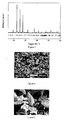
- FIG. 1 corresponds to the X-ray diffraction pattern ( ⁇ CuK ⁇ ) of the compound obtained according to Example 1, the vertical peaks corresponding to the Bragg positions calculated for the Pa-3 space group and for a mesh parameter of 23.636 Angstroms.
- the specific surface area of the compound obtained according to Example 1 is 7.4 m 2 / g ( ⁇ 0.1 m 2 / g).
- Figures 2 and 3 that the particles obtained are unagglomerated and flattened, with a diameter of about 5 .mu.m and a height of about 1 micron.
- a compound comprising only TiP 2 O 7 was produced by reaction in the solid state under air at a temperature of 1000 ° C. for 24 hours and from TiO 2 and NH 4 H 2 PO 4 .
- the compound obtained has a specific surface area of only 1.1 m 2 / g ( ⁇ 0.1 m 2 / g), which is insufficient to obtain good electrochemical performance due to poor conductivity.
- the pure TiP 2 O 7 particles are larger and more spherical than those obtained by the preparation process of Example 1.
- the figure 5 represents the crystallographic structure of TiP 2 O 7 .
- Titanium diphosphate TiP 2 O 7 has a disordered cubic structure resulting from a 3 ⁇ 3 ⁇ 3 type substructure.
- the structure is composed of diphosphate (P 2 O 7 ) 4- groups formed of PO 4 3- tetrahedra and linked to TiO 6 octahedra in an NaCl-type arrangement.
- the arrangement of the polyhedra is identical according to the three directions of space and is presented on the figure 5 in the plane (a, b), where a and b are the mesh parameters.
- a TiP 2 O 7 / C compound was made by mixing 1.801 grams of anatase TiO 2 with 5.185 grams of NH 4 H 2 PO 4 and 0.5 grams of cellulose in a Retsch planetary mill for 15 minutes. The rotation speed of the mill is 100 revolutions per minute, with an alternating direction of rotation. The crushing bowl, quartz and 50 cm 3 capacity , is filled in air and contains 15 quartz grinding beads of 10 mm in diameter and 1.4 grams each. The mixture is then treated at 700 ° C. under argon for 20 minutes in a closed quartz tube. A TiP 2 O 7 / C compound comprising 4.6% by weight of carbon was obtained.
- LiFePO 4 LiFe 0.9 Mg 0.1 PO 4 by a carbothermic reduction process (CTR process or "Carbothermal Reduction Method”).
- CTR process Carbothermal Reduction Method
- the process consists of mixing a precursor comprising the iron element under the oxidation state +3 (Fe (III) or Fe 3+ ), for example Fe 2 O 3 , with a precursor comprising the element lithium and PO 4 3- entity, for example LiH 2 PO 4 , and with carbon.
- the assembly is then subjected to a heat treatment carried out at a temperature of 750 ° C. for 8 hours.
- This process makes it possible to synthesize LiFePO 4 , reducing the Fe (III) element to Fe (II) and oxidizing the carbon to carbon monoxide (CO).
- the preparation method according to the invention has the advantage of carrying out the heat treatment at a relatively moderate temperature and preferably for a relatively short time. This avoids the formation of phosphides, as discussed in the patent application WO-2004/001881 where a LiFePO 4 / C composite is synthesized from an organic precursor comprising carbon.
- the preparation process according to the invention and in particular the fact of carrying out the synthesis of titanium diphosphate at a moderate temperature and for a relatively short time, reduce the crystalline growth of the TiP 2 O 7 particles.
- the particles of TiP 2 O 7 synthesized by the preparation method according to the invention are little or no agglomerated, they are free of impurities and especially they are small. This leads to an improvement in the ionic conductivity in comparison with the pure TiP 2 O 7 produced according to the prior art, since the diffusion of Li + ions in the TiP 2 O 7 grains is improved by means of shortcuts broadcast.
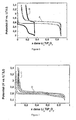
- curve A corresponds to the charge / discharge curve of the TiP 2 O 7 / C compound obtained according to example 2
- curve B corresponds to the charge / discharge curve of a TiP 2 O 7 compound obtained according to US Pat. prior art and as shown in the figure 4 .
- Both compounds were tested under identical conditions in a button-type lithium battery. It is found that the performances of the TiP 2 O 7 / C compound are clearly superior to those of the pure TiP 2 O 7 compound.
- the amount of lithium exchanged in the TiP 2 O 7 / C compound is in fact two times greater than that exchanged in the pure TiP 2 O 7 compound and the polarization is significantly lower in the TiP 2 O 7 / C compound. than that of the pure TiP 2 O 7 compound .
- the carbon being electronically conductive, its presence on the surface of TiP 2 O 7 particles in the compound according to the invention makes it possible to improve the electronic conductivity of TiP 2 O 7 .
- the compound TiP 2 O 7 / C is also a material capable of inserting and disinsulating, in its structure, the Li + ions.
- the reversible insertion and de-insertion reaction of lithium in the TiP 2 O 7 / C compound is schematically as follows: Ti IV P 2 O 7 / C + Li + + e - LiTi III P 2 O 7 / C
- the figure 7 illustrates the variation of the torque potential (Ti IV P 2 O 7 / C) / (LiTi III P 2 O 7 / C) with respect to the Li + / Li pair as a function of the proportion x of lithium inserted into the TiP 2 compound O 7 / C obtained according to Example 3, during load / discharge operations in intermittent galvanostatic mode, with a C / 20 speed and at 20 ° C and with open circuit periods of two hours.
- the curve C in solid line represents the charge / discharge curve of the compound obtained in intermittent galvanostatic mode while the dotted curve D represents the equilibrium curve and makes it possible to follow the potential in open circuit.
- the compound TiP 2 O 7 / C according to the invention has properties particularly suitable for its use as active material of a lithium battery electrode.
- the lithium insertion / de-insertion material it is desirable for the lithium insertion / de-insertion material to have as high a potential as possible relative to the Li + / Li pair, so as to obtain a material which can reversibly insert lithium over a high number of cycles.
- said potential must not be too high either, because in this type of accumulator, polymers which are unstable above 3.5 V with respect to the potential of the Li + / Li pair (polymers with polyethylene oxide base for example).
- a good compromise is, then, a material having an average potential of the order of 2.5V relative to the potential of the Li + / Li couple.
- vanadium oxides fulfill these requirements, but vanadium is a toxic element.
- the TiP 2 O 7 / C compound given its lithium insertion / de-insertion potential, is a material capable of replacing vanadium oxides. It also has the advantage of being nontoxic, stable in cycling and inexpensive.
- the active material of the negative electrode In Li / Ion type lithium batteries, the active material of the negative electrode must, in principle, have a lithium ion insertion potential that is not too high relative to the Li + / Li pair. Indeed, the potential delivered by the accumulator corresponds, in this case, to the potential difference between the respective active materials of the positive and negative electrodes. If the active material of the positive electrode has, for example, a material having a potential at 5V vs Li + / Li, it is preferable that the material The active electrode of the negative electrode has a potential lower than 3 V vs Li + / Li, which is the case of the compound TiP 2 O 7 / C.
- the pulverulent compound obtained also has the advantage of being able to be in the form of a film forming the electrode.
- the film may consist of a metal support forming a current collector and coated with at least TiP 2 O 7 / C. More particularly, the pulverulent TiP 2 O 7 / C compound may be mixed with an electronically conductive additive such as carbon black and / or with an organic binder such as polyether, polyester or a polymer based on methyl methacrylate. acrylonitrile, vinylidene hexafluoride ... so as to form a composite film which can then be deposited on the metal support, for example aluminum.
- lithium accumulators have been made, for example, using as active material of an electrode, the compound TiP 2 O 7 / C according to the invention.
- Such a lithium battery has been tested in intensiostatic mode at 20 ° C and 55 ° C under a C / 10 regime ( Figures 8 and 9 ). Although the electrochemical performance at 20 ° C is satisfactory, raising the temperature to 55 ° C provides even more improved performance. The polarization is extremely low and the cycling performance of the capacitance is not affected by the rise in temperature. At 20 ° C and 55 ° C, the capacity is stable in cycling and faradic efficiency is excellent. Under a C / 10 regime, the lithium battery delivers a capacity of 110 mAh / g perfectly stable in prolonged cycling.
- a lithium battery of Li / Metal type and "button cell” type was made with the same negative electrode and the same impregnated separator as those made in Example A above.
- the positive electrode consists of a disc 14 mm in diameter and is deposited on an aluminum current collector, 20 .mu.m thick.
- the disk is taken from a 50 ⁇ m thick composite film comprising 80% by weight of the TiP 2 O 7 / C compound as prepared according to Example 3, 10% by weight of carbon black and 10% by weight of carbon dioxide. polyvinylidene hexafluoride.
- the lithium battery thus produced delivers a relatively stable capacity over more than 600 cycles. It appears that in intensiostatic cycling, the capacity drops slightly during the first cycles and then stabilizes perfectly. More than 600 cycles are, for example, obtained under a C / 2 regime, with a capacity loss of less than 4%.
- the compound TiP 2 O 7 / C is stable in prolonged cycling and the reactivity with respect to the electrolyte, particularly with respect to the cycling potential, is almost non-existent, which implies that there is no degradation electrolyte or said compound.
- a Li / Ion lithium battery was made from a negative electrode comprising the compound TiP 2 O 7 / C according to Example 2, a positive electrode comprising the compound LiNi 0.5 Mn 1.5 O 4 and a separator such as that sold under the name Celgard 2400 and impregnated with a liquid electrolyte based on LiPF 6 salt (1 mol / L) in solution in a mixture of propylene carbonate, dimethyl carbonate and sodium carbonate. 'ethylene.
- Each of the electrodes consists of a mixture formed by 80% by weight of active material (TiP 2 O 7 / C for the negative electrode and LiNi 0.5 Mn 1.5 O 4 for the positive electrode), 5% mass of carbon black, 5% by weight of carbon fibers and 10% by weight of polyvinylidene hexafluoride. Such a mixture is deposited on an aluminum current collector.
- the accumulator thus produced allows the exchange of nearly one mole of Li + ions per mole of TiP 2 O 7 , in the range of potential 0.9-2.4 volts relative to the system.
- TiP 2 O 7 / LiTiP 2 O 7 The average potential of such a battery is about 2.05-2.10 volts.
- the liquid electrolyte used in Examples A to C can be replaced by any type of known electrolyte. It may, for example, consist of a salt comprising at least the Li + ion.
- the salt may, for example, be selected from LiClO 4 , LiAsF 6 , LiPF 6 , LiBF 4 , LiR F SO 3 , LiCH 3 SO 3 , LiN (R F SO 2 ) 2 , LiC (R F SO 2 ) 2 , LiTFSI, LiBOB, LiBETI.
- R F is selected from a fluorine atom and a perfluoroalkyl group having from 1 to 8 carbon atoms.
- LiTFSI is the acronym for lithium trifluoromethanesulphonylimide
- LiBOB is the acronym for lithium bis (oxalato) borate
- LiBETI is lithium bis (perfluoroethylsulfonyl) imide.
- the salt is preferably dissolved in an aprotic polar solvent, such as diethylene carbonate, propylene carbonate, dimethyl carbonate, diethyl carbonate, ethylmethyl carbonate ... and it can be supported by a separating element disposed between the two electrodes of the accumulator.
- the salt is not dissolved in an organic solvent but in a solid polymer conducting Li + ions, such as polyethylene oxide (POE), polyacrylonitrile (PAN ), polymethyl methacrylate (PMMA), polyvinylidene fluoride (PVdF) or a derivative thereof.
- a solid polymer conducting Li + ions such as polyethylene oxide (POE), polyacrylonitrile (PAN ), polymethyl methacrylate (PMMA), polyvinylidene fluoride (PVdF) or a derivative thereof.
Landscapes
- Chemical & Material Sciences (AREA)
- Chemical Kinetics & Catalysis (AREA)
- Electrochemistry (AREA)
- General Chemical & Material Sciences (AREA)
- Composite Materials (AREA)
- Crystallography & Structural Chemistry (AREA)
- Inorganic Chemistry (AREA)
- Battery Electrode And Active Subsutance (AREA)
Description
- L'invention concerne un composé comprenant du disphosphate de titane et du carbone, un procédé de préparation et l'utilisation d'un tel composé.
- Les accumulateurs au lithium ont tendance à remplacer des accumulateurs nickel-cadmium (Ni-Cd) ou nickel-hydrure métallique (Ni-MH) comme source d'énergie autonome, en particulier dans les équipements portables. En effet, les performances et plus particulièrement la densité d'énergie massique des accumulateurs au lithium sont supérieures à celles des accumulateurs Ni-Cd et Ni-MH.
- Les accumulateurs au lithium reposent sur le principe d'insertion et de désinsertion de cations Li+ dans au moins un matériau actif d'une électrode.
- L'électrode négative des accumulateurs au lithium peut être génératrice d'ions Li+ ou bien elle peut comporter un matériau actif d'intercalation du lithium. Le choix du matériau formant l'électrode négative permet de classer les accumulateurs au lithium en deux grandes catégories d'accumulateurs au lithium : les systèmes Li-Ion, avec un électrolyte liquide ou solide (de type polymère), et les systèmes Li-Métal comprenant une électrode négative en lithium métallique et généralement un électrolyte polymère. Ainsi, le matériau actif de l'électrode négative peut être choisi parmi du lithium métallique, un alliage de lithium, un mélange nanométrique d'un alliage de lithium dans un oxyde de lithium, un nitrure de lithium et de métal de transition ou bien parmi un matériau d'intercalation ou d'insertion du lithium tel que du carbone sous forme graphite ou un matériau de structure spinelle de type Li4Ti5O12.
- L'électrode positive comporte quant à elle au moins un matériau capable d'insérer, de manière réversible, un certain nombre de cations Li+ dans sa structure, un tel matériau étant également appelé matériau d'intercalation du lithium.
- Depuis l'émergence des accumulateurs au lithium, plusieurs générations de matériaux d'intercalation du lithium et notamment de matériaux actifs d'électrodes positives ont successivement fait leur apparition.
- On connaît, en effet, les oxydes de lithium et de métal de transition tels que les oxydes de structure lamellaire comme LiCoO2 et LiNiO2 et tels que les oxydes de structure spinelle comme LiMn2O4. Les capacités massiques théoriques et pratiques de ces composés, pour une tension de fonctionnement par rapport au lithium métallique de l'ordre de 4 Volts, sont respectivement de 275 mAh/g et 140 mAh/g pour LiCoO2 et LiNiO2 et de 148 mAh/g et 120 mAh/g pour LiMn2O4.
- Le concept d'insertion et de désinsertion du lithium dans les matériaux d'électrodes et depuis les matériaux d'électrodes a été étendu, il y a quelques années, aux structures tridimensionnelles construites à partir d'entités polyanioniques de type XOn m-, avec X = P, S, Mo, W...
- Ainsi, pour augmenter le potentiel d'insertion des matériaux actifs de l'électrode positive, il a été proposé de remplacer les oxydes de lithium et de métal de transition par des matériaux ayant une structure isotype de l'olivine, par exemple LiMPO4 ou bien par des matériaux ayant une structure de type NASICON, par exemple LixM2(PO4)3, M étant un métal (brevet américain
US5910382 ). Ce type de matériaux présente, en effet, l'avantage d'être non seulement moins coûteux mais également plus stable à l'état chargé et en présence de l'électrolyte, que les oxydes de lithium et de métal de transition usuellement utilisés. De plus, les matériaux ayant une structure isotype de l'olivine ou de type NASICON sont non toxiques. Le phosphate de fer lithié LiFePO4 est, par exemple, un composé de plus en plus utilisé pour former un composé actif d'électrode positive, notamment dans des domaines en développement tels que le domaine de l'automobile hybride. LiFePO4 présente une capacité spécifique théorique de 170 mAh/g pour un potentiel de fonctionnement de 3,4 Volts par rapport au potentiel du couple Li/Li+. - Récemment, certaines études ont porté sur les capacités d'insertion et de désinsertion du lithium dans des composés à base de diphosphates. A titre d'exemple, dans l'article « Lithium Insertion/Extraction into/from LiMX2O7 compositions (M=Fe, V ; X = P, As) prepared via a solution method » (Chem. Mater. 2002, 14, 2701-2710), C. Wurm et al. ont évalué le potentiel en tant que matériaux actifs d'électrode dans des batteries rechargeables au lithium des composés LiFeP2O7, LiFeAs2O7 et LiVP2O7. Les composés sont préparés en mélangeant des précurseurs solubles dans de l'eau déminéralisée puis en réalisant une lente évaporation sous agitation continue jusqu'à ce que le mélange soit sec. Le mélange sec subit ensuite un traitement thermique à une température comprise entre 300°C et 800°C.
- Des études portant sur l'utilisation du disphosphate de titane (TiP2O7) comme matériau actif d'électrode ont également été réalisées. Ainsi, S. Patoux et al., dans leur article « Lithium Insertion into Titanium Phosphates, Silicates and Sulfates ») Chem Mater. 2002, 14, 5057-5068) ont étudié l'utilisation de silicates, de sulfates et de phosphates comportant du titane dans un état d'oxydation +4, comme matériaux actifs d'électrode positive dans des accumulateurs au lithium. Ils ont trouvé que TiP2O7 pouvait être un matériau d'électrode positive intéressant pour des batteries au lithium de type Li-Métal, comprenant un électrolyte polymère et une électrode négative en lithium, avec une tension de fonctionnement de 2,5-2,6 Volts. En effet, les accumulateurs au lithium de type Li-Métal présentent l'avantage d'avoir une électrode négative en lithium métallique. Le matériau actif de l'électrode positive n'a donc pas besoin d'être initialement lithié. Dans ce cas, les ions Li+ sont initialement apportés par l'électrode négative et s'insèrent dans l'électrode positive au cours de la première décharge de l'accumulateur au lithium. Le processus électrochimique est parfaitement réversible dans les accumulateurs de type Li-Métal car les ions Li+ peuvent circuler de l'électrode négative vers l'électrode positive et vice-versa.
- Dans l'article « Synthesis and characterization of mesoporous titanium pyrophosphate as lithium intercalation elecrtode materials » (Microporous and Mesoporous Materials 88 (2006) 232-237), Zhincong Shi et al. ont étudié la synthèse et la caractérisation de TiP2O7 mésoporeux, par un procédé sol-gel, puis par calcination.
- Cependant, dans l'article « Cathode properties of pyrophosphates for rechargeable lithium batteries » (Solide State lonics 148 (2002) 323-328), Y. Uebou et al. montrent que, dans le diphosphate de titane (TiP2O7), seulement 0,6 Li par unité peut être inséré dans TiP2O7 à un potentiel de 2,6 V par rapport au potentiel du couple Li/Li+ (2,6 V vs Li/Li+). Le composé TiP2O7 a été synthétisé par réaction à l'état solide, à une température de l'ordre de 700°C, pendant une période de 12 à 24 heures et sous air. Un tel composé présente, donc, une faible conductivité électronique intrinsèque, ce qui limite la cinétique d'insertion et d'extraction du lithium au sein de la structure et l'utilisation de ces composés à des régimes de charge et de décharge relativement faibles.
- De plus, les phosphates en général et plus particulièrement les diphosphates, présentent l'inconvénient d'être isolants d'un point de vue électronique.
- Pour améliorer la conductivité électronique du matériau formant une électrode positive, il est connu de mélanger intimement le composé à base de phosphate avec du carbone. Ainsi, dans l'article « Lithium Insertion/Extraction into/from LiMX2O7 compositions (M=Fe, V ; X = P, As) prepared via a solution method » de C. Wurm et al., les composés LiFeP2O7, LiFeAs2O7 et LiVP2O7, une fois synthétisés, sont chacun broyés avec du carbone, de manière à améliorer l'activité électrochimique du composé actif d'une électrode positive. Le composé actif présente, cependant, l'inconvénient d'être sous une forme pulvérulente.
- Un procédé similaire est également décrit dans le document
WO-02/099913 - De même, dans l'article de S. Patoux et al. (« Lithium Insertion into Titanium Phosphates, Silicates and Sulfates » Chem Mater. 2002, 14, 5057-5068), une fois synthétisé, le composé TiP2O7 est broyé dans un broyeur à billes avec 16,67 % en masse de noir de carbone, avant d'être utilisé sous forme pulvérulente comme électrode positive. Une telle électrode positive présente l'inconvénient d'être sous forme pulvérulente. Or, un tel procédé de fabrication d'une électrode positive peut être utilisé en laboratoire, mais il n'est pas possible de fabriquer une telle électrode de manière industrielle. En effet, des électrodes positives sous forme de poudre sont peu pratiques à mettre en oeuvre dans des accumulateurs au lithium fabriqués en série et leur procédé de fabrication nécessite deux étapes successives, respectivement de synthèse et de broyage.
- Pour d'autres matériaux actifs et notamment LiFePO4, il a été proposé de revêtir la surface de certains matériaux par du carbone ou par un matériau carboné. Dans la demande de brevet
WO-A-2004/001881 , il est, ainsi, proposé de synthétiser des poudres, par exemple en LiFePO4, recouvertes de carbone, en préparant une solution aqueuse contenant des sources de Lithium, de fer et de phosphates et des composés monomères comprenant du carbone, puis en réalisant une évaporation de l'eau et un traitement thermique en atmosphère réductrice. De même, la demande de brevetEP-A-1049182 propose aussi diverses méthodes pour revêtir par voie chimique des matériaux d'électrodes et notamment LiFePO4, par un revêtement uniforme de matériau carboné conducteur. Par ailleurs, dans les articles « A carbothermal reduction method for the prepartion of electroactive materials for lithium Ion Applications » (Journal of the Electrochemical Society, 150(6) A684-A688 (2003)) et « Lithium Iron(II) Phospho-olivines prepared by a novel carbothermal réduction method » (Electrochemical and Solid State Letters, 6 (3) A53-A55 (2003)) J Barker et al. proposent une voie de synthèse par réduction carbothermique pour les composés LiFePO4 ou LiFe0,9Mg0,1PO4 et LiV2O5 ou Li3V2(PO4)3, selon laquelle du carbone est mélangé intimement à des composés précurseurs et le mélange est chauffé dans une atmosphère inerte, afin que le carbone réduise le métal de transition de l'un des composés précurseurs pour former le composé souhaité. - L'invention a pour but un composé présentant des propriétés adaptées à son utilisation comme matériau actif d'une électrode pour accumulateur au lithium.
- Selon l'invention, ce but est atteint par les revendications annexées.
- D'autres avantages et caractéristiques ressortiront plus clairement de la description qui va suivre de modes particuliers de réalisation de l'invention donnés à titre d'exemples non limitatifs et représentés aux dessins annexés, dans lesquels :
- La
figure 1 représente un diagramme de diffraction des rayons X (λCuKα) d'un composé particulier selon l'invention comportant TiP2O7 et 4,4% en masse de C. - Les
figures 2 et 3 représentent deux clichés obtenus par microscopie électronique à balayage (MEB) d'un composé particulier selon l'invention, comportant TiP2O7 avec 4,4% en masse de C, respectivement à des agrandissements de 267x et de 10000x. - La
figure 4 représente un cliché obtenu par microscopie électronique à balayage (MEB) de TiP2O7, à un agrandissement de 346x. - La
figure 5 représente la structure cristalline de TiP2O7 dans le plan (a, b). - La
figure 6 représente les courbes intentiostatiques, à 20°C, du premier cycle de charge/décharge, à un régime de C/10 de deux composés, respectivement en TiP2O7 (courbe A) et en TiP2O7 avec 7,7% en masse de C (courbe B). - La
figure 7 représente une courbe de charge/décharge en mode galvanostatique intermittent (régime de C/20, 20°C) avec des périodes en circuit ouvert de deux heures, sur laquelle est reportée l'évolution du potentiel par rapport au couple Li+/Li en fonction de la proportion x de lithium insérée dans un composé selon l'invention comprenant TiP2O7 avec 6,6% en masse de C. - La
figure 8 représente les premiers cycles de charge/décharge en mode intentiostatique, à 20°C et à 55°C, d'une électrode à base d'un composé comprenant TiP2O7 avec 6,6% en masse de C, tandis que lafigure 9 représente l'évolution de la capacité spécifique d'une telle électrode en fonction du nombre de cycles. - La
figure 10 représente l'évolution de la capacité de charge par rapport à la capacité de charge du premier cycle en fonction du nombre de cycles (régime de cyclage intentiostatique : C/10 et C/2, avec une température de cyclage de 20°C) pour un composé TiP2O7 avec 6,6% en masse de C. - Selon l'invention, un composé comprenant du disphosphate de titane TiP2O7 et du carbone présente des propriétés adaptées à son utilisation comme matériau actif d'une électrode pour accumulateur au lithium. Un tel composé est, plus particulièrement, un matériau composite dans lequel TiP2O7 et le carbone sont intimement liés, de sorte que le carbone recouvre au moins en partie la surface des particules de TiP2O7.
- Ainsi, le composé est sous forme de particules non agglomérées de disphosphate de titane, dont la surface est au moins en partie recouverte de carbone. De plus, les particules du composé sont, de préférence, des particules aplanies ayant une longueur moyenne comprise entre 5 et 10 micromètres et une hauteur moyenne comprise entre 0,2 et 1 micromètre.
- Le composé comporte, de préférence, entre 0,1% et 30% en masse de carbone et plus particulièrement entre 4% et 8% en masse de carbone et la surface spécifique du composé est, de préférence, supérieure ou égale à 6m2/g et, préférentiellement comprise entre 6m2/g et 14m2/g.
- Un tel composé est, plus particulièrement, obtenu par un procédé de préparation comportant successivement :
- le mélange d'au moins un premier précurseur comportant l'élément titane avec un degré d'oxydation +4, un second précurseur à base de phosphore et un précurseur organique contenant l'élément carbone,
- et le traitement thermique du mélange obtenu, à une température comprise entre 500°C et 800°C, sous atmosphère inerte. Le traitement thermique provoque alors la synthèse du diphosphate de titane et la formation, sur au moins une partie de la surface des particules de diphosphate de titane, de carbone par décomposition du précurseur organique.
- Le précurseur organique est un composé organique apte à se décomposer pour former au moins du carbone pendant l'étape de traitement thermique. Il est, de préférence, choisi parmi les carbohydrates tels que l'amidon, la cellulose et leurs dérivés, par exemple la carboxyméthylcellulose, l'hydroxypropylméthylcellulose, l'acétate de cellulose...
- Le précurseur organique est mélangé avec des précurseurs du diphosphate de titane de manière à former in situ, c'est-à-dire au cours de la synthèse du diphosphate de titane, du carbone recouvrant au moins en partie les particules de diphosphate de titane synthétisées. La décomposition du précurseur organique correspond à une calcination en atmosphère inerte, permettant de former du carbone et de libérer divers gaz tels que CO, CO2, des aldéhydes...
- Le mélange des précurseurs du diphosphate de titane avec le précurseur organique peut être de tout type. Il peut, par exemple, être réalisé par mélange à sec, par exemple par mécanosynthèse ou par broyage au mortier. Il peut également être réalisé dans un solvant (par exemple de l'hexane, de l'heptane...). Le solvant est alors évaporé à température ambiante avant que le mélange ne subisse le traitement thermique.
- Les précurseurs du diphosphate de titane sont formés par un premier précurseur comportant l'élément titane avec un degré d'oxydation +4 et par un second précurseur à base de phosphore. Leurs proportions sont, de préférence, stoechiométriques dans le mélange avec le précurseur organique. La proportion en précurseur organique dans le mélange est quant à elle variable. Le premier précurseur peut être choisi parmi l'oxyde de titane et le tétrachlorure de titane et le second précurseur peut être choisi parmi l'acide phosphorique H3PO4, l'hydrogénophosphate d'ammonium (NH4)2HPO4 et le dihydrogénophosphate d'ammonium (NH4)H2PO4.
- L'étape de traitement thermique est réalisée sous atmosphère de gaz.inerte, tel que l'argon ou l'azote, à une température comprise entre 500°C et 800°C et, de préférence, entre 580°C et 680°C. Le choix de la température est, plus particulièrement déterminé par le précurseur organique utilisé et par le taux de carbone désiré dans le composé obtenu. Le traitement thermique doit être réalisé à une température inférieure ou égale à 800°C, de manière à éviter la réduction partielle ou totale des ions Ti4+ en ions Ti3+ ou la formation de phosphures de titane (TiPx). La durée de l'étape de traitement thermique est relativement courte. Elle est, de préférence, comprise entre 15 minutes et 45 minutes. A titre d'exemple, l'étape de traitement thermique est réalisée par une montée en température choisie entre 580°C et 800°C. Ainsi, il a été constaté que le composé TiP2O7/C est synthétisé à 600°C, après seulement une dizaine de minutes de traitement. Il a également été constaté que plus la température, choisie entre 580°C et 800°C, est élevée, plus le précurseur organique se décompose et plus le carbone est conducteur. En revanche, plus la température est élevée, plus la taille des grains du composé TiP2O7/C augmente. La détermination de la température du traitement thermique correspond donc à un compromis entre les propriétés de conduction du carbone et la taille des grains.
- Plusieurs composés de type TiP2O7/C ont été réalisés, à titre d'exemples, par un procédé de préparation selon l'invention.
- Un composé TiP2O7/C a été réalisé en mélangeant 10,805 grammes de TiO2 de forme anatase avec 31,110 grammes de NH4H2PO4 et 3 grammes de cellulose dans un broyeur de type Retsch pendant cinq heures. La vitesse de rotation du broyeur est de 500 tours par minute, avec un sens de rotation alterné. Le bol de broyage, en quartz et de 250 cm3 de contenance, est rempli sous air et il contient 13 billes de broyage en quartz de 20 mm de diamètre et de 10,8 grammes chacune. Le mélange est ensuite traité à 700°C, sous argon, pendant 30 minutes, dans un tube en quartz fermé.
- A la fin du traitement thermique, un composé TiP2O7/C comportant 4,4% en masse de carbone est obtenu. La
figure 1 correspond au diagramme de diffraction des rayons X (λCuKα) du composé obtenu selon l'exemple 1, les pics verticaux correspondant aux positions de Bragg calculées pour le groupe d'espace Pa-3 et pour un paramètre de maille de 23,636 Angströms. La surface spécifique du composé obtenu selon l'exemple 1 est de 7,4 m2/g (±0,1 m2/g). On observe, par ailleurs, sur lesfigures 2 et 3 , que les particules obtenues sont non agglomérées et aplanies, avec un diamètre d'environ 5µm et une hauteur d'environ 1 µm. - A titre de comparaison, un composé comportant uniquement TiP2O7 a été réalisé par réaction à l'état de solide, sous air, à une température de 1000°C, pendant 24 heures et à partir de TiO2 et NH4H2PO4. Le composé obtenu présente une surface spécifique de seulement 1,1 m2/g (±0,1 m2/g), ce qui est insuffisant pour obtenir des bonnes performances électrochimiques du fait de la mauvaise conductivité. Sur la
figure 4 , on observe également que les particules de TiP2O7 pur sont plus grosses et plus sphériques que celles obtenues par le procédé de préparation de l'exemple 1. - A titre d'information, la
figure 5 représente la structure cristallographique de TiP2O7. Le diphosphate de titane TiP2O7 présente une structure cubique désordonnée résultant d'une sur-structure de type 3x3x3. Ainsi, la structure est composée de groupements diphosphate (P2O7)4- formés de tétraèdres PO4 3- et liés à des octaèdres TiO6 selon un arrangement de type NaCl. La disposition des polyèdres est identique suivant les trois directions de l'espace et elle est présentée, sur lafigure 5 , dans le plan (a, b), a et b étant les paramètres de maille. - 27,013 grammes de TiO2 de forme anatase et 77,775 grammes de NH4H2PO4 sont broyés manuellement au mortier avec 7,5 grammes de cellulose et 20 mL d'hexane. Après évaporation de l'hexane, à température ambiante sous une hotte, le mélange est ensuite traité à 600°C, sous argon, pendant 40 minutes, dans un tube en acier inoxydable fermé. Le composé obtenu est un composite TiP2O7/C, comportant 5,2% en masse de carbone.
- 10,805 grammes de TiO2 de forme anatase et 31,110 grammes de NH4H2PO4 sont mélangés avec 3,3 grammes d'hydroxypropylméthylcellulose dans un broyeur planétaire de type Fritsch pendant une heure. La vitesse de rotation du broyeur est de 200 tours par minute, avec un sens de rotation alterné. Le bol de broyage, en carbure de tungstène et de 250 cm3 de contenance, est rempli sous air et il contient 10 billes de broyage en carbure de tungstène de 20 mm de diamètre et de 62,4 grammes chacune. Le mélange est ensuite traité à 650°C, sous argon, pendant 15 minutes, dans un tube en quartz fermé. Un composé TiP2O7/C comportant 6,6% en masse de carbone a été obtenu.
- Un composé TiP2O7/C a été réalisé en mélangeant 1,801 grammes de TiO2 de forme anatase avec 5,185 grammes de NH4H2PO4 et 0,5 grammes de cellulose dans un broyeur planétaire de type Retsch pendant 15 minutes. La vitesse de rotation du broyeur est de 100 tours par minutes, avec un sens de rotation alterné. Le bol de broyage, en quartz et de 50 cm3 de contenance, est rempli sous air et il contient 15 billes de broyage en quartz de 10 mm de diamètre et de 1,4 grammes chacune. Le mélange est ensuite traité à 700°C, sous argon, pendant 20 minutes dans un tube en quartz fermé. Un composé TiP2O7/C comportant 4,6% en masse de carbone a été obtenu.
- On constate donc que le fait de mélanger un composé organique comprenant du carbone avec un précurseur comprenant l'élément titane dans un degré d'oxydation +4, et le fait de réaliser le traitement thermique à une température comprise entre 500°C et 800°C permet, de manière inattendue et rapide, de synthétiser TiP2O7. Cela permet donc de conserver l'élément titane dans un état d'oxydation +4, ce qui est particulièrement surprenant dans la mesure où le carbone est connu pour agir comme un réducteur de l'élément de transition présent dans l'un des précurseurs. C'est notamment le cas avec LiFePO4. Ainsi, l'article de J. Barker et al. (« Lithium Iron(II) Phospho-olivines Prepared by a Novel Carbothermal Reduction Method », Electrochemical and Solid-State Letters, 6 (3), A53-A55 (2003)) décrit la préparation de LiFePO4 et de LiFe0,9Mg0,1PO4 par un procédé de réduction carbothermique (procédé CTR ou « Carbothermal Reduction Method »). Pour LiFePO4, le procédé consiste à mélanger un précurseur comportant l'élément fer sous l'état d'oxydation +3 (Fe(III) ou Fe3+), par exemple Fe2O3, avec un précurseur comportant l'élément lithium et l'entité PO4 3-, par exemple LiH2PO4, et avec du carbone. L'ensemble est, ensuite, soumis à un traitement thermique réalisé à une température de 750°C pendant 8 heures. Ce procédé permet de synthétiser LiFePO4, en réduisant l'élément Fe(III) en Fe(II) et en oxydant le carbone en monoxyde de carbone (CO).
- Par ailleurs, le procédé de préparation selon l'invention présente l'avantage de réaliser le traitement thermique à une température relativement modérée et, de préférence pendant un temps relativement court. Ceci évite la formation de phosphures, comme cela est discuté dans la demande de brevet
WO-A-2004/001881 où un composite LiFePO4/C est synthétisé à partir d'un précurseur organique comprenant du carbone. - De plus, le procédé de préparation selon l'invention, et notamment le fait de réaliser la synthèse du diphosphate de titane à une température modérée et pendant un temps relativement court, permettent de réduire la croissance cristalline des particules de TiP2O7. En effet, les particules de TiP2O7 synthétisées par le procédé de préparation selon l'invention sont peu ou pas agglomérées, elles sont exemptes d'impuretés et surtout elles sont de petite taille. Ceci conduit à une amélioration de la conductivité ionique en comparaison au TiP2O7 pur réalisé selon l'art antérieur, puisque la diffusion des ions Li+ au coeur des grains TiP2O7 est améliorée par des chemins de diffusion raccourcis. Sur la
figure 6 , la courbe A correspond à la courbe de charge/décharge du composé TiP2O7/C obtenu selon l'exemple 2 tandis que la courbe B correspond à la courbe de charge/décharge d'un composé TiP2O7 obtenu selon l'art antérieur et tel que représenté sur lafigure 4 . Les deux composés ont été testés dans des conditions identiques, dans un accumulateur au lithium de type « pile bouton ». On constate que les performances du composé TiP2O7/C sont nettement supérieures à celles du composé pur de TiP2O7. La quantité de lithium échangée dans le composé TiP2O7/C est, en effet, deux fois supérieure à celle échangée dans le composé pur de TiP2O7 et la polarisation est nettement plus faible dans le composé TiP2O7/C que dans celle du composé pur TiP2O7. - De plus, le carbone étant conducteur électronique, sa présence à la surface des particules de TiP2O7 dans le composé selon l'invention permet d'améliorer la conductivité électronique de TiP2O7.
- Le composé TiP2O7/C est également un matériau capable d'insérer et de désinsérer, dans sa structure, les ions Li+. Ainsi, lors du fonctionnement d'un accumulateur au lithium, la réaction réversible d'insertion et de désinsertion du lithium dans le composé TiP2O7/C est schématiquement la suivante :
TiIVP2O7/C + Li+ + e- ⇔ LiTiIIIP2O7/C
- La
figure 7 illustre la variation du potentiel du couple (TiIVP2O7/C)/(LiTiIIIP2O7/C) par rapport au couple Li+/Li en fonction de la proportion x de lithium insérée dans le composé TiP2O7/C obtenu selon l'exemple 3, pendant des opérations de charge/décharge en mode galvanostatique intermittent, avec un régime C/20 et à 20°C et avec des périodes de circuit ouvert de deux heures. La courbe C en trait continu représente la courbe de charge/décharge du composé obtenu en mode galvanostatique intermittent tandis que la courbe D en pointillés représente la courbe à l'équilibre et permet de suivre le potentiel en circuit ouvert. On constate, ainsi, que la réaction d'insertion (/désinsertion) du lithium dans (/depuis) le composé TiP2O7/C s'effectue à 2,62-2,55 V par rapport au couple Li+/Li. On constate ainsi que la polarisation correspondant à la résistance interne de ce système est relativement faible. - Ainsi, le composé TiP2O7/C selon l'invention présente des propriétés particulièrement adaptées pour son utilisation comme matériau actif d'une électrode pour accumulateur au lithium.
- En effet, pour les accumulateurs au lithium de type Li-Métal, il est souhaitable que le matériau d'insertion/désinsertion du lithium ait un potentiel le plus élevé possible par rapport au couple Li+/Li, de manière à obtenir un matériau pouvant insérer de façon réversible le lithium sur un nombre de cycles élevé. Cependant, ledit potentiel ne doit pas être trop élevé non plus, car on utilise généralement, dans ce type d'accumulateur, des polymères qui sont instables au-delà de 3,5V par rapport au potentiel du couple Li+/Li (polymères à base de polyoxyde d'éthylène par exemple). Un bon compromis est, alors, un matériau possédant un potentiel moyen de l'ordre de 2,5V par rapport au potentiel du couple Li+/Li. Les oxydes de vanadium remplissent, par exemple, ces exigences, mais le vanadium est un élément toxique. Ainsi, le composé TiP2O7/C, compte tenu de son potentiel d'insertion/désinsertion du lithium, est un matériau capable de remplacer les oxydes de vanadium. Il présente également l'avantage d'être non toxique, stable en cyclage et d'être peu coûteux.
- Dans les accumulateurs au lithium de type Li/Ion, le matériau actif de l'électrode négative doit, en principe, présenter un potentiel d'insertion des ions lithium pas trop élevé par rapport au couple Li+/Li. En effet, le potentiel délivré par l'accumulateur correspond, dans ce cas, à la différence de potentiel entre les matériaux actifs respectifs des électrodes positive et négative. Si le matériau actif de l'électrode positive a, par exemple, un matériau ayant un potentiel à 5V vs Li+/Li, il est préférable que le matériau actif de l'électrode négative possède un potentiel inférieur à 3 V vs Li+/Li, ce qui est le cas du composé TiP2O7/C.
- Il est également possible, grâce à ce composé, d'augmenter la température d'utilisation des accumulateurs au lithium employant un tel composé, ce qui le rend particulièrement adapté aux accumulateurs au lithium de type Li/Métal et comportant un électrolyte polymère. La température de fonctionnement d'un tel accumulateur est, en effet, d'au moins 60°C.
- De plus, le composé pulvérulent obtenu présente également l'avantage de pouvoir être mis sous la forme d'un film formant l'électrode. Le film peut être constitué d'un support métallique formant un collecteur de courant et enduit par au moins TiP2O7/C. Plus particulièrement, le composé pulvérulent TiP2O7/C peut être mélangé à un additif conducteur électronique tel que du noir de carbone et/ou à un liant organique tel que le polyéther, le polyester, un polymère à base de méthacrylate de méthyle, l'acrylonitrile, le hexafluorure de vinylidène... de manière à former un film composite qui peut ensuite être déposé sur le support métallique, par exemple en aluminium.
- Plusieurs accumulateurs au lithium ont été réalisés, à titre d'exemple, en utilisant comme matériau actif d'une électrode, le composé TiP2O7/C selon l'invention.
- Un accumulateur au lithium de type Li/Métal et de forme « pile bouton » a été réalisé avec :
- une électrode négative en lithium, de 16 mm de diamètre et de 130 µm d'épaisseur, ladite électrode étant déposée sur un disque en nickel servant de collecteur de courant,
- une électrode positive constituée d'un disque de 14 mm de diamètre, ladite électrode étant déposée sur un collecteur de courant en aluminium, de 20µm d'épaisseur. Le disque est prélevé dans un film composite de 25 µm d'épaisseur comprenant 80% en masse du composé TiP2O7/C tel que préparé selon l'exemple 1, 10% en masse de noir de carbone et 10% en masse d'hexafluorure de polyvinylidène.
- un séparateur imbibé d'un électrolyte liquide à base du sel LiPF6 (1mol/L) en solution dans un mélange de carbonate d'éthylène et de carbonate de diméthyle.
- Un tel accumulateur au lithium a été testé en mode intensiostatique à 20°C et à 55°C, sous un régime C/10 (
figures 8 et 9 ). Bien que les performances électrochimiques à 20°C soient satisfaisantes, l'élévation de la température à 55°C permet d'obtenir des performances plus améliorées encore. La polarisation est extrêmement faible et la tenue en cyclage de la capacité n'est pas altérée par l'élévation de température. A 20°C et à 55°C, la capacité est stable en cyclage et le rendement faradique est excellent. Sous un régime de C/10, l'accumulateur au lithium délivre une capacité de 110 mAh/g parfaitement stable en cyclage prolongé. - Un accumulateur au lithium de type Li/Métal et de forme « pile bouton » a été réalisé avec la même électrode négative et le même séparateur imbibé que ceux réalisés dans l'exemple A ci-dessus.
- L'électrode positive est constituée d'un disque de 14 mm de diamètre et elle est déposée sur un collecteur de courant en aluminium, de 20µm d'épaisseur. Le disque est prélevé dans un film composite de 50 µm d'épaisseur comprenant 80% en masse du composé TiP2O7/C tel que préparé selon l'exemple 3, 10% en masse de noir de carbone et 10% en masse d'hexafluorure de polyvinylidène.
- Comme représenté sur la
figure 10 , à 20°C, sous un régime de C/2, l'accumulateur au lithium ainsi réalisé délivre une capacité relativement stable sur plus de 600 cycles. Il apparaît qu'en cyclage intensiostatique, la capacité chute légèrement au cours des premiers cycles puis se stabilise parfaitement. Plus de 600 cycles sont, par exemple, obtenus sous un régime C/2, avec une perte de capacité inférieure à 4%. Ainsi, le composé TiP2O7/C est stable en cyclage prolongé et la réactivité par rapport à l'électrolyte, notamment par rapport au potentiel de cyclage, est quasi inexistante, ce qui implique qu'il n'y a pas de dégradation de l'électrolyte ou dudit composé. - Un accumulateur au lithium de type Li/Ion a été réalisé à partir d'une électrode négative comprenant le composé TiP2O7/C selon l'exemple 2, d'une électrode positive comprenant le composé LiNi0,5Mn1,5O4 et un séparateur tel que celui commercialisé sous le nom Celgard 2400 et imbibé d'un électrolyte liquide à base du sel LiPF6 (1mol/L) en solution dans un mélange de carbonate de propylène, de carbonate de diméthyle et de carbonate d'éthylène. Chacune des électrodes est constituée d'un mélange formé par 80% en masse de matériau actif (TiP2O7/C pour l'électrode négative et LiNi0,5Mn1,5O4 pour l'électrode positive), 5% en masse de noir de carbone, 5% en masse de fibres de carbone et 10% en masse d'hexafluorure de polyvinylidène. Un tel mélange est déposé sur un collecteur de courant en aluminium.
- A 25°C, l'accumulateur ainsi réalisé permet l'échange de près d'une mole d'ions Li+ par mole de TiP2O7, dans le domaine de potentiel 0,9-2,4 Volts par rapport au système TiP2O7/ LiTiP2O7. Le potentiel moyen d'un tel accumulateur est d'environ 2,05-2,10 Volts.
- L'électrolyte liquide utilisé dans les exemples A à C peut être remplacé par tout type d'électrolyte connu. Il peut, par exemple, être constitué d'un sel comportant au moins l'ion Li+. Le sel peut, par exemple, être choisi parmi LiClO4, LiAsF6, LiPF6, LiBF4, LiRFSO3, LiCH3SO3, LiN(RFSO2)2, LiC(RFSO2)2, LiTFSI, LiBOB, LiBETI. RF est choisi parmi un atome de fluor et un groupement perfluoroalkyle comportant entre 1 et 8 atomes de carbone. LiTFSI est l'acronyme de lithium trifluorométhanesulphonylimide, LiBOB est l'acronyme de lithium bis(oxalato)borate et LiBETI est celui de lithium bis(perfluoroéthylsulfonyl)imide. Dans le cas d'un accumulateur de type Li/Ion, le sel est, de préférence, dissous dans un solvant polaire aprotique, tel que le carbonate de diéthylène, le carbonate de propylène, le carbonate de diméthyle, le carbonate de diéthyle, le carbonate d'éthylméthyle...et il peut être supporté par un élément séparateur disposé entre les deux électrodes de l'accumulateur. Dans le cas d'un accumulateur de type Li/Métal, le sel n'est pas dissous dans un solvant organique mais dans un polymère solide conducteur des ions Li+, tel que le polyoxyde d'éthylène (POE), le polyacrylonitrile (PAN), le polyméthacrylate de méthyle (PMMA), le polyfluorure de vinylidène (PVdF) ou un de leurs dérivés.
Claims (17)
- Composé comprenant du disphosphate de titane et du carbone caractérisé en ce que le composé est sous forme de particules non agglomérées de disphosphate de titane, dont la surface est au moins en partie recouverte de carbone.
- Composé selon la revendication 1, caractérisé en ce que la surface spécifique du composé est supérieure ou égale à 6m2/g.
- Composé selon la revendication 2, caractérisé en ce que la surface spécifique du composé est comprise entre 6m2/g et 14m2/g.
- Composé selon l'une quelconque des revendications 1 à 3, caractérisé en ce que les particules sont des particules aplanies ayant une longueur moyenne comprise entre 5 et 10 micromètres et une hauteur moyenne comprise entre 0,2 et 1 micromètre.
- Composé selon l'une quelconque des revendications 1 à 4, caractérisé en ce qu'il comporte entre 0,1% et 30% en masse de carbone.
- Composé selon la revendication 5, caractérisé en ce qu'il comporte entre 4% et 8% en masse de carbone.
- Procédé de préparation d'un composé selon l'une quelconque des revendications 1 à 6, caractérisé en ce qu'il comporte successivement :- le mélange d'au moins un premier précurseur comportant l'élément titane avec un degré d'oxydation +4, un second précurseur à base de phosphore et un précurseur organique contenant l'élément carbone,- et le traitement thermique du mélange obtenu, à une température comprise entre 500°C et 800°C, sous atmosphère inerte, ledit traitement thermique provoquant la décomposition du précurseur organique et la formation dudit composé.
- Procédé selon la revendication 7, caractérisé en ce que le précurseur organique est choisi parmi les carbohydrates.
- Procédé selon la revendication 8, caractérisé en ce que le précurseur organique est choisi parmi l'amidon, la cellulose et leurs dérivés.
- Procédé selon l'une quelconque des revendications 7 à 9, caractérisé en ce que le premier précurseur est choisi parmi l'oxyde de titane et le tétrachlorure de titane.
- Procédé selon l'une quelconque des revendications 7 à 10, caractérisé en ce que le second précurseur est choisi parmi l'acide phosphorique, l'hydrogénophosphate d'ammonium et le dihydrogénophosphate d'ammonium.
- Procédé selon l'une quelconque des revendications 7 à 11, caractérisé en ce que les premier et second précurseurs sont en proportions stoechiométriques dans le mélange avec le précurseur organique.
- Procédé selon l'une quelconque des revendications 7 à 12, caractérisé en ce que le mélange est réalisé à sec.
- Procédé selon l'une quelconque des revendications 7 à 12, caractérisé en ce que le mélange est réalisé dans un solvant, ledit solvant étant évaporé à température ambiante avant la réalisation du traitement thermique.
- Procédé selon l'une quelconque des revendications 7 à 14, caractérisé en ce que le traitement thermique est réalisé pendant une durée comprise entre quinze minutes et quarante-cinq minutes.
- Procédé selon l'une quelconque des revendications 7 à 15, caractérisé en ce que la température du traitement thermique est comprise entre 580°C et 680°C.
- Utilisation d'un composé selon l'une quelconque des revendications 1 à 6 comme matériau actif d'une électrode pour accumulateur au lithium.
Applications Claiming Priority (2)
| Application Number | Priority Date | Filing Date | Title |
|---|---|---|---|
| FR0602647A FR2898885B1 (fr) | 2006-03-27 | 2006-03-27 | Compose a base de disphosphate de titane et de carbone, procede de preparation et utilisation comme materiau actif d'une electrode pour accumulateur au lithium. |
| PCT/FR2007/000435 WO2007110495A2 (fr) | 2006-03-27 | 2007-03-13 | Compose a base de disphosphate de titane et de carbone, procede de preparation et utilisation comme materiau actif d'une electrode pour accumulateur au lithium |
Publications (2)
| Publication Number | Publication Date |
|---|---|
| EP1999810A2 EP1999810A2 (fr) | 2008-12-10 |
| EP1999810B1 true EP1999810B1 (fr) | 2015-10-07 |
Family
ID=36691524
Family Applications (1)
| Application Number | Title | Priority Date | Filing Date |
|---|---|---|---|
| EP07731131.4A Not-in-force EP1999810B1 (fr) | 2006-03-27 | 2007-03-13 | Compose a base de disphosphate de titane et de carbone, procede de preparation et utilisation comme materiau actif d'une electrode pour accumulateur au lithium |
Country Status (6)
| Country | Link |
|---|---|
| US (1) | US7879264B2 (fr) |
| EP (1) | EP1999810B1 (fr) |
| JP (1) | JP5431144B2 (fr) |
| CN (1) | CN101411008B (fr) |
| FR (1) | FR2898885B1 (fr) |
| WO (1) | WO2007110495A2 (fr) |
Families Citing this family (23)
| Publication number | Priority date | Publication date | Assignee | Title |
|---|---|---|---|---|
| FR2913680B1 (fr) * | 2007-03-14 | 2009-07-03 | Commissariat Energie Atomique | Synthese d'un compose limpo4 et utilisation comme materiau d'electrode dans un accumulateur au lithium |
| WO2011046910A2 (fr) | 2009-10-14 | 2011-04-21 | Arizona Board Of Regents For And On Behalf Of Arizona State University | Fabrication de matériaux poreux à l'aide de gels thixotropiques |
| US9242900B2 (en) | 2009-12-01 | 2016-01-26 | Arizona Board Of Regents, A Body Corporate Of The State Of Arizona Acting For And On Behalf Of Arizona State University | Porous geopolymer materials |
| JP5623544B2 (ja) * | 2009-12-04 | 2014-11-12 | ルート ジェイジェイ カンパニー リミテッド | ナノ中空繊維型炭素を含むリチウム二次電池用正極活物質前駆体、活物質及びその製造方法 |
| US9365691B2 (en) | 2010-08-06 | 2016-06-14 | Arizona Board Of Regents, A Body Corporate Of The State Of Arizona Acting For And On Behalf Of Arizona State University | Fabricating porous materials using intrepenetrating inorganic-organic composite gels |
| US20130053599A1 (en) * | 2011-08-22 | 2013-02-28 | Celanese International Corporation | Catalysts for producing acrylic acids and acrylates |
| EP2758355B1 (fr) | 2011-09-21 | 2023-05-10 | Arizona Board of Regents, a Body Corporate of the State of Arizona acting for and on behalf of Arizona State University | Procédé de préparation de matériaux géopolymères |
| JP2013095613A (ja) * | 2011-10-28 | 2013-05-20 | Toyota Motor Corp | 炭素被覆LiVP2O7粒子とその製造方法、及びリチウムイオン二次電池 |
| JP5831426B2 (ja) * | 2012-10-31 | 2015-12-09 | トヨタ自動車株式会社 | リチウムイオン電池用負極活物質、リチウムイオン電池、及び、リチウムイオン電池の使用方法 |
| CN103094628B (zh) * | 2012-12-31 | 2015-08-26 | 常州大学 | 一种高性能的水溶液锂离子电池 |
| CN103199245B (zh) * | 2013-03-12 | 2016-04-06 | 常州大学 | 一种高性能锂离子电池的电极材料及其制备方法 |
| US10170759B2 (en) | 2013-06-21 | 2019-01-01 | Arizona Board Of Regents On Behalf Of Arizona State University | Metal oxides from acidic solutions |
| US9979024B2 (en) | 2013-09-04 | 2018-05-22 | Lg Chem, Ltd. | Transition metal-pyrophosphate anode active material, method of preparing the same, and lithium secondary battery or hybrid capacitor including the anode active material |
| WO2015034229A1 (fr) * | 2013-09-04 | 2015-03-12 | 주식회사 엘지화학 | Matériau actif d'anode au pyrophosphate de métal de transition, procédé de fabrication associé, et batterie secondaire au lithium ou condensateur hybride comprenant ledit matériau |
| US10926241B2 (en) | 2014-06-12 | 2021-02-23 | Arizona Board Of Regents On Behalf Of Arizona State University | Carbon dioxide adsorbents |
| CN104600276B (zh) * | 2015-01-28 | 2017-09-22 | 中国科学院上海硅酸盐研究所 | 一种微球形钛磷氧化物及其制备方法 |
| JP6543722B2 (ja) * | 2015-03-25 | 2019-07-10 | ノキア ソリューションズ アンド ネットワークス オサケユキチュア | セル識別子最適化のための方法及びシステム |
| US10833314B2 (en) | 2015-08-11 | 2020-11-10 | Nippon Electric Glass Co., Ltd. | Negative electrode active material for electricity storage devices |
| WO2018136695A1 (fr) | 2017-01-20 | 2018-07-26 | Seo Dong Kyun | Nanotiges d'aluminosilicate |
| CN106920929A (zh) * | 2017-02-23 | 2017-07-04 | 复旦大学 | 一种水系锂离子电池混合负极材料 |
| CN108574093B (zh) * | 2018-05-08 | 2020-11-06 | 浙江农林大学 | 一种碳/焦磷酸钛复合材料及其制备方法 |
| CN110614124B (zh) * | 2018-12-20 | 2022-09-30 | 南京工程学院 | 一种具有多级结构的纳米金催化剂及其制备方法 |
| CN109879261B (zh) * | 2019-04-12 | 2022-09-09 | 云南大学 | 一种多面体结构焦磷酸钛粉体及其制备方法 |
Family Cites Families (12)
| Publication number | Priority date | Publication date | Assignee | Title |
|---|---|---|---|---|
| US4292345A (en) * | 1980-02-04 | 1981-09-29 | Kolesnik Mikhail I | Method of protecting carbon-containing component parts of metallurgical units from oxidation |
| US5733519A (en) * | 1996-02-05 | 1998-03-31 | Monsanto Company | Method for producing a dispersible, fine titanium pyrophosphate powder |
| US5910382A (en) * | 1996-04-23 | 1999-06-08 | Board Of Regents, University Of Texas Systems | Cathode materials for secondary (rechargeable) lithium batteries |
| JP3824196B2 (ja) * | 1998-06-24 | 2006-09-20 | テイカ株式会社 | ビス(リン酸−水素)チタンの双晶粒子およびその製造方法 |
| CA2270771A1 (fr) * | 1999-04-30 | 2000-10-30 | Hydro-Quebec | Nouveaux materiaux d'electrode presentant une conductivite de surface elevee |
| US6645452B1 (en) * | 2000-11-28 | 2003-11-11 | Valence Technology, Inc. | Methods of making lithium metal cathode active materials |
| EP1261050A1 (fr) * | 2001-05-23 | 2002-11-27 | n.v. Umicore s.a. | Poudre de phosphate de lithium et d'un métal de transition pour piles rechargeables |
| AU2003250847A1 (en) * | 2002-06-21 | 2004-01-06 | Le Centre National De La Recherche Scientifique | Carbon-coated li-containing powders and process for production thereof |
| JP2004165018A (ja) * | 2002-11-13 | 2004-06-10 | Toyota Central Res & Dev Lab Inc | リチウム電池用活物質及びその製造方法,並びにリチウム電池 |
| CN1255887C (zh) * | 2004-03-25 | 2006-05-10 | 浙江大学 | 含磷酸亚铁锂盐-碳的锂离子电池正极复合材料的制备方法 |
| CN100336247C (zh) * | 2004-03-30 | 2007-09-05 | 中国科学院物理研究所 | 一种锂离子电池的磷酸盐正极材料的制备方法 |
| ITPG20040013A1 (it) * | 2004-04-30 | 2004-07-30 | Fuma Tech Gmbh | Soluzioni organiche di precursori di fosfati e pirofosfati di metalli tetravalenti e loro impiego per la modificazione di elettrodi e per la preparazione di membrane composite per celle a combustibile operanti a temperature >900 centigradi e/o a bass |
-
2006
- 2006-03-27 FR FR0602647A patent/FR2898885B1/fr not_active Expired - Fee Related
-
2007
- 2007-03-13 JP JP2009502138A patent/JP5431144B2/ja not_active Expired - Fee Related
- 2007-03-13 EP EP07731131.4A patent/EP1999810B1/fr not_active Not-in-force
- 2007-03-13 US US12/224,651 patent/US7879264B2/en not_active Expired - Fee Related
- 2007-03-13 WO PCT/FR2007/000435 patent/WO2007110495A2/fr not_active Ceased
- 2007-03-13 CN CN2007800112541A patent/CN101411008B/zh not_active Expired - Fee Related
Also Published As
| Publication number | Publication date |
|---|---|
| WO2007110495A3 (fr) | 2007-11-15 |
| US20090026413A1 (en) | 2009-01-29 |
| US7879264B2 (en) | 2011-02-01 |
| WO2007110495A2 (fr) | 2007-10-04 |
| CN101411008B (zh) | 2011-06-15 |
| JP2009531265A (ja) | 2009-09-03 |
| CN101411008A (zh) | 2009-04-15 |
| FR2898885B1 (fr) | 2008-05-30 |
| FR2898885A1 (fr) | 2007-09-28 |
| EP1999810A2 (fr) | 2008-12-10 |
| JP5431144B2 (ja) | 2014-03-05 |
Similar Documents
| Publication | Publication Date | Title |
|---|---|---|
| EP1999810B1 (fr) | Compose a base de disphosphate de titane et de carbone, procede de preparation et utilisation comme materiau actif d'une electrode pour accumulateur au lithium | |
| JP4641375B2 (ja) | オリビン型リン酸リチウムと炭素材料との複合体の製造方法 | |
| EP2457278B1 (fr) | Matériau composite conducteur soufre/carbone, utilisation comme électrode et procédé de fabrication d'un tel matériau | |
| JP4660812B2 (ja) | 蓄電池用リチウム遷移金属ホスフェート粉末 | |
| EP2362467B1 (fr) | Procédé de synthèse de matériaux rédox enrobés de carbone à taille contrôlée | |
| EP2134650B1 (fr) | Synthèse d'un composé limpo4 | |
| JP6396799B2 (ja) | 混合カソード材料 | |
| EP1339642B1 (fr) | Procede d'obtention de particules a base de li4ti5o12, li(4-a)zati5o12, or li4zbti(5-b)o12 | |
| EP2661779B1 (fr) | Matériau composite silicium/carbone, procédé de synthèse et utilisation d'un tel matériau | |
| EP1784358B1 (fr) | Compose pulverulent d'oxyde mixte de titane et de lithium dense, procede de fabrication d'un tel compose et electrode comportant un tel compose | |
| WO2007023235A1 (fr) | Materiau d'electrode positive haute tension de structure spinelle a base de nickel et de manganese pour accumulateurs au lithium | |
| US20080303004A1 (en) | Method for producing lithium transition metal polyanion powders for batteries | |
| EP2757068B1 (fr) | Procédé de synthèse d'un composé LiM1-x-y-zNyQzFexPO4 et son utilisation comme matériau d'électrode pour accumulateur au lithium | |
| CN101720517A (zh) | 电池组用锂钒聚阴离子盐粉末的制造方法 | |
| KR100972187B1 (ko) | 리튬 이차 전지용 음극 활물질, 이의 제조 방법 및 이를포함하는 리튬 이차 전지 | |
| EP2731910A2 (fr) | Phosphate de manganese lithie et materiau composite le comprenant | |
| KR20100056251A (ko) | 리튬 이차 전지용 음극 활물질, 이의 제조방법, 및 이를 포함하는 리튬 이차 전지 | |
| EP3255712B1 (fr) | Procede de fabrication d'une electrode pour accumulateur fonctionnant sur le principe d'insertion et desinsertion ionique ou de formation d'alliage | |
| EP3218306B1 (fr) | Materiau d'electrode de formule limnxco(1-x)bo3, et son procede de preparation | |
| FR3139132A1 (fr) | Matériau actif en oxyde mixte niobium titane substitué par du tungstène |
Legal Events
| Date | Code | Title | Description |
|---|---|---|---|
| PUAI | Public reference made under article 153(3) epc to a published international application that has entered the european phase |
Free format text: ORIGINAL CODE: 0009012 |
|
| 17P | Request for examination filed |
Effective date: 20080903 |
|
| AK | Designated contracting states |
Kind code of ref document: A2 Designated state(s): AT BE BG CH CY CZ DE DK EE ES FI FR GB GR HU IE IS IT LI LT LU LV MC MT NL PL PT RO SE SI SK TR |
|
| RIN1 | Information on inventor provided before grant (corrected) |
Inventor name: BOURBON, CAROLE Inventor name: PATOUX, SEBASTIEN |
|
| 17Q | First examination report despatched |
Effective date: 20091013 |
|
| RAP1 | Party data changed (applicant data changed or rights of an application transferred) |
Owner name: COMMISSARIAT A L'ENERGIE ATOMIQUE ET AUX ENERGIES |
|
| DAX | Request for extension of the european patent (deleted) | ||
| RIC1 | Information provided on ipc code assigned before grant |
Ipc: H01M 4/02 20060101ALI20141031BHEP Ipc: H01M 10/052 20100101AFI20141031BHEP Ipc: H01M 4/36 20060101ALI20141031BHEP Ipc: H01M 4/62 20060101ALI20141031BHEP Ipc: H01M 4/58 20100101ALI20141031BHEP Ipc: H01M 4/587 20100101ALI20141031BHEP |
|
| REG | Reference to a national code |
Ref country code: DE Ref legal event code: R079 Ref document number: 602007043394 Country of ref document: DE Free format text: PREVIOUS MAIN CLASS: H01M0004480000 Ipc: H01M0004360000 |
|
| GRAP | Despatch of communication of intention to grant a patent |
Free format text: ORIGINAL CODE: EPIDOSNIGR1 |
|
| RIC1 | Information provided on ipc code assigned before grant |
Ipc: H01M 4/36 20060101AFI20150505BHEP Ipc: H01M 4/58 20100101ALI20150505BHEP Ipc: H01M 10/052 20100101ALN20150505BHEP Ipc: H01M 4/02 20060101ALN20150505BHEP Ipc: H01M 4/62 20060101ALI20150505BHEP Ipc: H01M 4/587 20100101ALN20150505BHEP |
|
| INTG | Intention to grant announced |
Effective date: 20150528 |
|
| GRAS | Grant fee paid |
Free format text: ORIGINAL CODE: EPIDOSNIGR3 |
|
| GRAA | (expected) grant |
Free format text: ORIGINAL CODE: 0009210 |
|
| AK | Designated contracting states |
Kind code of ref document: B1 Designated state(s): AT BE BG CH CY CZ DE DK EE ES FI FR GB GR HU IE IS IT LI LT LU LV MC MT NL PL PT RO SE SI SK TR |
|
| REG | Reference to a national code |
Ref country code: GB Ref legal event code: FG4D Free format text: NOT ENGLISH |
|
| REG | Reference to a national code |
Ref country code: AT Ref legal event code: REF Ref document number: 754222 Country of ref document: AT Kind code of ref document: T Effective date: 20151015 Ref country code: CH Ref legal event code: EP |
|
| REG | Reference to a national code |
Ref country code: IE Ref legal event code: FG4D Free format text: LANGUAGE OF EP DOCUMENT: FRENCH |
|
| REG | Reference to a national code |
Ref country code: DE Ref legal event code: R096 Ref document number: 602007043394 Country of ref document: DE |
|
| REG | Reference to a national code |
Ref country code: NL Ref legal event code: MP Effective date: 20151007 |
|
| REG | Reference to a national code |
Ref country code: AT Ref legal event code: MK05 Ref document number: 754222 Country of ref document: AT Kind code of ref document: T Effective date: 20151007 |
|
| REG | Reference to a national code |
Ref country code: LT Ref legal event code: MG4D |
|
| PG25 | Lapsed in a contracting state [announced via postgrant information from national office to epo] |
Ref country code: NL Free format text: LAPSE BECAUSE OF FAILURE TO SUBMIT A TRANSLATION OF THE DESCRIPTION OR TO PAY THE FEE WITHIN THE PRESCRIBED TIME-LIMIT Effective date: 20151007 Ref country code: ES Free format text: LAPSE BECAUSE OF FAILURE TO SUBMIT A TRANSLATION OF THE DESCRIPTION OR TO PAY THE FEE WITHIN THE PRESCRIBED TIME-LIMIT Effective date: 20151007 Ref country code: IS Free format text: LAPSE BECAUSE OF FAILURE TO SUBMIT A TRANSLATION OF THE DESCRIPTION OR TO PAY THE FEE WITHIN THE PRESCRIBED TIME-LIMIT Effective date: 20160207 Ref country code: IT Free format text: LAPSE BECAUSE OF FAILURE TO SUBMIT A TRANSLATION OF THE DESCRIPTION OR TO PAY THE FEE WITHIN THE PRESCRIBED TIME-LIMIT Effective date: 20151007 Ref country code: LT Free format text: LAPSE BECAUSE OF FAILURE TO SUBMIT A TRANSLATION OF THE DESCRIPTION OR TO PAY THE FEE WITHIN THE PRESCRIBED TIME-LIMIT Effective date: 20151007 |
|
| PG25 | Lapsed in a contracting state [announced via postgrant information from national office to epo] |
Ref country code: PL Free format text: LAPSE BECAUSE OF FAILURE TO SUBMIT A TRANSLATION OF THE DESCRIPTION OR TO PAY THE FEE WITHIN THE PRESCRIBED TIME-LIMIT Effective date: 20151007 Ref country code: AT Free format text: LAPSE BECAUSE OF FAILURE TO SUBMIT A TRANSLATION OF THE DESCRIPTION OR TO PAY THE FEE WITHIN THE PRESCRIBED TIME-LIMIT Effective date: 20151007 Ref country code: SE Free format text: LAPSE BECAUSE OF FAILURE TO SUBMIT A TRANSLATION OF THE DESCRIPTION OR TO PAY THE FEE WITHIN THE PRESCRIBED TIME-LIMIT Effective date: 20151007 Ref country code: PT Free format text: LAPSE BECAUSE OF FAILURE TO SUBMIT A TRANSLATION OF THE DESCRIPTION OR TO PAY THE FEE WITHIN THE PRESCRIBED TIME-LIMIT Effective date: 20160208 Ref country code: GR Free format text: LAPSE BECAUSE OF FAILURE TO SUBMIT A TRANSLATION OF THE DESCRIPTION OR TO PAY THE FEE WITHIN THE PRESCRIBED TIME-LIMIT Effective date: 20160108 Ref country code: FI Free format text: LAPSE BECAUSE OF FAILURE TO SUBMIT A TRANSLATION OF THE DESCRIPTION OR TO PAY THE FEE WITHIN THE PRESCRIBED TIME-LIMIT Effective date: 20151007 Ref country code: LV Free format text: LAPSE BECAUSE OF FAILURE TO SUBMIT A TRANSLATION OF THE DESCRIPTION OR TO PAY THE FEE WITHIN THE PRESCRIBED TIME-LIMIT Effective date: 20151007 |
|
| REG | Reference to a national code |
Ref country code: DE Ref legal event code: R097 Ref document number: 602007043394 Country of ref document: DE |
|
| PG25 | Lapsed in a contracting state [announced via postgrant information from national office to epo] |
Ref country code: CZ Free format text: LAPSE BECAUSE OF FAILURE TO SUBMIT A TRANSLATION OF THE DESCRIPTION OR TO PAY THE FEE WITHIN THE PRESCRIBED TIME-LIMIT Effective date: 20151007 |
|
| PLBE | No opposition filed within time limit |
Free format text: ORIGINAL CODE: 0009261 |
|
| STAA | Information on the status of an ep patent application or granted ep patent |
Free format text: STATUS: NO OPPOSITION FILED WITHIN TIME LIMIT |
|
| PG25 | Lapsed in a contracting state [announced via postgrant information from national office to epo] |
Ref country code: DK Free format text: LAPSE BECAUSE OF FAILURE TO SUBMIT A TRANSLATION OF THE DESCRIPTION OR TO PAY THE FEE WITHIN THE PRESCRIBED TIME-LIMIT Effective date: 20151007 Ref country code: RO Free format text: LAPSE BECAUSE OF FAILURE TO SUBMIT A TRANSLATION OF THE DESCRIPTION OR TO PAY THE FEE WITHIN THE PRESCRIBED TIME-LIMIT Effective date: 20151007 Ref country code: EE Free format text: LAPSE BECAUSE OF FAILURE TO SUBMIT A TRANSLATION OF THE DESCRIPTION OR TO PAY THE FEE WITHIN THE PRESCRIBED TIME-LIMIT Effective date: 20151007 Ref country code: SK Free format text: LAPSE BECAUSE OF FAILURE TO SUBMIT A TRANSLATION OF THE DESCRIPTION OR TO PAY THE FEE WITHIN THE PRESCRIBED TIME-LIMIT Effective date: 20151007 Ref country code: BE Free format text: LAPSE BECAUSE OF NON-PAYMENT OF DUE FEES Effective date: 20160331 |
|
| 26N | No opposition filed |
Effective date: 20160708 |
|
| REG | Reference to a national code |
Ref country code: DE Ref legal event code: R119 Ref document number: 602007043394 Country of ref document: DE |
|
| PG25 | Lapsed in a contracting state [announced via postgrant information from national office to epo] |
Ref country code: LU Free format text: LAPSE BECAUSE OF FAILURE TO SUBMIT A TRANSLATION OF THE DESCRIPTION OR TO PAY THE FEE WITHIN THE PRESCRIBED TIME-LIMIT Effective date: 20160313 Ref country code: MC Free format text: LAPSE BECAUSE OF FAILURE TO SUBMIT A TRANSLATION OF THE DESCRIPTION OR TO PAY THE FEE WITHIN THE PRESCRIBED TIME-LIMIT Effective date: 20151007 |
|
| REG | Reference to a national code |
Ref country code: CH Ref legal event code: PL |
|
| GBPC | Gb: european patent ceased through non-payment of renewal fee |
Effective date: 20160313 |
|
| PG25 | Lapsed in a contracting state [announced via postgrant information from national office to epo] |
Ref country code: SI Free format text: LAPSE BECAUSE OF FAILURE TO SUBMIT A TRANSLATION OF THE DESCRIPTION OR TO PAY THE FEE WITHIN THE PRESCRIBED TIME-LIMIT Effective date: 20151007 |
|
| REG | Reference to a national code |
Ref country code: IE Ref legal event code: MM4A |
|
| REG | Reference to a national code |
Ref country code: FR Ref legal event code: ST Effective date: 20161130 |
|
| PG25 | Lapsed in a contracting state [announced via postgrant information from national office to epo] |
Ref country code: FR Free format text: LAPSE BECAUSE OF NON-PAYMENT OF DUE FEES Effective date: 20160331 Ref country code: GB Free format text: LAPSE BECAUSE OF NON-PAYMENT OF DUE FEES Effective date: 20160313 Ref country code: IE Free format text: LAPSE BECAUSE OF NON-PAYMENT OF DUE FEES Effective date: 20160313 Ref country code: DE Free format text: LAPSE BECAUSE OF NON-PAYMENT OF DUE FEES Effective date: 20161001 Ref country code: CH Free format text: LAPSE BECAUSE OF NON-PAYMENT OF DUE FEES Effective date: 20160331 Ref country code: LI Free format text: LAPSE BECAUSE OF NON-PAYMENT OF DUE FEES Effective date: 20160331 |
|
| PG25 | Lapsed in a contracting state [announced via postgrant information from national office to epo] |
Ref country code: MT Free format text: LAPSE BECAUSE OF FAILURE TO SUBMIT A TRANSLATION OF THE DESCRIPTION OR TO PAY THE FEE WITHIN THE PRESCRIBED TIME-LIMIT Effective date: 20151007 |
|
| PG25 | Lapsed in a contracting state [announced via postgrant information from national office to epo] |
Ref country code: HU Free format text: LAPSE BECAUSE OF FAILURE TO SUBMIT A TRANSLATION OF THE DESCRIPTION OR TO PAY THE FEE WITHIN THE PRESCRIBED TIME-LIMIT; INVALID AB INITIO Effective date: 20070313 Ref country code: CY Free format text: LAPSE BECAUSE OF FAILURE TO SUBMIT A TRANSLATION OF THE DESCRIPTION OR TO PAY THE FEE WITHIN THE PRESCRIBED TIME-LIMIT Effective date: 20151007 |
|
| PG25 | Lapsed in a contracting state [announced via postgrant information from national office to epo] |
Ref country code: TR Free format text: LAPSE BECAUSE OF FAILURE TO SUBMIT A TRANSLATION OF THE DESCRIPTION OR TO PAY THE FEE WITHIN THE PRESCRIBED TIME-LIMIT Effective date: 20151007 |
|
| PG25 | Lapsed in a contracting state [announced via postgrant information from national office to epo] |
Ref country code: BG Free format text: LAPSE BECAUSE OF FAILURE TO SUBMIT A TRANSLATION OF THE DESCRIPTION OR TO PAY THE FEE WITHIN THE PRESCRIBED TIME-LIMIT Effective date: 20151007 |