EP2007819B1 - Purification d'une dispersion d'un polymère fluoré - Google Patents
Purification d'une dispersion d'un polymère fluoré Download PDFInfo
- Publication number
- EP2007819B1 EP2007819B1 EP07727895.0A EP07727895A EP2007819B1 EP 2007819 B1 EP2007819 B1 EP 2007819B1 EP 07727895 A EP07727895 A EP 07727895A EP 2007819 B1 EP2007819 B1 EP 2007819B1
- Authority
- EP
- European Patent Office
- Prior art keywords
- dispersion
- per
- halo
- surfactant
- content
- Prior art date
- Legal status (The legal status is an assumption and is not a legal conclusion. Google has not performed a legal analysis and makes no representation as to the accuracy of the status listed.)
- Not-in-force
Links
- 0 *C(OC(N)(N)O1)=C1I=* Chemical compound *C(OC(N)(N)O1)=C1I=* 0.000 description 2
Images
Classifications
-
- C—CHEMISTRY; METALLURGY
- C08—ORGANIC MACROMOLECULAR COMPOUNDS; THEIR PREPARATION OR CHEMICAL WORKING-UP; COMPOSITIONS BASED THEREON
- C08F—MACROMOLECULAR COMPOUNDS OBTAINED BY REACTIONS ONLY INVOLVING CARBON-TO-CARBON UNSATURATED BONDS
- C08F6/00—Post-polymerisation treatments
- C08F6/14—Treatment of polymer emulsions
- C08F6/16—Purification
-
- C—CHEMISTRY; METALLURGY
- C08—ORGANIC MACROMOLECULAR COMPOUNDS; THEIR PREPARATION OR CHEMICAL WORKING-UP; COMPOSITIONS BASED THEREON
- C08J—WORKING-UP; GENERAL PROCESSES OF COMPOUNDING; AFTER-TREATMENT NOT COVERED BY SUBCLASSES C08B, C08C, C08F, C08G or C08H
- C08J3/00—Processes of treating or compounding macromolecular substances
- C08J3/02—Making solutions, dispersions, lattices or gels by other methods than by solution, emulsion or suspension polymerisation techniques
- C08J3/03—Making solutions, dispersions, lattices or gels by other methods than by solution, emulsion or suspension polymerisation techniques in aqueous media
-
- C—CHEMISTRY; METALLURGY
- C08—ORGANIC MACROMOLECULAR COMPOUNDS; THEIR PREPARATION OR CHEMICAL WORKING-UP; COMPOSITIONS BASED THEREON
- C08L—COMPOSITIONS OF MACROMOLECULAR COMPOUNDS
- C08L27/00—Compositions of homopolymers or copolymers of compounds having one or more unsaturated aliphatic radicals, each having only one carbon-to-carbon double bond, and at least one being terminated by a halogen; Compositions of derivatives of such polymers
- C08L27/02—Compositions of homopolymers or copolymers of compounds having one or more unsaturated aliphatic radicals, each having only one carbon-to-carbon double bond, and at least one being terminated by a halogen; Compositions of derivatives of such polymers not modified by chemical after-treatment
- C08L27/12—Compositions of homopolymers or copolymers of compounds having one or more unsaturated aliphatic radicals, each having only one carbon-to-carbon double bond, and at least one being terminated by a halogen; Compositions of derivatives of such polymers not modified by chemical after-treatment containing fluorine atoms
-
- C—CHEMISTRY; METALLURGY
- C08—ORGANIC MACROMOLECULAR COMPOUNDS; THEIR PREPARATION OR CHEMICAL WORKING-UP; COMPOSITIONS BASED THEREON
- C08J—WORKING-UP; GENERAL PROCESSES OF COMPOUNDING; AFTER-TREATMENT NOT COVERED BY SUBCLASSES C08B, C08C, C08F, C08G or C08H
- C08J2327/00—Characterised by the use of homopolymers or copolymers of compounds having one or more unsaturated aliphatic radicals, each having only one carbon-to-carbon double bond, and at least one being terminated by a halogen; Derivatives of such polymers
- C08J2327/02—Characterised by the use of homopolymers or copolymers of compounds having one or more unsaturated aliphatic radicals, each having only one carbon-to-carbon double bond, and at least one being terminated by a halogen; Derivatives of such polymers not modified by chemical after-treatment
- C08J2327/12—Characterised by the use of homopolymers or copolymers of compounds having one or more unsaturated aliphatic radicals, each having only one carbon-to-carbon double bond, and at least one being terminated by a halogen; Derivatives of such polymers not modified by chemical after-treatment containing fluorine atoms
-
- C—CHEMISTRY; METALLURGY
- C08—ORGANIC MACROMOLECULAR COMPOUNDS; THEIR PREPARATION OR CHEMICAL WORKING-UP; COMPOSITIONS BASED THEREON
- C08J—WORKING-UP; GENERAL PROCESSES OF COMPOUNDING; AFTER-TREATMENT NOT COVERED BY SUBCLASSES C08B, C08C, C08F, C08G or C08H
- C08J2327/00—Characterised by the use of homopolymers or copolymers of compounds having one or more unsaturated aliphatic radicals, each having only one carbon-to-carbon double bond, and at least one being terminated by a halogen; Derivatives of such polymers
- C08J2327/02—Characterised by the use of homopolymers or copolymers of compounds having one or more unsaturated aliphatic radicals, each having only one carbon-to-carbon double bond, and at least one being terminated by a halogen; Derivatives of such polymers not modified by chemical after-treatment
- C08J2327/12—Characterised by the use of homopolymers or copolymers of compounds having one or more unsaturated aliphatic radicals, each having only one carbon-to-carbon double bond, and at least one being terminated by a halogen; Derivatives of such polymers not modified by chemical after-treatment containing fluorine atoms
- C08J2327/18—Homopolymers or copolymers of tetrafluoroethylene
-
- C—CHEMISTRY; METALLURGY
- C08—ORGANIC MACROMOLECULAR COMPOUNDS; THEIR PREPARATION OR CHEMICAL WORKING-UP; COMPOSITIONS BASED THEREON
- C08J—WORKING-UP; GENERAL PROCESSES OF COMPOUNDING; AFTER-TREATMENT NOT COVERED BY SUBCLASSES C08B, C08C, C08F, C08G or C08H
- C08J2327/00—Characterised by the use of homopolymers or copolymers of compounds having one or more unsaturated aliphatic radicals, each having only one carbon-to-carbon double bond, and at least one being terminated by a halogen; Derivatives of such polymers
- C08J2327/02—Characterised by the use of homopolymers or copolymers of compounds having one or more unsaturated aliphatic radicals, each having only one carbon-to-carbon double bond, and at least one being terminated by a halogen; Derivatives of such polymers not modified by chemical after-treatment
- C08J2327/12—Characterised by the use of homopolymers or copolymers of compounds having one or more unsaturated aliphatic radicals, each having only one carbon-to-carbon double bond, and at least one being terminated by a halogen; Derivatives of such polymers not modified by chemical after-treatment containing fluorine atoms
- C08J2327/20—Homopolymers or copolymers of hexafluoropropene
-
- C—CHEMISTRY; METALLURGY
- C08—ORGANIC MACROMOLECULAR COMPOUNDS; THEIR PREPARATION OR CHEMICAL WORKING-UP; COMPOSITIONS BASED THEREON
- C08L—COMPOSITIONS OF MACROMOLECULAR COMPOUNDS
- C08L71/00—Compositions of polyethers obtained by reactions forming an ether link in the main chain; Compositions of derivatives of such polymers
- C08L71/02—Polyalkylene oxides
Definitions
- TFE tetrafluoroethylene
- a surfactant or emulsifier is required to stabilize fluoropolymer dispersion in aqueous medium; said surfactant is generally chosen as not to disrupt the polymerization by chain transfer.
- These surfactant are termed nontelogenic emulsifiers ( U.S. Pat. No. 2,559,752 ).
- Use is mainly made of perfluorooctanoic acid (PFOA) in the form of ammonium and/or alkali metal salts, particularly preferred is ammonium perfluorooctanoate (APFOA).
- PFOA perfluorooctanoic acid
- AFOA ammonium perfluorooctanoate
- the content of this surfactant is generally within the range from 0.02 to 1% by weight, based on the fluoropolymer.
- Patent Citation 0001 EP 822175 A (DU PONT DE NEMOURS). 1998-02-04. describes the use of salts of CH 2 -containing fluorocarboxylic acids for the emulsion polymerization of TFE.
- Patent Citation 0002 WO WO 97/08214 (DU PONT DE NEMOURS). 1997-03-06 describes the use of 2-perfluorohexylethanesulfonic acid or salts thereof for TFE polymerization.
- Patent Citation 0009 US 2559752 (DU PONT DE NEMOURS). 1951-07-10. describes other fluorinated surfactants, but these have not been widely used since their volatility is low. These chemicals can cause discoloration of the final products at high processing temperatures.
- fluoropolymer aqueous emulsions obtained from polymerization generally have a solids content of about 15 to 40 % by weight
- industrial utilization thereof requires said dispersions to be concentrated up to about 40 to 75 % by weight.
- a first example of concentration processes is notably a decantation or phase-separation process (also known as clouding process) as described for instance in Patent Citation 0010: US 3037953 B (DU PONT DE NEMOURS). 1962-06-05.
- Patent Citation 0011 US 3704272 B (DU PONT DE NEMOURS). 1972-11-28
- Patent Citation 0012 US 3301807 B (THIOKOL CHEMICAL CORP). 1967-01-31.
- Said phase-separation process generally comprising adding a non-ionic surfactant to an aqueous fluoropolymer emulsion and heating the mixture to a temperature non lower that the cloud point of the non-ionic surfactant to thereby cause separation into an aqueous phase and a fluoropolymer phase.
- concentration process is an ultrafiltration process or dialysis process as described for instance in Patent Citation 0013: US 4369266 B (HOECHST AG). 1963-01-18 , Patent Citation 0014: US 6136893 B (DAIKIN IND LTD). 2000-10-24.
- fluorinated surfactants can reach the environment. Fluorinated surfactants can be released in the environment notably in the washing effluent or can be released in the atmosphere during drying or sintering steps which the fluoropolymer is submitted to during processing. The latter emission is still more pronounced when coatings are produced comprising PFOA (or derivatives thereof) as emulsifier, since PFOA is highly volatile.
- surfactants such as fluorocarboxylic acid and their salts (such as e.g. CH 2 -containing fluorocarboxylic acids described in , Patent Citation 0015: EP 822175 A (DU PONT DE NEMOURS). 1998-02-04. ) generally decompose by decarboxylation at the sintering temperatures normally employed, from 350 to 450°C, to give carbon dioxide and fluorinated hydrocarbons, which have a major global-warming effect ("greenhouse effect").
- fluorocarboxylic acid and their salts such as e.g. CH 2 -containing fluorocarboxylic acids described in , Patent Citation 0015: EP 822175 A (DU PONT DE NEMOURS). 1998-02-04.
- Patent Citation 0016 EP 1489104 A (ASAHI GLASS CO LTD). 2004-12-22. discloses a process for producing an aqueous polytetrafluoroethylene (PTFE) composition purified from anionic perfluorocarboxylate surfactants (APFC), said process comprising adding a nonionic surfactant and water to an aqueous PTFE emulsion, concentrating the resulting PTFE aqueous dispersion by phase separation and sedimentation and separating the highly concentrated aqueous PTFE dispersion containing a small amount of the APFC from the supernatant containing a large amount of said APFC.
- PTFE polytetrafluoroethylene
- APFC anionic perfluorocarboxylate surfactants
- WO 2005/003190 A (DAIKIN IND LTD) 13/01/2005 discloses a method for removing a fluorine-containing surfactant from a material to be treated, characterized in that it comprises contacting said material with a substance [A] which is a gas under standard conditions, such as supercritical carbon dioxide, to thereby remove the fluorine-containing surfactant.
- a substance [A] which is a gas under standard conditions, such as supercritical carbon dioxide
- Purification methods including an ion exchange treatment are generally preferred because of their lower fluorinated surfactant final concentrations in the dispersions.
- US 6833403 B (3M INNOVATIVE PROPERTIES) 21/12/2004 discloses a process for removing fluorine-containing emulsifiers from fluoropolymer dispersions, Said process comprising adding a non-ionic emulsifier to the fluoropolymer dispersion and contacting said stabilized dispersion with a basic anion exchanger. Removal of fluorinated surfactants is carried out either with crude dispersions from polymerization having a solids content of 15 to 30 % by weight or with previously concentrated dispersions with a solids content of up to 70 % weight.
- US 6720360 B (3M INNOVATIVE PROPERTIES ) 13/04/2004 discloses a process for preparing salt-free fluoropolymers, so-called ultra-clean fluoropolymers, said process comprising, inter alia, submitting fluoropolymer lattices to an ion exchange step, wherein both cation and anion exchangers treatments are carried out on raw dispersions from polymerization having a solids content from 10 to 40 % by weight, said dispersions being combined with a non-ionic emulsifier to decrease solids content to less than about 20 % wt.
- US 6825250 B (3M INNOVATIVE PROPERTIES) 30/11/2004 discloses a process for reducing the amount of fluorinated emulsifier in an aqueous fluoropolymer dispersion by contacting said aqueous fluoropolymer dispersion comprising between 10 and 70 % wt of fluoropolymer with an anion exchange resin by agitating the aqueous fluoropolymer dispersion with an effective amount of anion exchange resin and separating the anion exchange resin from the aqueous fluoropolymer dispersion.
- TFE tetrafluoroethylene
- Patent Citation 0023 EP 1584632 A (SOLVAY SOLEXIS S.P.A). 2005-10-12. discloses a process to substantially remove the fluorinated anionic surfactants from a fluoropolymer dispersion having a solids content from 20 to 75 % weight, said process comprising, inter alia, adding a salt, soluble in water and not giving precipitates in the dispersion under the use conditions and contacting the dispersion with a basic anionic exchanger.
- the ion exchange treatments of the processes of the prior art still suffer from several drawbacks; the efficiency of fluorinated surfactant removal is limited due to the strong affinity of said fluorinated surfactant for the fluoropolymer particles. Moreover, the risk of clogging or jamming the ion exchange resins cannot be avoided and undesired plant shut downs occur due to these phenomena. Also, a considerable amount of mechanical energy is required for circulating the aqueous dispersion through the ion exchange beds: high shear conditions can thus occur, yielding uncontrolled and undesired coagulation phenomena. Finally, agglomerates formation cannot be avoided during said ion exchange treatment: thus, purified dispersion can comprise agglomerates which might generate, if not removed with yield loss and energy consumption, undesirable defects in final parts (films, coating).
- the invention is concerned with a process for purifying a fluoropolymer dispersion, said process comprising:
- the process of the invention provides for an aqueous dispersion of polymer (F) comprising advantageously 0.8 ppm or less, preferably 0.75 ppm or less, more preferably 0.5 ppm or less of fluorinated surfactant (FS), based on the total weight of solids.
- F aqueous dispersion of polymer
- FS fluorinated surfactant
- a fluoropolymer dispersion accessible via the process of then invention can have a residual PFOA content as low as 0,1 ppm: such dispersion will emits in environment 250 times less of PFOA with respect to dispersion having 2,5 ppm content.
- the removal of the fluorinated surfactant advantageously takes place with improved efficiency.
- the Applicant has found, without this limiting the scope of the invention, that when aqueous dispersion is diluted prior to step (iv), a larger amount of the fluorinated surfactant (FS) is made available for the adsorption process.
- the fluorinated surfactant (FS) present in the aqueous dispersion (D) is shared into two fractions, a first fraction being adsorbed on surface of polymer (F) particles, a second fraction being solubilized in water, equilibrium between these two fraction being dependent, inter alia, upon solids content (SC). It is also generally understood that the former fraction of fluorinated surfactant (FS) solubilized in water has greater affinity for the adsorbing materials, in particular for the ion-exchange sites of the ion-exchage resins, than the latter fraction.
- a larger amount of fluorinated surfactant (FS) is advantageously made available in solution and thus efficiency of the adsorption process, in particular of the ion-exchange process, is increased, enabling achievement of lower fluorinated surfactant concentration in final purified dispersion.
- the risk of jamming or clogging adsorbing material, in particular the ion exchange resins, especially when used in a bed-like layout, by coagulated fluoropolymer particles, can be reduced.
- dispersion stability can be increased, that is to say that the risk of forming ag-glomerates, due to uncontrolled coagulation phenomena, can be reduced.
- the presence of these agglomerates is generally considered as highly undesirable, as agglomerates of coagulated particles can yield defects (like cracks or holes) when the dispersion is finally applied for coating.
- the viscosity of the diluted dispersion can be reduced, so that it is possible to circulate said dispersion in the process with minor pressure losses.
- the viscosity of a liquid comprising solid particles depends, inter alia, upon the concentration of said solid particles and upon the thickness of the double electric layer around the particles, or, in other words, upon the "ionic" diameter of said particles.
- the thickness of this layer is typically limited, while when ions concentration is highly reduced (as it happens following an ion-exchange process), particle ionic diameter generally strongly increases: viscosity of the liquid can thus achieve high values, which makes handling and circulating said liquid high energy consuming.
- polymer encompasses oligomers and polymers, having molecular weight from 10 2 2 to 10 8 ; also the term encompasses homopolymers and copolymers, depending upon the number of monomers which are employed.
- aqueous dispersion may comprise one or more than one polymer (F).
- the aqueous dispersion (D) comprises only one polymer (F).
- fluoropolymer and “polymer (F)” are intended to denote any polymer comprising recurring units (R), more than 25 % wt of said recurring units (R) being derived from at least one ethylenically unsaturated monomer comprising at least one fluorine atom (hereinafter, fluorinated monomer).
- the fluoropolymer comprises preferably more than 30 % wt, more preferably more than 40 % wt of recurring units derived from the fluorinated monomer.
- the fluorinated monomer can further comprise one or more other halogen atoms (Cl, Br, I). Shall the fluorinated monomer be free of hydrogen atom, it is designated as per(halo)fluoromonomer. Shall the fluorinated monomer comprise at least one hydrogen atom, it is designated as hydrogen-containing fluorinated monomer.
- Non limitative examples of fluorinated monomers are notably tetrafluoroethylene (TFE), vinylidene fluoride (VdF), chlorotrifluoroethylene (CTFE), and mixtures thereof.
- the fluoropolymer may comprise recurring units derived from one first monomer, said monomer being a fluorinated monomer as above described, and at least one other monomer [comonomer (CM), hereinafter].
- CM monomer
- CM comonomer
- CM comonomer
- HCM hydrogenated (i.e. free of fluorine atom)
- FCM fluorinated (i.e. containing at least one fluorine atom)
- HCM hydrogenated comonomers
- ethylene propylene
- vinyl monomers such as vinyl acetate
- acrylic monomers like methyl methacrylate
- acrylic acid methacrylic acid and hydroxyethyl acrylate
- styrene monomers like styrene and p-methylstyrene.
- FCM fluorinated comonomers
- the polymer (F) is a hydrogen-containing fluoropolymer.
- hydrogen-containing fluoropolymer it is meant a fluoropolymer as above defined comprising recurring units derived from at least one hydrogen-containing monomer. Said hydrogen-containing monomer may be the same monomer as the fluorinated monomer or can be a different monomer.
- this definition encompasses notably copolymers of one or more per(halo)fluoromonomer (for instance tetrafluoroethylene, chlorotrifluoroethylene, hexafluoropropylene, perfluoroalkylvinylethers, etc.) with one or more hydrogenated comonomer(s) (for instance ethylene, propylene, vinylethers, acrylic monomers, etc.), and/or homopolymers of hydrogen-containing fluorinated monomers (for instance vinylidene fluoride, trifluoroethylene, vinyl fluoride, etc.) and their copolymers with fluorinated and/or hydrogenated comonomers.
- per(halo)fluoromonomer for instance tetrafluoroethylene, chlorotrifluoroethylene, hexafluoropropylene, perfluoroalkylvinylethers, etc.
- hydrogenated comonomer(s) for instance ethylene, propylene, vinylethers
- the hydrogen-containing fluoropolymer are preferably chosen among :
- the polymer (F) is a per(halo)fluoropolymer.
- per(halo)fluoropolymer is intended to denote a fluoropolymer substantially free of hydrogen atoms.
- per(halo)fluoropolymer consists essentially of recurring units derived from ethylenically unsaturated monomers comprising at least one fluorine atom and free of hydrogen atoms [per(halo)fluoromonomer) (PFM)].
- the per(halo)fluoropolymer can comprise recurring units comprising one or more other halogen atoms (Cl, Br, I).
- the per(halo)fluoropolymer can be a homopolymer of a per(halo)fluoromonomer (PFM) or a copolymer comprising recurring units derived from more than one per(halo)fluoromonomer (PFM) being chosen among :
- the per(halo)fluoropolymer is non melt-processable.
- non melt-processable that the per(halo)fluoropolymer cannot be processed (i.e. fabricated into shaped articles such as films, fibres, tubes, wire coatings and the like) by conventional melt extruding, injecting or casting means. This generally requires that the melt viscosity at the processing temperature be more than 10 7 poise, preferably in the range from 10 7 to 10 13 poise, and most preferably from 10 7 to 10 12 poise.
- melt viscosity of the per(halo)fluoropolymer can be measured according to the method described in Non Patent Citation 0001: AJROLDI, G. Some Rheological Properties of molten Polytetrafluoroethylene. J. appl. polym. sci., 1970 vol. 14, p. 79-88 ISSN 0021-8995 . by tensile creep test at 360°C; this method is particularly suitable for high viscosity compounds (melt viscosity exceeding 10 10 ).
- melt viscosity of the per(halo)fluoropolymer can be measured according to ASTM D-1238-52T, using a cylinder, orifice and piston tip made of a corrosion-resistant alloy, charging a 5.0 g sample to the 9.5 mm inside diameter cylinder which is maintained at a temperature exceeding melting point, extruding the sample 5 minutes after charging through a 2.10 mm diameter, 800 mm long square-edged orifice under a load (piston plus weight) of 5 kg. Melt viscosity is calculated in poise from the observable extrusion rate in grams per minute.
- the per(halo)fluoropolymer is advantageously chosen among homopolymers of tetrafluoroethylene (TFE) or copolymers of TFE with at least one per(halo)fluoromonomer (PFM).
- TFE tetrafluoroethylene
- PFM per(halo)fluoromonomer
- Preferred per(halo)fluoropolymer is selected among TFE homopolymer and TFE copolymers comprising recurring units derived from at least one per(halo)fluoromonomer (PFM) chosen among the group consisting of :
- per(halo)fluoropolymers are selected among TFE homopolymer and TFE copolymers comprising recurring units derived from at least one per(halo)fluoromonomer (PFM) chosen among the group consisting of:
- the per(halo)fluoromonomer (PFM) is present in the TFE copolymer in an amount of advantageously at least 0.01, preferably at least 0.1 % by moles, with respect to the total moles of TFE and per(halo)fluoromonomer (FM).
- the per(halo)fluoromonomer (PFM) is present in the TFE copolymer in an amount of advantageously at most 3 % by moles, preferably at most 1 % by moles, with respect to the total moles of TFE and per(halo)fluoromonomer (PFM).
- TFE copolymers comprising from 0.01 to 3 % by moles of per(halo)fluoromonomer (PFM).
- TFE homopolymer and TFE copolymers wherein the fluorinated comonomer is perfluoromethylvinylether, a mixture of perfluoromethylvinylether and perfluoropropylvinylether, a mixture of perfluoroethylvinylether and perfluoropropylvinylether, or perfluoropropylvinylether.
- the aqueous dispersion (D) comprises at least one fluorinated surfactant (FS).
- FS fluorinated surfactant
- the aqueous dispersion (D) comprises only one surfactant (FS).
- the aqueous dispersion (D) advantageously comprises a fluorinated surfactant [surfactant (FS)] of formula : R f ⁇ (X - ) j (M + ) j
- surfactants As non limitative example of surfactants (FS), mention may be made of ammonium and/or sodiun perfluorocarboxylates, and/or (per)fluoropolyoxyalkylenes having one or more carboxylic end groups.
- fluorinated surfactants are (per)fluorooxyalkylenic surfactants described in Patent Citation 0024: US 2007015864 --. , Patent Citation 0025: US 2007015865 --. , Patent Citation 0026: US 2007015866 --. , Patent Citation 0027: US 2006015937 --. , Patent Citation 0028: US 2007025902 --. , Patent Citation 0029: US 2007027251 --. ,
- the fluorinated surfactant [surfactant (FS)] is chosen from
- the fluorinated surfactant [surfactant (FS)] is chosen from those complying with formula CF 3 (CF 2 ) n1 COOM', in which n 1 is an integer ranging from 4 to 10, preferably from 5 to 7, and more preferably being equal to 6 ; M' represents H, NH 4 , Na, Li or K, preferably NH 4 .
- the fluorinated surfactant is chosen among perfluorooctanoic acid (PFOA) and corresponding alkaline metal or ammonium salts.
- aqueous dispersion is meant that the polymer (F) particles are stably dispersed in an aqueous medium (i.e. a liquid medium comprising water, preferably wherein water is the major component, more preferably, consisting essentially of water), so that settling of the particles does not occur within the time when the dispersion will be used.
- aqueous medium i.e. a liquid medium comprising water, preferably wherein water is the major component, more preferably, consisting essentially of water
- the particles of polymer (F) are generally anionically stabilized by colloid chemistry methods.
- the anionic stabilization is typically provided by anionic end groups of the surfactant (FS).
- the term "particle” is intended to denote a mass of material that, from a geometrical point of view, has a definite three-dimensional volume and shape, characterized by three dimensions, wherein none of said dimensions exceed the remaining two other dimensions of more than 1000 %.
- Particles are generally not equidimensional, i.e. that are longer in one direction than in others, and include different shapes, such as spheroidal, rod-like, cobblestone, and the like.
- the aqueous dispersion (D) is generally obtained directly by the process known as dispersion (or emulsion, including micro-emulsion) polymerization (i.e. as crude polymerization latex).
- aqueous dispersions can be prepared by any means known to those skilled in the art.
- the dispersions are usually prepared by means of size-reduction equipment, such as, for example, a high-pressure homogenizer, a colloid mill, a fast pump, a vibratory agitator or an ultrasound device.
- the dispersions are preferably prepared by means of a high-pressure homogenizer or colloid mill and in a particularly preferred way by means of a high-pressure homogenizer.
- the purification process of the invention is generally carried out with aqueous dispersions from polymerization.
- the aqueous dispersion (D) of polymer (F) is advantageously obtained by any process comprising an emulsion polymerization step.
- the aqueous dispersion (D) is generally obtained from emulsion polymerization of at least one fluorinated monomer as above described.
- a mild stirring is advantageously applied to prevent the coagulation of the fluoropolymer primary particles.
- the polymer (F) polymerization step takes place advantageously in the presence of a fluorinated surfactant (FS) as above described, generally in a sufficiently high amount to stabilize the dispersion of the fluoropolymer (F) primary particles.
- FS fluorinated surfactant
- the fluorinated surfactant (FS) comprised in the aqueous dispersion (D) is generally the surfactant used for the polymerization.
- a co-stabilizer is advantageously used in combination with the surfactant (FS) during the emulsion polymerization.
- Paraffins with a softening point in the range 48°C - 62°C are preferred as co-stabilizers.
- Patent Citation 0030 US 4016345 (DU PONT DE NEMOURS). 1977-05-04.
- Patent Citation 0031 US 4725644 (DU PONT DE NEMOURS). 1988-02-16 and Patent Citation 0032: EP 11744488 A (AUSIMONT S.P.A). 2002-01-23.
- Emulsion polymerization is generally carried out in an aqueous medium comprising water having a reduced content in selected polyvalent cations which are known to yield insoluble salts with the fluorinated surfactant (FS); preferably the aqueous medium of emulsion polymerization comprises water having:
- Determination of said elements content can be notably carried out by inductively coupled plasma optical emission spectrometry according to ISO/DIS 11885 method.
- the water-soluble initiator is advantageously chosen from persulphates, permanganates and hydrosoluble organic-peroxides, such as disuccinic acid peroxide.
- the water-soluble initiator can be optionally used in combination with a reducing agent.
- a reducing agent is (NH 4 ) 2 Fe(SO 4 ) 2 .6H 2 O (Mohr's salt).
- Aqueous dispersions (D), especially those obtained as crude lattices from emulsion polymerization, have a solid content of 15 % wt or more, preferably of 18 % wt or more, more preferably of 20 % wt or more.
- Said aqueous dispersions (D) have a solid content of advantageously at most 40 % wt, preferably at most 38% wt, more preferably at most 35 % wt.
- aqueous dispersions (D) having a solids content ranging from 15 to 40% wt, preferably from 20 to 35 % wt.
- the polymer (F) particles have an average primary particle size of advantageously less than 500 nm, preferably less than 400 nm, more preferably less than 350 nm and advantageously of more than 1 nm, preferably more than 10 nm, more preferably more than 20 nm.
- the average primary particle size of the polymer (F) particles can be measured by photon correlation spectroscopy (PCS) (method also referred to as dynamic laser light scattering (DLLS) technique) according to the method described in Non Patent Citation 0002: CHU, B. Laser light scattering. Academic Press: New York,1974 . , following ISO 13321 Standard.
- PCS photon correlation spectroscopy
- DLLS dynamic laser light scattering
- the PCS gives an estimation of the average hydrodynamic diameter.
- the term "average size” is to be intended in its broadest meaning connected with the determination of the hydrodynamic diameter. Therefore, this term will be applied with no limit to the shape or morphology of the polymer (F) cores (cobblestone, rod-like, spherical, and the like).
- average particle size of primary particles is intended to denote the harmonic intensity-averaged particle diameter X PCS , as determined by equation (C10) of annex C of ISO 13321.
- the average primary particle size can be measured by using a Spectra-Physics laser light diffusion instrument equipped with a correlator Brookhaven model 2030AT and an Ar laser source at a wavelength of 514.5 nm and a PCS software (Malvern 1.34 version).
- Primary average particle size is preferably measured on latex specimens, as obtained from emulsion or microemulsion polymerization, suitably diluted with bidistilled water and filtered at 0.2 ⁇ m on Millipore filter.
- primary particle is intended to denote particles of polymer (F) which cannot be analyzed in agglomerations of smaller particles; primary particle are generally obtained during polymer (F) manufacture, as latex or dispersion in water. Primary particles of polymer (F) obtained from emulsion or dispersion polymerization can be converted to agglomerates (i.e. collection of primary particles) in the recovery and conditioning steps of polymer (F) manufacture, like notably concentration and/or coagulation of polymer (F) latexes and subsequent drying and homogenization.
- the surfactant (NS) is generally not captured by the adsorbing material, in particular by the ion-exchange resins, ad thus can be found in the final purified dispersion, and thus generally enters in the final product formulation.
- aqueous dispersion When the aqueous dispersion is firstly contacted with an anion exchange resin, its pH generally increases; when said dispersion is further contacted with a cation exchange resin, the pH is typically made to decrease and a purified dispersion having a pH ranging from 6 to 9 can be obtained.
- cations can, for instance, be present in the diluted aqueous dispersion because they are comprised in polymerization adjuvant/additives; as an example, addition of Mohr salt as component of the redox radical initiator generates, in fine, non neglectable concentrations of iron cations in the dispersion.
- the diluted dispersion, prior to contact the anion exchange resins has:
- the residence time is advantageously of at least 0.1 hours, preferably of at least 0.2 hour, and is advant-ageously of at most 10 hours, preferably of at most 8 hour.
- the concentrated purified dispersion can be obtained by the ultrafiltration method, well-known to those skilled in the art.
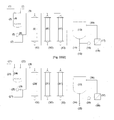
- a fluoropolymer aqueous dispersion (1) and a non ionic surfactant (2) are added to a stirred tank (3) wherein a homogeneous mixture of aqueous dispersion (D) and nonionic surfactant can be obtained and stored.
- Suitable pumping means (5) enable flowing the aqueous dispersion through a conduit (6) wherein a flow of water (7) is metered by means of appropriated metering means (not shown) and injection means (not shown).
- the diluted aqueous dispersion obtained in the conduit (8) is passed though a first column (9) comprising anion exchange resins and is withdrawn through conduit (10) towards a further column (9') also comprising anion exchange resins.
- Withdrawal means and conduit (10') drive the dispersion through column (11) comprising cation exchange resin.
- Purified dispersion withdrawn trough conduit (12) is fed to a storage tank (13).
- Suitable pumping means (16) feed said purified dispersion to an ultrafiltration unit (17) wherein a semi-permeable membrane separate waste water (18) from concentrated dispersion (19).
- Concentrated dispersion is recycled to the storage tank (13) and re-circulated through the ultrafiltration unit (17) until the final solids concentration is achieved.
- discharge valve (14) is opened and the concentrated purified aqueous dispersion (15) is recovered for formulation and/or further processing.
- non-ionic surfactant e.g. non-ionic surfactant can be notably recovered therefrom using technologies well-known to those skilled in the art, like, for instance, reverse osmosis (RO) concentration process.
- RO reverse osmosis
- Figure 2 depicts a second preferred embodiment of the process of the invention.
- a fluoropolymer aqueous dispersion (21) and TERGITOLTM TMN-X100 (non ionic surfactant) (22) are added to a stirred tank (23) wherein a homogeneous mixture of aqueous dispersion (D) and non-ionic surfactant can be obtained and stored.
- non-ionic surfactant can be submitted to additional treatment before final disposal; e.g. non-ionic surfactant can be notably recovered therefrom using technologies well-known to those skilled in the art, like, for instance, reverse osmosis (RO) concentration process.
- RO reverse osmosis
- an object of the invention is an aqueous polymer (F) dispersion comprising:
- the process of the invention is particularly suitable for obtaining the dispersion as above described; nevertheless, said dispersion can be obtained by any suitable means.
- the aqueous dispersion of polymer (F) of the invention comprises preferably 0.8 ppm or less, more preferably 0.75 ppm or less, most preferably of 0.5 ppm or less of fluorinated surfactant (FS), based on the total weight of solids.
- the dispersion of the invention possesses:
- the dispersion of the invention possesses:
- the dispersion of the invention possesses:
- the aqueous polymer (F) dispersion of the invention possesses an electrical conductivity of advantageously at least 225 ⁇ S/cm, preferably at least 250 ⁇ S/cm, more preferably at least 275 ⁇ S/cm and advantageously at most 450 ⁇ S/cm, preferably at most 425 ⁇ S/cm, more preferably at most 400 ⁇ S/cm at 25 °C
- Fine tuning of the electrical conductivity of said dispersion generally strongly affects both stability of the dispersion and viscosity of the same are strongly affected by this parameter.
- aqueous polymer (F) dispersion of the invention or obtained by the process as above detailed can be suitably formulated in connection with the targeted specific application by addition e.g. of other aqueous resin dispersions, such as, acrylic resins, silicone resins, polyamidoamide resins, imide resins, etc.; pigments, surfactants, inorganic fillers and other additives, such as antifoam agents, extending agents, etc.
- aqueous resin dispersions such as, acrylic resins, silicone resins, polyamidoamide resins, imide resins, etc.
- pigments such as, surfactants, inorganic fillers and other additives, such as antifoam agents, extending agents, etc.
- aqueous polymer (F) dispersion of the invention or obtained by the process as above detailed can be advantageously used for coating applications on metal surfaces and ceramic surfaces, in the textile impregnation and for obtaining cast films.
- Determination of concentration of polyvalent cations, expressed as element content, can be notably carried out by inductively coupled plasma optical emission spectrometry according to ISO/DIS 11885 method.
- Fluorinated surfactant (FS) content was determined by converting said surfactant (FS) in its corresponding methyl ester and quantitatively determining its concentration by gas-chromatographic method (GC).
- Said fluorinated phase is analyzed by GC, using a gas-chromatograph equipped with a SupelcoTM-1 fused silica capillary column and an Electron Capture Detector (ECD) from Thermo Finningam.
- ECD Electron Capture Detector
- FS fluorinated surfactant
- the system After dispersing the resin homogeneously in the aqueous dispersion, the system was left under stirring for the contact time indicated in the examples. The aqueous dispersion was filtered from the resin and the content of the residual anionic fluorinated surfactant (FS) was determined.
- FS residual anionic fluorinated surfactant
- a polyimide film support was totally immersed in a bath containing the concentrated dispersion at a dragging rate equal to 1.2 m/min. The excess of the dispersion was removed from the support by two pressing bars. Subsequently, the coated film was dried at 120° C and sintered at 350° C for about 30 sec time in a vertical tower. Coating and subsequent sintering processes were repeated 5 times in order to have a polymer film thickness of about 50 ⁇ m. The wetting properties of the dispersion were evaluated by detecting the absence of defects such as fish-eyes during the process. The coated film was then mechanically detached from the solid support to be characterized. The presence of defects (such as cracks and/or lumps) was evaluated with an optic microscope at a 10x10 magnification, and the degree of whiteness was qualitatively determined by comparison with other films obtained from different examples.
- the determination was performed using a standard pH-meter at a temperature of 25°C
- 500 g of the concentrated dispersion were filtered through a non-woven nylon net of known weight with mesh equal to 10 ⁇ m. At the end of the filtration 500 ml of water were made to pass through the net to remove the excess of dispersion from the net. The net with the optional residue was dried in an oven at 105°C for 1 hour and then weighed. The amount of coagulum was determined by the difference in weight with respect to the initial weight of the net. By dividing such difference by the amount of polymer (F) contained in 500 g of said dispersion and multiplying it by 100, the percentage of coagulum in the polymer (F) was determined. The sensitivity limit of the method is 0.005% based on the weight of the polymer.
- microemulsion was found to be perfectly limpid.
- the so obtained latex had a solids content of 22.7% (w/w) and a PPVE content of 0.7%(w/w) based on the total weight of the polymer.
- the average primary particle diameter determined by Photon Correlation Spectroscopy (PCS) as above detailed was found to be 52 nm.
- the fluorinated surfactant content was 37000 ppm with respect to the total weight of solids.
- the dispersion was loaded into a 40 liter tank and by using a centrifuge punp, the latex was made to circulate under pressure through a semi-permeable membrane in order to concentrate the aqueous dispersion by removing water. After 4 hours, the concentrated dispersion was recovered from the process tank.
- the latex had a PTFE content of 62.3% (w/w), a nonionic surfactant content of 3.3% referred to the polymer weight, and a conductivity of 350 ⁇ S/cm.
- the concentrated dispersion was formulated with TERGITOLTM TMN100X dissolved in water having a conductivity of 0.4 ⁇ S/an and following composition:
- the resulting dispersion had a solids content of 9.0% (w/w), and a nonionic surfactant content of 1.5% on the dispersion.
- the dispersion was treated with the cation exchange resin DOWEX® Mac3 in the H + form for 3 hours; the ion exchange resin was then filtered off. Then, the dispersion was treated with the anion exchange resin ABERJET® 4400 in the OHform, for 6 hours; the ion exchange resin was then filtered off. Above detailed sequence of treatments were repeated on the dispersion contacting the latter again with a cation exchange resin and, subsequently, with an anion exchange resin. All ion exchange treatments were carried out at 35°C
- the content of PFOA measured according to the method described above was found to be 0.5 ppm, referred to the total weight of solids.
- the ionic strength of the dispersion was adjusted by addition of 400 ppm of ammonium nitrate referred to the weight of the dispersion. All conditions set for the treatments performed on the dispersion can be found in table 1.
- the dispersion was loaded into a 40 litre tank and by using a centrifuge pump, the latex was made to circulate under pressure through a semi-permeable membrane in order to concentrate the aqueous dispersion by removing water. After 4 hours, the concentrated dispersion was recovered from the process tank.
- the latex has a PTFE content of 50.8% (w/w), a nonionic surfactant content of 10.4% referred to the polymer weight, and conductivity of 700 ⁇ S/cm.
- the concentrated dispersion was mixed with the dispersion obtained from example 4 in order to have a final dispersion comprised of a 10/90 ratio (w/w) of example2/example polymers.
- the obtained mixture was formulated with TERGITOL TM TMN100X dissolved in water having a conductivity of 0.4 ⁇ S/cm in order to obtain a dispersion having a PTFE content of 60% referred to the weight of the dispersion, and a nonionic surfactant content (TERGITOLTM TMN 100X) of 5% referred to the polymer weight.
- the presence of coagulum was undetectable.
- the viscosity measured at 35°C was 20 cps.
- Micro-aggregates were absent.
- the cast film did not show evidence of lumps and/or cracks, and was colourless. Fish-eye defects were not detected during cast film deposition process.
- the content of PFOA, measured according to the method above described was found to be 0.2 ppm, referred to the total weight of the solids.
- the ionic strength of the dispersion was then adjusted by addition of 500 ppm of ammonium sulphate referred to the weight of the dispersion.
- the dispersion was loaded into a 40 litre tank and by using a centrifuge pump, the latex was made to circulate under pressure through a semi-permeable membrane in order to concentrate the aqueous dispersion by removing water. After 4 hours, the concentrated dispersion was recovered from the process tank.
- the dispersion had a PTFE content of 62.4% (w/w), a nonionic surfactant content of 2.9% referred to the polymer weight.
- the concentrated dispersion was formulated with TERGITOLTM TMN100X dissolved in water in order to obtain a dispersion having a PTFE content of 60% referred to the weight of the dispersion, and a nonionic surfactant content (TERGITOLTM TMN100X) of 5% referred to the polymer weight.
- the presence of coagulum was undetectable.
- the viscosity measured at 35°C was 15 cps. Micro-aggregates were absent.
- the cast film did not show evidence of lumps and/or cracks, and was colourless.
- Example 1 8000 litres of a PTFE dispersion, obtained by scaling up the polymerization conditions given in Example 1 on an industrial reactor, were charged in a stirred tank and stabilized with TERGITOLTM TMN100X.
- the dispersion was contacted with ion exchange resins and concentrated by ultrafiltration according to the process layout sketched in Figure 2 , comprising:
- the concentrated dispersion was formulated with TERGITOLTM TMN100X in order to obtain a PTFE content of 60% (w/w) and a nonionic surfactant content of 5% (w/w) referred to the polymer weight.
- the viscosity measured at 35°C was 18 cps. Micro-aggregates were absent. The cast film did not show evidence of lumps and/or cracks, and was colourless.
- the dispersion was treated with the anion exchange resin AMBERJET® 4400 in the OH - form, for 6 hours; at the end of the treatment the ion-exchange resin was easily filtered off.
- the dispersion was then treated with the cation exchange resin DOWEX® Mac3 in the H + form, for 3 hours and the ion-exchange resin was filtered off. All ion exchange treatments were carried out at 20°C Above detailed sequence of treatments were repeated on the dispersion contacting the latter again with the cation exchange resin and, subsequently, with the anion exchange resin.
- the content of PFOA measured according to the method described here above was found to be 4.1 ppm, referred to the weight of solids.
- the dispersion was concentrated via the same process described in the previous examples and the resulting latex had a PTFE content of 63.4% (w/w), a nonionic surfactant content of 2.9% referred to the polymer weight.
- the concentrate dispersion was formulated with TRITON® X100 dissolved in water in order to obtain a dispersion having a PTFE content of 60% referred to the weight of the dispersion, and a nonionic surfactant content (TRITON® X100) of 5% referred to the polymer weight.
- the coagulum was found to account for 0.015%.
- the viscosity measured at 35°C was 50 cps. 2 micro-aggregates were detected in the film optical test.
- the cast film did not show evidence of lumps and/or cracks, but yellowish coloration was observed. Fish-eye defects were detected during the cast film deposition process.
- the dispersion was treated with the anion exchange resin AMBERJET® 4400 in the OH - form, following the procedure outlined above for 6 hours, and at the end of the treatment the ion-exchange resin was filtered off. Above detailed sequence of treatments were repeated on the dispersion contacting the latter again with the cation exchange resin and, subsequently, with the anion exchange resin.
- the resulting dispersion was treated with the cation exchange resin DOWEX® Mac3 in the H + form, following the procedure outlined above for 3 hours, and at the end of the treatment the ion-exchange resin was filtered off. All ion exchange treatments were carried out at 21°C.
- the content of PFOA measured according to the method above described was found to be 4.8 ppm, referred to the weight of the solids.
- the dispersion was again concentrated via the same process described in the previous examples to raise the solids content up to 62.7% (w/w), and to a nonionic surfactant content of 3.1% referred to the polymer weight.
- the concentrated dispersion was formulated with TRITON® X100 dissolved in water in order to obtain a dispersion having a PTFE content of 60% referred to the weight of the dispersion, and a nonionic surfactant content (TRITON® X100) of 5% referred to the polymer weight.
- the coagulum was found to account for 0.025%.
- the viscosity measured at 35°C was 48 cps. 4 micro-aggregates were detected during the film optical test.
- the cast film did not show evidence of lumps and/or cracks, but yellowish coloration was observed. Fish-eye defects were detected during the cast film deposition process.
- the dispersion was treated with the anion exchange resin AMBERJET® 4400 in the OH - form, following the procedure outlined above for 6 hours, and at the end of the treatment the ion-exchange resin was filtered off.
- the ion exchange treatment was carried out at 25°C
- the content of PFOA measured according to the method described above was found to be 2.3 ppm, referred to the total weight of solids.
- the dispersion was concentrated via the same process described in the previous examples and the resulting dispersion had a solids content of 61.0% (w/w), a nonionic surfactant content of 2.7% referred to the polymer weight.
- the concentrate dispersion was formulated with GENAPOL® X80 dissolved in water in order to obtain a dispersion having a PTFE content of 60% referred to the weight of the dispersion, and a nonionic surfactant (GENAPOL® X80) content of 5% referred to the polymer weight.
- GENAPOL® X80 nonionic surfactant
- the coagulum was found to account for 0.02% of the polymer.
- the viscosity measured at 35°C was 150 cps. 5 micro-aggregates were detected in the film optical test.
- the cast film showed manifest evidences of cracks, and was colourless. Fish-eye defects were not detected during the cast film deposition process.
- the dispersion was treated with the cation exchange resin DOWEX® Mac3 in the H + form, following the procedure outlined above for 3 hours; at the end of the treatment the resin was separated by filtration.
- the dispersion was treated with the anion exchange resin AMBERJET® 4400 in the OH - form, following the procedure outlined above for 6 hours; the resin was then separated by filtration.
- the content of PFOA was measured as previously described.
- the measured value was 0.1 ppm, referred to the weight of solids.
- the ionic strength of the dispersion was adjusted by addition of 200 ppm of ammonium nitrate referred to the weight of dispersion.
- the dispersion was loaded into a 40 litre tank and the latex was made to circulate under pressure through a semi-permeable membrane by using a centrifuge pump, in order to up-concentrate the aqueous dispersion by removing water. After 4 hours, the concentrated dispersion was recovered from the process tank.
- the latex had a PTFE content of 61.9% (w/w), a nonionic surfactant content of 2.8% referred to the polymer weight.
- the concentrated dispersion was formulated with TERGITOLTM TMN100X dissolved in water having a conductivity of 0.4 ⁇ S/cm and following composition: Al ⁇ 0.05 mg/l; Ca ⁇ 0.1 mg/l; Mg ⁇ 0.1 mg/l; Fe ⁇ 0.05 mg/l, in order to obtain a dispersion having a PTFE content of 60% referred to the weight of the dispersion, and a nonionic surfactant content (TERGITOLTM TMN100X) of 5% referred to the polymer weight.
- TERGITOLTM TMN100X nonionic surfactant content
- Micro-aggregates were absent.
- the cast film did not show evidence of lumps and/or cracks, and was colorless. Fish-eye defects were not detected during cast film deposition process.
- the resulting dispersion has a PTFE content of 9.4% (w/w), nonionic surfactant content of 1.6% on the dispersion, and a pH equal to 4.1.
- the diluted dispersion was treated with the cation exchange resin DOWEX® Mac3 in the H+ form in glass column having a diameter of 15 cm and height of 150 cm, as taught in US 6,833,403 , said column being filled with 25 litres of ion exchange resin and back washed with water.
- the anion exchange treatment with resins AMBERJET® 4400 in the OH- form was carried out in a similar column, filled from the top with 25 liters of ion exchange resin and back washed with water.
- the diluted dispersion was passed trough the columns, using a peristaltic pump, at a flow rate of 1.5 bed volume per hour resulting in a contact time of 40 min. Above treatment was repeated by passing the dispersion through cation exchange resin and anion exchange resin columns. All ion exchange treatment was carried out at 25°C.
- the resulting stabilized dispersion was found to have a PTFE content of 22.1% (w/w), nonionic surfactant content of 2.8% on the dispersion, and a pH equal to 3.4.
- the stabilized dispersion at a temperature of 25°C, was submitted to the same treatment as detailed in example 9, by contacting with an anionic resin in a column. After having pumped 40 liters of dispersion, the flow of dispersion diminished 'til becoming negligible and the pump shut down due to over pressure. The column was inspected and clogging was detected. A sample of the dispersion taken from inside the column was found to have a perfluoropolyether surfactant content of 250 ppm, referred to the total weight of solids.
- NS-1 stands for TERGITOLTM TMN100X.
- NS-2 stands for TRITON® X100 and
- NS-3 stands for GENAPOL® X80.
Landscapes
- Chemical & Material Sciences (AREA)
- Health & Medical Sciences (AREA)
- Chemical Kinetics & Catalysis (AREA)
- Medicinal Chemistry (AREA)
- Polymers & Plastics (AREA)
- Organic Chemistry (AREA)
- Dispersion Chemistry (AREA)
- Addition Polymer Or Copolymer, Post-Treatments, Or Chemical Modifications (AREA)
- Polymerisation Methods In General (AREA)
- Paints Or Removers (AREA)
Claims (9)
- Procédé de purification d'une dispersion d'un polymère fluoré, ledit procédé comprenant :(i) la préparation d'une dispersion aqueuse (D) d'au moins un polymère fluoré [polymère (F)] comprenant au moins un tensioactif fluoré [tensioactif (FS)], ayant une teneur en solides (SC) de 15 % en poids ou plus ;(ii) l'ajout à ladite dispersion aqueuse (D) d'au moins un tensioactif non fluoré non ionique [tensioactif (NS)] ;(iii) l'ajustement de ladite teneur en solides (SC) à moins de 10 % en poids, pour obtenir une dispersion aqueuse diluée (dD) ;(iv) la mise en contact de ladite dispersion aqueuse diluée (dD) avec au moins un matériau adsorbant, afin d'obtenir une dispersion aqueuse du polymère (F) ayant une teneur en tensioactif fluoré (FS) inférieure à 1 ppm par rapport au poids total de solides.
- Procédé selon la revendication 1, dans lequel le polymère (F) est un polymère per(halo)fluoré.
- Procédé selon la revendication 2, dans lequel le polymère per(halo)fluoré est un homopolymère d'un monomère per(halo)fluoré (PFM) ou un copolymère comprenant des unités de répétition dérivées de plus d'un monomère per(halo)fluoré (PFM), lesdits monomères per(halo)fluorés (PFM) étant choisis parmi :- les perfluoro-oléfines en C2-C8, telles que le tétrafluoroéthylène (TFE) et l'hexafluoropropène (HFP) ;- les per(halo)fluoro-oléfines en C2-C6 chlorées et/ou bromées et/ou iodées, telles que le chlorotrifluoroéthylène ;- les éthers per(halo)fluoroalkylvinyliques de formule générale CF2=CFORf3, Rf3 étant un per(halo)fluoroalkyle en C1-C6, tel que -CF3, -C2F5, -C3F7 ;- les éthers per(halo)fluoro-oxyalkylvinyles de formule générale CF2=CFOX01, X01 étant un per(halo)fluoro-oxyalkyle en C1-C12 contenant un ou plusieurs groupes éther, tels que le groupe perfluoro-2-propoxy-propyle ;- les éthers per(halo)fluoro-méthoxy-alkylvinyliques de formule générale CF2=CFOCF2ORf4, Rf4 étant un per(halo)fluoroalkyle en C1-C6, tel que -CF3, -C2F5, -C3F7 ou un per(halo)fluoro-oxyalkyle en C1-C6 contenant un ou plusieurs groupes éther, tels que -C2F5-O-CF3 ;- les per(halo)fluorodioxoles de formule :
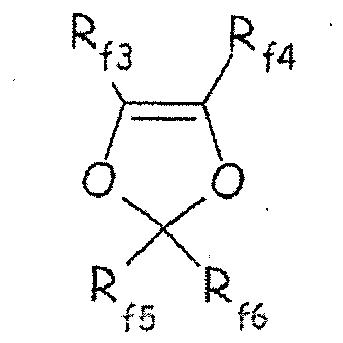 dans laquelle chaque substituant Rf3, Rf4, Rf5, Rf6, identiques ou différents les uns des autres, représente indépendamment un atome de fluor, un groupe perfluoroalkyle en C1-C6, comprenant éventuellement un ou plusieurs atomes d'oxygène, p. ex. -CF3, -C2F5, -C3F7, -OCF3, -OCF2CF2OCF3 ; de préférence un per(halo)fluorodioxole de la formule précédente, Rf3 et Rf4 étant des atomes de fluor et Rf5 et Rf6 étant des groupes perfluorométhyle (-CF3) [perfluoro-2,2-diméthyl-1,3-dioxole (PDD)], ou un per(halo)fluorodioxole de la formule précédente, Rf3, Rf5 et Rf6 étant des atomes de fluor et Rf4 étant un groupe perfluorométhoxy (-OCF3) [2,2,4-trifluoro-5-trifluorométhoxy-1,3-dioxole ou perfluorométhoxydioxole (MDO)].
 - Procédé selon la revendication 3, dans lequel le polymère per(halo)fluoré est choisi parmi l'homopolymère de TFE et les copolymères de TFE comprenant des unités de répétition dérivées d'au moins un monomère per(halo)fluoré (PFM) choisi dans le groupe constitué par :- les éthers perfluoroalkylvinyliques de formule CF2=CFOR7', R7' étant un groupe choisi parmi -CF3, -C2F5, -C3F7, et/ou- les per(halo)fluorodioxoles de formule :
 Rf3 et Rf4 étant des atomes de fluor et Rf5 et Rf6 étant des groupes perfluorométhyle (-CF3) [perfluoro-2,2-diméthyl-1,3-dioxole (PDD)], ou Rf3, Rf5 et Rf6 étant des atomes de fluor et Rf4 étant un groupe perfluorométhoxy (-OCF3) [2,2,4-trifluoro-5-trifluorométhoxy-1,3-dioxole ou perfluorométhoxydioxole (MDO)].
 - Procédé selon l'une quelconque des revendications précédentes, dans lequel la dispersion aqueuse (D) comprend un tensioactif fluoré [tensioactif (FS)] de formule :
Rf§(X-)j(M+)j
dans laquelle Rf§ est une chaîne (per)fluoroalkyle ou (per)fluoropolyoxyalkylène en C5-C16, X- est -COO-, -PO3 - ou -SO3 -, M+ est choisi parmi H+, NH4 +, un ion de métal alcalin, et j peut être 1 ou 2. - Procédé selon la revendication 5, dans lequel le tensioactif fluoré [tensioactif (FS)] est choisi parmi :- CF3(CF2)n1COOM', n1 étant un entier allant de 4 à 10, de préférence de 5 à 7 et de manière davantage préférée étant égal à 6 ; M' représentant H, NH4, Na, Li ou K, de préférence NH4 ;- T(C3F6O)n0(CFXO)m0CF2COOM", T représentant Cl ou un groupe perfluoroalcoxyde de formule CkF2k+1O, k étant un entier de 1 à 3, un atome F étant éventuellement remplacé par un atome Cl ; n0 étant un entier allant de 1 à 6 ; m0 étant un entier allant de 0 à 6 ; M" représentant H, NH4, Na, Li ou K ; X représentant F ou CF3 ;- F-(CF2-CF2)n2-CH2-CH2-RO3M'", R représentant P ou S, de préférence S, M"' représentant H, NH4, Na, Li ou K, de préférence H ; n2 étant un entier allant de 2 à 5, de préférence n2 = 3 ;- les tensioactifs fluorés bifonctionnels A-Rf-B, A et B, identiques ou différents l'un de l'autre, représentant -(O)pCFX-COOM* ; M* représentant H, NH4, Na, Li ou K, de préférence M* représentant NH4 ; X = F ou CF3 ; p étant un entier égal à 0 ou 1 ; Rf étant une chaîne perfluoroalkyle linéaire ou ramifiée ou une chaîne (per)fluoropolyéther telle que le poids moléculaire moyen en nombre de A-Rf-B soit dans la plage allant de 300 à 1 800 ;- et leurs mélanges.
- Procédé selon l'une quelconque des revendications précédentes, dans lequel le tensioactif non fluoré non ionique (NS) est selon la formule (I) ci-dessous :
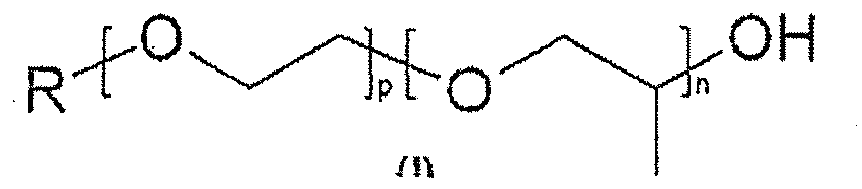 dans laquelle R est un groupe alkyle en C8-C18, p et n, identiques ou différents l'un de l'autre, peuvent valoir zéro ou être compris entre 6 et 18, à condition que p et/ou n soient différents de zéro.
 - Procédé selon la revendication 7, dans lequel le tensioactif (NS) est selon la formule (IV) ci-dessous :
 dans laquelle m est compris entre 7 et 12.
 - Procédé selon l'une quelconque des revendications précédentes, dans lequel, à l'étape (iv), la dispersion aqueuse diluée (dD) est mise en contact avec au moins une résine échangeuse d'anions et au moins une résine échangeuse de cations.
Priority Applications (1)
| Application Number | Priority Date | Filing Date | Title |
|---|---|---|---|
| EP07727895.0A EP2007819B1 (fr) | 2006-04-11 | 2007-04-06 | Purification d'une dispersion d'un polymère fluoré |
Applications Claiming Priority (3)
| Application Number | Priority Date | Filing Date | Title |
|---|---|---|---|
| EP06112473A EP1845116A1 (fr) | 2006-04-11 | 2006-04-11 | Methode de purification d'une dispersion de fluoropolymères |
| EP07727895.0A EP2007819B1 (fr) | 2006-04-11 | 2007-04-06 | Purification d'une dispersion d'un polymère fluoré |
| PCT/EP2007/053427 WO2007116037A1 (fr) | 2006-04-11 | 2007-04-06 | Purification d'une dispersion d'un polymère fluoré |
Publications (2)
| Publication Number | Publication Date |
|---|---|
| EP2007819A1 EP2007819A1 (fr) | 2008-12-31 |
| EP2007819B1 true EP2007819B1 (fr) | 2014-06-04 |
Family
ID=36930210
Family Applications (2)
| Application Number | Title | Priority Date | Filing Date |
|---|---|---|---|
| EP06112473A Withdrawn EP1845116A1 (fr) | 2006-04-11 | 2006-04-11 | Methode de purification d'une dispersion de fluoropolymères |
| EP07727895.0A Not-in-force EP2007819B1 (fr) | 2006-04-11 | 2007-04-06 | Purification d'une dispersion d'un polymère fluoré |
Family Applications Before (1)
| Application Number | Title | Priority Date | Filing Date |
|---|---|---|---|
| EP06112473A Withdrawn EP1845116A1 (fr) | 2006-04-11 | 2006-04-11 | Methode de purification d'une dispersion de fluoropolymères |
Country Status (5)
| Country | Link |
|---|---|
| US (1) | US8859645B2 (fr) |
| EP (2) | EP1845116A1 (fr) |
| JP (1) | JP5377286B2 (fr) |
| CN (1) | CN101460527B (fr) |
| WO (1) | WO2007116037A1 (fr) |
Families Citing this family (25)
| Publication number | Priority date | Publication date | Assignee | Title |
|---|---|---|---|---|
| WO2008004660A1 (fr) * | 2006-07-07 | 2008-01-10 | Daikin Industries, Ltd. | Procédé de fabrication d'une dispersion aqueuse de polymère contenant du fluor et dispersion aqueuse de polymère contenant du fluor |
| US20090281261A1 (en) * | 2008-05-09 | 2009-11-12 | E. I. Du Pont De Nemours And Company | Abatement of Fluoroether Carboxylic Acids or Salts Employed in Fluoropolymer Resin Manufacture |
| US8329813B2 (en) | 2009-05-08 | 2012-12-11 | E I Du Pont De Nemours And Company | Thermal reduction of fluoroether carboxylic acids or salts from fluoropolymer dispersions |
| RU2012120435A (ru) * | 2009-10-16 | 2013-11-27 | Асахи Гласс Компани, Лимитед | Способ получения водной политетрафторэтиленовой дисперсии для процесса коагуляции и водная политетрафторэтиленовая дисперсия для процесса коагуляции |
| WO2012150256A1 (fr) * | 2011-05-03 | 2012-11-08 | Solvay Specialty Polymers Italy S.P.A. | Procédé pour la fabrication d'élastomères fluorés |
| EP2623564A1 (fr) * | 2012-02-03 | 2013-08-07 | Omya International AG | Installation pour la purification des minéraux, pigments et/ou agents de remplissage et/ou la préparation de carbonate alcalin à la terre précipité |
| US9175110B2 (en) | 2012-05-09 | 2015-11-03 | The Chemours Company Fc, Llc | Fluoropolymer resin treatment employing melt extrusion and exposure to oxygen source to reduce discoloration |
| US9175112B2 (en) | 2012-05-09 | 2015-11-03 | The Chemours Company Fc, Llc | Drying wet fluoropolymer resin and exposing to oxygen source to reduce discoloration |
| US9175115B2 (en) | 2012-05-09 | 2015-11-03 | The Chemours Company Fc, Llc | Fluoropolymer resin treatment employing heating and oxygen source to reduce discoloration |
| US10889699B2 (en) * | 2012-06-20 | 2021-01-12 | Solvay Specialty Polymers Italy S.P.A. | Tetrafluoroethylene copolymers |
| CN102977236B (zh) * | 2012-12-24 | 2015-05-13 | 上海三爱富新材料股份有限公司 | 含氟聚合物的纯化方法 |
| US9574027B2 (en) | 2013-03-11 | 2017-02-21 | The Chemours Company Fc, Llc | Fluoropolymer resin treatment employing sorbent to reduce fluoropolymer resin discoloration |
| KR102348355B1 (ko) | 2013-06-04 | 2022-01-10 | 솔베이 스페셜티 폴리머스 이태리 에스.피.에이. | 플루오로중합체 복합재의 제조 방법 |
| CN103991948B (zh) * | 2014-05-16 | 2016-02-03 | 上海纳米技术及应用国家工程研究中心有限公司 | 改性分子筛为催化剂处理含低浓度全氟辛酸铵废水的方法 |
| CN113717300B (zh) * | 2017-03-31 | 2023-11-17 | 大金工业株式会社 | 含氟聚合物的制造方法、聚合用表面活性剂和表面活性剂的使用 |
| JP6642636B2 (ja) * | 2017-06-27 | 2020-02-05 | ダイキン工業株式会社 | 含フッ素ポリマー製造工程から生じる水性流体を処理する方法およびシステム |
| WO2019031617A1 (fr) * | 2017-08-10 | 2019-02-14 | ダイキン工業株式会社 | Procédé de production d'un liquide constitué d'une dispersion aqueuse de polytétrafluoréthylène purifié, procédé de production d'une poudre de polytétrafluoréthylène modifié, procédé de production d'un objet moulé en polytétrafluoréthylène, et composition |
| GB201807544D0 (en) * | 2018-05-09 | 2018-06-20 | 3M Innovative Properties Co | Fluoropolymers with very low amounts of a fluorinated alkanoic acid or its salts |
| WO2020050178A1 (fr) * | 2018-09-05 | 2020-03-12 | Agc株式会社 | Procédé de production d'une dispersion |
| CN110240156B (zh) * | 2019-06-20 | 2022-07-22 | 付睿 | 石墨烯浓缩聚胶及其制备方法和应用 |
| CN114106622B (zh) * | 2020-08-31 | 2022-09-06 | 浙江省化工研究院有限公司 | 一种水分散体涂料 |
| WO2022224105A1 (fr) * | 2021-04-22 | 2022-10-27 | 3M Innovative Properties Company | Purification de dispersions aqueuses d'ionomère |
| EP4563599A1 (fr) * | 2022-07-27 | 2025-06-04 | Daikin Industries, Ltd. | Dispersion aqueuse de polymère fluoré ainsi que procédé de fabrication de celle-ci, et composition de matériau de revêtement |
| CN116199905B (zh) * | 2022-11-11 | 2024-05-14 | 中昊晨光化工研究院有限公司 | 一种聚四氟乙烯浓缩分散液 |
| WO2025135028A1 (fr) * | 2023-12-19 | 2025-06-26 | Agc株式会社 | Procédé de production d'un polymère contenant du fluor, et composition solide |
Citations (2)
| Publication number | Priority date | Publication date | Assignee | Title |
|---|---|---|---|---|
| EP1714986A1 (fr) * | 2005-04-20 | 2006-10-25 | Solvay Solexis S.p.A. | Procédé pour la préparation de dispersions de fluoropolymère |
| WO2006127218A1 (fr) * | 2005-05-25 | 2006-11-30 | Gore Enterprise Holdings, Inc. | Pieces transparentes en elastomere perfluore de haute purete et leur procede de fabrication |
Family Cites Families (40)
| Publication number | Priority date | Publication date | Assignee | Title |
|---|---|---|---|---|
| US2559752A (en) * | 1951-03-06 | 1951-07-10 | Du Pont | Aqueous colloidal dispersions of polymers |
| DE1131013B (de) | 1960-12-01 | 1962-06-07 | Basf Ag | Verfahren zur Herstellung fremdstoffarmer Polymerisatdispersionen |
| US3037953A (en) * | 1961-04-26 | 1962-06-05 | Du Pont | Concentration of aqueous colloidal dispersions of polytetrafluoroethylene |
| US3301807A (en) * | 1963-04-11 | 1967-01-31 | Thiokol Chemical Corp | Stabilized, concentrated polytetrafluoroethylene dispersions containing non-ionic surfactants |
| US3682975A (en) * | 1968-05-13 | 1972-08-08 | Stevens & Co Inc J P | Substituted silyl glycidylamines |
| US3704272A (en) * | 1970-09-15 | 1972-11-28 | Du Pont | Concentration of polytetrafluoroethylene aqueous dispersion |
| US4016345A (en) * | 1972-12-22 | 1977-04-05 | E. I. Du Pont De Nemours And Company | Process for polymerizing tetrafluoroethylene in aqueous dispersion |
| DE2908001C2 (de) * | 1979-03-01 | 1981-02-19 | Hoechst Ag, 6000 Frankfurt | Verfahren zur Herstellung konzentrierter Dispersionen von Fluorpolymeren |
| US4725644A (en) * | 1986-05-06 | 1988-02-16 | E. I. Du Pont De Nemours And Company | Tetrafluoroethylene fine powder and preparation thereof |
| JPH03128903A (ja) * | 1989-07-13 | 1991-05-31 | Fine Kurei:Kk | 合成樹脂の改質方法および改質合成樹脂 |
| JP2743252B2 (ja) * | 1994-07-11 | 1998-04-22 | 三井・デュポンフロロケミカル株式会社 | フルオロポリマー水性エマルジョンの濃縮方法 |
| WO1997008214A1 (fr) | 1995-08-31 | 1997-03-06 | E.I. Du Pont De Nemours And Company | Procede de polymerisation de tetrafluoroethylene |
| US5763552A (en) * | 1996-07-26 | 1998-06-09 | E. I. Du Pont De Nemours And Company | Hydrogen-containing flourosurfacant and its use in polymerization |
| CA2251683A1 (fr) * | 1997-02-13 | 1998-08-20 | Daikin Industries, Ltd. | Procede pour concentrer une dispersion aqueuse de polymere fluore |
| DE19857111A1 (de) * | 1998-12-11 | 2000-06-15 | Dyneon Gmbh | Wäßrige Dispersionen von Fluorpolymeren |
| US6720360B1 (en) * | 2000-02-01 | 2004-04-13 | 3M Innovative Properties Company | Ultra-clean fluoropolymers |
| DE10018853C2 (de) * | 2000-04-14 | 2002-07-18 | Dyneon Gmbh | Herstellung wässriger Dispersionen von Fluorpolymeren |
| IT1318633B1 (it) | 2000-07-20 | 2003-08-27 | Ausimont Spa | Polveri fini di politetrafluoroetilene. |
| US6512063B2 (en) * | 2000-10-04 | 2003-01-28 | Dupont Dow Elastomers L.L.C. | Process for producing fluoroelastomers |
| WO2002077116A1 (fr) * | 2001-03-21 | 2002-10-03 | Daikin Industries, Ltd. | Agent de traitement de surface comprenant une matiere composite inorganique/organique |
| US20030125421A1 (en) * | 2001-08-03 | 2003-07-03 | Hermann Bladel | Aqueous dispersions of fluoropolymers |
| US6956078B2 (en) * | 2002-01-04 | 2005-10-18 | E.I. Du Pont De Nemours And Company | Concentrated fluoropolymer dispersions |
| JP4207442B2 (ja) | 2002-03-20 | 2009-01-14 | 旭硝子株式会社 | ポリテトラフルオロエチレン水性分散液組成物の製造方法 |
| EP1364972B1 (fr) * | 2002-05-22 | 2006-08-30 | 3M Innovative Properties Company | Procédé de réduction de la teneur en surfactant fluoré dans des dispersions aqueuses de fluoropolymére |
| US7468403B2 (en) * | 2002-11-29 | 2008-12-23 | Daikin Industries, Ltd. | Method for purification of aqueous fluoropolymer emulsions, purified emulsions, and fluorine-containing finished articles |
| DE60301322T2 (de) * | 2003-02-28 | 2006-06-08 | 3M Innovative Properties Co., St. Paul | Fluoropolymerdispersion enthaltend kein oder wenig fluorhaltiges Netzmittel mit niedrigem Molekulargewicht |
| JP4289034B2 (ja) | 2003-06-19 | 2009-07-01 | 旭硝子株式会社 | ポリテトラフルオロエチレン水性分散液組成物およびその製造方法 |
| EP1645572A4 (fr) * | 2003-07-03 | 2009-05-06 | Daikin Ind Ltd | Procede de purification d'un materiau a traiter et procede d'obtention d'un materiau coagule |
| ITMI20032050A1 (it) * | 2003-10-21 | 2005-04-22 | Solvay Solexis Spa | Processo per la preparazione di dispersori di fluoropolimeri. |
| EP1533325B1 (fr) | 2003-11-17 | 2011-10-19 | 3M Innovative Properties Company | Dispersions aqueuses de polytétrafluoroéthylène avec un contenu réduit de surfactants fluorés |
| ITMI20032377A1 (it) * | 2003-12-04 | 2005-06-05 | Solvay Solexis Spa | Copolimeri del tfe. |
| ITMI20040031A1 (it) * | 2004-01-14 | 2004-04-14 | Solvay Solexis Spa | Processo per la preparazione di dispersori di fluoropolimeri |
| US7304101B2 (en) * | 2004-07-19 | 2007-12-04 | 3M Innovative Properties Company | Method of purifying a dispersion of ionic fluoropolymer |
| ITMI20042554A1 (it) * | 2004-12-30 | 2005-03-30 | Solvay Solexis Spa | Procedimento per la preparazione di dispersioni di fluoropolimeri |
| ITMI20042553A1 (it) * | 2004-12-30 | 2005-03-30 | Solvay Solexis Spa | Processo per la preparazione di dispersioni di fluoropolimeri |
| US7671111B2 (en) * | 2005-02-10 | 2010-03-02 | E.I. Du Pont De Nemours And Company | Monitoring column breakthrough in a process for removing fluorosurfactant from aqueous fluoropolymer dispersions |
| US7671112B2 (en) * | 2005-07-15 | 2010-03-02 | 3M Innovative Properties Company | Method of making fluoropolymer dispersion |
| GB0514398D0 (en) * | 2005-07-15 | 2005-08-17 | 3M Innovative Properties Co | Aqueous emulsion polymerization of fluorinated monomers using a fluorinated surfactant |
| GB0514387D0 (en) * | 2005-07-15 | 2005-08-17 | 3M Innovative Properties Co | Aqueous emulsion polymerization of fluorinated monomers using a perfluoropolyether surfactant |
| ITMI20051397A1 (it) * | 2005-07-21 | 2007-01-22 | Solvay Solexis Spa | Polveri fini di fluoropolimeri |
-
2006
- 2006-04-11 EP EP06112473A patent/EP1845116A1/fr not_active Withdrawn
-
2007
- 2007-04-06 JP JP2009504709A patent/JP5377286B2/ja not_active Expired - Fee Related
- 2007-04-06 WO PCT/EP2007/053427 patent/WO2007116037A1/fr not_active Ceased
- 2007-04-06 US US12/296,485 patent/US8859645B2/en not_active Expired - Fee Related
- 2007-04-06 EP EP07727895.0A patent/EP2007819B1/fr not_active Not-in-force
- 2007-04-06 CN CN200780020832.8A patent/CN101460527B/zh not_active Expired - Fee Related
Patent Citations (2)
| Publication number | Priority date | Publication date | Assignee | Title |
|---|---|---|---|---|
| EP1714986A1 (fr) * | 2005-04-20 | 2006-10-25 | Solvay Solexis S.p.A. | Procédé pour la préparation de dispersions de fluoropolymère |
| WO2006127218A1 (fr) * | 2005-05-25 | 2006-11-30 | Gore Enterprise Holdings, Inc. | Pieces transparentes en elastomere perfluore de haute purete et leur procede de fabrication |
Also Published As
| Publication number | Publication date |
|---|---|
| CN101460527B (zh) | 2015-05-20 |
| WO2007116037A1 (fr) | 2007-10-18 |
| JP5377286B2 (ja) | 2013-12-25 |
| US8859645B2 (en) | 2014-10-14 |
| JP2009533509A (ja) | 2009-09-17 |
| EP2007819A1 (fr) | 2008-12-31 |
| US20090272944A1 (en) | 2009-11-05 |
| EP1845116A1 (fr) | 2007-10-17 |
| CN101460527A (zh) | 2009-06-17 |
Similar Documents
| Publication | Publication Date | Title |
|---|---|---|
| EP2007819B1 (fr) | Purification d'une dispersion d'un polymère fluoré | |
| JP4782408B2 (ja) | Tfeコポリマー | |
| RU2419642C2 (ru) | Политетрафторэтиленовая водная дисперсия и ее продукт | |
| EP4026855B1 (fr) | Composition et son procédé de production | |
| KR102719413B1 (ko) | 플루오로중합체의 제조 방법 | |
| EP3885372A1 (fr) | Procédé de fabrication de polytétrafluoréthylène modifié, et composition | |
| EP2440586B1 (fr) | Dispersions fluoro-ionomères dotées de tension à faible surface, viscosité à faible teneur en liquide et contenu à forte teneur solide | |
| EP3885406A1 (fr) | Composition, et corps étiré | |
| US7683118B2 (en) | Process for preparing fluoropolymer dispersions | |
| JP5392188B2 (ja) | 含フッ素ポリマー水性分散液の製造方法 | |
| US7666928B2 (en) | Staged addition of non-fluorinated anionic surfactant to reduced fluorosurfactant fluoropolymer dispersion | |
| JP2008530315A (ja) | 低減されたフッ素系界面活性剤含有量および高い剪断安定性を有するフルオロポリマー分散液 | |
| EP4249516B1 (fr) | Procédé de production de polytétrafluoroéthylène et composition contenant du polytétrafluoroéthylène | |
| CN101238247B (zh) | 具有低的含氟表面活性剂含量的含氟聚合物分散体的纺丝 | |
| WO2022244784A1 (fr) | Procédé de production d'un fluoropolymère, procédé de production de polytétrafluoréthylène et composition | |
| WO2009013214A1 (fr) | Procédé de préparation de dispersions de polymères | |
| EP4063405A1 (fr) | Procédé de production de polytétrafluoroéthylène | |
| JP2007016209A (ja) | ポリテトラフルオロエチレン水性分散液およびその製造方法 | |
| WO2009080713A2 (fr) | Composition aqueuse de polymère fluoré |
Legal Events
| Date | Code | Title | Description |
|---|---|---|---|
| PUAI | Public reference made under article 153(3) epc to a published international application that has entered the european phase |
Free format text: ORIGINAL CODE: 0009012 |
|
| 17P | Request for examination filed |
Effective date: 20081111 |
|
| AK | Designated contracting states |
Kind code of ref document: A1 Designated state(s): AT BE BG CH CY CZ DE DK EE ES FI FR GB GR HU IE IS IT LI LT LU LV MC MT NL PL PT RO SE SI SK TR |
|
| AX | Request for extension of the european patent |
Extension state: AL BA HR MK RS |
|
| 17Q | First examination report despatched |
Effective date: 20081219 |
|
| RAP1 | Party data changed (applicant data changed or rights of an application transferred) |
Owner name: SOLVAY SOLEXIS S.P.A. |
|
| RAP1 | Party data changed (applicant data changed or rights of an application transferred) |
Owner name: SOLVAY SPECIALTY POLYMERS ITALY S.P.A. |
|
| DAX | Request for extension of the european patent (deleted) | ||
| RIC1 | Information provided on ipc code assigned before grant |
Ipc: C08L 27/12 20060101ALN20130405BHEP Ipc: C08F 6/24 20060101ALI20130405BHEP Ipc: C08J 3/03 20060101ALI20130405BHEP Ipc: C08K 3/16 20060101ALI20130405BHEP Ipc: C08L 71/02 20060101ALN20130405BHEP Ipc: C08F 6/16 20060101AFI20130405BHEP |
|
| GRAP | Despatch of communication of intention to grant a patent |
Free format text: ORIGINAL CODE: EPIDOSNIGR1 |
|
| RIC1 | Information provided on ipc code assigned before grant |
Ipc: C08L 27/12 20060101ALN20131204BHEP Ipc: C08L 71/02 20060101ALN20131204BHEP Ipc: C08K 3/16 20060101ALI20131204BHEP Ipc: C08F 6/16 20060101AFI20131204BHEP Ipc: C08J 3/03 20060101ALI20131204BHEP Ipc: C08F 6/24 20060101ALI20131204BHEP |
|
| INTG | Intention to grant announced |
Effective date: 20140108 |
|
| GRAS | Grant fee paid |
Free format text: ORIGINAL CODE: EPIDOSNIGR3 |
|
| GRAA | (expected) grant |
Free format text: ORIGINAL CODE: 0009210 |
|
| AK | Designated contracting states |
Kind code of ref document: B1 Designated state(s): AT BE BG CH CY CZ DE DK EE ES FI FR GB GR HU IE IS IT LI LT LU LV MC MT NL PL PT RO SE SI SK TR |
|
| REG | Reference to a national code |
Ref country code: GB Ref legal event code: FG4D |
|
| REG | Reference to a national code |
Ref country code: CH Ref legal event code: EP |
|
| REG | Reference to a national code |
Ref country code: AT Ref legal event code: REF Ref document number: 671062 Country of ref document: AT Kind code of ref document: T Effective date: 20140615 |
|
| REG | Reference to a national code |
Ref country code: IE Ref legal event code: FG4D |
|
| REG | Reference to a national code |
Ref country code: DE Ref legal event code: R096 Ref document number: 602007036993 Country of ref document: DE Effective date: 20140710 |
|
| REG | Reference to a national code |
Ref country code: NL Ref legal event code: T3 Ref country code: AT Ref legal event code: MK05 Ref document number: 671062 Country of ref document: AT Kind code of ref document: T Effective date: 20140604 |
|
| PG25 | Lapsed in a contracting state [announced via postgrant information from national office to epo] |
Ref country code: LT Free format text: LAPSE BECAUSE OF FAILURE TO SUBMIT A TRANSLATION OF THE DESCRIPTION OR TO PAY THE FEE WITHIN THE PRESCRIBED TIME-LIMIT Effective date: 20140604 Ref country code: FI Free format text: LAPSE BECAUSE OF FAILURE TO SUBMIT A TRANSLATION OF THE DESCRIPTION OR TO PAY THE FEE WITHIN THE PRESCRIBED TIME-LIMIT Effective date: 20140604 Ref country code: CY Free format text: LAPSE BECAUSE OF FAILURE TO SUBMIT A TRANSLATION OF THE DESCRIPTION OR TO PAY THE FEE WITHIN THE PRESCRIBED TIME-LIMIT Effective date: 20140604 Ref country code: GR Free format text: LAPSE BECAUSE OF FAILURE TO SUBMIT A TRANSLATION OF THE DESCRIPTION OR TO PAY THE FEE WITHIN THE PRESCRIBED TIME-LIMIT Effective date: 20140905 |
|
| REG | Reference to a national code |
Ref country code: LT Ref legal event code: MG4D |
|
| PG25 | Lapsed in a contracting state [announced via postgrant information from national office to epo] |
Ref country code: LV Free format text: LAPSE BECAUSE OF FAILURE TO SUBMIT A TRANSLATION OF THE DESCRIPTION OR TO PAY THE FEE WITHIN THE PRESCRIBED TIME-LIMIT Effective date: 20140604 Ref country code: AT Free format text: LAPSE BECAUSE OF FAILURE TO SUBMIT A TRANSLATION OF THE DESCRIPTION OR TO PAY THE FEE WITHIN THE PRESCRIBED TIME-LIMIT Effective date: 20140604 Ref country code: SE Free format text: LAPSE BECAUSE OF FAILURE TO SUBMIT A TRANSLATION OF THE DESCRIPTION OR TO PAY THE FEE WITHIN THE PRESCRIBED TIME-LIMIT Effective date: 20140604 |
|
| PG25 | Lapsed in a contracting state [announced via postgrant information from national office to epo] |
Ref country code: PT Free format text: LAPSE BECAUSE OF FAILURE TO SUBMIT A TRANSLATION OF THE DESCRIPTION OR TO PAY THE FEE WITHIN THE PRESCRIBED TIME-LIMIT Effective date: 20141006 Ref country code: CZ Free format text: LAPSE BECAUSE OF FAILURE TO SUBMIT A TRANSLATION OF THE DESCRIPTION OR TO PAY THE FEE WITHIN THE PRESCRIBED TIME-LIMIT Effective date: 20140604 Ref country code: SK Free format text: LAPSE BECAUSE OF FAILURE TO SUBMIT A TRANSLATION OF THE DESCRIPTION OR TO PAY THE FEE WITHIN THE PRESCRIBED TIME-LIMIT Effective date: 20140604 Ref country code: ES Free format text: LAPSE BECAUSE OF FAILURE TO SUBMIT A TRANSLATION OF THE DESCRIPTION OR TO PAY THE FEE WITHIN THE PRESCRIBED TIME-LIMIT Effective date: 20140604 Ref country code: EE Free format text: LAPSE BECAUSE OF FAILURE TO SUBMIT A TRANSLATION OF THE DESCRIPTION OR TO PAY THE FEE WITHIN THE PRESCRIBED TIME-LIMIT Effective date: 20140604 Ref country code: RO Free format text: LAPSE BECAUSE OF FAILURE TO SUBMIT A TRANSLATION OF THE DESCRIPTION OR TO PAY THE FEE WITHIN THE PRESCRIBED TIME-LIMIT Effective date: 20140604 |
|
| PG25 | Lapsed in a contracting state [announced via postgrant information from national office to epo] |
Ref country code: IS Free format text: LAPSE BECAUSE OF FAILURE TO SUBMIT A TRANSLATION OF THE DESCRIPTION OR TO PAY THE FEE WITHIN THE PRESCRIBED TIME-LIMIT Effective date: 20141004 Ref country code: PL Free format text: LAPSE BECAUSE OF FAILURE TO SUBMIT A TRANSLATION OF THE DESCRIPTION OR TO PAY THE FEE WITHIN THE PRESCRIBED TIME-LIMIT Effective date: 20140604 |
|
| REG | Reference to a national code |
Ref country code: DE Ref legal event code: R097 Ref document number: 602007036993 Country of ref document: DE |
|
| PLBE | No opposition filed within time limit |
Free format text: ORIGINAL CODE: 0009261 |
|
| STAA | Information on the status of an ep patent application or granted ep patent |
Free format text: STATUS: NO OPPOSITION FILED WITHIN TIME LIMIT |
|
| PG25 | Lapsed in a contracting state [announced via postgrant information from national office to epo] |
Ref country code: IT Free format text: LAPSE BECAUSE OF FAILURE TO SUBMIT A TRANSLATION OF THE DESCRIPTION OR TO PAY THE FEE WITHIN THE PRESCRIBED TIME-LIMIT Effective date: 20140604 Ref country code: DK Free format text: LAPSE BECAUSE OF FAILURE TO SUBMIT A TRANSLATION OF THE DESCRIPTION OR TO PAY THE FEE WITHIN THE PRESCRIBED TIME-LIMIT Effective date: 20140604 |
|
| 26N | No opposition filed |
Effective date: 20150305 |
|
| REG | Reference to a national code |
Ref country code: DE Ref legal event code: R097 Ref document number: 602007036993 Country of ref document: DE Effective date: 20150305 |
|
| PG25 | Lapsed in a contracting state [announced via postgrant information from national office to epo] |
Ref country code: BE Free format text: LAPSE BECAUSE OF FAILURE TO SUBMIT A TRANSLATION OF THE DESCRIPTION OR TO PAY THE FEE WITHIN THE PRESCRIBED TIME-LIMIT Effective date: 20140604 |
|
| PG25 | Lapsed in a contracting state [announced via postgrant information from national office to epo] |
Ref country code: SI Free format text: LAPSE BECAUSE OF FAILURE TO SUBMIT A TRANSLATION OF THE DESCRIPTION OR TO PAY THE FEE WITHIN THE PRESCRIBED TIME-LIMIT Effective date: 20140604 |
|
| REG | Reference to a national code |
Ref country code: DE Ref legal event code: R119 Ref document number: 602007036993 Country of ref document: DE |
|
| PG25 | Lapsed in a contracting state [announced via postgrant information from national office to epo] |
Ref country code: MC Free format text: LAPSE BECAUSE OF FAILURE TO SUBMIT A TRANSLATION OF THE DESCRIPTION OR TO PAY THE FEE WITHIN THE PRESCRIBED TIME-LIMIT Effective date: 20140604 Ref country code: LU Free format text: LAPSE BECAUSE OF FAILURE TO SUBMIT A TRANSLATION OF THE DESCRIPTION OR TO PAY THE FEE WITHIN THE PRESCRIBED TIME-LIMIT Effective date: 20150406 |
|
| REG | Reference to a national code |
Ref country code: CH Ref legal event code: PL |
|
| GBPC | Gb: european patent ceased through non-payment of renewal fee |
Effective date: 20150406 |
|
| REG | Reference to a national code |
Ref country code: NL Ref legal event code: MM Effective date: 20150501 |
|
| REG | Reference to a national code |
Ref country code: IE Ref legal event code: MM4A |
|
| PG25 | Lapsed in a contracting state [announced via postgrant information from national office to epo] |
Ref country code: GB Free format text: LAPSE BECAUSE OF NON-PAYMENT OF DUE FEES Effective date: 20150406 Ref country code: DE Free format text: LAPSE BECAUSE OF NON-PAYMENT OF DUE FEES Effective date: 20151103 Ref country code: LI Free format text: LAPSE BECAUSE OF NON-PAYMENT OF DUE FEES Effective date: 20150430 Ref country code: CH Free format text: LAPSE BECAUSE OF NON-PAYMENT OF DUE FEES Effective date: 20150430 |
|
| REG | Reference to a national code |
Ref country code: FR Ref legal event code: ST Effective date: 20151231 |
|
| PG25 | Lapsed in a contracting state [announced via postgrant information from national office to epo] |
Ref country code: FR Free format text: LAPSE BECAUSE OF NON-PAYMENT OF DUE FEES Effective date: 20150430 |
|
| PG25 | Lapsed in a contracting state [announced via postgrant information from national office to epo] |
Ref country code: NL Free format text: LAPSE BECAUSE OF NON-PAYMENT OF DUE FEES Effective date: 20150501 |
|
| PG25 | Lapsed in a contracting state [announced via postgrant information from national office to epo] |
Ref country code: IE Free format text: LAPSE BECAUSE OF NON-PAYMENT OF DUE FEES Effective date: 20150406 |
|
| PG25 | Lapsed in a contracting state [announced via postgrant information from national office to epo] |
Ref country code: MT Free format text: LAPSE BECAUSE OF FAILURE TO SUBMIT A TRANSLATION OF THE DESCRIPTION OR TO PAY THE FEE WITHIN THE PRESCRIBED TIME-LIMIT Effective date: 20140604 |
|
| PG25 | Lapsed in a contracting state [announced via postgrant information from national office to epo] |
Ref country code: HU Free format text: LAPSE BECAUSE OF FAILURE TO SUBMIT A TRANSLATION OF THE DESCRIPTION OR TO PAY THE FEE WITHIN THE PRESCRIBED TIME-LIMIT; INVALID AB INITIO Effective date: 20070406 Ref country code: BG Free format text: LAPSE BECAUSE OF FAILURE TO SUBMIT A TRANSLATION OF THE DESCRIPTION OR TO PAY THE FEE WITHIN THE PRESCRIBED TIME-LIMIT Effective date: 20140604 |
|
| PG25 | Lapsed in a contracting state [announced via postgrant information from national office to epo] |
Ref country code: TR Free format text: LAPSE BECAUSE OF FAILURE TO SUBMIT A TRANSLATION OF THE DESCRIPTION OR TO PAY THE FEE WITHIN THE PRESCRIBED TIME-LIMIT Effective date: 20140604 |