EP2043831B1 - Procédé de cristallisation d'un polymère cristallisant lentement et granulés polymères - Google Patents
Procédé de cristallisation d'un polymère cristallisant lentement et granulés polymères Download PDFInfo
- Publication number
- EP2043831B1 EP2043831B1 EP07720223A EP07720223A EP2043831B1 EP 2043831 B1 EP2043831 B1 EP 2043831B1 EP 07720223 A EP07720223 A EP 07720223A EP 07720223 A EP07720223 A EP 07720223A EP 2043831 B1 EP2043831 B1 EP 2043831B1
- Authority
- EP
- European Patent Office
- Prior art keywords
- polymer
- melt
- crystallization
- process according
- particles
- Prior art date
- Legal status (The legal status is an assumption and is not a legal conclusion. Google has not performed a legal analysis and makes no representation as to the accuracy of the status listed.)
- Not-in-force
Links
- 229920000642 polymer Polymers 0.000 title claims description 242
- 238000002425 crystallisation Methods 0.000 title claims description 78
- 230000008025 crystallization Effects 0.000 title claims description 77
- 238000000034 method Methods 0.000 title claims description 38
- 230000008569 process Effects 0.000 title claims description 29
- 239000008187 granular material Substances 0.000 title description 40
- 239000000155 melt Substances 0.000 claims description 36
- 239000002245 particle Substances 0.000 claims description 32
- 239000000463 material Substances 0.000 claims description 22
- -1 polyethylene terephthalate Polymers 0.000 claims description 21
- 229920000139 polyethylene terephthalate Polymers 0.000 claims description 17
- 239000005020 polyethylene terephthalate Substances 0.000 claims description 17
- 239000004604 Blowing Agent Substances 0.000 claims description 13
- 239000002667 nucleating agent Substances 0.000 claims description 13
- 239000002904 solvent Substances 0.000 claims description 12
- 229920001577 copolymer Polymers 0.000 claims description 11
- 238000001816 cooling Methods 0.000 claims description 8
- 239000004014 plasticizer Substances 0.000 claims description 7
- 238000006068 polycondensation reaction Methods 0.000 claims description 7
- 230000009477 glass transition Effects 0.000 claims description 4
- 230000001133 acceleration Effects 0.000 claims description 3
- 239000008188 pellet Substances 0.000 claims 17
- 238000000465 moulding Methods 0.000 claims 2
- 239000000178 monomer Substances 0.000 description 19
- 239000010410 layer Substances 0.000 description 13
- 238000000926 separation method Methods 0.000 description 13
- 238000005469 granulation Methods 0.000 description 12
- 230000003179 granulation Effects 0.000 description 12
- 238000004519 manufacturing process Methods 0.000 description 12
- 239000000126 substance Substances 0.000 description 12
- 239000000654 additive Substances 0.000 description 11
- 239000007789 gas Substances 0.000 description 11
- 230000008901 benefit Effects 0.000 description 10
- 239000002826 coolant Substances 0.000 description 10
- 239000007788 liquid Substances 0.000 description 10
- 239000000047 product Substances 0.000 description 9
- 229920000728 polyester Polymers 0.000 description 8
- 238000007711 solidification Methods 0.000 description 7
- 230000008023 solidification Effects 0.000 description 7
- XLYOFNOQVPJJNP-UHFFFAOYSA-N water Substances O XLYOFNOQVPJJNP-UHFFFAOYSA-N 0.000 description 6
- OFOBLEOULBTSOW-UHFFFAOYSA-N Malonic acid Chemical compound OC(=O)CC(O)=O OFOBLEOULBTSOW-UHFFFAOYSA-N 0.000 description 5
- 229920000747 poly(lactic acid) Polymers 0.000 description 5
- 238000005520 cutting process Methods 0.000 description 4
- 238000010438 heat treatment Methods 0.000 description 4
- QQVIHTHCMHWDBS-UHFFFAOYSA-N isophthalic acid Chemical compound OC(=O)C1=CC=CC(C(O)=O)=C1 QQVIHTHCMHWDBS-UHFFFAOYSA-N 0.000 description 4
- LYCAIKOWRPUZTN-UHFFFAOYSA-N Ethylene glycol Chemical compound OCCO LYCAIKOWRPUZTN-UHFFFAOYSA-N 0.000 description 3
- WSFSSNUMVMOOMR-UHFFFAOYSA-N Formaldehyde Chemical compound O=C WSFSSNUMVMOOMR-UHFFFAOYSA-N 0.000 description 3
- 239000004952 Polyamide Substances 0.000 description 3
- 230000015572 biosynthetic process Effects 0.000 description 3
- 239000000498 cooling water Substances 0.000 description 3
- 239000000539 dimer Substances 0.000 description 3
- 150000002009 diols Chemical class 0.000 description 3
- 238000001035 drying Methods 0.000 description 3
- 239000012530 fluid Substances 0.000 description 3
- 239000012535 impurity Substances 0.000 description 3
- 238000002844 melting Methods 0.000 description 3
- 230000008018 melting Effects 0.000 description 3
- 238000002156 mixing Methods 0.000 description 3
- 239000005014 poly(hydroxyalkanoate) Substances 0.000 description 3
- 229920002647 polyamide Polymers 0.000 description 3
- 229920000903 polyhydroxyalkanoate Polymers 0.000 description 3
- 238000006116 polymerization reaction Methods 0.000 description 3
- 230000009467 reduction Effects 0.000 description 3
- IKHGUXGNUITLKF-UHFFFAOYSA-N Acetaldehyde Chemical compound CC=O IKHGUXGNUITLKF-UHFFFAOYSA-N 0.000 description 2
- IJGRMHOSHXDMSA-UHFFFAOYSA-N Atomic nitrogen Chemical compound N#N IJGRMHOSHXDMSA-UHFFFAOYSA-N 0.000 description 2
- VTYYLEPIZMXCLO-UHFFFAOYSA-L Calcium carbonate Chemical compound [Ca+2].[O-]C([O-])=O VTYYLEPIZMXCLO-UHFFFAOYSA-L 0.000 description 2
- UQSXHKLRYXJYBZ-UHFFFAOYSA-N Iron oxide Chemical compound [Fe]=O UQSXHKLRYXJYBZ-UHFFFAOYSA-N 0.000 description 2
- 229930040373 Paraformaldehyde Natural products 0.000 description 2
- KKEYFWRCBNTPAC-UHFFFAOYSA-N Terephthalic acid Chemical compound OC(=O)C1=CC=C(C(O)=O)C=C1 KKEYFWRCBNTPAC-UHFFFAOYSA-N 0.000 description 2
- YIMQCDZDWXUDCA-UHFFFAOYSA-N [4-(hydroxymethyl)cyclohexyl]methanol Chemical compound OCC1CCC(CO)CC1 YIMQCDZDWXUDCA-UHFFFAOYSA-N 0.000 description 2
- 239000006096 absorbing agent Substances 0.000 description 2
- 230000009471 action Effects 0.000 description 2
- 125000002091 cationic group Chemical group 0.000 description 2
- 239000002666 chemical blowing agent Substances 0.000 description 2
- 239000007795 chemical reaction product Substances 0.000 description 2
- 238000003776 cleavage reaction Methods 0.000 description 2
- 239000013078 crystal Substances 0.000 description 2
- 125000004122 cyclic group Chemical group 0.000 description 2
- 230000008030 elimination Effects 0.000 description 2
- 238000003379 elimination reaction Methods 0.000 description 2
- 229920000554 ionomer Polymers 0.000 description 2
- 239000000203 mixture Substances 0.000 description 2
- 229920001707 polybutylene terephthalate Polymers 0.000 description 2
- 239000004626 polylactic acid Substances 0.000 description 2
- 229920000098 polyolefin Polymers 0.000 description 2
- 229920006324 polyoxymethylene Polymers 0.000 description 2
- 238000002360 preparation method Methods 0.000 description 2
- 238000007151 ring opening polymerisation reaction Methods 0.000 description 2
- 230000007017 scission Effects 0.000 description 2
- 238000007493 shaping process Methods 0.000 description 2
- 238000003860 storage Methods 0.000 description 2
- 239000002344 surface layer Substances 0.000 description 2
- 238000007669 thermal treatment Methods 0.000 description 2
- 229920001169 thermoplastic Polymers 0.000 description 2
- 238000005809 transesterification reaction Methods 0.000 description 2
- 239000003039 volatile agent Substances 0.000 description 2
- BGJSXRVXTHVRSN-UHFFFAOYSA-N 1,3,5-trioxane Chemical compound C1OCOCO1 BGJSXRVXTHVRSN-UHFFFAOYSA-N 0.000 description 1
- OKTJSMMVPCPJKN-UHFFFAOYSA-N Carbon Chemical compound [C] OKTJSMMVPCPJKN-UHFFFAOYSA-N 0.000 description 1
- 239000004609 Impact Modifier Substances 0.000 description 1
- 239000006057 Non-nutritive feed additive Substances 0.000 description 1
- 229920000331 Polyhydroxybutyrate Polymers 0.000 description 1
- 238000009825 accumulation Methods 0.000 description 1
- 230000000996 additive effect Effects 0.000 description 1
- 239000003570 air Substances 0.000 description 1
- 150000001338 aliphatic hydrocarbons Chemical class 0.000 description 1
- 238000010539 anionic addition polymerization reaction Methods 0.000 description 1
- 125000000129 anionic group Chemical group 0.000 description 1
- 125000003118 aryl group Chemical group 0.000 description 1
- QVGXLLKOCUKJST-UHFFFAOYSA-N atomic oxygen Chemical compound [O] QVGXLLKOCUKJST-UHFFFAOYSA-N 0.000 description 1
- 230000004888 barrier function Effects 0.000 description 1
- 235000013361 beverage Nutrition 0.000 description 1
- 238000007664 blowing Methods 0.000 description 1
- 229910000019 calcium carbonate Inorganic materials 0.000 description 1
- 229910052799 carbon Inorganic materials 0.000 description 1
- 125000004432 carbon atom Chemical group C* 0.000 description 1
- 125000003178 carboxy group Chemical group [H]OC(*)=O 0.000 description 1
- 239000003054 catalyst Substances 0.000 description 1
- 238000010538 cationic polymerization reaction Methods 0.000 description 1
- 230000003750 conditioning effect Effects 0.000 description 1
- 238000010924 continuous production Methods 0.000 description 1
- 238000000354 decomposition reaction Methods 0.000 description 1
- 230000007423 decrease Effects 0.000 description 1
- 238000007872 degassing Methods 0.000 description 1
- 150000001991 dicarboxylic acids Chemical class 0.000 description 1
- MTHSVFCYNBDYFN-UHFFFAOYSA-N diethylene glycol Chemical compound OCCOCCO MTHSVFCYNBDYFN-UHFFFAOYSA-N 0.000 description 1
- 238000009792 diffusion process Methods 0.000 description 1
- 238000009826 distribution Methods 0.000 description 1
- 239000000428 dust Substances 0.000 description 1
- 239000000975 dye Substances 0.000 description 1
- 230000000694 effects Effects 0.000 description 1
- 230000002708 enhancing effect Effects 0.000 description 1
- CAPAZTWTGPAFQE-UHFFFAOYSA-N ethane-1,2-diol Chemical compound OCCO.OCCO CAPAZTWTGPAFQE-UHFFFAOYSA-N 0.000 description 1
- 230000008020 evaporation Effects 0.000 description 1
- 238000001704 evaporation Methods 0.000 description 1
- 239000000835 fiber Substances 0.000 description 1
- 239000000945 filler Substances 0.000 description 1
- 239000003063 flame retardant Substances 0.000 description 1
- 239000011521 glass Substances 0.000 description 1
- 238000000227 grinding Methods 0.000 description 1
- 229920001519 homopolymer Polymers 0.000 description 1
- 239000010954 inorganic particle Substances 0.000 description 1
- 238000009434 installation Methods 0.000 description 1
- JVTAAEKCZFNVCJ-UHFFFAOYSA-N lactic acid Chemical class CC(O)C(O)=O JVTAAEKCZFNVCJ-UHFFFAOYSA-N 0.000 description 1
- 239000007791 liquid phase Substances 0.000 description 1
- OJURWUUOVGOHJZ-UHFFFAOYSA-N methyl 2-[(2-acetyloxyphenyl)methyl-[2-[(2-acetyloxyphenyl)methyl-(2-methoxy-2-oxoethyl)amino]ethyl]amino]acetate Chemical compound C=1C=CC=C(OC(C)=O)C=1CN(CC(=O)OC)CCN(CC(=O)OC)CC1=CC=CC=C1OC(C)=O OJURWUUOVGOHJZ-UHFFFAOYSA-N 0.000 description 1
- 229910052757 nitrogen Inorganic materials 0.000 description 1
- 230000006911 nucleation Effects 0.000 description 1
- 238000010899 nucleation Methods 0.000 description 1
- 239000001301 oxygen Substances 0.000 description 1
- 229910052760 oxygen Inorganic materials 0.000 description 1
- 239000000049 pigment Substances 0.000 description 1
- 239000005015 poly(hydroxybutyrate) Substances 0.000 description 1
- 229920000515 polycarbonate Polymers 0.000 description 1
- 239000004417 polycarbonate Substances 0.000 description 1
- 239000011112 polyethylene naphthalate Substances 0.000 description 1
- 238000011176 pooling Methods 0.000 description 1
- 230000005855 radiation Effects 0.000 description 1
- 230000009257 reactivity Effects 0.000 description 1
- 230000003014 reinforcing effect Effects 0.000 description 1
- 239000013557 residual solvent Substances 0.000 description 1
- 239000007790 solid phase Substances 0.000 description 1
- 239000003381 stabilizer Substances 0.000 description 1
- 239000000454 talc Substances 0.000 description 1
- 229910052623 talc Inorganic materials 0.000 description 1
- 239000004416 thermosoftening plastic Substances 0.000 description 1
- 239000010409 thin film Substances 0.000 description 1
- 210000003934 vacuole Anatomy 0.000 description 1
- 239000001993 wax Substances 0.000 description 1
Images


Classifications
-
- B—PERFORMING OPERATIONS; TRANSPORTING
- B29—WORKING OF PLASTICS; WORKING OF SUBSTANCES IN A PLASTIC STATE IN GENERAL
- B29B—PREPARATION OR PRETREATMENT OF THE MATERIAL TO BE SHAPED; MAKING GRANULES OR PREFORMS; RECOVERY OF PLASTICS OR OTHER CONSTITUENTS OF WASTE MATERIAL CONTAINING PLASTICS
- B29B9/00—Making granules
- B29B9/12—Making granules characterised by structure or composition
-
- B—PERFORMING OPERATIONS; TRANSPORTING
- B29—WORKING OF PLASTICS; WORKING OF SUBSTANCES IN A PLASTIC STATE IN GENERAL
- B29B—PREPARATION OR PRETREATMENT OF THE MATERIAL TO BE SHAPED; MAKING GRANULES OR PREFORMS; RECOVERY OF PLASTICS OR OTHER CONSTITUENTS OF WASTE MATERIAL CONTAINING PLASTICS
- B29B13/00—Conditioning or physical treatment of the material to be shaped
- B29B13/02—Conditioning or physical treatment of the material to be shaped by heating
- B29B13/021—Heat treatment of powders
-
- B—PERFORMING OPERATIONS; TRANSPORTING
- B29—WORKING OF PLASTICS; WORKING OF SUBSTANCES IN A PLASTIC STATE IN GENERAL
- B29B—PREPARATION OR PRETREATMENT OF THE MATERIAL TO BE SHAPED; MAKING GRANULES OR PREFORMS; RECOVERY OF PLASTICS OR OTHER CONSTITUENTS OF WASTE MATERIAL CONTAINING PLASTICS
- B29B9/00—Making granules
- B29B9/02—Making granules by dividing preformed material
- B29B9/06—Making granules by dividing preformed material in the form of filamentary material, e.g. combined with extrusion
- B29B9/065—Making granules by dividing preformed material in the form of filamentary material, e.g. combined with extrusion under-water, e.g. underwater pelletizers
-
- B—PERFORMING OPERATIONS; TRANSPORTING
- B29—WORKING OF PLASTICS; WORKING OF SUBSTANCES IN A PLASTIC STATE IN GENERAL
- B29B—PREPARATION OR PRETREATMENT OF THE MATERIAL TO BE SHAPED; MAKING GRANULES OR PREFORMS; RECOVERY OF PLASTICS OR OTHER CONSTITUENTS OF WASTE MATERIAL CONTAINING PLASTICS
- B29B9/00—Making granules
- B29B9/16—Auxiliary treatment of granules
-
- B—PERFORMING OPERATIONS; TRANSPORTING
- B29—WORKING OF PLASTICS; WORKING OF SUBSTANCES IN A PLASTIC STATE IN GENERAL
- B29C—SHAPING OR JOINING OF PLASTICS; SHAPING OF MATERIAL IN A PLASTIC STATE, NOT OTHERWISE PROVIDED FOR; AFTER-TREATMENT OF THE SHAPED PRODUCTS, e.g. REPAIRING
- B29C48/00—Extrusion moulding, i.e. expressing the moulding material through a die or nozzle which imparts the desired form; Apparatus therefor
- B29C48/001—Combinations of extrusion moulding with other shaping operations
- B29C48/0022—Combinations of extrusion moulding with other shaping operations combined with cutting
-
- B—PERFORMING OPERATIONS; TRANSPORTING
- B29—WORKING OF PLASTICS; WORKING OF SUBSTANCES IN A PLASTIC STATE IN GENERAL
- B29C—SHAPING OR JOINING OF PLASTICS; SHAPING OF MATERIAL IN A PLASTIC STATE, NOT OTHERWISE PROVIDED FOR; AFTER-TREATMENT OF THE SHAPED PRODUCTS, e.g. REPAIRING
- B29C48/00—Extrusion moulding, i.e. expressing the moulding material through a die or nozzle which imparts the desired form; Apparatus therefor
- B29C48/03—Extrusion moulding, i.e. expressing the moulding material through a die or nozzle which imparts the desired form; Apparatus therefor characterised by the shape of the extruded material at extrusion
- B29C48/05—Filamentary, e.g. strands
-
- B—PERFORMING OPERATIONS; TRANSPORTING
- B29—WORKING OF PLASTICS; WORKING OF SUBSTANCES IN A PLASTIC STATE IN GENERAL
- B29C—SHAPING OR JOINING OF PLASTICS; SHAPING OF MATERIAL IN A PLASTIC STATE, NOT OTHERWISE PROVIDED FOR; AFTER-TREATMENT OF THE SHAPED PRODUCTS, e.g. REPAIRING
- B29C48/00—Extrusion moulding, i.e. expressing the moulding material through a die or nozzle which imparts the desired form; Apparatus therefor
- B29C48/16—Articles comprising two or more components, e.g. co-extruded layers
-
- B—PERFORMING OPERATIONS; TRANSPORTING
- B29—WORKING OF PLASTICS; WORKING OF SUBSTANCES IN A PLASTIC STATE IN GENERAL
- B29C—SHAPING OR JOINING OF PLASTICS; SHAPING OF MATERIAL IN A PLASTIC STATE, NOT OTHERWISE PROVIDED FOR; AFTER-TREATMENT OF THE SHAPED PRODUCTS, e.g. REPAIRING
- B29C48/00—Extrusion moulding, i.e. expressing the moulding material through a die or nozzle which imparts the desired form; Apparatus therefor
- B29C48/25—Component parts, details or accessories; Auxiliary operations
- B29C48/275—Recovery or reuse of energy or materials
- B29C48/277—Recovery or reuse of energy or materials of materials
-
- B—PERFORMING OPERATIONS; TRANSPORTING
- B29—WORKING OF PLASTICS; WORKING OF SUBSTANCES IN A PLASTIC STATE IN GENERAL
- B29C—SHAPING OR JOINING OF PLASTICS; SHAPING OF MATERIAL IN A PLASTIC STATE, NOT OTHERWISE PROVIDED FOR; AFTER-TREATMENT OF THE SHAPED PRODUCTS, e.g. REPAIRING
- B29C48/00—Extrusion moulding, i.e. expressing the moulding material through a die or nozzle which imparts the desired form; Apparatus therefor
- B29C48/25—Component parts, details or accessories; Auxiliary operations
- B29C48/30—Extrusion nozzles or dies
- B29C48/345—Extrusion nozzles comprising two or more adjacently arranged ports, for simultaneously extruding multiple strands, e.g. for pelletising
-
- B—PERFORMING OPERATIONS; TRANSPORTING
- B29—WORKING OF PLASTICS; WORKING OF SUBSTANCES IN A PLASTIC STATE IN GENERAL
- B29C—SHAPING OR JOINING OF PLASTICS; SHAPING OF MATERIAL IN A PLASTIC STATE, NOT OTHERWISE PROVIDED FOR; AFTER-TREATMENT OF THE SHAPED PRODUCTS, e.g. REPAIRING
- B29C48/00—Extrusion moulding, i.e. expressing the moulding material through a die or nozzle which imparts the desired form; Apparatus therefor
- B29C48/25—Component parts, details or accessories; Auxiliary operations
- B29C48/36—Means for plasticising or homogenising the moulding material or forcing it through the nozzle or die
- B29C48/395—Means for plasticising or homogenising the moulding material or forcing it through the nozzle or die using screws surrounded by a cooperating barrel, e.g. single screw extruders
- B29C48/40—Means for plasticising or homogenising the moulding material or forcing it through the nozzle or die using screws surrounded by a cooperating barrel, e.g. single screw extruders using two or more parallel screws or at least two parallel non-intermeshing screws, e.g. twin screw extruders
-
- B—PERFORMING OPERATIONS; TRANSPORTING
- B29—WORKING OF PLASTICS; WORKING OF SUBSTANCES IN A PLASTIC STATE IN GENERAL
- B29C—SHAPING OR JOINING OF PLASTICS; SHAPING OF MATERIAL IN A PLASTIC STATE, NOT OTHERWISE PROVIDED FOR; AFTER-TREATMENT OF THE SHAPED PRODUCTS, e.g. REPAIRING
- B29C48/00—Extrusion moulding, i.e. expressing the moulding material through a die or nozzle which imparts the desired form; Apparatus therefor
- B29C48/25—Component parts, details or accessories; Auxiliary operations
- B29C48/36—Means for plasticising or homogenising the moulding material or forcing it through the nozzle or die
- B29C48/395—Means for plasticising or homogenising the moulding material or forcing it through the nozzle or die using screws surrounded by a cooperating barrel, e.g. single screw extruders
- B29C48/40—Means for plasticising or homogenising the moulding material or forcing it through the nozzle or die using screws surrounded by a cooperating barrel, e.g. single screw extruders using two or more parallel screws or at least two parallel non-intermeshing screws, e.g. twin screw extruders
- B29C48/425—Means for plasticising or homogenising the moulding material or forcing it through the nozzle or die using screws surrounded by a cooperating barrel, e.g. single screw extruders using two or more parallel screws or at least two parallel non-intermeshing screws, e.g. twin screw extruders using three or more screws
-
- B—PERFORMING OPERATIONS; TRANSPORTING
- B29—WORKING OF PLASTICS; WORKING OF SUBSTANCES IN A PLASTIC STATE IN GENERAL
- B29C—SHAPING OR JOINING OF PLASTICS; SHAPING OF MATERIAL IN A PLASTIC STATE, NOT OTHERWISE PROVIDED FOR; AFTER-TREATMENT OF THE SHAPED PRODUCTS, e.g. REPAIRING
- B29C48/00—Extrusion moulding, i.e. expressing the moulding material through a die or nozzle which imparts the desired form; Apparatus therefor
- B29C48/25—Component parts, details or accessories; Auxiliary operations
- B29C48/36—Means for plasticising or homogenising the moulding material or forcing it through the nozzle or die
- B29C48/395—Means for plasticising or homogenising the moulding material or forcing it through the nozzle or die using screws surrounded by a cooperating barrel, e.g. single screw extruders
- B29C48/40—Means for plasticising or homogenising the moulding material or forcing it through the nozzle or die using screws surrounded by a cooperating barrel, e.g. single screw extruders using two or more parallel screws or at least two parallel non-intermeshing screws, e.g. twin screw extruders
- B29C48/425—Means for plasticising or homogenising the moulding material or forcing it through the nozzle or die using screws surrounded by a cooperating barrel, e.g. single screw extruders using two or more parallel screws or at least two parallel non-intermeshing screws, e.g. twin screw extruders using three or more screws
- B29C48/43—Ring extruders
-
- B—PERFORMING OPERATIONS; TRANSPORTING
- B29—WORKING OF PLASTICS; WORKING OF SUBSTANCES IN A PLASTIC STATE IN GENERAL
- B29C—SHAPING OR JOINING OF PLASTICS; SHAPING OF MATERIAL IN A PLASTIC STATE, NOT OTHERWISE PROVIDED FOR; AFTER-TREATMENT OF THE SHAPED PRODUCTS, e.g. REPAIRING
- B29C48/00—Extrusion moulding, i.e. expressing the moulding material through a die or nozzle which imparts the desired form; Apparatus therefor
- B29C48/25—Component parts, details or accessories; Auxiliary operations
- B29C48/36—Means for plasticising or homogenising the moulding material or forcing it through the nozzle or die
- B29C48/50—Details of extruders
- B29C48/76—Venting, drying means; Degassing means
-
- B—PERFORMING OPERATIONS; TRANSPORTING
- B29—WORKING OF PLASTICS; WORKING OF SUBSTANCES IN A PLASTIC STATE IN GENERAL
- B29B—PREPARATION OR PRETREATMENT OF THE MATERIAL TO BE SHAPED; MAKING GRANULES OR PREFORMS; RECOVERY OF PLASTICS OR OTHER CONSTITUENTS OF WASTE MATERIAL CONTAINING PLASTICS
- B29B9/00—Making granules
- B29B9/16—Auxiliary treatment of granules
- B29B2009/165—Crystallizing granules
-
- Y—GENERAL TAGGING OF NEW TECHNOLOGICAL DEVELOPMENTS; GENERAL TAGGING OF CROSS-SECTIONAL TECHNOLOGIES SPANNING OVER SEVERAL SECTIONS OF THE IPC; TECHNICAL SUBJECTS COVERED BY FORMER USPC CROSS-REFERENCE ART COLLECTIONS [XRACs] AND DIGESTS
- Y02—TECHNOLOGIES OR APPLICATIONS FOR MITIGATION OR ADAPTATION AGAINST CLIMATE CHANGE
- Y02P—CLIMATE CHANGE MITIGATION TECHNOLOGIES IN THE PRODUCTION OR PROCESSING OF GOODS
- Y02P70/00—Climate change mitigation technologies in the production process for final industrial or consumer products
- Y02P70/10—Greenhouse gas [GHG] capture, material saving, heat recovery or other energy efficient measures, e.g. motor control, characterised by manufacturing processes, e.g. for rolling metal or metal working
Definitions
- the simplification according to the invention is achieved by producing and crystallizing polymer granules which have an outer layer of a polymer which crystallizes more rapidly around the slowly crystallizing polymer. Surprisingly, it is not necessary to form a completely closed outer layer.
- WO 2005/110694 Ferrari, describes the preparation of multi-layered granules, each with different polymers, which differ mainly in their reactivity, are used. The possibility of a subsequent crystallization is described. The advantages of a targeted polymer selection due to the crystallization properties or the use of two versions of a polymer type with different crystallization properties are not recognized.
- EP 1063070 discloses a method according to the preamble of claim 1 and a granulate according to the preamble of claim 17.
- polymer A and B comprise polymers of the same polymer type. This results in the advantage that a substantially uniform material can be supplied to a further processing.
- Polymers A and B include polyethylene terephthalate or its copolymers.
- a higher crystallization rate for the polymer B present in the outer layer can be achieved, for example, by the measures mentioned in the subclaims.
- a preferred embodiment provides that polymer B has a lower proportion of comonomer than polymer A. This results in the advantage that no foreign substances have to be added to the polymer.
- Polymer A and Polymer B are copolymers of a polymer type containing the same major monomers
- Polymer B is said to have a lower level of comonomer.
- the outer polymer melt B contains a higher amount of nucleating agents than polymer melt A. This has the advantage that in the case of two polymers which crystallize more slowly, only one must be provided with nucleating agents for faster crystallization.
- the outer polymer melt B contains a higher amount of blowing agents and / or solvents than the polymer melt A.
- solvents or physical blowing agents there is the advantage that the solvent or blowing agent substantially removed during crystallization is and a uniform material for further processing can be supplied.
- the outer polymer melt B contains polymer A and at least one further component for accelerating the crystallization, such as nucleating agent, solvent or blowing agent.
- a further component for the acceleration of crystallization must be added.
- the outer polymer melt B contains a lower proportion of plasticizers than polymer melt A.
- the outer polymer B comprises a recycled polymer. If both polymers contain a recycled fraction, then polymer B contains a higher proportion of recycled material than polymer A.
- the recyclate is preferably purified food containers, in particular polyethylene terephthalate beverage bottles.
- Suitable polymers are crystallizable thermoplastic polymers.
- the polymers are formed by a polymerization reaction, such as free-radical, anionic or cationic. Polymerization, polyaddition or polycondensation obtained from their monomers. Polymers of a polymer type are derived from the same major monomers. A limited amount of other monomers, so-called comonomers, can be used. However, the comonomer content should not exceed 25%, measured as mol% of all monomers.
- POM polyoxymethylene
- An example is polyoxymethylene (POM), usually by cationic or anionic polymerization from its monomer formaldehyde or its trimeric trioxane
- thermoplastic polycondensates such as polyamide, polyester, polycarbonate, polyhydroxyalkanoates, polylactides or copolymers thereof.
- Polycondensates are obtained by a polycondensation reaction with elimination of a low molecular weight reaction product.
- the polycondensation can be carried out directly between the monomers or via an intermediate, which is subsequently reacted by transesterification, the transesterification in turn can be carried out with elimination of a low molecular weight reaction product or by ring-opening polymerization.
- the polycondensate thus obtained is linear, whereby a small number of branches can arise.
- Polycondensates of a polymer type are obtained from the same main monomers.
- the comonomer content should not exceed 25%, measured as mol% of all monomers.
- Polyester is a polymer which is usually obtained by polycondensation from its monomers, a diol component and a dicarboxylic acid component.
- Various, mostly linear or cyclic diol components are used.
- various mostly aromatic dicarboxylic acid components can be used. Instead of the dicarboxylic acid and their corresponding dimethyl ester can be used.
- polyesters are polyethylene terephthalate (PET), polybutylene terephthalate (PBT) and polyethylene naphthalate (PEN) which are used either as homopolymer or as copolymers.
- PET polyethylene terephthalate
- PBT polybutylene terephthalate
- PEN polyethylene naphthalate
- the polyethylene terephthalate is obtained from its monomers, a diol component and a dicarboxylic acid component, with the diol components as the main monomer of ethylene glycol (1,2 ethanediol) and the dicarboxylic acid components as the main monomer of terephthalic acid.
- Suitable comonomers are further linear, cyclic or aromatic diol and dicarboxylic acid compounds.
- Typical comonomers are diethylene glycol (DEG), isophthalic acid (IPA) or 1,4-bishydroxymethyl cyclohexane (CHDM).
- polylactides are polymers which can be obtained directly from dehydrated lactic acid or by ring-opening polymerization from its cyclic dimers (lactides).
- the polymer may be a virgin material or a recyclate.
- recycled materials recycled polymers from post-industrial or consumer-use collected and reprocessed polymers (post-consumer) are referred to.
- Additives may be added to the polymer.
- Suitable additives include, for example, catalysts, dyes and pigments, UV blockers, processing aids, stabilizers, impact modifiers, chemical and physical blowing agents, fillers, nucleating agents, flame retardants, plasticizers, barrier or mechanical properties enhancing particles, reinforcing bodies such as spheres or fibers, and reactive substances such as oxygen absorbers, acetaldehyde absorbers or molecular weight-increasing substances, etc.
- additives is limited in the present invention to substances which are part of the polymer melt. Substances which subsequently penetrate by diffusion into the polymer particles are not referred to as additives.
- At least two polymer melts (A and B), in particular polymers of the same polymer type, are required for the present invention, the polymers obtained from the polymer melts differing by their crystallization rate.
- the differences in the crystallization rate are due to different types of polymers, due to different comonomer contents of a polymer species, due to different amounts of plasticizers, nucleating agents or solvents and different strength of a preorientation, which was caused for example by a blowing agent.
- Plasticizers in this context are additives which reduce the crystallization rate of a polymer.
- solvent denotes additives which accelerate the crystallization rate of a polymer by so-called solvent-induced crystallization.
- blowing agent refers to additives which cause an expansion of the polymer.
- Physical blowing agents are, for example, gases which are mixed under pressure with the polymer and expand upon relaxation of the polymer.
- Chemical blowing agents are, for example, substances which decompose at elevated temperature, with at least parts of the decomposition products expanding upon relaxation of the polymers. The non-expanding residues of the chemical blowing agents can simultaneously act as nucleating agents.
- Nucleating agents are additives known in the art and cause more rapid crystal formation (nucleation) in the polymer, which is expressed by a higher crystallization rate.
- nucleating agents for example, inorganic particles, organic, in the polymer at least partially insoluble components or ionomers of the same polymer type can be used.
- Nucleating agents suitable for polyethylene terephthalate include, for example, talc, calcium carbonate, carbon, iron oxide, as well as polyamides, polyolefins, especially low molecular weight polyolefin waxes, and polyester ionomers, especially sodium-terminated polyethylene terephthalate monomers.
- the rate of crystallization describes the rate at which the degree of crystallinity of the amorphous product increases at a given treatment temperature.
- the crystallization rate can be determined as an addition by isothermal crystallization in the DSC starting from amorphous product, wherein in particular the half-life can be used for comparison. Indirectly, a difference in the crystallization rates can also be determined in the DSC by means of a cooling curve from the melt, the material having the crystallization peak at a higher temperature having the higher crystallization rate.
- polymerization reactors come into question, in which polymers are prepared in the liquid phase, such as stirred tanks, cage reactors or disk reactors, or apparatuses in which previously prepared polymers are melted, such as extruder or kneader.
- the polymer melt production can be continuous or batchwise. However, continuous processes are preferred for further processing.
- two or more separate apparatuses may be used.
- the addition of additives can be carried out directly in the apparatuses for melt production or in a subsequent mixing unit.
- Undesirable volatiles such as impurities from a recyclate, remaining solvents from the polymer production and monomers, dimers, oligomers or cleavage products from the polymer melt production can be removed via a degassing device, such as thin-film evaporator or extruder, in particular multi-screw extruder, such as twin-screw extruder or ring extruder, wherein it usually a partial distance to a value of 1 - 70% of the initial value.
- a degassing device such as thin-film evaporator or extruder, in particular multi-screw extruder, such as twin-screw extruder or ring extruder, wherein it usually a partial distance to a value of 1 - 70% of the initial value.
- both polymers are divided into a plurality of individual melt channels and then brought together, wherein the melt channels for polymer B enclose the outlet openings of the melt channels for polymer A.
- the melt channels end in an outlet device, in particular a nozzle or nozzle plate, wherein the outlet device comprises an outlet opening for each melt channel.
- the outlet openings are located on at least one straight or curved, in particular circular, line, wherein the outlet openings also can be arranged on several, substantially parallel or concentric lines.
- the individual melt channels are arranged parallel to one another and perpendicular to the end face of the outlet device. In some cases it may be advantageous to arrange at least some of the individual melt channels so that they move away from each other towards the exit opening.
- the melt channels can have any cross-sectional shape.
- the cross-sectional shape of the outer melt channels corresponds to the cross-sectional shape of the inner melt channels.
- round melt channel cross sections are preferred.
- the outlet openings of the melt channels for polymer A are preferably located centrally in the melt channels for polymer B.
- the flow directions for polymer A and polymer B should be identical.
- the wall thicknesses of the inner polymer melt channel conduits to the outlet are to be gradually reduced. This can be done either by reducing the outer diameter or by widening the inner diameter. Particularly when thin surface layers are to be produced, it is advantageous to expand the inner diameters of the inner polymer melt channel lines.
- the cone angle for diameter reduction should preferably be less than 45 °, in particular between 10 and 30 °.
- the distance between the outlet openings of the inner and outer melt channels should be kept relatively low.
- the distance should preferably be less than 50mm, in particular between 1 and 30mm.
- a reduction in the cross-sectional area of the outer melt channels can also take place after the polymer melts have been brought together.
- the granulation techniques known in the art such as strand granulation, water ring granulation, underwater granulation or head granulation (also known as hot face granulation) can be used.
- the polymer strands which emerge from the melt channels are solidified and separated into a large number of individual granules, wherein the separation can take place before or after solidification.
- water in the designation of the granulation means, other fluids, fluid mixtures, liquids, liquid mixtures or liquids with dissolved, emulsified or suspended substances may also be used.
- the separation takes place for example by an independent droplet formation, by the use of a liquid shear medium or by a mechanical separation, in particular cutting.
- cutting can be done both directly at the nozzle outlet or only after passing through a treatment section.
- the solidification of the polymer melt is carried out by cooling. This can be done with the aid of a liquid cooling medium (eg water, ethylene glycol) or gaseous cooling medium (eg air, nitrogen, water vapor) or by contact with a cold surface, whereby combinations of the cooling media are also conceivable.
- a liquid cooling medium eg water, ethylene glycol
- gaseous cooling medium eg air, nitrogen, water vapor
- the mean granule size should be between 0.1 mm and 10 mm, preferably between 0.5 mm and 3 mm and in particular between 0.85 and 2.5 mm.
- the mean granule size is the statistical average of the average granule diameter, which is the average granule height, length and width.
- the granule size distribution should be kept within a narrow range. Usually, the standard deviation of the granule weights of 100 measured granules is between 2 and 20%.
- the granules should preferably have a defined granular form, such as, for example, cylindrical, spherical, drop-shaped, spherical or a design form, as described, for example, in US Pat EP 0541 674 , Yau is suggested to exhibit.
- Irregularly granular product forms such as those resulting from a grinding or crushing process, are not suitable because they would destroy the layer structure.
- polymer B contains a blowing agent which causes an expansion of the outer layer on exit from the nozzle and thus a more rapid crystallizing polymer structure, which is attributed to the molecular stretching and the orientation resulting therefrom during the expansion becomes.
- the cooling can be carried out to a temperature which is below a tack temperature of the polymer granules, in particular below the glass transition temperature of polymer B, which allows the storage and / or transport of the granules over a longer period.
- the average temperature of the polymer granules can also be maintained at a higher level, in particular above the glass transition temperature of polymer B, in order to improve the energy efficiency of the process.
- both polymers in the strand must have sufficient strength to prevent squeezing out of the inner layer.
- the cooling medium After cooling, the cooling medium is separated from the granules.
- a treatment (conditioning) of the granules takes place in a liquid medium, for which purpose directly the cooling medium or another liquid can be used.
- separation devices known in the prior art. These can only be passive separation devices, such as gratings or grates, through which the cooling medium, but not the granules, can pass.
- passive separation devices are used for at least part of the separation, the separation taking place for example due to a gas flow, a centrifugal force or an impact.
- active separation devices are known, for example, as suction devices, impact dryers or centrifugal dryers.
- part of the separation can be effected by means of an unsaturated, optionally heated, gas stream by evaporation of the cooling medium.
- a step is carried out for at least partial crystallization of the polymers according to the methods known in the art.
- the crystallization can be continuous or batchwise.
- the crystallization can take place before the particles are formed.
- the particles are subjected to a heat treatment in a separate step to effect crystallization.
- the heat treatment can be carried out by utilizing the residual heat in the polymer (latent heat) or by adding process heat from the outside.
- the heat treatment can also be done by a combination of latent heat and supplied heat.
- a heat can be supplied via a heated wall of the crystallization reactor, via heated internals in the crystallization reactor, by radiation or by blowing a hot process gas.
- the crystallization can from the glass state, that is, after temporary cooling to a temperature below the crystallization temperature, in particular below the glass transition temperature Tg done.
- the crystallization can also take place directly from the melt.
- a preferred embodiment of the present invention provides that, in order to utilize the residual heat in the polymer, an outlet opening for polymer granulate from the separating device is connected directly to an inlet opening in a crystallization apparatus.
- the connection is made, for example, via a pipeline or by integrating the separation device and the crystallization device in a common housing.
- the distance between the two devices should be as small as possible. A distance of less than 5 m, in particular less than 3 m, is preferred, with a distance of less than 3 times, in particular less than 2 times, of the root from the cross-sectional area of the crystallization device being preferred for very large crystallization devices.
- a further preferred embodiment provides that outlet openings of a plurality of separation devices are connected to the crystallization device. This results in the advantage that in the case of alternating operation of a plurality of separating devices, a constant quantity of granulate is fed to the crystallization device.
- the temperature range is between 100 and 220 ° C, and it is achieved a degree of crystallinity of at least 20%, preferably of at least 30%.
- the appropriate crystallization time results from the time to bring the product in the appropriate temperature range plus at least the crystallization half-life at the given temperature, preferably 2-30 half-lives are added to the heating time.
- the crystallizing polymer granules should be kept in motion relative to each other. This can e.g. by the use of a stirrer, a moving container or container installation or under the action of a fluidizing gas. Furthermore, adhesions can be prevented by mixing between amorphous particles and already crystalline particles.
- Particularly suitable crystallization reactors are vibrating channels, reactors with stirrers, as well as fluidized bed or fluidized bed crystallizers, since these do not tend to form dust.
- the polymer B has a higher crystallization rate than the polymer A. This results in particles having a majority on the surface of a faster crystallizing polymer, which substantially encloses or envelops the slower crystallizing polymer. Only at the cut edges can a part of the surface consist of the slower crystallizing material. Between 50% and 95%, in particular more than 65%, of the surface should consist of the more rapidly crystallizing material. This results in the advantage that crystallization rapidly forms a crystalline surface layer, which in turn reduces the tendency of the particles to adhere.
- the present invention proves when a polymer A can be coated with a small amount of polymer B, which particles with low surface tack and still give an overall slow rate of crystallization.
- the volume of the polymer particles should on average consist of 50% to 95%, in particular more than 65%, of the slower crystallizing material.
- thermal treatment can be carried out in vacuum or under flow of a gas.
- This may be a step of further forming the crystal structure, a step of drying or moistening, a solid phase polycondensation (SSP) step, and / or a step of removing unwanted volatiles such as impurities from a recycled material, residual solvent the polymer production and monomers, dimers, oligomers or cleavage products from the polymer melt production act.
- SSP solid phase polycondensation
- FIG. 1 initially two reactors (1, 2) are shown for the preparation of two polymer melts. Both reactors can dosing devices, not shown Polymers and additives are supplied. From the first reactor (1) flows polymer melt B through a melt line (3) in the nozzle (5). From the second reactor (2) flows polymer melt A through a melt line (4) in the nozzle (5). In the nozzle (5), the polymer melts are guided so that a plurality of polymer strands is formed, each having an inner layer of polymer A and an outer layer of polymer B. The strands are cooled in the cooler (6a) and solidified sufficiently to permit cutting in the cutter (6b) where the polymer strands are cut into individual granules.
- the cooling device (6a) is supplied via line (15e) through a heat exchanger (W) tempered cooling water.
- the granules are fed via an optional treatment section (7) into a separating device (8).
- the treatment section (7) can be supplied via line (15d) further by a heat exchanger (W) tempered cooling medium.
- the separation device (8) which is designed here as a centrifugal dryer, the polymer granules are separated from the cooling water.
- the polymer granules pass via discharge opening (8a) into a transfer line (9) into the inlet opening (11) of the crystallization device (10).
- the granules are crystallized in a hot gas stream, which is supplied through the inlet opening (13) and a sieve bottom and led away through the outlet opening (14).
- the granules can be supplied via the outlet opening (12) for storage or further treatment.
- the cooling water is fed from the separator (8) via line (15a) in a buffer tank (15b) and can be reused from there via a pump (15c) in the circulation.
- melt channel (3) branches into a plurality of individual melt channels (3a-n).
- Melting channel (4) branches into a plurality of individual melt channels (4a-n).
- the individual melt channels (4a-n) each open in the axial direction into the center of a melt channel (3a-n).
- the wall thicknesses of the lines for the melt channels (4a-n) are gradually reduced towards the exit, which is done by reducing the outer diameter.
- the inner diameter of the outer melt channels (3a-n) is reduced before the melts are brought together.
- FIG. 3 also shows a section of a nozzle (5), wherein only an outer melt channel (3a), flows through the polymer B, and an inner melt channel (4a), flows through the polymer B, are shown.
- the wall thickness of the conduit for the melt channel (4a) is gradually reduced towards the exit, which is done by an extension of the inner diameter.
- the inner diameter of the outer melt channel (3a) remains constant. Also visible is the distance (D) between the outlet openings of the inner and outer melt channels and the cone angle (K) with which the inner diameter of the line for the melt channel (4a) is extended to the outlet.
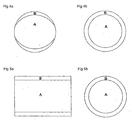
- FIG. 4 shows cross-sectional views (4a longitudinal section and 4b cross-section) through a granulate according to the invention were cut directly at the exit from the melt channel, as is done to the by-game by underwater granulation.
- the original cylindrical shape changes into a substantially round shape.
- a surface not covered by the outer layer (polymer B) remains.
- FIG. 5 shows cross-sectional views (5a longitudinal section and 5b cross-section) by a granulate according to the invention which were cut after solidification, as is done to Beilspiel by strand granulation.
- the original cylindrical shape is essentially preserved.
- a surface not covered by the outer layer (polymer B) remains.
Landscapes
- Engineering & Computer Science (AREA)
- Mechanical Engineering (AREA)
- Manufacturing & Machinery (AREA)
- Physics & Mathematics (AREA)
- Thermal Sciences (AREA)
- Processes Of Treating Macromolecular Substances (AREA)
- Processing And Handling Of Plastics And Other Materials For Molding In General (AREA)
Claims (26)
- Procédé pour la préparation d'un polymère partiellement cristallin, comprenant les étapesa) préparation d'une masse fondue de polymère A à partir d'un polymère cristallisable, qui comprend du poly(téréphtalate d'éthylène) ou des copolymères de poly(téréphtalate d'éthylène),b) préparation d'une masse fondue de polymère B à partir d'un polymère cristallisable, la masse fondue de polymère B comprenant du poly(téréphtalate d'éthylène) ou des copolymères de poly(téréphtalate d'éthylène),c) réunion des masses fondues de polymère A et B dans une multitude de canaux à masse fondue, la masse fondue de polymère B formant essentiellement une couche extérieure et la masse fondue de polymère A formant essentiellement une couche interne,d) façonnage de particules et solidification des masses fondues de polymère, le façonnage des particules pouvant avoir lieu avant ou après la solidification, la surface des particules étant constituée par entre 50% et 95% de polymère B caractérisé par l'étape :e) élévation du degré de cristallinité des particules polymères,
le polymère B obtenu par la solidification de la masse fondue de polymère B présentant une vitesse de cristallisation plus élevée que le polymère A obtenu par la solidification de la masse fondue de polymère A, le polymère A et le polymère B présentant au total entre 5 et 25% en mole de copolymère et étant cristallisés à un temps de séjour moyen inférieur à 10 fois le demi-temps de cristallisation du polymère A, à un degré de cristallisation entre 20% et 50%. - Procédé selon la revendication 1, caractérisé en ce que le polymère B présente une proportion plus faible de comonomère que le polymère A.
- Procédé selon l'une quelconque des revendications précédentes, caractérisé en ce que la masse fondue de polymère B présente une quantité plus élevée d'agent de nucléation que la masse fondue de polymère A.
- Procédé selon l'une quelconque des revendications précédentes, caractérisé en ce que la masse fondue de polymère B contient un agent de gonflement.
- Procédé selon l'une quelconque des revendications précédentes, caractérisé en ce que la masse fondue de polymère B présente une quantité plus élevée de solvants que la masse fondue de polymère A.
- Procédé selon l'une quelconque des revendications précédentes, caractérisé en ce que la masse fondue de polymère B comprend du polymère A et au moins un autre composant pour accélérer la cristallisation, tel qu'un agent de nucléation, un solvant ou un agent gonflant.
- Procédé selon l'une quelconque des revendications précédentes, caractérisé en ce que la masse fondue de polymère A présente une plus grande quantité de plastifiants que la masse fondue de polymère B.
- Procédé selon l'une quelconque des revendications précédentes, caractérisé en ce que le polymère A et le polymère B présentent au total entre 7 et 20% en mole de copolymère.
- Procédé selon l'une quelconque des revendications précédentes, caractérisé en ce que le polymère A et le polymère B sont cristallisés à un temps de séjour moyen inférieur à 6 fois le demi-temps de cristallisation du polymère A, à un degré de cristallisation entre 20% et 50%.
- Procédé selon l'une quelconque des revendications précédentes, caractérisé en ce que la réunion des masses fondues de polymère a lieu dans une filière dans laquelle sont formés une multitude de brins polymères qui sont coupés en granulats directement à la sortie de la filière ou après le passage dans une zone de refroidissement.
- Procédé selon l'une quelconque des revendications précédentes, caractérisé en ce que plus de 65% de la surface des particules sont formés par le polymère B.
- Procédé selon l'une quelconque des revendications précédentes, caractérisé en ce qu'entre 50% et 95% du volume des particules, en particulier des granulats, sont formés par le polymère A.
- Procédé selon la revendication 12, caractérisé en ce que plus de 65% du volume des particules sont formés par le polymère A.
- Procédé selon l'une quelconque des revendications précédentes, caractérisé en ce que l'élévation du degré de cristallisation des particules polymères a lieu directement après la préparation des particules, les particules étant maintenues à un niveau de température au-dessus de la température de transition vitreuse du polymère A.
- Procédé selon la revendication 14, caractérisé en ce que les particules sont maintenues à un niveau de température supérieur à 80°C.
- Procédé selon l'une quelconque des revendications précédentes, caractérisé en ce qu'après l'étape d'élévation du degré de cristallisation, une autre étape de polycondensation en phase solide suit.
- Granulat de polymère, constitué par au moins un polymère A, qui englobe la zone interne du granulat et un polymère B, qui englobe entre 50% et 95% de la zone de surface du granulat, le polymère A et le polymère B comprenant du poly(téréphtalate d'éthylène) ou des copolymères de poly(téréphtalate d'éthylène), caractérisé en ce que le polymère B présente une vitesse de cristallisation plus élevée que le polymère A, le polymère A et le polymère B présentent au total entre 5 et 25% en mole de copolymère et sont cristallisables à un temps de séjour moyen inférieur à 10 fois le demi-temps de cristallisation du polymère A, à un degré de cristallisation entre 20% et 50%.
- Granulat de polymère selon la revendication 17, caractérisé en ce que le polymère B présente une proportion plus faible de comonomère que le polymère A.
- Granulat de polymère selon la revendication 17 ou 18, caractérisé en ce que le polymère B présente une quantité plus élevée d'agent de nucléation que le polymère A.
- Granulat de polymère selon l'une quelconque des revendications 17 à 19, caractérisé en ce que le polymère B est plus fortement expansé que le polymère A.
- Granulat de polymère selon l'une quelconque des revendications 17 à 20, caractérisé en ce que le polymère B contient une quantité plus élevée de solvants que le polymère A.
- Granulat de polymère selon l'une quelconque des revendications 17 à 21, caractérisé en ce que le polymère B comprend du polymère A et au moins un autre composant pour accélérer la cristallisation, tel qu'un agent de nucléation, un solvant ou une préorientation, provoquée par un agent gonflant.
- Granulat de polymère selon l'une quelconque des revendications 17 à 22, caractérisé en ce que le polymère A présente une plus grande quantité de plastifiants que le polymère B.
- Granulat de polymère selon l'une quelconque des revendications 17 à 23, caractérisé en ce que plus de 65% de la surface des granulats sont formés par le polymère B.
- Granulat de polymère selon l'une quelconque des revendications 17 à 24, caractérisé en ce qu'entre 50% et 95% du volume des granulats sont formés par le polymère A.
- Granulat de polymère selon la revendication 25, caractérisé en ce que plus de 65% du volume des granulats sont formés par le polymère A.
Applications Claiming Priority (2)
| Application Number | Priority Date | Filing Date | Title |
|---|---|---|---|
| DE102006034284 | 2006-07-21 | ||
| PCT/CH2007/000331 WO2008009144A1 (fr) | 2006-07-21 | 2007-07-06 | Procédé de cristallisation d'un polymère cristallisant lentement |
Publications (2)
| Publication Number | Publication Date |
|---|---|
| EP2043831A1 EP2043831A1 (fr) | 2009-04-08 |
| EP2043831B1 true EP2043831B1 (fr) | 2013-02-27 |
Family
ID=38533868
Family Applications (1)
| Application Number | Title | Priority Date | Filing Date |
|---|---|---|---|
| EP07720223A Not-in-force EP2043831B1 (fr) | 2006-07-21 | 2007-07-06 | Procédé de cristallisation d'un polymère cristallisant lentement et granulés polymères |
Country Status (4)
| Country | Link |
|---|---|
| EP (1) | EP2043831B1 (fr) |
| ES (1) | ES2405310T3 (fr) |
| RU (1) | RU2009106080A (fr) |
| WO (1) | WO2008009144A1 (fr) |
Families Citing this family (3)
| Publication number | Priority date | Publication date | Assignee | Title |
|---|---|---|---|---|
| DE102012015257A1 (de) * | 2012-08-01 | 2014-02-06 | Automatik Plastics Machinery Gmbh | Granulatlochplatte |
| RU2685299C1 (ru) | 2016-06-21 | 2019-04-17 | Юоп Ллк | Способ и устройство для кристаллизации и повышения молекулярной массы полимерных частиц |
| US11298853B2 (en) | 2016-06-21 | 2022-04-12 | Uop Llc | Processes and apparatuses for conditioning polymer particles for an SSP reactor |
Citations (3)
| Publication number | Priority date | Publication date | Assignee | Title |
|---|---|---|---|---|
| EP0310968A2 (fr) * | 1987-10-06 | 1989-04-12 | Roderich Wilhelm Dr.-Ing. Gräff | Procédé et dispositif pour la cristallisation de granules synthétiques amorphes |
| DE19848245A1 (de) * | 1998-10-20 | 2000-05-04 | Rieter Automatik Gmbh | Verfahren zur Granulierung und Kristallisation von thermoplastischen Polyestern oder Copolyestern |
| WO2003037588A1 (fr) * | 2001-10-29 | 2003-05-08 | Markus Fellinger | Procede et dispositif pour augmenter la viscosite limite de polyester |
Family Cites Families (5)
| Publication number | Priority date | Publication date | Assignee | Title |
|---|---|---|---|---|
| JPH07171828A (ja) * | 1993-12-20 | 1995-07-11 | Terumo Corp | ポリマーペレット |
| ATE374682T1 (de) * | 1999-06-25 | 2007-10-15 | Sumika Color Company Ltd | Verfahren und vorrichtung zum herstellen von mehrschichtgranulaten |
| JP2003048991A (ja) * | 2001-08-03 | 2003-02-21 | Sumitomo Chem Co Ltd | 多層ペレット及びその製造方法 |
| US7204945B2 (en) * | 2003-09-16 | 2007-04-17 | Eastman Chemical Company | Direct coupling of melt polymerization and solid state processing for PET |
| DK1750916T3 (da) * | 2004-05-18 | 2012-06-11 | M & G Polimeri Italia Spa | Ruminddelte resinpellets |
-
2007
- 2007-07-06 RU RU2009106080/05A patent/RU2009106080A/ru not_active Application Discontinuation
- 2007-07-06 EP EP07720223A patent/EP2043831B1/fr not_active Not-in-force
- 2007-07-06 ES ES07720223T patent/ES2405310T3/es active Active
- 2007-07-06 WO PCT/CH2007/000331 patent/WO2008009144A1/fr not_active Ceased
Patent Citations (3)
| Publication number | Priority date | Publication date | Assignee | Title |
|---|---|---|---|---|
| EP0310968A2 (fr) * | 1987-10-06 | 1989-04-12 | Roderich Wilhelm Dr.-Ing. Gräff | Procédé et dispositif pour la cristallisation de granules synthétiques amorphes |
| DE19848245A1 (de) * | 1998-10-20 | 2000-05-04 | Rieter Automatik Gmbh | Verfahren zur Granulierung und Kristallisation von thermoplastischen Polyestern oder Copolyestern |
| WO2003037588A1 (fr) * | 2001-10-29 | 2003-05-08 | Markus Fellinger | Procede et dispositif pour augmenter la viscosite limite de polyester |
Also Published As
| Publication number | Publication date |
|---|---|
| WO2008009144A1 (fr) | 2008-01-24 |
| EP2043831A1 (fr) | 2009-04-08 |
| ES2405310T3 (es) | 2013-05-30 |
| RU2009106080A (ru) | 2010-08-27 |
Similar Documents
| Publication | Publication Date | Title |
|---|---|---|
| EP2209599B1 (fr) | Procédé pour cristalliser des polymères cristallisables présentant une tendance à l'adhésion élevée | |
| EP2520402B1 (fr) | Procédé de granulation en tête | |
| EP2101972B1 (fr) | Procédé de production de granulés de polycondensat cristallisés homogènes | |
| EP2712881A1 (fr) | Procédé et dispositif de cristallisation directe de polymères sous gaz inerte | |
| EP1742981B1 (fr) | Procede de production de granulat de polyester hautement condense | |
| EP2433771B1 (fr) | Procédé d'augmentation du poids moléculaire en utilisant la chaleur résiduelle de granulés de polyester | |
| DE10204954A1 (de) | Verfahren und Vorrichtung zum Herstellen kugelförmiger Partikel aus einer Schmelze aus Kunststoff | |
| EP1313599B1 (fr) | Procede et dispositif pour fabriquer des particules spheriques a partir de polymere fondu | |
| EP2398598B1 (fr) | Procédé de production de granulés de polyester à haute rendement sur une ligne | |
| EP1129124B1 (fr) | Procede et installation pour la production de granulats pet | |
| EP3650186B1 (fr) | Procédé et dispositif de cristallisation directe de polycondensats | |
| EP2043831B1 (fr) | Procédé de cristallisation d'un polymère cristallisant lentement et granulés polymères | |
| EP3363841B1 (fr) | Procédé et dispositif de cristallisation directe de polycondensats | |
| DE102007042636A1 (de) | Verfahren und Vorrichtung zur Herstellung eines Polyestergranulats nach dem Latentwärmekristallisationsverfahren | |
| DE102006012587A1 (de) | Verfahren und Vorrichtung zur Kristallisation von Polyestermaterial | |
| DE102004012579A1 (de) | Verfahren zur Herstellung eines teilkristallinen Polykondensates | |
| DE102007026737A1 (de) | Verfahren zur Kristallisation eines langsam kristallisierenden Polymeren | |
| EP4435366B1 (fr) | Echangeur de chaleur pour un lit de matière solide | |
| EP1727849B1 (fr) | Polyethylene terephtalate partiellement cristallin | |
| EP2454311B1 (fr) | Procédé et dispositif pour fabriquer une matière polymère partiellement cristalline |
Legal Events
| Date | Code | Title | Description |
|---|---|---|---|
| PUAI | Public reference made under article 153(3) epc to a published international application that has entered the european phase |
Free format text: ORIGINAL CODE: 0009012 |
|
| 17P | Request for examination filed |
Effective date: 20090218 |
|
| AK | Designated contracting states |
Kind code of ref document: A1 Designated state(s): AT BE BG CH CY CZ DE DK EE ES FI FR GB GR HU IE IS IT LI LT LU LV MC MT NL PL PT RO SE SI SK TR |
|
| AX | Request for extension of the european patent |
Extension state: AL BA HR MK RS |
|
| RAP1 | Party data changed (applicant data changed or rights of an application transferred) |
Owner name: BUEHLER AG Owner name: AUTOMATIK PLASTICS MACHINERY GMBH |
|
| 17Q | First examination report despatched |
Effective date: 20101108 |
|
| DAX | Request for extension of the european patent (deleted) | ||
| GRAP | Despatch of communication of intention to grant a patent |
Free format text: ORIGINAL CODE: EPIDOSNIGR1 |
|
| GRAS | Grant fee paid |
Free format text: ORIGINAL CODE: EPIDOSNIGR3 |
|
| GRAA | (expected) grant |
Free format text: ORIGINAL CODE: 0009210 |
|
| AK | Designated contracting states |
Kind code of ref document: B1 Designated state(s): AT BE BG CH CY CZ DE DK EE ES FI FR GB GR HU IE IS IT LI LT LU LV MC MT NL PL PT RO SE SI SK TR |
|
| REG | Reference to a national code |
Ref country code: GB Ref legal event code: FG4D Free format text: NOT ENGLISH |
|
| REG | Reference to a national code |
Ref country code: CH Ref legal event code: EP |
|
| REG | Reference to a national code |
Ref country code: AT Ref legal event code: REF Ref document number: 598251 Country of ref document: AT Kind code of ref document: T Effective date: 20130315 |
|
| REG | Reference to a national code |
Ref country code: IE Ref legal event code: FG4D Free format text: LANGUAGE OF EP DOCUMENT: GERMAN |
|
| REG | Reference to a national code |
Ref country code: DE Ref legal event code: R096 Ref document number: 502007011366 Country of ref document: DE Effective date: 20130425 |
|
| REG | Reference to a national code |
Ref country code: ES Ref legal event code: FG2A Ref document number: 2405310 Country of ref document: ES Kind code of ref document: T3 Effective date: 20130530 |
|
| RAP2 | Party data changed (patent owner data changed or rights of a patent transferred) |
Owner name: AUTOMATIK PLASTICS MACHINERY GMBH Owner name: BUEHLER THERMAL PROCESSES AG |
|
| REG | Reference to a national code |
Ref country code: DE Ref legal event code: R082 Ref document number: 502007011366 Country of ref document: DE Representative=s name: ISARPATENT GBR PATENT- UND RECHTSANWAELTE, DE |
|
| REG | Reference to a national code |
Ref country code: NL Ref legal event code: T3 Ref country code: NL Ref legal event code: SD Effective date: 20130702 |
|
| REG | Reference to a national code |
Ref country code: LT Ref legal event code: MG4D |
|
| PG25 | Lapsed in a contracting state [announced via postgrant information from national office to epo] |
Ref country code: SE Free format text: LAPSE BECAUSE OF FAILURE TO SUBMIT A TRANSLATION OF THE DESCRIPTION OR TO PAY THE FEE WITHIN THE PRESCRIBED TIME-LIMIT Effective date: 20130227 Ref country code: BG Free format text: LAPSE BECAUSE OF FAILURE TO SUBMIT A TRANSLATION OF THE DESCRIPTION OR TO PAY THE FEE WITHIN THE PRESCRIBED TIME-LIMIT Effective date: 20130527 Ref country code: IS Free format text: LAPSE BECAUSE OF FAILURE TO SUBMIT A TRANSLATION OF THE DESCRIPTION OR TO PAY THE FEE WITHIN THE PRESCRIBED TIME-LIMIT Effective date: 20130627 Ref country code: LT Free format text: LAPSE BECAUSE OF FAILURE TO SUBMIT A TRANSLATION OF THE DESCRIPTION OR TO PAY THE FEE WITHIN THE PRESCRIBED TIME-LIMIT Effective date: 20130227 |
|
| REG | Reference to a national code |
Ref country code: DE Ref legal event code: R081 Ref document number: 502007011366 Country of ref document: DE Owner name: AUTOMATIK PLASTICS MACHINERY GMBH, DE Free format text: FORMER OWNER: AUTOMATIK PLASTICS MACHINERY GM, BUEHLER AG, , CH Effective date: 20130701 Ref country code: DE Ref legal event code: R081 Ref document number: 502007011366 Country of ref document: DE Owner name: BUEHLER THERMAL PROCESSES AG, CH Free format text: FORMER OWNER: AUTOMATIK PLASTICS MACHINERY GM, BUEHLER AG, , CH Effective date: 20130701 Ref country code: DE Ref legal event code: R082 Ref document number: 502007011366 Country of ref document: DE Representative=s name: ISARPATENT GBR PATENT- UND RECHTSANWAELTE, DE Effective date: 20130701 Ref country code: DE Ref legal event code: R082 Ref document number: 502007011366 Country of ref document: DE Representative=s name: ISARPATENT PATENTANWAELTE BEHNISCH, BARTH, CHA, DE Effective date: 20130701 Ref country code: DE Ref legal event code: R081 Ref document number: 502007011366 Country of ref document: DE Owner name: BUEHLER THERMAL PROCESSES AG, CH Free format text: FORMER OWNERS: AUTOMATIK PLASTICS MACHINERY GMBH, 63762 GROSSOSTHEIM, DE; BUEHLER AG, UZWIL, CH Effective date: 20130701 Ref country code: DE Ref legal event code: R081 Ref document number: 502007011366 Country of ref document: DE Owner name: AUTOMATIK PLASTICS MACHINERY GMBH, DE Free format text: FORMER OWNERS: AUTOMATIK PLASTICS MACHINERY GMBH, 63762 GROSSOSTHEIM, DE; BUEHLER AG, UZWIL, CH Effective date: 20130701 |
|
| PG25 | Lapsed in a contracting state [announced via postgrant information from national office to epo] |
Ref country code: SI Free format text: LAPSE BECAUSE OF FAILURE TO SUBMIT A TRANSLATION OF THE DESCRIPTION OR TO PAY THE FEE WITHIN THE PRESCRIBED TIME-LIMIT Effective date: 20130227 Ref country code: LV Free format text: LAPSE BECAUSE OF FAILURE TO SUBMIT A TRANSLATION OF THE DESCRIPTION OR TO PAY THE FEE WITHIN THE PRESCRIBED TIME-LIMIT Effective date: 20130227 Ref country code: FI Free format text: LAPSE BECAUSE OF FAILURE TO SUBMIT A TRANSLATION OF THE DESCRIPTION OR TO PAY THE FEE WITHIN THE PRESCRIBED TIME-LIMIT Effective date: 20130227 Ref country code: GR Free format text: LAPSE BECAUSE OF FAILURE TO SUBMIT A TRANSLATION OF THE DESCRIPTION OR TO PAY THE FEE WITHIN THE PRESCRIBED TIME-LIMIT Effective date: 20130528 Ref country code: PT Free format text: LAPSE BECAUSE OF FAILURE TO SUBMIT A TRANSLATION OF THE DESCRIPTION OR TO PAY THE FEE WITHIN THE PRESCRIBED TIME-LIMIT Effective date: 20130627 Ref country code: PL Free format text: LAPSE BECAUSE OF FAILURE TO SUBMIT A TRANSLATION OF THE DESCRIPTION OR TO PAY THE FEE WITHIN THE PRESCRIBED TIME-LIMIT Effective date: 20130227 |
|
| PG25 | Lapsed in a contracting state [announced via postgrant information from national office to epo] |
Ref country code: RO Free format text: LAPSE BECAUSE OF FAILURE TO SUBMIT A TRANSLATION OF THE DESCRIPTION OR TO PAY THE FEE WITHIN THE PRESCRIBED TIME-LIMIT Effective date: 20130227 Ref country code: CZ Free format text: LAPSE BECAUSE OF FAILURE TO SUBMIT A TRANSLATION OF THE DESCRIPTION OR TO PAY THE FEE WITHIN THE PRESCRIBED TIME-LIMIT Effective date: 20130227 Ref country code: EE Free format text: LAPSE BECAUSE OF FAILURE TO SUBMIT A TRANSLATION OF THE DESCRIPTION OR TO PAY THE FEE WITHIN THE PRESCRIBED TIME-LIMIT Effective date: 20130227 Ref country code: DK Free format text: LAPSE BECAUSE OF FAILURE TO SUBMIT A TRANSLATION OF THE DESCRIPTION OR TO PAY THE FEE WITHIN THE PRESCRIBED TIME-LIMIT Effective date: 20130227 Ref country code: SK Free format text: LAPSE BECAUSE OF FAILURE TO SUBMIT A TRANSLATION OF THE DESCRIPTION OR TO PAY THE FEE WITHIN THE PRESCRIBED TIME-LIMIT Effective date: 20130227 |
|
| PGFP | Annual fee paid to national office [announced via postgrant information from national office to epo] |
Ref country code: DE Payment date: 20130703 Year of fee payment: 7 Ref country code: ES Payment date: 20130628 Year of fee payment: 7 Ref country code: NL Payment date: 20130710 Year of fee payment: 7 |
|
| PG25 | Lapsed in a contracting state [announced via postgrant information from national office to epo] |
Ref country code: CY Free format text: LAPSE BECAUSE OF FAILURE TO SUBMIT A TRANSLATION OF THE DESCRIPTION OR TO PAY THE FEE WITHIN THE PRESCRIBED TIME-LIMIT Effective date: 20130227 |
|
| PGFP | Annual fee paid to national office [announced via postgrant information from national office to epo] |
Ref country code: GB Payment date: 20130703 Year of fee payment: 7 |
|
| PG25 | Lapsed in a contracting state [announced via postgrant information from national office to epo] |
Ref country code: IT Free format text: LAPSE BECAUSE OF FAILURE TO SUBMIT A TRANSLATION OF THE DESCRIPTION OR TO PAY THE FEE WITHIN THE PRESCRIBED TIME-LIMIT Effective date: 20130227 |
|
| PLBE | No opposition filed within time limit |
Free format text: ORIGINAL CODE: 0009261 |
|
| STAA | Information on the status of an ep patent application or granted ep patent |
Free format text: STATUS: NO OPPOSITION FILED WITHIN TIME LIMIT |
|
| BERE | Be: lapsed |
Owner name: AUTOMATIK PLASTICS MACHINERY G.M.B.H. Effective date: 20130731 Owner name: BUHLER A.G. Effective date: 20130731 |
|
| 26N | No opposition filed |
Effective date: 20131128 |
|
| PG25 | Lapsed in a contracting state [announced via postgrant information from national office to epo] |
Ref country code: MC Free format text: LAPSE BECAUSE OF FAILURE TO SUBMIT A TRANSLATION OF THE DESCRIPTION OR TO PAY THE FEE WITHIN THE PRESCRIBED TIME-LIMIT Effective date: 20130227 |
|
| REG | Reference to a national code |
Ref country code: CH Ref legal event code: PL |
|
| REG | Reference to a national code |
Ref country code: DE Ref legal event code: R097 Ref document number: 502007011366 Country of ref document: DE Effective date: 20131128 |
|
| REG | Reference to a national code |
Ref country code: IE Ref legal event code: MM4A |
|
| REG | Reference to a national code |
Ref country code: FR Ref legal event code: ST Effective date: 20140331 |
|
| PG25 | Lapsed in a contracting state [announced via postgrant information from national office to epo] |
Ref country code: CH Free format text: LAPSE BECAUSE OF NON-PAYMENT OF DUE FEES Effective date: 20130731 Ref country code: BE Free format text: LAPSE BECAUSE OF NON-PAYMENT OF DUE FEES Effective date: 20130731 Ref country code: LI Free format text: LAPSE BECAUSE OF NON-PAYMENT OF DUE FEES Effective date: 20130731 |
|
| PG25 | Lapsed in a contracting state [announced via postgrant information from national office to epo] |
Ref country code: FR Free format text: LAPSE BECAUSE OF NON-PAYMENT OF DUE FEES Effective date: 20130731 |
|
| PG25 | Lapsed in a contracting state [announced via postgrant information from national office to epo] |
Ref country code: IE Free format text: LAPSE BECAUSE OF NON-PAYMENT OF DUE FEES Effective date: 20130706 |
|
| REG | Reference to a national code |
Ref country code: AT Ref legal event code: MM01 Ref document number: 598251 Country of ref document: AT Kind code of ref document: T Effective date: 20130706 |
|
| PG25 | Lapsed in a contracting state [announced via postgrant information from national office to epo] |
Ref country code: AT Free format text: LAPSE BECAUSE OF NON-PAYMENT OF DUE FEES Effective date: 20130706 |
|
| REG | Reference to a national code |
Ref country code: DE Ref legal event code: R119 Ref document number: 502007011366 Country of ref document: DE |
|
| REG | Reference to a national code |
Ref country code: NL Ref legal event code: V1 Effective date: 20150201 |
|
| GBPC | Gb: european patent ceased through non-payment of renewal fee |
Effective date: 20140706 |
|
| PG25 | Lapsed in a contracting state [announced via postgrant information from national office to epo] |
Ref country code: NL Free format text: LAPSE BECAUSE OF NON-PAYMENT OF DUE FEES Effective date: 20150201 |
|
| REG | Reference to a national code |
Ref country code: DE Ref legal event code: R119 Ref document number: 502007011366 Country of ref document: DE Effective date: 20150203 |
|
| PG25 | Lapsed in a contracting state [announced via postgrant information from national office to epo] |
Ref country code: DE Free format text: LAPSE BECAUSE OF NON-PAYMENT OF DUE FEES Effective date: 20150203 |
|
| PG25 | Lapsed in a contracting state [announced via postgrant information from national office to epo] |
Ref country code: GB Free format text: LAPSE BECAUSE OF NON-PAYMENT OF DUE FEES Effective date: 20140706 |
|
| PG25 | Lapsed in a contracting state [announced via postgrant information from national office to epo] |
Ref country code: TR Free format text: LAPSE BECAUSE OF FAILURE TO SUBMIT A TRANSLATION OF THE DESCRIPTION OR TO PAY THE FEE WITHIN THE PRESCRIBED TIME-LIMIT Effective date: 20130227 Ref country code: MT Free format text: LAPSE BECAUSE OF FAILURE TO SUBMIT A TRANSLATION OF THE DESCRIPTION OR TO PAY THE FEE WITHIN THE PRESCRIBED TIME-LIMIT Effective date: 20130227 |
|
| PG25 | Lapsed in a contracting state [announced via postgrant information from national office to epo] |
Ref country code: HU Free format text: LAPSE BECAUSE OF FAILURE TO SUBMIT A TRANSLATION OF THE DESCRIPTION OR TO PAY THE FEE WITHIN THE PRESCRIBED TIME-LIMIT; INVALID AB INITIO Effective date: 20070706 Ref country code: LU Free format text: LAPSE BECAUSE OF NON-PAYMENT OF DUE FEES Effective date: 20130706 |
|
| REG | Reference to a national code |
Ref country code: ES Ref legal event code: FD2A Effective date: 20160303 |
|
| PG25 | Lapsed in a contracting state [announced via postgrant information from national office to epo] |
Ref country code: ES Free format text: LAPSE BECAUSE OF NON-PAYMENT OF DUE FEES Effective date: 20140707 |