EP2053419A1 - Vorrichtung und Verfahren zur Schätzung und Kompensation einer Bewegung bei der Erzeugung eines synthetischen Bildes unter Benutzung einer besonderen Abtastreihenfolge - Google Patents
Vorrichtung und Verfahren zur Schätzung und Kompensation einer Bewegung bei der Erzeugung eines synthetischen Bildes unter Benutzung einer besonderen Abtastreihenfolge Download PDFInfo
- Publication number
- EP2053419A1 EP2053419A1 EP08018527A EP08018527A EP2053419A1 EP 2053419 A1 EP2053419 A1 EP 2053419A1 EP 08018527 A EP08018527 A EP 08018527A EP 08018527 A EP08018527 A EP 08018527A EP 2053419 A1 EP2053419 A1 EP 2053419A1
- Authority
- EP
- European Patent Office
- Prior art keywords
- transmit
- scan lines
- auto correlation
- motion
- decrement
- Prior art date
- Legal status (The legal status is an assumption and is not a legal conclusion. Google has not performed a legal analysis and makes no representation as to the accuracy of the status listed.)
- Granted
Links
Images





Classifications
-
- G—PHYSICS
- G01—MEASURING; TESTING
- G01S—RADIO DIRECTION-FINDING; RADIO NAVIGATION; DETERMINING DISTANCE OR VELOCITY BY USE OF RADIO WAVES; LOCATING OR PRESENCE-DETECTING BY USE OF THE REFLECTION OR RERADIATION OF RADIO WAVES; ANALOGOUS ARRANGEMENTS USING OTHER WAVES
- G01S7/00—Details of systems according to groups G01S13/00, G01S15/00, G01S17/00
- G01S7/52—Details of systems according to groups G01S13/00, G01S15/00, G01S17/00 of systems according to group G01S15/00
- G01S7/52017—Details of systems according to groups G01S13/00, G01S15/00, G01S17/00 of systems according to group G01S15/00 particularly adapted to short-range imaging
- G01S7/52046—Techniques for image enhancement involving transmitter or receiver
-
- G—PHYSICS
- G01—MEASURING; TESTING
- G01S—RADIO DIRECTION-FINDING; RADIO NAVIGATION; DETERMINING DISTANCE OR VELOCITY BY USE OF RADIO WAVES; LOCATING OR PRESENCE-DETECTING BY USE OF THE REFLECTION OR RERADIATION OF RADIO WAVES; ANALOGOUS ARRANGEMENTS USING OTHER WAVES
- G01S15/00—Systems using the reflection or reradiation of acoustic waves, e.g. sonar systems
- G01S15/88—Sonar systems specially adapted for specific applications
- G01S15/89—Sonar systems specially adapted for specific applications for mapping or imaging
- G01S15/8906—Short-range imaging systems; Acoustic microscope systems using pulse-echo techniques
- G01S15/8997—Short-range imaging systems; Acoustic microscope systems using pulse-echo techniques using synthetic aperture techniques
-
- G—PHYSICS
- G01—MEASURING; TESTING
- G01S—RADIO DIRECTION-FINDING; RADIO NAVIGATION; DETERMINING DISTANCE OR VELOCITY BY USE OF RADIO WAVES; LOCATING OR PRESENCE-DETECTING BY USE OF THE REFLECTION OR RERADIATION OF RADIO WAVES; ANALOGOUS ARRANGEMENTS USING OTHER WAVES
- G01S7/00—Details of systems according to groups G01S13/00, G01S15/00, G01S17/00
- G01S7/52—Details of systems according to groups G01S13/00, G01S15/00, G01S17/00 of systems according to group G01S15/00
- G01S7/52017—Details of systems according to groups G01S13/00, G01S15/00, G01S17/00 of systems according to group G01S15/00 particularly adapted to short-range imaging
- G01S7/52023—Details of receivers
- G01S7/52025—Details of receivers for pulse systems
- G01S7/52026—Extracting wanted echo signals
-
- G—PHYSICS
- G01—MEASURING; TESTING
- G01S—RADIO DIRECTION-FINDING; RADIO NAVIGATION; DETERMINING DISTANCE OR VELOCITY BY USE OF RADIO WAVES; LOCATING OR PRESENCE-DETECTING BY USE OF THE REFLECTION OR RERADIATION OF RADIO WAVES; ANALOGOUS ARRANGEMENTS USING OTHER WAVES
- G01S7/00—Details of systems according to groups G01S13/00, G01S15/00, G01S17/00
- G01S7/52—Details of systems according to groups G01S13/00, G01S15/00, G01S17/00 of systems according to group G01S15/00
- G01S7/52017—Details of systems according to groups G01S13/00, G01S15/00, G01S17/00 of systems according to group G01S15/00 particularly adapted to short-range imaging
- G01S7/52085—Details related to the ultrasound signal acquisition, e.g. scan sequences
-
- G—PHYSICS
- G01—MEASURING; TESTING
- G01S—RADIO DIRECTION-FINDING; RADIO NAVIGATION; DETERMINING DISTANCE OR VELOCITY BY USE OF RADIO WAVES; LOCATING OR PRESENCE-DETECTING BY USE OF THE REFLECTION OR RERADIATION OF RADIO WAVES; ANALOGOUS ARRANGEMENTS USING OTHER WAVES
- G01S7/00—Details of systems according to groups G01S13/00, G01S15/00, G01S17/00
- G01S7/52—Details of systems according to groups G01S13/00, G01S15/00, G01S17/00 of systems according to group G01S15/00
- G01S7/52017—Details of systems according to groups G01S13/00, G01S15/00, G01S17/00 of systems according to group G01S15/00 particularly adapted to short-range imaging
- G01S7/52077—Details of systems according to groups G01S13/00, G01S15/00, G01S17/00 of systems according to group G01S15/00 particularly adapted to short-range imaging with means for elimination of unwanted signals, e.g. noise or interference
Definitions
- the present invention generally relates to an ultrasound synthetic image, and more particularly to an apparatus and method of estimating and compensating a motion in forming an ultrasound synthetic image for a moving object to thereby enhance resolution and improve a signal-to-noise ratio (SNR).
- SNR signal-to-noise ratio
- an ultrasound diagnostic system may use an array transducer for transmitting and receiving ultrasound signals.
- an ultrasound synthetic image may be adopted.
- the ultrasound synthetic image may be formed by using receive dynamic focusing for forming multi-receive beams in response to one time transmission of a transmit beam.
- the ultrasound diagnostic system may synthesize the receive beams corresponding to the same scan line obtained through a plurality of transmissions of the transmit beam along a plurality of scan lines to thereby form an ultrasound synthetic image.
- the ultrasound diagnostic system may form (2m+1) numbers of receive beams corresponding to scan lines S n-m , S n-(m-1) , ..., S n , ..., S n+(m-1) , S n+m , wherein m>0.
- the transmit beam is focused along a scan line S n
- three receive beams may be formed based on echo signals from scan lines S n-1 , S n and S n+1 . That is, three receive beams may be obtained per each scan line and the receive beams are then synthesized to form an ultrasound synthetic image.
- an ultrasound synthetic having good resolution and signal to noise ration may be obtained.
- the target object is a moving object (especially moving in an axial direction)
- an undesirable image may be displayed in forming an ultrasound synthetic image. That is, the ultrasound synthetic image may be formed by using receive beams obtained with a time delay or multiple transmit beams such as bi-directional pixel based focusing.
- FIG. 1 is a schematic diagram showing a procedure of forming a general synthetic image.
- FIG. 2A shows a transmit fields in a brightness (B) mode with the array transducer.
- FIG. 2B shows a virtual source element located at a focal depth in a B mode.
- FIG. 2C shows superposition of transmit fields of two virtual source elements at imaging points.
- FIG. 3 is a schematic block diagram illustrating an ultrasound diagnostic system in accordance with one embodiment of the present invention.
- FIG. 4 is a schematic block diagram illustrating a beam former.
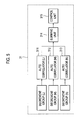
- FIG. 5 is a schematic block diagrams illustrating an image motion estimation/compensation unit.
- FIG. 6 is an exemplary diagram showing a non-sequential transmit order of a transmit beam for a plurality of scan lines in accordance with one embodiment of the present invention.
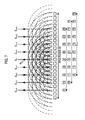
- FIG. 7 is a schematic diagram showing an example of a synthetic aperture imaging method by using BiPBF.
- FIG. 8 is a schematic diagram showing a method of obtaining a synthesis data at an arbitrary imaging point by using a plurality of low resolution images.
- FIG. 9 is a graph showing lateral beam width for the maximum values on the scan lines.
- the present invention is directed to removing an effect caused by side lobes with a relatively low amount of calculation in an ultrasound synthetic image to thereby enhance resolution and compensate a signal to noise ratio (SNR) for degradation.
- the present invention may adjust the transmit order of a transmit beam for scan lines, thereby removing factors having unnecessary phases caused by the side lobes. This is so that a radio frequency (RF) pixel (or sample unit) based motion estimation and compensation may be achieved with a relatively low amount of calculation.
- RF radio frequency
- the present invention is simulated based on bidirectional pixel based focusing (BIPBF) and the proposed method may be applied to a general synthetic imaging method of ultrasound images.
- the ultrasound synthetic image may be formed by using one of a receive synthetic-aperture focusing method or a transmit synthetic-aperture focusing method.
- the receive synthetic-aperture focusing method is a technique applied to a commercial equipment.
- Multi-receive beams may be formed and stored by repeatedly performing transmission and reception of ultrasound signals for the scan lines and then the stored receive beams are synthesized. This is so that an ultrasound synthetic image can be obtained according to the receive synthetic-aperture focusing method.
- the transmit synthetic-aperture focusing method may have an effect relatively increasing an ultrasound transmit power by using ultrasound signals generated in a plurality of transmit fields instead of a single transmit field.
- the BiPBF method may perform transmit and receive focusing for all points based on the transmit synthetic-aperture focusing method. As illustrated in FIG. 2B , the BiPBF method may be translated by referring to a transmit focal point as a virtual source element.
- FIG. 2A shows a transmit field in a brightness (B) mode with the array transducer.
- the transmit field which is radiated from the array transducer, converges toward a focal point and then diverges in the form of a circular wave within a limited angular extent.
- FIG. 2B shows a virtual source element located at a focal depth in the B mode. The virtual source element may generate a circular wave back and forth with respect to itself.
- FIG. 2C shows a superposition of transmit fields of two virtual source elements at imaging points. As shown in FIG. 2C , one imaging point is shown before the focal depth and the other imaging point is shown after the focal depth with respect to a center of symmetry of the circular field.
- the BiPBF method may be able to maintain a uniform lateral resolution over all focal depths and reduce a side lobe level compared to other methods. Also, since the transmit power increases due to the synthesis of transmit fields, an ultrasound synthetic image having an enhanced SNR may be obtained through the BiPBF method. However, the use of the BiPBF method may be restricted to imaging a stationary or slowly moving object. If the BiPBF method is applied for imaging a fast moving object, then the resolution may be degraded or the target object may disappear in the ultrasound synthetic image. Especially, a motion occurring in an axial direction may largely affect the ultrasound synthetic image compared to a motion occurring in a lateral direction.
- a motion occurring may be confidentially recognized by using 2-dimensional tissue Doppler imaging (2D-TDI).
- the 2D-TDI may repeatedly transmit an ultrasound signal with an identical acoustic field at a constant time interval and detect a phase change of echo signals to thereby find a mean Doppler frequency by using auto correlation or other methods.
- the synthetic aperture imaging may be similar to the 2D-TDI in terms of repeatedly transmitting an ultrasound signal. However, the SAI may transmit an ultrasound sound signal in a different acoustic field per transmission, which is different from the 2D-TDI for transmitting the ultrasound signal with the identical acoustic field per transmission.
- a wave plane of the acoustic field may be rotated in a constant angle per each transmit in view of each of the pixels. This rotation may cause the side lobes in a low resolution image formed based on each transmission to be also rotated.
- a motion in an axial direction may be found to be similar to a tissue Doppler.
- a wrong motion may be detected at a position of side lobes of the target object even at adjacencies of the target object, which is not moved.
- the present invention adopts a new transmit order of a transmit beam (i.e., a specified transmit order) for the scan lines and a phase detecting method through auto correlation for compensating for the wrongly detected motion.
- a problem caused by the side lobes in the low resolution image will be verified through the auto correlation for a stationary object and a moving object.
- a procedure using the new transmit order the transmit beam (i.e., not sequential but not non-sequential) and the auto correlation for calculating mean phase of receive beams to remove the effect caused by the side lobes and overcome limitation of amount of calculations will be described in detail. Since the motion may be estimated and compensated in a pixel with a relatively low amount of calculation, a uniform resolution of an ultrasound synthetic image for the moving object may be maintained identical to that of the stationary object.
- FIG. 3 is a schematic block diagram illustrating an ultrasound diagnostic system in accordance with one embodiment of the present invention.
- FIGS. 4 and 5 are schematic block diagrams illustrating a beam former and an image motion estimation/compensation unit.
- a probe 10 may include an array transducer and may be operable to transmit and receive ultrasound signals.
- the probe 10 may further include a transmitter (not shown) and an analog receiver (not shown).
- the array transducer may comprise a plurality of elements (e.g., 128 elements) and may be operable to output the ultrasound signals in response to transmit pulses applied from the transmitter.
- the analog receiver may be operable to amplify electrical receive signal outputted from the array transducer in response to echo signals, remove aliasing phenomenon and noises, and compensate attenuation due to propagation of the ultrasound signals in the target object.
- a transmit/receive switch 20 may be operable to switch transmission and reception of the ultrasound signals for the same elements.
- the transmit/receive switch 20 may be further operable to prevent a high power outputted from the transmitter from affecting the analog receiver. That is, when the transmission and the reception are alternately carried out, the transmit/receive switch 20 may be operable to appropriately switch the transmitter and the analog receive.
- a beam former 30 may be operable to sample the electric receive signals outputted from the transducer elements in response to the echo signals and perform receive focusing upon the sampled electric receive signals.
- the beam former 30 may include a gain adjusting unit 301, an analog-to-digital converting unit 302, a delay unit 303, an image synthesizing unit 304 and a summing unit 305.
- the gain adjusting unit 301 may be operable to compensate gain of the analog receive signals received at the analog receiver.
- the analog-to-digital converting unit may be operable to convert the analog receive signals to digital receive signals.
- the delay unit 303 may be operable to apply a different amount of delay to the digital receive signals based on distance differences between the respective elements and a focal point.
- the image synthesizing unit 304 may be operable to synthesize the delayed digital receive signals to thereby form a receive-focused beam of a radio frequency (RF).
- the summing unit 305 may be operable to sum the receive-focused beams form at respective channels.
- An echo processing unit 40 may be operable to convert the RF receive-focused beam into a baseband signal and perform envelop detection with a quadrature demodulator, thereby obtaining an ultrasound image data corresponding to scan lines.
- a scan converting unit 50 may be operable to scan-convert the ultrasound image data in a format capable of being displayed on a display unit 60. That is, the scan converting unit 50 may be operable to convert the ultrasound image data in an appropriate data format capable of being displayed on the display unit 60.
- the display unit 60 may be operable to receive the scan-converted ultrasound image data to display an ultrasound image of the target object.
- An ultimate aim of the present invention is to maintain uniform resolution of an ultrasound synthetic image for a moving object identical to that of a stationary object through motion estimation and compensation of the moving object in an ultrasound synthetic imaging procedure.
- the present invention may provide the non-sequential transmit order of the transmit beam for the scan lines and generate data necessary for motion estimation and compensation (e.g., phase data formed in a pixel unit or a sample unit) based on receive beams obtained in response to the transmit beam.
- the data may be inputted into auto correlators 311-313 by grouping the receive beams based on the transmit order. That is, the present invention may set a specific transmit order of the transmit beam for the scan lines ( see FIG. 6 ) through a transmit/receive control unit 21.
- the scan lines may be grouped with a decrement group and an increment group. The detailed description for grouping of the scan lines will be provided later.
- M and N numbers of receive beams responsive to the increment group and L numbers of receive beams responsive to the decrement group may be obtained.
- the receive beams may be inputted to the auto correlators 311-313.
- the auto correlators 311-313 may be operable to calculate phases from the inputted receive beams in a pixel unit or a sample unit and provide phase information for motion estimation and compensation based on the calculated phases.
- a control unit 315 of an image motion estimation/compensation control unit 31 may be operable to calculate a velocity of the motion based on the phase information and compensate the motion by adjusting receive delay time based on the calculated velocity per each pixel. This is so that the resolution of an ultrasound synthetic image for a moving object may be uniformly maintained identical to that of an ultrasound synthetic image for a stationary object.
- the image motion estimation/compensation control unit 31 is installed at an outside of the beam former 30 in FIGS. 3 and 4
- the image motion estimation/compensation control unit 31 may be installed in the beam former 30. It should be noted herein that the position for installing the image motion estimation/compensation control unit 31 is not limited thereto.
- the transmit/receive control unit 21 of the present invention may set not the sequential transmit order for the scan lines but the non-sequential transmit order.
- the auto correlators 311-313 of the image motion estimation/compensation control unit 31 may detect phases at the respective pixels with auto correlation function from the receive beams responsive to the transmission of the transmit beams in the non-sequential transmit order for the scan lines. This is so that an effect due to the side lobes may be removed with a relatively low amount of calculation.
- control unit 315 of the image motion estimation/compensation control unit 31 may estimate and compensate the motion of a moving object in the ultrasound synthetic imaging process, the resolution of the image for the moving object may be uniformly maintained identical to that of the ultrasound synthetic image for the stationary object.
- the present invention will be dominantly described for a control procedure for the image motion estimation and compensation (i.e., extraction of phases necessary for the motion estimation and compensation).
- the image motion estimation and compensation process i.e., calculation of velocity of moving object based on the phase information and compensation for the motion based on the calculated velocity, e.g., compensation for focusing delay time based on the calculated velocities for the pixels
- the image motion estimation and compensation process i.e., calculation of velocity of moving object based on the phase information and compensation for the motion based on the calculated velocity, e.g., compensation for focusing delay time based on the calculated velocities for the pixels
- phase status of a main lobe and a side lobe in an ultrasound synthetic image for a stationary object and an ultrasound synthetic image for a moving object will be checked through the low resolution images. Then, the phase status will be re-checked after setting a new transmit order of the transmit beams for the scan lines in accordance with the present invention.
- FIG. 7 is a schematic diagram showing an example of a synthetic aperture imaging method by using the BiPBF.
- N may be an ensemble number.
- the mean phase may be calculated at each of the pixels by using the ensemble number of the receive beams at the auto correlation function.
- an image for a main lobe may be indicated in the shape of a black hole as a correlation result since the phases for the main lobe are not changed.
- a phase may be changed due to the side lobe in spite of the stationary object.
- the phase change becomes lower close to the main lobe.
- the phase change due to the side lobe should be minimized.
- the moving velocity should be 0 m/s in case of the stationary target object.
- a velocity component may be detected due to the effect of the side lobe in the ultrasound synthetic image. That is, if the transmit focusing is carried out in a sequential transmit order for the scan lines, then a phase for the main lobe is not changed, but a phase for the side lobe is rotated in a constant pattern in an x-y space.
- the present invention may set the transmit order of the transmit beam for the scan lines in a non-sequential manner to minimize the effect of the side lobes and then perform the auto correlation for the receive beams obtained in response to the newly set transmit order.
- FIG. 6 is a schematic diagram showing an example of the specific transmit order of the transmit beam for the scan lines in accordance with one embodiment of the present invention.
- the scan lines are defined with sequential indices and the transmit order of the transmit beam for the scan lines is set in a non-sequential manner in which increment and decrement of the indices of the scan lines are repeated.
- the transmit scan lines may be divided into a scan line increment group and a scan line decrement group. Further, the increment and decrement may be set as +2 and -1, respectively.
- the transmission for the scan lines may be carried out in a rearranged transmit order such as 2, 1, 4, 3, 6, 5 ...
- the transmit order is rearranged such that the decrement and increment of -1 and +2 are to be repeated.
- a phase difference between receive beams obtained in response to the first transmission and the second transmission is indicated as a(1, 3)
- a mean phase difference calculated from a(2, 4), a(3, 5), a(8, 10), etc. i.e., B group having a number difference of +2 for pixels located in the side lobe of the stationary target object may be denoted as B.
- a mean phase difference calculated from a(2, 1), a(4, 3), a(6, 5), etc i.e., A group having a number difference of -1) may be denoted as A. If the mean phase differences for the stationary target object are denoted as A and B, then the following equation (1) may be approximately obtained.
- the mean phase may be calculated by using the auto correlation.
- the auto correlation may be carried out as follows.
- Function z 1 ( t ) may be defined by functions z ( t ) and z* ( t-T ) as the following equation (4)
- z * ⁇ t - T x ⁇ t - T - jy ⁇ t - T
- z* ( t-T ) is a conjugate complex delayed by a delay time T from the function z ( t ) as shown in the equation (5). If the function z 1 ( t ) is integrated over a specific time, then a result of the auto correlation function may be obtained as the following equation (6).
- n represents the number of the consecutive transmit pulses in a constant direction, which is referred to as an ensemble number in an ultrasound image.
- the following equation (7) represents an auto correlation function for the receive beams corresponding to the increment group having the increment of +2.
- the following equations (8) and (9) represent the power and phase of the receive beams corresponding to the increment group. This process is carried out by an auto correlator 312 for the receive beams corresponding to the increment group among the auto correlators 311-313 of the image motion estimation/compensation control unit 31.
- a complex value summing the calculated phases of the receive beams for the increment group and the decrement group, which are obtained by the auto correlators 311-313 of the image motion estimation/compensation control unit 31, may be expressed as the following equations (16) and (17).
- the summation may be carried out by the summation unit 314 of the image motion estimation/compensation control unit 31.
- the power of the corresponding pixel or sample may be defined as the following equation (18) and the phase may be defined as the following equation (19).
- the equation (19) represents a pixel based mean phase. By using this, a specific area based mean phase can be obtained. As such, the result of the equations (16) and (17) may be expressed in space coordinates as the following equation (20).
- the equation (20) may be expressed as the following equations (21) and (22) so that it can be extended to a type having a specific area based mean phase.
- a velocity of the target object may be calculated by using the following equation (23).
- V target represents a velocity of the target object
- c represents an acoustic velocity
- f0 represents a center frequency of the transducer
- PRF is a transmit repetition frequency.
- the distance may be calculated by using the calculated velocity of the target object as the following equation (24).
- the motion compensation may be carried out by compensating the transmit focusing delay time and the receive focusing delay time based on the estimated velocity per each pixel, or additionally applying motion compensation focusing delay time without changing the transmit focusing delay time and the receive focusing delay time, which are set by not considering the motion. If a power threshold is appropriately adjusted in the auto correlation, then it is effective to reduce an effect of the side lobes.
- FIG. 9 is a graph showing lateral beam width for the maximum values on the scan lines.
- the solid line represents a case for a stationary object and the dashed line represents a case for a moving object without motion compensation.
- the dotted line represents a case for a moving object with motion compensation in accordance with one embodiment of the present invention. As shown in FIG. 9 , the motion may be compensated in accordance with the present invention.
- the present invention may set a transmit order for the scan lines in a non-sequential manner, so that there is a merit reducing the effect due to the side lobes. Therefore, the motion in the moving object may be accurately estimated and compensated, so that a motion artifact, which may be occurred in forming an ultrasound synthetic image by using the BiPBF method, may be reduced. Also, since the auto correlation may be carried with a relatively low amount of calculation, the synthetic imaging process may be carried out in real time.
- an apparatus for estimating and compensating a motion in forming an ultrasound synthetic image having a plurality of pixels comprises: a transmit/receive control unit configured to set a plurality of scan lines, define sequential indices upon the scan lines, and set a transmit order of a transmit beam for the scan lines in a non-sequential manner in which increment and decrement of the indices of the scan lines are repeated, the transmit receive control unit further being configured to transmit the transmit beam to a target object based on the set transmit order to obtain a plurality of receive beams in response to each transmission of the transmit beam; an auto correlation unit configured to group the receive beams to an increment group corresponding to an increment direction of the numbers of the scan lines and a decrement group corresponding to a decrement direction of the numbers of the scan lines, and perform auto correlation upon the receive beams included in the respective increment group and the decrement group, the auto correlation unit further being configured to apply weights to the auto correlation results and sum the weight
- a method for estimating and compensating a motion in forming an ultrasound synthetic image having a plurality of pixels comprising: a) setting a plurality of scan lines and defining sequential indices upon the scan lines; b) setting a transmit order of a transmit beam for the scan lines in a non-sequential manner in which increment and decrement of the indices of the scan lines are repeated; c) transmitting the transmit beam to a target object based on the set transmit order to obtain a plurality of receive beams in response to each transmission of the transmit beam; d) grouping the receive beams to an increment group corresponding to an increment direction of the numbers of the scan lines and a decrement group corresponding to a decrement direction of the numbers of the scan lines; e) performing auto correlation upon the receive beams included in the respective increment group and the decrement group; f) applying weights to the auto correlation results and summing the weight-applied auto correlation results; and g)
- any reference in this specification to "one embodiment,” “an embodiment,” “example embodiment,” etc. means that a particular feature, structure or characteristic described in connection with the embodiment is included in at least one embodiment of the present invention.
- the appearances of such phrases in various places in the specification are not necessarily all referring to the same embodiment.
Landscapes
- Engineering & Computer Science (AREA)
- Physics & Mathematics (AREA)
- Radar, Positioning & Navigation (AREA)
- Remote Sensing (AREA)
- Computer Networks & Wireless Communication (AREA)
- General Physics & Mathematics (AREA)
- Acoustics & Sound (AREA)
- Ultra Sonic Daignosis Equipment (AREA)
Applications Claiming Priority (2)
| Application Number | Priority Date | Filing Date | Title |
|---|---|---|---|
| KR20070107963 | 2007-10-25 | ||
| KR1020080095126A KR20090042153A (ko) | 2007-10-25 | 2008-09-29 | 영상 움직임 추정 및 보상 장치와 그 방법 |
Publications (2)
| Publication Number | Publication Date |
|---|---|
| EP2053419A1 true EP2053419A1 (de) | 2009-04-29 |
| EP2053419B1 EP2053419B1 (de) | 2012-10-17 |
Family
ID=40404315
Family Applications (1)
| Application Number | Title | Priority Date | Filing Date |
|---|---|---|---|
| EP08018527A Active EP2053419B1 (de) | 2007-10-25 | 2008-10-23 | Vorrichtung und Verfahren zur Schätzung und Kompensation einer Bewegung bei der Erzeugung eines synthetischen Bildes unter Benutzung einer besonderen Abtastreihenfolge |
Country Status (3)
| Country | Link |
|---|---|
| US (1) | US20090112092A1 (de) |
| EP (1) | EP2053419B1 (de) |
| JP (1) | JP5503131B2 (de) |
Cited By (1)
| Publication number | Priority date | Publication date | Assignee | Title |
|---|---|---|---|---|
| CN105615919A (zh) * | 2014-11-21 | 2016-06-01 | �田睦 | 快速二维多普勒速度和方向成像 |
Families Citing this family (7)
| Publication number | Priority date | Publication date | Assignee | Title |
|---|---|---|---|---|
| EP2053420B1 (de) * | 2007-10-25 | 2012-12-05 | Samsung Medison Co., Ltd. | Verfahren zum Entfernen des Einflusses von Nebenkeulen beim Bilden eines synthetischen Ultraschallbilds durch Bewegungsabschätzung und Kompensierung |
| KR101226903B1 (ko) | 2011-01-27 | 2013-01-28 | 서강대학교산학협력단 | 움직임 정도에 따라 합성빔 수를 결정하는 합성구경 빔집속 방법 및 장치 |
| US9053564B1 (en) | 2012-03-21 | 2015-06-09 | Amazon Technologies, Inc. | Vibration sensing and canceling electronics |
| US9478045B1 (en) * | 2012-03-21 | 2016-10-25 | Amazon Technologies, Inc. | Vibration sensing and canceling for displays |
| JP5906281B2 (ja) * | 2014-06-17 | 2016-04-20 | 日立アロカメディカル株式会社 | 超音波診断装置 |
| GB2551376A (en) * | 2016-06-16 | 2017-12-20 | Imperial Innovations Ltd | Acoustic sub-aperture processing for ultrasound imaging |
| US12138107B2 (en) * | 2019-07-24 | 2024-11-12 | Exact Imaging Inc. | System and method for ultrasound perfusion imaging |
Citations (4)
| Publication number | Priority date | Publication date | Assignee | Title |
|---|---|---|---|---|
| US5438994A (en) * | 1994-10-07 | 1995-08-08 | Advanced Technology Laboratories, Inc. | Ultrasonic diagnostic image scanning |
| US5961462A (en) * | 1998-05-18 | 1999-10-05 | Atl Ultrasound | Ultrasonic doppler imaging at high frame rates of display |
| US6352508B1 (en) * | 1998-11-20 | 2002-03-05 | Acuson Corporation | Transducer motion compensation in medical diagnostic ultrasound extended field of view imaging |
| US20040102702A1 (en) * | 2002-11-07 | 2004-05-27 | Tadashi Shimazaki | Ultrasonic pulse transmission method and ultrasonic diagnostic apparatus |
Family Cites Families (22)
| Publication number | Priority date | Publication date | Assignee | Title |
|---|---|---|---|---|
| US4972838A (en) * | 1988-07-13 | 1990-11-27 | Kabushiki Kaisha Toshiba | Ultrasonic diagnostic apparatus |
| JPH04183459A (ja) * | 1990-11-16 | 1992-06-30 | Shimadzu Corp | 超音波診断装置 |
| JP3707882B2 (ja) * | 1995-11-21 | 2005-10-19 | 株式会社東芝 | 超音波診断装置 |
| JPH09294742A (ja) * | 1996-05-02 | 1997-11-18 | Ge Yokogawa Medical Syst Ltd | 動き速度検出方法および超音波診断装置 |
| US5873830A (en) * | 1997-08-22 | 1999-02-23 | Acuson Corporation | Ultrasound imaging system and method for improving resolution and operation |
| KR100232257B1 (ko) * | 1997-09-04 | 1999-12-01 | 이민화 | 클러터신호의 과도응답을 최소로 하는 초음파칼라도플러영상시스템 |
| JPH11164833A (ja) * | 1997-09-30 | 1999-06-22 | Toshiba Corp | 医用画像診断装置 |
| KR100352639B1 (ko) * | 1999-05-06 | 2002-09-18 | 주식회사 메디슨 | 칼라 도플러 영상화 시스템을 위한 칼라 영상 표시방법 및 장치 |
| US6679845B2 (en) * | 2000-08-30 | 2004-01-20 | The Penn State Research Foundation | High frequency synthetic ultrasound array incorporating an actuator |
| JP2003010178A (ja) * | 2001-07-03 | 2003-01-14 | Toshiba Corp | 超音波診断装置 |
| ATE438109T1 (de) * | 2001-10-02 | 2009-08-15 | B K Medical As | Verfahren und vorrichtung zur geschwindigkeitsschätzung bei synthetischer aperturabbildung |
| KR100419806B1 (ko) * | 2001-12-31 | 2004-02-21 | 주식회사 메디슨 | 평면파를 이용하는 초음파 영상의 합성 구경 집속 방법 |
| JP3908555B2 (ja) * | 2002-02-08 | 2007-04-25 | 株式会社東芝 | 超音波診断装置 |
| JP2003319938A (ja) * | 2002-04-30 | 2003-11-11 | Matsushita Electric Ind Co Ltd | 超音波診断装置 |
| US6780152B2 (en) * | 2002-06-26 | 2004-08-24 | Acuson Corporation | Method and apparatus for ultrasound imaging of the heart |
| JP2004173753A (ja) * | 2002-11-25 | 2004-06-24 | Matsushita Electric Ind Co Ltd | 超音波診断装置 |
| EP1652475B1 (de) * | 2003-08-06 | 2016-08-31 | Hitachi Medical Corporation | Ultraschallgerät und ultraschallverfahren |
| US9310475B2 (en) * | 2003-11-21 | 2016-04-12 | General Electric Company | Method and apparatus for transmitting multiple beams |
| US7207943B2 (en) * | 2004-03-24 | 2007-04-24 | Siemens Medical Solutions Usa, Inc. | Synthetic elevation aperture for ultrasound systems and methods |
| US7914454B2 (en) * | 2004-06-25 | 2011-03-29 | Wilk Ultrasound Of Canada, Inc. | Real-time 3D ultrasonic imaging apparatus and method |
| US8057392B2 (en) * | 2004-10-05 | 2011-11-15 | University Of Virgina Patent Foundation | Efficient architecture for 3D and planar ultrasonic imaging—synthetic axial acquisition and method thereof |
| US8254654B2 (en) * | 2007-10-31 | 2012-08-28 | University Of Southern California | Sidelobe suppression in ultrasound imaging using dual apodization with cross-correlation |
-
2008
- 2008-10-23 EP EP08018527A patent/EP2053419B1/de active Active
- 2008-10-24 JP JP2008274682A patent/JP5503131B2/ja not_active Expired - Fee Related
- 2008-10-24 US US12/257,512 patent/US20090112092A1/en not_active Abandoned
Patent Citations (4)
| Publication number | Priority date | Publication date | Assignee | Title |
|---|---|---|---|---|
| US5438994A (en) * | 1994-10-07 | 1995-08-08 | Advanced Technology Laboratories, Inc. | Ultrasonic diagnostic image scanning |
| US5961462A (en) * | 1998-05-18 | 1999-10-05 | Atl Ultrasound | Ultrasonic doppler imaging at high frame rates of display |
| US6352508B1 (en) * | 1998-11-20 | 2002-03-05 | Acuson Corporation | Transducer motion compensation in medical diagnostic ultrasound extended field of view imaging |
| US20040102702A1 (en) * | 2002-11-07 | 2004-05-27 | Tadashi Shimazaki | Ultrasonic pulse transmission method and ultrasonic diagnostic apparatus |
Non-Patent Citations (4)
| Title |
|---|
| JENSEN J A ET AL: "P3C-4 Motion Compensated Beamforming in Synthetic Aperture Vector Flow Imaging", ULTRASONICS SYMPOSIUM, 2006. IEEE, IEEE, PI, 1 October 2006 (2006-10-01), pages 2027 - 2031, XP031076694, ISBN: 978-1-4244-0201-4 * |
| LOKKE GARNMELMARK K ET AL: "Duplex synthetic aperture imaging with tissue motion compensation", 2003 IEEE ULTRASONICS SYMPOSIUM PROCEEDINGS. HONOLULU, HAWAII, OCT. 5 20031005; 20031005 - 20031008 NEW YORK, NY : IEEE, US, vol. 2, 5 October 2003 (2003-10-05), pages 1569 - 1573, XP010702293, ISBN: 978-0-7803-7922-0 * |
| M-H BAE ET AL: "P2B-3 A New Motion Estimation and Compensation Method for Real-Time Ultrasonic Synthetic Aperture Imaging", ULTRASONICS SYMPOSIUM, 2007. IEEE, IEEE, PISCATAWAY, NJ, USA, 28 October 2007 (2007-10-28), pages 1511 - 1513, XP031195271, ISBN: 978-1-4244-1383-6 * |
| TAVH B ET AL: "An efficient motion estimation technique for ultrasonic subaperture imaging", ENGINEERING IN MEDICINE AND BIOLOGY SOCIETY, 1998. PROCEEDINGS OF THE 20TH ANNUAL INTERNATIONAL CONFERENCE OF THE IEEE HONG KONG, CHINA 29 OCT.-1 NOV. 1998, PISCATAWAY, NJ, USA,IEEE, US, vol. 2, 29 October 1998 (1998-10-29), pages 816 - 819, XP010320558, ISBN: 978-0-7803-5164-6 * |
Cited By (1)
| Publication number | Priority date | Publication date | Assignee | Title |
|---|---|---|---|---|
| CN105615919A (zh) * | 2014-11-21 | 2016-06-01 | �田睦 | 快速二维多普勒速度和方向成像 |
Also Published As
| Publication number | Publication date |
|---|---|
| EP2053419B1 (de) | 2012-10-17 |
| JP5503131B2 (ja) | 2014-05-28 |
| JP2009101165A (ja) | 2009-05-14 |
| US20090112092A1 (en) | 2009-04-30 |
Similar Documents
| Publication | Publication Date | Title |
|---|---|---|
| US8135190B2 (en) | Method of removing an effect of side lobes in forming an ultrasound synthetic image | |
| KR100971433B1 (ko) | 사이드 로브의 영향을 제거하는 방법 | |
| Jensen et al. | Synthetic aperture ultrasound imaging | |
| EP2053419A1 (de) | Vorrichtung und Verfahren zur Schätzung und Kompensation einer Bewegung bei der Erzeugung eines synthetischen Bildes unter Benutzung einer besonderen Abtastreihenfolge | |
| JP4727319B2 (ja) | 超音波イメージングに用いる遅延評価方法およびシステム | |
| US6066099A (en) | Method and apparatus for high-frame-rate high-resolution ultrasonic image data acquisition | |
| US5952954A (en) | Ground penetrating radar with synthesized end-fire array | |
| US20090099451A1 (en) | Ultrasonic imaging apparatus and a method for generating an ultrasonic image | |
| KR101935514B1 (ko) | 탄성 이미징에서의 주파수 컴파운딩 | |
| KR102245671B1 (ko) | 음향 방사력-기반 초음파 이미징에서의 적응식 클러터 필터링 | |
| US20180310918A1 (en) | Variable focus for shear wave imaging | |
| CN108338808B (zh) | 使用相干的剪切速度成像 | |
| KR100971425B1 (ko) | 영상 움직임 추정 및 보상 장치와 그 방법 | |
| Gammelmark et al. | Duplex synthetic aperture imaging with tissue motion compensation | |
| US20050283077A1 (en) | Adaptive ultrasound imaging system | |
| JP2004113693A (ja) | 超音波撮像装置及び超音波撮像方法 |
Legal Events
| Date | Code | Title | Description |
|---|---|---|---|
| PUAI | Public reference made under article 153(3) epc to a published international application that has entered the european phase |
Free format text: ORIGINAL CODE: 0009012 |
|
| AK | Designated contracting states |
Kind code of ref document: A1 Designated state(s): AT BE BG CH CY CZ DE DK EE ES FI FR GB GR HR HU IE IS IT LI LT LU LV MC MT NL NO PL PT RO SE SI SK TR |
|
| AX | Request for extension of the european patent |
Extension state: AL BA MK RS |
|
| 17P | Request for examination filed |
Effective date: 20090703 |
|
| 17Q | First examination report despatched |
Effective date: 20090807 |
|
| AKX | Designation fees paid |
Designated state(s): DE FR IT |
|
| GRAP | Despatch of communication of intention to grant a patent |
Free format text: ORIGINAL CODE: EPIDOSNIGR1 |
|
| RAP1 | Party data changed (applicant data changed or rights of an application transferred) |
Owner name: MEDISON CO., LTD. |
|
| RIN1 | Information on inventor provided before grant (corrected) |
Inventor name: BAE, MOO HO Inventor name: HAM, JEONG HO |
|
| GRAS | Grant fee paid |
Free format text: ORIGINAL CODE: EPIDOSNIGR3 |
|
| GRAA | (expected) grant |
Free format text: ORIGINAL CODE: 0009210 |
|
| AK | Designated contracting states |
Kind code of ref document: B1 Designated state(s): DE FR IT |
|
| RAP1 | Party data changed (applicant data changed or rights of an application transferred) |
Owner name: SAMSUNG MEDISON CO., LTD. |
|
| REG | Reference to a national code |
Ref country code: DE Ref legal event code: R096 Ref document number: 602008019381 Country of ref document: DE Effective date: 20121213 |
|
| PLBE | No opposition filed within time limit |
Free format text: ORIGINAL CODE: 0009261 |
|
| STAA | Information on the status of an ep patent application or granted ep patent |
Free format text: STATUS: NO OPPOSITION FILED WITHIN TIME LIMIT |
|
| 26N | No opposition filed |
Effective date: 20130718 |
|
| REG | Reference to a national code |
Ref country code: DE Ref legal event code: R097 Ref document number: 602008019381 Country of ref document: DE Effective date: 20130718 |
|
| REG | Reference to a national code |
Ref country code: FR Ref legal event code: PLFP Year of fee payment: 9 |
|
| REG | Reference to a national code |
Ref country code: FR Ref legal event code: PLFP Year of fee payment: 10 |
|
| REG | Reference to a national code |
Ref country code: FR Ref legal event code: PLFP Year of fee payment: 11 |
|
| PGFP | Annual fee paid to national office [announced via postgrant information from national office to epo] |
Ref country code: IT Payment date: 20250909 Year of fee payment: 18 |
|
| PGFP | Annual fee paid to national office [announced via postgrant information from national office to epo] |
Ref country code: FR Payment date: 20250909 Year of fee payment: 18 |
|
| PGFP | Annual fee paid to national office [announced via postgrant information from national office to epo] |
Ref country code: DE Payment date: 20250908 Year of fee payment: 18 |