EP2053806A1 - Instant-Messaging-Verfahren und -System für mobile Endgeräte, die mit einem virtuellen Anwesenheitsserver ausgestattet sind, der für die Verwaltung verschiedener Kontaktlisten desselben Benutzers konfiguriert ist - Google Patents
Instant-Messaging-Verfahren und -System für mobile Endgeräte, die mit einem virtuellen Anwesenheitsserver ausgestattet sind, der für die Verwaltung verschiedener Kontaktlisten desselben Benutzers konfiguriert ist Download PDFInfo
- Publication number
- EP2053806A1 EP2053806A1 EP08291000A EP08291000A EP2053806A1 EP 2053806 A1 EP2053806 A1 EP 2053806A1 EP 08291000 A EP08291000 A EP 08291000A EP 08291000 A EP08291000 A EP 08291000A EP 2053806 A1 EP2053806 A1 EP 2053806A1
- Authority
- EP
- European Patent Office
- Prior art keywords
- presence server
- virtual presence
- instant messaging
- mobile terminal
- user
- Prior art date
- Legal status (The legal status is an assumption and is not a legal conclusion. Google has not performed a legal analysis and makes no representation as to the accuracy of the status listed.)
- Granted
Links
- 238000000034 method Methods 0.000 title claims abstract description 16
- 230000004931 aggregating effect Effects 0.000 claims abstract description 4
- 238000001914 filtration Methods 0.000 claims description 48
- 238000004883 computer application Methods 0.000 claims description 16
- 238000007726 management method Methods 0.000 description 29
- 238000004891 communication Methods 0.000 description 7
- 230000005540 biological transmission Effects 0.000 description 4
- 230000008859 change Effects 0.000 description 2
- 230000010354 integration Effects 0.000 description 2
- 230000009471 action Effects 0.000 description 1
- 230000004913 activation Effects 0.000 description 1
- 230000002776 aggregation Effects 0.000 description 1
- 238000004220 aggregation Methods 0.000 description 1
- 238000013475 authorization Methods 0.000 description 1
- 238000004590 computer program Methods 0.000 description 1
- 230000001143 conditioned effect Effects 0.000 description 1
- 230000001627 detrimental effect Effects 0.000 description 1
- 230000000694 effects Effects 0.000 description 1
- 238000010295 mobile communication Methods 0.000 description 1
- 238000012986 modification Methods 0.000 description 1
- 230000004048 modification Effects 0.000 description 1
- 230000008569 process Effects 0.000 description 1
- 238000012545 processing Methods 0.000 description 1
- 230000004044 response Effects 0.000 description 1
Images

Classifications
-
- H—ELECTRICITY
- H04—ELECTRIC COMMUNICATION TECHNIQUE
- H04L—TRANSMISSION OF DIGITAL INFORMATION, e.g. TELEGRAPHIC COMMUNICATION
- H04L51/00—User-to-user messaging in packet-switching networks, transmitted according to store-and-forward or real-time protocols, e.g. e-mail
- H04L51/04—Real-time or near real-time messaging, e.g. instant messaging [IM]
-
- H—ELECTRICITY
- H04—ELECTRIC COMMUNICATION TECHNIQUE
- H04L—TRANSMISSION OF DIGITAL INFORMATION, e.g. TELEGRAPHIC COMMUNICATION
- H04L51/00—User-to-user messaging in packet-switching networks, transmitted according to store-and-forward or real-time protocols, e.g. e-mail
- H04L51/58—Message adaptation for wireless communication
-
- H—ELECTRICITY
- H04—ELECTRIC COMMUNICATION TECHNIQUE
- H04W—WIRELESS COMMUNICATION NETWORKS
- H04W4/00—Services specially adapted for wireless communication networks; Facilities therefor
- H04W4/06—Selective distribution of broadcast services, e.g. multimedia broadcast multicast service [MBMS]; Services to user groups; One-way selective calling services
- H04W4/08—User group management
Definitions
- the present invention relates to an instant messaging system for mobile terminals equipped with a virtual presence server configured to manage different contact lists of the same user.
- the invention also relates to a method for managing different contact lists of the same user in an instant messaging session.
- the invention relates to the technical field of instant messengers on mobile terminals and more particularly the field of routing information in an instant messaging system.
- a computer application placed in his mobile terminal sends a presence request to the mail server.
- This presence request usually contains data to identify the user. Once the user is identified by the mail server, the latter sends to other users who have logged in, information indicating the presence of said user and his desire to converse.
- the computer application periodically sends the presence requests to the instant messaging server at a certain frequency.
- the computer application sends a disconnect request to the mail server Instant. This disconnect request tells the mail server that the user wants to close his session and no longer wants to converse with other users. The mail server then informs the other users of this event.
- instant messaging servers are capable of delivering instant messaging services to terminals connected to said servers and whose users have opened an instant messaging session.
- the instant messaging servers are in particular configured to detect a user connected to the instant messaging service and inform other users of his presence so that they can converse.
- These instant messaging servers have limited and general features.
- Other more complex services such as message filtering can be delivered by mail servers, but are not necessarily present in all mail servers. If these services are not necessarily present, the integration of such new services for use in a mobile terminal is long and costly for operators because number of management protocols and softwares / hardwares initially planned must be modified. This is a second disadvantage that is found in the messaging systems of the prior art.
- An instant messaging system for mobile terminals of the prior art is represented on the figure 1 .
- User A has different contact lists, for example two in this case: a first list of three contacts B1, C1, D1 belonging to a first instant messaging community Co1, for example YAHOO®; a second list of three other contacts B2, E2, F2 belonging to a second community Co2, for example MSN®.
- These contact lists are generally sent by the instant messaging servers S1, S2 to the mobile terminal TA of the user A. If the user A wishes to converse with the users B1, C1 and D1, he must connect to the server S1 instant messenger associated with the first community Co1.
- the same user B can belong to two different communities Co1 and Co2. In this case, it will have two different identities depending on whether it is connected to one or other of the communities, for example B@Co1.com and B@Co2.com.
- the user B opens an instant messaging session on the first community Co1
- it is seen by the mobile terminal of the user A as a first user B1 having as identity, for example B@Co1.com.
- user B opens an instant messaging session on a second community Co2
- the main technical problem that the invention aims to solve is to simplify the management of contact lists in an instant messaging session so that a user can easily converse with all these contacts.
- the invention also aims to simplify the implementation of filtration rules in an instant messaging system.
- the invention also aims to add new instant messaging services in a system of the prior art, without having to change the management protocols and / or Softwares / Hardwares initially installed in the existing mail servers.
- the invention further aims to enable a user to easily continue an instant messaging session when he can not, or does not wish to keep his session open.
- Another object of the invention is to simplify the connection to various instant messaging communities.
- the client mobile terminal includes a means for transmitting to the virtual presence server information indicating that users with different identities must be treated as a user. single user, said virtual presence server being able to connect to the instant messaging server on which the mobile terminal of said user is connected.
- the virtual presence server comprises means for automatically managing an instant messaging session instead of the user of the client mobile terminal.
- the messaging servers comprise means for transmitting to said virtual presence server a presence request when a new user registered on the contact lists opens an instant messaging session, the receipt of this request controlling the management means of said presence server virtual so that said management means issue a warning message to said mobile terminal client during the automatic management of the mail session.
- the virtual presence server comprises a base data containing filtration rules for application to messages to or from the terminals of the users registered on the contact lists transmitted to said server.
- the client mobile terminal is equipped with a computer application for transmitting to the virtual presence server filtration rules associated with different users, said server being equipped with means for recording these filtration rules in the database.
- the virtual presence server comprises means for transmitting a warning message to the users whose messages have been filtered and / or the mobile terminal client when a message is filtered.
- the virtual presence server is equipped with means for analyzing the lists of contacts transmitted by the mobile terminal client, and means for checking whether for each of the users registered on said lists, a or more filtration rules are already stored in the database. Also, the virtual presence server is advantageously configured to apply the same filtering rule to messages to or from the user terminals having different identities, but to be treated as a single user.
- the instant messenger system comprises one or more instant messaging servers S1, S2, of the type known to those skilled in the art and capable of delivering basic instant messaging services such as transmission of messages, management of attendance status, etc.
- the servers S1, S2 are associated with different instant messaging communities, respectively Co1, CO2. They are connected to a communication network (MSM®, Jabber®, Yahoo! ®, ...) usually used to implement instant messaging services.
- these mail servers are equipped with a processor, controller or any other equivalent means for managing the presence status of different users and more generally, the various events occurring in the system.
- the servers S1, S2 are able to deliver instant messaging services to terminals connected to said servers and whose users have opened an instant messaging session.
- the mobile client terminals TA used for the implementation of the invention may be mobile phones, devices of the personal digital assistant (PDA) type, or any other mobile communication terminal able to connect to an instant messaging service.
- the mobile terminals are configured to be connected to a communication network of the type MSM®, Jabber®, Yahoo! ®, etc. This type of mobile terminal is used by the user A in the rest of the description.
- the other terminals TB1, TC1, TD1, TB2, TE2, TF2 used are able to connect to the instant messaging service. They can be mobile type mobile phone, personal digital assistant (PDA) or other, but also non-mobile such as computers. This type of terminal is used by the users B1, C1, D1, B2, E2, F2 in the following description.
- the users B1, C1, D1, B2, E2, F2 connect in a conventional manner to the instant messaging servers S1 and / or S2 to open an instant messaging session.
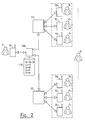
- a virtual presence server 100 independent of existing instant messaging servers S1, S2.
- the virtual presence server 100 is a computer or a computer program configured to offer certain instant messaging services to the mobile terminals of the clients who connect to it.
- the virtual presence server 100 may in particular be equipped with means for automatically managing an instant messaging session instead of a user, filter messages and manage the contact lists of a user.
- other services such as weather forecasting, advertising, games, audio messaging, or others can be implemented.
- the use of the virtual presence server 100 therefore makes it possible to add new functionalities in an instant messaging system of the prior art, without having to modify the existing messaging servers S1 and S2.
- the virtual presence server 100 is connected to at least one client mobile terminal TA and to at least one of the existing messaging servers S1, S2 so that the information intended for or sent by said mobile terminal client passes through said server virtual presence during the session.
- a computer application placed in said terminal sends a presence request to the virtual presence server 100.
- This presence request can contain the identification of the user and a password necessary for the virtual presence server 100 to allow the connection.
- This is a classic access authorization management.
- the presence request contains unique information making it possible to uniquely identify the user A. This information exchange is carried out via a conventional communication protocol: HTTP, SMS, TCP or other connection.
- the computer application of his client mobile terminal TA continues to periodically send requests for presence according to a certain frequency or queues for information from the virtual presence server 100.
- the virtual presence server 100 After analyzing the identification information of the user A, the virtual presence server 100 authorizes the connection and allocates a memory space in which it will keep a copy of the information that will circulate.
- the virtual presence server 100 connects to at least one of the mail servers S1 and / or S2 so that the information intended or sent by said mobile terminal client transit through said virtual presence server during the session.
- the virtual presence server 100 will connect to the instant messaging server S1 linked to a first community Co1, or the instant messaging server S2 linked to another community Co2. If the user A wishes to converse with users present in several communities, the virtual presence server will connect simultaneously to the different mail servers S1, S2.
- the virtual presence server 100 thus acts as a bridge between the mobile client terminal TA and the instant messaging servers concerned S1 and / or S2, allowing messages and requests to pass through, and if necessary applying certain action rules.
- the presence server 100 sends a presence request to the concerned mail servers S1 and / or S2.
- This presence request is similar to that sent by the computer application of the client mobile terminal TA and contains information making it possible to identify the user A.
- the fact of issuing a presence request similar to that sent by the mobile terminal TA allows not to change the identification protocols embedded in existing S1, S2 messaging servers.
- the virtual presence server 100 instead of issuing new presence requests, transmits to the mail servers S1 and / or S2 the presence requests issued periodically by the computer application placed in the terminal. mobile client TA.
- the mail servers S1 and / or S2 After analyzing the credentials of the user A, the mail servers S1 and / or S2 allow the opening of the instant messaging session. The mail servers S1 and / or S2 then inform the other users B1, C1, D1, B2, E2, F2 that the user A is connected and ready to converse. Also, the messaging servers S1 and / or S2 can transmit to the virtual presence server 100 the presence status of the other users B1, C1, D1, B2, E2, F2 in session and ready to converse with the user A. User A can then converse with users B1, C1, D1, B2, E2, F2 having logged on.
- the virtual presence server 100 is therefore perceived by the mail servers S1 and / or S2 as being the mobile terminal of the user A. The meaning of the expression " virtual presence " is therefore understood. Since for the instant messaging servers S1 and / or S2, the server 100 corresponds virtually to the mobile terminal client TA.
- the instant messaging servers S1 and / or S2 transmit to said virtual presence server the contact lists of the user A.
- the latter are then stored in a memory zone of the virtual presence server 100.
- the identity of the users B1, C1, D1, B2, E2, F2 registered on these contact lists is for example communicated to the virtual presence server 100 by the transmission of their name (for example "B1”, “C1”, “ D1 ",” B2 “,” E2 “,” F2 ") and / or their e-mail address (eg" B1@Co1.com “,” C1@Co1.com “,” D1@Co1.com “ , "B2@Co2.com”, “E2@Co2.com", “F2@Co2.com”), etc.
- the virtual presence server 100 comprises means for aggregating the different lists of contacts received to manage a single list 110 on which are registered the identities of the different users B1, C1, D1, B2, E2, F2, without distinction of the home community of said users.
- the aggregation of contact lists is done through a program, sub-program or other.
- the virtual presence server 100 comprises a database containing filtration rules intended to be applied to the messages sent by the terminals of the users B1, C1, D1, B2, E2, F2 registered on the transmitted contact lists. auditing server. These filtration rules can be applied during the normal course of the IM session and / or during the automatic management of the session by the virtual presence server 100.
- the mobile client terminal TA comprises a computer application making it possible to transmit to the virtual presence server 100 the filtration rules that the user A wishes to associate with the different users B1, C1, D1, B2, E2, F2, said server being equipped with means for recording these filtration rules in the database.
- the user A only wishes to receive the messages from the users B1, B2 and E2 and wishes to filter the messages coming from C1, D1 and F2.
- the client mobile terminal TA can integrate a specific interface for choosing, for each of his contacts, a predetermined filtering rule.
- It can be a graphical interface on which is presented the list of the various contacts, a drop-down menu being associated with each of said contacts, said drop-down menu presenting the different filtration rules. It is then enough for user A to validate a filtration rule for each of his contacts. Some filter rules can be set by default. For example, if user A does not choose a filtration rule for a contact, the messages sent by the latter are deemed to be authorized to transit to the mobile client terminal TA. Once the filtration rules are defined, the computer application of the client mobile terminal TA transmits to the virtual presence server 100 these data.
- the filtration rules are preferably programs or program commands developed by the virtual presence server designers 100 and integrated in said server. The IM operators therefore no longer have to modify their mail server S1 and / or S2 to offer the user A this filtration service.
- the virtual presence server 100 is advantageously equipped with means for analyzing the lists of contacts transmitted by the mobile terminal client, and check whether for each of the users B1, C1, D1, B2, E2, F2, registered on said lists, one or several filtration rules are already stored in the database. This characteristic allows the user A not to systematically transmit the same filtration rules to the virtual presence server 100. This analysis can be carried out via a correspondence table associating with the users already registered on the contact list. 110, the last rule of filtration to which they were subjected.
- the virtual presence server 100 comprises means for transmitting a warning message to the terminals TC1, TD1, TF2 of the users C1, D1, F2 whose messages have been filtered. Similarly, the virtual presence server 100 may transmit a warning message to the user's mobile terminal TA of the user A when a message is filtered.
- the warning message can be of the SMS, MMS, e-mail or other type and passes through a communication network known to those skilled in the art.
- the same user B belongs to two different communities Co1 and Co2. In this case, it will have two different identities depending on whether it is connected to one or other of the communities, for example B@Co1.com and B@Co2.com.
- the virtual presence server 100 When the user B opens an instant messaging session on the first community Co1, it is seen by the virtual presence server 100 as a first user B1 having as identity: B@Co1.com.
- the virtual presence server 100 When the user B opens an instant messaging session on a second community Co2, it is seen by the virtual presence server 100 as a second user B2 having the identity: B@Co2.com.
- the virtual presence server 100 is advantageously configured to recognize that the users B1 and B2 are in fact one and only one person.
- the computer application placed in the client mobile terminal TA transmits to the virtual presence server 100 information indicating that the users B1 and B2 having different identities must be treated as a single user B.
- the server virtual presence 100 may choose to connect to the instant messaging server S1 or S2 on which the mobile terminal TB1 or TB2 of the user B is connected.
- the virtual presence server 100 can thus establish this connection independently of the community of membership of the user B, the essential point being that the user A can converse with the user B.
- the user A will be able to define only one filtration rule for the user B, the virtual presence server 100 being configured to apply this filtration rule to the messages to or from the terminals TB1 or TB2. B1 or B2 users.
- the virtual presence server 100 allows the messages to pass to said mobile terminal.
- the virtual presence server 100 can also let the presence requests transmitted periodically transmitted by the computer application placed in the client mobile terminal TA to the messaging servers S1 and / or S2 transit. Also, the virtual presence server 100 allows requests for updates or the like to pass through, in from the messaging servers S1 and / or S2 and to the mobile terminal TA.
- the virtual presence server 100 activates management means and automatically manages the instant messaging session in place of said user A.
- the virtual presence server has an essentially active role.
- the management means are processors, controllers or any other equivalent softwares / hardwares for managing events occurring at virtual presence server 100. By executing one or more programs, subroutines, microprograms or other means, the means of Managements are able to manage the instant messaging session in place of the user A. In particular, the management means are configured to receive and store the messages sent by the other users B1, C1, D1, B2, E2, F2. still in session and transmit to said users other messages in response.
- the computer application placed in his client mobile terminal TA transmits a request to this effect to the virtual presence server 100.
- the virtual presence server 100 activates the management means. This activation can also be conditioned upon receipt of information explicitly indicating that the user A wishes the virtual presence server 100 to continue to automatically manage its session.
- this request contains a code or part of code able, at runtime, to activate the management means.
- the virtual presence server 100 is advantageously configured to activate the management means when the connection between the mobile client terminal TA and said virtual presence server is cut off. It is indeed possible that the user A closes his session without the computer application placed in his TA mobile terminal has time to transmit the closing request. In practice, when the connection between the client mobile terminal TA and the virtual presence server 100 is cut off, an application placed in said server activates the management means.
- the management means maintain the connection between the virtual presence server 100 and the instant messaging servers S1 and / or S2. In this way, the servers S1 and / or S2 continue to receive and send requests without detecting the absence of the user A and continue to manage the instant messaging session as if said user A was still connected.
- user A will open his instant messaging session again, he will be able to see all the messages exchanged.
- the management means can command the transmission of an alert message to the client mobile terminal TA, when a message sent by the terminals TB1, TC1, TD1, TB2, TE2 , TF2 of the users B1, C1, D1, B2, E2, F2 still in session and intended for the user A, is received by the virtual presence server 100.
- the alert message can be of the SMS, MMS, e-mail or other type and passes through a communication network known to those skilled in the art.
- the messaging servers S1 and / or S2 comprise means for transmitting to the virtual presence server 100 a presence request when a new user registered on the contact lists opens a session. instant messaging.
- the reception of this presence request activates the virtual presence server management means 100 so that said means of management issue a warning message to the TA mobile terminal.
- User A can thus be notified that one of his contacts is ready to communicate with him.
- the warning message can be of the SMS, MMS, e-mail or other type and passes through a communication network known to those skilled in the art.
- the management means can issue a warning message to the client mobile terminal. YOUR.
- the management means control the transmission of a warning message to the terminals TB1, TC1, TD1, TB2, TE2, TF2 of the other users B1, C1, D1, B2, E2. , F2 still in session.
- the warning message may be of the SMS, MMS, e-mail or other type and passes through the messaging servers S1 and / or S2 or by another communication network known to those skilled in the art.
- the virtual presence server 100 thus makes it possible to aggregate several features that an instant messaging server S1 and / or S2 could not support, unless complex modifications are made.
Landscapes
- Engineering & Computer Science (AREA)
- Computer Networks & Wireless Communication (AREA)
- Signal Processing (AREA)
- Mobile Radio Communication Systems (AREA)
Applications Claiming Priority (2)
| Application Number | Priority Date | Filing Date | Title |
|---|---|---|---|
| FR0707483A FR2923131B1 (fr) | 2007-10-24 | 2007-10-24 | Procede et systeme de messagerie instantanee pour terminaux mobiles equipe d'un serveur de presence virtuelle configure pour gerer differentes listes de contacts d'un meme utilisateur |
| US12/024,156 US8239464B2 (en) | 2007-10-24 | 2008-02-01 | Method and instantaneous messaging system for mobile terminals equipped with a virtual presence server configured to manage different contact lists of a single user |
Publications (2)
| Publication Number | Publication Date |
|---|---|
| EP2053806A1 true EP2053806A1 (de) | 2009-04-29 |
| EP2053806B1 EP2053806B1 (de) | 2010-12-29 |
Family
ID=40473809
Family Applications (1)
| Application Number | Title | Priority Date | Filing Date |
|---|---|---|---|
| EP08291000A Active EP2053806B1 (de) | 2007-10-24 | 2008-10-23 | Instant-Messaging-Verfahren und -System für mobile Endgeräte, die mit einem virtuellen Anwesenheitsserver ausgestattet sind, der für die Verwaltung verschiedener Kontaktlisten desselben Benutzers konfiguriert ist |
Country Status (1)
| Country | Link |
|---|---|
| EP (1) | EP2053806B1 (de) |
Cited By (4)
| Publication number | Priority date | Publication date | Assignee | Title |
|---|---|---|---|---|
| US8315611B2 (en) | 2008-01-08 | 2012-11-20 | Miyowa | Communication network for transferring information between a mobile terminal and source servers, and terminal and method for managing the transfer of information in such a network |
| US8386559B2 (en) | 2007-09-06 | 2013-02-26 | Miyowa | Method for exchanging requests between the computer application of a mobile terminal and an instantaneous messaging server |
| US8856900B2 (en) | 2009-04-16 | 2014-10-07 | Synchronoss Technologies France | Method for authorising a connection between a computer terminal and a source server |
| US9124645B2 (en) | 2007-10-24 | 2015-09-01 | François Colon | Method and instantaneous messaging system for mobile terminals equipped with a virtual presence server allowing an instantaneous messaging session to be managed automatically |
Families Citing this family (1)
| Publication number | Priority date | Publication date | Assignee | Title |
|---|---|---|---|---|
| CN110278140B (zh) * | 2018-03-14 | 2022-05-24 | 阿里巴巴集团控股有限公司 | 通讯方法及装置 |
Citations (3)
| Publication number | Priority date | Publication date | Assignee | Title |
|---|---|---|---|---|
| EP1587239A1 (de) * | 2004-04-14 | 2005-10-19 | Siemens Mobile Communications S.p.A. | Verfahren und Gerät zur serverseitigen Verwaltung von Buddylisten |
| US20060142880A1 (en) * | 2004-12-16 | 2006-06-29 | Deen Damon M | Messaging system based building control |
| US20060259632A1 (en) | 2005-05-13 | 2006-11-16 | Yahoo! Inc. | Redirection and invitation for accessing an online service |
-
2008
- 2008-10-23 EP EP08291000A patent/EP2053806B1/de active Active
Patent Citations (3)
| Publication number | Priority date | Publication date | Assignee | Title |
|---|---|---|---|---|
| EP1587239A1 (de) * | 2004-04-14 | 2005-10-19 | Siemens Mobile Communications S.p.A. | Verfahren und Gerät zur serverseitigen Verwaltung von Buddylisten |
| US20060142880A1 (en) * | 2004-12-16 | 2006-06-29 | Deen Damon M | Messaging system based building control |
| US20060259632A1 (en) | 2005-05-13 | 2006-11-16 | Yahoo! Inc. | Redirection and invitation for accessing an online service |
Cited By (4)
| Publication number | Priority date | Publication date | Assignee | Title |
|---|---|---|---|---|
| US8386559B2 (en) | 2007-09-06 | 2013-02-26 | Miyowa | Method for exchanging requests between the computer application of a mobile terminal and an instantaneous messaging server |
| US9124645B2 (en) | 2007-10-24 | 2015-09-01 | François Colon | Method and instantaneous messaging system for mobile terminals equipped with a virtual presence server allowing an instantaneous messaging session to be managed automatically |
| US8315611B2 (en) | 2008-01-08 | 2012-11-20 | Miyowa | Communication network for transferring information between a mobile terminal and source servers, and terminal and method for managing the transfer of information in such a network |
| US8856900B2 (en) | 2009-04-16 | 2014-10-07 | Synchronoss Technologies France | Method for authorising a connection between a computer terminal and a source server |
Also Published As
| Publication number | Publication date |
|---|---|
| EP2053806B1 (de) | 2010-12-29 |
Similar Documents
| Publication | Publication Date | Title |
|---|---|---|
| FR2923131A1 (fr) | Procede et systeme de messagerie instantanee pour terminaux mobiles equipe d'un serveur de presence virtuelle configure pour gerer differentes listes de contacts d'un meme utilisateur | |
| FR2923130A1 (fr) | Procede et systeme de messagerie instantanee pour terminaux mobiles equipe d'un serveur de presence virtuelle permettant de gerer automatiquement une session de messagerie instantanee | |
| EP2081339A1 (de) | Filterverfahren für Nachrichten in einem Terminal Instant-Messaging System, Instant messaging System und Serversystem welches dieses Filterverfahren umsetzt | |
| EP2053806B1 (de) | Instant-Messaging-Verfahren und -System für mobile Endgeräte, die mit einem virtuellen Anwesenheitsserver ausgestattet sind, der für die Verwaltung verschiedener Kontaktlisten desselben Benutzers konfiguriert ist | |
| WO2006107808A2 (en) | Federated challenge credit system | |
| EP2053805B1 (de) | Instant-Messaging-Verfahren und -System für mobile Endgeräte, die mit einem virtuellen Anwesenheitsserver ausgestattet sind, der eine automatische Verwaltung einer Instant-Messaging-Session ermöglicht | |
| EP1717739A1 (de) | Filterprozess für Instant Messaging | |
| WO2003071400A2 (fr) | Dispositif et procede de securisation de donnees sensibles, notamment entre deux parties via un organisme tiers | |
| WO2004080015A1 (fr) | Procede de gestion de presence selective pour service de messagerie instantanee au sein d’un reseau de telecommunication tel que le reseau internet | |
| EP1672855A1 (de) | Verfahren zur Begrenzung der Zahl gleichzeitiger Unterhaltungen in einem Instant-Messaging System | |
| EP1763187A1 (de) | Verfahren zur Übermittlung von Dateien in einem Instant-Messaging-System, Server und zugeordnetes Programm | |
| EP1637989A1 (de) | Verfahren und Vorrichtung zur Aufteilung von Konten mit persönlichen Daten | |
| FR2863379A1 (fr) | Systeme de messagerie electronique et procede d'emission de messages electroniques correspondant | |
| EP1865454B1 (de) | Verfahren und System zur automatischen und transparenten Verwaltung von Benutzeranfragen in einem Instant-Messaging-System mittels virtueller Kontakte | |
| EP1744508A2 (de) | Verfahren zum Aufbau einer Verbindung zwischen Personen | |
| WO2009092228A1 (zh) | 信息自动发送方法、服务器、系统以及客户端 | |
| FR2835673A1 (fr) | Equipement d'automatisme communiquant par messagerie instantanee | |
| WO2019239066A1 (fr) | Procede de communication securisee entre deux dispositifs electroniques, procede pour administrer une telle communication, objets electroniques mettant en oeuvre respectivement lesdits procedes et systeme associe | |
| EP2915113B1 (de) | Verbesserte verwaltung eines nachrichtenspeichers | |
| EP1501248B1 (de) | System und Verfahren zur elektronischen Benachrichtigung | |
| EP1922853A1 (de) | Verfahren zur übertragung von informationen mit verbesserter dauerhaftigkeit | |
| EP4533770A1 (de) | Verfahren und vorrichtung zur initialisierung der kommunikation zwischen einem chatbot und einem verbundenen objekt | |
| WO2008110705A2 (fr) | Procede et dispositif de transmission d'un message instantane, terminal emetteur, terminal destinataire, serveur de messagerie instantanee et programmes d'ordinateur correspondants | |
| WO2007093684A1 (fr) | Gestion d'une communication entre un systeme de telecommunications et un serveur | |
| WO2008017776A2 (fr) | Procede et systeme d'authentification d'utilisateurs dans un reseau de communication |
Legal Events
| Date | Code | Title | Description |
|---|---|---|---|
| PUAI | Public reference made under article 153(3) epc to a published international application that has entered the european phase |
Free format text: ORIGINAL CODE: 0009012 |
|
| AK | Designated contracting states |
Kind code of ref document: A1 Designated state(s): AT BE BG CH CY CZ DE DK EE ES FI FR GB GR HR HU IE IS IT LI LT LU LV MC MT NL NO PL PT RO SE SI SK TR |
|
| AX | Request for extension of the european patent |
Extension state: AL BA MK RS |
|
| 17P | Request for examination filed |
Effective date: 20090811 |
|
| 17Q | First examination report despatched |
Effective date: 20090911 |
|
| AKX | Designation fees paid |
Designated state(s): AT BE BG CH CY CZ DE DK EE ES FI FR GB GR HR HU IE IS IT LI LT LU LV MC MT NL NO PL PT RO SE SI SK TR |
|
| GRAP | Despatch of communication of intention to grant a patent |
Free format text: ORIGINAL CODE: EPIDOSNIGR1 |
|
| GRAS | Grant fee paid |
Free format text: ORIGINAL CODE: EPIDOSNIGR3 |
|
| GRAA | (expected) grant |
Free format text: ORIGINAL CODE: 0009210 |
|
| AK | Designated contracting states |
Kind code of ref document: B1 Designated state(s): AT BE BG CH CY CZ DE DK EE ES FI FR GB GR HR HU IE IS IT LI LT LU LV MC MT NL NO PL PT RO SE SI SK TR |
|
| REG | Reference to a national code |
Ref country code: GB Ref legal event code: FG4D Free format text: NOT ENGLISH |
|
| REG | Reference to a national code |
Ref country code: CH Ref legal event code: EP |
|
| REG | Reference to a national code |
Ref country code: IE Ref legal event code: FG4D Free format text: LANGUAGE OF EP DOCUMENT: FRENCH |
|
| REF | Corresponds to: |
Ref document number: 602008004202 Country of ref document: DE Date of ref document: 20110210 Kind code of ref document: P |
|
| REG | Reference to a national code |
Ref country code: DE Ref legal event code: R096 Ref document number: 602008004202 Country of ref document: DE Effective date: 20110210 |
|
| REG | Reference to a national code |
Ref country code: NL Ref legal event code: VDEP Effective date: 20101229 |
|
| PG25 | Lapsed in a contracting state [announced via postgrant information from national office to epo] |
Ref country code: LT Free format text: LAPSE BECAUSE OF FAILURE TO SUBMIT A TRANSLATION OF THE DESCRIPTION OR TO PAY THE FEE WITHIN THE PRESCRIBED TIME-LIMIT Effective date: 20101229 |
|
| LTIE | Lt: invalidation of european patent or patent extension |
Effective date: 20101229 |
|
| REG | Reference to a national code |
Ref country code: ES Ref legal event code: FG2A Ref document number: 2359767 Country of ref document: ES Kind code of ref document: T3 Effective date: 20110526 |
|
| PG25 | Lapsed in a contracting state [announced via postgrant information from national office to epo] |
Ref country code: FI Free format text: LAPSE BECAUSE OF FAILURE TO SUBMIT A TRANSLATION OF THE DESCRIPTION OR TO PAY THE FEE WITHIN THE PRESCRIBED TIME-LIMIT Effective date: 20101229 Ref country code: AT Free format text: LAPSE BECAUSE OF FAILURE TO SUBMIT A TRANSLATION OF THE DESCRIPTION OR TO PAY THE FEE WITHIN THE PRESCRIBED TIME-LIMIT Effective date: 20101229 Ref country code: LV Free format text: LAPSE BECAUSE OF FAILURE TO SUBMIT A TRANSLATION OF THE DESCRIPTION OR TO PAY THE FEE WITHIN THE PRESCRIBED TIME-LIMIT Effective date: 20101229 Ref country code: SE Free format text: LAPSE BECAUSE OF FAILURE TO SUBMIT A TRANSLATION OF THE DESCRIPTION OR TO PAY THE FEE WITHIN THE PRESCRIBED TIME-LIMIT Effective date: 20101229 Ref country code: BG Free format text: LAPSE BECAUSE OF FAILURE TO SUBMIT A TRANSLATION OF THE DESCRIPTION OR TO PAY THE FEE WITHIN THE PRESCRIBED TIME-LIMIT Effective date: 20110329 Ref country code: HR Free format text: LAPSE BECAUSE OF FAILURE TO SUBMIT A TRANSLATION OF THE DESCRIPTION OR TO PAY THE FEE WITHIN THE PRESCRIBED TIME-LIMIT Effective date: 20101229 Ref country code: SI Free format text: LAPSE BECAUSE OF FAILURE TO SUBMIT A TRANSLATION OF THE DESCRIPTION OR TO PAY THE FEE WITHIN THE PRESCRIBED TIME-LIMIT Effective date: 20101229 Ref country code: CY Free format text: LAPSE BECAUSE OF FAILURE TO SUBMIT A TRANSLATION OF THE DESCRIPTION OR TO PAY THE FEE WITHIN THE PRESCRIBED TIME-LIMIT Effective date: 20101229 |
|
| REG | Reference to a national code |
Ref country code: IE Ref legal event code: FD4D |
|
| PG25 | Lapsed in a contracting state [announced via postgrant information from national office to epo] |
Ref country code: PT Free format text: LAPSE BECAUSE OF FAILURE TO SUBMIT A TRANSLATION OF THE DESCRIPTION OR TO PAY THE FEE WITHIN THE PRESCRIBED TIME-LIMIT Effective date: 20110429 Ref country code: IS Free format text: LAPSE BECAUSE OF FAILURE TO SUBMIT A TRANSLATION OF THE DESCRIPTION OR TO PAY THE FEE WITHIN THE PRESCRIBED TIME-LIMIT Effective date: 20110429 Ref country code: NO Free format text: LAPSE BECAUSE OF FAILURE TO SUBMIT A TRANSLATION OF THE DESCRIPTION OR TO PAY THE FEE WITHIN THE PRESCRIBED TIME-LIMIT Effective date: 20110329 Ref country code: CZ Free format text: LAPSE BECAUSE OF FAILURE TO SUBMIT A TRANSLATION OF THE DESCRIPTION OR TO PAY THE FEE WITHIN THE PRESCRIBED TIME-LIMIT Effective date: 20101229 Ref country code: GR Free format text: LAPSE BECAUSE OF FAILURE TO SUBMIT A TRANSLATION OF THE DESCRIPTION OR TO PAY THE FEE WITHIN THE PRESCRIBED TIME-LIMIT Effective date: 20110330 Ref country code: EE Free format text: LAPSE BECAUSE OF FAILURE TO SUBMIT A TRANSLATION OF THE DESCRIPTION OR TO PAY THE FEE WITHIN THE PRESCRIBED TIME-LIMIT Effective date: 20101229 |
|
| PG25 | Lapsed in a contracting state [announced via postgrant information from national office to epo] |
Ref country code: RO Free format text: LAPSE BECAUSE OF FAILURE TO SUBMIT A TRANSLATION OF THE DESCRIPTION OR TO PAY THE FEE WITHIN THE PRESCRIBED TIME-LIMIT Effective date: 20101229 Ref country code: PL Free format text: LAPSE BECAUSE OF FAILURE TO SUBMIT A TRANSLATION OF THE DESCRIPTION OR TO PAY THE FEE WITHIN THE PRESCRIBED TIME-LIMIT Effective date: 20101229 Ref country code: NL Free format text: LAPSE BECAUSE OF FAILURE TO SUBMIT A TRANSLATION OF THE DESCRIPTION OR TO PAY THE FEE WITHIN THE PRESCRIBED TIME-LIMIT Effective date: 20101229 Ref country code: SK Free format text: LAPSE BECAUSE OF FAILURE TO SUBMIT A TRANSLATION OF THE DESCRIPTION OR TO PAY THE FEE WITHIN THE PRESCRIBED TIME-LIMIT Effective date: 20101229 |
|
| PG25 | Lapsed in a contracting state [announced via postgrant information from national office to epo] |
Ref country code: DK Free format text: LAPSE BECAUSE OF FAILURE TO SUBMIT A TRANSLATION OF THE DESCRIPTION OR TO PAY THE FEE WITHIN THE PRESCRIBED TIME-LIMIT Effective date: 20101229 Ref country code: IE Free format text: LAPSE BECAUSE OF FAILURE TO SUBMIT A TRANSLATION OF THE DESCRIPTION OR TO PAY THE FEE WITHIN THE PRESCRIBED TIME-LIMIT Effective date: 20101229 |
|
| PLBE | No opposition filed within time limit |
Free format text: ORIGINAL CODE: 0009261 |
|
| STAA | Information on the status of an ep patent application or granted ep patent |
Free format text: STATUS: NO OPPOSITION FILED WITHIN TIME LIMIT |
|
| 26N | No opposition filed |
Effective date: 20110930 |
|
| REG | Reference to a national code |
Ref country code: DE Ref legal event code: R097 Ref document number: 602008004202 Country of ref document: DE Effective date: 20110930 |
|
| BERE | Be: lapsed |
Owner name: MIYOWA Effective date: 20111031 |
|
| PG25 | Lapsed in a contracting state [announced via postgrant information from national office to epo] |
Ref country code: MC Free format text: LAPSE BECAUSE OF NON-PAYMENT OF DUE FEES Effective date: 20111031 |
|
| PG25 | Lapsed in a contracting state [announced via postgrant information from national office to epo] |
Ref country code: BE Free format text: LAPSE BECAUSE OF NON-PAYMENT OF DUE FEES Effective date: 20111031 |
|
| REG | Reference to a national code |
Ref country code: DE Ref legal event code: R082 Ref document number: 602008004202 Country of ref document: DE Representative=s name: BOETERS & LIECK, DE |
|
| REG | Reference to a national code |
Ref country code: FR Ref legal event code: CD Owner name: SYNCHRONOSS TECHNOLOGIES FRANCE, FR Effective date: 20130124 Ref country code: FR Ref legal event code: CA Effective date: 20130124 |
|
| PG25 | Lapsed in a contracting state [announced via postgrant information from national office to epo] |
Ref country code: MT Free format text: LAPSE BECAUSE OF FAILURE TO SUBMIT A TRANSLATION OF THE DESCRIPTION OR TO PAY THE FEE WITHIN THE PRESCRIBED TIME-LIMIT Effective date: 20101229 |
|
| REG | Reference to a national code |
Ref country code: DE Ref legal event code: R082 Ref document number: 602008004202 Country of ref document: DE Representative=s name: BOETERS & LIECK, DE Effective date: 20130213 Ref country code: DE Ref legal event code: R081 Ref document number: 602008004202 Country of ref document: DE Owner name: SYNCHRONOSS TECHNOLOGIES FRANCE, FR Free format text: FORMER OWNER: MIYOWA, MARSEILLE, FR Effective date: 20130213 |
|
| REG | Reference to a national code |
Ref country code: ES Ref legal event code: PC2A Owner name: SYNCHRONOSS TECHNOLOGIES FRANCE Effective date: 20130423 |
|
| PG25 | Lapsed in a contracting state [announced via postgrant information from national office to epo] |
Ref country code: LU Free format text: LAPSE BECAUSE OF NON-PAYMENT OF DUE FEES Effective date: 20111023 |
|
| REG | Reference to a national code |
Ref country code: CH Ref legal event code: PL |
|
| PG25 | Lapsed in a contracting state [announced via postgrant information from national office to epo] |
Ref country code: CH Free format text: LAPSE BECAUSE OF NON-PAYMENT OF DUE FEES Effective date: 20121031 Ref country code: LI Free format text: LAPSE BECAUSE OF NON-PAYMENT OF DUE FEES Effective date: 20121031 |
|
| PG25 | Lapsed in a contracting state [announced via postgrant information from national office to epo] |
Ref country code: TR Free format text: LAPSE BECAUSE OF FAILURE TO SUBMIT A TRANSLATION OF THE DESCRIPTION OR TO PAY THE FEE WITHIN THE PRESCRIBED TIME-LIMIT Effective date: 20101229 |
|
| PG25 | Lapsed in a contracting state [announced via postgrant information from national office to epo] |
Ref country code: HU Free format text: LAPSE BECAUSE OF FAILURE TO SUBMIT A TRANSLATION OF THE DESCRIPTION OR TO PAY THE FEE WITHIN THE PRESCRIBED TIME-LIMIT Effective date: 20101229 |
|
| PGFP | Annual fee paid to national office [announced via postgrant information from national office to epo] |
Ref country code: ES Payment date: 20150929 Year of fee payment: 8 |
|
| PGFP | Annual fee paid to national office [announced via postgrant information from national office to epo] |
Ref country code: IT Payment date: 20151026 Year of fee payment: 8 Ref country code: GB Payment date: 20151027 Year of fee payment: 8 |
|
| REG | Reference to a national code |
Ref country code: FR Ref legal event code: PLFP Year of fee payment: 9 |
|
| GBPC | Gb: european patent ceased through non-payment of renewal fee |
Effective date: 20161023 |
|
| PG25 | Lapsed in a contracting state [announced via postgrant information from national office to epo] |
Ref country code: GB Free format text: LAPSE BECAUSE OF NON-PAYMENT OF DUE FEES Effective date: 20161023 |
|
| REG | Reference to a national code |
Ref country code: FR Ref legal event code: PLFP Year of fee payment: 10 |
|
| PG25 | Lapsed in a contracting state [announced via postgrant information from national office to epo] |
Ref country code: IT Free format text: LAPSE BECAUSE OF NON-PAYMENT OF DUE FEES Effective date: 20161023 |
|
| PG25 | Lapsed in a contracting state [announced via postgrant information from national office to epo] |
Ref country code: ES Free format text: LAPSE BECAUSE OF NON-PAYMENT OF DUE FEES Effective date: 20161024 |
|
| REG | Reference to a national code |
Ref country code: FR Ref legal event code: PLFP Year of fee payment: 11 |
|
| REG | Reference to a national code |
Ref country code: ES Ref legal event code: FD2A Effective date: 20181123 |
|
| REG | Reference to a national code |
Ref country code: DE Ref legal event code: R079 Ref document number: 602008004202 Country of ref document: DE Free format text: PREVIOUS MAIN CLASS: H04L0012580000 Ipc: H04L0051000000 |
|
| PGFP | Annual fee paid to national office [announced via postgrant information from national office to epo] |
Ref country code: FR Payment date: 20240909 Year of fee payment: 17 |
|
| PGFP | Annual fee paid to national office [announced via postgrant information from national office to epo] |
Ref country code: DE Payment date: 20240904 Year of fee payment: 17 |