EP2061267A1 - Procede de retransmission de donnees, dispositif de controle dereseau, station mobile et station de base - Google Patents
Procede de retransmission de donnees, dispositif de controle dereseau, station mobile et station de base Download PDFInfo
- Publication number
- EP2061267A1 EP2061267A1 EP07805996A EP07805996A EP2061267A1 EP 2061267 A1 EP2061267 A1 EP 2061267A1 EP 07805996 A EP07805996 A EP 07805996A EP 07805996 A EP07805996 A EP 07805996A EP 2061267 A1 EP2061267 A1 EP 2061267A1
- Authority
- EP
- European Patent Office
- Prior art keywords
- data packet
- mobile station
- packet
- data
- base station
- Prior art date
- Legal status (The legal status is an assumption and is not a legal conclusion. Google has not performed a legal analysis and makes no representation as to the accuracy of the status listed.)
- Withdrawn
Links
Images




Classifications
-
- H—ELECTRICITY
- H04—ELECTRIC COMMUNICATION TECHNIQUE
- H04L—TRANSMISSION OF DIGITAL INFORMATION, e.g. TELEGRAPHIC COMMUNICATION
- H04L1/00—Arrangements for detecting or preventing errors in the information received
- H04L1/12—Arrangements for detecting or preventing errors in the information received by using return channel
- H04L1/16—Arrangements for detecting or preventing errors in the information received by using return channel in which the return channel carries supervisory signals, e.g. repetition request signals
- H04L1/18—Automatic repetition systems, e.g. Van Duuren systems
- H04L1/1867—Arrangements specially adapted for the transmitter end
- H04L1/1874—Buffer management
-
- H—ELECTRICITY
- H04—ELECTRIC COMMUNICATION TECHNIQUE
- H04L—TRANSMISSION OF DIGITAL INFORMATION, e.g. TELEGRAPHIC COMMUNICATION
- H04L1/00—Arrangements for detecting or preventing errors in the information received
- H04L2001/0092—Error control systems characterised by the topology of the transmission link
Definitions
- the present invention relates to a radio communication technology. More particularly, the present invention relates to a data retransmission method, which is employed in a radio communication system having a retransmission control function and constituted of a base station and a mobile station, in which a piece of data that might not have reached a destination mobile station due to handover is retransmitted to the destination mobile station, a network controller for realizing the data retransmission method, a mobile station, and a base station.
- HSDPA High Speed Downlink Packet Access
- HSUPA High Speed Uplink Packet Access
- the core technology that realize high-speed packet transmission using the above schemes include high-speed packet transmission/reception scheduling at a radio base station closest to a radio channel (BTS: Base Transceiver Station), radio channel error control between the BTS and a mobile terminal (UE: User Equipment) by using an HARQ (Hybrid Automatic Repeat Request) scheme, highly-reliable data transmission using a double ARQ loop of the HARQ and a conventional ARQ (Automatic Repeat Request) in an RLC (Radio Link Control) layer of a radio network controller (RNC: Radio Network Controller), and adaptive modulation for adaptively changing a modulation scheme and error correction capability in a radio channel between the BTS and the UE depending on the quality of the radio channel.
- BTS Base Transceiver Station
- HARQ Hybrid Automatic Repeat Request
- RLC Radio Link Control
- RNC Radio Network Controller
- a transmission scheme in which an HARQ scheme in MAC (Medium Access Control) layers of the BTS and the UE is combined with an ARQ scheme in the RLC layer is also employed in EUTRA (Evolved Universal Terrestrial Radio Access) and EUTRAN (Evolved Universal Terrestrial Radio Access Network), which are next generation access scheme and a radio access network for the UMTS, as a core technology for realizing fast and reliable packet transmission (see below Non Patent Literature 1).
- EUTRA Evolved Universal Terrestrial Radio Access
- EUTRAN Evolved Universal Terrestrial Radio Access Network
- Packet retransmission and packet loss cause throughput degradation in high-speed data transmission applications or quality degradation in real time applications such as a VoIP (Voice Over IP). Furthermore, if TCP is used as a transport, congestion control is performed, resulting in causing throughput degradation at an IP packet level. This leads to a problem that some time is required to recover from the throughput degradation. The packet retransmission and the packet loss occur mainly due to quality degradation of a radio channel. However, handover due to movement of a user cannot be ignored.
- Patent Document 1 A technology for resolving problems with the packet retransmission and the packet loss that occur at the time of execution of the handover is disclosed in Patent Document 1.
- a handover source BTS transmits to an RNC a sequence number (BVT(A)) of data of which acknowledge (ACK: Acknowledge) is to be received next by HARQ, and the RNC transfers data having a sequence number subsequent to the BVT(A) to a handover destination BTS or an RNC that controls the handover destination BTS.
- BVT(A) sequence number of data of which acknowledge (ACK: Acknowledge) is to be received next by HARQ
- retransmission control is performed by using a Selective Repeat ARQ scheme in which a plurality of pieces of data in a transmission window is transmitted in bulk without checking acknowledge of previous pieces of data. Therefore, with the conventional data retransmission scheme, in a situation where ACK was not received for only a piece of data of an earlier sequence number in the transmission window but ACK was received for almost all pieces of the data transmitted after that data in the transmission window, although ACK has been received for almost all the pieces of the data in the transmission window, almost all the pieces of the data are discarded and then retransmitted.
- Patent Document 1 does not discloses a technology related to data retransmission performed when an RLC is in an unacknowledged mode (UM: Unacknowledged Mode) that is suitable for data transmission of an application having real time capability such as a VoIP and the HARQ are used in combination with the UM.
- UM Unacknowledged Mode
- the RLC layer assumes that all the pieces of data reaches a reception side at the same time of data transmission. Therefore, if handover is executed while data is being retransmitted by HARQ in the MAC layer, data loss occurs.
- the present invention has been made to solve the above problems in the conventional technology and it is an object of the present invention to provide a data retransmission method, which is capable of preventing occurrence of ineffective packet retransmission at the time of handover and realizing fast and effective handover in a high-speed radio packet access system that performs retransmission control by HARQ and the like in the MAC layer when the AM or the UM is activated in the RLC layer, a network controller that realizes the data retransmission method, a base station, and a mobile station.
- a technology for providing a high-speed radio packet access by performing data retransmission by HARQ and the like in the MAC layer covers uplink data that is transmitted from a UE to a BTS as well as downlink data that is transmitted from the BTS to the UE.
- an RLC layer and a MAC layer are provided in a single device, which is different from a configuration of a radio access network (RAN) in which the RLC layer is provided in an RNC and the MAC layer is provided in a BTS.
- RAN radio access network
- a data retransmission technology and a radio communication system at the time of handover with the above device configuration are not disclosed. Therefore, another object of the present invention is to provide a data retransmission method that realizes fast and effective handover for high-speed uplink data communication.
- a data retransmission method implemented in a radio communication system including a base station and a network controller that transmits a data packet received from a network to a destination mobile station via the base station, wherein the network controller retransmits a data packet received from the network to a destination mobile station of the data packet depending on needs.
- the data retransmission method includes a packet transmission step including the network controller creating a single packet or a plurality of packets in a desired size from the data packet, and the network controller transmitting created packet to a base station that controls a destination mobile station; a reception result notification step including the base station transmitting a received packet to a destination mobile station and notifying the network controller of a packet reception result obtained from the destination mobile station; a data packet transmission result determination step including the network controller determining, based on a notified reception result, whether a data packet corresponding to a packet transmitted to the base station has correctly reached a destination mobile station; and a data retransmission step including, upon execution of handover by the destination mobile station, the network controller retransmitting a data packet, the data packet being determined that it has not correctly reached the destination mobile station, via a based station being a handover destination.
- a radio network controller (RNC) included in a radio communication system stores data in units of data packet (upper layer packet) received from an upper layer, acquires acknowledge data by HARQ from a base station (BTS) with respect to each packet that is created based on a stored upper layer packet and in a desired size, and identifies the upper layer packet that could not reach a destination mobile station (UE) based on the acquired acknowledge data. Then, the RNC retransmits the upper layer packet that could not reach the UE to a handover destination BTS. Therefore, even when data is being transmitted, handover can be executed in a prompt manner.
- RNC radio network controller
- the upper layer packet is retransmitted to the handover destination BTS only when there is a packet of a desired size of which acknowledge by HARQ is not received by the handover source BTS. Therefore, amount of data to be retransmitted from the RNC to the UE can be reduced, reducing throughput degradation caused by data retransmission.
- Fig. 1 is a diagram of an example of a protocol architecture for realizing a data retransmission method according to the present invention.
- an RLC layer and a MAC layer that perform transmission processing on downlink data are provided in an RNC, and a MAC-hs layer is provided in a BTS.
- all of an RLC layer, a MAC layer, and a MAC-hs layer are provided in a UE to perform data reception processing.
- the RNC and the BTS are connected to each other via an Iub interface.
- MAC_PDU MAC data in the RNC
- FP Framework Protocol
- the BTS is not limited to a BTS controlled by an SRNC (Serving RNC) that is an RNC that performs call processing on a UE.
- the BTS can be a BTS controlled by a DRNC (Drift RNC) that is an RNC different from the SRNC.
- SRNC Serving RNC
- DRNC Drift RNC
- the operation according to the embodiment is the same even in a subscriber extension state. Therefore, only an example in which subscriber extension has not been carried out yet is described below.
- Data that has been subjected to an HARQ process in the MAC-hs layer in the BTS is radio transmitted from a physical (PHY) layer to the UE.
- PHY physical
- protocol architecture described above is defined for descriptive purpose to simplify explanation of the present embodiment. In other words, the scope of application of the present invention is not to be limited to this protocol architecture.
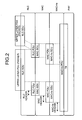
- Fig. 2 is a diagram of an example of a protocol stack for realizing the data retransmission method according to the present embodiment.
- a downlink data packet is input to the RLC layer of the RNC.
- the downlink data packet in the RLC layer is referred to as "RLC SDU” (RLC Service Data Unit, hereinafter, referred to as "RLC_SDU").
- the RLC_SDU is divided or combined so that it is of a size defined by the MAC layer, and then a header is added to that RLC_SDU.
- the header contains a sequence number to be used when retransmission control is performed in the RLC layer or when the RLC_SDU is reconfigured in an RLC layer of a reception side.
- RLC PDU RLC Protocol Data Unit, hereinafter, referred to as "RLC_PDU”
- Length Indicator is added to a header of that RLC_PDU to enable identification of an RLC_SDU boundary in the RLC_PDU.
- the RLC_PDU is output to the MAC layer as output data of the RLC layer.
- the RLC_PDU that received by the MAC layer as input data is referred to as "MAC SDU” (hereinafter, referred to as "MAC_SDU") in the MAC layer.
- the MAC layer adds header information to the MAC_SDU and outputs the MAC_SDU as "MAC PDU” (hereinafter, referred to as "MAC_PDU"). Subsequently, a plurality of the MAC_PDUs are bundled as an FP data frame, and the FP data frame is transferred to a transmission destination BTS.
- the BTS retrieves the MAC_PDUs from the FP data frame and inputs the MAC_PDUs to the MAC-hs layer.
- the input data (MAC_PDU) input into the MAC-hs layer is referred to as "MAC-hs SDU" (hereinafter, referred to as "MAC-hs_SDU").
- MAC-hs SDU The input data (MAC_PDU) input into the MAC-hs layer.
- MAC-hs_SDU MAC-hs SDU
- MAC-hs_SDU a plurality of the MAC-hs_SDUs are multiplexed, and a header containing information to be used for splitting each piece of the MAC-hs_SDU in a MAC-hs layer of a reception side (UE) is added to that MAC-hs_SDU.
- the header also contains information necessary for performing retransmission by using an HARQ scheme in the MAC-hs layer.
- Multiplexed data with the header added is referred to as "MAC-hs PDU" (hereinafter, referred to as "MAC-hs_PDU") and it is output to a PHY layer.
- the MAC-hs_PDU is referred to as a transport block (TB: Transport Block).
- TB Transport Block
- the UE performs an HARQ process on the received MAC-hs_PDU in the MAC-hs layer, and transmits a response signal indicating a result of the HARQ process to the BTS. That is, transmits an ACK as the response signal when received data is normal, and transmits a NACK when the received data is abnormal.
- the response signal is notified to the BTS as a control signal (not shown) unique to the PHY layer.
- the MAC-hs layer of the BTS determines based on the control signal received from the UE that the MAC-hs_PDU has not reached the UE (when the response signal is NACK), it retransmits the unreached MAC-hs_PDU.
- the MAC-hs layer of the UE Upon correctly receiving the MAC-hs_PDU, the MAC-hs layer of the UE retrieves MAC_SDU from the MAC-hs_PDU, and sends the retrieved MAC_SDU to the RLC layer via the MAC layer.
- the RLC layer recovers the RLC_SDU from the MAC_SDU, that is, the RLC_PDU, and transmits the RLC_SDU to an upper layer.
- the RLC_PDU When the AM is in an activated state in each of the RLC layers of the RNC and the UE, the RLC_PDU is subjected to retransmission control using Selective Repeat ARQ scheme. That is, the RLC layer of the UE transmits a reception status of the RLC_PDU as status information to the RLC layer of the RNC based on a status information transmission trigger specified by the RNC. If the RLC layer of the RNC that received the status information determines that the RLC_PDU has not reached the UE, the RLC layer of the RNC retransmits the unreached RLC_PDU. The status information reaches the RLC layer of the RNC via a route defined by another protocol stack and another protocol architecture, which are not shown.
- protocol stack mentioned above is defined for descriptive purpose to simplify explanation of the present embodiment, and the scope of application of the present invention is not to be limited to this protocol stack.
- FIG. 3 is a diagram of a configuration example of a radio communication system for realizing the data retransmission method according to the present invention.
- a UE 1 includes an RLC unit 11 that performs processing corresponding to an RLC layer, a MAC unit 12 that performs processing corresponding to a MAC layer, and a MAC-hs unit 13 that performs processing corresponding to a MAC-hs layer.
- the UE 1 communicates with a BTS 2 when it is in a cell controlled by the BTS 2.
- the BTS 2 includes a MAC-hs unit 21 that performs processing corresponding to a MAC-hs layer.
- the MAC-hs unit 21 of the BTS 2 performs user multiplexing, HARQ, and the like on MAC-d PDU received from an RNC 4, and distributes the processed MAC_PDU to the UE 1.
- the RNC 4 includes an RLC unit 41 that performs processing corresponding to an RLC layer, and a MAC unit 42 that performs processing corresponding to a MAC layer.
- the RNC 4 is an SRNC that performs call control on the UE 1 and radio resource control on the BTS 2.
- Downlink packet data to the UE 1 is transmitted from a higher-level device (not shown) of the RNC 4.
- the RNC 4 determines whether to handover the UE 1 to a cell controlled by a BTS 3 based on measurement data (data about downlink line quality) received from the UE 1.
- the handover herein means mobile control including processing of causing HS-PDSCH (High Speed Physical Data Shared CHannel) for performing high-speed transmission in an HSDPA communication to belong to a cell controlled by the BTS 3 from a cell controlled by the BTS 2.
- HS-PDSCH High Speed Physical Data Shared CHannel
- the handover herein includes, in addition to normal handover, mobile control called Cell Change for switching the HS-PDSCH while connections between a DCH (Dedicated CHannel), which is a dedicated channel for transmitting and receiving a control signal or other data in the HSDPA, and both of the BTS 2 and the BTS 3 are being established.
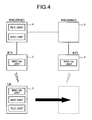
- a configuration as shown in Fig. 3 is exemplary described for simplifying explanation, the BTS 2 and the BTS 3 shown in Fig. 3 can be configured in other ways instead of the configuration in which they are controlled by the RNC 4 that is an SRNC.
- the BTS 3, which is a handover destination can be controlled by an RNC 5, which is a DRNC, instead of the RNC 4.
- Fig. 5 is a flowchart of an example of a downlink data (downlink data packet) retransmission processing by the RNC 4.
- the RNC 4 Upon determining to handover the UE 1 from a cell controlled by the BTS 2 to a cell controlled by the BTS 3, the RNC 4 enters a dummy acknowledge mode (Step S11). That is, the RLC unit 41 and the MAC unit 42 are switched to the dummy acknowledge mode.
- the RLC unit 41 While in the dummy acknowledge mode, the RLC unit 41 stores subsequent RLC_SDUs in a retransmission buffer so that the subsequent RLC_SDUs can be transmitted to the BTS 3 after completion of the handover.
- the retransmission buffer can be arranged in the RLC unit 41 or outside of the RLC unit 41.
- a data retransmission buffer used for an ARQ process can be used as the retransmission buffer for storing therein the RLC_SDU so that there is no need to provide an additional retransmission buffer for the RLC_SDU.
- the MAC unit 42 When the MAC unit 42, which is also in the dummy acknowledge mode, creates an FP data frame by bundling a plurality of MAC_PDUs, sets a dummy acknowledge notification flag in the FP data frame, and transmits the FP data frame to the BTS 2.
- the dummy acknowledge flag is used by the RNC 4 to instruct the BTS 2 to transmit a dummy acknowledge for MAC_PDU that has been transmitted, which will be described later.
- the dummy acknowledge notification flag can have, for example, a frame format shown in Fig. 6-1 in which a single acknowledge flag 61 is added for requesting dummy acknowledges for all MAC_PDUs contained in the FP data frame.
- a dummy acknowledge flag F62, F63, (7) can be added to each piece of the MAC_PDU.
- the frame format shown in Fig. 6-1 is employed for simplification of the explanation.
- other frame formats can be employed. For example, by using a format shown in Fig.
- control can be performed to cause MAC_PDU, which contains RLC_PDU containing an RLC_SDU boundary that is data at the tail of the RLC_SDU, to request a dummy acknowledge, or control can be performed not to request a dummy acknowledge when MAC_PDU contains only RLC control information instead of data.
- the RNC 4 instructs the BTS 2, which is the handover source; the BTS 3, which is the handover destination; and the UE 1 to start handover.
- the handover processing begins (Step S12).
- the RNC 4 waits for a dummy acknowledge from the BTS 2 until a data transmission destination is switched from the BTS 2 to the BTS 3.
- the RNC 4 monitors whether the transmission destination has been changed and packet transmission has been started (whether the transmission destination has been switched) (Step S13). If the transmission destination has not been switched completely (No at Step S13), the RNC 4 monitors whether a dummy acknowledge is received from the BTS 2 (Step S14). This monitoring of the dummy acknowledge is performed by the MAC unit 42.
- Step S15 If no dummy acknowledge is received from the BTS 2 (No at Step S14), process control returns to Step S13. On the other hand, if the dummy acknowledge is received from the BTS 2 (Yes at Step S14), information indicating that the RLC_PDU contained in the MAC_PDU corresponding to the received dummy acknowledge (MAC_PDU with the dummy acknowledge) has reached the UE 1 is stored (Step S15).
- Steps S13, S14, and S15 are repeatedly performed, and when dummy acknowledges for all RLC_PDUs contained in the RLC_SDU are confirmed (when dummy acknowledges for all RLC_PDUs contained in the RLC_SDU are received), the RLC_SDU is deleted from the retransmission buffer.
- the RLC_SDU retransmission buffer is configured as shown in Fig. 7 , a flag is set in a field corresponding to the RLC_SDU of which transmission to the UE 1 is tentatively confirmed by the dummy acknowledge, and when flags are set in all acknowledge fields, all pieces of data in a target entry containing the RLC_SDU are cleared.
- a timing of switching the data transmission destination from the BTS 2 to the BTS 3 basically depends on a handover scheme.
- the timing can be a time point when the RNC 4 receives a completion notice from the UE 1 after the UE 1 completes handover to a cell controlled by the BTS 3, or it can be a time point later than a handover execution timing that is notified by the RNC 4 to the UE 1, the BTS 2, and the BTS 3.
- Step S13 when it is determined that the packet transmission destination is switched (Yes at Step S13), the RNC 4 exits the dummy acknowledge mode (Step S16), and transmits the RLC_SDU remained in the retransmission buffer to the BTS 3 that is a handover destination (Step S17).
- An operation of each unit in the RNC 4 for transferring the RLC_SDU is the same as a normal operation of transmitting downlink data.
- the MAC-hs unit 21 of the BTS 2 Upon receiving the FP data frame from the RNC 4, the MAC-hs unit 21 of the BTS 2 checks the dummy acknowledge flag in the received FP data frame and determines whether a dummy acknowledge is necessary for each piece of the MAC-hs_SDU (MAC_PDU) contained in the FP data frame (Step S21).
- the MAC-hs unit 21 stores the MAC-hs_SDU and information indicating that the dummy acknowledge is necessary (for example, the dummy acknowledge flag corresponding to the MAC-hs_SDU is set to "1") (Step S22).
- the MAC-hs unit 21 stores the MAC-hs_SDU and information indicating that the dummy acknowledge is not necessary (for example, the dummy acknowledge flag corresponding to the MAC-hs_SDU is set to "0") (Step S23).
- a scheduling block in the MAC-hs unit 21 multiplexes the MAC-hs_SDUs to create MAC-hs_PDU based on scheduling information.
- the scheduling block creates a dummy acknowledge necessity determination table as shown in Fig. 9 in which an ACK reception notice from an HARQ processing block that performs HARQ process is associated with corresponding MAC-hs_SDU in the MAC-hs unit 21.
- MAC-hs_PDU-ID is an identification (ID) for associating an ACK reception notice from the HARQ processing block with corresponding MAC-hs_PDU
- MAC-hs_SDU number is the number of MAC-hs_SDU contained in the MAC-hs_PDU, both of which are data obtained when creating the MAC-hs_PDU in the scheduling block.
- Dummy acknowledge flag is information indicating whether a dummy acknowledge needs to be transmitted to the RNC 4 for each piece of MAC-hs_SDU multiplexed in the MAC-hs_PDU.
- SDU-ID is an ID for identifying MAC-hs_SDU in a MAC-hs layer.
- MAC_PDU Based on the SDU-ID, that is, an ID assigned to the MAC_PDU, a sequence number of corresponding MAC_SDU (RLC_PDU) can be identified.
- the SDU-ID can be assigned by, for example, the MAC unit 42 of the RNC 4 and its information can be contained in the header of the MAC_PDU.
- a scheme in which the MAC_PDU-ID (ID_1, ..., ID_n) is transmitted as an FP data frame as shown in Fig. 10 is employed for simplifying explanation.
- the MAC-hs unit 21 of the BTS 2 upon receiving HARQ response signal (ACK) from the UE 1, performs the processing shown in Fig. 11 . Specifically, in the MAC-hs unit 21 of the BTS 2, the HARQ processing block identifies transmission MAC-hs_PDU corresponding to the received ACK based on the timing of receiving the ACK, and refers to the dummy acknowledge necessity determination table shown in Fig. 9 (Step S31). The process control ends when an ID of the identified MAC-hs_PDU (MAC-hs_PDU-ID) is not registered in the dummy acknowledge necessity determination table (No at step S31).
- MAC-hs_PDU-ID an ID of the identified MAC-hs_PDU
- the MAC-hs unit 21 refers to the dummy acknowledge flag in a registered entry (the dummy acknowledge flag corresponding to the ID of the identified MAC-hs_PDU), and identifies MAC-hs_SDU that requires transmission of a dummy acknowledge to the RNC 4 from among the MAC-hs_SDUs contained in the MAC-hs_PDU (Step S32). Then, the MAC-hs unit 21 transmits the dummy acknowledge of the identified MAC-hs_SDU to the RNC 4 (Step S33). Incidentally, as shown in Fig.
- a plurality of the dummy acknowledges can be transmitted in bulk from the BTS 2 to the RNC 4.
- the MAC-hs unit 21 of the BTS 2 deletes the registered entry corresponding to the dummy acknowledge from the dummy acknowledge necessity determination table (Step S34).
- a dummy acknowledge operation is performed only at the time of handover in the present embodiment.
- the present invention is not limited to this configuration.
- the FP data frame contains the dummy acknowledge flag and the BTS specifies the RLC_PDU for which the dummy acknowledge is to be transmitted.
- the FP control frame can notify the BTS of the number of the FP data frame from which transmission of the dummy acknowledge is to be started. In this case, the BTS continues to transmit the dummy acknowledge to the RNC for consecutive FP data frames from an FP data frame of the frame number specified by the BTS until the RNC instructs termination of transmission of the dummy acknowledge.
- an RLC layer (RLC unit) in an RLC acquires from a BTS acknowledge data of a packet obtained by dividing or combining a data packet received from an upper layer and identifies RLC_SDU that could not reach an UE based on the acquired acknowledge data. Then, an RNC retransmits the unreached RLC_SDU to a handover destination BTS. Therefore, handover can be performed promptly even when data is being transmitted. Furthermore, retransmission of RLC_SDU to the handover destination BTS is performed only when there is RLC_PDU of which acknowledge is not confirmed by HARQ in the handover source BTS. Therefore, amount of data to be retransmitted from an RNC to a UE can be reduced and thereby throughput degradation caused by data retransmission can be prevented.
- a second embodiment is described below.
- downlink data necessary to be retransmitted at the time of handover is transferred (retransmitted) to a handover destination BTS.
- a data retransmission method is explained in which a UE identifies uplink data necessary to be retransmitted at the time of handover and the UE retransmits the uplink data to a handover destination BTS after the handover is completed.
- Configurations of the protocol architecture, the protocol stack, and the radio communication system for realizing the data retransmission method according to the present embodiment are the same as those in the first embodiment described above (see Figs. 1 , 2 , and 3 ).
- the MAC-hs in the RNC and the UE shown in Fig. 1 and Fig. 2 perform processing as MAC function units for downlink data.
- the MAC-hs in the RNC and the UE perform processing as MAC function units for uplink data.
- Fig. 13 is a flowchart of an exemplary operation performed by the UE 1 according to the present embodiment.
- Fig. 14 is a schematic diagram for explaining data exchange between the RLC layer, the MAC layer, and the MAC-hs layer in the UE 1 according to the present embodiment.
- the data retransmission method of the present embodiment can also be applied to a configuration in which the BTS 3 that is a handover destination is controlled by the RNC 5 that is a DRNC (see Fig. 4 ).
- the UE 1 When the RNC 4 instructs handover, the UE 1 enters a dummy acknowledge mode (Step S41). While in the dummy acknowledge mode, the RLC unit 11 of the UE 1 stores subsequent RLC_SDUs in a retransmission buffer so that the RLC_SDUs that were transmitted from a cell controlled by the BTS 3 to the BTS 2 but could not reach the BTS 2 can be retransmitted after completion of the handover.
- a data retransmission buffer used for an ARQ process can be used as the retransmission buffer for the RLC_SDU.
- the RLC unit 11 transmits an ID for identifying RLC_PDU, of which transmission is confirmed at a time of reception of the dummy acknowledge from the MAC-hs unit 13 as will be described later, in association with RLC_PDU to the MAC unit 12 (see processing 14-1 in Fig. 14 ).
- this ID is referred to as RLC_PDU-ID.
- RLC_PDU-ID is distinguished from a sequence number added to an RLC header.
- the RLC_PDU-ID can be a logical ID constituted of an RLC logical channel number and the sequence number of the RLC header.
- the MAC unit 12 groups IDs received with SDU and transmits grouped IDs in association with created MAC_PDU to the MAC-hs unit 13 (see processing 14-2 in Fig. 14 ).
- the MAC-hs unit 13 creates PDU (MAC-hs_SDU) from the SDU (MAC-hs_SDU) received from the MAC unit 12, and transmits the PDU from own HARQ processing block (not shown) to a base station.
- the MAC-hs unit 13 registers RLC_PDU-ID received with the SDU in an RLC_PDU-ID reference table as shown in Fig. 15 .
- MAC-hs_PDU-ID is an ID for associating an ACK reception notice from the HARQ processing block in the MAC-hs unit 13 with corresponding MAC-hs_PDU
- RLC_PDU-ID number is the number of RLC_PDU-ID registered in a corresponding entry and received by the MAC-hs unit 13.
- the UE 1 performs a dummy acknowledge operation by HARQ until handover to the cell controlled by the BTS 3 is completed. Specifically, whether the handover is completed is checked (Step S42), and if the handover is not completed (No at Step S42), whether a dummy acknowledge is received is further checked (Step S43).
- the MAC-hs unit 13 identifies corresponding transmission MAC-hs_PDU based on a timing of reception of the ACK, and executes a processing flow shown in Fig. 16 . That is, the MAC-hs unit 13 refers to the RLC_PDU-ID reference table, and checks whether an ID of MAC-hs_PDU identified based on the ACK reception timing is registered in the reference table (Step S51). The process control ends if the ID of the MAC-hs_PDU is not registered in the reference table (No at Step S51).
- ACK HARQ response signal
- Step S51 if the ID of the MAC-hs_PDU is registered in the RLC_PDU-ID reference table (Yes at Step S51), RLC_PDU-ID in a registered entry is transmitted as a dummy acknowledge to the RLC unit 11 (Step S52).
- a plurality of the RLC_PDU-IDs can be transmitted in bulk as shown in processing 14-3 in Fig. 14 .
- the MAC-hs unit 13 deletes the registered entry corresponding to the transmitted dummy acknowledge from the RLC_PDU-ID reference table (Step S53).
- Step S43 based on a check result obtained at Step S43, if it is determined that the dummy acknowledge is not received (No at Step S43), process control returns to Step S42 and repeats processing. On the other hand, if the dummy acknowledge is received (Yes at Step S43), information indicating that RLC_PDU identified based on RLC_PDU-ID has reached the BTS 2 is stored (Step S44).
- Steps S42, S43, and S44 Processing at the above-mentioned Steps S42, S43, and S44 are repeated, and when the dummy acknowledges for all RLC_PDUs contained in the RLC_SDU are received, the RLC_SDU stored in the retransmission buffer is deleted.
- the RLC_SDU retransmission buffer is configured as shown in Fig. 7 , the retransmission buffer control of the first embodiment as described above is applicable.
- Step S42 if it is determined that the handover is completed (Yes at Step S42), the UE 1 exits the dummy acknowledge mode (Step S45), and retransmits the RLC_SDUs that have remained in the retransmission buffer to a BTS that is a handover destination (Step S46).
- the RLC unit 11 in the UE manages RLC_PDU of which transmission to the BTS is confirmed by using the table shown in Fig. 7 while the MAC-hs unit 13 manages RLC_PDU-ID to be notified as an acknowledge to the RLC unit 11 by using the table shown in Fig. 15 .
- the present invention is not limited to this configuration.
- the RLC unit 11 reads (refers to) the RLC_PDU-ID reference table when it is necessary. Therefore, notification of a dummy acknowledge from the MAC-hs unit 13 to the RLC unit 11 as shown in Fig. 14 (processing 14-3) can be omitted.
- the UE enters the dummy acknowledge mode when the RNC instructs the handover; however, the present invention is not limited to this configuration.
- the UE can enter the dummy acknowledge mode based on own determination when sending a request of handover to the RNC by notifying measurement data.
- the dummy acknowledge operation is performed only at the time of handover; however, the present invention is not limited to this configuration. For example, it is possible to configure such that the dummy acknowledge is continuously performed and the RLC unit in the UE discards an unnecessary dummy acknowledge.
- the RLC layer (RLC unit) in a UE acquires from a MAC-hs layer (MAC-hs unit) acknowledge data of a packet obtained by dividing or combining a data packet, and identifies RLC_SDU that could not reach a BTS based on the acquired acknowledge data. Then, RLC_SDU that could not reach a handover source BTS due to the handover is retransmitted to a handover destination BTS after completion of the handover. Therefore, handover can be performed promptly even when data is being transmitted.
- MAC-hs unit MAC-hs unit
- RLC_SDU retransmission of RLC_SDU to the handover destination BTS is performed only when there is RLC_PDU of which acknowledge is not confirmed by HARQ in the handover source BTS. Therefore, amount of data to be retransmitted from the UE to the BTS can be reduced and thereby throughput degradation caused by data retransmission can be prevented.
- an operation of the first embodiment (downlink data retransmission operation) and an operation of the present embodiment (uplink data retransmission operation) are independent of each other. Therefore, if the present embodiment is applied with the first embodiment, it is possible to minimize data retransmission both for downlink and uplink and fast handover can be realized.
- a third embodiment is described below.
- the first and the second embodiments described above are configured to effectively perform fast handover using the protocol architecture in which the RLC layer is provided in the RNC while the MAC-hs layer is provided in the BTS.
- a data retransmission method is explained that is performed when the RLC layer and the MAC-hs layer (an RLC unit and a MAC-hs unit) on the network side are provided in a single device by integration between the RNC and the BTS as proposed in 3.9G EUTRA and EUTRAN currently being examined under 3GPP (3rd Generation Partnership Project).
- Fig. 17 is a diagram of a configuration example of a radio communication system for realizing the data retransmission method according to the third embodiment.
- ENBs (Evolved NodeB) 6 and 7 shown in Fig. 17 are devices in which the RNC and the BTS described in the first embodiment are integrated.
- the ENBs 6 and 7 further include MAC-hs units (MAC-hs units 21a and 31a) and RLC units (RLC units 22 and 32), respectively.
- the MAC-hs unit in the ENB is one in which the MAC unit (the MAC unit 42) in the RNC and the MAC-hs units (the MAC-hs unit 21 and a MAC-hs unit 31) in the BTS of the first embodiment are integrated, and further includes a MAC block (unit corresponding to the MAC unit 42) and a MAC-hs block (unit corresponding to the MAC-hs units 21 and 31).
- the RLC units 22 and 32 perform the same operations as that of the RLC unit 41 included in the RNC unit 4 of the first embodiment.
- a UE 1a includes a MAC-hs unit 13a and the RLC unit 11.
- the MAC-hs unit 13a includes a MAC block and a MAC-hs block corresponding to the MAC unit 12 and the MAC-hs unit 13, respectively, included in the UE 1 of the first embodiment.
- the RLC unit 11 is the same as the RLC unit 11 included in the UE 1 of the first embodiment.
- An AGW (Access Gateway) 8 is a gateway device that connects a radio network including the ENB and an upper core network.
- the AGW 8 is assumed to be a simple switch that controls data exchange between each of the ENBs.
- the second embodiment described above is to attain effective retransmission of uplink data at the time of handover and to realize fast handover
- the RLC unit and the MAC-hs unit are arranged in a single UE, which is substantially the same as that of the present embodiment.
- Fig. 18 if multiplexing processing on RLC_PDU in the MAC layer and grouping processing on RLC_PDU-ID are omitted from the processing shown in Fig. 14 , the resultant processing is the same as that of the present embodiment. Therefore, in the present embodiment, only a retransmission method on downlink data at the time of handover is explained.
- Fig. 18 is a schematic diagram for explaining a data exchange between an RLC layer and a MAC-hs layer in the ENB according to the present embodiment.
- Fig. 19 is a flowchart of downlink data retransmission processing performed by the ENB according to the present embodiment.
- Step S61 Upon determining to handover the UE 1 from the cell controlled by the ENB 6 to the cell controlled by the ENB 7, the ENB 6 enters a dummy acknowledge mode (Step S61). That is, the RLC unit 22 and the MAC-hs unit 21a are switched to the dummy acknowledge mode. While in the dummy acknowledge mode, the RLC unit 22 stores subsequent RLC_SDUs in a retransmission buffer so that the subsequent RLC_SDUs can be transmitted to the ENB 7 after completion of the handover.
- the RLC operates in the AM, if a data retransmission buffer used for an ARQ process is used as the retransmission buffer for storing therein the RLC_SDU, an additional retransmission buffer is not needed.
- the RLC unit 22 transmits RLC_PDU-ID, which is for identifying RLC_PDU of which transmission is confirmed when the MAC processing block receives a dummy acknowledge from the MAC-hs processing block in the MAC-hs unit 21a, in association with RLC_PDU to the MAC-hs unit 21a (the MAC processing block) (see processing 18-1 in Fig. 18 ).
- RLC_PDU-ID is distinguished from a sequence number added to an RLC header.
- the RLC_PDU-ID can be a logical ID constituted of an RLC logical channel number and the sequence number of the RLC header.
- the MAC-hs block creates PDU (MAC-hs_PDU) from SDU (MAC-hs_SDU) received from the MAC block, and transmits the PDU by an HARQ processing block (not shown) in the MAC-hs unit 21a.
- the MAC-hs block registers the RLC_PDU-ID received with the SDU in, for example, the RLC_PDU-ID reference table shown in Fig. 15 , in the same manner as in the second embodiment.
- the ENB 6 instructs the ENB 7 being a handover destination and the UE 1a to start handover. With this, the handover processing begins (Step S62). Then, the ENB 6 continuously performs the dummy acknowledge operation by HARQ until a data transmission destination is switched to the ENB 7. Specifically, the ENB 6 monitors whether the transmission destination has been switched and packet transmission is started (whether the transmission destination has been switched) (Step S63). If the transmission destination has not been switched completely (No at Step S63), the MAC block monitors whether a dummy acknowledge is received from the MAC-hs block (Step S64). If no dummy acknowledge is received (No at Step S64), process control returns to Step S63 and repeats processing. On the other hand, when the dummy acknowledge is received (Yes at Step S64), information indicating that the RLC_PDU contained in the MAC_PDU of which dummy acknowledge is received has reached the UE 1a is stored (Step S65).
- Steps S63, S64, and S65 are repeated, and when dummy acknowledges for all RLC_PDUs contained in the RLC_SDU are confirmed (when dummy acknowledges for all RLC_PDUs contained in the RLC_SDU are received), the RLC_SDU is deleted from the retransmission buffer.
- the RLC_SDU retransmission buffer is configured as shown in Fig. 7 , a flag is set in a field corresponding to the RLC_SDU of which dummy transmission to the UE 1 is tentatively confirmed by the dummy acknowledge, and when flags are set in all acknowledge fields, all pieces of data in a target entry containing the RLC_SDU is cleared.
- Step S63 when it is determined that the packet transmission destination is switched (Yes at Step S63), the ENB 6 exits the dummy acknowledge mode (Step S66), and transfers the RLC_SDU that remained in the retransmission buffer to the ENB 7 that is a handover destination of the UE 1 (Step S67).
- an RLC layer (RLC unit) in a handover source ENB acquires acknowledge data of a packet obtained by dividing or combining a data packet received from an upper layer and identifies RLC_SDU that could not reach an UE based on the acquired acknowledge data. Then, the handover source ENB retransmits the unreached RLC_SDU to a handover destination ENB. Therefore, handover can be performed promptly even when data is being transmitted. Furthermore, retransmission of RLC_SDU to the handover destination ENB is performed only when there is RLC_PDU of which acknowledge is not confirmed by HARQ in the handover source ENB.
- the RLC unit can manage only correspondence between RLC_PDU and RLC_PDU-ID so that RLC_SDU to be retransmitted is determined by referring to the RLC_PDU-ID reference table managed by the MAC-hs unit.
- the data retransmission method according the present invention is advantageous for a radio communication, and particularly advantageous as the data retransmission method for retransmitting unreached data to a destination device in a radio communication system that performs retransmission control by ARQ and when a destination device for data performs handover while there is data that has not reached the destination device.
Landscapes
- Engineering & Computer Science (AREA)
- Computer Networks & Wireless Communication (AREA)
- Signal Processing (AREA)
- Mobile Radio Communication Systems (AREA)
Applications Claiming Priority (2)
| Application Number | Priority Date | Filing Date | Title |
|---|---|---|---|
| JP2006241827 | 2006-09-06 | ||
| PCT/JP2007/066367 WO2008029628A1 (fr) | 2006-09-06 | 2007-08-23 | ProcÉDÉ de retransmission de donnÉes, dispositif de contrÔle de rÉseau, station mobile et station de base |
Publications (2)
| Publication Number | Publication Date |
|---|---|
| EP2061267A1 true EP2061267A1 (fr) | 2009-05-20 |
| EP2061267A4 EP2061267A4 (fr) | 2011-01-12 |
Family
ID=39157064
Family Applications (1)
| Application Number | Title | Priority Date | Filing Date |
|---|---|---|---|
| EP07805996A Withdrawn EP2061267A4 (fr) | 2006-09-06 | 2007-08-23 | Procede de retransmission de donnees, dispositif de controle dereseau, station mobile et station de base |
Country Status (5)
| Country | Link |
|---|---|
| US (1) | US20100067481A1 (fr) |
| EP (1) | EP2061267A4 (fr) |
| JP (1) | JPWO2008029628A1 (fr) |
| CN (1) | CN101507319A (fr) |
| WO (1) | WO2008029628A1 (fr) |
Families Citing this family (17)
| Publication number | Priority date | Publication date | Assignee | Title |
|---|---|---|---|---|
| FR2926939A1 (fr) * | 2008-01-30 | 2009-07-31 | Canon Kk | Procede de transmission de donnees avec anticipation des acquittements, dispositif d'entree, produit programme d'ordinateur et moyen de stockage correspondants |
| US8171362B2 (en) * | 2008-03-27 | 2012-05-01 | Nokia Corporation | Apparatus, method and computer program product for HARQ buffer size reduction |
| US20100027503A1 (en) * | 2008-07-31 | 2010-02-04 | Qualcomm Incorporated | Method and apparatus for reducing data loss during handover in a wireless communication system |
| KR101583724B1 (ko) * | 2008-11-07 | 2016-01-08 | 삼성전자주식회사 | 통신 시스템 및 그의 패킷 송수신 방법 |
| US9357462B2 (en) * | 2008-12-24 | 2016-05-31 | Samsung Electronics Co., Ltd. | Apparatus and method for changing serving cell in a high speed wireless communication system |
| JP5342012B2 (ja) * | 2008-12-30 | 2013-11-13 | テレフオンアクチーボラゲット エル エム エリクソン(パブル) | ハンドオーバ性能を改良する装置および方法 |
| CN102246554B (zh) * | 2009-06-12 | 2014-02-19 | 华为技术有限公司 | 切换处理方法、中继节点及目标节点 |
| JP2011015306A (ja) * | 2009-07-03 | 2011-01-20 | Hitachi Ltd | 移動通信システム及びデータ転送方法 |
| CN102123450B (zh) * | 2011-03-24 | 2016-08-03 | 中兴通讯股份有限公司 | 一种调节外环功率控制的方法、基站、移动台及系统 |
| US9072099B2 (en) | 2011-08-10 | 2015-06-30 | Blackberry Limited | Method and apparatus to control HSDPA activation/de-activation |
| WO2014022974A1 (fr) * | 2012-08-07 | 2014-02-13 | 华为技术有限公司 | Procédé, dispositif et système de transmission de données |
| HUE030112T2 (en) * | 2012-09-28 | 2017-04-28 | ERICSSON TELEFON AB L M (publ) | Procedure and equipment for IDC within the device |
| KR102265454B1 (ko) * | 2014-04-11 | 2021-06-15 | 삼성전자 주식회사 | 이동 통신 네트워크에서 통신 품질 개선 방법 및 장치 |
| US20160226628A1 (en) * | 2015-01-30 | 2016-08-04 | Huawei Technologies Co., Ltd. | System and method for data retransmission |
| US10462834B2 (en) * | 2015-05-15 | 2019-10-29 | Qualcomm Incorporated | Offloading through simplified multiflow |
| KR102562310B1 (ko) * | 2018-09-27 | 2023-08-01 | 삼성전자주식회사 | 적응적으로 성능을 변경하는 무선 통신장치 및 이의 동작방법 |
| CN110351029B (zh) | 2019-07-16 | 2021-11-02 | 中磊电子(苏州)有限公司 | 基站及其自动重传调度方法 |
Family Cites Families (13)
| Publication number | Priority date | Publication date | Assignee | Title |
|---|---|---|---|---|
| FI101763B1 (fi) * | 1995-12-01 | 1998-08-14 | Nokia Mobile Phones Ltd | Siirrettävän tiedon koostumuksen säilyttäminen tukiaseman vaihdon yhteydessä |
| EP1056258A1 (fr) * | 1999-05-27 | 2000-11-29 | TELEFONAKTIEBOLAGET L M ERICSSON (publ) | Moyens de transmission d'une unité de données et procédé de contrôle dans des réseaux radio |
| EP1461889B1 (fr) * | 2001-11-28 | 2008-11-12 | Telefonaktiebolaget LM Ericsson (publ) | Procede et systeme de retransmission |
| KR100438443B1 (ko) * | 2001-12-12 | 2004-07-03 | 삼성전자주식회사 | 이동통신시스템에서 핸드오프 수행방법 |
| WO2004006515A1 (fr) * | 2002-07-05 | 2004-01-15 | Siemens Aktiengesellschaft | Procede de transmission de paquets de donnees dans un systeme radio mobile et systeme radio mobile correspondant |
| US8254935B2 (en) * | 2002-09-24 | 2012-08-28 | Fujitsu Limited | Packet transferring/transmitting method and mobile communication system |
| EP2051553A1 (fr) * | 2002-09-24 | 2009-04-22 | Fujitsu Limited | Procédé de transmission/transfert en paquets et système de communication mobile |
| US7116674B2 (en) * | 2003-01-16 | 2006-10-03 | Utstarcom, Inc. | Method and apparatus for digital subscriber line access multiplexer stacking |
| KR20070086773A (ko) * | 2004-12-13 | 2007-08-27 | 교세라 가부시키가이샤 | 통신 단말 및 이를 구비한 이동체 통신 시스템 |
| JP2006217219A (ja) * | 2005-02-03 | 2006-08-17 | Matsushita Electric Ind Co Ltd | 制御局装置、基地局装置及びデータ再送方法 |
| KR101387475B1 (ko) * | 2006-03-22 | 2014-04-22 | 엘지전자 주식회사 | 복수의 네트워크 엔터티를 포함하는 이동 통신시스템에서의 데이터 처리 방법 |
| US20080101325A1 (en) * | 2006-10-31 | 2008-05-01 | Qi Bao | Wireless relay device deployment methods and apparatus |
| US8181056B2 (en) * | 2008-09-30 | 2012-05-15 | Mosaid Technologies Incorporated | Serial-connected memory system with output delay adjustment |
-
2007
- 2007-08-23 EP EP07805996A patent/EP2061267A4/fr not_active Withdrawn
- 2007-08-23 WO PCT/JP2007/066367 patent/WO2008029628A1/fr not_active Ceased
- 2007-08-23 JP JP2008533089A patent/JPWO2008029628A1/ja active Pending
- 2007-08-23 US US12/373,987 patent/US20100067481A1/en not_active Abandoned
- 2007-08-23 CN CNA2007800307408A patent/CN101507319A/zh active Pending
Also Published As
| Publication number | Publication date |
|---|---|
| US20100067481A1 (en) | 2010-03-18 |
| CN101507319A (zh) | 2009-08-12 |
| JPWO2008029628A1 (ja) | 2010-01-21 |
| EP2061267A4 (fr) | 2011-01-12 |
| WO2008029628A1 (fr) | 2008-03-13 |
Similar Documents
| Publication | Publication Date | Title |
|---|---|---|
| EP2061267A1 (fr) | Procede de retransmission de donnees, dispositif de controle dereseau, station mobile et station de base | |
| US9730104B2 (en) | Method for processing radio protocol in mobile telecommunications system and transmitter of mobile telecommunications | |
| EP3288218B1 (fr) | Procédé de transmission de rapport d'état d'une couche pdcp dans un système de télécommunications mobiles et récepteur de télécommunications mobiles | |
| EP1903820B1 (fr) | Procédé de transfert et appareil dans un système de communication mobile | |
| EP2811681B1 (fr) | Procédé pour le déplacement d'une fenêtre de réception dans un réseau d'accès radio | |
| EP1993241B1 (fr) | Procédé de réassemblage de données dans un système de communication sans fil et appareil associé | |
| US8413002B2 (en) | Method of performing ARQ procedure for transmitting high rate data | |
| US7512099B2 (en) | Method, system and transmitting side protocol entity for sending packet data units for unacknowledged mode services | |
| US8588784B2 (en) | Mobile communication system, wireless base station and hand over reconnection method for use therewith including an accumulation portion for holding data | |
| KR101635433B1 (ko) | 재전송 요청을 위한 제어 메시지를 처리하는 방법 및 장치 | |
| EP1871137A2 (fr) | Procédé et appareil pour manipuler un rapport d'état lors du transfert dans un système de communication sans fil | |
| EP2938017B1 (fr) | Procédés, station de base radio et contrôleur de réseau radio | |
| KR20050118591A (ko) | 무선통신 시스템에서의 무선링크제어(rlc) 데이터처리방법 | |
| US20100008269A1 (en) | Method for transmitting control information in a mobile communication system | |
| EP1959601A1 (fr) | Schéma de retransmission pour échanger des informations de contrôle entre une passerelle et un noeud mobile | |
| TW552816B (en) | Radio access networks | |
| HK40013771B (en) | Method for transmitting status report of pdcp layer in mobile telecommunications system and receiver of mobile telecommunications | |
| HK40013771A (en) | Method for transmitting status report of pdcp layer in mobile telecommunications system and receiver of mobile telecommunications |
Legal Events
| Date | Code | Title | Description |
|---|---|---|---|
| PUAI | Public reference made under article 153(3) epc to a published international application that has entered the european phase |
Free format text: ORIGINAL CODE: 0009012 |
|
| 17P | Request for examination filed |
Effective date: 20090109 |
|
| AK | Designated contracting states |
Kind code of ref document: A1 Designated state(s): AT BE BG CH CY CZ DE DK EE ES FI FR GB GR HU IE IS IT LI LT LU LV MC MT NL PL PT RO SE SI SK TR |
|
| AX | Request for extension of the european patent |
Extension state: AL BA HR MK RS |
|
| RIC1 | Information provided on ipc code assigned before grant |
Ipc: H04L 12/56 20060101ALI20090420BHEP Ipc: H04W 4/00 20090101AFI20090420BHEP |
|
| RBV | Designated contracting states (corrected) |
Designated state(s): DE FR GB |
|
| A4 | Supplementary search report drawn up and despatched |
Effective date: 20101215 |
|
| STAA | Information on the status of an ep patent application or granted ep patent |
Free format text: STATUS: THE APPLICATION IS DEEMED TO BE WITHDRAWN |
|
| 18D | Application deemed to be withdrawn |
Effective date: 20110705 |