EP2061624B1 - Saw-flusssystem für verbesserte gusszustandsschweissmetallzähigkeit - Google Patents
Saw-flusssystem für verbesserte gusszustandsschweissmetallzähigkeit Download PDFInfo
- Publication number
- EP2061624B1 EP2061624B1 EP07751690.4A EP07751690A EP2061624B1 EP 2061624 B1 EP2061624 B1 EP 2061624B1 EP 07751690 A EP07751690 A EP 07751690A EP 2061624 B1 EP2061624 B1 EP 2061624B1
- Authority
- EP
- European Patent Office
- Prior art keywords
- flux system
- flux
- titanium
- boron
- weld metal
- Prior art date
- Legal status (The legal status is an assumption and is not a legal conclusion. Google has not performed a legal analysis and makes no representation as to the accuracy of the status listed.)
- Active
Links
Images



Classifications
-
- B—PERFORMING OPERATIONS; TRANSPORTING
- B23—MACHINE TOOLS; METAL-WORKING NOT OTHERWISE PROVIDED FOR
- B23K—SOLDERING OR UNSOLDERING; WELDING; CLADDING OR PLATING BY SOLDERING OR WELDING; CUTTING BY APPLYING HEAT LOCALLY, e.g. FLAME CUTTING; WORKING BY LASER BEAM
- B23K9/00—Arc welding or cutting
- B23K9/18—Submerged-arc welding
- B23K9/186—Submerged-arc welding making use of a consumable electrodes
-
- B—PERFORMING OPERATIONS; TRANSPORTING
- B23—MACHINE TOOLS; METAL-WORKING NOT OTHERWISE PROVIDED FOR
- B23K—SOLDERING OR UNSOLDERING; WELDING; CLADDING OR PLATING BY SOLDERING OR WELDING; CUTTING BY APPLYING HEAT LOCALLY, e.g. FLAME CUTTING; WORKING BY LASER BEAM
- B23K35/00—Rods, electrodes, materials, or media, for use in soldering, welding, or cutting
- B23K35/22—Rods, electrodes, materials, or media, for use in soldering, welding, or cutting characterised by the composition or nature of the material
- B23K35/34—Rods, electrodes, materials, or media, for use in soldering, welding, or cutting characterised by the composition or nature of the material comprising compounds which yield metals when heated
-
- B—PERFORMING OPERATIONS; TRANSPORTING
- B23—MACHINE TOOLS; METAL-WORKING NOT OTHERWISE PROVIDED FOR
- B23K—SOLDERING OR UNSOLDERING; WELDING; CLADDING OR PLATING BY SOLDERING OR WELDING; CUTTING BY APPLYING HEAT LOCALLY, e.g. FLAME CUTTING; WORKING BY LASER BEAM
- B23K35/00—Rods, electrodes, materials, or media, for use in soldering, welding, or cutting
- B23K35/22—Rods, electrodes, materials, or media, for use in soldering, welding, or cutting characterised by the composition or nature of the material
- B23K35/36—Selection of non-metallic compositions, e.g. coatings or fluxes; Selection of soldering or welding materials, conjoint with selection of non-metallic compositions, both selections being of interest
- B23K35/362—Selection of compositions of fluxes
-
- B—PERFORMING OPERATIONS; TRANSPORTING
- B23—MACHINE TOOLS; METAL-WORKING NOT OTHERWISE PROVIDED FOR
- B23K—SOLDERING OR UNSOLDERING; WELDING; CLADDING OR PLATING BY SOLDERING OR WELDING; CUTTING BY APPLYING HEAT LOCALLY, e.g. FLAME CUTTING; WORKING BY LASER BEAM
- B23K9/00—Arc welding or cutting
- B23K9/02—Seam welding; Backing means; Inserts
- B23K9/0216—Seam profiling, e.g. weaving, multilayer
-
- B—PERFORMING OPERATIONS; TRANSPORTING
- B23—MACHINE TOOLS; METAL-WORKING NOT OTHERWISE PROVIDED FOR
- B23K—SOLDERING OR UNSOLDERING; WELDING; CLADDING OR PLATING BY SOLDERING OR WELDING; CUTTING BY APPLYING HEAT LOCALLY, e.g. FLAME CUTTING; WORKING BY LASER BEAM
- B23K9/00—Arc welding or cutting
- B23K9/02—Seam welding; Backing means; Inserts
- B23K9/025—Seam welding; Backing means; Inserts for rectilinear seams
-
- B—PERFORMING OPERATIONS; TRANSPORTING
- B23—MACHINE TOOLS; METAL-WORKING NOT OTHERWISE PROVIDED FOR
- B23K—SOLDERING OR UNSOLDERING; WELDING; CLADDING OR PLATING BY SOLDERING OR WELDING; CUTTING BY APPLYING HEAT LOCALLY, e.g. FLAME CUTTING; WORKING BY LASER BEAM
- B23K9/00—Arc welding or cutting
- B23K9/16—Arc welding or cutting making use of shielding gas
- B23K9/173—Arc welding or cutting making use of shielding gas and of a consumable electrode
-
- B—PERFORMING OPERATIONS; TRANSPORTING
- B23—MACHINE TOOLS; METAL-WORKING NOT OTHERWISE PROVIDED FOR
- B23K—SOLDERING OR UNSOLDERING; WELDING; CLADDING OR PLATING BY SOLDERING OR WELDING; CUTTING BY APPLYING HEAT LOCALLY, e.g. FLAME CUTTING; WORKING BY LASER BEAM
- B23K2101/00—Articles made by soldering, welding or cutting
- B23K2101/18—Sheet panels
Definitions
- the present invention relates to a flux system for use in electric arc welding, and to a method of electric arc welding using the flux system, and thus more generally to a granular flux for electric arc welding, and, more particularly to a novel basic Ti/Bor flux with a small amount of titanium and boron.
- an advancing welding wire moves through a granular flux so an electric arc between the wire and workpiece melts the advancing wire and deposits a weld metal onto the workpiece.
- the flux is at least partially melted during the welding process and forms a slag over the top of the molten metal deposited on the workpiece.
- the slag is designed to protect the molten metal from the ingress of atmospheric impurities.
- the flux disclosed in the present invention has a high Basicity Index (BI) so that fine grain structure is obtained by use of small amounts of titanium and boron. Toughness of a weld metal is commonly determined by a Charpy test. High toughness weld metal normally requires use of a high Bl (i.e., Bl exceeding about 2). It has been found that a highly basic flux that includes small amounts of titanium and boron produces a fine grain size and a high toughness weld metal, thus resulting in a significant improvement of prior art welding fluxes. These patents are incorporated by reference herein as background information on fluxes to which the present invention is directed.
- BI Basicity Index
- a flux system that included a rutile based slag system drastically increased the amount of titanium in the weld metal, resulting in even more difficult slag removal from the weld bead. Even though the large amounts of titanium in the weld metal made it more difficult to remove slag from the weld bead, high levels of titanium were believed to be required to from the necessary toughness of the weld metal. In prior flux systems that included boron, the boron content was maintained at quite low levels since only a very small amount of boron is generally desired for fine grain size of the weld metal. 'The ratio of titanium to boron in the weld metal formed by these prior flux systems was normally at least 10 : 1.
- the resulting weld metal formed by prior flux systems that included titanium and boron typically required the weld metal to be reheated so as to improve the toughness of the weld metal.
- the lower layer of weld bead can be reheated by the application of a molten weld metal on top of the lower layer of weld metal.
- the top layer of the weld metal is not exposed to another molten layer of weld metal, thus is not reheated during a welding process. As such, this top layer of weld metal can have a reduced hardness.
- US 2006/0196919 A1 discloses a welding flux system including a high melting point compound which facilitates in inhibiting or preventing the slag during the welding process from becoming too fluid.
- the melting point compounds are typically metal oxide compounds such as titanium oxide.
- JP 2005-125345 A discloses a flux system comprising boron oxide which, depending on the amount, is said to raise or deteriorate toughness.
- the present invention is directed to a flux system according to claim 1 that includes titanium and boron and which addresses the problems of part flux systems with regard to hardness and slag removal, and to a method of electric arc welding according to claim 15.
- the present invention in is directed to a granular flux system that includes a small amount of a titanium source and a small amount of a boron source to form a Ti/Bor system in the weld metal.
- the flux system of the present invention will be described with particular reference to a granular flux that does not include a titanium dioxide slag system.
- the inclusion of titanium and boron in the weld metal is known to improve the toughness of the weld metal, however, the exact mechanism by which this is achieved is not fully understood. It is believed that small amounts of boron in the weld metal inhibited or prevented grain growth by the boron migrating to the grain boundaries during solidification of the weld metal so that fine acicular ferrite is formed in the weld metal.
- acicular ferrite in the weld metal promoted the fine grain size in the weld metal, thus resulting in an increase in toughness of the weld metal. It is also believed that the titanium 1) combined with oxygen and/or nitrogen in the weld metal to remove inclusions which can reduce the effectiveness of the boron in the weld metal, and 2) formed TiO 2 and TiN in the weld metal that acted as nucleation sites for the formation of ferrite acicular ferrite is formed in the weld metal. In prior flux systems, high levels of titanium were in included in the flux system so as to produce high level of titanium (e.g., exceeding about 20 ppm) in the weld metal.
- the flux system of the present invention is formulated so that the use of aluminum to remove oxygen and nitrogen in the weld metal is not required.
- the flux system of the present invention is formulated so that the boron and titanium in the weld metal simultaneously kill the steel by removing oxygen and/or nitrogen with titanium and retard the ferrite transformation by the use of boron thereby preventing the formation of banite.
- a granular flux that includes a titanium source and a boron source.
- the flux system of the present invention can be used in a variety of welding processes (e.g., SAW, SMAW, GMAW, FCAW, etc.).
- the flux system of the present invention can be used to facilitate in the formation of a high toughness weld metal without the need to reheat the solidified weld metal.
- the flux system of the present invention also is formulated to provide for easy slag removal from the weld metal once the weld metal has solidified.
- the flux system of the present invention can be used to 1) obtain a high toughness weld bead formed by the cap pass in a pipe welding operation with a system, on an offshore joint that requires a cap pass, etc., and 2) form a slag on the weld metal that can be easily removed.
- the flux system is a basic flux system that includes a small amount of added titanium and boron. The titanium and boron source in the flux system as included in the flux system so as to transfer titanium metal and boron metal to the weld metal, as opposed to the formation of a slag during the weld process.
- At least 20 weight percent of the titanium metal in the flux system is transferred to the weld metal. In an additional and/or alternative non-limiting aspect of this embodiment, at least 40 weight percent of the titanium metal in the flux system is transferred to the weld metal. In still an additional and/or alternative non-limiting aspect of this embodiment, at least a majority weight percent of the titanium metal in the flux system is transferred to the weld metal. In yet an additional and/or alternative non-limiting aspect of this embodiment, at least 60 weight percent of the titanium metal in the flux system is transferred to the weld metal. In still yet an additional and/or alternative non-limiting aspect of this embodiment, at least 80 weight percent of the titanium metal in the flux system is transferred to the weld metal.
- At least 90 weight percent of the titanium metal in the flux system is transferred to the weld metal.
- at least 20 weight percent of the boron metal in the flux system is transferred to the weld metal.
- at least 40 weight percent of the boron metal in the flux system is transferred to the weld metal.
- at least a majority weight percent of the boron metal in the flux system is transferred to the weld metal.
- At least 60 weight percent of the boron metal in the flux system is transferred to the weld metal.
- at least 80 weight percent of the boron metal in the flux system is transferred to the weld metal.
- at least 90 weight percent of the boron metal in the flux system is transferred to the weld metal.
- a granular flux that is a highly basic flux, system that includes a titanium source and a boron source.
- the highly basic flux system is formulated to obtain a weld metal having high impact properties by the Charpy V-notch procedure.
- the flux system of the present invention has a Basicity Index (BI) of at least about 1.4 as measured by the standard Boniszewski formula.
- the flux system of the present invention has a BI of at least about 1.5.
- the flux system of the present invention has a BI of 1.5-3.5.
- the flux system of the present invention has a BI of 1.8-3. In yet an additional and/or alternative non-limiting aspect of this embodiment, the flux system of the present invention has a BI of 2-2.8. In still yet an additional and/or alternative non-limiting aspect of this embodiment, the flux system of the present invention has a BI of 2.4-2.8.
- a granular flux that includes a majority weight percent of at least two slag forming compounds selected from the group of aluminum oxide, calcium fluoride, calcium oxide, and magnesium oxide.
- the weight percent of any one of aluminum oxide, calcium fluoride, calcium oxide, and magnesium oxide in the flux system does not exceed 60 weight percent of the flux system.
- the weight percent of any one of aluminum oxide, calcium fluoride, calcium oxide, and magnesium oxide in the flux system does not exceed 50 weight percent of the flux system.
- the weight percent of any one of aluminum oxide, calcium fluoride, calcium oxide, and magnesium oxide in the flux system does not exceed 40 weight percent of the flux system.
- the flux system of the present invention includes calcium fluoride and magnesium oxide.
- the flux system of the present invention includes calcium fluoride calcium oxide, and magnesium oxide.
- the flux system of the present invention includes aluminum oxide, calcium fluoride calcium oxide, and magnesium oxide.
- the flux system of the present invention can include one or more compounds selected from silicon dioxide and manganese oxide.
- the titanium source in the flux system of the present invention is in the form of titanium metal, and/or the boron source in the flux system is in the form of boron metal.
- a granular flux that includes a controlled amount of titanium and boron.
- the titanium source in the flux system includes less than 0.5 weight percent titanium.
- the weight percent titanium metal in the flux system is equal to the weight percent of titanium in the flux system.
- the weight percent titanium in the flux system would be the weight percent of titanium dioxide multiplied by the weight ratio of titanium in the titanium dioxide (i.e., 0.6).
- the titanium source in the flux system includes less than 0.3 weight percent titanium.
- the titanium source in the flux system includes 0.05-0.25 weight percent titanium. In still an additional and/or alternative non-limiting aspect of this embodiment, the titanium source in the flux system includes 0.1-0.22 weight percent titanium. In yet an additional and/or alternative non-limiting aspect of this embodiment, the titanium source in the flux system includes 0.14-0.22 weight percent titanium. In an additional and/or alternative non-limiting embodiment of the invention, the boron source in the flux system includes less than 0.1 weight percent boron. For example, if the boron source is only in the form of boron metal, the weight percent boron metal in the flux system is equal to the weight percent of boron in the flux system.
- the weight percent boron in the flux system would be the weight percent of boron oxide multiplied by the weight ratio of boron in the boron oxide (i.e., 0.31).
- the boron source in the flux system includes less than 0.05 weight percent boron.
- the boron source in the flux system includes 0.005-0.04 weight percent titanium.
- the boron source in the flux system includes 0.01-0.035 weight percent titanium.
- the boron source in the flux system includes 0.012-0.03 weight percent titanium.
- the titanium source in the flux system is limited so as to deposit less that about 18 ppm titanium in the weld metal. In one non-limiting aspect of this embodiment, the titanium source in the flux system is limited so as to deposit less that 16 ppm titanium in the weld metal. In an additional and/or alternative non-limiting aspect of this embodiment, the titanium source in the flux system is limited so as to deposit 5-15 ppm titanium in the weld metal.
- the titanium source in the flux system is limited so as to deposit 8-14 ppm titanium in the weld metal.
- the boron source in the flux system is limited so as to deposit less that 15 ppm boron in the weld metal.
- the boron source in the flux system is limited so as to deposit less that 12 ppm boron in the weld metal.
- the boron source in the flux system is limited so as to deposit 1-10 ppm boron in the weld metal.
- the boron source in the flux system is limited so as to deposit 3-9 ppm titanium in the weld metal.
- the ratio of titanium to boron in the flux system is 5-20:1. In one non-limiting aspect of this embodiment, the ratio of titanium to boron in the flux system is 2-10: 1. In an additional and/or alternative non-limiting aspect of this embodiment, the ratio of titanium to boron in the flux system is 2.5-6:1. In still an additional and/or alternative non-limiting aspect of this embodiment, the ratio of titanium to boron in the flux system is 3-5:1.
- the ratio of titanium to boron that passes into the weld metal from the flux system is 1.1-10:1. In one non-limiting aspect of this embodiment, the ratio of titanium to boron that passes into the weld metal from the flux system is 1.2-4: 1. In an additional and/or alternative non-limiting aspect of this embodiment, the ratio of titanium to boron that passes into the weld metal from the flux system is 1.3-3:1. In still an additional and/or alternative non-limiting aspect of this embodiment, the ratio of titanium to boron that passes into the weld metal from the flux system is 1.5-2.5:1.
- a granular flux that can be used in submerged arc welding, in a cored, electrode or as the coating of a stick electrode.
- One or more alloying metals can be used in combination with the flux, system; however, this is not required.
- One non-limiting object of the present invention is the provision of a flux system using small amounts of titanium and boron to facilitate in the formation of a weld metal having a high toughness without requiring refinement of the weld metal by reheating the weld metal.
- An additional and/or alternative non-limiting object of the present invention is provision of a flux system having good slag removal properties.
- an additional and/or alternative non-limiting another object of the present invention is the provision of a flux system that is basic and that has titanium to transfer from the flux system to the weld metal in smaller amounts than heretofore believed necessary.
- an additional and/or alternative non-limiting another object of the present invention is the provision of a flux system that can be used in various electric arc welding procedures and which results in a high toughness as-cast metal having a low Charpy V-notch angle and good slag removal properties.
- an additional and/or alternative non-limiting another object of the present invention is the provision of a flux system which substantially reduces the minimum amount of titanium in the weld metal to increase the slag removal and killing effect of the titanium as it has a sufficient level to maintain the effectiveness of the small amount of boron.
- the present invention relates to a basic flux that produces a high toughness weld metal.
- the flux system is particularly useful in submerged arc welding process and will be described with particular reference thereto; however, it will be appreciated that the flux system of the present invention can be used as a coating on a stick electrode or as a fill in a cored electrode.
- Joint 10 as illustrated in FIGURE 1 has diverging side walls 12, 14 that terminate in a lower root gap 16. This gap is filled by first laying root pass 20 between spaced plates 22, 24 to join the two plates to form an upwardly opening groove. The groove is filled by laying overlapping beads, such as beads 30, 32 on the top of root pass 20. The overlapping beads extend upwardly to the top overlapping beads 40, 42. The total stack of molten metal formed by the several overlapping beads is covered by upper cap pass 50. It is commonly desirable that the weld metal in joint 10 have a toughness generally equal to the toughness of plates 22,24.
- transformation area 60 has a fine grain size and a high toughness; however, the as-cast outboard areas outside this transformation area are not hardened or toughened.
- Charpy impact test specimens 100, 102 and 104 are machined from areas A, B and C, respectively of joint 10.
- Each of the specimens includes a standard notch 110 to define the impact area of the specimen.
- Specimen 100 shown in FIGURE 1 A has the notch 110 in the as-. cast area 120 with refined area 60 outborne of notch 110.
- the Charpy impact test for area A merely measures the as-cast, less tough portion of joint 10.
- Specimen 102 is cut from joint 10 with transformation area 60 corresponding with the test notch 110. This specimen tests the hardness of transformation area 60 located between as-cast area 122, 124.
- the test results from specimen 100 are different from the test results from specimen 102.
- Test specimen 104 is taken from cap pass 50 and has no transformation area; therefore, the metal of specimen 104 is as-cast and has a toughness generally corresponding with the toughness of specimen 100. Depending on the property requirements needed by a welding joint, the toughness of the weld metal in specimens 100 and 104 may be considered unacceptably weak. If this determination is made, joint 10 must be reheated to transform the as-cast material into a fine grain metal to obtain the benefit of most patented levels of titanium and boron used for forming joint 10.
- the flux system of the present invention overcomes the disadvantages of both the patented and commercial prior art used to form the joint shown in FIGURE 1 .
- the flux system of the present invention can be used to increase toughness of the as-cast metal formed the joint and still allow for excellent slag removal from the weld metal.
- the present invention is directed to the use of a novel flux F that can be used in a submerged arc welding process as schematically illustrated in FIGURE 2 .
- Flux F has controlled amounts of titanium and boron to provide as-cast grain refining and to also lower the amount of titanium so as to improve slag removal from the weld metal.
- the use of flux F results in a weight ratio of titanium to boron in the weld metal of 1.5-2.0: 1.
- the titanium in the weld metal from flux F is drastically reduced to a range of 10-12 ppm.
- the titanium in the flux itself is in the range of 0.10 - 0.20 weight percent, whereas the boron in the flux is 0.020-0.030 weight percent.
- the titanium in the weld metal is less than 15 ppm and the flux contains a metal fluoride, such as, but not limited to, calcium fluoride.
- a metal fluoride such as, but not limited to, calcium fluoride.
- flux F is highly basic with a basicity in the range of more than 2.0; however, a more mild basicity index of 1.5-2.0 can be used.
- Flux can have a composition set forth in Table 1.
- the titanium source is titanium dioxide.
- the flux does not use a rutile slag system, but employs a fluoride basic slag system.
- the titanium dioxide is fully substituted by elemental titanium metal powder.
- elemental boron metal powder is fully substituted for the boron oxide.
- Joint 10 is formed as described in FIGURE 2 by the use of an advancing welding wire 150 with electric arc 152 between the end of the wire and the workpiece to melt and deposit weld metal into the joint.
- Power lead 160 is connected to power source 170 which is grounded by lead 162.
- welding wire 150 moves along joint 10 to deposit overlapping weld beads to fill the groove between diverging walls 12, 14.
- the transformation of much, if not all, of the volume of weld metal is accomplished by reducing the amount of titanium and maintaining a low level of both titanium and boron in the weld metal as deposited. It has been found that the gamma steel is consumed before the acicular ferrite can be formed. This results in the formation of a fine grain metal during the cooling process.
- the titanium provides a good substrate upon which the alpha ferrite can nucleate.
- the boron migrates to the grain boundaries during solidification to lower the energy level at the grain boundaries so the grain boundaries act more as if they were part of the matrix to prevent the alpha ferrite from growing during the cooling process.
- the flux F used in the welding process as illustrated in FIGURE 2 produces a tough as-cast metal essentially throughout joint 10.
- novel flux F can also be used in a cored electrode 220.
- Cored electrode 220 includes a sheath 222 and a core 224.
- Core 224 is illustrated as filled with flux F and any metal powder necessary for alloying.
- Cored electrode 220 can be a gas- shielded electrode or a self shielding electrode.
- electrode 220 is used in connection with bulk flux F 1 .
- This bulk flux F' can be the composition as flux F; however, this is not required.
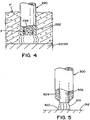
- Flux F in both of the embodiments set forth in FIGURES 3 and 4 facilitates in producing an as-cast metal having a high toughness without requiring transformation by reheating of the total joint 10 and with excellent slag removal.
- novel flux F can be used as coating 304 of stick electrode 300 having a center metal rod 302.
- Arc 310 between rod 302 and workpiece 312 deposits weld metal 320 onto workpiece 312 to form joint 10, as shown in FIGURE 1 .
- Weld metal 320 has fine grain as-cast condition to provide a high toughness layer of metal on workpiece 312.
- flux F has been shown to produce high toughness weld metal when employing submerged arc welding, shielded gas flux cored welding, stick electrode welding or other types of electric arc welding.
- the flux of the present invention has a reduced amount of titanium with small amounts of and boron.
- slag- 340 formed on weld metal 320 creates a very weak bond at interface 350 as shown in FIGURES 6 and 7 . Consequently, slag 340 can be easily removed from weld metal 320 after the weld metal has solidified.
- the reduction in titanium in the weld metal has been found to substantially reduce the holding force between the slag and weld metal when using novel flux F in any of the various welding processes illustrated in FIGURES 2, 3 , 4 and 5 .
Landscapes
- Engineering & Computer Science (AREA)
- Mechanical Engineering (AREA)
- Physics & Mathematics (AREA)
- Plasma & Fusion (AREA)
- Nonmetallic Welding Materials (AREA)
Claims (18)
- Flussmittelsystem zur Verwendung beim elektrischen Lichtbogenschweißen, das eine schlackebildende Verbindung, Titan und Bor umfasst, wobei das Titan und das Bor ein Gewichtsverhältnis von Titan zu Bor von 1,1-20:1 aufweisen, wobei die schlackebildende Verbindung einen größten Gewichtsprozent-Teil des Flussmittelsystems ausmacht, wobei die schlackebildende Verbindung enthält: mindestens 15 Gewichtsprozent Magnesiumverbindung, mindestens 10 Gewichtsprozent Metallfluorid, und mindestens eine Verbindung, die ausgewählt ist aus der Gruppe bestehend aus Aluminiumoxid, Kalziumoxid, Manganverbindung, und Siliziumoxid, wobei die Titanquelle in dem Flussmittelsystem nur in der Form von Titanmetall vorliegt und die Borquelle in dem Flussmittelsystem nur in der Form von Bormetall vorliegt.
- Flussmittelsystem nach Anspruch 1, wobei das Gewichtsverhältnis von Titan zu Bor in dem Flussmittelsystem 1,1 -15:1 beträgt.
- Flussmittelsystem nach Anspruch 1 oder 2, wobei das Titan in dem Flussmittel 0,05-0,5 Gewichtsprozent an dem Flussmittelsystem ausmacht.
- Flussmittelsystem nach einem der Ansprüche 1 bis 3, wobei das Bor in dem Flussmittel 0,005-0,1 Gewichtsprozent an dem Flussmittelsystem ausmacht und bevorzugt 0,02-0,03 Gewichtsprozent an dem Flussmittelsystem ausmacht.
- Flussmittelsystem nach einem der Ansprüche 1 bis 4, wobei das Gewichtsverhältnis von Titan zu Bor in dem Flussmittelsystem 1,5-10:1 beträgt, das Titan in dem Flussmittel 0,05-0,25 Gewichtsprozent in dem Flussmittelsystem beträgt und das Bor in dem Flussmittel 0,005-0,04 Gewichtsprozent in dem Flussmittelsystem beträgt.
- Flussmittelsystem nach einem der Ansprüche 1 bis 5, wobei das Metallfluorid Kalziumfluorid ist.
- Flussmittelsystem nach einem der Ansprüche 1 bis 6, wobei die Magnesiumverbindung Magnesiumoxid ist.
- Flussmittelsystem nach einem der Ansprüche 1 bis 7, wobei die schlackebildende Verbindung, die die Aluminiumverbindung enthält, Aluminiumoxid ist.
- Flussmittelsystem nach einem der Ansprüche 1 bis 8, wobei die schlackebildende Verbindung, die die Kalziumverbindung enthält, Kalziumoxid ist.
- Flussmittelsystem nach einem der Ansprüche 1 bis 9, wobei die schlackebildende Verbindung, die die Manganverbindung enthält, Manganoxid ist.
- Flussmittelsystem nach einem der Ansprüche 1 bis 10, wobei die schlackebildende Verbindung, die die Siliziumverbindung enthält, Siliziumdioxid ist.
- Flussmittelsystem nach einem der Ansprüche 1 bis 11, wobei das Flussmittel einen Basizitätsindex von über 1,4 hat.
- Flussmittelsystem nach einem der Ansprüche 1 bis 12, wobei die schlackebildende Verbindung mindestens 60 Gewichtsprozent von mindestens zwei Verbindungen enthält, die ausgewählt sind aus der Gruppe bestehend aus Aluminiumoxid, Kalziumfluorid, Kalziumoxid, Magnesiumoxid oder Gemischen davon.
- Flussmittelsystem nach einem der Ansprüche 1 bis 13, wobei die schlackebildende Verbindung maximal 50 Gewichtsprozent jeder Verbindung enthält, die ausgewählt ist aus der Gruppe bestehend Aluminiumoxid, Kalziumfluorid, Kalziumoxid oder Magnesiumoxid.
- Verfahren zum elektrischen Lichtbogenschweißen, wobei das Schweißmetall eine hohe Schlagzähigkeit ohne Wiedererwärmung unter Verwendung des Flussmittelsystems nach den Ansprüchen 1-4 aufweist, und das Folgendes umfasst:a) uswählen des Flussmittelsystems;b) Bereitstellen einer aufzehrbaren Metallelektrode, undc) Erzeugen eines elektrischen Lichtbogens, um das Flussmittelsystem und die aufzehrbare Metallelektrode mindestens teilweise zu schmelzen, wobei das mindestens teilweise Schmelzen des Flussmittelsystems dazu führt, dass das Titan und das Bor in dem Flussmittelsystem in das Schweißmetall eintreten, das durch das mindestens teilweise Schmelzen der aufzehrbaren Metallelektrode gebildet wird.
- Verfahren nach Anspruch 15, wobei das Schweißmetall weniger als etwa 18 ppm Titan und weniger als etwa 15 ppm Bor enthält.
- Verfahren nach Anspruch 16 oder 17, wobei ein Gewichtsverhältnis von Titan zu Bor in dem Schweißmetlall kleiner ist als 10:1.
- Verfahren nach einem der Ansprüche 15 bis 17, wobei der Schweißprozess ein Unterpulver-Lichtbogenschweißprozess oder ein FCAW-Prozess ist.
Applications Claiming Priority (2)
| Application Number | Priority Date | Filing Date | Title |
|---|---|---|---|
| US11/522,879 US8153934B2 (en) | 2006-09-15 | 2006-09-15 | Saw flux system for improved as-cast weld metal toughness |
| PCT/US2007/004951 WO2008033163A1 (en) | 2006-09-15 | 2007-02-27 | Saw flux system for improved as-cast weld metal toughness |
Publications (3)
| Publication Number | Publication Date |
|---|---|
| EP2061624A1 EP2061624A1 (de) | 2009-05-27 |
| EP2061624A4 EP2061624A4 (de) | 2010-11-24 |
| EP2061624B1 true EP2061624B1 (de) | 2017-04-12 |
Family
ID=39184082
Family Applications (1)
| Application Number | Title | Priority Date | Filing Date |
|---|---|---|---|
| EP07751690.4A Active EP2061624B1 (de) | 2006-09-15 | 2007-02-27 | Saw-flusssystem für verbesserte gusszustandsschweissmetallzähigkeit |
Country Status (6)
| Country | Link |
|---|---|
| US (1) | US8153934B2 (de) |
| EP (1) | EP2061624B1 (de) |
| AU (1) | AU2007295077B2 (de) |
| BR (1) | BRPI0716927B1 (de) |
| CA (1) | CA2662110C (de) |
| WO (1) | WO2008033163A1 (de) |
Families Citing this family (6)
| Publication number | Priority date | Publication date | Assignee | Title |
|---|---|---|---|---|
| US8907248B2 (en) | 2007-05-03 | 2014-12-09 | Illinois Tool Works Inc. | Aluminum deoxidizing welding wire |
| EP2489461B1 (de) * | 2009-12-16 | 2016-04-13 | Nippon Steel & Sumitomo Metal Corporation | Draht mit einem lötmaterial für gasversiegeltes lichtbogenschweissen in jeder position |
| CN101985194A (zh) * | 2010-11-19 | 2011-03-16 | 天津市永昌焊丝有限公司 | 一种合金粉末过渡带极堆焊专用堆焊焊剂 |
| JP5792050B2 (ja) * | 2011-01-31 | 2015-10-07 | 株式会社神戸製鋼所 | 低温用鋼のサブマージアーク溶接方法 |
| JP5410466B2 (ja) * | 2011-03-01 | 2014-02-05 | 株式会社神戸製鋼所 | ステンレス鋼フラックス入りワイヤ |
| EP3360641A1 (de) * | 2017-02-09 | 2018-08-15 | Oerlikon Schweisstechnik GmbH | Agglomeriertes schweissflussmittel und verfahren zum unterpulverschweissen von austenitischem rostfreien stahl unter verwendung dieses flussmittels |
Family Cites Families (38)
| Publication number | Priority date | Publication date | Assignee | Title |
|---|---|---|---|---|
| DE1251133C2 (de) | 1961-03-30 | 1973-01-18 | Verfahren zur herstellung von schweisspulvern mit kleinem schuettgewicht fuer das unterpulverschweissen | |
| US3424626A (en) | 1965-01-05 | 1969-01-28 | Union Carbide Corp | Low silica welding composition |
| US3531620A (en) | 1966-07-08 | 1970-09-29 | Kobe Steel Ltd | Arc welding electrode for steel without using gas or the like |
| US3551217A (en) | 1968-10-01 | 1970-12-29 | Union Carbide Corp | Submerged arc welding composition |
| NO131582C (de) * | 1969-12-27 | 1975-06-25 | Kobe Steel Ltd | |
| US3767891A (en) | 1971-05-07 | 1973-10-23 | Lincoln Electric Co | Electrode for arc welding in air |
| US3670135A (en) | 1971-06-02 | 1972-06-13 | Stoody Co | Arc welding electrode and process for stainless steel |
| JPS5514166A (en) * | 1978-07-17 | 1980-01-31 | Nippon Steel Corp | Non-fused flux for submerged arc welding |
| JPS6016878B2 (ja) * | 1980-09-24 | 1985-04-27 | 新日本製鐵株式会社 | 極低炭素鋼の潜弧溶接法 |
| JPS57137094A (en) | 1981-02-17 | 1982-08-24 | Kawasaki Steel Corp | High speed submerged arc welding method of single layer on both sides |
| JPS5944159B2 (ja) * | 1981-06-05 | 1984-10-26 | 株式会社神戸製鋼所 | ガスシ−ルドア−ク溶接用フラツクス入りワイヤ |
| JPS5841695A (ja) * | 1981-09-08 | 1983-03-10 | Nippon Steel Corp | 潜弧溶接用フラツクス |
| US4551610A (en) * | 1983-05-17 | 1985-11-05 | The Lincoln Electric Company | Tubular welding electrode |
| FR2570011A1 (fr) | 1984-09-11 | 1986-03-14 | Soudure Autogene Francaise | Flux solide pour soudage a l'arc submerge |
| JPS61158839A (ja) | 1984-12-28 | 1986-07-18 | Okuno Seiyaku Kogyo Kk | ガラス組成物 |
| US5192851A (en) * | 1988-02-05 | 1993-03-09 | Commonwealth Scientific And Industrial Research Organization And Welding Industries Limited | Cored electrode wires |
| AU628325B2 (en) | 1988-02-05 | 1992-09-17 | Commonwealth Scientific And Industrial Research Organisation | Improved cored electrode wires |
| US4940882A (en) | 1989-04-27 | 1990-07-10 | Inco Alloys International, Inc. | Welding flux and welding electrode |
| US4950331A (en) * | 1989-07-11 | 1990-08-21 | Pokhodnya Igor K | Ceramic flux for welding low-alloy steels |
| GB9013043D0 (en) * | 1990-06-12 | 1990-08-01 | Laporte Industries Ltd | Fluxes for aluminium brazing or welding |
| US5365036A (en) * | 1992-06-22 | 1994-11-15 | The Lincoln Electric Company | Flux cored gas shielded electrode |
| US5308407A (en) | 1993-04-16 | 1994-05-03 | Inco Alloys International, Inc. | Electroslag welding flux |
| FR2764221B1 (fr) * | 1997-06-09 | 1999-07-16 | Soudure Autogene Francaise | Fil fourre basse teneur azote |
| JP3617605B2 (ja) | 1998-10-01 | 2005-02-09 | 株式会社神戸製鋼所 | サブマージアーク溶接用ボンドフラックス |
| US6608284B1 (en) * | 2000-05-17 | 2003-08-19 | Illinois Tool Works Inc. | Weld wire with enhanced slag removal |
| JP2002018595A (ja) | 2000-07-03 | 2002-01-22 | Nippon Steel Corp | 低温用鋼の片面サブマージアーク溶接方法 |
| WO2002098599A1 (en) | 2001-06-06 | 2002-12-12 | Kotlar, Milan, Ludek | Welding consumable composition |
| JP3758040B2 (ja) * | 2002-07-26 | 2006-03-22 | 株式会社神戸製鋼所 | 低合金耐熱鋼用ガスシールドアーク溶接用フラックス入りワイヤ |
| US6939413B2 (en) | 2003-03-24 | 2005-09-06 | Lincoln Global, Inc. | Flux binder system |
| JP3850825B2 (ja) * | 2003-10-22 | 2006-11-29 | 株式会社神戸製鋼所 | サブマージアーク溶接用溶融型フラックス |
| US7147725B2 (en) | 2003-12-04 | 2006-12-12 | Lincoln Global, Inc. | Colloidal silica binder system |
| US7087859B2 (en) | 2004-05-06 | 2006-08-08 | Lincoln Global, Inc. | Stick electrode |
| JP4476018B2 (ja) | 2004-05-18 | 2010-06-09 | 株式会社神戸製鋼所 | 改良9Cr−1Mo鋼用溶接ワイヤ |
| US8168922B2 (en) | 2004-10-18 | 2012-05-01 | Lincoln Global, Inc. | Self-shielded flux cored electrode |
| US20060096966A1 (en) | 2004-11-08 | 2006-05-11 | Lincoln Global, Inc. | Self-shielded flux cored electrode for fracture critical applications |
| US20060144836A1 (en) | 2005-01-03 | 2006-07-06 | Lincoln Global, Inc. | Cored electrode for reducing diffusible hydrogen |
| US7491910B2 (en) | 2005-01-24 | 2009-02-17 | Lincoln Global, Inc. | Hardfacing electrode |
| US7678203B2 (en) * | 2005-03-04 | 2010-03-16 | Lincoln Global, Inc. | Welding flux |
-
2006
- 2006-09-15 US US11/522,879 patent/US8153934B2/en active Active
-
2007
- 2007-02-27 CA CA2662110A patent/CA2662110C/en active Active
- 2007-02-27 BR BRPI0716927-2A patent/BRPI0716927B1/pt active IP Right Grant
- 2007-02-27 AU AU2007295077A patent/AU2007295077B2/en not_active Ceased
- 2007-02-27 WO PCT/US2007/004951 patent/WO2008033163A1/en not_active Ceased
- 2007-02-27 EP EP07751690.4A patent/EP2061624B1/de active Active
Also Published As
| Publication number | Publication date |
|---|---|
| CA2662110A1 (en) | 2008-03-20 |
| US20080078809A1 (en) | 2008-04-03 |
| CA2662110C (en) | 2012-08-28 |
| AU2007295077A1 (en) | 2008-03-20 |
| BRPI0716927A2 (pt) | 2013-01-08 |
| EP2061624A4 (de) | 2010-11-24 |
| AU2007295077B2 (en) | 2011-09-29 |
| WO2008033163A1 (en) | 2008-03-20 |
| BRPI0716927B1 (pt) | 2015-06-02 |
| US8153934B2 (en) | 2012-04-10 |
| EP2061624A1 (de) | 2009-05-27 |
Similar Documents
| Publication | Publication Date | Title |
|---|---|---|
| CN1762644B (zh) | 自保护药芯焊丝及形成金属熔敷物的方法 | |
| US4571480A (en) | Flux cored wire electrodes for self-shielded arc welding | |
| JP4986562B2 (ja) | チタニヤ系ガスシールドアーク溶接用フラックス入りワイヤ | |
| US20060096966A1 (en) | Self-shielded flux cored electrode for fracture critical applications | |
| US10870178B2 (en) | Flux-cored wire for arc welding of duplex stainless steel and weld metal | |
| JPWO2009145347A1 (ja) | 凝固結晶粒を微細にする二相ステンレス鋼溶接用フラックス入りワイヤ | |
| EP2061624B1 (de) | Saw-flusssystem für verbesserte gusszustandsschweissmetallzähigkeit | |
| JP2001314996A (ja) | 耐熱鋼用ガスシールドアーク溶接用フラックス入りワイヤ | |
| JP3934399B2 (ja) | 凝固結晶粒を微細にするオーステナイト系ステンレス鋼溶接用フラックス入りワイヤ | |
| JPWO2020110856A1 (ja) | フラックス入りワイヤ、及び溶接継手の製造方法 | |
| EP3974097A2 (de) | Beschichtete elektrode zum lichtbogenschweissen von hochfestem stahl | |
| CN113613829A (zh) | Ni基合金药芯焊丝 | |
| JPH08257785A (ja) | 鋼溶接部の耐低温割れ性を改善するアーク溶接用フラックス入りワイヤ | |
| JP2001205483A (ja) | ガスシールドアーク溶接用フラックス入りワイヤ | |
| KR20160139686A (ko) | 플럭스 코어드 와이어 | |
| JP2010234429A (ja) | 凝固結晶粒を微細にする二相ステンレス鋼溶接用被覆アーク溶接棒 | |
| JPS62248594A (ja) | ガスシールドアーク溶接ワイヤ | |
| JP2528296B2 (ja) | エレクトロガスア−ク溶接用複合ワイヤ | |
| JPH09262693A (ja) | アーク溶接用フラックス入りワイヤ | |
| JP2519308B2 (ja) | セルフシ―ルドア―ク溶接フラックス入りワイヤ | |
| JP2530899B2 (ja) | セルフシ―ルドア―ク溶接フラックス入りワイヤ | |
| JPS62248593A (ja) | ガスシールドアーク溶接用フラックス入りワイヤ | |
| JPH0510199B2 (de) | ||
| JPH0378197B2 (de) | ||
| JP2628762B2 (ja) | セルフシールドアーク溶接フラックス入りワイヤ |
Legal Events
| Date | Code | Title | Description |
|---|---|---|---|
| PUAI | Public reference made under article 153(3) epc to a published international application that has entered the european phase |
Free format text: ORIGINAL CODE: 0009012 |
|
| 17P | Request for examination filed |
Effective date: 20090218 |
|
| AK | Designated contracting states |
Kind code of ref document: A1 Designated state(s): AT BE BG CH CY CZ DE DK EE ES FI FR GB GR HU IE IS IT LI LT LU LV MC NL PL PT RO SE SI SK TR |
|
| AX | Request for extension of the european patent |
Extension state: AL BA HR MK RS |
|
| A4 | Supplementary search report drawn up and despatched |
Effective date: 20101025 |
|
| RIC1 | Information provided on ipc code assigned before grant |
Ipc: B23K 35/362 20060101ALI20101019BHEP Ipc: B23K 31/02 20060101AFI20080411BHEP |
|
| DAX | Request for extension of the european patent (deleted) | ||
| 17Q | First examination report despatched |
Effective date: 20160801 |
|
| STAA | Information on the status of an ep patent application or granted ep patent |
Free format text: STATUS: EXAMINATION IS IN PROGRESS |
|
| REG | Reference to a national code |
Ref country code: DE Ref legal event code: R079 Ref document number: 602007050576 Country of ref document: DE Free format text: PREVIOUS MAIN CLASS: B23K0031020000 Ipc: B23K0009020000 |
|
| GRAP | Despatch of communication of intention to grant a patent |
Free format text: ORIGINAL CODE: EPIDOSNIGR1 |
|
| STAA | Information on the status of an ep patent application or granted ep patent |
Free format text: STATUS: GRANT OF PATENT IS INTENDED |
|
| RIC1 | Information provided on ipc code assigned before grant |
Ipc: B23K 9/18 20060101ALI20161124BHEP Ipc: B23K 101/18 20060101ALI20161124BHEP Ipc: B23K 35/34 20060101ALI20161124BHEP Ipc: B23K 9/025 20060101ALI20161124BHEP Ipc: B23K 35/362 20060101ALI20161124BHEP Ipc: B23K 35/36 20060101ALI20161124BHEP Ipc: B23K 9/173 20060101ALI20161124BHEP Ipc: B23K 9/02 20060101AFI20161124BHEP |
|
| INTG | Intention to grant announced |
Effective date: 20161215 |
|
| GRAS | Grant fee paid |
Free format text: ORIGINAL CODE: EPIDOSNIGR3 |
|
| GRAA | (expected) grant |
Free format text: ORIGINAL CODE: 0009210 |
|
| STAA | Information on the status of an ep patent application or granted ep patent |
Free format text: STATUS: THE PATENT HAS BEEN GRANTED |
|
| AK | Designated contracting states |
Kind code of ref document: B1 Designated state(s): AT BE BG CH CY CZ DE DK EE ES FI FR GB GR HU IE IS IT LI LT LU LV MC NL PL PT RO SE SI SK TR |
|
| REG | Reference to a national code |
Ref country code: GB Ref legal event code: FG4D |
|
| REG | Reference to a national code |
Ref country code: CH Ref legal event code: EP |
|
| REG | Reference to a national code |
Ref country code: IE Ref legal event code: FG4D |
|
| REG | Reference to a national code |
Ref country code: AT Ref legal event code: REF Ref document number: 883364 Country of ref document: AT Kind code of ref document: T Effective date: 20170515 |
|
| REG | Reference to a national code |
Ref country code: DE Ref legal event code: R081 Ref document number: 602007050576 Country of ref document: DE Owner name: LINCOLN GLOBAL, INC., SANTA FE SPRINGS, US Free format text: FORMER OWNER: LINCOLN GLOBAL, INC., CITY OF INDUSTRY, CALIF., US |
|
| REG | Reference to a national code |
Ref country code: DE Ref legal event code: R096 Ref document number: 602007050576 Country of ref document: DE |
|
| RAP2 | Party data changed (patent owner data changed or rights of a patent transferred) |
Owner name: LINCOLN GLOBAL, INC. |
|
| REG | Reference to a national code |
Ref country code: NL Ref legal event code: MP Effective date: 20170412 |
|
| REG | Reference to a national code |
Ref country code: LT Ref legal event code: MG4D |
|
| REG | Reference to a national code |
Ref country code: AT Ref legal event code: MK05 Ref document number: 883364 Country of ref document: AT Kind code of ref document: T Effective date: 20170412 |
|
| PG25 | Lapsed in a contracting state [announced via postgrant information from national office to epo] |
Ref country code: NL Free format text: LAPSE BECAUSE OF FAILURE TO SUBMIT A TRANSLATION OF THE DESCRIPTION OR TO PAY THE FEE WITHIN THE PRESCRIBED TIME-LIMIT Effective date: 20170412 |
|
| PG25 | Lapsed in a contracting state [announced via postgrant information from national office to epo] |
Ref country code: ES Free format text: LAPSE BECAUSE OF FAILURE TO SUBMIT A TRANSLATION OF THE DESCRIPTION OR TO PAY THE FEE WITHIN THE PRESCRIBED TIME-LIMIT Effective date: 20170412 Ref country code: FI Free format text: LAPSE BECAUSE OF FAILURE TO SUBMIT A TRANSLATION OF THE DESCRIPTION OR TO PAY THE FEE WITHIN THE PRESCRIBED TIME-LIMIT Effective date: 20170412 Ref country code: LT Free format text: LAPSE BECAUSE OF FAILURE TO SUBMIT A TRANSLATION OF THE DESCRIPTION OR TO PAY THE FEE WITHIN THE PRESCRIBED TIME-LIMIT Effective date: 20170412 Ref country code: GR Free format text: LAPSE BECAUSE OF FAILURE TO SUBMIT A TRANSLATION OF THE DESCRIPTION OR TO PAY THE FEE WITHIN THE PRESCRIBED TIME-LIMIT Effective date: 20170713 Ref country code: AT Free format text: LAPSE BECAUSE OF FAILURE TO SUBMIT A TRANSLATION OF THE DESCRIPTION OR TO PAY THE FEE WITHIN THE PRESCRIBED TIME-LIMIT Effective date: 20170412 |
|
| PG25 | Lapsed in a contracting state [announced via postgrant information from national office to epo] |
Ref country code: SE Free format text: LAPSE BECAUSE OF FAILURE TO SUBMIT A TRANSLATION OF THE DESCRIPTION OR TO PAY THE FEE WITHIN THE PRESCRIBED TIME-LIMIT Effective date: 20170412 Ref country code: PL Free format text: LAPSE BECAUSE OF FAILURE TO SUBMIT A TRANSLATION OF THE DESCRIPTION OR TO PAY THE FEE WITHIN THE PRESCRIBED TIME-LIMIT Effective date: 20170412 Ref country code: IS Free format text: LAPSE BECAUSE OF FAILURE TO SUBMIT A TRANSLATION OF THE DESCRIPTION OR TO PAY THE FEE WITHIN THE PRESCRIBED TIME-LIMIT Effective date: 20170812 Ref country code: LV Free format text: LAPSE BECAUSE OF FAILURE TO SUBMIT A TRANSLATION OF THE DESCRIPTION OR TO PAY THE FEE WITHIN THE PRESCRIBED TIME-LIMIT Effective date: 20170412 Ref country code: BG Free format text: LAPSE BECAUSE OF FAILURE TO SUBMIT A TRANSLATION OF THE DESCRIPTION OR TO PAY THE FEE WITHIN THE PRESCRIBED TIME-LIMIT Effective date: 20170712 |
|
| REG | Reference to a national code |
Ref country code: DE Ref legal event code: R097 Ref document number: 602007050576 Country of ref document: DE |
|
| PG25 | Lapsed in a contracting state [announced via postgrant information from national office to epo] |
Ref country code: DK Free format text: LAPSE BECAUSE OF FAILURE TO SUBMIT A TRANSLATION OF THE DESCRIPTION OR TO PAY THE FEE WITHIN THE PRESCRIBED TIME-LIMIT Effective date: 20170412 Ref country code: SK Free format text: LAPSE BECAUSE OF FAILURE TO SUBMIT A TRANSLATION OF THE DESCRIPTION OR TO PAY THE FEE WITHIN THE PRESCRIBED TIME-LIMIT Effective date: 20170412 Ref country code: EE Free format text: LAPSE BECAUSE OF FAILURE TO SUBMIT A TRANSLATION OF THE DESCRIPTION OR TO PAY THE FEE WITHIN THE PRESCRIBED TIME-LIMIT Effective date: 20170412 Ref country code: RO Free format text: LAPSE BECAUSE OF FAILURE TO SUBMIT A TRANSLATION OF THE DESCRIPTION OR TO PAY THE FEE WITHIN THE PRESCRIBED TIME-LIMIT Effective date: 20170412 Ref country code: CZ Free format text: LAPSE BECAUSE OF FAILURE TO SUBMIT A TRANSLATION OF THE DESCRIPTION OR TO PAY THE FEE WITHIN THE PRESCRIBED TIME-LIMIT Effective date: 20170412 |
|
| PLBE | No opposition filed within time limit |
Free format text: ORIGINAL CODE: 0009261 |
|
| STAA | Information on the status of an ep patent application or granted ep patent |
Free format text: STATUS: NO OPPOSITION FILED WITHIN TIME LIMIT |
|
| PG25 | Lapsed in a contracting state [announced via postgrant information from national office to epo] |
Ref country code: IT Free format text: LAPSE BECAUSE OF FAILURE TO SUBMIT A TRANSLATION OF THE DESCRIPTION OR TO PAY THE FEE WITHIN THE PRESCRIBED TIME-LIMIT Effective date: 20170412 |
|
| 26N | No opposition filed |
Effective date: 20180115 |
|
| PG25 | Lapsed in a contracting state [announced via postgrant information from national office to epo] |
Ref country code: SI Free format text: LAPSE BECAUSE OF FAILURE TO SUBMIT A TRANSLATION OF THE DESCRIPTION OR TO PAY THE FEE WITHIN THE PRESCRIBED TIME-LIMIT Effective date: 20170412 |
|
| REG | Reference to a national code |
Ref country code: CH Ref legal event code: PL |
|
| PG25 | Lapsed in a contracting state [announced via postgrant information from national office to epo] |
Ref country code: MC Free format text: LAPSE BECAUSE OF FAILURE TO SUBMIT A TRANSLATION OF THE DESCRIPTION OR TO PAY THE FEE WITHIN THE PRESCRIBED TIME-LIMIT Effective date: 20170412 |
|
| GBPC | Gb: european patent ceased through non-payment of renewal fee |
Effective date: 20180227 |
|
| REG | Reference to a national code |
Ref country code: BE Ref legal event code: MM Effective date: 20180228 |
|
| PG25 | Lapsed in a contracting state [announced via postgrant information from national office to epo] |
Ref country code: LI Free format text: LAPSE BECAUSE OF NON-PAYMENT OF DUE FEES Effective date: 20180228 Ref country code: LU Free format text: LAPSE BECAUSE OF NON-PAYMENT OF DUE FEES Effective date: 20180227 Ref country code: CH Free format text: LAPSE BECAUSE OF NON-PAYMENT OF DUE FEES Effective date: 20180228 |
|
| REG | Reference to a national code |
Ref country code: FR Ref legal event code: ST Effective date: 20181031 |
|
| REG | Reference to a national code |
Ref country code: IE Ref legal event code: MM4A |
|
| PG25 | Lapsed in a contracting state [announced via postgrant information from national office to epo] |
Ref country code: IE Free format text: LAPSE BECAUSE OF NON-PAYMENT OF DUE FEES Effective date: 20180227 |
|
| PG25 | Lapsed in a contracting state [announced via postgrant information from national office to epo] |
Ref country code: BE Free format text: LAPSE BECAUSE OF NON-PAYMENT OF DUE FEES Effective date: 20180228 Ref country code: GB Free format text: LAPSE BECAUSE OF NON-PAYMENT OF DUE FEES Effective date: 20180227 Ref country code: FR Free format text: LAPSE BECAUSE OF NON-PAYMENT OF DUE FEES Effective date: 20180228 |
|
| PG25 | Lapsed in a contracting state [announced via postgrant information from national office to epo] |
Ref country code: TR Free format text: LAPSE BECAUSE OF FAILURE TO SUBMIT A TRANSLATION OF THE DESCRIPTION OR TO PAY THE FEE WITHIN THE PRESCRIBED TIME-LIMIT Effective date: 20170412 |
|
| PG25 | Lapsed in a contracting state [announced via postgrant information from national office to epo] |
Ref country code: PT Free format text: LAPSE BECAUSE OF FAILURE TO SUBMIT A TRANSLATION OF THE DESCRIPTION OR TO PAY THE FEE WITHIN THE PRESCRIBED TIME-LIMIT Effective date: 20170412 Ref country code: HU Free format text: LAPSE BECAUSE OF FAILURE TO SUBMIT A TRANSLATION OF THE DESCRIPTION OR TO PAY THE FEE WITHIN THE PRESCRIBED TIME-LIMIT; INVALID AB INITIO Effective date: 20070227 |
|
| PG25 | Lapsed in a contracting state [announced via postgrant information from national office to epo] |
Ref country code: CY Free format text: LAPSE BECAUSE OF FAILURE TO SUBMIT A TRANSLATION OF THE DESCRIPTION OR TO PAY THE FEE WITHIN THE PRESCRIBED TIME-LIMIT Effective date: 20170412 |
|
| PGFP | Annual fee paid to national office [announced via postgrant information from national office to epo] |
Ref country code: DE Payment date: 20260217 Year of fee payment: 20 |