EP2106058B1 - Verfahren und Anordnung zur Einstellung der Zeitanpassung eines abgetasteten Datenstroms - Google Patents
Verfahren und Anordnung zur Einstellung der Zeitanpassung eines abgetasteten Datenstroms Download PDFInfo
- Publication number
- EP2106058B1 EP2106058B1 EP08153563A EP08153563A EP2106058B1 EP 2106058 B1 EP2106058 B1 EP 2106058B1 EP 08153563 A EP08153563 A EP 08153563A EP 08153563 A EP08153563 A EP 08153563A EP 2106058 B1 EP2106058 B1 EP 2106058B1
- Authority
- EP
- European Patent Office
- Prior art keywords
- phase
- data stream
- time adjustment
- sampled data
- shaping filter
- Prior art date
- Legal status (The legal status is an assumption and is not a legal conclusion. Google has not performed a legal analysis and makes no representation as to the accuracy of the status listed.)
- Not-in-force
Links
Images


Classifications
-
- H—ELECTRICITY
- H04—ELECTRIC COMMUNICATION TECHNIQUE
- H04L—TRANSMISSION OF DIGITAL INFORMATION, e.g. TELEGRAPHIC COMMUNICATION
- H04L25/00—Baseband systems
- H04L25/02—Details ; arrangements for supplying electrical power along data transmission lines
- H04L25/03—Shaping networks in transmitter or receiver, e.g. adaptive shaping networks
- H04L25/03828—Arrangements for spectral shaping; Arrangements for providing signals with specified spectral properties
- H04L25/03834—Arrangements for spectral shaping; Arrangements for providing signals with specified spectral properties using pulse shaping
-
- H—ELECTRICITY
- H04—ELECTRIC COMMUNICATION TECHNIQUE
- H04W—WIRELESS COMMUNICATION NETWORKS
- H04W56/00—Synchronisation arrangements
- H04W56/004—Synchronisation arrangements compensating for timing error of reception due to propagation delay
- H04W56/0045—Synchronisation arrangements compensating for timing error of reception due to propagation delay compensating for timing error by altering transmission time
Definitions
- the present invention relates generally to the field of adjusting time alignment of a sampled data stream. More particularly, it relates to such adjustment in a transmitter chain of an electronic communication device.
- radio parts of the transmitter chain of an electronic communication device have been working in the analogue domain.
- Digital radio functionality may, however, also be implemented, and digital radio parts of the transmitter chain are becoming increasingly popular.
- WO 2006/115928 discloses a DigiRF interface with scheduling.
- this is achieved by a method of adjusting time alignment of a sampled data stream having a first sample resolution.
- the method comprises transferring the sampled data stream from a baseband subsystem to a digital interface, transferring the sampled data stream from the digital interface to a digital radio comprising a pulse shaping filter modulator, modulating the sampled data stream by using the pulse shaping filter modulator, and transmitting the modulated sampled data stream.
- the method also comprises transferring a time adjustment control signal from the baseband subsystem to the digital radio, and the modulating step comprises a step of adjusting, based on the time adjustment control signal, the time alignment of the sampled data stream using a second sample resolution.
- the second sample resolution is higher than the first sample resolution.
- the method may further comprise converting, in the digital interface, the sampled data stream to an in-phase sampled data stream and a quadrature sampled data stream, and modulating the in-phase and quadrature sampled data streams separately.
- the digital interface may be compliant with the DigRF standard.
- the digital radio may comprise a Wideband Code Division Multiple Access - WCDMA - modulator and the WCDMA modulator may comprise the pulse shaping filter modulator.
- the pulse-shaping filter may be a root raised cosine filter.
- the step of adjusting the time alignment of the sampled data stream may comprise adjusting a phase of the pulse-shaping filter based on time adjustment control signal, and modifying coefficients of the pulse-shaping filter based on the adjusted phase.
- the step of transferring the time adjustment control signal from the baseband subsystem to the digital radio may comprise transferring the time adjustment control signal from the baseband subsystem to the digital interface, converting the time adjustment control signal to a time adjustment value, and transferring the time adjustment value from the digital interface to the digital radio.
- the method may further comprise converting the time adjustment control signal to an apply time adjustment flag, transferring the apply time adjustment flag from the digital interface to the digital radio, and performing the step of adjusting the time alignment of the sampled data stream when the apply time adjustment flag is set.
- the step of adjusting the phase of the pulse shaping filter based on time adjustment control signal may comprise updating the phase of the pulse shaping filter by adding a default phase update offset value and the time adjustment value to the phase.
- the method may further comprise determining whether adjusting the phase of the pulse shaping filter results in reprocessing of a sample of the sampled data stream, and, if adjusting the phase of the pulse-shaping filter results in reprocessing of a sample of the sampled data stream, postponing the step of adjusting the time alignment of the sampled data stream and updating the phase of the pulse shaping filter by adding the default phase update offset value to the phase.
- the method may further comprise determining whether adding the default phase update offset value and the time adjustment value to the phase gives a first result value that is less than a threshold, and. if the first result value is less than the threshold, postponing the step of adjusting the time alignment of the sampled data stream, and updating the phase of the pulse shaping filter by adding the default phase update offset value to the phase.
- the threshold may be zero.
- a second aspect of the invention is a computer program product comprising a computer readable medium, having thereon a computer program comprising program instructions, the computer program being loadable into a data-processing unit and adapted to cause the data-processing unit to execute at least the step of adjusting the time alignment according to the first aspect of the invention when the computer program is run by the data-processing unit.
- a third aspect of the invention is an arrangement for adjusting time alignment of a sampled data stream having a first sample resolution.
- the arrangement comprises a baseband subsystem, a digital interface, and a digital radio comprising a modulator and a transmitter.
- the baseband subsystem is adapted to transfer the sampled data stream to the digital interface
- the digital interface is adapted to transfer the sampled data stream to the digital radio
- the modulator is adapted to modulate the sampled data stream
- the transmitter is adapted to transmit the modulated sampled data stream.
- the baseband subsystem is adapted to transfer a time adjustment control signal to the digital radio
- the modulator is adapted to adjust, based on the time adjustment control signal, the time alignment of the sampled data stream using a second sample resolution.
- the modulator comprises a Wideband Code Division Multiple Access - WCDMA - modulator and the WCDMA modulator comprises a pulse shaping filter modulator.
- the modulator may comprise a phase counter adapted to provide a phase of the pulse shaping filter, and a modulation control unit adapted to adjust the phase based on time adjustment control signal.
- the pulse shaping filter modulator may be adapted to modify coefficients of the pulse-shaping filter based on the adjusted phase.
- the third aspect of the invention may additionally have features identical with or corresponding to any of the various features as explained above for the first aspect of the invention.
- a fourth aspect of the invention is an electronic device comprising the arrangement of the third aspect of the invention.
- the electronic device may be a mobile terminal.
- the first sample resolution may be defined as the smallest possible time alignment adjustment that can be made in the baseband subsystem.
- the second sample resolution may be defined as the smallest possible time alignment adjustment that can be made in the digital radio according to embodiments of the invention.
- that the second sample resolution is higher than the first sample resolution in some embodiments means that a time alignment adjustment can be made in smaller steps if using the second sample resolution rather than the first sample resolution.
- One of the advantages of embodiments of the invention is that time alignment of a sampled data stream may be achieved.
- a further advantage of embodiments of the invention is that the alignment can be achieved with high resolution.
- a further advantage of embodiments of the invention is that timing adjustments are achievable that are smaller than the distance between the samples that are transferred between the baseband module and the radio module. This allows for fine-tuning of the timing adjustments.
- a further advantage of embodiments of the invention is that mechanisms are provided to prevent ambiguities at packet boundaries and at chip boundaries.
- a further advantage of embodiments of the invention is that the transmitted signal does not contain sharp changes. Instead, the adjustment may be made so that the effect of the adjustment is smoothed in the transmitted signal.
- a further advantage of embodiments of the invention is that a low complexity implementation is offered.
- the data stream may be a transmit data stream in a Wideband Code Division Multiple Access (WCDMA) transmitter.
- WCDMA Wideband Code Division Multiple Access
- the invention is not limited to such cases.
- embodiments of the invention may be used in transmitter chains that use other transmission techniques, such as, for example, Orthogonal Frequency Division Multiplexing (OFDM).
- OFDM Orthogonal Frequency Division Multiplexing
- misalignment and/or congestion in the baseband module may be a reason that time alignment adjustment is needed.
- the movement of a mobile communication device may be a reason that time alignment adjustment is needed as explained above. If, for example, the baseband stream misalignment is one chip, the call will be dropped according to some scenarios. In the 3GPP standard, adjustments of less than one-quarter chip are allowed (see TS 25.133 (2007-12), Section 7.1).
- One way of achieving a time adjustment is to perform an adjustment in the baseband module/sub-system or in the digital interface. In general, however, this has the disadvantage that adjustments can only be made with a resolution of one chip.
- a modulator of a digital radio may have a resolution that is substantially higher than one chip.
- the time adjustment may be performed with a resolution of 1/325 of a chip.
- Embodiments of the invention suggest that time adjustment is made in association with the digital radio modulator.
- the resolution of the time adjustment increases.
- the resolution increases from one chip to 1/325 chip and adjustments of up to one quarter of a chip may be achieved.
- a resolution of 1/325 and a maximum adjustment of one quarter of a chip are merely example values. Other example values may be handled by some embodiments of the invention.
- Maximum adjustment values may be imposed by a communication standard applied by an example embodiment. For example, one quarter of a chip adjustment is imposed by the 3GPP standard document TS 25.133 (2007-12), Section 7.1.
- time adjustment is achieved by modifying coefficients of a pulse-shaping filter used in the digital radio modulator in a controlled manner.
- the pulse-shaping filter may practice over-sampling of the data stream, hence providing a higher resolution for the time adjustment.
- this pulse-shaping filter is a poly-phase filter used for up-sampling in the modulator.
- the pulse shaping filter gives the functionality of a 325 times over-sampled root raised cosine filter multiplied with a Kaiser window with parameter 2.0.
- the baseband module may send the required adjustment value to the digital interface, which in turn may forward the adjustment value to the pulse shaping filter control.
- a strobe indicating when to apply the adjustment may also be provided.
- the modulator accepts timing adjustment values up to and including ⁇ 1/4 chips, with a timing adjustment step size of 1/325 chip.
- Figure 1 illustrates an example mobile terminal 110 connected, through a radio link 120, to a base station site 130.
- the base station site 130 comprises one or more antennas 135 and at least one base station 150.
- the mobile terminal 110 may comprise an arrangement according to embodiments of the invention.
- the mobile terminal 110 is illustrated as a mobile telephone in a schematic front view.
- This example mobile terminal 110 comprises an antenna 111 mounted on the housing of the apparatus.
- the mobile terminal 110 may have an internal antenna mounted within the housing of the apparatus.
- the mobile terminal 110 may even comprise multiple antennas.
- the mobile terminal 110 may further comprise a display, a keypad, a loudspeaker, and a microphone, which together provides a man-machine interface for operating the mobile terminal 110.
- the example mobile terminal 110 is adapted to connect to a mobile telecommunication network via the wireless link 120 to the radio base station 150.
- a user of the mobile terminal 110 may use conventional circuit-switched telecommunication services such as voice calls, data calls, video calls, and fax transmissions, and/or packet-based services such as electronic messaging, VoIP, Internet browsing, electronic commerce, etc.
- the mobile terminal 110 and the base station 150 may be compliant with at least one mobile telecommunication standard, for instance UMTS or UMTS LTE.
- Figure 2 illustrates parts of an example arrangement 200 according to some embodiments of the invention.
- the illustrated arrangement 200 may be comprised in an electronic communication device, such as the mobile terminal 110 illustrated in Figure 1 .
- the arrangement 200 comprises a baseband module 210, which is adapted to produce a digital data stream.
- the digital data stream may be transferred to a digital interface 220, such as a DigRF interface.
- the digital interface 220 may be adapted to split the digital data stream into an in-phase and a quadrature data stream.
- these in-phase and quadrature data streams are transferred to a digital radio 230.
- the digital interface specifies the form and timing of communication between baseband and radio modules.
- Dig RF data may be sent in packets. Each packet may contain eight samples at chip rate, meaning that one sample corresponds to one chip. The chip rate may be 3.84 Msamples per second. Samples may be represented by 12 or 16 bits. The samples may be divided equally between in-phase and quadrature branches. Thus, each packet may contain 4 samples (chips).
- the TX (transmit) data interface in Dig RF carries both data to be transmitted and RF IC (radio frequency integrated circuit) control information. More information regarding standard packing in the uplink may be found in "DigRF, Dual-mode 2.5G / 3G, Baseband / RF IC", Interface Standard, v3.09, 22 November 2006, section 7.1.3.
- the digital radio 230 comprises a modulator 240, such as a wideband modulator in the case of WCDMA, and transmitter circuitry (TX) 250.
- the modulator 240 is adapted to up-sample and modulate the in-phase and quadrature data streams respectively and the transmitter circuitry 250 is adapted to transmit the modulated data steams via one or more antennas 260.
- the in-phase and quadrature data streams Before the in-phase and quadrature data streams enter the modulator 240, they may undergo rounding and saturation operations.
- the in-phase and quadrature data streams then enter the modulator 240, which comprises a pulse shaping filter modulator (PSFM) 270.
- the pulse shaping filter modulator 270 is adapted to process the in-phase and quadrature data streams separately using two pulse shaping filters (PSF) 271 a and 271 b.
- the modulator 240 also comprises a modulation control unit (MCU) 280 and a phase counter (Ph Cntr) 290.
- the modulation control unit 280 and the phase counter 290 are operatively connected at 284.
- the modulation control unit 280 and the phase counter 290 are operatively connected to the pulse shaping filter modulator 270 at 282 and 292 respectively.
- the digital interface might not split the digital data stream into an in-phase and a quadrature data stream. Instead the digital data stream is transferred to the digital radio 230 via a single connection and the digital radio 230 processes the digital data stream as a single data stream.
- a time adjustment control signal may be transferred from the baseband module 210 to the digital interface 220 as shown at 214.
- the time adjustment control signal may, for example, be included in the RF IC control information in DigRF. This time adjustment control signal may indicate whether time adjustment is needed. In some embodiments, it may also indicate when the time adjustment should be applied. In some embodiments, the time adjustment control signal is associated with a packet of the data stream. The timing of the packet sent from the baseband module to the digital radio may, for example, be adjusted at the same time as the control command is sent to the digital radio.
- the digital interface 220 may convert the time adjustment control signal to a time adjustment value and transfer this value to the digital radio as shown at 223.
- the digital interface 220 may also convert the time adjustment control signal to an apply time adjustment flag and transfer this flag to the digital radio as shown at 224.
- the apply time adjustment flag may be created by the digital interface 220.
- the digital interface 220 does not convert the time adjustment signal. Instead the time adjustment signal is simply forwarded to the digital radio 230.
- FIG 3A illustrates an example implementation of a pulse-shaping filter 300 according to some embodiments of the invention.
- the pulse-shaping filter 300 may for example be comprised in the pulse shaping filters 271 a and 271 b of Figure 2 .
- the signal at the input 310 of the pulse-shaping filter 300 may be the in-phase or quadrature data stream received from the digital interface 220 of Figure 2 .
- each symbol (chip) of the input signal is shifted along a first-in first-out (FIFO) shift register, which is made up by memory elements 312a-j. The symbols are shifted one step each time the control signal 394 is set.
- FIFO first-in first-out
- each memory element 312a-j is multiplied by a corresponding filter coefficient 314a-j.
- the results of the multiplications are accumulated in adder 317 and output from the pulse-shaping filter 300 at 319, possibly after rounding in 318.
- each coefficient 314a-j is variable.
- Each coefficient may, for example comprise a table of coefficient values.
- a phase illustrated at 392, determines the coefficient value that should be used.
- the phase may specify which value in a table to apply in the multiplication.
- the phase is updated during each filter clock cycle.
- a new result is output at 319 for each update of the phase.
- the illustrated pulse-shaping filter 300 has a poly-phase structure, which reduces implementation cost.
- the illustrated poly-phase structure has a filter bank of 325 coefficient vectors. Each vector consists of 10 coefficients values.
- the 325 coefficient vectors differ in sample phase, representing a time shift of (0...324)/325 chip, i.e. each change of vector bank changes the phase by 1/325 chip.
- the phase is determined by a phase calculation unit 340 and is output to the coefficient tables at 392.
- the phase calculation unit may comprise the modulation control unit 280 and the phase counter 290 of Figure 2 .
- the phase control unit 340 receives information regarding the time adjustment value and the apply time adjustment flag as illustrated at 323 and 324 (compare with 223 and 224 of Figure 2 ).
- time alignment adjustment may be achieved also when other types of filters are used.
- the invention is not limited to pulse shaping filters of a poly-phase structure.
- Figure 3B illustrates an example with 8 times chip rate over-sampling.
- an adjustment of an eighth of a chip will be equivalent to repeating one sample or ignoring one sample depending on if the required adjustment is negative or positive.
- two chips (each comprising 8 samples) are shown in different adjustment situations, wherein 351 represents an adjustment of-1/4 chip, 352 represents an adjustment of -1/8 chip, 353 represents a situation with no adjustment, 354 represents an adjustment of 1/8 chip, and 355 represents an adjustment of 1/4 chip.
- FIG 4 illustrates an example pulse shaping filter function 400 according to some embodiments of the invention.
- This example filter function 400 is a root raised cosine function and may be used in the pulse-shaping filter 300 of Figure 3A .
- the filter function 400 is illustrated with ten coefficient tables (compare 314a j of Figure 3A ), and each coefficient table comprises 325 coefficient values in this example.
- Phase calculation 280, 290, 340 has the main control over the pulse shaping filters 271a, 271b, 300.
- the phase counter updates the phase by adding a default value modulus the coefficient table size in each filter clock cycle.
- the calculated phase may then be used as an index in each coefficient table 314a-j.
- a new symbol is shifted into the pulse shaping filter 271a, 271b, 300 at 310.
- the example pulse-shaping filter 300 is clocked with a 52MHz clock.
- the input to the filter is samples at chip rate, e.g. 3.84 MHz, each represented with, for example, 12 bits.
- the following pseudo code may illustrate an example phase calculation algorithm:
- shift_en denotes a flag for reading a new symbol to the filter and shift the previous data one step forward.
- the time adjustment control signal (time adjustment value and the apply time adjustment flag) may be used in the modulator 240 to determine when and how much the time alignment should be adjusted.
- the phase may be updated by adding the default value and the time adjustment value modulus the coefficient table size.
- Figure 5 illustrates an example method 500 according to some embodiments of the invention.
- the method steps of method 500 may, for example be performed in an arrangement such as arrangement 200 of Figure 2 .
- a sampled data stream is transferred from a baseband unit to a digital interface.
- the sampled data stream may be divided into packets.
- a time adjustment control signal (TACS) is transferred from the baseband unit to the digital interface. Steps 510 and 515 may be performed in sequence or in parallel.
- the sampled data stream is transferred from the digital interface to a digital radio.
- the data stream may or may not have been processed by the digital interface. It may for example have been split into an in-phase and a quadrature stream.
- the time adjustment control signal is transferred from the digital interface to the digital radio.
- the time adjustment control signal may or may not have been processed by the digital interface. For example it may have been converted to a time adjustment value and an apply time adjustment flag. Steps 520 and 525 may be performed in sequence or in parallel.
- the data stream is modulated in the digital radio in step 530. During the modulation, the timing of the data stream is adjusted, based on the time adjustment control signal. Finally, in step 540, the modulated signal is transmitted.
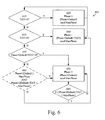
- Figure 6 illustrates an example method 600 according to some embodiments of the invention.
- the method steps of method 600 may, for example be performed by the modulation control unit 280 and the phase counter 290 of Figure 2 .
- step 610 it is determined whether the time adjustment value (TAV) is zero (i.e. no time adjustment is required).
- step 610 If the time adjustment value is zero (YES-path out of step 610), the phase is updated by adding a default value (modulus a maximal phase value) in step 620 and the process returns to step 610 to update the phase in the next filter clock cycle.
- step 610 If the time adjustment value is not zero (NO-path out of step 610), then the process proceeds to step 630 where it is determined whether the time adjustment value is positive.
- step 630 If the time adjustment value is positive (YES-path out of step 630), the phase is updated by adding the default value and the time adjustment value (modulus the maximal phase value) in step 640 and the process returns to step 610 to update the phase in the next filter clock cycle.
- step 650 it is determined whether adding the default value and the time adjustment value (no modulus) would result in a negative phase. This corresponds to the case where the FIFO 312a-j of the pulse-shaping filter 300 in Figure 3A would have to be shifted backwards, which is an unrealistic course of action. Thus, if this is the case, then the time adjustment must be postponed.
- step 650 If adding the default value and the time adjustment value (no modulus) would not result in a negative phase (NO-path out of step 650), then the process proceeds to step 660.
- step 660 it is determined whether adding twice the default value and the time adjustment value (no modulus) would result in a phase that is less than a threshold and adding twice the default value (no modulus) would result in a phase that is not less than the threshold.
- the threshold may be equal to the maximal phase value. This scenario corresponds to the case where the phase is already close to its maximum value and there is a risk of getting into the situation when the FIFO 312a-j of the pulse-shaping filter 300 in Figure 3A would have to be shifted backwards. Thus, if this is the case, then the time adjustment must be postponed.
- step 660 If this is not the case (NO-path out of step 660), then the process proceeds to step 640, where the phase is updated by adding the default value and the time adjustment value (modulus the maximal phase value), Then, the process returns to step 610 to update the phase in the next filter clock cycle.
- step 670 If, however, it was determined that there is a risk of getting into the situation when the FIFO 312a-j of the pulse shaping filter 300 in Figure 3A would have to be shifted backwards (YES-paths out of steps 650 and 660), then the time adjustment must be postponed and the process proceeds to step 670.
- step 670 the phase is updated by adding the default value (modulus the maximal phase value). Then, for the next filter clock cycle, it is determined in step 680 whether there is no longer any risk of getting into the situation when the FIFO 312a-j of the pulse shaping filter 300 in Figure 3A would have to be shifted backwards. This is determined by checking whether adding the default value and the time adjustment value (no modulus) would result in a non-negative phase that is less that the threshold.
- steps 670 and 680 are repeated for each filter clock cycle until the risk has vanished.
- step 640 the phase is updated by adding the default value and the time adjustment value (modulus the maximal phase value). Then, the process returns to step 610 to update the phase in the next filter clock cycle.
- decision step 660 is omitted.
- the NO-path out of step 650 leads directly to step 640, where the phase is updated by adding the default value and the time adjustment value (modulus the maximal phase value), Then, the process returns to step 610 to update the phase in the next filter clock cycle.
- the time adjustments value is subtracted from the phase as explained above.
- the special cases where there is a risk of getting a resulting negative phase may be handled separately as described above.
- the phase may be held at a fixed value (thus not updating with the default value) for a specified amount of time if the time adjustment value is negative.
- the specified amount of time may be a number of clock cycles equal to the floor value of the time adjustment value divided by the default value.
- the phase may be incremented by the time adjustment value modulus the default value and by the default value. Then the process may go back to incrementing the phase by the default value (compare with step 620).
- the phase may be updated using increment values that are less than the default value if the time adjustment value is negative. In these embodiments, the time adjustment is thus spread out over time. If, for example, the time adjustment value is -50 and the default value is 24, then the phase may be incremented by 14 instead of 24 in each of the subsequent 5 clock cycles. Then the process may go back to incrementing the phase by the default value (compare with step 620).
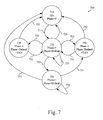
- Figure 7 is a state diagram 700 illustrating example state transitions according to some embodiments of the invention.
- the state diagram may, for example, describe operation of the modulation control unit 280 and the phase counter 290 of Figure 2 .
- the transitions in the state diagram 700 may also be compared with the method steps of method 600.
- idle state 710 there is no data to modulate.
- the state changes to state 720 via transition 711 and modulation starts.
- the state machine remains in state 720 as long as there is data to modulate and no time adjustment is needed.
- the phase is updated (repeatedly) by adding the default value (modulus a maximum phase value) as illustrated by transition 725. If there is no more data to modulate the state machine returns to the idle state 710 via transition 721.
- state 730 the state changes to state 730 via transition 722.
- the phase is updated by adding the default value and the time adjustment value (modulus the maximum phase value).
- the state changes back to state 720 via transition 731 1 unless there is no more data to modulate, in which case the state machine returns to the idle state 710 via transition 732.
- state 740 If a time adjustment is needed and the time adjustment value is negative, the state changes to state 740 via transition 723 if there is no risk of the ambiguity as described in relation to method steps 650 and 660 of method 600 in Figure 6 .
- the phase is updated by adding the default value and the time adjustment value (modulus the maximum phase value).
- the state changes back to state 720 via transition 741 unless there is no more data to modulate, in which case the state machine returns to the idle state 710 via transition 742.
- the state changes to waiting state 750 via transition 724.
- state 750 the phase is updated by adding the default value (modulus the maximum phase value), as illustrated by transition 752, until the risk has vanished or there is no more data to modulate. If there is no more data to modulate, the state machine returns to the idle state 710 via transition 753. When the risk has vanished, the state changes to state 740 via transition 751.
- state 740 the phase is updated by adding the default value and the time adjustment value (modulus the maximum phase value).
- the state changes back to state 720 via transition 741 unless there is no more data to modulate in which case the state machine returns to the idle state 710 via transition 742.
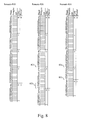
- Figure 8 illustrates three scenarios 810, 820, 830 of example time alignment adjustments according to some embodiments of the invention.
- Scenario 810 illustrates the situation when no time adjustment is needed.
- the illustrated scenario starts with Packet 0, Chip 0.
- the phase is initiated to a random phase, in this case 8.
- the default phase update value is set to 24 in this example.
- Scenario 820 illustrates the situation when a time adjustment of -82 (corresponding to one quarter of a chip) is needed.
- the time adjustment is done in the last chip in the packet (Chip 3, Packet 0).
- the effect of applying the time adjustment is that Chip 3 stays longer in the pulse shaping filter, see 822, and the next packet (Packet 1) is read later compared to scenario 810.
- the samples that are output from the pulse-shaping filter after the time adjustment are not copies of any samples before or after.
- Scenario 830 illustrates the situation when a time adjustment of 82 is needed.
- the time adjustment is also done in the last chip in the packet (Chip 3, Packet 0).
- the phase is incremented by 82 as soon as we are in Chip 3 and the time adjustment value is available (in the illustrated scenario, this occurs in the beginning of Chip 3, see 831).
- the effect of applying the time adjustment is that Chip 3 stays a shorter period in the pulse shaping filter, see 832, and the next packet (Packet 1) is read earlier compared to scenario 810.
- the time adjustment was applied in the last chip of a packet. It is to be noted that this is merely an example implementation, and that the time adjustment may be applied in any chip of a packet.
- Embodiments of the invention may be performed by general-purpose circuits associated with or integral to a receiver, such as digital signal processors (DSP), central processing units (CPU), co-processor units, or by specialized circuits such as for example application-specific integrated circuits (ASIC). All such forms are contemplated to be within the scope of the invention.
- DSP digital signal processors
- CPU central processing units
- ASIC application-specific integrated circuits
- the invention may be embodied within an electronic apparatus comprising a transmitter chain having arrangements or performing methods according to any of the embodiments of the invention.
- the electronic apparatus may, for example, be a portable or handheld mobile radio communication equipment, a mobile radio terminal, a mobile telephone, a pager, a communicator, an electronic organizer, a smartphone, a computer, an embedded drive, a mobile gaming device, or a (wrist) watch.
- a computer program product comprises a computer readable medium such as, for example, a diskette or a CD-ROM.
- the computer readable medium may have stored thereon a computer program comprising program instructions.
- the computer program may be loadable into a data-processing unit, which may, for example, be comprised in the mobile terminal 110.
- the computer program When loaded into the data-processing unit, the computer program may be stored in a memory associated with or integral to the data-processing unit.
- the computer program may, when loaded into and run by the data-processing unit, cause the data-processing unit to execute method steps according to, for example, the methods shown in Figures 5 and 6 .
Landscapes
- Engineering & Computer Science (AREA)
- Computer Networks & Wireless Communication (AREA)
- Signal Processing (AREA)
- Physics & Mathematics (AREA)
- Spectroscopy & Molecular Physics (AREA)
- Power Engineering (AREA)
- Digital Transmission Methods That Use Modulated Carrier Waves (AREA)
- Synchronisation In Digital Transmission Systems (AREA)
- Mobile Radio Communication Systems (AREA)
- Transmitters (AREA)
Claims (28)
- Verfahren zum Einstellen einer Zeitanpassung eines abgetasteten Datenstroms mit einer ersten Abtastungsauflösung, umfassend:Transferieren (510) des abgetasteten Datenstroms von einem Basisband-Subsystem zu einer digitalen Schnittstelle;Transferieren (520) des abgetasteten Datenstroms von der digitalen Schnittstelle zu einem Digitalfunk mit einem Pulsformfiltermodulator;Modulieren (530) des abgetasteten Datenstroms unter Verwendung des Pulsformfiltermodulators; undÜbertragung (540) des modulierten abgetasteten Datenstroms;gekennzeichnet durchTransferieren (515, 525) eines Zeiteinstellungs-Steuersignals von dem Basisband-Subsystem an den Digitalfunk;wobei der Modulationsschritt einen Schritt umfasst zum Einstellen, auf Grundlage des Zeiteinstellungs-Steuersignals, der Zeitanpassung des abgetasteten Datenstroms unter Verwendung einer zweiten Abtastungsauflösung.
- Verfahren nach Anspruch 1, wobei die zweite Abtastungsauflösung höher als die erste Abtastungsauflösung ist.
- Verfahren nach irgendeinem der Ansprüche 1 bis 2, ferner umfassend:Wandeln, in der digitalen Schnittstelle, des abgetasteten Datenstroms in einen abgetasteten In-Phase-Datenstrom und einen abgetasteten Quadrature-Datenstrom; undseparates Modulieren der abgetasteten In-Phase- und Quadrature-Datenströme.
- Verfahren nach irgendeinem der Ansprüche 1 bis 3, wobei die digitale Schnittstelle konform mit dem DigRF-Standard, v3.09, ist.
- Verfahren nach irgendeinem der Ansprüche 1 bis 4, wobei der Digitalfunk einen Wideband-Code-Division-Multiple-Access-, WCDMA, Modulator umfasst, und der WCDMA-Modulator den Pulsformfiltermodulator umfasst.
- Verfahren nach irgendeinem der Ansprüche 1 bis 5, wobei ein Pulsformfilter des Pulsformfiltermodulators ein Root-Raised-Cosine-Filter ist.
- Verfahren nach irgendeinem der Ansprüche 1 bis 5, wobei der Schritt zum Einstellen der Zeitanpassung des abgetasteten Datenstroms umfasst:Einstellen einer Phase eines Pulsformfilters des Pulsformfiltermodulators auf Grundlage eines Zeiteinstellungs-Steuersignals; undModifizieren von Koeffizienten des Pulsformfilters auf Grundlage der eingestellten Phase.
- Verfahren nach Anspruch 7, wobei der Schritt zum Transferieren des Zeiteinstellungs-Steuersignals von dem Basisband-Subsystem an den Digitalfunk umfasst:Transferieren (515) des Zeiteinstellungs-Steuersignals von dem Basisband-Subsystem an den Digitalfunk;Wandeln des Zeiteinstellungs-Steuersignals in einen Zeiteinstellungswert; undTransferieren (525) des Zeiteinstellungswerts von der digitalen Schnittstelle zu dem Digitalfunk.
- Verfahren nach Anspruch 8, ferner umfassend:Wandeln des Zeiteinstellungs-Steuersignals in ein Anwendungszeit-Einstellflag;Transferieren (525) des Anwendungszeit-Einstellflags von der digitalen Schnittstelle zu dem Digitalfunk; undDurchführen des Schritts zum Einstellen der Zeitanpassung des abgetasteten Datenstroms, wenn das Anwendungszeit-Einstellflag gesetzt ist.
- Verfahren nach irgendeinem der Ansprüche 8 bis 9, wobei der Schritt zum Einstellen der Phase des Pulsformfilters auf Grundlage des Zeiteinstellungs-Steuersignals umfasst:Aktualisieren (640) der Phase des Pulsformfilters durch Addieren eines Standardphasen-Aktualisierungs-Offsetwerts und des Zeiteinstellwerts zu der Phase.
- Verfahren nach Anspruch 10, ferner umfassend:Bestimmen (650, 660), ob das Einstellen der Phase des Pulsformfilters zu einer Neubearbeitung einer Abtastung des abgetasteten Datenstroms führt; undwenn das Einstellen der Phase des Pulsformfilters zu einer Neubearbeitung einer Abtastung des abgetasteten Datenstroms führt;Aufschieben des Schritts zum Einstellen der Zeitanpassung des abgetasteten Datenstroms; undAktualisieren (670) der Phase des Pulsformfilters durch Addieren des Standardphasen-Aktualisierungs-Offsetwerts zu der Phase.
- Verfahren nach Anspruch 10, ferner umfassend:Bestimmen (650), ob das Addieren des Standardphasen-Aktualisierungs-Offsetwerts und des Zeiteinstellwerts zu der Phase zu einem ersten resultierenden Wert führt, der geringer als ein Schwellenwert ist; undwenn der erste resultierende Wert geringer als der Schwellenwert ist;Verschieben des Schritts zum Einstellen der Zeitanpassung des abgetasteten Datenstroms; undAktualisieren (670) der Phase des Pulsformfilters durch Addieren des Standardphasen-Aktualisierungs-Offsetwerts zu der Phase.
- Verfahren nach Anspruch 12, wobei der Schwellenwert Null ist.
- Computerprogrammprodukt mit einem computerlesbaren Medium, welches darauf ein Computerprogramm mit Programmanweisungen aufweist, wobei das Computerprogramm in eine Datenverarbeitungseinheit geladen werden kann, und ausgelegt ist, zu bewirken, dass die Datenverarbeitungseinheit zumindest das Verfahren zum Einstellen der Zeitanpassung gemäß irgendeinem der Ansprüche 1 bis 13 ausführt, wenn das Computerprogramm durch die Datenverarbeitungseinheit ausgeführt wird.
- Anordnung zum Einstellen einer Zeitanpassung eines abgetasteten Datenstroms mit einer ersten Abtastungsauflösung, umfassend:ein Basisband-Subsystem (210);eine digitale Schnittstelle (220); undeinen Digitalfunk (230) mit einem Modulator (240) und einem Transmitter (250);wobei das Basisband-Subsystem (210) ausgelegt ist zum Transferieren des abgetasteten Datenstroms an die digitale Schnittstelle, die digitale Schnittstelle (220) ausgelegt ist zum Transferieren des abgetasteten Datenstroms an dem Digitalfunk, der Modulator (240) ausgelegt ist zum Modulieren des abgetasteten Datenstroms unter Verwendung des Pulsformfiltermodulators, und der Transmitter (250) dazu ausgelegt ist zum Übertragen des modulierten abgetasteten Datenstroms;dadurch gekennzeichnet, dassdas Basisband-Subsystem (210) ausgelegt ist zum Transferieren eines Zeiteinstellungs-Steuersignals an den Digitalfunk; undder Modulator (240) ausgelegt ist zum Einstellen, auf Grundlage des Zeiteinstellungs-Steuersignals, der Zeitanpassung des abgetasteten Datenstroms unter Verwendung einer zweiten Abtastungsauflösung.
- Anordnung nach Anspruch 15, wobei die zweite Abtastungsauflösung höher als die erste Abtastungsauflösung ist.
- Anordnung nach irgendeinem der Ansprüche 15 bis 16, wobei die digitale Schnittstelle (220) ferner ausgelegt ist zum Wandeln des abgetasteten Datenstroms in einen abgetasteten In-Phase-Datenstrom und einen abgetasteten Quadrature-Datenstrom; und der Modulator (240) ferner ausgelegt ist zum separaten Modulieren der abgetasteten In-phase- und Quadrature-Datenströme.
- Anordnung nach irgendeinem der Ansprüche 15 bis 17, wobei die digitale Schnittstelle (220) konform mit dem DigRF-Standard, v3.09, ist.
- Anordnung nach irgendeinem der Ansprüche 15 bis 18, wobei der Modulator (240) einen Wideband-Code-Division-Multiple-Access-, WCDMA-Modulator umfasst, und der WCDMA-Modulator einen Pulsformfiltermodulator (270) umfasst.
- Anordnung nach irgendeinem der Ansprüche 19, wobei ein Pulsformfilter des Pulsformfiltermodulators ein Root-Raised-Cosine-Filter (400) ist.
- Anordnung nach Anspruch 19, wobei der Modulator (240) umfasst:einen Phasenzähler (290), der ausgelegt ist zum Bereitstellen einer Phase eines Pulsformfilters des Pulsformfiltermodulators; undeine Modulationssteuereinheit (280), die ausgelegt ist zum Einstellen der Phase auf Grundlage eines Zeiteinstellungs-Steuersignals;und wobei der Pulsformfiltermodulator (270) ausgelegt ist zum Modifizieren von Koeffizienten des Pulsformfilters auf Grundlage der eingestellten Phase.
- Anordnung nach Anspruch 21, wobei das Basisband-Subsystem (210) ferner ausgelegt ist zum Transferieren des Zeiteinstellungs-Steuersignals an die digitale Schnittstelle, und die digitale Schnittstelle (220) ferner ausgelegt ist zum Wandeln des Zeiteinstellungs-Steuersignals in einen Zeiteinstellungswert und zum Transferieren des Zeiteinstellungswerts an den Digitalfunk.
- Anordnung nach Anspruch 22, wobei die digitale Schnittstelle (220) ferner ausgelegt ist zum Wandeln des Zeiteinstellungs-Steuersignals in ein Anwendungszeit-Einstellflag und zum Transferieren des Anwendungszeit-Einstellflags an den Digitalfunk, und wobei der Modulator (240) ausgelegt ist zum Einstellen der Zeitanpassung des abgetasteten Datenstroms, wenn das Anwendungszeit-Einstellflag gesetzt ist.
- Anordnung nach irgendeinem der Ansprüche 22 bis 23, wobei die Modulationssteuereinheit (280) ferner ausgelegt ist zum Aktualisieren der Phase des Pulsformfilters durch Addieren eines Standardphasen-Aktualisierungs-Offsetwerts und des Zeiteinstellwerts zu der Phase.
- Anordnung nach Anspruch 24, wobei die Modulationssteuereinheit (280) ferner ausgelegt ist zum:Bestimmen, ob die Anpassung der Phase des Pulsformfilters zu einer Neubearbeitung einer Abtastung des abgetasteten Datenstroms führt; undwenn die Einstellung der Phase des Pulsformfilters zu einer Neubearbeitung einer Abtastung des abgetasteten Datenstroms führt;Verschiebung der Einstellung der Zeitanpassung des abgetasteten Datenstroms; undAnweisen des Phasenzählers (290) zum Aktualisieren der Phase des Pulsformfilters durch Addieren des Standardphasen-Aktualisierungs-Offsetwerts zu der Phase.
- Anordnung nach Anspruch 24, wobei die Modulationssteuereinheit (280) ferner ausgelegt ist zum:Bestimmen, ob das Addieren des Standardphasen-Aktualisierungs-Offsetwerts und des Zeiteinstellwerts zu der Phase zu einem ersten resultierenden Wert führt, der geringer als ein Schwellenwert ist; undwenn der erste resultierende Wert geringer als der Schwellenwert ist;Verschieben einer Einstellung der Zeitanpassung des abgetasteten Datenstroms; undAnweisen des Phasenzählers (290) zum Aktualisieren der Phase des Pulsformfilters durch Addieren des Standardphasen-Aktualisierungs-Offsetwerts zu der Phase.
- Elektronische Vorrichtung mit der Anordnung nach irgendeinem der Ansprüche 15 bis 26.
- Elektronische Vorrichtung nach Anspruch 27, wobei die elektronische Vorrichtung ein mobiles Endgerät (110) ist.
Priority Applications (4)
| Application Number | Priority Date | Filing Date | Title |
|---|---|---|---|
| EP08153563A EP2106058B1 (de) | 2008-03-28 | 2008-03-28 | Verfahren und Anordnung zur Einstellung der Zeitanpassung eines abgetasteten Datenstroms |
| ARP090101105A AR071098A1 (es) | 2008-03-28 | 2009-03-27 | Metodo y disposicion para ajustar la alineacion de tiempo de un flujo de datos muestreados |
| US12/934,728 US8509206B2 (en) | 2008-03-28 | 2009-03-27 | Method and arrangement for adjusting time alignment of a sampled data stream |
| PCT/EP2009/053649 WO2009118405A1 (en) | 2008-03-28 | 2009-03-27 | Method and arrangement for adjusting time alignment of a sampled data stream |
Applications Claiming Priority (1)
| Application Number | Priority Date | Filing Date | Title |
|---|---|---|---|
| EP08153563A EP2106058B1 (de) | 2008-03-28 | 2008-03-28 | Verfahren und Anordnung zur Einstellung der Zeitanpassung eines abgetasteten Datenstroms |
Publications (2)
| Publication Number | Publication Date |
|---|---|
| EP2106058A1 EP2106058A1 (de) | 2009-09-30 |
| EP2106058B1 true EP2106058B1 (de) | 2012-06-27 |
Family
ID=39712570
Family Applications (1)
| Application Number | Title | Priority Date | Filing Date |
|---|---|---|---|
| EP08153563A Not-in-force EP2106058B1 (de) | 2008-03-28 | 2008-03-28 | Verfahren und Anordnung zur Einstellung der Zeitanpassung eines abgetasteten Datenstroms |
Country Status (4)
| Country | Link |
|---|---|
| US (1) | US8509206B2 (de) |
| EP (1) | EP2106058B1 (de) |
| AR (1) | AR071098A1 (de) |
| WO (1) | WO2009118405A1 (de) |
Families Citing this family (18)
| Publication number | Priority date | Publication date | Assignee | Title |
|---|---|---|---|---|
| US7843859B1 (en) * | 2008-09-23 | 2010-11-30 | Netlogic Microsystems, Inc. | Analog echo canceller with filter banks |
| US20110075648A1 (en) * | 2009-09-30 | 2011-03-31 | Hongwei Kong | Method and system for wcdma/hsdoa timing adjustment |
| CA2838778C (en) * | 2011-06-10 | 2020-03-10 | Astrium Limited | Alignment of non-synchronous data streams |
| US9341676B2 (en) | 2011-10-07 | 2016-05-17 | Alcatel Lucent | Packet-based propagation of testing information |
| US8737551B1 (en) | 2012-11-06 | 2014-05-27 | Motorola Mobility Llc | Synchronizing receive data over a digital radio frequency (RF) interface |
| US9231719B2 (en) | 2013-03-12 | 2016-01-05 | Hamilton Sundstrand Corporation | Method and apparatus for multiplexed time aligned analog input sampling |
| WO2016053841A1 (en) | 2014-09-29 | 2016-04-07 | Laird Technologies, Inc. | Telematics devices and methods for vehicle ignition detection |
| US10158509B2 (en) | 2015-09-23 | 2018-12-18 | Innophase Inc. | Method and apparatus for polar receiver with phase-amplitude alignment |
| US9673829B1 (en) | 2015-12-02 | 2017-06-06 | Innophase, Inc. | Wideband polar receiver architecture and signal processing methods |
| US10122397B2 (en) | 2017-03-28 | 2018-11-06 | Innophase, Inc. | Polar receiver system and method for Bluetooth communications |
| US10108148B1 (en) * | 2017-04-14 | 2018-10-23 | Innophase Inc. | Time to digital converter with increased range and sensitivity |
| US10503122B2 (en) | 2017-04-14 | 2019-12-10 | Innophase, Inc. | Time to digital converter with increased range and sensitivity |
| US10840921B2 (en) | 2018-09-07 | 2020-11-17 | Innophase Inc. | Frequency control word linearization for an oscillator |
| US11095296B2 (en) | 2018-09-07 | 2021-08-17 | Innophase, Inc. | Phase modulator having fractional sample interval timing skew for frequency control input |
| US10622959B2 (en) | 2018-09-07 | 2020-04-14 | Innophase Inc. | Multi-stage LNA with reduced mutual coupling |
| US10728851B1 (en) | 2019-01-07 | 2020-07-28 | Innophase Inc. | System and method for low-power wireless beacon monitor |
| US11070196B2 (en) | 2019-01-07 | 2021-07-20 | Innophase Inc. | Using a multi-tone signal to tune a multi-stage low-noise amplifier |
| US20250133519A1 (en) * | 2023-10-23 | 2025-04-24 | Hughes Network Systems, Llc | Waveform generation and digital upsampling in a communications system |
Family Cites Families (9)
| Publication number | Priority date | Publication date | Assignee | Title |
|---|---|---|---|---|
| US6915318B2 (en) * | 2002-04-29 | 2005-07-05 | Lsi Logic Corporation | Interpolator |
| US7054396B2 (en) * | 2002-08-20 | 2006-05-30 | Rf Micro Devices, Inc. | Method and apparatus for multipath signal compensation in spread-spectrum communications systems |
| KR101125542B1 (ko) * | 2004-07-29 | 2012-03-23 | 에스티 에릭슨 에스에이 | 멀티타임 슬롯 및 멀티-모드 작동에서 무선 통신 장비의 제어 장치, 베이스밴드 장치, 베이스밴드 인터페이스 장치 및 무선 통신 장비 |
| US7583937B2 (en) * | 2005-04-26 | 2009-09-01 | Silicon Laboratories Inc. | Digital interface and related event manager for integrated circuits |
| US20080195920A1 (en) * | 2007-02-13 | 2008-08-14 | Freescale Semiconductor, Inc. | Self-test structure and method of testing a digital interface |
| US8023556B2 (en) * | 2007-03-30 | 2011-09-20 | Silicon Laboratories Inc. | Autonomously generating ramp profiles in a transceiver |
| US7738491B2 (en) * | 2007-07-16 | 2010-06-15 | Infineon Technologies Ag | Frame structure, method for organizing data and method for transmitting data |
| US7941118B2 (en) * | 2007-08-01 | 2011-05-10 | Broadcom Corporation | Method and apparatus to process dedicated physical control channel (DPCCH) in a transmit antenna diversity (TXDIV) rake finger |
| GB0721427D0 (en) * | 2007-10-31 | 2007-12-12 | Icera Inc | Processing signals in a wireless newtwork |
-
2008
- 2008-03-28 EP EP08153563A patent/EP2106058B1/de not_active Not-in-force
-
2009
- 2009-03-27 US US12/934,728 patent/US8509206B2/en not_active Expired - Fee Related
- 2009-03-27 WO PCT/EP2009/053649 patent/WO2009118405A1/en not_active Ceased
- 2009-03-27 AR ARP090101105A patent/AR071098A1/es active IP Right Grant
Also Published As
| Publication number | Publication date |
|---|---|
| US20110019657A1 (en) | 2011-01-27 |
| AR071098A1 (es) | 2010-05-26 |
| EP2106058A1 (de) | 2009-09-30 |
| WO2009118405A1 (en) | 2009-10-01 |
| US8509206B2 (en) | 2013-08-13 |
Similar Documents
| Publication | Publication Date | Title |
|---|---|---|
| EP2106058B1 (de) | Verfahren und Anordnung zur Einstellung der Zeitanpassung eines abgetasteten Datenstroms | |
| US8031586B2 (en) | Method and apparatus for transmitter timing adjustment | |
| US6411611B1 (en) | Communication systems, communication methods and a method of communicating data within a DECT communication system | |
| US8619840B2 (en) | Apparatus and methods for sampling rate conversion for wireless transceivers | |
| US20030072284A1 (en) | Sample rate change between single-carrier and multi-carrier waveforms | |
| CZ285903B6 (cs) | Účastnická jednotka pro bezdrátovou komunikaci se základní stanicí v bezdrátovém digitálním účastnickém systému | |
| WO2005062755A2 (en) | Ofdm frequency offset estimation apparatus and method | |
| WO2015143602A1 (zh) | 物理层数据的传输方法及数据传输设备 | |
| EP4535684A1 (de) | Verfahren und vorrichtung zur aufwärts- und abwärtssynchronisation für ein mobiles satellitenkommunikationssystem | |
| EP1894331B1 (de) | Synchronisieren eines modems und vocoders einer mobilstation | |
| CN1459166A (zh) | 在通信设备中进行计时同步 | |
| SE522704C2 (sv) | Överföring av ljuddata och icke ljuddata mellan en bärbar ch kommunikationsapparat och en extern terminal | |
| US20020037030A1 (en) | Digital matched filter despreading received signal and mobile wireless Terminal using digital matched filter | |
| WO2024169810A1 (zh) | 信号传输方法、装置、信号发送设备及信号接收设备 | |
| WO1999031866A1 (en) | Apparatus and method for adapting an echo canceller in a communication system | |
| US20120063536A1 (en) | Method and Device for Processing a Digital Complex Modulated Signal Within a Polar Modular Transmission Chain | |
| WO2002060146A1 (en) | Method of implementing modulation and modulator | |
| US8098758B2 (en) | Digital baseband transmitter with digital RF/IF support in GSM/GPRS/EDGE compliant handsets | |
| US7885357B1 (en) | Apparatus for signal detection to enhance performance of a receiver and method therefor | |
| EP2461525B1 (de) | Verfahren und Vorrichtung zum Ausrichten von Datenrahmen in einem Sende-/Empfangsgerät | |
| CN113543303A (zh) | 一种同步方法、装置、芯片及模组设备 | |
| JP2001244848A (ja) | スペクトラム拡散通信受信装置 | |
| CN120263610A (zh) | 一种通信方法及相关装置 | |
| NL9700008A (nl) | Abonnee-eenheid voor een draadloos digitaal communicatiesysteem. | |
| JP2004056747A (ja) | Ofdmのafc機能およびその装置 |
Legal Events
| Date | Code | Title | Description |
|---|---|---|---|
| PUAI | Public reference made under article 153(3) epc to a published international application that has entered the european phase |
Free format text: ORIGINAL CODE: 0009012 |
|
| AK | Designated contracting states |
Kind code of ref document: A1 Designated state(s): AT BE BG CH CY CZ DE DK EE ES FI FR GB GR HR HU IE IS IT LI LT LU LV MC MT NL NO PL PT RO SE SI SK TR |
|
| AX | Request for extension of the european patent |
Extension state: AL BA MK RS |
|
| 17P | Request for examination filed |
Effective date: 20100330 |
|
| AKX | Designation fees paid |
Designated state(s): AT BE BG CH CY CZ DE DK EE ES FI FR GB GR HR HU IE IS IT LI LT LU LV MC MT NL NO PL PT RO SE SI SK TR |
|
| 17Q | First examination report despatched |
Effective date: 20110920 |
|
| REG | Reference to a national code |
Ref country code: DE Ref legal event code: R079 Ref document number: 602008016678 Country of ref document: DE Free format text: PREVIOUS MAIN CLASS: H04L0007000000 Ipc: H04W0056000000 |
|
| GRAP | Despatch of communication of intention to grant a patent |
Free format text: ORIGINAL CODE: EPIDOSNIGR1 |
|
| RIC1 | Information provided on ipc code assigned before grant |
Ipc: H04B 1/40 20060101ALI20120103BHEP Ipc: H04W 56/00 20090101AFI20120103BHEP Ipc: H04L 25/03 20060101ALN20120103BHEP |
|
| RIC1 | Information provided on ipc code assigned before grant |
Ipc: H04W 56/00 20090101AFI20120110BHEP Ipc: H04L 25/03 20060101ALN20120110BHEP Ipc: H04B 1/40 20060101ALI20120110BHEP |
|
| GRAS | Grant fee paid |
Free format text: ORIGINAL CODE: EPIDOSNIGR3 |
|
| GRAA | (expected) grant |
Free format text: ORIGINAL CODE: 0009210 |
|
| AK | Designated contracting states |
Kind code of ref document: B1 Designated state(s): AT BE BG CH CY CZ DE DK EE ES FI FR GB GR HR HU IE IS IT LI LT LU LV MC MT NL NO PL PT RO SE SI SK TR |
|
| REG | Reference to a national code |
Ref country code: GB Ref legal event code: FG4D |
|
| REG | Reference to a national code |
Ref country code: CH Ref legal event code: EP |
|
| REG | Reference to a national code |
Ref country code: AT Ref legal event code: REF Ref document number: 564724 Country of ref document: AT Kind code of ref document: T Effective date: 20120715 |
|
| REG | Reference to a national code |
Ref country code: IE Ref legal event code: FG4D |
|
| REG | Reference to a national code |
Ref country code: DE Ref legal event code: R096 Ref document number: 602008016678 Country of ref document: DE Effective date: 20120830 |
|
| PG25 | Lapsed in a contracting state [announced via postgrant information from national office to epo] |
Ref country code: FI Free format text: LAPSE BECAUSE OF FAILURE TO SUBMIT A TRANSLATION OF THE DESCRIPTION OR TO PAY THE FEE WITHIN THE PRESCRIBED TIME-LIMIT Effective date: 20120627 Ref country code: LT Free format text: LAPSE BECAUSE OF FAILURE TO SUBMIT A TRANSLATION OF THE DESCRIPTION OR TO PAY THE FEE WITHIN THE PRESCRIBED TIME-LIMIT Effective date: 20120627 Ref country code: SE Free format text: LAPSE BECAUSE OF FAILURE TO SUBMIT A TRANSLATION OF THE DESCRIPTION OR TO PAY THE FEE WITHIN THE PRESCRIBED TIME-LIMIT Effective date: 20120627 |
|
| REG | Reference to a national code |
Ref country code: NL Ref legal event code: T3 |
|
| REG | Reference to a national code |
Ref country code: AT Ref legal event code: MK05 Ref document number: 564724 Country of ref document: AT Kind code of ref document: T Effective date: 20120627 |
|
| REG | Reference to a national code |
Ref country code: NO Ref legal event code: T2 Effective date: 20120627 |
|
| REG | Reference to a national code |
Ref country code: LT Ref legal event code: MG4D Effective date: 20120627 |
|
| PG25 | Lapsed in a contracting state [announced via postgrant information from national office to epo] |
Ref country code: LV Free format text: LAPSE BECAUSE OF FAILURE TO SUBMIT A TRANSLATION OF THE DESCRIPTION OR TO PAY THE FEE WITHIN THE PRESCRIBED TIME-LIMIT Effective date: 20120627 Ref country code: GR Free format text: LAPSE BECAUSE OF FAILURE TO SUBMIT A TRANSLATION OF THE DESCRIPTION OR TO PAY THE FEE WITHIN THE PRESCRIBED TIME-LIMIT Effective date: 20120928 Ref country code: HR Free format text: LAPSE BECAUSE OF FAILURE TO SUBMIT A TRANSLATION OF THE DESCRIPTION OR TO PAY THE FEE WITHIN THE PRESCRIBED TIME-LIMIT Effective date: 20120627 Ref country code: SI Free format text: LAPSE BECAUSE OF FAILURE TO SUBMIT A TRANSLATION OF THE DESCRIPTION OR TO PAY THE FEE WITHIN THE PRESCRIBED TIME-LIMIT Effective date: 20120627 |
|
| PG25 | Lapsed in a contracting state [announced via postgrant information from national office to epo] |
Ref country code: CY Free format text: LAPSE BECAUSE OF FAILURE TO SUBMIT A TRANSLATION OF THE DESCRIPTION OR TO PAY THE FEE WITHIN THE PRESCRIBED TIME-LIMIT Effective date: 20120627 Ref country code: RO Free format text: LAPSE BECAUSE OF FAILURE TO SUBMIT A TRANSLATION OF THE DESCRIPTION OR TO PAY THE FEE WITHIN THE PRESCRIBED TIME-LIMIT Effective date: 20120627 Ref country code: AT Free format text: LAPSE BECAUSE OF FAILURE TO SUBMIT A TRANSLATION OF THE DESCRIPTION OR TO PAY THE FEE WITHIN THE PRESCRIBED TIME-LIMIT Effective date: 20120627 Ref country code: EE Free format text: LAPSE BECAUSE OF FAILURE TO SUBMIT A TRANSLATION OF THE DESCRIPTION OR TO PAY THE FEE WITHIN THE PRESCRIBED TIME-LIMIT Effective date: 20120627 Ref country code: IS Free format text: LAPSE BECAUSE OF FAILURE TO SUBMIT A TRANSLATION OF THE DESCRIPTION OR TO PAY THE FEE WITHIN THE PRESCRIBED TIME-LIMIT Effective date: 20121027 Ref country code: CZ Free format text: LAPSE BECAUSE OF FAILURE TO SUBMIT A TRANSLATION OF THE DESCRIPTION OR TO PAY THE FEE WITHIN THE PRESCRIBED TIME-LIMIT Effective date: 20120627 Ref country code: SK Free format text: LAPSE BECAUSE OF FAILURE TO SUBMIT A TRANSLATION OF THE DESCRIPTION OR TO PAY THE FEE WITHIN THE PRESCRIBED TIME-LIMIT Effective date: 20120627 |
|
| PG25 | Lapsed in a contracting state [announced via postgrant information from national office to epo] |
Ref country code: IT Free format text: LAPSE BECAUSE OF FAILURE TO SUBMIT A TRANSLATION OF THE DESCRIPTION OR TO PAY THE FEE WITHIN THE PRESCRIBED TIME-LIMIT Effective date: 20120627 Ref country code: PT Free format text: LAPSE BECAUSE OF FAILURE TO SUBMIT A TRANSLATION OF THE DESCRIPTION OR TO PAY THE FEE WITHIN THE PRESCRIBED TIME-LIMIT Effective date: 20121029 Ref country code: PL Free format text: LAPSE BECAUSE OF FAILURE TO SUBMIT A TRANSLATION OF THE DESCRIPTION OR TO PAY THE FEE WITHIN THE PRESCRIBED TIME-LIMIT Effective date: 20120627 |
|
| PG25 | Lapsed in a contracting state [announced via postgrant information from national office to epo] |
Ref country code: DK Free format text: LAPSE BECAUSE OF FAILURE TO SUBMIT A TRANSLATION OF THE DESCRIPTION OR TO PAY THE FEE WITHIN THE PRESCRIBED TIME-LIMIT Effective date: 20120627 Ref country code: ES Free format text: LAPSE BECAUSE OF FAILURE TO SUBMIT A TRANSLATION OF THE DESCRIPTION OR TO PAY THE FEE WITHIN THE PRESCRIBED TIME-LIMIT Effective date: 20121008 |
|
| PLBE | No opposition filed within time limit |
Free format text: ORIGINAL CODE: 0009261 |
|
| STAA | Information on the status of an ep patent application or granted ep patent |
Free format text: STATUS: NO OPPOSITION FILED WITHIN TIME LIMIT |
|
| 26N | No opposition filed |
Effective date: 20130328 |
|
| REG | Reference to a national code |
Ref country code: DE Ref legal event code: R097 Ref document number: 602008016678 Country of ref document: DE Effective date: 20130328 |
|
| PG25 | Lapsed in a contracting state [announced via postgrant information from national office to epo] |
Ref country code: BG Free format text: LAPSE BECAUSE OF FAILURE TO SUBMIT A TRANSLATION OF THE DESCRIPTION OR TO PAY THE FEE WITHIN THE PRESCRIBED TIME-LIMIT Effective date: 20120927 |
|
| PG25 | Lapsed in a contracting state [announced via postgrant information from national office to epo] |
Ref country code: MC Free format text: LAPSE BECAUSE OF NON-PAYMENT OF DUE FEES Effective date: 20130331 |
|
| REG | Reference to a national code |
Ref country code: CH Ref legal event code: PL |
|
| REG | Reference to a national code |
Ref country code: IE Ref legal event code: MM4A |
|
| PG25 | Lapsed in a contracting state [announced via postgrant information from national office to epo] |
Ref country code: IE Free format text: LAPSE BECAUSE OF NON-PAYMENT OF DUE FEES Effective date: 20130328 Ref country code: LI Free format text: LAPSE BECAUSE OF NON-PAYMENT OF DUE FEES Effective date: 20130331 Ref country code: CH Free format text: LAPSE BECAUSE OF NON-PAYMENT OF DUE FEES Effective date: 20130331 |
|
| PG25 | Lapsed in a contracting state [announced via postgrant information from national office to epo] |
Ref country code: MT Free format text: LAPSE BECAUSE OF FAILURE TO SUBMIT A TRANSLATION OF THE DESCRIPTION OR TO PAY THE FEE WITHIN THE PRESCRIBED TIME-LIMIT Effective date: 20120627 |
|
| PG25 | Lapsed in a contracting state [announced via postgrant information from national office to epo] |
Ref country code: TR Free format text: LAPSE BECAUSE OF FAILURE TO SUBMIT A TRANSLATION OF THE DESCRIPTION OR TO PAY THE FEE WITHIN THE PRESCRIBED TIME-LIMIT Effective date: 20120627 |
|
| PG25 | Lapsed in a contracting state [announced via postgrant information from national office to epo] |
Ref country code: HU Free format text: LAPSE BECAUSE OF FAILURE TO SUBMIT A TRANSLATION OF THE DESCRIPTION OR TO PAY THE FEE WITHIN THE PRESCRIBED TIME-LIMIT; INVALID AB INITIO Effective date: 20080328 Ref country code: LU Free format text: LAPSE BECAUSE OF NON-PAYMENT OF DUE FEES Effective date: 20130328 |
|
| REG | Reference to a national code |
Ref country code: FR Ref legal event code: PLFP Year of fee payment: 9 |
|
| REG | Reference to a national code |
Ref country code: FR Ref legal event code: PLFP Year of fee payment: 10 |
|
| REG | Reference to a national code |
Ref country code: FR Ref legal event code: PLFP Year of fee payment: 11 |
|
| PGFP | Annual fee paid to national office [announced via postgrant information from national office to epo] |
Ref country code: NO Payment date: 20200327 Year of fee payment: 13 |
|
| PGFP | Annual fee paid to national office [announced via postgrant information from national office to epo] |
Ref country code: BE Payment date: 20200327 Year of fee payment: 13 |
|
| PGFP | Annual fee paid to national office [announced via postgrant information from national office to epo] |
Ref country code: FR Payment date: 20210325 Year of fee payment: 14 |
|
| PGFP | Annual fee paid to national office [announced via postgrant information from national office to epo] |
Ref country code: GB Payment date: 20210329 Year of fee payment: 14 Ref country code: DE Payment date: 20210329 Year of fee payment: 14 |
|
| REG | Reference to a national code |
Ref country code: NO Ref legal event code: MMEP |
|
| PGFP | Annual fee paid to national office [announced via postgrant information from national office to epo] |
Ref country code: NL Payment date: 20210326 Year of fee payment: 14 |
|
| REG | Reference to a national code |
Ref country code: BE Ref legal event code: MM Effective date: 20210331 |
|
| PG25 | Lapsed in a contracting state [announced via postgrant information from national office to epo] |
Ref country code: NO Free format text: LAPSE BECAUSE OF NON-PAYMENT OF DUE FEES Effective date: 20210331 |
|
| PG25 | Lapsed in a contracting state [announced via postgrant information from national office to epo] |
Ref country code: BE Free format text: LAPSE BECAUSE OF NON-PAYMENT OF DUE FEES Effective date: 20210331 |
|
| REG | Reference to a national code |
Ref country code: DE Ref legal event code: R119 Ref document number: 602008016678 Country of ref document: DE |
|
| REG | Reference to a national code |
Ref country code: NL Ref legal event code: MM Effective date: 20220401 |
|
| GBPC | Gb: european patent ceased through non-payment of renewal fee |
Effective date: 20220328 |
|
| PG25 | Lapsed in a contracting state [announced via postgrant information from national office to epo] |
Ref country code: NL Free format text: LAPSE BECAUSE OF NON-PAYMENT OF DUE FEES Effective date: 20220401 Ref country code: GB Free format text: LAPSE BECAUSE OF NON-PAYMENT OF DUE FEES Effective date: 20220328 Ref country code: FR Free format text: LAPSE BECAUSE OF NON-PAYMENT OF DUE FEES Effective date: 20220331 Ref country code: DE Free format text: LAPSE BECAUSE OF NON-PAYMENT OF DUE FEES Effective date: 20221001 |