EP2117680B1 - Keramikmaterialien für einen 4-weg-nox-speicherkatalysator und verfahren zu ihrer herstellung - Google Patents
Keramikmaterialien für einen 4-weg-nox-speicherkatalysator und verfahren zu ihrer herstellung Download PDFInfo
- Publication number
- EP2117680B1 EP2117680B1 EP08725534.5A EP08725534A EP2117680B1 EP 2117680 B1 EP2117680 B1 EP 2117680B1 EP 08725534 A EP08725534 A EP 08725534A EP 2117680 B1 EP2117680 B1 EP 2117680B1
- Authority
- EP
- European Patent Office
- Prior art keywords
- ceramic
- composition
- source
- oxide
- yttrium
- Prior art date
- Legal status (The legal status is an assumption and is not a legal conclusion. Google has not performed a legal analysis and makes no representation as to the accuracy of the status listed.)
- Ceased
Links
- 238000000034 method Methods 0.000 title claims description 23
- 229910010293 ceramic material Inorganic materials 0.000 title description 2
- 239000000919 ceramic Substances 0.000 claims description 117
- 239000000203 mixture Substances 0.000 claims description 94
- GWEVSGVZZGPLCZ-UHFFFAOYSA-N Titan oxide Chemical compound O=[Ti]=O GWEVSGVZZGPLCZ-UHFFFAOYSA-N 0.000 claims description 48
- PNEYBMLMFCGWSK-UHFFFAOYSA-N aluminium oxide Inorganic materials [O-2].[O-2].[O-2].[Al+3].[Al+3] PNEYBMLMFCGWSK-UHFFFAOYSA-N 0.000 claims description 43
- 229910000505 Al2TiO5 Inorganic materials 0.000 claims description 39
- 229910000164 yttrium(III) phosphate Inorganic materials 0.000 claims description 37
- AABBHSMFGKYLKE-SNAWJCMRSA-N propan-2-yl (e)-but-2-enoate Chemical compound C\C=C\C(=O)OC(C)C AABBHSMFGKYLKE-SNAWJCMRSA-N 0.000 claims description 36
- UXBZSSBXGPYSIL-UHFFFAOYSA-K yttrium(iii) phosphate Chemical compound [Y+3].[O-]P([O-])([O-])=O UXBZSSBXGPYSIL-UHFFFAOYSA-K 0.000 claims description 32
- MCMNRKCIXSYSNV-UHFFFAOYSA-N Zirconium dioxide Chemical compound O=[Zr]=O MCMNRKCIXSYSNV-UHFFFAOYSA-N 0.000 claims description 20
- SIWVEOZUMHYXCS-UHFFFAOYSA-N oxo(oxoyttriooxy)yttrium Chemical compound O=[Y]O[Y]=O SIWVEOZUMHYXCS-UHFFFAOYSA-N 0.000 claims description 20
- RTAQQCXQSZGOHL-UHFFFAOYSA-N Titanium Chemical compound [Ti] RTAQQCXQSZGOHL-UHFFFAOYSA-N 0.000 claims description 19
- QCWXUUIWCKQGHC-UHFFFAOYSA-N Zirconium Chemical compound [Zr] QCWXUUIWCKQGHC-UHFFFAOYSA-N 0.000 claims description 15
- 229910052726 zirconium Inorganic materials 0.000 claims description 15
- 238000005245 sintering Methods 0.000 claims description 11
- 239000012700 ceramic precursor Substances 0.000 claims description 10
- 238000010304 firing Methods 0.000 claims description 10
- 239000007788 liquid Substances 0.000 claims description 10
- 239000011230 binding agent Substances 0.000 claims description 8
- BPQQTUXANYXVAA-UHFFFAOYSA-N Orthosilicate Chemical compound [O-][Si]([O-])([O-])[O-] BPQQTUXANYXVAA-UHFFFAOYSA-N 0.000 claims description 6
- 238000004519 manufacturing process Methods 0.000 claims description 4
- RUDFQVOCFDJEEF-UHFFFAOYSA-N yttrium(III) oxide Inorganic materials [O-2].[O-2].[O-2].[Y+3].[Y+3] RUDFQVOCFDJEEF-UHFFFAOYSA-N 0.000 claims description 2
- MWUXSHHQAYIFBG-UHFFFAOYSA-N nitrogen oxide Inorganic materials O=[N] MWUXSHHQAYIFBG-UHFFFAOYSA-N 0.000 description 45
- 239000011148 porous material Substances 0.000 description 34
- 210000004027 cell Anatomy 0.000 description 32
- ZLMJMSJWJFRBEC-UHFFFAOYSA-N Potassium Chemical compound [K] ZLMJMSJWJFRBEC-UHFFFAOYSA-N 0.000 description 20
- 229910052700 potassium Inorganic materials 0.000 description 20
- 239000011591 potassium Substances 0.000 description 20
- 239000003054 catalyst Substances 0.000 description 17
- 239000000463 material Substances 0.000 description 13
- 241000264877 Hippospongia communis Species 0.000 description 12
- VYPSYNLAJGMNEJ-UHFFFAOYSA-N Silicium dioxide Chemical compound O=[Si]=O VYPSYNLAJGMNEJ-UHFFFAOYSA-N 0.000 description 11
- 238000001125 extrusion Methods 0.000 description 10
- 239000000758 substrate Substances 0.000 description 10
- 239000002245 particle Substances 0.000 description 9
- 239000013618 particulate matter Substances 0.000 description 9
- 230000032683 aging Effects 0.000 description 8
- 229930195733 hydrocarbon Natural products 0.000 description 8
- 150000002430 hydrocarbons Chemical class 0.000 description 8
- UGFAIRIUMAVXCW-UHFFFAOYSA-N Carbon monoxide Chemical compound [O+]#[C-] UGFAIRIUMAVXCW-UHFFFAOYSA-N 0.000 description 7
- 229910052782 aluminium Inorganic materials 0.000 description 7
- XAGFODPZIPBFFR-UHFFFAOYSA-N aluminium Chemical compound [Al] XAGFODPZIPBFFR-UHFFFAOYSA-N 0.000 description 7
- 229910002091 carbon monoxide Inorganic materials 0.000 description 7
- 229910052878 cordierite Inorganic materials 0.000 description 7
- JSKIRARMQDRGJZ-UHFFFAOYSA-N dimagnesium dioxido-bis[(1-oxido-3-oxo-2,4,6,8,9-pentaoxa-1,3-disila-5,7-dialuminabicyclo[3.3.1]nonan-7-yl)oxy]silane Chemical compound [Mg++].[Mg++].[O-][Si]([O-])(O[Al]1O[Al]2O[Si](=O)O[Si]([O-])(O1)O2)O[Al]1O[Al]2O[Si](=O)O[Si]([O-])(O1)O2 JSKIRARMQDRGJZ-UHFFFAOYSA-N 0.000 description 7
- 239000003981 vehicle Substances 0.000 description 7
- 238000005516 engineering process Methods 0.000 description 6
- 239000007789 gas Substances 0.000 description 6
- BHEPBYXIRTUNPN-UHFFFAOYSA-N hydridophosphorus(.) (triplet) Chemical compound [PH] BHEPBYXIRTUNPN-UHFFFAOYSA-N 0.000 description 6
- FGIUAXJPYTZDNR-UHFFFAOYSA-N potassium nitrate Chemical compound [K+].[O-][N+]([O-])=O FGIUAXJPYTZDNR-UHFFFAOYSA-N 0.000 description 6
- 239000000843 powder Substances 0.000 description 6
- 230000008569 process Effects 0.000 description 6
- 239000000243 solution Substances 0.000 description 6
- 239000000654 additive Substances 0.000 description 5
- 229910052788 barium Inorganic materials 0.000 description 5
- DSAJWYNOEDNPEQ-UHFFFAOYSA-N barium atom Chemical compound [Ba] DSAJWYNOEDNPEQ-UHFFFAOYSA-N 0.000 description 5
- 239000011248 coating agent Substances 0.000 description 5
- 238000000576 coating method Methods 0.000 description 5
- 238000009472 formulation Methods 0.000 description 5
- QSHDDOUJBYECFT-UHFFFAOYSA-N mercury Chemical compound [Hg] QSHDDOUJBYECFT-UHFFFAOYSA-N 0.000 description 5
- 229910052753 mercury Inorganic materials 0.000 description 5
- 230000009467 reduction Effects 0.000 description 5
- 238000001878 scanning electron micrograph Methods 0.000 description 5
- 238000012360 testing method Methods 0.000 description 5
- 230000001413 cellular effect Effects 0.000 description 4
- 238000006243 chemical reaction Methods 0.000 description 4
- 229910052593 corundum Inorganic materials 0.000 description 4
- 238000001914 filtration Methods 0.000 description 4
- FAHBNUUHRFUEAI-UHFFFAOYSA-M hydroxidooxidoaluminium Chemical compound O[Al]=O FAHBNUUHRFUEAI-UHFFFAOYSA-M 0.000 description 4
- 238000002156 mixing Methods 0.000 description 4
- BASFCYQUMIYNBI-UHFFFAOYSA-N platinum Chemical compound [Pt] BASFCYQUMIYNBI-UHFFFAOYSA-N 0.000 description 4
- 230000035939 shock Effects 0.000 description 4
- XLYOFNOQVPJJNP-UHFFFAOYSA-N water Substances O XLYOFNOQVPJJNP-UHFFFAOYSA-N 0.000 description 4
- OKKJLVBELUTLKV-UHFFFAOYSA-N Methanol Chemical compound OC OKKJLVBELUTLKV-UHFFFAOYSA-N 0.000 description 3
- 239000004411 aluminium Substances 0.000 description 3
- QVGXLLKOCUKJST-UHFFFAOYSA-N atomic oxygen Chemical compound [O] QVGXLLKOCUKJST-UHFFFAOYSA-N 0.000 description 3
- 229910001593 boehmite Inorganic materials 0.000 description 3
- 238000000354 decomposition reaction Methods 0.000 description 3
- 238000009826 distribution Methods 0.000 description 3
- 238000011068 loading method Methods 0.000 description 3
- 239000000314 lubricant Substances 0.000 description 3
- 239000001301 oxygen Substances 0.000 description 3
- 229910052760 oxygen Inorganic materials 0.000 description 3
- UXBZSSBXGPYSIL-UHFFFAOYSA-N phosphoric acid;yttrium(3+) Chemical compound [Y+3].OP(O)(O)=O UXBZSSBXGPYSIL-UHFFFAOYSA-N 0.000 description 3
- 230000000704 physical effect Effects 0.000 description 3
- 235000010333 potassium nitrate Nutrition 0.000 description 3
- 239000004323 potassium nitrate Substances 0.000 description 3
- 239000002994 raw material Substances 0.000 description 3
- 239000011541 reaction mixture Substances 0.000 description 3
- 239000000377 silicon dioxide Substances 0.000 description 3
- 239000004071 soot Substances 0.000 description 3
- WRIDQFICGBMAFQ-UHFFFAOYSA-N (E)-8-Octadecenoic acid Natural products CCCCCCCCCC=CCCCCCCC(O)=O WRIDQFICGBMAFQ-UHFFFAOYSA-N 0.000 description 2
- LTMQZVLXCLQPCT-UHFFFAOYSA-N 1,1,6-trimethyltetralin Chemical compound C1CCC(C)(C)C=2C1=CC(C)=CC=2 LTMQZVLXCLQPCT-UHFFFAOYSA-N 0.000 description 2
- LQJBNNIYVWPHFW-UHFFFAOYSA-N 20:1omega9c fatty acid Natural products CCCCCCCCCCC=CCCCCCCCC(O)=O LQJBNNIYVWPHFW-UHFFFAOYSA-N 0.000 description 2
- QSBYPNXLFMSGKH-UHFFFAOYSA-N 9-Heptadecensaeure Natural products CCCCCCCC=CCCCCCCCC(O)=O QSBYPNXLFMSGKH-UHFFFAOYSA-N 0.000 description 2
- OKTJSMMVPCPJKN-UHFFFAOYSA-N Carbon Chemical compound [C] OKTJSMMVPCPJKN-UHFFFAOYSA-N 0.000 description 2
- 239000004215 Carbon black (E152) Substances 0.000 description 2
- LFQSCWFLJHTTHZ-UHFFFAOYSA-N Ethanol Chemical compound CCO LFQSCWFLJHTTHZ-UHFFFAOYSA-N 0.000 description 2
- XEEYBQQBJWHFJM-UHFFFAOYSA-N Iron Chemical compound [Fe] XEEYBQQBJWHFJM-UHFFFAOYSA-N 0.000 description 2
- 239000005642 Oleic acid Substances 0.000 description 2
- ZQPPMHVWECSIRJ-UHFFFAOYSA-N Oleic acid Natural products CCCCCCCCC=CCCCCCCCC(O)=O ZQPPMHVWECSIRJ-UHFFFAOYSA-N 0.000 description 2
- 229910019142 PO4 Inorganic materials 0.000 description 2
- GSEJCLTVZPLZKY-UHFFFAOYSA-N Triethanolamine Chemical compound OCCN(CCO)CCO GSEJCLTVZPLZKY-UHFFFAOYSA-N 0.000 description 2
- 239000003570 air Substances 0.000 description 2
- 239000003513 alkali Substances 0.000 description 2
- VXAUWWUXCIMFIM-UHFFFAOYSA-M aluminum;oxygen(2-);hydroxide Chemical compound [OH-].[O-2].[Al+3] VXAUWWUXCIMFIM-UHFFFAOYSA-M 0.000 description 2
- 230000033228 biological regulation Effects 0.000 description 2
- 210000002421 cell wall Anatomy 0.000 description 2
- 235000013339 cereals Nutrition 0.000 description 2
- 238000002485 combustion reaction Methods 0.000 description 2
- 239000010431 corundum Substances 0.000 description 2
- 239000013078 crystal Substances 0.000 description 2
- 238000001035 drying Methods 0.000 description 2
- 239000000839 emulsion Substances 0.000 description 2
- QXJSBBXBKPUZAA-UHFFFAOYSA-N isooleic acid Natural products CCCCCCCC=CCCCCCCCCC(O)=O QXJSBBXBKPUZAA-UHFFFAOYSA-N 0.000 description 2
- 238000002386 leaching Methods 0.000 description 2
- 238000005259 measurement Methods 0.000 description 2
- 238000012986 modification Methods 0.000 description 2
- 230000004048 modification Effects 0.000 description 2
- ZQPPMHVWECSIRJ-KTKRTIGZSA-N oleic acid Chemical compound CCCCCCCC\C=C/CCCCCCCC(O)=O ZQPPMHVWECSIRJ-KTKRTIGZSA-N 0.000 description 2
- RVTZCBVAJQQJTK-UHFFFAOYSA-N oxygen(2-);zirconium(4+) Chemical compound [O-2].[O-2].[Zr+4] RVTZCBVAJQQJTK-UHFFFAOYSA-N 0.000 description 2
- 238000002161 passivation Methods 0.000 description 2
- 235000021317 phosphate Nutrition 0.000 description 2
- 229910052697 platinum Inorganic materials 0.000 description 2
- -1 polyethylene Polymers 0.000 description 2
- 238000002459 porosimetry Methods 0.000 description 2
- 239000002904 solvent Substances 0.000 description 2
- 229910052712 strontium Inorganic materials 0.000 description 2
- CIOAGBVUUVVLOB-UHFFFAOYSA-N strontium atom Chemical compound [Sr] CIOAGBVUUVVLOB-UHFFFAOYSA-N 0.000 description 2
- 239000003784 tall oil Substances 0.000 description 2
- 229960004418 trolamine Drugs 0.000 description 2
- 229910001845 yogo sapphire Inorganic materials 0.000 description 2
- 229910052727 yttrium Inorganic materials 0.000 description 2
- VWQVUPCCIRVNHF-UHFFFAOYSA-N yttrium atom Chemical compound [Y] VWQVUPCCIRVNHF-UHFFFAOYSA-N 0.000 description 2
- 229910001928 zirconium oxide Inorganic materials 0.000 description 2
- 229910002706 AlOOH Inorganic materials 0.000 description 1
- 208000031872 Body Remains Diseases 0.000 description 1
- OYPRJOBELJOOCE-UHFFFAOYSA-N Calcium Chemical compound [Ca] OYPRJOBELJOOCE-UHFFFAOYSA-N 0.000 description 1
- 241000640882 Condea Species 0.000 description 1
- FYYHWMGAXLPEAU-UHFFFAOYSA-N Magnesium Chemical compound [Mg] FYYHWMGAXLPEAU-UHFFFAOYSA-N 0.000 description 1
- 229920003091 Methocel™ Polymers 0.000 description 1
- 229920003108 Methocel™ A4M Polymers 0.000 description 1
- ZOKXTWBITQBERF-UHFFFAOYSA-N Molybdenum Chemical compound [Mo] ZOKXTWBITQBERF-UHFFFAOYSA-N 0.000 description 1
- 239000004698 Polyethylene Substances 0.000 description 1
- 239000004111 Potassium silicate Substances 0.000 description 1
- 241001085205 Prenanthella exigua Species 0.000 description 1
- 230000010757 Reduction Activity Effects 0.000 description 1
- 229920002472 Starch Polymers 0.000 description 1
- HCHKCACWOHOZIP-UHFFFAOYSA-N Zinc Chemical compound [Zn] HCHKCACWOHOZIP-UHFFFAOYSA-N 0.000 description 1
- 238000010521 absorption reaction Methods 0.000 description 1
- 230000006978 adaptation Effects 0.000 description 1
- 230000000996 additive effect Effects 0.000 description 1
- 238000007605 air drying Methods 0.000 description 1
- 229910052783 alkali metal Inorganic materials 0.000 description 1
- 150000001340 alkali metals Chemical class 0.000 description 1
- 229910052784 alkaline earth metal Inorganic materials 0.000 description 1
- WNROFYMDJYEPJX-UHFFFAOYSA-K aluminium hydroxide Chemical compound [OH-].[OH-].[OH-].[Al+3] WNROFYMDJYEPJX-UHFFFAOYSA-K 0.000 description 1
- SMZOGRDCAXLAAR-UHFFFAOYSA-N aluminium isopropoxide Chemical compound [Al+3].CC(C)[O-].CC(C)[O-].CC(C)[O-] SMZOGRDCAXLAAR-UHFFFAOYSA-N 0.000 description 1
- MHCAFGMQMCSRGH-UHFFFAOYSA-N aluminum;hydrate Chemical compound O.[Al] MHCAFGMQMCSRGH-UHFFFAOYSA-N 0.000 description 1
- 239000012080 ambient air Substances 0.000 description 1
- 238000003491 array Methods 0.000 description 1
- 229910001680 bayerite Inorganic materials 0.000 description 1
- 239000011324 bead Substances 0.000 description 1
- 230000008901 benefit Effects 0.000 description 1
- 229910052797 bismuth Inorganic materials 0.000 description 1
- JCXGWMGPZLAOME-UHFFFAOYSA-N bismuth atom Chemical compound [Bi] JCXGWMGPZLAOME-UHFFFAOYSA-N 0.000 description 1
- 238000001354 calcination Methods 0.000 description 1
- 229910052791 calcium Inorganic materials 0.000 description 1
- 239000011575 calcium Substances 0.000 description 1
- 229910052799 carbon Inorganic materials 0.000 description 1
- 150000004649 carbonic acid derivatives Chemical class 0.000 description 1
- 238000005266 casting Methods 0.000 description 1
- 229920003086 cellulose ether Polymers 0.000 description 1
- 238000009750 centrifugal casting Methods 0.000 description 1
- 238000004814 ceramic processing Methods 0.000 description 1
- 230000008859 change Effects 0.000 description 1
- 239000007795 chemical reaction product Substances 0.000 description 1
- 239000003795 chemical substances by application Substances 0.000 description 1
- 150000001860 citric acid derivatives Chemical class 0.000 description 1
- 239000011247 coating layer Substances 0.000 description 1
- 150000001875 compounds Chemical class 0.000 description 1
- 230000007423 decrease Effects 0.000 description 1
- 230000003247 decreasing effect Effects 0.000 description 1
- 230000001419 dependent effect Effects 0.000 description 1
- 230000001627 detrimental effect Effects 0.000 description 1
- 229910001648 diaspore Inorganic materials 0.000 description 1
- 238000002276 dielectric drying Methods 0.000 description 1
- 238000009792 diffusion process Methods 0.000 description 1
- 238000007571 dilatometry Methods 0.000 description 1
- 238000003618 dip coating Methods 0.000 description 1
- 230000000694 effects Effects 0.000 description 1
- 230000007613 environmental effect Effects 0.000 description 1
- 238000011156 evaluation Methods 0.000 description 1
- 235000013312 flour Nutrition 0.000 description 1
- 229910001679 gibbsite Inorganic materials 0.000 description 1
- 239000010439 graphite Substances 0.000 description 1
- 229910002804 graphite Inorganic materials 0.000 description 1
- 230000036541 health Effects 0.000 description 1
- 238000010438 heat treatment Methods 0.000 description 1
- 229910001385 heavy metal Inorganic materials 0.000 description 1
- 150000004677 hydrates Chemical class 0.000 description 1
- 125000002887 hydroxy group Chemical group [H]O* 0.000 description 1
- 239000001866 hydroxypropyl methyl cellulose Substances 0.000 description 1
- 229920003088 hydroxypropyl methyl cellulose Polymers 0.000 description 1
- UFVKGYZPFZQRLF-UHFFFAOYSA-N hydroxypropyl methyl cellulose Chemical compound OC1C(O)C(OC)OC(CO)C1OC1C(O)C(O)C(OC2C(C(O)C(OC3C(C(O)C(O)C(CO)O3)O)C(CO)O2)O)C(CO)O1 UFVKGYZPFZQRLF-UHFFFAOYSA-N 0.000 description 1
- 235000010979 hydroxypropyl methyl cellulose Nutrition 0.000 description 1
- 230000006872 improvement Effects 0.000 description 1
- 238000001746 injection moulding Methods 0.000 description 1
- 229910052500 inorganic mineral Inorganic materials 0.000 description 1
- 229910052742 iron Inorganic materials 0.000 description 1
- 229910052746 lanthanum Inorganic materials 0.000 description 1
- FZLIPJUXYLNCLC-UHFFFAOYSA-N lanthanum atom Chemical compound [La] FZLIPJUXYLNCLC-UHFFFAOYSA-N 0.000 description 1
- 229910052749 magnesium Inorganic materials 0.000 description 1
- 239000011777 magnesium Substances 0.000 description 1
- 238000002844 melting Methods 0.000 description 1
- 230000008018 melting Effects 0.000 description 1
- 229910052751 metal Inorganic materials 0.000 description 1
- 239000002184 metal Substances 0.000 description 1
- 150000002739 metals Chemical class 0.000 description 1
- 229920000609 methyl cellulose Polymers 0.000 description 1
- 239000001923 methylcellulose Substances 0.000 description 1
- 230000005012 migration Effects 0.000 description 1
- 238000013508 migration Methods 0.000 description 1
- 239000011707 mineral Substances 0.000 description 1
- 229910052750 molybdenum Inorganic materials 0.000 description 1
- 239000011733 molybdenum Substances 0.000 description 1
- 238000000465 moulding Methods 0.000 description 1
- 150000002823 nitrates Chemical class 0.000 description 1
- 239000003921 oil Substances 0.000 description 1
- 239000003960 organic solvent Substances 0.000 description 1
- TWNQGVIAIRXVLR-UHFFFAOYSA-N oxo(oxoalumanyloxy)alumane Chemical compound O=[Al]O[Al]=O TWNQGVIAIRXVLR-UHFFFAOYSA-N 0.000 description 1
- NBIIXXVUZAFLBC-UHFFFAOYSA-K phosphate Chemical compound [O-]P([O-])([O-])=O NBIIXXVUZAFLBC-UHFFFAOYSA-K 0.000 description 1
- 239000010452 phosphate Substances 0.000 description 1
- 150000003013 phosphoric acid derivatives Chemical class 0.000 description 1
- 239000004033 plastic Substances 0.000 description 1
- 229920003023 plastic Polymers 0.000 description 1
- 239000004014 plasticizer Substances 0.000 description 1
- 229920000573 polyethylene Polymers 0.000 description 1
- 229920000642 polymer Polymers 0.000 description 1
- NNHHDJVEYQHLHG-UHFFFAOYSA-N potassium silicate Chemical compound [K+].[K+].[O-][Si]([O-])=O NNHHDJVEYQHLHG-UHFFFAOYSA-N 0.000 description 1
- 229910052913 potassium silicate Inorganic materials 0.000 description 1
- 235000019353 potassium silicate Nutrition 0.000 description 1
- 239000012254 powdered material Substances 0.000 description 1
- 239000002243 precursor Substances 0.000 description 1
- 238000003825 pressing Methods 0.000 description 1
- 230000008929 regeneration Effects 0.000 description 1
- 238000011069 regeneration method Methods 0.000 description 1
- 230000001105 regulatory effect Effects 0.000 description 1
- 238000007873 sieving Methods 0.000 description 1
- 150000004760 silicates Chemical class 0.000 description 1
- 238000004513 sizing Methods 0.000 description 1
- 238000007569 slipcasting Methods 0.000 description 1
- 239000002002 slurry Substances 0.000 description 1
- RYYKJJJTJZKILX-UHFFFAOYSA-M sodium octadecanoate Chemical compound [Na+].CCCCCCCCCCCCCCCCCC([O-])=O RYYKJJJTJZKILX-UHFFFAOYSA-M 0.000 description 1
- 241000894007 species Species 0.000 description 1
- 239000008107 starch Substances 0.000 description 1
- 235000019698 starch Nutrition 0.000 description 1
- 238000003860 storage Methods 0.000 description 1
- 239000000126 substance Substances 0.000 description 1
- 239000004094 surface-active agent Substances 0.000 description 1
- 239000000725 suspension Substances 0.000 description 1
- 150000003568 thioethers Chemical class 0.000 description 1
- 229910052719 titanium Inorganic materials 0.000 description 1
- 239000010936 titanium Substances 0.000 description 1
- 239000004408 titanium dioxide Substances 0.000 description 1
- 231100000331 toxic Toxicity 0.000 description 1
- 230000002588 toxic effect Effects 0.000 description 1
- 230000007704 transition Effects 0.000 description 1
- WFKWXMTUELFFGS-UHFFFAOYSA-N tungsten Chemical compound [W] WFKWXMTUELFFGS-UHFFFAOYSA-N 0.000 description 1
- 229910052721 tungsten Inorganic materials 0.000 description 1
- 239000010937 tungsten Substances 0.000 description 1
- 238000009834 vaporization Methods 0.000 description 1
- 230000008016 vaporization Effects 0.000 description 1
- 239000001993 wax Substances 0.000 description 1
- 238000005303 weighing Methods 0.000 description 1
- 239000002023 wood Substances 0.000 description 1
- 229910052725 zinc Inorganic materials 0.000 description 1
- 239000011701 zinc Substances 0.000 description 1
Images


Classifications
-
- C—CHEMISTRY; METALLURGY
- C04—CEMENTS; CONCRETE; ARTIFICIAL STONE; CERAMICS; REFRACTORIES
- C04B—LIME, MAGNESIA; SLAG; CEMENTS; COMPOSITIONS THEREOF, e.g. MORTARS, CONCRETE OR LIKE BUILDING MATERIALS; ARTIFICIAL STONE; CERAMICS; REFRACTORIES; TREATMENT OF NATURAL STONE
- C04B35/00—Shaped ceramic products characterised by their composition; Ceramics compositions; Processing powders of inorganic compounds preparatory to the manufacturing of ceramic products
- C04B35/622—Forming processes; Processing powders of inorganic compounds preparatory to the manufacturing of ceramic products
- C04B35/626—Preparing or treating the powders individually or as batches ; preparing or treating macroscopic reinforcing agents for ceramic products, e.g. fibres; mechanical aspects section B
- C04B35/62605—Treating the starting powders individually or as mixtures
- C04B35/62645—Thermal treatment of powders or mixtures thereof other than sintering
- C04B35/62675—Thermal treatment of powders or mixtures thereof other than sintering characterised by the treatment temperature
-
- C—CHEMISTRY; METALLURGY
- C04—CEMENTS; CONCRETE; ARTIFICIAL STONE; CERAMICS; REFRACTORIES
- C04B—LIME, MAGNESIA; SLAG; CEMENTS; COMPOSITIONS THEREOF, e.g. MORTARS, CONCRETE OR LIKE BUILDING MATERIALS; ARTIFICIAL STONE; CERAMICS; REFRACTORIES; TREATMENT OF NATURAL STONE
- C04B35/00—Shaped ceramic products characterised by their composition; Ceramics compositions; Processing powders of inorganic compounds preparatory to the manufacturing of ceramic products
- C04B35/01—Shaped ceramic products characterised by their composition; Ceramics compositions; Processing powders of inorganic compounds preparatory to the manufacturing of ceramic products based on oxide ceramics
- C04B35/46—Shaped ceramic products characterised by their composition; Ceramics compositions; Processing powders of inorganic compounds preparatory to the manufacturing of ceramic products based on oxide ceramics based on titanium oxides or titanates
- C04B35/462—Shaped ceramic products characterised by their composition; Ceramics compositions; Processing powders of inorganic compounds preparatory to the manufacturing of ceramic products based on oxide ceramics based on titanium oxides or titanates based on titanates
- C04B35/478—Shaped ceramic products characterised by their composition; Ceramics compositions; Processing powders of inorganic compounds preparatory to the manufacturing of ceramic products based on oxide ceramics based on titanium oxides or titanates based on titanates based on aluminium titanates
-
- C—CHEMISTRY; METALLURGY
- C04—CEMENTS; CONCRETE; ARTIFICIAL STONE; CERAMICS; REFRACTORIES
- C04B—LIME, MAGNESIA; SLAG; CEMENTS; COMPOSITIONS THEREOF, e.g. MORTARS, CONCRETE OR LIKE BUILDING MATERIALS; ARTIFICIAL STONE; CERAMICS; REFRACTORIES; TREATMENT OF NATURAL STONE
- C04B35/00—Shaped ceramic products characterised by their composition; Ceramics compositions; Processing powders of inorganic compounds preparatory to the manufacturing of ceramic products
- C04B35/01—Shaped ceramic products characterised by their composition; Ceramics compositions; Processing powders of inorganic compounds preparatory to the manufacturing of ceramic products based on oxide ceramics
- C04B35/48—Shaped ceramic products characterised by their composition; Ceramics compositions; Processing powders of inorganic compounds preparatory to the manufacturing of ceramic products based on oxide ceramics based on zirconium or hafnium oxides, zirconates, zircon or hafnates
- C04B35/49—Shaped ceramic products characterised by their composition; Ceramics compositions; Processing powders of inorganic compounds preparatory to the manufacturing of ceramic products based on oxide ceramics based on zirconium or hafnium oxides, zirconates, zircon or hafnates containing also titanium oxides or titanates
-
- C—CHEMISTRY; METALLURGY
- C04—CEMENTS; CONCRETE; ARTIFICIAL STONE; CERAMICS; REFRACTORIES
- C04B—LIME, MAGNESIA; SLAG; CEMENTS; COMPOSITIONS THEREOF, e.g. MORTARS, CONCRETE OR LIKE BUILDING MATERIALS; ARTIFICIAL STONE; CERAMICS; REFRACTORIES; TREATMENT OF NATURAL STONE
- C04B38/00—Porous mortars, concrete, artificial stone or ceramic ware; Preparation thereof
- C04B38/0006—Honeycomb structures
-
- C—CHEMISTRY; METALLURGY
- C04—CEMENTS; CONCRETE; ARTIFICIAL STONE; CERAMICS; REFRACTORIES
- C04B—LIME, MAGNESIA; SLAG; CEMENTS; COMPOSITIONS THEREOF, e.g. MORTARS, CONCRETE OR LIKE BUILDING MATERIALS; ARTIFICIAL STONE; CERAMICS; REFRACTORIES; TREATMENT OF NATURAL STONE
- C04B2111/00—Mortars, concrete or artificial stone or mixtures to prepare them, characterised by specific function, property or use
- C04B2111/00474—Uses not provided for elsewhere in C04B2111/00
- C04B2111/00793—Uses not provided for elsewhere in C04B2111/00 as filters or diaphragms
-
- C—CHEMISTRY; METALLURGY
- C04—CEMENTS; CONCRETE; ARTIFICIAL STONE; CERAMICS; REFRACTORIES
- C04B—LIME, MAGNESIA; SLAG; CEMENTS; COMPOSITIONS THEREOF, e.g. MORTARS, CONCRETE OR LIKE BUILDING MATERIALS; ARTIFICIAL STONE; CERAMICS; REFRACTORIES; TREATMENT OF NATURAL STONE
- C04B2111/00—Mortars, concrete or artificial stone or mixtures to prepare them, characterised by specific function, property or use
- C04B2111/00474—Uses not provided for elsewhere in C04B2111/00
- C04B2111/0081—Uses not provided for elsewhere in C04B2111/00 as catalysts or catalyst carriers
-
- C—CHEMISTRY; METALLURGY
- C04—CEMENTS; CONCRETE; ARTIFICIAL STONE; CERAMICS; REFRACTORIES
- C04B—LIME, MAGNESIA; SLAG; CEMENTS; COMPOSITIONS THEREOF, e.g. MORTARS, CONCRETE OR LIKE BUILDING MATERIALS; ARTIFICIAL STONE; CERAMICS; REFRACTORIES; TREATMENT OF NATURAL STONE
- C04B2111/00—Mortars, concrete or artificial stone or mixtures to prepare them, characterised by specific function, property or use
- C04B2111/32—Expansion-inhibited materials
- C04B2111/325—Expansion-inhibited materials the expansion being inhibited in one direction only
-
- C—CHEMISTRY; METALLURGY
- C04—CEMENTS; CONCRETE; ARTIFICIAL STONE; CERAMICS; REFRACTORIES
- C04B—LIME, MAGNESIA; SLAG; CEMENTS; COMPOSITIONS THEREOF, e.g. MORTARS, CONCRETE OR LIKE BUILDING MATERIALS; ARTIFICIAL STONE; CERAMICS; REFRACTORIES; TREATMENT OF NATURAL STONE
- C04B2235/00—Aspects relating to ceramic starting mixtures or sintered ceramic products
- C04B2235/02—Composition of constituents of the starting material or of secondary phases of the final product
- C04B2235/30—Constituents and secondary phases not being of a fibrous nature
- C04B2235/32—Metal oxides, mixed metal oxides, or oxide-forming salts thereof, e.g. carbonates, nitrates, (oxy)hydroxides, chlorides
- C04B2235/3217—Aluminum oxide or oxide forming salts thereof, e.g. bauxite, alpha-alumina
-
- C—CHEMISTRY; METALLURGY
- C04—CEMENTS; CONCRETE; ARTIFICIAL STONE; CERAMICS; REFRACTORIES
- C04B—LIME, MAGNESIA; SLAG; CEMENTS; COMPOSITIONS THEREOF, e.g. MORTARS, CONCRETE OR LIKE BUILDING MATERIALS; ARTIFICIAL STONE; CERAMICS; REFRACTORIES; TREATMENT OF NATURAL STONE
- C04B2235/00—Aspects relating to ceramic starting mixtures or sintered ceramic products
- C04B2235/02—Composition of constituents of the starting material or of secondary phases of the final product
- C04B2235/30—Constituents and secondary phases not being of a fibrous nature
- C04B2235/32—Metal oxides, mixed metal oxides, or oxide-forming salts thereof, e.g. carbonates, nitrates, (oxy)hydroxides, chlorides
- C04B2235/3224—Rare earth oxide or oxide forming salts thereof, e.g. scandium oxide
- C04B2235/3225—Yttrium oxide or oxide-forming salts thereof
-
- C—CHEMISTRY; METALLURGY
- C04—CEMENTS; CONCRETE; ARTIFICIAL STONE; CERAMICS; REFRACTORIES
- C04B—LIME, MAGNESIA; SLAG; CEMENTS; COMPOSITIONS THEREOF, e.g. MORTARS, CONCRETE OR LIKE BUILDING MATERIALS; ARTIFICIAL STONE; CERAMICS; REFRACTORIES; TREATMENT OF NATURAL STONE
- C04B2235/00—Aspects relating to ceramic starting mixtures or sintered ceramic products
- C04B2235/02—Composition of constituents of the starting material or of secondary phases of the final product
- C04B2235/30—Constituents and secondary phases not being of a fibrous nature
- C04B2235/32—Metal oxides, mixed metal oxides, or oxide-forming salts thereof, e.g. carbonates, nitrates, (oxy)hydroxides, chlorides
- C04B2235/3231—Refractory metal oxides, their mixed metal oxides, or oxide-forming salts thereof
- C04B2235/3244—Zirconium oxides, zirconates, hafnium oxides, hafnates, or oxide-forming salts thereof
-
- C—CHEMISTRY; METALLURGY
- C04—CEMENTS; CONCRETE; ARTIFICIAL STONE; CERAMICS; REFRACTORIES
- C04B—LIME, MAGNESIA; SLAG; CEMENTS; COMPOSITIONS THEREOF, e.g. MORTARS, CONCRETE OR LIKE BUILDING MATERIALS; ARTIFICIAL STONE; CERAMICS; REFRACTORIES; TREATMENT OF NATURAL STONE
- C04B2235/00—Aspects relating to ceramic starting mixtures or sintered ceramic products
- C04B2235/02—Composition of constituents of the starting material or of secondary phases of the final product
- C04B2235/30—Constituents and secondary phases not being of a fibrous nature
- C04B2235/44—Metal salt constituents or additives chosen for the nature of the anions, e.g. hydrides or acetylacetonate
- C04B2235/447—Phosphates or phosphites, e.g. orthophosphate or hypophosphite
-
- C—CHEMISTRY; METALLURGY
- C04—CEMENTS; CONCRETE; ARTIFICIAL STONE; CERAMICS; REFRACTORIES
- C04B—LIME, MAGNESIA; SLAG; CEMENTS; COMPOSITIONS THEREOF, e.g. MORTARS, CONCRETE OR LIKE BUILDING MATERIALS; ARTIFICIAL STONE; CERAMICS; REFRACTORIES; TREATMENT OF NATURAL STONE
- C04B2235/00—Aspects relating to ceramic starting mixtures or sintered ceramic products
- C04B2235/65—Aspects relating to heat treatments of ceramic bodies such as green ceramics or pre-sintered ceramics, e.g. burning, sintering or melting processes
- C04B2235/656—Aspects relating to heat treatments of ceramic bodies such as green ceramics or pre-sintered ceramics, e.g. burning, sintering or melting processes characterised by specific heating conditions during heat treatment
-
- C—CHEMISTRY; METALLURGY
- C04—CEMENTS; CONCRETE; ARTIFICIAL STONE; CERAMICS; REFRACTORIES
- C04B—LIME, MAGNESIA; SLAG; CEMENTS; COMPOSITIONS THEREOF, e.g. MORTARS, CONCRETE OR LIKE BUILDING MATERIALS; ARTIFICIAL STONE; CERAMICS; REFRACTORIES; TREATMENT OF NATURAL STONE
- C04B2235/00—Aspects relating to ceramic starting mixtures or sintered ceramic products
- C04B2235/65—Aspects relating to heat treatments of ceramic bodies such as green ceramics or pre-sintered ceramics, e.g. burning, sintering or melting processes
- C04B2235/656—Aspects relating to heat treatments of ceramic bodies such as green ceramics or pre-sintered ceramics, e.g. burning, sintering or melting processes characterised by specific heating conditions during heat treatment
- C04B2235/6567—Treatment time
-
- C—CHEMISTRY; METALLURGY
- C04—CEMENTS; CONCRETE; ARTIFICIAL STONE; CERAMICS; REFRACTORIES
- C04B—LIME, MAGNESIA; SLAG; CEMENTS; COMPOSITIONS THEREOF, e.g. MORTARS, CONCRETE OR LIKE BUILDING MATERIALS; ARTIFICIAL STONE; CERAMICS; REFRACTORIES; TREATMENT OF NATURAL STONE
- C04B2235/00—Aspects relating to ceramic starting mixtures or sintered ceramic products
- C04B2235/70—Aspects relating to sintered or melt-casted ceramic products
- C04B2235/74—Physical characteristics
- C04B2235/77—Density
-
- C—CHEMISTRY; METALLURGY
- C04—CEMENTS; CONCRETE; ARTIFICIAL STONE; CERAMICS; REFRACTORIES
- C04B—LIME, MAGNESIA; SLAG; CEMENTS; COMPOSITIONS THEREOF, e.g. MORTARS, CONCRETE OR LIKE BUILDING MATERIALS; ARTIFICIAL STONE; CERAMICS; REFRACTORIES; TREATMENT OF NATURAL STONE
- C04B2235/00—Aspects relating to ceramic starting mixtures or sintered ceramic products
- C04B2235/70—Aspects relating to sintered or melt-casted ceramic products
- C04B2235/80—Phases present in the sintered or melt-cast ceramic products other than the main phase
-
- C—CHEMISTRY; METALLURGY
- C04—CEMENTS; CONCRETE; ARTIFICIAL STONE; CERAMICS; REFRACTORIES
- C04B—LIME, MAGNESIA; SLAG; CEMENTS; COMPOSITIONS THEREOF, e.g. MORTARS, CONCRETE OR LIKE BUILDING MATERIALS; ARTIFICIAL STONE; CERAMICS; REFRACTORIES; TREATMENT OF NATURAL STONE
- C04B2235/00—Aspects relating to ceramic starting mixtures or sintered ceramic products
- C04B2235/70—Aspects relating to sintered or melt-casted ceramic products
- C04B2235/96—Properties of ceramic products, e.g. mechanical properties such as strength, toughness, wear resistance
- C04B2235/9607—Thermal properties, e.g. thermal expansion coefficient
Definitions
- the present invention relates to ceramic articles, and more particularly to ceramic articles having properties suitable for use in exhaust after-treatment applications, particularly diesel exhaust filtration.
- diesel engine due to its efficiency, durability, and economical aspects.
- diesel emissions have been scrutinized both in the United States and Europe.
- stricter environmental regulations will require diesel engines to be held to the similar standards as gasoline engines. Therefore, diesel engine manufacturers and emission-control companies are working to achieve a diesel engine which is efficient, cleaner and meets the most stringent of requirements under all operating conditions with minimal cost to the consumer.
- An emission reduction system which simultaneously controls HC, NOx, CO and PM emissions referred to in the industry as a 4-way system, is the future technology desired by many original equipment manufacturers.
- Current 4-way emission reduction technology propose use of a NOx adsorber (storage) material coated on a fine porous ceramic filter.
- NOx adsorber storage
- the engine cycles between rich and lean operation modes.
- particulate matter is oxidized by active oxygen released from the NOx adsorbers and excess oxygen from the exhaust.
- NOx is reduced while particulate matter is also oxidized by active oxygen released during the adsorbed NOx reduction.
- Cordierite is presently being proposed as a porous substrate material for NOx adsorbing emission reduction systems, however its use has been limited to only barium-based NOx adsorbing catalyst formulations.
- NOx slippage with barium-based applications is a concern, as such slippage may occur during uncontrolled exotherms exceeding 600°C.
- NOx adsorber based upon a potassium (K) catalyst would be highly desired by engine manufacturers because it may offer a broader and higher operable temperature window for NOx reduction activity.
- potassium (K) is also preferable as it is not regulated as toxic heavy metal that is detrimental to the environment and human health.
- cordierite a primary ceramic material for present after treatment systems, contains silicate phases that are prone to react with potassium-based NOx adsorber washcoats used in diesel particulate NOx reduction (DPNR) systems.
- DPNR diesel particulate NOx reduction
- silicates within current cordierite ceramic substrate technology have been shown to leach and react with potassium based catalysts to form potassium silicate. This leaching reaction compromises both the durability of the cordierite filter substrate and NOx absorption function of the potassium washcoat. For this reason, cordierite is considered to be incompatible with a potassium-based DPNR system.
- operating temperatures of current DPNR systems are typically below 800°C due to the presence of the catalyst, the low heat capacity of cordierite can present additional concerns.
- current DPNR systems typically require a ceramic support substrate having a porosity of at least 50%. This relatively high porosity reduces the heat capacity of the cordierite substrate and decreases thermal mass, thereby increasing the likelihood of a possible temperature excursion leading to a failure during use.
- WO 2006/130759 A2 teaches aluminium titanate ceramic compositions and preferably adding silica to the aluminium titanate.
- US 2006/021308 A1 shows silicate ceramic compositions, each example includes a source of silica.
- US 4 758 542 teaches compositions comprising aluminium titanate and zirconium titanate.
- US 2003/211369 A1 discloses a single crystal of yttrium orthophosphate. The single crystals are packed into arrays and bonded together.
- the present invention relates to ceramic articles, and more particularly to ceramic articles having properties suitable for use in systems employing 4-way and NOx adsorber technologies, such as in exhaust after treatment applications.
- the ceramic articles can be formed of a porous non-silicate ceramic oxide capable of supporting a catalyst formulation.
- the ceramic article according to the present invention is defined in claim 1.
- the ceramic articles can further comprise an alkali-based or alkaline earth-based catalyst formulation, including for example, a potassium-based catalyst formulation.
- the absence of silica in the ceramic article can, in one aspect, enable the ceramic articles to be resistant to potassium migration.
- the ceramic articles of the present invention exhibit relatively high heat capacity with relatively low coefficients of thermal expansion. When catalyzed, the resulting ceramic body remains durable; maintaining its low CTE and high thermal shock resistance.
- the present invention also provides a method for producing the ceramic articles disclosed herein.
- the method is defined in claim 7.
- alumina source includes aspects having two or more such alumina sources unless the context clearly indicates otherwise.
- Ranges can be expressed herein as from “about” one particular value, and/or to "about” another particular value. When such a range is expressed, another aspect includes from the one particular value and/or to the other particular value. Similarly, when values are expressed as approximations, by use of the antecedent "about,” it will be understood that the particular value forms another aspect. It will be further understood that the endpoints of each of the ranges are significant both in relation to the other endpoint, and independently of the other endpoint.
- the terms "optional” or “optionally” mean that the subsequently described event or circumstance may or may not occur, and that the description includes instances where said event or circumstance occurs and instances where it does not.
- a “weight percent” or “percent by weight” of a component is based on the total weight of the formulation or composition in which the component is included.
- the present invention provides an improved ceramic articles useful for high temperature ceramic filter applications.
- the ceramic articles are suitable for use as a "4-Way" diesel particular filter (DPF) capable of reducing one or more of Hydrocarbons (HC), Carbon Monoxide (CO), Nitrogen Oxides (NOx), and Particulate Matter (PM) from a stream of diesel exhaust gas.
- DPF diesel particular filter
- HC Hydrocarbons
- CO Carbon Monoxide
- NOx Nitrogen Oxides
- PM Particulate Matter
- the sintered phase ceramic oxide composition comprises aluminum titanate (Al 2 TiO 5 ) in an amount "a", expressed on a weight percent oxide basis as a weight fraction of the oxide components, wherein 0.5 ⁇ a ⁇ 0.95.
- the weight fraction "a” of aluminum titanate can be any value within the stated range, including for example, 0.6, 0.7, 0.8 and 0.9.
- the weight fraction "a” of aluminum titanate can also be within any range of values derived therefrom, including for example 0.6 ⁇ a ⁇ 0.8.
- the ceramic oxide composition can optionally comprise zirconium titanate (ZrTiO 4 ) in an amount "b", expressed on a weight percent oxide basis as a weight fraction of the oxide components, wherein 0 ⁇ b ⁇ 0.5.
- ZrTiO 4 zirconium titanate
- the weight fraction "b" of zirconium titanate can be any value within the stated range, including for example, 0.1, 0.2, 0.3 and 0.4.
- the weight fraction "b" of zirconium titanate can also be within any range of values derived therefrom, including for example 0.20 ⁇ b ⁇ 0.40.
- the ceramic oxide composition can also optionally comprise yttrium oxide (Y 2 O 3 ).
- the yttrium oxide can in one aspect be utilized as a sintering aid during manufacture of the sintered phase composition.
- the yttrium oxide is optionally present in an amount "c", expressed on a weight percent oxide basis as a weight fraction of the oxide components, wherein 0.0 ⁇ c ⁇ 0.10.
- the weight fraction "c" of yttrium oxide can be any value within the stated range, including for example, 0.01, 0.03, 0.05, 0.07, and 0.09.
- the weight fraction "c" of yttrium oxide can also be within any range of values derived therefrom, including for example 0.0 ⁇ c ⁇ 0.05.
- the ceramic oxide composition further optionally comprises yttrium phosphate (YPO 4 and also known as xenotime) in an amount "d", expressed on a weight percent oxide basis as a weight fraction of the oxide components, wherein 0 ⁇ d ⁇ 0.5.
- YPO 4 yttrium phosphate
- the weight fraction "d" of yttrium phosphate can be any value within the stated range, including for example, 0.05, 0.15, 0.25, 0.35, and 0.45.
- the weight fraction "d" of yttrium phosphate can also be within any range of values derived therefrom, including for example 0.05 ⁇ d ⁇ 0.5.
- the ceramic oxide composition can comprise aluminum titanate together with any one or more of the zirconium titanate, yttrium oxide, and yttrium phosphate.
- the sintered phase ceramic oxide composition can consist essentially of aluminum titanate, zirconium titanate, and yttrium oxide, wherein the respective weight fractions of the aluminum titanate, zirconium titanate, and yttrium oxide are: 0.60 ⁇ a ⁇ 0.80 and 0.20 ⁇ b ⁇ 0.40 and 0.00 ⁇ c ⁇ 0.05.
- the sintered phase ceramic oxide composition can consist essentially of aluminum titanate and yttrium phosphate, wherein the respective weight fractions of the aluminum titanate and the yttrium phosphate are: 0.5 ⁇ a ⁇ 0.95 and 0.05 ⁇ d ⁇ 0.5.
- the sintered phase ceramic oxide composition can further be characterized by its total porosity in %, as measured by mercury porosimetry, as being relatively high.
- the total porosity of the ceramic oxide composition is at least 40%.
- the total porosity % can be at least 45%, at least 50%, at least 55%, or even at least 60%.
- the total porosity % may be in any range derived from these exemplary porosity values, including for example, in the range of from 40% to 50%, from 45% to 55%, or even from 50% to 60%.
- the ceramic articles of the present invention are characterized by having a relatively low coefficient of thermal expansion (CTE), measured by dilatometry, in at least one direction, i.e., the axial and/or transverse direction, wherein CTE is less than or equal to 20.0 x 10 -7 /°C across the temperature range of from 25°C to 1000°C.
- CTE coefficient of thermal expansion
- the CTE is less than or equal to 15.0 x 10 -7 /°C across the temperature range of from 25°C to 1000°C. Still further, in another aspect, the CTE of the ceramic article is less than or equal to 12.0 x 10 -7 /°C across the temperature range of from 25°C to 1000°C. In still another aspect, the CTE is less than or equal to 10.0 x 10 -7 /°C across the temperature range of from 25°C to 1000°C. In another aspect, the CTE does not change appreciably after aging in 10% steam at 800 °C for 65 hours. In particular, the CTE is less than 20.0 x 10 -7 /°C after such aging in 10% steam at 800 °C for 65 hours.
- the ceramic bodies of the present invention can also comprise a relatively narrow pore size distribution evidenced by a minimized percentage of relatively fine and/or relatively large pore sizes.
- relative pore size distributions can be expressed by a pore fraction which, as used herein, is the percent by volume of porosity, as measured by mercury porosimetry, divided by 100.
- d 50 is the median pore size based upon pore volume, and is measured in micrometers; thus, d 50 is the pore diameter at which 50% of the open porosity of the ceramic has been intruded by mercury.
- the quantity d 90 is the pore diameter at which 90% of the pore volume is comprised of pores whose diameters are smaller than the value of d 90 ; thus, d 90 is also equal to the pore diameter at which 10% by volume of the open porosity of the ceramic has been intruded by mercury.
- the quantity d 10 is the pore diameter at which 10% of the pore volume is comprised of pores whose diameters are smaller than the value of d 10 ; thus, d 10 is equal to the pore diameter at which 90% by volume of the open porosity of the ceramic has been intruded by mercury.
- the median pore diameter or median pore size (MPS), d 50 , of the pores present in the instant ceramic articles can, in one aspect, be greater than 1 ⁇ m, greater than 5 ⁇ m, greater than 10 ⁇ m, greater than 15 ⁇ m, or even greater than 20 ⁇ m.
- the median pore diameter can be in the range of from 1 ⁇ m to 25 ⁇ m.
- the median pored diameter can be in the range of from 5 ⁇ m to 15 ⁇ m.
- the ceramic articles of the present invention can have any shape or geometry suitable for a particular application.
- a multicellular structure such as that of a honeycomb monolith.
- An exemplary honeycomb structure can have an inlet and outlet end or face, and a multiplicity of cells extending from the inlet end to the outlet end, the cells having porous walls.
- the honeycomb structure can further have cellular densities from 70 cells/in 2 (10.9 cells/cm 2 ) to 400 cells/in 2 (62 cells/cm 2 ).
- a portion of the cells at the inlet end or face end can, in one aspect, be plugged with a paste having same or similar composition to that of the honeycomb structure, as described in U.S. Pat. No. 4,329,162 which is herein incorporated by reference.
- the plugging is only at the ends of the cells which is typically to a depth of about 5 to 20 mm, although this can vary.
- a portion of the cells on the outlet end but not corresponding to those on the inlet end are plugged. Therefore, each cell is plugged only at one end.
- a preferred arrangement is to have every other cell on a given face plugged as in a checkered pattern. This plugging configuration allows for more intimate contact between the exhaust stream and the porous wall of the substrate.
- the exhaust stream flows into the substrate through the open cells at the inlet end, then through the porous cell walls, and out of the structure through the open cells at the outlet end.
- Filters of the type herein described are known as "wall flow” filters since the flow paths resulting from alternate channel plugging require the exhaust being treated to flow through the porous ceramic cell walls prior to exiting the filter.
- the ceramic articles of the present invention can further comprise a catalyst washcoating applied thereon.
- a catalyst washcoating applied thereon.
- the particular catalyst washcoating desired will be dependent upon the particular species to be adsorbed and/or filtered from an exhaust stream.
- the catalyst washcoating can comprise an alkali metal or alkali earth metal catalyst, including for example, barium, strontium, and/or potassium.
- the present invention also provides a method for manufacturing ceramic articles as described herein. Any high temperature ceramic processing methods such as reaction-sintering or melting of inorganic batch precursors can be used.
- the method according to the present invention generally comprises the steps of first providing a plasticized ceramic precursor batch composition comprising an inorganic ceramic forming batch composition; an organic binder; and a liquid vehicle. An extruded green body can then be formed from the plasticized ceramic precursor batch composition. Once formed, the extruded green body can be fired under conditions effective to convert the ceramic precursor composition into a sintered phase ceramic composition.
- the inorganic ceramic forming batch composition comprises an alumina source and a titania source.
- the inorganic ceramic forming batch composition further comprises at least one of a zirconia source, a phosphorous oxide source, a yttria source, and yttrium phosphate source, and an optional yttrium oxide sintering aid.
- the inorganic ceramic forming batch composition comprises an alumina source, a titania source, and a zirconia source.
- the inorganic ceramic forming batch composition further comprises an alumina source, a titania source, and a yttrium phosphate source.
- the inorganic ceramic batch components can also be naturally occurring and/or synthetically produced materials including components in the form of carbonates, phosphates, nitrates, citrates, sulfides, hydrates, oxides, and the like.
- the present invention is not limited to any particular types of powders or.raw materials, as such can be selected depending on the properties desired in the final ceramic body.
- Exemplary alumina sources can include aluminum oxides or a compound containing aluminum which when heated to sufficiently high temperature yields essentially 100% aluminum oxide.
- Non-limiting examples of alumina forming sources include corundum or alpha-alumina, gamma-alumina, transitional aluminas, aluminum hydroxide such as gibbsite and bayerite, boehmite, diaspore, aluminum isopropoxide and the like.
- Commercially available alumina sources can include relatively coarse aluminas, such as the Alcan C-700 series, having a particle size of about 4-6 micrometers, and a surface area of about 0.5-1 m 2 /g, e.g., C-714 and C-701TM.
- Relatively fine aluminas having a particle size of about 0.5-2 micrometers, and a surface area of about 8-11 m 2 /g, can also be used, such as A10 and A-16SG alumina, available from Alcoa.
- the alumina forming source can be a colloidal alumina having particles sizes in the range of from 20nm to 50nm, such as the AL20 available from Nyacol.
- the alumina source can also comprise a dispersible alumina forming source.
- a dispersible alumina forming source is an alumina forming source that is at least substantially dispersible in a solvent or liquid medium and that can be used to provide a colloidal suspension in a solvent or liquid medium.
- a dispersible alumina source can be a relatively high surface area alumina source having a specific surface area of at least 20 m 2 /g.
- a dispersible alumina source can have a specific surface area of at least 50 m 2 /g.
- a suitable dispersible alumina source for use in the methods of the instant invention comprises alpha aluminum oxide hydroxide (AlOOH ⁇ x ⁇ H 2 O) commonly referred to as boehmite, pseudoboehmite, and as aluminum monohydrate.
- the dispersible alumina source can comprise the so-called transition or activated aluminas (i.e., aluminum oxyhydroxide and chi, eta, rho, iota, kappa, gamma, delta, and theta alumina) which can contain various amounts of chemically bound water or hydroxyl functionalities.
- dispersible alumina sources that can be used in the present invention include, without limitation, Dispal Boehmite, commercially available from CONDEA Vista Company of Houston, Texas, and Alpha Alumina A1000, commercially available from Almatis, Inc.
- the titania source can in one aspect be a titanium dioxide composition, such as rutile titania, anatase titania, or a combination thereof.
- An exemplary commercially available titania source suitable for use in the instant invention is the Ti-pure titania, available from Dupont, Wilmington, Delaware, USA. Titania sources are not limited to the rutile structure. Anatase sources which are usually of finer particles sizes may also be use. When anatase is used as the source of the titania, the titania source may be spray-dry to aggregate the particles to particle size greater than 1 micron, or even 5 - 20 microns aggregates. Rutile titania particle range may be between 1- 25 microns, or even between 10-20 microns.
- the zirconia source can in one aspect be a zirconium oxide (ZrO 2 ).
- ZrO 2 zirconium oxide
- an exemplary commercially available zirconia source suitable for use in the instant invention is the Z19 zirconia, available from Zircoa, Inc., Solon, Ohio USA. It is preferable that the zirconia median particle size is at least 2 microns.
- Yttrium phosphate is a naturally occurring mineral, also referred to as Xenotime.
- a yttrium phosphate or xenotime powder can also be obtained by reacting yttrium oxide and phosphorous oxide under a variety of conditions effective to provide yttrium phosphate.
- a mixture of yttrium oxide and phosphorous oxide can be calcined in a platinum crucible at 190°C for approximately 24 hours. The calcined mixture can then be reacted at an elevated temperature for another 24 hours.
- the resulting yttrium phosphate can be ground to a desired particle size using, for example, alumina media and sieving to a desired mesh size.
- the yttrium source may be yttrium oxide and the phosphate source may be phosphorous oxide.
- the amount of the above-described inorganic batch components can be selected to yield a resulting ceramic composition having the desired oxide components and desired weight fractions as described herein. To that end, the selection and/or determination of such amounts will be readily obtainable by one of ordinary skill in the art in view of the instant disclosure and without requiring undue experimentation and thus will not be discussed in detail herein.
- the amount of aluminum titanate is estimated to be between 50 - 90% by weight, and in some embodiments, even between 60 - 80% by weight.
- the secondary phase zirconium titanate or Yttrium phosphate
- the inorganic ceramic forming batch composition can further comprise a sintering aid.
- the addition of the sintering aid can, for example, enhance the strength of the ceramic composition after firing.
- Suitable sintering aids generally include an oxide source of one or more metals such as strontium, barium, iron, magnesium, zinc, calcium, aluminum, lanthanum, yttrium, titanium, bismuth, molybdenum or tungsten.
- the sintering aid comprises yttrium oxide.
- the plasticized ceramic precursor batch composition can further comprise an optional pore forming agent in order to optimize the porosity and pore size distribution in the fired body for a particular application.
- a pore former is a fugitive material which can, for example, evaporate or undergoes vaporization by combustion during drying or heating of the green body to obtain a desired, usually higher porosity and/or coarser median pore diameter.
- a suitable pore former can include, without limitation, carbon; graphite; starch; wood, shell, or nut flour; polymers such as polyethylene beads; waxes; and the like.
- the pore former can be utilized in virtually any amount sufficient to achieve desired levels of porosity.
- the plasticized ceramic precursor batch composition can comprise one or more pore formers in an amount in the range of from 0 weight percent up to 70 weight percent, including exemplary amounts of 20 weight %, 30 weight %, 40 weight % or even 50 weight %.
- the inorganic batch components and any optional pore former component can be intimately blended with a liquid vehicle and forming aids which impart plastic formability and green strength to the raw materials when they are shaped into a green body.
- exemplary forming aids can include, without limitation, plasticizers, surfactants, lubricants, and temporary binders.
- Forming of the green body may be done by, for example, molding or extrusion.
- a cellulose ether temporary binder such as methylcellulose, hydroxypropyl methylcellulose, methylcellulose derivatives, and/or any combinations thereof, serve as a binder.
- Exemplary lubricants can also include a hydrocarbon oil, tall oil, oleic acid, sodium stearate, tri-ethanol amine, or any combination thereof.
- the liquid vehicle component can in an exemplary aspect comprise water.
- organic solvents such as, for example, methanol, ethanol, or a mixture thereof can also be used as the liquid vehicle.
- the relative amounts of the forming aids can vary depending on factors such as the nature and amounts of raw materials used, etc.
- the organic binder is present in as a super addition in an amount in the range of from about 2% to about 10% by weight of the plasticized composition.
- the liquid vehicle component can vary depending on the type of material used in order to impart optimum handling properties and compatibility with the other components in the ceramic batch mixture.
- the liquid vehicle can be present as a super addition in an amount in the range of from 15% to 60% by weight of the plasticized composition, and more preferably in the range of from 20% to 50% by weight of the plasticized composition.
- the resulting stiff, uniform, and extrudable plasticized ceramic precursor batch composition can then be shaped into a green body by any known conventional ceramic forming process, such as, e.g., extrusion, injection molding, slip casting, centrifugal casting, pressure casting, dry pressing, and the like.
- extrusion can be done using a hydraulic ram extrusion press, or a two stage de-airing single auger extruder, or a twin screw mixer with a die assembly attached to the discharge end. In the latter, the proper screw elements are chosen according to material and other process conditions in order to build up sufficient pressure to force the batch material through the die.
- the instant method and the resulting ceramic structures are in one aspect especially suited for use as diesel particulate filters and, in particular, for adsorbing one or more of Hydrocarbons (HC), Carbon Monoxide (CO), Nitrogen Oxides (NOx), and Particulate Matter (PM) from a stream of combustion exhaust gas.
- the inventive ceramic bodies are especially suited as multi-cellular honeycomb structures having a high filter volumetric heat capacity, a low pressure drop between the entrance and exit faces of the filter, a low CTE, and high filtration efficiency.
- the plasticized ceramic precursor batch composition can be formed or otherwise shaped into a honeycomb configuration.
- a honeycomb ceramic filter of the present invention normally has a structure in which a plurality of through holes opened to the end surface of the exhaust gas flow-in side and to the end surface of the exhaust gas flow-out side are alternately sealed at both the end surfaces
- the shape of the honeycomb filter is not particularly restricted.
- the filter may be a cylinder having end surfaces with a shape of a circle or an ellipse, a prism having the end surfaces with a shape of a polygon such as a triangle or a square, a shape in which the sides of these cylinder and prism are bent like an "doglegged shape,” or the like.
- the shape of through holes is not particularly limited.
- the sectional shape may be a polygon such as a square or an octagon, a circle, an ellipse, or the like.
- Some examples of ceramic honeycombs produced by the process of the present invention generally comprise cell densities in the of range from 235 cells/cm 2 (about 1500 cells/in 2 ) to 15 cells/cm 2 (about 100 cells/in 2 ), including those having about 94 cells/cm 2 (about 600 cells/in 2 ), about 62 cells/cm 2 (about 400 cells/in 2 ), or about 47 cells/cm 2 (about 300 cells/in 2 ), those having about 31 cells/cm 2 (about 200 cells/in 2 ), or those having about 15 cells/cm 2 (about 100 cells/in 2 ). Further, the wall or web thicknesses typically range from about 0.07 to about 0.6 mm (about 3 to about 25 mils).
- the particular desired size and shape of the ceramic body can depend on the application, e.g., in automotive applications by engine size and space available for mounting, etc.
- the ceramic articles of the instant invention are, in one aspect, suitable for preparing thin-walled honeycombs
- the claimed mixtures can also be used for thicker walled structures.
- honeycombs structures having about 15 to about 30 cells/cm 2 (about 100 to about 200 cells/in 2 ) and about 0.30 to about 0.64 mm (about 12 to about 25 mil) wall thicknesses are well suited for diesel particulate filter applications.
- the formed green body having a desired size and shape as described above can then be dried to remove excess moisture.
- the drying step can be performed by hot air, microwave, steam, or dielectric drying, which can be followed by ambient air drying. Once dried, the green body can thereafter be fired under conditions effective to convert the green body into a ceramic article comprising a primary crystalline phase ceramic composition as described below.
- the firing conditions effective to convert the green body into a ceramic article can vary depending on the process conditions such as, for example, the specific composition, size of the green body, and nature of the equipment used. To that end, in one aspect the optimal firing conditions needed to obtain a ceramic article according to the instant invention will be obtainable by one of ordinary skill in the art through no more than mere routine experimentation. Thus, the present invention is not limited to specific firing temperatures and times. However, in one aspect, the firing temperatures can range from about 1400°C to about 1600°C. In another aspect, the firing temperature can range from about 1450°C to about 1550°C. The firing times can also range from about 1 hour to about 6 hours, including exemplary firing times of 2, 3, 4, or 5 hours.
- the washcoating can be an alkali washcoating solution such as, for example, an alumina/barium, or alumina/potassium based washcoating solution.
- the typical potassium washcoat solution used is prepared by mixing potassium nitrate (Sigma Aldrich, St. Louis, Mo) with gamma alumina (Grace Chemicals, Columbia, MD) in 10/100 w/w ratio. The resulting mixture is then dried and calcined at 550 °C for three hours.
- a pre-coating or passivation step can be used to improve the properties of the catalyzed substrates, by reducing catalyst and/or support coating diffusion into the relatively fine pore and microcrack structure of the formed ceramic article.
- Exemplary pre-coating or passivation steps can include one or more of those disclosed and described in United States Patent Application Publication No.: 2005/0037147 , the entire disclosure of which is incorporated by reference herein for all purposes.
- the washcoating can be applied by any conventionally known method.
- the washcoating process can comprise dip-coating the porous ceramic article in a washcoating solution for a period of time sufficient to achieve a substantially even coating layer. Excess coating can then be removed from the sample using, for example, compressed air.
- the washcoated ceramic article can also be dried to provide the resulting catalyst-coated or washcoated ceramic article.
- the relative weight percentages of the inorganic batch materials were varied among the three batch compositions in order to provide resulting ceramic articles having aluminum titanate and zirconium titanate in varying relative weight fractions.
- the batch compositions were adjusted to provide sintered phase ceramic articles having aluminum titanate weight fractions of 80%, 70% and 60% respectively.
- the relative oxide weight fractions of the zirconium titanate in the resulting ceramic articles were 20%, 30% and 40% respectively.
- the ceramic articles can be prepared by pre-sizing and turbula mixing the powdered materials.
- the batch additives and forming aids including the liquid vehicle, organic binder, and any lubricant can be added to the resulting powder mixture and subsequently mulled together.
- the resulting material can then extruded, and the resulting cellular wares can be dried by, for example, a humidity controlled oven or microwave.
- a humidity controlled oven or microwave For Examples 1-3, three two inch extruded green bodies, each comprising one of the plasticized batch composition A, B, and C, of Table 1 were fired at 1500°C for approximately 6 hours.
- Example 4 was similarly prepared by firing a fourth extruded 2 inch green body, also comprising the plasticized batch composition "C" at approximately 1475°C for approximately 6 hours. Except where noted, testing of the four resulting ceramic articles was performed on cellular wares having 200 cells per square inch and 12 mil wall thicknesses.
- Table 2 Measured Physical properties of Examples 1- 4 Example # 1 2 3 4 Batch Composition A B C C Firing Temperature/Time 1500°C/6 hr 1500°C/6 hr 1500°C/6 hr 1475°C/6 hr CTE (x 10 -7 /°C) 7.2 5.4 4.1 7.4 Porosity (%) 53 52 45 50 MPS ( ⁇ m) 13 12 20.8 17 Strength (psi - rods) 503 788 -- 725
- the washcoat was applied primarly on the surface of the ceramic web in order to simulate a typical coating condition used for automotive substrates.
- Figure 1 shows the electron microprobe result of the potassium washcoat on the 80%AT/20%ZT sample after aging at 850 °C for 10 hours in 10% steam. As shown, no potassium reaction or leaching was observed in the interstitial microstructure for up to 6 wt % K 2 O after the accelerated aging test.
- FIG. 1 A second sample of a ceramic article prepared according to the procedures set forth for Example 1, comprising 80%AT/20%ZT, was again evaluated for its compatibility with a potassium containing washcoat.
- a 0.6 M potassium washcoat was applied in the pores of the walls as would typically be the case in a 4 way adsorber application.
- Figure 2 shows the electron microprobe result of the potassium washcoat on the 80%AT/20%ZT sample after aging at 850°C fcr 10 hours in 10% steam environment. Again, no significant reaction was observed in the analyzed using electron microprobe upto 3.5% wt K 2 O after accelerated aging.
- a sample prepared according to Example 2 comprising of 70%AT/30%ZT was pre-passivated with ionene according to US7132150 .
- the inventive sample was washcoated with 0.9% weight of the potassium nitrate/gamma alumina/ Al-20 washcoat slurry and aged under 10% steam at 800 °C for 15 hours.
- the post measured coefficient of thermal expansion up to 1000 °C decreased by 1.6 points.
- Figure 4 provides the pressure drop curve obtained for the 80% AT and 20% ZT sample.
- the targeted soot loading per regeneration is 1-2 g/l as indicated in the plot.
- the data reported in Figure 4 indicates that, when compared with targeted pressure drop values reported in Figure 5 , the pressure drop value of the inventive ceramic article at 2 g/l soot loading is comparable to that of conventional articles having 60% or higher levels of porosity.
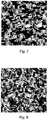
- Figure 6 is an exemplary scanning electron micrograph of the 80% AT/20% ZT sample prepared according to Example 1. As shown, the well connected pores of the microstructures are visible with the white grains being the zirconium titanate phase and the gray being the aluminum titanate phase.
- yttrium phosphate as a non-silicate additive and strengthener for an aluminum titanate ceramic article according to the present invention was also evaluated with three extrusion batches.
- three inventive sintered phase ceramic oxide compositions comprising yttrium phosphate and aluminum titanate (YP-AT) were prepared from the exemplary batch compositions set forth in Table 3 below. Table 3.
- the three extrusion batch compositions are equivalent except for the yttrium phosphate component.
- the three yttrium phosphate batch materials were prepared by first turbula mixing powders of yttrium oxide and phosphorous oxide for 1 hour, then calcining the mixture in a platinum crucible at 190°C for 24 hours. The calcined mixtures were then reacted at an elevated temperature for 24 hours. The reaction products were then ground with alumina media and sieved to - 325 mesh size. Yttrium phosphate batch code "A" was reacted at 1200°C and contained a slight excess of phosphorous oxide in the reaction mixture.
- Yttrium phosphate batch code "B” was reacted at 1475°C and the reaction mixture contained approximately 0.5 weight percent of excess yttrium oxide.
- Yttrium phosphate batch code "C” was reacted at 1200°C and the reaction mixture contained stoichiometric amounts within the limits of the weighing error.
- Plasticized extrusion batches were prepared by turbula mixing the inorganic powder batch materials for approximately 15 minutes, followed by mulling for the addition of the additives and forming aids. Two dies were used for extrusion. A rod was used for measurement of modulus of rupture and was produced with a 1 ⁇ 4 diameter die. A one inch diameter honeycomb die was used to make cellular wares having 200 cells per square inch and 16 mil thick wall for expansion and porosity measurements. The extruded wares were dried in a humidity controlled oven for 72 hours. Samples for the three batches were then fired at three sintering temperatures, 1400, 1500, and 1600°C, for approximately 4 hours. The modulus of temperatures, 1400, 1500, and 1600°C, for approximately 4 hours.
Landscapes
- Chemical & Material Sciences (AREA)
- Engineering & Computer Science (AREA)
- Ceramic Engineering (AREA)
- Structural Engineering (AREA)
- Manufacturing & Machinery (AREA)
- Materials Engineering (AREA)
- Organic Chemistry (AREA)
- Composite Materials (AREA)
- Physics & Mathematics (AREA)
- Thermal Sciences (AREA)
- Inorganic Chemistry (AREA)
- Compositions Of Oxide Ceramics (AREA)
- Filtering Materials (AREA)
- Catalysts (AREA)
Claims (10)
- Poröser Nichtsilikat-Keramikartikel, bestehend aus einer Sinterphasen-Keramikzusammensetzung, umfassend, ausgedrückt auf Basis von Gewichtsprozent Oxid:
a(Al2TiO5)+b(ZrTiO4)+c(Y2O3)+d(YPO4),
wobei a, b, c und d für solche Gewichtsanteile jeder Komponente stehen, dass (a + b + c + d) = 1,00,wobei 0,5 < a ≤ 0,95; 0 ≤ b ≤ 0,5, 0,0 ≤ c ≤ 0,10 und 0 ≤ d ≤ 0,5,wobei die Zusammensetzung Zirconiumtitanat oder Yttriumphosphat umfasst, undwobei die Gesamtporosität der keramischen Oxidzusammensetzung mindestens 40% beträgt. - Keramikartikel nach Anspruch 1, wobei die Sinter-phasen-Keramikzusammensetzung im Wesentlichen aus Aluminiumtitanat, Zirconiumtitanat und Yttriumoxid besteht und wobei 0,60 ≤ a ≤ 0,80 und 0,20 ≤ b ≤ 0,40 und 0, 00 ≤ c ≤ 0,05.
- Keramikartikel nach Anspruch 1, wobei die Sinter-phasen-Keramikzusammensetzung im Wesentlichen aus Aluminiumtitanat und Yttriumphosphat besteht und wobei 0,5 ≤ a ≤ 0,95 und 0,05 ≤ d ≤ 0,5.
- Keramikartikel nach Anspruch 1, wobei die Sinter-phasen-Keramikzusammensetzung eine Gesamtporosität größer gleich 45% aufweist.
- Keramikartikel nach Anspruch 4, wobei die Sinter-phasen-Keramikzusammensetzung eine Gesamtporosität größer gleich 50% aufweist.
- Keramikartikel nach Anspruch 1, wobei die Sinter-phasen-Keramikzusammensetzung einen Wärmeausdehnungskoeffizienten in mindestens einer Richtung aufweist, der über den Temperaturbereich von 25°C bis 1000°C kleiner gleich 12,0 x 10⁻⁷/°C ist.
- Verfahren zur Herstellung eines porösen Nichtsilikat-Keramikartikels nach einem der Ansprüche 1 bis 6, das folgende Schritte umfasst:Bereitstellen einer plastifizierten Keramikvorläuferchargenzusammensetzung, die eine Aluminiumoxidquelle, eine Titandioxidquelle und eine Zirconiumdioxidquelle und/oder eine Yttrium-phosphatquelle;ein organisches Bindemittel, undein flüssiges Vehikelumfasst;Bilden eines extrudierten Grünkörpers aus der plastifizierten Keramikvorläuferchargenzusammensetzung undBrennen des gebildeten Grünkörpers unter Bedingungen, unter denen die Keramikvorläuferzusammensetzung in eine Sinterphasen-Keramikzusammensetzung umgewandelt wird, wobei die Gesamtporosität der Sinterphasen-Keramikzusammensetzung mindestens 40% beträgt.
- Verfahren nach Anspruch 7, bei dem die anorganische Chargenzusammensetzung eine Aluminiumoxidquelle, eine Titandioxidquelle und eine Zirconiumdioxidquelle umfasst.
- Verfahren nach Anspruch 8, bei dem die anorganische Chargenzusammensetzung ferner eine Yttriumoxid-Sinterhilfe umfasst.
- Verfahren nach Anspruch 7, bei dem die anorganische Chargenzusammensetzung eine Aluminiumoxidquelle, eine Titandioxidquelle und eine Yttriumphosphatquelle umfasst.
Applications Claiming Priority (2)
| Application Number | Priority Date | Filing Date | Title |
|---|---|---|---|
| US11/711,336 US7713897B2 (en) | 2007-02-27 | 2007-02-27 | Ceramic materials for 4-way and NOx adsorber and method for making same |
| PCT/US2008/001918 WO2008106014A2 (en) | 2007-02-27 | 2008-02-13 | Ceramic materials for 4-way and nox adsorber and method for making same |
Publications (3)
| Publication Number | Publication Date |
|---|---|
| EP2117680A2 EP2117680A2 (de) | 2009-11-18 |
| EP2117680A4 EP2117680A4 (de) | 2014-01-15 |
| EP2117680B1 true EP2117680B1 (de) | 2017-05-10 |
Family
ID=39714973
Family Applications (1)
| Application Number | Title | Priority Date | Filing Date |
|---|---|---|---|
| EP08725534.5A Ceased EP2117680B1 (de) | 2007-02-27 | 2008-02-13 | Keramikmaterialien für einen 4-weg-nox-speicherkatalysator und verfahren zu ihrer herstellung |
Country Status (5)
| Country | Link |
|---|---|
| US (2) | US7713897B2 (de) |
| EP (1) | EP2117680B1 (de) |
| JP (1) | JP5335699B2 (de) |
| CN (2) | CN101622053B (de) |
| WO (1) | WO2008106014A2 (de) |
Families Citing this family (20)
| Publication number | Priority date | Publication date | Assignee | Title |
|---|---|---|---|---|
| WO2007096986A1 (ja) * | 2006-02-24 | 2007-08-30 | Ibiden Co., Ltd. | 端面加熱装置、ハニカム集合体の端面乾燥方法、及び、ハニカム構造体の製造方法 |
| US8956436B2 (en) | 2006-06-30 | 2015-02-17 | Corning Incorporated | Cordierite aluminum magnesium titanate compositions and ceramic articles comprising same |
| US10501375B2 (en) | 2006-06-30 | 2019-12-10 | Corning Incorporated | Cordierite aluminum magnesium titanate compositions and ceramic articles comprising same |
| WO2008093727A1 (ja) * | 2007-01-30 | 2008-08-07 | Kyocera Corporation | ハニカム構造体および浄化装置 |
| EP2168935A1 (de) | 2008-09-29 | 2010-03-31 | Siemens Aktiengesellschaft | Materialzusammensetzung zur Herstellung eines Feuerfestwerkstoffes sowie ihre Verwendung und Feuerfestformkörper sowie Verfahren zu seiner Herstellung |
| US8231701B2 (en) * | 2009-01-21 | 2012-07-31 | Corning Incorporated | Particulate filters and methods for regenerating particulate filters |
| US9034787B2 (en) * | 2009-05-29 | 2015-05-19 | Corning Incorporated | Ceramic articles and methods of producing ceramic articles |
| KR20120083349A (ko) * | 2009-09-22 | 2012-07-25 | 생-고뱅 생트레 드 레체르체 에 데투드 유로삐엔 | 알루미나 티타네이트 다공성 구조물 |
| FR2950341B1 (fr) * | 2009-09-22 | 2013-03-15 | Saint Gobain Ct Recherches | Structure poreuse du type titanate d'alumine |
| US9221192B2 (en) * | 2010-11-30 | 2015-12-29 | Corning Incorporated | Ceramic processing firing |
| FR2973368B1 (fr) | 2011-03-31 | 2013-11-08 | Saint Gobain Ct Recherches | Grains fondus atz |
| US9115034B2 (en) * | 2011-06-01 | 2015-08-25 | FIB-Service Intellectual, S.A. | Ceramic particle mixture, and method for manufacturing ceramic parts from such a mixture |
| JP5802087B2 (ja) * | 2011-09-02 | 2015-10-28 | 三井金属鉱業株式会社 | 排気ガス浄化用触媒 |
| US10526249B2 (en) * | 2012-11-30 | 2020-01-07 | Corning Incorporated | Cordierite aluminum magnesium titanate compositions and ceramic articles comprising same |
| US9102114B1 (en) * | 2013-03-15 | 2015-08-11 | Ibiden Co., Ltd. | Method for manufacturing aluminum-titanate-based ceramic honeycomb structure |
| US9339791B2 (en) | 2013-06-18 | 2016-05-17 | Corning Incorporated | Low thermal expansion aluminum titanate zirconium tin titanate ceramics |
| WO2015081147A1 (en) * | 2013-11-27 | 2015-06-04 | Corning Incorporated | Composition for improved manufacture of substrates |
| US9789633B2 (en) | 2014-06-04 | 2017-10-17 | Corning Incorporated | Method and system for crack-free drying of high strength skin on a porous ceramic body |
| CN108137413B (zh) | 2015-09-28 | 2021-10-15 | 康宁股份有限公司 | 钛酸锆锡组合物、包含其的陶瓷体、及其制造方法 |
| JP6756530B2 (ja) * | 2016-07-05 | 2020-09-16 | イビデン株式会社 | ハニカム構造体及びハニカム構造体の製造方法 |
Family Cites Families (29)
| Publication number | Priority date | Publication date | Assignee | Title |
|---|---|---|---|---|
| US3549400A (en) * | 1967-09-15 | 1970-12-22 | Corning Glass Works | Thermal shock resistant ceramic material |
| US3578471A (en) * | 1969-11-10 | 1971-05-11 | Corning Glass Works | Thermal shock resistant ceramic material |
| JPS5223113A (en) * | 1975-08-14 | 1977-02-21 | Tdk Electronics Co Ltd | Low thermal expansion ceramics |
| JPS5689844A (en) * | 1979-12-25 | 1981-07-21 | Asahi Glass Co Ltd | Ceramic honeycomb and its production |
| US4483944A (en) * | 1983-07-27 | 1984-11-20 | Corning Glass Works | Aluminum titanate-mullite ceramic articles |
| JPS63201060A (ja) * | 1987-02-13 | 1988-08-19 | ダブリユー・アール・グレイス・アンド・カンパニー−コネチカツト | 低膨張性ZrTiO↓4−Al↓2TiO↓5−ZrO↓2系組成物 |
| US4758542A (en) * | 1987-02-13 | 1988-07-19 | W. R. Grace & Co. | Low thermal expansion ZrTiO4 --Al2 TiO5 --ZrO2 compositions |
| DE68905668T2 (de) * | 1988-05-24 | 1993-10-14 | Sumitomo Metal Ceramics Inc | Dielektrische keramische Zusammensetzung. |
| US5039644A (en) * | 1989-01-10 | 1991-08-13 | Corning Incorporated | Phosphate-containing ceramic structures for catalyst support and fluid filtering |
| US5167885A (en) * | 1992-01-07 | 1992-12-01 | W. R. Grace & Co.-Conn. | Method for making sintered bodies |
| US5322821A (en) * | 1993-08-23 | 1994-06-21 | W. R. Grace & Co.-Conn. | Porous ceramic beads |
| JPH08215522A (ja) * | 1994-12-15 | 1996-08-27 | Matsushita Electric Ind Co Ltd | 排ガスフィルター及びその製造方法 |
| US5491116A (en) * | 1995-04-03 | 1996-02-13 | Corning Incorporated | Fine-grained glass-ceramics |
| JP3769818B2 (ja) * | 1996-06-26 | 2006-04-26 | 松下電器産業株式会社 | 排ガスフィルタ |
| JPH10165817A (ja) * | 1996-12-10 | 1998-06-23 | Toyota Central Res & Dev Lab Inc | 排ガス浄化用触媒 |
| JP3612943B2 (ja) * | 1997-06-20 | 2005-01-26 | 松下電器産業株式会社 | 排ガスフィルタの製造方法 |
| US6383519B1 (en) * | 1999-01-26 | 2002-05-07 | Vita Special Purpose Corporation | Inorganic shaped bodies and methods for their production and use |
| EP1341599B1 (de) * | 2000-11-06 | 2009-08-12 | Corning Incorporated | Katalysator zur reinigung von abgasen |
| US6677272B2 (en) * | 2001-08-15 | 2004-01-13 | Corning Incorporated | Material for NOx trap support |
| US7022303B2 (en) | 2002-05-13 | 2006-04-04 | Rutgers, The State University | Single-crystal-like materials |
| JP3758601B2 (ja) * | 2002-05-15 | 2006-03-22 | トヨタ自動車株式会社 | 吸蔵還元型NOx浄化用触媒 |
| AU2003229087A1 (en) * | 2003-05-14 | 2005-01-21 | Rutgers, The State University | Single-crystal-like materials |
| US7132150B2 (en) * | 2003-08-14 | 2006-11-07 | Corning Incorporated | Porous ceramic filters with catalyst coatings |
| WO2005065199A2 (en) * | 2003-12-31 | 2005-07-21 | Corning Incorporated | Ceramic structures having hydrophobic coatings |
| US7259120B2 (en) * | 2004-04-21 | 2007-08-21 | Corning Incorporated | Aluminum titanate ceramic articles and methods of making same |
| US20060021308A1 (en) * | 2004-07-29 | 2006-02-02 | Merkel Gregory A | Mullite-aluminum titanate body and method for making same |
| KR100752520B1 (ko) * | 2005-03-07 | 2007-08-29 | (주)케이에이치 케미컬 | 내부식성 세라믹 재료 및 이를 사용한 필터, 이들의제조방법 |
| JP2008545612A (ja) | 2005-05-31 | 2008-12-18 | コーニング インコーポレイテッド | 細孔形成剤の組合せを含有するチタン酸アルミニウムセラミック形成バッチ混合物および未焼成体、および同混合物および未焼成体の製造および焼成方法 |
| CN101330961A (zh) * | 2005-12-16 | 2008-12-24 | 康宁股份有限公司 | 低压降的涂覆的柴油机废气过滤器 |
-
2007
- 2007-02-27 US US11/711,336 patent/US7713897B2/en active Active
-
2008
- 2008-02-13 WO PCT/US2008/001918 patent/WO2008106014A2/en not_active Ceased
- 2008-02-13 EP EP08725534.5A patent/EP2117680B1/de not_active Ceased
- 2008-02-13 CN CN2008800060698A patent/CN101622053B/zh not_active Expired - Fee Related
- 2008-02-13 JP JP2009551670A patent/JP5335699B2/ja not_active Expired - Fee Related
- 2008-02-13 CN CN201310021727.3A patent/CN103058650B/zh not_active Expired - Fee Related
-
2010
- 2010-03-23 US US12/729,800 patent/US7932201B2/en active Active
Also Published As
| Publication number | Publication date |
|---|---|
| US20080203627A1 (en) | 2008-08-28 |
| EP2117680A4 (de) | 2014-01-15 |
| US20100234216A1 (en) | 2010-09-16 |
| JP5335699B2 (ja) | 2013-11-06 |
| CN101622053B (zh) | 2013-02-06 |
| JP2010519169A (ja) | 2010-06-03 |
| US7932201B2 (en) | 2011-04-26 |
| EP2117680A2 (de) | 2009-11-18 |
| US7713897B2 (en) | 2010-05-11 |
| CN101622053A (zh) | 2010-01-06 |
| CN103058650B (zh) | 2015-03-11 |
| WO2008106014A2 (en) | 2008-09-04 |
| CN103058650A (zh) | 2013-04-24 |
| WO2008106014A3 (en) | 2008-11-13 |
Similar Documents
| Publication | Publication Date | Title |
|---|---|---|
| EP2117680B1 (de) | Keramikmaterialien für einen 4-weg-nox-speicherkatalysator und verfahren zu ihrer herstellung | |
| EP2016033B1 (de) | Hochporöse cordieritzusammensetzung | |
| JP6324472B2 (ja) | 多孔質セラミックハニカム物品およびその作製方法 | |
| EP1493724B1 (de) | Poröses material und herstellungsverfahren dafür | |
| EP1968913B1 (de) | Cordierit-keramikwabenartikel mit enger porengrössenverteilung und herstellungsverfahren dafür | |
| EP2937143B1 (de) | Keramikwabenstruktur und verfahren zur herstellung davon | |
| KR940000869B1 (ko) | 모노리드식 촉매 지지체 및 그의 제조방법 | |
| EP2254678B1 (de) | Verfahren zur herstellung von wabenkörper mit geriebenen nussschalen | |
| EP1979290B1 (de) | Chargenzusammensetzung zur herstellung eines porösen cordieritkeramikgegenstands und verfahren zur herstellung eines porösen cordieritkeramikgegenstands | |
| CN108367224A (zh) | 多孔陶瓷材料、过滤器和制品 | |
| EP3429726B1 (de) | Keramische wabenstruktur mit hoher porosität und verfahren zur herstellung | |
| EP1927392B1 (de) | Verfahren zur Herstellung eines Wabenstrukturkörpers | |
| JP6611707B2 (ja) | コージエライト対ムライトの比率が高いコージエライト・ムライト・チタン酸アルミニウムマグネシウム組成物およびそれから構成されたセラミック物品 | |
| EP1808228A1 (de) | Wabenstruktur, herstellungsverfahren dafür und abgasreinigungsvorrichtung | |
| JP5856793B2 (ja) | チタン酸アルミニウム質ハニカム構造体 | |
| JP2021535068A (ja) | コーディエライト‐インディアライト‐擬板チタン石構造セラミック体、バッチ組成物混合物、及びこれらからセラミック体を製造する方法 | |
| EP1927391A1 (de) | Verfahren zur Herstellung eines Wabenstrukturkörpers, und Wabenstrukturkörper | |
| US20110185711A1 (en) | Textured particulate filter for catalytic applications |
Legal Events
| Date | Code | Title | Description |
|---|---|---|---|
| PUAI | Public reference made under article 153(3) epc to a published international application that has entered the european phase |
Free format text: ORIGINAL CODE: 0009012 |
|
| 17P | Request for examination filed |
Effective date: 20090326 |
|
| AK | Designated contracting states |
Kind code of ref document: A2 Designated state(s): AT BE BG CH CY CZ DE DK EE ES FI FR GB GR HR HU IE IS IT LI LT LU LV MC MT NL NO PL PT RO SE SI SK TR |
|
| AX | Request for extension of the european patent |
Extension state: AL BA MK RS |
|
| RBV | Designated contracting states (corrected) |
Designated state(s): DE FR GB |
|
| DAX | Request for extension of the european patent (deleted) | ||
| A4 | Supplementary search report drawn up and despatched |
Effective date: 20131216 |
|
| RIC1 | Information provided on ipc code assigned before grant |
Ipc: B01D 53/56 20060101AFI20131210BHEP Ipc: B01J 23/00 20060101ALI20131210BHEP |
|
| 17Q | First examination report despatched |
Effective date: 20140818 |
|
| GRAP | Despatch of communication of intention to grant a patent |
Free format text: ORIGINAL CODE: EPIDOSNIGR1 |
|
| RIC1 | Information provided on ipc code assigned before grant |
Ipc: C04B 35/478 20060101ALI20161116BHEP Ipc: B01J 23/00 20060101ALI20161116BHEP Ipc: B01D 53/56 20060101AFI20161116BHEP Ipc: C04B 38/00 20060101ALI20161116BHEP |
|
| INTG | Intention to grant announced |
Effective date: 20161206 |
|
| RIN1 | Information on inventor provided before grant (corrected) |
Inventor name: TANNER, CAMERON W. Inventor name: OGUNWUMI, STEVEN B. |
|
| GRAS | Grant fee paid |
Free format text: ORIGINAL CODE: EPIDOSNIGR3 |
|
| GRAA | (expected) grant |
Free format text: ORIGINAL CODE: 0009210 |
|
| AK | Designated contracting states |
Kind code of ref document: B1 Designated state(s): DE FR GB |
|
| REG | Reference to a national code |
Ref country code: GB Ref legal event code: FG4D |
|
| REG | Reference to a national code |
Ref country code: DE Ref legal event code: R096 Ref document number: 602008050210 Country of ref document: DE |
|
| REG | Reference to a national code |
Ref country code: FR Ref legal event code: PLFP Year of fee payment: 11 |
|
| REG | Reference to a national code |
Ref country code: DE Ref legal event code: R097 Ref document number: 602008050210 Country of ref document: DE |
|
| PLBE | No opposition filed within time limit |
Free format text: ORIGINAL CODE: 0009261 |
|
| STAA | Information on the status of an ep patent application or granted ep patent |
Free format text: STATUS: NO OPPOSITION FILED WITHIN TIME LIMIT |
|
| 26N | No opposition filed |
Effective date: 20180213 |
|
| PGFP | Annual fee paid to national office [announced via postgrant information from national office to epo] |
Ref country code: GB Payment date: 20200130 Year of fee payment: 13 |
|
| PGFP | Annual fee paid to national office [announced via postgrant information from national office to epo] |
Ref country code: FR Payment date: 20200124 Year of fee payment: 13 |
|
| GBPC | Gb: european patent ceased through non-payment of renewal fee |
Effective date: 20210213 |
|
| PG25 | Lapsed in a contracting state [announced via postgrant information from national office to epo] |
Ref country code: GB Free format text: LAPSE BECAUSE OF NON-PAYMENT OF DUE FEES Effective date: 20210213 Ref country code: FR Free format text: LAPSE BECAUSE OF NON-PAYMENT OF DUE FEES Effective date: 20210228 |
|
| PGFP | Annual fee paid to national office [announced via postgrant information from national office to epo] |
Ref country code: DE Payment date: 20220112 Year of fee payment: 15 |
|
| REG | Reference to a national code |
Ref country code: DE Ref legal event code: R119 Ref document number: 602008050210 Country of ref document: DE |
|
| PG25 | Lapsed in a contracting state [announced via postgrant information from national office to epo] |
Ref country code: DE Free format text: LAPSE BECAUSE OF NON-PAYMENT OF DUE FEES Effective date: 20230901 |