EP2140994A1 - Éponge, son procédé de fabrication, et appareil - Google Patents
Éponge, son procédé de fabrication, et appareil Download PDFInfo
- Publication number
- EP2140994A1 EP2140994A1 EP08012030A EP08012030A EP2140994A1 EP 2140994 A1 EP2140994 A1 EP 2140994A1 EP 08012030 A EP08012030 A EP 08012030A EP 08012030 A EP08012030 A EP 08012030A EP 2140994 A1 EP2140994 A1 EP 2140994A1
- Authority
- EP
- European Patent Office
- Prior art keywords
- sponge
- paste
- cellulose
- making device
- base paste
- Prior art date
- Legal status (The legal status is an assumption and is not a legal conclusion. Google has not performed a legal analysis and makes no representation as to the accuracy of the status listed.)
- Withdrawn
Links
Images


Classifications
-
- B—PERFORMING OPERATIONS; TRANSPORTING
- B29—WORKING OF PLASTICS; WORKING OF SUBSTANCES IN A PLASTIC STATE IN GENERAL
- B29C—SHAPING OR JOINING OF PLASTICS; SHAPING OF MATERIAL IN A PLASTIC STATE, NOT OTHERWISE PROVIDED FOR; AFTER-TREATMENT OF THE SHAPED PRODUCTS, e.g. REPAIRING
- B29C44/00—Shaping by internal pressure generated in the material, e.g. swelling or foaming ; Producing porous or cellular expanded plastics articles
- B29C44/34—Auxiliary operations
- B29C44/36—Feeding the material to be shaped
- B29C44/46—Feeding the material to be shaped into an open space or onto moving surfaces, i.e. to make articles of indefinite length
- B29C44/461—Feeding the material to be shaped into an open space or onto moving surfaces, i.e. to make articles of indefinite length dispensing apparatus, e.g. dispensing foaming resin over the whole width of the moving surface
-
- C—CHEMISTRY; METALLURGY
- C08—ORGANIC MACROMOLECULAR COMPOUNDS; THEIR PREPARATION OR CHEMICAL WORKING-UP; COMPOSITIONS BASED THEREON
- C08J—WORKING-UP; GENERAL PROCESSES OF COMPOUNDING; AFTER-TREATMENT NOT COVERED BY SUBCLASSES C08B, C08C, C08F, C08G or C08H
- C08J9/00—Working-up of macromolecular substances to porous or cellular articles or materials; After-treatment thereof
- C08J9/0061—Working-up of macromolecular substances to porous or cellular articles or materials; After-treatment thereof characterized by the use of several polymeric components
-
- C—CHEMISTRY; METALLURGY
- C08—ORGANIC MACROMOLECULAR COMPOUNDS; THEIR PREPARATION OR CHEMICAL WORKING-UP; COMPOSITIONS BASED THEREON
- C08J—WORKING-UP; GENERAL PROCESSES OF COMPOUNDING; AFTER-TREATMENT NOT COVERED BY SUBCLASSES C08B, C08C, C08F, C08G or C08H
- C08J9/00—Working-up of macromolecular substances to porous or cellular articles or materials; After-treatment thereof
- C08J9/30—Working-up of macromolecular substances to porous or cellular articles or materials; After-treatment thereof by mixing gases into liquid compositions or plastisols, e.g. frothing with air
-
- C—CHEMISTRY; METALLURGY
- C08—ORGANIC MACROMOLECULAR COMPOUNDS; THEIR PREPARATION OR CHEMICAL WORKING-UP; COMPOSITIONS BASED THEREON
- C08J—WORKING-UP; GENERAL PROCESSES OF COMPOUNDING; AFTER-TREATMENT NOT COVERED BY SUBCLASSES C08B, C08C, C08F, C08G or C08H
- C08J2201/00—Foams characterised by the foaming process
- C08J2201/02—Foams characterised by the foaming process characterised by mechanical pre- or post-treatments
- C08J2201/03—Extrusion of the foamable blend
-
- C—CHEMISTRY; METALLURGY
- C08—ORGANIC MACROMOLECULAR COMPOUNDS; THEIR PREPARATION OR CHEMICAL WORKING-UP; COMPOSITIONS BASED THEREON
- C08J—WORKING-UP; GENERAL PROCESSES OF COMPOUNDING; AFTER-TREATMENT NOT COVERED BY SUBCLASSES C08B, C08C, C08F, C08G or C08H
- C08J2301/00—Characterised by the use of cellulose, modified cellulose or cellulose derivatives
- C08J2301/02—Cellulose; Modified cellulose
-
- C—CHEMISTRY; METALLURGY
- C08—ORGANIC MACROMOLECULAR COMPOUNDS; THEIR PREPARATION OR CHEMICAL WORKING-UP; COMPOSITIONS BASED THEREON
- C08J—WORKING-UP; GENERAL PROCESSES OF COMPOUNDING; AFTER-TREATMENT NOT COVERED BY SUBCLASSES C08B, C08C, C08F, C08G or C08H
- C08J2303/00—Characterised by the use of starch, amylose or amylopectin or of their derivatives or degradation products
- C08J2303/02—Starch; Degradation products thereof, e.g. dextrin
-
- C—CHEMISTRY; METALLURGY
- C08—ORGANIC MACROMOLECULAR COMPOUNDS; THEIR PREPARATION OR CHEMICAL WORKING-UP; COMPOSITIONS BASED THEREON
- C08J—WORKING-UP; GENERAL PROCESSES OF COMPOUNDING; AFTER-TREATMENT NOT COVERED BY SUBCLASSES C08B, C08C, C08F, C08G or C08H
- C08J2401/00—Characterised by the use of cellulose, modified cellulose or cellulose derivatives
- C08J2401/02—Cellulose; Modified cellulose
-
- C—CHEMISTRY; METALLURGY
- C08—ORGANIC MACROMOLECULAR COMPOUNDS; THEIR PREPARATION OR CHEMICAL WORKING-UP; COMPOSITIONS BASED THEREON
- C08J—WORKING-UP; GENERAL PROCESSES OF COMPOUNDING; AFTER-TREATMENT NOT COVERED BY SUBCLASSES C08B, C08C, C08F, C08G or C08H
- C08J2403/00—Characterised by the use of starch, amylose or amylopectin or of their derivatives or degradation products
- C08J2403/02—Starch; Degradation products thereof, e.g. dextrin
Definitions
- the present invention relates to a sponge product, a method for its manufacture, and an apparatus for carrying out the method to manufacture the product in an on-demand fashion.
- a very recent proposal for how to make air dried tissue may be found in International application WO 2008/027198 A2 .
- a wet tissue web is received from the wet end of a papermaking machine and dried by an air flotation dryer that uses an endless loop to transport and support the wet tissue web as it is dried.
- Other conventional machines such as that disclosed in document US 5,656,132 , use through air drying (TAD) in rotating devices.
- TAD through air drying
- An object of the present invention is therefore to overcome these drawbacks of the prior art.
- the best solution for the environment and for consumers is to actually make the toilet paper immediately before use (on-demand) - directly in the bathroom ( in situ ) - since this would require minimum additional handling, transport, effluent, and energy consumption.
- the device generally includes a precursor container, a foaming member, an extrusion chamber and a fixing chamber.
- the device generally operates as follows: Upon a user command, the precursor is released from its container and is foamed and extruded (in a single step or in subsequent steps). The extruded foam is then dried so as to be ready for use.
- the product so manufactured generally comprises an inner, relatively moist layer with gas-filled bubbles, and an outer layer or outer layers which are relatively drier and have open pores.
- the inner and outer layer(s) need not have a visible boundary layer, but there may be a gradual transition between the drier outer layer and the moister inner part with bubbles.
- the device enables a user to activate it when and where the product is needed, and with a particular design or other properties as desired under the circumstances.
- the device includes a replaceable precursor container, which may be distributed by mail directly from the manufacturer.
- the base paste may comprise a minimum amount of liquid materials such as water to make the base paste more flowable. Since the contemplated site of installing the device is a bathroom, in embodiments the base material may be devoid of water, which in that case may be admixed via home appliances such as a water tap so as to form the base paste.
- the device may comprise a precursor mixing chamber, into which a base material and water may be filled and which may include means for mixing.
- the dry base material may contain reactants which upon addition of water form a gas, such as CO 2 .
- the mixing chamber may be pressurized or sealed against ambient pressure.
- the device may comprise an absorbent reservoir to accommodate a supply of absorbent, in particular a water absorbent such as a drying powder or a superabsorbent.
- a water absorbent such as a drying powder or a superabsorbent.
- the device may comprise a cartridge containing a pressurized gas, such as nitrogen, compressed air, nitrous oxide (N 2 O), CO 2 or a mixture of any of these.
- a pressurized gas such as nitrogen, compressed air, nitrous oxide (N 2 O), CO 2 or a mixture of any of these.
- the device may comprise a compressor for in situ providing compressed air.
- the base paste comprises a pressure-liquefied gas such as isobutane, which upon decompression during extrusion forms bubbles all by itself without the need for any hardware. Else, the base paste may be foamed by pressing a gas into it, and extruding the base paste.
- the device comprises an absorbent reservoir and a compressor or pressurized cartridge, and further comprises a duct so as to enable the flow of gas to be entrained with the absorbent from the reservoir.
- a powder may be blown into the base paste to assist subsequent drying from the inside.
- the device includes a heater for heating air or other gas blown towards the extruded foam so as to enhance evaporation of water and/or other wet material from the foam. In so operating, it may be desirable to also evaporate perfume or fragrances included in the base paste, which are thus liberated at the request of the user at a most suitable time.
- the extruded foam is directly heated by microwaves or ultrasound, so as to evaporate excess water from its surface.
- the components of the device are all contained in a common housing fitting in a bathroom.
- the housing may have a volume of less than 1 m 3 .
- the method comprises foaming a base paste comprising starch and cellulose, extruding the foam through one or more slit-like openings, a row of nozzles or even multiple rows of nozzles, and drying the extruded foam while it is hanging from the openings or nozzles, respectively.
- the starch or the cellulose in the base paste may be pre-digested, partially hydrolyzed, derivatized, purified or modified.
- the foaming may be aided or accomplished by whipping the base paste under compressed air and/or other gas.
- the drying may comprise admixing a moisture-absorbing agent to the base paste prior to extrusion; or may comprise blowing a drying agent, such as talcum powder, onto the extruded foam.
- a drying agent such as talcum powder
- there may be a re-wetting step with e.g. alcoholic fragrance solution, perfume or skin soothing substances.
- the product may be printed on and/or embossed so as to give it a desired design and/or surface texture.
- This design and/or texture may be selectable via a user interface.
- the product so manufactured has relatively more closed pores, or rather bubbles, in its interior filled with the foaming gas, and relatively more open pores on its surfaces.
- the overall structure is a sheet-like material in which one extension (thickness) is much smaller than the other two (length and width).
- the relative amount by dry weight of starch exceeds that of the cellulose. In certain applications, however, there may be as much, or more cellulose than starch; or even no starch at all. In all these cases, it is contemplated that the gas bubble volume proportion be more than 10%, or more than 30%, or more than 50% of the total volume of the product.
- the bubbles' volume proportion may be less than 90%, or less than 75% of the total volume of the product.
- the source of the starch and cellulose be environmentally friendly.
- the relative moisture content of the interior layer is higher than that of the outer, surface layers.
- the overall moisture content may be from 15% to 70% by weight, or from 25% to 50%, or from 30% to 40%.
- the cellulose dry weight proportion may be from 5% to 60%, or from 10% to 50%, or from 15% to 30%.
- the starch dry weight proportion may be from 35% to 95%, or from 50% to 80%, or from 55 to 70%.
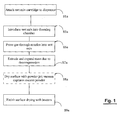
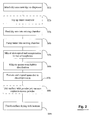
- the method of operating the apparatus, and to manufacture the product is shown in Figs. 1 and 2 .
- the first embodiment of the method shown in Fig. 1 , uses a wet pre-mix, which is supplied in a replacement cartridge. Same is attached S1a to the dispenser and, upon a user command, the wet pre-mix forming a base paste mainly comprising water, starch and cellulose is introduced S3a into a foaming chamber. This may be accomplished either by gravity feeding or using a controllable pump. Then, a foaming gas is pressed S5a into the base paste. In alternative embodiments, this step may be omitted, if a pressure-liquefied gas such as isobutane is already contained in the pressurized pre-mix.
- the mass is extruded through a slit, a row of nozzles, or multiple rows of nozzles, so that the mass expands S7a due to decompression.
- the surface may then be pre-dried S8a with a powder jet, vacuum capturing excess powder.
- the surface drying is then finished S9a with heaters, which may be resistor wires, microwave horns or ultrasound transducers.
- the texture may be varied (not shown) with an embossing means either before or after dry-finishing.
- the product may be re-moistened with fragrances or perfume (also not shown). The product then hangs from the dispenser, ready to hand.
- the entire process starting from the user command may take one or several minutes, typically less than 10 minutes, preferably less than 2 minutes.
- the method uses a dry pre-mix, which is supplied in a replacement cartridge. Same is attached S1b to the dispenser and, if necessary, the water reservoir is topped up S2b. Step S2b may also be completed prior to step S1b, e.g. during idle periods. In a variant, this is accomplished automatically whenever necessary, as determined by a sensor, via a controlled valve in a tap water pipe. Upon a user command, the dry pre-mix is gravity fed S3b into a mixing chamber, and water is pumped S4b into the mixing chamber. The pre-mix and the water are then mixed at slow speed and compression to e.g. two atmospheres S5b.
- Whipping S6b may assist in assuring an even bubble distribution.
- the base paste so formed is extruded S7b through a slit, a row of nozzles, or multiple rows of nozzles, so that the mass expands due to decompression.
- the surface may then be pre-dried S8b with a powder jet as in the first embodiment.
- the surface drying is then finished S9b with heaters. Again, the texture may be varied, and/or the product may be perfumed.
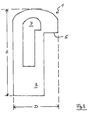
- Fig. 3 shows the dispenser's 1 general structure:
- a housing 3 accommodates a water reservoir, a mixing/whipping chamber, an extruder, a powder jet/vacuum unit, and heaters near the outlet 5.
- the entire operation of the dispenser 1 is controlled via a control and status touch screen panel 7.
- the housing's height H (top-bottom), in this example is 80 cm, its width D (left-right) is 40 cm. Its depth (front-rear) may be somewhere between 15 cm to 20 cm. Accordingly, the overall volume will be in the approximate range 0.04 m 3 to 0.075 m 3 .
- the height may be reduced in specific environments (overhead dispenser), and, if required, the width and/or depth accordingly increased.
- the touch screen panel is divided into several sections.
- status monitoring section 9 comprises a number of simple status indicators such as LEDs 13 for indicating the presence of dry mix or water, the proper functioning of power supply, or other (pressurizing gas etc.).
- input section 11 is an alphanumeric keypad for enabling the user to input data or to program the device.
- output section 15 includes a text screen for detailed instructions, internet access etc.
- control and status touch screen panel 7 includes a control section 17 which comprises controls 21, 23 for setting "luxury level" and easy preference settings 19.
- a two-dimensional touch pad 21 representing a two-parameter space (such as moisture and temperature), and the desired parameter combination of the sponge product is selected by the user by dragging or rotating (indicated by arrows) the indicator circle 23 to the appropriate position and/or orientation on the pad 21.
- the device may include a controller having a memory, which is adapted to store pre-defined parameter sets. The user may thereby select entire desired parameter settings by the pressing of a single button 19. Also, there may be control wiring connecting the controller to the various controllable valves, pumps, actuators and the like, explained hereinbelow.
- the interior of the dispenser 1 is shown in some detail in Fig. 5 : From a reservoir 25, the dry-mix is fed to a mixing chamber 27 via a controllable valve 29. Water from a water tank 31 is pumped (pump not shown) into the mixing chamber 27.
- the dry mix may contain such substances which react with one another to produce a gas, such as CO 2 . In particular, sodium bicarbonate and tartaric acid may be used for this purpose.
- An optional compressor for pressurizing the mixing chamber 27 is also not shown.
- the mixing chamber may contain whipping means such as a beater or agitator (not shown) to aid aeration.
- the aerated mixture is pumped to the extruder 33, where extrusion begins and the mass expands, forming a foam.
- the foam passes a drying section 35 comprising a powder jet 37 and heaters 39 which finishes the surface drying.
- the ready-to-hand product exits the dispenser through outlet 5.
- the water is provided via a controllable valve 41. This valve may also be manually operated.
- the heating section may comprise means to recover the evaporated water, and feed it back to the water reservoir.
- the water tank may be omitted entirely, and the water may be supplied directly from the tap.
- a wet base paste already containing sufficient water is foamed with a pressurized gas from a replaceable cartridge, or from a compressor.
- an additional, absorbent reservoir preferably having a connection to a gas duct from the compressor or cartridge to the foaming chamber.
- the gas flow may thus be entrained with the (super) absorbent powder so as to aid drying the product from its inside.
- the drying powder optionally used as a pre-drying means may comprise talc (hydrated magnesium silicate) or alum (hydrated aluminum potassium sulfate) or, in particular in the latter case, additional skin-soothing substances like chamomile or aloe vera.
- Fig. 6 shows the general structure of the sponge product 43 so manufactured:
- the surfaces are comprised of outer layers 45 having an open pore 49 structure, which is relatively dry, and contains much more solid materials than remaining moisture.
- the interior is formed of a moister layer 47 containing closed pores 51 filled with the foaming gas.
- This layer also contains solid materials, but their proportion is less than their proportion in the outer layers, and may even be less than 50%, meaning that there is more wet material (mostly water) than solid materials in the inner layer.
- the solid materials are mainly made up of cellulose and starch or their derivatives, in particular more starch than cellulose.
- the invention provides a system of a sponge making device in the vicinity of a toilet (say, less than 1 or 2 m distant) with replaceable pre-mix cartridges.
- a toilet say, less than 1 or 2 m distant
- the user of the toilet input the desired properties of the sponge product in terms of moisture, temperature, texture and/or smell and the desired quantity, and within minutes the device mixes the appropriate amounts of powder or base paste, optionally water and gas or air so as to provide an extrudable foam. While still hanging, the extruded foam is then dried according to the user settings to form a sponge and used according to necessities.
- the product due to its composition, will readily disintegrate in the flush water, and partly or wholly may even dissolve.
- the invention thus enables the handling, transport, effluent, and energy consumption associated with toilet “paper” to be minimized.
- the cost of storing and transporting the air necessarily contained in high bulk soft tissue is by far reduced by transporting only the pre-mix cartridges. Same are therefore adapted to be removably attached, under sealing conditions, to the dispenser of the present invention.
Landscapes
- Chemical & Material Sciences (AREA)
- Engineering & Computer Science (AREA)
- Materials Engineering (AREA)
- Health & Medical Sciences (AREA)
- Chemical Kinetics & Catalysis (AREA)
- Medicinal Chemistry (AREA)
- Polymers & Plastics (AREA)
- Organic Chemistry (AREA)
- Extrusion Moulding Of Plastics Or The Like (AREA)
- Manufacture Of Porous Articles, And Recovery And Treatment Of Waste Products (AREA)
Priority Applications (2)
| Application Number | Priority Date | Filing Date | Title |
|---|---|---|---|
| EP08012030A EP2140994A1 (fr) | 2008-07-03 | 2008-07-03 | Éponge, son procédé de fabrication, et appareil |
| PCT/EP2009/004764 WO2010000466A1 (fr) | 2008-07-03 | 2009-07-01 | Eponge, son procédé de fabrication, et appareil associé |
Applications Claiming Priority (1)
| Application Number | Priority Date | Filing Date | Title |
|---|---|---|---|
| EP08012030A EP2140994A1 (fr) | 2008-07-03 | 2008-07-03 | Éponge, son procédé de fabrication, et appareil |
Publications (1)
| Publication Number | Publication Date |
|---|---|
| EP2140994A1 true EP2140994A1 (fr) | 2010-01-06 |
Family
ID=40227500
Family Applications (1)
| Application Number | Title | Priority Date | Filing Date |
|---|---|---|---|
| EP08012030A Withdrawn EP2140994A1 (fr) | 2008-07-03 | 2008-07-03 | Éponge, son procédé de fabrication, et appareil |
Country Status (2)
| Country | Link |
|---|---|
| EP (1) | EP2140994A1 (fr) |
| WO (1) | WO2010000466A1 (fr) |
Cited By (1)
| Publication number | Priority date | Publication date | Assignee | Title |
|---|---|---|---|---|
| CN108437331A (zh) * | 2018-03-30 | 2018-08-24 | 重庆致昌塑胶制品有限公司 | 一种海绵泡沫生产设备 |
Families Citing this family (1)
| Publication number | Priority date | Publication date | Assignee | Title |
|---|---|---|---|---|
| CN118700421B (zh) * | 2024-08-27 | 2024-10-29 | 佛山市顺德区多宝海绵有限公司 | 一种适用于海绵生产用发泡设备及其发泡方法 |
Citations (5)
| Publication number | Priority date | Publication date | Assignee | Title |
|---|---|---|---|---|
| EP0683027A2 (fr) * | 1994-05-17 | 1995-11-22 | Nordson Corporation | Appareil et méthode pour verser des matières alvéolaires |
| US5656132A (en) | 1993-06-24 | 1997-08-12 | Kimberly-Clark Worldwide, Inc. | Soft tissue |
| US6033769A (en) * | 1995-02-20 | 2000-03-07 | Stockhausen Gmbh & Co. Kg | Body of layered structure for absorbing liquids, the production and use thereof |
| WO2008027198A2 (fr) | 2006-08-25 | 2008-03-06 | Graf Edwin X | Processus et machine permettant de réaliser du papier séché à l'air |
| WO2008026114A2 (fr) * | 2006-08-31 | 2008-03-06 | Kimberly-Clark Worldwide, Inc. | Amidon expansé pour la neutralisation des odeurs |
Family Cites Families (3)
| Publication number | Priority date | Publication date | Assignee | Title |
|---|---|---|---|---|
| EP0792144B1 (fr) * | 1994-11-09 | 1998-12-23 | The Procter & Gamble Company | Papiers nettoyants traites avec une emulsion d'eau en lipide |
| US20040170670A1 (en) * | 2001-03-09 | 2004-09-02 | Smith James A. | Cosmetic sponges |
| GB0428584D0 (en) * | 2004-12-31 | 2005-02-09 | Abecassiss Charlie | Sponge device |
-
2008
- 2008-07-03 EP EP08012030A patent/EP2140994A1/fr not_active Withdrawn
-
2009
- 2009-07-01 WO PCT/EP2009/004764 patent/WO2010000466A1/fr not_active Ceased
Patent Citations (5)
| Publication number | Priority date | Publication date | Assignee | Title |
|---|---|---|---|---|
| US5656132A (en) | 1993-06-24 | 1997-08-12 | Kimberly-Clark Worldwide, Inc. | Soft tissue |
| EP0683027A2 (fr) * | 1994-05-17 | 1995-11-22 | Nordson Corporation | Appareil et méthode pour verser des matières alvéolaires |
| US6033769A (en) * | 1995-02-20 | 2000-03-07 | Stockhausen Gmbh & Co. Kg | Body of layered structure for absorbing liquids, the production and use thereof |
| WO2008027198A2 (fr) | 2006-08-25 | 2008-03-06 | Graf Edwin X | Processus et machine permettant de réaliser du papier séché à l'air |
| WO2008026114A2 (fr) * | 2006-08-31 | 2008-03-06 | Kimberly-Clark Worldwide, Inc. | Amidon expansé pour la neutralisation des odeurs |
Cited By (2)
| Publication number | Priority date | Publication date | Assignee | Title |
|---|---|---|---|---|
| CN108437331A (zh) * | 2018-03-30 | 2018-08-24 | 重庆致昌塑胶制品有限公司 | 一种海绵泡沫生产设备 |
| CN108437331B (zh) * | 2018-03-30 | 2020-04-21 | 重庆致昌塑胶制品有限公司 | 一种海绵泡沫生产设备 |
Also Published As
| Publication number | Publication date |
|---|---|
| WO2010000466A1 (fr) | 2010-01-07 |
Similar Documents
| Publication | Publication Date | Title |
|---|---|---|
| KR102389631B1 (ko) | 세탁 세제 시트를 제조하기 위한 방법 및 장치 | |
| EP2140994A1 (fr) | Éponge, son procédé de fabrication, et appareil | |
| CA2542558A1 (fr) | Utilisations d'une methode de production de pieces formees en mousse a partir de caoutchouc silicone liquide | |
| CA2869842C (fr) | Appareil et systeme de dilatation de microspheres polymeres pouvant se dilater | |
| EP1951636A2 (fr) | Fabrication de plaque de ciment | |
| JP2012501884A (ja) | 石膏ボード生産用の効率の良い湿潤デンプン調製システム | |
| CN107531497A (zh) | 气凝胶片的制造方法和制造装置 | |
| EP3812419A1 (fr) | Mousse chargée en cellulose microfibrillée, procédé de production d'une telle mousse et utilisation d'une telle mousse | |
| JP2008224170A (ja) | 加湿装置 | |
| EP1428644A3 (fr) | Appareil et procédé pour la confection d'enveloppes à rembourrage de mousse | |
| KR20170112949A (ko) | 원단 가공장치 | |
| JP2007167856A (ja) | 散気装置 | |
| US12601112B2 (en) | Material storage apparatus, method of controlling material storage apparatus, and sheet manufacturing apparatus | |
| US20170275428A1 (en) | Apparatus and system for expanding expandable polymeric microspheres | |
| JP2001329491A (ja) | 発泡用紙及び該発泡用紙を用いて作製した紙製容器 | |
| CN103889212A (zh) | 排泄物处理材料、排泄物处理材料的制造方法及其制造装置 | |
| JP3593319B2 (ja) | 発泡成形体およびその製造方法 | |
| JP2003276094A (ja) | 発泡成形体およびその製造装置 | |
| JP2016073528A (ja) | 泡沫発生装置 | |
| WO2023079924A1 (fr) | Dispositif d'approvisionnement, machine de traitement de vêtements et procédé de commande de dispositif d'approvisionnement | |
| CN106082908A (zh) | 一种降低纸面石膏板面密度的工艺 | |
| JPH0741592A (ja) | 発泡体の製造方法 | |
| JP5282892B2 (ja) | 炭粉入り樹脂発泡体 | |
| CN109262936A (zh) | 一种增加聚氨酯发泡产品香味的方法 | |
| KR20010090705A (ko) | 카본 시트 |
Legal Events
| Date | Code | Title | Description |
|---|---|---|---|
| PUAI | Public reference made under article 153(3) epc to a published international application that has entered the european phase |
Free format text: ORIGINAL CODE: 0009012 |
|
| AK | Designated contracting states |
Kind code of ref document: A1 Designated state(s): AT BE BG CH CY CZ DE DK EE ES FI FR GB GR HR HU IE IS IT LI LT LU LV MC MT NL NO PL PT RO SE SI SK TR |
|
| AX | Request for extension of the european patent |
Extension state: AL BA MK RS |
|
| 17P | Request for examination filed |
Effective date: 20100702 |
|
| AKX | Designation fees paid |
Designated state(s): AT BE BG CH CY CZ DE DK EE ES FI FR GB GR HR HU IE IS IT LI LT LU LV MC MT NL NO PL PT RO SE SI SK TR |
|
| 17Q | First examination report despatched |
Effective date: 20100824 |
|
| STAA | Information on the status of an ep patent application or granted ep patent |
Free format text: STATUS: THE APPLICATION IS DEEMED TO BE WITHDRAWN |
|
| 18D | Application deemed to be withdrawn |
Effective date: 20110104 |