EP2143548A2 - Verfahren zum Herstellen von thermoplastisch geformten Anordnungen und Folienanordnung - Google Patents
Verfahren zum Herstellen von thermoplastisch geformten Anordnungen und Folienanordnung Download PDFInfo
- Publication number
- EP2143548A2 EP2143548A2 EP09164427A EP09164427A EP2143548A2 EP 2143548 A2 EP2143548 A2 EP 2143548A2 EP 09164427 A EP09164427 A EP 09164427A EP 09164427 A EP09164427 A EP 09164427A EP 2143548 A2 EP2143548 A2 EP 2143548A2
- Authority
- EP
- European Patent Office
- Prior art keywords
- film
- layers
- deformation
- printing
- film layers
- Prior art date
- Legal status (The legal status is an assumption and is not a legal conclusion. Google has not performed a legal analysis and makes no representation as to the accuracy of the status listed.)
- Granted
Links
Images
Classifications
-
- B—PERFORMING OPERATIONS; TRANSPORTING
- B29—WORKING OF PLASTICS; WORKING OF SUBSTANCES IN A PLASTIC STATE IN GENERAL
- B29C—SHAPING OR JOINING OF PLASTICS; SHAPING OF MATERIAL IN A PLASTIC STATE, NOT OTHERWISE PROVIDED FOR; AFTER-TREATMENT OF THE SHAPED PRODUCTS, e.g. REPAIRING
- B29C51/00—Shaping by thermoforming, i.e. shaping sheets or sheet like preforms after heating, e.g. shaping sheets in matched moulds or by deep-drawing; Apparatus therefor
- B29C51/02—Combined thermoforming and manufacture of the preform
-
- B—PERFORMING OPERATIONS; TRANSPORTING
- B29—WORKING OF PLASTICS; WORKING OF SUBSTANCES IN A PLASTIC STATE IN GENERAL
- B29C—SHAPING OR JOINING OF PLASTICS; SHAPING OF MATERIAL IN A PLASTIC STATE, NOT OTHERWISE PROVIDED FOR; AFTER-TREATMENT OF THE SHAPED PRODUCTS, e.g. REPAIRING
- B29C51/00—Shaping by thermoforming, i.e. shaping sheets or sheet like preforms after heating, e.g. shaping sheets in matched moulds or by deep-drawing; Apparatus therefor
- B29C51/14—Shaping by thermoforming, i.e. shaping sheets or sheet like preforms after heating, e.g. shaping sheets in matched moulds or by deep-drawing; Apparatus therefor using multilayered preforms or sheets
-
- B—PERFORMING OPERATIONS; TRANSPORTING
- B32—LAYERED PRODUCTS
- B32B—LAYERED PRODUCTS, i.e. PRODUCTS BUILT-UP OF STRATA OF FLAT OR NON-FLAT, e.g. CELLULAR OR HONEYCOMB, FORM
- B32B27/00—Layered products comprising a layer of synthetic resin
- B32B27/06—Layered products comprising a layer of synthetic resin as the main or only constituent of a layer, which is next to another layer of the same or of a different material
- B32B27/08—Layered products comprising a layer of synthetic resin as the main or only constituent of a layer, which is next to another layer of the same or of a different material of synthetic resin
-
- B—PERFORMING OPERATIONS; TRANSPORTING
- B32—LAYERED PRODUCTS
- B32B—LAYERED PRODUCTS, i.e. PRODUCTS BUILT-UP OF STRATA OF FLAT OR NON-FLAT, e.g. CELLULAR OR HONEYCOMB, FORM
- B32B27/00—Layered products comprising a layer of synthetic resin
- B32B27/30—Layered products comprising a layer of synthetic resin comprising vinyl (co)polymers; comprising acrylic (co)polymers
-
- B—PERFORMING OPERATIONS; TRANSPORTING
- B32—LAYERED PRODUCTS
- B32B—LAYERED PRODUCTS, i.e. PRODUCTS BUILT-UP OF STRATA OF FLAT OR NON-FLAT, e.g. CELLULAR OR HONEYCOMB, FORM
- B32B27/00—Layered products comprising a layer of synthetic resin
- B32B27/30—Layered products comprising a layer of synthetic resin comprising vinyl (co)polymers; comprising acrylic (co)polymers
- B32B27/304—Layered products comprising a layer of synthetic resin comprising vinyl (co)polymers; comprising acrylic (co)polymers comprising vinyl halide (co)polymers, e.g. PVC, PVDC, PVF, PVDF
-
- B—PERFORMING OPERATIONS; TRANSPORTING
- B32—LAYERED PRODUCTS
- B32B—LAYERED PRODUCTS, i.e. PRODUCTS BUILT-UP OF STRATA OF FLAT OR NON-FLAT, e.g. CELLULAR OR HONEYCOMB, FORM
- B32B27/00—Layered products comprising a layer of synthetic resin
- B32B27/32—Layered products comprising a layer of synthetic resin comprising polyolefins
-
- B—PERFORMING OPERATIONS; TRANSPORTING
- B32—LAYERED PRODUCTS
- B32B—LAYERED PRODUCTS, i.e. PRODUCTS BUILT-UP OF STRATA OF FLAT OR NON-FLAT, e.g. CELLULAR OR HONEYCOMB, FORM
- B32B27/00—Layered products comprising a layer of synthetic resin
- B32B27/36—Layered products comprising a layer of synthetic resin comprising polyesters
-
- B—PERFORMING OPERATIONS; TRANSPORTING
- B32—LAYERED PRODUCTS
- B32B—LAYERED PRODUCTS, i.e. PRODUCTS BUILT-UP OF STRATA OF FLAT OR NON-FLAT, e.g. CELLULAR OR HONEYCOMB, FORM
- B32B38/00—Ancillary operations in connection with laminating processes
- B32B38/12—Deep-drawing
-
- B—PERFORMING OPERATIONS; TRANSPORTING
- B32—LAYERED PRODUCTS
- B32B—LAYERED PRODUCTS, i.e. PRODUCTS BUILT-UP OF STRATA OF FLAT OR NON-FLAT, e.g. CELLULAR OR HONEYCOMB, FORM
- B32B7/00—Layered products characterised by the relation between layers; Layered products characterised by the relative orientation of features between layers, or by the relative values of a measurable parameter between layers, i.e. products comprising layers having different physical, chemical or physicochemical properties; Layered products characterised by the interconnection of layers
- B32B7/04—Interconnection of layers
- B32B7/12—Interconnection of layers using interposed adhesives or interposed materials with bonding properties
-
- B—PERFORMING OPERATIONS; TRANSPORTING
- B29—WORKING OF PLASTICS; WORKING OF SUBSTANCES IN A PLASTIC STATE IN GENERAL
- B29C—SHAPING OR JOINING OF PLASTICS; SHAPING OF MATERIAL IN A PLASTIC STATE, NOT OTHERWISE PROVIDED FOR; AFTER-TREATMENT OF THE SHAPED PRODUCTS, e.g. REPAIRING
- B29C2791/00—Shaping characteristics in general
- B29C2791/004—Shaping under special conditions
- B29C2791/006—Using vacuum
-
- B—PERFORMING OPERATIONS; TRANSPORTING
- B29—WORKING OF PLASTICS; WORKING OF SUBSTANCES IN A PLASTIC STATE IN GENERAL
- B29C—SHAPING OR JOINING OF PLASTICS; SHAPING OF MATERIAL IN A PLASTIC STATE, NOT OTHERWISE PROVIDED FOR; AFTER-TREATMENT OF THE SHAPED PRODUCTS, e.g. REPAIRING
- B29C2795/00—Printing on articles made from plastics or substances in a plastic state
- B29C2795/002—Printing on articles made from plastics or substances in a plastic state before shaping
-
- B—PERFORMING OPERATIONS; TRANSPORTING
- B29—WORKING OF PLASTICS; WORKING OF SUBSTANCES IN A PLASTIC STATE IN GENERAL
- B29C—SHAPING OR JOINING OF PLASTICS; SHAPING OF MATERIAL IN A PLASTIC STATE, NOT OTHERWISE PROVIDED FOR; AFTER-TREATMENT OF THE SHAPED PRODUCTS, e.g. REPAIRING
- B29C2795/00—Printing on articles made from plastics or substances in a plastic state
- B29C2795/007—Printing on articles made from plastics or substances in a plastic state after shaping
-
- B—PERFORMING OPERATIONS; TRANSPORTING
- B29—WORKING OF PLASTICS; WORKING OF SUBSTANCES IN A PLASTIC STATE IN GENERAL
- B29C—SHAPING OR JOINING OF PLASTICS; SHAPING OF MATERIAL IN A PLASTIC STATE, NOT OTHERWISE PROVIDED FOR; AFTER-TREATMENT OF THE SHAPED PRODUCTS, e.g. REPAIRING
- B29C51/00—Shaping by thermoforming, i.e. shaping sheets or sheet like preforms after heating, e.g. shaping sheets in matched moulds or by deep-drawing; Apparatus therefor
- B29C51/10—Forming by pressure difference, e.g. vacuum
-
- B—PERFORMING OPERATIONS; TRANSPORTING
- B29—WORKING OF PLASTICS; WORKING OF SUBSTANCES IN A PLASTIC STATE IN GENERAL
- B29K—INDEXING SCHEME ASSOCIATED WITH SUBCLASSES B29B, B29C OR B29D, RELATING TO MOULDING MATERIALS OR TO MATERIALS FOR MOULDS, REINFORCEMENTS, FILLERS OR PREFORMED PARTS, e.g. INSERTS
- B29K2003/00—Use of starch or derivatives as moulding material
-
- B—PERFORMING OPERATIONS; TRANSPORTING
- B29—WORKING OF PLASTICS; WORKING OF SUBSTANCES IN A PLASTIC STATE IN GENERAL
- B29K—INDEXING SCHEME ASSOCIATED WITH SUBCLASSES B29B, B29C OR B29D, RELATING TO MOULDING MATERIALS OR TO MATERIALS FOR MOULDS, REINFORCEMENTS, FILLERS OR PREFORMED PARTS, e.g. INSERTS
- B29K2023/00—Use of polyalkenes or derivatives thereof as moulding material
- B29K2023/04—Polymers of ethylene
- B29K2023/06—PE, i.e. polyethylene
-
- B—PERFORMING OPERATIONS; TRANSPORTING
- B29—WORKING OF PLASTICS; WORKING OF SUBSTANCES IN A PLASTIC STATE IN GENERAL
- B29K—INDEXING SCHEME ASSOCIATED WITH SUBCLASSES B29B, B29C OR B29D, RELATING TO MOULDING MATERIALS OR TO MATERIALS FOR MOULDS, REINFORCEMENTS, FILLERS OR PREFORMED PARTS, e.g. INSERTS
- B29K2023/00—Use of polyalkenes or derivatives thereof as moulding material
- B29K2023/10—Polymers of propylene
- B29K2023/12—PP, i.e. polypropylene
-
- B—PERFORMING OPERATIONS; TRANSPORTING
- B29—WORKING OF PLASTICS; WORKING OF SUBSTANCES IN A PLASTIC STATE IN GENERAL
- B29K—INDEXING SCHEME ASSOCIATED WITH SUBCLASSES B29B, B29C OR B29D, RELATING TO MOULDING MATERIALS OR TO MATERIALS FOR MOULDS, REINFORCEMENTS, FILLERS OR PREFORMED PARTS, e.g. INSERTS
- B29K2067/00—Use of polyesters or derivatives thereof, as moulding material
- B29K2067/003—PET, i.e. poylethylene terephthalate
-
- B—PERFORMING OPERATIONS; TRANSPORTING
- B29—WORKING OF PLASTICS; WORKING OF SUBSTANCES IN A PLASTIC STATE IN GENERAL
- B29K—INDEXING SCHEME ASSOCIATED WITH SUBCLASSES B29B, B29C OR B29D, RELATING TO MOULDING MATERIALS OR TO MATERIALS FOR MOULDS, REINFORCEMENTS, FILLERS OR PREFORMED PARTS, e.g. INSERTS
- B29K2227/00—Use of polyvinylhalogenides or derivatives thereof as reinforcement
- B29K2227/06—PVC, i.e. polyvinylchloride
-
- B—PERFORMING OPERATIONS; TRANSPORTING
- B29—WORKING OF PLASTICS; WORKING OF SUBSTANCES IN A PLASTIC STATE IN GENERAL
- B29K—INDEXING SCHEME ASSOCIATED WITH SUBCLASSES B29B, B29C OR B29D, RELATING TO MOULDING MATERIALS OR TO MATERIALS FOR MOULDS, REINFORCEMENTS, FILLERS OR PREFORMED PARTS, e.g. INSERTS
- B29K2267/00—Use of polyesters or derivatives thereof as reinforcement
- B29K2267/04—Polyesters derived from hydroxycarboxylic acids
- B29K2267/046—PLA, i.e. polylactic acid or polylactide
-
- B—PERFORMING OPERATIONS; TRANSPORTING
- B29—WORKING OF PLASTICS; WORKING OF SUBSTANCES IN A PLASTIC STATE IN GENERAL
- B29L—INDEXING SCHEME ASSOCIATED WITH SUBCLASS B29C, RELATING TO PARTICULAR ARTICLES
- B29L2009/00—Layered products
- B29L2009/001—Layered products the layers being loose
-
- B—PERFORMING OPERATIONS; TRANSPORTING
- B32—LAYERED PRODUCTS
- B32B—LAYERED PRODUCTS, i.e. PRODUCTS BUILT-UP OF STRATA OF FLAT OR NON-FLAT, e.g. CELLULAR OR HONEYCOMB, FORM
- B32B37/00—Methods or apparatus for laminating, e.g. by curing or by ultrasonic bonding
- B32B2037/0092—Methods or apparatus for laminating, e.g. by curing or by ultrasonic bonding in which absence of adhesives is explicitly presented as an advantage
-
- B—PERFORMING OPERATIONS; TRANSPORTING
- B32—LAYERED PRODUCTS
- B32B—LAYERED PRODUCTS, i.e. PRODUCTS BUILT-UP OF STRATA OF FLAT OR NON-FLAT, e.g. CELLULAR OR HONEYCOMB, FORM
- B32B2250/00—Layers arrangement
- B32B2250/24—All layers being polymeric
-
- B—PERFORMING OPERATIONS; TRANSPORTING
- B32—LAYERED PRODUCTS
- B32B—LAYERED PRODUCTS, i.e. PRODUCTS BUILT-UP OF STRATA OF FLAT OR NON-FLAT, e.g. CELLULAR OR HONEYCOMB, FORM
- B32B2255/00—Coating on the layer surface
- B32B2255/20—Inorganic coating
- B32B2255/205—Metallic coating
-
- B—PERFORMING OPERATIONS; TRANSPORTING
- B32—LAYERED PRODUCTS
- B32B—LAYERED PRODUCTS, i.e. PRODUCTS BUILT-UP OF STRATA OF FLAT OR NON-FLAT, e.g. CELLULAR OR HONEYCOMB, FORM
- B32B2307/00—Properties of the layers or laminate
- B32B2307/20—Properties of the layers or laminate having particular electrical or magnetic properties, e.g. piezoelectric
- B32B2307/21—Anti-static
-
- B—PERFORMING OPERATIONS; TRANSPORTING
- B32—LAYERED PRODUCTS
- B32B—LAYERED PRODUCTS, i.e. PRODUCTS BUILT-UP OF STRATA OF FLAT OR NON-FLAT, e.g. CELLULAR OR HONEYCOMB, FORM
- B32B2307/00—Properties of the layers or laminate
- B32B2307/40—Properties of the layers or laminate having particular optical properties
- B32B2307/402—Coloured
- B32B2307/4026—Coloured within the layer by addition of a colorant, e.g. pigments, dyes
-
- B—PERFORMING OPERATIONS; TRANSPORTING
- B32—LAYERED PRODUCTS
- B32B—LAYERED PRODUCTS, i.e. PRODUCTS BUILT-UP OF STRATA OF FLAT OR NON-FLAT, e.g. CELLULAR OR HONEYCOMB, FORM
- B32B2307/00—Properties of the layers or laminate
- B32B2307/40—Properties of the layers or laminate having particular optical properties
- B32B2307/406—Bright, glossy, shiny surface
-
- B—PERFORMING OPERATIONS; TRANSPORTING
- B32—LAYERED PRODUCTS
- B32B—LAYERED PRODUCTS, i.e. PRODUCTS BUILT-UP OF STRATA OF FLAT OR NON-FLAT, e.g. CELLULAR OR HONEYCOMB, FORM
- B32B2307/00—Properties of the layers or laminate
- B32B2307/40—Properties of the layers or laminate having particular optical properties
- B32B2307/412—Transparent
-
- B—PERFORMING OPERATIONS; TRANSPORTING
- B32—LAYERED PRODUCTS
- B32B—LAYERED PRODUCTS, i.e. PRODUCTS BUILT-UP OF STRATA OF FLAT OR NON-FLAT, e.g. CELLULAR OR HONEYCOMB, FORM
- B32B2307/00—Properties of the layers or laminate
- B32B2307/70—Other properties
- B32B2307/702—Amorphous
-
- B—PERFORMING OPERATIONS; TRANSPORTING
- B32—LAYERED PRODUCTS
- B32B—LAYERED PRODUCTS, i.e. PRODUCTS BUILT-UP OF STRATA OF FLAT OR NON-FLAT, e.g. CELLULAR OR HONEYCOMB, FORM
- B32B2307/00—Properties of the layers or laminate
- B32B2307/70—Other properties
- B32B2307/724—Permeability to gases, adsorption
- B32B2307/7242—Non-permeable
-
- B—PERFORMING OPERATIONS; TRANSPORTING
- B32—LAYERED PRODUCTS
- B32B—LAYERED PRODUCTS, i.e. PRODUCTS BUILT-UP OF STRATA OF FLAT OR NON-FLAT, e.g. CELLULAR OR HONEYCOMB, FORM
- B32B2307/00—Properties of the layers or laminate
- B32B2307/70—Other properties
- B32B2307/724—Permeability to gases, adsorption
- B32B2307/7242—Non-permeable
- B32B2307/7244—Oxygen barrier
-
- B—PERFORMING OPERATIONS; TRANSPORTING
- B32—LAYERED PRODUCTS
- B32B—LAYERED PRODUCTS, i.e. PRODUCTS BUILT-UP OF STRATA OF FLAT OR NON-FLAT, e.g. CELLULAR OR HONEYCOMB, FORM
- B32B2307/00—Properties of the layers or laminate
- B32B2307/70—Other properties
- B32B2307/724—Permeability to gases, adsorption
- B32B2307/7242—Non-permeable
- B32B2307/7246—Water vapor barrier
-
- B—PERFORMING OPERATIONS; TRANSPORTING
- B32—LAYERED PRODUCTS
- B32B—LAYERED PRODUCTS, i.e. PRODUCTS BUILT-UP OF STRATA OF FLAT OR NON-FLAT, e.g. CELLULAR OR HONEYCOMB, FORM
- B32B2307/00—Properties of the layers or laminate
- B32B2307/70—Other properties
- B32B2307/738—Thermoformability
-
- B—PERFORMING OPERATIONS; TRANSPORTING
- B32—LAYERED PRODUCTS
- B32B—LAYERED PRODUCTS, i.e. PRODUCTS BUILT-UP OF STRATA OF FLAT OR NON-FLAT, e.g. CELLULAR OR HONEYCOMB, FORM
- B32B2307/00—Properties of the layers or laminate
- B32B2307/70—Other properties
- B32B2307/75—Printability
-
- B—PERFORMING OPERATIONS; TRANSPORTING
- B32—LAYERED PRODUCTS
- B32B—LAYERED PRODUCTS, i.e. PRODUCTS BUILT-UP OF STRATA OF FLAT OR NON-FLAT, e.g. CELLULAR OR HONEYCOMB, FORM
- B32B2323/00—Polyalkenes
- B32B2323/10—Polypropylene
-
- B—PERFORMING OPERATIONS; TRANSPORTING
- B32—LAYERED PRODUCTS
- B32B—LAYERED PRODUCTS, i.e. PRODUCTS BUILT-UP OF STRATA OF FLAT OR NON-FLAT, e.g. CELLULAR OR HONEYCOMB, FORM
- B32B2439/00—Containers; Receptacles
- B32B2439/70—Food packaging
-
- B—PERFORMING OPERATIONS; TRANSPORTING
- B32—LAYERED PRODUCTS
- B32B—LAYERED PRODUCTS, i.e. PRODUCTS BUILT-UP OF STRATA OF FLAT OR NON-FLAT, e.g. CELLULAR OR HONEYCOMB, FORM
- B32B37/00—Methods or apparatus for laminating, e.g. by curing or by ultrasonic bonding
- B32B37/0007—Methods or apparatus for laminating, e.g. by curing or by ultrasonic bonding involving treatment or provisions in order to avoid deformation or air inclusion, e.g. to improve surface quality
- B32B37/003—Methods or apparatus for laminating, e.g. by curing or by ultrasonic bonding involving treatment or provisions in order to avoid deformation or air inclusion, e.g. to improve surface quality to avoid air inclusion
-
- B—PERFORMING OPERATIONS; TRANSPORTING
- B32—LAYERED PRODUCTS
- B32B—LAYERED PRODUCTS, i.e. PRODUCTS BUILT-UP OF STRATA OF FLAT OR NON-FLAT, e.g. CELLULAR OR HONEYCOMB, FORM
- B32B37/00—Methods or apparatus for laminating, e.g. by curing or by ultrasonic bonding
- B32B37/14—Methods or apparatus for laminating, e.g. by curing or by ultrasonic bonding characterised by the properties of the layers
- B32B37/15—Methods or apparatus for laminating, e.g. by curing or by ultrasonic bonding characterised by the properties of the layers with at least one layer being manufactured and immediately laminated before reaching its stable state, e.g. in which a layer is extruded and laminated while in semi-molten state
- B32B37/153—Methods or apparatus for laminating, e.g. by curing or by ultrasonic bonding characterised by the properties of the layers with at least one layer being manufactured and immediately laminated before reaching its stable state, e.g. in which a layer is extruded and laminated while in semi-molten state at least one layer is extruded and immediately laminated while in semi-molten state
-
- B—PERFORMING OPERATIONS; TRANSPORTING
- B32—LAYERED PRODUCTS
- B32B—LAYERED PRODUCTS, i.e. PRODUCTS BUILT-UP OF STRATA OF FLAT OR NON-FLAT, e.g. CELLULAR OR HONEYCOMB, FORM
- B32B38/00—Ancillary operations in connection with laminating processes
- B32B38/14—Printing or colouring
- B32B38/145—Printing
Definitions
- the invention relates to a method for producing thermoplastic-shaped arrangements of plastic films.
- thermoplastic-shaped arrangements In the production of thermoplastic-shaped arrangements, multi-layered and / or printed plastic films are often used, which are subsequently deep-drawn.
- the object of the invention is to propose a method which makes it possible to compile film arrangements as required and to select printing. It must be ensured that the printing inks, coatings and / or metallization can not be abraded and get into the food. In addition, it is desirable if residues can be used again sorted.
- This object is achieved in that a consisting of at least two layers film assembly is formed by merging two finished films, extrusion coating, extrusion lamination, coextrusion or the like without the use of conventional adhesion promoters or Kaschierklebern, and that the film layers connected to each other in a subsequent thermoplastic deformation become.
- An attached between the film layers printing is not exposed to abrasion.
- a surface printing can be provided.
- Another very advantageous embodiment is also present when the printing is applied before the assembly of the Folienanordung and / or before the thermoplastic deformation and / or an external printing even after deformation.
- thermoplastic printing can be applied to prints that are nevertheless protected.
- the attachment of metallizations or the like is also possible.
- the film layers By merging the film layers are not firmly connected to each other, but they have only a small adhesion to each other. Rather, the air located between the film layers is removed when merging finished film layers. But even an extrusion coating or extrusion lamination can be carried out without having to use unwanted adhesion promoter or laminating adhesive in itself poorly compatible materials. It is also conceivable that the film layers can be separated from each other again with little effort. Only by the thermoplastic deformation, the layers are joined together so that they adhere well to each other and do not dissolve. Separated remnants of the thermoforming material can be separated from each other very easily and can be recycled separately.
- thermoplastic deformation is carried out as a deep-drawing process.
- Another very advantageous embodiment of the invention is also present when at least a portion of the film layers of a polyolefin, especially a polyethylene, polypropylene and / or polystyrene, PET, APET, PVC, PLA or another biodegradable and / or renewable Raw materials based plastic and their mixtures or blends is made.
- a polyolefin especially a polyethylene, polypropylene and / or polystyrene, PET, APET, PVC, PLA or another biodegradable and / or renewable Raw materials based plastic and their mixtures or blends is made.
- thermoplastic deformation is carried out at 140 to 165 ° C in PP.
- the deformation is carried out at a pressure of from 0 to 15 bar, preferably between 0 and 10 bar, more preferably from 3 to 8 bar, preferably at 5 to 6 bar or at a negative pressure between 0 and 1 bar becomes.
- the deformation time is 0.5 to 5 seconds, preferably 1.5 to 5 seconds for polypropylene, and a cooling time of 0.2 to 1.5 seconds, preferably 0.5 to 1 for polypropylene, 5 seconds is included, which is included in the deformation time.
- a film arrangement used for the method according to the invention it is extremely advantageous if a film arrangement consisting of at least two layers without the use of conventional adhesion promoters or Kaschierklebern composed and that between the layers a printing, painting, paint application and / or metallization is provided.
- the printing, painting, paint application and / or metallization is protected and prevents components thereof can deposit elsewhere and / or can get directly into the packaged food.
- PP homopolymer preferably between 45 and 55% or between 75 and 85% PP homopolymer, preferably 50% or 80% PP homopolymer are provided.
- antistatics, fillers, nucleating agents, antiblock additives, lubricants, processing aids, color pigments are also added in the form of masterbatches to at least one part of the film layers.
- a printing is arranged, which is arranged on an opaque lower film layer. It is also conceivable that on the other side of the lower film layer, a further printing can be arranged, which in turn can be covered by a cover sheet.
- the top film, cover film or lower parts may be formed as a barrier layer.
- prefabricated foils can be securely bonded to one another, for example by means of tempering rollers, which bond together easily. The final connection takes place again during deformation.
- Another very advantageous embodiment is also present if at least one external view of the arrangement is at least partially transparent.
- a base film made of a polypropylene called.
- This base film 1 is brought together with a cover film 2, which is finished and which is provided on the base film 1 side facing with a print 3.
- the two films 1 and 2 are joined together via a pressure roller, so that these together Adhere by at least substantially removed air contained between the sheets 1 and 2.
- a film assembly 4 is formed, which is then fed to a thermoforming device 5, which produces from the film assembly 4 shells 6 or other spatially shaped objects.
- the initially provided film 1 or 2 can be configured either thick or thin and the material order be aligned accordingly.
- the finished film or even the extruded coating can also be provided as a barrier layer and consist of appropriate barrier material against oxygen, water vapor or other substances.
- the film assembly 4 is wider than the lid 6 to be produced, so that during deep drawing an edge 7 remains, which is separated by a mounted in the thermoforming device 5, not shown in detail punching from the lid 6; in the case of a plurality of simultaneously deep-drawn covers 6, a plurality of edges 7, which are likewise separated from the punching tool, are also produced.
- the film layers 1 and 2 are firmly connected to one another by the deformation process, in particular by the pressure and stretching that occurs.
- the forming pressures are usually in the range between 3 and 8 bar. By this high pressure even the smallest bumps of the film layers 1 and 2 and the printing 3 are used to hook these downright with each other.
- optically non-disruptive microcracks occur in the printing 3, through which a cohesion between the film layers 1 and 2 is produced. It is also important that a temperature between 140 and 165 ° C is maintained, especially in film layers of polypropylene, since at these temperatures a compound of the beneficial softening of the film layers is achieved.
- a printing is provided both on the inside and on the outside of the lid 6.
- One or both may be covered by a cover layer.
- An intended printing or metallization or the like is effectively protected and can not contaminate the food to be packaged.
- the mechanical connection may not be as stable as a compound made with a laminating adhesive, it is quite sufficient and it also opens up the possibility of separating the materials used for the shell after use.
- a deformation time between 0.5 and 5 seconds, with PP preferably between 1.5 and 5 seconds and a cooling time between 0.2 and 1.5 seconds, with PP between 0, 5 and 1.5 seconds are respected.
- these times may vary as well as the deformation temperatures and strain pressures to be used.
- the two film layers 1 and 2 can be made completely separate from each other.
- an inline extrusion coating or lamination is conceivable when printing a film.
- the cover layer 2 is usually much thinner than the base layer 1. The late bringing together of the two layers can be reacted flexibly to decor and inscription changes.
- the individual film layers usually have a thickness of between 20 and 90 ⁇ m, with PP between 50 and 70 ⁇ m, but may vary with other materials. It is conceivable, for example, that the layer thicknesses are reduced with stiffer materials.
- the thinner cover layers 2 are printed. Especially with amorphous plastics such as APET but also the thicker base layer can be printed and these are then extrusion coated. As a result, due to the temperatures occurring shrinkage is effectively avoided.
- the waiver of laminating adhesive and adhesion promoter is also very advantageous in the field of food packaging. On the one hand, this eliminates the need to prove the necessary safety. On the other hand, it also eliminates the likelihood of these substances entering the food.
- polypropylene in particular as a homopolymer and copolymer in different mixing ratios have proved to be very advantageous.
- Polypropylene homopolymer may for example be provided between 0 and 100%, with between 45 and 55%, in particular 50% and between 75 and 85%, in particular 80%, having proven particularly suitable. The rest is advantageously supplemented by polypropylene copolymer.
- auxiliaries are conceivable.
- thermoformable plastics such as PS, APET can be used.
- the films 1 and 2 should not be stretched to avoid shrinkage when assembling the film structure.
Landscapes
- Engineering & Computer Science (AREA)
- Mechanical Engineering (AREA)
- Manufacturing & Machinery (AREA)
- Laminated Bodies (AREA)
- Processing And Handling Of Plastics And Other Materials For Molding In General (AREA)
- Manufacture Of Macromolecular Shaped Articles (AREA)
- Moulding By Coating Moulds (AREA)
- Extrusion Moulding Of Plastics Or The Like (AREA)
Abstract
Description
- Die Erfindung bezieht sich auf ein Verfahren zum Herstellen von thermoplastisch geformten Anordnungen aus Kunststofffolien.
- Beim Herstellen von thermoplastisch geformten Anordnungen werden oftmals mehrlagige und/oder bedruckte Kunststofffolien eingesetzt, die anschließend tiefgezogen werden.
- Problematisch ist es dabei jedoch, daß beim Tiefziehen Abfall entsteht. Die eingesetzte Folie muss immer größer gewählt werden, um ein gutes und beständiges Tiefziehergebnis sicherzustellen. Der verbleibende Rand wird durch Stanzen oder Schneiden entfernt. Da diese Ränder mehrere Materialien enthalten und/oder auch Druckfarben enthalten sind, ist eine Wiederverwertung nur sehr eingeschränkt möglich.
- Zudem besteht das erhebliche Problem, daß alle bekannten und vor allem im Lebensmittelbereich einsetzbaren Druckfarben dazu neigen, insbesondere beim Thermoformen abgerieben zu werden, so daß diese sich auf der Innenseite der späteren Verpackung absetzen können und so in das Lebensmittel gelangen können. Dies ist besonders bei Metallisierungen und Farben bzw. Beschichtungen mit einem Metallanteil nicht erlaubt, zumal diese noch leichter abgerieben werden.
- Desweiteren wurden in der Vergangenheit oftmals problematische Kaschierkleber und/oder Haftvermittler eingesetzt um die Folienanordnungen zusammenzufügen. Diese sind jedoch besonders im Hinblick auf Kosten und Arbeitsaufwand und auch im Hinblick auf Lebensmittelechtheit und Trennbarkeit problematisch.
- Es wurden in der Vergangenheit auch Versuche unternommen, einzelne Folienschichten durch Siegelschichten, also Schichten, die aus einem Siegelmaterial bestehen zu ersetzen und so auf Kaschierklebstoffe und Haftvermittler zu verzichten. Dies bedingt jedoch eine erhebliche Einschränkung bei der Materialauswahl, die nicht erwünscht ist.
- Aufgabe der Erfindung ist es, ein Verfahren vorzuschlagen, das es ermöglicht, nach Bedarf Folienanordnungen zusammenzustellen und Bedruckungen auszuwählen. Dabei muß sichergestellt sein, daß die Druckfarben, Beschichtungen und/oder Metallisierungen nicht abgerieben und in das Lebensmittel gelangen können. Zudem ist es wünschenswert, wenn anfallende Reste wieder sortenrein verwertet werden können.
- Diese Aufgabe wird erfindungsgemäß dadurch gelöst, daß eine aus wenigstens zwei Schichten bestehende Folienanordnung durch Zusammenführen zweier fertiger Folien, durch Extrusionsbeschichtung, Extrusionskaschierung, Coextrusion oder dergleichen ohne Einsatz von herkömmlichen Haftvermittlern oder Kaschierklebern gebildet wird, und daß die Folienschichten bei einer anschließenden thermoplastischen Verformung miteinander verbunden werden.
- Hierdurch wird es ermöglicht, kurz vor der thermoplastischen Verformung die Folienschichten miteinander in Kontakt zu bringen.
- Dabei hat es sich als sehr vorteilhaft erwiesen, wenn auf der Folienanordnung und/oder zwischen den Folienschichten eine Bedruckung vorgesehen wird.
- Eine zwischen den Folienschichten angebrachte Bedruckung ist keinem Abrieb ausgesetzt. Zusätzlich kann jedoch eine Oberflächenbedruckung vorgesehen sein.
- Eine weitere sehr vorteilhafte Ausgestaltung liegt auch dann vor, wenn die Bedruckung vor dem Zusammenfügen der Folienanordung und/oder vor dem thermoplastischen Verformen und/oder eine außenliegende Bedruckung auch nach dem Verformen angebracht wird.
- So lassen sich sehr kurzfristig und direkt vor dem Formen dem thermoplastischen Verformen Bedruckungen anbringen, die dennoch geschützt sind. Das Anbringen von Metallisierungen oder dergleichen wird ebenfalls ermöglicht.
- Sehr vorteilhaft ist es auch, wenn die Folienschichten in adhäsiven Kontakt zueinander gebracht werden.
- Durch das Zusammenführen werden die Folienschichten nicht fest miteinander verbunden, vielmehr weisen diese nur eine geringe Adhäsion aneinander auf. Vielmehr wird die zwischen den Folienschichten befindliche Luft bei Zusammenführung fertiger Folienlagen entfernt. Aber auch eine Extrusionsbeschichtung bzw. Extrusionskaschierung kann so ausgeführt werden, ohne bei an sich schlecht verträglichen Materialien unerwünschte Haftvermittler oder Kaschierkleber benutzen zu müssen. Es ist auch denkbar, daß die Folienschichten auch wieder mit geringem Kraftaufwand voneinander getrennt werden können. Erst durch die thermoplastische Umformung werden die Schichten miteinander so verbunden, daß diese gut aneinander haften und sich nicht voneinander lösen. Abgetrennte Reste des Tiefziehmaterials können so sehr leicht wieder voneinander getrennt werden und können getrennt einer Wiederverwertung zugeführt werden.
- Es hat sich erfindungsgemäß als äußerst vorteilhaft erwiesen, wenn die Folienschichten beim thermoplastischen Verformen miteinander fest verbunden werden.
- Durch die beim thermoplastischen Verformen und die dabei stattfindende Verpressung und wenigstens partiell auftretenden Streckungen werden die Folienschichten verbunden und eine ausreichende Haftung erzeugt. Gerade in bedruckten Bereichen war bislang keine ausreichende Haftung sicherstellbar. Durch das erfindungsgemäße Verfahren wird aber auch in diesen Bereichen eine gute Haftung erzielt. Je nach Druckfarbe bzw. Lack werden variierende Haftungen erzielt. Die Variierung kann beispielsweise durch eine abgestufte Pigmentierung der Druckfarbe erfolgen. Beim Verformen der Folienanordnung können auch Mikrorisse in der Bedruckung bzw. im Lack auftreten, durch die die Folienschichten wieder in direkten Kontakt gelangen können, wodurch die Haftung nochmals verbessert werden kann. Diese Mikrorisse sind optisch nicht störend.
- Sehr vorteilhaft ist es erfindungsgemäß auch, wenn die thermoplastische Verformung als Tiefziehverfahren ausgeführt wird.
- Tiefziehverfahren sind weit verbreitet, so daß hier keine Neuentwicklung auf Maschinenseite notwendig ist.
- Eine weitere sehr vorteilhafte Ausgestaltung der Erfindung liegt auch dann vor, wenn wenigstens ein Teil der Folienschichten aus einem Polyolefin, insbesondere einem Polyethylen, Polypropylen und/oder Polystyrol, PET, APET, PVC, PLA oder einem anderen auch biologisch abbaubaren und/oder auf nachwachsenden Rohstoffen basierenden Kunststoff und deren Mischungen bzw. Blends gefertigt wird.
- Mit all diesen Materialien wurden sehr gute Ergebnisse erzielt. Besonders PP in verschiedensten Abmischungen ist ein gebräuchlicher Rohstoff für Lebensmittelverpackungen.
- Als äußerst vorteilhaft hat es sich erwiesen, wenn die thermoplastische Verformung bei PP bei 140 bis 165°C ausgeführt wird.
- In diesem Temperaturbereich wird einerseits eine gute Verformbarkeit beobachtet und andererseits eine sehr gute Haftung der Folienschichten aneinander erreicht, die der von mit Haftvermittlern oder Kaschierklebern verbundener Folienschichten gleichwertig ist. Aufgrund des abweichenden Schmelzverhaltens sind die Temperaturen bei anderen Materialien entsprechend angepasst auszuwählen.
- Sehr vorteilhaft ist es erfindungsgemäß auch, wenn die Verformung bei einem Pressdruck von 0 bis 15 bar, vorzugsweise zwischen 0 und 10 bar, besonders vorteilhaft von 3 bis 8 bar, vorzugsweise bei 5 bis 6 bar oder bei einem Unterdruck zwischen 0 und 1 bar ausgeführt wird.
- Ebenfalls sehr vorteilhaft ist es auch, wenn die Verformungszeit 0,5 bis 5 Sekunden, vorzugsweise bei Polypropylen 1,5 bis 5 Sekunden beträgt und eine Kühlzeit von 0,2 bis 1,5 Sekunden, vorzugsweise bei Polypropylen von 0,5 bis 1,5 Sekunden eingehalten wird, die in der Verformungszeit eingeschlossen ist.
- Durch die Einhaltung der genannten Verfahrensparameter wird eine sehr gute Verbindung der Folienschichten erzielt, die zum Beispiel beim Formen von Bechern, Schalen oder Deckeln auch benötigt wird.
- Bei einer für das erfindungsgemäße Verfahren eingesetzten Folienanordnung ist es äußerst vorteilhaft, wenn eine aus wenigstens zwei Schichten bestehende Folienanordnung ohne Einsatz von herkömmlichen Haftvermittlern oder Kaschierklebern zusammengesetzt und daß zwischen den Schichten eine Bedruckung, Bemalung, Lackauftrag und/oder Metallisierung vorgesehen ist.
- Hierdurch wird die Bedruckung, Bemalung, der Lackauftrag und/oder eine Metallisierung geschützt und verhindert, daß Bestandteile hiervon sich an anderer Stelle ablagern können und/oder direkt in das verpackte Lebensmittel gelangen können.
- Sehr vorteilhaft ist es dabei, wenn zwischen 0 und 100% PP Homopolymer, vorzugsweise zwischen 45 und 55% oder zwischen 75 und 85% PP Homopolymer, vorzugsweise 50% oder 80% PP Homopolymer vorgesehen sind.
- Mit Anteilen an PP Homopolymer wurden sehr gute Ergebnisse erzielt.
- Dabei ist es sehr vorteilhaft, wenn dem PP Homopolymer ein weiterer Anteil aus PP Copolymer zugefügt ist, das bis zum fehlenden Anteil auf 100% zugesetzt sein kann.
- Ebenfalls ist es gemäß einer weiteren Ausgestaltung der Erfindung sehr vorteilhaft, wenn wenigstens einem Teil der Folienschichten Antistatika, Füllmittel, Nukleierungsmittel, Antiblockzusätze, Gleitstoffe, Verarbeitungshilfsstoffe, Farbpigmente auch in Form von Masterbatches zugefügt sind.
- Hierdurch lassen sich leicht verarbeitbare Gegenstände schaffen, die auch besondere optische Eigenschaften aufweisen können. So ist es beispielsweise denkbar, daß unter einer transparenten oder aber auch teilweise opaken, milchigen bzw. transparent farbigen Oberflächenfolie eine Bedruckung angeordnet ist, die auf einer opaken Unterfolienschicht angeordnet ist. Denkbar ist es dabei auch, daß auf der anderen Seite der Unterfolienschicht eine weitere Bedruckung angeordnet sein kann, die ihrerseits wiederum durch eine Deckfolie abgedeckt sein kann. Die Oberfolie, Deckfolie oder auch Unterteile kann als Barriereschicht ausgebildet sein.
- Es ist desweiteren gemäß einer Fortbildung der Erfindung auch sehr vorteilhaft, wenn wenigstens ein Teil der Folienschichten selbst aus einem Coextrudat besteht.
- Dabei ist es auch sehr vorteilhaft, wenn zwischen den Folienschichten eine niedrig schmelzende Schicht, ein Heißsiegellack oder dergleichen vorgesehen ist.
- Damit lassen sich auch vorgefertigte Folien sicher miteinander zum Beispiel über Temperierwalzen leicht aneinander haftend miteinander verbinden. Die endgültige Verbindung erfolgt wieder beim Verformen.
- Eine weitere sehr vorteilhafte Ausgestaltung liegt auch dann vor, wenn wenigstens eine Außensicht der Anordnung wenigstens teilweise transparent ausgebildet ist.
- Damit wird eine sehr gute Lesbarkeit sichergestellt.
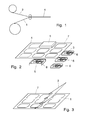
- Im folgenden wird die Erfindung anhand eines Ausführungsbeispiels veranschaulicht.
-
- Fig. 1
- die Bildung einer Folienanordnung zum Tiefziehen,
- Fig. 2
- das Tiefziehen der Folienanordnung zu einem Deckel und das Abtrennen von überschüssigem Material, und
- Fig. 3
- das Trennen des abgetrennten Materials zur Wiederverwertung.
- Mit 1 ist in
Fig. 1 eine Basisfolie aus einem Polypropylen bezeichnet. Diese Basisfolie 1 wird mit einer Deckfolie 2 zusammengebracht, die fertig zuläuft und die auf der der Basisfolie 1 zugewandten Seite mit einer Bedruckung 3 versehen ist. Die beiden Folien 1 und 2 werden über eine Anpresswalze zusammengefügt, so daß diese aneinander anhaften, indem zwischen den Folien 1 und 2 enthaltene Luft wenigstens weitgehend entfernt wird. Die Anhaftung der beiden Folien 1 und 2 aneinander ist jedoch gering. Es wird eine Folienanordnung 4 gebildet, die anschließend einer Tiefziehvorrichtung 5 zugeführt werden, die aus der Folienanordnung 4 Schalen 6 oder andere räumlich geformte Gegenstände erzeugt. - Es ist aber auch denkbar, daß eine Basisfolie 1 oder eine Deckfolie 2 aus einem Polyolefin bedruckt wird und anschließend die bedruckte Seite im Extrusionsbeschichtungs- oder -kaschierungsverfahren mit einer weiteren Folienschicht abgedeckt wird.
- Damit wird eine abgedeckte Bedruckung oder Metallisierung erzeugt, die durch eine Folienschicht insbesondere gegen Abrieb geschützt ist.
- Dabei kann die zunächst vorgesehene Folie 1 bzw. 2 entweder dick oder dünn ausgestaltet sein und der Materialauftrag entsprechend ausgerichtet sein.
- Die fertige Folie oder aber auch die aufextrudierte Beschichtung kann auch als Barriereschicht vorgesehen sein und aus entsprechendem Barrierematerial gegen Sauerstoff, Wasserdampf oder anderen Stoffen bestehen.
- Die Folienanordnung 4 ist breiter als der zu erzeugende Deckel 6, so daß beim Tiefziehen ein Rand 7 bestehen bleibt, der durch ein in der Tiefziehvorrichtung 5 angebrachtes, nicht näher dargestelltes Stanzwerkzeug vom Deckel 6 getrennt wird; bei mehreren gleichzeitig tiefgezogenen Deckeln 6 entstehen auch mehrere Ränder 7, die ebenfalls von dem Stanzwerkzeug abgetrennt werden.
- Es ist denkbar, daß der getrennte Rand 7 vom Deckel 6 weggeführt wird und automatisch oder manuell wieder in die Folien 1 und 2 getrennt wird. Hierzu ist es denkbar, daß nach anfänglicher manueller Trennung getrennte Haspeln für die beiden Folien 1 und 2 vorgesehen sind. Anschließend können die Reste der Folie 1 wieder der ursprünglichen Folienextrusion zugefügt werden.
- Beim Tiefziehen des Deckels 6 werden die Folienschichten 1 und 2 durch den Verformungsprozess, insbesondere durch den dabei auftretenden Druck und durch Streckungen fest miteinander verbunden. Die Umformdrücke liegen meist im Bereich zwischen 3 und 8 bar. Durch diesen hohen Druck werden auch kleinste Unebenheiten der Folienschichten 1 und 2 und der Bedruckung 3 genutzt um diese regelrecht miteinander zu verhaken. Zudem treten durch die beim Tiefziehen auftreneden Streckungen optisch nicht störende Mikrorisse in der Bedruckung 3 auf, durch die hindurch ein Zusammenhalt zwischen den Folienschichten 1 und 2 erzeugt wird. Wichtig ist dabei auch, daß eine Temperatur zwischen 140 und 165°C insbesondere bei Folienschichten aus Polypropylen eingehalten wird, da bei diesen Temperaturen eine der Verbindung förderliche Erweichung der Folienschichten erzielt wird.
- Es ist aber auch denkbar, daß die Verformung im Vakuumverfahren oder bei anderen Drücken erfolgt. Diese können auch von den miteinander zu verbindenden Materialien und den eingesetzten Druckfarben bzw. Lacken abhängig sein.
- Die meisten Folien weisen auf ihren beiden Oberseiten einen unterschiedlichen Glanzgrad auf. Durch das Zusammenfügen zweier Folien, bei denen jeweils die einen höheren Glanzgrad aufweisende Seite nach außen gerichtet ist, weist ingesamt einen sehr hohen Glanz und auch eine sehr hohe Transparenz auf. Die beiden nach innen gerichteten matteren Seiten verlieren durch das Verpressen beim Verformen ihre Mattigkeit.
- Es sind auch andere Gestaltungen mit eingefärbten oder mit definierter Opazität versehenen Deckschichten denkbar. Perlmutteffekte oder dergleichen lassen sich so einfach realisieren.
- Es ist auch denkbar, daß sowohl auf der Innenseite als auch auf der Außenseite des Deckels 6 eine Bedruckung vorgesehen ist. Eine oder beide können durch eine Deckschicht abgedeckt sein.
- Zwischen den Folienschichten 1 und 2 ist weder ein Haftvermittler noch ein Kaschierkleber vorgesehen. Vielmehr werden die Folienschichten nur physikalisch miteinander verbunden. Dieses Verbinden geschieht durch das Tiefziehen. Um die Erweichung im langsamer aufwärmenden Kern der Folienanordnung zu verbessern, kann eine niedrig schmelzende Schicht oder ein Siegellack vorgesehen werden, welche die Verbindung der Folienschichten zu verbessern vermögen.
- Eine vorgesehene Bedruckung oder Metallisierung oder dergleichen ist wirksam geschützt und vermag das zu verpackende Lebensmittel nicht zu kontaminieren.
- Die mechanische Verbindung mag zwar nicht so stabil sein, wie eine mit einem Kaschierkleber geschaffene Verbindung, jedoch ist diese völlig ausreichend und es wird dadurch auch die Möglichkeit eröffnet, die für die Schale verwendeten Materialien nach Gebrauch wieder voneinander zu trennen.
- Beim Tiefziehen muss für eine gute Verbindung der Schichten 1 und 2 eine Verformungszeit zwischen 0,5 und 5 Sekunden, bei PP vorzugsweise zwischen 1,5 und 5 Sekunden und eine Kühlzeit zwischen 0,2 und 1,5 Sekunden, bei PP zwischen 0,5 und 1,5 Sekunden eingehalten werden. Für andere Materialien können diese Zeiten ebenso variieren wie die anzuwendenden Verformungstemperaturen und die Verformungsdrücke.
- Durch den Verzicht auf Kaschierkleber und Haftvermittler werden nicht nur Materialkosten gespart. Vielmehr wird auch die Handhabung erheblich erleichtert.
- Zum Beispiel können die beiden Folienschichten 1 und 2 völlig getrennt voneinander gefertigt werden. Ebenso ist eine Inline-Extrusionsbeschichtung bzw. -kaschierung beim Bedrucken einer Folie denkbar. Die Deckschicht 2 ist im üblichen erheblich dünner als die Basisschicht 1. Durch das späte Zusammenbringen der beiden Schichten kann flexibel auf Dekor und Beschriftungsänderungen reagiert werden. Die einzelnen Folienschichten weisen meistens eine Dicke zwischen 20 und 90 µm auf, bei PP zwischen 50 und 70 µm, können aber bei anderen Materialien variieren. Es ist beispielsweise denkbar, daß die Schichtdicken bei steiferen Materialien reduziert werden.
- Meistens werden die dünneren Deckschichten 2 bedruckt. Gerade bei amorphen Kunststoffen wie zum Beispiel APET kann aber auch die dickere Basisschicht bedruckt werden und diese dann extrusionsbeschichtet werden. Hierdurch wird ein durch die auftretenden Temperaturen bedingter Schrumpf wirksam vermieden.
- Außerdem ist es auch möglich, eigentlich unverträgliche Folienschichten 1 und 2 miteinander auf diese Art und Weise zu verbinden. Durch die physikalische Verbindung der Folienschichten haften auch diese eigentlich unverträglichen Materialien aneinander, ohne daß es dem Einsatz aufwendiger Verfahren und teurer Haftvermittler bedarf. Es sind Aufbauten denkbar, die eine Folienlage aus PE mit einer Folienlage aus PP kombinieren.
- Der Verzicht auf Kaschierkleber und Haftvermittler ist auch gerade im Bereich von Lebensmittelverpackungen sehr vorteilhaft. Einerseits fällt dadurch die Notwendigkeit des Nachweises der nötigen Unbedenklichkeit weg. Andererseits wird aber auch die Wahrscheinlichkeit, daß diese Substanzen in die Lebensmittel gelangen können beseitigt.
- Zudem wird eine Inline-Extrusionsbeschichtung bzw. -kaschierung erheblich erleichter bzw. erst ermöglicht.
- Für die Folienschichten haben sich Polypropylen, insbesondere als Homopolymer und Copolymer in unterschiedlichen Mischungsverhältnissen als sehr vorteilhaft erwiesen. Polypropylen Homopolymer kann beispielsweise zwischen 0 und 100% vorgesehen sein, wobei sich zwischen 45 und 55%, insbesondere 50% und zwischen 75 und 85%, insbesondere 80% als besonders gut geeignet erwiesen haben. Der Rest ist dabei vorteilhafter weise durch Polypropylen Copolymer ergänzt.
- Der Einsatz von Hilfsstoffen ist denkbar.
- Es ist aber auch denkbar, daß Polyethylen, PLA oder auch andere thermoplastisch verformbare, insbesondere tiefziehbare Kunststoffe wie zum Beispiel PS, APET eingesetzt werden können.
- Die Folien 1 und 2 sollten nicht gereckt sein um einen Schrumpf beim Zusammenfügen des Folienaufbaus zu vermeiden.
Claims (17)
Applications Claiming Priority (1)
| Application Number | Priority Date | Filing Date | Title |
|---|---|---|---|
| DE102008031616A DE102008031616A1 (de) | 2008-07-07 | 2008-07-07 | Verfahren zum Herstellen von thermoplastisch geformten Anordnungen und Folienanordnung |
Publications (3)
| Publication Number | Publication Date |
|---|---|
| EP2143548A2 true EP2143548A2 (de) | 2010-01-13 |
| EP2143548A3 EP2143548A3 (de) | 2013-03-06 |
| EP2143548B1 EP2143548B1 (de) | 2023-05-17 |
Family
ID=40984913
Family Applications (1)
| Application Number | Title | Priority Date | Filing Date |
|---|---|---|---|
| EP09164427.8A Active EP2143548B1 (de) | 2008-07-07 | 2009-07-02 | Verfahren zum Herstellen von thermoplastisch geformten Anordnungen und Folienanordnung |
Country Status (7)
| Country | Link |
|---|---|
| EP (1) | EP2143548B1 (de) |
| DE (1) | DE102008031616A1 (de) |
| DK (1) | DK2143548T3 (de) |
| ES (1) | ES2948942T3 (de) |
| FI (1) | FI2143548T3 (de) |
| HU (1) | HUE063221T2 (de) |
| PL (1) | PL2143548T3 (de) |
Cited By (2)
| Publication number | Priority date | Publication date | Assignee | Title |
|---|---|---|---|---|
| EP2444236A3 (de) * | 2009-08-03 | 2015-03-11 | Paccor Deutschland GmbH | Verfahren zum Herstellen von thermoplastisch geformten Anordnungen und Folienanordnung |
| CN118024680A (zh) * | 2023-12-25 | 2024-05-14 | 桐乡市佑泰新材料有限公司 | 一种复合铝箔及其加工设备 |
Family Cites Families (6)
| Publication number | Priority date | Publication date | Assignee | Title |
|---|---|---|---|---|
| US5366791A (en) * | 1990-07-06 | 1994-11-22 | Paramount Packaging Corporation | Thermoformable laminate material with registered print and method of making the same |
| JPH04158025A (ja) * | 1990-10-23 | 1992-06-01 | Hitachi Chem Co Ltd | 繊維強化プラスチツク成形品の製造法 |
| US6835266B2 (en) * | 2001-08-02 | 2004-12-28 | Lear Corporation | Shuttle system for manufacturing vehicle headliners |
| DE10350787A1 (de) * | 2003-10-29 | 2005-05-25 | Röhm GmbH & Co. KG | Verfahren zur Herstellung eines dreidimensional geformten Schichtverbund-Bauteils aus Rohacell |
| WO2007006006A1 (en) * | 2005-07-06 | 2007-01-11 | Avery Dennison Corporation | Textured screen-printed laminates |
| DE102005062352B4 (de) * | 2005-12-23 | 2009-09-17 | Sks Sitzkomponenten Gmbh & Co. Kg | Verfahren zur Herstellung von Formteillaminaten |
-
2008
- 2008-07-07 DE DE102008031616A patent/DE102008031616A1/de not_active Ceased
-
2009
- 2009-07-02 DK DK09164427.8T patent/DK2143548T3/da active
- 2009-07-02 HU HUE09164427A patent/HUE063221T2/hu unknown
- 2009-07-02 FI FIEP09164427.8T patent/FI2143548T3/en active
- 2009-07-02 ES ES09164427T patent/ES2948942T3/es active Active
- 2009-07-02 EP EP09164427.8A patent/EP2143548B1/de active Active
- 2009-07-02 PL PL09164427.8T patent/PL2143548T3/pl unknown
Cited By (3)
| Publication number | Priority date | Publication date | Assignee | Title |
|---|---|---|---|---|
| EP2444236A3 (de) * | 2009-08-03 | 2015-03-11 | Paccor Deutschland GmbH | Verfahren zum Herstellen von thermoplastisch geformten Anordnungen und Folienanordnung |
| EP2444236B1 (de) | 2009-08-03 | 2018-06-13 | Coveris Rigid (Zell) Deutschland GmbH | Verfahren zum Herstellen von thermoplastisch geformten Anordnungen und Folienanordnung |
| CN118024680A (zh) * | 2023-12-25 | 2024-05-14 | 桐乡市佑泰新材料有限公司 | 一种复合铝箔及其加工设备 |
Also Published As
| Publication number | Publication date |
|---|---|
| EP2143548A3 (de) | 2013-03-06 |
| ES2948942T3 (es) | 2023-09-22 |
| EP2143548B1 (de) | 2023-05-17 |
| DE102008031616A1 (de) | 2010-01-14 |
| HUE063221T2 (hu) | 2024-01-28 |
| FI2143548T3 (en) | 2023-07-10 |
| PL2143548T3 (pl) | 2023-08-14 |
| DK2143548T3 (da) | 2023-07-10 |
Similar Documents
| Publication | Publication Date | Title |
|---|---|---|
| EP1351823B1 (de) | Etikettenfolie mit verbesserter haftfähigkeit | |
| EP3411308B1 (de) | Folienverpackungsmaterial | |
| AT521168B1 (de) | Recycelfreundliches Verpackungslaminat mit verbesserter Wärmebeständigkeit beim Siegeln | |
| EP2205435B1 (de) | Etikettenfolie für rundumetiketten | |
| DE102010021892A1 (de) | Verfahren und Vorrichtung zur Kaschierung eines 3D-Trägerteils mit einem Schichtstoff | |
| DE10235557A1 (de) | Etikettenfolie für In-Mould-Verfahren | |
| EP1841594A1 (de) | Siegelbares tubenlaminat | |
| DE4410235C2 (de) | Siegelfähige, peelbare Kunststoffolie auf Polypropylen-Basis | |
| EP2421698B1 (de) | Etikettenfolie | |
| EP2387493B1 (de) | Verwendung einer etikettenfolie für tiefziehverfahren | |
| EP2444236B1 (de) | Verfahren zum Herstellen von thermoplastisch geformten Anordnungen und Folienanordnung | |
| EP3888911B1 (de) | Metallisierte verpackungsfolien aus recycling-kunststoffen | |
| DE19610028A1 (de) | Folie zur Beschichtung von nachbearbeitbaren Substraten | |
| EP2143548A2 (de) | Verfahren zum Herstellen von thermoplastisch geformten Anordnungen und Folienanordnung | |
| DE10128711A1 (de) | Etikettenfolie mit verbesserter Haftfähigkeit | |
| EP0524488A1 (de) | Siegelfähige, peelbare Kunststoffolie | |
| EP1896257B1 (de) | Laminat für tuben- und behälterkonstruktionen | |
| DE102013108693B3 (de) | Schale | |
| DE102005036258A1 (de) | Dekorfolien und Verfahren zu deren Herstellung | |
| WO2006096894A1 (de) | Verbundmaterial für verschlusselemente, verfahren zu dessen herstellung sowie dessen verwendung | |
| DE102005046309B4 (de) | Verbundmaterial | |
| DE102015100106A1 (de) | Laminat, insbesondere zur Herstellung von Deckelmaterial, Verfahren zu dessen Herstellung sowie Deckelmaterial aus einem solchen Laminat | |
| DE102014101741B4 (de) | Verpackung | |
| DE102019118304A1 (de) | Durchsichtiger oder zumindest kontakttransparenter Papier-Folie-Verbund und daraus hergestellte Verpackungen | |
| DE102004059138A1 (de) | Verbundfolie, insbesondere Tubenverbundfolie und Verfahren zu ihrer Herstellung |
Legal Events
| Date | Code | Title | Description |
|---|---|---|---|
| PUAI | Public reference made under article 153(3) epc to a published international application that has entered the european phase |
Free format text: ORIGINAL CODE: 0009012 |
|
| AK | Designated contracting states |
Kind code of ref document: A2 Designated state(s): AT BE BG CH CY CZ DE DK EE ES FI FR GB GR HR HU IE IS IT LI LT LU LV MC MK MT NL NO PL PT RO SE SI SK SM TR |
|
| RIC1 | Information provided on ipc code assigned before grant |
Ipc: B32B 27/36 20060101ALI20120904BHEP Ipc: B41M 1/30 20060101ALI20120904BHEP Ipc: B32B 27/30 20060101ALI20120904BHEP Ipc: B29C 51/02 20060101AFI20120904BHEP Ipc: B29C 51/10 20060101ALI20120904BHEP Ipc: B32B 27/32 20060101ALI20120904BHEP Ipc: B29C 51/14 20060101ALI20120904BHEP |
|
| PUAL | Search report despatched |
Free format text: ORIGINAL CODE: 0009013 |
|
| AK | Designated contracting states |
Kind code of ref document: A3 Designated state(s): AT BE BG CH CY CZ DE DK EE ES FI FR GB GR HR HU IE IS IT LI LT LU LV MC MK MT NL NO PL PT RO SE SI SK SM TR |
|
| AX | Request for extension of the european patent |
Extension state: AL BA RS |
|
| RIC1 | Information provided on ipc code assigned before grant |
Ipc: B29C 51/10 20060101ALI20130125BHEP Ipc: B41M 1/30 20060101ALI20130125BHEP Ipc: B32B 27/30 20060101ALI20130125BHEP Ipc: B29C 51/14 20060101ALI20130125BHEP Ipc: B32B 27/32 20060101ALI20130125BHEP Ipc: B29C 51/02 20060101AFI20130125BHEP Ipc: B32B 27/36 20060101ALI20130125BHEP |
|
| 17P | Request for examination filed |
Effective date: 20130625 |
|
| RBV | Designated contracting states (corrected) |
Designated state(s): AT BE BG CH CY CZ DE DK EE ES FI FR GB GR HR HU IE IS IT LI LT LU LV MC MK MT NL NO PL PT RO SE SI SK SM TR |
|
| RAP1 | Party data changed (applicant data changed or rights of an application transferred) |
Owner name: PACCOR DEUTSCHLAND GMBH |
|
| STAA | Information on the status of an ep patent application or granted ep patent |
Free format text: STATUS: EXAMINATION IS IN PROGRESS |
|
| 17Q | First examination report despatched |
Effective date: 20180319 |
|
| RAP1 | Party data changed (applicant data changed or rights of an application transferred) |
Owner name: PACCOR PACKAGING GMBH |
|
| GRAP | Despatch of communication of intention to grant a patent |
Free format text: ORIGINAL CODE: EPIDOSNIGR1 |
|
| STAA | Information on the status of an ep patent application or granted ep patent |
Free format text: STATUS: GRANT OF PATENT IS INTENDED |
|
| INTG | Intention to grant announced |
Effective date: 20221207 |
|
| GRAS | Grant fee paid |
Free format text: ORIGINAL CODE: EPIDOSNIGR3 |
|
| GRAA | (expected) grant |
Free format text: ORIGINAL CODE: 0009210 |
|
| STAA | Information on the status of an ep patent application or granted ep patent |
Free format text: STATUS: THE PATENT HAS BEEN GRANTED |
|
| AK | Designated contracting states |
Kind code of ref document: B1 Designated state(s): AT BE BG CH CY CZ DE DK EE ES FI FR GB GR HR HU IE IS IT LI LT LU LV MC MK MT NL NO PL PT RO SE SI SK SM TR |
|
| REG | Reference to a national code |
Ref country code: GB Ref legal event code: FG4D Free format text: NOT ENGLISH |
|
| REG | Reference to a national code |
Ref country code: DE Ref legal event code: R096 Ref document number: 502009016460 Country of ref document: DE |
|
| REG | Reference to a national code |
Ref country code: CH Ref legal event code: EP |
|
| REG | Reference to a national code |
Ref country code: IE Ref legal event code: FG4D Free format text: LANGUAGE OF EP DOCUMENT: GERMAN |
|
| REG | Reference to a national code |
Ref country code: AT Ref legal event code: REF Ref document number: 1568230 Country of ref document: AT Kind code of ref document: T Effective date: 20230615 |
|
| P01 | Opt-out of the competence of the unified patent court (upc) registered |
Effective date: 20230524 |
|
| REG | Reference to a national code |
Ref country code: DK Ref legal event code: T3 Effective date: 20230708 Ref country code: FI Ref legal event code: FGE |
|
| REG | Reference to a national code |
Ref country code: LT Ref legal event code: MG9D |
|
| REG | Reference to a national code |
Ref country code: ES Ref legal event code: FG2A Ref document number: 2948942 Country of ref document: ES Kind code of ref document: T3 Effective date: 20230922 |
|
| PG25 | Lapsed in a contracting state [announced via postgrant information from national office to epo] |
Ref country code: SE Free format text: LAPSE BECAUSE OF FAILURE TO SUBMIT A TRANSLATION OF THE DESCRIPTION OR TO PAY THE FEE WITHIN THE PRESCRIBED TIME-LIMIT Effective date: 20230517 Ref country code: PT Free format text: LAPSE BECAUSE OF FAILURE TO SUBMIT A TRANSLATION OF THE DESCRIPTION OR TO PAY THE FEE WITHIN THE PRESCRIBED TIME-LIMIT Effective date: 20230918 Ref country code: NO Free format text: LAPSE BECAUSE OF FAILURE TO SUBMIT A TRANSLATION OF THE DESCRIPTION OR TO PAY THE FEE WITHIN THE PRESCRIBED TIME-LIMIT Effective date: 20230817 Ref country code: NL Free format text: LAPSE BECAUSE OF FAILURE TO SUBMIT A TRANSLATION OF THE DESCRIPTION OR TO PAY THE FEE WITHIN THE PRESCRIBED TIME-LIMIT Effective date: 20230517 |
|
| PGFP | Annual fee paid to national office [announced via postgrant information from national office to epo] |
Ref country code: GB Payment date: 20230724 Year of fee payment: 15 Ref country code: FI Payment date: 20230719 Year of fee payment: 15 Ref country code: ES Payment date: 20230821 Year of fee payment: 15 Ref country code: CH Payment date: 20230801 Year of fee payment: 15 Ref country code: AT Payment date: 20230718 Year of fee payment: 15 |
|
| PG25 | Lapsed in a contracting state [announced via postgrant information from national office to epo] |
Ref country code: LV Free format text: LAPSE BECAUSE OF FAILURE TO SUBMIT A TRANSLATION OF THE DESCRIPTION OR TO PAY THE FEE WITHIN THE PRESCRIBED TIME-LIMIT Effective date: 20230517 Ref country code: LT Free format text: LAPSE BECAUSE OF FAILURE TO SUBMIT A TRANSLATION OF THE DESCRIPTION OR TO PAY THE FEE WITHIN THE PRESCRIBED TIME-LIMIT Effective date: 20230517 Ref country code: IS Free format text: LAPSE BECAUSE OF FAILURE TO SUBMIT A TRANSLATION OF THE DESCRIPTION OR TO PAY THE FEE WITHIN THE PRESCRIBED TIME-LIMIT Effective date: 20230917 Ref country code: HR Free format text: LAPSE BECAUSE OF FAILURE TO SUBMIT A TRANSLATION OF THE DESCRIPTION OR TO PAY THE FEE WITHIN THE PRESCRIBED TIME-LIMIT Effective date: 20230517 Ref country code: GR Free format text: LAPSE BECAUSE OF FAILURE TO SUBMIT A TRANSLATION OF THE DESCRIPTION OR TO PAY THE FEE WITHIN THE PRESCRIBED TIME-LIMIT Effective date: 20230818 |
|
| PGFP | Annual fee paid to national office [announced via postgrant information from national office to epo] |
Ref country code: PL Payment date: 20230707 Year of fee payment: 15 Ref country code: FR Payment date: 20230724 Year of fee payment: 15 Ref country code: DK Payment date: 20230724 Year of fee payment: 15 Ref country code: DE Payment date: 20230720 Year of fee payment: 15 |
|
| PG25 | Lapsed in a contracting state [announced via postgrant information from national office to epo] |
Ref country code: SK Free format text: LAPSE BECAUSE OF FAILURE TO SUBMIT A TRANSLATION OF THE DESCRIPTION OR TO PAY THE FEE WITHIN THE PRESCRIBED TIME-LIMIT Effective date: 20230517 |
|
| REG | Reference to a national code |
Ref country code: HU Ref legal event code: AG4A Ref document number: E063221 Country of ref document: HU |
|
| PG25 | Lapsed in a contracting state [announced via postgrant information from national office to epo] |
Ref country code: SM Free format text: LAPSE BECAUSE OF FAILURE TO SUBMIT A TRANSLATION OF THE DESCRIPTION OR TO PAY THE FEE WITHIN THE PRESCRIBED TIME-LIMIT Effective date: 20230517 Ref country code: SK Free format text: LAPSE BECAUSE OF FAILURE TO SUBMIT A TRANSLATION OF THE DESCRIPTION OR TO PAY THE FEE WITHIN THE PRESCRIBED TIME-LIMIT Effective date: 20230517 Ref country code: RO Free format text: LAPSE BECAUSE OF FAILURE TO SUBMIT A TRANSLATION OF THE DESCRIPTION OR TO PAY THE FEE WITHIN THE PRESCRIBED TIME-LIMIT Effective date: 20230517 Ref country code: EE Free format text: LAPSE BECAUSE OF FAILURE TO SUBMIT A TRANSLATION OF THE DESCRIPTION OR TO PAY THE FEE WITHIN THE PRESCRIBED TIME-LIMIT Effective date: 20230517 Ref country code: CZ Free format text: LAPSE BECAUSE OF FAILURE TO SUBMIT A TRANSLATION OF THE DESCRIPTION OR TO PAY THE FEE WITHIN THE PRESCRIBED TIME-LIMIT Effective date: 20230517 |
|
| PGFP | Annual fee paid to national office [announced via postgrant information from national office to epo] |
Ref country code: HU Payment date: 20230803 Year of fee payment: 15 |
|
| REG | Reference to a national code |
Ref country code: DE Ref legal event code: R097 Ref document number: 502009016460 Country of ref document: DE |
|
| PG25 | Lapsed in a contracting state [announced via postgrant information from national office to epo] |
Ref country code: MC Free format text: LAPSE BECAUSE OF FAILURE TO SUBMIT A TRANSLATION OF THE DESCRIPTION OR TO PAY THE FEE WITHIN THE PRESCRIBED TIME-LIMIT Effective date: 20230517 |
|
| PG25 | Lapsed in a contracting state [announced via postgrant information from national office to epo] |
Ref country code: MC Free format text: LAPSE BECAUSE OF FAILURE TO SUBMIT A TRANSLATION OF THE DESCRIPTION OR TO PAY THE FEE WITHIN THE PRESCRIBED TIME-LIMIT Effective date: 20230517 |
|
| REG | Reference to a national code |
Ref country code: BE Ref legal event code: MM Effective date: 20230731 |
|
| PG25 | Lapsed in a contracting state [announced via postgrant information from national office to epo] |
Ref country code: LU Free format text: LAPSE BECAUSE OF NON-PAYMENT OF DUE FEES Effective date: 20230702 |
|
| PLBE | No opposition filed within time limit |
Free format text: ORIGINAL CODE: 0009261 |
|
| STAA | Information on the status of an ep patent application or granted ep patent |
Free format text: STATUS: NO OPPOSITION FILED WITHIN TIME LIMIT |
|
| PG25 | Lapsed in a contracting state [announced via postgrant information from national office to epo] |
Ref country code: LU Free format text: LAPSE BECAUSE OF NON-PAYMENT OF DUE FEES Effective date: 20230702 |
|
| 26N | No opposition filed |
Effective date: 20240220 |
|
| REG | Reference to a national code |
Ref country code: IE Ref legal event code: MM4A |
|
| PG25 | Lapsed in a contracting state [announced via postgrant information from national office to epo] |
Ref country code: SI Free format text: LAPSE BECAUSE OF FAILURE TO SUBMIT A TRANSLATION OF THE DESCRIPTION OR TO PAY THE FEE WITHIN THE PRESCRIBED TIME-LIMIT Effective date: 20230517 |
|
| PG25 | Lapsed in a contracting state [announced via postgrant information from national office to epo] |
Ref country code: SI Free format text: LAPSE BECAUSE OF FAILURE TO SUBMIT A TRANSLATION OF THE DESCRIPTION OR TO PAY THE FEE WITHIN THE PRESCRIBED TIME-LIMIT Effective date: 20230517 Ref country code: IT Free format text: LAPSE BECAUSE OF FAILURE TO SUBMIT A TRANSLATION OF THE DESCRIPTION OR TO PAY THE FEE WITHIN THE PRESCRIBED TIME-LIMIT Effective date: 20230517 Ref country code: BE Free format text: LAPSE BECAUSE OF NON-PAYMENT OF DUE FEES Effective date: 20230731 |
|
| PG25 | Lapsed in a contracting state [announced via postgrant information from national office to epo] |
Ref country code: IE Free format text: LAPSE BECAUSE OF NON-PAYMENT OF DUE FEES Effective date: 20230702 |
|
| PG25 | Lapsed in a contracting state [announced via postgrant information from national office to epo] |
Ref country code: IE Free format text: LAPSE BECAUSE OF NON-PAYMENT OF DUE FEES Effective date: 20230702 |
|
| PG25 | Lapsed in a contracting state [announced via postgrant information from national office to epo] |
Ref country code: BG Free format text: LAPSE BECAUSE OF FAILURE TO SUBMIT A TRANSLATION OF THE DESCRIPTION OR TO PAY THE FEE WITHIN THE PRESCRIBED TIME-LIMIT Effective date: 20230517 |
|
| PG25 | Lapsed in a contracting state [announced via postgrant information from national office to epo] |
Ref country code: BG Free format text: LAPSE BECAUSE OF FAILURE TO SUBMIT A TRANSLATION OF THE DESCRIPTION OR TO PAY THE FEE WITHIN THE PRESCRIBED TIME-LIMIT Effective date: 20230517 |
|
| REG | Reference to a national code |
Ref country code: DE Ref legal event code: R119 Ref document number: 502009016460 Country of ref document: DE |
|
| REG | Reference to a national code |
Ref country code: DK Ref legal event code: EBP Effective date: 20240731 |
|
| REG | Reference to a national code |
Ref country code: CH Ref legal event code: PL |
|
| REG | Reference to a national code |
Ref country code: AT Ref legal event code: MM01 Ref document number: 1568230 Country of ref document: AT Kind code of ref document: T Effective date: 20240702 |
|
| GBPC | Gb: european patent ceased through non-payment of renewal fee |
Effective date: 20240702 |
|
| PG25 | Lapsed in a contracting state [announced via postgrant information from national office to epo] |
Ref country code: HU Free format text: LAPSE BECAUSE OF NON-PAYMENT OF DUE FEES Effective date: 20240703 |
|
| PG25 | Lapsed in a contracting state [announced via postgrant information from national office to epo] |
Ref country code: HU Free format text: LAPSE BECAUSE OF NON-PAYMENT OF DUE FEES Effective date: 20240703 |
|
| PG25 | Lapsed in a contracting state [announced via postgrant information from national office to epo] |
Ref country code: DE Free format text: LAPSE BECAUSE OF NON-PAYMENT OF DUE FEES Effective date: 20250201 |
|
| PG25 | Lapsed in a contracting state [announced via postgrant information from national office to epo] |
Ref country code: FI Free format text: LAPSE BECAUSE OF NON-PAYMENT OF DUE FEES Effective date: 20240702 |
|
| PG25 | Lapsed in a contracting state [announced via postgrant information from national office to epo] |
Ref country code: AT Free format text: LAPSE BECAUSE OF NON-PAYMENT OF DUE FEES Effective date: 20240702 Ref country code: CH Free format text: LAPSE BECAUSE OF NON-PAYMENT OF DUE FEES Effective date: 20240731 |
|
| PG25 | Lapsed in a contracting state [announced via postgrant information from national office to epo] |
Ref country code: FR Free format text: LAPSE BECAUSE OF NON-PAYMENT OF DUE FEES Effective date: 20240731 |
|
| PG25 | Lapsed in a contracting state [announced via postgrant information from national office to epo] |
Ref country code: GB Free format text: LAPSE BECAUSE OF NON-PAYMENT OF DUE FEES Effective date: 20240702 |
|
| PG25 | Lapsed in a contracting state [announced via postgrant information from national office to epo] |
Ref country code: DK Free format text: LAPSE BECAUSE OF NON-PAYMENT OF DUE FEES Effective date: 20240731 |
|
| REG | Reference to a national code |
Ref country code: ES Ref legal event code: FD2A Effective date: 20250826 |
|
| PG25 | Lapsed in a contracting state [announced via postgrant information from national office to epo] |
Ref country code: CY Free format text: LAPSE BECAUSE OF FAILURE TO SUBMIT A TRANSLATION OF THE DESCRIPTION OR TO PAY THE FEE WITHIN THE PRESCRIBED TIME-LIMIT; INVALID AB INITIO Effective date: 20090702 |
|
| PG25 | Lapsed in a contracting state [announced via postgrant information from national office to epo] |
Ref country code: ES Free format text: LAPSE BECAUSE OF NON-PAYMENT OF DUE FEES Effective date: 20240703 |
|
| PG25 | Lapsed in a contracting state [announced via postgrant information from national office to epo] |
Ref country code: TR Free format text: LAPSE BECAUSE OF FAILURE TO SUBMIT A TRANSLATION OF THE DESCRIPTION OR TO PAY THE FEE WITHIN THE PRESCRIBED TIME-LIMIT Effective date: 20230517 |
|
| PG25 | Lapsed in a contracting state [announced via postgrant information from national office to epo] |
Ref country code: PL Free format text: LAPSE BECAUSE OF NON-PAYMENT OF DUE FEES Effective date: 20240702 |