EP2151214B1 - Barbotine durcissant à la lumière pour la fabrication stéréolithographique de céramiques dentaires - Google Patents
Barbotine durcissant à la lumière pour la fabrication stéréolithographique de céramiques dentaires Download PDFInfo
- Publication number
- EP2151214B1 EP2151214B1 EP08161505A EP08161505A EP2151214B1 EP 2151214 B1 EP2151214 B1 EP 2151214B1 EP 08161505 A EP08161505 A EP 08161505A EP 08161505 A EP08161505 A EP 08161505A EP 2151214 B1 EP2151214 B1 EP 2151214B1
- Authority
- EP
- European Patent Office
- Prior art keywords
- ceramic
- acid
- slip
- slip according
- iii
- Prior art date
- Legal status (The legal status is an assumption and is not a legal conclusion. Google has not performed a legal analysis and makes no representation as to the accuracy of the status listed.)
- Active
Links
Images
Classifications
-
- A—HUMAN NECESSITIES
- A61—MEDICAL OR VETERINARY SCIENCE; HYGIENE
- A61L—METHODS OR APPARATUS FOR STERILISING MATERIALS OR OBJECTS IN GENERAL; DISINFECTION, STERILISATION OR DEODORISATION OF AIR; CHEMICAL ASPECTS OF BANDAGES, DRESSINGS, ABSORBENT PADS OR SURGICAL ARTICLES; MATERIALS FOR BANDAGES, DRESSINGS, ABSORBENT PADS OR SURGICAL ARTICLES
- A61L27/00—Materials for grafts or prostheses or for coating grafts or prostheses
- A61L27/40—Composite materials, i.e. containing one material dispersed in a matrix of the same or different material
- A61L27/44—Composite materials, i.e. containing one material dispersed in a matrix of the same or different material having a macromolecular matrix
- A61L27/46—Composite materials, i.e. containing one material dispersed in a matrix of the same or different material having a macromolecular matrix with phosphorus-containing inorganic fillers
-
- A—HUMAN NECESSITIES
- A61—MEDICAL OR VETERINARY SCIENCE; HYGIENE
- A61K—PREPARATIONS FOR MEDICAL, DENTAL OR TOILETRY PURPOSES
- A61K6/00—Preparations for dentistry
- A61K6/80—Preparations for artificial teeth, for filling teeth or for capping teeth
- A61K6/802—Preparations for artificial teeth, for filling teeth or for capping teeth comprising ceramics
- A61K6/807—Preparations for artificial teeth, for filling teeth or for capping teeth comprising ceramics comprising magnesium oxide
-
- A—HUMAN NECESSITIES
- A61—MEDICAL OR VETERINARY SCIENCE; HYGIENE
- A61K—PREPARATIONS FOR MEDICAL, DENTAL OR TOILETRY PURPOSES
- A61K6/00—Preparations for dentistry
- A61K6/80—Preparations for artificial teeth, for filling teeth or for capping teeth
- A61K6/802—Preparations for artificial teeth, for filling teeth or for capping teeth comprising ceramics
- A61K6/818—Preparations for artificial teeth, for filling teeth or for capping teeth comprising ceramics comprising zirconium oxide
-
- A—HUMAN NECESSITIES
- A61—MEDICAL OR VETERINARY SCIENCE; HYGIENE
- A61K—PREPARATIONS FOR MEDICAL, DENTAL OR TOILETRY PURPOSES
- A61K6/00—Preparations for dentistry
- A61K6/80—Preparations for artificial teeth, for filling teeth or for capping teeth
- A61K6/802—Preparations for artificial teeth, for filling teeth or for capping teeth comprising ceramics
- A61K6/822—Preparations for artificial teeth, for filling teeth or for capping teeth comprising ceramics comprising rare earth metal oxides
-
- A—HUMAN NECESSITIES
- A61—MEDICAL OR VETERINARY SCIENCE; HYGIENE
- A61K—PREPARATIONS FOR MEDICAL, DENTAL OR TOILETRY PURPOSES
- A61K6/00—Preparations for dentistry
- A61K6/80—Preparations for artificial teeth, for filling teeth or for capping teeth
- A61K6/831—Preparations for artificial teeth, for filling teeth or for capping teeth comprising non-metallic elements or compounds thereof, e.g. carbon
- A61K6/833—Glass-ceramic composites
-
- B—PERFORMING OPERATIONS; TRANSPORTING
- B33—ADDITIVE MANUFACTURING TECHNOLOGY
- B33Y—ADDITIVE MANUFACTURING, i.e. MANUFACTURING OF THREE-DIMENSIONAL [3D] OBJECTS BY ADDITIVE DEPOSITION, ADDITIVE AGGLOMERATION OR ADDITIVE LAYERING, e.g. BY 3D PRINTING, STEREOLITHOGRAPHY OR SELECTIVE LASER SINTERING
- B33Y70/00—Materials specially adapted for additive manufacturing
- B33Y70/10—Composites of different types of material, e.g. mixtures of ceramics and polymers or mixtures of metals and biomaterials
-
- C—CHEMISTRY; METALLURGY
- C04—CEMENTS; CONCRETE; ARTIFICIAL STONE; CERAMICS; REFRACTORIES
- C04B—LIME, MAGNESIA; SLAG; CEMENTS; COMPOSITIONS THEREOF, e.g. MORTARS, CONCRETE OR LIKE BUILDING MATERIALS; ARTIFICIAL STONE; CERAMICS; REFRACTORIES; TREATMENT OF NATURAL STONE
- C04B35/00—Shaped ceramic products characterised by their composition; Ceramics compositions; Processing powders of inorganic compounds preparatory to the manufacturing of ceramic products
- C04B35/01—Shaped ceramic products characterised by their composition; Ceramics compositions; Processing powders of inorganic compounds preparatory to the manufacturing of ceramic products based on oxide ceramics
- C04B35/10—Shaped ceramic products characterised by their composition; Ceramics compositions; Processing powders of inorganic compounds preparatory to the manufacturing of ceramic products based on oxide ceramics based on aluminium oxide
- C04B35/111—Fine ceramics
-
- C—CHEMISTRY; METALLURGY
- C04—CEMENTS; CONCRETE; ARTIFICIAL STONE; CERAMICS; REFRACTORIES
- C04B—LIME, MAGNESIA; SLAG; CEMENTS; COMPOSITIONS THEREOF, e.g. MORTARS, CONCRETE OR LIKE BUILDING MATERIALS; ARTIFICIAL STONE; CERAMICS; REFRACTORIES; TREATMENT OF NATURAL STONE
- C04B35/00—Shaped ceramic products characterised by their composition; Ceramics compositions; Processing powders of inorganic compounds preparatory to the manufacturing of ceramic products
- C04B35/01—Shaped ceramic products characterised by their composition; Ceramics compositions; Processing powders of inorganic compounds preparatory to the manufacturing of ceramic products based on oxide ceramics
- C04B35/48—Shaped ceramic products characterised by their composition; Ceramics compositions; Processing powders of inorganic compounds preparatory to the manufacturing of ceramic products based on oxide ceramics based on zirconium or hafnium oxides, zirconates, zircon or hafnates
- C04B35/486—Fine ceramics
-
- C—CHEMISTRY; METALLURGY
- C04—CEMENTS; CONCRETE; ARTIFICIAL STONE; CERAMICS; REFRACTORIES
- C04B—LIME, MAGNESIA; SLAG; CEMENTS; COMPOSITIONS THEREOF, e.g. MORTARS, CONCRETE OR LIKE BUILDING MATERIALS; ARTIFICIAL STONE; CERAMICS; REFRACTORIES; TREATMENT OF NATURAL STONE
- C04B35/00—Shaped ceramic products characterised by their composition; Ceramics compositions; Processing powders of inorganic compounds preparatory to the manufacturing of ceramic products
- C04B35/622—Forming processes; Processing powders of inorganic compounds preparatory to the manufacturing of ceramic products
- C04B35/626—Preparing or treating the powders individually or as batches ; preparing or treating macroscopic reinforcing agents for ceramic products, e.g. fibres; mechanical aspects section B
- C04B35/62605—Treating the starting powders individually or as mixtures
- C04B35/62625—Wet mixtures
- C04B35/6263—Wet mixtures characterised by their solids loadings, i.e. the percentage of solids
-
- C—CHEMISTRY; METALLURGY
- C04—CEMENTS; CONCRETE; ARTIFICIAL STONE; CERAMICS; REFRACTORIES
- C04B—LIME, MAGNESIA; SLAG; CEMENTS; COMPOSITIONS THEREOF, e.g. MORTARS, CONCRETE OR LIKE BUILDING MATERIALS; ARTIFICIAL STONE; CERAMICS; REFRACTORIES; TREATMENT OF NATURAL STONE
- C04B35/00—Shaped ceramic products characterised by their composition; Ceramics compositions; Processing powders of inorganic compounds preparatory to the manufacturing of ceramic products
- C04B35/622—Forming processes; Processing powders of inorganic compounds preparatory to the manufacturing of ceramic products
- C04B35/626—Preparing or treating the powders individually or as batches ; preparing or treating macroscopic reinforcing agents for ceramic products, e.g. fibres; mechanical aspects section B
- C04B35/62605—Treating the starting powders individually or as mixtures
- C04B35/62625—Wet mixtures
- C04B35/6264—Mixing media, e.g. organic solvents
-
- C—CHEMISTRY; METALLURGY
- C04—CEMENTS; CONCRETE; ARTIFICIAL STONE; CERAMICS; REFRACTORIES
- C04B—LIME, MAGNESIA; SLAG; CEMENTS; COMPOSITIONS THEREOF, e.g. MORTARS, CONCRETE OR LIKE BUILDING MATERIALS; ARTIFICIAL STONE; CERAMICS; REFRACTORIES; TREATMENT OF NATURAL STONE
- C04B35/00—Shaped ceramic products characterised by their composition; Ceramics compositions; Processing powders of inorganic compounds preparatory to the manufacturing of ceramic products
- C04B35/622—Forming processes; Processing powders of inorganic compounds preparatory to the manufacturing of ceramic products
- C04B35/626—Preparing or treating the powders individually or as batches ; preparing or treating macroscopic reinforcing agents for ceramic products, e.g. fibres; mechanical aspects section B
- C04B35/63—Preparing or treating the powders individually or as batches ; preparing or treating macroscopic reinforcing agents for ceramic products, e.g. fibres; mechanical aspects section B using additives specially adapted for forming the products, e.g.. binder binders
- C04B35/632—Organic additives
-
- C—CHEMISTRY; METALLURGY
- C04—CEMENTS; CONCRETE; ARTIFICIAL STONE; CERAMICS; REFRACTORIES
- C04B—LIME, MAGNESIA; SLAG; CEMENTS; COMPOSITIONS THEREOF, e.g. MORTARS, CONCRETE OR LIKE BUILDING MATERIALS; ARTIFICIAL STONE; CERAMICS; REFRACTORIES; TREATMENT OF NATURAL STONE
- C04B35/00—Shaped ceramic products characterised by their composition; Ceramics compositions; Processing powders of inorganic compounds preparatory to the manufacturing of ceramic products
- C04B35/622—Forming processes; Processing powders of inorganic compounds preparatory to the manufacturing of ceramic products
- C04B35/626—Preparing or treating the powders individually or as batches ; preparing or treating macroscopic reinforcing agents for ceramic products, e.g. fibres; mechanical aspects section B
- C04B35/63—Preparing or treating the powders individually or as batches ; preparing or treating macroscopic reinforcing agents for ceramic products, e.g. fibres; mechanical aspects section B using additives specially adapted for forming the products, e.g.. binder binders
- C04B35/632—Organic additives
- C04B35/634—Polymers
- C04B35/63448—Polymers obtained otherwise than by reactions only involving carbon-to-carbon unsaturated bonds
- C04B35/63488—Polyethers, e.g. alkylphenol polyglycolether, polyethylene glycol [PEG], polyethylene oxide [PEO]
-
- C—CHEMISTRY; METALLURGY
- C04—CEMENTS; CONCRETE; ARTIFICIAL STONE; CERAMICS; REFRACTORIES
- C04B—LIME, MAGNESIA; SLAG; CEMENTS; COMPOSITIONS THEREOF, e.g. MORTARS, CONCRETE OR LIKE BUILDING MATERIALS; ARTIFICIAL STONE; CERAMICS; REFRACTORIES; TREATMENT OF NATURAL STONE
- C04B35/00—Shaped ceramic products characterised by their composition; Ceramics compositions; Processing powders of inorganic compounds preparatory to the manufacturing of ceramic products
- C04B35/622—Forming processes; Processing powders of inorganic compounds preparatory to the manufacturing of ceramic products
- C04B35/626—Preparing or treating the powders individually or as batches ; preparing or treating macroscopic reinforcing agents for ceramic products, e.g. fibres; mechanical aspects section B
- C04B35/63—Preparing or treating the powders individually or as batches ; preparing or treating macroscopic reinforcing agents for ceramic products, e.g. fibres; mechanical aspects section B using additives specially adapted for forming the products, e.g.. binder binders
- C04B35/638—Removal thereof
-
- G—PHYSICS
- G03—PHOTOGRAPHY; CINEMATOGRAPHY; ANALOGOUS TECHNIQUES USING WAVES OTHER THAN OPTICAL WAVES; ELECTROGRAPHY; HOLOGRAPHY
- G03F—PHOTOMECHANICAL PRODUCTION OF TEXTURED OR PATTERNED SURFACES, e.g. FOR PRINTING, FOR PROCESSING OF SEMICONDUCTOR DEVICES; MATERIALS THEREFOR; ORIGINALS THEREFOR; APPARATUS SPECIALLY ADAPTED THEREFOR
- G03F7/00—Photomechanical, e.g. photolithographic, production of textured or patterned surfaces, e.g. printing surfaces; Materials therefor, e.g. comprising photoresists; Apparatus specially adapted therefor
- G03F7/0037—Production of three-dimensional images
-
- G—PHYSICS
- G03—PHOTOGRAPHY; CINEMATOGRAPHY; ANALOGOUS TECHNIQUES USING WAVES OTHER THAN OPTICAL WAVES; ELECTROGRAPHY; HOLOGRAPHY
- G03F—PHOTOMECHANICAL PRODUCTION OF TEXTURED OR PATTERNED SURFACES, e.g. FOR PRINTING, FOR PROCESSING OF SEMICONDUCTOR DEVICES; MATERIALS THEREFOR; ORIGINALS THEREFOR; APPARATUS SPECIALLY ADAPTED THEREFOR
- G03F7/00—Photomechanical, e.g. photolithographic, production of textured or patterned surfaces, e.g. printing surfaces; Materials therefor, e.g. comprising photoresists; Apparatus specially adapted therefor
- G03F7/004—Photosensitive materials
- G03F7/0047—Photosensitive materials characterised by additives for obtaining a metallic or ceramic pattern, e.g. by firing
-
- G—PHYSICS
- G03—PHOTOGRAPHY; CINEMATOGRAPHY; ANALOGOUS TECHNIQUES USING WAVES OTHER THAN OPTICAL WAVES; ELECTROGRAPHY; HOLOGRAPHY
- G03F—PHOTOMECHANICAL PRODUCTION OF TEXTURED OR PATTERNED SURFACES, e.g. FOR PRINTING, FOR PROCESSING OF SEMICONDUCTOR DEVICES; MATERIALS THEREFOR; ORIGINALS THEREFOR; APPARATUS SPECIALLY ADAPTED THEREFOR
- G03F7/00—Photomechanical, e.g. photolithographic, production of textured or patterned surfaces, e.g. printing surfaces; Materials therefor, e.g. comprising photoresists; Apparatus specially adapted therefor
- G03F7/004—Photosensitive materials
- G03F7/027—Non-macromolecular photopolymerisable compounds having carbon-to-carbon double bonds, e.g. ethylenic compounds
-
- A—HUMAN NECESSITIES
- A61—MEDICAL OR VETERINARY SCIENCE; HYGIENE
- A61C—DENTISTRY; APPARATUS OR METHODS FOR ORAL OR DENTAL HYGIENE
- A61C13/00—Dental prostheses; Making same
- A61C13/0003—Making bridge-work, inlays, implants or the like
- A61C13/0006—Production methods
- A61C13/0013—Production methods using stereolithographic techniques
-
- B—PERFORMING OPERATIONS; TRANSPORTING
- B33—ADDITIVE MANUFACTURING TECHNOLOGY
- B33Y—ADDITIVE MANUFACTURING, i.e. MANUFACTURING OF THREE-DIMENSIONAL [3D] OBJECTS BY ADDITIVE DEPOSITION, ADDITIVE AGGLOMERATION OR ADDITIVE LAYERING, e.g. BY 3D PRINTING, STEREOLITHOGRAPHY OR SELECTIVE LASER SINTERING
- B33Y80/00—Products made by additive manufacturing
-
- C—CHEMISTRY; METALLURGY
- C04—CEMENTS; CONCRETE; ARTIFICIAL STONE; CERAMICS; REFRACTORIES
- C04B—LIME, MAGNESIA; SLAG; CEMENTS; COMPOSITIONS THEREOF, e.g. MORTARS, CONCRETE OR LIKE BUILDING MATERIALS; ARTIFICIAL STONE; CERAMICS; REFRACTORIES; TREATMENT OF NATURAL STONE
- C04B2235/00—Aspects relating to ceramic starting mixtures or sintered ceramic products
- C04B2235/02—Composition of constituents of the starting material or of secondary phases of the final product
- C04B2235/30—Constituents and secondary phases not being of a fibrous nature
- C04B2235/32—Metal oxides, mixed metal oxides, or oxide-forming salts thereof, e.g. carbonates, nitrates, (oxy)hydroxides, chlorides
- C04B2235/3224—Rare earth oxide or oxide forming salts thereof, e.g. scandium oxide
-
- C—CHEMISTRY; METALLURGY
- C04—CEMENTS; CONCRETE; ARTIFICIAL STONE; CERAMICS; REFRACTORIES
- C04B—LIME, MAGNESIA; SLAG; CEMENTS; COMPOSITIONS THEREOF, e.g. MORTARS, CONCRETE OR LIKE BUILDING MATERIALS; ARTIFICIAL STONE; CERAMICS; REFRACTORIES; TREATMENT OF NATURAL STONE
- C04B2235/00—Aspects relating to ceramic starting mixtures or sintered ceramic products
- C04B2235/02—Composition of constituents of the starting material or of secondary phases of the final product
- C04B2235/30—Constituents and secondary phases not being of a fibrous nature
- C04B2235/32—Metal oxides, mixed metal oxides, or oxide-forming salts thereof, e.g. carbonates, nitrates, (oxy)hydroxides, chlorides
- C04B2235/3224—Rare earth oxide or oxide forming salts thereof, e.g. scandium oxide
- C04B2235/3225—Yttrium oxide or oxide-forming salts thereof
-
- C—CHEMISTRY; METALLURGY
- C04—CEMENTS; CONCRETE; ARTIFICIAL STONE; CERAMICS; REFRACTORIES
- C04B—LIME, MAGNESIA; SLAG; CEMENTS; COMPOSITIONS THEREOF, e.g. MORTARS, CONCRETE OR LIKE BUILDING MATERIALS; ARTIFICIAL STONE; CERAMICS; REFRACTORIES; TREATMENT OF NATURAL STONE
- C04B2235/00—Aspects relating to ceramic starting mixtures or sintered ceramic products
- C04B2235/02—Composition of constituents of the starting material or of secondary phases of the final product
- C04B2235/30—Constituents and secondary phases not being of a fibrous nature
- C04B2235/32—Metal oxides, mixed metal oxides, or oxide-forming salts thereof, e.g. carbonates, nitrates, (oxy)hydroxides, chlorides
- C04B2235/3231—Refractory metal oxides, their mixed metal oxides, or oxide-forming salts thereof
- C04B2235/3244—Zirconium oxides, zirconates, hafnium oxides, hafnates, or oxide-forming salts thereof
- C04B2235/3246—Stabilised zirconias, e.g. YSZ or cerium stabilised zirconia
-
- C—CHEMISTRY; METALLURGY
- C04—CEMENTS; CONCRETE; ARTIFICIAL STONE; CERAMICS; REFRACTORIES
- C04B—LIME, MAGNESIA; SLAG; CEMENTS; COMPOSITIONS THEREOF, e.g. MORTARS, CONCRETE OR LIKE BUILDING MATERIALS; ARTIFICIAL STONE; CERAMICS; REFRACTORIES; TREATMENT OF NATURAL STONE
- C04B2235/00—Aspects relating to ceramic starting mixtures or sintered ceramic products
- C04B2235/02—Composition of constituents of the starting material or of secondary phases of the final product
- C04B2235/30—Constituents and secondary phases not being of a fibrous nature
- C04B2235/32—Metal oxides, mixed metal oxides, or oxide-forming salts thereof, e.g. carbonates, nitrates, (oxy)hydroxides, chlorides
- C04B2235/3262—Manganese oxides, manganates, rhenium oxides or oxide-forming salts thereof, e.g. MnO
-
- C—CHEMISTRY; METALLURGY
- C04—CEMENTS; CONCRETE; ARTIFICIAL STONE; CERAMICS; REFRACTORIES
- C04B—LIME, MAGNESIA; SLAG; CEMENTS; COMPOSITIONS THEREOF, e.g. MORTARS, CONCRETE OR LIKE BUILDING MATERIALS; ARTIFICIAL STONE; CERAMICS; REFRACTORIES; TREATMENT OF NATURAL STONE
- C04B2235/00—Aspects relating to ceramic starting mixtures or sintered ceramic products
- C04B2235/02—Composition of constituents of the starting material or of secondary phases of the final product
- C04B2235/30—Constituents and secondary phases not being of a fibrous nature
- C04B2235/32—Metal oxides, mixed metal oxides, or oxide-forming salts thereof, e.g. carbonates, nitrates, (oxy)hydroxides, chlorides
- C04B2235/327—Iron group oxides, their mixed metal oxides, or oxide-forming salts thereof
- C04B2235/3272—Iron oxides or oxide forming salts thereof, e.g. hematite, magnetite
-
- C—CHEMISTRY; METALLURGY
- C04—CEMENTS; CONCRETE; ARTIFICIAL STONE; CERAMICS; REFRACTORIES
- C04B—LIME, MAGNESIA; SLAG; CEMENTS; COMPOSITIONS THEREOF, e.g. MORTARS, CONCRETE OR LIKE BUILDING MATERIALS; ARTIFICIAL STONE; CERAMICS; REFRACTORIES; TREATMENT OF NATURAL STONE
- C04B2235/00—Aspects relating to ceramic starting mixtures or sintered ceramic products
- C04B2235/02—Composition of constituents of the starting material or of secondary phases of the final product
- C04B2235/30—Constituents and secondary phases not being of a fibrous nature
- C04B2235/32—Metal oxides, mixed metal oxides, or oxide-forming salts thereof, e.g. carbonates, nitrates, (oxy)hydroxides, chlorides
- C04B2235/3287—Germanium oxides, germanates or oxide forming salts thereof, e.g. copper germanate
-
- C—CHEMISTRY; METALLURGY
- C04—CEMENTS; CONCRETE; ARTIFICIAL STONE; CERAMICS; REFRACTORIES
- C04B—LIME, MAGNESIA; SLAG; CEMENTS; COMPOSITIONS THEREOF, e.g. MORTARS, CONCRETE OR LIKE BUILDING MATERIALS; ARTIFICIAL STONE; CERAMICS; REFRACTORIES; TREATMENT OF NATURAL STONE
- C04B2235/00—Aspects relating to ceramic starting mixtures or sintered ceramic products
- C04B2235/02—Composition of constituents of the starting material or of secondary phases of the final product
- C04B2235/30—Constituents and secondary phases not being of a fibrous nature
- C04B2235/44—Metal salt constituents or additives chosen for the nature of the anions, e.g. hydrides or acetylacetonate
- C04B2235/441—Alkoxides, e.g. methoxide, tert-butoxide
-
- C—CHEMISTRY; METALLURGY
- C04—CEMENTS; CONCRETE; ARTIFICIAL STONE; CERAMICS; REFRACTORIES
- C04B—LIME, MAGNESIA; SLAG; CEMENTS; COMPOSITIONS THEREOF, e.g. MORTARS, CONCRETE OR LIKE BUILDING MATERIALS; ARTIFICIAL STONE; CERAMICS; REFRACTORIES; TREATMENT OF NATURAL STONE
- C04B2235/00—Aspects relating to ceramic starting mixtures or sintered ceramic products
- C04B2235/02—Composition of constituents of the starting material or of secondary phases of the final product
- C04B2235/30—Constituents and secondary phases not being of a fibrous nature
- C04B2235/44—Metal salt constituents or additives chosen for the nature of the anions, e.g. hydrides or acetylacetonate
- C04B2235/449—Organic acids, e.g. EDTA, citrate, acetate, oxalate
-
- C—CHEMISTRY; METALLURGY
- C04—CEMENTS; CONCRETE; ARTIFICIAL STONE; CERAMICS; REFRACTORIES
- C04B—LIME, MAGNESIA; SLAG; CEMENTS; COMPOSITIONS THEREOF, e.g. MORTARS, CONCRETE OR LIKE BUILDING MATERIALS; ARTIFICIAL STONE; CERAMICS; REFRACTORIES; TREATMENT OF NATURAL STONE
- C04B2235/00—Aspects relating to ceramic starting mixtures or sintered ceramic products
- C04B2235/60—Aspects relating to the preparation, properties or mechanical treatment of green bodies or pre-forms
- C04B2235/602—Making the green bodies or pre-forms by moulding
- C04B2235/6026—Computer aided shaping, e.g. rapid prototyping
-
- C—CHEMISTRY; METALLURGY
- C04—CEMENTS; CONCRETE; ARTIFICIAL STONE; CERAMICS; REFRACTORIES
- C04B—LIME, MAGNESIA; SLAG; CEMENTS; COMPOSITIONS THEREOF, e.g. MORTARS, CONCRETE OR LIKE BUILDING MATERIALS; ARTIFICIAL STONE; CERAMICS; REFRACTORIES; TREATMENT OF NATURAL STONE
- C04B2235/00—Aspects relating to ceramic starting mixtures or sintered ceramic products
- C04B2235/65—Aspects relating to heat treatments of ceramic bodies such as green ceramics or pre-sintered ceramics, e.g. burning, sintering or melting processes
- C04B2235/656—Aspects relating to heat treatments of ceramic bodies such as green ceramics or pre-sintered ceramics, e.g. burning, sintering or melting processes characterised by specific heating conditions during heat treatment
- C04B2235/6562—Heating rate
-
- C—CHEMISTRY; METALLURGY
- C04—CEMENTS; CONCRETE; ARTIFICIAL STONE; CERAMICS; REFRACTORIES
- C04B—LIME, MAGNESIA; SLAG; CEMENTS; COMPOSITIONS THEREOF, e.g. MORTARS, CONCRETE OR LIKE BUILDING MATERIALS; ARTIFICIAL STONE; CERAMICS; REFRACTORIES; TREATMENT OF NATURAL STONE
- C04B2235/00—Aspects relating to ceramic starting mixtures or sintered ceramic products
- C04B2235/70—Aspects relating to sintered or melt-casted ceramic products
- C04B2235/74—Physical characteristics
- C04B2235/77—Density
-
- C—CHEMISTRY; METALLURGY
- C04—CEMENTS; CONCRETE; ARTIFICIAL STONE; CERAMICS; REFRACTORIES
- C04B—LIME, MAGNESIA; SLAG; CEMENTS; COMPOSITIONS THEREOF, e.g. MORTARS, CONCRETE OR LIKE BUILDING MATERIALS; ARTIFICIAL STONE; CERAMICS; REFRACTORIES; TREATMENT OF NATURAL STONE
- C04B2235/00—Aspects relating to ceramic starting mixtures or sintered ceramic products
- C04B2235/70—Aspects relating to sintered or melt-casted ceramic products
- C04B2235/96—Properties of ceramic products, e.g. mechanical properties such as strength, toughness, wear resistance
-
- C—CHEMISTRY; METALLURGY
- C04—CEMENTS; CONCRETE; ARTIFICIAL STONE; CERAMICS; REFRACTORIES
- C04B—LIME, MAGNESIA; SLAG; CEMENTS; COMPOSITIONS THEREOF, e.g. MORTARS, CONCRETE OR LIKE BUILDING MATERIALS; ARTIFICIAL STONE; CERAMICS; REFRACTORIES; TREATMENT OF NATURAL STONE
- C04B2235/00—Aspects relating to ceramic starting mixtures or sintered ceramic products
- C04B2235/70—Aspects relating to sintered or melt-casted ceramic products
- C04B2235/96—Properties of ceramic products, e.g. mechanical properties such as strength, toughness, wear resistance
- C04B2235/9646—Optical properties
- C04B2235/9661—Colour
Definitions
- the present invention relates to light-curing slips for the stereolithographic production of ceramic moldings, such as e.g. dental inlays, onlays, veneers, crowns, bridges and scaffolds.
- RP rapid prototyping
- CAD data computer-aided design data
- SLS stereolithography
- FDM fused deposition modeling
- IJP ink jet printing
- MJM fused deposition modeling
- SFF Solid Freeform Fabrication
- LOM Laminated Object Manufacturing
- LOM Laser Powder Forming
- DCJP Direct Ceramic Jet Printing
- Stereolithography is an RP method ( A. Beil, production of micro-components by stereolithography, Dusseldorf 2002, VDI-Verlag 3 ff .), In which a molding on the basis of CAD data is built up in layers of a liquid and curable monomer resin.
- Stereolithographic processes for the production of dental moldings are especially in ceramic materials of great advantage, since thus a significant simplification of the dental laboratory with large Manual effort operated molding and casting processes or the milling and grinding operations is possible and at the same time occurring in non-generative process large material loss can be avoided. Since a complete digital process chain is established today, the classical process steps for the production of eg multi-unit bridge frameworks (aligning in the articulator, wax modulation, embedding and casting) can be replaced by the digitization of the model, virtual construction of the dental body and its generative stereolithographic fabrication.
- a ceramic green compact is first produced by layer-wise radiation curing of a flowable ceramic slurry, which is then sintered after debindering to form a dense ceramic molded body.
- the green body is also called green body.
- Debinding is the expulsion of the binder.
- the binder used is usually removed by heating the green body to a temperature of about 90 ° C to 600 ° C. It is essential that the formation of cracks and deformations is largely avoided. Due to the debindering of the green body of the so-called Weissling.
- Debinding involves purely thermal and thermochemical processes. Usually, when pressing ceramic powders as binder, mixtures of water, solvents, polymers, waxes or oils are used. As polymers usually find polypropylene, polyethylene, polyvinyl acetate, polyvinyl alcohol, methyl cellulose, polyvinylpyrrolidone, polystyrene or polyethyl methacrylate application (see. R. Moreno, Amer. Cerium. Soc. Bull. 71 (1992) 1647-1657 ). These are linear polymers produced by depolymerization or chain scission at higher temperature more or less easily decomposed to volatile components.
- the sintering of the Weisslings takes place in the sintering furnace during the high-temperature firing. This results in the compaction and solidification of the finely divided ceramic powder by the effect of temperature below the melting temperature of the main components, whereby the porous member is smaller and increases its strength.
- the EP 1 021 997 A2 describes the application of the laser sintering method for the production of dental restorations.
- metal powders are sintered in layers using a laser.
- the DE 101 14 290 A1 relates to the production of dental moldings by 3-D plotting using fusible, condensable, thermally or UV or visible light curable, unfilled or filled materials.
- fusible, condensable, thermally or UV or visible light curable, unfilled or filled materials for the production of green bodies inorganic pastes are proposed which consist of glass, glass ceramic or ceramic powder, which is converted with solvent, binder and plasticizer into a moldable paste. The powders used are not surface-modified.
- the WO 97/29901 describes a method and apparatus for making 3-dimensional parts from a liquid, curable medium.
- the part is built up in layers, with each individual layer being laser-abraded and hardened. Thereafter, the next layer of the curable material is applied by means of a scraper and then cured as well.
- a stereolithographic process for the production of dental implants is known from WO 95/28688 known.
- the US 5,496,682 discloses photohardenable compositions for the production of three-dimensional bodies by stereolithography comprising 40 to 70% by volume of ceramic or metal particles, 10 to 35% by weight of monomer, 1 to 10% by weight of photoinitiator, 1 to 10% by weight of dispersant and preferably also contain solvents, plasticizers and coupling agents.
- the US 6,117,612 describes resins for the stereolithographic production of sintered ceramic or metal parts.
- the resins have a viscosity of less than 3000 mPa ⁇ s.
- low viscosity monomers are used, preferably in aqueous solution.
- dispersants is intended to achieve a high solids content with low viscosity.
- the DE 10 2005 058 116 A1 discloses suspensions for the stereolithographic production of ceramic implants to those in the US 6,117,612 described manner, which do not contain diluents such as water or organic solvents, since these should increase the viscosity by local evaporation during energy input.
- the viscosity of the suspension is adjusted to less than 20 Pa.s by varying the concentration of a dispersant.
- a dispersant alkylammonium salts of copolymers with acidic groups are used, these can also be coated on the particles of the ceramic powder.
- the composition and properties of the radiation-curable slurry are of decisive importance.
- the highest possible volume fraction of the ceramic particles in the slurry is necessary in particular for a high density and final strength and good accuracy of fit of the ceramic molding.
- a well-adjusted rheology of the slurry is a fundamental prerequisite for the stereolithographic structure of a defect-free green body, wherein the viscosity and the flow behavior depend inter alia on the size and content of the ceramic particles in the silt.
- the binder can be removed without residue and tension during debindering of the green body without cracking and tensioning.
- slips used to make the green compacts are stable in storage for a sufficient period of time and behave substantially intimately with respect to the tub material, backing surface and other components with which it comes in contact during the stereolithography process.
- a particular problem in the production of ceramic moldings by RP processes is the coloring of the ceramic, since the dyes used must survive the debinding and sintering process.
- the known slip are unsatisfactory in terms of the above requirements.
- the invention is therefore based on the object to provide improved light-curing slip for the stereolithographic production of ceramic and glass ceramic moldings that meet the above requirements.
- the slurries are said to give green compacts of sufficient strength which can be debinded without deformation, cracking or tensioning and which, when sintered, give high strength ceramics suitable for dental use.
- the ceramics should have a color scheme adapted to the desired application.
- polyreactive binder A can be particularly polymerization and.
- Use polyaddition resins which usually consist of a mixture of low molecular weight or oligomeric monomers containing one or more polyreactive groups.
- polymerization resins radically and cationically polymerizable resins as well as monomers for ring-opening metathesis polymerization are preferred.
- polyaddition resins especially thiol-ene resins and Michael reaction resins are suitable.
- radical polymerization resins it is possible in particular to use monofunctional or polyfunctional (meth) acrylates or mixtures thereof.
- Preferred monomers are acrylates such as hydroxyethyl, hydroxypropyl, benzyl, tetrahydrofurfuryl or isobornyl acrylate, as well as di-, tri- or tetraethylene glycol diacrylate, acrylate group-terminated poly (ethylene glycol) s and poly (propylene glycol) s, hexanediol diacrylate, trimethylolpropane triacrylate and pentaerythritol tetraacrylate.
- the di- or multifunctional acrylates are preferably used in the organic slip phase in admixture with monoacrylates.
- acrylates are preferred because of their higher reactivity compared to the corresponding methacrylates, which manifests itself in faster curing. Since organic components are removed on debindering, the use of acrylates is harmless from a toxicological point of view, so that the reactivity advantages of the acrylates can be utilized.
- acrylamides such as N-ethylacrylamide, N, N-dimethylacrylamide, N- (2-hydroxyethyl) acrylamide, N, N'-diethyl-1,3-bis (acrylamido) -propane and 1,4-bis (acrylic amido) butane.
- the bisacrylamides are preferably used in excess in comparison with the monoacrylamides in the organic binder.
- the proportion of monoacrylamides in the component (A) is preferably 30% by weight or less.
- the properties of the slip before and after light curing can be influenced by a specific combination of monomers.
- Mixtures of monofunctional and difunctional monomers are characterized by a relatively low viscosity and reactivity of the resin mixture, wherein viscosity and reactivity decrease with the content of monofunctional monomers.
- a content of monofunctional monomers ensures a lower brittleness and a faster debindering of the obtained by light curing of the slip green compacts.
- Mixtures of difunctional and trifunctional monomers have higher viscosity and reactivity, with viscosity and reactivity increasing with the content of trifunctional monomers.
- the content of trifunctional monomers causes a higher brittleness and slower debindering of the green compacts.
- Reactivity and viscosity of the resin mixture and the polymerization shrinkage are further determined by the molecular weight of the monomers, with increasing molecular weight decrease the reactivity and polymerization shrinkage, while the viscosity increases.
- the interaction with the material of the stereolithographic tub such as the swelling of the material of the polymerization tub, be influenced.
- silicone elastomers are often used. By using OH-containing monomers swelling of silicone elastomers can be largely avoided.
- Cationic polymerization resins which can be used are cationically ring-opening polymerizable monomers, for example glycidyl ethers or cycloaliphatic epoxides, cyclic ketene acetals, spiroorthocarbonates, oxetanes or bicyclic orthoesters.
- Preferred examples are: 2-methylene-1,4,6-trioxaspiro [2.2] nonane, 3,9-dimethylene-1,5,7,11-tetraoxaspiro [5.5] undecane, 2-methylene-1,3-dioxepane , 2-phenyl-4-methylene-1,3-dioxolane, bisphenol A diglycidyl ether, 3,4-epoxycyclohexylmethyl-3,4-epoxycyclohexanecarboxylate, bis (3,4-epoxycyclohexylmethyl) adipate, vinylcyclohexene dioxide, 3-ethyl 3-hydroxymethyloxetane, 1,10-decanediylbis (oxymethylene) bis (3-ethyloxetane) or 3,3- (4-xylylenedioxy) bis (methyl-3-ethyl-oxetane) and the in the EP 0 879 257 B1 called ep
- Preferred monomers are bisphenol A diglycidyl ether, 3,4-epoxycyclohexylmethyl 3,4-epoxycyclohexanecarboxylate and bis (3,4-epoxycyclohexylmethyl) adipate.
- silicic acid polycondensates which carry cationically polymerisable groups, preferably epoxide, oxetane or spiroorthoester groups, and which are obtainable, for example, by hydrolytic condensation of silanes.
- Such silicic acid polycondensates are for example in the DE 41 33 494 C2 or US 6,096,903 described.
- Preferred silicic acid polycondensates are those which are obtained by hydrolytic homo- or cocondensation of 2- (3,4-epoxycyclohexyltrimethoxysilane and / or triethoxysilane.Also, as cationically polymerizable monomers, vinyl ethers, such as, for example, ethyl or isobutyl vinyl ether, and Use N-vinylpyrrolidone.
- Suitable monomers for the ring-opening metathesis polymerization can be known ROMPO monomers, such as monocyclic alkenes or alkadienes, for example cyclopentene, cycloheptene, cyclooctene, cyclododecene or 1,5-cyclooctadiene, or bicyclic alkenes, for example bicyclo [2.2.1] heptane 2-ene (2-norbornene) or derivatives derived therefrom, such as 7-oxa-bicyclo [2.2.1] hept-2-ene, bicyclo [2.2.1] hept-5-ene-2,3-dicarboxylic acid dimethyl ester, 7-Oxabicyclo [2.2.1] hept-5-ene-2,3-dicarboxylic acid diethyl ester, 5-norbornene-2-methyl ester or 5-norbornen-2-yl ester of mono-, di- and multicarboxylic acids or
- thiol-ene resins which consist of mixtures of monofunctional or polyfunctional mercapto compounds and difunctional or polyfunctional unsaturated monomers, especially allyl or norbornene compounds.
- mono- or multifunctional mercapto compounds are o-, m- or p-dimercaptobenzene and esters of thioglycol or 3-mercaptopropionic acid of ethylene glycol, propylene glycol or butylene glycol, hexanediol, glycerol, trimethylolpropane or pentaerythritol.
- di- or multifunctional allyl compounds are esters of allyl alcohol with di- or tricarboxylic acids, such as malonic, maleic, glutaric, succinic, adipic, sebacic, phthalic, terephthalic or gallic acid, and mono- or trifunctional allyl ethers, such as For example, diallyl ether, ⁇ , ⁇ -bis [allyloxy] alkanes, resorcinol or Hydrochinondiallylether and Pyrogalloltriallylether, or other unsaturated compounds such as 1,3,5-triallyl-1,3,5-triazine-2,4,6- (1H , 3H, 5H) -trione, tetraallyl silane or tetraallyl orthosilicate.
- di- or multifunctional allyl compounds are esters of allyl alcohol with di- or tricarboxylic acids, such as malonic, maleic, glutaric, succinic, adipic, sebacic,
- di- or multifunctional norbornene compounds are Diels-Alder addition products of Cyclopentadiene or furan with difunctional or polyfunctional (meth) acrylates, and also esters or urethanes of 5-norbornene-2-methanol or 5-norbornen-2-ol with di- or polycarboxylic acids, such as malonemalein, glutaric, Succinic, adipic, sebacic, phthalic, terephthalic or gallic acid, with or di- or polyisocyanates, such as hexamethylene diisocyanate or its cyclic trimer, 2,2,4-trimethylhexamethylene diisocyanate, tolylene diisocyanate or isophorone diisocyanate.
- Thiol-ene resins are advantageously characterized by a low viscosity and a low polymerization shrinkage.
- the mercapto groups of the thiol component interact with the surface of the ceramic particles and thus stabilize the slurry
- Particularly preferred thiol-ene components are mixtures of esters of 3-mercaptopropionic acid with hexanediol, glycerol, trimethylolpropane and / or pentaerythritol with one or more of the following ene components: bicyclo [2.2.1] hept-2-ene, bicyclo [2.2 .1] hept-5-ene-2,3-dicarboxylic acid dimethyl ester, 7-oxa-bicyclo [2.2.1] hept-5-ene-2,3-dicarboxylic acid diethyl ester, 5-norbornene-2-methyl ester of succinic acid or adipic acid and esters of allyl alcohol with adipic, terephthalic or gallic acid, hydroquinone diallyl ether, pyrogallol triallyl ether and 1,3,5-triallyl-1,3,5-triazine-2,4,6- (1H, 3H, 5
- Michael reaction resins are preferably mixtures of acylamides and / or bisacrylamides, in particular di- and / or multifunctional acrylates with difunctional or polyfunctional acetoacetates.
- suitable acrylates are ethylene glycol diacrylate, hexanediol diacrylate, tripropylene glycol diacrylate, ethoxylated bisphenol A diacrylate, polyethylene glycol 200 diacrylate, trimethylolpropane triacrylate, pentaerythritol tetraacrylate.
- acrylates can be prepared especially with di-, tri- or tetrafunctional acetoacetates, such as Hexandioldiacetoacetat, trimethylolpropane and Glycerintrisacetoacetat and Pentaerythrittetrakisacetoacetat to network polymers implement.
- suitable catalysts and thus the Michael reaction between the di- or multifunctional acrylates with the di- or multifunctional acetoacetates can be induced photochemically.
- catalysts for the Michael reaction strong bases are particularly suitable, such as 1,5-diazabicyclo [4.3.0] non-5-ene (DBN), which can be released by irradiation with light from corresponding precursors.
- DBN 1,5-diazabicyclo [4.3.0] non-5-ene
- acrylates are added in excess or if the acetoacetates contain polymerizable groups, such as, for example, 2-acetoacetoxyethyl methacrylate, or if the acrylates are dissolved in a mono- or dimethacrylate or mixtures thereof, then a free-radical polymer network can be formed simultaneously with the formation of a polyaddition network. Due to the structure and functionality of the acetoacetates and acrylates, the elasticity, strength of the polyadduct matrix and their degradation in the debinding process can be varied in a targeted manner. Thus, difunctional components are particularly preferred, which lead to a comparatively low crosslinking density and therefore better debinderability compared to tri- or tetrafunctional components.
- spacer groups can influence the flexibility of the polymer matrix.
- functional groups such as, for example, acetoacetate or acrylate groups.
- longer and / or non-polar spacer groups, such as decamethylene groups provide greater flexibility compared to propylene or methylene oxymethylene spacers.
- mixtures containing less than 20% by weight of monoacrylates and monoacetoacetates are preferably used.
- the choice of the photoinitiator B depends on the type of monomer used. Slips based on free-radically polymerizable resins and of thiol-ene polyaddition resins can be prepared with the known free-radical photoinitiators for the visible range (cf. JP Fouassier, JF Rabek (ed.), Radiation Curing in Polymer Science and Technology, Vol.
- acyl-bisacylphosphine oxides preferably with ⁇ -diketones such as 9,10-phenanthrenequinone, diacetyl, furil, anisil, 4,4'-dichlorobenzil and 4,4'-dialkoxybenzil, and most preferably polymerizing camphorquinone.
- ⁇ -diketones are preferably used in combination with aromatic amines.
- Redox systems which have proven particularly useful are combinations of camphorquinone with amines, such as N, N-dimethyl-p-toluidine, N, N-dihydroxyethyl-p-toluidine, 4-dimethylaminobenzoic acid ethyl ester or structurally related systems.
- Particularly preferred photoinitiators are Norrish type I photoinitiators, especially monoacyl trialkyl or diacyl dialkyl germanium compounds, e.g. Benzoyltrimethylgermanium, Dibenzoyldiethylgermanium or bis (4-methoxybenzoyl) diethylgermanium. It is also possible to use mixtures of the various photoinitiators, such as e.g. Dibenzoyldiethylgermanium in combination with camphorquinone and 4-Dimethylaminobenzoeklathylester.
- polar or hydrophilic photoinitiators and accelerators are advantageous.
- the polarity or hydrophilicity of the photoinitiators and accelerators can be determined by the incorporation of appropriate functional groups, e.g. OH or ionic groups or polar radicals, e.g. Di- or triethylene glycol residues increase.
- oligomeric or polymeric photoinitiators and accelerators are advantageous, such as oligomers or polymers of the polymerizable photoinitiator 10-Methacryloyloxycampherchinon or the polymerizable accelerator 2- (dimethylamino) ethyl methacrylate, which are difficult to penetrate into the tub material due to their high molecular weight.
- Polymeric photoinitiators and accelerators can also be obtained by thermally copolymerizing polymerizable initiators or accelerators with polar comonomers, such as, for example, 2-hydroxyethyl methacrylate, or nonpolar comonomers, such as, for example, styrene. In this way, the polarity and the molecular weight can be adjusted specifically and thus effectively reduce the solubility of the photoinitiators and / or accelerators in the material of the stereolithographic pan or other materials.
- Slips based on cationically polymerizable resins according to the invention can be mixed with the known cationic photoinitiators, especially with diaryliodonium or triarylsulfonium salts, if appropriate in the presence of suitable sensitizers, such as e.g. Camphorquinone, monoacyl trialkyl or diacyl dialkylgermanium compounds, e.g. Benzoyltrimethylgermanium, Dibenzoyldiethylgermanium or bis (4-methoxybenzoyl) diethylgermanium, cure.
- suitable sensitizers such as e.g. Camphorquinone, monoacyl trialkyl or diacyl dialkylgermanium compounds, e.g. Benzoyltrimethylgermanium, Dibenzoyldiethylgermanium or bis (4-methoxybenzoyl) diethylgermanium, cure.
- diaryliodonium salts which can be used with camphorquinone, monoacyltrialkyl or diacyldialkylgermanium compounds or thioxanthones as sensitizer in the visible range are the commercially available 4-octyloxy-phenylphenyl-iodoniumhexafluoroantimonate or isopropylphenyl-methylphenyl-iodonium tetrakis (pentafluorophenyl) borate.
- Ruthenium complexes which carry an N-heterocyclic carbene ligand, preferably ruthenium complexes according to the following formula, where R 1 and R 2 are alkyl groups, are especially suitable for initiating the visible light-induced ring-opening metathesis polymerization of slip based on ROMP monomers Methyl, and R 2 can also be phenyl, halogen or alkoxy:
- photolatent bases can be used. This is it These are compounds which form catalytically active tertiary amine components upon irradiation of light. Examples include photolatent amidines, such as 5-benzyl-1,5-diazabicyclo [4.3.0] non-5-ene, which upon irradiation forms 1,5-di-azabicyclo [4.3.0] -5-nonene, which is a very effective catalyst for the Michael reaction of acetoacetates with acrylates. Photolatent bases can also be combined with known visible sensitizers. Preferred photosensitizers are ⁇ -diketones such as 9,10-phenanthrenequinone, diacetyl or especially camphorquinone.
- the slip according to the invention contain surface-modified ceramic and / or glass-ceramic particles.
- Ceramics are understood to mean inorganic materials which have a crystalline structure and are usually produced from corresponding powders.
- the ceramic is preferably produced by sintering (sintered ceramic).
- Oxide ceramics are preferably obtained by sintering metal oxide powders such as ZrO 2 or Al 2 O 3 .
- oxide ceramics may also contain one or more glass phases.
- Glass ceramics are materials which are usually produced from amorphous glasses, in particular silicate glasses, by controlled crystallization and in which a glass phase and one or more crystal phases in the solid state are present next to one another. For sinterable glass ceramics, both glass powders and glass ceramic powders can be used.
- a ZrO 2 or Al 2 O 3 ceramic is composed only of ZrO 2 or Al 2 O 3 .
- Stabilized ceramics contain, in addition to the base oxide such as ZrO 2 or Al 2 O 3, a stabilizing agent which is preferably selected from HfO 2 CaO, Y 2 O 3 , CeO 2 MgO and mixtures thereof.
- the Stablilticiansstoff is preferably used in an amount of 3 to 5 wt .-%, based on the mass of the stabilized ceramic.
- High-strength ZrO 2 ceramics preferably contain from 3 to 5% by weight of Y 2 O 3 (yttrium oxide) for stabilizing the tetragonal crystal structure. This ZrO 2 ceramic is referred to as Y-TZP (Yttrium Stabilized Tetragonal Zirconium Dioxide Polycrystals). Ceramic particles containing only base oxide and stabilizer are particularly preferred.
- the particle size of component B is preferably in the range of 50 nm to 50 microns. It depends on the ceramic used. In the case of Al 2 O 3 , the size of the particles used as component B is preferably in the range from 50 to 500 nm, particularly preferably between 75 and 200 nm; in glass ceramic in the range of 500 nm and 50 microns, more preferably between 1 and 10 microns; For TZP-3Y zirconia in the range of 50 and 500 nm, more preferably between 50 and 350 nm. The particle size is preferably chosen so that sedimentation-stable slip are obtained. The particle sizes are the absolute upper and lower limits.
- ceramic or glass-ceramic particles having a particle size in the range of 10-200 nm can also be used as nanodoorganosols, i. as a dispersion of the nanoparticles in a solvent, a suitable monomer of component A or mixtures thereof.
- the particles are surface-modified with suitable substances.
- suitable substances for surface modification it is preferred to use those compounds which are chemically, i. bound by ionic or covalent bonds to the surface of the ceramic or glass ceramic particles.
- the particle surface may be partially or preferably completely covered with the modifier.
- the modifiers used in the invention are monomeric compounds.
- polyreactive groups such as radically polymerizable groups, for example (meth) acryl, (meth) acrylamide, vinyl, Vinyl ether or epoxy groups which form a covalent bond with the resin matrix (A).
- Such compounds are referred to herein as non-polymerizable surface modifiers.
- non-polymerisable surface modifiers in particular linear or branched carboxylic acids, such as e.g. Formic acid, acetic acid, propionic acid, octanoic acid, isobutyric acid, isovaleric acid, pivalic acid, acidic phosphoric acid esters, e.g. Dimethyl, diethyl, dipropyl, dibutyl, dipentyl, dihexyl, dioctyl or di (2-ethylhexyl) phosphate, or phosphonic acids, e.g. such as methyl, ethyl, propyl, butyl-hexyl, octyl or phenylphosphonic.
- carboxylic acids such as e.g. Formic acid, acetic acid, propionic acid, octanoic acid, isobutyric acid, isovaleric acid, pivalic acid, acidic phosphoric acid esters, e.g. Di
- Suitable non-polymerisable surface modifiers are, for example, propyltrimethoxysilane, phenyltrimethoxysilane, hexyltrimethoxysilane, octyltrimethoxysilane, trimethylchlorosilane, trimethylbromosilane, trimethylmethoxysilane or hexamethyldisilazane.
- the slip according to the invention contains, as component D, an inhibitor for preventing a spontaneous polyreaction as a stabilizer.
- the inhibitors or stabilizers improve the storage stability of the slip and also prevent an uncontrolled polyreaction in the stereolithographic pan.
- the inhibitors are preferably added in such an amount that the slips are storage stable over a period of about 2-3 years.
- the inhibitors are particularly preferably used in an amount of 0.001 to 1.0% by weight, very particularly preferably 0.001 to 0.50% by weight, in each case based on the total mass of the slip.
- phenols such as hydroquinone monomethyl ether (MEHQ) or 2,6-di-tert-butyl-4-methylphenol (BHT), which are used only in the presence of .alpha.
- MEHQ hydroquinone monomethyl ether
- BHT 2,6-di-tert-butyl-4-methylphenol
- Oxygen are effectively effective and are preferably used in a concentration range of 200-2000 ppm.
- Suitable anaerobic inhibitors are phenothiazine, 2,2,6,6-tetramethylpiperidine-1-oxyl radical (TEMPO), iodine and Cupfer (I) iodide. These are already working in low concentrations of preferably 10-50 ppm even in the absence of oxygen.
- Polymerization does not take place until these additives have been consumed. It is advantageous to use a mixture of aerobic and anaerobic inhibitors.
- Alkali and alkaline earth salts of saturated and unsaturated carboxylic acid for example sodium methoxide, calcium stearate or lithium oleate, can advantageously be used as inhibitors for the cationic polymerization.
- the Michael reaction can be inhibited by acids, for example by acetic acid or p-toluenesulfonic acid.
- Aerobic inhibitors are preferably used in an amount of 0.01 to 0.50 wt .-% and anaerobic inhibitors in an amount of 0.001 to 0.02 wt .-%, each based on the total mass of the slurry.
- Preferred mixtures contain 0.01-0.10 wt .-% of aerobic inhibitors and 0.001 to 0.01 wt .-% of anaerobic inhibitors, also based on the total mass of the slurry.
- the slip as component E contains a so-called debindering accelerator.
- This is preferably used in an amount of 0 to 20 wt .-%, particularly preferably 0.01 to 10 wt .-%, each based on the total mass of the slurry.
- delivery accelerators are meant substances which facilitate the removal of the binder during the debinding process.
- the debinding of the green compact can be promoted or targeted influenced by suitable, ie polyresures capablee substances in Polyre forcestiarz.
- suitable, ie polyresures shalle substances in Polyre forcestiarz are additives which influence the formation of networks, in particular chain transfer active substances, so-called chain regulators, which reduce the polymer network density and thus lead to a better thermal degradability.
- chain regulators for example for free-radical polymerization, are, above all, mercaptans, such as, for example, laurylmercaptan, and disulfides.
- Disulfides especially dithiourethane disulfides, such as, for example, tetramethylthiuram disulfide or isopropylxanthogen acid disulfide, act as so-called photoiniferters in radical photopolymerization. These are compounds which act both as a photoinitiator (photini) and participate in transfer reactions (English: transfer, -fer-) and termination reactions (English: termination, -ter) (cf. T. Ostsu, M. Yoshida, Makromol. Chem., Rapid. Commun.
- Chain regulators and photoiniferters are preferably used in an amount of 0.005 to 2 wt .-% and particularly preferably 0.01 to 1.0 wt .-% based on the component (A).
- comonomers which lead to a reduction in the thermal stability of polymer networks can advantageously also be used as debindering accelerators.
- Comonomers containing thermally labile groups such as peroxide, azo or urethane groups, which are incorporated into the polymer network during the stereolithographic process and then accelerate degradation of the polymer network in the thermal debinding process, are suitable for this purpose.
- thermally labile groups such as peroxide, azo or urethane groups
- a preferred example of a polymerizable peroxide is 4,4'-divinylbenzoyl peroxide, which is accessible by reaction of 4-vinylbenzoyl chloride with sodium peroxide.
- a preferred example of a polymerizable azo compound is the ester of 2-hydroxyethyl methacrylate and the 4,4'-azobis (4-cyano-valeric acid).
- Preferred thermally labile urethanes are accessible from diisocyanates, for example by reacting 2,2,4-trimethylhexamethylene diisocyanate (TMDI) or tolylene diisocyanate (TDI) with hydroxypropyl acrylate (HPA) or 2-hydroxyethyl acrylate (HEA).
- thermally labile monomer unit is ⁇ , ⁇ , ⁇ ', ⁇ '-tetramethyl-1,4-benzenedimethyl, its incorporation into a Michael addition networks, for example of diacrylates and diacetoacetates in the presence of catalytic amounts of acid to a accelerated degradation of the polymer network leads.
- comonomers whose polyreaction products are readily biodegradable.
- comonomers are preferred which, like ⁇ -methylstyrene, have a low ceiling temperature T c .
- the ceiling temperature is the limit temperature at which the polymerization is in equilibrium with the depolymerization, and can be calculated from the quotient of the enthalpy of polymerization and the entropy of polymerization (cf. H.-G. Elias, macromolecules, vol. 1, 6th Ed., Wiley-VCH, Weinheim, etc. 1999, 193ff .).
- T c for ⁇ -methylstyrene is 61 ° C.
- the ceiling temperature T C of polytetrahydrofuran (PTHF) is 80 ° C. Accordingly, by using telechelics, in particular PTHF di (meth) acrylate Telechelen as comonomer, the degradability of poly (meth) acrylate networks can be accelerated.
- comonomers having a ceiling temperature of from -10 to 150.degree. C., preferably from 10 to 150.degree. C. and particularly preferably from 20 to 130.degree. C., are particularly suitable.
- the comonomers are preferably used in an amount of 0.1 to 30 wt .-% and particularly preferably 0.5 to 20 wt.% Based on the component (A).
- the slips according to the invention preferably contain a coloring component.
- the coloring component is preferably used in an amount of 0.00001 to 2.0% by weight, more preferably 0.001 to 1.0% by weight, and most preferably 0.01 to 0.5% by weight to the mass of component C.
- the usual dyes or pigments are not suitable according to the invention, since they are not sufficiently stable to survive the debinding or sintering process.
- reactive transition metal compounds are used as component F which on the one hand do not adversely affect the binder A and the course of photocuring and which, on the other hand, form transition metal transition metal ions during the debindering of the stereolithographically produced ceramic green compact or the sintering of the ceramic white body obtained therefrom.
- Particularly preferred as the coloring component transition metal compounds are acetylacetonates or carboxylic acid salts of the elements iron, cerium, praseodymium, terbium, lanthanum, tungsten, osmium, terbium and manganese.
- the salts of the carboxylic acids are preferably acetic, propionic, butyric, 2-ethylhexylcarbonic, stearic and palmitic acid.
- the corresponding Fe, Pr, Mn and Tb compounds e.g. Iron (III) acetate or acetylacetonate, manganese (III) acetate or acetylacetonate, praseodymium (III) acetate or acetylacetonate or terbium (III) acetate or acetylacetonate and the corresponding carboxylic acid salts.
- the coloring components are chosen so that after debindering and sintering tooth-colored ceramic moldings are obtained.
- slips which, in addition to components A, B and C, contain an inhibitor D, a debindering accelerator E and / or a coloring component F.
- slip comprising the components A, B, C and D; A, B, C and E; A, B, C and F contain, very particularly preferred are slip which the components A, B, C, D and E; A, B, C, D and F; Containing A, B, C, E and F, and in particular slip containing the components A, B, C, D, E and F. It is preferred in each case to use the above-defined components and preferred components, preferably in the amounts indicated.
- the slip according to the invention may contain further components as additives.
- the slip may additionally contain one or more dispersants containing the Prevent the formation of agglomerates and the settling of ceramic particles.
- Preferred dispersants for aqueous slips are above all polymers, in particular polyelectrolytes, for example polycarboxylic acids or polycarboxylic acid salts, or nonionic polymers, such as polyethylene glycol or carboxymethyl cellulose.
- Suitable dispersants for aqueous slurries are polyelectrolytes which carry ionic groups such as, for example, ammonium polycarboxylate and which therefore adsorb relatively easily to the surface of solids, for example ceramic particles.
- the polyelectrolyte ions can give the particles an electrical charge, so that one speaks of an electrosteric effect.
- the dispersing action of the polyelectrolytes depends, inter alia, on their concentration, the type and degree of coverage of the particles, the pH of the solution and their ionic strength.
- non-aqueous slips are particularly suitable as dispersants polymers which are soluble in the polyreaction resin, such as poly (meth) acrylates, which are soluble in light-cured (meth) acrylate resins.
- Dispersants are optionally used in an amount of preferably 0.5 to 3 wt .-% based on the mass of the slurry. Dispersants having a molecular weight in the range of 500 to 5,000 g / mol are preferred.
- the particles of component C can be pretreated with dispersant even before the slip preparation. If this treatment takes place before the surface modification, the particles are treated only with a comparatively small amount of dispersant, preferably at most 1% by weight, in order to avoid a hindrance of the surface modification. If the particles are treated with dispersant after the surface modification, the proportion of dispersant is preferably 0.1 to 5 wt .-%, each based on the mass of the particles.
- the ceramic slurry according to the invention may contain one or more plasticizers.
- the plasticizer (s) can prevent the ceramic green body becoming brittle after the photochemical curing and possibly drying.
- plasticizers provide for a sufficient flexibility of the stereolithographically produced green body.
- Preferred plasticizers are phthalates, such as dibutyl or Dihexylphthalat, non-acidic phosphates, such as tributyl or tricresyl phosphate, n-octanol, glycerol or polyethylene glycols.
- Plasticizers are preferably used in an amount of 0 to 15 wt .-% and particularly preferably 0.1 to 5 wt .-%, based on the mass of component (A).
- Suitable solvents are, for example, the compounds mentioned above as plasticizers.
- the solvents used are preferably those components which have a boiling point of at least about 120 ° C., preferably from 150 to 250 ° C., particularly preferably from 180 to 230 ° C., so that the stereolithographic processing of the slip does not lead to premature evaporation comes. Mixtures of such solvents are particularly suitable, which are gradually evaporated in a temperature range between 150 and 250 ° C.
- octanol triethylene glycol divinyl ether, 2-amino-2-methyl-1-propanol, 2-methyl-2,4-pentanediol, ammonium citrate tribasic (solid), tripropylene glycol, tetraethylene glycol, triethylene glycol, triethyl citrate, acetic acid acetic acid.
- the solvent or solvents are preferably used in an amount of 5 and 50% by weight, particularly preferably 10 and 30% by weight, based on the mass of component (A).
- a porosity of the green compact can also be achieved by extracting out washable components prior to heat treatment.
- Suitable extractable components are water-soluble polymers, e.g. Polyvinyl alcohol, polyvinyl pyrrolidone and polyethylene glycols.
- gasoline-soluble substances such as paraffin or waxes and long-chain fatty acid esters can be used.
- the preferred amount of extractable components in the resin matrix is between 0 and 40% by weight, more preferably between 0.1 and 30% by weight, based on the component (A).
- the slips of the present invention may contain components that promote oxidative degradation of the polymer matrix in the debinding process, such as e.g. stable at room temperature peroxides, or catalytically active components that allow catalytic debinding.
- components that promote oxidative degradation of the polymer matrix in the debinding process such as e.g. stable at room temperature peroxides, or catalytically active components that allow catalytic debinding.
- other substances which are oxidizing e.g. Nitric acid, or the oxidizing agent split off or form.
- the slip according to the invention may contain defoaming agents and / or skin-preventing agents which prevent foam formation in the production of the slip or the formation of a skin during the processing of the slip.
- Defoaming and / or skin-preventing agents are preferably used in an amount of 0 to 5 wt .-%, particularly preferably 0.1 to 2 wt .-% in the organic matrix, based on the mass of component (A).
- Slips are particularly suitable for the production of ceramic or glass ceramic moldings, in particular for the production of dental restorations, such as e.g. Inlays, onlays, veneers, crowns, bridges or scaffolding.
- the preparation of the green compact in step (a) is carried out by rapid prototyping, preferably by stereolithography. It is produced by layer-wise radiation curing of a flowable ceramic slurry, a ceramic green compact, which is debinded in step (b). In this case, the binder used by heating the green body to a temperature of preferably 90 ° C to 600 ° C, and there is obtained the so-called Weissling.
- the white matter is sintered in step (c) to form a dense ceramic shaped body.
- the sintering of the Weisslings takes place in the sintering furnace, preferably at a temperature for glass ceramic of 650 to 1100 ° C, preferably 700 to 900 ° C, for zirconia from 1100 to 1600 ° C, preferably 1400 to 1500 ° C and for alumina from 1400 to 1800 ° C, preferably 1600 to 1700 ° C.
- the ceramic moldings produced by the process according to the invention are characterized by high strength and great attention to detail.
- the flexural strength according to ISO 6872 is preferably above 100 MPa for glass ceramic molded articles, in particular in the range from 150 to 500 MPa.
- Shaped bodies of Al 2 O 3 have a bending strength of preferably more than 300 MPa, in particular from 500 to 700 MPa, shaped bodies of ZrO 2 of more than 500 MPa, in particular from 800 to 1100 MPa.
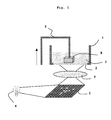
- Fig. 1 shows a schematic representation of an apparatus for performing the method according to the invention.
- the device comprises a container 1 for the slurry according to the invention 7.
- the container 1 is also referred to as a polymerization pan or tub.
- the tub 1 has a transparent window 2 through which the slurry is selectively exposed and cured from below.
- a computer-controlled, movable mirror 3 a so-called micro-mirror array (micro-mirror array), arranged, which is irradiated with a radiation source 4 .
- the image of the mirror 3 is projected onto the transparent window 2 by an optical device 5 .
- a substrate carrier 6 which can be moved in the Z direction, is arranged, which carries the body 8 constructed in layers.
- the substrate carrier 6 may have a not shown carrier plate have.
- the substrate carrier 6 is inserted far enough into the slurry such that the distance between the support 6 and the attached thereto body 8 and the inner surface of the trough 1 of the layer thickness of the layer to be produced corresponds.
- the slurry layer between the support 6 and the inner surface of the tub through the transparent window 2 is selectively exposed and hardened by means of the mirror 3 . There are hardened areas which adhere to the carrier 6 .
- this layer is selectively cured and constructed by repeating the process of the desired shaped body, preferably a dental restoration, in layers.
- the slip was built by means of the commercially available stereolithography equipment Perfactory (Envisiontec) to cylindrical biaxial strength test specimens (diameter 15 mm and height 2.2 mm).
- the heat treatment of the test specimens was carried out in a commercially available Nabertherm sintering furnace with catalytic afterburning in the following steps: 1st step (debindering): thermal treatment up to 500 ° C. at a heating rate of 1 K / min. Following a holding phase of 90 min at 500 ° C.
- the density of the test specimens was determined by the buoyancy method, whereby a value of greater than 99% of the theoretical density was achieved.
- compositions listed in Table 2 were prepared from ceramic or glass ceramic slips which were easy to debind and stereolithographically processed to form high-strength, tooth-colored dental ceramic and glass ceramic moldings.
Landscapes
- Chemical & Material Sciences (AREA)
- Engineering & Computer Science (AREA)
- Ceramic Engineering (AREA)
- Health & Medical Sciences (AREA)
- Manufacturing & Machinery (AREA)
- Oral & Maxillofacial Surgery (AREA)
- Materials Engineering (AREA)
- Structural Engineering (AREA)
- Organic Chemistry (AREA)
- Inorganic Chemistry (AREA)
- Life Sciences & Earth Sciences (AREA)
- Veterinary Medicine (AREA)
- Public Health (AREA)
- General Health & Medical Sciences (AREA)
- Animal Behavior & Ethology (AREA)
- Epidemiology (AREA)
- Plastic & Reconstructive Surgery (AREA)
- Physics & Mathematics (AREA)
- Composite Materials (AREA)
- General Physics & Mathematics (AREA)
- Spectroscopy & Molecular Physics (AREA)
- Dermatology (AREA)
- Medicinal Chemistry (AREA)
- Transplantation (AREA)
- Chemical Kinetics & Catalysis (AREA)
- Civil Engineering (AREA)
- Dental Preparations (AREA)
- Compositions Of Oxide Ceramics (AREA)
- Polymerisation Methods In General (AREA)
Claims (15)
- Barbotine destinée à la fabrication de pièces façonnées en céramique, à base d'un liant polyréactif, d'un amorceur de polymérisation et d'une charge, caractérisée en ce qu'elle contient :A) de 5 à 65 % en poids de liant polyréactif,B) de 0,001 à 1,0 % en poids de photo-amorceur,C) et de 35 à 90 % en poids de particules de céramique et/ou de vitrocéramique, modifiées en surface, dans chaque cas par rapport à la masse totale de la barbotine,et un solvant.
- Barbotine conforme à la revendication 1, qui contient en outre :D) de 0,001 à 1,0 % en poids d'inhibiteur,par rapport à la masse totale de la barbotine.
- Barbotine conforme à la revendication 1 ou 2, qui contient en outre :E) de 0 à 20 % en poids d'accélérateur de déliantage,
par rapport à la masse de composant (A). - Barbotine conforme à l'une des revendications 1 à 3, qui contient en outre :F) de 0,00001 à 2,0 % en poids de composants colorants,par rapport à la masse de composant (C).
- Barbotine conforme à l'une des revendications 1 à 4, qui contient, en tant que liant polyréactif (A), des résines photodurcissables, polymérisables par voie radicalaire ou cationique, des monomères pour polymérisation par métathèse avec ouverture de cycle, des résines de type thiol-ène, ou des résines de réaction de Michaël.
- Barbotine conforme à l'une des revendications 1 à 5, qui contient, en tant que composant (C), des particules de vitrocéramique ou des particules de céramique, à base de zircone ZrO2 pure, d'alumine Al2O3 pure, de zircone-alumine pure, ou de zircone ou zircone-alumine stabilisée avec de l'oxyde de hafnium HfO2, de l'oxyde de calcium CaO, de l'oxyde d'yttrium Y2O3, de l'oxyde de cérium CeO2 et/ou de l'oxyde de magnésium MgO.
- Barbotine conforme à l'une des revendications 1 à 6, dans laquelle les particules de composant (C) sont modifiées en surface avec un acide carboxylique linéaire ou ramifié, en particulier de l'acide formique, de l'acide acétique, de l'acide propionique, de l'acide octanoïque, de l'acide isobutyrique, de l'acide isovalérique ou de l'acide pivalique, avec un ester phosphate acide, en particulier du phosphate de diméthyle, de diéthyle, de dipropyle, de dibutyle, de dipentyle, de dihexyle, de dioctyle ou de di(2-éthyl-hexyle), avec un acide phosphonique, en particulier de l'acide méthyl-phosphonique, éthyl-phosphonique, propyl-phosphonique, butyl-phosphonique, hexyl-phosphonique, octyl-phosphonique ou phényl-phosphonique, ou avec un silane, en particulier du propyl-triméthoxy-silane, du phényl-triméthoxy-silane, de l'hexyl-triméthoxy-silane, de l'octyl-triméthoxy-silane, du triméthylchloro-silane, du triméthyl-bromo-silane, du triméthyl-méthoxy-silane ou de l'hexaméthyl-disilazane, étant entendu que l'agent de modification de surface ne comporte aucun groupe qui puisse donner lieu à une polymérisation par voie radicalaire.
- Barbotine conforme à l'une des revendications 1 à 7, dans laquelle les particules de composant (C) présentent une taille de particules située dans la gamme allant de 50 nm à 50 µm.
- Barbotine conforme à l'une des revendications 3 à 8, qui contient, en tant qu'accélérateur de déliantage (E), un agent de régulation des chaînes, en particulier un thiol, un disulfure ou un agent de photoamorçage-transfert-terminaison (agent "photoiniferter"), de préférence du lauryl-mercaptan, un disulfure de dithiouréthane, du disulfure de tétraméthyl-thiurame ou du disulfure d'acide isopropyl-xanthogénique, un comonomère comportant un ou plusieurs groupe(s) thermolabile(s), en particulier un ou plusieurs groupes peroxy, azo ou uréthane, un comonomère dont la température plafond se situe entre -10 et 150 °C, en particulier de l'alpha-méthyl-styrène ou du polytétrahydrofurane, ou un composé téléchélique comportant des groupes pouvant donner lieu à une polymérisation par voie radicalaire, en particulier un composé téléchélique bis(acrylate) ou bis(méthacrylate) de polytétrahydrofurane.
- Barbotine conforme à l'une des revendications 4 à 9, qui contient, en tant que composant colorant (F), un composé de métal de transition, en particulier un acétyl-acétonate ou un carbonate de l'un des éléments fer, cérium, praséodyme, terbium, lanthane, tungstène, osmium et manganèse, en particulier de l'acétate de fer-III, de l'acétyl-acétonate de fer-III, de l'acétate de manganèse-III, de l'acétyl-acétonate de manganèse-III, de l'acétate de praséodyme-III, de l'acétyl-acétonate de praséodyme-III, de l'acétate de terbium-III ou de l'acétyl-acétonate de terbium-III.
- Barbotine conforme à l'une des revendications 1 à 10, qui contient en outre un solvant qui est choisi parmi les suivants : phtalates, en particulier du phtalate de dibutyle ou du phtalate de dihexyle, phosphates non acides, en particulier du phosphate de tributyle ou du phosphate de tricrésyle, n-octanol, glycérol, polyéthylèneglycols, octanol, éther divinylique de triéthylèneglycol, 2-amino-2-méthyl-propane-1-ol, 2-méthyl-pentane-2,4-diol, citrate d'ammonium tribasique (solide), tripropylèneglycol, tétraéthylèneglycol, triéthylèneglycol, citrate de triéthyle, acétyl-acétate d'éthyle, cyclohexanol, cyclohexanone, éther monométhylique de diéthylèneglycol, oxalate de dibutyle, 2,5-diméthoxy-tétrahydrofurane, polyéthylèneglycol 300, nonane-1-ol, nonane-2-ol, et éther diéthylique de diéthylèneglycol, en particulier 2,5-diméthoxy-tétrahydrofurane, oxalate de dibutyle, cyclohexanol, cyclohexanone et acétyl-acétate d'éthyle, ainsi que leurs mélanges.
- Barbotine conforme à l'une des revendications 1 à 11, qui présente une viscosité située dans l'intervalle allant de 200 à 20 000 Pa.s, et de préférence, de 500 à 5000 Pa.s.
- Utilisation d'une barbotine conforme à l'une des revendications 1 à 12 pour la fabrication de pièces façonnées en céramique ou en vitrocéramique.
- Utilisation conforme à la revendication 13, dans laquelle la pièce en céramique est une pièce de restauration dentaire, comme par exemple une incrustation "inlay" ou "onlay", une facette "veneer", une couronne, un bridge ou une armature.
- Procédé de fabrication d'une pièce façonnée en céramique ou en vitrocéramique, dans lequel :a) on prépare un "corps vert" (ébauche crue), en faisant durcir une barbotine conforme à l'une des revendications 1 à 10 par application locale d'un rayonnement énergétique, tout en donnant au corps vert une forme d'une certaine géométrie ;b) on soumet ce corps vert à un traitement thermique pour en chasser le liant (déliantage), ce qui donne un "corps blanc" (pièce non frittée),c) et l'on fritte ce corps blanc.
Priority Applications (3)
| Application Number | Priority Date | Filing Date | Title |
|---|---|---|---|
| EP08161505A EP2151214B1 (fr) | 2008-07-30 | 2008-07-30 | Barbotine durcissant à la lumière pour la fabrication stéréolithographique de céramiques dentaires |
| US12/394,452 US7927538B2 (en) | 2008-07-30 | 2009-02-27 | Light-curing slips for the stereolithographic preparation of dental ceramics |
| JP2009176955A JP5571917B2 (ja) | 2008-07-30 | 2009-07-29 | 歯科用セラミックの立体リトグラフによる調製のための光硬化性スリップ |
Applications Claiming Priority (1)
| Application Number | Priority Date | Filing Date | Title |
|---|---|---|---|
| EP08161505A EP2151214B1 (fr) | 2008-07-30 | 2008-07-30 | Barbotine durcissant à la lumière pour la fabrication stéréolithographique de céramiques dentaires |
Publications (2)
| Publication Number | Publication Date |
|---|---|
| EP2151214A1 EP2151214A1 (fr) | 2010-02-10 |
| EP2151214B1 true EP2151214B1 (fr) | 2013-01-23 |
Family
ID=40202872
Family Applications (1)
| Application Number | Title | Priority Date | Filing Date |
|---|---|---|---|
| EP08161505A Active EP2151214B1 (fr) | 2008-07-30 | 2008-07-30 | Barbotine durcissant à la lumière pour la fabrication stéréolithographique de céramiques dentaires |
Country Status (3)
| Country | Link |
|---|---|
| US (1) | US7927538B2 (fr) |
| EP (1) | EP2151214B1 (fr) |
| JP (1) | JP5571917B2 (fr) |
Cited By (4)
| Publication number | Priority date | Publication date | Assignee | Title |
|---|---|---|---|---|
| US9598531B2 (en) | 2013-02-27 | 2017-03-21 | Materia, Inc. | Olefin metathesis catalyst compositions comprising at least two metal carbene olefin metathesis catalysts |
| US10457597B2 (en) | 2011-06-17 | 2019-10-29 | Materia, Inc. | Adhesion promoters and gel-modifiers for olefin metathesis compositions |
| EP3660085A1 (fr) | 2018-11-29 | 2020-06-03 | Ivoclar Vivadent AG | Matériau support pour l'impression par transfert induit par impulsion énergétique |
| EP4582402A1 (fr) * | 2024-01-03 | 2025-07-09 | Karlsruher Institut für Technologie | Barbotine |
Families Citing this family (87)
| Publication number | Priority date | Publication date | Assignee | Title |
|---|---|---|---|---|
| EP2157067B1 (fr) * | 2008-07-30 | 2012-09-12 | Ivoclar Vivadent AG | Particule primaire revêtue d'un agent colorant |
| EP2233449B1 (fr) * | 2009-03-27 | 2014-12-17 | Ivoclar Vivadent AG | Utilisation d'une barbotine pour la fabrication de céramiques dentaires à l'aide du procédé d'impression par injection de matière thermoplastique |
| US10196464B1 (en) * | 2009-07-21 | 2019-02-05 | Hrl Laboratories, Llc | Pre-ceramic monomer formulations for making preceramic polymer waveguides |
| ES2744218T3 (es) * | 2010-07-08 | 2020-02-24 | Ivoclar Vivadent Ag | Barbotina cerámica fotoendurecible para la producción estereolitográfica de cerámicas de alta resistencia |
| EP2603162B1 (fr) * | 2010-08-11 | 2018-05-02 | 3M Innovative Properties Company | Articles dentaires comprenant des revêtements en céramique et à microparticules et leur procédé de fabrication |
| US9370404B2 (en) | 2010-08-11 | 2016-06-21 | Bhaskar V. Velamakanni | Aesthetic and abrasion resistant coated dental articles and methods of making the same |
| EP2450000A1 (fr) * | 2010-11-09 | 2012-05-09 | 3M Innovative Properties Company | Procédé de production d'un article dentaire, article pouvant être obtenu selon ce procédé et utilisations correspondantes |
| WO2012161363A1 (fr) * | 2011-05-26 | 2012-11-29 | (주) 베리콤 | Composition de complexe dentaire contenant de la vitrocéramique cristallisée |
| EP2529694B1 (fr) | 2011-05-31 | 2017-11-15 | Ivoclar Vivadent AG | Procédé de génération de formes en céramique par jet d'impression 3D |
| US20140093690A1 (en) * | 2011-05-31 | 2014-04-03 | Nanoptics, Incorporated | Method and apparatus for lithographic manufacture of multi-component polymeric fiber plates |
| SE536670C2 (sv) * | 2011-08-26 | 2014-05-13 | Digital Metal Ab | Skiktbaserad tillverkning av friformade mikrokomponenter avmultimaterial |
| DE102011115031A1 (de) * | 2011-10-07 | 2013-04-11 | Heraeus Kulzer Gmbh | Laborimplantat mit Indexierungen zum Einbringen in Kunststoffmodelle |
| WO2013153183A2 (fr) * | 2012-04-11 | 2013-10-17 | Ivoclar Vivadent Ag | Composition de résine composite et procédé de fabrication de composants dentaires par stéréolithographie |
| EP2919705B1 (fr) * | 2012-11-14 | 2021-06-23 | DENTSPLY SIRONA Inc. | Systèmes de matériau de fabrication tridimensionnelle pour produire des produits dentaires |
| DE102013004182A1 (de) * | 2013-03-12 | 2014-09-18 | Tutec Gmbh | Druckmasse zur Verwendung in 3D-Druckern und Verfahren zur Herstellung von Körpern mittels dieser Druckmassen sowie Verwendung der nach diesem Verfahren hergestellten Körpern |
| JP2015043793A (ja) * | 2013-08-27 | 2015-03-12 | ディーダブルエス エス・アール・エル | 人工歯の製造方法 |
| JP6606861B2 (ja) * | 2014-08-11 | 2019-11-20 | 株式会社リコー | 積層造形用粉末及び積層造形物の製造方法 |
| WO2016044549A1 (fr) | 2014-09-17 | 2016-03-24 | Garrison Dental Solutions, Llc | Lumière de polymérisation de prothèse dentaire |
| US10259210B2 (en) * | 2014-10-21 | 2019-04-16 | Statasys Ltd. | Three-dimensional inkjet printing using ring-opening metathesis polymerization |
| KR20170119694A (ko) * | 2015-02-26 | 2017-10-27 | 코닝 인코포레이티드 | 무기 재료로부터 투명 3d 부품을 제작하기 위한 적층 가공 공정 |
| US20180044245A1 (en) * | 2015-03-03 | 2018-02-15 | 3M Innovative Properties Company | Gel compositions, shaped gel articles and a method of making a sintered article |
| US11078125B1 (en) | 2015-03-04 | 2021-08-03 | Hrl Laboratories, Llc | Cellular ceramic materials |
| CN107635531B (zh) * | 2015-05-28 | 2021-06-18 | 3M创新有限公司 | 包含纳米氧化锆颗粒的溶胶在用于制备三维制品的增材制造方法中的用途 |
| EP3303255B1 (fr) * | 2015-05-28 | 2022-06-29 | 3M Innovative Properties Company | Processus de fabrication additive permettant de produire des articles en céramique à l'aide d'un sol contenant des particules de taille nanométrique |
| JP6812093B2 (ja) * | 2015-06-26 | 2021-01-13 | 日本電気硝子株式会社 | 無機充填材粒子及びそれを用いた立体造形用樹脂組成物 |
| US20180200946A1 (en) | 2015-07-15 | 2018-07-19 | Stichting Energieonderzoek Centrum Nederland | Method and apparatus for forming thin layers of slurries for additive manufacturing |
| US11311850B2 (en) | 2015-08-26 | 2022-04-26 | Sandvik Intellectual Property Ab | Diamond composites by lithography-based manufacturing |
| ES2733838T3 (es) * | 2015-09-25 | 2019-12-03 | Ivoclar Vivadent Ag | Barbotina de cerámica y vitrocerámica para estereolitografía |
| ES3053144T3 (en) | 2015-10-15 | 2026-01-19 | Saint Gobain Ceramics | Method for forming a three dimensional body from a mixture with a high content of solid particles |
| US11141919B2 (en) | 2015-12-09 | 2021-10-12 | Holo, Inc. | Multi-material stereolithographic three dimensional printing |
| JP6942960B2 (ja) * | 2015-12-18 | 2021-09-29 | Dic株式会社 | セラミック体の製造方法及びそれに用いる分散体 |
| ITUB20160408A1 (it) | 2016-01-28 | 2017-07-28 | Dws Srl | Composizione di resina fotoindurente per produzioni stereolitografiche, articoli tridimensionali prodotti con detta composizione e relativo metodo di produzione |
| US11001725B2 (en) | 2016-02-05 | 2021-05-11 | Stratasys Ltd. | Three-dimensional inkjet printing using ring-opening metathesis polymerization |
| JP7048502B2 (ja) | 2016-02-05 | 2022-04-05 | ストラタシス リミテッド | ポリアミド形成材料を使用する三次元インクジェット印刷 |
| WO2017134673A1 (fr) | 2016-02-07 | 2017-08-10 | Stratasys Ltd. | Impression tridimensionnelle combinant une polymérisation par ouverture de cycle par métathèse et une polymérisation radicalaire |
| DE102017203885A1 (de) | 2016-03-14 | 2017-09-14 | Ceramtec Gmbh | Keramische Suspension |
| US11118004B2 (en) | 2016-04-26 | 2021-09-14 | Stratasys Ltd. | Three-dimensional inkjet printing using ring-opening metathesis polymerization |
| US10023500B2 (en) | 2016-08-30 | 2018-07-17 | General Electric Company | Light-curable ceramic slurries with hybrid binders |
| JP6913275B2 (ja) * | 2016-09-16 | 2021-08-04 | 日本電気硝子株式会社 | 立体造形用ガラス粉末 |
| DE102016119531B4 (de) * | 2016-10-13 | 2021-01-28 | Lisa Dräxlmaier GmbH | Formmasse umfassend Übergangsmetalloxid stabilisiertes Zirkoniumdioxid sowie Formkörper, dessen Herstellung und Verwendung im Automobilbereich |
| US10029949B2 (en) * | 2016-10-24 | 2018-07-24 | The Boeing Company | Precursor material for additive manufacturing of low-density, high-porosity ceramic parts and methods of producing the same |
| US11198757B2 (en) | 2016-11-03 | 2021-12-14 | 3M Innovative Properties Company | Compositions including a photolatent amine, camphorquinone, and coumarin and related methods |
| WO2018085546A1 (fr) | 2016-11-03 | 2018-05-11 | 3M Innovative Properties Company | Composition comprenant un polythiol, un polyépoxyde, une base photolatente, et une amine et procédés associés à la composition |
| US11299430B2 (en) * | 2016-11-30 | 2022-04-12 | Hrl Laboratories, Llc | Formulations with active functional additives for 3D printing of preceramic polymers, and methods of 3D-printing the formulations |
| EP3335687B1 (fr) * | 2016-12-15 | 2020-02-12 | Ivoclar Vivadent AG | Matière à modeler dentaire calcinable |
| US10935891B2 (en) | 2017-03-13 | 2021-03-02 | Holo, Inc. | Multi wavelength stereolithography hardware configurations |
| US10647061B2 (en) * | 2017-05-12 | 2020-05-12 | Lawrence Livermore National Security, Llc | System and method for computed axial lithography (CAL) for 3D additive manufacturing |
| GB2564956B (en) | 2017-05-15 | 2020-04-29 | Holo Inc | Viscous film three-dimensional printing systems and methods |
| US10920002B2 (en) * | 2017-05-15 | 2021-02-16 | The Board Of Trustees Of The University Of Illinois | 3D printing of thermoset polymers and composites |
| CN110997282B (zh) * | 2017-06-16 | 2022-08-26 | 霍洛公司 | 用于立体光刻三维打印的方法和系统 |
| US10460728B2 (en) * | 2017-06-16 | 2019-10-29 | Amazon Technologies, Inc. | Exporting dialog-driven applications to digital communication platforms |
| US10245785B2 (en) | 2017-06-16 | 2019-04-02 | Holo, Inc. | Methods for stereolithography three-dimensional printing |
| CA3069982C (fr) | 2017-07-21 | 2023-08-01 | Saint-Gobain Performance Plastics Corporation | Procede de formation d'un corps tridimensionnel |
| US10647023B2 (en) | 2017-08-08 | 2020-05-12 | United Technologies Corporation | Method and material for additively manufacturing a ceramic containing article |
| CN108017389B (zh) * | 2017-12-11 | 2020-08-25 | 苏州卫优知识产权运营有限公司 | 一种模具用陶瓷材料 |
| CN109485381A (zh) * | 2018-01-15 | 2019-03-19 | 杭州创屹机电科技有限公司 | 一种高流动性的陶瓷浆料及3d打印制备陶瓷坯胎的方法 |
| US10538460B2 (en) | 2018-03-15 | 2020-01-21 | General Electric Company | Ceramic slurries for additive manufacturing techniques |
| EP3776081A4 (fr) * | 2018-03-28 | 2022-03-09 | Benjamin Lund | Polymères de thiol-acrylate, procédés de synthèse correspondants et utilisation dans des technologies de fabrication additive |
| CN108424149A (zh) * | 2018-04-27 | 2018-08-21 | 中南大学 | 光固化氮化硅陶瓷浆料 |
| US11148320B1 (en) * | 2018-04-27 | 2021-10-19 | Dynamic Material Systems, LLC | Inorganic polymers and compositions for improved 3D printing of larger scale ceramic materials and components |
| US20210261468A1 (en) * | 2018-06-15 | 2021-08-26 | Basf Se | Ceramic photoresin formulation |
| EP3659989A1 (fr) | 2018-11-29 | 2020-06-03 | Ivoclar Vivadent AG | Barbotine et procédé de fabrication de structures tridimensionnelles céramiques et vitrocéramiques |
| CN117067579A (zh) | 2018-12-26 | 2023-11-17 | 霍洛公司 | 用于三维打印系统和方法的传感器 |
| FR3092109B1 (fr) | 2019-01-25 | 2023-12-08 | Commissariat Energie Atomique | Composition et procédé pour fabriquer des pièces constituées par des céramiques oxydes ou des pièces hybrides par une technique de stéréolithographie. |
| KR102228118B1 (ko) * | 2019-02-12 | 2021-03-16 | 주식회사 하스 | 결정화 유리를 포함하는 치과용 복합체 |
| CN110330328B (zh) * | 2019-04-03 | 2022-01-04 | 武汉理工大学 | 一种用于光固化成型的低过固化磷酸钙陶瓷浆料及其制备方法 |
| CN112010641A (zh) * | 2019-05-31 | 2020-12-01 | 圣戈班研发(上海)有限公司 | 一种陶瓷组合物、其制品及其制备方法 |
| US12590211B2 (en) * | 2019-11-27 | 2026-03-31 | Corning Incorporated | Compositions and methods of making a green body or a printed article using the same |
| EP4072782B1 (fr) | 2019-12-12 | 2026-01-28 | 3M Innovative Properties Company | Articles abrasifs à liaison polymère comprenant une matrice polymère continue et leurs procédés de fabrication |
| WO2021115727A1 (fr) * | 2019-12-13 | 2021-06-17 | Institut Straumann Ag | Article en céramique fonctionnalisé |
| US11578002B2 (en) | 2020-02-27 | 2023-02-14 | General Electric Company | Ceramic slurries with photoreactive-photostable hybrid binders |
| US11572313B2 (en) | 2020-02-27 | 2023-02-07 | General Electric Company | Ceramic slurries with photoreactive-photostable hybrid binders |
| KR102373393B1 (ko) * | 2020-06-02 | 2022-03-11 | 오스템임플란트 주식회사 | 서지컬 가이드용 광경화성 수지 조성물, 이로부터 제조된 서지컬 가이드 및 그의 제조방법 |
| US11809161B2 (en) * | 2020-07-13 | 2023-11-07 | Lawrence Livermore National Security, Llc | Computed axial lithography optimization system |
| CN111777412A (zh) * | 2020-07-14 | 2020-10-16 | 嘉兴饶稷科技有限公司 | 大尺寸模型3d陶瓷打印工艺 |
| GB202011693D0 (en) * | 2020-07-28 | 2020-09-09 | Lucite International Speciality Polymers And Resins Ltd | Additive manufacturing composition for 3-D printed object |
| CN111848183B (zh) * | 2020-08-07 | 2021-05-18 | 北京理工大学 | 一种热膨胀可调的陶瓷材料构件的制备方法及其产品 |
| EP3967666A1 (fr) | 2020-09-14 | 2022-03-16 | Glassomer GmbH | Fabrication et façonnage thermique de verre transparent |
| CN112142452A (zh) * | 2020-09-27 | 2020-12-29 | 嘉兴饶稷科技有限公司 | 超低粘度光固化陶瓷树脂浆料 |
| EP4225824A4 (fr) * | 2020-10-09 | 2024-10-30 | Polyspectra, Inc. | Produits oraux et leurs procédés de production |
| US11718710B2 (en) | 2020-10-14 | 2023-08-08 | The Board Of Trustees Of The University Of Illinois | Method of light-promoted frontal ring-opening metathesis polymerization |
| US11718744B2 (en) | 2021-03-26 | 2023-08-08 | Dentca, Inc. | Photo-curable resin compositions containing impact modifier for three dimensional printing and cured dental product made of the same |
| EP4063337A1 (fr) * | 2021-03-26 | 2022-09-28 | Glassomer GmbH | Matériau et procédé de fabrication et de mise en forme de céramiques transparentes |
| FR3121623B1 (fr) * | 2021-04-09 | 2023-06-16 | S A S 3Dceram Sinto | Composition durcissable pour la fabrication, par stereolithographie, de pieces crues en materiau ceramique ou metallique par voie photo-thermique |
| WO2022225854A1 (fr) | 2021-04-19 | 2022-10-27 | Holo, Inc. | Systèmes et procédés d'impression tridimensionnelle stéréolithographique |
| DE102022113425A1 (de) | 2022-05-27 | 2023-11-30 | Dirk Müller | Satz von Chemikalien für die Herstellung einer Keramikdispersion |
| WO2024010476A1 (fr) * | 2022-07-07 | 2024-01-11 | Politechnika Warszawska | Procédé de fabrication de composites à matrice céramique renforcés par des particules métalliques |
Family Cites Families (29)
| Publication number | Priority date | Publication date | Assignee | Title |
|---|---|---|---|---|
| DE3135113A1 (de) * | 1981-09-04 | 1983-03-24 | Bayer Ag, 5090 Leverkusen | Photopolymerisierbare massen, deren verwendung fuer zahnaerztliche zwecke, sowie verfahren zur herstellung von zahnersatzteilen, zahnfuellungen und ueberzuegen |
| US4778834A (en) * | 1987-02-24 | 1988-10-18 | Sterling Drug Inc. | Hydroxylapatite-synthetic resin composites |
| DE4133494C2 (de) | 1991-10-09 | 1996-03-28 | Fraunhofer Ges Forschung | Dentalharzmasse, Verfahren zu deren Herstellung und deren Verwendung |
| DE69307172T2 (de) * | 1992-03-16 | 1997-04-24 | Kawasaki Steel Co | Bindersystem für den Gebrauch beim Spritzgiessen von sinterfähigen Pulvern und dieses Bindersystem enthaltende Formmasse |
| US5496682A (en) | 1993-10-15 | 1996-03-05 | W. R. Grace & Co.-Conn. | Three dimensional sintered inorganic structures using photopolymerization |
| BE1008372A3 (nl) | 1994-04-19 | 1996-04-02 | Materialise Nv | Werkwijze voor het vervaardigen van een geperfektioneerd medisch model uitgaande van digitale beeldinformatie van een lichaamsdeel. |
| JPH0812442A (ja) * | 1994-06-22 | 1996-01-16 | Toshiba Ceramics Co Ltd | セラミック複合材スラリー及びその成形方法 |
| US6117612A (en) | 1995-04-24 | 2000-09-12 | Regents Of The University Of Michigan | Stereolithography resin for rapid prototyping of ceramics and metals |
| BE1009947A6 (nl) | 1996-02-15 | 1997-11-04 | Materialise Nv | Werkwijze en inrichting voor het vervaardigen van een driedimensionaal voorwerp uit een hardbaar vloeibaar medium. |
| JPH09241311A (ja) * | 1996-03-13 | 1997-09-16 | Olympus Optical Co Ltd | 粉末混合光硬化性流動樹脂組成物 |
| DE19648283A1 (de) | 1996-11-21 | 1998-05-28 | Thera Ges Fuer Patente | Polymerisierbare Massen auf der Basis von Epoxiden |
| US6096903A (en) | 1997-03-25 | 2000-08-01 | Ivoclar Ag | Hydrolysable and polymerizable oxetane silanes |
| US6977095B1 (en) * | 1997-10-01 | 2005-12-20 | Wright Medical Technology Inc. | Process for producing rigid reticulated articles |
| US6306926B1 (en) * | 1998-10-07 | 2001-10-23 | 3M Innovative Properties Company | Radiopaque cationically polymerizable compositions comprising a radiopacifying filler, and method for polymerizing same |
| DE29924924U1 (de) | 1999-01-19 | 2006-12-21 | BEGO Bremer Goldschlägerei Wilh. Herbst GmbH & Co. KG | Formkörper zur Verwendung als Zahnersatz und dentales Hilfsteil |
| DE19938463A1 (de) | 1999-08-13 | 2001-02-22 | Deltamed Medizinprodukte Gmbh | Mit sichtbarem Licht aushärtende Zusammensetzung und deren Verwendung |
| DE19950284A1 (de) | 1999-10-19 | 2001-04-26 | Deltamed Medizinprodukte Gmbh | Mit sichtbarem Licht aushärtende Zusammensetzung und deren Verwendung |
| US6387981B1 (en) * | 1999-10-28 | 2002-05-14 | 3M Innovative Properties Company | Radiopaque dental materials with nano-sized particles |
| US6376585B1 (en) * | 2000-06-26 | 2002-04-23 | Apex Advanced Technologies, Llc | Binder system and method for particulate material with debind rate control additive |
| DE10042050A1 (de) * | 2000-08-26 | 2002-03-14 | Degussa | Dentalkomposite aufweisend Hybridfüllstoffe und Verfahren zur Herstellung |
| US6939489B2 (en) | 2001-03-23 | 2005-09-06 | Ivoclar Vivadent Ag | Desktop process for producing dental products by means of 3-dimensional plotting |
| DE10114290B4 (de) | 2001-03-23 | 2004-08-12 | Ivoclar Vivadent Ag | Desktop-Verfahren zur Herstellung von Dentalprodukten unter Verwendung des 3D-Plottings |
| US6890968B2 (en) * | 2001-05-16 | 2005-05-10 | Kerr Corporation | Prepolymerized filler in dental restorative composite |
| US6811937B2 (en) * | 2001-06-21 | 2004-11-02 | Dsm Desotech, Inc. | Radiation-curable resin composition and rapid prototyping process using the same |
| FR2835828B1 (fr) * | 2002-02-08 | 2006-07-14 | Ct De Transfert De Technologie | Procede et composition pour la fabrication de pieces ceramiques par stereo-lithophotographie et application au domaine dentaire |
| JP2006257323A (ja) * | 2005-03-18 | 2006-09-28 | Osaka Univ | 立体形状物の製造方法及び立体形状物 |
| DE102005019600A1 (de) * | 2005-04-27 | 2006-11-09 | Ivoclar Vivadent Ag | Oberflächenmodifizierte Füllstoffe |
| JP2006348214A (ja) * | 2005-06-17 | 2006-12-28 | Jsr Corp | 光造形用光硬化性液状組成物、立体造形物及びその製造方法 |
| DE102005058116A1 (de) | 2005-11-29 | 2007-03-29 | Siemens Ag | Verfahren zum Herstellen keramischer Bauteile, insbesondere von Implantaten |
-
2008
- 2008-07-30 EP EP08161505A patent/EP2151214B1/fr active Active
-
2009
- 2009-02-27 US US12/394,452 patent/US7927538B2/en active Active
- 2009-07-29 JP JP2009176955A patent/JP5571917B2/ja active Active
Cited By (5)
| Publication number | Priority date | Publication date | Assignee | Title |
|---|---|---|---|---|
| US10457597B2 (en) | 2011-06-17 | 2019-10-29 | Materia, Inc. | Adhesion promoters and gel-modifiers for olefin metathesis compositions |
| US12043573B2 (en) | 2011-06-17 | 2024-07-23 | Materia, Inc. | Adhesion promoters and gel-modifiers for olefin metathesis compositions |
| US9598531B2 (en) | 2013-02-27 | 2017-03-21 | Materia, Inc. | Olefin metathesis catalyst compositions comprising at least two metal carbene olefin metathesis catalysts |
| EP3660085A1 (fr) | 2018-11-29 | 2020-06-03 | Ivoclar Vivadent AG | Matériau support pour l'impression par transfert induit par impulsion énergétique |
| EP4582402A1 (fr) * | 2024-01-03 | 2025-07-09 | Karlsruher Institut für Technologie | Barbotine |
Also Published As
| Publication number | Publication date |
|---|---|
| US20100029801A1 (en) | 2010-02-04 |
| EP2151214A1 (fr) | 2010-02-10 |
| JP5571917B2 (ja) | 2014-08-13 |
| JP2010031279A (ja) | 2010-02-12 |
| US7927538B2 (en) | 2011-04-19 |
Similar Documents
| Publication | Publication Date | Title |
|---|---|---|
| EP2151214B1 (fr) | Barbotine durcissant à la lumière pour la fabrication stéréolithographique de céramiques dentaires | |
| EP2404590B1 (fr) | Barbotine en céramique durcissant à la lumière pour la fabrication stéréo-lithographique de céramiques à haute résistance | |
| EP3147707B1 (fr) | Barbotine en ceramique ou en vitroceramique pour la stereolithographie | |
| EP2157067B1 (fr) | Particule primaire revêtue d'un agent colorant | |
| EP3919092A1 (fr) | Suspension pour impression 3d à photopolymérisation, sa méthode de préparation et sa méthode d'utilisation | |
| EP1711122B1 (fr) | MATERIAU COMPOSITE ANORGANIQUE-ANORGANIQUE, PROCEDE DE FABRICATION et son utilisation | |
| EP2233449B1 (fr) | Utilisation d'une barbotine pour la fabrication de céramiques dentaires à l'aide du procédé d'impression par injection de matière thermoplastique | |
| DE10114290B4 (de) | Desktop-Verfahren zur Herstellung von Dentalprodukten unter Verwendung des 3D-Plottings | |
| KR102432983B1 (ko) | 기공 구조 제어를 통한 강도 증진된 자이로이드 구조의 세라믹 스캐폴드 제조 | |
| KR102011720B1 (ko) | 광경화성 세라믹 슬러리 기반 3d 플라팅 기술 | |
| KR102451756B1 (ko) | 3d 프린팅 기술에 의한 다중 스케일 기공 제어를 통한 다공성 세라믹 스캐폴드 제작 | |
| DE102016225208B4 (de) | Ausbrennbares Material auf Polymerbasis für die Lost-Wax Technik | |
| KR102195987B1 (ko) | 광경화성 세라믹 3d 프린팅용 세라믹 슬러리 조성물 제조 기술 | |
| EP3659989A1 (fr) | Barbotine et procédé de fabrication de structures tridimensionnelles céramiques et vitrocéramiques | |
| KR102353544B1 (ko) | 치과용 알루미나 부품 제조용 세라믹 3d 프리팅 기술 | |
| EP3338814B1 (fr) | Composant en métal léger structuré | |
| EP3335687B1 (fr) | Matière à modeler dentaire calcinable | |
| US20260060781A1 (en) | Process For The Production Of Ceramic And Glass-Ceramic Dental Restorations |
Legal Events
| Date | Code | Title | Description |
|---|---|---|---|
| PUAI | Public reference made under article 153(3) epc to a published international application that has entered the european phase |
Free format text: ORIGINAL CODE: 0009012 |
|
| AK | Designated contracting states |
Kind code of ref document: A1 Designated state(s): AT BE BG CH CY CZ DE DK EE ES FI FR GB GR HR HU IE IS IT LI LT LU LV MC MT NL NO PL PT RO SE SI SK TR |
|
| AX | Request for extension of the european patent |
Extension state: AL BA MK RS |
|
| 17P | Request for examination filed |
Effective date: 20100217 |
|
| 17Q | First examination report despatched |
Effective date: 20100326 |
|
| AKX | Designation fees paid |
Designated state(s): AT BE BG CH CY LI |
|
| REG | Reference to a national code |
Ref country code: DE Ref legal event code: 8566 |
|
| RBV | Designated contracting states (corrected) |
Designated state(s): AT BE BG CH CY CZ DE DK EE ES FI FR GB GR HR HU IE IS IT LI LT LU LV MC MT NL NO PL PT RO SE SI SK TR |
|
| GRAP | Despatch of communication of intention to grant a patent |
Free format text: ORIGINAL CODE: EPIDOSNIGR1 |
|
| GRAS | Grant fee paid |
Free format text: ORIGINAL CODE: EPIDOSNIGR3 |
|
| GRAA | (expected) grant |
Free format text: ORIGINAL CODE: 0009210 |
|
| AK | Designated contracting states |
Kind code of ref document: B1 Designated state(s): AT BE BG CH CY CZ DE DK EE ES FI FR GB GR HR HU IE IS IT LI LT LU LV MC MT NL NO PL PT RO SE SI SK TR |
|
| REG | Reference to a national code |
Ref country code: GB Ref legal event code: FG4D Free format text: NOT ENGLISH |
|
| RIN1 | Information on inventor provided before grant (corrected) |
Inventor name: STAMPFL, JUERGEN Inventor name: RHEINBERGER, VOLKER Inventor name: MOSZNER, NORBERT Inventor name: PATZER, JOHANNES Inventor name: APPERT, CHRISTOPH Inventor name: LISKA, ROBERT Inventor name: WACHTER, WOLFGANG |
|
| REG | Reference to a national code |
Ref country code: CH Ref legal event code: NV Representative=s name: KELLER AND PARTNER PATENTANWAELTE AG, CH Ref country code: CH Ref legal event code: EP |
|
| REG | Reference to a national code |
Ref country code: AT Ref legal event code: REF Ref document number: 594532 Country of ref document: AT Kind code of ref document: T Effective date: 20130215 Ref country code: CH Ref legal event code: EP Ref country code: CH Ref legal event code: NV Representative=s name: KELLER AND PARTNER PATENTANWAELTE AG, CH |
|
| REG | Reference to a national code |
Ref country code: IE Ref legal event code: FG4D Free format text: LANGUAGE OF EP DOCUMENT: GERMAN |
|
| REG | Reference to a national code |
Ref country code: DE Ref legal event code: R096 Ref document number: 502008009165 Country of ref document: DE Effective date: 20130321 |
|
| REG | Reference to a national code |
Ref country code: SE Ref legal event code: TRGR |
|
| REG | Reference to a national code |
Ref country code: LT Ref legal event code: MG4D |
|
| REG | Reference to a national code |
Ref country code: NL Ref legal event code: VDEP Effective date: 20130123 |
|
| PG25 | Lapsed in a contracting state [announced via postgrant information from national office to epo] |
Ref country code: BG Free format text: LAPSE BECAUSE OF FAILURE TO SUBMIT A TRANSLATION OF THE DESCRIPTION OR TO PAY THE FEE WITHIN THE PRESCRIBED TIME-LIMIT Effective date: 20130423 Ref country code: IS Free format text: LAPSE BECAUSE OF FAILURE TO SUBMIT A TRANSLATION OF THE DESCRIPTION OR TO PAY THE FEE WITHIN THE PRESCRIBED TIME-LIMIT Effective date: 20130523 Ref country code: LT Free format text: LAPSE BECAUSE OF FAILURE TO SUBMIT A TRANSLATION OF THE DESCRIPTION OR TO PAY THE FEE WITHIN THE PRESCRIBED TIME-LIMIT Effective date: 20130123 Ref country code: NO Free format text: LAPSE BECAUSE OF FAILURE TO SUBMIT A TRANSLATION OF THE DESCRIPTION OR TO PAY THE FEE WITHIN THE PRESCRIBED TIME-LIMIT Effective date: 20130423 Ref country code: ES Free format text: LAPSE BECAUSE OF FAILURE TO SUBMIT A TRANSLATION OF THE DESCRIPTION OR TO PAY THE FEE WITHIN THE PRESCRIBED TIME-LIMIT Effective date: 20130504 |
|
| PG25 | Lapsed in a contracting state [announced via postgrant information from national office to epo] |
Ref country code: GR Free format text: LAPSE BECAUSE OF FAILURE TO SUBMIT A TRANSLATION OF THE DESCRIPTION OR TO PAY THE FEE WITHIN THE PRESCRIBED TIME-LIMIT Effective date: 20130424 Ref country code: SI Free format text: LAPSE BECAUSE OF FAILURE TO SUBMIT A TRANSLATION OF THE DESCRIPTION OR TO PAY THE FEE WITHIN THE PRESCRIBED TIME-LIMIT Effective date: 20130123 Ref country code: PT Free format text: LAPSE BECAUSE OF FAILURE TO SUBMIT A TRANSLATION OF THE DESCRIPTION OR TO PAY THE FEE WITHIN THE PRESCRIBED TIME-LIMIT Effective date: 20130523 Ref country code: NL Free format text: LAPSE BECAUSE OF FAILURE TO SUBMIT A TRANSLATION OF THE DESCRIPTION OR TO PAY THE FEE WITHIN THE PRESCRIBED TIME-LIMIT Effective date: 20130123 Ref country code: FI Free format text: LAPSE BECAUSE OF FAILURE TO SUBMIT A TRANSLATION OF THE DESCRIPTION OR TO PAY THE FEE WITHIN THE PRESCRIBED TIME-LIMIT Effective date: 20130123 Ref country code: LV Free format text: LAPSE BECAUSE OF FAILURE TO SUBMIT A TRANSLATION OF THE DESCRIPTION OR TO PAY THE FEE WITHIN THE PRESCRIBED TIME-LIMIT Effective date: 20130123 Ref country code: PL Free format text: LAPSE BECAUSE OF FAILURE TO SUBMIT A TRANSLATION OF THE DESCRIPTION OR TO PAY THE FEE WITHIN THE PRESCRIBED TIME-LIMIT Effective date: 20130123 |
|
| PG25 | Lapsed in a contracting state [announced via postgrant information from national office to epo] |
Ref country code: HR Free format text: LAPSE BECAUSE OF FAILURE TO SUBMIT A TRANSLATION OF THE DESCRIPTION OR TO PAY THE FEE WITHIN THE PRESCRIBED TIME-LIMIT Effective date: 20130123 |
|
| PG25 | Lapsed in a contracting state [announced via postgrant information from national office to epo] |
Ref country code: CZ Free format text: LAPSE BECAUSE OF FAILURE TO SUBMIT A TRANSLATION OF THE DESCRIPTION OR TO PAY THE FEE WITHIN THE PRESCRIBED TIME-LIMIT Effective date: 20130123 Ref country code: EE Free format text: LAPSE BECAUSE OF FAILURE TO SUBMIT A TRANSLATION OF THE DESCRIPTION OR TO PAY THE FEE WITHIN THE PRESCRIBED TIME-LIMIT Effective date: 20130123 Ref country code: RO Free format text: LAPSE BECAUSE OF FAILURE TO SUBMIT A TRANSLATION OF THE DESCRIPTION OR TO PAY THE FEE WITHIN THE PRESCRIBED TIME-LIMIT Effective date: 20130123 Ref country code: SK Free format text: LAPSE BECAUSE OF FAILURE TO SUBMIT A TRANSLATION OF THE DESCRIPTION OR TO PAY THE FEE WITHIN THE PRESCRIBED TIME-LIMIT Effective date: 20130123 Ref country code: DK Free format text: LAPSE BECAUSE OF FAILURE TO SUBMIT A TRANSLATION OF THE DESCRIPTION OR TO PAY THE FEE WITHIN THE PRESCRIBED TIME-LIMIT Effective date: 20130123 |
|
| PG25 | Lapsed in a contracting state [announced via postgrant information from national office to epo] |
Ref country code: CY Free format text: LAPSE BECAUSE OF FAILURE TO SUBMIT A TRANSLATION OF THE DESCRIPTION OR TO PAY THE FEE WITHIN THE PRESCRIBED TIME-LIMIT Effective date: 20130123 |
|
| PLBE | No opposition filed within time limit |
Free format text: ORIGINAL CODE: 0009261 |
|
| STAA | Information on the status of an ep patent application or granted ep patent |
Free format text: STATUS: NO OPPOSITION FILED WITHIN TIME LIMIT |
|
| 26N | No opposition filed |
Effective date: 20131024 |
|
| BERE | Be: lapsed |
Owner name: TECHNISCHE UNIVERSITAT WIEN Effective date: 20130731 Owner name: IVOCLAR VIVADENT AG Effective date: 20130731 |
|
| REG | Reference to a national code |
Ref country code: DE Ref legal event code: R097 Ref document number: 502008009165 Country of ref document: DE Effective date: 20131024 |
|
| PG25 | Lapsed in a contracting state [announced via postgrant information from national office to epo] |
Ref country code: MC Free format text: LAPSE BECAUSE OF FAILURE TO SUBMIT A TRANSLATION OF THE DESCRIPTION OR TO PAY THE FEE WITHIN THE PRESCRIBED TIME-LIMIT Effective date: 20130123 |
|
| REG | Reference to a national code |
Ref country code: IE Ref legal event code: MM4A |
|
| PG25 | Lapsed in a contracting state [announced via postgrant information from national office to epo] |
Ref country code: BE Free format text: LAPSE BECAUSE OF NON-PAYMENT OF DUE FEES Effective date: 20130731 |
|
| PG25 | Lapsed in a contracting state [announced via postgrant information from national office to epo] |
Ref country code: IE Free format text: LAPSE BECAUSE OF NON-PAYMENT OF DUE FEES Effective date: 20130730 |
|
| REG | Reference to a national code |
Ref country code: CH Ref legal event code: PCAR Free format text: NEW ADDRESS: EIGERSTRASSE 2 POSTFACH, 3000 BERN 14 (CH) |
|
| PG25 | Lapsed in a contracting state [announced via postgrant information from national office to epo] |
Ref country code: MT Free format text: LAPSE BECAUSE OF FAILURE TO SUBMIT A TRANSLATION OF THE DESCRIPTION OR TO PAY THE FEE WITHIN THE PRESCRIBED TIME-LIMIT Effective date: 20130123 Ref country code: TR Free format text: LAPSE BECAUSE OF FAILURE TO SUBMIT A TRANSLATION OF THE DESCRIPTION OR TO PAY THE FEE WITHIN THE PRESCRIBED TIME-LIMIT Effective date: 20130123 |
|
| PG25 | Lapsed in a contracting state [announced via postgrant information from national office to epo] |
Ref country code: HU Free format text: LAPSE BECAUSE OF FAILURE TO SUBMIT A TRANSLATION OF THE DESCRIPTION OR TO PAY THE FEE WITHIN THE PRESCRIBED TIME-LIMIT; INVALID AB INITIO Effective date: 20080730 Ref country code: LU Free format text: LAPSE BECAUSE OF NON-PAYMENT OF DUE FEES Effective date: 20130730 |
|
| PGFP | Annual fee paid to national office [announced via postgrant information from national office to epo] |
Ref country code: SE Payment date: 20150724 Year of fee payment: 8 |
|
| PGFP | Annual fee paid to national office [announced via postgrant information from national office to epo] |
Ref country code: IT Payment date: 20150728 Year of fee payment: 8 |
|
| REG | Reference to a national code |
Ref country code: FR Ref legal event code: PLFP Year of fee payment: 9 |
|
| REG | Reference to a national code |
Ref country code: SE Ref legal event code: EUG |
|
| PG25 | Lapsed in a contracting state [announced via postgrant information from national office to epo] |
Ref country code: SE Free format text: LAPSE BECAUSE OF NON-PAYMENT OF DUE FEES Effective date: 20160731 |
|
| REG | Reference to a national code |
Ref country code: FR Ref legal event code: PLFP Year of fee payment: 10 |
|
| PG25 | Lapsed in a contracting state [announced via postgrant information from national office to epo] |
Ref country code: IT Free format text: LAPSE BECAUSE OF NON-PAYMENT OF DUE FEES Effective date: 20160730 |
|
| REG | Reference to a national code |
Ref country code: FR Ref legal event code: PLFP Year of fee payment: 11 |
|
| REG | Reference to a national code |
Ref country code: CH Ref legal event code: PFA Owner name: IVOCLAR VIVADENT AG, AT Free format text: FORMER OWNER: IVOCLAR VIVADENT AG, AT |
|
| P01 | Opt-out of the competence of the unified patent court (upc) registered |
Effective date: 20230607 |
|
| PGFP | Annual fee paid to national office [announced via postgrant information from national office to epo] |
Ref country code: DE Payment date: 20250724 Year of fee payment: 18 |
|
| PGFP | Annual fee paid to national office [announced via postgrant information from national office to epo] |
Ref country code: GB Payment date: 20250725 Year of fee payment: 18 |
|
| PGFP | Annual fee paid to national office [announced via postgrant information from national office to epo] |
Ref country code: FR Payment date: 20250728 Year of fee payment: 18 Ref country code: AT Payment date: 20250723 Year of fee payment: 18 |
|
| PGFP | Annual fee paid to national office [announced via postgrant information from national office to epo] |
Ref country code: CH Payment date: 20250807 Year of fee payment: 18 |