EP2174984A1 - Silicone resin composition for optical semiconductor devices - Google Patents
Silicone resin composition for optical semiconductor devices Download PDFInfo
- Publication number
- EP2174984A1 EP2174984A1 EP09171894A EP09171894A EP2174984A1 EP 2174984 A1 EP2174984 A1 EP 2174984A1 EP 09171894 A EP09171894 A EP 09171894A EP 09171894 A EP09171894 A EP 09171894A EP 2174984 A1 EP2174984 A1 EP 2174984A1
- Authority
- EP
- European Patent Office
- Prior art keywords
- weight
- group
- parts
- resin composition
- silicone resin
- Prior art date
- Legal status (The legal status is an assumption and is not a legal conclusion. Google has not performed a legal analysis and makes no representation as to the accuracy of the status listed.)
- Granted
Links
Images

Classifications
-
- H—ELECTRICITY
- H10—SEMICONDUCTOR DEVICES; ELECTRIC SOLID-STATE DEVICES NOT OTHERWISE PROVIDED FOR
- H10W—GENERIC PACKAGES, INTERCONNECTIONS, CONNECTORS OR OTHER CONSTRUCTIONAL DETAILS OF DEVICES COVERED BY CLASS H10
- H10W74/00—Encapsulations, e.g. protective coatings
- H10W74/40—Encapsulations, e.g. protective coatings characterised by their materials
- H10W74/47—Encapsulations, e.g. protective coatings characterised by their materials comprising organic materials, e.g. plastics or resins
- H10W74/476—Organic materials comprising silicon
-
- C—CHEMISTRY; METALLURGY
- C08—ORGANIC MACROMOLECULAR COMPOUNDS; THEIR PREPARATION OR CHEMICAL WORKING-UP; COMPOSITIONS BASED THEREON
- C08J—WORKING-UP; GENERAL PROCESSES OF COMPOUNDING; AFTER-TREATMENT NOT COVERED BY SUBCLASSES C08B, C08C, C08F, C08G or C08H
- C08J3/00—Processes of treating or compounding macromolecular substances
- C08J3/20—Compounding polymers with additives, e.g. colouring
-
- C—CHEMISTRY; METALLURGY
- C08—ORGANIC MACROMOLECULAR COMPOUNDS; THEIR PREPARATION OR CHEMICAL WORKING-UP; COMPOSITIONS BASED THEREON
- C08L—COMPOSITIONS OF MACROMOLECULAR COMPOUNDS
- C08L83/00—Compositions of macromolecular compounds obtained by reactions forming in the main chain of the macromolecule a linkage containing silicon with or without sulfur, nitrogen, oxygen or carbon only; Compositions of derivatives of such polymers
- C08L83/04—Polysiloxanes
-
- H—ELECTRICITY
- H10—SEMICONDUCTOR DEVICES; ELECTRIC SOLID-STATE DEVICES NOT OTHERWISE PROVIDED FOR
- H10W—GENERIC PACKAGES, INTERCONNECTIONS, CONNECTORS OR OTHER CONSTRUCTIONAL DETAILS OF DEVICES COVERED BY CLASS H10
- H10W74/00—Encapsulations, e.g. protective coatings
- H10W74/40—Encapsulations, e.g. protective coatings characterised by their materials
-
- C—CHEMISTRY; METALLURGY
- C08—ORGANIC MACROMOLECULAR COMPOUNDS; THEIR PREPARATION OR CHEMICAL WORKING-UP; COMPOSITIONS BASED THEREON
- C08G—MACROMOLECULAR COMPOUNDS OBTAINED OTHERWISE THAN BY REACTIONS ONLY INVOLVING UNSATURATED CARBON-TO-CARBON BONDS
- C08G77/00—Macromolecular compounds obtained by reactions forming a linkage containing silicon with or without sulfur, nitrogen, oxygen or carbon in the main chain of the macromolecule
- C08G77/04—Polysiloxanes
- C08G77/14—Polysiloxanes containing silicon bound to oxygen-containing groups
- C08G77/16—Polysiloxanes containing silicon bound to oxygen-containing groups to hydroxyl groups
-
- C—CHEMISTRY; METALLURGY
- C08—ORGANIC MACROMOLECULAR COMPOUNDS; THEIR PREPARATION OR CHEMICAL WORKING-UP; COMPOSITIONS BASED THEREON
- C08G—MACROMOLECULAR COMPOUNDS OBTAINED OTHERWISE THAN BY REACTIONS ONLY INVOLVING UNSATURATED CARBON-TO-CARBON BONDS
- C08G77/00—Macromolecular compounds obtained by reactions forming a linkage containing silicon with or without sulfur, nitrogen, oxygen or carbon in the main chain of the macromolecule
- C08G77/04—Polysiloxanes
- C08G77/14—Polysiloxanes containing silicon bound to oxygen-containing groups
- C08G77/18—Polysiloxanes containing silicon bound to oxygen-containing groups to alkoxy or aryloxy groups
-
- C—CHEMISTRY; METALLURGY
- C08—ORGANIC MACROMOLECULAR COMPOUNDS; THEIR PREPARATION OR CHEMICAL WORKING-UP; COMPOSITIONS BASED THEREON
- C08G—MACROMOLECULAR COMPOUNDS OBTAINED OTHERWISE THAN BY REACTIONS ONLY INVOLVING UNSATURATED CARBON-TO-CARBON BONDS
- C08G77/00—Macromolecular compounds obtained by reactions forming a linkage containing silicon with or without sulfur, nitrogen, oxygen or carbon in the main chain of the macromolecule
- C08G77/04—Polysiloxanes
- C08G77/20—Polysiloxanes containing silicon bound to unsaturated aliphatic groups
-
- C—CHEMISTRY; METALLURGY
- C08—ORGANIC MACROMOLECULAR COMPOUNDS; THEIR PREPARATION OR CHEMICAL WORKING-UP; COMPOSITIONS BASED THEREON
- C08G—MACROMOLECULAR COMPOUNDS OBTAINED OTHERWISE THAN BY REACTIONS ONLY INVOLVING UNSATURATED CARBON-TO-CARBON BONDS
- C08G77/00—Macromolecular compounds obtained by reactions forming a linkage containing silicon with or without sulfur, nitrogen, oxygen or carbon in the main chain of the macromolecule
- C08G77/70—Siloxanes defined by use of the MDTQ nomenclature
-
- C—CHEMISTRY; METALLURGY
- C08—ORGANIC MACROMOLECULAR COMPOUNDS; THEIR PREPARATION OR CHEMICAL WORKING-UP; COMPOSITIONS BASED THEREON
- C08K—Use of inorganic or non-macromolecular organic substances as compounding ingredients
- C08K3/00—Use of inorganic substances as compounding ingredients
- C08K3/18—Oxygen-containing compounds, e.g. metal carbonyls
- C08K3/20—Oxides; Hydroxides
- C08K3/22—Oxides; Hydroxides of metals
-
- H—ELECTRICITY
- H10—SEMICONDUCTOR DEVICES; ELECTRIC SOLID-STATE DEVICES NOT OTHERWISE PROVIDED FOR
- H10H—INORGANIC LIGHT-EMITTING SEMICONDUCTOR DEVICES HAVING POTENTIAL BARRIERS
- H10H20/00—Individual inorganic light-emitting semiconductor devices having potential barriers, e.g. light-emitting diodes [LED]
- H10H20/80—Constructional details
- H10H20/85—Packages
- H10H20/852—Encapsulations
- H10H20/854—Encapsulations characterised by their material, e.g. epoxy or silicone resins
-
- H—ELECTRICITY
- H10—SEMICONDUCTOR DEVICES; ELECTRIC SOLID-STATE DEVICES NOT OTHERWISE PROVIDED FOR
- H10W—GENERIC PACKAGES, INTERCONNECTIONS, CONNECTORS OR OTHER CONSTRUCTIONAL DETAILS OF DEVICES COVERED BY CLASS H10
- H10W90/00—Package configurations
- H10W90/701—Package configurations characterised by the relative positions of pads or connectors relative to package parts
- H10W90/751—Package configurations characterised by the relative positions of pads or connectors relative to package parts of bond wires
- H10W90/756—Package configurations characterised by the relative positions of pads or connectors relative to package parts of bond wires between a chip and a stacked lead frame, conducting package substrate or heat sink
Definitions
- the present invention relates to a silicone resin composition for optical semiconductor devices, specifically to a silicone resin composition comprising an organopolysiloxane having a silanol group and an organopolysiloxane having a linear diorganopolysiloxane moiety with a particular length, wherein formability is good and problems, such as warping of a semiconductor device in curing, and discoloration, specifically yellowing, of a cured body due to light degradation, are markedly reduced.
- Optical semiconductor elements such as light emitting diodes (LED) are used as indicators or light sources. Recently, their output is higher and their wavelength is shorter, so that there is a problem that resin materials present near the optical semiconductor elements degrade due to light and turn yellow and, therefore, light output lowers.
- LED light emitting diodes
- Patent Literature 1 discloses, as a resin composition for encapsulating optical semiconductors, an epoxy resin composition in a B stage which comprises an epoxy resin, a curing agent, and a curing promoter. It describes that bisphenol A epoxy resin or bisphenol F epoxy resin is mainly used as the epoxy resin and triglycidyl isocyanate may be used. However, the afore-mentioned composition has the aforesaid yellowing problem, particularly when a semiconductor element is lit at a high temperature or for a long time.
- Patent Literature 2 discloses a composition which comprises an epoxy resin derived from isocyanuric acid, as a heat-resistant and light-resistant epoxy resin composition for encapsulating light emitting elements. However, light resistance of the composition is insufficient, again.
- Patent Literature 3 discloses a resin composition for encapsulating LED devices, which composition comprises an organopolysiloxane having a weight average molecular weight of 5 X 10 2 or higher and a condensation catalyst. However, the composition is directed to applications where high transparency is required, rather than to applications where white pigments are used, such as reflectors.
- Patent Literature 1 Japanese Patent Application Laid-Open Hei-02-189958
- Patent Literature 2 Japanese Patent Application Laid-Open 2005-306952
- Patent Literature 3 Japanese Patent Application Laid-Open 2006-77234
- the purpose of the present invention is to provide a silicone resin composition for optical semiconductor devices which provide a cured body, wherein warpage in the optical semiconductor device in curing is less, and whiteness, heat-resistance, and light resistance are superior.
- the present invention is a silicone resin composition for an optical semiconductor device, comprising
- composition of the present invention does not cause distortion in a device when cured and can give a cured body which is white, heat resistant and light resistant, on account of the combination of organopolysiloxane (E), which has a linear diorganopolysiloxane moiety having a particular length, with organopolysiloxane (A), which has a branched structure.
- Fig. 1 is a cross sectional view which indicates an example of an optical semiconductor device where the silicone resin composition of the present invention is adopted.
- Fig. 2 is a cross sectional view which indicates an example of a photo coupler where the silicone resin composition of the present invention is adopted.
- Organopolysiloxane (A) has a silanol group and forms a cross linked structure in the presence of condensation catalyst (D).
- D condensation catalyst
- R 1 is an organic group having 1 to 4 carbon atoms and a, b, and c are numbers which satisfy the equations: 0.8 ⁇ a ⁇ 1.5, 0 ⁇ b ⁇ 0.3, 0.001 ⁇ c ⁇ 0.5, and 0.801 ⁇ a + b + c ⁇ 2.
- a satisfies the equation 0.9 ⁇ a ⁇ 1.2, more preferably 0.9 ⁇ a ⁇ 1.1.
- OR 1 content of OR 1 , exceeds 0.3, the molecular weight is so small that crack resistance may be insufficient.
- b satisfies the equation 0.001 ⁇ b ⁇ 0.2, more preferably 0.0 1 ⁇ b ⁇ 0.1.
- the group, OR 1 can be quantified in infrared absorption spectrum (IR) and alcohol quantification by alkali cracking.
- c content of an OH group bound to an Si atom, exceeds 0.5, such an organopolysiloxane gives, after condensation in thermal curing and/or condensation with component (E), a cured body which has a high stiffness but has a poor crack resistance. If c is less than 0.001, a melting point of the polyorganosiloxane tends to be higher, so that problems may occur in workability. If no bond is formed with component (E), component (E) is not fixed within a cured body, so that stiffness of the cured body tends to be low and solvent resistance tends to be poor.
- c satisfies the equation 0.01 ⁇ c ⁇ 0.3, more preferably 0.05 ⁇ c ⁇ 0.2.
- a complete condensation rate of alkoxy groups of the raw material is preferably from 86 % to 96 %. If the rate is less than 86 %, the melting point tends to be low, whereas if it exceeds 96 %, the melting point tends to be too high.
- a total of a, b, and c preferably satisfies the equation, 0.911 ⁇ a + b + c ⁇ 1.8, more preferably 1.0 ⁇ a + b + c ⁇ 1.5.
- R 1 is the same or different organic group having 1 to 4 carbon atoms.
- R 1 include an alkyl group such as a methyl group, an ethyl group, an isopropyl group, and a n-butyl group; and alkenyl groups such as a vinyl group and an allyl group.
- a methyl group and an isopropyl group are preferred because the raw material is easily available.
- Organopolysiloxane (A) has a weight average molecular weight of from 500 to 20000, preferably from 1000 to 10000, more preferably from 2000 to 8000, reduced to a polystyrene standard, as determined by GPC. If the molecular weight is less than 500, such an organopolysiloxane is difficult to solidify. If the molecular weight exceeds 20000, the viscosity is so high that flowability may be too low.
- Component (A) can generally be represented by the combination of unit Q (SiO 4/2 ), unit T (CH 3 SiO 3/2 ), and unit D ((CH 3 ) 2 SiO 2/2 ).
- a molar ratio of unit T is preferably 70 mole % or higher, desirably 75 mole % or higher, particularly 80 mole % or higher, relative to the total moles of the siloxane units. If the molar ratio of unit T is less than 70 %, overall balance among the stiffness, adhesion, and appearance may be lost.
- the remaining part other than unit T may be units D and Q. These units may preferably account for less than 30 mole % or less of component (A). The melting point tends to be higher as units D and Q increase.
- Component (A) can be obtained as a hydrolysis condensate of an organosilane represented by the following general formula (3), (CH 3 ) n SiX 4-n (3) wherein X is a halogen atom such as chlorine or an alkoxy group having 1 to 4 carbon atoms, and n is 1, 2, or 0. X is preferably a halogen atom, particularly a chlorine atom to obtain a organopolysiloxane in a solid state.
- organosilane represented by the following general formula (3), (CH 3 ) n SiX 4-n (3) wherein X is a halogen atom such as chlorine or an alkoxy group having 1 to 4 carbon atoms, and n is 1, 2, or 0. X is preferably a halogen atom, particularly a chlorine atom to obtain a organopolysiloxane in a solid state.
- Examples of the silane compounds represented by the afore-mentioned formula (3) include methyltrichlorosilane, methyltrimethoxysilane, methyltriethoxysilane, dimethyldichlorosilane, dimethyldimethoxysilane, dimethyldiethoxysilane, tetrachlorosilane, tetramethoxysilane, and tetraethoxysilane.
- Hydrolysis and condensation of the afore-mentioned silane compounds having a hydrolysable group can be carried out in a conventional method, for instance, in the presence of acid catalysts such as acetic acid, hydrochloric acid, and sulfuric acid or alkali catalysts such as sodium hydroxide, potassium hydroxide, and tetramethylammonium hydroxide.
- acid catalysts such as acetic acid, hydrochloric acid, and sulfuric acid or alkali catalysts
- sodium hydroxide, potassium hydroxide, and tetramethylammonium hydroxide for instance, when a silane which has a chlorine atom as a hydrolysable group is used, water added generates hydrochloric acid as a catalyst to give a hydrolysis condensate with a desirable molecular weight.
- the amount of water to be added in the hydrolysis and condensation is typically 0.9 to 1.6 moles, preferably 1.0 to 1.3 moles, relative to total 1 mole of the hydrolysable groups, such as a chlorine atom, in the afore-mentioned silane compound having a hydrolysable group.
- this amount falls within the range from 0.9 to 1.6 moles, the composition mentioned below exhibits excellent workability and the cured body exhibits excellent toughness.
- the afore-mentioned silane compound which has a hydrolysable group is hydrolyzed preferably in an organic solvent such as alcohols, ketones, esters, cellosolves and aromatic compounds.
- organic solvent such as alcohols, ketones, esters, cellosolves and aromatic compounds.
- the preferred solvents include alcohols such as methanol, ethanol, isopropyl alcohol, isobutyl alcohol, n-butanol and 2-butanol, and aromatic compounds such as toluene and xylene.
- a combination of isopropyl alcohol and toluene is more preferred for better curability of the composition and toughness of the cured body.
- the temperature for the hydrolysis and condensation is preferably from 10 to 120 degrees C, more preferably from 20 to 100 degrees C.
- a solid hydrolysis condensate does not cause gelling and is usable in the subsequent step.
- methyltrichlorosilane When methyltrichlorosilane is used, water and isopropyl alcohol are added to methyltrichlorosilane dissolved in toluene to cause partial hydrolysis at a reaction temperature of from - 5 degrees C to 100 degrees C. Then, water is further added in such an amount that all of the unreacted chlorine atoms hydrolyze and the resulting hydrolysate reacts with each other to give a solid silicone polymer with a melting point of 76 degrees C, represented by the following formula: (CH 3 ) a Si(OC 3 H 7 ) b (OH) c O (4-a-b-c)/2 (4) wherein a, b, and c are as defined above.
- Examples of the compound represented by the afore-mentioned average compositional formula (4) include those represented by the following formula (5) or (6).
- White pigment (B) is added in order to make the cured body white for applications, such as a reflector, i.e. reflecting board, in an optical semiconductor device.
- the white pigments for instance, titanium dioxide, alumina, zirconium oxide, zinc sulfide, zinc oxide, and magnesium oxide can be used alone or in combination with titanium dioxide.
- titanium dioxide, magnesium oxide, and alumina are preferred, and titanium dioxide is more preferred.
- a crystal form of the titanium dioxide may be of any type, such as rutile type, anatase type, and Brookite type, and rutile type one is preferred.
- the white pigment preferably has an average particle diameter of from 0.05 to 10.0 ⁇ m, more preferably from 0.1 to 5.0 ⁇ m, even more preferably from 0.1 to 1.0 ⁇ m.
- the white pigment may be surface treated in advance, for instance, with a hydroxide of Al or Si in order to enhance its miscibility or dispersibility with resin component (A) or (E) or inorganic fillers (C).
- the average particle diameter can be determined as mass average D 50 or median diameter in a particle size distribution measurement by a laser light diffraction method.
- the amount of the white pigment to be added is from 3 to 200 parts by weight, preferably from 5 to 150 parts by weight, particularly from 10 to 120 parts by weight relative to 100 parts by weight of component (A). If the amount is less than 3 parts by weight, it is sometimes difficult to attain sufficient whiteness, an initial reflectance ratio of 70% or higher of a cured body, and a reflectance ratio of 70% or higher after a degradation test by heating at 180 degrees C for 24 hours. If the amount exceeds 200 parts by weight, such a problem might cause that a content of inorganic filler (C) must be reduced which is added for enhancing mechanical strength.
- the amount of this white pigment is preferably in a range of from 1 to 50 % by weight, more preferably from 5 to 30 % by weight, most preferably from 10 to 30 % by weight, relative to a total amount of the silicone resin composition.
- Inorganic filler (C) is a filler other than the afore-mentioned white pigment. Those which are generally blended in epoxy resin compositions can be used.
- the fillers include silicas such as fused silica, spherical fused silica, and crystalline silica; silicon nitride; aluminium nitride; boron nitride; and antimony trioxide.
- An average particle diameter and shape of these inorganic fillers are not particularly limited, but is generally from 5 to 50 ⁇ m. The average particle diameter can be determined as a mass average D 50 or median diameter in a particle size distribution measurement by a laser light diffraction method as described above.
- fused silica and spherical fused silica are preferred.
- the upper limit of the average particle diameter is 50 ⁇ m, preferably 45 ⁇ m, and the lower limit thereof is 5 ⁇ m, preferably 7 ⁇ m, more preferably 10 ⁇ m for better moldability and flowability.
- an inorganic filler whose average particle diameter is one half the thickness of the afore-said narrow part.
- the afore-mentioned inorganic filler may be surface treated with a coupling agent such as a silane coupling agent and a titanate coupling agent, for higher bond strength between the resin and the inorganic filler.
- a coupling agent such as a silane coupling agent and a titanate coupling agent
- epoxy-functional alkoxysilanes such as gamma-glycidoxypropyltrimethoxysilane, gamma-glycidoxypropylmethyldiethoxysilane, and beta-(3, 4-epoxycyclohexyl)ethyltrimethoxysilane; amino-functional alkoxysilanes such as N-beta-(aminoethyl)-gamma-aminopropyltrimethoxysilane, gammaaminopropyltriethoxysilane, and N-phenyl-gamma-aminopropyltrimethoxysilane; and mercapto-funcational alkoxysilane such as gamma-mercaptopropyltrimethoxysilane.
- the amount of the coupling agent for the surface treatment and a method of the surface treatment are not restricted to any particular ones.
- the amount of the inorganic filler to be added is preferably from 400 to 1000 parts by weight, particularly from 600 to 950 parts by weight, relative to 100 parts by weight of component (A). If the amount is less than 400 parts by weight, a desired linear expansion coefficient may not be attained. If the amount exceeds 1000 parts by weight, a mold may not be fully filled due to an increased viscosity, or flexibility may be lost and, therefore, defects such as abrasion in an element may occur.
- a total amount of the inorganic filler and the white pigment is preferably from 70 to 93 % by weight, particularly from 75 to 91 % by weight, relative to the total weight of the silicone resin composition.
- Condensation catalyst (D) is for curing the afore-mentioned component (A) and selected, considering, for instance, storage stability of component (A) and desired stiffness.
- the condesation catalysts include basic compounds such as trimethylbenzylammonium hydroxide, tetramethylammonium hydroxide, n-hexylamine, tributylamine, diazabicycloundecene (DBU) and dicyandiamide; metal-containing compounds such as tetraisopropyl titanate, tetrabutyl titanate, titanium acetylacetonate, aluminum triisobutoxide, aluminum triisopropoxide, zirconium tetra(acetylacetonato), zirconium tetrabutylate, cobalt octylate, cobalt acetylacetonato, iron acetylacetonato, tin acetylacetonato, dibut
- zinc octylate, zinc bezoate, zinc p-tert-butylbenzoate, zinc laurate, zinc stearate, aluminium phosphate, and alminium triisopropoxide, particularly zinc benzote and aluminium triisopropoxide, are preferred.
- the amount of the curing catalyst to be added is from 0.01 to 10 parts by weight, preferably from 0.1 to 6 parts by weight, relative to 100 parts by weight of (A). Within the afore-mentioned range, curing is good and storage stability of the composition is also good.
- Component (E) is characterized in that it comprises a linear dioranopolysiloxane moiety which is represented by the following formula (2).
- R 2 and R 3 are, independently of each other, a group selected from the group consisting of a hydroxyl group, an alkyl group having 1 to 3 carbon atoms, a cyclohexyl group, a vinyl group, a phenyl group and an allyl group, preferably a methyl group and a phenyl group.
- m is an integer of from 5 to 50, preferably from 8 to 40, and more preferably 10 to 35. If m is less than 5, the cured body is poor in flexibility, i.e., crack resistance, and, therefore, warpage of a device may occur. Meanwhile, if m exceeds 50, mechanical strength tends to be insufficient.
- Component (E) may comprise unit D (R 2 SiO 2/2 ), unit M (R 3 SiO 1/2 ), and unit T (RSiO 3/2 ) in addition to unit D (R 2 R 3 SiO 2/2 ) which is represented by the afore-mentioned formula (2).
- Their mole ratio is preferably 90-24 : 75-0 : 50-1, particularly 70-28 : 70-20 : 10-2, provided that the total is 100, for good properties of the cured body.
- R represents a hydroxyl group, a methyl group, an ethyl group, a propyl group, a cyclohexyl group, a phenyl group, a vinyl group, or an allyl group.
- Component (E) may comprise unit Q (SiO 2 ).
- organopolysiloxane (E) constitutes, in a molecule, the linear diorganopolysiloxane structure which is represented by the general formula (2).
- the weight average molecular weight of component (E), reduced to polystyrene, determined by gel permeation chromatography (GPC), is preferably from 3,000 to 1,000,000, more preferably from 10,000 to 100,000.
- the polymer is solid or a semi solid and, therefore, is suitable for workability and curability.
- Component (E) can be prepared by combining compounds which would constitute the afore-mentioned units in such a ratio that a desired mole ratio among the units is obtained in the resulting polymer and carrying out hydrolysis and condensation in the presence of, for instance, an acid.
- Examples of the raw materials for unit RSiO 3/2 include chlorosilanes such as MeSiCl 3 , EtSiCl 3 , PhSiCl 3 , propyltrichlorosilane, and cyclohexyltrichlorosilane; and alkoxysilanes corresponding to the afore-mentioned chlorosilanes, such as methoxysilanes.
- chlorosilanes such as MeSiCl 3 , EtSiCl 3 , PhSiCl 3 , propyltrichlorosilane, and cyclohexyltrichlorosilane
- alkoxysilanes corresponding to the afore-mentioned chlorosilanes such as methoxysilanes.
- n is the number of from 0 to 48 on average, provided that a total of m and n is the number of from 3 to 48 on average.
- Examples of the raw materials for unit M and unit D include chlorosilanes such as Me 2 PhSiCl, Me 2 ViSiCl, MePhSiCl 2 , MeViSiCl 2 , Ph 2 MeSiCl, Ph 2 ViSiCl, and PhViSiCl 2 ; and alkoxysilanes corresponding to the afore-mentioned chlorosilanes such as methoxysilanes, wherein Me represets a methyl group; Et, an ethyl group; Ph, a phenyl group, and Vi, a vinyl group.
- chlorosilanes such as Me 2 PhSiCl, Me 2 ViSiCl, MePhSiCl 2 , MeViSiCl 2 , Ph 2 MeSiCl, Ph 2 ViSiCl, and PhViSiCl 2 ; and alkoxysilanes corresponding to the afore-mentione
- Component (E) can be obtained by combining the afore-mentioned raw materials in a particular mole ratio, for instance, as follows. 100 Parts by mass of phenylmethyldichlorosilane, 2100 parts by weight of phenyltrichlorosilane, 2400 parts by weight of a silicone oil having 21 Si atoms and chlorodimethyl groups on both ends, and 3000 parts by weight of toluene are mixed. Then, the mixture of the silanes is added dropwise to 11000 parts by weight of water, subsequently, hydrolyzed at a temperature of from 30 to 50 degrees C for 1 hour and aged at 50 degrees C for 1 hour. Then, water is added for washing and, subsequently, an organic phase is subjected to azeotropic dehydration, filtration, and strip under reduced pressure.
- a siloxane unit having a silanol group may be incorporated into organopolysiloxane (E) in the afore-mentioned hydrolysis and condensation step.
- the siloxane unit having a silanol group is contained generally in a content of from 0.5 to 10 mole %, preferably from 1 to 5 mole %, relative to the total moles of the silixoane units.
- Examples of the afore-mentioned siloxane unit having a silanol group include unit R(HO)SiO 2/2 , unit R(HO) 2 SiO 1/2 , and unit R 2 (HO)SiO 1/2 , wherein R is not a hydroxyl group.
- the organopolysiloxane has a silanol group and, therefore, reacts with component (A), curable organopolysiloxane.
- the amount of component (E) to be added is preferably from 2 to 50 parts by weight, more preferably from 3 to 30 parts by weight, relative to 100 parts by weight of component (A). If the amount is less than the afore-mentioned lower limit, the effect of improving continuous moldability is less and the low warpage cannot be attained. If the amount is more than the afore-mentioned upper limit, the viscosity of the composition is so high that molding may be difficult.
- the present silicone resin composition may further comprise, if needed, various kinds of additives.
- the present composition may comprise mercapto functional alkoxy silanes such as gamma-mercaptopropyltrimethoxysilane; coupling agents such as gamma-glycidoxypropyltrimethoxysilane, gamma-glycidoxypropylmethyldiethoxysilane, and beta-(3,4-epoxycyclohexyl)ethyl trimethoxysilane; additives such as whiskers, silicone powder, thermoplastic resins, thermoplastic elastomers, and organic synthetic rubber; internal releasing agents such as esters of aliphatic acids, esters of glyceric acid, zinc stearate, and calcium stearate; and antioxidants of phenol type, phosphorus type, and sulfur type in such an amount that the effects of the present invention are not damaged.
- the present composition shows less discolor by light compared to conventional thermosetting silicone resin compositions,
- the present composition can be prepared by blending the silicone resin, the white pigment, the inorganic filler, the curing catalyst, and optional other additives in a predetermined ratio, stirring the resulting mixture sufficiently with, for instance, a mixer, melt mixed with, for instance, hot rolls, a kneader, an extruder, cooled to solidify, and pulverized into a suitable size to obtain the silicone resin composition for molding.
- the linear expansion coefficient of the cured body of the present silicone resin composition is from 10 ppm/K to 30 ppm/K, preferably from 10 ppm/K to 20 ppm/K at a temperature or higher of the glass transition temperature.
- Fig. 1 shows a cross section of an example of an optical semiconductor device.
- optical semiconductor element 1 such as an LED
- a cured body of the present silicone resin composition constitutes white reflector 5.
- Numeral 6 indicates a lens.
- Fig. 2 shows a cross section of an example of a photo coupler.
- semiconductor element 1 is die bonded to lead frame 2 and further wire bonded via bonding wire 3 to another lead frame (not shown behind lead frame 2 in Fig. 2 ).
- Semiconductor element 1' for receiving light is die bonded to lead frame 2' so that semiconductor element 1' faces semiconductor element 1.
- Semiconductor element 1' is further wire bonded via bonding wire 3' to another lead frame (not shown behind lead frame 2' in Fig. 2 ).
- the space between these semiconductor elements is filled with transparent encapsulating resin 4.
- the semiconductor elements which are surrounded with transparent encapsulating resin 4 is further encapsulated with the present silicone resin composition 7.
- the reflector thus obtained initially has a light reflectance at a wavelength of 450 nm of 70 % or higher, particularly 80 % or higher, above all 85 % or higher. After a degradation test at 180 degrees C for 24 hours, the reflector has a reflectance of 70 % or higher, particularly 80 % or higher, above all 85 % or higher. If the reflectance after the degradation test is less than 70 %, the durability as a reflector for an LED semiconductor element is short.
- the transfer molding is carried out using a transfer molding machine, preferably at a molding pressure of 5 to 20 N/mm 2 at a molding temperature of 120 to 190 degrees C for a molding time of 30 to 500 seconds, particularly at a molding temperature of 150 to 185 degrees C for a molding time of 30 to 180 seconds.
- the compression molding molding is carried out using a compression molding machine, preferably at a molding temperature of from 120 to 190 degrees C for a molding time of from 30 to 600 seconds, specifically at a temperature of from 130 to 160 degrees C for 120 to 300 seconds.
- post curing may be carried out at a temperature of from 150 to 185 degrees C for 2 to 20 hours.
- the silicone resin composition of the present invention thus obtained has good moldability and heat and light resistance, particularly ultraviolet ray resistance and, therefore, is suitable for a pre-molded package for white, blue, and, further, ultraviolet LED, as well as for a packaging material for solar cells.
- the present invention also encompasses a pre-molded package which is prepared by integrally encapsulating, with the present composition, a metal substrate or an organic substrate of matrix array type with a lead part or a pad part thereon, while leaving a position for an LED element to be molded open.
- the present composition can also be used for encapsulating general semiconductors or various modules to be installed in vehicles.
- thermosetting organopolysiloxane (A) represented by the following formula (7) .
- White pigment titanium dioxide (rutile type); average particle diameter, 0.29 ⁇ m; R-45M (trade name ex Sakai Chemical Industry Co., Ltd.)
- the inorganic filler had an average particle diameter of 43 ⁇ m and consisted of:
- Silane coupling agent KBM803, ex Shin-Etsu Chemical Co., Ltd.
- Releasing agent stearyl stearate, RikemalSL-900A, ex Riken Vitamin Co., Ltd.
- organopolysiloxane (A), white pigment (B), inorganic filler (C), curing catalyst (D), and organopolysiloxane (E) were mixed, kneaded in roll mixing, cooled and pulverized to obtain a white silicone resin composition.
- melt viscosity was measured at 175 °C and at a pressure of 25 kgf.
- a specimen was prepared by molding at a molding temperature of 175 degrees C and a molding pressure of 6.9N/mm 2 for a molding time of 120 seconds using a metal die according to JIS-K6911. The bending strength of the specimen was measured at room temperature, 25 degrees C.
- MAP type packages of 50 x 50 mm having a Cu frame plated with Ag were continuously molded at a molding temperature of 175 degrees C and a molding pressure of 6.9 N/mm 2 for a molding time of 120 seconds and were evaluated for releasability at the cavity, breakage of a runner and burrs. The number of the repeated molding was recorded until the resin was not released from the cavity, the runner broke, or a burr appeared.
- a 50 x 50 mm MAP package (Cu frame) was encapsulated with a resin of 45 mm x 45 mm x 0.5 mm at a molding temperature of 175 degrees C, a molding pressure of 6.9 N/mm 2 for a molding time of 120 seconds. Warpage of the cured body obtained was measured on a warpage measurement instrument.
- a disc, cured body, of 50 mm in diameter and 50 mm in thickness was molded in the conditions of a molding temperature of 175 degrees C, a molding pressure of 6.9 N/mm 2 and a molding time of 90 seconds.
- the disc was left at 180 degrees C for 24 hours, irradiated with UV from a high-pressure mercury lamp having a peak wavelength of 365 nm and an output of 60 mW/cm, for 24 hours.
- a light reflectance at a wave length of 450 nm was measured using X-rite 8200, ex S. D. G. Co., Ltd.
- a cured body having 5 x 5 x 15 mm was prepared in the conditions of a molding temperature of 175 degrees C, a molding pressure of 6.9 N/mm 2 , and a molding time 120 of seconds and subjected to post curing at 180 degrees C for 4 hours. Then, a linear expansion coefficient was determined at a temperature rise rate of 5 degrees C/minute on TMA 8140 C, ex Rigaku Corporation.
- the present resin composition is suitable for use in optical semiconductor devices, specifically reflectors.
Landscapes
- Chemical & Material Sciences (AREA)
- Health & Medical Sciences (AREA)
- Chemical Kinetics & Catalysis (AREA)
- Medicinal Chemistry (AREA)
- Polymers & Plastics (AREA)
- Organic Chemistry (AREA)
- Compositions Of Macromolecular Compounds (AREA)
- Led Device Packages (AREA)
- Structures Or Materials For Encapsulating Or Coating Semiconductor Devices Or Solid State Devices (AREA)
- Photo Coupler, Interrupter, Optical-To-Optical Conversion Devices (AREA)
Abstract
(A) 100 parts by weight of an organopolysiloxane having a weight average molecular weight of from 500 to 20000, reduced to polystyrene, and represented by the following average compositional formula (1),
(CH3)aSi(OR1)b(OH)cO(4-a-d-c)/2 (1)
wherein R1 is an organic group having 1 to 4 carbon atoms and a, b, and c are numbers satisfying the equations: 0.8 ≦ a ≦ 1.5, 0 ≦ b ≦ 0.3, 0.001 ≦ c ≦ 0.5, and 0.801 ≦ a + b + c < 2,
(B) 3 to 200 parts by weight of a white pigment,
(C) 400 to 1000 parts by weight of an inorganic filler other than said white pigment,
(D) 0.01 to 10 parts by weight of a condensation catalyst, and
(E) 2 to 50 parts by weight of an organopolysiloxane comprising a linear diorganopolysiloxane moiety represented by the following formula (2),
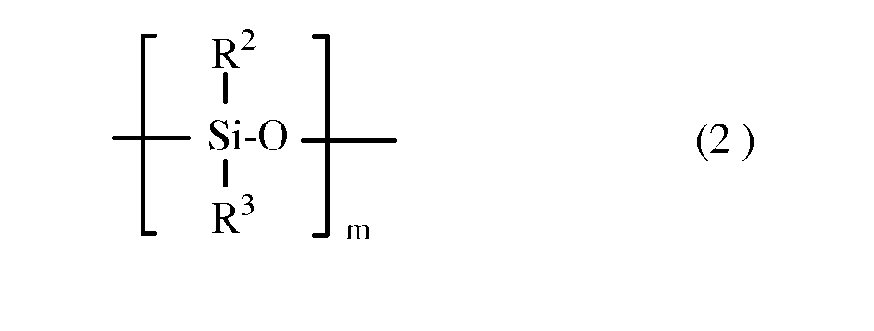
wherein R2 and R3 are, independently of each other, a group selected from the group consisting of a hydroxyl group, an alkyl group having 1 to 3 carbon atoms, a cyclohexyl group, a vinyl group, a phenyl group and an allyl group, and wherein m is an integer of from 5 to 50.
Description
- This application claims the benefits of Japanese Patent Application Nos.
2008-253764 filed on September 30, 2008 2009-200919 filed on August 31, 2009 - The present invention relates to a silicone resin composition for optical semiconductor devices, specifically to a silicone resin composition comprising an organopolysiloxane having a silanol group and an organopolysiloxane having a linear diorganopolysiloxane moiety with a particular length, wherein formability is good and problems, such as warping of a semiconductor device in curing, and discoloration, specifically yellowing, of a cured body due to light degradation, are markedly reduced.
- Optical semiconductor elements, such as light emitting diodes (LED), are used as indicators or light sources. Recently, their output is higher and their wavelength is shorter, so that there is a problem that resin materials present near the optical semiconductor elements degrade due to light and turn yellow and, therefore, light output lowers.
- The following
Patent Literature 1 discloses, as a resin composition for encapsulating optical semiconductors, an epoxy resin composition in a B stage which comprises an epoxy resin, a curing agent, and a curing promoter. It describes that bisphenol A epoxy resin or bisphenol F epoxy resin is mainly used as the epoxy resin and triglycidyl isocyanate may be used. However, the afore-mentioned composition has the aforesaid yellowing problem, particularly when a semiconductor element is lit at a high temperature or for a long time. -
Patent Literature 2 discloses a composition which comprises an epoxy resin derived from isocyanuric acid, as a heat-resistant and light-resistant epoxy resin composition for encapsulating light emitting elements. However, light resistance of the composition is insufficient, again. -
Patent Literature 3 discloses a resin composition for encapsulating LED devices, which composition comprises an organopolysiloxane having a weight average molecular weight of 5 X 10 2 or higher and a condensation catalyst. However, the composition is directed to applications where high transparency is required, rather than to applications where white pigments are used, such as reflectors. - Meanwhile, recently, sizes of molded packages become bigger, for instance, in Matrix Array Package (MAP) method and, therefore, warpage in curing of an encapsulating resin becomes a serious problem. Large warpage causes various malfunctions in a package carrying step or a package cutting step. The afore-mentioned compositions are unsatisfactory in this respect also.
- Patent Literature 1: Japanese Patent Application Laid-Open
Hei-02-189958
Patent Literature 2: Japanese Patent Application Laid-Open2005-306952
Patent Literature 3: Japanese Patent Application Laid-Open2006-77234 - The purpose of the present invention is to provide a silicone resin composition for optical semiconductor devices which provide a cured body, wherein warpage in the optical semiconductor device in curing is less, and whiteness, heat-resistance, and light resistance are superior.
- The present invention is a silicone resin composition for an optical semiconductor device, comprising
- (A) 100 parts by weight of an organopolysiloxane having a weight average molecular weight of from 500 to 20000, reduced to polystyrene, and represented by the following average compositional formula (1),
(CH3)aSi(OR1)b(OH)cO(4-a-b-c)/2 (1)
wherein R1 is an organic group having 1 to 4 carbon atoms and a, b, and c are numbers satisfying the equations: 0.8 ≦ a ≦ 1.5, 0 ≦ b ≦ 0.3, 0.001 ≦ c ≦ 0.5, and 0.801 ≦ a + b + c < 2, - (B) 3 to 200 parts by weight of a white pigment,
- (C) 400 to 1000 parts by weight of an inorganic filler other than said white pigment,
- (D) 0.01 to 10 parts by weight of a condensation catalyst, and
- (E) 2 to 50 parts by weight of an organopolysiloxane comprising a linear diorganopolysiloxane moiety represented by the following formula (2),

- The composition of the present invention does not cause distortion in a device when cured and can give a cured body which is white, heat resistant and light resistant, on account of the combination of organopolysiloxane (E), which has a linear diorganopolysiloxane moiety having a particular length, with organopolysiloxane (A), which has a branched structure.
-
Fig. 1 is a cross sectional view which indicates an example of an optical semiconductor device where the silicone resin composition of the present invention is adopted. -
Fig. 2 is a cross sectional view which indicates an example of a photo coupler where the silicone resin composition of the present invention is adopted. - Organopolysiloxane (A) has a silanol group and forms a cross linked structure in the presence of condensation catalyst (D). In the afore-mentioned average compositional formula (1), R1 is an organic group having 1 to 4 carbon atoms and a, b, and c are numbers which satisfy the equations: 0.8 ≦ a ≦ 1.5, 0 ≦ b ≦ 0.3, 0.001 ≦ c ≦ 0.5, and 0.801 ≦ a + b + c < 2.
- A composition which comprises an organopolysiloxane with "a" less than 0.8, where "a" represents an amount of CH3, is not preferred because such a composition provides a too hard cured body, so that cracks may occur. Meanwhile, if a exceeds 1.5, such a resin does not solidify. Preferably, a satisfies the equation 0.9 ≦ a ≦ 1.2, more preferably 0.9 ≦ a ≦ 1.1.
- If b, content of OR1, exceeds 0.3, the molecular weight is so small that crack resistance may be insufficient. Preferably, b satisfies the equation 0.001 ≦ b ≦ 0.2, more preferably 0.0 1 ≦ b ≦ 0.1. The group, OR1, can be quantified in infrared absorption spectrum (IR) and alcohol quantification by alkali cracking.
- If c, content of an OH group bound to an Si atom, exceeds 0.5, such an organopolysiloxane gives, after condensation in thermal curing and/or condensation with component (E), a cured body which has a high stiffness but has a poor crack resistance. If c is less than 0.001, a melting point of the polyorganosiloxane tends to be higher, so that problems may occur in workability. If no bond is formed with component (E), component (E) is not fixed within a cured body, so that stiffness of the cured body tends to be low and solvent resistance tends to be poor. Preferably, c satisfies the equation 0.01 ≦ c ≦ 0.3, more preferably 0.05 ≦ c ≦ 0.2. As conditions for controlling c, a complete condensation rate of alkoxy groups of the raw material is preferably from 86 % to 96 %. If the rate is less than 86 %, the melting point tends to be low, whereas if it exceeds 96 %, the melting point tends to be too high.
- Accordingly, a total of a, b, and c preferably satisfies the equation, 0.911 ≦ a + b + c ≦ 1.8, more preferably 1.0 ≦ a + b + c ≦ 1.5.
- In the above average compositional formula (1), R1 is the same or different organic group having 1 to 4 carbon atoms. Examples of R1 include an alkyl group such as a methyl group, an ethyl group, an isopropyl group, and a n-butyl group; and alkenyl groups such as a vinyl group and an allyl group. A methyl group and an isopropyl group are preferred because the raw material is easily available.
- Organopolysiloxane (A) has a weight average molecular weight of from 500 to 20000, preferably from 1000 to 10000, more preferably from 2000 to 8000, reduced to a polystyrene standard, as determined by GPC. If the molecular weight is less than 500, such an organopolysiloxane is difficult to solidify. If the molecular weight exceeds 20000, the viscosity is so high that flowability may be too low.
- Component (A) can generally be represented by the combination of unit Q (SiO4/2), unit T (CH3SiO3/2), and unit D ((CH3)2SiO2/2). In this notation for component (A), a molar ratio of unit T is preferably 70 mole % or higher, desirably 75 mole % or higher, particularly 80 mole % or higher, relative to the total moles of the siloxane units. If the molar ratio of unit T is less than 70 %, overall balance among the stiffness, adhesion, and appearance may be lost. The remaining part other than unit T may be units D and Q. These units may preferably account for less than 30 mole % or less of component (A). The melting point tends to be higher as units D and Q increase.
- Component (A) can be obtained as a hydrolysis condensate of an organosilane represented by the following general formula (3),
(CH3)nSiX4-n (3)
wherein X is a halogen atom such as chlorine or an alkoxy group having 1 to 4 carbon atoms, and n is 1, 2, or 0. X is preferably a halogen atom, particularly a chlorine atom to obtain a organopolysiloxane in a solid state. - Examples of the silane compounds represented by the afore-mentioned formula (3) include methyltrichlorosilane, methyltrimethoxysilane, methyltriethoxysilane, dimethyldichlorosilane, dimethyldimethoxysilane, dimethyldiethoxysilane, tetrachlorosilane, tetramethoxysilane, and tetraethoxysilane.
- Hydrolysis and condensation of the afore-mentioned silane compounds having a hydrolysable group can be carried out in a conventional method, for instance, in the presence of acid catalysts such as acetic acid, hydrochloric acid, and sulfuric acid or alkali catalysts such as sodium hydroxide, potassium hydroxide, and tetramethylammonium hydroxide. For instance, when a silane which has a chlorine atom as a hydrolysable group is used, water added generates hydrochloric acid as a catalyst to give a hydrolysis condensate with a desirable molecular weight.
- The amount of water to be added in the hydrolysis and condensation is typically 0.9 to 1.6 moles, preferably 1.0 to 1.3 moles, relative to
total 1 mole of the hydrolysable groups, such as a chlorine atom, in the afore-mentioned silane compound having a hydrolysable group. When this amount falls within the range from 0.9 to 1.6 moles, the composition mentioned below exhibits excellent workability and the cured body exhibits excellent toughness. - The afore-mentioned silane compound which has a hydrolysable group is hydrolyzed preferably in an organic solvent such as alcohols, ketones, esters, cellosolves and aromatic compounds. Specific examples of the preferred solvents include alcohols such as methanol, ethanol, isopropyl alcohol, isobutyl alcohol, n-butanol and 2-butanol, and aromatic compounds such as toluene and xylene. A combination of isopropyl alcohol and toluene is more preferred for better curability of the composition and toughness of the cured body.
- The temperature for the hydrolysis and condensation is preferably from 10 to 120 degrees C, more preferably from 20 to 100 degrees C. When the reaction temperature falls in the afore-mentioned range, a solid hydrolysis condensate does not cause gelling and is usable in the subsequent step.
- When methyltrichlorosilane is used, water and isopropyl alcohol are added to methyltrichlorosilane dissolved in toluene to cause partial hydrolysis at a reaction temperature of from - 5 degrees C to 100 degrees C. Then, water is further added in such an amount that all of the unreacted chlorine atoms hydrolyze and the resulting hydrolysate reacts with each other to give a solid silicone polymer with a melting point of 76 degrees C, represented by the following formula:
(CH3)aSi(OC3H7)b(OH)cO(4-a-b-c)/2 (4)
wherein a, b, and c are as defined above. - Examples of the compound represented by the afore-mentioned average compositional formula (4) include those represented by the following formula (5) or (6).
(CH3)1.0Si(OC3H7)0.07(OH)0.13O1.4 (5)
(CH3)1.1Si(OC3H7)0.06(OH)0.12O1.3 (6)
- White pigment (B) is added in order to make the cured body white for applications, such as a reflector, i.e. reflecting board, in an optical semiconductor device. As the white pigments (white coloring agent), for instance, titanium dioxide, alumina, zirconium oxide, zinc sulfide, zinc oxide, and magnesium oxide can be used alone or in combination with titanium dioxide. Among these, titanium dioxide, magnesium oxide, and alumina are preferred, and titanium dioxide is more preferred. A crystal form of the titanium dioxide may be of any type, such as rutile type, anatase type, and Brookite type, and rutile type one is preferred.
- The white pigment preferably has an average particle diameter of from 0.05 to 10.0 µm, more preferably from 0.1 to 5.0 µm, even more preferably from 0.1 to 1.0 µm. The white pigment may be surface treated in advance, for instance, with a hydroxide of Al or Si in order to enhance its miscibility or dispersibility with resin component (A) or (E) or inorganic fillers (C). The average particle diameter can be determined as mass average D50 or median diameter in a particle size distribution measurement by a laser light diffraction method.
- The amount of the white pigment to be added is from 3 to 200 parts by weight, preferably from 5 to 150 parts by weight, particularly from 10 to 120 parts by weight relative to 100 parts by weight of component (A). If the amount is less than 3 parts by weight, it is sometimes difficult to attain sufficient whiteness, an initial reflectance ratio of 70% or higher of a cured body, and a reflectance ratio of 70% or higher after a degradation test by heating at 180 degrees C for 24 hours. If the amount exceeds 200 parts by weight, such a problem might cause that a content of inorganic filler (C) must be reduced which is added for enhancing mechanical strength. The amount of this white pigment is preferably in a range of from 1 to 50 % by weight, more preferably from 5 to 30 % by weight, most preferably from 10 to 30 % by weight, relative to a total amount of the silicone resin composition.
- Inorganic filler (C) is a filler other than the afore-mentioned white pigment. Those which are generally blended in epoxy resin compositions can be used. Examples of the fillers include silicas such as fused silica, spherical fused silica, and crystalline silica; silicon nitride; aluminium nitride; boron nitride; and antimony trioxide. An average particle diameter and shape of these inorganic fillers are not particularly limited, but is generally from 5 to 50 µm. The average particle diameter can be determined as a mass average D50 or median diameter in a particle size distribution measurement by a laser light diffraction method as described above.
- Particularly, fused silica and spherical fused silica are preferred. The upper limit of the average particle diameter is 50 µm, preferably 45 µm, and the lower limit thereof is 5 µm, preferably 7 µm, more preferably 10 µm for better moldability and flowability. For higher flowability of the resin composition, it is desirable to combine the one in a fine particle size zone with the average particle size of 3 µm or less, the one in a medium particle size zone with the average particle size of 4 to 8 µm, and the one in a coarse zone with the average particle size of 10 to 50 µm so that the average particle diameter falls within the afore-mentioned range. Especially in a case where a composition is used to form a pre-molded package or in underfill having a narrow part, particularly desirable is an inorganic filler whose average particle diameter is one half the thickness of the afore-said narrow part.
- The afore-mentioned inorganic filler may be surface treated with a coupling agent such as a silane coupling agent and a titanate coupling agent, for higher bond strength between the resin and the inorganic filler.
- As the afore-mentioned coupling agents, use may preferably be made of epoxy-functional alkoxysilanes such as gamma-glycidoxypropyltrimethoxysilane, gamma-glycidoxypropylmethyldiethoxysilane, and beta-(3, 4-epoxycyclohexyl)ethyltrimethoxysilane; amino-functional alkoxysilanes such as N-beta-(aminoethyl)-gamma-aminopropyltrimethoxysilane, gammaaminopropyltriethoxysilane, and N-phenyl-gamma-aminopropyltrimethoxysilane; and mercapto-funcational alkoxysilane such as gamma-mercaptopropyltrimethoxysilane. The amount of the coupling agent for the surface treatment and a method of the surface treatment are not restricted to any particular ones.
- The amount of the inorganic filler to be added is preferably from 400 to 1000 parts by weight, particularly from 600 to 950 parts by weight, relative to 100 parts by weight of component (A). If the amount is less than 400 parts by weight, a desired linear expansion coefficient may not be attained. If the amount exceeds 1000 parts by weight, a mold may not be fully filled due to an increased viscosity, or flexibility may be lost and, therefore, defects such as abrasion in an element may occur. A total amount of the inorganic filler and the white pigment is preferably from 70 to 93 % by weight, particularly from 75 to 91 % by weight, relative to the total weight of the silicone resin composition.
- Condensation catalyst (D) is for curing the afore-mentioned component (A) and selected, considering, for instance, storage stability of component (A) and desired stiffness. Examples of the condesation catalysts include basic compounds such as trimethylbenzylammonium hydroxide, tetramethylammonium hydroxide, n-hexylamine, tributylamine, diazabicycloundecene (DBU) and dicyandiamide; metal-containing compounds such as tetraisopropyl titanate, tetrabutyl titanate, titanium acetylacetonate, aluminum triisobutoxide, aluminum triisopropoxide, zirconium tetra(acetylacetonato), zirconium tetrabutylate, cobalt octylate, cobalt acetylacetonato, iron acetylacetonato, tin acetylacetonato, dibutyltin octylate, dibutyltin laurate, zinc octylate, zinc bezoate, zinc p-tert-butylbenzoate, zinc laurate, zinc stearate, aluminium phosphate, and alminium triisopropoxide; organic titanium chelate compounds such as aluminium trisacetylacetonate, aluminium bisethylacetoacetate · monoacetylacetonate, diisopropoxybis(ethylacetoacetate)titanium, and diisopropoxybis(ethylacetoacetate)titanium. Among these, zinc octylate, zinc bezoate, zinc p-tert-butylbenzoate, zinc laurate, zinc stearate, aluminium phosphate, and alminium triisopropoxide, particularly zinc benzote and aluminium triisopropoxide, are preferred.
- The amount of the curing catalyst to be added is from 0.01 to 10 parts by weight, preferably from 0.1 to 6 parts by weight, relative to 100 parts by weight of (A). Within the afore-mentioned range, curing is good and storage stability of the composition is also good.
- Component (E) is characterized in that it comprises a linear dioranopolysiloxane moiety which is represented by the following formula (2).

- Component (E) may comprise unit D (R2SiO2/2), unit M (R3SiO1/2), and unit T (RSiO3/2) in addition to unit D (R2R3SiO2/2) which is represented by the afore-mentioned formula (2). Their mole ratio is preferably 90-24 : 75-0 : 50-1, particularly 70-28 : 70-20 : 10-2, provided that the total is 100, for good properties of the cured body. In the afore-mentioned units, R represents a hydroxyl group, a methyl group, an ethyl group, a propyl group, a cyclohexyl group, a phenyl group, a vinyl group, or an allyl group. Component (E) may comprise unit Q (SiO2).
- Preferably, 30 mole % or higher, particularly 50 mole % or higher, of organopolysiloxane (E) constitutes, in a molecule, the linear diorganopolysiloxane structure which is represented by the general formula (2).
- The weight average molecular weight of component (E), reduced to polystyrene, determined by gel permeation chromatography (GPC), is preferably from 3,000 to 1,000,000, more preferably from 10,000 to 100,000. When the molecular weight is within the afore-mentioned range, the polymer is solid or a semi solid and, therefore, is suitable for workability and curability.
- Component (E) can be prepared by combining compounds which would constitute the afore-mentioned units in such a ratio that a desired mole ratio among the units is obtained in the resulting polymer and carrying out hydrolysis and condensation in the presence of, for instance, an acid.
- Examples of the raw materials for unit RSiO3/2 include chlorosilanes such as MeSiCl3, EtSiCl3, PhSiCl3, propyltrichlorosilane, and cyclohexyltrichlorosilane; and alkoxysilanes corresponding to the afore-mentioned chlorosilanes, such as methoxysilanes.
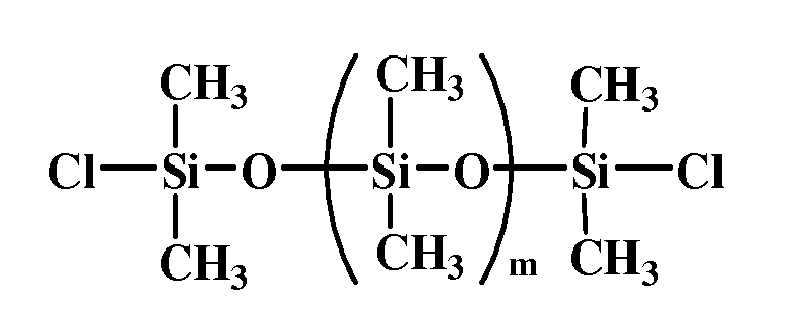
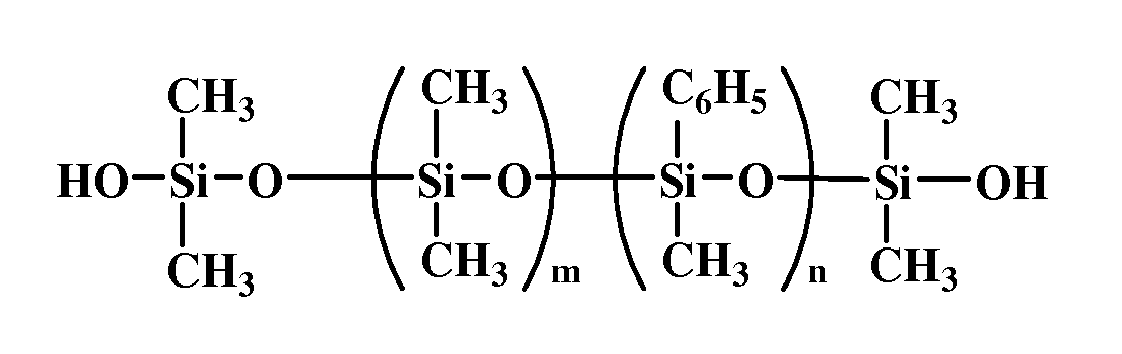
- Examples of the raw materials for unit R2R3SiO2/2 represented by the afore-mentioned formula (2) include


-


-


- Examples of the raw materials for unit M and unit D include chlorosilanes such as Me2PhSiCl, Me2ViSiCl, MePhSiCl2, MeViSiCl2, Ph2MeSiCl, Ph2ViSiCl, and PhViSiCl2; and alkoxysilanes corresponding to the afore-mentioned chlorosilanes such as methoxysilanes, wherein Me represets a methyl group; Et, an ethyl group; Ph, a phenyl group, and Vi, a vinyl group.
- Component (E) can be obtained by combining the afore-mentioned raw materials in a particular mole ratio, for instance, as follows. 100 Parts by mass of phenylmethyldichlorosilane, 2100 parts by weight of phenyltrichlorosilane, 2400 parts by weight of a silicone oil having 21 Si atoms and chlorodimethyl groups on both ends, and 3000 parts by weight of toluene are mixed. Then, the mixture of the silanes is added dropwise to 11000 parts by weight of water, subsequently, hydrolyzed at a temperature of from 30 to 50 degrees C for 1 hour and aged at 50 degrees C for 1 hour. Then, water is added for washing and, subsequently, an organic phase is subjected to azeotropic dehydration, filtration, and strip under reduced pressure.
- A siloxane unit having a silanol group may be incorporated into organopolysiloxane (E) in the afore-mentioned hydrolysis and condensation step. The siloxane unit having a silanol group is contained generally in a content of from 0.5 to 10 mole %, preferably from 1 to 5 mole %, relative to the total moles of the silixoane units. Examples of the afore-mentioned siloxane unit having a silanol group include unit R(HO)SiO2/2, unit R(HO)2SiO1/2, and unit R2(HO)SiO1/2, wherein R is not a hydroxyl group. The organopolysiloxane has a silanol group and, therefore, reacts with component (A), curable organopolysiloxane.
- The amount of component (E) to be added is preferably from 2 to 50 parts by weight, more preferably from 3 to 30 parts by weight, relative to 100 parts by weight of component (A). If the amount is less than the afore-mentioned lower limit, the effect of improving continuous moldability is less and the low warpage cannot be attained. If the amount is more than the afore-mentioned upper limit, the viscosity of the composition is so high that molding may be difficult.
- The present silicone resin composition may further comprise, if needed, various kinds of additives. For instance, the present composition may comprise mercapto functional alkoxy silanes such as gamma-mercaptopropyltrimethoxysilane; coupling agents such as gamma-glycidoxypropyltrimethoxysilane, gamma-glycidoxypropylmethyldiethoxysilane, and beta-(3,4-epoxycyclohexyl)ethyl trimethoxysilane; additives such as whiskers, silicone powder, thermoplastic resins, thermoplastic elastomers, and organic synthetic rubber; internal releasing agents such as esters of aliphatic acids, esters of glyceric acid, zinc stearate, and calcium stearate; and antioxidants of phenol type, phosphorus type, and sulfur type in such an amount that the effects of the present invention are not damaged. It should be noted that the present composition shows less discolor by light compared to conventional thermosetting silicone resin compositions, even when the present composition does not comprise any antioxidant.
- The present composition can be prepared by blending the silicone resin, the white pigment, the inorganic filler, the curing catalyst, and optional other additives in a predetermined ratio, stirring the resulting mixture sufficiently with, for instance, a mixer, melt mixed with, for instance, hot rolls, a kneader, an extruder, cooled to solidify, and pulverized into a suitable size to obtain the silicone resin composition for molding. The linear expansion coefficient of the cured body of the present silicone resin composition is from 10 ppm/K to 30 ppm/K, preferably from 10 ppm/K to 20 ppm/K at a temperature or higher of the glass transition temperature.
- The silicone resin composition thus obtained is particularly useful as an encapsulating agent for optical semiconductor devices, specifically LED cases, and photo couplers.
Fig. 1 shows a cross section of an example of an optical semiconductor device. InFig. 1 ,optical semiconductor element 1, such as an LED, is die bonded to leadframe 2 and further wire bonded viabonding wire 3 to another lead frame 2'. The space between these semiconductor elements is filled with transparent encapsulatingresin 4. In the example illustrated inFig. 1 , a cured body of the present silicone resin composition constituteswhite reflector 5. Numeral 6 indicates a lens.Fig. 2 shows a cross section of an example of a photo coupler. InFig. 2 ,semiconductor element 1 is die bonded to leadframe 2 and further wire bonded viabonding wire 3 to another lead frame (not shown behindlead frame 2 inFig. 2 ). Semiconductor element 1' for receiving light is die bonded to lead frame 2' so that semiconductor element 1' facessemiconductor element 1. Semiconductor element 1' is further wire bonded via bonding wire 3' to another lead frame (not shown behind lead frame 2' inFig. 2 ). The space between these semiconductor elements is filled with transparent encapsulatingresin 4. The semiconductor elements which are surrounded with transparent encapsulatingresin 4 is further encapsulated with the presentsilicone resin composition 7. - The reflector thus obtained initially has a light reflectance at a wavelength of 450 nm of 70 % or higher, particularly 80 % or higher, above all 85 % or higher. After a degradation test at 180 degrees C for 24 hours, the reflector has a reflectance of 70 % or higher, particularly 80 % or higher, above all 85 % or higher. If the reflectance after the degradation test is less than 70 %, the durability as a reflector for an LED semiconductor element is short.
- As the most common molding method of the reflector, mention is made of transfer molding and compression molding. The transfer molding is carried out using a transfer molding machine, preferably at a molding pressure of 5 to 20 N/mm2 at a molding temperature of 120 to 190 degrees C for a molding time of 30 to 500 seconds, particularly at a molding temperature of 150 to 185 degrees C for a molding time of 30 to 180 seconds. In the compression molding, molding is carried out using a compression molding machine, preferably at a molding temperature of from 120 to 190 degrees C for a molding time of from 30 to 600 seconds, specifically at a temperature of from 130 to 160 degrees C for 120 to 300 seconds. In both of the molding methods, post curing may be carried out at a temperature of from 150 to 185 degrees C for 2 to 20 hours.
- The silicone resin composition of the present invention thus obtained has good moldability and heat and light resistance, particularly ultraviolet ray resistance and, therefore, is suitable for a pre-molded package for white, blue, and, further, ultraviolet LED, as well as for a packaging material for solar cells.
- Further, the present invention also encompasses a pre-molded package which is prepared by integrally encapsulating, with the present composition, a metal substrate or an organic substrate of matrix array type with a lead part or a pad part thereon, while leaving a position for an LED element to be molded open. The present composition can also be used for encapsulating general semiconductors or various modules to be installed in vehicles.
- The present invention will be explained more in detail in the following Examples and Comparative Examples. However, the present invention shall not be limited to the Examples.
- The raw materials used in the Examples and the Comparative Examples are as follows.
- To a one litter flask were added 100 parts by mass of metyltrichlorosilane and 200 parts by mass of toluene. To the resulting mixture, was dropwise added a mixture of 8 parts by weight of water and 60 parts by weight of isopropyl alcohol over 5 to 20 hours while keeping the inner temperature at -5 to 0 degrees C by cooling the reactor in an ice bath. Then, the mixture was heated with stirring at a refluxing temperature for 20 minutes, and cooled to room temperature, to which 12 parts by weight of water was dropwise added at a temperature below 30 degrees C over 30 minutes and the mixture was stirred for 20 minutes. Further, 25 parts by weight of water was dropwise added and stirred at a temperature of from 40 to 45 degrees C for 60 minutes. Then, 200 parts by weight of water were added and an organic phase was separated. The organic phase was washed until the phase became neutral and then subjected to azeotropic dehydration, filtration, and strip under reduced pressure to obtain 36.0 parts by weight of a colorless and transparent solid (melting point, 76 degrees C), thermosetting organopolysiloxane (A) represented by the following formula (7) .
(CH3)1.0Si(OC3H7)0.07(OH)0.10O1.4 (7)
- White pigment: titanium dioxide (rutile type); average particle diameter, 0.29µm; R-45M (trade name ex Sakai Chemical Industry Co., Ltd.)
- The inorganic filler had an average particle diameter of 43µm and consisted of:
- 95 parts by weight of spherical fused silica which has an an average particle diameter of 45 µm, MSR-4500TN (ex Tatsumori Co., Ltd); and
- 5 parts by weight of spherical alumina which had an average particle diameter of 0.5µm, SO 25 R (ex Admatechs Co., Ltd).
- Zinc benzoate, ex Wako Pure Chemical Industries Ltd.
- 100 Grams (4.4 mole %) of phenylmethyldichlorosilane, 2100 g (83.2 mole %) of phenyltrichlorosilane, 2400 g (12.4 mole %) of silicone oil having 21 Si atoms and chlorodimethyl groups on both ends, 3000 g of toluene were mixed and added dropwise to 11000 g of water and hydrolyzed at a temperature of from 30 to 50 degrees C for 1 hour. Then, the mixture was aged at 50 degrees C for 1 hour, to which water was added for washing. Then, the organic phase was subjected to azeotropic dehydration, filtration, and strip under reduced pressure to obtain colorless and transparent organopolysiloxane (E) which had a melt viscosity of 5 Pa. s at 150 degrees C.
- 45 Grams of 1,3,5-tris(2,3-epoxypropyl) isocyanurate, TEPIC-S (trade name, ex Nissan Chemical Industries, Ltd., epoxy equivalent, 100), was blended with 55 g of methyl hexahydrophthalic anhydride, RIKACID MH (trade name ex New Japan Chemical Co., Ltd.) in a blend mole ratio of epoxy group/acid anhydride = 1.4. The resulting mixture was heated at 80 degrees C for 10 hours to react the epoxy resin with the acid anhydride to obtain the preliminary reaction product.
- Silane coupling agent: KBM803, ex Shin-Etsu Chemical Co., Ltd.
Releasing agent: stearyl stearate, RikemalSL-900A, ex Riken Vitamin Co., Ltd. - In a formulation shown in Table 1 (in parts by weight), organopolysiloxane (A), white pigment (B), inorganic filler (C), curing catalyst (D), and organopolysiloxane (E) were mixed, kneaded in roll mixing, cooled and pulverized to obtain a white silicone resin composition.
- For these compositions, the following properties were dermined. The results are as shown in Table 1. Molding was carried out in a transferring molding machine at a molding temperature of 175 degrees C for a molding time of 120 seconds.
- Using a mold according to Epoxy Molding Materials Institute (EMMI) Standards, a spiral flow value was determined at a molding temperature of 175 degrees C and a molding pressure of 6.9 N/mm2 for a molding time of 120 seconds.
- Using a Koka type flow tester provided with a 1 mm-diameter nozzle, a melt viscosity was measured at 175 °C and at a pressure of 25 kgf.
- A specimen was prepared by molding at a molding temperature of 175 degrees C and a molding pressure of 6.9N/mm2 for a molding time of 120 seconds using a metal die according to JIS-K6911. The bending strength of the specimen was measured at room temperature, 25 degrees C.
- MAP type packages of 50 x 50 mm having a Cu frame plated with Ag were continuously molded at a molding temperature of 175 degrees C and a molding pressure of 6.9 N/mm2 for a molding time of 120 seconds and were evaluated for releasability at the cavity, breakage of a runner and burrs. The number of the repeated molding was recorded until the resin was not released from the cavity, the runner broke, or a burr appeared.
- A 50 x 50 mm MAP package (Cu frame) was encapsulated with a resin of 45 mm x 45 mm x 0.5 mm at a molding temperature of 175 degrees C, a molding pressure of 6.9 N/mm2 for a molding time of 120 seconds. Warpage of the cured body obtained was measured on a warpage measurement instrument.
- A disc, cured body, of 50 mm in diameter and 50 mm in thicknesswas molded in the conditions of a molding temperature of 175 degrees C, a molding pressure of 6.9 N/mm2 and a molding time of 90 seconds. Immediately after the molding, the disc was left at 180 degrees C for 24 hours, irradiated with UV from a high-pressure mercury lamp having a peak wavelength of 365 nm and an output of 60 mW/cm, for 24 hours. A light reflectance at a wave length of 450 nm was measured using X-rite 8200, ex S. D. G. Co., Ltd.
- A cured body having 5 x 5 x 15 mm was prepared in the conditions of a molding temperature of 175 degrees C, a molding pressure of 6.9 N/mm2, and a molding time 120 of seconds and subjected to post curing at 180 degrees C for 4 hours. Then, a linear expansion coefficient was determined at a temperature rise rate of 5 degrees C/minute on TMA 8140 C, ex Rigaku Corporation.
-


- As seen in Table 1, Reference Example 1, where the content of component (E) is too low, and Comparative Example 1, where component (E) is not contained at all, showed a large warpage. Meanwhile, Reference Example 2, where the content of (E) is too high, and Comparative Example 2, where only component (E) is contained as the organopolysiloxane component, the flowability was poor, so that moldability was poor. Comparative Example 3, where the preliminary reaction product of the isocyanuric acid-derived epoxy resin with the acid anhydride is contained showed a much lower light reflectance after UV irradiation, i.e., bad weathering resistance. Contrary to these, the Examples of the present invention showed no decrease in light reflectance and less warpage.
- The present resin composition is suitable for use in optical semiconductor devices, specifically reflectors.
-
- 1 and 1': Semiconductor element
- 2 and 2': Lead frame
- 3 and 3': Bonding wire
- 4: Transparent encapsulating resin
- 5: White reflector (cured body of the silicone resin composition)
- 6: Lens
- 7: Cured body of the silicone resin composition
Claims (4)
- A silicone resin composition for an optical semiconductor device, comprising(A) 100 parts by weight of an organopolysiloxane having a weight average molecular weight of from 500 to 20000, reduced to polystyrene, and represented by the following average compositional formula (1),
(CH3)aSi(OR1)b(OH)cO(4-a-b-c)/2 (1)
wherein R1 is an organic group having 1 to 4 carbon atoms and a, b, and c are numbers satisfying the equations: 0.8 ≦ a ≦ 1.5, 0 ≦ b ≦ 0.3, 0.001 ≦ c ≦ 0.5, and 0.801 ≦ a + b + c < 2,(B) 3 to 200 parts by weight of a white pigment,(C) 400 to 1000 parts by weight of an inorganic filler other than said white pigment,(D) 0.01 to 10 parts by weight of a condensation catalyst, and(E) 2 to 50 parts by weight of an organopolysiloxane comprising a linear diorganopolysiloxane moiety represented by the following formula (2),wherein R2 and R3 are, independently of each other, a group selected from the group consisting of a hydroxyl group, an alkyl group having 1 to 3 carbon atoms, a cyclohexyl group, a vinyl group, a phenyl group and an allyl group, and wherein m is an integer of from 5 to 50.
- The silicone resin composition according to claim 1, wherein said white pigment (B) is at least one selected from the group consisting of titanium dioxide, magnesium oxide and alumina, with their average particle diameters being 0.05 to 10.0 µm, and the content of (B) is 1 to 50 % by weight relative to the weight of the silicone resin composition, and
wherein a total weight of white pigment (B) and inorganic filler (C) is 70 to 93 % by weight relative to the weight of the silicone resin composition. - The silicone resin composition according to claim 1 or 2, wherein a linear expansion coefficient of a cured body of the silicone resin composition is in the range of from 10 to 30 ppm/K at a glass transition temperature or higher of said cured body.
- An optical semiconductor device provided with a cured body of the silicone resin composition according to any one of claims 1 to 3.
Applications Claiming Priority (2)
| Application Number | Priority Date | Filing Date | Title |
|---|---|---|---|
| JP2008253764 | 2008-09-30 | ||
| JP2009200919A JP2010106243A (en) | 2008-09-30 | 2009-08-31 | Silicone resin composition for optical semiconductor device |
Publications (2)
| Publication Number | Publication Date |
|---|---|
| EP2174984A1 true EP2174984A1 (en) | 2010-04-14 |
| EP2174984B1 EP2174984B1 (en) | 2011-08-24 |
Family
ID=41395906
Family Applications (1)
| Application Number | Title | Priority Date | Filing Date |
|---|---|---|---|
| EP09171894A Active EP2174984B1 (en) | 2008-09-30 | 2009-09-30 | Silicone resin composition for optical semiconductor devices |
Country Status (7)
| Country | Link |
|---|---|
| US (1) | US8022137B2 (en) |
| EP (1) | EP2174984B1 (en) |
| JP (1) | JP2010106243A (en) |
| KR (1) | KR101497158B1 (en) |
| CN (1) | CN101712799B (en) |
| AT (1) | ATE521668T1 (en) |
| TW (1) | TWI465519B (en) |
Cited By (7)
| Publication number | Priority date | Publication date | Assignee | Title |
|---|---|---|---|---|
| EP2295499A1 (en) * | 2009-09-15 | 2011-03-16 | Shin-Etsu Chemical Co., Ltd. | Underfill composition and an optical semiconductor device |
| EP2672533A2 (en) * | 2012-06-06 | 2013-12-11 | Nitto Denko Corporation | Light reflecting member for optical semiconductor, and substrate for mounting optical semiconductor and optical semiconductor device using the light reflecting member |
| EP3147329A1 (en) * | 2015-09-28 | 2017-03-29 | Shin-Etsu Chemical Co., Ltd. | Heat-curable silicone resin composition, optical semiconductor device and semiconductior package using molded product of same |
| EP3239244A4 (en) * | 2014-12-25 | 2018-08-01 | Shengyi Technology Co. Ltd. | Organic silicone resin composition and pre-preg, laminate, copper-clad laminate, and aluminum substrate that use the composition |
| EP3239245A4 (en) * | 2014-12-25 | 2018-08-22 | Shengyi Technology Co. Ltd. | Organic silicon resin composition, white prepreg and white laminate using same |
| EP3239243A4 (en) * | 2014-12-25 | 2018-10-10 | Shengyi Technology Co. Ltd. | Ceramized silicone resin composition and pre-preg and laminate that use the composition |
| EP3285307A4 (en) * | 2015-04-17 | 2018-12-05 | Samsung Electronics Co., Ltd. | Semiconductor light-emitting device and method for manufacturing same |
Families Citing this family (38)
| Publication number | Priority date | Publication date | Assignee | Title |
|---|---|---|---|---|
| JP5108825B2 (en) * | 2009-04-24 | 2012-12-26 | 信越化学工業株式会社 | Silicone resin composition for optical semiconductor device and optical semiconductor device |
| WO2011125753A1 (en) * | 2010-04-02 | 2011-10-13 | 株式会社カネカ | Curable resin composition, curable resin composition tablet, molded body, semiconductor package, semiconductor component and light emitting diode |
| JP5682257B2 (en) * | 2010-07-30 | 2015-03-11 | 三菱化学株式会社 | Resin composition for semiconductor light emitting device |
| JP2012064928A (en) * | 2010-08-18 | 2012-03-29 | Mitsubishi Chemicals Corp | Resin molding material for semiconductor light-emitting device and resin molding |
| JP2012041428A (en) * | 2010-08-18 | 2012-03-01 | Shin-Etsu Chemical Co Ltd | Silicone resin composition and optical semiconductor case |
| JP5971176B2 (en) * | 2010-09-02 | 2016-08-17 | 住友ベークライト株式会社 | Fixing resin composition used for rotor |
| JP2012057000A (en) * | 2010-09-07 | 2012-03-22 | Shin-Etsu Chemical Co Ltd | Silicone resin composition, sealing material of semiconductor device, and semiconductor device |
| US9045668B2 (en) * | 2010-09-22 | 2015-06-02 | Dow Corning Corporation | Organosiloxane block copolymer |
| KR101849807B1 (en) | 2010-10-25 | 2018-04-17 | 이데미쓰 고산 가부시키가이샤 | (meth)acrylate composition |
| JP5728960B2 (en) * | 2011-01-17 | 2015-06-03 | 信越化学工業株式会社 | White thermosetting silicone resin composition for optical semiconductor case formation and optical semiconductor case |
| JP5728961B2 (en) * | 2011-01-17 | 2015-06-03 | 信越化学工業株式会社 | White thermosetting silicone resin composition for optical semiconductor case formation and optical semiconductor case |
| JP5919903B2 (en) * | 2011-03-31 | 2016-05-18 | 三菱化学株式会社 | Package for semiconductor light emitting device, semiconductor light emitting device having the package, and method for manufacturing the same |
| JP5833333B2 (en) * | 2011-04-19 | 2015-12-16 | アイカ工業株式会社 | Silicone resin composition for optical semiconductor device reflector |
| TW201247782A (en) * | 2011-05-25 | 2012-12-01 | Daxin Materials Corp | White thermocurable siloxane resin composition |
| JP5987580B2 (en) * | 2011-10-03 | 2016-09-07 | 三菱化学株式会社 | Method for producing curable polysiloxane composition |
| JP2013133429A (en) * | 2011-12-27 | 2013-07-08 | Kaneka Corp | Resin molding for surface mounting type light emitting device and light emitting device using the same |
| JP2015513362A (en) * | 2012-03-12 | 2015-05-11 | ダウ コーニング コーポレーションDow Corning Corporation | Resin-linear organosiloxane block copolymer composition |
| KR102063029B1 (en) * | 2012-03-20 | 2020-02-11 | 다우 실리콘즈 코포레이션 | Light guide and associated light assemblies |
| CN104321366B (en) * | 2012-03-21 | 2017-08-25 | 道康宁公司 | The composition of resin linear Organosiloxane block copolymer |
| EP2828319B1 (en) * | 2012-03-21 | 2018-09-12 | Dow Silicones Corporation | Compositions comprising resin-linear organosiloxane block copolymers and organopolysiloxanes |
| US9279946B2 (en) | 2012-05-23 | 2016-03-08 | Avago Technologies General Ip (Singapore) Pte. Ltd. | Premolded cavity for optoelectronic device |
| JP6363618B2 (en) | 2012-12-27 | 2018-07-25 | ダウ シリコーンズ コーポレーション | Composition for forming articles having excellent reflectivity and flame retardancy, and articles formed therefrom |
| WO2014109293A1 (en) * | 2013-01-10 | 2014-07-17 | コニカミノルタ株式会社 | Led device and coating liquid used for production of same |
| JP2014177570A (en) * | 2013-03-15 | 2014-09-25 | Shin Etsu Chem Co Ltd | Thermosetting silicone resin composition |
| JP2015040238A (en) * | 2013-08-21 | 2015-03-02 | 信越化学工業株式会社 | Thermosetting silicone resin composition for optical semiconductor case formation |
| JP2015054965A (en) * | 2013-09-13 | 2015-03-23 | 株式会社東芝 | Resin for sealing, semiconductor device, and optical coupling device |
| JP5797717B2 (en) * | 2013-10-16 | 2015-10-21 | 台湾太陽油▲墨▼股▲分▼有限公司 | White thermosetting resin composition, cured product thereof, and display member using the same |
| JP6417878B2 (en) * | 2013-11-20 | 2018-11-07 | 三菱ケミカル株式会社 | Curable organopolysiloxane composition for semiconductor light emitting device sealing material, cured organopolysiloxane obtained by curing the composition, and semiconductor light emitting device sealed using the same |
| US9671085B2 (en) | 2014-04-22 | 2017-06-06 | Dow Corning Corporation | Reflector for an LED light source |
| JP6194853B2 (en) * | 2014-06-06 | 2017-09-13 | 信越化学工業株式会社 | White thermosetting silicone resin composition for optical semiconductor device and case for mounting optical semiconductor element |
| JP2017043656A (en) * | 2015-08-24 | 2017-03-02 | 信越化学工業株式会社 | Thermosetting silicone resin composition and optical semiconductor element mounting case using the molded body |
| JP6925147B2 (en) * | 2016-03-31 | 2021-08-25 | Koa株式会社 | Thermosetting silicone resin paste composition and its use |
| US10833231B2 (en) * | 2016-04-18 | 2020-11-10 | Osram Oled Gmbh | Method for producing an optoelectronic component, and optoelectronic component |
| CN107501942B (en) * | 2017-08-29 | 2020-10-02 | 北京康美特科技股份有限公司 | Moldable silicone resin, composition and semiconductor light-emitting element thereof |
| JP2019159140A (en) * | 2018-03-14 | 2019-09-19 | 信越化学工業株式会社 | Heat-curable silicone resin composition for white reflector, and white reflector made of cured product of the same |
| KR102952088B1 (en) * | 2019-03-29 | 2026-04-15 | 다우 도레이 캄파니 리미티드 | Curable silicone composition, its cured product, and its manufacturing method |
| JP7793276B2 (en) * | 2022-12-22 | 2026-01-05 | 信越化学工業株式会社 | Photocoupler sealant and photocoupler |
| CN117594735B (en) * | 2023-11-20 | 2024-04-30 | 南通惟怡新材料科技有限公司 | A laminate and a method for preparing the same |
Citations (6)
| Publication number | Priority date | Publication date | Assignee | Title |
|---|---|---|---|---|
| JPH02189958A (en) | 1989-01-18 | 1990-07-25 | Nitto Denko Corp | Optical semiconductor device and epoxy resin composition for sealing photo-semiconductor used for same device |
| JP2005306952A (en) | 2004-04-20 | 2005-11-04 | Japan Epoxy Resin Kk | Epoxy resin composition for light emitting device sealing material |
| JP2006077234A (en) | 2004-08-10 | 2006-03-23 | Shin Etsu Chem Co Ltd | LED element sealing resin composition and cured product obtained by curing the composition |
| US20060229408A1 (en) * | 2005-04-08 | 2006-10-12 | Shin-Etsu Chemical Co., Ltd. | Curable resin composition for sealing LED element |
| JP2008253764A (en) | 2007-04-03 | 2008-10-23 | General Electric Co <Ge> | Method and apparatus for obtaining and/or analyzing anatomical image |
| JP2009200919A (en) | 2008-02-22 | 2009-09-03 | Pioneer Electronic Corp | Speaker system |
Family Cites Families (4)
| Publication number | Priority date | Publication date | Assignee | Title |
|---|---|---|---|---|
| US4102970A (en) * | 1974-10-03 | 1978-07-25 | Wacker-Chemie Gmbh | Thermosetting compositions which can be cured to form molded objects or coatings |
| US6509423B1 (en) * | 2001-08-21 | 2003-01-21 | Dow Corning Corporation | Silicone composition and cured silicone product |
| US20060035092A1 (en) | 2004-08-10 | 2006-02-16 | Shin-Etsu Chemical Co., Ltd. | Resin composition for sealing LED elements and cured product generated by curing the composition |
| JP5108825B2 (en) * | 2009-04-24 | 2012-12-26 | 信越化学工業株式会社 | Silicone resin composition for optical semiconductor device and optical semiconductor device |
-
2009
- 2009-08-31 JP JP2009200919A patent/JP2010106243A/en active Pending
- 2009-09-25 TW TW098132503A patent/TWI465519B/en active
- 2009-09-29 KR KR20090092107A patent/KR101497158B1/en active Active
- 2009-09-29 US US12/569,433 patent/US8022137B2/en active Active
- 2009-09-30 CN CN2009102040214A patent/CN101712799B/en active Active
- 2009-09-30 EP EP09171894A patent/EP2174984B1/en active Active
- 2009-09-30 AT AT09171894T patent/ATE521668T1/en not_active IP Right Cessation
Patent Citations (6)
| Publication number | Priority date | Publication date | Assignee | Title |
|---|---|---|---|---|
| JPH02189958A (en) | 1989-01-18 | 1990-07-25 | Nitto Denko Corp | Optical semiconductor device and epoxy resin composition for sealing photo-semiconductor used for same device |
| JP2005306952A (en) | 2004-04-20 | 2005-11-04 | Japan Epoxy Resin Kk | Epoxy resin composition for light emitting device sealing material |
| JP2006077234A (en) | 2004-08-10 | 2006-03-23 | Shin Etsu Chem Co Ltd | LED element sealing resin composition and cured product obtained by curing the composition |
| US20060229408A1 (en) * | 2005-04-08 | 2006-10-12 | Shin-Etsu Chemical Co., Ltd. | Curable resin composition for sealing LED element |
| JP2008253764A (en) | 2007-04-03 | 2008-10-23 | General Electric Co <Ge> | Method and apparatus for obtaining and/or analyzing anatomical image |
| JP2009200919A (en) | 2008-02-22 | 2009-09-03 | Pioneer Electronic Corp | Speaker system |
Cited By (11)
| Publication number | Priority date | Publication date | Assignee | Title |
|---|---|---|---|---|
| EP2295499A1 (en) * | 2009-09-15 | 2011-03-16 | Shin-Etsu Chemical Co., Ltd. | Underfill composition and an optical semiconductor device |
| KR20110030338A (en) * | 2009-09-15 | 2011-03-23 | 신에쓰 가가꾸 고교 가부시끼가이샤 | Underfill material composition and optical semiconductor device |
| US8519063B2 (en) | 2009-09-15 | 2013-08-27 | Shin-Etsu Chemical Co., Ltd. | Underfill composition and an optical semiconductor device |
| EP2672533A2 (en) * | 2012-06-06 | 2013-12-11 | Nitto Denko Corporation | Light reflecting member for optical semiconductor, and substrate for mounting optical semiconductor and optical semiconductor device using the light reflecting member |
| EP3239244A4 (en) * | 2014-12-25 | 2018-08-01 | Shengyi Technology Co. Ltd. | Organic silicone resin composition and pre-preg, laminate, copper-clad laminate, and aluminum substrate that use the composition |
| EP3239245A4 (en) * | 2014-12-25 | 2018-08-22 | Shengyi Technology Co. Ltd. | Organic silicon resin composition, white prepreg and white laminate using same |
| EP3239243A4 (en) * | 2014-12-25 | 2018-10-10 | Shengyi Technology Co. Ltd. | Ceramized silicone resin composition and pre-preg and laminate that use the composition |
| US10308808B2 (en) | 2014-12-25 | 2019-06-04 | Shengyi Technology Co., Ltd. | Organic silicone resin composition and pre-preg, laminate, copper-clad laminate, and aluminum substrate that use the composition |
| US10336905B2 (en) | 2014-12-25 | 2019-07-02 | Shengyi Technology Co., Ltd. | Organic silicon resin composition, white prepreg and white laminate using same |
| EP3285307A4 (en) * | 2015-04-17 | 2018-12-05 | Samsung Electronics Co., Ltd. | Semiconductor light-emitting device and method for manufacturing same |
| EP3147329A1 (en) * | 2015-09-28 | 2017-03-29 | Shin-Etsu Chemical Co., Ltd. | Heat-curable silicone resin composition, optical semiconductor device and semiconductior package using molded product of same |
Also Published As
| Publication number | Publication date |
|---|---|
| CN101712799A (en) | 2010-05-26 |
| JP2010106243A (en) | 2010-05-13 |
| TWI465519B (en) | 2014-12-21 |
| TW201022365A (en) | 2010-06-16 |
| ATE521668T1 (en) | 2011-09-15 |
| US20100081748A1 (en) | 2010-04-01 |
| KR101497158B1 (en) | 2015-02-27 |
| CN101712799B (en) | 2012-08-29 |
| EP2174984B1 (en) | 2011-08-24 |
| US8022137B2 (en) | 2011-09-20 |
| KR20100036977A (en) | 2010-04-08 |
Similar Documents
| Publication | Publication Date | Title |
|---|---|---|
| EP2174984B1 (en) | Silicone resin composition for optical semiconductor devices | |
| EP2253671B1 (en) | Silicone Resin Composition for Optical Semiconductor Devices and an Optical Semiconductor Device | |
| JP4678415B2 (en) | White thermosetting silicone resin composition for forming optical semiconductor case and optical semiconductor case | |
| US8013056B2 (en) | White heat-curable silicone resin composition, optoelectronic part case, and molding method | |
| CN101619169B (en) | Heat-curable silicone resin-epoxy resin composition, and premolded package molded from same | |
| EP2295499B1 (en) | Underfill composition and an optical semiconductor device | |
| JP5729270B2 (en) | White thermosetting silicone resin composition useful as LED reflector and optical semiconductor device using the composition | |
| CN101629018A (en) | White heat-curable silicone resin composition and optoelectronic part case | |
| JP2011032392A (en) | Silicone resin composition for optical semiconductor devices | |
| JP2014177570A (en) | Thermosetting silicone resin composition | |
| JP2012041428A (en) | Silicone resin composition and optical semiconductor case | |
| JP5728960B2 (en) | White thermosetting silicone resin composition for optical semiconductor case formation and optical semiconductor case | |
| JP2011063664A (en) | Underfill material composition and optical semiconductor device | |
| JP5728961B2 (en) | White thermosetting silicone resin composition for optical semiconductor case formation and optical semiconductor case | |
| JP2015040238A (en) | Thermosetting silicone resin composition for optical semiconductor case formation | |
| JP5556794B2 (en) | White thermosetting silicone resin composition useful as LED reflector and optical semiconductor device using the composition | |
| KR101881604B1 (en) | White thermosetting silicone resin composition useful as led reflector and optical semiconductor device using the same | |
| JP5640957B2 (en) | White thermosetting silicone resin composition useful as LED reflector and optical semiconductor device using the composition |
Legal Events
| Date | Code | Title | Description |
|---|---|---|---|
| PUAI | Public reference made under article 153(3) epc to a published international application that has entered the european phase |
Free format text: ORIGINAL CODE: 0009012 |
|
| AK | Designated contracting states |
Kind code of ref document: A1 Designated state(s): AT BE BG CH CY CZ DE DK EE ES FI FR GB GR HR HU IE IS IT LI LT LU LV MC MK MT NL NO PL PT RO SE SI SK SM TR |
|
| AX | Request for extension of the european patent |
Extension state: AL BA RS |
|
| 17P | Request for examination filed |
Effective date: 20100930 |
|
| GRAJ | Information related to disapproval of communication of intention to grant by the applicant or resumption of examination proceedings by the epo deleted |
Free format text: ORIGINAL CODE: EPIDOSDIGR1 |
|
| GRAP | Despatch of communication of intention to grant a patent |
Free format text: ORIGINAL CODE: EPIDOSNIGR1 |
|
| RIC1 | Information provided on ipc code assigned before grant |
Ipc: H01L 33/56 20100101ALI20110121BHEP Ipc: H01L 31/0203 20060101ALI20110121BHEP Ipc: H01L 23/29 20060101ALI20110121BHEP Ipc: C08K 3/22 20060101ALI20110121BHEP Ipc: C08L 83/04 20060101AFI20110121BHEP |
|
| RAP1 | Party data changed (applicant data changed or rights of an application transferred) |
Owner name: SHIN-ETSU CHEMICAL CO., LTD. |
|
| GRAS | Grant fee paid |
Free format text: ORIGINAL CODE: EPIDOSNIGR3 |
|
| GRAA | (expected) grant |
Free format text: ORIGINAL CODE: 0009210 |
|
| AK | Designated contracting states |
Kind code of ref document: B1 Designated state(s): AT BE BG CH CY CZ DE DK EE ES FI FR GB GR HR HU IE IS IT LI LT LU LV MC MK MT NL NO PL PT RO SE SI SK SM TR |
|
| REG | Reference to a national code |
Ref country code: GB Ref legal event code: FG4D |
|
| REG | Reference to a national code |
Ref country code: CH Ref legal event code: EP |
|
| REG | Reference to a national code |
Ref country code: IE Ref legal event code: FG4D |
|
| REG | Reference to a national code |
Ref country code: DE Ref legal event code: R096 Ref document number: 602009002251 Country of ref document: DE Effective date: 20111020 |
|
| REG | Reference to a national code |
Ref country code: NL Ref legal event code: T3 |
|
| LTIE | Lt: invalidation of european patent or patent extension |
Effective date: 20110824 |
|
| PG25 | Lapsed in a contracting state [announced via postgrant information from national office to epo] |
Ref country code: SE Free format text: LAPSE BECAUSE OF FAILURE TO SUBMIT A TRANSLATION OF THE DESCRIPTION OR TO PAY THE FEE WITHIN THE PRESCRIBED TIME-LIMIT Effective date: 20110824 Ref country code: FI Free format text: LAPSE BECAUSE OF FAILURE TO SUBMIT A TRANSLATION OF THE DESCRIPTION OR TO PAY THE FEE WITHIN THE PRESCRIBED TIME-LIMIT Effective date: 20110824 Ref country code: NO Free format text: LAPSE BECAUSE OF FAILURE TO SUBMIT A TRANSLATION OF THE DESCRIPTION OR TO PAY THE FEE WITHIN THE PRESCRIBED TIME-LIMIT Effective date: 20111124 Ref country code: HR Free format text: LAPSE BECAUSE OF FAILURE TO SUBMIT A TRANSLATION OF THE DESCRIPTION OR TO PAY THE FEE WITHIN THE PRESCRIBED TIME-LIMIT Effective date: 20110824 Ref country code: PT Free format text: LAPSE BECAUSE OF FAILURE TO SUBMIT A TRANSLATION OF THE DESCRIPTION OR TO PAY THE FEE WITHIN THE PRESCRIBED TIME-LIMIT Effective date: 20111226 Ref country code: LT Free format text: LAPSE BECAUSE OF FAILURE TO SUBMIT A TRANSLATION OF THE DESCRIPTION OR TO PAY THE FEE WITHIN THE PRESCRIBED TIME-LIMIT Effective date: 20110824 Ref country code: IS Free format text: LAPSE BECAUSE OF FAILURE TO SUBMIT A TRANSLATION OF THE DESCRIPTION OR TO PAY THE FEE WITHIN THE PRESCRIBED TIME-LIMIT Effective date: 20111224 |
|
| REG | Reference to a national code |
Ref country code: AT Ref legal event code: MK05 Ref document number: 521668 Country of ref document: AT Kind code of ref document: T Effective date: 20110824 |
|
| PG25 | Lapsed in a contracting state [announced via postgrant information from national office to epo] |
Ref country code: GR Free format text: LAPSE BECAUSE OF FAILURE TO SUBMIT A TRANSLATION OF THE DESCRIPTION OR TO PAY THE FEE WITHIN THE PRESCRIBED TIME-LIMIT Effective date: 20111125 Ref country code: CY Free format text: LAPSE BECAUSE OF FAILURE TO SUBMIT A TRANSLATION OF THE DESCRIPTION OR TO PAY THE FEE WITHIN THE PRESCRIBED TIME-LIMIT Effective date: 20110824 Ref country code: LV Free format text: LAPSE BECAUSE OF FAILURE TO SUBMIT A TRANSLATION OF THE DESCRIPTION OR TO PAY THE FEE WITHIN THE PRESCRIBED TIME-LIMIT Effective date: 20110824 Ref country code: PL Free format text: LAPSE BECAUSE OF FAILURE TO SUBMIT A TRANSLATION OF THE DESCRIPTION OR TO PAY THE FEE WITHIN THE PRESCRIBED TIME-LIMIT Effective date: 20110824 Ref country code: SI Free format text: LAPSE BECAUSE OF FAILURE TO SUBMIT A TRANSLATION OF THE DESCRIPTION OR TO PAY THE FEE WITHIN THE PRESCRIBED TIME-LIMIT Effective date: 20110824 Ref country code: AT Free format text: LAPSE BECAUSE OF FAILURE TO SUBMIT A TRANSLATION OF THE DESCRIPTION OR TO PAY THE FEE WITHIN THE PRESCRIBED TIME-LIMIT Effective date: 20110824 |
|
| PG25 | Lapsed in a contracting state [announced via postgrant information from national office to epo] |
Ref country code: BE Free format text: LAPSE BECAUSE OF FAILURE TO SUBMIT A TRANSLATION OF THE DESCRIPTION OR TO PAY THE FEE WITHIN THE PRESCRIBED TIME-LIMIT Effective date: 20110824 |
|
| PG25 | Lapsed in a contracting state [announced via postgrant information from national office to epo] |
Ref country code: CZ Free format text: LAPSE BECAUSE OF FAILURE TO SUBMIT A TRANSLATION OF THE DESCRIPTION OR TO PAY THE FEE WITHIN THE PRESCRIBED TIME-LIMIT Effective date: 20110824 Ref country code: SK Free format text: LAPSE BECAUSE OF FAILURE TO SUBMIT A TRANSLATION OF THE DESCRIPTION OR TO PAY THE FEE WITHIN THE PRESCRIBED TIME-LIMIT Effective date: 20110824 Ref country code: MC Free format text: LAPSE BECAUSE OF NON-PAYMENT OF DUE FEES Effective date: 20110930 |
|
| PG25 | Lapsed in a contracting state [announced via postgrant information from national office to epo] |
Ref country code: IT Free format text: LAPSE BECAUSE OF FAILURE TO SUBMIT A TRANSLATION OF THE DESCRIPTION OR TO PAY THE FEE WITHIN THE PRESCRIBED TIME-LIMIT Effective date: 20110824 Ref country code: EE Free format text: LAPSE BECAUSE OF FAILURE TO SUBMIT A TRANSLATION OF THE DESCRIPTION OR TO PAY THE FEE WITHIN THE PRESCRIBED TIME-LIMIT Effective date: 20110824 Ref country code: RO Free format text: LAPSE BECAUSE OF FAILURE TO SUBMIT A TRANSLATION OF THE DESCRIPTION OR TO PAY THE FEE WITHIN THE PRESCRIBED TIME-LIMIT Effective date: 20110824 |
|
| PG25 | Lapsed in a contracting state [announced via postgrant information from national office to epo] |
Ref country code: DK Free format text: LAPSE BECAUSE OF FAILURE TO SUBMIT A TRANSLATION OF THE DESCRIPTION OR TO PAY THE FEE WITHIN THE PRESCRIBED TIME-LIMIT Effective date: 20110824 |
|
| PLBE | No opposition filed within time limit |
Free format text: ORIGINAL CODE: 0009261 |
|
| STAA | Information on the status of an ep patent application or granted ep patent |
Free format text: STATUS: NO OPPOSITION FILED WITHIN TIME LIMIT |
|
| REG | Reference to a national code |
Ref country code: IE Ref legal event code: MM4A |
|
| PG25 | Lapsed in a contracting state [announced via postgrant information from national office to epo] |
Ref country code: IE Free format text: LAPSE BECAUSE OF NON-PAYMENT OF DUE FEES Effective date: 20110930 |
|
| 26N | No opposition filed |
Effective date: 20120525 |
|
| REG | Reference to a national code |
Ref country code: FR Ref legal event code: ST Effective date: 20120706 |
|
| PG25 | Lapsed in a contracting state [announced via postgrant information from national office to epo] |
Ref country code: FR Free format text: LAPSE BECAUSE OF NON-PAYMENT OF DUE FEES Effective date: 20111024 |
|
| REG | Reference to a national code |
Ref country code: DE Ref legal event code: R097 Ref document number: 602009002251 Country of ref document: DE Effective date: 20120525 |
|
| PG25 | Lapsed in a contracting state [announced via postgrant information from national office to epo] |
Ref country code: MT Free format text: LAPSE BECAUSE OF FAILURE TO SUBMIT A TRANSLATION OF THE DESCRIPTION OR TO PAY THE FEE WITHIN THE PRESCRIBED TIME-LIMIT Effective date: 20110824 Ref country code: MK Free format text: LAPSE BECAUSE OF FAILURE TO SUBMIT A TRANSLATION OF THE DESCRIPTION OR TO PAY THE FEE WITHIN THE PRESCRIBED TIME-LIMIT Effective date: 20110824 |
|
| PG25 | Lapsed in a contracting state [announced via postgrant information from national office to epo] |
Ref country code: ES Free format text: LAPSE BECAUSE OF FAILURE TO SUBMIT A TRANSLATION OF THE DESCRIPTION OR TO PAY THE FEE WITHIN THE PRESCRIBED TIME-LIMIT Effective date: 20111205 Ref country code: SM Free format text: LAPSE BECAUSE OF FAILURE TO SUBMIT A TRANSLATION OF THE DESCRIPTION OR TO PAY THE FEE WITHIN THE PRESCRIBED TIME-LIMIT Effective date: 20110824 |
|
| PG25 | Lapsed in a contracting state [announced via postgrant information from national office to epo] |
Ref country code: LU Free format text: LAPSE BECAUSE OF NON-PAYMENT OF DUE FEES Effective date: 20110930 |
|
| PG25 | Lapsed in a contracting state [announced via postgrant information from national office to epo] |
Ref country code: BG Free format text: LAPSE BECAUSE OF FAILURE TO SUBMIT A TRANSLATION OF THE DESCRIPTION OR TO PAY THE FEE WITHIN THE PRESCRIBED TIME-LIMIT Effective date: 20111124 |
|
| PG25 | Lapsed in a contracting state [announced via postgrant information from national office to epo] |
Ref country code: TR Free format text: LAPSE BECAUSE OF FAILURE TO SUBMIT A TRANSLATION OF THE DESCRIPTION OR TO PAY THE FEE WITHIN THE PRESCRIBED TIME-LIMIT Effective date: 20110824 |
|
| PG25 | Lapsed in a contracting state [announced via postgrant information from national office to epo] |
Ref country code: HU Free format text: LAPSE BECAUSE OF FAILURE TO SUBMIT A TRANSLATION OF THE DESCRIPTION OR TO PAY THE FEE WITHIN THE PRESCRIBED TIME-LIMIT Effective date: 20110824 |
|
| REG | Reference to a national code |
Ref country code: CH Ref legal event code: PL |
|
| GBPC | Gb: european patent ceased through non-payment of renewal fee |
Effective date: 20130930 |
|
| PG25 | Lapsed in a contracting state [announced via postgrant information from national office to epo] |
Ref country code: GB Free format text: LAPSE BECAUSE OF NON-PAYMENT OF DUE FEES Effective date: 20130930 Ref country code: LI Free format text: LAPSE BECAUSE OF NON-PAYMENT OF DUE FEES Effective date: 20130930 Ref country code: CH Free format text: LAPSE BECAUSE OF NON-PAYMENT OF DUE FEES Effective date: 20130930 |
|
| PGFP | Annual fee paid to national office [announced via postgrant information from national office to epo] |
Ref country code: NL Payment date: 20250814 Year of fee payment: 17 |
|
| PGFP | Annual fee paid to national office [announced via postgrant information from national office to epo] |
Ref country code: DE Payment date: 20250805 Year of fee payment: 17 |