EP2176177B1 - Method of recovering phosphate from biomass - Google Patents
Method of recovering phosphate from biomass Download PDFInfo
- Publication number
- EP2176177B1 EP2176177B1 EP20080774641 EP08774641A EP2176177B1 EP 2176177 B1 EP2176177 B1 EP 2176177B1 EP 20080774641 EP20080774641 EP 20080774641 EP 08774641 A EP08774641 A EP 08774641A EP 2176177 B1 EP2176177 B1 EP 2176177B1
- Authority
- EP
- European Patent Office
- Prior art keywords
- liquid phase
- extraction
- precipitated
- added
- phosphate
- Prior art date
- Legal status (The legal status is an assumption and is not a legal conclusion. Google has not performed a legal analysis and makes no representation as to the accuracy of the status listed.)
- Not-in-force
Links
- 229910019142 PO4 Inorganic materials 0.000 title claims abstract description 109
- 238000000034 method Methods 0.000 title claims abstract description 72
- 239000010452 phosphate Substances 0.000 title claims abstract description 56
- NBIIXXVUZAFLBC-UHFFFAOYSA-K phosphate Chemical compound [O-]P([O-])([O-])=O NBIIXXVUZAFLBC-UHFFFAOYSA-K 0.000 title claims abstract description 56
- 239000002028 Biomass Substances 0.000 title abstract description 15
- 239000007791 liquid phase Substances 0.000 claims abstract description 54
- 239000007787 solid Substances 0.000 claims abstract description 28
- 239000000203 mixture Substances 0.000 claims abstract description 23
- HEMHJVSKTPXQMS-UHFFFAOYSA-M Sodium hydroxide Chemical compound [OH-].[Na+] HEMHJVSKTPXQMS-UHFFFAOYSA-M 0.000 claims abstract description 21
- 239000003795 chemical substances by application Substances 0.000 claims abstract description 18
- IJGRMHOSHXDMSA-UHFFFAOYSA-N Atomic nitrogen Chemical compound N#N IJGRMHOSHXDMSA-UHFFFAOYSA-N 0.000 claims abstract description 12
- 150000001875 compounds Chemical class 0.000 claims abstract description 10
- 239000002699 waste material Substances 0.000 claims abstract description 10
- 229910021645 metal ion Inorganic materials 0.000 claims abstract description 8
- 229910052757 nitrogen Inorganic materials 0.000 claims abstract description 8
- 229910052751 metal Inorganic materials 0.000 claims abstract description 7
- 239000002184 metal Substances 0.000 claims abstract description 7
- 239000011343 solid material Substances 0.000 claims abstract description 7
- 230000001376 precipitating effect Effects 0.000 claims abstract description 6
- 150000002736 metal compounds Chemical class 0.000 claims abstract 2
- 150000002739 metals Chemical class 0.000 claims abstract 2
- 230000003647 oxidation Effects 0.000 claims abstract 2
- 238000007254 oxidation reaction Methods 0.000 claims abstract 2
- 238000000605 extraction Methods 0.000 claims description 74
- MUBZPKHOEPUJKR-UHFFFAOYSA-N Oxalic acid Chemical compound OC(=O)C(O)=O MUBZPKHOEPUJKR-UHFFFAOYSA-N 0.000 claims description 57
- 238000001556 precipitation Methods 0.000 claims description 28
- 235000006408 oxalic acid Nutrition 0.000 claims description 19
- 239000007789 gas Substances 0.000 claims description 13
- 150000002978 peroxides Chemical class 0.000 claims description 13
- KRKNYBCHXYNGOX-UHFFFAOYSA-N citric acid Chemical compound OC(=O)CC(O)(C(O)=O)CC(O)=O KRKNYBCHXYNGOX-UHFFFAOYSA-N 0.000 claims description 11
- 239000012530 fluid Substances 0.000 claims description 10
- UCKMPCXJQFINFW-UHFFFAOYSA-N Sulphide Chemical compound [S-2] UCKMPCXJQFINFW-UHFFFAOYSA-N 0.000 claims description 8
- 238000000926 separation method Methods 0.000 claims description 7
- 150000007524 organic acids Chemical class 0.000 claims description 4
- 239000010815 organic waste Substances 0.000 claims description 4
- 235000005985 organic acids Nutrition 0.000 claims description 2
- FGUUSXIOTUKUDN-IBGZPJMESA-N C1(=CC=CC=C1)N1C2=C(NC([C@H](C1)NC=1OC(=NN=1)C1=CC=CC=C1)=O)C=CC=C2 Chemical compound C1(=CC=CC=C1)N1C2=C(NC([C@H](C1)NC=1OC(=NN=1)C1=CC=CC=C1)=O)C=CC=C2 FGUUSXIOTUKUDN-IBGZPJMESA-N 0.000 claims 1
- VDQVEACBQKUUSU-UHFFFAOYSA-M disodium;sulfanide Chemical compound [Na+].[Na+].[SH-] VDQVEACBQKUUSU-UHFFFAOYSA-M 0.000 claims 1
- 238000010438 heat treatment Methods 0.000 claims 1
- 229910052979 sodium sulfide Inorganic materials 0.000 claims 1
- 150000003573 thiols Chemical class 0.000 claims 1
- 239000002002 slurry Substances 0.000 abstract description 6
- 210000003608 fece Anatomy 0.000 abstract description 4
- 239000010871 livestock manure Substances 0.000 abstract description 4
- 239000002351 wastewater Substances 0.000 abstract description 4
- 238000002474 experimental method Methods 0.000 description 52
- 235000021317 phosphate Nutrition 0.000 description 45
- 229910001385 heavy metal Inorganic materials 0.000 description 40
- MHAJPDPJQMAIIY-UHFFFAOYSA-N Hydrogen peroxide Chemical compound OO MHAJPDPJQMAIIY-UHFFFAOYSA-N 0.000 description 34
- 239000007788 liquid Substances 0.000 description 34
- 229910052802 copper Inorganic materials 0.000 description 33
- QGZKDVFQNNGYKY-UHFFFAOYSA-N Ammonia Chemical compound N QGZKDVFQNNGYKY-UHFFFAOYSA-N 0.000 description 32
- 229910052725 zinc Inorganic materials 0.000 description 32
- 229910000069 nitrogen hydride Inorganic materials 0.000 description 16
- 239000011575 calcium Substances 0.000 description 14
- 150000003013 phosphoric acid derivatives Chemical class 0.000 description 12
- 238000006243 chemical reaction Methods 0.000 description 11
- 239000000047 product Substances 0.000 description 10
- QAOWNCQODCNURD-UHFFFAOYSA-N Sulfuric acid Chemical compound OS(O)(=O)=O QAOWNCQODCNURD-UHFFFAOYSA-N 0.000 description 9
- 239000003337 fertilizer Substances 0.000 description 9
- 150000003568 thioethers Chemical class 0.000 description 8
- 238000003795 desorption Methods 0.000 description 6
- OYPRJOBELJOOCE-UHFFFAOYSA-N Calcium Chemical compound [Ca] OYPRJOBELJOOCE-UHFFFAOYSA-N 0.000 description 5
- 239000002253 acid Substances 0.000 description 5
- 229910052791 calcium Inorganic materials 0.000 description 5
- 229910001424 calcium ion Inorganic materials 0.000 description 5
- 239000012071 phase Substances 0.000 description 5
- -1 Al+3 Chemical compound 0.000 description 4
- QGZKDVFQNNGYKY-UHFFFAOYSA-O Ammonium Chemical compound [NH4+] QGZKDVFQNNGYKY-UHFFFAOYSA-O 0.000 description 4
- RWSOTUBLDIXVET-UHFFFAOYSA-N Dihydrogen sulfide Chemical compound S RWSOTUBLDIXVET-UHFFFAOYSA-N 0.000 description 4
- XEEYBQQBJWHFJM-UHFFFAOYSA-N Iron Chemical compound [Fe] XEEYBQQBJWHFJM-UHFFFAOYSA-N 0.000 description 4
- 238000010521 absorption reaction Methods 0.000 description 4
- 239000000835 fiber Substances 0.000 description 4
- 238000004519 manufacturing process Methods 0.000 description 4
- VNWKTOKETHGBQD-UHFFFAOYSA-N methane Chemical compound C VNWKTOKETHGBQD-UHFFFAOYSA-N 0.000 description 4
- 239000002244 precipitate Substances 0.000 description 4
- QTBSBXVTEAMEQO-UHFFFAOYSA-N Acetic acid Chemical compound CC(O)=O QTBSBXVTEAMEQO-UHFFFAOYSA-N 0.000 description 3
- 229910052782 aluminium Inorganic materials 0.000 description 3
- XAGFODPZIPBFFR-UHFFFAOYSA-N aluminium Chemical compound [Al] XAGFODPZIPBFFR-UHFFFAOYSA-N 0.000 description 3
- 150000002500 ions Chemical class 0.000 description 3
- 229910052976 metal sulfide Inorganic materials 0.000 description 3
- 239000007800 oxidant agent Substances 0.000 description 3
- 229910052698 phosphorus Inorganic materials 0.000 description 3
- XLYOFNOQVPJJNP-UHFFFAOYSA-N water Substances O XLYOFNOQVPJJNP-UHFFFAOYSA-N 0.000 description 3
- 241000894006 Bacteria Species 0.000 description 2
- CURLTUGMZLYLDI-UHFFFAOYSA-N Carbon dioxide Chemical compound O=C=O CURLTUGMZLYLDI-UHFFFAOYSA-N 0.000 description 2
- 229910003202 NH4 Inorganic materials 0.000 description 2
- 239000004411 aluminium Substances 0.000 description 2
- 229910021529 ammonia Inorganic materials 0.000 description 2
- 229910052793 cadmium Inorganic materials 0.000 description 2
- 150000001735 carboxylic acids Chemical class 0.000 description 2
- 229910052804 chromium Inorganic materials 0.000 description 2
- 230000001419 dependent effect Effects 0.000 description 2
- 238000000855 fermentation Methods 0.000 description 2
- 230000004151 fermentation Effects 0.000 description 2
- 239000000706 filtrate Substances 0.000 description 2
- 238000005189 flocculation Methods 0.000 description 2
- 230000016615 flocculation Effects 0.000 description 2
- 229910052742 iron Inorganic materials 0.000 description 2
- 229910052745 lead Inorganic materials 0.000 description 2
- 239000000463 material Substances 0.000 description 2
- 229910052753 mercury Inorganic materials 0.000 description 2
- 150000007522 mineralic acids Chemical class 0.000 description 2
- 229910052759 nickel Inorganic materials 0.000 description 2
- 239000011368 organic material Substances 0.000 description 2
- 230000008092 positive effect Effects 0.000 description 2
- 229910052700 potassium Inorganic materials 0.000 description 2
- 150000003839 salts Chemical class 0.000 description 2
- 239000010801 sewage sludge Substances 0.000 description 2
- 238000003860 storage Methods 0.000 description 2
- 239000000126 substance Substances 0.000 description 2
- PXRKCOCTEMYUEG-UHFFFAOYSA-N 5-aminoisoindole-1,3-dione Chemical compound NC1=CC=C2C(=O)NC(=O)C2=C1 PXRKCOCTEMYUEG-UHFFFAOYSA-N 0.000 description 1
- KCXVZYZYPLLWCC-UHFFFAOYSA-N EDTA Chemical compound OC(=O)CN(CC(O)=O)CCN(CC(O)=O)CC(O)=O KCXVZYZYPLLWCC-UHFFFAOYSA-N 0.000 description 1
- 102000004190 Enzymes Human genes 0.000 description 1
- 108090000790 Enzymes Proteins 0.000 description 1
- LFQSCWFLJHTTHZ-UHFFFAOYSA-N Ethanol Chemical compound CCO LFQSCWFLJHTTHZ-UHFFFAOYSA-N 0.000 description 1
- ABLZXFCXXLZCGV-UHFFFAOYSA-N Phosphorous acid Chemical class OP(O)=O ABLZXFCXXLZCGV-UHFFFAOYSA-N 0.000 description 1
- OAICVXFJPJFONN-UHFFFAOYSA-N Phosphorus Chemical compound [P] OAICVXFJPJFONN-UHFFFAOYSA-N 0.000 description 1
- QAOWNCQODCNURD-UHFFFAOYSA-L Sulfate Chemical compound [O-]S([O-])(=O)=O QAOWNCQODCNURD-UHFFFAOYSA-L 0.000 description 1
- 230000002378 acidificating effect Effects 0.000 description 1
- BFNBIHQBYMNNAN-UHFFFAOYSA-N ammonium sulfate Chemical compound N.N.OS(O)(=O)=O BFNBIHQBYMNNAN-UHFFFAOYSA-N 0.000 description 1
- 229910052921 ammonium sulfate Inorganic materials 0.000 description 1
- 239000012223 aqueous fraction Substances 0.000 description 1
- QVGXLLKOCUKJST-UHFFFAOYSA-N atomic oxygen Chemical compound [O] QVGXLLKOCUKJST-UHFFFAOYSA-N 0.000 description 1
- 239000011230 binding agent Substances 0.000 description 1
- 239000004202 carbamide Substances 0.000 description 1
- 125000003178 carboxy group Chemical group [H]OC(*)=O 0.000 description 1
- 230000015556 catabolic process Effects 0.000 description 1
- 239000003153 chemical reaction reagent Substances 0.000 description 1
- 238000004140 cleaning Methods 0.000 description 1
- 238000002485 combustion reaction Methods 0.000 description 1
- 238000006731 degradation reaction Methods 0.000 description 1
- 238000007599 discharging Methods 0.000 description 1
- 230000000694 effects Effects 0.000 description 1
- 239000003344 environmental pollutant Substances 0.000 description 1
- 230000007717 exclusion Effects 0.000 description 1
- 235000013305 food Nutrition 0.000 description 1
- BHEPBYXIRTUNPN-UHFFFAOYSA-N hydridophosphorus(.) (triplet) Chemical compound [PH] BHEPBYXIRTUNPN-UHFFFAOYSA-N 0.000 description 1
- 229910052500 inorganic mineral Inorganic materials 0.000 description 1
- 238000000622 liquid--liquid extraction Methods 0.000 description 1
- 238000005259 measurement Methods 0.000 description 1
- 230000004060 metabolic process Effects 0.000 description 1
- 229910001463 metal phosphate Inorganic materials 0.000 description 1
- 239000011707 mineral Substances 0.000 description 1
- 150000002823 nitrates Chemical class 0.000 description 1
- 150000002894 organic compounds Chemical class 0.000 description 1
- 239000003895 organic fertilizer Substances 0.000 description 1
- 239000005416 organic matter Substances 0.000 description 1
- 239000001301 oxygen Substances 0.000 description 1
- 229910052760 oxygen Inorganic materials 0.000 description 1
- 239000011574 phosphorus Substances 0.000 description 1
- 231100000719 pollutant Toxicity 0.000 description 1
- 102000004169 proteins and genes Human genes 0.000 description 1
- 108090000623 proteins and genes Proteins 0.000 description 1
- 239000002994 raw material Substances 0.000 description 1
- 230000003134 recirculating effect Effects 0.000 description 1
- 230000000630 rising effect Effects 0.000 description 1
- 239000002689 soil Substances 0.000 description 1
- 239000008247 solid mixture Substances 0.000 description 1
- 238000000638 solvent extraction Methods 0.000 description 1
- 238000003756 stirring Methods 0.000 description 1
- 239000000758 substrate Substances 0.000 description 1
- 150000003467 sulfuric acid derivatives Chemical class 0.000 description 1
- 241001148471 unidentified anaerobic bacterium Species 0.000 description 1
- 235000013311 vegetables Nutrition 0.000 description 1
- 238000005406 washing Methods 0.000 description 1
- 238000004065 wastewater treatment Methods 0.000 description 1
Images








Classifications
-
- C—CHEMISTRY; METALLURGY
- C02—TREATMENT OF WATER, WASTE WATER, SEWAGE, OR SLUDGE
- C02F—TREATMENT OF WATER, WASTE WATER, SEWAGE, OR SLUDGE
- C02F3/00—Biological treatment of water, waste water, or sewage
- C02F3/28—Anaerobic digestion processes
- C02F3/282—Anaerobic digestion processes using anaerobic sequencing batch reactors
-
- C—CHEMISTRY; METALLURGY
- C02—TREATMENT OF WATER, WASTE WATER, SEWAGE, OR SLUDGE
- C02F—TREATMENT OF WATER, WASTE WATER, SEWAGE, OR SLUDGE
- C02F11/00—Treatment of sludge; Devices therefor
- C02F11/06—Treatment of sludge; Devices therefor by oxidation
- C02F11/08—Wet air oxidation
-
- C—CHEMISTRY; METALLURGY
- C02—TREATMENT OF WATER, WASTE WATER, SEWAGE, OR SLUDGE
- C02F—TREATMENT OF WATER, WASTE WATER, SEWAGE, OR SLUDGE
- C02F9/00—Multistage treatment of water, waste water or sewage
-
- C—CHEMISTRY; METALLURGY
- C02—TREATMENT OF WATER, WASTE WATER, SEWAGE, OR SLUDGE
- C02F—TREATMENT OF WATER, WASTE WATER, SEWAGE, OR SLUDGE
- C02F1/00—Treatment of water, waste water, or sewage
- C02F1/52—Treatment of water, waste water, or sewage by flocculation or precipitation of suspended impurities
- C02F1/5236—Treatment of water, waste water, or sewage by flocculation or precipitation of suspended impurities using inorganic agents
-
- C—CHEMISTRY; METALLURGY
- C02—TREATMENT OF WATER, WASTE WATER, SEWAGE, OR SLUDGE
- C02F—TREATMENT OF WATER, WASTE WATER, SEWAGE, OR SLUDGE
- C02F1/00—Treatment of water, waste water, or sewage
- C02F1/66—Treatment of water, waste water, or sewage by neutralisation; pH adjustment
-
- C—CHEMISTRY; METALLURGY
- C02—TREATMENT OF WATER, WASTE WATER, SEWAGE, OR SLUDGE
- C02F—TREATMENT OF WATER, WASTE WATER, SEWAGE, OR SLUDGE
- C02F1/00—Treatment of water, waste water, or sewage
- C02F1/72—Treatment of water, waste water, or sewage by oxidation
- C02F1/722—Oxidation by peroxides
-
- C—CHEMISTRY; METALLURGY
- C02—TREATMENT OF WATER, WASTE WATER, SEWAGE, OR SLUDGE
- C02F—TREATMENT OF WATER, WASTE WATER, SEWAGE, OR SLUDGE
- C02F2101/00—Nature of the contaminant
- C02F2101/10—Inorganic compounds
- C02F2101/105—Phosphorus compounds
-
- C—CHEMISTRY; METALLURGY
- C02—TREATMENT OF WATER, WASTE WATER, SEWAGE, OR SLUDGE
- C02F—TREATMENT OF WATER, WASTE WATER, SEWAGE, OR SLUDGE
- C02F2101/00—Nature of the contaminant
- C02F2101/10—Inorganic compounds
- C02F2101/16—Nitrogen compounds, e.g. ammonia
-
- C—CHEMISTRY; METALLURGY
- C02—TREATMENT OF WATER, WASTE WATER, SEWAGE, OR SLUDGE
- C02F—TREATMENT OF WATER, WASTE WATER, SEWAGE, OR SLUDGE
- C02F2101/00—Nature of the contaminant
- C02F2101/10—Inorganic compounds
- C02F2101/20—Heavy metals or heavy metal compounds
-
- C—CHEMISTRY; METALLURGY
- C02—TREATMENT OF WATER, WASTE WATER, SEWAGE, OR SLUDGE
- C02F—TREATMENT OF WATER, WASTE WATER, SEWAGE, OR SLUDGE
- C02F2103/00—Nature of the water, waste water, sewage or sludge to be treated
- C02F2103/20—Nature of the water, waste water, sewage or sludge to be treated from animal husbandry
-
- C—CHEMISTRY; METALLURGY
- C02—TREATMENT OF WATER, WASTE WATER, SEWAGE, OR SLUDGE
- C02F—TREATMENT OF WATER, WASTE WATER, SEWAGE, OR SLUDGE
- C02F2103/00—Nature of the water, waste water, sewage or sludge to be treated
- C02F2103/22—Nature of the water, waste water, sewage or sludge to be treated from the processing of animals, e.g. poultry, fish, or parts thereof
-
- C—CHEMISTRY; METALLURGY
- C02—TREATMENT OF WATER, WASTE WATER, SEWAGE, OR SLUDGE
- C02F—TREATMENT OF WATER, WASTE WATER, SEWAGE, OR SLUDGE
- C02F2103/00—Nature of the water, waste water, sewage or sludge to be treated
- C02F2103/26—Nature of the water, waste water, sewage or sludge to be treated from the processing of plants or parts thereof
-
- C—CHEMISTRY; METALLURGY
- C02—TREATMENT OF WATER, WASTE WATER, SEWAGE, OR SLUDGE
- C02F—TREATMENT OF WATER, WASTE WATER, SEWAGE, OR SLUDGE
- C02F2103/00—Nature of the water, waste water, sewage or sludge to be treated
- C02F2103/32—Nature of the water, waste water, sewage or sludge to be treated from the food or foodstuff industry, e.g. brewery waste waters
-
- C—CHEMISTRY; METALLURGY
- C02—TREATMENT OF WATER, WASTE WATER, SEWAGE, OR SLUDGE
- C02F—TREATMENT OF WATER, WASTE WATER, SEWAGE, OR SLUDGE
- C02F2305/00—Use of specific compounds during water treatment
- C02F2305/02—Specific form of oxidant
- C02F2305/026—Fenton's reagent
-
- C—CHEMISTRY; METALLURGY
- C22—METALLURGY; FERROUS OR NON-FERROUS ALLOYS; TREATMENT OF ALLOYS OR NON-FERROUS METALS
- C22B—PRODUCTION AND REFINING OF METALS; PRETREATMENT OF RAW MATERIALS
- C22B3/00—Extraction of metal compounds from ores or concentrates by wet processes
- C22B3/20—Treatment or purification of solutions, e.g. obtained by leaching
- C22B3/44—Treatment or purification of solutions, e.g. obtained by leaching by chemical processes
-
- C—CHEMISTRY; METALLURGY
- C22—METALLURGY; FERROUS OR NON-FERROUS ALLOYS; TREATMENT OF ALLOYS OR NON-FERROUS METALS
- C22B—PRODUCTION AND REFINING OF METALS; PRETREATMENT OF RAW MATERIALS
- C22B7/00—Working up raw materials other than ores, e.g. scrap, to produce non-ferrous metals and compounds thereof; Methods of a general interest or applied to the winning of more than two metals
- C22B7/006—Wet processes
-
- Y—GENERAL TAGGING OF NEW TECHNOLOGICAL DEVELOPMENTS; GENERAL TAGGING OF CROSS-SECTIONAL TECHNOLOGIES SPANNING OVER SEVERAL SECTIONS OF THE IPC; TECHNICAL SUBJECTS COVERED BY FORMER USPC CROSS-REFERENCE ART COLLECTIONS [XRACs] AND DIGESTS
- Y02—TECHNOLOGIES OR APPLICATIONS FOR MITIGATION OR ADAPTATION AGAINST CLIMATE CHANGE
- Y02E—REDUCTION OF GREENHOUSE GAS [GHG] EMISSIONS, RELATED TO ENERGY GENERATION, TRANSMISSION OR DISTRIBUTION
- Y02E50/00—Technologies for the production of fuel of non-fossil origin
- Y02E50/30—Fuel from waste, e.g. synthetic alcohol or diesel
-
- Y—GENERAL TAGGING OF NEW TECHNOLOGICAL DEVELOPMENTS; GENERAL TAGGING OF CROSS-SECTIONAL TECHNOLOGIES SPANNING OVER SEVERAL SECTIONS OF THE IPC; TECHNICAL SUBJECTS COVERED BY FORMER USPC CROSS-REFERENCE ART COLLECTIONS [XRACs] AND DIGESTS
- Y02—TECHNOLOGIES OR APPLICATIONS FOR MITIGATION OR ADAPTATION AGAINST CLIMATE CHANGE
- Y02P—CLIMATE CHANGE MITIGATION TECHNOLOGIES IN THE PRODUCTION OR PROCESSING OF GOODS
- Y02P10/00—Technologies related to metal processing
- Y02P10/20—Recycling
Definitions
- the present invention relates to a method of recovering phosphate from biomass such as animal manure, waste slurries, organically loaded waste water etc.
- US 5.720.882 discloses one method for recovering phosphorous and at least one metal including iron from waste water while discharging heavy metals. This method comprises a liquid-liquid extraction which takes place after removal of the organic material and before the precipitation of heavy metals, this step is rather expensive and more commonly used in the pharmaceutical industry.
- EP 558.568 describes a process where biomass in the form of domestic animal manure, slurry, organically loaded effluent waste water or a mixture thereof is being treated in order to separate the biomass in to two fractions, a small fraction which may be utilized as a fertilizer and a large fraction which may directly be discharged to a recipient.
- the process comprises the following steps: - the fresh biomass is received in a tank 1, - a flocculation agent is added and the fiber fraction is discharged to a tank 9 and the liquid fraction is transferred to tank 2,
- the method according to the present invention makes it possible to regain more than 90% of the phosphates of the incoming waste thereby reducing the content of phosphate being redirected into the environment, and at the same time the content of NH 3 and K 2 O will be reduced to at least the same level as in the process of EP-B1-558.568, and further the amount of heavy metals in the waste products from the process will be reduced.
- the feedstock enters a fermenter 1.
- the feed can be any kind of organic waste or combinations of different organic waste, such as manure, waste from food industries, sewage sludge from waste water treatment, refuse from animal or vegetable production etc. or mixtures of different kind of waste.
- the feed is subjected to fermentation, fermentation breaks down organic matter under exclusion of oxygen.
- a hydrolysation process takes place where facultatively anaerobic bacteria start the hydrolysation and disintegration of volatile organic substances.
- Complex organic compounds are split under production of organic acids, CO 2 , H 2 S and alcohol.
- Nitrates and sulfates are reduced and the pH value is lowered.
- methane bacteria digest the products of the metabolism of the first phase. Final products of the process are methane gas, CO 2 , H 2 S and mineral salts.
- the pH value Due to the reducing atmosphere inside the fermenter and the production of ammonium out of the anaerobic degradation of proteins, the pH value is rising continuously, and the pH value of the fermented substrate normally ranges from 7.5 to 8.5. If a fermenter is not used with the process it might be necessary to provide another source of sulfide.
- Two streams leave the fermenter 1, a stream of liquid/solid mixture which is led to an area 2, and a stream of biogas which is either removed from the process or is returned to the process in area 2.
- the liquid When heavy metals have been removed from the process liquid in area 2, the liquid enters an area 3 where phosphates and ammonia in ratio approximately 1: 1 are to be removed from the liquid. Two streams leave the area 3, a solid mass comprising precipitated phosphate and phosphate with ammonia which could be used directly as a fertilizer or as a component for production of a fertilizer, and a liquid with remaining nitrogen is lead to area 4.
- the area 4 represents removal of the residual NH 3 /NH 4 from the liquid and an example of NH 3 /NH 4 -removal is illustrated in details in connection with the description of figure 2 .
- Two streams leave the area 4.
- the first stream comprises a liquid having a content of nitrogen which is high enough to characterise the liquid as a liquid N-fertilizer and the second stream comprises a liquid having such a small amount of fertilizers and heavy metals that it would be possible to send the liquid directly to a recipient.
- Figure 2 shows an example of a process for removal of NH 3 /NH 4 from the process mixture.
- the pH value of the process fluid is raised to preferably 8.5-10.5, for example by adding a solution of NaOH to the fluid.
- the temperature of the fluid is raised to above 50°C in a heat exchanger 8.
- the warm, alkaline fluid enters a desorption unit 9 at one end, and passes over a large surface which surface, together with a counter current gas flow, allows for transferal of NH 3 from the liquid phase to the gas phase.
- the counter currently flowing gas has a very low or no content of NH 3 and is entering into the desorption unit 9 at the opposite end of where the fluid enters.
- the gas has passed through the desorption unit 9, the gas has a certain content of NH 3 , the exact content of NH 3 depend on the content of NH 3 in the process fluid.
- the waste fluid having a much reduced content of N leaves the desorption unit 9.
- the NH 3 -containing gas from the desorption unit 9 is send to an absorption unit 10 in which unit the NH 3 -containing gas is washed in counter current with a liquid acid solution, preferably H 2 SO 4 .
- a liquid acid solution preferably H 2 SO 4 .
- the acidic liquid is recirculating through the absorption unit 10, and during the recirculation a fraction of the ammonium solution is removed while additional water and acid is supplied in order to reach appropriate absorption conditions.
- sulfuric acid it will be possible to use the resulting (NH 4 ) 2 SO 4 which is removed from the absorption unit 10 as a fertilizer component.
- the gas which is leaving the unit 10 has a very low content of NH 3 and can be recirculated to unit 9.
- an extraction section 11 ( Fig.3 ) which can comprise one or more extraction steps, in which the pH value is lowered to ⁇ 3.5, preferably by adding sulfuric acid.
- a part of the solid material remaining in the process fluid is broken down and heavy metal ions and phosphate is released from the solids.
- hydrogen peroxide or another oxidizing agent can be added in order to increase release of heavy metals and phosphates to the liquid phase.
- a separator unit 12 e.g. in a centrifuge or filter.
- a flocculant can be added before the separation process. Normally the solids separated during this process step consist of 75-85 % organic material which makes it suitable for combustion.
- Fig. 3a shows an embodiment of the extraction section 11 comprising two separate steps 11a and 11b.
- a first extraction is executed in step 11a, in the first extraction step an acid is added, preferably an inorganic acid such as H 2 SO 4 , and pH adjusted to ⁇ 3.5, further an oxidizing agent preferably H 2 O 2 is added to the solution.
- an acid is added, preferably an inorganic acid such as H 2 SO 4 , and pH adjusted to ⁇ 3.5, further an oxidizing agent preferably H 2 O 2 is added to the solution.
- the mixture is agitated for a period.
- the mixture is transferred to a separator unit 12 where it is separated into a liquid fraction which is transferred to step 13 and a solid fraction which is transferred to step 11 b.
- a flocculation agent can advantageously be added to the mixture before the mixture enters the separator unit 12.
- a second extraction is executed in step 11 b by adding an inorganic acid such as H 2 SO 4 adjusting pH to ⁇ 3.5 (preferably adjusting pH to ⁇ 1.1), an oxidizing agent, preferably H 2 O 2 , and water, the resulting solution is agitated for a period.
- an inorganic acid such as H 2 SO 4 adjusting pH to ⁇ 3.5 (preferably adjusting pH to ⁇ 1.1)
- an oxidizing agent preferably H 2 O 2
- water water
- the liquid from the separator unit 12 enters a reaction step 13 ( fig. 3 ) where a main part of the heavy metals contained in the liquid will be precipitated.
- the pH value is raised to between 3.5 and 7.5 e.g. by adding NaOH.
- sulfide is added to react with the heavy metals forming sparingly soluble compounds in form of metal sulfides M x S.
- the precipitation of the heavy metals can be performed with other agents forming other sparingly soluble compounds than metal sulfide in which case the conditions for the reaction such as the pH value should be adjusted to the new agent.
- the sulfide in the biogas removed from the fermenter can be added to the reaction step 13 and used for precipitation of heavy metals.
- the biogas preferably enters the liquid in step 13 through a nozzle in the lower part of the container in which the reaction takes place and as the biogas passes through the process liquid the H 2 S in the biogas reacts with the heavy metals contained in the process liquid forming sparingly soluble metal sulfides and at the same time cleaning the biogas of the aggressive and unwanted H 2 S.
- Fig. 3b shows reaction step 13 comprising two steps 13a and 13b.
- the process liquid is added to the first step 13a together with a precipitation forming agent which does not raise pH, preferably oxalic acid, and after having been agitated for a suitable time, the process liquid is transferred to the second step 13b.
- pH is raised to between 3 and 7.5 by adding a base, e.g. NaOH., and after raising pH sulfide is added to the step 13b, e.g. at least a part of the sulfide is added continuously to the step 13b in the form of biogas.
- a precipitation forming agent to reaction step 13a in order to bind ions such as e.g. aluminium, calcium and ferric, that have the affinity for forming insoluble compounds with phosphate at pH>3.
- ions such as e.g. aluminium, calcium and ferric
- a precipitation forming agent can be a carboxylic acid with one or more -COOH groups, preferably citric or oxalic acid which precipitates e.g. Al 3+ , Fe 3+ , Fe 2+ , Ca 2+ , and assures that a significant fraction of the Al 3+ , Fe 3+ , Fe 2+ , Ca 2+ can be removed.
- the precipitates are removed from the liquid stream into a separator unit 14 e.g. in a centrifuge or filter.
- the liquid thereafter enters a storage container 15 where it remains until it can be transferred to the final area 3.
- the feed stock entering area 3 from the storage container 15 is low in heavy metals and has a pH value defined by the previous process step.
- the filtrate (feed) enters a reaction step 16, it is registered how many mol P that are present in the liquid in the step 16, where after a corresponding number of mol metal ions M 2+ , preferably MgO, is added to the liquid.
- the filtrate is transferred to a second reaction step 17 and in this step the pH value is raised to between 8.5 and 10 by adding NaOH or another appropriate base in order to induce a precipitation of the formed phosphate compounds.
- the precipitated phosphate compounds mainly comprises of NH 4 MgPO 4 and HMgPO 4 in the case that MgO was added as metal ions M 2+ to the liquid.
- a flocculent might be added to the mixture in order to increase separation where after the mixture is transferred to a separator unit 18, e.g. a centrifuge or a filter.
- the separator unit 18 separates the mixture in to a solid rich in phosphate and a liquid with a very low content of pollutants.
- the products of the process comprise a phosphate-rich compound having a low content of heavy metals and being well-suited as a fertilizer, a water fraction which is clean enough to be let directly into the environment, a gas fraction which can comprise desulfurised biogas and a solid organic fraction which can be either burned or used as fertilizer. Further the process will produce a waste product in the form of a small amount of heavy metals in a solid fraction, normally in the form of sulfides.
- Figure 5-9 shows measurements of process conditions and contents of components measured at variable positions in the process for three experiments 1, 2 and 14.
- the raw material for all three processes is slurry from animal husbandry.
- the content of dry matter in the mixture before entering the first extraction step was between 3-8 %.
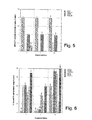
- Figure 5 shows the pH values and amount of added hydrogen peroxide for a first and a second extraction performed in tank 11 a and 11 b.
- the four columns for each experiment indicate from the left: (1) pH of first extraction, (2) vol% hydrogen peroxide added at the first extraction, (3) pH of second extraction, (4) vol% hydrogen peroxide added at the second extraction.
- the values for pH and the amount of peroxide added will normally vary as a function of the dry matter content of the biomass, the higher the content of dry matter the more peroxide is added and the lower the pH but as "biomass" is a rather undetermined composition a precise optimum for the values of pH and peroxide has to be determined by experiments for the actual biomass. Also the addition of peroxide during the extraction process should be adjusted to the amount of oxidisable compounds in the biomass as to much peroxide added during extraction will result in an increased amount of sulfide being consumed during the stage of precipitating heavy metals.
- Fig. 6 shows the release of heavy metals to the liquid phase during respectively the first and the second extraction.
- the six columns for each experiment 1, 2 and 14 indicates respectively from the left: (1) the content in % of Cu present in liquid phase after first extraction, (2) the content in % of Cu present in liquid phase after second extraction, (3) total amount of Cu released to the liquid phase, (4) the content in % of Zn present in liquid phase after first extraction, (5) the content in % of Zn present in liquid phase after second extraction, (6) total amount of Zn released to the liquid phase.
- Table 1 Dissolved Cu and Zn (fig. 6) Experiment no. 1 2 14 Total release of Cu (%) 61,9 7,62 94,0 Total release of Zn (%) 89,8 59,7 99,3
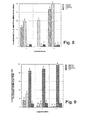
- Fig. 7 shows the amount of PO 4 released to the liquid phase after extraction and the total amount of Cu, Zn and PO 4 left in the remaining organic solids.
- the six columns for each experiment 1, 2 and 14 indicates respectively from the left: (1) the content in % of PO 4 present in liquid phase after first extraction, (2) the content in % of PO 4 present in liquid phase after second extraction, (3) total amount of PO 4 released to the liquid phase, (4) %Cu present in the organic solids after second extraction, (5) %Zn present in dry matter after second extraction, (6) %PO 4 present in the organic solids after second extraction.
- Table 2 Dissolved PO 4 , PO 4 ,Cu,Zn remaining in the organic solids (fig. 7) Experiment no. 1 2 14 Total release of PO 4 (%) 94,2 94,2 98,8 Zn (%) in dry matter 5,85 35,4 6,67 Cu (%) in dry matter 30,1 87,4 11,3 PO 4 (%) in dry matter 2,34 1,93 4,55
- the values for Cu and Zn given in table 2 are the percentage of Cu and Zn in the organic solids in relation to the total amounts of respectively Cu and Zn in the feed.
- the extraction of phosphate is less dependent on the presence of peroxide in the extraction steps.
- the amount of extracted phosphate dependents more on the pH value and on which acid is used for the extraction.
- the amounts of Cu and Zn in the organic solids should preferably be as small as possible as the dry matter removed from the process at this stage could e.g. be spread on fields and used for enrichment of soil or e.g. be burned in which case it is desirable to produce an ash with a low content of heavy metals.
- Figure 8 shows the amounts of precipitated Cu and Zn-sulfide in tank 13b at different pH values.
- the amount of precipitated metal in this process step is as large as possible while the amount of precipitated phosphate is as small as possible as the intention is to separate the heavy metals from the phosphate.
- a precipitation forming agent can e.g. be a carboxylic acid with one or more -COOH-groups, preferably citric acid, oxalic acid or acetic acid; complex binders such as EDTA, NTA, phosphonates etc. can also be used at this stage but they can complicate the separation between fractions later in the process.
- Figure 9 shows the amounts of phosphate compounds precipitated in tank 17 at different pH values.
- Table 4 Precipitation of Cu, Zn sulfides and phosphates (fig. 9) Experiment no. 1 2 14 % prep. Cu 16,9 3,97 1,52 % prep. Zn 31,1 8,92 1,67 % prep. PO 4 84,5 89,3 98,1 pH 8,71 9,84 9,42 Addition of oxalic acid (Yes/No) Y Y Y Y
- Figure 10 shows the pH values and amount of added hydrogen peroxide for a first and a second extraction performed in tank 11 a and 11 b for the three experiments 8, 12 and 14.
- the four columns for each experiment indicate from the left: (1) pH of first extraction, (2) vol% hydrogen peroxide added at the first extraction, (3) pH of the second extraction, (4) vol% hydrogen peroxide added at second extraction.
- These three experiments have all had hydrogen peroxide added to the first extraction step.
- Experiment 8 and 12 had 0.25 vol% added and experiment 14 had 0.36 vol% added.
- experiment 8 and 12 had 0.72 vol% and in experiment 14 no hydrogen peroxide were added.
- Fig. 11 shows the release of Cu and Zn to the liquid phase during respectively the first and the second extraction.
- the six columns for each experiment 8, 12 and 14 indicates respectively from the left: (1) the content of Cu present in liquid phase after first extraction in % of total amount of Cu in the feed, (2) the content of Cu present in liquid phase after second extraction in % of total amount of Cu in the feed, (3) total amount of Cu released to the liquid phase in % of total amount of Cu in the feed, (4) the content of Zn present in liquid phase after first extraction in % of total amount of Zn in the feed, (5) the content of Zn present in liquid phase after second extraction in % of total amount of Zn present in the feed, (6) total amount of Zn released to the liquid phase.
- Table 5 Dissolved Cu and Zn (fig. 11) Experiment no. 8 12 14 Total release of Cu (%) 82,5 91,4 94 Total release of Zn (%) 96,8 99,7 99,3
- Fig. 12 shows the amount of PO 4 released to the liquid phase after extraction and the total amount of Cu, Zn and PO 4 left in the remaining organic solids.
- the six columns for each experiment 1, 2 and 14 indicates respectively from the left: (1) the content in % of PO 4 present in liquid phase after first extraction in % of the total amount of P04 in the feed, (2) the content in % of PO 4 present in liquid phase after second extraction in % of the total amount of P04 in the feed, (3) total amount of PO 4 released to the liquid phase in % of the total amount of P04 in the feed, (4) %Cu present in the organic solids after second extraction in relation to the total amount of Cu in the feed, (5) %Zn present in the organic solids after second extraction in relation to the total amount of Zn in the feed, (6) %PO 4 present in the organic solids after second extraction in relation to the total amount of PO 4 in the feed.
- the values for Cu and Zn given in Table 6 are the percentage of Cu and Zn in organic solids in relation to the total amounts of respectively Cu and Zn in the feed.
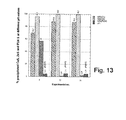
- Figure 13 shows the amounts of precipitated Cu and Zn-sulfide in tank 13b at different pH values together with the unwanted precipitated amount of phosphate.
- experiment 12 and 14 there is added oxalic acid to the tank 13a in in order to occupy e.g. Al Ca and Fe ions and prevent preferably aluminium from forming complex insoluble compounds with the phosphate.
- the four columns for each experiment indicate from the left: (1) % precipitated Cu in relation to the total amount of Cu in the feed, (2) % precipitated Zn in relation to the total amount of Zn in the feed, (3) % precipitated PO 4 in relation to the total amount of PO 4 in the feed, (4) pH value at which precipitation took place.
- the reduced amount of precipitated PO 4 in experiment 12 and 14 where oxalic acid is added is confirmed by the results of additional experiments 1 y and 2y illustrated in figure 13a .
- experiment 2y oxalic acid is added to the tank 13a.
- the six columns for each experiment indicate from the left: (1) pH value at which precipitation took place, (2) % precipitated Cu in relation to the total amount of Cu in the extract, (3) % precipitated Zn in relation to the total amount of Zn in the extract, (4) % precipitated Ca in relation to the total amount of Ca in the extract, (5) % precipitated PO 4 in relation to the total amount of PO 4 in the extract, (6) % precipitation of NH 4 in relation to the total amount of NH 4 in the extract.
- Table 8a Precipitation of Cu, Zn, Ca ions, phosphate and nitrogen (fig. 13a)) Experiment No. 1y 2y pH 4,77 4,58 Addition of oxalic acid (Yes/No) N Y % prep. Cu 99,9 99,9 % prep. Zn 99,3 99,3 % prep. Ca 7,7 99,7 % prep. PO 4 64,3 11,3 % prep. NH 4 1,5 2,1
- Figure14 shows the amounts of phosphate precipitated in tank 17 at different pH values.
- phosphate is predominantly and preferably precipitated with Mg but phosphate also forms insoluble compounds with e.g. Al, NH 4 , Fe.
- Table 8 Precipitation of Cu, Zn sulfides and phosphates (fig. 14) Experiment no. 8 12 14 % prep. Cu 4,88 1,66 1,52 % prep. Zn 6,51 n.d. 1,67 % prep. PO 4 42,6 87,2 98,1 pH 10 9,5 9,42
- Results of additionally conducted experiments 1y and 2y are presented in figure 14a .
- experiment 2y oxalic acid is added in the preceding process step.
- the six columns for each experiment indicate from the left: (1) pH value at which precipitation took place, (2) % precipitated Cu in relation to the total amount of Cu in the extract, (3) % precipitated Zn in relation to the total amount of Zn in the extract, (4) % precipitated Ca in relation to the total amount of Ca in the extract, (5) % precipitated PO 4 in relation to the total amount of PO 4 in the extract, (6) % precipitation of NH 4 in relation to the total amount of NH 4 in the extract.
- Table 9a Precipitation of Cu, Zn, Ca ions, phosphate and nitrogen (fig.
- Figure 15 shows the pH values and amount of added hydrogen peroxide for a first and a second extraction performed in tank 11 a and 11 b for the three experiments 1x, 2x and 3 (named as experiments 1-2 in fig. 1-9 ).
- the four columns for each experiment indicate from the left: (1) pH of first extraction, (2) vol% hydrogen peroxide added at the first extraction, (3) pH of the second extraction, (4) vol% hydrogen peroxide added at second extraction.
- Table 9 pH and added hydrogen peroxide (fig. 5, fig. 10, fig. 15)
- Experiment no. 1x 2x 3 1 2 8 12 14 1. extraction pH 1,69 1,83 1,6 2,0 2,0 2,0 1,95 1,96 H 2 O 2 0,36 0,5 0 0 0 0,25 0,25 0,36 2.
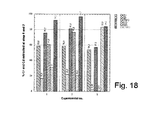
- Fig. 16-19 shows the release of the heavy metals Cu, Zn, Ni, Pb, Cr, Cd and Hg and of phosphate to the liquid phase during respectively the first and the second extraction.
- Table 10 Dissolved heavy metals and phosphate (fig. 16-19) incl. results from table 1 and 5. Experiment no.
Landscapes
- Life Sciences & Earth Sciences (AREA)
- Hydrology & Water Resources (AREA)
- Engineering & Computer Science (AREA)
- Environmental & Geological Engineering (AREA)
- Water Supply & Treatment (AREA)
- Chemical & Material Sciences (AREA)
- Organic Chemistry (AREA)
- Microbiology (AREA)
- Biodiversity & Conservation Biology (AREA)
- Removal Of Specific Substances (AREA)
- Processing Of Solid Wastes (AREA)
- Treatment Of Sludge (AREA)
Abstract
Description
- The present invention relates to a method of recovering phosphate from biomass such as animal manure, waste slurries, organically loaded waste water etc.
- Until now it has been a problem to remove sufficient phosphate from the biomass products fed to the process and to transform the phosphate removed from the biomass products in order to gain both a valuable phosphate product and one or more waste products which could be either released to the surroundings without causing any environmentally problems or be reused in other processes.
-
US 5.720.882 discloses one method for recovering phosphorous and at least one metal including iron from waste water while discharging heavy metals. This method comprises a liquid-liquid extraction which takes place after removal of the organic material and before the precipitation of heavy metals, this step is rather expensive and more commonly used in the pharmaceutical industry. -
EP 558.568
- the fresh biomass is received in atank 1,
- a flocculation agent is added and the fiber fraction is discharged to atank 9 and the liquid fraction is transferred totank 2, - -- the pH of the fiber fraction in
tank 9 is adjusted, - -- bacteria and enzymes is added to the fiber fraction to decompose solid material e.g. lignocellulose and liberate N, P and K bound in the solid material,
- The method according to the present invention makes it possible to regain more than 90% of the phosphates of the incoming waste thereby reducing the content of phosphate being redirected into the environment, and at the same time the content of NH3 and K2O will be reduced to at least the same level as in the process of EP-B1-558.568, and further the amount of heavy metals in the waste products from the process will be reduced.
- The invention will in the following be explained in further detail with reference to the accompanying drawings, where
-
figure 1 illustrates a flow chart for a method according to the invention, -
figure 2 illustrates a process for removal of NH3/NH4 from the process, -
figure 3 illustrates a process for removal of heavy metals from the process, -
figure 3a shows an embodiment of the extraction section comprising two separate tanks, -
figure 3b shows an embodiment of the reaction container comprising two tanks, -
figure 4 illustrates a process for precipitation of phosphates, -
figure 5 shows pH and used peroxide for threeexperiments -
figure 6 shows the release of Cu and Zn to the liquid phase during respectively the first and the second extraction for the threeexperiments -
figure 7 shows the amount of PO4 released to the liquid phase after extraction and the total amount of Cu, Zn and PO4 left in the remaining dry matter for the threeexperiments -
figure 8 shows the amounts of precipitated CuS and ZnS after addition of sulfide at different pH values for the threeexperiments -
figure 9 shows the amounts of phosphate compounds being precipitated after the extraction at different pH values for the threeexperiments -
figure 10 shows the pH values and amount of added hydrogen peroxide for a first and a second extraction performed intank experiments -
figure 11 shows the release of Cu and Zn to the liquid phase during respectively the first and the second extraction for the threeexperiments -
figure 12 shows the amount of PO4 released to the liquid phase after extraction and the total amount of Cu, Zn and PO4 left in the remaining dry matter (TS), -
figure 13 shows the amounts of precipitated Cu and Zn-sulfide intank 13b at different pH values together with the precipitated amount of phosphate, -
figure 13a shows the amounts of precipitated Cu, Zn, Ca, PO4 and NH4 intank 13b at different pH values together with the precipitated amount of phosphate, -
figure 14 shows the amounts of phosphate precipitated intank 17 at different pH values, -
figure 14a shows the amounts of precipitated Cu, Zn, Ca, PO4 and NH4 intank 13b at different pH values together with the precipitated amount of phosphate, -
figure 15 shows the pH values and amount of added hydrogen peroxide for a first and a second extraction performed intank experiments 1x, 2x and 3, -
figure 16-19 shows the release of the heavy metals Cu, Zn, Ni, Pb, Cr, Cd and Hg and of phosphate to the liquid phase during respectively the first and the second extraction. - In the embodiment of the process illustrated in
figure 1 the feedstock enters afermenter 1. The feed can be any kind of organic waste or combinations of different organic waste, such as manure, waste from food industries, sewage sludge from waste water treatment, refuse from animal or vegetable production etc. or mixtures of different kind of waste. - In the
fermenter 1 the feed is subjected to fermentation, fermentation breaks down organic matter under exclusion of oxygen. In a first phase a hydrolysation process takes place where facultatively anaerobic bacteria start the hydrolysation and disintegration of volatile organic substances. Complex organic compounds are split under production of organic acids, CO2, H2S and alcohol. Nitrates and sulfates are reduced and the pH value is lowered. In second phase methane bacteria digest the products of the metabolism of the first phase. Final products of the process are methane gas, CO2, H2S and mineral salts. Due to the reducing atmosphere inside the fermenter and the production of ammonium out of the anaerobic degradation of proteins, the pH value is rising continuously, and the pH value of the fermented substrate normally ranges from 7.5 to 8.5. If a fermenter is not used with the process it might be necessary to provide another source of sulfide. - Two streams leave the
fermenter 1, a stream of liquid/solid mixture which is led to anarea 2, and a stream of biogas which is either removed from the process or is returned to the process inarea 2. - In
area 2 heavy metals are removed from the slurry and four streams leave the area 2: - A. remaining solids which normally comprises around 75-85% material of organic origin which makes the material appropriate for being burned, e.g. having an ash content of 15-25 %,
- B. heavy metals normally precipitated as sulfides,
- C. desulfurised biogas, and
- D. process liquid
- An example of the processes of
area 2 is illustrated in details in connection with the description offigure 3 . - When heavy metals have been removed from the process liquid in
area 2, the liquid enters anarea 3 where phosphates and ammonia in ratio approximately 1: 1 are to be removed from the liquid. Two streams leave thearea 3, a solid mass comprising precipitated phosphate and phosphate with ammonia which could be used directly as a fertilizer or as a component for production of a fertilizer, and a liquid with remaining nitrogen is lead toarea 4. - The
area 4 represents removal of the residual NH3/NH4 from the liquid and an example of NH3/NH4-removal is illustrated in details in connection with the description offigure 2 . Two streams leave thearea 4. The first stream comprises a liquid having a content of nitrogen which is high enough to characterise the liquid as a liquid N-fertilizer and the second stream comprises a liquid having such a small amount of fertilizers and heavy metals that it would be possible to send the liquid directly to a recipient. -
Figure 2 shows an example of a process for removal of NH3/NH4 from the process mixture. First the pH value of the process fluid is raised to preferably 8.5-10.5, for example by adding a solution of NaOH to the fluid. Then the temperature of the fluid is raised to above 50°C in aheat exchanger 8. The warm, alkaline fluid enters adesorption unit 9 at one end, and passes over a large surface which surface, together with a counter current gas flow, allows for transferal of NH3 from the liquid phase to the gas phase. The counter currently flowing gas has a very low or no content of NH3 and is entering into thedesorption unit 9 at the opposite end of where the fluid enters. When the gas has passed through thedesorption unit 9, the gas has a certain content of NH3, the exact content of NH3 depend on the content of NH3 in the process fluid. The waste fluid having a much reduced content of N leaves thedesorption unit 9. - The NH3-containing gas from the
desorption unit 9 is send to anabsorption unit 10 in which unit the NH3-containing gas is washed in counter current with a liquid acid solution, preferably H2SO4. During the washing process the NH3 passes from the gas phase to the liquid by forming ammonium when reacting with the acid. The acidic liquid is recirculating through theabsorption unit 10, and during the recirculation a fraction of the ammonium solution is removed while additional water and acid is supplied in order to reach appropriate absorption conditions. When sulfuric acid is used, it will be possible to use the resulting (NH4)2SO4 which is removed from theabsorption unit 10 as a fertilizer component. The gas which is leaving theunit 10 has a very low content of NH3 and can be recirculated tounit 9. - When the process fluid passes into the
area 2 for removal of heavy metals it first enters an extraction section 11 (Fig.3 ) which can comprise one or more extraction steps, in which the pH value is lowered to ≤ 3.5, preferably by adding sulfuric acid. During lowering of the pH value a part of the solid material remaining in the process fluid is broken down and heavy metal ions and phosphate is released from the solids. Together with or after addition of the sulfuric acid, hydrogen peroxide or another oxidizing agent can be added in order to increase release of heavy metals and phosphates to the liquid phase. After having been subjected to stirring for a sufficient time remaining solids are separated from the liquid in aseparator unit 12 e.g. in a centrifuge or filter. In order to improve the separation a flocculant can be added before the separation process. Normally the solids separated during this process step consist of 75-85 % organic material which makes it suitable for combustion. -
Fig. 3a shows an embodiment of theextraction section 11 comprising twoseparate steps extraction section 11 a first extraction is executed instep 11a, in the first extraction step an acid is added, preferably an inorganic acid such as H2SO4, and pH adjusted to ≤ 3.5, further an oxidizing agent preferably H2O2 is added to the solution. After adding the reagents to the mixture, the mixture is agitated for a period. After the first extraction step the mixture is transferred to aseparator unit 12 where it is separated into a liquid fraction which is transferred to step 13 and a solid fraction which is transferred to step 11 b. A flocculation agent can advantageously be added to the mixture before the mixture enters theseparator unit 12. A second extraction is executed instep 11 b by adding an inorganic acid such as H2SO4 adjusting pH to ≤ 3.5 (preferably adjusting pH to ≤ 1.1), an oxidizing agent, preferably H2O2, and water, the resulting solution is agitated for a period. After the second extraction instep 11 b the mixture is again transferred to theseparator unit 12 where it is separated into a liquid fraction which is transferred to step 13 and a solid fraction which is removed from the process and e.g. burned. - The liquid from the
separator unit 12 enters a reaction step 13 (fig. 3 ) where a main part of the heavy metals contained in the liquid will be precipitated. In thereaction step 13 the pH value is raised to between 3.5 and 7.5 e.g. by adding NaOH. Then sulfide is added to react with the heavy metals forming sparingly soluble compounds in form of metal sulfides MxS. The precipitation of the heavy metals can be performed with other agents forming other sparingly soluble compounds than metal sulfide in which case the conditions for the reaction such as the pH value should be adjusted to the new agent. - Preferably the sulfide in the biogas removed from the fermenter can be added to the
reaction step 13 and used for precipitation of heavy metals. The biogas preferably enters the liquid instep 13 through a nozzle in the lower part of the container in which the reaction takes place and as the biogas passes through the process liquid the H2S in the biogas reacts with the heavy metals contained in the process liquid forming sparingly soluble metal sulfides and at the same time cleaning the biogas of the aggressive and unwanted H2S. -
Fig. 3b showsreaction step 13 comprising twosteps first step 13a together with a precipitation forming agent which does not raise pH, preferably oxalic acid, and after having been agitated for a suitable time, the process liquid is transferred to thesecond step 13b. In the second step pH is raised to between 3 and 7.5 by adding a base, e.g. NaOH., and after raising pH sulfide is added to thestep 13b, e.g. at least a part of the sulfide is added continuously to thestep 13b in the form of biogas. - Specially in the treatment of sewage sludge it will be advantageous to add a precipitation forming agent to
reaction step 13a in order to bind ions such as e.g. aluminium, calcium and ferric, that have the affinity for forming insoluble compounds with phosphate at pH>3. In order to obtain satisfying results in the heavy metal precipitation step taking place instep 13b it is necessary to increase the pH-value >3 and the higher the pH-value the better the precipitation results for the heavy metals. Fixing calcium in the compound with the precipitation forming agent and thereby removing it from the process liquid together with the heavy metals will have a positive effect in the further treatment. The presence of calcium can cause problems in the successive process of NH3-/NH4-desorption, where the pH value has to be increased. Calcium can form solid deposits in the stripping tower and can block the process stream. A precipitation forming agent can be a carboxylic acid with one or more -COOH groups, preferably citric or oxalic acid which precipitates e.g. Al3+, Fe3+, Fe2+, Ca2+, and assures that a significant fraction of the Al3+, Fe3+, Fe2+, Ca2+ can be removed. - After leaving the
container 13 the precipitates are removed from the liquid stream into aseparator unit 14 e.g. in a centrifuge or filter. The liquid thereafter enters astorage container 15 where it remains until it can be transferred to thefinal area 3. - The feed
stock entering area 3 from thestorage container 15 is low in heavy metals and has a pH value defined by the previous process step. The filtrate (feed) enters areaction step 16, it is registered how many mol P that are present in the liquid in thestep 16, where after a corresponding number of mol metal ions M2+, preferably MgO, is added to the liquid. Then the filtrate is transferred to asecond reaction step 17 and in this step the pH value is raised to between 8.5 and 10 by adding NaOH or another appropriate base in order to induce a precipitation of the formed phosphate compounds. The precipitated phosphate compounds mainly comprises of NH4MgPO4 and HMgPO4 in the case that MgO was added as metal ions M2+ to the liquid. After the second reaction step 17 a flocculent might be added to the mixture in order to increase separation where after the mixture is transferred to aseparator unit 18, e.g. a centrifuge or a filter. Theseparator unit 18 separates the mixture in to a solid rich in phosphate and a liquid with a very low content of pollutants. - According to the process defined in the claims the products of the process comprise a phosphate-rich compound having a low content of heavy metals and being well-suited as a fertilizer, a water fraction which is clean enough to be let directly into the environment, a gas fraction which can comprise desulfurised biogas and a solid organic fraction which can be either burned or used as fertilizer. Further the process will produce a waste product in the form of a small amount of heavy metals in a solid fraction, normally in the form of sulfides.
-
Figure 5-9 shows measurements of process conditions and contents of components measured at variable positions in the process for threeexperiments - The raw material for all three processes is slurry from animal husbandry. The content of dry matter in the mixture before entering the first extraction step was between 3-8 %.
-
Figure 5 shows the pH values and amount of added hydrogen peroxide for a first and a second extraction performed intank - The values for pH and the amount of peroxide added (in volume %) will normally vary as a function of the dry matter content of the biomass, the higher the content of dry matter the more peroxide is added and the lower the pH but as "biomass" is a rather undetermined composition a precise optimum for the values of pH and peroxide has to be determined by experiments for the actual biomass. Also the addition of peroxide during the extraction process should be adjusted to the amount of oxidisable compounds in the biomass as to much peroxide added during extraction will result in an increased amount of sulfide being consumed during the stage of precipitating heavy metals.
-
Fig. 6 shows the release of heavy metals to the liquid phase during respectively the first and the second extraction. The six columns for eachexperiment Table 1: Dissolved Cu and Zn (fig. 6) Experiment no. 1 2 14 Total release of Cu (%) 61,9 7,62 94,0 Total release of Zn (%) 89,8 59,7 99,3 - The results show that when extracting heavy metals from the present biomass it is preferred to add peroxide to a first extraction step as this increase the total amount of Cu/Zn released to the liquid phase and reduce the amount of heavy metals remaining in the organic dry matter.
-
Fig. 7 shows the amount of PO4 released to the liquid phase after extraction and the total amount of Cu, Zn and PO4 left in the remaining organic solids. The six columns for eachexperiment Table 2: Dissolved PO4, PO4,Cu,Zn remaining in the organic solids (fig. 7) Experiment no. 1 2 14 Total release of PO4 (%) 94,2 94,2 98,8 Zn (%) in dry matter 5,85 35,4 6,67 Cu (%) in dry matter 30,1 87,4 11,3 PO4 (%) in dry matter 2,34 1,93 4,55 - The values for Cu and Zn given in table 2 are the percentage of Cu and Zn in the organic solids in relation to the total amounts of respectively Cu and Zn in the feed.
- The extraction of phosphate is less dependent on the presence of peroxide in the extraction steps. The amount of extracted phosphate dependents more on the pH value and on which acid is used for the extraction. The amounts of Cu and Zn in the organic solids should preferably be as small as possible as the dry matter removed from the process at this stage could e.g. be spread on fields and used for enrichment of soil or e.g. be burned in which case it is desirable to produce an ash with a low content of heavy metals.
Figure 8 shows the amounts of precipitated Cu and Zn-sulfide intank 13b at different pH values. The four columns for each experiment indicate from the left: (1) % precipitated CuS in relation to the total amount of Cu in the feed, (2) % precipitated ZnS in relation to the total amount of Zn in the feed, (3) % precipitated PO4 in relation to the total amount of PO4 in the feed, (4) pH value at which precipitation took place.Table 3: Precipitation of Cu, Zn sulfides and phosphates (fig. 8) Experiment no. 1 2 14 % prep. Cu 45 n.d. 87,3 % prep. Zn 58,8 61,5 99,7 % prep. PO 2,2 1,24 2,28 pH 5,33 5,54 4,77 Addition of oxalic acid (Yes/No) Y Y Y - It is an advantage that the amount of precipitated metal in this process step is as large as possible while the amount of precipitated phosphate is as small as possible as the intention is to separate the heavy metals from the phosphate.
- If aluminum is present in the extract it is an advantage for the separation of the heavy metals from phosphate when a precipitation forming agent is added to
tank 13a in order to remove or reduce the content of e.g. Al3+, Fe3+, Fe2+ and Ca2+ in the solution. Such a precipitation forming agent can e.g. be a carboxylic acid with one or more -COOH-groups, preferably citric acid, oxalic acid or acetic acid; complex binders such as EDTA, NTA, phosphonates etc. can also be used at this stage but they can complicate the separation between fractions later in the process. -
Figure 9 shows the amounts of phosphate compounds precipitated intank 17 at different pH values.Table 4: Precipitation of Cu, Zn sulfides and phosphates (fig. 9) Experiment no. 1 2 14 % prep. Cu 16,9 3,97 1,52 % prep. Zn 31,1 8,92 1,67 % prep. PO 484,5 89,3 98,1 pH 8,71 9,84 9,42 Addition of oxalic acid (Yes/No) Y Y Y - At this stage it is desirable that as much PO4 as possible is precipitated and as little as possible of the heavy metals Cu and Zn are precipitated. It is possible to increase the separation, i.e. increase the amount of P04 and decrease the amount of heavy metals, in the phosphate product by increasing the pH value.
-
Figure 10 shows the pH values and amount of added hydrogen peroxide for a first and a second extraction performed intank experiments Experiment experiment 14 had 0.36 vol% added. In the secondextraction step experiment experiment 14 no hydrogen peroxide were added. -
Fig. 11 shows the release of Cu and Zn to the liquid phase during respectively the first and the second extraction. The six columns for eachexperiment Table 5: Dissolved Cu and Zn (fig. 11) Experiment no. 8 12 14 Total release of Cu (%) 82,5 91,4 94 Total release of Zn (%) 96,8 99,7 99,3 - The results show that when extracting heavy metals from the present biomass it is possible to optimize the amount of added peroxide to the first extraction step thereby increasing the total amount of Cu/Zn released to the liquid phase and reducing the amount of Cu/Zn remaining in the organic solids.
-
Fig. 12 shows the amount of PO4 released to the liquid phase after extraction and the total amount of Cu, Zn and PO4 left in the remaining organic solids. The six columns for eachexperiment Table 6: Dissolved PO4, PO4,Cu,Zn remaining in the organic solids (fig. 12) Experiment no. 8 12 14 Total release of PO4 (%) 89,2 90,1 98,8 Zn (%) in dry matter 3,58 1,85 6,67 Cu (%) in dry matter 27,9 11,2 11,3 PO4 (%) in dry matter 4,34 6,6 4,55 - The values for Cu and Zn given in Table 6 are the percentage of Cu and Zn in organic solids in relation to the total amounts of respectively Cu and Zn in the feed.
-
Figure 13 shows the amounts of precipitated Cu and Zn-sulfide intank 13b at different pH values together with the unwanted precipitated amount of phosphate. Inexperiment tank 13a in in order to occupy e.g. Al Ca and Fe ions and prevent preferably aluminium from forming complex insoluble compounds with the phosphate. The four columns for each experiment indicate from the left: (1) % precipitated Cu in relation to the total amount of Cu in the feed, (2) % precipitated Zn in relation to the total amount of Zn in the feed, (3) % precipitated PO4 in relation to the total amount of PO4 in the feed, (4) pH value at which precipitation took place.Table 7: Precipitation of Cu, Zn sulfides and phosphates (fig. 13) Experiment no. 8 12 14 % prep. Cu 69,7 87,8 87,3 % prep. Zn 95,7 99,7 99,7 % prep. PO4 57 1,24 2,28 pH 5,33 5,54 4,77 Addition of oxalic acid (Yes/No) N Y Y - As it is an advantage that the amount of precipitated metal in this process step is as large as possible while the amount of precipitated phosphate is as small as possible the result of
experiment 8 is not good while the results ofexperiment 12 and 14 - especially the result of experiment 12 - are very good. - The reduced amount of precipitated PO4 in
experiment additional experiments figure 13a . Inexperiment 2y oxalic acid is added to thetank 13a. The six columns for each experiment indicate from the left: (1) pH value at which precipitation took place, (2) % precipitated Cu in relation to the total amount of Cu in the extract, (3) % precipitated Zn in relation to the total amount of Zn in the extract, (4) % precipitated Ca in relation to the total amount of Ca in the extract, (5) % precipitated PO4 in relation to the total amount of PO4 in the extract, (6) % precipitation of NH4 in relation to the total amount of NH4 in the extract.Table 8a: Precipitation of Cu, Zn, Ca ions, phosphate and nitrogen (fig. 13a)) Experiment No. 1y 2y pH 4,77 4,58 Addition of oxalic acid (Yes/No) N Y % prep. Cu 99,9 99,9 % prep. Zn 99,3 99,3 % prep. Ca 7,7 99,7 % prep. PO 464,3 11,3 % prep. NH 1,5 2,1 - The addition of oxalic acid leads beside the effect of the reduced amount of precipitated phosphor to another positive effect. A large amount of the undesirable Calcium is precipitated. When no oxalic acid is present nearly the total amount of Ca in solution will come with the stream to the next process step.
-
Figure14 shows the amounts of phosphate precipitated intank 17 at different pH values. At this stage phosphate is predominantly and preferably precipitated with Mg but phosphate also forms insoluble compounds with e.g. Al, NH4, Fe.Table 8: Precipitation of Cu, Zn sulfides and phosphates (fig. 14) Experiment no. 8 12 14 % prep. Cu 4,88 1,66 1,52 % prep. Zn 6,51 n.d. 1,67 % prep. PO 42,6 87,2 98,1 pH 10 9,5 9,42 - At this stage it is desirable that as much PO4 as possible is precipitated and as little as possible of the heavy metals Cu and Zn are precipitated. In
experiment 8 there was not added oxalic acid to the step preceding the precipitation of the heavy metals intank 13a. The result is a reduced precipitation of phosphate at this step because the main part of the phosphate has already been precipitated with the heavy metals sulfides. - Results of additionally conducted
experiments figure 14a . Inexperiment 2y oxalic acid is added in the preceding process step. The six columns for each experiment indicate from the left: (1) pH value at which precipitation took place, (2) % precipitated Cu in relation to the total amount of Cu in the extract, (3) % precipitated Zn in relation to the total amount of Zn in the extract, (4) % precipitated Ca in relation to the total amount of Ca in the extract, (5) % precipitated PO4 in relation to the total amount of PO4 in the extract, (6) % precipitation of NH4 in relation to the total amount of NH4 in the extract.Table 9a: Precipitation of Cu, Zn, Ca ions, phosphate and nitrogen (fig. 14a) Experiment No. 1y 2y pH 8,83 8,74 Addition of oxalic acid (Yes/No) N Y % prep. Cu 0 0 % prep. Zn 0,0024 0,0020 % prep. Ca 55,7 0,2 % prep. PO 34,8 85,8 % prep. NH 9,3 21,3 - With the application of oxalic acid a large amount of phosphate can be precipitated in this stage. The precipitated amount of the undesirable Ca is very small because the main part of the Ca has already been precipitated with the heavy metal sulphides.
-
Figure 15 shows the pH values and amount of added hydrogen peroxide for a first and a second extraction performed intank fig. 1-9 ). The four columns for each experiment indicate from the left: (1) pH of first extraction, (2) vol% hydrogen peroxide added at the first extraction, (3) pH of the second extraction, (4) vol% hydrogen peroxide added at second extraction.Table 9: pH and added hydrogen peroxide (fig. 5, fig. 10, fig. 15) Experiment no. 1x 2x 3 1 2 8 12 14 1. extraction pH 1,69 1,83 1,6 2,0 2,0 2,0 1,95 1,96 H2O2 0,36 0,5 0 0 0 0,25 0,25 0,36 2. extraction pH 2,6 0,95 2,0 1,0 1,01 1,94 1,88 0,96 H2O2 0,36 0,36 0,7 0,36 0 0,72 0,72 0 Addition of oxalic acid Yes / No N N N Y Y N Y Y -
Fig. 16-19 shows the release of the heavy metals Cu, Zn, Ni, Pb, Cr, Cd and Hg and of phosphate to the liquid phase during respectively the first and the second extraction.Table 10: Dissolved heavy metals and phosphate (fig. 16-19) incl. results from table 1 and 5. Experiment no. 1x 2x 3 1 2 8 12 14 Total release of Cu (%) 80,8 97,3 66,1 61,9 7,62 82,5 91,4 94,0 Total release of Zn (%) 100,0 97,4 81,2 89,8 59,7 96,8 99,7 99,3 Total release of Ni (%) 81,4 89,6 68,3 Total release of Pb (%) 73,8 80,9 19,1 Total release of Cr (%) 75,7 81,2 57,2 Total release of Cd (%) 92,3 96,7 84,2 Total release of Hg (%) 37,7 50,1 26,1 Total release of P04 (%) 88,2 94,0 96,0 - The experiments show that the adding of peroxide has a significant importance when it comes to releasing heavy metals during the extraction steps, preferably peroxide should be added to the first extraction step. The release of phosphate during extraction relates more to the pH; preferably pH should be in a range from 4.5 to 5.5.
- the pretreated fiber fraction of
- urea complex, ammonium and phosphate is precipitated by adding metal ions (Mg+2, Ca+2, Ba+2, Be+2, Co+2, Zn+2, Mn+2, Mn+3, Fe+2, Fe+3, Al+3, Cu+1, Cu+2, B+3, Si etc) and adjusting the pH value (pH = 4-10), which pH value is chosen will depend on which fertilizer type is wanted,
- the precipitates are removed in a
- in
- precipitates are removed in a
- the substances from
- the liquid phase in
| NH3 (kg/m3) | P2O5 (kg/m3) | K2O (kg/m3) | |
| Slurry from | 4,25 | 1,55 | 5,83 |
| Outflow from | 0,46 | 0,17 | 0,48 |
| Remaining | 10,8% | 11,0% | 8,2% |
Claims (12)
- Method for recovering phosphate from a feed mixture comprising a liquid phase and a solid material in which mixture metals are present which method comprises the following steps:a. assuring a pH < 3.5 and adding an oxidation agent thereby dissolving at least a part of the solid material and increasing the metal and phosphate content in the liquid phase;b. separating remaining solid from the liquid phase;
after having separated solids from the liquid phase in step b), components having affinity for forming insoluble compounds with PO4 at pH > 3 are removed from the liquid phase before step c) andc. then pH is increased to > 3 in the liquid phase and an agent for precipitating metal ions is added;d. separating the precipitated metal compounds from the liquid phase;e. adding alkaline (MgO, NaOH etc.) and increasing pH to > 8 in the liquid phase;f. separating the precipitated phosphate and nitrogen from the liquid phase, characterised in that a precipitation forming agent in the form of an organic acid or a mixture of organic acids with one or more carboxylic groups is/are added to the liquid phase after step b) and before step c). - Method for recovering phosphate according to claim 1 wherein the precipitating agent used in step c) is H2S, Na2S, R2SR1 or thiols (RSH).
- Method for recovering phosphate according to claim 1 or 2 wherein the residue -NH4-/NH3 is removed from the feed mixture after step f.
- Method for recovering phosphate according to claim 1, 2 or 3 wherein NH4-/NH3 is removed from the feed mixture by(i) raising pH until pH > 8 and heating the waste to a temperature ≥ 50°C and then(ii) separating NH3-gas from a process fluid.
- Method for recovering phosphate according to claim 4, wherein pH in step (i) is raised by adding alkaline e.g. NaOH.
- Method for recovering phosphate according to any of the preceding claims, wherein the feed mixture is provided by fermenting organic waste.
- Method for recovering phosphate according to any of the preceding claims, wherein the agent for precipitating metal ions in step c) comprises biogas produced by fermenting organic waste.
- Method for recovering phosphate according to any of the preceding claims, wherein the agent for precipitating metal ions in step c) comprises a sulfide containing gas.
- Method for recovering phosphate according to any of the preceding claims, wherein step a) comprises two extraction steps each step having a pH < 3.5.
- Method for recovering phosphate according to claim 9, where the pH-value in each extraction step is 0.5 < pH < 3.5, and where at least 0.2 vol% peroxide, normally 0.2 - 2.0 vol% peroxide is added to at least the first extraction step.
- Method for recovering phosphate according to any of the preceding claims, wherein the organic acid is oxalic acid or citric acid or a mixture of oxalic and citric acid.
- Method for recovering phosphate according to any preceding claim, wherein a flocculant is added before any of the separation steps b, d, or f.
Applications Claiming Priority (2)
| Application Number | Priority Date | Filing Date | Title |
|---|---|---|---|
| DKPA200700994 | 2007-07-05 | ||
| PCT/EP2008/058507 WO2009004027A1 (en) | 2007-07-05 | 2008-07-02 | Method of recovering phosphate from biomass |
Publications (2)
| Publication Number | Publication Date |
|---|---|
| EP2176177A1 EP2176177A1 (en) | 2010-04-21 |
| EP2176177B1 true EP2176177B1 (en) | 2011-12-21 |
Family
ID=39684409
Family Applications (1)
| Application Number | Title | Priority Date | Filing Date |
|---|---|---|---|
| EP20080774641 Not-in-force EP2176177B1 (en) | 2007-07-05 | 2008-07-02 | Method of recovering phosphate from biomass |
Country Status (4)
| Country | Link |
|---|---|
| EP (1) | EP2176177B1 (en) |
| AT (1) | ATE538074T1 (en) |
| DK (1) | DK2176177T3 (en) |
| WO (1) | WO2009004027A1 (en) |
Cited By (2)
| Publication number | Priority date | Publication date | Assignee | Title |
|---|---|---|---|---|
| EP4516734A1 (en) | 2023-08-30 | 2025-03-05 | LANXESS Deutschland GmbH | Recovery of silicon in the form of the tetrachloride from biochar |
| WO2025045768A1 (en) | 2023-08-30 | 2025-03-06 | Lanxess Deutschland Gmbh | Recovery of silicon in the form of silicon tetrachloride from biochar |
Families Citing this family (3)
| Publication number | Priority date | Publication date | Assignee | Title |
|---|---|---|---|---|
| US11053173B2 (en) | 2017-02-23 | 2021-07-06 | Cleanbay Renewables Llc | Process for forming a product solution from poultry waste digestate |
| CN107540182A (en) * | 2017-10-20 | 2018-01-05 | 天津壹新环保工程有限公司 | A kind of method and apparatus of sludge organic fertilizer |
| CN108117420A (en) * | 2018-01-17 | 2018-06-05 | 江苏华美达生物能源有限公司 | A kind of livestock and poultry fecal pollution and straw cooperative processing method |
Family Cites Families (3)
| Publication number | Priority date | Publication date | Assignee | Title |
|---|---|---|---|---|
| FI97288C (en) * | 1993-08-26 | 1996-11-25 | Kemira Oy | Procedure for treatment of wastewater sludge |
| DE4414261A1 (en) * | 1994-04-23 | 1995-10-26 | Tomas Burmester | Decontamination of solids contg. heavy metals and/or organics |
| WO1996021625A1 (en) * | 1995-01-14 | 1996-07-18 | Niels Ole Vesterager | Method of treating a biomass in order to remove heavy metals with hydrogen sulphide |
-
2008
- 2008-07-02 DK DK08774641T patent/DK2176177T3/en active
- 2008-07-02 EP EP20080774641 patent/EP2176177B1/en not_active Not-in-force
- 2008-07-02 AT AT08774641T patent/ATE538074T1/en active
- 2008-07-02 WO PCT/EP2008/058507 patent/WO2009004027A1/en not_active Ceased
Cited By (2)
| Publication number | Priority date | Publication date | Assignee | Title |
|---|---|---|---|---|
| EP4516734A1 (en) | 2023-08-30 | 2025-03-05 | LANXESS Deutschland GmbH | Recovery of silicon in the form of the tetrachloride from biochar |
| WO2025045768A1 (en) | 2023-08-30 | 2025-03-06 | Lanxess Deutschland Gmbh | Recovery of silicon in the form of silicon tetrachloride from biochar |
Also Published As
| Publication number | Publication date |
|---|---|
| WO2009004027A1 (en) | 2009-01-08 |
| DK2176177T3 (en) | 2012-04-16 |
| ATE538074T1 (en) | 2012-01-15 |
| EP2176177A1 (en) | 2010-04-21 |
Similar Documents
| Publication | Publication Date | Title |
|---|---|---|
| CN101993169B (en) | Treatment method of sintering flue gas desulphurization wastewater | |
| EP1157972A1 (en) | A method of processing oil-plant wastes | |
| CN102149645B (en) | Sludge treatment method and apparatus thereof and application to wastewater bio-treatment | |
| DE102008050349B4 (en) | Process for the precipitation of phosphorus from phosphate-contaminated wastewater | |
| EP2176177B1 (en) | Method of recovering phosphate from biomass | |
| CZ300446B6 (en) | Method of treatment of iron-containing waterworks sludge and a mixture prepared by this method | |
| CN102010104A (en) | Method for treating riboflavin fermentation waste water | |
| CN112499905B (en) | Organic phosphorus effluent disposal system | |
| WO2008055388A1 (en) | Method for the treatment of waste water from florfenicol production | |
| CN102874957A (en) | Method for processing liquid dung of pig farm through flocculation oxidizing resistance dimishing method | |
| US20210238074A1 (en) | Method for operating a wastewater treatment plant for phosphorus treatment of effluent | |
| CN100339311C (en) | Method for preparing polymerized ferric sulfate from ferric sulfate solution | |
| US20090314046A1 (en) | Production of a high phosphorus fertilizer product | |
| DE102005040018B4 (en) | Wastewater treatment process | |
| CN222293818U (en) | Treatment system for amino acid metal chelate wastewater | |
| OA10329A (en) | Improved wastewater treatment process | |
| CN102491472B (en) | Method for recovering sewage slag and preparing phosphate concentrate by using sewage slag | |
| CN113149344B (en) | Processing method of vegetable juicing stock solution | |
| CN101956069A (en) | Method for reducing and leaching manganese from pyrolusite in sulfuric acid solution by using sludge | |
| CN112158986B (en) | Method for treating sewage containing high ammonia, nitrogen and phosphorus in livestock and poultry farm by using boric sludge | |
| CN102351383A (en) | Method for treating sewage generated in ammonia synthesis process using coal as raw material | |
| CN1255329C (en) | Method for treating high-sulphur-phenol waste alkali liquor under normal temperature and pressure conditions | |
| CN102198968B (en) | Heavy metal and arsenic ion complexing agent and preparation method and using method thereof | |
| KR100451855B1 (en) | Treated method of a nightsoil | |
| CN1814546B (en) | Method for producing general superphosphate from waste water of yellow ginger processing by dry method |
Legal Events
| Date | Code | Title | Description |
|---|---|---|---|
| PUAI | Public reference made under article 153(3) epc to a published international application that has entered the european phase |
Free format text: ORIGINAL CODE: 0009012 |
|
| 17P | Request for examination filed |
Effective date: 20100204 |
|
| AK | Designated contracting states |
Kind code of ref document: A1 Designated state(s): AT BE BG CH CY CZ DE DK EE ES FI FR GB GR HR HU IE IS IT LI LT LU LV MC MT NL NO PL PT RO SE SI SK TR |
|
| AX | Request for extension of the european patent |
Extension state: AL BA MK RS |
|
| DAX | Request for extension of the european patent (deleted) | ||
| GRAP | Despatch of communication of intention to grant a patent |
Free format text: ORIGINAL CODE: EPIDOSNIGR1 |
|
| GRAS | Grant fee paid |
Free format text: ORIGINAL CODE: EPIDOSNIGR3 |
|
| GRAA | (expected) grant |
Free format text: ORIGINAL CODE: 0009210 |
|
| AK | Designated contracting states |
Kind code of ref document: B1 Designated state(s): AT BE BG CH CY CZ DE DK EE ES FI FR GB GR HR HU IE IS IT LI LT LU LV MC MT NL NO PL PT RO SE SI SK TR |
|
| REG | Reference to a national code |
Ref country code: GB Ref legal event code: FG4D |
|
| REG | Reference to a national code |
Ref country code: CH Ref legal event code: EP |
|
| REG | Reference to a national code |
Ref country code: AT Ref legal event code: REF Ref document number: 538074 Country of ref document: AT Kind code of ref document: T Effective date: 20120115 |
|
| REG | Reference to a national code |
Ref country code: IE Ref legal event code: FG4D |
|
| REG | Reference to a national code |
Ref country code: DE Ref legal event code: R096 Ref document number: 602008012207 Country of ref document: DE Effective date: 20120301 |
|
| REG | Reference to a national code |
Ref country code: SE Ref legal event code: TRGR |
|
| REG | Reference to a national code |
Ref country code: NL Ref legal event code: T3 |
|
| REG | Reference to a national code |
Ref country code: DK Ref legal event code: T3 |
|
| PG25 | Lapsed in a contracting state [announced via postgrant information from national office to epo] |
Ref country code: NO Free format text: LAPSE BECAUSE OF FAILURE TO SUBMIT A TRANSLATION OF THE DESCRIPTION OR TO PAY THE FEE WITHIN THE PRESCRIBED TIME-LIMIT Effective date: 20120321 Ref country code: LT Free format text: LAPSE BECAUSE OF FAILURE TO SUBMIT A TRANSLATION OF THE DESCRIPTION OR TO PAY THE FEE WITHIN THE PRESCRIBED TIME-LIMIT Effective date: 20111221 |
|
| REG | Reference to a national code |
Ref country code: CH Ref legal event code: NV Representative=s name: BRAUNPAT BRAUN EDER AG |
|
| LTIE | Lt: invalidation of european patent or patent extension |
Effective date: 20111221 |
|
| PG25 | Lapsed in a contracting state [announced via postgrant information from national office to epo] |
Ref country code: HR Free format text: LAPSE BECAUSE OF FAILURE TO SUBMIT A TRANSLATION OF THE DESCRIPTION OR TO PAY THE FEE WITHIN THE PRESCRIBED TIME-LIMIT Effective date: 20111221 Ref country code: SI Free format text: LAPSE BECAUSE OF FAILURE TO SUBMIT A TRANSLATION OF THE DESCRIPTION OR TO PAY THE FEE WITHIN THE PRESCRIBED TIME-LIMIT Effective date: 20111221 Ref country code: GR Free format text: LAPSE BECAUSE OF FAILURE TO SUBMIT A TRANSLATION OF THE DESCRIPTION OR TO PAY THE FEE WITHIN THE PRESCRIBED TIME-LIMIT Effective date: 20120322 Ref country code: LV Free format text: LAPSE BECAUSE OF FAILURE TO SUBMIT A TRANSLATION OF THE DESCRIPTION OR TO PAY THE FEE WITHIN THE PRESCRIBED TIME-LIMIT Effective date: 20111221 |
|
| PG25 | Lapsed in a contracting state [announced via postgrant information from national office to epo] |
Ref country code: CY Free format text: LAPSE BECAUSE OF FAILURE TO SUBMIT A TRANSLATION OF THE DESCRIPTION OR TO PAY THE FEE WITHIN THE PRESCRIBED TIME-LIMIT Effective date: 20111221 Ref country code: BE Free format text: LAPSE BECAUSE OF FAILURE TO SUBMIT A TRANSLATION OF THE DESCRIPTION OR TO PAY THE FEE WITHIN THE PRESCRIBED TIME-LIMIT Effective date: 20111221 |
|
| PG25 | Lapsed in a contracting state [announced via postgrant information from national office to epo] |
Ref country code: IS Free format text: LAPSE BECAUSE OF FAILURE TO SUBMIT A TRANSLATION OF THE DESCRIPTION OR TO PAY THE FEE WITHIN THE PRESCRIBED TIME-LIMIT Effective date: 20120421 Ref country code: CZ Free format text: LAPSE BECAUSE OF FAILURE TO SUBMIT A TRANSLATION OF THE DESCRIPTION OR TO PAY THE FEE WITHIN THE PRESCRIBED TIME-LIMIT Effective date: 20111221 Ref country code: EE Free format text: LAPSE BECAUSE OF FAILURE TO SUBMIT A TRANSLATION OF THE DESCRIPTION OR TO PAY THE FEE WITHIN THE PRESCRIBED TIME-LIMIT Effective date: 20111221 Ref country code: SK Free format text: LAPSE BECAUSE OF FAILURE TO SUBMIT A TRANSLATION OF THE DESCRIPTION OR TO PAY THE FEE WITHIN THE PRESCRIBED TIME-LIMIT Effective date: 20111221 Ref country code: BG Free format text: LAPSE BECAUSE OF FAILURE TO SUBMIT A TRANSLATION OF THE DESCRIPTION OR TO PAY THE FEE WITHIN THE PRESCRIBED TIME-LIMIT Effective date: 20120321 |
|
| PG25 | Lapsed in a contracting state [announced via postgrant information from national office to epo] |
Ref country code: PL Free format text: LAPSE BECAUSE OF FAILURE TO SUBMIT A TRANSLATION OF THE DESCRIPTION OR TO PAY THE FEE WITHIN THE PRESCRIBED TIME-LIMIT Effective date: 20111221 Ref country code: PT Free format text: LAPSE BECAUSE OF FAILURE TO SUBMIT A TRANSLATION OF THE DESCRIPTION OR TO PAY THE FEE WITHIN THE PRESCRIBED TIME-LIMIT Effective date: 20120423 Ref country code: RO Free format text: LAPSE BECAUSE OF FAILURE TO SUBMIT A TRANSLATION OF THE DESCRIPTION OR TO PAY THE FEE WITHIN THE PRESCRIBED TIME-LIMIT Effective date: 20111221 |
|
| REG | Reference to a national code |
Ref country code: AT Ref legal event code: MK05 Ref document number: 538074 Country of ref document: AT Kind code of ref document: T Effective date: 20111221 |
|
| PLBE | No opposition filed within time limit |
Free format text: ORIGINAL CODE: 0009261 |
|
| STAA | Information on the status of an ep patent application or granted ep patent |
Free format text: STATUS: NO OPPOSITION FILED WITHIN TIME LIMIT |
|
| 26N | No opposition filed |
Effective date: 20120924 |
|
| PG25 | Lapsed in a contracting state [announced via postgrant information from national office to epo] |
Ref country code: IT Free format text: LAPSE BECAUSE OF FAILURE TO SUBMIT A TRANSLATION OF THE DESCRIPTION OR TO PAY THE FEE WITHIN THE PRESCRIBED TIME-LIMIT Effective date: 20111221 |
|
| REG | Reference to a national code |
Ref country code: DE Ref legal event code: R097 Ref document number: 602008012207 Country of ref document: DE Effective date: 20120924 |
|
| PG25 | Lapsed in a contracting state [announced via postgrant information from national office to epo] |
Ref country code: AT Free format text: LAPSE BECAUSE OF FAILURE TO SUBMIT A TRANSLATION OF THE DESCRIPTION OR TO PAY THE FEE WITHIN THE PRESCRIBED TIME-LIMIT Effective date: 20111221 |
|
| PG25 | Lapsed in a contracting state [announced via postgrant information from national office to epo] |
Ref country code: ES Free format text: LAPSE BECAUSE OF FAILURE TO SUBMIT A TRANSLATION OF THE DESCRIPTION OR TO PAY THE FEE WITHIN THE PRESCRIBED TIME-LIMIT Effective date: 20120401 |
|
| PG25 | Lapsed in a contracting state [announced via postgrant information from national office to epo] |
Ref country code: TR Free format text: LAPSE BECAUSE OF FAILURE TO SUBMIT A TRANSLATION OF THE DESCRIPTION OR TO PAY THE FEE WITHIN THE PRESCRIBED TIME-LIMIT Effective date: 20111221 |
|
| PG25 | Lapsed in a contracting state [announced via postgrant information from national office to epo] |
Ref country code: HU Free format text: LAPSE BECAUSE OF FAILURE TO SUBMIT A TRANSLATION OF THE DESCRIPTION OR TO PAY THE FEE WITHIN THE PRESCRIBED TIME-LIMIT Effective date: 20080702 |
|
| REG | Reference to a national code |
Ref country code: FR Ref legal event code: PLFP Year of fee payment: 8 |
|
| PGFP | Annual fee paid to national office [announced via postgrant information from national office to epo] |
Ref country code: LU Payment date: 20150729 Year of fee payment: 8 |
|
| PGFP | Annual fee paid to national office [announced via postgrant information from national office to epo] |
Ref country code: NL Payment date: 20150720 Year of fee payment: 8 |
|
| PGFP | Annual fee paid to national office [announced via postgrant information from national office to epo] |
Ref country code: DK Payment date: 20150720 Year of fee payment: 8 Ref country code: CH Payment date: 20150723 Year of fee payment: 8 Ref country code: GB Payment date: 20150728 Year of fee payment: 8 Ref country code: FI Payment date: 20150717 Year of fee payment: 8 Ref country code: IE Payment date: 20150715 Year of fee payment: 8 Ref country code: MC Payment date: 20150728 Year of fee payment: 8 Ref country code: DE Payment date: 20150727 Year of fee payment: 8 |
|
| PGFP | Annual fee paid to national office [announced via postgrant information from national office to epo] |
Ref country code: FR Payment date: 20150731 Year of fee payment: 8 Ref country code: SE Payment date: 20150720 Year of fee payment: 8 |
|
| REG | Reference to a national code |
Ref country code: DE Ref legal event code: R119 Ref document number: 602008012207 Country of ref document: DE |
|
| REG | Reference to a national code |
Ref country code: DK Ref legal event code: EBP Effective date: 20170131 |
|
| REG | Reference to a national code |
Ref country code: CH Ref legal event code: PL |
|
| REG | Reference to a national code |
Ref country code: NL Ref legal event code: MM Effective date: 20160801 |
|
| REG | Reference to a national code |
Ref country code: SE Ref legal event code: EUG |
|
| GBPC | Gb: european patent ceased through non-payment of renewal fee |
Effective date: 20160702 |
|
| PG25 | Lapsed in a contracting state [announced via postgrant information from national office to epo] |
Ref country code: MC Free format text: LAPSE BECAUSE OF NON-PAYMENT OF DUE FEES Effective date: 20160801 |
|
| PGFP | Annual fee paid to national office [announced via postgrant information from national office to epo] |
Ref country code: MT Payment date: 20150716 Year of fee payment: 8 |
|
| PG25 | Lapsed in a contracting state [announced via postgrant information from national office to epo] |
Ref country code: SE Free format text: LAPSE BECAUSE OF NON-PAYMENT OF DUE FEES Effective date: 20160703 Ref country code: DE Free format text: LAPSE BECAUSE OF NON-PAYMENT OF DUE FEES Effective date: 20170201 Ref country code: LI Free format text: LAPSE BECAUSE OF NON-PAYMENT OF DUE FEES Effective date: 20160731 Ref country code: CH Free format text: LAPSE BECAUSE OF NON-PAYMENT OF DUE FEES Effective date: 20160731 Ref country code: NL Free format text: LAPSE BECAUSE OF NON-PAYMENT OF DUE FEES Effective date: 20160801 Ref country code: FR Free format text: LAPSE BECAUSE OF NON-PAYMENT OF DUE FEES Effective date: 20160801 Ref country code: FI Free format text: LAPSE BECAUSE OF NON-PAYMENT OF DUE FEES Effective date: 20160702 |
|
| REG | Reference to a national code |
Ref country code: FR Ref legal event code: ST Effective date: 20170331 |
|
| REG | Reference to a national code |
Ref country code: IE Ref legal event code: MM4A |
|
| PG25 | Lapsed in a contracting state [announced via postgrant information from national office to epo] |
Ref country code: GB Free format text: LAPSE BECAUSE OF NON-PAYMENT OF DUE FEES Effective date: 20160702 |
|
| PG25 | Lapsed in a contracting state [announced via postgrant information from national office to epo] |
Ref country code: IE Free format text: LAPSE BECAUSE OF NON-PAYMENT OF DUE FEES Effective date: 20160702 |
|
| PG25 | Lapsed in a contracting state [announced via postgrant information from national office to epo] |
Ref country code: LU Free format text: LAPSE BECAUSE OF NON-PAYMENT OF DUE FEES Effective date: 20160702 |
|
| PG25 | Lapsed in a contracting state [announced via postgrant information from national office to epo] |
Ref country code: DK Free format text: LAPSE BECAUSE OF NON-PAYMENT OF DUE FEES Effective date: 20160731 |
|
| PG25 | Lapsed in a contracting state [announced via postgrant information from national office to epo] |
Ref country code: MT Free format text: LAPSE BECAUSE OF NON-PAYMENT OF DUE FEES Effective date: 20160702 |