EP2182040A2 - Aromatic compounds and organic electronic device using the same - Google Patents
Aromatic compounds and organic electronic device using the same Download PDFInfo
- Publication number
- EP2182040A2 EP2182040A2 EP09156604A EP09156604A EP2182040A2 EP 2182040 A2 EP2182040 A2 EP 2182040A2 EP 09156604 A EP09156604 A EP 09156604A EP 09156604 A EP09156604 A EP 09156604A EP 2182040 A2 EP2182040 A2 EP 2182040A2
- Authority
- EP
- European Patent Office
- Prior art keywords
- alkyl
- aryl
- heteroaryl
- tri
- independently represent
- Prior art date
- Legal status (The legal status is an assumption and is not a legal conclusion. Google has not performed a legal analysis and makes no representation as to the accuracy of the status listed.)
- Withdrawn
Links
- 0 [*-2]CC=C(C1(c2ccccc2-c2c1cccc2)C1=C(C23c4ccccc4-c4c2cccc4)C=CIC=C1)C3=C* Chemical compound [*-2]CC=C(C1(c2ccccc2-c2c1cccc2)C1=C(C23c4ccccc4-c4c2cccc4)C=CIC=C1)C3=C* 0.000 description 22
- YCWPTVCQNICBSH-UHFFFAOYSA-N CC(C)(C12C=CC=CC1C21)c2c3[n]1c(C=CC1(C4C1)N(C1NC=CC5C=CC=CC15)C1=C(CCCC5)C5CC=N1)c4c3ccc2 Chemical compound CC(C)(C12C=CC=CC1C21)c2c3[n]1c(C=CC1(C4C1)N(C1NC=CC5C=CC=CC15)C1=C(CCCC5)C5CC=N1)c4c3ccc2 YCWPTVCQNICBSH-UHFFFAOYSA-N 0.000 description 1
- TZHRVHPRNZGTMF-UHFFFAOYSA-N CC(C)(C12C=CC=CC1C21)c2ccccc2N1c(cc12)ccc1N1C(C=CCC3)=C3C(C)(C)C3=C1C2=CCC3 Chemical compound CC(C)(C12C=CC=CC1C21)c2ccccc2N1c(cc12)ccc1N1C(C=CCC3)=C3C(C)(C)C3=C1C2=CCC3 TZHRVHPRNZGTMF-UHFFFAOYSA-N 0.000 description 1
- HVABGRYGNRTAEV-UHFFFAOYSA-N CC(C)(c1c2ccc(-c(cc3)ccc3F)c1)c(cc(cc1C3(C)C)-c(cc4)ccc4F)c1N2c(cc1)c3cc1-c(cc1)ccc1F Chemical compound CC(C)(c1c2ccc(-c(cc3)ccc3F)c1)c(cc(cc1C3(C)C)-c(cc4)ccc4F)c1N2c(cc1)c3cc1-c(cc1)ccc1F HVABGRYGNRTAEV-UHFFFAOYSA-N 0.000 description 1
- CYOQCCVNDOKSFR-UHFFFAOYSA-N CC(C)(c1c2cccc1)c(cccc1C3(C)C)c1N2c(cc1)c3cc1-c1ccc2[o]c(cccc3)c3c2c1 Chemical compound CC(C)(c1c2cccc1)c(cccc1C3(C)C)c1N2c(cc1)c3cc1-c1ccc2[o]c(cccc3)c3c2c1 CYOQCCVNDOKSFR-UHFFFAOYSA-N 0.000 description 1
- TZPIMKJTAXYCML-UHFFFAOYSA-N CC(C)(c1c2cccc1)c1cccc(C(C)(C)c3c4)c1N2c3ccc4-c(c(cccc1)c1cc1)c1-c1ccccc1 Chemical compound CC(C)(c1c2cccc1)c1cccc(C(C)(C)c3c4)c1N2c3ccc4-c(c(cccc1)c1cc1)c1-c1ccccc1 TZPIMKJTAXYCML-UHFFFAOYSA-N 0.000 description 1
- PLZGXYYITJPJHA-UHFFFAOYSA-N CC(C)(c1c2cccc1)c1cccc(C3(C)C)c1N2c(cc1)c3cc1N(c(cc1)ccc1C#N)c(cc1)ccc1F Chemical compound CC(C)(c1c2cccc1)c1cccc(C3(C)C)c1N2c(cc1)c3cc1N(c(cc1)ccc1C#N)c(cc1)ccc1F PLZGXYYITJPJHA-UHFFFAOYSA-N 0.000 description 1
- FBVOUVRMKRQDMT-UHFFFAOYSA-N CC(C)(c1cc(-c(cc2)ccc2N(c2ccccc2)c2cccc3c2cccc3)cc(c2c3)c11)c(cccc4C5(C)C)c4-[n]1c2c5cc3N(c1ccccc1)c1ccccc1 Chemical compound CC(C)(c1cc(-c(cc2)ccc2N(c2ccccc2)c2cccc3c2cccc3)cc(c2c3)c11)c(cccc4C5(C)C)c4-[n]1c2c5cc3N(c1ccccc1)c1ccccc1 FBVOUVRMKRQDMT-UHFFFAOYSA-N 0.000 description 1
- FRPHXMWYWPQLNX-UHFFFAOYSA-N CC(C)(c1cc(-c(cc2)ccc2N(c2ccccc2)c2ccccc2)cc(c2c3)c11)c(cccc4C5(C)C)c4-[n]1c2c5cc3N(c1ccccc1)c1ccccc1 Chemical compound CC(C)(c1cc(-c(cc2)ccc2N(c2ccccc2)c2ccccc2)cc(c2c3)c11)c(cccc4C5(C)C)c4-[n]1c2c5cc3N(c1ccccc1)c1ccccc1 FRPHXMWYWPQLNX-UHFFFAOYSA-N 0.000 description 1
- IHLBVWCIXRWNAM-UHFFFAOYSA-N CC(C)(c1ccc2)C(C=CCC3)=C3[n]3c1c2c1c3ccc(N2c(cccc3)c3S(C)(C)C3C=CCCC23)c1 Chemical compound CC(C)(c1ccc2)C(C=CCC3)=C3[n]3c1c2c1c3ccc(N2c(cccc3)c3S(C)(C)C3C=CCCC23)c1 IHLBVWCIXRWNAM-UHFFFAOYSA-N 0.000 description 1
- VHOQXAPEJWAKPM-UHFFFAOYSA-N CC(C)(c1ccc2)c(cccc3)c3-[n]3c1c2c1c3ccc(-c(cc2)ccc2F)c1 Chemical compound CC(C)(c1ccc2)c(cccc3)c3-[n]3c1c2c1c3ccc(-c(cc2)ccc2F)c1 VHOQXAPEJWAKPM-UHFFFAOYSA-N 0.000 description 1
- RGABXJNSDYYTHI-UHFFFAOYSA-N CC(C)(c1ccc2)c(cccc3)c3-[n]3c1c2c1c3ccc(N(c2ccc(C)cc2)c(cc2)ccc2-c2cccc3c2cccc3)c1 Chemical compound CC(C)(c1ccc2)c(cccc3)c3-[n]3c1c2c1c3ccc(N(c2ccc(C)cc2)c(cc2)ccc2-c2cccc3c2cccc3)c1 RGABXJNSDYYTHI-UHFFFAOYSA-N 0.000 description 1
- WGYYCORVGDIMTE-UHFFFAOYSA-N CC(C)(c1ccc2)c3ccccc3-[n]3c1c2c1c3ccc(N(C2NC=CC=C2)c2ncccc2)c1 Chemical compound CC(C)(c1ccc2)c3ccccc3-[n]3c1c2c1c3ccc(N(C2NC=CC=C2)c2ncccc2)c1 WGYYCORVGDIMTE-UHFFFAOYSA-N 0.000 description 1
- UUBYRMGVYGVTPW-UHFFFAOYSA-N CC(C)(c1cccc(C2(C)C)c11)c3cccc(C(C)(C)c4c5)c3N1c4c2cc5N(c1cc(-c2cccc3c2cccc3)ccc1)c1c(cccc2)c2ccc1 Chemical compound CC(C)(c1cccc(C2(C)C)c11)c3cccc(C(C)(C)c4c5)c3N1c4c2cc5N(c1cc(-c2cccc3c2cccc3)ccc1)c1c(cccc2)c2ccc1 UUBYRMGVYGVTPW-UHFFFAOYSA-N 0.000 description 1
- PODYUGDXMOERJK-UHFFFAOYSA-N CC(C)(c1cccc(c2c3)c11)c(cccc4C5(C)C)c4-[n]1c2c5cc3N(c1cc(-c2c(cccc3)c3ccc2)ccc1)c1cccc2ccccc12 Chemical compound CC(C)(c1cccc(c2c3)c11)c(cccc4C5(C)C)c4-[n]1c2c5cc3N(c1cc(-c2c(cccc3)c3ccc2)ccc1)c1cccc2ccccc12 PODYUGDXMOERJK-UHFFFAOYSA-N 0.000 description 1
- FGRLJBNSHPSNDJ-UHFFFAOYSA-N CC(C)(c1cccc(c2c3)c11)c(cccc4C5(C)C)c4-[n]1c2c5cc3N(c1ccccc1)c1cc(-c2c(cccc3)c3ccc2)ccc1 Chemical compound CC(C)(c1cccc(c2c3)c11)c(cccc4C5(C)C)c4-[n]1c2c5cc3N(c1ccccc1)c1cc(-c2c(cccc3)c3ccc2)ccc1 FGRLJBNSHPSNDJ-UHFFFAOYSA-N 0.000 description 1
- JTAZRHUGMWVDOU-UHFFFAOYSA-N CC(C)(c1cccc(c2c3)c11)c(cccc4C5(C)C)c4-[n]1c2c5cc3N(c1ccccc1)c1cc(-c2cc(cccc3)c3cc2)ccc1 Chemical compound CC(C)(c1cccc(c2c3)c11)c(cccc4C5(C)C)c4-[n]1c2c5cc3N(c1ccccc1)c1cc(-c2cc(cccc3)c3cc2)ccc1 JTAZRHUGMWVDOU-UHFFFAOYSA-N 0.000 description 1
- MZORVQUSSRNASR-UHFFFAOYSA-N CC(C)(c1ccccc11)c(cc(cc2C3(C)C)-c4ccccc4)c2N1c(cc1)c3cc1-c1c(cccc2)c2ccc1 Chemical compound CC(C)(c1ccccc11)c(cc(cc2C3(C)C)-c4ccccc4)c2N1c(cc1)c3cc1-c1c(cccc2)c2ccc1 MZORVQUSSRNASR-UHFFFAOYSA-N 0.000 description 1
- IEZQLPWKBUTFNS-UHFFFAOYSA-N CC(C)(c1ccccc11)c(cc(cc2C3(C)C)-c4ccccc4)c2N1c(cc1)c3cc1-c1cc(cccc2)c2cc1 Chemical compound CC(C)(c1ccccc11)c(cc(cc2C3(C)C)-c4ccccc4)c2N1c(cc1)c3cc1-c1cc(cccc2)c2cc1 IEZQLPWKBUTFNS-UHFFFAOYSA-N 0.000 description 1
- BLCGAFSDWJGGGY-UHFFFAOYSA-N CC(C)(c1ccccc11)c(cccc2C3(C)C)c2N1c(cc1)c3cc1-[n]1c(cccc2)c2c2c1cccc2 Chemical compound CC(C)(c1ccccc11)c(cccc2C3(C)C)c2N1c(cc1)c3cc1-[n]1c(cccc2)c2c2c1cccc2 BLCGAFSDWJGGGY-UHFFFAOYSA-N 0.000 description 1
- WIFVPZQKALKISM-UHFFFAOYSA-N CC(C)(c1ccccc11)c(cccc2C3(C)C)c2N1c(cc1)c3cc1-c1cc(C)cc(C)c1 Chemical compound CC(C)(c1ccccc11)c(cccc2C3(C)C)c2N1c(cc1)c3cc1-c1cc(C)cc(C)c1 WIFVPZQKALKISM-UHFFFAOYSA-N 0.000 description 1
- MSEGNLJWGQWOPI-UHFFFAOYSA-N CC(C)(c1ccccc11)c(cccc2C3(C)C)c2N1c(cc1)c3cc1N(c1ccccc1)c1cc(C)cc(C)c1 Chemical compound CC(C)(c1ccccc11)c(cccc2C3(C)C)c2N1c(cc1)c3cc1N(c1ccccc1)c1cc(C)cc(C)c1 MSEGNLJWGQWOPI-UHFFFAOYSA-N 0.000 description 1
- KUSWDNRDWQSSOH-UHFFFAOYSA-N CC(C)(c1ccccc11)c2cccc(C3(C)C)c2N1c(cc1)c3cc1N(c1ccccc1)c1ncccc1 Chemical compound CC(C)(c1ccccc11)c2cccc(C3(C)C)c2N1c(cc1)c3cc1N(c1ccccc1)c1ncccc1 KUSWDNRDWQSSOH-UHFFFAOYSA-N 0.000 description 1
- PDEPQYNXYBKBSJ-UHFFFAOYSA-N CC(CC(N(c(cc1)ccc1-c1c(cccc2)c2ccc1)c1cc(cccc2)c2cc1)=C1)c2c1c1cccc3c1[n]2C1C=CC=CC1C3(C)C Chemical compound CC(CC(N(c(cc1)ccc1-c1c(cccc2)c2ccc1)c1cc(cccc2)c2cc1)=C1)c2c1c1cccc3c1[n]2C1C=CC=CC1C3(C)C PDEPQYNXYBKBSJ-UHFFFAOYSA-N 0.000 description 1
- MFIVPUATENGFJX-UHFFFAOYSA-N CC(CC=C1)c(c2c3ccc(N(c4ccccc4)c(cc4)ccc4-c(cc4)ccc4N(c4ccccc4)c(cc4c5c6cccc5)ccc4[n]6-c4ccccc4)c2)c1[n]3-c1ccccc1 Chemical compound CC(CC=C1)c(c2c3ccc(N(c4ccccc4)c(cc4)ccc4-c(cc4)ccc4N(c4ccccc4)c(cc4c5c6cccc5)ccc4[n]6-c4ccccc4)c2)c1[n]3-c1ccccc1 MFIVPUATENGFJX-UHFFFAOYSA-N 0.000 description 1
- KKYXPWWRTDCDED-UHFFFAOYSA-N CC(CC=C1)c(c2c3ccc(N(c4ccccc4)c(cc4)ccc4N(C4=CC=CCC4)c(cc4c5c6cccc5)ccc4[n]6-c4ccccc4)c2)c1[n]3-c1ccccc1 Chemical compound CC(CC=C1)c(c2c3ccc(N(c4ccccc4)c(cc4)ccc4N(C4=CC=CCC4)c(cc4c5c6cccc5)ccc4[n]6-c4ccccc4)c2)c1[n]3-c1ccccc1 KKYXPWWRTDCDED-UHFFFAOYSA-N 0.000 description 1
- BXFPKQIKNIBJTG-UHFFFAOYSA-N CC1(C)c(cc(cc2)-c(cc3)ccc3N(C(C3)C=Cc4c3c(cccc3C5(C)C)c3[n]4-c3c5cccc3)c3ccc(C)cc3)c2-c2ccccc12 Chemical compound CC1(C)c(cc(cc2)-c(cc3)ccc3N(C(C3)C=Cc4c3c(cccc3C5(C)C)c3[n]4-c3c5cccc3)c3ccc(C)cc3)c2-c2ccccc12 BXFPKQIKNIBJTG-UHFFFAOYSA-N 0.000 description 1
- CEEGRBXWOUKIFJ-UHFFFAOYSA-N CC1(C)c(cc(cc2)N(c3ccccc3)c(cc3)cc(C(C)(C)c4c5)c3-c4ccc5-c(cc3C(C)(C)c4c5c(C6(C)C)ccc4)cc4c3N5c3c6cccc3C4(C)C)c2-c2c1cccc2 Chemical compound CC1(C)c(cc(cc2)N(c3ccccc3)c(cc3)cc(C(C)(C)c4c5)c3-c4ccc5-c(cc3C(C)(C)c4c5c(C6(C)C)ccc4)cc4c3N5c3c6cccc3C4(C)C)c2-c2c1cccc2 CEEGRBXWOUKIFJ-UHFFFAOYSA-N 0.000 description 1
- JWFZUIPQMTWKQP-UHFFFAOYSA-N CC1(C)c(cc(cc2)N(c3nc(cccc4)c4cc3)c3c(cccc4)c4ccn3)c2N(C2=C(C3(C)C)C=CCC2)c2c3cccc12 Chemical compound CC1(C)c(cc(cc2)N(c3nc(cccc4)c4cc3)c3c(cccc4)c4ccn3)c2N(C2=C(C3(C)C)C=CCC2)c2c3cccc12 JWFZUIPQMTWKQP-UHFFFAOYSA-N 0.000 description 1
- IZVMTHQAVKBDGX-UHFFFAOYSA-N CC1(C)c(cccc2)c2-[n]2c3c1cccc3c1c2ccc(-c2ccc3c4c2cccc4CC3)c1 Chemical compound CC1(C)c(cccc2)c2-[n]2c3c1cccc3c1c2ccc(-c2ccc3c4c2cccc4CC3)c1 IZVMTHQAVKBDGX-UHFFFAOYSA-N 0.000 description 1
- LJOZFGOQSWPGBL-UHFFFAOYSA-N CC1(C)c(cccc2)c2-[n]2c3c1cccc3c1c2ccc(N(C2C=CN=CC2)C2=CCNC=C2)c1 Chemical compound CC1(C)c(cccc2)c2-[n]2c3c1cccc3c1c2ccc(N(C2C=CN=CC2)C2=CCNC=C2)c1 LJOZFGOQSWPGBL-UHFFFAOYSA-N 0.000 description 1
- KOFHKSWGFAQHHW-UHFFFAOYSA-N CC1(C)c(cccc2)c2-[n]2c3c1cccc3c1c2ccc(N(c2ccc(C)cc2)c(cc2)ccc2-c2ccc(cccc3)c3c2)c1 Chemical compound CC1(C)c(cccc2)c2-[n]2c3c1cccc3c1c2ccc(N(c2ccc(C)cc2)c(cc2)ccc2-c2ccc(cccc3)c3c2)c1 KOFHKSWGFAQHHW-UHFFFAOYSA-N 0.000 description 1
- NDUGPXZSQPYAHV-UHFFFAOYSA-N CC1(C)c(cccc2C(C)(C)c3cc(-c4cccc5c4cccc5)c4)c2-[n]2c3c4c3cc(-c(cc4)ccc4N(c4ccccc4)c4ccccc4)cc1c23 Chemical compound CC1(C)c(cccc2C(C)(C)c3cc(-c4cccc5c4cccc5)c4)c2-[n]2c3c4c3cc(-c(cc4)ccc4N(c4ccccc4)c4ccccc4)cc1c23 NDUGPXZSQPYAHV-UHFFFAOYSA-N 0.000 description 1
- OSGZGSNQEHSDCT-UHFFFAOYSA-N CC1(C)c2cc(-c(cc3)c(cccc4)c4c3N(c3cc(cccc4)c4cc3)c3cc4ccccc4cc3)ccc2N2c3c1cccc3C(C)(C)c1c2ccc(-c(cc2)c(cccc3)c3c2N(c2ccc(cccc3)c3c2)c2cc3ccccc3cc2)c1 Chemical compound CC1(C)c2cc(-c(cc3)c(cccc4)c4c3N(c3cc(cccc4)c4cc3)c3cc4ccccc4cc3)ccc2N2c3c1cccc3C(C)(C)c1c2ccc(-c(cc2)c(cccc3)c3c2N(c2ccc(cccc3)c3c2)c2cc3ccccc3cc2)c1 OSGZGSNQEHSDCT-UHFFFAOYSA-N 0.000 description 1
- XLUSTHDVPVQTON-UHFFFAOYSA-N CC1(C)c2cc(-c(cc3)cc(C(C)(C)c4c5)c3N(c3ccccc3C3(C)C)c4c3cc5-c3ccccc3)ccc2-c2ccccc12 Chemical compound CC1(C)c2cc(-c(cc3)cc(C(C)(C)c4c5)c3N(c3ccccc3C3(C)C)c4c3cc5-c3ccccc3)ccc2-c2ccccc12 XLUSTHDVPVQTON-UHFFFAOYSA-N 0.000 description 1
- KNPUWUZCPMWDBS-UHFFFAOYSA-N CC1(C)c2cc(-c3cccc(N(c4ccccc4)c(cc4c5c6c(C7(C)C)ccc5)cc5c4[n]6-c4c7cccc4C5(C)C)c3)ccc2-c2c1cccc2 Chemical compound CC1(C)c2cc(-c3cccc(N(c4ccccc4)c(cc4c5c6c(C7(C)C)ccc5)cc5c4[n]6-c4c7cccc4C5(C)C)c3)ccc2-c2c1cccc2 KNPUWUZCPMWDBS-UHFFFAOYSA-N 0.000 description 1
- GMXWSUCAUAAUEK-UHFFFAOYSA-N CC1(C)c2cc(-c3cccc(N(c4ccccc4)c4cc(C(C)(C)c5cccc(C6(C)C)c55)c7N5c5c6cccc5C(C)(C)c7c4)c3)ccc2-c2ccccc12 Chemical compound CC1(C)c2cc(-c3cccc(N(c4ccccc4)c4cc(C(C)(C)c5cccc(C6(C)C)c55)c7N5c5c6cccc5C(C)(C)c7c4)c3)ccc2-c2ccccc12 GMXWSUCAUAAUEK-UHFFFAOYSA-N 0.000 description 1
- PLISUSGCFMUDRO-UHFFFAOYSA-N CC1(C)c2cc(N(c(cc3)ccc3-c(cc3C4(C)C)cc5c3[n]3-c6c4cccc6C(C)(C)c4c3c5cc(N(c3ccccc3)c3ccccc3)c4)c(cc3)cc4c3-c3ccccc3C4(C)C)ccc2-c2c1cccc2 Chemical compound CC1(C)c2cc(N(c(cc3)ccc3-c(cc3C4(C)C)cc5c3[n]3-c6c4cccc6C(C)(C)c4c3c5cc(N(c3ccccc3)c3ccccc3)c4)c(cc3)cc4c3-c3ccccc3C4(C)C)ccc2-c2c1cccc2 PLISUSGCFMUDRO-UHFFFAOYSA-N 0.000 description 1
- FPONUDYDOBKVDK-UHFFFAOYSA-N CC1(C)c2cc(N(c3ccccc3)c(ccc3c4)cc3ccc4-c(cc3C(C)(C)c4c5c(C6(C)C)ccc4)cc4c3N5c3c6cccc3C4(C)C)ccc2C2C=CC=CC12 Chemical compound CC1(C)c2cc(N(c3ccccc3)c(ccc3c4)cc3ccc4-c(cc3C(C)(C)c4c5c(C6(C)C)ccc4)cc4c3N5c3c6cccc3C4(C)C)ccc2C2C=CC=CC12 FPONUDYDOBKVDK-UHFFFAOYSA-N 0.000 description 1
- VZKDDXVLARFOKG-UHFFFAOYSA-N CC1(C)c2cccc(C(C)(C)c3cc(N(c4ccccc4)c4ccccc4)c4)c2-[n]2c3c4c3cc(-c(cc4)ccc4N(c4ccccc4)c4cc5ccccc5cc4)cc1c23 Chemical compound CC1(C)c2cccc(C(C)(C)c3cc(N(c4ccccc4)c4ccccc4)c4)c2-[n]2c3c4c3cc(-c(cc4)ccc4N(c4ccccc4)c4cc5ccccc5cc4)cc1c23 VZKDDXVLARFOKG-UHFFFAOYSA-N 0.000 description 1
- FUOREIMHMGDRIE-UHFFFAOYSA-N CC1(C)c2ccccc2-[n]2c3c1cccc3c1c2ccc(-c(cc2)ccc2C#N)c1 Chemical compound CC1(C)c2ccccc2-[n]2c3c1cccc3c1c2ccc(-c(cc2)ccc2C#N)c1 FUOREIMHMGDRIE-UHFFFAOYSA-N 0.000 description 1
- UDXXYUXYGAQQLL-UHFFFAOYSA-N CC1(C)c2ccccc2-[n]2c3c1cccc3c1c2ccc(-c(cc2)ccc2OC)c1 Chemical compound CC1(C)c2ccccc2-[n]2c3c1cccc3c1c2ccc(-c(cc2)ccc2OC)c1 UDXXYUXYGAQQLL-UHFFFAOYSA-N 0.000 description 1
- JZXYVMMZENOADN-UHFFFAOYSA-N CC1(C)c2ccccc2-[n]2c3c1cccc3c1c2ccc(-c2ccc(C(F)(F)F)cc2)c1 Chemical compound CC1(C)c2ccccc2-[n]2c3c1cccc3c1c2ccc(-c2ccc(C(F)(F)F)cc2)c1 JZXYVMMZENOADN-UHFFFAOYSA-N 0.000 description 1
- MCUMFOLMAVOBTI-UHFFFAOYSA-N CC1(C)c2ccccc2-[n]2c3c1cccc3c1c2ccc(N(C2=C(C=CC=C3)C3=C3C=CC=CC3C2)c2cc(cccc3)c3cc2)c1 Chemical compound CC1(C)c2ccccc2-[n]2c3c1cccc3c1c2ccc(N(C2=C(C=CC=C3)C3=C3C=CC=CC3C2)c2cc(cccc3)c3cc2)c1 MCUMFOLMAVOBTI-UHFFFAOYSA-N 0.000 description 1
- SFLGYPWFVUIFBB-UHFFFAOYSA-N CC1(C)c2ccccc2-[n]2c3c1cccc3c1c2ccc(N(C2=C(CC3)C=CCC2)C2=C3C=CCC2)c1 Chemical compound CC1(C)c2ccccc2-[n]2c3c1cccc3c1c2ccc(N(C2=C(CC3)C=CCC2)C2=C3C=CCC2)c1 SFLGYPWFVUIFBB-UHFFFAOYSA-N 0.000 description 1
- AGKYCEGJXGTZJR-UHFFFAOYSA-N CC1C=C(C)C=CC1c(cc1)cc(c2c3c(C4(C)C)ccc2)c1[n]3-c1c4cccc1 Chemical compound CC1C=C(C)C=CC1c(cc1)cc(c2c3c(C4(C)C)ccc2)c1[n]3-c1c4cccc1 AGKYCEGJXGTZJR-UHFFFAOYSA-N 0.000 description 1
- ZVDRKVNIIHJHSY-UHFFFAOYSA-N CCC(C=C(CC1C(C)(C)c2cccc(C(C)(C)c3ccc4)c22)c(c5c6cccc5)ccc6N(c5ccccc5)c(cc5)cc6c5-c5ccccc5C6(C)C)=C1N2c3c4SC Chemical compound CCC(C=C(CC1C(C)(C)c2cccc(C(C)(C)c3ccc4)c22)c(c5c6cccc5)ccc6N(c5ccccc5)c(cc5)cc6c5-c5ccccc5C6(C)C)=C1N2c3c4SC ZVDRKVNIIHJHSY-UHFFFAOYSA-N 0.000 description 1
- VTSFLGMBTHXJSM-UHFFFAOYSA-N CN(c1c(CC2)cccc1)c1c2cccc1 Chemical compound CN(c1c(CC2)cccc1)c1c2cccc1 VTSFLGMBTHXJSM-UHFFFAOYSA-N 0.000 description 1
- WKMPLZAFPNQAMR-UHFFFAOYSA-N CN1c2ccccc2C=Cc2c1cccc2 Chemical compound CN1c2ccccc2C=Cc2c1cccc2 WKMPLZAFPNQAMR-UHFFFAOYSA-N 0.000 description 1
- DXYYSGDWQCSKKO-UHFFFAOYSA-N Cc1nc2ccccc2[s]1 Chemical compound Cc1nc2ccccc2[s]1 DXYYSGDWQCSKKO-UHFFFAOYSA-N 0.000 description 1
- XEMXPOJZQIBKBT-UHFFFAOYSA-N N#Cc(cc1)ccc1N(C(CC1)=Cc(c2c3C=CCC2)c1[n]3-c1ccccc1)c(cc1)ccc1N(c(cc1)ccc1C#N)c(cc1)cc(c2ccccc22)c1[n]2-c1ccccc1 Chemical compound N#Cc(cc1)ccc1N(C(CC1)=Cc(c2c3C=CCC2)c1[n]3-c1ccccc1)c(cc1)ccc1N(c(cc1)ccc1C#N)c(cc1)cc(c2ccccc22)c1[n]2-c1ccccc1 XEMXPOJZQIBKBT-UHFFFAOYSA-N 0.000 description 1
Images
Classifications
-
- C—CHEMISTRY; METALLURGY
- C07—ORGANIC CHEMISTRY
- C07D—HETEROCYCLIC COMPOUNDS
- C07D471/00—Heterocyclic compounds containing nitrogen atoms as the only ring hetero atoms in the condensed system, at least one ring being a six-membered ring with one nitrogen atom, not provided for by groups C07D451/00 - C07D463/00
- C07D471/02—Heterocyclic compounds containing nitrogen atoms as the only ring hetero atoms in the condensed system, at least one ring being a six-membered ring with one nitrogen atom, not provided for by groups C07D451/00 - C07D463/00 in which the condensed system contains two hetero rings
- C07D471/06—Peri-condensed systems
-
- C—CHEMISTRY; METALLURGY
- C07—ORGANIC CHEMISTRY
- C07D—HETEROCYCLIC COMPOUNDS
- C07D241/00—Heterocyclic compounds containing 1,4-diazine or hydrogenated 1,4-diazine rings
- C07D241/36—Heterocyclic compounds containing 1,4-diazine or hydrogenated 1,4-diazine rings condensed with carbocyclic rings or ring systems
-
- C—CHEMISTRY; METALLURGY
- C07—ORGANIC CHEMISTRY
- C07D—HETEROCYCLIC COMPOUNDS
- C07D471/00—Heterocyclic compounds containing nitrogen atoms as the only ring hetero atoms in the condensed system, at least one ring being a six-membered ring with one nitrogen atom, not provided for by groups C07D451/00 - C07D463/00
- C07D471/12—Heterocyclic compounds containing nitrogen atoms as the only ring hetero atoms in the condensed system, at least one ring being a six-membered ring with one nitrogen atom, not provided for by groups C07D451/00 - C07D463/00 in which the condensed system contains three hetero rings
- C07D471/16—Peri-condensed systems
-
- C—CHEMISTRY; METALLURGY
- C07—ORGANIC CHEMISTRY
- C07D—HETEROCYCLIC COMPOUNDS
- C07D497/00—Heterocyclic compounds containing in the condensed system at least one hetero ring having oxygen and sulfur atoms as the only ring hetero atoms
- C07D497/02—Heterocyclic compounds containing in the condensed system at least one hetero ring having oxygen and sulfur atoms as the only ring hetero atoms in which the condensed system contains two hetero rings
- C07D497/04—Ortho-condensed systems
-
- C—CHEMISTRY; METALLURGY
- C07—ORGANIC CHEMISTRY
- C07D—HETEROCYCLIC COMPOUNDS
- C07D498/00—Heterocyclic compounds containing in the condensed system at least one hetero ring having nitrogen and oxygen atoms as the only ring hetero atoms
- C07D498/02—Heterocyclic compounds containing in the condensed system at least one hetero ring having nitrogen and oxygen atoms as the only ring hetero atoms in which the condensed system contains two hetero rings
- C07D498/04—Ortho-condensed systems
-
- C—CHEMISTRY; METALLURGY
- C07—ORGANIC CHEMISTRY
- C07F—ACYCLIC, CARBOCYCLIC OR HETEROCYCLIC COMPOUNDS CONTAINING ELEMENTS OTHER THAN CARBON, HYDROGEN, HALOGEN, OXYGEN, NITROGEN, SULFUR, SELENIUM OR TELLURIUM
- C07F7/00—Compounds containing elements of Groups 4 or 14 of the Periodic Table
- C07F7/02—Silicon compounds
- C07F7/08—Compounds having one or more C—Si linkages
- C07F7/0803—Compounds with Si-C or Si-Si linkages
- C07F7/081—Compounds with Si-C or Si-Si linkages comprising at least one atom selected from the elements N, O, halogen, S, Se or Te
- C07F7/0812—Compounds with Si-C or Si-Si linkages comprising at least one atom selected from the elements N, O, halogen, S, Se or Te comprising a heterocyclic ring
-
- C—CHEMISTRY; METALLURGY
- C07—ORGANIC CHEMISTRY
- C07F—ACYCLIC, CARBOCYCLIC OR HETEROCYCLIC COMPOUNDS CONTAINING ELEMENTS OTHER THAN CARBON, HYDROGEN, HALOGEN, OXYGEN, NITROGEN, SULFUR, SELENIUM OR TELLURIUM
- C07F7/00—Compounds containing elements of Groups 4 or 14 of the Periodic Table
- C07F7/02—Silicon compounds
- C07F7/08—Compounds having one or more C—Si linkages
- C07F7/0803—Compounds with Si-C or Si-Si linkages
- C07F7/081—Compounds with Si-C or Si-Si linkages comprising at least one atom selected from the elements N, O, halogen, S, Se or Te
- C07F7/0812—Compounds with Si-C or Si-Si linkages comprising at least one atom selected from the elements N, O, halogen, S, Se or Te comprising a heterocyclic ring
- C07F7/0816—Compounds with Si-C or Si-Si linkages comprising at least one atom selected from the elements N, O, halogen, S, Se or Te comprising a heterocyclic ring said ring comprising Si as a ring atom
-
- C—CHEMISTRY; METALLURGY
- C07—ORGANIC CHEMISTRY
- C07F—ACYCLIC, CARBOCYCLIC OR HETEROCYCLIC COMPOUNDS CONTAINING ELEMENTS OTHER THAN CARBON, HYDROGEN, HALOGEN, OXYGEN, NITROGEN, SULFUR, SELENIUM OR TELLURIUM
- C07F9/00—Compounds containing elements of Groups 5 or 15 of the Periodic Table
- C07F9/02—Phosphorus compounds
- C07F9/547—Heterocyclic compounds, e.g. containing phosphorus as a ring hetero atom
- C07F9/6564—Heterocyclic compounds, e.g. containing phosphorus as a ring hetero atom having phosphorus atoms, with or without nitrogen, oxygen, sulfur, selenium or tellurium atoms, as ring hetero atoms
- C07F9/6568—Heterocyclic compounds, e.g. containing phosphorus as a ring hetero atom having phosphorus atoms, with or without nitrogen, oxygen, sulfur, selenium or tellurium atoms, as ring hetero atoms having phosphorus atoms as the only ring hetero atoms
- C07F9/65683—Heterocyclic compounds, e.g. containing phosphorus as a ring hetero atom having phosphorus atoms, with or without nitrogen, oxygen, sulfur, selenium or tellurium atoms, as ring hetero atoms having phosphorus atoms as the only ring hetero atoms the ring phosphorus atom being part of a phosphine
-
- C—CHEMISTRY; METALLURGY
- C09—DYES; PAINTS; POLISHES; NATURAL RESINS; ADHESIVES; COMPOSITIONS NOT OTHERWISE PROVIDED FOR; APPLICATIONS OF MATERIALS NOT OTHERWISE PROVIDED FOR
- C09K—MATERIALS FOR MISCELLANEOUS APPLICATIONS, NOT PROVIDED FOR ELSEWHERE
- C09K11/00—Luminescent materials, e.g. electroluminescent or chemiluminescent
- C09K11/06—Luminescent materials, e.g. electroluminescent or chemiluminescent containing organic luminescent materials
-
- H—ELECTRICITY
- H10—SEMICONDUCTOR DEVICES; ELECTRIC SOLID-STATE DEVICES NOT OTHERWISE PROVIDED FOR
- H10K—ORGANIC ELECTRIC SOLID-STATE DEVICES
- H10K85/00—Organic materials used in the body or electrodes of devices covered by this subclass
- H10K85/40—Organosilicon compounds, e.g. TIPS pentacene
-
- H—ELECTRICITY
- H10—SEMICONDUCTOR DEVICES; ELECTRIC SOLID-STATE DEVICES NOT OTHERWISE PROVIDED FOR
- H10K—ORGANIC ELECTRIC SOLID-STATE DEVICES
- H10K85/00—Organic materials used in the body or electrodes of devices covered by this subclass
- H10K85/60—Organic compounds having low molecular weight
- H10K85/615—Polycyclic condensed aromatic hydrocarbons, e.g. anthracene
- H10K85/624—Polycyclic condensed aromatic hydrocarbons, e.g. anthracene containing six or more rings
-
- H—ELECTRICITY
- H10—SEMICONDUCTOR DEVICES; ELECTRIC SOLID-STATE DEVICES NOT OTHERWISE PROVIDED FOR
- H10K—ORGANIC ELECTRIC SOLID-STATE DEVICES
- H10K85/00—Organic materials used in the body or electrodes of devices covered by this subclass
- H10K85/60—Organic compounds having low molecular weight
- H10K85/615—Polycyclic condensed aromatic hydrocarbons, e.g. anthracene
- H10K85/626—Polycyclic condensed aromatic hydrocarbons, e.g. anthracene containing more than one polycyclic condensed aromatic rings, e.g. bis-anthracene
-
- H—ELECTRICITY
- H10—SEMICONDUCTOR DEVICES; ELECTRIC SOLID-STATE DEVICES NOT OTHERWISE PROVIDED FOR
- H10K—ORGANIC ELECTRIC SOLID-STATE DEVICES
- H10K85/00—Organic materials used in the body or electrodes of devices covered by this subclass
- H10K85/60—Organic compounds having low molecular weight
- H10K85/631—Amine compounds having at least two aryl rest on at least one amine-nitrogen atom, e.g. triphenylamine
-
- H—ELECTRICITY
- H10—SEMICONDUCTOR DEVICES; ELECTRIC SOLID-STATE DEVICES NOT OTHERWISE PROVIDED FOR
- H10K—ORGANIC ELECTRIC SOLID-STATE DEVICES
- H10K85/00—Organic materials used in the body or electrodes of devices covered by this subclass
- H10K85/60—Organic compounds having low molecular weight
- H10K85/631—Amine compounds having at least two aryl rest on at least one amine-nitrogen atom, e.g. triphenylamine
- H10K85/633—Amine compounds having at least two aryl rest on at least one amine-nitrogen atom, e.g. triphenylamine comprising polycyclic condensed aromatic hydrocarbons as substituents on the nitrogen atom
-
- H—ELECTRICITY
- H10—SEMICONDUCTOR DEVICES; ELECTRIC SOLID-STATE DEVICES NOT OTHERWISE PROVIDED FOR
- H10K—ORGANIC ELECTRIC SOLID-STATE DEVICES
- H10K85/00—Organic materials used in the body or electrodes of devices covered by this subclass
- H10K85/60—Organic compounds having low molecular weight
- H10K85/631—Amine compounds having at least two aryl rest on at least one amine-nitrogen atom, e.g. triphenylamine
- H10K85/636—Amine compounds having at least two aryl rest on at least one amine-nitrogen atom, e.g. triphenylamine comprising heteroaromatic hydrocarbons as substituents on the nitrogen atom
-
- H—ELECTRICITY
- H10—SEMICONDUCTOR DEVICES; ELECTRIC SOLID-STATE DEVICES NOT OTHERWISE PROVIDED FOR
- H10K—ORGANIC ELECTRIC SOLID-STATE DEVICES
- H10K85/00—Organic materials used in the body or electrodes of devices covered by this subclass
- H10K85/60—Organic compounds having low molecular weight
- H10K85/649—Aromatic compounds comprising a hetero atom
- H10K85/654—Aromatic compounds comprising a hetero atom comprising only nitrogen as heteroatom
-
- H—ELECTRICITY
- H10—SEMICONDUCTOR DEVICES; ELECTRIC SOLID-STATE DEVICES NOT OTHERWISE PROVIDED FOR
- H10K—ORGANIC ELECTRIC SOLID-STATE DEVICES
- H10K85/00—Organic materials used in the body or electrodes of devices covered by this subclass
- H10K85/60—Organic compounds having low molecular weight
- H10K85/649—Aromatic compounds comprising a hetero atom
- H10K85/657—Polycyclic condensed heteroaromatic hydrocarbons
-
- H—ELECTRICITY
- H10—SEMICONDUCTOR DEVICES; ELECTRIC SOLID-STATE DEVICES NOT OTHERWISE PROVIDED FOR
- H10K—ORGANIC ELECTRIC SOLID-STATE DEVICES
- H10K85/00—Organic materials used in the body or electrodes of devices covered by this subclass
- H10K85/60—Organic compounds having low molecular weight
- H10K85/649—Aromatic compounds comprising a hetero atom
- H10K85/657—Polycyclic condensed heteroaromatic hydrocarbons
- H10K85/6572—Polycyclic condensed heteroaromatic hydrocarbons comprising only nitrogen in the heteroaromatic polycondensed ring system, e.g. phenanthroline or carbazole
-
- H—ELECTRICITY
- H10—SEMICONDUCTOR DEVICES; ELECTRIC SOLID-STATE DEVICES NOT OTHERWISE PROVIDED FOR
- H10K—ORGANIC ELECTRIC SOLID-STATE DEVICES
- H10K85/00—Organic materials used in the body or electrodes of devices covered by this subclass
- H10K85/60—Organic compounds having low molecular weight
- H10K85/649—Aromatic compounds comprising a hetero atom
- H10K85/657—Polycyclic condensed heteroaromatic hydrocarbons
- H10K85/6574—Polycyclic condensed heteroaromatic hydrocarbons comprising only oxygen in the heteroaromatic polycondensed ring system, e.g. cumarine dyes
-
- C—CHEMISTRY; METALLURGY
- C09—DYES; PAINTS; POLISHES; NATURAL RESINS; ADHESIVES; COMPOSITIONS NOT OTHERWISE PROVIDED FOR; APPLICATIONS OF MATERIALS NOT OTHERWISE PROVIDED FOR
- C09K—MATERIALS FOR MISCELLANEOUS APPLICATIONS, NOT PROVIDED FOR ELSEWHERE
- C09K2211/00—Chemical nature of organic luminescent or tenebrescent compounds
- C09K2211/10—Non-macromolecular compounds
- C09K2211/1003—Carbocyclic compounds
- C09K2211/1007—Non-condensed systems
-
- C—CHEMISTRY; METALLURGY
- C09—DYES; PAINTS; POLISHES; NATURAL RESINS; ADHESIVES; COMPOSITIONS NOT OTHERWISE PROVIDED FOR; APPLICATIONS OF MATERIALS NOT OTHERWISE PROVIDED FOR
- C09K—MATERIALS FOR MISCELLANEOUS APPLICATIONS, NOT PROVIDED FOR ELSEWHERE
- C09K2211/00—Chemical nature of organic luminescent or tenebrescent compounds
- C09K2211/10—Non-macromolecular compounds
- C09K2211/1003—Carbocyclic compounds
- C09K2211/1011—Condensed systems
-
- C—CHEMISTRY; METALLURGY
- C09—DYES; PAINTS; POLISHES; NATURAL RESINS; ADHESIVES; COMPOSITIONS NOT OTHERWISE PROVIDED FOR; APPLICATIONS OF MATERIALS NOT OTHERWISE PROVIDED FOR
- C09K—MATERIALS FOR MISCELLANEOUS APPLICATIONS, NOT PROVIDED FOR ELSEWHERE
- C09K2211/00—Chemical nature of organic luminescent or tenebrescent compounds
- C09K2211/10—Non-macromolecular compounds
- C09K2211/1018—Heterocyclic compounds
- C09K2211/1025—Heterocyclic compounds characterised by ligands
- C09K2211/1029—Heterocyclic compounds characterised by ligands containing one nitrogen atom as the heteroatom
-
- C—CHEMISTRY; METALLURGY
- C09—DYES; PAINTS; POLISHES; NATURAL RESINS; ADHESIVES; COMPOSITIONS NOT OTHERWISE PROVIDED FOR; APPLICATIONS OF MATERIALS NOT OTHERWISE PROVIDED FOR
- C09K—MATERIALS FOR MISCELLANEOUS APPLICATIONS, NOT PROVIDED FOR ELSEWHERE
- C09K2211/00—Chemical nature of organic luminescent or tenebrescent compounds
- C09K2211/10—Non-macromolecular compounds
- C09K2211/1018—Heterocyclic compounds
- C09K2211/1025—Heterocyclic compounds characterised by ligands
- C09K2211/1029—Heterocyclic compounds characterised by ligands containing one nitrogen atom as the heteroatom
- C09K2211/1033—Heterocyclic compounds characterised by ligands containing one nitrogen atom as the heteroatom with oxygen
-
- C—CHEMISTRY; METALLURGY
- C09—DYES; PAINTS; POLISHES; NATURAL RESINS; ADHESIVES; COMPOSITIONS NOT OTHERWISE PROVIDED FOR; APPLICATIONS OF MATERIALS NOT OTHERWISE PROVIDED FOR
- C09K—MATERIALS FOR MISCELLANEOUS APPLICATIONS, NOT PROVIDED FOR ELSEWHERE
- C09K2211/00—Chemical nature of organic luminescent or tenebrescent compounds
- C09K2211/10—Non-macromolecular compounds
- C09K2211/1018—Heterocyclic compounds
- C09K2211/1025—Heterocyclic compounds characterised by ligands
- C09K2211/1044—Heterocyclic compounds characterised by ligands containing two nitrogen atoms as heteroatoms
-
- C—CHEMISTRY; METALLURGY
- C09—DYES; PAINTS; POLISHES; NATURAL RESINS; ADHESIVES; COMPOSITIONS NOT OTHERWISE PROVIDED FOR; APPLICATIONS OF MATERIALS NOT OTHERWISE PROVIDED FOR
- C09K—MATERIALS FOR MISCELLANEOUS APPLICATIONS, NOT PROVIDED FOR ELSEWHERE
- C09K2211/00—Chemical nature of organic luminescent or tenebrescent compounds
- C09K2211/10—Non-macromolecular compounds
- C09K2211/1018—Heterocyclic compounds
- C09K2211/1025—Heterocyclic compounds characterised by ligands
- C09K2211/1088—Heterocyclic compounds characterised by ligands containing oxygen as the only heteroatom
-
- C—CHEMISTRY; METALLURGY
- C09—DYES; PAINTS; POLISHES; NATURAL RESINS; ADHESIVES; COMPOSITIONS NOT OTHERWISE PROVIDED FOR; APPLICATIONS OF MATERIALS NOT OTHERWISE PROVIDED FOR
- C09K—MATERIALS FOR MISCELLANEOUS APPLICATIONS, NOT PROVIDED FOR ELSEWHERE
- C09K2211/00—Chemical nature of organic luminescent or tenebrescent compounds
- C09K2211/10—Non-macromolecular compounds
- C09K2211/1018—Heterocyclic compounds
- C09K2211/1025—Heterocyclic compounds characterised by ligands
- C09K2211/1092—Heterocyclic compounds characterised by ligands containing sulfur as the only heteroatom
-
- C—CHEMISTRY; METALLURGY
- C09—DYES; PAINTS; POLISHES; NATURAL RESINS; ADHESIVES; COMPOSITIONS NOT OTHERWISE PROVIDED FOR; APPLICATIONS OF MATERIALS NOT OTHERWISE PROVIDED FOR
- C09K—MATERIALS FOR MISCELLANEOUS APPLICATIONS, NOT PROVIDED FOR ELSEWHERE
- C09K2211/00—Chemical nature of organic luminescent or tenebrescent compounds
- C09K2211/18—Metal complexes
- C09K2211/185—Metal complexes of the platinum group, i.e. Os, Ir, Pt, Ru, Rh or Pd
-
- H—ELECTRICITY
- H10—SEMICONDUCTOR DEVICES; ELECTRIC SOLID-STATE DEVICES NOT OTHERWISE PROVIDED FOR
- H10K—ORGANIC ELECTRIC SOLID-STATE DEVICES
- H10K50/00—Organic light-emitting devices
- H10K50/10—OLEDs or polymer light-emitting diodes [PLED]
- H10K50/11—OLEDs or polymer light-emitting diodes [PLED] characterised by the electroluminescent [EL] layers
-
- Y—GENERAL TAGGING OF NEW TECHNOLOGICAL DEVELOPMENTS; GENERAL TAGGING OF CROSS-SECTIONAL TECHNOLOGIES SPANNING OVER SEVERAL SECTIONS OF THE IPC; TECHNICAL SUBJECTS COVERED BY FORMER USPC CROSS-REFERENCE ART COLLECTIONS [XRACs] AND DIGESTS
- Y02—TECHNOLOGIES OR APPLICATIONS FOR MITIGATION OR ADAPTATION AGAINST CLIMATE CHANGE
- Y02E—REDUCTION OF GREENHOUSE GAS [GHG] EMISSIONS, RELATED TO ENERGY GENERATION, TRANSMISSION OR DISTRIBUTION
- Y02E10/00—Energy generation through renewable energy sources
- Y02E10/50—Photovoltaic [PV] energy
- Y02E10/549—Organic PV cells
Definitions
- the present invention relates to novel compounds for organic electronic material, and organic electronic devices comprising the same. More specifically, the invention relates to novel compounds for organic electronic material having high efficiency, and organic electronic devices which comprise the compounds in a hole transport layer or a hole injecting layer, or in an electroluminescent layer as the host for phosphor.
- electroluminescence devices are self-luminescent display devices showing the advantage of wide angle of view, excellent contrast and rapid response rate.
- Eastman Kodak developed in 1987 an organic EL device which employs a low molecular weight aromatic diamine and an aluminum complex as material for forming an EL layer, for the first time [ Appl. Phys. Lett. 51, 913, 1987 ].
- An organic EL device is a device wherein, when charge is applied to an organic film formed between an electron injection electrode (cathode) and a hole injection electrode (anode), an electron and a hole form a pair and then become extinct with emitting light.
- a device can be formed on a transparent flexible substrate such as plastics. The device can be operated at a lower voltage (not more than 10 V) with relatively lower power consumption but excellent color purity, as compared to a plasma display panel or an inorganic EL display.
- electroluminescent material The most important factor to determine the performances such as luminous efficiency, lifetime or the like in an organic EL device is electroluminescent material.
- electroluminescent materials Several properties required for such electroluminescent materials include that the material should have high fluorescent quantum yield in solid state and high mobility of electrons and holes, is not easily decomposed during vapor-deposition in vacuo, and forms uniform and stable thin film.
- Organic electroluminescent materials can be generally classified into high-molecular materials and low-molecular materials.
- the low-molecular materials include metal complexes and thoroughly organic electroluminescent materials which do not contain metal, from the aspect of molecular structure.
- Such electroluminescent materials include chelate complexes such as tris(8-quinolinolato)aluminum complexes, coumarin derivatives, tetraphenylbutadiene derivatives, bis(styrylarylene) derivatives and oxadiazole derivatives. From those materials, it is reported that light emission of visible region from blue to red can be obtained
- electroluminescent materials for red, green and blue
- the important issue is to develop red, green and blue electroluminescent materials with high efficiency and long life, in order to enhance the overall feature of the organic electroluminescent (EL) devices.
- the EL materials are classified into host materials and dopant materials from the aspect of their functions. It is generally known that a device structure having the most excellent EL properties can be fabricated with an EL layer prepared by doping a dopant to a host.
- CBP 4,4'-N,N'-dicarbazole-biphenyl
- the conventional materials are advantageous in view of light emitting property, they have low glass transition temperature and very poor thermal stability, so that the materials tend to be changed during high temperature vapor-deposition in vacuo.
- OLED organic electroluminescent device
- power efficiency ( ⁇ /voltage) x current efficiency.
- the power efficiency is inversely proportional to the voltage, and the power efficiency should be higher in order to obtain lower power consumption of an OLED.
- an OLED employing phosphorescent electroluminescent (EL) material shows significantly higher current efficiency (cd/A) than an OLED employing fluorescent EL material.
- hole injecting/transport materials including copper phthalocyanine (CuPc), 4,4'-bis[N-(1-naphthyl)-N-phenylamino]biphenyl (NPB) and MTDATA have been known.
- Glass transition temperature (Tg) is employed as an index for non-crystallinity.
- the object of the invention is to provide organic novel compounds for organic electronic material having the backbone to give better luminous efficiency and device life with appropriate color coordinate as compared to those of conventional host material of phosphor, with overcoming disadvantages of them.
- Another object of the invention is to provide organic electronic device employing the novel compounds for organic electronic material in the hole injecting layer, the hole transport layer or the electroluminescent layer.
- Still another object of the invention is to provide organic solar cells comprising the novel compounds for organic electronic material.
- the present invention relates to novel compounds for organic electronic material, and organic electronic devices comprising the same.
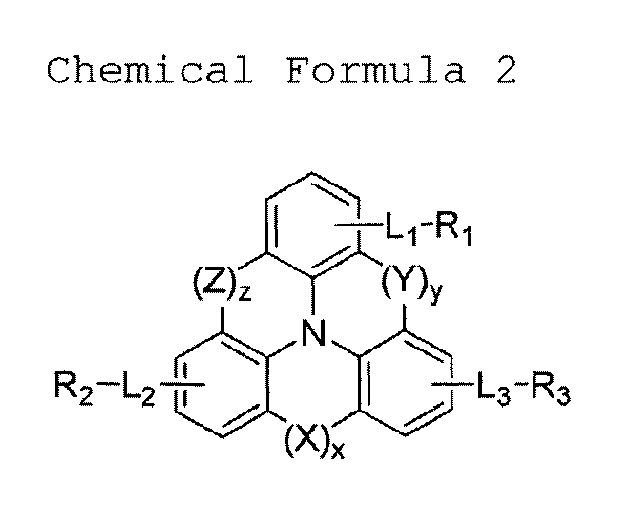
- novel compounds for organic electronic material according to the invention are represented by Chemical Formula (1) or Chemical Formula (2): wherein,
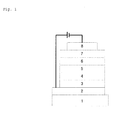
- Fig. 1 illustrates a cross-sectional view of an OLED of the present invention comprising a Glass 1, Transparent electrode 2, Hole injecting layer 3, Hole transport layer 4, Electroluminescent layer 5, Electron transport layer 6, Electron injecting layer 7 and Al cathode 8.
- alkyl and other substituents containing “alkyl” moiety includes linear and branched species.
- aryl means an organic radical derived from aromatic hydrocarbon via elimination of one hydrogen atom.
- Each ring suitably comprises a monocyclic or fused ring system containing from 4 to 7, preferably from 5 to 6 cyclic atoms.
- Specific examples include phenyl, naphthyl, biphenyl, anthryl, indenyl, fluorenyl, phenanthryl, triphenylenyl, pyrenyl, perylenyl, chrysenyl, naphthacenyl and fluoranthenyl, but they are not restricted thereto.
- heteroaryl described herein means an aryl group containing from 1 to 4 heteroatom(s) selected from N, O and S for the aromatic cyclic backbone atoms, and carbon atom(s) for remaining aromatic cyclic backbone atoms.
- the heteroaryl may be 5- or 6-membered monocyclic heteroaryl or a polycyclic heteroaryl which is fused with one or more benzene ring(s), and may be partially saturated.
- the heteroaryl groups may include divalent aryl groups of which the heteroatoms are oxidized or quarternized to form N-oxides, quaternary salts, or the like.
- monocyclic heteroaryl groups such as furyl, thiophenyl, pyrrolyl, imidazolyl, pyrazolyl, thiazolyl, thiadiazolyl, isothiazolyl, isoxazolyl, oxazolyl, oxadiazolyl, triazinyl, tetrazinyl, triazolyl, tetrazolyl, furazanyl, pyridyl, pyrazinyl, pyrimidinyl, pyridazinyl; polycyclic heteroaryl groups such as benzofuranyl, benzothiophenyl, isobenzofuranyl, benzimidazolyl, benzothiazolyl, benzisothiazolyl, benzisoxazolyl, benzoxazolyl, isoindolyl, indolyl, indazolyl, benzothiadiazolyl, quinolyl, isoquinolyl,
- the substituents comprising "(C1-C60)alkyl” moiety described herein may contain 1 to 60 carbon atoms, 1 to 20 carbon atoms, or 1 to 10 carbon atoms.
- the substituents comprising "(C6-C60)aryl” moiety may contain 6 to 60 carbon atoms, 6 to 20 carbon atoms, or 6 to 12 carbon atoms.
- the substituents comprising "(C3-C60)heteroaryl” moiety may contain 3 to 60 carbon atoms, 4 to 20 carbon atoms, or 4 to 12 carbon atoms.
- the substituents comprising "(C3-C60)cycloalkyl” moiety may contain 3 to 60 carbon atoms, 3 to 20 carbon atoms, or 3 to 7 carbon atoms.
- the substituents comprising "(C2-C60)alkenyl or alkynyl” moiety may contain 2 to 60 carbon atoms, 2 to 20 carbon atoms, or 2 to 10 carbon atoms.
- R 1 -L 1 -, R 2 -L 2 - and R 3 -L 3 - independently represent diphenylamino group (-NPh 2 ) (in other word, if L 1 , L 2 or L 3 represents chemical bonds, R 1 , R 2 or R 3 represent NR 11 R 12 , and both R 11 and R 12 represent phenyl), at least one of phenyl must have a substituent other than hydrogen.
- the compounds for organic electronic material according to the invention can be selected from those represented by one of Chemical Formulas (3) to (6): wherein, L 1 , L 2 , L 3 , R 1 , R 2 , R 3 , R 31 and R 32 are defined as in Chemical Formula (1) or (2).
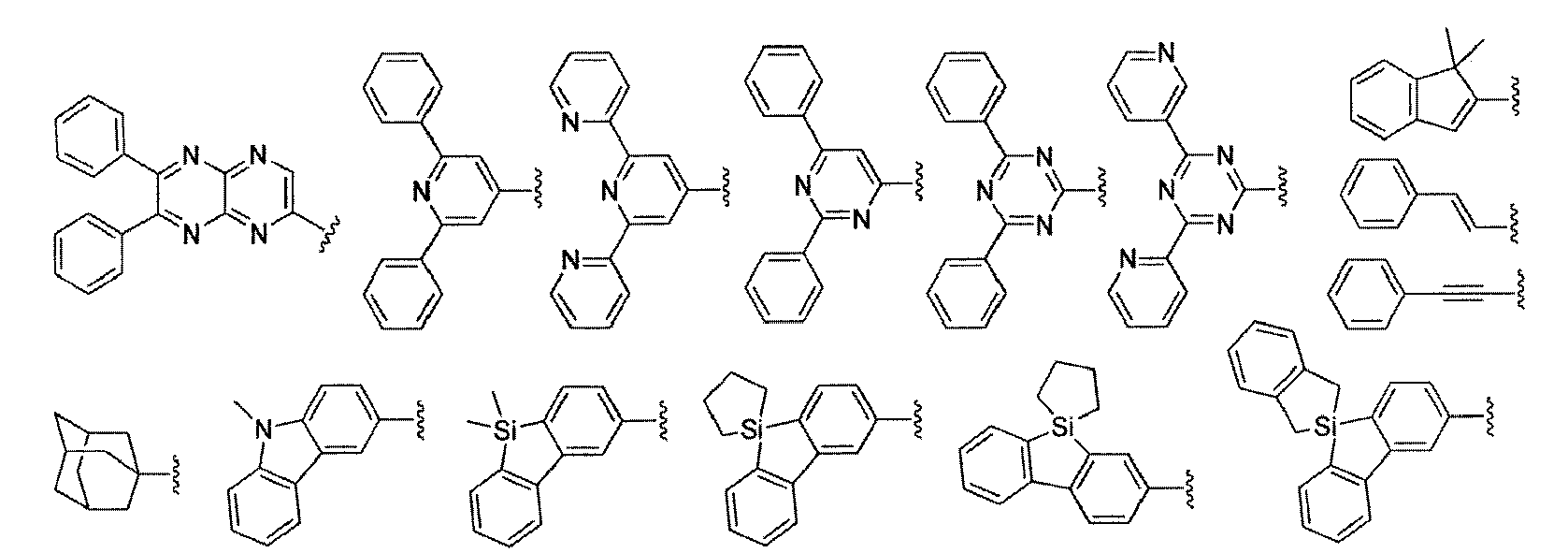
- R 1 , R 2 and R 3 independently represent, without restriction, hydrogen, deuterium or NR 11 R 12 , or a substituent selected from the following structures:
- R 1 , R 2 and R 3 can be independently exemplified by the following structures, without restriction:
- L 1 , L 2 and L 3 independently represent a chemical bond, or arylene or heteroarylene selected from the phenylene, naphthylene, biphenylene, fluorenylene, phenanthrylene, anthrylene, fluoranthenylene, triphenylenylene, pyrenylene, chrysenylene, naphthacenylene, perylenylene, spirobifluorenyl, tetrahydronaphthylene, acenaphthenylene, indenylene, pyridylene, bipyridylene, pyrrolylene, furylene, thienylene, imidazolylene, benzimidazolylene, pyrazinylene, pyrimidinylene, pyridazinylene, quinolinylene, triazinylene, benzofurylene, dibenzofurylene, benzothienylene, dibenzothienylene, dibenzothi
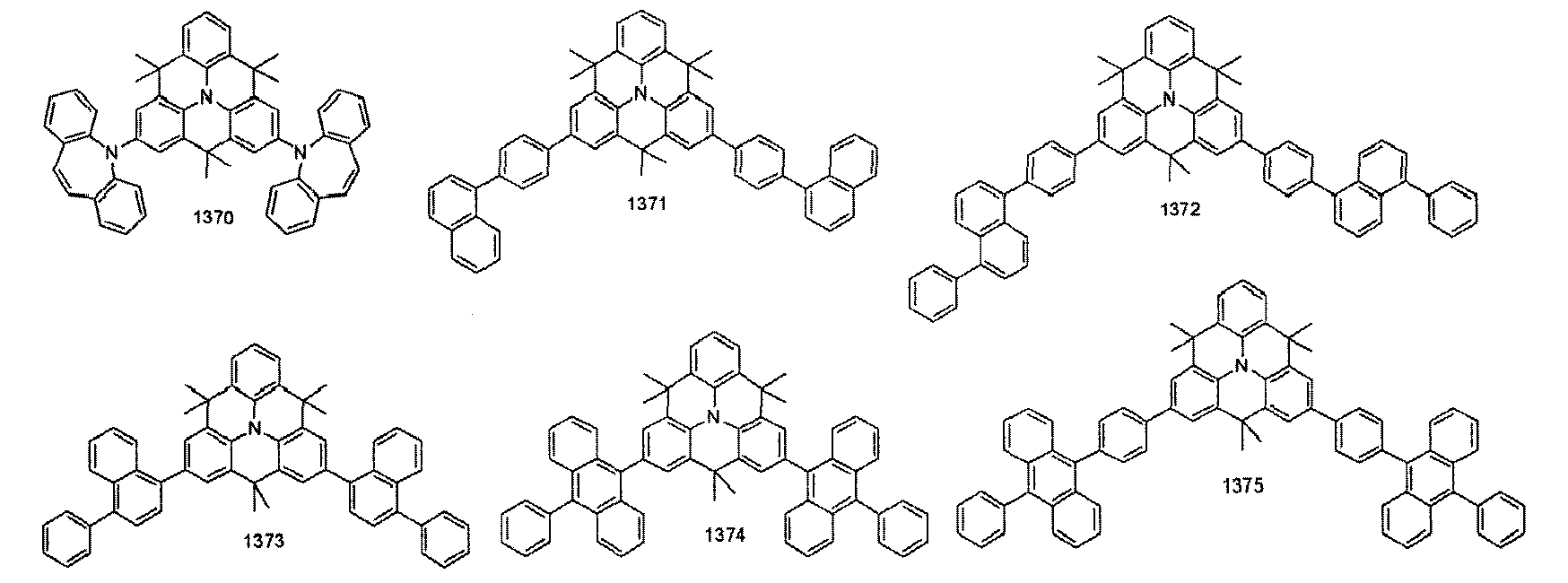
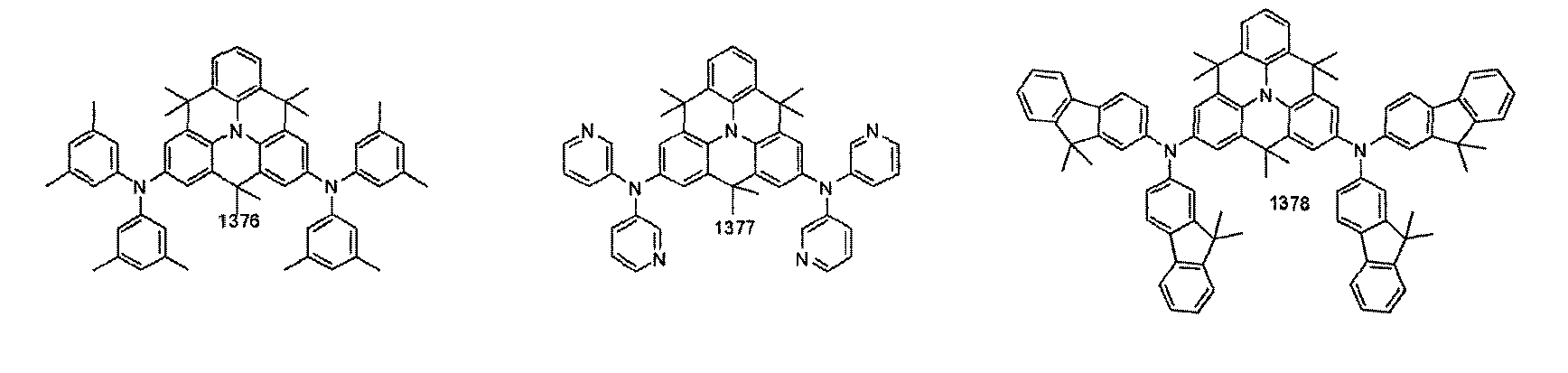
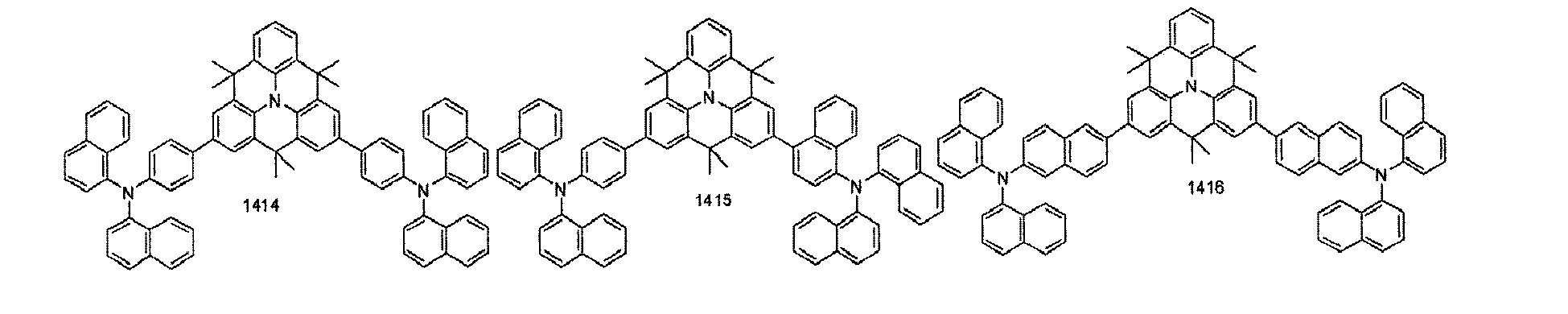
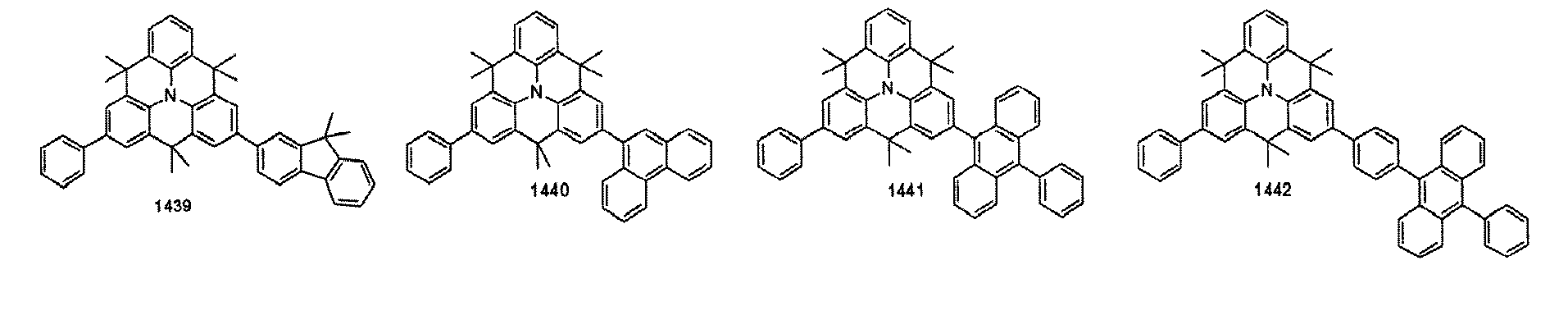
- organic electroluminescent compounds according to the present invention can be more specifically exemplified by the following compounds, but they are not restricted thereto:
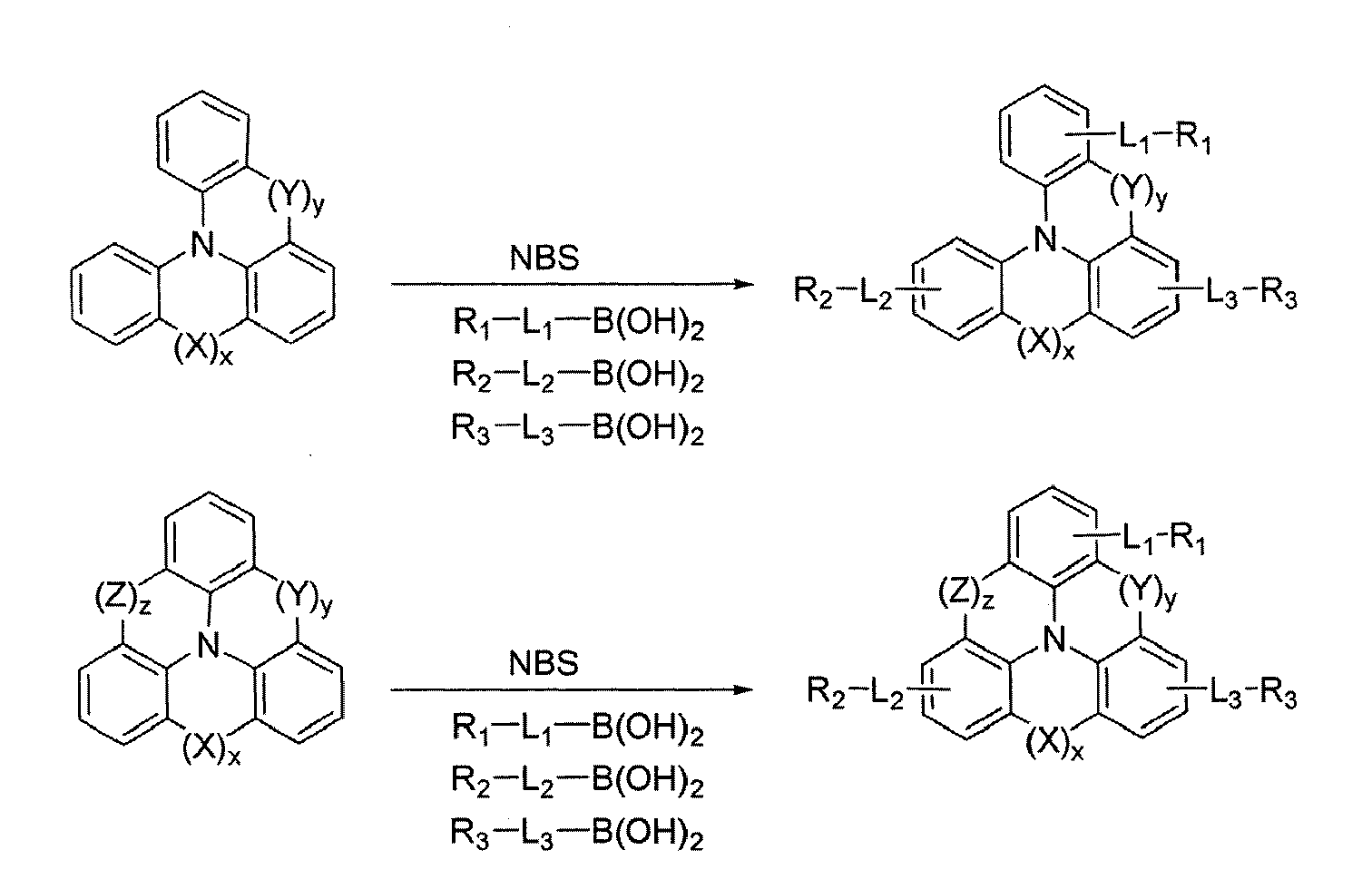
- the compounds for organic electronic material according to the present invention can be prepared by a procedure as illustrated by Reaction Schemes (1): wherein, L 1 , L 2 , L 3 , R 1 , R 2 , R 3 , R 31 and R 32 are defined as in Chemical Formula (1) or (2).
- the present invention also provides organic solar cells, which comprises one or more compound(s) for organic electronic material represented by Chemical Formula (1) or (2).
- the present invention also provides an organic electronic device which is comprised of a first electrode; a second electrode; and at least one organic layer(s) interposed between the first electrode and the second electrode; wherein the organic layer comprises one or more compound(s) for organic electronic material represented by Chemical Formula (1) or (2).
- the compounds for organic electronic material may be used as material for forming a hole injecting layer or a hole transport layer, or host material for an electroluminescent layer.
- the organic electronic device according to the present invention is characterized in that the organic layer comprises an electroluminescent layer, which comprises one or more dopant(s), in addition to one or more compound(s) for organic electronic material represented by Chemical Formula (1) or (2).
- the dopant to be applied to the organic electronic device according to the invention is not particularly restricted, but preferably selected from compounds represented by Chemical Formula (7): Chemical Formula 7 M 1 L 101 L 102 L 103 wherein, M 1 is selected from a group consisting of metals of Group 7, 8, 9, 10, 11, 13, 14, 15 and 16 in the Periodic Table of Elements, and ligands L 101 , L 102 and L 103 are independently selected from the following structures:
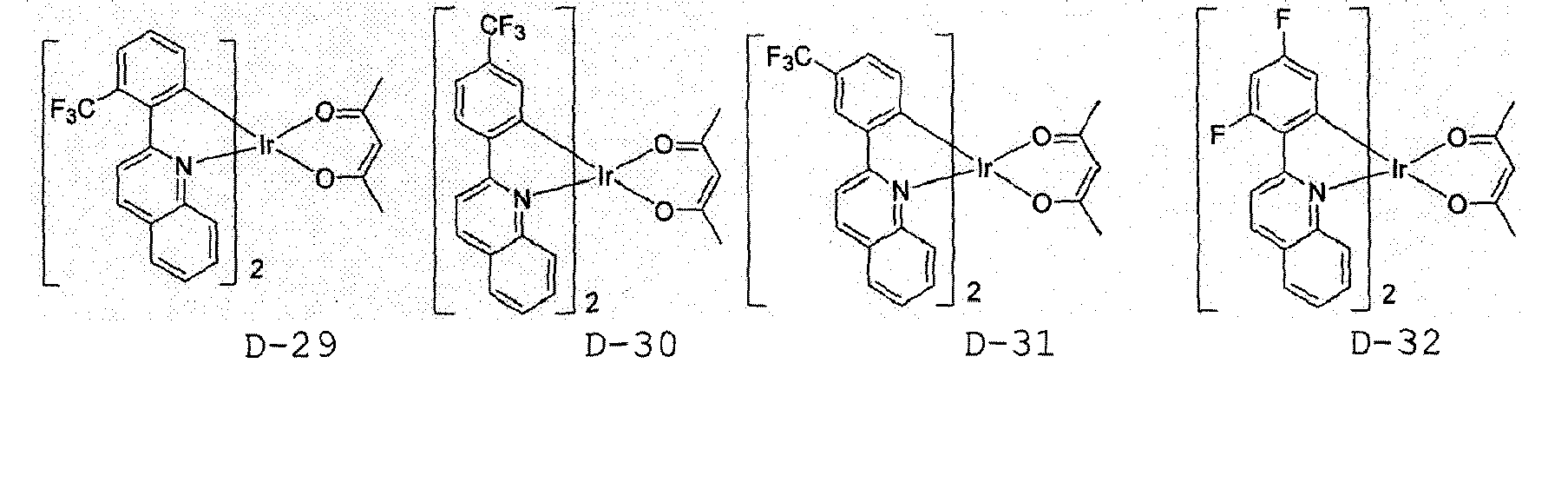
- the dopant compounds of Chemical Formula (7) can be exemplified by the following compounds, without restriction:
- the organic electronic device according to the invention may further comprise one or more compound(s) selected from a group consisting of arylamine compounds and styrylarylamine compounds, in addition to the compound for organic electronic material represented by Chemical Formula (1) or (2).
- arylamine or styrylarylamine compounds include the compounds represented by Chemical Formula (8), but they are not restricted thereto:
- arylamine compounds and styrylarylamine compounds can be more specifically exemplified by the following compounds, but are not restricted thereto.
- the organic layer may further comprise one or more metal(s) selected from a group consisting of organometals of Group 1, Group 2, 4 th period and 5 th period transition metals, lanthanide metals and d-transition elements in the Periodic Table of Elements, in addition to the compounds for organic electronic material represented by Chemical Formula (1) or (2).
- the organic layer may comprise an electroluminescent layer and a charge generating layer at the same time.
- the present invention can realize an organic electronic device having a pixel structure of independent light-emitting mode, which comprises an organic electronic device containing the compound for organic electronic material of Chemical Formula (1) or (2) as a sub-pixel and one or more sub-pixel(s) comprising one or more metallic compound(s) selected from a group consisting of Ir, Pt, Pd, Rh, Re, Os, Tl, Pb, Bi, In, Sn, Sb, Te, Au and Ag, patterned in parallel at the same time.
- the organic electronic device may comprise one or more compound(s) selected from compounds having electroluminescent peak of wavelength of blue, green or red in addition to the organic electroluminescent compound in the organic layer to form a white electroluminescent device.
- the compounds having electroluminescent peak of wavelength of blue, green or red can be exemplified by those represented by one of Chemical Formulas (9) to (12), but they are not restricted thereto.
- Ar 11 and Ar 12 independently represent (C1-C60)alkyl, (C6-C60)aryl, (C4-C60)heteroaryl, (C6-C60)arylamino, (C1-C60)alkylamino, 5- or 6-membered heterocycloalkyl containing one or more heteroatom(s) selected from N, O and S, or (C3-C60)cycloalkyl, or Ar 11 and Ar 12 may be linked via (C3-C60)alkylene or (C3-C60)alkenylene with or without a fused ring to form an alicyclic ring, or a monocyclic or polycyclic aromatic ring;
- R 301 through R 304 independently represent hydrogen, deuterium, halogen, (C1-C60)alkyl, (C6-C60)aryl, (C4-C60)heteroaryl, 5- or 6-membered heterocycloalkyl containing one or more heteroatom(s) selected from N, O and S, (C3-C60)cycloalkyl, tri(C1-C60)alkylsilyl, di(C1-C60)alkyl(C6-C60)arylsilyl, tri(C6-C60)arylsilyl, adamantyl, (C7-C60)bicycloalkyl, (C2-C60)alkenyl, (C2-C60)alkynyl, (C1-C60)alkoxy, cyano, (C1-C60)alkylamino, (C6-C60)arylamino, (C6-C60)ar(C1-C60)alky
- the compounds represented by Chemical Formula (11) or (12) can be exemplified by anthracene derivatives or benz[a]anthracene derivatives represented by one of Chemical Formulas (13) to (16).
- L 41 and L 42 independently represent a chemical bond, (C6-C60)arylene, (C3-C60)heteroarylene; the arylene or heteroarylene of L 41 and L 42 may be further substituted by one or more substituent(s) selected from deuterium, (C1-C60)alkyl, halogen, cyano, (C1-C60)alkoxy, (C3-C60)cycloalkyl, (C6-C60)aryl, (C3-C60)heteroaryl, tri(C1-C30)alkylsilyl, di(C1-C30)alkyl(C6-C30)arylsilyl and tri(C6-C30)arylsilyl;
- the compounds having electroluminescent peak of wavelength of blue, green or red color, to be contained in the electroluminescent layer can be exemplified by the following compounds, without restriction.
- an organic electronic device it is preferable to place one or more layer(s) (here-in-below, referred to as the "surface layer") selected from chalcogenide layers, metal halide layers and metal oxide layers, on the inner surface of at least one side of the pair of electrodes.
- the surface layer selected from chalcogenide layers, metal halide layers and metal oxide layers.
- a chalcogenide layer of silicon and aluminum metal including oxides
- Examples of chalcogenides preferably include SiO x (1 ⁇ X ⁇ 2), AlO x (1 ⁇ X ⁇ 1.5), SiON, SiAlON, or the like.
- Examples of metal halides preferably include LiF, MgF 2 , CaF 2 , fluorides of rare earth metal, or the like.
- Examples of metal oxides preferably include Cs 2 O, Li 2 O, MgO, SrO, BaO, CaO, or the like.
- an organic electronic device it is also preferable to arrange, on at least one surface of the pair of electrodes thus manufactured, a mixed region of electron transport compound and a reductive dopant, or a mixed region of a hole transport compound with an oxidative dopant. Accordingly, the electron transport compound is reduced to an anion, so that injection and transportation of electrons from the mixed region to an EL medium are facilitated. In addition, since the hole transport compound is oxidized to form a cation, injection and transportation of holes from the mixed region to an EL medium are facilitated.
- Preferable oxidative dopants include various Lewis acids and acceptor compounds.
- Preferable reductive dopants include alkali metals, alkali metal compounds, alkaline earth metals, rare-earth metals, and mixtures thereof.
- the compounds for organic electronic material according to the invention exhibit high luminous efficiency and excellent life property of material, so that OLED's having very good operation life of device can be advantageously manufactured therefrom.
- the compounds for organic electronic material according to the invention can be contained in a hole transport layer or a hole injecting layer, or employed as host for phosphor to result in lowered operation voltage, thus providing advantages of noticeably decreased power consumption while exhibiting at least comparable luminous efficiency.
- the present invention is further described with respect to the representative compounds of the invention, by describing the compounds for organic electronic material, the processes for preparing the same, and electroluminescent properties of the device manufactured therefrom in the Examples below, which are provided for illustration of the embodiments only but are not intended to limit the scope of the invention by any means.
- a reaction vessel was charged with aniline (4.89 mL, 53.7 mmol), methyl-2-iodobenzoate (23.7 mL, 161 mmol), K 2 CO 3 (15.6 g, 113 mmol), Cu (0.68 g, 10.7 mmol), CuI (0.51 g, 2.69 mmol) and di-n-butyl ether (50 mL), and the mixture was stirred under reflux for 48 hours in the presence of argon atmosphere.
- the organic product was purified via column chromatography by using hexane and ethyl acetate (4:1), and recrystallized from ethanol to obtain Compound (N) (15.7 g, 81%).
- a reaction vessel was charged with anthranilic acid methyl ester (10 g, 66.2 mmol), methyl-2-iodobenzoate (28.2 mL, 191.98 mmol), K 2 CO 3 (19.2 g, 139.02 mmol), Cu (0.84 g, 13.24 mmol), CuI (0.63 g, 3.31 mmol) and di-n-butyl ether (120 mL), and the mixture was stirred under reflux for 48 hours in the presence of argon atmosphere.
- the organic product was purified via column chromatography by using hexane and ethyl acetate (4:1), and recrystallized from ethanol to obtain Compound (R) (21.7 g, 78%).
- An OLED device was manufactured by using a compound for electronic material according to the invention.
- an ITO substrate was equipped in a substrate folder of a vacuum vapor-deposit device, and 4,4',4"-tris(N,N-(2-naphthyl)-phenylamino)triphenylamine (2-TNATA) (of which the structure is shown below) was placed in a cell of the vacuum vapor-deposit device, which was then ventilated up to 10 -6 torr of vacuum in the chamber. Electric current was applied to the cell to evaporate 2-TNATA, thereby providing vapor-deposit of a hole injecting layer (3) having 60 nm thickness on the ITO substrate.
- 2-TNATA 4,4',4"-tris(N,N-(2-naphthyl)-phenylamino)triphenylamine
- NPB N,N'-bis( ⁇ -naphthyl)-N,N'-diphenyl-4,4'-diamine
- an electroluminescent layer was vapor-deposited as follows. To one cell of said vacuum vapor-deposit device, charged was a compound according to the invention (e.g., Compound 279) as host material (which had been purified via sublimation in vacuo at 10 -6 torr), and an electroluminescent dopant compound (e.g., (piq) 2 Ir(acac)) was charged to another cell. The two substances were evaporated at different rates to carry out doping at a concentration of 4 to 10% by weight, thereby vapor-depositing an electroluminescent layer (5) with 30 nm thickness on the hole transport layer.
- a compound according to the invention e.g., Compound 279
- an electroluminescent dopant compound e.g., (piq) 2 Ir(acac)
- An OLED device was manufactured according to the same procedure as in Example 1, but using bis(2-methyl-8-quinolinato)(p-phenylphenolato)aluminum (III) (BAlq) as electroluminescent host material in another cell of the vacuum deposit device, instead of the electroluminescent compound according to the present invention.
- the devices employing the electroluminescent compounds as host material exhibit excellent electroluminescent properties with lowered operation voltage to induce increase of power efficiency by 0.8 ⁇ 2.2 lm/W with improved power consumption.
- An OLED was manufactured according to the same procedure as in Example 1, otherwise.
- Example 2 The luminous efficiencies of the OLED's comprising the compound for electronic material according to the present invention (Example 2) or conventional electroluminescent compound (Comparative Example 1) were measured at 5,000 cd/m 2 , respectively, and the results are shown in Table 3.
- Table 3 No. Material of hole transport layer Operation voltage (V) @1,000 cd/m 2 Luminous efficiency (cd/A) @1,000 cd/m 2 Color 1 Compound 394 5.5 5.4 Red 2 Compound 765 5.4 5.6 Red Comp.1 NPB 6 4.5 Red
- An ITO substrate was equipped in a substrate folder of a vacuum vapor-deposit device according to the same procedure as in Example 1.
- Compound (494) (of which the structure is shown below) was placed in a cell of the vacuum vapor-deposit device, which was then ventilated up to 10 -6 torr of vacuum in the chamber. Electric current was applied to the cell to evaporate Compound (494), thereby providing vapor-deposit of a hole injecting layer (3) having 60 nm thickness on the ITO substrate.
- An OLED was manufactured according to the same procedure as in Example 1, otherwise.
Landscapes
- Chemical & Material Sciences (AREA)
- Organic Chemistry (AREA)
- Engineering & Computer Science (AREA)
- Materials Engineering (AREA)
- Spectroscopy & Molecular Physics (AREA)
- Physics & Mathematics (AREA)
- Biochemistry (AREA)
- Molecular Biology (AREA)
- General Health & Medical Sciences (AREA)
- Life Sciences & Earth Sciences (AREA)
- Health & Medical Sciences (AREA)
- Electroluminescent Light Sources (AREA)
- Organic Low-Molecular-Weight Compounds And Preparation Thereof (AREA)
- Nitrogen Condensed Heterocyclic Rings (AREA)
- Photovoltaic Devices (AREA)
- Heterocyclic Carbon Compounds Containing A Hetero Ring Having Oxygen Or Sulfur (AREA)
Abstract



Description
- The present invention relates to novel compounds for organic electronic material, and organic electronic devices comprising the same. More specifically, the invention relates to novel compounds for organic electronic material having high efficiency, and organic electronic devices which comprise the compounds in a hole transport layer or a hole injecting layer, or in an electroluminescent layer as the host for phosphor.
- Among display devices, electroluminescence devices (EL devices) are self-luminescent display devices showing the advantage of wide angle of view, excellent contrast and rapid response rate. Eastman Kodak developed in 1987 an organic EL device which employs a low molecular weight aromatic diamine and an aluminum complex as material for forming an EL layer, for the first time [Appl. Phys. Lett. 51, 913, 1987].
- An organic EL device is a device wherein, when charge is applied to an organic film formed between an electron injection electrode (cathode) and a hole injection electrode (anode), an electron and a hole form a pair and then become extinct with emitting light. A device can be formed on a transparent flexible substrate such as plastics. The device can be operated at a lower voltage (not more than 10 V) with relatively lower power consumption but excellent color purity, as compared to a plasma display panel or an inorganic EL display.
- The most important factor to determine the performances such as luminous efficiency, lifetime or the like in an organic EL device is electroluminescent material. Several properties required for such electroluminescent materials include that the material should have high fluorescent quantum yield in solid state and high mobility of electrons and holes, is not easily decomposed during vapor-deposition in vacuo, and forms uniform and stable thin film.
- Organic electroluminescent materials can be generally classified into high-molecular materials and low-molecular materials. The low-molecular materials include metal complexes and thoroughly organic electroluminescent materials which do not contain metal, from the aspect of molecular structure. Such electroluminescent materials include chelate complexes such as tris(8-quinolinolato)aluminum complexes, coumarin derivatives, tetraphenylbutadiene derivatives, bis(styrylarylene) derivatives and oxadiazole derivatives. From those materials, it is reported that light emission of visible region from blue to red can be obtained
- Three electroluminescent materials (for red, green and blue) are employed to realize a full-colored OLED display. The important issue is to develop red, green and blue electroluminescent materials with high efficiency and long life, in order to enhance the overall feature of the organic electroluminescent (EL) devices. The EL materials are classified into host materials and dopant materials from the aspect of their functions. It is generally known that a device structure having the most excellent EL properties can be fabricated with an EL layer prepared by doping a dopant to a host. Recently, development of organic EL devices with high efficiency and long life comes to the fore as an urgent subject, and particularly urgent is development of a material with far better EL properties as compared to conventional EL materials as considering EL properties required for a medium to large sized OLED panel.
- As a host material for phosphorescent light emitting material, 4,4'-N,N'-dicarbazole-biphenyl (CBP) has been most widely known up to the present, and OLED's having high efficiency to which a hole blocking layer (such as BCP and BAlq) had been applied have been developed. Pioneer (Japan) or the like reported OLED's of high performances which were developed by using bis(2-methyl-8-quinolinato)(p-phenylphenolato)aluminum (III) (BAlq) derivatives as the host.

- Though the conventional materials are advantageous in view of light emitting property, they have low glass transition temperature and very poor thermal stability, so that the materials tend to be changed during high temperature vapor-deposition in vacuo. In an organic electroluminescent device (OLED), it is defined that power efficiency = (π/voltage) x current efficiency. Thus, the power efficiency is inversely proportional to the voltage, and the power efficiency should be higher in order to obtain lower power consumption of an OLED. In practice, an OLED employing phosphorescent electroluminescent (EL) material shows significantly higher current efficiency (cd/A) than an OLED employing fluorescent EL material. However, in case that a conventional material such as BAlq and CBP as host material of the phosphorescent EL material is employed, no significant advantage can be obtained in terms of power efficiency (lm/w) because of higher operating voltage as compared to an OLED employing a fluorescent material.
- Furthermore, there was no satisfactory result in view of life of an OLED, so that development of host material providing better stability and higher performance is still required.
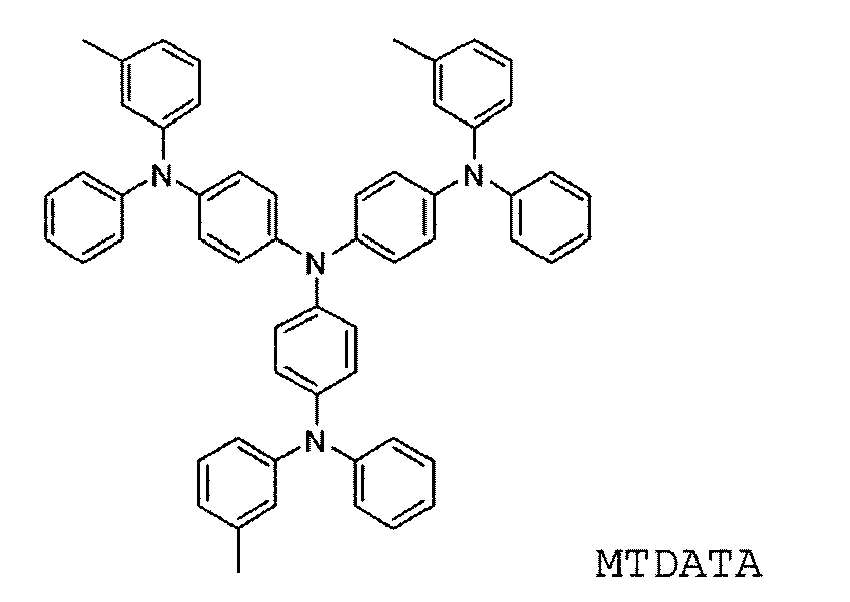
- Further, hole injecting/transport materials including copper phthalocyanine (CuPc), 4,4'-bis[N-(1-naphthyl)-N-phenylamino]biphenyl (NPB) and MTDATA have been known.
- In view of improvement in durability of an organic electroluminescent device, it is reported that compounds having higher non-crystallinity give higher stability of thin film. Glass transition temperature (Tg) is employed as an index for non-crystallinity.
- It is recognized that conventional MTDATA does not show high non-crystallinity, having glass transition temperature of 76°C. Thus, no satisfactory property could be obtained in terms of durability of the organic EL device, or luminous efficiency which comes from the hole injecting/transport property.
- Thus, the object of the invention is to provide organic novel compounds for organic electronic material having the backbone to give better luminous efficiency and device life with appropriate color coordinate as compared to those of conventional host material of phosphor, with overcoming disadvantages of them.
- Another object of the invention is to provide organic electronic device employing the novel compounds for organic electronic material in the hole injecting layer, the hole transport layer or the electroluminescent layer.
- Still another object of the invention is to provide organic solar cells comprising the novel compounds for organic electronic material.
- The present invention relates to novel compounds for organic electronic material, and organic electronic devices comprising the same. Specifically, the novel compounds for organic electronic material according to the invention are represented by Chemical Formula (1) or Chemical Formula (2):


- L1, L2 and L3 independently represent a chemical bond, (C6-C60)arylene, (C3-C60)heteroarylene, 5- or 6-membered heterocycloalkylene containing one or more heteroatom(s) selected from N, O and S, (C3-C60)cycloalkylene, adamantylene, (C7-C60)bicycloalkylene, (C2-C60)alkenylene, (C2-C60)alkynylene, (C6-C60)ar(C1-C60)alkylene, (C1-C60)alkyenethio, (C1-C60)alkylenoxy, (C6-C60)arylenoxy or (C6-C60)arylenethio;
- R1, R2 and R3 independently represent hydrogen, deuterium, (C6-C60)aryl, (C3-C60)heteroaryl, 5- or 6-membered heterocycloalkyl containing one or more heteroatom(s) selected from N, O and S, (C3-C60)cycloalkyl, adamantyl, (C7-C60)bicycloalkyl, (C2-C60)alkenyl, (C2-C60)alkynyl, (C1-C60)alkylthio, (C6-C60)aryloxy, (C6-C60)arylthio, NR11R12, or a substituent selected from the following structures (excluding the case wherein R1, R2 and R3 are hydrogen all at the same time):


- R11 and R12 independently represent (C6-C60)aryl or (C3-C60)heteroaryl, or may be linked via (C3-C60)alkylene or (C3-C60)alkenylene with or without a fused ring to form an alicyclic ring, or a monocyclic or polycyclic aromatic ring;
- R13 through R30 independently represent hydrogen, deuterium, halogen, (C1-C60)alkyl, (C6-C60)aryl, (C3-C60)heteroaryl, morpholino, thiomorpholino, 5- or 6-membered heterocycloalkyl containing one or more heteroatom(s) selected from N, O and S, (C3-C60)cycloalkyl, tri(C1-C60)alkylsilyl, di(C1-C60)alkyl(C6-C60)arylsilyl, tri(C6-C60)arylsilyl, adamantyl, (C7-C60)bicycloalkyl, (C2-C60)alkenyl, (C2-C60)alkynyl, cyano, (C1-C60)alkylamino, (C6-C60)arylamino, (C6-C60)ar(C1-C60)alkyl, (C1-C60)alkyloxy, (C1-C60)alkylthio, (C6-C60)aryloxy, (C6-C60)arylthio, (C1-C60)alkoxycarbonyl, (C1-C60)alkylcarbonyl, (C6-C60)arylcarbonyl, carboxyl, nitro or hydroxyl, or each of R13 through R25 may be linked to an adjacent substituent via (C3-C60)alkylene or (C3-C60)alkenylene with or without a fused ring to form an alicyclic ring, or a monocyclic or polycyclic aromatic ring;
- A, B, X, Y and Z independently represent a chemical bond, or -(CR31R32)a-, -N(R33)-, -S-, -O-, -Si(R34)(R35)-, -P(R36)-, - C(=O)-, -B(R37)-, -In(R38)-, -Se-, -Ge(R39)(R40)-, -Sn(R41)(R42)-, -Ga(R43)- or -(R44)C=C(R45)-;
- R31 through R45 independently represent hydrogen, deuterium, halogen, (C1-C60)alkyl, (C6-C60)aryl, (C3-C60)heteroaryl, morpholino, thiomorpholino, 5- or 6-membered heterocycloalkyl containing one or more heteroatom(s) selected from N, O and S, (C3-C60)cycloalkyl, tri(C1-C60)alkylsilyl, di(C1-C60)alkyl(C6-C60)arylsilyl, tri(C6-C60)arylsilyl, adamantyl, (C7-C60)bicycloalkyl, (C2-C60)alkenyl, (C2-C60)alkynyl, cyano, (C1-C60)alkylamino, (C6-C60)arylamino, (C6-C60)ar(C1-C60)alkyl, (C1-C60)alkyloxy, (C1-C60)alkylthio, (C6-C60)aryloxy, (C6-C60)arylthio, (C1-C60)alkoxycarbonyl, (C1-C60)alkylcarbonyl, (C6-C60)arylcarbonyl, carboxyl, nitro or hydroxyl, or R31 and R32, R34 and R35, R39 and R40, R41 and R42, or R44 and R45 may be linked via (C3-C60)alkylene or (C3-C60)alkenylene with or without a fused ring to form an alicyclic ring, or a monocyclic or polycyclic aromatic ring;
- the arylene, heteroarylene, arylenoxy or arylenethio of L1, L2 and L3; the aryl or heteroaryl of R1, R2, R3, R11 and R12; or the alkyl, aryl, heteroaryl, heterocycloalkyl, cycloalkyl, trialkylsilyl, dialkylarylsilyl, triarylsilyl, adamantyl, bicycloalkyl, alkenyl, alkynyl, aralkyl, alkyloxy, alkylthio, aryloxy, arylthio, alkylamino, arylamino, alkoxycarbonyl, alkylcarbonyl or arylcarbonyl of R13 through R30 and R31 through R45 may be further substituted by one or more substituent(s) selected from a group consisting of deuterium, halogen, (C1-C60)alkyl with or without halogen substituent(s), (C6-C60)aryl, (C3-C60)heteroaryl with or without (C6-C60)aryl substituent(s), morpholino, thiomorpholino, 5- or 6-membered heterocycloalkyl containing one or more heteroatom(s) selected from N, O and S, (C3-C60)cycloalkyl, tri(C1-C60)alkylsilyl, di(C1-C60)alkyl(C6-C60)arylsilyl, tri(C6-C60)arylsilyl, adamantyl, (C7-C60)bicycloalkyl, (C2-C60)alkenyl, (C2-C60)alkynyl, cyano, carbazolyl, (C1-C60)alkylamino, (C6-C60)arylamino, (C6-C60)ar(C1-C60)alkyl, (C1-C60)alkyl(C6-C60)aryl, (C1-C60)alkyloxy, (C1-C60)alkylthio, (C6-C60)aryloxy, (C6-C60)arylthio, (C1-C60)alkoxycarbonyl, (C1-C60)alkylcarbonyl, (C6-C60)arylcarbonyl, carboxyl, nitro and hydroxyl; and
- a, x, y and z independently represent an integer from 0 to 4;
- but excluding the case wherein R1-L1-, R2-L2- or R3-L3-independently represents diphenylamino group (-NPh2).
-
-
Fig. 1 is a cross-sectional view of an OLED. - Referring now to the Drawings,
Fig. 1 illustrates a cross-sectional view of an OLED of the present invention comprising aGlass 1,Transparent electrode 2,Hole injecting layer 3,Hole transport layer 4,Electroluminescent layer 5,Electron transport layer 6,Electron injecting layer 7 andAl cathode 8. - The term "alkyl" and other substituents containing "alkyl" moiety includes linear and branched species.
- The term "aryl" described herein means an organic radical derived from aromatic hydrocarbon via elimination of one hydrogen atom. Each ring suitably comprises a monocyclic or fused ring system containing from 4 to 7, preferably from 5 to 6 cyclic atoms. Specific examples include phenyl, naphthyl, biphenyl, anthryl, indenyl, fluorenyl, phenanthryl, triphenylenyl, pyrenyl, perylenyl, chrysenyl, naphthacenyl and fluoranthenyl, but they are not restricted thereto.
- The term "heteroaryl" described herein means an aryl group containing from 1 to 4 heteroatom(s) selected from N, O and S for the aromatic cyclic backbone atoms, and carbon atom(s) for remaining aromatic cyclic backbone atoms. The heteroaryl may be 5- or 6-membered monocyclic heteroaryl or a polycyclic heteroaryl which is fused with one or more benzene ring(s), and may be partially saturated. The heteroaryl groups may include divalent aryl groups of which the heteroatoms are oxidized or quarternized to form N-oxides, quaternary salts, or the like. Specific examples include monocyclic heteroaryl groups such as furyl, thiophenyl, pyrrolyl, imidazolyl, pyrazolyl, thiazolyl, thiadiazolyl, isothiazolyl, isoxazolyl, oxazolyl, oxadiazolyl, triazinyl, tetrazinyl, triazolyl, tetrazolyl, furazanyl, pyridyl, pyrazinyl, pyrimidinyl, pyridazinyl; polycyclic heteroaryl groups such as benzofuranyl, benzothiophenyl, isobenzofuranyl, benzimidazolyl, benzothiazolyl, benzisothiazolyl, benzisoxazolyl, benzoxazolyl, isoindolyl, indolyl, indazolyl, benzothiadiazolyl, quinolyl, isoquinolyl, cinnolinyl, quinazolinyl, quinoxalinyl, carbazolyl, phenanthridinyl and benzodioxolyl; and corresponding N-oxides (for example, pyridyl N-oxide, quinolyl N-oxide) and quaternary salts thereof; but they are not restricted thereto.
- The substituents comprising "(C1-C60)alkyl" moiety described herein may contain 1 to 60 carbon atoms, 1 to 20 carbon atoms, or 1 to 10 carbon atoms. The substituents comprising "(C6-C60)aryl" moiety may contain 6 to 60 carbon atoms, 6 to 20 carbon atoms, or 6 to 12 carbon atoms. The substituents comprising "(C3-C60)heteroaryl" moiety may contain 3 to 60 carbon atoms, 4 to 20 carbon atoms, or 4 to 12 carbon atoms. The substituents comprising "(C3-C60)cycloalkyl" moiety may contain 3 to 60 carbon atoms, 3 to 20 carbon atoms, or 3 to 7 carbon atoms. The substituents comprising "(C2-C60)alkenyl or alkynyl" moiety may contain 2 to 60 carbon atoms, 2 to 20 carbon atoms, or 2 to 10 carbon atoms.
- In Chemical Formula (1) or (2), if R1-L1-, R2-L2- and R3-L3- independently represent diphenylamino group (-NPh2) (in other word, if L1, L2 or L3 represents chemical bonds, R1, R2 or R3 represent NR11R12, and both R11 and R12 represent phenyl), at least one of phenyl must have a substituent other than hydrogen.
- The compounds for organic electronic material according to the invention can be selected from those represented by one of Chemical Formulas (3) to (6):


- In the chemical formulas, R1, R2 and R3 independently represent, without restriction, hydrogen, deuterium or NR11R12, or a substituent selected from the following structures:


- wherein, R11 and R12 are defined as in Chemical Formula (1) or (2);
- R51 through R64 independently represent hydrogen, deuterium, halogen, (C1-C60)alkyl, halo(C1-C60)alkyl, (C6-C60)aryl, (C3-C60)heteroaryl, 5- or 6-membered heterocycloalkyl containing one or more heteroatom(s) selected from N, O and S, (C3-C60)cycloalkyl, tri(C1-C60)alkylsilyl, di(C1-C60)alkyl(C6-C60)arylsilyl, tri(C6-C60)arylsilyl, adamantyl, (C7-C60)bicycloalkyl, (C2-C60)alkenyl, (C2-C60)alkynyl, cyano, (C1-C60)alkylamino, (C6-C60)arylamino, (C6-C60)ar(C1-C60)alkyl, (C1-C60)alkyl(C6-C60)aryl, (C1-C60)alkyloxy, (C1-C60)alkylthio, (C6-C60)aryloxy, (C6-C60)arylthio, (C1-C60)alkoxycarbonyl, (C1-C60)alkylcarbonyl, (C6-C60)arylcarbonyl, carboxyl, nitro or hydroxyl;
- A and B independently represent -C(R31)(R32)-, -N(R33)-, - S-, -O-, -Si(R34)(R35)-, -P(R36)-, -C(=O)-, -B(R37)-, -In(R38)-, - Se-, -Ge(R39)(R40)-, -Sn(R41)(R42)-, -Ga(R43)- or -(R44)C=C(R45)-;
- R31 through R45 independently represent hydrogen, deuterium, halogen, (C1-C60)alkyl, (C6-C60)aryl, (C3-C60)heteroaryl, morpholino, thiomorpholino, 5- or 6-membered heterocycloalkyl containing one or more heteroatom(s) selected from N, O and S, (C3-C60)cycloalkyl, tri(C1-C60)alkylsilyl, di(C1-C60)alkyl(C6-C60)arylsilyl, tri(C6-C60)arylsilyl, adamantyl, (C7-C60)bicycloalkyl, (C2-C60)alkenyl, (C2-C60)alkynyl, cyano, (C1-C60)alkylamino, (C6-C60)arylamino, (C6-C60)ar(C1-C60)alkyl, (C1-C60)alkyloxy, (C1-C60)alkylthio, (C6-C60)aryloxy, (C6-C60)arylthio, (C1-C60)alkoxycarbonyl, (C1-C60)alkylcarbonyl, (C6-C60)arylcarbonyl, carboxyl, nitro or hydroxyl, or R31 and R32, R34 and R35, R39 and R40, R41 and R42, or R44 and R45 may be linked via (C3-C60)alkylene or (C3-C60)alkenylene with or without a fused ring to form an alicyclic ring, or a monocyclic or polycyclic aromatic ring;
- the alkyl, aryl, heteroaryl, heterocycloalkyl, cycloalkyl, trialkylsilyl, dialkylarylsilyl, triarylsilyl, adamantyl, bicycloalkyl, alkenyl, alkynyl, alkylamino or arylamino of R31 through R45 and R51 through R64 may be further substituted by deuterium, halogen, (C1-C60)alkyl, (C6-C60)aryl, (C3-C60)heteroaryl, 5- or 6-membered heterocycloalkyl containing one or more heteroatom(s) selected from N, O and S, (C3-C60)cycloalkyl, tri(C1-C60)alkylsilyl, di(C1-C60)alkyl(C6-C60)arylsilyl, tri(C6-C60)arylsilyl, adamantyl, (C7-C60)bicycloalkyl, (C2-C60)alkenyl, (C2-C60)alkynyl, (C1-C60)alkoxy, (C1-C60)alkylthio, cyano, (C1-C60)alkylamino, (C6-C60)arylamino, (C6-C60)ar(C1-C60)alkyl, (C6-C60)aryloxy, (C6-C60)arylthio, (C6-C60)arylcarbonyl, (C1-C60)alkoxycarbonyl, (C1-C60)alkylcarbonyl, carboxyl, nitro or hydroxyl;
- b represents an integer from 1 to 5; c represents an integer from 1 to 4; and d represents an integer from 1 to 3.
- More specifically, R1, R2 and R3 can be independently exemplified by the following structures, without restriction:






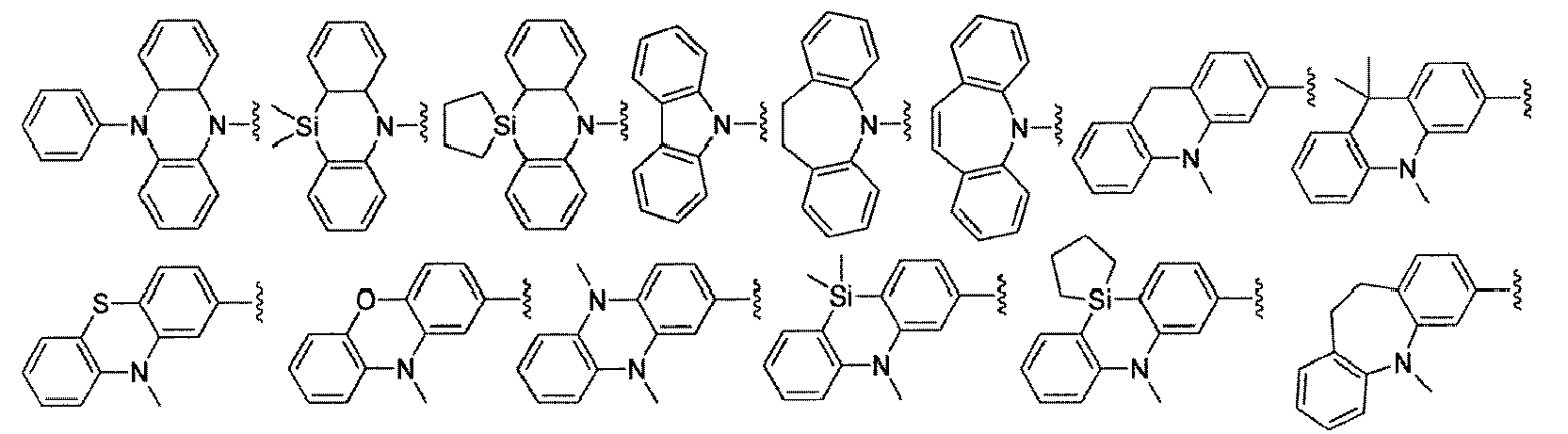


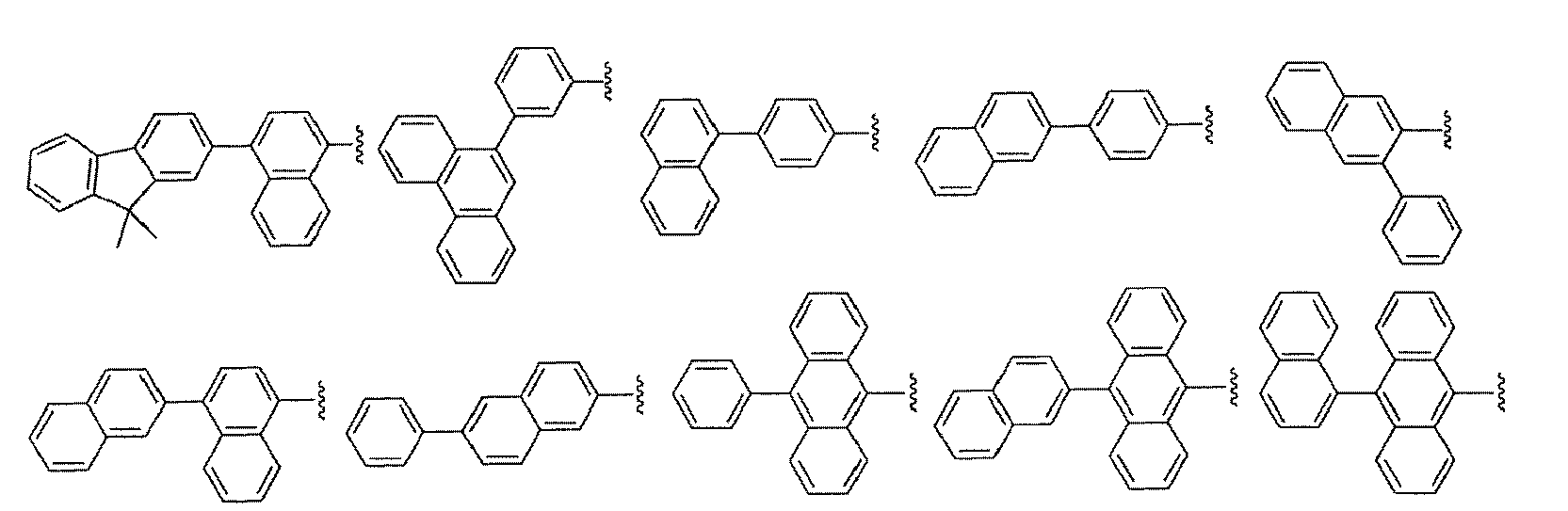


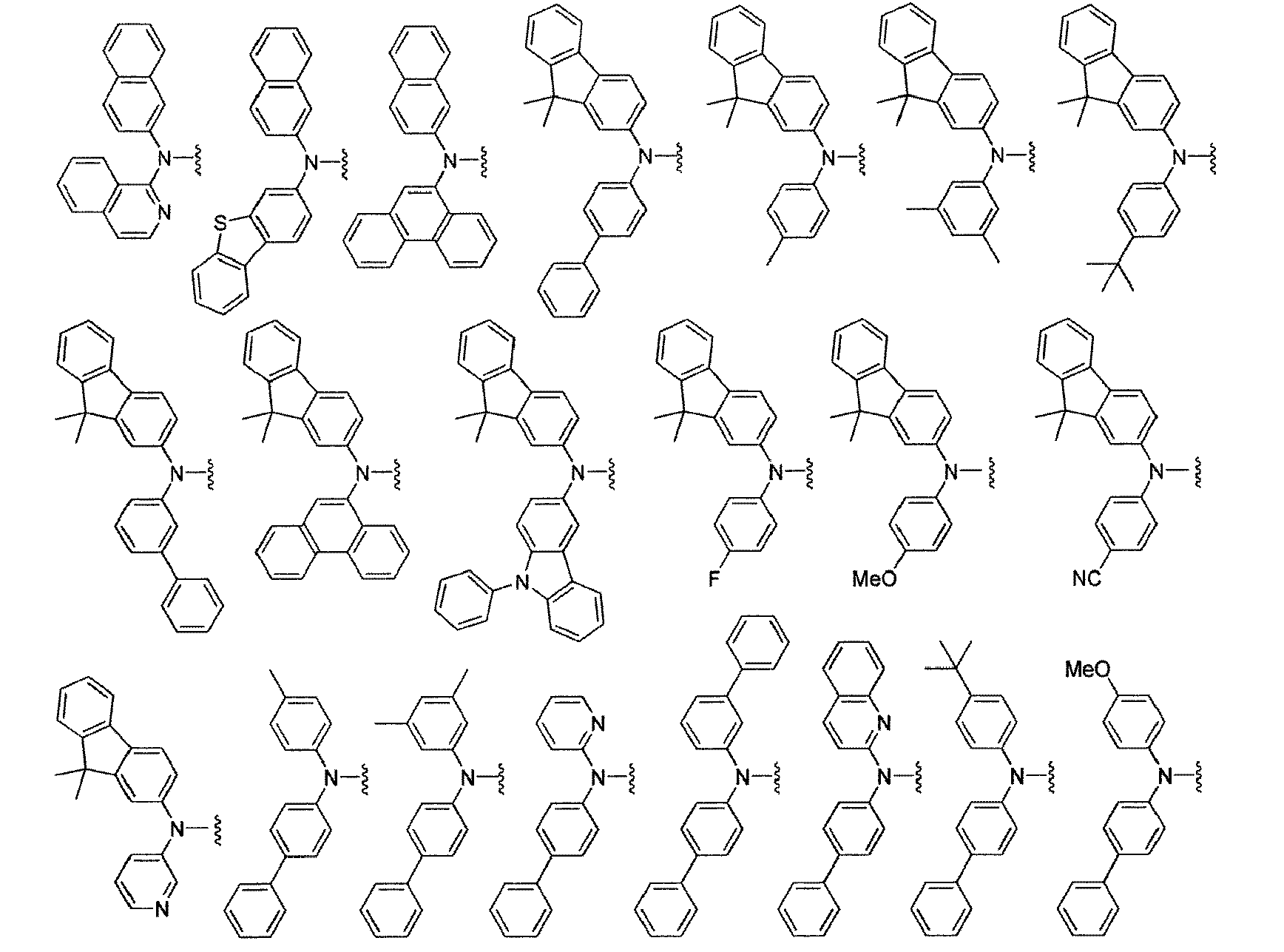


- In the chemical formulas, L1, L2 and L3 independently represent a chemical bond, or arylene or heteroarylene selected from the phenylene, naphthylene, biphenylene, fluorenylene, phenanthrylene, anthrylene, fluoranthenylene, triphenylenylene, pyrenylene, chrysenylene, naphthacenylene, perylenylene, spirobifluorenyl, tetrahydronaphthylene, acenaphthenylene, indenylene, pyridylene, bipyridylene, pyrrolylene, furylene, thienylene, imidazolylene, benzimidazolylene, pyrazinylene, pyrimidinylene, pyridazinylene, quinolinylene, triazinylene, benzofurylene, dibenzofurylene, benzothienylene, dibenzothienylene, pyrazolylene, indolylene, carbazolylene, indenocarbazolylene, thiazolylene, oxazolylene, benzothiazolylene, benzoxazolylene, phenanthridinylene, phenanthrolinylene, piperidinylene, quinazolinylene,


- The organic electroluminescent compounds according to the present invention can be more specifically exemplified by the following compounds, but they are not restricted thereto:



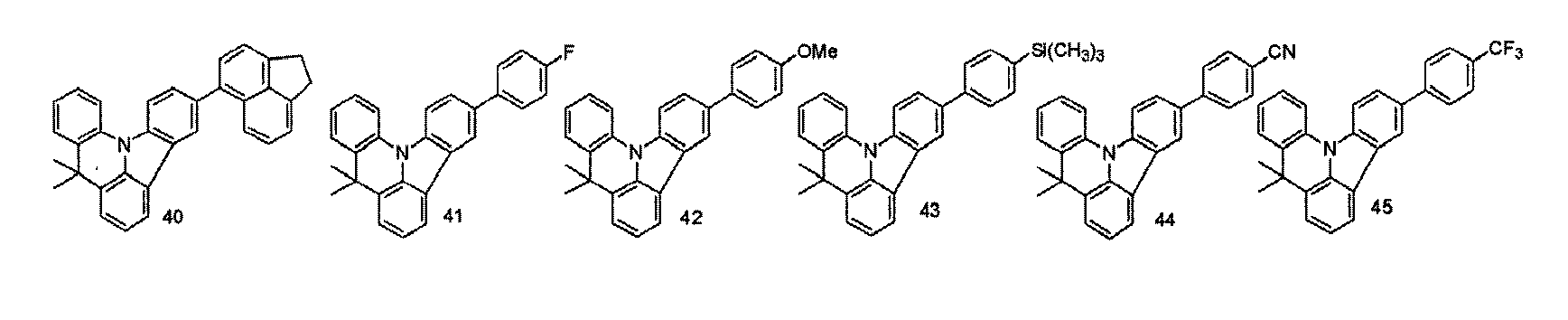


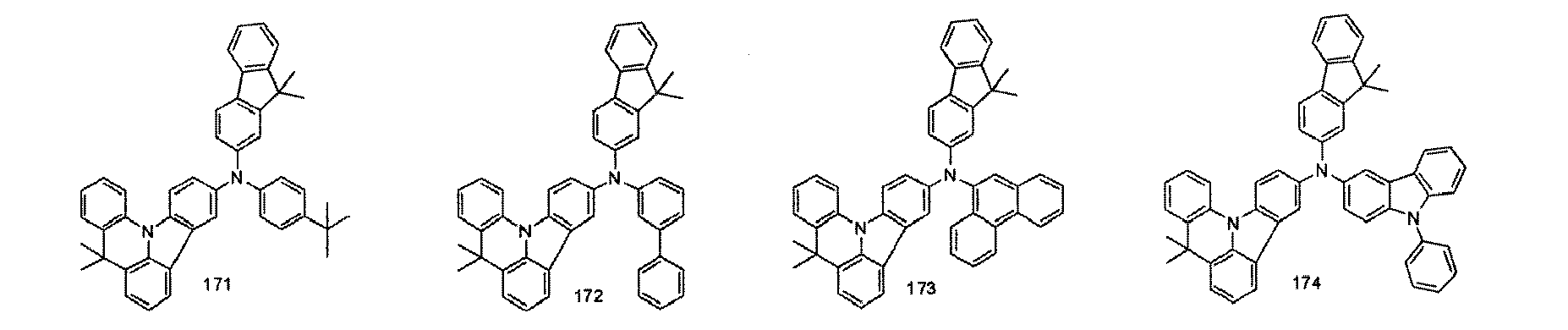

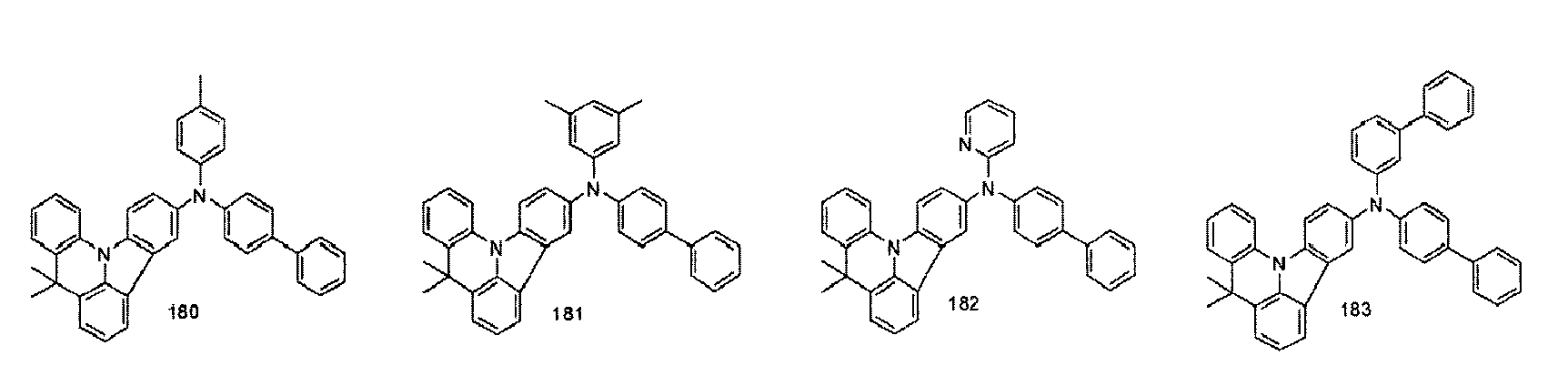





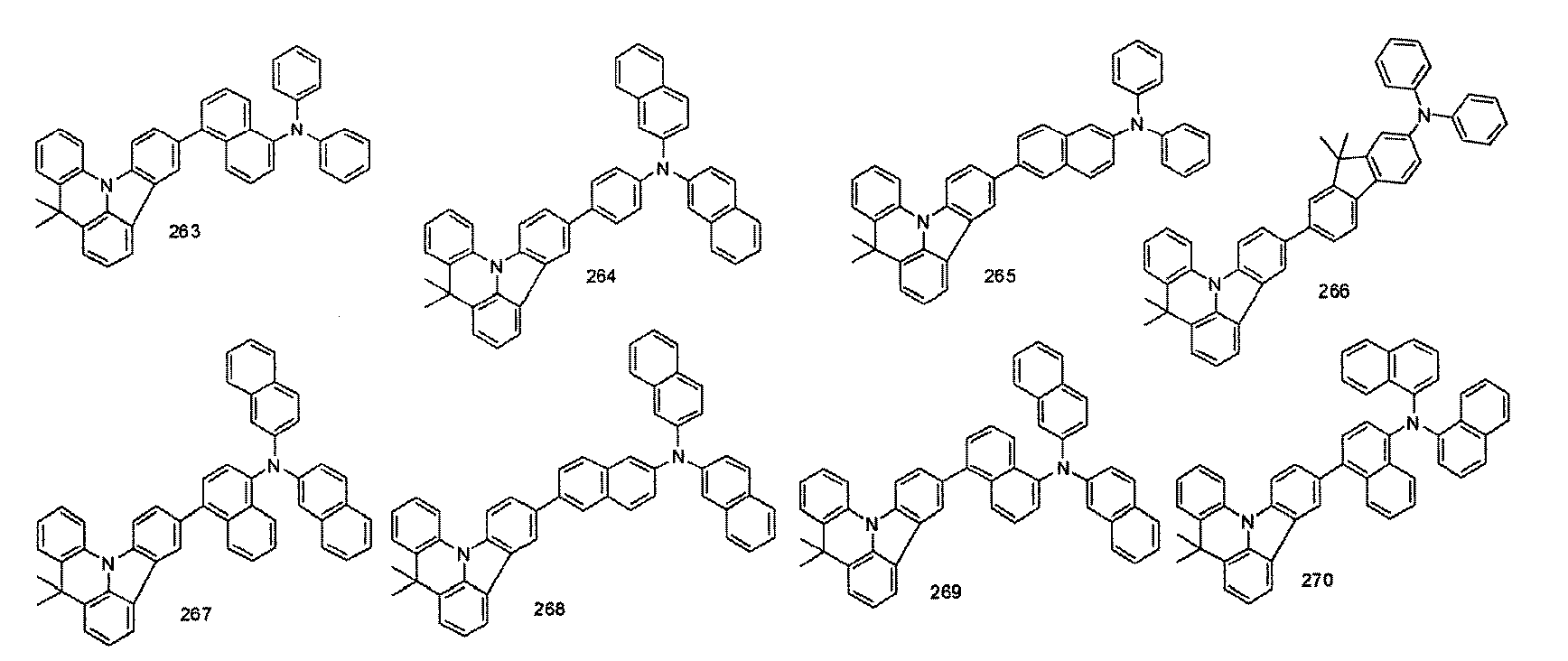

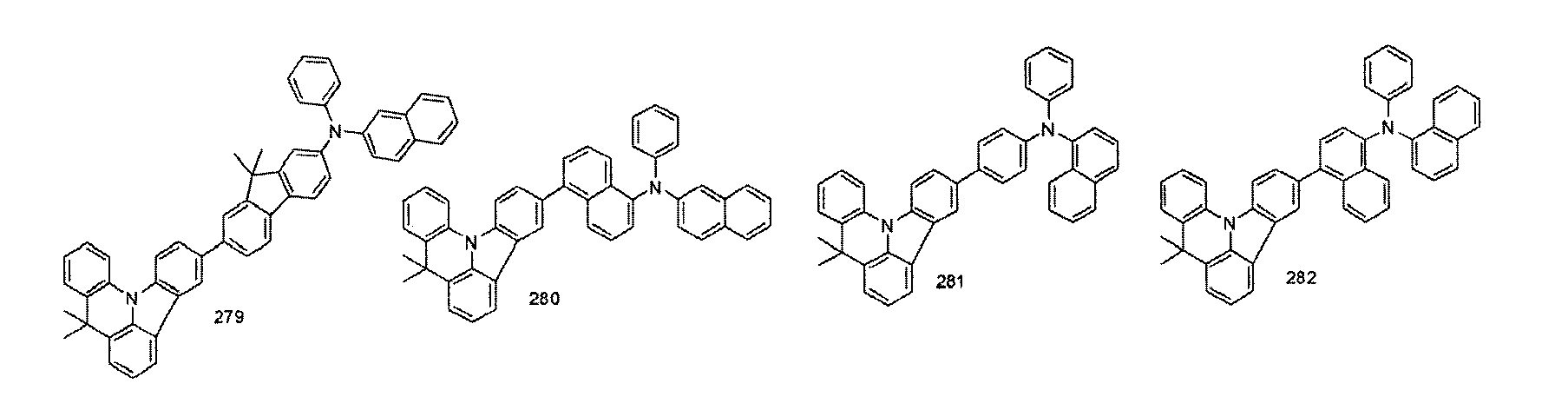

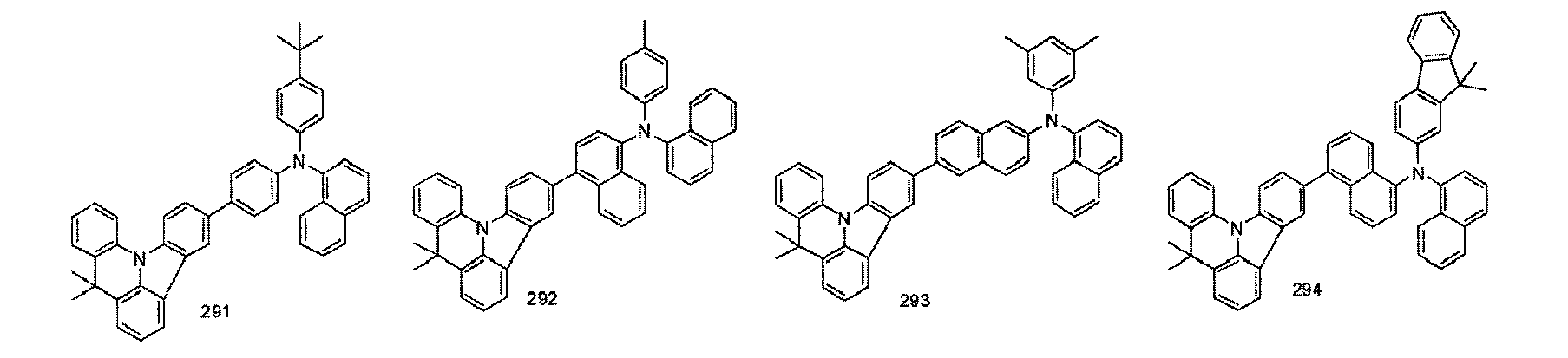



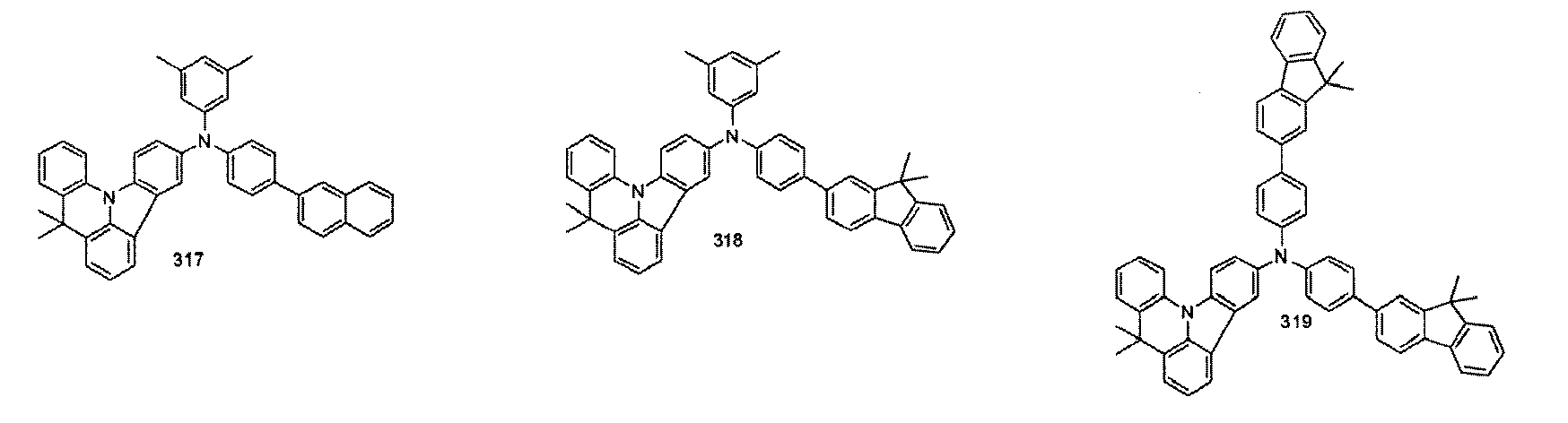


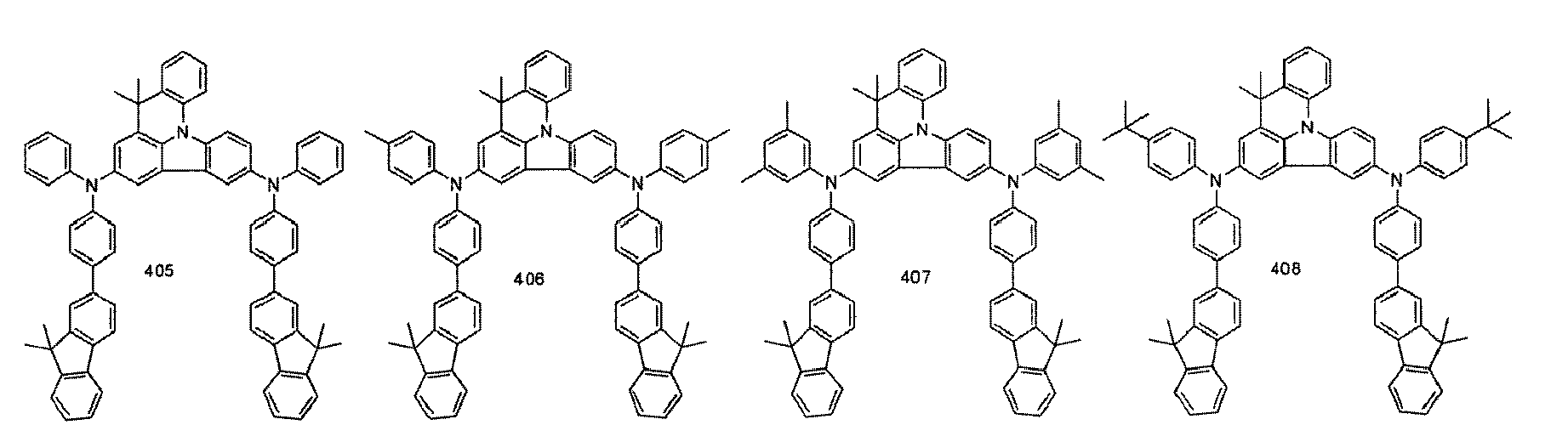


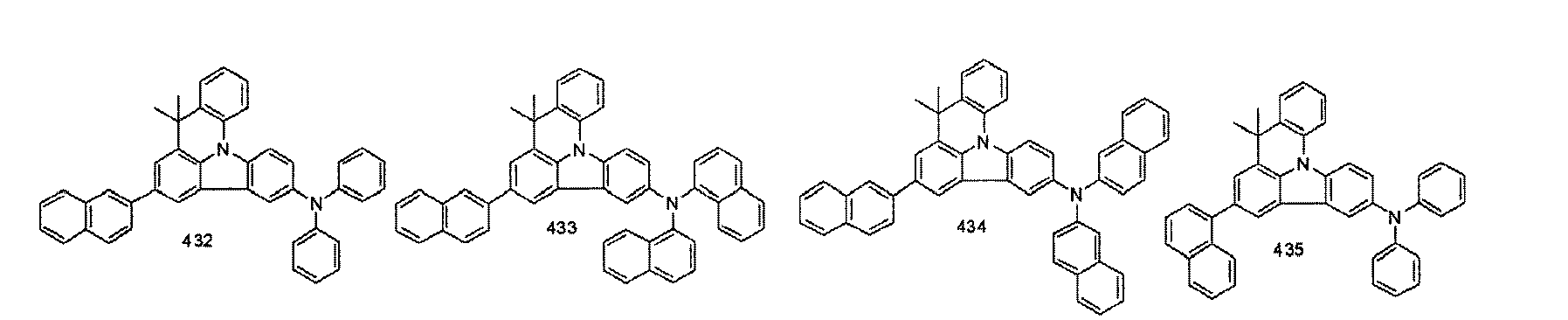


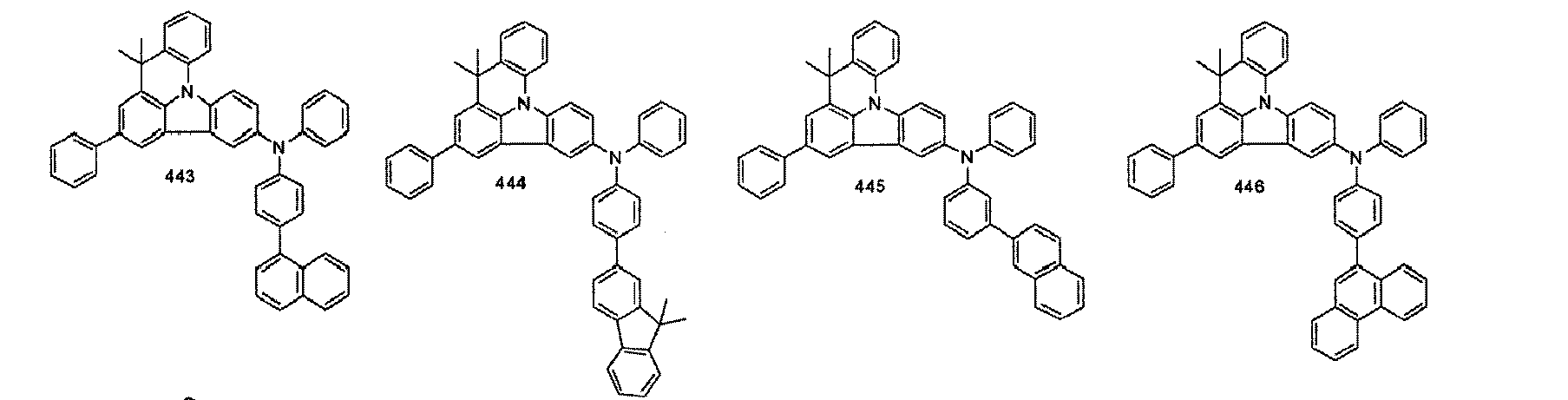


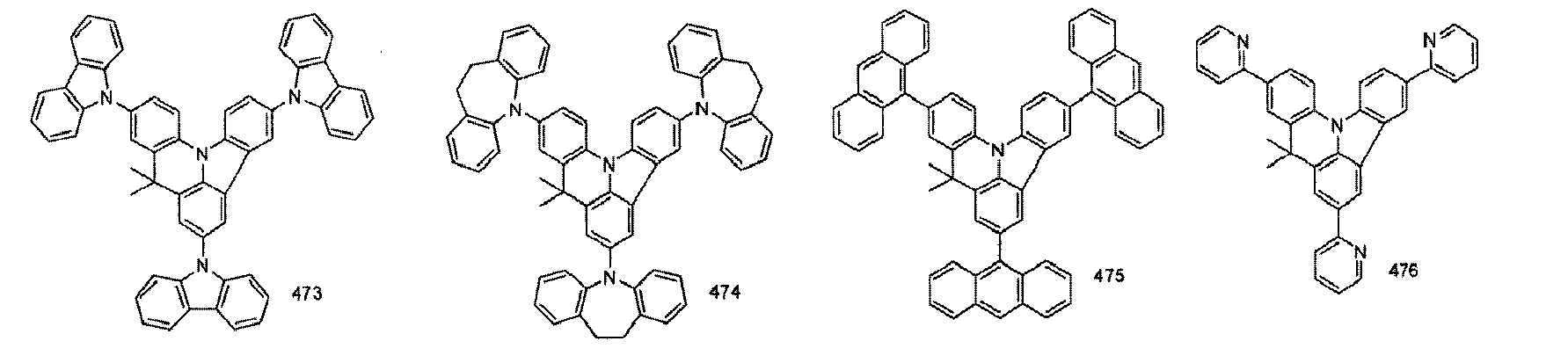


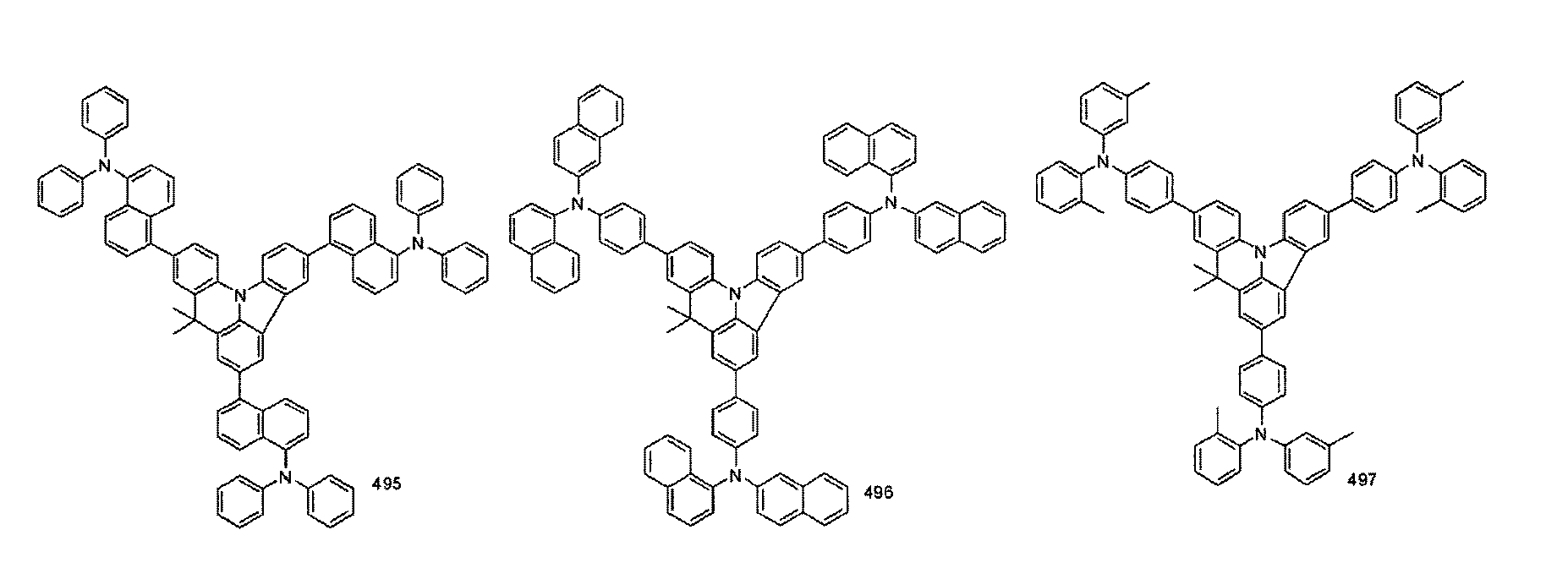


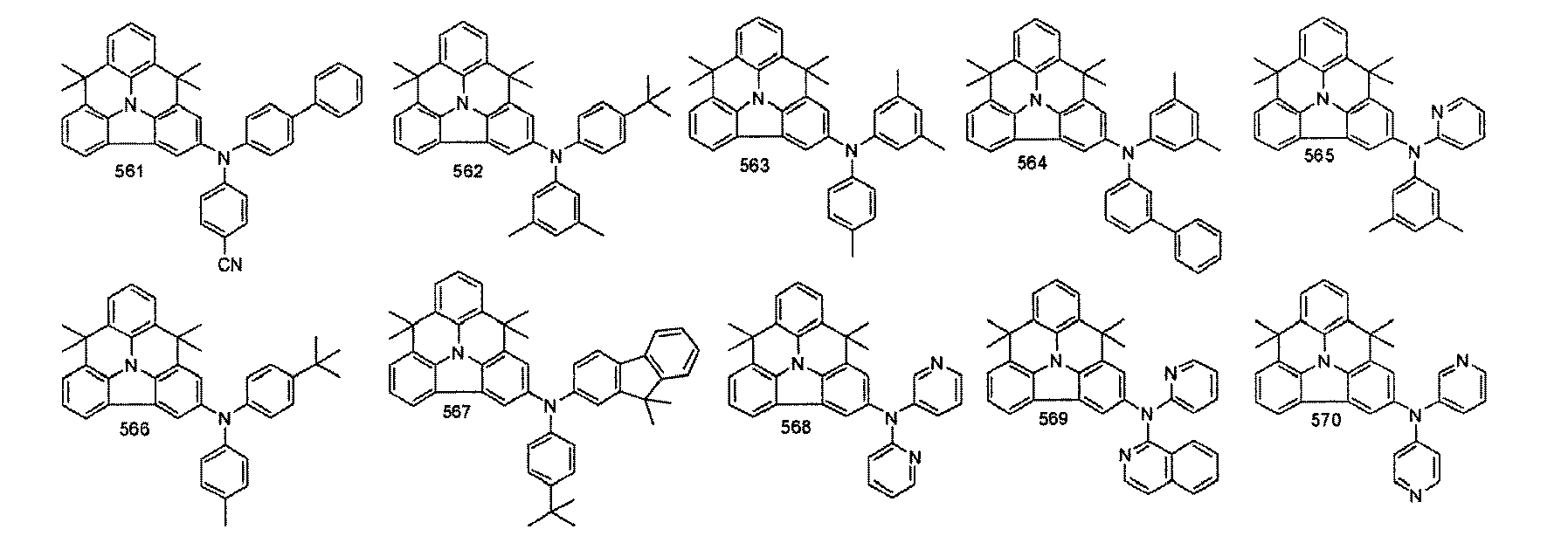


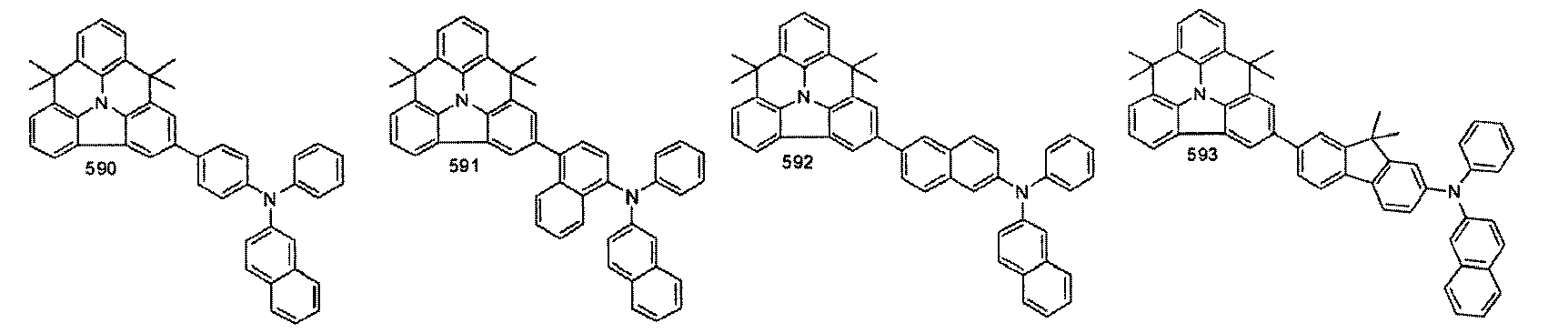





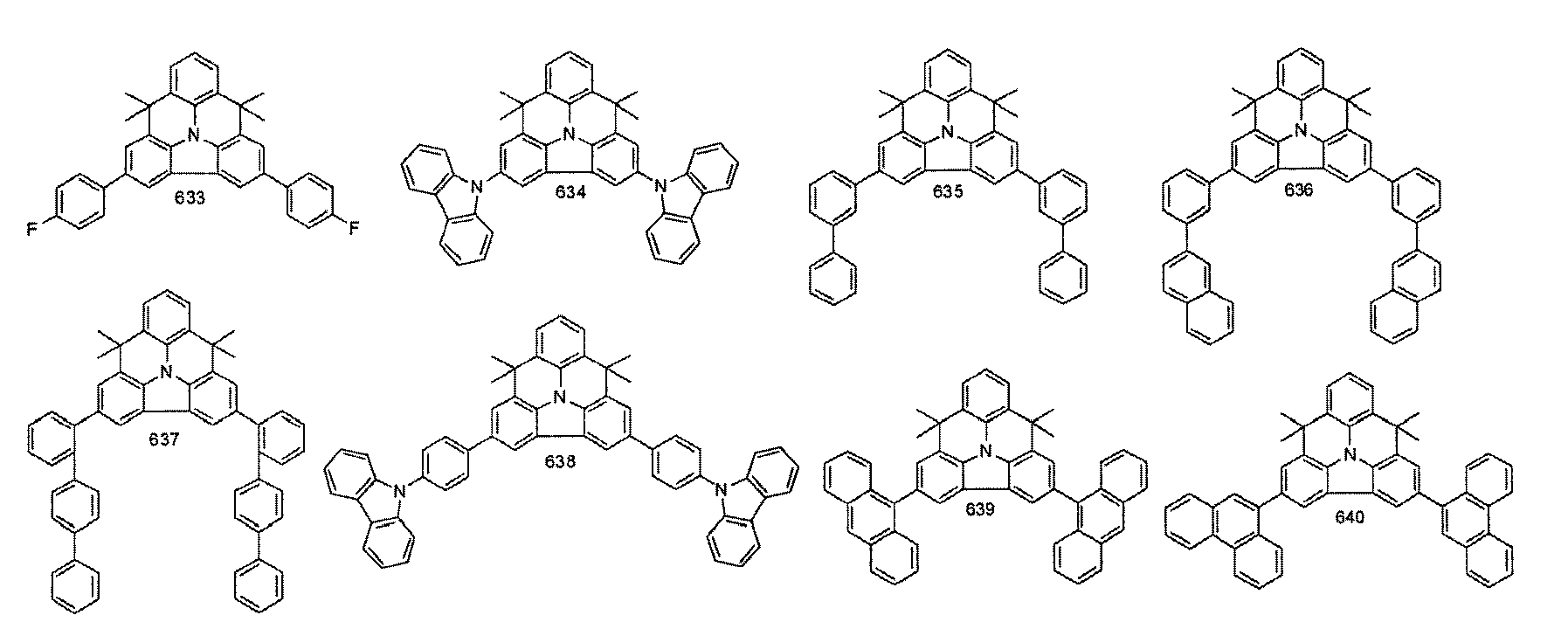


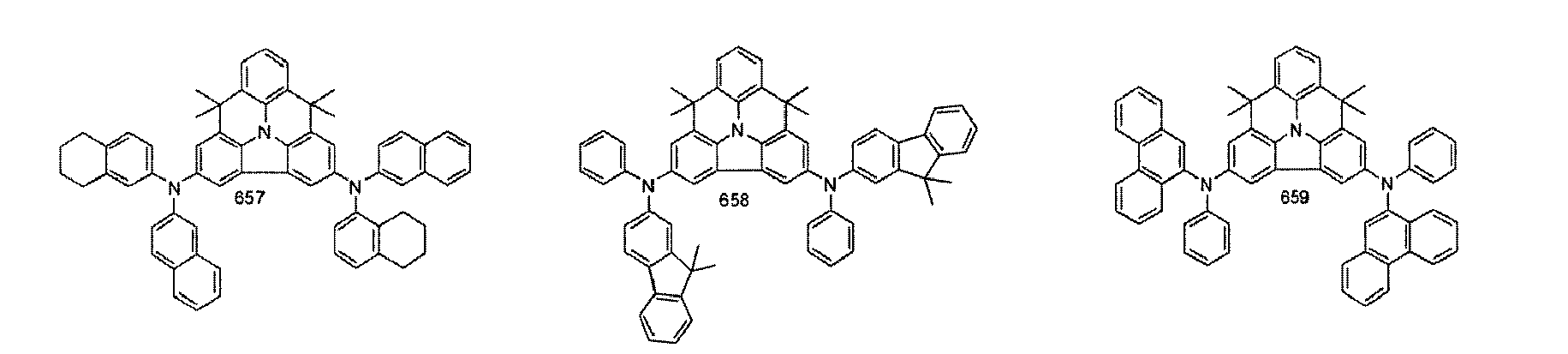


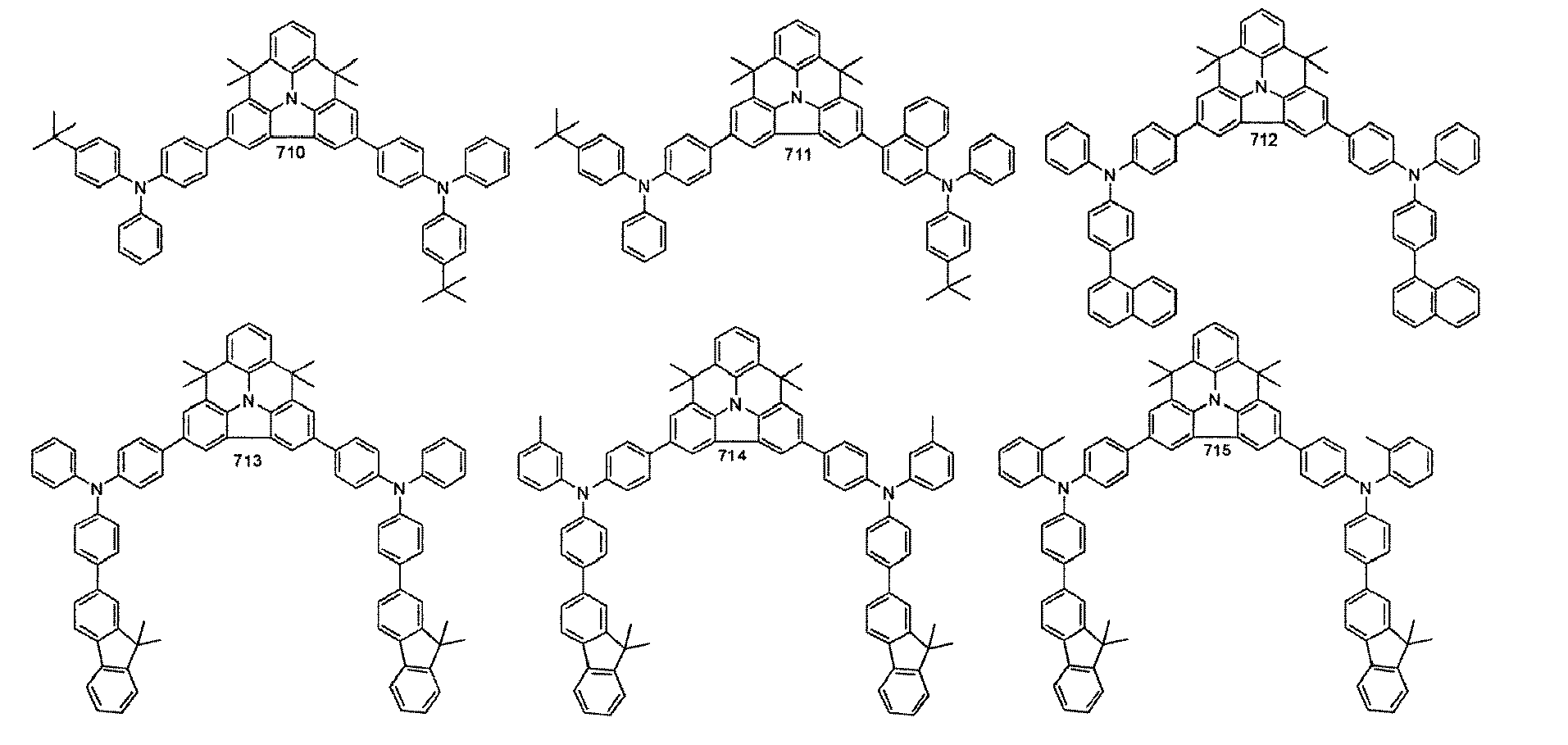


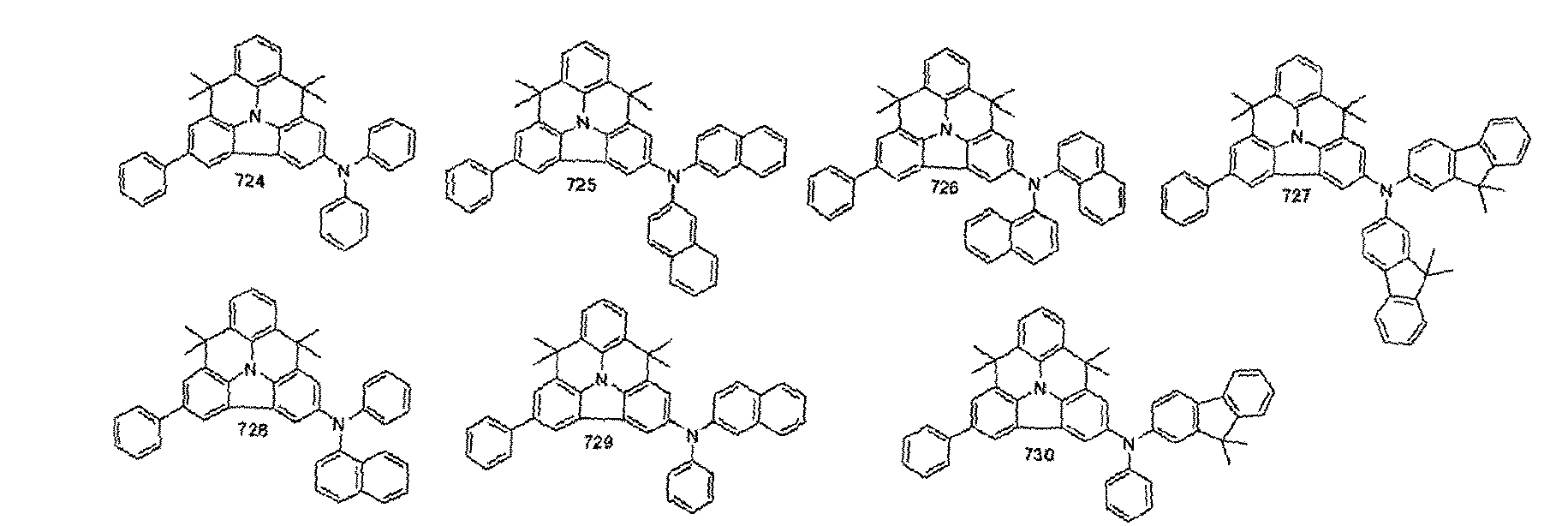

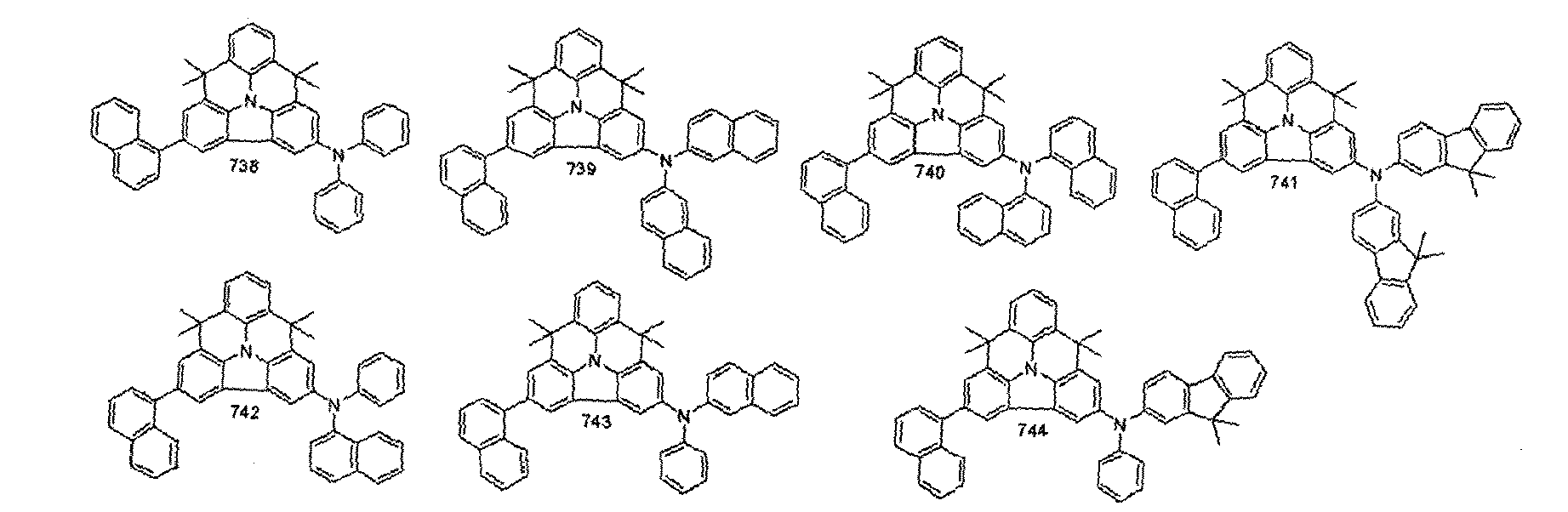
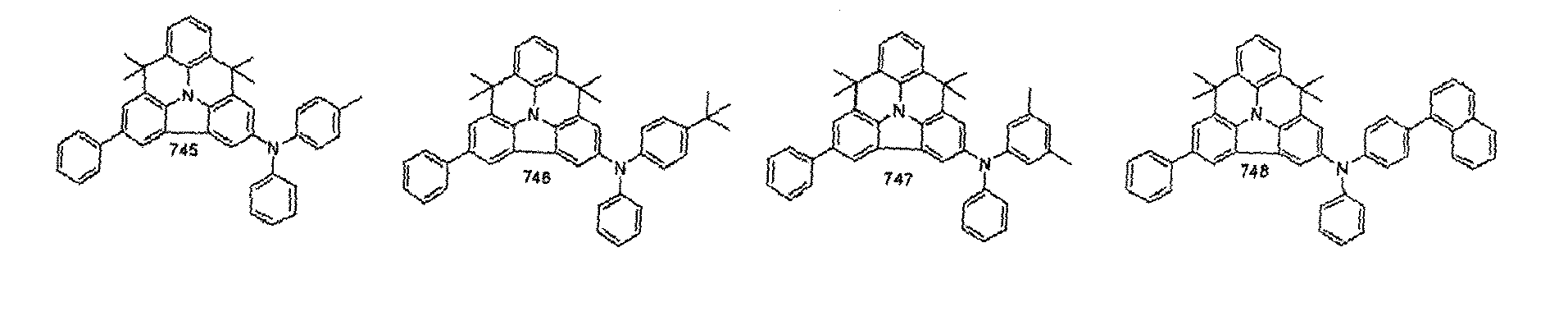


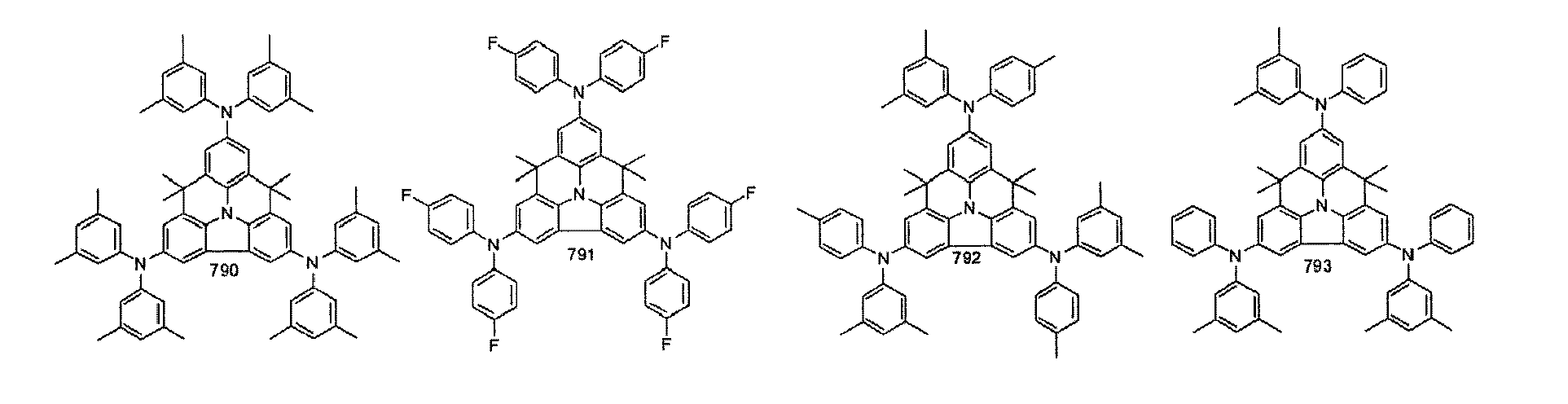


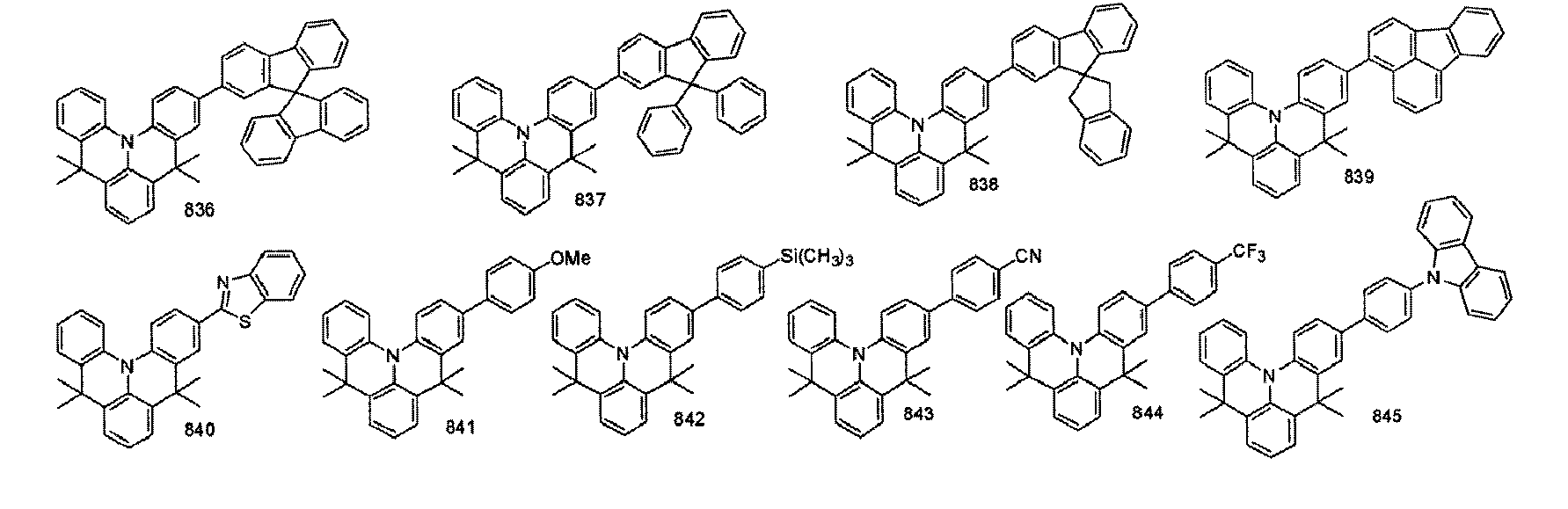


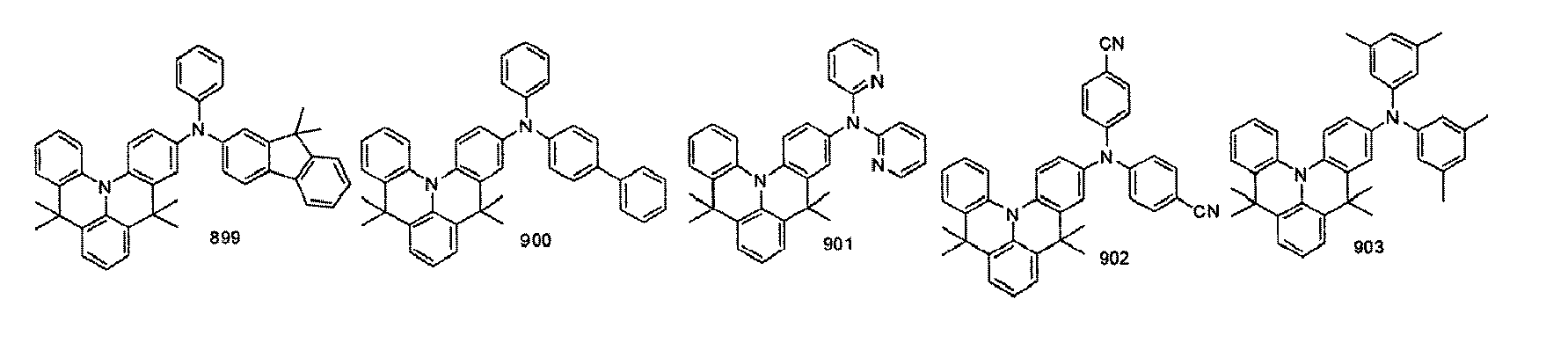
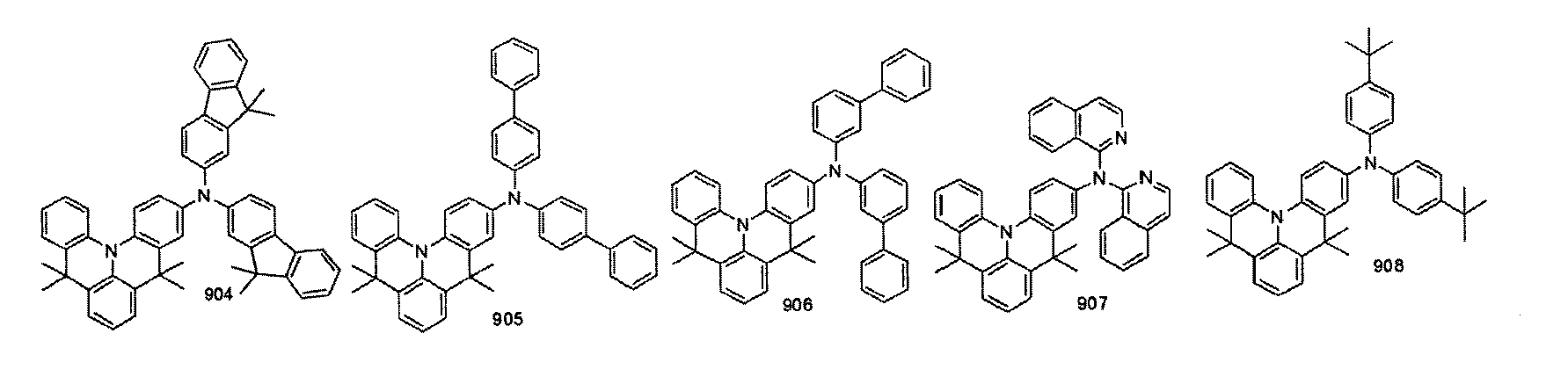


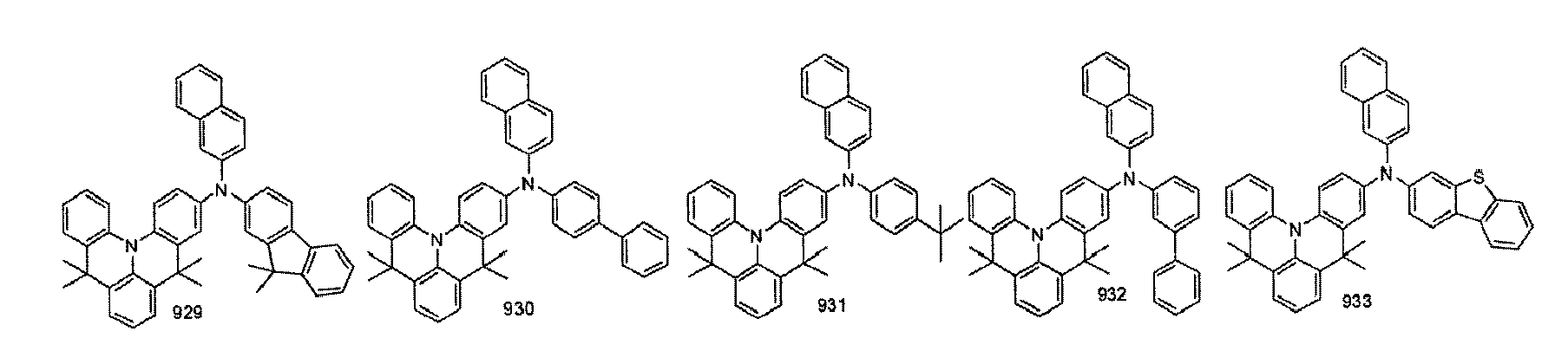


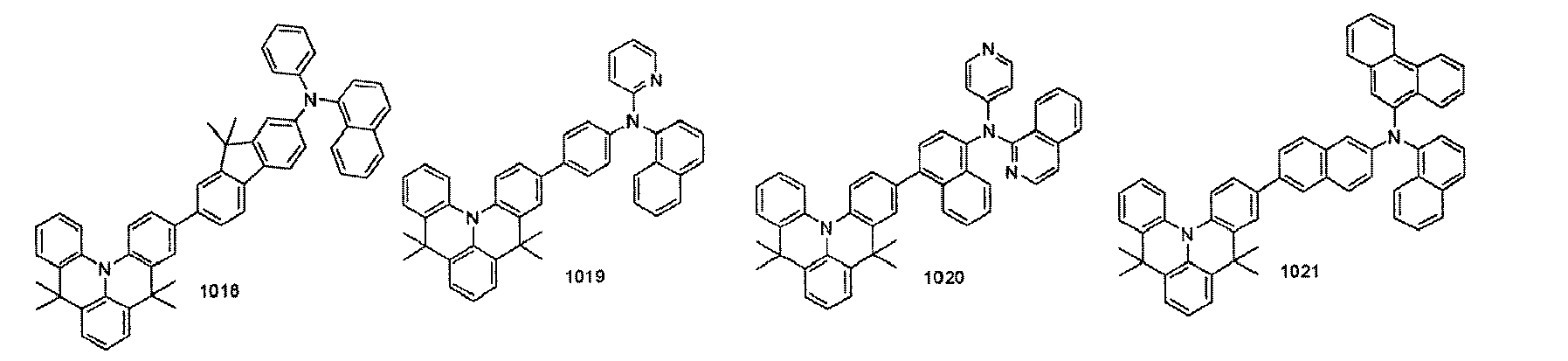


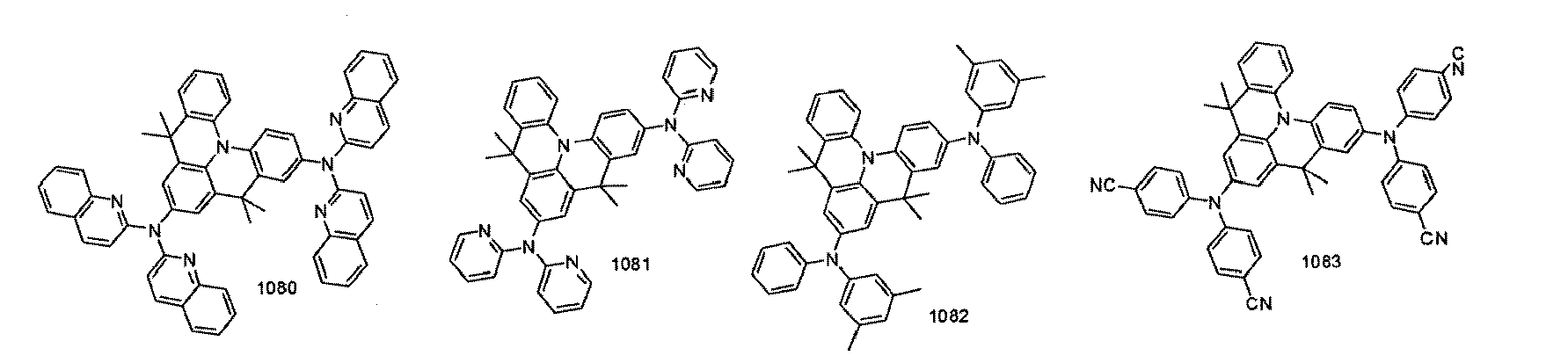


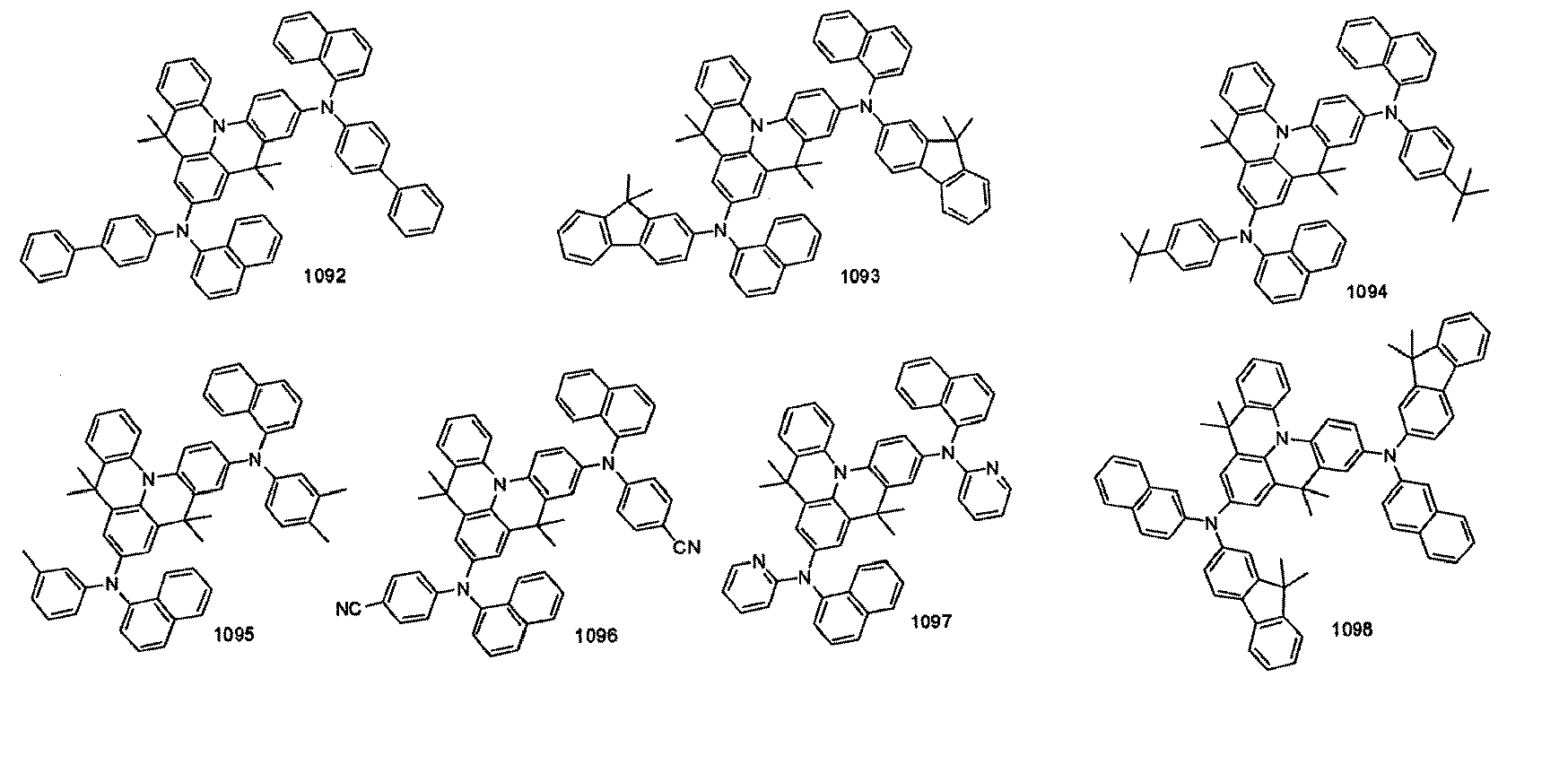


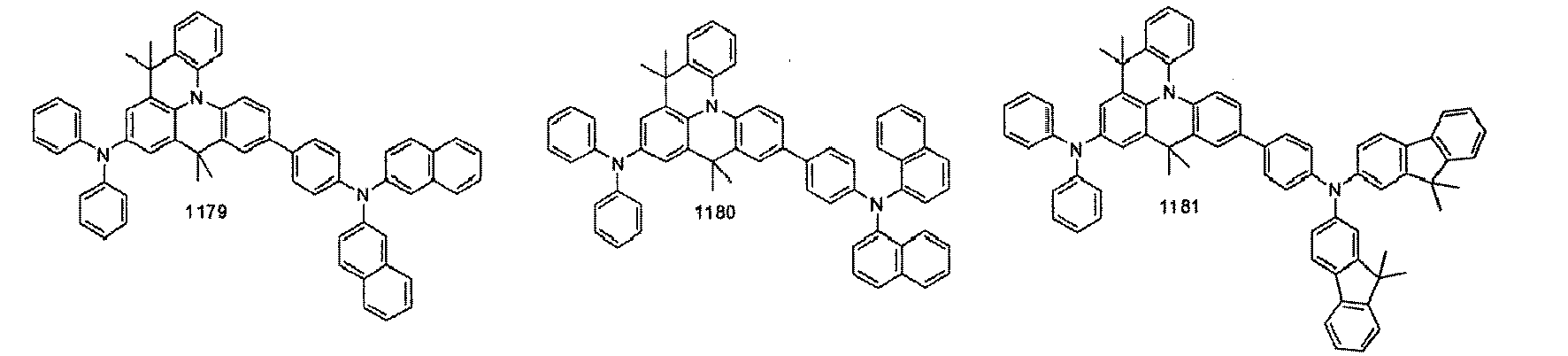


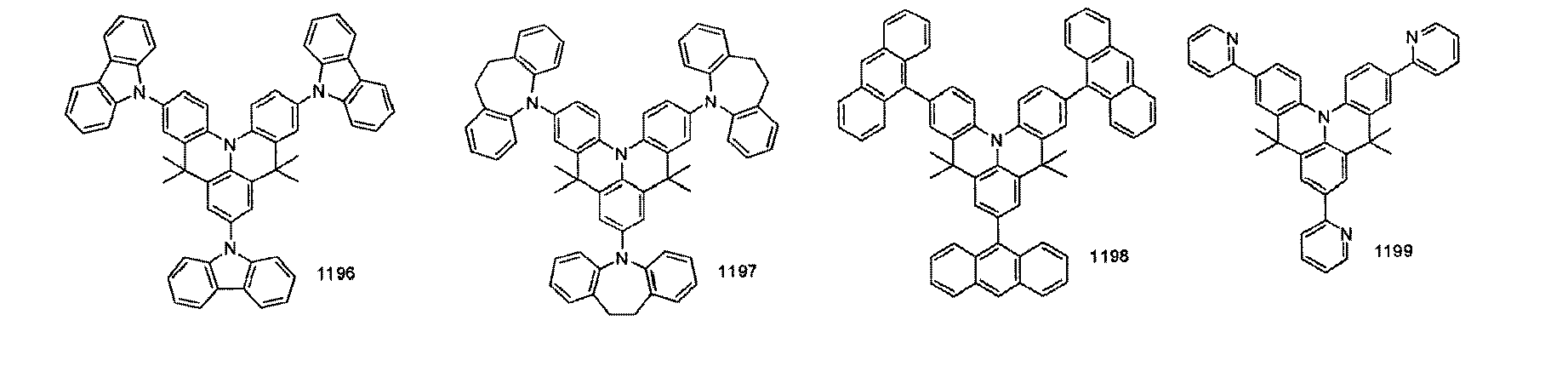


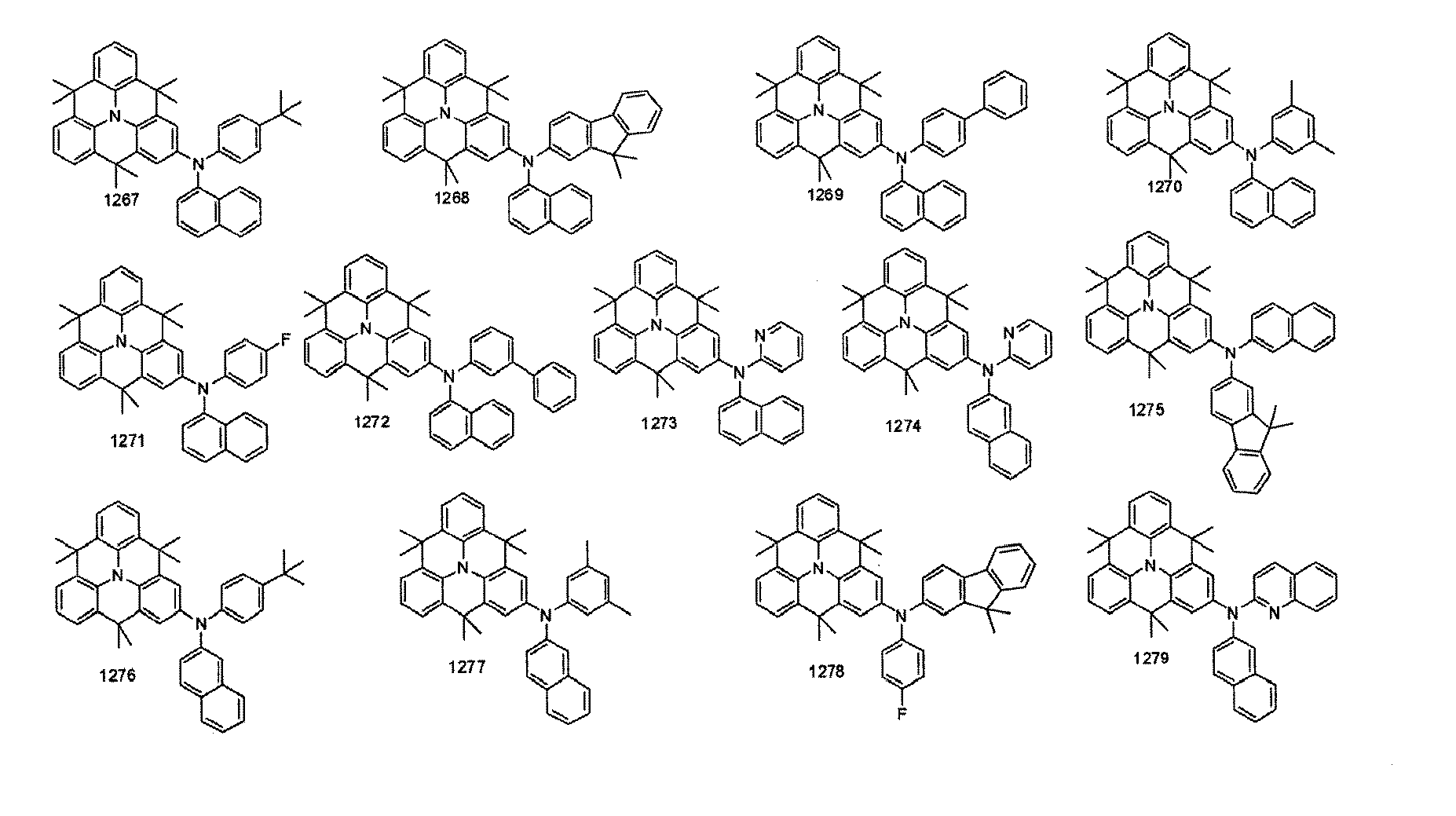


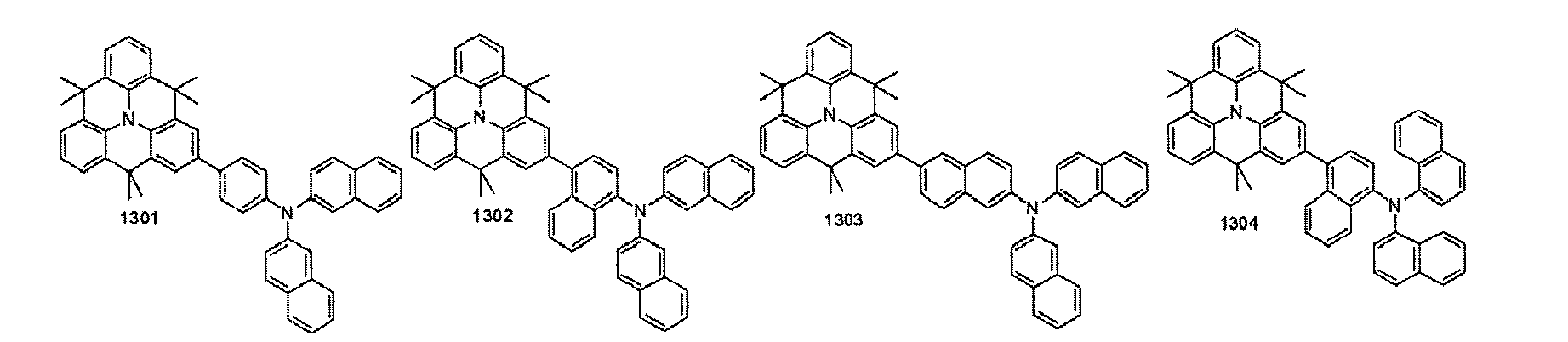





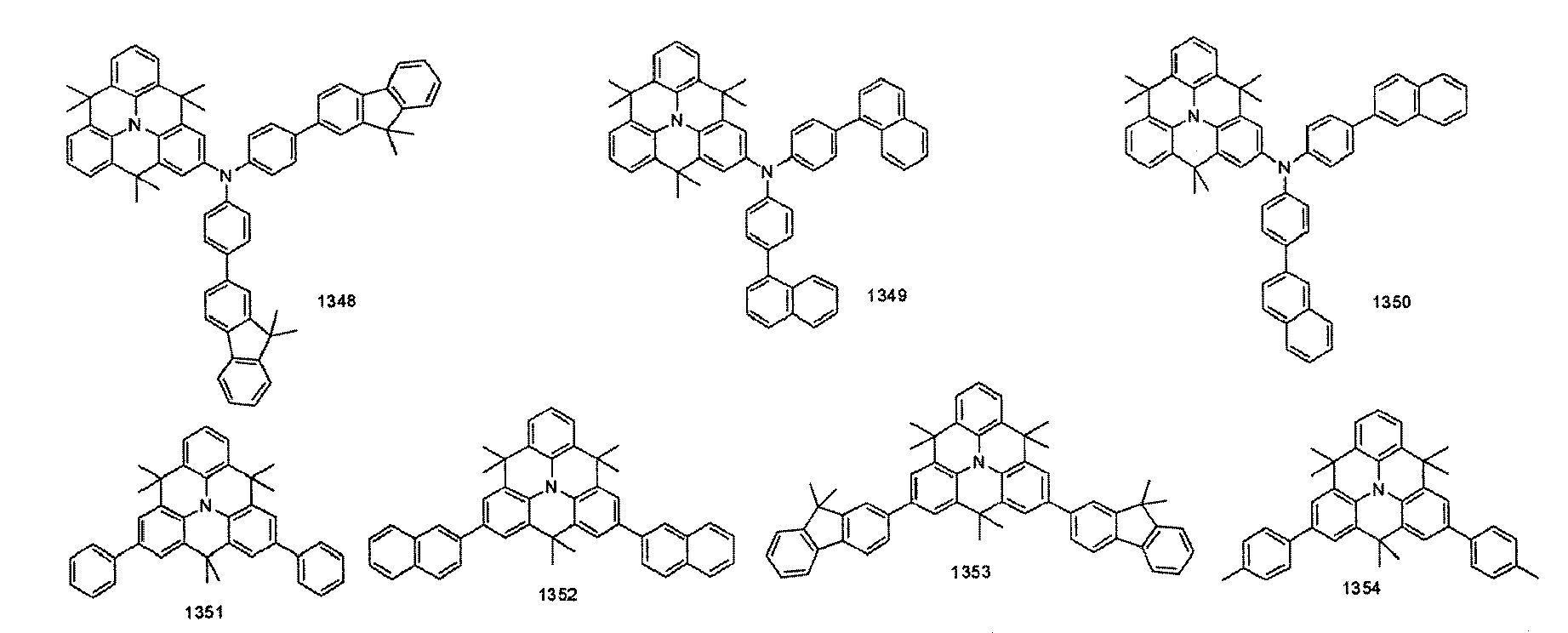











- The compounds for organic electronic material according to the present invention can be prepared by a procedure as illustrated by Reaction Schemes (1):

- The present invention also provides organic solar cells, which comprises one or more compound(s) for organic electronic material represented by Chemical Formula (1) or (2).
- The present invention also provides an organic electronic device which is comprised of a first electrode; a second electrode; and at least one organic layer(s) interposed between the first electrode and the second electrode; wherein the organic layer comprises one or more compound(s) for organic electronic material represented by Chemical Formula (1) or (2). The compounds for organic electronic material may be used as material for forming a hole injecting layer or a hole transport layer, or host material for an electroluminescent layer.
- The organic electronic device according to the present invention is characterized in that the organic layer comprises an electroluminescent layer, which comprises one or more dopant(s), in addition to one or more compound(s) for organic electronic material represented by Chemical Formula (1) or (2). The dopant to be applied to the organic electronic device according to the invention is not particularly restricted, but preferably selected from compounds represented by Chemical Formula (7):
Chemical Formula 7 M1L101L102L103
wherein, M1 is selected from a group consisting of metals ofGroup 

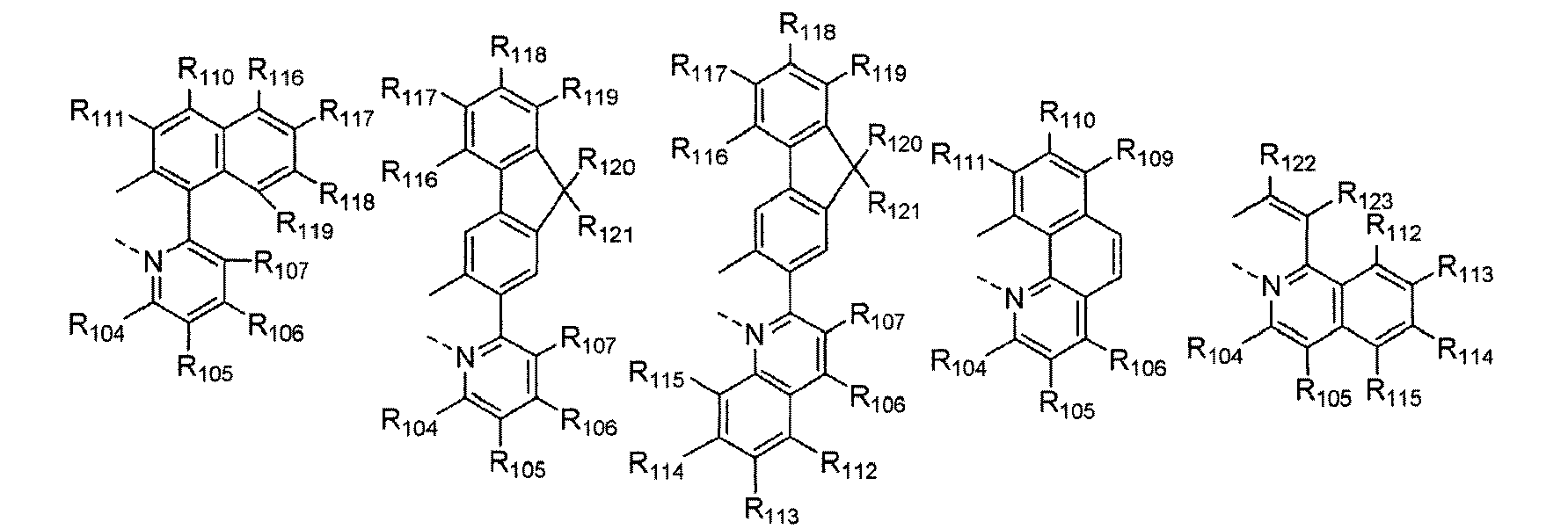
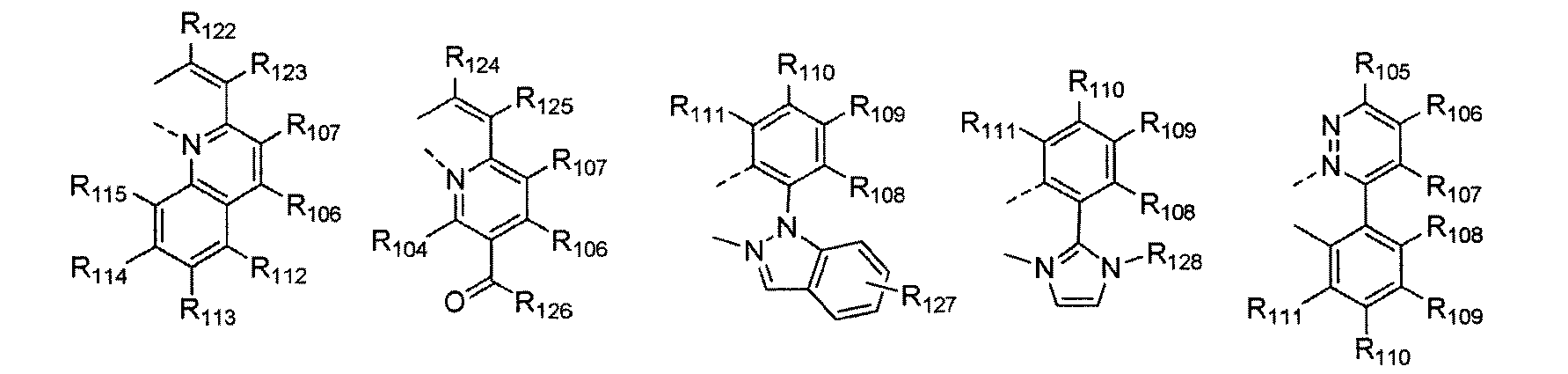

- wherein, R101 through R103 independently represent hydrogen, deuterium, (C1-C60)alkyl with or without halogen substituent(s), (C6-C60)aryl with or without (C1-C60)alkyl substituent(s), or halogen;
- R104 through R119 independently represent hydrogen, deuterium, (C1-C60)alkyl, (C1-C30)alkyloxy, (C3-C60)cycloalkyl, (C2-C30)alkenyl, (C6-C60)aryl, mono or di(C1-C30)alkylamino, mono or di(C6-C30)arylamino, SF5, tri(C1-C30)alkylsilyl, di(C1-C30)alkyl(C6-C30)arylsilyl, tri(C6-C30)arylsilyl, cyano or halogen; the alkyl, cycloalkyl, alkenyl or aryl of R104 through R119 may be further substituted by one or more substituent(s) selected from deuterium, (C1-C60)alkyl, (C6-C60) aryl and halogen;
- R120 through R123 independently represent hydrogen, deuterium, (C1-C60)alkyl with or without halogen substituent(s), or (C6-C60)aryl with or without (C1-C60)alkyl substituent(s);
- R124 and R125 independently represent hydrogen, deuterium, (C1-C60)alkyl, (C6-C60)aryl or halogen, or R124 and R125 may be linked via (C3-C12)alkylene or (C3-C12)alkenylene with or without a fused ring to form an alicyclic ring, or a monocyclic or polycyclic aromatic ring; the alkyl or aryl of R124 and R125, or the alicyclic ring or the monocyclic or polycyclic aromatic ring formed therefrom by linkage via (C3-C12)alkylene or (C3-C12)alkenylene with or without a fused ring may be further substituted by one or more substituent(s) selected from deuterium, (C1-C60)alkyl with or without halogen substituent(s), (C1-C30)alkyloxy, halogen, tri(C1-C30)alkylsilyl, tri(C6-C30)arylsilyl and (C6-C60)aryl;
- R126 represents (C1-C60)alkyl, (C6-C60)aryl, (C5-C60)heteroaryl or halogen;
- R127 through R129 independently represent hydrogen, deuterium, (C1-C60)alkyl, (C6-C60)aryl or halogen; the alkyl or aryl of R126 through R129 may be further substituted by halogen or (C1-C60)alkyl; and
- Q represents


- The dopant compounds of Chemical Formula (7) can be exemplified by the following compounds, without restriction:



- The organic electronic device according to the invention may further comprise one or more compound(s) selected from a group consisting of arylamine compounds and styrylarylamine compounds, in addition to the compound for organic electronic material represented by Chemical Formula (1) or (2). Examples of the arylamine or styrylarylamine compounds include the compounds represented by Chemical Formula (8), but they are not restricted thereto:

- wherein, Ar1 and Ar2 independently represent (C1-C60)alkyl, (C6-C60)aryl, (C4-C60)heteroaryl, (C6-C60)arylamino, (C1-C60)alkylamino, morpholino, thiomorpholino, 5- or 6-membered heterocycloalkyl containing one or more heteroatom(s) selected from N, O and S, or (C3-C60)cycloalkyl, or Ar1 and Ar2 may be linked via (C3-C60)alkylene or (C3-C60)alkenylene with or without a fused ring to form an alicyclic ring, or a monocyclic or polycyclic aromatic ring;
- the aryl, heteroaryl, arylamino or heterocycloalkyl of Ar1 and Ar2 may be further substituted by one or more substituent(s) selected from deuterium, halogen, (C1-C60)alkyl, (C2-C60)alkenyl, (C2-C60)alkynyl, (C6-C60)aryl, (C4-C60)heteroaryl, 5- or 6-membered heterocycloalkyl containing one or more heteroatom(s) selected from N, O and S, (C3-C60)cycloalkyl, tri(C1-C60)alkylsilyl, di(C1-C60)alkyl(C6-C60)arylsilyl, tri(C6-C60)arylsilyl, adamantyl, (C7-C60)bicycloalkyl, (C1-C60)alkoxy, (C1-C60)alkylthio, cyano, (C1-C60)alkylamino, (C6-C60)arylamino, (C6-C60)ar(C1-C60)alkyl, (C6-C60)aryloxy, (C6-C60)arylthio, (C6-C60)arylcarbonyl, (C1-C60)alkoxycarbonyl, (C1-C60)alkylcarbonyl, carboxyl, nitro and hydroxyl;
- when e is 1, Ar3 represents (C6-C60)aryl, (C4-C60)heteroaryl, or a substituent selected from the following structures:

- when e is 2, Ar3 represents (C6-C60)arylene, (C4-C60)heteroarylene, or a substituent selected from the following structures:

- wherein Ar4 represents (C6-C60)arylene or (C4-C60)heteroarylene;
- R221, R222 and R223 independently represent hydrogen, deuterium, (C1-C60)alkyl or (C6-C60)aryl;
- f is an integer from 1 to 4, g is an integer of 0 or 1; and
- the alkyl, aryl, heteroaryl, arylamino, alkylamino, cycloalkyl or heterocycloalkyl of Ar1 and Ar2; the aryl, heteroaryl, arylene or heteroarylene of Ar3; the arylene or heteroarylene of Ar4 and Ar5; or the alkyl or aryl of R221 through R223 may be further substituted by one or more substituent(s) selected from a group consisting of deuterium, halogen, (C1-C60)alkyl, (C6-C60)aryl, (C4-C60)heteroaryl, 5- or 6-membered heterocycloalkyl containing one or more heteroatom(s) selected from N, O and S, (C3-C60)cycloalkyl, tri(C1-C60)alkylsilyl, di(C1-C60)alkyl(C6-C60)arylsilyl, tri(C6-C60)arylsilyl, adamantyl, (C7-C60)bicycloalkyl, (C2-C60)alkenyl, (C2-C60)alkynyl, cyano, (C1-C60)alkylamino, (C6-C60)arylamino, (C6-C60)ar(C1-C60)alkyl, (C6-C60)aryloxy, (C1-C60)alkyloxy, (C6-C60)arylthio, (C1-C60)alkylthio, (C1-C60)alkoxycarbonyl, (C1-C60)alkylcarbonyl, (C6-C60)arylcarbonyl, carboxyl, nitro and hydroxyl.
- The arylamine compounds and styrylarylamine compounds can be more specifically exemplified by the following compounds, but are not restricted thereto.


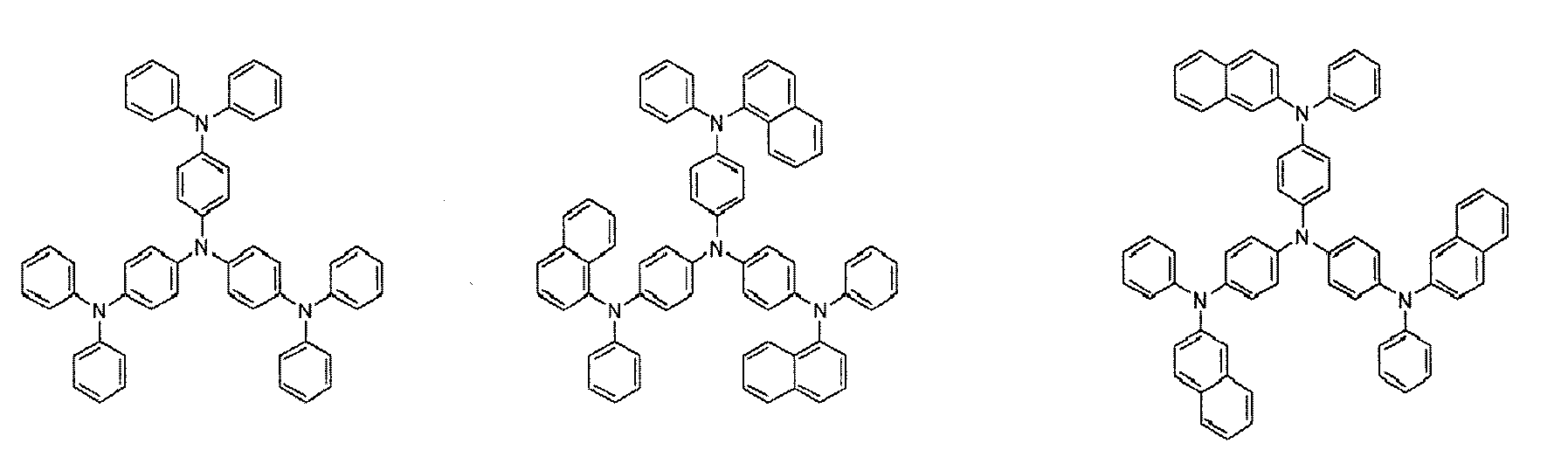
- In an organic electronic device according to the present invention, the organic layer may further comprise one or more metal(s) selected from a group consisting of organometals of
Group 1,Group - The present invention can realize an organic electronic device having a pixel structure of independent light-emitting mode, which comprises an organic electronic device containing the compound for organic electronic material of Chemical Formula (1) or (2) as a sub-pixel and one or more sub-pixel(s) comprising one or more metallic compound(s) selected from a group consisting of Ir, Pt, Pd, Rh, Re, Os, Tl, Pb, Bi, In, Sn, Sb, Te, Au and Ag, patterned in parallel at the same time.
- The organic electronic device may comprise one or more compound(s) selected from compounds having electroluminescent peak of wavelength of blue, green or red in addition to the organic electroluminescent compound in the organic layer to form a white electroluminescent device. The compounds having electroluminescent peak of wavelength of blue, green or red can be exemplified by those represented by one of Chemical Formulas (9) to (12), but they are not restricted thereto.

- In Chemical Formula (9), Ar11 and Ar12 independently represent (C1-C60)alkyl, (C6-C60)aryl, (C4-C60)heteroaryl, (C6-C60)arylamino, (C1-C60)alkylamino, 5- or 6-membered heterocycloalkyl containing one or more heteroatom(s) selected from N, O and S, or (C3-C60)cycloalkyl, or Ar11 and Ar12 may be linked via (C3-C60)alkylene or (C3-C60)alkenylene with or without a fused ring to form an alicyclic ring, or a monocyclic or polycyclic aromatic ring;
- when i is 1, Ar13 represents (C6-C60)aryl, (C4-C60)heteroaryl, or a substituent selected from the following structures:

- when i is 2, Ar13 represents (C6-C60)arylene, (C4-C60)heteroarylene, or a substituent selected from the following structures:

- wherein Ar14 represents (C6-C60)arylene or (C4-C60)heteroarylene;
- R231 through R233 independently represent hydrogen, deuterium, (C1-C60)alkyl or (C6-C60)aryl;
- j is an integer from 1 to 4, k is an integer of 0 or 1; and
- the alkyl, aryl, heteroaryl, arylamino, alkylamino, cycloalkyl or heterocycloalkyl of Ar11 and Ar12; the aryl, heteroaryl, arylene or heteroarylene of Ar13; the arylene or heteroarylene of Ar14; or the alkyl or aryl of R231 through R233 may be further substituted by one or more substituent(s) selected from a group consisting of deuterium, halogen, (C1-C60)alkyl, (C6-C60)aryl, (C4-C60)heteroaryl, 5- or 6-membered heterocycloalkyl containing one or more heteroatom(s) selected from N, O and S, (C3-C60)cycloalkyl, tri(C1-C60)alkylsilyl, di(C1-C60)alkyl(C6-C60)arylsilyl, tri(C6-C60)arylsilyl, adamantyl, (C7-C60)bicycloalkyl, (C2-C60)alkenyl, (C2-C60)alkynyl, cyano, (C1-C60)alkylamino, (C6-C60)arylamino, (C6-C60)ar(C1-C60)alkyl, (C6-C60)aryloxy, (C1-C60)alkyloxy, (C6-C60)arylthio, (C1-C60)alkylthio, (C1-C60)alkoxycarbonyl, (C1-C60)alkylcarbonyl, (C6-C60)arylcarbonyl, carboxyl, nitro and hydroxyl.

- In Chemical Formula (10), R301 through R304 independently represent hydrogen, deuterium, halogen, (C1-C60)alkyl, (C6-C60)aryl, (C4-C60)heteroaryl, 5- or 6-membered heterocycloalkyl containing one or more heteroatom(s) selected from N, O and S, (C3-C60)cycloalkyl, tri(C1-C60)alkylsilyl, di(C1-C60)alkyl(C6-C60)arylsilyl, tri(C6-C60)arylsilyl, adamantyl, (C7-C60)bicycloalkyl, (C2-C60)alkenyl, (C2-C60)alkynyl, (C1-C60)alkoxy, cyano, (C1-C60)alkylamino, (C6-C60)arylamino, (C6-C60)ar(C1-C60)alkyl, (C6-C60)aryloxy, (C6-C60)arylthio, (C1-C60)alkoxycarbonyl, carboxyl, nitro or hydroxyl, or each of R301 through R304 may be linked to an adjacent substituent via (C3-C60)alkylene or (C3-C60)alkenylene with or without a fused ring to form an alicyclic ring, or a monocyclic or polycyclic aromatic ring; and
the alkyl, alkenyl, alkynyl, cycloalkyl, heterocycloalkyl, aryl, heteroaryl, arylsilyl, alkylsilyl, alkylamino or arylamino of R301 through R304, or the alicyclic ring, or the monocyclic or polycyclic aromatic ring formed therefrom by linkage to an adjacent substituent via (C3-C60)alkylene or (C3-C60)alkenylene with or without a fused ring may be further substituted by one or more substituent(s) selected from deuterium, halogen, (C1-C60)alkyl, (C6-C60)aryl, (C4-C60)heteroaryl, 5- or 6-membered heterocycloalkyl containing one or more heteroatom(s) selected from N, O and S, (C3-C60)cycloalkyl, tri(C1-C60)alkylsilyl, di(C1-C60)alkyl(C6-C60)arylsilyl, tri(C6-C60)arylsilyl, adamantyl, (C7-C60)bicycloalkyl, (C2-C60)alkenyl, (C2-C60)alkynyl, (C1-C60)alkoxy, cyano, (C1-C60)alkylamino, (C6-C60)arylamino, (C6-C60)ar(C1-C60)alkyl, (C6-C60)aryloxy, (C6-C60)arylthio, (C1-C60)alkoxycarbonyl, carboxyl, nitro and hydroxyl.
Chemical Formula 11 (Ar31)p-L11-(Ar32)q
Chemical Formula 12 (Ar33)r-L12-(Ar34)s
- In Chemical Formulas (11) and (12),
- L11 represents (C6-C60)arylene or (C4-C60)heteroarylene;
- L12 represents anthracenylene;
- Ar31 through Ar34 are independently selected from hydrogen, deuterium, (C1-C60)alkyl, (C1-C60)alkoxy, halogen, (C4-C60)heteroaryl, (C5-C60)cycloalkyl and (C6-C60)aryl; the cycloalkyl, aryl or heteroaryl of Ar31 through Ar34 may be further substituted by one or more substituent(s) selected from a group consisting of (C6-C60)aryl or (C4-C60)heteroaryl with or without one or more substituent(s) selected from a group consisting of deuterium, (C1-C60)alkyl with or without halogen substituent(s), (C1-C60)alkoxy, (C3-C60)cycloalkyl, halogen, cyano, tri(C1-C60)alkylsilyl, di(C1-C60)alkyl(C6-C60)arylsilyl and tri(C6-C60)arylsilyl; (C1-C60)alkyl with or without halogen substituent(s), (C1-C60)alkoxy, (C3-C60)cycloalkyl, halogen, cyano, tri(C1-C60)alkylsily di(C1-C60)alkyl(C6-C60)arylsilyl and tri(C6-C60)arylsilyl; and
- p, q, r and s independently represent an integer from 0 to 4.
- The compounds represented by Chemical Formula (11) or (12) can be exemplified by anthracene derivatives or benz[a]anthracene derivatives represented by one of Chemical Formulas (13) to (16).


- In Chemical Formulas (13) through (15),
- R311 and R312 independently represent (C6-C60)aryl, (C4-C60)heteroaryl, 5- or 6-membered heterocycloalkyl containing one or more heteroatom(s) selected from N, O and S, or (C3-C60)cycloalkyl; the aryl or heteroaryl of R311 and R312 may be further substituted by one or more substituent(s) selected from a group consisting of deuterium, (C1-C60)alkyl, halo(C1-C60)alkyl, (C1-C60)alkoxy, (C3-C60)cycloalkyl, (C6-C60)aryl, (C4-C60)heteroaryl, halogen, cyano, tri(C1-C60)alkylsilyl, di(C1-C60)alkyl(C6-C60)arylsilyl and tri(C6-C60)arylsilyl;
- R313 through R316 independently represent hydrogen, deuterium, (C1-C60)alkyl, (C1-C60)alkoxy, halogen, (C4-C60)heteroaryl, (C5-C60)cycloalkyl or (C6-C60)aryl, and the heteroaryl, cycloalkyl or aryl of R313 through R316 may be further substituted by one or more substituent(s) selected from a group consisting of deuterium, (C1-C60)alkyl with or without halogen substituent(s), (C1-C60)alkoxy, (C3-C60)cycloalkyl, halogen, cyano, tri(C1-C60)alkylsilyl, di(C1-C60)alkyl(C6-C60)arylsilyl and tri(C6-C60)arylsilyl;
- G1 and G2 independently represent a chemical bond, or (C6-C60)arylene with or without one or more substituent(s) selected from (C1-C60)alkyl, (C1-C60)alkoxy, (C6-C60)aryl, (C4-C60)heteroaryl and halogen;
- Ar41 and Ar42 represent (C4-C60)heteroaryl or aryl selected from the following structures:
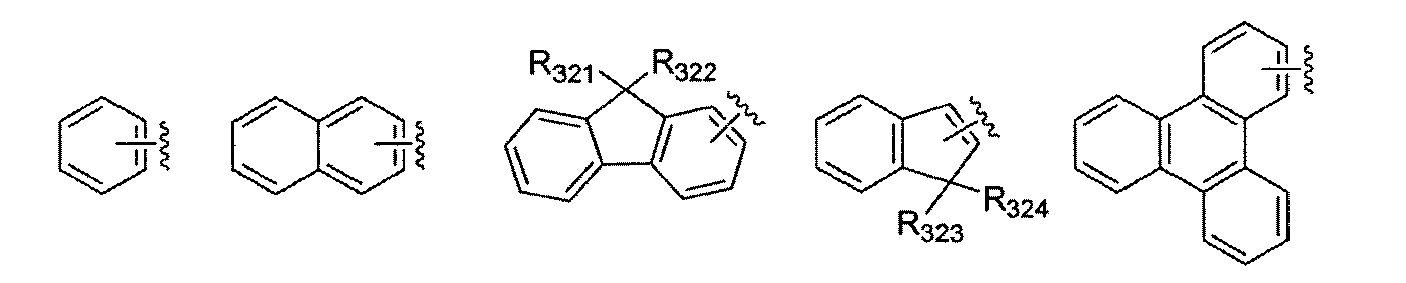


- the aryl or heteroaryl of Ar41 and Ar42 may be substituted by one or more substituent(s) selected from deuterium, (C1-C60)alkyl, (C1-C60)alkoxy, (C6-C60)aryl and (C4-C60)heteroaryl;
- L31 represents (C6-C60)arylene, (C4-C60)heteroarylene or a group represented by the following structural formula:

- the arylene or heteroarylene of L31 may be substituted by one or more substituent(s) selected from deuterium, (C1-C60)alkyl, (C1-C60)alkoxy, (C6-C60)aryl, (C4-C60)heteroaryl and halogen;
- R321 through R324 independently represent hydrogen, deuterium, (C1-C60)alkyl or (C6-C60)aryl, or each of them may be linked to an adjacent substituent via (C3-C60)alkylene or (C3-C60)alkenylene with or without a fused ring to form an alicyclic ring, or a monocyclic or polycyclic aromatic ring; and
- R331 through R334 independently represent hydrogen, deuterium, (C1-C60)alkyl, (C1-C60)alkoxy, (C6-C60)aryl, (C4-C60)heteroaryl or halogen, or each of them may be linked to an adjacent substituent via (C3-C60)alkylene or (C3-C60)alkenylene with or without a fused ring to form an alicyclic ring, or a monocyclic or polycyclic aromatic ring.

- In Chemical Formula (16), L41 and L42 independently represent a chemical bond, (C6-C60)arylene, (C3-C60)heteroarylene; the arylene or heteroarylene of L41 and L42 may be further substituted by one or more substituent(s) selected from deuterium, (C1-C60)alkyl, halogen, cyano, (C1-C60)alkoxy, (C3-C60)cycloalkyl, (C6-C60)aryl, (C3-C60)heteroaryl, tri(C1-C30)alkylsilyl, di(C1-C30)alkyl(C6-C30)arylsilyl and tri(C6-C30)arylsilyl;
- R401 through R419 independently represent hydrogen, deuterium, halogen, (C1-C60)alkyl, (C6-C60)aryl, (C4-C60)heteroaryl, 5- or 6-membered heterocycloalkyl containing one or more heteroatom(s) selected from N, O and S, (C3-C60)cycloalkyl, tri(C1-C60)alkylsilyl, di(C1-C60)alkyl(C6-C60)arylsilyl, tri(C6-C60)arylsilyl, adamantyl, (C7-C60)bicycloalkyl, (C2-C60)alkenyl, (C2-C60)alkynyl, (C1-C60)alkoxy, cyano, (C1-C60)alkylamzio, (C6-C60)arylamino, (C6-C60)ar(C1-C60)alkyl, (C6-C60)aryloxy, (C6-C60)arylthio, (C1-C60)alkoxycarbonyl, carboxyl, nitro or hydroxyl, or each of R401 through R419 may be linked to an adjacent substituent via (C3-C60)alkylene or (C3-C60)alkenylene with or without a fused ring to form an alicyclic ring, or a monocyclic or polycyclic aromatic ring;
- Ar51 represents (C6-C60)aryl, (C4-C60)heteroaryl, 5- or 6-membered heterocycloalkyl containing one or more heteroatom(s) selected from N, O and S, (C3-C60)cycloalkyl, adamantyl, (C7-C60)bicycloalkyl, or a substituent selected from the following structures:

- wherein, R420 through R432 independently represent hydrogen, deuterium, halogen, (C1-C60)alkyl, (C6-C60)aryl, (C4-C60)heteroaryl, 5- or 6-membered heterocycloalkyl containing one or more heteroatom(s) selected from N, O and S, (C3-C60)cycloalkyl, tri(C1-C60)alkylsilyl, di(C1-C60)alkyl(C6-C60)arylsilyl, tri(C6-C60)arylsilyl, adamantyl, (C7-C60)bicycloalkyl, (C2-C60)alkenyl, (C2-C60)alkynyl, (C1-c60)alkoxy, cyano, (C1-C60)alkylamino, (C6-C60)arylamino, (C6-C60)ar(C1-C60)alkyl, (C6-C60)aryloxy, (C6-C60)arylthio, (C1-C60)alkoxycarbonyl, carboxyl, nitro or hydroxyl;
- E and F independently represent a chemical bond, - (CR433R434)w-, -N(R435)-, -S-, -O-, -Si(R436) (R437)-, -P(R438)-, - C(=O)-, -B(R439)-, -In(R440)-, -Se-, -Ge(R441) (R442)-, - Sn(R443)(R444)-, -Ga(R445)- or -(R446)C=C(R447)-;
- R433 through R445 independently represent hydrogen, deuterium, halogen, (C1-C60)alkyl, (C6-C60)aryl, (C4-C60)heteroaryl, 5- or 6-membered heterocycloalkyl containing one or more heteroatom(s) selected from N, O and S, (C3-C60)cycloalkyl, tri(C1-C60)alkylsilyl, di(C1-C60)alkyl(C6-C60)arylsilyl, tri(C6-C60)arylsilyl, adamantyl, (C7-C60)bicycloalkyl, (C2-C60)alkenyl, (C2-C60)alkynyl, (C1-c60)alkoxy, cyano, (C1-C60)alkylamino, (C6-C60)arylamino, (C6-C60)ar(C1-C60)alkyl, (C6-C60)aryloxy, (C6-C60)arylthio, (C1-C60)alkoxycarbonyl, carboxyl, nitro or hydroxyl; or each of R433 through R445 may be linked to an adjacent substituent via (C3-C60)alkylene or (C3-C60)alkenylene with or without a fused ring to form an alicyclic ring, or a monocyclic or polycyclic aromatic ring;
- the aryl, heteroaryl, heterocycloalkyl, adamantyl or bicycloalkyl of Ar51; or the alkyl, alkenyl, alkynyl, cycloalkyl, heterocycloalkyl, aryl, heteroaryl, arylsilyl, alkylsilyl, alkylamino or arylamino of R401 through R445 may be further substituted by one or more substituent(s) selected from deuterium, halogen, (C1-C60)alkyl, (C6-C60)aryl, (C4-C60)heteroaryl, 5- or 6-membered heterocycloalkyl containing one or more heteroatom(s) selected from N, O and S, (C3-C60)cycloalkyl, tri(C1-C60)alkylsilyl, di(C1-C60)alkyl(C6-C60)arylsilyl, tri(C6-C60)arylsilyl, adamantyl, (C7-C60)bicycloalkyl, (C2-C60) alkenyl, (C2-C60)alkynyl, (C1-C60)alkoxy, cyano, (C1-C60)alkylamino, (C6-C60)arylamino, (C6-C60)ar(C1-C60)alkyl, (C6-C60)aryloxy, (C6-C60)arylthio, (C1-C60)alkoxycarbonyl, carboxyl, nitro and hydroxyl; and
- t and w independently represent an integer from 1 to 4.
- The compounds having electroluminescent peak of wavelength of blue, green or red color, to be contained in the electroluminescent layer can be exemplified by the following compounds, without restriction.






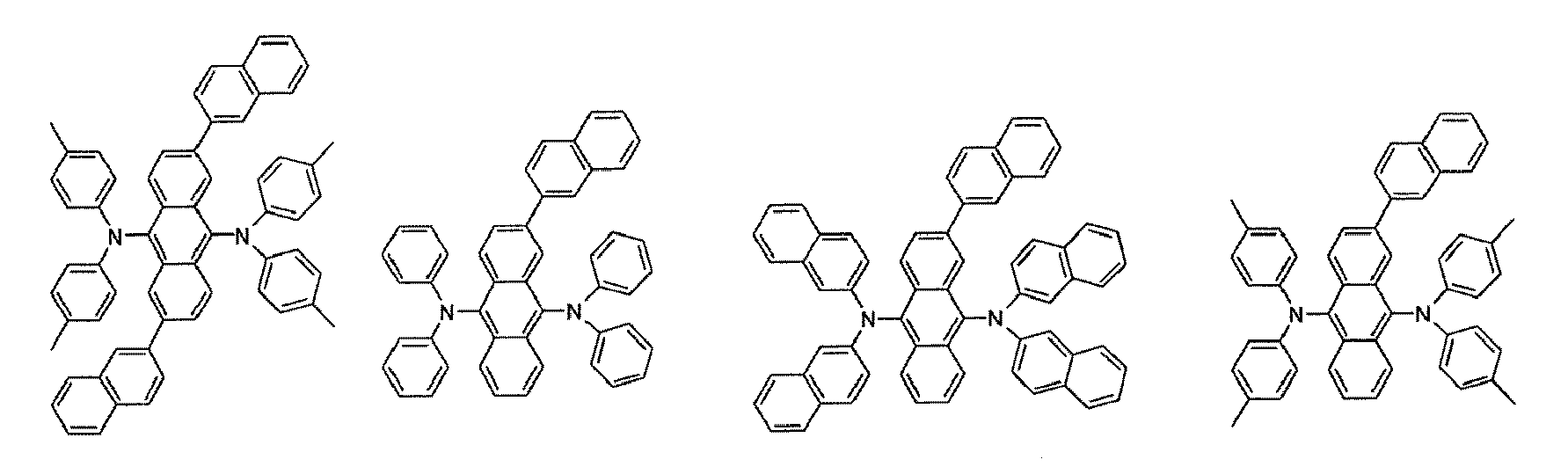


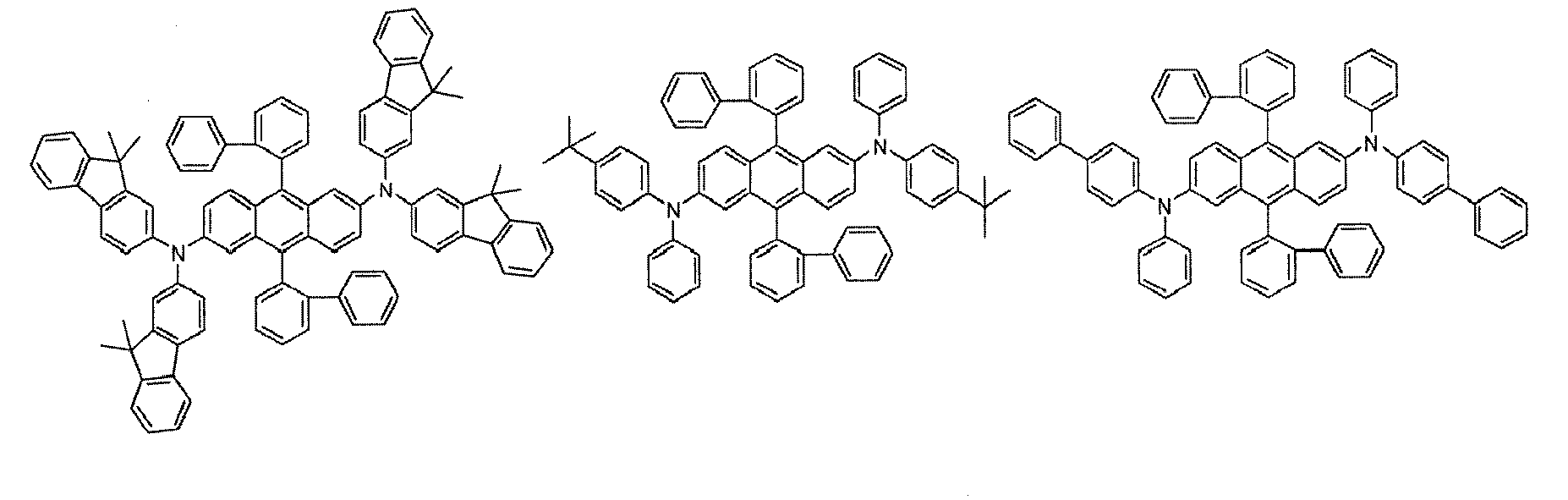


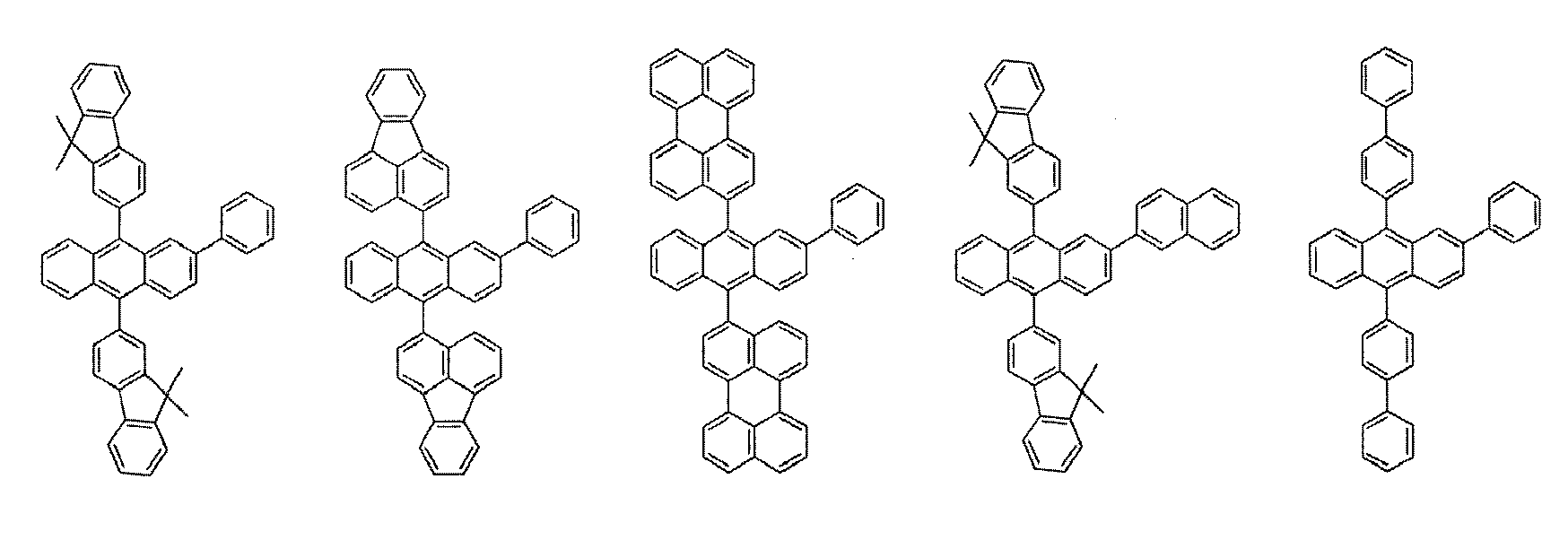


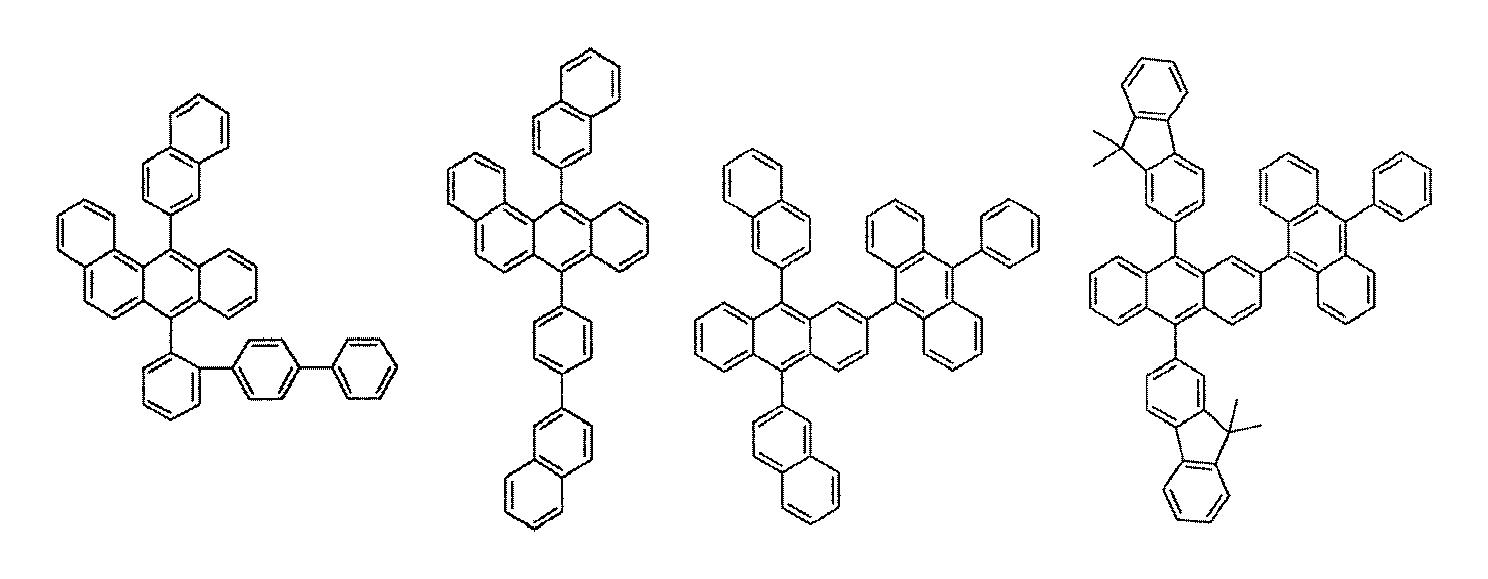


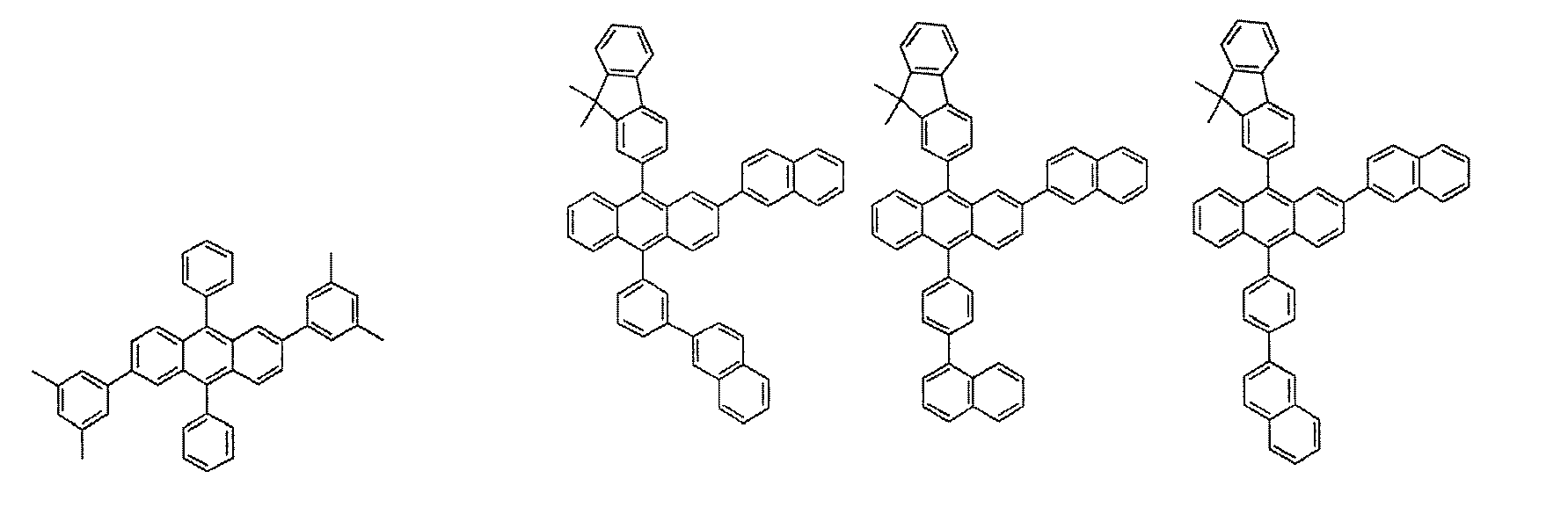


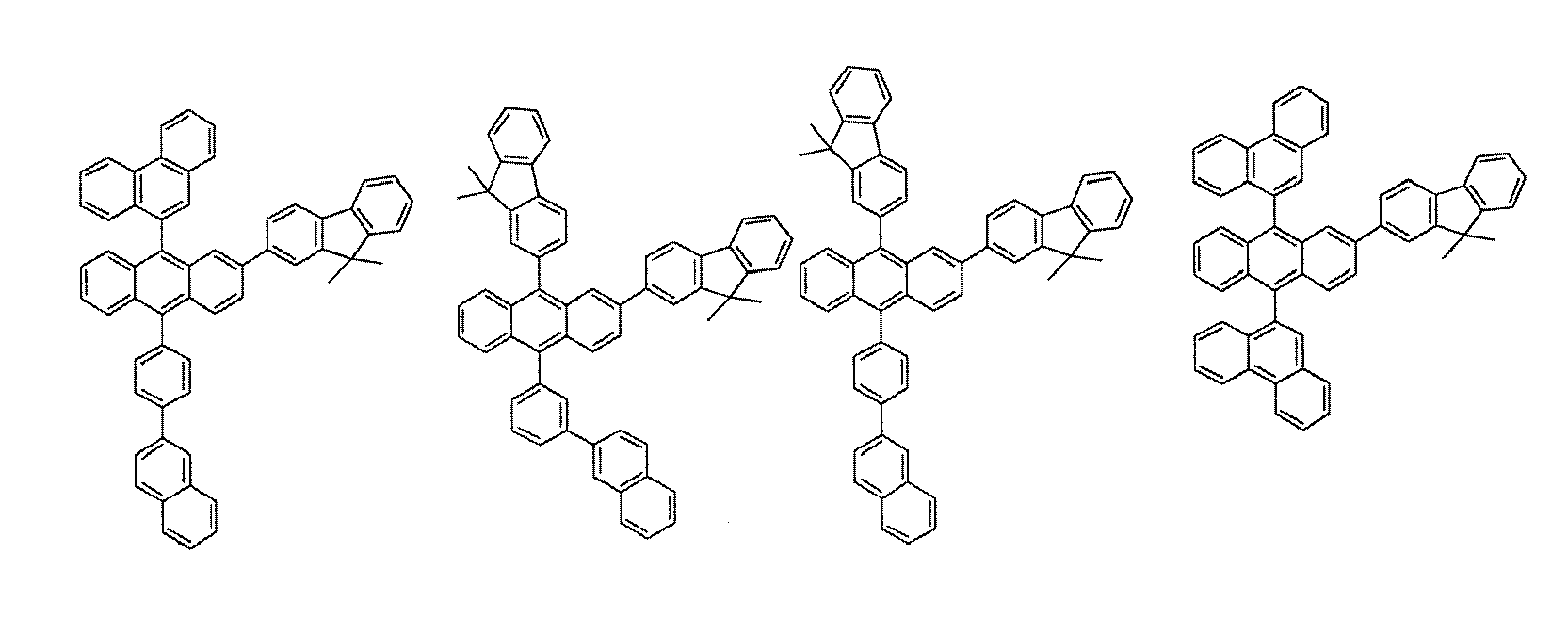


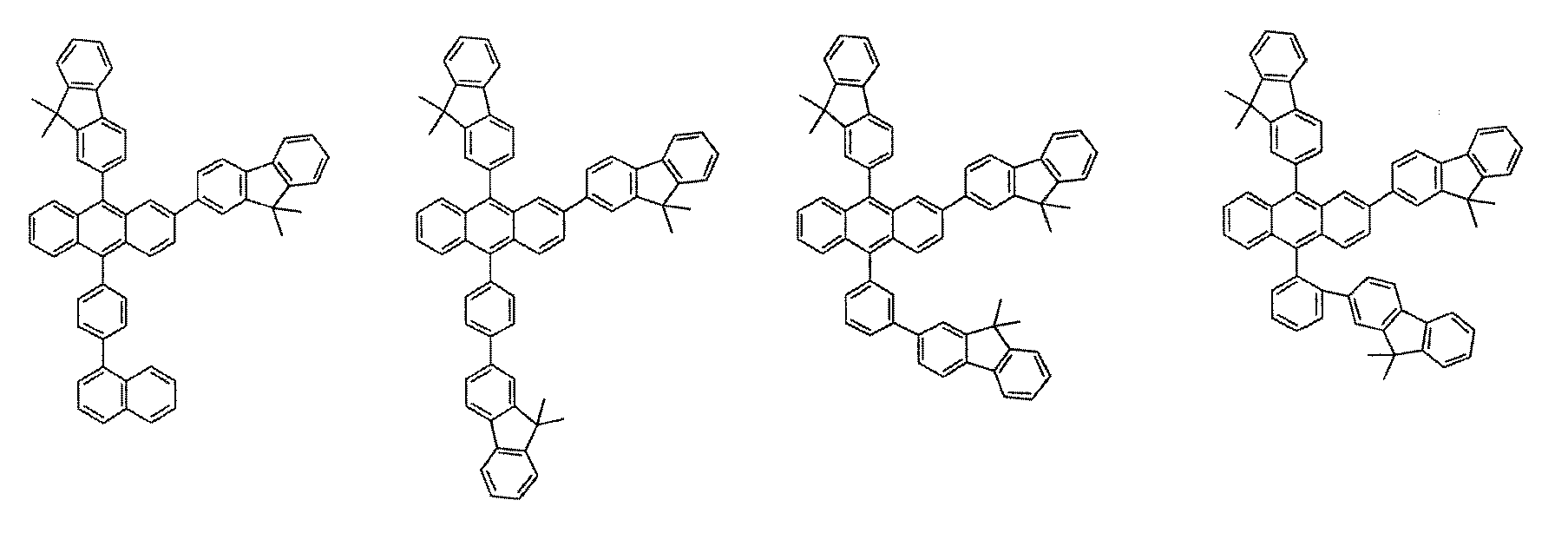

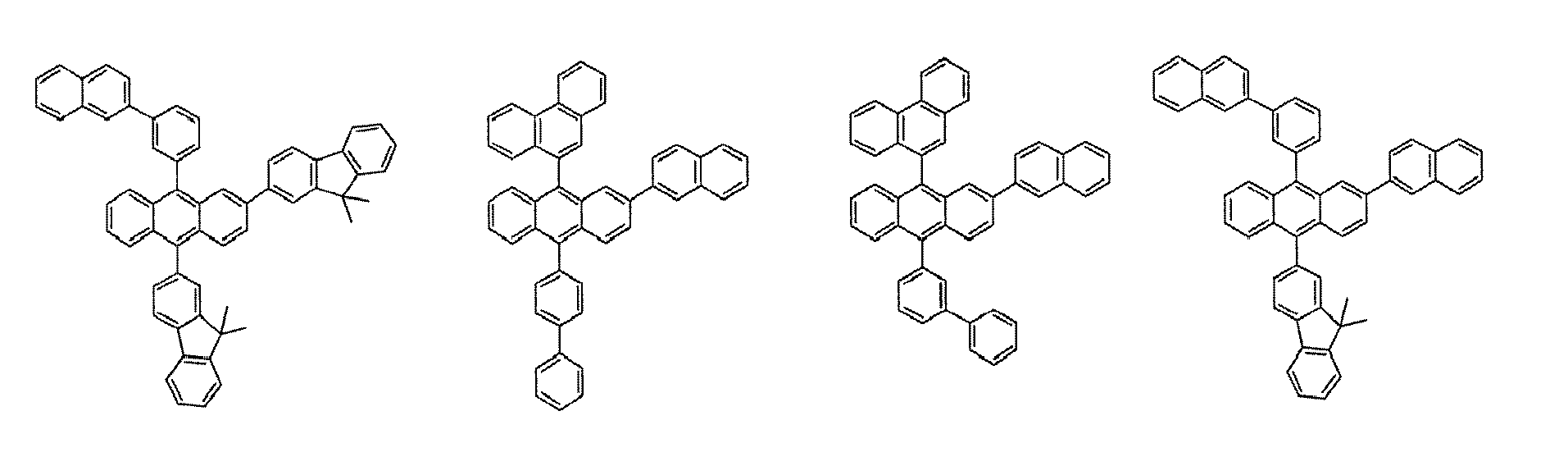

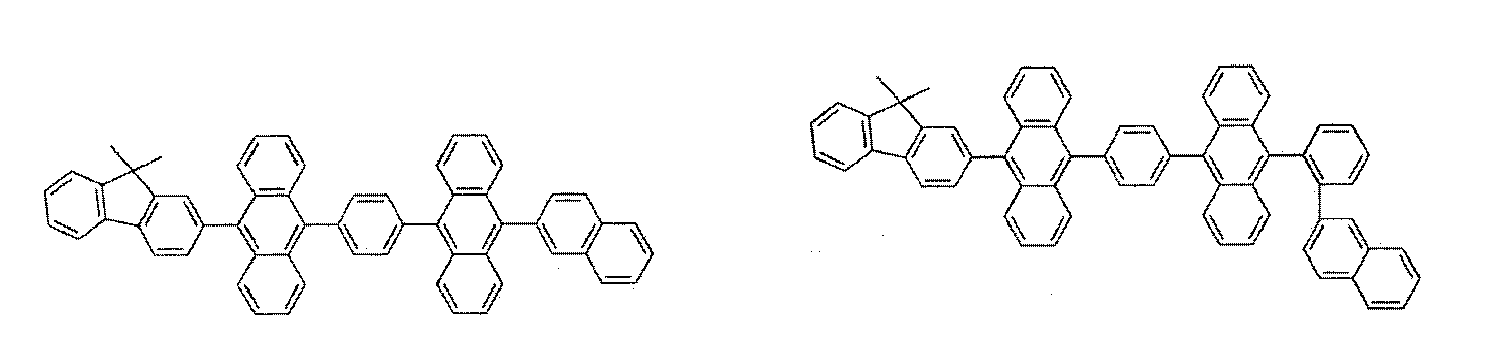


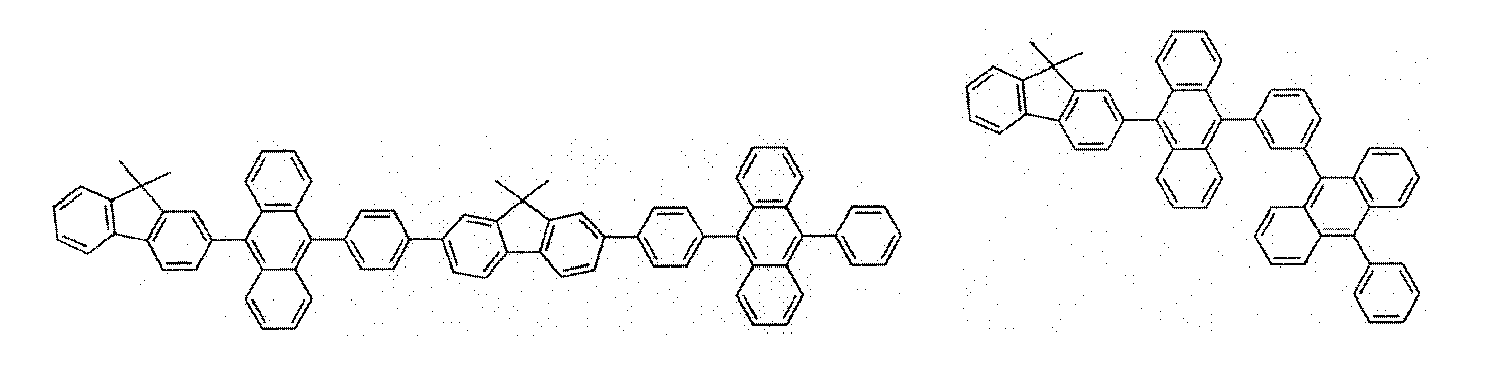


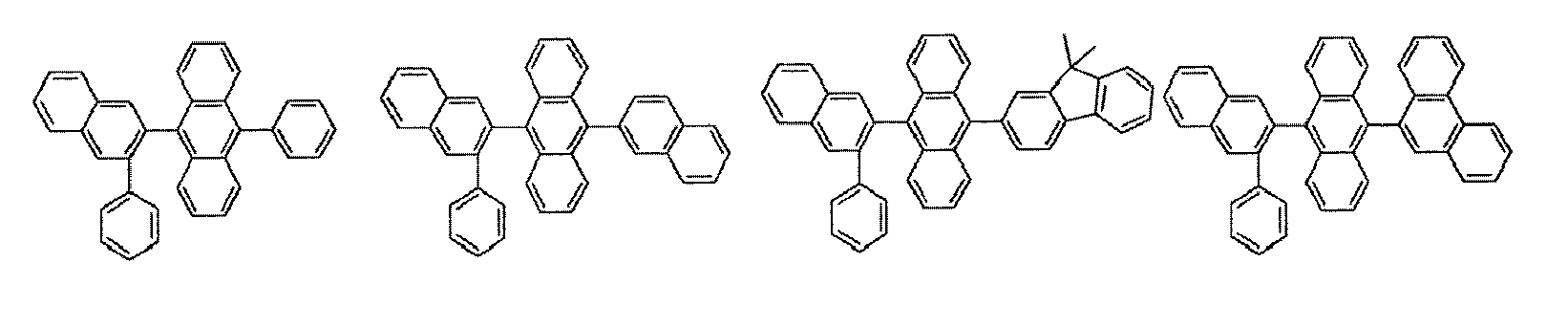


- In an organic electronic device according to the present invention, it is preferable to place one or more layer(s) (here-in-below, referred to as the "surface layer") selected from chalcogenide layers, metal halide layers and metal oxide layers, on the inner surface of at least one side of the pair of electrodes. Specifically, it is preferable to arrange a chalcogenide layer of silicon and aluminum metal (including oxides) on the anode surface of the EL medium layer, and a metal halide layer or a metal oxide layer on the cathode surface of the EL medium layer. As the result, stability in operation can be obtained.
- Examples of chalcogenides preferably include SiOx (1≤X≤2), AlOx (1≤X≤1.5), SiON, SiAlON, or the like. Examples of metal halides preferably include LiF, MgF2, CaF2, fluorides of rare earth metal, or the like. Examples of metal oxides preferably include Cs2O, Li2O, MgO, SrO, BaO, CaO, or the like.
- In an organic electronic device according to the present invention, it is also preferable to arrange, on at least one surface of the pair of electrodes thus manufactured, a mixed region of electron transport compound and a reductive dopant, or a mixed region of a hole transport compound with an oxidative dopant. Accordingly, the electron transport compound is reduced to an anion, so that injection and transportation of electrons from the mixed region to an EL medium are facilitated. In addition, since the hole transport compound is oxidized to form a cation, injection and transportation of holes from the mixed region to an EL medium are facilitated. Preferable oxidative dopants include various Lewis acids and acceptor compounds. Preferable reductive dopants include alkali metals, alkali metal compounds, alkaline earth metals, rare-earth metals, and mixtures thereof.
- The compounds for organic electronic material according to the invention exhibit high luminous efficiency and excellent life property of material, so that OLED's having very good operation life of device can be advantageously manufactured therefrom. The compounds for organic electronic material according to the invention can be contained in a hole transport layer or a hole injecting layer, or employed as host for phosphor to result in lowered operation voltage, thus providing advantages of noticeably decreased power consumption while exhibiting at least comparable luminous efficiency.
- The present invention is further described with respect to the representative compounds of the invention, by describing the compounds for organic electronic material, the processes for preparing the same, and electroluminescent properties of the device manufactured therefrom in the Examples below, which are provided for illustration of the embodiments only but are not intended to limit the scope of the invention by any means.
-

- Carbazole (20 g, 119.6 mmmol), methyl-2-iodobenzoate (26.4 mL, 179.4 mmol), K2CO3 (21.5 g, 155.5 mmol), Cu (1.52 g, 23.9 mmol) and CuI (1.14 g, 5.98 mmol) were dissolved in dibutyl ether (500 mL), and the solution was stirred under reflux for 48 hours in the presence of argon atmosphere. When the reaction was completed, the reaction mixture was cooled to room temperature, and extracted with water (800 mL). The organic layer was evaporated under reduced pressure. The residue was purified via column chromatography by using hexane and ethyl acetate (4:1), and recrystallized from ethanol (300 mL) to obtain Compound (A) (24.5 g, 68%).
- Compound (A) (15.0 g, 49.8 mmol) was dissolved in ether (100 mL), and the solution was chilled to -78°C. Methyl lithium (1.6 M in ether, 78 mL, 124.4 mmol) was added thereto, and the mixture stirred for 1 hour. The reaction mixture was slowly warmed to room temperature, and further stirred for 4 hours. When the reaction was completed, the mixture was extracted with water (200 mL), and the organic layer was evaporated under reduced pressure. Recrystallization from ethanol/acetone (1:1 v/v) gave Compound (B) (10.1 g, 67%).
- Compound (B) (14.0 g, 46.5 mmol) was dissolved in concentrated H3PO4 (150 mL), and the solution was stirred for 5.5 hours. The reaction mixture was extracted with water (200 mL) and ethyl acetate (200 mL), and the organic layer was evaporated under reduced pressure. Recrystallization from ethanol (150 mL) gave Compound (C) (9.48 g, 72%).
- Compound (C) (7 g, 24.7 mmol) was dissolved in dichloromethane (100 mL), and N-bromosuccinimide (5.28 g, 29.6 mmol) was added thereto at 0°C. The solution was stirred for 4 hours, while maintaining the temperature. Then the reaction was quenched by adding distilled water (150 mL), and the mixture was extracted with dichloromethane (100 mL), and the extract was evaporated under reduced pressure. Recrystallization from ethanol/acetone (1:2 v/v) gave Compound (D) (6.4 g, 72%).
- Compound (D) (5 g, 13.8 mmol), phenylboronic acid (1.9 g, 15.18 mmol) and Pd(PPh3)4 (0.8 g, 0.52 mmol) were dissolved in toluene (100 mL) and ethanol (50 mL), and aqueous 2 M sodium carbonate solution (50 mL) was added thereto. After stirring under reflux at 120°C for 4 hours, the reaction mixture was cooled to 25°C, and the reaction was quenched by adding distilled water (200 mL). The mixture was extracted with ethyl acetate (150 mL), and the extract was evaporated under reduced pressure. Purification via column chromatography gave the target compound (Compound 1) (1.6 g, 3.33 mmol).
-

- Compound (C) (7 g, 24.7 mmol) was dissolved in dichloromethane (100 mL), and N-bromosuccinimide (10.5 g, 59.2 mmol) was added thereto at 0°C. The solution was stirred for 5 hours, while maintaining the temperature. Then the reaction was quenched by adding distilled water (150 mL), and the mixture was extracted with dichloromethane (100 mL), and the extract was evaporated under reduced pressure. Recrystallization from ethanol/acetone (1:2 v/v) gave Compound (E) (7.4 g, 68%).
- Compound (E) (5 g, 13.8 mmol), phenylboronic acid (3.8 g, 30.36 mmol) and Pd(PPh3)4 (1.6 g, 1.04 mmol) were dissolved in toluene (100 mL) and ethanol (50 mL), and aqueous 2 M sodium carbonate solution (50 mL) was added thereto. After stirring under reflux at 120°C for 4 hours, the reaction mixture was cooled to 25°C, and the reaction was quenched by adding distilled water (200 mL). The mixture was extracted with ethyl acetate (150 mL), and the extract was evaporated under reduced pressure. Purification via column chromatography gave the target compound (Compound 320) (3.9 g, 8.95 mmol).
-

- Carbazole (20 g, 119.6 mmmol), 5-bromomethyl-2-iodobenzoate (26.4 mL, 179.4 mmol), K2CO3 (21.5 g, 155.5 mmol), Cu (1.52 g, 23.9 mmol) and CuI (1.14 g, 5.98 mmol) were dissolved in dibutyl ether (500 mL), and the solution was stirred under reflux for 48 hours in the presence of argon atmosphere. When the reaction was completed, the reaction mixture was cooled to room temperature, and extracted with water (800 mL). The organic layer was evaporated under reduced pressure. The residue was purified via column chromatography by using hexane and ethyl acetate (4:1), and recrystallized from ethanol (300 mL) to obtain Compound (F) (24.5 g, 58%).
- Compound (F) (15.0 g, 49.8 mmol) was dissolved in ether (100 mL), and the solution was chilled to -78°C. Methyl lithium (1.6 M in ether, 78 mL, 124.4 mmol) was added thereto, and the mixture stirred for 1 hour. The reaction mixture was slowly warmed to room temperature, and further stirred for 4 hours. When the reaction was completed, the mixture was extracted with water (200 mL), and the organic layer was evaporated under reduced pressure. Recrystallization from ethanol/acetone (1:1 v/v) gave Compound (G) (10.1 g, 57%).
- Compound (G) (14.0 g, 46.5 mmol) was dissolved in concentrated H3PO4 (150 mL), and the solution was stirred for 5.5 hours. The reaction mixture was extracted with water (200 mL) and ethyl acetate (200 mL), and the organic layer was evaporated under reduced pressure. Recrystallization from ethanol (150 mL) gave Compound (H) (9.48 g, 62%).
- Compound (H) (7 g, 24.7 mmol) was dissolved in dichloromethane (100 mL), and N-bromosuccinimide (5.28 g, 29.6 mmol) was added thereto at 0°C. The solution was stirred for 4 hours, while maintaining the temperature. Then the reaction was quenched by adding distilled water (150 mL), and the mixture was extracted with dichloromethane (100 mL), and the extract was evaporated under reduced pressure. Recrystallization from ethanol/acetone (1:2 v/v) gave Compound (I) (6.4 g, 62%).
- Compound (I) (5 g, 13.8 mmol), phenylboronic acid (5.7 g, 45.54 mmol) and Pd(PPh3)4 (2.4 g, 1.56 mmol) were dissolved in toluene (100 mL) and ethanol (50 mL), and aqueous 2 M sodium carbonate solution (50 mL) was added thereto. After stirring under reflux at 120°C for 4 hours, the reaction mixture was cooled to 25°C, and the reaction was quenched by adding distilled water (200 mL). The mixture was extracted with ethyl acetate (150 mL), and the extract was evaporated under reduced pressure. Purification via column chromatography gave the target compound (Compound 462) (1.6 g, 3.12 mmol).
-

- Carbazole (20 g, 119.6 mmmol), dimethyl-2-iodoisophthalate (49.8 g, 155.5 mmol), K2CO3 (21.5 g, 155.5 mmol), Cu (1.52 g, 23.9 mmol) and CuI (1.14 g, 5.98 mmol) were dissolved in dibutyl ether (800 mL), and the solution was stirred under reflux for 48 hours in the presence of argon atmosphere. When the reaction was completed, the reaction mixture was cooled to room temperature, and extracted with water (800 mL). The organic layer was evaporated under reduced pressure. The residue was purified via column chromatography by using hexane and ethyl acetate (4:1), and recrystallized from ethanol (300 mL) to obtain Compound (J) (27.1 g, 63%).
- Compound (J) (15.0 g, 41.7 mmol) was dissolved in ether (300 mL), and the solution was chilled to -78°C. Methyl lithium (1.6 M in ether, 120 mL, 187.8 mmol) was added thereto, and the mixture stirred for 1 hour. The reaction mixture was slowly warmed to room temperature, and further stirred for 4 hours. When the reaction was completed, the mixture was extracted with water (200 mL), and the organic layer was evaporated under reduced pressure. Recrystallization from ethanol/acetone (1:1 v/v) gave Compound (K) (8.7 g, 58%).
- Compound (K) (14.0 g, 38.9 mmol) was dissolved in concentrated H3PO4 (150 mL), and the solution was stirred for 5.5 hours. The reaction mixture was extracted with water (200 mL) and ethyl acetate (200 mL), and the organic layer was evaporated under reduced pressure. Recrystallization from ethanol (150 mL) gave Compound (L) (7.68 g, 61%).
- Compound (L) (7 g, 21.6 mmol) was dissolved in dichloromethane (100 mL), and N-bromosuccinimide (5.28 g, 28.1 mmol) was added thereto at 0°C. The solution was stirred for 4 hours, while maintaining the temperature. Then the reaction was quenched by adding distilled water (150 mL), and the mixture was extracted with dichloromethane (100 mL), and the extract was evaporated under reduced pressure. Recrystallization from ethanol/acetone (1:2 v/v) gave Compound (M) (5.7 g, 66%).
- Compound (M) (5 g, 12.4 mmol), phenylboronic acid (1.9 g, 15.18 mmol) and Pd(PPh3)4 (0.8 g, 0.52 mmol) were dissolved in toluene (100 mL) and ethanol (50 mL), and aqueous 2 M sodium carbonate solution (50 mL) was added thereto. After stirring under reflux at 120°C for 4 hours, the reaction mixture was cooled to 25°C, and the reaction was quenched by adding distilled water (200 mL). The mixture was extracted with ethyl acetate (150 mL), and the extract was evaporated under reduced pressure. Purification via column chromatography gave the target compound (Compound 498) (1.5 g, 3.75 mmol).
-

- A reaction vessel was charged with aniline (4.89 mL, 53.7 mmol), methyl-2-iodobenzoate (23.7 mL, 161 mmol), K2CO3 (15.6 g, 113 mmol), Cu (0.68 g, 10.7 mmol), CuI (0.51 g, 2.69 mmol) and di-n-butyl ether (50 mL), and the mixture was stirred under reflux for 48 hours in the presence of argon atmosphere. The organic product was purified via column chromatography by using hexane and ethyl acetate (4:1), and recrystallized from ethanol to obtain Compound (N) (15.7 g, 81%).
- Compound (N) (15.0 g, 41.5 mmol) was dissolved in ether (80 mL), and methyl lithium (in ether, 45 mmol) was added thereto at -78°C. The mixture was slowly warmed to ambient temperature, and reacted for 4 hours. Recrystallization from ethanol/acetone (1:1 v/v) gave Compound (O) (7.68 g, 61%).
- Compound (O) (14.0 g, 38.7 mmol) was added to concentrated H3PO4 (150 mL), and the mixture was stirred for 5.5 hours. The reaction mixture was extracted with water/ethyl acetate, and the organic product was recrystallized from ethanol to obtain Compound (P) (7.8 g, 68%).
- Compound (P) (7 g, 21.5 mmol) was dissolved in methylene chloride, and N-bromosuccinimide (NBS) (4.98 g, 27.95 mmol) was added thereto at 0°C. After 5 hours, the reaction mixture was extracted and recrystallized from ethanol/acetone (1:2 v/v) to obtain Compound (Q) (6 g, 75%).
- Compound (Q) (5 g, 12.4 mmol), phenylboronic acid (1.9 g, 15.18 mmol) and Pd(PPh3)4 (0.8 g, 0.52 mmol) were dissolved in toluene (100 mL) and ethanol (50 mL), and aqueous 2 M sodium carbonate solution (50 mL) was added thereto. After stirring under reflux at 120°C for 4 hours, the reaction mixture was cooled to 25°C, and the reaction was quenched by adding distilled water (200 mL). The mixture was extracted with ethyl acetate (150 mL), and the extract was evaporated under reduced pressure. Purification via column chromatography gave the target compound (Compound 811) (1.5 g, 3.75 mmol).
-

- A reaction vessel was charged with anthranilic acid methyl ester (10 g, 66.2 mmol), methyl-2-iodobenzoate (28.2 mL, 191.98 mmol), K2CO3 (19.2 g, 139.02 mmol), Cu (0.84 g, 13.24 mmol), CuI (0.63 g, 3.31 mmol) and di-n-butyl ether (120 mL), and the mixture was stirred under reflux for 48 hours in the presence of argon atmosphere. The organic product was purified via column chromatography by using hexane and ethyl acetate (4:1), and recrystallized from ethanol to obtain Compound (R) (21.7 g, 78%).
- Compound (R) (15.0 g, 35.8 mmol) was dissolved in ether (100 mL), and methyl lithium (1.6 M in ether, 145 mL, 232.46 mmol) was added thereto at -78°C. The mixture was slowly warmed to room temperature, and continuously reacted for 4 hours. Recrystallization from ethanol/acetone (1:1 v/v) gave Compound (S) (10.4 g, 69%).
- Compound (S) (14.0 g, 33.4 mmol) was added to concentrated H3PO4 (150 mL), and the mixture was stirred for 5.5 hours. The reaction mixture was extracted with water/ethyl acetate, and the organic product was recrystallized from ethanol to obtain Compound (T) (9.15 g, 75%).
- Compound (T) (7 g, 19.2 mmol) was dissolved in methylene chloride, and N-bromosuccinimide (NBS) (4.09 g, 23.0 mmol) was added thereto at 0°C. After 5 hours, the reaction mixture was extracted by using water and ethyl acetate, and the organic product was recrystallized from ethanol/acetone (1:2 v/v) to obtain Compound (U) (6.4 g, 75%).
- Compound (U) (5 g, 11.3 mmol), phenylboronic acid (1.9 g, 15.18 mmol) and Pd(PPh3)4 (0.8 g, 0.52 mmol) were dissolved in toluene (100 mL) and ethanol (50 mL), and aqueous 2 M sodium carbonate solution (50 mL) was added thereto. After stirring under reflux at 120°C for 4 hours, the reaction mixture was cooled to 25°C, and the reaction was quenched by adding distilled water (200 mL). The mixture was extracted with ethyl acetate (150 mL), and the extract was evaporated under reduced pressure. Purification via column chromatography gave the target compound (Compound 1221) (1.5 g, 3.75 mmol).
- Organic electroluminescent compounds (
Compounds 1 to 1528) were prepared according to the procedure described in Preparation Examples 1 to 6, and the 1H NMR and MS/FAB data of those compounds are shown in Table 1.Table 1 Compound No. 1H NMR(CDCl3, 200 MHz) MS/FAB found calculated 1 δ = 1.72(6H, s), 6.95(1H, m), 7.17(1H, m), 7.26∼7.3(2H, m), 7.37∼7.41(3H, m), 7.51∼7.52(4H, m), 7.69(1H, m), 7.77(1H, m), 7.87(1H, m), 8.37(1H, m) 359.46 359.17 4 δ = 1.72(12H, s), 6.95(1H, m), 7.17(1H, m), 7.26∼7.3(3H, m), 7.37∼7.4(3H, m), 7.55(1H, m), 7.63(1H, m), 7.69(1H, m), 7.77(2H, m), 7.87∼7.93(3H, m), 8.37(1H, m) 475.62 475.23 16 δ = 1.72(6H, s), 6.95(1H, m), 7.17(1H, m), 7.26∼7.3(2H, m), 7.37∼7.41(3H, m), 7.48∼7.57(7H, m), 7.69∼7.7(2H, m), 7.77(1H, m), 7.87(1H, m), 8.37(1H, m) 435.56 435.20 28 δ = 1.72(6H, s), 6.95(1H, m), 7.17(1H, m), 7.26∼7.3(2H, m), 7.37∼7.41(3H, m), 7.51(2H, m), 7.59(2H, m), 7.69(1H, m), 7.77∼7.79(3H, m), 7.87(1H, m), 8(2H, m), 8.37∼8.4(3H, m) 485.62 485.21 35 δ = 1.72(6H, s), 6.95(1H, m), 7.17∼7.3(7H, m), 7.37∼7.5(5H, m), 7.58∼7.59(3H, m), 7.69(1H, m), 7.77(1H, m), 7.85∼7.87(3H, m), 8.37(1H, m), 8.56(1H, m) 551.68 551.24 38 δ = 1.72(6H, s), 6.95(1H, m), 7.17(1H, m), 7.25∼7.3(4H, m), 7.37∼7.4(2H, m), 7.53(2H, m), 7.69(1H, m), 7.77(1H, m), 7.85∼7.87(3H, m), 8.01(1H, m), 8.18(1H, m), 8.37(1H, m) 492.63 492.17 49 δ = 1.72(6H, s), 6.95(1H, m), 7.17(1H, m), 7.25∼7.4(7H, m), 7.5(1H, m), 7.63∼7.69(4H, m), 7.77∼7.79(3H, m), 7.87(1H, m), 7.94(1H, m), 8.12(1H, m), 8.37(1H, m), 8.55(1H, m) 524.65 524.23 50 δ = 1.72(6H, s), 6.95(1H, m), 7.17(1H, m), 7.25∼7.33(9H, m), 7.58(2H, m), 7.69(2H, m), 7.77(2H, m), 7.87(2H, m), 7.94(1H, m), 8.37(1H, m), 8.55(1H, m) 524.65 524.23 72 δ = 1.72(6H, s), 6.95(1H, m), 7.17(1H, m), 7.26∼7.3(2H, m), 7.36∼7.42(5H, m), 7.48(1H, m), 7.69∼7.87(8H, m), 8.03∼8.12(3H, m), 8.37(1H, m) 541.62 541.20 91 δ = 1.72(6H, s), 6.95(1H, m), 7.17(1H, m), 7.25∼7.3(6H, m), 7.37∼7.4(2H, m), 7.55(2H, m), 7.61(1H, m), 7.69(1H, m), 7.77(1H, m), 7.87(1H, m), 8.04∼8.08(2H, m), 8.37∼8.42(2H, m), 8.55(1H, m) 485.62 485.21 94 δ = 1.72(6H, s), 6.95(1H, m), 7.17(1H, m), 7.26∼7.3(2H, m), 7.37∼7.4(2H, m), 7.48(2H, m), 7.57∼7.59(4H, m), 7.69∼7.77(4H, m), 7.87∼7.92(2H, m), 8(2H, m), 8.37(1H, m) 485.62 485.21 104 δ = 1.72(6H, s), 6.95(1H, m), 7.17(1H, m), 7.26∼7.3{2H, m), 7.37∼7.41(3H, m), 7.51∼7.52(4H, m), 7.58(2H, m), 7.69∼7.77(4H, m), 7.87∼7.92(3H, m), 8.37(1H, m) 485.62 485.21 106 δ = 1.72(6H, s), 6.95(1H, m), 7.17(1H, m), 7.26∼7.3(2H, m), 7.37∼7.41(3H, m), 7.51∼7.55(4H, m), 7.69(1H, m), 7.77∼7.79(3H, m), 7.87(1H, m), 8.01(2H, m), 8.37(1H, m), 8.55(2H, m) 485.62 485.21 112 δ = 1.72(6H, s), 6.95(1H, m), 7.17(1H, m), 7.26∼7.3(2H, m), 7.37∼7.4(6H, m), 7.58∼7.59(3H, m), 7.69∼7.77(3H, m), 7.87∼7.92(6H, m), 8(2H, m), 8.37(1H, m) 585.73 585.25 119 δ = 1.72(6H, s), 2.34(12H, s), 6.36(4H, m), 6.71∼6.77(4H, m), 6.95(1H, m), 7.17(1H, m), 7.26∼7.3(2H, m), 7.37∼7.4(3H, m), 8.37(1H, m) 506.68 506.27 132 δ = 1.72(12H, s), 6.58∼6.63(3H, m), 6.75∼6.81(4H, m), 6.95(1H, m), 7.17∼7.3(6H, m), 7.37∼7.4(4H, m), 7.55(1H, m), 7.62(1H, m), 7.87(1H, m), 8.37(1H, m) 566.73 566.27 146 δ = 1.72(6H, s), 6.69∼6.77(4H, m), 6.95∼6.98(2H, m), 7.17(1H, m), 7.26∼7.3(2H, m), 7.37∼7.41(5H, m), 7.51∼7.57(9H, m), 8.02∼8.07(2H, m), 8.37(1H, m) 576.73 576.26 158 δ = 1.72(12H, s), 6.58(1H, m), 6.75∼6.77(3H, m), 6.95(1H, m), 7.17(1H, m), 7.26∼7.3(3H, m), 7.36∼7.4(5H, m), 7.49∼7.55(3H, m), 7.62(1H, m), 7.74∼7.77(2H, m), 7.84∼7.88(3H, m), 8.37(1H, m) 616.79 616.29 171 δ = 1.35(9H, s), 1.72(12H, s), 6.55∼6.58(3H, m), 6.75∼6.77(3H, m), 6.95∼7.01(3H, m), 7.17(1H, m), 7.26∼7.3(3H, m), 7.37∼7.4(4H, m), 7.55(1H, m), 7.62(1H, m), 7.87(1H, m), 8.37(1H, m) 622.84 622.33 235 δ = 1.72(6H, s), 6.62(1H, m), 6.7∼6.77(3H, m), 6.95∼6.99(3H, m), 7.17(1H, m), 7.26∼7.3(2H, m), 7.37∼7.4(3H, m), 7.55(1H, m), 8.07(1H, m), 8.37(1H, m), 8.46(2H, m) 452.55 452.20 261 δ = 1.72(6H, s), 6.63(4H, m), 6.69(2H, m), 6.81(2H, m), 6.95(1H, m), 7.17∼7.3(7H, m), 7.37∼7.4(2H, m), 7.54(2H, m), 7.69(1H, m), 7.77(1H, m), 7.87(1H, m), 8.37(1H, m) 526.67 526.24 263 δ = 1.72(6H, s), 6.63(4H, m), 6.81(2H, m), 6.95∼6.98(2H, m), 7.17∼7.3(7H, m), 7.37∼7.4(3H, m), 7.6(1H, m), 7.69(1H, m), 7.77(1H, m), 7.87(1H, m), 8.03∼8.04(2H, m), 8.37∼8.4(2H, m) 576.73 576.26 266 δ = 1.72(12H, s), 6.58∼6.63(5H, m), 6.75∼6.81(3H, m), 6.95(1H, m), 7.17∼7.3(7H, m), 7.37∼7.4(2H, m), 7.62∼7.63(2H, m), 7.69(1H, m), 7.77(2H, m), 7.87∼7.93(2H, m), 8.37(1H, m) 642.83 642.30 271 δ = 1.72(12H, s), 6.58(1H, m), 6.75(1H, m), 6.95(1H, m), 7.17(1H, m), 7.26∼7.3(2H, m), 7.36∼7.4(4H, m), 7.49∼7.5(4H, m), 7.62∼7.63(2H, m), 7.69∼7.77(7H, m), 7.84∼7.93(6H, m), 8.37(1H, m) 742.95 742.33 278 δ = 1.72(6H, s), 6.63(2H, m), 6.81(1H, m), 6.95∼6.98(2H, m), 7.17∼7.3(5H, m), 7.37∼7.46(8H, m), 7.64∼7.77(5H, m), 7.84∼7.87(2H, m), 8.02∼8.07(2H, m), 8.37(1H, m) 626.79 626.27 301 δ = 1.72(6H, s), 6.63(2H, m), 6.69∼6.81(5H, m), 6.95(1H, m), 7.17∼7.3(5H, m), 7.37∼7.4(3H, m), 7.54∼7.59(5H, m), 7.73(1H, m), 7.92(1H, m), 8(2H, m), 8.37(1H, m) 576.73 576.26 320 δ = 1.72(6H, s), 7.26∼7.3(2H, m), 7.37∼7.41(4H, m), 7.51∼7.52(8H, m), 7.59(1H, m), 7.69(1H, m), 7.77(1H, m), 7.87(1H, m), 8.54(1H, m) 435.56 435.20 341 δ = 1.72(6H, s), 7.25∼7.4(10H, m), 7.5(2H, m), 7.59∼7.69(8H, m), 7.77∼7.79(5H, m), 7.87(1H, m), 7.94(2H, m), 8.12(2H, m), 8.54∼8.55(3H, m) 765.94 765.31 360 δ = 1.72(30H, s), 6.15(1H, m), 6.58(4H, m), 6.75∼6.77(6H, m), 7.26∼7.3(6H, m), 7.37∼7.45(8H, m), 7.55(4H, m), 7.62(4H, m), 7.87(4H, m) 1082.42 1081.53 374 δ = 1.72(18H, s), 6.15(1H, m), 6.58(2H, m), 6.75∼6.77(4H, m), 6.98(2H, m), 7.26∼7.3(4H, m), 7.37∼7.45(8H, m), 7.53∼7.62(10H, m), 7.87(2H, m), 8.02∼8.07(4H, m) 950.22 949.44 394 δ = 1.72(6H, s), 6.63(8H, m), 6.69(4H, m), 6.81(4H, m), 7.2∼7.3(10H, m), 7.37∼7.4(2H, m), 7.54∼7.59(5H, m), 7.69(1H, m), 7.77(1H, m), 7.87(1H, m), 8.54(1H, m) 769.97 769.35 402 δ = 1.72(6H, s), 6.63(4H, m), 6.69(4H, m), 6.81(2H, m), 6.98(2H, m), 7.2∼7.3(6H, m), 7.37∼7.4(4H, m), 7.53∼7.59(11H, m), 7.69(1H, m), 7.77(1H, m), 7.87(1H, m), 8.02∼8.07(4H, m), 8.54(1H, m) 870.09 869.38 415 δ = 1.72(12H, s), 7.26∼7.3(3H, m), 7.37∼7.41(4H, m), 7.51∼7.63(7H, m), 7.69(1H, m), 7.77(2H, m), 7.87∼7.93(3H, m), 8.54(1H, m) 551.72 551.26 428 δ = 1.72(6H, s), 6.63(4H, m), 6.75∼6.81(4H, m), 7.2∼7.3(6H, m), 7.37∼7.41(4H, m), 7.51∼7.52(4H, m), 7.59(1H, m), 8.54(1H, m) 526.67 526.24 432 δ = 1.72(6H, s), 6.63(4H, m), 6.75∼6.81(4H, m), 7.2∼7.3(6H, m), 7.37∼7.4(3H, m), 7.58∼7.59(4H, m), 7.73(1H, m), 7.92(1H, m), 8(2H, m), 8.54(1H, m) 576.73 576.26 447 δ = 1.72(6H, s), 6.63(4H, m), 6.69(2H, m), 6.81(2H, m), 7.2∼7.3(6H, m), 7.37∼7.41(3H, m), 7.51∼7.59(7H, m), 7.69(1H, m), 7.77(1H, m), 7.87(1H, m), 8.54(1H, m) 602.76 602.27 454 δ = 1.72(6H, s), 6.15(1H, m), 6.63(6H, m), 6.69(2H, m), 6.81(3H, m), 6.98(1H, m), 7.2∼7.3(8H, m), 7.37∼7.45(4H, m), 7.53∼7.57(5H, m), 7.69(1H, m), 7.77(1H, m), 7.87(1H, m), 8.02∼8.07(2H, m) 743.93 743.33 462 δ = 1.72(6H, s), 7.41(3H, m), 7.51∼7.52(12H, m), 7.59∼7.61(3H, m), 7.69(1H, m), 7.77(1H, m), 7.86∼7.87(2H, m), 8.54(1H, m) 511.65 511.23 473 δ = 1.72(6H, s), 7.25∼7.33(10H, m), 7.44∼7.54(5H, m), 7.63(5H, m), 7.8(1H, m), 7.94∼8.01(5H, m), 8.12(3H, m), 8.55(3H, m) 778.94 778.31 480 δ = 1.72(6H, s), 2.34(36H, s), 6.15(1H, m), 6.36(12H, m), 6.45(1H, m), 6.62(1H, m), 6.71∼6.77(8H, m), 7.29(1H, m), 7.38(1H, m), 7.45(1H, m) 953.31 952.54 494 δ = 1.72(6H, s), 6.63(12H, m), 6.69(6H, m), 6.81(6H, m), 7.2(12H, m), 7.54∼7.61(9H, m), 7.69(1H, m), 7.77(1H, m), 7.86∼7.87(2H, m), 8.54(1H, m) 1013.27 1012.45 496 δ = 1.72(6H, s), 6.69(6H, m), 6.98(3H, m), 7.36∼7.35(6H, m), 7.49∼7.54(24H, m), 7.69∼7.77(8H, m), 7.84∼7.88(8H, m), 8.02∼8.07(6H, m), 8.54(1H, m) 1313.63 1312.54 516 δ = 1.72(12H, s), 6.95(1H, m), 7.12∼7.17(3H, m), 7.25∼7.33(3H, m), 7.5∼7.51(2H, m), 7.59∼7.68(4H, m), 7.79∼7.81(3H, m), 7.94(1H, m), 8.12(1H, m), 8.37(1H, m), 8.55(1H, m) 564.72 564.26 538 δ = 1.72(12H, s), 6.15(1H, m), 6.57∼6.63(3H, m), 6.69(2H, m), 6.81(1H, m), 6.95(1H, m), 7.12∼7.2(5H, m), 7.41(1H, m), 7.51∼7.54(7H, m), 8.37(1H, m) 566.73 566.27 571 δ = 1.72(12H, s), 6.63(4H, m), 6.69(2H, m), 6.81(2H, m), 6.95(1H, m), 7.12∼7.2(7H, m), 7.51∼7.59(4H, m), 7.81(1H, m), 8.37(1H, m) 566.73 566.27 586 δ = 1.72(12H, s), 6.63(2H, m), 6.69(2H, m), 6.81(1H, m), 6.95∼6.98(2H, m), 7.12∼7.2(5H, m), 7.38(1H, m), 7,51∼7.59(7H, m), 7.81(1H, m), 8.02∼8.07(2H, m), 8.37(1H, m) 616.79 616.29 600 δ = 1.35(9H, s), 1.72(12H, s), 6.55(2H, m), 6.95∼7.01(4H, m), 7.12∼7.17(3H, m), 7.38(1H, m), 7.46(1H, m), 7.49(1H, m), 7.51∼7.57(8H, m), 7.81∼7.84(2H, m), 8.02∼8.07(2H, m), 8.37(1H, m) 722.96 722.37 602 δ = 1.72(12H, s), 6.15(1H, m), 6.57∼6.63(3H, m), 6.69(2H, m), 6.81(1H, m), 6.95(1H, m), 7.12∼7.2(5H, m), 7.51∼7.59(6H, m), 7.73(1H, m), 7.92(1H, m), 8(2H, m), 8.37(1H, m) 616.79 616.29 624 δ = 1.72(12H, s), 6.15(1H, m), 6.57(1H, m), 6.69(4H, m), 6.95(1H, m), 7.12∼7.17(3H, m), 7.51∼7.59(11H, m), 7.73(2H, m), 7.92(2H, m), 8(4H, m), 8.37(1H, m) 742.95 742.33 648 δ = 1.72(12H, s), 7.12(2H, m), 7.39∼7.41(10H, m), 7.51∼7.52(9H, m), 7.59(2H, m), 7.81(1H, m), 7.91(8H, m), 8.54(1H, m) 828.05 827.36 685 δ = 1.72(12H, s), 6.63(8H, m), 6.69(4H, m), 6.81(4H, m), 7.12(2H, m), 7.2(8H, m), 7.51∼7.59(7H, m), 7.81(1H, m), 8.54(1H, m) 810.04 809.38 689 δ = 1.72(12H, s), 6.63(8H, m), 6.69(2H, m), 6.81 (4H, m), 7.04(1H, m) , 7.12(2H, m), 7.2(8H, m), 7.51∼7.59(7H, m), 7.78∼7.81(2H, m), 8.07(1H, m), 8.49∼8.54(2H, m) 860.09 859.39 698 δ = 1.72(12H, s), 2.34(12H, s), 6.51(8H, m), 6.69(4H, m), 6.98(8H, m), 7.12(2H, m), 7.51∼7.59(7H, m), 7.81(1H, m), 8.54(1H, m) 866.14 865.44 712 δ = 1.72(12H, s), 6.63(4H, m), 6.69(8H, m), 6.81(2H, m), 7.12(2H, m), 7.2(4H, m), 7.51∼7.61(17H, m), 7.81(1H, m), 8.04∼8.08(4H, m), 8.42(2H, m), 8.54∼8.55(3H, m) 1062.34 1061.47 724 δ = 1.72(12H, s), 6.15(1H, m), 6.57∼6.63(5H, m), 6.81(2H, m), 7.12(2H, m), 7.2(4H, m), 7.41(1H, m), 7.51∼7.32(5H, m), 7.59(1H, m), 8.54(1H, m) 566.73 566.27 736 δ = 1.72(12H, s), 6.15(1H, m), 6.57∼6.63(3H, m), 6.81(1H, m), 7.12(2H, m), 7.2(2H, m), 7.36(1H, m), 7.49∼7.51(3H, m), 7.58∼7.59(4H, m), 7.73∼7.77(3H, m), 7.84∼7.92(3H, m), 8(2H, m), 8.54(1H, m) 666.85 666.30 758 δ = 1.72(12H, s), 6.63(4H, m), 6.69(2H, m), 6.81(2H, m), 7.12(2H, m), 7.2(4H, m), 7.51∼7.59(8H, m), 7.73(1H, m), 7.81(1H, m), 7.92(1H, m), 8(2H, m), 8.54(1H, m) 692.89 692.32 779 δ = 1.72(12H, s), 7.41(3H, m), 7.51∼7.52(12H, m), 7.59(2H, m), 7.68(2H, m), 7.81(1H, m), 8.54(1H, m) 551.72 551.26 802 δ = 1.72(12H, s), 6.63(12H, m), 6.69(6H, m), 6.81(6H, m), 7.2(12H, m), 7.54∼7.59(8H, m), 7.68(2H, m), 7.81(1H, m), 8.54(1H, m) 1053.34 1052.48 805 δ = 1.72(12H, s), 6.63(6H, m), 6.69(6H, m), 6.81(3H, m), 7.2(6H, m), 7.36(3H, m), 7.49∼7.59(14H, m), 7.68(2H, m), 7.74∼7.88(13H, m), 8.54(1H, m) 1203.51 1202.53 830 δ = 1.72(12H, s), 6.55(1H, m), 6.61(1H, m), 6.73(1H, m), 6.87(3H, m), 7.02∼7.05(2H, m), 7.36∼7.41(3H, m), 7.51∼7.52(8H, m), 7.61∼7.66(4H, m) 553.73 553.28 872 δ = 1.72(12H, s), 6.55(1H, m), 6.61(1H, m), 6.73(1H, m), 6.87(3H, m), 7.02∼7.05(2H, m), 7.25(4H, m), 7.36(1H, m), 7.55(2H, m), 7.61(2H, m), 8.04∼8.08(2H, m), 8.42(1H, m), 8.55(1H, m) 527.70 527.26 925 δ = 1.72(12H, s), 6.2(1H, m), 6.3(1H, m), 6.37(1H, m), 6.55(1H, m), 6.73(1H, m), 6.87∼6.91(4H, m), 6.98∼7.05(3H, m), 7.38(1H, m), 7.53∼7.57(3H, m), 7.82∼7.88(4H, m), 8.02∼8.12(4H, m), 8.93(2H, m) 642.83 642.30 978 δ = 1.72(12H, s), 6.55(1H, m), 6.61∼6.63(5H, m), 6.73(1H, m), 6.81(2H, m), 6.87(3H, m), 6.98∼7.05(3H, m), 7.2(4H, m), 7.36∼7.38(2H, m), 7.6∼7.61(2H, m), 8.03∼8.04(2H, m), 8.4(1H, m) 618.81 618.30 984 δ = 1.72(12H, s), 6.55(1H, m), 6.61∼6.63(5H, m), 6.69∼6.73(3H, m), 6.81(2H, m), 6.87(3H, m), 7.02∼7.05(2H, m), 7.2(4H, m), 7.36(1H, m), 7.54(2H, m), 7.61(1H, m) 568.75 568.29 1002 δ = 1.72(18H, s), 6.55∼6.63(5H, m), 6.73∼6.81(3H, m), 6.87(3H, m), 7.02∼7.05(2H, m), 7.2(2H, m), 7.36(2H, m), 7.49∼7.5(2H, m), 7.61∼7.63(3H, m), 7.74∼7.77(3H, m), 7.84∼7.93(3H, m) 734.97 734.37 1004 δ = 1.72(12H, s), 6.55(1H, m), 6.61∼6.63(3H, m), 6.69∼6.73(3H, m), 6.81(1H, m), 6.87(3H, m), 6.98∼7.05(3H, m), 7.2(2H, m), 7.36∼7.38(2H, m), 7.53∼7.61(6H, m), 8.02∼8.07(2H, m) 618.81 618.30 1026 δ = 1.72(12H, s), 6.2(1H, m), 6.3(1H, m), 6.37(1H, m), 6.55(1H, m), 6.69∼6.73(3H, m), 6.87(3H, m), 6.98∼7.05(3H, m), 7.38(1H, m), 7.53∼7.59(8H, m), 7.73(1H, m), 7.92(1H, m), 8∼8.07(4H, m) 668.87 668.32 1042 δ = 1.72(12H, s), 6.55(1H, m), 6.61(1H, m), 6.73(1H, m), 7.02∼7.05(2H, m), 7.36∼7.43(5H, m), 7.51∼7.52(8H, m), 7.61(1H, m) 477.64 477.25 1048 δ = 1.35(18H, s), 1.72(12H, s), 6.55(1H, m), 6.61(1H, m), 6.73(1H, m), 7.02∼7.05(2H, m), 7.36∼7.43(11H, m), 7.61(1H, m) 589.85 589.37 1073 δ = 1.72(12H, s), 6.55(1H, m), 6.61(1H, m), 6.73(1H, m), 7.02∼7.05(2H, m), 7.36∼7.43(13H, m), 7.51∼7.52(8H, m), 7.61(1H, m), 7.91(8H, m) 830.06 829.37 1117 δ = 1.72(12H, s), 6.55(1H, m), 6.61∼6.63(9H, m), 6.69∼6.73(5H, m), 6.81(4H, m), 7.02∼7.05(2H, m), 7.2(8H, m), 7.36(1H, m), 7.43(2H, m), 7.54(4H, m), 7.61(1H, m) 812.05 811.39 1123 δ = 1.72(24H, s), 6.55∼6.63(12H, m), 6.73∼6.81(7H, m), 7.02∼7.05(2H, m), 7.2(8H, m), 7.36(1H, m), 7.43(2H, m), 7.61∼7.63(5H, m), 7.77(2H, m), 7.93(2H, m) 1044.37 1043.52 1138 δ = 1.72(18H, s), 6.55(1H, m), 6.61(1H, m), 6.73(1H, m), 7.02∼7.05(2H, m), 7.28(1H, m), 7.36∼7.43(5H, m), 7.51∼7.55(5H, m), 7.61∼7.63(2H, m), 7.77(1H, m), 7.87∼7.93(2H, m) 593.80 593.31 1155 δ = 1.72(12H, s), 6.2(1H, m), 6.3(1H, m), 6.37(1H, m), 6.55(1H, m), 6.63(4H, m), 6.73(1H, m), 6.81(2H, m), 7.02∼7.05(2H, m), 7.2(4H, m), 7.43(2H, m), 7.58∼7.59(3H, m), 7.73(1H, m), 7.92(1H, m), 8(2H, m) 618.81 618.30 1166 δ = 1.72(12H, s), 6.2(1H, m), 6.3(1H, m), 6.37(1H, m), 6.55(1H, m), 6.63(2H, m), 6.69∼6.73(3H, m), 6.81(1H, m), 7.02∼7.05(2H, m), 7.2(2H, m), 7.41∼7.43(3H, m), 7.51∼7.55(8H, m), 7.61(1H, m), 8.04∼8.08(2H, m), 8.42(1H, m), 8.55(1H, m) 694.90 694.33 1173 δ = 1.72(12H, s), 6.19(2H, m), 6.55(1H, m), 6.61∼6.63(9H, m), 6.69∼6.73(3H, m), 6.81(4H, m), 7.02∼7.05(2H, m), 7.2(8H, m), 7.36(1H, m), 7.54(2H, m), 7.61(1H, m) 735.96 735.36 1177 δ = 1.72(12H, s), 6.19(2H, m), 6.55(1H, m), 6.61∼6.63(7H, m), 6.69∼6.73(3H, m), 6.81(3H, m), 6.98∼7.05(3H, m), 7.2(6H, m), 7.36∼7.38(2H, m), 7.53∼7.61(6H, m), 8.02∼8.07(2H, m) 786.01 785.38 1183 δ = 1.72(12H, s), 6.19(2H, m), 6.55(1H, m), 6.61∼6.63(7H, m), 6.69∼6.73(3H, m), 6.81(3H, m), 7.02∼7.05(2H, m), 7.2(6H, m), 7.36(2H, m), 7.49∼7.54(4H, m), 7.61(1H, m), 7.74∼7.77(2H, m), 7.84∼7.88(2H, m) 786.01 785.38 1196 δ = 1.72(12H, s), 6.55(2H, m), 7.19∼7.38(15H, m), 7.5(3H, m), 7.63(3H, m), 7.94(3H, m), 8.12(3H, m), 8.55(3H, m) 821.02 820.36 1201 δ = 1.35(54H, s), 1.72(12H, s), 6.19∼6.2(4H, m), 6.3(2H, m), 6.37(2H, m), 6.55(12H, m), 7.01(12H, m) 1163.70 1162.78 1208 δ = 1.72(30H, s), 6.19∼6.2(4H, m), 6.3(2H, m), 6.37(2H, m), 6.58∼6.63(9H, m), 6.75∼6.81(6H, m), 7.2(6H, m), 7.28(3H, m), 7.38(3H, m), 7.55(3H, m), 7.62(3H, m), 7.87(3H, m) 1175.55 1174.59 1217 δ = 1.72(12H, s), 6.61∼6.63(14H, m), 6.69(6H, m), 6.81(6H, m), 7.2(12H, m), 7.36(2H, m), 7.43(2H, m), 7.54(6H, m), 7.61(2H, m) 1055.35 1054.50 1219 δ = 1.72(12H, s), 6.61(2H, m), 6.69(6H, m), 6.98(3H, m), 7.36∼7.43(10H, m), 7.49∼7.61(23H, m), 7.74∼7.77(6H, m), 7.84∼7.88(6H, m), 8.02∼8.07(6H, m) 1355.71 1354.59 1243 δ = 1.72(24H, s), 6.87(6H, m), 7.25∼7.28(5H, m), 7.38∼7.43(3H, m), 7.55(1H, m), 7.63(1H, m), 7.77(1H, m), 7.87∼7.93(2H, m) 633.86 633.34 1249 δ = 1.72(18H, s), 6.87(6H, m), 7.25(4H, m), 7.39∼7.43(7H, m), 7.51∼7.52(4H, m), 7.91(4H, m) 693.92 693.34 1264 δ = 1.72(24H, s), 6.19(2H, m), 6.58∼6.63(3H, m), 6.75∼6.81(2H, m), 6.87(6H, m), 7.2(2H, m), 7.28(1H, m), 7.38(1H, m), 7.55(1H, m), 7.62(1H, m), 7.87(1H, m) 648.88 648.35 1295 δ = 1.72(18H, s), 6.63(4H, m), 6.81(2H, m), 6.87(6H, m), 7.04(1H, m), 7.2(4H, m), 7.43(2H, m), 7.53∼7.54(2H, m), 7.78(1H, m), 8.07(1H, m), 8.49(1H, m) 658.87 658.33 1316 δ = 1.72(18H, s), 6.63(2H, m), 6.69(2H, m), 6.81(1H, m), 6.87(6H, m), 7.2(2H, m), 7.36(1H, m), 7.43(2H, m), 7.49∼7.54(4H, m), 7.74∼7.77(2H, m), 7.84∼7.88(2H, m) 658.87 658.33 1364 δ = 1.72(18H, s), 6.87(3H, m), 7.25∼7.33(6H, m), 7.43(4H, m), 7.5(2H, m), 7.63∼7.68(6H, m), 7.79(4H, m), 7.94(2H, m), 8.12(2H, m), 8.55(2H, m) 848.08 847.39 1404 δ = 1.72(18H, s), 6.63(8H, m), 6.69(4H, m), 6.81(4H, m), 6.87(3H, m), 7.2(8H, m), 7.43(4H, m), 7.54(4H, m) 852.12 851.42 1409 δ = 1.72(18H, s), 6.69(4H, m), 6.87(3H, m), 7.36(4H, m), 7.43(4H, m), 7.49∼7.54(12H, m), 7.74∼7.77(8H, m), 7.84∼7.88(8H, m) 1052.35 1051.49 1417 δ = 1.72(18H, s), 2.34(12H, s), 6.51(8H, m), 6.69(4H, m), 6.87(3H, m), 6.98(8H, m), 7.43(4H, m), 7.54(4H, m) 908.22 907.49 1428 δ = 1.72(18H, s), 6.63(4H, m), 6.69(2H, m), 6.81(2H, m), 6.87(3H, m), 6.98∼7.04(3H, m), 7.2(4H, m), 7.38∼7.43(6H, m), 7.53∼7.57(10H, m), 7.78(1H, m), 8.02∼8.07(5H, m), 8.49(1H, m) 1002.29 1001.47 1454 δ = 1.72(18H, s), 6.19(2H, m), 6.63(2H, m), 6.81(1H, m), 6.87(3H, m), 6.98(1H, m), 7.2(2H, m), 7.38∼7.43(3H, m), 7.53∼7.59(6H, m), 7.73(1H, m), 7.92(1H, m), 8∼8.07(4H, m) 708.93 708.35 1469 δ = 1.72(18H, s), 6.63(4H, m), 6.69(2H, m), 6.81(2H, m), 6.87(3H, m), 7.2(4H, m), 7.41∼7.43(5H, m), 7.51∼7.54(6H, m) 684.91 684.35 1473 δ = 1.72(18H, s), 6.63(2H, m), 6.69(2H, m), 6.81(1H, m), 6.87(3H, m), 6.98(1H, m), 7.2(2H, m), 7.38∼7.43(6H, m), 7.51∼7.57(9H, m), 8.02∼8.07(2H, m) 734.97 734.37 1484 δ = 1.72(18H, s), 6.19(2H, m), 6.63(6H, m), 6.69(2H, m), 6.81(3H, m), 6.87(3H, m), 6.98(1H, m), 7.2(6H, m), 7.38∼7.43(3H, m), 7.53∼7.57(5H, m), 8.02∼8.07(2H, m) 826.08 825.41 1505 δ = 1.72(18H, s), 7.2∼7.33(15H, m), 7.5(3H, m), 7.63(3H, m), 7.94(3H, m), 8.12(3H, m), 8.55(3H, m) 861.08 860.39 1507 δ = 1.72(18H, s), 7.25∼7.33(9H, m), 7.43(6H, m), 7.5(3H, m), 7.63∼7.68(9H, m), 7.79(6H, m), 7.94(3H, m), 8.12(3H, m), 8.55(3H, m) 1089.37 1088.48 1513 δ = 1.35(27H, s), 1.72(18H, s), 6.19(6H, m), 6.55(6H, m), 6.63(6H, m), 6.81(3H, m), 7.01(6H, m), 7.2(6H, m) 1035.45 1034.62 1520 δ = 1.72(18H, s), 6.63(12H, m), 6.69(6H, m), 6.81(6H, m), 7.2(12H, m), 7.43(6H, m), 7.54(6H, m) 1095.42 1094.53 1524 δ = 1.72(18H, s), 6.63(6H, m), 6.69(6H, m), 6.81(3H, m), 6.98(3H, m), 7.2(6H, m), 7.38∼7.43(9H, m), 7.53∼7.57(15H, m), 8.02∼8.07(6H, m) 1245.59 1244.58 1528 δ = 1.72(18H, s), 6.63(6H, m), 6.81(3H, m), 7.04(3H, m), 7.2(6H, m), 7.36(3H, m), 7.43(6H, m), 7.49∼7.54(12H, m), 7.74∼7.88(15H, m), 8.07(3H, m), 8.49(3H, m) 1395.77 1394.62 - An OLED device was manufactured by using a compound for electronic material according to the invention.
- First, a transparent electrode ITO thin film (15 Ω/□) (2) prepared from glass for OLED (produced by Samsung Corning) (1) was subjected to ultrasonic washing with trichloroethylene, acetone, ethanol and distilled water, sequentially, and stored in isopropanol before use.
- Then, an ITO substrate was equipped in a substrate folder of a vacuum vapor-deposit device, and 4,4',4"-tris(N,N-(2-naphthyl)-phenylamino)triphenylamine (2-TNATA) (of which the structure is shown below) was placed in a cell of the vacuum vapor-deposit device, which was then ventilated up to 10-6 torr of vacuum in the chamber. Electric current was applied to the cell to evaporate 2-TNATA, thereby providing vapor-deposit of a hole injecting layer (3) having 60 nm thickness on the ITO substrate.
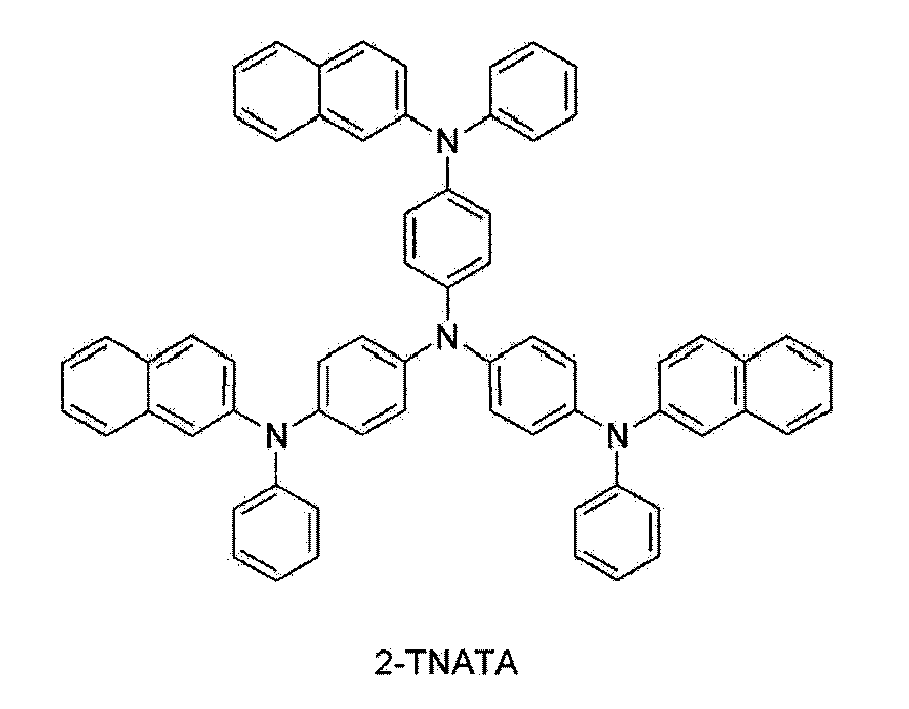
- Then, to another cell of the vacuum vapor-deposit device, charged was N,N'-bis(α-naphthyl)-N,N'-diphenyl-4,4'-diamine (NPB) (of which the structure is shown below), and electric current was applied to the cell to evaporate NPB, thereby providing vapor-deposit of a hole transport layer (4) of 20 nm thickness on the hole injecting layer.

- After forming a hole injecting layer and a hole transport layer, an electroluminescent layer was vapor-deposited as follows. To one cell of said vacuum vapor-deposit device, charged was a compound according to the invention (e.g., Compound 279) as host material (which had been purified via sublimation in vacuo at 10-6 torr), and an electroluminescent dopant compound (e.g., (piq)2Ir(acac)) was charged to another cell. The two substances were evaporated at different rates to carry out doping at a concentration of 4 to 10% by weight, thereby vapor-depositing an electroluminescent layer (5) with 30 nm thickness on the hole transport layer.
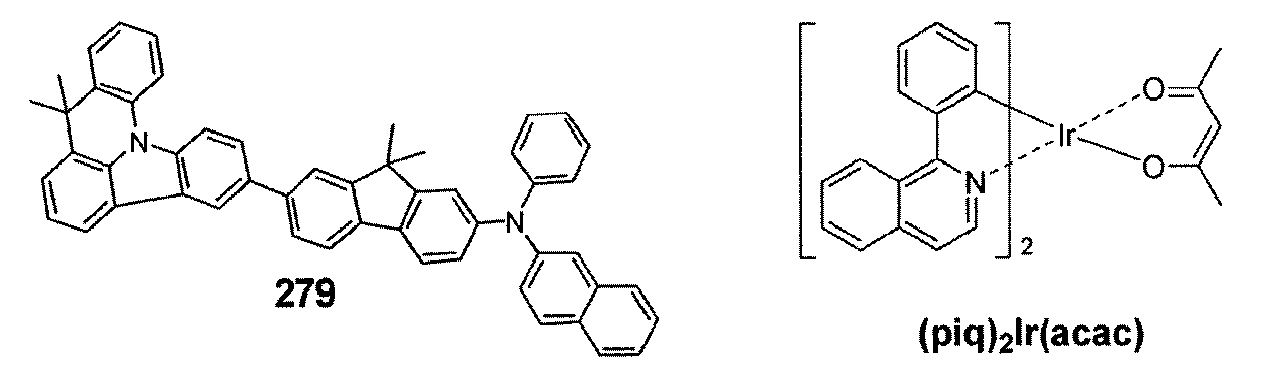
- Then, on the electroluminescent layer, bis(2-methyl-8-quinolinato)(p-phenylphenolato)aluminum (III) (BAlq) was vapor-deposited as a hole blocking layer with a thickness of 5 nm, tris(8-hydroxyquinoline)aluminum (III) (Alq) was vapor-deposited as an electron transport layer (6) with a thickness of 20 nm, and then lithium quinolate (Liq) was vapor-deposited as an electron injecting layer (7) with a thickness of 1 to 2 nm. Thereafter, an Al cathode (8) was vapor-deposited with a thickness of 150 nm by using another vacuum vapor-deposit device to manufacture an OLED.

- An OLED device was manufactured according to the same procedure as in Example 1, but using bis(2-methyl-8-quinolinato)(p-phenylphenolato)aluminum (III) (BAlq) as electroluminescent host material in another cell of the vacuum deposit device, instead of the electroluminescent compound according to the present invention.

- The luminous efficiencies and power efficiencies of the OLED's comprising the organic electroluminescent compound according to the present invention (Example 1) or conventional electroluminescent compound (Comparative Example 1) were measured at 1,000 cd/m2, respectively, and the results are shown in Table 2.
Table 2 No. Host material EL material Hole blocking layer Operation voltage (V) @1,000 cd/m2 Power efficiency (lm/W) @1,000 cd/m2 EL color 1 279 (piq)2Ir(acac) BAlq 6.5 4.4 Red 2 298 (piq)2Ir(acac) BAlq 6.7 4.7 Red 3 592 (piq)2Ir(acac) BAlq 6.5 4.8 Red 4 600 (piq)2Ir(acac) BAlq 6.8 4.4 Red 5 990 (piq)2Ir(acac) BAlq 6.8 4.0 Red 6 1005 (piq)2Ir(acac) BAlq 7.0 4.4 Red 7 1301 (piq)2Ir(acac) BAlq 6.9 4.3 Red 8 1306 (piq)2Ir(acac) BAlq 6.5 4.3 Red 9 1315 (piq)2Ir(acac) BAlq 6.8 4.7 Red 10 1473 (piq)2Ir(acac) BAlq 6.9 4.2 Red Comp.1 BAlq (piq)2Ir(acac) - 7.5 2.6 Red - As can be seen from Table 2, the complexes developed according to the present invention showed better electroluminescent properties than conventional material.
- Thus, the devices employing the electroluminescent compounds as host material exhibit excellent electroluminescent properties with lowered operation voltage to induce increase of power efficiency by 0.8 ∼ 2.2 lm/W with improved power consumption.
- After forming a hole injecting layer (3) according to the same procedure as in Example 1, Compound (394) (of which the structure is shown below) was charged to another cell of the vacuum vapor-deposit device, and electric current was applied to the cell to evaporate the material to vapor-deposit a hole transport layer (4) with a thickness of 20 nm on the hole injecting layer.

- An OLED was manufactured according to the same procedure as in Example 1, otherwise.
- The luminous efficiencies of the OLED's comprising the compound for electronic material according to the present invention (Example 2) or conventional electroluminescent compound (Comparative Example 1) were measured at 5,000 cd/m2, respectively, and the results are shown in Table 3.
Table 3 No. Material of hole transport layer Operation voltage (V) @1,000 cd/m2 Luminous efficiency (cd/A) @1,000 cd/m2 Color 1 Compound 394 5.5 5.4 Red 2 Compound 765 5.4 5.6 Red Comp.1 NPB 6 4.5 Red - It is confirmed that the compounds developed by the present invention exhibit better properties than conventional materials in view of performances.
- An ITO substrate was equipped in a substrate folder of a vacuum vapor-deposit device according to the same procedure as in Example 1. Compound (494) (of which the structure is shown below) was placed in a cell of the vacuum vapor-deposit device, which was then ventilated up to 10-6 torr of vacuum in the chamber. Electric current was applied to the cell to evaporate Compound (494), thereby providing vapor-deposit of a hole injecting layer (3) having 60 nm thickness on the ITO substrate.
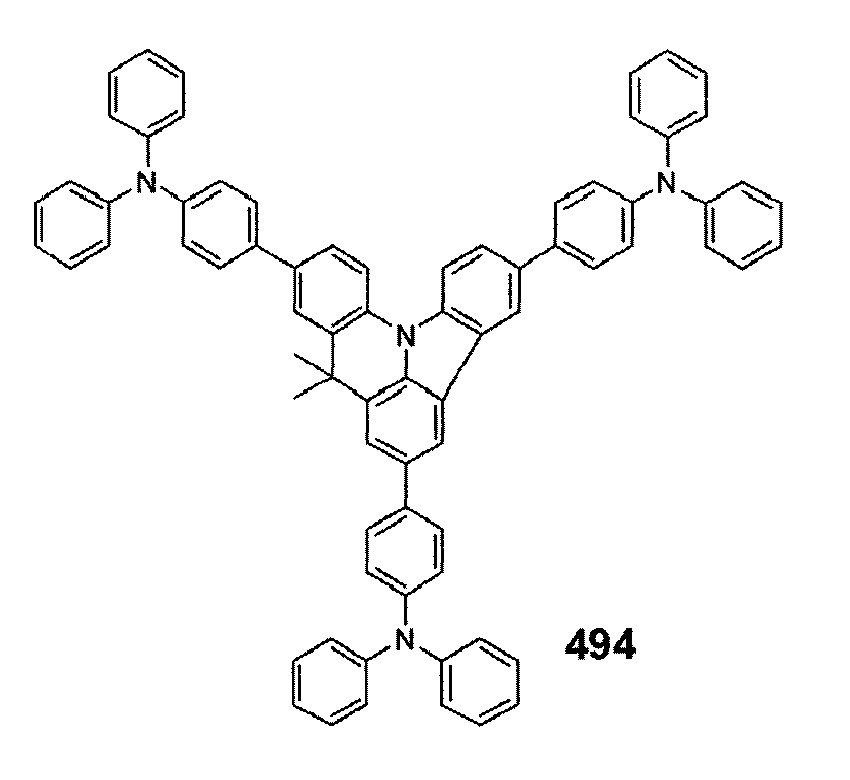
- An OLED was manufactured according to the same procedure as in Example 1, otherwise.
- The luminous efficiencies of the OLED's comprising organic electroluminescent compounds according to the present invention (Example 3) or conventional electroluminescent compound (Comparative Example 1) were measured at 5,000 cd/m2, respectively, and the results are shown in Table 4.
Table 4 No. Material of hole injecting layer Operation voltage (V) @1,000 cd/m2 Luminous efficiency (cd/A) @1,000 cd/m2 Color 1 Compound 494 5.2 5.4 Red 2 Compound 805 5.0 5.6 Red Comp.1 2- TNATA 6 4.5 Red - It is confirmed that the compounds developed by the present invention exhibit better properties than conventional materials in view of performances.
Claims (9)
- A compound for organic electronic material represented by Chemical Formula (1) or (2):

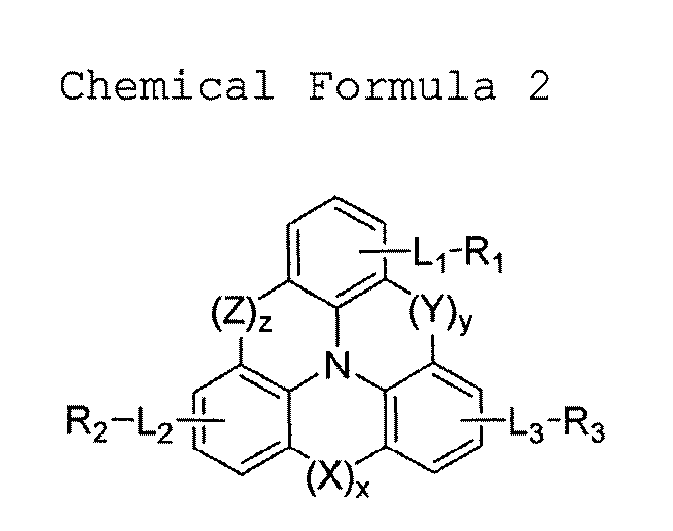 L1, L2 and L3 independently represent a chemical bond, (C6-C60)arylene, (C3-C60)heteroarylene, 5- or 6-membered heterocycloalkylene containing one or more heteroatom(s) selected from N, O and S, (C3-C60)cycloalkylene, adamantylene, (C7-C60)bicycloalkylene, (C2-C60)alkenylene, (C2-C60)alkynylene, (C6-C60)ar(C1-C60)alkylene, (C1-C60)alkyenethio, (C1-C60)alkylenoxy, (C6-C60)arylenoxy or (C6-C60)arylenethio;R1, R2 and R3 independently represent hydrogen, deuterium, (C6-C60)aryl, (C3-C60)heteroaryl, 5- or 6-membered heterocycloalkyl containing one or more heteroatom(s) selected from N, O and S, (C3-C60)cycloalkyl, adamantyl, (C7-C60)bicycloalkyl, (C2-C60)alkenyl, (C2-C60)alkynyl, (C1-C60)alkylthio, (C6-C60)aryloxy, (C6-C60)arylthio, NR11R12, or a substituent selected from the following structures (excluding the case wherein R1, R2 and R3 are hydrogen all at the same time):

 R11 and R12 independently represent (C6-C60)aryl or (C3-C60)heteroaryl, or may be linked via (C3-C60)alkylene or (C3-C60)alkenylene with or without a fused ring to form an alicyclic ring, or a monocyclic or polycyclic aromatic ring;R13 through R30 independently represent hydrogen, deuterium, halogen, (C1-C60)alkyl, (C6-C60)aryl, (C3-C60)heteroaryl, morpholino, thiomorpholino, 5- or 6-membered heterocycloalkyl containing one or more heteroatom(s) selected from N, O and S, (C3-C60)cycloalkyl, tri(C1-C60)alkylsilyl, di(C1-C60)alkyl(C6-C60)arylsil tri(C6-C60)arylsilyl, adamantyl, (C7-C60)bicycloalkyl, (C2-C60)alkenyl, (C2-C60)alkynyl, cyano, (C1-C60)alkylamino, (C6-C60)arylamino, (C6-C60)ar(C1-C60)alkyl, (C1-C60)alkyloxy, (C1-C60)alkylthio, (C6-C60)aryloxy, (C6-C60)arylthio, (C1-C60)alkoxycarbon (C1-C60)alkylcarbonyl, (C6-C60)arylcarbonyl, carboxyl, nitro or hydroxyl, or each of R13 through R25 may be linked to an adjacent substituent via (C3-C60)alkylene or (C3-C60)alkenylene with or without a fused ring to form an alicyclic ring, or a monocyclic or polycyclic aromatic ring;A, B, X, Y and Z independently represent a chemical bond, or -(CR31R32)a-, -N(R33)-, -S-, -O-, -Si(R34)(R35)-, -P(R36)-, - C(=O)-, -B(R37)-, -In(R38)-, -Se-, -Ge(R39)(R40)-, -Sn(R41)(R42)-, -Ga(R43)- or -(R44)C=C(R45)-;R31 through R45 independently represent hydrogen, deuterium, halogen, (C1-C60)alkyl, (C6-C60) aryl, (C3-C60)heteroaryl, morpholino, thiomorpholino, 5- or 6-membered heterocycloalkyl containing one or more heteroatom(s) selected from N, O and S, (C3-C60)cycloalkyl, tri(C1-C60)alkylsilyl, di(C1-C60)alkyl(C6-C60)arylsilyl, tri(C6-C60)arylsilyl, adamantyl, (C7-C60)bicycloalkyl, (C2-C60)alkenyl, (C2-C60)alkynyl, cyano, (C1-C60)alkylamino, (C6-C60)arylamino, (C6-C60)ar(C1-C60)alkyl, (C1-C60)alkyloxy, (C1-C60)alkylthio, (C6-C60)aryloxy, (C6-C60)arylthio, (C1-C60)alkoxycarbonyl, (C1-C60)alkylcarbonyl, (C6-C60)arylcarbonyl, carboxyl, nitro or hydroxyl, or R31 and R32, R34 and R35, R39 and R40, R41 and R42, or R44 and R45 may be linked via (C3-C60)alkylene or (C3-C60)alkenylene with or without a fused ring to form an alicyclic ring, or a monocyclic or polycyclic aromatic ring;the arylene, heteroarylene, arylenoxy or arylenethio of L1, L2 and L3; the aryl or heteroaryl of R1, R2, R3, R11 and R12; or the alkyl, aryl, heteroaryl, heterocycloalkyl, cycloalkyl, trialkylsilyl, dialkylarylsilyl, triarylsilyl, adamantyl, bicycloalkyl, alkenyl, alkynyl, aralkyl, alkyloxy, alkylthio, aryloxy, arylthio, alkylamino, arylamino, alkoxycarbonyl, alkylcarbonyl or arylcarbonyl of R13 through R30 and R31 through R45 may be further substituted by one or more substituent(s) selected from a group consisting of deuterium, halogen, (C1-C60)alkyl with or without halogen substituent(s), (C6-C60)aryl, (C3-C60)heteroaryl with or without (C6-C60)aryl substituent(s), morpholino, thiomorpholino, 5- or 6-membered heterocycloalkyl containing one or more heteroatom(s) selected from N, O and S, (C3-C60)cycloalkyl, tri(C1-C60)alkylsil di(C1-C60)alkyl(C6-C60)arylsilyl, tri(C6-C60)arylsilyl, adamantyl, (C7-C60)bicycloalkyl, (C2-C60)alkenyl, (C2-C60)alkynyl, cyano, carbazolyl, (C1-C60)alkylamino, (C6-C60)arylamino, (C6-C60)ar(C1-C60)alkyl, (C1-C60)alkyl(C6-C60)aryl, (C1-C60)alkyloxy, (C1-C60)alkylthio, (C6-C60)aryloxy, (C6-C60)arylthio, (C1-C60)alkoxycarbonyl, (C1-C60)alkylcarbonyl, (C6-C60)arylcarbonyl, carboxyl, nitro and hydroxyl; anda, x, y and z independently represent an integer from 0 to 4;but excluding the case wherein R1-L1-, R2-L2- or R3-L3-independently represents diphenylamino group (-NPh2).
 - The compound for organic electronic material according to claim 1, which is selected from the compounds represented by Chemical Formulas (3) to (6):

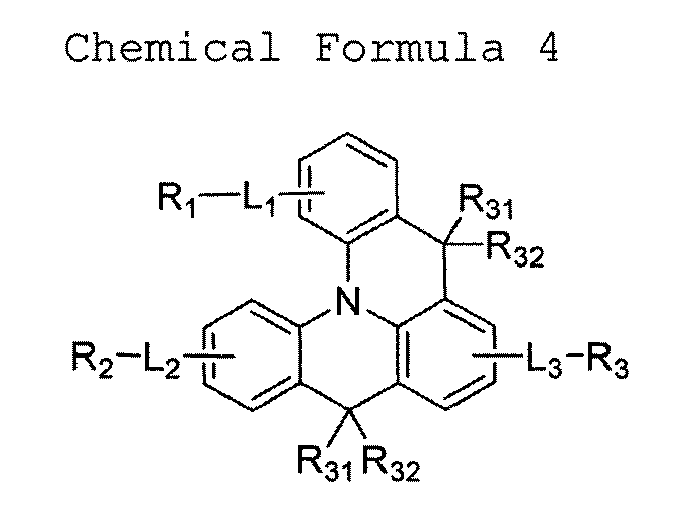

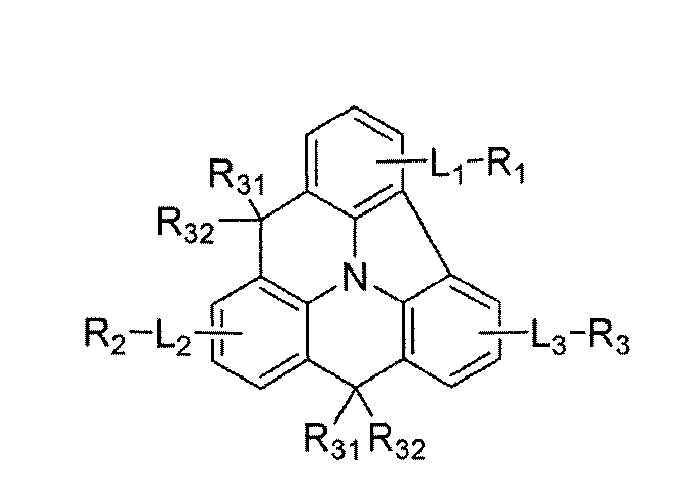

- The compound for organic electronic material according to claim 2, wherein R1, R2 and R3 independently represent hydrogen, deuterium or NR11R12, or a substituent selected from the following structures:


 wherein, R11 and R12 are defined as in claim 1;R51 through R64 independently represent hydrogen, deuterium, halogen, (C1-C60)alkyl, halo(C1-C60)alkyl, (C6-C60)aryl, (C3-C60)heteroaryl, 5- or 6-membered heterocycloalkyl containing one or more heteroatom(s) selected from N, O and S, (C3-C60)cycloalkyl, tri(C1-C60)alkylsilyl, di(C1-C60)alkyl(C6-C60)arylsilyl, tri(C6-C60)arylsilyl, adamantyl, (C7-C60)bicycloalkyl, (C2-C60)alkenyl, (C2-C60)alkynyl, cyano, (C1-C60)alkylamino, (C6-C60)arylamino, (C6-C60)ar(C1-C60)alkyl, (C1-C60)alkyl(C6-C60)aryl, (C1-C60)alkyloxy, (C1-C60)alkylthio, (C6-C60)aryloxy, (C6-C60)arylthio, (C1-C60)alkoxycarbonyl, (C1-C60)alkylcarbonyl, (C6-C60)arylcarbonyl, carboxyl, nitro or hydroxyl;A and B independently represent -C(R31)(R32)-, -N(R33)-, - S-, -O-, -Si(R34)(R35)-, -P(R36)-, -C(=O)-, -B(R37)-, -In(R38)-, - Se-, -Ge(R39)(R40)-, -Sn(R41)(R42)-, -Ga(R43)- or -(R44)C=C(R45)-;R31 through R45 independently represent hydrogen, deuterium, halogen, (C1-C60)alkyl, (C6-C60)aryl, (C3-C60)heteroaryl, morpholino, thiomorpholino, 5- or 6-membered heterocycloalkyl containing one or more heteroatom(s) selected from N, O and S, (C3-C60)cycloalkyl, tri(C1-C60)alkylsilyl, di(C1-C60)alkyl(C6-C60)arylsilyl, tri(C6-C60)arylsilyl, adamantyl, (C7-C60)bicycloalkyl, (C2-C60)alkenyl, (C2-C60)alkynyl, cyano, (C1-C60)alkylamino, (C6-C60)arylamino, (C6-C60)ar(C1-C60)alkyl, (C1-C60)alkyloxy, (C1-C60)alkylthio, (C6-C60)aryloxy, (C6-C60)arylthio, (C1-C60)alkoxycarbonyl, (C1-C60)alkylcarbonyl, (C6-C60)arylcarbonyl, carboxyl, nitro or hydroxyl, or R31 and R32, R34 and R35, R39 and R40, R41 and R42, or R44 and R45 may be linked via (C3-C60)alkylene or (C3-C60)alkenylene with or without a fused ring to form an alicyclic ring, or a monocyclic or polycyclic aromatic ring;the alkyl, aryl, heteroaryl, heterocycloalkyl, cycloalkyl, trialkylsilyl, dialkylarylsilyl, triarylsilyl, adamantyl, bicycloalkyl, alkenyl, alkynyl, alkylamino or arylamino of R31 through R45 and R51 through R64 may be further substituted by deuterium, halogen, (C1-C60)alkyl, (C6-C60)aryl, (C3-C60)heteroaryl, 5- or 6-membered heterocycloalkyl containing one or more heteroatom(s) selected from N, O and S, (C3-C60)cycloalkyl, tri(C1-C60)alkylsilyl, di(C1-C60)alkyl(C6-C60)arylsilyl, tri(C6-C60)arylsilyl, adamantyl, (C7-C60)bicycloalkyl, (C2-C60)alkenyl, (C2-C60)alkynyl, (C1-C60)alkoxy, (C1-C60)alkylthio, cyano, (C1-C60)alkylamino, (C6-C60)arylamino, (C6-C60)ar(C1-C60)alkyl, (C6-C60)aryloxy, (C6-C60)arylthio, (C6-C60)arylcarbonyl, (C1-C60)alkoxycarbonyl, (C1-C60)alkylcarbonyl, carboxyl, nitro or hydroxyl;b represents an integer from 1 to 5; c represents an integer from 1 to 4; and d represents an integer from 1 to 3.
 - An organic electronic device which is comprised of a first electrode, a second electrode, and at least one organic layer(s) interposed between the first electrode and the second electrode;
wherein the organic layer comprises an organic electronic material represented by Chemical Formula (1) or (2):
 L1, L2 and L3 independently represent a chemical bond, (C6-C60)arylene, (C3-C60)heteroarylene, 5- or 6-membered heterocycloalkylene containing one or more heteroatom(s) selected from N, O and S, (C3-C60)cycloalkylene, adamantylene, (C7-C60)bicycloalkylene, (C2-C60)alkenylene, (C2-C60)alkynylene, (C6-C60)ar(C1-C60)alkylen (C1-C60)alkyenethio, (C1-C60)alkylenoxy, (C6-C60)arylenoxy or (C6-C60)arylenethio;R1, R2 and R3 independently represent hydrogen, deuterium, (C6-C60)aryl, (C3-C60)heteroaryl, 5- or 6-membered heterocycloalkyl containing one or more heteroatom(s) selected from N, O and S, (C3-C60)cycloalkyl, adamantyl, (C7-C60)bicycloalkyl, (C2-C60)alkenyl, (C2-C60)alkynyl, (C1-C60)alkylthio, (C6-C60)aryloxy, (C6-C60)arylthio, NR11R12, or a substituent selected from the following structures (excluding the case wherein R1, R2 and R3 are hydrogen all at the same time):

 R11 and R12 independently represent (C6-C60)aryl or (C3-C60)heteroaryl, or may be linked via (C3-C60)alkylene or (C3-C60)alkenylene with or without a fused ring to form an alicyclic ring, or a monocyclic or polycyclic aromatic ring;R13 through R30 independently represent hydrogen, deuterium, halogen, (C1-C60)alkyl, (C6-C60)aryl, (C3-C60)heteroaryl, morpholino, thiomorpholino, 5- or 6-membered heterocycloalkyl containing one or more heteroatom(s) selected from N, O and S, (C3-C60)cycloalkyl, tri(C1-C60)alkylsilyl, di(C1-C60)alkyl(C6-C60)arylsilyl, tri(C6-C60)arylsilyl, adamantyl, (C7-C60)bicycloalkyl, (C2-C60)alkenyl, (C2-C60)alkynyl, cyano, (C1-C60)alkylamino, (C6-C60)arylamino, (C6-C60)ar(C1-C60)alkyl, (C1-C60)alkyloxy, (C1-C60)alkylthio, (C6-C60)aryloxy, (C6-C60)arylthio, (C1-C60)alkoxycarbonyl, (C1-C60)alkylcarbo (C6-C60)arylcarbonyl, carboxyl, nitro or hydroxyl, or each of R13 through R25 may be linked to an adjacent substituent via (C3-C60)alkylene or (C3-C60)alkenylene with or without a fused ring to form an alicyclic ring, or a monocyclic or polycyclic aromatic ring;A, B, X, Y and Z independently represent a chemical bond, or -(CR31R32)a-, -N(R33)-, -S-, -O-, -Si(R34)(R35)-, -P(R36)-, - C(=O)-, -B(R37)-, -In(R38)-, -Se-, -Ge(R39)(R40)-, -Sn(R41)(R42)-, -Ga(R43)- or -(R44)C=C(R45)-;R31 through R45 independently represent hydrogen, deuterium, halogen, (C1-C60)alkyl, (C6-C60)aryl, (C3-C60)heteroaryl, morpholino, thiomorpholino, 5- or 6-membered heterocycloalkyl containing one or more heteroatom(s) selected from N, O and S, (C3-C60)cycloalkyl, tri(C1-C60)alkylsiyl, di(C1-C60)alkyl(C6-C60)arylsilyl, tri(C6-C60)arylsilyl, adamantyl, (C7-C60)bicycloalkyl, (C2-C60)alkenyl, (C2-C60)alkynyl, cyano, (C1-C60)alkylamino, (C6-C60)arylamino, (C6-C60)ar(C1-C60)alkyl, (C1-C60)alkyloxy, (C1-C60)alkylthio, (C6-C60)aryloxy, (C6-C60)arylthio, (C1-C60)alkoxycarbonyl, (C1-C60)alkylcarbonyl, (C6-C60)arylcarbonyl, carboxyl, nitro or hydroxyl, or R31 and R32, R34 and R35, R39 and R40, R41 and R42, or R44 and R45 may be linked via (C3-C60)alkylene or (C3-C60)alkenylene with or without a fused ring to form an alicyclic ring, or a monocyclic or polycyclic aromatic ring;the arylene, heteroarylene, arylenoxy or arylenethio of L1, L2 and L3; the aryl or heteroaryl of R1, R2, R3, R11 and R12; or the alkyl, aryl, heteroaryl, heterocycloalkyl, cycloalkyl, trialkylsilyl, dialkylarylsilyl, triarylsilyl, adamantyl, bicycloalkyl, alkenyl, alkynyl, aralkyl, alkyloxy, alkylthio, aryloxy, arylthio, alkylamino, arylamino, alkoxycarbonyl, alkylcarbonyl or arylcarbonyl of R13 through R30 and R31 through R45 may be further substituted by one or more substituent(s) selected from a group consisting of deuterium, halogen, (C1-C60)alkyl with or without halogen substituent(s), (C6-C60)aryl, (C3-C60)heteroaryl with or without (C6-C60)aryl substituent(s), morpholino, thiomorpholino, 5- or 6-membered heterocycloalkyl containing one or more heteroatom(s) selected from N, O and S, (C3-C60)cycloalkyl, tri(C1-C60)alkylsilyl, di(C1-C60)alkyl(C6-C60)arylsilyl, tri(C6-C60)arylsilyl, adamantyl, (C7-C60)bicycloalkyl, (C2-C60)alkenyl, (C2-C60)alkynyl, cyano, carbazolyl, (C1-C60)alkylamino, (C6-C60)arylamino, (C6-C60)ar(C1-C60)alkyl, (C1-C60)alkyl(C6-C60)aryl, (C1-C60)alkyloxy, (C1-C60)alkylthio, (C6-C60)aryloxy, (C6-C60)arylthio, (C1-C60)alkoxycarbonyl, (C1-C60)alkylcarbonyl, (C6-C60)arylcarbonyl, carboxyl, nitro and hydroxyl; anda, x, y and z independently represent an integer from 0 to 4;but excluding the case wherein R1-L1-, R2-L2- or R3-L3-independently represents diphenylamino group (-NPh2) and one or more dopant(s) represented by Chemical Formula (7):
Chemical Formula 7 M1L101L102L103
wherein, M1 is selected from a group consisting of metals of Group 7, 8, 9, 10, 11, 13, 14, 15 and 16 in the Periodic Table of Elements, and ligands L101, L102 and L103 are independently selected from the following structures:
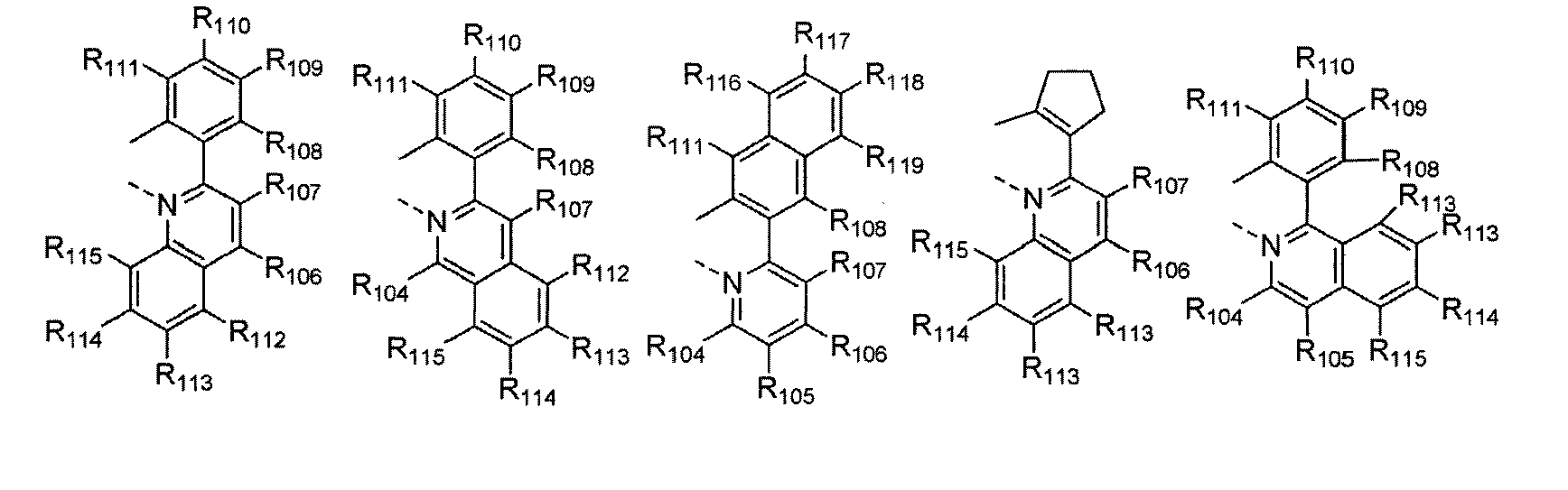


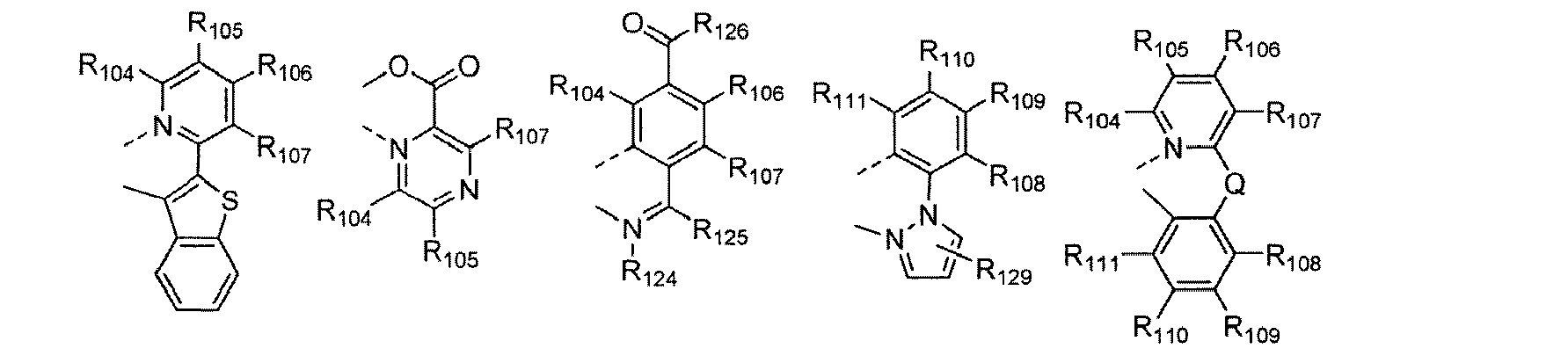 wherein, R101 through R103 independently represent hydrogen, deuterium, (C1-C60)alkyl with or without halogen substituent(s), (C6-C60)aryl with or without (C1-C60)alkyl substituent(s), or halogen;R104 through R119 independently represent hydrogen, deuterium, (C1-C60)alkyl, (C1-C30)alkyloxy, (C3-C60)cycloalkyl, (C2-C30)alkenyl, (C6-C60)aryl, mono or di(C1-C30)alkylamino, mono or di(C6-C30)arylamino, SF5, tri(C1-C30)alkylsilyl, di(C1-C30)alkyl(C6-C30)arylsilyl, tri(C6-C30)arylsilyl, cyano or halogen; the alkyl, cycloalkyl, alkenyl or aryl of R104 through R119 may be further substituted by one or more substituent(s) selected from deuterium, (C1-C60)alkyl, (C6-C60)aryl and halogen;R120 through R123 independently represent hydrogen, deuterium, (C1-C60)alkyl with or without halogen substituent(s), or (C6-C60)aryl with or without (C1-C60)alkyl substituent(s);R124 and R125 independently represent hydrogen, deuterium, (C1-C60)alkyl, (C6-C60) aryl or halogen, or R124 and R125 may be linked via (C3-C12)alkylene or (C3-C12)alkenylene with or without a fused ring to form an alicyclic ring, or a monocyclic or polycyclic aromatic ring; the alkyl or aryl of R124 and R125, or the alicyclic ring or the monocyclic or polycyclic aromatic ring formed therefrom by linkage via (C3-C12)alkylene or (C3-C12)alkenylene with or without a fused ring may be further substituted by one or more substituent(s) selected from deuterium, (C1-C60)alkyl with or without halogen substituent(s), (C1-C30)alkyloxy, halogen, tri(C1-C30)alkylsilyl, tri(C6-C30)arylsilyl and (C6-C60)aryl;R126 represents (C1-C60)alkyl, (C6-C60)aryl, (C5-C60)heteroaryl or halogen;R127 through R129 independently represent hydrogen, deuterium, (C1-C60)alkyl, (C6-C60)aryl or halogen; the alkyl or aryl of R126 through R129 may be further substituted by halogen or (C1-C60)alkyl; andQ represents

- The organic electronic device according to claim 4, wherein the organic layer comprises one or more compound(s) selected from a group consisting of arylamine compounds and styrylarylamine compounds.
- The organic electronic device according to claim 4, which comprises one or more metal(s) selected from a group consisting of organometals of Group 1, Group 2, 4th period and 5th period transition metals, lanthanide metals and d-transition elements in the Periodic Table of Elements.
- The organic electronic device according to claim 4, wherein the organic layer comprises an electroluminescent layer and a charge generating layer.
- A white electroluminescent device comprising an organic electroluminescent compound represented by Chemical Formula (1) or (2):

 L1, L2 and L3 independently represent a chemical bond, (C6-C60)arylene, (C3-C60)heteroarylene, 5- or 6-membered heterocycloalkylene containing one or more heteroatom(s) selected from N, O and S, (C3-C60)cycloalkylene, adamantylene, (C7-C60)bicycloalkylene, (C2-C60)alkenylene, (C2-C60)alkynylene, (C6-C60)ar(C1-C60)alkylene, (C1-C60)alkyenethio, (C1-C60)alkylenoxy, (C6-C60)arylenoxy or (C6-C60)arylenethio;R1, R2 and R3 independently represent hydrogen, deuterium, (C6-C60)aryl, (C3-C60)heteroaryl, 5- or 6-membered heterocycloalkyl containing one or more heteroatom(s) selected from N, O and S, (C3-C60)cycloalkyl, adamantyl, (C7-C60)bicycloalkyl, (C2-C60)alkenyl, (C2-C60)alkynyl, (C1-C60)alkylthio, (C6-C60)aryloxy, (C6-C60)arylthio, NR11R12, or a substituent selected from the following structures (excluding the case wherein R1, R2 and R3 are hydrogen all at the same time) :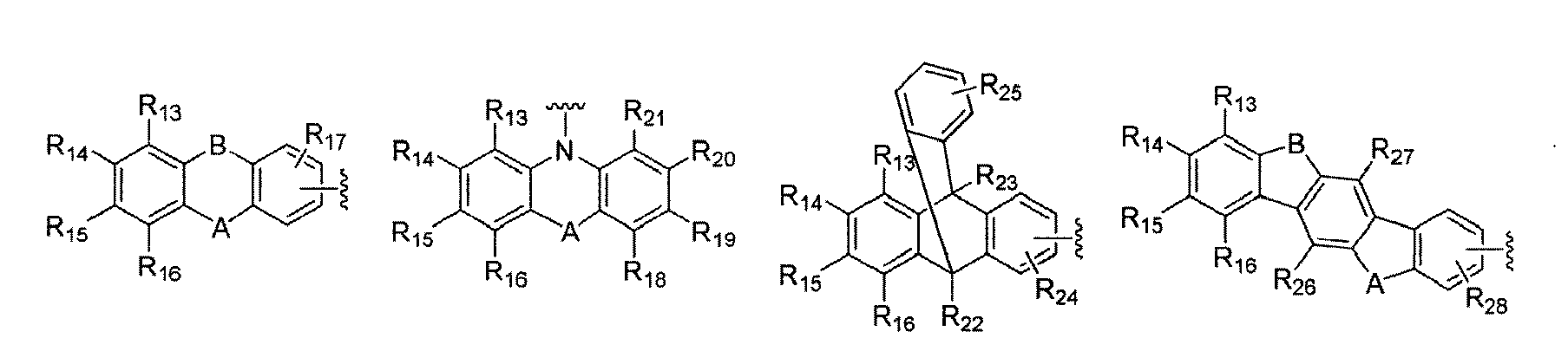

 R11 and R12 independently represent (C6-C60)aryl or (C3-C60)heteroaryl, or may be linked via (C3-C60)alkylene or (C3-C60)alkenylene with or without a fused ring to form an alicyclic ring, or a monocyclic or polycyclic aromatic ring;R13 through R30 independently represent hydrogen, deuterium, halogen, (C1-C60)alkyl, (C6-C60)aryl, (C3-C60)heteroaryl, morpholino, thiomorpholino, 5- or 6-membered heterocycloalkyl containing one or more heteroatom(s) selected from N, O and S, (C3-C60)cycloalkyl, tri(C1-C60)alkylsilyl, di(C1-C60)alkyl(C6-C60)arylsilyl, tri(C6-C60)arylsilyl, adamantyl, (C7-C60)bicycloalkyl, (C2-C60)alkenyl, (C2-C60)alkynyl, cyano, (C1-C60)alkylamino, (C6-C60)arylamino, (C6-C60)ar(C1-C60)alkyl, (C1-C60)alkyloxy, (C1-C60)alkylthio, (C6-C60)aryloxy, (C6-C60)arylthio, (C1-C60)alkoxycarbonyl, (C1-C60)alkylcarbonyl, (C6-C60)arylcarbonyl, carboxyl, nitro or hydroxyl, or each of R13 through R25 may be linked to an adjacent substituent via (C3-C60)alkylene or (C3-C60)alkenylene with or without a fused ring to form an alicyclic ring, or a monocyclic or polycyclic aromatic ring;A, B, X, Y and Z independently represent a chemical bond, or -(CR31R32)a-, -N(R33)-, -S-, -O-, -Si(R34)(R35)-, -P(R36)-, - C(=O)-, -B(R37)-, -In(R38)-, -Se-, -Ge(R39)(R40)-, -Sn(R41)(R42)-, -Ga(R43)- or -(R44)C=C(R45)-;R31 through R45 independently represent hydrogen, deuterium, halogen, (C1-C60)alkyl, (C6-C60)aryl, (C3-C60)heteroaryl, morpholino, thiomorpholino, 5- or 6-membered heterocycloalkyl containing one or more heteroatom(s) selected from N, O and S, (C3-C60)cycloalkyl, tri(C1-C60)alkylsilyl, di(C1-C60)alkyl(C6-C60)arylsilyl, tri(C6-C60)arylsilyl, adamantyl, (C7-C60)bicycloalkyl, (C2-C60)alkenyl, (C2-C60)alkynyl, cyano, (C1-C60)alkylamino, (C6-C60)arylamino, (C6-C60)ar(C1-C60)alkyl, (C1-C60)alkyloxy, (C1-C60)alkylthio, (C6-C60)aryloxy, (C6-C60)arylthio, (C1-C60)alkoxycarbonyl, (C1-C60)alkylcarbonyl, (C6-C60)arylcarbonyl, carboxyl, nitro or hydroxyl, or R31 and R32, R34 and R35, R39 and R40, R41 and R42, or R44 and R45 may be linked via (C3-C60)alkylene or (C3-C60)alkenylene with or without a fused ring to form an alicyclic ring, or a monocyclic or polycyclic aromatic ring;the arylene, heteroarylene, arylenoxy or arylenethio of L1, L2 and L3; the aryl or heteroaryl of R1, R2, R3, R11 and R12; or the alkyl, aryl, heteroaryl, heterocycloalkyl, cycloalkyl, trialkylsilyl, dialkylarylsilyl, triarylsilyl, adamantyl, bicycloalkyl, alkenyl, alkynyl, aralkyl, alkyloxy, alkylthio, aryloxy, arylthio, alkylamino, arylamino, alkoxycarbonyl, alkylcarbonyl or arylcarbonyl of R13 through R30 and R31 through R45 may be further substituted by one or more substituent(s) selected from a group consisting of deuterium, halogen, (C1-C60)alkyl with or without halogen substituent(s), (C6-C60) aryl, (C3-C60)heteroaryl with or without (C6-C60)aryl substituent(s), morpholino, thiomorpholino, 5- or 6-membered heterocycloalkyl containing one or more heteroatom(s) selected from N, O and S, (C3-C60)cycloalkyl, tri(C1-C60)alkylsilyl, di(C1-C60)alkyl(C6-C60)arylsilyl, tri(C6-C60)arylsilyl, adamantyl, (C7-C60)bicycloalkyl, (C2-C60)alkenyl, (C2-C60)alkynyl, cyano, carbazolyl, (C1-C60)alkylamino, (C6-C60)arylamino, (C6-C60)ar(C1-C60)alkyl, (C1-C60)alkyl(C6-C60)aryl, (C1-C60)alkyloxy, (C1-C60)alkylthio, (C6-C60)aryloxy, (C6-C60)arylthio, (C1-C60)alkoxycarbonyl, (C1-C60)alkylcarbonyl, (C6-C60)arylcarbonyl, carboxyl, nitro and hydroxyl; anda, x, y and z independently represent an integer from 0 to 4;but excluding the case wherein R1-L1-, R2-L2- or R3-L3-independently represents diphenylamino group (-NPh2).
 - An organic solar cell comprising an compound for organic electronic material represented by Chemical Formula (1) or (2) :

 L1, L2 and L3 independently represent a chemical bond, (C6-C60)arylene, (C3-C60)heteroarylene, 5- or 6-membered heterocycloalkylene containing one or more heteroatom(s) selected from N, O and S, (C3-C60)cycloalkylene, adamantylene, (C7-C60)bicycloalkylene, (C2-C60)alkenylene, (C2-C60)alkynylene, (C6-C60)ar(C1-C60)alkylene, (C1-C60)alkyenethio, (C1-C60)alkylenoxy, (C6-C60)arylenoxy or (C6-C60)arylenethio;R1, R2 and R3 independently represent hydrogen, deuterium, (C6-C60)aryl, (C3-C60)heteroaryl, 5- or 6-membered heterocycloalkyl containing one or more heteroatom(s) selected from N, O and S, (C3-C60)cycloalkyl, adamantyl, (C7-C60)bicycloalkyl, (C2-C60)alkenyl, (C2-C60)alkynyl, (C1-C60)alkylthio, (C6-C60)aryloxy, (C6-C60)arylthio, NR11R12, or a substituent selected from the following structures (excluding the case wherein R1, R2 and R3 are hydrogen all at the same time) :

 R11 and R12 independently represent (C6-C60)aryl or (C3-C60)heteroaryl, or may be linked via (C3-C60)alkylene or (C3-C60)alkenylene with or without a fused ring to form an alicyclic ring, or a monocyclic or polycyclic aromatic ring;R13 through R30 independently represent hydrogen, deuterium, halogen, (C1-C60)alkyl, (C6-C60)aryl, (C3-C60)heteroaryl, morpholino, thiomorpholino, 5- or 6-membered heterocycloalkyl containing one or more heteroatom(s) selected from N, O and S, (C3-C60)cycloalkyl, tri(C1-C60)alkylsilyl, di(C1-C60)alkyl(C6-C60)arylsilyl, tri(C6-C60)arylsilyl, adamantyl, (C7-C60)bicycloalkyl, (C2-C60)alkenyl, (C2-C60)alkynyl, cyano, (C1-C60)alkylamino, (C6-C60)arylamino, (C6-C60)ar(C1-C60)alkyl, (C1-C60)alkyloxy, (C1-C60)alkylthio, (C6-C60)aryloxy, (C6-C60)arylthio, (Cl-C60)alkoxycarbonyl, (C1-C60)alkylcarbonyl, (C6-C60)arylcarbonyl, carboxyl, nitro or hydroxyl, or each of R13 through R25 may be linked to an adjacent substituent via (C3-C60)alkylene or (C3-C60)alkenylene with or without a fused ring to form an alicyclic ring, or a monocyclic or polycyclic aromatic ring;A, B, X, Y and Z independently represent a chemical bond, or -(CR31R32)a-, -N(R33)-, -S-, -O-, -Si(R34)(R35)-, -P(R36)-, - C(=O)-, -B(R37)-, -In(R38)-, -Se-, -Ge(R39)(R40)-, -Sn(R41)(R42)-, -Ga(R43)- or -(R44)C=C(R45)-;R31 through R45 independently represent hydrogen, deuterium, halogen, (C1-C60)alkyl, (C6-C60)aryl, (C3-C60)heteroaryl, morpholino, thiomorpholino, 5- or 6-membered heterocycloalkyl containing one or more heteroatom(s) selected from N, O and S, (C3-C60)cycloalkyl, tri(C1-C60)alkylsilyl, di(C1-C60)alkyl(C6-C60)arylsilyl, tri(C6-C60)arylsilyl, adamantyl, (C7-C60)bicycloalkyl, (C2-C60)alkenyl, (C2-C60)alkynyl, cyano, (C1-C60)alkylamino, (C6-C60)arylamino, (C6-C60)ar(C1-C60)alkyl, (C1-C60)alkyloxy, (C1-C60)alkylthio, (C6-C60)aryloxy, (C6-C60)arylthio, (C1-C60)alkoxycarbonyl, (C1-C60)alkylcarbonyl, (C6-C60)arylcarbonyl, carboxyl, nitro or hydroxyl, or R31 and R32, R34 and R35, R39 and R40, R41 and R42, or R44 and R45 may be linked via (C3-C60)alkylene or (C3-C60)alkenylene with or without a fused ring to form an alicyclic ring, or a monocyclic or polycyclic aromatic ring;the arylene, heteroarylene, arylenoxy or arylenethio of L1, L2 and L3; the aryl or heteroaryl of R1, R2, R3, R11 and R12; or the alkyl, aryl, heteroaryl, heterocycloalkyl, cycloalkyl, trialkylsilyl, dialkylarylsilyl, triarylsilyl, adamantyl, bicycloalkyl, alkenyl, alkynyl, aralkyl, alkyloxy, alkylthio, aryloxy, arylthio, alkylamino, arylamino, alkoxycarbonyl, alkylcarbonyl or arylcarbonyl of R13 through R30 and R31 through R45 may be further substituted by one or more substituent(s) selected from a group consisting of deuterium, halogen, (C1-C60)alkyl with or without halogen substituent(s), (C6-C60)aryl, (C3-C60)heteroaryl with or without (C6-C60)aryl substituent(s), morpholino, thiomorpholino, 5- or 6-membered heterocycloalkyl containing one or more heteroatom(s) selected from N, O and S, (C3-C60)cycloalkyl, tri(C1-C60)alkylsil di(C1-C60)alkyl(C6-C60)arylsilyl, tri(C6-C60)arylsilyl, adamantyl, (C7-C60)bicycloalkyl, (C2-C60)alkenyl, (C2-C60)alkynyl, cyano, carbazolyl, (C1-C60)alkylamino, (C6-C60)arylamino, (C6-C60)ar(C1-C60)alkyl, (C1-C60)alkyl(C6-C60)aryl, (C1-C60)alkyloxy, (C1-C60)alkylthio, (C6-C60)aryloxy, (C6-C60)arylthio, (C1-C60)alkoxycarbonyl, (C1-C60)alkylcarbonyl, (C6-C60)arylcarbonyl, carboxyl, nitro and hydroxyl; anda, x, y and z independently represent an integer from 0 to 4;but excluding the case wherein R1-L1-, R2-L2- or R3-L3-independently represents diphenylamino group (-NPh2).
Applications Claiming Priority (1)
| Application Number | Priority Date | Filing Date | Title |
|---|---|---|---|
| KR1020080107606A KR101506919B1 (en) | 2008-10-31 | 2008-10-31 | Novel compounds for organic electronic material and organic electronic device using the same |
Publications (2)
| Publication Number | Publication Date |
|---|---|
| EP2182040A2 true EP2182040A2 (en) | 2010-05-05 |
| EP2182040A3 EP2182040A3 (en) | 2011-06-22 |
Family
ID=41611302
Family Applications (1)
| Application Number | Title | Priority Date | Filing Date |
|---|---|---|---|
| EP09156604A Withdrawn EP2182040A3 (en) | 2008-10-31 | 2009-03-30 | Aromatic compounds and organic electronic device using the same |
Country Status (6)
| Country | Link |
|---|---|
| EP (1) | EP2182040A3 (en) |
| JP (1) | JP2012507507A (en) |
| KR (1) | KR101506919B1 (en) |
| CN (2) | CN102203212A (en) |
| TW (1) | TW201114770A (en) |
| WO (1) | WO2010050778A1 (en) |
Cited By (39)
| Publication number | Priority date | Publication date | Assignee | Title |
|---|---|---|---|---|
| WO2011042107A3 (en) * | 2009-10-08 | 2011-06-16 | Merck Patent Gmbh | Materials for organic electroluminescent devices |
| US20120292576A1 (en) * | 2010-01-25 | 2012-11-22 | Merck Patent Gmbh | Compounds for electronic devices |
| WO2013017192A1 (en) * | 2011-08-03 | 2013-02-07 | Merck Patent Gmbh | Materials for electronic devices |
| JP2013193972A (en) * | 2012-03-16 | 2013-09-30 | Tosoh Corp | Arylamine compound, method for producing the same, and application thereof |
| WO2014008967A3 (en) * | 2012-07-10 | 2014-03-06 | Merck Patent Gmbh | Materials for organic electroluminescent devices |
| WO2014067598A1 (en) * | 2012-10-13 | 2014-05-08 | Merck Patent Gmbh | Aromatic aza-bicyclic compounds comprising cu, ag, au, zn, al for use in electroluminescent devices |
| US9000171B2 (en) | 2012-11-19 | 2015-04-07 | Samsung Display Co., Ltd. | Organic electroluminescence material including a substituted acridine compound and organic electroluminescence device including the same |
| EP2896660A1 (en) * | 2014-01-16 | 2015-07-22 | Ecole Polytechnique Federale De Lausanne (Epfl) | Hole transporting and light absorbing material for solid state solar cells |
| WO2015167300A1 (en) * | 2014-05-02 | 2015-11-05 | Rohm And Haas Electronic Materials Korea Ltd. | Organic electroluminescent compound and organic electroluminescent device comprising the same |
| US9266851B2 (en) | 2009-10-16 | 2016-02-23 | Idemitsu Kosan Co., Ltd. | Fluorene-containing aromatic compound, material for organic electroluminescent element, and organic electroluminescent element using same |
| CN105348300A (en) * | 2015-11-10 | 2016-02-24 | 中节能万润股份有限公司 | Organic photoelectric material and applications thereof |
| EP3029036A1 (en) * | 2014-12-05 | 2016-06-08 | Solvay SA | Acridine derivatives and their use in organic electronic devices |
| WO2016091353A1 (en) * | 2014-12-12 | 2016-06-16 | Merck Patent Gmbh | Organic compounds with soluble groups |
| DE102015108002A1 (en) * | 2015-01-20 | 2016-07-21 | Cynora Gmbh | Composition for use in optoelectronic devices |
| US9466800B2 (en) | 2009-04-24 | 2016-10-11 | Idemitsu Kosan Co., Ltd. | Aromatic amine derivative, and organic electroluminescent element comprising the same |
| WO2016191803A1 (en) * | 2015-05-29 | 2016-12-08 | Commonwealth Scientific And Industrial Research Organisation | Organic light emitting device with thermally activated delayed fluorescent light emitting material |
| US9859507B2 (en) | 2014-05-02 | 2018-01-02 | Rohm And Haas Electronic Materials Korea Ltd. | Organic electroluminescent compound and organic electroluminescent device comprising the same |
| US9871206B2 (en) | 2012-09-12 | 2018-01-16 | Idemitsu Kosan Co., Ltd. | Compound, organic electroluminescence device material, organic electroluminescence device and electronic device |
| US10008673B2 (en) | 2010-03-02 | 2018-06-26 | Merck Patent Gmbh | Compounds for electronic devices |
| US10141519B2 (en) | 2013-01-30 | 2018-11-27 | Lms Co., Ltd. | Compound, light emitting device comprising same, and electronic device |
| US10193077B2 (en) | 2010-04-20 | 2019-01-29 | Idemitsu Kosan Co., Ltd. | Biscarbazole derivative, material for organic electroluminescence device and organic electroluminescence device using the same |
| WO2020022381A1 (en) * | 2018-07-25 | 2020-01-30 | Ricoh Company, Ltd. | Electrochromic compound, electrochromic composition, and electrochromic element |
| US10658594B2 (en) | 2017-12-06 | 2020-05-19 | Idemitsu Kosan Co., Ltd. | Organic electroluminescence device and novel compound |
| US20200203630A1 (en) * | 2018-12-19 | 2020-06-25 | Samsung Display Co., Ltd. | Heterocyclic compound and organic light-emitting device including the same |
| US20200223873A1 (en) * | 2017-09-12 | 2020-07-16 | Cynora Gmbh | Organic molecules for use in optoelectronic devices |
| US20210036235A1 (en) * | 2019-07-30 | 2021-02-04 | Cynora Gmbh | Organic molecules in particular for use in optoelectronic devices |
| CN112368284A (en) * | 2018-07-25 | 2021-02-12 | 株式会社理光 | Electrochromic compound, electrochromic composition, and electrochromic element |
| US11158815B2 (en) | 2018-06-27 | 2021-10-26 | Samsung Display Co., Ltd. | Condensed cyclic compound and organic light-emitting device including the same |
| US11158814B2 (en) | 2018-09-17 | 2021-10-26 | Ningbo Lumilan Advanced Materials Co., Ltd | 9,10-dihydro-acridine derivative, and preparation method and use thereof |
| WO2022058508A1 (en) | 2020-09-18 | 2022-03-24 | Cynora Gmbh | Organic electroluminescent device |
| US11581487B2 (en) | 2017-04-26 | 2023-02-14 | Oti Lumionics Inc. | Patterned conductive coating for surface of an opto-electronic device |
| US11730012B2 (en) | 2019-03-07 | 2023-08-15 | Oti Lumionics Inc. | Materials for forming a nucleation-inhibiting coating and devices incorporating same |
| US11730054B2 (en) | 2018-01-29 | 2023-08-15 | Idemitsu Kosan Co., Ltd. | Compound having dibenzofuran and naphthalene structures, and organic electroluminescent element using same |
| US11751415B2 (en) | 2018-02-02 | 2023-09-05 | Oti Lumionics Inc. | Materials for forming a nucleation-inhibiting coating and devices incorporating same |
| DE112009003900B4 (en) * | 2009-01-20 | 2024-05-08 | Merck Patent Gmbh | Compounds for electronic devices, methods for their manufacture, their use and electronic devices |
| US12069938B2 (en) | 2019-05-08 | 2024-08-20 | Oti Lumionics Inc. | Materials for forming a nucleation-inhibiting coating and devices incorporating same |
| US12101987B2 (en) | 2019-04-18 | 2024-09-24 | Oti Lumionics Inc. | Materials for forming a nucleation-inhibiting coating and devices incorporating same |
| US12108666B2 (en) | 2018-09-26 | 2024-10-01 | Idemitsu Kosan Co., Ltd. | Compound and organic electroluminescence device |
| US12262634B2 (en) | 2017-12-06 | 2025-03-25 | Idemitsu Kosan Co., Ltd. | Organic electroluminescence device and novel compound |
Families Citing this family (243)
| Publication number | Priority date | Publication date | Assignee | Title |
|---|---|---|---|---|
| KR20100106014A (en) * | 2009-03-23 | 2010-10-01 | 다우어드밴스드디스플레이머티리얼 유한회사 | Novel organic electroluminescent compounds and organic electroluminescent device using the same |
| KR101120892B1 (en) * | 2009-06-19 | 2012-02-27 | 주식회사 두산 | Acridine derivative and organic electroluminescence device comprising the same |
| DE102009041289A1 (en) | 2009-09-16 | 2011-03-17 | Merck Patent Gmbh | Organic electroluminescent device |
| DE102009049587A1 (en) | 2009-10-16 | 2011-04-21 | Merck Patent Gmbh | metal complexes |
| DE102010014933A1 (en) * | 2010-04-14 | 2011-10-20 | Merck Patent Gmbh | Materials for electronic devices |
| US9273080B2 (en) | 2010-06-15 | 2016-03-01 | Merek Patent Gmbh | Metal complexes |
| DE102010024897A1 (en) | 2010-06-24 | 2011-12-29 | Merck Patent Gmbh | Materials for organic electroluminescent devices |
| DE102010027316A1 (en) | 2010-07-16 | 2012-01-19 | Merck Patent Gmbh | metal complexes |
| DE102010027319A1 (en) | 2010-07-16 | 2012-01-19 | Merck Patent Gmbh | metal complexes |
| DE102010027317A1 (en) | 2010-07-16 | 2012-01-19 | Merck Patent Gmbh | metal complexes |
| KR20120011445A (en) * | 2010-07-29 | 2012-02-08 | 롬엔드하스전자재료코리아유한회사 | Novel organic light emitting compound and organic electroluminescent device comprising same |
| DE102010045405A1 (en) * | 2010-09-15 | 2012-03-15 | Merck Patent Gmbh | Materials for organic electroluminescent devices |
| JP5656534B2 (en) * | 2010-09-29 | 2015-01-21 | キヤノン株式会社 | Indolo [3,2,1-jk] carbazole compound and organic light emitting device having the same |
| JP2012082344A (en) * | 2010-10-13 | 2012-04-26 | Sumitomo Chemical Co Ltd | Condensed aromatic compound, organic semiconductor material, and organic transistor |
| KR101305934B1 (en) * | 2010-11-19 | 2013-09-12 | 한국과학기술연구원 | Chemical and Organic Electronic Element using the same, Terminal thereof |
| DE112011103904B4 (en) | 2010-11-24 | 2022-12-15 | Merck Patent Gmbh | Materials for organic electroluminescent devices |
| JP5669539B2 (en) * | 2010-12-01 | 2015-02-12 | キヤノン株式会社 | Quinolino [3,2,1-kl] phenoxazine compound and organic light emitting device using the same |
| JP5669550B2 (en) | 2010-12-10 | 2015-02-12 | キヤノン株式会社 | Indolophenoxazine compound and organic light-emitting device using the same |
| DE102011106849A1 (en) | 2010-12-15 | 2012-06-21 | Merck Patent Gmbh | Process for the synthesis of N-N linked and around the N-N bond of rotation-inhibited bis-N-heterocyclic carbenes and their use as ligands for metal complexes |
| WO2012136296A1 (en) | 2011-04-04 | 2012-10-11 | Merck Patent Gmbh | Metal complexes |
| JP6215192B2 (en) | 2011-04-18 | 2017-10-18 | メルク パテント ゲーエムベーハー | Materials for organic electroluminescence devices |
| KR101123047B1 (en) * | 2011-04-29 | 2012-03-16 | 덕산하이메탈(주) | Chemical and organic electronic element using the same, electronic device thereof |
| WO2012149992A1 (en) | 2011-05-04 | 2012-11-08 | Merck Patent Gmbh | Device for preserving fresh goods |
| DE102012007810A1 (en) | 2011-05-16 | 2012-11-22 | Merck Patent Gmbh | Electronic device, preferably organic electroluminescent device comprises a transition metal compound exhibiting a transition metal-tin bond |
| JP5782836B2 (en) * | 2011-05-27 | 2015-09-24 | コニカミノルタ株式会社 | ORGANIC ELECTROLUMINESCENT ELEMENT MATERIAL, ORGANIC ELECTROLUMINESCENT ELEMENT, DISPLAY DEVICE, LIGHTING DEVICE, AND COMPOUND |
| CN103619860B (en) | 2011-06-03 | 2016-08-17 | 默克专利有限公司 | Metal complex |
| WO2012163465A1 (en) | 2011-06-03 | 2012-12-06 | Merck Patent Gmbh | Organic electroluminescence device |
| JP6038908B2 (en) | 2011-06-28 | 2016-12-07 | メルク パテント ゲーエムベーハー | Metal complex |
| WO2013020631A1 (en) | 2011-08-10 | 2013-02-14 | Merck Patent Gmbh | Metal complexes |
| DE102012016192A1 (en) | 2011-08-19 | 2013-02-21 | Merck Patent Gmbh | New compounds capable of forming hydrogen bonds are useful in electronic device, e.g. organic electroluminescent device, organic light-emitting transistor and organic light-emitting electrochemical cell |
| EP2748878B1 (en) | 2011-08-22 | 2020-04-01 | Merck Patent GmbH | Organic electroluminescence device |
| SG11201400709VA (en) | 2011-09-21 | 2014-06-27 | Merck Patent Gmbh | Carbazole derivatives for organic electroluminescence devices |
| KR102059793B1 (en) | 2011-10-20 | 2019-12-27 | 메르크 파텐트 게엠베하 | Materials for organic electroluminescent devices |
| EP2782975B1 (en) | 2011-10-27 | 2018-01-10 | Merck Patent GmbH | Materials for electronic devices |
| WO2013064206A1 (en) | 2011-11-01 | 2013-05-10 | Merck Patent Gmbh | Organic electroluminescent device |
| CN106986858B (en) | 2012-01-16 | 2019-08-27 | 默克专利有限公司 | Metal-organic complex |
| JP5981770B2 (en) | 2012-01-23 | 2016-08-31 | ユー・ディー・シー アイルランド リミテッド | Organic electroluminescence device, charge transport material for organic electroluminescence device, and light emitting device, display device and illumination device using the device |
| KR102357439B1 (en) | 2012-02-14 | 2022-02-08 | 메르크 파텐트 게엠베하 | Spirobifluorene compounds for organic electroluminescent devices |
| KR101968925B1 (en) * | 2012-03-06 | 2019-04-16 | 덕산네오룩스 주식회사 | Compound for organic electronic element, organic electronic element using the same, and a electronic device thereof |
| US9386657B2 (en) | 2012-03-15 | 2016-07-05 | Universal Display Corporation | Organic Electroluminescent materials and devices |
| JP6009817B2 (en) | 2012-05-22 | 2016-10-19 | ユー・ディー・シー アイルランド リミテッド | Charge transport material, organic electroluminescent element, light emitting device, display device and lighting device |
| KR102028204B1 (en) | 2012-05-24 | 2019-10-02 | 유디씨 아일랜드 리미티드 | Organic electroluminescence element, charge transport materials for an organic electroluminescence element, and light emitting device, display device and illuminating device using the element |
| KR101586531B1 (en) * | 2012-05-31 | 2016-01-18 | 주식회사 엘지화학 | New compounds and organic light emitting device using the same |
| EP2872590B1 (en) | 2012-07-13 | 2018-11-14 | Merck Patent GmbH | Metal complexes |
| CN104507932B (en) | 2012-07-23 | 2016-12-07 | 默克专利有限公司 | Material for organic electroluminescence device |
| JP6251675B2 (en) * | 2012-07-26 | 2017-12-20 | 保土谷化学工業株式会社 | COMPOUND HAVING ACRYDAN RING STRUCTURE AND ORGANIC ELECTROLUMINESCENT DEVICE |
| CN104520308B (en) | 2012-08-07 | 2018-09-28 | 默克专利有限公司 | Metal complex |
| CN107056718A (en) | 2012-08-10 | 2017-08-18 | 默克专利有限公司 | Material for organic electroluminescence device |
| JP6239624B2 (en) * | 2012-09-18 | 2017-11-29 | メルク パテント ゲーエムベーハー | Materials for electronic devices |
| WO2014044347A1 (en) | 2012-09-20 | 2014-03-27 | Merck Patent Gmbh | Metal complexes |
| JP6250684B2 (en) | 2012-10-11 | 2017-12-20 | メルク パテント ゲーエムベーハー | Materials for organic electroluminescent devices |
| KR101963104B1 (en) | 2012-10-31 | 2019-03-28 | 메르크 파텐트 게엠베하 | Electronic device |
| DE102012021650A1 (en) | 2012-11-03 | 2014-05-08 | Eberhard Karls Universität Tübingen | metal complexes |
| KR102105810B1 (en) | 2012-11-20 | 2020-04-29 | 메르크 파텐트 게엠베하 | Formulation in high-purity solvent for producing electronic devices |
| US9899600B2 (en) | 2012-11-26 | 2018-02-20 | Heesung Material Ltd. | Multicyclic aromatic compound and organic light emitting device using the same |
| KR101468088B1 (en) * | 2012-11-28 | 2014-12-05 | 주식회사 엘엠에스 | Novel compound, light-emitting device including the compound and electronic device |
| EP2941469A2 (en) | 2013-01-03 | 2015-11-11 | Merck Patent GmbH | Materials for electronic devices |
| US20150329772A1 (en) | 2013-01-03 | 2015-11-19 | Merck Patent Gmbh | Materials for Electronic Devices |
| JP6199752B2 (en) * | 2013-01-24 | 2017-09-20 | 出光興産株式会社 | Material for organic electroluminescence device, organic electroluminescence device using the same, and nitrogen-containing heterocyclic compound |
| JP2014196252A (en) * | 2013-03-29 | 2014-10-16 | 出光興産株式会社 | Hetero-arene derivative, organic electroluminescence element material, and organic electroluminescence element |
| DE102013008189A1 (en) | 2013-05-14 | 2014-12-04 | Eberhard Karls Universität Tübingen | metal complexes |
| JP6223558B2 (en) * | 2013-06-14 | 2017-11-01 | エルジー・ケム・リミテッド | Organic solar cell and manufacturing method thereof |
| EP3052505B1 (en) | 2013-10-02 | 2021-06-23 | Merck Patent GmbH | Boron-containing compounds |
| JP6644688B2 (en) | 2013-12-12 | 2020-02-12 | メルク パテント ゲーエムベーハー | Materials for electronic devices |
| EP4438693A3 (en) | 2013-12-19 | 2024-12-25 | Merck Patent GmbH | Heterocyclic spiro compounds |
| JP6890975B2 (en) | 2014-05-05 | 2021-06-18 | メルク パテント ゲーエムベーハー | Materials for OLED devices |
| DE102015006708A1 (en) | 2014-06-12 | 2015-12-17 | Merck Patent Gmbh | metal complexes |
| CN104072529A (en) * | 2014-07-07 | 2014-10-01 | 太仓博亿化工有限公司 | Synthesis method of triaryl-2-boric acid |
| KR102317448B1 (en) | 2014-07-17 | 2021-10-28 | 삼성디스플레이 주식회사 | Condensed-cyclic compound and organic light-emitting device including the same |
| DE102014012818A1 (en) | 2014-08-28 | 2016-03-03 | Eberhard Karls Universität Tübingen | metal complexes |
| KR102304723B1 (en) * | 2014-10-01 | 2021-09-27 | 삼성디스플레이 주식회사 | Compound and organic light emitting device comprising same |
| KR102496045B1 (en) | 2014-11-11 | 2023-02-03 | 메르크 파텐트 게엠베하 | Materials for organic electroluminescent devices |
| GB2533268A (en) * | 2014-12-02 | 2016-06-22 | Cambridge Display Tech Ltd | Organic light-emitting device |
| WO2016102039A1 (en) * | 2014-12-23 | 2016-06-30 | Merck Patent Gmbh | Heterocyclic compounds with dibenzazapine strctures |
| EP3254317B1 (en) | 2015-02-03 | 2019-07-31 | Merck Patent GmbH | Metal complexes |
| JP6661289B2 (en) * | 2015-07-08 | 2020-03-11 | 三星ディスプレイ株式會社Samsung Display Co.,Ltd. | Organic electroluminescent element material and organic electroluminescent element using the same |
| CN114805091A (en) | 2015-07-22 | 2022-07-29 | 默克专利有限公司 | Material for organic electroluminescent device |
| GB201513037D0 (en) | 2015-07-23 | 2015-09-09 | Merck Patent Gmbh | Phenyl-derived compound for use in organic electronic devices |
| EP3328825B1 (en) | 2015-07-29 | 2023-06-28 | Merck Patent GmbH | Materials for organic electroluminescent devices |
| KR20180039680A (en) | 2015-08-13 | 2018-04-18 | 메르크 파텐트 게엠베하 | Hexamethylindane |
| JP6786591B2 (en) | 2015-08-14 | 2020-11-18 | メルク、パテント、ゲゼルシャフト、ミット、ベシュレンクテル、ハフツングMerck Patent GmbH | Phenoxazine derivatives for organic electroluminescence devices |
| US10211411B2 (en) * | 2015-08-25 | 2019-02-19 | Arizona Board Of Regents On Behalf Of Arizona State University | Thermally activated delayed fluorescent material based on 9,10-dihydro-9,9-dimethylacridine analogues for prolonging device longevity |
| DE102015013381A1 (en) | 2015-10-14 | 2017-04-20 | Eberhard Karls Universität Tübingen | metal complexes |
| JP6593114B2 (en) * | 2015-11-11 | 2019-10-23 | コニカミノルタ株式会社 | ORGANIC ELECTROLUMINESCENT ELEMENT, DISPLAY DEVICE, LIGHTING DEVICE, AND Aromatic Heterocyclic Derivative |
| KR101798597B1 (en) | 2015-11-16 | 2017-11-17 | 부산대학교 산학협력단 | Novel triphenylamine derivatives and photovoltaic device using the same |
| DE102015016016A1 (en) | 2015-12-10 | 2017-06-14 | Eberhard Karls Universität Tübingen | metal complexes |
| US10336772B2 (en) | 2015-12-28 | 2019-07-02 | Samsung Electronics Co., Ltd. | Bicarbazole compound, material for organic light-emitting device including bicarbazole compound, and organic light-emitting device including bicarbazole compound |
| US10135006B2 (en) | 2016-01-04 | 2018-11-20 | Universal Display Corporation | Organic electroluminescent materials and devices |
| JP7051691B2 (en) | 2016-02-05 | 2022-04-11 | メルク パテント ゲーエムベーハー | Materials for electronic devices |
| JP7566454B2 (en) | 2016-03-03 | 2024-10-15 | メルク パテント ゲーエムベーハー | Materials for organic electroluminescent devices |
| TWI745361B (en) | 2016-03-17 | 2021-11-11 | 德商麥克專利有限公司 | Compounds having spirobifluorene structures |
| KR102636244B1 (en) | 2016-03-30 | 2024-02-15 | 삼성디스플레이 주식회사 | Organic light emitting device |
| KR20250004078A (en) | 2016-04-11 | 2025-01-07 | 메르크 파텐트 게엠베하 | Heterocyclic compounds comprising dibenzofuran and/or dibenzothiophene structures |
| CN105801569B (en) * | 2016-04-14 | 2018-11-23 | 中节能万润股份有限公司 | A kind of organic photoelectrical material and the organic electroluminescence device comprising the material |
| US11643414B2 (en) | 2016-04-29 | 2023-05-09 | Merck Patent Gmbh | Materials for organic electroluminescent devices |
| CN116283864A (en) | 2016-06-03 | 2023-06-23 | 默克专利有限公司 | Material for organic electroluminescent device |
| KR102696804B1 (en) * | 2016-06-22 | 2024-08-21 | 삼성디스플레이 주식회사 | Organic light emitting device |
| KR102404836B1 (en) | 2016-06-30 | 2022-06-02 | 메르크 파텐트 게엠베하 | Method for separation of enantiomeric mixtures from metal complexes |
| CN109415344B (en) | 2016-07-14 | 2022-06-03 | 默克专利有限公司 | Metal complexes |
| TW201817738A (en) | 2016-07-25 | 2018-05-16 | 德商麥克專利有限公司 | Metal complexes |
| US11932659B2 (en) | 2016-07-25 | 2024-03-19 | Udc Ireland Limited | Metal complexes for use as emitters in organic electroluminescence devices |
| WO2018041769A1 (en) | 2016-08-30 | 2018-03-08 | Merck Patent Gmbh | Binuclear and trinuclear metal complexes composed of two inter-linked tripodal hexadentate ligands for use in electroluminescent devices |
| WO2018050584A1 (en) | 2016-09-14 | 2018-03-22 | Merck Patent Gmbh | Compounds with spirobifluorene-structures |
| CN109689655A (en) | 2016-09-14 | 2019-04-26 | 默克专利有限公司 | Compound with carbazole structure |
| US11136343B2 (en) | 2016-09-21 | 2021-10-05 | Merck Patent Gmbh | Binuclear metal complexes for use as emitters in organic electroluminescent devices |
| TWI766884B (en) | 2016-09-30 | 2022-06-11 | 德商麥克專利有限公司 | Compounds having diazadibenzofuran or diazadibenzothiophene structures, process for preparing the same and use thereof |
| KR102773142B1 (en) | 2016-09-30 | 2025-02-25 | 메르크 파텐트 게엠베하 | Carbazoles with diazadibenzofurane or diazadibenzothiophene structures |
| TWI764942B (en) | 2016-10-10 | 2022-05-21 | 德商麥克專利有限公司 | Electronic device |
| KR102455660B1 (en) | 2016-10-11 | 2022-10-19 | 롬엔드하스전자재료코리아유한회사 | Organic Electroluminescence Device |
| WO2018070773A1 (en) * | 2016-10-11 | 2018-04-19 | Rohm And Haas Electronic Materials Korea Ltd. | Organic electroluminescent device |
| EP3526228B1 (en) | 2016-10-12 | 2020-11-25 | Merck Patent GmbH | Metal complexes |
| CN109803975A (en) | 2016-10-12 | 2019-05-24 | 默克专利有限公司 | PROCESS FOR PRODUCTION OF BINUCLEAR and electronic device, particularly organic electroluminescence device containing the metal complex |
| WO2018069273A1 (en) | 2016-10-13 | 2018-04-19 | Merck Patent Gmbh | Metal complexes |
| DE102017008794A1 (en) | 2016-10-17 | 2018-04-19 | Merck Patent Gmbh | Materials for use in electronic devices |
| EP3532480B1 (en) | 2016-10-25 | 2020-11-25 | Merck Patent GmbH | Metal complexes |
| WO2018083053A1 (en) | 2016-11-02 | 2018-05-11 | Merck Patent Gmbh | Materials for electronic devices |
| US11440925B2 (en) | 2016-11-08 | 2022-09-13 | Merck Patent Gmbh | Compounds for electronic devices |
| WO2018087022A1 (en) | 2016-11-09 | 2018-05-17 | Merck Patent Gmbh | Materials for organic electroluminescent devices |
| TWI756292B (en) | 2016-11-14 | 2022-03-01 | 德商麥克專利有限公司 | Compounds having an acceptor group and a donor group |
| KR102734910B1 (en) | 2016-11-14 | 2024-11-28 | 삼성디스플레이 주식회사 | Heterocyclic compound and organic electroluminescence device including the same |
| EP3541890B1 (en) | 2016-11-17 | 2020-10-28 | Merck Patent GmbH | Materials for organic electroluminescent devices |
| TW201833118A (en) | 2016-11-22 | 2018-09-16 | 德商麥克專利有限公司 | Materials for electronic devices |
| WO2018099846A1 (en) | 2016-11-30 | 2018-06-07 | Merck Patent Gmbh | Compounds having valerolactam structures |
| TW201831468A (en) | 2016-12-05 | 2018-09-01 | 德商麥克專利有限公司 | Nitrogen-containing heterocyclic compound |
| CN106800570B (en) * | 2016-12-15 | 2018-11-27 | 南京邮电大学 | Photoelectric functional material and its preparation method and application based on silicon piperazine unit |
| JP7114596B2 (en) | 2016-12-22 | 2022-08-08 | メルク パテント ゲーエムベーハー | A mixture containing at least two organic functional compounds |
| KR102463125B1 (en) | 2016-12-22 | 2022-11-04 | 메르크 파텐트 게엠베하 | Materials for electronic devices |
| KR102653232B1 (en) | 2017-01-13 | 2024-04-02 | 삼성디스플레이 주식회사 | Polycyclic compound and organic electroluminescence device including the same |
| CN106800556A (en) * | 2017-01-13 | 2017-06-06 | 南京信息工程大学 | A kind of structure of three-dimensional triphen amine hole mobile material, synthesis and application |
| JP2020506912A (en) | 2017-01-25 | 2020-03-05 | メルク パテント ゲーエムベーハー | Carbazole derivative |
| EP3577101B1 (en) | 2017-02-02 | 2021-03-03 | Merck Patent GmbH | Materials for electronic devices |
| WO2018159662A1 (en) * | 2017-02-28 | 2018-09-07 | 国立大学法人九州大学 | Compound, light emitting material and organic light emitting element |
| KR20230170828A (en) | 2017-03-01 | 2023-12-19 | 메르크 파텐트 게엠베하 | Organic electroluminescent device |
| US20200055822A1 (en) | 2017-03-02 | 2020-02-20 | Merck Patent Gmbh | Materials for organic electronic devices |
| TW201843143A (en) | 2017-03-13 | 2018-12-16 | 德商麥克專利有限公司 | Compound containing an arylamine structure |
| JP7155142B2 (en) | 2017-03-15 | 2022-10-18 | メルク パテント ゲーエムベーハー | Materials for organic electroluminescent devices |
| EP3601257B1 (en) | 2017-03-29 | 2021-10-27 | Merck Patent GmbH | Aromatic compounds |
| CN110573515B (en) | 2017-04-25 | 2023-07-25 | 默克专利有限公司 | Compounds for electronic devices |
| US11731990B2 (en) | 2017-05-11 | 2023-08-22 | Merck Patent Gmbh | Carbazole-based Bodipys for organic electroluminescent devices |
| KR102592391B1 (en) | 2017-05-11 | 2023-10-20 | 메르크 파텐트 게엠베하 | Organoboron complexes for organic electroluminescent devices |
| US10392387B2 (en) | 2017-05-19 | 2019-08-27 | Arizona Board Of Regents On Behalf Of Arizona State University | Substituted benzo[4,5]imidazo[1,2-a]phenanthro[9,10-c][1,8]naphthyridines, benzo[4,5]imidazo[1,2-a]phenanthro[9,10-c][1,5]naphthyridines and dibenzo[f,h]benzo[4,5]imidazo[2,1-a]pyrazino[2,3-c]isoquinolines as thermally assisted delayed fluorescent materials |
| US10615349B2 (en) | 2017-05-19 | 2020-04-07 | Arizona Board Of Regents On Behalf Of Arizona State University | Donor-acceptor type thermally activated delayed fluorescent materials based on imidazo[1,2-F]phenanthridine and analogues |
| US11535619B2 (en) | 2017-05-22 | 2022-12-27 | Merck Patent Gmbh | Hexacyclic heteroaromatic compounds for electronic devices |
| JP2018206793A (en) * | 2017-05-30 | 2018-12-27 | 株式会社カネカ | Hole-transporting material, organic EL element including the same, lighting fixture including the same, and display device |
| TW201920343A (en) | 2017-06-21 | 2019-06-01 | 德商麥克專利有限公司 | Materials for electronic devices |
| WO2018234346A1 (en) | 2017-06-23 | 2018-12-27 | Merck Patent Gmbh | MATERIALS FOR ORGANIC ELECTROLUMINESCENT DEVICES |
| KR20240110060A (en) | 2017-06-26 | 2024-07-12 | 메르크 파텐트 게엠베하 | Homogeneous mixtures |
| EP3645501B1 (en) | 2017-06-28 | 2023-08-23 | Merck Patent GmbH | Materials for electronic devices |
| TWI776926B (en) | 2017-07-25 | 2022-09-11 | 德商麥克專利有限公司 | Metal complexes |
| KR102734776B1 (en) | 2017-07-28 | 2024-11-27 | 메르크 파텐트 게엠베하 | Spirobifluorene derivatives for use in electronic devices |
| CN118405982A (en) | 2017-09-08 | 2024-07-30 | 默克专利有限公司 | Materials for electronic devices |
| CN107739380A (en) * | 2017-09-11 | 2018-02-27 | 陕西莱特光电材料股份有限公司 | A kind of acridine derivatives and preparation method thereof |
| CN111065640B (en) | 2017-09-12 | 2023-04-18 | 默克专利有限公司 | Material for organic electroluminescent device |
| KR102671945B1 (en) | 2017-10-06 | 2024-06-03 | 메르크 파텐트 게엠베하 | Materials for organic electroluminescent devices |
| CN108675975A (en) | 2017-10-17 | 2018-10-19 | 默克专利有限公司 | Material for organic electroluminescence device |
| KR20250035612A (en) | 2017-11-23 | 2025-03-12 | 메르크 파텐트 게엠베하 | Materials for electronic devices |
| TWI838352B (en) | 2017-11-24 | 2024-04-11 | 德商麥克專利有限公司 | Materials for organic electroluminescent devices |
| TWI820057B (en) | 2017-11-24 | 2023-11-01 | 德商麥克專利有限公司 | Materials for organic electroluminescent devices |
| JP7293228B2 (en) | 2017-12-13 | 2023-06-19 | メルク パテント ゲゼルシャフト ミット ベシュレンクテル ハフツング | metal complex |
| WO2019115577A1 (en) | 2017-12-15 | 2019-06-20 | Merck Patent Gmbh | Substituted aromatic amines for use in organic electroluminescent devices |
| TW201938562A (en) | 2017-12-19 | 2019-10-01 | 德商麥克專利有限公司 | Heterocyclic compounds |
| US20210036245A1 (en) | 2017-12-20 | 2021-02-04 | Merck Patent Gmbh | Heteroaromatic compounds |
| KR102515063B1 (en) * | 2018-02-01 | 2023-03-28 | 덕산네오룩스 주식회사 | Compound for organic electronic element, organic electronic element comprising the same, and electronic device thereof |
| US12180233B2 (en) | 2018-02-13 | 2024-12-31 | Udc Ireland Limited | Metal complexes |
| TW201938761A (en) | 2018-03-06 | 2019-10-01 | 德商麥克專利有限公司 | Materials for organic electroluminescent devices |
| TWI802656B (en) | 2018-03-06 | 2023-05-21 | 德商麥克專利有限公司 | Materials for organic electroluminescent devices |
| WO2019175149A1 (en) | 2018-03-16 | 2019-09-19 | Merck Patent Gmbh | Materials for organic electroluminescent devices |
| TWI828664B (en) | 2018-03-19 | 2024-01-11 | 愛爾蘭商Udc愛爾蘭責任有限公司 | Metal complexes |
| CN110407710B (en) * | 2018-04-28 | 2022-05-06 | 香港科技大学深圳研究院 | Triphenylamine derivative pure organic room temperature phosphorescent material and preparation method thereof |
| US12108659B2 (en) * | 2018-07-19 | 2024-10-01 | Lg Display Co., Ltd. | Organic electroluminescent device |
| US20220069231A1 (en) | 2018-07-20 | 2022-03-03 | Merck Patent Gmbh | Materials for organic electroluminescent devices |
| CN112585242A (en) | 2018-08-28 | 2021-03-30 | 默克专利有限公司 | Material for organic electroluminescent device |
| TWI823993B (en) | 2018-08-28 | 2023-12-01 | 德商麥克專利有限公司 | Materials for organic electroluminescent devices |
| TWI837167B (en) | 2018-08-28 | 2024-04-01 | 德商麥克專利有限公司 | Materials for organic electroluminescent devices |
| KR102670447B1 (en) * | 2018-08-31 | 2024-06-03 | 삼성디스플레이 주식회사 | Organic light emitting device and compound |
| CN109761981A (en) * | 2018-09-07 | 2019-05-17 | 北京拓彩光电科技有限公司 | Compound with anthracene nucleus and pyrido indole ring structures and the organic light emitting diode device containing the compound |
| TW202030902A (en) | 2018-09-12 | 2020-08-16 | 德商麥克專利有限公司 | Electroluminescent devices |
| TWI826522B (en) | 2018-09-12 | 2023-12-21 | 德商麥克專利有限公司 | Electroluminescent devices |
| JP7459065B2 (en) | 2018-09-12 | 2024-04-01 | メルク パテント ゲーエムベーハー | Materials for organic electroluminescent devices |
| KR102799882B1 (en) | 2018-09-27 | 2025-04-23 | 메르크 파텐트 게엠베하 | Method for producing sterically hindered nitrogen heteroaromatic compounds |
| CN112739795B (en) | 2018-09-27 | 2025-02-21 | 默克专利有限公司 | Compounds useful as active compounds in organic electronic devices |
| US20220223801A1 (en) | 2018-10-31 | 2022-07-14 | Merck Patent Gmbh | Materials for organic electroluminescent devices |
| US11917906B2 (en) | 2018-11-05 | 2024-02-27 | Merck Patent Gmbh | Compounds that can be used in an organic electronic device |
| KR20210091769A (en) | 2018-11-14 | 2021-07-22 | 메르크 파텐트 게엠베하 | Compounds that can be used in the manufacture of organic electronic devices |
| KR102094830B1 (en) * | 2018-11-30 | 2020-03-30 | 에스에프씨 주식회사 | Polycyclic aromatic compound and organoelectroluminescent device using the same |
| US11985891B2 (en) | 2018-11-30 | 2024-05-14 | Sfc Co., Ltd. | Polycyclic aromatic compounds and organic electroluminescent devices using the same |
| KR102745916B1 (en) | 2018-12-10 | 2024-12-26 | 삼성디스플레이 주식회사 | Organic electroluminescence device and polycyclic compound for organic electroluminescence device |
| KR102719524B1 (en) | 2018-12-10 | 2024-10-22 | 삼성디스플레이 주식회사 | Organic electroluminescence device and polycyclic compound for organic electroluminescence device |
| KR20200075193A (en) * | 2018-12-17 | 2020-06-26 | 삼성디스플레이 주식회사 | Condensed-cyclic compound, organic light-emitting device including the same and display including the same |
| KR102853461B1 (en) | 2019-01-16 | 2025-09-02 | 메르크 파텐트 게엠베하 | Materials for organic electroluminescent devices |
| TWI850329B (en) | 2019-02-11 | 2024-08-01 | 愛爾蘭商Udc愛爾蘭責任有限公司 | Metal complexes |
| US20220127286A1 (en) | 2019-03-04 | 2022-04-28 | Merck Patent Gmbh | Ligands for nano-sized materials |
| KR102700509B1 (en) * | 2019-04-10 | 2024-08-30 | 덕산네오룩스 주식회사 | Compound for organic electronic element, organic electronic element using the same, and an electronic device thereof |
| KR102769410B1 (en) | 2019-04-11 | 2025-02-17 | 메르크 파텐트 게엠베하 | Materials for organic electroluminescent devices |
| JP7608358B2 (en) | 2019-04-15 | 2025-01-06 | ユー・ディー・シー アイルランド リミテッド | Metal complexes |
| CN110028505B (en) * | 2019-05-28 | 2020-12-22 | 吉林奥来德光电材料股份有限公司 | Organic electroluminescent compound, preparation method thereof and organic electroluminescent device |
| CN110078727B (en) * | 2019-05-28 | 2021-01-08 | 吉林奥来德光电材料股份有限公司 | Organic electroluminescent compound, preparation method thereof and organic electroluminescent device |
| KR20200139287A (en) | 2019-06-03 | 2020-12-14 | 삼성디스플레이 주식회사 | Organic electroluminescence device and fused polycyclic compound for organic electroluminescence device |
| KR102786579B1 (en) | 2019-06-28 | 2025-03-27 | 삼성디스플레이 주식회사 | Organic electroluminescence device and polycyclic compound for organic electroluminescence device |
| KR20210013495A (en) | 2019-07-26 | 2021-02-04 | 삼성디스플레이 주식회사 | Anthracene-based compound and organic light emitting device including the same |
| CN110511223B (en) | 2019-08-13 | 2020-10-13 | 武汉华星光电半导体显示技术有限公司 | Hole transport material, preparation method thereof and organic electroluminescent device |
| CN114450286A (en) | 2019-09-16 | 2022-05-06 | 默克专利有限公司 | Material of organic electroluminescent device |
| CN114514628A (en) | 2019-10-22 | 2022-05-17 | 默克专利有限公司 | Material for organic electroluminescent device |
| KR102890850B1 (en) | 2019-10-24 | 2025-11-27 | 삼성디스플레이 주식회사 | Organic electroluminescence device and polycyclic compound for organic electroluminescence device |
| CN114641482A (en) | 2019-11-04 | 2022-06-17 | 默克专利有限公司 | Material for organic electroluminescent device |
| CN110938074B (en) * | 2019-11-10 | 2022-08-12 | 天津大学 | Planar triphenylamine derivative with crosslinkable group and method for synthesizing the same |
| TW202134252A (en) | 2019-11-12 | 2021-09-16 | 德商麥克專利有限公司 | Materials for organic electroluminescent devices |
| CN112341461B (en) * | 2019-11-27 | 2022-05-27 | 广东聚华印刷显示技术有限公司 | Organic compound, polymer and organic light emitting diode comprising same |
| US20230056324A1 (en) | 2019-12-04 | 2023-02-23 | Merck Patent Gmbh | Metal complexes |
| TW202136181A (en) | 2019-12-04 | 2021-10-01 | 德商麥克專利有限公司 | Materials for organic electroluminescent devices |
| US12168661B2 (en) | 2020-02-21 | 2024-12-17 | Arizona Board Of Regents On Behalf Of Arizona State University | Functional materials based on stable chemical structure |
| EP3876296A1 (en) | 2020-03-05 | 2021-09-08 | Samsung Electronics Co., Ltd. | Organic light-emitting device |
| KR102819805B1 (en) | 2020-03-19 | 2025-06-13 | 삼성디스플레이 주식회사 | Organic electroluminescence device and condensed cyclic compound for organic electroluminescence device |
| JP6753545B1 (en) * | 2020-03-23 | 2020-09-09 | 東洋紡株式会社 | Nitrogen-containing heterocyclic compounds and their use |
| WO2021191058A1 (en) | 2020-03-23 | 2021-09-30 | Merck Patent Gmbh | Materials for organic electroluminescent devices |
| KR102840148B1 (en) | 2020-03-27 | 2025-08-01 | 삼성디스플레이 주식회사 | Organic electroluminescence device and polycyclic compound for organic electroluminescence device |
| KR102917957B1 (en) * | 2020-05-13 | 2026-01-27 | 삼성디스플레이 주식회사 | Heterocyclic compound, light emitting device comprising the same, and apparatus |
| TW202208594A (en) | 2020-05-27 | 2022-03-01 | 德商麥克專利有限公司 | Materials for electronic devices |
| KR102847865B1 (en) | 2020-05-28 | 2025-08-20 | 삼성디스플레이 주식회사 | Organic electroluminescence device and polycyclic compound for organic electroluminescence device |
| US20230234937A1 (en) | 2020-06-18 | 2023-07-27 | Merck Patent Gmbh | Indenoazanaphthalenes |
| WO2022017997A1 (en) | 2020-07-22 | 2022-01-27 | Merck Patent Gmbh | Materials for organic electroluminescent devices |
| KR102900610B1 (en) | 2020-07-31 | 2025-12-19 | 삼성디스플레이 주식회사 | Organic electroluminescence device and polycyclic compound for organic electroluminescence device |
| CN111875608B (en) * | 2020-08-07 | 2021-04-02 | 长春海谱润斯科技股份有限公司 | Seven-membered nitrogen-containing heterocyclic derivative and organic electroluminescent device thereof |
| CN116134113B (en) | 2020-08-13 | 2025-12-26 | Udc爱尔兰有限公司 | Metal complexes |
| US12545678B2 (en) | 2020-09-09 | 2026-02-10 | Arizona Board Of Regents On Behalf Of Arizon State University | Blue thermally activated delayed fluorescent emitters and hosts based on functionalized imidazolyl groups |
| KR102875088B1 (en) | 2020-09-18 | 2025-10-24 | 삼성디스플레이 주식회사 | Organic electroluminescence device and fused polycyclic compound for organic electroluminescence device |
| CN116113676B (en) | 2020-09-29 | 2025-04-25 | Udc爱尔兰有限公司 | Mononuclear tripodal hexadentate iridium complexes for OLEDs |
| KR102860315B1 (en) | 2020-10-08 | 2025-09-16 | 삼성디스플레이 주식회사 | heterocyclic compound, light emitting device including the condensed cyclic compound and electronic apparatus including the light emitting device |
| KR102936425B1 (en) * | 2020-12-15 | 2026-03-10 | 삼성디스플레이 주식회사 | Light emitting divice and polycyclic compound for the same |
| EP4079742A1 (en) | 2021-04-14 | 2022-10-26 | Merck Patent GmbH | Metal complexes |
| US12552816B2 (en) | 2021-05-26 | 2026-02-17 | Samsung Display Co., Ltd. | Light emitting diode |
| CN114133333B (en) * | 2021-08-06 | 2024-03-19 | 陕西莱特迈思光电材料有限公司 | Nitrogen-containing compound, electronic component and electronic device |
| CN115925691B (en) * | 2021-09-30 | 2024-12-06 | 广州华睿光电材料有限公司 | Carbazole compounds, mixtures, compositions and organic electronic devices |
| CN114044778B (en) * | 2021-11-24 | 2023-04-18 | 西安瑞联新材料股份有限公司 | Tris (1,2-phenyl) diamine derivative organic photoelectric material and its use |
| WO2023099543A1 (en) | 2021-11-30 | 2023-06-08 | Merck Patent Gmbh | Compounds having fluorene structures |
| CN118434819A (en) | 2021-12-21 | 2024-08-02 | 默克专利有限公司 | Electronic Devices |
| KR20240127395A (en) | 2021-12-21 | 2024-08-22 | 메르크 파텐트 게엠베하 | Electronic devices |
| US20230389407A1 (en) * | 2022-05-30 | 2023-11-30 | Universal Display Corporation | Organic electroluminescent materials and devices |
| EP4311849B1 (en) | 2022-07-27 | 2025-01-29 | UDC Ireland Limited | Metal complexes |
| KR20250110873A (en) | 2022-11-17 | 2025-07-21 | 메르크 파텐트 게엠베하 | Materials for organic electroluminescent devices |
| KR20250151490A (en) | 2023-02-17 | 2025-10-21 | 메르크 파텐트 게엠베하 | Materials for organic electroluminescent devices |
| CN121487940A (en) | 2023-07-12 | 2026-02-06 | 默克专利有限公司 | Material for electronic devices |
| WO2025196145A1 (en) | 2024-03-22 | 2025-09-25 | Merck Patent Gmbh | Materials for organic light emitting devices |
Family Cites Families (12)
| Publication number | Priority date | Publication date | Assignee | Title |
|---|---|---|---|---|
| JPH05107784A (en) * | 1991-04-29 | 1993-04-30 | Kao Corp | Electrophotographic photoreceptor |
| JPH11339868A (en) * | 1998-05-29 | 1999-12-10 | Fuji Photo Film Co Ltd | Charge transporting material, photoelectric conversion element, and light regeneration type photoelectrochemical cell |
| JP4708749B2 (en) * | 2004-09-14 | 2011-06-22 | 富士フイルム株式会社 | ORGANIC ELECTROLUMINESCENT ELEMENT, AZEPINE COMPOUND AND METHOD FOR PRODUCING SAME |
| WO2006033563A1 (en) * | 2004-09-24 | 2006-03-30 | Lg Chem. Ltd. | Organic light emitting device |
| DE112005003284B4 (en) * | 2004-12-29 | 2016-03-03 | Cambridge Display Technology Ltd. | Rigid amines |
| KR100788254B1 (en) * | 2005-08-16 | 2007-12-27 | (주)그라쎌 | Green electroluminescent compounds and organic electroluminescent device using the same |
| DE102005043163A1 (en) * | 2005-09-12 | 2007-03-15 | Merck Patent Gmbh | Connections for organic electronic devices |
| KR100925323B1 (en) * | 2006-12-01 | 2009-11-04 | 주식회사 엘지화학 | Novel compound and organic light emitting device using same |
| CN101143830A (en) * | 2007-01-31 | 2008-03-19 | 清华大学 | A kind of organic electroluminescent material and its application |
| CN101279969B (en) * | 2007-01-31 | 2011-03-30 | 北京维信诺科技有限公司 | Organic electroluminescent material and application thereof |
| KR100987822B1 (en) * | 2007-12-17 | 2010-10-13 | (주)씨에스엘쏠라 | Organic light emitting compound and organic light emitting device having the same |
| JP5483962B2 (en) * | 2008-09-04 | 2014-05-07 | ユー・ディー・シー アイルランド リミテッド | Organic electroluminescence device |
-
2008
- 2008-10-31 KR KR1020080107606A patent/KR101506919B1/en not_active Expired - Fee Related
-
2009
- 2009-03-30 EP EP09156604A patent/EP2182040A3/en not_active Withdrawn
- 2009-10-30 CN CN2009801431149A patent/CN102203212A/en active Pending
- 2009-10-30 WO PCT/KR2009/006350 patent/WO2010050778A1/en not_active Ceased
- 2009-10-30 JP JP2011534394A patent/JP2012507507A/en active Pending
- 2009-10-30 CN CN201410060622.3A patent/CN103864789A/en active Pending
- 2009-10-30 TW TW098136835A patent/TW201114770A/en unknown
Non-Patent Citations (1)
| Title |
|---|
| EL LAYER, APPL. PHYS. LETT., vol. 51, 1987, pages 913 |
Cited By (89)
| Publication number | Priority date | Publication date | Assignee | Title |
|---|---|---|---|---|
| DE112009003900B4 (en) * | 2009-01-20 | 2024-05-08 | Merck Patent Gmbh | Compounds for electronic devices, methods for their manufacture, their use and electronic devices |
| US9741938B2 (en) | 2009-04-24 | 2017-08-22 | Idemitsu Kosan Co., Ltd. | Aromatic amine derivative, and organic electroluminescent element comprising the same |
| US9466800B2 (en) | 2009-04-24 | 2016-10-11 | Idemitsu Kosan Co., Ltd. | Aromatic amine derivative, and organic electroluminescent element comprising the same |
| US10263191B2 (en) | 2009-04-24 | 2019-04-16 | Idemitsu Kosan Co., Ltd. | Aromatic amine derivative, and organic electroluminescent element comprising the same |
| US8785636B2 (en) | 2009-10-08 | 2014-07-22 | Merck Patent Gmbh | Substituted indoloacridines for organic electroluminescent devices |
| WO2011042107A3 (en) * | 2009-10-08 | 2011-06-16 | Merck Patent Gmbh | Materials for organic electroluminescent devices |
| US9266851B2 (en) | 2009-10-16 | 2016-02-23 | Idemitsu Kosan Co., Ltd. | Fluorene-containing aromatic compound, material for organic electroluminescent element, and organic electroluminescent element using same |
| US9133119B2 (en) * | 2010-01-25 | 2015-09-15 | Merck Patent Gmbh | Compounds for electronic devices |
| US20120292576A1 (en) * | 2010-01-25 | 2012-11-22 | Merck Patent Gmbh | Compounds for electronic devices |
| US9708262B2 (en) | 2010-01-25 | 2017-07-18 | Merck Patent Gmbh | Compounds for electronic devices |
| US10008673B2 (en) | 2010-03-02 | 2018-06-26 | Merck Patent Gmbh | Compounds for electronic devices |
| US11264575B2 (en) | 2010-03-02 | 2022-03-01 | Merck Patent Gmbh | Compounds for electronic devices |
| US10193077B2 (en) | 2010-04-20 | 2019-01-29 | Idemitsu Kosan Co., Ltd. | Biscarbazole derivative, material for organic electroluminescence device and organic electroluminescence device using the same |
| US11121323B2 (en) | 2011-08-03 | 2021-09-14 | Merck Patent Gmbh | Materials for electronic devices |
| JP2014534161A (en) * | 2011-08-03 | 2014-12-18 | メルク パテント ゲーエムベーハー | Materials for electronic devices |
| WO2013017192A1 (en) * | 2011-08-03 | 2013-02-07 | Merck Patent Gmbh | Materials for electronic devices |
| US9773979B2 (en) | 2011-08-03 | 2017-09-26 | Merck Patent Gmbh | Materials for electronic devices |
| CN103718317A (en) * | 2011-08-03 | 2014-04-09 | 默克专利有限公司 | Materials for Electronic Devices |
| CN103718317B (en) * | 2011-08-03 | 2016-11-16 | 默克专利有限公司 | Materials for Electronic Devices |
| JP2017128573A (en) * | 2011-08-03 | 2017-07-27 | メルク パテント ゲーエムベーハー | Materials for electronic devices |
| JP2013193972A (en) * | 2012-03-16 | 2013-09-30 | Tosoh Corp | Arylamine compound, method for producing the same, and application thereof |
| US10622567B2 (en) | 2012-07-10 | 2020-04-14 | Merck Patent Gmbh | Materials for organic electroluminescent devices |
| WO2014008967A3 (en) * | 2012-07-10 | 2014-03-06 | Merck Patent Gmbh | Materials for organic electroluminescent devices |
| US10510964B2 (en) | 2012-09-12 | 2019-12-17 | Idemitsu Kosan Co., Ltd. | Compound, organic electroluminescence device material, organic electroluminescence device and electronic device |
| US9871206B2 (en) | 2012-09-12 | 2018-01-16 | Idemitsu Kosan Co., Ltd. | Compound, organic electroluminescence device material, organic electroluminescence device and electronic device |
| CN104736544A (en) * | 2012-10-13 | 2015-06-24 | 默克专利有限公司 | Aromatic aza-bicyclic compounds comprising Cu, Ag, Au, Zn, al for use in electroluminescent devices |
| WO2014067598A1 (en) * | 2012-10-13 | 2014-05-08 | Merck Patent Gmbh | Aromatic aza-bicyclic compounds comprising cu, ag, au, zn, al for use in electroluminescent devices |
| US9000171B2 (en) | 2012-11-19 | 2015-04-07 | Samsung Display Co., Ltd. | Organic electroluminescence material including a substituted acridine compound and organic electroluminescence device including the same |
| US10141519B2 (en) | 2013-01-30 | 2018-11-27 | Lms Co., Ltd. | Compound, light emitting device comprising same, and electronic device |
| WO2015107454A1 (en) * | 2014-01-16 | 2015-07-23 | Ecole Polytechnique Federale De Lausanne (Epfl) | Hole transporting and light absorbing material for solid state solar cells |
| EP2896660A1 (en) * | 2014-01-16 | 2015-07-22 | Ecole Polytechnique Federale De Lausanne (Epfl) | Hole transporting and light absorbing material for solid state solar cells |
| US9859507B2 (en) | 2014-05-02 | 2018-01-02 | Rohm And Haas Electronic Materials Korea Ltd. | Organic electroluminescent compound and organic electroluminescent device comprising the same |
| WO2015167300A1 (en) * | 2014-05-02 | 2015-11-05 | Rohm And Haas Electronic Materials Korea Ltd. | Organic electroluminescent compound and organic electroluminescent device comprising the same |
| EP3029036A1 (en) * | 2014-12-05 | 2016-06-08 | Solvay SA | Acridine derivatives and their use in organic electronic devices |
| WO2016087624A1 (en) * | 2014-12-05 | 2016-06-09 | Solvay Sa | Acridine derivatives and their use in organic electronic devices |
| US10683453B2 (en) | 2014-12-12 | 2020-06-16 | Merck Patent Gmbh | Organic compounds with soluble groups |
| WO2016091353A1 (en) * | 2014-12-12 | 2016-06-16 | Merck Patent Gmbh | Organic compounds with soluble groups |
| DE102015108002A1 (en) * | 2015-01-20 | 2016-07-21 | Cynora Gmbh | Composition for use in optoelectronic devices |
| WO2016191803A1 (en) * | 2015-05-29 | 2016-12-08 | Commonwealth Scientific And Industrial Research Organisation | Organic light emitting device with thermally activated delayed fluorescent light emitting material |
| CN105348300A (en) * | 2015-11-10 | 2016-02-24 | 中节能万润股份有限公司 | Organic photoelectric material and applications thereof |
| CN105348300B (en) * | 2015-11-10 | 2018-04-10 | 中节能万润股份有限公司 | A kind of organic photoelectrical material and its production and use |
| US11581487B2 (en) | 2017-04-26 | 2023-02-14 | Oti Lumionics Inc. | Patterned conductive coating for surface of an opto-electronic device |
| US12069939B2 (en) | 2017-04-26 | 2024-08-20 | Oti Lumionics Inc. | Method for patterning a coating on a surface and device including a patterned coating |
| US20200223873A1 (en) * | 2017-09-12 | 2020-07-16 | Cynora Gmbh | Organic molecules for use in optoelectronic devices |
| US11878990B2 (en) * | 2017-09-12 | 2024-01-23 | Samsung Display Co., Ltd. | Organic molecules for use in optoelectronic devices |
| US10672989B2 (en) | 2017-12-06 | 2020-06-02 | Idemitsu Kosan Co., Ltd. | Organic electroluminescence device and novel compound |
| US10658594B2 (en) | 2017-12-06 | 2020-05-19 | Idemitsu Kosan Co., Ltd. | Organic electroluminescence device and novel compound |
| US12262634B2 (en) | 2017-12-06 | 2025-03-25 | Idemitsu Kosan Co., Ltd. | Organic electroluminescence device and novel compound |
| US11730054B2 (en) | 2018-01-29 | 2023-08-15 | Idemitsu Kosan Co., Ltd. | Compound having dibenzofuran and naphthalene structures, and organic electroluminescent element using same |
| US12464943B2 (en) | 2018-01-29 | 2025-11-04 | Idemitsu Kosan Co., Ltd. | Compound and organic electroluminescent element using same |
| US12178064B2 (en) | 2018-02-02 | 2024-12-24 | Oti Lumionics Inc. | Materials for forming a nucleation-inhibiting coating and devices incorporating same |
| US11751415B2 (en) | 2018-02-02 | 2023-09-05 | Oti Lumionics Inc. | Materials for forming a nucleation-inhibiting coating and devices incorporating same |
| US11158815B2 (en) | 2018-06-27 | 2021-10-26 | Samsung Display Co., Ltd. | Condensed cyclic compound and organic light-emitting device including the same |
| WO2020022381A1 (en) * | 2018-07-25 | 2020-01-30 | Ricoh Company, Ltd. | Electrochromic compound, electrochromic composition, and electrochromic element |
| US11859131B2 (en) | 2018-07-25 | 2024-01-02 | Ricoh Company, Ltd. | Electrochromic compound, electrochromic composition, and electrochromic element |
| CN112368284B (en) * | 2018-07-25 | 2024-03-08 | 株式会社理光 | Electrochromic compounds, electrochromic compositions and electrochromic elements |
| CN112368284A (en) * | 2018-07-25 | 2021-02-12 | 株式会社理光 | Electrochromic compound, electrochromic composition, and electrochromic element |
| US11370963B2 (en) | 2018-07-25 | 2022-06-28 | Ricoh Company, Ltd. | Electrochromic compound, electrochromic composition, and electrochromic element |
| US11158814B2 (en) | 2018-09-17 | 2021-10-26 | Ningbo Lumilan Advanced Materials Co., Ltd | 9,10-dihydro-acridine derivative, and preparation method and use thereof |
| US12108666B2 (en) | 2018-09-26 | 2024-10-01 | Idemitsu Kosan Co., Ltd. | Compound and organic electroluminescence device |
| US20200203630A1 (en) * | 2018-12-19 | 2020-06-25 | Samsung Display Co., Ltd. | Heterocyclic compound and organic light-emitting device including the same |
| US12492313B2 (en) | 2019-03-07 | 2025-12-09 | Oti Lumionics Inc. | Materials for forming a nucleation-inhibiting coating and devices incorporating same |
| US11730012B2 (en) | 2019-03-07 | 2023-08-15 | Oti Lumionics Inc. | Materials for forming a nucleation-inhibiting coating and devices incorporating same |
| US12101987B2 (en) | 2019-04-18 | 2024-09-24 | Oti Lumionics Inc. | Materials for forming a nucleation-inhibiting coating and devices incorporating same |
| US12069938B2 (en) | 2019-05-08 | 2024-08-20 | Oti Lumionics Inc. | Materials for forming a nucleation-inhibiting coating and devices incorporating same |
| US20210036235A1 (en) * | 2019-07-30 | 2021-02-04 | Cynora Gmbh | Organic molecules in particular for use in optoelectronic devices |
| US11944005B2 (en) * | 2019-07-30 | 2024-03-26 | Samsung Display Co., Ltd. | Organic molecules in particular for use in optoelectronic devices |
| WO2022058521A1 (en) | 2020-09-18 | 2022-03-24 | Cynora Gmbh | Organic electroluminescent device |
| WO2022058504A1 (en) | 2020-09-18 | 2022-03-24 | Cynora Gmbh | Organic electroluminescent device |
| WO2022058515A1 (en) | 2020-09-18 | 2022-03-24 | Cynora Gmbh | Organic electroluminescent device emitting blue light |
| WO2022058524A1 (en) | 2020-09-18 | 2022-03-24 | Cynora Gmbh | Organic electroluminescent device emitting green light |
| EP4658040A2 (en) | 2020-09-18 | 2025-12-03 | Samsung Display Co., Ltd. | Organic electroluminescent device |
| WO2022058512A1 (en) | 2020-09-18 | 2022-03-24 | Cynora Gmbh | Organic electroluminescent device |
| WO2022058523A1 (en) | 2020-09-18 | 2022-03-24 | Cynora Gmbh | Organic electroluminescent device emitting blue light |
| WO2022058516A2 (en) | 2020-09-18 | 2022-03-24 | Cynora Gmbh | Organic electroluminescent device |
| WO2022058501A1 (en) | 2020-09-18 | 2022-03-24 | Cynora Gmbh | Organic electroluminescent device |
| WO2022058513A1 (en) | 2020-09-18 | 2022-03-24 | Cynora Gmbh | Organic electroluminescent device |
| WO2022058507A1 (en) | 2020-09-18 | 2022-03-24 | Cynora Gmbh | Organic electroluminescent device |
| WO2022058502A1 (en) | 2020-09-18 | 2022-03-24 | Cynora Gmbh | Organic electroluminescent device |
| WO2022058508A1 (en) | 2020-09-18 | 2022-03-24 | Cynora Gmbh | Organic electroluminescent device |
| WO2022058525A1 (en) | 2020-09-18 | 2022-03-24 | Cynora Gmbh | Organic electroluminescent device |
| WO2022058510A1 (en) | 2020-09-18 | 2022-03-24 | Cynora Gmbh | Organic electroluminescent device |
| WO2022058520A1 (en) | 2020-09-18 | 2022-03-24 | Cynora Gmbh | Organic electroluminescent device |
| EP4672932A2 (en) | 2020-09-18 | 2025-12-31 | Samsung Display Co., Ltd. | ORGANIC ELECTROLUMINESTENT DEVICE |
| EP4672933A2 (en) | 2020-09-18 | 2025-12-31 | Samsung Display Co., Ltd. | ORGANIC ELECTROLUMINESTENT DEVICE |
| EP4683474A2 (en) | 2020-09-18 | 2026-01-21 | Samsung Display Co., Ltd. | Organic electroluminescent device |
| EP4683473A2 (en) | 2020-09-18 | 2026-01-21 | Samsung Display Co., Ltd. | Organic electroluminescent device |
| EP4709112A2 (en) | 2020-09-18 | 2026-03-11 | Samsung Display Co., Ltd. | Organic electroluminescent device |
| EP4709113A2 (en) | 2020-09-18 | 2026-03-11 | Samsung Display Co., Ltd. | Organic electroluminescent device |
Also Published As
| Publication number | Publication date |
|---|---|
| EP2182040A3 (en) | 2011-06-22 |
| KR20100048447A (en) | 2010-05-11 |
| KR101506919B1 (en) | 2015-03-30 |
| CN103864789A (en) | 2014-06-18 |
| CN102203212A (en) | 2011-09-28 |
| JP2012507507A (en) | 2012-03-29 |
| TW201114770A (en) | 2011-05-01 |
| WO2010050778A1 (en) | 2010-05-06 |
Similar Documents
| Publication | Publication Date | Title |
|---|---|---|
| EP2182040A2 (en) | Aromatic compounds and organic electronic device using the same | |
| EP2182039A2 (en) | Aromatic electroluminescent compounds and organic electroluminescent device using the same | |
| EP2161319A2 (en) | Benzo(c)phenanthrene derivatives and organic electroluminescent device using the same | |
| US7906228B2 (en) | Compounds for electronic material and organic electronic device using the same | |
| EP2145936A2 (en) | Fluorene and pyrene derivatives and organic electroluminescent device using the same | |
| EP2066150B1 (en) | Novel red electroluminescent compounds and organic electroluminescent device using the same | |
| EP2281863A2 (en) | Fluorene-derivatives and organic electroluminescent device using the same | |
| EP2175005A1 (en) | Novel organic electroluminescent compounds and organic electroluminescent device using the same | |
| KR101546215B1 (en) | Novel compounds for organic electronic material and organic electronic device using the same | |
| EP2108689A2 (en) | Novel organic electroluminescent compounds and organic electroluminescent device using the same | |
| EP2147962A1 (en) | Azaanthracene-derivatives and organic electroluminescent device using the same | |
| EP2100941A2 (en) | Novel organic electroluminescent compounds and organic electroluminescent device using the same | |
| EP2256176A1 (en) | Novel organic electroluminescent compounds and organic electroluminescent device using the same | |
| EP2112214A1 (en) | Dibenzo[g,p]chrysene derivatives and organic electroluminescent device using the same | |
| EP2090637A1 (en) | Organic electroluminescent compounds and light emitting diode using the same | |
| US20120091885A1 (en) | Novel organic electroluminescent compounds and organic electroluminescent device using the same | |
| EP2100940A2 (en) | Organic electroluminescent device using organic electroluminescent compounds | |
| EP2182002A1 (en) | Novel compounds for electronic material and organic electronic device using the same | |
| EP2058322A2 (en) | Novel red electroluminescent compounds and organic electroluminescent device using the same | |
| EP2103666A2 (en) | Novel organic electroluminescent compounds and organic electroluminescent device using the same | |
| EP2107095A1 (en) | Novel organic electroluminescent compounds and organic electroluminescent device using the same | |
| EP2108690A1 (en) | Novel organic electroluminescent compounds and organic electroluminescent device using the same | |
| KR20120038060A (en) | Novel compounds for organic electronic material and organic electroluminescent device using the same | |
| KR20110112098A (en) | Novel organic light emitting compound and organic electroluminescent device employing the same | |
| EP2055709A2 (en) | Novel red electroluminescent compounds and organic electroluminescent device using the same |
Legal Events
| Date | Code | Title | Description |
|---|---|---|---|
| PUAI | Public reference made under article 153(3) epc to a published international application that has entered the european phase |
Free format text: ORIGINAL CODE: 0009012 |
|
| 17P | Request for examination filed |
Effective date: 20090330 |
|
| AK | Designated contracting states |
Kind code of ref document: A2 Designated state(s): AT BE BG CH CY CZ DE DK EE ES FI FR GB GR HR HU IE IS IT LI LT LU LV MC MK MT NL NO PL PT RO SE SI SK TR |
|
| AX | Request for extension of the european patent |
Extension state: AL BA RS |
|
| RIC1 | Information provided on ipc code assigned before grant |
Ipc: H01L 51/50 20060101ALI20110210BHEP Ipc: C09K 11/06 20060101AFI20100208BHEP |
|
| PUAL | Search report despatched |
Free format text: ORIGINAL CODE: 0009013 |
|
| AK | Designated contracting states |
Kind code of ref document: A3 Designated state(s): AT BE BG CH CY CZ DE DK EE ES FI FR GB GR HR HU IE IS IT LI LT LU LV MC MK MT NL NO PL PT RO SE SI SK TR |
|
| AX | Request for extension of the european patent |
Extension state: AL BA RS |
|
| 17Q | First examination report despatched |
Effective date: 20110719 |
|
| AKX | Designation fees paid |
Designated state(s): DE FR GB |
|
| STAA | Information on the status of an ep patent application or granted ep patent |
Free format text: STATUS: THE APPLICATION IS DEEMED TO BE WITHDRAWN |
|
| 18D | Application deemed to be withdrawn |
Effective date: 20111130 |