EP2182461B1 - Informationsverarbeitungsvorrichtung, Verfahren zum Wechseln des Chiffres und Programm - Google Patents
Informationsverarbeitungsvorrichtung, Verfahren zum Wechseln des Chiffres und Programm Download PDFInfo
- Publication number
- EP2182461B1 EP2182461B1 EP20090252216 EP09252216A EP2182461B1 EP 2182461 B1 EP2182461 B1 EP 2182461B1 EP 20090252216 EP20090252216 EP 20090252216 EP 09252216 A EP09252216 A EP 09252216A EP 2182461 B1 EP2182461 B1 EP 2182461B1
- Authority
- EP
- European Patent Office
- Prior art keywords
- encryption algorithm
- encryption
- disabling
- cipher
- unit
- Prior art date
- Legal status (The legal status is an assumption and is not a legal conclusion. Google has not performed a legal analysis and makes no representation as to the accuracy of the status listed.)
- Not-in-force
Links
Images







Classifications
-
- G—PHYSICS
- G06—COMPUTING OR CALCULATING; COUNTING
- G06Q—INFORMATION AND COMMUNICATION TECHNOLOGY [ICT] SPECIALLY ADAPTED FOR ADMINISTRATIVE, COMMERCIAL, FINANCIAL, MANAGERIAL OR SUPERVISORY PURPOSES; SYSTEMS OR METHODS SPECIALLY ADAPTED FOR ADMINISTRATIVE, COMMERCIAL, FINANCIAL, MANAGERIAL OR SUPERVISORY PURPOSES, NOT OTHERWISE PROVIDED FOR
- G06Q20/00—Payment architectures, schemes or protocols
- G06Q20/38—Payment protocols; Details thereof
- G06Q20/40—Authorisation, e.g. identification of payer or payee, verification of customer or shop credentials; Review and approval of payers, e.g. check credit lines or negative lists
- G06Q20/409—Device specific authentication in transaction processing
- G06Q20/4097—Device specific authentication in transaction processing using mutual authentication between devices and transaction partners
- G06Q20/40975—Device specific authentication in transaction processing using mutual authentication between devices and transaction partners using encryption therefor
-
- G—PHYSICS
- G06—COMPUTING OR CALCULATING; COUNTING
- G06F—ELECTRIC DIGITAL DATA PROCESSING
- G06F21/00—Security arrangements for protecting computers, components thereof, programs or data against unauthorised activity
- G06F21/70—Protecting specific internal or peripheral components, in which the protection of a component leads to protection of the entire computer
- G06F21/71—Protecting specific internal or peripheral components, in which the protection of a component leads to protection of the entire computer to assure secure computing or processing of information
- G06F21/72—Protecting specific internal or peripheral components, in which the protection of a component leads to protection of the entire computer to assure secure computing or processing of information in cryptographic circuits
-
- G—PHYSICS
- G06—COMPUTING OR CALCULATING; COUNTING
- G06F—ELECTRIC DIGITAL DATA PROCESSING
- G06F21/00—Security arrangements for protecting computers, components thereof, programs or data against unauthorised activity
- G06F21/70—Protecting specific internal or peripheral components, in which the protection of a component leads to protection of the entire computer
- G06F21/71—Protecting specific internal or peripheral components, in which the protection of a component leads to protection of the entire computer to assure secure computing or processing of information
- G06F21/77—Protecting specific internal or peripheral components, in which the protection of a component leads to protection of the entire computer to assure secure computing or processing of information in smart cards
-
- G—PHYSICS
- G06—COMPUTING OR CALCULATING; COUNTING
- G06Q—INFORMATION AND COMMUNICATION TECHNOLOGY [ICT] SPECIALLY ADAPTED FOR ADMINISTRATIVE, COMMERCIAL, FINANCIAL, MANAGERIAL OR SUPERVISORY PURPOSES; SYSTEMS OR METHODS SPECIALLY ADAPTED FOR ADMINISTRATIVE, COMMERCIAL, FINANCIAL, MANAGERIAL OR SUPERVISORY PURPOSES, NOT OTHERWISE PROVIDED FOR
- G06Q20/00—Payment architectures, schemes or protocols
- G06Q20/30—Payment architectures, schemes or protocols characterised by the use of specific devices or networks
- G06Q20/34—Payment architectures, schemes or protocols characterised by the use of specific devices or networks using cards, e.g. integrated circuit [IC] cards or magnetic cards
- G06Q20/341—Active cards, i.e. cards including their own processing means, e.g. including an IC or chip
-
- G—PHYSICS
- G07—CHECKING-DEVICES
- G07F—COIN-FREED OR LIKE APPARATUS
- G07F7/00—Mechanisms actuated by objects other than coins to free or to actuate vending, hiring, coin or paper currency dispensing or refunding apparatus
- G07F7/08—Mechanisms actuated by objects other than coins to free or to actuate vending, hiring, coin or paper currency dispensing or refunding apparatus by coded identity card or credit card or other personal identification means
- G07F7/10—Mechanisms actuated by objects other than coins to free or to actuate vending, hiring, coin or paper currency dispensing or refunding apparatus by coded identity card or credit card or other personal identification means together with a coded signal, e.g. in the form of personal identification information, like personal identification number [PIN] or biometric data
- G07F7/1008—Active credit-cards provided with means to personalise their use, e.g. with PIN-introduction/comparison system
-
- G—PHYSICS
- G06—COMPUTING OR CALCULATING; COUNTING
- G06F—ELECTRIC DIGITAL DATA PROCESSING
- G06F2221/00—Indexing scheme relating to security arrangements for protecting computers, components thereof, programs or data against unauthorised activity
- G06F2221/21—Indexing scheme relating to G06F21/00 and subgroups addressing additional information or applications relating to security arrangements for protecting computers, components thereof, programs or data against unauthorised activity
- G06F2221/2147—Locking files
Definitions
- the present invention relates to an information processing apparatus, a method for switching cipher and a program.
- an integrated circuit (IC) card in which an integrated circuit capable of recording information and performing computation is integrated has been in actual use.
- an IC card having a processor in the integrated circuit to perform sophisticated information processing which is called a smart card, is recently used widely for various applications as banking means or personal identification means in daily life.
- JP-A Japanese Patent Application Laid-open
- JP-A No. 2000-36014 it is proposed that managing information is encrypted and transmitted to the IC card in order to prevent manipulation and interception etc. of the managing information which is to be stored in the IC card for managing user data.
- JP-A No. 2000-36021 it is proposed to improve security of data confidentiality etc. by layering structure of an area definition field and a service definition field for managing a storage field of user data and locking each of the definition fields.
- FIG. 1 briefly illustrates a transition procedure when IC cards and reader/writers for reading and writing data of the IC cards are replaced. That is, in FIG. 1(1a) , both the IC card and the reader/writer support only an old or former encryption algorithm before the replacement (hereinafter, called former encryption algorithm). Then, first, the reader/writer is replaced to a reader/writer which is capable of supporting both updated encryption algorithm (hereinafter, called new encryption algorithm) and the former encryption algorithm in 1b. Then, after replacement of the reader/writer is completed, the IC card is replaced to an IC card which is capable of supporting the new encryption algorithm in 1c.
- former encryption algorithm updated encryption algorithm
- FIG. 2 illustrates variation of the number of IC card issuance distributed in the market along the transition procedure of FIG. 1 .
- the IC cards which support the former encryption algorithm (hereinafter, called former IC cards) are continued to be issued from the timing T1 of starting the replacement of the reader/writer until the timing T2 of completing the replacement.
- the reason is that the reader/writers which do not support the new encryption algorithm still remain in part and there is a possibility that such old reader/writers are used by users.
- issuing of the IC cards which support the new encryption algorithm (hereinafter, called new IC cards) is started.
- the present invention has been made in view of the abovementioned issues, and it is desirable to provide a new and improved information processing apparatus, a method for switching cipher and a program with which an additional process for switching encryption algorithm supported by an IC card can be omitted.
- an information processing apparatus including, a plurality of encryption algorithm units which are respectively capable of performing mutual authentication with an external device by respectively using an encryption method or a cipher key being different from one another, and a data memory unit which stores a plurality of cipher-specific information being provided to each of the encryption algorithm units and including a cipher type which specifies an encryption method used by each of the encryption algorithm units and disabling control information for disabling at least one encryption algorithm unit among the plurality of encryption algorithm units.
- At least a first encryption algorithm unit among the plurality of encryption algorithm units disables another encryption algorithm unit in accordance with the disabling control information which is stored at the data memory unit when a mutual authentication with an external device succeeds.
- mutual authentication by the second encryption algorithm unit which supports the former encryption algorithm can be performed until mutual authentication by the first encryption algorithm unit which supports the new encryption algorithm succeeds firstly. Then, after the first mutual authentication by the first encryption algorithm unit succeeds, for example, the second encryption algorithm unit is disabled in accordance with the disabling control information which is stored at the data memory unit.
- the disabling control information may include a valid cipher type for distinguishing a valid encryption method among encryption methods used by the plurality of encryption algorithm units, and each of the encryption algorithm units may perform mutual authentication with an external device only in a case that a cipher type which is specified by an authentication request received from the external device is included in the valid cipher type which is stored at the data memory unit.
- the disabling control information may further include a disabling cipher type for distinguishing an encryption method to be automatically disabled, and the first encryption algorithm unit may delete a cipher type which matches with the disabling cipher type from the valid cipher types stored at the data memory unit when the mutual authentication with the external device succeeds.
- the cipher-specific information may further include a generation number which specifies a generation of a cipher key used by each of the encryption algorithm units, and the first encryption algorithm unit may disable another encryption algorithm unit corresponding to a generation number which is older than a generation number which is specified by an authentication request received from the external device when the mutual authentication with the external device succeeds.
- the disabling control information may include a valid generation number for distinguishing a valid encryption algorithm unit among the plurality of encryption algorithm units, and the first encryption algorithm unit may disable the other encryption algorithm unit by updating the valid generation number.
- the first encryption algorithm unit may disable another encryption algorithm unit in accordance with the disabling control information which is stored at the data memory unit only in a case that a special authentication request which instructs execution of disabling is received from the external device.
- the data memory unit may store a priority order which is predefined in accordance with security strength of each of the encryption algorithm units, and the first encryption algorithm unit may disable another encryption algorithm unit of which priority order is lower than that of the first encryption algorithm unit when the mutual authentication with an external device succeeds.
- a method for switching cipher including the steps of: storing a plurality of cipher-specific information being provided to each of a plurality of encryption algorithm units and including a cipher type which specifies an encryption method used by each of the encryption algorithm units and disabling control information for disabling at least one encryption algorithm unit among the plurality of encryption algorithm units at a memory area of an information processing apparatus which includes the plurality of encryption algorithm units capable of respectively performing mutual authentication with an external device by respectively using an encryption method or a cipher key being different from one another, performing a mutual authentication with an external device by a first encryption algorithm unit among the plurality of encryption algorithm units, and disabling another encryption algorithm unit in accordance with the disabling control information which is stored at the memory area by the first encryption algorithm unit when a mutual authentication by the first encryption algorithm unit succeeds.
- a computer program product causing a computer which controls an information processing apparatus to operate as a plurality of encryption algorithm units which are respectively capable of performing mutual authentication with an external device by respectively using an encryption method or a cipher key being different from one another, and disable another encryption algorithm unit by a first encryption algorithm unit in accordance with disabling control information stored at a data memory unit of the own apparatus for disabling at least one encryption algorithm unit among the plurality of encryption algorithm units when at least the first encryption algorithm unit among the plurality of encryption algorithm units succeeds in mutual authentication with an external device.
- the additional process for switching encryption algorithm supported by an IC card can be omitted.
- FIG. 3 is a block diagram which illustrates the summary of the communication system 1 according to the embodiment of the present invention.
- the communication system 1 includes an information processing apparatus 10 (for example, an IC card 10A, a portable terminal 10B and the like), a service providing apparatus 12 and a reader/writer 14.
- an information processing apparatus 10 for example, an IC card 10A, a portable terminal 10B and the like
- a service providing apparatus 12 for example, a portable terminal 10B and the like
- a reader/writer 14 for example, a reader/writer 16.
- the information processing apparatus 10 may be a non-contact type IC card 10A incorporating an IC chip which is an electronic circuit for performing non-contact communication with the reader/writer 14 (i.e., a data reading and writing device) which is an external device.
- the IC card 10A is the information processing apparatus including an antenna for performing non-contact communication with the reader/writer 14 and the IC chip on which an IC for performing a predetermined arithmetic process within a thin card package.
- the IC card 10A is capable of wire communicating with the reader/writer 14 in a non-contact manner.
- data in the IC card 10A can be read or written by the reader/writer 14 simply by holding the IC card 10A within an effective range of electromagnetic waves radiated from the reader/writer 14.
- the IC card 10A can be a contact-type IC card.
- the IC card 10A is adopted to IC card systems which provide a variety of services.
- the IC card 10A can be adopted to an electronic money system, a ticket gate system of transportation, a security system for accessing a building or for logging-in to a computer, an electronic banking system, and the like. More specifically, the IC card 10A is utilized for the following usage of 1 to 6, for example. Further, a multi-application type card which has a plurality of functions with a single IC card 10A has been developed, so that the variety of kinds of the IC cards 10A are increasing.
- the information processing apparatus 10 may be a portable terminal 10B as a portable type information processing apparatus on which the abovementioned IC chip is incorporated.
- the portable terminal 10B is actualized as a cellular phone terminal, a watch, a personal digital assistant (PDA), a portable game terminal, and portable video/audio player etc. Similar to the abovementioned IC card 10A, the portable terminal 10B is also used for enjoying the variety of abovementioned services by performing non-contact communication with the reader/writer 14.
- the service providing apparatus 12 is a host apparatus for providing services to users through the information processing apparatus 10 such as the IC card 10A and the portable terminal 10B.
- the service providing apparatus 12 is actualized as an automated ticket gate of transportation, a register device at a shop such as a convenience store, a terminal device used for electronic dealing through the internet (i.e., a personal computer etc.), a vending machine for various products and transportation tickets, a POS terminal, a kiosk terminal, and an automated teller machine (ATM) of a financial institution, for example.
- the service providing apparatus 12 includes the reader/writer 14 for performing non-contact communication with the information processing apparatus 10.
- the reader/writer 14 may be incorporated and integrated with the service providing apparatus 12 or may be configured as a separate device which is connected to be capable of performing wireless or wired communication with the service providing apparatus 12.
- the reader/writer 14 performs wireless or wired communication with the information processing apparatus 10 pursuant to a predetermined communication method such as ISO/IEC 18092, for example. More specifically, the reader/writer 14 transmits an instruction which is output from the service providing apparatus 12 to the information processing apparatus 10, for example. Then, the reader/writer 14 receives a response against the instruction from the information processing apparatus 10 and inputs to the service providing apparatus 12.
- a predetermined communication method such as ISO/IEC 18092
- the IC chip which is mounted on the information processing apparatus 10 is provided with an encryption processing circuit (for example, a processor) supporting a plurality of encryption algorithms which respectively adopt an encryption method or an cipher key being different from one another.
- the encryption method denotes arbitrary cryptography such as symmetric-key cryptography of DES, AES, Camellia, CLEFIA etc., for example, and public key cryptography of Revest Shamir Adleman (RSA) etc.
- the plurality of encryption algorithms may be encryption algorithms utilizing respective encryption methods selected from DES, AES of 128 bits (hereinafter, called AES 128), AES of 256 bits (hereinafter called AES256) which are different from one another.
- the plurality of encryption algorithms may be encryption algorithms with the same encryption method (for example, AES 128 etc.) of which cipher key generations are different.
- Each of the encryption algorithms respectively has merits and demerits on security reliability, encryption processing loads and the like.
- the plurality of encryption algorithms correspond to the former encryption algorithm and the new encryption algorithm which are described with reference to FIGS. 1 and 2 . Since the information processing apparatus 10 supports the new and former algorithms, the information processing apparatus 10 performs communication with the reader/writer 14 using former encryption algorithm when the reader/writer 14 supports still only the former encryption algorithm, for example. Then, the information processing apparatus 10 can perform communication using the new encryption algorithm without changing an IC chip when the reader/writer 14 supports the new encryption algorithm.
- the security strength of the information processing apparatus 10 remains at that of the former encryption algorithm as long as the former encryption algorithm is valid with the information processing apparatus 10. The reason is that there remains risk of unauthorized access and data manipulation by decrypting the cipher key of the former encryption algorithm, for example. Therefore, in the information processing apparatus 10, it is desirable to actualize a system to disable the former algorithm preferably without an additional process for users and service providers when the former encryption algorithm becomes redundant.
- FIG. 4 is a block diagram which illustrates a physical configuration of the information processing apparatus 10 according to the first embodiment.
- the information processing apparatus 10 includes an antenna section 20, a transmission section 30, a reception section 40, an encryption section 50, a decryption section 60, a control section 70 and a memory section 80.
- the antenna section 20 is an antenna for performing communication in a non-contact manner with the reader/writer 14.
- the information processing apparatus 10 is a non-contact IC card as an example.
- the reception section 40 demodulates reception data received from the reader/writer 14.
- the decryption section 60 decrypts the reception data which is demodulated by the reception section 40.
- the encryption section 50 encrypts transmission data to the reader/writer 14.
- the transmission section 30 modulates the transmission data which is encrypted by the encryption section 50.
- the control section 70 controls each of the sections in the information processing apparatus 10.
- the memory section 80 is a memory which maintains data such as user data and managing data.
- the transmission section 30, the reception section 40, the encryption section 50, the decryption section 60, the control section 70 and the memory section 80 are configured with predetermined circuits and incorporated into a small chip.
- the front-end circuit regenerates a clock for operating the information processing apparatus 10 by dividing the carrier waves.
- the front-end circuit modulates the carrier waves in accordance with the instruction or data of a predetermined service generated by the control section 70 and transmits the modulated carrier waves to the reader/writer 14 through the antenna section 20.
- the encryption section 50 and the decryption section 60 structures an encryption processing unit and are configured with dedicated hardware such as an encryption co-processor which has an encryption processing function, for example.
- the encryption section 50 and the decryption section 60 are processors which are respectively capable of supporting the plurality of encryption algorithms being different from one another. By incorporating these processors, the information processing apparatus 10 becomes capable of performing mutual authentication with the reader/writer 14 that is an external device by using the plurality of encryption algorithms.
- cipher-specific information etc. which corresponds to the encryption algorithm is to be maintained at a predetermined area of the memory section 80.
- the control section 70 is configured with a processing unit such as a microprocessor, a ROM and a RAM.
- the control section 70 performs a predetermined arithmetic process while controlling each section within the information processing apparatus 10.
- the control section 70 operates pursuant to a program which is stored at a memory medium such as the memory section 80 and the ROM which is not illustrated and performs the predetermined arithmetic process, command generation, and control of transmitting/receiving and reading/writing of various information. For example, when communicating with the reader/writer 14 regarding a predetermined service, the control section 70 reads/writes user data of the service from/to the memory section 80.
- control section 70 controls the encryption process or the decryption process of the data which is performed by the encryption section 50 or the decryption section 60. At that time, the control section 70 also controls necessity of the encryption and decryption processes, so that the transmission/reception data is not always encrypted or decrypted.
- the memory section 80 is configured with a semiconductor memory such as a flash memory, an electrically erasable programmable ROM (EEPROM) and a ferroelectric RAM (FeRAM), for example. As illustrated in FIG. 5 , the memory section 80 functions as a data memory unit 180 and a key memory unit 190. The memory section 80 stores user data and control data of the service which is provided to a user by the service providing apparatus 12 and a cipher key which is used for each of the encryption algorithms.
- the memory section 80 may be configured with another memory device such as a hard disk drive (HDD).
- HDD hard disk drive
- FIG. 5 is a block diagram which illustrates the logical configuration of the information processing apparatus 10 according to the present embodiment.
- the information processing apparatus 10 includes a response detection unit 110, a first encryption algorithm unit 120A, a second encryption algorithm unit 120B, a read/write unit 170, a data memory unit 180 and a key memory unit 190.
- each of the encryption algorithm units 120 respectively includes an authentication key generation unit 130, a mutual authentication unit 140, a communication path encryption unit 150 and an issuance information decryption unit 160.
- the first encryption algorithm unit 120A and the second encryption algorithm unit 120B are collectively called the encryption algorithm unit 120 when the distinguishing therebetween is inessential.
- Each of the other units 130-170 is also collectively called in the same manner.
- the response detection unit 110 has a function corresponding to a polling command which is proposed in ISO/IEC 18092, for example.
- a polling command which is proposed in ISO/IEC 18092, for example.
- the response detection unit 110 When the polling command regarding a predetermined IC card system or service is received from the reader/writer 14, the response detection unit 110 generates a response command of the corresponding IC card and replies to the reader/writer 14 as the response thereof.
- the response detection unit 110 is provided commonly to the plurality of encryption algorithms.
- the first encryption algorithm unit 120A and the second encryption algorithm unit 120B are capable of performing mutual authentication respectively with external devices (for example, the reader/writer 14) by utilizing the respectively different encryption algorithm or cipher key.
- the authentication key generation unit 130, the mutual authentication unit 140, the communication path encryption unit 150 and the issuance information decryption unit 160 which are provided commonly to each of the encryption algorithm units 120 are described.
- the authentication key generation unit 130 generates an authentication key for mutual authentication between the information processing apparatus 10 and the reader/writer 14. For example, a method which is disclosed in JP-A No. 10-327142 may be used as the method of generating the authentication key. The summary thereof is as follows.
- the authentication key generation unit 130 generates the authentication key with a service key of the memory area which is used for the service usage and an ID which is uniquely allocated to each of the information processing apparatuses 10 (hereinafter, called a card ID).
- a card ID an ID which is uniquely allocated to each of the information processing apparatuses 10
- the mutual authentication unit 140 performs mutual authentication by using this authentication key.
- the communication path encryption unit 150 encrypts a communication path between the information processing apparatus 10 and the reader/writer 14 by utilizing, for example, a block encryption method which is shown in NIST SP 800-38. Specifically, after the above-mentioned mutual authentication, the communication path encryption unit 150 transmits and receives the communication data which is to be transmitted and received while the communication path is encrypted by using ,as a session key, a communication path key generated with the random number which is mutually confirmed.
- the issuance information decryption unit 160 obtains issuance information by controlling the decryption section 60 so as to decrypt the encrypted issuance information (i.e., encryption issuance information) which is received from, for example, an issuing apparatus when the IC chip which is incorporated in the information processing apparatus 10 is issued.
- An authority key such as a system key which is stored at the data memory unit 180 or the key memory unit 190 is used for the decryption process of the issuance information.
- the read/write unit 170 performs a process to read various data or to write various data from or to the memory section 80 which is illustrated in FIG. 4 .
- the read/write unit 170 reads the user data from a predetermined service defining area of the data memory unit 180.
- the read/write unit 170 writes the user data to a predetermined service defining area of the data memory unit 180.
- the read/write unit 170 is provided commonly to the plurality of encryption algorithm units 120. However, instead, it is also possible that the read/write unit 170 may be provided to each of the encryption algorithm units 120.
- each of functions of the response detection unit 110, the first encryption algorithm unit 120A, the second encryption algorithm unit 120B and the read/write unit 170 may be performed by utilizing a computer program, for example.
- the program for executing the functions is stored at the memory section 80 of FIG. 4 and a processor which structures the control section 70 executes the program.
- the program may be stored at a memory medium other than the memory section 80 or may be provided to the information processing apparatus 10 via a communication medium.
- each of functions of the response detection unit 110, the first encryption algorithm unit 120A, the second encryption unit 120B and the read/write unit 170 may be performed by utilizing dedicated hardware (i.e., a processor, a circuit etc.).
- the data memory unit 180 and the key memory unit 190 are realized by utilizing the memory section 80 of FIG. 4 .
- the data memory unit 180 stores the user data which is used for providing various services, and the disabling control information 184 and the cipher-specific information 186 which are utilized for the disabling process of the encryption algorithm unit 120 in a hierarchical structure.
- the logical file structure at the data memory unit 180 is structured by logically layering the defining area which is the memory area for managing information.
- the key memory unit 190 securely stores the cipher key such as the authority key which is used by each of the encryption algorithm units 120.
- FIG. 6 is a schematic diagram which illustrates an example of a logical data structure of the user data 182, the disabling control information 184 and the cipher-specific information 186 which are stored at the data memory unit 180.
- FIG. 6 is illustrated in a class diagram of UML2.0.
- the disabling control information 184 and the cipher-specific information 186 are logically aligned in hierarchical structure at the data memory unit 180. More specifically, the relation between the disabling control information 184 and the cipher-specific information 186 is one-many relation. Namely, one or more of the cipher-specific information 186 may exist with respect to one of the disabling control information 184. Further, the relation between the disabling control information 184 and the user data 182 is one or more to one or more. Namely, one or more of the user data 182 may exist against one of the disabling control information 184, and then, one or more of the disabling control information 184 may exist against one of the user data 182.
- each of the encryption algorithm units 120 performs mutual authentication with an external device only in the case that the cipher type which is specified by the authentication request received from the external device is included in the valid cipher types in the disabling control information 184.
- the disabling cipher type is the data for distinguishing the cipher type which is to be automatically disabled at the information processing apparatus 10.
- the mutual authentication unit 140A of the first encryption algorithm unit 120A succeeds in a mutual authentication with an external device
- the mutual authentication unit 140A obtains the disabling cipher type from the data memory unit 180 and deletes the cipher type which matches with the obtained disabling cipher type from the valid cipher types. Accordingly, mutual authentication with an external device may not be performed with the encryption method which is indicated by the deleted cipher type, so that one of the other cipher algorithm units 120 in the information processing apparatus 10 is disabled.
- the cipher-specific information 186 is located at the lower of the disabling control information 184 and, for example, is provided to each of the cipher algorithm units 120.
- the cipher-specific information 186 includes a cipher key, a key version and a cipher type, for example.
- the cipher key is a key necessary for accessing a predetermined range of the memory area of the data memory unit 180.
- the key version is the data indicating the version of the abovementioned cipher key.
- the cipher type is the data for specifying the encryption method which is used by each of the encryption algorithm units 120 and, for example, is indicated by a predefined code value for each encryption method.
- two cipher types of DES and AES128 are included in the valid cipher types of the disabling control information 184 of the logical address 1008h. Further, DES is included in the disabling cipher types.
- cipher-specific information 186A corresponding to the first encryption algorithm unit 120A and cipher-specific information 186B corresponding to the second encryption algorithm unit 120B are defined at the lower of the disabling control information 184.
- the cipher key is 23456789...h
- the key version is 1111h
- the cipher type is AES128.
- the cipher-specific information 186B the cipher key is 12345678...h
- the key version is 1000h
- the cipher type is DES.
- the example indicates that the first encryption algorithm unit 120A supports mutual authentication by the AES128 method and the second encryption algorithm unit 120B supports mutual authentication by the DES method.
- the mutual authentication unit 140A of the first encryption algorithm unit 120A succeeds in a mutual authentication with an external device, for example, the mutual authentication unit 140A deletes DES which is specified as the disabling cipher type from the valid cipher types of the disabling control information 184 as described above. Accordingly, the second encryption algorithm unit 120B which supports the DES method becomes incapable of performing mutual authentication with an external device, so that the second encryption algorithm unit 120B is disabled.
- a file system within an IC card is capable of actualizing a data structure which is logically layered so that a plurality of service providers can smoothly share the IC card and effectively manage various services.
- JP-A No. 2000-36021 discloses a file system which is capable of managing the memory area for each of three layers of systems, areas and services.
- the disabling control information 184 and the cipher-specific information 186 which are illustrated in FIGS. 6 and 7 may be located at any layer provided the one-many, parent-child relation is maintained.
- the access to the information processing apparatus 10 is started when a user holds the information processing apparatus 10 within the communication range of the reader/writer 14 of the service providing apparatus 12, for example.
- the information processing apparatus 10 is seized by the polling of the reader/writer 14 in steps S1 to S10.
- a mutual authentication between the reader/writer 14 and the information processing apparatus 10 is performed and the communication path is encrypted in steps S20 to S50.
- predetermined instructions and responses of a service are exchanged between the reader/writer 14 and the information processing apparatus 10 in steps S60 to S70.
- the former encryption algorithm is disabled, for example, when the first authentication with the new encryption algorithm is successfully performed while mutual authentication between the reader/writer 14 and the information processing apparatus 10 is completed. Then, a session key for encrypting the communication path between the both is generated.
- step S10 each of the polling response process in step S10, the first authentication response process in step S30 and the second authentication response process in step S50 is described further in details with reference to FIGS. 9 to 11 .
- FIG. 9 is a flowchart which describes an example of detailed flow of the polling response process by the information processing apparatus 10 (i.e., S10 process in FIG. 8 ).
- the information processing apparatus 10 terminates the polling response process as an error and does not respond to the reader/writer 14 in step S 14.
- the information processing apparatus 10 transmits a card identifier for identifying the information processing apparatus 10 and the valid cipher type to the reader/writer 14 as the polling response in step S 13. Accordingly, the information processing apparatus 10 can notifies the cipher type which is capable of being used by the own apparatus to the reader/writer 14.
- the information processing apparatus 10 receives the first authentication request from the reader/writer 14 in step S31. Accordingly, the information processing apparatus 10 obtains the cipher type and the logical address which are specified by the reader/writer 14 via the received first authentication request.
- step S34 the information processing apparatus 10 prepares the first authentication response by utilizing the encryption method which is indicated by the cipher type specified by the reader/writer 14.
- the mutual authentication unit 140A of the first encryption algorithm unit 120A prepares the first authentication response.
- the first authentication response which is prepared accordingly includes the first random number and the second random number for the mutual authentication which are described relating to FIG. 5 .
- the information processing apparatus 10 transmits the prepared first authentication response to the reader/writer 14 in step S35.
- the information processing apparatus 10 when the power of the information processing apparatus 10 is switched off or when the information processing apparatus 10 receives a reset command from the reader/writer 14, the specified current authentication information which has been maintained is deleted.
- the information processing apparatus 10 receives the reset command for resetting the previously maintained data.
- step S52 the information processing apparatus 10 determines whether or not the received card identifier and cipher type are the same as the data included in the current authentication information which is maintained at step S36. Further, the information processing apparatus 10 examines whether or not the received second authentication request is normal in step S53. Herein, in the case that the received card identifier and cipher type are not the same as the card identifier and cipher type included in the current authentication information or in the case that the received second authentication request is not normal, no response process is performed in step S59. On the other hand, in the case that the received card identifier and cipher type are the same as the card identifier and cipher type included in the current authentication information and the second authentication request is normal, the process proceeds to step S54.
- the examination of whether or not the second authentication request is normal is performed by decrypting the second random number which is re-encrypted by the reader/writer 14 and by comparing the decrypted second random number with the second random number which is originally generated at the information processing apparatus 10.
- step S54 the disabling process is performed in accordance with the disabling control information 184 which is stored at the data memory unit 180 by the mutual authentication unit 140 of the encryption algorithm unit 120 which corresponds to the specified cipher type.
- FIG. 12 is a flowchart which describes an example of detailed flow of the disabling process by the mutual authentication unit 140 of the encryption algorithm unit 120.
- step S102 it is determined whether or not the cipher type which is set as the disabling cipher type is included in the valid cipher types included in the disabling control information 184 in step S102.
- the encryption algorithm unit 120 to be disabled is already disabled. Therefore, the subsequent disabling process is skipped.
- the process proceeds to step S103.
- step S103 the cipher type matching with the cipher type set as the disabling cipher type is deleted from the valid cipher types. Accordingly, the encryption algorithm unit 120 which supports the encryption method indicated by the deleted cipher type becomes incapable of performing mutual authentication with an external device thereafter. Then, the disabling process of FIG. 12 ends.
- the disabling process described with reference to FIG. 12 is not necessarily incorporated in all of the encryption algorithm units 120.
- the first encryption algorithm unit 120A which supports the new encryption algorithm and the second encryption algorithm unit 120B which supports the former encryption algorithm are provided to the information processing apparatus 10.
- the disabling process of FIG. 12 does not have to be incorporated in the second encryption algorithm unit 120B which supports the former encryption algorithm.
- step S54 is not necessary to be executed among the second authentication response process of FIG. 11 .
- the information processing apparatus 10 prepares the second authentication response by utilizing the encryption method indicated by the cipher type specified by the reader/writer 14 in step S55.
- the second authentication response is a message to notify completion of the mutual authentication to the reader/writer 14. Further, the information processing apparatus 10 temporarily maintains information which indicates completion of the mutual authentication with the reader/writer 14 at the memory area of the memory section 80 etc. as the internal state in step S56.
- the information processing apparatus 10 maintains the key generated during the mutual authentication (i.e., the session key) as a communication path cipher key in step S57. Subsequently, the information processing apparatus 10 transmits the second authentication response prepared in step S55 to the reader/writer 14 after encrypting with the session key in step S58.
- the abovementioned configuration enables transition procedure of the encryption algorithm of the IC card as illustrated in FIG. 13 , for example.
- a service provider can issue a new IC card (i.e., corresponding to the information processing apparatus 10) to a user before timing T2 of completion of replacing all of the reader/writers which are used by service providers to new devices.
- Issuing timing T3 of the new IC card may be arbitrary timing after the specification of the new encryption algorithm between the reader/writer and the IC card is confirmed.
- mutual authentication with the new encryption algorithm by the reader/writer is started after the timing T2 of completion of replacing the reader/writers.
- the former encryption algorithm in the new IC card with which mutual authentication is successfully performed is disabled without an additional process.
- security strength of the new IC card is enhanced to that of the new encryption algorithm.
- switching of the encryption algorithm of the IC card is completed.
- the user can use the reader/writer which supports the former encryption algorithm.
- the timing of starting issuance of new IC cards can be advanced compared to that of transition procedure which is illustrated in FIG. 2 .
- a user who purchases an IC card within the term between T3 and T2 of FIG. 13 may not be urged to change the IC card for switching the encryption algorithm.
- the number of the former IC cards to be targets of IC card replacing operation is suppressed and the process to switch the encryption algorithm of new IC cards becomes inessential. Accordingly, the service providers can enjoy a merit of lightening operational burden for the encryption algorithm transition.
- FIG. 14 is a schematic diagram which illustrates a logical data structure of the user data 182, the disabling control information 184 and the cipher-specific information 186 which are stored at the data memory unit 180 according to the present modified example.
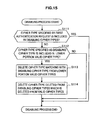
- step S 112 it is determined whether or not the cipher type which is set as the disabling cipher type is included in any valid cipher types of the lower portion in step S 112.
- the subsequent disabling process is skipped.
- the process proceeds to step S 113.
- step S 113 the cipher type matching with the cipher type set as the disabling cipher type is deleted from the valid cipher types of the lower portion of the disabling control information 184. Accordingly, the encryption algorithm unit 120 which supports the encryption method indicated by the deleted cipher type becomes incapable of performing mutual authentication with an external device thereafter.
- step S 114 the cipher type deleted from the valid cipher types is deleted from the disabling cipher types of the disabling control information 184. Accordingly, a process of searching for the cipher type which is previously deleted from the valid cipher types at the lower portion of the disabling control information 184 (i.e., corresponding to step S 112 of FIG. 15 ) thereafter can be avoided. Then, the disabling process according to the present modified example ends.
- FIG. 16 is a schematic diagram which illustrates a logical data structure of the user data 182, the disabling control information 184 and the cipher-specific information 186 stored in the data memory unit 180 according to the present modified example.
- the disabling control information 184 includes the logical address, the disabling cipher types and valid generation number, for example.
- the logical address is used for accessing the disabling control information 184 in the memory section 80 of FIG. 4 .
- the disabling cipher types are the data for distinguishing the encryption method to be automatically disabled at the information processing apparatus 10.
- the valid generation number is the data for distinguishing the generation number of the valid cipher key of which generation is the oldest (i.e., the generation number is the smallest) among the cipher keys which are used by the plurality of encryption algorithm units 120.
- FIG. 17 is a schematic diagram which illustrates a specific data example of the user data 182, the disabling control information 184 and the cipher-specific information 186 according to the present modified example.
- AES128 is included in the disabling cipher types of the disabling control information 184 of the logical address 1008h. Further, the valid generation number indicates 1.
- the cipher-specific information 186A which corresponds to the first encryption algorithm 120A and the cipher-specific information 186B which corresponds to the second encryption algorithm 120B are defined at the lower portion of the disabling control information 184.
- the cipher key is aaa...h
- the key version is 1111h
- the cipher type is AES128 and the generation number is 1.
- the cipher-specific information 186B the cipher key is bbb...h
- the key version is 1112h
- the cipher type is AES128 and the generation number is 2.
- the example indicates that the generation of the cipher key for the second encryption algorithm unit 120B is newer while both of the first encryption algorithm unit 120A and the second encryption algorithm unit 120B support mutual authentication with the AES128 method.
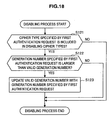
- FIG. 18 is a flowchart which describes an example of a detailed flow of the disabling process by the mutual authentication unit 140 of the encryption algorithm unit 120 according to the present modified example.
- step S121 it is determined whether or not the cipher type specified by the first authentication request is included in the disabling cipher types stored at the data memory unit 180 in step S121.
- the cipher type specified by the first authentication request is not included in the disabling cipher types, the following disabling process based on the generation number is skipped.
- the process proceeds to step S122.
- step S122 it is determined whether or not the generation number specified by the first authentication request is larger than the valid generation number included in the disabling control information 184.
- the generation number specified by the first authentication request is not larger than the valid generation number, the following disabling process is skipped.
- the process proceeds to step S123.
- the numeral which specifies the generation of the cipher key is used as the generation number.
- the key version instead of the numeral.
- an address conversion table for converting the logical address specified by the first authentication request is previously maintained, for example, at the memory section 80 of FIG. 4 .
- FIG. 19 is an explanatory table which shows an example of the address conversion table 82 according to the present modified example.
- the address conversion table 82 includes the first row which defines logical addresses for normal authentication request and the second row which defines logical addresses for requesting to perform the disabling process against the logical addresses defined at the first row.
- the logical address for the disabling process against the logical address 0000 for the normal authentication request is 0180.
- the logical address for the disabling process against the logical address 0001 for the normal authentication request is 0181.
- the logical address for the disabling process against the logical address 1008 for the normal authentication request is 1182.
- the information processing apparatus 10 reads the logical address to replace to the logical address for the normal authentication request by using the address conversion table 82 and performs the access sequence of FIG. 8 .
- the second authentication request process by the information processing apparatus 10 in FIG. 11 i.e., S50 process in FIG. 8
- service providers can adjust the switching timing of the encryption algorithm of IC cards to arbitrary timing after new encryption algorithm is supported by reader/writers.
- the physical configuration of the information processing apparatus 20 according to the present embodiment is similar to the configuration of the information processing apparatus 10 of the first embodiment which is illustrated in FIG. 4 . Further, similar to the information processing apparatus 10 according to the first embodiment, the information processing apparatus 20 corresponds to an IC card or a portable terminal on which an IC chip is incorporated as illustrated in FIG. 3 , for example.
- FIG. 20 is a block diagram which illustrates a logical configuration of the information processing apparatus 20 according to the present embodiment.
- the information processing apparatus 20 includes a response detection unit 110, a first encryption algorithm unit 220A, a second encryption algorithm unit 220B, a third encryption algorithm unit 220C, a read/write unit 170, a data memory unit 280 and a key memory unit 190.
- each of the encryption algorithm units 220 includes an authentication key generation unit 130, a mutual authentication unit 240, a communication path encryption unit 150 and an issuance information decryption unit 160.
- the mutual authentication unit 240 of each of the encryption algorithm units 220 performs mutual authentication with external devices. Similar to the mutual authentication unit 140 according to the first embodiment, a method which is disclosed in JP-A No. H10-020780 or proposed in ISO/IEC9798 may be used as a mutual authentication method, for example. Further, a mutual authentication process by the mutual authentication unit 240 is performed by one of the encryption algorithm units 220 in accordance with the cipher type or the generation number which is specified by the authentication request from an external device.
- the mutual authentication unit 240 disables another encryption algorithm unit 220 in accordance with the disabling control information 284 which is stored at the data memory unit 280.
- the mutual authentication unit 240A of the first encryption algorithm unit 220A and the mutual authentication unit 240B of the second encryption algorithm unit 220B are capable of performing the later-mentioned disabling process. The disabling process is described later further in details.
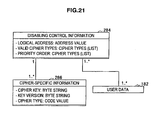
- FIG. 21 is a schematic diagram which illustrates an example of a logical data structure of the user data 182, the disabling control information 284 and the cipher-specific information 286 which are stored at the data memory unit 280.
- the disabling control information 284 and the cipher-specific information 286 are logically aligned in hierarchical structure at the data memory unit 280. More specifically, the relation between the disabling control information 284 and the cipher-specific information 286 is one-many relation. Namely, one or more of the cipher-specific information 286 may exist with respect to one of the disabling control information 284. Further, the relation between the disabling control information 284 and the user data 182 is one or more to one or more.
- DES three cipher types of DES, AES128 and AES256 are included in the valid cipher types of the disabling control information 284 of the logical address 1008h. Further, the priority order is AES256, AES128 and DES (i.e., AES256 > AES128 > DES).
- Cipher-specific information 286A corresponding to the first encryption algorithm unit 220A, cipher-specific information 286B corresponding to the second encryption algorithm unit 220B and cipher-specific information 286C corresponding to the third encryption algorithm unit 220C are defined at the lower portion of the disabling control information 284.
- the cipher-specific information 286A the cipher key is 34567890...h, the key version is 1111h, and the cipher type is AES256.
- the cipher-specific information 286B the cipher key is 23456789...h, the key version is 1100h, and the cipher type is AES128.
- the cipher-specific information 286C the cipher key is 12345678...h, the key version is 1000h, and the cipher type is DES.
- the mutual authentication unit 240B of the second encryption algorithm unit 220B succeeds in mutual authentication with an external device, for example, the mutual authentication unit 240B deletes DES of which priority order is lower than that of the own cipher type of AES128 from the valid cipher types of the disabling control information 284. Accordingly, the third encryption algorithm unit 220C which supports the DES method becomes incapable of performing mutual authentication with an external device, so that the third encryption algorithm unit 220C is disabled.
- the mutual authentication unit 240A of the first encryption algorithm unit 220A succeeds in mutual authentication with an external device, for example, the mutual authentication unit 240A deletes AES128 and DES of which priority orders are lower than that of the own cipher type of AES256 from the valid cipher types. Accordingly, the second encryption algorithm unit 220B and the third encryption algorithm unit 220C become incapable of performing mutual authentication with an external device, so that the two encryption algorithm units 220 are disabled.
- the process of the information processing apparatus 20 according to the present embodiment when receiving access from an external device is similar to that of the first information processing apparatus 10 which has been described with reference to FIGS. 8 to 11 except the disabling process by the mutual authentication unit 240.
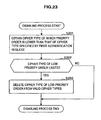
- FIG. 23 is a flowchart which describes an example of detailed flow of the disabling process by the mutual authentication unit 240 of the encryption algorithm unit 220 according to the present embodiment.
- the priority order stored at the data memory unit 180 is referenced and the cipher type of which priority order is lower than that of the cipher type specified by the first authentication request is obtained in step S201.
- step S202 it is determined whether or not the cipher type obtained in step S201 exists as one or more.
- the process proceeds to step S203.
- step S203 the cipher type obtained in step S201 of which priority order is low is deleted from the valid cipher types stored at the data memory unit 180.
- the cipher type of AES128 is specified and mutual authentication is successfully performed, for example, DES is deleted from the valid cipher types.
- the third encryption algorithm unit 220C which uses the DES method becomes incapable of performing mutual authentication with an external device thereafter. Then, the disabling process according to the present embodiment ends.
- the first to third modified examples which are described relating to the first embodiment can be combined with the second embodiment.
- the example in which the data indicating the priority order is maintained in the disabling control information 284 is described.
- priority degree is numerically defined for each of the encryption algorithm units 220 based on the security strength and actualize the priority order corresponding to the magnitude of the priority degree by maintaining the priority degree in the cipher-specific information 286.
- each of the processes according to the first and second embodiments which are described with reference to the flowcharts is not necessarily performed in the order described in the flowcharts. It is also possible that each process step includes a process which is executed simultaneously or independently.
- a computer program providing such software control and a computer program product or similar object of manufacture comprising processor implementable instructions stored on a data carrier such as a floppy disk, optical disk, hard disk, PROM, RAM, flash memory or any combination of these or other storage media, or transmitted via data signals on a network such as an Ethernet, a wireless network, the Internet, or any combination of these of other networks, or realised in hardware as an ASIC (application specific integrated circuit) or an FPGA (field programmable gate array) or other suitable configurable circuit are envisaged as aspects of the present invention.
- a data carrier such as a floppy disk, optical disk, hard disk, PROM, RAM, flash memory or any combination of these or other storage media
- a network such as an Ethernet, a wireless network, the Internet, or any combination of these of other networks, or realised in hardware as an ASIC (application specific integrated circuit) or an FPGA (field programmable gate array) or other suitable configurable circuit
Landscapes
- Engineering & Computer Science (AREA)
- Physics & Mathematics (AREA)
- Theoretical Computer Science (AREA)
- General Physics & Mathematics (AREA)
- Business, Economics & Management (AREA)
- Computer Hardware Design (AREA)
- Computer Security & Cryptography (AREA)
- Accounting & Taxation (AREA)
- General Engineering & Computer Science (AREA)
- Software Systems (AREA)
- Mathematical Physics (AREA)
- Strategic Management (AREA)
- General Business, Economics & Management (AREA)
- Microelectronics & Electronic Packaging (AREA)
- Computer Networks & Wireless Communication (AREA)
- Finance (AREA)
- Storage Device Security (AREA)
Claims (7)
- Datenverarbeitungsvorrichtung, die Folgendes umfasst:mehrere Einheiten von Verschlüsselungsalgorithmen, die jeweils durch Verwendung eines Verschlüsselungsverfahrens, das einen Chiffrierschlüssel besitzt, jeweils eine gegenseitige Authentifizierung durchführen können, wobei jedes Verschlüsselungsverfahren und jeder Chiffrierschlüssel voneinander verschieden sind, wobei die gegenseitige Authentifizierung mit einer externen Einrichtung stattfindet; undeine Datenspeichereinheit, die mehrere Chiffrespezifische Informationen, die jeder der Einheiten von Verschlüsselungsalgorithmen bereitgestellt werden und ein Verschlüsselungsverfahren enthalten, das durch jede der Einheiten von Verschlüsselungsalgorithmen verwendet wird, und Informationen zum Ausschalten der Steuerung, um mindestens eine Einheit von Verschlüsselungsalgorithmen unter den mehreren Einheiten von Verschlüsselungsalgorithmen auszuschalten, speichert;wobei die Informationen zum Ausschalten der Steuerung eine gültige Liste der Verschlüsselungsverfahren enthalten, um ein gültiges Verschlüsselungsverfahren unter den Verschlüsselungsverfahren, die durch die mehreren Einheiten von Verschlüsselungsalgorithmen verwendet werden, zu erkennen, und ferner eine Liste der Verfahren zum Ausschalten der Verschlüsselung enthalten, um ein Verschlüsselungsverfahren zu erkennen, das durch eine erste Einheit von Verschlüsselungsalgorithmen ausgeschaltet werden soll, wobei ein Verfahren zum Ausschalten der Verschlüsselung als ein gültiges Verschlüsselungsverfahren aufgelistet ist; undwobei jeder der Einheiten von Verschlüsselungsalgorithmen durch die Datenverarbeitungsvorrichtung erlaubt ist, eine gegenseitige Authentifizierung mit einer externen Einrichtung nur in dem Fall zu versuchen, dass ein Verschlüsselungsverfahren, das durch eine Authentifizierungsanforderung, die von der externen Einrichtung empfangen wird, vorgegeben ist, in der gültigen Liste der Verschlüsselungsverfahren, die in der Datenspeichereinheit gespeichert ist, enthalten ist, undwobei eine erste Einheit von Verschlüsselungsalgorithmen dafür ausgelegt ist, eine weitere Einheit von Verschlüsselungsalgorithmen auszuschalten, wenn die gegenseitige Authentifizierung durch die erste Einheit von Verschlüsselungsalgorithmen mit der externen Einrichtung erfolgreich ist, indem ein Verschlüsselungsverfahren von der gültigen Liste der Verschlüsselungsverfahren, die in der Datenspeichereinheit gespeichert ist, gelöscht wird, das mit einem Verschlüsselungsverfahren von der Liste der Verschlüsselungsverfahren zum Ausschalten übereinstimmt, aber nur dann, wenn die gegenseitige Authentifizierung mit einer externen Einrichtung durchgeführt wird, indem ein Verschlüsselungsverfahren, das nicht mit einem Verschlüsselungsverfahren von der Liste der Verschlüsselungsverfahren zum Ausschalten ist, übereinstimmt, vorgegeben wird, so dass die ausgeschaltete Einheit von Verschlüsselungsalgorithmen danach eine gegenseitige Authentifizierung mit einer externen Einrichtung nicht durchführen kann.
- Datenverarbeitungsvorrichtung nach Anspruch 1,
wobei die Chiffre-spezifischen Informationen ferner eine Erzeugungszahl enthalten, die eine Erzeugung eines Chiffrierschlüssels vorgibt, der durch jede der Einheiten von Verschlüsselungsalgorithmen verwendet wird; und
die erste Einheit von Verschlüsselungsalgorithmen eine weitere Einheit von Verschlüsselungsalgorithmen ausschaltet, die einer Erzeugungszahl entsprechen, die älter ist als eine Erzeugungszahl, die durch eine Authentifizierungsanforderung, die von der externen Einrichtung empfangen wird, vorgegeben ist, wenn die gegenseitige Authentifizierung mit der externen Einrichtung erfolgreich ist. - Datenverarbeitungsvorrichtung nach Anspruch 2,
wobei die Informationen zum Ausschalten der Steuerung eine gültige Erzeugungszahl enthalten, um eine gültige Einheit von Verschlüsselungsalgorithmen unter den mehreren Einheiten von Verschlüsselungsalgorithmen zu erkennen; und
die erste Einheit von Verschlüsselungsalgorithmen die andere Einheit der Verschlüsselungsalgorithmen durch Aktualisieren der gültigen Erzeugungszahl ausschaltet. - Datenverarbeitungsvorrichtung nach Anspruch 1,
wobei die erste Einheit von Verschlüsselungsalgorithmen eine weitere Einheit von Verschlüsselungsalgorithmen in Übereinstimmung mit den Information zum Ausschalten der Steuerung, die in der Datenspeichereinheit gespeichert sind, nur in einem Fall ausschaltet, in dem eine besondere Authentifizierungsanforderung, die die Ausführung des Ausschaltens anweist, von der externen Einrichtung empfangen wird. - Datenverarbeitungsvorrichtung nach Anspruch 1,
wobei die Datenspeichereinheit eine Prioritätsreihenfolge speichert, die in Übereinstimmung mit der Sicherheitsstärke von jeder der Einheiten von Verschlüsselungsalgorithmen vordefiniert ist; und
die erste Einheit von Verschlüsselungsalgorithmen eine weitere Einheit von Verschlüsselungsalgorithmen ausschaltet, deren Prioritätsreihenfolge niedriger ist als die der ersten Einheit von Verschlüsselungsalgorithmen, wenn die gegenseitige Authentifizierung mit einer externen Einrichtung erfolgreich ist. - Verfahren in einer Datenverarbeitungsvorrichtung zum Umschalten der Chiffre, das die folgenden Schritte umfasst:Speichern von mehreren Chiffre-spezifischen Informationen, die von jeder von mehreren Einheiten von Verschlüsselungsalgorithmen bereitgestellt werden und ein Verschlüsselungsverfahren enthalten, die durch jede der Einheiten von Verschlüsselungsalgorithmen verwendet wird, und von Informationen zum Ausschalten der Steuerung, um mindestens eine Einheit von Verschlüsselungsalgorithmen unter den mehreren Einheiten von Verschlüsselungsalgorithmen auszuschalten, in einem Speicherbereich einer Datenverarbeitungsvorrichtung, die mehrere Einheiten von Verschlüsselungsalgorithmen umfasst, die jeweils durch Verwendung eines Verschlüsselungsverfahrens, das einen Chiffrierschlüssel besitzt, jeweils eine gegenseitige Authentifizierung durchführen können, wobei jedes Verschlüsselungsverfahren und jeder Chiffrierschlüssel voneinander verschieden sind, wobei die gegenseitige Authentifizierung mit einer externen Einrichtung stattfindet;wobei die Informationen zum Ausschalten der Steuerung eine gültige Liste der Verschlüsselungsverfahren enthalten, um ein gültiges Verschlüsselungsverfahren unter den Verschlüsselungsverfahren, die durch die mehreren Einheiten von Verschlüsselungsalgorithmen verwendet werden, zu erkennen, und ferner eine Liste der Verfahren zum Ausschalten der Verschlüsselung enthalten, um ein Verschlüsselungsverfahren zu erkennen, das automatisch ausgeschaltet werden soll, wobei ein Verfahren zum Ausschalten der Verschlüsselung als ein gültiges Verschlüsselungsverfahren aufgelistet ist; undDurchführen einer gegenseitigen Authentifizierung mit einer externen Einrichtung durch eine erste Einheit von Verschlüsselungsalgorithmen unter den mehreren Einheiten von Verschlüsselungsalgorithmen,wobei der Schritt des Durchführens der gegenseitigen Authentifizierung mit einer externen Einrichtung nur in einem Fall erlaubt ist, in dem ein Verschlüsselungsverfahren, das durch eine Authentifizierungsanforderung, die von der externen Einrichtung empfangen wird, vorgegeben ist, in der gültigen Liste der Verschlüsselungsverfahren, die in dem Datenspeichereinheit gespeichert ist, enthalten ist; undAusschalten einer weiteren Einheit von Verschlüsselungsalgorithmen durch Löschen eines Verschlüsselungsverfahrens von der gültigen Liste der Verschlüsselungsverfahren, die in der Datenspeichereinheit gespeichert ist, das mit einem Verschlüsselungsverfahren von der Liste der Verschlüsselungsverfahren zum Ausschalten übereinstimmt, aber nur dann, wenn die gegenseitige Authentifizierung mit einer externen Einrichtung durchgeführt wird, indem ein Verschlüsselungsverfahren, das nicht mit einem Verschlüsselungsverfahren von der Liste der Verschlüsselungsverfahren zum Ausschalten übereinstimmt, vorgegeben wird, so dass die ausgeschaltete Einheit von Verschlüsselungsalgorithmen danach eine gegenseitige Authentifizierung mit einer externen Einrichtung nicht durchführen kann.
- Computerprogrammprodukt, das einen Computer, der eine Datenverarbeitungsvorrichtung steuert, veranlasst, die Schritte nach Anspruch 6 auszuführen.
Applications Claiming Priority (1)
| Application Number | Priority Date | Filing Date | Title |
|---|---|---|---|
| JP2008265322A JP5272637B2 (ja) | 2008-10-14 | 2008-10-14 | 情報処理装置、暗号切替方法、及びプログラム |
Publications (2)
| Publication Number | Publication Date |
|---|---|
| EP2182461A1 EP2182461A1 (de) | 2010-05-05 |
| EP2182461B1 true EP2182461B1 (de) | 2015-05-13 |
Family
ID=41785715
Family Applications (1)
| Application Number | Title | Priority Date | Filing Date |
|---|---|---|---|
| EP20090252216 Not-in-force EP2182461B1 (de) | 2008-10-14 | 2009-09-17 | Informationsverarbeitungsvorrichtung, Verfahren zum Wechseln des Chiffres und Programm |
Country Status (4)
| Country | Link |
|---|---|
| US (1) | US8458473B2 (de) |
| EP (1) | EP2182461B1 (de) |
| JP (1) | JP5272637B2 (de) |
| CN (1) | CN101727603B (de) |
Families Citing this family (27)
| Publication number | Priority date | Publication date | Assignee | Title |
|---|---|---|---|---|
| US9317286B2 (en) * | 2009-03-31 | 2016-04-19 | Oracle America, Inc. | Apparatus and method for implementing instruction support for the camellia cipher algorithm |
| US20100250965A1 (en) * | 2009-03-31 | 2010-09-30 | Olson Christopher H | Apparatus and method for implementing instruction support for the advanced encryption standard (aes) algorithm |
| US8654970B2 (en) * | 2009-03-31 | 2014-02-18 | Oracle America, Inc. | Apparatus and method for implementing instruction support for the data encryption standard (DES) algorithm |
| US20100246815A1 (en) * | 2009-03-31 | 2010-09-30 | Olson Christopher H | Apparatus and method for implementing instruction support for the kasumi cipher algorithm |
| US8832464B2 (en) * | 2009-03-31 | 2014-09-09 | Oracle America, Inc. | Processor and method for implementing instruction support for hash algorithms |
| GB2476233B (en) | 2009-12-14 | 2018-05-23 | Visa Europe Ltd | Payment device |
| JP5740867B2 (ja) * | 2010-08-18 | 2015-07-01 | ソニー株式会社 | 通信装置、情報処理システムおよび暗号切替方法 |
| US9179303B2 (en) | 2010-11-17 | 2015-11-03 | Qualcomm Incorporated | Methods and apparatus for transmitting and receiving secure and non-secure data |
| JP5763993B2 (ja) * | 2011-07-08 | 2015-08-12 | 泰治郎 伊東 | 電子タグ認証システム及び電子タグ |
| US9698983B2 (en) * | 2012-10-09 | 2017-07-04 | Nokia Technologies Oy | Method and apparatus for disabling algorithms in a device |
| BR102013029499A2 (pt) * | 2012-11-16 | 2014-10-29 | Seiko Epson Corp | Aparelho de processamento de informação, método de controle do aparelho de processamento de informação e meio de armazenamento |
| JP6017943B2 (ja) * | 2012-12-07 | 2016-11-02 | Jr東日本メカトロニクス株式会社 | リーダーライター装置 |
| FR2999747B1 (fr) * | 2012-12-19 | 2018-05-04 | Idemia France | Procede de securisation d'un dispositif apte a communiquer avec un lecteur selon deux protocoles d'authentification |
| CN103593592B (zh) * | 2013-11-08 | 2017-01-18 | 上海新储集成电路有限公司 | 一种用户数据的加解密方法 |
| CN103684755B (zh) * | 2013-12-06 | 2017-04-05 | 上海新储集成电路有限公司 | 一种加解密算法和加解密钥的更换方法 |
| DE102014010339A1 (de) * | 2014-07-11 | 2016-01-14 | Giesecke & Devrient Gmbh | Verfahren zum Auslesen eines Ausweisdokumentes |
| US9298647B2 (en) * | 2014-08-25 | 2016-03-29 | HGST Netherlands B.V. | Method and apparatus to generate zero content over garbage data when encryption parameters are changed |
| US10445710B2 (en) * | 2014-08-26 | 2019-10-15 | Ncr Corporation | Security device key management |
| JP6874318B2 (ja) * | 2016-10-07 | 2021-05-19 | 大日本印刷株式会社 | 電子情報記憶媒体、icカード、サポート情報更新方法、及びサポート情報更新プログラム |
| JP6508188B2 (ja) * | 2016-12-26 | 2019-05-08 | トヨタ自動車株式会社 | 暗号通信システム |
| US11018879B2 (en) * | 2017-09-29 | 2021-05-25 | Nxp B.V. | Method and system for authentication with side-channel attack protection using pre-calculated ciphers |
| CN107704737A (zh) * | 2017-10-25 | 2018-02-16 | 维沃移动通信有限公司 | 安全验证的方法、装置、移动终端及计算机可读存储介质 |
| CN110740035B (zh) * | 2019-10-21 | 2021-08-31 | 浙江正泰仪器仪表有限责任公司 | 一种智能表具加密系统以及加密方法 |
| CN110762007B (zh) * | 2019-10-31 | 2021-05-25 | 上海斯可络压缩机有限公司 | 一种变频螺杆压缩机控制器自动识别系统 |
| US12368594B2 (en) | 2020-06-30 | 2025-07-22 | Fanuc Corporation | Control device |
| CN113922949B (zh) * | 2021-10-14 | 2023-07-25 | 合肥工业大学 | 一种基于clefia-sha3的密码协处理器 |
| JP7585412B1 (ja) * | 2023-09-05 | 2024-11-18 | 株式会社東芝 | 携帯可能電子装置およびicカード |
Family Cites Families (16)
| Publication number | Priority date | Publication date | Assignee | Title |
|---|---|---|---|---|
| JP3890602B2 (ja) | 1996-06-28 | 2007-03-07 | ソニー株式会社 | 情報処理装置および情報処理方法、並びに記録媒体 |
| CN1573806B (zh) | 1996-06-28 | 2013-06-19 | 索尼株式会社 | 信息处理装置 |
| US6073236A (en) | 1996-06-28 | 2000-06-06 | Sony Corporation | Authentication method, communication method, and information processing apparatus |
| JP4268690B2 (ja) | 1997-03-26 | 2009-05-27 | ソニー株式会社 | 認証システムおよび方法、並びに認証方法 |
| JPH11298468A (ja) * | 1998-04-09 | 1999-10-29 | Hitachi Ltd | 暗号変換装置,復号変換装置及び暗号通信方法 |
| JP4029234B2 (ja) | 1998-07-16 | 2008-01-09 | ソニー株式会社 | 情報処理装置および情報処理方法 |
| JP4051510B2 (ja) | 1998-07-16 | 2008-02-27 | ソニー株式会社 | データ記憶装置およびデータ記憶方法 |
| JP3390380B2 (ja) * | 1999-10-27 | 2003-03-24 | 日本電信電話株式会社 | 暗号処理方法及びシステム装置 |
| FR2820847B1 (fr) * | 2001-02-12 | 2003-05-30 | Gemplus Card Int | Controle d'acces de sujets a des objets notamment dans une carte a microcontroleur |
| FR2837009A1 (fr) * | 2002-03-11 | 2003-09-12 | Schlumberger Systems & Service | Mise a jour d'un algorithme d'authentification dans un systeme informatique |
| AU2002323169A1 (en) * | 2002-04-05 | 2003-10-27 | Ipass, Inc. | Method and system for changing security information in a computer network |
| JP2004015667A (ja) * | 2002-06-10 | 2004-01-15 | Takeshi Sakamura | Icカード間暗号通信方法、電子チケット流通システムにおけるicカード間暗号通信方法およびicカード |
| WO2005099168A1 (ja) * | 2004-03-30 | 2005-10-20 | Matsushita Electric Industrial Co., Ltd. | 暗号化方式のアップデートシステム |
| EP1783614A4 (de) * | 2004-08-19 | 2009-03-25 | Mitsubishi Electric Corp | Verwaltungs-dienst-einrichtung, backup-dienst-einrichtung, kommunikations-endgerät und speichermedium |
| JP2006108886A (ja) * | 2004-10-01 | 2006-04-20 | Sony Corp | 情報処理装置および方法、記録媒体、並びにプログラム |
| US7958353B2 (en) * | 2005-04-25 | 2011-06-07 | Panasonic Corporation | Information security device |
-
2008
- 2008-10-14 JP JP2008265322A patent/JP5272637B2/ja not_active Expired - Fee Related
-
2009
- 2009-09-17 EP EP20090252216 patent/EP2182461B1/de not_active Not-in-force
- 2009-10-14 US US12/579,025 patent/US8458473B2/en not_active Expired - Fee Related
- 2009-10-14 CN CN2009101795950A patent/CN101727603B/zh not_active Expired - Fee Related
Also Published As
| Publication number | Publication date |
|---|---|
| EP2182461A1 (de) | 2010-05-05 |
| CN101727603A (zh) | 2010-06-09 |
| JP5272637B2 (ja) | 2013-08-28 |
| CN101727603B (zh) | 2013-05-08 |
| JP2010098367A (ja) | 2010-04-30 |
| US20100180118A1 (en) | 2010-07-15 |
| US8458473B2 (en) | 2013-06-04 |
Similar Documents
| Publication | Publication Date | Title |
|---|---|---|
| EP2182461B1 (de) | Informationsverarbeitungsvorrichtung, Verfahren zum Wechseln des Chiffres und Programm | |
| JP4631935B2 (ja) | 情報処理装置、情報処理方法、プログラム及び通信システム | |
| US7882208B2 (en) | Information management apparatus, information management method, and program for managing an integrated circuit | |
| US8789146B2 (en) | Dual interface device for access control and a method therefor | |
| CN104969245B (zh) | 用于安全元件交易和资产管理的装置和方法 | |
| US7870998B2 (en) | Private information exchange in smart card commerce | |
| US6763463B1 (en) | Integrated circuit card with data modifying capabilities and related methods | |
| KR100437513B1 (ko) | 복수의 발급자 시큐리티 도메인을 설치할 수 있는 스마트카드 및 하나의 스마트 카드에 복수의 발급자 시큐리티도메인을 설치할 수 있는 방법 | |
| WO2005098622A1 (en) | Semiconductor memory | |
| US7516479B2 (en) | Data communicating apparatus and method for managing memory of data communicating apparatus | |
| CN1863049B (zh) | 无线通信系统,读/写器装置,密钥管理方法,和计算机程序 | |
| JP5467315B2 (ja) | 情報処理装置、情報処理方法およびプログラム | |
| Kose et al. | A Secure design on MIFARE Classic Cards for Ensuring Contactless Payment and Control Services | |
| JP2004295176A (ja) | データ管理方法とそのシステム、及びic記憶媒体 | |
| JP2005258885A (ja) | Icカード決済システムおよびicカード決済方法 | |
| Kose et al. | ADVANCES IN CYBER-PHYSICAL SYSTEMS Vol. 7, Num. 1, 2022 A SECURE DESIGN ON MIFARE CLASSIC CARDS FOR ENSURING CONTACTLESS PAYMENT AND CONTROL SERVICES | |
| JP2007249544A (ja) | 電子媒体およびそれを含む情報端末 | |
| Shen et al. | A Universal Application Storage System Based on Smart Card | |
| HK1138087B (en) | Information processing device, information processing method and communication system |
Legal Events
| Date | Code | Title | Description |
|---|---|---|---|
| PUAI | Public reference made under article 153(3) epc to a published international application that has entered the european phase |
Free format text: ORIGINAL CODE: 0009012 |
|
| 17P | Request for examination filed |
Effective date: 20091006 |
|
| AK | Designated contracting states |
Kind code of ref document: A1 Designated state(s): AT BE BG CH CY CZ DE DK EE ES FI FR GB GR HR HU IE IS IT LI LT LU LV MC MK MT NL NO PL PT RO SE SI SK SM TR |
|
| AX | Request for extension of the european patent |
Extension state: AL BA RS |
|
| 17Q | First examination report despatched |
Effective date: 20100409 |
|
| REG | Reference to a national code |
Ref country code: DE Ref legal event code: R079 Ref document number: 602009031203 Country of ref document: DE Free format text: PREVIOUS MAIN CLASS: G06F0021000000 Ipc: G06F0021770000 |
|
| GRAP | Despatch of communication of intention to grant a patent |
Free format text: ORIGINAL CODE: EPIDOSNIGR1 |
|
| RIC1 | Information provided on ipc code assigned before grant |
Ipc: G06F 21/77 20130101AFI20141112BHEP |
|
| INTG | Intention to grant announced |
Effective date: 20141204 |
|
| GRAS | Grant fee paid |
Free format text: ORIGINAL CODE: EPIDOSNIGR3 |
|
| GRAA | (expected) grant |
Free format text: ORIGINAL CODE: 0009210 |
|
| AK | Designated contracting states |
Kind code of ref document: B1 Designated state(s): AT BE BG CH CY CZ DE DK EE ES FI FR GB GR HR HU IE IS IT LI LT LU LV MC MK MT NL NO PL PT RO SE SI SK SM TR |
|
| REG | Reference to a national code |
Ref country code: GB Ref legal event code: FG4D |
|
| REG | Reference to a national code |
Ref country code: CH Ref legal event code: EP |
|
| REG | Reference to a national code |
Ref country code: IE Ref legal event code: FG4D |
|
| REG | Reference to a national code |
Ref country code: AT Ref legal event code: REF Ref document number: 727076 Country of ref document: AT Kind code of ref document: T Effective date: 20150615 |
|
| REG | Reference to a national code |
Ref country code: DE Ref legal event code: R096 Ref document number: 602009031203 Country of ref document: DE Effective date: 20150625 |
|
| REG | Reference to a national code |
Ref country code: FR Ref legal event code: PLFP Year of fee payment: 7 |
|
| REG | Reference to a national code |
Ref country code: AT Ref legal event code: MK05 Ref document number: 727076 Country of ref document: AT Kind code of ref document: T Effective date: 20150513 |
|
| REG | Reference to a national code |
Ref country code: NL Ref legal event code: MP Effective date: 20150513 |
|
| REG | Reference to a national code |
Ref country code: LT Ref legal event code: MG4D |
|
| PG25 | Lapsed in a contracting state [announced via postgrant information from national office to epo] |
Ref country code: PT Free format text: LAPSE BECAUSE OF FAILURE TO SUBMIT A TRANSLATION OF THE DESCRIPTION OR TO PAY THE FEE WITHIN THE PRESCRIBED TIME-LIMIT Effective date: 20150914 Ref country code: NO Free format text: LAPSE BECAUSE OF FAILURE TO SUBMIT A TRANSLATION OF THE DESCRIPTION OR TO PAY THE FEE WITHIN THE PRESCRIBED TIME-LIMIT Effective date: 20150813 Ref country code: HR Free format text: LAPSE BECAUSE OF FAILURE TO SUBMIT A TRANSLATION OF THE DESCRIPTION OR TO PAY THE FEE WITHIN THE PRESCRIBED TIME-LIMIT Effective date: 20150513 Ref country code: FI Free format text: LAPSE BECAUSE OF FAILURE TO SUBMIT A TRANSLATION OF THE DESCRIPTION OR TO PAY THE FEE WITHIN THE PRESCRIBED TIME-LIMIT Effective date: 20150513 Ref country code: ES Free format text: LAPSE BECAUSE OF FAILURE TO SUBMIT A TRANSLATION OF THE DESCRIPTION OR TO PAY THE FEE WITHIN THE PRESCRIBED TIME-LIMIT Effective date: 20150513 Ref country code: LT Free format text: LAPSE BECAUSE OF FAILURE TO SUBMIT A TRANSLATION OF THE DESCRIPTION OR TO PAY THE FEE WITHIN THE PRESCRIBED TIME-LIMIT Effective date: 20150513 |
|
| PG25 | Lapsed in a contracting state [announced via postgrant information from national office to epo] |
Ref country code: AT Free format text: LAPSE BECAUSE OF FAILURE TO SUBMIT A TRANSLATION OF THE DESCRIPTION OR TO PAY THE FEE WITHIN THE PRESCRIBED TIME-LIMIT Effective date: 20150513 Ref country code: GR Free format text: LAPSE BECAUSE OF FAILURE TO SUBMIT A TRANSLATION OF THE DESCRIPTION OR TO PAY THE FEE WITHIN THE PRESCRIBED TIME-LIMIT Effective date: 20150814 Ref country code: BG Free format text: LAPSE BECAUSE OF FAILURE TO SUBMIT A TRANSLATION OF THE DESCRIPTION OR TO PAY THE FEE WITHIN THE PRESCRIBED TIME-LIMIT Effective date: 20150813 Ref country code: IS Free format text: LAPSE BECAUSE OF FAILURE TO SUBMIT A TRANSLATION OF THE DESCRIPTION OR TO PAY THE FEE WITHIN THE PRESCRIBED TIME-LIMIT Effective date: 20150913 Ref country code: LV Free format text: LAPSE BECAUSE OF FAILURE TO SUBMIT A TRANSLATION OF THE DESCRIPTION OR TO PAY THE FEE WITHIN THE PRESCRIBED TIME-LIMIT Effective date: 20150513 |
|
| PG25 | Lapsed in a contracting state [announced via postgrant information from national office to epo] |
Ref country code: EE Free format text: LAPSE BECAUSE OF FAILURE TO SUBMIT A TRANSLATION OF THE DESCRIPTION OR TO PAY THE FEE WITHIN THE PRESCRIBED TIME-LIMIT Effective date: 20150513 Ref country code: DK Free format text: LAPSE BECAUSE OF FAILURE TO SUBMIT A TRANSLATION OF THE DESCRIPTION OR TO PAY THE FEE WITHIN THE PRESCRIBED TIME-LIMIT Effective date: 20150513 |
|
| REG | Reference to a national code |
Ref country code: DE Ref legal event code: R097 Ref document number: 602009031203 Country of ref document: DE |
|
| PG25 | Lapsed in a contracting state [announced via postgrant information from national office to epo] |
Ref country code: CZ Free format text: LAPSE BECAUSE OF FAILURE TO SUBMIT A TRANSLATION OF THE DESCRIPTION OR TO PAY THE FEE WITHIN THE PRESCRIBED TIME-LIMIT Effective date: 20150513 Ref country code: PL Free format text: LAPSE BECAUSE OF FAILURE TO SUBMIT A TRANSLATION OF THE DESCRIPTION OR TO PAY THE FEE WITHIN THE PRESCRIBED TIME-LIMIT Effective date: 20150513 Ref country code: RO Free format text: LAPSE BECAUSE OF NON-PAYMENT OF DUE FEES Effective date: 20150513 Ref country code: SK Free format text: LAPSE BECAUSE OF FAILURE TO SUBMIT A TRANSLATION OF THE DESCRIPTION OR TO PAY THE FEE WITHIN THE PRESCRIBED TIME-LIMIT Effective date: 20150513 |
|
| PLBE | No opposition filed within time limit |
Free format text: ORIGINAL CODE: 0009261 |
|
| STAA | Information on the status of an ep patent application or granted ep patent |
Free format text: STATUS: NO OPPOSITION FILED WITHIN TIME LIMIT |
|
| 26N | No opposition filed |
Effective date: 20160216 |
|
| PG25 | Lapsed in a contracting state [announced via postgrant information from national office to epo] |
Ref country code: LU Free format text: LAPSE BECAUSE OF FAILURE TO SUBMIT A TRANSLATION OF THE DESCRIPTION OR TO PAY THE FEE WITHIN THE PRESCRIBED TIME-LIMIT Effective date: 20150917 Ref country code: MC Free format text: LAPSE BECAUSE OF FAILURE TO SUBMIT A TRANSLATION OF THE DESCRIPTION OR TO PAY THE FEE WITHIN THE PRESCRIBED TIME-LIMIT Effective date: 20150513 Ref country code: IT Free format text: LAPSE BECAUSE OF FAILURE TO SUBMIT A TRANSLATION OF THE DESCRIPTION OR TO PAY THE FEE WITHIN THE PRESCRIBED TIME-LIMIT Effective date: 20150513 |
|
| REG | Reference to a national code |
Ref country code: CH Ref legal event code: PL |
|
| PG25 | Lapsed in a contracting state [announced via postgrant information from national office to epo] |
Ref country code: SI Free format text: LAPSE BECAUSE OF FAILURE TO SUBMIT A TRANSLATION OF THE DESCRIPTION OR TO PAY THE FEE WITHIN THE PRESCRIBED TIME-LIMIT Effective date: 20150513 |
|
| REG | Reference to a national code |
Ref country code: IE Ref legal event code: MM4A |
|
| PG25 | Lapsed in a contracting state [announced via postgrant information from national office to epo] |
Ref country code: LI Free format text: LAPSE BECAUSE OF NON-PAYMENT OF DUE FEES Effective date: 20150930 Ref country code: IE Free format text: LAPSE BECAUSE OF NON-PAYMENT OF DUE FEES Effective date: 20150917 Ref country code: CH Free format text: LAPSE BECAUSE OF NON-PAYMENT OF DUE FEES Effective date: 20150930 |
|
| PG25 | Lapsed in a contracting state [announced via postgrant information from national office to epo] |
Ref country code: BE Free format text: LAPSE BECAUSE OF FAILURE TO SUBMIT A TRANSLATION OF THE DESCRIPTION OR TO PAY THE FEE WITHIN THE PRESCRIBED TIME-LIMIT Effective date: 20150513 |
|
| REG | Reference to a national code |
Ref country code: FR Ref legal event code: PLFP Year of fee payment: 8 |
|
| PG25 | Lapsed in a contracting state [announced via postgrant information from national office to epo] |
Ref country code: MT Free format text: LAPSE BECAUSE OF FAILURE TO SUBMIT A TRANSLATION OF THE DESCRIPTION OR TO PAY THE FEE WITHIN THE PRESCRIBED TIME-LIMIT Effective date: 20150513 |
|
| PG25 | Lapsed in a contracting state [announced via postgrant information from national office to epo] |
Ref country code: HU Free format text: LAPSE BECAUSE OF FAILURE TO SUBMIT A TRANSLATION OF THE DESCRIPTION OR TO PAY THE FEE WITHIN THE PRESCRIBED TIME-LIMIT; INVALID AB INITIO Effective date: 20090917 Ref country code: SM Free format text: LAPSE BECAUSE OF FAILURE TO SUBMIT A TRANSLATION OF THE DESCRIPTION OR TO PAY THE FEE WITHIN THE PRESCRIBED TIME-LIMIT Effective date: 20150513 |
|
| PG25 | Lapsed in a contracting state [announced via postgrant information from national office to epo] |
Ref country code: NL Free format text: LAPSE BECAUSE OF FAILURE TO SUBMIT A TRANSLATION OF THE DESCRIPTION OR TO PAY THE FEE WITHIN THE PRESCRIBED TIME-LIMIT Effective date: 20150513 Ref country code: CY Free format text: LAPSE BECAUSE OF FAILURE TO SUBMIT A TRANSLATION OF THE DESCRIPTION OR TO PAY THE FEE WITHIN THE PRESCRIBED TIME-LIMIT Effective date: 20150513 Ref country code: SE Free format text: LAPSE BECAUSE OF FAILURE TO SUBMIT A TRANSLATION OF THE DESCRIPTION OR TO PAY THE FEE WITHIN THE PRESCRIBED TIME-LIMIT Effective date: 20150513 |
|
| PG25 | Lapsed in a contracting state [announced via postgrant information from national office to epo] |
Ref country code: TR Free format text: LAPSE BECAUSE OF FAILURE TO SUBMIT A TRANSLATION OF THE DESCRIPTION OR TO PAY THE FEE WITHIN THE PRESCRIBED TIME-LIMIT Effective date: 20150513 |
|
| REG | Reference to a national code |
Ref country code: FR Ref legal event code: PLFP Year of fee payment: 9 |
|
| PG25 | Lapsed in a contracting state [announced via postgrant information from national office to epo] |
Ref country code: MK Free format text: LAPSE BECAUSE OF FAILURE TO SUBMIT A TRANSLATION OF THE DESCRIPTION OR TO PAY THE FEE WITHIN THE PRESCRIBED TIME-LIMIT Effective date: 20150513 |
|
| REG | Reference to a national code |
Ref country code: FR Ref legal event code: PLFP Year of fee payment: 10 |
|
| PGFP | Annual fee paid to national office [announced via postgrant information from national office to epo] |
Ref country code: FR Payment date: 20210819 Year of fee payment: 13 |
|
| PGFP | Annual fee paid to national office [announced via postgrant information from national office to epo] |
Ref country code: DE Payment date: 20210818 Year of fee payment: 13 Ref country code: GB Payment date: 20210820 Year of fee payment: 13 |
|
| REG | Reference to a national code |
Ref country code: GB Ref legal event code: 746 Effective date: 20211108 |
|
| REG | Reference to a national code |
Ref country code: DE Ref legal event code: R119 Ref document number: 602009031203 Country of ref document: DE |
|
| GBPC | Gb: european patent ceased through non-payment of renewal fee |
Effective date: 20220917 |
|
| PG25 | Lapsed in a contracting state [announced via postgrant information from national office to epo] |
Ref country code: FR Free format text: LAPSE BECAUSE OF NON-PAYMENT OF DUE FEES Effective date: 20220930 Ref country code: DE Free format text: LAPSE BECAUSE OF NON-PAYMENT OF DUE FEES Effective date: 20230401 |
|
| PG25 | Lapsed in a contracting state [announced via postgrant information from national office to epo] |
Ref country code: GB Free format text: LAPSE BECAUSE OF NON-PAYMENT OF DUE FEES Effective date: 20220917 |