EP2202692A1 - Procédé et système d'envoi d'un envoi postal - Google Patents
Procédé et système d'envoi d'un envoi postal Download PDFInfo
- Publication number
- EP2202692A1 EP2202692A1 EP09177018A EP09177018A EP2202692A1 EP 2202692 A1 EP2202692 A1 EP 2202692A1 EP 09177018 A EP09177018 A EP 09177018A EP 09177018 A EP09177018 A EP 09177018A EP 2202692 A1 EP2202692 A1 EP 2202692A1
- Authority
- EP
- European Patent Office
- Prior art keywords
- postage
- identification feature
- valid
- identification
- franking
- Prior art date
- Legal status (The legal status is an assumption and is not a legal conclusion. Google has not performed a legal analysis and makes no representation as to the accuracy of the status listed.)
- Withdrawn
Links
- 238000000034 method Methods 0.000 title claims abstract description 72
- 230000008569 process Effects 0.000 claims abstract description 30
- 230000004913 activation Effects 0.000 claims description 48
- 238000001514 detection method Methods 0.000 claims description 5
- 238000010200 validation analysis Methods 0.000 abstract 1
- 238000001994 activation Methods 0.000 description 43
- 230000008901 benefit Effects 0.000 description 6
- 238000003860 storage Methods 0.000 description 5
- 238000009826 distribution Methods 0.000 description 3
- 230000004048 modification Effects 0.000 description 3
- 238000012986 modification Methods 0.000 description 3
- 238000011161 development Methods 0.000 description 2
- 230000018109 developmental process Effects 0.000 description 2
- 230000003213 activating effect Effects 0.000 description 1
- 230000005540 biological transmission Effects 0.000 description 1
- 230000001419 dependent effect Effects 0.000 description 1
- 230000006870 function Effects 0.000 description 1
- 238000004519 manufacturing process Methods 0.000 description 1
- 239000011159 matrix material Substances 0.000 description 1
- 238000004806 packaging method and process Methods 0.000 description 1
Images
Classifications
-
- G—PHYSICS
- G07—CHECKING-DEVICES
- G07B—TICKET-ISSUING APPARATUS; FARE-REGISTERING APPARATUS; FRANKING APPARATUS
- G07B17/00—Franking apparatus
- G07B17/00185—Details internally of apparatus in a franking system, e.g. franking machine at customer or apparatus at post office
- G07B17/00435—Details specific to central, non-customer apparatus, e.g. servers at post office or vendor
-
- G—PHYSICS
- G07—CHECKING-DEVICES
- G07B—TICKET-ISSUING APPARATUS; FARE-REGISTERING APPARATUS; FRANKING APPARATUS
- G07B17/00—Franking apparatus
- G07B17/00185—Details internally of apparatus in a franking system, e.g. franking machine at customer or apparatus at post office
- G07B17/00193—Constructional details of apparatus in a franking system
- G07B2017/00225—Vending machine or POS (Point Of Sale) apparatus
-
- G—PHYSICS
- G07—CHECKING-DEVICES
- G07B—TICKET-ISSUING APPARATUS; FARE-REGISTERING APPARATUS; FRANKING APPARATUS
- G07B17/00—Franking apparatus
- G07B17/00185—Details internally of apparatus in a franking system, e.g. franking machine at customer or apparatus at post office
- G07B17/00435—Details specific to central, non-customer apparatus, e.g. servers at post office or vendor
- G07B2017/00443—Verification of mailpieces, e.g. by checking databases
Definitions
- the invention relates to a method for sending a postal item provided with a postage indicium. Furthermore, the invention relates to a system for sending a mailpiece provided with a postage indicium, which is suitable for carrying out the method.
- Postage stamps are often used for the franking of mailpieces, which are purchased at the postal company intended for the transport of the mailpieces and are applied by the customers to mailpieces to be sent.
- the sale of postage stamps can be done, for example, in stores.
- a disadvantage of the sale of postage stamps is that they must be kept in shops, and that the loss of a held postage stamp, for example due to a theft, is associated with an economic disadvantage of the shop.
- a method for sending a postal item provided with a postage indicium.
- at least one identification feature assigned to the postage indicium is generated.
- the identification feature is output and / or marked as a valid identification feature on the basis of a payment procedure carried out by means of a sales facility with regard to a postage value assigned to the postage indicium.
- the identification feature is stored as valid in a central system.
- the identification feature is detected on the mail item, whereby a valid franking is determined when the identification feature coincides with the identification feature stored in the central system.
- a system for mailing a mailpiece comprises a central system in which an identification feature can be stored, which is assigned to a postage indicium. Furthermore, the system comprises a sales device which is designed to output the identification feature as a valid identification feature based on a payment procedure carried out by means of the sales device for a postage value assigned to the postage indicium and / or to report it to the central system, wherein the identification feature is determined by checking the franking of the mailpiece can be detected on the mailpiece and a valid franking can be determined if the identification feature coincides with the in the central system as a valid stored identification feature.
- the invention includes the idea of issuing valid postage indicia by means of a sales facility, with which a payment procedure relating to the postage value is carried out, and / or to mark postage indicia as valid. This is coupled with the payment process. This ensures that in a business no valued postage stamps must be kept, in the loss of which the business creates an economic disadvantage.
- a further advantage of the invention is that the characteristics of modern sales facilities, such as computer cash registers, can be used to easily issue and / or mark franking marks.
- the proposed storage of the identification feature as valid can be made before the payment process or due to the payment process.
- the identification feature may be, for example, an identification code uniquely assigned to the postage indicium, which is introduced into the postage indicium. Likewise, it can be provided, for example, that the identification feature comprises an identifier of the sales facility. This can be supplemented by a time stamp.
- the postage value of the postage indicium is assigned to the identification feature in the central system, wherein the postage value of the postage item assigned to the identification feature in the central system is the same as that to be paid for sending the mailpiece Postage value is compared.
- This can result, for example, from items such as the format of the item of mail, the weight of the item of mail or desired additional services, which are determined for checking the franking.
- An advantage of the embodiment is that the postage value is stored in association with the identification feature in the central system. This will prevent it from being tampered with the postage indicium of the postage value assigned to the postage indicium can be changed. This increases the security of the franking.
- the postage value is not stored in association with the identification feature in the central system, but the indication of the postage value is contained only in the postage indicium itself. In order to ensure the integrity of the postage value in this case, provision may be made for it to be encased in the postage indicium.
- An associated embodiment of the method and the system provides that an invalid franking is determined if the postage value to be paid for the dispatch of the mail item exceeds the postage value assigned to the identification feature. In this case, the postal item was franked with a too small postage value, so that an invalid franking is determined.
- a refinement of the method and of the system involves that a valid postage indicium containing the identification feature is printed by means of the sales facility on the basis of the payment process carried out.
- the vending device is used in this embodiment to print a postage indicium with the identification feature.
- the printing may be done, for example, with a receipt printer conventionally provided at a point of sale to print receipts, or a separate printing device for printing indicia may be provided.
- an embodiment of the method and of the system is characterized in that a plurality of identification features is stored in the point of sale, wherein the selling device outputs the identification features in each case on the basis of the payment of the postage value.
- the identification features are already provided prior to the output or the generation of a postage indicium, so that if necessary an identification code is already available.
- the identification codes can be provided by a postal company, which is therefore already known postage indicia, which are only generated or printed in the future using the sales facility.
- the majority of the identification codes can also be generated elsewhere, in particular in the sales facility itself. Therefore, one embodiment of the method and the system provides that the identification feature is generated in the point of sale and reported by the point of sale to the central system.
- the message may be due to the issue of a postage indicium or already in advance, for example, after the generation of the identification feature.
- a demand-driven generation of the identification feature can be provided, in which the identification feature is generated on the basis of the output of a postage indicium.
- An associated embodiment of the method and the system comprises that the identification feature is reported together with an associated postage value to the central system. This is particularly expedient if the assignment of the postage value to the identification feature in the area of the sales facility is undertaken. This can be done both in terms of identification codes provided by a postal company and in terms of identification codes generated in the point of sale.
- a further connected embodiment of the method and the system is characterized in that the identification feature and the associated postage value are reported to the central system due to the execution of the payment process. This is especially advantageous if the postage value determined during the execution of the payment process and assigned to the postage indicium.
- a further development of the method and the system is characterized in that at least one prefabricated postage indicium is associated with an activation code, the activation code is detected due to a payment procedure posted postage value for the postage indicium by means of the sales facility and reported to the central system, said the Indicia associated with the franking mark is marked as valid on the basis of the receipt of the activation code in the central system.
- prefabricated postage indicia may be offered for sale in a shop, but these are not valid prior to their payment.
- the loss of a prefabricated postage indicium is not associated with the loss of the associated postage amount, and the prefabricated postage indicia need not be inventoried in the store, since no postage value is assigned to them.
- the activation advantageously comprises that the identification feature assigned to the postage indicium is marked as valid in the central system.
- an activation code is assigned to a plurality of prefabricated postage indicia, wherein the identification features assigned to the postage indicia are marked as valid on the basis of the receipt of the activation code in the central system.
- this makes it possible to sell franking notes in bundles, wherein the activation of the postage indicia contained in the bundle can be carried out in a particularly simple manner together using a single activation code.
- a further connected embodiment of the method and of the system provides that an invalid franking of the mail item is determined if the applied identification feature in the central system is not marked as valid.
- a product code stored in the sales facility is associated with a postage indicium, the payment process for the postage value associated with the postage indicium being started on the sales device due to the detection of the product code.
- product codes as they are often used in connection with computer cashiers when selling goods, for the sale of postage indicia.
- the product code can be provided in machine-readable form, in particular in the form of a bar code, which can be detected by means of a reading device of the sales device.
- the payment process can be started in a particularly simple manner.
- Corresponding reading devices for the detection of product codes are usually already present at selling devices, such as computer cash registers.
- an embodiment of the method and system provides that the prefabricated postage indicia is associated with a product code stored in the sales facility, the payment process relating to the total postage value associated with the postage indicium being based on the detection of the product code in the sales facility is started.
- the payment process for a bundle of postage indicia with a certain total postage value can be started in a particularly simple manner.
- an embodiment of the method and the system is characterized in that the product code corresponds to the activation code.
- An advantage of this embodiment is that only one code is detected to start both the payment process and the activation process.
- the selling device is in one embodiment of the method and the system, as already described above, a computer cash.
- the computer cash register may in particular be arranged in a shop in which a customer can purchase postage indicia.
- computer cash registers provide a security architecture with secured hardware and / or software to make payment transactions tamper-proof. This security architecture is also preferably used for the generation and printing of postage indicia or for secure activation of postage indicia, thereby further increasing security.
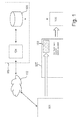
- FIG. 1 shows in a schematic representation selected components of a system for generating valid frankings and verifying frankings during mailing of a mail piece. Exemplary is in FIG. 1 a mail piece 107 is shown with a postage indicium 108.
- the exemplified system includes a vendor 101 located in a store, such as a supermarket or department store.
- the sales device 101 which is for example a computer cash register, is executed in a manner known to a person skilled in the art and makes it possible to process payment transactions with cash, cash card, credit card and / or other means of payment.
- the computer cash register 101 is connected to a central system 103 of the postal company.
- the connection is preferably made via a data network 102, which may be, for example, the Internet.
- the central system 103 comprises a franking server 104 communicating with the computer cash register 101 and a database 105 connected to the franking server 104.
- the database 105 can access postal distribution centers 106 to check the frankings of postal items 107 which are processed in the mail distribution centers 106.
- a mail distribution center 106 is shown.
- the computer cash register 101 is used in the illustrated system to make payment transactions for postage indicia 108 that can be purchased by a customer in the store.
- the computer cash register 101 is also intended to generate and print postage indicia 108 that can be applied by the customer to mailpieces 107 in order to frank them.
- a printing device assigned to the computer cash 101 is used for the printing of the franking marks 108. This may be a receipt printer, which is typically included in a computer cash register 101 in the manner previously described in order to print receipts for the payment transactions carried out.
- the computer cash station 101 comprises a further printing device which is used for the printing of postage indicia 108. This can in particular be a label printer, can be printed with the label, which can be glued by the customer on a mail piece 107.
- the postage indicia 108 printable by the computer cash register 101 include indicia containing unique identification codes of the indicia 108.
- the identification codes are also used to check the franking marks 108 in the mail distribution centers 106.
- the franking information may include other data, such as an identification of the computer cash 101, an indication of the company operating the computer cash 101, and the postage value and time of printing.
- the postage information may be printed in a machine-readable form, particularly as a bar code Postage indicium 108 may be included.
- the barcode can be a two-dimensional barcode, in particular a data-matrix code.
- individual details contained in the barcode, such as the postage value may also be included in the franking mark 108 in plain text.
- the computer cash register 101 preferably includes software configured to generate graphical representations of the indicia 108 using the information to be included in the indicia 108, particularly using the identification codes.
- the graphical representations of the indicia 108 generated by the software are then printed by the computer cash register 101 in the manner previously described.
- a plurality of identification codes are generated in the franking server 104 of the central system 103.
- the generated identification codes are stored in the database 105 as valid identification codes and transmitted to the computer cash register 101.
- the received identification codes are stored to print postage indicia 108 using the identification codes.
- the generation of the identification codes and their provision at the computer cash 101 takes place in an embodiment at regular intervals, so that in the computer cash 101 always identification codes are available to produce postage indicia 108.
- identification codes are provided by the mailing server 104 on the basis of a request from the computer cash register 101.
- the request may then be sent from the computer cash register 101 to the franking server 104, for example, when the computer cash register 101 determines that insufficient identification codes are available in the computer cash register 101.
- computer cash registers 101 provide a storage device secured by suitable hardware or software, which makes it possible to store identification codes securely, so that they are protected against access by unauthorized third parties.
- individual identification codes if required, that is to say when a franking mark 108 is to be generated, are transmitted to the franking server 104 in the computer cash register 101 upon a corresponding request from the computer cash register 101.
- a further embodiment provides that the identification codes are generated in the computer cash 101.
- a plurality of identification codes is generated at regular intervals or if necessary.
- the identification codes are then stored in the computer cash register 101 for future use.
- a secure storage device provided by the computer cash 101 can be used.
- the generated identification codes are reported to the mailing server 104, which stores the identification codes in the database 105 as received valid identification codes upon receipt.
- the generated identification codes can be sent jointly to the franking server 104 after they have been generated.
- the identification codes are each transmitted to the franking server 104 after they have been used, that is to say after the generation of a franking mark 108.
- the identification codes are generated in advance of the generation of postage indicia 108, predetermined postage values can be assigned to the identification codes when they are generated, so that an identification code can be used only for the generation and printing of a postage indicium 108 with the postage value associated with the identification code .
- the postage values are deposited both in the computer cash 101 and in the database 105 in association with the identification codes.
- the postage values associated with the identification codes, together with the identification codes are transmitted from the franking server 104 to the computer cash register 101 when the identification codes are generated in the franking server 104. If the identification codes are generated in the computer cash 101, then it transmits the assigned postage values together with the identification codes to the franking server 104.
- the identification codes are not assigned fixed postage values, but the postage values when franking marks 108 are generated be determined.
- franking marks 108 with predetermined postage values can thus be generated in the computer cash register 101.
- the postage values may correspond to postage values for commonly used postal company products, such as mailpieces 107 of a conventional format and weight.
- Each available postage value is preferably associated with a product code registered in the computer cash register 101, which is entered at the computer cash register 101 to start a payment transaction for the postage amount and the generation and printing of a corresponding postage indicium 108. Due to the entry of a product code, the computer cash register 101 recognizes that a postage indicium 108 is to be generated and what postage value it should have.
- franking markers 108 having freely selectable postage values can be generated and printed by means of the computer cash register 101.
- a common product code is preferably associated with the postage indicia 108, and the desired postage value is additionally input to the computer cash register 101.
- the product codes used can be designed, for example, as EANs (EAN: International Article Numbers) known to the person skilled in the art or as comparable product codes.
- the entry of a product code can be done manually.
- the product code is provided in machine-readable form, in particular as a bar code, which is detected by means of a bar code scanner of the computer cash register 101. Such scanners are already present in a variety of computer cash registers 101 of the type described above.
- the generation and the printing of a postage indicium 108 by means of the computer cash register 101 are preferably connected to a payment procedure relating to the postage value associated with the franking mark 108.
- the payment process is started and executed in much the same way as payment for another product to be acquired in the store by a customer.
- a customer at the computer cash register 101 announces his request, whereupon the corresponding product code is entered into the computer cash register 101.
- the computer cashier 101 also requests the input of the desired postage value, which then, for example, manually via a Keyboard can be entered and stored in the computer cash 101 at least temporarily.
- the postage indicium 108 further products may be acquired by the customer which, for example, are likewise provided with product codes which are detected at the computer cash register 101, in a manner known to those skilled in the art.
- the computer cash 101 After entering the product code and possibly the desired postage value, the computer cash 101 initially starts a payment process for the postage value. If further products registered in the computer cash 101 are to be paid, their prices are taken into account in the payment transaction. In particular, the computer cash register 101 forms in the usual way that of the customer total amount to be paid for the postage and the prices of the other products. After the start of the payment process, the customer pays the determined amount. Payment is made in a manner known per se using a means of payment usable on the computer cash register 101. As previously mentioned, this may be, for example, cash, a credit card or a cash card.
- a receipt or a document is printed over the amount paid by the customer using the receipt printer of the computer cash. Further, the computer cash register 101 initiates the generation and printing of a postage indicium 108 using an identification code.
- the computer cash register 101 If there are identification codes stored in the computer cash register 101 which have been previously generated in the franking server 104 or in the computer cash 101 and to which predetermined postage values have been assigned, the computer cash register 101 first determines an identification code for generating a postage indicium, to which the desired postage value is assigned , This is then used for the generation of the postage indicium 108. Due to its use, the identification code is also deleted in the memory of the computer cash 101 or marked as already used. As already used marked franking marks 108 can not be used again for the generation of a franking mark 108.
- the identification code used is reported together with the postage value to the franking server 104 if the identification code has not previously been transferred to the franking server 104 or has been generated in the franking server 104. Due to the receipt of the identification code, the mailing server 104 stores the identification code in association with the postage value in the database 105.
- identification codes are stored in the computer cash register 101 prior to the generation of a postage indicium 108, however, this no fixed postage value is determined, the computer cash 101 determines due to the successful payment of the franking mark 108 an identification code and uses this to generate the franking mark 108. Furthermore, the identification code is deleted in the memory of the computer cash 101 or marked as already used in the manner described above. In addition, the identification code is reported together with the postage value to the franking server 104. If the identification code has been generated in the computer cash register 101, the franking server 104 stores the received identification code in association with the postage value in the database 105. If the franking server 104 has generated the identification code and this is already stored in the database 105, the franking server 104 determines the received identification code in the database 105 and assigns him the reported postage value.
- the computer cash register 101 In the embodiment in which identification codes are generated, if necessary, in the computer cash register 101, the computer cash register 101 generates an identification code after payment of the franking mark 108 and uses this to generate the franking mark 108. Furthermore, the identification code is reported to the franking server 104 together with the associated postage value which stores the identification code in association with the postage value in the database 105.
- the computer cash register 101 If it is provided that the computer cash register 101 requests identification codes from the franking server 104 as needed, then the computer cash register 101 will send a request for the identification code stating the postage value to the franking server 104 upon payment of the franking mark 108. The franking server 104 will generate or determine based on the request In addition, the mailing server 104 sends the identification code to the computer cash register 101. The computer cash register 101 then generates a postage indicium 108 using the identification code obtained from the mailing server 104.
- a postage indicium 108 After a postage indicium 108 has been generated in the computer cash register 101 using an identification code, it is printed out by means of the printing device of the computer cash 101 provided for this purpose. If the receipt printer of the computer cash register 101 is used for the printout of the postage indicium 108, the printout of the postage indicium 108 is preferably made separately from the printout of the receipt. In this way, the customer receives a separate franking mark 108, which he can apply to a mail piece 107. The franking mark 108 generated by means of the computer cash register 101 is passed to the customer after printing, which can then use the franking mark 108 for the franking of mailpieces 107.
- the postage indicium 108 is attached to the mail item 107.
- the franking mark 108 can be glued onto the mail piece 107, for example.
- the customer delivers the mail piece 107 to the postal company.
- the mail piece 107 is then transported to a mail distribution center 106, in which the proper franking of the mail item 107 is checked. This is usually the postal distribution center 106 of the postal company, which is assigned to the departure point of the mail item 107.
- the identification code contained in the franking mark 108 is detected in the mail distribution center 106.
- the detected identification code is then compared with the identification codes stored in the database 105 as valid identification codes. If the detected identification code does not correspond to a valid identification code in the database 105, an invalid franking of the mail item 107 is detected. As a result, the mail piece 107 is usually discharged from the normal Befördungselle.
- the detected identification code coincides with a valid identification code stored in the database 105
- it is preferably checked whether the postage value assigned to the identification code in the database 105 coincides with the postage value for transporting the postal item 107 or if the product, the associated with the identification code in the database 105, which corresponds to mail item 107.
- the relevant for the postage determination items such as format, weight and desired additional services, determined.
- the resulting postage amount is then calculated from the determined mailing characteristics and compared with the postage value associated with the identification code in the database 105. If this is equal to or greater than the calculated postage amount, a valid franking is determined, and the mail piece 107 is delivered in the normal manner to the intended recipient.
- the identification code is marked as invalid in the database 105 after the determination that it is a valid franking, or deleted from the database 105, so that a valid franking can not be determined once again for this identification code. If the postage value associated with the identification code in the database 105 is smaller than the postage amount for the mail item 107 calculated in the postal distribution center 106, it is determined that the franking is invalid and the mail item 107 is handled in a predetermined manner.
- the identification code can also be marked as invalid in the database 105 or deleted in this case.
- a further embodiment of the invention differs from the embodiments described above in that the franking marks 108 are not assigned any unique identification codes. Instead, the computer cash register 101 uses an identifier associated with the computer cash register 101 to generate the indicia 108. Further, the indicia 108 are provided with a timestamp having a fixed value over a certain period of time, such as a second or a minute, after the expiration of the Period is incremented. Due to the production of a postage indicium In this embodiment, the computer cash 101 sends a corresponding message to the franking server 104. The message preferably contains the time stamp which the computer cash register 101 has inserted in the franking mark 108.
- the franking server 104 it is determined on the basis of the message received from the computer cash register 101 about which total postage amount one or more postage indicia 108 has generated the computer cash register 101 with a specific time stamp.
- the determined postage amount is then stored in the database 105 in association with the time stamp and in association with the identifier of the computer cash register 101 as a valid postage amount.
- the postage value, the identifier of the computer cash 101 and the contained time stamp are read from the franking mark 108. Then the valid postage amount stored in association with the identifier and the time stamp in the database 105 is determined.
- the postage value assigned to a postage indicium is not stored in the database 105 in association with the identification code of the postage indicium, but is merely contained in the postage indicium.
- the indication of the postage value encoded by the computer cash station 101 in this case can be deciphered in the mail distribution center 106 carrying out the check.
- the deciphered postage value is then compared with the postage value to be paid for the mail item 107 in order to check the validity of the franking of the mail item 107.
- the transmission of the postage amount from the computer cash station 101 to the franking server 104 provided in previously described embodiments can be dispensed with.
- the storage is omitted
- the output of the postage indicium in this modification may be made in the same manner as described above.
- a further embodiment of the invention differs from the previously described embodiments in particular in that franking marks 108 are not printed by the computer cash register 101, but prefabricated postage indicia 108 are provided in the store in which the computer cash register 101 is located.
- the prefabricated indicia 108 are initially not valid, i.e., are recognized as invalid at the time of the check in the mail distribution center 106.
- the franking marks 108 only become valid after activation, which can be carried out in a manner to be described. Due to the activation, the postage indicia 108 are marked as valid in the database 105. Since the not yet activated postage indicia 108 thus have no value, there is the advantage that they do not have to be inventoried in the shop and that in case of theft no loss arises.
- prefabricated indicia 108 may be provided individually or in bundles so that they may be applied by customers to self-made mailings 107.
- stickers with the franking marks 108 can be provided, which can be attached to the mailpieces 107.
- the indicia 108 may also be applied to pre-made mailpieces 107, such as pre-made postcards.
- postage indicia 108 are applied to envelopes of mailpieces 107, such as envelopes or pre-made boxes for mailing parcels, which are delivered to customers of the postal company.
- Each prefabricated postage indicium 108 is preferably associated with a unique identification code.
- the identification codes are in the postage indicia 108 preferably contained in a machine-readable form, for example in the form of barcodes.
- the identification codes are preferably also stored in the central system 103 of the postal company.
- the identification codes can be stored in the franking server 104 or in the database 105. However, the identification codes are initially marked as invalid, so that the associated postage indicia 108 can not initially be used for sending mailpieces 107.
- the prefabricated postage indicia 108 may each be assigned a fixed postage value.
- the postage value is stored in association with the identification code of a postage indicium 108 in the central system 103 or the postage value is included in the postage indicium 108 in a truncated form.
- provision may also be made for the postage value of the postage indicia 108 to be variable and to be determined when activated in a manner to be described.
- each franking mark 108 is assigned an activation code.
- the activation code associated with a postage indicium 108 is also stored in the central system 103. In one embodiment, there is a clear association between the indicia 108 and the activation codes. This means that exactly one activation code is assigned to one postage indicium 108 and vice versa. In this case, the activation code may correspond to the identification code of the postage indicium 108. Likewise, however, a postage indicium 108 may also be assigned an activation code different from the identification code, which is stored in association with the identification code in the central system 103. Likewise, it may be provided that a plurality of franking marks 108 are associated with an activation code.
- the postage indicia 108 contained in the bundle may in this case be assigned a common activation code.
- the one franking mark 108 associated activation code may be included in the postage indicium 101, preferably in machine-readable form, for example as a barcode.
- the activation code may be provided separately. This can be the case in particular when the activation code has several postage indicia 108 assigned to it.
- the activation code can be attached, for example, in a machine-readable form to a packaging in which the franking marks 108 are contained.
- each postage value is preferably assigned a product code which is stored in the computer cash register 101 in association with the postage value.
- the product code is included as a barcode in the franking marks 108, for example.
- the bundle is preferably associated with a product code. This is deposited in the computer cash 101 with assignment of the total postage value of the postage indicia 108 contained in the bundle.
- a general product code is preferably associated with the postage indicia 108 and the desired postage value is additionally input to the computer cash register 101.
- the product code attached to the postage indicium 108 or the bundle is entered into the computer cash register 101. This is preferably done by scanning the product code by means of the bar code reader of the computer cash register 101.
- the product code as described above, is either the product code associated with the given postage value of the postage indicium 108 or the total postage of the bundle or a generic product code for postage indicia 108.
- the computer cash 101 determines the postage value or the total postage on the basis of the product code.
- further products may be acquired by the customer which, for example, are likewise provided with product codes which are detected at the computer cash register 101, in a manner known to those skilled in the art.
- the computer cash 101 After entering the product code and possibly the desired postage value, the computer cash 101 first starts a payment process for the postage value. If further products registered in the computer cash 101 are to be paid, their prices are taken into account in the payment transaction. In particular, the computer cash register 101 forms in the usual way the total amount of the postage value to be paid by the customer and the prices of the other products. After the start of the payment process, the customer pays the determined amount. Payment is made in a manner known per se using a means of payment usable on the computer cash register 101. As previously mentioned, this may be, for example, cash, a credit card or a cash card. After the payment process is completed, a receipt or a document is printed over the amount paid by the customer using the receipt printer of the computer cash.
- the activation code which is associated with the postage indicium 108 or the bundle of postage indicia 108, is recorded.
- the bar code scanner of the computer cash 101 can be used.
- the activation code is entered manually at the computer cash register 101.
- the detected activation code is then transferred from the computer cash 101 to the franking server 104 Posted. If the postage value of the franking mark 108 has been determined during the payment process, the postage value is also reported to the franking server 104 in addition to the activation code.
- an additional product code is dispensed with.
- the activation codes of the postage indicia 108 in the store or the bundle of postage indicia 108 are stored in the computer cash register 101.
- the postage values of the postage indicia 108 are also stored in the computer cash register 101.
- the total postage values of the respective postage indicia 108 contained in the bundles are stored in the computer cash 101. At a variable postage value is deposited in the computer cash 101 that a postage value is entered.
- the associated activation code is detected at the computer cash register 101 in this embodiment.
- the computer cash 101 determines the postage value to be paid using the assignment stored in the computer cash register 101. If the postage value is variable, the computer cashier 101 requests entry of the postage value and takes over the subsequent entry. With regard to the postage value, the payment process is subsequently carried out in the same way as previously described.
- the detected activation code is then sent from the computer cash register 101 to the mailing server 104.
- the postage value of the franking mark 108 is also reported to the franking server 104 in addition to the activation code.
- the franking server 104 determines the identification code associated with the activation code or the identification codes associated with the activation code. The identification code or the identification codes are then entered by the activation device 104 in the database 105 as valid identification codes.
- the postage values of the postage indicia 108 assigned to the identification codes are stored in the database 105 in association with the identification codes, provided that they are not contained in the postage indicia 108 in a merely encrypted form. The postage values are determined based on the received activation code, or the postage value reported by the computer cash register 101 is used.
- the identification codes are already stored in the database 105 after they have been generated, but are first marked as invalid.
- the respective identification codes are marked as valid by the mailing server 104 in the database 105 after activation code has been received. If the associated postage values have not previously been stored in the database 105, they may possibly also be stored by the activation device 104 in association with the identification codes in the database 105.
- the postage indicium 108 After activation of a postage indicium 108, that is, after in the franking mark 108 assigned identification code in association with the postage value of the franking mark 108 in the database 105 is valid deposited, the postage indicium 108 can be used by a customer for franking a mail piece 107. For this purpose, the postage indicium 108 is applied to a mailpiece 107 created by the customer, unless an already prefabricated mailpiece 107 with postage indicium 108 is used. The postal item 107 provided with the franking mark 108 can then be dispatched by the customer to the postal company for delivery. After the delivery of the mail item 107, a check of the franking mark 108 is carried out in the mail distribution center 106. This is done in the manner already described above.
Landscapes
- Physics & Mathematics (AREA)
- General Physics & Mathematics (AREA)
- Management, Administration, Business Operations System, And Electronic Commerce (AREA)
- Devices For Checking Fares Or Tickets At Control Points (AREA)
Applications Claiming Priority (1)
| Application Number | Priority Date | Filing Date | Title |
|---|---|---|---|
| DE200810063009 DE102008063009A1 (de) | 2008-12-23 | 2008-12-23 | Verfahren und System zum Versenden einer Postsendung |
Publications (1)
| Publication Number | Publication Date |
|---|---|
| EP2202692A1 true EP2202692A1 (fr) | 2010-06-30 |
Family
ID=41718777
Family Applications (1)
| Application Number | Title | Priority Date | Filing Date |
|---|---|---|---|
| EP09177018A Withdrawn EP2202692A1 (fr) | 2008-12-23 | 2009-11-25 | Procédé et système d'envoi d'un envoi postal |
Country Status (2)
| Country | Link |
|---|---|
| EP (1) | EP2202692A1 (fr) |
| DE (1) | DE102008063009A1 (fr) |
Cited By (1)
| Publication number | Priority date | Publication date | Assignee | Title |
|---|---|---|---|---|
| CN103068495A (zh) * | 2010-08-16 | 2013-04-24 | 西门子公司 | 用于可检验地递送物品的方法 |
Families Citing this family (1)
| Publication number | Priority date | Publication date | Assignee | Title |
|---|---|---|---|---|
| WO2023047237A1 (fr) * | 2021-09-24 | 2023-03-30 | 3M Innovative Properties Company | Enveloppe d'expédition comportant un lien de communication en vue d'une activation |
Citations (9)
| Publication number | Priority date | Publication date | Assignee | Title |
|---|---|---|---|---|
| WO2002092351A2 (fr) | 2001-05-11 | 2002-11-21 | Neopost Inc. | Procede et systeme de fourniture de timbres par une borne interactive |
| EP1435593A2 (fr) | 2002-12-30 | 2004-07-07 | Pitney Bowes Inc. | Système de comptage pour des fonds personnels et procédé associé |
| US20060122947A1 (en) | 2004-12-08 | 2006-06-08 | Lockheed Martin Corporation | Automatic revenue protection and adjustment of postal indicia products |
| US20060261154A1 (en) * | 2003-10-28 | 2006-11-23 | First Data Corporation | Multi-card bulk package identifying activation systems and methods |
| EP1762986A2 (fr) | 2005-09-09 | 2007-03-14 | Neopost Technologies | Procédé et système pour la validation et la vérification d'envois postaux |
| EP1762985A1 (fr) | 2005-09-09 | 2007-03-14 | Neopost Technologies | Procédé d'obtention d'un crédit d'affranchissement au travers d'un réseau de télécommunication |
| EP1903506A1 (fr) | 2006-09-15 | 2008-03-26 | Neopost Technologies | Procédé d'affranchissement de courriers avec stockage de numéro d'identification unique dans une base de données. |
| US20080114696A1 (en) * | 2006-11-13 | 2008-05-15 | Blackhawk Network, Inc. | System for packaging, processing, activating, and deactivating multiple individual transaction cards as a singular unit |
| DE102007018394A1 (de) | 2007-04-17 | 2008-10-23 | Deutsche Post Ag | Verfahren zur Frankierung einer Postsendung sowie Vorrichtung, Netzwerkknoten, Logistiksystem und Bearbeitungseinheit zur Durchführung des Verfahrens |
Family Cites Families (3)
| Publication number | Priority date | Publication date | Assignee | Title |
|---|---|---|---|---|
| EP1035515A3 (fr) * | 1999-03-11 | 2000-12-20 | Pitney Bowes Inc. | Timbre postal et procédé pour vérifier sa validation |
| DE10115585B4 (de) * | 2001-03-29 | 2008-09-11 | Siemens Ag | Verfahren zum Frankieren und Bearbeiten von Postsendungen mit einer Datenübermittlung zwischen einer Zentrale und dem Versender |
| DE10131254A1 (de) * | 2001-07-01 | 2003-01-23 | Deutsche Post Ag | Verfahren zum Überprüfen der Gültigkeit von digitalen Freimachungsvermerken |
-
2008
- 2008-12-23 DE DE200810063009 patent/DE102008063009A1/de not_active Ceased
-
2009
- 2009-11-25 EP EP09177018A patent/EP2202692A1/fr not_active Withdrawn
Patent Citations (9)
| Publication number | Priority date | Publication date | Assignee | Title |
|---|---|---|---|---|
| WO2002092351A2 (fr) | 2001-05-11 | 2002-11-21 | Neopost Inc. | Procede et systeme de fourniture de timbres par une borne interactive |
| EP1435593A2 (fr) | 2002-12-30 | 2004-07-07 | Pitney Bowes Inc. | Système de comptage pour des fonds personnels et procédé associé |
| US20060261154A1 (en) * | 2003-10-28 | 2006-11-23 | First Data Corporation | Multi-card bulk package identifying activation systems and methods |
| US20060122947A1 (en) | 2004-12-08 | 2006-06-08 | Lockheed Martin Corporation | Automatic revenue protection and adjustment of postal indicia products |
| EP1762986A2 (fr) | 2005-09-09 | 2007-03-14 | Neopost Technologies | Procédé et système pour la validation et la vérification d'envois postaux |
| EP1762985A1 (fr) | 2005-09-09 | 2007-03-14 | Neopost Technologies | Procédé d'obtention d'un crédit d'affranchissement au travers d'un réseau de télécommunication |
| EP1903506A1 (fr) | 2006-09-15 | 2008-03-26 | Neopost Technologies | Procédé d'affranchissement de courriers avec stockage de numéro d'identification unique dans une base de données. |
| US20080114696A1 (en) * | 2006-11-13 | 2008-05-15 | Blackhawk Network, Inc. | System for packaging, processing, activating, and deactivating multiple individual transaction cards as a singular unit |
| DE102007018394A1 (de) | 2007-04-17 | 2008-10-23 | Deutsche Post Ag | Verfahren zur Frankierung einer Postsendung sowie Vorrichtung, Netzwerkknoten, Logistiksystem und Bearbeitungseinheit zur Durchführung des Verfahrens |
Cited By (2)
| Publication number | Priority date | Publication date | Assignee | Title |
|---|---|---|---|---|
| CN103068495A (zh) * | 2010-08-16 | 2013-04-24 | 西门子公司 | 用于可检验地递送物品的方法 |
| US8973814B2 (en) | 2010-08-16 | 2015-03-10 | Siemens Aktiengesellschaft | Method for the verifiable delivery of an article |
Also Published As
| Publication number | Publication date |
|---|---|
| DE102008063009A1 (de) | 2010-06-24 |
Similar Documents
| Publication | Publication Date | Title |
|---|---|---|
| US4791281A (en) | Encoding and decoding system | |
| DE69724345T2 (de) | System zur kontrollierten Annahme von Poststücken, das sicher die Wiederverwendung einer ursprünglich für ein Poststück erzeugten digitalen Wertmarke bei einem später vorbereiteten anderen Poststück zum Beglaubigen der Bezahlung der Postgebühren ermöglicht | |
| EP0895172A2 (fr) | Méthode pour facturer des services d'expedition | |
| WO2003035283A2 (fr) | Procede et dispositif pour traiter des envois postaux | |
| DE69637237T2 (de) | Verfahren and Vorrichtung zur Authentifizierung von Postgebührenabrechnungsberichten | |
| EP2017791A1 (fr) | Procédé, dispositif et système logistique destinés au transport d'envois postaux | |
| EP0354260A1 (fr) | Système de codage et de décodage | |
| EP2192557A1 (fr) | Procédé de détection de fraude postale pour des timbres activés au point de vente | |
| EP1696391B1 (fr) | Système et procédé d'évaluation de frais postaux | |
| EP1656218B1 (fr) | Procede et dispositif pour traiter des informations graphiques se trouvant sur des envois postaux | |
| EP1581910A1 (fr) | Procede et dispositif pour le traitement d'information graphique figurant sur des surfaces d'articles postaux | |
| EP2202692A1 (fr) | Procédé et système d'envoi d'un envoi postal | |
| EP1916628A1 (fr) | Procédé destiné à la production d'un document intelligent et dispositif destiné à l'exécution du procédé | |
| EP1736935A2 (fr) | Procédé destiné à l'attribution d'une information à un élément postal | |
| EP1178452B1 (fr) | Méthode pour une transmission de données sécurisée dans les ventes de marchandises | |
| EP0829826B1 (fr) | Dispositif pour fabriquer des documents de valeur | |
| DE102008063010A1 (de) | Verfahren und System zum Frankieren einer Postsendung | |
| DE10115585B4 (de) | Verfahren zum Frankieren und Bearbeiten von Postsendungen mit einer Datenübermittlung zwischen einer Zentrale und dem Versender | |
| EP1774482A1 (fr) | Proc d et dispositif de production et de vente de vignettes d'affranchissement pour l'envoi de courriers postaux | |
| EP1784771B1 (fr) | Procédé de vérification de taxation lors du transport d'envois postaux par l'intermédiaire d'un système électronique de casiers pour colis, et système électronique de casiers pour colis pour la mise en oeuvre du procédé | |
| WO2020038715A1 (fr) | Procédé et système d'affranchissement direct d'envois postaux au moyen d'une identification décentralisée | |
| EP2140429A1 (fr) | Procédé et dispositif d'affranchissement d'un envoi postal avec enregistrement d'une information d'identification dans une liste positive | |
| DE19720053A1 (de) | Verfahren zur Beschleunigung der Sortierung und des Transports sowie zur Vereinfachung der Abrechnung im Brief- und Frachtverkehr | |
| EP1671278A1 (fr) | Procede et dispositif pour realiser un envoi postal | |
| EP2348473A1 (fr) | Procédé de paiement d'une offre à l'aide d'unités de valeur électroniques ; système de transaction |
Legal Events
| Date | Code | Title | Description |
|---|---|---|---|
| PUAI | Public reference made under article 153(3) epc to a published international application that has entered the european phase |
Free format text: ORIGINAL CODE: 0009012 |
|
| AK | Designated contracting states |
Kind code of ref document: A1 Designated state(s): AT BE BG CH CY CZ DE DK EE ES FI FR GB GR HR HU IE IS IT LI LT LU LV MC MK MT NL NO PL PT RO SE SI SK SM TR |
|
| AX | Request for extension of the european patent |
Extension state: AL BA RS |
|
| 17P | Request for examination filed |
Effective date: 20101230 |
|
| 17Q | First examination report despatched |
Effective date: 20110303 |
|
| RIN1 | Information on inventor provided before grant (corrected) |
Inventor name: MEYER, BERND Inventor name: RAKOW, MATTHIAS Inventor name: DR. LANG, JUERGEN |
|
| STAA | Information on the status of an ep patent application or granted ep patent |
Free format text: STATUS: THE APPLICATION IS DEEMED TO BE WITHDRAWN |
|
| 18D | Application deemed to be withdrawn |
Effective date: 20150909 |