EP2234043A1 - Mobile rack for a library and rfid system for a library including the same - Google Patents
Mobile rack for a library and rfid system for a library including the same Download PDFInfo
- Publication number
- EP2234043A1 EP2234043A1 EP10157540A EP10157540A EP2234043A1 EP 2234043 A1 EP2234043 A1 EP 2234043A1 EP 10157540 A EP10157540 A EP 10157540A EP 10157540 A EP10157540 A EP 10157540A EP 2234043 A1 EP2234043 A1 EP 2234043A1
- Authority
- EP
- European Patent Office
- Prior art keywords
- racks
- rack
- books
- rfid
- tag
- Prior art date
- Legal status (The legal status is an assumption and is not a legal conclusion. Google has not performed a legal analysis and makes no representation as to the accuracy of the status listed.)
- Ceased
Links
Images



Classifications
-
- G—PHYSICS
- G06—COMPUTING OR CALCULATING; COUNTING
- G06K—GRAPHICAL DATA READING; PRESENTATION OF DATA; RECORD CARRIERS; HANDLING RECORD CARRIERS
- G06K17/00—Methods or arrangements for effecting co-operative working between equipments covered by two or more of main groups G06K1/00 - G06K15/00, e.g. automatic card files incorporating conveying and reading operations
-
- A—HUMAN NECESSITIES
- A47—FURNITURE; DOMESTIC ARTICLES OR APPLIANCES; COFFEE MILLS; SPICE MILLS; SUCTION CLEANERS IN GENERAL
- A47B—TABLES; DESKS; OFFICE FURNITURE; CABINETS; DRAWERS; GENERAL DETAILS OF FURNITURE
- A47B53/00—Cabinets or racks having several sections one behind the other
- A47B53/02—Cabinet systems, e.g. consisting of cabinets arranged in a row with means to open or close passages between adjacent cabinets
-
- A—HUMAN NECESSITIES
- A47—FURNITURE; DOMESTIC ARTICLES OR APPLIANCES; COFFEE MILLS; SPICE MILLS; SUCTION CLEANERS IN GENERAL
- A47B—TABLES; DESKS; OFFICE FURNITURE; CABINETS; DRAWERS; GENERAL DETAILS OF FURNITURE
- A47B63/00—Cabinets, racks or shelf units, specially adapted for storing books, documents, forms, or the like
-
- G—PHYSICS
- G06—COMPUTING OR CALCULATING; COUNTING
- G06Q—INFORMATION AND COMMUNICATION TECHNOLOGY [ICT] SPECIALLY ADAPTED FOR ADMINISTRATIVE, COMMERCIAL, FINANCIAL, MANAGERIAL OR SUPERVISORY PURPOSES; SYSTEMS OR METHODS SPECIALLY ADAPTED FOR ADMINISTRATIVE, COMMERCIAL, FINANCIAL, MANAGERIAL OR SUPERVISORY PURPOSES, NOT OTHERWISE PROVIDED FOR
- G06Q10/00—Administration; Management
- G06Q10/08—Logistics, e.g. warehousing, loading or distribution; Inventory or stock management
- G06Q10/087—Inventory or stock management, e.g. order filling, procurement or balancing against orders
Definitions
- the present disclosure relates to a mobile rack for a library and an RFID (Radio Frequency IDentification) system for a library including the same, and more particularly to a mobile rack for a library and an RFID system for a library including the same, in which an RFID communication using UHF is employed, and security and ambient space utilization can be beneficially obtained by moving racks containing books.
- RFID Radio Frequency IDentification
- a library mobile rack is installed at a place where lots of books are stored or kept such as a library, and configured to move racks in various shapes and structures. These days, an RFID (Radio Frequency IDentification) communication is utilized to effectively manage the books in the library moving racks.
- RFID Radio Frequency IDentification
- the above RFID is a technology to receive and transmit data from an electronic tag attached to objects by using radio frequency. That is, the RFID is a technology that uses radio frequencies to transmit/receive information to/from an electronic tag attached to an object, thereby providing a related service during the sale of the object.
- the RFID can be thought of as a representative technology of general contact-less cards that can replace barcodes, magnetic cards, IC cards, and the like.
- AN RFID system includes an RFID reader and an RFID tag.
- the RFID reader includes an internal or external antenna forming an electromagnetic field, that is, RF field by diffusing an active signal. If the electronic tag enters the RF field, the electronic tag receives the active signal diffused by the antenna and transmits data stored at a tag to the RFID reader by using the received active signal. After this, the RFID reader receives and analyzes the data transmitted by the electronic tag to acquire particular data on an object where the electronic tag is attached.
- an RFID system includes an RFID reader and an RFID tag.
- the RFID reader emits an active signal through an antenna to create an electromagnetic field, that is, an RF field.
- the RFID tag Upon entering the RF field, the RFID tag is enabled.
- the enabled RFID tag transmits its stored information (or a tag response signal) to the RFID reader.
- the RFID reader analyzes the received information to obtain the specific information relating to an object to which the RFID tag is attached.
- an RFID system uses various frequency bands such as low frequency, high frequency, UHF, microwave, having different usages and practical uses respectively.
- frequencies generally used by the RFID communication include low frequencies (125 kHz, 135 kHz) and high frequencies (13.56 MHz), whereby an interference signal is transmitted to the antenna.
- the interference signal brings about an inconvenience to management of objects attached with the RFID tag.
- many signals may be overlappingly received by the antenna to increase inconveniences to the management of books caused by the interfered signals in a library mobile rack where a plurality of racks stacked with many books is installed and where each rack is movably provided.
- the present disclosure is disclosed to obviate the above-mentioned disadvantages, and it is an object of the present disclosure to provide a mobile rack for a library and an RFID (Radio Frequency IDentification) system for a library including the same, whereby, an RFID communication is enabled to allow an easy management of books even if racks for keeping books are disposed at adjacent areas.
- RFID Radio Frequency IDentification
- the present disclosure also enables movement of racks to provide an advantage to security and ambient space utilization.
- a mobile rack for a library comprises: a plurality of racks configured to keep books each attached with an RFID tag and mounted with an RFID reader for recognizing tag information stored in the RFID tag; moving means configured to move at least one of the plurality of racks; a server configured to manage the books that are inputted, outputted and stacked; and a controller configured to control the moving means in response to a user command through the server or the tag information and to adjust a discrete distance between racks.
- the plurality of racks may include a first rack and a second rack
- the controller may control the moving means to allow the first and second racks to be locked while being approached in response to the tag information in the books stacked in the first rack or the second rack, or the user command.
- the controller may release the locking between the first and second racks in response to the tag information in the books stacked in the first rack or the second rack, or the user command, and separate the first and second racks, whereby the moving means may be controlled to open and unfold the first and second racks.
- the mobile rack may be provided with an UHF antenna configured to transmit an radio frequency (RF) signal of UHF band generated by the RFID reader and transmit the RF signal to the RFID reader by receiving the RF signal of UHF band transmitted by the RFID tag, and provided with a plurality of divisional plates configured to keep the books by dividing the racks, wherein each of the divisional plates is provided with the UHF antenna to divide a stacking area of books through the server.
- RF radio frequency
- the mobile rack may further comprise an obstacle detecting sensor configured to detect whether there is any obstacle between the first and second racks and to transmit obstacle detection information to the controller.
- the controller may stop the operation of the moving means if the obstacle detection information is received from the obstacle detection sensor that there is an obstacle between the first and second racks.
- the mobile rack may further comprise a display configured to display at least one of the tag information, the user command and the obstacle detection information.
- a mobile rack for a library comprises: a plurality of racks configured to keep books each attached with an RFID tag and mounted with an RFID reader for recognizing tag information stored in the RFID tag; moving means configured to move at least one of the plurality of racks; a server configured to manage the books that are inputted, outputted and stacked; and a locking device configured to lock the two adjacent racks while the two adjacent racks are mutually approached in response to a user command through the server or the tag information.
- the locking device may release the lock-up in response to a user command through the server or the tag information whereby a space between the two adjacent racks can be opened.
- the mobile rack for a library and an RFID (Radio Frequency IDentification) system for a library including the same is advantageous in that the use of RFID communication using the UHF band enables the book management using the RFID communication without being affected by interference signal even if racks configured to keep books are provided in plural form.
- Another advantage is that security of books can be maintained because the racks are locked up by being moved in adjacent manner.
- Still another advantage is that a space between a space of each rack is opened to allow books to be taken out, where the obstacle detection sensor is used to guarantee the security of a user taking out a book.
- FIG. 1 is a perspective view illustrating a mobile rack for a library according to an exemplary embodiment of the present disclosure
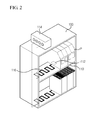
- FIG.2 is an enlarged perspective view illustrating a rack of a mobile rack for a library according to an exemplary embodiment of the present disclosure.
- a mobile rack for a library may include a rack 100, moving means 200, a server 300 and a controller 400.
- the rack 100 serves to keep the books each attached with an RFID tag 112, and may be provided with a plurality of divisional plates 110 configured to divide the racks 100 so that the books (P) can be easily stored. At this time, other items placeable on the racks 100 may be included.
- the rack 100 may be provided with an RFID reader 114 configured to recognize tag information recorded with in an RFID tag 112 attached to the book (P).
- the RFID reader 114 may be connected to an UHF antenna 116.
- the UHF antenna 116 serves to transmit a radio frequency (RF) signal of UHF band generated by the RFID reader 114 and to transmit the RF signal to the RFID reader 114 by receiving the RF signal of UHF band transmitted by the RFID tag 112.
- RF radio frequency
- the UHF antenna 116 employing a near-field generates no interference with other antennas provided in other divisional plates, and has a high recognition speed and recognition rate over that of an HF antenna.
- the disadvantage of the UHF antenna is that it has a shorter recognition distance over that of the HF antenna.
- the UHF antenna has no problem when it comes to a short discrete distance between the RFID tag and the antenna as in the mobile racks for a library according to the present disclosure.
- the UHF antenna is mounted at each divisional plate 110 to check at which divisional plate a book (P) is stacked. That is, the usage of the UHF antenna enables a user to discern a stacked area of a book via the server. Furthermore, the UHF antenna can also correct the tag information collected in the RFID tag by receiving a recorded signal from the RFID reader 114. That is to say, in a case information correction on a book (P) is needed, the information correction of the book is possible without taking out the book that is stacked.
- the UHF antenna may be also used to additionally input security information on the book (P) or to delete the security information inputted into the book (P).
- the moving means 200 serves to move at least one of the plurality of racks 100, and may include a rail 210, a wheel (not shown) rotating along the rail 210, and a motor (not shown) driving the wheel. That is, the rack 100 may be mounted at a bottom surface thereof with the wheel and the motor, and the rack 100 may be moved by control of the motor by the controller 400 (to be described later).
- the server 300 functions to manage the in/out and stacking of books (P) on the rack 100, and may be provided to be able to communicate with the RFID reader 114 wirelessly or wiredly. That is, the server 300 receives the information of the books (P) through the RFID communication and transmits the information to a user, and the user having received the information uses the information to manage the in/out and stacking of the books (P).
- the server 300 is also connected to the controller 400 to be explained later.
- the user therefore can use the server 300 to transmit a command to the controller 400.
- the controller 400 may control the moving means 200 to cause the rack 100 stacked with a book (P) sought after by the user to be moved.
- the server 300 is also connected to a display 600 (to be explained later) to allow the information of the book (P) desired by the user to be managed in real time. This real time management of books provides an advantage to a case where in/out of books (P) is frequent.
- controller 400 may control the moving means 200 responsive to the user command via the server 300 or the tag information to adjust each discrete distance of the racks 100.
- the controller 400 may receive information on the kinds of books (P) and security problems of the books (P) from the tag information recognized via the RFID reader 114, or receive via the server 300 the user command of whether to open or close the racks 100 and what kind of book desired by the user is. In a case the controller 400 receives the user command or the tag information, the controller 400 controls the moving means 200 to arrange the racks 100 in the following manner.
- the controller 400 may control the moving means 200 in such a fashion that the first and second racks 120, 140 are mutually approached. That is, the controller 400 may control in such a manner that a discrete distance between the two racks is narrowed. At this time, racks not facing one another and located in the right hand side and in the left hand side of the first and second racks 120, 140 may be simultaneously moved. Once the first and second racks 120, 140 are mutually approached, the controller 400 may check whether the books (P) stacked inside the two racks need to be security-maintained according to the tag information of the books or the user command, and may control in such a manner that the two racks are locked.
- the controller 400 may check whether the books (P) stacked inside the two racks need to be security-maintained according to the tag information of the books or the user command, and may control in such a manner that the two racks are locked.
- the controller 400 may lock up the two racks by turning off the motor mounted at the moving means 200 or by applying a brake to the wheel.
- the controller 400 may lock up the two racks by controlling a locking device 700 separately provided at the bottom of the rack 100.
- the controller 400 may control the moving means 200 in such a manner that the first rack 120 is distanced from the second rack 140 or vice versa. That is, the controller 400 controls in such a way that the discrete distance between the two racks is increased. Prior to the first rack 120 and the second rack 140 being opened to a wider width, the lock-up of the two racks must be released. The release of the lock-up may be determined by the tag information of the book (P) or the user command.
- the controller 400 may turn on the motor or release the brake of the wheel to release the lock-up of the two racks.
- the user may take out a book stacked on one of the two racks.
- an obstacle detection sensor 500 be provided to detect whether there is an obstacle (B) between the first and second racks 120, 140.
- the obstacle detection sensor 500 may be mounted at a lateral surface of the first rack 120 and the second rack 140, or at an upper side and a lower side of the first rack 120 and the second rack 140.
- the obstacle detection sensor 500 may be conventionally a proximity sensor.
- the obstacle detection sensor 500 is not limited to the proximity sensor but may be an ultrasonic sensor, an ultrasonic sensor or any other type of sensor.
- the obstacle detection sensor 500 transmits the detected obstacle detection information to the controller 400.
- the controller 400 in turn stops the operation of the moving means 200 to prevent the two opened racks from being closed again if the controller 400 receives the detected obstacle detection information.
- a safety device configured to forcibly stop the operation of the moving means 200 if the obstacle detection sensor 500 fails to properly operate.
- a mobile rack for a library may further include a display 600 that is connected to the RFID reader 114, the server 300 and the controller 400 for displaying at least one of the tag information and the user command or the obstacle detection information.
- the server 300 and the display 600 may be implemented by a user personal computer (PC), and the controller 400 may be provided to communicate with the user PC wiredly or wirelessly. This configuration is intended for the user not only to firsthand manipulate the controller and but to manipulate the controller 400 via the server 300 while watching the display at a remote distance.
- FIG.3 is a status view illustrating two adjacent racks being locked up according to the present disclosure
- FIG.4 is a status view illustrating an opened state of two adjacent racks according to the present disclosure
- FIG. 5 is an operational status view illustrating an operational process of an obstacle detection sensor in a mobile rack for a library according to the present disclosure
- FIG.6 is an operational status view illustrating an operational process of an obstacle detection sensor in a mobile rack for a library according to another exemplary embodiment of the present disclosure
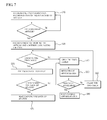
- FIG.7 is a flowchart illustrating an operational process of an RFID system for a library according to the present disclosure.
- information of a book (P) stacked on the divisional plate 110 may be recognized using the UHF antenna 116 and the RFID reader 114 provided underneath the divisional plate 110 dividing the rack 100.
- the tag information recorded in the RFID tag 112 attached to the book (P) is collected by the UHF antenna 116, and the collected information is recognized by the RFID reader 114 provided at each rack (S10).
- the controller 400 causes the recognized tag information to check if the book selected by the tag information is the right book that the user has selected, and if the book is the right one, the controller 400 recognizes the first rack on which the book is stacked and the second rack 140 that faces the first rack 120 (S20). Alternatively, if the book is not the right one that the user intends to select, the tag information is fed back to the controller 400 to recognize the tag information.
- the tag information and the selected racks may be displayed on the display 600 from which the user may acquire the information on the desired book (P).
- the controller 400 may determine whether to lock up the two racks using the tag information per se, or the user who has recognized the information from the display 600 on the desired book (P) may determine whether to lock up the two racks based on the command transmitted from the server 300.
- the two racks are made to be locked up. Furthermore, even if the user determines that the desired book (P) must be security-maintained, the two racks are made to be locked up (S30).
- the controller 400 may control the moving means 200 to shorten the discrete gap between the two racks.
- the discrete gap is a distance where the user cannot see or take out the desired book (P) from the first rack 120 but a distance that can be locked up.
- the controller 400 repeatedly checks at a predetermined periodical interval whether to maintain the lock-up status, and if there is a need of maintaining the lock-up status, the controller 400 maintains the lock-up status (S70). At this time, the controller 400 also checks the lock-up period based on the tag information or the user command when determining whether to maintain the lock-up status.
- the discrete gap between the two racks is lengthened to open and to widen the two racks (S40).
- the user then takes out the book after the two racks are widely opened.
- the obstacle detection sensor 600 is used to monitor if there is an obstacle (B) (S50).
- the user maintains the opened status (S80).
- the two racks may be closed (S60). After the two racks are closed, a recheck is made as to whether to lock up the two racks and the user determines whether to lock up the two racks.
- the racks 100 stacked with a book (P) are moved by the information on the book recognized by using the RFID communication and the user command, whereby the user can easily find the book (P) and a book that needs security-maintenance can be managed.
Landscapes
- Business, Economics & Management (AREA)
- Engineering & Computer Science (AREA)
- Economics (AREA)
- Theoretical Computer Science (AREA)
- General Physics & Mathematics (AREA)
- Physics & Mathematics (AREA)
- Marketing (AREA)
- Human Resources & Organizations (AREA)
- Entrepreneurship & Innovation (AREA)
- Operations Research (AREA)
- Quality & Reliability (AREA)
- Strategic Management (AREA)
- Tourism & Hospitality (AREA)
- Development Economics (AREA)
- General Business, Economics & Management (AREA)
- Finance (AREA)
- Accounting & Taxation (AREA)
- Warehouses Or Storage Devices (AREA)
- Management, Administration, Business Operations System, And Electronic Commerce (AREA)
Abstract
The present disclosure relates to a mobile rack for a library and an RFID (Radio Frequency IDentification) system for a library including the same, wherein the mobile rack includes a plurality of racks configured to keep books each attached with an RFID tag and mounted with an RFID reader for recognizing tag information stored in the RFID tag, a moving unit configured to move at least one of the plurality of racks, a server configured to manage the books that are inputted, outputted and stacked, and a controller configured to control the moving means in response to a user command through the server or the tag information and to adjust a discrete distance between racks.
Description
- The present disclosure relates to a mobile rack for a library and an RFID (Radio Frequency IDentification) system for a library including the same, and more particularly to a mobile rack for a library and an RFID system for a library including the same, in which an RFID communication using UHF is employed, and security and ambient space utilization can be beneficially obtained by moving racks containing books.
- Generally, a library mobile rack is installed at a place where lots of books are stored or kept such as a library, and configured to move racks in various shapes and structures. These days, an RFID (Radio Frequency IDentification) communication is utilized to effectively manage the books in the library moving racks.
- The above RFID is a technology to receive and transmit data from an electronic tag attached to objects by using radio frequency. That is, the RFID is a technology that uses radio frequencies to transmit/receive information to/from an electronic tag attached to an object, thereby providing a related service during the sale of the object. The RFID can be thought of as a representative technology of general contact-less cards that can replace barcodes, magnetic cards, IC cards, and the like.
- The operating principle of the RFID system is as follows. AN RFID system includes an RFID reader and an RFID tag. The RFID reader includes an internal or external antenna forming an electromagnetic field, that is, RF field by diffusing an active signal. If the electronic tag enters the RF field, the electronic tag receives the active signal diffused by the antenna and transmits data stored at a tag to the RFID reader by using the received active signal. After this, the RFID reader receives and analyzes the data transmitted by the electronic tag to acquire particular data on an object where the electronic tag is attached.
- That is to say, an RFID system includes an RFID reader and an RFID tag. The RFID reader emits an active signal through an antenna to create an electromagnetic field, that is, an RF field. Upon entering the RF field, the RFID tag is enabled. In response to a reader request signal transmitted from the RFID reader, the enabled RFID tag transmits its stored information (or a tag response signal) to the RFID reader. Upon receiving the information from the RFID tag, the RFID reader analyzes the received information to obtain the specific information relating to an object to which the RFID tag is attached.
- Meanwhile, an RFID system uses various frequency bands such as low frequency, high frequency, UHF, microwave, having different usages and practical uses respectively. However, frequencies generally used by the RFID communication include low frequencies (125 kHz, 135 kHz) and high frequencies (13.56 MHz), whereby an interference signal is transmitted to the antenna. The interference signal brings about an inconvenience to management of objects attached with the RFID tag.
- Particularly, many signals may be overlappingly received by the antenna to increase inconveniences to the management of books caused by the interfered signals in a library mobile rack where a plurality of racks stacked with many books is installed and where each rack is movably provided.
- The present disclosure is disclosed to obviate the above-mentioned disadvantages, and it is an object of the present disclosure to provide a mobile rack for a library and an RFID (Radio Frequency IDentification) system for a library including the same, whereby, an RFID communication is enabled to allow an easy management of books even if racks for keeping books are disposed at adjacent areas.
- The present disclosure also enables movement of racks to provide an advantage to security and ambient space utilization.
- However, it should be understood that the above details regarding mobile rack for a library and an RFID (Radio Frequency IDentification) system for a library including the same are illustrative in nature as the disclosure may be modified and practiced in different but equivalent manners apparent to those skilled in the art having the benefit of the teachings herein. Thus, the present disclosure should not be limited to such details unless they are specifically set forth in the appended claims..
- In one general aspect of the present disclosure, a mobile rack for a library comprises: a plurality of racks configured to keep books each attached with an RFID tag and mounted with an RFID reader for recognizing tag information stored in the RFID tag; moving means configured to move at least one of the plurality of racks; a server configured to manage the books that are inputted, outputted and stacked; and a controller configured to control the moving means in response to a user command through the server or the tag information and to adjust a discrete distance between racks.
- In some exemplary embodiments, the plurality of racks may include a first rack and a second rack, and the controller may control the moving means to allow the first and second racks to be locked while being approached in response to the tag information in the books stacked in the first rack or the second rack, or the user command.
- In some exemplary embodiments, the controller may release the locking between the first and second racks in response to the tag information in the books stacked in the first rack or the second rack, or the user command, and separate the first and second racks, whereby the moving means may be controlled to open and unfold the first and second racks.
- In some exemplary embodiments, the mobile rack may be provided with an UHF antenna configured to transmit an radio frequency (RF) signal of UHF band generated by the RFID reader and transmit the RF signal to the RFID reader by receiving the RF signal of UHF band transmitted by the RFID tag, and provided with a plurality of divisional plates configured to keep the books by dividing the racks, wherein each of the divisional plates is provided with the UHF antenna to divide a stacking area of books through the server.
- In some exemplary embodiments, the mobile rack may further comprise an obstacle detecting sensor configured to detect whether there is any obstacle between the first and second racks and to transmit obstacle detection information to the controller.
- In some exemplary embodiments, the controller may stop the operation of the moving means if the obstacle detection information is received from the obstacle detection sensor that there is an obstacle between the first and second racks.
- In some exemplary embodiments, the mobile rack may further comprise a display configured to display at least one of the tag information, the user command and the obstacle detection information.
- In another general aspect of the present disclosure, a mobile rack for a library comprises: a plurality of racks configured to keep books each attached with an RFID tag and mounted with an RFID reader for recognizing tag information stored in the RFID tag; moving means configured to move at least one of the plurality of racks; a server configured to manage the books that are inputted, outputted and stacked; and a locking device configured to lock the two adjacent racks while the two adjacent racks are mutually approached in response to a user command through the server or the tag information.
- In some exemplary embodiments, the locking device may release the lock-up in response to a user command through the server or the tag information whereby a space between the two adjacent racks can be opened.
- The mobile rack for a library and an RFID (Radio Frequency IDentification) system for a library including the same according to the present disclosure is advantageous in that the use of RFID communication using the UHF band enables the book management using the RFID communication without being affected by interference signal even if racks configured to keep books are provided in plural form.
- Another advantage is that security of books can be maintained because the racks are locked up by being moved in adjacent manner.
- Still another advantage is that a space between a space of each rack is opened to allow books to be taken out, where the obstacle detection sensor is used to guarantee the security of a user taking out a book.
- The accompanying drawings, which are included to provide a further understanding of the disclosure and are incorporated in and constitute a part of this application, illustrate embodiment(s) of the disclosure and together with the description, serve to explain the principle of the disclosure. In the drawings:
-
FIG. 1 is a perspective view illustrating a mobile rack for a library according to an exemplary embodiment of the present disclosure; -
FIG.2 is an enlarged perspective view illustrating a rack of a mobile rack for a library according to an exemplary embodiment of the present disclosure; -
FIG.3 is a status view illustrating two adjacent racks being locked up according to an exemplary embodiment of the present disclosure; -
FIG.4 is a status view illustrating an opened state of two adjacent racks according to an exemplary embodiment of the present disclosure; -
FIG. 5 is an operational status view illustrating an operational process of an obstacle detection sensor in a mobile rack for a library according to an exemplary embodiment of the present disclosure; -
FIG.6 is an operational status view illustrating an operational process of an obstacle detection sensor in a mobile rack for a library according to another exemplary embodiment of the present disclosure; and -
FIG.7 is a flowchart illustrating an operational process of an RFID system for a library according to the present disclosure. - Hereinafter, exemplary embodiments of the present disclosure are described in detail with reference to the accompanying drawings. Detailed descriptions of well-known functions, configurations or constructions are omitted for brevity and clarity so as not to obscure the description of the present disclosure with unnecessary detail. In the drawings, the size and relative sizes of constituent elements may be exaggerated for clarity. The same reference numerals will be assigned to the same elements in the explanation of the figures.
- Accordingly, the meaning of specific terms or words used in the specification and claims should not be limited to the literal or commonly employed sense, but should be construed or may be different in accordance with the intention of a user or an operator and customary usages. Therefore, the definition of the specific terms or words should be based on the contents across the specification.
-
FIG. 1 is a perspective view illustrating a mobile rack for a library according to an exemplary embodiment of the present disclosure, andFIG.2 is an enlarged perspective view illustrating a rack of a mobile rack for a library according to an exemplary embodiment of the present disclosure. - Referring to
FIGS.1 and2 , a mobile rack for a library may include arack 100, moving means 200, aserver 300 and acontroller 400. Therack 100 serves to keep the books each attached with anRFID tag 112, and may be provided with a plurality ofdivisional plates 110 configured to divide theracks 100 so that the books (P) can be easily stored. At this time, other items placeable on theracks 100 may be included. Therack 100 may be provided with anRFID reader 114 configured to recognize tag information recorded with in anRFID tag 112 attached to the book (P). TheRFID reader 114 may be connected to anUHF antenna 116. - The
UHF antenna 116 serves to transmit a radio frequency (RF) signal of UHF band generated by theRFID reader 114 and to transmit the RF signal to theRFID reader 114 by receiving the RF signal of UHF band transmitted by theRFID tag 112. - The
UHF antenna 116 employing a near-field generates no interference with other antennas provided in other divisional plates, and has a high recognition speed and recognition rate over that of an HF antenna. The disadvantage of the UHF antenna is that it has a shorter recognition distance over that of the HF antenna. However, the UHF antenna has no problem when it comes to a short discrete distance between the RFID tag and the antenna as in the mobile racks for a library according to the present disclosure. - That is, although separate means must be installed for preventing the interference phenomenon with other antennas disposed in other divisional plates if the UHF antenna is not used, the usage of the UHF antenna can dispense with the inconvenience.
- The UHF antenna is mounted at each
divisional plate 110 to check at which divisional plate a book (P) is stacked. That is, the usage of the UHF antenna enables a user to discern a stacked area of a book via the server. Furthermore, the UHF antenna can also correct the tag information collected in the RFID tag by receiving a recorded signal from theRFID reader 114. That is to say, in a case information correction on a book (P) is needed, the information correction of the book is possible without taking out the book that is stacked. The UHF antenna may be also used to additionally input security information on the book (P) or to delete the security information inputted into the book (P). - Meanwhile, the moving means 200 serves to move at least one of the plurality of
racks 100, and may include arail 210, a wheel (not shown) rotating along therail 210, and a motor (not shown) driving the wheel. That is, therack 100 may be mounted at a bottom surface thereof with the wheel and the motor, and therack 100 may be moved by control of the motor by the controller 400 (to be described later). - The
server 300 functions to manage the in/out and stacking of books (P) on therack 100, and may be provided to be able to communicate with theRFID reader 114 wirelessly or wiredly. That is, theserver 300 receives the information of the books (P) through the RFID communication and transmits the information to a user, and the user having received the information uses the information to manage the in/out and stacking of the books (P). Theserver 300 is also connected to thecontroller 400 to be explained later. - The user therefore can use the
server 300 to transmit a command to thecontroller 400. As noted above, in a case thecontroller 400 is provided with the user command, thecontroller 400 may control the moving means 200 to cause therack 100 stacked with a book (P) sought after by the user to be moved. Theserver 300 is also connected to a display 600 (to be explained later) to allow the information of the book (P) desired by the user to be managed in real time. This real time management of books provides an advantage to a case where in/out of books (P) is frequent. - Meanwhile, the
controller 400 may control the moving means 200 responsive to the user command via theserver 300 or the tag information to adjust each discrete distance of theracks 100. - That is, the
controller 400 may receive information on the kinds of books (P) and security problems of the books (P) from the tag information recognized via theRFID reader 114, or receive via theserver 300 the user command of whether to open or close theracks 100 and what kind of book desired by the user is. In a case thecontroller 400 receives the user command or the tag information, thecontroller 400 controls the moving means 200 to arrange theracks 100 in the following manner. - First, assuming that two oppositely-laid racks are called a
first rack 120 and asecond rack 140, thecontroller 400 may control the moving means 200 in such a fashion that the first andsecond racks controller 400 may control in such a manner that a discrete distance between the two racks is narrowed. At this time, racks not facing one another and located in the right hand side and in the left hand side of the first andsecond racks second racks controller 400 may check whether the books (P) stacked inside the two racks need to be security-maintained according to the tag information of the books or the user command, and may control in such a manner that the two racks are locked. At this time, thecontroller 400 may lock up the two racks by turning off the motor mounted at the moving means 200 or by applying a brake to the wheel. Alternatively, thecontroller 400 may lock up the two racks by controlling alocking device 700 separately provided at the bottom of therack 100. - Meanwhile, the
controller 400 may control the moving means 200 in such a manner that thefirst rack 120 is distanced from thesecond rack 140 or vice versa. That is, thecontroller 400 controls in such a way that the discrete distance between the two racks is increased. Prior to thefirst rack 120 and thesecond rack 140 being opened to a wider width, the lock-up of the two racks must be released. The release of the lock-up may be determined by the tag information of the book (P) or the user command. - That is, in a case a tag information is transmitted that the security validity of the book (P) has been terminated via the
RFID reader 114, or a user command is inputted that the user has released the security of the book via theserver 300, thecontroller 400 may turn on the motor or release the brake of the wheel to release the lock-up of the two racks. - As mentioned above, in a case the lock-up of the two racks is released, and the distance or gap between the two racks is widened, the user may take out a book stacked on one of the two racks.
- At this time, the user may be hurt in the midst of taking out the book if the two opened racks are closed, such that it is preferable that an
obstacle detection sensor 500 be provided to detect whether there is an obstacle (B) between the first andsecond racks obstacle detection sensor 500 may be mounted at a lateral surface of thefirst rack 120 and thesecond rack 140, or at an upper side and a lower side of thefirst rack 120 and thesecond rack 140. Theobstacle detection sensor 500 may be conventionally a proximity sensor. Theobstacle detection sensor 500 is not limited to the proximity sensor but may be an ultrasonic sensor, an ultrasonic sensor or any other type of sensor. - The
obstacle detection sensor 500 transmits the detected obstacle detection information to thecontroller 400. Thecontroller 400 in turn stops the operation of the moving means 200 to prevent the two opened racks from being closed again if thecontroller 400 receives the detected obstacle detection information. - In addition, there may be provided between the
first rack 120 and the second rack 140 a safety device configured to forcibly stop the operation of the moving means 200 if theobstacle detection sensor 500 fails to properly operate. - A mobile rack for a library according to an exemplary embodiment of the present disclosure may further include a
display 600 that is connected to theRFID reader 114, theserver 300 and thecontroller 400 for displaying at least one of the tag information and the user command or the obstacle detection information. At this time, theserver 300 and thedisplay 600 may be implemented by a user personal computer (PC), and thecontroller 400 may be provided to communicate with the user PC wiredly or wirelessly. This configuration is intended for the user not only to firsthand manipulate the controller and but to manipulate thecontroller 400 via theserver 300 while watching the display at a remote distance. - Now, an operating process of a mobile rack for a library thus configured and an RFID system for a library including the same will be described with reference to
FIGS. 3 to 7 . -
FIG.3 is a status view illustrating two adjacent racks being locked up according to the present disclosure,FIG.4 is a status view illustrating an opened state of two adjacent racks according to the present disclosure,FIG. 5 is an operational status view illustrating an operational process of an obstacle detection sensor in a mobile rack for a library according to the present disclosure,FIG.6 is an operational status view illustrating an operational process of an obstacle detection sensor in a mobile rack for a library according to another exemplary embodiment of the present disclosure, andFIG.7 is a flowchart illustrating an operational process of an RFID system for a library according to the present disclosure. - Referring to
FIG.7 , information of a book (P) stacked on thedivisional plate 110 may be recognized using theUHF antenna 116 and theRFID reader 114 provided underneath thedivisional plate 110 dividing therack 100. - That is, the tag information recorded in the
RFID tag 112 attached to the book (P) is collected by theUHF antenna 116, and the collected information is recognized by theRFID reader 114 provided at each rack (S10). - The
controller 400 causes the recognized tag information to check if the book selected by the tag information is the right book that the user has selected, and if the book is the right one, thecontroller 400 recognizes the first rack on which the book is stacked and thesecond rack 140 that faces the first rack 120 (S20). Alternatively, if the book is not the right one that the user intends to select, the tag information is fed back to thecontroller 400 to recognize the tag information. - At this time, the tag information and the selected racks may be displayed on the
display 600 from which the user may acquire the information on the desired book (P). Successively, thecontroller 400 may determine whether to lock up the two racks using the tag information per se, or the user who has recognized the information from thedisplay 600 on the desired book (P) may determine whether to lock up the two racks based on the command transmitted from theserver 300. - At this time, if it is recorded in the tag information that the desired book (P) needs to be security-maintained, the two racks are made to be locked up. Furthermore, even if the user determines that the desired book (P) must be security-maintained, the two racks are made to be locked up (S30).
- In case the two racks are locked up, the
controller 400 may control the moving means 200 to shorten the discrete gap between the two racks. At this time, the discrete gap is a distance where the user cannot see or take out the desired book (P) from thefirst rack 120 but a distance that can be locked up. - Furthermore, following the lock-up of the two racks, the
controller 400 repeatedly checks at a predetermined periodical interval whether to maintain the lock-up status, and if there is a need of maintaining the lock-up status, thecontroller 400 maintains the lock-up status (S70). At this time, thecontroller 400 also checks the lock-up period based on the tag information or the user command when determining whether to maintain the lock-up status. - Meanwhile, in a case the user is to take out an article from the
first rack 120 while the two racks are not locked up, the discrete gap between the two racks is lengthened to open and to widen the two racks (S40). The user then takes out the book after the two racks are widely opened. However, if the two racks are closed, there is a risk of the user being hurt, such that theobstacle detection sensor 600 is used to monitor if there is an obstacle (B) (S50). At this time, if there is an obstacle, i.e., a man, between the two racks, the user maintains the opened status (S80). - However, if there is no obstacle between the two racks, the two racks may be closed (S60). After the two racks are closed, a recheck is made as to whether to lock up the two racks and the user determines whether to lock up the two racks.
- As apparent from the foregoing, the
racks 100 stacked with a book (P) are moved by the information on the book recognized by using the RFID communication and the user command, whereby the user can easily find the book (P) and a book that needs security-maintenance can be managed. - In addition, as long as a book (P) is not to be taken out, a discrete gap between
racks 100 is narrowed to enhance the space availability at an area where the mobile rack for a library is installed. - What has been described above includes examples of one or more aspects. It is, of course, not possible to describe every conceivable combination of components or methodologies for purposes of describing the aforementioned aspects, but one of ordinary skill in the art may recognize that many further combinations and permutations of various aspects are possible. Accordingly, the described aspects are intended to embrace all such alterations, modifications, and variations that fall within the scope of the appended claims. Furthermore, to the extent that the term "includes" is used in either the detailed description or the claims, such term is intended to be inclusive in a manner similar to the term "comprising" as "comprising" is interpreted when employed as a transitional word in a claim.
Claims (9)
- A mobile rack for a library comprising: a plurality of racks configured to keep books each attached with an RFID tag and mounted with an RFID reader for recognizing tag information stored in the RFID tag; moving means configured to move at least one of the plurality of racks; a server configured to manage the books that are inputted, outputted and stacked; and a controller configured to control the moving means in response to a user command through the server or the tag information and to adjust a discrete distance between racks.
- The mobile rack of claim 1, wherein the plurality of racks include a first rack and a second rack, and the controller controls the moving means to allow the first and second racks to be locked while being approached in response to the tag information in the books stacked in the first rack or the second rack, or the user command.
- The mobile rack of claim 2, wherein the controller releases the locking between the first and second racks in response to the tag information in the books stacked in the first rack or the second rack, or the user command, and separates the first and second racks, whereby the moving means may be controlled to open and unfold the first and second racks.
- The mobile rack of claim 2 or 3, comprising: an UHF antenna configured to transmit an radio frequency (RF) signal of UHF band generated by the RFID reader and transmit the RF signal to the RFID reader by receiving the RF signal of UHF band transmitted by the RFID tag; and a plurality of divisional plates configured to keep the books by dividing the racks, wherein each of the divisional plates is provided with the UHF antenna to divide a stacking area of books through the server.
- The mobile rack of claim 2 or 3, further comprising an obstacle detecting sensor configured to detect whether there is any obstacle between the first and second racks and to transmit obstacle detection information to the controller.
- The mobile rack of claim 5, wherein the controller stops the operation of the moving means if the obstacle detection information is received from the obstacle detection sensor that there is an obstacle between the first and second racks.
- The mobile rack of claim 5, further comprising a display configured to display at least one of the tag information, the user command and the obstacle detection information.
- A mobile rack for a library comprising: a plurality of racks configured to keep books each attached with an RFID tag and mounted with an RFID reader for recognizing tag information stored in the RFID tag; moving means configured to move at least one of the plurality of racks; a server configured to manage the books that are inputted, outputted and stacked; and a locking device configured to lock the two adjacent racks while the two adjacent racks are mutually approached in response to a user command through the server or the tag information.
- The mobile rack of claim 8, wherein the locking device releases the lock-up in response to a user command through the server or the tag information whereby a space between the two adjacent racks can be opened.
Applications Claiming Priority (1)
| Application Number | Priority Date | Filing Date | Title |
|---|---|---|---|
| KR1020090026631A KR20100108124A (en) | 2009-03-27 | 2009-03-27 | Mobile rack for a library and rfid system for a library including the same |
Publications (1)
| Publication Number | Publication Date |
|---|---|
| EP2234043A1 true EP2234043A1 (en) | 2010-09-29 |
Family
ID=42237421
Family Applications (1)
| Application Number | Title | Priority Date | Filing Date |
|---|---|---|---|
| EP10157540A Ceased EP2234043A1 (en) | 2009-03-27 | 2010-03-24 | Mobile rack for a library and rfid system for a library including the same |
Country Status (5)
| Country | Link |
|---|---|
| US (1) | US8406915B2 (en) |
| EP (1) | EP2234043A1 (en) |
| JP (1) | JP5409468B2 (en) |
| KR (1) | KR20100108124A (en) |
| CN (1) | CN101843412B (en) |
Cited By (4)
| Publication number | Priority date | Publication date | Assignee | Title |
|---|---|---|---|---|
| EP2903086A1 (en) | 2014-02-04 | 2015-08-05 | Sick Ag | RFID reading device for shelf occupancy detection |
| CN108830353A (en) * | 2018-06-25 | 2018-11-16 | 杭州骑轻尘信息技术有限公司 | Electronic monitoring identifies equipment and motor vehicle monitoring system |
| CN109497781A (en) * | 2018-11-28 | 2019-03-22 | 湖南全望信息科技有限公司 | A kind of real estate information consulting paper periodical layering exhibition device |
| US12112608B2 (en) | 2019-12-23 | 2024-10-08 | E Track Ltd | Asset control system |
Families Citing this family (50)
| Publication number | Priority date | Publication date | Assignee | Title |
|---|---|---|---|---|
| WO2011124209A2 (en) * | 2010-04-06 | 2011-10-13 | Stephan Hammelbacher | Method, computer program product, and changing station for tracking a process |
| US8555363B2 (en) | 2011-09-16 | 2013-10-08 | Google Inc. | Authenticating a user of a system using near field communication |
| CN102542309A (en) * | 2011-12-28 | 2012-07-04 | 上海阿法迪智能标签系统技术有限公司 | Wireless data acquisition system equipment |
| CN102654900A (en) * | 2012-01-06 | 2012-09-05 | 上海理工大学 | Device convenient for arranging wrongly-placed books in library |
| CN102697302A (en) * | 2012-05-10 | 2012-10-03 | 北京理工大学 | Magazine management system |
| CN102682134A (en) * | 2012-05-24 | 2012-09-19 | 南京大学 | Intelligent bookshelf based on radio frequency identification technology and working method thereof |
| WO2014052904A1 (en) * | 2012-09-27 | 2014-04-03 | Seeonic, Inc. | Collapsible storage rack with integral rfid tag scanner |
| US10380542B2 (en) * | 2012-10-01 | 2019-08-13 | Stephan Hammelbacher | Method and device for process tracking of operations or services relating to at least one object |
| JP5458164B1 (en) * | 2012-11-19 | 2014-04-02 | 株式会社文祥堂 | Motorized mobile shelf device in a library using a matrix type two-dimensional code or bar code |
| JP2014101170A (en) * | 2012-11-19 | 2014-06-05 | Bunshodo Corp | Motorized mobile shelf device for library using rfid system |
| CN103202608A (en) * | 2013-04-16 | 2013-07-17 | 上海大学 | Smart file cabinet based on RFID (radio frequency identification) technology |
| EP3062264A4 (en) * | 2013-10-25 | 2017-07-26 | Son, Young-Jeon | Reel receiving device based on rfid |
| CN103569572B (en) * | 2013-11-18 | 2016-03-02 | 福建通力达实业有限公司 | Intelligent electric dense cabinet |
| CN103584516A (en) * | 2013-11-29 | 2014-02-19 | 北京科东电力控制系统有限责任公司 | Intelligent file cabinet, file management system and file positioning method |
| CN105270802A (en) * | 2014-07-22 | 2016-01-27 | 李江波 | Storage shelf |
| CN104504413B (en) * | 2014-11-19 | 2018-01-02 | 上海大学 | A kind of RFID antenna deployment system monitored in real time for warehouse and method |
| CN104586103B (en) * | 2014-12-08 | 2017-06-16 | 浙江工商职业技术学院 | A kind of rotating disk bookshelf for monitoring books quantity |
| CN104574700A (en) * | 2014-12-30 | 2015-04-29 | 常州工程职业技术学院 | Library handheld self-service book borrowing device based on RFID |
| CN104986488A (en) * | 2015-06-23 | 2015-10-21 | 重庆尚思为科技发展有限公司 | Intelligent file cabinet and file access method thereof |
| CN105046847A (en) * | 2015-09-17 | 2015-11-11 | 四川润心琢玉科技有限公司 | Book lending system based on RFID |
| CN105930886B (en) * | 2016-04-22 | 2019-04-12 | 西安交通大学 | It is a kind of based on the commodity association method for digging for closing on state detection |
| CN106897763A (en) * | 2017-01-19 | 2017-06-27 | 江苏文瑞智能科技有限公司 | A kind of ultra-high frequency RFID label and its production method for library |
| US10566023B2 (en) * | 2017-03-16 | 2020-02-18 | International Business Machines Corporation | Data storage library with service mode for protecting data storage drives |
| US10551806B2 (en) | 2017-03-16 | 2020-02-04 | International Business Machines Corporation | System for providing an access area for a data storage library |
| US10509421B2 (en) | 2017-03-16 | 2019-12-17 | International Business Machines Corproation | Method for controlling environmental conditions within an automated data storage library |
| US10431254B2 (en) | 2017-03-16 | 2019-10-01 | International Business Machines Corporation | System for providing an acclimation enclosure for a data storage library |
| US10026455B1 (en) | 2017-03-16 | 2018-07-17 | International Business Machines Corporation | System and method for controlling environmental conditions within an automated data storage library |
| US11500430B2 (en) | 2017-03-16 | 2022-11-15 | International Business Machines Corporation | Data storage library with service mode for protecting data storage drives |
| US10418071B2 (en) | 2017-03-16 | 2019-09-17 | International Business Machines Corporation | Data storage library with positive pressure system |
| US10890955B2 (en) | 2017-03-16 | 2021-01-12 | International Business Machines Corporation | System for controlling environmental conditions within an automated data storage library |
| US10026445B1 (en) | 2017-03-16 | 2018-07-17 | International Business Machines Corporation | Data storage library with interior access regulation |
| US10660240B2 (en) | 2017-03-16 | 2020-05-19 | International Business Machines Corporation | Method for providing an access area for a data storage library |
| US10417851B2 (en) | 2017-03-16 | 2019-09-17 | International Business Machines Corporation | Data storage library with service mode |
| CN107232793A (en) * | 2017-06-29 | 2017-10-10 | 商丘医学高等专科学校 | A kind of smart profile management system |
| CN107467909B (en) * | 2017-08-08 | 2019-07-26 | 顾婧蕾 | A bookshelf with the function of automatically picking up and placing books |
| CN108402708A (en) * | 2018-03-02 | 2018-08-17 | 重庆师范大学 | Removable far-end speech controls intelligent bookshelf system |
| CN108814005B (en) * | 2018-06-08 | 2021-01-12 | 京东方科技集团股份有限公司 | Bookshelf and book management equipment |
| CN109299761A (en) * | 2018-09-27 | 2019-02-01 | 西安科技大学 | RFID systems in high-density scenarios |
| CN109809099B (en) * | 2019-01-30 | 2020-08-25 | 郑州航空工业管理学院 | Library information classification and collection device |
| CN109911485A (en) * | 2019-03-12 | 2019-06-21 | 安徽华一德智能储存设备有限公司 | The mobile column anti-pinch safety inspection device of electronic moving goods rack |
| CN109875278A (en) * | 2019-03-22 | 2019-06-14 | 北京融安汇智科技有限公司 | A smart filing cabinet |
| CN110089858A (en) * | 2019-05-13 | 2019-08-06 | 唐山学院 | A kind of library bookshelf |
| JP7385478B2 (en) * | 2020-01-10 | 2023-11-22 | サトーホールディングス株式会社 | Article management system and article management method |
| CN111202357A (en) * | 2020-01-20 | 2020-05-29 | 河南科技学院 | A novel workstation for design work |
| WO2021150024A1 (en) * | 2020-01-21 | 2021-07-29 | 박진태 | Document management system using furniture unit, and operating method |
| CN111700396B (en) * | 2020-06-17 | 2021-07-02 | 江西金虎保险设备集团有限公司 | Special bookshelf in college library |
| CN112438503A (en) * | 2020-11-23 | 2021-03-05 | 江西锐盾智能科技有限公司 | Intelligent compact shelf and operation mode thereof |
| CN114120522B (en) * | 2021-11-25 | 2024-03-08 | 华南师范大学 | A statistical device for classifying and sorting teaching materials for educational management |
| US12305455B2 (en) * | 2022-05-02 | 2025-05-20 | Edmond Joseph Hebert | Adjustable multipurpose rack |
| CN115413889B (en) * | 2022-08-19 | 2024-04-26 | 国网新源控股有限公司 | Wisdom archives storehouse based on ultrahigh frequency internet of things |
Citations (2)
| Publication number | Priority date | Publication date | Assignee | Title |
|---|---|---|---|---|
| US5636750A (en) * | 1993-05-10 | 1997-06-10 | Richards-Wilcox, Inc. | Method and apparatus for automatically locating an item in a movable storage system |
| GB2419722A (en) * | 2004-10-29 | 2006-05-03 | Uniconsul Co Ltd | Filing security system and article security system |
Family Cites Families (12)
| Publication number | Priority date | Publication date | Assignee | Title |
|---|---|---|---|---|
| JP2530078B2 (en) * | 1991-12-28 | 1996-09-04 | 金剛 株式会社 | Mobile shelf equipment |
| JP2002517865A (en) * | 1998-06-08 | 2002-06-18 | セント・ロジトラック・ピーティイー・リミテッド | Monitoring system |
| US6595418B1 (en) * | 1999-09-28 | 2003-07-22 | Hitachi Kokusai Electric Inc. | Enhanced article management system and method |
| KR100392788B1 (en) | 2003-02-25 | 2003-07-28 | 주식회사 삼광씨스템 | Method for controlling of the electrically powered mobile rack |
| JP2005352951A (en) * | 2004-06-14 | 2005-12-22 | Trc Library Service Inc | Library management system using rfid in library system using ic tag |
| CN2754449Y (en) | 2004-07-08 | 2006-02-01 | 沈阳沈飞飞世兰档案图书装具有限公司 | Bookshelf with computer controlled electric actuation or manual controlled actuation |
| JP4747622B2 (en) * | 2005-03-18 | 2011-08-17 | オムロン株式会社 | Information processing apparatus, information processing method, control program, recording medium recording control program, and information processing system |
| JP2006341985A (en) * | 2005-06-10 | 2006-12-21 | Dainippon Printing Co Ltd | Goods storage device |
| CN101064026B (en) * | 2006-04-28 | 2012-03-28 | 中国科学院自动化研究所 | System and method for library automatic borrowing and returning books based on radio frequency identification technology and method for ordering books |
| CN1952974B (en) * | 2006-11-10 | 2010-06-09 | 中山大学 | Method and system for automatically and accurately locating books in library |
| KR100814456B1 (en) | 2007-03-20 | 2008-03-17 | 주식회사 나루기술 | Mobile rack's product storage management system through RFID identification and method |
| CN101359767B (en) | 2008-09-16 | 2012-07-25 | 中国电子科技集团公司第七研究所 | Electronic label reading and writing device antenna and a RFID system |
-
2009
- 2009-03-27 KR KR1020090026631A patent/KR20100108124A/en not_active Ceased
-
2010
- 2010-03-24 EP EP10157540A patent/EP2234043A1/en not_active Ceased
- 2010-03-24 US US12/730,937 patent/US8406915B2/en not_active Expired - Fee Related
- 2010-03-24 JP JP2010067687A patent/JP5409468B2/en not_active Expired - Fee Related
- 2010-03-25 CN CN2010101403340A patent/CN101843412B/en not_active Expired - Fee Related
Patent Citations (2)
| Publication number | Priority date | Publication date | Assignee | Title |
|---|---|---|---|---|
| US5636750A (en) * | 1993-05-10 | 1997-06-10 | Richards-Wilcox, Inc. | Method and apparatus for automatically locating an item in a movable storage system |
| GB2419722A (en) * | 2004-10-29 | 2006-05-03 | Uniconsul Co Ltd | Filing security system and article security system |
Cited By (5)
| Publication number | Priority date | Publication date | Assignee | Title |
|---|---|---|---|---|
| EP2903086A1 (en) | 2014-02-04 | 2015-08-05 | Sick Ag | RFID reading device for shelf occupancy detection |
| US9323968B2 (en) | 2014-02-04 | 2016-04-26 | Sick Ag | RFID reading apparatus for shelf occupancy detection |
| CN108830353A (en) * | 2018-06-25 | 2018-11-16 | 杭州骑轻尘信息技术有限公司 | Electronic monitoring identifies equipment and motor vehicle monitoring system |
| CN109497781A (en) * | 2018-11-28 | 2019-03-22 | 湖南全望信息科技有限公司 | A kind of real estate information consulting paper periodical layering exhibition device |
| US12112608B2 (en) | 2019-12-23 | 2024-10-08 | E Track Ltd | Asset control system |
Also Published As
| Publication number | Publication date |
|---|---|
| CN101843412A (en) | 2010-09-29 |
| US20100249987A1 (en) | 2010-09-30 |
| US8406915B2 (en) | 2013-03-26 |
| JP2010227569A (en) | 2010-10-14 |
| JP5409468B2 (en) | 2014-02-05 |
| CN101843412B (en) | 2013-08-21 |
| KR20100108124A (en) | 2010-10-06 |
Similar Documents
| Publication | Publication Date | Title |
|---|---|---|
| US8406915B2 (en) | Mobile rack for a library and RFID system for a library including the same | |
| US7843345B2 (en) | Dual frequency RFID circuit | |
| US10262167B2 (en) | Detachable radio frequency identification switch tag | |
| US11734670B2 (en) | Detachable radio frequency identification switch tag | |
| US20050116020A1 (en) | Locating individuals and games in a gaming establishment | |
| US20140197991A1 (en) | Spatial recognition of rfid tag placement using antenna multiplexing | |
| JP2006153428A (en) | Refrigerator with improved recognition rate of RFID tag | |
| KR20070012462A (en) | Variable Frequency Propagation Identification (RRFF) Tag | |
| EP2537121B1 (en) | Multiple antenna reading system suitable for use with contactless transaction devices | |
| US12265867B2 (en) | Detachable radio frequency identification switch tag | |
| US20200074261A1 (en) | Detachable radio frequency identification switch tag | |
| US20170039465A1 (en) | Middleware device, driving method of reader and method for determining misrecognition of tag | |
| US9208364B2 (en) | Identification information access device | |
| US20210125019A1 (en) | Detachable radio frequency identification switch tag | |
| KR20080041382A (en) | Motion control device and method of RFID system | |
| EP3329428A1 (en) | Detachable radio frequency identification switch tag | |
| KR20130013783A (en) | System for managing distribution by using rfid | |
| KR100915894B1 (en) | Anti-theft device with radio wave identification device | |
| KR102832176B1 (en) | Wireless location management system using RFID tag | |
| KR100883338B1 (en) | Apparatus and method for discriminating entry lane of vehicle using RFID | |
| KR102789282B1 (en) | Wireless location management device and method using RFID tag | |
| EP1814066A1 (en) | Information carrier comprising means for contactless reading | |
| CA2873221C (en) | Mounting an rfid tag on a support formed of a material which blocks or attenuates rf signals | |
| KR20220009047A (en) | Intelligent logistics management system | |
| KR20110104669A (en) | Double bottom liquid container |
Legal Events
| Date | Code | Title | Description |
|---|---|---|---|
| PUAI | Public reference made under article 153(3) epc to a published international application that has entered the european phase |
Free format text: ORIGINAL CODE: 0009012 |
|
| AK | Designated contracting states |
Kind code of ref document: A1 Designated state(s): AT BE BG CH CY CZ DE DK EE ES FI FR GB GR HR HU IE IS IT LI LT LU LV MC MK MT NL NO PL PT RO SE SI SK SM TR |
|
| AX | Request for extension of the european patent |
Extension state: AL BA ME RS |
|
| 17P | Request for examination filed |
Effective date: 20110329 |
|
| 17Q | First examination report despatched |
Effective date: 20111017 |
|
| STAA | Information on the status of an ep patent application or granted ep patent |
Free format text: STATUS: THE APPLICATION HAS BEEN REFUSED |
|
| 18R | Application refused |
Effective date: 20120926 |