EP2234072A2 - System und Verfahren zur Einstellung einer Sicherheitsstufe und Signalisierung von Alarmen in überwachten Bereichen - Google Patents
System und Verfahren zur Einstellung einer Sicherheitsstufe und Signalisierung von Alarmen in überwachten Bereichen Download PDFInfo
- Publication number
- EP2234072A2 EP2234072A2 EP10157131A EP10157131A EP2234072A2 EP 2234072 A2 EP2234072 A2 EP 2234072A2 EP 10157131 A EP10157131 A EP 10157131A EP 10157131 A EP10157131 A EP 10157131A EP 2234072 A2 EP2234072 A2 EP 2234072A2
- Authority
- EP
- European Patent Office
- Prior art keywords
- region
- security level
- individual
- access
- sensor
- Prior art date
- Legal status (The legal status is an assumption and is not a legal conclusion. Google has not performed a legal analysis and makes no representation as to the accuracy of the status listed.)
- Withdrawn
Links
- 238000000034 method Methods 0.000 title claims description 13
- 230000011664 signaling Effects 0.000 title 1
- 230000004044 response Effects 0.000 claims abstract description 9
- 230000009429 distress Effects 0.000 claims description 4
- 230000000977 initiatory effect Effects 0.000 claims 1
- 238000010586 diagram Methods 0.000 description 5
- 238000012545 processing Methods 0.000 description 5
- 238000004891 communication Methods 0.000 description 4
- 238000001514 detection method Methods 0.000 description 3
- 230000001960 triggered effect Effects 0.000 description 3
- KJLPSBMDOIVXSN-UHFFFAOYSA-N 4-[4-[2-[4-(3,4-dicarboxyphenoxy)phenyl]propan-2-yl]phenoxy]phthalic acid Chemical compound C=1C=C(OC=2C=C(C(C(O)=O)=CC=2)C(O)=O)C=CC=1C(C)(C)C(C=C1)=CC=C1OC1=CC=C(C(O)=O)C(C(O)=O)=C1 KJLPSBMDOIVXSN-UHFFFAOYSA-N 0.000 description 2
- 238000013475 authorization Methods 0.000 description 2
- 238000012986 modification Methods 0.000 description 2
- 230000004048 modification Effects 0.000 description 2
- 239000007787 solid Substances 0.000 description 2
- 230000004913 activation Effects 0.000 description 1
- 230000008859 change Effects 0.000 description 1
- 238000011109 contamination Methods 0.000 description 1
- 239000003814 drug Substances 0.000 description 1
- 230000001815 facial effect Effects 0.000 description 1
- 230000003993 interaction Effects 0.000 description 1
- 230000003287 optical effect Effects 0.000 description 1
- 230000008569 process Effects 0.000 description 1
- 230000002207 retinal effect Effects 0.000 description 1
- 239000000126 substance Substances 0.000 description 1
Images




Classifications
-
- G—PHYSICS
- G07—CHECKING-DEVICES
- G07C—TIME OR ATTENDANCE REGISTERS; REGISTERING OR INDICATING THE WORKING OF MACHINES; GENERATING RANDOM NUMBERS; VOTING OR LOTTERY APPARATUS; ARRANGEMENTS, SYSTEMS OR APPARATUS FOR CHECKING NOT PROVIDED FOR ELSEWHERE
- G07C9/00—Individual registration on entry or exit
- G07C9/20—Individual registration on entry or exit involving the use of a pass
- G07C9/28—Individual registration on entry or exit involving the use of a pass the pass enabling tracking or indicating presence
Definitions
- the invention pertains to regional access control systems and methods. More particularly, the invention pertains to such systems and methods where individuals in a region are sensed and identified and responsive thereto, a security level and alarm state of the region can be adjusted.
- Fig. 1 is a diagram of a stand-alone access control system which embodies the invention
- Fig. 2 is a diagram of a multi-controller system which embodies the invention
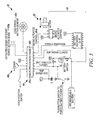
- Fig. 3 a block diagram of a door mountable access control unit which can be used in the systems of Figs. 1 or 2 ;
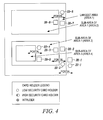
- Fig. 4 a diagram of a monitored region illustrating details of the present invention.
- Figs. 5-9 illustrate aspects of processing by control units, such as in Fig 3 , which embody the present invention.
- card holders and intruders within an area are identified. Identified individuals can be classified as authorized, unauthorized or an unrecognized intruder. Control of the area, or, region can then be based on the identification and classification of the individual(s).
- a method which embodies the invention classifies individuals as they enter, exit, and are present in monitored areas with different levels of security and alarm states.
- situations can be automatically established in which certain alarm states may be indicated, and the security level of an area may be raised or lowered automatically.
- a system which embodies the invention identifies known personnel as they pass through one or more areas. Access can be provided by various forms of credentials. These include without limitation, contact-type or wireless access cards, or physiological characteristics or the like, all without limitation.
- BAP battery-assisted passive access cards
- Such access cards can communicate with door controllers as well as access points in an area. If an access card is communicating with an access point, then it is assumed that the card holder is within a predefined area of the access point.
- Other forms of identification devices come within the spirit and scope of the invention.
- physiological, or biometric, identification devices such as solid state cameras can be used without departing from the spirit and scope of the invention.
- identification devices can communicate with video surveillance controllers which process physiological data of individuals in an area. If the physiological data of an individual in an area matches pre-recorded data of a known individual, then it is assumed that a card holder is within a predefined area of the physiological identification device.
- intrusion sensors can be incorporated in accordance with the invention.
- the intrusion sensor or sensors is/are positioned to monitor the same area as a corresponding access point or door controller. Hence, motion around an access point or door may be detected.
- areas and sub-areas that are monitored by both an access point and an intrusion sensor can be defined.
- the intrusion sensor detects a person in the area
- the system can place the individual into one of three categories:
- An authorized individual is a person carrying a valid credential, such as a card, and is allowed in the area;
- An unauthorized individual is a person carrying an identifiable credential, or card, but is not allowed in the area;
- An unrecognized individual is a person without a credential, such as an intruder.
- the security level of an area or group of areas can control the alarm state or change a security level of an area or group of areas.
- the security level of an area and its sub-areas may remain constant if authorized personnel are moving in the area.
- an intrusion alarm system for an area would not need to be disabled when valid personnel are in the area. Any event generated from the movement of authorized personnel would be shunted and not emitted or transmitted to a common control unit or other control units, such as an intrusion controller or video surveillance controller.
- the security level(s) of sub-areas may be controlled by the presence of a particular authorized individual.
- the security level of a medicine cabinet in a pharmacy may decrease when the supervisor is within a certain distance of the cabinet, and this decrease may unlock the cabinet or allow access to trainees. The security level may then automatically increase again when the supervisor walks away from the cabinet.
- a high security area or sub-area may be locked down if an unauthorized person enters the area.
- an unauthorized person may 'piggyback' on an authorized person through a portal and gain access to a secure area. If this occurs, in accordance with the invention, the security level of the area can automatically be increased to the level of 'lockdown' in the secure area and its sub-areas.
- the coverage and responses of intrusion alarm and video surveillance controllers may be altered if an unauthorized person is in a secure area.
- systems or methods which embody the invention can increase the security level of an area or group of areas upon the detection of an intruder. This event occurs when motion is detected in an area, and there is not an authorized individual in the area.
- the security level may increase to the level of 'lockdown,' and an alarm may be raised.
- a security level may be increased, or, an alarm may be raised in an area, or region in response to the triggering of a 'distress' or personal emergency event.
- Such events are often manually triggered by an individual needing emergency assistance in response to accidental physical danger or intentional violence. However these events may also be triggered by the occurrence of personal industrial hazards such as the activation of fall arresting gear. Distress events may be triggered in other various ways as would be understood by those of skill in the art.
- the security levels may be controlled between areas to prevent the interaction of a threat with credential carrying personnel.
- the threat may be identified through the intrusion system or a supplementary system that generates known alarms. For example, if a fire is identified in an area of a building, then the security level may be controlled so that credential carrying personnel may only exit the area and not enter it.
- the security level of other areas may also be controlled, which would funnel all credential carrying personnel to safety in the quickest way possible.
- Other examples of threats that may initiate this automated security level control could include armed intruders, chemical spills or contamination, all without limitation.
- the security level of other areas may also be controlled, so as to enable the access and infrastructure (e.g. lighting, HVAC, etc.) needed by emergency responders to such events in order to re-establish security and/or safety.
- Fig. 1 illustrates one form of a stand-alone system 10 which embodies the invention.
- a wireless door controller is mounted on a door D to control access to a region which is closed, or blocked by the door D.
- a wireless card 14 can be used to cause controller 12 to release, or unlock door D for access by an individual in possession of card 14.
- an associated sensor 16 of an intrusion detection system 18 can detect the presence of one or more individuals/intruders in the vicinity of the door D.
- sensor 16 could be incorporated into controller 12 which could be coupled to system 18 wirelessly or via a wired medium.
- Fig. 2 illustrates a multiple door/region access control system 20.
- System 20 includes a wireless door controller 22 carried by a door D1 which provides access to a respective region.
- Controller 22 in addition to responding to a wireless access card 24 to provide access to the respective region, can also be in wireless communication, via repeaters 28a,b with a control unit or panel 30. It will be understood that controller 22 can operate substantially in a stand-alone mode and provide access via door D1 and feed access related data to unit 30, or can communicate information as to card 24 to unit 30 to obtain authorization to release door D1, all without limitation.
- Control unit 30 can include control circuits 32. Circuits 32 can be implemented in part by a programmable processor 32a, associated control software 32b, executed by processor 32a and a wireless interface 32c for communication with controller 22. System 20 can also include a plurality of additional controllers, indicated generally at 36, which provide access to different regions than does controller 22.
- One or more intrusion sensors such as motion sensor 28 can be located in the vicinity of access controller 22, or configured as part of controller 22. Sensors such as sensor 28 can be coupled to an intrusion sensing system, such as system 40 which can also be in communication with control panel 30.
- a fire alarm system, such as 44, coupled to one or both systems 30, 40 can provide audible/visible alarms in the region being monitored indicative of detected individuals in the absence of authorization.
- Fig. 3 is a block diagram of an exemplary controller 40, comparable to controllers 20, 22, 36.
- Controller 40 can include a door mountable housing 42.
- Housing 42 can carry control circuits 44 which can include a programmed processor 46a and associated radio or transceiver 46b for wireless communication via antenna 46c.
- Housing 42 can also carry a short range capacitive motion sensor 48a and a longer range motion sensor, for example a passive infra-red-type sensor 48b.
- a short range capacitive motion sensor 48a and a longer range motion sensor, for example a passive infra-red-type sensor 48b.
- Such sensors can also be used, in combination with local processing, or processing by intrusion sensing system 40 in identifying intruders. Where motion as been sensed, but no authorized credential carrying personnel are in the area, the motion would have been caused by an intruder.
- controller 40 is exemplary only and other variations or configurations, including wired controllers come within the spirit and scope of the invention. Similarly, the particular details of the type of card being used to obtain access are not limitations of the invention. For example, RFID-type cards as well as optical or magnetic cards all come within the spirit and scope of the invention.
- Figs 4-9 illustrate methods, or processing which embody the present invention and which could be carried out by controllers, such as controller 40.
- Fig. 4 illustrates multiple controlled areas, or, regions. Areas 1, 2 represent relatively low security areas. Areas 3, 4 represent higher security areas. Areas 1-4 are accessed by respective Portals which provide access via one or more respective doors, such as D, or D1. Each of the portals has an associated access control system, such as the unit 22-I, and at least one local intrusion or motion sensor, such as 28-I as discussed above relative to Figs. 2 , 3 .
- the access control units 22-I could be coupled (wired or wirelessly) to control unit 30.
- the intrusion sensors could be coupled to system 40, discussed above.
- Sensors 28-I can be included in, or displaced from respective access control units 22-i.
- multiple intrusion sensors can be installed throughout areas 1-4 as appropriate without departing from the spirit and scope of the invention. Regions illustrated in Figs. 5-9 include the access control units and intrusion sensors as illustrated in Fig. 4 .
- Fig. 5 illustrates that the security level of an area and its sub-areas can be maintained constant in the presence of an authorized individual, or, card holder.
- a sensor such as 28-i in combination with information from a respective card such as 24 and access control unit 22-I can enable the card holder to enter a region with an active intrusion alarm without setting off the alarm.
- Fig. 6 illustrates control of the security level of a sub-area in response to the present of an authorized individual.
- An individual with a higher security level can alter the security level of a sub-area thereby enabling someone of a lower security level to have access to an internal, higher security region but only when in the presence of the person having a high security level.
- Fig. 7 illustrates locking down a high security area or sub-area(s) in response to an unauthorized card holder entering the area, perhaps along with a person having a higher security level.
- Fig. 8 illustrates locking down and increasing the security level of an area upon detection of an intruder.
- Fig. 9 illustrates increasing security in an area or generating an alarm where an intruder uses proximity to a higher security individual to gain access to a secure area, and the higher security level individual can create a "distress event" alerting the unit 40.
- card based access control units such as 22-i
- Alternatives to the card based access control units, such as 22-i also come within the spirit and scope of the invention. These include without limitation, access control units with key pads, or that recognize one or more physiological, or biometric, characteristics of an individual such as fingerprints, retinal prints, facial characteristics, speech and the like all without limitation.
- Sensors can include video, or other forms of cameras without limitation.
- embodiments of the invention can sense that an individual is present. The individual can then be identified.
- One or more sensors can be used without departing from the spirit and scope of the invention. The details of such sensors are not limitations of the invention.
Landscapes
- Physics & Mathematics (AREA)
- General Physics & Mathematics (AREA)
- Alarm Systems (AREA)
- Burglar Alarm Systems (AREA)
Applications Claiming Priority (1)
| Application Number | Priority Date | Filing Date | Title |
|---|---|---|---|
| US12/410,613 US8242905B2 (en) | 2009-03-25 | 2009-03-25 | System and method for adjusting a security level and signaling alarms in controlled areas |
Publications (1)
| Publication Number | Publication Date |
|---|---|
| EP2234072A2 true EP2234072A2 (fr) | 2010-09-29 |
Family
ID=42211776
Family Applications (1)
| Application Number | Title | Priority Date | Filing Date |
|---|---|---|---|
| EP10157131A Withdrawn EP2234072A2 (fr) | 2009-03-25 | 2010-03-19 | System und Verfahren zur Einstellung einer Sicherheitsstufe und Signalisierung von Alarmen in überwachten Bereichen |
Country Status (3)
| Country | Link |
|---|---|
| US (1) | US8242905B2 (fr) |
| EP (1) | EP2234072A2 (fr) |
| CN (1) | CN101847278B (fr) |
Cited By (2)
| Publication number | Priority date | Publication date | Assignee | Title |
|---|---|---|---|---|
| GB2517527A (en) * | 2013-08-23 | 2015-02-25 | Dinky Assets Ltd | A combination care monitoring and access control system |
| EP3264374A1 (fr) * | 2016-06-27 | 2018-01-03 | Tyco Fire & Security GmbH | Système et procédé combinés de détection de mouvement et de contrôle d'accès |
Families Citing this family (30)
| Publication number | Priority date | Publication date | Assignee | Title |
|---|---|---|---|---|
| DE102008016516B3 (de) * | 2008-01-24 | 2009-05-20 | Kaba Gallenschütz GmbH | Zugangskontrollvorrichtung |
| US9691200B2 (en) | 2009-11-03 | 2017-06-27 | Honeywell International Inc. | Energy saving security system |
| EP2645285A4 (fr) * | 2011-02-21 | 2014-11-05 | Ntt Docomo Inc | Système d'authentification à apprentissage de caractéristiques de préhension et procédé d'authentification à apprentissage de caractéristiques de préhension |
| JP5673800B2 (ja) * | 2011-03-30 | 2015-02-18 | 三菱電機株式会社 | 入退室管理装置 |
| WO2013098910A1 (fr) * | 2011-12-26 | 2013-07-04 | 三菱電機株式会社 | Système de gestion d'entrée/de sortie de pièce |
| CN102737456B (zh) * | 2012-06-18 | 2015-01-21 | 成都扬帆电力制造有限公司 | 区域性入侵报警的系统及其方法 |
| NZ706030A (en) * | 2012-08-16 | 2016-01-29 | Schlage Lock Co Llc | Wireless reader system |
| KR101679998B1 (ko) * | 2013-01-22 | 2016-11-25 | 미쓰비시덴키 가부시키가이샤 | 판독 장치 및 입퇴실 관리 시스템 |
| CN103530996A (zh) * | 2013-09-16 | 2014-01-22 | 界首市保安服务公司 | 智能联动报警控制系统 |
| US10741041B2 (en) * | 2014-01-06 | 2020-08-11 | Binatone Electronics International Limited | Dual mode baby monitoring |
| BR102014019625B1 (pt) * | 2014-03-19 | 2021-01-26 | Digicon S/a Controle Eletrônico Para Mecânica | sistema e método de controle e monitoramento para acesso em área restrita |
| CN103927807B (zh) * | 2014-04-29 | 2016-08-31 | 国网冀北电力有限公司廊坊供电公司 | 用于多机房的门禁系统的安全等级的调节方法和装置 |
| US9286790B2 (en) * | 2014-05-23 | 2016-03-15 | Emergency Alert Solutions Group, Llc | Lockdown apparatus for initiation of lockdown procedures at a facility during an emergency |
| US10047543B2 (en) | 2015-06-15 | 2018-08-14 | Comcast Cable Communications, Llc | Monitoring access |
| CN105096413B (zh) * | 2015-07-07 | 2018-03-20 | 小米科技有限责任公司 | 智能门锁的限制等级调整方法、装置及系统 |
| US10671325B2 (en) * | 2015-10-28 | 2020-06-02 | International Business Machines Corporation | Selective secure deletion of data in distributed systems and cloud |
| CN105513179B (zh) * | 2015-12-07 | 2018-07-31 | 小米科技有限责任公司 | 开锁方法、装置及智能锁 |
| CN105469533A (zh) * | 2016-01-13 | 2016-04-06 | 上海腾盛智能交通技术有限公司 | 一种火灾通讯报警装置 |
| US9858783B1 (en) * | 2016-06-03 | 2018-01-02 | Akhil K. Agrawal | Access monitoring system for medical kits |
| CN106815908B (zh) * | 2016-12-09 | 2019-11-22 | 国网北京市电力公司 | 报警处理方法、装置及门禁监控系统 |
| US10078927B2 (en) * | 2017-01-23 | 2018-09-18 | Honeywell International Inc. | Systems and methods for time-bound homogenous consecutive events triggering a procedure in an access control host system |
| CN107277443B (zh) * | 2017-06-23 | 2019-12-10 | 深圳市盛路物联通讯技术有限公司 | 一种大范围周边安全监控方法和系统 |
| US10210683B1 (en) | 2017-09-12 | 2019-02-19 | International Business Machines Corporation | Physical condition based intelligent house security system |
| US11680436B2 (en) * | 2019-11-11 | 2023-06-20 | Smarter Building Technologies Alliance, Inc. | Monitoring system to identify unregistered persons entering premises and to secure rooms containing registered occupants |
| US11017649B1 (en) * | 2020-08-24 | 2021-05-25 | Climax Technology Co., Ltd. | Dynamic alarm priority system and method |
| WO2022174299A1 (fr) * | 2021-02-19 | 2022-08-25 | Soterius Pty Ltd | Capteurs, systèmes et procédés de détection d'agents pathogènes respiratoires |
| US11495025B1 (en) * | 2021-10-25 | 2022-11-08 | Motorola Solutions, Inc. | Method and apparatus for increasing security at an entrance point |
| CN115376295A (zh) * | 2022-08-22 | 2022-11-22 | 深圳奇迹智慧网络有限公司 | 智慧杆的视频识别管理方法及系统 |
| US12610241B2 (en) | 2023-03-14 | 2026-04-21 | Bank Of America Corporation | System and method for detecting radio-frequency-based attacks in a predetermined area |
| US12536856B1 (en) | 2024-07-23 | 2026-01-27 | Motorola Solutions, Inc. | Physical security system and method to temporarily revoke a portion of access control credentials during an incident |
Citations (1)
| Publication number | Priority date | Publication date | Assignee | Title |
|---|---|---|---|---|
| US20080086758A1 (en) | 2006-10-10 | 2008-04-10 | Honeywell International Inc. | Decentralized access control framework |
Family Cites Families (8)
| Publication number | Priority date | Publication date | Assignee | Title |
|---|---|---|---|---|
| US5650800A (en) * | 1995-05-15 | 1997-07-22 | Inelec Corporation | Remote sensor network using distributed intelligent modules with interactive display |
| US5992094A (en) * | 1997-02-11 | 1999-11-30 | Diaz; William | Access control vestibule |
| US6690414B2 (en) * | 2000-12-12 | 2004-02-10 | Koninklijke Philips Electronics N.V. | Method and apparatus to reduce false alarms in exit/entrance situations for residential security monitoring |
| US7295119B2 (en) * | 2003-01-22 | 2007-11-13 | Wireless Valley Communications, Inc. | System and method for indicating the presence or physical location of persons or devices in a site specific representation of a physical environment |
| US7636842B2 (en) * | 2005-01-10 | 2009-12-22 | Interdigital Technology Corporation | System and method for providing variable security level in a wireless communication system |
| US7405653B2 (en) * | 2005-06-13 | 2008-07-29 | Honeywell International Inc. | System for monitoring activities and location |
| US20070083915A1 (en) * | 2005-10-06 | 2007-04-12 | Janani Janakiraman | Method and system for dynamic adjustment of computer security based on personal proximity |
| CN101753983A (zh) * | 2008-11-28 | 2010-06-23 | 康佳集团股份有限公司 | 一种门禁控制方法、设备和系统 |
-
2009
- 2009-03-25 US US12/410,613 patent/US8242905B2/en active Active
-
2010
- 2010-03-19 EP EP10157131A patent/EP2234072A2/fr not_active Withdrawn
- 2010-03-24 CN CN201010176720.5A patent/CN101847278B/zh active Active
Patent Citations (1)
| Publication number | Priority date | Publication date | Assignee | Title |
|---|---|---|---|---|
| US20080086758A1 (en) | 2006-10-10 | 2008-04-10 | Honeywell International Inc. | Decentralized access control framework |
Cited By (3)
| Publication number | Priority date | Publication date | Assignee | Title |
|---|---|---|---|---|
| GB2517527A (en) * | 2013-08-23 | 2015-02-25 | Dinky Assets Ltd | A combination care monitoring and access control system |
| EP3264374A1 (fr) * | 2016-06-27 | 2018-01-03 | Tyco Fire & Security GmbH | Système et procédé combinés de détection de mouvement et de contrôle d'accès |
| US10169936B2 (en) | 2016-06-27 | 2019-01-01 | Tyco Fire & Security Gmbh | Combined motion detection and access control system and method |
Also Published As
| Publication number | Publication date |
|---|---|
| US8242905B2 (en) | 2012-08-14 |
| CN101847278B (zh) | 2015-09-16 |
| CN101847278A (zh) | 2010-09-29 |
| US20100245087A1 (en) | 2010-09-30 |
Similar Documents
| Publication | Publication Date | Title |
|---|---|---|
| US8242905B2 (en) | System and method for adjusting a security level and signaling alarms in controlled areas | |
| CN105551177B (zh) | 使用bim的访问控制系统中的物理和逻辑威胁分析 | |
| AU2007295891B2 (en) | Method and apparatus for automatically disarming a security system | |
| EP2606477B1 (fr) | Procédé et système antivol | |
| US10311706B2 (en) | System and method for smart intrusion control using wearable BLE devices | |
| JP5212839B2 (ja) | 監視システム、及び監視方法 | |
| CN104050787B (zh) | 具有分类属性的异常检测的系统和方法 | |
| US20020067259A1 (en) | Portal intrusion detection apparatus and method | |
| JP2017536587A (ja) | 監視及び制御システムとアクセスと禁止区域への立ち入り法 | |
| CN104050771B (zh) | 异常检测的系统和方法 | |
| KR101492799B1 (ko) | 감시영역 입퇴실자 추적을 통한 출입 통제 기능을 가지는 출입 통제 통합 영상 저장 시스템 및 그 방법 | |
| US20200150264A1 (en) | Systems and methods for security system device tamper detection | |
| EP3142089B1 (fr) | Notification sur l' armement d' un système basée sur une position ble | |
| EP3125209B1 (fr) | Ouverture d'une session dans un système avec un dispositif bluetooth | |
| KR101370982B1 (ko) | 무선태그를 이용한 이동감지장치 및 이를 구비한 보안장치와 이를 이용한 이동감지방법 | |
| KR20180085337A (ko) | 무단침입감지센서를 구비한 보안용 게이트 시스템 | |
| US11164414B2 (en) | System and method for providing secure access | |
| KR101843712B1 (ko) | 출입 통제 시스템 | |
| KR101579178B1 (ko) | 지역 영상 및 온도 감지 데이터를 이용한 지능형 출입 통제 시스템 | |
| KR20190022602A (ko) | 무단침입감지센서를 구비한 보안용 게이트 시스템 | |
| US20220180686A1 (en) | Access control system | |
| JP2025008423A (ja) | 顔認証装置、顔認証方法、顔認証プログラム及び警備システム | |
| KR101271691B1 (ko) | 보안 시스템 및 방법 | |
| WO2021045713A1 (fr) | Système de commande de passage | |
| KR20050066923A (ko) | 생체정보를 이용한 출입통제 방법 |
Legal Events
| Date | Code | Title | Description |
|---|---|---|---|
| PUAI | Public reference made under article 153(3) epc to a published international application that has entered the european phase |
Free format text: ORIGINAL CODE: 0009012 |
|
| 17P | Request for examination filed |
Effective date: 20100319 |
|
| AK | Designated contracting states |
Kind code of ref document: A2 Designated state(s): AT BE BG CH CY CZ DE DK EE ES FI FR GB GR HR HU IE IS IT LI LT LU LV MC MK MT NL NO PL PT RO SE SI SK SM TR |
|
| STAA | Information on the status of an ep patent application or granted ep patent |
Free format text: STATUS: THE APPLICATION HAS BEEN WITHDRAWN |
|
| 18W | Application withdrawn |
Effective date: 20120104 |