EP2244660B1 - Dentalpositionsbestimmungssystem für eine zahnbürste - Google Patents
Dentalpositionsbestimmungssystem für eine zahnbürste Download PDFInfo
- Publication number
- EP2244660B1 EP2244660B1 EP09715477.7A EP09715477A EP2244660B1 EP 2244660 B1 EP2244660 B1 EP 2244660B1 EP 09715477 A EP09715477 A EP 09715477A EP 2244660 B1 EP2244660 B1 EP 2244660B1
- Authority
- EP
- European Patent Office
- Prior art keywords
- toothbrush
- information
- target
- orientation
- head
- Prior art date
- Legal status (The legal status is an assumption and is not a legal conclusion. Google has not performed a legal analysis and makes no representation as to the accuracy of the status listed.)
- Active
Links
Images


Classifications
-
- A—HUMAN NECESSITIES
- A61—MEDICAL OR VETERINARY SCIENCE; HYGIENE
- A61C—DENTISTRY; APPARATUS OR METHODS FOR ORAL OR DENTAL HYGIENE
- A61C17/00—Devices for cleaning, polishing, rinsing or drying teeth, teeth cavities or prostheses; Saliva removers; Dental appliances for receiving spittle
- A61C17/16—Power-driven cleaning or polishing devices
- A61C17/22—Power-driven cleaning or polishing devices with brushes, cushions, cups, or the like
- A61C17/221—Control arrangements therefor
-
- A—HUMAN NECESSITIES
- A46—BRUSHWARE
- A46B—BRUSHES
- A46B15/00—Other brushes; Brushes with additional arrangements
- A46B15/0002—Arrangements for enhancing monitoring or controlling the brushing process
-
- A—HUMAN NECESSITIES
- A46—BRUSHWARE
- A46B—BRUSHES
- A46B15/00—Other brushes; Brushes with additional arrangements
- A46B15/0002—Arrangements for enhancing monitoring or controlling the brushing process
- A46B15/0004—Arrangements for enhancing monitoring or controlling the brushing process with a controlling means
- A46B15/0006—Arrangements for enhancing monitoring or controlling the brushing process with a controlling means with a controlling brush technique device, e.g. stroke movement measuring device
-
- A—HUMAN NECESSITIES
- A46—BRUSHWARE
- A46B—BRUSHES
- A46B15/00—Other brushes; Brushes with additional arrangements
- A46B15/0002—Arrangements for enhancing monitoring or controlling the brushing process
- A46B15/0038—Arrangements for enhancing monitoring or controlling the brushing process with signalling means
-
- A—HUMAN NECESSITIES
- A46—BRUSHWARE
- A46B—BRUSHES
- A46B15/00—Other brushes; Brushes with additional arrangements
- A46B15/0002—Arrangements for enhancing monitoring or controlling the brushing process
- A46B15/0038—Arrangements for enhancing monitoring or controlling the brushing process with signalling means
- A46B15/004—Arrangements for enhancing monitoring or controlling the brushing process with signalling means with an acoustic signalling means, e.g. noise
-
- A—HUMAN NECESSITIES
- A46—BRUSHWARE
- A46B—BRUSHES
- A46B2200/00—Brushes characterized by their functions, uses or applications
- A46B2200/10—For human or animal care
- A46B2200/1066—Toothbrush for cleaning the teeth or dentures
-
- A—HUMAN NECESSITIES
- A61—MEDICAL OR VETERINARY SCIENCE; HYGIENE
- A61C—DENTISTRY; APPARATUS OR METHODS FOR ORAL OR DENTAL HYGIENE
- A61C17/00—Devices for cleaning, polishing, rinsing or drying teeth, teeth cavities or prostheses; Saliva removers; Dental appliances for receiving spittle
- A61C17/16—Power-driven cleaning or polishing devices
- A61C17/22—Power-driven cleaning or polishing devices with brushes, cushions, cups, or the like
Definitions
- This invention relates generally to systems which track the position of a toothbrush in the mouth relative to a region or regions of teeth (dental zones) during brushing, and more specifically concerns such a system which takes into account movement of the head during brushing.
- Real-time feedback as the user is brushing his/her teeth is a desired feature in a toothbrush.
- One important piece of information concerns the length of time that the toothbrush is used in different dental positions or zones, i.e. specific teeth regions covering a number of adjacent teeth. This information helps the user to determine the quality of brushing relative to each dental zone. Users can thus determine, for instance, whether they are underbrushing or overbrushing in terms of time for each dental zone.
- One known technique for obtaining this information includes determining the orientation of the toothbrush as the user brushes his/her teeth and then correlating that orientation information with various pre-selected dental zones, since the orientation of the toothbrush will vary in a known manner depending upon the particular region or dental zone being brushed, e.g. a toothbrush will be oriented differently depending on whether the teeth being brushed are in the lower or upper jaw, and the particular surface being brushed is the outside, inside or chewing surface.
- a toothbrush having accelerometer and magnetometer sensors mounted thereon is capable of developing this orientation information.
- Accelerometers are used to measure gravity, while magnetometers measure the earth's magnetic fields. With this information, orientation information of a toothbrush relative to the earth (in an earth-based coordinate system) can be determined.
- the dental zone determinations are made based on the head being held in a particular known orientation. If the head orientation changes (the head moves/rotates) significantly during brushing in a given zone, the measured orientations will change accordingly for that zone, and these new measured orientations may no longer match with the fixed "target" toothbrush orientations for that dental region. The dental region thus may not be recognized or an incorrect dental region may be identified. Significant head movements are very common during a two-minute brushing interval.
- One solution is to measure head orientation changes by use of a reference sensor on the user's head which has a fixed orientation relative to the user's head. Changes in the target orientations can be made accordingly. However, using a separate sensor on the user's head is not convenient, adds additional expense and is unlikely to be consistently used.
- WO02/083257A2 discloses a dental tracking system without compensation of head movements since the referential is on the head itself.
- a dental position tracking system which includes obtaining toothbrush orientation information by use of accelerometers and magnetometers, but which also includes the ability to accurately take into account movement of the head during brushing without the need for a separate sensor.
- a method of dental zone tracking system for a toothbrush which compensates for head movement during brushing, comprising the steps of: determining the orientation of the toothbrush in the mouth of a user; storing target information for toothbrush orientation for each of a plurality of selected dental zones; comparing the toothbrush orientation information with the target orientation information, once the toothbrush orientation information and the target orientation information are both in the same coordinate system and determining which, if any, target information matches, within a selected tolerance, the toothbrush orientation information; adjusting target information for the dental zones based on differences between the toothbrush orientation information and previous target information; and providing feedback information to the user concerning brushing in the selected dental zones.
- toothbrush orientation information (in the mouth) is obtained in an earth-based coordinate system by accelerometer and magnetometer sensors in a manner similar to that described in the '648 publication or other conventional, well-known manner.
- This orientation information referred to as measured toothbrush orientation information, is also used in the present system to determine changes of the position of the user's head (rotation), by tracking differences between the measured orientations and the preestablished fixed target orientations for the dental zones, such differences being caused by head movement. This enables the system to accurately identify dental regions in which the toothbrush is located even when the user is moving his/her head. Time of brushing information is then accurately obtained for each dental zone/region.
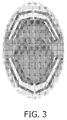
- a system of dental zone position tracking first requires identifying the number of dental zones in the mouth, e.g. the zones may be divided according to the jaw (upper/lower), the surfaces of the teeth (outside surface, chewing surface, inside surface) and a particular jaw half (right/left). This is represented in Figure 3 .
- This particular arrangement thus divides the mouth into twelve different dental zones or regions, for example, one zone/region could cover the outside surfaces of the teeth in the left half of the lower jaw. Fewer or greater numbers of zones may be used. For a greater number of zones, the teeth at the front of the jaw may be distinguished from the teeth at the rear of the jaw.
- each of the dental zones has a range of known valid toothbrush orientations associated with it, referred to as target orientations, given the head being in a particular position.
- target orientations are defined in a head-based coordinate system, while the measured toothbrush orientations, determined from accelerometer and magnetometer sensor data, are relative to an earth-based coordinate system. Comparisons are made when the target orientations ranges and the measured orientations are expressed in the same coordinate system. If the measured toothbrush orientation is within one of the target ranges, it is concluded that the user is brushing his/her teeth in the dental zone having that target range. The time spent in each dental zone can then be tracked and that information provided to the user for confirmation or modification of brushing habits. Further, in a real-time situation, information can be provided as to how much time should still be used for each zone.
- the target range of orientations for each dental position includes one dimension that is associated with the ideal orientations within the zone, as well as two orthogonal dimensions that indicate an allowable orientation tolerance relative to the ideal target orientation.
- the target ranges for each dental zone are stored in memory in the toothbrush.
- the target orientation ranges are defined in a head-based coordinate system, while the measured toothbrush orientations which are determined from the accelerometer and magnetometer sensor data are represented in an earth-based coordinate system. Comparison of the two to determine dental zone requires that both be expressed in the same coordinate system. It is computationally less intensive to convert the target range of orientations to the earth-based coordinate system than vice versa, although, alternatively, the measured orientations could be converted to the head-based coordinate system for comparison.
- the initial head position is established at the time the user starts the brushing session.
- the initial head position can be determined very accurately only if the initial toothbrush orientation in the head-based coordinate system is known. Knowing the initial toothbrush orientation in the head-based coordinate system, while measuring the toothbrush orientation in the earth-based coordinate system, permits the determination of initial head position.
- the head orientation is effectively tracked as the user may change it (or not) in the course of a brushing session.
- the measured toothbrush orientations are used to track changes in head orientation. If the head orientation changes, the measured toothbrush orientations will deviate from the target orientation range (which does not change directly from a change in head orientation) that corresponds to the dental zone being brushed, because the measured toothbrush orientations will change to follow the actual position of the teeth as the head orientation changes. If the head position does not change, then the measured orientations will be within the stored target orientation range for the dental zone being brushed.
- Deviation from the target orientation range but within a threshold value relative to the range indicates that the head orientation estimation should be adjusted (resulting in a change in the target orientation range) so that the target orientation range, as expressed in the earth coordinate system, gets closer to the measured toothbrush orientations.
- the change in head orientation produces a difference between the target orientation range and the measured orientation, which difference in head orientation is actually tracked, i.e. accommodated.
- the adjustment to be applied to the target orientation range could be the same as that which would be needed to turn (match) the range of target orientations with the measured toothbrush orientation.
- the full corrective adjustment is typically not made because of the presence of noise in the measured orientations; i.e. one sampling interval should not be used to make a full correction.
- the correction is hence somewhat less than a full correction, which can be varied between 0 (no correction) and 1 (full correction).
- any measured toothbrush orientations are outside of the range (including the difference tolerance/threshold) that corresponds to the likely dental position zone, then the head orientation information and the target orientation range is not updated, since the orientation information outside of the threshold would likely indicate that the toothbrush is being moved by the user from one dental zone to another.
- Figure 1 shows the coordinate system for a toothbrush
- Figure 2 shows a head-based coordinate system.
- the x -axis is in the direction of the bristles
- the z-axis is along the shaft of the toothbrush
- the y -axis is directed sideways (laterally) relative to the toothbrush.
- the z -axis is the direction from the bottom to the top of the head (perpendicular to the plane of the dental arch
- the x -axis is the direction to the right of the head
- the y -axis is the direction forward of the head.
- orientation information of the toothbrush relative to the earth is determined from measured accelerometer and magnetometer information. This is shown at block 20 in Figure 4 .
- the calculation of the orientation information from gravity or the earth's magnetic field is briefly described below.
- the earth's gravity and magnetic field vectors have a fixed and known orientation in an earth-fixed reference coordinate system. They are identified below as r g and r B respectively, which are both three-dimensional vectors.
- r g and r B are both three-dimensional vectors.
- both vectors can be measured in the toothbrush-based coordinate system ( Figure 1 ) providing t g and t B.
- the toothbrush orientation in the earth-fixed coordinate system can be expressed in a 3x3 matrix r T.
- the columns of r T are the base vectors of the toothbrush-based coordinate system, expressed in the earth-based coordinate system.
- the superscript T indicates the matrix transpose operator and has been used to replace the matrix inverse operator, which is permitted since the operand matrix is unitary.
- the left hand-matrix factor (containing the vector representations in the earth-based coordinate system) can be precalculated.
- the x -direction is more or less parallel to the bristle hairs (when the brush is not operating), so the result from the above calculations is orientation information for the toothbrush relative to the toothbrush coordinate system.
- Each of the dental position zones is mapped onto a corresponding continuous range of toothbrush target orientations, which are time-fixed (invariant) when expressed in a head-based coordinate system, as shown in Figure 2 .
- This is represented at block 22 in Figure 4 .
- the beginning and end of each range corresponds to brushing the incisors and the molars of a particular zone, i.e. the orientation range of the toothbrush from the incisors to the molars.
- the toothbrush is typically rotated about a single axis.
- This axis is generally in the z-direction of the head-based coordinate system (perpendicular to the plane of the dental arch in Figure 2 ).
- a complete zone definition (for twelve zones) in terms of toothbrush beginning and ending target orientation is shown in Table 1, identifying, for example, for each zone the selected tooth surfaces (outside, inside, chew) of the upper/lower jaw, either right or left side.
- Toothbrush x -axis direction Position Zone begin end begin end Upper, Outside, Left 80 80 (0,-1,0) Upper, Outside, Right -80 -80 (0,-1,0) Upper, Chew, 80 0 (0,0,1) (0,0,1) Left Upper, Chew, Right 100 180 (0,0,1) (0,0,1) Upper, Inside, Left -80 -80 (0,1,0) Upper, Inside, Right 80 80 (0,1,0) Lower, Outside, Left 100 100 (0,-1,0) Lower, Outside, Right -100 -100 (0,-1,0) Lower, Chew, Left 100 180 (0,0,-1) 0,0,-1) Lower, Chew, Right 80 0 (0,0,-1) (0,0,-1) Lower, Inside, Left -100 -100 (0,1,0) Lower, Inside, Right 100 100 (0,1,0)
- the target orientations are represented with respect to the head-based coordinate system and is characterized by a rotation angle about the toothbrush x -axis and the direction of the toothbrush x -axis.
- the rotation angle is zero and the toothbrush x -axis direction is (1,0,0).
- the target orientation ranges each have a beginning and an end. From the beginning orientation, the end orientation is reached by continued rotation of the toothbrush about a single rotation axis.
- the unique rotation axis is parallel to the z-axis in the head-based coordinate system.
- the beginning and ending orientations of each zone are spaced apart by an 80° rotation of the toothbrush.
- the measured toothbrush orientation information is then compared at regular intervals (every so many milliseconds) to the target orientation ranges by a processor (block 24) in the toothbrush or a separate unit.
- Determination of the dental zone that is being brushed involves comparison of the measured toothbrush orientations (block 20) with the twelve possible target ranges (block 22).
- the most likely dental zone being brushed is the zone in which a target orientation range is closest to the measured orientation. If the closest target range differs too much from the measured orientation, i.e. outside of the threshold difference relative to the range, the brush is likely to not be in any of the dental position zones.
- the difference between the target orientation range and the measured orientation is measured by the smallest rotation angle that is needed to get from one orientation to another. In this respect, the calculations are easier if orientations are expressed using quaternions.
- the calculation of the rotation angle between the measured orientation and the target range orientation represented by quaternions involves taking a dot-product of the two quaternions. The dot-product is proportional to the cosine of the rotation angle. Taking the inverse cosine of the dot-product gives the desired rotation angle that measures the orientation difference. If the magnitude of the rotation angle is smaller than the threshold or tolerance value (within the threshold) relative to a target range, the toothbrush is still likely to be within the dental zone corresponding to that target orientation range.
- Reasonable orientation threshold levels are in the range between 5°-20°.
- target orientation ranges are characterized by beginning and ending toothbrush orientations.
- the intermediate target orientation quaternions are obtained by interpolation between the beginning and the end orientations.
- the set of target quaternions forms a circular arc in four-dimensional quaternion space.
- the first step is to find the single interpolated target quaternion along the arc which is closest to the measured quaternion. This is referred to as the optimal target quaternion. Once that target quaternion is identified, one may readily calculate its distance to the measured quaternion. This distance is the distance between the measured orientation quaternion and the target orientation quaternion range.
- the target orientation ranges are converted from the head-based coordinate system to the earth-based coordinate system so that they can be compared to the toothbrush orientations which are determined in the earth-based coordinate system. This conversion is done by multiplying the quaternion representing head orientation with that representing the respective beginning or end of a target orientation range.
- the measured toothbrush orientations are converted to the head-based coordinate system so they can be compared with the target orientation ranges already defined in that coordinate system. This conversion is done by multiplying the conjugate of the quaternion representing head orientation with the quaternion representing the measured toothbrush orientation.
- the head orientation quaternion will typically need updating, resulting in adjustment in the target range.
- the change in head orientation is estimated on the assumption that if the measured orientation quaternions are found to deviate systematically from the target range associated with the identified dental position zone, this must be due to a change in head position.
- the head orientation as indicated above, is then slowly adapted by successive adjustments in the target orientations such that the deviation (difference) within the threshold between the measured toothbrush orientation and the target orientations ultimately goes to zero. These adjustments are represented by the feedback line 27 between the processor block 24 and the target ranges block 22.
- the error (difference) quaternion as determined produces a change in the target quaternion to match the measured toothbrush orientation quaternion. If the error quaternion is applied to change the head orientation quaternion, then the optimal target orientation quaternion would appear to coincide with the measured orientation quaternion. Generally, however, to avoid incorrect head orientation estimates and corresponding incorrect target orientation quaternions, due to noise in the measured quaternion, which would lead to poor dental zone identification, the head orientation estimation is updated on the basis of the expected head position change during brushing, which is typically relatively small. The full error quaternion is not applied, but rather a scaled-down version thereof.
- An example of the sequence of processing system steps using quaternions which includes updating of the head position information is as follows.
- superscript r indicates that the corresponding quantity (vector, matrix or quaternion) is expressed in the earth-based (reference) coordinate system.
- superscript t indicates an expression in the toothbrush-based coordinate system
- superscript h indicates an expression in the head-fixed coordinate system.
- Determination at regular time intervals of the dental zone where the toothbrush is brushing in accordance with the above takes into account possible change in head orientation of the user during brushing. This is accomplished by the processor 24 in the manner described in detail above using quaternions. Information is then developed for the user with respect to the amount of brushing time spent in each dental zone, based on toothbrush orientation, as indicated at block 28.
- This feedback information may be generated within the toothbrush itself, which is indicated by dotted lines 30 in Figure 4 , such as a voice, or by a separate device which could include voice and a display.
- the communication between the toothbrush and the separate device could be wireless or by a wire tether.
- the separate device could be a toothbrush-dedicated device, or it could be the user's PDA or mobile phone, equipped with a suitable wireless interface.
- Real-time feedback is thus provided on the time spent in each dental position zone. Further, insufficiently brushed zones could be identified, as well as brushing efficiency, such as the fraction of the total brushing time spent in each zone.
- a variety of reports and information can be provided to the user, in real time. User feedback can also be provided in the form of brushing reports and brushing trends. The trends require a memory and a suitable user interface.
- the memory could take the form of a memory element which can be plugged into the separate device, or memory inside the user's PDA or mobile phone.
- the information could also be stored in the user's personal computer.
- a system for accurately tracking dental zones during brushing, by determining toothbrush orientation through the use of accelerometers and magnetometers, while also taking into account changes in the position of the user's head, by selected processing of the orientation information.
- Accurate information of the dental zones being brushed can be obtained, even if the user moves his/her head during brushing, without the need for a separate sensor on the user's head.
- This information can be processed to produce important feedback for the user concerning time spent in the various dental zones, and other related information.
Landscapes
- Life Sciences & Earth Sciences (AREA)
- Health & Medical Sciences (AREA)
- Physics & Mathematics (AREA)
- Acoustics & Sound (AREA)
- Biophysics (AREA)
- Epidemiology (AREA)
- Dentistry (AREA)
- Animal Behavior & Ethology (AREA)
- General Health & Medical Sciences (AREA)
- Public Health (AREA)
- Veterinary Medicine (AREA)
- Brushes (AREA)
- Dental Tools And Instruments Or Auxiliary Dental Instruments (AREA)
Claims (15)
- Dentalpositionsbestimmungssystem für eine Zahnbürste, das die Kopfbewegung während des Bürstens ausgleicht, folgendes umfassend:eine Zahnbürste, die ein System (20) zum Bestimmen der Orientierung der Zahnbürste im Mund eines Benutzers enthält;gespeicherte Zielinformation (22) für die Zahnbürstenorientierung für jede aus einer Vielzahl ausgewählter Dentalzonen;ein Verarbeitungssystem (24) zum Vergleichen der Zahnbürstenorientierungsinformation mit der Zielorientierungsinformation, sobald die Zahnbürstenorientierungsinformation und die Zielorientierungsinformation beide im selben Koordinatensystem sind, und zum Bestimmen, welche Zielinformation, sofern vorhanden, innerhalb einer ausgewählten Toleranz mit der Zahnbürstenorientierungsinformation übereinstimmt;ein Kompensationssystem (24), das eine angepasste Zielinformation für die Dentalzonen basierend auf Unterschieden zwischen der Zahnbürstenorientierungsinformation und einer früheren Zielinformation erzeugt; undein Informationssystem (28), das auf das Verarbeitungssystem reagiert, um eine Feedback-Information für den Benutzer in Bezug auf das Bürsten in den ausgewählten Dentalzonen bereitzustellen.
- System nach Anspruch 1, wobei die Zielinformation in Form eines Bereichs von Zielorientierungen für jede Dentalzone auftritt.
- System nach Anspruch 2, wobei die Anpassung an die Zielbereichsinformation kleiner ist, als der gesamte Unterschied.
- System nach Anspruch 1, wobei das Informationssystem dem Benutzer Informationen über die Zeit bereitstellt, die mit dem Bürsten in jeder Dentalzone verbracht wird.
- System nach Anspruch 2, wobei das Kompensationssystem die Verwendung der ursprünglichen Kopfpositionsinformation basierend auf einer bekannten ursprünglichen Position der Zahnbürste im Verhältnis zu einer vorgewählten Dentalzone enthält, und wobei die Kopfpositionsinformation in vorgewählten Zeitintervallen aktualisiert wird, indem man in den besagten Zeitintervallen den Unterschied zwischen der Zahnbürstenorientierungsinformation und der Zielbereichsorientierungsinformation bestimmt.
- System nach Anspruch 2, wobei die Zielorientierungsbereiche ursprünglich im Verhältnis zum Kopf des Benutzers gesehen werden, und wobei die Zahnbürstenorientierungen ursprünglich im Verhältnis zu einem bodenbezogenen Koordinatensystem gesehen werden.
- System nach Anspruch 6, wobei die Zielorientierungsinformation und die Zielbereiche, während des Vergleichs der beiden, beide im Verhältnis zu einem bodenbezogenen Koordinatensystem gesehen werden, oder während des Vergleichs der beiden im Verhältnis zu einem kopfbasierten Koordinatensystem gesehen werden.
- System nach Anspruch 1, wobei die Benutzer-Feedback-Information- von der Zahnbürste, z.B. in Form einer hörbaren Kommunikation, oder,- von einem Gerät abseits der Zahnbürste, z.B. in Form einer hörbaren Information oder einer visuellen Anzeige, wie einem der Zahnbürste zugeordneten Gerät, einem PDA oder einem Mobiltelefon bereitgestellt wird.
- System nach Anspruch 1, wobei das Vergleichs- und das Kompensationssystem Quaternionen verwenden.
- System nach Anspruch 9, wobei die Vielzahl von Dentalzonen die folgenden Zahnunterteilungen enthalten: (1) der Zahnaußenflächen, der Zahnkauflächen, der Zahninnenfläche; (2) eine des Oberkiefers, des Unterkiefers; und (3) eine der rechten Kieferhälfte und der linken Kieferhälfte.
- System nach Anspruch 1, wobei der Unterschied zwischen der Zahnbürstenorientierungsinformation und der Zielorientierungsinformation durch den kleinsten Rotationswinkel bestimmt wird, der zwischen der Zahnbürstenorientierungsinformation und der Zielorientierungsinformation einzuschlagen ist.
- System nach Anspruch 1, wobei die Zahnbürstenorientierungsinformation durch die Verwendung von Messwerten bestimmt wird, die man durch einen Beschleunigungsmesser und einen Magnetometer erhält, die in der Zahnbürste angeordnet sind.
- System nach Anspruch 2, wobei man die Zwischenorientierungen innerhalb des Bereichs von Zielorientierungen durch Drehen um eine einzige Rotationsachse erhält.
- System nach Anspruch 13, wobei die einzige Rotationsachse parallel zur Z-Achse eines kopfbasierten Koordinatensystems verläuft.
- Verfahren zur Dentalpositionsbestimmung für eine Zahnbürste, das die Kopfbewegung während des Bürstens ausgleicht, die folgenden Schritte umfassend:Bestimmen (20) der Orientierung der Zahnbürste im Mund eines Benutzers;Speichern einer Zielinformation (22) für die Zahnbürstenorientierung für jede aus einer Vielzahl ausgewählter Dentalzonen;Vergleichen (24) der Zahnbürstenorientierungsinformation mit der Zielorientierungsinformation, sobald die Zahnbürstenorientierungsinformation und die Zielorientierungsinformation beide im selben Koordinatensystem sind und Bestimmen, welche Zielinformation, sofern vorhanden, innerhalb einer ausgewählten Toleranz mit der Zahnbürstenorientierungsinformation übereinstimmt;Anpassen (24) einer Zielinformation für die Dentalzonen basierend auf Unterschieden zwischen der Zahnbürstenorientierungsinformation und einer früheren Zielinformation; undBereitstellen einer Feedback-Information (28) für den Benutzer in Bezug auf das Bürsten in den ausgewählten Dentalzonen.
Applications Claiming Priority (3)
| Application Number | Priority Date | Filing Date | Title |
|---|---|---|---|
| US1584608P | 2008-02-27 | 2008-02-27 | |
| US6105608P | 2008-06-12 | 2008-06-12 | |
| PCT/IB2009/050695 WO2009107047A1 (en) | 2008-02-27 | 2009-02-19 | Dental position tracking system for a toothbrush |
Publications (2)
| Publication Number | Publication Date |
|---|---|
| EP2244660A1 EP2244660A1 (de) | 2010-11-03 |
| EP2244660B1 true EP2244660B1 (de) | 2016-04-13 |
Family
ID=40722595
Family Applications (1)
| Application Number | Title | Priority Date | Filing Date |
|---|---|---|---|
| EP09715477.7A Active EP2244660B1 (de) | 2008-02-27 | 2009-02-19 | Dentalpositionsbestimmungssystem für eine zahnbürste |
Country Status (10)
| Country | Link |
|---|---|
| US (2) | US8690579B2 (de) |
| EP (1) | EP2244660B1 (de) |
| JP (1) | JP5587796B2 (de) |
| KR (1) | KR101564459B1 (de) |
| CN (1) | CN102065791B (de) |
| BR (1) | BRPI0907548A2 (de) |
| CA (1) | CA2717092C (de) |
| MX (1) | MX2010009342A (de) |
| RU (1) | RU2496446C2 (de) |
| WO (1) | WO2009107047A1 (de) |
Cited By (1)
| Publication number | Priority date | Publication date | Assignee | Title |
|---|---|---|---|---|
| RU2759877C2 (ru) * | 2016-12-01 | 2021-11-18 | Конинклейке Филипс Н.В. | Способ определения ориентации головы пользователя во время чистки зубов |
Families Citing this family (77)
| Publication number | Priority date | Publication date | Assignee | Title |
|---|---|---|---|---|
| US20100186234A1 (en) | 2009-01-28 | 2010-07-29 | Yehuda Binder | Electric shaver with imaging capability |
| JP2012524643A (ja) * | 2009-05-08 | 2012-10-18 | ザ ジレット カンパニー | パーソナルケアシステム、製品、及び方法 |
| US8186997B2 (en) * | 2010-06-29 | 2012-05-29 | Mcneil-Ppc, Inc. | Method for cleaning the oral cavity |
| DE102011081049A1 (de) * | 2011-08-16 | 2013-02-21 | Robert Bosch Gmbh | Verfahren zur Auswertung von Ausgangssignalen einer Drehratensensoreinheit und Drehratensensoreinheit |
| BR112014009430A2 (pt) * | 2011-10-24 | 2017-04-18 | Koninklijke Philips Nv | escova dental elétrica e processador para uso em uma escova dental elétrica |
| CN104869942B (zh) | 2012-12-21 | 2017-05-03 | 皇家飞利浦有限公司 | 用于修改用户刷牙动作的自适应系统 |
| JP6358730B2 (ja) * | 2013-04-11 | 2018-07-18 | ライオン株式会社 | 歯ブラシの位置姿勢伝達方法、および歯ブラシの位置姿勢伝達システム |
| AT514490B1 (de) | 2013-06-19 | 2015-10-15 | Benjamin Ohmer | System und Verfahren zur Bestimmung von Bewegungsmustern bei einer Zahnbehandlung |
| WO2014202250A1 (en) | 2013-06-19 | 2014-12-24 | Kolibree | Toothbrush system with sensors for a dental hygiene monitoring system |
| EP3811820A1 (de) | 2013-06-19 | 2021-04-28 | Valutis GmbH | Verfahren zur bestimmung von bewegungsmustern bei einer zahnbehandlung |
| EP2976966A1 (de) | 2014-07-22 | 2016-01-27 | Braun GmbH | Fixierbare Vorrichtung zur Detektion der Mundhöhlenposition |
| EP2976965A1 (de) | 2014-07-22 | 2016-01-27 | Braun GmbH | Fixierbare Vorrichtung zur Detektion der Mundhöhlenposition |
| EP3174431B1 (de) | 2014-07-29 | 2020-07-08 | Benjamin Ohmer | Verfahren und system zur bestimmung von bewegungsmustern bei einer zahnbehandlung |
| JP2016211911A (ja) * | 2015-05-01 | 2016-12-15 | 株式会社知能機械研究所 | 姿勢検出装置、姿勢検出方法及び姿勢検出プログラム |
| WO2016180929A1 (en) * | 2015-05-13 | 2016-11-17 | Kolibree | Toothbrush system with magnetometer for dental hygiene monitoring |
| GB2538305B (en) * | 2015-05-15 | 2017-09-20 | Dyson Technology Ltd | Cleaning appliance |
| US10702206B2 (en) | 2015-06-29 | 2020-07-07 | Braun Gmbh | Toothbrush for oral cavity position detection |
| US10952528B2 (en) * | 2015-06-29 | 2021-03-23 | Koninklijke Philips N.V. | Methods and systems for extracting brushing motion characteristics of a user using an oral hygiene device including at least one accelerometer to provide feedback to a user |
| US10543069B2 (en) * | 2015-08-19 | 2020-01-28 | Koninklijke Philips N.V. | Methods and systems for oral cleaning device localization |
| EP3141151B1 (de) | 2015-09-08 | 2023-10-18 | Braun GmbH | Bestimmung eines derzeit behandelten körperteils eines benutzers |
| CN105466422A (zh) * | 2015-12-02 | 2016-04-06 | 爱芽(北京)科技有限公司 | 一种检测牙刷在口腔内部位置变动算法 |
| WO2017102890A1 (en) * | 2015-12-15 | 2017-06-22 | Koninklijke Philips N.V. | System and method for determining and notifying a user when to replace a dental cleaning head |
| US11197537B2 (en) | 2015-12-22 | 2021-12-14 | Koninklijke Philips N.V. | Systems, methods, and devices for providing guidance and feedback based on location and performance |
| WO2017115200A1 (en) | 2015-12-29 | 2017-07-06 | Koninklijke Philips N.V. | Methods and systems for providing brushing session feedback |
| EP3207823A1 (de) | 2016-02-16 | 2017-08-23 | Braun GmbH | Aufbaukonzept eines interaktiven systems |
| KR102584374B1 (ko) | 2016-03-14 | 2023-09-27 | 콜리브리 | 준수 모니터링을 위한 시각적 인식을 갖는 구강 위생 시스템 |
| WO2017178375A1 (en) * | 2016-04-15 | 2017-10-19 | Koninklijke Philips N.V. | System and method for detecting movement of a user of an oral health care device and providing feedback |
| CN119423483A (zh) | 2016-08-22 | 2025-02-14 | 科利布里有限公司 | 用于依从性监测的口腔卫生系统及远程-牙科系统 |
| CN110419853B (zh) * | 2016-08-30 | 2021-09-07 | 北京易得道科技有限公司 | 牙刷系统 |
| US10631626B2 (en) | 2016-10-11 | 2020-04-28 | Samsung Electronics Co., Ltd. | Method for determining tooth brushing section, and smart toothbrush and electronic device therefor |
| USD848747S1 (en) | 2016-11-02 | 2019-05-21 | Dyson Technology Limited | Dental appliance |
| USD836345S1 (en) | 2016-11-02 | 2018-12-25 | Dyson Technology Limited | Handle for dental appliance |
| USD854328S1 (en) | 2016-11-02 | 2019-07-23 | Dyson Technology Limited | Dental appliance |
| USD846884S1 (en) | 2016-11-02 | 2019-04-30 | Dyson Technology Limited | Head for dental appliance |
| JP1595510S (de) | 2016-11-02 | 2018-01-22 | ||
| USD854330S1 (en) | 2016-11-02 | 2019-07-23 | Dyson Technology Limited | Dental appliance |
| USD836346S1 (en) | 2016-11-02 | 2018-12-25 | Dyson Technology Limited | Handle for dental appliance |
| USD848746S1 (en) | 2016-11-02 | 2019-05-21 | Dyson Technology Limited | Dental cleaning appliance |
| USD847513S1 (en) | 2016-11-02 | 2019-05-07 | Dyson Technology Limited | Head for dental appliance |
| CA174300S (en) | 2016-11-02 | 2018-04-18 | Dyson Technology Ltd | Electric toothbrush |
| USD865367S1 (en) | 2016-11-02 | 2019-11-05 | Dyson Technology Limited | Head for dental appliance |
| JP1595509S (de) | 2016-11-02 | 2018-01-22 | ||
| USD869851S1 (en) | 2016-11-02 | 2019-12-17 | Dyson Technology Limited | Reservoir for dental appliance |
| USD854329S1 (en) | 2016-11-02 | 2019-07-23 | Dyson Technology Limited | Dental appliance |
| EP3537928B1 (de) * | 2016-11-10 | 2023-06-07 | Koninklijke Philips N.V. | Mundreinigungsvorrichtung zur bestimmung der konformität mit einer angeleiteten reinigungssitzung |
| US20230132413A1 (en) * | 2016-11-14 | 2023-05-04 | Colgate-Palmolive Company | Oral Care System and Method |
| US10582764B2 (en) | 2016-11-14 | 2020-03-10 | Colgate-Palmolive Company | Oral care system and method |
| US11213120B2 (en) | 2016-11-14 | 2022-01-04 | Colgate-Palmolive Company | Oral care system and method |
| US10835028B2 (en) | 2016-11-14 | 2020-11-17 | Colgate-Palmolive Company | Oral care system and method |
| US11361672B2 (en) | 2016-11-14 | 2022-06-14 | Colgate-Palmolive Company | Oral care system and method |
| US11043141B2 (en) | 2016-11-14 | 2021-06-22 | Colgate-Palmolive Company | Oral care system and method |
| GB201713034D0 (en) * | 2017-08-14 | 2017-09-27 | Playbrush Ltd | Toothbrush coaching system |
| EP3459492B1 (de) * | 2017-09-22 | 2020-04-15 | Braun GmbH | Persönliches hygienesystem |
| WO2019098466A1 (ko) * | 2017-11-17 | 2019-05-23 | 엘지전자 주식회사 | 스마트 칫솔과 연동되는 양치 가이드 모듈 및 스마트 칫솔과 양치 가이드 모듈로 구성되는 스마트 칫솔 시스템 |
| US11344394B2 (en) | 2018-01-31 | 2022-05-31 | Ali Mohammad Saghiri | Electromagnetic toothbrush |
| US11246403B2 (en) | 2018-01-31 | 2022-02-15 | Quip NYC Inc. | Toothbrush system |
| US12085377B2 (en) | 2018-03-01 | 2024-09-10 | Koninklijke Philips N.V. | Method and system for improved motion robustness during location measurement |
| US11883252B2 (en) | 2018-03-28 | 2024-01-30 | Koninklijke Philips N.V. | Systems and methods for measuring an oral arch geometry and selecting a mouthpiece based on oral arch measurements |
| CN109567814B (zh) * | 2018-10-22 | 2022-06-28 | 深圳大学 | 刷牙动作的分类识别方法、计算设备、系统及存储介质 |
| JP7643343B2 (ja) * | 2019-04-18 | 2025-03-11 | コーニンクレッカ フィリップス エヌ ヴェ | ハンドヘルドデバイスのユーザに適応的な物理的フィードバックを提供するシステム及び方法 |
| CN110619289B (zh) * | 2019-08-30 | 2022-06-07 | 深圳市云顶信息技术有限公司 | 口腔区域识别方法、装置、计算机设备和存储介质 |
| CN110608754B (zh) * | 2019-08-30 | 2022-04-08 | 深圳市云顶信息技术有限公司 | 口腔区域识别方法、装置、计算机设备和存储介质 |
| CN113729388B (zh) * | 2020-05-29 | 2022-12-06 | 华为技术有限公司 | 控制牙刷的方法、智能牙刷及牙刷系统 |
| WO2021262528A1 (en) * | 2020-06-22 | 2021-12-30 | Colgate-Palmolive Company | Oral care system and method for promoting oral hygiene |
| US12575665B2 (en) | 2020-10-28 | 2026-03-17 | Koninklijke Philips N.V. | Systems and methods for determining location and orientation of an oral care device |
| CN112618081B (zh) * | 2020-12-30 | 2022-04-29 | 深圳素士科技股份有限公司 | 牙龈护理型冲牙器 |
| EP4094722A1 (de) | 2021-05-27 | 2022-11-30 | Koninklijke Philips N.V. | Erzeugung von empfohlenen mundreinigungs- und/oder -behandlungseigenschaften |
| EP4162899A1 (de) | 2021-10-11 | 2023-04-12 | Koninklijke Philips N.V. | Systeme und verfahren zur bereitstellung einer reinigungsanleitung |
| USD1024567S1 (en) | 2021-12-17 | 2024-04-30 | Colgate-Palmolive Company | Oral care implement |
| USD1039279S1 (en) | 2021-12-17 | 2024-08-20 | Colgate-Palmolive Company | Oral care implement |
| MX2024007100A (es) | 2021-12-17 | 2024-06-24 | Colgate Palmolive Co | Sistema, implemento y/o kit para el cuidado bucal. |
| WO2024256178A1 (en) * | 2023-06-12 | 2024-12-19 | Koninklijke Philips N.V. | Estimating head tilt angle of toothbrush user |
| EP4477109A1 (de) * | 2023-06-12 | 2024-12-18 | Koninklijke Philips N.V. | Schätzung des kopfneigungswinkels eines zahnbürstenbenutzers |
| WO2024256179A1 (en) * | 2023-06-12 | 2024-12-19 | Koninklijke Philips N.V. | Estimating head tilt angle of toothbrush user |
| EP4477110A1 (de) * | 2023-06-12 | 2024-12-18 | Koninklijke Philips N.V. | Schätzung des kopfneigungswinkels eines zahnbürstenbenutzers |
| CN120188972A (zh) * | 2023-12-21 | 2025-06-24 | 华为技术有限公司 | 一种刷牙位置确定方法、装置以及系统 |
| GB202407171D0 (en) * | 2024-05-20 | 2024-07-03 | Playbrush Ltd | Region detection |
Family Cites Families (16)
| Publication number | Priority date | Publication date | Assignee | Title |
|---|---|---|---|---|
| JP3363837B2 (ja) | 1999-06-11 | 2003-01-08 | キヤノン株式会社 | ユーザインタフェース装置および情報処理方法 |
| US6850167B2 (en) * | 1999-12-08 | 2005-02-01 | Howard Rosen | Brushing behavior reinforcement toothbrush and enclosed electronic game switch with grid |
| US6536068B1 (en) * | 1999-12-29 | 2003-03-25 | Gillette Canada Company | Toothbrushing technique monitoring |
| RU2253409C1 (ru) * | 2001-03-14 | 2005-06-10 | БРАУН ГмбХ | Способ и устройство для чистки зубов |
| GB0109444D0 (en) * | 2001-04-17 | 2001-06-06 | Unilever Plc | Toothbrush usage monitoring system |
| US6731213B1 (en) | 2001-05-31 | 2004-05-04 | Gateway, Inc. | Method and apparatus for providing oral health data |
| JP2005137526A (ja) * | 2003-11-06 | 2005-06-02 | Microdent:Kk | 振動ブラシ |
| US7140839B2 (en) | 2004-09-22 | 2006-11-28 | Hamilton Sundstrand | Variable area diffuser vane geometry |
| EP1817603A4 (de) * | 2004-10-25 | 2012-09-12 | Eastern Virginia Med School | System, verfahren und medium zum simulieren von normalen und abnormalen medizinischen zuständen |
| KR100799913B1 (ko) * | 2005-06-20 | 2008-02-01 | 지우솔루션주식회사 | 양치 패턴 분석 교정장치, 인터렉티브 양치습관 교정 방법및 시스템 |
| WO2007032015A2 (en) | 2005-09-18 | 2007-03-22 | Emad Gith | Toothbrush |
| US8758022B2 (en) * | 2006-02-16 | 2014-06-24 | Youngjoo Elaine Kim | Instructional toothbrushing |
| US7976388B2 (en) * | 2006-03-24 | 2011-07-12 | Umagination Labs, L.P. | Oral care gaming system with electronic game |
| US20070261185A1 (en) * | 2006-05-11 | 2007-11-15 | Guney Ali G | Method and apparatus for providing automated instructions for maintaining oral hygiene |
| KR100815862B1 (ko) | 2006-10-13 | 2008-03-21 | 추용환 | 애니메이션을 이용한 구강질환 예방장치 및 그 제어방법 |
| US20090215015A1 (en) * | 2008-02-21 | 2009-08-27 | Raindrop Network Ltd. | Method and Apparatus for Developing a Proper Tooth Brushing Technique |
-
2009
- 2009-02-19 WO PCT/IB2009/050695 patent/WO2009107047A1/en not_active Ceased
- 2009-02-19 EP EP09715477.7A patent/EP2244660B1/de active Active
- 2009-02-19 CN CN2009801064597A patent/CN102065791B/zh active Active
- 2009-02-19 CA CA2717092A patent/CA2717092C/en not_active Expired - Fee Related
- 2009-02-19 US US12/866,381 patent/US8690579B2/en active Active
- 2009-02-19 RU RU2010139399/14A patent/RU2496446C2/ru active
- 2009-02-19 BR BRPI0907548-8A patent/BRPI0907548A2/pt not_active Application Discontinuation
- 2009-02-19 MX MX2010009342A patent/MX2010009342A/es active IP Right Grant
- 2009-02-19 KR KR1020107021076A patent/KR101564459B1/ko not_active Expired - Fee Related
- 2009-02-19 JP JP2010548224A patent/JP5587796B2/ja not_active Expired - Fee Related
-
2014
- 2014-03-06 US US14/199,284 patent/US9277979B2/en active Active
Cited By (1)
| Publication number | Priority date | Publication date | Assignee | Title |
|---|---|---|---|---|
| RU2759877C2 (ru) * | 2016-12-01 | 2021-11-18 | Конинклейке Филипс Н.В. | Способ определения ориентации головы пользователя во время чистки зубов |
Also Published As
| Publication number | Publication date |
|---|---|
| US9277979B2 (en) | 2016-03-08 |
| BRPI0907548A2 (pt) | 2015-07-28 |
| CA2717092A1 (en) | 2009-09-03 |
| RU2496446C2 (ru) | 2013-10-27 |
| WO2009107047A1 (en) | 2009-09-03 |
| JP5587796B2 (ja) | 2014-09-10 |
| KR20110002011A (ko) | 2011-01-06 |
| RU2010139399A (ru) | 2012-04-10 |
| US8690579B2 (en) | 2014-04-08 |
| CA2717092C (en) | 2016-05-10 |
| US20140246049A1 (en) | 2014-09-04 |
| MX2010009342A (es) | 2010-09-24 |
| CN102065791B (zh) | 2013-07-31 |
| US20100323337A1 (en) | 2010-12-23 |
| EP2244660A1 (de) | 2010-11-03 |
| CN102065791A (zh) | 2011-05-18 |
| KR101564459B1 (ko) | 2015-10-30 |
| JP2011512933A (ja) | 2011-04-28 |
Similar Documents
| Publication | Publication Date | Title |
|---|---|---|
| EP2244660B1 (de) | Dentalpositionsbestimmungssystem für eine zahnbürste | |
| US8478383B2 (en) | Probe tracking using multiple tracking methods | |
| Braun et al. | The curve of Spee revisited | |
| KR102121963B1 (ko) | 치아 교정 임상 빅데이터를 이용한 투명 교정 모델 설정 장치, 그 방법 및 프로그램 | |
| RU2745622C2 (ru) | Слежение за положением для системы обработки волос | |
| CN101756701B (zh) | 电流定位追踪器 | |
| CN100571623C (zh) | 活体内三维运动测定装置及其方法 | |
| RU2018136072A (ru) | Система гигиены ротовой полости с визуальным распознаванием для контроля соблюдения правил чистки зубов | |
| EP0455700A1 (de) | Verfahren und vorrichtung zur erzeugung zephalometrischer bilder | |
| EP3525619A1 (de) | Mundpflegesystem und -verfahren | |
| Beazley | Assessment of mandibular arch length discrepancy utilizing an individualized arch form | |
| EP4536134B1 (de) | System zur bestimmung einer mundöffnung | |
| EP4289394A1 (de) | Bestimmen einer mündungsöffnung | |
| EP4289393A1 (de) | Bestimmen einer mündungsöffnung | |
| US20250302375A1 (en) | Determining a mouth opening | |
| CN120392343A (zh) | 多数据托槽的匹配方法及装置 | |
| WO2022201060A1 (en) | Method and apparatus for detecting and responding to changes in subjects |
Legal Events
| Date | Code | Title | Description |
|---|---|---|---|
| PUAI | Public reference made under article 153(3) epc to a published international application that has entered the european phase |
Free format text: ORIGINAL CODE: 0009012 |
|
| 17P | Request for examination filed |
Effective date: 20100927 |
|
| AK | Designated contracting states |
Kind code of ref document: A1 Designated state(s): AT BE BG CH CY CZ DE DK EE ES FI FR GB GR HR HU IE IS IT LI LT LU LV MC MK MT NL NO PL PT RO SE SI SK TR |
|
| AX | Request for extension of the european patent |
Extension state: AL BA RS |
|
| DAX | Request for extension of the european patent (deleted) | ||
| RAP1 | Party data changed (applicant data changed or rights of an application transferred) |
Owner name: KONINKLIJKE PHILIPS N.V. |
|
| GRAP | Despatch of communication of intention to grant a patent |
Free format text: ORIGINAL CODE: EPIDOSNIGR1 |
|
| INTG | Intention to grant announced |
Effective date: 20150908 |
|
| RIN1 | Information on inventor provided before grant (corrected) |
Inventor name: BOEVE, HANS MARC BERT Inventor name: IKKINK, TEUNIS JAN |
|
| GRAS | Grant fee paid |
Free format text: ORIGINAL CODE: EPIDOSNIGR3 |
|
| GRAA | (expected) grant |
Free format text: ORIGINAL CODE: 0009210 |
|
| AK | Designated contracting states |
Kind code of ref document: B1 Designated state(s): AT BE BG CH CY CZ DE DK EE ES FI FR GB GR HR HU IE IS IT LI LT LU LV MC MK MT NL NO PL PT RO SE SI SK TR |
|
| REG | Reference to a national code |
Ref country code: GB Ref legal event code: FG4D |
|
| REG | Reference to a national code |
Ref country code: AT Ref legal event code: REF Ref document number: 789239 Country of ref document: AT Kind code of ref document: T Effective date: 20160415 Ref country code: CH Ref legal event code: EP |
|
| REG | Reference to a national code |
Ref country code: IE Ref legal event code: FG4D |
|
| REG | Reference to a national code |
Ref country code: DE Ref legal event code: R096 Ref document number: 602009037748 Country of ref document: DE |
|
| REG | Reference to a national code |
Ref country code: LT Ref legal event code: MG4D |
|
| REG | Reference to a national code |
Ref country code: AT Ref legal event code: MK05 Ref document number: 789239 Country of ref document: AT Kind code of ref document: T Effective date: 20160413 |
|
| REG | Reference to a national code |
Ref country code: NL Ref legal event code: MP Effective date: 20160413 |
|
| PG25 | Lapsed in a contracting state [announced via postgrant information from national office to epo] |
Ref country code: LT Free format text: LAPSE BECAUSE OF FAILURE TO SUBMIT A TRANSLATION OF THE DESCRIPTION OR TO PAY THE FEE WITHIN THE PRESCRIBED TIME-LIMIT Effective date: 20160413 Ref country code: NL Free format text: LAPSE BECAUSE OF FAILURE TO SUBMIT A TRANSLATION OF THE DESCRIPTION OR TO PAY THE FEE WITHIN THE PRESCRIBED TIME-LIMIT Effective date: 20160413 Ref country code: PL Free format text: LAPSE BECAUSE OF FAILURE TO SUBMIT A TRANSLATION OF THE DESCRIPTION OR TO PAY THE FEE WITHIN THE PRESCRIBED TIME-LIMIT Effective date: 20160413 Ref country code: FI Free format text: LAPSE BECAUSE OF FAILURE TO SUBMIT A TRANSLATION OF THE DESCRIPTION OR TO PAY THE FEE WITHIN THE PRESCRIBED TIME-LIMIT Effective date: 20160413 Ref country code: NO Free format text: LAPSE BECAUSE OF FAILURE TO SUBMIT A TRANSLATION OF THE DESCRIPTION OR TO PAY THE FEE WITHIN THE PRESCRIBED TIME-LIMIT Effective date: 20160713 |
|
| PG25 | Lapsed in a contracting state [announced via postgrant information from national office to epo] |
Ref country code: AT Free format text: LAPSE BECAUSE OF FAILURE TO SUBMIT A TRANSLATION OF THE DESCRIPTION OR TO PAY THE FEE WITHIN THE PRESCRIBED TIME-LIMIT Effective date: 20160413 Ref country code: SE Free format text: LAPSE BECAUSE OF FAILURE TO SUBMIT A TRANSLATION OF THE DESCRIPTION OR TO PAY THE FEE WITHIN THE PRESCRIBED TIME-LIMIT Effective date: 20160413 Ref country code: HR Free format text: LAPSE BECAUSE OF FAILURE TO SUBMIT A TRANSLATION OF THE DESCRIPTION OR TO PAY THE FEE WITHIN THE PRESCRIBED TIME-LIMIT Effective date: 20160413 Ref country code: GR Free format text: LAPSE BECAUSE OF FAILURE TO SUBMIT A TRANSLATION OF THE DESCRIPTION OR TO PAY THE FEE WITHIN THE PRESCRIBED TIME-LIMIT Effective date: 20160714 Ref country code: PT Free format text: LAPSE BECAUSE OF FAILURE TO SUBMIT A TRANSLATION OF THE DESCRIPTION OR TO PAY THE FEE WITHIN THE PRESCRIBED TIME-LIMIT Effective date: 20160816 Ref country code: ES Free format text: LAPSE BECAUSE OF FAILURE TO SUBMIT A TRANSLATION OF THE DESCRIPTION OR TO PAY THE FEE WITHIN THE PRESCRIBED TIME-LIMIT Effective date: 20160413 Ref country code: LV Free format text: LAPSE BECAUSE OF FAILURE TO SUBMIT A TRANSLATION OF THE DESCRIPTION OR TO PAY THE FEE WITHIN THE PRESCRIBED TIME-LIMIT Effective date: 20160413 |
|
| PG25 | Lapsed in a contracting state [announced via postgrant information from national office to epo] |
Ref country code: BE Free format text: LAPSE BECAUSE OF FAILURE TO SUBMIT A TRANSLATION OF THE DESCRIPTION OR TO PAY THE FEE WITHIN THE PRESCRIBED TIME-LIMIT Effective date: 20160413 Ref country code: IT Free format text: LAPSE BECAUSE OF FAILURE TO SUBMIT A TRANSLATION OF THE DESCRIPTION OR TO PAY THE FEE WITHIN THE PRESCRIBED TIME-LIMIT Effective date: 20160413 |
|
| REG | Reference to a national code |
Ref country code: DE Ref legal event code: R097 Ref document number: 602009037748 Country of ref document: DE |
|
| PG25 | Lapsed in a contracting state [announced via postgrant information from national office to epo] |
Ref country code: DK Free format text: LAPSE BECAUSE OF FAILURE TO SUBMIT A TRANSLATION OF THE DESCRIPTION OR TO PAY THE FEE WITHIN THE PRESCRIBED TIME-LIMIT Effective date: 20160413 Ref country code: EE Free format text: LAPSE BECAUSE OF FAILURE TO SUBMIT A TRANSLATION OF THE DESCRIPTION OR TO PAY THE FEE WITHIN THE PRESCRIBED TIME-LIMIT Effective date: 20160413 Ref country code: SK Free format text: LAPSE BECAUSE OF FAILURE TO SUBMIT A TRANSLATION OF THE DESCRIPTION OR TO PAY THE FEE WITHIN THE PRESCRIBED TIME-LIMIT Effective date: 20160413 Ref country code: RO Free format text: LAPSE BECAUSE OF FAILURE TO SUBMIT A TRANSLATION OF THE DESCRIPTION OR TO PAY THE FEE WITHIN THE PRESCRIBED TIME-LIMIT Effective date: 20160413 Ref country code: CZ Free format text: LAPSE BECAUSE OF FAILURE TO SUBMIT A TRANSLATION OF THE DESCRIPTION OR TO PAY THE FEE WITHIN THE PRESCRIBED TIME-LIMIT Effective date: 20160413 |
|
| PLBE | No opposition filed within time limit |
Free format text: ORIGINAL CODE: 0009261 |
|
| STAA | Information on the status of an ep patent application or granted ep patent |
Free format text: STATUS: NO OPPOSITION FILED WITHIN TIME LIMIT |
|
| REG | Reference to a national code |
Ref country code: FR Ref legal event code: PLFP Year of fee payment: 9 |
|
| 26N | No opposition filed |
Effective date: 20170116 |
|
| PG25 | Lapsed in a contracting state [announced via postgrant information from national office to epo] |
Ref country code: SI Free format text: LAPSE BECAUSE OF FAILURE TO SUBMIT A TRANSLATION OF THE DESCRIPTION OR TO PAY THE FEE WITHIN THE PRESCRIBED TIME-LIMIT Effective date: 20160413 |
|
| PG25 | Lapsed in a contracting state [announced via postgrant information from national office to epo] |
Ref country code: MC Free format text: LAPSE BECAUSE OF FAILURE TO SUBMIT A TRANSLATION OF THE DESCRIPTION OR TO PAY THE FEE WITHIN THE PRESCRIBED TIME-LIMIT Effective date: 20160413 |
|
| REG | Reference to a national code |
Ref country code: CH Ref legal event code: PL |
|
| PG25 | Lapsed in a contracting state [announced via postgrant information from national office to epo] |
Ref country code: CH Free format text: LAPSE BECAUSE OF NON-PAYMENT OF DUE FEES Effective date: 20170228 Ref country code: LI Free format text: LAPSE BECAUSE OF NON-PAYMENT OF DUE FEES Effective date: 20170228 |
|
| REG | Reference to a national code |
Ref country code: IE Ref legal event code: MM4A |
|
| PG25 | Lapsed in a contracting state [announced via postgrant information from national office to epo] |
Ref country code: LU Free format text: LAPSE BECAUSE OF NON-PAYMENT OF DUE FEES Effective date: 20170219 |
|
| REG | Reference to a national code |
Ref country code: FR Ref legal event code: PLFP Year of fee payment: 10 |
|
| PG25 | Lapsed in a contracting state [announced via postgrant information from national office to epo] |
Ref country code: IE Free format text: LAPSE BECAUSE OF NON-PAYMENT OF DUE FEES Effective date: 20170219 |
|
| PG25 | Lapsed in a contracting state [announced via postgrant information from national office to epo] |
Ref country code: MT Free format text: LAPSE BECAUSE OF NON-PAYMENT OF DUE FEES Effective date: 20170219 |
|
| PG25 | Lapsed in a contracting state [announced via postgrant information from national office to epo] |
Ref country code: HU Free format text: LAPSE BECAUSE OF FAILURE TO SUBMIT A TRANSLATION OF THE DESCRIPTION OR TO PAY THE FEE WITHIN THE PRESCRIBED TIME-LIMIT; INVALID AB INITIO Effective date: 20090219 |
|
| PG25 | Lapsed in a contracting state [announced via postgrant information from national office to epo] |
Ref country code: BG Free format text: LAPSE BECAUSE OF FAILURE TO SUBMIT A TRANSLATION OF THE DESCRIPTION OR TO PAY THE FEE WITHIN THE PRESCRIBED TIME-LIMIT Effective date: 20160413 |
|
| PG25 | Lapsed in a contracting state [announced via postgrant information from national office to epo] |
Ref country code: CY Free format text: LAPSE BECAUSE OF NON-PAYMENT OF DUE FEES Effective date: 20160413 |
|
| PG25 | Lapsed in a contracting state [announced via postgrant information from national office to epo] |
Ref country code: MK Free format text: LAPSE BECAUSE OF FAILURE TO SUBMIT A TRANSLATION OF THE DESCRIPTION OR TO PAY THE FEE WITHIN THE PRESCRIBED TIME-LIMIT Effective date: 20160413 |
|
| PG25 | Lapsed in a contracting state [announced via postgrant information from national office to epo] |
Ref country code: IS Free format text: LAPSE BECAUSE OF FAILURE TO SUBMIT A TRANSLATION OF THE DESCRIPTION OR TO PAY THE FEE WITHIN THE PRESCRIBED TIME-LIMIT Effective date: 20160813 |
|
| PGFP | Annual fee paid to national office [announced via postgrant information from national office to epo] |
Ref country code: TR Payment date: 20220208 Year of fee payment: 14 |
|
| PGFP | Annual fee paid to national office [announced via postgrant information from national office to epo] |
Ref country code: GB Payment date: 20240220 Year of fee payment: 16 |
|
| GBPC | Gb: european patent ceased through non-payment of renewal fee |
Effective date: 20250219 |
|
| PG25 | Lapsed in a contracting state [announced via postgrant information from national office to epo] |
Ref country code: GB Free format text: LAPSE BECAUSE OF NON-PAYMENT OF DUE FEES Effective date: 20250219 |
|
| PGFP | Annual fee paid to national office [announced via postgrant information from national office to epo] |
Ref country code: DE Payment date: 20260220 Year of fee payment: 18 |
|
| PGFP | Annual fee paid to national office [announced via postgrant information from national office to epo] |
Ref country code: FR Payment date: 20260224 Year of fee payment: 18 |