EP2246474A2 - Highway bridge equipped with a joint transition - Google Patents
Highway bridge equipped with a joint transition Download PDFInfo
- Publication number
- EP2246474A2 EP2246474A2 EP10161236A EP10161236A EP2246474A2 EP 2246474 A2 EP2246474 A2 EP 2246474A2 EP 10161236 A EP10161236 A EP 10161236A EP 10161236 A EP10161236 A EP 10161236A EP 2246474 A2 EP2246474 A2 EP 2246474A2
- Authority
- EP
- European Patent Office
- Prior art keywords
- joint
- substructure
- approximately
- transition
- plate
- Prior art date
- Legal status (The legal status is an assumption and is not a legal conclusion. Google has not performed a legal analysis and makes no representation as to the accuracy of the status listed.)
- Withdrawn
Links
- 230000007704 transition Effects 0.000 title claims abstract description 25
- 239000000463 material Substances 0.000 claims abstract description 25
- 239000010426 asphalt Substances 0.000 claims abstract description 18
- 229920001971 elastomer Polymers 0.000 claims abstract description 18
- 230000002787 reinforcement Effects 0.000 claims abstract description 13
- 239000002184 metal Substances 0.000 claims abstract description 10
- 238000011065 in-situ storage Methods 0.000 claims abstract description 8
- 239000000203 mixture Substances 0.000 claims abstract description 5
- 239000004744 fabric Substances 0.000 claims abstract description 4
- 239000003365 glass fiber Substances 0.000 claims abstract description 3
- 239000011384 asphalt concrete Substances 0.000 claims description 8
- 239000004567 concrete Substances 0.000 claims description 4
- 239000011230 binding agent Substances 0.000 claims description 2
- 239000010410 layer Substances 0.000 description 28
- 238000005266 casting Methods 0.000 description 9
- 150000001875 compounds Chemical class 0.000 description 7
- 239000000806 elastomer Substances 0.000 description 4
- 230000008602 contraction Effects 0.000 description 3
- -1 based on bitumen Chemical class 0.000 description 2
- 239000004593 Epoxy Substances 0.000 description 1
- 230000001464 adherent effect Effects 0.000 description 1
- 239000000853 adhesive Substances 0.000 description 1
- 230000001070 adhesive effect Effects 0.000 description 1
- 239000012790 adhesive layer Substances 0.000 description 1
- 239000003795 chemical substances by application Substances 0.000 description 1
- 238000013016 damping Methods 0.000 description 1
- 239000003822 epoxy resin Substances 0.000 description 1
- 239000000835 fiber Substances 0.000 description 1
- 239000012530 fluid Substances 0.000 description 1
- 239000006260 foam Substances 0.000 description 1
- 239000011521 glass Substances 0.000 description 1
- 239000008187 granular material Substances 0.000 description 1
- 229910052500 inorganic mineral Inorganic materials 0.000 description 1
- 238000004519 manufacturing process Methods 0.000 description 1
- 239000011707 mineral Substances 0.000 description 1
- 229920000647 polyepoxide Polymers 0.000 description 1
- 229920001296 polysiloxane Polymers 0.000 description 1
- 239000000565 sealant Substances 0.000 description 1
- 229920002994 synthetic fiber Polymers 0.000 description 1
- XLYOFNOQVPJJNP-UHFFFAOYSA-N water Substances O XLYOFNOQVPJJNP-UHFFFAOYSA-N 0.000 description 1
Images
Classifications
-
- E—FIXED CONSTRUCTIONS
- E01—CONSTRUCTION OF ROADS, RAILWAYS, OR BRIDGES
- E01D—CONSTRUCTION OF BRIDGES, ELEVATED ROADWAYS OR VIADUCTS; ASSEMBLY OF BRIDGES
- E01D19/00—Structural or constructional details of bridges
- E01D19/06—Arrangement, construction or bridging of expansion joints
- E01D19/067—Flat continuous joints cast in situ
Definitions
- This invention relates to a connection structure for components of a road surface, in particular to compensate deviations in expansion or contraction due to temperature changes.
- the invention can be applied to the joints or such transition structures in e.g. a viaduct, tunnel, or bridge, e.g. between the bridge deck and the foundation/mole.
- the pavement/road surface is with such a joint interrupted such that the deviation in expansion or contraction by the temperature change can be compensated by expansion and contraction, respectively, of the joint.
- joint transition is named joint transition.
- such a joint is filled with a curing or hardening casting compound, e.g. based on bitumen, to durably and at low price make the joint water tight and to keep the noise production of across the joint riding pneumatic tyres of cars and trucks as small as possible. In this manner a so called soft joint transition is obtained, contrary to a hard one.
- a curing or hardening casting compound e.g. based on bitumen
- DE 2.842.171 proposes to make the transition of a bloc shaped strip of an elastomer in which coils of metal wire are completely embedded. These coils are with their ends pull tight connected to a relevant to the component at the one and other, respectively, side of the joint fixed mounting part with the shape of a metal L-strip. These strips extend horizontally parallel to the joint length, thus normal to the driving direction, across the complete length of the transition, such that the transition crossing pneumatic tires make direct contact with these strips.
- EP 1.009.881 also discloses completely embedded coils of metal wire into the transition, which coils are with pre tension mounted to L-shaped strips at both sides of the joint, which strips end at sufficient distance below the top of the transition.
- FR 2.717.512 discloses application of a plurality mutual parallel and horizontal, parallel to the length of the joint, thus normal to the driving direction, extending, vertical strips of metal embedded in the transition and covered by a wear layer on top of which the tires roll.
- W096/24.726A discloses an expansion padding from a central part of bitumen and end parts of epoxy resin.
- US5.649.784A and US5.024.554A disclose a padding of a mixture of road-metal and curable fluid sealant.
- US5.171.100A discloses an expansion padding of a resilient central part and by plate parts thereof separated end parts of fibre reinforced epoxy.
- the object of the invention is to increase the durability of the transition in a different manner.
- the invention relates to a substructure of e.g. concrete and one or more of the following aspects: the substructure comprises two substantially in mutual extension provided parts which are mutually separated by a joint; the substructure is covered by a top layer of e.g. asphalt concrete, preferably ZOAB (very open asphalt concrete); the top layer is absent in the edge area's of the substructure at both sides of the joint; in said area the top layer is continued by a both parts of the substructure overlapping connection layer (transition) which preferably is partly made of e.g.
- a top layer e.g. asphalt concrete, preferably ZOAB (very open asphalt concrete
- the top layer is absent in the edge area's of the substructure at both sides of the joint
- the top layer is continued by a both parts of the substructure overlapping connection layer (transition) which preferably is partly made of e.g.
- bituminous material or a different cured or hardened casting compound such that the surface of the top layer and the surface of the connection layer provide a substantially continuous surface across which the pneumatic tires of cars and trucks roll; below the connection layer one of the edge area's of the substructure at both sides of the joint overlapping and preferably on both edge area's laying lower plate/joint plate/slab provided of preferably easily or supple foldable or pleadable sheet like material, such as of rubber or rubber like or elastomer material in preferably vulcanised state, which joint plate has e.g. a thickness between 1 and 10 millimetre, such as approx.
- the joint plate is substantially non-perforated in an area which extends across the joint; the joint plate is substantially flat or with pre-tension mounted by in its face, preferably crosswise of the joint, stretching in an amount of preferably at least 5%; the joint plate is fixedly connected to the one edge area or to both edge area's, e.g.
- the joint plate lays partly loose on one or both edge area's preferably in an area between the location of adhering connection to the edge area and the edge of the joint, wherein the loose laying area, related to the directing crosswise to the longitudinal direction of the joint, is preferably at least 5 cm;
- the connection layer has one, two or more prefabricated, above each other located plate like joint elements which are located o top of the possible joint plate; the one or more joint elements are adhered to each other and possibly to the joint plate and/or the substructure by preferably bituminous material; on top of the one or more joint elements there is a plate like cover part of which the top face is preferably level with the top face of the rest of the road surface such that the top face is uncovered and the cover part is recessed in the road surface while the cover part preferably has a non-adherent surface or a surface which is treated with release agent, such as silicone, such that it does
- a joint element can have indeed (preferably the upper joint element) or no (preferably the lower joint element) embedded reinforcement, which is preferably netlike and preferably made of an easily elastically stretchable material, like rubber or rubber like or elastomer material; a joint element contains a mixture of rubber or rubber like or elastomer material, road-metal and bitumen or a different binder; above the joint elements and the supporting beams there is a cover layer of which the top face is level with the top face of the upper layer and seamless connects to it.
- connection layer is e.g. at least 30 mm and/or not more than 200mm and is preferably between approx. 50 and 100mm.
- the invention can in particular be applied to a pavement with an open surface structure, such as ZOAB, made of asphalt concrete, e.g. made from two or more layers asphalt concrete of e.g. different type onto each other, such as a lower layer with a closed structure and on top of that a layer with an open structure.
- the open surface structure is e.g. obtained by applying a mixture of minerals with a granule size distribution around a mean.
- the connection layer is partly made in situ, preferably by castable or pourable material.
- connection layer/joint transition is protected in noise damping manner against early wear.
- the joint extends horizontally, perpendicular to the typical driving direction.
- the joint is at its top face covered by a prefabricated joint plate 6 with a thickness of 3 mm which by adhesive is fixedly mounted to both the foundation and the deck.
- a prefabricated joint plate 6 with a thickness of 3 mm which by adhesive is fixedly mounted to both the foundation and the deck.
- the plate 6 is parallel to itself according to the driving direction slightly expanded such that the plate 6 is nicely flat and tightly mounted.
- the joint plate 6 is illustrated at a distance above the parts 1 and 2.
- the plate 6 is located immediately on to op de parts 1 and 2, with an intermediate thin adhesive layer.
- the joint 7 is approx. 2 cm wide (the distance between the parts 1 and 2).
- the plate 6 is with parallel to the length of the joint 7 extending edge strips of approx. 2 or 3 cm wide to the parts 1 and 2 adhered, such that in the area between said edge strips the plate 6 is freely slidable located onto the parts 1 and 2.
- the concrete substructure bears a pavement which in this example is made from two layers of asphalt, wherein the lower layer 4 is of the closed type and the upper layer is of the open type (ZOAB) 3.
- These cover layers are in the edge area's at both sides of the joint absent and replaced by a joint transition which provides with the cover layers a smooth driving face.
- the upper joint element 9 contains an embedded reinforcement net of rubber and the lower joint element is free from reinforcement.
- the reinforcement net is obtained by providing a rubber plate of 1 cm thick with oval perforations, wherein between the perforations remaining walls at the location of minimum wall thickness have a thickness of 1 cm.
- hot bitumen is cast onto it and, while the bitumen is still hot, the lower element 9 is installed, after which hot bitumen is cast again and, while the bitumen is still hot, the upper element 9 is installed, after which hot bitumen is cast again and, while the bitumen is still hot, the cover plate 8 is located on top.
- hot bitumen is cast onto parts 5 and 8 in a layer thickness of 5 to 10 millimetre, onto which a 4/8 road-metal is spread.
- the dimension of the parts 5 is 30 and of the parts 8 is 50 centimetre.
- the width of the joint plate 6 is smaller than that of the joint elements which have an equal width.
- the joint plate 6 has a width of 20 cm and the joint element has a width of 50 cm.
- the lower joint element is adhered to the substructure by e.g. bitumen.
- the element 8 is absent and to finish the structure initially shape free covering material is provided, e.g. casting compound poured, onto the top joint element and the supporting beams 5, such that they are covered by the casting compound and the top face of the casting compound merges seamlessly into the top face of part 3 to provide a complete driving face.
- initially shape free covering material e.g. casting compound poured, onto the top joint element and the supporting beams 5, such that they are covered by the casting compound and the top face of the casting compound merges seamlessly into the top face of part 3 to provide a complete driving face.
- joint 7 is at east partly filled with an easily yielding material, such as elastic foam of sponge like material, which is e.g. partly compressed and/or adhered to the side wall of the joint 7 and provides additional noise reduction.
- an easily yielding material such as elastic foam of sponge like material
- the joint plate 6 extends beyond the to the substructure adhered edge strips, thus is wider then the area between the adhered edge strips plus the width of the edge strips.
- the joint plate can be perforated such that in said area through the joint plate 6 the lower joint element is adhered to the substructure.
Landscapes
- Engineering & Computer Science (AREA)
- Architecture (AREA)
- Civil Engineering (AREA)
- Structural Engineering (AREA)
- Bridges Or Land Bridges (AREA)
- Road Paving Structures (AREA)
Abstract
Description
- This invention relates to a connection structure for components of a road surface, in particular to compensate deviations in expansion or contraction due to temperature changes. In particular the invention can be applied to the joints or such transition structures in e.g. a viaduct, tunnel, or bridge, e.g. between the bridge deck and the foundation/mole. The pavement/road surface is with such a joint interrupted such that the deviation in expansion or contraction by the temperature change can be compensated by expansion and contraction, respectively, of the joint. In the following such a connection structure is named joint transition.
- Typically such a joint is filled with a curing or hardening casting compound, e.g. based on bitumen, to durably and at low price make the joint water tight and to keep the noise production of across the joint riding pneumatic tyres of cars and trucks as small as possible. In this manner a so called soft joint transition is obtained, contrary to a hard one.
- To increase in particular the durability of the joint transition,
DE 2.842.171 proposes to make the transition of a bloc shaped strip of an elastomer in which coils of metal wire are completely embedded. These coils are with their ends pull tight connected to a relevant to the component at the one and other, respectively, side of the joint fixed mounting part with the shape of a metal L-strip. These strips extend horizontally parallel to the joint length, thus normal to the driving direction, across the complete length of the transition, such that the transition crossing pneumatic tires make direct contact with these strips.EP 1.009.881 also discloses completely embedded coils of metal wire into the transition, which coils are with pre tension mounted to L-shaped strips at both sides of the joint, which strips end at sufficient distance below the top of the transition.FR 2.717.512 W096/24.726A US5.649.784A andUS5.024.554A disclose a padding of a mixture of road-metal and curable fluid sealant.US5.171.100A discloses an expansion padding of a resilient central part and by plate parts thereof separated end parts of fibre reinforced epoxy. - The object of the invention is to increase the durability of the transition in a different manner. Thus the invention relates to a substructure of e.g. concrete and one or more of the following aspects: the substructure comprises two substantially in mutual extension provided parts which are mutually separated by a joint; the substructure is covered by a top layer of e.g. asphalt concrete, preferably ZOAB (very open asphalt concrete); the top layer is absent in the edge area's of the substructure at both sides of the joint; in said area the top layer is continued by a both parts of the substructure overlapping connection layer (transition) which preferably is partly made of e.g. bituminous material or a different cured or hardened casting compound, such that the surface of the top layer and the surface of the connection layer provide a substantially continuous surface across which the pneumatic tires of cars and trucks roll; below the connection layer one of the edge area's of the substructure at both sides of the joint overlapping and preferably on both edge area's laying lower plate/joint plate/slab provided of preferably easily or supple foldable or pleadable sheet like material, such as of rubber or rubber like or elastomer material in preferably vulcanised state, which joint plate has e.g. a thickness between 1 and 10 millimetre, such as approx. 3 or 5 millimetre and/or preferably can be at least 25% or 50% elastically stretched without tearing; the joint plate is substantially non-perforated in an area which extends across the joint; the joint plate is substantially flat or with pre-tension mounted by in its face, preferably crosswise of the joint, stretching in an amount of preferably at least 5%; the joint plate is fixedly connected to the one edge area or to both edge area's, e.g. by adhering with a preferably bituminous material, and/or slidably connected with the other edge area; the joint plate lays partly loose on one or both edge area's preferably in an area between the location of adhering connection to the edge area and the edge of the joint, wherein the loose laying area, related to the directing crosswise to the longitudinal direction of the joint, is preferably at least 5 cm; the connection layer has one, two or more prefabricated, above each other located plate like joint elements which are located o top of the possible joint plate; the one or more joint elements are adhered to each other and possibly to the joint plate and/or the substructure by preferably bituminous material; on top of the one or more joint elements there is a plate like cover part of which the top face is preferably level with the top face of the rest of the road surface such that the top face is uncovered and the cover part is recessed in the road surface while the cover part preferably has a non-adherent surface or a surface which is treated with release agent, such as silicone, such that it does not adhere or hardly adhere to the material below and/or at both sides of this cover part, wherein this surface preferably relates to one or more of the top face, bottom face and the upright side faces; the width of one or more of the joint plate, the one or more joint elements and the cover plate is substantially equal; the width of the joint plate is smaller, preferably at least 5 cm smaller, than that of one or more of the joint elements; the width of the part of the joint plate covering the joint and slidably or slippingly bearing onto the substructure is smaller, preferably at least 5 cm smaller, than that of the width of one or more of the joint elements; the joint elements have an equal width; the thickness of the joint elements differs; at both sides of one or more of the joint plate, the one or more joint elements and the cover plate to the connection layer belonging, cured casting compound is present, which is cast in situ; the connection layer is at both sides of the joint elements provided with supporting beams, which are preferably made in situ, to protect one or more components adjacent the joint such as the connection layer or the ZOAB; a supporting beam is made of bituminous or different initially shape free material, e.g. casting asphalt or with an initially shape free material, such as synthetic material, impregnated material with open cell structure, such as ZOAB; a joint element can have indeed (preferably the upper joint element) or no (preferably the lower joint element) embedded reinforcement, which is preferably netlike and preferably made of an easily elastically stretchable material, like rubber or rubber like or elastomer material; a joint element contains a mixture of rubber or rubber like or elastomer material, road-metal and bitumen or a different binder; above the joint elements and the supporting beams there is a cover layer of which the top face is level with the top face of the upper layer and seamless connects to it.
- Op het niveau van de naad tussen de voegelementen loopt in iedere steunbalk een in de steunbalk ingebed en ingegoten en met het materiaal van de steunbalk geimpregneerd, , velvormig en trekvast wapeningelement van bijvoorbeeld glasvezel doek over preferably de gehele breedte van de steunbalk en is bevestigd aan een of beide voegelementen, bijvoorbeeld doordat een randstrook van bijvoorbeeld 2 centimeter en smaller dan 10 centimeter, e.g. zich bevindt tussen de voegelementen en daaraan is gehecht.
- Approximately halfway the height of the joint element or assembly of joint elements or at the level of the seam between the joint elements a within each supporting beam and in de beam embedded and molded and with the material of the beam impregnated, preferably horizontally extending, sheet like and tension proof reinforcement element of e.g. glass fibre cloth extends preferably across the complete width of the beam and is connected to one or both joint elements, e.g. in that an edge strip of e.g. 2 centimetre and narrower than 10 centimetre is embedded in the joint element or assembly of joint elements, e.g. is present between the joint elements and is adhered to it.
- The following dimensions are feasible: supporting beam at least 10 cm wide, at least 5 cm high; layer on top of upper joint element between 1 and 6 mm thick; joint between 10 and 100 mm wide; top layer of e.g. asphalt concrete typically 11 cm thick; slab approx. 20 cm wide.
- The thickness of the connection layer is e.g. at least 30 mm and/or not more than 200mm and is preferably between approx. 50 and 100mm. The invention can in particular be applied to a pavement with an open surface structure, such as ZOAB, made of asphalt concrete, e.g. made from two or more layers asphalt concrete of e.g. different type onto each other, such as a lower layer with a closed structure and on top of that a layer with an open structure. The open surface structure is e.g. obtained by applying a mixture of minerals with a granule size distribution around a mean. The connection layer is partly made in situ, preferably by castable or pourable material.
- Thus the invention provides, that the connection layer/joint transition is protected in noise damping manner against early wear.
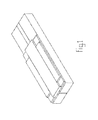
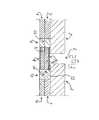
- Now the invention is elaborated by way of an in the drawing illustrated example, in perspective (
fig. 1 ) and in cross section (fig. 2 ). - Shown is a concrete substructure, in this example made by a bridge deck 1 and a foundation 2, which components are mutually separated by a joint 7. In this example the joint extends horizontally, perpendicular to the typical driving direction.
- The joint is at its top face covered by a prefabricated joint plate 6 with a thickness of 3 mm which by adhesive is fixedly mounted to both the foundation and the deck. During mounting the plate 6 is parallel to itself according to the driving direction slightly expanded such that the plate 6 is nicely flat and tightly mounted. In
fig. 2 the joint plate 6 is illustrated at a distance above the parts 1 and 2. In practice the plate 6 is located immediately on to op de parts 1 and 2, with an intermediate thin adhesive layer. - The joint 7 is approx. 2 cm wide (the distance between the parts 1 and 2). The plate 6 is with parallel to the length of the joint 7 extending edge strips of approx. 2 or 3 cm wide to the parts 1 and 2 adhered, such that in the area between said edge strips the plate 6 is freely slidable located onto the parts 1 and 2.
- The concrete substructure bears a pavement which in this example is made from two layers of asphalt, wherein the lower layer 4 is of the closed type and the upper layer is of the open type (ZOAB) 3. These cover layers are in the edge area's at both sides of the joint absent and replaced by a joint transition which provides with the cover layers a smooth driving face.
- This transition is made by the parts 5, 8 and two between the parts 6 and 8 provided, plate shaped
joint elements 9. The plate shapedjoint elements 9 and the cover plate 8 are prefabricated and as wide as part 6. Parts 5 (the supporting beams) are of in situ provided, cured casting compound, like casting asphalt, which is cast after parts 6 and 8 and the joint elements are positioned. - The
upper joint element 9 contains an embedded reinforcement net of rubber and the lower joint element is free from reinforcement. The reinforcement net is obtained by providing a rubber plate of 1 cm thick with oval perforations, wherein between the perforations remaining walls at the location of minimum wall thickness have a thickness of 1 cm. - After the joint plate 6 is installed, hot bitumen is cast onto it and, while the bitumen is still hot, the
lower element 9 is installed, after which hot bitumen is cast again and, while the bitumen is still hot, theupper element 9 is installed, after which hot bitumen is cast again and, while the bitumen is still hot, the cover plate 8 is located on top. Finally hot bitumen is cast onto parts 5 and 8 in a layer thickness of 5 to 10 millimetre, onto which a 4/8 road-metal is spread. - At the level of the
seam 11 between theelements 9 within each beam 5 an in the beam embedded and cast and with the material of the beam impregnated sheet like and tensionproof reinforcement element 10 of glass fabric extends the complete width of the beam and is connected to bothjoint elements 9, in that an edge strip of 5 centimetre is present between theelements 9 and is adhered to it. - As viewed in driving direction the dimension of the parts 5 is 30 and of the parts 8 is 50 centimetre.
- In a more preferred alternative the width of the joint plate 6 is smaller than that of the joint elements which have an equal width. E.g. the joint plate 6 has a width of 20 cm and the joint element has a width of 50 cm. In the area beyond the joint plate 6 the lower joint element is adhered to the substructure by e.g. bitumen.
- In an alternative the element 8 is absent and to finish the structure initially shape free covering material is provided, e.g. casting compound poured, onto the top joint element and the supporting beams 5, such that they are covered by the casting compound and the top face of the casting compound merges seamlessly into the top face of part 3 to provide a complete driving face.
- Also different embodiments are feasible, e.g. wherein the joint 7 is at east partly filled with an easily yielding material, such as elastic foam of sponge like material, which is e.g. partly compressed and/or adhered to the side wall of the joint 7 and provides additional noise reduction. Or wherein the joint plate 6 extends beyond the to the substructure adhered edge strips, thus is wider then the area between the adhered edge strips plus the width of the edge strips. In the area of the joint plate 6 outside the adhered edge strips the joint plate can be perforated such that in said area through the joint plate 6 the lower joint element is adhered to the substructure.
- Features of different in here disclosed embodiments can be combined in different manners and different aspects of certain features are regarded mutually exchangeable. All described or in the drawing shown features provide as such or in arbitrary combination the subject matter of this invention, also independent from their arrangement in the claims or their referral.
Claims (10)
- With a joint transition provided bridge of a road of highway, wherein the bridge has a substructure of e.g. concrete, which substructure comprises two substantially in mutual extension located parts (1, 2) that are mutually separated by a joint (7) having a width of e.g. approximately 2 centimetre and this substructure is covered by a top layer (3, 4) of e.g. asphalt concrete, which is e.g. provided by a lower layer (4) of e.g. closed asphalt concrete and an upper layer (3) of e.g. ZOAB (very open asphalt concrete), which top layer (3, 4) is absent in the edge area's of the substructure (1, 2) at both sides of the joint (7) in which area the top layer (3, 4) is extended by a both parts of the substructure (1, 2) overlapping joint transition, such that the surface of the top layer and the surface of the joint transition provide a substantially continuous surface across which the pneumatic tyres of cars and trucks roll.
- Bridge according to claim 1, wherein the transition has a the edge area's of the substructure (1, 2) on both sides of the joint (7), preferably substantially equally, overlapping and on both edge area's lying, preferably non-perforated joint plate (6) of e.g. supple foldable and pliable sheet like e.g. rubber in vulcanised state, material with a thickness of e.g. approximately 3 millimetre, a width of e.g. approximately 20 centimetre and preferably at least approximately 50% elastically stretchable without tearing, which joint plate is preferably flat and with pre tension mounted by in its plane in cross direction of the joint (7) stretching with an amount of preferably at least approximately 5%, and which joint plate (6) is preferably with e.g. at least approximately 2 centimetre wide extreme edge area's fixedly connected to one or both edge area's of the substructure by adhesion with e.g. bituminous material, such that in the e.g. approximately 16 centimetre wide area in between the joint plate (6) is loose lying on the substructure (1, 2).
- Bridge according to claim 1 or 2, wherein the transition has one or two e.g. approximately 50 centimetre wide prefabricated, preferably immediately on top of each other stacked, plate like and e.g. equally thick joint elements (9) which are stacked substantially centred preferably immediately on top of the joint plate(6) and, if present, preferably on both sides e.g. equally far extend beyond the joint plate (6) and in said edge area's possibly immediately bear onto the substructure and are for substantially their complete surface preferably adhered to each other and/or the the joint plate and/or the substructure by e.g. bituminous material.
- Bridge according to claim 1, 2 or 3, wherein preferably centred immediately on top of the one or both joint elements (9) a preferably substantially equally wide and with substantially the complete surface by e.g. bituminous material to it adhered, e.g. in situ cast and with e.g. 4/8 road-metal spread, e.g. approximately 6 millimetre thick cover layer (8) is present of which the top face is preferably at equal level with the top face of the rest of the pavement and e.g. seamless connects with it.
- Bridge according to any of claims 1-4, wherein preferably immediately at both sides of the arrangement of one or more of the joint plate (6), the one or more joint elements (9) and the cover layer (8), and preferably of equal height, an e.g., seamless to said arrangement connecting and to the transition belonging, e.g. approximately 10 centimetre wide and approximately 5 cm thick supporting beam (5) is present of e.g. cast asphalt which is preferably cast in situ and of which the top face is preferably at equal level with or is higher then the top face of the arrangement or the rest of the pavement and e.g. seamless connects with it and which supporting beam preferably immediately bears on the substructure (1, 2) and possible adheres to it.
- Bridge according to any of claims 1-5, wherein of the transition a joint element, e.g. the top element, has an embedded reinforcement which is preferably net like and is possibly made of easily elastically yieldable material, e.g. rubber, and is preferably located approximately halfway the height of the joint element of assembly of joint elements or near or at the lower side of the joint element, and possibly the lower joint element has no reinforcement.
- Bridge according to any of claims 1-6, wherein one or all joint elements are made of a mixture of rubber and road-metal, bound by a binder such as bitumen.
- Bridge according to any of claims 1-7, wherein in each supporting beam (5) an in the beam embedded reinforcement element (10) extends preferably over the complete width of the beam and possibly is connected to one or both joint elements, in that e.g. an edge strip of e.g. approximately 5 centimetre overlaps with or is present in one or both joint elements (9) and is possibly adhered to it.
- Bridge according to claim 8, wherein for the reinforcement element one or more of the following applies: extends at the level of the seam (11) between the joint elements (9); is embedded in the supporting beam and cast into and impregnated with the material of the beam; is sheet like and stretch free; is made of glass fibre fabric.
- Prefabricated joint element for a bridge according to any of claims 1-9, possibly provided with reinforcement.
Applications Claiming Priority (2)
| Application Number | Priority Date | Filing Date | Title |
|---|---|---|---|
| NL2002830 | 2009-05-01 | ||
| NL2003886A NL2003886C2 (en) | 2009-05-01 | 2009-11-30 | BRIDGE OF A HIGHWAY EQUIPPED WITH A JOINT TRANSITION. |
Publications (2)
| Publication Number | Publication Date |
|---|---|
| EP2246474A2 true EP2246474A2 (en) | 2010-11-03 |
| EP2246474A3 EP2246474A3 (en) | 2015-07-01 |
Family
ID=42371394
Family Applications (1)
| Application Number | Title | Priority Date | Filing Date |
|---|---|---|---|
| EP10161236.4A Withdrawn EP2246474A3 (en) | 2009-05-01 | 2010-04-28 | Highway bridge equipped with a joint transition |
Country Status (2)
| Country | Link |
|---|---|
| EP (1) | EP2246474A3 (en) |
| NL (1) | NL2003886C2 (en) |
Cited By (3)
| Publication number | Priority date | Publication date | Assignee | Title |
|---|---|---|---|---|
| CN103015315A (en) * | 2012-12-19 | 2013-04-03 | 长安大学 | Method for improving wind resisting stability of bridge |
| CN111155424A (en) * | 2020-01-10 | 2020-05-15 | 南通大学 | A kind of concrete bridge deck assembled telescopic device and its manufacturing method |
| CN112853913A (en) * | 2021-01-14 | 2021-05-28 | 张义 | Horizontal splicing bridge |
Families Citing this family (4)
| Publication number | Priority date | Publication date | Assignee | Title |
|---|---|---|---|---|
| CN105442441A (en) * | 2016-01-27 | 2016-03-30 | 江苏三川智能科技有限公司 | Bridge expansion joint device |
| RU2655126C1 (en) * | 2017-07-21 | 2018-05-23 | Акционерное общество "Спецремпроект" | Expansion joint of the slab-girder bridge |
| RU2734389C1 (en) * | 2020-01-28 | 2020-10-15 | Акционерное общество "Спецремпроект" | Beam bridge expansion joint |
| CN112681123A (en) * | 2020-12-18 | 2021-04-20 | 江苏领跑梦毛勒智造科技集团有限公司 | Environment-friendly telescopic device and mounting method thereof |
Citations (7)
| Publication number | Priority date | Publication date | Assignee | Title |
|---|---|---|---|---|
| DE2842171B1 (en) | 1978-09-28 | 1979-06-28 | Kober Ag | Coverage over expansion joints in traffic routes, especially bridges |
| US5024554A (en) | 1990-02-22 | 1991-06-18 | Koch Materials Company | Bridge joint construction |
| US5171100A (en) | 1990-12-12 | 1992-12-15 | Bergstedt Jan Eric O | Preformed expansion joint system |
| FR2717512A1 (en) | 1994-03-21 | 1995-09-22 | Chapuis Philippe | Leafed expansion joint for constructive works including roads |
| WO1996024726A1 (en) | 1995-02-09 | 1996-08-15 | Prismo Limited | Asphaltic plug expansion joint with flexible nosing |
| US5649784A (en) | 1995-06-16 | 1997-07-22 | Pavetech International, Inc. | Expansion joint system and method of making |
| EP1009881A1 (en) | 1997-08-28 | 2000-06-21 | RSAG Reparatur- und Sanierungstechnik AG | Connecting structure for building elements and process for producing said connecting structure |
-
2009
- 2009-11-30 NL NL2003886A patent/NL2003886C2/en not_active IP Right Cessation
-
2010
- 2010-04-28 EP EP10161236.4A patent/EP2246474A3/en not_active Withdrawn
Patent Citations (7)
| Publication number | Priority date | Publication date | Assignee | Title |
|---|---|---|---|---|
| DE2842171B1 (en) | 1978-09-28 | 1979-06-28 | Kober Ag | Coverage over expansion joints in traffic routes, especially bridges |
| US5024554A (en) | 1990-02-22 | 1991-06-18 | Koch Materials Company | Bridge joint construction |
| US5171100A (en) | 1990-12-12 | 1992-12-15 | Bergstedt Jan Eric O | Preformed expansion joint system |
| FR2717512A1 (en) | 1994-03-21 | 1995-09-22 | Chapuis Philippe | Leafed expansion joint for constructive works including roads |
| WO1996024726A1 (en) | 1995-02-09 | 1996-08-15 | Prismo Limited | Asphaltic plug expansion joint with flexible nosing |
| US5649784A (en) | 1995-06-16 | 1997-07-22 | Pavetech International, Inc. | Expansion joint system and method of making |
| EP1009881A1 (en) | 1997-08-28 | 2000-06-21 | RSAG Reparatur- und Sanierungstechnik AG | Connecting structure for building elements and process for producing said connecting structure |
Cited By (5)
| Publication number | Priority date | Publication date | Assignee | Title |
|---|---|---|---|---|
| CN103015315A (en) * | 2012-12-19 | 2013-04-03 | 长安大学 | Method for improving wind resisting stability of bridge |
| CN103015315B (en) * | 2012-12-19 | 2015-10-28 | 长安大学 | A kind of method improving Wind-resistance of Bridges stability |
| CN111155424A (en) * | 2020-01-10 | 2020-05-15 | 南通大学 | A kind of concrete bridge deck assembled telescopic device and its manufacturing method |
| CN112853913A (en) * | 2021-01-14 | 2021-05-28 | 张义 | Horizontal splicing bridge |
| CN112853913B (en) * | 2021-01-14 | 2022-11-18 | 中铁二十五局集团第五工程有限公司 | Horizontal splicing bridge |
Also Published As
| Publication number | Publication date |
|---|---|
| EP2246474A3 (en) | 2015-07-01 |
| NL2003886C2 (en) | 2010-11-09 |
Similar Documents
| Publication | Publication Date | Title |
|---|---|---|
| EP2246474A2 (en) | Highway bridge equipped with a joint transition | |
| RU2558557C2 (en) | Device to close compensation gap | |
| JP5852353B2 (en) | Telescopic device used for bridge and method for manufacturing the same | |
| KR101174256B1 (en) | Construction method for grid-reinforced asphalt pads and pavements at expansion joints of underpass structures | |
| CA2832030C (en) | Integrated ballast mat | |
| JP5113003B2 (en) | Pavement structure and method for forming pavement | |
| US3308725A (en) | Paving element and paving employing the same | |
| KR20170082318A (en) | Elastic recovering type expansion joint and the construction method therefor | |
| JP4452818B2 (en) | Repair method of expansion joints in bridges | |
| KR20100089616A (en) | Expansion joint with reinforcement net | |
| CN106498849B (en) | A kind of bridge expanssion joint and its construction technology | |
| KR20190112451A (en) | Construction Method of Expansion Joints Device with Improved Durability using Elastomeric Pad | |
| KR102701744B1 (en) | Sleeper pad for unifying non-woven fabric using rubber pad for reclamating stiffner, and manufacturing method and construction method for the same | |
| KR101560189B1 (en) | Flexible jointing structure of concrete road installation using key shape and constructing method thereof | |
| JP2005048389A (en) | Expansion joint device | |
| JP4927681B2 (en) | Pavement structure | |
| JP3941875B2 (en) | Joint structure in the gap between bridge decks | |
| CZ297844B6 (en) | Damping section for rails | |
| US6561728B1 (en) | Method for producing a road joint, and joint obtained by the method | |
| JP3789412B2 (en) | Buried joints for road bridge buried joints and buried bridge joints for road bridges | |
| KR101360788B1 (en) | Method for constructing joint part of structure using Expension Join | |
| JPH0632961Y2 (en) | Road joint | |
| JPH10292316A (en) | Buried joint member for highway bridge | |
| CN113152270A (en) | Seamless bridge deck expansion joint device and construction method thereof | |
| NL2001419C2 (en) | Forming expansion joint cover for e.g. bridges or viaducts, by laying two elastic layers having different elasticity |
Legal Events
| Date | Code | Title | Description |
|---|---|---|---|
| PUAI | Public reference made under article 153(3) epc to a published international application that has entered the european phase |
Free format text: ORIGINAL CODE: 0009012 |
|
| AK | Designated contracting states |
Kind code of ref document: A2 Designated state(s): AT BE BG CH CY CZ DE DK EE ES FI FR GB GR HR HU IE IS IT LI LT LU LV MC MK MT NL NO PL PT RO SE SI SK SM TR |
|
| AX | Request for extension of the european patent |
Extension state: AL BA ME RS |
|
| PUAL | Search report despatched |
Free format text: ORIGINAL CODE: 0009013 |
|
| AK | Designated contracting states |
Kind code of ref document: A3 Designated state(s): AT BE BG CH CY CZ DE DK EE ES FI FR GB GR HR HU IE IS IT LI LT LU LV MC MK MT NL NO PL PT RO SE SI SK SM TR |
|
| AX | Request for extension of the european patent |
Extension state: AL BA ME RS |
|
| RIC1 | Information provided on ipc code assigned before grant |
Ipc: E01D 19/06 20060101AFI20150528BHEP |
|
| STAA | Information on the status of an ep patent application or granted ep patent |
Free format text: STATUS: THE APPLICATION IS DEEMED TO BE WITHDRAWN |
|
| 18D | Application deemed to be withdrawn |
Effective date: 20160105 |