EP2248837A1 - Klebstoffe auf Basis silanterminierter Isocyanate - Google Patents
Klebstoffe auf Basis silanterminierter Isocyanate Download PDFInfo
- Publication number
- EP2248837A1 EP2248837A1 EP10401064A EP10401064A EP2248837A1 EP 2248837 A1 EP2248837 A1 EP 2248837A1 EP 10401064 A EP10401064 A EP 10401064A EP 10401064 A EP10401064 A EP 10401064A EP 2248837 A1 EP2248837 A1 EP 2248837A1
- Authority
- EP
- European Patent Office
- Prior art keywords
- adhesive
- isocyanate
- coating material
- amino
- viscosity
- Prior art date
- Legal status (The legal status is an assumption and is not a legal conclusion. Google has not performed a legal analysis and makes no representation as to the accuracy of the status listed.)
- Granted
Links
- 0 *NC(N(*)C(N*)=O)=O Chemical compound *NC(N(*)C(N*)=O)=O 0.000 description 2
Classifications
-
- C—CHEMISTRY; METALLURGY
- C09—DYES; PAINTS; POLISHES; NATURAL RESINS; ADHESIVES; COMPOSITIONS NOT OTHERWISE PROVIDED FOR; APPLICATIONS OF MATERIALS NOT OTHERWISE PROVIDED FOR
- C09D—COATING COMPOSITIONS, e.g. PAINTS, VARNISHES OR LACQUERS; FILLING PASTES; CHEMICAL PAINT OR INK REMOVERS; INKS; CORRECTING FLUIDS; WOODSTAINS; PASTES OR SOLIDS FOR COLOURING OR PRINTING; USE OF MATERIALS THEREFOR
- C09D175/00—Coating compositions based on polyureas or polyurethanes; Coating compositions based on derivatives of such polymers
- C09D175/04—Polyurethanes
-
- C—CHEMISTRY; METALLURGY
- C08—ORGANIC MACROMOLECULAR COMPOUNDS; THEIR PREPARATION OR CHEMICAL WORKING-UP; COMPOSITIONS BASED THEREON
- C08G—MACROMOLECULAR COMPOUNDS OBTAINED OTHERWISE THAN BY REACTIONS ONLY INVOLVING UNSATURATED CARBON-TO-CARBON BONDS
- C08G18/00—Polymeric products of isocyanates or isothiocyanates
- C08G18/06—Polymeric products of isocyanates or isothiocyanates with compounds having active hydrogen
- C08G18/28—Polymeric products of isocyanates or isothiocyanates with compounds having active hydrogen characterised by the compounds used containing active hydrogen
- C08G18/2805—Compounds having only one group containing active hydrogen
- C08G18/288—Compounds containing at least one heteroatom other than oxygen or nitrogen
- C08G18/289—Compounds containing at least one heteroatom other than oxygen or nitrogen containing silicon
-
- C—CHEMISTRY; METALLURGY
- C08—ORGANIC MACROMOLECULAR COMPOUNDS; THEIR PREPARATION OR CHEMICAL WORKING-UP; COMPOSITIONS BASED THEREON
- C08G—MACROMOLECULAR COMPOUNDS OBTAINED OTHERWISE THAN BY REACTIONS ONLY INVOLVING UNSATURATED CARBON-TO-CARBON BONDS
- C08G18/00—Polymeric products of isocyanates or isothiocyanates
- C08G18/06—Polymeric products of isocyanates or isothiocyanates with compounds having active hydrogen
- C08G18/70—Polymeric products of isocyanates or isothiocyanates with compounds having active hydrogen characterised by the isocyanates or isothiocyanates used
- C08G18/72—Polyisocyanates or polyisothiocyanates
- C08G18/77—Polyisocyanates or polyisothiocyanates having heteroatoms in addition to the isocyanate or isothiocyanate nitrogen and oxygen or sulfur
- C08G18/78—Nitrogen
- C08G18/7806—Nitrogen containing -N-C=0 groups
- C08G18/7818—Nitrogen containing -N-C=0 groups containing ureum or ureum derivative groups
- C08G18/7831—Nitrogen containing -N-C=0 groups containing ureum or ureum derivative groups containing biuret groups
-
- C—CHEMISTRY; METALLURGY
- C08—ORGANIC MACROMOLECULAR COMPOUNDS; THEIR PREPARATION OR CHEMICAL WORKING-UP; COMPOSITIONS BASED THEREON
- C08G—MACROMOLECULAR COMPOUNDS OBTAINED OTHERWISE THAN BY REACTIONS ONLY INVOLVING UNSATURATED CARBON-TO-CARBON BONDS
- C08G18/00—Polymeric products of isocyanates or isothiocyanates
- C08G18/06—Polymeric products of isocyanates or isothiocyanates with compounds having active hydrogen
- C08G18/70—Polymeric products of isocyanates or isothiocyanates with compounds having active hydrogen characterised by the isocyanates or isothiocyanates used
- C08G18/72—Polyisocyanates or polyisothiocyanates
- C08G18/77—Polyisocyanates or polyisothiocyanates having heteroatoms in addition to the isocyanate or isothiocyanate nitrogen and oxygen or sulfur
- C08G18/78—Nitrogen
- C08G18/7806—Nitrogen containing -N-C=0 groups
- C08G18/7818—Nitrogen containing -N-C=0 groups containing ureum or ureum derivative groups
- C08G18/7837—Nitrogen containing -N-C=0 groups containing ureum or ureum derivative groups containing allophanate groups
-
- C—CHEMISTRY; METALLURGY
- C08—ORGANIC MACROMOLECULAR COMPOUNDS; THEIR PREPARATION OR CHEMICAL WORKING-UP; COMPOSITIONS BASED THEREON
- C08G—MACROMOLECULAR COMPOUNDS OBTAINED OTHERWISE THAN BY REACTIONS ONLY INVOLVING UNSATURATED CARBON-TO-CARBON BONDS
- C08G18/00—Polymeric products of isocyanates or isothiocyanates
- C08G18/06—Polymeric products of isocyanates or isothiocyanates with compounds having active hydrogen
- C08G18/70—Polymeric products of isocyanates or isothiocyanates with compounds having active hydrogen characterised by the isocyanates or isothiocyanates used
- C08G18/72—Polyisocyanates or polyisothiocyanates
- C08G18/77—Polyisocyanates or polyisothiocyanates having heteroatoms in addition to the isocyanate or isothiocyanate nitrogen and oxygen or sulfur
- C08G18/78—Nitrogen
- C08G18/79—Nitrogen characterised by the polyisocyanates used, these having groups formed by oligomerisation of isocyanates or isothiocyanates
-
- C—CHEMISTRY; METALLURGY
- C09—DYES; PAINTS; POLISHES; NATURAL RESINS; ADHESIVES; COMPOSITIONS NOT OTHERWISE PROVIDED FOR; APPLICATIONS OF MATERIALS NOT OTHERWISE PROVIDED FOR
- C09J—ADHESIVES; NON-MECHANICAL ASPECTS OF ADHESIVE PROCESSES IN GENERAL; ADHESIVE PROCESSES NOT PROVIDED FOR ELSEWHERE; USE OF MATERIALS AS ADHESIVES
- C09J175/00—Adhesives based on polyureas or polyurethanes; Adhesives based on derivatives of such polymers
- C09J175/04—Polyurethanes
Definitions
- the invention relates to adhesives or coating materials, in particular for construction purposes, based on silane-terminated polymers of isocyanates, as well as their uses and production methods thereof.
- the adhesives or coating materials have little or no content of monomers or molecules with free isocyanate groups.
- Adhesives that comply with DIN EN 204-D4 generally contain harmful isocyanates and must therefore be labeled in accordance with the applicable regulations. Sometimes this labeling leads to marketing restrictions.
- the object of the present invention is to find adhesives or coating materials which have favorable toxicological or occupational hygiene properties and, in particular, also have high adhesion to many substrates and high weather resistance.
- the DE 10 2008 021 221 also theoretically involves the reaction of isocyanates with silanes, but it is a different goal: good elasticity and ductility should be achieved, and the application is directed to isocyanatosilanes and polyoxyalkylene glycols as preferred materials.
- the DE 60 2004 012 439 T2 describes primarily polyoxyethylene hydroxides, also here it is again about high elasticity and rather putty.
- the US 2009/0053411 describes compulsively surfactant-containing compositions and aims to increase the shelf life of organoalkoxysilanes for adhesion promoters. It concerns compositions for the pre-impregnation of surfaces. Only epoxide derivatives, not isocyanate derivatives, are exemplified.
- Alkoxysilanes having amino groups are used in a number of ways in the EP 0 913 402 described documents. However, it is mentioned that it is known that all amino-functional Silanes are extremely reactive with isocyanates. Therefore, it is difficult to react these alkoxysilanes with polyisocyanates because of the incompatibility, inhomogeneity and extremely high viscosities of the reaction products.
- the resulting polar (for example, polyurethane, polythiourethane, polyurea and / or polythiourea) compounds are particularly characterized by chain stability, good adhesion to polar substrates, high strength and low elongation after curing) and thus enable compounds of high stability and strength.
- the elongation after curing (residual strain) is advantageously less than 110%, e.g. less than 100%, e.g. less than 80%, determined by the elongation at break method mentioned in the examples.
- they have a molecular weight distribution such that no single molecular species is greater than 50 weight percent, and more than 50 weight percent of the chains are composed of at least 3 + 1 covalently attached monomer units / reactants.
- the invention also relates to the use of the adhesives according to the invention in bonding in particular in the construction and construction sector for (at least) cohesive connection of two or more contactable surfaces of a part and / or two or more parts to an object consisting of the connected parts.
- the invention also relates to the use of the coating materials according to the invention for coating substrates, metallic, organic or mineral substrates, in particular substrates in the construction sector, such as metals, masonry, concrete, ceramics, wood, plastic or the like. Furthermore, the use for bonding or coating in the field of manufacturing of land, water or aircraft, in the field of sanitation, in the field of electrical industry, in the field of production of products with plastic parts, and / or in the furniture industry.
- hydrosettable radicals including, for example, halogen atoms (such as chloro), ketoximato, amino, aminoxy, mercapto, acyloxy, aryloxy, aralky
- Amino, mercapto, epoxy, isocyanato and / or Anhydrido group carry, for example silanes of the formula I, [R 1 -X- (CH 2 ) n -] p -Si (-R 2 ) q (I) wherein X is S or NH or O or NCO or nothing; where X is not when R 1 is carboxylic acid anhydride; R 1 is nothing, hydrogen, cycloalkyl, alkyl, aminoalkyl, epoxyalkyl, aryl, acyl, carboxylic anhydride, heterocyclyl or a radical of the formula - [(CH 2 ) n * ] p * -Si (OR 2 *) q * wherein each independently of the other radical, R 2 * has one of the meanings given for R 2 ; wherein R 1 is hydrogen when X is S; wherein R 1 is epoxyalkyl when X is O; where R 1 is nothing when X is NCO; R 2 is
- the alpha effect is to be understood as meaning the interaction between silicon and a geminal donor group (for example amino, sec-amino or mercapto (sulfanyl) bonded via a carbon, for example a methylene group, which has an increased reactivity of the silanes and thus their accelerated Hardening supported.
- a geminal donor group for example amino, sec-amino or mercapto (sulfanyl) bonded via a carbon, for example a methylene group
- silanes which have as substituents at least one hydrolyzable radical and at least one substituent with an isocyanate-reactive group those which contain at least one other than amino or sec-amino groups as isocyanate-reactive groups, in particular those which which contain the said isocyanate-reactive groups other than amino or secondary amino groups.
- silanes having as substituents at least one hydrolyzable radical and at least one substituent with an isocyanate-reactive group those which contain at least one group other than mercapto as isocyanate-reactive groups, in particular those which contain the contain isocyanate-reactive groups except mercapto.
- silanes which have as substituents at least one hydrolyzable radical and at least one substituent with an isocyanate-reactive group can be used, in particular amino or sec.-amino or mercapto groups, the latter also in the uses according to the invention.
- Alkyl is always understood within this disclosure to mean, in particular, an unbranched or mono- or polysubstituted alkyl radical having, for example, 1 to 20, preferably 1 to 10, carbon atoms, for example having 1 to 4 carbon atoms, such as e.g. Methyl, ethyl, n-propyl, isopropyl, n-butyl, sec-butyl, isobutyl or tert-butyl.
- Cycloalkyl is in particular mono-, di- or tricyclic, preferably monocyclic, cycloalkyl having 3 to 20 carbon atoms, preferably having 3 to 10 carbon atoms, in the ring, in particular for cyclopentyl or cyclohexyl.
- Aminoalkyl is preferably alkyl as defined above which is substituted by amino, e.g. for 2-aminoethyl, 3-aminopropyl or the like.
- epoxyalkyl is alkyl as defined above which is ring-substituted by an epoxy group, such as, in particular, (2,3-epoxy-propan-1-yl).
- Aryl is a mono-, di- or tricyclic, preferably monocyclic, unsaturated cyclic hydrocarbon radical, in particular phenyl or naphthyl, where aryl may be unsubstituted or substituted, for example by one or more, for example up to three, C 1 -C 7 alkyl.
- Acyl is a radical of an organic carboxylic acid bound via the carbonyl group, for example an alkanoyl radical, such as C 2 -C 7 -alkanoyl, or in particular a C 1 -C 7 -alkoxycarbonyl radical, such as methoxycarbonyl (Me-OC (OO) -)
- Heterocyclyl is in particular a mono- or tricyclic, in particular monocyclic radical having 3 to 20, preferably 3 to 8 ring atoms, of which one or more, in particular 2, heteroatoms independently of one another are selected from N, O and S, and can one or more oxo groups may be substituted, especially those attached to ring carbon atoms attached through an O-heteroatom (resulting in anhydride).
- a possible preferred example is 2,5-dioxo-oxolan-3-yl, another is the corresponding unsaturated variant 2,5-dioxo-oxol-3-yl having a double bond between the C atoms in positions 3 and 4 of the ring, another 3,4-benzoannelated 2,5-dioxolan-3-yl radical.
- Ketoximato means in particular a (in this case bound to Si via the bond marked with Sterchen *) of the formula wherein R A and R A independently of one another are alkyl, in particular C 1 -C 7 -alkyl, which may be branched or unbranched, for example methyl, ethyl or isobutyl.
- Aromatic e.g., aryl
- the corresponding polyisocyanates contain aromatic groups having from 6 to 18 carbon atoms, such as phenylene, naphthylene, which may be substituted with one or more, optionally also bridging, alkyl substituents, such as one or more methyl groups, e.g. For example, toluene or methyldiphenylene.
- Aromatic-aliphatic means that the corresponding radicals contain combinations of aliphatic radicals and aromatic radicals as mentioned above.
- These carry the by reaction of isocyanate groups cyclic structures formed with each other such as those of the uretdione type, the isocyanurate type, the uretonimine type or the iminooxadiazinone type, or further the oxadiazinetrione type, or noncyclic groups of the biuretype or the allophanate type or further of the carbodiimide type, or two or more different such groups , and one or preferably a plurality of remaining unreacted isocyanate groups
- Aliphatic (preferred), aromatic or araliphatic polyisocyanates having cyclic structures are in particular to be understood as meaning those cyclic structures obtainable, for example, from the reaction of at least some of the isocyanate groups of corresponding isocyanate group-carrying monomers. of the uretdione type, the isocyanurate type, the iminooxadiazinedione type and / or the uretonimine type, and / or further of the oxadiazinetrione type.
- Uretdione-type structures include groups (or in particular compounds) of the formula A.
- Y 1 and Y 2 can be independently selected from alkyl, aryl or alkylaryl, wherein at least one or all of these radicals are substituted by at least one free isocyanate group, wherein a part of the isocyanate groups again part of corresponding uretdione-type or further optionally also can be structures resulting from side reactions, so per molecule several such groups, for example up to ten, may occur, so that a total of at least one or preferably two, or more, free isocyanate groups per molecule of the formula A remain.
- Isocyanurate-type structures include structures of the type (or in particular compounds) of the formula B in which Y 1 *, Y 2 * and Y 3 * can be selected independently of one another from alkyl, aryl or alkylaryl, where at least one or preferably two or all of these radicals are substituted by at least one free isocyanate group, isocyanate groups being again part of corresponding isocyanurate groups.
- Type or further possibly also by side reactions resulting structures, so per molecule of formula B may occur several, for example up to ten, such groups, so that a total of at least one or preferably two or three, or more, free isocyanate groups per molecule of Formula B remain.
- Iminooxadiazinedione type structures include structures of the type (or in particular compounds) of the formula C. wherein Y 1 **, Y 2 ** and Y 3 ** independently of one another can be selected from alkyl, aryl or alkylaryl, where at least one or preferably two or all of these radicals are substituted by at least one free isocyanate group, isocyanate groups again being part of corresponding iminooxadiazinedione type or other possibly also by side reactions resulting structures, so per molecule of formula C may occur several, for example up to ten, such groups, so that in total at least one or preferably two or three, or more, free isocyanate groups remain per molecule of the formula C.
- Uretonimine-type structures include structures of the type (or in particular compounds) of the formula D wherein Y 1 , Y 2, Y 3 and Y 3 may be independently selected from alkyl, aryl or alkylaryl, at least one or preferably two or all of these radicals being substituted by at least one free isocyanate group, wherein isocyanate groups may again be part of corresponding isocyanurate-type or other possibly also by side reactions resulting structures, so per molecule of formula D may occur several, for example up to ten, such groups, so that in total at least one or preferably two or three, or more , free isocyanate groups per molecule of the formula D remain.
- Oxadiazinetrione type structures include structures of the type (or in particular compounds) of the formula G, wherein Y 1 **** and Y 2 **** independently of one another can be selected from alkyl, aryl or alkylaryl, where at least one or preferably two or all of these radicals are substituted by at least one free isocyanate group, isocyanate groups being again part of corresponding Isocyanurate-type or other possibly also be formed by side reactions structures, so per molecule of formula G may occur several, for example up to ten, such groups, so that in total at least one or preferably two or three, or more, free isocyanate groups Molecule of the formula G remain.
- Aryl is always within this disclosure preferably an aromatic radical having 6 to 18 carbon atoms, for example, phenyl, naphthyl, toluyl or methyldiphenyl.
- Aralkyl within this disclosure is always aryl as previously defined which is attached to alkyl as defined above, for example, benzyl or phenylethyl, but may be omitted from within this disclosure for embodiments of the invention.
- Viscosities are measured according to DIN EN ISO 2555 with a Brookfield DV-III + viscometer with spindle 3 at 10 revolutions / minute (rpm) at 23 ° C and in Pa ⁇ s (hereinafter also referred to as Pa * s or Pas reproduced) ,
- this measurement may after Siggia, S. and JG Hanna. 1948. Anal. Chem., 20: 1084 , or according to the non-binding method according to ASTM D4666-87, "Standard Test Method for Polyurethane Raw Materials: Determination of Amines Equivalent to Crude or Modified Isocyanates".
- Aliphatic (preferred), aromatic or araliphatic polyisocyanates having biuret or allophanate structures or furthermore carbodiimide structures (acyclic structures) are in particular those which contain, for example, corresponding acyclic structures obtainable from the reaction of at least some of the isocyanate groups.
- Biuret-type structures include structures of the type (or in particular compounds) of the formula E wherein Z 1 , Z 2 and Z 3 can be independently selected from alkyl, aryl or alkylaryl, wherein at least one or preferably two or all of these radicals are substituted by at least one isocyanate group, wherein isocyanate groups again part of corresponding biuret-type or further optionally may also be formed by side reactions structures, so per molecule, for example, up to ten, such groups may occur, so that a total of at least one or preferably two or three, or more, free isocyanate groups per molecule of the formula E remain.
- Allophanate-type structures include structures of the type (or in particular compounds) of the formula F wherein Z 1 *, Z 2 * and Z 3 * can be independently selected from alkyl, aryl or alkylaryl, wherein at least one or preferably two of these radicals are substituted by an isocyanate group, wherein isocyanate groups again part of corresponding allophanate-type or further may also be formed by side reactions structures, so per molecule of formula F may occur several, for example up to ten, such groups, so that a total of at least one or preferably two or three, or more free isocyanate groups per molecule of the formula F remain.
- Corresponding compounds of type b1) (such as HDI isocyanurate, the corresponding pentamers, IPDI trimers or HDI or IPDI iminooxadiazinediones, uretonimines or higher polymers thereof) or b2) (such as HDI-biuret or HDI uretdione, or each higher polymers thereof) are known or can be prepared by known methods, for example as in EP 0 000 194 , of the EP 0 531 820 . DE 2 616 416 . EP 0 010 589 . US 3,124,605 . US 3,358,010 . US 3,644,490 . US 3,769,318 . US 4,160,080 . US 4,177,342 . US 5,124,427 . US 5,208,334 . US 5,235,018 or similar.
- HDI stands for hexamethylene diisocyanate
- IPDI isophorone diisocyanate
- C 1 -C 10 methylene diisocyanates e.g. As hexamethylene diisocyanate, the cyclic structures (b1)) or in particular biuret and / or allophanate structures.
- Suitable starting materials for components b1) and b2) are, for example, diisocyanatodiphenylmethane and its structural isomers, polymers and homologues, toluene diisocyanate and its structural isomers, polymers and homologues 1,6-hexamethylene diisocyanate, 1-isocyanato-3,3,5-trimethyl-5-isocyanatomethylcyclohexane (Isophorone diisocyanate) and diisocyanato-dicyclohexylmethane and its structural isomers, polymers and homologs, and mixtures thereof.
- diisocyanatodiphenylmethane and its structural isomers polymers and homologues
- toluene diisocyanate and its structural isomers polymers and homologues 1,6-hexamethylene diisocyanate, 1-isocyanato-3,3,5-trimethyl-5-isocyanatomethylcyclohexane (Isophorone
- structural isomers are meant in particular positional isomers, polymers or homologs eg prepolymers based thereon.
- isocyanate groups may again be a constituent" of uretdione, isocyanurate, iminooxadiazinedione, uretonimine, oxadiazinetrione, biuret, allophanate or carbodiimide-type structures or other structures which may be formed by side reactions, this means that the isocyanate groups may be present in a modified form according to a corresponding reaction (then not more than isocyanate groups as such).
- one or more of the compounds mentioned above and below with isocyanate groups may also be mixed in a modified form or be only other of those mentioned used as compounds with biuret and or isocyanurate-type structures.
- the prepolymers with a viscosity of 60,000 or less mPa.s which can be prepared from the reaction of b1) and / or b2) with compounds having at least 2 isocyanate-reactive groups, are prepolymers corresponding to b3) and are corresponding prepolymers which can be prepared by reaction under to prepare prepolymers from the isocyanates as such conventional conditions.
- Corresponding compounds having at least two isocyanate-reactive groups are in particular di- or higher-functional (preferably aliphatic, aromatic or araliphatic) compounds having two or more groups selected from amino, imino, hydroxy and mercapto, for example corresponding alcohols, thiols, amines, Thioalkoho-le , Amino alcohols or aminothiols, or mixtures thereof, for example as in WO 02/079341 and WO 02/079293 called, which are incorporated herein by reference.
- corresponding compounds are secondary products of ethylene or propylene oxide, such as ethanediol, other diols, such as butanediol, bisphenol A or bisphenol F, higher alcohols, such as glycerol or Trimethylolpropane, hydroxyl-containing polyethers, for example polyethylene oxide, polypropylene oxide or polytetrahydrofuran, polyethers each having terminal hydroxy, which contain aromatic structural units in the main chain, hydroxyl-containing polyesters,
- aliphatic aminols in particular Hydroxiliederalkylamine, such as ethanolamine, diethanolamine or 3-aminopropanol, or aromatic aminols, such as 2-, 3- or 4-aminophenol, inorganic or organic amino compounds having 2 or more amino groups, such as hydrazine or ethylenediamine or in particular sterically hindered, secondary aliphatic diamines such as N, N'-di-tert-butylethylenediamine, or aromatic di- or polyamines, such as 2,4 and 2,6-toluenediamine or 4,4'-diaminodiphenylmethane, polyetherdiamines or polyphenyl / polymethylenepolyamines obtainable by condensation of anilines with formaldehyde, or in particular sterically hindered aromatic diamines (such as Et)
- prepolymers which, in addition to polyethers, include compounds having at least two isocyanate-reactive groups at least one of the other compounds mentioned in this paragraph with such reactive groups, in particular prepolymers in whose preparation no polyethers were used , or those in which carry at least (leading to urea) one or more amino groups.
- This allows a particularly low deformability, which is advantageous for solid bonding.
- the corresponding methods and uses according to the invention also represent particular embodiments of the invention.
- Aliphatic (preferred), aromatic or araliphatic polyisocyanates having cyclic structures and aliphatic (preferred), aromatic or araliphatic polyisocyanates with biuret, allophanate or further carbodiimide structures (acyclic structures) can be found in the This disclosure also be referred to as compounds with isocyanate groups in a modified form.
- an adhesive is to be understood as meaning a material which, after curing, enables the materially bonded surfaces of objects to be bonded, be it within an object or, preferably, for joining two objects.
- the adhesives of the present invention may include, in addition to the above components a) and b), other common ingredients (additives or additives), such as silane crosslinkers, esters of polysilicic acid (such as Dynasilan 40), coupling agents, e.g. Aminosilanes, thixotropic agents such as fumed silica, pigments, dyes, adjuvants, solvents such as e.g.
- These further ingredients may for example be present in a total amount of up to 80, preferably between 0.01 and 50 wt .-%.
- catalysts may be added in an amount known to those skilled in the art, e.g. Lead, cobalt, iron, nickel, zinc or especially tin salts of organic carboxylic acids such as fatty acids such as tin octanoate, tin naphthenate or tin acetate, tin alkoxylates or dialkyltin dicarboxylates such as dibutyltin dilaurate, dibutyltin dipalmitate, dibutyltin distearate, dibutyltin diacetate or dibutyltin acetylacetonate, titanic acid esters such as tetrabutyl titanate or tetrapropyl titanate, or (for example secondary or tertiary) amines such as ethylamine, morpholine, n-methylmorpholine, 2-ethyl-2-methylimidazole, 1,8-diazabicyclo (5.4.0)
- fillers are used as further additives, preferably mineral or mineral-like fillers, such as quartz, glass, porcelain, corundum, ceramics, talc, silicic acid (eg fumed silica), silicates, clay, titanium dioxide, chalk, baryte, Feldspar, basalt, aluminum hydroxide, granite or sandstone, polymeric fillers, hydraulically hardenable fillers, such as gypsum, quicklime or cement (eg Tonerd- or Portland cement), water glasses, active aluminum hydroxides, metals, such as aluminum, carbon black, furthermore wood, mineral or organic Fibers, or the like, or mixtures of two or more thereof.
- mineral or mineral-like fillers such as quartz, glass, porcelain, corundum, ceramics, talc, silicic acid (eg fumed silica), silicates, clay, titanium dioxide, chalk, baryte, Feldspar, basalt, aluminum hydroxide, granite or sandstone, polymeric fillers, hydraulically hardenable fillers,
- the fillers can be present in any desired forms, for example as powder or flour, or as shaped bodies, for example in cylindrical, ring, spherical, platelet, stick, saddle or crystal form, or else in fiber form, and have the corresponding base particles preferably a maximum diameter of 0.001 ⁇ m to 10 mm. Fillers are based on the finished mixture (adhesive) preferably in an amount of up to 90, in particular 3 to 85, for example 5 to 70 wt .-% before.
- the inventive preparation of an adhesive is preferably carried out by reacting the components a) and b) after mixing the components, if necessary in the presence of a solvent without active hydrogen (such as in SH, NH or OH), but preferably without solvent, at ordinary temperatures, for example in Range between 0 ° C and the resulting by the heat of reaction temperature, for example between 20 and 150 ° C or optionally at higher temperatures by heating optionally with simultaneous or preferably subsequent mixing with one or more other ingredients.
- a catalyst addition may be carried out to sufficiently accelerate the reaction, wherein the activation can be carried out for example with one or more of the catalysts mentioned above.
- the molar ratio of the functional groups (eg X in formula I) of the silane (component a)) to those of the isocyanate derivatives (isocyanate groups) (component b)) in the range from 1: 5 to 5: 1 is preferably particularly preferred in the range of 1: 2 to 2: 1.
- Excess silane can serve as reactive diluents and / or crosslinkers in the final composition.
- Excess isocyanate groups may serve to promote adhesion or to create foam structures.
- the product obtainable in this way is an adhesive or coating material according to the invention.
- the adhesives of the invention may be provided as a one-component adhesive and thus also be used as such - the curing then takes place mainly by the ambient humidity (eg from air and / or the materials to be bonded).
- the embodiment is possible as a two-component system, in particular in such a way that water and silanes are present in separate components, wherein the first component preferably contains the adhesive (for example composed as for a one-component system), the second component water, in particular in pastes. or gel form (bound, for example, bound to a binder such as silica gel or the like), which then allows curing.
- the adhesive for example composed as for a one-component system
- the second component water, in particular in pastes. or gel form (bound, for example, bound to a binder such as silica gel or the like), which then allows curing.
- the two components adhesive and water may be present in separate containers of a package and be joined together (for example by stirring), or preferably in a two-chamber cartridge or equivalent apparatus can be equipped with a static mixer, so that the mixing takes place directly on site and the curing begins with it.
- the invention also relates to the use of the adhesives according to the invention in bonding in particular in the construction or construction sector for (at least) cohesive connection of two or more contactable surfaces of a part and / or two or more parts to an object consisting of the connected parts.
- the field of construction includes, for example, the use for gluing in the field of manufacturing of land, water or air vehicles, such as in the automotive industry, in the field of sanitation, in the electrical industry, in the production of plastic parts, in the furniture industry and many other areas.
- one surface of a (bonding) object to be treated is at least partially applied to the adhesive and then associated with another surface (which may also be applied with adhesive according to the invention) of the same or another object.
- another surface which may also be applied with adhesive according to the invention.
- the surfaces are at least cohesively connected to each other (in addition, other connection mechanisms such as positive and / or adhesion may be involved in the connection).
- a construction adhesive is prepared from a silane-terminated prepolymer and other additives.
- Dynasilan AMEO and Vestanat HB 2540 LV are converted to produce a silane-terminated prepolymer.
- a prepolymer having a ratio of the isocyanate functional groups (isocyanate equivalents) to those of the aminosilane (amino equivalents) of 1: 1.54 is prepared.
- 55.83 g Dynasylan AMEO are weighed.
- 30 g of Vestanat HB 2640 LV are added and stirred in such a way that the temperature can be controlled.
- the prepolymer is mixed with 40% by weight of chalk. Thereafter, 0.01% by weight of DABCO T9 catalyst is added.
- a construction adhesive is prepared from a silane-terminated prepolymer and other additives.
- Materials used ⁇ / u> Dynasylan® 1505 Evonik Industries 1 3- (diethoxymethylsilyl) propylamine Vestanat® HB 2640 LV Evonik Industries 1 Hexamethylene-1,6-diisocyanate, with biuret structures Calcilit® 6 HS Alpha Calcite 2 Chalk (filler) PC-CAT DBU Performance Chemicals 3 Catalyst (diazabicycloundecene)
- Dynasylan 1505 and Vestanat HB 2540 LV are reacted to produce a silane-terminated prepolymer.
- a prepolymer having a ratio of the isocyanate functional groups (isocyanate equivalents) to those of the aminosilane (amino equivalents) of 1: 1.54 is prepared.
- 47.07 g of Dynasylan 1505 are weighed.
- 30 g of Vestanat HB 2640 LV are added and stirred in such a way that the temperature can be controlled.
- the prepolymer is mixed with 40% by weight of chalk. Thereafter, 0.01% by weight of PC-CAT-DBU catalyst is added.
- the elongation at break is determined according to DIN EN ISO 527-1 on shoulder bars of the specimen type 1 BA (according to DIN EN ISO 527-2). After 7 days of storage at room temperature, an elongation at break of 3.7 ⁇ 0.3% is obtained.
- a construction adhesive is prepared from a silane-terminated prepolymer and other additives.
- Dynasylan 1505 and Vestanat HB 2540 LV are reacted to produce a silane-terminated prepolymer with the addition of 10% plasticizer.
- a prepolymer having a ratio of the isocyanate functional groups (isocyanate equivalents) to those of the aminosilane (amino equivalents) of 1: 1.1 is prepared.
- 6.14 g of plasticizer are introduced and then weighed 31.38 g Dynasylan 1505.
- 30 g of Vestanat HB 2640 LV are added and stirred in such a way that the temperature can be controlled.
- the prepolymer is mixed with 40% by weight of chalk. Thereafter, 0.01% by weight of PC-CAT-DBU catalyst is added.
- the tensile shear strength of the adhesive is determined according to DIN EN 204 on beech. After storage sequence 1, an average value of> 10 MPa is obtained. After storage sequence 3 and 5, one obtains in each case an average value of 4 MPa.
Landscapes
- Chemical & Material Sciences (AREA)
- Organic Chemistry (AREA)
- Health & Medical Sciences (AREA)
- Chemical Kinetics & Catalysis (AREA)
- Medicinal Chemistry (AREA)
- Polymers & Plastics (AREA)
- Life Sciences & Earth Sciences (AREA)
- Engineering & Computer Science (AREA)
- Materials Engineering (AREA)
- Wood Science & Technology (AREA)
- Adhesives Or Adhesive Processes (AREA)
Abstract
Description
- Die Erfindung betrifft Kleb- oder Beschichtungsstoffe, insbesondere für Konstruktionszwecke, auf Basis silanterminierter Polymere aus Isocyanaten, sowie deren Verwendungen und Herstellungs-verfahren dafür. Die Kleb- oder Beschichtungsstoffe weisen einen nur geringen oder gar keinen Gehalt an Monomeren oder Molekülen mit freien Isocyanatgruppen auf.
- Klebstoffe, die DIN EN 204-D4 erfüllen, enthalten in der Regel gesundheitsschädliche Isocyanate und sind daher entsprechend den geltenden Vorschriften zu kennzeichnen. Mitunter führt diese Kennzeichnung zu Vermarktungsbeschränkungen.
- Aufgabe der vorliegenden Erfindung ist vor diesem Hintergrund, Kleb- oder Beschichtungsstoffe zu finden, welche günstige toxikologische bzw. arbeitshygienische Eigenschaften haben und insbesondere auch hohe Adhäsion zu vielen Substraten und eine hohe Witterungsbeständigkeit aufweisen.
- Die
DE 10 2008 021 221 umfasst theoretisch auch die Reaktion von Isocyanaten mit Silanen, jedoch geht es um ein anderes Ziel: Gute Elastizität und Dehnbarkeit soll erreicht werden, und die Anmeldung ist auf Isocyanatosilane und Polyoxyalkylenglykole als bevorzugte Materialien ausgerichtet. -
DE 10 2004 022 150 beschreibt 2-komponentige Massen mit Silanen in beiden Komponenten, wobei konkret nur die Reaktion von Polyethern mit endständigen OH-Gruppen beschrieben wird, auch hier stehen hohe Elastizität und Kitte im Vordergrund. - Die
DE 60 2004 012 439 T2 beschreibt in erster Linie Polyoxyethylen-Hydroxide, auch hier geht es wieder um hohe Elastizität und eher Kitte. - Die
US 2009/0053411 beschreibt obligatorisch tensidhaltige Zusammensetzungen und hat als Ziel, die Lagerfähigkeit von Organoalkoxysilanen für Adhesionspromotoren zu erhöhen. Es geht um Zusammensetzungen zum Vorimprägnieren von Oberflächen. Es werden nur Epoxidderivate, keine Isocyanat-Derivate, exemplifiziert. - Alkoxysilane mit Aminogruppen werden in einer Reihe von in der
EP 0 913 402 genannten Dokumenten beschrieben. Es wird jedoch erwähnt, dass es bekannt ist, dass alle aminofunktionalen Silane extrem reaktiv mit Isocyanaten sind. Daher wird es als schwierig beschrieben, diese Alkoxysilane mit Polyisocyanaten umzusetzen wegen der Inkompatibilität, Inhomogenität und extrem hoher Viskositäten der Reaktionsprodukte. - Es wurde nun jedoch überraschend gefunden, dass die genannten Nachteile bei Durchführung der Umsetzung mit Rohstoffen nach a) und b) wie unten erklärt nicht bestätigt werden können und sogar Kleb- oder Beschichtungsstoffe mit ausgezeichneten Eigenschaften resultieren.
- Bei den erfindungsgemäßen Kleb- oder Beschichtungsstoffen handelt es sich um solche, die auf der Basis von Harzen gebildet sind, die bei der Umsetzung von
- a) Silanen, die als Substituenten mindestens einen hydrolysierbaren Rest, insbesondere Alkoxyrest, und mindestens einen Substituenten mit einer gegenüber Isocyanaten reaktiven (funktionalen) Gruppe, ausgewählt aus -NH2 (Amino), -NH- (sek. Amino), - SH (Mercapto), Epoxy, Isocyanato, gamma-Ureido, O-Alkyl-carbamato und/oder Anhydrido aufweisen;
und einer oder mehreren weiteren Komponenten b) ausgewählt aus - b1) aliphatischen (bevorzugt), aromatischen oder araliphatischen Polyisocyanaten mit durch Reaktion von Isocyanatgruppen miteinander gebildeten cyklischen Strukturen , einer Viskosität von höchstens 15000 mPa·s, besonders bevorzugt von höchstens 5000 mPa·s (jeweils bei 23 °C) und einem Gehalt an freien monomeren Isocyanaten von 2 oder weniger Gewichtsprozent, vorzugsweise von 0,5 oder weniger Gewichtsprozent, stärker bevorzugt von 0,1 Gewichtsprozent oder niedriger;
- b2) aliphatischen (bevorzugt), aromatischen oder araliphatischen Polyisocyanaten mit Biuret-, Allophanat- oder Carbodiimid-Typ-Strukturen, einer Viskosität von höchstens 15000 mPa·s, besonders bevorzugt von höchstens 5000 mPa·s bei 23 °C und einem Gehalt an freien monomeren Isocyanaten von 2 oder weniger Gewichtsprozent, vorzugsweise von 0,5 oder weniger Gewichtsprozent; und
- b3) Präpolymeren mit einer Viskosität von 60'000 mPa*s oder weniger, bevorzugt von 15'000 oder weniger mPa·s, herstellbar aus der Reaktion von b1) und/oder b2) mit Verbindungen mit mindestens 2 gegenüber Isocyanaten reaktiven Gruppen erhältlich sind.
- Die entstehenden polaren (beispielsweise Polyurethan-, Polythiourethan-, Polyharnstoff- und/oder Polythioharnstoff-) Verbindungen sind besonders durch Kettenstabilität, gute Haftung auf polaren Substraten, hohe Festigkeit und geringe Dehnung nach dem Aushärten) gekennzeichnet und ermöglichen somit Verbindungen hoher Stabilität und Festigkeit. Die Dehnung nach dem Aushärten (Restdehnung) liegt vorteilhaft bei kleiner 110 %, z.B. kleiner als 100 %, wie z.B. kleiner als 80% , bestimmt nach der in den Beispielen genannten Methode für die Bruchdehnung.
- Vorteilhaft weisen sie eine Molekulargewichtsverteilung derart auf, dass keine einzelne Molekülspezies zu mehr als 50 Gewichtsprozent vorliegt und gleichzeitig mehr als 50 Gewichtsprozent der Ketten aus mindestens 3 + 1 kovalent gebundenen Monomereinheiten/Reaktanten zusammengesetzt sind.
- Die Erfindung betrifft auch die Verwendung der erfindungsgemäßen Klebstoffe beim Verkleben insbesondere im Konstruktions- und Baubereich zur (mindestens) stoffschlüssigen Verbindung von zwei oder mehr in Kontakt bringbaren Flächen eines Teils und/oder von zwei oder mehr Teilen zu einem aus den verbundenen Teilen bestehenden Objekt.
- Die Erfindung betrifft auch die Verwendung der erfindungsgemäßen Beschichtungsstoffe zur Beschichtung von Substraten, metallischen, organischen oder mineralischen Substraten, insbesondere Substraten im Baubereich, wie Metallen, Mauerwerk, Beton, Keramik, Holz, Kunststoff oder dergleichen. Ferner kann die Verwendung zur Verklebung oder Beschichtung im Bereich der Herstellung von Land-, Wasser- oder Luftfahrzeugen, im Bereich des Sanitärwesens, im Bereich der Elektroindustrie, im Bereich der Herstellung von Produkten mit Kunststoffteilen, und/oder in der Möbelindustrie stattfinden.
- Die Erfindung betrifft in einer weiteren Ausführungsform auch ein Verfahren oder eine Methode zur Herstellung der Kleb- oder Beschichtungsstoffe, welches durch Umsetzung von
- a) Silanen, die als Substituenten mindestens einen hydrolysierbaren Rest, insbesondere Alkoxyrest, und mindestens einen Substituenten mit einer gegenüber Isocyanaten reaktiven (funktionalen) Gruppe, ausgewählt aus -NH2 (Amino), -NH- (sek. Amino), - SH (Mercapto), Epoxy, Isocyanato, gamma-Ureido, O-Alkyl-carbamato und/oder Anhydrido aufweisen;
und einer oder mehreren weiteren Komponenten b) ausgewählt aus - b1) aliphatischen (bevorzugt), aromatischen oder araliphatischen Polyisocyanaten mit durch Reaktion von Isocyanatgruppen miteinander gebildeten cyklischen Strukturen , einer Viskosität von höchstens 15000 mPa·s, besonders bevorzugt von höchstens 5000 mPa·s (jeweils bei 23 °C) und einem Gehalt an freien monomeren Isocyanaten von 2 oder weniger Gewichtsprozent, vorzugsweise von 0,5 oder weniger Gewichtsprozent, stärker bevorzugt von 0,1 Gewichtsprozent oder niedriger;
- b2) aliphatischen (bevorzugt), aromatischen oder araliphatischen Polyisocyanaten mit Biuret-, Allophanat- oder Carbodiimid-Typ-Strukturen, einer Viskosität von höchstens 15000 mPa·s, besonders bevorzugt von höchstens 5000 mPa·s bei 23 °C und einem Gehalt an freien monomeren Isocyanaten von 2 oder weniger Gewichtsprozent, vorzugsweise von 0,5 oder weniger Gewichtsprozent; und
- b3) Präpolymeren mit einer Viskosität von 60'000 mPa*s oder weniger, bevorzugt von 15'000 oder weniger mPa·s, herstellbar aus der Reaktion von b1) und/oder b2) mit Verbindungen mit mindestens 2 gegenüber Isocyanaten reaktiven Gruppen; gekennzeichnet ist.
- Die nachfolgenden Definitionen allgemeiner Begriffe ermöglichen die Ersetzung eines oder mehrerer der Begriffe durch die spezifischen Definitionen, was zu bevorzugten Ausführungsformen der Erfindung führt.
- Unter Silanen, die als Substituenten mindestens einen hydrolysierbaren Rest und mindestens einen Substituenten mit einer gegenüber Isocyanaten reaktiven Gruppe, ausgewählt aus -NH2 (Amino), -NH- (sek. Amino), -SH (Mercapto), Epoxy, -NCO (Isocyanato) oder Anhydrido, aufweisen, sind alle entsprechenden Silane zu verstehen, die derartige hydroylsierbare Reste, worunter vor- und nachstehend beispielsweise Halogenatome (wie Chloro), Ketoximato, Amino, Aminoxy, Mercapto, Acyloxy, Aryloxy, Aralkyloxy (= Arylalkoxy) oder insbesondere Alkyloxy (Alkoxy) zu verstehen sind, aufweisen, beispielsweise mindestens einen hydrolysierbaren Alkoxyrest und mindestens eine Amino-, sek. Amino-, Mercapto-, Epoxy-, Isocyanato- und/oder Anhydrido-Gruppe tragen, beispielsweise Silane der Formel I,
[R1-X-(CH2)n-]p-Si(-R2)q (I)
worin
X für S oder NH oder O oder NCO oder nichts steht; wobei X nichts ist, wenn R1 für Carbonsäureanhydrid steht;
R1 für nichts, Wasserstoff, Cycloalkyl, Alkyl, Aminoalkyl, Epoxyalkyl, Aryl, Acyl, Carbonsäureanhydrid, Heterocyclyl oder einen Rest der Formel -[(CH2)n*]p*-Si(OR2*)q* steht, worin, jeweils unabhängig vom anderen Rest, R2* eine der für R2, genannten Bedeutungen hat; wobei R1 Wasserstoff ist, wenn X für S steht; wobei R1 Epoxyalkyl ist, wenn X für O steht; wobei R1 nichts ist, wenn X für NCO steht;
R2 für Alkyl oder für einen hydrolysierbaren Rest, insbesondere Alkoxy, steht, mit der Maßgabe, dass mindestens einer, vorzugsweise zwei oder drei, der Reste R2 für (unabhängig voneinander auswählbare oder identische) hydrolysierbare Reste, beispielsweise für Alkoxy steht, bzw. stehen;
n und n* unabhängig voneinander für eine positive ganze Zahl, insbesondere 1 bis 10, stehen;
p und p* unabhängig voneinander für 1 bis 3 stehen; und
q und q* unabhängig voneinander für 1 bis 3 stehen, mit der Maßgabe, dass die Summe aus p bzw p* und q bzw. q* gleich 4 ist. - Besonders vorteilhaft können hierbei solche Silane verwendet werden, die den alpha-Effekt zeigen, also z.B. worin n und gegebenenfalls n* in obiger Formel I gleich 1 ist (n = 1 und ggf. n* = 1 in Formel I), z.B. N-Cyclohexylaminomethyl-methyldiethoxysilan, N-Cyclohexylaminomethyl-trimethoxysilan, Phenylaminomethyl-trimethoxysilan, Phenylaminomethyl-methyldimethoxysilan, N-Trimethoxysilylmethyl-O-methylcarbamat, N-Dimethoxy-(methyl)silylmethyl-O-methyl-carbamat, (Isocyanatomethyl)methyldimethoxysilan. Unter dem alpha-Effekt ist die Wechselwirkung zwischen Silicium und einer geminalen (z.B. über einen Kohlenstoff beispielsweise eine Methylengruppe gebundenen) Donorgruppe (z.B. Amino, sek-Amino oder Mercapto (Sulfanyl)) zu verstehen, der eine erhöhte Reaktivität der Silane und damit deren beschleunigte Härtung unterstützt.
- Bei den Silanen, die als Substituenten mindestens einen hydrolysierbaren Rest und mindestens einen Substituenten mit einer gegenüber Isocyanaten reaktiven Gruppe aufweisen, können solche bevorzugt sein, die mindestens auch eine andere als Amino- oder sek-Aminogruppen als gegenüber Isocyanaten reaktive Gruppen enthalten, insbesondere solche, welche die genannten gegenüber Isocyanaten reaktiven Gruppen außer Amino- oder sekundären Aminogruppen enthalten. Diese Varianten gelten insbesondere für die Kleb- und Beschichtungsstoffe als solche oder deren Verwendung zum Kleben, zum Beschichten oder zum Kleben und Beschichten. Andere bevorzugte Varianten können als Silane, die als Substituenten mindestens einen hydrolysierbaren Rest und mindestens einen Substituenten mit einer gegenüber Isocyanaten reaktive Gruppe aufweisen, solche beinhalten, die mindestens auch eine andere Gruppe als Mercapto als gegenüber Isocyanaten reaktive Gruppen enthalten, insbesondere solche, welche die genannten gegenüber Isocyanaten reaktiven Gruppen außer Mercapto enthalten.
- Bei den erfindungsgemäßen Herstellungsverfahren können alle genannten Silane, die als Substituenten mindestens einen hydrolysierbaren Rest und mindestens einen Substituenten mit einer gegenüber Isocyanaten reaktiven Gruppe aufweisen, verwendet werden, insbesondere Amino- oder sek.-Amino- oder Mercaptogruppen, letztere auch bei den erfindungsgemäßen Verwendungen.
- Alkyl steht innerhalb dieser Offenbarung stets für insbesondere einen unverzweigten oder ein- oder mehrfach verzweigten Alkylrest mit beispielsweise 1 bis 20, vorzugsweise 1 bis 10 Kohlenstoffatomen, beispielsweise mit 1 bis 4 Kohlenstoffatomen, wie z.B. Methyl, Ethyl, n-Propyl, Isopropyl, n-Butyl, sek.-Butyl, Isobutyl oder tert-Butyl.
- Cycloalkyl steht insbesondere für mono-, di- oder trizyklisches, vorzugsweise monozyklisches, Cycloalkyl mit 3 bis 20 Kohlenstoffatomen, vorzugsweise mit 3 bis 10 Kohlenstoffatomen, im Ring, insbesondere für Cyclopentyl oder Cyclohexyl.
- Aminoalkyl steht vorzugsweise für Alkyl wie oben definiert, das durch Amino substituiert ist, z.B. für 2-Aminoethyl, 3-Aminopropyl oder dergleichen.
- Epoxyalkyl steht vorzugsweise für Alkyl wie oben definiert, das durch eine Epoxygruppe unter Ringbildung substituiert ist, wie insbesondere(2,3-Epoxy-propan-1-yl).
- Aryl steht für einen mono-, di- oder trizyklischen, vorzugsweise monozyklischen, ungesättigten cyclischen Kohlenwasserstoffrest, wie insbesondere für Phenyl oder Naphthyl, wobei Aryl unsubstituiert oder substituiert sein kann, beispielsweise durch ein oder mehrere, z.B. bis zu drei, C1-C7-Alkylreste.
- Acyl steht für einen über die Carbonylgruppe gebundenen Rest einer organischen Carbonsäure, beispielsweise einen Alkanoylrest, wie C2-C7-Alkanoyl, oder insbesondere einen C1-C7-Alkoxycarbonylrest, wie Methoxycarbonyl (Me-O-C(=O)-)
- Heterocyclyl bedeutet insbesondere einen mono- di- oder trizyklischen, insbesondere monozyklischen Rest mit 3 bis 20, vorzugsweise 3 bis 8 Ringatomen, von denen ein oder mehrere , insbesondere 2, als Heteroatome unabhängig voneinander ausgewählt aus N, O und S vorliegen, und kann durch ein oder mehrere Oxogruppen substituiert sein, insbesondere solche, die an Ringkohlenstoffatome gebunden sind, die über ein O-Heteroatom gebunden sind (was zu Anhydrido führt). Unter Heterocyclyl fällt somit insbesondere auch Anhydrido, bei dem es sich um einen cyclischen Rest handelt, der folgendes ringschließendes Brückenelement enthält: -C(=O)-O-C(=O)-. Der Ring beinhaltet also eine Carbonsäureanhydridgruppe. Ein mögliches bevorzugtes Beispiel ist 2,5-Dioxo-oxolan-3-yl, ein anderes die entsprechende ungesättigte Variante 2,5-Dioxo-oxol- -3-yl mit Doppelbindung zwischen den C-Atomen in Stellung 3 und 4 des Rings, ein weiteres ein in 3,4-Stellung benzoannelierter 2,5-Dioxolan-3-ylrest.
- Unter Isocyanato oder Isocyanatgruppe ist -N=C=O zu verstehen.
- Dass "X für nichts" steht oder X nichts ist oder dergleichen, bedeutet, dass der Rest "-X-" in der jeweiligen Formel für eine einfache Bindung steht. Dass R1 nichts ist, bedeutet, dass der Rest R1 fehlt.
- Ketoximato bedeutet insbesondere einen (hier über die mit Sterchen * markierte Bindung an Si gebundenen) Rest der Formel

- "Beinhalten" oder "umfassen" bedeutet, dass neben den genannten Komponenten oder Merkmalen noch andere vorhanden sein können, steht also für eine nicht abschließende Aufzählung, im Gegensatz zu "enthalten", das eine abschließende Aufzählung der bei seiner Verwendung aufgezählten Komponenten oder Merkmale bedeutet.
- Die Komponenten b) sind vorzugsweise wie folgt definierbar:
- Aliphatisch (z.B. Alkyl) bedeutet, dass die entsprechenden Polyisocyanate gesättigte Kohlenwasserstoffketten mit 1 bis 20, vorzugsweise 1 bis 10, Kohlenstoffatomen, die geradkettig und/oder verzweigtkettig sein können, wie Hexamethylen oder Heptamethylen, oder gesättigte cyclische Reste, die mit ein oder mehreren ggf. weiter substituierten Alkylgruppen substituiert sein können, wie Isophoronylen (1,1,3,3-tetramethylcyclohexanylen) oder Dicyclohexylmethylen, enthalten. Diese tragen die durch Reaktion von Isocyanatgruppen miteinander gebildeten ein oder mehreren cyklischen Strukturen, wie die des Uretdion-Typs, des Isocyanurat-Typs, des Iminooxadiazinon-Typs oder des Uretonimin-Typs, oder nichtzyklische Gruppen des Biurettyps oder des Allophanattyps; oder zwei oder mehr unterschiedliche derartige Gruppen, und ein oder vorzugsweise mehrere noch verbleibende nicht umgesetzte Isocyanatgruppen.
- Aromatisch (z.B. Aryl) bedeutet, dass die entsprechenden Polyisocyanate aromatische Reste mit 6 bis 18 Kohlenstoffatomen enthalten, wie Phenylen, Naphthylen, die mit ein oder mehreren, gegebenenfalls auch verbrückenden Alkylsubstituenten, wie ein oder mehreren Methylgruppen, substituiert sein können, z. B. Toluylen oder Methyldiphenylen. Diese tragen die durch Reaktion von Isocyanatgruppen miteinander gebildeten cyklischen Strukturen, wie die des Uretdion-Typs, des Isocyanurat-Typs, des Uretonimin-Typs oder des Iminooxadiazinontyps, oder nichtzyklische Gruppen des Biurettyps oder des Allophanattyps, oder zwei oder mehr unterschiedliche derartige Gruppen, und ein oder vorzugsweise mehrere noch verbleibende nicht umgesetzte Isocyanatgruppen.
- Aromatisch-aliphatisch (z.B. Aralkyl; weniger bevorzugt als Bedeutung) bedeutet, dass die entsprechenden Reste Kombinationen aus aliphatischen Resten und aromatischen Resten, wie vorstehend genannt, enthalten. Diese tragen die durch Reaktion von Isocyanatgruppen miteinander gebildeten cyklischen Strukturen, wie die des Uretdion-Typs, des Isocyanurat-Typs, des Uretonimin-Typs oder des Iminooxadiazinontyps, oder ferner des Oxadiazintriontyps, oder nichtzyklische Gruppen des Biurettyps oder des Allophanattyps oder ferner des Carbodiimidtyps, oder zwei oder mehr unterschiedliche derartige Gruppen, und ein oder vorzugsweise mehrere noch verbleibende nicht umgesetzte Isocyanatgruppen
- Unter aliphatischen (bevorzugt), aromatischen oder araliphatischen Polyisocyanaten mit cyklischen Strukturen sind insbesondere solche zu verstehen, die beispielsweise aus der Umsetzung von mindestens einem Teil der Isocyanatgruppen entsprechender Isocyanat-gruppen tragender Monomere erhältliche zyklische Strukturen, wie z.B. des Uretdion-Typs, des Isocyanurat-Typs, des Iminooxadiazindion-Typs und/oder des Uretonimin-Typs, und/oder ferner des Oxadiazintriontyps, beinhalten.
- Uretdion-Typ-Strukturen beinhalten Gruppen (oder bestehen insbesondere aus Verbindungen) der Formel A

- Isocyanurat-Typ-Strukturen beinhalten Strukturen des Typs (oder bestehen insbesondere aus Verbindungen) der Formel B

- Iminooxadiazindion-Typ-Strukturen beinhalten Strukturen des Typs (oder bestehen insbesondere aus Verbindungen) der Formel C
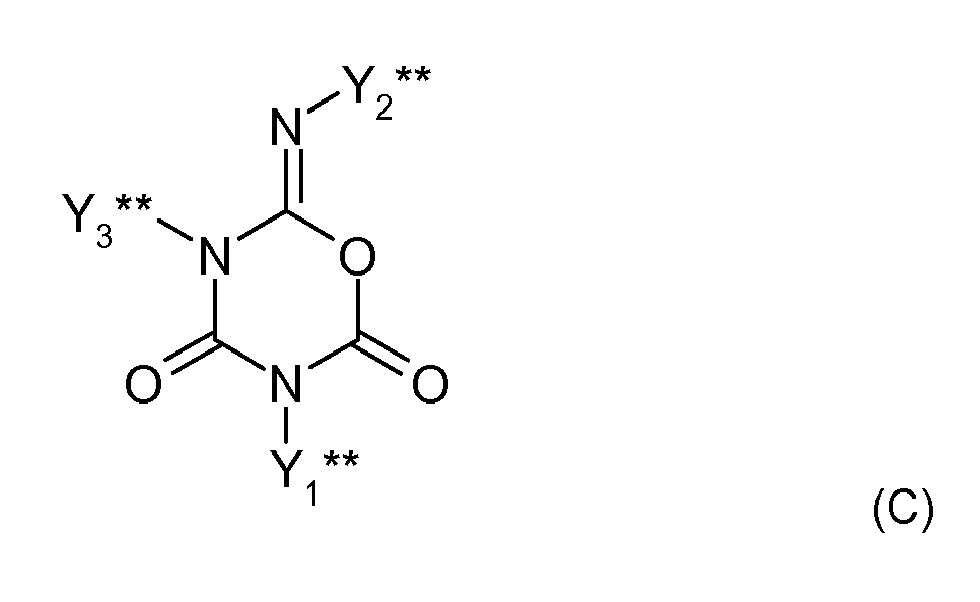
- Uretonimin-Typ-Strukturen beinhalten Strukturen des Typs (oder bestehen insbesondere aus Verbindungen) der Formel D

- Oxadiazintrion-Typ-Strukturen beinhalten Strukturen des Typs (oder bestehen insbesondere aus Verbindungen) der Formel G,

- Aryl ist innerhalb dieser Offenbarung stets vorzugsweise ein aromatischer Rest mit 6 bis 18 Kohlenstoffatomen, beispielsweise Phenyl, Naphthyl, Toluyl oder Methyldiphenyl.
- Aralkyl ist innerhalb dieser Offenbarung stets Aryl wie zuvor definiert, welches an Alkyl wie vorstehend definiert gebunden ist, beispielsweise Benzyl oder Phenylethyl, kann aber bei für Ausführungsformen der Erfindung innerhalb dieser Offenbarung weggelassen werden.
- Viskositäten werden nach DIN EN ISO 2555 mit einem Brookfield DV-III+-Viskosimeter mit Spindel 3 bei 10 Umdrehungen/Minute (U/min) bei 23 °C gemessen und in Pa·s (nachfolgend auch als Pa * s oder Pas wiedergegeben) angegeben.
- Die Bestimmung des NCO-Gehaltes eines Isocyanates erfolgt durch Reaktion eines Überschusses an Dibutylamin mit dem Isocyanat, gefolgt von einer Rücktitration des überschüssigen Amins mit Chlorwasserstoffsäure (HCl), nach der Formel:

- Beispielsweise kann diese Messung nach Siggia, S. and J. G. Hanna. 1948. Anal. Chem., 20:1084, oder nach der nicht verbindlich gewordenen Methode nach ASTM D4666-87, "Standard Test Method for Polyurethane Raw Materials: Determination of Amine Equivalent of Crude or Modified Isocyanates", durchgeführt werden.
- Unter aliphatischen (bevorzugt), aromatischen oder araliphatischen Polyisocyanaten mit Biuret- oder Allophanat-Strukturen oder ferner Carbodiimid-Strukturen (acyclischen Strukturen) sind insbesondere solche zu verstehen, die beispielsweise aus der Umsetzung von mindestens einem Teil der Isocyanatgruppen erhältliche entsprechende acyclische Strukturen beinhalten.
- Biuret-Typ-Strukturen beinhalten Strukturen des Typs (oder bestehen insbesondere aus Verbindungen) der Formel E

- Allophanat-Typ-Strukturen beinhalten Strukturen des Typs (oder bestehen insbesondere aus Verbindungen) der Formel F

- Carbodiimid-Typ-Strukturen beinhalten Strukturen des Typs (oder bestehen insbesondere aus Verbindungen) der Formel H
Z1**-N=C=N-Z2** (H)
worin Z1** und Z2** unabhängig voneinander aus Alkyl, Aryl oder Alkylaryl ausgewählt sein können, wobei mindestens einer oder vorzugsweise zwei dieser Reste durch eine Isocyanatgruppe substituiert sind, wobei Isocyanatgruppen erneut Bestandteil von entsprechenden Allophanat-Typ- oder weiteren gegebenenfalls auch durch Nebenreaktionen entstehenden Strukturen sein können, also pro Molekül der Formel H mehrere, beispielsweise bis zu zehn, solcher Gruppen vorkommen können, so dass insgesamt mindestens eine oder vorzugsweise zwei oder drei, oder mehr, freie Isocyanatgruppen je Molekül der Formel H verbleiben. - Entsprechende Verbindungen des Typs b1) (wie z.B. HDI-Isocyanurat, die entsprechenden Pentamere, IPDI-Trimere oder HDI- oder IPDI-Iminooxadiazindione, Uretonimine oder jeweils höhere Polymere davon) oder b2) (wie z.B. HDI-Biuret oder HDI-Uretdion, oder jeweils höhere Polymere davon) sind bekannt oder nach bekannten Verfahren herstellbar, beispielsweise wie in der
EP 0 000 194 , derEP 0 531 820 ,DE 2 616 416 ,EP 0 010 589 ,US 3,124,605 ,US 3,358,010 ,US 3,644,490 ,US 3,769,318 ,US 4,160,080 ,US 4,177,342 ,US 5,124,427 ,US 5,208,334 ,US 5,235,018 oder dergleichen. - HDI steht für Hexamethylendiisocyanat, IPDI für Isophorondiisocyanat.
- Besonders bevorzugt sind C1-C10-Methylendiisocyanate, z. B. Hexamethylendiisocyanat, die cyklische Strukturen (b1)) oder insbesondere Biuret- und/oder Allophanat-Strukturen beinhalten.
- Geeignete Ausgangsmaterialien für die Komponenten b1) und b2) sind beispielsweise Diisocyanatodiphenylmethan und seine Strukturisomere, Polymeren und Homologen, Toluoldiisocyanat und seine Strukturisomeren, Polymeren und Homologen 1,6-Hexamethylendiisocyanat, 1-Isocyanato-3,3,5-trimethyl-5-isocyanatomethylcyclohexan (Isophorondiisocyanat) und Diisocyanato-dicyclohexylmethan und seine Strukturisomeren, Polymeren und Homologen, sowie deren Mischungen.
- Unter Strukturisomeren sind insbesondere Stellungsisomere zu verstehen, unter Polymeren oder Homologen z.B. Präpolymeren auf deren Basis.
- Wo die Rede von "weiteren ggf. auch durch Nebenreaktionen entstehenden Strukturen" ist, bezieht sich das auf andere als die jeweils genannten Isocyanat-Reaktionsprodukte, wie unvollständige Reaktionsprodukte oder jeweils aus anderen der genannten Gruppen stammende Strukturen. Derartige Nebenprodukte können oft nicht vermieden werden und können beispielsweise in einem Anteil von bis zu 50, z.B. bis zu 40, Prozent der Zahl aller umgesetzten Isocyanatgruppen vorhanden sein.
- Wo die Rede davon ist, dass "Isocyanatgruppen erneut Bestandteil" sein können von Uretdion-, Isocyanurat-, Iminooxadiazindion-, Uretonimin-, Oxadiazintrion-, Biuret-, Allophanat- oder CarbodiimidTyp-Strukturen oder weiteren gegebenenfalls durch Nebenreaktionen entstehenden Strukturen bedeutet dies, dass die Isocyanatgruppen in nach entsprechender Reaktion abgewandelter Form vorliegen können (dann also nicht mehr als Isocyanatgruppen als solche).
- Bei den Varianten b1 und b2 insbesondere des erfindungsgemäßen Verfahrens können beispielsweise bei Verwendung von Verbindungen mit Biuret- und oder Isocyanurat-Typ-Strukturen auch ein oder mehrere andere der oben und unten genannten Verbindungen mit Isocyanat-gruppen in abgewandelter Form zugemischt sein, oder es werden nur andere der genannten als Verbindungen mit Biuret- und oder Isocyanurat-Typ-Strukturen eingesetzt.
- Bei den unter b3) fallenden Präpolymeren mit einer Viskosität von 60'000 oder weniger mPa.s, herstellbar aus der Reaktion von b1) und/oder b2) mit Verbindungen mit mindestens 2 gegenüber Isocyanaten reaktiven Gruppen, handelt es sich um entsprechende Präpolymere, die durch Umsetzung unter zur Herstellung von Präpolymeren aus den Isocyanaten als solchen üblichen Bedingungen herstellbar sind.
- Entsprechende Verbindungen mit mindestens zwei gegenüber Isocyanaten reaktiven Gruppen sind insbesondere di- oder höherfunktionale (vorzugsweise aliphatische, aromatische oder araliphatische) Verbindungen mit zwei oder mehr Gruppen ausgewählt aus Amino, Imino, Hydroxy und Mercapto, beispielsweise entsprechende Alkohole, Thiole, Amine, Thioalkoho-le, Aminoalkohole oder Aminothiole, oder Gemische davon, beispielsweise wie in
WO 02/079341 WO 02/079293 - oder insbesondere Polyether mit jeweils endständigem Amino ("Jeff-Amine" = Polyoxyalkylenamine, was zur Entstehung entsprechender Harnstoffderivate führt), aliphatische Aminole, insbesondere Hydroxyniederalkylamine, wie Ethanolamin, Diethanolamin oder 3-Aminopropanol, oder aromatische Aminole, wie 2-, 3- oder 4-Aminophenol, anorganische oder organische Aminoverbindungen mit 2 oder mehr Aminogruppen, wie Hydrazin oder Ethylendiamin oder insbesondere sterisch gehinderte, sekundäre aliphatische Diamine wie N,N'-Di-tert.-butylethylendiamin , oder aromatische Di- oder Polyamine, wie 2,4-und 2,6-Toluoldiamin oder 4,4'-Diaminodiphenylmethan, Polyetherdiamine oder Polyphenyl/Polymethylen-polyamine, die durch Kondensation von Anilinen mit Formaldehyd erhältlich sind, oder insbesondere sterisch gehinderte aromatische Diamine (wie Ethacure® (Albemarle Corp., Baton Rouge, Louisiana, USA) oder Lonzacure® (Lonza Group Ltd., Basel, Schweiz) oder sterisch gehinderte, sekundäre aromatische Diamine (wie Unilink®, UOP, Des Plaines, Illinois, USA). Es können auch Mischungen von zwei oder mehr der genannten jeweils di- oder höherfunktionalen Alkohole, oder insbesondere Aminoalkohole oder Amine vorliegen, oder Thioanaloge (mit Mercaptogruppen statt Amino und/oder Hydroxy) der genannten Verbindungen.
- Bevorzugt sind solche der genannten Präpolymeren, bei deren Herstellung außer Polyethern als im letzten Absatz genannte Verbindungen mit mindestens zwei gegenüber Isocyanaten reaktiven Gruppen mindestens eine der anderen in diesem Absatz genannten Verbindungen mit solchen reaktiven Gruppen beinhalten, insbesondere Präpolymeren, bei deren Herstellung keine Polyether verwendet wurden, oder solche, bei denen mindestens auch (zu Harnstoffen führende) ein oder mehrere Aminogruppen tragen. Dies ermöglicht eine besonders geringe Verformbarkeit, die für festes Kleben vorteilhaft ist. Auch die entsprechenden erfindungsgemäßen Verfahren und Verwendungen stellen besondere Ausführungsformen der Erfindung dar.
- Aliphatische (bevorzugt), aromatische oder araliphatische Polyisocyanate mit cyklischen Strukturen und aliphatische (bevorzugt), aromatische oder araliphatische Polyisocyanate mit Biuret-, Allophanat- oder ferner Carbodiimid-Strukturen (acyclische Strukturen) können in der vorliegenden Offenbarung auch als Verbindungen mit Isocyanat-gruppen in abgewandelter Form bezeichnet werden.
- Unter einem Klebstoff ist im Rahmen der vorliegenden Offenbarung ein Material zu verstehen, das nach dem Aushärten das stoffschlüssige Verbinden von Oberflächen von Objekten ermöglicht, sei des innerhalb eines Objekts oder vorzugsweise zum Verbinden von zwei Objekten.
- "Auf Basis" bedeutet, dass die erfindungsgemäßen Klebstoffe neben den genannten Komponenten a) und b) auch weitere übliche Inhaltsstoffe (Zusätze oder Zusatzstoffe) beinhalten können, wie Silan-Vernetzer, Ester der Polykieselsäure (wie z.B. Dynasilan 40), Haftvermittler, wie z.B. Aminosilane, Thixotropiermittel, wie pyrogene Kieselsäure, Pigmente, Farbstoffe, Hilfsstoffe, Lösemittel wie z.B. Aceton, oder Toluol, Phthalsäureester oder Paraffine, Stabilisatoren (z.B. gegen Oxidation, UV-Licht oder Licht), Antistatikmittel, Verdickungsmittel oder dergleichen Additive enthalten, oder Gemische von zwei oder mehr davon, vorzugsweise (insbesondere bei primären oder sekundären Aminosilanen oder Mercaptosilanen und Biureten oder Isocyanuraten als Edukten) ohne Tenside. Diese weiteren Inhaltsstoffe können beispielsweise in einer Menge von insgesamt bis zu 80, vorzugsweise zwischen 0,01 und 50 Gew.-%, vorliegen.
- Als Katalysator können übliche Katalysatoren in dem Fachmann bekannter Menge zugesetzt werden, wie z.B. Blei, Kobalt-, Eisen, Nickel, Zink- oder insbesondere Zinnsalze von organischen Carboxylsäuren, wie Fettsäuren, wie Zinnoctanoat, Zinnaphthenat oder Zinn-Acetat, Zinnalkoxylate oder Dialkylzinn-Dicarboxylate, wie Dibutylzinn-dilaurat, Dibutylzinn-dipalmitat, Dibutylzinn-distearat, Dibutylzinn-diacetat oder Dibutylzinnacetylacetonat, Titansäureester, wie Tetrabutyltitanat oder Tetrapropyltitanat, oder (beispielsweise sekundäre oder tertäre) Amine, wie Ethylamine, Morpholin, n-Methylmorpholin, 2-Ethyl-2-Methylimidazol, 1,8-Diazabicycli(5.4.0)undecen-7, Pyridin, Carboxylsäuresalze solcher Amine oder langkettige aliphatische Amine, oder Gemische von zwei oder mehr davon, wobei die Gesamtmenge an Katalysator, bezogen auf den fertigen Klebstoff, beispielsweise bei 0,001 bis 5 Gew.-% liegen kann, z.B. bei 0,005 bis 0,5 Gew.-%.
- Als weitere Zusätze kommen insbesondere Füllstoffe zum Einsatz, vorzugsweise mineralische oder mineralähnliche Füllstoffe, wie Quarz, Glas, Porzellan, Korund, Keramik, Talkum, Kieselsäure (z.B. pyrogene Kieselsäure), Silikate, Ton, Titandioxid, Kreide, Schwerspat, Feldspat, Basalt, Aluminiumhydroxid, Granit oder Sandstein, polymere Füllstoffe, , hydraulisch härtbare Füllstoffe, wie Gips, Branntkalk oder Zement (z.B. Tonerd- oder Portlandzement), Wassergläser, aktive Aluminiumhydroxide, Metalle, wie Aluminium, Ruß, ferner Holz, mineralische oder organische Fasern, oder dergleichen, oder Gemische von zwei oder mehr davon. Die Füllstoffe können in beliebigen Formen vorliegen, beispielsweise als Pulver oder Mehl, oder als Formkörper, z.B. in Zylinder-, Ring-, Kugel-, Plättchen-, Stäbchen-, Sattel- oder Kristallform, oder ferner in Faserform, und die entsprechenden Grundteilchen haben vorzugsweise einen maximalen Durchmesser von 0,001 µm bis 10 mm. Füllstoffe liegen bezogen auf die fertige Mischung (Klebstoff) vorzugsweise in einer Menge von bis zu 90, insbesondere 3 bis 85, beispielsweise 5 bis 70 Gew.-% vor.
- Die erfindungsgemäße Herstellung eines Klebstoffes erfolgt vorzugsweise durch Umsetzung der Komponenten a) und b) nach Vermischen der Komponenten, erforderlichenfalls in Gegenwart eines Lösungsmittels ohne aktiven Wasserstoff (wie z.B. in SH, NH oder OH), vorzugsweise jedoch ohne Lösungsmittel, bei üblichen Temperaturen beispielsweise im Bereich zwischen 0 °C und der durch die Reaktionswärme entstehenden Temperatur, beispielsweise zwischen 20 und 150 °C oder gegebenenfalls bei höheren Temperaturen durch Erwärmen gegebenenfalls unter gleichzeitiger oder vorzugsweise anschließender Vermischung mit ein oder mehreren weiteren Inhaltsstoffen. Eventuell kann ein Katalysatorzusatz zur ausreichenden Beschleunigung der Reaktion erfolgen, wobei die Aktivierung beispielsweise mit einem oder mehreren der oben genannten Katalysatoren erfolgen kann.
- Vorzugsweise liegt dabei das molare Verhältnis der miteinander umzusetzenden funktionellen Gruppen (z.B. X in Formel I) des Silans (Komponente a)) zu denen der Isocyanatderivate (Isocyanatgruppen) (Komponente b)) im Bereich von 1 : 5 bis 5 : 1, besonders bevorzugt im Bereich von 1:2 bis 2:1. Überschüssiges Silan kann dabei als Reaktivverdünner und/oder Vernetzer in der endgültigen Zusammensetzung dienen. Überschüssige Isocyanat-Gruppen können der Haftvermittlung oder der Erzeugung von Schaumstrukturen dienen.
- Das derart erhältliche Produkt ist ein erfindungsgemäßer Kleb- oder Beschichtungsstoff.
- In einer möglichen bevorzugten Ausführungsform können die erfindungsgemäßen Klebstoffe als Ein-Komponenten-Kleber vorgesehen sein und somit auch als solche verwendet werden - die Aushärtung erfolgt dann vor allem durch die Umgebungsfeuchtigkeit (z.B. aus Luft und/oder den zu verklebenden Materialien).
- Alternativ ist die Ausführung als Zwei-Komponenten-System möglich, insbesondere derart, dass Wasser und Silane in getrennten Komponenten vorliegen, wobei vorzugsweise die erste Komponente den Klebstoff (beispielsweise zusammengesetzt wie für ein einkomponentiges System), die zweite Komponente Wasser, insbesondere in Pasten- oder Gelform (beispielsweise gebunden an einen Binder, wie Kieselgel oder dergleichen) gebunden, enthalten kann, das dann die Aushärtung ermöglicht.
- Bei Zweikomponentensystemen können die beiden Komponenten Klebstoff und Wasser (insbesondere in Pasten- oder Gelform) in getrennten Behältnissen eines Gebindes vorhanden sein und (beispielsweise durch Rühren) miteinander verbunden werden, oder vorzugsweise in einer Zwei-Kammer-Kartusche oder einer entsprechenden Vorrichtung, die vorteilhaft mit einem Statikmischer ausgestattet sein kann, so dass die Vermischung direkt vor Ort erfolgt und die Aushärtung damit beginnt.
- Die Erfindung betrifft auch die Verwendung der erfindungsgemäßen Klebstoffe beim Verkleben insbesondere im Konstruktions- oder Baubereich zur (mindestens) stoffschlüssigen Verbindung von zwei oder mehr in Kontakt bringbaren Flächen eines Teils und/oder von zwei oder mehr Teilen zu einem aus den verbundenen Teilen bestehenden Objekt.
- Zum Konstruktionsbereich gehört beispielsweise der Einsatz zum Verkleben im Bereich der Herstellung von Land-, Wasser- oder Luftfahrzeugen, wie in der Automobilindustrie, im Bereich des Sanitärwesens, im Bereich der Elektroindustrie, im Bereich der Herstellung von Produkten mit Kunststoffteilen, in der Möbelindustrie und vielen anderen Bereichen.
- Im Baubereich gehört beispielsweise der Einsatz zum Verkleben von Böden, Rohren, Platten, Steinen, Holzbauteilen (hier ist die Realisierbarkeit der Belastungsgruppe D4 nach DIN EN 204 mit erfindungsgemäßen Klebstoffen hervorzuheben) und dergleichen (beispielsweise zur Befestigung von Platten an Fassaden oder dergleichen) zu den erfindungsgemäßen Verwendungen.
- Bei der Verwendung wird vorzugsweise jeweils eine Oberfläche eines zu behandelnden (verklebenden) Objekts mindestens teilweise mit dem Klebstoff beaufschlagt und dann mit einer anderen Oberfläche (die auch mit erfindungsgemäßem Klebstoff beaufschlagt sein kann) desselben oder eine anderen Objektes in Verbindung gebracht. Nach dem Aushärten (durch Luftfeuchtigkeit, Feuchtigkeit in den Objekten und/oder zugesetztes Wasser (letzteres insbesondere im Fall eines Zwei-Komponenten-Systems), sind die Oberflächen mindestens stoffschlüssig miteinander verbunden (daneben können andere Verbindungsmechanismen wie Form- und/oder Kraftschluss an der Verbindung beteiligt sein).
- Bevorzugte Ausführungsformen der Erfindung finden sich in den Beispielen, wie auch in den Ansprüchen (insbesondere den Unteransprüchen), die hier durch Bezugnahme aufgenommen werden, wobei ebenfalls die oben genannten Definitionen zur Präzisierung von ein oder mehreren der in den Ansprüchen genannten Merkmalen dienen können, was zu weiteren Ausführungsformen der Erfindung führt.
- Die nachfolgenden Beispiele dienen der Illustration der Erfindung, ohne ihren Umfang einzuschränken.
- Es wird ein Konstruktionsklebstoff aus einem silanterminierten Präpolymeren und weiteren Zusätzen hergestellt.
Eingesetzte Materialien: Dynasylan® AMEO Evonik Industries1 3-Aminopropyltriethoxysilan Vestanat® HB 2640 LV Evonik Industries1 Hexamethylen-1,6-diisocyanat, mit Biuret-Strukturen Calcilit® 6 HS Alpha Calcit2 Kreide (Füllstoff) Dabco T9 Air Products3 Katalysator (Zinnoctanoat) - Dynasilan AMEO und Vestanat HB 2540 LV werden zur Herstellung eines silanterminierten Präpolymers umgesetzt. Es wird ein Präpolymer mit einem Verhältnis der funktionellen Gruppen des Isocyanats (Isocyanat-Äquivalente) zu denen des Aminosilans (Amino-Äquivalente) von 1:1,54 hergestellt. Dazu werden 55,83 g Dynasylan AMEO eingewogen. Im Anschluss werden 30 g Vestanat HB 2640 LV derart zugegeben und untergerührt, dass die Temperatur kontrolliert werden kann.
- Das Präpolymer wird mit 40 Gew.-% Kreide gemischt. Danach werden 0,01 Gew.-% DABCO T9 Katalysator zugegeben.
- Die Zugscherfestigkeit des Klebstoffs wird nach DIN EN 205 und ISO 4587 auf Buche bestimmt. Man erhält einen Durchschnittswert von > 10 MPa.
- 1) Essen, Deutschland
- 2) Köln, Deutschland
- 3) Air Products Polyurethan Additive, Hamburg, Deutschland
- Es wird ein Konstruktionsklebstoff aus einem silanterminierten Präpolymeren und weiteren Zusätzen hergestellt.
Eingesetzte Materialien: Dynasylan® 1505 Evonik Industries1 3-(Diethoxymethylsilyl)propylamin Vestanat® HB 2640 LV Evonik Industries1 Hexamethylen-1,6-diisocyanat, mit Biuret-Strukturen Calcilit® 6 HS Alpha Calcit2 Kreide (Füllstoff) PC-CAT-DBU Performance Chemicals3 Katalysator (Diazabicycloundecene) - Dynasylan 1505 und Vestanat HB 2540 LV werden zur Herstellung eines silanterminierten Präpolymers umgesetzt. Es wird ein Präpolymer mit einem Verhältnis der funktionellen Gruppen des Isocyanats (Isocyanat-Äquivalente) zu denen des Aminosilans (Amino-Äquivalente) von 1:1,54 hergestellt. Dazu werden 47,07 g Dynasylan 1505 eingewogen. Im Anschluss werden 30 g Vestanat HB 2640 LV derart zugegeben und untergerührt, dass die Temperatur kontrolliert werden kann.
- Das Präpolymer wird mit 40 Gew.-% Kreide gemischt. Danach werden 0,01 Gew.-% PC-CAT-DBU Katalysator zugegeben.
- Bestimmung der Bruchdehnung als Maß für die Elastizität:
- Die Bruchdehnung wird gemäß DIN EN ISO 527-1 an Schulterstäben des Probekörpertyps 1 BA (nach DIN EN ISO 527-2) bestimmt. Nach 7 Tagen Lagerung bei Raumtemperatur erhält man eine eine Bruchdehnung von 3,7 ± 0,3 %.
- Nach Lagerung gemäß Lagerungsfolge 5 der DIN EN 204 erhält man ein Zugmodul von 264 ± 40 MPa, eine Bruchspannung von 8,5 ± 0,7 MPa und eine Bruchdehnung von 7,2 ± 2,7 %.
- 1) Essen, Deutschland
- 2) Köln, Deutschland
- 3) Performance Chemicals, Hamburg, Deutschland
- Es wird ein Konstruktionsklebstoff aus einem silanterminierten Präpolymeren und weiteren Zusätzen hergestellt.
Eingesetzte Materialien: Dynasylan® 1505 Evonik Industries1 3-(Diethoxymethylsilyl)propylamin Vestanat® HB 2640 LV Evonik Industries1 Hexamethylen-1,6-diisocyanat, mit Biuret-Strukturen Palatinol 10-P BASF SE2 Weichmacher (Bis(2-propylheptyl)phthalat) Calcilit® 6 HS Alpha Calcit3 Kreide (Füllstoff) PC-CAT-DBU Performance Chemicals4 Katalysator (Diazabicycloundecene) - Dynasylan 1505 und Vestanat HB 2540 LV werden zur Herstellung eines silanterminierten Präpolymers unter Zugabe von 10 % Weichmacher umgesetzt. Es wird ein Präpolymer mit einem Verhältnis der funktionellen Gruppen des Isocyanats (Isocyanat-Äquivalente) zu denen des Aminosilans (Amino-Äquivalente) von 1:1,1 hergestellt. Dazu werden 6,14 g Weichmacher vorgelegt und anschließend 31,38 g Dynasylan 1505 eingewogen. Im Anschluss werden 30 g Vestanat HB 2640 LV derart zugegeben und untergerührt, dass die Temperatur kontrolliert werden kann.
- Das Präpolymer wird mit 40 Gew.-% Kreide gemischt. Danach werden 0,01 Gew.-% PC-CAT-DBU Katalysator zugegeben.
- Die Zugscherfestigkeit des Klebstoffs wird nach DIN EN 204 auf Buche bestimmt. Man erhält nach Lagerungsfolge 1 einen Durchschnittswert von > 10 MPa. Nach Lagerungsfolge 3 und 5 erhält man jeweils einen Durchschnittswert von 4 MPa.
Claims (17)
- Kleb- oder Beschichtungsstoff, insbesondere für Konstruktionszwecke, auf Basis silanterminierter Polymere aus Isocyanaten, die bei der Umsetzung von als erster Komponentea) ein oder mehreren Silanen, die als Substituenten mindestens einen hydrolysierbaren Rest und mindestens einen Substituenten mit einer gegenüber Isocyanaten reaktiven (funktionalen) Gruppe, ausgewählt aus -NH2 (Amino), -NH- (sek. Amino),-SH (Mercapto), Epoxy, Isocyanato und Anhydrido aufweisen;
und einer oder mehreren weiteren Komponenten b) ausgewählt ausb1) aliphatischen, aromatischen oder araliphatischen Polyisocyanaten mit durch Reaktion von Isocyanatgruppen miteinander gebildeten cyklischen Strukturen, einer Viskosität von höchstens 15000 mPa·s bei 23 °C und einem Gehalt an freien monomeren Isocyanaten von 2 oder weniger Gewichtsprozent, vorzugsweise von 0,5 oder weniger Gewichtsprozen;b2) aliphatischen (bevorzugt), aromatischen oder araliphatischen Polyisocyanaten mit Biuret-, Allophanat- oder Carbodiimid-Typ-Strukturen, einer Viskosität von höchstens 15000 mPa·s bei 23 °C und einem Gehalt an freien monomeren Isocyanaten von 2 oder weniger Gewichtsprozent, vorzugsweise von 0,5 oder weniger Gewichtsprozent; undb3) Präpolymeren mit einer Viskosität von 60'000 oder weniger mPa·s bei 23 °C, herstellbar aus der Reaktion von b1) und/oder b2) mit Verbindungen mit mindestens 2 gegenüber Isocyanaten reaktiven Gruppen
erhältlich sind. - Kleb- oder Beschichtungsstoffe nach Anspruch 1, dadurch gekennzeichnet, dass als Silan in Komponente a) solche Verwendung finden, deren hydrolysierbarer Rest oder Reste aus Halogen, Ketoximato, Amino, Aminoxy, Mercapto, Acyloxy, Aryloxy, Aralkyloxy und insbesondere Alkyloxy ausgewählt sind.
- Kleb- oder Beschichtungsstoff nach Anspruch 1 oder nach Anspruch 2, dadurch gekennzeichnet, dass als Silan in Komponente a) ein oder mehrere solche Silane Verwendung finden, die mindestens einen hydrolysierbaren Alkoxyrest und mindestens eine Amino-, sek-Amino- und/oder Mercaptogruppe tragen.
- Kleb- oder Beschichtungsstoff nach einem der Ansprüche 1 bis 3, wobei die Komponenten in den Varianten b1 oder b2 jeweils eine Viskosität < 5000 mPas, in Variante b3 eine Viskosität <15000 mPas haben.
- Kleb- oder Beschichtungsstoff nach Anspruch 1, dadurch gekennzeichnet, dass unter dem Silan in Komponente a) ein oder mehrere Silane der Formel I,
[R1-X-(CH2)n-]p-Si(-R2)q (I)
worin
X für S oder NH oder O oder NCO oder nichts steht; wobei X nichts ist, wenn R1 für Carbonsäureanhydrid steht;
R1 für nichts, Wasserstoff, Cycloalkyl, Alkyl, Aminoalkyl, Epoxyalkyl, Aryl, Acyl, Carbonsäureanhydrid, Heterocyclyl oder einen Rest der Formel -[(CH2)n*]p*-Si(OR2*)q* steht, worin, jeweils unabhängig vom anderen Rest, R2* eine der für R2, genannten Bedeutungen hat; wobei R1 Wasserstoff ist, wenn X für S steht; wobei R1 Epoxyalkyl ist, wenn X für O steht; wobei R1 nichts ist, wenn X für NCO steht;
R2 für Alkyl oder für einen hydrolysierbaren Rest, insbesondere Alkoxy, steht, mit der Maßgabe, dass mindestens einer, vorzugsweise zwei oder drei, der Reste R2 für Alkoxy steht, bzw. stehen;
n und n* unabhängig voneinander für eine positive ganze Zahl, insbesondere 1 bis 10, stehen;
p und p* unabhängig voneinander für 1 bis 3 stehen; und
q und q* unabhängig voneinander für 1 bis 3 stehen, mit der Maßgabe, dass die Summe aus p bzw p* und q bzw. q* gleich 4 ist. - Kleb- oder Beschichtungsstoff nach einem der Ansprüche 1 bis 5, dadurch gekennzeichnet, dass unter dem oder den Silanen für Komponente a) solche mit alpha-Effekt zu verstehen sind.
- Kleb- oder Beschichtungsstoff nach einem der Ansprüche 1 bis 6, dadurch gekennzeichnet, dass als Komponente oder Komponenten b) ein oder mehrere der folgenden vorgesehen sind:b1*) aliphatische, aromatische oder araliphatische Polyisocyanate mit durch Reaktion von Isocyanatgruppen miteinander gebildeten cyklischen Strukturen, einer Viskosität von höchstens 5000 mPa·s bei 23 °C und einem Gehalt an freien monomeren Isocyanaten von 0,5 oder weniger Gewichtsprozent, stärker bevorzugt von 0,1 Gewichtsprozent oder niedriger;b2*) aliphatische, aromatische oder araliphatische Polyisocyanate mit Biuret-, Allophanat- oder Carbodiimid-Typ-Strukturen, einer Viskosität von höchstens 5000 mPa·s bei 23 °C und einem Gehalt an freien monomeren Isocyanaten von 0,5 oder weniger Gewichtsprozent, stärker bevorzugt von 0,1 Gewichtsprozent oder niedriger; und/oderb3*) Präpolymeren mit einer Viskosität von 15'000 oder weniger mPa·s, herstellbar aus der Reaktion von b1*) und/oder b2*) mit Verbindungen mit mindestens 2 gegenüber Isocyanaten reaktiven Gruppen.
- Klebstoff nach einem der Ansprüche 1 bis 7, dadurch gekennzeichnet, dass als Komponente b) ein oder mehrere ausgewählt ausb1**) aliphatischen Polyisocyanaten mit cyclischen Strukturen ausgewählt aus solchen des Uretdion-Typs, des Isocyanurat-Typs, des Uretonimin, des Iminooxadiazindion- und des Oxadiazintrion-Typsb2**) aliphatischen Polyiisocyanaten ausgewählt aus solchen mit Biuret-, Allophanatstruktur und/oder Carbodiimid-Struktur; undb3**) Präpolymeren mit einer Viskosität von 15'000 oder weniger mPa·s, herstellbar aus der Reaktion von b1**) und/oder b2**) mit Verbindungen mit mindestens 2 gegenüber Isocyanaten reaktiven Gruppen ausgewählt aus Amino, Imino, Hydroxy und Mercapto, insbesondere zwei oder mehr ausgewählt aus entsprechenden Alkoholen, Thiolen, Aminen, Thioalkoho-len, Aminoalkoholen und Aminothiolen
beinhaltet sind. - Kleb- oder Beschichtungsstoff nach einem der Ansprüche 1 bis 8, weiter enthaltend ein oder mehrere übliche Zusätze, insbesondere ausgewählt aus Silan-Vernetzern, Estern der Polykieselsäure, Haftvermittlern, Thixotropiermitteln, Pigmenten, Farbstoffen, anderen Hilfsstoffen, Lösemitteln, Stabilisatoren, Antistatikmitteln, Verdickungsmitteln, Füllstoffen, insbesondere auch hydraulisch härtbare Füllstoffe, und Katalysatoren.
- Kleb- oder Beschichtungsstoff nach einem der Ansprüche 1 bis 9, ausgeführt in Form eines wasserfreien Ein-Komponenten-Kleb- oder Beschichtungsstoffes.
- Kleb- oder Beschichtungstoff nach einem der Ansprüche 1 bis 9, ausgeführt in Form eines Zwei-Komponenten-Kleb- oder Beschichtungsstoffes, dessen eine Komponente ein Kleb- oder Beschichtungsstoff nach einem der Ansprüche 1 bis 9 ist, dessen andere Komponente Wasser in freier oder in Pasten- oder Gelform ist.
- Verwendung eines Klebstoffes nach einem der Ansprüche 1 bis 11 zum Verkleben insbesondere im Konstruktions- und Baubereich zur mindestens stoffschlüssigen Verbindung von zwei oder mehr in Kontakt bringbaren Flächen eines Teils und/oder von zwei oder mehr Teilen zu einem aus den verbundenen Teilen bestehenden Objekt, bei der jeweils eine Oberfläche eines zu behandelnden Objekts mindestens teilweise mit dem Klebstoff beaufschlagt wird und dann mit einer anderen Oberfläche, die gegebenenfalls auch mit dem Klebstoff beaufschlagt sein kann, desselben oder eines anderen Objekts in Verbindung gebracht wird.
- Verwendung eines Beschichtungsstoffes nach einem der Ansprüche 1 bis 11 zur Beschichtung von Substraten, insbesondere von metallischen, organischen und/oder mineralischen Substraten.
- Verwendung nach Anspruch 12 zum Verkleben oder nach Anspruch 13 zum Beschichten im Bereich der Herstellung von Land-, Wasser- oder Luftfahrzeugen, im Bereich des Sanitärwesens, im Bereich der Elektroindustrie, im Bereich der Herstellung von Produkten mit Kunststoffteilen, in der Möbelindustrie und/oder in der Bauindustrie.
- Verwendung nach Anspruch 12 zum Verkleben von Böden, Rohren, Platten oder Steinen.
- Verfahren zur Herstellung eines Kleb- oder Beschichtungsstoffes nach einem der Ansprüche 1 bis 11, dadurch gekennzeichnet, dass man die Komponenten a) und b) nach Vermischen der Komponenten, umsetzt.
- Verfahren nach Anspruch 16, dadurch gekennzeichnet, dass die Umsetzung in Gegenwart eines Lösungsmittels ohne aktiven Wasserstoff (wie z.B. in SH, NH oder OH), vorzugsweise jedoch ohne Lösungsmittel, bei üblichen Temperaturen, beispielsweise im Bereich zwischen 0 °C und der durch die Reaktionswärme entstehenden Temperatur, beispielsweise zwischen 20 und 150 °C, oder gegebenenfalls unter Erwärmen, gegebenenfalls unter gleichzeitiger oder (vorzugsweise) anschließender Vermischung mit ein oder mehreren weiteren Inhaltsstoffen, durchgeführt wird.
Applications Claiming Priority (1)
| Application Number | Priority Date | Filing Date | Title |
|---|---|---|---|
| DE200910019899 DE102009019899A1 (de) | 2009-05-04 | 2009-05-04 | Klebstoffe auf Basis silanterminierter Isocyanate |
Publications (2)
| Publication Number | Publication Date |
|---|---|
| EP2248837A1 true EP2248837A1 (de) | 2010-11-10 |
| EP2248837B1 EP2248837B1 (de) | 2013-03-20 |
Family
ID=42245564
Family Applications (1)
| Application Number | Title | Priority Date | Filing Date |
|---|---|---|---|
| EP20100401064 Not-in-force EP2248837B1 (de) | 2009-05-04 | 2010-04-29 | Klebstoffe auf Basis silanterminierter Isocyanate |
Country Status (2)
| Country | Link |
|---|---|
| EP (1) | EP2248837B1 (de) |
| DE (1) | DE102009019899A1 (de) |
Cited By (4)
| Publication number | Priority date | Publication date | Assignee | Title |
|---|---|---|---|---|
| WO2011054782A1 (de) * | 2009-11-05 | 2011-05-12 | Basf Se | Kleb- und dichtstoffe enthaltend ester auf basis von 2-propylheptanol |
| JP2011132374A (ja) * | 2009-12-24 | 2011-07-07 | Nisshinbo Holdings Inc | 樹脂架橋剤 |
| WO2013060767A2 (en) | 2011-10-27 | 2013-05-02 | Dsm Ip Assets B.V. | Polymer, compositions and process for preparing them |
| US20170029676A1 (en) * | 2014-04-10 | 2017-02-02 | Sika Technology Ag | Silane-terminated adhesive for joining joints in the naval field |
Families Citing this family (2)
| Publication number | Priority date | Publication date | Assignee | Title |
|---|---|---|---|---|
| CN104817993A (zh) * | 2015-05-22 | 2015-08-05 | 北京京能恒基新材料有限公司 | 一种用于非开挖修复技术的抗静电环氧胶黏剂及其制备方法 |
| CN110903803B (zh) * | 2019-12-06 | 2022-03-11 | 浙江皇马科技股份有限公司 | 一种改性聚氨酯胶粘剂及其制备方法 |
Citations (13)
| Publication number | Priority date | Publication date | Assignee | Title |
|---|---|---|---|---|
| EP0913402A1 (de) | 1997-10-20 | 1999-05-06 | Bayer Ag | Alkoxysilan- und Hydantoingruppen enthaltende Verbindungen |
| WO2002079293A1 (de) | 2001-03-29 | 2002-10-10 | Fischerwerke Artur Fischer Gmbh & Co. Kg | Vinylester-harnstoff |
| WO2002079341A1 (de) | 2001-03-29 | 2002-10-10 | Fischerwerke Artur Fischer Gmbh & Co. Kg | Mehrkomponentenkits und kombinationen, ihre verwendung und erhältliche kunstmörtel |
| EP1273640A2 (de) | 2001-07-06 | 2003-01-08 | Degussa AG | Nichtwässriges, wärmehärtendes Zweikomponenten-Beschichtungsmittel |
| WO2003054049A1 (de) | 2001-12-20 | 2003-07-03 | Henkel Kommanditgesellschaft Auf Aktien | Haftvermittler für reaktive polyurethane |
| WO2005105939A1 (en) | 2004-04-27 | 2005-11-10 | E.I. Dupont De Nemours And Company | Preparation and use of reactive organosilicon compounds |
| DE102004022150A1 (de) | 2004-05-05 | 2005-12-01 | Henkel Kgaa | Zweikomponenten-Kleb-/ und Dichtstoff |
| WO2008043722A1 (de) | 2006-10-09 | 2008-04-17 | Basf Se | Strahlungshärtbare verbindungen |
| DE102007013262A1 (de) | 2007-03-15 | 2008-09-18 | Basf Coatings Ag | Beschichtungsmittel enthaltend Addukte mit Silanfunktionalität und daraus hergestellte hochkratzfeste Beschichtungen mit verbesserter Rissbeständigkeit |
| EP2014692A2 (de) | 2007-07-13 | 2009-01-14 | Bayer MaterialScience AG | Allophanat- und Silangruppen enthaltende Polyisocyanate |
| US20090053411A1 (en) | 2005-09-02 | 2009-02-26 | Sika Technology Ag | Surfactant-stabilized organoalkoxysilane composition |
| DE602004012439T2 (de) | 2003-10-22 | 2009-04-16 | Bayer Materialscience Llc | Feuchtigkeitshärtbare polyetherurethane mit reaktiven silangruppen und ihre verwendung als dichtstoffe, klebstoffe und beschichtungen |
| DE102008021221A1 (de) | 2008-04-28 | 2009-10-29 | Henkel Ag & Co. Kgaa | Härtbare Zusammensetzung auf Basis silylierter Polyurethane |
Family Cites Families (12)
| Publication number | Priority date | Publication date | Assignee | Title |
|---|---|---|---|---|
| US3124605A (en) | 1963-12-05 | 1964-03-10 | Biuret polyisocyanates | |
| US3358010A (en) | 1964-03-11 | 1967-12-12 | Mobay Chemical Corp | Biuret polyisocyanates |
| DE1618394C3 (de) | 1967-03-29 | 1975-08-21 | Bayer Ag, 5090 Leverkusen | Verfahren zur Herstellung von nicht-flüchtigen niedermolekularen, tertiäre Aminogruppen enthaltenden Mono- und Polyisocyanaten |
| DE2009179C3 (de) | 1970-02-27 | 1974-07-11 | Bayer Ag, 5090 Leverkusen | Verfahren zur Herstellung von Allophanatpoly isocy anaten |
| DE2616416C2 (de) | 1976-04-14 | 1982-11-11 | Basf Ag, 6700 Ludwigshafen | 1,3,5-Tris-(N,N-dialkylaminoalkyl)-s- hexahydrotriazin-Anlagerungsverbindungen und ihre Verwendung als Trimerisierungskatalysatoren für Polyisocyanate |
| DE2725318A1 (de) | 1977-06-04 | 1978-12-14 | Bayer Ag | Verfahren zur herstellung von allophanatgruppen aufweisenden polyisocyanaten |
| DE2729990A1 (de) | 1977-07-02 | 1979-01-18 | Bayer Ag | Verfahren zur herstellung von isocyanatgruppen aufweisenden allophanaten |
| CA1112243A (en) | 1978-09-08 | 1981-11-10 | Manfred Bock | Process for the preparation of polyisocyanates containing isocyanurate groups and the use thereof |
| US5124427A (en) | 1991-01-22 | 1992-06-23 | Miles Inc. | Polyisocyanates containing allophanate and isocyanurate groups, a process for their production and their use in two-component coating compositions |
| US5208334A (en) | 1991-07-22 | 1993-05-04 | Miles Inc. | Process for the production of polyisocyanates containing allophanate and isocyanurate groups |
| US5235018A (en) | 1991-07-22 | 1993-08-10 | Miles Inc. | Polyisocyanates containing allophanate and isocyanurate groups, a process for their production and their use in two-component coating compositions |
| DE4129953A1 (de) | 1991-09-10 | 1993-03-11 | Bayer Ag | Polyisocyanatgemische, ein verfahren zu ihrer herstellung und ihre verwendung |
-
2009
- 2009-05-04 DE DE200910019899 patent/DE102009019899A1/de not_active Withdrawn
-
2010
- 2010-04-29 EP EP20100401064 patent/EP2248837B1/de not_active Not-in-force
Patent Citations (13)
| Publication number | Priority date | Publication date | Assignee | Title |
|---|---|---|---|---|
| EP0913402A1 (de) | 1997-10-20 | 1999-05-06 | Bayer Ag | Alkoxysilan- und Hydantoingruppen enthaltende Verbindungen |
| WO2002079293A1 (de) | 2001-03-29 | 2002-10-10 | Fischerwerke Artur Fischer Gmbh & Co. Kg | Vinylester-harnstoff |
| WO2002079341A1 (de) | 2001-03-29 | 2002-10-10 | Fischerwerke Artur Fischer Gmbh & Co. Kg | Mehrkomponentenkits und kombinationen, ihre verwendung und erhältliche kunstmörtel |
| EP1273640A2 (de) | 2001-07-06 | 2003-01-08 | Degussa AG | Nichtwässriges, wärmehärtendes Zweikomponenten-Beschichtungsmittel |
| WO2003054049A1 (de) | 2001-12-20 | 2003-07-03 | Henkel Kommanditgesellschaft Auf Aktien | Haftvermittler für reaktive polyurethane |
| DE602004012439T2 (de) | 2003-10-22 | 2009-04-16 | Bayer Materialscience Llc | Feuchtigkeitshärtbare polyetherurethane mit reaktiven silangruppen und ihre verwendung als dichtstoffe, klebstoffe und beschichtungen |
| WO2005105939A1 (en) | 2004-04-27 | 2005-11-10 | E.I. Dupont De Nemours And Company | Preparation and use of reactive organosilicon compounds |
| DE102004022150A1 (de) | 2004-05-05 | 2005-12-01 | Henkel Kgaa | Zweikomponenten-Kleb-/ und Dichtstoff |
| US20090053411A1 (en) | 2005-09-02 | 2009-02-26 | Sika Technology Ag | Surfactant-stabilized organoalkoxysilane composition |
| WO2008043722A1 (de) | 2006-10-09 | 2008-04-17 | Basf Se | Strahlungshärtbare verbindungen |
| DE102007013262A1 (de) | 2007-03-15 | 2008-09-18 | Basf Coatings Ag | Beschichtungsmittel enthaltend Addukte mit Silanfunktionalität und daraus hergestellte hochkratzfeste Beschichtungen mit verbesserter Rissbeständigkeit |
| EP2014692A2 (de) | 2007-07-13 | 2009-01-14 | Bayer MaterialScience AG | Allophanat- und Silangruppen enthaltende Polyisocyanate |
| DE102008021221A1 (de) | 2008-04-28 | 2009-10-29 | Henkel Ag & Co. Kgaa | Härtbare Zusammensetzung auf Basis silylierter Polyurethane |
Cited By (8)
| Publication number | Priority date | Publication date | Assignee | Title |
|---|---|---|---|---|
| WO2011054782A1 (de) * | 2009-11-05 | 2011-05-12 | Basf Se | Kleb- und dichtstoffe enthaltend ester auf basis von 2-propylheptanol |
| JP2013510200A (ja) * | 2009-11-05 | 2013-03-21 | ビーエーエスエフ ソシエタス・ヨーロピア | 2−プロピルヘプタノールを基礎とするエステルを含有する接着剤およびシーラント |
| JP2011132374A (ja) * | 2009-12-24 | 2011-07-07 | Nisshinbo Holdings Inc | 樹脂架橋剤 |
| EP2518113A4 (de) * | 2009-12-24 | 2013-06-19 | Nisshinbo Holdings Inc | Kunstharzvernetzungsmittel |
| US8853442B2 (en) | 2009-12-24 | 2014-10-07 | Nisshinbo Holdings, Inc. | Resin crosslinking agent |
| WO2013060767A2 (en) | 2011-10-27 | 2013-05-02 | Dsm Ip Assets B.V. | Polymer, compositions and process for preparing them |
| US20170029676A1 (en) * | 2014-04-10 | 2017-02-02 | Sika Technology Ag | Silane-terminated adhesive for joining joints in the naval field |
| US10745600B2 (en) * | 2014-04-10 | 2020-08-18 | Sika Technology Ag | Silane-terminated adhesive for joining joints in the naval field |
Also Published As
| Publication number | Publication date |
|---|---|
| EP2248837B1 (de) | 2013-03-20 |
| DE102009019899A1 (de) | 2010-11-11 |
Similar Documents
| Publication | Publication Date | Title |
|---|---|---|
| EP2744842B1 (de) | Vernetzbare massen auf basis von organyloxysilanterminierten polymeren | |
| EP0807649B1 (de) | Alkoxysilan- und Hydantoingruppen aufweisende Polyurethanprepolymere, ein Verfahren zu ihrer Herstellung sowie ihre Verwendung zur Herstellung von Dichtstoffen | |
| EP2510027B1 (de) | Polyurethan-prepolymere | |
| EP2248781B1 (de) | Mehrkomponenten-kunstmörtel auf basis silanterminierter harze | |
| WO2011069966A1 (de) | Mit alkoxysilangruppen modifizierte polyurethane | |
| DE602004002551T2 (de) | Zweikomponenten silylierte Polyurethan-Klebstoffe,-Dichtstoffe und Beschichtungszusammensetzungen | |
| EP1682596B1 (de) | Wasseremulgierbare isocyanate mit verbesserten eigenschaften | |
| EP2248837B1 (de) | Klebstoffe auf Basis silanterminierter Isocyanate | |
| DE102008020979A1 (de) | Härtbare Zusammensetzungen enthaltend silylierte Polyurethane | |
| EP1551894A1 (de) | Zweikomponente-systeme für die herstellung elastischer beschichtungen | |
| EP2450386B1 (de) | Harz für Kleb- und Beschichtungsstoffe auf Basis silanterminierter Harze mit mindestens zwei Edukten | |
| EP3947507B1 (de) | Isocyanatgruppen-haltiges polymer basierend auf einem dimerfettsäure-polyesterdiol | |
| EP3947509B1 (de) | Feuchtigkeitshärtende zusammensetzung mit guten haftungseigenschaften | |
| EP3749730B1 (de) | Zweikomponenten-strukturklebstoffe | |
| EP2510030A1 (de) | Polyurethan-prepolymere | |
| EP1668090B1 (de) | Kohäsionsverminderte bindemittel, deren herstellung und verwendung in ablösbaren montageklebern | |
| EP2718346A1 (de) | Polyurethan-polymere | |
| EP2718345B1 (de) | Polyurethan-polymere | |
| WO2020079160A1 (de) | Wasserfrei härtende klebstoffe auf polyisocyanatbasis | |
| EP2368928B1 (de) | Wasseremulgierbare Isocyanate mit verbesserten Eigenschaften | |
| DE102011088170A1 (de) | Reaktive Haftklebstoffe | |
| EP4286436A1 (de) | Härtbare zusammensetzung aus polycarbonsäure und polycarbodiimid | |
| WO2011069968A1 (de) | Polyurethan-prepolymere | |
| WO2026022184A1 (de) | 2-komponenten strukturklebstoffe |
Legal Events
| Date | Code | Title | Description |
|---|---|---|---|
| PUAI | Public reference made under article 153(3) epc to a published international application that has entered the european phase |
Free format text: ORIGINAL CODE: 0009012 |
|
| AK | Designated contracting states |
Kind code of ref document: A1 Designated state(s): AT BE BG CH CY CZ DE DK EE ES FI FR GB GR HR HU IE IS IT LI LT LU LV MC MK MT NL NO PL PT RO SE SI SK SM TR |
|
| AX | Request for extension of the european patent |
Extension state: AL BA ME RS |
|
| 17P | Request for examination filed |
Effective date: 20110209 |
|
| 17Q | First examination report despatched |
Effective date: 20110728 |
|
| GRAP | Despatch of communication of intention to grant a patent |
Free format text: ORIGINAL CODE: EPIDOSNIGR1 |
|
| RIC1 | Information provided on ipc code assigned before grant |
Ipc: C08G 18/79 20060101ALI20120329BHEP Ipc: C08G 18/28 20060101AFI20120329BHEP Ipc: C09J 175/04 20060101ALI20120329BHEP Ipc: C09D 175/04 20060101ALI20120329BHEP Ipc: C08G 18/78 20060101ALI20120329BHEP |
|
| RIN1 | Information on inventor provided before grant (corrected) |
Inventor name: VOGEL, MARTIN Inventor name: HERBSTRITT, YVONNE Inventor name: SCHLENK, CHRISTIAN Inventor name: GRUEN, JUERGEN |
|
| GRAJ | Information related to disapproval of communication of intention to grant by the applicant or resumption of examination proceedings by the epo deleted |
Free format text: ORIGINAL CODE: EPIDOSDIGR1 |
|
| GRAS | Grant fee paid |
Free format text: ORIGINAL CODE: EPIDOSNIGR3 |
|
| GRAP | Despatch of communication of intention to grant a patent |
Free format text: ORIGINAL CODE: EPIDOSNIGR1 |
|
| GRAA | (expected) grant |
Free format text: ORIGINAL CODE: 0009210 |
|
| AK | Designated contracting states |
Kind code of ref document: B1 Designated state(s): AT BE BG CH CY CZ DE DK EE ES FI FR GB GR HR HU IE IS IT LI LT LU LV MC MK MT NL NO PL PT RO SE SI SK SM TR |
|
| REG | Reference to a national code |
Ref country code: GB Ref legal event code: FG4D Free format text: NOT ENGLISH |
|
| REG | Reference to a national code |
Ref country code: CH Ref legal event code: EP |
|
| REG | Reference to a national code |
Ref country code: IE Ref legal event code: FG4D Free format text: LANGUAGE OF EP DOCUMENT: GERMAN |
|
| REG | Reference to a national code |
Ref country code: AT Ref legal event code: REF Ref document number: 602072 Country of ref document: AT Kind code of ref document: T Effective date: 20130415 |
|
| REG | Reference to a national code |
Ref country code: DE Ref legal event code: R096 Ref document number: 502010002611 Country of ref document: DE Effective date: 20130516 |
|
| REG | Reference to a national code |
Ref country code: NL Ref legal event code: T3 |
|
| PG25 | Lapsed in a contracting state [announced via postgrant information from national office to epo] |
Ref country code: ES Free format text: LAPSE BECAUSE OF FAILURE TO SUBMIT A TRANSLATION OF THE DESCRIPTION OR TO PAY THE FEE WITHIN THE PRESCRIBED TIME-LIMIT Effective date: 20130701 Ref country code: NO Free format text: LAPSE BECAUSE OF FAILURE TO SUBMIT A TRANSLATION OF THE DESCRIPTION OR TO PAY THE FEE WITHIN THE PRESCRIBED TIME-LIMIT Effective date: 20130620 Ref country code: SE Free format text: LAPSE BECAUSE OF FAILURE TO SUBMIT A TRANSLATION OF THE DESCRIPTION OR TO PAY THE FEE WITHIN THE PRESCRIBED TIME-LIMIT Effective date: 20130320 Ref country code: LT Free format text: LAPSE BECAUSE OF FAILURE TO SUBMIT A TRANSLATION OF THE DESCRIPTION OR TO PAY THE FEE WITHIN THE PRESCRIBED TIME-LIMIT Effective date: 20130320 Ref country code: BG Free format text: LAPSE BECAUSE OF FAILURE TO SUBMIT A TRANSLATION OF THE DESCRIPTION OR TO PAY THE FEE WITHIN THE PRESCRIBED TIME-LIMIT Effective date: 20130620 |
|
| REG | Reference to a national code |
Ref country code: LT Ref legal event code: MG4D |
|
| PG25 | Lapsed in a contracting state [announced via postgrant information from national office to epo] |
Ref country code: FI Free format text: LAPSE BECAUSE OF FAILURE TO SUBMIT A TRANSLATION OF THE DESCRIPTION OR TO PAY THE FEE WITHIN THE PRESCRIBED TIME-LIMIT Effective date: 20130320 Ref country code: SI Free format text: LAPSE BECAUSE OF FAILURE TO SUBMIT A TRANSLATION OF THE DESCRIPTION OR TO PAY THE FEE WITHIN THE PRESCRIBED TIME-LIMIT Effective date: 20130320 Ref country code: LV Free format text: LAPSE BECAUSE OF FAILURE TO SUBMIT A TRANSLATION OF THE DESCRIPTION OR TO PAY THE FEE WITHIN THE PRESCRIBED TIME-LIMIT Effective date: 20130320 Ref country code: GR Free format text: LAPSE BECAUSE OF FAILURE TO SUBMIT A TRANSLATION OF THE DESCRIPTION OR TO PAY THE FEE WITHIN THE PRESCRIBED TIME-LIMIT Effective date: 20130621 |
|
| PG25 | Lapsed in a contracting state [announced via postgrant information from national office to epo] |
Ref country code: HR Free format text: LAPSE BECAUSE OF FAILURE TO SUBMIT A TRANSLATION OF THE DESCRIPTION OR TO PAY THE FEE WITHIN THE PRESCRIBED TIME-LIMIT Effective date: 20130320 |
|
| BERE | Be: lapsed |
Owner name: FISCHERWERKE G.M.B.H. & CO. KG Effective date: 20130430 |
|
| PG25 | Lapsed in a contracting state [announced via postgrant information from national office to epo] |
Ref country code: IS Free format text: LAPSE BECAUSE OF FAILURE TO SUBMIT A TRANSLATION OF THE DESCRIPTION OR TO PAY THE FEE WITHIN THE PRESCRIBED TIME-LIMIT Effective date: 20130720 Ref country code: SK Free format text: LAPSE BECAUSE OF FAILURE TO SUBMIT A TRANSLATION OF THE DESCRIPTION OR TO PAY THE FEE WITHIN THE PRESCRIBED TIME-LIMIT Effective date: 20130320 Ref country code: RO Free format text: LAPSE BECAUSE OF FAILURE TO SUBMIT A TRANSLATION OF THE DESCRIPTION OR TO PAY THE FEE WITHIN THE PRESCRIBED TIME-LIMIT Effective date: 20130320 Ref country code: CZ Free format text: LAPSE BECAUSE OF FAILURE TO SUBMIT A TRANSLATION OF THE DESCRIPTION OR TO PAY THE FEE WITHIN THE PRESCRIBED TIME-LIMIT Effective date: 20130320 Ref country code: EE Free format text: LAPSE BECAUSE OF FAILURE TO SUBMIT A TRANSLATION OF THE DESCRIPTION OR TO PAY THE FEE WITHIN THE PRESCRIBED TIME-LIMIT Effective date: 20130320 Ref country code: PT Free format text: LAPSE BECAUSE OF FAILURE TO SUBMIT A TRANSLATION OF THE DESCRIPTION OR TO PAY THE FEE WITHIN THE PRESCRIBED TIME-LIMIT Effective date: 20130722 |
|
| PG25 | Lapsed in a contracting state [announced via postgrant information from national office to epo] |
Ref country code: PL Free format text: LAPSE BECAUSE OF FAILURE TO SUBMIT A TRANSLATION OF THE DESCRIPTION OR TO PAY THE FEE WITHIN THE PRESCRIBED TIME-LIMIT Effective date: 20130320 Ref country code: CY Free format text: LAPSE BECAUSE OF FAILURE TO SUBMIT A TRANSLATION OF THE DESCRIPTION OR TO PAY THE FEE WITHIN THE PRESCRIBED TIME-LIMIT Effective date: 20130320 |
|
| PG25 | Lapsed in a contracting state [announced via postgrant information from national office to epo] |
Ref country code: MC Free format text: LAPSE BECAUSE OF FAILURE TO SUBMIT A TRANSLATION OF THE DESCRIPTION OR TO PAY THE FEE WITHIN THE PRESCRIBED TIME-LIMIT Effective date: 20130320 |
|
| PLBE | No opposition filed within time limit |
Free format text: ORIGINAL CODE: 0009261 |
|
| STAA | Information on the status of an ep patent application or granted ep patent |
Free format text: STATUS: NO OPPOSITION FILED WITHIN TIME LIMIT |
|
| REG | Reference to a national code |
Ref country code: IE Ref legal event code: MM4A |
|
| PG25 | Lapsed in a contracting state [announced via postgrant information from national office to epo] |
Ref country code: DK Free format text: LAPSE BECAUSE OF FAILURE TO SUBMIT A TRANSLATION OF THE DESCRIPTION OR TO PAY THE FEE WITHIN THE PRESCRIBED TIME-LIMIT Effective date: 20130320 Ref country code: BE Free format text: LAPSE BECAUSE OF NON-PAYMENT OF DUE FEES Effective date: 20130430 |
|
| 26N | No opposition filed |
Effective date: 20140102 |
|
| REG | Reference to a national code |
Ref country code: DE Ref legal event code: R097 Ref document number: 502010002611 Country of ref document: DE Effective date: 20140102 |
|
| PG25 | Lapsed in a contracting state [announced via postgrant information from national office to epo] |
Ref country code: IE Free format text: LAPSE BECAUSE OF NON-PAYMENT OF DUE FEES Effective date: 20130429 |
|
| REG | Reference to a national code |
Ref country code: CH Ref legal event code: PL |
|
| PG25 | Lapsed in a contracting state [announced via postgrant information from national office to epo] |
Ref country code: CH Free format text: LAPSE BECAUSE OF NON-PAYMENT OF DUE FEES Effective date: 20140430 Ref country code: LI Free format text: LAPSE BECAUSE OF NON-PAYMENT OF DUE FEES Effective date: 20140430 |
|
| PG25 | Lapsed in a contracting state [announced via postgrant information from national office to epo] |
Ref country code: MT Free format text: LAPSE BECAUSE OF FAILURE TO SUBMIT A TRANSLATION OF THE DESCRIPTION OR TO PAY THE FEE WITHIN THE PRESCRIBED TIME-LIMIT Effective date: 20130320 |
|
| PG25 | Lapsed in a contracting state [announced via postgrant information from national office to epo] |
Ref country code: SM Free format text: LAPSE BECAUSE OF FAILURE TO SUBMIT A TRANSLATION OF THE DESCRIPTION OR TO PAY THE FEE WITHIN THE PRESCRIBED TIME-LIMIT Effective date: 20130320 |
|
| PG25 | Lapsed in a contracting state [announced via postgrant information from national office to epo] |
Ref country code: TR Free format text: LAPSE BECAUSE OF FAILURE TO SUBMIT A TRANSLATION OF THE DESCRIPTION OR TO PAY THE FEE WITHIN THE PRESCRIBED TIME-LIMIT Effective date: 20130320 |
|
| PG25 | Lapsed in a contracting state [announced via postgrant information from national office to epo] |
Ref country code: LU Free format text: LAPSE BECAUSE OF NON-PAYMENT OF DUE FEES Effective date: 20130429 Ref country code: HU Free format text: LAPSE BECAUSE OF FAILURE TO SUBMIT A TRANSLATION OF THE DESCRIPTION OR TO PAY THE FEE WITHIN THE PRESCRIBED TIME-LIMIT; INVALID AB INITIO Effective date: 20100429 Ref country code: MK Free format text: LAPSE BECAUSE OF FAILURE TO SUBMIT A TRANSLATION OF THE DESCRIPTION OR TO PAY THE FEE WITHIN THE PRESCRIBED TIME-LIMIT Effective date: 20130320 |
|
| REG | Reference to a national code |
Ref country code: FR Ref legal event code: PLFP Year of fee payment: 7 |
|
| REG | Reference to a national code |
Ref country code: AT Ref legal event code: MM01 Ref document number: 602072 Country of ref document: AT Kind code of ref document: T Effective date: 20150429 |
|
| PG25 | Lapsed in a contracting state [announced via postgrant information from national office to epo] |
Ref country code: AT Free format text: LAPSE BECAUSE OF NON-PAYMENT OF DUE FEES Effective date: 20150429 |
|
| REG | Reference to a national code |
Ref country code: FR Ref legal event code: PLFP Year of fee payment: 8 |
|
| REG | Reference to a national code |
Ref country code: FR Ref legal event code: PLFP Year of fee payment: 9 |
|
| PGFP | Annual fee paid to national office [announced via postgrant information from national office to epo] |
Ref country code: NL Payment date: 20200427 Year of fee payment: 11 |
|
| REG | Reference to a national code |
Ref country code: NL Ref legal event code: MM Effective date: 20210501 |
|
| PG25 | Lapsed in a contracting state [announced via postgrant information from national office to epo] |
Ref country code: NL Free format text: LAPSE BECAUSE OF NON-PAYMENT OF DUE FEES Effective date: 20210501 |
|
| PGFP | Annual fee paid to national office [announced via postgrant information from national office to epo] |
Ref country code: IT Payment date: 20220420 Year of fee payment: 13 Ref country code: GB Payment date: 20220425 Year of fee payment: 13 Ref country code: FR Payment date: 20220421 Year of fee payment: 13 |
|
| GBPC | Gb: european patent ceased through non-payment of renewal fee |
Effective date: 20230429 |
|
| PG25 | Lapsed in a contracting state [announced via postgrant information from national office to epo] |
Ref country code: GB Free format text: LAPSE BECAUSE OF NON-PAYMENT OF DUE FEES Effective date: 20230429 |
|
| PG25 | Lapsed in a contracting state [announced via postgrant information from national office to epo] |
Ref country code: GB Free format text: LAPSE BECAUSE OF NON-PAYMENT OF DUE FEES Effective date: 20230429 Ref country code: FR Free format text: LAPSE BECAUSE OF NON-PAYMENT OF DUE FEES Effective date: 20230430 |
|
| PG25 | Lapsed in a contracting state [announced via postgrant information from national office to epo] |
Ref country code: IT Free format text: LAPSE BECAUSE OF NON-PAYMENT OF DUE FEES Effective date: 20230429 |
|
| PGFP | Annual fee paid to national office [announced via postgrant information from national office to epo] |
Ref country code: DE Payment date: 20240322 Year of fee payment: 15 |
|
| REG | Reference to a national code |
Ref country code: DE Ref legal event code: R119 Ref document number: 502010002611 Country of ref document: DE |
|
| PG25 | Lapsed in a contracting state [announced via postgrant information from national office to epo] |
Ref country code: DE Free format text: LAPSE BECAUSE OF NON-PAYMENT OF DUE FEES Effective date: 20251104 |