EP2272999A2 - Fiber with 4t cross section. - Google Patents
Fiber with 4t cross section. Download PDFInfo
- Publication number
- EP2272999A2 EP2272999A2 EP09171850A EP09171850A EP2272999A2 EP 2272999 A2 EP2272999 A2 EP 2272999A2 EP 09171850 A EP09171850 A EP 09171850A EP 09171850 A EP09171850 A EP 09171850A EP 2272999 A2 EP2272999 A2 EP 2272999A2
- Authority
- EP
- European Patent Office
- Prior art keywords
- fiber
- cross
- section
- lobes
- shaped
- Prior art date
- Legal status (The legal status is an assumption and is not a legal conclusion. Google has not performed a legal analysis and makes no representation as to the accuracy of the status listed.)
- Withdrawn
Links
- 239000000835 fiber Substances 0.000 title claims abstract description 129
- 238000009987 spinning Methods 0.000 claims description 19
- 229920000728 polyester Polymers 0.000 claims description 7
- 229920000642 polymer Polymers 0.000 claims description 6
- 238000002844 melting Methods 0.000 claims description 4
- 230000008018 melting Effects 0.000 claims description 4
- 238000004519 manufacturing process Methods 0.000 claims description 2
- 239000004744 fabric Substances 0.000 abstract description 14
- 230000000694 effects Effects 0.000 abstract description 13
- 210000004243 sweat Anatomy 0.000 abstract description 13
- 238000013461 design Methods 0.000 abstract description 2
- XLYOFNOQVPJJNP-UHFFFAOYSA-N water Substances O XLYOFNOQVPJJNP-UHFFFAOYSA-N 0.000 description 12
- 238000000034 method Methods 0.000 description 9
- 229920000742 Cotton Polymers 0.000 description 8
- 238000010521 absorption reaction Methods 0.000 description 7
- 230000000052 comparative effect Effects 0.000 description 6
- 238000012360 testing method Methods 0.000 description 6
- 238000005520 cutting process Methods 0.000 description 5
- 238000001035 drying Methods 0.000 description 5
- 238000001816 cooling Methods 0.000 description 4
- 238000004806 packaging method and process Methods 0.000 description 3
- 229920001187 thermosetting polymer Polymers 0.000 description 3
- 239000002184 metal Substances 0.000 description 2
- 230000003287 optical effect Effects 0.000 description 2
- 230000000704 physical effect Effects 0.000 description 2
- 238000010791 quenching Methods 0.000 description 2
- 230000000171 quenching effect Effects 0.000 description 2
- 238000010998 test method Methods 0.000 description 2
- 101100117236 Drosophila melanogaster speck gene Proteins 0.000 description 1
- 239000004677 Nylon Substances 0.000 description 1
- 239000004743 Polypropylene Substances 0.000 description 1
- 239000003795 chemical substances by application Substances 0.000 description 1
- 238000007796 conventional method Methods 0.000 description 1
- 238000010586 diagram Methods 0.000 description 1
- 238000004043 dyeing Methods 0.000 description 1
- 230000007774 longterm Effects 0.000 description 1
- 229920001778 nylon Polymers 0.000 description 1
- -1 polypropylene Polymers 0.000 description 1
- 229920001155 polypropylene Polymers 0.000 description 1
- 238000012545 processing Methods 0.000 description 1
- 238000002791 soaking Methods 0.000 description 1
- 229920002994 synthetic fiber Polymers 0.000 description 1
- 239000012209 synthetic fiber Substances 0.000 description 1
- 238000009941 weaving Methods 0.000 description 1
Images


Classifications
-
- D—TEXTILES; PAPER
- D01—NATURAL OR MAN-MADE THREADS OR FIBRES; SPINNING
- D01D—MECHANICAL METHODS OR APPARATUS IN THE MANUFACTURE OF ARTIFICIAL FILAMENTS, THREADS, FIBRES, BRISTLES OR RIBBONS
- D01D4/00—Spinnerette packs; Cleaning thereof
- D01D4/02—Spinnerettes
-
- D—TEXTILES; PAPER
- D01—NATURAL OR MAN-MADE THREADS OR FIBRES; SPINNING
- D01D—MECHANICAL METHODS OR APPARATUS IN THE MANUFACTURE OF ARTIFICIAL FILAMENTS, THREADS, FIBRES, BRISTLES OR RIBBONS
- D01D5/00—Formation of filaments, threads, or the like
- D01D5/253—Formation of filaments, threads, or the like with a non-circular cross section; Spinnerette packs therefor
-
- D—TEXTILES; PAPER
- D01—NATURAL OR MAN-MADE THREADS OR FIBRES; SPINNING
- D01F—CHEMICAL FEATURES IN THE MANUFACTURE OF ARTIFICIAL FILAMENTS, THREADS, FIBRES, BRISTLES OR RIBBONS; APPARATUS SPECIALLY ADAPTED FOR THE MANUFACTURE OF CARBON FILAMENTS
- D01F6/00—Monocomponent artificial filaments or the like of synthetic polymers; Manufacture thereof
- D01F6/58—Monocomponent artificial filaments or the like of synthetic polymers; Manufacture thereof from homopolycondensation products
- D01F6/62—Monocomponent artificial filaments or the like of synthetic polymers; Manufacture thereof from homopolycondensation products from polyesters
-
- Y—GENERAL TAGGING OF NEW TECHNOLOGICAL DEVELOPMENTS; GENERAL TAGGING OF CROSS-SECTIONAL TECHNOLOGIES SPANNING OVER SEVERAL SECTIONS OF THE IPC; TECHNICAL SUBJECTS COVERED BY FORMER USPC CROSS-REFERENCE ART COLLECTIONS [XRACs] AND DIGESTS
- Y10—TECHNICAL SUBJECTS COVERED BY FORMER USPC
- Y10T—TECHNICAL SUBJECTS COVERED BY FORMER US CLASSIFICATION
- Y10T428/00—Stock material or miscellaneous articles
- Y10T428/29—Coated or structually defined flake, particle, cell, strand, strand portion, rod, filament, macroscopic fiber or mass thereof
- Y10T428/2913—Rod, strand, filament or fiber
- Y10T428/2973—Particular cross section
Definitions
- the present invention relates to a fiber, particularly, to a fiber with 4T cross section.
- Fibers with different shapes of cross section such as cross-shaped, Y-shaped, W-shaped, or circle-shaped cross section, are well known. These kinds of fibers normally have the function of absorbing moisture and relieving sweat.
- the present invention provides a fiber with 4T cross section and a spinneret for producing such fiber.
- the fiber with 4T cross section has guide channels and can preserves relatively large clearances between fibers. Fabrics woven by the fiber have the outstanding capability of absorbing moisture and relieving sweat and the effect of keeping warm without creating a muggy feeling.
- the fiber with 4T cross section satisfies the following requirements: 0.8 ⁇ Denier ⁇ 20 10 ⁇ ° ⁇ ⁇ ⁇ 60 ⁇ ° 10 % ⁇ Hollowness Ratio ⁇ 30 % 2 ⁇ Degree of Variation of the cross section R / r ⁇ 6 wherein ⁇ represents the range of the hollow portion, R represents the radius of the circumcircle of the fiber, and r represents the radius of the incircle of the fiber.
- the circumcircle is a hypothetical circle circumscribing the outmost sides of cap portions of the T-shaped lobes of the fiber with 4T cross section.
- the incircle is a hypothetical circle inscribing the connection portions of the leg portions of the T-shaped lobes of the fiber with 4T cross section.
- Denier is obtained by the following CNS 13756 Test Method for fiber fineness:
- the hollowness ratio is obtained by the following method: The cross section of a monofilament is magnified 400 times by using an optical microscope to measure the average ratio between the total areas of the hollow portions and the total areas of the cross sections for 20 monofilaments.
- the fiber that satisfies the above requirements can preserve relatively large clearances.
- Fabrics woven by this fiber have outstanding capability of absorbing moisture and relieving sweat and the effect of keeping warm without creating a muggy feeling..
- the opening range of the hollow portion of the 4T cross section fiber of the present invention is about 10° to about 60°, and the hollowness ratio is about 10% to about 30%, thereby obtaining excellent effects of moisture absorption and sweat release.
- the opening range of the hollow portion of the 4T cross section fiber of the present invention is about 15° to about 45°. If the opening range of the hollow portion is smaller than 10°, the clearances between the T-shaped lobes are easily closed during the spinning process, therefore reducing the effect of moisture absorption and sweat release. If the opening range of the hollow portion is greater than 60°, the fibers will stack too tightly. This also reduces the effect of moisture absorption and sweat release.
- the 4T cross section fiber of the present invention includes four T-shaped lobes and four open hollow portions.
- the hollowness ratio is about 10% to about 30%, preferably, about 15% to about 25%. If the hollowness ratio is below 10%, this implies that the open hollow portions are not properly formed and will thus reduce the effect of moisture absorption and sweat release. If the hollowness ratio is above 30%, the thickness of the crisscross portion of the cross section of fiber will be thinner and thus the fiber will be easily damaged in the subsequent weaving process. This will cause some problems, such as dyeing speck, and thus lower the quality.
- the degree of variation of the cross section of the fiber of the present invention is between 2 to t 6, preferably, between 2.5 to 4.5. If the degree of variation of the cross section is below 2, the feeling of staying dry for the fabrics of the fiber is insufficient. If the degree of variation of the cross section is above 6, the producing process will get worse.
- the Denier of the 4T cross section fiber of the present invention is between 0.8 to 15, preferably between 1 to 20, and more preferably, between 1 to 15.
- the length of staple fibers made of the 4T cross section fiber of the present invention is between 22mm to 100mm, preferably between 38mm to 90mm.
- the 4T cross section fiber of the present invention may be crimped in a spiral or zigzag shape.
- the 4T cross section fiber of the present invention may be made of synthetic fibers, such as polyester, nylon and polypropylene.
- the 4T cross section fiber of the present invention may be independently woven or mixed with other fibers, both of which can bring the dry and soft effects.
- a spinneret for producing the fiber with 4T cross section as above- mentioned comprises four T-shaped slits of spinning nozzles, each of which has a cap portion and a leg portion, each leg portion separating from each other.
- a method for producing the fiber with 4T cross section as above- mentioned comprises the step of spinning fibers of polyester polymer in melting state through the spinneret as aforementioned, and then followed by the steps of quenching, drawing, thermosetting, cooling, wrinkling, oiling, drying, cotton-cutting, and packaging.
- the fiber with 4T cross section of the present invention can be easily produced by the above spinneret design and method.
- the fabrics woven by the 4T cross section fiber of the present invention can has the outstanding effects of moisture absorption and sweat release as the above-mentioned.
- the effects can be further enhanced when processing together with a hydrophilic oil agent.
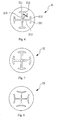
- FIG. 1 shows the cross section of one embodiment of the 4T cross section fiber 10 of the present invention.
- the fiber includes four T-shaped lobes 11.
- Each of the T-shaped lobes 11 includes a cap portion 112 and a leg portion 111.
- Four leg portions 111 of the lobes 11 intersect at the center of the fiber 10.
- Each of the lobes 11 separates from each other.
- the adjacent T-shaped lobes 11 form an open hollow portion 12 severing as a guide channel to drain the moisture.
- the fiber 10 should also satisfy the following requirements: 0.8 ⁇ Deniers ⁇ 20 10 ⁇ ° ⁇ ⁇ 60 ⁇ ° 10 % ⁇ Hollowness Ratio ⁇ 30 % 2 ⁇ Degree of Variation of the cross section R / r ⁇ 6 wherein ⁇ represents the range of the hollow portion of the open hollow portion 12; R represents the radius of the circumcircle of the fiber 10; and r represents the radius of the incircle of the fiber 10.
- the opening range of the hollow portion ( ⁇ ) of the open hollow portion 12 is 15°; the radius of the circumcircle (R) is 8.2 ⁇ m; the radius of the incircle (r) is 2.1 ⁇ m; Denier is 3.0; and the degree of variation of the cross section (R/r) is 3.9.
- FIG 2 is a photograph of the cross section of one embodiment of the 4T cross section fiber according to the present invention.
- the fiber that satisfies the above requirements can preserve relatively large clearances.
- the open hollow portions 12 act as guild channels, the fabrics woven by the fibers 10 absorb the moisture or sweat through these guide channels 12, thereby presenting outstanding water absorptivity for the fabrics. Also, when drying the fiber 10, the moisture or sweat is drained through the open hollow portions 12, thereby presenting an outstanding fast drying effect.
- the fabrics woven by the fibers 10 can preserve the clearances between the fibers 10 without tightly stacking. Therefore, the fabrics woven by the fiber have the capabilities of absorbing moisture and relieving sweat and the effect of keeping warm without having a muggy feeling.
- Figure 4 shows one embodiment of the 4T cross section fiber 10 according to the present invention, which is crimped into a 2D zigzag form.
- Figure 5 shows another embodiment of the 4T cross section fiber 10 according to the present invention, which is crimped into a 3D spiral form.
- the fiber of the 4T cross section of the present invention can also be crimped into other crimp forms.
- FIG 6 shows the cross section of one embodiment of the spinneret 21 that produces the fiber 10 of the 4T cross section of Figure 1 of the present invention.
- the spinneret 21 includes four T-shaped slits of spinning nozzles 211.
- Each of the T-shaped slits of spinning nozzles 211 has a straight line-shaped cap portion 212 and a leg portion 213. The ends of leg portions 213 of the slits of spinning nozzles 211 separate from each other.
- the width of cap portion 212 is between 0.05mm to 0.09mm, and the length of cap portion 212 is between 0.30mm to 0.60mm.
- the width of the leg 213 is between 0.03mm to 0.08mm, and the length of the leg 213 is between 0.50mm to 0.80mm.
- the distance (D) of the ends of the adjacent legs 213 is between 0.02mm to 0.05mm.
- the legs 213 of the four T-shaped slit of spinning nozzles 211 are not connected at their ends.
- the fiber 10 with 4T cross section as shown in Figure 1 is obtained by the expansion of the polymer extruded from the legs 213 which causes the legs 111 of the fiber 10 to connect to each other.
- the ends of the legs 213 of the T-shaped slits of spinning nozzles 211 will not wear out, therefore facilitating the spinning operation and maintaining the integrality for the cross section of the fiber. Also, it is easy to manage the spinneret.
- the polymer (such as polyester) in melting form is extruded through the T-shaped slits of spinning nozzles 211 of the above-mentioned spinneret 21. After quenching, drawing, thermosetting, cooling, wrinkling, oiling, drying, cotton-cutting and packaging, the fiber 10 with 4T cross section as shown in Figure 1 is obtained.
- Figure 7 and Figure 8 show spinnerets (22, 23) of the present invention in different form.
- the spinnerets for producing the fiber with 4T cross section of the present invention can be slightly changed in shape, such as changing the cap of the T-shaped slit of spinning nozzle into concave shape or convex shape rather than straight-line shape. These changes can also achieve the above-mentioned effects.
- the cross section of a monofilament is magnified 400 times by using an optical microscope to measure the average ratio between the total areas of the hollow portions and the total areas of the cross sections for 20 monofilaments
- the polyester polymer in melting form is extruded through a spinneret as shown in Figure 6 and then the filaments are quenched by cooling air at a rate of 40 nm/hr, and the filaments are formed at a spinning rate of 700 m/min. After the yarns are drawn at a total elongation of 2.89, these yarns are subject to 160°C thermosetting, cooling, wrinkling, oiling, drying, cutting, and packaging steps.
- the 4T cross section fibers of 3Dx51 mm thus can be obtained.
- the properties of the fiber are listed in the following Tables 1 and 2.
- Example 2 In accordance with the same procedures of Example 1, a conventional round-shaped cross section spinneret is used to extrude the melted polyester polymer and then a round-shaped cross section fiber of 3Dx51 mm can be obtained.
- the properties of said fiber are listed in the following Tables 1 and 2.
- Table 1 Properties of the 4T cross section fiber of the present invention and the round-shaped cross section fiber of the prior art Items Example 1 Comparative Example 1 3D*51mm 3D*51mm 4T cross section round-shaped cross section Length (mm) 52.4 51.00 Fineness (De) 3.0 3.04 Strength (g/d) 3.96 5.37 Elongation (%) 40.8 48.6 Crimp Numbers (25mm) 11.4 11.48 Crimp Stability (%) 68.6 67.94 Degree of Variation of the cross section (R/r) 3.9 1 Hollowness Ratio (%) 25 0 ⁇ 30 0 TE-10 (g/D) 2.3 2.60
- Table 2 Comparative Data of the Water Absorption for the fabrics woven by the 4T cross section fiber of Example 1 and the fabrics woven by the round-shaped cross section fiber of Comparative Example 1.
- the 4T cross section fiber of the present invention has better physical properties and water absorptivity than the conventional round-shaped cross section fiber.
Landscapes
- Engineering & Computer Science (AREA)
- Textile Engineering (AREA)
- Mechanical Engineering (AREA)
- Chemical & Material Sciences (AREA)
- Chemical Kinetics & Catalysis (AREA)
- General Chemical & Material Sciences (AREA)
- Spinning Methods And Devices For Manufacturing Artificial Fibers (AREA)
- Artificial Filaments (AREA)
- Woven Fabrics (AREA)
Abstract
Description
- The present invention relates to a fiber, particularly, to a fiber with 4T cross section.
- Fibers with different shapes of cross section, such as cross-shaped, Y-shaped, W-shaped, or circle-shaped cross section, are well known. These kinds of fibers normally have the function of absorbing moisture and relieving sweat.
-
U.S. patent No. 5,057,368 discloses a fiber with 3T or 4T cross section. Each of T-shaped lobes of the fiber has a specific relation between the length and width. The patent also discloses a spinneret for producing such fibers. As known by the applicant, the spinning operation using such spinneret is difficult and there is no commercialized process for the product. Moreover, the slit of spinning nozzle of the spinneret is easily worn out, causing the cross section of the fiber to deform. - Therefore, it is highly desired to have a fiber that can be easily produced and the produced fabrics have excellent function of absorbing moisture and relieving sweat.
- The present invention provides a fiber with 4T cross section and a spinneret for producing such fiber. The fiber with 4T cross section has guide channels and can preserves relatively large clearances between fibers. Fabrics woven by the fiber have the outstanding capability of absorbing moisture and relieving sweat and the effect of keeping warm without creating a muggy feeling.
- In accordance with one aspect of the invention, a fiber with 4T cross section is provided. The fiber comprises four T-shaped lobes, each of which has a cap portion and a leg portion. Each of the leg portions intersect at the center of the fiber and each of lobes separates from each other. The adjacent T-shaped lobes form an open hollow portion.
- The fiber with 4T cross section satisfies the following requirements:



wherein θ represents the range of the hollow portion,
R represents the radius of the circumcircle of the fiber, and
r represents the radius of the incircle of the fiber. - In the context, the circumcircle is a hypothetical circle circumscribing the outmost sides of cap portions of the T-shaped lobes of the fiber with 4T cross section.
- In the context, the incircle is a hypothetical circle inscribing the connection portions of the leg portions of the T-shaped lobes of the fiber with 4T cross section.
- In the context, Denier is obtained by the following CNS 13756 Test Method for fiber fineness:
- Comb several fiber samples in parallel with a metal comb and place them on a cutting table. Press them with a plate gage while the samples are drawn straightly by proper tension. Cut the samples at the length of 30mm. Count 300 short fibers to form one set of samples (if the fiber is shorter than 30 mm, just make the total length of the chosen fibers to be 9000mm). Measure the mass of the set of samples so as to obtain the measure of fiber Denier (d'). Obtain the standard fiber Denier (d) by using equilibrium moisture regain from the following equation. Test five times and calculate the average to the first decimal place.

wherein d' represents the measure of fiber Denier,
Rc represents the nominal moisture regain (%),
Re represents the equilibrium moisture regain (%). - In the context, the hollowness ratio is obtained by the following method: The cross section of a monofilament is magnified 400 times by using an optical microscope to measure the average ratio between the total areas of the hollow portions and the total areas of the cross sections for 20 monofilaments.
- In the context, the degree of variation of the cross section is obtained by the following method: The cross section of a monofilament is magnified 400 times to measure the radius of the circumcircle of the fiber (R) and the radius of the incircle of the fiber (r). Then the degree of variation of the cross section is calculated according to the following equation:

- Unlike the tight stack of conventional fibers, the fiber that satisfies the above requirements can preserve relatively large clearances. Fabrics woven by this fiber have outstanding capability of absorbing moisture and relieving sweat and the effect of keeping warm without creating a muggy feeling..
- The opening range of the hollow portion of the 4T cross section fiber of the present invention is about 10° to about 60°, and the hollowness ratio is about 10% to about 30%, thereby obtaining excellent effects of moisture absorption and sweat release.
- Preferably, the opening range of the hollow portion of the 4T cross section fiber of the present invention is about 15° to about 45°. If the opening range of the hollow portion is smaller than 10°, the clearances between the T-shaped lobes are easily closed during the spinning process, therefore reducing the effect of moisture absorption and sweat release. If the opening range of the hollow portion is greater than 60°, the fibers will stack too tightly. This also reduces the effect of moisture absorption and sweat release.
- The 4T cross section fiber of the present invention includes four T-shaped lobes and four open hollow portions. The hollowness ratio is about 10% to about 30%, preferably, about 15% to about 25%. If the hollowness ratio is below 10%, this implies that the open hollow portions are not properly formed and will thus reduce the effect of moisture absorption and sweat release. If the hollowness ratio is above 30%, the thickness of the crisscross portion of the cross section of fiber will be thinner and thus the fiber will be easily damaged in the subsequent weaving process. This will cause some problems, such as dyeing speck, and thus lower the quality.
- The degree of variation of the cross section of the fiber of the present invention is between 2 to t 6, preferably, between 2.5 to 4.5. If the degree of variation of the cross section is below 2, the feeling of staying dry for the fabrics of the fiber is insufficient. If the degree of variation of the cross section is above 6, the producing process will get worse.
- The Denier of the 4T cross section fiber of the present invention is between 0.8 to 15, preferably between 1 to 20, and more preferably, between 1 to 15.
- The length of staple fibers made of the 4T cross section fiber of the present invention is between 22mm to 100mm, preferably between 38mm to 90mm.
- The 4T cross section fiber of the present invention may be crimped in a spiral or zigzag shape.
- The 4T cross section fiber of the present invention may be made of synthetic fibers, such as polyester, nylon and polypropylene.
- The 4T cross section fiber of the present invention may be independently woven or mixed with other fibers, both of which can bring the dry and soft effects.
- In accordance with another aspect of the invention, a spinneret for producing the fiber with 4T cross section as above- mentioned is provided. The spinneret comprises four T-shaped slits of spinning nozzles, each of which has a cap portion and a leg portion, each leg portion separating from each other.
- In accordance with yet another aspect of the invention, a method for producing the fiber with 4T cross section as above- mentioned is provided. The method comprises the step of spinning fibers of polyester polymer in melting state through the spinneret as aforementioned, and then followed by the steps of quenching, drawing, thermosetting, cooling, wrinkling, oiling, drying, cotton-cutting, and packaging.
- Therefore, the fiber with 4T cross section of the present invention can be easily produced by the above spinneret design and method.
- The fabrics woven by the 4T cross section fiber of the present invention can has the outstanding effects of moisture absorption and sweat release as the above-mentioned. The effects can be further enhanced when processing together with a hydrophilic oil agent.
-
-
Figure 1 schematically shows the cross section of one embodiment of the 4T cross section fiber of the present invention. -
Figure 2 is a photograph of the cross section of one embodiment of the 4T cross section fiber according to the present invention. -
Figure 3 schematically shows the arrangement of the cross section for several 4T cross section fibers of the present invention. -
Figure 4 schematically shows a crimped form of one embodiment of the 4T cross section fiber according to the present invention. -
Figure 5 schematically shows a diagram of a crimped form of another embodiment of the 4T cross section fiber according to the present invention. -
Figure 6 schematically shows the cross section of one embodiment of the spinneret of the present invention. -
Figure 7 schematically shows the cross section of another embodiment of the spinneret of the present invention. -
Figure 8 schematically shows the cross section of another embodiment of the spinneret of the present invention. -
Figure 1 shows the cross section of one embodiment of the 4Tcross section fiber 10 of the present invention. The fiber includes four T-shapedlobes 11. Each of the T-shapedlobes 11 includes acap portion 112 and aleg portion 111. Fourleg portions 111 of thelobes 11 intersect at the center of thefiber 10. Each of thelobes 11 separates from each other. The adjacent T-shapedlobes 11 form an openhollow portion 12 severing as a guide channel to drain the moisture. Thefiber 10 should also satisfy the following requirements: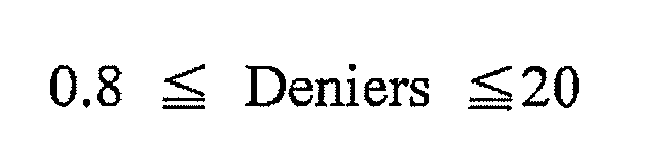


wherein θ represents the range of the hollow portion of the openhollow portion 12; R represents the radius of the circumcircle of thefiber 10; and r represents the radius of the incircle of thefiber 10. - In the embodiment of
Figure 1 , the opening range of the hollow portion (θ) of the openhollow portion 12 is 15°; the radius of the circumcircle (R) is 8.2 µm; the radius of the incircle (r) is 2.1 µm; Denier is 3.0; and the degree of variation of the cross section (R/r) is 3.9. -
Figure 2 is a photograph of the cross section of one embodiment of the 4T cross section fiber according to the present invention. Unlike the tight stack of conventional fibers, the fiber that satisfies the above requirements can preserve relatively large clearances. When several 4Tcross section fibers 10 stack, as schematically shown inFigure 3 , by having the openhollow portions 12 act as guild channels, the fabrics woven by thefibers 10 absorb the moisture or sweat through theseguide channels 12, thereby presenting outstanding water absorptivity for the fabrics. Also, when drying thefiber 10, the moisture or sweat is drained through the openhollow portions 12, thereby presenting an outstanding fast drying effect. Further, since thefiber 10 of 4T cross section has T-shapedlobes 11, the fabrics woven by thefibers 10 can preserve the clearances between thefibers 10 without tightly stacking. Therefore, the fabrics woven by the fiber have the capabilities of absorbing moisture and relieving sweat and the effect of keeping warm without having a muggy feeling. -
Figure 4 shows one embodiment of the 4Tcross section fiber 10 according to the present invention, which is crimped into a 2D zigzag form.Figure 5 shows another embodiment of the 4Tcross section fiber 10 according to the present invention, which is crimped into a 3D spiral form. Of course, the fiber of the 4T cross section of the present invention can also be crimped into other crimp forms. -
Figure 6 shows the cross section of one embodiment of thespinneret 21 that produces thefiber 10 of the 4T cross section ofFigure 1 of the present invention. Thespinneret 21 includes four T-shaped slits of spinningnozzles 211. Each of the T-shaped slits of spinningnozzles 211 has a straight line-shapedcap portion 212 and aleg portion 213. The ends ofleg portions 213 of the slits of spinningnozzles 211 separate from each other. - Generally, the width of
cap portion 212 is between 0.05mm to 0.09mm, and the length ofcap portion 212 is between 0.30mm to 0.60mm. The width of theleg 213 is between 0.03mm to 0.08mm, and the length of theleg 213 is between 0.50mm to 0.80mm. The distance (D) of the ends of theadjacent legs 213 is between 0.02mm to 0.05mm. - The
legs 213 of the four T-shaped slit of spinningnozzles 211 are not connected at their ends. Thefiber 10 with 4T cross section as shown inFigure 1 is obtained by the expansion of the polymer extruded from thelegs 213 which causes thelegs 111 of thefiber 10 to connect to each other. In comparison with the conventional technique that the legs of the T-shaped slits of spinning nozzles are connected to each other (e.g.,US 5,057,368 ), after a long-term spinning, the ends of thelegs 213 of the T-shaped slits of spinningnozzles 211 will not wear out, therefore facilitating the spinning operation and maintaining the integrality for the cross section of the fiber. Also, it is easy to manage the spinneret. - The polymer (such as polyester) in melting form is extruded through the T-shaped slits of spinning
nozzles 211 of the above-mentionedspinneret 21. After quenching, drawing, thermosetting, cooling, wrinkling, oiling, drying, cotton-cutting and packaging, thefiber 10 with 4T cross section as shown inFigure 1 is obtained. -
Figure 7 and Figure 8 show spinnerets (22, 23) of the present invention in different form. The spinnerets for producing the fiber with 4T cross section of the present invention can be slightly changed in shape, such as changing the cap of the T-shaped slit of spinning nozzle into concave shape or convex shape rather than straight-line shape. These changes can also achieve the above-mentioned effects. - The physical properties of the products produced in the embodiment of the present invention and the comparative example can be determined and evaluated in accordance with the following methods:
- Comb several fiber samples in parallel with a metal comb and place them on a cutting table. Press them with a plate gage while the samples are drawn straightly by proper tension. Cut the samples at the length of 30mm. Count 300 fibers to form one set of samples (If the fiber is shorter than 30 mm, just make the total length of the chosen fibers to be 9000mm). Measure the mass of the set of samples so as to obtain the measure of fiber Denier (d'). Obtain the standard fiber Denier (d) by using equilibrium moisture regain from the following equation. Test five times and calculate the average to the first decimal place.

wherein d' represents the measure of fiber Denier,
Rc represents the nominal moisture regain (%),
Re represents the equilibrium moisture regain (%). - The cross section of a monofilament is magnified 400 times by using an optical microscope to measure the average ratio between the total areas of the hollow portions and the total areas of the cross sections for 20 monofilaments
- The cross section of a monofilament is magnified 400 times to measure the radius of the circumcircle of the fiber (R) and the radius of the incircle of the fiber (r). Then the degree of variation of the cross section is calculated according to the following equation:

- Take 5 grams (G1) of sample and put it into a vessel with filter. After fully soaking the sample in water for 10 minutes, hang the sample freely until no water drip. Then weight the sample (G2). The water content per gram for cotton is then obtained according to the following equation:

- The polyester polymer in melting form is extruded through a spinneret as shown in
Figure 6 and then the filaments are quenched by cooling air at a rate of 40 nm/hr, and the filaments are formed at a spinning rate of 700 m/min. After the yarns are drawn at a total elongation of 2.89, these yarns are subject to 160°C thermosetting, cooling, wrinkling, oiling, drying, cutting, and packaging steps. The 4T cross section fibers of 3Dx51 mm thus can be obtained. The properties of the fiber are listed in the following Tables 1 and 2. - In accordance with the same procedures of Example 1, a conventional round-shaped cross section spinneret is used to extrude the melted polyester polymer and then a round-shaped cross section fiber of 3Dx51 mm can be obtained. The properties of said fiber are listed in the following Tables 1 and 2.
Table 1: Properties of the 4T cross section fiber of the present invention and the round-shaped cross section fiber of the prior art Items Example 1 Comparative Example 1 3D*51mm 3D*51mm 4T cross section round-shaped cross section Length (mm) 52.4 51.00 Fineness (De) 3.0 3.04 Strength (g/d) 3.96 5.37 Elongation (%) 40.8 48.6 Crimp Numbers (25mm) 11.4 11.48 Crimp Stability (%) 68.6 67.94 Degree of Variation of the cross section (R/r) 3.9 1 Hollowness Ratio (%) 25 0 θ 30 0 TE-10 (g/D) 2.3 2.60 Table 2: Comparative Data of the Water Absorption for the fabrics woven by the 4T cross section fiber of Example 1 and the fabrics woven by the round-shaped cross section fiber of Comparative Example 1. Cotton Weight (G1) Cotton plus Water Weight (G2) Water Weight Water content per gram for cotton (g) (G2-G1)/G1 Average Water Absorption (g) Fabrics (cotton) of Example 1 5.42 83.34 77.92 14.38 13.67 5.67 79.21 73.54 12.97 Fabrics (cotton) of Comparative Example 1 5.5 48.05 42.55 7.74 7.92 5.62 51.16 45.54 8.10 - From Table 1 and 2, it is known that the 4T cross section fiber of the present invention has better physical properties and water absorptivity than the conventional round-shaped cross section fiber.
Claims (9)
- A fiber with 4T cross section, comprising four T-shaped lobes, each of said T-shaped lobes having a cap portion and a leg portion, each of the leg portions of said lobes intersecting at the center of the fiber, each of said lobes separating from each other, and the adjacent T-shaped lobes forming an open hollow portion, wherein the fiber fulfills the following requirements:



wherein θ represents the range of the hollow portion, R represents the radius of the circumcircle of the fiber, and r represents the radius of the incircle of the fiber. - The fiber as claimed in claim 1, wherein the hollowness ratio is between 15% to 30%.
- The fiber as claimed in claim 2, wherein the hollowness ratio is between 15% to 25%.
- The fiber as claimed in claim 1, wherein the degree of variation of the cross section is between 2 to 5.
- The fiber as claimed in claim 4, wherein the degree of variation of the cross section is between 2.5 to 4.5.
- The fiber as claimed in claim 1, wherein the opening range of the hollow portion is between 15° to 45°.
- The fiber as claimed in claim 1, wherein the fiber is a polyester fiber structure.
- A spinneret for producing the fiber with 4T cross section as claimed in claim 1, the fiber comprising four T-shaped slits of spinning nozzles, each of said T-shaped slits of spinning nozzles having a cap portion and a leg portion, each leg portion of said slits of spinning nozzles separating from each other than connecting to each other.
- A method for producing the fiber with 4T cross section as claimed in claim 1, comprising a step of extruding the polyester polymer in melting form through the spinneret as claimed in claim 8.
Applications Claiming Priority (1)
| Application Number | Priority Date | Filing Date | Title |
|---|---|---|---|
| TW098122940A TWI374952B (en) | 2009-07-07 | 2009-07-07 | Fiber with 4t cross section, and spinneret and method for producing the same |
Publications (2)
| Publication Number | Publication Date |
|---|---|
| EP2272999A2 true EP2272999A2 (en) | 2011-01-12 |
| EP2272999A3 EP2272999A3 (en) | 2011-02-02 |
Family
ID=43012788
Family Applications (1)
| Application Number | Title | Priority Date | Filing Date |
|---|---|---|---|
| EP09171850A Withdrawn EP2272999A3 (en) | 2009-07-07 | 2009-09-30 | Fiber with 4t cross section. |
Country Status (4)
| Country | Link |
|---|---|
| US (1) | US20110008620A1 (en) |
| EP (1) | EP2272999A3 (en) |
| JP (1) | JP4889058B2 (en) |
| TW (1) | TWI374952B (en) |
Cited By (4)
| Publication number | Priority date | Publication date | Assignee | Title |
|---|---|---|---|---|
| CN102586911A (en) * | 2011-01-14 | 2012-07-18 | 新光合成纤维股份有限公司 | Fiber with humidity regulating function, its production method and use |
| WO2013014364A1 (en) | 2011-07-28 | 2013-01-31 | Saint-Gobain Adfors | Acoustic absorbent wall coating |
| WO2014018492A1 (en) * | 2012-07-25 | 2014-01-30 | Celanese Acetate Llc | Spinneret comprising tri-arc holes and tri-arc filaments produced therefrom |
| EP3733943B1 (en) | 2019-04-29 | 2021-06-02 | Advanced Nonwovens Technologies Srl | Non-woven fabric support for multi-tubular sheaths |
Families Citing this family (5)
| Publication number | Priority date | Publication date | Assignee | Title |
|---|---|---|---|---|
| US20170151514A1 (en) | 2014-03-31 | 2017-06-01 | Unitika Ltd. | Air filter material |
| JP2016183433A (en) * | 2015-03-26 | 2016-10-20 | ユニチカ株式会社 | Wet type sheet making non-woven fabric |
| TWI650451B (en) | 2016-07-27 | 2019-02-11 | 新光合成纖維股份有限公司 | A down-like fiber, a spinneret and a method for manufacturing the fiber |
| DE112017005495T5 (en) * | 2016-10-31 | 2019-08-08 | RLEPL Limited | insulating material |
| KR102714465B1 (en) * | 2019-07-10 | 2024-10-07 | 현대자동차주식회사 | Fiber for sound absorbing material of vehicle and sound absorbing material for vehicle including the same |
Citations (2)
| Publication number | Priority date | Publication date | Assignee | Title |
|---|---|---|---|---|
| JPS63159511A (en) * | 1986-12-17 | 1988-07-02 | Teijin Ltd | Modified cross-section yarn and spinneret thereof |
| US5057368A (en) | 1989-12-21 | 1991-10-15 | Allied-Signal | Filaments having trilobal or quadrilobal cross-sections |
Family Cites Families (10)
| Publication number | Priority date | Publication date | Assignee | Title |
|---|---|---|---|---|
| CA918371A (en) * | 1969-02-26 | 1973-01-09 | E.I. Du Pont De Nemours And Company | Filament with continuous voids and without reentrant curves |
| JPS54138617A (en) * | 1978-04-20 | 1979-10-27 | Teijin Ltd | Synthetic fibers |
| JPS54151617A (en) * | 1978-05-15 | 1979-11-29 | Teijin Ltd | Synthetic fibers |
| JPH0723562B2 (en) * | 1986-11-27 | 1995-03-15 | 帝人株式会社 | Latent bulky multifilament and method for producing the same |
| US4791026A (en) * | 1986-11-27 | 1988-12-13 | Teijin Limited | Synthetic polymer multifilament yarn useful for bulky yarn and process for producing the same |
| CA2001426A1 (en) * | 1988-11-18 | 1990-05-18 | Henry Kobsa | Spinneret capillaries |
| US5277976A (en) * | 1991-10-07 | 1994-01-11 | Minnesota Mining And Manufacturing Company | Oriented profile fibers |
| US5707735A (en) * | 1996-03-18 | 1998-01-13 | Midkiff; David Grant | Multilobal conjugate fibers and fabrics |
| US6610395B2 (en) * | 2001-06-11 | 2003-08-26 | Honeywell International Inc. | Breathable electromagnetic shielding material |
| JP4774558B2 (en) * | 2007-04-17 | 2011-09-14 | 根来産業株式会社 | Functionally modified recycled polyethylene terephthalate fiber and method for producing the same |
-
2009
- 2009-07-07 TW TW098122940A patent/TWI374952B/en active
- 2009-09-30 US US12/585,986 patent/US20110008620A1/en not_active Abandoned
- 2009-09-30 EP EP09171850A patent/EP2272999A3/en not_active Withdrawn
- 2009-09-30 JP JP2009227322A patent/JP4889058B2/en active Active
Patent Citations (2)
| Publication number | Priority date | Publication date | Assignee | Title |
|---|---|---|---|---|
| JPS63159511A (en) * | 1986-12-17 | 1988-07-02 | Teijin Ltd | Modified cross-section yarn and spinneret thereof |
| US5057368A (en) | 1989-12-21 | 1991-10-15 | Allied-Signal | Filaments having trilobal or quadrilobal cross-sections |
Cited By (7)
| Publication number | Priority date | Publication date | Assignee | Title |
|---|---|---|---|---|
| CN102586911A (en) * | 2011-01-14 | 2012-07-18 | 新光合成纤维股份有限公司 | Fiber with humidity regulating function, its production method and use |
| WO2013014364A1 (en) | 2011-07-28 | 2013-01-31 | Saint-Gobain Adfors | Acoustic absorbent wall coating |
| US9186865B2 (en) | 2011-07-28 | 2015-11-17 | Saint-Gobain Adfors | Acoustic absorbent wall coating |
| WO2014018492A1 (en) * | 2012-07-25 | 2014-01-30 | Celanese Acetate Llc | Spinneret comprising tri-arc holes and tri-arc filaments produced therefrom |
| US8790556B2 (en) | 2012-07-25 | 2014-07-29 | Celanese Acetate Llc | Process of making tri-arc filaments |
| CN104395510A (en) * | 2012-07-25 | 2015-03-04 | 塞拉尼斯醋酸纤维有限公司 | Spinneret comprising tri-arc holes and tri-arc filaments produced therefrom |
| EP3733943B1 (en) | 2019-04-29 | 2021-06-02 | Advanced Nonwovens Technologies Srl | Non-woven fabric support for multi-tubular sheaths |
Also Published As
| Publication number | Publication date |
|---|---|
| TW201102463A (en) | 2011-01-16 |
| US20110008620A1 (en) | 2011-01-13 |
| JP2011017115A (en) | 2011-01-27 |
| JP4889058B2 (en) | 2012-02-29 |
| TWI374952B (en) | 2012-10-21 |
| EP2272999A3 (en) | 2011-02-02 |
Similar Documents
| Publication | Publication Date | Title |
|---|---|---|
| EP2272999A2 (en) | Fiber with 4t cross section. | |
| EP3112505B1 (en) | Sea-island composite fiber, composite ultra-fine fiber, and fiber product | |
| DE69607469T2 (en) | POLYESTER FILAMENTS AND CABLES | |
| DE69626303T2 (en) | VERY THIN MICROFIBRE FLEECE | |
| KR101345434B1 (en) | Composite fiber | |
| KR102575874B1 (en) | Core-sheath conjugated fiber, slit fiber, and method for manufacturing these fibers | |
| EP2722426B1 (en) | Composite fiber | |
| DE69723581T2 (en) | IMPROVED FILAMENT CROSS SECTIONS | |
| US5591523A (en) | Polyester tow | |
| KR102274710B1 (en) | Laminated non-woven fabric | |
| DE60110361T2 (en) | POLYTRIMETHYLENEEPHTHALATE STAPLE FIBERS WITH TETRAKANAL CROSS SECTION | |
| EP2732080B1 (en) | Regenerated cellulose fiber | |
| EP2221400B1 (en) | Square-analogous four-hole hollow staple fiber | |
| EP2171138B1 (en) | Spinning method | |
| CN102251297A (en) | 4T-section fiber | |
| CN113574217A (en) | Stretched conjugate fiber, nonwoven fabric, and method for producing stretched conjugate fiber | |
| DE69614790T2 (en) | POLYESTER FILM YARN, METHOD FOR THE PRODUCTION THEREOF, WOVEN OR KNITTED PRODUCTS MADE THEREOF, AND METHOD FOR THE PRODUCTION THEREOF | |
| JP7260362B2 (en) | Island-in-the-sea composite fiber and porous hollow fiber made of the same | |
| CN114351269B (en) | Same-plate reducing hollow crimped fiber and production method thereof | |
| EP4036297B1 (en) | Spun nonwoven laminate and method for producing a spun nonwoven laminate | |
| JP3790313B2 (en) | Method for producing split synthetic fibers | |
| JP2005211111A (en) | carpet | |
| JP2007009369A (en) | Woven knitted fabric made of blended yarn | |
| KR0162550B1 (en) | The spinning nozzle for manufacturing hollow fiber | |
| JPH0578916A (en) | Conjugate polypropylene staple fiber and its nonwoven fabric |
Legal Events
| Date | Code | Title | Description |
|---|---|---|---|
| PUAI | Public reference made under article 153(3) epc to a published international application that has entered the european phase |
Free format text: ORIGINAL CODE: 0009012 |
|
| PUAL | Search report despatched |
Free format text: ORIGINAL CODE: 0009013 |
|
| 17P | Request for examination filed |
Effective date: 20090930 |
|
| AK | Designated contracting states |
Kind code of ref document: A2 Designated state(s): AT BE BG CH CY CZ DE DK EE ES FI FR GB GR HR HU IE IS IT LI LT LU LV MC MK MT NL NO PL PT RO SE SI SK SM TR |
|
| AX | Request for extension of the european patent |
Extension state: AL BA RS |
|
| AK | Designated contracting states |
Kind code of ref document: A3 Designated state(s): AT BE BG CH CY CZ DE DK EE ES FI FR GB GR HR HU IE IS IT LI LT LU LV MC MK MT NL NO PL PT RO SE SI SK SM TR |
|
| AX | Request for extension of the european patent |
Extension state: AL BA RS |
|
| RIC1 | Information provided on ipc code assigned before grant |
Ipc: D01D 4/02 20060101ALI20101230BHEP Ipc: D01D 5/253 20060101AFI20101102BHEP Ipc: D01F 6/62 20060101ALI20101230BHEP |
|
| 17Q | First examination report despatched |
Effective date: 20170704 |
|
| STAA | Information on the status of an ep patent application or granted ep patent |
Free format text: STATUS: THE APPLICATION IS DEEMED TO BE WITHDRAWN |
|
| 18D | Application deemed to be withdrawn |
Effective date: 20200109 |