EP2316372A1 - Verfahren und Apparat zur medizinischen Behandlung unter Verwendung langpulsiger elektromagnetischer Strahlung - Google Patents
Verfahren und Apparat zur medizinischen Behandlung unter Verwendung langpulsiger elektromagnetischer Strahlung Download PDFInfo
- Publication number
- EP2316372A1 EP2316372A1 EP10012155A EP10012155A EP2316372A1 EP 2316372 A1 EP2316372 A1 EP 2316372A1 EP 10012155 A EP10012155 A EP 10012155A EP 10012155 A EP10012155 A EP 10012155A EP 2316372 A1 EP2316372 A1 EP 2316372A1
- Authority
- EP
- European Patent Office
- Prior art keywords
- emr
- temperature
- target
- chromophore
- duration
- Prior art date
- Legal status (The legal status is an assumption and is not a legal conclusion. Google has not performed a legal analysis and makes no representation as to the accuracy of the status listed.)
- Withdrawn
Links
- 230000005670 electromagnetic radiation Effects 0.000 title claims abstract description 178
- 238000000034 method Methods 0.000 title claims abstract description 173
- 238000011282 treatment Methods 0.000 title claims description 156
- 238000010521 absorption reaction Methods 0.000 claims abstract description 57
- 230000008859 change Effects 0.000 claims abstract description 12
- 230000006378 damage Effects 0.000 claims description 101
- 210000004209 hair Anatomy 0.000 claims description 66
- 230000003287 optical effect Effects 0.000 claims description 34
- 238000001816 cooling Methods 0.000 claims description 33
- 230000003685 thermal hair damage Effects 0.000 claims description 31
- 230000000694 effects Effects 0.000 claims description 20
- 230000037303 wrinkles Effects 0.000 claims description 16
- 231100000216 vascular lesion Toxicity 0.000 claims description 14
- 210000001732 sebaceous gland Anatomy 0.000 claims description 6
- 230000005855 radiation Effects 0.000 abstract description 64
- 230000009467 reduction Effects 0.000 abstract description 4
- XUMBMVFBXHLACL-UHFFFAOYSA-N Melanin Chemical compound O=C1C(=O)C(C2=CNC3=C(C(C(=O)C4=C32)=O)C)=C2C4=CNC2=C1C XUMBMVFBXHLACL-UHFFFAOYSA-N 0.000 description 112
- 210000003491 skin Anatomy 0.000 description 87
- 210000004919 hair shaft Anatomy 0.000 description 66
- 210000001519 tissue Anatomy 0.000 description 59
- 210000002615 epidermis Anatomy 0.000 description 54
- 238000010438 heat treatment Methods 0.000 description 51
- 210000003780 hair follicle Anatomy 0.000 description 44
- 210000000130 stem cell Anatomy 0.000 description 34
- 210000004207 dermis Anatomy 0.000 description 31
- 102000008186 Collagen Human genes 0.000 description 28
- 108010035532 Collagen Proteins 0.000 description 28
- 229920001436 collagen Polymers 0.000 description 28
- XLYOFNOQVPJJNP-UHFFFAOYSA-N water Substances O XLYOFNOQVPJJNP-UHFFFAOYSA-N 0.000 description 22
- 238000009792 diffusion process Methods 0.000 description 20
- 230000004907 flux Effects 0.000 description 20
- 239000008280 blood Substances 0.000 description 19
- 210000004369 blood Anatomy 0.000 description 19
- 210000004204 blood vessel Anatomy 0.000 description 18
- 239000000975 dye Substances 0.000 description 17
- 239000011159 matrix material Substances 0.000 description 14
- 230000007246 mechanism Effects 0.000 description 14
- 230000001965 increasing effect Effects 0.000 description 13
- 230000002745 absorbent Effects 0.000 description 11
- 239000002250 absorbent Substances 0.000 description 11
- 230000008569 process Effects 0.000 description 10
- 210000004918 root sheath Anatomy 0.000 description 10
- 238000012546 transfer Methods 0.000 description 10
- 238000009835 boiling Methods 0.000 description 9
- 230000036555 skin type Effects 0.000 description 9
- 206010020843 Hyperthermia Diseases 0.000 description 8
- 238000010586 diagram Methods 0.000 description 8
- 102000001554 Hemoglobins Human genes 0.000 description 7
- 108010054147 Hemoglobins Proteins 0.000 description 7
- 230000015572 biosynthetic process Effects 0.000 description 7
- 230000002500 effect on skin Effects 0.000 description 7
- 230000036031 hyperthermia Effects 0.000 description 7
- 210000003462 vein Anatomy 0.000 description 7
- 238000004061 bleaching Methods 0.000 description 6
- 238000009826 distribution Methods 0.000 description 6
- 230000002427 irreversible effect Effects 0.000 description 6
- 230000003902 lesion Effects 0.000 description 6
- 201000004384 Alopecia Diseases 0.000 description 5
- 230000017531 blood circulation Effects 0.000 description 5
- 230000036760 body temperature Effects 0.000 description 5
- 229910052799 carbon Inorganic materials 0.000 description 5
- 210000003128 head Anatomy 0.000 description 5
- 102000004169 proteins and genes Human genes 0.000 description 5
- 108090000623 proteins and genes Proteins 0.000 description 5
- 230000001225 therapeutic effect Effects 0.000 description 5
- OKTJSMMVPCPJKN-UHFFFAOYSA-N Carbon Chemical compound [C] OKTJSMMVPCPJKN-UHFFFAOYSA-N 0.000 description 4
- 230000008901 benefit Effects 0.000 description 4
- 230000037369 collagen remodeling Effects 0.000 description 4
- 230000007423 decrease Effects 0.000 description 4
- 230000036425 denaturation Effects 0.000 description 4
- 238000004925 denaturation Methods 0.000 description 4
- 239000012530 fluid Substances 0.000 description 4
- 208000024963 hair loss Diseases 0.000 description 4
- 230000003676 hair loss Effects 0.000 description 4
- 210000001208 inner root sheath cell Anatomy 0.000 description 4
- 230000031700 light absorption Effects 0.000 description 4
- 238000002844 melting Methods 0.000 description 4
- 230000008018 melting Effects 0.000 description 4
- 230000002829 reductive effect Effects 0.000 description 4
- 208000009056 telangiectasis Diseases 0.000 description 4
- 230000000451 tissue damage Effects 0.000 description 4
- 231100000827 tissue damage Toxicity 0.000 description 4
- 208000027418 Wounds and injury Diseases 0.000 description 3
- 238000002679 ablation Methods 0.000 description 3
- 238000004364 calculation method Methods 0.000 description 3
- 210000004027 cell Anatomy 0.000 description 3
- 230000015271 coagulation Effects 0.000 description 3
- 238000005345 coagulation Methods 0.000 description 3
- 230000001427 coherent effect Effects 0.000 description 3
- 210000002808 connective tissue Anatomy 0.000 description 3
- 239000002537 cosmetic Substances 0.000 description 3
- 230000003247 decreasing effect Effects 0.000 description 3
- 230000001419 dependent effect Effects 0.000 description 3
- 230000001066 destructive effect Effects 0.000 description 3
- 230000008030 elimination Effects 0.000 description 3
- 238000003379 elimination reaction Methods 0.000 description 3
- 238000001704 evaporation Methods 0.000 description 3
- 230000003779 hair growth Effects 0.000 description 3
- 208000014674 injury Diseases 0.000 description 3
- 150000002632 lipids Chemical class 0.000 description 3
- 238000007726 management method Methods 0.000 description 3
- 238000004519 manufacturing process Methods 0.000 description 3
- 239000000463 material Substances 0.000 description 3
- 238000013021 overheating Methods 0.000 description 3
- 230000002035 prolonged effect Effects 0.000 description 3
- 230000037390 scarring Effects 0.000 description 3
- 239000000126 substance Substances 0.000 description 3
- 230000007704 transition Effects 0.000 description 3
- 238000009834 vaporization Methods 0.000 description 3
- 230000008016 vaporization Effects 0.000 description 3
- 208000002193 Pain Diseases 0.000 description 2
- 230000003190 augmentative effect Effects 0.000 description 2
- 230000005540 biological transmission Effects 0.000 description 2
- 230000005779 cell damage Effects 0.000 description 2
- 208000037887 cell injury Diseases 0.000 description 2
- 230000001112 coagulating effect Effects 0.000 description 2
- 230000008021 deposition Effects 0.000 description 2
- 210000003038 endothelium Anatomy 0.000 description 2
- 230000008020 evaporation Effects 0.000 description 2
- 210000000630 fibrocyte Anatomy 0.000 description 2
- 238000001914 filtration Methods 0.000 description 2
- 230000003325 follicular Effects 0.000 description 2
- 230000012010 growth Effects 0.000 description 2
- 239000003102 growth factor Substances 0.000 description 2
- 230000001678 irradiating effect Effects 0.000 description 2
- 230000007774 longterm Effects 0.000 description 2
- 239000006249 magnetic particle Substances 0.000 description 2
- 230000001404 mediated effect Effects 0.000 description 2
- 239000002184 metal Substances 0.000 description 2
- 239000013307 optical fiber Substances 0.000 description 2
- 210000002488 outer root sheath cell Anatomy 0.000 description 2
- 230000036407 pain Effects 0.000 description 2
- 239000002245 particle Substances 0.000 description 2
- 230000004044 response Effects 0.000 description 2
- 230000037380 skin damage Effects 0.000 description 2
- 238000001228 spectrum Methods 0.000 description 2
- 239000007921 spray Substances 0.000 description 2
- 238000010561 standard procedure Methods 0.000 description 2
- 230000008685 targeting Effects 0.000 description 2
- 238000012360 testing method Methods 0.000 description 2
- 208000002874 Acne Vulgaris Diseases 0.000 description 1
- 201000004569 Blindness Diseases 0.000 description 1
- 206010030113 Oedema Diseases 0.000 description 1
- 208000000114 Pain Threshold Diseases 0.000 description 1
- 206010037549 Purpura Diseases 0.000 description 1
- 241001672981 Purpura Species 0.000 description 1
- 206010037660 Pyrexia Diseases 0.000 description 1
- 206010043189 Telangiectasia Diseases 0.000 description 1
- 206010046996 Varicose vein Diseases 0.000 description 1
- 239000006096 absorbing agent Substances 0.000 description 1
- 238000009825 accumulation Methods 0.000 description 1
- 206010000496 acne Diseases 0.000 description 1
- 238000009098 adjuvant therapy Methods 0.000 description 1
- 230000002411 adverse Effects 0.000 description 1
- 231100000360 alopecia Toxicity 0.000 description 1
- 230000003698 anagen phase Effects 0.000 description 1
- 230000008512 biological response Effects 0.000 description 1
- 230000023555 blood coagulation Effects 0.000 description 1
- 230000008081 blood perfusion Effects 0.000 description 1
- 230000008822 capillary blood flow Effects 0.000 description 1
- 238000010000 carbonizing Methods 0.000 description 1
- 230000015556 catabolic process Effects 0.000 description 1
- 238000006243 chemical reaction Methods 0.000 description 1
- 230000037319 collagen production Effects 0.000 description 1
- 150000001875 compounds Chemical group 0.000 description 1
- 230000001010 compromised effect Effects 0.000 description 1
- 239000012809 cooling fluid Substances 0.000 description 1
- 230000001186 cumulative effect Effects 0.000 description 1
- 238000005520 cutting process Methods 0.000 description 1
- 230000000593 degrading effect Effects 0.000 description 1
- 230000000881 depressing effect Effects 0.000 description 1
- 238000013461 design Methods 0.000 description 1
- 230000004069 differentiation Effects 0.000 description 1
- 201000010099 disease Diseases 0.000 description 1
- 208000037265 diseases, disorders, signs and symptoms Diseases 0.000 description 1
- 230000002708 enhancing effect Effects 0.000 description 1
- 210000005081 epithelial layer Anatomy 0.000 description 1
- 230000001747 exhibiting effect Effects 0.000 description 1
- 238000004880 explosion Methods 0.000 description 1
- 231100000040 eye damage Toxicity 0.000 description 1
- 230000001815 facial effect Effects 0.000 description 1
- 230000008713 feedback mechanism Effects 0.000 description 1
- 239000000835 fiber Substances 0.000 description 1
- 210000004186 follicle cell Anatomy 0.000 description 1
- 239000007789 gas Substances 0.000 description 1
- 210000000442 hair follicle cell Anatomy 0.000 description 1
- 229910052736 halogen Inorganic materials 0.000 description 1
- 150000002367 halogens Chemical class 0.000 description 1
- 230000036541 health Effects 0.000 description 1
- 239000008236 heating water Substances 0.000 description 1
- 208000021760 high fever Diseases 0.000 description 1
- 238000005286 illumination Methods 0.000 description 1
- 230000006872 improvement Effects 0.000 description 1
- 230000006698 induction Effects 0.000 description 1
- 238000011221 initial treatment Methods 0.000 description 1
- 230000003993 interaction Effects 0.000 description 1
- 238000002955 isolation Methods 0.000 description 1
- 231100000518 lethal Toxicity 0.000 description 1
- 230000001665 lethal effect Effects 0.000 description 1
- 239000007788 liquid Substances 0.000 description 1
- 208000002780 macular degeneration Diseases 0.000 description 1
- 238000005259 measurement Methods 0.000 description 1
- 230000004060 metabolic process Effects 0.000 description 1
- 230000005012 migration Effects 0.000 description 1
- 238000013508 migration Methods 0.000 description 1
- 230000000116 mitigating effect Effects 0.000 description 1
- 230000004048 modification Effects 0.000 description 1
- 238000012986 modification Methods 0.000 description 1
- 238000012544 monitoring process Methods 0.000 description 1
- 230000017074 necrotic cell death Effects 0.000 description 1
- 210000001328 optic nerve Anatomy 0.000 description 1
- 238000011369 optimal treatment Methods 0.000 description 1
- 210000000056 organ Anatomy 0.000 description 1
- 230000037040 pain threshold Effects 0.000 description 1
- 230000004962 physiological condition Effects 0.000 description 1
- 230000019612 pigmentation Effects 0.000 description 1
- 230000000541 pulsatile effect Effects 0.000 description 1
- 230000003716 rejuvenation Effects 0.000 description 1
- 230000002441 reversible effect Effects 0.000 description 1
- 229910052594 sapphire Inorganic materials 0.000 description 1
- 239000010980 sapphire Substances 0.000 description 1
- 238000007789 sealing Methods 0.000 description 1
- 238000000926 separation method Methods 0.000 description 1
- 230000035939 shock Effects 0.000 description 1
- 229910000679 solder Inorganic materials 0.000 description 1
- 230000000638 stimulation Effects 0.000 description 1
- 230000035900 sweating Effects 0.000 description 1
- 230000002123 temporal effect Effects 0.000 description 1
- 238000002560 therapeutic procedure Methods 0.000 description 1
- 230000001131 transforming effect Effects 0.000 description 1
- 230000000472 traumatic effect Effects 0.000 description 1
- 238000011269 treatment regimen Methods 0.000 description 1
- 230000001960 triggered effect Effects 0.000 description 1
- 208000027185 varicose disease Diseases 0.000 description 1
- 230000002792 vascular Effects 0.000 description 1
- 210000005166 vasculature Anatomy 0.000 description 1
- 238000003466 welding Methods 0.000 description 1
Images







Classifications
-
- A—HUMAN NECESSITIES
- A61—MEDICAL OR VETERINARY SCIENCE; HYGIENE
- A61B—DIAGNOSIS; SURGERY; IDENTIFICATION
- A61B18/00—Surgical instruments, devices or methods for transferring non-mechanical forms of energy to or from the body
- A61B18/18—Surgical instruments, devices or methods for transferring non-mechanical forms of energy to or from the body by applying electromagnetic radiation, e.g. microwaves
- A61B18/20—Surgical instruments, devices or methods for transferring non-mechanical forms of energy to or from the body by applying electromagnetic radiation, e.g. microwaves using laser
- A61B18/203—Surgical instruments, devices or methods for transferring non-mechanical forms of energy to or from the body by applying electromagnetic radiation, e.g. microwaves using laser applying laser energy to the outside of the body
-
- A—HUMAN NECESSITIES
- A61—MEDICAL OR VETERINARY SCIENCE; HYGIENE
- A61B—DIAGNOSIS; SURGERY; IDENTIFICATION
- A61B17/00—Surgical instruments, devices or methods
- A61B2017/00017—Electrical control of surgical instruments
- A61B2017/00137—Details of operation mode
- A61B2017/00154—Details of operation mode pulsed
- A61B2017/00172—Pulse trains, bursts, intermittent continuous operation
-
- A—HUMAN NECESSITIES
- A61—MEDICAL OR VETERINARY SCIENCE; HYGIENE
- A61B—DIAGNOSIS; SURGERY; IDENTIFICATION
- A61B18/00—Surgical instruments, devices or methods for transferring non-mechanical forms of energy to or from the body
- A61B2018/00315—Surgical instruments, devices or methods for transferring non-mechanical forms of energy to or from the body for treatment of particular body parts
- A61B2018/00452—Skin
-
- A—HUMAN NECESSITIES
- A61—MEDICAL OR VETERINARY SCIENCE; HYGIENE
- A61B—DIAGNOSIS; SURGERY; IDENTIFICATION
- A61B18/00—Surgical instruments, devices or methods for transferring non-mechanical forms of energy to or from the body
- A61B2018/00315—Surgical instruments, devices or methods for transferring non-mechanical forms of energy to or from the body for treatment of particular body parts
- A61B2018/00452—Skin
- A61B2018/00476—Hair follicles
Definitions
- This invention relates to methods and apparatus for medical treatments using electromagnetic radiation, and more particularly to such methods and apparatus for treatment where the electromagnetic radiation is applied to a treatment area for a relatively long time interval at relatively low peak power.
- EMR electromagnetic radiation
- RF radio frequency
- a chromophore which may be naturally existing in the patient's body or may be introduced into the body, absorbs at least some wavelength or wavelengths of the applied EMR and is heated as a result of this absorption.
- a natural chromophore can for example be water, melanin, hemoglobin, protein, or lipid.
- An artificial chromophore can for example be dye, ink, carbon particles or magnetic particles.
- the heating of the chromophore usually results in the destruction of an unwanted hair follicle, pigmented lesion, tattoo, blood vessel, etc. to effect the desired treatment.
- the requirement to generate high peak power has required the use of large, and relatively expensive, lasers and other optical sources.
- a laser head having as many as 100 diode bars may be required, depending to some extent on wavelength.
- the use of such a large number of diode bars creates serious thermal management problems, further complicating the design and increasing the cost of the resulting diode laser device.
- the chromophore absorbing radiation and being heated thereby and the target to be acted on for destruction or other treatment generally occupying the same area, the chromophore being the treatment target.
- the treatment target is not a chromophore and a chromophore does not exist in the immediate area of the treatment target; or in another words where non-uniform absorption exists in the target area, part of the target area exhibiting weak absorption or no absorption at all, while other parts show significant absorption.
- EMR treatments where enough energy cannot be applied to the target during a single treatment to effect the desired therapeutic result without undesired side effects, for example epidermal damage.
- the chromophore is generally destroyed during the treatment, so that weeks or even months must pass before the chromophore regenerates sufficiently for another treatment to be performed. It would be far preferable if two or more EMR treatments could be performed during a single treatment session, or at least within days of each other, rather then within weeks or months.
- this invention provides a method and apparatus for performing a medical procedure on a treatment area of a patient's body, which procedure may, for example, be a dermatology procedure such as hair removal, treatment of vascular lesions or collagen restructuring for wrinkle removal or other purposes.
- the method and apparatus involve applying electromagnetic radiation (EMR) of an appropriate wavelength from a source of such EMR through a suitable head to the treatment area.
- EMR electromagnetic radiation
- the EMR is optical radiation, for example, coherent optical radiation from a laser or non-coherent optical radiation from a flash lamp, filament lamp, LED or other suitable source.
- Key features of the invention are the power profile for the applied radiation and the duration for application of radiation to the target area.
- the power profile for the applied radiation has an average power (P a ) sufficient to effect the desired result over the application duration and a peak power (P p ) which does not result in destruction of the chromophore or heater.
- the duration of radiation application to the target area is longer than the thermal relaxation time (TRT) of the target area, being long enough for sufficient energy for the procedure to be applied at the power profile to the treatment area.
- TRT thermal relaxation time
- the duration of radiation application can be up to 20 seconds and more, particularly for hyperthermia treatments, and P p is preferably less than 500 watts.
- P p and P a for the radiation over the duration of application are roughly the same.
- irradiation is applied to heat at least one chromophore in the treatment area and the peak power is selected so as to heat the at least one chromophore only to a selected temperature, which temperature is below that at which the chromophore undergoes a change which results in significant lose of absorption at the applied wavelength or wavelengths.
- the temperature to which the chromophore is heated may be no more than approximately 100-110° C so as to avoid vaporization of water in the tissue.
- the procedure is hair removal
- the chromophore is melanin within a hair shaft of the hair follicle and the duration of radiation application is sufficient for heat transfer from the hair shaft to the outer root sheath of the follicle to damage stem cells located thereat.
- the chromophore may also be another chromophore either located within the hair follicle or introduced therein which results in the power profile and duration being sufficient to cause destruction of stem cells at an outer root sheath of the follicle, a papilla for the follicle and/or other critical follicle cells.
- the procedure is wrinkle removal
- the chromophore is melanin at the dermis/epidermis (DE) junction
- the power profile and duration are sufficient to heat collagen in the papillary dermis sufficiently to restructure such collagen.
- the procedure is destruction of vascular lesions, the chromophore being at least hemoglobin or water of the blood in the vascular lesion and the duration being sufficiently longer at the power profile for heating and denaturation of the wall of the vessel. Water may also be the chromophore for various other treatments, including treatments for skin rejuvenation or wrinlde removal.
- the wavelength of the EMR from the source is absorbed by melanin in the patient's epidermis, including at the dermis/epidermis (DE) junction, and the power profile and duration are such that heat generated as a result of EMR absorption in epidermal melanin can migrate to the skin surface and be removed concurrent with irradiation, thereby controlling temperature increase in the epidermis during irradiation.
- the treatment area has a target area with a thermal relaxation time and the duration is longer than this thermal relaxation time.
- the target area includes a heater part or portion which is highly absorbing at the wavelength(s) of the EMR source and the EMR radiation is applied at least to such heater portion of the target area for a duration significantly greater than the thermal relaxation time of the target area.
- the target area also has a thermal damage time (TDT) which is the time required at the applied power profile for the entire target area to reach a thermal destruction temperature, and the duration of the optical radiation is substantially equal to such TDT.
- TDT thermal damage time
- the duration of the optical radiation (T) is equal (TDT- ⁇ ) where ⁇ is roughly the propagation time for the front of the heat from the heater portion to a non-heater portion of the target furthest from the heater.
- T 0 target and heater temperature before irradiation
- T 1 is the heater temperature
- T 2 is the temperature at which irreversible thermal damage of the target area generally occurs.
- TDT is the time required for heat to the thermal destruction temperature to reach an outer sheath of the follicle.
- TDT is the time required for heat to the thermal destruction temperature to reach through walls of the blood vessel in the target area.
- TDT is the time required for heat at the thermal destruction temperature for collagen to reach a desired depth in the papillary dermis.
- the power profile should be such that, at TDT, the entire target area is at a temperature of at least the thermal destruction temperature, but substantially no tissue outside the target area is at or above the thermal destruction temperature.
- cooling may be active cooling, for example having a chilled plate, lens, waveguide or the like in contact with the patient's skin, applying a cryogen spray to the patient's skin, gas/liquid flow across skin surface or other known contact or non-contact active cooling techniques, or may be passive, relying on heat diffusion from the skin surface.
- the power profile of applied radiation results in heating of the heater to a temperature T which is greater than the thermal destruction temperature for at least a portion of the target to be damaged, but less than a collapse temperature at which the heater portion undergoes a change which results in significant loss of absorption at the at least one wavelength.
- the heater part of the target area may be a naturally-occurring chromophore in the patient's body, or may be an artificial chromophore introduced to the target area.
- the heater may include a hair shaft or hair matrix in the hair follicle which has a collapse temperature of up to 250° C, the radiation duration in this case being up to approximately 20 seconds.
- the duration of radiation application may, for example, also be up to approximately 20 seconds.
- the target area includes at least one highly absorbent heater portion and at least one non-heater portion having weak absorption to no absorption, the at least one non-heater portion being spaced to varying degrees from the at least one heater portion.
- Electromagnetic radiation from a suitable source is applied to at least the heater portion(s) of the target area, the radiation including at least one wavelength highly absorbed by the heater portion(s) and having a power profile which heats the heater portion(s) to a temperature T greater than the thermal damage temperature for the portion(s) of the target area to be damaged, but less than the collapse temperature at which heater portion(s) undergo a change which results in significant loss of absorption at the applied at least one wavelength, the radiation being applied for a duration sufficient with the power profile to permit heating of substantially all of the target area from the heater portions to a temperature sufficient to accomplish the medical procedure.
- the wavelength utilized in addition to being appropriate for the medical procedure being performed, is also absorbed by melanin in the patient's epidermis, including at the DE junction.
- the EMR has a power profile and duration which are sufficient to effect the medical procedure and are such that heat generated as a result of EMR absorption in the epidermal melanin can migrate to the skin surface and be removed concurrent with irradiation, thereby controlling temperature increase in the epidermis during irradiation.
- Active cooling may be applied to the skin surface to facilitate the removal of heat therefrom.
- the power profile is such that the temperature of the heater is maintained substantially constant for the duration of EMR application.
- This power profile may for example result in an optical power which decreases substantially exponentially for the EMR duration.
- Fig. 1 is a schematic representation of a patient's skin 10 and of an exemplary system 12 for applying electromagnetic radiation (EMR) to the patient's skin for treating a variety of medical conditions.
- the skin 10 consists of a dermis 14 covered by an epidermis 16, there being a dermal epidermal (DE) junction 18 at the intersection of these two skin layers.
- Epidermis 16 is generally relatively thin, extending perhaps 30 to 200 microns from the skin surface, while the dermis 14 is thicker, extending on average approximately two to five mm from the DE junction.
- Pigmentation which determines the color, and in particular the darkness, of a person's skin is contained primarily in epidermis 16 in the form of melanin which exists primarily on the epidermis side of the DE junction, but, particularly for darker skinned individuals (including tanned individuals), also exists throughout the epidermis.
- the darkness of a person's skin is frequently quantified on a Fitzpatrick scale, which ranges from I for very light skinned individuals to VI for very dark-skinned individuals.
- Hair follicles 20 may for example be irradiated to remove unwanted hair, for example facial or leg hair on women, and may in some cases also be irradiated to stimulate hair growth.
- the mechanism for stimulation can be soft reversible damage of the follicle matrix to stimulate blood delivery to the papilla.
- Treatment may also be performed to remove blood vessels 22 or other vascular lesions, which may include leg veins, spider veins, varicose veins or other blood vessels which either cause discomfort to the patient or which are consider unsightly and the removal of which is desired.
- Collagen 24 may be non-invasively remodeled, existing collagen being destroyed to facilitate regrowth of new collagen, for wrinkle removal and other purposes.
- the teachings of this invention may also be used for other dermatological treatments and for certain subdermal treatments, such as fat removal, acne (sebaceous gland) treatment or for other medical procedures normally performed by selectively applying EMR of an appropriate wavelength to a selected treatment area.
- Apparatus or system 12 illustrates in schematic form the basic components of a system or apparatus for applying EMR radiation to a treatment area of a patient.
- Apparatus 12 includes a source of EMR 28, an applicator 30 through which the EMR is applied to the skin of the patient, a mechanism 32 which as shown operates in conjunction with applicator 30 to remove heat from the surface of the patient's skin, or in other words to cool at least the epidermis of the patient, and controls 34 which operate in accordance with the teachings of this invention to control, for example the power profile and/or duration of EMR from source 28 and/or to control applicator 30 to achieve a desired power profile, wavelength profile and/or duration for EMR applied thereto from source 28 and to control component 32 as required to achieve a desired cooling of the patient's skin.
- EMR source 28 may be any of a variety of EMR sources currently or hereafter used or developed for EMR medical procedures, including various types of lasers, for example solid-state lasers and diode lasers, fiber lasers, flash lamps, filament lamps and other sources of incoherent optical radiation, a microwave source, an RF source, etc.
- lasers for example solid-state lasers and diode lasers, fiber lasers, flash lamps, filament lamps and other sources of incoherent optical radiation, a microwave source, an RF source, etc.
- source 28 and/or applicator 30 may include filters, wavelength slifters or other appropriate components to eliminate undesired wavelengths and/or to enhance desired wavelengths.
- Further EMR source 28 may be a pulse source which remains on for a selected duration, may be a source which generates a sequence of pulses in rapid sequence, with short spaces between adjacent such pulses, such sequence of pulses being generated for a duration which is equal to the desired duration for the EMR signal, or may be a continuous wave (CW) signal, such CW signal being either continuously on or a sequence of short pulses of the type indicated above with small spaces between adjacent pulses.
- the power supply can also control the power profile of the EMR to obtain an optimum pulse shape which maximizes heating of the target and minimizes overheating of the epidermis.
- a CW source and/or the applicator 30 used therewith may be moved at a selected rate over a treatment area so as to provide a selected dwell time or pulse duration over each target area.
- pulse duration or “signal duration”
- signal duration should be interpreted to mean the total dwell time of any of the above EMR signals on a selected target area or portion thereof.
- EMR from source 28 is applied through a suitable conduit 36 to applicator 30.
- conduit 36 may be an optical fiber or bundle of optical fibers.
- applicator 30 may be a radiation delivery head having EMR source 28 physically mounted therein. Other arrangements known in the art for delivering EMR radiation from a source to an applicator may also be utilized.
- applicator 30 is shown in Fig. 1 as being in contact with the patient's skin, and for most applications an applicator in contact with the patient's skin is preferred, this is not a limitation on the invention, and in some applications a non-contact applicator may be used, either with passive cooling, cryogenic spray cooling, etc., the specific applicator utilized varying with application. For example, where the applicator is also being utilized to cool or remove heat from the skin surface, good thermal contact is clearly preferred. Contact may also permit more efficient transfer of radiation into the patient's skin and may facilitate retro-reflection of radiation which, as a result of scattering in the skin, leaves the skin and is reflected back by the head toward the treatment area.
- applicator 30 may be stationary over a treatment area for the duration of a given EMR pulse or signal or, where source 28 is a source of CW radiation, applicator 30 may move over the skin at a rate so that the dwell time of the radiation from the applicator over each portion of the treatment area is equal to the desired duration of the EMR signal. Applicator 30 may also determine or control the aperture size for the applied radiation.
- Mechanism 32 may be any of a variety of components known in the art for cooling or removing heat from a patient's skin.
- applicator 32 may be a waveguide, lens or plate of sapphire or other suitable material through which the radiation is applied to the patient's skin, the material of the waveguide/lens/plate having good heat transfer properties and being cooled by a thermoelectric device 32 being in contact therewith or by passing a cooling fluid, for example a cryogenic fluid, water, gas, etc., over the waveguide/lens/plate either periodically or continuously in manners known in the art.
- a cooling fluid for example a cryogenic fluid, water, gas, etc.
- Applicator 30 could also be a block of a metal or other material having good heat transfer properties with open channels through which radiation is applied to the patient's skin, the block being cooled using one of the techniques previously indicated.
- component 32 may be utilized to first heat the person's skin to the depth at which treatment is to occur and then used to cool the epidermis prior to irradiation.
- Controls 34 may be manually operated, but preferably include a microprocessor or other suitable processor programmed to control the operation of EMR source 28, applicator 30, and cooling component 32 in the manner to be hereinafter discussed to achieve a power profile and duration for the applied radiation which conform to the teachings of this invention. Controls 34 may receive selected inputs from source 28, applicator 30, temperature mechanism 32 and/or other components indicating such things as temperature of various system components and/or of the patient's skin.
- the relatively long duration EMR signal also permits time for heat to diffuse from heater portions of the target area to the non-pigmented portions of the target to achieve the desired thermal destruction or other treatment of such non-pigmented portions.
- the energy applied to the heater must, at least for the required pulse duration, be below the threshold at which the heater undergoes a phase change or transition which results in a significant loss of absorption at the EMR wavelengths, for example as a result of bleaching, melting, boiling, bubble formation or other destructive process on the heater.
- the invention involves the use of EMR signals of relatively low peak power delivered over a relatively long duration in order to achieve the objectives indicated above.
- Such low peak power, long duration EMR signals also permit use of lower cost EMR sources and, by permitting much lower power EMR sources to be utilized, are far safer to use, permitting in some instances further cost reductions by having treatments performed by less highly skilled and trained, and thus less expensive, individuals. Since the chromophore remains intact, even when a treatment is completed, multiple treatments may be performed during a single treatment session or within days of each other to permit safer, more effective treatment.
- the extended time interval of the treatment also facilitates feedback control.
- the long duration EMR signals are sometimes referred to as "pulses,” it should be understood, as indicated earlier, that long duration EMR signals in accordance with the teachings of this invention may be obtained in at least three different ways.
- the EMR signal may be applied as a single pulse of the desire duration.
- Such a pulse may for example be achieved by operating EMR source 28 for the prescribed duration, by using a shutter to pass radiation from the source to the target for such duration or by other techniques known in the art.
- the EMR source pulses on and off at a relatively high rate such source may be used as long as the maximum spacing between adjacent pulses is very short relative to the EMR duration and the average power of the pulse train for the duration of the EMR signal is sufficient to effect the desired treatment.
- the latter condition is necessary in order for requisite power and energy to be achieved without requiring a high peak power source.
- the third way in which the EMR signal duration may be achieved is to use a continuous wave (CW) source, which source may be a high repetition rate, high duty cycle source of the type indicated for the second option, and passing this source over the treatment area in for example the manner indicated in co-pending Application Serial No. 09/078,055 filed May 13, 1998 , the signal duration in this case being the dwell time of the CW signal source over the target area.
- CW continuous wave
- the head delivering the EMR energy would be moved at a much slower rate then for embodiments where the teachings of this invention are not practiced.
- the problem with dark-skinned patients stems from the fact that for all patients there is some melanin concentration in the epidermis at the dermal/epidermal (DE) junction.
- the melanin concentration in this area increases for darker skinned individuals, and, as skin color darkens, melanin tends to increasingly appear throughout the epidermis.
- melanin concentration at the DE junction for very dark skinned patients, for example patients with skin types V and VI, there is significant melanin concentration at the DE junction, with lesser amounts of melanin throughout the epidermis.
- heat from melanin absorption in the epidermis can migrate to the skin surface to be removed, either by air, by evaporating cryogen on the skin surface, by a cooled element in contact with the skin surface, or by other suitable means in as little as 0.1 milliseconds for melanin near the surface of the epidermis (melanin being near the surface at the epidermis for dark skinned individuals and/or for skin areas having an exceptionally thin epidermis), it typically takes at least 10 ms for heat from melanin at the DE junction to reach the skin surface, and generally takes significantly longer.
- parallel cooling being defined for purposes of this invention as skin cooling which occurs as a result of heat escaping from the skin's surface during irradiation, a radiation duration of at least 50 ms, and preferably 100 ms or more, is required.
- the epidermis also has a finite capacity for transferring heat per unit time.
- the epidermis does not have the capacity to remove most of the heat accumulated in the melanin at the DE junction during this time interval.
- the lower peak power required permits optical sources having a peak power in the 100's of watts range, for example 100 to 200 watts, to be utilized, and possibly even less, permitting for example an 800 nm laser diode head having only one to three laser diode bars, as opposed to 10-100 bars for shorter pulse, to be utilized. Similar improvements can be obtained at other wavelengths. In some applications, this may even permit the EMR source to be a standard incandescent light bulb or other standard light source (for example, even the sun), appropriate filtering or wavelength shifting sometimes being required or desirable when such wide-spectrum sources are utilized.
- Another significant advantage of utilizing the low peak power, long pulse technique of this invention is that its safer for the patient.
- prior art systems can, if not properly utilized, cause damage to the patient's skin or, when used to treat for example wrinkles or hair on a patient's face, have the potential for causing eye damage or damage to other organs of the patient's body, the potential for harm to the patient as a result of improper use of the treatment apparatus is significantly reduced when low peak power optical sources are utilized. Potential injury to the operator is also significantly reduced.
- the low peak power, long duration pulses allow sufficient time for the condition of the patient's skin or other treatment parameters to be monitored and utilized to control treatment parameters, for example EMR power and/or cooling, and to terminate treatment in the event a dangerous condition is detected before skin damage occurs.
- treatment parameters for example EMR power and/or cooling
- Such feedback control and protection are not practical with the short pulses currently utilized.
- the low peak power apparatus which may be utilized in accordance with the teachings of this invention may permit hair removal, skin resurfacing and other dermatological procedures to be performed by less highly trained people, and possibly by cosmologists, barbers and the like.
- Such signals are also useful where the target area has non-uniform absorption of radiation for the wavelengths of the applied EMR signal.
- non-uniform absorption which is common for the human skin, means that within a given target area there are portions which are highly absorbent at the wavelength or wavelengths of the EMR source and there are portions in the target area which are either weakly absorbent of such radiation or totally non-absorbent.
- the low power, long duration signals of this invention are capable of effecting such treatments. More specifically, the procedure using a pulse duration ⁇ ⁇ TRT becomes inapplicable when the target and the chromophore or heater are spatially separated or the absorption of the target is non uniform over its volume, and the treated part of the target has weak or no absorption, but another part of the target has significant absorption. If this is the case, the weakly absorbing part of the target has to be treated by the diffusion, radiation, convection or other transfer mechanism of heat from the strongly absorbing heater part.
- follicle structure up to the connective tissue sheath or the stem cells located in the bulge area at the outermost layer of the outer root sheath. Damage or destruction of follicle matrix and/or papilla are also desirable for hair removal.
- the heaters with high absorption of light are the melanin-containing hair shaft and matrix cells.
- the targets to be damaged include stem cells and other follicular structures such as the papilla that do not have the required chromophores. These targets can be damaged by heat diffusion from the hair shaft or the matrix cells to the surrounding follicular structures that do not contain a useful chromophore. In order to accomplish this, the hair shaft or other chromophore must continue to absorb for the entire pulse duration and must not become thermally isolated from the remainder of the follicle which is to be damaged or destroyed.
- telangiectasia or leg veins.
- Permanent closure of the vessels probably requires coagulation of the vascular wall.
- the heater is blood, due to the high absorption of hemoglobin and/or water. Coagulation of the wall requires heat diffusion from the blood into the wall.
- this treatment procedure can be used to safely deliver a clinically-effective thermal dose to a prescribed region surrounding the light-absorbing chromophores or heaters to cause a thermal lesion or a volume of denatured or coagulated tissue as required, while avoiding an absorption degrading change to the chromophore.
- the chromophore used e.g., water, melanin, hemoglobin
- the energy delivered is such that it does not cause the chromophore to explode or be otherwise be altered so as to lose or degrade its ability to absorb radiation.
- the thermal dose is calculated according to formulas known to those skilled in the art, and is an Arrhenius integral of the applied temperature over the time of treatment.
- the boundaries demarcating treated tissue from untreated healthy tissue outside the treatment volume are sharp due to the Arrhenius nature of the thermal dose delivery, such that tissue outside the treatment volume receives less total thermal dose than that lying within the treatment volume.
- the treatment volume may extend beyond the region being irradiated, and depends on the properties of the irradiating source as well as the tissue properties.
- cooling by external means e.g. parallel cooling
- internal means by thermal diffusion or blood perfusion
- Thermal damage of such types of targets requires heat deposition of sufficient power in the heaters, and good heat transfer from the heaters to the targets.
- Heat deposition depends on the coefficient of absorption of the targets and the power density of the EMR within the tissue.
- Heat transfer depends on the distance between the target and the heater and the heat transmission coefficient of the tissue.
- both the absorption coefficient of the heater and the heat transmission coefficient from the heater to the other targeted tissues may be compromised by phase transition and destructive processes like bleaching, melting, boiling, and bubble formation for the heater, and possible for tissue adjacent the heater.
- the peak temperature of the heater has to be limited by a prescribed maximum value, T 1max , called hereafter the “heater collapse temperature.”
- T 1max a prescribed maximum value
- the temperature should exceed some minimum prescribed value, “the thermal damage temperature,” T 2 , over the target volume.
- T 2 the thermal damage temperature
- the temperature within the tissue between the target and the heater should be below the boiling temperature of water to prevent thermal isolation of the target from the heater and other adverse effects.
- the power of the EMR should be controlled, and the pulse width has to be sufficiently long to deliver the energy needed.
- the thermal damage time (TDT) of the target is the time for the target temperature to exceed T 2 for a duration sufficient for irreversible target damage without damaging the surrounding tissue.
- TDT is thus the time to generate a temperature T 2 at the target by heat diffusion from the heater to the target. Because the temperature gradient is not sharp, part of the heat will leak from the target, resulting in the heated area being larger than the target. Nevertheless, TDT may be many times as long as TRT of the whole target while still achieving selective damage of the target with sparing of the surrounding tissue.
- the optimum pulsewidth ⁇ 0 of the EMR pulse should however be slightly shorter than or equal to TDT.
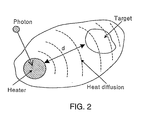
- Fig. 2 The mechanism for selective damage of the target by heat diffusion is illustrated in Fig. 2 , this mechanism relating to therapeutic and medical treatments using electromagnetic radiation to selectively damage targets that are spatially separated from the light absorbing chromophore.
- Fig.2 the distance between the heater and the target is d .
- Photons from an EMR source are absorbed by the heater.
- the EMR power density and pulse length are established so that the temperature of the heater T 1 should be below the thermal damage threshold T 1max of the chromophore. Heat is transferred from the heater to the target by thermal diffusion or another mechanism such as by shock waves or steam.
- T 2 Confined thermal damage of the target is achieved when the temperature of the target reaches T 2 , but the external surrounding tissue remains below that temperature.
- This thermal damage temperature T 2 depends on the duration and the shape of the heating pulse. For proteins, T 2 is between 42-80°C, depending on the dwell time (i.e., determined by Arrhenius integral). It is usually not possible to damage the target without damaging the tissue between the target and the heater. After the end of the EMR pulse, the temperature of the target will continue to rise to a maximum some time later.
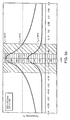
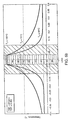
- a target that is a highly pigmented long cylinder with diameter d 1 surrounded by a treatment area with diameter d 2 ( Fig. 4b ) is considered, this model representing, for example, a hair follicle or a blood vessel.
- Two modes of heating are considered.
- the first mode is a "rectangular EMR pulse” ( Fig. 5a )
- the second mode is a "rectangular temperature pulse” ( Fig. 5b ).
- the temperature of the heater rises during the EMR pulse, and reaches T 1 at the end of the pulse ( Fig. 3b ).
- the temperature of the heater is constant during the EMR pulse ( Fig. 3a ).
- the temperature of the heater is below the collapse temperature T 1max , so absorbing properties of the of heater are not changed.
- the sequence of thermal profiles during heating of the heater is depicted in Figs. 5a , 5b for the first mode and second mode of heating respectively, these profiles in the target and surround tissue being at different moments.
- the lower curve in both figures is the temperature profile at a time equal to the thermal relaxation time of the target (i.e.
- TRT the temperature on the boundary of the target is significantly below the thermal damage temperature.
- the upper curve in both figures is the temperature profile at TDT when the target temperature reaches the damage temperature T 2 . At this moment, the target is damaged, but the surrounding tissue is not.
- Fig. 5c is a cross-section through an illustrative hair shaft illustrating the relation of the profiles of Figs. 5a , 5b to the targeted hair follicle.
- 26 is the hair shaft, 28 the inner root sheath, 30 the outer root sheath and 32 the location of stem cells (see also Fig. 1 ).
- T 0 is the temperature of the target and heater before irradiation.
- T 0 is body temperature (37°C).
- TDT/TRT is close to one when the temperature of the heater is very high (for example 200°C). In biological tissue, such high temperatures can be expected with chromophores like carbon or melanin in the hair shaft.
- Table 2 Variable Dimensionality Name Assumptions and relations K cm 2 s -1 Thermal diffusivity Assumed to be the same all over the target P G cm -3 Density Assumed to be the same all over the target C J/(g o K) Specific heat Assumed to be the same all over the target ⁇ a cm -1 Tissue absorption coefficient Assumed to be zero outside the heater Q a.u.
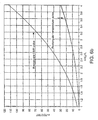
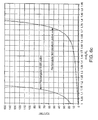
- Fig. 6a-6c shows dependence of TDT on x.
- the value of the TDT can be up to 4 times longer than the TRT for plane targets, 120 times for cylindrical, and 500 times for spherical targets.
- Typical parameters of treatment for hair follicle and spider veins given by the formulas are provided in tables 3 and 4. Table 3.
- Treatments for which the teachings of this invention are particularly adapted include wrinkle, hair and vascular lesion removal.
- this lethal or sublethal heating take place primarily in the papillary dermis, the portion of the spineis closest to the dermal-epidermal (D-E) junction. Accordingly, this treatment is targeted at the upper portion of the dermis, from approximately 100 microns to approximately 1mm below the upper surface of the epidermis, and may be particularly targeted to the upper portion of this region.
- the process of wrinlde removal described above does not require the removal of the epidermis, usually referred to as “skin resurfacing", and is therefore less traumatic and more desirable as a cosmetic procedure. However, even in skin resurfacing, collagen restructuring is thought to be the fundamental process leading to a desirable wrinkle free result.
- the melanin layer located at the D-E junction may serve as the chromophore for light absorption in the wavelength range approximately 400-1500 nm. While melanin is normally optimally absorbed in a wavelength band from approximately 500 nm to 1300 nm; this wavelength range is extended due to the added skin protection afforded the epidermis by the extra long pulse.
- this wrinkle removal technique preferably requires pulse durations from 100 ms to 1 second or more. Depending on the skin type and other factors, times outside these ranges might also be employed.
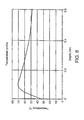
- Figure 8 shows the calculated temperature distribution for a cooled surface (10 degrees Celsius) and a laser pulse duration of one second at roughly 150 J/cm 2 . With this curve, collagen remodeling extends about 200 microns into the capillary dermis, which should be sufficient for wrinkle removal.
- the target region of the papillary dermis mentioned above is shown to be in the range of 50-70 degrees Celsius.
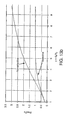
- Fig. 9 illustrates this effect reasonably well at lower power (i.e., 50 J/cm 2 ) which may be suitable for some applications such as hair removal.
- Fig. 8 illustrates the effect using three times the fluence, a regimen more suitable for wrinlde removal. This treatment may be concentrated in areas containing substantial wrinkles to further protect against skin damage.
- An alternative technique for utilizing the teachings of this invention for wrinkle removal is to utilize a source operating in a wavelength band preferentially absorbed by water, for example a range of 0.95 micrometers to 1.9 micrometers and 2.1 to 2.4 micrometers, and otherwise irradiating and cooling as indicated above.
- Radiation in the wavelength band indicated while preferentially absorbed by water, are not so strongly absorbed that they cannot migrate at least several millimeters into the papillary dermis, heating water in the tissues of the papillary dermis sufficiently to raise the temperature of collagen in this area, resulting as indicated previously in the restructuring of such collagen.
- melanin in the hair shaft may function as a chromophore as well as melanin in the lower portions of the follicle near/in the matrix and near the papilla.
- Each hair follicle has stem cells 32 which are, as shown in Figs. 1 and 5c , at the outer side of the outer root sheath 30 in an area at a depth of approximately 0.5 to 1.5 mm from the skin surface. This is sometimes referred to as the bulge area of the follicle.
- stems cells in general do not contain a chromophore, these stem cells can usually be heated and destroyed only by heating chromophores adjacent thereto, and permitting heat from such chromophores to be transferred to the stem cells.
- the most convenient naturally-occurring chromophore adjacent to stem cells is the melanin in the hair shaft 26 itself.
- the hair shaft To destroy the stem cells, the hair shaft must be irradiated for a sufficient period of time for heat from the hair shaft to be transferred to the stem cells.
- the temperature of the tissue be kept below approximately 100-110°C, the temperature at which formation of water vapor may occur.
- the peak power of the optical radiation applied to the hair shaft/heater for this application should be low enough so that the hair shaft/heater does not heat to above approximately 100°C by the end of the treatment, and the heating should last for a time sufficient for the heat from the hair shaft/heater to be transferred to the outer sheath of the follicle where the stem cells are located and/or other appropriate target. As is discussed later, this time will vary somewhat with the size of the hair shaft and follicle.
- the sebaceous gland which primarily contains fat or lipid, and which is also located at the depth of the bulge, may also function as a chromophore for the stem cells, either in addition to or instead of other chromophores discussed herein. With proper focusing, it may also be possible using wavelengths previously discussed to target water in the stem cells and/or tissue surrounding the stem cells and/or in/surrounding other appropriate target.
- the melanin in the hair shaft (and possibly in the stem cells for type IV patients), the lipid in the sebaceous gland and water in tissue surrounding the hair shaft (and possibly in the stem cells) are the only naturally-occurring chromophores adjacent to or in stem cells, it is also possible to introduce an artificial chromophore into this region for purposes of destroying the stem cells.
- a dye could be applied to the hair shaft, which dye migrates down the hair shaft at least to the level of the bulge, or an artificial chromophore such as carbon particles or magnetic particles of a selected optical quality can be applied to the skin and either naturally migrate into the follicle region or be forced into the follicle region using various techniques known in the art.
- the optical source would still be a relatively low peak power source of a wavelength appropriate for the chromophores being utilized, and would be applied for at least a sufficient duration so as to permit the heating of the chromophores to a temperature sufficient to damage or destroy the stem cells and/or other appropriate target, and for the heat from the chromophores to be transferred to the stem cells.
- the chromophores are heated to temperature to prevent chromophore destruction and ablation (for example 100°C-300°C depending on the chromophore), or slightly above, so that with thermal losses as the heat migrates to the stem cells, the stem cells will still be heated to approximately 65°C-70°C, as required for their destruction. It is also preferable that temperatures above 65°-70°C not reach much beyond the stem cells so as to avoid pronounced dermal damage. This is generally not a problem for regions of low density hair, but can be a problem for high density hair regions, where there can be accumulation of heat from adjacent follicles in dermal regions therebetween.
- F NS is (d 3 /d 2 ) n times greater than the fluence required to produce selective damage F S , where d 2 and d 3 are the target size and distance between centers of the targets, and n is 1, 2 or 3 for planar, cylindrical and spherical targets, respectively.
- F NS /F S is proportional to the ratio of target volume and tissue bulk volume and independent of pulsewidth, the risk of nonselective damage increasing in the following order: spherical, cylindrical and planar targets.
- hair follicle heating to achieve permanent hair removal is usually accomplished through light absorption by hair shaft melanin, melanin near the follicle matrix and/or artificial dye.
- This dye could be applied to the hair shaft and/or follicle or in the space created by epilation of the hair shaft.
- melanin or artificial dye heating continues until a certain thermal dose or temperature is reached and lasts as long as necessary for a protein denaturation zone (or thermal lesion) to extend to the outer sheath border where stem cells are located and/or to another appropriate target.
- the thermal history and spatial profile of the temperature are primarily defined by two conditions. First, light absorption by the melanin or artificial dye, which should not decrease appreciably with heating.
- the hair shaft or artificial dye and outer root sheath must not be heat-insulated from each other by, for example water vapor created by boiling of tissue water.
- the first condition is met if hair shaft temperature is not over one of the following: (a) 220-250°C, (b) a temperature of artificial dye photo-bleaching, (c) the temperature of dye evaporation. This latter temperature depends on the dye type.
- the second condition is satisfied if the hair shaft or artificial dye temperature does not exceed the tissue boiling temperature, which is about 100-110°C.
- the method thus requires that the temperature of the chromophores (melanin or artificial dye) be low enough to prevent its bleaching during light heating of a hair follicle.
- the maintained hair shaft provides an objective criterion for hair follicle destruction; this criterion consists of mechanical removal of the hair shaft by gently pulling it out.
- the hair shaft can be removed with all or part of the follicle structure, including stem cells. This can be an additional mechanism of permanent hair removal.
- the hair shaft can be welded to the inner root sheath either with or without support of biological solder injected in the gap between hair shaft and inner root sheath.
- a procedure for defining the parameters of the light treatment for this method might thus be:
- the above procedure may be carried out by applying the optical radiation locally or in a pattern with or without parallel cooling to achieve a spatial and temporal temperature profile and thermal dose map, which may include using a compound sequence of interrupted pulsatile irradiation, or a quasi-continuous irradiation scheme, whereby the position of the light source is scanned or patterned over the area to be treated.
- An alternative procedure would be to choose a test sample before treatment. While hair shaving is not done, mechanical cutting is possible so long as the remaining length of the hair is sufficient to remove it.
- the pulse duration is increased by, for example 50-100ms, and the steps are performed again, ranging up to a maximum pulse duration of about 5s. Then the flux is augmented and the treatment procedure is duplicated with a rise of the flux from minimum to maximum. If certain values of the flux and pulse duration result in the hair coming out under gentle pulling while the epidermis stays intact after the treatment, then these parameters are suitable operational parameters for hair removal.
- the most appropriate set of exposure parameters can be chosen, as indicated above, the heterogenicity of hairs and hair follicles for a patient have to be considered in designing the most appropriate treatment of that patient.
- Different hair and hair follicles with similar properties can be grouped together. The more specific the differentiation of the group, the more appropriately each group can be treated. In general, division into a few group will allow treatment close to optimal treatment parameters.
- each pulse's parameters optimized for a certain subset of hair follicles allows more complete hair removal. These multiple pulses could either be applied in a short time interval over a single treatment or delivered during different treatment sessions. This technique effectively thins the hairs in the area, eliminating for example thinner hair first, thereby mitigating interaction problems in dense hair areas. This is because destruction of thinner hairs can occur before the TRT for the thicker hairs is reached.
- a special mode of treatment is the delivery of multiple pulses with increasing flux from pulse to pulse.
- the thermal destruction of certain chromophores is intentional and can be described as "optical fuse".
- the calculations above demonstrate that with increasing flux, the threshold for hair shaft ablation is shifted to hairs containing less chromophore. If the outer root sheath cells are already destroyed by the preceding pulse, than the following pulse with a flux above the threshold for hair shaft ablation can remove the chromophore that is not needed anymore because this particular hair follicle is already destroyed. By removing the chromophore with increased flux, the EMR will only be absorbed by the remaining hair shafts with less chromophore.
- These hair follicles need a higher flux to generate sufficient temperature rise within the hair follicle.
- the maximum flux of this train of pulses is limited by the flux that is tolerated by the epidermis.
- This strategy of delivering a train of pulses, each targeting a different subset of hair follicles, and reduction in absorption of unnecessary EMR by removal of chromophores within already destroyed hair follicle is a novel treatment strategy.
- a higher ratio of damaged hair follicles within a treatment area can be expected with less danger of thermal damage, even for relatively dense hair areas.
- This is substantially different from a train of pulses each with the same flux and pulse duration, targeting the same subset of hair follicles.
- using parameters of EMR what are below the threshold of chromophore destruction will allow multiple treatment of a certain subset of hair follicles in order to get more complete destruction of this subset of hair follicles.
- the invention may also be used for the elimination of unsightly vascular lesions such as leg veins.
- the strategy for eliminating leg veins using a laser or other EMR source is based on stopping the blood flow by either coagulating the blood, causing an occlusion in the vessel, or by applying external contact pressure capable of interrupting or impeding the flow of blood in the vessel.
- the degree to which this occlusion is necessary is determined by the irradiation parameters and the local tissue properties and depth of the treatment region.
- the inner lining of the vessel wall should be substantially destroyed;
- the treatment of offending blood vessels can be augmented by mechanical or acoustical means known to those skilled in the art to achieve a reduction in blood flow or occlusion by pinching off the blood flow, or by coagulation of the blood, forming a blockage in the flow path.
- tissue welding may be induced, preferably upon heating the vessel to the degree of destroying the epithelial layer, and by applying external pressure to press the now exposed and heated collagen layers together, allowing them to form a tissue weld bond.
- a process can be performed whereby the hemoglobin, water in the blood and/or the blood fluid act as the chromophores, converting, the applied radiation light into heat.
- the chromophores used in the treatments e.g. melanin, water, hemoglobin, blood fluid
- have a higher threshold for photo-thermal damage than the tissues in the surrounding treatment volume e.g.
- the concept presented herein can be applied to use bulk heating originating from the light-absorbing chromophores to treat the surrounding area, thus defining a prescribed treatment volume outside of which no permanent damage will occur, even if the treatment times exceed the thermal relaxation time for the tissues in question.
- radiation used for blood coagulation has generally been in the 540 nm to 580 nm range in the prior art, less epidermal heating occurs at longer wavelengths, for example 810 nm available from a diode laser.
- a pulse duration which is longer that the thermal diffusion time for the vessel, a tissue volume larger than the blood vessel is heated. This bulk heating of the blood vessel and surrounding tissue results in the uniform destruction of the vessel endothelium, decreasing growth factor and perhaps ensuring the permanent blockage, and therefore elimination, of the blood vessel.
- the target has generally been damaged or destroyed by being heated to a temperature well above normal body temperature
- Such heating may be achieved by either direct heating of a target containing a suitable chromophore or by indirect heating of the target by heat diffusion from an absorbing chromophore, as described above.
- Pulse durations of more than 20 seconds might be appropriate for this type of treatment, and exposure or treatment times substantially greater, perhaps even in the range of minutes to hours, may be necessary in some instances.
- postfebrile temporary alopecia i.e., hair loss at elevated temperature, for example when a patient has a high fever
- the critical fever temperature that can cause temporary hair loss is approximately 39°C. This indicates a susceptibility of hair follicle cells to hyperthermia. While heating the entire body nonselectively in order to achieve hair removal may not be practical and could cause unwanted side effects, a treatment procedure where temperature in a range of a few degrees above body temperature are achieved close to the hair follicles in order to cause hair loss is an option. In order to achieve hair loss with these relatively low temperature increases, exposure in the range of minutes to hours is probably necessary. This would result in the temperature distribution within the tissue being close to a steady state profile.
- the low peak power/long pulse duration teachings of this invention can be used to calculate appropriate power and pulse duration for achieving hyperthermia treatments.
- the body performs compensating mechanisms, like increased blood flow and sweating, which have to be considered to calculate appropriate parameters. It therefore may be more accurate to empiracally determine appropriate parameters using for example feedback mechanisms. For example, the onset of pain or the monitoring of skin temperature either at or close to the skin surface might be utilized to control power and duration with this regimen.
- a hyperthermia regimen may also be employed by introducing an artificial chromophore into the middle part of the hair shaft, a very low power EMR source being utilized in this case in combination with very long exposure times.
- Hyperthermia-type treatment might also be utilized for skin resurfacing with melanin in the epidermis being used to induce hyperthermia of the papillary dermis.
- Long pulse heating of a hair shaft or hair follicle can also enhance adjuvant therapies, for example PDP or other photo-excited processes for hair removal.
- the increased temperature in the long pulse regimen can enhance susceptibility to photochemical induced damage.
- the low peak power/long pulse duration regimens of this invention are by no means limited to the field of dermatology and may be advantageously employed in other EMR therapie.
- such a regimen might be useful for treating ophthalmic diseases such as macular degeneration where great care must be exercised to achieve therapeutic results in the desired area of the eye without causing damage to adjacent areas such as the optic nerve.
- Lower energy radiation delivered over a significantly longer duration might permit the desired therapeutic effects to be achieved while reducing the danger of blindness in the eye if an undesired area is accidentally momentarily irradiated.
Landscapes
- Physics & Mathematics (AREA)
- Health & Medical Sciences (AREA)
- Surgery (AREA)
- Optics & Photonics (AREA)
- Life Sciences & Earth Sciences (AREA)
- Heart & Thoracic Surgery (AREA)
- Molecular Biology (AREA)
- Nuclear Medicine, Radiotherapy & Molecular Imaging (AREA)
- Engineering & Computer Science (AREA)
- Biomedical Technology (AREA)
- Electromagnetism (AREA)
- Medical Informatics (AREA)
- Otolaryngology (AREA)
- Animal Behavior & Ethology (AREA)
- General Health & Medical Sciences (AREA)
- Public Health (AREA)
- Veterinary Medicine (AREA)
- Radiation-Therapy Devices (AREA)
- Laser Surgery Devices (AREA)
- Thermotherapy And Cooling Therapy Devices (AREA)
Applications Claiming Priority (3)
| Application Number | Priority Date | Filing Date | Title |
|---|---|---|---|
| US17794300P | 2000-01-25 | 2000-01-25 | |
| US23581400P | 2000-09-27 | 2000-09-27 | |
| EP01906689A EP1251791A1 (de) | 2000-01-25 | 2001-01-25 | Verfahren und apparat zur medizinischen behandlung unter verwendung langzeitiger elektromagnetischer strahlung |
Related Parent Applications (1)
| Application Number | Title | Priority Date | Filing Date |
|---|---|---|---|
| EP01906689.3 Division | 2001-01-25 |
Publications (1)
| Publication Number | Publication Date |
|---|---|
| EP2316372A1 true EP2316372A1 (de) | 2011-05-04 |
Family
ID=26873805
Family Applications (2)
| Application Number | Title | Priority Date | Filing Date |
|---|---|---|---|
| EP01906689A Withdrawn EP1251791A1 (de) | 2000-01-25 | 2001-01-25 | Verfahren und apparat zur medizinischen behandlung unter verwendung langzeitiger elektromagnetischer strahlung |
| EP10012155A Withdrawn EP2316372A1 (de) | 2000-01-25 | 2001-01-25 | Verfahren und Apparat zur medizinischen Behandlung unter Verwendung langpulsiger elektromagnetischer Strahlung |
Family Applications Before (1)
| Application Number | Title | Priority Date | Filing Date |
|---|---|---|---|
| EP01906689A Withdrawn EP1251791A1 (de) | 2000-01-25 | 2001-01-25 | Verfahren und apparat zur medizinischen behandlung unter verwendung langzeitiger elektromagnetischer strahlung |
Country Status (7)
| Country | Link |
|---|---|
| US (3) | US20020091377A1 (de) |
| EP (2) | EP1251791A1 (de) |
| JP (1) | JP4495894B2 (de) |
| AU (1) | AU784423B2 (de) |
| CA (1) | CA2398238A1 (de) |
| IL (2) | IL150604A0 (de) |
| WO (1) | WO2001054606A1 (de) |
Cited By (1)
| Publication number | Priority date | Publication date | Assignee | Title |
|---|---|---|---|---|
| US11141309B2 (en) | 2019-06-03 | 2021-10-12 | Cooler Heads Care, Inc. | Cooling cap assembly and cooling unit |
Families Citing this family (105)
| Publication number | Priority date | Publication date | Assignee | Title |
|---|---|---|---|---|
| US7452358B2 (en) * | 1996-01-05 | 2008-11-18 | Thermage, Inc. | RF electrode assembly for handpiece |
| US7115123B2 (en) | 1996-01-05 | 2006-10-03 | Thermage, Inc. | Handpiece with electrode and non-volatile memory |
| US7022121B2 (en) | 1999-03-09 | 2006-04-04 | Thermage, Inc. | Handpiece for treatment of tissue |
| US7141049B2 (en) | 1999-03-09 | 2006-11-28 | Thermage, Inc. | Handpiece for treatment of tissue |
| US7473251B2 (en) | 1996-01-05 | 2009-01-06 | Thermage, Inc. | Methods for creating tissue effect utilizing electromagnetic energy and a reverse thermal gradient |
| US7229436B2 (en) | 1996-01-05 | 2007-06-12 | Thermage, Inc. | Method and kit for treatment of tissue |
| US7006874B2 (en) | 1996-01-05 | 2006-02-28 | Thermage, Inc. | Treatment apparatus with electromagnetic energy delivery device and non-volatile memory |
| US7189230B2 (en) | 1996-01-05 | 2007-03-13 | Thermage, Inc. | Method for treating skin and underlying tissue |
| US7267675B2 (en) | 1996-01-05 | 2007-09-11 | Thermage, Inc. | RF device with thermo-electric cooler |
| US6653618B2 (en) | 2000-04-28 | 2003-11-25 | Palomar Medical Technologies, Inc. | Contact detecting method and apparatus for an optical radiation handpiece |
| US8182473B2 (en) | 1999-01-08 | 2012-05-22 | Palomar Medical Technologies | Cooling system for a photocosmetic device |
| US6517532B1 (en) | 1997-05-15 | 2003-02-11 | Palomar Medical Technologies, Inc. | Light energy delivery head |
| US7204832B2 (en) | 1996-12-02 | 2007-04-17 | Pálomar Medical Technologies, Inc. | Cooling system for a photo cosmetic device |
| DE69836801D1 (de) | 1997-03-04 | 2007-02-15 | Vnus Med Tech Inc | Vorrichtung zur behandlung von venöser insuffizienz mittels direktionaler energie |
| DE69825447T2 (de) | 1997-05-15 | 2005-09-15 | Palomar Medical Technologies, Inc., Burlington | Gerät zur dermatologischen behandlung |
| WO1999046005A1 (en) | 1998-03-12 | 1999-09-16 | Palomar Medical Technologies, Inc. | System for electromagnetic radiation of the skin |
| ES2640937T3 (es) | 1998-03-27 | 2017-11-07 | The General Hospital Corporation | Procedimiento para el direccionamiento selectivo de glándulas sebáceas |
| US6514242B1 (en) | 1998-12-03 | 2003-02-04 | David Vasily | Method and apparatus for laser removal of hair |
| US6888319B2 (en) | 2001-03-01 | 2005-05-03 | Palomar Medical Technologies, Inc. | Flashlamp drive circuit |
| US6723090B2 (en) | 2001-07-02 | 2004-04-20 | Palomar Medical Technologies, Inc. | Fiber laser device for medical/cosmetic procedures |
| US20040082940A1 (en) * | 2002-10-22 | 2004-04-29 | Michael Black | Dermatological apparatus and method |
| US20030216719A1 (en) * | 2001-12-12 | 2003-11-20 | Len Debenedictis | Method and apparatus for treating skin using patterns of optical energy |
| AU2002367397A1 (en) | 2001-12-27 | 2003-07-24 | Palomar Medical Technologies, Inc. | Method and apparatus for improved vascular related treatment |
| US7044959B2 (en) | 2002-03-12 | 2006-05-16 | Palomar Medical Technologies, Inc. | Method and apparatus for hair growth management |
| CA2489506A1 (en) | 2002-06-19 | 2003-12-31 | Palomar Medical Technologies, Inc. | Method and apparatus for treatment of cutaneous and subcutaneous conditions |
| EP1523283A1 (de) | 2002-06-19 | 2005-04-20 | Palomar Medical Technologies, Inc. | Verfahren und vorrichtung zur photothermischen tiefenbehandlung des gewebes |
| AU2003275471A1 (en) * | 2002-10-07 | 2004-05-04 | Palomar Medical Technologies, Inc. | Apparatus for performing photobiostimulation |
| CA2501098C (en) | 2002-10-23 | 2014-04-08 | Palomar Medical Technologies, Inc. | Phototreatment device for use with coolants and topical substances |
| US20070179481A1 (en) * | 2003-02-14 | 2007-08-02 | Reliant Technologies, Inc. | Laser System for Treatment of Skin Laxity |
| US20040176754A1 (en) * | 2003-03-06 | 2004-09-09 | Island Tobin C. | Method and device for sensing skin contact |
| EP1596747B1 (de) * | 2003-02-25 | 2016-02-17 | Tria Beauty, Inc. | Augensicheres dermatologisches behandlungsgerät |
| EP1596707A4 (de) * | 2003-02-25 | 2010-08-18 | Tria Beauty Inc | Vorrichtung und verfahren zur behandlung von akne |
| US7981111B2 (en) | 2003-02-25 | 2011-07-19 | Tria Beauty, Inc. | Method and apparatus for the treatment of benign pigmented lesions |
| US7413567B2 (en) * | 2003-02-25 | 2008-08-19 | Spectragenics, Inc. | Optical sensor and method for identifying the presence of skin |
| US7118563B2 (en) * | 2003-02-25 | 2006-10-10 | Spectragenics, Inc. | Self-contained, diode-laser-based dermatologic treatment apparatus |
| JP4361083B2 (ja) | 2003-02-25 | 2009-11-11 | トリア ビューティ インコーポレイテッド | 目に安全な内蔵型毛再生抑制装置 |
| EP2604216B1 (de) | 2003-02-25 | 2018-08-22 | Tria Beauty, Inc. | In sich geschlossene Vorrichtung zur dermatologischen Behandlung auf Diodenlaserbasis |
| JP4769580B2 (ja) | 2003-03-27 | 2011-09-07 | ザ ジェネラル ホスピタル コーポレイション | 皮膚科的処置及び部分的な皮膚の表面再形成のための装置 |
| US7153298B1 (en) * | 2003-03-28 | 2006-12-26 | Vandolay, Inc. | Vascular occlusion systems and methods |
| US7291140B2 (en) * | 2003-07-18 | 2007-11-06 | Cutera, Inc. | System and method for low average power dermatologic light treatment device |
| US8870856B2 (en) | 2003-08-25 | 2014-10-28 | Cutera, Inc. | Method for heating skin using light to provide tissue treatment |
| US8915906B2 (en) * | 2003-08-25 | 2014-12-23 | Cutera, Inc. | Method for treatment of post-partum abdominal skin redundancy or laxity |
| US7722600B2 (en) | 2003-08-25 | 2010-05-25 | Cutera, Inc. | System and method for heating skin using light to provide tissue treatment |
| US20080021527A1 (en) * | 2003-10-30 | 2008-01-24 | Cooltouch Incorporated | Endovenous laser treatment generating reduced blood coagulation |
| US8409183B2 (en) | 2003-10-30 | 2013-04-02 | Cooltouch Incorporated | Endovenous laser treatment generating reduced blood coagulation |
| US7326199B2 (en) * | 2003-12-22 | 2008-02-05 | Cutera, Inc. | System and method for flexible architecture for dermatologic treatments utilizing multiple light sources |
| US7309335B2 (en) | 2003-12-31 | 2007-12-18 | Palomar Medical Technologies, Inc. | Dermatological treatment with visualization |
| US8777935B2 (en) * | 2004-02-25 | 2014-07-15 | Tria Beauty, Inc. | Optical sensor and method for identifying the presence of skin |
| WO2005096979A1 (en) | 2004-04-01 | 2005-10-20 | The General Hospital Corporation | Method and apparatus for dermatological treatment and tissue reshaping |
| US7413572B2 (en) | 2004-06-14 | 2008-08-19 | Reliant Technologies, Inc. | Adaptive control of optical pulses for laser medicine |
| US7837675B2 (en) * | 2004-07-22 | 2010-11-23 | Shaser, Inc. | Method and device for skin treatment with replaceable photosensitive window |
| US7780656B2 (en) * | 2004-12-10 | 2010-08-24 | Reliant Technologies, Inc. | Patterned thermal treatment using patterned cryogen spray and irradiation by light |
| US8157807B2 (en) * | 2005-06-02 | 2012-04-17 | The Invention Science Fund I, Llc | Skin treatment including patterned light |
| US8540701B2 (en) * | 2005-03-04 | 2013-09-24 | The Invention Science Fund I, Llc | Hair treatment system |
| US20060200114A1 (en) * | 2005-03-04 | 2006-09-07 | Searete Llc, A Limited Liability Corporation Of State Of Delaware | Hair removal system with light source array |
| US8529560B2 (en) | 2005-03-04 | 2013-09-10 | The Invention Science Fund I, Llc | Hair treatment system |
| US20060276859A1 (en) * | 2005-06-02 | 2006-12-07 | Searete Llc, A Limited Liability Corporation Of The State Of Delaware | Photopatterning of skin |
| US8679101B2 (en) * | 2005-03-04 | 2014-03-25 | The Invention Science Fund I, Llc | Method and system for temporary hair removal |
| US7542628B2 (en) * | 2005-04-11 | 2009-06-02 | Sarnoff Corporation | Method and apparatus for providing strobed image capture |
| US7856985B2 (en) | 2005-04-22 | 2010-12-28 | Cynosure, Inc. | Method of treatment body tissue using a non-uniform laser beam |
| US20070032846A1 (en) * | 2005-08-05 | 2007-02-08 | Bran Ferren | Holographic tattoo |
| US9055958B2 (en) * | 2005-06-29 | 2015-06-16 | The Invention Science Fund I, Llc | Hair modification using converging light |
| US20070038270A1 (en) * | 2005-07-05 | 2007-02-15 | Searete Llc, A Limited Liability Corporation Of The State Of Delaware | Multi step photopatterning of skin |
| US20070048340A1 (en) * | 2005-08-31 | 2007-03-01 | Searete Llc, A Limited Liability Corporation Of The State Of Delaware | Multi step patterning of a skin surface |
| US8346347B2 (en) | 2005-09-15 | 2013-01-01 | Palomar Medical Technologies, Inc. | Skin optical characterization device |
| WO2007099545A2 (en) | 2006-03-03 | 2007-09-07 | Alma Lasers Ltd. | Method and apparatus for light-based hair removal |
| WO2007099546A2 (en) * | 2006-03-03 | 2007-09-07 | Alma Lasers Ltd. | Method and apparatus for light-based hair removal using incoherent light pulses |
| PL2034920T3 (pl) * | 2006-06-26 | 2015-06-30 | Koninklijke Philips Nv | Urządzenie do laserowych zabiegów dermatologicznych |
| US7586957B2 (en) | 2006-08-02 | 2009-09-08 | Cynosure, Inc | Picosecond laser apparatus and methods for its operation and use |
| US20080161888A1 (en) * | 2007-01-03 | 2008-07-03 | Candela Corporation | Treatment of Skin by Spatial Modulation of Thermal Injury |
| EP2578176B1 (de) * | 2007-03-02 | 2017-06-14 | Candela Corporation | Durch Laser erfolgende Hauterwärmung von variabler Tiefe |
| US20080242967A1 (en) * | 2007-03-27 | 2008-10-02 | Ethicon Endo-Surgery, Inc. | Medical imaging and therapy utilizing a scanned beam system operating at multiple wavelengths |
| EP2150194B1 (de) | 2007-04-27 | 2012-09-12 | Tyco Healthcare Group LP | System zur behandlung hohler anatomischer strukturen |
| WO2009021225A1 (en) * | 2007-08-08 | 2009-02-12 | Spectragenics, Inc. | Capacitive sensing method and device for detecting skin |
| US9474576B2 (en) * | 2007-10-05 | 2016-10-25 | The Research Foundation For The State University Of New York | Coherent imaging fiber based hair removal device |
| WO2009052847A1 (de) * | 2007-10-25 | 2009-04-30 | Limmer Laser Gmbh | Vorrichtung zur vaporisation von gewebe mittels laserstrahlung |
| US20110022128A1 (en) * | 2008-03-31 | 2011-01-27 | Takehiro Nakagawa | Hair-growth device and hair-growth method |
| JP5628792B2 (ja) | 2008-04-25 | 2014-11-19 | トリア ビューティ インコーポレイテッド | 皮膚の存在および皮膚の色素沈着を識別するための光学センサおよびその方法 |
| WO2009139900A1 (en) * | 2008-05-15 | 2009-11-19 | Ceramoptec Industries, Inc. | Method/device for transdermal vascular treatment |
| US20090287066A1 (en) * | 2008-05-19 | 2009-11-19 | Oliver Meissner | Method for minimally invasive medical intervention |
| US9770297B2 (en) | 2008-06-04 | 2017-09-26 | Covidien Lp | Energy devices and methods for treating hollow anatomical structures |
| GB2470927A (en) * | 2009-06-10 | 2010-12-15 | Dezac Group Ltd | Phototherapy apparatus with skin temperature control |
| US20100331832A1 (en) * | 2009-06-24 | 2010-12-30 | Boris Vaynberg | Method for treating skin |
| US9919168B2 (en) | 2009-07-23 | 2018-03-20 | Palomar Medical Technologies, Inc. | Method for improvement of cellulite appearance |
| US20130039845A1 (en) * | 2010-01-19 | 2013-02-14 | Michael R. Detty | Method For Producing Hydrogen |
| FR2963550B1 (fr) * | 2010-08-06 | 2013-05-03 | Yperion Technology | Systeme de traitement de la surface pileuse muni d'un generateur de signaux pulses a puissance variable et procede de traitement associe |
| US20120190979A1 (en) | 2011-01-24 | 2012-07-26 | Actium BioSystems, LLC | System for automatically amending energy field characteristics in the application of an energy field to a living organism for treatment of invasive agents |
| US8968171B2 (en) | 2011-01-24 | 2015-03-03 | Endomagnetics Limited | System for correlating energy field characteristics with target particle characteristics in the application of an energy field to a living organism for imaging and treatment of invasive agents |
| US8757166B2 (en) | 2011-01-24 | 2014-06-24 | Actium BioSystems, LLC | System for defining energy field characteristics to illuminate nano-particles used to treat invasive agents |
| US20120190911A1 (en) * | 2011-01-24 | 2012-07-26 | Actium BioSystems, LLC | Low temperature hyperthermia system for therapeutic treatment of invasive agents |
| JP6472133B2 (ja) | 2011-08-26 | 2019-02-20 | エンドマグネティクス リミテッド | 体腔および腔様の部分における癌を治療するためのエネルギー場を発生する装置 |
| KR102136901B1 (ko) | 2012-04-18 | 2020-07-22 | 싸이노슈어, 엘엘씨 | 피코초 레이저 장치 및 그를 사용한 표적 조직의 치료 방법 |
| EP2890317B1 (de) * | 2012-08-10 | 2017-12-13 | The General Hospital Corporation | Vorrichtung zur dermatologischen behandlung |
| US20150216598A1 (en) * | 2013-03-13 | 2015-08-06 | Cynosure, Inc. | Controlled photomechanical and photothermal tissue treatment in the picosecond regime |
| EP2973894A2 (de) | 2013-03-15 | 2016-01-20 | Cynosure, Inc. | Optische picosekunden-strahlungssysteme und verfahren zur verwendung |
| US10518104B2 (en) | 2015-04-23 | 2019-12-31 | Cynosure, Llc | Systems and methods of unattended treatment |
| US10737109B2 (en) | 2015-04-23 | 2020-08-11 | Cynosure, Llc | Systems and methods of unattended treatment of a subject's head or neck |
| CA2996981C (en) * | 2015-10-26 | 2023-08-01 | Ojai Retinal Technology, Llc | Method for heat treating biological tissues using pulsed energy sources |
| US11400308B2 (en) | 2017-11-21 | 2022-08-02 | Cutera, Inc. | Dermatological picosecond laser treatment systems and methods using optical parametric oscillator |
| WO2019165426A1 (en) | 2018-02-26 | 2019-08-29 | Cynosure, Inc. | Q-switched cavity dumped sub-nanosecond laser |
| JP7314266B2 (ja) | 2018-10-22 | 2023-07-25 | アキュア アクネ, インコーポレイテッド | 皮膚表面温度の測定値を使用する線量測定の決定プロセスおよび予測閉ループ制御ならびにそれに関する方法 |
| US10864380B1 (en) | 2020-02-29 | 2020-12-15 | Cutera, Inc. | Systems and methods for controlling therapeutic laser pulse duration |
| US11253720B2 (en) | 2020-02-29 | 2022-02-22 | Cutera, Inc. | Dermatological systems and methods with handpiece for coaxial pulse delivery and temperature sensing |
| CN112473019A (zh) * | 2020-12-16 | 2021-03-12 | 迈尔健康科技(深圳)有限公司 | 一种保持红外热疗辐射平衡的方法及装置 |
| CN117547348B (zh) * | 2023-12-13 | 2024-10-15 | 深圳市爱诗恩科技有限公司 | 一种产生超长脉宽强脉冲光的脱毛仪及其实现方法 |
Citations (7)
| Publication number | Priority date | Publication date | Assignee | Title |
|---|---|---|---|---|
| US3538919A (en) * | 1967-04-07 | 1970-11-10 | Gregory System Inc | Depilation by means of laser energy |
| US3693623A (en) * | 1970-12-25 | 1972-09-26 | Gregory System Inc | Photocoagulation means and method for depilation |
| EP0565331A2 (de) * | 1992-04-09 | 1993-10-13 | ESC Medical Systems Ltd. | Elektromagnetische Therapie |
| WO1998024507A2 (en) * | 1996-12-05 | 1998-06-11 | Thermolase Corporation | Methods and devices for inhibiting hair growth and related skin treatments |
| WO1998051235A1 (en) * | 1997-05-15 | 1998-11-19 | Palomar Medical Technologies, Inc. | Method and apparatus for dermatology treatment |
| WO1999029243A1 (en) * | 1997-12-05 | 1999-06-17 | Thermolase Corporation | Skin enhancement using laser light |
| US5968034A (en) * | 1997-06-24 | 1999-10-19 | Laser Aesthetics, Inc. | Pulsed filament lamp for dermatological treatment |
Family Cites Families (156)
| Publication number | Priority date | Publication date | Assignee | Title |
|---|---|---|---|---|
| US5475A (en) * | 1848-03-14 | The graphic co | ||
| US123745A (en) * | 1872-02-13 | Improvement in horse-powers | ||
| US41886A (en) * | 1864-03-08 | Improvement in washing and wringing machines | ||
| US161357A (en) * | 1875-03-30 | Improvement in fire-proof floors and ceilings | ||
| US173780A (en) * | 1876-02-22 | Improvement in screw-cutting dies | ||
| US23283A (en) * | 1859-03-15 | Bread-making table | ||
| US666000A (en) * | 1900-05-05 | 1901-01-15 | Mahoney & Dickinson | Cigar-lighter. |
| BE346723A (de) * | 1926-11-13 | |||
| US3327712A (en) * | 1961-09-15 | 1967-06-27 | Ira H Kaufman | Photocoagulation type fiber optical surgical device |
| US3527932A (en) * | 1967-11-16 | 1970-09-08 | James J Thomas | Transilluminating flashlight |
| US3622743A (en) * | 1969-04-28 | 1971-11-23 | Hrand M Muncheryan | Laser eraser and microwelder |
| US3834391A (en) * | 1973-01-19 | 1974-09-10 | Block Carol Ltd | Method and apparatus for photoepilation |
| US3900034A (en) * | 1974-04-10 | 1975-08-19 | Us Energy | Photochemical stimulation of nerves |
| GB1485908A (en) * | 1974-05-21 | 1977-09-14 | Nath G | Apparatus for applying light radiation |
| JPS56156150A (en) * | 1980-02-27 | 1981-12-02 | Nato Giyuntaa | Photocoagulator |
| US4316467A (en) * | 1980-06-23 | 1982-02-23 | Lorenzo P. Maun | Control for laser hemangioma treatment system |
| US4388924A (en) * | 1981-05-21 | 1983-06-21 | Weissman Howard R | Method for laser depilation |
| US4461294A (en) * | 1982-01-20 | 1984-07-24 | Baron Neville A | Apparatus and process for recurving the cornea of an eye |
| GB2123287B (en) * | 1982-07-09 | 1986-03-05 | Anna Gunilla Sutton | Depilaton device |
| JPS60123818A (ja) * | 1983-12-08 | 1985-07-02 | Olympus Optical Co Ltd | 光伝送装置 |
| US4608978A (en) * | 1983-09-26 | 1986-09-02 | Carol Block Limited | Method and apparatus for photoepiltion |
| US5140984A (en) * | 1983-10-06 | 1992-08-25 | Proclosure, Inc. | Laser healing method and apparatus |
| US5108388B1 (en) * | 1983-12-15 | 2000-09-19 | Visx Inc | Laser surgery method |
| JPS60148567A (ja) * | 1984-01-13 | 1985-08-05 | 株式会社東芝 | レ−ザ治療装置 |
| IL75998A0 (en) * | 1984-08-07 | 1985-12-31 | Medical Laser Research & Dev C | Laser system for providing target tissue specific energy deposition |
| JPH0655173B2 (ja) * | 1985-03-29 | 1994-07-27 | ウジエヌ ジム ポリツザ | ひげそり方法およびひげそり装置 |
| JPS6224243A (ja) * | 1985-04-30 | 1987-02-02 | Fuji Photo Film Co Ltd | ハロゲン化銀乳剤 |
| US5196004A (en) * | 1985-07-31 | 1993-03-23 | C. R. Bard, Inc. | Infrared laser catheter system |
| US4917084A (en) * | 1985-07-31 | 1990-04-17 | C. R. Bard, Inc. | Infrared laser catheter system |
| US5137530A (en) * | 1985-09-27 | 1992-08-11 | Sand Bruce J | Collagen treatment apparatus |
| GB2184021A (en) * | 1985-12-13 | 1987-06-17 | Micra Ltd | Laser treatment apparatus for port wine stains |
| FR2597744A1 (fr) * | 1986-04-29 | 1987-10-30 | Boussignac Georges | Catheter cardio-vasculaire pour tir au rayon laser |
| WO1988000072A1 (fr) * | 1986-06-30 | 1988-01-14 | Medical Laser Research Co., Ltd. | Appareil therapeutique a laser a semiconducteur |
| US4926227A (en) * | 1986-08-01 | 1990-05-15 | Nanometrics Inc. | Sensor devices with internal packaged coolers |
| US4860744A (en) * | 1987-11-02 | 1989-08-29 | Raj K. Anand | Thermoelectrically controlled heat medical catheter |
| US4860172A (en) * | 1988-01-19 | 1989-08-22 | Biotronics Associates, Inc. | Lamp-based laser simulator |
| US5242437A (en) * | 1988-06-10 | 1993-09-07 | Trimedyne Laser Systems, Inc. | Medical device applying localized high intensity light and heat, particularly for destruction of the endometrium |
| US5070865A (en) * | 1989-03-02 | 1991-12-10 | John Iams | Soft tissue support system |
| US4945239A (en) * | 1989-03-29 | 1990-07-31 | Center For Innovative Technology | Early detection of breast cancer using transillumination |
| US5263951A (en) * | 1989-04-21 | 1993-11-23 | Kerus Medical Systems | Correction of the optical focusing system of the eye using laser thermal keratoplasty |
| US5057104A (en) * | 1989-05-30 | 1991-10-15 | Cyrus Chess | Method and apparatus for treating cutaneous vascular lesions |
| US5486172A (en) * | 1989-05-30 | 1996-01-23 | Chess; Cyrus | Apparatus for treating cutaneous vascular lesions |
| US5182557A (en) * | 1989-09-20 | 1993-01-26 | Semborg Recrob, Corp. | Motorized joystick |
| DE3936367A1 (de) * | 1989-11-02 | 1991-05-08 | Simon Pal | Rasierapparat |
| SE465953B (sv) * | 1990-04-09 | 1991-11-25 | Morgan Gustafsson | Anordning foer behandling av icke oenskade ytliga aakommor |
| US5059192A (en) * | 1990-04-24 | 1991-10-22 | Nardo Zaias | Method of hair depilation |
| US5071417A (en) * | 1990-06-15 | 1991-12-10 | Rare Earth Medical Lasers, Inc. | Laser fusion of biological materials |
| US5065515A (en) * | 1991-01-24 | 1991-11-19 | Warner-Lambert Company | Thermally assisted shaving system |
| US5300097A (en) * | 1991-02-13 | 1994-04-05 | Lerner Ethan A | Fiber optic psoriasis treatment device |
| US5207671A (en) * | 1991-04-02 | 1993-05-04 | Franken Peter A | Laser debridement of wounds |
| US5178617A (en) * | 1991-07-09 | 1993-01-12 | Laserscope | System for controlled distribution of laser dosage |
| US5225926A (en) * | 1991-09-04 | 1993-07-06 | International Business Machines Corporation | Durable optical elements fabricated from free standing polycrystalline diamond and non-hydrogenated amorphous diamond like carbon (dlc) thin films |
| US5370642A (en) * | 1991-09-25 | 1994-12-06 | Keller; Gregory S. | Method of laser cosmetic surgery |
| US5226907A (en) * | 1991-10-29 | 1993-07-13 | Tankovich Nikolai I | Hair removal device and method |
| US5871480A (en) * | 1991-10-29 | 1999-02-16 | Thermolase Corporation | Hair removal using photosensitizer and laser |
| US5817089A (en) * | 1991-10-29 | 1998-10-06 | Thermolase Corporation | Skin treatment process using laser |
| US5344418A (en) * | 1991-12-12 | 1994-09-06 | Shahriar Ghaffari | Optical system for treatment of vascular lesions |
| US5275596A (en) * | 1991-12-23 | 1994-01-04 | Laser Centers Of America | Laser energy delivery tip element with throughflow of vaporized materials |
| US5405368A (en) * | 1992-10-20 | 1995-04-11 | Esc Inc. | Method and apparatus for therapeutic electromagnetic treatment |
| US5334191A (en) * | 1992-05-21 | 1994-08-02 | Dix Phillip Poppas | Laser tissue welding control system |
| DE69311478T2 (de) * | 1992-09-07 | 1998-01-02 | Philips Electronics Nv | Verfahren zur Herstellung eines blockförmigen Trägerkörpers für eine Halbleiterkomponente |
| US5683380A (en) * | 1995-03-29 | 1997-11-04 | Esc Medical Systems Ltd. | Method and apparatus for depilation using pulsed electromagnetic radiation |
| US5620478A (en) * | 1992-10-20 | 1997-04-15 | Esc Medical Systems Ltd. | Method and apparatus for therapeutic electromagnetic treatment |
| US5720772A (en) * | 1992-10-20 | 1998-02-24 | Esc Medical Systems Ltd. | Method and apparatus for therapeutic electromagnetic treatment |
| US6280438B1 (en) * | 1992-10-20 | 2001-08-28 | Esc Medical Systems Ltd. | Method and apparatus for electromagnetic treatment of the skin, including hair depilation |
| US5626631A (en) * | 1992-10-20 | 1997-05-06 | Esc Medical Systems Ltd. | Method and apparatus for therapeutic electromagnetic treatment |
| GB2272278B (en) * | 1992-10-23 | 1997-04-09 | Cancer Res Campaign Tech | Light source |
| US5334193A (en) * | 1992-11-13 | 1994-08-02 | American Cardiac Ablation Co., Inc. | Fluid cooled ablation catheter |
| US5707403A (en) * | 1993-02-24 | 1998-01-13 | Star Medical Technologies, Inc. | Method for the laser treatment of subsurface blood vessels |
| US5304170A (en) * | 1993-03-12 | 1994-04-19 | Green Howard A | Method of laser-induced tissue necrosis in carotenoid-containing skin structures |
| US5350376A (en) * | 1993-04-16 | 1994-09-27 | Ceramoptec, Inc. | Optical controller device |
| US5403306A (en) * | 1993-06-22 | 1995-04-04 | Vanderbilt University | Laser surgery method |
| US5860967A (en) * | 1993-07-21 | 1999-01-19 | Lucid, Inc. | Dermatological laser treatment system with electronic visualization of the area being treated |
| US6251100B1 (en) * | 1993-09-24 | 2001-06-26 | Transmedica International, Inc. | Laser assisted topical anesthetic permeation |
| US5415654A (en) * | 1993-10-05 | 1995-05-16 | S.L.T. Japan Co., Ltd. | Laser balloon catheter apparatus |
| US5458140A (en) * | 1993-11-15 | 1995-10-17 | Non-Invasive Monitoring Company (Nimco) | Enhancement of transdermal monitoring applications with ultrasound and chemical enhancers |
| US5885211A (en) * | 1993-11-15 | 1999-03-23 | Spectrix, Inc. | Microporation of human skin for monitoring the concentration of an analyte |
| US5413587A (en) * | 1993-11-22 | 1995-05-09 | Hochstein; Peter A. | Infrared heating apparatus and methods |
| US5505726A (en) * | 1994-03-21 | 1996-04-09 | Dusa Pharmaceuticals, Inc. | Article of manufacture for the photodynamic therapy of dermal lesion |
| US5616140A (en) * | 1994-03-21 | 1997-04-01 | Prescott; Marvin | Method and apparatus for therapeutic laser treatment |
| US5519534A (en) * | 1994-05-25 | 1996-05-21 | The Government Of The United States Of America As Represented By The Secretary Of The Department Of Health And Human Services | Irradiance attachment for an optical fiber to provide a uniform level of illumination across a plane |
| JP3596029B2 (ja) * | 1994-06-06 | 2004-12-02 | 住友電気工業株式会社 | 半導体レーザモジュール |
| US5735884A (en) * | 1994-10-04 | 1998-04-07 | Medtronic, Inc. | Filtered feedthrough assembly for implantable medical device |
| AT403654B (de) * | 1994-12-01 | 1998-04-27 | Binder Michael Dr | Einrichtung zur optischen untersuchung von human-haut sowie derselben zugeordnete auswertungs-einrichtung |
| US5595568A (en) * | 1995-02-01 | 1997-01-21 | The General Hospital Corporation | Permanent hair removal using optical pulses |
| US5735844A (en) * | 1995-02-01 | 1998-04-07 | The General Hospital Corporation | Hair removal using optical pulses |
| US5868731A (en) * | 1996-03-04 | 1999-02-09 | Innotech Usa, Inc. | Laser surgical device and method of its use |
| US5885273A (en) * | 1995-03-29 | 1999-03-23 | Esc Medical Systems, Ltd. | Method for depilation using pulsed electromagnetic radiation |
| DE29508077U1 (de) * | 1995-05-16 | 1995-08-10 | Wilden Lutz Dr Med | Mundpflegegerät |
| JP3592406B2 (ja) * | 1995-07-10 | 2004-11-24 | 富士通株式会社 | 光モジュール及び光モジュールの製造方法 |
| US5879376A (en) * | 1995-07-12 | 1999-03-09 | Luxar Corporation | Method and apparatus for dermatology treatment |
| US5964749A (en) * | 1995-09-15 | 1999-10-12 | Esc Medical Systems Ltd. | Method and apparatus for skin rejuvenation and wrinkle smoothing |
| US5836999A (en) * | 1995-09-28 | 1998-11-17 | Esc Medical Systems Ltd. | Method and apparatus for treating psoriasis using pulsed electromagnetic radiation |
| US5824023A (en) * | 1995-10-12 | 1998-10-20 | The General Hospital Corporation | Radiation-delivery device |
| US6350276B1 (en) * | 1996-01-05 | 2002-02-26 | Thermage, Inc. | Tissue remodeling apparatus containing cooling fluid |
| IT1286551B1 (it) * | 1996-02-13 | 1998-07-15 | El En S R L | Dispositivo e metodo per l'eliminazione di strati adiposi tramite energia laser |
| US5630811A (en) * | 1996-03-25 | 1997-05-20 | Miller; Iain D. | Method and apparatus for hair removal |
| US5662644A (en) * | 1996-05-14 | 1997-09-02 | Mdlt, Inc. | Dermatological laser apparatus and method |
| US5743901A (en) * | 1996-05-15 | 1998-04-28 | Star Medical Technologies, Inc. | High fluence diode laser device and method for the fabrication and use thereof |
| CA2259437C (en) * | 1996-07-03 | 2006-12-05 | Altea Technologies, Inc. | Multiple mechanical microporation of skin or mucosa |
| AU3813897A (en) * | 1996-07-25 | 1998-02-20 | Light Medicine, Inc. | Photodynamic therapy apparatus and methods |
| US6096029A (en) * | 1997-02-24 | 2000-08-01 | Laser Skin Toner, Inc. | Laser method for subsurface cutaneous treatment |
| US5759200A (en) * | 1996-09-04 | 1998-06-02 | Azar; Zion | Method of selective photothermolysis |
| AU7101396A (en) * | 1996-09-10 | 1998-04-02 | Grigory Borisovich Altshuler | Toothbrush |
| US5782249A (en) * | 1996-09-30 | 1998-07-21 | Weber; Paul J. | Laser manicure process |
| US6653618B2 (en) * | 2000-04-28 | 2003-11-25 | Palomar Medical Technologies, Inc. | Contact detecting method and apparatus for an optical radiation handpiece |
| US6517532B1 (en) * | 1997-05-15 | 2003-02-11 | Palomar Medical Technologies, Inc. | Light energy delivery head |
| US6015404A (en) * | 1996-12-02 | 2000-01-18 | Palomar Medical Technologies, Inc. | Laser dermatology with feedback control |
| US7204832B2 (en) * | 1996-12-02 | 2007-04-17 | Pálomar Medical Technologies, Inc. | Cooling system for a photo cosmetic device |
| FR2756741B1 (fr) * | 1996-12-05 | 1999-01-08 | Cird Galderma | Utilisation d'un chromophore dans une composition destinee a etre appliquee sur la peau avant un traitement laser |
| US5830208A (en) * | 1997-01-31 | 1998-11-03 | Laserlite, Llc | Peltier cooled apparatus and methods for dermatological treatment |
| US5810801A (en) * | 1997-02-05 | 1998-09-22 | Candela Corporation | Method and apparatus for treating wrinkles in skin using radiation |
| US6030399A (en) * | 1997-06-04 | 2000-02-29 | Spectrx, Inc. | Fluid jet blood sampling device and methods |
| US5883471A (en) * | 1997-06-20 | 1999-03-16 | Polycom, Inc. | Flashlamp pulse shaper and method |
| US5885274A (en) * | 1997-06-24 | 1999-03-23 | New Star Lasers, Inc. | Filament lamp for dermatological treatment |
| US6273885B1 (en) * | 1997-08-16 | 2001-08-14 | Cooltouch Corporation | Handheld photoepilation device and method |
| US6176854B1 (en) * | 1997-10-08 | 2001-01-23 | Robert Roy Cone | Percutaneous laser treatment |
| US5968033A (en) * | 1997-11-03 | 1999-10-19 | Fuller Research Corporation | Optical delivery system and method for subsurface tissue irradiation |
| FR2772274B1 (fr) * | 1997-12-16 | 2002-01-04 | Galderma Rech Dermatologique | Dispositif comprenant une composition chromophore a appliquer sur la peau, procede de fabrication d'un tel dispositif et utilisations |
| IL122840A (en) * | 1997-12-31 | 2002-04-21 | Radiancy Inc | Hair removal device and methods |
| WO1999034868A1 (en) * | 1998-01-07 | 1999-07-15 | Kim Robin Segal | Diode laser irradiation and electrotherapy system for biological tissue stimulation |
| US6221068B1 (en) * | 1998-01-15 | 2001-04-24 | Northwestern University | Method for welding tissue |
| US7048731B2 (en) * | 1998-01-23 | 2006-05-23 | Laser Abrasive Technologies, Llc | Methods and apparatus for light induced processing of biological tissues and of dental materials |
| US6149644A (en) * | 1998-02-17 | 2000-11-21 | Altralight, Inc. | Method and apparatus for epidermal treatment with computer controlled moving focused infrared light |
| US6080146A (en) * | 1998-02-24 | 2000-06-27 | Altshuler; Gregory | Method and apparatus for hair removal |
| US6173202B1 (en) * | 1998-03-06 | 2001-01-09 | Spectrx, Inc. | Method and apparatus for enhancing flux rates of a fluid in a microporated biological tissue |
| US6530915B1 (en) * | 1998-03-06 | 2003-03-11 | Spectrx, Inc. | Photothermal structure for biomedical applications, and method therefor |
| US6022316A (en) * | 1998-03-06 | 2000-02-08 | Spectrx, Inc. | Apparatus and method for electroporation of microporated tissue for enhancing flux rates for monitoring and delivery applications |
| WO1999046005A1 (en) * | 1998-03-12 | 1999-09-16 | Palomar Medical Technologies, Inc. | System for electromagnetic radiation of the skin |
| ES2640937T3 (es) * | 1998-03-27 | 2017-11-07 | The General Hospital Corporation | Procedimiento para el direccionamiento selectivo de glándulas sebáceas |
| DE19836649C2 (de) * | 1998-08-13 | 2002-12-19 | Zeiss Carl Meditec Ag | Medizinisches Handstück |
| US6059820A (en) * | 1998-10-16 | 2000-05-09 | Paradigm Medical Corporation | Tissue cooling rod for laser surgery |
| US6096209A (en) * | 1998-11-25 | 2000-08-01 | Aws Industries, L.L.C. | Three media silver recovery apparatus |
| US6936044B2 (en) * | 1998-11-30 | 2005-08-30 | Light Bioscience, Llc | Method and apparatus for the stimulation of hair growth |
| US6663659B2 (en) * | 2000-01-13 | 2003-12-16 | Mcdaniel David H. | Method and apparatus for the photomodulation of living cells |
| US6514242B1 (en) * | 1998-12-03 | 2003-02-04 | David Vasily | Method and apparatus for laser removal of hair |
| US6183500B1 (en) * | 1998-12-03 | 2001-02-06 | Sli Lichtsysteme Gmbh | Process and apparatus for the cosmetic treatment of acne vulgaris |
| US6183773B1 (en) * | 1999-01-04 | 2001-02-06 | The General Hospital Corporation | Targeting of sebaceous follicles as a treatment of sebaceous gland disorders |
| SE522249C2 (sv) * | 1999-01-13 | 2004-01-27 | Biolight Patent Holding Ab | Styranordning för styrning av utvärters behandling medelst ljus |
| AU3147200A (en) * | 1999-03-08 | 2000-09-28 | Asah Medico A/S | An apparatus for tissue treatment and having a monitor for display of tissue features |
| US6709269B1 (en) * | 2000-04-14 | 2004-03-23 | Gregory B. Altshuler | Apparatus and method for the processing of solid materials, including hard tissues |
| US6685699B1 (en) * | 1999-06-09 | 2004-02-03 | Spectrx, Inc. | Self-removing energy absorbing structure for thermal tissue ablation |
| US6358242B1 (en) * | 1999-11-12 | 2002-03-19 | Ceramoptec Industries, Inc. | Post laser treatment for permanent hair removal |
| US6743222B2 (en) * | 1999-12-10 | 2004-06-01 | Candela Corporation | Method of treating disorders associated with sebaceous follicles |
| US6354370B1 (en) * | 1999-12-16 | 2002-03-12 | The United States Of America As Represented By The Secretary Of The Air Force | Liquid spray phase-change cooling of laser devices |
| US20020149326A1 (en) * | 2001-03-01 | 2002-10-17 | Mikhail Inochkin | Flashlamp drive circuit |
| JP3792129B2 (ja) * | 2001-03-01 | 2006-07-05 | 新光電気工業株式会社 | キャパシタ、キャパシタ内蔵回路基板及びそれらの製造方法 |
| US6679837B2 (en) * | 2001-06-01 | 2004-01-20 | Intlas Ltd. | Laser light irradiation apparatus |
| US20030032900A1 (en) * | 2001-08-08 | 2003-02-13 | Engii (2001) Ltd. | System and method for facial treatment |
| US20050049582A1 (en) * | 2001-12-12 | 2005-03-03 | Debenedictis Leonard C. | Method and apparatus for fractional photo therapy of skin |
| AU2002367397A1 (en) * | 2001-12-27 | 2003-07-24 | Palomar Medical Technologies, Inc. | Method and apparatus for improved vascular related treatment |
| US7044959B2 (en) * | 2002-03-12 | 2006-05-16 | Palomar Medical Technologies, Inc. | Method and apparatus for hair growth management |
| AU2003226326A1 (en) * | 2002-04-09 | 2003-10-27 | Altshuler, Gregory | Method and apparatus for processing hard material |
| US6989023B2 (en) * | 2003-07-08 | 2006-01-24 | Oralum, Llc | Hygienic treatments of body structures |
| US8870856B2 (en) * | 2003-08-25 | 2014-10-28 | Cutera, Inc. | Method for heating skin using light to provide tissue treatment |
| US7805598B2 (en) | 2007-05-03 | 2010-09-28 | Dell Products L.P. | Auto-detecting and auto-correcting system state changes before booting into operating systems |
-
2001
- 2001-01-25 IL IL15060401A patent/IL150604A0/xx unknown
- 2001-01-25 US US09/769,960 patent/US20020091377A1/en not_active Abandoned
- 2001-01-25 AU AU34570/01A patent/AU784423B2/en not_active Ceased
- 2001-01-25 CA CA002398238A patent/CA2398238A1/en not_active Abandoned
- 2001-01-25 JP JP2001555586A patent/JP4495894B2/ja not_active Expired - Fee Related
- 2001-01-25 EP EP01906689A patent/EP1251791A1/de not_active Withdrawn
- 2001-01-25 WO PCT/US2001/002511 patent/WO2001054606A1/en not_active Ceased
- 2001-01-25 EP EP10012155A patent/EP2316372A1/de not_active Withdrawn
-
2002
- 2002-07-04 IL IL150604A patent/IL150604A/en not_active IP Right Cessation
-
2005
- 2005-03-25 US US11/090,896 patent/US20050215988A1/en not_active Abandoned
-
2010
- 2010-12-14 US US12/967,396 patent/US20110137230A1/en not_active Abandoned
Patent Citations (7)
| Publication number | Priority date | Publication date | Assignee | Title |
|---|---|---|---|---|
| US3538919A (en) * | 1967-04-07 | 1970-11-10 | Gregory System Inc | Depilation by means of laser energy |
| US3693623A (en) * | 1970-12-25 | 1972-09-26 | Gregory System Inc | Photocoagulation means and method for depilation |
| EP0565331A2 (de) * | 1992-04-09 | 1993-10-13 | ESC Medical Systems Ltd. | Elektromagnetische Therapie |
| WO1998024507A2 (en) * | 1996-12-05 | 1998-06-11 | Thermolase Corporation | Methods and devices for inhibiting hair growth and related skin treatments |
| WO1998051235A1 (en) * | 1997-05-15 | 1998-11-19 | Palomar Medical Technologies, Inc. | Method and apparatus for dermatology treatment |
| US5968034A (en) * | 1997-06-24 | 1999-10-19 | Laser Aesthetics, Inc. | Pulsed filament lamp for dermatological treatment |
| WO1999029243A1 (en) * | 1997-12-05 | 1999-06-17 | Thermolase Corporation | Skin enhancement using laser light |
Non-Patent Citations (1)
| Title |
|---|
| GROSSMAN, DIERRICKX,FARINELLE,FLOTTE,ANDERSON: "Damage to hair follicles by normal-mode ruby laser pulses", JOURNAL OF THE AMERICAN ACADEMY OF DERMATOLOGY, vol. 35, pages 889 - 894, XP001034172, DOI: 10.1016/S0190-9622(96)90111-5 * |
Cited By (2)
| Publication number | Priority date | Publication date | Assignee | Title |
|---|---|---|---|---|
| US11141309B2 (en) | 2019-06-03 | 2021-10-12 | Cooler Heads Care, Inc. | Cooling cap assembly and cooling unit |
| US11622881B2 (en) | 2019-06-03 | 2023-04-11 | Cooler Heads Care, Inc. | Cooling cap assembly and cooling unit |
Also Published As
| Publication number | Publication date |
|---|---|
| AU3457001A (en) | 2001-08-07 |
| IL150604A0 (en) | 2003-02-12 |
| WO2001054606A1 (en) | 2001-08-02 |
| JP2003521305A (ja) | 2003-07-15 |
| IL150604A (en) | 2009-08-03 |
| AU784423B2 (en) | 2006-03-30 |
| JP4495894B2 (ja) | 2010-07-07 |
| US20020091377A1 (en) | 2002-07-11 |
| US20110137230A1 (en) | 2011-06-09 |
| EP1251791A1 (de) | 2002-10-30 |
| US20050215988A1 (en) | 2005-09-29 |
| CA2398238A1 (en) | 2001-08-02 |
Similar Documents
| Publication | Publication Date | Title |
|---|---|---|
| AU784423B2 (en) | Method and apparatus for medical treatment utilizing long duration electromagnetic radiation | |
| Altshuler et al. | Extended theory of selective photothermolysis | |
| AU742982B2 (en) | Pulsed filament lamp for dermatological treatment | |
| US5968034A (en) | Pulsed filament lamp for dermatological treatment | |
| US6443946B2 (en) | Apparatus for wrinkle removal | |
| US5630811A (en) | Method and apparatus for hair removal | |
| EP1267792B1 (de) | Gewebekühlstab für die laserchirugie | |
| US6881212B1 (en) | Skin wrinkle reduction using pulsed light | |
| WO2004000150A1 (en) | Method and apparatus for photothermal treatment of tissue at depth | |
| CN110167635A (zh) | 用于选择性光热瞄准的热梯度预处理的系统和方法 | |
| Jia et al. | Treatment of cutaneous vascular lesions using multiple‐intermittent cryogen spurts and two‐wavelength laser pulses: Numerical and animal studies | |
| US20050065503A1 (en) | Method and apparatus for reducing the appearance of skin markings | |
| Grad et al. | Scientific evaluation of VSP Nd: YAG lasers for hair removal | |
| Lee et al. | Long-Pulsed Alexandrite Laser and Thermal Kinetic Selectivity | |
| Kosir et al. | Influence of Skin Type and Light Scattering on Induced Skin Temperatures during Nd: YAG and Alexandrite Laser Treatments in Dermatology. J LA&HA, J | |
| Lukac et al. | Beyond customary paradigm: FRAC3® Nd: YAG laser hair removal | |
| WO2024215774A1 (en) | Systems and methods for tissue treatment with an asymmetric beam | |
| Gerstman | Nanosecond laser pulses: from retinal damage to refined surgical treatment of congenital nevi and melanoma | |
| Lee et al. | Intense Pulse Light (IPL) and Extended Theory of Selective Photothermolysis |
Legal Events
| Date | Code | Title | Description |
|---|---|---|---|
| PUAI | Public reference made under article 153(3) epc to a published international application that has entered the european phase |
Free format text: ORIGINAL CODE: 0009012 |
|
| AC | Divisional application: reference to earlier application |
Ref document number: 1251791 Country of ref document: EP Kind code of ref document: P |
|
| AK | Designated contracting states |
Kind code of ref document: A1 Designated state(s): AT BE CH CY DE DK ES FI FR GB GR IE IT LI LU MC NL PT SE TR |
|
| 17P | Request for examination filed |
Effective date: 20111104 |
|
| 17Q | First examination report despatched |
Effective date: 20111205 |
|
| STAA | Information on the status of an ep patent application or granted ep patent |
Free format text: STATUS: THE APPLICATION IS DEEMED TO BE WITHDRAWN |
|
| 18D | Application deemed to be withdrawn |
Effective date: 20120417 |