EP2334008A1 - Système et procédé permettant de concevoir des protocoles de communication sécurisés client-serveur basés sur une infrastructure de clé publique sans certificat - Google Patents
Système et procédé permettant de concevoir des protocoles de communication sécurisés client-serveur basés sur une infrastructure de clé publique sans certificat Download PDFInfo
- Publication number
- EP2334008A1 EP2334008A1 EP10193957.7A EP10193957A EP2334008A1 EP 2334008 A1 EP2334008 A1 EP 2334008A1 EP 10193957 A EP10193957 A EP 10193957A EP 2334008 A1 EP2334008 A1 EP 2334008A1
- Authority
- EP
- European Patent Office
- Prior art keywords
- value
- key
- elliptic curve
- client
- server
- Prior art date
- Legal status (The legal status is an assumption and is not a legal conclusion. Google has not performed a legal analysis and makes no representation as to the accuracy of the status listed.)
- Ceased
Links
- 238000000034 method Methods 0.000 title claims abstract description 86
- 238000004891 communication Methods 0.000 title claims abstract description 45
- 238000012795 verification Methods 0.000 claims description 23
- 238000012545 processing Methods 0.000 claims description 13
- 238000007781 pre-processing Methods 0.000 claims description 12
- 230000008569 process Effects 0.000 description 13
- 230000004044 response Effects 0.000 description 4
- 238000004364 calculation method Methods 0.000 description 3
- 238000010586 diagram Methods 0.000 description 3
- 238000005516 engineering process Methods 0.000 description 3
- 230000004048 modification Effects 0.000 description 3
- 238000012986 modification Methods 0.000 description 3
- 230000002441 reversible effect Effects 0.000 description 3
- 230000002411 adverse Effects 0.000 description 2
- 230000000295 complement effect Effects 0.000 description 2
- 238000009792 diffusion process Methods 0.000 description 2
- 230000007246 mechanism Effects 0.000 description 2
- 241001620634 Roger Species 0.000 description 1
- 238000013459 approach Methods 0.000 description 1
- 230000005540 biological transmission Effects 0.000 description 1
- 230000008859 change Effects 0.000 description 1
- 230000006835 compression Effects 0.000 description 1
- 238000007906 compression Methods 0.000 description 1
- 230000001010 compromised effect Effects 0.000 description 1
- 230000000694 effects Effects 0.000 description 1
- 230000002452 interceptive effect Effects 0.000 description 1
- 238000013507 mapping Methods 0.000 description 1
- 230000000873 masking effect Effects 0.000 description 1
- 238000010295 mobile communication Methods 0.000 description 1
- 230000006855 networking Effects 0.000 description 1
- 238000005192 partition Methods 0.000 description 1
Images


Classifications
-
- H—ELECTRICITY
- H04—ELECTRIC COMMUNICATION TECHNIQUE
- H04L—TRANSMISSION OF DIGITAL INFORMATION, e.g. TELEGRAPHIC COMMUNICATION
- H04L9/00—Cryptographic mechanisms or cryptographic arrangements for secret or secure communications; Network security protocols
- H04L9/08—Key distribution or management, e.g. generation, sharing or updating, of cryptographic keys or passwords
- H04L9/0816—Key establishment, i.e. cryptographic processes or cryptographic protocols whereby a shared secret becomes available to two or more parties, for subsequent use
- H04L9/0838—Key agreement, i.e. key establishment technique in which a shared key is derived by parties as a function of information contributed by, or associated with, each of these
- H04L9/0841—Key agreement, i.e. key establishment technique in which a shared key is derived by parties as a function of information contributed by, or associated with, each of these involving Diffie-Hellman or related key agreement protocols
Definitions
- This invention relates to the field of communication.
- this invention relates to the field of cryptography and network security.
- 'Primitives' in this specification relates to known systems used for creating and verifying digital signatures such as elliptic curve diffie hellman system, elliptic curve digital signature system, and also to known systems that are used to randomize the message as well as verify the authenticity of the message, such as message randomization system, jacobi identity verification system and the like.
- the term 'Digital Signature' or 'Signature' in this specification relates to a mechanism for determining the authenticity of a message, financial transaction and cases where there is a necessity to detect forgery or tampering.
- Client-server networking is a distributed application architecture that partitions tasks or work loads between service providers (servers) and service requesters (clients). This kind of network communication is not necessarily secure.
- servers service providers
- clients service requesters
- This kind of network communication is not necessarily secure.
- many researchers and organizations incorporate methods such as public key based cryptography, identity based cryptography and the like.
- United States Patent 7673141 granted to Roger Kilian-Kehr et al provides a system for providing secured access to an application service.
- the system envisaged by the US Patent No. 7673141 includes a challenge provider that uses a first cryptographic technique to provide a challenge to a client seeking access to an application service.
- the client uses a second cryptographic technique to generate a response, and provides the response to an authentication service.
- the authentication service grants the client access to the application service only if the challenge and response are authenticated using a first authentication technique complementary to the first cryptographic technique and a second authentication technique complementary to the second cryptographic technique, respectively.
- United States Patent Application 2008069338 filed by Robert Relyea provides a computer system and a method for verifying a location factor associated with the token (client).
- the token receives an encrypted challenge from a server.
- the encrypted challenge is encrypted by a key commonly shared by the server and the token.
- the token then decrypts the encrypted challenge by the commonly shared key and manipulates the challenge by a predetermined elliptic curve cryptography (ECC) procedure to obtain a manipulated challenge.
- ECC elliptic curve cryptography
- the token returns a signed manipulated challenge and an ECC public key to the server as a reply to the challenge.
- the server receives the signed manipulated challenge and verifies that the signed manipulated challenge was actually generated at the token based upon the ECC public key.
- the client receives an encrypted challenge from the server, the challenge is encrypted using a key that is known to both the client and the server (public key).
- United States Patent Application 2009003597 filed by Alexander Gantman et al provides a method and apparatus with means for use in authentication between two entities having agreed on the use of a common modulus N.
- the method envisaged by US Patent Application No. 2009003597 comprises the steps of, generating a pseudorandom string value from an input value; generating a first public key value based on the modulus N and the pseudorandom string value; generating a first private key value corresponding to the first public key value; receiving a second public key value; and generating a shared secret value based on the modulus N, the first private key value and the second public key value; determining the authentication signature using the shared secret value and transmitting the said authentication signature.
- the system envisaged by the US Patent Application No. 2009003597 makes use of the key generation unit to generate the first public key and the first private key.
- the system further makes use of a receiver unit to receive a second public key value and a secret key generation unit to generate a secret shared key value.
- United States Patent Application 2010211779 filed by Ganapathy S.Sundaram provides a key agreement protocol between a first party and a second party.
- a random key component is generated, encrypted by the first party (server) and sent to the second party (client).
- the random key part is encrypted using the public key of the second party.
- the second party receives the random key component sent from the first party, and in addition to receiving the first random key component the second party generates the second key component.
- the first key component and the second key component are encrypted to form a random encrypted key component pair. So generated random key component pair is encrypted and transmitted from the second party (client) to the first party (server).
- the server or the first party Upon receiving the encrypted random key component pair from the second party, the server or the first party sends an encrypted second random key component to the second party and the key to be used in all the subsequent communication between the client and the server are computed and decided at the first party (server) based on the second random key component.
- the focus of the US Patent Application No. 2010211779 is on providing an identity based encryption scheme.
- United States Patent 7549044 granted to Lane W. Lee provides a block-level storage device which has been configured to implement a digital rights management (DRM) system.
- DRM digital rights management
- the storage device challenges the host system to prove it has the corresponding private key to establish trust. This trust is established by encrypting a secure session key using the public key.
- the host system uses its private key to recover the secure session key.
- the storage device may store content that has been encrypted according to a content key.
- the storage device may encrypt the content key using the secure session key.
- the focus of the US Patent No. 7549044 is on providing a digital rights management system.
- the secure session key itself is encrypted and subsequently decrypted in order to ensure a secured communication between the storage device and the client.
- Chinese Patent Application 1444168 filed by Zhu Huafei discloses creating an elliptic curve public key certificate based on the probability of asymmetric encryption method.
- the system envisaged by the Chinese Patent Application No. 1444168 further includes making use of the principles of anti-collision hash functions, public key encryption system and public key certificate scheme in order to facilitate secured communication between the client and the server.
- the present invention is dissimilar from the system envisaged by the Chinese Patent Application No. 1444168 in that it provides certificateless public key infrastructure. Even though the Chinese Patent Application discloses making use of elliptic curve cryptography (ECC), the major dissimilarity lies in the fact that the present invention makes use of certificateless public key infrastructure whereas the Chinese Patent Application discloses using a certificate based public key infrastructure.
- ECC elliptic curve cryptography
- a system for facilitating secure client server communication comprising:
- the processing means includes an encryption means adapted to receive said random number and encrypt said random number with the public key using elliptic curve encryption.
- the processing means includes a preprocessing means adapted to receive said random number and process said random number using message randomization.
- the first verification means includes a decryption means adapted to receive said processed value and decrypt said processed value with the private key using elliptic curve encryption.
- the first verification means includes a preprocessing means adapted to receive and verify said processed value using message randomization to detect forgery.
- the first value is selected form the group consisting of pair of public key and private key and Jacobi identity.
- the second value is selected from the group consisting of digitally signed value and lie product.
- the predetermined primitives are selected from the group consisting of curve diffie hellman method, elliptic curve digital signature method and jacobi identity verification system.
- the predetermined primitives are selected from the group consisting of elliptic curve diffie hellman system and elliptic curve digital signature system.
- the method of processing said random number to produce a processed value further includes the step of encrypting said random number with the public key using elliptic curve encryption system.
- the method of processing said random number to produce a processed value further includes the step of processing said random number using primitives selected from the group consisting of bit shuffling, compression, T-function and linear feedback shift registration.
- the method of verifying said processed value further includes the step of decrypting said processed value with the private key using elliptic curve encryption method.
- the method of verifying said processed value further includes the step of verifying said processed value by using message randomization method.
- the method of generating said first value further includes the step of generating a pair of public key and private key;
- the method of generating said first value further includes the step of generating the jacobi identity.
- the method of generating said second value based on said first value further includes the step of generating a digitally signed value.
- the method of generating said second value based on said first value further includes the step of generating a lie product.
- the step of verifying said second value using predetermined primitives further includes the step of verifying said second value using predetermined primitives selected from the group consisting of curve diffie hellman method, elliptic curve digital signature method andjacobi identity verification method.
- the step of receiving transmitted public key and generating a secret key based on predetermined primitives further includes the step of generating said secret key based on predetermined primitives selected from the group consisting of elliptic curve diffie hellman method and elliptic curve digital signature method.
- the step of generating a session key based on said secret key and said predetermined primitives further includes the step of generating a session key using said session key and predetermined primitives selected from the group consisting of elliptic curve diffie hellman method and elliptic curve digital signature method.
- PKI certificateless public key Infrastructure
- the system includes at least one server which performs the function of generating keys that is a pair of public key and the private key, allowing the server to act as a Key Generation Center (KGC) and at least one client, forming server client architecture and the required infrastructure of the PKI which includes set of hardware, policies, procedures, and the like needed for communication.
- KGC Key Generation Center
- the certificateless PKI based communication using first network security protocol initially allows server to act as a Key Generation Center (KGC) for distributing public and private keys to clients.
- KGC Key Generation Center
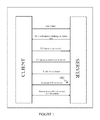
- the steps involved in setting up certificateless PKI based communications using first network security protocol are seen in FIGURE 1 .
- the client initiates the communication by sending an introductory message such as "client Hello".
- the server In return to client message, the server generates a random number (value) of length 'n' bits using a random number generator.
- the server further encrypts the generated value using client's public key. No digital certificates are created during the process of encryption of random value.
- the server keeps track of the set of private key and public key assigned to individual clients.
- Elliptic curve encryption method is utilized at the server side for encrypting the value.
- the value that has been encrypted using client's public key is sent to the client.
- the server challenges the client to decrypt the value that contains the number in encrypted form, and prove its identity.
- the client receives the encrypted value and decrypts the encrypted value using its private key.
- the client decrypts the encrypted value using its private key and elliptic curve diffie hellman algorithm and verifies whether the value was sent form a trusted source. By successfully decrypting the encrypted value and recovering the original value the client proves to the server that it is trustworthy.
- the client on completing the step of verification (i.e., decryption of the encrypted value sent by the server) of value sent by the server, generates a pair of public key and private key by making use of elliptic curve cryptography.
- the client creates a signature on the decrypted value using elliptic curve digital signature algorithm and sends the signature to the server
- the server on its part receives the signature sent by the client and verifies the signature using elliptic curve digital signature algorithm.
- the server Soon after verifying the signature sent by the client, the server generates a pair of public key and private key using elliptic curve diffie hellman algorithm and sends the generated public key to the client.
- the client Upon receiving the public key from the server, the client generates a secret key of length 'm' bits using elliptic curve diffie hellman algorithm and shares the secret key with the server.
- the server in return generates an 'm' bit session key based on elliptic curve diffie hellman algorithm.
- the secret key and the corresponding session key are generated using elliptic curve diffie hellman algorithm.
- Reference numeral 100 of FIGURE 1 denotes the step of generation of session key of length 'm' bits using elliptic curve diffie hellman algorithm.
- the session key is used for all the subsequent communications and transactions between the server and the client. Since the session key is known only to the server and the client, the communication between the client and the server is entirely secure.
- KGC Key Generation Center
- Client initiates the communication to server by sending a message 'Client Hello!'
- Second Step Server generates Random challenge or Random value of n-bits using Pseudo Random Number Generator (PRNG). Further, Server encrypts Random value with client's public key using Elliptic Curve Encryption method (ECE). Client decrypts the encrypted random value with its private key using ECE.
- PRNG Pseudo Random Number Generator
- ECE Elliptic Curve Encryption method
- Client generates Public and Private Keys on Elliptic curve by making use of elliptic curve cryptography method.
- the length of the public key and the private key could either be 256 bits or 384 bits or 512 bits as recommended by NIST (National Institute of Standards and Technology).
- Client creates a signature on the value sent by the server using elliptic curve digital signature algorithm and sends the signature to Server.
- Server verifies the signature using elliptic curve digital signature algorithm and subsequently generates a key pair on the elliptic curve. Server sends its public key to Client.
- Client and server negotiate an m-bit shared secret key using ECDH (elliptic curve diffie hellman) algorithm.
- ECDH elliptic curve diffie hellman
- Client and server negotiate Session key of m bits generated using elliptic curve diffie hellman algorithm, for the purpose of Encryption.
- Client and server have a cipher suite.
- the steps involved in setting up certificateless PKI based communications using second network security protocol are seen in FIGURE 2 .
- the certificateless PKI based communication using second network security protocol is slightly different from first Network security protocol as there is no initial set up for generating a pair of public and private keys for client and server but client and server have a unique message preprocessing (MP) function which converts the plain text into a random message.
- MP unique message preprocessing
- Bijective mapping is used for the purpose of ensuring that no modification has taken place, when the random value is sent. In case of the random value, the bit sequence representing the particular value will be altered or randomized thereby masking the original value.
- the client initiates the communication by sending an introductory message such as "client Hello".
- the server In return to client message, the server generates a random number (value) of length 'n' bits using a random number generator.
- the server processes the generated random value using the message preprocessing function (message randomization function).
- the message preprocessing function includes performing three operations in sequential manner. The three operations are shuffling, T-Function and LFSR (Linear Feedback Shift Register).
- the process of preprocessing starts with shuffling of bits. Shuffling of bits helps increase the diffusion. Diffusion refers to the property that, the redundancy in the statistics of the input is dissipated in the output. The process of shuffling is invertible and the original bit sequence can be easily recovered from the shuffled bit sequence.
- T-Function is followed by the process of T-Function.
- T-function is an update function which updates every bit by a linear combination of the same bit and the less significant bits.
- the process of T-function is followed by the function of LFSR (Linear Feedback Shift Register).
- LFSR Linear Feedback Shift Register
- LFSR is a process that includes using an irreducible polynomial of degree 32 and period 2 32 ⁇ 1. In case of LFSR the given input is shifted with the given polynomial for 4 to 15 cycles.
- the output of bit shuffling, T-Function and LFSR (collectively referred to as preprocessing) is a highly randomized value.
- the server after subjecting the generated value to the preprocessing function sends the preprocessed value and the original value to the client.
- the preprocessed value is a derivative of the original value and the only difference between the preprocessed value and the original value is that, in case of the preprocessed value the bit sequence would be altered.
- the preprocessed value is verified using the functions of shuffling, T-Function and LFSR in the reverse order, i.e., the process of LFSR is followed by T function and bit shuffling.
- the order of conduction of the above mentioned process is reversed in case of preprocessing the value. Since all the three functions are invertible, the order of conduction can be reversed without any data loss and adverse effects.
- the client after performing the above mentioned functions in the reverse order (i.e., LFSR followed by T-Functioning and Bit shuffling) obtains the verified value.
- Client compares the verified value that has been obtained as a result of performing the process of LFSR, T-Functioning and bit shuffling and the original value sent by the server thereby detecting whether the value had been forged.
- the client After verifying the value sent by the server, if the value sent by the server is authentic, the client generates a pair of public key and private key using the elliptic curve diffie-hellman algorithm.
- the client further creates a signature on the value sent by the server using elliptic curve digital signature algorithm and sends the signature along with its public key to the server.
- the server on receiving the signature, verifies the signature sent by the client using elliptic curve digital signature algorithm and subsequently generates a pair of public key and private key using elliptic curve diffie hellman algorithm. Subsequently, the server sends the generated public key to the client.
- the client Upon receiving the public key from the server, the client generates a secret key of length 'm' bits using elliptic curve diffie hellman algorithm and shares the secret key with the server.
- the server in return generates an 'm' bit session key based on the secret key and elliptic curve diffie hellman algorithm.
- the secret key and the corresponding session key are generated by making use of elliptic curve diffie hellman algorithm.
- Reference numeral 200 of FIGURE 2 denotes the step of generation of session key of length 'm' bits based on the secret key and elliptic curve diffie hellman algorithm.
- the session key is used for all the subsequent communications and transactions between the server and the client. Since the session key is known only to the server and the client, the communication between the client and the server is entirely secure.
- Client initiates the communication to server by sending a message 'Client Hello!'
- Second Step Server generates Random challenge or Random Number of n-bits using Pseudo Random Number Generator (PRNG) and computes the message preprocessing of Random Number.
- Client receives the Random Number and MP (Random Number). It verifies MP (Random Number).
- Client generates Public and Private keys on Elliptic curve.
- the length of the private key and the public key could be either 256 bits or 384 bits or 512 bits as recommended by NIST (National Institute of Standards and Technology).
- Client signs the value sent by the server using elliptic curve digital signature algorithm and sends the signature with its public key to Server.
- Server verifies the signature and generates a key pair on the elliptic curve. Server sends its public key to Client.
- Client and Server negotiate an m-bit shared secret key using ECDH (elliptic curve diffie hellman) algorithm.
- ECDH elliptic curve diffie hellman
- Client and Server negotiate a Session key of m bits created using elliptic curve diffie hellman algorithm, for the purpose of Encryption.
- Client and Server have a cipher suite.
- the certificateless PKI (Public Key Infrastructure) based communication using third network security protocol is similar to first Network Security Protocol but the difference can be seen in signature generation.
- Client uses Jacobi identity, a special product on Lie algebras, to authenticate server.
- FIGURE 3 The steps involved in setting up certificateless PKI based communications using third network security protocol are seen in FIGURE 3 .
- the client initiates the communication by sending an introductory message such as "client Hello".
- the server In return to client message, the server generates a random number (value) of length 'n' bits using a random number generator.
- the server further encrypts the generated value using client's public key. No digital certificates are created during the process of encryption of random value.
- the server keeps track of the set of private key and public key assigned to individual clients.
- Elliptic curve cryptography method is utilized at the server side for encrypting the value.
- the value that has been encrypted using client's public key is sent to the client.
- the server challenges the client to decrypt the encrypted value and prove its identity.
- the client receives the encrypted value and decrypts the encrypted value using its private key and elliptic curve cryptography method thereby proving to the server that it is a trusted destination.
- the client further computes the jacobi identity on the sent value. That is, the client divides the decrypted value into three parts. The client further generates the lie product on the received value.
- the jacobi identity of the value would be represented by xllyllz .
- the server further generates a pair of public key and private key by making use of elliptic curve cryptography.
- Elliptic curve diffie hellman algorithm which forms a part of the elliptic curve cryptography is used for the purpose of generating the pair of public key and private key.
- the client subsequently sends its public key to the client.
- the client Upon receiving the public key from the server, the client generates a secret key of length 'm' bits using elliptic curve diffie hellman algorithm and shares the secret key with the server.
- the server in return generates an 'm' bit session key using the secret key and elliptic curve diffie hellman algorithm.
- the secret key and the corresponding session key are generated by making use of elliptic curve diffie hellman algorithm.
- Reference numeral 300 of FIGURE 3 denotes the step of generation of session key of length 'm' bits. For all the subsequent communications and transactions between the server and the client the session key is used. Since the session key is known only to the server and the client, the communication between the client and the server is entirely secure.
- KGC Key Generation Center
- Client initiates the communication to server by sending a message 'Client Hello!'
- Second Step Server generates Random challenge or Random Number of n-bits using Pseudo Random Number Generator (PRNG). Further, Server encrypts Random Number with client's public key using Elliptic Curve Cryptography method (ECC). Client decrypts the encrypted Random number with its private key using Elliptic Curve Cryptography method.
- PRNG Pseudo Random Number Generator
- ECC Elliptic Curve Cryptography method
- Server sends its public key using ECC (elliptic curve cryptography) to Client.
- Client and server negotiate an m-bit shared secret key using ECDH (elliptic curve diffie hellman) algorithm.
- ECDH elliptic curve diffie hellman
- Client and server negotiate a Session key of m bits that has been generated using elliptic curve diffie hellman algorithm, for the purpose of Encryption.
- Client and server have a cipher suite.
Landscapes
- Engineering & Computer Science (AREA)
- Computer Security & Cryptography (AREA)
- Computer Networks & Wireless Communication (AREA)
- Signal Processing (AREA)
- Computer And Data Communications (AREA)
Applications Claiming Priority (1)
| Application Number | Priority Date | Filing Date | Title |
|---|---|---|---|
| IN2849MU2009 | 2009-12-10 |
Publications (1)
| Publication Number | Publication Date |
|---|---|
| EP2334008A1 true EP2334008A1 (fr) | 2011-06-15 |
Family
ID=43797795
Family Applications (1)
| Application Number | Title | Priority Date | Filing Date |
|---|---|---|---|
| EP10193957.7A Ceased EP2334008A1 (fr) | 2009-12-10 | 2010-12-07 | Système et procédé permettant de concevoir des protocoles de communication sécurisés client-serveur basés sur une infrastructure de clé publique sans certificat |
Country Status (4)
| Country | Link |
|---|---|
| US (1) | US8670563B2 (fr) |
| EP (1) | EP2334008A1 (fr) |
| JP (3) | JP2011125020A (fr) |
| CN (1) | CN102098157B (fr) |
Cited By (10)
| Publication number | Priority date | Publication date | Assignee | Title |
|---|---|---|---|---|
| CN103024743A (zh) * | 2012-12-17 | 2013-04-03 | 北京航空航天大学 | 一种无线局域网可信安全接入方法 |
| WO2015080698A1 (fr) * | 2013-11-26 | 2015-06-04 | Intel Corporation | Techniques pour étendre la chaîne de confiance des communications à des applications clientes |
| GB2547039A (en) * | 2016-02-05 | 2017-08-09 | Vodafone Ip Licensing Ltd | Secured service provisioning |
| WO2017133411A1 (fr) * | 2016-02-04 | 2017-08-10 | 华为技术有限公司 | Procédé, dispositif et système de négociation de clés de session |
| CN108289026A (zh) * | 2017-12-22 | 2018-07-17 | 北京邮电大学 | 一种卫星网络中的身份认证方法及相关设备 |
| CN110113155A (zh) * | 2019-04-28 | 2019-08-09 | 电子科技大学 | 一种高效无证书公钥加密方法 |
| CN112600668A (zh) * | 2020-12-15 | 2021-04-02 | 上海银基信息安全技术股份有限公司 | 密钥协商方法、装置、电子设备和存储介质 |
| CN113347009A (zh) * | 2021-08-05 | 2021-09-03 | 成都飞机工业(集团)有限责任公司 | 基于椭圆曲线密码体制的无证书门限签密方法 |
| US11314876B2 (en) | 2020-05-28 | 2022-04-26 | Bank Of America Corporation | System and method for managing built-in security for content distribution |
| CN118101355A (zh) * | 2024-04-29 | 2024-05-28 | 中国电子科技集团公司第三十研究所 | 一种面向网络瘫痪、控制风险的效能损失计算方法 |
Families Citing this family (66)
| Publication number | Priority date | Publication date | Assignee | Title |
|---|---|---|---|---|
| US11336425B1 (en) * | 2010-06-01 | 2022-05-17 | Ternarylogic Llc | Cryptographic machines characterized by a Finite Lab-Transform (FLT) |
| US11093213B1 (en) * | 2010-12-29 | 2021-08-17 | Ternarylogic Llc | Cryptographic computer machines with novel switching devices |
| JP5225412B2 (ja) * | 2011-03-03 | 2013-07-03 | 株式会社東芝 | 通信装置および通信方法 |
| CN102201920B (zh) * | 2011-07-12 | 2013-06-12 | 北京中兴通数码科技有限公司 | 一种无证书公钥密码系统的构造方法 |
| EP2566098A1 (fr) * | 2011-08-29 | 2013-03-06 | Thomson Licensing | Procédé et dispositif de cryptage de signes et procédé et dispositif correspondants de vérification du cryptage de signes |
| US9172529B2 (en) * | 2011-09-16 | 2015-10-27 | Certicom Corp. | Hybrid encryption schemes |
| US9497171B2 (en) * | 2011-12-15 | 2016-11-15 | Intel Corporation | Method, device, and system for securely sharing media content from a source device |
| US9503259B2 (en) * | 2012-02-09 | 2016-11-22 | Irdeto B.V. | System and method for generating and protecting cryptographic keys |
| EP2634993B1 (fr) * | 2012-03-01 | 2017-01-11 | Certicom Corp. | Disponitifs et procédés pour connecter des dispositifs clients à un réseau |
| US9203832B2 (en) * | 2013-03-12 | 2015-12-01 | Cable Television Laboratories, Inc. | DTCP certificate authentication over TLS protocol |
| US9768962B2 (en) * | 2013-03-15 | 2017-09-19 | Microsoft Technology Licensing, Llc | Minimal disclosure credential verification and revocation |
| US8745394B1 (en) | 2013-08-22 | 2014-06-03 | Citibank, N.A. | Methods and systems for secure electronic communication |
| CN103475473B (zh) * | 2013-08-26 | 2016-10-05 | 数安时代科技股份有限公司 | 数字签名方法和设备、数字签名中密码运算方法和服务器 |
| US9100175B2 (en) | 2013-11-19 | 2015-08-04 | M2M And Iot Technologies, Llc | Embedded universal integrated circuit card supporting two-factor authentication |
| US9350550B2 (en) | 2013-09-10 | 2016-05-24 | M2M And Iot Technologies, Llc | Power management and security for wireless modules in “machine-to-machine” communications |
| US10498530B2 (en) | 2013-09-27 | 2019-12-03 | Network-1 Technologies, Inc. | Secure PKI communications for “machine-to-machine” modules, including key derivation by modules and authenticating public keys |
| US10700856B2 (en) | 2013-11-19 | 2020-06-30 | Network-1 Technologies, Inc. | Key derivation for a module using an embedded universal integrated circuit card |
| CN104954327B (zh) * | 2014-03-27 | 2019-02-22 | 东华软件股份公司 | 用于终端连接控制的服务器及方法、终端及方法、和系统 |
| US11399019B2 (en) | 2014-10-24 | 2022-07-26 | Netflix, Inc. | Failure recovery mechanism to re-establish secured communications |
| US11533297B2 (en) | 2014-10-24 | 2022-12-20 | Netflix, Inc. | Secure communication channel with token renewal mechanism |
| US10050955B2 (en) * | 2014-10-24 | 2018-08-14 | Netflix, Inc. | Efficient start-up for secured connections and related services |
| CN104378374B (zh) * | 2014-11-14 | 2017-11-07 | 国家超级计算深圳中心(深圳云计算中心) | 一种基于安全套接层建立通信的方法及系统 |
| US9853977B1 (en) | 2015-01-26 | 2017-12-26 | Winklevoss Ip, Llc | System, method, and program product for processing secure transactions within a cloud computing system |
| US9635003B1 (en) * | 2015-04-21 | 2017-04-25 | The United States Of America As Represented By The Director, National Security Agency | Method of validating a private-public key pair |
| CN104811302B (zh) * | 2015-05-15 | 2016-08-17 | 陕西师范大学 | 基于无证书的椭圆曲线混合签密方法 |
| US9843449B2 (en) * | 2015-06-09 | 2017-12-12 | Dresser, Inc. | Secure device communication |
| US12609809B2 (en) * | 2015-06-28 | 2026-04-21 | Peter Lablans | Method and apparatus for activating a remote device |
| WO2017014614A1 (fr) * | 2015-07-23 | 2017-01-26 | 주식회사 투아이피 | Procédé de fonctionnement d'un client de communication d'un dispositif iot, et dispositif iot comprenant un client de communication |
| CN105187205B (zh) * | 2015-08-05 | 2018-05-15 | 北京航空航天大学 | 无证书的基于层次身份基的认证密钥协商方法和协商系统 |
| US12143468B2 (en) * | 2015-12-20 | 2024-11-12 | Lcip Jv | Cryptographic computer machines with novel switching devices |
| US12425189B1 (en) * | 2015-12-20 | 2025-09-23 | Peter Lablans | Cryptographic computer machines with novel switching devices |
| US11698990B2 (en) * | 2016-04-29 | 2023-07-11 | Privitar Limited | Computer-implemented privacy engineering system and method |
| US10129026B2 (en) * | 2016-05-03 | 2018-11-13 | Certicom Corp. | Method and system for cheon resistant static diffie-hellman security |
| CN106385593B (zh) * | 2016-09-14 | 2019-05-17 | 武汉斗鱼网络科技有限公司 | 基于椭圆曲线算法的同时观看直播人数的统计方法及系统 |
| JP6834400B2 (ja) | 2016-11-22 | 2021-02-24 | ソニー株式会社 | 撮像素子、積層型撮像素子、撮像装置及び電子装置 |
| EP3364596A1 (fr) * | 2017-02-15 | 2018-08-22 | Koninklijke Philips N.V. | Dispositifs et procédé d'échange de clés |
| CN107248909B (zh) * | 2017-03-16 | 2020-07-03 | 北京百旺信安科技有限公司 | 一种基于sm2算法的无证书安全签名方法 |
| US10903980B2 (en) | 2017-10-09 | 2021-01-26 | Data Republic Pty Ltd | System and method to protect sensitive information via distributed trust |
| CN110768938A (zh) * | 2018-07-27 | 2020-02-07 | 上海汽车集团股份有限公司 | 一种车辆安全通信方法及装置 |
| CN110868285B (zh) * | 2018-08-28 | 2023-05-19 | 中国电信股份有限公司 | 认证方法、服务器、系统和计算机可读存储介质 |
| CN109257181B (zh) * | 2018-10-17 | 2019-10-29 | 西安邮电大学 | 无证书环境下椭圆曲线盲签密方法 |
| CN109274502B (zh) * | 2018-11-02 | 2021-11-23 | 克洛斯比尔有限公司 | 公钥加密及密钥签名的创建方法、设备及可读存储介质 |
| EP3881492A4 (fr) | 2018-11-16 | 2022-07-27 | Microsec Pte Ltd | Procédé et architecture de sécurisation et de gestion de réseaux de systèmes intégrés à infrastructure à clé publique optimisée |
| US11228448B2 (en) * | 2018-11-20 | 2022-01-18 | Iot And M2M Technologies, Llc | Mutually authenticated ECDHE key exchange for a device and a network using multiple PKI key pairs |
| CN109687957A (zh) * | 2018-12-26 | 2019-04-26 | 无锡泛太科技有限公司 | 一种基于椭圆双曲线的公钥加密机制的rfid认证方法 |
| WO2020227920A1 (fr) * | 2019-05-14 | 2020-11-19 | Daolicloud Information Technology (Beijing) Co., Ltd. | Authentification de consensus distribuée acceptable sans vérification pour une identité en tant que clé publique |
| KR102241389B1 (ko) * | 2019-09-23 | 2021-04-16 | 주식회사 케이씨에스 | 고속 암호인증을 위한 암호화 장치 및 그 장치의 구동 방법 |
| CN111600704B (zh) * | 2020-05-12 | 2023-08-08 | 京东科技信息技术有限公司 | 基于sm2的秘钥交换方法、系统、电子设备及存储介质 |
| CN114070550B (zh) * | 2020-07-31 | 2024-07-02 | 马上消费金融股份有限公司 | 一种信息处理方法、装置、设备和存储介质 |
| CN114124423B (zh) * | 2020-08-31 | 2023-04-07 | Oppo广东移动通信有限公司 | 一种认证方法、客户端、服务端及存储介质 |
| CN112003698B (zh) * | 2020-09-07 | 2024-04-19 | 三未信安科技股份有限公司 | 一种sm9协同数字签名方法和系统 |
| CN111931249B (zh) * | 2020-09-22 | 2021-01-08 | 西南石油大学 | 支持传输容错机制的医疗密态数据统计分析方法 |
| CN112448806A (zh) * | 2020-09-29 | 2021-03-05 | 尚承科技股份有限公司 | 电子资讯安全传送系统与方法 |
| KR102329580B1 (ko) * | 2020-11-10 | 2021-11-23 | 주식회사 아톰릭스랩 | 복수의 제3자 위탁 운영 시스템에 대한 암호키 배포 및 복구 방법 |
| KR102328896B1 (ko) * | 2020-11-10 | 2021-11-22 | 주식회사 아톰릭스랩 | 제3자 위탁 운영 시스템에 대한 암호키 배포 및 복구 방법 |
| CN114722364B (zh) * | 2021-01-04 | 2025-05-16 | 中国移动通信有限公司研究院 | 一种认证方法、装置及设备 |
| CN113079508B (zh) * | 2021-04-06 | 2022-08-26 | 中国工商银行股份有限公司 | 基于区块链网络的数据传输方法、装置及设备 |
| CN113572603B (zh) * | 2021-07-21 | 2024-02-23 | 淮阴工学院 | 一种异构的用户认证和密钥协商方法 |
| CN113806771B (zh) * | 2021-09-01 | 2024-07-02 | 上海兆芯集成电路股份有限公司 | 具备椭圆曲线密码算法的处理器及其处理方法 |
| CN114095214B (zh) * | 2021-10-29 | 2023-12-12 | 上海热线信息网络有限公司 | 一种基于区块链nft技术的加、解密方法及装置、设备及介质 |
| US12225130B2 (en) * | 2022-01-14 | 2025-02-11 | Micron Technology, Inc. | Embedded TLS protocol for lightweight devices |
| CN114785528B (zh) * | 2022-06-20 | 2022-10-14 | 深圳市乐凡信息科技有限公司 | 数据传输的加密方法、系统、设备及存储介质 |
| CN116318943A (zh) * | 2023-03-09 | 2023-06-23 | 中国联合网络通信集团有限公司 | 一种基于传输层安全性协议的通信方法、装置及存储介质 |
| US20250158803A1 (en) * | 2023-11-11 | 2025-05-15 | Peter Lablans | Encryption Cloaking with a Modified Radix-n Function for Enhanced Security |
| US12476789B1 (en) * | 2024-04-02 | 2025-11-18 | Peter Lablans | Computational function transformation (CFT) in computer implemented cryptography |
| CN119788426B (zh) * | 2025-03-10 | 2025-05-09 | 福州市公安局 | 一种分布式隐私计算组网节点管理方法及系统 |
Citations (9)
| Publication number | Priority date | Publication date | Assignee | Title |
|---|---|---|---|---|
| US6477254B1 (en) | 1998-02-13 | 2002-11-05 | Hitachi, Ltd. | Network system using a threshold secret sharing method |
| CN1444168A (zh) | 2003-04-23 | 2003-09-24 | 浙江大学 | 一种椭圆曲线上基于公钥证书的概率型非对称加密方法 |
| US20060179319A1 (en) * | 2005-02-10 | 2006-08-10 | International Business Machines Corporation | Method and structure for challenge-response signatures and high-performance secure diffie-hellman protocols |
| US20080069338A1 (en) | 2006-08-31 | 2008-03-20 | Robert Relyea | Methods and systems for verifying a location factor associated with a token |
| US20090003597A1 (en) | 2005-02-25 | 2009-01-01 | Qualcomm Incorporated | Small Public-Key Based Digital Signatures for Authentication |
| US20090085780A1 (en) * | 2007-10-01 | 2009-04-02 | Natarajan Vijayrangan | Method for preventing and detecting hash collisions of data during the data transmission |
| US7549044B2 (en) | 2003-10-28 | 2009-06-16 | Dphi Acquisitions, Inc. | Block-level storage device with content security |
| US7673141B2 (en) | 2004-05-28 | 2010-03-02 | Sap Aktiengesellschaft | Client authentication using a challenge provider |
| US20100211779A1 (en) | 2009-02-17 | 2010-08-19 | Sundaram Ganapathy S | Identity Based Authenticated Key Agreement Protocol |
Family Cites Families (16)
| Publication number | Priority date | Publication date | Assignee | Title |
|---|---|---|---|---|
| EP0856968A3 (fr) * | 1997-01-24 | 2000-12-06 | Nec Corporation | Système de traitement d'une clé de chiffrage destiné à être incorporé dans un système de recupération de données ou de détermination de clé pour générer une clé de chiffrage |
| JPH11234259A (ja) * | 1998-02-13 | 1999-08-27 | Hitachi Ltd | 相手認証と鍵配送方法とそれを用いた装置、および、暗号通信方法と暗号通信システム |
| CA2255285C (fr) * | 1998-12-04 | 2009-10-13 | Certicom Corp. | Protocole ameliore d'authentification d'abonne |
| JP2001236321A (ja) * | 2000-02-23 | 2001-08-31 | Ntt Comware Corp | 認証システム、認証方法、および、そのプログラムを記録した記録媒体 |
| JP4464187B2 (ja) * | 2003-05-07 | 2010-05-19 | パナソニック株式会社 | 送受信システム |
| JP4706165B2 (ja) * | 2003-05-26 | 2011-06-22 | 日本電気株式会社 | アカウント管理システム、アカウント管理方法およびアカウント管理プログラム |
| US7961873B2 (en) * | 2004-03-03 | 2011-06-14 | King Fahd University Of Petroleum And Minerals | Password protocols using XZ-elliptic curve cryptography |
| JP4706317B2 (ja) * | 2005-04-19 | 2011-06-22 | ソニー株式会社 | 通信システム,通信方法および通信端末 |
| US7680260B2 (en) * | 2005-05-03 | 2010-03-16 | Avaya Inc. | Detecting a voice mail system answering a call |
| US7627760B2 (en) * | 2005-07-21 | 2009-12-01 | Microsoft Corporation | Extended authenticated key exchange |
| US7908482B2 (en) * | 2005-08-18 | 2011-03-15 | Microsoft Corporation | Key confirmed authenticated key exchange with derived ephemeral keys |
| US7664259B2 (en) * | 2006-03-09 | 2010-02-16 | Motorola, Inc. | Encryption and verification using partial public key |
| JP4970178B2 (ja) * | 2007-07-20 | 2012-07-04 | 株式会社東芝 | 対面業務システム、対面制御サーバ装置およびプログラム |
| CA2746830C (fr) * | 2008-12-16 | 2016-06-07 | Blackberry Limited | Acceleration de protocoles de mise en accord de cles |
| US8331568B2 (en) * | 2009-05-28 | 2012-12-11 | Microsoft Corporation | Efficient distribution of computation in key agreement |
| US8850203B2 (en) * | 2009-08-28 | 2014-09-30 | Alcatel Lucent | Secure key management in multimedia communication system |
-
2010
- 2010-12-07 EP EP10193957.7A patent/EP2334008A1/fr not_active Ceased
- 2010-12-08 US US12/963,409 patent/US8670563B2/en active Active
- 2010-12-10 JP JP2010275385A patent/JP2011125020A/ja active Pending
- 2010-12-10 CN CN201010589090.4A patent/CN102098157B/zh active Active
-
2015
- 2015-10-22 JP JP2015207711A patent/JP2016036166A/ja active Pending
-
2016
- 2016-10-07 JP JP2016199248A patent/JP2017063432A/ja active Pending
Patent Citations (9)
| Publication number | Priority date | Publication date | Assignee | Title |
|---|---|---|---|---|
| US6477254B1 (en) | 1998-02-13 | 2002-11-05 | Hitachi, Ltd. | Network system using a threshold secret sharing method |
| CN1444168A (zh) | 2003-04-23 | 2003-09-24 | 浙江大学 | 一种椭圆曲线上基于公钥证书的概率型非对称加密方法 |
| US7549044B2 (en) | 2003-10-28 | 2009-06-16 | Dphi Acquisitions, Inc. | Block-level storage device with content security |
| US7673141B2 (en) | 2004-05-28 | 2010-03-02 | Sap Aktiengesellschaft | Client authentication using a challenge provider |
| US20060179319A1 (en) * | 2005-02-10 | 2006-08-10 | International Business Machines Corporation | Method and structure for challenge-response signatures and high-performance secure diffie-hellman protocols |
| US20090003597A1 (en) | 2005-02-25 | 2009-01-01 | Qualcomm Incorporated | Small Public-Key Based Digital Signatures for Authentication |
| US20080069338A1 (en) | 2006-08-31 | 2008-03-20 | Robert Relyea | Methods and systems for verifying a location factor associated with a token |
| US20090085780A1 (en) * | 2007-10-01 | 2009-04-02 | Natarajan Vijayrangan | Method for preventing and detecting hash collisions of data during the data transmission |
| US20100211779A1 (en) | 2009-02-17 | 2010-08-19 | Sundaram Ganapathy S | Identity Based Authenticated Key Agreement Protocol |
Non-Patent Citations (5)
| Title |
|---|
| "Chapter 10: Identification and Entity Authentication ED - Menezes A J; Van Oorschot P C; Vanstone S A", 1 October 1996 (1996-10-01), XP001525010, ISBN: 978-0-8493-8523-0, Retrieved from the Internet <URL:http://www.cacr.math.uwaterloo.ca/hac/> * |
| "Chapter 12: Key Establishment Protocols ED - Menezes A J; Van Oorschot P C; Vanstone S A", 1 October 1996 (1996-10-01), XP001525012, ISBN: 978-0-8493-8523-0, Retrieved from the Internet <URL:http://www.cacr.math.uwaterloo.ca/hac/> * |
| "CHAPTER 4: Cryptographic Protocols ED - Darrel Hankerson; Alfred Menezes; Scott Vanstone", 1 January 2004, GUIDE TO ELLIPTIC CURVE CRYPTOGRAPHY, SPRINGER, PAGE(S) 153 - 204, ISBN: 978-0-387-95273-4, XP001525414 * |
| ALFRED J. MENEZES ET AL: "Some New Key Agreement Protocols Providing Implicit Authentication", SELECTED AREAS IN CRYPTOGRAPHY SAC '95, 18 May 1995 (1995-05-18), Ontario, Canada, pages 22 - 32, XP055078224 * |
| WIKIPEDIA: "Jacobi identity", 31 July 2013 (2013-07-31), XP055078093, Retrieved from the Internet <URL:http://en.wikipedia.org/wiki/Jacobi_identity> [retrieved on 20130906] * |
Cited By (13)
| Publication number | Priority date | Publication date | Assignee | Title |
|---|---|---|---|---|
| CN103024743A (zh) * | 2012-12-17 | 2013-04-03 | 北京航空航天大学 | 一种无线局域网可信安全接入方法 |
| WO2015080698A1 (fr) * | 2013-11-26 | 2015-06-04 | Intel Corporation | Techniques pour étendre la chaîne de confiance des communications à des applications clientes |
| WO2017133411A1 (fr) * | 2016-02-04 | 2017-08-10 | 华为技术有限公司 | Procédé, dispositif et système de négociation de clés de session |
| GB2547039A (en) * | 2016-02-05 | 2017-08-09 | Vodafone Ip Licensing Ltd | Secured service provisioning |
| CN108289026B (zh) * | 2017-12-22 | 2020-07-31 | 北京邮电大学 | 一种卫星网络中的身份认证方法及相关设备 |
| CN108289026A (zh) * | 2017-12-22 | 2018-07-17 | 北京邮电大学 | 一种卫星网络中的身份认证方法及相关设备 |
| CN110113155A (zh) * | 2019-04-28 | 2019-08-09 | 电子科技大学 | 一种高效无证书公钥加密方法 |
| US11314876B2 (en) | 2020-05-28 | 2022-04-26 | Bank Of America Corporation | System and method for managing built-in security for content distribution |
| US11645401B2 (en) | 2020-05-28 | 2023-05-09 | Bank Of America Corporation | System and method for managing built-in security for content distribution |
| CN112600668A (zh) * | 2020-12-15 | 2021-04-02 | 上海银基信息安全技术股份有限公司 | 密钥协商方法、装置、电子设备和存储介质 |
| CN113347009A (zh) * | 2021-08-05 | 2021-09-03 | 成都飞机工业(集团)有限责任公司 | 基于椭圆曲线密码体制的无证书门限签密方法 |
| CN113347009B (zh) * | 2021-08-05 | 2022-01-07 | 成都飞机工业(集团)有限责任公司 | 基于椭圆曲线密码体制的无证书门限签密方法 |
| CN118101355A (zh) * | 2024-04-29 | 2024-05-28 | 中国电子科技集团公司第三十研究所 | 一种面向网络瘫痪、控制风险的效能损失计算方法 |
Also Published As
| Publication number | Publication date |
|---|---|
| JP2017063432A (ja) | 2017-03-30 |
| CN102098157B (zh) | 2016-05-18 |
| US20120023336A1 (en) | 2012-01-26 |
| US8670563B2 (en) | 2014-03-11 |
| HK1159349A1 (zh) | 2012-07-27 |
| CN102098157A (zh) | 2011-06-15 |
| JP2011125020A (ja) | 2011-06-23 |
| JP2016036166A (ja) | 2016-03-17 |
Similar Documents
| Publication | Publication Date | Title |
|---|---|---|
| US8670563B2 (en) | System and method for designing secure client-server communication protocols based on certificateless public key infrastructure | |
| US12010216B2 (en) | Computer-implemented system and method for highly secure, high speed encryption and transmission of data | |
| JP4944886B2 (ja) | 展性攻撃に対して改良された安全性を有する技術(これに限定されない)を含む非ワンタイムパッド暗号で暗号化した署名鍵を用いた、暗号認証、及び/又は共有暗号鍵の設定 | |
| EP3318043A1 (fr) | Authentification mutuelle d'une communication confidentielle | |
| CN110020524B (zh) | 一种基于智能卡的双向认证方法 | |
| US11528127B2 (en) | Computer-implemented system and method for highly secure, high speed encryption and transmission of data | |
| Daddala et al. | Design and implementation of a customized encryption algorithm for authentication and secure communication between devices | |
| KR101793528B1 (ko) | 무인증서 공개키 암호 시스템 | |
| Purevjav et al. | Email encryption using hybrid cryptosystem based on Android | |
| Surya et al. | Single sign on mechanism using attribute based encryption in distributed computer networks | |
| Román et al. | Subliminal Channels in CRYSTALS-Kyber Key-Encapsulation Mechanism and Their Use in Quantum-Resistant TLS Protocols | |
| Zhen et al. | Optimized Key Agreement Protocol Based on Chaotic | |
| HK40095834A (en) | Computer-implemented system and method for highly secure, high speed encryption and transmission of data | |
| Sharma et al. | Towards Efficient and Secure Authentication: A Novel Protocol with Formal Validation | |
| BISWAS | INFORMATION SECURITY USING KEY MANAGEMENT | |
| LEUNG et al. | PUBLIC KEY CRYPTOGRAPHY | |
| Halder et al. | Information Security Using Key Management | |
| Yildiz et al. | Elliptic curve coding technique application for digital signature | |
| HK1159349B (en) | A system and method for designing secure client-server communication protocols based on certificateless public key infrastructure | |
| Blomqvist | Kleptography--Overview and a new proof of concept | |
| HK40020610B (en) | Computer-implemented system and method for highly secure, high speed encryption and transmission of data | |
| HK40020610A (en) | Computer-implemented system and method for highly secure, high speed encryption and transmission of data | |
| Gilchrist | Enhanced Elliptic Curve Digital Signature Algorithm Authentication System Utilising Cryptographic Key Tweaking |
Legal Events
| Date | Code | Title | Description |
|---|---|---|---|
| PUAI | Public reference made under article 153(3) epc to a published international application that has entered the european phase |
Free format text: ORIGINAL CODE: 0009012 |
|
| 17P | Request for examination filed |
Effective date: 20101208 |
|
| AK | Designated contracting states |
Kind code of ref document: A1 Designated state(s): AL AT BE BG CH CY CZ DE DK EE ES FI FR GB GR HR HU IE IS IT LI LT LU LV MC MK MT NL NO PL PT RO RS SE SI SK SM TR |
|
| AX | Request for extension of the european patent |
Extension state: BA ME |
|
| 17Q | First examination report despatched |
Effective date: 20120326 |
|
| STAA | Information on the status of an ep patent application or granted ep patent |
Free format text: STATUS: THE APPLICATION HAS BEEN REFUSED |
|
| 18R | Application refused |
Effective date: 20140402 |