EP2338880A2 - Polycarbonat mit verbesserten thermischen und mechanischen Eigenschaften sowie reduziertem thermischen Ausdehnungskoeffizienten - Google Patents
Polycarbonat mit verbesserten thermischen und mechanischen Eigenschaften sowie reduziertem thermischen Ausdehnungskoeffizienten Download PDFInfo
- Publication number
- EP2338880A2 EP2338880A2 EP20100195558 EP10195558A EP2338880A2 EP 2338880 A2 EP2338880 A2 EP 2338880A2 EP 20100195558 EP20100195558 EP 20100195558 EP 10195558 A EP10195558 A EP 10195558A EP 2338880 A2 EP2338880 A2 EP 2338880A2
- Authority
- EP
- European Patent Office
- Prior art keywords
- alkyl
- formula
- polycarbonate
- diphenols
- bis
- Prior art date
- Legal status (The legal status is an assumption and is not a legal conclusion. Google has not performed a legal analysis and makes no representation as to the accuracy of the status listed.)
- Granted
Links
Images

Classifications
-
- C—CHEMISTRY; METALLURGY
- C07—ORGANIC CHEMISTRY
- C07D—HETEROCYCLIC COMPOUNDS
- C07D209/00—Heterocyclic compounds containing five-membered rings, condensed with other rings, with one nitrogen atom as the only ring hetero atom
- C07D209/02—Heterocyclic compounds containing five-membered rings, condensed with other rings, with one nitrogen atom as the only ring hetero atom condensed with one carbocyclic ring
- C07D209/44—Iso-indoles; Hydrogenated iso-indoles
- C07D209/46—Iso-indoles; Hydrogenated iso-indoles with an oxygen atom in position 1
-
- B—PERFORMING OPERATIONS; TRANSPORTING
- B29—WORKING OF PLASTICS; WORKING OF SUBSTANCES IN A PLASTIC STATE IN GENERAL
- B29C—SHAPING OR JOINING OF PLASTICS; SHAPING OF MATERIAL IN A PLASTIC STATE, NOT OTHERWISE PROVIDED FOR; AFTER-TREATMENT OF THE SHAPED PRODUCTS, e.g. REPAIRING
- B29C48/00—Extrusion moulding, i.e. expressing the moulding material through a die or nozzle which imparts the desired form; Apparatus therefor
- B29C48/03—Extrusion moulding, i.e. expressing the moulding material through a die or nozzle which imparts the desired form; Apparatus therefor characterised by the shape of the extruded material at extrusion
-
- C—CHEMISTRY; METALLURGY
- C08—ORGANIC MACROMOLECULAR COMPOUNDS; THEIR PREPARATION OR CHEMICAL WORKING-UP; COMPOSITIONS BASED THEREON
- C08G—MACROMOLECULAR COMPOUNDS OBTAINED OTHERWISE THAN BY REACTIONS ONLY INVOLVING UNSATURATED CARBON-TO-CARBON BONDS
- C08G64/00—Macromolecular compounds obtained by reactions forming a carbonic ester link in the main chain of the macromolecule
- C08G64/04—Aromatic polycarbonates
- C08G64/06—Aromatic polycarbonates not containing aliphatic unsaturation
- C08G64/08—Aromatic polycarbonates not containing aliphatic unsaturation containing atoms other than carbon, hydrogen or oxygen
- C08G64/12—Aromatic polycarbonates not containing aliphatic unsaturation containing atoms other than carbon, hydrogen or oxygen containing nitrogen
-
- C—CHEMISTRY; METALLURGY
- C08—ORGANIC MACROMOLECULAR COMPOUNDS; THEIR PREPARATION OR CHEMICAL WORKING-UP; COMPOSITIONS BASED THEREON
- C08G—MACROMOLECULAR COMPOUNDS OBTAINED OTHERWISE THAN BY REACTIONS ONLY INVOLVING UNSATURATED CARBON-TO-CARBON BONDS
- C08G73/00—Macromolecular compounds obtained by reactions forming a linkage containing nitrogen with or without oxygen or carbon in the main chain of the macromolecule, not provided for in groups C08G12/00 - C08G71/00
-
- C—CHEMISTRY; METALLURGY
- C08—ORGANIC MACROMOLECULAR COMPOUNDS; THEIR PREPARATION OR CHEMICAL WORKING-UP; COMPOSITIONS BASED THEREON
- C08J—WORKING-UP; GENERAL PROCESSES OF COMPOUNDING; AFTER-TREATMENT NOT COVERED BY SUBCLASSES C08B, C08C, C08F, C08G or C08H
- C08J7/00—Chemical treatment or coating of shaped articles made of macromolecular substances
- C08J7/12—Chemical modification
- C08J7/123—Treatment by wave energy or particle radiation
-
- B—PERFORMING OPERATIONS; TRANSPORTING
- B29—WORKING OF PLASTICS; WORKING OF SUBSTANCES IN A PLASTIC STATE IN GENERAL
- B29K—INDEXING SCHEME ASSOCIATED WITH SUBCLASSES B29B, B29C OR B29D, RELATING TO MOULDING MATERIALS OR TO MATERIALS FOR MOULDS, REINFORCEMENTS, FILLERS OR PREFORMED PARTS, e.g. INSERTS
- B29K2069/00—Use of PC, i.e. polycarbonates or derivatives thereof, as moulding material
-
- Y—GENERAL TAGGING OF NEW TECHNOLOGICAL DEVELOPMENTS; GENERAL TAGGING OF CROSS-SECTIONAL TECHNOLOGIES SPANNING OVER SEVERAL SECTIONS OF THE IPC; TECHNICAL SUBJECTS COVERED BY FORMER USPC CROSS-REFERENCE ART COLLECTIONS [XRACs] AND DIGESTS
- Y10—TECHNICAL SUBJECTS COVERED BY FORMER USPC
- Y10T—TECHNICAL SUBJECTS COVERED BY FORMER US CLASSIFICATION
- Y10T428/00—Stock material or miscellaneous articles
- Y10T428/31504—Composite [nonstructural laminate]
- Y10T428/31507—Of polycarbonate
Definitions
- the present invention relates to thermoplastic high-Tg polycarbonates and molding compositions, which are characterized by improved thermal properties and improved mechanical properties, in particular by reduced thermal expansion. Furthermore, the present invention relates to a process for the preparation of these polycarbonates. More particularly, this invention relates to polycarbonates containing the structural unit derived from phthalimide of formula (I), as well as polycarbonate compositions and molding compositions thereof, as well as to a process for making these polycarbonates, and to their use, especially as reflectors and display substrates.
- (Co) polycarbonates belong to the group of engineering thermoplastics. You will find versatile applications in the electrical and electronics sector, as a housing material of luminaires and applications that both special thermal and mechanical properties and excellent optical properties are required, such as applications in the automotive sector, plastic covers, diffusers or light guides and lamp covers, lamp bezels (bezels ). Reflectors or subreflectors made of a thermoplastic by injection molding with excellent surface quality would be a very interesting addition to these applications for (co) polycarbonates.
- Thermoplastic plastics from which light-reflecting components are produced by injection molding and subsequent metallization (vacuum coating, usually with aluminum) are known. Such components are z.
- the paraboloid headlamps which used to be invariably used, two basic types optimized for light utilization and space requirements were developed, the projection (ellipsoid, polyellipsoid) and the open space headlamps. Since the cover plates can be designed in particular by open space headlights as a result of the optimized light utilization and distribution of this type of reflector usually without profiling, today transparent polycarbonate are in use.
- headlamp reflectors made of either sheet metal or metallized injection molded parts made of duroplastic (bulk molding compounds, BMC). Demanded here are good dimensional stability and temperature resistance.
- Headlamp reflectors can also be subdivided into the actual reflector, which essentially has a paraboloidal shape, and a subreflector which deviates more or less from the paraboloidal shape.
- the reflector is the actual, the light targeted to the desired lighting component, which is normally located in the immediate vicinity of the light-generating bulb.
- the lamp or light bulb or a light source corresponding thereto also generates heat in addition to the light, so that the reflector, depending on the construction, can be exposed to an operating temperature of about 180-220 ° C. For this reason, it is necessary to provide materials with the lowest possible linear coefficient of thermal expansion available. This material should preferably be processed by injection molding technology and be inexpensive.
- the reflectors in a temperature range of -50 ° C to 220 ° C should be dimensionally stable, i. the expansion and shrinkage behavior must be as isotropic as possible, so that - at least in the reflectors - the light output or light bundling is not affected.
- the metal layers have a substantially same expansion and shrinkage behavior as the reflectors, so that the tensile or shear stress of the reflection layers is as small as possible. This additionally reduces the risk of cracking or compression in the reflective layers.
- thermosets and more rarely thermoplastics, have been used to manufacture reflectors.
- amorphous thermoplastics eg polyetherimide (PEI), polyamide-imide (PAI) or polysulfones, eg polyethersulfone (PES) or polysulfone (PSU) or polyphenylene ether sulfone (PPSU)
- PET polyetherimide
- PAI polyamide-imide
- PES polyethersulfone
- PSU polysulfone
- PPSU polyphenylene ether sulfone
- Tg glass transition temperature
- PAI TORLON ® from Solvay Advanced Polymers
- BMC Bulk Molding Compounds
- This is a fiber-matrix semifinished product. It consists mostly of short glass fibers and a polyester or vinyl ester resin, other reinforcing fibers or resin systems are possible.
- BMC is processed by hot pressing, which enables short cycle times. The BMC compound is placed centrally in a heated, split tool. When closing, the BMC is distributed in the tool. Due to the short fiber lengths, thin ribs and wall thicknesses can be filled during pressing. However, there is a risk that BMC will segregate at bottlenecks. This happens when a bottleneck clogged with fibers, so that only the resin can continue to flow.
- the individual reinforcing fibers are generally oriented in the flow direction, so that locally strongly oriented fibers can occur.
- BMC can also be processed by injection molding with correspondingly short fiber lengths.
- a typical application for duroplastics are car headlights, more precisely the reflectors of the headlight. Here comes the good dimensional stability and temperature resistance to fruition.
- the process is very similar to elastomer injection molding. Cycle times for thermoset processing are generally longer with wall thicknesses of up to approx. 4 mm than with thermoplastics.
- duroplastics usually lose in comparison with the thermoplastics when the good electrical or mechanical properties are not needed.
- the main task of the fillers is to make BMC more cost-effective by replacing fiber and resin volumes with cheaper fillers.
- additives are added. For example, magnesia increases plasticity, and kaolin increases acid resistance.
- the reflectors have been made of either sheet metal, thermosets such as BMC, or metallized injection molded amorphous high Tg thermoplastics (PEI, PSU, PES).
- thermosets such as BMC
- PEI, PSU, PES metallized injection molded amorphous high Tg thermoplastics
- thermoplastics An example of one of said high Tg thermoplastics is the polyethersulfone ULTRASON E ® from BASF Ludwigshafen, Germany (with an iridescence temperature of 212 ° C), as described in the cited below magazine.
- polyethersulfone ULTRASON E ® from BASF Ludwigshafen, Germany (with an iridescence temperature of 212 ° C), as described in the cited below magazine.
- compositions which contain a fibrillar, inorganic filler cf. EP 0 863 180
- an additional granular inorganic filler EP 1 312 647 or EP 0 585 056
- EP 0 913 421 a material for the production of street lighting reflectors.
- the product mentioned is the partially crystalline nylon 66 (PA 66), which in addition to a heat stabilizer also comprises 36-40% of classic minerals.
- PA 66 partially crystalline nylon 66
- this material does not appear suitable for the quality of the surface, at least for vehicle driving lights.
- the considerable lengthening of the cycle times in injection molding with such compositions compared to amorphous polymers is also considered here.
- a very homogeneous, very smooth, high-gloss surface for the coating must be provided. Poorly flowing or too early solidifying plastics or an addition of fillers often lead to a rough, matt or irregular impression in the injection mold, measured against the extremely high demands of a mirror-smooth surface, even if the corresponding surface of the shaping tool is highly polished.
- compositions are known without fillers. However, these also reach only insufficient Tg values of less than 175 ° C (see, eg EP 0 313 436 . EP 0 553 581 and US 4,898,896 ).
- This category of inadequate for the intended use polymers include Polyarylamides as IXEF ® 2057 (Solvay Advanced Polymers), polyarylates, polybutylene terephthalate (PBT, such as the ARNITE ® TV4 220 of DSM).
- the European patent EP 0 725 101 B2 disclosed transparent, colorless and amorphous homopolyamides have a glass transition temperature of about 157 ° C and are at best suitable for the production of subreflectors, but not for the production of Lichtreflektierbau former, which are designed for operating temperatures of at least 200 ° C.
- thermoplastics such as polyetherimides, polyarylethers, polyethersulfones, polysulfones, polycarbonates, polyestercarbonates, polyarylates, polyamides, polyesters, and single phase blends of such thermoplastics are known.
- These reflectors can be provided directly with a metal layer and a Glass transition temperature (Tg) of at least 170 ° C to 200 ° C.
- Tg Glass transition temperature
- the polycarbonates or copolycarbonates described in the prior art have the disadvantage, due to their excessively high coefficients of expansion, that when used as a metallized component at z. B. high temperature applications as a reflector limited or may not be suitable.
- Polyimides have the highest glass transition temperature (360 ° C), in addition to very low thermal expansion coefficients, but appear orange to brown in appearance. The cost of these materials is also very high. For applications in display technology, very good optical properties, such as high transparency without birefringence, are also required. A polymer material which has a very good transparency with isotropic optical appearance at a reasonable cost with simultaneous high glass transition temperature, low thermal endurance would be desirable for the display technology.
- the new compositions should also show improved flowability.
- polycarbonate compositions are mixtures of two or more polycarbonates, which may optionally be provided with additives (further component).
- the invention also provides a process for the preparation of the phthalimide of the formula (I) which comprises the reaction of phenolphthalein with an aqueous methylamine solution in the presence of N-methylpyrrolidone.
- the N-methylpyrrolidone is preferably initially introduced at 40 to 60 ° C., particularly preferably 45 to 55 ° C., very particularly preferably at 50 ° C., and the reactant phenolphthalein is added. After obtaining a homogeneous solution, the remaining water of the solvent mixture and the methylamine solution is added as another reactant.
- the reaction is preferably carried out in a temperature range of 65 to 95 ° C, preferably 75 to 90 ° C and particularly preferably at 80 to 88 ° C.
- the isolation and purification of the product is carried out by precipitation in a hydrochloric acid aqueous solution, preferably 37% strength and subsequent dissolution in sodium hydroxide solution by known methods.
- the cycle of isolation and purification is carried out several times in succession, preferably 1-3 times.
- the invention furthermore relates to the preparation and use of a thermoplastic polymer molding compound containing the monomer building block (I) for producing components which are suitable for operating temperatures of at least 160 ° C., preferably 180 ° C., particularly preferably 200 ° C., optionally metal-coated components, in particular LED applications and film substrates, Lichtreflektierbau former, and corresponding, metallically coated or metallically coated Lichtreflektierbaumaschinener such as reflectors or subreflectors and the corresponding components thereof.
- Another object of the invention is the preparation of a polycarbonate using the diphenol erfingungshacken and the corresponding production process.
- These polycarbonates are obtained by condensing the bisphenol unit according to the invention with optionally further bisphenol units in the interfacial process or the melt transesterification process to give higher molecular weight copolycarbonates.
- the (co) polycarbonates according to the invention are based on bisphenols of the general formulas (Ia) as recurring monomer unit:
- bisphenol A 2,2-bis- (3-methyl-4-hydroxyphenyl) -propane (dimethyl-bisphenol A), 1,1-bis-, is preferably derived as diphenol from form 1 (II).
- bisphenol TMC 4,3-hydroxyphenyl) -3,3,5-trimethylcyclohexane
- suitable diphenols which are based on the structural unit of the formula (II) are, for example, hydroquinone, resorcinol, bis (hydroxyphenyl) alkanes, bis (hydroxyphenyl) sulfides, bis (hydroxyphenyl) ethers, Bis (hydroxyphenyl) ketones, bis (hydroxyphenyl) sulfones, bis (hydroxyphenyl) sulfoxides, ⁇ , ⁇ '-bis (hydroxyphenyl) diisopropylbenzenes, and their alkylated, nuclear-alkylated and ring-halogenated compounds.
- Preferred diphenols are 4,4'-dihydroxydiphenyl, 2,2-bis (4-hydroxyphenyl) -1-phenyl-propane, 1,1-bis (4-hydroxyphenyl) -phenyl-ethane, 2,2-bis- (4-hydroxyphenyl) propane, 2,2-bis- (3-methyl-4-hydroxyphenyl) -propane, 2,4-bis- (4-hydroxyphenyl) -2-methylbutane, 1,3-bis- [2- (4-hydroxyphenyl) -2-propyl] benzene (bisphenol M), 2,2-bis (3-methyl-4-hydroxyphenyl) -propane, bis (3,5-dimethyl-4-hydroxyphenyl) -methane, 2,2-bis (3,5-dimethyl-4-hydroxyphenyl) propane, bis (3,5-dimethyl-4-hydroxyphenyl) sulfone, 2,4-bis (3,5-dimethyl-4 -hydroxyphenyl) -2-methylbutane, 1,3-bis
- Alkyl in the sense of the present invention is in each case linear or branched.
- R is optionally substituted by the abovementioned radicals in R 5 substituted phenyl represented by the formula (IVc) and (IVd) (mixture of isomers). wherein R 5 has the abovementioned meaning.
- diphenols are 2,2-bis (4-hydroxyphenyl) propane (bisphenol A), and 2,2-bis (3-methyl-4-hydroxyphenyl) propane (dimethyl bisphenol A) or bisphenol TMC and the bisphenols of formula (IV).
- copolycarbonates of the bisphenol (I) according to the invention and bisphenol A or bisphenol TMC or dimethyl bisphenol A.
- the bisphenol of the formula (I) can be used both alone and in admixture with one or more bisphenols of the formula (II) and / or (IV);
- polycarbonates are to be understood as meaning both homopolycarbonates and copolycarbonates.
- Copolycarbonates generally contain in addition to a diphenol selected from compounds of the formula (I) up to 95 mol%, preferably up to 80 mol%, particularly preferably up to 70 mol% of at least one further diphenol selected from compounds of the formula (II) and / or (IV) (based on the sum of the moles of diphenols used).
- the copolycarbonates preferably contain as the lower limit at least 5 mol%, in particular 10 mol% (based on the sum of the moles of diphenols used) selected from compounds of the formula (II) and / or (IV).
- copolycarbonates contain 40-60, in particular 45-55 mol% of diphenol of the formula (I) and 60-40, in particular 45-55 mol% of diphenol (e) of the formula (II) and / or (IV) (relative on the sum of the moles of diphenols used).
- thermoplastic polycarbonates and copolycarbonates according to the invention generally have average molecular weights (weight average Mw, determined by gel permeation chromatography GPC measurement with polycarbonate calibration) of 2,000 g / mol to 200,000 g / mol, preferably 3,000 g / mol to 150,000 g / mol , in particular 5,000 g / mol to 100,000 g / mol, very particularly preferably 8,000 g / mol to 80,000 g / mol, in particular 12,000 g / mol to 70,000 g / mol.
- Molecular weights can also be indicated by the number average Mn, which are likewise determined after prior calibration on polycarbonate by means of GPC.
- the invention further provides blends comprising one or more (co) polycarbonates according to the invention and one or more thermoplastic polymers.
- thermoplastic polymer used is preferably at least one of the series polycarbonate, polyamide, polyester, in particular polybutylene terephthalate and polyethylene terephthalate, polylactide, polyether, thermoplastic polyurethane, polyacetal, fluoropolymer, in particular polyvinylidene fluoride, polyethersulfones, polyolefin, in particular polyethylene and polypropylene, polyimide, polyacrylate, in particular poly (methyl) methacrylate, polyphenylene oxide, polyphenylene sulfide, polyether ketone, polyaryl ether ketone, styrene polymers, in particular polystyrene, styrene copolymers, in particular styrene-acrylonitrile copolymer, acrylonitrile-butadiene-styrene block copolymers and polyvinyl chloride.
- the diphenols used, as well as all other chemicals and auxiliaries added to the synthesis, may be contaminated with the impurities derived from their own synthesis, handling and storage. However, it is desirable to work with as pure as possible raw materials.
- the alkali metal salts of diphenols are reacted with phosgene in the two-phase mixture.
- the molecular weight can be determined by the amount of monophenols which act as chain terminators, such as. For example, phenol, tert-butylphenol or cumylphenol, particularly preferably phenol, tert-butylphenol. In these reactions arise almost exclusively linear polymers. This can be demonstrated by end group analysis.
- branching agents generally polyhydroxylated compounds, branched polycarbonates are also obtained.
- the amount of Kettenabrecher to be used is 0.5 mol% to 10 mol%, preferably 1 mol% to 8 mol%, more preferably 2 mol% to 6 mol%, based on moles of diphenols used in each case.
- the addition of the chain terminators can take place before, during or after the phosgenation, preferably as a solution in a solvent mixture of methylene chloride and chlorobenzene (8-15% by weight).
- the polycarbonates or copolycarbonates can also be branched.
- certain small amounts preferably amounts between 0.05 and 5 mol%, more preferably 0.1 to 3 mol%, most preferably 0.1 to 2 mol%, based on the moles of diphenols used, of trifunctional compounds such z.
- Isatin biscresol (IBK) or phloroglucinol 4,6-dimethyl-2,4,6-tri- (4-hydroxyphenyl) -hepten-2; 4,6-dimethyl-2,4,6-tri- (4-hydroxyphenyl) heptane; 1,3,5-tri- (4-hydroxyphenyl) benzene; 1,1,1-tri- (4-hydroxyphenyl) -ethylene (THPE); Tri- (4-hydroxyphenyl) -phenylmethane; 2,2-bis [4,4-bis (4-hydroxyphenyl) -cyclohexyl] -propane; 2,4-bis (4-hydroxyphenyl-isopropyl) -phenol; 2,6-bis- (2-hydroxy-5'-methyl-benzyl) -4-methyl phenol; 2- (4-hydroxyphenyl) -2- (2,4-dihydroxyphenyl) propane; Hexa- (4- (4-hydroxyphenyl-isopropyl) -phenyl)
- branching agents results in branched structures.
- the resulting long chain branching leads to rheological properties of the resulting polycarbonates, which manifests itself in an intrinsic viscosity compared to linear types.
- the present invention furthermore relates to a process for preparing the polycarbonates and copolycarbonates according to the invention, which comprises dissolving bisphenols and possibly branching agents in aqueous alkaline solution and reacting with a carbonate source, optionally dissolved in a solvent, such as phosgene in a two-phase mixture of an aqueous alkaline solution, an organic solvent and a catalyst, preferably an amine compound, are reacted.
- a solvent such as phosgene
- the reaction can also be carried out in several stages.
- Such methods for the production of polycarbonate are basically z. B. two-phase interface method. B. off H. Schnell, Chemistry and Physics of Polycarbonates, Polymer Reviews, Vol. 9, Interscience Publishers, New York 1964 p. 33 et seq. and from Polymer Reviews, Vol. 10, "Condensation Polymers by Interfacial and Solution Methods", Paul W. Morgan, Interscience Publishers, New York 1965, Ch. VIII, p. 325 known
- the concentration of the bisphenols in the aqueous alkaline solution is 2 to 25 wt .-%, preferably 2 to 20 wt .-%, more preferably 2 to 18 wt .-% and most preferably 3 to 15 wt .-%.
- the aqueous alkaline solution consists of water in which hydroxides of alkali or alkaline earth metals are dissolved. Preference is given to sodium and potassium hydroxides.
- the volume ratio of aqueous alkaline solution to organic solvent is 5:95 to 95: 5, preferably 20:80 to 80:20, particularly preferably 30:70 to 70:30 and very particularly preferably 40:60 to 60:40.
- the molar ratio of bisphenol to phosgene is less than 1:10, preferably less than 1: 6, more preferably less than 1: 4 and most preferably less than 1: 3.
- the concentration of the branched polycarbonates and copolycarbonates according to the invention in the organic phase is 1.0 to 25% by weight, preferably 2 to 20% by weight, more preferably 2 to 18% by weight and most preferably 3 to 15% by weight. -%.
- the concentration of the amine compound is based on the amount of bisphenol used 0.1 to 10 mol%, preferably 0.2 to 8 mol%, more preferably 0.3 to 6 mol% and most preferably 0.4 to 5 mol% %.
- the carbonate source is phosgene, diphosgene or triphosgene, preferably phosgene.
- phosgene it may be possible to dispense with a solvent and to introduce the phosgene directly into the reaction mixture.
- the catalyst used can be tertiary amines, such as triethylamine or N-alkylpiperidines. Suitable catalysts are trialkylamines and 4- (dimethylamino) pyridine. Particularly suitable are triethylamine, tripropylamine, triisopropylamine, tributylamine, triisobutylamine, N-methylpiperidine, N-ethylpiperidine, and N-propylpiperidine.
- organic solvents are halogenated hydrocarbons such as methylene chloride and / or chlorobenzene, dichlorobenzene, trichlorobenzene or mixtures thereof or aromatic hydrocarbons such.
- halogenated hydrocarbons such as methylene chloride and / or chlorobenzene, dichlorobenzene, trichlorobenzene or mixtures thereof or aromatic hydrocarbons such.
- the reaction temperature may be -5 ° C to 100 ° C, preferably 0 ° C to 80 ° C, more preferably 10 ° C to 70 ° C and most preferably 10 ° C to 60 ° C.
- the polycarbonates of the invention may also be prepared by the melt transesterification process.
- the melt transesterification process is, for example, in Encyclopedia of Polymer Science, Vol. 10 (1969 ) Chemistry and Physics of Polycarbonates, Polymer Reviews, H. Schnell, Vol. 9, John Wiley and Sons, Inc. (1964 ) as well as the DE-C 10 31 512 described.
- the aromatic dihydroxy compounds already described in the phase boundary process are transesterified in the melt with carbonic acid diesters with the aid of suitable catalysts and optionally further additives.
- Carbonic acid diesters according to the invention are those of the formula (6) and (7) in which R, R 'and R "independently of one another may represent H, optionally branched C 1 -C 34 -alkyl / cycloalkyl, C 7 -C 34 -alkaryl or C 6 -C 34 -aryl, for example Diphenylcarbonate, butylphenylphenylcarbonate, di-butylphenylcarbonate, isobutylphenylphenylcarbonate, di-isobutylphenylcarbonate, tert-butylphenyl-phenylcarbonate, di-tert-butylphenylcarbonate, n-pentylphenyl-phenylcarbonate, di (n-pentylphenyl) carbonate, n-hexylphenylphenylcarbonate, di- (n- Hexylphenyl) carbonate, cyclohexylphenyl-p
- the proportion of carbonic acid ester is 100 to 130 mol%, preferably 103 to 120 mol%, particularly preferably 103 to 109 mol%, based on the dihydroxy compound.
- the catalysts are preferably used in amounts of from 10 -8 to 10 -3 mol, based on one mol of bisphenol, particularly preferably in amounts of from 10 -7 to 10 -4 mol.
- catalysts can be used alone or optionally in addition to the onium salt to increase the rate of polymerization.
- These include salts of alkali metals and alkaline earth metals, such as hydroxides, alkoxides and aryloxides of lithium, sodium and potassium, preferably sodium hydroxide, alkoxide or aryloxide salts. Most preferred are sodium hydroxide and sodium phenolate.
- the amounts of cocatalyst can range from 1 to 200 ppb, preferably from 5 to 150 ppb, and most preferably from 10 to 125 ppb, each calculated as sodium.
- the transesterification reaction of the aromatic dihydroxy compound and the carbonic diester in the melt is preferably carried out in two stages.
- the melting of the aromatic dihydroxy compound and the carbonic diester at temperatures of 80 to 250 ° C, preferably 100 to 230 ° C, particularly preferably 120 to 190 ° C under normal pressure in 0 to 5 hours, preferably 0.25 to 3 hours instead.
- the catalyst After addition of the catalyst by applying vacuum (up to 2 mm Hg) and increasing the temperature (up to 260 ° C) by Distilling off the monophenol, the oligocarbonate prepared from the aromatic dihydroxy compound and the carbonic acid diester. In this case, the majority of vapors from the process accrue.
- the oligocarbonate thus prepared has an average weight molecular weight M w (determined by measuring the relative solution viscosity in dichloromethane or in mixtures of equal amounts by weight phenol / o-dichlorobenzene calibrated by light scattering) in the range of 2000 g / mol to 18 000 g / mol, preferably from 4 000 g / mol to 15,000 g / mol.
- polycarbonate is prepared by further increasing the temperature to 250 to 320 ° C, preferably 270 to 295 ° C, and a pressure of ⁇ 2 mm Hg in the polycondensation. The remainder of the vapors are removed from the process.
- the catalysts can also be used in combination (two or more) with each other.
- alkali / alkaline earth metal catalysts When using alkali / alkaline earth metal catalysts, it may be advantageous to add the alkali / alkaline earth metal catalysts at a later time (eg, after the oligocarbonate synthesis in the second stage polycondensation).
- the reaction of the aromatic dihydroxy compound and the carbonic acid diester to give the polycarbonate can be carried out batchwise or preferably continuously, for example in stirred vessels, thin-film evaporators, falling-film evaporators, stirred tank cascades, extruders, kneaders, simple disk reactors and high-viscosity disk reactors.
- branched polycarbonates or copolycarbonates can be prepared by using polyfunctional compounds.
- Preferred, particularly preferred or very particularly preferred are embodiments which make use of the parameters, compounds, definitions and explanations mentioned under preferred, particularly preferred or very particularly preferred or, preferably, etc.
- polycarbonates and copolycarbonates according to the invention can be worked up in a known manner and processed to give any shaped articles, for example by extrusion, injection molding or extrusion blow molding.
- polycarbonates and copolycarbonates according to the invention may also be blended with other aromatic polycarbonates and / or other aromatic polyester carbonates and / or other aromatic polyesters in a known manner, for example by compounding.
- the composition may contain other commercially available polymer additives such as flame retardants, flame retardant synergists, anti-dripping agents (for example compounds of the fluorinated polyolefins, silicones and aramid fibers), lubricants and mold release agents (for example pentaerythritol tetrastearate), nucleating agents, stabilizers, antistatic agents (for example carbon blacks, carbon fibers, carbon nanotubes and organic antistatics such as polyalkylene ethers, alkylsulfonates or polyamide-containing polymers), as well as dyes and pigments in amounts which do not damage the mechanical properties of the composition to such an extent that the target property profile (no splintering failure at -10 ° C) is no longer met.
- flame retardants for example compounds of the fluorinated polyolefins, silicones and aramid fibers
- lubricants and mold release agents for example pentaerythritol tetrastearate
- the flame retardants are preferably sulfonic acid salts such as potassium perfluorobutanesulfonic acid or potassium diphenylsulfone, brominated oligobisphenols, PTFE or PTFE compounds and phosphorus-containing flame retardants used, in particular selected from the groups of mono- and oligomeric phosphoric and phosphonic, phosphonateamines and phosphazenes, wherein mixtures of a plurality of components selected from one or more of these groups can be used as flame retardants.
- preferably halogen-free phosphorus compounds can be used alone or in any combination with other, preferably halogen-free phosphorus compounds.
- Suitable phosphorus compounds are: tributyl phosphate, triphenyl phosphate, tricresyl phosphate, diphenyl cresyl phosphate, diphenyl octyl phosphate, diphenyl 2-ethyl cresyl phosphate, tri (isopropylphenyl) phosphate, resorcinol-bridged di- or oligophosphate and bisphenol A bridged di- or oligophosphate.
- oligomeric phosphoric acid esters derived from bisphenol A is particularly preferred.
- Suitable flame retardants phosphorus compounds are known (see, for example EP-A 0 363 608 .
- EP-A 0 640 655 or can be prepared by known methods in an analogous manner (eg Ullmanns Enzyklopadie der ischen Chemie, Vol. 18, p. 301 ff. 1979 ; Houben-Weyl, Methods of Organic Chemistry, Vol. 12/1, p. 43 ; Beilstein Vol. 6, p. 177 ).
- additives serves to prolong the useful life or the color (stabilizers), to simplify the processing (eg demulsifiers, flow aids, antistatic agents) or to adapt the polymer properties to specific loads (impact modifiers such as rubbers, flame retardants, colorants, glass fibers).
- additives can be added individually or in any desired mixtures or several different mixtures of the polymer melt, namely directly in the isolation of the polymer or after melting of granules in a so-called compounding step.
- the additives or their mixtures may be added as a solid, ie as a powder, or as a melt of the polymer melt.
- Another type of dosing is the use of masterbatches or mixtures of masterbatches of the additives or additive mixtures.
- Suitable additives are described, for example, in “ Additives for Plastics Handbook, John Murphy, Elsevier, Oxford 1999”, in the “ Plastics Additives Handbook, Hans Zweifel, Hanser, Kunststoff 2001” or in WO 99/55772 , Pp. 15-25.
- Tris (2,4-di-tert-butylphenyl) phosphite (Irgafos 168), tetrakis (2,4-di-tert-butylphenyl) [1,1-biphenyl] -4,4'- are preferred as thermal stabilizers.
- diyl bisphosphonite triisoctyl phosphate, octadecyl 3- (3,5-di-tert-butyl-4-hydroxyphenyl) propionate (Irganox 1076 from BASF), bis (2,4-dicumyl-phenyl) pentaerythritol diphosphite (Doverphos S-9228-PC) , Bis (2,6-di-tert-butyl-4-methylphenyl) -pentaerythritol diphosphite (ADK STAB PEP-36) or triphenylphosphine. They are used alone or in a mixture (eg Irganox B900 from BASF or Doverphos S-9228-PC with Irganox B900 or Irganox 1076).
- UV stabilizers organic UV stabilizers are suitable.
- the UV stabilizers are preferably selected from the group consisting of benzotriazoles (eg Tinuvine from Ciba), triazines CGX-06 from Ciba), benzophenones (Uvinule from BASF), cyanoacrylates (Uvinule from Fa. BASF), cinnamic acid esters and oxalanilides and mixtures of these UV stabilizers.
- Particularly preferred UV stabilizers for the molding compositions according to the invention are compounds from the group consisting of the benzotriazoles (b) and dimeric benzotriazoles (c and d), the malonic esters (a) and the cyanoacrylates (h) and mixtures of these compounds.
- the UV stabilizers are used in amounts of from 0.01% by weight to 15.00% by weight, based on the molding composition, preferably in amounts of from 0.05% by weight to 1.00% by weight, especially preferably in amounts of 0.08 wt .-% to 0.5 wt .-% and most preferably in amounts of 0.1 wt .-% to 0.4 wt .-% based on the total composition.
- the mold release agents optionally added to the compositions according to the invention are preferably selected from the group comprising pentaerythritol tetrastearate, glycerol monostearate, stearyl stearate and propanediol stearate and mixtures thereof.
- the mold release agents are used in amounts of 0.05 wt .-% to 2.00 wt .-% based on the molding composition, preferably in amounts of 0.1 wt .-% to 1.0 wt .-%, particularly preferably in Amounts of 0.15 wt .-% to 0.60 wt .-% and most preferably in amounts of 0.2 wt .-% to 0.5 wt .-% based on the total composition.
- colorants such as organic dyes or pigments or inorganic pigments, carbon black, IR absorbers, individually, in admixture or in combination with stabilizers, glass fibers, glass (hollow) spheres, inorganic fillers or organic or inorganic scattering pigments may be added.
- the invention also provides processes for the preparation of the molding compositions and the use of the molding compositions for the production of moldings.
- the molding compositions of the invention can be used for the production of moldings of any kind. These can be produced for example by injection molding, extrusion and blow molding. Another form of processing is the production of moldings by deep drawing from previously prepared plates or films.
- the (co) polycarbonates and (co) polycarbonate compositions according to the invention can be processed in the customary manner on conventional machines, for example on extruders or injection molding machines, to give any moldings or shaped parts, to films and film laminates or plates or bottles.
- the compounding of the individual constituents can take place in a known manner both successively and simultaneously.
- the (co) polycarbonates thus obtainable can be used for the production of extrudates (plates, films and their laminates, eg for card applications or film substrates for displays such as LCDs and pipes) and shaped articles (bottles), in particular those for use in the transparent region in the field of optical applications such as Plates, multi-wall sheets, glazing, diffusers or cover plates, lamp covers, plastic covers, light guide elements and LED applications. Furthermore, they can be used for the production of articles for the E / E and IT sector.
- injection-molded bodies consisting of the inventive substrate material and a metal layer, preferably an aluminum layer, preferably in a thickness of 20-500 nm, particularly preferably in a thickness of 40-300 nm, are the subject of the invention.
- the metal layer is applied to the thermoplastic, for example, by electrocoating deposition (ECD), physical vapor deposition (PVD) or chemical vapor deposition (CVD) or a suitable combination of these methods.
- ECD electrocoating deposition
- PVD physical vapor deposition
- CVD chemical vapor deposition
- a protective layer for example, applied for corrosion protection on the metal layer.
- the corrosion-reducing protective layer can be applied in a PECVD (Plasma Enhanced Chemical Vapor Deposition) or plasma polymerization process.
- PECVD Plasma Enhanced Chemical Vapor Deposition
- low-boiling precursors are mainly vaporized siloxane-based in a plasma and thereby activated so that they can form a film.
- Typical substances here are hexamethyldisiloxane (HMDSO), hexamethyldisilazane (HMDS), tetramethyldisiloxane, decamethylcyclopentasiloxane, octamethylcyclotetrasiloxane and trimethoxymethylsilane. Particularly preferred is HMDSO.
- the substrate may be subjected to a suitable pretreatment prior to metallization, such as.
- a suitable pretreatment such as.
- a plasma pretreatment with the aim to activate or clean the substrate surface.
- the (co) polycarbonate compositions are used in particular for the production of compounds, blends and components, in which optical, thermal and mechanical properties are used, such as housings, items in the E / E range, such as plugs, switches, plates, lamp holders automotive covers such as lamp sockets and covers, glazing, lenses, collimators, light emitting diodes or diffuser sheets for displays and other applications.
- the moldings or moldings and extrudates of the polymers according to the invention are likewise the subject of this application.
- copolycarbonates were characterized by Vicat temperature and the relative solution viscosity ⁇ rel . Furthermore, the copolycarbonates were examined with regard to their thermal expansion coefficients.
- the Vicat temperature VST B50 is determined according to DIN ISO 306, method B at a heat load of 50 K / h.
- the relative solution viscosity was determined in methylene chloride as a solvent at a concentration of 0.5 g / l and at a temperature of 25 ° C. using an Ubbelohde viscometer (DIN 51562).
- the white precipitated reaction product is slurried with 2 liters of water and then aspirated using a G3 frit.
- the crude product obtained is redissolved in 3.5 liters of a dilute sodium hydroxide solution (16 mol) and again precipitated in a hydrochloric acid water solution.
- the precipitated crude product is slurried several times with 2 liters of water and then each aspirated. This washing procedure is repeated until the conductivity of the washing water is less than 15 ⁇ S.
- the product thus obtained is dried at 90 ° C in a vacuum oven to constant mass.
- the characterization of the bisphenol obtained was carried out by means of 1 H-NMR spectroscopy.
- Transparent polycarbonate granules are obtained (analytics see Table 1).
- the rheological properties were determined by the melt volume flow rate (MVR) according to ISO 1133.
- the mechanical properties were determined by tensile modulus, yield stress, yield strain and nominal elongation at break according to ISO 527-1, -2, Charpy impact to ISO 179-1 eU and Charpy impact to ISO 179-1 eA.
- the thermal properties were determined by heat distortion temperature HDT (A and B) according to ISO 75-1, -2 and the Vicat softening temperature according to ISO 306.
- Table 3 gives a general overview of all the thermal and mechanical properties of the copolycarbonates according to the invention in comparison to comparative samples having a similar Vicat temperature. It can be seen that the mechanical properties of the materials according to the invention from Examples 2 to 5 show no deterioration compared with the comparative samples 1 to 4 according to the invention. However, as shown in Table 2 above, they have the advantage of smaller linear thermal expansion coefficients.
- the samples according to the invention show a better flowability compared to non-inventive samples with the same Vicat temperature (see Examples 2 and 6 or 3 and 7).
- Table 3 ⁇ / u> Comparative samples Inventive samples 6 7 8th 9 2 3 4 5 Mn 10150 10544 9977 11456 9092 10004 9629 10328 mw 25370 26253 26424 29061 22291 23228 24153 24257 D 2.50 2.49 2.65 2.59 2.45 2.32 2.51 2.35 Eta rel 1.257 1,253 1,249 1,248 1,238 1,238 1,241 1,235 1st measurement - 2nd heating ° C 156.7 169.9 180.8 204 168.6 178.5 190.1 230.1 2nd measurement - 2nd heating ° C 157.7 169.9 177.8 204 168.8 179.2 189.6 229.9 Average temperature ° C 157.2 169.9 179.3 204.0 168.7 178.9
Landscapes
- Chemical & Material Sciences (AREA)
- Organic Chemistry (AREA)
- Health & Medical Sciences (AREA)
- Chemical Kinetics & Catalysis (AREA)
- Medicinal Chemistry (AREA)
- Polymers & Plastics (AREA)
- General Chemical & Material Sciences (AREA)
- Engineering & Computer Science (AREA)
- Mechanical Engineering (AREA)
- Compositions Of Macromolecular Compounds (AREA)
- Polyesters Or Polycarbonates (AREA)
- Laminated Bodies (AREA)
Abstract
Description
- Die vorliegende Erfindung betrifft thermoplastische Hoch-Tg-Polycarbonate sowie Formmassen, die sich durch verbesserte thermische Eigenschaften sowie verbesserte mechanische Eigenschaften, insbesondere durch verringerte thermische Ausdehnung, auszeichnen. Weiterhin betrifft die vorliegende Erfindung ein Verfahren zur Herstellung dieser Polycarbonate. Insbesondere betrifft diese Erfindung Polycarbonate, die die Struktureinheit, die sich von Phthalimid der Formel (I) ableitet, sowie Polycarbonatzusammensetzungen und Formmassen daraus, wie auch ein Verfahren zur Herstellung dieser Polycarbonate, sowie deren Verwendung, insbesondere als Reflektoren und Displaysubstraten.
- (Co)polycarbonate gehören zur Gruppe der technischen Thermoplaste. Sie finden vielseitige Anwendungen im Elektro- und Elektronikbereich, als Gehäusewerkstoff von Leuchten und bei Anwendungen, bei denen sowohl besondere thermische und mechanische Eigenschaften als auch hervorragende optische Eigenschaften gefordert sind, beispielsweise Anwendungen im Automobilbereich, Kunststoffabdeckungen, Streuscheiben oder Lichtleitelemente sowie Lampenabdeckungen, Lampeneinfassungen (bezels). Reflektoren bzw. Subreflektoren aus einem Thermoplasten durch Spritzguss mit hervorragender Oberflächenqualität hergestellt, wären eine sehr interessante Ergänzung dieser Anwendungen für (Co)polycarbonate.
- Bei diesen Anwendungen werden praktisch immer die guten thermischen Eigenschaften wie Vicat-Temperatur (Wärmeformbeständigkeit) und Glastemperatur zwingend benötigt. Auch eine gute Metallhaftung, beispielsweise für Aluminium, ist für einige Anwendungen unabdingbar. Gleichzeitig sind hervorragende optische Eigenschaften von höchster Bedeutung. Unberücksichtigt blieben bisher mechanische Eigenschaften hinsichtlich thermischer Ausdehnung des amorphen Polycarbonats bei gleichbleibenden thermischen Eigenschaften, wie der lineare thermische Ausdehnungskoeffizient.
- Thermoplastische Kunststoffe, aus denen durch Spritzgießen und anschließende Metallisierung (Vakuumbeschichtung, zumeist mit Aluminium) lichtreflektierende Bauteile hergestellt werden, sind bekannt. Solche Bauteile sind z. B. Scheinwerferreflektoren für Automobile. Neben den früher ausnahmslos verwendeten Paraboloid-Scheinwerfern wurden zwei hinsichtlich Lichtausnutzung und Platzbedarf optimierte Grundtypen entwickelt, die Projektions- (Ellipsoid, Polyellipsoid) und die Freiflächen-Scheinwerfer. Da die Abdeckscheiben insbesondere von Freiflächen-Scheinwerfern in Folge der optimierten Lichtausnutzung und -verteilung dieses Reflektortyps meist ohne Profilierung gestaltet werden können, sind heute Klarsichtscheiben aus Polycarbonat im Einsatz. Dies erhöht die Anforderungen an die Oberflächengüte der von außen gut sichtbaren Elemente (z. B. Reflektor, Subreflektor, Blendrahmen), wobei die Dimensionsbeständigkeit in der Wärme, ein geringes Ausgasen um Blasenbildung zu vermeiden, die mechanische Festigkeit, eine einfache Verarbeitung und geringe Fertigungstoleranzen weiterhin wichtig sind.
- Bisher werden Scheinwerferreflektoren entweder aus Blech oder metallisierten Spritzgussteilen aus Duroplast (Bulk Molding Compounds, BMC) hergestellt. Gefordert sind hier gute Maßhaltigkeit sowie Temperaturbeständigkeit.
- Scheinwerferreflektoren können auch in den eigentlichen, im Wesentlichen eine Paraboloidform aufweisenden Reflektor und einen mehr oder weniger von der Paraboloidform abweichenden Subreflektor unterteilt werden. Der Reflektor ist das eigentliche, das Licht zur gewünschten Beleuchtung gezielt reflektierende Bauteil, das normalerweise in unmittelbarer Umgebung der das Licht erzeugenden Glühlampe angeordnet ist. Die Lampe bzw. Glühbirne oder eine diesen entsprechende Lichtquelle erzeugt neben dem Licht auch Wärme, so dass der Reflektor je nach Konstruktion einer Betriebstemperatur von etwa 180-220°C ausgesetzt sein kann. Aus diesem Grunde ist es notwendig, Materialien mit einem möglichst geringen linearen thermischen Ausdehnungskoeffizienten zur Verfügung zu stellen. Dieses Material soll möglichst durch Spritzgußtechnologie verarbeitet werden können und preiswert sein.
- Zudem sollten die Reflektoren in einem Temperaturbereich von -50°C bis 220°C formstabil sein, d.h. das Ausdehnungs- und Schwindungsverhalten muss möglichst isotrop sein, damit - zumindest bei den Reflektoren - die Lichtausbeute bzw. Lichtbündelung nicht beeinträchtigt wird. Bevorzugt weisen die Metallschichten ein im Wesentlichen gleiches Ausdehnungs- und Schwindungsverhalten wie die Reflektoren auf, so dass die Zug- bzw. Schubbeanspruchung der Reflexionsschichten möglichst klein ist. Dadurch wird zusätzlich die Gefahr einer Rissbildung oder Stauchung in den Reflexionsschichten reduziert.
- Bisher wurden zum Herstellen von Reflektoren zumeist Duroplaste, seltener auch Thermoplaste eingesetzt. Von den letzteren weisen die hauptsächlich verwendeten amorphen Thermoplaste, z.B. Polyetherimid (PEI), Polyamidimid (PAI) oder Polysulfone, z.B. Polyethersulfon (PES) bzw. Polysulfon (PSU) bzw. Polyphenylenethersulfon (PPSU), eine hohe bis sehr hohe Glasübergangstemperatur (Tg) auf (vgl. z.B. das PAI TORLON® der Firma Solvay Advanced Polymers). Diese amorphen Hoch-Tg-Thermoplaste können ohne Füllstoffe zum Erzeugen von Reflektor-Rohlingen mit einer hervorragenden Oberflächenglätte verwendet werden. Die Reflektor-Rohlinge können direkt metallisiert werden. Nachteilig für eine Massenproduktion ist allerdings der zum Teil sehr hohe Preis der genannten amorphen Hoch-Tg-Thermoplaste. Zudem gestaltet sich die Verarbeitung dieser Hoch-Tg-Thermoplaste zum Teil als schwierig.
- Für Scheinwerferreflektoren kommen seit einiger Zeit hauptsächlich Bulk Molding Compounds (BMC) zur Anwendung. Dabei handelt es sich um ein Faser-Matrix-Halbzeug. Es besteht zumeist aus Kurz-Glasfasern und einem Polyester- oder Vinylesterharz, andere Verstärkungsfasern oder Harzsysteme sind möglich. BMC wird im Heißpressverfahren verarbeitet, was kurze Taktzeiten ermöglicht. Die BMC Masse wird dazu zentral in ein beheiztes, geteiltes Werkzeug eingelegt. Beim Schließen verteilt sich das BMC im Werkzeug. Durch die kurzen Faserlängen können beim Pressen auch dünne Rippen und Wanddicken gefüllt werden. Es besteht jedoch die Gefahr, dass sich an Engstellen das BMC entmischt. Dies geschieht dann, wenn eine Engstelle mit Fasern verstopft, so dass nur noch das Harz weiterfließen kann. Die einzelnen Verstärkungsfasern orientieren sich in der Regel in Strömungsrichtung, so dass lokal stark orientierte Fasern auftreten können. In Spezialverfahren kann BMC, bei entsprechend kleinen Faserlängen, auch im Spritzgussverfahren verarbeitet werden.
- Eine typische Anwendung für Duroplaste (BMC) sind PKW-Scheinwerfer, genauer die Reflektoren des Scheinwerfers. Hier kommt die gute Maßhaltigkeit und Temperaturbeständigkeit zum Tragen. Der Prozess ähnelt sehr stark dem Elastomer-Spritzgießen. Die Zykluszeiten sind bei der Duroplastverarbeitung in der Regel bei Wanddicken bis ca. 4 mm länger als bei Thermoplasten. Dadurch verlieren Duroplaste im Wirtschaftlichkeitsvergleich meist gegenüber den Thermoplasten, wenn die guten elektrischen oder mechanischen Eigenschaften nicht benötigt werden.
- Die Füllstoffe haben dabei überwiegend die Aufgabe das BMC kostengünstiger herzustellen, indem Faser- und Harzvolumen durch billigere Füllstoffe ersetzt wird. Je nach gewünschten Eigenschaften, zum Beispiel erhöhter Flammschutz oder niedriger Schrumpf, werden Zusatzstoffe zugesetzt. So erhöht zum Beispiel Magnesiumoxid die Plastizität und Kaolin die Säurebeständigkeit.
- In der Beleuchtungseinheit treten naturgemäß die höchsten Temperaturen auf. Daher wurden bisher die Reflektoren entweder aus Blech, aus Duroplasten, wie BMC oder aus metallisierten, spritzgegossenen amorphen Hoch-Tg-Thermoplasten (PEI, PSU, PES) hergestellt. Die hohen Toleranzanforderungen, gekoppelt mit der für die Metallisierung erforderlichen Oberflächengüte der Spritzgussteile, wurden bisher hauptsächlich von ungefüllten amorphen Hoch-Tg-Thermoplasten oder lackierten Duroplasten erfüllt.
- Ein Beispiel für einen der genannten Hoch-Tg-Thermoplaste ist das Polyethersulfon ULTRASON E® von BASF Ludwigshafen, Deutschland (mit einer Irisiertemperatur von 212°C), wie es in der nachfolgend zitierten Zeitschrift beschrieben ist. Im Zuge der fortschreitenden Komplexizitätsreduzierung findet zur Zeit eine zunehmende Integration von Scheinwerferkomponenten zu hoch entwickelten Beleuchtungssystemen statt, die höhere Materialanforderungen erwarten lassen (J. Queisser, M. Geprägs, R. Blum und G. Ickes, Trends bei Automobilscheinwerfern, Kunststoffe 3/2002, Hanser Verlag, München).
- Aus dem Stand der Technik sind zudem Zusammensetzungen bekannt, die einen fibrillären, anorganischen Füllstoff (vgl.
EP 0 863 180 ) und einen zusätzlichen körnigen anorganischen Füllstoff umfassen (EP 1 312 647 oderEP 0 585 056 ) oder die nur einen körnigen, anorganischen Füllstoff umfassen (EP 0 913 421 ). Unter dem Namen MINLON® (E.I. du Pont de Nemours & Co., Wilmington, USA) ist ein Material zur Herstellung von Strassenbeleuchtungsreflektoren bekannt. Bei dem genannten Produkt handelt es sich um das teilkristalline Nylon 66 (PA 66), welches neben einem Hitzestabilisator auch 36-40% klassische Mineralstoffe umfasst. Allerdings erscheint dieses Material von der Oberflächengüte her zumindest für Fahrzeugfahrbeleuchtungen nicht geeignet. Als weiterer Nachteil wird auch hier das erhebliche Verlängern der Zykluszeiten beim Spritzgießen mit solchen Zusammensetzungen gegenüber amorphen Polymeren angesehen. - Eine weitere Anforderung betrifft die Oberflächengüte der zu beschichtenden (meist gekrümmten) Kunststoffoberfläche. Speziell bei Reflektoren, bei welchen die Lichtausbeute essentiell ist, muss eine möglichst homogene, sehr glatte, hochglänzende Oberfläche für die Beschichtung bereitgestellt werden. Schlecht fließende oder zu früh erstarrende Kunststoffe bzw. eine Zugabe von Füllstoffen führen in der Spritzgußform oft zu einem rauen, matten oder unregelmäßigen Abdruck, gemessen an den extrem hohen Anforderungen einer spiegelglatten Oberfläche, selbst wenn die entsprechende Oberfläche des formgebenden Werkzeugs hochglanzpoliert ist.
- Aus dem Stand der Technik sind weitere Zusammensetzungen ohne Füllstoffe bekannt. Diese erreichen aber ebenfalls nur ungenügende Tg-Werte von weniger als 175°C (vgl. z.B.
EP 0 313 436 ,EP 0 553 581 undUS 4,898,896 ). Zu dieser Kategorie von für die geplante Verwendung ungenügenden Polymere gehören auch Polyarylamide wie IXEF® 2057 (Solvay Advanced Polymers), Polyarylate, Polybutylen-Therephthalat (PBT, wie z.B. das ARNITE® TV4 220 von DSM). - Die im europäischen Patent
EP 0 725 101 B2 offenbarten transparenten, farblosen und amorphen Homopolyamide weisen eine Glastemperatur von ca. 157°C auf und sind allenfalls für die Herstellung von Subreflektoren, aber nicht für die Herstellung von Lichtreflektierbauteilen geeignet, die für Betriebstemperaturen von mindestens 200°C ausgelegt sind. - Aus dem Patent
US 6,355,723 B1 sind spritzgegossene Reflektoren aus amorphen Thermoplasten, wie Polyetherimiden, Polyarylethern, Polyethersulfonen, Polysulfonen, Polycarbonaten, Polyestercarbonaten, Polyarylaten, Polyamiden, Polyestern und Einzelphasengemischen solcher Thermoplaste bekannt. Diese Reflektoren können direkt mit einer Metallschicht versehen werden und eine Glasübergangstemperatur (Tg) von mindestens 170°C bis 200°C aufweisen. Um auffällige Oberflächenfehler vor dem Metallisieren der Reflektoroberfläche mittels Sichtinspektion einfacher feststellen zu können und um unerwünschte Lichteffekte durch nicht-metallisierte Teile der Reflektoren zu unterbinden, sind alle diese Reflektoren mittels Beimischen von Farbstoffen schwarz eingefärbt. - Die im Stand der Technik vorbeschriebenen Polycarbonate bzw. Copolycarbonate haben jedoch durch ihre zu hohen Ausdehnungskoeffizienten den Nachteil, dass sie beim Einsatz als metallisiertes Bauteil bei z. B. Hochtemperaturanwendungen als Reflektor nur beschränkt oder gar nicht geeignet sein können.
- Für die Anwendung flexibler Substrate für Displayanwendungen, beispielsweise LCD- bzw. OLED-Displays, werden Polymermaterialien mit sehr guten optischen und thermischen Eigenschaften benötigt. So ist für die Erzeugung der Thin Film Transistor (TFT)-Elemente auf den Substraten, beispielsweise durch die a-Si:H-Methode, eine ausreichend hohe Glastemperatur des Materials notwendig. Polyethylennaphtalat (PEN) zeigt zwar einen geringen thermischen Ausdehnungskoeffizienten, weist jedoch nur eine geringe Glastemperatur von 120 °C auf und wirkt doppelbrechend. Polyarylate (PAR) zeigen zwar eine hohe Glastemperatur (215 °C) und optisch isotrope Erscheinung, sind allerdings sehr kostspielige Materialien. Dies gilt auch für Polyethersulfon (PES, Tg = 220 °C). Polyimide haben die höchste Glastemperatur (360 °C), neben sehr geringen thermischen Ausdehnungskoeffizienten, erscheinen jedoch orange bis braun im optischen Aussehen. Die Kosten für diese Materialien sind ebenfalls sehr hoch. Für Anwendungen in der Displaytechnologie sind außerdem sehr gute optische Eigenschaften, wie hohe Transparenz ohne Doppelbrechung erforderlich. Ein Polymermaterial, welches zu vertretbaren Kosten bei gleichzeitiger hoher Glastemperatur, geringer thermischen Ausdenung eine sehr gute Transparenz bei isotroper optischer Erscheinung aufweist, wäre für die Displaytechnologie wünschenswert.
- Es bestand daher die Aufgabe, aromatische (Co)Polycarbonate mit verringerten thermischen Ausdehnungskoeffizienten zu entwickeln, die sich gleichzeitig durch eine hervorragende Metallhaftung und guten thermischen Eigenschaften (insbesondere hohe Vicat- oder GlasTemperatur) auszeichnen, bei gleich guter Oberfläche (die für die direkte Beschichtung mit einer Metallschicht ohne zusätzlichem Vorbehandlungsschritt geeignet ist) und mit vergleichbar guter Wärmeformbeständigkeit hergestellt werden können, als mit aus dem Stand der Technik bekannten Materialien.
- Die neuen Zusammensetzungen sollten außerdem eine verbesserte Fließfähigkeit zeigen.
- Unter Polycarbonatzusammensetzungen (oder Blends) im Sinne dieser Anmeldung versteht man Mischungen aus zwei oder mehreren Polycarbonaten, die gegebenenfalls mit Zusatzstoffen (weitere Komponente) versehen sein können.
- Überraschenderweise wurde nun gefunden, dass ein Copolycarbonat enthaltend die Struktureinheit der Formel (I), bei gleichbleibenden thermischen Eigenschaften (Vicat-Temperatur) und mechanischen sowie optischen Eigenschaften geringere thermische Ausdehnungskoeffizienten aufweist:

- Gegenstand der Erfindung ist auch ein Verfahren zur Herstellung des Phthalimids der Formel (I), umfassend die Umsetzung von Phenolphtalein mit einer wässrigen Methylaminlösung in Gegenwart von N-Methylpyrrolidon.
- Bevorzugt wird dabei eine 20 bis 80 Gew.%-ige bevorzugt 30 bis 60%-ige besonders bevorzugt 35 bis 45%-ige Methylaminlösung, bevorzugt eine wässrige Lösung, in 3,5 bis 4,5-fachen molarem Überschuss an Phenolphtalein in Lösung, bevorzugt ein N-Methylpyrrolidon-Wasser-Gemisch, umgesetzt. Bevorzugt werden auf 4 mol Phenolphtalein 2 kg N-Methylpyrrolidon und 2 kg Wasser als Lösungsmittelgemisch verwendet.
- Das N-Methylpyrrolidon wird bevorzugt bei 40 bis 60°C, besonders bevorzugt 45 bis 55°C, ganz besonders bevorzugt bei 50 °C vorgelegt und der Reaktand Phenolphtalein hinzugegeben. Nach Erhalt einer homogenen Lösung, wird das restliche Wasser des Lösungsmittelgemisches sowie die Methylamin-Lösung als weiterer Reaktand zugegeben. Die Reaktion erfolgt bevorzugt in einem Temperaturbereich von 65 bis 95 °C, bevorzugt 75 bis 90 °C und besonders bevorzugt bei 80 bis 88 °C.
- Die Isolierung und Reinigung des Produktes erfolgt durch Ausfällen in einer salzsauren, wässrigen Lösung, bevorzugt 37 %-ig und anschließendes Auflösen in Natronlauge nach bekannten Methoden. Der Zyklus der Isolierung und Reinigung wird mehrmals hintereinander durchgefürt, bevorzugt 1-3 mal.
- Die Erfindung betrifft weiterhin die Herstellung und Verwendung einer thermoplastischen Polymer-Formmasse enthaltend den Monomerbaustein (I) zum Herstellen von für Betriebstemperaturen von mindestens 160°C bevorzugt 180°C, besonders bevorzugt 200°C geeigneten, gegebenenfalls metallisch beschichteten Bauteilen, insbesondere LED-Anwendungen und Foliensubstrate, Lichtreflektierbauteilen, sowie entsprechende, metallisch beschichtete bzw. metallisch zu beschichtende Lichtreflektierbauteile wie Reflektoren oder Subreflektoren sowie die entsprechenden Bauteile daraus.
- Ein weiterer Gegenstand der Erfindung ist die Herstellung eines Polycarbonats unter Verwendung des erfingungsgemäßen Diphenols sowie die entsprechenden Herstellungsverfahren. Diese Polycarbonate werden dadurch erhalten, dass der erfindungsgemäße Bisphenolbaustein mit gegebenenfalls weiteren Bisphenolbausteinen im Phasengrenzflächenverfahren bzw. dem Schmelzeumesterungsverfahren zu höhermolekularen Copolycarbonaten aufkondensiert werden.
- Die erfindungsgemäßen (Co)Polycarbonate basieren auf Bisphenolen der allgemeinen Formeln (Ia) als wiederkehrende Monomereinheit:

- Im Falle von (Co)Polycarbonaten können neben einem oder mehreren Diphenolen der Formel (I), als weitere Monomereinheit Bisphenole der Formel (II) enthalten sein:
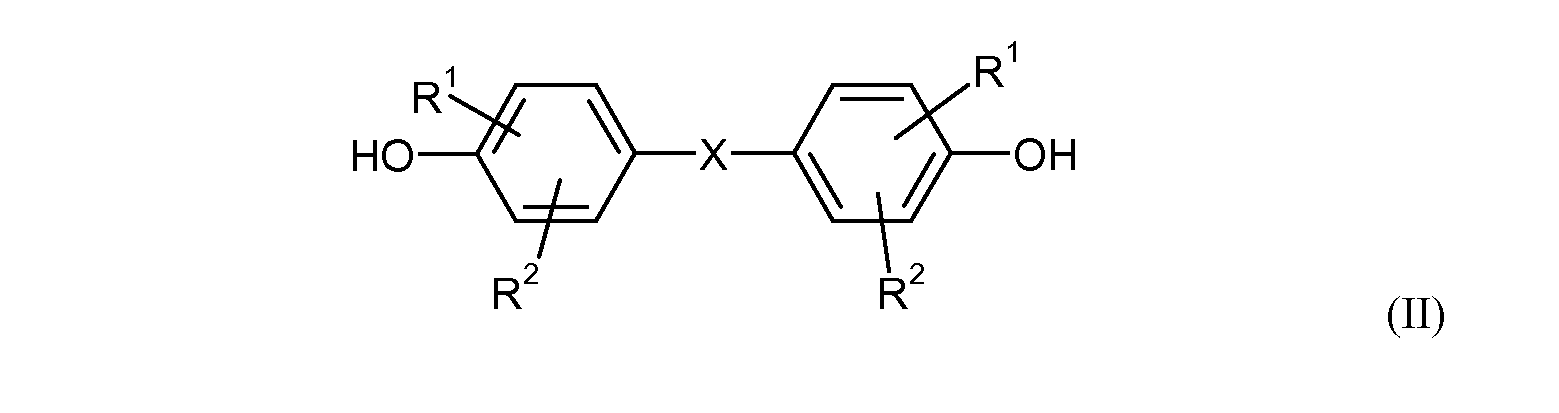
- R1 und R2
- unabhängig voneinander für H, C1-C18-Alkyl-, C1-C18-Alkoxy, Halogen wie Cl oder Br oder für jeweils gegebenenfalls substituiertes Aryl oder Aralkyl, bevorzugt für H oder C1-C12-Alkyl, besonders bevorzugt für H oder C1-C8-Alkyl und ganz besonders bevorzugt für H oder Methyl stehen, und
- X
- für eine Einfachbindung, -SO2-, -CO-, -O-, -S-, C1- bis C6-Alkylen, C2- bis C5-Akliden oder C5- bis C6- Cycloalkyliden, welches mit C1- bis C6-Alkyl, vorzugsweise Methyl oder Ethyl substituiert sein kann, ferner für C6- bis C12-Arylen, welches gegebenenfalls mit weiteren Heteroatome enthaltenden aromatischen Ringen kondensiert sein kann, steht.
- Bevorzugt steht X für eine Einfachbindung, C1 bis C5-Alkylen, C2 bis C5-Alkyliden, C 5 bis C6-Cycloalkyliden, -O-, -SO-, -CO-, -S-, -SO2-, oder für einen Rest der Formel (III)

- R3 und R4
- für jedes X1 individuell wählbar, unabhängig voneinander Wasserstoff oder C1 bis C6-Alkyl, vorzugsweise Wasserstoff, Methyl oder Ethyl bedeuten und
- X1
- Kohlenstoff und
- m
- eine ganze Zahl von 4 bis 7, bevorzugt 4 oder 5 bedeuten, mit der Maßgabe, dass an mindestens einem Atom X1, R3 und R4 gleichzeitig Alkyl sind.
- Für die Herstellung der erfindungsgemäßen Copolycarbonate wird als Diphenol abgeleitet von Forme 1 (II) bevorzugt Bisphenol A, 2,2-Bis-(3-methyl-4-hydroxyphenyl)-propan (Dimethyl-Bisphenol A), 1,1-Bis-(4-hydroxyphenyl)-3,3,5-trimethylcyclohexan (Bisphenol TMC) sowie 1,1-Bis-(3-methyl-4-hydroxyphenyl)-3,3,5-trimethylcyclohexan (Dimethyl TMC) eingesetzt.
- Für die Herstellung der erfindungsgemäß zu verwendenden Copolycarbonate geeignete Diphenole die der Struktureinheit nach Formel (II) zugrunde liegen sind beispielsweise Hydrochinon, Resorcin, Bis-(hydroxyphenyl)-alkane, Bis-(hydroxyphenyl)-sulfide, Bis-(hydroxyphenyl)-ether, Bis-(hydroxyphenyl)-ketone, Bis-(hydroxyphenyl)-sulfone, Bis-(hydroxyphenyl)-sulfoxide, α,α'-Bis-(hydroxyphenyl)-diisopropylbenzole, sowie deren alkylierte, kernalkylierte und kernhalogenierte Verbindungen.
- Bevorzugte Diphenole sind 4,4'-Dihydroxydiphenyl, 2,2-Bis-(4-hydroxyphenyl)-1-phenyl-propan, 1,1-Bis-(4-hydroxyphenyl)-phenyl-ethan, 2,2-Bis-(4-hydroxyphenyl)propan, 2,2-Bis-(3-methyl-4-hydroxyphenyl)-propan, 2,4-Bis-(4-hydroxyphenyl)-2-methylbutan, 1,3-Bis-[2-(4-hydroxyphenyl)-2-propyl]benzol (Bisphenol M), 2,2-Bis-(3-methyl-4-hydroxyphenyl)-propan, Bis-(3,5-dimethyl-4-hydroxyphenyl)-methan, 2,2-Bis-(3,5-dimethyl-4-hydroxyphenyl)-propan, Bis-(3,5-dimethyl-4-hydroxyphenyl)-sulfon, 2,4-Bis-(3,5-dimethyl-4-hydroxyphenyl)-2-methylbutan, 1,3-Bis-[2-(3,5-dimethyl-4-hydroxyphenyl)-2-propyl]-benzol, 1,1-Bis-(4-hydroxyphenyl)-3,3,5-trimethylcyclohexan, 2,2-Bis(4-hydroxyphenyl)-1-phenyl-1H-indol-3-on, 3,3-Bis(4-hydroxyphenyl)-1-phenyl-1H-indol-2-on.
- Ferner können Bisphenole der allgemeinen Formeln (IVa) und (IVb) (Isomerengemisch) (im Folgenden auch als Bisphenole der Formel (IV) bezeichnet) als weitere Diphenolverbindung verwendet werden.

- R5
- unabhängig voneinander für Wasserstoff oder C1-C10 Alkyl, bevorzugt für Wasserstoff oder C1-C6 Alkyl, besonders bevorzugt Wasserstoff oder C1-C4 Alkyl, ganz besonders bevorzugt für Wasserstoff oder Methyl steht
- R6
- für C1-C10 Alkyl, bevorzugt C1-C6 Alkyl, besonders bevorzugt C1-C4 Alkyl, jeweils gegebenenfalls substituiertes Phenyl oder Benzyl, insbesondere Methyl, Phenyl oder Benzyl steht, wobei als Substituenten für Phenyl und Benzyl die bei R1 genannten Reste bevorzugt sind.
- Alkyl im Sinne der vorliegenden Erfindung ist jeweils linear oder verzweigt.
- Besonders bevorzugt steht R6 für gegebenenfalls durch die in R5 genannten Reste substituiertes Phenyl, dargestellt durch die Formel (IVc) und (IVd) (Isomerengemisch).

R5 die oben genannte Bedeutung hat. - Ganz besonders bevorzugt ist das Bisphenol der Formel (IVe) und (IVf) (Isomerengemisch).

- Besonders bevorzugte Diphenole sind 2,2-Bis-(4-hydroxyphenyl)-propan (Bisphenol A), und 2,2-Bis-(3-methyl-4-hydroxyphenyl)-propan (Dimethyl Bisphenol A) bzw. Bisphenol TMC sowie die Bisphenole der Formel (IV).
- Ganz besonders bevorzugt sind Copolycarbonate aus dem erfindungsgemäßen Bisphenol (I) und Bisphenol A bzw. Bisphenol TMC bzw. Dimethyl Bisphenol A.
- Diese und weitere geeignete Diphenole sind kommerziell erhältlich und z.B. in "H. Schnell, Chemistry and Physics of Polycarbonates, Interscience Publishers, New York 1964, S. 28ff; S.102ff", und in "D.G. Legrand, J.T. Bendler, Handbook of Polycarbonate Science and Technology, Marcel Dekker New York 2000, S. 72ff." beschrieben.
- Das Bisphenol der Formel (I) kann sowohl allein als auch im Gemisch mit einem oder mehreren Bisphenolen der Formel (II) und / oder (IV) verwendet werden; unter Polycarbonaten im Sinne der vorliegenden Erfindung sind sowohl Homopolycarbonate als auch Copolycarbonate zu verstehen.
- Copolycarbonate enthalten im Allgemeinen neben einem Diphenol ausgewählt aus Verbindungen der Formel (I) bis zu 95 Mol-%, vorzugsweise bis zu 80 Mol-%, besonders bevorzugt bis 70 Mol-% mindestens ein weiteres Diphenol, ausgewählt aus Verbindungen der Formel (II) und / oder (IV) (bezogen auf die Summe der Mole eingesetzter Diphenole). Bevorzugt enthalten die Copolycarbonate als untere Grenze mindestens 5 Mol-%, insbesondere 10 Mol-% (bezogen auf die Summe der Mole eingesetzter Diphenole) ausgewählt aus Verbindungen der Formel (II) und / oder (IV). Besonders bevorzugte Copolycarbonate enthalten 40-60, insbesondere 45-55 Mol-% Diphenol der Formel (I) und 60-40, insbesondere 45-55 Mol-% Diphenol(e) der Formel (II) und / oder (IV) (bezogen auf die Summe der Mole eingesetzter Diphenole).
- Die erfindungsgemäßen thermoplastischen Polycarbonate und Copolycarbonate haben im Allgemeinen mittlere Molekulargewichte (Gewichtsmittel Mw, ermittelt durch Gelpermeationschromatographie GPC Messung mit Polycarbonat-Eichung) von 2 000 g/mol bis 200 000 g/mol, bevorzugt 3 000 g/mol bis 150 000 g/mol, insbesondere 5 000 g/mol bis 100 000 g/mol, ganz besonders bevorzugt 8 000 g/mol bis 80 000 g/mol, insbesondere 12 000 g/mol bis 70 000 g/mol. Molekulargewichte lassen sich auch durch die Zahlenmittel Mn angeben, welche ebenfalls nach vorheriger Eichung auf Polycarbonat mittels GPC bestimmt werden.
- Weiterer Gegenstand der Erfindung sind Blends enthaltend ein oder mehrere erfindungsgemäße (Co)Polycarbonate und ein oder mehrere thermoplastische Polymere.
- Als thermoplastisches Polymer wird bevorzugt wenigstens eines aus der Reihe Polycarbonat, Polyamid, Polyester, insbesondere Polybutylenterephthalat und Polyethylenterephthalat, Polylactid, Polyether, thermoplastisches Polyurethan, Polyacetal, Fluorpolymer, insbesondere Polyvinylidenfluorid, Polyethersulfone, Polyolefin, insbesondere Polyethylen und Polypropylen, Polyimid, Polyacrylat, insbesondere Poly(methyl)methacrylat, Polyphenylenoxid, Polyphenylensulfid, Polyetherketon, Polyaryletherketon, Styrolpolymerisate, insbesondere Polystyrol, Styrolcopolymere, insbesondere Styrolacrylnitrilcopolymer, Acrylnitrilbutadienstyrolblockcopolymere und Polyvinylchlorid eingesetzt.
- Besonders bevorzugt sind Polycarbonate als Blend-Partner.
- Die verwendeten Diphenole, wie auch alle anderen der Synthese zugesetzten Chemikalien und Hilfsstoffe, können mit den aus ihrer eigenen Synthese, Handhabung und Lagerung stammenden Verunreinigungen kontaminiert sein. Es ist jedoch wünschenswert, mit möglichst reinen Rohstoffen zu arbeiten.
- Zur Gewinnung hochmolekularer Polycarbonate nach dem Phasengrenzflächenverfahren werden im Zweiphasengemisch die Alkalisalze von Diphenolen mit Phosgen umgesetzt. Das Molekulargewicht kann durch die Menge an Monophenolen, die als Kettenabbrecher wirken, wie z. B. Phenol, tert.-Butylphenol oder Cumylphenol gesteuert werden, besonders bevorzugt Phenol, tert.-Butylphenol. Bei diesen Umsetzungen entstehen praktisch ausschließlich lineare Polymere. Dies kann durch Endgruppenanalyse nachgewiesen werden. Durch gezielte Verwendung von sogenannten Verzweigern, in der Regel mehrfach hydroxylierte Verbindungen, werden dabei auch verzweigte Polycarbonate erhalten.
- Die Menge an einzusetzenden Kettenabrecher beträgt 0,5 Mol-% bis 10 Mol-%, bevorzugt 1 Mol-% bis 8 Mol-%, besonders bevorzugt 2 Mol-% bis 6 Mol-% bezogen auf Mole an jeweils eingesetzten Diphenolen. Die Zugabe der Kettenabbrecher kann vor, während oder nach der Phosgenierung erfolgen, bevorzugt als Lösung in einem Lösungsmittelgemisch aus Methylenchlorid und Chlorbenzol (8-15 Gew.%-ig).
- Die Polycarbonate bzw. Copolycarbonate können auch verzweigt sein. Hierzu werden bestimmte geringe Mengen, vorzugsweise Mengen zwischen 0.05 und 5 mol-%, besonders bevorzugt 0,1 bis 3 mol-%, ganz besonders bevorzugt 0,1 bis 2 mol-%, bezogen auf die Mole eingesetzter Diphenole, an trifunktionellen Verbindungen wie z. B. Isatinbiskresol (IBK) oder Phloroglucin, 4,6-Dimethyl-2,4,6-tri-(4-hydroxyphenyl)-hepten-2; 4,6-Dimethyl-2,4,6-tri-(4-hydroxyphenyl)-heptan; 1,3,5-Tri-(4-hydroxyphenyl)-benzol; 1,1,1-Tri-(4-hydroxyphenyl)-e th an (THPE); Tri-(4-hydroxyphenyl)-phenylmethan; 2,2-Bis-[4,4-bis-(4-hydroxyphenyl)-cyclohexyl]-propan; 2,4-Bis-(4-hydroxyphenyl-isopropyl)-phenol; 2,6-Bis-(2-hydroxy-5'-methyl-benzyl)-4-methylphenol; 2-(4-Hydroxyphenyl)-2-(2,4-dihydroxyphenyl)-propan; Hexa-(4-(4-hydroxyphenyl-isopropyl)-phenyl)-orthoterephthal-säureester; Tetra-(4-hydroxyphenyl)-methan; Tetra-(4-(4-hydroxyphenyl-isopropyl)-phenoxy)-methan; α, α'.α"-Tris-(4-hydroxyphenyl)-1,3,5-triisopropylbenzol;2,4-Dihydroxybenzoesäure; Trimesinsäure; Cyanurchlorid; 3,3-Bis-(3-methyl-4-hydroxyphenyl)-2-oxo-2,3-dihydroindol; 1,4-Bis-(4',4"-dihydroxytriphenyl)-methyl)-benzol und insbesondere 1,1,1-Tri-(4-hydroxyphenyl)-ethan und Bis-(3-methyl-4-hydroxyphenyl)-2-oxo-2,3-dihydroindol als sogenannte Verzweiger, eingesetzt. Bevorzugt werden Isatinbiskresol sowie 1,1,1-Tri-(4-hydroxyphenyl)-ethan und Bis-(3-methyl-4-hydroxyphenyl)-2-oxo-2,3-dihydroindol als Verzweiger eingesetzt.
- Durch den Einsatz dieser Verzweiger ergeben sich verzweigte Strukturen. Die resultierende Langkettenverzweigung führt zu rheologischen Eigenschaften der erhaltenen Polycarbonate, die sich in einer Strukturviskosität im Vergleich zu linearen Typen äußert.
- Die vorliegende Erfindung betrifft weiterhin ein Verfahren zur Herstellung der erfindungsgemäßen Polycarbonate und Copolycarbonate, dadurch gekennzeichnet, dass Bisphenole und evtl. Verzweiger in wässriger alkalischer Lösung gelöst werden und mit einer gegebenenfalls in einem Lösemittel gelösten Carbonatquelle wie Phosgen in einem Zweiphasengemisch aus einer wässrigen alkalischen Lösung, einem organischen Lösemittel und einem Katalysator, bevorzugt einer Aminverbindung, zur Reaktion gebracht werden. Die Reaktionsführung kann auch mehrstufig erfolgen. Solche Verfahren zur Herstellung von Polycarbonat sind als Zweiphasengrenzflächenverfahren grundsätzlich z. B. aus H. Schnell, Chemistry and Physics of Polycarbonates, Polymer Reviews, Vol. 9, Interscience Publishers, New York 1964 S. 33 ff. und aus Polymer Reviews, Vol. 10, "Condensation Polymers by Interfacial and Solution Methods", Paul W. Morgan, Interscience Publishers, New York 1965, Kap. VIII, S. 325 bekannt und die grundlegenden Bedingungen daher dem Fachmann geläufig.
- Die Konzentration der Bisphenole in der wässrigen alkalischen Lösung beträgt dabei 2 bis 25 Gew.-%, bevorzugt 2 bis 20 Gew.-%, besonders bevorzugt 2 bis 18 Gew.-% und ganz besonders bevorzugt 3 bis 15 Gew.-%. Die wässrige alkalische Lösung besteht aus Wasser, in dem Hydroxide von Alkali- oder Erdalkalimetallen gelöst sind. Bevorzugt sind Natrium- und Kaliumhydroxide.
- Bei der Verwendung von Phosgen als Carbonatquelle beträgt das Volumenverhältnis wässrige alkalische Lösung zu organischem Lösemittel 5:95 bis 95:5, bevorzugt 20:80 bis 80:20, besonders bevorzugt 30:70 bis 70:30 und ganz besonders bevorzugt 40:60 bis 60:40. Das Molverhältnis Bisphenol zu Phosgen ist kleiner als 1:10, bevorzugt kleiner als 1:6, besonders bevorzugt kleiner als 1:4 und ganz besonders bevorzugt kleiner als 1:3. Die Konzentration der erfindungsgemäßen verzweigten Polycarbonate und Copolycarbonate in der organischen Phase beträgt 1,0 bis 25 Gew.-%, bevorzugt 2 bis 20 Gew.- %, besonders bevorzugt 2 bis 18 Gew.-% und ganz besonders bevorzugt 3 bis 15 Gew.-%.
- Die Konzentration der Aminverbindung beträgt bezogen auf die eingesetzte Bisphenolmenge 0,1 bis 10 mol-%, bevorzugt 0,2 bis 8 mol-%, besonders bevorzugt 0,3 bis 6 mol-% und ganz besonders bevorzugt 0,4 bis 5 mol-%.
- Unter Bisphenolen sind die o.g. Diphenole, mit Anteilen der oben genannten Verzweiger, zu verstehen. Bei der Carbonatquelle handelt es sich um Phosgen, Diphosgen oder Triphosgen, bevorzugt um Phosgen. Für den Fall, dass Phosgen eingesetzt wird, kann gegebenenfalls auf ein Lösemittel verzichtet und das Phosgen direkt in das Reaktionsgemisch eingeleitet werden.
- Als Katalysator können tertiäre Amine wie Triethylamin oder N-Alkylpiperidine eingesetzt werden. Als Katalysatoren geeignet sind Trialkylamine und 4-(Dimethylamino)pyridin. Besonders geeignet sind Triethylamin, Tripropylamin, Triisopropylamin, Tributylamin, Triisobutylamin, N-Methylpiperidin, N-Ethylpiperidin, und N-Propylpiperidin.
- Als organisches Lösemittel kommen halogenierte Kohlenwasserstoffe wie Methylenchlorid und/oder Chlorbenzol, Dichlorbenzol, Trichlorbenzol oder Gemische davon oder aromatische Kohlenwasserstoffe, wie z. B. Toluol oder Xylole in Frage.
- Die Reaktionstemperatur kann -5°C bis 100°C betragen, bevorzugt 0°C bis 80°C, besonders bevorzugt 10°C bis 70°C und ganz besonders bevorzugt 10°C bis 60°C betragen.
- Alternativ können die erfindungsgemäßen Polycarbonate auch nach dem Schmelzumesterungsverfahren hergestellt werden. Das Schmelzumesterungsverfahren ist beispielsweise in der Encyclopedia of Polymer Science, Vol. 10 (1969), Chemistry and Physics of Polycarbonates, Polymer Reviews, H. Schnell, Vol. 9, John Wiley and Sons, Inc. (1964) sowie der
DE-C 10 31 512 beschrieben. - Beim Schmelzumesterungsverfahren werden die bereits beim Phasengrenzflächenverfahren beschriebenen aromatischen Dihydroxyverbindungen, mit Kohlensäurediestern unter Zuhilfenahme von geeigneten Katalysatoren und gegebenenfalls weiteren Zusatzstoffen in der Schmelze umgeestert.
- Kohlensäurediester im Sinne der Erfindung sind solche der Formel (6) und (7)
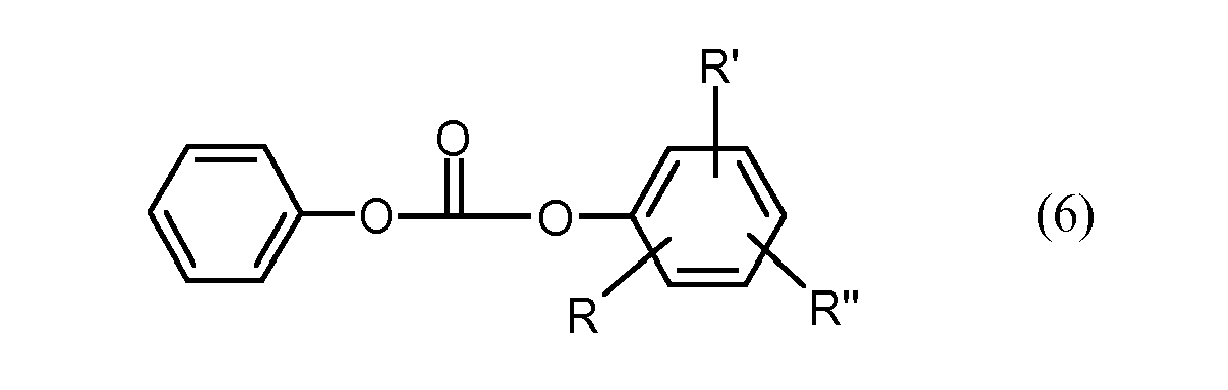

R, R' und R" unabhängig voneinander H, gegebenenfalls verzweigte C1-C34-Alkyl/Cycloakl, C7-C34-Alkaryl oder C6-C34-Aryl darstellen können,
beispielsweise
Diphenylcarbonat, Butylphenylphenylcarbonat, Di-Butylphenylcarbonat, Isobutylphenylphenylcarbonat, Di-Isobutylphenylcarbonat, tert-Butylphenyl-phenylcarbonat, Di-tert-Butylphenylcarbonat, n-Pentylphenyl-phenylcarbonat, Di-(n-Pentylphenyl)carbonat, n-Hexylphenylphenylcarbonat, Di-(n-Hexylphenyl)carbonat, Cyclohexylphenyl-p henylcarbonat, D i-Cyclohexylphenylcarbonat, Phenylphenolphenylcarbonat, Di-Phenylphenolcarbonat, Isooctylphenyl-phenylcarbonat, Di-Isooctylphenylcarbonat, n-Nonylphenyl-phenylcarbonat, Di-(n-Nonylphenyl)carbonat, Cumylphenylphenylcarbonat, Di-Cumylphenylcarbonat, Naphthylphenylphenylcarbonat, Di-Naphthylphenylcarbonat, Di-tert-Butylphenyl-phenylcarbonat, Di-(Di-tert-Butylphenyl)carbonat, Dicumylphenyl-phenylcarbonat, Di-(Dicumylphenyl)carbonat, 4-Phenoxyphenyl-phenylcarbonat, Di-(4-Phenoxyphenyl)carbonat, 3-Pentadecylphenyl-phenylcarbonat, Di-(3-Pentadecylphenyl)carbonat, Tritylphenyl-phenylcarbonat, Di-Tritylphenylcarbonat,
bevorzugt
Diphenylcarbonat, tert-Butylphenyl-phenylcarbonat, Di-tert-Butylphenylcarbonat, Phenylphenolphenylcarbonat, Di-Phenylphenolcarbonat, Cumylphenyl-phenylcarbonat, Di-Cumylphenylcarbonat,
besonders bevorzugt Diphenylcarbonat.
Es können auch Mischungen der genannten Kohlensäurediester eingesetzt werden. - Der Anteil an Kohlensäureester beträgt 100 bis 130 mol-%, bevorzugt 103 bis 120 mol-%, besonders bevorzugt 103 bis 109 mol-%, bezogen auf die Dihydroxyverbindung.
- Als Katalysatoren im Sinne der Erfindung werden im Schmelzumesterungsverfahren wie in der genannten Literatur beschrieben basische Katalysatoren wie beispielsweise Alkali- und Erdalkalihydroxide und -oxide aber auch Ammonium- oder Phosphoniumsalze, im Folgenden als Oniumsalze bezeichnet, eingesetzt. Bevorzugt werden dabei Oniumsalze, besonders bevorzugt Phosphoniumsalze eingesetzt. Phosphoniumsalze im Sinne der Erfindung sind solche der Formel (IV)

- R4-7
- dieselben oder verschiedene C1-C10-Alkyle, C6-C10-Aryle, C7-C10-Aralkyle oder C5-C6-Cycloalkyle sein können, bevorzugt Methyl oder C6-C14-Aryle, besonders bevorzugt Methyl oder Phenyl, und
- X-
- ein Anion wie Hydroxid, Sulfat, Hydrogensulfat, Hydrogencarbonat, Carbonat, ein Halogenid, bevorzugt Chlorid, oder ein Alkoholat der Formel OR sein kann, wobei R C6-C14-Aryl oder C7-C12-Aralkyl, bevorzugt Phenyl, sein kann. Bevorzugte Katalysatoren sind
- Tetraphenylphosphoniumchlorid, Tetraphenylphosphoniumhydroxid, Tetraphenylphosphoniumphenolat, besonders bevorzugt Tetraphenylphosphoniumphenolat.
- Die Katalysatoren werden bevorzugt in Mengen von 10-8 bis 10-3 mol, bezogen auf ein mol Bisphenol, besonders bevorzugt in Mengen von 10-7 bis 10-4 mol, eingesetzt.
- Weitere Katalysatoren können allein oder gegebenenfalls zusätzlich zu dem Oniumsalz verwendet werden, um die Geschwindigkeit der Polymerisation zu erhöhen. Dazu gehören Salze von Alkalimetallen und Erdalkalimetallen, wie Hydroxide, Alkoxide und Aryloxide von Lithium, Natrium und Kalium, vorzugsweise Hydroxid-, Alkoxid- oder Aryloxidsalze von Natrium. Am meisten bevorzugt sind Natriumhydroxid und Natriumphenolat. Die Mengen des Cokatalysators können im Bereich von 1 bis 200 ppb, vorzugsweise 5 bis 150 ppb und am meisten bevorzugt 10 bis 125 ppb liegen, jeweils berechnet als Natrium.
- Die Umesterungsreaktion der aromatischen Dihydroxyverbindung und des Kohlensäurediester in der Schmelze wird bevorzugt in zwei Stufen durchgeführt. In der ersten Stufe findet das Aufschmelzen der aromatischen Dihydroxyverbindung und des Kohlensäurediester bei Temperaturen von 80 bis 250°C, bevorzugt 100 bis 230°C, besonders bevorzugt 120 bis 190°C unter normalem Druck in 0 bis 5 Stunden, bevorzugt 0,25 bis 3 Stunden statt. Nach Zugabe des Katalysators wird durch Anlegen von Vakuum (bis zu 2 mm Hg) und Erhöhung der Temperatur (auf bis zu 260°C) durch Abdestillieren des Monophenols das Oligocarbonat aus der aromatischen Dihydroxyverbindung und dem Kohlensäurediester hergestellt. Hierbei fällt die Hauptmenge an Brüden aus dem Prozess an. Das so hergestellte Oligocarbonat hat eine mittlere Gewichtsmolmasse Mw (ermittelt durch Messung der relativen Lösungsviskosität in Dichlormethan oder in Mischungen gleicher Gewichtsmengen Phenol/o-Dichlorbenzol geeicht durch Lichtstreuung) im Bereich von 2000 g/mol bis 18 000 g/mol, bevorzugt von 4 000 g/mol bis 15 000 g/mol.
- In der zweiten Stufe wird bei der Polykondensation durch weiteres Erhöhen der Temperatur auf 250 bis 320°C, bevorzugt 270 bis 295°C, und einem Druck von <2 mm Hg das Polycarbonat hergestellt. Hierbei wird der Rest an Brüden aus dem Prozess entfernt.
- Die Katalysatoren können auch in Kombination (zwei oder mehrere) miteinander eingesetzt werden.
- Beim Einsatz von Alkali-/Erdalkalimetallkatalysatoren kann es vorteilhaft sein, die Alkali-/ Erdalkalimetallkatalysatoren zu einem späteren Zeitpunkt (z. B. nach der Oligocarbonatsynthese bei der Polykondensation in der zweiten Stufe) zuzusetzen.
- Die Reaktion der aromatischen Dihydroxyverbindung und des Kohlensäurediester zum Polycarbonat kann im Sinne des erfindungsgemäßen Verfahrens diskontinuierlich oder bevorzugt kontinuierlich durchgeführt werden, beispielsweise in Rührkesseln, Dünnschichtverdampfern, Fallfilmverdampfern, Rührkesselkaskaden, Extrudern, Knetern, einfachen Scheibenreaktoren und Hochviskos-Scheibenreaktoren.
- Analog des Phasengrenzflächenverfahrens können durch Einsatz mehrfunktioneller Verbindungen verzweigte Poly- oder Copolycarbonate hergestellt werden.
- Bevorzugt, besonders bevorzugt oder ganz besonders bevorzugt sind Ausführungsformen, welche von den unter bevorzugt, besonders bevorzugt oder ganz besonders bevorzugt bzw., vorzugsweise etc. genannten Parametern, Verbindungen, Definitionen und Erläuterungen Gebrauch machen.
- Die in der Beschreibung aufgeführten allgemeinen oder in Vorzugsbereichen aufgeführten Definitionen, Parameter, Verbindungen und Erläuterungen können jedoch auch untereinander, also zwischen den jeweiligen Bereichen und Vorzugsbereichen beliebig kombiniert werden.
- Die erfindungsgemäßen Polycarbonate und Copolycarbonate können in bekannter Weise aufgearbeitet und zu beliebigen Formkörpern verarbeitet werden, beispielsweise durch Extrusion, Spritzguss oder Extrusionsblasformen.
- Den erfindungsgemäßen Polycarbonaten und Copolycarbonaten können noch andere aromatische Polycarbonate und/oder andere aromatische Polyestercarbonate und/oder andere aromatische Polyester in bekannter Weise zugemischt werden, beispielsweise durch Compoundierung.
- Die Zusammensetzung kann weitere handelsübliche Polymeradditive wie Flammschutzmittel, Flammschutzsynergisten, Antidrippingmittel (beispielsweise Verbindungen der Substanzklassen der fluorierten Polyolefine, der Silikone sowie Aramidfasern), Gleit- und Entformungsmittel (beispielsweise Pentaerythrittetrastearat), Nukleiermittel, Stabilisatoren, Antistatika (beispielsweise Leitruße, Carbonfasern, Carbon Nanotubes sowie organische Antistatika wie Polyalkylenether, Alkylsulfonate oder Polyamid-haltige Polymere), sowie Farbstoffe und Pigmente in solchen Mengen enthalten, die die mechanischen Eigenschaften der Zusammensetzung nicht insoweit schädigen, dass das Zieleigenschaftsprofil (kein splitterndes Bruchversagen bei -10°C) nicht mehr erfüllt wird.
- Als Flammschutzmittel werden vorzugsweise Sulfonsäuresalze wie Kaliumperfluorbutansulfonsäure ooder Kaliumdiphenylsulfonsulfonat, bromierte Oligobisphenole, PTFE oder PTFE-Compounds sowie phosphorhaltige Flammschutzmittel eingesetzt, insbesondere ausgewählt aus den Gruppen der mono- und oligomeren Phosphor- und Phosphonsäureester, Phosphonatamine und Phosphazene, wobei auch Mischungen von mehreren Komponenten ausgewählt aus einer oder verschiedener dieser Gruppen als Flammschutzmittel zum Einsatz kommen können. Auch andere hier nicht speziell erwähnte, vorzugsweise halogenfreie Phosphorverbindungen können alleine oder in beliebiger Kombination mit anderen, vorzugsweise halogenfreien Phosphorverbindungen eingesetzt werden. Beispielsweise sind als Phosphorverbindungen geeignet: Tributylphosphat, Triphenylphosphat, Trikresylphosphat, Diphenylkresylphosphat, Diphenyloctylphosphat, Diphenyl-2-ethylkresylphosphat, Tri-(isopropylphenyl)-phosphat, Resorcin-verbrücktes Di- bzw. Oligophosphat und Bisphenol A verbrücktes Di- bzw. Oligophosphat. Der Einsatz von oligomeren Phosphorsäureestern, die sich vom Bisphenol A ableiten, ist insbesondere bevorzugt. Als Flammschutzmittel geeignete Phosphorverbindungen sind bekannt (vgl. z.B.
EP-A 0 363 608 ,EP-A 0 640 655 ) oder lassen sich nach bekannten Methoden in analoger Weise herstellen (z.B. Ullmanns Enzyklopädie der technischen Chemie, Bd. 18, S. 301 ff. 1979; Houben-Weyl, Methoden der organischen Chemie, Bd. 12/1, S. 43; Beilstein Bd. 6, S. 177). - Der Zusatz von Additiven dient der Verlängerung der Nutzungsdauer oder der Farbe (Stabilisatoren), der Vereinfachung der Verarbeitung (z.B. Entformer, Fließhilfsmittel, Antistatika) oder der Anpassung der Polymereigenschaften an bestimmte Belastungen (Schlagzähmodifikatoren, wie Kautschuke; Flammschutzmittel, Farbmittel, Glasfasern).
- Diese Additive können einzeln oder in beliebigen Mischungen oder mehreren verschiedenen Mischungen der Polymerschmelze zugesetzt werden und zwar direkt bei der Isolierung des Polymeren oder aber nach Aufschmelzung von Granulat in einem sogenannten Compoundierungsschritt. Dabei können die Additive beziehungsweise deren Mischungen als Feststoff, also als Pulver, oder als Schmelze der Polymerschmelze zugesetzt werden. Eine andere Art der Dosierung ist die Verwendung von Masterbatches oder Mischungen von Masterbatches der Additive oder Additivmischungen.
- Geeignete Additive sind beispielsweise beschrieben in "Additives for Plastics Handbook, John Murphy, Elsevier, Oxford 1999", im "Plastics Additives Handbook, Hans Zweifel, Hanser, München 2001" oder in
WO 99/55772 - Als Thermostabilisator eignen sich bevorzugt Tris-(2,4-di-tert-butylphenyl)phosphit (Irgafos 168), Tetrakis(2,4-di-tert.-butylphenyl)[1,1-biphenyl]-4,4'-diylbisphosphonit, Triisoctylphosphat, Octadecyl-3-(3,5-di-tert-butyl-4-hydroxyphenyl)propionat (Irganox 1076 von BASF), Bis(2,4-dicumyl-phenyl)pentaerythritoldiphosphit (Doverphos S-9228-PC), Bis(2,6-di-tert.-butyl-4-methylphenyl)-pentaerythritoldiphosphit (ADK STAB PEP-36) oder Triphenylphosphin. Sie werden allein oder im Gemisch (z. B. Irganox B900 von BASF oder Doverphos S-9228-PC mit Irganox B900 bzw. Irganox 1076) eingesetzt.
- Als UV-Stabilisatoren sind organische UV-Stabilisatoren geeignet. Die UV-Stabilisatoren sind bevorzugt ausgewählt aus der Gruppe, die Benzotriazole (z. B. Tinuvine der Fa. Ciba), Triazine CGX-06 der Fa. Ciba), Benzophenone (Uvinule der Fa. BASF), Cyanacrylate (Uvinule der Fa. BASF), Zimtsäureester und Oxalanilide sowie Mischungen dieser UV-Stabilisatoren umfaßt.
- Beispiele für geeignete UV-Absorber sind:
- a) Malonester der Formel (I):

- b) Benzotriazol-Derivate nach Formel (II):

Bevorzugt sind dabei Tinuvin® 329 mit X = 1,1,3,3-Tetramethylbutyl und R° = H, Tinuvin® 350 mit X = tert-Butyl und R0 = 2-Butyl und Tinuvin® 234 mit X und R° = 1,1-Dimethyl-1-phenyl - c) Dimere Benzotriazol-Derivate nach Formel (III):

In Formel (III) sind R3 und R4 ebenfalls gleich oder verschieden und bedeuten H, C1-C 4-Alkyl, C5-C6 -Cycloalkyl, Benzyl oder C6-C14-Aryl.
In Formel (III) bedeuten m 1,2 oder 3 und n 1,2,3 oder 4.
Bevorzugt ist dabei Tinuvin® 360 mit R1 = R3 = R4 = H; n = 4; R2 = 1,1,3,3-Tetramethylbutyl;
m = 1 - d) Dimere Benzotriazol-Derivate nach Formel (IV):


Bevorzugt sind dabei Tinuvin® 840 mit R1 = H; n = 4; R2 = tert-Butyl; m = 1; R2 ist in ortho-Stellung zur OH-Gruppe angebracht; R3 = R4 = H; p = 2; Y = -(CH2)5-; q = 1 - e) Triazin-Derivate nach Formel (V):
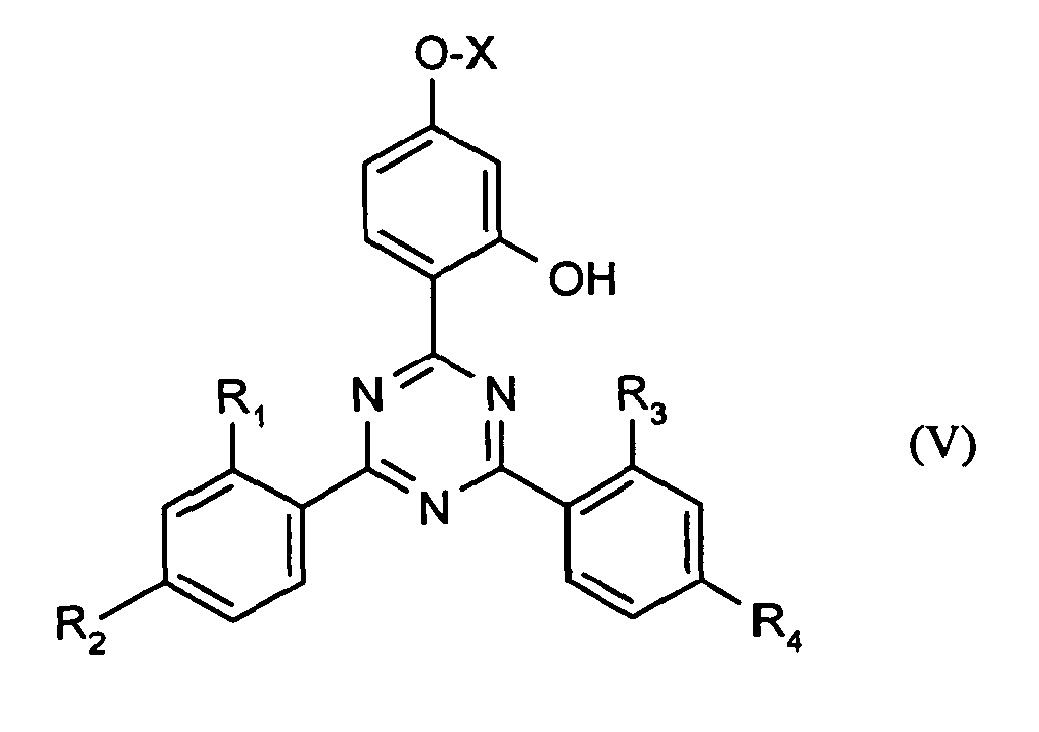
Bevorzugt ist dabei Tinuvin® 1577 mit R1 = R2 = R3 = R4 = H; X = Hexyl sowie Cyasorb® UV-1 164 mit R1 = R2 = R3 = R4 = Methyl; X Octyl - f) Triazin-Derivate der folgenden Formel (Va):

- g) Dimere Triazin-Derivate der Formel (VI):

- h) Diarylcyanoacrylate der Formel (VII):

Bevorzugt ist dabei Uvinul® 3030 mit R1 bis R40 = H. - Besonders bevorzugte UV-Stabilisatoren für die erfindungsgemäßen Formmassen sind Verbindungen aus der Gruppe, die aus den Benzotriazolen (b) und dimeren Benzotriazolen (c und d), den Malonestern (a) und den Cyanacrylaten (h) sowie Mischungen dieser Verbindungen besteht.
- Die UV-Stabilisatoren werden eingesetzt in Mengen von 0,01 Gew.-% bis 15,00 Gew.-% bezogen auf die Formmasse, bevorzugt in Mengen von 0,05 Gew.-% bis 1,00 Gew.-%, besonders bevorzugt in Mengen von 0,08 Gew.-% bis 0,5 Gew.-% und ganz besonders bevorzugt in Mengen von 0,1 Gew.-% bis 0,4 Gew.-% bezogen auf die Gesamtzusammensetzung.
- Die den erfindungsgemäßen Zusammensetzungen gegebenenfalls zugesetzten Entformungsmittel sind bevorzugt ausgewählt aus der Gruppe, die Pentaerythrittetrastearat, Glycerinmonostearat, Stearylstearat und Propoandiolstearat sowie deren Mischungen umfaßt. Die Entformungsmittel werden eingesetzt in Mengen von 0,05 Gew.-% bis 2,00 Gew.-% bezogen auf die Formmasse, bevorzugt in Mengen von 0,1 Gew.-% bis 1,0 Gew.-%, besonders bevorzugt in Mengen von 0,15 Gew.-% bis 0,60 Gew.-% und ganz besonders bevorzugt in Mengen von 0,2 Gew.-% bis 0,5 Gew.-% bezogen auf die Gesamtzusammensetzung.
- Des weiteren können Farbmittel, wie organische Farbstoffe oder Pigmente oder anorganische Pigmente, Ruß, IR-Absorber, einzeln, im Gemisch oder auch in Kombination mit Stabilisatoren, Glasfasern, Glas(hohl)kugeln, anorganischen Füllstoffen oder organische oder anorganische Streupigmente zugesetzt werden.
- Gegenstand der Erfindung sind ebenfalls Verfahren zur Herstellung der Formmassen und die Verwendung der Formmassen zur Herstellung von Formkörpern.
- Die erfindungsgemäßen Formmassen können zur Herstellung von Formkörpern jeder Art verwendet werden. Diese können zum Beispiel durch Spritzguss, Extrusion und Blasformverfahren hergestellt werden. Eine weitere Form der Verarbeitung ist die Herstellung von Formkörpern durch Tiefziehen aus zuvor hergestellten Platten oder Folien.
- Die erfindungsgemäßen (Co)polycarbonate und (Co)polycarbonat-Zusammensetzungen können auf üblichen Maschinen, beispielsweise auf Extrudern oder Spritzgussmaschinen, zu beliebigen Formkörpern bzw. Formteilen, zu Folien und Folienlaminate oder Platten oder Flaschen, in üblicher Weise verarbeitet werden.
- Die Compoundierung der einzelnen Bestandteile kann in bekannter Weise sowohl sukzessive als auch simultan erfolgen.
- Die so erhältlichen (Co)polycarbonate können zur Herstellung von Extrudaten (Platten, Folien und deren Laminate; z. B. für Kartenanwendungen oder Foliensubstrate für Displays wie LCDs und Rohre) und Formkörpern (Flaschen), insbesondere solchen zur Verwendung im transparenten Bereich, besonders im Bereich optischer Anwendungen wie z.B. Platten, Stegplatten, Verglasungen, Streu- oder Abdeckscheiben, Lampenabdeckungen, Kunststoffabdeckscheiben, Lichtleitelemente sowie LED-Anwendungen verwendet werden. Weiterhin können sie zur Herstellung von Gegenständen für den E/E und IT-Bereich verwendet werden.
- Ferner sind Spritzgusskörper bestehend aus dem erfindungsgemäßen Substratmaterial und einer Metallschicht, bevorzugt eine Aluminiumschicht, bevorzugt in einer Dicke von 20 - 500 nm insbesondere bevorzugt in einer Dicke von 40 - 300 nm Gegenstand der Erfindung.
- Die Metallschicht wird beispielsweise mit Hilfe von Electro-Coating Deposition (ECD), Physical Vapor Deposition (PVD) oder Chemical Vapor Deposition (CVD) oder einer geeigneten Kombination dieser Verfahren auf den thermoplastischen Kunststoff aufgebracht. Verfahren zur Metallisierung von Polymerwerkstoffen sind in der Literatur bekannt.
- In einer besonderen Ausführungsform ist auf der Metallschicht noch eine Schutzschicht, beispielsweise zum Korrosionsschutz aufgetragen. Die korrosionsmindernde Schutzschicht kann in einem PECVD (plasma enhanced chemical vapour deposition) oder Plasmapolymerisationsprozess aufgebracht werden. Hierbei werden niedrigsiedende Precursoren haupsächlich auf Siloxan Basis in ein Plasma verdampft und dadurch aktiviert, so dass sie einen Film bilden können. Typsiche Substanzen hierbei sind Hexamethyldisiloxan (HMDSO), Hexamethyldisilazan (HMDS), Tetrametyldisiloxan, Decamethylcyclopentasiloxan, Octamethylcyclotetrasiloxan und Trimethoximethylsilan. Besonders bevorzugt ist HMDSO.
- In einer weiteren besonderen Ausführungsform kann das Substrat vor der Metallisierung einer geeigneten Vorbehandlung unterzogen werden, wie z. B. eine Plasmavorbehandlung, mit dem Ziel, die Substratoberfläche zu aktivieren oder zu reinigen.
- Die (Co)polycarbonat-Zusammensetzungen werden insbesondere zur Herstellung von Compounds, Blends und Bauteilen verwendet, bei denen optische, thermische und mechanische Eigenschaften genutzt werden, wie beispielsweise Gehäuse, Gegenstände im E/E-Bereich, wie Stecker, Schalter, Platten, Lampenhalterungen, -abdeckungen, Automobilbereich wie Lampenfassungen und - abdeckungen, Verscheibungen, Linsen, Kollimatoren, Leuchtdioden oder diffusor sheets für Displays und andere Anwendungen.
- Die erfindungsgemäßen Polycarbonate und Copolycarbonate, gegebenenfalls in Abmischung mit anderen Thermoplasten wie beispielsweise Pfropfpolymerisate auf Basis Acrylnitril/-Butadien/- Styrol oder auf Acrylatkautschuk basierende Pfropfcopolymerisate (siehe beispielsweise die in
EP-A 640 655 - 1. Sicherheitsscheiben, die bekanntlich in vielen Bereichen von Gebäuden, Fahrzeugen und Flugzeugen erforderlich sind, sowie als Schilde von Helmen.
- 2. Herstellung von Folien und Folienlaminaten.
- 3. Automobilscheinwerfer, bezels, Blinker, Reflektoren
- 4. Als transluzente Kunststoffe mit einem Gehalt an Glasfasern für lichttechnische Zwecke, als transluzente Kunststoffe mit einem Gehalt an Bariumsulfat, Titandioxid und/oder Zirkoniumoxid
- 5. Zur Herstellung von Präzisionsspritzgussteilen, wie beispielsweise Linsen, Kollimatoren, Linsenhalterungen, Lichtleitelementen und LED-Anwendungen.
- 6. Als Elektroisolierstoffe für elektrische Leiter und für Steckergehäuse sowie Steckverbinder
- 7. Gehäuse für elektrische Geräte
- 8. Schutzbrillen, Visiere
- 9. Extrudierte Formkörper wie Platten und Folien
- 10. LED-Anwendungen (Sockel, Reflektoren, heat sinks),
- Die Formkörper bzw. Formteile und Extrudate aus den erfindungsgemäßen Polymeren sind ebenfalls Gegenstand dieser Anmeldung.
- Die folgenden Beispiele dienen der weiteren Erläuterung der Erfindung.
- Die Copolycarbonate wurden mittels Vicat-Temperatur und der relativen Lösungsviskosität ηrel charakterisiert. Weiterhin wurden die Copolycarbonate bezüglich deren thermischer Längenausdehnungskoeffizienten untersucht.
- Die Vicat-Temperatur VST B50 wird nach DIN ISO 306, Methode B bei einer Heizlast von 50 K/h ermittelt. Die relative Lösungsviskosität wurde in Methylenchlorid als Lösungsmittel bei einer Konzentration von 0,5 g/l und bei einer Temperatur von 25°C mit einem Ubbelohde-Viskosimeter bestimmt (DIN 51562).
-
- Die Längenausdehnungskoeffizienten werden mittels eines Mettler TMA 841-Messgerätes unter Stickstoff ermittelt (Meßbereich 23 - 55°C). Als Norm kommt die ASTM E 831 zur Anwendung.
- Die für die Messung benötigten Probekörper (Flachstab 80 x 10 x 4 mm) werden nach Trockung des Granulates bei 130 °C über Nacht durch Spritzguß hergestellt. Gemessen wird jeweils quer und
- längs des Probekörpers.
- Die Synthese des erfindungsgemäßen Monomerbausteins erfolgt nach
Fig. 1 . - In einem Planschliffreaktor wird eine Lösung aus 2 kg (20,2 mol) N-Methylpyrrolidon (NMP) und 1273,3 g (4 mol) Phenolphtalein vorgelegt. Unter Rühren werden 2 Liter Wasser und anschließend 18 mol einer 40 %-igen wässrigen Methylaminlösung zugegeben. Bei Zugabe des Methylamins verfärbt sich die Reaktionslösung violett. Unter Nutzung eines Trockeneiskühlers wird danach für 8 Stunden bei 82 °C nachgerührt. Die Färbung des Reaktionsansatzes verändert sich dabei dunkelgelblich. Nach Reaktionsende fällt man den Reaktionsansatz mittels eines Tropftrichters unter Rühren in eine salzsaure Wasservorlage.
- Das weiß ausgefallene Reaktionsprodukt wird mit 2 Liter Wasser aufgeschlämt und anschließend mittels einer G3-Fritte abgesaugt. Das erhaltene Rohprodukt wird in 3,5 Liter einer verdünnten Natronlauge (16 mol) wieder gelöst und wiederum in einer salzsauren Wasservorlage ausgefällt. Das umgefällte Rohprodukt wird mehrmals mit 2 Liter Wasser aufgeschlämt und danach jeweils abgesaugt. Diese Waschprozedur wird so lange wiederholt, bis die Leitfähigkeit des Waschwassers kleiner 15 µS ist.
- Das so erhaltene Produkt wird bei 90 °C im Vakuumtrockenschrank bis zur Massenkonstanz getrocknet.
- Man erhielt nach 4-maliger Experimentdurchführung jeweils folgende Ausbeuten:
- 1a) 950 g eines weißen Feststoffes
- 1b) 890 g eines weißen Feststoffes
- 1c) 1120 g eines weißen Feststoffes
- 1d) 1050 g eines weißen Feststoffes
- Die Schmelzpunktbestimmung des Produktes ergab 264 °C.
- Die Charakterisierung des erhaltenen Bisphenols erfolgte mittels 1H-NMR-Spektroskopie.
-
- Zu einer mit Stickstoff inertisierten Lösung von 532,01 g (1,6055 mol) Bisphenol A (BPA), 2601,36 g (11,39 mol) Bisphenol aus Beispiel 1, 93,74 g (0,624 mol, 4,8 mol-% bzgl. Diphenole) p-tert.-Butylphenol (BUP) als Kettenabbrecher und 1196 g (29,9 mol) Natriumhydroxid in 25,9 Liter Wasser werden 11,79 Liter Methylenchlorid und 14,1 Liter Chlorbenzol hinzugegeben. Bei einem pH-Wert von 12,5 - 13,5 und 20 °C leitet man 2,057 kg (20,8 mol) Phosgen ein. Um den pH-Wert nicht unter 12,5 fallen zu lassen, wurde während der Phosgenierung 30 %-ige Natronlauge zugegeben. Nach beendeter Phosgenierung und Spülung mit Stickstoff rührt man für weitere 30 Minuten und gibt dann 14,7 g (0,13 mol, 1 mol-% bzgl. Diphenole) N-Ethylpiperidin als Katalysator zu und lässt 1 Stunde nachrühren. Die organische Phase wird nach Abtrennen der wässrigen Phase und Ansäuern mit Phosphorsäure mittels eines Separators mehrmals mit Wasser salzfrei gewaschen.
- Die organische Phase wird abgetrennt und einem Lösungsmittelaustausch Chlorbenzol gegen Methylenchlorid unterworfen. Die aufkonzentrierte Copolycarbonatlösung in Chlorbenzol wird anschließend mit Hilfe eines Ausdampfextruders vom Lösungsmittel befreit. Die erhaltenen Polycarbonatschmelzestränge werden in einem Wasserbad gekühlt, abgezogen und abschließend granuliert.
- Man erhält transparentes Polycarbonatgranulat (Analytik siehe Tabelle 1).
-
- Die Copolycarbonate der Beispiele 3 bis 5 wurden analog Beispiel 2 hergestellt (Ergebnisse s. Tabelle 1).
- Als Vergleichsproben werden Apec®-Proben (Bayer MaterialScience AG, Deutschland) mit den in Tabelle 2 angegebenen Vicat-Temperaturen verwendet. Diese stellen den nächstgelegenen Stand der Technik für Polycarbonate bei Hochtemperaturanwendungen dar.
Tabelle 2: Vergleichsbeispiele 6 7 8 9 Vicat-Temperatur [°C] 158 173 183 203 Glastemperatur Tg [°C] 157,2 169,9 179,3 204 Ausdehnungskoeffzient quer [10-6/K] 68,0 68,0 66,0 66,0 Ausdehnungskoeffzient längs [10-6/K] 67,0 67,0 67,0 64,0 Erfindungsgemäße Probe aus Beispiel 2 3 4 5 Vicat-Temperatur [°C] 168,6 177,4 188,3 228,2 Ausdehnungskoeffzient quer [10-6/K] 65,0 63,4 63,4 59,7 Ausdehnungskoeffzient längs [10-6/K] 63,1 64,0 62,8 59,4 - Im Vergleich mit den Vergleichsproben 6 - 9 stellt man fest, dass die erfindungsgemäßen Copolycarbonate aus den Beispielen 2 - 5 bei vergleichbaren Vicat-Temperaturen signifikant niedrigere Werte für den thermischen Ausdehnungskoeffizienten aufweisen. Dies war für den Fachmann nicht zu erwarten. Insbesondere das Copolycarbonat aus Beispiel 5 zeigt mit einer Vicat-Temperatur von 228,2 °C die geforderten Anforderungen an Reflektormaterialien bezüglich thermischer Stabilität und reduziertem Ausdehnungskoeffizienten.
- Die rheologischen Eigenschaften wurden über die Schmelze-Volumenfließrate (MVR) nach ISO 1133 bestimmt.
- Die mechanischen Eigenschaften wurden über Zug-Modul, Streckspannung, Streckdehnung und nominelle Bruchdehnung nach ISO 527-1, -2, Charpy-Schlagzähigkeit nach ISO 179-1 eU und Charpy-Kerbschlagzähigkeit nach ISO 179-1 eA bestimmt.
- Die thermischen Eigenschaften wurden über Formbeständigkeitstemperatur HDT (A und B) nach ISO 75-1, -2 und über die Vicat-Erweichungstemperatur nach ISO 306 ermittelt.
- In der Tabelle 3 ist eine Gesamtübersicht über alle thermischen und mechanischen Eigenschaften der erfindungsgemäßen Copolycarbonate im Vergleich zu Vergleichsproben mit ähnlicher Vicat-Temperatur aufgeführt. Man kann erkennen, dass die mechanischen Eigenschaften der erfindungsgemäßen Materialien aus Beispiel 2 - 5 keine Verschlechterung gegenüber den erfindungsgemäßen Vergleichsproben 1 - 4 aufweisen. Wie oben in Tabelle 2 gezeigt, weisen sie allerdings den Vorteil von kleineren linearen thermischen Ausdehungskoeffizieneten auf.
- Außerdem zeigen die erfindungsgemäßen Proben ein besseres Fließverhalten im Vergleich zu nicht erfindungsgemäßen Proben mit gleicher Vicat-Temperatur (siehe Beispiele 2 und 6 bzw. 3 und 7).
Tabelle 3 Vergleichsproben Erfindungsgemäße Proben 6 7 8 9 2 3 4 5 Mn 10150 10544 9977 11456 9092 10004 9629 10328 Mw 25370 26253 26424 29061 22291 23228 24153 24257 D 2,50 2,49 2,65 2,59 2,45 2,32 2,51 2,35 Eta rel 1,257 1,253 1,249 1,248 1,238 1,238 1,241 1,235 1. Messung - 2. Aufheizen °C 156,7 169,9 180,8 204 168,6 178,5 190,1 230,1 2. Messung - 2. Aufheizen °C 157,7 169,9 177,8 204 168,8 179,2 189,6 229,9 Durchschnitts-Temperatur °C 157,2 169,9 179,3 204,0 168,7 178,9 189,9 230,0 Schmelze-Volumenfließrate (MVR) (330 °C; 2,16 kg) cm3/ (10 min) 45 24 18 8 46,0 31,0 17,2 2,2 Zug-Modul (1 mm/min) MPa 2400 2400 2400 2400 2407 2487 2532 2774 Streckspannung (50 mm/min) MPa 68 72 74 76 70,6 73,8 77,7 92,5 Streckdehnung (50 mm/min) % 6,2 6,4 6,8 6,9 6,6 6,8 7,1 7,7 Nominelle Bruchdehnung (50mm/min) % 96 89 89 57 78 77 61 15 Z kJ/m2 - - - - - - - - Charpy-Schlagzähigkeit (23°C) S - - - - - - - - N 10 x NB 10 x NB 10 x NB 10 x NB 10 x NB 10 x NB 10x NB 10xNB Z kJ/m2 - - - - - - - - Charpy-Schlagzähigkeit (-20°C) S - - - - - - - - N 10 x NB 10 x NB 10 x NB 10 x NB 10 x NB 10 x NB 10 x NB 10 x NB Charpy-Kerbschlagzähigkeit (23 °C; 3,0 mm) kJ/m2 10 x 13b 10 x 12b 10 x 10b 10 x 8b 10 x 16b 10 x 17b 10 x 16b 10 x 17b Formbeständigkeitstemperatur HDT, Af (1,80 MPa) °C 138 149 158 173 144,9 154,1 164,1 201,6 Formbeständigkeitstemperatur HDT, Bf (0,45 MPa) °C 150 163 173 192 158,9 167,8 178,6 218,1 Vicat-Erweichungstemperatur (50 N, 120 K/h) °C 158 173 183 203 168,6 177,4 188,3 228,2 Z: zäh S: spröde N: nicht gebrochen NB: not broken (nicht gebrochen) b: brittle (spröde)
| Copolycarbonat aus | Beispiel 5 | Beispiel 4 | Beispiel 3 | Beispiel 2 |
| Bisphenol aus Beispiel 1 | ||||
| [mol-%] | 55,5 | 25,0 | 18,0 | 12,4 |
| [Gew.-%] | 62,2 | 32,6 | 24,2 | 17,0 |
| Bisphenol A (BPA) | ||||
| [mol-%] | 44,5 | 75 | 82 | 87,6 |
| [Gew.-%] | 37,8 | 67,4 | 75,8 | 83 |
| Vicat-temperatur [°C] | 228,2 | 188,3 | 177,4 | 168,6 |
| Glastemperatur Tg [°C] | 230,0 | 189,9 | 178,9 | 168,7 |
| ηrel | 1,235 | 1,240 | 1,237 | 1,238 |
Claims (19)
- Verbindung der Formel (I)

- Verfahren zur Herstellung von der Verbindung der Formel (I)

- Verfahren nach Anspruch 2, umfassend zusätzlich die Isolierung und Reinigung des Produktes durch Ausfällen in einer salzsauren, wässrigen Lösung und anschließendes Auflösen in Natronlauge.
- Verwendung der Verbindungen gemäß Anspruch 1 zur Herstellung von (Co)Polycarbonaten.
- (Co)Polycarbonatzusammensetzung enthaltend Bisphenole der Formel (Ia) als wiederkehrende Monomereinheit im Polymer

- (Co)Polycarbonat gemäß Anspruch 5, enthaltend bis zu 95 Mol-% (bezogen auf die Menge eingesetzter Diphenole) eines oder mehrerer Diphenole ausgewählt aus Diphenole der Formel (II) und Diphenole der Formel (IV), wobei Diphenole der Formel (IV) ein Isomerengemisch aus Diphenole der Formeln (IVa) und (IVb) sein können
 R1 und R2 unabhängig voneinander für Wasserstoff, C1-C18-Alkyl-, C1-C18-Alkoxy, Halogen, jeweils gegebenenfalls substituiertes Aryl oder Aralkyl, stehen, undX für eine Einfachbindung, -SO2-, -CO-, -O-, -S-, C1- bis C6-Alkylen, C2- bis C5-Alkyliden oder C5- bis C6- Cycloalkyliden, welches mit C1- bis C6-Alkyl substituiert sein kann, für C6-C12-Arylen, welches gegebenenfalls mit weiteren Heteroatome enthaltenden aromatischen Ringen kondensiert sein kann, steht, und / oder
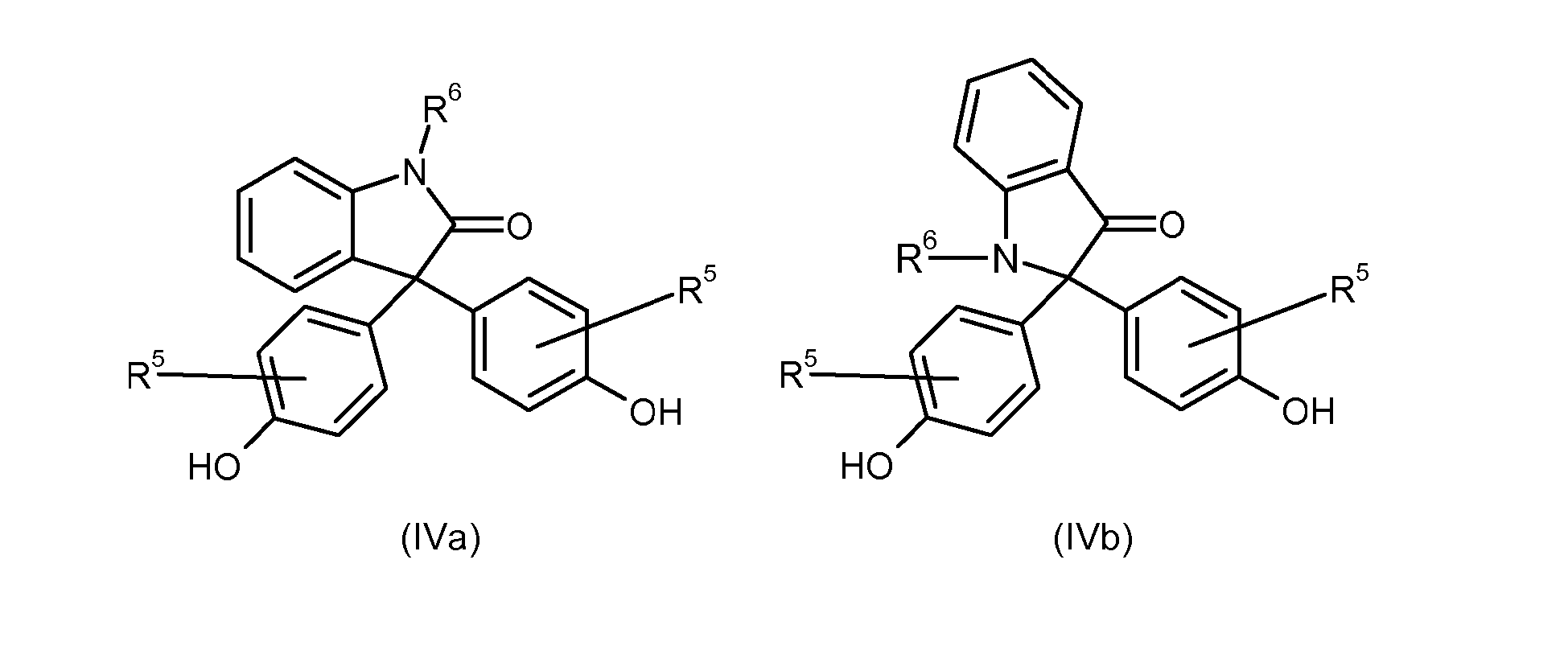 R5 unabhängig voneinander für Wasserstoff oder C1-C10 Alkyl, bevorzugt für Wasserstoff oder C1-C6 Alkyl, besonders bevorzugt Wasserstoff oder C1-C4 Alkyl, ganz besonders bevorzugt für Wasserstoff oder Methyl stehtR6 für C1-C10 Alkyl, bevorzugt C1-C6 Alkyl, besonders bevorzugt C1-C4 Alkyl, jeweils gegebenenfalls substituiertes Phenyl oder Benzyl, insbesondere Methyl, Phenyl oder Benzyl steht, wobei als Substituenten für Phenyl und Benzyl die bei R1 genannten Reste bevorzugt sind.
 - (Co-)Polycarbonat gemäß Anspruch 6 enthaltend 20 bis 100 Mol% Diphenol der Formel (I) und 80 bis 0 Mol-% (jeweils bezogen auf die Menge eingesetzter Diphenole) Diphenole der Formel (II) und / oder (IV).
- (Co-)Polycarbonat gemäß Anspruch 6 oder 7, wobei Diphenole der Formel (II) ausgewählt sind aus mindestens einem aus der Gruppe bestehend aus Bisphenol A, 4,4'-Dihydroxybiphenyl, 2,2-Bis-(3-methyl-4-hydroxyphenyl)-propan, Bisphenol TMC.
- (Co-)Polycarbonat gemäß einem der Ansprüche 5 bis 8, dadurch gekennzeichnet, dass das (Co)Polycarbonat ein oder mehrere Additive aus der Klasse der Thermostabilisatoren, Entformungsmittel, UV-Absorber und Füllstoffe enthält.
- Blends enthaltend ein oder mehrere (Co)Polycarbonate gemäß einem der Ansprüche 5 bis 9 und ein oder mehrere thermoplastische Polymere.
- Verwendung von (Co)Polycarbonatzusammensetzungen gemäß einem der Ansprüche 5 bis 10 zur Herstellung von Formteilen.
- Formteile, erhältlich aus (Co)Polycarbonatzusammensetzungen gemäß einem der Ansprüche 5 bis 10.
- Produkte, aus Spritzguss- oder Extrusionsverfahren gemäß Anspruch 12.
- Mehrschichtiges Erzeugnis enthaltend ein Substrat, das mindestens auf einer Seite eine weitere Schicht aufweist, wobei das Substrat aus Zusammensetzungen nach einem der Ansprüche 5 bis 10 hergestellt wird.
- Mehrschichtiges Erzeugnis nach Anspruch 14, dadurch gekennzeichnet, dass die Schicht auf der Substratschicht eine Metallschicht ist.
- Mehrschichtiges Erzeugnis nach Anspruch 15, dadurch gekennzeichnet, dass auf der Metallschicht eine weitere Schutzschicht aufgetragen ist.
- Verfahren zur Erzeugung eines mehrschichtigen Erzeugnisses nach Anspruch 16, dadurch gekennzeichnet, dass die Schutzschicht in einem PECVD oder Plasmapolymerisationsprozess aufgebracht wird.
- Verfahren zur Erzeugung eines mehrschichtigen Erzeugnisses nach Anspruch 17, dadurch gekennzeichnet, dass die Erzeugung der Schutzschicht durch PECVD oder Plasmapolymerisationsprozess von einer oder mehrerer leichtflüchtigen Komponenten ausgewählt aus Hexamethyldisiloxan (HMDSO), Hexamethyldisilazan (HMDS), Tetrametyldisiloxan, Decamethylcyclopentasiloxan, Octamethylcyclotetrasiloxan und Trimethoximethylsilan erfolgt.
- Verfahren zur Herstellung von (Co)Polycarbonaten gemäß einem der Ansprüche 5 bis 10 nach dem Phasengrenzflächenverfahren bzw. Schmelzeumesterungsverfahren, dadurch gekennzeichnet, dass Verbindungen der Formel (I) als Bisphenol eingesetzt werden.
Applications Claiming Priority (1)
| Application Number | Priority Date | Filing Date | Title |
|---|---|---|---|
| DE102009059771A DE102009059771A1 (de) | 2009-12-21 | 2009-12-21 | Polycarbonat mit verbesserten thermischen und mechanischen Eigenschaften sowie reduziertem thermischen Ausdehnungskoeffizienten |
Publications (3)
| Publication Number | Publication Date |
|---|---|
| EP2338880A2 true EP2338880A2 (de) | 2011-06-29 |
| EP2338880A3 EP2338880A3 (de) | 2011-10-05 |
| EP2338880B1 EP2338880B1 (de) | 2014-06-04 |
Family
ID=43585573
Family Applications (1)
| Application Number | Title | Priority Date | Filing Date |
|---|---|---|---|
| EP20100195558 Not-in-force EP2338880B1 (de) | 2009-12-21 | 2010-12-17 | Mehrschichtige Erzeugnisse enthaltend ein Polycarbonat mit verbesserten thermischen und mechanischen Eigenschaften sowie reduziertem thermischen Ausdehnungskoeffizienten |
Country Status (12)
| Country | Link |
|---|---|
| US (1) | US9676716B2 (de) |
| EP (1) | EP2338880B1 (de) |
| JP (1) | JP6000510B2 (de) |
| KR (1) | KR101809268B1 (de) |
| CN (1) | CN102101839B (de) |
| AU (1) | AU2010246337A1 (de) |
| BR (1) | BRPI1010428A2 (de) |
| DE (1) | DE102009059771A1 (de) |
| ES (1) | ES2485293T3 (de) |
| RU (1) | RU2010152001A (de) |
| SG (1) | SG172574A1 (de) |
| TW (1) | TWI486374B (de) |
Cited By (7)
| Publication number | Priority date | Publication date | Assignee | Title |
|---|---|---|---|---|
| WO2014031730A1 (en) * | 2012-08-21 | 2014-02-27 | Sabic Innovative Plastics Ip B.V. | Transparent plastic article |
| WO2016087294A1 (de) * | 2014-12-01 | 2016-06-09 | Covestro Deutschland Ag | Copolycarbonat-zusammensetzungen mit verbesserten rheologischen und optischen eigenschaften enthaltend diglycerolester |
| WO2016087480A1 (de) * | 2014-12-04 | 2016-06-09 | Covestro Deutschland Ag | Copolycarbonat-zusammensetzungen mit verbessertem verarbeitungsverhalten enthaltend pe-wachse |
| CN107207843A (zh) * | 2014-12-01 | 2017-09-26 | 科思创德国股份有限公司 | 具有改善的流动性和高刚度的填充的聚碳酸酯组合物 |
| US10119009B2 (en) | 2014-12-01 | 2018-11-06 | Covestro Deutschland Ag | Flowability of polycarbonate compositions |
| US10189941B2 (en) | 2014-12-04 | 2019-01-29 | Covestro Deutschland Ag | Polycarbonate compositions containing polyethylene wax |
| US10239865B2 (en) | 2015-01-15 | 2019-03-26 | Council Of Scientific & Industrial Research | Bisphenols containing pendant clickable maleimide group and polymers therefrom |
Families Citing this family (37)
| Publication number | Priority date | Publication date | Assignee | Title |
|---|---|---|---|---|
| US9290618B2 (en) | 2011-08-05 | 2016-03-22 | Sabic Global Technologies B.V. | Polycarbonate compositions having enhanced optical properties, methods of making and articles comprising the polycarbonate compositions |
| US8962117B2 (en) | 2011-10-27 | 2015-02-24 | Sabic Global Technologies B.V. | Process for producing bisphenol A with reduced sulfur content, polycarbonate made from the bisphenol A, and containers formed from the polycarbonate |
| WO2013116697A1 (en) | 2012-02-03 | 2013-08-08 | Sabic Innovative Plastics Ip B.V. | Light emitting diode device and method for production thereof containing conversion material chemistry |
| WO2013130610A1 (en) | 2012-02-29 | 2013-09-06 | Sabic Innovative Plastics Ip B.V. | Polycarbonate compositions containing conversions material chemistry and having enhanced optical properties, methods of making and articles comprising the same |
| CN104144902A (zh) | 2012-02-29 | 2014-11-12 | 沙特基础创新塑料Ip私人有限责任公司 | 用于生产低硫双酚a的方法、用于生产聚碳酸酯的方法以及由聚碳酸酯制作的制品 |
| US9346949B2 (en) | 2013-02-12 | 2016-05-24 | Sabic Global Technologies B.V. | High reflectance polycarbonate |
| CN104334625A (zh) | 2012-05-16 | 2015-02-04 | 沙特基础创新塑料Ip私人有限责任公司 | 含有支化聚碳酸酯的组合物和制品 |
| US9821523B2 (en) | 2012-10-25 | 2017-11-21 | Sabic Global Technologies B.V. | Light emitting diode devices, method of manufacture, uses thereof |
| US20150368434A1 (en) * | 2012-12-20 | 2015-12-24 | Bayer Materialscience Ag | Organic colorants and coloured polymer compositions with good processing properties |
| US10571053B2 (en) | 2012-12-28 | 2020-02-25 | Agc Chemicals Americas, Inc. | Layered tube for a hose assembly |
| US9127119B2 (en) | 2013-01-11 | 2015-09-08 | Sabic Global Technologies B.V. | Polycarbonate compositions having improved thermal dimensional stability and high refractive index |
| WO2014183101A1 (en) * | 2013-05-10 | 2014-11-13 | Agc Chemicals Americas, Inc. | A layered tube and layer for use in same |
| US9553244B2 (en) | 2013-05-16 | 2017-01-24 | Sabic Global Technologies B.V. | Branched polycarbonate compositions having conversion material chemistry and articles thereof |
| EP3004234B1 (de) | 2013-05-29 | 2021-08-18 | SABIC Global Technologies B.V. | Beleuchtungsvorrichtungen mit farbstabilen thermoplastischen lichtdurchlässigen gegenständen |
| EP3004233B1 (de) | 2013-05-29 | 2018-02-14 | SABIC Global Technologies B.V. | Farbstabile thermoplastische zusammensetzung |
| EP3039061B1 (de) * | 2013-08-28 | 2018-07-25 | SABIC Global Technologies B.V. | Amorphe polycarbonatfolien für kondensatoren, verfahren zur herstellung und daraus hergestellte artikel |
| CN103881354A (zh) * | 2014-03-27 | 2014-06-25 | 苏州益群模具有限公司 | 汽车前灯罩注塑材料 |
| CN103881352A (zh) * | 2014-03-27 | 2014-06-25 | 苏州益群模具有限公司 | 汽车前灯材料的加工方法 |
| CN106660953B (zh) | 2014-07-22 | 2020-07-28 | 沙特基础工业全球技术有限公司 | 高耐热单体及其使用方法 |
| CN104324395B (zh) * | 2014-10-24 | 2017-01-25 | 深圳莱特光电股份有限公司 | 一种led紫外光杀菌灯 |
| GB201513760D0 (en) * | 2015-08-04 | 2015-09-16 | Teer Coatings Ltd | Improved coatings and method of applying the same |
| WO2017106484A1 (en) | 2015-12-15 | 2017-06-22 | Agc Chemicals Americas Inc. | A layered tube and layer for use in same |
| WO2017180556A1 (en) * | 2016-04-15 | 2017-10-19 | Sabic Global Technologies B.V. | Polyisoindolinones, methods of manufacture, and compositions and articles formed therefrom |
| US10640645B2 (en) * | 2016-04-15 | 2020-05-05 | Sabic Global Technologies | Polyisoindolinone compositions, methods of manufacture, and compositions and articles formed therefrom |
| EP3448934B1 (de) | 2016-04-28 | 2020-05-20 | SABIC Global Technologies B.V. | Kompatibilisierte zusammensetzungen, daraus geformte artikel und verfahren zur herstellung davon |
| EP3380553B1 (de) | 2016-05-27 | 2019-06-26 | SABIC Global Technologies B.V. | Copolycarbonatlinsen, verfahren zur herstellung und anwendungen davon |
| EP3464469B1 (de) | 2016-05-27 | 2021-04-07 | SHPP Global Technologies B.V. | Hochwärme-copolycarbonatzusammensetzungen mit verbesserten optischen eigenschaften, daraus hergestellte artikel und verfahren zur herstellung |
| US10787568B2 (en) | 2016-07-25 | 2020-09-29 | Sabic Global Technologies B.V. | Polycarbonate compositions having enhanced optical properties, articles formed therefrom, and methods of manufacture |
| DE102016115921B9 (de) * | 2016-08-26 | 2024-02-15 | OSRAM Opto Semiconductors Gesellschaft mit beschränkter Haftung | Optoelektronisches Bauelement und Verfahren zur Herstellung eines optoelektronischen Bauelements |
| DE102017111963A1 (de) * | 2017-05-31 | 2018-12-06 | Automotive Lighting Reutlingen Gmbh | Kunststoff-Reflektor eines Lichtmoduls und Verfahren zu dessen Herstellung |
| CN111417668B (zh) | 2017-11-01 | 2022-06-28 | 高新特殊工程塑料全球技术有限公司 | 苯并[c]吡咯酮共聚碳酸酯光学制品,由其形成的制品及其制造方法 |
| CN108032484A (zh) * | 2017-12-14 | 2018-05-15 | 上海小糸车灯有限公司 | 一种汽车用led反射镜及其制备方法 |
| EP3587495B1 (de) * | 2018-06-29 | 2021-03-31 | SHPP Global Technologies B.V. | Copolycarbonatzusammensetzungen mit einer 2-hydrocarbyl-3-(dihydroxyfluoresceinyl)-phthalimidin-einheit und daraus abgeleitete artikel |
| EP3660074B1 (de) | 2018-11-30 | 2021-05-26 | SHPP Global Technologies B.V. | Schwefelstabilisierte copolycarbonate und daraus hergestellte artikel |
| CN116490549B (zh) * | 2020-11-30 | 2025-11-04 | 科思创德国股份有限公司 | 适合用作反射器的多层结构 |
| US20240083849A1 (en) * | 2020-12-30 | 2024-03-14 | Council Of Scientific & Industrial Research | New bisphenols bearing pendant clickable norbornenyl group and polymers therefrom |
| DE102021116975A1 (de) | 2021-07-01 | 2023-01-05 | R. Stahl Schaltgeräte GmbH | Kunststoffteil und Verfahren zu seiner Herstellung |
Citations (11)
| Publication number | Priority date | Publication date | Assignee | Title |
|---|---|---|---|---|
| EP0313436A1 (de) | 1987-10-21 | 1989-04-26 | Elf Atochem S.A. | Durchsichtige Polyamide und Verfahren zu deren Herstellung |
| EP0363608A1 (de) | 1988-09-22 | 1990-04-18 | General Electric Company | Polymer-Mischung aus einem aromatischen Polycarbonat, einem Styrol enthaltenden Copolymer und/oder Pfropfpolymer und einem Flammschutzmittel auf der Basis eines Phosphats, geformte Gegenstände daraus |
| EP0553581A2 (de) | 1991-12-31 | 1993-08-04 | Elf Atochem S.A. | Transparente amorphe Zusammensetzungen mit erhöhtem Gehalt an chemischen Stoffen |
| EP0585056A2 (de) | 1992-08-21 | 1994-03-02 | Mitsubishi Gas Chemical Company, Inc. | Harzzusammensetzung auf der Basis von MX-Nylon und modifiziertem Polyphenylenether, daraus hergestellte Formkörper und Lampenreflektoren |
| EP0640655A2 (de) | 1993-08-26 | 1995-03-01 | Bayer Ag | Flammwidrige, spannungsrissbeständige Polycarbonat-ABS-Formmassen |
| EP0725101B1 (de) | 1995-02-01 | 1998-04-01 | Ems-Inventa Ag | Transparente, farblose amorphe Polyamide und Formteile |
| EP0863180A1 (de) | 1997-03-07 | 1998-09-09 | Toray Industries, Inc. | Polyamidharz-Zusammensetzung und daraus hergestellte Formkörper |
| EP0913421A1 (de) | 1997-10-27 | 1999-05-06 | Teijin Limited | Biaxial orientierte Folie und magnetisches Aufzeichnungsmedium die diese als Basisfolie enthält |
| WO1999055772A1 (en) | 1998-04-24 | 1999-11-04 | Ciba Specialty Chemicals Holding Inc. | Increasing the molecular weight of polyesters |
| US6355723B1 (en) | 2000-06-22 | 2002-03-12 | General Electric Co. | Dark colored thermoplastic compositions, articles molded therefrom, and article preparation methods |
| EP1312647A2 (de) | 2001-11-16 | 2003-05-21 | Mitsubishi Engineering-Plastics Corporation | Polyamid-Formmassen und daraus hergestellte dickwandige Formteile |
Family Cites Families (9)
| Publication number | Priority date | Publication date | Assignee | Title |
|---|---|---|---|---|
| DE1031512B (de) | 1955-12-21 | 1958-06-04 | Bayer Ag | Verfahren zur Herstellung von hochmolekularen faser- und filmbildenden Polycarbonaten |
| US5344910A (en) * | 1993-03-23 | 1994-09-06 | General Electric Company | Heat-resistant polycarbonate resins containing 2-alkyl-3,3-bis(p-hydroxyphenyl)phthalimide |
| JP4390882B2 (ja) * | 1997-12-10 | 2009-12-24 | 大日本印刷株式会社 | 透明バリアフィルム、それを使用した積層材および包装用容器 |
| US7358321B2 (en) | 2005-11-29 | 2008-04-15 | General Electric Company | High glass transition temperature copolycarbonates, methods of manufacture, and uses thereof |
| US7329720B2 (en) * | 2005-11-29 | 2008-02-12 | General Electric Company | Methods for increasing the mean particle size of 2-hydrocarbyl-3,3-bis(hydroxyaryl)phthalimidines |
| US7491788B1 (en) * | 2006-05-19 | 2009-02-17 | Sabic Innovative Plastics Ip B.V. | High heat polycarbonate compositions, methods for the preparation thereof, and articles derived therefrom |
| DE102006046330A1 (de) * | 2006-09-28 | 2008-04-03 | Bayer Materialscience Ag | Polycarbonate und Copolycarbonate mit verbesserter Metallhaftung |
| US7514524B2 (en) * | 2007-03-30 | 2009-04-07 | Sabic Innovative Plastics Ip B.V. | Methods for producing and purifying 2-hydrocarbyl-3,3-bis(4-hydroxyaryl)phthalimidine monomers and polycarbonates derived therefrom |
| US20080274360A1 (en) * | 2007-05-04 | 2008-11-06 | General Electric Company | Polyaryl ether ketone - polycarbonate copolymer blends |
-
2009
- 2009-12-21 DE DE102009059771A patent/DE102009059771A1/de not_active Withdrawn
-
2010
- 2010-11-19 AU AU2010246337A patent/AU2010246337A1/en not_active Abandoned
- 2010-11-30 TW TW099141325A patent/TWI486374B/zh not_active IP Right Cessation
- 2010-12-17 EP EP20100195558 patent/EP2338880B1/de not_active Not-in-force
- 2010-12-17 SG SG2010093763A patent/SG172574A1/en unknown
- 2010-12-17 ES ES10195558.1T patent/ES2485293T3/es active Active
- 2010-12-20 US US12/973,060 patent/US9676716B2/en not_active Expired - Fee Related
- 2010-12-20 KR KR1020100130573A patent/KR101809268B1/ko not_active Expired - Fee Related
- 2010-12-20 RU RU2010152001/04A patent/RU2010152001A/ru not_active Application Discontinuation
- 2010-12-21 JP JP2010284647A patent/JP6000510B2/ja not_active Expired - Fee Related
- 2010-12-21 CN CN201010598015.4A patent/CN102101839B/zh not_active Expired - Fee Related
- 2010-12-21 BR BRPI1010428-3A patent/BRPI1010428A2/pt not_active Application Discontinuation
Patent Citations (12)
| Publication number | Priority date | Publication date | Assignee | Title |
|---|---|---|---|---|
| EP0313436A1 (de) | 1987-10-21 | 1989-04-26 | Elf Atochem S.A. | Durchsichtige Polyamide und Verfahren zu deren Herstellung |
| US4898896A (en) | 1987-10-21 | 1990-02-06 | Atochem | Transparent copolyamide from oligomeric amide and cycloaliphatic diamine and process for the production thereof |
| EP0363608A1 (de) | 1988-09-22 | 1990-04-18 | General Electric Company | Polymer-Mischung aus einem aromatischen Polycarbonat, einem Styrol enthaltenden Copolymer und/oder Pfropfpolymer und einem Flammschutzmittel auf der Basis eines Phosphats, geformte Gegenstände daraus |
| EP0553581A2 (de) | 1991-12-31 | 1993-08-04 | Elf Atochem S.A. | Transparente amorphe Zusammensetzungen mit erhöhtem Gehalt an chemischen Stoffen |
| EP0585056A2 (de) | 1992-08-21 | 1994-03-02 | Mitsubishi Gas Chemical Company, Inc. | Harzzusammensetzung auf der Basis von MX-Nylon und modifiziertem Polyphenylenether, daraus hergestellte Formkörper und Lampenreflektoren |
| EP0640655A2 (de) | 1993-08-26 | 1995-03-01 | Bayer Ag | Flammwidrige, spannungsrissbeständige Polycarbonat-ABS-Formmassen |
| EP0725101B1 (de) | 1995-02-01 | 1998-04-01 | Ems-Inventa Ag | Transparente, farblose amorphe Polyamide und Formteile |
| EP0863180A1 (de) | 1997-03-07 | 1998-09-09 | Toray Industries, Inc. | Polyamidharz-Zusammensetzung und daraus hergestellte Formkörper |
| EP0913421A1 (de) | 1997-10-27 | 1999-05-06 | Teijin Limited | Biaxial orientierte Folie und magnetisches Aufzeichnungsmedium die diese als Basisfolie enthält |
| WO1999055772A1 (en) | 1998-04-24 | 1999-11-04 | Ciba Specialty Chemicals Holding Inc. | Increasing the molecular weight of polyesters |
| US6355723B1 (en) | 2000-06-22 | 2002-03-12 | General Electric Co. | Dark colored thermoplastic compositions, articles molded therefrom, and article preparation methods |
| EP1312647A2 (de) | 2001-11-16 | 2003-05-21 | Mitsubishi Engineering-Plastics Corporation | Polyamid-Formmassen und daraus hergestellte dickwandige Formteile |
Non-Patent Citations (11)
| Title |
|---|
| "Additives for Plastics Handbook", 1999, JOHN MURPHY, ELSEVIER |
| "Encyclopedia of Polymer Science", vol. 10, 1969 |
| "Plastics Additives Handbook", 2001, HANS ZWEIFEL |
| "Ullmanns Enzyklopädie der technischen Chemie", vol. 18, 1979, pages: 301 |
| D.G. LEGRAND; J.T. BENDLER: "Handbook ofPolycarbonate Science and Technology", 2000, MARCEL DEKKER, pages: 72FF |
| H. SCHNELL: "Chemistry and Physics of Polycarbonates", 1964, INTERSCIENCE PUBLISHERS, pages: 28,102 |
| H. SCHNELL: "Chemistry and Physics of Polycarbonates, Polymer Reviews", vol. 9, 1964, INTERSCIENCE PUBLISHERS, pages: 33 |
| H. SCHNELL: "Chemistry and Physics of Polycarbonates, Polymer Reviews", vol. 9, 1964, JOHN WILEY AND SONS, INC. |
| HOUBEN-WEYL, METHODEN DER ORGANISCHEN CHEMIE, pages 43,177 |
| J. QUEISSER; M. GEPRÄGS; R. BLUM; G. ICKES: "Trends bei Automobilscheinwerfern, Kunststoffe", vol. 3, 2002, HANSER VERLAG |
| PAUL W. MORGAN: "Condensation Polymers by Interfacial and Solution Methods", 1965, INTERSCIENCE PUBLISHERS, pages: 325 |
Cited By (9)
| Publication number | Priority date | Publication date | Assignee | Title |
|---|---|---|---|---|
| WO2014031730A1 (en) * | 2012-08-21 | 2014-02-27 | Sabic Innovative Plastics Ip B.V. | Transparent plastic article |
| US9546269B2 (en) | 2012-08-21 | 2017-01-17 | Sabic Global Technologies B.V. | Transparent plastic article |
| WO2016087294A1 (de) * | 2014-12-01 | 2016-06-09 | Covestro Deutschland Ag | Copolycarbonat-zusammensetzungen mit verbesserten rheologischen und optischen eigenschaften enthaltend diglycerolester |
| CN107207843A (zh) * | 2014-12-01 | 2017-09-26 | 科思创德国股份有限公司 | 具有改善的流动性和高刚度的填充的聚碳酸酯组合物 |
| CN107207846A (zh) * | 2014-12-01 | 2017-09-26 | 科思创德国股份有限公司 | 具有改善的流变和光学性质的包含双甘油酯的共聚碳酸酯组合物 |
| US10119009B2 (en) | 2014-12-01 | 2018-11-06 | Covestro Deutschland Ag | Flowability of polycarbonate compositions |
| WO2016087480A1 (de) * | 2014-12-04 | 2016-06-09 | Covestro Deutschland Ag | Copolycarbonat-zusammensetzungen mit verbessertem verarbeitungsverhalten enthaltend pe-wachse |
| US10189941B2 (en) | 2014-12-04 | 2019-01-29 | Covestro Deutschland Ag | Polycarbonate compositions containing polyethylene wax |
| US10239865B2 (en) | 2015-01-15 | 2019-03-26 | Council Of Scientific & Industrial Research | Bisphenols containing pendant clickable maleimide group and polymers therefrom |
Also Published As
| Publication number | Publication date |
|---|---|
| AU2010246337A1 (en) | 2011-07-07 |
| EP2338880B1 (de) | 2014-06-04 |
| TWI486374B (zh) | 2015-06-01 |
| JP6000510B2 (ja) | 2016-09-28 |
| DE102009059771A1 (de) | 2011-06-22 |
| KR101809268B1 (ko) | 2017-12-14 |
| RU2010152001A (ru) | 2012-06-27 |
| KR20110073301A (ko) | 2011-06-29 |
| CN102101839B (zh) | 2014-12-24 |
| US20110151262A1 (en) | 2011-06-23 |
| EP2338880A3 (de) | 2011-10-05 |
| TW201139513A (en) | 2011-11-16 |
| CN102101839A (zh) | 2011-06-22 |
| SG172574A1 (en) | 2011-07-28 |
| JP2011137156A (ja) | 2011-07-14 |
| ES2485293T3 (es) | 2014-08-13 |
| US9676716B2 (en) | 2017-06-13 |
| BRPI1010428A2 (pt) | 2012-12-25 |
Similar Documents
| Publication | Publication Date | Title |
|---|---|---|
| EP2338880B1 (de) | Mehrschichtige Erzeugnisse enthaltend ein Polycarbonat mit verbesserten thermischen und mechanischen Eigenschaften sowie reduziertem thermischen Ausdehnungskoeffizienten | |
| EP2333013B1 (de) | Polycarbonatblends mit hoher Wärmeformbeständigkeit und verbesserten Oberflächeneigenschaften | |
| EP2336246A1 (de) | Copolycarbonat-Zusammensetzungen mit verbesserten thermischen Eigenschaften auf Basis von Blends | |
| EP2313456B1 (de) | Modifizierte polycarbonate mit verbesserten oberflächeneigenschaften | |
| EP2333011A1 (de) | Polycarbonatzusammensetzungen mit verbesserter Oberflächenhärte | |
| EP2785764B1 (de) | Metallisierter mehrschichtkörper aus speziellen polycarbonaten mit niedrigem wärmeausdehnungskoeffizient | |
| WO2016016425A1 (de) | Copolycarbonat-zusammensetzungen mit verzweigungsstrukturen und linearen oligomeren und verbesserten rheologischen eigenschaften | |
| EP3227387B1 (de) | Copolycarbonat-zusammensetzungen mit verbessertem verarbeitungsverhalten enthaltend pe-wachse | |
| EP2333014B1 (de) | Folie aus Polycarbonatzusammensetzung | |
| EP2411473B1 (de) | (co)polycarbonate mit verbesserten optischen eigenschaften | |
| DE10135465A1 (de) | Polycarbonat-Blends | |
| KR101248680B1 (ko) | 폴리카르보네이트 및 신규 uv 흡수제 함유 조성물 | |
| EP4251423B1 (de) | Zur verwendung als reflektor geeigneter multilagenaufbau | |
| EP2764050B1 (de) | Polycarbonatzusammensetzungen mit guter metallisierbarkeit | |
| EP3502306B1 (de) | Mehrschichtkörper, umfassend eine substratschicht enthaltend polycarbonat, talk und wachs | |
| WO2016016424A1 (de) | Copolycarbonat-zusammensetzungen mit cyclischen und linearen oligomeren und verbesserten optischen eigenschaften | |
| WO2016016422A1 (de) | Copolycarbonat-zusammensetzungen mit cyclischen und linearen oligomeren und verbesserten rheologischen eigenschaften | |
| WO2019221408A1 (ko) | 폴리카보네이트 수지 조성물 및 이를 포함하는 광학 성형품 | |
| KR20230047012A (ko) | 열가소성 수지 및 이로부터 제조된 성형품 |
Legal Events
| Date | Code | Title | Description |
|---|---|---|---|
| PUAI | Public reference made under article 153(3) epc to a published international application that has entered the european phase |
Free format text: ORIGINAL CODE: 0009012 |
|
| AK | Designated contracting states |
Kind code of ref document: A2 Designated state(s): AL AT BE BG CH CY CZ DE DK EE ES FI FR GB GR HR HU IE IS IT LI LT LU LV MC MK MT NL NO PL PT RO RS SE SI SK SM TR |
|
| AX | Request for extension of the european patent |
Extension state: BA ME |
|
| PUAL | Search report despatched |
Free format text: ORIGINAL CODE: 0009013 |
|
| AK | Designated contracting states |
Kind code of ref document: A3 Designated state(s): AL AT BE BG CH CY CZ DE DK EE ES FI FR GB GR HR HU IE IS IT LI LT LU LV MC MK MT NL NO PL PT RO RS SE SI SK SM TR |
|
| AX | Request for extension of the european patent |
Extension state: BA ME |
|
| RIC1 | Information provided on ipc code assigned before grant |
Ipc: C08G 64/12 20060101ALI20110831BHEP Ipc: C08L 69/00 20060101ALI20110831BHEP Ipc: C08G 4/00 20060101ALI20110831BHEP Ipc: B29C 47/00 20060101ALI20110831BHEP Ipc: B29C 45/00 20060101ALI20110831BHEP Ipc: C07D 209/46 20060101AFI20110831BHEP |
|
| 17P | Request for examination filed |
Effective date: 20120405 |
|
| 17Q | First examination report despatched |
Effective date: 20120828 |
|
| RAP1 | Party data changed (applicant data changed or rights of an application transferred) |
Owner name: BAYER INTELLECTUAL PROPERTY GMBH |
|
| GRAP | Despatch of communication of intention to grant a patent |
Free format text: ORIGINAL CODE: EPIDOSNIGR1 |
|
| INTG | Intention to grant announced |
Effective date: 20140128 |
|
| GRAS | Grant fee paid |
Free format text: ORIGINAL CODE: EPIDOSNIGR3 |
|
| GRAA | (expected) grant |
Free format text: ORIGINAL CODE: 0009210 |
|
| AK | Designated contracting states |
Kind code of ref document: B1 Designated state(s): AL AT BE BG CH CY CZ DE DK EE ES FI FR GB GR HR HU IE IS IT LI LT LU LV MC MK MT NL NO PL PT RO RS SE SI SK SM TR |
|
| REG | Reference to a national code |
Ref country code: GB Ref legal event code: FG4D Free format text: NOT ENGLISH |
|
| REG | Reference to a national code |
Ref country code: CH Ref legal event code: EP |
|
| REG | Reference to a national code |
Ref country code: AT Ref legal event code: REF Ref document number: 671012 Country of ref document: AT Kind code of ref document: T Effective date: 20140615 |
|
| REG | Reference to a national code |
Ref country code: IE Ref legal event code: FG4D Free format text: LANGUAGE OF EP DOCUMENT: GERMAN |
|
| REG | Reference to a national code |
Ref country code: DE Ref legal event code: R096 Ref document number: 502010007108 Country of ref document: DE Effective date: 20140717 |
|
| REG | Reference to a national code |
Ref country code: ES Ref legal event code: FG2A Ref document number: 2485293 Country of ref document: ES Kind code of ref document: T3 Effective date: 20140813 |
|
| REG | Reference to a national code |
Ref country code: NL Ref legal event code: T3 |
|
| PG25 | Lapsed in a contracting state [announced via postgrant information from national office to epo] |
Ref country code: GR Free format text: LAPSE BECAUSE OF FAILURE TO SUBMIT A TRANSLATION OF THE DESCRIPTION OR TO PAY THE FEE WITHIN THE PRESCRIBED TIME-LIMIT Effective date: 20140905 Ref country code: NO Free format text: LAPSE BECAUSE OF FAILURE TO SUBMIT A TRANSLATION OF THE DESCRIPTION OR TO PAY THE FEE WITHIN THE PRESCRIBED TIME-LIMIT Effective date: 20140904 Ref country code: CY Free format text: LAPSE BECAUSE OF FAILURE TO SUBMIT A TRANSLATION OF THE DESCRIPTION OR TO PAY THE FEE WITHIN THE PRESCRIBED TIME-LIMIT Effective date: 20140604 Ref country code: LT Free format text: LAPSE BECAUSE OF FAILURE TO SUBMIT A TRANSLATION OF THE DESCRIPTION OR TO PAY THE FEE WITHIN THE PRESCRIBED TIME-LIMIT Effective date: 20140604 Ref country code: FI Free format text: LAPSE BECAUSE OF FAILURE TO SUBMIT A TRANSLATION OF THE DESCRIPTION OR TO PAY THE FEE WITHIN THE PRESCRIBED TIME-LIMIT Effective date: 20140604 |
|
| REG | Reference to a national code |
Ref country code: LT Ref legal event code: MG4D |
|
| PG25 | Lapsed in a contracting state [announced via postgrant information from national office to epo] |
Ref country code: LV Free format text: LAPSE BECAUSE OF FAILURE TO SUBMIT A TRANSLATION OF THE DESCRIPTION OR TO PAY THE FEE WITHIN THE PRESCRIBED TIME-LIMIT Effective date: 20140604 Ref country code: SE Free format text: LAPSE BECAUSE OF FAILURE TO SUBMIT A TRANSLATION OF THE DESCRIPTION OR TO PAY THE FEE WITHIN THE PRESCRIBED TIME-LIMIT Effective date: 20140604 Ref country code: RS Free format text: LAPSE BECAUSE OF FAILURE TO SUBMIT A TRANSLATION OF THE DESCRIPTION OR TO PAY THE FEE WITHIN THE PRESCRIBED TIME-LIMIT Effective date: 20140604 Ref country code: HR Free format text: LAPSE BECAUSE OF FAILURE TO SUBMIT A TRANSLATION OF THE DESCRIPTION OR TO PAY THE FEE WITHIN THE PRESCRIBED TIME-LIMIT Effective date: 20140604 |
|
| PG25 | Lapsed in a contracting state [announced via postgrant information from national office to epo] |
Ref country code: CZ Free format text: LAPSE BECAUSE OF FAILURE TO SUBMIT A TRANSLATION OF THE DESCRIPTION OR TO PAY THE FEE WITHIN THE PRESCRIBED TIME-LIMIT Effective date: 20140604 Ref country code: PT Free format text: LAPSE BECAUSE OF FAILURE TO SUBMIT A TRANSLATION OF THE DESCRIPTION OR TO PAY THE FEE WITHIN THE PRESCRIBED TIME-LIMIT Effective date: 20141006 Ref country code: SK Free format text: LAPSE BECAUSE OF FAILURE TO SUBMIT A TRANSLATION OF THE DESCRIPTION OR TO PAY THE FEE WITHIN THE PRESCRIBED TIME-LIMIT Effective date: 20140604 Ref country code: EE Free format text: LAPSE BECAUSE OF FAILURE TO SUBMIT A TRANSLATION OF THE DESCRIPTION OR TO PAY THE FEE WITHIN THE PRESCRIBED TIME-LIMIT Effective date: 20140604 Ref country code: RO Free format text: LAPSE BECAUSE OF FAILURE TO SUBMIT A TRANSLATION OF THE DESCRIPTION OR TO PAY THE FEE WITHIN THE PRESCRIBED TIME-LIMIT Effective date: 20140604 |
|
| REG | Reference to a national code |
Ref country code: DE Ref legal event code: R026 Ref document number: 502010007108 Country of ref document: DE |
|
| PG25 | Lapsed in a contracting state [announced via postgrant information from national office to epo] |
Ref country code: IS Free format text: LAPSE BECAUSE OF FAILURE TO SUBMIT A TRANSLATION OF THE DESCRIPTION OR TO PAY THE FEE WITHIN THE PRESCRIBED TIME-LIMIT Effective date: 20141004 Ref country code: PL Free format text: LAPSE BECAUSE OF FAILURE TO SUBMIT A TRANSLATION OF THE DESCRIPTION OR TO PAY THE FEE WITHIN THE PRESCRIBED TIME-LIMIT Effective date: 20140604 |
|
| PLBI | Opposition filed |
Free format text: ORIGINAL CODE: 0009260 |
|
| 26 | Opposition filed |
Opponent name: SABIC GLOBAL TECHNOLOGIES B.V. Effective date: 20150226 |
|
| PLAX | Notice of opposition and request to file observation + time limit sent |
Free format text: ORIGINAL CODE: EPIDOSNOBS2 |
|
| PG25 | Lapsed in a contracting state [announced via postgrant information from national office to epo] |
Ref country code: DK Free format text: LAPSE BECAUSE OF FAILURE TO SUBMIT A TRANSLATION OF THE DESCRIPTION OR TO PAY THE FEE WITHIN THE PRESCRIBED TIME-LIMIT Effective date: 20140604 |
|
| REG | Reference to a national code |
Ref country code: DE Ref legal event code: R026 Ref document number: 502010007108 Country of ref document: DE Effective date: 20150226 |
|
| PG25 | Lapsed in a contracting state [announced via postgrant information from national office to epo] |
Ref country code: BE Free format text: LAPSE BECAUSE OF NON-PAYMENT OF DUE FEES Effective date: 20141231 |
|
| PG25 | Lapsed in a contracting state [announced via postgrant information from national office to epo] |
Ref country code: LU Free format text: LAPSE BECAUSE OF FAILURE TO SUBMIT A TRANSLATION OF THE DESCRIPTION OR TO PAY THE FEE WITHIN THE PRESCRIBED TIME-LIMIT Effective date: 20141217 Ref country code: SI Free format text: LAPSE BECAUSE OF FAILURE TO SUBMIT A TRANSLATION OF THE DESCRIPTION OR TO PAY THE FEE WITHIN THE PRESCRIBED TIME-LIMIT Effective date: 20140604 |
|
| REG | Reference to a national code |
Ref country code: CH Ref legal event code: PL |
|
| PLAF | Information modified related to communication of a notice of opposition and request to file observations + time limit |
Free format text: ORIGINAL CODE: EPIDOSCOBS2 |
|
| GBPC | Gb: european patent ceased through non-payment of renewal fee |
Effective date: 20141217 |
|
| REG | Reference to a national code |
Ref country code: IE Ref legal event code: MM4A |
|
| PLBB | Reply of patent proprietor to notice(s) of opposition received |
Free format text: ORIGINAL CODE: EPIDOSNOBS3 |
|
| PG25 | Lapsed in a contracting state [announced via postgrant information from national office to epo] |
Ref country code: IE Free format text: LAPSE BECAUSE OF NON-PAYMENT OF DUE FEES Effective date: 20141217 Ref country code: GB Free format text: LAPSE BECAUSE OF NON-PAYMENT OF DUE FEES Effective date: 20141217 Ref country code: CH Free format text: LAPSE BECAUSE OF NON-PAYMENT OF DUE FEES Effective date: 20141231 Ref country code: LI Free format text: LAPSE BECAUSE OF NON-PAYMENT OF DUE FEES Effective date: 20141231 |
|
| REG | Reference to a national code |
Ref country code: FR Ref legal event code: PLFP Year of fee payment: 6 |
|
| RAP2 | Party data changed (patent owner data changed or rights of a patent transferred) |
Owner name: COVESTRO DEUTSCHLAND AG |
|
| REG | Reference to a national code |
Ref country code: DE Ref legal event code: R081 Ref document number: 502010007108 Country of ref document: DE Owner name: COVESTRO DEUTSCHLAND AG, DE Free format text: FORMER OWNER: BAYER INTELLECTUAL PROPERTY GMBH, 40789 MONHEIM, DE |
|
| PG25 | Lapsed in a contracting state [announced via postgrant information from national office to epo] |
Ref country code: SM Free format text: LAPSE BECAUSE OF FAILURE TO SUBMIT A TRANSLATION OF THE DESCRIPTION OR TO PAY THE FEE WITHIN THE PRESCRIBED TIME-LIMIT Effective date: 20140604 |
|
| PG25 | Lapsed in a contracting state [announced via postgrant information from national office to epo] |
Ref country code: MC Free format text: LAPSE BECAUSE OF FAILURE TO SUBMIT A TRANSLATION OF THE DESCRIPTION OR TO PAY THE FEE WITHIN THE PRESCRIBED TIME-LIMIT Effective date: 20140604 |
|
| PG25 | Lapsed in a contracting state [announced via postgrant information from national office to epo] |
Ref country code: BG Free format text: LAPSE BECAUSE OF FAILURE TO SUBMIT A TRANSLATION OF THE DESCRIPTION OR TO PAY THE FEE WITHIN THE PRESCRIBED TIME-LIMIT Effective date: 20140604 |
|
| PG25 | Lapsed in a contracting state [announced via postgrant information from national office to epo] |
Ref country code: MT Free format text: LAPSE BECAUSE OF FAILURE TO SUBMIT A TRANSLATION OF THE DESCRIPTION OR TO PAY THE FEE WITHIN THE PRESCRIBED TIME-LIMIT Effective date: 20140604 Ref country code: HU Free format text: LAPSE BECAUSE OF FAILURE TO SUBMIT A TRANSLATION OF THE DESCRIPTION OR TO PAY THE FEE WITHIN THE PRESCRIBED TIME-LIMIT; INVALID AB INITIO Effective date: 20101217 Ref country code: TR Free format text: LAPSE BECAUSE OF FAILURE TO SUBMIT A TRANSLATION OF THE DESCRIPTION OR TO PAY THE FEE WITHIN THE PRESCRIBED TIME-LIMIT Effective date: 20140604 |
|
| REG | Reference to a national code |
Ref country code: NL Ref legal event code: PD Owner name: COVESTRO DEUTSCHLAND AG; DE Free format text: DETAILS ASSIGNMENT: VERANDERING VAN EIGENAAR(S), OVERDRACHT; FORMER OWNER NAME: BAYER INTELLECTUAL PROPERTY GMBH Effective date: 20160810 |
|
| REG | Reference to a national code |
Ref country code: FR Ref legal event code: PLFP Year of fee payment: 7 |
|
| REG | Reference to a national code |
Ref country code: AT Ref legal event code: MM01 Ref document number: 671012 Country of ref document: AT Kind code of ref document: T Effective date: 20151217 |
|
| PG25 | Lapsed in a contracting state [announced via postgrant information from national office to epo] |
Ref country code: AT Free format text: LAPSE BECAUSE OF NON-PAYMENT OF DUE FEES Effective date: 20151217 |
|
| REG | Reference to a national code |
Ref country code: DE Ref legal event code: R100 Ref document number: 502010007108 Country of ref document: DE |
|
| PLCK | Communication despatched that opposition was rejected |
Free format text: ORIGINAL CODE: EPIDOSNREJ1 |
|
| REG | Reference to a national code |
Ref country code: DE Ref legal event code: R100 Ref document number: 502010007108 Country of ref document: DE |
|
| PLBN | Opposition rejected |
Free format text: ORIGINAL CODE: 0009273 |
|
| 27O | Opposition rejected |
Effective date: 20170706 |
|
| PLAE | Information related to rejection of opposition modified |
Free format text: ORIGINAL CODE: 0009299REJO |
|
| REG | Reference to a national code |
Ref country code: FR Ref legal event code: PLFP Year of fee payment: 8 |
|
| R27O | Information related to the rejection of opposition modified: opposition rejected |
Effective date: 20170614 |
|
| PG25 | Lapsed in a contracting state [announced via postgrant information from national office to epo] |
Ref country code: MK Free format text: LAPSE BECAUSE OF FAILURE TO SUBMIT A TRANSLATION OF THE DESCRIPTION OR TO PAY THE FEE WITHIN THE PRESCRIBED TIME-LIMIT Effective date: 20140604 |
|
| PG25 | Lapsed in a contracting state [announced via postgrant information from national office to epo] |
Ref country code: AL Free format text: LAPSE BECAUSE OF FAILURE TO SUBMIT A TRANSLATION OF THE DESCRIPTION OR TO PAY THE FEE WITHIN THE PRESCRIBED TIME-LIMIT Effective date: 20140604 |
|
| PGFP | Annual fee paid to national office [announced via postgrant information from national office to epo] |
Ref country code: NL Payment date: 20191212 Year of fee payment: 10 |
|
| PGFP | Annual fee paid to national office [announced via postgrant information from national office to epo] |
Ref country code: IT Payment date: 20191209 Year of fee payment: 10 Ref country code: FR Payment date: 20191128 Year of fee payment: 10 |
|
| PGFP | Annual fee paid to national office [announced via postgrant information from national office to epo] |
Ref country code: ES Payment date: 20200102 Year of fee payment: 10 |
|
| REG | Reference to a national code |
Ref country code: NL Ref legal event code: MM Effective date: 20210101 |
|
| PG25 | Lapsed in a contracting state [announced via postgrant information from national office to epo] |
Ref country code: NL Free format text: LAPSE BECAUSE OF NON-PAYMENT OF DUE FEES Effective date: 20210101 |
|
| PG25 | Lapsed in a contracting state [announced via postgrant information from national office to epo] |
Ref country code: IT Free format text: LAPSE BECAUSE OF NON-PAYMENT OF DUE FEES Effective date: 20201217 Ref country code: FR Free format text: LAPSE BECAUSE OF NON-PAYMENT OF DUE FEES Effective date: 20201231 |
|
| REG | Reference to a national code |
Ref country code: ES Ref legal event code: FD2A Effective date: 20220412 |
|
| PG25 | Lapsed in a contracting state [announced via postgrant information from national office to epo] |
Ref country code: ES Free format text: LAPSE BECAUSE OF NON-PAYMENT OF DUE FEES Effective date: 20201218 |
|
| PGFP | Annual fee paid to national office [announced via postgrant information from national office to epo] |
Ref country code: DE Payment date: 20231121 Year of fee payment: 14 |
|
| REG | Reference to a national code |
Ref country code: DE Ref legal event code: R119 Ref document number: 502010007108 Country of ref document: DE |
|
| PG25 | Lapsed in a contracting state [announced via postgrant information from national office to epo] |
Ref country code: DE Free format text: LAPSE BECAUSE OF NON-PAYMENT OF DUE FEES Effective date: 20250701 |