EP2384562B1 - Verarbeitung von kryptografischen berechtigungen in datenverarbeitungssystemen - Google Patents
Verarbeitung von kryptografischen berechtigungen in datenverarbeitungssystemen Download PDFInfo
- Publication number
- EP2384562B1 EP2384562B1 EP10703121.3A EP10703121A EP2384562B1 EP 2384562 B1 EP2384562 B1 EP 2384562B1 EP 10703121 A EP10703121 A EP 10703121A EP 2384562 B1 EP2384562 B1 EP 2384562B1
- Authority
- EP
- European Patent Office
- Prior art keywords
- credential
- credentials
- accumulator
- witness
- computer
- Prior art date
- Legal status (The legal status is an assumption and is not a legal conclusion. Google has not performed a legal analysis and makes no representation as to the accuracy of the status listed.)
- Active
Links
Images

Classifications
-
- H—ELECTRICITY
- H04—ELECTRIC COMMUNICATION TECHNIQUE
- H04L—TRANSMISSION OF DIGITAL INFORMATION, e.g. TELEGRAPHIC COMMUNICATION
- H04L9/00—Cryptographic mechanisms or cryptographic arrangements for secret or secure communications; Network security protocols
- H04L9/30—Public key, i.e. encryption algorithm being computationally infeasible to invert or user's encryption keys not requiring secrecy
- H04L9/3066—Public key, i.e. encryption algorithm being computationally infeasible to invert or user's encryption keys not requiring secrecy involving algebraic varieties, e.g. elliptic or hyper-elliptic curves
- H04L9/3073—Public key, i.e. encryption algorithm being computationally infeasible to invert or user's encryption keys not requiring secrecy involving algebraic varieties, e.g. elliptic or hyper-elliptic curves involving pairings, e.g. identity based encryption [IBE], bilinear mappings or bilinear pairings, e.g. Weil or Tate pairing
-
- H—ELECTRICITY
- H04—ELECTRIC COMMUNICATION TECHNIQUE
- H04L—TRANSMISSION OF DIGITAL INFORMATION, e.g. TELEGRAPHIC COMMUNICATION
- H04L9/00—Cryptographic mechanisms or cryptographic arrangements for secret or secure communications; Network security protocols
- H04L9/32—Cryptographic mechanisms or cryptographic arrangements for secret or secure communications; Network security protocols including means for verifying the identity or authority of a user of the system or for message authentication, e.g. authorization, entity authentication, data integrity or data verification, non-repudiation, key authentication or verification of credentials
- H04L9/3218—Cryptographic mechanisms or cryptographic arrangements for secret or secure communications; Network security protocols including means for verifying the identity or authority of a user of the system or for message authentication, e.g. authorization, entity authentication, data integrity or data verification, non-repudiation, key authentication or verification of credentials using proof of knowledge, e.g. Fiat-Shamir, GQ, Schnorr, ornon-interactive zero-knowledge proofs
- H04L9/3221—Cryptographic mechanisms or cryptographic arrangements for secret or secure communications; Network security protocols including means for verifying the identity or authority of a user of the system or for message authentication, e.g. authorization, entity authentication, data integrity or data verification, non-repudiation, key authentication or verification of credentials using proof of knowledge, e.g. Fiat-Shamir, GQ, Schnorr, ornon-interactive zero-knowledge proofs interactive zero-knowledge proofs
-
- H—ELECTRICITY
- H04—ELECTRIC COMMUNICATION TECHNIQUE
- H04L—TRANSMISSION OF DIGITAL INFORMATION, e.g. TELEGRAPHIC COMMUNICATION
- H04L2209/00—Additional information or applications relating to cryptographic mechanisms or cryptographic arrangements for secret or secure communication H04L9/00
- H04L2209/12—Details relating to cryptographic hardware or logic circuitry
-
- H—ELECTRICITY
- H04—ELECTRIC COMMUNICATION TECHNIQUE
- H04L—TRANSMISSION OF DIGITAL INFORMATION, e.g. TELEGRAPHIC COMMUNICATION
- H04L2209/00—Additional information or applications relating to cryptographic mechanisms or cryptographic arrangements for secret or secure communication H04L9/00
- H04L2209/42—Anonymization, e.g. involving pseudonyms
Definitions
- This invention relates generally to management of cryptographic credentials in data processing systems.
- Methods, apparatus and computer programs are provided for use in managing a dynamic set of such credentials in data processing systems.
- a cryptographic credential is typically a cryptographic signature, certificate or other cryptographic token which is issued to a user by a trusted party (the "issuer").
- the credential can then be used subsequently in data communications between the user and another party (the “verifier", who may or may not be the issuer) as proof of the information for which the credential was issued.
- a typical scenario involves a user connecting to a remote server via a data communications network and using a credential to demonstrate authorization to access to some restricted service or other resource.
- the credential verification procedure between user and verifier often involves proving that a credential is one of a defined set of data items, for example that the credential is on a list of authentic or valid credentials.
- Such a proof may also need to be made in a manner that does not disclose the credential itself, or indeed reveal any other information about the credential or proving party so as to preserve anonymity and user privacy generally.
- the set of valid credentials is a dynamic one, changing with time as new credentials are issued and "old" credentials are removed from the set.
- the validity of a cryptographic credential may be transitory, either because it is issued for a limited time period or because it is revoked for some other reason after issuance.
- expiration date could be included in the credential (e.g. as one of the components, or "attributes", of data encrypted in the credential) and checked by a verifier to ensure validity.
- a verifier requires additional information from the issuer (or other trusted party) to confirm validity.
- Anonymous credential systems require transactions between users, issuers and verifiers to be performed in such a way that users disclose only the minimum amount of information required for a transaction to take place. Moreover, issuers cannot learn which credential attributes are shown to verifiers, and issuers and verifiers cannot link the user transactions. As anonymous credential systems are aimed at protecting user anonymity and transaction unlinkability, issuers and verifiers cannot learn certificate id's during transactions and alternative revocation status check techniques are required.
- a cryptographic accumulator allows a large set of inputs to be hashed in a single short output, namely the accumulator.
- Evidence that a given input is indeed contained in the accumulator is then provided by an accumulator witness.
- a dynamic accumulator is constructed from bilinear pairings in " Accumulators from bilinear pairings and applications", Lan Nguyen, in Alfred Menezes, editor, CT-RSA, volume 3376 of Lecture Notes in Computer Science, pages 275-292, Springer, 2005 .
- Application of this system to an anonymous credential system results in very large system parameters (a number of elements linear in the number of accumulatable values) that need to be stored by each user in order to prove validity of their credential.
- this accumulator is not secure, and that any party can succeed in an anonymous identification protocol without any secret knowledge, in " Cryptanalysis and improvement of an ID-based ad-hoc anonymous identification scheme", Zhang and Chen, at CT-RSA 05, 2005 .
- a dynamic accumulator for batch update is proposed in " A new dynamic accumulator for batch updates", Peishun Wang et al., in Sihan Qing et al., editors, ICICS, volume 4861 of Lecture Notes in Computer Science, pages 98-112, Springer, 2007 . Users who missed many witness updates can request update information to the issuer and update their witness with one multiplication. This scheme would not be usable for applications such as credential revocation however. For example, it is not apparent how one would achieve an efficient proof of knowledge of an element contained in the accumulator as is needed for use of the accumulator for revocation of credentials.
- EP 1 848 143 A1 discloses a member-certificate acquiring device which is input with a group public key and a random number and outputs a member certificate and a member secret key by communicating with a member-certificate issuing device.
- One aspect of the present invention provides a method for managing a dynamic set of cryptographic credentials in a data processing system.
- the method comprises:
- Methods embodying this invention provide fast and efficient accumulator-based techniques for managing dynamic sets of cryptographic credentials and accommodating credential revocation in data processing systems.
- witnesses are generated as the products of subsets of group elements as defined above, and this leads to exceptionally efficient witness updates.
- computation of witnesses is linear in the number of credentials in the set, and update of each witness is linear in the number of changes in the set.
- witness update can thus be achieved with a single multiplication.
- the improvement in computational complexity is such that witness updates in typical applications can be realistically handled centrally, e.g. by the issuer or one or more witness update authorities, shifting the computational burden away from users.
- This allows convenient application in data processing systems involving resource-constrained user devices such as smart cards or other devices with limited computational power.
- the system provides the basis for efficient proof protocols between users and verifiers based on anonymous credentials, and is thus eminently suitable for privacy-sensitive applications.
- the periodic generation of the cryptographic accumulator can be performed at intervals, regular or otherwise, to reflect changes in the dynamic set of credentials. At any time therefore, the accumulator should comprise the product of group elements related to the elements mapped to credentials currently in the set.
- the accumulator can be generated by calculating the defined product from the appropriate group elements for the initial set of credentials. Subsequently, however, the accumulator can be generated simply by updating the previous accumulator value via a multiplication factor to reflect the new product as detailed below.
- witnesses for an initial set of credentials can each be generated by computing the product of the appropriate subset of group elements, but updated witnesses following a change in the set can be generated by updating the previous witness via a multiplication factor as detailed below.
- witness updates are performed only when required, e.g. "on-demand" for individual users.
- witnesses are preferably generated by an authority on behalf of users as discussed above, in preferred embodiments witnesses are periodically published in the data processing system for access by users.
- each time the accumulator is generated it will typically be published immediately in the data processing system so as to be available for use by components of the system involved in subsequent credential verification processes.
- Systems might be envisaged where publication could be effected by transmitting the accumulator/witnesses directly to relevant system components. More usually, however, publication will be effected by providing access to the accumulator/witnesses via one or more data communications channels in the system, whereby system components can access the accumulator/witnesses when required for verification procedures.
- the mapping of credentials to group elements may be defined between respective group elements and a numerical identifier such as a serial number associated with each credential. This identifier is ideally defined in the credential itself. In some embodiments, the mapping might be defined by assigning the allocated group element as the identifier for the credential.
- a second aspect of the invention provides apparatus for managing a dynamic set of cryptographic credentials in a data processing system.
- the apparatus comprises control logic adapted to perform a method according to the first aspect of the invention, and memory for said plurality of group elements.
- a third aspect of the invention provides a data processing system comprising a user computer and a verifier computer each adapted for communication via a data communications network, and credential management apparatus adapted for communication with the user and verifier computers via the network.
- the credential management apparatus includes control logic adapted to perform a method according to the first aspect of the invention for managing a dynamic set of cryptographic credentials including a user credential associated with said user computer.
- the user computer stores said user credential and is adapted to acquire via said network the witness periodically generated by the credential management apparatus for the user credential.
- the user computer and verifier computer are adapted for communication via the network to implement a verification protocol proving knowledge by the user computer of a witness corresponding to a credential in the set indicated by the cryptographic accumulator.
- witness updates can be handled as separate task to other credential/accumulator management operations.
- the credential management apparatus may comprise an issuer computer adapted to periodically generate the cryptographic accumulator indicative of the set of credentials, and one or more witness update computers for periodically generating the updated witnesses for credentials on generation of the cryptographic accumulator following a change in said set.
- a fourth aspect of the invention provides a witness update computer of such a data processing system according to the third aspect of the invention.
- a fifth aspect of the invention provides a user computer of a data processing system according to the third aspect of the invention.
- a sixth aspect of the invention provides a computer program comprising program code means for causing a computer to perform a method according to the first aspect of the invention.
- computer is used herein in the most general sense and includes any device, component or system having a data processing capability for implementing a computer program.
- a computer program embodying the invention may constitute an independent program or may be an element of a larger program, and may be supplied, for example, embodied in a computer-readable medium such as a disk or an electronic transmission for loading in a computer.
- the program code means of the computer program may comprise any expression, in any language, code or notation, of a set of instructions intended to cause a computer to perform the method in question, either directly or after either or both of (a) conversion to another language, code or notation, and (b) reproduction in a different material form.
- a function ⁇ is negligible if, for every integer c, there exists an integer K such that for all k > K ,
- a problem is said to be hard (or intractable ) if there exists no probabilistic polynomial time (p.p.t.) algorithm on the size of the input to solve it.
- Security is based on the following number-theoretic assumptions.
- the accumulator construction in the embodiments to be described is based on the Diffie-Hellman Exponent assumption.
- the unforgeability of credentials is based on the Strong Diffie-Hellman assumption.
- For credential revocation we need to prove possession of an accumulator witness for a credential.
- This proof is based on our new Hidden Strong Diffie-Hellman Exponent (SDHE) assumption.
- SDHE Hidden Strong Diffie-Hellman Exponent
- n-DHE Diffie-Hellman Exponent (DHE) assumption:
- DHE Diffie-Hellman Exponent
- the n-DHE assumption states that this problem is hard to solve.
- Boneh and Boyen introduced the Strong Diffie-Hellman assumption in "Short signatures without random oracles", Dan Boneh and Xavier Boyen, in Christian Cachin and Jan Camenisch, editors, EUROCRYPT, volume 3027 of Lecture Notes in Computer Science, pages 56-73. Springer, 2004 .
- values a, ⁇ , and ⁇ denote quantities of which knowledge is being proven (and are kept secret), while all other values are known to the verifier.
- values a, ⁇ , and ⁇ denote quantities of which knowledge is being proven (and are kept secret), while all other values are known to the verifier.
- prime order groups which include all groups we consider here, it is well known that there exists a knowledge extractor which can extract these quantities from a successful prover.
- An accumulator is dynamic if the computational cost of adding/deleting elements from it is independent of the number of elements that are contained in the accumulator.
- a secure accumulator consists of algorithms AccGen, AccAdd, AccUpdate, AccWitUpdate, and AccVerify. These algorithms are used by the authority managing the accumulator (the "authority"), a user and a verifier. (In some of the preferred embodiments to be described certain of these algorithms may also be used by an untrusted update entity).
- the authority creates an accumulator key pair ( sk A , pk A ), the accumulator acc ⁇ , and a public state state ⁇ using the AccGen algorithm. It can add a new value i to the accumulator acc V using the AccAdd algorithm to obtain a new accumulator acc V ⁇ ⁇ i ⁇ and state state U ⁇ i ⁇ , together with a witness wit i .
- the accumulator for a given set of values V can be computed using the AccUpdate algorithm.
- acc V and wit i are of constant size (independent of the number of accumulated values).
- the authority does some bookkeeping about the values contained in the accumulator and the status of the accumulator when a witness wit i was created. These sets are denoted as V and V w respectively.
- the bookkeeping information is made public and is only needed for updating witnesses, it is not needed for verifying that a value is contained in an accumulator.
- the accumulator state state U also contains bookkeeping information U , the set of elements ever added to the accumulator (but not necessarily contained in the current accumulator). This is a superset of V and V w .
- AccGen(1 k , n ) creates an accumulator key pair ( sk A , pk A ), an empty accumulator acc ⁇ (for accumulating up to n values) and an initial state state ⁇ .
- AccAdd( sk A , i, acc V , state U ) allows the authority to add i to the accumulator. It outputs a new accumulator acc V ⁇ i ⁇ and state state U ⁇ i ⁇ , together with a witness wit i for i .
- AccUpdate( pk A , V, state U ) outputs an accumulator acc V for values V c U.
- AccWitUpdate( pk A , wit i , V w , acc V , V, state U ) outputs a witness wit' i for acc V if wit i was a witness for acc Vw and i ⁇ V.
- AccVerify( pk A , i, wit i , acc V ) verifies that v ⁇ V using an up-to-date witness wit i and the accumulator acc V . In that case the algorithm accepts, otherwise it rejects.
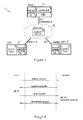
- FIG. 1 of the drawings is a simplified schematic of a first data processing system embodying the invention showing the main components involved in operation of the system.
- the data processing system 1 includes a data item management computer 2 operated by the authority responsible for managing data items, here cryptographic credentials, and for managing a cryptographic accumulator for use in the credential verification process to be described.
- this authority here the "issuer” issues cryptographic credentials to users and indicates valid credentials in the system via the accumulator to be described.
- the issuer computer 2 includes credential management logic 3 for implementing processes detailed below, memory 4 and a communications interface 5.
- the system 1 also includes a user computer 6 for using cryptographic credentials obtained from issuer computer 2, and a verifier computer 7 for verifying user credentials by reference to the accumulator to be described.
- User computer 6 includes prover logic 8 for implementing cryptographic processes described below, memory 7 and a communications interface 8.
- Verifier computer 3 includes verifier logic 11 for performing a cryptographic verification process described below, memory 12 and a communications interface 13.
- Computers 2, 6 and 7 can communicate over a data communications network 15 via their respective communications interfaces (where network 15 may in practice comprise a plurality of component networks and/or internetworks).
- the system 1 includes a distributor computer 16, shown here in network 15 and accessible to all computers 2, 6, 7, the purpose of which is explained below.
- control logic 3, 8, 11 of the issuer, user and verifier computers is configured for implementing the appropriate steps of the cryptographic processes described below.
- this control logic may be implemented in hardware or software or a combination thereof, and the precise form of the user, verifier and issuer devices 2, 6, 7 is largely irrelevant to fundamental operation of the system to be described.
- these devices are implemented by general-purpose computers, user computer 6 being a user pc and issuer and verifier computers 2, 7 being servers to which user pc 2 can connect over network 15.
- Credential management logic 3, prover logic 8 and verifier logic 11 are implemented here by respective computer programs which configure the host computers to perform the functions described. Suitable software will be apparent to those skilled in the art from the description herein.
- computers 2, 6, 7 and 16 may in general be implemented by one or more component devices.
- the functionality of user computer 6 might be distributed in practice between a general purpose computer providing a communications interface to network 15, and a separate user device such as a smart card.
- a separate user device such as a smart card.
- Such a separate device may provide secure storage for credentials and cryptographic software, and may be connected via wired or wireless links to the user computer when desired.
- Verifier computer 7 is operated by a service provider (SP).
- SP computer 7 can connect over network 15 to SP computer 7 to request access to a restricted service.
- SP computer 7 must demonstrate possession of a cryptographic credential obtained from issuer 2.
- SP computer 7 must verify that the presented credential is valid. This involves confirming that the credential is one of a set of valid credentials maintained by issuer 2. This is achieved using a cryptographic accumulator construction.
- Algorithms underlying this initial accumulator construction will be defined in the following and are based in part on the broadcast encryption scheme by Boneh, Gentry and Waters (see “ Collusion Resistant Broadcast Encryption with Short Ciphertexts and Private Keys", Boneh, Gentry and Waters, Advances in Cryptology - CRYPTO 2005, volume 3621 of Lecture Notes in Computer Science, pages 258-275, Springer, 2005 ).
- accumulator computation in the construction to be described is related to the way in which encryption keys are generated in the referenced scheme
- witness computation is related to the way in which decryption keys are generated in the referenced scheme.
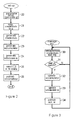
- step 21 of Figure 2 logic 3 defines the mapping between group elements and the credentials to be issued.
- Each credential has an identifier in the form of serial number which is defined in the credential, and the mapping is defined between these serial numbers and respective group elements.
- serial numbers For simplicity here we represent the serial numbers by the set of integers 1 to n, though of course any arbitrary mapping of numbers to group elements can be accommodated.
- Step 22 represents generation by logic 3 of the initial set of credentials C ( i ) to be issued to users. These are the credentials that will be initially contained in the accumulator. Credentials can be generated in known manner, each credential including the respective serial number i .
- logic 3 generates the accumulator for the initial set of credentials in accordance with the following algorithm:
- the cryptographic accumulator is generated here as the product of the group elements g n +1- i for values of i for which the group element g i is mapped to a credential in the set of valid credentials.
- the group elements actually accumulated are thus related via the i -values to the elements g i mapped to valid credentials.
- the accumulator witness w is calculated as the product of a respective different subset of the group elements. This subset is dependent on the i -values of credentials in the valid set and also the i -value of the credential for which each witness is generated. Specifically, for each valid credential mapped to a group element g i , the witness comprises the product of the group elements g n +1- j + i for all values of j for which a group element g j is mapped to another valid credential. Thus, the witness generation makes use of the auxiliary group elements g n +2 , ..., g 2 n defined earlier.
- the signature ⁇ i indicates the mapping between the associated credential and the corresponding group element.
- step 25 each credential C ( i ), together with its associated witness wit i , is sent via network 15 to the user in question.
- credential logic 3 publishes the cryptographic accumulator by sending the accumulator calculated in step 23 to distributor computer(s) 16.
- Distributor 16 publishes the accumulator on network 15 by providing access to any connecting computer 6, 7. The initial stages of accumulator setup are then complete.
- Step 30 represents the issue and revocation of credentials which occurs within a defined "epoch”.
- credential logic 3 logs this fact along with the serial number i in memory 4. While the ensuing update process could in principle be performed each time a credential is issued or revoked, the update is typically performed periodically at regular intervals, for example daily.
- credential logic 3 checks whether the current epoch has ended, and if not operation reverts to step 30.
- step 32 logic 3 updates the accumulator to account for each credential added/removed from the set of valid credentials.
- step 33 the set of witnesses is then updated by generating witnesses for newly issued credentials and updating the old witnesses for existing credentials to reflect changes in the valid set. For each newly issued credential, these processes are defined by the following algorithm:
- step 34 credential logic 3 of issuer computer 2 sends the updated accumulator and witnesses to distributor computer(s) 16 for publication on network 15.
- Trustes are published with some form of identifying tag to enable individual users to identify the witness for their particular credential when required. Operation then reverts to step 30 for the new epoch.
- Figure 4 illustrates the procedure when a user subsequently wishes to use his credential to access an on-line service via verifier computer 7.
- This figure indicates the key steps performed by user computer 6 on the left of the figure and verifier computer 7 on the right. Operation begins when user computer 6 connects to verifier computer 7 to request access to the service. Verifier logic 11 of computer 7 responds by requesting the user's credential. This request is received by prover logic 8 of user computer 6. The prover logic then establishes a connection to distributor computer 16 to download the current value of the witness w for the credential C ( i ) previously obtained from issuer 2 and stored in memory 9. This step is necessary to account for any changes in the accumulator since the credential was issued in accordance with steps 32 to 34 of Figure 3 .
- prover logic 8 sends the credential C ( i ), containing the serial number i as discussed earlier, together with the full witness wit i ( w , ⁇ i , g i ) defined above, to verifier 7.
- Verifier logic 11 then similarly accesses distributor computer 16 to download the current value of the accumulator acc V which is then stored in memory 12.
- verifier logic 11 runs the following verification protocol:
- verifier logic 11 checks that the signature ⁇ i is valid for the serial number i of the user's credential C ( i ) and the associated group element g i . (Note that the use of this signature scheme to sign the g i together with the value to which they map avoids the need to publish the mapping of the g i values, thus avoiding large public parameters during verification). Verifier logic 11 also checks that the witness w confirms the group element g i is in the current accumulator acc V . This confirms that the user's credential is valid. Verifier logic 11 then permits or denies user computer 6 access to the service according to whether or not the credential is deemed valid.
- each party can simply retrieve the new values periodically at the start of each new epoch.
- witness updates for example require only multiplications (no exponentiations) linear in the number of changes to the accumulator and do not require knowledge of any secret information. In general, therefore, witnesses could be kept up-to-date for the users either by the users themselves, by the issuer, or by some third party.
- witness updates could be performed individually by users as in prior schemes, the preferred embodiments exploit the efficiency of the system, which enables all witnesses to be feasibly kept in main memory, to allow witness calculation to be performed centrally. This is done by issuer 2 in the above embodiment.
- witness updates can be efficiently offloaded to an untrusted update entity who runs AccWitUpdate and is only given the accumulator state state U and the bookkeeping information V and V w .
- the distributor computer 16 in Figure 1 could additionally function as a witness update computer. On updating of the accumulator by issuer computer 2 following a change in the valid set, witness updates for credentials remaining in the set could be performed, altogether or in batches, by one or more such distributor computers 16.
- C Camenisch-Lysyanskaya
- IssuerKeygen(1 k ) be the certificate issuer's keypair.
- the framework supports two types of protocols: 1) an interactive certificate issuing protocol ObtainCert that allows a signature on committed values to be obtained without revealing these values and 2) efficient zero-knowledge proofs of knowledge of signature possession.
- a user can obtain a certificate on ( m 1 , ..., m l ) such that the issuer does not learn any information on the data items in H , while it learns the other data items, i.e. L ⁇ H.
- V be the set of valid certificates for an epoch with epoch information epoch V .
- a certificate is assigned a unique identifier i (embedded into it as one of the attributes) and a witness wit i .
- the user can prove to a verifier that she possesses a non-revoked certificate only if i ⁇ V . This is achieved by having the user prove that the identifier embedded into her credential is a valid one for the current epoch.
- the user needs to update her witness and both parties (the user and the verifier) need to obtain the most up-to-date epoch information epoch v for V .
- the preferred credential revocation system is based on updated IssuerKeygen and ObtainCert protocols, new algorithms UpdateEpoch and UpdateWitness for managing revocation, and a zero-knowledge proof system for a new predicate VerifyEpoch that allows proof of possession of a witness wit i :
- UpdateEpoch( V , state U ) outputs epoch information epoch V ; if V ⁇ U . Otherwise it outputs ⁇ .
- UpdateWitness( wit i , epoch V , state U ) outputs an updated witness wit' i if V ⁇ U . Otherwise it outputs ⁇ .
- a user who knows a certificate cert i and a corresponding up-to-date witness wit i can prove to a verifier possession of the certificate and its validity for the current epoch using the new predicate VerifyEpoch as follows.
- the user's secret input is cert i .
- the common input of the protocol is the issuer's public key pk I , the epoch information epoch V , and a specification of the proof statement (this includes the information revealed about the certificate).
- the user chooses to keep the first l ' messages secret while revealing the rest of the messages.
- mapping of i to g i is made implicit by including g i in the credential to make the proofs more efficient.
- the g i values are used both in the private certificate and the accumulator to represent the certificate id i . This requires that we extend the signature scheme given earlier to allow verification without knowing the secret exponent ⁇ i :
- the set up process performed by credential management logic 3 of issuer computer 2 (corresponding to step 20 of Figure 2 ) is defined by:
- each party 6, 7 downloads updated values from distributor computer 16 to account for intervening changes in the accumulator.
- prover logic 8 obtains the current witness value w i for the user's credential cred i
- verifier logic 11 sends a verification request to prover logic 6.
- prover logic defines various parameters to be used in the ensuing proof. Specifically, prover logic picks ⁇ , ⁇ ' , r, r', r'', r''' ⁇ Z q and picks opening open, open' ⁇ Z q to commit to ⁇ and r respectively.
- the prover logic then sends C , C', A, G', W', S ' and U ' to the verifier.
- the prover logic 8 and verifier logic 11 then communicate to implement a zero-knowledge (ZK) verification protocol.
- ZK zero-knowledge
- the common input of the protocol is the issuer's public key pk 1 , the epoch information epoch V , and a specification of the proof statement (this includes the information revealed about the certificate).
- the user chooses to keep the first l' messages secret while he reveals the rest of the messages:
- the above process allows the user to prove possession of a valid credential without revealing any other information to the verifier, maintaining full anonymity and transaction unlinkability.
- the system described is computationally efficient, providing, inter alia, highly efficient witness updates.
- the number of revocations per epoch is likely to be very large.
- Resource-constrained user devices will typically be unable to handle the computation required to accommodate such changes.
- witness update entities responsible for upgrading witnesses for group of users.
- witness updates could be performed by per-county or per-city. This requires only public parameters and update authorities are only responsible for correct computation of the witness updates for users in their group. Malicious behaviour by one of the witness update entities does not break system security (since they need only public parameters) but may simply lead to denial of service.
- the size of the public parameters in the foregoing construction is linear in the estimated upper bound on the number of values that may need to be accumulated. In scenarios where this upper bound is hard to estimate, over-estimation could be a costly issue.
Landscapes
- Engineering & Computer Science (AREA)
- Computer Security & Cryptography (AREA)
- Theoretical Computer Science (AREA)
- Signal Processing (AREA)
- Computer Networks & Wireless Communication (AREA)
- Mathematical Physics (AREA)
- Physics & Mathematics (AREA)
- Pure & Applied Mathematics (AREA)
- Mathematical Optimization (AREA)
- Computing Systems (AREA)
- Mathematical Analysis (AREA)
- General Physics & Mathematics (AREA)
- Algebra (AREA)
- Storage Device Security (AREA)
- Management, Administration, Business Operations System, And Electronic Commerce (AREA)
Claims (10)
- Verfahren zum Verwalten von dynamischen Sätzen kryptographischer Berechtigungsdaten in einem Datenverarbeitungssystem (1), wobei das Verfahren umfasst:Festlegen einer Abbildung zwischen kryptographischen Berechtigungsdaten in dem Satz und zugehörigen Gruppenelementen aus einer vorgegebenen Vielzahl von Gruppenelementen;periodisches Erzeugen eines kryptographischen Akkumulators, der den Satz von Berechtigungsdaten angibt, wobei der kryptographische Akkumulator das Produkt zugehöriger Gruppenelemente umfasst, die mit den Gruppenelementen verknüpft sind, die auf die Berechtigungsdaten in dem Satz abgebildet werden;periodisches Veröffentlichen des kryptographischen Akkumulators in dem Datenverarbeitungs-System (1); undperiodisches Erzeugen eines Zeugen für jedes Berechtigungsdatum in dem Satz, wobei jeder Zeuge das Produkt einer zugehörigen anderen Teilmenge der Gruppenelemente umfasst und die Teilmenge für jeden Zeugen von den Berechtigungsdaten in dem Satz und dem Berechtigungsdatum unabhängig ist, für die der Zeuge erzeugt wurde,Erzeugen der Vielzahl von Gruppenelementen durch Erzeugen jedes Gruppenelements mit einem Geheimwert γ und einem Gruppenerzeuger g, wobei die Gruppenelemente zugehörige Elemente gi = g γ
i für i ∈ {1,2,3,...,n} umfassen und n eine vorgegebene Höchstanzahl von Berechtigungsdaten in dem Satz darstellt; und wobei die Abbildung zwischen Berechtigungsdaten in dem Satz und zugehörigen Gruppenelementen g i festgelegt ist, der kryptographische Akkumulator das Produkt der Gruppenelemente g n+1-i für Werte von i umfasst, für die das Gruppenelement g i auf ein Berechtigungsdatum in dem Satz abgebildet wird, und wobei die Gruppenelemente die Hilfselemente g n+2 =g γn+2 , g n+3 = gγn+3 , g n+4 = g γn+4 , g 2n = g γ2n umfassen; und wobeifür jedes Berechtigungsdatum in dem Satz, das auf ein Gruppenelement g i abgebildet wird, der Zeuge das Produkt der Gruppenelemente g n+1-j+1 für alle Werte von j umfasst, für die ein Gruppenelement g j auf ein anderes Berechtigungsdatum in dem Satz abgebildet wird. - Verfahren nach Anspruch 1, das ein periodische Veröffentlichen der Zeugen für die Berechtigungsdaten in dem Satz in dem Datenverarbeitungssystem (1) beinhaltet.
- Verfahren nach Anspruch 1 oder 2, wobei die Abbildung zwischen einem numerischen Bezeichner, der in jedem Berechtigungsdatum festgelegt ist, und dem zugehörigen Gruppenelement definiert ist.
- Verfahren nach einem der vorangehenden Ansprüche, wobei das Verfahren das Erzeugen der kryptographischen Berechtigungsdaten beinhaltet.
- Verfahren nach Anspruch 4, das das Übertragen jedes erzeugten Berechtigungsdatums an einen Benutzer-Computer (6) des Datenverarbeitungssystems (1) beinhaltet.
- Computerprogramm, das Computerprogramm-Codemittel umfasst, um einen Computer zu veranlassen, das Verfahren nach einem vorangehenden Anspruch auszuführen.
- Einheit zum Verarbeiten eines dynamischen Satzes von kryptographischen Berechtigungsdaten in einem Datenverarbeitungssystem (1), wobei die Einheit Steuerlogik (3), die zum Ausführen des Verfahrens nach einem der Ansprüche 1 bis 5 geeignet ist, und einen Speicher (4) zum Speichern der Vielzahl von Gruppenelementen umfasst.
- Datenverarbeitungs-System (1), das einen Benutzer-Computer (6) und einen Bestätigungs-Computer (7) umfasst, die jeweils zum Datenaustausch über ein Datenübertragungs-Netzwerk (15) geeignet sind,
und eine Berechtigungsdaten-Verwaltungsvorrichtung, die zum Austauschen von Daten mit den Teilnehmer- und Bestätigungs-Computern (6, 7) über das Netzwerk (15) geeignet ist, wobei:die Berechtigungsdaten-Verwaltungsvorrichtung Steuerlogik (3) beinhaltet, die zum Ausführen eines Verfahrens nach einem der Ansprüche 1 bis 5 ausgelegt ist, um einen dynamischen Satz von kryptographischen Berechtigungsdaten einschließlich eines Teilnehmerberechtigungsdatums, das dem Teilnehmer-Computer (6) zugehörig ist, zu verarbeiten;der Benutzer-Computer (6) zum Speichern der Benutzer-Berechtigungsdaten und zum Anfordern des Zeugen über das Netzwerk (15) ausgelegt ist, wobei der Zeuge periodisch durch die Berechtigungsdaten-Verwaltungsvorrichtung für das Benutzer-Berechtigungsdatum erzeugt wird; undder Benutzer-Computer (6) und der Bestätigungs-Computer (7) zum Datenaustausch über das Netzwerk (15) ausgelegt sind, um ein Prüfprotokoll umzusetzen, das die Kenntnis eines Zeugen durch den Benutzer-Computer (6) nachweist, wobei der Zeuge zu einem Berechtigungsdatum in dem Satz gehört, der durch den kryptographischen Akkumulator angegeben wird. - System nach Anspruch 8, wobei es sich bei dem Prüfprotokoll um ein kenntnisfreies Prüfprotokoll handelt.
- System nach Anspruch 8 oder 9, wobei die Berechtigungsdaten-Verwaltungsvorrichtung einen Ausgabe-Computer (2) und einen Zeugenaktualisierungs-Computer (16) umfasst, die jeweils zum Datenaustausch über das Netzwerk (15) geeignet sind, wobei der Ausgabe-Computer (2) zum periodischen Erzeugen des kryptographischen Akkumulators ausgelegt ist, der den Satz von Berechtigungsdaten angibt, und der Zeugenaktualisierungs-Computer (16) zum Erzeugen der Zeugen für die Berechtigungsdaten ausgelegt ist, die in dem Satz beim Erzeugen des kryptographischen Akkumulators nach einer Änderung in dem Satz verbleiben.
Priority Applications (1)
| Application Number | Priority Date | Filing Date | Title |
|---|---|---|---|
| EP10703121.3A EP2384562B1 (de) | 2009-01-31 | 2010-01-27 | Verarbeitung von kryptografischen berechtigungen in datenverarbeitungssystemen |
Applications Claiming Priority (3)
| Application Number | Priority Date | Filing Date | Title |
|---|---|---|---|
| EP09151833 | 2009-01-31 | ||
| EP10703121.3A EP2384562B1 (de) | 2009-01-31 | 2010-01-27 | Verarbeitung von kryptografischen berechtigungen in datenverarbeitungssystemen |
| PCT/IB2010/050366 WO2010086802A1 (en) | 2009-01-31 | 2010-01-27 | Management of cryptographic credentials in data processing systems |
Publications (2)
| Publication Number | Publication Date |
|---|---|
| EP2384562A1 EP2384562A1 (de) | 2011-11-09 |
| EP2384562B1 true EP2384562B1 (de) | 2013-07-17 |
Family
ID=42101780
Family Applications (1)
| Application Number | Title | Priority Date | Filing Date |
|---|---|---|---|
| EP10703121.3A Active EP2384562B1 (de) | 2009-01-31 | 2010-01-27 | Verarbeitung von kryptografischen berechtigungen in datenverarbeitungssystemen |
Country Status (4)
| Country | Link |
|---|---|
| EP (1) | EP2384562B1 (de) |
| JP (1) | JP2012516603A (de) |
| CN (1) | CN102301643B (de) |
| WO (1) | WO2010086802A1 (de) |
Families Citing this family (8)
| Publication number | Priority date | Publication date | Assignee | Title |
|---|---|---|---|---|
| US9083535B2 (en) * | 2010-11-05 | 2015-07-14 | Nokia Corporation | Method and apparatus for providing efficient management of certificate revocation |
| CN102970682B (zh) * | 2012-12-10 | 2015-05-06 | 北京航空航天大学 | 一种应用于可信移动终端平台的直接匿名证明方法 |
| US9768962B2 (en) * | 2013-03-15 | 2017-09-19 | Microsoft Technology Licensing, Llc | Minimal disclosure credential verification and revocation |
| EP3741082B1 (de) * | 2018-01-19 | 2021-12-29 | Qed-It Systems Ltd. | Beweisverkettung und zersetzung |
| EP3750277A4 (de) * | 2018-02-05 | 2021-12-08 | Lg Electronics Inc. | Kryptografische verfahren und systeme, die verblindete aktivierungscodes für den widerruf von digitalen zertifikaten verwenden |
| CN110289950B (zh) * | 2019-05-29 | 2021-11-09 | 北京链化未来科技有限公司 | 一种密钥信息生成方法及装置 |
| EP4055774A1 (de) * | 2019-12-05 | 2022-09-14 | Huawei Technologies Co., Ltd. | System und verfahren zur feststellung einer vertrauenswürdigen beziehung in einem verteilten system |
| CN112600677A (zh) * | 2020-12-28 | 2021-04-02 | 中钞信用卡产业发展有限公司杭州区块链技术研究院 | 一种证照验证方法及系统 |
Family Cites Families (4)
| Publication number | Priority date | Publication date | Assignee | Title |
|---|---|---|---|---|
| US7360080B2 (en) * | 2000-11-03 | 2008-04-15 | International Business Machines Corporation | Non-transferable anonymous credential system with optional anonymity revocation |
| US7543139B2 (en) * | 2001-12-21 | 2009-06-02 | International Business Machines Corporation | Revocation of anonymous certificates, credentials, and access rights |
| EP1848143A4 (de) * | 2005-02-10 | 2010-04-14 | Nec Corp | Mitglieder-zertifikats-beschaffungseinrichtung, mitglieder-zertifikat-ausgabeeinrichtung, gruppensigniereinrichtung und gruppensignatur-verifiziereinrichtung |
| FR2890267B1 (fr) * | 2005-08-26 | 2007-10-05 | Viaccess Sa | Procede d'etablissement d'une cle de session et unites pour la mise en oeuvre du procede |
-
2010
- 2010-01-27 EP EP10703121.3A patent/EP2384562B1/de active Active
- 2010-01-27 CN CN201080005950.3A patent/CN102301643B/zh not_active Expired - Fee Related
- 2010-01-27 JP JP2011547039A patent/JP2012516603A/ja active Pending
- 2010-01-27 WO PCT/IB2010/050366 patent/WO2010086802A1/en not_active Ceased
Also Published As
| Publication number | Publication date |
|---|---|
| CN102301643B (zh) | 2014-12-03 |
| EP2384562A1 (de) | 2011-11-09 |
| JP2012516603A (ja) | 2012-07-19 |
| WO2010086802A1 (en) | 2010-08-05 |
| CN102301643A (zh) | 2011-12-28 |
Similar Documents
| Publication | Publication Date | Title |
|---|---|---|
| Camenisch et al. | An accumulator based on bilinear maps and efficient revocation for anonymous credentials | |
| Camenisch et al. | Dynamic accumulators and application to efficient revocation of anonymous credentials | |
| US8499149B2 (en) | Revocation for direct anonymous attestation | |
| US8225098B2 (en) | Direct anonymous attestation using bilinear maps | |
| US8245047B2 (en) | Group signature scheme with improved efficiency, in particular in a join procedure | |
| Kaaniche et al. | Attribute-based signatures for supporting anonymous certification | |
| Hwang et al. | Short dynamic group signature scheme supporting controllable linkability | |
| EP2384562B1 (de) | Verarbeitung von kryptografischen berechtigungen in datenverarbeitungssystemen | |
| Brickell et al. | Enhanced privacy id from bilinear pairing | |
| US9882890B2 (en) | Reissue of cryptographic credentials | |
| CA2560038A1 (en) | Malleable pseudonym certificate system and method | |
| JPWO2011007697A1 (ja) | 匿名認証署名システム、ユーザ装置、検証装置、署名方法、検証方法およびそれらのプログラム | |
| Zhang et al. | Stateless blockchain-based lightweight identity management architecture for industrial IoT applications | |
| EP2384563B1 (de) | Überprüfung von datenobjekten in datenverarbeitungssystemen | |
| Wei et al. | Remove key escrow from the BF and Gentry identity-based encryption with non-interactive key generation | |
| CN101155032A (zh) | 匿名可选择凭证系统及其方法 | |
| Lapon et al. | Performance analysis of accumulator-based revocation mechanisms | |
| Sahana et al. | A provable secure key-escrow-free identity-based signature scheme without using secure channel at the phase of private key issuance | |
| Kumar et al. | Escrow-less identity-based signature scheme with outsourced protection in cloud computing | |
| Rasslan et al. | An IoT Privacy-Oriented selective disclosure credential system | |
| Hajny et al. | Anonymous credentials with practical revocation | |
| Shin et al. | AAnA: Anonymous authentication and authorization based on short traceable signatures | |
| Bultel et al. | Improving the efficiency of report and trace ring signatures | |
| Shao et al. | Certificate‐based verifiably encrypted RSA signatures | |
| Yum et al. | A distributed online certificate status protocol based on GQ signature scheme |
Legal Events
| Date | Code | Title | Description |
|---|---|---|---|
| PUAI | Public reference made under article 153(3) epc to a published international application that has entered the european phase |
Free format text: ORIGINAL CODE: 0009012 |
|
| 17P | Request for examination filed |
Effective date: 20110719 |
|
| AK | Designated contracting states |
Kind code of ref document: A1 Designated state(s): AT BE BG CH CY CZ DE DK EE ES FI FR GB GR HR HU IE IS IT LI LT LU LV MC MK MT NL NO PL PT RO SE SI SK SM TR |
|
| DAX | Request for extension of the european patent (deleted) | ||
| 17Q | First examination report despatched |
Effective date: 20120515 |
|
| GRAP | Despatch of communication of intention to grant a patent |
Free format text: ORIGINAL CODE: EPIDOSNIGR1 |
|
| INTG | Intention to grant announced |
Effective date: 20130328 |
|
| GRAS | Grant fee paid |
Free format text: ORIGINAL CODE: EPIDOSNIGR3 |
|
| GRAA | (expected) grant |
Free format text: ORIGINAL CODE: 0009210 |
|
| AK | Designated contracting states |
Kind code of ref document: B1 Designated state(s): AT BE BG CH CY CZ DE DK EE ES FI FR GB GR HR HU IE IS IT LI LT LU LV MC MK MT NL NO PL PT RO SE SI SK SM TR |
|
| REG | Reference to a national code |
Ref country code: GB Ref legal event code: FG4D |
|
| REG | Reference to a national code |
Ref country code: CH Ref legal event code: EP |
|
| REG | Reference to a national code |
Ref country code: IE Ref legal event code: FG4D |
|
| REG | Reference to a national code |
Ref country code: AT Ref legal event code: REF Ref document number: 622760 Country of ref document: AT Kind code of ref document: T Effective date: 20130815 |
|
| REG | Reference to a national code |
Ref country code: GB Ref legal event code: 746 Effective date: 20130816 |
|
| REG | Reference to a national code |
Ref country code: DE Ref legal event code: R096 Ref document number: 602010008609 Country of ref document: DE Effective date: 20130912 |
|
| REG | Reference to a national code |
Ref country code: DE Ref legal event code: R084 Ref document number: 602010008609 Country of ref document: DE Effective date: 20130807 |
|
| REG | Reference to a national code |
Ref country code: AT Ref legal event code: MK05 Ref document number: 622760 Country of ref document: AT Kind code of ref document: T Effective date: 20130717 |
|
| REG | Reference to a national code |
Ref country code: NL Ref legal event code: VDEP Effective date: 20130717 |
|
| REG | Reference to a national code |
Ref country code: LT Ref legal event code: MG4D |
|
| PG25 | Lapsed in a contracting state [announced via postgrant information from national office to epo] |
Ref country code: AT Free format text: LAPSE BECAUSE OF FAILURE TO SUBMIT A TRANSLATION OF THE DESCRIPTION OR TO PAY THE FEE WITHIN THE PRESCRIBED TIME-LIMIT Effective date: 20130717 Ref country code: LT Free format text: LAPSE BECAUSE OF FAILURE TO SUBMIT A TRANSLATION OF THE DESCRIPTION OR TO PAY THE FEE WITHIN THE PRESCRIBED TIME-LIMIT Effective date: 20130717 Ref country code: BE Free format text: LAPSE BECAUSE OF FAILURE TO SUBMIT A TRANSLATION OF THE DESCRIPTION OR TO PAY THE FEE WITHIN THE PRESCRIBED TIME-LIMIT Effective date: 20130717 Ref country code: PT Free format text: LAPSE BECAUSE OF FAILURE TO SUBMIT A TRANSLATION OF THE DESCRIPTION OR TO PAY THE FEE WITHIN THE PRESCRIBED TIME-LIMIT Effective date: 20131118 Ref country code: IS Free format text: LAPSE BECAUSE OF FAILURE TO SUBMIT A TRANSLATION OF THE DESCRIPTION OR TO PAY THE FEE WITHIN THE PRESCRIBED TIME-LIMIT Effective date: 20131117 Ref country code: CY Free format text: LAPSE BECAUSE OF FAILURE TO SUBMIT A TRANSLATION OF THE DESCRIPTION OR TO PAY THE FEE WITHIN THE PRESCRIBED TIME-LIMIT Effective date: 20130724 Ref country code: NO Free format text: LAPSE BECAUSE OF FAILURE TO SUBMIT A TRANSLATION OF THE DESCRIPTION OR TO PAY THE FEE WITHIN THE PRESCRIBED TIME-LIMIT Effective date: 20131017 Ref country code: HR Free format text: LAPSE BECAUSE OF FAILURE TO SUBMIT A TRANSLATION OF THE DESCRIPTION OR TO PAY THE FEE WITHIN THE PRESCRIBED TIME-LIMIT Effective date: 20130717 Ref country code: SE Free format text: LAPSE BECAUSE OF FAILURE TO SUBMIT A TRANSLATION OF THE DESCRIPTION OR TO PAY THE FEE WITHIN THE PRESCRIBED TIME-LIMIT Effective date: 20130717 |
|
| PG25 | Lapsed in a contracting state [announced via postgrant information from national office to epo] |
Ref country code: PL Free format text: LAPSE BECAUSE OF FAILURE TO SUBMIT A TRANSLATION OF THE DESCRIPTION OR TO PAY THE FEE WITHIN THE PRESCRIBED TIME-LIMIT Effective date: 20130717 Ref country code: NL Free format text: LAPSE BECAUSE OF FAILURE TO SUBMIT A TRANSLATION OF THE DESCRIPTION OR TO PAY THE FEE WITHIN THE PRESCRIBED TIME-LIMIT Effective date: 20130717 Ref country code: ES Free format text: LAPSE BECAUSE OF FAILURE TO SUBMIT A TRANSLATION OF THE DESCRIPTION OR TO PAY THE FEE WITHIN THE PRESCRIBED TIME-LIMIT Effective date: 20131028 Ref country code: GR Free format text: LAPSE BECAUSE OF FAILURE TO SUBMIT A TRANSLATION OF THE DESCRIPTION OR TO PAY THE FEE WITHIN THE PRESCRIBED TIME-LIMIT Effective date: 20131018 Ref country code: SI Free format text: LAPSE BECAUSE OF FAILURE TO SUBMIT A TRANSLATION OF THE DESCRIPTION OR TO PAY THE FEE WITHIN THE PRESCRIBED TIME-LIMIT Effective date: 20130717 Ref country code: FI Free format text: LAPSE BECAUSE OF FAILURE TO SUBMIT A TRANSLATION OF THE DESCRIPTION OR TO PAY THE FEE WITHIN THE PRESCRIBED TIME-LIMIT Effective date: 20130717 Ref country code: LV Free format text: LAPSE BECAUSE OF FAILURE TO SUBMIT A TRANSLATION OF THE DESCRIPTION OR TO PAY THE FEE WITHIN THE PRESCRIBED TIME-LIMIT Effective date: 20130717 |
|
| PG25 | Lapsed in a contracting state [announced via postgrant information from national office to epo] |
Ref country code: CY Free format text: LAPSE BECAUSE OF FAILURE TO SUBMIT A TRANSLATION OF THE DESCRIPTION OR TO PAY THE FEE WITHIN THE PRESCRIBED TIME-LIMIT Effective date: 20130717 |
|
| PG25 | Lapsed in a contracting state [announced via postgrant information from national office to epo] |
Ref country code: EE Free format text: LAPSE BECAUSE OF FAILURE TO SUBMIT A TRANSLATION OF THE DESCRIPTION OR TO PAY THE FEE WITHIN THE PRESCRIBED TIME-LIMIT Effective date: 20130717 Ref country code: CZ Free format text: LAPSE BECAUSE OF FAILURE TO SUBMIT A TRANSLATION OF THE DESCRIPTION OR TO PAY THE FEE WITHIN THE PRESCRIBED TIME-LIMIT Effective date: 20130717 Ref country code: SK Free format text: LAPSE BECAUSE OF FAILURE TO SUBMIT A TRANSLATION OF THE DESCRIPTION OR TO PAY THE FEE WITHIN THE PRESCRIBED TIME-LIMIT Effective date: 20130717 Ref country code: DK Free format text: LAPSE BECAUSE OF FAILURE TO SUBMIT A TRANSLATION OF THE DESCRIPTION OR TO PAY THE FEE WITHIN THE PRESCRIBED TIME-LIMIT Effective date: 20130717 Ref country code: RO Free format text: LAPSE BECAUSE OF FAILURE TO SUBMIT A TRANSLATION OF THE DESCRIPTION OR TO PAY THE FEE WITHIN THE PRESCRIBED TIME-LIMIT Effective date: 20130717 |
|
| PLBE | No opposition filed within time limit |
Free format text: ORIGINAL CODE: 0009261 |
|
| STAA | Information on the status of an ep patent application or granted ep patent |
Free format text: STATUS: NO OPPOSITION FILED WITHIN TIME LIMIT |
|
| PG25 | Lapsed in a contracting state [announced via postgrant information from national office to epo] |
Ref country code: IT Free format text: LAPSE BECAUSE OF FAILURE TO SUBMIT A TRANSLATION OF THE DESCRIPTION OR TO PAY THE FEE WITHIN THE PRESCRIBED TIME-LIMIT Effective date: 20130717 |
|
| 26N | No opposition filed |
Effective date: 20140422 |
|
| REG | Reference to a national code |
Ref country code: DE Ref legal event code: R097 Ref document number: 602010008609 Country of ref document: DE Effective date: 20140422 |
|
| PG25 | Lapsed in a contracting state [announced via postgrant information from national office to epo] |
Ref country code: LU Free format text: LAPSE BECAUSE OF FAILURE TO SUBMIT A TRANSLATION OF THE DESCRIPTION OR TO PAY THE FEE WITHIN THE PRESCRIBED TIME-LIMIT Effective date: 20140127 |
|
| REG | Reference to a national code |
Ref country code: CH Ref legal event code: PL |
|
| PG25 | Lapsed in a contracting state [announced via postgrant information from national office to epo] |
Ref country code: LI Free format text: LAPSE BECAUSE OF NON-PAYMENT OF DUE FEES Effective date: 20140131 Ref country code: CH Free format text: LAPSE BECAUSE OF NON-PAYMENT OF DUE FEES Effective date: 20140131 |
|
| REG | Reference to a national code |
Ref country code: FR Ref legal event code: ST Effective date: 20140930 |
|
| REG | Reference to a national code |
Ref country code: IE Ref legal event code: MM4A |
|
| PG25 | Lapsed in a contracting state [announced via postgrant information from national office to epo] |
Ref country code: FR Free format text: LAPSE BECAUSE OF NON-PAYMENT OF DUE FEES Effective date: 20140131 |
|
| PG25 | Lapsed in a contracting state [announced via postgrant information from national office to epo] |
Ref country code: IE Free format text: LAPSE BECAUSE OF NON-PAYMENT OF DUE FEES Effective date: 20140127 |
|
| PG25 | Lapsed in a contracting state [announced via postgrant information from national office to epo] |
Ref country code: MC Free format text: LAPSE BECAUSE OF FAILURE TO SUBMIT A TRANSLATION OF THE DESCRIPTION OR TO PAY THE FEE WITHIN THE PRESCRIBED TIME-LIMIT Effective date: 20130717 |
|
| PG25 | Lapsed in a contracting state [announced via postgrant information from national office to epo] |
Ref country code: MT Free format text: LAPSE BECAUSE OF FAILURE TO SUBMIT A TRANSLATION OF THE DESCRIPTION OR TO PAY THE FEE WITHIN THE PRESCRIBED TIME-LIMIT Effective date: 20130717 |
|
| PG25 | Lapsed in a contracting state [announced via postgrant information from national office to epo] |
Ref country code: SM Free format text: LAPSE BECAUSE OF FAILURE TO SUBMIT A TRANSLATION OF THE DESCRIPTION OR TO PAY THE FEE WITHIN THE PRESCRIBED TIME-LIMIT Effective date: 20130717 |
|
| PG25 | Lapsed in a contracting state [announced via postgrant information from national office to epo] |
Ref country code: BG Free format text: LAPSE BECAUSE OF FAILURE TO SUBMIT A TRANSLATION OF THE DESCRIPTION OR TO PAY THE FEE WITHIN THE PRESCRIBED TIME-LIMIT Effective date: 20130717 |
|
| PG25 | Lapsed in a contracting state [announced via postgrant information from national office to epo] |
Ref country code: HU Free format text: LAPSE BECAUSE OF FAILURE TO SUBMIT A TRANSLATION OF THE DESCRIPTION OR TO PAY THE FEE WITHIN THE PRESCRIBED TIME-LIMIT; INVALID AB INITIO Effective date: 20100127 Ref country code: TR Free format text: LAPSE BECAUSE OF FAILURE TO SUBMIT A TRANSLATION OF THE DESCRIPTION OR TO PAY THE FEE WITHIN THE PRESCRIBED TIME-LIMIT Effective date: 20130717 |
|
| PG25 | Lapsed in a contracting state [announced via postgrant information from national office to epo] |
Ref country code: MK Free format text: LAPSE BECAUSE OF FAILURE TO SUBMIT A TRANSLATION OF THE DESCRIPTION OR TO PAY THE FEE WITHIN THE PRESCRIBED TIME-LIMIT Effective date: 20130717 |
|
| REG | Reference to a national code |
Ref country code: DE Ref legal event code: R082 Ref document number: 602010008609 Country of ref document: DE Representative=s name: KUISMA, SIRPA, FI |
|
| P01 | Opt-out of the competence of the unified patent court (upc) registered |
Effective date: 20230423 |
|
| PGFP | Annual fee paid to national office [announced via postgrant information from national office to epo] |
Ref country code: DE Payment date: 20240216 Year of fee payment: 15 |
|
| REG | Reference to a national code |
Ref country code: DE Ref legal event code: R119 Ref document number: 602010008609 Country of ref document: DE |
|
| PG25 | Lapsed in a contracting state [announced via postgrant information from national office to epo] |
Ref country code: DE Free format text: LAPSE BECAUSE OF NON-PAYMENT OF DUE FEES Effective date: 20250801 |
|
| PGFP | Annual fee paid to national office [announced via postgrant information from national office to epo] |
Ref country code: GB Payment date: 20260107 Year of fee payment: 17 |