EP2386636B1 - Médicaments à base d'acide nucléique ena modifiant l'épissage dans un précurseur d'arnm - Google Patents
Médicaments à base d'acide nucléique ena modifiant l'épissage dans un précurseur d'arnm Download PDFInfo
- Publication number
- EP2386636B1 EP2386636B1 EP11155689.0A EP11155689A EP2386636B1 EP 2386636 B1 EP2386636 B1 EP 2386636B1 EP 11155689 A EP11155689 A EP 11155689A EP 2386636 B1 EP2386636 B1 EP 2386636B1
- Authority
- EP
- European Patent Office
- Prior art keywords
- compound
- solution
- dna
- group
- oligonucleotide
- Prior art date
- Legal status (The legal status is an assumption and is not a legal conclusion. Google has not performed a legal analysis and makes no representation as to the accuracy of the status listed.)
- Expired - Lifetime
Links
- 0 CC[C@](C(C1OC)OP(*C)(O)=O)O[C@]1[n]1c(ncnc2N)c2nc1 Chemical compound CC[C@](C(C1OC)OP(*C)(O)=O)O[C@]1[n]1c(ncnc2N)c2nc1 0.000 description 3
- IISPLEAPBTXWQU-FHMJJXEGSA-N CCC(CCO[C@@H]12)(C1OP(O)(OC)=S)OC2N(C=C(C)C(N)=N1)C1=O Chemical compound CCC(CCO[C@@H]12)(C1OP(O)(OC)=S)OC2N(C=C(C)C(N)=N1)C1=O IISPLEAPBTXWQU-FHMJJXEGSA-N 0.000 description 1
- YXSWXLPMUUWKMC-YCCAYGLISA-N CCC(CCO[C@@H]12)([C@@H]1OP(O)(OC)=O)O[C@H]2N(C=C(C)C(N1)=O)C1=O Chemical compound CCC(CCO[C@@H]12)([C@@H]1OP(O)(OC)=O)O[C@H]2N(C=C(C)C(N1)=O)C1=O YXSWXLPMUUWKMC-YCCAYGLISA-N 0.000 description 1
- MTAWLJOKNXVMIM-BYROXMSHSA-N CCC(CCO[C@@H]12)([C@@H]1OP(O)(OC)=S)O[C@H]2N(C=C(C)C(N1)=O)C1=O Chemical compound CCC(CCO[C@@H]12)([C@@H]1OP(O)(OC)=S)O[C@H]2N(C=C(C)C(N1)=O)C1=O MTAWLJOKNXVMIM-BYROXMSHSA-N 0.000 description 1
- AXJNPZDVCMHDQE-FQURIYOBSA-N CCC(CO[C@@H]12)([C@@H]1OP(O)(OC)=S)O[C@H]2C(CC1)C=Nc2c1ncnc2N Chemical compound CCC(CO[C@@H]12)([C@@H]1OP(O)(OC)=S)O[C@H]2C(CC1)C=Nc2c1ncnc2N AXJNPZDVCMHDQE-FQURIYOBSA-N 0.000 description 1
- IPQDHHFKACKRSO-UPVVCXGASA-N CCC(CO[C@@H]12)([C@@H]1OP(O)(OI)=S)OC2N(C=C(C)C(N1)=O)C1=O Chemical compound CCC(CO[C@@H]12)([C@@H]1OP(O)(OI)=S)OC2N(C=C(C)C(N1)=O)C1=O IPQDHHFKACKRSO-UPVVCXGASA-N 0.000 description 1
- YDSWIJMZYAYPQE-RRKGBCIJSA-N CCC(O[C@H](C1OC)N(C=CC(N)=N2)C2=O)=C1OP(O)(OC)=O Chemical compound CCC(O[C@H](C1OC)N(C=CC(N)=N2)C2=O)=C1OP(O)(OC)=O YDSWIJMZYAYPQE-RRKGBCIJSA-N 0.000 description 1
- MHMPDFLBIDZQDA-RRKGBCIJSA-N CCC(O[C@H](C1OC)N(C=CC(N2)=O)C2=O)=C1OP(O)(OC)=O Chemical compound CCC(O[C@H](C1OC)N(C=CC(N2)=O)C2=O)=C1OP(O)(OC)=O MHMPDFLBIDZQDA-RRKGBCIJSA-N 0.000 description 1
- NCIJWTFHYDBXLN-JLOHTSLTSA-N CCC([O](C)[C@H](C1OC)[n]2c(N=C(N)NC3=O)c3nc2)=C1OP(O)(OC)=O Chemical compound CCC([O](C)[C@H](C1OC)[n]2c(N=C(N)NC3=O)c3nc2)=C1OP(O)(OC)=O NCIJWTFHYDBXLN-JLOHTSLTSA-N 0.000 description 1
- VUQNFOYCBILCTB-ZJTJHKMLSA-N CC[C@H](C(C1OC)OP(O)(OC)=O)O[C@H]1N(C=CC(N)=N1)C1=O Chemical compound CC[C@H](C(C1OC)OP(O)(OC)=O)O[C@H]1N(C=CC(N)=N1)C1=O VUQNFOYCBILCTB-ZJTJHKMLSA-N 0.000 description 1
- YPEOVUNUWNXPDR-ZJTJHKMLSA-N CC[C@H](C(C1OC)OP(O)(OC)=O)O[C@H]1N(CCC(N1)=O)C1=O Chemical compound CC[C@H](C(C1OC)OP(O)(OC)=O)O[C@H]1N(CCC(N1)=O)C1=O YPEOVUNUWNXPDR-ZJTJHKMLSA-N 0.000 description 1
- HWVBLLLUCOFYJB-YEFCAQKCSA-N CC[C@H](C(C1OC)OP(O)(OC)=O)O[C@H]1[n]1c(N=C(N)NC2=O)c2nc1 Chemical compound CC[C@H](C(C1OC)OP(O)(OC)=O)O[C@H]1[n]1c(N=C(N)NC2=O)c2nc1 HWVBLLLUCOFYJB-YEFCAQKCSA-N 0.000 description 1
- XKUVJSCTFWQLQA-FGFFJQAFSA-N CC[C@](CCOC12)(C1OP(O)(OC)=O)OC2N(C=C(C)C(N)=N1)C1=O Chemical compound CC[C@](CCOC12)(C1OP(O)(OC)=O)OC2N(C=C(C)C(N)=N1)C1=O XKUVJSCTFWQLQA-FGFFJQAFSA-N 0.000 description 1
- XKUVJSCTFWQLQA-WEJVVEKQSA-N CC[C@](CCOC12)(C1OP(O)(OC)=O)O[C@H]2N(C=C(C)C(N)=N1)C1=O Chemical compound CC[C@](CCOC12)(C1OP(O)(OC)=O)O[C@H]2N(C=C(C)C(N)=N1)C1=O XKUVJSCTFWQLQA-WEJVVEKQSA-N 0.000 description 1
- YXSWXLPMUUWKMC-SLTDEYSJSA-N CC[C@](CCO[C@@H]12)(C1OP(O)(OC)=O)OC2N(C=C(C)C(N1)=O)C1=O Chemical compound CC[C@](CCO[C@@H]12)(C1OP(O)(OC)=O)OC2N(C=C(C)C(N1)=O)C1=O YXSWXLPMUUWKMC-SLTDEYSJSA-N 0.000 description 1
- JOIODGXRQYXHMU-MIHJLMNYSA-N CC[C@](CO[C@@H]12)(C1OP(O)(OC)=S)O[C@H]2N(C=C(C)C(N)=N1)C1=O Chemical compound CC[C@](CO[C@@H]12)(C1OP(O)(OC)=S)O[C@H]2N(C=C(C)C(N)=N1)C1=O JOIODGXRQYXHMU-MIHJLMNYSA-N 0.000 description 1
- ZQTDWHIGWTUXFZ-UHFFFAOYSA-N CCc([o]c(-[n]1c([n]cnc2N)c2nc1)c1OC)c1OP(O)(OC)=O Chemical compound CCc([o]c(-[n]1c([n]cnc2N)c2nc1)c1OC)c1OP(O)(OC)=O ZQTDWHIGWTUXFZ-UHFFFAOYSA-N 0.000 description 1
Images


Classifications
-
- C—CHEMISTRY; METALLURGY
- C07—ORGANIC CHEMISTRY
- C07H—SUGARS; DERIVATIVES THEREOF; NUCLEOSIDES; NUCLEOTIDES; NUCLEIC ACIDS
- C07H21/00—Compounds containing two or more mononucleotide units having separate phosphate or polyphosphate groups linked by saccharide radicals of nucleoside groups, e.g. nucleic acids
- C07H21/04—Compounds containing two or more mononucleotide units having separate phosphate or polyphosphate groups linked by saccharide radicals of nucleoside groups, e.g. nucleic acids with deoxyribosyl as saccharide radical
-
- A—HUMAN NECESSITIES
- A61—MEDICAL OR VETERINARY SCIENCE; HYGIENE
- A61P—SPECIFIC THERAPEUTIC ACTIVITY OF CHEMICAL COMPOUNDS OR MEDICINAL PREPARATIONS
- A61P21/00—Drugs for disorders of the muscular or neuromuscular system
-
- A—HUMAN NECESSITIES
- A61—MEDICAL OR VETERINARY SCIENCE; HYGIENE
- A61P—SPECIFIC THERAPEUTIC ACTIVITY OF CHEMICAL COMPOUNDS OR MEDICINAL PREPARATIONS
- A61P21/00—Drugs for disorders of the muscular or neuromuscular system
- A61P21/04—Drugs for disorders of the muscular or neuromuscular system for myasthenia gravis
-
- C—CHEMISTRY; METALLURGY
- C12—BIOCHEMISTRY; BEER; SPIRITS; WINE; VINEGAR; MICROBIOLOGY; ENZYMOLOGY; MUTATION OR GENETIC ENGINEERING
- C12N—MICROORGANISMS OR ENZYMES; COMPOSITIONS THEREOF; PROPAGATING, PRESERVING, OR MAINTAINING MICROORGANISMS; MUTATION OR GENETIC ENGINEERING; CULTURE MEDIA
- C12N15/00—Mutation or genetic engineering; DNA or RNA concerning genetic engineering, vectors, e.g. plasmids, or their isolation, preparation or purification; Use of hosts therefor
- C12N15/09—Recombinant DNA-technology
- C12N15/11—DNA or RNA fragments; Modified forms thereof; Non-coding nucleic acids having a biological activity
- C12N15/113—Non-coding nucleic acids modulating the expression of genes, e.g. antisense oligonucleotides; Antisense DNA or RNA; Triplex- forming oligonucleotides; Catalytic nucleic acids, e.g. ribozymes; Nucleic acids used in co-suppression or gene silencing
-
- A—HUMAN NECESSITIES
- A61—MEDICAL OR VETERINARY SCIENCE; HYGIENE
- A61K—PREPARATIONS FOR MEDICAL, DENTAL OR TOILETRY PURPOSES
- A61K38/00—Medicinal preparations containing peptides
-
- A—HUMAN NECESSITIES
- A61—MEDICAL OR VETERINARY SCIENCE; HYGIENE
- A61K—PREPARATIONS FOR MEDICAL, DENTAL OR TOILETRY PURPOSES
- A61K48/00—Medicinal preparations containing genetic material which is inserted into cells of the living body to treat genetic diseases; Gene therapy
-
- C—CHEMISTRY; METALLURGY
- C12—BIOCHEMISTRY; BEER; SPIRITS; WINE; VINEGAR; MICROBIOLOGY; ENZYMOLOGY; MUTATION OR GENETIC ENGINEERING
- C12N—MICROORGANISMS OR ENZYMES; COMPOSITIONS THEREOF; PROPAGATING, PRESERVING, OR MAINTAINING MICROORGANISMS; MUTATION OR GENETIC ENGINEERING; CULTURE MEDIA
- C12N2310/00—Structure or type of the nucleic acid
- C12N2310/10—Type of nucleic acid
- C12N2310/11—Antisense
-
- C—CHEMISTRY; METALLURGY
- C12—BIOCHEMISTRY; BEER; SPIRITS; WINE; VINEGAR; MICROBIOLOGY; ENZYMOLOGY; MUTATION OR GENETIC ENGINEERING
- C12N—MICROORGANISMS OR ENZYMES; COMPOSITIONS THEREOF; PROPAGATING, PRESERVING, OR MAINTAINING MICROORGANISMS; MUTATION OR GENETIC ENGINEERING; CULTURE MEDIA
- C12N2310/00—Structure or type of the nucleic acid
- C12N2310/30—Chemical structure
- C12N2310/32—Chemical structure of the sugar
- C12N2310/323—Chemical structure of the sugar modified ring structure
- C12N2310/3231—Chemical structure of the sugar modified ring structure having an additional ring, e.g. LNA, ENA
-
- C—CHEMISTRY; METALLURGY
- C12—BIOCHEMISTRY; BEER; SPIRITS; WINE; VINEGAR; MICROBIOLOGY; ENZYMOLOGY; MUTATION OR GENETIC ENGINEERING
- C12N—MICROORGANISMS OR ENZYMES; COMPOSITIONS THEREOF; PROPAGATING, PRESERVING, OR MAINTAINING MICROORGANISMS; MUTATION OR GENETIC ENGINEERING; CULTURE MEDIA
- C12N2320/00—Applications; Uses
- C12N2320/30—Special therapeutic applications
- C12N2320/33—Alteration of splicing
Definitions
- the present invention relates to ENA nucleic acid pharmaceuticals capable of modifying splicing of mRNA precursors. More specifically, the present invention relates to antisense oligonucleotide compounds to splicing enhancer sequences within exon 51 of the dystrophin gene, as well as therapeutic agents for muscular dystrophy comprising the compounds.
- Muscular dystrophy which is a genetic muscular disease, is roughly classified into Duchenne muscular dystrophy (DMD) and Becker muscular dystrophy (BMD).
- DMD is the most frequently occurring genetic muscular disease and occurs at a ratio of 1 per 3,500 male births.
- DMD patients show symptoms of weakening of muscles in their childhood; thereafter, muscular atrophy progresses consistently and results in death at the age of around 20.
- BMD Becker muscular dystrophy
- dystrophin protein disappears completely from patients' skeletal muscles.
- dystrophin protein is produced from in-frame mRNA in BMD patient-derived muscle tissues, though the protein is incomplete.
- a method for treating DMD there is known a method in which an out-frame mutation (the reading frame of amino acids is shifted) is converted to an in-frame mutation (the reading frame is maintained) by modifying dystrophin mRNA ( Matsuo M., Brain Dev 1996; 18:167-172 ).
- SESs splicing enhancer sequences
- Aartsma-Rus et al (2002) Neuromuscular Disorders 12: S71-S77 discusses gene correction therapies aimed at restoration of the reading frame in Duchenne muscular dystrophy patients.
- WO 2004/083446 describes methods for generating oligonucleotides with which an exon may be skipped in a pre-mRNA and thus excluded from a produced mRNA thereof.
- EP-A-1 111 097 describes methods for inducing exon skipping in eukaryotic cells by providing an agent capable of specifically inhibiting an exon inclusion signal, such as an exon recognition sequence, of said exon.
- EP-A-1 160 318 and EP-A-1 191 098 describe antisense oligonucleotides directed against splicing enhancer sequences in the dystropin gene.
- Surono et al (Human Gene Therapy (2004) 15:749-757 ) describes oligonucleotides consisting of 2'-O-methyl RNA and a 2'-O,4'-C-ethylene bridged nucleic acid designed to bind the mutation site of exon 41 of dystrophin.
- the present inventors have succeeded in designing and synthesizing those nucleotide sequences and antisense oligonucleotide compounds which have higher exon skipping effect on exon 51 of the dystrophin gene.
- the present invention has been achieved.
- a compound capable of inducing exon 51 of the dystrophin gene to skip which is (a) an oligonucleotide consisting of the nucleotide sequence as shown in any one of SEQ ID NOs 64, 66, 87 and 88, wherein at least one of the sugars constituting the oligonucleotide is modified, and wherein said sugar is D-ribofuranose and at least one modification of said sugar is 2'-O,4'-C-alkylenation of the D-ribofuranose, or (b) a compound represented by the general formula (XV"); or a pharmacologically acceptable salt thereof, wherein said general formula is defined as follows: B T " 15 -B M " 15 -B B " 15 (XV") where B T " 15 is a group represented by any one of the following (15a") to (15j"): (15a")HO-, (15b")HO-Bt-, (15c")HO-Bc-Bt-
- [2] The compound of [1] above or a pharmacologically acceptable salt thereof, further comprising 2'-O-alkylation of the D-ribofuranose.
- [3] The compound of [1] or [2] above or a pharmacologically acceptable salt thereof, wherein at least one of the phosphates constituting the oligonucleotide is modified.
- [4] The compound of [3] above or a pharmacologically acceptable salt thereof, wherein the modification of the phosphate is thioation of the phosphate group.
- oligonucleotide used in the present invention encompasses not only oligo DNA or oligo RNA, but also an oligonucleotide in which at least one D-ribofuranose constituting the oligonucleotide is 2'-O-alkylated; an oligonucleotide in which at least one D-ribofuranose constituting the oligonucleotide is 2'-O,4'-C-alkylenated; an oligonucleotide in which at least one phosphate constituting the oligonucleotide is thioated; or a combination thereof.
- Such oligonucleotides in which at least one D-ribofuranose constituting the oligonucleotides is 2'-O-alkylated or 2'-O,4'-C-alkylenated have high binding strength to RNA and high resistance to nuclease. Thus, they are expected to produce higher therapeutic effect than natural nucleotides (i.e. oligo DNA or oligo RNA). Further, an oligonucleotide in which at least one phosphate constituting the oligonucleotide is thioated also has high resistance to nuclease and, thus, is expected to produce higher therapeutic effect than natural nucleotides (i.e. oligo DNA or oligo RNA). An oligonucleotide comprising both the modified sugar and the modified phosphate as described above has still higher resistance to nuclease and, thus, is expected to produce still higher therapeutic effect.
- examples of the modification of sugar include, but are not limited to, 2'-O-alkylation (e.g. 2'-O-methylation, 2'-O-aminoethylation, 2'-O-propylation, 2'-O-allylation, 2'-O-methoxyethylation, 2'-O-butylation, 2'-O-pentylation, or 2'-O-propargylation) of D-ribofuranose; 2'-O,4'-C-alkylenation (e.g.
- examples of the modification of phosphate include, but are not limited to, phosphorothioate, methylphosphonate, methylthiophosphonate, phosphorodithioate and phosphoroamidate.
- examples of the alkoxy group with 1-6 carbon atoms include, but are not limited to, methoxy group, aminoethoxy group, propoxy group, allyloxy group, methoxyethoxy group, butoxy group, pentyloxy group, and propargyloxy group.
- alkylene group with 1-5 carbon atoms examples include, but are not limited to, methylene group, ethylene group, propylene group, tetramethylene group and pentamethylene group.
- Preferable examples of the compound represented by general formula (XV") include the following compounds.
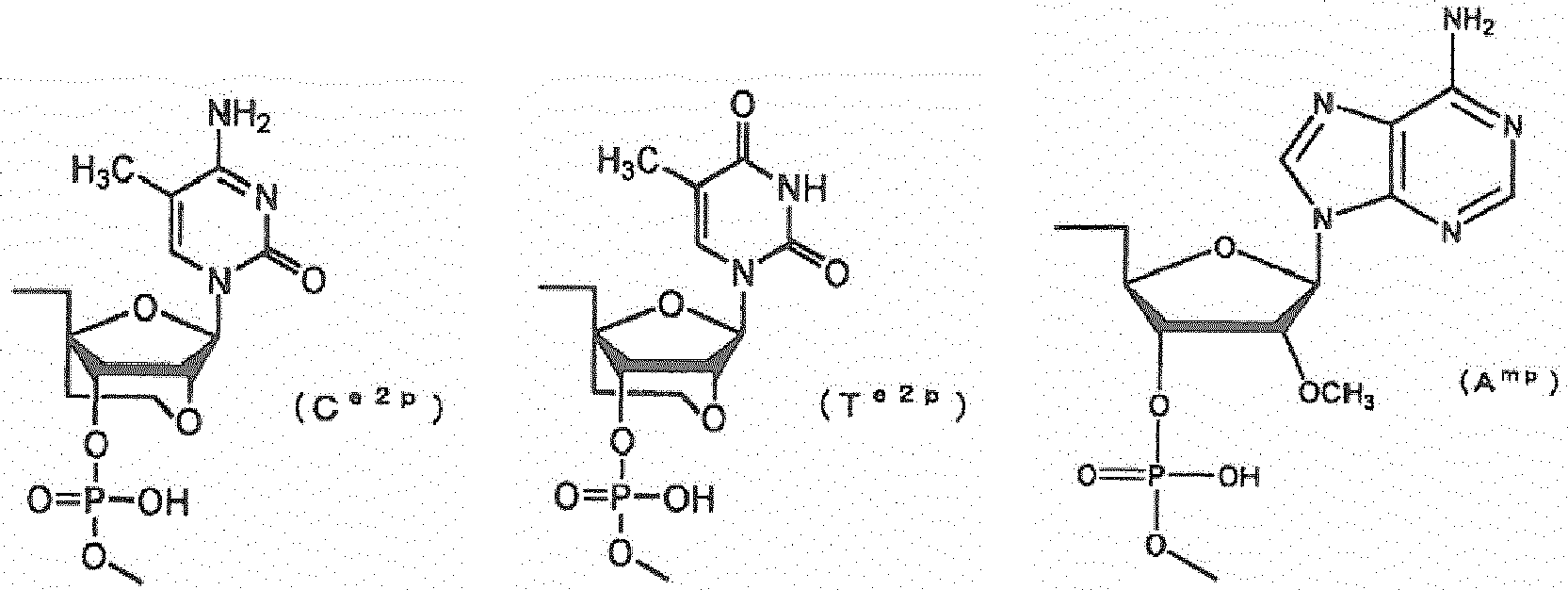
- a e1p , G e1p , C e1p , T e1p , A e2p , G e2p , C e2p , T e2p , A mp , G mp , C mp , U mp , A e1s , G e1s , C e1s , T e1s , A e2s , G e2s , C e2s , T e2s , A ms , G ms , C ms , U ms and Ph are groups having the following structures, respectively.
- salts of the oligonucleotide of the invention refers to salts of the oligonucleotide of the invention (e.g. oligonucleotide having the nucleotide sequence as shown in any one of SEQ ID NOS: 64, 66, 87 or 88) or salts of those compounds represented by general formula (XV").
- salts include metal salts such as alkali metal salts (e.g. sodium salts, potassium salts, lithium salts), alkaline earth metal salts (e.g.
- t-octylamine salts dibenzylamine salts, morpholine salts, glucosamine salts, phenylglycine alkyl ester salts, ethylenediamine salts, N-methylglucamine salts, guanidine salts, diethylamine salts, triethylamine salts, dicyclohexylamine salts; N',N'-dibenzylethylenediamine salts, chloroprocaine salts, procaine salts, diethanolamine salts, N-benzyl-phenetylamine salts, piperazine salts, tetramethylammonium salts, tris(hydroxymethyl)aminomethane salts] and the like; inorganic acid salts such as halogenated hydroacid salts (e.g.
- organic acid salts such as lower alkane sulfonates (e.g. methan
- the oligonucleotide of the invention the compounds represented by general formula (XV") (hereinafter, referred to as the "compound of the invention") and pharmacologically acceptable salts thereof are effective as pharmaceuticals for treating muscular dystrophy.
- the compound of the invention may be synthesized based on the method described in the literature ( Nucleic Acids Research, 12: 4539 (1984 )) using a commercial synthesizer (e.g. PerkinElmer Model 392 employing the phosphoroamidite method).
- a commercial synthesizer e.g. PerkinElmer Model 392 employing the phosphoroamidite method.
- commercial reagents are available for natural nucleosides and 2'-O-methylnucleosides (i.e. 2'-O-methylguanosine, 2'-O-methyladenosine, 2'-O-methylcytosine and 2'-O-methyluridine).
- 2'-O-alkyl-guanosine, -adenosine, -cytosine and -uridine where the alkyl group has 2-6 carbon atoms, they may be synthesized or purchased as described below.
- 2'-O-aminoethyl-guanosine, -adenosine, -cytosine and -uridine may be synthesized according to Blommers et al., Biochemistry (1998), 37: 17714-17725 .
- 2'-O-propyl-guanosine, -adenosine, -cytosine and -uridine may be synthesized according to Lesnik, E.A. et al., Biochemistry (1993), 32: 7832-7838 .
- 2'-O-methoxyethyl-guanosine, -adenosine, -cytosine and -uridine may be synthesized according to U.S. Patent No. 6261840 or Martin, P., Helv. Chim. Acta. (1995) 78: 486-504 .
- 2'-O-butyl-guanosine, -adenosine, -cytosine and -uridine may be synthesized according to Lesnik, E.A. et al., Biochemistry (1993), 32: 7832-7838 .
- 2'-O-pentyl-guanosine, -adenosine, -cytosine and -uridine may be synthesized according to Lesnik, E.A. et al., Biochemistry (1993), 32: 7832-7838 .
- 2'-O,4'-C-methylene-guanosine, -adenosine, 5-methyl-cytosine and -thymidine may be synthesized according to the method described in WO99/14226 .
- 2'-O,4'-C-alkylene-guanosine and -adenosine where the alkylene group has 2-5 carbon atoms, 5-methyl-cytosine and -thymidine may be synthesized according to the method described in WO00/47599 .
- thioate derivatives may be obtained based on the methods described in Tetrahedron Letters, 32, 3005 (1991 ) and J. Am. Chem. Soc., 112, 1253 (1990 ), using sulfur and a reagent such as tetraethylthiuram disulfide (TETD; Applied Biosystems) or Beaucage reagent (Glen Research) which reacts with a trivalent phosphate to form a thioate.
- TETD tetraethylthiuram disulfide
- Beaucage reagent Beaucage reagent
- DPG controlled pore glass
- 3'-amino-Modifier C3 CPG 3'-amino-Modifier C7 CPG, Glyceryl CPG (Glen Research), 3'-specer C3 SynBase CPG 1000 or 3'-specer C9 SynBase CPG 1000 (Link Technologies) allows synthesis of oligonucleotides to which a hydroxyalkylphosphate group or aminoalkylphosphate group is attached at the 3' end.
- the compounds of the present invention and pharmacologically acceptable salts thereof have an effect of inducing skipping of exon 51 of the dystrophin gene.
- the compounds of the invention represented by general formula (XV") and pharmacologically acceptable salts thereof have high binding strength to RNA and high resistance to nuclease. Therefore, the compounds of the invention and pharmacologically acceptable salts thereof are useful as pharmaceuticals for treating muscular dystrophy.
- the compound or a pharmacologically acceptable salt or ester thereof may be administered by itself.
- the compound or a pharmacologically acceptable salt or ester thereof may be mixed with appropriate pharmacologically acceptable excipients or diluents, prepared into tablets, capsules, granules, powders, syrups, etc. and administered orally; or prepared into injections, suppositories, patches, external medicines, etc. and administered parenterally.
- excipients e.g. sugar derivatives (such as lactose, white sugar, glucose, mannitol and sorbitol), starch derivatives (such as corn starch, potato starch, ⁇ starch and dextrin), cellulose derivatives (such as crystalline cellulose), gum arabic, dextran, pullulan and the like; and inorganic excipients e.g. sugar derivatives (such as lactose, white sugar, glucose, mannitol and sorbitol), starch derivatives (such as corn starch, potato starch, ⁇ starch and dextrin), cellulose derivatives (such as crystalline cellulose), gum arabic, dextran, pullulan and the like; and inorganic excipients e.g.
- sugar derivatives such as lactose, white sugar, glucose, mannitol and sorbitol
- starch derivatives such as corn starch, potato starch, ⁇ starch and dextrin
- cellulose derivatives
- silicate derivatives such as light silicic acid anhydride, synthetic aluminium silicate, calcium silicate and magnesium aluminate metasilicate
- phosphates such as calcium hydrogenphosphate
- carbonates such as calcium carbonate
- sulfates such as calcium sulfate
- lubricants e.g.
- stearic acid such as stearic acid, calcium stearate, and magnesium stearate
- talc colloidal silica
- waxes such as bees wax and spermaceti
- boric acid adipic acid
- sulfates such as sodium sulfate; glycol; fumaric acid; sodium benzoate; DL leucine; lauryl sulfates such as sodium lauryl sulfate and magnesium lauryl sulfate
- silicic acid materials such as silicic acid anhydride and silicic acid hydrate; above-mentioned starch derivatives
- binders e.g.
- colloidal clay such as bentonite, Veegum
- metal hydroxides such as magnesium hydroxide, aluminium hydroxide
- anionic surfactants such as sodium lauryl sulfate, calcium stearate
- cation surfactants such as benzalkonium chloride
- nonionic surfactants such as polyoxyethylene alkyl ethers, polyoxyethylene sorbitan fatty acid esters, sucrose fatty acid ester), stabilizers (e.g.
- paraoxybenzoic acid esters such as methyl paraben, propyl paraben; alcohols such as chlorobutanol, benzyl alcohol, phenylethyl alcohol; benzalkonium chloride; phenols such as phenol, cresol; thimerosal; dehydroacetic acid; sorbic acid), flavoring/aromatic agents (e.g. conventionally used sweeteners, acidifiers, aromatics, etc.) or diluents.
- alcohols such as chlorobutanol, benzyl alcohol, phenylethyl alcohol
- benzalkonium chloride phenols such as phenol, cresol; thimerosal
- dehydroacetic acid sorbic acid
- flavoring/aromatic agents e.g. conventionally used sweeteners, acidifiers, aromatics, etc.
- the therapeutic agent of the present invention comprises preferably 0.05-5 ⁇ moles/ml of the compound of the invention or a pharmacologically acceptable salt thereof, 0.02-10% w/v of carbohydrates or polyhydric alcohols, and 0.01-0.4% w/v of pharmacologically acceptable surfactants. More preferable range for the content of the compound of the invention or a pharmacologically acceptable salt thereof is 0.1-1 ⁇ moles/ml.
- monosaccharides and/or disaccharides are especially preferable.
- these carbohydrates and polyhydric alcohols include, but are not limited to, glucose, galactose, mannose, lactose, maltose, mannitol and sorbitol. These may be used alone or in combination.
- surfactants include, but are not limited to, polyoxyethylene sorbitan mono- to tri-esters, alkyl phenyl polyoxyethylene, sodium taurocholate, sodium cholate and polyhydric alcohol esters. Especially preferable are polyoxyethylene sorbitan mono- to tri-esters, where especially preferable esters are oleates, laurates, stearates and palmitates. These surfactants may be used alone or in combination.
- the therapeutic agent of the invention comprises 0.03-0.09 M of pharmacologically acceptable neutral salt, e.g. sodium chloride, potassium chloride and/or calcium chloride.
- pharmacologically acceptable neutral salt e.g. sodium chloride, potassium chloride and/or calcium chloride.
- the therapeutic agent of the invention may comprise 0.002-0.05 M of pharmacologically acceptable buffer.
- pharmacologically acceptable buffers include sodium citrate, sodium glycinate, sodium phosphate and tris(hydroxymethyl)aminomethane. These buffers may be used alone or in combination.
- the above-described therapeutic agent of the invention may be supplied in the state of solution. However, considering the storing of the therapeutic agent for some period of time, usually, it is preferable to lyophilize the therapeutic agent for the purpose of stabilizing the antisense oligonucleotide and thereby preventing the lowering of its therapeutic effect.
- the lyophilized therapeutic agent may be reconstructed with a dissolving liquid (e.g. distilled water for injection) at the time of use, and used in the state of solution.
- a dissolving liquid e.g. distilled water for injection
- the therapeutic agent of the invention encompasses such a lyophilized therapeutic agent to be reconstructed with a dissolving liquid at the time of use so that individual components fall under specific concentration ranges.
- the therapeutic agent may further contain albumin or amino acids such as glycine.
- the compound or salt may be administered orally or intravenously at a dose of about 0.1-100 mg/kg body weight per day, preferably 1-50 mg/kg body weight per day for adult patients once a day or divided into several portions.
- the dose and the number of times of administration may be appropriately changed depending on the type of disease, conditions, the age of the patient, the route of administration, etc.
- the compound of the invention or a pharmacologically acceptable salt thereof may be prepared by methods well-known to those skilled in the art, sterilized by conventional methods and then formulated into, for example, an injection solution with a concentration of 1200 ⁇ g/ml.
- This solution is, for example, drip-fed to the patient intravenously in the form of infusion so that the antisense oligonucleotide is administered to the patient at a dose of, for example, 20 mg/kg body weight.
- Such administration may be repeated, for example, 4 times at intervals of 2 weeks.
- this treatment is repeated appropriately. If therapeutic effect is recognized and yet no definite side effect is observed, this treatment is continued; in principle, the administration is continued throughout life time.
- hAON4 [FAM-CUG CUU CCU CCAACC (SEQ ID NO: 23); all the nucleotides are 2'-O-methylnucleotide and linked with each other by a phosphorothioate bond] which is disclosed in a document ( van Deutekom, J.C.T. et al. (2001) Hum. Mol. Genet. 10, 1547-1554 ) and known as an oligonucleotide that induces exon 46 skipping was synthesized according to the above document.
- FAM is a fluorescence group with the following structure.
- hAON6 [FAM-GUU AUC UGC UUC CUC CAA CC (SEQ ID NO: 24); all the nucleotides are 2'-O-methylnucleotide and linked with each other by a phosphorothioate bond] which is disclosed in a document ( van Deutekom, J.C.T. et al. (2001) Hum. Mol. Genet. 10, 1547-1554 ) and known as an oligonucleotide that induces exon 46 skipping was synthesized according to the above document.
- hAON8 [FAM-GCU UUU CUU UUA GUU GCU GC (SEQ ID NO: 25); all the nucleotides are 2'-O-methylnucleotide and linked with each other by a phosphorothioate bond] which is disclosed in a document ( van Deutekom, J.C.T. et al. (2001) Hum. Mol. Genet. 10, 1547-1554 ) and known as an oligonucleotide that induces exon 46 skipping was synthesized according to the above document.
- the subject compound was synthesized with an automated nucleic acid synthesizer (PerkinElmer ABI model 394 DNA/RNA synthesizer) at a 40 nmol scale.
- concentrations of solvents, reagents and phosphoroamidites at individual synthesis cycles were the same as used in the synthesis of natural oligonucleotides.
- the solvents, reagents and phosphoroamidites of 2'-O-methylnucleoside (adenosine form: product No. 27-1822-41; guanosine form: product No. 27-1826-41; citydine form: product No. 27-1823-02; uridine form: product No. 27-1825-42) were products from Amersham Pharmacia.
- Example 55 those compounds disclosed in Example 55 (5'-O-dimethoxytrityl-2'-0,4'-C-ethylene-6-N-benzoyladenosine-3'-O-(2-cyanoethyl N,N-diisopropyl)phosphoroamidite),
- Example 68 (5'-O-dimethoxytrityl-2'-O,4'-C-ethylene-N-isobutylylguanosine-3'-O-(2-cyanoethyl N,N-diisopropyl)phosphoroamidite),
- Example 63 (5'-O-dimethoxytrityl-2'-O,4'-C-ethylene-4-N-benzoyl-5-methylcitydine-3'-O- (2-cyanoethyl N,N-diisopropyl)phosphoroamidite), and
- Example 50 (5'-O-dimethoxytrityl-2'-O,4'-C-ethylene-5
- the subject compound was synthesized on a modified control pore glass (CPG) (disclosed in Example 12b of Japanese Unexamined Patent Publication No. H7-87982 ) as a solid support.
- CPG modified control pore glass
- the time period for condensation of amidites was 15 min.
- the protected oligonucleotide analogue having the sequence of interest was treated with concentrated aqueous ammonia to thereby cut out the oligomer from the support and, at the same time, remove the protective cyanoethyl groups on phosphorus atoms and the protective groups on nucleic acid bases.
- the nucleotide sequence of the subject compound is complementary to the nucleotides Nos. 6555-6572 of dystrophin cDNA (Gene Bank accession No. NM_004006.1).
- Example 1 having a sequence of interest was synthesized in the same manner as in Reference Example 4, except that phenyl 2-cyanoethyl N,N-diisopropylphosphoramidite ( Hotoda, H. et al. Nucleosides & Nucleotides 15, 531-538, (1996 )) was used in the final condensation to introduce phenylphosphate on the 5' terminal side.
- phenyl 2-cyanoethyl N,N-diisopropylphosphoramidite Hotoda, H. et al. Nucleosides & Nucleotides 15, 531-538, (1996 )
- the resultant product was purified by reversed phase HPLC [Shimadzu model LC-10VP; column: Merck, Chromolith Performance RP-18e (4.6 x 100 mm); solution A: 5% acetonitrile, 0.1 M aqueous triethylamine acetate (TEAA), pH 7.0; solution B: acetonitrile B%: 5% ⁇ 15% (10 min, linear gradient); 60°C; 2 ml/min; 254 nm]. The fraction eluted at 5.24 min was collected. After distilling off the solvent, the resultant residue was dissolved in 0.5 ml of water and filtered with Ultrafree-MC (Millipore: product No. UFC4 OHV 25).
- the nucleotide sequence of the subject compound is complementary to the nucleotides Nos. 7565-7584 of dystrophin cDNA (Gene Bank accession No. NM_004006.1).
- Example 2 having a sequence of interest was synthesized in the same manner as in Reference Example 4, except that phenyl 2-cyanoethyl N,N-diisopropylphosphoramidite ( Hotoda, H. et al. Nucleosides & Nucleotides 15, 531-538, (1996 )) was used in the final condensation to introduce phenylphosphate on the 5' terminal side.
- phenyl 2-cyanoethyl N,N-diisopropylphosphoramidite Hotoda, H. et al. Nucleosides & Nucleotides 15, 531-538, (1996 )
- the resultant product was purified by reversed phase HPLC [Shimadzu model LC-10VP; column: Merck, Chromolith Performance RP-18e (4.6 x 100 mm); solution A: 5% acetonitrile, 0.1 M aqueous triethylamine acetate (TEAA), pH 7.0; solution B: acetonitrile B%: 5% ⁇ 15% (10 min, linear gradient); 60°C; 2 ml/min; 254 nm]. The fraction eluted at 6.23 min was collected. After distilling off the solvent, the resultant residue was dissolved in 0.5 ml of water and filtered with Ultrafree-MC (Millipore: product No. UFC4 OHV 25).
- the nucleotide sequence of the subject compound is complementary to the nucleotides Nos. 7569-7588 of dystrophin cDNA (Gene Bank accession No. NM_004006.1).
- Example 3 The compound of Example 3 having a sequence of interest was synthesized in the same manner as in Reference Example 4, except that phenyl 2-cyanoethyl N,N-diisopropylphosphoramidite ( Hotoda, H. et al. Nucleosides & Nucleotides 15, 531-538, (1996 )) was used in the final condensation to introduce phenylphosphate on the 5' terminal side.
- phenyl 2-cyanoethyl N,N-diisopropylphosphoramidite Hotoda, H. et al. Nucleosides & Nucleotides 15, 531-538, (1996 )
- the resultant product was purified by reversed phase HPLC [Shimadzu model LC-10VP; column: Merck, Chromolith Performance RP-18e (4.6 x 100 mm); solution A: 5% acetonitrile, 0.1 M aqueous triethylamine acetate (TEAA), pH 7.0; solution B: acetonitrile B%: 5% ⁇ 15% (10 min, linear gradient); 60°C; 2 ml/min; 254 nm]. The fraction eluted at 4.71 min was collected. After distilling off the solvent, the resultant residue was dissolved in 0.5 ml of water and filtered with Ultrafree-MC (Millipore: product No. UFC4 OHV 25).
- the nucleotide sequence of the subject compound is complementary to the nucleotides Nos. 7578-7597 of dystrophin cDNA (Gene Bank accession No. NM_004006.1).
- Example 4 The compound of Example 4 having a sequence of interest was synthesized in the same manner as in Reference Example 4, except that phenyl 2-cyanoethyl N,N-diisopropylphosphoramidite ( Hotoda, H. et al. Nucleosides & Nucleotides 15, 531-538, (1996 )) was used in the final condensation to introduce phenylphosphate on the 5' terminal side.
- phenyl 2-cyanoethyl N,N-diisopropylphosphoramidite Hotoda, H. et al. Nucleosides & Nucleotides 15, 531-538, (1996 )
- the resultant product was purified by reversed phase HPLC [Shimadzu model LC-10VP; column: Merck, Chromolith Performance RP-18e (4.6 x 100 mm); solution A: 5% acetonitrile, 0.1 M aqueous triethylamine acetate (TEAA), pH 7.0; solution B: acetonitrile B%: 5% ⁇ 15% (10 min, linear gradient); 60°C; 2 ml/min; 254 nm]. The fraction eluted at 7.79 min was collected. After distilling off the solvent, the resultant residue was dissolved in 0.5 ml of water and filtered with Ultrafree-MC (Millipore: product No. UFC4 OHV 25).
- the nucleotide sequence of the subject compound is complementary to the nucleotides Nos. 7698-7717 of dystrophin cDNA (Gene Bank accession No. NM_004006.1).
- Example 5 The compound of Example 5 having a sequence of interest was synthesized in the same manner as in Reference Example 4, except that phenyl 2-cyanoethyl N,N-diisopropylphosphoramidite ( Hotoda, H. et al. Nucleosides & Nucleotides 15, 531-538, (1996 )) was used in the final condensation to introduce phenylphosphate on the 5' terminal side.
- phenyl 2-cyanoethyl N,N-diisopropylphosphoramidite Hotoda, H. et al. Nucleosides & Nucleotides 15, 531-538, (1996 )
- the resultant product was purified by reversed phase HPLC [Shimadzu model LC-10VP; column: Merck, Chromolith Performance RP-18e (4.6 x 100 mm); solution A: 5% acetonitrile, 0.1 M aqueous triethylamine acetate (TEAA), pH 7.0; solution B: acetonitrile B%: 5% ⁇ 13% (8 min, linear gradient); 60°C; 2 ml/min; 254 nm]. The fraction eluted at 7.20 min was collected. After distilling off the solvent, the resultant residue was dissolved in 0.5 ml of water and filtered with Ultrafree-MC (Millipore: product No. UFC4 OHV 25).
- the nucleotide sequence of the subject compound is complementary to the nucleotides Nos. 7719-7738 of dystrophin cDNA (Gene Bank accession No. NM_004006.1).
- Example 6 The compound of Example 6 having a sequence of interest was synthesized in the same manner as in Reference Example 4, except that phenyl 2-cyanoethyl N,N-diisopropylphosphoramidite ( Hotoda, H. et al. Nucleosides & Nucleotides 15, 531-538, (1996 )) was used in the final condensation to introduce phenylphosphate on the 5' terminal side.
- phenyl 2-cyanoethyl N,N-diisopropylphosphoramidite Hotoda, H. et al. Nucleosides & Nucleotides 15, 531-538, (1996 )
- the resultant product was purified by reversed phase HPLC [Shimadzu model LC-10VP; column: Merck, Chromolith Performance RP-18e (4.6 x 100 mm); solution A: 5% acetonitrile, 0.1 M aqueous triethylamine acetate (TEAA), pH 7.0; solution B: acetonitrile B%: 5% ⁇ 15% (10 min, linear gradient); 60°C; 2 ml/min; 254 nm]. The fraction eluted at 6.74 min was collected. After distilling off the solvent, the resultant residue was dissolved in 0.5 ml of water and filtered with Ultrafree-MC (Millipore: product No. UFC4 OHV 25).
- the nucleotide sequence of the subject compound is complementary to the nucleotides Nos. 7728-7747 of dystrophin cDNA (Gene Bank accession No. NM_004006.1).
- Example 7 The compound of Example 7 having a sequence of interest was synthesized in the same manner as in Reference Example 4, except that phenyl 2-cyanoethyl N,N-diisopropylphosphoramidite ( Hotoda, H. et al. Nucleosides & Nucleotides 15, 531-538, (1996 )) was used in the final condensation to introduce phenylphosphate on the 5' terminal side.
- phenyl 2-cyanoethyl N,N-diisopropylphosphoramidite Hotoda, H. et al. Nucleosides & Nucleotides 15, 531-538, (1996 )
- the resultant product was purified by reversed phase HPLC [Shimadzu model LC-10VP; column: Merck, Chromolith Performance RP-18e (4.6 x 100 mm); solution A: 5% acetonitrile, 0.1 M aqueous triethylamine acetate (TEAA), pH 7.0; solution B: acetonitrile B%: 5% ⁇ 15% (10 min, linear gradient); 60°C; 2 ml/min; 254 nm]. The fraction eluted at 6.62 min was collected. After distilling off the solvent, the resultant residue was dissolved in 0.5 ml of water and filtered with Ultrafree-MC (Millipore: product No. UFC4 OHV 25).
- the nucleotide sequence of the subject compound is complementary to the nucleotides Nos. 7738-7757 of dystrophin cDNA (Gene Bank accession No. NM_004006.1).
- Example 8 having a sequence of interest was synthesized in the same manner as the compound of Reference Example 4 was synthesized. After deprotection, the resultant product was purified by reversed phase HPLC [Shimadzu model LC-10VP; column: Merck, Chromolith Performance RP-18e (4.6 x 100 mm); solution A: 5% acetonitrile, 0.1 M aqueous triethylamine acetate (TEAA), pH 7.0; solution B: acetonitrile B%: 10% ⁇ 45% (10 min, linear gradient); 60°C; 2 ml/min; 254 nm]. The fraction eluted at 7.64 min was collected.
- the nucleotide sequence of the subject compound is complementary to the nucleotides Nos. 7554-7571 of dystrophin cDNA (Gene Bank accession No. NM_004006.1).
- Example 9 having a sequence of interest was synthesized in the same manner as the compound of Reference Example 4 was synthesized. After deprotection, the resultant product was purified by reversed phase HPLC [Shimadzu model LC-10VP; column: Merck, Chromolith Performance RP-18e (4.6 x 100 mm); solution A: 5% acetonitrile, 0.1 M aqueous triethylamine acetate (TEAA), pH 7.0; solution B: acetonitrile B%: 10% ⁇ 45% (10 min, linear gradient); 60°C; 2 ml/min; 254 nm]. The fraction eluted at 6.82 min was collected.
- the nucleotide sequence of the subject compound is complementary to the nucleotides Nos. 7612-7629 of dystrophin cDNA (Gene Bank accession No. NM_004006.1).
- Example 10 having a sequence of interest was synthesized in the same manner as the compound of Reference Example 4 was synthesized. After deprotection, the resultant product was purified by reversed phase HPLC [Shimadzu model LC-10VP; column: Merck, Chromolith Performance RP-18e (4.6 x 100 mm); solution A: 5% acetonitrile, 0.1 M aqueous triethylamine acetate (TEAA), pH 7.0; solution B: acetonitrile B%: 10% ⁇ 45% (10 min, linear gradient); 60°C; 2 ml/min; 254 nm]. The fraction eluted at 6.76 min was collected.
- the nucleotide sequence of the subject compound is complementary to the nucleotides Nos. 7684-7701 of dystrophin cDNA (Gene Bank accession No. NM _004006.1).
- Example 11 having a sequence of interest was synthesized in the same manner as the compound of Reference Example 4 was synthesized. After deprotection, the resultant product was purified by reversed phase HPLC [Shimadzu model LC-10VP; column: Merck, Chromolith Performance RP-18e (4.6 x 100 mm); solution A: 5% acetonitrile, 0.1 M aqueous triethylamine acetate (TEAA), pH 7.0; solution B: acetonitrile B%: 10% ⁇ 38% (8 min, linear gradient); 60°C; 2 ml/min; 254 nm]. The fraction eluted at 6.62 min was collected.
- the nucleotide sequence of the subject compound is complementary to the nucleotides Nos. 7603-7620 of dystrophin cDNA (Gene Bank accession No. NM_004006.1).
- Example 12 having a sequence of interest was synthesized in the same manner as the compound of Reference Example 4 was synthesized. After deprotection, the resultant product was purified by reversed phase HPLC [Shimadzu model LC-10VP; column: Merck, Chromolith Performance RP-18e (4.6 x 100 mm); solution A: 5% acetonitrile, 0.1 M aqueous triethylamine acetate (TEAA), pH 7.0; solution B: acetonitrile B%: 10% ⁇ 45% (8 min, linear gradient); 60°C; 2 ml/min; 254 nm]. The fraction eluted at 6.27 min was collected.
- the nucleotide sequence of the subject compound is complementary to the nucleotides Nos. 7612-7629 of dystrophin cDNA (Gene Bank accession No. NM_004006.1).
- Example 13 having a sequence of interest was synthesized in the same manner as the compound of Reference Example 4 was synthesized. However, the portion with a phosphorothioate bond was sulfurized by treating with a mixed solution of 0.02 M xanthane hydride/acetonitrile-pyridine (9:1 mixture) for 15 min, instead of the oxidation step with iodine-H 2 O.
- the resultant product was purified by reversed phase HPLC [Shimadzu model LC-10VP; column: Merck, Chromolith Performance RP-18e (4.6 x 100 mm); solution A: 5% acetonitrile, 0.1 M aqueous triethylamine acetate (TEAA), pH 7.0; solution B: acetonitrile B%: 10% ⁇ 45% (8 min, linear gradient); 60°C; 2 ml/min; 254 nm]. The fraction eluted at 6.47 min was collected. After the solvent was distilled off under reduced pressure, 80% aqueous acetic acid solution was added to the residue, which was then left for 20 min to remove the DMTr group.
- the nucleotide sequence of the subject compound is complementary to the nucleotides Nos. 7612-7629 of dystrophin cDNA (Gene Bank accession No. NM_004006.1).
- Example 14 having a sequence of interest was synthesized in the same manner as the compound of Reference Example 4 was synthesized. However, the portion with a phosphorothioate bond was sulfurized by treating with a mixed solution of 0.02 M xanthane hydride/acetonitrile-pyridine (9:1 mixture) for 15 min, instead of the oxidation step with iodine-H 2 O.
- the resultant product was purified by reversed phase HPLC [Shimadzu model LC-10VP; column: Merck, Chromolith Performance RP-18e (4.6 x 100 mm); solution A: 5% acetonitrile, 0.1 M aqueous triethylamine acetate (TEAA), pH 7.0; solution B: acetonitrile B%: 10% ⁇ 45% (8 min, linear gradient); 60°C; 2 ml/min; 254 nm]. The fraction eluted at 7.08 min was collected. After the solvent was distilled off under reduced pressure, 80% aqueous acetic acid solution was added to the residue, which was then left for 20 min to remove the DMTr group.
- the nucleotide sequence of the subject compound is complementary to the nucleotides Nos. 7603-7620 of dystrophin cDNA (Gene Bank accession No. NM_004006.1).
- Example 15 having a sequence of interest was synthesized in the same manner as the compound of Reference Example 4 was synthesized. After deprotection, the resultant product was purified by reversed phase HPLC [Shimadzu model LC-10VP; column: Merck, Chromolith Performance RP-18e (4.6 x 100 mm); solution A: 5% acetonitrile, 0.1 M aqueous triethylamine acetate (TEAA), pH 7.0; solution B: acetonitrile B%: 10% ⁇ 45% (8 min, linear gradient); 60°C; 2 ml/min; 254 nm]. The fraction eluted at 6.47 min was collected.
- the nucleotide sequence of the subject compound is complementary to the nucleotides Nos. 7603-7620 of dystrophin cDNA (Gene Bank accession No. NM_004006.1).
- a primary culture of myoblast cells was established as described below.
- Myoblast cells were transfected with the compounds prepared in Examples (ENAs) as described below.
- nucleotide sequences of the forward and reverse primers used in the PCR reactions for detecting the skipping of exons 51 are as described below.
- the PCR product was analyzed by 2% agarose gel electrophoresis.
- the resultant gel was stained with ethidium bromide.
- the resultant band (A) (where an exon was skipped) and band (B) (where an exon was not skipped) were visualized with a gel photographing device (Printgraph Model AE-6911FXFD; ATTO) and quantitatively determined with ATTO Densitograph ver.4.1 for the Macintosh.
- the values obtained were put into the formula A/(A+B)x100 to obtain skipping efficiency (%). 5.
- the band where skipping had occurred was cut out, and the PCR product was subcloned into pT7 Blue-T vector (Novagen), followed by sequencing reaction with Thermo Sequenase TM II dye terminator cycle sequencing kit (Amersham Pharmacia Biotec) and confirmation of the nucleotide sequence with ABI PRISM 310 Genetic Analyzer (Applied Biosystems).
- the reaction procedures were according to the manual attached to the kit.
- Figs. 1 , 2 , 3 and 4 show examples of exon 51 skipping induced by compounds A03-6, AO8-10, AO37, AO39, AO43 and AO58. As shown in these Figures, exon 51 skipping was observed when these compounds were used.
- any one of the compounds of Examples 1 to 15 or a salt thereof is dissolved to prepare a solution of a specific volume.
- the resultant solution is filtered with a membrane filter 0.22 ⁇ m in pore size to thereby obtain a preparation for intravenous administration.
- Any one of the compounds of Examples 1 to 15 or a salt thereof 500 mg Sodium chloride 8.6 g Potassium chloride 0.3 g Calcium chloride 0.33 g Distilled water for injection to give a total volume of 1000 ml
- any one of the compounds of Examples 1 to 15 or a salt thereof is dissolved to prepare a solution of a specific volume.
- the resultant solution is filtered with a filter 15 nm in pore size (PLANOVE 15: Asahi Kasei) to thereby obtain a preparation for intravenous administration.
- Any one of the compounds of Examples 1 to 15 or a salt thereof 100 mg Sodium chloride 8.3 g Potassium chloride 0.3 g Calcium chloride 0.33 g Sodium hydrogenphosphate ⁇ 12H 2 O 1.8 g 1N HCl appropriate amount (pH 7.4) Distilled water for injection to give a total volume of 1000 ml
- any one of the compounds of Examples 1 to 15 or a salt thereof is dissolved to prepare a solution of a specific volume.
- the resultant solution is filtered with a filter 35 nm in pore size (PLANOVE 35: Asahi Kasei) to thereby obtain a preparation for intravenous administration.
- Any one of the compounds of Examples 1 to 15 or a salt thereof 100 mg Sodium chloride 8.3 g Potassium chloride 0.3 g Calcium chloride 0.33 g Glucose 0.4 g Sodium hydrogenphosphate ⁇ 12H 2 O 1.8 g 1N HCl appropriate amount (pH 7.4) Distilled water for injection to give a total volume of 1000 ml
- the compounds of the present invention and pharmacologically acceptable salts thereof have an effect of inducing skipping of exon 51 of the dystrophin gene and thus useful as pharmaceuticals for treating muscular dystrophy.
- SEQ ID NO: 23 shows the nucleotide sequence of the oligonucleotide prepared in Reference Example 1.
- SEQ ID NO: 24 shows the nucleotide sequence of the oligonucleotide prepared in Reference Example 2.
- SEQ ID NO: 25 shows the nucleotide sequence of the oligonucleotide prepared in Reference Example 3.
- SEQ ID NO: 30 shows the nucleotide sequence of the oligonucleotide prepared in Reference Example 4 (AO100).
- SEQ ID NO: 56 shows the nucleotide sequence of the oligonucleotide prepared in Example 1 (AO3).
- SEQ ID NO: 57 shows the nucleotide sequence of the oligonucleotide prepared in Example 2 (AO4).
- SEQ ID NO: 58 shows the nucleotide sequence of the oligonucleotide prepared in Example 3 (AO5).
- SEQ ID NO: 59 shows the nucleotide sequence of the oligonucleotide prepared in Example 4 (AO6).
- SEQ ID NO: 60 shows the nucleotide sequence of the oligonucleotide prepared in Example 5 (AO8).
- SEQ ID NO: 61 shows the nucleotide sequence of the oligonucleotide prepared in Example 6 (AO9).
- SEQ ID NO: 62 shows the nucleotide sequence of the oligonucleotide prepared in Example 7 (AO10).
- SEQ ID NO: 63 shows the nucleotide sequence of the oligonucleotide prepared in Example 8 (AO37).
- SEQ ID NO: 64 shows the nucleotide sequence of the oligonucleotide prepared in Example 9 (AO39).
- SEQ ID NO: 65 shows the nucleotide sequence of the oligonucleotide prepared in Example 10 (AO43).
- SEQ ID NO: 66 shows the nucleotide sequence of the oligonucleotide prepared in Example 11 (AO58).
- SEQ ID NO: 81 shows the nucleotide sequence of the forward primer (for the PCR reaction for detecting exon 51 skipping) used in Test Example.
- SEQ ID NO: 82 shows the nucleotide sequence of the reverse primer (for the PCR reaction for detecting exon 51 skipping) used in Test Example.
- SEQ ID NO: 87 shows the nucleotide sequence of the oligonucleotides prepared in Example 12 and 13 (AO131 and AO132).
- SEQ ID NO: 88 shows the nucleotide sequence of the oligonucleotides prepared in Example 14 and 15 (AO139 and AO140).
Landscapes
- Health & Medical Sciences (AREA)
- Life Sciences & Earth Sciences (AREA)
- Chemical & Material Sciences (AREA)
- Engineering & Computer Science (AREA)
- Genetics & Genomics (AREA)
- Organic Chemistry (AREA)
- Molecular Biology (AREA)
- Biomedical Technology (AREA)
- Biotechnology (AREA)
- Biochemistry (AREA)
- Bioinformatics & Cheminformatics (AREA)
- General Health & Medical Sciences (AREA)
- Wood Science & Technology (AREA)
- General Engineering & Computer Science (AREA)
- Zoology (AREA)
- Physics & Mathematics (AREA)
- Biophysics (AREA)
- Plant Pathology (AREA)
- Microbiology (AREA)
- General Chemical & Material Sciences (AREA)
- Veterinary Medicine (AREA)
- Public Health (AREA)
- Animal Behavior & Ethology (AREA)
- Pharmacology & Pharmacy (AREA)
- Nuclear Medicine, Radiotherapy & Molecular Imaging (AREA)
- Medicinal Chemistry (AREA)
- Chemical Kinetics & Catalysis (AREA)
- Physical Education & Sports Medicine (AREA)
- Orthopedic Medicine & Surgery (AREA)
- Neurology (AREA)
- Pharmaceuticals Containing Other Organic And Inorganic Compounds (AREA)
- Medicines That Contain Protein Lipid Enzymes And Other Medicines (AREA)
- Saccharide Compounds (AREA)
Claims (12)
- Composé capable d'induire le saut de l'exon 51 du gène de dystrophine, qui esta) un oligonucléotide constitué de l'une des séquences de nucléotides présentées en tant que Séquences N° 64, N° 66, N° 87 et N° 88, dans lequel au moins l'un des sucres constituant l'oligonucléotide est modifié, étant entendu que ledit sucre est un D-ribofuranose et que ladite modification au nombre d'au moins une dudit sucre est une 2'-O,4'-C-alcanediylation du D-ribofuranose,b) ou un composé représenté par la formule générale (XV"),ou sel pharmacologiquement admissible d'un tel composé ;
étant entendu que ladite formule générale est définie comme suit :
BT"15-BM"15-BB"15 (XV")
où BT"15 représente un groupe symbolisé par l'une des formules (15a") à (15j") suivantes :(15a") HO-(15b") HO-Bt-(15c") HO-Bc-Bt-(15d") HO-Bt-Bc-Bt-(15e") HO-Bt-Bt-Bc-Bt-(15f") HO-Bt-Bt-Bt-Bc-Bt-(15g") HO-Ba-Bt-Bt-Bt-Bc-Bt-(15h") HO-Bc-Ba-Bt-Bt-Bt-Bc-Bt-(15i") HO-Bg-Bc-Ba-Bt-Bt-Bt-Bc-Bt-(15j") HO-Bg-Bg-Bc-Ba-Bt-Bt-Bt-Bc-Bt-BM"15 représente un groupe symbolisé par la formule (15") suivante :
-Ba-Bg-Bt-Bt-Bt-Bg-Bg-Ba-Bg- (15")
et BB"15 représente un groupe symbolisé par l'une des formules (115a") à (115j") suivantes :(115a") -CH2CH2OH(115b") -Ba-CH2CH2OH(115c") -Ba-Bt-CH2CH2OH(115d") -Ba-Bt-Bg-CH2CH2OH(115e") -Ba-Bt-Bg-Bg-CH2CH2OH(115f") -Ba-Bt-Bg-Bg-Bc-CH2CH2OH(115g") -Ba-Bt-Bg-Bg-Bc-Ba-CH2CH2OH (115h") -Ba-Bt-Bg-Bg-Bc-Ba-Bg-CH2CH2OH (115i") -Ba-Bt-Bg-Bg-Bc-Ba-Bg-Bt-CH2CH2OH(115j") -Ba-Bt-Bg-Bg-Bc-Ba-Bg-Bt-Bt-CH2CH2OH étant entendu que Bg représente un groupe de formule (G1) ou (G2) donnée ci-dessous, Ba représente un groupe de formule (A1) ou (A2) donnée ci-dessous, Bc représente un groupe de formule (C1) ou (C2) donnée ci-dessous, et Bt représente un groupe de formule (U1) ou (T2) donnée ci-dessous :dans lesquelles formules

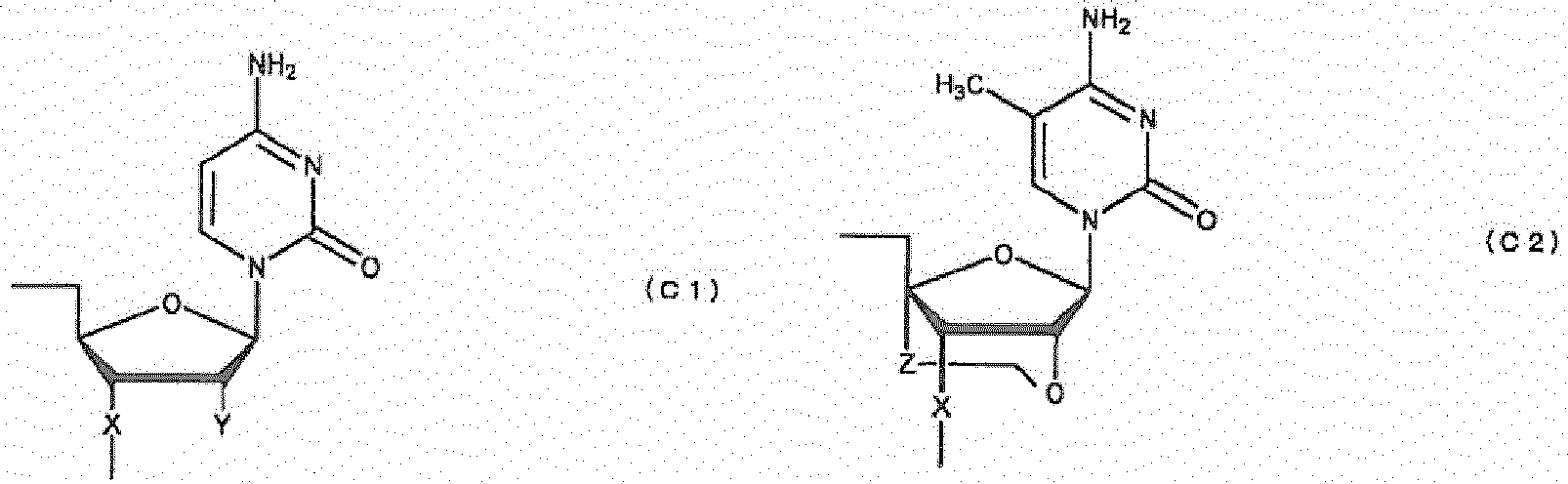
 - les symboles X représentent chacun, indépendamment, un groupe de formule (X1) ou (X2) suivante :
 - les symboles Y représentent chacun, indépendamment, un atome d'hydrogène, un groupe hydroxyle ou un groupe alcoxy comportant de 1 à 6 atomes de carbone,- et les symboles Z représentent chacun, indépendamment, une liaison simple ou un groupe alcanediyle comportant de 1 à 5 atomes de carbone ;étant entendu qu'au moins l'un des nucléosides constituant le composé de formule (XV") comporte un groupe 2'-O,4'-C-alcanediyle.
 - Composé conforme à la revendication 1, ou sel pharmacologiquement admissible d'un tel composé, qui comprend en outre une 2'-O-alkylation du D-ribofuranose.
- Composé conforme à la revendication 1 ou 2, ou sel pharmacologiquement admissible d'un tel composé, dans lequel au moins l'un des groupes phosphate constituant l'oligonucléotide est modifié.
- Composé conforme à la revendication 3, ou sel pharmacologiquement admissible d'un tel composé, dans lequel la modification du groupe phosphate est la thioation de ce groupe phosphate.
- Composé conforme à l'une des revendications 1 à 4, qui est représenté par n'importe quelle formule choisie dans l'ensemble formé par les formules (XV"-1), (XV"-2), (XV"-3), (XV"-4), (XV"-5), (XV"-6), (XV"-7), (XV"-8), (XV"-9), (XV"-10), (XV"-11), (XV"-12), (XV"-13), (XV"-14), (XV"-15), (XV"-16), (XV"-17), (XV"-18), (XV"-19), (XV"-20), (XV"-21), (XV"-22), (XV"-23) et (XV"-24), ou sel pharmacologiquement admissible d'un tel composé :(XV"-1) HO-Ge2p-Ge2p-Ce2p-Ae2p-Te2p-Ump-Ump-Cmp-Ump-Amp-Gmp-Ump-Ump-Te2p-Ge2p-Ge2p-Ae2p-Ge2p-CH2CH2OH;(XV"-2) HO-Ae2p-Ge2p-Te2p-Te2p-Te2p-Gmp-Gmp-Amp-Gmp-Amp-Ump-Gmp-Gmp-Ce2p-Ae2p-Ge2p-Te2p-Te2p-CH2CH2OH;(XV"-3) HO-Gmp-Gmp-Ce2p-Amp-Te2p-Te2p-Ump-Ce2p-Te2p-Amp-Gmp-Ump-Te2p-Te2p-Gmp-Gmp-Ae2p-Gmp-CH2CH2OH;(XV"-4) HO-Ae2p-Gmp-Te2p-Ump-Te2p-Gmp-Gmp-Ae2p-Gmp-Amp-Te2p-Gmp-Gmp-Ce2p-Ae2p-Gmp-Te2p-Te2p-CH2CH2OH;(XV"-5) HO-Ge1p-Ge1p-Ce1p-Ae1p-Te1p-Ump-Ump-Cmp-Ump-Amp-Gmp-Ump-Ump-Te1p-Ge1p-Ge1p-Ae1p-Ge1p-CH2CH2OH;(X-V"-6) HO-Ae1p-Ge1p-Te1p-Te1p-Te1p-Gmp-Gmp-Amp-Gmp-Amp-Ump-Gmp-Cmp-Ce1p-Ae1p-Ge1p-Te1p-Te1p-CH2CH2OH;(XV"-7) HO-Gmp-Gmp-Ce1p-Amp-Te1p-Te1p-Ump-Ce1p-Te1p-Amp-Gmp-Ump-Te1p-Te1p-Gmp-Gmp-Ae1p-Gmp-CH2CH2OH;(XV"-8) HO-Ae1p-Gmp-Te1p-Ump-Te1p-Gmp-Gmp-Ae1p-Gmp-Amp-Te1p-Gmp-Gmp-Gmp-Ae1p-Gmp-Te1p-Te1p-CH2CH2OH;(XV"-9) HO-Ge2p-Ge2p-Ce2p-Ae2p-Te2p-Te2p-Ums-Ums-Cms-Ums-Ams-Gms-Ums-Ums-Te2p-Ge2p-Ge2p-Ae2p-Ge2p-CH2CH2OH;(X-V"-10) HO-Ae2p-Ge2p-Te2p-Te2p-Te2p-Gms-Gms-Ams-Gms-Ams-Ums-Gms-Gms-Ce2p-Ae2p-Ge2p-Te2p-Te2p-CH2CH2OH;(XV"-11) HO-Gms-Gms-Ce2p-Ams-Te2p-Te2p-Ums-Ce2p-Te2p-Ams-Gms-Ums-Te2p-Te2p-Gms-Gms-Ae2p-Gms-CH2CH2OH;(XV"-12) HO-Ae2p-Gms-Ge2p-Ums-Te2p-Gms-Gms-Ae2p-Gms-Ams-Te2p-Gms-Gms-Ge2p-Ae2p-Gms-Te2p-Te2p-CH2CH2OH;(XV"-13) HO-Ge1p-Ge1p-Ce1p-Ae1p-Te1p-Ums-Ums-Cms-Ums-Ams-Gms-Ums-Ums-Te1p-Ge1p-Ge1p-Ae1p-Ge1p-CH2CH2OH;(XV"-14) HO-Ae1p-Ge1p-Te1p-Te1p-Te1p-Gms-Gms-Ams-Gms-Ams-Ums-Gms-Gms-Ce1p-Ae1p-Ge1p-Te1p-Te1p-CH2CH2OH;(XV"-15) HO-Gms-Gms-Ce1p-Ams-Te1p-Te1p-Ums-Ce1p-Te1p-Ams-Gms-Ums-Te1p-Te1p-Gms-Gms-Ae1p-Gms-CH2CH2OH;(XV"-16) HO-Ae1p-Gms-Te1p-Ums-Te1p-Gms-Gms-Ae1p-Gms-Ams-Te1p-Gms-Gms-Ce1p-Ae1p-Gms-Te1p-Te1p-CH2CH2OH;(XV"-17) HO-Ge2s-Ge2s-Ce2s-Ae2s-Te2s-Ums-Ums-Cms-Ums-Ams-Gms-Ums-Ums-Te2s-Ge2s-Ge2s-Ae2s-Ge2s-CH2CH2OH;(XV"-18) HO-Ae2s-Ge2s-Te2s-Te2s-Te2s-Gms-Gms-Ams-Gms-Ams-Ums-Gms-Gms-Ce2s-Ae2s-Ge2s-Te2s-Te2s-CH2CH2OH;(XV"-19) HO-Gms-Gms-Ce2s-Ams-Te2s-Te2s-Ums-Ce2s-Te2s-Ams-Gms-Ums-Te2s-Te2s-Gms-Gms-Ae2s-Gms-CH2CH2OH;(XV"-20) HO-Ae2s-Gms-Te2s-Ums-Te2s-Gms-Gms-Ae2s-Gms-Ams-Te2s-Gms-Gms-Ce2s-Ae2s-Gms-Te2s-Te2s-CH2CH2OH;(XV"-21) HO-Ge1s-Ge1s-Ge1sAe1s-Te1s-Ums-Ums-Cms-Ums-Ams-Gms-Ums-Ums-Te1s-Ge1s-Ge1s-Ae1s-Ge1s-CH2CH2OH;(XV"-22) HO-Ae1s-Ge1s-Te1s-Te1s-Te1s-Gms-Gms-Ams-Gms-Ams-Ums-Gms-Gms-Ce1s-Ae1s-Ge1s-Te1s-Te1s-CH2CH2OH;(XV"-23) HO-Gms-Gms-Ce1s-Ams-Te1s-Te1s-Ums-Ce1s-Te1s-Ams-Gms-Ums-Te1s-Te1s-Gms-Gms-Ae1s-Gms-CH2CH2OH;(XV"-24) HO-Ae1s-Gms-Te1s-Ums-Te1s-Gms-Gms-Ae1s-Gms-Ams-Te1s-Gms-Gms-Ce1s-Ae1s-Gms-Te1s-Te1s-CH2CH2OHdans lesquelles formules Ae1p, Ge1p, Ce1p, Te1p, Ae2p, Ge2p, Ce2p, Te2p, Amp, Gmp, Cmp, Ump, Ae1s, Ge1s, Ce1s, Te1s, Ae2s, Ge2s, Ce2s, Te2s, Ams, Gms, Cms et Ums représentent respectivement des groupes de structures suivantes :




- Composé conforme à la revendication 5, qui est choisi parmi les composés (XV"-1), (XV"-2), (XV"-3), (XV"-4), (XV"-17), (XV"-18), (XV"-19) et (XV"-20).
- Agent thérapeutique pour dystrophie musculaire, comprenant un composé conforme à l'une des revendications 1 à 6, ou un sel pharmacologiquement admissible d'un tel composé.
- Agent thérapeutique conforme à la revendication 7, dont la cible de traitement est constituée par les patients chez lesquels le nombre total d'acides aminés dans le cadre ouvert de lecture du gène de dystrophine est un multiple de 3 quand l'exon 51 du gène de dystrophine a été sauté.
- Composé conforme à l'une des revendications 1 à 6, ou agent thérapeutique conforme à la revendication 7 ou 8, pour utilisation dans le traitement d'une dystrophie musculaire.
- Utilisation d'un composé conforme à l'une des revendications 1 à 6, dans la fabrication d'un médicament destiné au traitement d'une dystrophie musculaire.
- Utilisation conforme à la revendication 10, dans laquelle la cible de traitement est constituée par les patients chez lesquels le nombre total d'acides aminés dans le cadre ouvert de lecture du gène de dystrophine est un multiple de 3 quand l'exon 51 du gène de dystrophine a été sauté.
- Agent thérapeutique conforme à la revendication 7 ou 8, composé ou agent thérapeutique pour utilisation conforme à la revendication 9, ou utilisation conforme à la revendication 10 ou 11, étant entendu que ladite dystrophie musculaire est la myopathie de Duchenne.
Applications Claiming Priority (4)
| Application Number | Priority Date | Filing Date | Title |
|---|---|---|---|
| JP2002340857 | 2002-11-25 | ||
| JP2003204381 | 2003-07-31 | ||
| EP03774151A EP1568769A4 (fr) | 2002-11-25 | 2003-11-21 | Medicaments d'acide nucleique ena modifiant l'epissage dans un precurseur mrna |
| EP09011130.3A EP2135948B1 (fr) | 2002-11-25 | 2003-11-21 | Medicaments d'acide nucleique ena modifiant l'epissage dans un precurseur mrna |
Related Parent Applications (5)
| Application Number | Title | Priority Date | Filing Date |
|---|---|---|---|
| EP09011130.3A Division-Into EP2135948B1 (fr) | 2002-11-25 | 2003-11-21 | Medicaments d'acide nucleique ena modifiant l'epissage dans un precurseur mrna |
| EP09011130.3A Division EP2135948B1 (fr) | 2002-11-25 | 2003-11-21 | Medicaments d'acide nucleique ena modifiant l'epissage dans un precurseur mrna |
| EP03774151A Division EP1568769A4 (fr) | 2002-11-25 | 2003-11-21 | Medicaments d'acide nucleique ena modifiant l'epissage dans un precurseur mrna |
| EP03774151.9 Division | 2003-11-21 | ||
| EP09011130.3 Division | 2009-08-31 |
Publications (3)
| Publication Number | Publication Date |
|---|---|
| EP2386636A2 EP2386636A2 (fr) | 2011-11-16 |
| EP2386636A3 EP2386636A3 (fr) | 2012-09-05 |
| EP2386636B1 true EP2386636B1 (fr) | 2016-01-27 |
Family
ID=32396255
Family Applications (9)
| Application Number | Title | Priority Date | Filing Date |
|---|---|---|---|
| EP12182249.8A Expired - Lifetime EP2530153B1 (fr) | 2002-11-25 | 2003-11-21 | Médicaments à base d'acide nucléique ENA modifiant l'épissage dans un précurseur d'ARNm |
| EP12182252.2A Expired - Lifetime EP2530154B1 (fr) | 2002-11-25 | 2003-11-21 | Médicaments à base d'acide nucléique ENA modifiant l'épissage dans un précurseur d'ARNm |
| EP11155685A Withdrawn EP2374885A3 (fr) | 2002-11-25 | 2003-11-21 | Medicaments d'acide nucleique ena modifiant l'epissage dans un precurseur mRNA |
| EP11155689.0A Expired - Lifetime EP2386636B1 (fr) | 2002-11-25 | 2003-11-21 | Médicaments à base d'acide nucléique ena modifiant l'épissage dans un précurseur d'arnm |
| EP12182258.9A Expired - Lifetime EP2530156B1 (fr) | 2002-11-25 | 2003-11-21 | Médicaments à base d'acide nucléique ENA modifiant l'épissage dans un précurseur d'ARNm |
| EP03774151A Withdrawn EP1568769A4 (fr) | 2002-11-25 | 2003-11-21 | Medicaments d'acide nucleique ena modifiant l'epissage dans un precurseur mrna |
| EP11155691A Withdrawn EP2392660A3 (fr) | 2002-11-25 | 2003-11-21 | Médicaments à base d'acide nucléique ENA modifiant l'épissage dans un précurseur d'ARNm |
| EP09011130.3A Expired - Lifetime EP2135948B1 (fr) | 2002-11-25 | 2003-11-21 | Medicaments d'acide nucleique ena modifiant l'epissage dans un precurseur mrna |
| EP12182257.1A Expired - Lifetime EP2530155B1 (fr) | 2002-11-25 | 2003-11-21 | Médicaments à base d'acide nucléique ENA modifiant l'épissage dans un précurseur d'ARNm |
Family Applications Before (3)
| Application Number | Title | Priority Date | Filing Date |
|---|---|---|---|
| EP12182249.8A Expired - Lifetime EP2530153B1 (fr) | 2002-11-25 | 2003-11-21 | Médicaments à base d'acide nucléique ENA modifiant l'épissage dans un précurseur d'ARNm |
| EP12182252.2A Expired - Lifetime EP2530154B1 (fr) | 2002-11-25 | 2003-11-21 | Médicaments à base d'acide nucléique ENA modifiant l'épissage dans un précurseur d'ARNm |
| EP11155685A Withdrawn EP2374885A3 (fr) | 2002-11-25 | 2003-11-21 | Medicaments d'acide nucleique ena modifiant l'epissage dans un precurseur mRNA |
Family Applications After (5)
| Application Number | Title | Priority Date | Filing Date |
|---|---|---|---|
| EP12182258.9A Expired - Lifetime EP2530156B1 (fr) | 2002-11-25 | 2003-11-21 | Médicaments à base d'acide nucléique ENA modifiant l'épissage dans un précurseur d'ARNm |
| EP03774151A Withdrawn EP1568769A4 (fr) | 2002-11-25 | 2003-11-21 | Medicaments d'acide nucleique ena modifiant l'epissage dans un precurseur mrna |
| EP11155691A Withdrawn EP2392660A3 (fr) | 2002-11-25 | 2003-11-21 | Médicaments à base d'acide nucléique ENA modifiant l'épissage dans un précurseur d'ARNm |
| EP09011130.3A Expired - Lifetime EP2135948B1 (fr) | 2002-11-25 | 2003-11-21 | Medicaments d'acide nucleique ena modifiant l'epissage dans un precurseur mrna |
| EP12182257.1A Expired - Lifetime EP2530155B1 (fr) | 2002-11-25 | 2003-11-21 | Médicaments à base d'acide nucléique ENA modifiant l'épissage dans un précurseur d'ARNm |
Country Status (7)
| Country | Link |
|---|---|
| US (5) | US7902160B2 (fr) |
| EP (9) | EP2530153B1 (fr) |
| JP (6) | JP4777777B2 (fr) |
| AU (1) | AU2003284638A1 (fr) |
| CA (4) | CA2942791C (fr) |
| ES (6) | ES2566628T3 (fr) |
| WO (1) | WO2004048570A1 (fr) |
Cited By (1)
| Publication number | Priority date | Publication date | Assignee | Title |
|---|---|---|---|---|
| US10781451B2 (en) | 2004-06-28 | 2020-09-22 | The University Of Western Australia | Antisense oligonucleotides for inducing exon skipping and methods of use thereof |
Families Citing this family (65)
| Publication number | Priority date | Publication date | Assignee | Title |
|---|---|---|---|---|
| US6784291B2 (en) | 2000-05-04 | 2004-08-31 | Avi Biopharma, Inc. | Splice-region antisense composition and method |
| JP4777777B2 (ja) | 2002-11-25 | 2011-09-21 | 雅文 松尾 | mRNA前駆体のスプライシングを修飾するENA核酸医薬 |
| USRE48960E1 (en) | 2004-06-28 | 2022-03-08 | The University Of Western Australia | Antisense oligonucleotides for inducing exon skipping and methods of use thereof |
| NZ563206A (en) * | 2005-04-22 | 2009-09-25 | Academisch Ziekenhuis Leiden | Modulation of exon recognition in pre-mRNA by interfering with the binding or SR proteins and by interfering with secondary RNA structure |
| WO2007123391A1 (fr) | 2006-04-20 | 2007-11-01 | Academisch Ziekenhuis Leiden | Intervention thérapeutique dans une maladie génétique chez un individu en modifiant l'expression d'un gène exprimé de manière aberrante. |
| EP1857548A1 (fr) | 2006-05-19 | 2007-11-21 | Academisch Ziekenhuis Leiden | Procédé et moyen permettant d'induire un saut d'exon |
| AU2007282224B2 (en) | 2006-08-11 | 2013-08-29 | Vico Therapeutics B.V. | Methods and means for treating DNA repeat instability associated genetic disorders |
| CA2693742A1 (fr) * | 2007-07-12 | 2009-01-15 | Prosensa Technologies B.V. | Molecules pour cibler des composes vers divers organes, tissus ou cellules tumorales selectionnes |
| WO2009008727A2 (fr) * | 2007-07-12 | 2009-01-15 | Prosensa Technologies B.V. | Molécules permettant d'orienter des composés vers divers organes ou tissus sélectionnés |
| USRE48468E1 (en) | 2007-10-26 | 2021-03-16 | Biomarin Technologies B.V. | Means and methods for counteracting muscle disorders |
| AU2008317566B2 (en) * | 2007-10-26 | 2014-05-01 | Academisch Ziekenhuis Leiden | Means and methods for counteracting muscle disorders |
| NZ587178A (en) * | 2008-02-08 | 2011-11-25 | Prosensa Holding Bv | Methods and means for treating dna repeat instability associated genetic disorders |
| EP2119783A1 (fr) | 2008-05-14 | 2009-11-18 | Prosensa Technologies B.V. | Procédé pour l'omission efficace de l'exon (44) dans la dystrophie musculaire de Duchenne et moyens connexes |
| CN112574988A (zh) * | 2008-10-24 | 2021-03-30 | 萨雷普塔治疗公司 | 用于dmd的多外显子跳跃组合物 |
| CA2759899A1 (fr) | 2009-04-24 | 2010-10-28 | Prosensa Technologies B.V. | Oligonucleotide comprenant une inosine pour traiter une dystrophie musculaire de duchenne (dmd) |
| LT2499249T (lt) | 2009-11-12 | 2018-12-27 | The University Of Western Australia | Priešprasmės molekulės ir patologijų gydymo būdai |
| AU2014280918B2 (en) * | 2009-12-18 | 2016-11-17 | Arrowhead Pharmaceuticals, Inc. | Organic compositions to treat HSF1-related diseases |
| EP3000885B1 (fr) | 2009-12-18 | 2018-07-25 | Arrowhead Pharmaceuticals, Inc. | Compositions organiques de traitement des pathologies liées à hsf1 |
| WO2011078672A1 (fr) | 2009-12-24 | 2011-06-30 | Prosensa Technologies B.V. | Molécule pour traiter un trouble inflammatoire |
| TWI541024B (zh) | 2010-09-01 | 2016-07-11 | 日本新藥股份有限公司 | 反義核酸 |
| EP2750715B1 (fr) | 2011-08-30 | 2018-10-31 | The Regents of The University of California | Identification de petites molécules qui améliorent le saut d'exon thérapeutique |
| CN117721110A (zh) * | 2011-12-28 | 2024-03-19 | 日本新药株式会社 | 反义核酸 |
| EA036003B1 (ru) * | 2012-01-04 | 2020-09-11 | Кварк Фармасьютикалс, Инк. | Способ лечения оптической нейропатии с применением двухцепочечной рнк к casp2 |
| CN112251436A (zh) | 2012-01-27 | 2021-01-22 | 比奥马林技术公司 | 治疗杜兴型肌营养不良症和贝克型肌营养不良症的具有改善特性的rna调节性寡核苷酸 |
| JP6928025B2 (ja) * | 2012-01-27 | 2021-09-01 | バイオマリン テクノロジーズ ベー.フェー. | デュシェンヌ型及びベッカー型筋ジストロフィーの治療のための改善された特徴を有するrna調節オリゴヌクレオチド |
| WO2013191129A1 (fr) * | 2012-06-18 | 2013-12-27 | 第一三共株式会社 | Intermédiaire pour la production d'un analogue de nucléoside, et son procédé de production |
| NZ731587A (en) | 2013-03-14 | 2021-07-30 | Sarepta Therapeutics Inc | Exon skipping compositions for treating muscular dystrophy |
| CA2906812A1 (fr) | 2013-03-15 | 2014-09-18 | Sarepta Therapeutics, Inc. | Compositions ameliorees pour le traitement de la dystrophie musculaire |
| SMT201900169T1 (it) | 2014-03-12 | 2019-05-10 | Nippon Shinyaku Co Ltd | Acido nucleico antisenso |
| RU2695430C2 (ru) | 2014-06-17 | 2019-07-23 | Ниппон Синяку Ко., Лтд. | Антисмысловые нуклеиновые кислоты |
| SI3351633T1 (sl) | 2015-09-15 | 2020-09-30 | Nippon Shinyaku Co., Ltd. | Protismiselna nukleinska kislina |
| JP2019513371A (ja) | 2016-04-01 | 2019-05-30 | アビディティー バイオサイエンシーズ エルエルシー | 核酸ポリペプチド組成物とその使用 |
| TW201811807A (zh) | 2016-06-30 | 2018-04-01 | 美商薩羅塔治療公司 | 用於肌肉萎縮症之外顯子跳躍寡聚物 |
| SI3554554T1 (sl) | 2016-12-19 | 2023-02-28 | Sarepta Therapeutics, Inc. | Oligomerni konjugati, ki preskakujejo ekson za mišično distrofijo |
| IL297528A (en) | 2016-12-19 | 2022-12-01 | Sarepta Therapeutics Inc | Exon-skipping oligomer conjugates for muscular dystrophy |
| SMT202200366T1 (it) | 2016-12-19 | 2022-11-18 | Sarepta Therapeutics Inc | Coniugati di oligomeri per salto di esone per distrofia muscolare |
| CN110199023A (zh) * | 2016-12-28 | 2019-09-03 | 第一三共株式会社 | 阿尔波特氏综合症治疗药 |
| MX2019008199A (es) | 2017-01-06 | 2019-11-25 | Avidity Biosciences Llc | Composiciones de acido nucleico polipeptido y metodos de induccion de la omision de exon. |
| US11963974B2 (en) | 2017-03-10 | 2024-04-23 | National Center For Child Health And Development | Antisense oligonucleotide and composition for prevention or treatment of glycogen storage disease type Ia |
| GB201711809D0 (en) * | 2017-07-21 | 2017-09-06 | Governors Of The Univ Of Alberta | Antisense oligonucleotide |
| EA201991450A1 (ru) | 2017-09-22 | 2019-12-30 | Сарепта Терапьютикс, Инк. | Конъюгаты олигомеров для пропуска экзона при мышечной дистрофии |
| WO2019067975A1 (fr) | 2017-09-28 | 2019-04-04 | Sarepta Therapeutics, Inc. | Polythérapies pour traiter une dystrophie musculaire |
| JP2020536058A (ja) | 2017-09-28 | 2020-12-10 | サレプタ セラピューティクス, インコーポレイテッド | 筋ジストロフィーを処置するための併用療法 |
| CN111511915A (zh) | 2018-03-09 | 2020-08-07 | 第一三共株式会社 | 糖原病Ia型治疗药 |
| US10758629B2 (en) | 2018-05-29 | 2020-09-01 | Sarepta Therapeutics, Inc. | Exon skipping oligomer conjugates for muscular dystrophy |
| EP3815696A4 (fr) | 2018-06-26 | 2022-11-30 | Nippon Shinyaku Co., Ltd. | Composition comprenant un oligonucléotide antisens et son utilisation pour le traitement de la dystrophie musculaire de duchenne |
| US12018087B2 (en) | 2018-08-02 | 2024-06-25 | Dyne Therapeutics, Inc. | Muscle-targeting complexes comprising an anti-transferrin receptor antibody linked to an oligonucleotide and methods of delivering oligonucleotide to a subject |
| US20220193250A1 (en) | 2018-08-02 | 2022-06-23 | Dyne Therapeutics, Inc. | Muscle targeting complexes and uses thereof for treating facioscapulohumeral muscular dystrophy |
| EP3829595A4 (fr) | 2018-08-02 | 2022-08-24 | Dyne Therapeutics, Inc. | Complexes de ciblage musculaire et leurs utilisations pour le traitement de dystrophinopathies |
| US11168141B2 (en) | 2018-08-02 | 2021-11-09 | Dyne Therapeutics, Inc. | Muscle targeting complexes and uses thereof for treating dystrophinopathies |
| WO2021049504A1 (fr) | 2019-09-10 | 2021-03-18 | 第一三共株式会社 | Conjugué galnac-oligonucléotide pour une utilisation d'administration ciblée sur le foie, et son procédé de production |
| IL292286A (en) * | 2019-10-18 | 2022-06-01 | Daiichi Sankyo Co Ltd | Production method for bicyclic phosphoramidite |
| JP7842395B2 (ja) | 2019-12-19 | 2026-04-08 | 日本新薬株式会社 | エクソンスキッピングを可能にするアンチセンス核酸 |
| CN118109468A (zh) | 2019-12-26 | 2024-05-31 | 日本新药株式会社 | 诱导外显子50的跳读的反义核酸 |
| US20230140736A1 (en) | 2020-02-28 | 2023-05-04 | Nippon Shinyaku Co., Ltd. | Antisense nucleic acid inducing skipping of exon 51 |
| US11987795B2 (en) | 2020-11-24 | 2024-05-21 | The Broad Institute, Inc. | Methods of modulating SLC7A11 pre-mRNA transcripts for diseases and conditions associated with expression of SLC7A11 |
| MX2023012559A (es) | 2021-04-30 | 2023-12-15 | Sarepta Therapeutics Inc | Métodos de tratamiento para la distrofia muscular. |
| WO2022270585A1 (fr) | 2021-06-23 | 2022-12-29 | 日本新薬株式会社 | Combinaison d'oligomères antisens |
| US11771776B2 (en) | 2021-07-09 | 2023-10-03 | Dyne Therapeutics, Inc. | Muscle targeting complexes and uses thereof for treating dystrophinopathies |
| IL309936A (en) | 2021-07-09 | 2024-03-01 | Dyne Therapeutics Inc | Muscle targeting complexes and formulations for the treatment of dystrophinopathy |
| US11969475B2 (en) | 2021-07-09 | 2024-04-30 | Dyne Therapeutics, Inc. | Muscle targeting complexes and uses thereof for treating facioscapulohumeral muscular dystrophy |
| US11638761B2 (en) | 2021-07-09 | 2023-05-02 | Dyne Therapeutics, Inc. | Muscle targeting complexes and uses thereof for treating Facioscapulohumeral muscular dystrophy |
| US20240390508A1 (en) | 2021-08-21 | 2024-11-28 | Takeda Pharmaceutical Company Limited | Human transferrin receptor binding peptide-drug conjugate |
| EP4215614A1 (fr) | 2022-01-24 | 2023-07-26 | Dynacure | Thérapie de combinaison pour maladies liées à la dystrophine |
| JP2025509438A (ja) | 2022-03-17 | 2025-04-11 | サレプタ セラピューティクス, インコーポレイテッド | ホスホロジアミデートモルホリノオリゴマーコンジュゲート |
Family Cites Families (25)
| Publication number | Priority date | Publication date | Assignee | Title |
|---|---|---|---|---|
| JP2544164B2 (ja) | 1987-11-28 | 1996-10-16 | 新明工業株式会社 | ピストンリング組み付け装置 |
| WO1993020227A1 (fr) * | 1992-03-31 | 1993-10-14 | Abbott Laboratories | Procede de reaction de ligase en chaine multiplex |
| US6436635B1 (en) * | 1992-11-06 | 2002-08-20 | Boston University | Solid phase sequencing of double-stranded nucleic acids |
| JPH0787982A (ja) | 1993-01-29 | 1995-04-04 | Sankyo Co Ltd | 修飾オリゴデオキシリボヌクレオチド |
| US5525470A (en) * | 1994-01-26 | 1996-06-11 | Hybridon, Inc. | Method of sequencing [short] oligonucleotides |
| US5563255A (en) * | 1994-05-31 | 1996-10-08 | Isis Pharmaceuticals, Inc. | Antisense oligonucleotide modulation of raf gene expression |
| US5853990A (en) * | 1996-07-26 | 1998-12-29 | Edward E. Winger | Real time homogeneous nucleotide assay |
| AU9063398A (en) | 1997-09-12 | 1999-04-05 | Exiqon A/S | Oligonucleotide analogues |
| JPH11140930A (ja) | 1997-11-13 | 1999-05-25 | Matsushita Electric Works Ltd | シャワー装置 |
| CZ296576B6 (cs) | 1999-02-12 | 2006-04-12 | Sankyo Company Limited | Nukleosidový analog a oligonukleotidový analog a farmaceutický prostredek, sonda a primer s jeho obsahem |
| JP2000325085A (ja) * | 1999-05-21 | 2000-11-28 | Masafumi Matsuo | デュシェンヌ型筋ジストロフィー治療剤 |
| US6165728A (en) * | 1999-11-19 | 2000-12-26 | Isis Pharmaceuticals Inc. | Antisense modulation of NCK-2 expression |
| US6261840B1 (en) | 2000-01-18 | 2001-07-17 | Isis Pharmaceuticals, Inc. | Antisense modulation of PTP1B expression |
| US6653467B1 (en) | 2000-04-26 | 2003-11-25 | Jcr Pharmaceutical Co., Ltd. | Medicament for treatment of Duchenne muscular dystrophy |
| ATE437944T1 (de) * | 2000-04-28 | 2009-08-15 | Asklepios Biopharmaceutical In | Für das dystrophin-minigen kodierende dna- sequenzen und verfahren zu deren verwendung |
| RU2165149C1 (ru) | 2000-07-03 | 2001-04-20 | Шапошников Валерий Геннадьевич | Система формования и упаковки изделий из сахарной ваты |
| US6920153B2 (en) * | 2000-07-17 | 2005-07-19 | Nortel Networks Limited | Architecture and addressing scheme for storage interconnect and emerging storage service providers |
| US6727355B2 (en) * | 2000-08-25 | 2004-04-27 | Jcr Pharmaceuticals Co., Ltd. | Pharmaceutical composition for treatment of Duchenne muscular dystrophy |
| JP4836366B2 (ja) * | 2000-08-25 | 2011-12-14 | 雅文 松尾 | デュシェンヌ型筋ジストロフィー治療剤 |
| EP1191097A1 (fr) * | 2000-09-21 | 2002-03-27 | Leids Universitair Medisch Centrum | Induction du "exon-skipping" dans des cellules eukaryotes |
| JP3781687B2 (ja) | 2001-02-23 | 2006-05-31 | 松下電器産業株式会社 | 遺伝子診断装置及び遺伝子診断方法 |
| EP1472335A4 (fr) * | 2001-11-08 | 2005-12-28 | Univ Johns Hopkins | Procedes et systemes pour le sequencage d'acides nucleiques |
| JP2003204381A (ja) | 2002-01-04 | 2003-07-18 | Hitachi Ltd | 情報通信端末装置 |
| JP4777777B2 (ja) * | 2002-11-25 | 2011-09-21 | 雅文 松尾 | mRNA前駆体のスプライシングを修飾するENA核酸医薬 |
| CA2524255C (fr) | 2003-03-21 | 2014-02-11 | Academisch Ziekenhuis Leiden | Modulation de la reconnaissance d'exons dans le pre-arnm par interference avec la structure d'arn secondaire |
-
2003
- 2003-11-21 JP JP2005510284A patent/JP4777777B2/ja not_active Expired - Lifetime
- 2003-11-21 WO PCT/JP2003/014915 patent/WO2004048570A1/fr not_active Ceased
- 2003-11-21 EP EP12182249.8A patent/EP2530153B1/fr not_active Expired - Lifetime
- 2003-11-21 CA CA2942791A patent/CA2942791C/fr not_active Expired - Lifetime
- 2003-11-21 EP EP12182252.2A patent/EP2530154B1/fr not_active Expired - Lifetime
- 2003-11-21 EP EP11155685A patent/EP2374885A3/fr not_active Withdrawn
- 2003-11-21 ES ES12182249.8T patent/ES2566628T3/es not_active Expired - Lifetime
- 2003-11-21 EP EP11155689.0A patent/EP2386636B1/fr not_active Expired - Lifetime
- 2003-11-21 ES ES09011130.3T patent/ES2509140T3/es not_active Expired - Lifetime
- 2003-11-21 AU AU2003284638A patent/AU2003284638A1/en not_active Abandoned
- 2003-11-21 CA CA2796924A patent/CA2796924C/fr not_active Expired - Lifetime
- 2003-11-21 EP EP12182258.9A patent/EP2530156B1/fr not_active Expired - Lifetime
- 2003-11-21 CA CA2507125A patent/CA2507125C/fr not_active Expired - Lifetime
- 2003-11-21 CA CA3001404A patent/CA3001404C/fr not_active Expired - Lifetime
- 2003-11-21 EP EP03774151A patent/EP1568769A4/fr not_active Withdrawn
- 2003-11-21 EP EP11155691A patent/EP2392660A3/fr not_active Withdrawn
- 2003-11-21 ES ES11155689.0T patent/ES2561851T3/es not_active Expired - Lifetime
- 2003-11-21 ES ES12182252.2T patent/ES2566629T3/es not_active Expired - Lifetime
- 2003-11-21 EP EP09011130.3A patent/EP2135948B1/fr not_active Expired - Lifetime
- 2003-11-21 US US10/536,258 patent/US7902160B2/en not_active Expired - Lifetime
- 2003-11-21 ES ES12182257.1T patent/ES2566632T3/es not_active Expired - Lifetime
- 2003-11-21 ES ES12182258.9T patent/ES2554660T3/es not_active Expired - Lifetime
- 2003-11-21 EP EP12182257.1A patent/EP2530155B1/fr not_active Expired - Lifetime
-
2010
- 2010-04-09 JP JP2010090504A patent/JP5138722B2/ja not_active Expired - Lifetime
- 2010-07-30 US US12/847,237 patent/US8624019B2/en not_active Expired - Fee Related
-
2012
- 2012-02-10 JP JP2012027325A patent/JP5486028B2/ja not_active Expired - Lifetime
- 2012-11-09 US US13/673,466 patent/US9657049B2/en not_active Expired - Fee Related
-
2014
- 2014-01-20 JP JP2014007759A patent/JP5802770B2/ja not_active Expired - Lifetime
- 2014-04-22 US US14/258,663 patent/US9243026B2/en not_active Expired - Lifetime
-
2015
- 2015-05-12 JP JP2015097462A patent/JP6382150B2/ja not_active Expired - Lifetime
- 2015-09-18 US US14/858,404 patent/US9657050B2/en not_active Expired - Fee Related
-
2016
- 2016-05-11 JP JP2016095419A patent/JP2016182122A/ja active Pending
Cited By (1)
| Publication number | Priority date | Publication date | Assignee | Title |
|---|---|---|---|---|
| US10781451B2 (en) | 2004-06-28 | 2020-09-22 | The University Of Western Australia | Antisense oligonucleotides for inducing exon skipping and methods of use thereof |
Also Published As
Similar Documents
| Publication | Publication Date | Title |
|---|---|---|
| EP2386636B1 (fr) | Médicaments à base d'acide nucléique ena modifiant l'épissage dans un précurseur d'arnm | |
| KR20130069762A (ko) | 안티센스 핵산 | |
| JP7634542B2 (ja) | B型肝炎ウイルス感染症を処置するためのsept9阻害剤の使用 | |
| JP2025166835A (ja) | B型肝炎ウイルス感染を処置するためのscamp3阻害剤の使用 | |
| CN114867856A (zh) | Saraf抑制剂用于治疗乙型肝炎病毒感染的用途 | |
| WO2021157730A1 (fr) | Médicament à base d'acide nucléique et utilisation associée | |
| JP7627495B2 (ja) | DUX4 pre-mRNAのスプライシングを変化させるアンチセンスオリゴヌクレオチド | |
| EP3628737A1 (fr) | Oligonucléotide antisens ena pour l'inhibition de l'expression alpha -synucléine | |
| JP7653997B2 (ja) | B型肝炎ウイルス感染を処置するためのcops3阻害剤の使用 | |
| JP6934695B2 (ja) | 核酸医薬とその使用 | |
| JP2007104971A (ja) | ミオスタチンのスプライシング制御アンチセンスオリゴヌクレオチド | |
| EP4067489A1 (fr) | Méthode visant à réduire la toxicité d'acides nucléiques antisesns | |
| CN114829601A (zh) | Sbds抑制剂用于治疗乙型肝炎病毒感染的用途 | |
| JPWO2019240164A1 (ja) | 心筋障害治療薬 | |
| EP4446414A1 (fr) | Complexe d'oligonucléotide antisens | |
| EP3146970B1 (fr) | Médicament à base d'acide nucléique destiné à induire un saut d'exon de variant du gène cd44 et à augmenter l'expression de l'arnm du cd44 de type normal | |
| HK40077333A (en) | Use of saraf inhibitors for treating hepatitis b virus infection | |
| HK40078456A (en) | Use of sbds inhibitors for treating hepatitis b virus infection | |
| EP3564373A1 (fr) | Médicament thérapeutique pour le syndrome d'alport | |
| HK40065915A (en) | Antisense oligonucleotide capable of altering splicing of dux4 pre-mrna | |
| HK40071185A (en) | Use of sept9 inhibitors for treating hepatitis b virus infection | |
| HK40078459A (en) | Use of scamp3 inhibitors for treating hepatitis b virus infection | |
| WO2019111791A1 (fr) | Oligonucléotide antisens apte à annuler la rétention d'introns dans le gène de la dystrophine | |
| HK40015131A (en) | Therapeutic drug for alport's syndrome |
Legal Events
| Date | Code | Title | Description |
|---|---|---|---|
| AC | Divisional application: reference to earlier application |
Ref document number: 2135948 Country of ref document: EP Kind code of ref document: P Ref document number: 1568769 Country of ref document: EP Kind code of ref document: P |
|
| AK | Designated contracting states |
Kind code of ref document: A2 Designated state(s): AT BE BG CH CY CZ DE DK EE ES FI FR GB GR HU IE IT LI LU MC NL PT RO SE SI SK TR |
|
| PUAI | Public reference made under article 153(3) epc to a published international application that has entered the european phase |
Free format text: ORIGINAL CODE: 0009012 |
|
| RIC1 | Information provided on ipc code assigned before grant |
Ipc: C07H 21/04 20060101ALI20120613BHEP Ipc: C12N 15/11 20060101AFI20120613BHEP Ipc: A61K 31/7125 20060101ALI20120613BHEP Ipc: A61K 48/00 20060101ALI20120613BHEP Ipc: A61K 31/7088 20060101ALI20120613BHEP Ipc: A61P 21/04 20060101ALI20120613BHEP Ipc: A61K 31/712 20060101ALI20120613BHEP |
|
| PUAL | Search report despatched |
Free format text: ORIGINAL CODE: 0009013 |
|
| RIC1 | Information provided on ipc code assigned before grant |
Ipc: A61K 31/7088 20060101ALI20120705BHEP Ipc: A61K 31/712 20060101ALI20120705BHEP Ipc: A61K 31/7125 20060101ALI20120705BHEP Ipc: A61P 21/04 20060101ALI20120705BHEP Ipc: C07H 21/04 20060101ALI20120705BHEP Ipc: A61K 48/00 20060101ALI20120705BHEP Ipc: C12N 15/11 20060101AFI20120705BHEP |
|
| AK | Designated contracting states |
Kind code of ref document: A3 Designated state(s): AT BE BG CH CY CZ DE DK EE ES FI FR GB GR HU IE IT LI LU MC NL PT RO SE SI SK TR |
|
| RIC1 | Information provided on ipc code assigned before grant |
Ipc: A61K 31/7125 20060101ALI20120727BHEP Ipc: C12N 15/11 20060101AFI20120727BHEP Ipc: A61K 31/7088 20060101ALI20120727BHEP Ipc: A61K 31/712 20060101ALI20120727BHEP Ipc: A61K 48/00 20060101ALI20120727BHEP Ipc: A61P 21/04 20060101ALI20120727BHEP Ipc: C07H 21/04 20060101ALI20120727BHEP |
|
| RIN1 | Information on inventor provided before grant (corrected) |
Inventor name: TAKESHIMA, YASUHIRO Inventor name: KOIZUMI, MAKOTO Inventor name: MATSUO, MASAFUMI |
|
| RAP1 | Party data changed (applicant data changed or rights of an application transferred) |
Owner name: NONPROFIT ORGANIZATION TRANSLATIONAL RESEARCH ORGA Owner name: TAKESHIMA, YASUHIRO Owner name: MATSUO, MASAFUMI Owner name: DAIICHI SANKYO COMPANY, LIMITED |
|
| 17P | Request for examination filed |
Effective date: 20130220 |
|
| RAP1 | Party data changed (applicant data changed or rights of an application transferred) |
Owner name: MATSUO, MASAFUMI Owner name: ORPHAN DISEASE TREATMENT INSTITUTE CO., LTD. Owner name: DAIICHI SANKYO COMPANY, LIMITED Owner name: TAKESHIMA, YASUHIRO |
|
| 17Q | First examination report despatched |
Effective date: 20130819 |
|
| RAP1 | Party data changed (applicant data changed or rights of an application transferred) |
Owner name: TAKESHIMA, YASUHIRO Owner name: DAIICHI SANKYO COMPANY, LIMITED Owner name: MATSUO, MASAFUMI Owner name: ORPHAN DISEASE TREATMENT INSTITUTE CO., LTD. |
|
| RIN1 | Information on inventor provided before grant (corrected) |
Inventor name: KOIZUMI, MAKOTO Inventor name: MATSUO, MASAFUMI Inventor name: TAKESHIMA, YASUHIRO |
|
| RAP1 | Party data changed (applicant data changed or rights of an application transferred) |
Owner name: MATSUO, MASAFUMI Owner name: DAIICHI SANKYO COMPANY, LIMITED Owner name: TAKESHIMA, YASUHIRO Owner name: ORPHAN DISEASE TREATMENT INSTITUTE CO., LTD. |
|
| GRAP | Despatch of communication of intention to grant a patent |
Free format text: ORIGINAL CODE: EPIDOSNIGR1 |
|
| INTG | Intention to grant announced |
Effective date: 20150730 |
|
| GRAS | Grant fee paid |
Free format text: ORIGINAL CODE: EPIDOSNIGR3 |
|
| GRAA | (expected) grant |
Free format text: ORIGINAL CODE: 0009210 |
|
| AC | Divisional application: reference to earlier application |
Ref document number: 2135948 Country of ref document: EP Kind code of ref document: P Ref document number: 1568769 Country of ref document: EP Kind code of ref document: P |
|
| AK | Designated contracting states |
Kind code of ref document: B1 Designated state(s): AT BE BG CH CY CZ DE DK EE ES FI FR GB GR HU IE IT LI LU MC NL PT RO SE SI SK TR |
|
| REG | Reference to a national code |
Ref country code: GB Ref legal event code: FG4D |
|
| REG | Reference to a national code |
Ref country code: CH Ref legal event code: EP |
|
| REG | Reference to a national code |
Ref country code: AT Ref legal event code: REF Ref document number: 772737 Country of ref document: AT Kind code of ref document: T Effective date: 20160215 |
|
| REG | Reference to a national code |
Ref country code: IE Ref legal event code: FG4D |
|
| REG | Reference to a national code |
Ref country code: ES Ref legal event code: FG2A Ref document number: 2561851 Country of ref document: ES Kind code of ref document: T3 Effective date: 20160301 |
|
| REG | Reference to a national code |
Ref country code: DE Ref legal event code: R096 Ref document number: 60348514 Country of ref document: DE |
|
| REG | Reference to a national code |
Ref country code: NL Ref legal event code: MP Effective date: 20160127 |
|
| REG | Reference to a national code |
Ref country code: AT Ref legal event code: MK05 Ref document number: 772737 Country of ref document: AT Kind code of ref document: T Effective date: 20160127 |
|
| PG25 | Lapsed in a contracting state [announced via postgrant information from national office to epo] |
Ref country code: NL Free format text: LAPSE BECAUSE OF FAILURE TO SUBMIT A TRANSLATION OF THE DESCRIPTION OR TO PAY THE FEE WITHIN THE PRESCRIBED TIME-LIMIT Effective date: 20160127 |
|
| PG25 | Lapsed in a contracting state [announced via postgrant information from national office to epo] |
Ref country code: GR Free format text: LAPSE BECAUSE OF FAILURE TO SUBMIT A TRANSLATION OF THE DESCRIPTION OR TO PAY THE FEE WITHIN THE PRESCRIBED TIME-LIMIT Effective date: 20160428 Ref country code: FI Free format text: LAPSE BECAUSE OF FAILURE TO SUBMIT A TRANSLATION OF THE DESCRIPTION OR TO PAY THE FEE WITHIN THE PRESCRIBED TIME-LIMIT Effective date: 20160127 |
|
| PG25 | Lapsed in a contracting state [announced via postgrant information from national office to epo] |
Ref country code: SE Free format text: LAPSE BECAUSE OF FAILURE TO SUBMIT A TRANSLATION OF THE DESCRIPTION OR TO PAY THE FEE WITHIN THE PRESCRIBED TIME-LIMIT Effective date: 20160127 Ref country code: AT Free format text: LAPSE BECAUSE OF FAILURE TO SUBMIT A TRANSLATION OF THE DESCRIPTION OR TO PAY THE FEE WITHIN THE PRESCRIBED TIME-LIMIT Effective date: 20160127 Ref country code: PT Free format text: LAPSE BECAUSE OF FAILURE TO SUBMIT A TRANSLATION OF THE DESCRIPTION OR TO PAY THE FEE WITHIN THE PRESCRIBED TIME-LIMIT Effective date: 20160527 |
|
| REG | Reference to a national code |
Ref country code: FR Ref legal event code: PLFP Year of fee payment: 14 |
|
| REG | Reference to a national code |
Ref country code: DE Ref legal event code: R097 Ref document number: 60348514 Country of ref document: DE |
|
| PG25 | Lapsed in a contracting state [announced via postgrant information from national office to epo] |
Ref country code: EE Free format text: LAPSE BECAUSE OF FAILURE TO SUBMIT A TRANSLATION OF THE DESCRIPTION OR TO PAY THE FEE WITHIN THE PRESCRIBED TIME-LIMIT Effective date: 20160127 Ref country code: DK Free format text: LAPSE BECAUSE OF FAILURE TO SUBMIT A TRANSLATION OF THE DESCRIPTION OR TO PAY THE FEE WITHIN THE PRESCRIBED TIME-LIMIT Effective date: 20160127 |
|
| PG25 | Lapsed in a contracting state [announced via postgrant information from national office to epo] |
Ref country code: CZ Free format text: LAPSE BECAUSE OF FAILURE TO SUBMIT A TRANSLATION OF THE DESCRIPTION OR TO PAY THE FEE WITHIN THE PRESCRIBED TIME-LIMIT Effective date: 20160127 Ref country code: RO Free format text: LAPSE BECAUSE OF FAILURE TO SUBMIT A TRANSLATION OF THE DESCRIPTION OR TO PAY THE FEE WITHIN THE PRESCRIBED TIME-LIMIT Effective date: 20160127 Ref country code: SK Free format text: LAPSE BECAUSE OF FAILURE TO SUBMIT A TRANSLATION OF THE DESCRIPTION OR TO PAY THE FEE WITHIN THE PRESCRIBED TIME-LIMIT Effective date: 20160127 |
|
| PLBE | No opposition filed within time limit |
Free format text: ORIGINAL CODE: 0009261 |
|
| STAA | Information on the status of an ep patent application or granted ep patent |
Free format text: STATUS: NO OPPOSITION FILED WITHIN TIME LIMIT |
|
| PG25 | Lapsed in a contracting state [announced via postgrant information from national office to epo] |
Ref country code: BE Free format text: LAPSE BECAUSE OF FAILURE TO SUBMIT A TRANSLATION OF THE DESCRIPTION OR TO PAY THE FEE WITHIN THE PRESCRIBED TIME-LIMIT Effective date: 20160127 |
|
| 26N | No opposition filed |
Effective date: 20161028 |
|
| PG25 | Lapsed in a contracting state [announced via postgrant information from national office to epo] |
Ref country code: BG Free format text: LAPSE BECAUSE OF FAILURE TO SUBMIT A TRANSLATION OF THE DESCRIPTION OR TO PAY THE FEE WITHIN THE PRESCRIBED TIME-LIMIT Effective date: 20160427 Ref country code: SI Free format text: LAPSE BECAUSE OF FAILURE TO SUBMIT A TRANSLATION OF THE DESCRIPTION OR TO PAY THE FEE WITHIN THE PRESCRIBED TIME-LIMIT Effective date: 20160127 |
|
| REG | Reference to a national code |
Ref country code: CH Ref legal event code: PL |
|
| PG25 | Lapsed in a contracting state [announced via postgrant information from national office to epo] |
Ref country code: LI Free format text: LAPSE BECAUSE OF NON-PAYMENT OF DUE FEES Effective date: 20161130 Ref country code: CH Free format text: LAPSE BECAUSE OF NON-PAYMENT OF DUE FEES Effective date: 20161130 |
|
| REG | Reference to a national code |
Ref country code: IE Ref legal event code: MM4A |
|
| PG25 | Lapsed in a contracting state [announced via postgrant information from national office to epo] |
Ref country code: LU Free format text: LAPSE BECAUSE OF NON-PAYMENT OF DUE FEES Effective date: 20161130 |
|
| REG | Reference to a national code |
Ref country code: FR Ref legal event code: PLFP Year of fee payment: 15 |
|
| PG25 | Lapsed in a contracting state [announced via postgrant information from national office to epo] |
Ref country code: IE Free format text: LAPSE BECAUSE OF NON-PAYMENT OF DUE FEES Effective date: 20161121 |
|
| PG25 | Lapsed in a contracting state [announced via postgrant information from national office to epo] |
Ref country code: HU Free format text: LAPSE BECAUSE OF FAILURE TO SUBMIT A TRANSLATION OF THE DESCRIPTION OR TO PAY THE FEE WITHIN THE PRESCRIBED TIME-LIMIT; INVALID AB INITIO Effective date: 20031121 Ref country code: CY Free format text: LAPSE BECAUSE OF FAILURE TO SUBMIT A TRANSLATION OF THE DESCRIPTION OR TO PAY THE FEE WITHIN THE PRESCRIBED TIME-LIMIT Effective date: 20160127 |
|
| PG25 | Lapsed in a contracting state [announced via postgrant information from national office to epo] |
Ref country code: MC Free format text: LAPSE BECAUSE OF FAILURE TO SUBMIT A TRANSLATION OF THE DESCRIPTION OR TO PAY THE FEE WITHIN THE PRESCRIBED TIME-LIMIT Effective date: 20160127 Ref country code: TR Free format text: LAPSE BECAUSE OF FAILURE TO SUBMIT A TRANSLATION OF THE DESCRIPTION OR TO PAY THE FEE WITHIN THE PRESCRIBED TIME-LIMIT Effective date: 20160127 |
|
| REG | Reference to a national code |
Ref country code: FR Ref legal event code: PLFP Year of fee payment: 16 |
|
| REG | Reference to a national code |
Ref country code: DE Ref legal event code: R081 Ref document number: 60348514 Country of ref document: DE Owner name: DAIICHI SANKYO COMPANY, LIMITED, JP Free format text: FORMER OWNERS: DAIICHI SANKYO COMPANY, LIMITED, TOKYO, JP; MATSUO, MASAFUMI, KOBE-SHI, HYOGO-KEN, JP; ORPHAN DISEASE TREATMENT INSTITUTE CO., LTD., TOKYO, JP; TAKESHIMA, YASUHIRO, NISHINOMIYA-SHI, HYOGO-KEN, JP Ref country code: DE Ref legal event code: R081 Ref document number: 60348514 Country of ref document: DE Owner name: DAIICHI SANKYO CO., LIMITED, JP Free format text: FORMER OWNERS: DAIICHI SANKYO COMPANY, LIMITED, TOKYO, JP; MATSUO, MASAFUMI, KOBE-SHI, HYOGO-KEN, JP; ORPHAN DISEASE TREATMENT INSTITUTE CO., LTD., TOKYO, JP; TAKESHIMA, YASUHIRO, NISHINOMIYA-SHI, HYOGO-KEN, JP Ref country code: DE Ref legal event code: R081 Ref document number: 60348514 Country of ref document: DE Owner name: TAKESHIMA, YASUHIRO, NISHINOMIYA-SHI, JP Free format text: FORMER OWNERS: DAIICHI SANKYO COMPANY, LIMITED, TOKYO, JP; MATSUO, MASAFUMI, KOBE-SHI, HYOGO-KEN, JP; ORPHAN DISEASE TREATMENT INSTITUTE CO., LTD., TOKYO, JP; TAKESHIMA, YASUHIRO, NISHINOMIYA-SHI, HYOGO-KEN, JP Ref country code: DE Ref legal event code: R081 Ref document number: 60348514 Country of ref document: DE Owner name: MATSUO, MASAFUMI, KOBE-SHI, JP Free format text: FORMER OWNERS: DAIICHI SANKYO COMPANY, LIMITED, TOKYO, JP; MATSUO, MASAFUMI, KOBE-SHI, HYOGO-KEN, JP; ORPHAN DISEASE TREATMENT INSTITUTE CO., LTD., TOKYO, JP; TAKESHIMA, YASUHIRO, NISHINOMIYA-SHI, HYOGO-KEN, JP Ref country code: DE Ref legal event code: R081 Ref document number: 60348514 Country of ref document: DE Owner name: DAIICHI SANKYO CO., LTD., JP Free format text: FORMER OWNERS: DAIICHI SANKYO COMPANY, LIMITED, TOKYO, JP; MATSUO, MASAFUMI, KOBE-SHI, HYOGO-KEN, JP; ORPHAN DISEASE TREATMENT INSTITUTE CO., LTD., TOKYO, JP; TAKESHIMA, YASUHIRO, NISHINOMIYA-SHI, HYOGO-KEN, JP |
|
| REG | Reference to a national code |
Ref country code: ES Ref legal event code: PC2A Owner name: DAIICHI SANKYO COMPANY, LIMITED Effective date: 20210929 |
|
| REG | Reference to a national code |
Ref country code: GB Ref legal event code: 732E Free format text: REGISTERED BETWEEN 20210923 AND 20210929 |
|
| REG | Reference to a national code |
Ref country code: DE Ref legal event code: R081 Ref document number: 60348514 Country of ref document: DE Owner name: TAKESHIMA, YASUHIRO, NISHINOMIYA-SHI, JP Free format text: FORMER OWNERS: DAIICHI SANKYO CO., LTD., TOKYO, JP; MATSUO, MASAFUMI, KOBE-SHI, HYOGO-KEN, JP; TAKESHIMA, YASUHIRO, NISHINOMIYA-SHI, HYOGO-KEN, JP Ref country code: DE Ref legal event code: R081 Ref document number: 60348514 Country of ref document: DE Owner name: MATSUO, MASAFUMI, KOBE-SHI, JP Free format text: FORMER OWNERS: DAIICHI SANKYO CO., LTD., TOKYO, JP; MATSUO, MASAFUMI, KOBE-SHI, HYOGO-KEN, JP; TAKESHIMA, YASUHIRO, NISHINOMIYA-SHI, HYOGO-KEN, JP Ref country code: DE Ref legal event code: R081 Ref document number: 60348514 Country of ref document: DE Owner name: DAIICHI SANKYO COMPANY, LIMITED, JP Free format text: FORMER OWNERS: DAIICHI SANKYO CO., LTD., TOKYO, JP; MATSUO, MASAFUMI, KOBE-SHI, HYOGO-KEN, JP; TAKESHIMA, YASUHIRO, NISHINOMIYA-SHI, HYOGO-KEN, JP |
|
| REG | Reference to a national code |
Ref country code: DE Ref legal event code: R081 Ref document number: 60348514 Country of ref document: DE Owner name: TAKESHIMA, YASUHIRO, NISHINOMIYA-SHI, JP Free format text: FORMER OWNERS: DAIICHI SANKYO CO., LIMITED, TOKYO, JP; MATSUO, MASAFUMI, KOBE-SHI, HYOGO-KEN, JP; TAKESHIMA, YASUHIRO, NISHINOMIYA-SHI, HYOGO-KEN, JP Ref country code: DE Ref legal event code: R081 Ref document number: 60348514 Country of ref document: DE Owner name: MATSUO, MASAFUMI, KOBE-SHI, JP Free format text: FORMER OWNERS: DAIICHI SANKYO CO., LIMITED, TOKYO, JP; MATSUO, MASAFUMI, KOBE-SHI, HYOGO-KEN, JP; TAKESHIMA, YASUHIRO, NISHINOMIYA-SHI, HYOGO-KEN, JP Ref country code: DE Ref legal event code: R081 Ref document number: 60348514 Country of ref document: DE Owner name: DAIICHI SANKYO COMPANY, LIMITED, JP Free format text: FORMER OWNERS: DAIICHI SANKYO CO., LIMITED, TOKYO, JP; MATSUO, MASAFUMI, KOBE-SHI, HYOGO-KEN, JP; TAKESHIMA, YASUHIRO, NISHINOMIYA-SHI, HYOGO-KEN, JP |
|
| PGFP | Annual fee paid to national office [announced via postgrant information from national office to epo] |
Ref country code: GB Payment date: 20220930 Year of fee payment: 20 |
|
| PGFP | Annual fee paid to national office [announced via postgrant information from national office to epo] |
Ref country code: FR Payment date: 20221010 Year of fee payment: 20 |
|
| PGFP | Annual fee paid to national office [announced via postgrant information from national office to epo] |
Ref country code: IT Payment date: 20221011 Year of fee payment: 20 Ref country code: ES Payment date: 20221208 Year of fee payment: 20 Ref country code: DE Payment date: 20220930 Year of fee payment: 20 |
|
| REG | Reference to a national code |
Ref country code: DE Ref legal event code: R071 Ref document number: 60348514 Country of ref document: DE |
|
| REG | Reference to a national code |
Ref country code: ES Ref legal event code: FD2A Effective date: 20231204 |
|
| REG | Reference to a national code |
Ref country code: GB Ref legal event code: PE20 Expiry date: 20231120 |
|
| PG25 | Lapsed in a contracting state [announced via postgrant information from national office to epo] |
Ref country code: GB Free format text: LAPSE BECAUSE OF EXPIRATION OF PROTECTION Effective date: 20231120 |
|
| PG25 | Lapsed in a contracting state [announced via postgrant information from national office to epo] |
Ref country code: ES Free format text: LAPSE BECAUSE OF EXPIRATION OF PROTECTION Effective date: 20231122 |
|
| PG25 | Lapsed in a contracting state [announced via postgrant information from national office to epo] |
Ref country code: GB Free format text: LAPSE BECAUSE OF EXPIRATION OF PROTECTION Effective date: 20231120 Ref country code: ES Free format text: LAPSE BECAUSE OF EXPIRATION OF PROTECTION Effective date: 20231122 |