EP2401280B1 - Cyclopropyl fused indolobenzazepine hcv ns5b inhibitors - Google Patents
Cyclopropyl fused indolobenzazepine hcv ns5b inhibitors Download PDFInfo
- Publication number
- EP2401280B1 EP2401280B1 EP10722809.0A EP10722809A EP2401280B1 EP 2401280 B1 EP2401280 B1 EP 2401280B1 EP 10722809 A EP10722809 A EP 10722809A EP 2401280 B1 EP2401280 B1 EP 2401280B1
- Authority
- EP
- European Patent Office
- Prior art keywords
- mmol
- cyclohexyl
- methoxy
- indolo
- benzazepine
- Prior art date
- Legal status (The legal status is an assumption and is not a legal conclusion. Google has not performed a legal analysis and makes no representation as to the accuracy of the status listed.)
- Not-in-force
Links
- 125000001559 cyclopropyl group Chemical group [H]C1([H])C([H])([H])C1([H])* 0.000 title claims description 6
- 239000003112 inhibitor Substances 0.000 title description 17
- JYGUARFTLQSWDG-UHFFFAOYSA-N 3,12-diazatetracyclo[9.7.0.02,8.013,18]octadeca-1,3,5,7,9,11,13,15,17-nonaene Chemical compound C1=CC=NC2=C3C4=CC=CC=C4N=C3C=CC2=C1 JYGUARFTLQSWDG-UHFFFAOYSA-N 0.000 title description 7
- 101710112514 Host translation inhibitor 5b Proteins 0.000 title 1
- 150000001875 compounds Chemical class 0.000 claims description 137
- 239000000203 mixture Substances 0.000 claims description 116
- 229910052739 hydrogen Inorganic materials 0.000 claims description 101
- -1 hydroxy, benzyloxy Chemical group 0.000 claims description 74
- 125000002915 carbonyl group Chemical group [*:2]C([*:1])=O 0.000 claims description 49
- 125000000217 alkyl group Chemical group 0.000 claims description 40
- 239000001257 hydrogen Substances 0.000 claims description 34
- 125000004435 hydrogen atom Chemical group [H]* 0.000 claims description 33
- 150000003839 salts Chemical class 0.000 claims description 24
- 125000000753 cycloalkyl group Chemical group 0.000 claims description 21
- 125000002496 methyl group Chemical group [H]C([H])([H])* 0.000 claims description 13
- 229910003844 NSO2 Inorganic materials 0.000 claims description 10
- 125000000325 methylidene group Chemical group [H]C([H])=* 0.000 claims description 9
- 125000002757 morpholinyl group Chemical group 0.000 claims description 9
- 125000000719 pyrrolidinyl group Chemical group 0.000 claims description 9
- 125000001188 haloalkyl group Chemical group 0.000 claims description 8
- 125000004183 alkoxy alkyl group Chemical group 0.000 claims description 7
- 125000003545 alkoxy group Chemical group 0.000 claims description 7
- 125000004453 alkoxycarbonyl group Chemical group 0.000 claims description 7
- 125000003282 alkyl amino group Chemical group 0.000 claims description 7
- 125000004448 alkyl carbonyl group Chemical group 0.000 claims description 7
- 125000003917 carbamoyl group Chemical group [H]N([H])C(*)=O 0.000 claims description 7
- 125000004663 dialkyl amino group Chemical group 0.000 claims description 7
- 125000002393 azetidinyl group Chemical group 0.000 claims description 6
- 125000001797 benzyl group Chemical group [H]C1=C([H])C([H])=C(C([H])=C1[H])C([H])([H])* 0.000 claims description 6
- 125000001495 ethyl group Chemical group [H]C([H])([H])C([H])([H])* 0.000 claims description 6
- 125000004193 piperazinyl group Chemical group 0.000 claims description 6
- 125000003386 piperidinyl group Chemical group 0.000 claims description 6
- 125000004568 thiomorpholinyl group Chemical group 0.000 claims description 6
- 125000001584 benzyloxycarbonyl group Chemical group C(=O)(OCC1=CC=CC=C1)* 0.000 claims description 5
- 125000006254 cycloalkyl carbonyl group Chemical group 0.000 claims description 5
- 239000003937 drug carrier Substances 0.000 claims description 5
- 125000004692 haloalkylcarbonyl group Chemical group 0.000 claims description 5
- 125000000956 methoxy group Chemical group [H]C([H])([H])O* 0.000 claims description 5
- UYWQUFXKFGHYNT-UHFFFAOYSA-N phenylmethyl ester of formic acid Natural products O=COCC1=CC=CC=C1 UYWQUFXKFGHYNT-UHFFFAOYSA-N 0.000 claims description 5
- 125000004076 pyridyl group Chemical group 0.000 claims description 5
- 125000003342 alkenyl group Chemical group 0.000 claims description 4
- 125000004438 haloalkoxy group Chemical group 0.000 claims description 4
- 125000001475 halogen functional group Chemical group 0.000 claims description 4
- 125000002777 acetyl group Chemical group [H]C([H])([H])C(*)=O 0.000 claims description 3
- 125000000113 cyclohexyl group Chemical group [H]C1([H])C([H])([H])C([H])([H])C([H])(*)C([H])([H])C1([H])[H] 0.000 claims description 3
- 125000005448 ethoxyethyl group Chemical group [H]C([H])([H])C([H])([H])OC([H])([H])C([H])([H])* 0.000 claims description 3
- 125000001160 methoxycarbonyl group Chemical group [H]C([H])([H])OC(*)=O 0.000 claims description 3
- 125000004205 trifluoroethyl group Chemical group [H]C([H])(*)C(F)(F)F 0.000 claims description 3
- 208000005176 Hepatitis C Diseases 0.000 claims description 2
- 208000010710 hepatitis C virus infection Diseases 0.000 claims 1
- OKKJLVBELUTLKV-UHFFFAOYSA-N Methanol Chemical compound OC OKKJLVBELUTLKV-UHFFFAOYSA-N 0.000 description 391
- WEVYAHXRMPXWCK-UHFFFAOYSA-N Acetonitrile Chemical compound CC#N WEVYAHXRMPXWCK-UHFFFAOYSA-N 0.000 description 350
- XLYOFNOQVPJJNP-UHFFFAOYSA-N water Chemical compound O XLYOFNOQVPJJNP-UHFFFAOYSA-N 0.000 description 244
- DTQVDTLACAAQTR-UHFFFAOYSA-N trifluoroacetic acid Substances OC(=O)C(F)(F)F DTQVDTLACAAQTR-UHFFFAOYSA-N 0.000 description 199
- 238000004895 liquid chromatography mass spectrometry Methods 0.000 description 185
- 239000002904 solvent Substances 0.000 description 185
- 239000007787 solid Substances 0.000 description 137
- 239000000243 solution Substances 0.000 description 126
- WYURNTSHIVDZCO-UHFFFAOYSA-N Tetrahydrofuran Chemical compound C1CCOC1 WYURNTSHIVDZCO-UHFFFAOYSA-N 0.000 description 118
- XEKOWRVHYACXOJ-UHFFFAOYSA-N Ethyl acetate Chemical compound CCOC(C)=O XEKOWRVHYACXOJ-UHFFFAOYSA-N 0.000 description 116
- 239000000543 intermediate Substances 0.000 description 110
- YMWUJEATGCHHMB-UHFFFAOYSA-N Dichloromethane Chemical compound ClCCl YMWUJEATGCHHMB-UHFFFAOYSA-N 0.000 description 98
- 230000014759 maintenance of location Effects 0.000 description 95
- 238000006243 chemical reaction Methods 0.000 description 72
- 241000711549 Hepacivirus C Species 0.000 description 69
- 238000005160 1H NMR spectroscopy Methods 0.000 description 67
- IAZDPXIOMUYVGZ-UHFFFAOYSA-N Dimethylsulphoxide Chemical compound CS(C)=O IAZDPXIOMUYVGZ-UHFFFAOYSA-N 0.000 description 59
- 239000011541 reaction mixture Substances 0.000 description 53
- 235000019439 ethyl acetate Nutrition 0.000 description 51
- 238000002953 preparative HPLC Methods 0.000 description 48
- 238000000034 method Methods 0.000 description 46
- HEMHJVSKTPXQMS-UHFFFAOYSA-M Sodium hydroxide Chemical compound [OH-].[Na+] HEMHJVSKTPXQMS-UHFFFAOYSA-M 0.000 description 45
- 239000000872 buffer Substances 0.000 description 45
- WSFSSNUMVMOOMR-UHFFFAOYSA-N Formaldehyde Chemical compound O=C WSFSSNUMVMOOMR-UHFFFAOYSA-N 0.000 description 42
- HEDRZPFGACZZDS-MICDWDOJSA-N Trichloro(2H)methane Chemical compound [2H]C(Cl)(Cl)Cl HEDRZPFGACZZDS-MICDWDOJSA-N 0.000 description 42
- VEXZGXHMUGYJMC-UHFFFAOYSA-N Hydrochloric acid Chemical compound Cl VEXZGXHMUGYJMC-UHFFFAOYSA-N 0.000 description 41
- JGFZNNIVVJXRND-UHFFFAOYSA-N N,N-Diisopropylethylamine (DIPEA) Chemical compound CCN(C(C)C)C(C)C JGFZNNIVVJXRND-UHFFFAOYSA-N 0.000 description 39
- VLKZOEOYAKHREP-UHFFFAOYSA-N n-Hexane Chemical class CCCCCC VLKZOEOYAKHREP-UHFFFAOYSA-N 0.000 description 36
- 239000000047 product Substances 0.000 description 36
- IXCSERBJSXMMFS-UHFFFAOYSA-N hydrogen chloride Substances Cl.Cl IXCSERBJSXMMFS-UHFFFAOYSA-N 0.000 description 35
- 125000000472 sulfonyl group Chemical group *S(*)(=O)=O 0.000 description 34
- OKKJLVBELUTLKV-VMNATFBRSA-N methanol-d1 Chemical compound [2H]OC OKKJLVBELUTLKV-VMNATFBRSA-N 0.000 description 33
- CSNNHWWHGAXBCP-UHFFFAOYSA-L Magnesium sulfate Chemical compound [Mg+2].[O-][S+2]([O-])([O-])[O-] CSNNHWWHGAXBCP-UHFFFAOYSA-L 0.000 description 32
- USFZMSVCRYTOJT-UHFFFAOYSA-N Ammonium acetate Chemical compound N.CC(O)=O USFZMSVCRYTOJT-UHFFFAOYSA-N 0.000 description 31
- ZMANZCXQSJIPKH-UHFFFAOYSA-N Triethylamine Chemical compound CCN(CC)CC ZMANZCXQSJIPKH-UHFFFAOYSA-N 0.000 description 31
- 125000002147 dimethylamino group Chemical group [H]C([H])([H])N(*)C([H])([H])[H] 0.000 description 30
- RTZKZFJDLAIYFH-UHFFFAOYSA-N Diethyl ether Chemical compound CCOCC RTZKZFJDLAIYFH-UHFFFAOYSA-N 0.000 description 27
- VYPSYNLAJGMNEJ-UHFFFAOYSA-N Silicium dioxide Chemical compound O=[Si]=O VYPSYNLAJGMNEJ-UHFFFAOYSA-N 0.000 description 27
- 0 CC(CC1=C2C=CC(*)C1)(C[n]1c2c(C2CCCCC2)c2ccc(*)cc12)C(OC)=O Chemical compound CC(CC1=C2C=CC(*)C1)(C[n]1c2c(C2CCCCC2)c2ccc(*)cc12)C(OC)=O 0.000 description 26
- 239000012267 brine Substances 0.000 description 26
- HPALAKNZSZLMCH-UHFFFAOYSA-M sodium;chloride;hydrate Chemical compound O.[Na+].[Cl-] HPALAKNZSZLMCH-UHFFFAOYSA-M 0.000 description 26
- 238000003756 stirring Methods 0.000 description 26
- ZMXDDKWLCZADIW-UHFFFAOYSA-N N,N-Dimethylformamide Chemical compound CN(C)C=O ZMXDDKWLCZADIW-UHFFFAOYSA-N 0.000 description 25
- PBCJIPOGFJYBJE-UHFFFAOYSA-N acetonitrile;hydrate Chemical compound O.CC#N PBCJIPOGFJYBJE-UHFFFAOYSA-N 0.000 description 24
- 239000005695 Ammonium acetate Substances 0.000 description 22
- 235000019257 ammonium acetate Nutrition 0.000 description 22
- 229940043376 ammonium acetate Drugs 0.000 description 22
- 230000000694 effects Effects 0.000 description 22
- 125000002924 primary amino group Chemical group [H]N([H])* 0.000 description 22
- 238000004128 high performance liquid chromatography Methods 0.000 description 21
- GBMDVOWEEQVZKZ-UHFFFAOYSA-N methanol;hydrate Chemical compound O.OC GBMDVOWEEQVZKZ-UHFFFAOYSA-N 0.000 description 21
- GQHTUMJGOHRCHB-UHFFFAOYSA-N 2,3,4,6,7,8,9,10-octahydropyrimido[1,2-a]azepine Chemical compound C1CCCCN2CCCN=C21 GQHTUMJGOHRCHB-UHFFFAOYSA-N 0.000 description 20
- KAESVJOAVNADME-UHFFFAOYSA-N 1H-pyrrole Natural products C=1C=CNC=1 KAESVJOAVNADME-UHFFFAOYSA-N 0.000 description 17
- 239000003814 drug Substances 0.000 description 17
- KLDLRDSRCMJKGM-UHFFFAOYSA-N 3-[chloro-(2-oxo-1,3-oxazolidin-3-yl)phosphoryl]-1,3-oxazolidin-2-one Chemical compound C1COC(=O)N1P(=O)(Cl)N1CCOC1=O KLDLRDSRCMJKGM-UHFFFAOYSA-N 0.000 description 16
- IWUCXVSUMQZMFG-AFCXAGJDSA-N Ribavirin Chemical compound N1=C(C(=O)N)N=CN1[C@H]1[C@H](O)[C@H](O)[C@@H](CO)O1 IWUCXVSUMQZMFG-AFCXAGJDSA-N 0.000 description 16
- PFKFTWBEEFSNDU-UHFFFAOYSA-N carbonyldiimidazole Chemical compound C1=CN=CN1C(=O)N1C=CN=C1 PFKFTWBEEFSNDU-UHFFFAOYSA-N 0.000 description 16
- 210000004027 cell Anatomy 0.000 description 16
- 229910052943 magnesium sulfate Inorganic materials 0.000 description 16
- 150000004702 methyl esters Chemical class 0.000 description 16
- BEOOHQFXGBMRKU-UHFFFAOYSA-N sodium cyanoborohydride Chemical compound [Na+].[B-]C#N BEOOHQFXGBMRKU-UHFFFAOYSA-N 0.000 description 16
- YXFVVABEGXRONW-UHFFFAOYSA-N Toluene Chemical compound CC1=CC=CC=C1 YXFVVABEGXRONW-UHFFFAOYSA-N 0.000 description 15
- 239000002253 acid Substances 0.000 description 15
- 229960000329 ribavirin Drugs 0.000 description 15
- HZCAHMRRMINHDJ-DBRKOABJSA-N ribavirin Natural products O[C@@H]1[C@H](O)[C@@H](CO)O[C@H]1N1N=CN=C1 HZCAHMRRMINHDJ-DBRKOABJSA-N 0.000 description 15
- IAZDPXIOMUYVGZ-WFGJKAKNSA-N Dimethyl sulfoxide Chemical compound [2H]C([2H])([2H])S(=O)C([2H])([2H])[2H] IAZDPXIOMUYVGZ-WFGJKAKNSA-N 0.000 description 14
- 238000003556 assay Methods 0.000 description 14
- YKPJEYXZEBLYCI-UHFFFAOYSA-N pyrrolo[3,4-c]pyrrole Chemical compound C1=NC=C2C=NC=C21 YKPJEYXZEBLYCI-UHFFFAOYSA-N 0.000 description 14
- QTBSBXVTEAMEQO-UHFFFAOYSA-N Acetic acid Chemical compound CC(O)=O QTBSBXVTEAMEQO-UHFFFAOYSA-N 0.000 description 13
- LFQSCWFLJHTTHZ-UHFFFAOYSA-N Ethanol Chemical compound CCO LFQSCWFLJHTTHZ-UHFFFAOYSA-N 0.000 description 13
- 101800001554 RNA-directed RNA polymerase Proteins 0.000 description 13
- PMZURENOXWZQFD-UHFFFAOYSA-L Sodium Sulfate Chemical compound [Na+].[Na+].[O-]S([O-])(=O)=O PMZURENOXWZQFD-UHFFFAOYSA-L 0.000 description 13
- 239000012044 organic layer Substances 0.000 description 13
- 229910052938 sodium sulfate Inorganic materials 0.000 description 13
- 239000012043 crude product Substances 0.000 description 12
- 238000002360 preparation method Methods 0.000 description 12
- 239000000725 suspension Substances 0.000 description 12
- 108010047761 Interferon-alpha Proteins 0.000 description 11
- 102000006992 Interferon-alpha Human genes 0.000 description 11
- 239000007832 Na2SO4 Substances 0.000 description 11
- 238000001914 filtration Methods 0.000 description 11
- 108700008776 hepatitis C virus NS-5 Proteins 0.000 description 11
- 208000015181 infectious disease Diseases 0.000 description 11
- 239000010410 layer Substances 0.000 description 11
- 239000000463 material Substances 0.000 description 11
- 238000000746 purification Methods 0.000 description 11
- 125000003118 aryl group Chemical group 0.000 description 10
- 239000003795 chemical substances by application Substances 0.000 description 10
- 239000000284 extract Substances 0.000 description 10
- 239000012071 phase Substances 0.000 description 10
- 108090000623 proteins and genes Proteins 0.000 description 10
- 239000003153 chemical reaction reagent Substances 0.000 description 9
- 238000002866 fluorescence resonance energy transfer Methods 0.000 description 9
- 125000004051 hexyl group Chemical group [H]C([H])([H])C([H])([H])C([H])([H])C([H])([H])C([H])([H])C([H])([H])* 0.000 description 9
- 108010026228 mRNA guanylyltransferase Proteins 0.000 description 9
- 230000036961 partial effect Effects 0.000 description 9
- IJGRMHOSHXDMSA-UHFFFAOYSA-N Atomic nitrogen Chemical compound N#N IJGRMHOSHXDMSA-UHFFFAOYSA-N 0.000 description 8
- 108010079944 Interferon-alpha2b Proteins 0.000 description 8
- 102000014150 Interferons Human genes 0.000 description 8
- 108010050904 Interferons Proteins 0.000 description 8
- FAPWRFPIFSIZLT-UHFFFAOYSA-M Sodium chloride Chemical compound [Na+].[Cl-] FAPWRFPIFSIZLT-UHFFFAOYSA-M 0.000 description 8
- 239000000706 filtrate Substances 0.000 description 8
- 229940079322 interferon Drugs 0.000 description 8
- 239000002244 precipitate Substances 0.000 description 8
- 102000004169 proteins and genes Human genes 0.000 description 8
- 125000000999 tert-butyl group Chemical group [H]C([H])([H])C(*)(C([H])([H])[H])C([H])([H])[H] 0.000 description 8
- ZHWKEWKOYIOCAE-UHFFFAOYSA-N 13-cyclohexyl-n-(cyclopropylsulfonyl)-3-methoxy-6-(3-oxa-7,10-diazatricyclo[3.3.3.01,5]undec-7-ylcarbonyl)-7h-indolo[2,1-a][2]benzazepine-10-carboxamide Chemical compound C12=CC=C(C(=O)NS(=O)(=O)C3CC3)C=C2N2CC(C(=O)N3CC45CNCC4(COC5)C3)=CC3=CC(OC)=CC=C3C2=C1C1CCCCC1 ZHWKEWKOYIOCAE-UHFFFAOYSA-N 0.000 description 7
- UCCOYTULIOILMS-UHFFFAOYSA-N 13-cyclohexyl-n-(dimethylsulfamoyl)-3-methoxy-6-(3-oxa-7,10-diazatricyclo[3.3.3.01,5]undec-7-ylcarbonyl)-7h-indolo[2,1-a][2]benzazepine-10-carboxamide Chemical compound C12=CC=C(C(=O)NS(=O)(=O)N(C)C)C=C2N2CC(C(=O)N3CC45CNCC4(COC5)C3)=CC3=CC(OC)=CC=C3C2=C1C1CCCCC1 UCCOYTULIOILMS-UHFFFAOYSA-N 0.000 description 7
- 101710118046 RNA-directed RNA polymerase Proteins 0.000 description 7
- 238000004458 analytical method Methods 0.000 description 7
- 239000012280 lithium aluminium hydride Substances 0.000 description 7
- 235000019341 magnesium sulphate Nutrition 0.000 description 7
- 239000000741 silica gel Substances 0.000 description 7
- 229910002027 silica gel Inorganic materials 0.000 description 7
- GNRSYADZKOOSAR-UHFFFAOYSA-N 13-cyclohexyl-n-(dimethylsulfamoyl)-6-((7,10-dimethyl-3,7,10-triazatricyclo[3.3.3.01,5]undec-3-yl)carbonyl)-3-methoxy-7h-indolo[2,1-a][2]benzazepine-10-carboxamide Chemical compound C12=CC=C(C(=O)NS(=O)(=O)N(C)C)C=C2N2CC(C(=O)N3CC45CN(C)CC4(CN(C)C5)C3)=CC3=CC(OC)=CC=C3C2=C1C1CCCCC1 GNRSYADZKOOSAR-UHFFFAOYSA-N 0.000 description 6
- KJLFFCRGGGXQKE-UHFFFAOYSA-N 1h-indole-6-carboxamide Chemical compound NC(=O)C1=CC=C2C=CNC2=C1 KJLFFCRGGGXQKE-UHFFFAOYSA-N 0.000 description 6
- GHTDODSYDCPOCW-UHFFFAOYSA-N 1h-indole-6-carboxylic acid Chemical compound OC(=O)C1=CC=C2C=CNC2=C1 GHTDODSYDCPOCW-UHFFFAOYSA-N 0.000 description 6
- HEDRZPFGACZZDS-UHFFFAOYSA-N Chloroform Chemical compound ClC(Cl)Cl HEDRZPFGACZZDS-UHFFFAOYSA-N 0.000 description 6
- PMATZTZNYRCHOR-CGLBZJNRSA-N Cyclosporin A Chemical compound CC[C@@H]1NC(=O)[C@H]([C@H](O)[C@H](C)C\C=C\C)N(C)C(=O)[C@H](C(C)C)N(C)C(=O)[C@H](CC(C)C)N(C)C(=O)[C@H](CC(C)C)N(C)C(=O)[C@@H](C)NC(=O)[C@H](C)NC(=O)[C@H](CC(C)C)N(C)C(=O)[C@H](C(C)C)NC(=O)[C@H](CC(C)C)N(C)C(=O)CN(C)C1=O PMATZTZNYRCHOR-CGLBZJNRSA-N 0.000 description 6
- 229930105110 Cyclosporin A Natural products 0.000 description 6
- 108010036949 Cyclosporine Proteins 0.000 description 6
- PEDCQBHIVMGVHV-UHFFFAOYSA-N Glycerine Chemical compound OCC(O)CO PEDCQBHIVMGVHV-UHFFFAOYSA-N 0.000 description 6
- TWRXJAOTZQYOKJ-UHFFFAOYSA-L Magnesium chloride Chemical compound [Mg+2].[Cl-].[Cl-] TWRXJAOTZQYOKJ-UHFFFAOYSA-L 0.000 description 6
- OFBQJSOFQDEBGM-UHFFFAOYSA-N Pentane Chemical compound CCCCC OFBQJSOFQDEBGM-UHFFFAOYSA-N 0.000 description 6
- CDBYLPFSWZWCQE-UHFFFAOYSA-L Sodium Carbonate Chemical compound [Na+].[Na+].[O-]C([O-])=O CDBYLPFSWZWCQE-UHFFFAOYSA-L 0.000 description 6
- 239000011324 bead Substances 0.000 description 6
- FJDQFPXHSGXQBY-UHFFFAOYSA-L caesium carbonate Chemical compound [Cs+].[Cs+].[O-]C([O-])=O FJDQFPXHSGXQBY-UHFFFAOYSA-L 0.000 description 6
- 229910000024 caesium carbonate Inorganic materials 0.000 description 6
- 229960001265 ciclosporin Drugs 0.000 description 6
- 238000001816 cooling Methods 0.000 description 6
- NNHOUIKFCCIVCI-UHFFFAOYSA-N cyclopenta[c]pyrrole Chemical compound N1=CC2=CC=CC2=C1 NNHOUIKFCCIVCI-UHFFFAOYSA-N 0.000 description 6
- KWGKDLIKAYFUFQ-UHFFFAOYSA-M lithium chloride Chemical compound [Li+].[Cl-] KWGKDLIKAYFUFQ-UHFFFAOYSA-M 0.000 description 6
- BDAGIHXWWSANSR-UHFFFAOYSA-N methanoic acid Natural products OC=O BDAGIHXWWSANSR-UHFFFAOYSA-N 0.000 description 6
- HRTGCDRCJQKACR-UHFFFAOYSA-N methyl 2-dimethoxyphosphorylprop-2-enoate Chemical compound COC(=O)C(=C)P(=O)(OC)OC HRTGCDRCJQKACR-UHFFFAOYSA-N 0.000 description 6
- 239000003921 oil Substances 0.000 description 6
- 235000019198 oils Nutrition 0.000 description 6
- 150000004885 piperazines Chemical class 0.000 description 6
- BWHMMNNQKKPAPP-UHFFFAOYSA-L potassium carbonate Chemical compound [K+].[K+].[O-]C([O-])=O BWHMMNNQKKPAPP-UHFFFAOYSA-L 0.000 description 6
- 108090000765 processed proteins & peptides Proteins 0.000 description 6
- 238000010992 reflux Methods 0.000 description 6
- 239000000377 silicon dioxide Substances 0.000 description 6
- 108091032973 (ribonucleotides)n+m Proteins 0.000 description 5
- QXPNRNMFSXANLN-UHFFFAOYSA-N 13-cyclohexyl-n-(cyclopropylsulfonyl)-3-methoxy-6-(3-oxa-7,10-diazatricyclo[3.3.3.01,5]undec-7-ylcarbonyl)-6,7-dihydro-5h-indolo[2,1-a][2]benzazepine-10-carboxamide Chemical compound C12=CC=C(C(=O)NS(=O)(=O)C3CC3)C=C2N2CC(C(=O)N3CC45CNCC4(COC5)C3)CC3=CC(OC)=CC=C3C2=C1C1CCCCC1 QXPNRNMFSXANLN-UHFFFAOYSA-N 0.000 description 5
- NLXLAEXVIDQMFP-UHFFFAOYSA-N Ammonia chloride Chemical compound [NH4+].[Cl-] NLXLAEXVIDQMFP-UHFFFAOYSA-N 0.000 description 5
- 102000004190 Enzymes Human genes 0.000 description 5
- 108090000790 Enzymes Proteins 0.000 description 5
- IWAYHXSUIMXRQW-UHFFFAOYSA-N cyclopenta[c]pyrrole-5-carboxylic acid Chemical compound C1=NC=C2C1=CC(=C2)C(=O)O IWAYHXSUIMXRQW-UHFFFAOYSA-N 0.000 description 5
- 231100000135 cytotoxicity Toxicity 0.000 description 5
- HPNMFZURTQLUMO-UHFFFAOYSA-N diethylamine Chemical compound CCNCC HPNMFZURTQLUMO-UHFFFAOYSA-N 0.000 description 5
- 229940088598 enzyme Drugs 0.000 description 5
- 239000007788 liquid Substances 0.000 description 5
- IVXQBCUBSIPQGU-UHFFFAOYSA-N piperazine-1-carboxamide Chemical class NC(=O)N1CCNCC1 IVXQBCUBSIPQGU-UHFFFAOYSA-N 0.000 description 5
- 239000011734 sodium Substances 0.000 description 5
- ZSSNGMFKYFBOAG-UHFFFAOYSA-N (2-formyl-4-methoxyphenyl)boronic acid Chemical compound COC1=CC=C(B(O)O)C(C=O)=C1 ZSSNGMFKYFBOAG-UHFFFAOYSA-N 0.000 description 4
- SVFZGQRGZRGSBI-UHFFFAOYSA-N 1,2,3,3a,4,5,6,6a-octahydropyrrolo[3,4-c]pyrrole;dihydrochloride Chemical compound Cl.Cl.C1NCC2CNCC21 SVFZGQRGZRGSBI-UHFFFAOYSA-N 0.000 description 4
- 238000001644 13C nuclear magnetic resonance spectroscopy Methods 0.000 description 4
- ZVUVBRNZBOZLBU-UHFFFAOYSA-N 2-bromo-3-cyclohexyl-1h-indole-6-carboxylic acid Chemical compound BrC=1NC2=CC(C(=O)O)=CC=C2C=1C1CCCCC1 ZVUVBRNZBOZLBU-UHFFFAOYSA-N 0.000 description 4
- JBQIUTDNWDWSIG-UHFFFAOYSA-N 3a,6a-bis(bromomethyl)-2,5-bis-(4-methylphenyl)sulfonyl-1,3,4,6-tetrahydropyrrolo[3,4-c]pyrrole Chemical compound C1=CC(C)=CC=C1S(=O)(=O)N1CC2(CBr)CN(S(=O)(=O)C=3C=CC(C)=CC=3)CC2(CBr)C1 JBQIUTDNWDWSIG-UHFFFAOYSA-N 0.000 description 4
- VHYFNPMBLIVWCW-UHFFFAOYSA-N 4-Dimethylaminopyridine Chemical compound CN(C)C1=CC=NC=C1 VHYFNPMBLIVWCW-UHFFFAOYSA-N 0.000 description 4
- KCXVZYZYPLLWCC-UHFFFAOYSA-N EDTA Chemical compound OC(=O)CN(CC(O)=O)CCN(CC(O)=O)CC(O)=O KCXVZYZYPLLWCC-UHFFFAOYSA-N 0.000 description 4
- 101710200424 Inosine-5'-monophosphate dehydrogenase Proteins 0.000 description 4
- WMFOQBRAJBCJND-UHFFFAOYSA-M Lithium hydroxide Chemical compound [Li+].[OH-] WMFOQBRAJBCJND-UHFFFAOYSA-M 0.000 description 4
- IMNFDUFMRHMDMM-UHFFFAOYSA-N N-Heptane Chemical compound CCCCCCC IMNFDUFMRHMDMM-UHFFFAOYSA-N 0.000 description 4
- PCLIMKBDDGJMGD-UHFFFAOYSA-N N-bromosuccinimide Chemical compound BrN1C(=O)CCC1=O PCLIMKBDDGJMGD-UHFFFAOYSA-N 0.000 description 4
- KDLHZDBZIXYQEI-UHFFFAOYSA-N Palladium on carbon Substances [Pd] KDLHZDBZIXYQEI-UHFFFAOYSA-N 0.000 description 4
- 150000001408 amides Chemical class 0.000 description 4
- 150000001412 amines Chemical class 0.000 description 4
- 150000001413 amino acids Chemical group 0.000 description 4
- 238000004587 chromatography analysis Methods 0.000 description 4
- 238000003776 cleavage reaction Methods 0.000 description 4
- 229930182912 cyclosporin Natural products 0.000 description 4
- 238000002330 electrospray ionisation mass spectrometry Methods 0.000 description 4
- 238000001952 enzyme assay Methods 0.000 description 4
- 239000012065 filter cake Substances 0.000 description 4
- 239000007789 gas Substances 0.000 description 4
- 208000006454 hepatitis Diseases 0.000 description 4
- 231100000283 hepatitis Toxicity 0.000 description 4
- 230000005764 inhibitory process Effects 0.000 description 4
- 125000000250 methylamino group Chemical group [H]N(*)C([H])([H])[H] 0.000 description 4
- 229910052757 nitrogen Inorganic materials 0.000 description 4
- 239000011369 resultant mixture Substances 0.000 description 4
- 230000007017 scission Effects 0.000 description 4
- 239000011780 sodium chloride Substances 0.000 description 4
- 229940124530 sulfonamide Drugs 0.000 description 4
- 150000003456 sulfonamides Chemical class 0.000 description 4
- 238000004808 supercritical fluid chromatography Methods 0.000 description 4
- 238000012360 testing method Methods 0.000 description 4
- 238000002560 therapeutic procedure Methods 0.000 description 4
- ZXSQEZNORDWBGZ-UHFFFAOYSA-N 1,3-dihydropyrrolo[2,3-b]pyridin-2-one Chemical compound C1=CN=C2NC(=O)CC2=C1 ZXSQEZNORDWBGZ-UHFFFAOYSA-N 0.000 description 3
- UGWQQOFFCLPVOE-UHFFFAOYSA-N 2-bromo-3-cyclohexyl-n-(dimethylsulfamoyl)-1h-indole-6-carboxamide Chemical compound BrC=1NC2=CC(C(=O)NS(=O)(=O)N(C)C)=CC=C2C=1C1CCCCC1 UGWQQOFFCLPVOE-UHFFFAOYSA-N 0.000 description 3
- LLEYUDRIZPZOSP-UHFFFAOYSA-N 3,7-diazatricyclo[3.3.2.01,5]decane dihydrochloride Chemical compound Cl.Cl.C1NCC23CCC31CNC2 LLEYUDRIZPZOSP-UHFFFAOYSA-N 0.000 description 3
- OSWFIVFLDKOXQC-UHFFFAOYSA-N 4-(3-methoxyphenyl)aniline Chemical compound COC1=CC=CC(C=2C=CC(N)=CC=2)=C1 OSWFIVFLDKOXQC-UHFFFAOYSA-N 0.000 description 3
- WTDWVLJJJOTABN-UHFFFAOYSA-N 5-cyclopropyl-2-(4-fluorophenyl)-6-[(2-hydroxyethyl)(methylsulfonyl)amino]-n-methyl-1-benzofuran-3-carboxamide Chemical compound C1=C2C(C(=O)NC)=C(C=3C=CC(F)=CC=3)OC2=CC(N(CCO)S(C)(=O)=O)=C1C1CC1 WTDWVLJJJOTABN-UHFFFAOYSA-N 0.000 description 3
- YECJYURGDVJCSI-UHFFFAOYSA-N 7h-indolo[2,1-a][2]benzazepine-6-carboxylic acid Chemical compound C1C(C(=O)O)=CC2=CC=CC=C2C2=CC3=CC=CC=C3N21 YECJYURGDVJCSI-UHFFFAOYSA-N 0.000 description 3
- 108091003079 Bovine Serum Albumin Proteins 0.000 description 3
- XTHFKEDIFFGKHM-UHFFFAOYSA-N Dimethoxyethane Chemical compound COCCOC XTHFKEDIFFGKHM-UHFFFAOYSA-N 0.000 description 3
- 108010006035 Metalloproteases Proteins 0.000 description 3
- 102000005741 Metalloproteases Human genes 0.000 description 3
- BZLVMXJERCGZMT-UHFFFAOYSA-N Methyl tert-butyl ether Chemical compound COC(C)(C)C BZLVMXJERCGZMT-UHFFFAOYSA-N 0.000 description 3
- 108060004795 Methyltransferase Proteins 0.000 description 3
- 238000005481 NMR spectroscopy Methods 0.000 description 3
- 101800001020 Non-structural protein 4A Proteins 0.000 description 3
- 101800001019 Non-structural protein 4B Proteins 0.000 description 3
- 101800001014 Non-structural protein 5A Proteins 0.000 description 3
- 108700026244 Open Reading Frames Proteins 0.000 description 3
- 235000019502 Orange oil Nutrition 0.000 description 3
- NFHFRUOZVGFOOS-UHFFFAOYSA-N Pd(PPh3)4 Substances [Pd].C1=CC=CC=C1P(C=1C=CC=CC=1)C1=CC=CC=C1.C1=CC=CC=C1P(C=1C=CC=CC=1)C1=CC=CC=C1.C1=CC=CC=C1P(C=1C=CC=CC=1)C1=CC=CC=C1.C1=CC=CC=C1P(C=1C=CC=CC=1)C1=CC=CC=C1 NFHFRUOZVGFOOS-UHFFFAOYSA-N 0.000 description 3
- 229940124158 Protease/peptidase inhibitor Drugs 0.000 description 3
- 229920002684 Sepharose Polymers 0.000 description 3
- 108010022999 Serine Proteases Proteins 0.000 description 3
- 102000012479 Serine Proteases Human genes 0.000 description 3
- 229940122055 Serine protease inhibitor Drugs 0.000 description 3
- 101710102218 Serine protease inhibitor Proteins 0.000 description 3
- 101800001838 Serine protease/helicase NS3 Proteins 0.000 description 3
- 229940100389 Sulfonylurea Drugs 0.000 description 3
- 239000012317 TBTU Substances 0.000 description 3
- 108010078233 Thymalfasin Proteins 0.000 description 3
- CLZISMQKJZCZDN-UHFFFAOYSA-N [benzotriazol-1-yloxy(dimethylamino)methylidene]-dimethylazanium Chemical compound C1=CC=C2N(OC(N(C)C)=[N+](C)C)N=NC2=C1 CLZISMQKJZCZDN-UHFFFAOYSA-N 0.000 description 3
- 150000007513 acids Chemical class 0.000 description 3
- 230000008901 benefit Effects 0.000 description 3
- SIKJAQJRHWYJAI-UHFFFAOYSA-N benzopyrrole Natural products C1=CC=C2NC=CC2=C1 SIKJAQJRHWYJAI-UHFFFAOYSA-N 0.000 description 3
- 229910052681 coesite Inorganic materials 0.000 description 3
- 229910052906 cristobalite Inorganic materials 0.000 description 3
- 230000003013 cytotoxicity Effects 0.000 description 3
- 238000011161 development Methods 0.000 description 3
- 150000002148 esters Chemical class 0.000 description 3
- OAYLNYINCPYISS-UHFFFAOYSA-N ethyl acetate;hexane Chemical compound CCCCCC.CCOC(C)=O OAYLNYINCPYISS-UHFFFAOYSA-N 0.000 description 3
- 239000012894 fetal calf serum Substances 0.000 description 3
- 235000019253 formic acid Nutrition 0.000 description 3
- 230000007062 hydrolysis Effects 0.000 description 3
- 238000006460 hydrolysis reaction Methods 0.000 description 3
- 230000002401 inhibitory effect Effects 0.000 description 3
- 238000002347 injection Methods 0.000 description 3
- 239000007924 injection Substances 0.000 description 3
- UBJFKNSINUCEAL-UHFFFAOYSA-N lithium;2-methylpropane Chemical compound [Li+].C[C-](C)C UBJFKNSINUCEAL-UHFFFAOYSA-N 0.000 description 3
- 238000003670 luciferase enzyme activity assay Methods 0.000 description 3
- 239000012139 lysis buffer Substances 0.000 description 3
- 229910001629 magnesium chloride Inorganic materials 0.000 description 3
- GRWIABMEEKERFV-UHFFFAOYSA-N methanol;oxolane Chemical compound OC.C1CCOC1 GRWIABMEEKERFV-UHFFFAOYSA-N 0.000 description 3
- QOQJFUQDXVNLMK-UHFFFAOYSA-N methyl 2-bromo-3-cyclohexyl-1h-indole-6-carboxylate Chemical compound BrC=1NC2=CC(C(=O)OC)=CC=C2C=1C1CCCCC1 QOQJFUQDXVNLMK-UHFFFAOYSA-N 0.000 description 3
- 238000000655 nuclear magnetic resonance spectrum Methods 0.000 description 3
- 239000010502 orange oil Substances 0.000 description 3
- 229940002988 pegasys Drugs 0.000 description 3
- 108010092853 peginterferon alfa-2a Proteins 0.000 description 3
- 239000000137 peptide hydrolase inhibitor Substances 0.000 description 3
- 229910000027 potassium carbonate Inorganic materials 0.000 description 3
- NLKNQRATVPKPDG-UHFFFAOYSA-M potassium iodide Chemical compound [K+].[I-] NLKNQRATVPKPDG-UHFFFAOYSA-M 0.000 description 3
- 239000000843 powder Substances 0.000 description 3
- JHHIBGYNKSWPMJ-UHFFFAOYSA-N prop-1-ene-2-sulfonamide Chemical compound CC(=C)S(N)(=O)=O JHHIBGYNKSWPMJ-UHFFFAOYSA-N 0.000 description 3
- 238000002165 resonance energy transfer Methods 0.000 description 3
- 239000003001 serine protease inhibitor Substances 0.000 description 3
- 229910001958 silver carbonate Inorganic materials 0.000 description 3
- LKZMBDSASOBTPN-UHFFFAOYSA-L silver carbonate Substances [Ag].[O-]C([O-])=O LKZMBDSASOBTPN-UHFFFAOYSA-L 0.000 description 3
- 229910000029 sodium carbonate Inorganic materials 0.000 description 3
- 229910000104 sodium hydride Inorganic materials 0.000 description 3
- 235000011152 sodium sulphate Nutrition 0.000 description 3
- 229910052682 stishovite Inorganic materials 0.000 description 3
- 125000001424 substituent group Chemical group 0.000 description 3
- 125000000547 substituted alkyl group Chemical group 0.000 description 3
- BBAWEDCPNXPBQM-GDEBMMAJSA-N telaprevir Chemical compound N([C@H](C(=O)N[C@H](C(=O)N1C[C@@H]2CCC[C@@H]2[C@H]1C(=O)N[C@@H](CCC)C(=O)C(=O)NC1CC1)C(C)(C)C)C1CCCCC1)C(=O)C1=CN=CC=N1 BBAWEDCPNXPBQM-GDEBMMAJSA-N 0.000 description 3
- NZVYCXVTEHPMHE-ZSUJOUNUSA-N thymalfasin Chemical compound CC(=O)N[C@@H](CO)C(=O)N[C@@H](CC(O)=O)C(=O)N[C@@H](C)C(=O)N[C@@H](C)C(=O)N[C@@H](C(C)C)C(=O)N[C@@H](CC(O)=O)C(=O)N[C@@H]([C@@H](C)O)C(=O)N[C@@H](CO)C(=O)N[C@@H](CO)C(=O)N[C@@H](CCC(O)=O)C(=O)N[C@@H]([C@@H](C)CC)C(=O)N[C@@H]([C@@H](C)O)C(=O)N[C@@H]([C@@H](C)O)C(=O)N[C@@H](CCCCN)C(=O)N[C@@H](CC(O)=O)C(=O)N[C@@H](CC(C)C)C(=O)N[C@@H](CCCCN)C(=O)N[C@@H](CCC(O)=O)C(=O)N[C@@H](CCCCN)C(=O)N[C@@H](CCCCN)C(=O)N[C@@H](CCC(O)=O)C(=O)N[C@@H](C(C)C)C(=O)N[C@@H](C(C)C)C(=O)N[C@@H](CCC(O)=O)C(=O)N[C@@H](CCC(O)=O)C(=O)N[C@@H](C)C(=O)N[C@@H](CCC(O)=O)C(=O)N[C@@H](CC(N)=O)C(O)=O NZVYCXVTEHPMHE-ZSUJOUNUSA-N 0.000 description 3
- 125000002088 tosyl group Chemical group [H]C1=C([H])C(=C([H])C([H])=C1C([H])([H])[H])S(*)(=O)=O 0.000 description 3
- 229910052905 tridymite Inorganic materials 0.000 description 3
- 229940086542 triethylamine Drugs 0.000 description 3
- BPLKQGGAXWRFOE-UHFFFAOYSA-M trimethylsulfoxonium iodide Chemical compound [I-].C[S+](C)(C)=O BPLKQGGAXWRFOE-UHFFFAOYSA-M 0.000 description 3
- 102000040650 (ribonucleotides)n+m Human genes 0.000 description 2
- WSLDOOZREJYCGB-UHFFFAOYSA-N 1,2-Dichloroethane Chemical compound ClCCCl WSLDOOZREJYCGB-UHFFFAOYSA-N 0.000 description 2
- UBCHPRBFMUDMNC-UHFFFAOYSA-N 1-(1-adamantyl)ethanamine Chemical compound C1C(C2)CC3CC2CC1(C(N)C)C3 UBCHPRBFMUDMNC-UHFFFAOYSA-N 0.000 description 2
- IWUCXVSUMQZMFG-RGDLXGNYSA-N 1-[(2s,3s,4r,5s)-3,4-dihydroxy-5-(hydroxymethyl)oxolan-2-yl]-1,2,4-triazole-3-carboxamide Chemical compound N1=C(C(=O)N)N=CN1[C@@H]1[C@@H](O)[C@@H](O)[C@H](CO)O1 IWUCXVSUMQZMFG-RGDLXGNYSA-N 0.000 description 2
- ICTADUINZNDLFX-UHFFFAOYSA-N 11-cyclohexyl-n-(dimethylsulfamoyl)-6-ethoxy-8-methoxy-6h-isoindolo[2,1-a]indole-3-carboxamide Chemical compound C12=CC=C(C(=O)NS(=O)(=O)N(C)C)C=C2N2C(OCC)C3=CC(OC)=CC=C3C2=C1C1CCCCC1 ICTADUINZNDLFX-UHFFFAOYSA-N 0.000 description 2
- RPBFKAGNJARWFC-UHFFFAOYSA-N 13-cyclohexyl-10-(cyclopropylsulfonylcarbamoyl)-3-methoxy-7h-indolo[2,1-a][2]benzazepine-6-carboxylic acid Chemical compound C12=CC=C(C(=O)NS(=O)(=O)C3CC3)C=C2N2CC(C(O)=O)=CC3=CC(OC)=CC=C3C2=C1C1CCCCC1 RPBFKAGNJARWFC-UHFFFAOYSA-N 0.000 description 2
- UXCCPFFQHHETTI-UHFFFAOYSA-N 13-cyclohexyl-10-(dimethylsulfamoylcarbamoyl)-3-methoxy-7h-indolo[2,1-a][2]benzazepine-6-carboxylic acid Chemical compound C12=CC=C(C(=O)NS(=O)(=O)N(C)C)C=C2N2CC(C(O)=O)=CC3=CC(OC)=CC=C3C2=C1C1CCCCC1 UXCCPFFQHHETTI-UHFFFAOYSA-N 0.000 description 2
- XKYAOFAJGZWBMX-UHFFFAOYSA-N 13-cyclohexyl-n-(cyclopropylsulfonyl)-3-methoxy-6-((10-methyl-3-oxa-7,10-diazatricyclo[3.3.3.01,5]undec-7-yl)carbonyl)-6,7-dihydro-5h-indolo[2,1-a][2]benzazepine-10-carboxamide Chemical compound C12=CC=C(C(=O)NS(=O)(=O)C3CC3)C=C2N2CC(C(=O)N3CC45COCC4(CN(C)C5)C3)CC3=CC(OC)=CC=C3C2=C1C1CCCCC1 XKYAOFAJGZWBMX-UHFFFAOYSA-N 0.000 description 2
- BMQSGSDONTXRLJ-UHFFFAOYSA-N 13-cyclohexyl-n-(dimethylsulfamoyl)-3-methoxy-6-((10-methyl-3-oxa-7,10-diazatricyclo[3.3.3.01,5]undec-7-yl)carbonyl)-7h-indolo[2,1-a][2]benzazepine-10-carboxamide Chemical compound C12=CC=C(C(=O)NS(=O)(=O)N(C)C)C=C2N2CC(C(=O)N3CC45COCC4(CN(C)C5)C3)=CC3=CC(OC)=CC=C3C2=C1C1CCCCC1 BMQSGSDONTXRLJ-UHFFFAOYSA-N 0.000 description 2
- LFNFIEDSBDELEY-UHFFFAOYSA-N 13-cyclohexyl-n-(dimethylsulfamoyl)-6-((7,10-dimethyl-3,7,10-triazatricyclo[3.3.3.01,5]undec-3-yl)carbonyl)-3-methoxy-6,7-dihydro-5h-indolo[2,1-a][2]benzazepine-10-carboxamide Chemical compound C12=CC=C(C(=O)NS(=O)(=O)N(C)C)C=C2N2CC(C(=O)N3CC45CN(C)CC4(CN(C)C5)C3)CC3=CC(OC)=CC=C3C2=C1C1CCCCC1 LFNFIEDSBDELEY-UHFFFAOYSA-N 0.000 description 2
- ABEXEQSGABRUHS-UHFFFAOYSA-N 16-methylheptadecyl 16-methylheptadecanoate Chemical compound CC(C)CCCCCCCCCCCCCCCOC(=O)CCCCCCCCCCCCCCC(C)C ABEXEQSGABRUHS-UHFFFAOYSA-N 0.000 description 2
- ROZCIVXTLACYNY-UHFFFAOYSA-N 2,3,4,5,6-pentafluoro-n-(3-fluoro-4-methoxyphenyl)benzenesulfonamide Chemical compound C1=C(F)C(OC)=CC=C1NS(=O)(=O)C1=C(F)C(F)=C(F)C(F)=C1F ROZCIVXTLACYNY-UHFFFAOYSA-N 0.000 description 2
- YKDOJHMZSJUCHI-UHFFFAOYSA-N 2,5-bis((4-methylphenyl)sulfonyl)tetrahydro-1h,4h-3a,6a-ethanopyrrolo[3,4-c]pyrrole Chemical compound C1=CC(C)=CC=C1S(=O)(=O)N1CC2(CN(C3)S(=O)(=O)C=4C=CC(C)=CC=4)CCC23C1 YKDOJHMZSJUCHI-UHFFFAOYSA-N 0.000 description 2
- JKMHFZQWWAIEOD-UHFFFAOYSA-N 2-[4-(2-hydroxyethyl)piperazin-1-yl]ethanesulfonic acid Chemical compound OCC[NH+]1CCN(CCS([O-])(=O)=O)CC1 JKMHFZQWWAIEOD-UHFFFAOYSA-N 0.000 description 2
- FKYDPLWKRLECOK-UHFFFAOYSA-N 3-cyclohexyl-n-(dimethylsulfamoyl)-2-(2-formyl-4-methoxyphenyl)-1h-indole-6-carboxamide Chemical compound O=CC1=CC(OC)=CC=C1C1=C(C2CCCCC2)C2=CC=C(C(=O)NS(=O)(=O)N(C)C)C=C2N1 FKYDPLWKRLECOK-UHFFFAOYSA-N 0.000 description 2
- JUOUVYCPYCITOJ-UHFFFAOYSA-N 3a,6a-bis(iodomethyl)-2,5-bis-(4-methylphenyl)sulfonyl-1,3,4,6-tetrahydropyrrolo[3,4-c]pyrrole Chemical compound C1=CC(C)=CC=C1S(=O)(=O)N1CC2(CI)CN(S(=O)(=O)C=3C=CC(C)=CC=3)CC2(CI)C1 JUOUVYCPYCITOJ-UHFFFAOYSA-N 0.000 description 2
- QOLZYNFCOGTMNK-UHFFFAOYSA-N 3a,6a-bis(methoxymethyl)-2,5-bis-(4-methylphenyl)sulfonyl-1,3,4,6-tetrahydropyrrolo[3,4-c]pyrrole Chemical compound C1C2(COC)CN(S(=O)(=O)C=3C=CC(C)=CC=3)CC2(COC)CN1S(=O)(=O)C1=CC=C(C)C=C1 QOLZYNFCOGTMNK-UHFFFAOYSA-N 0.000 description 2
- BWVSWBQBNOTZGV-UHFFFAOYSA-N 7h-indolo[2,1-a][2]benzazepine-6,10-dicarboxylic acid Chemical compound C1=C(C(O)=O)CN2C3=CC(C(=O)O)=CC=C3C=C2C2=CC=CC=C21 BWVSWBQBNOTZGV-UHFFFAOYSA-N 0.000 description 2
- HBAQYPYDRFILMT-UHFFFAOYSA-N 8-[3-(1-cyclopropylpyrazol-4-yl)-1H-pyrazolo[4,3-d]pyrimidin-5-yl]-3-methyl-3,8-diazabicyclo[3.2.1]octan-2-one Chemical class C1(CC1)N1N=CC(=C1)C1=NNC2=C1N=C(N=C2)N1C2C(N(CC1CC2)C)=O HBAQYPYDRFILMT-UHFFFAOYSA-N 0.000 description 2
- IKHGUXGNUITLKF-UHFFFAOYSA-N Acetaldehyde Chemical compound CC=O IKHGUXGNUITLKF-UHFFFAOYSA-N 0.000 description 2
- QGZKDVFQNNGYKY-UHFFFAOYSA-N Ammonia Chemical compound N QGZKDVFQNNGYKY-UHFFFAOYSA-N 0.000 description 2
- 108020005544 Antisense RNA Proteins 0.000 description 2
- COUYSONDCXRMBD-UHFFFAOYSA-N C12=CC=C(C(=O)NS(=O)(=O)C3CC3)C=C2N2CC(C(=O)N3CC45CNCC4(CN(C)C5)C3)CC3=CC(OC)=CC=C3C2=C1C1CCCCC1 Chemical compound C12=CC=C(C(=O)NS(=O)(=O)C3CC3)C=C2N2CC(C(=O)N3CC45CNCC4(CN(C)C5)C3)CC3=CC(OC)=CC=C3C2=C1C1CCCCC1 COUYSONDCXRMBD-UHFFFAOYSA-N 0.000 description 2
- 101150041968 CDC13 gene Proteins 0.000 description 2
- OKTJSMMVPCPJKN-UHFFFAOYSA-N Carbon Chemical compound [C] OKTJSMMVPCPJKN-UHFFFAOYSA-N 0.000 description 2
- 229940124186 Dehydrogenase inhibitor Drugs 0.000 description 2
- 102000007260 Deoxyribonuclease I Human genes 0.000 description 2
- 108010008532 Deoxyribonuclease I Proteins 0.000 description 2
- 241000710781 Flaviviridae Species 0.000 description 2
- 229940122604 HCV protease inhibitor Drugs 0.000 description 2
- HAEJPQIATWHALX-KQYNXXCUSA-N ITP Chemical compound O[C@@H]1[C@H](O)[C@@H](COP(O)(=O)OP(O)(=O)OP(O)(O)=O)O[C@H]1N1C(N=CNC2=O)=C2N=C1 HAEJPQIATWHALX-KQYNXXCUSA-N 0.000 description 2
- 102100040018 Interferon alpha-2 Human genes 0.000 description 2
- 102100026720 Interferon beta Human genes 0.000 description 2
- 108010005716 Interferon beta-1a Proteins 0.000 description 2
- 108090000467 Interferon-beta Proteins 0.000 description 2
- 102000013462 Interleukin-12 Human genes 0.000 description 2
- 108010065805 Interleukin-12 Proteins 0.000 description 2
- 102000000588 Interleukin-2 Human genes 0.000 description 2
- 108010002350 Interleukin-2 Proteins 0.000 description 2
- 102000004889 Interleukin-6 Human genes 0.000 description 2
- 108090001005 Interleukin-6 Proteins 0.000 description 2
- 241000764238 Isis Species 0.000 description 2
- KFZMGEQAYNKOFK-UHFFFAOYSA-N Isopropanol Chemical compound CC(C)O KFZMGEQAYNKOFK-UHFFFAOYSA-N 0.000 description 2
- 108060001084 Luciferase Proteins 0.000 description 2
- 239000005089 Luciferase Substances 0.000 description 2
- BAVYZALUXZFZLV-UHFFFAOYSA-N Methylamine Chemical compound NC BAVYZALUXZFZLV-UHFFFAOYSA-N 0.000 description 2
- 102000016943 Muramidase Human genes 0.000 description 2
- 108010014251 Muramidase Proteins 0.000 description 2
- 108010062010 N-Acetylmuramoyl-L-alanine Amidase Proteins 0.000 description 2
- NBIIXXVUZAFLBC-UHFFFAOYSA-N Phosphoric acid Chemical compound OP(O)(O)=O NBIIXXVUZAFLBC-UHFFFAOYSA-N 0.000 description 2
- GLUUGHFHXGJENI-UHFFFAOYSA-N Piperazine Chemical compound C1CNCCN1 GLUUGHFHXGJENI-UHFFFAOYSA-N 0.000 description 2
- NQRYJNQNLNOLGT-UHFFFAOYSA-N Piperidine Chemical compound C1CCNCC1 NQRYJNQNLNOLGT-UHFFFAOYSA-N 0.000 description 2
- 108010076039 Polyproteins Proteins 0.000 description 2
- 108010052090 Renilla Luciferases Proteins 0.000 description 2
- PLXBWHJQWKZRKG-UHFFFAOYSA-N Resazurin Chemical compound C1=CC(=O)C=C2OC3=CC(O)=CC=C3[N+]([O-])=C21 PLXBWHJQWKZRKG-UHFFFAOYSA-N 0.000 description 2
- KEAYESYHFKHZAL-UHFFFAOYSA-N Sodium Chemical compound [Na] KEAYESYHFKHZAL-UHFFFAOYSA-N 0.000 description 2
- UIIMBOGNXHQVGW-UHFFFAOYSA-M Sodium bicarbonate Chemical compound [Na+].OC([O-])=O UIIMBOGNXHQVGW-UHFFFAOYSA-M 0.000 description 2
- WQDUMFSSJAZKTM-UHFFFAOYSA-N Sodium methoxide Chemical compound [Na+].[O-]C WQDUMFSSJAZKTM-UHFFFAOYSA-N 0.000 description 2
- 230000005867 T cell response Effects 0.000 description 2
- DKGAVHZHDRPRBM-UHFFFAOYSA-N Tert-Butanol Chemical compound CC(C)(C)O DKGAVHZHDRPRBM-UHFFFAOYSA-N 0.000 description 2
- 239000007983 Tris buffer Substances 0.000 description 2
- 108700022715 Viral Proteases Proteins 0.000 description 2
- JBPUGFODGPKTDW-SFHVURJKSA-N [(3s)-oxolan-3-yl] n-[[3-[[3-methoxy-4-(1,3-oxazol-5-yl)phenyl]carbamoylamino]phenyl]methyl]carbamate Chemical compound C=1C=C(C=2OC=NC=2)C(OC)=CC=1NC(=O)NC(C=1)=CC=CC=1CNC(=O)O[C@H]1CCOC1 JBPUGFODGPKTDW-SFHVURJKSA-N 0.000 description 2
- 230000002378 acidificating effect Effects 0.000 description 2
- 125000001931 aliphatic group Chemical group 0.000 description 2
- DKNWSYNQZKUICI-UHFFFAOYSA-N amantadine Chemical compound C1C(C2)CC3CC2CC1(N)C3 DKNWSYNQZKUICI-UHFFFAOYSA-N 0.000 description 2
- 229960003805 amantadine Drugs 0.000 description 2
- 238000013459 approach Methods 0.000 description 2
- 239000012131 assay buffer Substances 0.000 description 2
- 125000004429 atom Chemical group 0.000 description 2
- 230000027455 binding Effects 0.000 description 2
- 229960000074 biopharmaceutical Drugs 0.000 description 2
- 230000015572 biosynthetic process Effects 0.000 description 2
- LHHCSNFAOIFYRV-DOVBMPENSA-N boceprevir Chemical compound O=C([C@@H]1[C@@H]2[C@@H](C2(C)C)CN1C(=O)[C@@H](NC(=O)NC(C)(C)C)C(C)(C)C)NC(C(=O)C(N)=O)CC1CCC1 LHHCSNFAOIFYRV-DOVBMPENSA-N 0.000 description 2
- 230000037396 body weight Effects 0.000 description 2
- 229910052799 carbon Inorganic materials 0.000 description 2
- 125000004432 carbon atom Chemical group C* 0.000 description 2
- 238000004113 cell culture Methods 0.000 description 2
- 238000011210 chromatographic step Methods 0.000 description 2
- 239000012230 colorless oil Substances 0.000 description 2
- 238000002648 combination therapy Methods 0.000 description 2
- 239000003184 complementary RNA Substances 0.000 description 2
- 238000010168 coupling process Methods 0.000 description 2
- 238000005859 coupling reaction Methods 0.000 description 2
- 239000003480 eluent Substances 0.000 description 2
- 125000004185 ester group Chemical group 0.000 description 2
- 238000003818 flash chromatography Methods 0.000 description 2
- 210000002443 helper t lymphocyte Anatomy 0.000 description 2
- 229960001340 histamine Drugs 0.000 description 2
- PPZMYIBUHIPZOS-UHFFFAOYSA-N histamine dihydrochloride Chemical compound Cl.Cl.NCCC1=CN=CN1 PPZMYIBUHIPZOS-UHFFFAOYSA-N 0.000 description 2
- XMBWDFGMSWQBCA-UHFFFAOYSA-N hydrogen iodide Chemical compound I XMBWDFGMSWQBCA-UHFFFAOYSA-N 0.000 description 2
- NPZTUJOABDZTLV-UHFFFAOYSA-N hydroxybenzotriazole Substances O=C1C=CC=C2NNN=C12 NPZTUJOABDZTLV-UHFFFAOYSA-N 0.000 description 2
- 238000005417 image-selected in vivo spectroscopy Methods 0.000 description 2
- 229960003444 immunosuppressant agent Drugs 0.000 description 2
- 230000001861 immunosuppressant effect Effects 0.000 description 2
- 239000003018 immunosuppressive agent Substances 0.000 description 2
- 238000011534 incubation Methods 0.000 description 2
- PZOUSPYUWWUPPK-UHFFFAOYSA-N indole Natural products CC1=CC=CC2=C1C=CN2 PZOUSPYUWWUPPK-UHFFFAOYSA-N 0.000 description 2
- RKJUIXBNRJVNHR-UHFFFAOYSA-N indolenine Natural products C1=CC=C2CC=NC2=C1 RKJUIXBNRJVNHR-UHFFFAOYSA-N 0.000 description 2
- 238000012739 integrated shape imaging system Methods 0.000 description 2
- 230000002452 interceptive effect Effects 0.000 description 2
- 229940117681 interleukin-12 Drugs 0.000 description 2
- 229940100601 interleukin-6 Drugs 0.000 description 2
- 229940065638 intron a Drugs 0.000 description 2
- 229910052740 iodine Inorganic materials 0.000 description 2
- 208000019423 liver disease Diseases 0.000 description 2
- 238000003468 luciferase reporter gene assay Methods 0.000 description 2
- 239000006166 lysate Substances 0.000 description 2
- 239000004325 lysozyme Substances 0.000 description 2
- 229960000274 lysozyme Drugs 0.000 description 2
- 235000010335 lysozyme Nutrition 0.000 description 2
- 239000012452 mother liquor Substances 0.000 description 2
- 239000002777 nucleoside Substances 0.000 description 2
- 150000003833 nucleoside derivatives Chemical class 0.000 description 2
- 239000002773 nucleotide Substances 0.000 description 2
- 125000003729 nucleotide group Chemical group 0.000 description 2
- 239000012074 organic phase Substances 0.000 description 2
- 230000003647 oxidation Effects 0.000 description 2
- 238000007254 oxidation reaction Methods 0.000 description 2
- 108010092851 peginterferon alfa-2b Proteins 0.000 description 2
- 229940106366 pegintron Drugs 0.000 description 2
- 239000008188 pellet Substances 0.000 description 2
- 125000004140 pentalen-2-yl group Chemical group [H]C1=C([H])C2=C([H])C(*)=C([H])C2=C1[H] 0.000 description 2
- 239000008194 pharmaceutical composition Substances 0.000 description 2
- 239000000546 pharmaceutical excipient Substances 0.000 description 2
- 230000000144 pharmacologic effect Effects 0.000 description 2
- 238000000524 positive electrospray ionisation mass spectrometry Methods 0.000 description 2
- 230000008569 process Effects 0.000 description 2
- 230000009467 reduction Effects 0.000 description 2
- 229960000888 rimantadine Drugs 0.000 description 2
- WRIKHQLVHPKCJU-UHFFFAOYSA-N sodium bis(trimethylsilyl)amide Chemical compound C[Si](C)(C)N([Na])[Si](C)(C)C WRIKHQLVHPKCJU-UHFFFAOYSA-N 0.000 description 2
- 239000012312 sodium hydride Substances 0.000 description 2
- 239000007858 starting material Substances 0.000 description 2
- 239000000758 substrate Substances 0.000 description 2
- 230000002459 sustained effect Effects 0.000 description 2
- 238000003786 synthesis reaction Methods 0.000 description 2
- 229960002935 telaprevir Drugs 0.000 description 2
- 108010017101 telaprevir Proteins 0.000 description 2
- NHDARNHWERPVGS-UHFFFAOYSA-N tert-butyl 2-bromo-3-cyclohexyl-1h-indole-6-carboxylate Chemical compound BrC=1NC2=CC(C(=O)OC(C)(C)C)=CC=C2C=1C1CCCCC1 NHDARNHWERPVGS-UHFFFAOYSA-N 0.000 description 2
- RVQBNNBJWBSKPM-UHFFFAOYSA-N tert-butyl 3-cyclohexyl-2-(2-formyl-4-methoxyphenyl)-1h-indole-6-carboxylate Chemical compound O=CC1=CC(OC)=CC=C1C1=C(C2CCCCC2)C2=CC=C(C(=O)OC(C)(C)C)C=C2N1 RVQBNNBJWBSKPM-UHFFFAOYSA-N 0.000 description 2
- VZGDMQKNWNREIO-UHFFFAOYSA-N tetrachloromethane Chemical compound ClC(Cl)(Cl)Cl VZGDMQKNWNREIO-UHFFFAOYSA-N 0.000 description 2
- FYSNRJHAOHDILO-UHFFFAOYSA-N thionyl chloride Chemical compound ClS(Cl)=O FYSNRJHAOHDILO-UHFFFAOYSA-N 0.000 description 2
- 229960004231 thymalfasin Drugs 0.000 description 2
- 238000004448 titration Methods 0.000 description 2
- 231100000419 toxicity Toxicity 0.000 description 2
- 230000001988 toxicity Effects 0.000 description 2
- VZCYOOQTPOCHFL-UHFFFAOYSA-N trans-butenedioic acid Natural products OC(=O)C=CC(O)=O VZCYOOQTPOCHFL-UHFFFAOYSA-N 0.000 description 2
- PYOKUURKVVELLB-UHFFFAOYSA-N trimethyl orthoformate Chemical compound COC(OC)OC PYOKUURKVVELLB-UHFFFAOYSA-N 0.000 description 2
- 230000003612 virological effect Effects 0.000 description 2
- 239000003643 water by type Substances 0.000 description 2
- 238000010626 work up procedure Methods 0.000 description 2
- PASOFFRBGIVJET-YRKGHMEHSA-N (2r,3r,4r,5r)-2-(6-aminopurin-9-yl)-5-(hydroxymethyl)-3-methyloxolane-3,4-diol Chemical compound C[C@@]1(O)[C@H](O)[C@@H](CO)O[C@H]1N1C2=NC=NC(N)=C2N=C1 PASOFFRBGIVJET-YRKGHMEHSA-N 0.000 description 1
- MDENRACGWNSYCU-FATLICPNSA-N (2r,3s)-2-amino-4,7,7-trimethylbicyclo[2.2.1]heptan-3-ol Chemical compound C1CC2(C)[C@H](O)[C@H](N)C1C2(C)C MDENRACGWNSYCU-FATLICPNSA-N 0.000 description 1
- BSVHTRRLCAVQCZ-JDEXMCKMSA-N (2s)-1-[(2s)-1-[(2s)-1-[(2s)-1-[(2s)-1-[(2s)-1-[(2s)-2-[[(2s)-1-[(2s)-2-[[(2s)-2-amino-3-(4-hydroxyphenyl)propanoyl]amino]-3-carboxypropanoyl]pyrrolidine-2-carbonyl]amino]propanoyl]pyrrolidine-2-carbonyl]pyrrolidine-2-carbonyl]pyrrolidine-2-carbonyl]pyrro Chemical compound C([C@H](N)C(=O)N[C@@H](CC(O)=O)C(=O)N1CCC[C@H]1C(=O)N[C@@H](C)C(=O)N1[C@@H](CCC1)C(=O)N1[C@@H](CCC1)C(=O)N1[C@@H](CCC1)C(=O)N1[C@@H](CCC1)C(=O)N1[C@@H](CCC1)C(=O)N1[C@@H](CCC1)C(O)=O)C1=CC=C(O)C=C1 BSVHTRRLCAVQCZ-JDEXMCKMSA-N 0.000 description 1
- SCVHJVCATBPIHN-SJCJKPOMSA-N (3s)-3-[[(2s)-2-[[2-(2-tert-butylanilino)-2-oxoacetyl]amino]propanoyl]amino]-4-oxo-5-(2,3,5,6-tetrafluorophenoxy)pentanoic acid Chemical compound N([C@@H](C)C(=O)N[C@@H](CC(O)=O)C(=O)COC=1C(=C(F)C=C(F)C=1F)F)C(=O)C(=O)NC1=CC=CC=C1C(C)(C)C SCVHJVCATBPIHN-SJCJKPOMSA-N 0.000 description 1
- JXDNUMOTWHZSCB-XMTZKCFKSA-N (3s)-3-acetamido-4-[[(2s)-3-carboxy-1-[[(2s,3s)-1-[[(2s)-1-[(2s)-2-[[(1r)-1-carboxy-2-sulfanylethyl]carbamoyl]pyrrolidin-1-yl]-3-methyl-1-oxobutan-2-yl]amino]-3-methyl-1-oxopentan-2-yl]amino]-1-oxopropan-2-yl]amino]-4-oxobutanoic acid Chemical compound OC(=O)C[C@H](NC(C)=O)C(=O)N[C@@H](CC(O)=O)C(=O)N[C@@H]([C@@H](C)CC)C(=O)N[C@@H](C(C)C)C(=O)N1CCC[C@H]1C(=O)N[C@@H](CS)C(O)=O JXDNUMOTWHZSCB-XMTZKCFKSA-N 0.000 description 1
- 108010030583 (melle-4)cyclosporin Proteins 0.000 description 1
- NOXPGSDFQWSNSW-UHFFFAOYSA-N (sulfamoylamino)methane Chemical compound CNS(N)(=O)=O NOXPGSDFQWSNSW-UHFFFAOYSA-N 0.000 description 1
- SYKLNLIUTCAYCR-UHFFFAOYSA-N (sulfamoylamino)methylbenzene Chemical compound NS(=O)(=O)NCC1=CC=CC=C1 SYKLNLIUTCAYCR-UHFFFAOYSA-N 0.000 description 1
- RKOUFQLNMRAACI-UHFFFAOYSA-N 1,1,1-trifluoro-2-iodoethane Chemical compound FC(F)(F)CI RKOUFQLNMRAACI-UHFFFAOYSA-N 0.000 description 1
- POYMFKJUYZDXAT-UHFFFAOYSA-N 1-(4-iodophenyl)pyrrolidine Chemical compound C1=CC(I)=CC=C1N1CCCC1 POYMFKJUYZDXAT-UHFFFAOYSA-N 0.000 description 1
- MPPPKRYCTPRNTB-UHFFFAOYSA-N 1-bromobutane Chemical group CCCCBr MPPPKRYCTPRNTB-UHFFFAOYSA-N 0.000 description 1
- GPTVQTPMFOLLOA-UHFFFAOYSA-N 1-chloro-2-ethoxyethane Chemical compound CCOCCCl GPTVQTPMFOLLOA-UHFFFAOYSA-N 0.000 description 1
- PJUPKRYGDFTMTM-UHFFFAOYSA-N 1-hydroxybenzotriazole;hydrate Chemical compound O.C1=CC=C2N(O)N=NC2=C1 PJUPKRYGDFTMTM-UHFFFAOYSA-N 0.000 description 1
- CREMHQDKHPRVOD-UHFFFAOYSA-N 11-cyclohexyl-n-(dimethylsulfamoyl)-6-hydroxy-8-methoxy-6h-isoindolo[2,1-a]indole-3-carboxamide Chemical compound C=1C(OC)=CC=C2C=1C(O)N(C1=CC(=CC=C11)C(=O)NS(=O)(=O)N(C)C)C2=C1C1CCCCC1 CREMHQDKHPRVOD-UHFFFAOYSA-N 0.000 description 1
- GJPSXQIIWBOZTC-UHFFFAOYSA-N 13-cyclohexyl-n-(cyclopropylsulfonyl)-3-methoxy-6-((10-methyl-3-oxa-7,10-diazatricyclo[3.3.3.01,5]undec-7-yl)carbonyl)-7h-indolo[2,1-a][2]benzazepine-10-carboxamide Chemical compound C12=CC=C(C(=O)NS(=O)(=O)C3CC3)C=C2N2CC(C(=O)N3CC45COCC4(CN(C)C5)C3)=CC3=CC(OC)=CC=C3C2=C1C1CCCCC1 GJPSXQIIWBOZTC-UHFFFAOYSA-N 0.000 description 1
- QKNYBSVHEMOAJP-UHFFFAOYSA-N 2-amino-2-(hydroxymethyl)propane-1,3-diol;hydron;chloride Chemical compound Cl.OCC(N)(CO)CO QKNYBSVHEMOAJP-UHFFFAOYSA-N 0.000 description 1
- QOJLTIJRCYTUDQ-UHFFFAOYSA-N 2-dimethoxyphosphorylacetic acid Chemical compound COP(=O)(OC)CC(O)=O QOJLTIJRCYTUDQ-UHFFFAOYSA-N 0.000 description 1
- JAOINXWEFKZYIL-UHFFFAOYSA-N 4-(1-methyl-2-oxoquinolin-4-yl)oxy-n-(4-methylpyridin-2-yl)butanamide;2,2,2-trifluoroacetic acid Chemical group OC(=O)C(F)(F)F.CC1=CC=NC(NC(=O)CCCOC=2C3=CC=CC=C3N(C)C(=O)C=2)=C1 JAOINXWEFKZYIL-UHFFFAOYSA-N 0.000 description 1
- WCKQPPQRFNHPRJ-UHFFFAOYSA-N 4-[[4-(dimethylamino)phenyl]diazenyl]benzoic acid Chemical compound C1=CC(N(C)C)=CC=C1N=NC1=CC=C(C(O)=O)C=C1 WCKQPPQRFNHPRJ-UHFFFAOYSA-N 0.000 description 1
- NYPIRLYMDJMKGW-VPCXQMTMSA-N 4-amino-1-[(2r,3r,4r,5r)-3-fluoro-4-hydroxy-5-(hydroxymethyl)-3-methyloxolan-2-yl]pyrimidin-2-one Chemical compound C[C@@]1(F)[C@H](O)[C@@H](CO)O[C@H]1N1C(=O)N=C(N)C=C1 NYPIRLYMDJMKGW-VPCXQMTMSA-N 0.000 description 1
- 229960000549 4-dimethylaminophenol Drugs 0.000 description 1
- SJISCEAZUHNOMD-UHFFFAOYSA-N 4-phenylcyclohexan-1-amine Chemical compound C1CC(N)CCC1C1=CC=CC=C1 SJISCEAZUHNOMD-UHFFFAOYSA-N 0.000 description 1
- SJQRQOKXQKVJGJ-UHFFFAOYSA-N 5-(2-aminoethylamino)naphthalene-1-sulfonic acid Chemical compound C1=CC=C2C(NCCN)=CC=CC2=C1S(O)(=O)=O SJQRQOKXQKVJGJ-UHFFFAOYSA-N 0.000 description 1
- OCKGFTQIICXDQW-ZEQRLZLVSA-N 5-[(1r)-1-hydroxy-2-[4-[(2r)-2-hydroxy-2-(4-methyl-1-oxo-3h-2-benzofuran-5-yl)ethyl]piperazin-1-yl]ethyl]-4-methyl-3h-2-benzofuran-1-one Chemical compound C1=C2C(=O)OCC2=C(C)C([C@@H](O)CN2CCN(CC2)C[C@H](O)C2=CC=C3C(=O)OCC3=C2C)=C1 OCKGFTQIICXDQW-ZEQRLZLVSA-N 0.000 description 1
- WCPKRTRPNSUUKJ-UHFFFAOYSA-N 6h-isoindolo[2,1-a]indole-3-carboxamide Chemical compound C12=CC=CC=C2CN2C1=CC1=CC=C(C(=O)N)C=C12 WCPKRTRPNSUUKJ-UHFFFAOYSA-N 0.000 description 1
- ZCYVEMRRCGMTRW-UHFFFAOYSA-N 7553-56-2 Chemical compound [I] ZCYVEMRRCGMTRW-UHFFFAOYSA-N 0.000 description 1
- QTBSBXVTEAMEQO-UHFFFAOYSA-M Acetate Chemical compound CC([O-])=O QTBSBXVTEAMEQO-UHFFFAOYSA-M 0.000 description 1
- 102100036774 Afamin Human genes 0.000 description 1
- QGZKDVFQNNGYKY-UHFFFAOYSA-O Ammonium Chemical compound [NH4+] QGZKDVFQNNGYKY-UHFFFAOYSA-O 0.000 description 1
- 229940096888 Beta tubulin inhibitor Drugs 0.000 description 1
- CPELXLSAUQHCOX-UHFFFAOYSA-M Bromide Chemical compound [Br-] CPELXLSAUQHCOX-UHFFFAOYSA-M 0.000 description 1
- YFSJLPIPBPSXCB-UHFFFAOYSA-N CC(C)(C)OC(c(cc1)cc2c1c(C1CCCCC1)c(-c(cc1)c(C3C4)cc1OC)[n]2CC34C(OC)=O)=O Chemical compound CC(C)(C)OC(c(cc1)cc2c1c(C1CCCCC1)c(-c(cc1)c(C3C4)cc1OC)[n]2CC34C(OC)=O)=O YFSJLPIPBPSXCB-UHFFFAOYSA-N 0.000 description 1
- NRLKTUUXMPHIQQ-UHFFFAOYSA-N CC(C)(C)OC(c1ccc(c(C2CCCCC2)c2[n]3CC(C(OC)=O)=CC(C4)=C2C=CC4OC)c3c1)=O Chemical compound CC(C)(C)OC(c1ccc(c(C2CCCCC2)c2[n]3CC(C(OC)=O)=CC(C4)=C2C=CC4OC)c3c1)=O NRLKTUUXMPHIQQ-UHFFFAOYSA-N 0.000 description 1
- WFRNOHSYJPHDMX-WQWPHCJOSA-N CC(C)S(NC(c1ccc(c(C2CCCCC2)c(-c(cc2)c([C@@H]3C4)cc2OC)[n]2C[C@]34C(N(C3)CC4(CN(C5)C(NC)O)C35COC4)=O)c2c1)=O)(=O)=O Chemical compound CC(C)S(NC(c1ccc(c(C2CCCCC2)c(-c(cc2)c([C@@H]3C4)cc2OC)[n]2C[C@]34C(N(C3)CC4(CN(C5)C(NC)O)C35COC4)=O)c2c1)=O)(=O)=O WFRNOHSYJPHDMX-WQWPHCJOSA-N 0.000 description 1
- DKFWBMIPBFABRQ-KEKKYGQCSA-N CCN1CC2(CN(C3)C(C(C[C@@H]4Cc5c6)C(C)c(cc(cc7)OC)c7C4=C(C4CCCCC4)c5ccc6C(N)=O)=[NH+][O-])C33OCC23C1 Chemical compound CCN1CC2(CN(C3)C(C(C[C@@H]4Cc5c6)C(C)c(cc(cc7)OC)c7C4=C(C4CCCCC4)c5ccc6C(N)=O)=[NH+][O-])C33OCC23C1 DKFWBMIPBFABRQ-KEKKYGQCSA-N 0.000 description 1
- ABJSIPZTRZPVKU-JJNMFGATSA-N CN(C)S(NC(c1ccc(c(C2CCCCC2)c(-c(cc2)c([C@@H]3C4)cc2OC)[n]2C[C@]34C(N(C3)CC(CC4)(C5)C34C[N]5(CC(F)(F)F)[O-])=O)c2c1)=O)(=O)=O Chemical compound CN(C)S(NC(c1ccc(c(C2CCCCC2)c(-c(cc2)c([C@@H]3C4)cc2OC)[n]2C[C@]34C(N(C3)CC(CC4)(C5)C34C[N]5(CC(F)(F)F)[O-])=O)c2c1)=O)(=O)=O ABJSIPZTRZPVKU-JJNMFGATSA-N 0.000 description 1
- YUQHUXYXRGKLLK-DGYFFCTDSA-N CN(C)S(NCc1ccc(c(C2CCCCC2)c-2[n]3C[C@](C4)(C(N(C5)CC(CC6)(C7)C56CN7C(N5CCOCC5)=O)O)[C@@H]4c4c-2ccc(OC)c4)c3c1)(=O)=O Chemical compound CN(C)S(NCc1ccc(c(C2CCCCC2)c-2[n]3C[C@](C4)(C(N(C5)CC(CC6)(C7)C56CN7C(N5CCOCC5)=O)O)[C@@H]4c4c-2ccc(OC)c4)c3c1)(=O)=O YUQHUXYXRGKLLK-DGYFFCTDSA-N 0.000 description 1
- BUUOYFQKKHDUMO-UHFFFAOYSA-N CNN(S(=O)=O)NC Chemical compound CNN(S(=O)=O)NC BUUOYFQKKHDUMO-UHFFFAOYSA-N 0.000 description 1
- OYPRJOBELJOOCE-UHFFFAOYSA-N Calcium Chemical compound [Ca] OYPRJOBELJOOCE-UHFFFAOYSA-N 0.000 description 1
- 229940123169 Caspase inhibitor Drugs 0.000 description 1
- 108090000994 Catalytic RNA Proteins 0.000 description 1
- 102000053642 Catalytic RNA Human genes 0.000 description 1
- VEXZGXHMUGYJMC-UHFFFAOYSA-M Chloride anion Chemical compound [Cl-] VEXZGXHMUGYJMC-UHFFFAOYSA-M 0.000 description 1
- KRKNYBCHXYNGOX-UHFFFAOYSA-K Citrate Chemical compound [O-]C(=O)CC(O)(CC([O-])=O)C([O-])=O KRKNYBCHXYNGOX-UHFFFAOYSA-K 0.000 description 1
- 229940122806 Cyclophilin inhibitor Drugs 0.000 description 1
- LVZWSLJZHVFIQJ-UHFFFAOYSA-N Cyclopropane Chemical compound C1CC1 LVZWSLJZHVFIQJ-UHFFFAOYSA-N 0.000 description 1
- 108090000626 DNA-directed RNA polymerases Proteins 0.000 description 1
- 102000004163 DNA-directed RNA polymerases Human genes 0.000 description 1
- YZCKVEUIGOORGS-OUBTZVSYSA-N Deuterium Chemical compound [2H] YZCKVEUIGOORGS-OUBTZVSYSA-N 0.000 description 1
- FEWJPZIEWOKRBE-JCYAYHJZSA-N Dextrotartaric acid Chemical compound OC(=O)[C@H](O)[C@@H](O)C(O)=O FEWJPZIEWOKRBE-JCYAYHJZSA-N 0.000 description 1
- YIIMEMSDCNDGTB-UHFFFAOYSA-N Dimethylcarbamoyl chloride Chemical compound CN(C)C(Cl)=O YIIMEMSDCNDGTB-UHFFFAOYSA-N 0.000 description 1
- 241000588724 Escherichia coli Species 0.000 description 1
- 206010016654 Fibrosis Diseases 0.000 description 1
- VZCYOOQTPOCHFL-OWOJBTEDSA-N Fumaric acid Chemical compound OC(=O)\C=C\C(O)=O VZCYOOQTPOCHFL-OWOJBTEDSA-N 0.000 description 1
- 229940126656 GS-4224 Drugs 0.000 description 1
- WQZGKKKJIJFFOK-GASJEMHNSA-N Glucose Natural products OC[C@H]1OC(O)[C@H](O)[C@@H](O)[C@@H]1O WQZGKKKJIJFFOK-GASJEMHNSA-N 0.000 description 1
- 239000007821 HATU Substances 0.000 description 1
- HTTJABKRGRZYRN-UHFFFAOYSA-N Heparin Chemical compound OC1C(NC(=O)C)C(O)OC(COS(O)(=O)=O)C1OC1C(OS(O)(=O)=O)C(O)C(OC2C(C(OS(O)(=O)=O)C(OC3C(C(O)C(O)C(O3)C(O)=O)OS(O)(=O)=O)C(CO)O2)NS(O)(=O)=O)C(C(O)=O)O1 HTTJABKRGRZYRN-UHFFFAOYSA-N 0.000 description 1
- 241000713772 Human immunodeficiency virus 1 Species 0.000 description 1
- UFHFLCQGNIYNRP-UHFFFAOYSA-N Hydrogen Chemical compound [H][H] UFHFLCQGNIYNRP-UHFFFAOYSA-N 0.000 description 1
- CPELXLSAUQHCOX-UHFFFAOYSA-N Hydrogen bromide Chemical compound Br CPELXLSAUQHCOX-UHFFFAOYSA-N 0.000 description 1
- DGAQECJNVWCQMB-PUAWFVPOSA-M Ilexoside XXIX Chemical compound C[C@@H]1CC[C@@]2(CC[C@@]3(C(=CC[C@H]4[C@]3(CC[C@@H]5[C@@]4(CC[C@@H](C5(C)C)OS(=O)(=O)[O-])C)C)[C@@H]2[C@]1(C)O)C)C(=O)O[C@H]6[C@@H]([C@H]([C@@H]([C@H](O6)CO)O)O)O.[Na+] DGAQECJNVWCQMB-PUAWFVPOSA-M 0.000 description 1
- 108010078049 Interferon alpha-2 Proteins 0.000 description 1
- JVTAAEKCZFNVCJ-UHFFFAOYSA-M Lactate Chemical compound CC(O)C([O-])=O JVTAAEKCZFNVCJ-UHFFFAOYSA-M 0.000 description 1
- 108091026898 Leader sequence (mRNA) Proteins 0.000 description 1
- WHXSMMKQMYFTQS-UHFFFAOYSA-N Lithium Chemical compound [Li] WHXSMMKQMYFTQS-UHFFFAOYSA-N 0.000 description 1
- FYYHWMGAXLPEAU-UHFFFAOYSA-N Magnesium Chemical compound [Mg] FYYHWMGAXLPEAU-UHFFFAOYSA-N 0.000 description 1
- AFVFQIVMOAPDHO-UHFFFAOYSA-N Methanesulfonic acid Chemical compound CS(O)(=O)=O AFVFQIVMOAPDHO-UHFFFAOYSA-N 0.000 description 1
- RTGDFNSFWBGLEC-UHFFFAOYSA-N Mycophenolate mofetil Chemical compound COC1=C(C)C=2COC(=O)C=2C(O)=C1CC=C(C)CCC(=O)OCCN1CCOCC1 RTGDFNSFWBGLEC-UHFFFAOYSA-N 0.000 description 1
- MBBZMMPHUWSWHV-BDVNFPICSA-N N-methylglucamine Chemical compound CNC[C@H](O)[C@@H](O)[C@H](O)[C@H](O)CO MBBZMMPHUWSWHV-BDVNFPICSA-N 0.000 description 1
- 150000001204 N-oxides Chemical class 0.000 description 1
- 229910002651 NO3 Inorganic materials 0.000 description 1
- 244000061176 Nicotiana tabacum Species 0.000 description 1
- 235000002637 Nicotiana tabacum Nutrition 0.000 description 1
- NHNBFGGVMKEFGY-UHFFFAOYSA-N Nitrate Chemical compound [O-][N+]([O-])=O NHNBFGGVMKEFGY-UHFFFAOYSA-N 0.000 description 1
- 102000008021 Nucleoside-Triphosphatase Human genes 0.000 description 1
- 108010075285 Nucleoside-Triphosphatase Proteins 0.000 description 1
- 240000007594 Oryza sativa Species 0.000 description 1
- 235000007164 Oryza sativa Nutrition 0.000 description 1
- 229910019142 PO4 Inorganic materials 0.000 description 1
- 229930040373 Paraformaldehyde Natural products 0.000 description 1
- 108010077495 Peptide oostatic hormone Proteins 0.000 description 1
- BELBBZDIHDAJOR-UHFFFAOYSA-N Phenolsulfonephthalein Chemical compound C1=CC(O)=CC=C1C1(C=2C=CC(O)=CC=2)C2=CC=CC=C2S(=O)(=O)O1 BELBBZDIHDAJOR-UHFFFAOYSA-N 0.000 description 1
- 241000276498 Pollachius virens Species 0.000 description 1
- ZLMJMSJWJFRBEC-UHFFFAOYSA-N Potassium Chemical compound [K] ZLMJMSJWJFRBEC-UHFFFAOYSA-N 0.000 description 1
- 108090000944 RNA Helicases Proteins 0.000 description 1
- 102000004409 RNA Helicases Human genes 0.000 description 1
- 108010012770 Rebetron Proteins 0.000 description 1
- 108700008625 Reporter Genes Proteins 0.000 description 1
- 108091028664 Ribonucleotide Proteins 0.000 description 1
- DWAQJAXMDSEUJJ-UHFFFAOYSA-M Sodium bisulfite Chemical compound [Na+].OS([O-])=O DWAQJAXMDSEUJJ-UHFFFAOYSA-M 0.000 description 1
- 108010090804 Streptavidin Proteins 0.000 description 1
- 101710172711 Structural protein Proteins 0.000 description 1
- QAOWNCQODCNURD-UHFFFAOYSA-L Sulfate Chemical compound [O-]S([O-])(=O)=O QAOWNCQODCNURD-UHFFFAOYSA-L 0.000 description 1
- 206010042618 Surgical procedure repeated Diseases 0.000 description 1
- 238000006069 Suzuki reaction reaction Methods 0.000 description 1
- YZCKVEUIGOORGS-NJFSPNSNSA-N Tritium Chemical compound [3H] YZCKVEUIGOORGS-NJFSPNSNSA-N 0.000 description 1
- 229920004890 Triton X-100 Polymers 0.000 description 1
- 239000013504 Triton X-100 Substances 0.000 description 1
- 108020000999 Viral RNA Proteins 0.000 description 1
- 241000700605 Viruses Species 0.000 description 1
- HCHKCACWOHOZIP-UHFFFAOYSA-N Zinc Chemical compound [Zn] HCHKCACWOHOZIP-UHFFFAOYSA-N 0.000 description 1
- TVRCRTJYMVTEFS-ICGCPXGVSA-N [(2r,3r,4r,5r)-5-(4-amino-2-oxopyrimidin-1-yl)-4-hydroxy-2-(hydroxymethyl)-4-methyloxolan-3-yl] (2s)-2-amino-3-methylbutanoate Chemical compound C[C@@]1(O)[C@H](OC(=O)[C@@H](N)C(C)C)[C@@H](CO)O[C@H]1N1C(=O)N=C(N)C=C1 TVRCRTJYMVTEFS-ICGCPXGVSA-N 0.000 description 1
- ZBIKORITPGTTGI-UHFFFAOYSA-N [acetyloxy(phenyl)-$l^{3}-iodanyl] acetate Chemical compound CC(=O)OI(OC(C)=O)C1=CC=CC=C1 ZBIKORITPGTTGI-UHFFFAOYSA-N 0.000 description 1
- QLVXZWLBTPVKIO-UHFFFAOYSA-N [cyclopropyl(ethoxy)methoxy]-trimethylsilane Chemical compound CCOC(O[Si](C)(C)C)C1CC1 QLVXZWLBTPVKIO-UHFFFAOYSA-N 0.000 description 1
- OSDWHKRVHQDTEM-UHFFFAOYSA-N [methyl(sulfamoyl)amino]cyclopropane Chemical compound NS(=O)(=O)N(C)C1CC1 OSDWHKRVHQDTEM-UHFFFAOYSA-N 0.000 description 1
- QMHAHUAQAJVBIW-UHFFFAOYSA-N [methyl(sulfamoyl)amino]methane Chemical compound CN(C)S(N)(=O)=O QMHAHUAQAJVBIW-UHFFFAOYSA-N 0.000 description 1
- 229950010850 acistrate Drugs 0.000 description 1
- 229940099550 actimmune Drugs 0.000 description 1
- 239000004480 active ingredient Substances 0.000 description 1
- 108010080374 albuferon Proteins 0.000 description 1
- 150000001298 alcohols Chemical class 0.000 description 1
- 230000029936 alkylation Effects 0.000 description 1
- 238000005804 alkylation reaction Methods 0.000 description 1
- 229910052782 aluminium Inorganic materials 0.000 description 1
- XAGFODPZIPBFFR-UHFFFAOYSA-N aluminium Chemical compound [Al] XAGFODPZIPBFFR-UHFFFAOYSA-N 0.000 description 1
- 229910021529 ammonia Inorganic materials 0.000 description 1
- AVKUERGKIZMTKX-NJBDSQKTSA-N ampicillin Chemical compound C1([C@@H](N)C(=O)N[C@H]2[C@H]3SC([C@@H](N3C2=O)C(O)=O)(C)C)=CC=CC=C1 AVKUERGKIZMTKX-NJBDSQKTSA-N 0.000 description 1
- 229960000723 ampicillin Drugs 0.000 description 1
- 125000000129 anionic group Chemical group 0.000 description 1
- 230000003510 anti-fibrotic effect Effects 0.000 description 1
- 230000000692 anti-sense effect Effects 0.000 description 1
- 230000000840 anti-viral effect Effects 0.000 description 1
- 125000002785 azepinyl group Chemical group 0.000 description 1
- 238000010945 base-catalyzed hydrolysis reactiony Methods 0.000 description 1
- 229950001429 batabulin Drugs 0.000 description 1
- JUHORIMYRDESRB-UHFFFAOYSA-N benzathine Chemical compound C=1C=CC=CC=1CNCCNCC1=CC=CC=C1 JUHORIMYRDESRB-UHFFFAOYSA-N 0.000 description 1
- SRSXLGNVWSONIS-UHFFFAOYSA-M benzenesulfonate Chemical compound [O-]S(=O)(=O)C1=CC=CC=C1 SRSXLGNVWSONIS-UHFFFAOYSA-M 0.000 description 1
- 125000000440 benzylamino group Chemical group [H]N(*)C([H])([H])C1=C([H])C([H])=C([H])C([H])=C1[H] 0.000 description 1
- 239000011230 binding agent Substances 0.000 description 1
- 230000004071 biological effect Effects 0.000 description 1
- 238000010170 biological method Methods 0.000 description 1
- 229910052797 bismuth Inorganic materials 0.000 description 1
- JCXGWMGPZLAOME-UHFFFAOYSA-N bismuth atom Chemical compound [Bi] JCXGWMGPZLAOME-UHFFFAOYSA-N 0.000 description 1
- 229960000517 boceprevir Drugs 0.000 description 1
- 210000004899 c-terminal region Anatomy 0.000 description 1
- 239000011575 calcium Substances 0.000 description 1
- 229910052791 calcium Inorganic materials 0.000 description 1
- MIOPJNTWMNEORI-UHFFFAOYSA-N camphorsulfonic acid Chemical compound C1CC2(CS(O)(=O)=O)C(=O)CC1C2(C)C MIOPJNTWMNEORI-UHFFFAOYSA-N 0.000 description 1
- 239000002775 capsule Substances 0.000 description 1
- 125000002837 carbocyclic group Chemical group 0.000 description 1
- 229950005499 carbon tetrachloride Drugs 0.000 description 1
- 150000003857 carboxamides Chemical class 0.000 description 1
- 150000001732 carboxylic acid derivatives Chemical class 0.000 description 1
- 239000000969 carrier Substances 0.000 description 1
- 125000002091 cationic group Chemical group 0.000 description 1
- 229940107810 cellcept Drugs 0.000 description 1
- 230000001413 cellular effect Effects 0.000 description 1
- 230000007541 cellular toxicity Effects 0.000 description 1
- 238000005119 centrifugation Methods 0.000 description 1
- OGEBRHQLRGFBNV-RZDIXWSQSA-N chembl2036808 Chemical class C12=NC(NCCCC)=NC=C2C(C=2C=CC(F)=CC=2)=NN1C[C@H]1CC[C@H](N)CC1 OGEBRHQLRGFBNV-RZDIXWSQSA-N 0.000 description 1
- OEYIOHPDSNJKLS-UHFFFAOYSA-N choline Chemical compound C[N+](C)(C)CCO OEYIOHPDSNJKLS-UHFFFAOYSA-N 0.000 description 1
- 229960001231 choline Drugs 0.000 description 1
- PJZPDFUUXKKDNB-KNINVFKUSA-N ciluprevir Chemical compound N([C@@H]1C(=O)N2[C@H](C(N[C@@]3(C[C@H]3\C=C/CCCCC1)C(O)=O)=O)C[C@H](C2)OC=1C2=CC=C(C=C2N=C(C=1)C=1N=C(NC(C)C)SC=1)OC)C(=O)OC1CCCC1 PJZPDFUUXKKDNB-KNINVFKUSA-N 0.000 description 1
- 230000007882 cirrhosis Effects 0.000 description 1
- 208000019425 cirrhosis of liver Diseases 0.000 description 1
- 238000010367 cloning Methods 0.000 description 1
- 239000002299 complementary DNA Substances 0.000 description 1
- 230000009918 complex formation Effects 0.000 description 1
- 238000007796 conventional method Methods 0.000 description 1
- 230000008878 coupling Effects 0.000 description 1
- OJQRKFLFAUTOGO-UHFFFAOYSA-N cyclopenta[c]pyrrole dihydrochloride Chemical compound C1=CC2=CN=CC2=C1.Cl.Cl OJQRKFLFAUTOGO-UHFFFAOYSA-N 0.000 description 1
- 239000000134 cyclophilin inhibitor Substances 0.000 description 1
- 238000005888 cyclopropanation reaction Methods 0.000 description 1
- 150000001942 cyclopropanes Chemical class 0.000 description 1
- WMSPXQIQBQAWLL-UHFFFAOYSA-N cyclopropanesulfonamide Chemical compound NS(=O)(=O)C1CC1 WMSPXQIQBQAWLL-UHFFFAOYSA-N 0.000 description 1
- 230000009089 cytolysis Effects 0.000 description 1
- 230000003247 decreasing effect Effects 0.000 description 1
- 238000001514 detection method Methods 0.000 description 1
- 229910052805 deuterium Inorganic materials 0.000 description 1
- 150000004985 diamines Chemical class 0.000 description 1
- ZBCBWPMODOFKDW-UHFFFAOYSA-N diethanolamine Chemical compound OCCNCCO ZBCBWPMODOFKDW-UHFFFAOYSA-N 0.000 description 1
- 229960004132 diethyl ether Drugs 0.000 description 1
- BEPAFCGSDWSTEL-UHFFFAOYSA-N dimethyl malonate Chemical compound COC(=O)CC(=O)OC BEPAFCGSDWSTEL-UHFFFAOYSA-N 0.000 description 1
- 241001493065 dsRNA viruses Species 0.000 description 1
- 229950000234 emricasan Drugs 0.000 description 1
- 230000002708 enhancing effect Effects 0.000 description 1
- SEACYXSIPDVVMV-UHFFFAOYSA-L eosin Y Chemical compound [Na+].[Na+].[O-]C(=O)C1=CC=CC=C1C1=C2C=C(Br)C(=O)C(Br)=C2OC2=C(Br)C([O-])=C(Br)C=C21 SEACYXSIPDVVMV-UHFFFAOYSA-L 0.000 description 1
- UREBWPXBXRYXRJ-UHFFFAOYSA-N ethyl acetate;methanol Chemical compound OC.CCOC(C)=O UREBWPXBXRYXRJ-UHFFFAOYSA-N 0.000 description 1
- 238000001704 evaporation Methods 0.000 description 1
- 230000008020 evaporation Effects 0.000 description 1
- 230000005284 excitation Effects 0.000 description 1
- 239000013604 expression vector Substances 0.000 description 1
- 239000006260 foam Substances 0.000 description 1
- 238000009472 formulation Methods 0.000 description 1
- 125000002485 formyl group Chemical group [H]C(*)=O 0.000 description 1
- 238000004817 gas chromatography Methods 0.000 description 1
- 239000000499 gel Substances 0.000 description 1
- 230000002068 genetic effect Effects 0.000 description 1
- 239000008103 glucose Substances 0.000 description 1
- 238000010438 heat treatment Methods 0.000 description 1
- 229960002897 heparin Drugs 0.000 description 1
- 229920000669 heparin Polymers 0.000 description 1
- 230000002440 hepatic effect Effects 0.000 description 1
- 206010073071 hepatocellular carcinoma Diseases 0.000 description 1
- 231100000844 hepatocellular carcinoma Toxicity 0.000 description 1
- 102000011749 human hepatitis C immune globulin Human genes 0.000 description 1
- 108010062138 human hepatitis C immune globulin Proteins 0.000 description 1
- 244000052637 human pathogen Species 0.000 description 1
- 125000002768 hydroxyalkyl group Chemical group 0.000 description 1
- 239000005457 ice water Substances 0.000 description 1
- 239000002955 immunomodulating agent Substances 0.000 description 1
- 229940121354 immunomodulator Drugs 0.000 description 1
- 230000002584 immunomodulator Effects 0.000 description 1
- 229940090438 infergen Drugs 0.000 description 1
- 108010006088 interferon alfa-n1 Proteins 0.000 description 1
- 108010010648 interferon alfacon-1 Proteins 0.000 description 1
- 108010042414 interferon gamma-1b Proteins 0.000 description 1
- 239000011630 iodine Substances 0.000 description 1
- 150000002500 ions Chemical class 0.000 description 1
- BPHPUYQFMNQIOC-NXRLNHOXSA-N isopropyl beta-D-thiogalactopyranoside Chemical compound CC(C)S[C@@H]1O[C@H](CO)[C@H](O)[C@H](O)[C@H]1O BPHPUYQFMNQIOC-NXRLNHOXSA-N 0.000 description 1
- 239000006194 liquid suspension Substances 0.000 description 1
- 229910052744 lithium Inorganic materials 0.000 description 1
- GLXDVVHUTZTUQK-UHFFFAOYSA-M lithium;hydroxide;hydrate Chemical compound [Li+].O.[OH-] GLXDVVHUTZTUQK-UHFFFAOYSA-M 0.000 description 1
- 230000004807 localization Effects 0.000 description 1
- 230000005923 long-lasting effect Effects 0.000 description 1
- 239000011777 magnesium Substances 0.000 description 1
- 229910052749 magnesium Inorganic materials 0.000 description 1
- UZNGRHDUJIVHQT-UHFFFAOYSA-M magnesium;prop-1-ene;bromide Chemical compound [Mg+2].[Br-].C[C-]=C UZNGRHDUJIVHQT-UHFFFAOYSA-M 0.000 description 1
- VZCYOOQTPOCHFL-UPHRSURJSA-N maleic acid Chemical compound OC(=O)\C=C/C(O)=O VZCYOOQTPOCHFL-UPHRSURJSA-N 0.000 description 1
- 230000010534 mechanism of action Effects 0.000 description 1
- 229960003194 meglumine Drugs 0.000 description 1
- 239000012528 membrane Substances 0.000 description 1
- IBIKHMZPHNKTHM-RDTXWAMCSA-N merck compound 25 Chemical compound C1C[C@@H](C(O)=O)[C@H](O)CN1C(C1=C(F)C=CC=C11)=NN1C(=O)C1=C(Cl)C=CC=C1C1CC1 IBIKHMZPHNKTHM-RDTXWAMCSA-N 0.000 description 1
- 229950003168 merimepodib Drugs 0.000 description 1
- HAHULJMPMRAZNA-UHFFFAOYSA-N methyl 13-cyclohexyl-10-(dimethylsulfamoylcarbamoyl)-3-methoxy-7h-indolo[2,1-a][2]benzazepine-6-carboxylate Chemical compound C12=CC=C(C(=O)NS(=O)(=O)N(C)C)C=C2N2CC(C(=O)OC)=CC3=CC(OC)=CC=C3C2=C1C1CCCCC1 HAHULJMPMRAZNA-UHFFFAOYSA-N 0.000 description 1
- ISGMYFROWQKXIL-UHFFFAOYSA-N methyl 3-cyclohexyl-1h-indole-6-carboxylate Chemical compound C=1NC2=CC(C(=O)OC)=CC=C2C=1C1CCCCC1 ISGMYFROWQKXIL-UHFFFAOYSA-N 0.000 description 1
- XMJHPCRAQCTCFT-UHFFFAOYSA-N methyl chloroformate Chemical compound COC(Cl)=O XMJHPCRAQCTCFT-UHFFFAOYSA-N 0.000 description 1
- HAMGRBXTJNITHG-UHFFFAOYSA-N methyl isocyanate Chemical compound CN=C=O HAMGRBXTJNITHG-UHFFFAOYSA-N 0.000 description 1
- CXKWCBBOMKCUKX-UHFFFAOYSA-M methylene blue Chemical compound [Cl-].C1=CC(N(C)C)=CC2=[S+]C3=CC(N(C)C)=CC=C3N=C21 CXKWCBBOMKCUKX-UHFFFAOYSA-M 0.000 description 1
- 229960000907 methylthioninium chloride Drugs 0.000 description 1
- HPNSFSBZBAHARI-UHFFFAOYSA-N micophenolic acid Natural products OC1=C(CC=C(C)CCC(O)=O)C(OC)=C(C)C2=C1C(=O)OC2 HPNSFSBZBAHARI-UHFFFAOYSA-N 0.000 description 1
- 238000002156 mixing Methods 0.000 description 1
- 238000012544 monitoring process Methods 0.000 description 1
- XMWFMEYDRNJSOO-UHFFFAOYSA-N morpholine-4-carbonyl chloride Chemical compound ClC(=O)N1CCOCC1 XMWFMEYDRNJSOO-UHFFFAOYSA-N 0.000 description 1
- RSAFAYLZKCYUQW-UHFFFAOYSA-N n,n-di(propan-2-yl)carbamoyl chloride Chemical compound CC(C)N(C(C)C)C(Cl)=O RSAFAYLZKCYUQW-UHFFFAOYSA-N 0.000 description 1
- OHDXDNUPVVYWOV-UHFFFAOYSA-N n-methyl-1-(2-naphthalen-1-ylsulfanylphenyl)methanamine Chemical compound CNCC1=CC=CC=C1SC1=CC=CC2=CC=CC=C12 OHDXDNUPVVYWOV-UHFFFAOYSA-N 0.000 description 1
- XHFGWHUWQXTGAT-UHFFFAOYSA-N n-methylpropan-2-amine Chemical compound CNC(C)C XHFGWHUWQXTGAT-UHFFFAOYSA-N 0.000 description 1
- 210000004897 n-terminal region Anatomy 0.000 description 1
- RPJPZDVUUKWPGT-FOIHOXPVSA-N nim811 Chemical compound CC[C@H](C)[C@@H]1N(C)C(=O)CN(C)C(=O)[C@H](CC)NC(=O)[C@H]([C@H](O)[C@H](C)C\C=C\C)N(C)C(=O)[C@H](C(C)C)N(C)C(=O)[C@H](CC(C)C)N(C)C(=O)[C@H](CC(C)C)N(C)C(=O)[C@@H](C)NC(=O)[C@H](C)NC(=O)[C@H](CC(C)C)N(C)C(=O)[C@H](C(C)C)NC1=O RPJPZDVUUKWPGT-FOIHOXPVSA-N 0.000 description 1
- 231100000252 nontoxic Toxicity 0.000 description 1
- 230000003000 nontoxic effect Effects 0.000 description 1
- 239000004533 oil dispersion Substances 0.000 description 1
- 230000003287 optical effect Effects 0.000 description 1
- 239000003960 organic solvent Substances 0.000 description 1
- KJIFKLIQANRMOU-UHFFFAOYSA-N oxidanium;4-methylbenzenesulfonate Chemical compound O.CC1=CC=C(S(O)(=O)=O)C=C1 KJIFKLIQANRMOU-UHFFFAOYSA-N 0.000 description 1
- 229910052763 palladium Inorganic materials 0.000 description 1
- YJVFFLUZDVXJQI-UHFFFAOYSA-L palladium(ii) acetate Chemical compound [Pd+2].CC([O-])=O.CC([O-])=O YJVFFLUZDVXJQI-UHFFFAOYSA-L 0.000 description 1
- 229920002866 paraformaldehyde Polymers 0.000 description 1
- 230000008506 pathogenesis Effects 0.000 description 1
- 235000019371 penicillin G benzathine Nutrition 0.000 description 1
- 229960003531 phenolsulfonphthalein Drugs 0.000 description 1
- NBIIXXVUZAFLBC-UHFFFAOYSA-K phosphate Chemical compound [O-]P([O-])([O-])=O NBIIXXVUZAFLBC-UHFFFAOYSA-K 0.000 description 1
- 239000010452 phosphate Substances 0.000 description 1
- 230000001766 physiological effect Effects 0.000 description 1
- 229910052700 potassium Inorganic materials 0.000 description 1
- 239000011591 potassium Substances 0.000 description 1
- LPNYRYFBWFDTMA-UHFFFAOYSA-N potassium tert-butoxide Chemical compound [K+].CC(C)(C)[O-] LPNYRYFBWFDTMA-UHFFFAOYSA-N 0.000 description 1
- 238000012545 processing Methods 0.000 description 1
- 239000000651 prodrug Substances 0.000 description 1
- 229940002612 prodrug Drugs 0.000 description 1
- 230000000750 progressive effect Effects 0.000 description 1
- DRINJBFRTLBHNF-UHFFFAOYSA-N propane-2-sulfonyl chloride Chemical compound CC(C)S(Cl)(=O)=O DRINJBFRTLBHNF-UHFFFAOYSA-N 0.000 description 1
- 230000002797 proteolythic effect Effects 0.000 description 1
- JQRYUMGHOUYJFW-UHFFFAOYSA-N pyridine;trihydrobromide Chemical compound [Br-].[Br-].[Br-].C1=CC=[NH+]C=C1.C1=CC=[NH+]C=C1.C1=CC=[NH+]C=C1 JQRYUMGHOUYJFW-UHFFFAOYSA-N 0.000 description 1
- XACWJIQLDLUFSR-UHFFFAOYSA-N pyrrolidine-1-carbonyl chloride Chemical compound ClC(=O)N1CCCC1 XACWJIQLDLUFSR-UHFFFAOYSA-N 0.000 description 1
- 238000011002 quantification Methods 0.000 description 1
- 238000010791 quenching Methods 0.000 description 1
- 230000000171 quenching effect Effects 0.000 description 1
- 229940038850 rebif Drugs 0.000 description 1
- 238000011084 recovery Methods 0.000 description 1
- 238000001953 recrystallisation Methods 0.000 description 1
- 230000002829 reductive effect Effects 0.000 description 1
- 230000010076 replication Effects 0.000 description 1
- 238000004007 reversed phase HPLC Methods 0.000 description 1
- 239000003161 ribonuclease inhibitor Substances 0.000 description 1
- 239000002336 ribonucleotide Substances 0.000 description 1
- 125000002652 ribonucleotide group Chemical group 0.000 description 1
- 108091092562 ribozyme Proteins 0.000 description 1
- 235000009566 rice Nutrition 0.000 description 1
- 238000007423 screening assay Methods 0.000 description 1
- 238000000926 separation method Methods 0.000 description 1
- 238000010898 silica gel chromatography Methods 0.000 description 1
- 238000004467 single crystal X-ray diffraction Methods 0.000 description 1
- 238000009097 single-agent therapy Methods 0.000 description 1
- 229910052708 sodium Inorganic materials 0.000 description 1
- URGAHOPLAPQHLN-UHFFFAOYSA-N sodium aluminosilicate Chemical class [Na+].[Al+3].[O-][Si]([O-])=O.[O-][Si]([O-])=O URGAHOPLAPQHLN-UHFFFAOYSA-N 0.000 description 1
- 229910000030 sodium bicarbonate Inorganic materials 0.000 description 1
- 238000002415 sodium dodecyl sulfate polyacrylamide gel electrophoresis Methods 0.000 description 1
- AKHNMLFCWUSKQB-UHFFFAOYSA-L sodium thiosulfate Chemical compound [Na+].[Na+].[O-]S([O-])(=O)=S AKHNMLFCWUSKQB-UHFFFAOYSA-L 0.000 description 1
- 239000008247 solid mixture Substances 0.000 description 1
- 239000012453 solvate Substances 0.000 description 1
- VNFWTIYUKDMAOP-UHFFFAOYSA-N sphos Chemical group COC1=CC=CC(OC)=C1C1=CC=CC=C1P(C1CCCCC1)C1CCCCC1 VNFWTIYUKDMAOP-UHFFFAOYSA-N 0.000 description 1
- 238000012916 structural analysis Methods 0.000 description 1
- 239000000126 substance Substances 0.000 description 1
- KDYFGRWQOYBRFD-UHFFFAOYSA-L succinate(2-) Chemical compound [O-]C(=O)CCC([O-])=O KDYFGRWQOYBRFD-UHFFFAOYSA-L 0.000 description 1
- NVBFHJWHLNUMCV-UHFFFAOYSA-N sulfamide Chemical compound NS(N)(=O)=O NVBFHJWHLNUMCV-UHFFFAOYSA-N 0.000 description 1
- YBBRCQOCSYXUOC-UHFFFAOYSA-N sulfuryl dichloride Chemical compound ClS(Cl)(=O)=O YBBRCQOCSYXUOC-UHFFFAOYSA-N 0.000 description 1
- 238000010189 synthetic method Methods 0.000 description 1
- 239000006188 syrup Substances 0.000 description 1
- 235000020357 syrup Nutrition 0.000 description 1
- 229940066771 systemic antihistamines piperazine derivative Drugs 0.000 description 1
- NHKZSTHOYNWEEZ-AFCXAGJDSA-N taribavirin Chemical compound N1=C(C(=N)N)N=CN1[C@H]1[C@H](O)[C@H](O)[C@@H](CO)O1 NHKZSTHOYNWEEZ-AFCXAGJDSA-N 0.000 description 1
- 229950006081 taribavirin Drugs 0.000 description 1
- 229940095064 tartrate Drugs 0.000 description 1
- RKSOPLXZQNSWAS-UHFFFAOYSA-N tert-butyl bromide Chemical compound CC(C)(C)Br RKSOPLXZQNSWAS-UHFFFAOYSA-N 0.000 description 1
- IKZBGGFGUKBECY-UHFFFAOYSA-N tert-butyl n-(methylsulfamoyl)-n-propan-2-ylcarbamate Chemical compound CNS(=O)(=O)N(C(C)C)C(=O)OC(C)(C)C IKZBGGFGUKBECY-UHFFFAOYSA-N 0.000 description 1
- YLQBMQCUIZJEEH-UHFFFAOYSA-N tetrahydrofuran Natural products C=1C=COC=1 YLQBMQCUIZJEEH-UHFFFAOYSA-N 0.000 description 1
- RWRDLPDLKQPQOW-UHFFFAOYSA-N tetrahydropyrrole Substances C1CCNC1 RWRDLPDLKQPQOW-UHFFFAOYSA-N 0.000 description 1
- 238000011285 therapeutic regimen Methods 0.000 description 1
- 229940044655 toll-like receptor 9 agonist Drugs 0.000 description 1
- JOXIMZWYDAKGHI-UHFFFAOYSA-N toluene-4-sulfonic acid Chemical compound CC1=CC=C(S(O)(=O)=O)C=C1 JOXIMZWYDAKGHI-UHFFFAOYSA-N 0.000 description 1
- 230000007704 transition Effects 0.000 description 1
- 238000013519 translation Methods 0.000 description 1
- LENZDBCJOHFCAS-UHFFFAOYSA-N tris Chemical compound OCC(N)(CO)CO LENZDBCJOHFCAS-UHFFFAOYSA-N 0.000 description 1
- 229910052722 tritium Inorganic materials 0.000 description 1
- 238000001665 trituration Methods 0.000 description 1
- 229960000281 trometamol Drugs 0.000 description 1
- WFKWXMTUELFFGS-UHFFFAOYSA-N tungsten Chemical compound [W] WFKWXMTUELFFGS-UHFFFAOYSA-N 0.000 description 1
- 229910052721 tungsten Inorganic materials 0.000 description 1
- 239000010937 tungsten Substances 0.000 description 1
- 239000003981 vehicle Substances 0.000 description 1
- 230000029812 viral genome replication Effects 0.000 description 1
- 210000002845 virion Anatomy 0.000 description 1
- 238000010792 warming Methods 0.000 description 1
- 239000000080 wetting agent Substances 0.000 description 1
- 229910052725 zinc Inorganic materials 0.000 description 1
- 239000011701 zinc Substances 0.000 description 1
Classifications
-
- C—CHEMISTRY; METALLURGY
- C07—ORGANIC CHEMISTRY
- C07D—HETEROCYCLIC COMPOUNDS
- C07D487/00—Heterocyclic compounds containing nitrogen atoms as the only ring hetero atoms in the condensed system, not provided for by groups C07D451/00 - C07D477/00
- C07D487/02—Heterocyclic compounds containing nitrogen atoms as the only ring hetero atoms in the condensed system, not provided for by groups C07D451/00 - C07D477/00 in which the condensed system contains two hetero rings
- C07D487/04—Ortho-condensed systems
-
- A—HUMAN NECESSITIES
- A61—MEDICAL OR VETERINARY SCIENCE; HYGIENE
- A61P—SPECIFIC THERAPEUTIC ACTIVITY OF CHEMICAL COMPOUNDS OR MEDICINAL PREPARATIONS
- A61P1/00—Drugs for disorders of the alimentary tract or the digestive system
- A61P1/16—Drugs for disorders of the alimentary tract or the digestive system for liver or gallbladder disorders, e.g. hepatoprotective agents, cholagogues, litholytics
-
- A—HUMAN NECESSITIES
- A61—MEDICAL OR VETERINARY SCIENCE; HYGIENE
- A61P—SPECIFIC THERAPEUTIC ACTIVITY OF CHEMICAL COMPOUNDS OR MEDICINAL PREPARATIONS
- A61P31/00—Antiinfectives, i.e. antibiotics, antiseptics, chemotherapeutics
-
- A—HUMAN NECESSITIES
- A61—MEDICAL OR VETERINARY SCIENCE; HYGIENE
- A61P—SPECIFIC THERAPEUTIC ACTIVITY OF CHEMICAL COMPOUNDS OR MEDICINAL PREPARATIONS
- A61P31/00—Antiinfectives, i.e. antibiotics, antiseptics, chemotherapeutics
- A61P31/12—Antivirals
- A61P31/14—Antivirals for RNA viruses
-
- C—CHEMISTRY; METALLURGY
- C07—ORGANIC CHEMISTRY
- C07D—HETEROCYCLIC COMPOUNDS
- C07D487/00—Heterocyclic compounds containing nitrogen atoms as the only ring hetero atoms in the condensed system, not provided for by groups C07D451/00 - C07D477/00
- C07D487/12—Heterocyclic compounds containing nitrogen atoms as the only ring hetero atoms in the condensed system, not provided for by groups C07D451/00 - C07D477/00 in which the condensed system contains three hetero rings
- C07D487/18—Bridged systems
-
- C—CHEMISTRY; METALLURGY
- C07—ORGANIC CHEMISTRY
- C07D—HETEROCYCLIC COMPOUNDS
- C07D491/00—Heterocyclic compounds containing in the condensed ring system both one or more rings having oxygen atoms as the only ring hetero atoms and one or more rings having nitrogen atoms as the only ring hetero atoms, not provided for by groups C07D451/00 - C07D459/00, C07D463/00, C07D477/00 or C07D489/00
- C07D491/12—Heterocyclic compounds containing in the condensed ring system both one or more rings having oxygen atoms as the only ring hetero atoms and one or more rings having nitrogen atoms as the only ring hetero atoms, not provided for by groups C07D451/00 - C07D459/00, C07D463/00, C07D477/00 or C07D489/00 in which the condensed system contains three hetero rings
- C07D491/18—Bridged systems
Definitions
- the disclosure generally relates to the novel compounds of formula I, including their salts, which have activity against hepatitis C virus (HCV) and are useful in treating those infected with HCV.
- HCV hepatitis C virus
- the disclosure also relates to compositions and methods of using these compounds.
- HCV Hepatitis C virus
- HCV is a positive-stranded RNA virus. Based on a comparison of the deduced amino acid sequence and the extensive similarity in the 5'-untranslated region, HCV has been classified as a separate genus in the Flaviviridae family. All members of the Flaviviridae family have enveloped virions that contain a positive stranded RNA genome encoding all known virus-specific proteins via translation of a single, uninterrupted, open reading frame.
- the single strand HCV RNA genome is approximately 9500 nucleotides in length and has a single open reading frame (ORF) encoding a single large polyprotein of about 3000 amino acids. In infected cells, this polyprotein is cleaved at multiple sites by cellular and viral proteases to produce the structural and non-structural (NS) proteins. In the case of HCV, the generation of mature non-structural proteins (NS2, NS3, NS4A, NS4B, NS5A, and NS5B) is effected by two viral proteases.
- ORF open reading frame
- the first one is believed to be a metalloprotease and cleaves at the NS2-NS3 junction; the second one is a serine protease contained within the N-terminal region of NS3 (also referred to as NS3 protease) and mediates all the subsequent cleavages downstream of NS3, both in cis, at the NS3-NS4A cleavage site, and in trans, for the remaining NS4A-NS4B, NS4B-NS5A, NS5A-NS5B sites.
- the NS4A protein appears to serve multiple functions, acting as a cofactor for the NS3 protease and possibly assisting in the membrane localization of NS3 and other viral replicase components.
- NS5B (also referred to as HCV polymerase) is a RNA-dependent RNA polymerase that is involved in the replication of HCV.
- the HCV NS5B protein is described in "Structural Analysis of the Hepatitis C Virus RNA Polymerase in Complex with Ribonucleotides ( Bressanelli; S. et al., Journal of Virology 2002, 3482-3492 ; and Defrancesco and Rice, Clinics in Liver Disease 2003, 7, 211-242 .
- HCV-796 an HCV NS5B inhibitor
- HCV-796 showed an ability to reduce HCV RNA levels in patients.
- the viral RNA levels decreased transiently and then rebounded during dosing when treatment was with the compound as a single agent but levels dropped more robustly when combined with the standard of care which is a form of interferon and ribavirin.
- the development of this compound was suspended due to hepatic toxicity observed during exteneded dosing of the combination regimens.
- US patent 7,265,152 and the corresponding PCT patent application WO2004/041201A2 describe compounds of the HCV-796 class.
- Cyclopropyl fused indolobenzazepine HCV NS5B inhibitors are described in WO 2008/112848 A1 and WO 2008/112841 A1 .
- the invention provides technical advantages, for example, the compounds are novel and are effective against hepatitis C. Additionally, the compounds provide advantages for pharmaceutical uses, for example, with regard to one or more of their mechanism of action, binding, inhibition efficacy, target selectivity, solubility, safety profiles, or bioavailability.
- One aspect of the invention is a compound of formula I where:
- R 1 is CONR 6 R 7 ;
- R 2 is R 3 is alkoxy;
- R 4 is cycloalkyl;
- R 6 is alkylSO 2 , alkenylSO 2 , cycloalkylSO 2 , or (R 9 ) 2 NSO 2 ;
- R 7 is hydrogen;
- R 8 is hydrogen, alkyl, cycloalkyl, haloalkyl, alkoxyalkyl, alkylcarbonyl, alkoxycarbonyl, alkylSO 2 , aminocarbonyl, (alkylamino)carbonyl, (dialkylamino)carbonyl, or (R 11 )CO;
- R 9 is alkyl; and
- X is absent, a bond, or methylene; or a pharmaceutically acceptable salt thereof.
- R 1 is CONR 6 R 7 ;
- R 2 is R 3 is methoxy;
- R 4 is cyclohexyl;
- R 6 is isopropylSO 2 , isobutylSO 2 , isopropenylSO 2 , cyclopropylSO 2 , or (Me) 2 NSO 2 ;
- R 7 is hydrogen;
- R 8 is hydrogen, methyl, ethyl, cyclopropyl, trifluoroethyl, ethoxyethyl, acetyl, methoxycarbonyl, isopropylSO 2 , (methylamino)carbonyl, (dimethylamino)carbonyl, (diisopropylamino)carbonyl, (pyrrolidinyl)CO, and (morpholinyl)CO; and
- X is absent, a bond, or methylene; or a pharmaceutically acceptable salt thereof.
- R 1 is CONR 6 R 7 ;
- R 6 is alkylSO 2 , cycloalkylSO 2 , haloalkylSO 2 , (R 9 ) 2 NSO2, or (R 10 )SO 2 ; and
- R 7 is hydrogen.
- Another aspect of the invention is a compound of formula I where R 2 is
- Another aspect of the invention is a compound of formula I where R 3 is hydrogen.
- Another aspect of the invention is a compound of formula I where R 3 is methoxy.
- Another aspect of the invention is a compound of formula I where R 4 is cyclohexyl.
- Another aspect of the invention is a compound of formula I where R 6 is (R 9 ) 2 NSO 2 or (R 10 )SO 2 .
- Another aspect of the invention is a compound of formula I where R 6 is (dimethylamino)SO 2 .
- Another aspect of the invention is a compound of formula I where R 6 is alkylSO 2 .
- Another aspect of the invention is a compound of formula I where R 6 is isopropylSO 2 .
- R 8 is hydrogen, alkyl, cycloalkyl, (cycloalkyl)alkyl, haloalkyl, alkoxyalkyl, alkylcarbonyl, cycloalkylcarbonyl, haloalkylcarbonyl, alkoxycarbonyl, alkylSO 2 , cycloalkylSO 2 , haloalkylSO 2 , aminocarbonyl, (alkylamino)carbonyl, (dialkylamino)carbonyl, (R 11 )CO, benzyl, benzyloxycarbonyl, or pyridinyl.
- R 8 is hydrogen, methyl, ethyl, cyclopropyl, trifluoroethyl, ethoxyethyl, acetyl, methoxycarbonyl, isopropylSO 2 , (methylamino)carbonyl, (dimethylamino)carbonyl, (diisopropylamino)carbonyl, (pyrrolidinyl)CO, or (morpholinyl)CO.
- Another aspect of the invention is a compound of formula I where X is methylene.
- Another aspect of the invention is a compound of formula I where X is a bond.
- Another aspect of the invention is a compound of formula I where X is absent.
- Another aspect of the invention is a compound of formula I according to the following stereochemistry.
- Another aspect of the invention is a compound of formula I according to the following stereochemistry.
- Another aspect of the invention is a compound of formula I according to the following stereochemistry.
- Another aspect of the invention is a compound of formula I according to the following stereochemistry.
- Any scope of any variable, including R 1 , R 2 , R 3 , R 5 , R 6 , R 7 , R 8 , R 9 , R 10 , R 11 , or X can be used independently with the scope of any other instance of a variable.
- Alkyl means a straight or branched alkyl group composed of 1 to 6 carbons.
- Alkenyl means a straight or branched alkyl group composed of 2 to 6 carbons with at least one double bond.
- Cycloalkyl means a monocyclic ring system composed of 3 to 7 carbons.
- Hydroalkyl means a straight and branched isomers composed of 1 to 6 carbon atoms for the alkyl moiety.
- Haloalkyl and haloalkoxy include all halogenated isomers from monohalo substituted alkyl to perhalo substituted alkyl.
- Aryl includes carbocyclic and heterocyclic aromatic substituents. Parenthetic and multiparenthetic terms are intended to clarify bonding relationships to those skilled in the art. For example, a term such as ((R)alkyl) means an alkyl substituent further substituted with the substituent R.
- the invention includes all pharmaceutically acceptable salt forms of the compounds.
- Pharmaceutically acceptable salts are those in which the counter ions do not contribute significantly to the physiological activity or toxicity of the compounds and as such function as pharmacological equivalents. These salts can be made according to common organic techniques employing commercially available reagents. Some anionic salt forms include acetate, acistrate, besylate, bromide, camsylate, chloride, citrate, fumarate, glucouronate, hydrobromide, hydrochloride, hydroiodide, iodide, lactate, maleate, mesylate, nitrate, pamoate, phosphate, succinate, sulfate, tartrate, tosylate, and xinofoate.
- Some cationic salt forms include ammonium, aluminum, benzathine, bismuth, calcium, choline, diethylamine, diethanolamine, lithium, magnesium, meglumine, 4-phenylcyclohexylamine, piperazine, potassium, sodium, tromethamine, and zinc.
- the invention includes all stereoisomeric forms, including enantiomers and diastereomers as well as mixtures of stereoisomers such as racemates. Some stereoisomers can be made using methods known in the art. Stereoisomeric mixtures of the compounds and related intermediates can be separated into individual isomers according to methods commonly known in the art. The use of wedges or hashes in the depictions of molecular structures in the following schemes and tables is intended only to indicate relative stereochemistry, and should not be interpreted as implying absolute stereochemical assignments.
- the invention is intended to include all isotopes of atoms occurring in the present compounds.
- Isotopes include those atoms having the same atomic number but different mass numbers.
- isotopes of hydrogen include deuterium and tritium.
- Isotopes of carbon include 13 C and 14 C.
- Isotopically-labeled compounds of the invention can generally be prepared by conventional techniques known to those skilled in the art or by processes analogous to those described herein, using an appropriate isotopically-labeled reagent in place of the non-labeled reagent otherwise employed. Such compounds may have a variety of potential uses, for example as standards and reagents in determining biological activity. In the case of stable isotopes, such compounds may have the potential to favorably modify biological, pharmacological, or pharmacokinetic properties.
- the compounds may be made by methods known in the art including those described below. Some reagents and intermediates are known in the art. Other reagents and intermediates can be made by methods known in the art using commercially available materials.
- the variables (e.g. numbered "R" substituents) used to describe the synthesis of the compounds are intended only to illustrate how to make and are not to be confused with variables used in the claims or in other sections of the specification. Abbreviations used within the schemes generally follow conventions used in the art.
- Methyl 2-bromo-3-cyclohexyl-1H-indole-6-carboxylate can be hydrolyzed to 2-bromo-3-cyclohexyl-1H-indole-6-carboxylic acid (See Scheme 1).
- This compound can be condensed with a variety of sulfonyl ureas, using for example, 1,1'-carbonyldiimidazole in combination with 1,8-diazabicyclo[5.4.0]undec-7-ene in anhydrous THF.
- acyl sulfamides can be subjected to known coupling reactions with a diversity of 2-formyl boronic acids or esters, using for example, Suzuki coupling conditions, to provide cyclic hemiaminal intermediates of the type depicted.
- These compounds can be converted to indolobenzazepines derivatives by treatment with methyl 2-(dimethoxyphosphoryl)acrylate under the influence of cesium carbonate in DMF via consecutive Michael and Homer Emmons reactions.
- fused cyclopropyl ester derivatives can be generated by methods known in the art, including treatment of the indolobenzazepine esters with trimethyl sulfoxonium iodide under strongly basic conditions in DMSO.
- the residual aliphatic ester moiety in the resultant fused cyclopropanes can be hydrolyzed and the product acids can be condensed with a variety of alkyl-bridged piperazines.
- O-(1H-benzotriazol-1-yl)-N,N, N',N'-tetramethyluronium tetrafluoroborate and diisopropyl ethyl amine in DMSO can give alkyl bridged piperazine carboxamides.
- N-protected piperazines can also be coupled to the intermediate indolobenzazepine acids and the resultant piperazine carboxamides can be deprotected using methods known in the art and derivatized using a variety of synthetic protocols, some illustrative examples of which are shown below where W is a diamine (See Scheme 2).
- This methodology involves base catalyzed hydrolysis of the indole methyl ester shown, followed by its reaction with either thionyl chloride and potassium tertiary butoxide, or alkylation with silver carbonate and tertiary butyl bromides.
- the resultant compound can be transformed using chemistry analogous to that outlined previously to provide the mixed ester indolobenzazepines shown above.
- O-(1H-benzotriazol-1-yl)-N,N, N',N'-tetramethyluronium tetrafluoroborate and diisopropyl ethyl amine in DMSO can give the alkyl bridged piperazine carboxamides.
- O-(1H-benzotriazol-1-yl)-N,N, N',N'-tetramethyluronium tetrafluoroborate and diisopropyl ethyl amine in DMSO can give the alkyl bridged piperazine carboxamides.
- stereoisomeric mixtures Some examples exist as stereoisomeric mixtures.
- the invention encompasses all stereoisomers of the compounds. Methods of fractionating stereoisomeric mixtures are well known in the art, and include but are not limited to; preparative chiral supercritical fluid chromatography (SFC) and chiral high performance liquid chromatography (HPLC). An example using this approach is shown in scheme 6.
- Some diastereomeric amides can be separated using reverse phase HPLC. After hydroysis, the resultant optically active acids can be coupled with bridged piperazine derivatives (Scheme 8).
- Scheme 8 O-(1H-benzotriazol-1-yl)-N,N, N',N'-tetramethyluronium tetrafluoroborate and diisopropyl ethyl amine in DMSO can be used to give the alkyl bridged piperazine carboxamides.
- Other standard acid amine coupling methods can also be used to give optically active carboxamides.
- HCV NS5B RdRp cloning, expression, and purification The cDNA encoding the NS5B protein of HCV, genotype 1b, was cloned into the pET21a expression vector. The protein was expressed with an 18 amino acid C-terminal truncation to enhance the solubility.
- the E. coli competent cell line BL21(DE3) was used for expression of the protein. Cultures were grown at 37 °C for ⁇ 4 hours until the cultures reached an optical density of 2.0 at 600 nm. The cultures were cooled to 20 °C and induced with 1 mM IPTG. Fresh ampicillin was added to a final concentration of 50 ⁇ g/ml and the cells were grown overnight at 20 °C.
- Cell pellets (3L) were lysed for purification to yield 15-24 mgs of purified NS5B.
- the lysis buffer consisted of 20 mM Tris-HCl, pH 7.4, 500 mM NaCl, 0.5% triton X-100, 1 mM DTT, 1mM EDTA, 20% glycerol, 0.5 mg/ml lysozyme, 10 mM MgCl2, 15 ug/ml deoxyribonuclease I, and Complete TM protease inhibitor tablets (Roche). After addition of the lysis buffer, frozen cell pellets were resuspended using a tissue homogenizer.
- aliquots of the lysate were sonicated on ice using a microtip attached to a Branson sonicator.
- the sonicated lysate was centrifuged at 100,000 x g for 1hr at 4 °C and filtered through a 0.2 ⁇ m filter unit (Corning).
- the protein was purified using three sequential chromatography steps: Heparin sepharose CL-6B, polyU sepharose 4B, and Hitrap SP sepharose (Pharmacia).
- the chromatography buffers were identical to the lysis buffer but contained no lysozyme, deoxyribonuclease I, MgCl2 or protease inhibitor and the NaCl concentration of the buffer was adjusted according to the requirements for charging the protein onto the column.
- Each column was eluted with a NaCl gradient which varied in length from 5-50 column volumes depending on the column type.
- the resulting purity of the enzyme is >90% based on SDS-PAGE analysis.
- the enzyme was aliquoted and stored at -80 °C.
- HCV RdRp genotype 1b assays were run in a final volume of 60 ⁇ l in 96 well plates (Costar 3912).
- the assay buffer is composed of 20 mM Hepes, pH 7.5, 2.5 mM KCl, 2.5 mM MgCl2, 1 mM DTT, 1.6 U RNAse inhibitor (Promega N2515), 0.1 mg/ml BSA (Promega R3961), and 2 % glycerol. All compounds were serially diluted (3-fold) in DMSO and diluted further in water such that the final concentration of DMSO in the assay was 2%.
- HCV RdRp genotype 1b enzyme was used at a final concentration of 28 nM.
- a polyA template was used at 6 nM, and a biotinylated oligo-dT12 primer was used at 180 nM final concentration. Template was obtained commercially (Amersham 27-4110).
- Biotinylated primer was prepared by Sigma Genosys. 3H-UTP was used at 0.6 ⁇ Ci (0.29 ⁇ M total UTP). Reactions were initiated by the addition of enzyme, incubated at 30 °C for 60 min, and stopped by adding 25 ⁇ l of 50 mM EDTA containing SPA beads (4 ⁇ g/ ⁇ l, Amersham RPNQ 0007). Plates were read on a Packard Top Count NXT after >lhr incubation at room temperature.
- Modified HCY NS5B RdRp enzyme assay A modified enzyme assay was performed essentially as described for the standard enzyme assay except for the following: The biotinylated oligo dT12 primer was precaptured on streptavidin-coated SPA beads by mixing primer and beads in assay buffer and incubating at room temperature for one hour. Unbound primer was removed after centrifugation. The primer-bound beads were resuspended in 20 mM Hepes buffer, pH 7.5 and used in the assay at final concentrations of 20 nM primer and 0.67 ⁇ g/ ⁇ l beads.
- enzyme 14 nM was added to diluted compound followed by the addition of a mixture of template (0.2 nM), 3H-UTP (0.6 ⁇ Ci, 0.29 ⁇ M), and primer-bound beads, to initiate the reaction; concentrations given are final. Reactions were allowed to proceed for 4 hours at 30° C.
- FRET Assay Preparation. To perform the HCV FRET screening assay, 96-well cell culture plates were used.
- the FRET peptide (Anaspec, Inc.) ( Taliani et al., Anal. Biochem. 1996, 240, 60-67 ) contains a fluorescence donor, EDANS, near one end of the peptide and an acceptor, DABCYL, near the other end.
- the fluorescence of the peptide is quenched by intermolecular resonance energy transfer (RET) between the donor and the acceptor, but as the NS3 protease cleaves the peptide the products are released from RET quenching and the fluorescence of the donor becomes apparent.
- RET intermolecular resonance energy transfer
- the assay reagent was made as follows: 5X cell Luciferase cell culture lysis reagent from Promega (#E153A) diluted to 1X with dH 2 O, NaCl added to 150 mM final, the FRET peptide diluted to 20 ⁇ M final from a 2 mM stock.
- HCV replicon cells with or without a Renilla luciferase reporter gene, were trypsinized and placed into each well of a 96-well plate with titrated test compounds added in columns 3 through 12; columns 1 and 2 contained a control compound (HCV protease inhibitor), and the bottom row contained cells without compound.
- the plates were then placed in a CO 2 incubator at 37 °C.
- the signal to noise using an endpoint analysis after the reads was at least three-fold.
- plates were rinsed with PBS, 50 ul of DMEM (high glucose) without phenol red was added and plates were then used for luciferase assay using the Promega Dual-Glo Luciferase Assay System.
- Compound analysis was determined by quantification of the relative HCV replicon inhibition and the relative cytotoxicity values.
- cytoxicity values the average Alamar Blue fluorescence signals from the control wells were set as 100% non-toxic. The individual signals in each of the compound test wells were then divided by the average control signal and multiplied by 100% to determine percent cytotoxicity.
- HCV replicon inhibition values an average background value was obtained from the two wells containing the highest amount of HCV protease inhibitor at the end of the assay period. These numbers were similar to those obtained from naive Huh-7 cells.
- the background numbers were then subtracted from the average signal obtained from the control wells and this number was used as 100% activity.
- the individual signals in each of the compound test wells were then divided by the averaged control values after background subtraction and multiplied by 100% to determine percent activity.
- EC 50 values for a protease inhibitor titration were calculated as the concentration which caused a 50% reduction in FRET or luciferase activity.
- the two numbers generated for the compound plate, percent cytoxicity and percent activity were used to determine compounds of interest for further analysis.
- HCV Replicon Luciferase Reporter Assay (LE Assay in Table)
- the HCV replicon luciferase assay was developed to monitor the inhibitory effects of compounds described in the disclosure on HCV viral replication. Utilization of a replicon luciferase reporter assay was first described by Krieger et al
- HUH-7 cells constitutively expressing the HCV replicon, were grown in Dulbecco's Modified Eagle Media (DMEM) (Gibco-BRL) containing 10% Fetal calf serum (FCS) (Sigma) and 1 mg/ml G418 (Gibco-BRL). Compounds were serially diluted 3 folds in DMSO for a twenty-point titration and subsequently transferred to sterile 384-well tissue-culture treated plates (Coming cat # 3571).
- DMEM Dulbecco's Modified Eagle Media
- FCS Fetal calf serum
- G418 G418
- the plates were then seeded with 50 ⁇ l of cells at a density of 3.0 x 10 3 cells/well in DMEM containing 4 % FCS (final DMSO concentration at 0.5 %). After 3 days incubation at 37°C, cells were analyzed for Renilla Luciferase activity using the EnduRen as substrate (Promega cat #E6485). The EnduRen substrate was diluted in DMEM and then added to the plates to a final concentration of 7.5 ⁇ M. The plates were incubated for 2 hrs at 37°C and then read immediately for 30 seconds with Viewlux Imager (PerkinElmer) using a luminescence program.
- CC 50 values were generated by multiplexing the EnduRen-containing plates with Cell Titer-Blue (Promega, cat # G8082). 3 ⁇ l of Cell-Titer Blue was added to each well and incubated for 8 hrs at 37°C. The fluorescence signal from each well was read, with an excitation wavelength at 525/10 nm and an emission wavelength of 598/10 nm, using the Viewlux Imager.
- NeoLuc EC50 ( ⁇ M) LE NeoLuc EC50, ( ⁇ M) IC50( ⁇ M) 0.02 0.04 0.00879 >1.0 2.10 0.0078 0.00696 0.0035 0.13 0.09 0.0031 0.01 0.03 0.0024 0.06 ⁇ 0.0017 0.00769 0.0019
- compositions comprising a compound, or a pharmaceutically acceptable salt thereof, and a pharmaceutically acceptable carrier.
- compositions further comprising a compound having anti-HCV activity.
- Another aspect of the invention is a composition where the compound having anti-HCV activity is an interferon.
- the interferon is selected from interferon alpha 2B, pegylated interferon alpha, consensus interferon, interferon alpha 2A, and lymphoblastoid interferon tau.
- compositions where the compound having anti-HCV activity is a cyclosporin.
- cyclosporin is cyclosporin A.
- compositions where the compound having anti-HCV activity is selected from the group consisting of interleukin 2, interleukin 6, interleukin 12, a compound that enhances the development of a type 1 helper T cell response, interfering RNA, anti-sense RNA, Imiqimod, ribavirin, an inosine 5'-monophospate dehydrogenase inhibitor, amantadine, and rimantadine.
- Another aspect of the invention is a composition where the compound having anti-HCV activity is effective to inhibit the function of a target selected from HCV metalloprotease, HCV serine protease, HCV polymerase, HCV helicase, HCV NS4B protein, HCV entry, HCV assembly, HCV egress, HCV NS5A protein, IMPDH, and a nucleoside analog for the treatment of an HCV infection.
- a target selected from HCV metalloprotease, HCV serine protease, HCV polymerase, HCV helicase, HCV NS4B protein, HCV entry, HCV assembly, HCV egress, HCV NS5A protein, IMPDH, and a nucleoside analog for the treatment of an HCV infection.
- compositions comprising a compound, or a pharmaceutically acceptable salt thereof, a pharmaceutically acceptable carrier, an interferon and ribavirin.
- Another aspect of the invention is inhibiting the function of the HCV replicon by contacting the HCV replicon with a compound or a pharmaceutically acceptable salt thereof.
- Another aspect of the invention is inhibiting the function of the HCV NS5B protein by contacting the HCV NS5B protein with a compound or a pharmaceutically acceptable salt thereof.
- Another aspect of the invention is a compound or a pharmaceutically acceptable salt thereof for use in a method of treating an HCV infection in a patient comprising administering to the patient a therapeutically effective amount of the compound or a pharmaceutically acceptable salt thereof.
- the compound is effective to inhibit the function of the HCV replicon.
- the compound is effective to inhibit the function of the HCV NS5B protein.
- Another aspect of the invention is a compound, or a pharmaceutically acceptable salt thereof for use in a method of treating an HCV infection in a patient comprising administering to the patient a therapeutically effective amount of the compound, or a pharmaceutically acceptable salt thereof, in conjunction with (prior to, after, or concurrently) another compound having anti-HCV activity.
- the other compound having anti-HCV activity is an interferon.
- the interferon is selected from interferon alpha 2B, pegylated interferon alpha, consensus interferon, interferon alpha 2A, and lymphoblastoid interferon tau.
- the other compound having anti-HCV activity is a cyclosporin.
- the cyclosporin is cyclosporin A.
- the other compound having anti-HCV activity is selected from interleukin 2, interleukin 6, interleukin 12, a compound that enhances the development of a type 1 helper T cell response, interfering RNA, anti-sense RNA, Imiqimod, ribavirin, an inosine 5'-monophospate dehydrogenase inhibitor, amantadine, and rimantadine.
- the other compound having anti-HCV activity is effective to inhibit the function of a target selected from the group consisting of HCV metalloprotease, HCV serine protease, HCV polymerase, HCV helicase, HCV NS4B protein, HCV entry, HCV assembly, HCV egress, HCV NS5A protein, IMPDH, and a nucleoside analog for the treatment of an HCV infection.
- a target selected from the group consisting of HCV metalloprotease, HCV serine protease, HCV polymerase, HCV helicase, HCV NS4B protein, HCV entry, HCV assembly, HCV egress, HCV NS5A protein, IMPDH, and a nucleoside analog for the treatment of an HCV infection.
- the other compound having anti-HCV activity is effective to inhibit the function of target in the HCV life cycle other than the HCV NS5B protein.
- “Therapeutically effective” means the amount of agent required to provide a meaningful patient benefit as understood by practitioners in the field of hepatitis and HCV infection.
- Patient means a person infected with the HCV virus and suitable for therapy as understood by practitioners in the field of hepatitis and HCV infection.
- compositions comprised of a therapeutically effective amount of a compound or its pharmaceutically acceptable salt and a pharmaceutically acceptable carrier and may contain conventional excipients.
- Pharmaceutically acceptable carriers are those conventionally known carriers having acceptable safety profiles.
- Compositions encompass all common solid and liquid forms including for example capsules, tablets, losenges, and powders as well as liquid suspensions, syrups, elixers, and solutions.
- Compositions are made using common formulation techniques, and conventional excipients (such as binding and wetting agents) and vehicles (such as water and alcohols) are generally used for compositions. See, for example, Remington's Pharmaceutical Sciences, Mack Publishing Company, Easton, PA, 17th edition, 1985 .
- compositions are normally formulated in dosage units and compositions providing from about 1 to 1000 mg of the active ingredient per dose are preferred. Some examples of dosages are 1 mg, 10 mg, 100 mg, 250 mg, 500 mg, and 1000 mg. Generally, other agents will be present in a unit range similar to agents of that class used clinically. Typically, this is 0.25-1000 mg/unit.
- Liquid compositions are usually in dosage unit ranges. Generally, the liquid composition will be in a unit dosage range of 1-100 mg/mL. Some examples of dosages are 1 mg/mL, 10 mg/mL, 25 mg/mL, 50 mg/mL, and 100 mg/mL. Generally, other agents will be present in a unit range similar to agents of that class used clinically. Typically, this is 1-100 mg/mL.
- the invention encompasses all conventional modes of administration; oral and parenteral methods are preferred.
- the dosing regimen will be similar to other agents used clinically.
- the daily dose will be 1-100 mg/kg body weight daily.
- more compound is required orally and less parenterally.
- the specific dosing regime will be determined by a physician using sound medical judgement.
- the invention also encompasses embodiments where the compound is given in combination therapy. That is, the compound can be used in conjunction with, but separately from, other agents useful in treating hepatitis and HCV infection.
- the compound will generally be given in a daily dose of 1-100 mg/kg body weight daily in conjunction with other agents.
- the other agents generally will be given in the amounts used therapeutically.
- the specific dosing regime will be determined by a physician using sound medical judgement.
- Table 3 Brand Name Type of Inhibitor or Target Source Company Omega IFN IFN- ⁇ Intarcia Therapeutics BILN-2061 serine protease inhibitor Boehringer Ingelheim Pharma KG, Ingelheim, Germany Summetrel antiviral Endo Pharmaceuticals Holdings Inc., Chadds Ford, PA Roferon A IFN- ⁇ 2a F. Hoffmann-La Roche LTD, Basel, Switzerland Pegasys PEGylated IFN- ⁇ 2a F. Hoffmann-La Roche LTD, Basel, Switzerland Pegasys and Ribavirin PEGylated IFN- ⁇ 2a/ribavirin F.
- the reaction solution was stirred at 0-5 °C for 2.5h, and washed with sat. aq. NaHSO 3 (1 L), 1 N HCl (1 L) and brine (1 L).
- the organic layer was dried (MgSO 4 ) and concentrated.
- the resulting red oil was diluted with Et 2 O and concentrated.
- the resulting pink solid was dissolved into Et 2 O (200 mL) treated with hexanes (300 mL) and partially concentrated. The solids were collected by filtration and rinsed with hexanes. The mother liquor was concentrated to dryness and the procedure repeated.
- N,N-Dimethylsulfamide (0.94 g, 7.56 mmol) was added followed by the dropwise addition of a solution of DBU (1.34 g ,8.8 mmol) in THF (4 mL). Stirring was continued for 24 hr. The mixture was partitioned between ethyl acetate and dilute HCl. The ethyl acetate layer was washed with water followed by brine and dried over Na 2 SO 4 . The extract was concentrated to dryness to leave the title product as a pale yellow friable foam, (2.0 g, 74 %, >90 % purity, estimated from NMR).
- N,N- dimethylaminosulfonamide (41.7 g, 0.336 mol) was added in one portion followed by addition of DBU (54.1 mL, 0.362 mol) drop wise over a period of 1 h.
- the reaction mixture was then stirred at rt for 20 h.
- the solvent was removed in vacuo and the residue was partitioned between EtOAc and 1 N HC1 (1 : 1, 2 L).
- the organic layer was separated and the aqueous layer was extracted with EtOAc (500 mL).
- the combined organic layers were washed with brine (1.5 L) and dried over MgSO4.
- the solution was filtered and concentrated in vacuo to give the crude product (111.0 g).
- the crude product was suspended in EtOAc (400 mL) at 60 oC. To the suspension was added heptane (2 L) slowly. The resulting suspension was stirred and cooled to 0 oC. It was then filtered. The filter cake was rinsed with small amount of heptane and house vacuum air dried for 2 days. The product was collected as a white solid (92.0 g, 83%).
- the reaction mixture was then diluted with ethyl acetate and water, and then acidified with an excess of dilute HCl.
- the ethyl acetate layer was then collected and washed with dilute HCl, water and brine.
- the organic solution was then dried (magnesium sulfate), filtered and concentrated to give a gum.
- the gum was diluted with hexanes (250 ml) and ethyl acetate (25 mL), and the mixture was stirred for 20 hr at 22° C during which time the product was transformed into a bright yellow granular solid (4.8 g) which was used directly without further purification.
- reaction solution was flushed with nitrogen and heated at 70 °C (internal monitoring) overnight and then cooled to rt.
- the reaction was diluted with EtOAc (1 L) and EtOH (100 mL), washed carefully with 1N aqueous HCl (1 L) and brine (500 mL), dried (MgSO4), filtered and concentrated.
- 11-cyclohexyl-N-(N,N-dimethylsulfamoyl)-6-ethoxy-8-methoxy-6H-isoindolo[2,1-a]indole-3-carboxamide was dissolved in THF (75 mL). To the solution was added a solution of 2 N HCl (300 mL). The mixture was vigorously stirred under N2 at rt for 16 h.
- Analytical conditions of ee determination on Thar analytical SFC Analytical Column: Chiralcel OJ (.46x25cm, 10 ⁇ l); BPR pressure: 100 bars; Temperature: 35 °C; Flow rate: 3.0 ml/min; Mobile Phase: 15% MeOH/ CH 3 CN (1/1) in CO 2 ; Detector Wavelength: 254 nm; Retention time (min): 4, 6.5.
- HPLC conditions column Phenomenoex Synergi Polar-RP 4 um 4.6 x 50 mm; UV: 220 nm; gradient time: 4 min; flow rate: 4 mL/min, 75 - 100% B; solvent A: 10% MeOH/90% H 2 O with 0.2% H 3 PO 4 , solvent B: 90% MeOH/10% H 2 O with 0.2% H 3 PO 4 .
- GC analysis CH 2 Cl 2 4.94%; Anal.
- the reaction mixture was heated at 120°C under microwave conditions for 1 hr. It was then concentrated, acidified with conc. HCl solution and extracted with ethyl acetate twice (2X 30 mL). The organic layers were combined, dried (MgSO4), filtered and concentrated in vacuo to an orange oil. The crude product was then purified by Prep. HPLC column to afford the product a light yellow solid, (80 mg, 64% yield). Average specific rotation -130.85°; Solvent MeOH; Wavelength 589 nm; 50 cm cell. MS m/552(MH + ), Retention time: 3.760 min.
- the following procedure is an example of a method to effect the resolution of racemic cycloprop[d]indolo[2,1-a][2]benzazepine-1a,5(2H)-dicarboxylic acid, 8-cyclohexyl-1,12b-dihydro-11-methoxy-, 5-(1,1-dimethylethyl) 1a-methyl ester, (+/-).
- the title compound was prepared using a similar procedure to that described for cycloprop[d]indolo[2,1-a][2]benzazepine-1a(2H)-carboxylic acid, 8-cyclohexyl-5-[[[(methylamino)sulfonyl]anfino]carbonyl]-1,12b-dihydro-11-methoxycycloprop[d]indolo[2,1-a][2]benzazepine-1a(2H)-carboxylic acid starting from (+/-) 8-cyclohexyl-1,1a,2,12b-tetrahydro-11-methoxy-1a-(methoxycarbonyl)-cycloprop[d]indolo[2,1-a][2]benzazepine-5-carboxylic acid.
- Neat CDI (0.049 g, 0.302 mmol) was added to stirred solution of the acid (0.092 g, 0.200 mmol) in THF (1 ml) and the mixture was heated at 50 °C for 30 min and then allowed to cool to rt. Then N-cyclopropyl-N-methylsulfamide (0.0451 g, 0.300 mmol) and DBU (0.060 ml, 0.400 mmol) were added consecutively. The mixture sonicated for 1-2 hand then stirred overnight at rt.
- the acid (0.22g, 87%) was made from the ester (0.258 g, 0.435 mmol) using NaOH in THF/MeOH. The acid was isolated as a pale yellow solid.
- LC-MS retention time 3.608min; MS m/z (M+H) 580.
- LC/MS method Start % B: 0, Final % B: 100; Gradient time: 3 min; Stop time: 4 min; Flow rate: 4 ml/min; Wavelenth: 220; Solvent A: 10% MeOH / 90% H 2 O / 0.1% Trifluoroacetic Acid; Solvent B: 10% H 2 O / 90% MeOH / 0.1% Trifluoroacetic Acid; Column: XBridge 4.6 x 50 mm S5.
- 3a,6a-bis(methoxymethyl)-2,5-bis((4-methylphenyl)sulfonyl)octahydropyrrolo[3,4-c]pyrrole 25 wt.% Sodium methoxide in MeOH (3.8 mL, 16 mmol) was added to a suspension of 3a,6a-bis(bromomethyl)-2,5-bis((4-methylphenyl)sulfonyl)octahydropyrrolo[3,4- c ]pyrrole (Intermediate 1) (2 g, 3.30 mmol) in DMSO (10 mL) and the mixture was stirred at 120 °C under N 2 for 16 h.
- prop-1-ene-2-sulfonamide A 0.5 M solution of prop-1-en-2-ylmagnesium bromide (20 mL 10.0 mmol) in Et 2 O was added slowly to a stirring solution of sulfuryl dichloride (1.6 mL, 20 mmol) in hexanes (20 mL) at 0° C. The reaction was slowly allowed to warm to rt and stirred 16h. The reaction was quenched with water (40 mL), the layers separated and the organic layer was concentrated to a clear liquid. The residue was dissolved into THF (30 mL), cooled to 0° C and treated with ammonia ( ⁇ 10 mL) using a cold finger (-70 °C).
- CDI (243 mg, 1.501 mmol) was added to a solution of (1a R ,12b S )-8-cyclohexyl-1a-(ethoxycarbonyl)-11-methoxy-1,1a,2,12b-tetrahydrocyclopropa[ d ]indolo[2,1- a ][2]benzazepine-5-carboxylic acid (Intermediate 13) (474 mg, 1.00 mmol) in THF (5 mL) and the mixture was stirred at 60 °C for 1 h.
- 3a, 6a-bis(Iodomethyl)-2,5-bis((4-methylphenyl)sulfonyl)octahydropyrrolo[3,4-c]pyrrole A suspension of 3a,6a-bis(bromomethyl)-2,5-bis((4-methylphenyl)sulfonyl)octahydropyrrolo[3,4- c ]pyrrole (0.606 g, 1.00 mmol) and potassium iodide (1.66 g, 10.0 mmol) in dry DMF (5 mL) was stirred under N 2 at 100 °C for 12 h. Upon heating to 100 °C, the reaction turned from a white suspension to a yellow suspension.
- the solid was purified on silica gel (Biotage, EtOAc/hexanes (30 % to 50 % EtOAc over 5 CV) followed by a second gradient consisting of a 1:1 CH 2 Cl 2 : 10 % MeOH in CH 2 Cl 2 mixture for 3 CV ramping to only 10% MeOH in CH 2 Cl 2 over 10 CV, all fractions collected) to give 2,8-bis((4-methylphenyl)sulfonyl)tetrahydro-1 H ,4 H -3a,6a-(methanoiminomethano)cyclopenta[ c ]pyrrole-5-carboxylic acid (0.340 g, 0.674 mmol, 69.9 % yield) as a white fluffy solid.
- This oil was purified on silica gel (Biotage, EtOAc/hexanes (ramp of 20 % EtOAc to 90 % EtOAc over 12 CV), all fractions collected) to give a mixture of 2,8-bis((4-methylphenyl)sulfonyl)-2,3-dihydro-1 H ,4 H -3a,6a-(methanoiminomethano)cyclopenta[ c ]pyrrole and 5-iodo-2,8-bis((4-methylphenyl)sulfonyl)tetrahydro-1 H ,4 H- 3a,6a-(methanoiminomethano)cyclopenta[c]pyrrole (0.150 g).
- the mixture from the previous step (160 mg, 0.348 mmol) was dissolved in a mixture of 10 % MeOH in THF (1 mL). Palladium 10 % on carbon (18.5 mg, 0.174 mmol) was added to the reaction solution and the mixture was degassed and the flask was backfilled with Ar (3x). Next, the Ar blanketed mixture was degassed and charged with H 2 (3x). The H 2 blanketed mixture was allowed to stir at r.t. under a balloon of H 2 overnight. The mixture was then filtered through a pad of Celite rinsing with THF.
- 9A (racemate) 8-cyclohexyl-1a-((10-ethyl-3-oxa-7,10-dfazatricyclo[3.3.3.0 1,5 ]undec-7-yl)carbonyl)-N-(isopropylsulfonyl)-11-methoxy-1,1a,2,12b-tetrahydrocyclopropa[d]indolo[2,1-a][2]beniazepine-5-carboxamide and 9B (homochiral) (1aR12bS)-8-cyclohexyl-1a-((10-ethyl-3-oxa-7,10-diazatricyclo[3.3.3.0 1,5 ]undec-7-yl)carbonyl)-N-(isopropylsufonyl)-11-methoxy-1,1a,2,12b-tetrahydrocyclopropa[d]indolo[2,1-a][2]benza
- reaction was diluted with MeOH and purified by preparative HPLC (H 2 O-CH 3 CN with 10mM NH 4 OAc buffer) to yield product 1a-(((3a R ,6a S )-3a,6a-bis(methoxymethyl)hexahydropyrrolo[3,4- c ]pyrrol-2(1 H )-yl)carbonyl)-8-cyclohexyl- N -(isopropylsulfonyl)-11-methoxy-1,1a,2,12b-tetrahydrocyclopropa[ d ]indolo[2,1- a ][2]benzazepine-5-carboxamide (28.6 mg, 0.036 mmol, 33 % yield) as a white solid.
- reaction was diluted with MeOH and purified by preparative HPLC (H 2 O-CH 3 CN with 10mM NH 4 OAc buffer) to yield product (1a R ,12b S )-1a-(((3a R ,6a S )-3a,6a-bis(methoxymethyl)-5-methylhexahydropyrrolo[3,4- c ]pyrrol-2(1 H )-yl)carbonyl)-8-cyclohexyl- N- (isopropenylsulfonyl)-11-methoxy-1,1a,2,12b-tetrahydrocyclopropa[ d ]indolo[2,1- a ][2]benzazepine-5-carboxamide (16.5 mg, 0.021 mmol, 58 % yield) as a white solid.
- reaction was filtered and purified by preparative HPLC (H 2 O-MeOH with 0.1% TFA buffer) to yield product 8-cyclohexyl- N -(dimethylsulfamoyl)-la-((7,10-dimethyl-3,7,10-triazatricyclo[3.3.3.0 1,5 ]undec-3-yl)carbonyl)-11-methoxy-1,1a,2,12b-tetrahydrocyciopropa[ d ]indolo[2,1- a ][2]benzazepine-5-carboxamide (8.2 mg, 8.3 ⁇ mol, 41% yield) as a bright yellow solid.
- HATU (7.6 mg, 0.020 mmol) was added to a solution of 8-cyclohexyl- N -(isobutylsulfonyl)-11-methoxy-1a-(3-oxa-7,10-diazatricyclo[3.3.3.0 1,5 ]undec-7-ylcarbonyl)-1,1a,2,12b-tetrahydrocyclopropa[ d ]indolo[2,1- a ][2]benzazepine-5-carboxamide (Example 7A) (9.4 mg, 0.013 mmol) and acetic acid (0.01 mL, 0.2 mmol) in DMF (1 mL) and TEA (0.05 mL, 0.4 mmol) and the mixture was stirred at rt for 16 h.
- reaction was diluted with MeOH, filtered and purified by preparative HPLC (H 2 O-MeOH with 0.1% TFA buffer) to yield product la-((10-acetyl-3-oxa-7,10-diazatricyclo[3.3.3 .0 1,5 ]undec-7-yl)carbonyl)-8-cyclohexyl- N -(isobutylsulfonyl)-11-methoxy-1,1a,2,12b-tetrahydrocyclopropa[d]indolo [2,1- a ][2]benzazepine-5-carboxamide (9.4 mg, 0.011 mmol, 85 % yield) as a tan solid.
- Solvent A 90% Water/ 10% Acetonitrile/ 0.1%TFA.
- Solvent B 10% Water/ 90% Acetonitrile/ 0.1%TFA.
- Start % B 0.
- Final % B 100.
- Gradient Time 3 min.
- Flow Rate 4 mL/min.).
- Solvent A 90% Water/ 10% Acetonitrile/ 0.1%TFA.
- Solvent B 10% Water/ 90% Acetonitrile/ 0.1%TFA.
- Start % B 0.
- Final % B 100.
- Gradient Time 3 min.
- Flow Rate 4 mL/min.).
- Solvent A 90% Water/ 10% Acetonitrile/ 0.1%TFA.
- Solvent B 10% Water/ 90% Acetonitrile/ 0.1%TFA.
- Start % B 0.
- Final % B 100.
- Gradient Time 3 min.
- Flow Rate 4 mL/min.).
- Solvent A 90% Water/ 10% Acetonitrile/ 0.1%TFA.
- Solvent B 10% Water/ 90% Acetonitrile/ 0.1%TFA.
- Start % B 0.
- Final % B 100.
- Gradient Time 3 min.
- Flow Rate 4 mL/min.).
- Solvent A 90% Water/ 10% Acetonitrile/ 0.1%TFA.
- Solvent B 10% Water/ 90% Acetonitrile/ 0.1%TFA.
- Start % B 0.
- Final % B 100.
- Gradient Time 3 min.
- Flow Rate 4 mL/min.).
Landscapes
- Chemical & Material Sciences (AREA)
- Organic Chemistry (AREA)
- Health & Medical Sciences (AREA)
- Life Sciences & Earth Sciences (AREA)
- Public Health (AREA)
- Animal Behavior & Ethology (AREA)
- Veterinary Medicine (AREA)
- Chemical Kinetics & Catalysis (AREA)
- General Chemical & Material Sciences (AREA)
- Medicinal Chemistry (AREA)
- Nuclear Medicine, Radiotherapy & Molecular Imaging (AREA)
- General Health & Medical Sciences (AREA)
- Pharmacology & Pharmacy (AREA)
- Oncology (AREA)
- Virology (AREA)
- Communicable Diseases (AREA)
- Molecular Biology (AREA)
- Gastroenterology & Hepatology (AREA)
- Engineering & Computer Science (AREA)
- Bioinformatics & Cheminformatics (AREA)
- Pharmaceuticals Containing Other Organic And Inorganic Compounds (AREA)
- Nitrogen And Oxygen Or Sulfur-Condensed Heterocyclic Ring Systems (AREA)
Description
- The disclosure generally relates to the novel compounds of formula I, including their salts, which have activity against hepatitis C virus (HCV) and are useful in treating those infected with HCV. The disclosure also relates to compositions and methods of using these compounds.
- Hepatitis C virus (HCV) is a major human pathogen, infecting an estimated 170 million persons worldwide - roughly five times the number infected by human immunodeficiency virus type 1. A substantial fraction of these HCV infected individuals develop serious progressive liver disease, including cirrhosis and hepatocellular carcinoma (Lauer, G. M.; Walker, B. D. N. Engl. J. Med. 2001, 345, 41-52).
- HCV is a positive-stranded RNA virus. Based on a comparison of the deduced amino acid sequence and the extensive similarity in the 5'-untranslated region, HCV has been classified as a separate genus in the Flaviviridae family. All members of the Flaviviridae family have enveloped virions that contain a positive stranded RNA genome encoding all known virus-specific proteins via translation of a single, uninterrupted, open reading frame.
- Considerable heterogeneity is found within the nucleotide and encoded amino acid sequence throughout the HCV genome. At least six major genotypes have been characterized, and more than 50 subtypes have been described. The major genotypes of HCV differ in their distribution worldwide, and the clinical significance of the genetic heterogeneity of HCV remains elusive despite numerous studies of the possible effect of genotypes on pathogenesis and therapy.
- The single strand HCV RNA genome is approximately 9500 nucleotides in length and has a single open reading frame (ORF) encoding a single large polyprotein of about 3000 amino acids. In infected cells, this polyprotein is cleaved at multiple sites by cellular and viral proteases to produce the structural and non-structural (NS) proteins. In the case of HCV, the generation of mature non-structural proteins (NS2, NS3, NS4A, NS4B, NS5A, and NS5B) is effected by two viral proteases. The first one is believed to be a metalloprotease and cleaves at the NS2-NS3 junction; the second one is a serine protease contained within the N-terminal region of NS3 (also referred to as NS3 protease) and mediates all the subsequent cleavages downstream of NS3, both in cis, at the NS3-NS4A cleavage site, and in trans, for the remaining NS4A-NS4B, NS4B-NS5A, NS5A-NS5B sites. The NS4A protein appears to serve multiple functions, acting as a cofactor for the NS3 protease and possibly assisting in the membrane localization of NS3 and other viral replicase components. The complex formation of the NS3 protein with NS4A seems necessary to the processing events, enhancing the proteolytic efficiency at all of the sites. The NS3 protein also exhibits nucleoside triphosphatase and RNA helicase activities. NS5B (also referred to as HCV polymerase) is a RNA-dependent RNA polymerase that is involved in the replication of HCV. The HCV NS5B protein is described in "Structural Analysis of the Hepatitis C Virus RNA Polymerase in Complex with Ribonucleotides (Bressanelli; S. et al., Journal of Virology 2002, 3482-3492; and Defrancesco and Rice, Clinics in Liver Disease 2003, 7, 211-242.
- Currently, the most effective HCV therapy employs a combination of alpha-interferon and ribavirin, leading to sustained efficacy in 40% of patients (Poynard, T. et al. Lancet 1998, 352, 1426-1432). Recent clinical results demonstrate that pegylated alpha-interferon is superior to unmodified alpha-interferon as monotherapy (Zeuzem, S. et al. N. Engl. J. Med. 2000, 343, 1666-1672). However, even with experimental therapeutic regimens involving combinations of pegylated alpha-interferon and ribavirin, a substantial fraction of patients do not have a sustained reduction in viral load. Thus, there is a clear and important need to develop effective therapeutics for treatment of HCV infection.
- HCV-796, an HCV NS5B inhibitor, showed an ability to reduce HCV RNA levels in patients. The viral RNA levels decreased transiently and then rebounded during dosing when treatment was with the compound as a single agent but levels dropped more robustly when combined with the standard of care which is a form of interferon and ribavirin. The development of this compound was suspended due to hepatic toxicity observed during exteneded dosing of the combination regimens.
US patent 7,265,152 and the correspondingPCT patent application WO2004/041201A2 - Cyclopropyl fused indolobenzazepine HCV NS5B inhibitors are described in
WO 2008/112848 A1 andWO 2008/112841 A1 . - The invention provides technical advantages, for example, the compounds are novel and are effective against hepatitis C. Additionally, the compounds provide advantages for pharmaceutical uses, for example, with regard to one or more of their mechanism of action, binding, inhibition efficacy, target selectivity, solubility, safety profiles, or bioavailability.
- One aspect of the invention is a compound of formula I
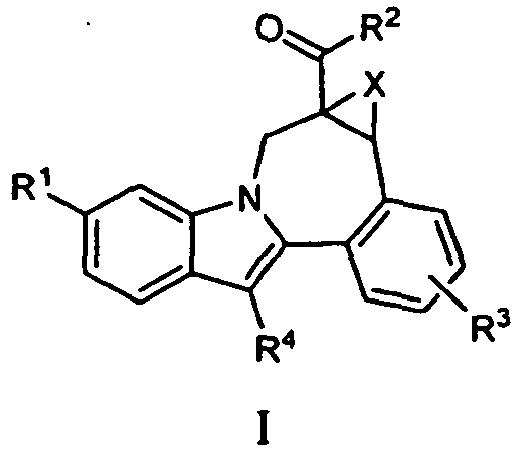
- R1 is CO2R5 or CONR6R7;
- R2 is
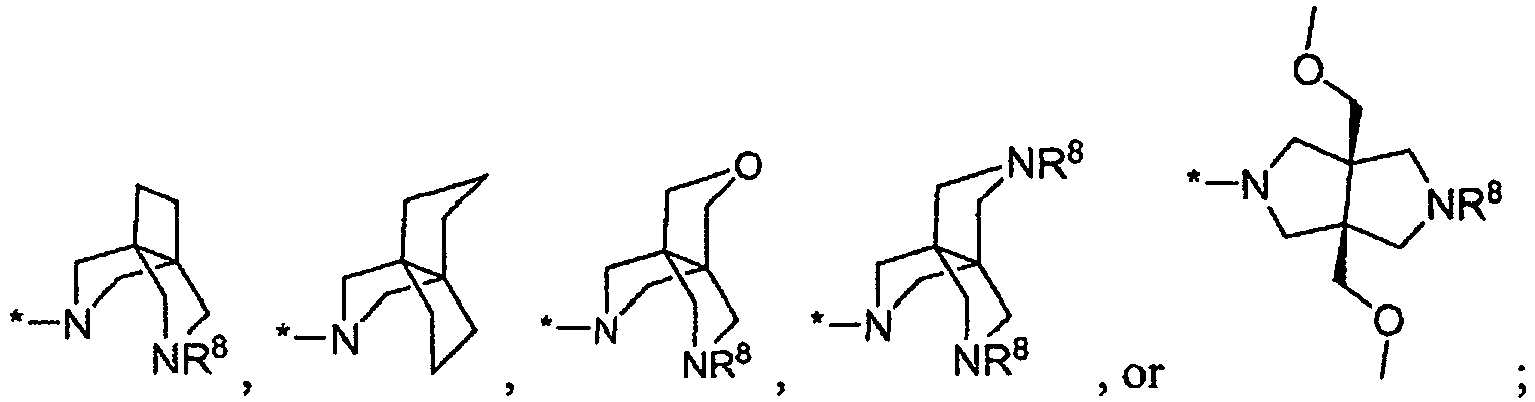
- R4 is cycloalkyl;
- R5 is hydrogen or alkyl;
- R6 is hydrogen, alkyl, alkylSO2, alkenylSO2, cycloalkylSO2, haloalkylSO2, (R9)2NSO2, or (R10)SO2;
- R7 is hydrogen or alkyl;
- R8 is hydrogen, alkyl, cycloalkyl, (cycloalkyl)alkyl, haloalkyl, alkoxyalkyl, alkylcarbonyl, cycloalkylcarbonyl, haloalkylcarbonyl, alkoxycarbonyl, alkylSO2, cycloalkylSO2, haloalkylSO2, aminocarbonyl, (alkylamino)carbonyl, (dialkylamino)carbonyl, R11CO, benzyl, benzyloxycarbonyl, or pyridinyl;
- R9 is hydrogen, alkyl, or cycloalkyl;
- R10 is azetidinyl, pyrrolidinyl, piperidinyl, piperazinyl, morpholinyl, thiomorpholinyl, homopiperidinyl, or homomorpholinyl and is substituted with 0-3 alkyl substituents; R11 is azetidinyl, pyrrolidinyl, piperidinyl, piperazinyl, morpholinyl, thiomorpholinyl, homopiperidinyl, or homomorpholinyl and is substituted with 0-3 alkyl substituents; and
- X is absent, a bond, or methylene;
- Another aspect of the invention is a compound of formula I where
R1 is CONR6R7;
R2 is
R4 is cycloalkyl;
R6 is alkylSO2, alkenylSO2, cycloalkylSO2, or (R9)2NSO2;
R7 is hydrogen;
R8 is hydrogen, alkyl, cycloalkyl, haloalkyl, alkoxyalkyl, alkylcarbonyl, alkoxycarbonyl, alkylSO2, aminocarbonyl, (alkylamino)carbonyl, (dialkylamino)carbonyl, or (R11)CO;
R9 is alkyl; and
X is absent, a bond, or methylene;
or a pharmaceutically acceptable salt thereof. - Another aspect of the invention is a compound of formula I where
R1 is CONR6R7;
R2 is
R4 is cyclohexyl;
R6 is isopropylSO2, isobutylSO2, isopropenylSO2, cyclopropylSO2, or (Me)2NSO2;
R7 is hydrogen; and
R8 is hydrogen, methyl, ethyl, cyclopropyl, trifluoroethyl, ethoxyethyl, acetyl, methoxycarbonyl, isopropylSO2, (methylamino)carbonyl, (dimethylamino)carbonyl, (diisopropylamino)carbonyl, (pyrrolidinyl)CO, and (morpholinyl)CO; and
X is absent, a bond, or methylene;
or a pharmaceutically acceptable salt thereof. - Another aspect of the invention is a compound of formula I where R1 is CONR6R7; R6 is alkylSO2, cycloalkylSO2, haloalkylSO2, (R9)2NSO2, or (R10)SO2; and R7 is hydrogen.
- Another aspect of the invention is a compound of formula I where R2 is

- Another aspect of the invention is a compound of formula I where R3 is hydrogen.
- Another aspect of the invention is a compound of formula I where R3 is methoxy.
- Another aspect of the invention is a compound of formula I where R4 is cyclohexyl.
- Another aspect of the invention is a compound of formula I where R6 is (R9)2NSO2 or (R10)SO2.
- Another aspect of the invention is a compound of formula I where R6 is (dimethylamino)SO2.
- Another aspect of the invention is a compound of formula I where R6 is alkylSO2.
- Another aspect of the invention is a compound of formula I where R6 is isopropylSO2.
- Another aspect of the invention is a compound of formula I where R8 is hydrogen, alkyl, cycloalkyl, (cycloalkyl)alkyl, haloalkyl, alkoxyalkyl, alkylcarbonyl, cycloalkylcarbonyl, haloalkylcarbonyl, alkoxycarbonyl, alkylSO2, cycloalkylSO2, haloalkylSO2, aminocarbonyl, (alkylamino)carbonyl, (dialkylamino)carbonyl, (R11)CO, benzyl, benzyloxycarbonyl, or pyridinyl.
- Another aspect of the invention is a compound of formula I where R8 is hydrogen, methyl, ethyl, cyclopropyl, trifluoroethyl, ethoxyethyl, acetyl, methoxycarbonyl, isopropylSO2, (methylamino)carbonyl, (dimethylamino)carbonyl, (diisopropylamino)carbonyl, (pyrrolidinyl)CO, or (morpholinyl)CO.
- Another aspect of the invention is a compound of formula I where X is methylene.

- Another aspect of the invention is a compound of formula I where X is a bond.

- Another aspect of the invention is a compound of formula I where X is absent.

- Another aspect of the invention is a compound of formula I according to the following stereochemistry.

- Another aspect of the invention is a compound of formula I according to the following stereochemistry.

- Another aspect of the invention is a compound of formula I according to the following stereochemistry.

- Another aspect of the invention is a compound of formula I according to the following stereochemistry.

- Unless specified otherwise, these terms have the following meanings. "Alkyl" means a straight or branched alkyl group composed of 1 to 6 carbons. "Alkenyl" means a straight or branched alkyl group composed of 2 to 6 carbons with at least one double bond. "Cycloalkyl" means a monocyclic ring system composed of 3 to 7 carbons. "Hydroxyalkyl," "alkoxy" and other terms with a substituted alkyl moiety include straight and branched isomers composed of 1 to 6 carbon atoms for the alkyl moiety. "Haloalkyl" and "haloalkoxy" include all halogenated isomers from monohalo substituted alkyl to perhalo substituted alkyl. "Aryl" includes carbocyclic and heterocyclic aromatic substituents. Parenthetic and multiparenthetic terms are intended to clarify bonding relationships to those skilled in the art. For example, a term such as ((R)alkyl) means an alkyl substituent further substituted with the substituent R.
- The invention includes all pharmaceutically acceptable salt forms of the compounds. Pharmaceutically acceptable salts are those in which the counter ions do not contribute significantly to the physiological activity or toxicity of the compounds and as such function as pharmacological equivalents. These salts can be made according to common organic techniques employing commercially available reagents. Some anionic salt forms include acetate, acistrate, besylate, bromide, camsylate, chloride, citrate, fumarate, glucouronate, hydrobromide, hydrochloride, hydroiodide, iodide, lactate, maleate, mesylate, nitrate, pamoate, phosphate, succinate, sulfate, tartrate, tosylate, and xinofoate. Some cationic salt forms include ammonium, aluminum, benzathine, bismuth, calcium, choline, diethylamine, diethanolamine, lithium, magnesium, meglumine, 4-phenylcyclohexylamine, piperazine, potassium, sodium, tromethamine, and zinc.
- Some of the compounds of the invention possess asymmetric carbon atoms (see, for example, the structures below). The invention includes all stereoisomeric forms, including enantiomers and diastereomers as well as mixtures of stereoisomers such as racemates. Some stereoisomers can be made using methods known in the art. Stereoisomeric mixtures of the compounds and related intermediates can be separated into individual isomers according to methods commonly known in the art. The use of wedges or hashes in the depictions of molecular structures in the following schemes and tables is intended only to indicate relative stereochemistry, and should not be interpreted as implying absolute stereochemical assignments.

- The invention is intended to include all isotopes of atoms occurring in the present compounds. Isotopes include those atoms having the same atomic number but different mass numbers. By way of general example and without limitation, isotopes of hydrogen include deuterium and tritium. Isotopes of carbon include 13C and 14C. Isotopically-labeled compounds of the invention can generally be prepared by conventional techniques known to those skilled in the art or by processes analogous to those described herein, using an appropriate isotopically-labeled reagent in place of the non-labeled reagent otherwise employed. Such compounds may have a variety of potential uses, for example as standards and reagents in determining biological activity. In the case of stable isotopes, such compounds may have the potential to favorably modify biological, pharmacological, or pharmacokinetic properties.
- The compounds may be made by methods known in the art including those described below. Some reagents and intermediates are known in the art. Other reagents and intermediates can be made by methods known in the art using commercially available materials. The variables (e.g. numbered "R" substituents) used to describe the synthesis of the compounds are intended only to illustrate how to make and are not to be confused with variables used in the claims or in other sections of the specification. Abbreviations used within the schemes generally follow conventions used in the art.
- Abbreviations used in the schemes generally follow conventions used in the art. Chemical abbreviations used in the specification and examples are defined as follows: "NaHMDS" for sodium bis(trimethylsilyl)amide; "DMF" for N,N-dimethylformamide; "MeOH" for methanol; "NBS" for N-bromosuccinimide; "Ar" for aryl; "TFA" for trifluoroacetic acid; "LAH" for lithium aluminum hydride; "BOC", "DMSO" for dimethylsulfoxide; "h" for hours; "rt" for room temperature or retention time (context will dictate); "min" for minutes; "EtOAc" for ethyl acetate; "THF" for tetrahydrofuran; "EDTA" for ethylenediaminetetraacetic acid; "Et2O" for diethyl ether; "DMAP" for 4-dimethylaminopyridine; "DCE" for 1,2-dichloroethane; "ACN" for acetonitrile; "DME" for 1,2-dimethoxyethane; "HOBt" for 1-hydroxybenzotriazole hydrate; "DIEA" for diisopropylethylamine, "Nf" for CF3(CF2)3SO2-; and "TMOF" for trimethylorthoformate.
- Methyl 2-bromo-3-cyclohexyl-1H-indole-6-carboxylate can be hydrolyzed to 2-bromo-3-cyclohexyl-1H-indole-6-carboxylic acid (See Scheme 1). This compound can be condensed with a variety of sulfonyl ureas, using for example, 1,1'-carbonyldiimidazole in combination with 1,8-diazabicyclo[5.4.0]undec-7-ene in anhydrous THF. The resultant acyl sulfamides can be subjected to known coupling reactions with a diversity of 2-formyl boronic acids or esters, using for example, Suzuki coupling conditions, to provide cyclic hemiaminal intermediates of the type depicted. These compounds can be converted to indolobenzazepines derivatives by treatment with methyl 2-(dimethoxyphosphoryl)acrylate under the influence of cesium carbonate in DMF via consecutive Michael and Homer Emmons reactions.
- Related fused cyclopropyl ester derivatives can be generated by methods known in the art, including treatment of the indolobenzazepine esters with trimethyl sulfoxonium iodide under strongly basic conditions in DMSO. The residual aliphatic ester moiety in the resultant fused cyclopropanes can be hydrolyzed and the product acids can be condensed with a variety of alkyl-bridged piperazines. For example, O-(1H-benzotriazol-1-yl)-N,N, N',N'-tetramethyluronium tetrafluoroborate and diisopropyl ethyl amine in DMSO can give alkyl bridged piperazine carboxamides.

- N-protected piperazines can also be coupled to the intermediate indolobenzazepine acids and the resultant piperazine carboxamides can be deprotected using methods known in the art and derivatized using a variety of synthetic protocols, some illustrative examples of which are shown below where W is a diamine (See Scheme 2).
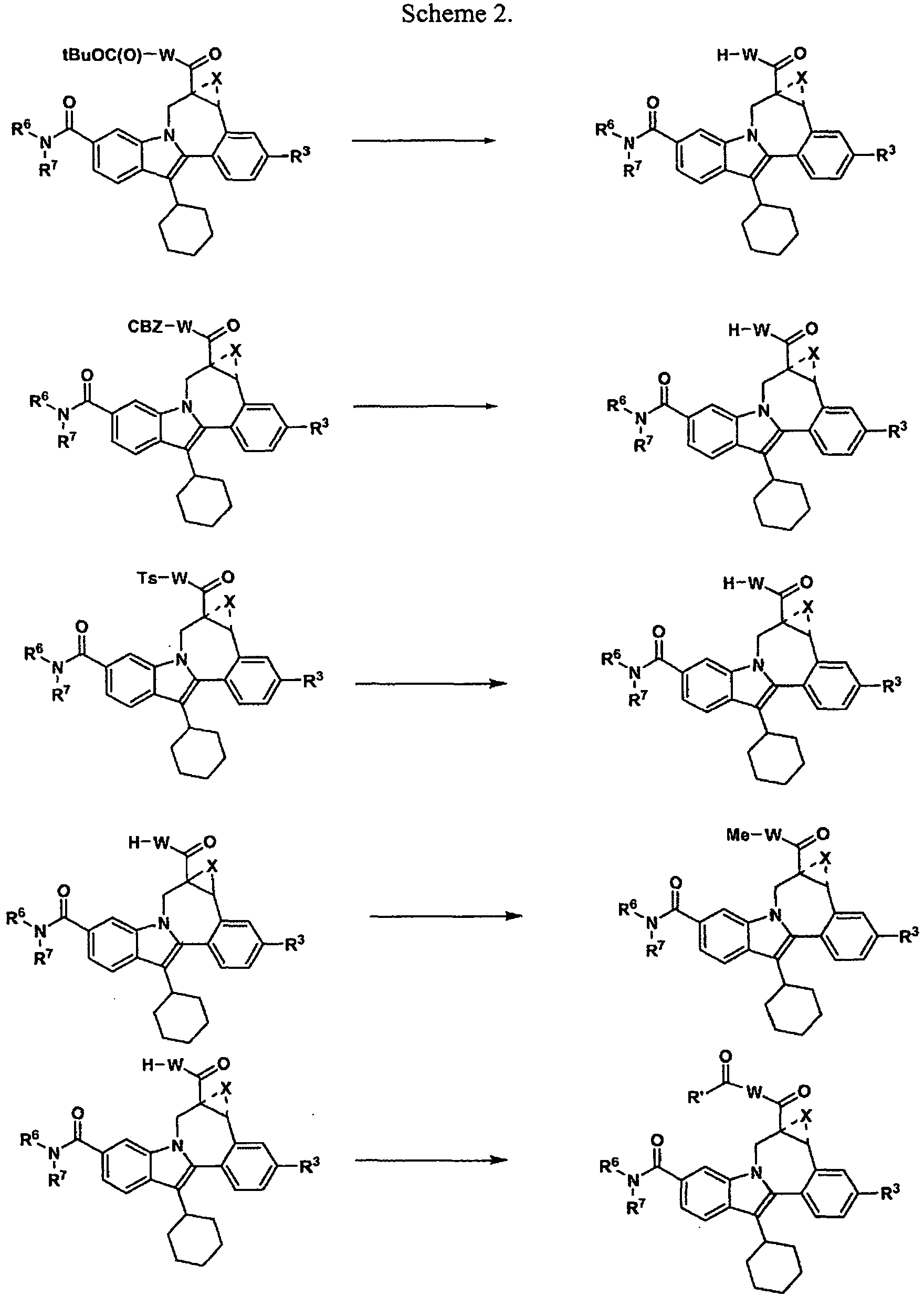
- An intermediate useful for the synthesis of some compounds of the invention involves the preparation of the tert-butyl ester indolobenzazepine shown in Scheme 3.

- This methodology involves base catalyzed hydrolysis of the indole methyl ester shown, followed by its reaction with either thionyl chloride and potassium tertiary butoxide, or alkylation with silver carbonate and tertiary butyl bromides. The resultant compound can be transformed using chemistry analogous to that outlined previously to provide the mixed ester indolobenzazepines shown above.
- These intermediates are useful in an alternative procedure that can be employed for the preparation of acylsulfamide and acylsulfonamide alkyl-bridged piperazines as shown in Scheme 4. Cleavage of the t-butyl ester group can generate the acid which can be coupled to a diversity of sulfonamides and sulfonylureas. Subsequent hydrolysis affords the related aliphatic acid, which can be coupled with a diversity of alkyl-bridged piperazines. For example, O-(1H-benzotriazol-1-yl)-N,N, N',N'-tetramethyluronium tetrafluoroborate and diisopropyl ethyl amine in DMSO can give the alkyl bridged piperazine carboxamides.

- These intermediates are also useful in an alternative procedure that can be employed for the preparation of acylsulfamide and acylsulfonamide alkyl-bridged piperazines in compounds containing a bridged cyclopropane, as shown in Scheme 4. Cyclopropanation of an intermediate t-butyl ester indolobenzazepine and subsequent cleavage of the t-butyl ester group can generate the acid which can be coupled to a diversity of sulfonamides and sulfonylureas. Subsequent hydrolysis affords the related aliphatic acid, which can be coupled with a diversity of alkyl-bridged piperazines. For example, O-(1H-benzotriazol-1-yl)-N,N, N',N'-tetramethyluronium tetrafluoroborate and diisopropyl ethyl amine in DMSO can give the alkyl bridged piperazine carboxamides.

- Some examples exist as stereoisomeric mixtures. The invention encompasses all stereoisomers of the compounds. Methods of fractionating stereoisomeric mixtures are well known in the art, and include but are not limited to; preparative chiral supercritical fluid chromatography (SFC) and chiral high performance liquid chromatography (HPLC). An example using this approach is shown in scheme 6.

- An additional method to achieve such separations involves the preparation of mixtures of diastereomers which can be separated using a variety of methods known in the art. One example of this approach is shown below (Scheme 7).

- Some diastereomeric amides can be separated using reverse phase HPLC. After hydroysis, the resultant optically active acids can be coupled with bridged piperazine derivatives (Scheme 8). For example, O-(1H-benzotriazol-1-yl)-N,N, N',N'-tetramethyluronium tetrafluoroborate and diisopropyl ethyl amine in DMSO can be used to give the alkyl bridged piperazine carboxamides. Other standard acid amine coupling methods can also be used to give optically active carboxamides.

- Schemes 9-11 illustrate other methods of making intermediates and compounds.


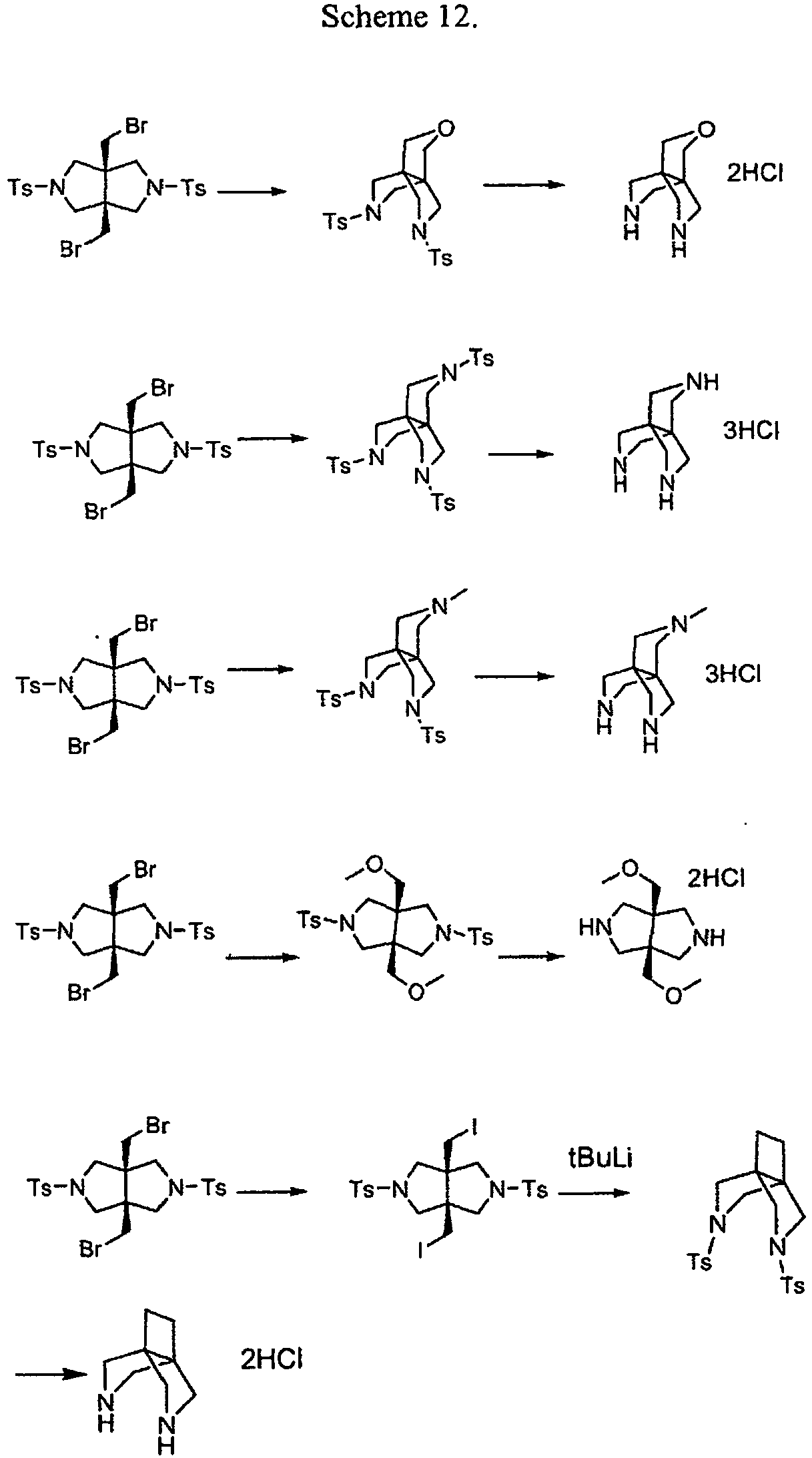
- The starting dibromide can be prepared using the method published in Tetrahedron Letters 1994, 35(48), 8965-8. Schemes 13 show the preparation of the novel substituents of the compounds of this invention and the specific details and conditions are contained in the experimental section.

- The compounds demonstrated activity against HCV NS5B as determined in the following HCV RdRp assays.
- HCV NS5B RdRp cloning, expression, and purification. The cDNA encoding the NS5B protein of HCV, genotype 1b, was cloned into the pET21a expression vector. The protein was expressed with an 18 amino acid C-terminal truncation to enhance the solubility. The E. coli competent cell line BL21(DE3) was used for expression of the protein. Cultures were grown at 37 °C for ∼ 4 hours until the cultures reached an optical density of 2.0 at 600 nm. The cultures were cooled to 20 °C and induced with 1 mM IPTG. Fresh ampicillin was added to a final concentration of 50 µg/ml and the cells were grown overnight at 20 °C.
- Cell pellets (3L) were lysed for purification to yield 15-24 mgs of purified NS5B. The lysis buffer consisted of 20 mM Tris-HCl, pH 7.4, 500 mM NaCl, 0.5% triton X-100, 1 mM DTT, 1mM EDTA, 20% glycerol, 0.5 mg/ml lysozyme, 10 mM MgCl2, 15 ug/ml deoxyribonuclease I, and Complete TM protease inhibitor tablets (Roche). After addition of the lysis buffer, frozen cell pellets were resuspended using a tissue homogenizer. To reduce the viscosity of the sample, aliquots of the lysate were sonicated on ice using a microtip attached to a Branson sonicator. The sonicated lysate was centrifuged at 100,000 x g for 1hr at 4 °C and filtered through a 0.2 µm filter unit (Corning).
- The protein was purified using three sequential chromatography steps: Heparin sepharose CL-6B, polyU sepharose 4B, and Hitrap SP sepharose (Pharmacia). The chromatography buffers were identical to the lysis buffer but contained no lysozyme, deoxyribonuclease I, MgCl2 or protease inhibitor and the NaCl concentration of the buffer was adjusted according to the requirements for charging the protein onto the column. Each column was eluted with a NaCl gradient which varied in length from 5-50 column volumes depending on the column type. After the final chromatography step, the resulting purity of the enzyme is >90% based on SDS-PAGE analysis. The enzyme was aliquoted and stored at -80 °C.
- Standard HCV NS5B RdRp enzyme assay. HCV RdRp genotype 1b assays were run in a final volume of 60 µl in 96 well plates (Costar 3912). The assay buffer is composed of 20 mM Hepes, pH 7.5, 2.5 mM KCl, 2.5 mM MgCl2, 1 mM DTT, 1.6 U RNAse inhibitor (Promega N2515), 0.1 mg/ml BSA (Promega R3961), and 2 % glycerol. All compounds were serially diluted (3-fold) in DMSO and diluted further in water such that the final concentration of DMSO in the assay was 2%. HCV RdRp genotype 1b enzyme was used at a final concentration of 28 nM. A polyA template was used at 6 nM, and a biotinylated oligo-dT12 primer was used at 180 nM final concentration. Template was obtained commercially (Amersham 27-4110). Biotinylated primer was prepared by Sigma Genosys. 3H-UTP was used at 0.6 µCi (0.29 µM total UTP). Reactions were initiated by the addition of enzyme, incubated at 30 °C for 60 min, and stopped by adding 25 µl of 50 mM EDTA containing SPA beads (4 µg/µl, Amersham RPNQ 0007). Plates were read on a Packard Top Count NXT after >lhr incubation at room temperature.
- Modified HCY NS5B RdRp enzyme assay. A modified enzyme assay was performed essentially as described for the standard enzyme assay except for the following: The biotinylated oligo dT12 primer was precaptured on streptavidin-coated SPA beads by mixing primer and beads in assay buffer and incubating at room temperature for one hour. Unbound primer was removed after centrifugation. The primer-bound beads were resuspended in 20 mM Hepes buffer, pH 7.5 and used in the assay at final concentrations of 20 nM primer and 0.67 µg/µl beads. Order of addition in the assay: enzyme (14 nM) was added to diluted compound followed by the addition of a mixture of template (0.2 nM), 3H-UTP (0.6 µCi, 0.29 µM), and primer-bound beads, to initiate the reaction; concentrations given are final. Reactions were allowed to proceed for 4 hours at 30° C.
- IC50 values for compounds were determined using seven different [I]. IC50 values were calculated from the inhibition using the formula y = A+((B-A)/(1+((C/x)^D))).
- FRET Assay Preparation. To perform the HCV FRET screening assay, 96-well cell culture plates were used. The FRET peptide (Anaspec, Inc.) (Taliani et al., Anal. Biochem. 1996, 240, 60-67) contains a fluorescence donor, EDANS, near one end of the peptide and an acceptor, DABCYL, near the other end. The fluorescence of the peptide is quenched by intermolecular resonance energy transfer (RET) between the donor and the acceptor, but as the NS3 protease cleaves the peptide the products are released from RET quenching and the fluorescence of the donor becomes apparent. The assay reagent was made as follows: 5X cell Luciferase cell culture lysis reagent from Promega (#E153A) diluted to 1X with dH2O, NaCl added to 150 mM final, the FRET peptide diluted to 20 µM final from a 2 mM stock.
- To prepare plates, HCV replicon cells, with or without a Renilla luciferase reporter gene, were trypsinized and placed into each well of a 96-well plate with titrated test compounds added in columns 3 through 12; columns 1 and 2 contained a control compound (HCV protease inhibitor), and the bottom row contained cells without compound. The plates were then placed in a CO2 incubator at 37 °C.
- Assays. Subsequent to addition of the test compounds described above (FRET Assay Preparation), at various times the plate was removed and Alamar blue solution (Trek Diagnostics, #00-100) was added per well as a measure of cellular toxicity. After reading in a Cytoflour 4000 instrument (PE Biosystems), plates were rinsed with PBS and then used for FRET assay by the addition of 30 ul of the FRET peptide assay reagent described above (FRET Assay Preparation) per well. The plate was then placed into the Cytoflour 4000 instrument which had been set to 340 excite/490 emission, automatic mode for 20 cycles and the plate read in a kinetic mode. Typically, the signal to noise using an endpoint analysis after the reads was at least three-fold. Alternatively, after Alamar blue reading, plates were rinsed with PBS, 50 ul of DMEM (high glucose) without phenol red was added and plates were then used for luciferase assay using the Promega Dual-Glo Luciferase Assay System.
- Compound analysis was determined by quantification of the relative HCV replicon inhibition and the relative cytotoxicity values. To calculate cytoxicity values, the average Alamar Blue fluorescence signals from the control wells were set as 100% non-toxic. The individual signals in each of the compound test wells were then divided by the average control signal and multiplied by 100% to determine percent cytotoxicity. To calculate the HCV replicon inhibition values, an average background value was obtained from the two wells containing the highest amount of HCV protease inhibitor at the end of the assay period. These numbers were similar to those obtained from naive Huh-7 cells.
- The background numbers were then subtracted from the average signal obtained from the control wells and this number was used as 100% activity. The individual signals in each of the compound test wells were then divided by the averaged control values after background subtraction and multiplied by 100% to determine percent activity. EC50 values for a protease inhibitor titration were calculated as the concentration which caused a 50% reduction in FRET or luciferase activity. The two numbers generated for the compound plate, percent cytoxicity and percent activity were used to determine compounds of interest for further analysis.
- The HCV replicon luciferase assay was developed to monitor the inhibitory effects of compounds described in the disclosure on HCV viral replication. Utilization of a replicon luciferase reporter assay was first described by Krieger et al
- (Krieger N, Lohmann V, and Bartenschlager R, J. Virol. 75(10):4614-4624 (2001)). HUH-7 cells, constitutively expressing the HCV replicon, were grown in Dulbecco's Modified Eagle Media (DMEM) (Gibco-BRL) containing 10% Fetal calf serum (FCS) (Sigma) and 1 mg/ml G418 (Gibco-BRL). Compounds were serially diluted 3 folds in DMSO for a twenty-point titration and subsequently transferred to sterile 384-well tissue-culture treated plates (Coming cat # 3571). The plates were then seeded with 50 µl of cells at a density of 3.0 x 10³ cells/well in DMEM containing 4 % FCS (final DMSO concentration at 0.5 %). After 3 days incubation at 37°C, cells were analyzed for Renilla Luciferase activity using the EnduRen as substrate (Promega cat #E6485). The EnduRen substrate was diluted in DMEM and then added to the plates to a final concentration of 7.5 µM. The plates were incubated for 2 hrs at 37°C and then read immediately for 30 seconds with Viewlux Imager (PerkinElmer) using a luminescence program. To assess cytotoxicity of compounds, CC50 values were generated by multiplexing the EnduRen-containing plates with Cell Titer-Blue (Promega, cat # G8082). 3 µl of Cell-Titer Blue was added to each well and incubated for 8 hrs at 37°C. The fluorescence signal from each well was read, with an excitation wavelength at 525/10 nm and an emission wavelength of 598/10 nm, using the Viewlux Imager.
- Representative data for compounds are reported in Tables 1 and 2.
Table 1. Structure NeoLuc EC50 (µM) LE NeoLuc EC50, (µM) IC50 (µM 
A A 
C I 
A I 
A I 
A I 
A A 
A A 
A A A 
A A 
A 
B H 
A A 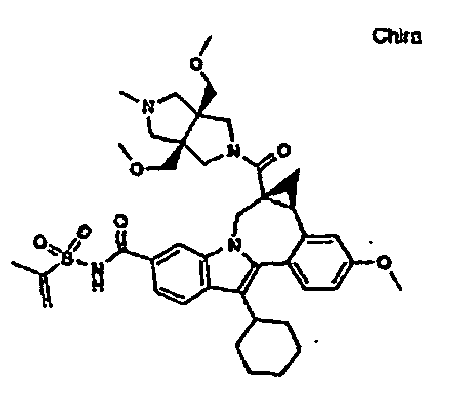
A H 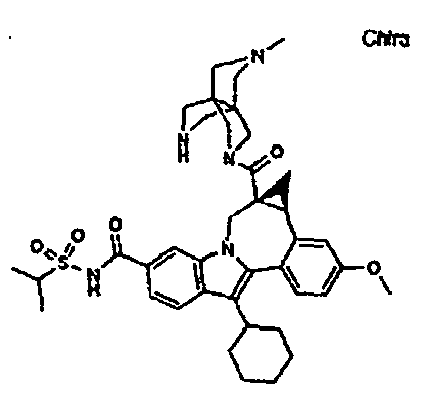
A B A 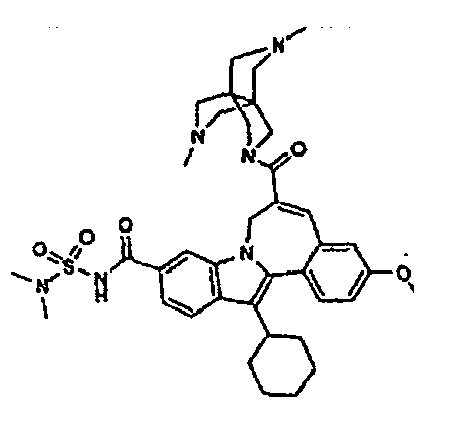
A A A 
A A A 
A A A 
A A A 
A A A 
A A A 
A A A 
A A A 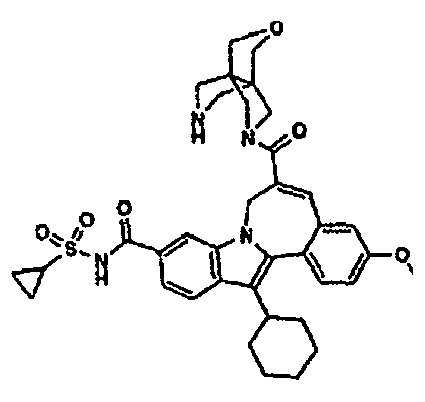
A A A 
A A A 
A A A 
A A A 
A A A 
C E A 
A A A 
A B A 
C B A 
A A A 
A A F 
A A 
A A 
A A A 
A A A 
A A 
A A A 
A A 
A 
C 
A A 
A A 
A* A 
A* A 
A* A 
A* A 
A* G 
A* A 
A* A 
A* A 

A* A 
A* A 
A* A 
A* A 
A* G 
A A 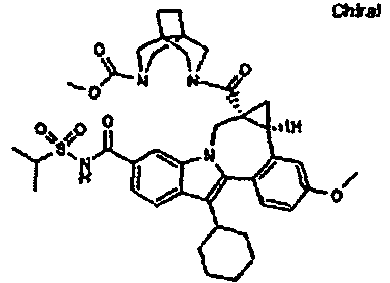
A A 
A A 
A G 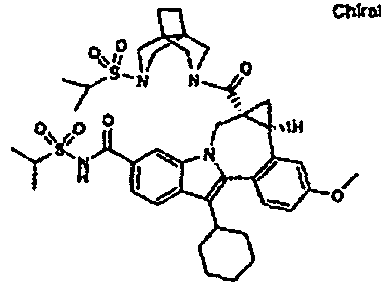
A A 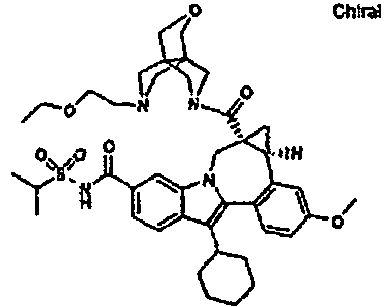
A A 
A* 
A A 
A A 
A* A 0.0019 to 0.5 µM; B >0.5 µM - 1.0 µM; C > 1.0 µM but an exact value was not determined; D 0.00341 or less to 0.5 µM; E >0.5 µM - 5 µM; ; F 0.0025 or less to 0.5 µM; but an exact value was not determined; G < 0.0017 µM but an exact value was not determined; H <0.02 µM but an exact value was not determined; I < 0.0023 µM but an exact value was not determined. * a gentoptype 1a rather than 1b replicon was used to get this data. Table 2. Structure NeoLuc EC50 (µM) LE NeoLuc EC50, (µM) IC50(µM) 
0.02 0.04 0.00879 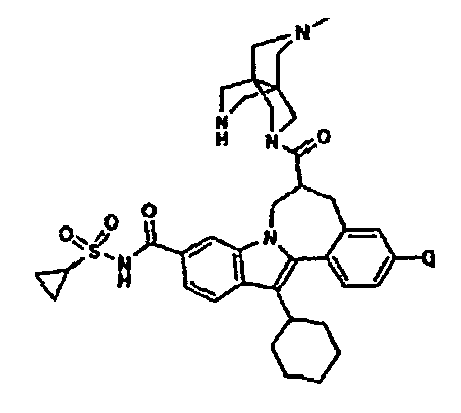
>1.0 2.10 0.0078 
0.00696 0.0035 
0.13 0.09 0.0031 
0.01 0.03 0.0024 
0.06 <0.0017 
0.00769 0.0019 - The compounds demonstrate activity against HCV NS5B and can be useful in treating HCV and HCV infection. Therefore, another aspect of the invention is a composition comprising a compound, or a pharmaceutically acceptable salt thereof, and a pharmaceutically acceptable carrier.
- Another aspect of the invention is a composition further comprising a compound having anti-HCV activity.
- Another aspect of the invention is a composition where the compound having anti-HCV activity is an interferon. Another aspect of the invention is where the interferon is selected from interferon alpha 2B, pegylated interferon alpha, consensus interferon, interferon alpha 2A, and lymphoblastoid interferon tau.
- Another aspect of the invention is a composition where the compound having anti-HCV activity is a cyclosporin. Another aspect of the invention is where the cyclosporin is cyclosporin A.
- Another aspect of the invention is a composition where the compound having anti-HCV activity is selected from the group consisting of interleukin 2, interleukin 6, interleukin 12, a compound that enhances the development of a type 1 helper T cell response, interfering RNA, anti-sense RNA, Imiqimod, ribavirin, an inosine 5'-monophospate dehydrogenase inhibitor, amantadine, and rimantadine.
- Another aspect of the invention is a composition where the compound having anti-HCV activity is effective to inhibit the function of a target selected from HCV metalloprotease, HCV serine protease, HCV polymerase, HCV helicase, HCV NS4B protein, HCV entry, HCV assembly, HCV egress, HCV NS5A protein, IMPDH, and a nucleoside analog for the treatment of an HCV infection.
- Another aspect of the invention is a composition comprising a compound, or a pharmaceutically acceptable salt thereof, a pharmaceutically acceptable carrier, an interferon and ribavirin.
- Another aspect of the invention is inhibiting the function of the HCV replicon by contacting the HCV replicon with a compound or a pharmaceutically acceptable salt thereof.
- Another aspect of the invention is inhibiting the function of the HCV NS5B protein by contacting the HCV NS5B protein with a compound or a pharmaceutically acceptable salt thereof.
- Another aspect of the invention is a compound or a pharmaceutically acceptable salt thereof for use in a method of treating an HCV infection in a patient comprising administering to the patient a therapeutically effective amount of the compound or a pharmaceutically acceptable salt thereof. In another embodiment the compound is effective to inhibit the function of the HCV replicon. In another embodiment the compound is effective to inhibit the function of the HCV NS5B protein.
- Another aspect of the invention is a compound, or a pharmaceutically acceptable salt thereof for use in a method of treating an HCV infection in a patient comprising administering to the patient a therapeutically effective amount of the compound, or a pharmaceutically acceptable salt thereof, in conjunction with (prior to, after, or concurrently) another compound having anti-HCV activity.
- According to another aspect of the invention, the other compound having anti-HCV activity is an interferon.
- According to another aspect of the invention, the interferon is selected from interferon alpha 2B, pegylated interferon alpha, consensus interferon, interferon alpha 2A, and lymphoblastoid interferon tau.
- According to another aspect of the invention, the other compound having anti-HCV activity is a cyclosporin.
- According to another aspect of the invention, the cyclosporin is cyclosporin A.
- According to another aspect of the invention, the other compound having anti-HCV activity is selected from interleukin 2, interleukin 6, interleukin 12, a compound that enhances the development of a type 1 helper T cell response, interfering RNA, anti-sense RNA, Imiqimod, ribavirin, an inosine 5'-monophospate dehydrogenase inhibitor, amantadine, and rimantadine.
- According to another aspect of the invention, the other compound having anti-HCV activity is effective to inhibit the function of a target selected from the group consisting of HCV metalloprotease, HCV serine protease, HCV polymerase, HCV helicase, HCV NS4B protein, HCV entry, HCV assembly, HCV egress, HCV NS5A protein, IMPDH, and a nucleoside analog for the treatment of an HCV infection.
- According to another aspect of the invention, the other compound having anti-HCV activity is effective to inhibit the function of target in the HCV life cycle other than the HCV NS5B protein.
- "Therapeutically effective" means the amount of agent required to provide a meaningful patient benefit as understood by practitioners in the field of hepatitis and HCV infection.
- "Patient" means a person infected with the HCV virus and suitable for therapy as understood by practitioners in the field of hepatitis and HCV infection.
- "Treatment," "therapy," "regimen," "HCV infection," and related terms are used as understood by practitioners in the field of hepatitis and HCV infection.
- The compounds of this invention are generally given as pharmaceutical compositions comprised of a therapeutically effective amount of a compound or its pharmaceutically acceptable salt and a pharmaceutically acceptable carrier and may contain conventional excipients. Pharmaceutically acceptable carriers are those conventionally known carriers having acceptable safety profiles. Compositions encompass all common solid and liquid forms including for example capsules, tablets, losenges, and powders as well as liquid suspensions, syrups, elixers, and solutions. Compositions are made using common formulation techniques, and conventional excipients (such as binding and wetting agents) and vehicles (such as water and alcohols) are generally used for compositions. See, for example, Remington's Pharmaceutical Sciences, Mack Publishing Company, Easton, PA, 17th edition, 1985.
- Solid compositions are normally formulated in dosage units and compositions providing from about 1 to 1000 mg of the active ingredient per dose are preferred. Some examples of dosages are 1 mg, 10 mg, 100 mg, 250 mg, 500 mg, and 1000 mg. Generally, other agents will be present in a unit range similar to agents of that class used clinically. Typically, this is 0.25-1000 mg/unit.
- Liquid compositions are usually in dosage unit ranges. Generally, the liquid composition will be in a unit dosage range of 1-100 mg/mL. Some examples of dosages are 1 mg/mL, 10 mg/mL, 25 mg/mL, 50 mg/mL, and 100 mg/mL. Generally, other agents will be present in a unit range similar to agents of that class used clinically. Typically, this is 1-100 mg/mL.
- The invention encompasses all conventional modes of administration; oral and parenteral methods are preferred. Generally, the dosing regimen will be similar to other agents used clinically. Typically, the daily dose will be 1-100 mg/kg body weight daily. Generally, more compound is required orally and less parenterally. The specific dosing regime, however, will be determined by a physician using sound medical judgement.
- The invention also encompasses embodiments where the compound is given in combination therapy. That is, the compound can be used in conjunction with, but separately from, other agents useful in treating hepatitis and HCV infection. In these combination therapies, the compound will generally be given in a daily dose of 1-100 mg/kg body weight daily in conjunction with other agents. The other agents generally will be given in the amounts used therapeutically. The specific dosing regime, however, will be determined by a physician using sound medical judgement.
- Some examples of compounds suitable for compositions and methods are listed in Table 3.
Table 3. Brand Name Type of Inhibitor or Target Source Company Omega IFN IFN-ω Intarcia Therapeutics BILN-2061 serine protease inhibitor Boehringer Ingelheim Pharma KG, Ingelheim, Germany Summetrel antiviral Endo Pharmaceuticals Holdings Inc., Chadds Ford, PA Roferon A IFN-α2a F. Hoffmann-La Roche LTD, Basel, Switzerland Pegasys PEGylated IFN-α2a F. Hoffmann-La Roche LTD, Basel, Switzerland Pegasys and Ribavirin PEGylated IFN-α2a/ribavirin F. Hoffmann-La Roche LTD, Basel, Switzerland CellCept HCV IgG immunosuppressant F. Hoffmann-La Roche LTD, Basel, Switzerland Wellferon lymphoblastoid IFN-αn1 GlaxoSmithKline plc, Uxbridge, UK Albuferon - α albumin IFN-α2b Human Genome Sciences Inc., Rockville, MD Levovirin ribavirin ICN Pharmaceuticals, Costa Mesa, CA IDN-6556 caspase inhibitor Idun Pharmaceuticals Inc., San Diego, CA IP-501 antifibrotic Indevus Pharmaceuticals Inc., Lexington, MA Actimmune INF-γ InterMune Inc., Brisbane, CA Infergen A IFN alfacon-1 InterMune Pharmaceuticals Inc., Brisbane, CA ISIS 14803 antisense ISIS Pharmaceuticals Inc, Carlsbad, CA/Elan Phamaceuticals Inc., New York, NY JTK-003 RdRp inhibitor Japan Tobacco Inc., Tokyo, Japan Pegasys and Ceplene PEGylated IFN-α2a/immune modulator Maxim Pharmaceuticals Inc., San Diego, CA Ceplene immune modulator Maxim Pharmaceuticals Inc., San Diego, CA Civacir HCV IgG immunosuppressant Nabi Biopharmaceuticals Inc., Boca Raton, FL Intron A and Zadaxin IFN-α2b/α1-thymosin RegeneRx Biopharmiceuticals Inc., Bethesda, MD/SciClone Pharmaceuticals Inc, San Mateo, CA Levovirin IMPDH inhibitor Ribapharm Inc., Costa Mesa, CA Viramidine Ribavirin Prodrug Ribapharm Inc., Costa Mesa, CA Heptazyme ribozyme Ribozyme Pharmaceuticals Inc., Boulder, CO Intron A IFN-α2b Schering-Plough Corporation, Kenilworth, NJ PEG-Intron PEGylated IFN-α2b Schering-Plough Corporation, Kenilworth, NJ Rebetron IFN-α2b/ribavirin Schering-Plough Corporation, Kenilworth, NJ Ribavirin ribavirin Schering-Plough Corporation, Kenilworth, NJ PEG-Intron / Ribavirin PEGylated IFN-α2b/ribavirin Schering-Plough Corporation, Kenilworth, NJ Zadazim Immune modulator SciClone Pharmaceuticals Inc., San Mateo, CA Rebif IFN-β1a Serono, Geneva, Switzerland IFN-β and EMZ701 IFN-β and EMZ701 Transition Therapeutics Inc., Ontario, Canada Batabulin (T67) β-tubulin inhibitor Tularik Inc., South San Francisco, CA Merimepodib (VX-497) IMPDH inhibitor Vertex Pharmaceuticals Inc., Cambridge, MA Telaprevir (VX-950, LY-570310) NS3 serine protease inhibitor Vertex Pharmaceuticals Inc., Cambridge, MA/ Eli Lilly and Co. Inc., Indianapolis, IN Omniferon natural IFN-α Viragen Inc., Plantation, FL XTL-6865 (XTL-002) monoclonal antibody XTL Biopharmaceuticals Ltd., Rehovot, Isreal HCV-796 NS5B Replicase Inhibitor Wyeth / Viropharma NM-283 NS5B Replicase Inhibitor Idenix / Novartis GL-59728 NS5B Replicase Inhibitor Gene Labs / Novartis GL-60667 NS5B Replicase Inhibitor Gene Labs / Novartis 2'C MeA NS5B Replicase Inhibitor Gilead PSI 6130 NS5B Replicase Inhibitor Roche R1626 NS5B Replicase Inhibitor Roche SCH 503034 serine protease inhibitor Schering Plough NIM811 Cyclophilin Inhibitor Novartis Suvus Methylene blue Bioenvision Multiferon Long lasting IFN Viragcn/Valentis Actilon (CPG10101) TLR9 agonist Coley Interferon-β Interferon-β-1a Serono Zadaxin Immunomodulator Sciclone Pyrazolopyrimidine compounds and salts From WO-2005047288 26 May 2005 HCV Inhibitors Arrow Therapeutics Ltd. 2'C Methyl adenosine NS5B Replicase Inhibitor Merck GS-9132 (ACH-806) HCV Inhibitor Achillion / Gilead - Unless otherwise specified, analytical LCMS data on the following intermediates and examples were acquired using the following columns and conditions. Stop time: Gradient time + 1 minute; Starting conc: 0% B unless otherwise noted; Eluent A: 5% CH3CN / 95% H2O with 10 mM NH4OAc (for columns A, D and E); 10 % MeOH / 90 % H2O with 0.1 % TFA (for columns B and C); Eluent B: 95% CH3CN / 5% H2O with 10 mM NH4OAc (for columns A, D and E); 90 % MeOH /10 % H2O with 0.1 % TFA (for columns B and C); Column A: Phenomenex 10µ 4.6 x 50 mm C 18; Column B: Phenomenex C 18 10µ 3.0 x 50 mm; Column C: Phenomenex 4.6 x 50 mm C18 10µ; Column D: Phenomenex Lina C18 5µ 3.0 x 50 mm; Column E: Phenomenex 5µ 4.6 x 50 mm C18.
-

- 1H-Indole-6-carboxylic acid, 2-bromo-3-cyclohexyl-, methyl ester. Freshly recrystallized pyridinium tribromide (recrystallization from hot AcOH (5 mL per 1 g), rinsed with cold AcOH and dried under high vacuum over KOH) was added in portions (over 10 min.) to a stirring solution of methyl 3-cyclohexyl-1H-indole-6-carboxylate (60 g, 233 mmol) (prepared using procedures describe in
WO2004/065367 ) in CHCl3/THF (1:1, 1.25 L) at 2o C. The reaction solution was stirred at 0-5 °C for 2.5h, and washed with sat. aq. NaHSO3 (1 L), 1 N HCl (1 L) and brine (1 L). The organic layer was dried (MgSO4) and concentrated. The resulting red oil was diluted with Et2O and concentrated. The resulting pink solid was dissolved into Et2O (200 mL) treated with hexanes (300 mL) and partially concentrated. The solids were collected by filtration and rinsed with hexanes. The mother liquor was concentrated to dryness and the procedure repeated. The solids were combined to yield 1H-indole-6-carboxylic acid, 2-bromo-3-cyclohexyl-, methyl ester (64 g, 190 mmol, 82%) as a fluffy pink solid, which was used without further purification. 1HNMR (300 MHz, CDCl3) δ 8.47 (br s, 1H), 8.03 (d, J = 1.4 Hz, 1H), 7.74 (dd, J = 1.4, 8.8 Hz, 1H), 7.69 (d, J = 8.8 Hz, 1H), 3.92 (s, 3H), 2.82 (tt, J = 3.7, 11.7 Hz, 1H), 1.98 - 1.72 (m, 7H), 1.50 - 1.27 (m, 3H). 13CNMR (75 MHz, CDC13) δ 168.2, 135.6, 130.2, 123.1, 120.8, 120.3, 118.7, 112.8, 110.7, 52.1, 37.0, 32.2(2), 27.0(2), 26.1. LCMS: m/e 334 (M-H)-, ret time 3.34 min, column A, 4 minute gradient. -

- 1H-Indole-6-carboxylic acid, 2-bromo-3-cyclohexyl-. A solution of methyl 2-bromo-3-cyclohexyl-1H-indole-6-carboxylate (20 g, 60 mmol) and LiOH (3.8 g, 160 mmol) in MeOH/THF/H2O (1:1:1, 300 mL) was heated at 90 °C for 2h. The reaction mixture was cooled in an ice/H2O bath, neutralized with 1M HCl (∼160 mL) diluted with H2O (250 mL) and stirred for 1h at rt. The precipitates were collected by filtration rinse with H2O and dried to yield 1H-indole-6-carboxylic acid, 2-bromo-3-cyclohexyl- (quant.) which was used without further purification.
- An alternative procedure that can by used to provide 1H-indole-6-carboxylic acid, 2-bromo-3-cyclohexyl- is described below:
- A solution of methyl 2-bromo-3-cyclohexyl-1H-indole-6-carboxylate (117 g, 349 mmol) and LiOH.H2O (26.4 g, 629 mmol) in MeOH/THF/H2O (1:1:1, 1.8 L) was heated at reflux for 3h. The reaction mixture was cooled in an ice/H2O bath to ∼2 °C, neutralized with 1M HCl (∼650 mL) (added at such a rate that temperature did not exceed 5 °C), diluted with H2O (1 L) and stirred while warming to ambient temperature. The precipitates were collected by filtration rinsed with H2O and dried to yield the mono THF solvate of 1H-indole-6-carboxylic acid, 2-bromo-3-cyclohexyl- (135.5 g, 345 mmol, 99%) as a yellow solid, which was used without further purification. 1HNMR (300 MHz, CDCl3) δ 11.01 (br s, 1H), 8.77 (s, 1H), 8.07 (d, J = 1.5 Hz, 1H), 7.82 (dd, J = 1.5, 8.8 Hz, 1H), 7.72 (d, J = 8.8 Hz, 1H), 3.84 - 3.74 (m, 4H), 2.89 (m, 1H), 1.98 - 1.72 (m, 11H), 1.50 - 1.24 (m, 3H). 13CNMR (75 MHz, CDCl3) δ 172.7, 135.5, 130.7, 122.3, 120.9(2), 118.8, 113.3, 111.1, 67.9(2), 37.0, 32.2(2), 27.0(2), 26.1, 25.5(2). LCMS: m/e 320 (M-H)-, ret time 2.21 min, column A, 4 minute gradient.
-

- 1H-Indole-6-carboxamide, 2-bromo-3-cyclohexyl-N [(dimethylamino)sulfonyl]-. 1,1'-Carbonyldiimidazole (1.17 g, 7.2 mmol) was added to a stirred solution of 2-bromo-3-cyclohexyl-1H-indole-6-carboxylic acid (2.03 g, 6.3 mmol) in THF (6 mL) at 22 °C. The evolution of CO2 was instantaneous and when it slowed the solution was heated at 50°C for 1 hr and then cooled to 22°C. N,N-Dimethylsulfamide (0.94 g, 7.56 mmol) was added followed by the dropwise addition of a solution of DBU (1.34 g ,8.8 mmol) in THF (4 mL). Stirring was continued for 24 hr. The mixture was partitioned between ethyl acetate and dilute HCl. The ethyl acetate layer was washed with water followed by brine and dried over Na2SO4. The extract was concentrated to dryness to leave the title product as a pale yellow friable foam, (2.0 g, 74 %, >90 % purity, estimated from NMR). 1H NMR (300 MHz, DMSO-D6) δ ppm 1.28 - 1.49 (m, 3 H) 1.59 - 2.04 (m, 7 H) 2.74 - 2.82 (m, 1 H) 2.88 (s, 6 H) 7.57 (dd, J=8.42, 1.46 Hz, 1 H) 7.74 (d, J=8.78 Hz, 1 H) 7.91 (s, 1 H) 11.71 (s, 1 H) 12.08 (s, I H).
- An alternative method for the preparation of 1H-indole-6-carboxamide, 2-bromo-3-cyclohexyl-N-[(dimethylamino)sulfonyl]- is described below.
- To a 1 L four necked round bottom flask equipped with a mechanical stirrer, a temperature controller, a N2 inlet, and a condenser, under N2, was added 2-bromo-3-cyclohexyl-1H-indole-6-carboxylic acid (102.0 g, 0.259 mol) and dry THF (300 mL). After stirring for 10 min, CDI (50.3 g, 0.31 mol) was added portion wise. The reaction mixture was then heated to 50 oC for 2 h. After cooling to 30 oC, N,N-dimethylaminosulfonamide (41.7 g, 0.336 mol) was added in one portion followed by addition of DBU (54.1 mL, 0.362 mol) drop wise over a period of 1 h. The reaction mixture was then stirred at rt for 20 h. The solvent was removed in vacuo and the residue was partitioned between EtOAc and 1 N HC1 (1 : 1, 2 L). The organic layer was separated and the aqueous layer was extracted with EtOAc (500 mL). The combined organic layers were washed with brine (1.5 L) and dried over MgSO4. The solution was filtered and concentrated in vacuo to give the crude product (111.0 g). The crude product was suspended in EtOAc (400 mL) at 60 oC. To the suspension was added heptane (2 L) slowly. The resulting suspension was stirred and cooled to 0 oC. It was then filtered. The filter cake was rinsed with small amount of heptane and house vacuum air dried for 2 days. The product was collected as a white solid (92.0 g, 83%). 1H NMR (MeOD, 300 MHz) δ 7.89 (s, H), 7.77 (d, J= 8.4 Hz, 1H), 7.55 (dd, J= 8.4 and 1.8 Hz, 1H), 3.01 (s, 6H), 2.73-2.95 (m, 1H), 1.81-2.05 (m, 8H), 1.39-1.50 (m, 2H); m/z 429 (M +H)+.
-

- 1H-Indole-6-carboxamide, 3-cyclohexyl-N-[(dimethylamino)sulfonyl]-2-(2-formyl-4-methoxyphenyl)-. A mixture of the 2-Bromo-3-cyclohexyl- N-[(dimethylamino)sulfonyl]-1H-indole-6-carboxamide (4.28g, 0.01 mol), 4-methoxy-2-formylphenyl boronic acid (2.7g, 0.015 mol), 2-dicyclohexylphosphino-2',6'-dimethoxy-biphenyl (41 mg, 0.0001 mol), palladium acetate (11.2 mg), and finely ground potassium carbonate (4.24g, 0.02 mol) in toluene (30 mL) was stirred under reflux and under nitrogen for 30 min, at which time LC/MS analysis showed the reaction to be complete. The reaction mixture was then diluted with ethyl acetate and water, and then acidified with an excess of dilute HCl. The ethyl acetate layer was then collected and washed with dilute HCl, water and brine. The organic solution was then dried (magnesium sulfate), filtered and concentrated to give a gum. The gum was diluted with hexanes (250 ml) and ethyl acetate (25 mL), and the mixture was stirred for 20 hr at 22° C during which time the product was transformed into a bright yellow granular solid (4.8 g) which was used directly without further purification.
- An alternative procedure for the preparation of 1H-indole-6-carboxamide, 3-cyclohexyl-N-[(dimethylamino)sulfonyl]-2-(2-formyl-4-methoxyphenyl)- is provided below:
- To a slurried solution of 2-bromo-3-cyclohexyl-N-[(dimethylamino)sulfonyl]-indole-6-carboxamide (54.0 g, 126 mmol), 4-methoxy-2-formylphenylboronic acid (29.5 g, 164 mmol) and LiCl (13.3 g, 315 mmol) in EtOH/toluene (1:1, 1L) was added a solution of Na2CO3 (40.1 g, 379 mmol) in water (380 mL). The reaction mixture was stirred 10 min. and then Pd(PPh3)4 (11.3 g, 10.0 mmol) was added. The reaction solution was flushed with nitrogen and heated at 70 °C (internal monitoring) overnight and then cooled to rt. The reaction was diluted with EtOAc (1 L) and EtOH (100 mL), washed carefully with 1N aqueous HCl (1 L) and brine (500 mL), dried (MgSO4), filtered and concentrated. The residual solids were stirred with Et2O (600 mL) for 1h and collected by filtration to yield 1H-indole-6-carboxamide, 3-cyclohexyl-N-[(dimethylamino)sulfonyl]-2-(2-formyl-4-methoxyphenyl)- (52.8g, 109 mmol, 87%) as a yellow powder which was used without further purification. 1HNMR (300 MHz, d6-DMSO) δ 11.66 (s, 1H), 8.17 (s, 1H), 7.75 (d, J = 8.4 Hz, 1H), 7.74 (d, J = 8.4 Hz, 1H), 7.59 (dd, J = 1.4, 8.4 Hz, 1H), 7.23 - 7.16 (m, 2H), 7.08 (dd, J = 2.6, 8.4 Hz, 1H), 6.54 (d, J = 8.8 Hz, 1H), 3.86 (s, 3H), 3 .22 - 3.08 (m, 1H), 2.91 (s, 6H), 2.00 - 1.74 (m, 7H), 1.60 - 1.38 (m, 3H). 13CNMR (75 MHz, CDCl3) δ 165.7, 158.8, 147.2, 139.1, 134.3, 132.0, 123.4, 122.0, 119.2, 118.2, 114.8, 112.3, 110.4, 109.8, 79.6, 45.9, 37.2(2), 34.7, 32.0(2), 25.9(2), 24.9. LCMS: m/e 482 (M-H)-, ret time 2.56 min, column A, 4 minute gradient.
-

- 6H-Isoindolo[2,1-a]indole-3-carboxamide, 11-cyclohexyl-N-[(dimethylamino)sulfonyl]-6-ethoxy-8-methoxy-. To a 5 L four necked round bottom flask equipped with a temperature controller, a condenser, a N2 inlet and a mechanical stirrer, was charged toluene (900 mL), EtOH (900 mL), 2-bromo-3-cyclohexyl-N-(N,N-dimethylsulfamoyl)-1H-indole-6-carboxamide (90 g, 0.21 mol), 2-formyl-4-methoxyphenylboronic acid (49.2 g, 0.273 mol) and LiCl (22.1 g, 0.525 mol). The resulting solution was bubbled with N2 for 15 mins. A solution of Na2CO3 (66.8 g, 0.63 mol) in H2O (675 mL) was added and the reaction mixture was bubbled with N2 for another (10 mins). Pd(PPh3)4 (7.0 g, 6.3 mmol) was added and the reaction mixture was heated to 70 °C for 20 h. After cooling to 35°C, a solution of 1 N HCl (1.5 L) was added slowly. The resulting mixture was transferred to a 6 L separatory funnel and extracted with EtOAc (2 X 1.5 L). The combined organic extracts were washed with brine (2 L), dried over MgSO4, filtered and concentrated in vacuo to give a yellow solid, which was triturated with 20% EtOAc in hexane (450 mL, 50°C to 0 °C) to give 3-cyclohexyl-N-(N,N-dimethylsulfamoyl)-2-(2-formyl-4-methoxyphenyl)-1H-indole-6-carboxamide(65.9 g) as a yellow solid. HPLC purity, 98%.
- The mother liquid from the trituration was concentrated in vacuo. The residue was refluxed with EtOH (50 mL) for 3 h. The solution was then cooled to 0 °C. The precipitates were filtered and washed with cooled TBME (5 °C) (20 mL). The filter cake was house vacuum air dried to give a further quantity of the title compound as a white solid (16.0 g). HPLC purity, 99%. 1H NMR (CDCl3, 300 MHz) δ 8.75 (s, 1H), 7.96 (s, 1H), 7.73 (d, J = 8.4 Hz, 1H), 7.67 (d, J = 8.4 Hz, 1H), 7.45 (dd, J = 8.4 and 1.4 Hz, 1H), 7.09 (d, J = 2.2 Hz, 1H), 6.98 (dd, J = 8.4 and 2.2 Hz, 1H), 6.50 (s, 1H), 3.86 (s, 3H), 3.05 (s, 6H), 2.92-3.13 (m, 3H), 1.85-1.93 (m, 7 H), 1.40-1.42 (m, 3H), 1.05 (t, J= 7.1 Hz, 3H). m/z 512 (M + H)+.
-

- 1H-indole-6-carboxamide, 3-cyclohexyl-N-[(dimethylamino)sulfonyl]-2-(2-formyl-4-methoxyphenyl)-. 11-cyclohexyl-N-(N,N-dimethylsulfamoyl)-6-ethoxy-8-methoxy-6H-isoindolo[2,1-a]indole-3-carboxamide was dissolved in THF (75 mL). To the solution was added a solution of 2 N HCl (300 mL). The mixture was vigorously stirred under N2 at rt for 16 h. The resulting suspension was filtered and washed with cooled TBME (2 X 30 mL). the filer cake was vacuum air dried overnight to give the title compound as a yellow solid. HPLC purity, 99% 1H NMR (DMSO-d6, 300 MHz) δ 11.65 (s, 1H), 8.16 (s, 1H), 7.76 (d, J= 5.9 Hz, 1H), 7.73 (d, J = 5.9 Hz, 1H), 7.58 (dd, J = 8.5 and 1.5 Hz, 1H), 7.17-7.20 (m, 2H), 7.08 (dd, J = 8.5 and 1.4 Hz, 1H), 6.55 (d, J = 8.6 Hz, 1H), 3.86 (s, 3H), 3.14-3.18 (m, 1H), 2.91 (s, 6H), 1.75-1.99 (m, 7H), 1.48-1.60 (m, 3H); m/z 484 (M + H)+.
-

- 7H-Indolo[2,1-a][2]benzazepine-6-carboxylic acid, 13-cyclohexyl-10-[[[(dimethylamino)sulfony]amino]carbonyl]-3-methoxy-, methyl ester. A mixture of the 3-cyclohexyl-N-(N,N-dimethylsulfamoyl)-2-(2-formyl-4-methoxyphenyl)-1H-indole-6-carboxamide (4.8g, 0.01 mol), methyl 2-(dimethoxyphosphoryl)acrylate (9.7 g, 0.02 mol) and cesium carbonate (7.1g, 0.02 mol) in DMF (28mL) was stirred for 20 hr at an oil bath temperature of 55 °C. The mixture was poured into ice-water and acidified with dilute HCl to precipitate the crude product. The solid was collected, dried and flash chromatographed on SiO2 (110g) using an ethyl acetate and methylene chloride (1:10) solution containing 2% acetic acid. Homogeneous fractions were combined and evaporated to afford the title compound as a pale yellow solid (3.9g, 71 % yield). MS: 552 (M=H+).
- An alternate procedure for the preparation of 7H-indolo[2,1-a][2]benzazepine-6-carboxylic acid, 13-cyclohexyl-10-[[[(dimethylamino)sulfonyl]amino]carbonyl]-3-methoxy-, methyl ester is provided below.
- A solution of 11-cyclohexyl-N-[(dimethylamino)sulfonyl]-6-hydroxy-8-methoxy-6H-isoindolo[2,1-a]indole-3-carboxamide (cyclic hemiaminal) (63.0 g, 130 mmol), methyl 2-(dimethoxyphosphoryl)acrylate (60 g, 261 mmol), cesium carbonate (106 g, 326 mmol) in DMF (400 mL) was heated at 60 °C (bath temp) for 4.5h. Additional methyl 2-(dimethoxyphosphoryl)acrylate (15 g, 65 mmol) and cesium carbonate (21.2 g, 65 mmol) were added and the reaction was heated at 60 °C overnight then and cooled to rt. The stirring reaction mixture was diluted with H2O (1 L), slowly neutralized with 1N aqueous HCl (800 mL), stirred 3h, and then the precipitates were collected by filtration. The solids were triturated with Et20 (800 mL) and dried to yield methyl 7H-indolo[2,1-a][2]benzazepine-6-carboxylic acid, 13-cyclohexyl-10-[[[(dimethylamino)sulfonyl]amino]carbonyl]-3-methoxy-, methyl ester (70.2 g, 127 minol, 98%) as a yellow solid which was used without further purification. 1HNMR (300 MHz, CDC13) δ 8.67 (s, 1H), 8.09 (s, 1H), 7.86 (d, J = 8.4 Hz, 1H), 7.80 (s, 1H), 7.50 (d, J = 8.4 Hz, 1H), 7.42 (d, J = 8.8 Hz, 1H), 7.08 (dd, J = 2.6, 8.8 Hz, 1H), 6.98 (d, J = 2.6 Hz, 1H), 5.75 - 5.51 (m, 1H), 4.29 - 4.01 (m, 1H), 3.89 (s, 3H), 3.82 (s, 3H), 3.05 (s, 6H), 2.87 - 2.73 (m, 1H), 2.11 - 1.12 (m, 10H). LCMS: m/e 550 (M-H)-, ret time 3.21 min, column A, 4 minute gradient.
-
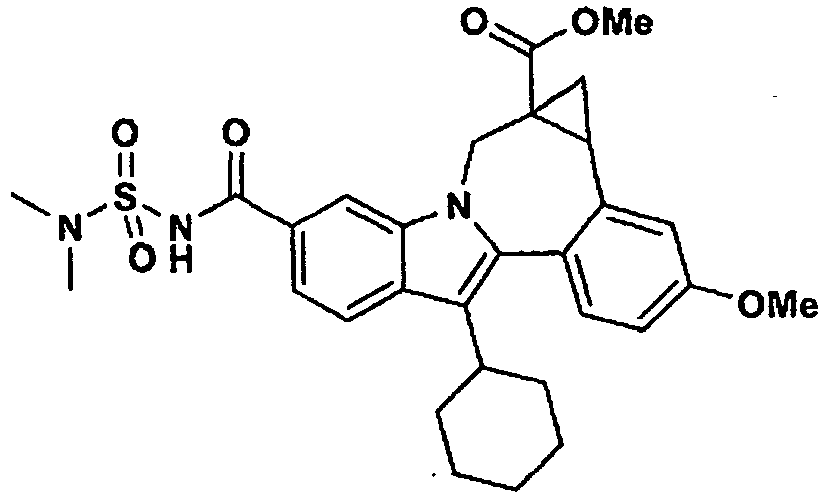
- Cycloprop[d]indolo[2,1-a][2]benzazepine-1a(2H)-carboxylic acid, 8-cyclohexyl-5-[[[(dimethylamino)sulfonyl]aminojcarbonyl]-1,12b-dihydro-11-methoxy-, methyl ester, (+/-)-. DMSO (5 mL) was added to a mixture of trimethylsulfoxonium iodide (199 mg, 0.906 mmol) and NaH (38 mg in 60% oil dispersion, 0.953 mmol) in a round-bottomed flask. The reaction mixture was stirred at rt for 0.5 hr. 7H-Indolo[2,1-a][2]benzazepine-6-carboxylic acid, 13-cyclohexyl-10-[[[(dimethylamino)sulfonyl]amino]carbonyl]-3-(methoxy)-, methyl ester (125 mg, 0.227 mmol) was then added and the reaction mixture was stirred at rt. for 3 hr., and then at 50°C for a further 3 hr. The reaction was then quenched with water and acidified with 1N HCl solution. The crude product then precipitated as a light yellow solid which was collected by filtration and air dried, (106 mg, 83% yield). 6 mg of this material was then purified by Prep. HPLC to afford the title compound as a light yellow solid (1.8 mg). MS m/z 566(MH+), Retention time: 3.850 min.1H NMR (500 MHz, MeOD) δ ppm 0.28 (m, 0.36 H) 1.19 - 2.20 (m, 11.64 H) 2.70 - 3.02 (m, 2 H) 3.03 (s, 2.16 H) 3.05 (s, 3.84 H) 3.49 (d, J=15.26 Hz, 0.64 H) 3.54 (s, 1.92 H) 3.83 (s, 1.08 H) 3.91 (s, 3 H) 4.08 (d, J=15.26 Hz, 0.36 H) 5.29 (d, J=15.26 Hz, 0.36 H) 5.50 (d, J=14.95 Hz, 0.64 H) 6.98 - 7.06 (m, 1 H) 7.16 (d, J=2.44 Hz, 0.36 H) 7.23 (d, J=2.44 Hz, 0.64 H) 7.30 (d, J=8.55 Hz, 0.64 H) 7.34 (d, J=8.55 Hz, 0.36 H) 7.56 (dd, J=8.55, 1.53 Hz, 0.64 H) 7.63 (dd, J=8.55, 1.53 Hz, 0.36 H) 7.88 (d, J=8.55 Hz, 0.64 H) 7.91 (d, J=8.55 Hz, 0.36 H) 8.12 (s, 0.36 H) 8.33 (d, J=1.53 Hz, 0.64 H).
- An alternative procedure for the preparation of the title compounds is provided below.
- To a flame dried, four necked, 1 L round bottom flask equipped with a mechanical stirrer, N2 inlet and a thermometer, under N2, was charged sodium hydride (95%) (3.09 g, 129.2 mmol) and dry DMF (200 mL). With vigorous stirring, trimethylsulfoxonium iodide (32.5 g, 147.3 mmol) portion wise during which time the temperature rose to 30 °C. After stirring for 30 mins, a solution of 7H-Indolo[2,1-a][2]benzazepine-6-carboxylic acid, 13-cyclohexyl-10-[[[(dimethylamino)sulfonyl]amino]carbonyl]-3-(methoxy)-, methyl ester (33.8 g, 61.3 mmol) in dry DMF (70 mL) was added quickly. The reaction mixture was stirred below 30 °C for 30 mins and then poured into an ice cold solution of 1 N HCl (130 mL) in H2O (2 L) portion wise. After the resulting suspension was mechanically stirred for 1 h, the precipitates were filtered and the filter cake was washed with H2O (100 mL). The filter cake was partitioned between EtOAc and 0.5 N HCl (1:1, 4 L). The organic phase was separated, washed with H2O (1 L) and brine (1L), dried over MgSO4, filtered and concentrated in vacuo. The residue was dissolved in EtOAc (150 mL), and the solution was filtered through a silica gel pad (300 g in hexane) and rinsed with 50% EtOAc in hexane (5 L). The filtrate was concentrated in vacuo to give a slightly yellow solid which was triturated with 10% EtOAc in TBME (220 mL) from 50 °C to 0 °C to to give cycloprop[d]indolo[2,1-a][2]benzazepine-1a(2H)-carboxylic acid, 8-cyclohexyl-5-[[[(dimethylamino)sulfonyl]amino]carbonyl]-1,12b-dihydro-11-methoxy-, methyl ester, (+/-)- as a white solid (26.1 g, 75% yield). HPLC purity, 100%. 1H NMR (DMSO-d6, 300 MHz) δ 11.61 (s, 1H), 8.47 (s, 0.5H), 8.25 (s, 0.5H), 7.81-7.88 (m, 1H), 7.57-7.63 (m, 1H), 7.23-7.29 (m, 2H), 7.01-7.07 (m, 1H), 5.43 (d, J = 15.0 Hz, 0.5H), 5.22 (d, J = 15 Hz, 0.5H), 4.04 (dd, J = 15.4 and 6.6 Hz, 0.5H), 3.83 (s, 3H), 3.75 (s, 1H), 3.08-3.47 (m, 0.5H), 3.29 (s, 3H), 2.73-2.92 (m, 8H), 1.11-1.99 (m, 10.5H), 0.20 (m, 0.5H); m/z 566 (M + H)+.
-

- Cycloprop[d]indolo[2,1-a][2]benzazepine-1a(2H)-carboxylic acid, 8-cyclohexyl-5-[[[(dimethylamino)sulfonyl]amino)carbonyl]-1, 12b-dihydro-11-methoxy-, methyl ester, (-)-. A sample of (+/-) cycloprop[d]indolo[2,1-a][2]benzazepine-1a(2H)-carboxylic acid, 8-cyclohexyl-5-[[[(dimethylamino)sulfonyl]amino]carbonyl]-1,12b-dihydro-11-methoxy- methyl ester was dissolved in EtOH/CH3CN 1/1 + 0.5% DEA at a concentration of 50 mg/ml. [The addition of DEA ensures the compound remains in solution during the injection process]. This solution was then injected onto a Thar SFC-350 preparative SFC under the conditions shown below.
- Preparative conditions on Thar SFC-350: Column: Chiralcel OJ-H 5x25 cm; mobile phase: 25% MeOH/ CH3CN (1/1) in CO2; pressure (bar): 100; flow rate (ml/min): 240; solution concentration (mg/ml): 50; injection amount (ml): 4.5-5; Cycle time (min/inj): 6.5-7; Temperature (°C): 45; throughput (g/hr): ∼2; Detector wavelength (nm): 254.
- From 371.4 g of racemic starting material, a total of 177.3g of the desired second eluting (-) isomer was obtained, containing ∼1 Meq of diethylamine. This material was purified using the following procedure. The mixture (24.7 g) dissolved in dichloromethane (800 mL)) was washed sequentially with; 0.5 N HCl (1 x 400 mL, 1 x 240 mL), H2O (2 x 240 mL), and brine (2 x 240 mL). The organic layer was then dried (Anhy. Na2SO4), filtered and evaporated to give 22.33 g of (cycloprop[d]indolo[2,1-a][2]benzazepine-1a(2H)-carboxylic acid, 8-cyclohexyl-5-[[[(dimethylamino)sulfonyl]amino]carbonyl]-1,12b-dihydro-11-methoxy-, methyl ester, (-)- as a yellow solid (92% recovery). HPLC1 > 99% (Rt 2.38 min); LC/MS (ES+) 566.51 (M+H, 100); [α]D 25C- 194.64 ° (c 1.03, MeOH). Anal. Calcd for C30H35N3O6S●0.33H2O: C, 63.04; H, 6.29; N, 7.35; S, 5.61; H2O, 1.04. Found: C, 63.07; H, 6.01; N, 7.24; S, 5.58; H2O, 1.03. The NMR shows the absence of Et2NH. The EE of this material was determined to be > 99% using the following analytical HPLC procedure.
- Analytical conditions of ee determination on Thar analytical SFC. Analytical Column: Chiralcel OJ (.46x25cm, 10µl); BPR pressure: 100 bars; Temperature: 35 °C; Flow rate: 3.0 ml/min; Mobile Phase: 15% MeOH/ CH3CN (1/1) in CO2; Detector Wavelength: 254 nm; Retention time (min): 4, 6.5.
-

- Cycloprop(d]indolo(2,1-a][2]benzazepine-1a(2H)-carboxylic acid, 8-cyclohexyl-5-[[[(dimethydamino)sulfonyl]amino]carbonyd]-1,12b-dihydro-11-methoxy-, (-)-. To a solution of (-) cycloprop[d]indolo[2,1-a][2]benzazepine-1a(2H)-carboxylic acid, 8-cyclohexyl-5-[[[(dimethylamino)sulfonyl]amino]carbonyl]-1,12b-dihydro-11-methoxy-, methyl ester (22.33 g, 39.5 mmol) in MeOH (300 mL) was added 1 N NaOH (120 mL) slowly over 20 min., while maintaining the reaction temperature < 30 °C. The mixture was stirred at rt under N2 for 18 h. The HPLC indicated the reaction was complete. To the reaction solution was added 1 N HCl (130 mL). After addition was complete, the pH of the reaction mixture was about 2. The methanol in the reaction mixture was evaporated. Water (300 mL) was added to the mixture which was then extracted with CH2Cl2 (1 x 600 mL, 1 x 200 mL). The combined extracts were washed with H2O (2 x 300 mL), brine (2 x 300 mL), dried (Na2SO4) and evaporated to give 20.82 g (96% yield) of the title compound as a yellow solid. HPLC conditions column: Phenomenoex Synergi Polar-RP 4 um 4.6 x 50 mm; UV: 220 nm; gradient time: 4 min; flow rate: 4 mL/min, 75 - 100% B; solvent A: 10% MeOH/90% H2O with 0.2% H3PO4, solvent B: 90% MeOH/10% H2O with 0.2% H3PO4. HPLC > 99% (Rt 1.80 min.) LC/MS (ES+) 552.25 (M+H, 100); [α]D 25C - 166.99 °(c 1.00, MeOH). GC analysis: CH2Cl2 4.94%; Anal. Calcd for C29H33N3O6S●0.16 H2O●0.35 CH2Cl2: C, 60.37; H, 5.87; N, 7.20; S, 5.49; H2O, 0.49; CH2Cl2, 5.02. Found: C, 59.95; H, 5.89; N, 7.03; S, 5.38; H2O, 0.47; CH2Cl2, 4.94.
-

- Cycloprop[d]indolo(2,1-a][2]enzazepine-1a(2H)-carboxylic acid, 8-cyclohexyl-5-[[[(dimethylamino)sulfonyl]amino]carbonyl]-1,12b-dihydro-11-methoxy-, (+/-)-. To a solution of (+/-) cycloprop[d]indolo[2,1-a][2]benzazepine-1a(2H)-carboxylic acid, 8-cyclohexyl-5-[[[(dimethylamino)sulfonyl]amino]carbonyl]-1,12b-dihydro-11-methoxy-, methyl ester (100 mg, 0.177 mmol) in THF/Methanol mixture (2.0 mL/2.0 mL), 2N NaOH solution (1.0 mL) was added. The reaction mixture was heated at 90°C under microwave conditions for 5 min. It was then concentrated, acidified with 1N HCl solution and extracted with ethyl acetate (2X20 mL). The organic layers were combined, dried (MgSO4), filtered and concentrated. The residue was purified by preparative HPLC to afford the desired product as a light yellow solid, (59 mg, 60% yield). MS m/z 552(MH+), Retention time: 3.850 min.1H NMR (300 MHz, MeOD) δ ppm 0.25 (m, 0.38 H) 1.14 - 2.22 (m, 11.62 H) 2.69 - 2.98 (m, 2 H) 3.02 (s, 2.28 H) 3.02 (s, 3.72 H) 3.41 (d, J=15.00 Hz, 0.62 H) 3.88 (s, 3 H) 4.01 (d, J=15.00 Hz, 0.38 H) 5.26 (d, J=15.00 Hz, 0.38 H) 5.45 (d, J=14.64 Hz, 0.62 H) 6.94 - 7.02 (m, 1 H) 7.13 (d, J=2.56 Hz, 0.38 H) 7.21 (d, J=2.20 Hz, 0.62 H) 7.26 (d, J=8.42 Hz, 0.62 H) 7.30 (d, J=8.78 Hz, 0.38 H) 7.53 (dd, J=8.42, 1.46 Hz, 0.62H) 7.61 (dd, J=8.60, 1.65 Hz, 0.38 H) 7.85 (d, J=8.42 Hz, 0.62 H) 7.89 (d, J=8.42 Hz, 0.38 H) 8.10 (s, 0.38 H) 8.28 (d, J=1.46 Hz, 0.62 H).
-

- Cycloprop[d]indolo(2,1-a][2]benzazepine-1a,5(2H)-dicarboxamide, 8-cyclohexyl-N5-[(dimethylamino)sulfonyl]-1,12b-dihydro-N1a-[(2R,3S)-3-hydroxy-4,7,7-trimethylbicyclo[2.2.1]hept-2-yl]-11-methoxy-, (1aR)-(partial]-. TBTU (437 mg, 1.36 mmol) and DIPEA (0.95 mL, 5.436 mmol) were added to a solution of (+/-) cycloprop[d]indolo[2,1-a][2]benzazepine-1a(2H)-carboxylic acid, 8-cyclohexyl-5-[[[(dimethylamino)sulfonyl]amino]carbonyl]-1,12b-dihydro-11-methoxy- (500 mg, 0.906 mmol) in DMSO (20.0 mL). The reaction mixture was stirred at rt for 15 min. (2S,3R)-3-Amino-1,7,7-trimethylbicyclo[2.2.1]heptan-2-ol (280 mg, 1.36mmol) was then added and the reaction mixture was stirred at rt overnight. The reaction mixture was quenched with water and acidified with 1N HCl solution. A brown solid separated which was collected by filtration. This material was then fractionated by Preparative HPLC under the following conditions. Column: Waters Sunfire 19mm x 100mm; Solvent A: 10% CH3CN-90% H2O-0.1% TFA; Solvent B: 90% CH3CN-10% H2O-0.1 % TFA; Program: Start with 65% solvent B, initial hold time for 5 min, then gradually increase to 90% solvent B in 30 min with flow rate 25 mL/min. Load: 50-60 mg/run.
- Cycloprop[d]indolo[2,1-a][2]benzazepine-1a,5(2H)-dicarboxamide, 8-cyclohexyl-N5-[(dimethylamino)sulfonyl]-1,12b-dihydro-N1a-[(2R,3S)-3-hydroxy-4,7,7-trimethylbicyclo[2.2.1]hept-2-yl]-11-methoxy-, (1aR)- [partial]- elutes before Cycloprop[d]indolo[2,1-a][2]benzazepine-1a,5(2H)-dicarboxamide, 8-cyclohexyl-N5-[(dimethylamino)sulfonyl]-1,12b-dihydro-N1a-[(2R,3S)-3-hydroxy-4,7,7-trimethylbicyclo[2.2.1]hept-2-yl]-11-methoxy-, (1aS)- [partial]- under the HPLC conditions described above. Product obtained as a light yellow solid, 230 mg, 36% yield). MS m/ 703(MH+), Retention time: 3.936 min. 1H NMR (500 MHz, MeOD) δ ppm 0.14 - 0.24 (m, 2.64 H) 0.51 (s, 2.46 H) 0.72 - 2.21 (m, 20.9 H) 2.49 (m, 0.18 H) 2.62 (m, 0.82 H) 2.85 (m, 0.18 H) 2.96 (m, 0.82 H) 3.03 (s, 6 H) 3.39 (m, 0.82 H) 3.49-3.58(m, 1.64 H) 3.71 - 3.80 (m, 0.36 H) 3.90 (s, 3 H) 4.17 (d, J=14.65 Hz, 0.18 H) 5.06 (d, J=14.65 Hz, 0.18 H) 5.37 (d, J=14.95 Hz, 0.82 H) 6.73 (d, J=5.49 Hz, 0.82 H) 6.98 - 7.05 (m, I H) 7.08 (d, J=4.58 Hz, 0.18 H) 7.10 (d, J=2.44 Hz, 0.18 H) 7.21 (d, J=2.44 Hz, 0.82 H) 7.31 (d, iJ=8.55 Hz, 0.82 H) 7.34 (d, J=8.55 Hz, 0.18 H) 7.59 - 7.64 (m, 1 H) 7.87 - 7.93 (m, 1 H) 7.99 (s, 0.18 H) 8.09 (d, J=1.22 Hz, 0.82 H).
-

- Cycloprop[d]indolo[2,1-a][2]benzazepine-1a,5(2H)-dicarboxamide, 8-cyclohexyl-N5-[(dimethylamino)sulfonyl]-1,12b-dihydro-N1a-[(2R,3S)-3-hydroxy-4,7,7-trimethylbicyclo(2.2.1]hept-2-yl]-11-methoxy-, (1aS)- [partial]-. TBTU(437 mg, 1.36 mmol) and DIPEA (0.95 mL, 5.436 mmol) were added to a solution of (+/-) cycloprop[d]indolo[2,1-a][2]benzazepine-1a(2H)-carboxylic acid, 8-cyclohexyl-5-[[[(dimethylamino)sulfonyl]amino]carbonyl]-1,12b-dihydro-11-methoxy- (500 mg, 0.906 mmol) in DMSO (20.0 mL). The reaction mixture was stirred at rt for 15 min. Then (25,3R)-3-amino-1,7,7-trimethylbicyclo[2.2.1]heptan-2-ol (280 mg, 1.36mmol) was added, and the reaction mixture was stirred at rt overnight. The reaction mixture was quenched with water and then acidified with 1N HCl solution. A brown colored solid separated that was collected by filtration. This material was then fractionated by preparative HPLC under the following conditions. Column: Waters Sunfire 19mm x 100mm; Solvent A: 10% CH3CN-90% H2O-0.1% TFA; Solvent B: 90% CH3CN-10% H2O-0.1% TFA; Program: Start with 65% solvent B, initial hold time for 5 min, then gradually increase to 90% solvent B in 30 min with flow rate 25 mL/min. Load: 50-60 mg/run.
- Cycloprop[d]indolo[2,1-a][2]benzazepine-1a,5(2H)-dicarboxamide, 8-cyclohexyl-N5-[(dimethylamino)sulfonyl]-1,12b-dihydro-N1a-[(2R,3S)-3-hydroxy-4,7,7-trimethylbicyclo[2.2.1]hept-2-yl]-11-methoxy-, (laS)- [partial]- elutes after cycloprop[d]indolo[2,1-a][2]benzazepine-1a,5(2H)-dicarboxamide, 8-cyclohexyl-N5-[(dimethylamino)sulfonyl)-1,12b-dihydro-Na1a-[(2R,3S)-3-hydroxy-4,7,7-trimethylbicyclo[2.2.1]hept-2-yl]-11-methoxy-, (laR)- [partial]- under the HPLC conditions described above. Product obtained as a light yellow solid, 215 mg, 34% yield). MS m/ 703(MH+), Retention time: 4.038 min. 1H NMR (500 MHz, MeOD) δ ppm 0.20 (m, 0.38 H) 0.75 (s, 1.86 H) 0.76 (s, 1.86 H) 0.84 (s, 1.86 H) 0.85 (s, 1.14 H) 0.89 - 2.18 (m, 18.9 H) 2.52 (m, 0.38 H) 2.70 (m, 0.62 H) 2.85 (m, 0.38 H) 2.97 (m, 0.62 H) 3.03 (s, 2.28 H) 3.04 (s, 3.72 H) 3.33 - 3.39 (m, 0.62 H) 3.43 - 3.51 (m, 1.24 H) 3.73 - 3.77 (m, 0.38 H) 3.78 - 3.84 (m, 0.38 H) 3.90 (s, 1.86 H) 3.90 (s, 1.14 H) 4.14 (d, J=14.65 Hz, 0.38 H) 5.11 (d, J=14.65 Hz, 0.38 H) 5.44 (d, J=15.26 Hz, 0.62 H) 6.68 (d, J=4.88 Hz, 0.62 H) 6.96 - 7.03 (m, 1 H) 7.07 (d, J=5.19 Hz, 0.38 H) 7.12 (d, J=2.44 Hz, 0.38 H) 7.23 (d, J=2.14 Hz, 0.62 H) 7.27 (d, J=8.54 Hz, 0.62 H) 7.33 (d, J=8.54 Hz, 0.38 H) 7.55 (dd, J=8.39, 1.68 Hz, 0.62 H) 7.62 (dd, J=8.55, 1.53 Hz, 0.38 H) 7.87 (d, J=8.54 Hz, 0.62 H) 7.91 (d, J=8.55 Hz, 0.38 H) 8.08 (d, J=1.22 Hz, 0.38 H) 8.10 (d, J=1.22 Hz, 0.62 H).
-

- Cycloprop[d]indolo[2,1-a][2]benzazepine-1a(2H)-carboxylic acid, 8-cyclohexyl-5-[[[(dimethylamino)sulfonyl]amino]carbonyl]-1,12b-dihydro-11-methoxy-, (-)-. 10 N NaOH (2.0 mL, 20 mmol) solution and 4 mL of water were added to a solution of cycloprop[d]indolo[2,1-a][2]benzazepine-1a,5(2H)-dicarboxamide, 8-cyclohexyl-N5-[(dimethylamino)sulfonyl]-1,12b-dihydro-N1a-[(2R,3S)-3-hydroxy-4,7,7-trimethylbicyclo[2.2.1]hept-2-yl]-11-methoxy-, (laR)-[partial]- (160 mg, 0.228 mmol) in THF/MeOH (7 mL/7 mL). The reaction mixture was heated at 120°C under microwave conditions for 1 hr. It was then concentrated, acidified with conc. HCl solution and extracted with ethyl acetate twice (2X 30 mL). The organic layers were combined, dried (MgSO4), filtered and concentrated in vacuo to an orange oil. The crude product was then purified by Prep. HPLC column to afford the product a light yellow solid, (80 mg, 64% yield). Average specific rotation -130.85°; Solvent MeOH; Wavelength 589 nm; 50 cm cell. MS m/552(MH+), Retention time: 3.760 min. 1H NMR (500 MHz, MeOD) δ ppm 0.27 (m, 0.38 H) 1.14 - 2.22 (m, 11.62 H) 2.76 (m, 0.38 H) 2.80 - 2.92 (m, 1 H) 2.92 - 3.09 (m, 6.62 H) 3.45 (d, J=14.95 Hz, 0.62 H) 3.90 (s, 1.86 H) 3.91 (s, 1.14 H) 4.04 (d, J=15.26 Hz, 0.38 H) 5.28 (d, J=15.26 Hz, 0.38 H) 5.47 (d, J=15.26 Hz, 0.62 H) 6.95 - 7.05 (m, 1 H) 7.15 (d, J=2.75 Hz, 0.38 H) 7.23 (d, J=1.83 Hz, 0.62 H) 7.28 (d, J=8.55 Hz, 0.62 H) 7.33 (d, J=8.54 Hz, 0.38 H) 7.54 (dd, J=8.39, 1.68 Hz, 0.62 H) 7.63 (dd, J=8.55, 1.53 Hz, 0.38 H) 7.86 (d, J=8.55 Hz, 0.62 H) 7.91 (d, J=8.55 Hz, 0.38 H) 8.11 (d, J=1.22 Hz, 0.62 H) 8.29 (d, J=1.22 Hz, 0.38 H).
-

- Cycloprop[d]indolo[2,1-a][2]benzazepine-1a(2H)-carboxylic acid, 8-cyclohexyl-5-[[[(dimethylamino)sulfonyl]amino]carbonyl]-1,12b-dihydro-11-methoxy-, (+)-. 10 N NaOH (1.8 mL, 18 mmol) solution and 4 mL of water were added to a solution of cycloprop[d]indolo[2,1-a][2]benzazepine-1a,5(2H)-dicarboxamide, 8-cyclohexyl-N5-[(dimethylamino)sulfonyl]-1,12b-dihydro-N1a-[(2R,3S)-3-hydroxy-4,7,7-trimethylbicyclo[2.2.1]hept-2-yl]-11-methoxy-, (laS)-[partial]- (130 mg, 0.185 mmol) in bTHF/MeOH (7 mL/7 mL). The reaction mixture was heated at 120°C under microwave conditions for 1 hr. It was concentrated, acidified with conc. HCl solution and extracted with ethyl acetate twice (2X 30 mL). The organic layers were combined, dried (MgSO4), filtered and concentrated in vacuo to give an orange oil. The crude product was then purified by Prep. HPLC column to afford the product as a light yellow solid, (68 mg, 67% yield). Average specific rotation + 174.73°; Solvent MeOH; Wavelength 589 nm; 50 cm cell MS m/552(MH+), Retention time: 3.773 min. 1H NMR (500 MHz, MeOD) δ ppm 0.27 (m, 0.38 H) 1.14 - 2.22 (m, 11.62 H) 2.76 (m, 0.38 H) 2.80 - 2.92 (m, 1 H) 2.92 - 3.09 (m, 6.62 H) 3.45 (d, J=14.95 Hz, 0.62 H) 3.90 (s, 1.86 H) 3.91 (s, 1.14 H) 4.04 (d, J=15.26 Hz, 0.38 H) 5.28 (d, J=15.26 Hz, 0.38 H) 5.47 (d, J=15.26 Hz, 0.62 H) 6.95 - 7.05 (m, 1 H) 7.15 (d, J=2.75 Hz, 0.38 H) 7.23 (d, J=1.83 Hz, 0.62 H) 7.28 (d, J=8.55 Hz, 0.62 H) 7.33 (d, J=8.54 Hz, 0.38 H) 7.54 (dd, J=8.39, 1.68 Hz, 0.62 H) 7.63 (dd, J=8.55, 1.53 Hz, 0.38 H) 7.86 (d, J=8.55 Hz, 0.62 H) 7.91 (d, J=8.55 Hz, 0.38 H) 8.11 (d, J=1.22 Hz, 0.62 H) 8.29 (d, J=1.22 Hz, 0.38 H).
-

- To a mechanically stirred solution of 2-bromo-3-cyclohexyl-1H-indole-6-carboxylic acid (80 g, 0.24 m) in dry methylene dichloride(1.2 L) and THF (100 mL) were added activated molecular sieves (4A, 80 g) and silver carbonate (275 g, 0.99 m). The reaction mixture was cooled to 0°C and t-Butyl bromide (142 g, 1.04 m) was added drop wise. The mixture was stirred overnight at rt and monitored by TLC (Hexane-Ethyl acetate 80:20, Rf (Product) = 0.7). If any bromo acid was left unconverted a further 10% of silver carbonate was added and stirring was continued for an addition 2 - 4 h. On completion, the reaction mixture was filtered through a thin bed of celite. The filtrand was washed with methylene dichloride (500 mL). The combined filtrates were concentrated in-vacuo, and the crude product thus obtained was purified by silica gel chromatography: (230 - 400 mesh, eluted with a gradient of ethyl acetate in pet ether 0 - 2%). Homogeneous fractions were combined and evaporated under reduced pressure to give 80 g (85%) of the title compound. HPLC : 90.1% (RT = 6.56 min), Column : C18 BDS, (50X4.6mm), Mobile Phase: Gradient of 0.1% TFA in water: ACN (30 → 100 → 30), Flow rate 0.8 mL / min. LCMS : 99.8% (RT = 4.44 min), Column : Geneis, C18 50X4.6 mm Mobile Phase : Gradient of 0.1% Formic acid in water : ACN (70 → 95 → 70), Flow rate : 0.8 mL / min; M - 1 = 376.5; 1H NMR CDCl3) (400 MHz) δ 1.37 -1.40 (m, 3H, cyc.Hexyl), 1.62 (s, 9H, t-Bu), 1.80 -1.94 (two sets of m, 3H, & 4H respectively, cyc.Hexyl part), 2.81 (m, 1H, CH of cyc.Hexyl - benzylic), 7.70 - 7.75 (m, 2H, Indole-H4&5), 8.04 (s, 1H, Indole-H7), 8.52 (s, 1H, Indole-NH).
-

- 1H-Indole-6-carboxylic acid, 3-cyclohexyl-2-(2 formyl-4-methoxyphenyl)-, 1,1-dimethylethyl ester. tert-Butyl 2-bromo-3-cyclohexyl-1H-indole-6-carboxylate (72 g, 0.19 m) was dissolved in a 1:1 mixture of toluene and ethanol (720 mL) and degasified. LiCl (23.9 g, 0.51 m) was then added, followed by sodium carbonate (720 mL, 1.0 M solution degasified separately,) and Pd-tetrakis (13.1 g, 0.011 m). After stirring for 0.25 h, 2-formyl-4-methoxyphenylboronic acid (41.1 g, 0.22 m) was added and the reaction mixture was heated to 85°C for 4 h. The reaction was then monitored by TLC, (Hexane-Ethyl acetate 80:20, Rf (Product) = 0.55). On completion, the reaction mixture was cooled to rt and water (1.0 L) was added followed by ethyl acetate (1.0 L). The organic layer was washed with brine, and dried and concentrated under vacuum to afford the title compound as a yellow solid. Yield 75 g (74%). HPLC : 99.7% (RT = 6.30 min), Column : C18 BDS (4.6 X 50 mm), SC-307, Mobile Phase : Gradient of 0.1% TFA in water: ACN (30 → 100 → 30), Flow rate 0.8 mL / min. LCMS : 98.0% (RT = 5.28 min), Column : Geneis, C18 (50X4.6 mm), Mobile Phase : Gradient of 0.1% Formic acid in water : ACN (70 → 95 → 70), Flow rate : 0.8 mL / min; M - 1 = 432.2; 1H NMR (DMSO -d6) (400 MHz) δ 1.40 - 1.48 (m, 3H, cyc.Hexyl), 1.57 (s, 9H, t-Bu), 1.84-1.90 (m, 7H, cyc.Hexyl part), 3.09 (m, 1H, CH of cyc.Hexyl - benzylic), 3.84 (s, 3H, OCH3), 6.55 (d, J = 4 Hz, 1H, aryl H2,), 7.06 (d, 1H, aryl H3'),7.08 (s, 1H, aryl H6'), 7.23 (d, 1H, Indole-H5), 7.53 (d, J = 8 Hz, 1H, Indole-H4), 7.70 - 7.75 (m, 2H, NH + Indole-H7), 8.06 (s, 1H, CHO).
-

- 7H-Indolo[2,1-a][2]benzazepine-6,10-dicarboxylic acid, 13-cyclohexyl-, 10-(1,1-dimethylethyl) 6-methyl ester. tert-Butyl 3-cyclohexyl-2-(2-formyl-4-methoxyphenyl)-1H-indole-6-carboxylate (62.5 g, 0.144 m) was dissolved in dry DMF (1.2 L) and stirred mechanically. Cesium carbonate (84 g, 0.17 m) and methyl 2-(dimethoxyphosphoryl)acrylate (65 - 70% GC pure, 56.2 g, 0.18 m) were then added and the reaction mixture was heated to 65°C for 4h, and the reaction was monitored by TLC (Hexane-Ethyl acetate 80:20, Rf (Product) = 0.7). On completion, the mixture was cooled to rt, then quenched with water (1.0 L). A yellow solid precipitated, which was collected by filtration and air dried This material was then slurried in methanol, filtered, and dried under vacuum to give the product as a yellow powder, (70 g, 90%). HPLC : 99.1% (RT = 6.45 min), Column: C18 BDS (4.6 X 50 mm), Mobile Phase : Gradient of 0.1% TFA in water: ACN (30 → 100 → 30), Flow rate 0.8 mL / min. LCMS : 100% (RT = 7.00 min), Column : Geneis, C18 (50X4.6 mm), Mobile Phase : Gradient of 0.1% Formic acid in water : ACN (70 → 95 → 70), Flow rate : 0.8 mL / min; M + 1 = 502.2; 1H NMR (CDCl3) (400 MHz) δ 1.10 -1.30 (m, 3H, cyc.Hexyl), 1.64 (s, 9H, t-Bu), 1.77 - 2.07 (m, 7H, cyc.Hexyl part), 2.80 (m, 1H, CH of cyc.Hexyl - benzylic), 3.84 (s, 3H, OCH3), 3.93 (s, 3H, COOCH3), 4.15 & 5.65 (two br. peak., 1H each, allylic CH2), 6.95 (s, 1H, aryl H6'), 7.01 (d, 1H, aryl H2'), 7.53 (d, J = 8 Hz, 1H, aryl H3'), 7.70 (d, J = 4 Hz, 1H, Indole-H5), 7.84 (s + d, 2H, olefinic H + Indole-H4), 8.24 (s, 1H, indole - H7); 13C NMR (CDCl3) (100.0 MHz) δ 166.92, 165.71, 158.96, 142.28, 136.47, 13.50, 134.61, 132.43, 132.01, 129.73, 124.78, 124.68, 120.33, 119.39, 119.04, 115.62, 115.05, 111.27, 80.27, 55.49, 52.50, 39.09, 36.81, 33.40, 28.38, 27.15, 26.28.
-

- 2-Propenoic acid, 2-(dimethoxyphosphinyl)-, methyl ester. To a 5 L four necked round bottom flask equipped with a mechanical stirrer, a condenser, a temperature controller and a N2 inlet, was charged paraformaldehyde (40.5 g, 1.35 mol), MeOH (2 L) and piperidine (2 mL). The reaction mixture was heated to reflux under N2 for 3 h. After cooling to 50 °C, 2-(dimethoxyphosphoryl)acetate (150 g, 0.824 mol) was added in one portion. The reaction mixture was continued to reflux for 18 h. After cooling to rt, the reaction solution was concentrated in vacuo to give a clear colorless oil. The above oil was dissolved in dry toluene (1 L) in a 3 L four necked round bottom flask equipped a temperature controller, a N2 inlet, a magnetic stirrer and a Dean-Stark apparatus. To the solution was added TsOH.H2O (5.2 g). The reaction mixture was then refluxed azeotropically to remove methanol for 18 h. After cooling to rt, the solution was concentrated in vacuo to give a yellow oil which was vacuum distilled at 150 - 155 °C /0.2 mmHg to afford the product as a colorless oil (135.0 g). Purity, 90% based on 1H NMR. 1H NMR (CDCl3, 300 MHz) δ 7.0 (dd, J= 42.4 and 1.5 Hz, 1H), 6.73 (dd, J= 20.5 and 1.8 Hz, 1H), 3.80 (s, 6H), 3.76 (s, 3H).
-

- Cycloprop[d]indolo[2,1-a][2]benzazepine-1a,5(2H)-dicarboxylic acid, 8-cyclohexyl-1,12b-dihydro-11-methoxy-, 5-(1,1-dimethylethyl) 1a-methyl ester, (+/-). Sodium hydride (96 mg, 4 mmol) was added to a stirred suspension of trimethylsulfoxonium chloride (567 mg, 4.4 mmol) in anhydrous DMSO (10 mL) under nitrogen. The resultant mixture was stirred at rt for 30-45 min and then neat 7H-indolo[2,1-a][2]benzazepine-6,10-dicarboxylic acid, 13-cyclohexyl-3-methoxy-, 10-(1,1-dimethylethyl) 6-methyl ester (1.0, 2 mmol) was added in small portions. The suspension was diluted with DMSO (5 mL) and heated at 50 °C for 3-4 h. The reaction mixture was allowed to cool to rt and water was added. A solid separated, which was collected by filtration and washed with water and then air dried overnight to afford 1.15 g of crude product. This material was purified by flash column chromatography (silica gel, 3% MeOH in DCM) to provide pure title compound (0.96 g): LC/MS: Retention time 3.816 min; m/e 516 (MH+). 1H NMR (400 MHz, CDCl3): The product was observed to exist as inter-converting rotamers, as evidenced from the compound's NMR spectrum.
- The following procedure is an example of a method to effect the resolution of racemic cycloprop[d]indolo[2,1-a][2]benzazepine-1a,5(2H)-dicarboxylic acid, 8-cyclohexyl-1,12b-dihydro-11-methoxy-, 5-(1,1-dimethylethyl) 1a-methyl ester, (+/-). A sample of cycloprop[d]indolo[2,1-a][2]benzaepine-1a,5(2H)-dicarboxylic acid, 8-cyclohexyl-1,12b-dihydro-11-methoxy-, 5-(1,1-dimethylethyl) 1a-methyl ester, (+/-)-was dissolved in a mixture of isopropanol and acetonitrile (8:2) to give a final concentration of 20mg/mL. This mixture was injected on a preparative chiral SFC chromatography system using the following conditions: Chiralcel OJ-H column, 4.6 x 250mm, 5µm; Mobile Phase: 8% MeOH in CO2; Temp: 35 °C; Flow rate: 2 mL/min for 16 min; UV monitored @ 260nm; Injection: 5µL of∼20.0mg/mL in IPA:ACN (8:2).
-

- Cycloprop[d]indolo[2,1-a][2]benzazepine-1a,5(2H)-dicarboxylic acid, 8-cyclohexyl-1,12b-dihydro-11-methoxy-, 1a-methyl ester, (+/-)-. TFA (5 mL) was added to a solution of (+/-) 8-Cyclohexyl-1,1a,2,12b-tetrahydro-11-methoxy-1a-(methoxycarbonyl)-cycloprop[d]indolo[2,1-a](2]benzazepine-5-carboxylic acid, tert-butyl ester (515 mg, 1 mmol) in anhydrous DCM (10 mL). The resultant solution was stirred at rt for approximately 8 to 12 hr. The reaction was then evaporated to dryness to afford the title compound (0.47g, 100%). LC/MS: Retention time 2.245 min; m/e 460 (MH+). 1H NMR (400 MHz, CDCl3): From the compounds NMR spectrum, the product was observed to exist as a mixture of interconverting rotamers.
-

- Cycloprop[d]indolo[2,1-a][2]benzazepine-1a(2H)-carboxylic acid, 8-cyclohexyl-1,12b-dihydro-11-methoxy-5-[[[(methylamino)sulfonyl]amino]carbonyl]-, Methyl ester. A solution of 8-Cyclohexyl-1,1a,2,12b-tetrahydro-11-methoxy-1a-(methoxycarbonyl)-cycloprop[d]indolo[2,1-a][2]benzazepine-5-carboxylic acid (140 mg, 0.31 mmol) and CDI (64 mg, 0.40 mmol) in THF (3 mL) was stirred for 1 hr at 60 °C. N-methylsulfamide (68 mg, 0.62 mmol) and DBU (71.6 mg, 0.47 mmol) were added and the mixture was stirred at 60 °C overnight. The reaction was then poured into cold water, acidified with dilute hydrochloric acid and extracted into ethyl acetate. The extracts were washed sequentially with dilute hydrochloric acid (0.1 N), and brine, and then dried (anhy. sodium sulfate), filtered and evaporated to provide the title compound as a brown solid. ESI-MS m/e 552 (MH+). This material was used without further purification.
-

- Cycloprop[d]indolo[2,1-a][2]benzazepine-1a(2H)-carboxylic acid, 8-cyclohexyl-1,12b-dihydro-11-methoxy-5-[[[(methylamino)sulfonyl]amino]carbonyl]-. Cyloprop[d]indolo[2,1-a][2]benzazepine-1a(2H)-carboxylic acid, 8-cyclohexyl-5-[[[(methylamino)sulfonyl]amino]carbonyl]-1,12b-dihydro-11-methoxy-, methyl ester was dissolved in THF, MeOH mixture (2 mL,2 mL). 2.5 M NaOH (aq.) (1.2 mL, 3 mmol) was then added and the reaction was shaken at 22 °C for 2 hr. The solution was then neutralized with 1M HCl (aq.) (3 mL) and concentrated to remove the organic solvents. The residue was slurried with H2O and the solids were collected by filtration, washed with H2O and dried to yield compound the title compound (160 mg, 0.30 mmol). ESI-MS m/e 538 (MH+). This material was used without further purification.
-

- Cycloprop[d]indolo[2,1-a][2]benzazepine-1a(2H)-carboxylic acid, 8-cyclohexyl-5-[[[(benzylamino)sulfonyl]amino]carbonyl]-1,12b-dihydro-11-(methoxy)-12-(methoxy)-, methyl ester, (+/-)-. A solution of (+/-) 8-cyclohexyl-1,1a,2,2b-tetrahydro-11-methoxy-1a-(methoxycarbonyl)-cycloprop[d]indolo[2,1-a][2]benzazepine-5-carboxylic acid (200 mg, 0.44 mmol) and CDI (92 mg, 0.57 mmol) in THF (5 mL) was stirred for 1 hr at 60 °C. N-benzylsulfamide (164 mg, 0.88 mmol) and DBU (100 mg, 0.66 mmol) were then added and the resultant mixture was stirred at 60 °C overnight. The reaction was then poured into cold water, acidified with dilute hydrochloric acid and extracted into ethyl acetate. The organic phase was washed hydrochloric acid (0.1 N), brine and dried (sodium sulfate) and evaporated in vacuo to provide the title compound as a brown solid. ESI-MS m/e 628 (MH+).
-

- Cycloprop[d]indolo[2,1-a][2]benzazepine-1a(2H)-carboxylic acid, 8-cyclohexyl-1,12b-dihydro-11-methoxy-5-[[[[(phenylmethyl)amino]sulfonyl]amino]carbonyl]-, (+/-)-. The title compound was prepared using a similar procedure to that described for cycloprop[d]indolo[2,1-a][2]benzazepine-1a(2H)-carboxylic acid, 8-cyclohexyl-5-[[[(methylamino)sulfonyl]anfino]carbonyl]-1,12b-dihydro-11-methoxycycloprop[d]indolo[2,1-a][2]benzazepine-1a(2H)-carboxylic acid starting from (+/-) 8-cyclohexyl-1,1a,2,12b-tetrahydro-11-methoxy-1a-(methoxycarbonyl)-cycloprop[d]indolo[2,1-a][2]benzazepine-5-carboxylic acid. ESI-MS m/e 613 (MH+), 1H NMR (500 MHz, MeOD) δ ppm 1.22 - 2.20 (m, 13 H) 3.27 - 3.31 (m, 1 H) 3.47 (d, J=14.95 Hz, 0.6 H) 3.92 (d, J=2.44 Hz, 3 H) 4.04 (d, 0.4 H) 4.31 (d, J=2.75 Hz, 2 H) 5.24 (d, 0.4 H) 5.48 (d, 0.6 H) 7.02 (d, 1 H) 7.17 (d, J=2.75 Hz, 1 H) 7.19 - 7.35 (m, 5 H) 7.39 (t, J=7.48 Hz, 2 H) 7.45 - 7.52 (m, 1 H) 7.80 (d, J=1.53 Hz, 0.4 H) 7.85 (dd, J=8.39, 6.87 Hz, 1 H) 8.22 (d, J=1.53 Hz, 0.6 H).
-

- Cycloprop[d]indolo[2,1-a][2]benzazepine-1a(2H)-carboxylic acid, 8-cyclohexyl-5-[[(cyclopropylsulfonyl)amino]carbonyl]-1,12b-dihydro-11-methoxy-, (+/-)-. A mixture of (+/-) 8-cyclohexyl-1,1a,2,12b-tetrahydro-11-methoxy-1a-(methoxycarbonyl)-cycloprop[d]indolo[2,1-a][2]benzazepine-5-carboxylic acid (1 equiv), and carbonyldiimidazole (1.5 equiv) in anhydrous THF was heated at 50 °C for 30 min and allowed to cool to rt. Then 1 equiv of cyclopropanesulfonamide and 1,8-diazabicyclo[5.4.0]undec-7-ene (2 equiv) were added consecutively. The resultant mixture was stirred at rt overnight. After acidic aqueous workup, the isolated crude product was purified by prep. HPLC. The intermediate ester was then hydrolyzed using 1N NaOH in THF-MeOH to afford the title compound. LC/MS: Retention time: 2.030 min; m/e 549 (MH+). 1H NMR (400 MHz, CDCl3): The product was observed to exist as inter-converting rotamers, as evidenced from the compound's NMR spectrum.
-

- General procedure for making sulfonamides. A mixture of acid (1 equiv) and carbonyldiimidazole (1.5 equiv) in an. THF was heated at 50 °C for 30 min and allowed to cool to rt. Then 1 equiv of either sulfamide (R = NR2) or sulfonamide (R = alkyl or aryl) and DBU (2 equiv) were added consecutively. The resultant mixture was stirred at rt overnight. After acidic aqueous workup, isolated crude product was purified by prep. HPLC to afford the title intermediates.
-

- General procedure for making acids. Methyl esters hydrolyzed using 1N NaOH in THF-MeOH.
-
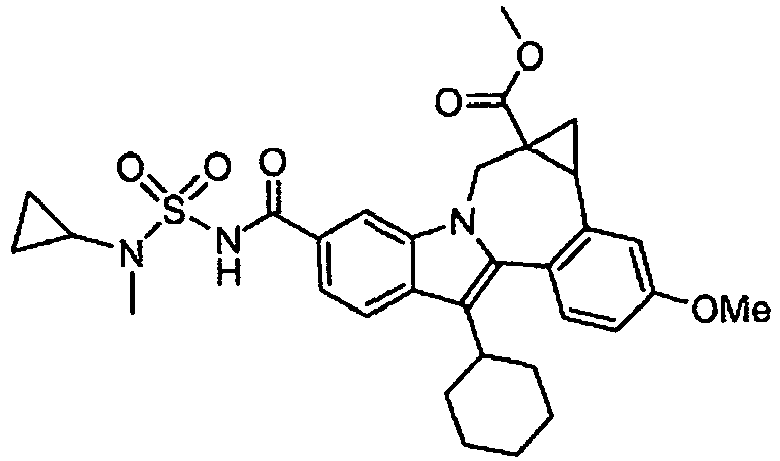
- Neat CDI (0.049 g, 0.302 mmol) was added to stirred solution of the acid (0.092 g, 0.200 mmol) in THF (1 ml) and the mixture was heated at 50 °C for 30 min and then allowed to cool to rt. Then N-cyclopropyl-N-methylsulfamide (0.0451 g, 0.300 mmol) and DBU (0.060 ml, 0.400 mmol) were added consecutively. The mixture sonicated for 1-2 hand then stirred overnight at rt. Reaction was quenched with MeOH (0.5 ml) and then acidified with 1N HCl and extracted with EtOAc (2X25 mL), washed with water, brine and dried (Na2SO4). Crude product (0.123 g) was purified by silica gel flash chromatography (5% MeOH in DCM) to afford the expected product as an off-white solid (0.101g 85%).
-

- 1N NaOH (2 mL, 2.000 mmol) was added to stirred solution of the methyl ester (0.098 g, 0.166 mmol) in THF-MeOH under nitrogen. The mixture was stirred at rt for 2 h and then acidified with 1N HCl (3 ml), extracted with EtOAc (2X25 ml), washed with water, brine and dried (MgSO4). Evaporation of solvents gave the acid as an off-white solid (0.0942 g, 98%). LC/MS: m/e 578 (MH+). LC/MS method: Start % B: 0, Final % B: 100; Gradient time: 3 min; Stop time: 4 min; Flow rate: 4 ml/min; Wavelenth: 220; Solvent A: 10% MeOH / 90% H2O / 0.1% Trifluoroacetic Acid; Solvent B: 10% H2O / 90% MeOH / 0.1% Trifluoroacetic Acid; Column: XBridge 4.6 x 50 mm S5.
-
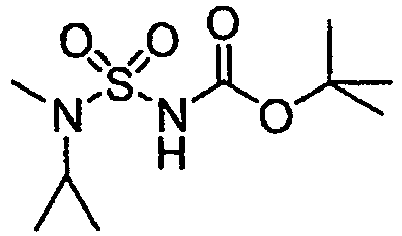
- t-Butanol (1.35 mL, 14 mmol) was added dropwise to the solution of CSI (1.24 mL, 14 mmol) of CH2Cl2 (10 mL) at 0 °C. The generated solution was stirred for 2 h at 0 °C. A solution of N-methylpropan-2-amine (1.57 ml, 14.13 mmol) and TEA (2.167 ml, 15.54 mmol) in CH2Cl2 (3 ml) was added dropwise. The generated reaction mixture was stirred for 2 h at r.t. The reaction mixture was diluted with EtOAc and washed with cold 1N HCl, brine, dried (MgSO4), removed the solvent and the residue was purified by Biotage 40M column (EtOAc-MeOH (90-10)/hexane 5% to 100%) to afford the product as a colorless gel (2.3 g, 65%) 1H NMR (400 MHz, CHLOROFORM-d) δ ppm 1.19 (d, J=6.55 Hz, 6 H) 1.49 (s, 9 H) 2.90 (s, 3 H) 4.05 - 4.26 (m, 1 H) 7.02 (br. s., 1 H).
-

- To tert-butyl N-isopropyl-N-methylsulfamoylcarbamate (2.3 g, 9.12 mmol) was added cold HCl (6 mL, 24.00 mmol) and stirred at room temperature for 2 h, removed the solvent to afford the product as a solid in light tan (1.38g, 99%). 1H NMR (400 MHz, CHLOROFORM-d) δ ppm 1.16 (d, J=6.80 Hz, 5 H) 2.72 (s, 3 H) 4.16 (dt, J=13.53, 6.70 Hz, 1 H) 4.43 (br. s., 1 H).
-

- The product (0.261g, 81%) was made from the acid (0.25 g, 0.54mmol) and amine using CDI and DBU. LC-MS retention time: 3.635 min; MS m/z (M+H) 594. H NMR showed compound existed as rotamers (∼4/3). LC/MS method: Start % B: 0, Final % B: 100; Gradient time: 3 min; Stop time: 4 min; Flow rate: 4 ml/min; Wavelenth: 220; Solvent A: 10% MeOH / 90% H2O / 0.1% Trifluoroacetic Acid; Solvent B: 10% H2O / 90% MEOH, / 0.1 % Trifluoroacetic Acid; Column: XBridge 4.6 x 50 mm S5.
-

- The acid (0.22g, 87%) was made from the ester (0.258 g, 0.435 mmol) using NaOH in THF/MeOH. The acid was isolated as a pale yellow solid. LC-MS retention time: 3.608min; MS m/z (M+H) 580. LC/MS method: Start % B: 0, Final % B: 100; Gradient time: 3 min; Stop time: 4 min; Flow rate: 4 ml/min; Wavelenth: 220; Solvent A: 10% MeOH / 90% H2O / 0.1% Trifluoroacetic Acid; Solvent B: 10% H2O / 90% MeOH / 0.1% Trifluoroacetic Acid; Column: XBridge 4.6 x 50 mm S5. 1H NMR existed rotomers (∼1/2). The major isomer: 1H NMR (400 MHz, CHLOROFORM-d) δ ppm 0.41 (t, J=6.30 Hz, 1 H) 1.08 - 2.15 (m, 17 H) 2.63 - 2.80 (m, 1 H) 2.84 - 2.96 (m, 1 H) 3.04 (s, 3 H) 3.84 (s, 3 H) 4.03 (d, J=14.86 Hz, 1 H) 4.22 - 4.41 (m, 1 H) 5.35 (d, J=15.11 Hz, 1 H) 6.86 (dd, J=8.44, 2.39 Hz, 1 H) 6.98 (d, J=2.27 Hz, 1 H) 7.20 (d, J=8.56 Hz, 1 H) 7.67 (d, J=8.31 Hz, 1 H) 7.81 - 7.89 (m, 1 H) 8.10 (s, 1 H).
-

- General procedure for making amides for some examples. Acid derivatives (1 equiv) were combined with corresponding amine (1.2 equiv), triethylamine (2-3 equiv) and TBTU (1.3 equiv) in anh. DMF and stirred at rt for 1-2 h until completion of the amide coupling. Isolated crude products were purified by prep. HPLC to provide the desired amides.
- The compounds prepared in the following procedures were analyzed by the following LC/MS method until noted: Analysis Conditions: Column: PHENOMENNEX-LUNA 3.0 x 50mm S10; Mobile Phase: (A) 10:90 methanol-water; (B) 90:10 methanol-water; Buffer: 0.1% TFA; Gradient Range: 0-100% B; Gradient Time: 2 min; Flow Rate: 4 mL/min; Analysis Time: 3 min; Detection: Detector 1: UV at 220 nm; Detector 2: MS (ESI+).
-

- (+/-)-8-Cyclohexyl-5-(morpholinosulfonylcarbamoyl)-1, 1a,2,12b-tetrahydro-11-methoxy-cycloprop[d]indolo[2,1-a][2]benzazepine-1a-carboxylic acid. The product was purified by prep HPLC and isolated as a beige solid. LC/MS: Retention time: 1.968 min; m/e 460 (MH+). 1H NMR (400 MHz, CDCl3): The compound was observed to exist as inter-converting rotamers.
-

- (+/-)-8-Cyclohexyl-5-(4-mehylpiperazin-1-ylsulfonylcarbamoyl)-1,1a,2,12b-tetrahydro-11-methoxy-cycloprop[d]indolo[2,1-a][2]benzazepine-1a-carboxylic acid. The product was purified by prep HPLC and isolated in mono TFA salt form as a beige solid. LC/MS: Retention time: 1.687 min; m/e 607 (MH+). 1H NMR (400 MHz, CDCl3): The compound was observed to exist as inter-converting rotamers.
- All compounds labeled with an A are racemic mixtures and compounds labeled with a B are single enantiomers. Compounds with cyclopropyl rings fused to an azepine ring are cis-fused.
-

- 3a,6a-bis(bromomethyl)-2, 5-bis((4-methylphenyl)sulfonyl)octahydropyrrolo[3,4-c]pyrrole. Prepared according to J. Org. Chem. 1996, 61, 8897 - 8903. MW 606.4.
-

- 5,8-bis((4-methylphenyl)sulfonyl)dihydro-4H-3a,6a-(methanoiminomethano)furo[3,4-c]pyrrole. Prepared via the procedures outlined in J. Org. Chem, 1996, 61, 8897 - 8903.
-
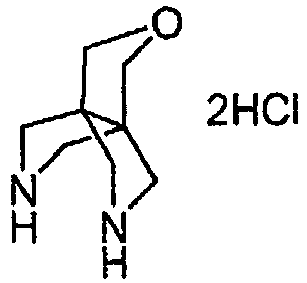
- dihydro-4H-3a,6a-(methanoiminomethano)furo[3,4-c]pyrrole dihydrochloride. Lithium aluminum hydride (1.0 M in THF) (17.3 mL, 17.3 mmol) was added to a solution of crude 5,8-bis((4-methylphenyl)sulfonyl)dihydro-4H-3a,6a-(methanoiminomethano)furo[3,4-c]pyrrole (Intermediate 2) (800 mg, 1.73 mmol) in THF (10 mL) and the mixture was stirred at rt for 4 d. Et2O (100 mL) was added to the reaction, followed by the dropwise addition of water (1.5 mL) and then 10 N NaOH (aq) (1.5 mL). After the gas evolution ceased, the mixture was filtered through celite. The filtrate was acidified with HCl (2.0 M in Et2O, 2 mL), (white precipitate formed) and concentrated to a pink solid, which was triturated with Et2O and then MeOH to yield dihydro-4H-3a,6a-(methanoiminomethano)furo[3,4-c]pyrrole dihydrochloride (254 mg, 1.65 mmol, 95 % yield) as a white solid. LCMS: m/e 155 (M+H)+. LCMS retention time: 0.26 min. (Column: SunFire C18 5u 4.6 X 50 mm. Solvent A = 90% Water/ 10% Acetonitrile/ 0.1%TFA. Solvent B =10% Water/ 90% Acetonitrile/ 0.1%TFA. Start % B = 0. Final % B = 100. Gradient Time = 2 min. Flow Rate = 4 mL/min.). 1H NMR (500 MHz, DMSO-d6 ) δ ppm 10.24 - 9.90 (4 H, m), 3.82 (4 H, s), 3.56 (4 H, d, J = 12.21 Hz), 3.18 (4 H, d, J= 12.21 Hz). Intermediate 45
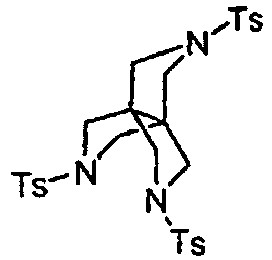
- 2,5,8-tris((4-methylphenyl)sulfonyl)tetrahydro-1H,4H-3a,6a-(methanoiminomethano)pyrrolo[3,4-c]pyrrole. Prepared via the procedures outlined in J. Org. Chem. 1996, 61, 8897 - 8903.
-

- tetrahydro-1H,4H-3a,6a-(methanoiminomethano)pyrrolo[3,4-c]pyrrole trihydrochloride. Lithium aluminum hydride (1.0 M in THF) (19.7 mL, 19.7 mmol) was added to a solution of 2,5,8-tris((4-methylphenyl)sulfonyl)tetrahydro-1H,4H-3a,6a-(methanoiminomethano)pyrrolo[3,4-c]pyrrole (Intermediate 4) (810 mg, 1.32 mmol) in THF (20 mL) and the mixture was stirred at rt for 2 d. Et2O (100 mL) was added to the reaction, followed by the dropwise addition of water (2 mL) and then 10 N NaOH (aq) (2 mL). After the gas evolution ceased, the mixture was dried by Na2SO4 and filtered through celite. The filtrate was acidified with HCl (2.0 M in Et2O, 2 mL), (white precipitate formed), concentrated to dryness and the residue was triturated with Et2O and then MeOH to yield tetrahydro-1H,4H-3a,6a-(methanoiminomethano)pyrrolo[3,4-c]pyrrole trihydrochloride (80 mg, 0.52 mmol, 40 % yield) as a white solid. LCMS: m/e =154 (M+H)+. LCMS retention time: 0.25 min. (Column: SunFire C18 5u 4.6 X 50 mm. Solvent A = 90% Water/10% Acetonitrile/ 0.1%TFA. Solvent B = 10% Water/ 90% Acetonitrile/ 0.1%TFA. Start % B = 0. Final % B = 100. Gradient Time = 2 min. Flow Rate = 4 mL/min.). 1H NMR (500 MHz, DMSO-d6 ) δ ppm 10.21 (6 H, br s), 3.59 (12 H, br s).
-

- tetrahydro-2-methyl-5,8-bis[(4-methylphenyl)sulfonyl]-1H,4H-3a,6a-(methanoiminomethano)pyrrolo[3,4-c]pyrrole. 2.0 M Methylamine in THF (15 mL, 30 mmol) was added to a suspension of 3a,6a-bis(bromomethyl)-2,5-bis((4-methylphenyl)sulfonyl)octahydrapyrrolo[3,4-c]pyrrole (Intermediate 1) (2 g, 3.3 mmol) in DMSO (30 mL) and the mixture was stirred at 120 °C in sealed tube for 1d. The solvent was removed under vacuum and the residue was partitioned between CHCl3 (100 mL) and brine (50 mL). The organic layer was washed with brine, dried (MgSO4) and concentrated to a yellow solid, which was purified by flash silica chromatography (SiO2, EtOAc/Hexanes, gradient from 33% to 100% EtOAc) to yield product tetrahydro-2-methyl-5,8-bis[(4-methylphenyl)sulfonyl]-1H,4H-3a,6a-(methanoiminomethano)pyrrolo[3,4-c]pyrrole (810 mg, 1.70 mmol, 52 % yield) as a white solid. LCMS:m/e= 476 (M+H)+. LCMS retention time: 1.10min. (Column: SunFire C18 5u 4.6 X 50 mm. Solvent A = 90% Water/10% Acetonitrile/ 0.1%TFA. Solvent B = 10% Water/ 90% Acetonitrile/ 0.1%TFA. Start % B = 0. Final % B = 100. Gradient Time = 2 min. Flow Rate = 4 mL/min.)
-

- 2-methyltetrahydro-1H,4H-3a,6a-(methanoiminomethano)pyrrolo[3,4-c]pyrrole trihydrochloride. Lithium aluminum hydride (1.0 M in THF) (5.7 mL, 5.7 mmol) was added to a solution of tetrahydro-2-methyl-5,8-bis[(4-methylphenyl)sulfonyl]-1H,4H-3a,6a-(methanoiminomemano)pyrrolo[3,4-c]pyrrole (Intermediate 6) (270 mg, 0.57 mmol) in THF (6 mL) and the mixture was stirred at rt for 16 h. Et2O (30 mL) and THF (20 mL) were added to the reaction, followed by the dropwise addition of water (0.6 mL) and then 10 N NaOH (aq) (0.6 mL). After the gas evolution ceased, the mixture was filtered through celite. The filtrate was acidified with HCl (2.0 M in Et2O, 0.9 mL) and concentrated to a pink solid, which was triturated with MeOH and EtOAc to yield 2-methyltetrahydro-1H,4H-3a,6a-(methanoiminomethano)pyrrolo[3,4-c]pyrrole trihydrochloride (100.6 mg, 0.364 mmol, 64 % yield) as a white solid. LCMS: m/e = 168 (M+H)+. LCMS retention time: 0.26 min. (Column: SunFire C18 5u 4.6 X 50 mm. Solvent A = 90% Water/10% Acetonitrile/ 0.1%TFA. Solvent B = 10% Water/ 90% Acetonitrile/ 0.1%TFA. Start % B = 0. Final % B = 100. Gradient Time = 3 min. Flow Rate = 4 mL/min.). 1H NMR (400 MHz, DMSO-d6 ) □ ppm 12.28 - 9.36 (5 H, m), 3.63 (12 H, br s), 2.82 (3 H, s).
-

- 3a,6a-bis(methoxymethyl)-2,5-bis((4-methylphenyl)sulfonyl)octahydropyrrolo[3,4-c]pyrrole. 25 wt.% Sodium methoxide in MeOH (3.8 mL, 16 mmol) was added to a suspension of 3a,6a-bis(bromomethyl)-2,5-bis((4-methylphenyl)sulfonyl)octahydropyrrolo[3,4-c]pyrrole (Intermediate 1) (2 g, 3.30 mmol) in DMSO (10 mL) and the mixture was stirred at 120 °C under N2 for 16 h. The solvent was evaporated under vacuum and the residue was partitioned between CHCl3 and sat. NH4Cl (aq). The organic layer was washed with brine, dried (MgSO4) and concentrated to an orange solid, which was triturated with CH2Cl2 to yield the first crop of 3a,6a-bis(methoxymethyl)-2,5-bis((4-methylphenyl)sulfonyl)octahydropyrrolo[3,4-c]pyrrole (720 mg, 1.4 mmol, 43 %) as a white solid. The mother liquor was purified by flash silica chromatography (SiO2, eluted with EtOAc/Hexanes 1:2) to yield additional desired product (130 mg, 0.26 mmol, 8%) as awhite solid. LCMS: m/e = 509 (M+H)+. LCMS retention time: 1.85 min. (Column: SunFire C18 5u 4.6 X 50 mm. Solvent A = 90% Water/10% Acetonitrile/ 0.1%TFA. Solvent B = 10% Water/ 90% Acetonitrile/ 0.1%TFA. Start % B = 0. Final % B = 100. Gradient Time = 2 min. Flow Rate = 4 mL/min.).
-
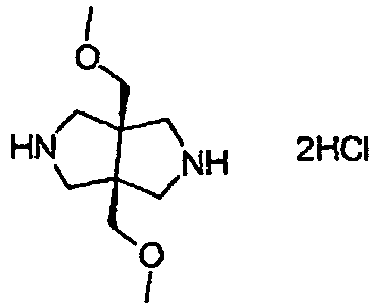
- cis-3a,6a-bis(methoxymethyl)octahydropyrrolo[3,4-c]pyrrole dihydrochloride. Lithium aluminum hydride (1.0 M in THF) (14.2 mL, 14.2 mmol) was added to a solution of (3as,6as)-3a,6a-bis(methoxymethyl)-2,5-ditosyloctahydropyrrolo[3,4-c]pyrrole (Intermediate 8) (720 mg, 1.42 mmol) in THF (15 mL) and the mixture was stirred at rt for 3 d. Additional lithium aluminum hydride (1.0 M in THF) (10 mL, 10 mmol) was added and the reaction was continued for another day. The reaction was diluted with Et2O (100 mL), followed by the dropwise addition of water (1.5 mL) and then 10 N NaOH (aq) (1.5 mL). After the gas evolution ceased, the mixture was filtered through celite. The filtrate was acidified with HCl (2.0 M in Et2O, 2 mL), (white precipitate formed) and concentrated to an orange solid, which was triturated with Et2O and then MeOH to yield cis-3a,6a-bis(methoxymethyl)octahydropyrrolo[3,4-c]pyrrole dihydrochloride (266 mg, 1.33 mmol, 94 % yield) as a white solid. LCMS: m/e = 201 (M+H)+. LCMS retention time: 0.26 min. (Column: SunFire C18 5u 4.6 X 50 mm. Solvent A = 90% Water/ 10% Acetonitrile/ 0.1%TFA. Solvent B =10% Water/ 90% Acetonitrile/ 0.1%TFA. Start % B = 0. Final % B = 100. Gradient Time = 3 min. Flow Rate = 4 mL/min.).
-

- (1aR,12bS)-8-cyclohexyl-5-((isopropylsulfonyl)carbamoyl)-11-methoxy-1,12b-dihydrocyclopropa[d]indolo[2,1-a][2]benzazepine-1a(2H)-carboxylic acid. Prepared according to
US 20080146537 andUS 2007184024 . -

- 8-cyclohexyl-5-((isopropylsulfonyl)carbamoyl)-11-methoxy-1,12b-dihydrocyclopropa[d]indolo[2,1-a][2]benzazepine-1a(2H)-carboxylic acid. Prepared according
US 20080146537 andUS 2007184024 . -
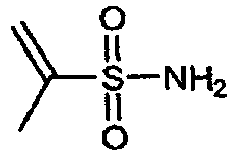
- prop-1-ene-2-sulfonamide. A 0.5 M solution of prop-1-en-2-ylmagnesium bromide (20 mL 10.0 mmol) in Et2O was added slowly to a stirring solution of sulfuryl dichloride (1.6 mL, 20 mmol) in hexanes (20 mL) at 0° C. The reaction was slowly allowed to warm to rt and stirred 16h. The reaction was quenched with water (40 mL), the layers separated and the organic layer was concentrated to a clear liquid. The residue was dissolved into THF (30 mL), cooled to 0° C and treated with ammonia (∼10 mL) using a cold finger (-70 °C). The cooling bath was removed and the reaction was allowed to stir at rt for 1 h with the cold finger attached, and then stirred open to air at rt ON. The reaction was filtered, concentrated under vacuum and partially purified through a pad of silica (eluting with EtOAc/hexanes 1:1). Fractions containing product were combined, concentrated and then recrystallized from hexanes/EtOAc (3:1) to yield prop-1-ene-2-sulfonamide (161 mg, 1.33 mmol, 13%) as a white solid. 1H NMR (300 MHz, CDCl3) δ ppm 6.06 (s, 1H), 5.55 (q, J= 1.5 Hz, 1H), 4.57 (br s, 2H), 2.14 (, br s, 3H).
-

- (1aR, 12bS)-8-cyclohexyl-1a-(ethoxycarbonyl)-11-methoxy-1,1a,2,12b-tetrahydrocyclopropa[d]indolo[2,1-a][2]benzazepine-5-carboxylic acid. Prepared according
US 2008146537 . -
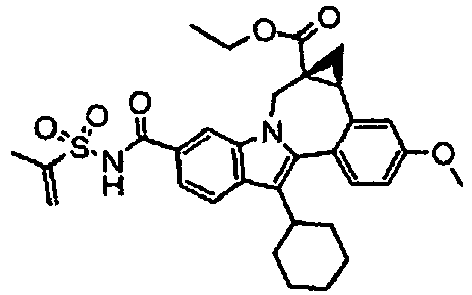
- Ethyl (1aR, 12bS)-8-cyclohexyl-5-((isopropenylsulfonyl)carbamoyl)-11-methoxy-1,12b-dihydrocyclopropa[d]indolo[2,1-a][2]benzazepine-1a(2H)-carboxylate. CDI (243 mg, 1.501 mmol) was added to a solution of (1aR,12bS)-8-cyclohexyl-1a-(ethoxycarbonyl)-11-methoxy-1,1a,2,12b-tetrahydrocyclopropa[d]indolo[2,1-a][2]benzazepine-5-carboxylic acid (Intermediate 13) (474 mg, 1.00 mmol) in THF (5 mL) and the mixture was stirred at 60 °C for 1 h. Then prop-1-ene-2-sulfonamide (Intermediate 12) (182 mg, 1.50 mmol) and DBU (0.3 mL, 1.990 mmol) were added, the reaction was stirred at rt for 3d. The reaction mixture was diluted with 0.5 N aq HCl (20 ml) and extracted with EtOAc (50 ml x 2). The combined organics were washed with aq HCl and brine, dried (MgSO4), filtered and concentrated to a yellow oil. The residue was purified by prep HPLC (H2O-CH3CN with 10mM NH4OAc buffer) to yield ethyl (1aR,12bS)-8-cyclohexyl-5-((isopropenylsulfonyl)carbamoyl)-11-methoxy-1,12b-dihydrocyclopropa[d]indolo[2,1-a][2]benzazepine-1a(2H)-carboxylate (357 mg, 0.619 mmol, 62 % yield) as a white solid. LCMS: m/e = 577 (M+H)+. LCMS retention time: 1.22 min. (Column: phenomenex 10u 4.6x50mm C18. Solvent A = H2O: ACN 95% : 5% 10 mm Ammonium Acetate. Solvent B = H2O: ACN 5%: 95% 10 mm Ammonium Acetate. Start % B = 30. Final % B = 100. Gradient Time = 2 min. Flow Rate = 4 ml/min.). Presents as a 3:1 ratio of rotamers or atrope isomers. 1H NMR(300 MHz, MeOD) δppm 8.30 (s, 0.25H), 8.09 (s , 0.75H), 7.91 (d, J= 8.8 Hz, 0.25H), 7.88 (d, J= 8.4 Hz, 0.75H), 7.62 (dd, J= 8.8, 1.5 Hz, 0.25H), 7.56 (dd, J= 8.4, 1.5 Hz, 0.75H), 7.32 (d, J= 8.4 Hz, 0.25H), 7.28 (d, J = 8.8 Hz, 0.75H), 7.23 (d, J= 2.2 Hz, 0.75H), 7.15 (d, J= 2.6 Hz, 0.25H), 7.05 - 6.97 (m, 1H), 6.31 (br s, 1H), 5.94 (br s, 1H), 5.47 (d, J = 15.0 Hz, 0.75H), 5.26 (d, J= 15.0 Hz, 0.25H), 4.33 - 3.88 (m, 3H), 3.90 (s, 3H), 3.48 (d, J= 15.0 Hz, 0.75H), 3.14 - 2.66 (m, 2.25H), 2.23 - 0.88 (m, 13.75H), 0.29 - 0.23 (m, 0.25H).
-

- (1aR, 12bS)-8-cyclohexyl-5-((isopropenylsulfonyl)carbamoyl)-11-methoxy-1,12b-dihydrocyclopropa[d]indolo[2,1-a][2]benzazepine-1a(2H)-carboxylic acid. Aqueous NaOH (1.8 mL, 1.8 mmol) was added to a solution of ethyl (1aR,12bS)-8-cyclohexyl-5-((isopropenylsulfonyl)carbamoyl)-11-methoxy-1,12b-dihydrocyclopropa[d]indolo[2,1-a][2]benzazepine-la(2H)-carboxylate (Intermediate 14) (350 mg, 0.607 mmol) in MeOH (4 mL) and THF (4 mL) and the mixture was stirred at rt for 16 h. The reaction was quenched with 1N aq HCl (1.8 mL), concentrated and the residue was partitioned between EtOAc (50 mL) and H2O (30 mL). The organic layer was washed with brine, dried (MgSO4) and concentrated to yield crude (1aR,12bS)-8-cyclohexyl-5-((isopropenylsulfonyl)carbamoyl)-11-methoxy-1,12b-dihydrocyclopropa[d]indolo[2,1-a][2]benzazepine-1a(2H)-carboxylic acid (333 mg, 0.577 mmol, 95 % yield) as a yellow solid. LCMS: m/e = 549 (M+H)+. LCMS retention time: 1.55 min. (Column: phenomenex 10u 4.6x50mm C18. Solvent A = H2O: ACN 95%: 5% 10 mm Ammonium Acetate. Solvent B = H2O: ACN 5% : 95% 10 mm Ammonium Acetate. Start % B = 0. Final % B = 100. Gradient Time = 3 min. Flow Rate = 4 ml/min.).
-

- Methyl 8-cyclohexyt-5-((isobutylsulfonyl)carbamoyl)-11-methoxy-1,12b-dihydrocyclopropa[d]indolo[2,1-a][2]benzazepine-1a(2H)-carboxylate. Prepared according to
US 20080146537 . -

- 8-cyclohexyl-5-((isobutylsulfonyl)carbamoyl)-11-methoxy-1,12b-dihydrocyclopropa[d]indolo[2,1-a][2]benzazepine-1a(2H)-carboxylic acid. Prepared according to
US 20080146537 . -

- 13-cyclohexyl-10-((dimethydsulfamoyl)carbamoyl)-3-methoxy-7H-indolo[2,1-a][2]benzazepine-6-carboxylic acid. Prepared according to
WO 2008097796 andWO 20070333175 -
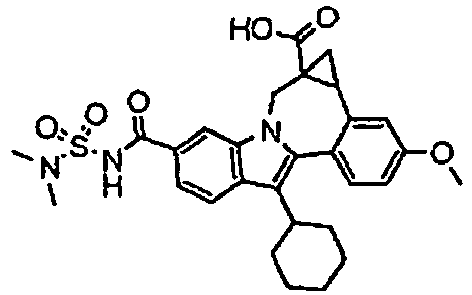
- 8-cyclohexyl-5-((dimethylsulfamoyl)carbamoyl)-11-methoxy-1,12b-dihydrocyclopropa[d]indolo[2,1-a][2]benzazepine-1a(2H)-carboxylic acid. Prepared according to
US 20080146537 ,WO 2008097796 andWO 2007143521 . -

- 13-cyclohexyl-10-((cycdopropylsulfonyl)carbamoyl)-3-methoxy-7H-indolo[2,1-a][2]benzazepine-6-carboxylic acid. Prepared according to
US 2007184024 . -

- Methyl 8-cyclohexyl-5-((cyclopropylsulfonyl)carbamoyl)-11-methoxy-1,12b-dihydrocyclopropa[d]indolo[2,1-a][2]benzazepine-1a(2H)-carboxylate. A solution of 13-cyclohexyl-10-((cyclopropylsulfonyl)carbamoyl)-3-methoxy-7H-indolo[2,1-a][2]benzazepine-6-carboxylic acid (Intermediate 20) (80 mg, 0.15 mmol) in MeOH (20 mL) was passed through a 10% Pd-C cartridge with H2 stream at 30 bar, rt in a ThalesNano H-cube reactor. The output was collected and concentrated to yield methyl 8-cyaohexyl-5-((cyclopropylsulfonyl)carbamoyl)-11-methoxy-1,12b-dihydrocyclopropa[d]indolo[2,1-a][2]benzazepine-1a(2H)-carboxylate (61.6 mg, 0.115 mmol, 77 % yield) as bright yellow solid. LCMS: m/e 537 (M+H)+. LCMS retention time: 3.03 min. (Column: Phenomenex-Luna 3.0 x 50mm S10. Solvent A = 90% Water: 10% Methanol: 0.1% TFA. Solvent B = 10% Water:90% Methanol: 0.1 % TFA. Start % B = 0. Final % B = 100. Gradient Time = 3 min. Flow Rate = 4 mL/min).
-

- 3a, 6a-bis(Iodomethyl)-2,5-bis((4-methylphenyl)sulfonyl)octahydropyrrolo[3,4-c]pyrrole. A suspension of 3a,6a-bis(bromomethyl)-2,5-bis((4-methylphenyl)sulfonyl)octahydropyrrolo[3,4-c]pyrrole (0.606 g, 1.00 mmol) and potassium iodide (1.66 g, 10.0 mmol) in dry DMF (5 mL) was stirred under N2 at 100 °C for 12 h. Upon heating to 100 °C, the reaction turned from a white suspension to a yellow suspension. After 12 h of stirring at 100 °C, the reaction was cooled to r.t., diluted with H2O (30 mL) and concentrated to an aqueous mixture. The resulting mixture was extracted with CH2Cl2 (3 x 15 mL), the combined organic extracts were washed with sat. NH4Cl (aq.) (20 mL), dried over Na2SO4, filtered and concentrated to give diiodo-bis-pyrrolidine (0.65 g, 0.93 mmol, 93 % yield). LCMS : m/e = 701 (M+H)+. LCMS retention time: 2.69 min. (Column: SunFire C 18 5u 4.6 X 50 mm. Solvent A = 90% Water/ 10% Acetonitrile/ 0.1%TFA. Solvent B = 10% Water/ 90% Acetonitrile/ 0.1%TFA. Start % B = 0. Final % B = 100. Gradient Time = 3 min. Flow Rate = 4 mL/min.).1H NMR (400 MHz, CHLOROFORM-d) δ ppm 7.68 (4 H, d, J=8.28 Hz), 7.39 (4 H, d, J=7.78 Hz), 3.34 (4 H, d, J=10.54 Hz), 3.24 (4 H, d, J=10.54 Hz), 3.00 (4 H, s), 2.49 (6 H, s).
-

- 2,5-bis((4-methylphenyl)sulfonyl)tetrahydro-1H,4H-3a,6a-ethanopyrrolo[3,4-c]pyrrole. t-Butyl lithium (1.7 M pentane) (1.05 mL, 1.76 mmol) was added dropwise to a stirring solution of 3a,6a-bis(iodomethyl)-2,5-bis((4-methylphenyl)sulfonyl)octahydropyrrolo[3,4-c]pyrrole (0.50 g, 0.71 mmol) in THF (10 mL) at -78 °C. The resulting orange mixture was stirred at -78 °C for 30 minutes. After this time, additional t-Butyl lithium 1.7 M in pentane (1.05 mL, 1.76 mmol) was added to the reaction mixture at -78 °C. After 10 minutes of additional stirring at -78 °C, the reaction was quenched with the addition of sat. NH4Cl (aq) (10 mL). The mixture was warmed to r.t., diluted with EtOAc (15 mL) and the layers were separated. The aq. layer was then extracted with EtOAc (3 x 20 mL) and once with CH2Cl2. The combined organic extracts were washed with brine (30 mL), dried over Na2SO4, filtered and concentrated to give 2,5-bis((4-methylphenyl)sulfonyl)tetrahydxo-1H,4H-3a,6a-ethanopyrrolo[3,4-c]pyrrole (.308 g, 0.690 mmol, 97 % yield) as a white crystaline solid. LCMS : m/e = 447 (M+H)+. LCMS retention time: 2.39 min. (Column: SunFire C18 5u 4.6 X 50 mm. Solvent A = 90% Water/ 10% Acetonitrile/ 0.1%TFA. Solvent B = 10% Water/ 90% Acetonitrile/ 0.1%TFA. Start % B = 0. Final % B = 100. Gradient Time = 3 min. Flow Rate = 4 mL/min.). Structure was verified via single crystal X-ray diffraction. 1H NMR (400 MHz, CHLOROFORM-d) □ ppm 7.67 (4 H, d, J=8.28 Hz), 7.34 (4 H, d, J=8.03 Hz), 3.36 (4 H, d, J=9.79 Hz), 2.73 (4 H, d, J=9.79 Hz), 2.47 (6 H, s), 2.00 (4 H, s).
-

- 2,8-bis((4-methylphenyl)sulfonyl)tetrahydro-1H,4H-3a,6a-(methanoiminomethano)cyclopenta[c]pyrrole-5-carboxylic acid. A flame dried flask was charged with 3a,6a-bis(bromomethyl)-2,5-bis((4-methylphenyl)sulfonyl)octahydropyrrolo[3,4-c]pyrrole (1.00 g, 1.65 mmol) and cesium carbonate (5.37 g, 16.5 mmol). The flask was evacuated and backfilled with N2. The solids were taken up in dry DMSO (10 mL). Finally, dry dimethyl malonate (0.377 mL, 3.30 mmol) was added and the mixture was heated to 100 °C. The mixture was allowed to stir at this temperature under N2 for 3 days. The reaction was cooled to r.t., diluted with H2O (30 mL) and CH2Cl2 (30 mL) and the layers were separated. The aqueous layer was extracted with CH2Cl2 (3 x 20 mL). The combined organic extracts were washed with brine (30 mL), dried over Na2SO4, filtered and concentrated to give an orange solid. This solid was purified on silica gel (Biotage, EtOAc/hexanes (20 % EtOAc to 80 % EtOAc over 10 CV, all fractions collected) to give a mixture of methyl 2,8-bis((4-methylphenyl)sulfonyl)tetrahydro-1H,4H-3a,6a-(methanoiminomethano)cyclopenta[c]pyrrole-5-carboxylate (0.30 g, 0.58 mmol, 46 % yield) and 5,8-bis((4-methylphenyl)sulfonyl)dihydro-4H-3a,6a-(methanoiminomethano)furo[3,4-c]pyrrole (0.29 g, 0.63 mmol, 50 % yield) as a white solid. This inseparable mixture was taken on to the hydrolysis where 2,8-bis((4-methylphenyl)sulfonyl)tetrahydro-1H,4H-3a,6a-(methanoiminomethano)cyclopenta[c]pyrrole-5-carboxylic acid and 5,8-bis((4-methylphenyl)sulfonyl)dihydro-4H-3a,6a-(methanoiminomethano)furo[3,4-c]pyrrole were separated. The mixture from the previous step was dissolved in THF (40 mL). The solution was cooled to 0 °C and 4M LiOH (aq) (10 mL, 20.0 mmol) was added. The yellow solution was allowed to warm to room tempurature overnight. The solution was concentrated in vacuo. The resulting residue was diluted with 1M HCl (aq) (50 mL) and extracted with EtOAc (3 x 20 mL). The combined organic extracts were washed with brine, dried over Na2SO4, filtered and concentrated to give 0.9 g of a white solid consisting of the unreacted 5,8-bis((4-methylphenyl)sulfonyl)dihydro-4H-3a,6a-(methanoiminomethano)furo[3,4-c]pyrrole and the desire 2,8-bis((4-methylphenyl)sulfonyl)tetrahydro-1H,4H-3a,6a-(methanoiminomethano)cyclopenta[c]pyrrole-5-carboxylic acid. The solid was purified on silica gel (Biotage, EtOAc/hexanes (30 % to 50 % EtOAc over 5 CV) followed by a second gradient consisting of a 1:1 CH2Cl2: 10 % MeOH in CH2Cl2 mixture for 3 CV ramping to only 10% MeOH in CH2Cl2 over 10 CV, all fractions collected) to give 2,8-bis((4-methylphenyl)sulfonyl)tetrahydro-1H,4H-3a,6a-(methanoiminomethano)cyclopenta[c]pyrrole-5-carboxylic acid (0.340 g, 0.674 mmol, 69.9 % yield) as a white fluffy solid. LCMS : m/e = 519 (M+H)+. LCMS retention time: 2.28 min. (Column: SunFire C18 5u 4.6 X 50 mm. Solvent A = 90% Water/10% Acetonitrile/ 0.1%TFA. Solvent B = 10% Water/ 90% Acetonitrile/0.1%TFA. Start % B = 0. Final % B = 100. Gradient Time = 3 min. Flow Rate = 4 mL/min.).1H NMR (400 MHz, CHLOROFORM-d) δ ppm 7.65 (2 H, d, J=8.28 Hz), 7.58 (2 H, d, J=8.28 Hz), 7.36 (4 H, dd, J=16.06, 7.78 Hz), 3.48 (2 H, d, J=9.54 Hz), 3.33 (2 H, d, J=10.04 Hz), 2.60 (2 H, d, J=9.79 Hz), 2.55 (1 H, m), 2.49 (3 H, s), 2.46 (3 H, s), 2.38 (2 H, d, J=10.29 Hz), 2.04 (1 H, d, J=113.43 Hz), 2.02 (2 H, d, J=13.43 Hz), 1.91 (1 H, d, J=12.55 Hz), 1.87 (1 H, d, J=2.55 Hz).
-
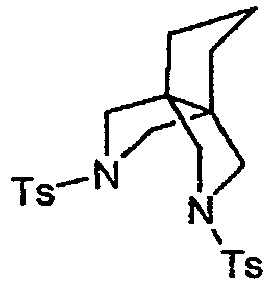
- 2,8-bis((4-methylphenyl)sulfonyl)tetrahydro-1H,4H-3a,6a-(methanoiminomethano)cyclopenta[c]pyrrole. A mixture of 2,8-bis((4-methylphenyl)sulfonyl)tetrahydro-1H,4H-3a,6a-(methanoiminomethano)cyclopenta[c]pyrrole-5-carboxylic acid (200 mg, 0.396 mmol), Iodobenzene diacetate (511 mg, 1.59 mmol) and iodine (402 mg, 1.59 mmol) in carbontetrachloride (8 mL) was irradiated with a 300 W tungsten filament lamp (to reflux temperature) for 8 h in a flask fitted with two sequential reflux condensers.
- After this time, the reaction was diluted with CH2Cl2 and was washed with sat. Na2S2O3 (aq) (25 mL). The aqueous layer was extracted with CH2Cl2 (3 x 10 mL). The combined organic extracts were washed with brine, dried over Na2SO4, filtered and concentrated to give an orange oil. This oil was purified on silica gel (Biotage, EtOAc/hexanes (ramp of 20 % EtOAc to 90 % EtOAc over 12 CV), all fractions collected) to give a mixture of 2,8-bis((4-methylphenyl)sulfonyl)-2,3-dihydro-1H,4H-3a,6a-(methanoiminomethano)cyclopenta[c]pyrrole and 5-iodo-2,8-bis((4-methylphenyl)sulfonyl)tetrahydro-1H,4H-3a,6a-(methanoiminomethano)cyclopenta[c]pyrrole (0.150 g). t-Butyl lithium 1.7 M in pentane (2.01 mL, 342 µmol) was added dropwise to a stirring solution of the mixture from the previous step in THF (4 mL) at -78 °C. The orange tinted solution was stirred at -78 °C for 55 min. Next, the reaction was quenched with the addition of sat. NH4Cl (aq) (25 mL). The resulting mixture was diluted with Et2O and the layers were separated. The aqeous layer was extracted with Et2O (3 x 5 mL), and combined organic extracts were washed with brine, dried over Na2SO4, filtered and concentrated to give 160 mg of a mixture of 2,8-bis((4-methylphenyl)sulfonyl)-2,3-dihydro-1H,4H-3a,6a-(methanoiminomethano)cyclopenta[c]pyrrole and 2,8-bis((4-methylphenyl)sulfonyl)tetrahydro-1H,4H-3a,6a-(methanoiminomethano)cyclopenta[c]pyrrole. This mixture was taken on without further purification. The mixture from the previous step (160 mg, 0.348 mmol) was dissolved in a mixture of 10 % MeOH in THF (1 mL). Palladium 10 % on carbon (18.5 mg, 0.174 mmol) was added to the reaction solution and the mixture was degassed and the flask was backfilled with Ar (3x). Next, the Ar blanketed mixture was degassed and charged with H2 (3x). The H2 blanketed mixture was allowed to stir at r.t. under a balloon of H2 overnight. The mixture was then filtered through a pad of Celite rinsing with THF. The filtrate was concentrated, diluted with CH2Cl2 and purified on silica gel (Biotage, EtOAc/hexanes (ramp of 20 % EtOAc to 90 % EtOAc over 12 CV), all fractions collected) to give 2,8-bis((4-methylphenyl)sulfonyl)tetrahydro-1H,4H-3a,6a-(methanoiminomethano)cyclopenta[c]pyrrole (102 mg, 0.221 mmol, 64 % yield) (56 % yield from the carboxylic acid). LCMS : m/e = 461 (M+H)+. LCMS retention time: 2.46 min. (Column: SunFire C 18 5u 4.6 X 50 mm. Solvent A = 90% Water/ 10% Acetonitrile/ 0.1%TFA. Solvent B = 10% Water/ 90% Acetonitrile/ 0.1%TFA. Start % B = 0. Final % B = 100. Gradient Time = 3 min. Flow Rate = 4 mL/min.). 1H NMR (400 MHz, CHLOROFORM-d) δ ppm 7.62 (4 H, d, J=8.28 Hz), 7.35 (4 H, d, J=8.03 Hz), 2.81 - 3.03 (8 H, m), 2.47 (6 H, s), 1.64 (4 H, t, J=6.53 Hz), 1.34 - 1.46 (2 H, m).
-

- tetrahydro-1H,4H-3a,6a-ethanopyrrolo[3,4-c]pyrrole dihydrochloride. A solution of lithium aluminum hydride 2M THF (26.2 mL, 52.4 mmol) was added to a stirring solution of 2,5 -bis((4-methylphenyl)sulfonyl)tetrahydro-1H,4H-3a,6a-ethanopyrrolo[3,4-c]pyrrole (1.17 mg, 2.62 mmol) in THF (10 mL) at r.t. The mixture was then allowed to stir at r.t. for 48 h. The reaction was then diluted with Et2O and then quenched with the addition of H2O (1.0 mL) followed by 1M NaOH (aq) (1.0 mL). The resulting mixture was allowed to stir at room temperature overnight. The mixture was then filtered through a pad of Celite rinsing with THF. The filtrate was then acidified with the addition of 2M HCl in Et2O, affording a white ppt. This mixture was concentrated to give a sticky tan solid. This sticky solid was triturated with Et2O and dried in vacuo to give tetrahydro-1H,4H-3a,6a-ethanopyrrolo[3,4-c]pyrrole dihydrochloride (518 mg, 2.45 mmol, 94 % yield) as a tan solid containing less than 5 % of the mono-protected amine. This compound does not exhibit a detectable LCMS signal. 1H NMR (400 MHz, MeOD) δ ppm 3.64 (4 H, d, J=12.30 Hz), 3.47 (4 H, d, J=12.30 Hz), 2.27 (4 H, s).
-

- 1A Racemate: 8-cyclohexyl-N-(isopropylsulfonyl)-11-methoxy-1a-(3-oxa-7,10-diazatricyclo[3.3.3.01.5]undec-7-ylcarbonyl)-1,1a,2,12b-tetrahydrocyclopropa[d]indolo[2,1-a][2]benzazepine-5-carboxamide and 1B Homochiral: (1aR,12bS)-8-cyclohexyl-N-(isopropylsulfonyl)-11-methoxy-1a-(3-oxa-7,10-diazatricyclo[3.3.3.01.5]undec-7-ylcarbonyl)-1,1a,2,12b-tetrahydrocyclopropa[d]indolo[2,1-a][2]benzazepine-5-carboxamide. BOP-Cl (69 mg, 0.27 mmol) was added to a stirring solution of (1aR,12bS)-8-cyclohexyl-5-((isopropylsulfonyl)carbamoyl)-11-methoxy-1,12b-dihydrocyclopropa[d]indolo[2,1-a][2]benzazepine-1a(2H)-carboxylic acid (Intermediate 10) (100 mg, 0.182 mmol) and dihydro-4H-3a,6a-(methanoiminomethano)furo[3,4-c]pyrrole dihydrochloride (Intermediate 3) (62 mg, 0.27 mmol) in CH2Cl2 (5 mL) and TEA (0.50 mL, 3.6 mmol), and the mixture was stirred at rt for 16 h. The reaction was diluted with MeOH and purified by preparative HPLC (H2O-MeOH with 0.1% TFA buffer) to yield (1aR,12bS)-8-cylohexyl-N-(isopropylsulfonyl)-11-methoxy-1a-(3-oxa-7,10-diazatricyclo[3.3.3.01,5]undec-7-ylcarbonyl)-1,1a,2,12b-tetrahydrocyclopropa[d]indolo[2,1-a][2]benzazepine-5-carboxamide (72 mg, 0.085 mmol, 47 % yield) as a bright yellow solid. LCMS: m/e 687 (M+H)+. LCMS retention time: 2.43 min. (Column: Phenomenex-Luna 3.0 x 50mm S10. Solvent A =90% Water:10% Methanol: 0.1% TFA. Solvent B =10% Water:90% Methanol: 0.1 % TFA. Start % B = 0. Final % B = 100. Gradient Time = 3 min. Flow Rate = 4 mL/min.). Presents as a 2:1 ratio of rotamers or atrope isomers. 1H NMR (400 MHz, MeOD) δ ppm 8.09 (br s, 0.33H), 7.97 (br s, 0.67H), 7.88 (d, J=8.5 Hz, 1H), 7.61 - 7.55 (m, 1H), 7.31 - 7.26 (m, 1H), 7.16 (d, J=2.8 Hz, 0.67H), 7.14 (d, J=2.5 Hz, 0.33H), 7.02 - 6.94 (m, 1H), 5.10 (d, J=15.1 Hz, 0.67H), 4.80 (d, J=15.1 Hz, 0.33H), 4.16 - 3.43 (m, 9H), 3.88 (s, 1H), 3.86 (s, 2H), 3.38 - 3.09 (m, 4H), 3.00 - 2.89 (m, 0.66H), 2.84 - 2.74 (m, 0.33H), 2.65 (dd, J=9.0, 5.8 Hz, 0.67H), 2.52 (dd, J=10.0, 6.3 Hz, 0.33H), 2.15 - 1.01 (m, 12.67H), 1.42 (d, J=7.0 Hz, 4H), 1.41 (d, J=7.0 Hz, 2H), 0.20 - 0.12 (m, 0.33H).
-

- 2A Racemate: 8-cyclohexyl-N-(isopropylsulfonyl)-11-methoxy-1a-((10-methyl-3-oxa-7,10-diazatricyclo[3.3.3.01,5]undec-7-yl)carbonyl)-1,1a,2,12b-tetrahydrocyclopropa[d]indolo[2,1-a][2]benzazepine-5-carboxamide and 2B Homochiral: (1aR,12bS)-8-cyclohexyl-N-(isopropylsulfonyl)-11-methoxy-1a-((10-methyl-3-oxa-7,10-diazatricyclo[3.3.3.01,5]undec-7-yl)carbonyl)-1,1a,2,12b-tetrahydrocyclopropa[d]indolo[2,1-a][2]benzazepine-5-carboxamide. A 1M solution of sodium cyanoborohydride in THF (0.51 mL, 0.51 mmol) was added to a solution of (1aR,12bS)-8-cyclohexyl-N-(isopropylsulfonyl)-11-methoxy-1a-(3-oxa-7,10-diazatricyclo[3.3.3.01,5]undec-7-ylcarbonyl)-1,1a,2,12b-tetrahydrocylopropa[d]indolo[2,1-a][2]benzazepine-5-carboxamide (Example 1A) (35 mg, 0.051 mmol) and formaldehyde (37wt.% in water) (0.038 mL, 0.51 mmol) in MeOH (1 mL) and the reaction mixture was stirred at rt for 16 h. The reaction was concentrated, dissolved into MeOH, filtered and purified by preparative HPLC (H2O-MeOH with 0.1% TFA buffer) to yield (1aR,12bS)-8-cyclohexyl-N-(isopropylsulfonyl)-11-methoxy-1a-((10-methyl-3-oxa-7,10-diazatricyclo[3.3.3.01,5]undec-7-yl)carbonyl)-1,1a,2,12b-tetrahydrocyclopropa[d]indolo[2,1-a][2]benzazepine-5-carboxamide (28 mg, 0.033 mmol, 64 % yield) as an off-white solid. LCMS: m/e 701 (M+H)+. LCMS retention time: 1.86 min. (Column: SunFire C18 5u 4.6 X 50 mm. Solvent A = 90% Water/ 10% Acetonitrile/ 0.1%TFA. Solvent B =10% Water/ 90% Acetonitrile/ 0.1%TFA. Start % B = 0. Final % B = 100. Gradient Time = 3 min. Flow Rate = 4 mL/min.). Presents as a 2:1 ratio of rotamers or atrope isomers. 1H NMR (400 MHz, MeOD) δ ppm 8.12 (br s, 0.33H), 7.99 (br s, 0.67H), 7.92 - 7.86 (m, 1H), 7.62 - 7.56 (m, 1H), 7.30 (d, J=8.5 Hz, 0.67H), 7.28 (d, J=8.5 Hz, 0.33H), 7.16 (d, J=2.5 Hz, 0.67H), 7.15 (d, J=2.8 Hz, 0.33H), 7.00 (dd, J=8.5, 2.5 Hz, 0.67H), 6.97 (dd, J=8.5, 2.8 Hz, 0.33H), 5.11 (d, J=15.6 Hz, 0.67H), 4.92 - 4.80 (m, 0.33H), 4.19 - 3.53 (m, 8H), 3.88 (s, 1H), 3.86 (s, 2H), 3.12 - 2.48 (m, 8H), 2.14 - 1.02 (m, 14.67H), 1.42 (d, J=6.8 Hz, 4H), 1.42 (d, J=7.0 Hz, 2H), 0.21 - 0.15 (m, 0.33H).
-

- (Racemate) 8-cyclohexyl-N-(isopropylsulfonyl)-11-methoxy-1a-(3,7,10-triazatricyclo[3.3.3.01,5]undec-3-ylcarbonyl)-1,1a,2,12b-tetrahydrocyclopropa[d]indolo[2,1-a][2]benzazepine-5-carboxamide. BOP-Cl (36 mg, 0.14 mmol) was added to a solution of 8-cyclohexyl-5-((isopropylsulfonyl)carbamoyl)-11-methoxy-1,12b-dihydrocyclopropa[d]indolo[2,1-a][2]benzazepine-1a(2H)-carboxylic acid (Intemediate 11) (60 mg, 0.11 mmol) and tetrahydro-1H,4H-3a,6a-(methanoiminomemano)pyrrolo[3,4-c]pyrrole trihydrochloride (Intemediate 5) (43 mg, 0.16 mmol) in CH2Cl2 (1 mL) and DIPEA (0.2 mL, 1.1 mmol) and the reaction mixture was stirred at rt for 16 h. The reaction was diluted with MeOH and purified by preparative HPLC (H2O-MeOH with 0.1 % TFA buffer) to yield 8-cyclohexyl-N-(isopropylsulfonyl)-11-methoxy-1a-(3,7,10-triazatricyclo[3.3.3.01,5]undec-3-ylcarbonyl)-1,1a,2,12b-tetrahydrocyclopropa[d]indolo[2,1-a][2]benzazepine-5-carboxamide (17 mg, 0.017 mmol, 15 % yield) as a yellow solid. LCMS: m/e 686 (M+H)+. LCMS retention time: 2.93 min. (Column: Phenomenex-Luna 3.0 x 50mm S10. Solvent A = 90% Water:10% Methanol: 0.1% TFA. Solvent B = 10% Water:90% Methanol: 0.1% TFA. Start % B = 0. Final % B = 100. Gradient Time = 3 min. Flow Rate = 4 mL/min).
-

- 4A Racemate: 8-cycdohexyl-1a-((7,10-dimethyl-3,7,10-triazatricyclo[3.3.3.01,5]undec-3-yl)carbonyl)-N-(isopropylsulfonyl)-11-methoxy-1,1a,2,12b-tetrahydrocyclopropa[d]indolo[2,1-a][2]benzazepine-5-carboxamide and 4B Homochiral: (1aR,12bS)-8-cyclohexyl-1a-((7,10-dimethyl-3,7,10-triazatricyclo[3.3.3.01.5]undec-3-yl)carbonyl)-N-(isopropylsulfonyl)-11-methoxy 1,1a,2,12b-tetrahydrocyclopropa[d]indolo[2,1-a][2]benzazepine-5-carboxamide. A 1M solution of sodium cyanoborohydride in THF (0.24 mL, 0.24 mmol) was added to a solution of 8-cyclohexyl-N-(isopropylsulfonyl)-11-methoxy-1a-(3,7,10-triazatricyclo[3.3.3.01,5]undec-3-ylcarbonyl)-1,1a,2,12b-tetrahydrocyclopropa[d]indolo[2,1-a][2]benzazepine-5-carboxamide (Example 3A) (12 mg, 0.017 mmol) and formaldehyde (37wt.% in water) (0.013 mL, 0.18 mmol) in MeOH (1 mL) and the mixture was stirred at rt for 16 h. The reaction was diluted with MeOH and purified by preparative HPLC (H2O-MeOH with 0.1 % TFA buffer) to yield 8-cyclohexyl-1a-((7,10-dimethyl-3,7,10-triazatricyclo[3.3.3.01,5]undec-3-yl)carbonyl)-N-(isopropylsulfonyl)-11-methoxy-1,1a,2,12b-tetrahydrocyclopropa[d]indolo[2,1-a][2]benzazepine-5-carboxamide (12 mg, 0.012 mmol, 70 % yield) as a bright yellow solid. LCMS: m/e 714 (M+H)+. LCMS retention time: 2.10 min. (Column: LUNA 4.6 x 50MM S10. Solvent A = H2O:CH3CN 95% : 5% 10 mm Ammonium Acetate. Solvent B = H2O:CH3CN 5% : 95% 10 mm Ammonium Acetate. Start % B = 0. Final % B = 100. Gradient Time = 3 min. Flow Rate = 4 mL/min.). Presents as a 2:3 ratio of rotamers or atrope isomers. 1H NMR (400 MHz, MeOD) δ ppm 8.22 (br s, 0.4H), 8.05 (d, J=1.5 Hz, 0.6H), 7.91 (d, J=8.5 Hz, 0.6H), 7.89 (d, J=8.5 Hz, 0.4H), 7.62 (dd, J=8.5, 1.5 Hz, 0.4H), 7.61 (dd, J=8.5, 1.5 Hz, 0.6H), 7.31 (d, J=8.5 Hz, 0.6H), 7.29 (d, J=8.5 Hz, 0.4H), 7.17 - 7.13 (m, 1H), 7.00 (dd, J=8.5, 2.5 Hz, 0.6H), 6.97 (dd, J=8.5, 2.8 Hz, 0.4H), 5.10 (d, J=15.3 Hz, 0.6H), 4.97 - 4.82 (m, 0.4H), 4.14 (d, J=15.1 Hz, 0.4H), 4.08 - 3.82 (m, 4H), 3.88 (s, 1.2H), 3.86 (s, 1.8H), 3.78 - 3.22 (m, 8.6H), 3.12 - 2.74 (m, 7H), 2.64 - 2.58 (m, 0.6H), 2.55 - 2.50 (m, 0.4H), 2.15 - 1.05 (m, 12.6H), 1.42 (d, J=7.0 Hz, 3.6H), 1.42 (d, J=7.0 Hz, 2.4H), 0.23 - 0.18 (m, 0.4H).
-

- (homochiral) (1aR,12bS)-8-cyclohexyl-N-(isopropenylsulfonyl)-1a-(4H-3a,6a-(methanoinainomethano)furo[3,4-c]pyrrol-5(1H,3H,6H)-ylcarbonyl)-11-methoxy-1,1a,2,12b-tetrahydrocyclopropa[d]indolo[2,1-a][2]benzazepine-5-carboxamide. BOP-Cl (30 mg, 0.12 mmol) was added to a solution of (1aR,12bS)-8-cyclohexyl-5-((isopropenylsulfonyl)carbamoyl)-11-methoxy-1,12b-dihydrocyclopropa[d]indolo[2,1-a][2]benzazepine-1a(2H)-carboxylic acid (Intermediate 15) (50 mg, 0.091 mmol) and dihydro-4H-3a,6a-{methanoiminomethano)furo[3,4-c]pyrrole dihydrochloride (31 mg, 0.14 mmol) in CH2Cl2 (1 mL) and DIPEA (0.10 mL, 0.57 mmol) and the mixture was stirred at rt for 16 h. The reaction was diluted with MeOH and purified by preparative HPLC (H2O-MeOH with 0.1% TFA buffer) to yield (1aR,12bS)-8-cyaohexyl-N-(isopropenylsulfonyl)-1a-(4H-3a,6a-(methanoiminomethano)furo[3,4-c]pyrrol-5(1H,3H,6H)-ylcarbonyl)-11-methoxy-1,1a,2,12b-tetrahydrocyclopropa[d]indolo[2,1-a][2]benzazepine-5-carboxamide (45 mg, 0.054 mmol, 59 % yield) as a light yellow solid. LCMS: m/e 685 (M+H)+. LCMS retention time: 1.14 min. (Column: Phenomenex-Luna 3.0 x 50mm S10. Solvent A = 90% Water :10% Methanol: 0.1% TFA. Solvent B = 10% Water :90% Methanol: 0.1% TFA. Start % B = 0. Final % B = 100. Gradient Time = 2 min. Flow Rate = 4 mL/min). Presents as a 7:3 ratio of rotamers or atrope isomers. 1H NMR (400 MHz, MeOD) δ ppm 8.08 (br s, 0.3H), 7.94 (br s, 0.7H), 7.89 (d, J=8.5 Hz, 1H), 7.59 - 7.54 (m, 1H), 7.29 (d, J=8.5 Hz, 1H), 7.16 (d, J=2.3 Hz, 0.7H), 7.14 (d, J=2.5 Hz, 0.3H), 7.00 (dd, J=8.5, 2.3 Hz, 0.7H), 6.97 (dd, J=8.5, 2.5 Hz, 0.3H), 6.27 - 6.24 (m, 1H), 5.93 - 5.89 (m, 1H), 5.11 (d, J=15.3 Hz, 0.7H), 4.92 - 4.81 (m, 0.3H), 4.15 (d, J=15.0 Hz, 0.3H), 4.10 - 3.08 (m, 11.7H), 3.87 (s, 0.9H), 3.86 (s, 2.1H), 3.00 - 2.90 (m, 0.7H), 2.84 - 2.74 (m, 0.3H), 2.65 (dd, J=9.0, 5.8 Hz, 0.7H), 2.52 (dd, J=10.0, 6.3 Hz, 0.3H), 2.15 (s, 3H), 2.12 - 1.02 (m, 12.7H), 0.19 - 0.13 (m, 0.3H).
-

- (homochiral) (1aR, 12bS)-8-cyclohexyl-N-(isopropenylsulfony/)-11-methoxy-1a-((8-methyl-4H-3a,6a-(methanoiminomethano)furo[3,4-c]pyrrol-5(1H,3H,6H)-yl)carbonyl)-1,1a,2,12b-tetrahydrocyclopropa[d]indolo[2,1-a][2]benzazepine-5-carboxamide. A I M solution of sodium cyanoborohydride in THF (0.17 mL, 0.17 mmol) was added to a solution of (1aR,12bS)-8-cyclohexyl-N-(isopropenylsulfonyl)-1a-(4H-3a,6a-(methanoiminomethano)furo[3,4-c]pyrrol-5(1H,3H,6H)-ylcarbonyl)-11-methoxy-1,1a,2,12b-tetrahydrocyclopropa[d]indolo[2,1-a][2]benzazepine-5-carboxamide (Example 5B) (20 mg, 0.029 mmol) and formaldehyde (37wt.% in water) (0.013 mL, 0.18 mmol) in MeOH (1 mL) and the mixture was stirred at rt for 2 h. The reaction was diluted with MeOH and purified by preparative HPLC (H2O-CH3CN with 10mM NH4OAc buffer) to yield (1aR,12bS)-8-cyclohexyl-N-(isopropenylsulfonyl)-11-methoxy-1a-((8-methyl-4H-3a,6a-(methanoiminomethano)furo[3,4-c]pyrrol-5(1H,3H,6H)-yl)carbonyl)-1,1a,2,12b-tetrahydrocyclopropa[d]indolo[2,1-a][2]benzazepine-5-carboxamide (11 mg, 0.014 mmol, 49 % yield) as a white solid. LCMS: m/e 699 (M+H)+. LCMS retention time: 1.87 min. (Column: LUNA 4.6 x 50MM S10. Solvent A = H2O:CH3CN 95% : 5% 10 mm Ammonium Acetate. Solvent B = H2O:CH3CN 5%: 95% 10 mm Ammonium Acetate. Start % B = 0. Final % B = 100. Gradient Time = 3 min. Flow Rate = 4 mL/min.). Presents as a 2:3 ratio of rotamers or atrope isomers. 1H NMR (500 MHz, MeOD) δ ppm 8.23 (br s, 0.4H), 8.12 (br s, 0.6H), 7.84 - 7.73 (m, 2H), 7.36 - 7.27 (m, 1H), 7.20 (br s, 0.6H), 7.17 (br s, 0.4H), 7.02 (br d, J=8.5 Hz, 0.6H), 6.98 (br d, J=8.5 Hz, 0.4H), 6.04 (s, 1H), 5.57 (s, 1H), 5.24 - 5.10 (m, 1H), 4.16 - 3.52 (m, 6H), 3.92 (s, 1.2H), 3.90 (s, 1.8H), 3.32 - 2.40 (m, 9H), 2.15 (s, 3H), 2.12 - 0.97 (m, 14.6H), 0.28 - 0.23 (m, 0.4H).
-

- (racemate) 8-cyclohexyd-N-(isobutylsulfonyl)-11-methoxy-1a-(3-oxa-7,10-diazatricyclo[3.3.3.01,5]undec-7-ylcarbonyl)-1,1a,2,12b-tetrahydrocyclopropa[d]indolo[2,1-a][2]benzazepine-5-carboxamide. BOP-Cl (29 mg, 0.12 mmol) was added to a solution of 8-cyclohexyl-5-((isobutylsulfonyl)carbamoyl)-11-methoxy-1,12b-dihydrocyclopropa[d]indolo[2,1-a][2]benzazepine-1a(2H)-carboxylic acid (Intermediate 17) (50 mg, 0.089 mmol) and dihydro-4H-3a,ba-(methanoiminomethano)furo[3,4-c]pyrrole dihydrochloride (30 mg, 0.13 mmol) in CH2Cl2 (1 mL) and DIPEA (0.1 mL, 0.6 mmol) and the mixture was stirred at rt for 16 h. The reaction was diluted with MeOH and purified by preparative HPLC (H2O-CH3CN with 10mM NH4OAc buffer) to yield 8-cyclohexyl-N-(isobutylsulfonyl)-11-methoxy-1a-(3-oxa-7,10-diazatricyclo[3.3.3.01,5]undec-7-ylcarbonyl)-1,1a,2,12b-tetrahydrocyaopropa[dlindolo[2, 1 -a][2]benzazepine-5-carboxamide (34 mg, 0.047 mmol, 53 % yield) as a white solid. LCMS: m/e 701 (M+H)+. LCMS retention time: 1.45 min. (Column: LUNA 4.6 x 50MM S10. Solvent A = H2O:CH3CN 95% : 5% 10 mm Ammonium Acetate. Solvent B = H2O:CH3CN 5% : 95% 10 mm Ammonium Acetate. Start % B = 0. Final % B = 100. Gradient Time = 2 min. Flow Rate = 5 mL/min.).
-

- (racemate) 8-cyclohexyl-N-(isobutylsulfonyl)-11-methoxy-1a-((10-methyl-3-oxa-7,10-diazatricyclo[3.3.3.01,5]undec-7-yl)carbonyl)-1,1a,2,12b-tetrahydrocyclopropa[d]indolo[2,1-a][2]benzazepine-5-carboxamide. A 1M solution of sodium cyanoborohydride in THF (0.17 mL, 0.17 mmol) was added to a solution of 8-cyclohexyl-N-(isobutylsulfonyl)-11-methoxy-1a-(3-oxa-7,10-diazatricyclo[3.3.3.01,5]undec-7-ylcarbonyl)-1,1a,2,12b-tetrahydrocyclopropa[d]indolo[2,1-a][2]benzazepine-5-carboxamide (Example 7A) (20 mg, 0.029 mmol) and formaldehyde (37wt.% in water) (0.013 mL, 0.17 mmol) in MeOH (1 mL) and the mixture was stirred at rt for 2 h. The reaction was diluted with MeOH and purified by preparative HPLC (H2O-CH3CN with 10mM NH4OAc buffer) to yield 8-cydohexyl-N-(isobutylsulfonyl)-11-methoxy-1a-((10-methyl-3-oxa-7,10-diazatricyclo[3.3.3.01,5]undec-7-yl)carbonyl)-1,1a,2,12b-tetrahydrocyclopropa[d]indolo[2,1-a][2]benzazepine-5-carboxamide (15.2 mg, 0.020 mmol, 71 % yield) as a white solid. LCMS: m/e 715 (M+H)+. LCMS retention time: 2.06 min. (Column: LUNA 4.6 x 50MM S10. Solvent A = H2O:CH3CN 95%: 5% 10 mm Ammonium Acetate. Solvent B = H2O:CH3CN 5%: 95% 10 mm Ammonium Acetate. Start % B = 0. Final % B = 100. Gradient Time = 3 min. Flow Rate = 4 mL/min.). Presents as a 2:1 ratio of rotamers or atrope isomers. 1H NMR (400 MHz, MeOD) δ ppm 8.20 (br s, 0.33H), 8.10 (br s, 0.67H), 7.87 - 7.79 (m, 1H), 7.76 - 7.70 (m, 1H), 7.32 - 7.24 (m, 0.33H), 7.30 (d, J=8.6 Hz, 0.67H), 7.20 (d, J=2.5 Hz, 0.67H), 7.15 (br s, 0.33H), 7.01 (dd, J=8.6, 2.5 Hz, 0.67H), 6.97 (br d, J=8.2 Hz, 0.33H), 5.20 - 5.05 (m, 0.67H), 4.94 - 4.81 (m, 0.33H), 4.08 - 3.69 (m, 4H), 3.91 (s, 1H), 3.90 (s, 2H), 3.62 - 1.72 (m, 25H), 1.97 (s, 3H), 1.17 - 1.13 (m, 6H), 1.08 -0.76 (m, 0.67H), 0.24 - 0.15 (m, 0.33H).
-

- 9A (racemate) 8-cyclohexyl-1a-((10-ethyl-3-oxa-7,10-dfazatricyclo[3.3.3.01,5]undec-7-yl)carbonyl)-N-(isopropylsulfonyl)-11-methoxy-1,1a,2,12b-tetrahydrocyclopropa[d]indolo[2,1-a][2]beniazepine-5-carboxamide and 9B (homochiral) (1aR12bS)-8-cyclohexyl-1a-((10-ethyl-3-oxa-7,10-diazatricyclo[3.3.3.01,5]undec-7-yl)carbonyl)-N-(isopropylsufonyl)-11-methoxy-1,1a,2,12b-tetrahydrocyclopropa[d]indolo[2,1-a][2]benzazepine-5-carboxamide. A 1M solution of sodium cyanoborohydride in THF (0.82 mL, 0.82 mmol) was added to a solution of (1aR, 12bS)-8-cyclohexyl-N-(isopropylsulfonyl)-11-methoxy-1a-(3-oxa-7,10-diazatricyclo[3.3.3.01,5]undec-7-ylcarbonyl)-1,1a,2,12b-tetrahydrocyclopropa[d]indolo[2,1-a][2]benzazepine-5-carboxamide (Example 1B) (94 mg, 0.14 mmol) and acetaldehyde (0.046 mL, 0.82 mmol) in MeOH (2 mL) and the mixture was stirred at rt for 2 h. The reaction was concentrated, dissolved into MeOH, filtered and purified by preparative HPLC (H2O-MeOH with 0.1% TFA buffer) to yield (1aR,12bS)-8-cyclohexyl-1a-((10-ethyl-3-oxa-7,10-diazatricyclo[3.3.3.01,5]undec-7-yl)carbonyl)-N-(isopropylsulfonyl)-11-methoxy-1,1a,2,12b-tetrahydrocyclopropa[d]indolo[2,1-a][2]benzazepine-5-carboxamide (51 mg, 0.058 mmol, 43 % yield) as a light yellow solid. LCMS: m/e 715 (M+H)+. LCMS retention time: 2.88 min. (Column: Phenomenex-Luna 3.0 x 50mm S10. Solvent A = 90% Water: 10% Methanol: 0.1% TFA. Solvent B = 10% Water:90% Methanol: 0.1 % TFA. Start % B = 0. Final % B = 100. Gradient Time = 3 min. Flow Rate = 4 mL/min). Presents as a 7:3 ratio of rotamers or atrope isomers. 1H NMR (500 MHz, MeOD) δ ppm 8.20 (br s, 0.3H), 8.12 (br s, 0.7H), 7.86 - 7.71 (m, 2H), 7.35 - 7.26 (m, 1H), 7.20 (d, J=2.8 Hz, 0.7H), 7.18 - 7.15 (m, 0.3H), 7.01 (dd, J=8.6, 2.8 Hz, 0.7H), 7.00 - 6.95 (m, 0.3H), 5.22 - 5.08 (m, 0.7H), 4.93 - 4.73 (m, 0.3H), 4.18 - 0.95 (m, 38.7H), 3.92 (s, 0.9H), 3.90 (s, 2.1H), 0.26 - 0.20 (m, 0.3H).
-
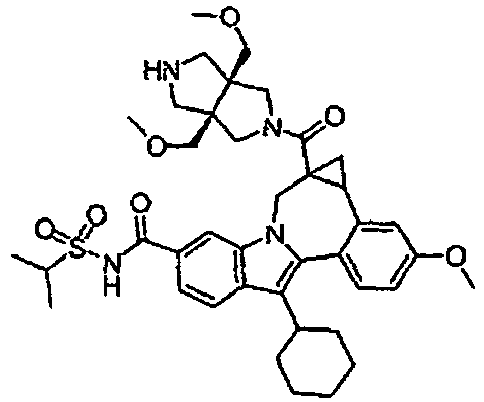
- (racemate) 1a-(((3aR, 6aS)-3a, 6a-bis (methoxymethyl)hexahydropyrrolo[3,4-c]pyrrol-2(1H)-yl)carbonyl)-8-cyclohexyl-N-(isopropylsulfonyl)-11-methoxy-1,1a,2,12b-tetrahydrocyclopropa[d]indolo[2,1-a][2]benzazepine-5-carboxamide. BOP-Cl (36 mg, 0.14 mmol) was added to a solution of 8-cyclohexyl-5-((isopropylsulfonyl)carbamoyl)-11-methoxy-1,12b-dihydrocyclopropa[d]indolo[2,1-a][2]benzazepine-1a(2H)-carboxylic acid (Intermediate 11) (60 mg, 0.109 mmol) and cis-3a,6a-bis(methoxymethyl)octahydropyrrolo[3,4-c]pyrrole dihydrochloride (Intermediate 9) (32.7 mg, 0.163 mmol) in CH2Cl2 (1mL) and DIPEA (0.1 mL, 0.57 mmol) and the mixture was stirred at rt for 16 h. The reaction was diluted with MeOH and purified by preparative HPLC (H2O-CH3CN with 10mM NH4OAc buffer) to yield product 1a-(((3aR,6aS)-3a,6a-bis(methoxymethyl)hexahydropyrrolo[3,4-c]pyrrol-2(1H)-yl)carbonyl)-8-cyclohexyl-N-(isopropylsulfonyl)-11-methoxy-1,1a,2,12b-tetrahydrocyclopropa[d]indolo[2,1-a][2]benzazepine-5-carboxamide (28.6 mg, 0.036 mmol, 33 % yield) as a white solid. LCMS: m/e 733 (M+H)+. LCMS retention time: 2.02 min. (Column: LUNA 4.6 x 50MM S10. Solvent A = H2O:CH3CN 95% : 5% 10 mm Ammonium Acetate. Solvent B = H2O:CH3CN 5% : 95% 10 mm Ammonium Acetate. Start % B = 0. Final % B = 100. Gradient Time = 3 min. Flow Rate = 4 mL/min.). Presents as a 2:3 ratio of rotamers or atrope isomers. 1H NMR (400 MHz, DMSO-d6 ) δ ppm 8.44 (br s, 0.4H), 8.12 (br s, 0.6H), 7.76 - 7.61 (m, 2H), 7.26 (d, J=8.2 Hz, 1H), 7.16 (br s, 0.4H), 7.11 (br s, 0.6H), 7.03 (d, J=8.2 Hz, 0.6H), 7.00 (d, J=8.2 Hz, 0.4H), 5.21 (d, J=15.3 Hz, 0.6H), 5.10 (d, J=15.3 Hz, 0.4H), 4.18 (d, J=11.6 Hz, 0.6H), 3.86 (s, 1.2H), 3.85 (s, 1.8H), 3.98 - 2.35 (m, 23.4H), 2.12 - 0.89 (m, 19.6H), 0.15 - 0.08 (m, 0.4H).
-
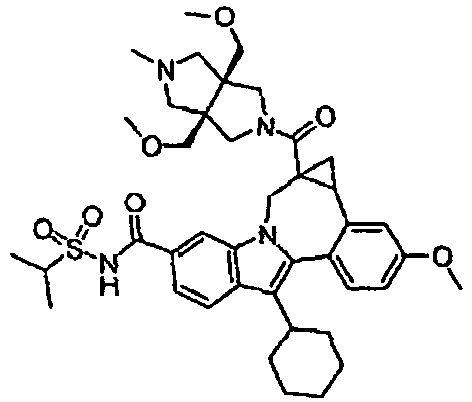
- (racemate) 1a-(((3aR, 6aS)-3a, 6a-bis(methoxymethyl)-5-methylhexahydropyrrolo[3,4-c]pyrrol-2(1H)-yl)carbonyl)-8-cyclohexyl-N-(isopropylsulfonyl)-11-methoxy-1,1a,2,12b-tetrahydrocyclopropa[d]indolo[2,1-a][2]benzazepine-5-carboxamide. A 1M solution of sodium cyanoborohydride in THF (0.16 mL, 0.16 mmol) was added to a solution of 1a-(((3aR,6aS)-3a,6a-bis(methoxymethyl)hexahydropyrrolo[3,4-c]pyrrol-2(1H)-yl)carbonyl)-8-cyclohexyl-N-(isopropylsulfonyl)-11-methoxy-1,1a,2,12b-tetrahydrocyclopropa[d]indolo[2,1-a][2]benzazepine-5-carboxamide (Example 10A) (19.6 mg, 0.027 mmol) and formaldehyde (37wt.% in water) (0.012 mL, 0.16 mmol) in MeOH (1 mL) and the mixture was stirred at rt for 16 h. The reaction was diluted with MeOH and purified by preparative HPLC (H2O-CH3CN with 10mM NH4OAc buffer) to yield 1a-(((3aR,6aS)-3a,6a-bis(methoxymethyl)-5-methylhexahydropyrrolo[3,4-c]pyrrol-2(1H)-yl)carbonyl)-8-cyclohexyl-N-(isopropylsulfonyl)-11-methoxy-1,1a,2,12b-tetrahydrocyclopropa[d]indolo[2,1-a][2]benzazepine-5-carboxamide (11.7 mg, 0.015 mmol, 57 % yield) as a white solid. LCMS: m/e 747 (M+H)+. LCMS retention time: 1.72 min. (Column: Luna 4.6 x 50mm S10. Solvent A = H2O:CH3CN 95% : 5% 10 mm Ammonium Acetate. Solvent B = H2O:CH3CN 5% : 95% 10 mm Ammonium Acetate. Start % B = 0. Final % B = 100. Gradient Time = 3 min. Flow Rate = 4 mL/min.). Presents as a 2:1:1 ratio of rotamers or atrope isomers. 1H NMR (500 MHz, MeOD) δ ppm 8.44 (br s, 0.25H), 8.14 (br s, 0.25H), 8.06 (br s, 0.5H), 7.88 - 7.11 (m, 2H), 7.88 - 7.71 (m, 1H), 7.35 - 7.26 (m, 1H), 7.22 - 7.12 (m, 1H), 7.04 - 6.95 (m, 1H), 5.22 - 5.08 (m, 0.75H), 4.97 - 4.69 (m, 0.25H), 4.16 - 0.89 (m, 44.75H), 0.30 - 0.21 (m, 0.25H).
-

- (homochiral) (1aR,12bS)-1a-(((3aR,6aS)-3a,6a-bis(methoxymethyl)hexahydropyrrolo[3,4-c]pyrrol-2(1H)-yl)carbonyl)-8-cyclohexyl-N-(isopropenylsulfonyl)-11-methoxy-1,1a,2,12b-tetrahydrocyclopropa[d]indolo[2,1]-a][2]benzazepine-5-carboxamide. BOP-Cl (36.2 mg, 0.142 mmol) was added to a solution of (1aR,12bS)-8-cyclohexyl-5-((isopropenylsulfonyl)carbamoyl)-11-methoxy-1,12b-dihydrocyclopropa[d]indolo[2,1-a][2]benzazepine-1a(2H)-carboxylic acid (Intermediate 15) (60 mg, 0.109 mmol) and cis-3a,6a-bis(methoxymethyl)octahydropyrrolo[3,4-c]pyrrole dihydrochloride (Intermediate 9) (32.9 mg, 0.164 mmol) in CH2Cl2 (1 mL) and DIPEA (0.1 mL, 0.6 mmol) and the mixture was stirred at rt for 16 h. The reaction was diluted with MeOH, and purified by preparative HPLC (H2O-CH3CN with 10mM NH4OAcbuffer) to yield (1 aR, 12bS)-1a-(((3aR,6aS)-3a,6a-bis(methoxymethyl)hexahydropyrrolo[3,4-c]pyrrol-2(1H)-yl)carbonyl)-8-cyclohexyl-N-(isopropenylsulfonyl)-11-methoxy-1,1a,2,12b-tetrahydrocyclopropa[d]indolo[2,1-a][2]benzazepine-5-carboxamide (31.9 mg, 0.041 mmol, 38 % yield) as a white solid. LCMS: m/e 731 (M+H)+. LCMS retention time: 1.99 min. (Column: LUNA 4.6 x 50MM S10. Solvent A = H2O:CH3CN 95% : 5% 10 mm Ammonium Acetate. Solvent B = H2O:CH3CN 5%: 95% 10 mm Ammonium Acetate. Start % B = 0. Final % B = 100. Gradient Time = 3 min. Flow Rate = 4 mL/min.).
-

- (homochiral) (1aR,12bS)-1a-(((3aR,6aS)-3a,6a-bis(methoxymethyl)-5-methylhexahydropyrrolo[3,4-c]pyrrol-2(1H)-yl)carbonyl)-8-cyclohexyl-N-(isopropenydsulfonyl)-11-methoxy-1,1a,2,12b-tetrahydrocyclopropa[d]indolo[2,1-a][2]benzazepine-5-carboxamide. A 1M solution of sodium cyanoborohydride in THF (0.22 mL, 0.22 mmol) was added to a solution of (1aR,12bS)-1a-(((3aR,6aS)-3a,6a-bis(methoxymethyl)hexahydropyrrolo[3,4-c]pyrrol-2(1H)-yl)carbonyl)-8-cyclohexyl-N-(isopropenylsulfonyl)-11-methoxy-1,1a,2,12b-tetrahydrocyclopropa[d]indolo[2,1-a][2]benzazepine-5-carboxamide (Example 12B) (27.2 mg, 0.037 mmol) and formaldehyde (37 wt.% in water) (0.017 mL, 0.22 mmol) in MeOH (1 mL) and the mixture was stirred at rt for 16 h. The reaction was diluted with MeOH and purified by preparative HPLC (H2O-CH3CN with 10mM NH4OAc buffer) to yield product (1aR,12bS)-1a-(((3aR,6aS)-3a,6a-bis(methoxymethyl)-5-methylhexahydropyrrolo[3,4-c]pyrrol-2(1H)-yl)carbonyl)-8-cyclohexyl-N-(isopropenylsulfonyl)-11-methoxy-1,1a,2,12b-tetrahydrocyclopropa[d]indolo[2,1-a][2]benzazepine-5-carboxamide (16.5 mg, 0.021 mmol, 58 % yield) as a white solid. LCMS: m/e 745 (M+H)+. LCMS retention time: 1.69 min. (Column: Luna 4.6 x 50mm S10. Solvent A = H2O:CH3CN 95% : 5% 10 mm Ammonium Acetate. Solvent B = H2O:CH3CN 5% : 95% 10 mm Ammonium Acetate. Start % B = 0. Final % B = 100. Gradient Time = 3 min. Flow Rate = 4 mL/min.). Presents as a 1:1:1 ratio of rotamers or atrope isomers. 1H NMR (500 MHz, MeOD) δ ppm 8.24 (br s, 0.33H), 8.12 (br s, 0.33H), 8.09 (br s, 0.33H), 7.86 - 7.73 (m, 2H), 7.35 - 7.27 (m, 1H), 7.04 - 6.95 (m, 1H), 6.01 (s, 1H), 5.54 (s, 1H), 5.22 - 5.11 (m, 0.67H), 4.96 - 4.76 (m, 0.33H), 4.17 - 0.95 (m, 38.67H), 3.92 (s, 1H), 3.90 (s, 2H), 0.33 - 0.22 (m, 0.33H).
-

- (homochiral) (1aR,12bS)-8-cyclohexyl-N-(isopropylsulfonyl)-11-methoxy-1a-((7-methyl-3,7,10-triazatricyclo[3.3.3.01,5]undec-3-yl)carbonyl)-1,1a,2,12b-tetr-ahydrocyclopropa[d]indolo[2,1-a][2]benzazepine-5-carboxamide. BOP-Cl (35 mg, 0.14 mmol) was added to a solution of 2-methyltetrahydro-1H,4H-3a,6a-(methanoiminomethano)pyrrolo[3,4-c]pyrrole trihydrochloride (Intermediate 7) (37.7 mg, 0.136 mmol) and (1aR,12bS)-8-cyclohexyl-5-((isopropylsulfonyl)carbamoyl)-11-methoxy-1,12b-dihydrocyclopropa[d]indolo[2,1-a][2]benzazepine-1a(2H)-carboxylic acid (Intermediate 10) (50 mg, 0.091 mmol) in CH2Cl2 (3 mL) and TEA (0.3 mL, 2 mmol) and the mixture was stirred at rt for 16h. The reaction was concentrated, dissolved into MeOH, filtered and purified by preparative HPLC (H2O-MeCN with 0.1% TFA buffer) to yield (1aR,12bS)-8-cyclohexyl-N-(isopropylsulfonyl)-11-methoxy-1a-((7-methyl-3,7,10-triazatricyclo[3.3.3.01,5]undec-3-yl)carbonyl)-1,1a,2,12b-tetrahydrocyclopropa[d]indolo[2,1-a][2]benzazepine-5-carboxamide (24 mg, 0.034 mmol, 38 % yield) as light yellow solid. LCMS: m/e 700 (M+H)+. LCMS retention time: 1.67 min. (Column: SunFire C18 5u 4.6 X 50 mm. Solvent A = 90% Water/ 10% Acetonitrile/ 0.1%TFA. Solvent B = 10% Water/ 90% Acetonitrile/ 0.1 %TFA. Start % B = 0. Final % B = 100. Gradient Time = 3 min. Flow Rate = 4 mL/min.). Presents as a 2:1 ratio of rotamers or atrope isomers. 1H NMR (400 MHz, MeOD) δ ppm 8.19 (br s, 0.33H), 8.03 (d, J=1.3 Hz, 0.67H), 7.90 (d, J=8.5 Hz, 0.33H), 7.90 (d, J=8.5 Hz, 0.67H), 7.63 - 7.57 (m, 1H), 7.31 (d, J=8.5 Hz, 0.67H), 7.31 (d, J=8.5 Hz, 0.33H), 7.17 - 7.14 (m, 1H), 7.01 (dd, J=8.5, 2.3 Hz, 0.67H), 6.98 (dd, J=8.5,2.8 Hz, 0.33H), 5.13 (d, J=15.1 Hz, 0.67H), 4.96 - 4.93 (m, 0.33H), 4.15 (d, J=15.1 Hz, 0.67H), 3.98 - 3.89 (m, 2.33 H), 3.88 (s, 1H), 3.86 (s, 2H), 3.75 - 3.21 (m, 11H), 3.01 - 2.79 (m, 4H), 2.63 - 2.51 (m, 1H), 2.14 - 1.61 (m, 7H), 1.52 - 1.06 (m, 11.67H), 0.24 - 0.19 (m, 0.33H).
-

- (achiral) 13-cyclohexyl-N-(dimethylsulfamoyl)-6-((7,10-dimethyl-3,7,10-triazatricyclo[3.3.3.01,5]undec-3-yl)carbonyl)-3-methoxy-7H-indolo[2,1-a][2]benzazepine-10-carboxamide. BOP-Cl (28 mg, 0.11 mmol) was added to a solution of 2-methyltetrahydro-1H,4H-3a,6a-(methanoiminomethano)pyrrolo[3,4-c]pyrrole trihydrochloride (Intermediate 5) (31 mg, 0.11 mmol) and 13-cyclohexyl-10-((dimethylsulfamoyl)carbamoyl)-3-methoxy-7H-indolo[2,1-a][2]benzazepine-6-carboxylic acid (Intermediate 18) (40 mg, 0.074 mmol) in CH2Cl2 (2 mL) and TEA (0.2 mL, 1.4 mmol), and the mixture was stirred at rt for 16h. The solvent was removed under vacuum and the residue was partitioned between EtOAc (5 mL) / sat. aq NaHCO3 (2 mL). The organic layer was washed with sat. aq NH4Cl, brine, dried (MgSO4), filtered and concentrated to yield a crude intermediate as a yellow solid. This material was dissolved into MeOH (1 mL) and to it was added formaldehyde (37wt.% in water) (0.016 mL, 0.22 mmol) and then a 1M solution of sodium cyanoborohydride in THF (0.22 mL, 0.22 mmol). The mixture was stirred at rt for 3 d. The reaction was filtered and purified by preparative HPLC (H2O-MeOH with 0.1 % TFA buffer) to yield product 13-cyclohexyl-N-(dimethylsulfamoyl)-6-((7,10-dimethyl-3,7,10-triazatricyclo[3.3.3.01,5]undec-3-yl)carbonyl)-3-methoxy-7H-indolo[2,1-a][2]benzazepine-10-carboxamide (9.3 mg, 9.5 µmol, 44 % yield) as a bright yellow solid. LCMS: m/e 701 (M+H)+. LCMS retention time: 2.29 min. (Column: Phenomenex-Luna 3.0 x 50mm S10. Solvent A = 90% Water :10% Methanol: 0.1% TFA. Solvent B = 10% Water :90% Methanol: 0.1% TFA. Start % B = 0. Final % B = 100. Gradient Time = 3 min. Flow Rate = 4 mL/min). 1H NMR (400 MHz, MeOD) δ ppm 8.13 (d, J=1.5 Hz, 1H), 7.92 (d, J=8.5 Hz, 1H), 7.59 - 7.55 (m, 2H), 7.18 (dd, J=8.5, 2.5 Hz, 1H), 7.13 - 7.01 (m. 2H), 5.43 - 5.13 (m, 2H), 4.39 - 4.27 (m, 1H), 3.92 (s, 3H), 3.86 - 3.45 (m, 4H), 3.43 - 3.29 (m, 2H), 3.14 - 3.10 (m, 1H), 3.00 (s, 6H), 2.92 - 2.67 (m, 8H), 2.23 - 1.69 (m, 7H), 1.56 - 1.10 (m, 6H).
-

- (racemic) 8-cyclohexyl-N-(dimethylsulfamoyl)-11-methoxy-1a-((7-methyl-3,7,10-triazatricyclo(3.3.3.01,5]undec-3-yl)carbonyl)-1,1a,2,12b-tetrahydrocyclopropa[d]indolo[2,1-a][2]benzazepine-5-carboxamide. BOP-Cl (27.7 mg, 0.109 mmol) was added to a solution of 2-methyltetrahydro-1H,4H-3a,6a-(methanoiminomethano)pyrrolo[3,4-c]pyrrole trihydrochloride (Intermediate 5) (30.1 mg, 0.109 mmol) and 8-cyclohexyl-5-((dimethylsulfamoyl)carbamoyl)-11-methoxy-1,12b-dihydrocyclopropa[d]indolo[2,1-a][2]benzazepine-1a(2H)-carboxylic acid (Intermediate 19) (40 mg, 0.073 mmol) in CH2Cl2 (2 mL) and TEA (0.20 mL, 1.4 mmol) and the mixture was stirred at rt for 16 h. The reaction was concentrated, dissolved into MeOH, filtered and purified by preparative HPLC (H2O-MeCN with 0.1% TFA buffer) to yield 8-cyclohexyl-N-(dimethylsulfamoyl)-11-methoxy-1a-((7-methyl-3,7,10-triazatricyclo[3.3.3.01,5]undec-3-yl)carbonyl)-1,1a,2,12b-tetrahydrocyclopropa[d]indolo[2,1-a][2]benzazepine-5-carboxamide (13.6 mg, 0.014 mmol, 19 % yield) as yellow solid. LCMS: m/e 701 (M+H)+. LCMS retention time: 1.66 min. (Column: SunFire C18 5u 4.6 X 50 mm. Solvent A = 90% Water/ 10% Acetonitrile/ 0.1%TFA. Solvent B = 10% Water/ 90% Acetonitrile/ 0.1%TFA. Start % B = 0. Final % B = 100. Gradient Time = 3 min. Flow Rate = 4 mL/min.). Presents as a 2:3 ratio of rotamers or atrope isomers. 1H NMR (400 MHz, MeOD) δ ppm 8.17 (br s, 0.4H), 8.00 (d, J=1.3 Hz, 0.6H), 7.89 (d, J=8.5 Hz, 1H), 7.60 (dd, J=8.5, 1.3 Hz, 0.4H), 7.58 (dd, J=8.5, 1.3 Hz, 0.6H), 7.31 (d, J=8.5 Hz, 1H), 7.17 - 7.13 (m, 1H), 7.00 (dd, J=8.5, 2.5 Hz, 0.6H), 6.97 (dd, J=8.5, 2.5 Hz, 0.4H), 5.11 (d, J=15.3 Hz, 0.6H), 4.97 - 4.90 (m, 0.4H), 4.15 (d, J=14.8 Hz, 0.4H), 4.15 - 3.84 (m, 2.6H), 3.88 (s, 1.2H), 3.86 (s, 1.8H), 3.82 - 3.21 (m, 10.4H), 3.06 - 2.74 (m, 4.6H), 2.98 (s, 6H), 2.64 - 2.50 (m, 1H), 2.15 - 1.59 (m, 7H), 1.52 - 1.07 (m, 4.6H), 0.24 - 0.19 (m, 0.4H).
-

- (racemic) 8-cyclohexyl-N-(dimethylsulfamoyl)-1a-((7,10-dimethyl-3,7,10-triazatricyclo[3.3.3.01,5[undec-3-yl)carbonyl)-11-methoxy-1,1a,2,12b-tetrahydrocyclopropa[d]indolo[2,1-a][2]benzazepine-5-carboxamide. A 1M solution of sodium cyanoborohydride in THF (0.20 mL, 0.20 mmol) was added to a solution of 8-cyclohexyl-N-(dimethylsulfamoyl)-11-methoxy-1a-((7-methyl-3,7,10-triazatricyclo[3.3.3.01,5]undec-3-yl)carbonyl)-1,a,2,12b-tetrahydrocyclopropa[d]indolo[2,1-a][2]benzazepine-5-carboxamide (Example 16A) (14 mg, 0.020 mmol) and formaldehyde (37wt.% in water) (0.015 mL, 0.20 mmol) in MeOH (1 mL) and the mixture was stirred at rt for 16 h. The reaction was filtered and purified by preparative HPLC (H2O-MeOH with 0.1% TFA buffer) to yield product 8-cyclohexyl-N-(dimethylsulfamoyl)-la-((7,10-dimethyl-3,7,10-triazatricyclo[3.3.3.01,5]undec-3-yl)carbonyl)-11-methoxy-1,1a,2,12b-tetrahydrocyciopropa[d]indolo[2,1-a][2]benzazepine-5-carboxamide (8.2 mg, 8.3 µmol, 41% yield) as a bright yellow solid. LCMS: m/e 715 (M+H)+. LCMS retention time: 1.71 min. (Column: SunFire C18 5u 4.6 X 50 mm. Solvent A = 90% Water/ 10% Acetonitrile/ 0.1%TFA. Solvent B = 10% Water/ 90% Acetonitrile/ 0.1%TFA. Start % B = 0. Final % B = 100. Gradient Time = 3 min. Flow Rate = 4 mL/min.). Presents as a 2:3 ratio of rotamers or atrope isomers. 1H NMR (400 MHz, MeOD) δ ppm 8.19 (br s, 0.4H), 8.04 (br s, 0.6H), 7.90 (d, J=8.5 Hz, 0.6H), 7.88 (d, J=8.5 Hz, 0.4H), 7.59 (dd, J=8.5, 1.5 Hz, 0.6H), 7.58 (dd, J=8.5, 1.5 Hz, 0.4H), 7.30 (d, J=8.5 Hz, 0.6H), 7.29 (d, J=8.5 Hz, 0.4H), 7.15 (d, J=2.5 Hz, 0.6H), 7.15 (d, J=2.8 Hz, 0.4H), 7.00 (dd, J=8.5, 2.5 Hz, 0.6H), 6.97 (dd, J=8.5,2.8 Hz, 0.4H), 5.12 (d, J=15.3 Hz, 0.6H), 4.96 (d, J=15.1 Hz, 0.4H), 4.14 (d, J=15.1 Hz, 0.4H), 4.12 - 3.24 (m, 11.6H), 3.88 (s, 1.2H), 3.86 (s, 1.8H), 3.07 - 2.74 (m, 7H), 2.99 (s, 2.4H), 2.98 (s, 3.6H), 2.62 (dd, J=9.0, 5.8 Hz, 0.6H), 2.53 (dd, J=10.0, 6.3 Hz, 0.4H), 2.16 - 1.05 (m, 11.6H), 0.23 - 0.17 (m, 0.4H).
-

- (racemic) 8-cyclohexyl-N-(dimethylsulfamoyl)-1-methoxy-1a-(3-oxa-7,10-diazatricyclo[3.3.3.01,5]undec-7-ylcarbonyl)-1,1a,2,12b-tetrahydrocyclopropa[d]indolo[2,1-a][2]benzazepine-5-carboxamide. BOP-Cl (14 mg, 0.054 mmol) was added to a solution of dihydro-4H-3a,6a-(methanoiminomethano)furo[3,4-c]pyrrole dihydrochloride (Intermediate 3) (12.4 mg, 0.054 mmol) and 8-cyclohexyl-5-((dimethylsulfamoyl)carbamoyl)-11-methoxy-1,12b-dihydrocyclopropa[d]indolo[2,1-a][2]benzazepine-1a(2H)-carboxylic acid (Intermediate 19) (20 mg, 0.036 mmol) in CH2Cl2 (1 mL) and TEA (0.1 mL, 0.7 mmol) and the mixture was stirred at rt for 16 h. The reaction was concentrated, dissolved into MeOH, filtered and purified by preparative HPLC (H2O-MeOH with 0.1% TFA buffer) to yield product 8-cyclohexyl-N-(dimethylsulfamoyl)-11-methoxy-1a-(3-oxa-7,10-diazatricyclo[3.3.3.01,5]undec-7-ylcarbonyl)-1,1a,2,12b-tetrahydrocyclopropa[d]indolo[2,1-a][2]benzazepine-5-carboxamide (12 mg, 0.013 mmol, 37 % yield) as a bright yellow solid. LCMS: m/e 688 (M+H)+. LCMS retention time: 2.41 min. (Column: Phenomenex-Luna 3.0 x 50mm S 10. Solvent A = 90% Water: 10% Methanol: 0.1% TFA. Solvent B = 10% Water:90% Methanol: 0.1% TFA. Start % B = 0. Final % B = 100. Gradient Time = 3 min. Flow Rate = 4 mL/min). Presents as a 7:3 ratio of rotamers or atrope isomers. 1H NMR (400 MHz, MeOD) δ ppm 8.09 (br s, 0.3H), 7.95 (br s, 0.7H), 7.88 (d, J=8.5 Hz, 1H), 7.59 - 7.53 (m, 1H), 7.29 (d, J=8.5 Hz, 1H), 7.16 (d, J=2.5 Hz, 0.7H), 7.15 (d, J=2.5 Hz, 0.3H), 6.99 (dd, J=8.5, 2.5 Hz, 0.7H), 6.97 (dd, J=8.5, 2.5 Hz, 0.3H), 5.11 (d, J=15.3 Hz, 0.7H), 4.93 - 4.79 (m, 0.3H), 4.15 (d, J=14.8 Hz, 0.3H), 4.11 - 3.44 (m, 8H), 3.88 (s, 0.9H), 3.86 (s, 2.1H), 3.60 (d, J=15.3 Hz, 0.7H), 3.41 - 3.14 (m, 3H), 2.98 (s, 6H), 3.04 - 2.89 (m, 1.7H), 2.85 - 2.75 (m, 0.3H), 2.66 (dd, J=8.8, 5.8 Hz, 0.7H), 2.52 (dd, J=10.0, 6.3 Hz, 0.3H), 2.16 - 1.04 (m, 12.7H), 0.20 - 0.14 (m, 0.3H).
-

- (racemic) 8-cyclohexyl-N-(dimethylsulfamoyl)-11-methoxy-1a-((10-methyl-3-oxa-7,10-diazatricyclo[3.3.3.01,5]undec-7-yl)carbonyl)-1,1a,2,12b-tetrahydrocyclopropa[d]indodo[2,1-a][2]benzazepine-5-carboxamide. A 1M solution of sodium cyanoborohydride in THF (0.13 mL, 0.13 mmol) was added to a solution of 8-cyclohexyl-N-(dimethylsulfamoyl)-11-methoxy-1a-(3-oxa-7,10-diazatricyclo[3.3.3.01,5]undec-7-ylcarbonyl)-1,1a,2,12b-tetrahydrocyclopropa[d]indolo[2,1-a][2]benzazepine-5-carboxamide (Example 18A) (9.0 mg, 0.01.3 mmol) and formaldehyde (37wt.% in water) (0.010 mL, 0.10 mmol) in MeOH (1 mL) and the mixture was stirred at rt for 16 h. The reaction was concentrated, dissolved into MeOH, filtered and purified by preparative HPLC (H2O-MeOH with 0.1% TFA buffer) to yield 8-cyclohexyl-N-(dimethylsulfamoyl)-11-methoxy-1a-((10-methyl-3-oxa-7,10-diazatricyclo[3.3.3.01,5]undec-7-yl)carbonyl)-1,1a,2,12b-tetrahydrocyclopropa[d]indolo[2,1-a][2]benzazepine-5-carboxamide (7.5 mg, 8.7 µmol, 67 % yield) as a white solid. LCMS: m/e 702 (M+H)+. LCMS retention time: 1.84 min. (Column: SunFire C18 5u 4.6 X 50 mm. Solvent A = 90% Water/ 10% Acetonitrile/ 0.1%TFA. Solvent B = 10% Water/ 90% Acetonitrile/ 0.1%TFA. Start % B = 0. Final % B = 100. Gradient Time = 3 min. Flow Rate = 4 mL/min.). Presents as a 2:1 ratio of rotamers or atrope isomers. 1H NMR (400 MHz, MeOD) δ ppm 8.11 (br s, 0.33H), 7.97 (br s, 0.67H), 7.89 (d, J=8.5 Hz, 0.33H), 7.88 (d, J=8.5 Hz, 0.67H), 7.60 - 7.54 (m, 1H), 7.29 (d, J=8.5 Hz, 0.67H), 7.29 (d, J=8.5 Hz, 0.33H), 7.16 (d, J=2.5 Hz, 0.67H), 7.15 (d, J=2.8 Hz, 0.33H), 7.00 (dd, J=8.5, 2.5 Hz, 0.67H), 6.97 (dd, J=8.5, 2.8 Hz, 0.33H), 5.11 (d, J=15.1 Hz, 0.67H), 4.92 - 4.80 (m, 0.33H), 4.21 - 3.44 (m, 9H), 3.87 (s, 1H), 3.86 (s, 2H), 3.16 - 2.49 (m, 8H), 2.99 (s, 2H), 2.98 (s, 4h), 2.16 - 1.04 (m, 12.67H), 0.21 - 0.15 (m, 0.33H).
-

- (achiral) 13-cyclohexyl-N-(dimethylsulfamoyl)-3-methoxy-6-(3-oxa-7,10-diazatricyclo[3.3.3.01,5]undec-7-ylcarbonyl)-7H-indolo[2,1-a][2]benzazepine-10-carboxamide. BOP-Cl (14 mg, 0.056 mmol) was added to a solution of dihydro-4H 3a,6a-(methanoiminomethano)furo[3,4-c]pyrrole dihydrochloride (Intermediate 3) (12.7 mg, 0.056 mmol) and 13-cyclohexyl-10-((dimethylsulfamoyl)carbamoyl)-3-methoxy-7H-indolo[2,1-a][2]benzazepine-6-carboxylic acid (Intermediate 18) (20 mg, 0.037 mmol) in CH2Cl2 (1 mL) and TEA (0.1 mL, 0.7 mmol) and the mixture was stirred at rt for 16 h. The reaction was concentrated, diluted with MeOH, filtered and purified by preparative HPLC (H2O-MeOH with 0.1 % TFA buffer) to yield 13-cyclohexyl-N-(dimethylsulfamoyl)-3-methoxy-6-(3-oxa-7,10-diazatricyclo[3.3.3.01,5]undec-7-ylcarbonyl)-7H-indolo[2,1-a][2]benzazepine-10-carboxamide (12.5 mg, 0.014 mmol, 38 % yield) as a yellow solid. LCMS: m/e 674 (M+H)+. LCMS retention time: 2.44 min. (Column: Phenomenex-Luna 3.0 x 50mm S10. Solvent A = 90% Water: 10% Methanol: 0.1 % TFA. Solvent B =10% Water:90% Methanol: 0.1% TFA. Start % B = 0. Final % B =100. Gradient Time = 3 min. Flow Rate = 4 mL/min). 1H NMR (400 MHz, MeOD) δ ppm 8.06 (d, J=1.3 Hz, 1H), 7.86 (d, J=8.5 Hz, 1H), 7.55 - 7.51 (m, 2H), 7.15 (dd, J=8.5,2.8 Hz, 1H), 7.09 (br d, J=2.8 Hz, 1H), 7.06 (br s, 1H), 5.26 - 5.16 (m, 1H), 4.93 - 4.82 (m, 1H), 4.30 - 4.18 (m, 1H), 4.12 - 4.01 (m, 1H), 3.96 - 3.89 (m, 1H), 3.89 (s, 3H), 3.62 - 3.39 (m, 5H), 3.32 - 3.09 (m, 3H), 2.98 (s, 6H), 2.86 - 2.77 (m, 1H), 2.14 - 1.11 (m, 11H).
-

- (achiral) 13-cyclohexyl-N-(dimethylsulfamoyl)-3-methoxy-6-((10-methyl-3-oxa-7,10-diazatricyclo[3.3.3.01,5]undec-7-yl)carbonyl)-7H-indolo[2,1-a][2]benzazepine-10-carboxamide. A 1M solution of sodium cyanoborohydride in THF (0.15 mL, 0.15 mmol) was added to a solution of 13-cyclohexyl-N-(dimethylsulfamoyl)-3-methoxy-6-(3-oxa-7,10-diazatricyclo[3.3.3.01,5]undec-7-ylcarbonyl)-7H-indolo[2,1-a][2]benzazepine-10-carboxamide (Example 20) (10 mg, 0.015 mmol) and formaldehyde (37wt.% in water) (0.01 mL, 0.1 mmol) in MeOH (1 mL) and the mixture was stirred at rt for 16 h. The reaction was filtered and purified by preparative HPLC (H2O-MeOH with 0.1 % TFA buffer) to yield product 13-cyclohexyl-N-(dimethylsulfamoyl)-3-methoxy-6-((10-methyl-3-oxa-7,10-diazatricyclo[3.3.3.01,5]undec-7-yl)carbonyl)-7H-indolo[2,1-a][2]benzazepine-10-carboxamide (8.5 mg, 10 µmol, 68 % yield) as a bright yellow solid. LCMS: m/e 688 (M+H)+. LCMS retention time: 1.91 min. (Column: SunFire C18 5u 4.6 X 50 mm. Solvent A = 90% Water/ 10% Acetonitrile/ 0.1%TFA. Solvent B = 10% Water/ 90% Acetonitrile/ 0.1%TFA. Start % B = 0. Final % B = 100. Gradient Time = 3 min. Flow Rate = 4 mL/min.) 1H NMR (400 MHz, MeOD) δ ppm 8.07 (br s, 1H), 7.87 (d, J=8.5 Hz, 1H), 7.54 (br d, J=8.5 Hz, 1H), 7.53 (d, J=8.5 Hz, 1H), 7.14 (dd, J=8.5, 2.5 Hz, 1H), 7.09 (d, J=2.5 Hz, 1H), 7.06 (s, 1H), 5.23 (br d, J=14.8 Hz, 1H), 4.37 - 3.06 (m, 10H), 4.25 (br d, J=14.8 Hz, 1H), 3.89 (s, 3H), 2.98 (s, 6H), 2.94 - 2.76 (m, 4H), 2.15 - 1.69 (m, 6H), 1.52 - 1.10 (m, 4H).
-

- (achiral) 13-cyclohexyl-N-(cyclopropylsulfonyl)-3-methoxy-6-(3-oxa-7,10-diazatricyclo[3.3.3.01,5]undec-7-ylcarbonyl)-7H-indolo[2,1-a][2]benzazepine-10-carboxamide. BOP-Cl (14.3 mg, 0.056 mmol) was added to a solution of dihydro-4H-3a,6a-(methanoiminomethano)furo[3,4-c]pyrrole dihydrochloride (Intermediate 3) (12.7 mg, 0.056 mmol) and 13-cyclohexyl-10-((cyclopropylsulfonyl)carbamoyl)-3-methoxy-7H-indolo[2,1-a][2]benzazepine-6-carboxylic acid (Intermediate 20) (20 mg, 0.037 mmol) in CH2Cl2 (1 mL) and TEA (0.1 mL, 0.7 mmol) and the mixture was stirred at rt for 16 h. The reaction was concentrated, diluted with MeOH, filtered and purified by preparative HPLC (H2O-MeOH with 0.1% TFA buffer) to yield product 13-cyclohexyl-N-(cyclopropylsulfonyl)-3-methoxy-6-(3-oxa-7,10-diazatricyclo[3.3.3.01,5]undec-7-ylcarbonyl)-7H-indolo[2,1-a][2]benzazepine-10-carboxamide (12 mg, 0.014 mmol, 37 % yield) as a yellow solid. LCMS: m/e 671 (M+H)+. LCMS retention time: 2.41 min. (Column: Phenomenex-Luna 3.0 x 50mm S10. Solvent A = 90% Water: 10% Methanol: 0. 1 % TFA. Solvent B = 10% Water:90% Methanol: 0.1% TFA. Start % B = 0. Final % B = 100. Gradient Time = 3 min. Flow Rate = 4 mL/min). 1H NMR (400 MHz, MeOD) δ ppm 8.07 (d, J=1.3 Hz, 1H), 7.87 (d, J=8.5 Hz, 1H), 7.54 (d, J=8.8 Hz, 2H), 7.15 (dd, J=8.8, 2.8 Hz, 1H), 7.09 (d, J=2.8 Hz, 1H), 7.07 (br s, 1H), 5.26 - 5.16 (m, 1H), 4.93 - 4.81 (m, 1H), 4.29 - 4.18 (m, 1H), 4.07 - 3.88 (m, 2H), 3.90 (s, 3H), 3.64 - 3.39 (m, 6H), 3.28 - 3.09 (m, 4H), 2.87 - 2.77 (m, 1H), 2.18 - 1.09 (m, 14H).
-

- (achiral) 13-cyclohezyl-N-(cyclopropylsulfonyl)-3-methoxy-6-((10-methyl-3-oxa-7,10-diazatricyclo[3.3.3.01,5]undec-7yl)carbonyl)-7H-indolo[2,1-a][2]benzazepine-10-carboxamide. A 1M solution of sodium cyanoborohydride in THF (0.15 mL, 0.15 mmol) was added to a solution of 13-cyclohexyl-N-(cyclopropylsulfonyl)-3-methoxy-6-(3-oxa-7,10-diazatricyclo[3.3.3.01,5]undec-7-ylcarbonyl)-7H-indolo[2,1-a][2]benzazepine-10-carboxamide (Example 22) (10 mg, 0.015 mmol) and formaldehyde (37 wt.% in water) (0.01 mL, 0.1 mmol) in MeOH (1 mL) and the mixture was stirred at rt for 16 h. The reaction was concentrated, dissolved into MeOH, filtered and purified by preparative HPLC (H2O-MeOH with 0.1 % TFA buffer) to yield 13-cyclohexyl-N-(cyclopropylsulfonyl)-3-methoxy-6-((10-methyl-3-oxa-7,10-diazatricyclo[3.3.3.01,5]undec-7-yl)carbonyl)-7H-indolo[2,1-a][2]benzazepine-10-carboxamide (7.9 mg, 9.4 µmol, 63 % yield) as a bright yellow solid. LCMS: m/e 685 (M+H)+. LCMS retention time: 1.92 min. (Column: SunFire C18 5u 4.6 X 50 mm. Solvent A = 90% Water/ 10% Acetonitrile/ 0.1%TFA. Solvent B = 10% Water/ 90% Acetonitrile/ 0.1%TFA. Start % B = 0. Final % B = 100. Gradient Time = 3 min. Flow Rate = 4 mL/min.) 1H NMR (400 MHz, MeOD) δ ppm 8.09 (br s, 1H), 7.87 (d, J=8.5 Hz, 1H), 7.54 (br d, J=8.5 Hz, 1H), 7.53 (d, J=8.5 Hz, 1H), 7.14 (dd, J=8.5, 2.5 Hz, 1H), 7.10 (d, J=2.5 Hz, 1H), 7.07 (s, 1H), 5.22 (br d, J=14.8 Hz, 1H), 4.13 - 3.12 (m, 10H), 4.23 (br d, J=14.8 Hz, 1H), 3.90 (s, 3H), 2.97 - 2.76 (m, 5H), 2.15 - 1.67 (m, 6H), 1.52 - 1.07 (m, 8H).
-

- (racemate) 13-cyclohexyl-N-(cyclopropylsulfonyl)-3-methoxy-6-(3-oxa-7,10-diazatricyclo[3.3.3.01,5]undec-7-ylcarbonyl)-6,7-dihydro-5H-indolo[2,1-a][2]benzazepine-10-carboxamide. BOP-Cl (21.5 mg, 0.084 mmol) was added to a solution of dihydro-4H-3a,6a-(methanoiminomethano)furo[3,4-c]pyrrole dihydrochloride (Intermediate 3) (19 mg, 0.084 mmol) and methyl 8-cyclohexyl-5-((cyclopropylsulfonyl)carbamoyl)-11-methoxy-1,12b-dihydrocyclopropa[d]indolo[2,1-a][2]benzazepine-1a(2H)-carboxylate (Intermediate 21) (30 mg, 0.056 mmol) in CH2Cl2 (1 mL) and TEA (0.16 mL, 1.1 mmol) and the mixture was stirred at rt for 4 d. The reaction was concentrated, dissolved into MeOH, filtered and purified by preparative HPLC (H2O-MeOH with 0.1% TFA buffer) to yield 13-cyclohexyl-N-(cyclopropylsulfonyl)-3-methoxy-6-(3-oxa-7,10-diazatricyclo[3.3.3.01,5]undec-7-ylcarbonyl)-6,7-dihydro-5H-indolo[2,1-a][2]benzazepine-10-carboxamide (17.9 mg, 0.020 mmol, 37 % yield) as a yellow solid. LCMS: m/e 673 (M+H)+. LCMS retention time: 2.83 min. (Column: Phenomenex-Luna 3.0 x 50mm S10. Solvent A = 90% Water :10% Methanol: 0.1% TFA. Solvent B = 10% Water :90% Methanol: 0.1% TFA. Start % B = 0. Final % B = 100. Gradient Time = 3 min. Flow Rate = 4 mL/min). Presents as a 2:1 ratio of rotamers or atrope isomers. 1H NMR (400 MHz, MeOD) δ ppm 8.04 - 7.94 (m, 1H), 7.89 - 7.76 (m, 1H), 7.59 - 7.48 (m, 1H), 7.38 - 7.28 (m, 1H), 7.08 - 6.72 (m, 2H), 4.57 - 4.37 (m, 1H), 4.12 - 3.29 (m, 17H), 3.23 - 3.15 (m, 1H), 2.96 - 1.08 (m, 17H).
-

- (racemate) 13-cyclohexyl-N-(cyclopropylsulfonyl)-3-methoxy-6-((10-methyl-3-oxa-7,10-diazatricyclo[3.3.3.01,5]undec-7-yl)carbonyl)-6,7-dihydro-5H-indolo[2,1-a][2]benzazepine-10-carboxamide. A 1M solution of sodium cyanoborohydride in THF (0.16 mL, 0.16 mmol) was added to a solution of 13-cyclohexyl-N-(cyclopropylsulfonyl)-3-methoxy-6-(3-oxa-7,10-diazatricyclo[3.3.3.01,5]undec-7-ylcarbonyl)-6,7-dihydro-5H-indolo[2,1-a][2]benzazepine-10-carboxamide (Example 24A) (11 mg, 0.016 mmol) and formaldehyde (37wt.% in water) (0.01 mL, 0.1 mmol) in MeOH (1 mL) and the mixture was stirred at rt for 16 h. The reaction was concentrated, dissolved into MeOH, filtered and purified by preparative HPLC (H2O-MeOH with 0.1 % TFA buffer) to yield 13-cyclohexyl-N-(cyclopropylsulfonyl)-3-methoxy-6-((10-methyl-3-oxa-7,10-diazatricyclo[3.3.3.01,5]undec-7-yl)carbonyl)-6,7-dihydro-5H-indolo[2,1-a][2]benzazepine-10-carboxamide (12 mg, 0.013 mmol, 82 % yield) as a yellow solid. LCMS: m/e 687 (M+H)+. LCMS retention time: 2.47 min. (Column: Phenomenex-Luna 3.0 x 50mm S10. Solvent A = 90% Water: 10% Methanol: 0.1% TFA. Solvent B = 10% Water:90% Methanol: 0.1% TFA. Start % B = 0. Final % B = 100. Gradient Time = 3 min. Flow Rate = 4 mL/min).
-
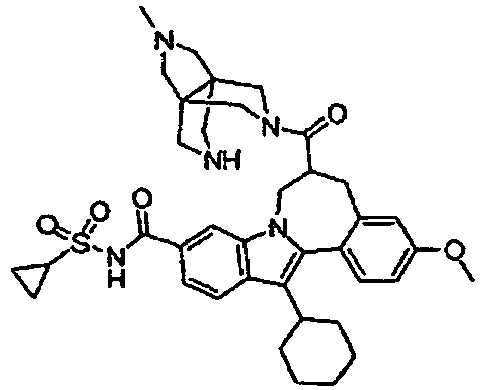
- (racemate) 13-cyclohexyl-N-(cyclopropylsulfonyl)-3-methoxy-6-((7-methyl-3,7,10-triazatricyclo[3.3.3.01,5]undec-3-yl)carbonyl)-6,7-dihydro-5H-indolo[2,1-a][2]benzazepine-10-carboxamide. BOP-Cl (21.3 mg, 0.084 mmol) was added to a solution of 2-methyltetrahydro-1H,4H-3a,6a-(methanoiminomethano)pyrrolo[3,4-c]pyrrole trihydrochloride (Intermediate 5) (23.2 mg, 0.084 mmol) and methyl 8-cyclohexyl-5-((cyclopropylsulfbnyl)carbamoyl)-11-methoxy-1,12b-dihydrocyclopropa[d]indolo[2,1-a][2]benzazepine-1a(2H)-carboxylate (Intermediate 21) (30 mg, 0.056 mmol) in CH2Cl2 (1 mL) and TEA (0.16 mL, 1.1 mmol) and the mixture was stirred at rt for 3d. The reaction was concentrated, dissolved into MeOH, filtered and purified by preparative HPLC (H2O-MeCN with 0.1 % TFA buffer) and repurified by preparative HPLC (H2O-MeOH with 0.1% TFA buffer) to yield product 13-cyclohexyl-N-(cyclopropylsulfonyl)-3-methoxy-6-((7-methyl-3,7,10-triazatricyclo[3.3.3.01,5]undec-3-yl)carbonyl)-6,7-dihydro-5H-indolo[2,1-a][2]benzazepine-10-carboxamide (3.7 mg, 3.8 µmol, 6.9 % yield) as a yellow solid. LCMS: m/e 686 (M+H)+. LCMS retention time: 2.37 min. (Column: Phenomenex-Luna 3.0 x 50mm S10. Solvent A = 90% Water: 10% Methanol: 0.1% TFA. Solvent B = 10% Water: 90% Methanol: 0.1% TFA. Start % B = 0. Final % B = 100. Gradient Time = 3 min. Flow Rate = 4 mL/min). 1H NMR (500 MHz, MeOD) δ ppm 8.08 - 7.98 (m, 1H), 7.94 - 7.86 (m, 1H), 7.65 - 7.57 (m, 1H), 7.45- 7.36 (m, 1H), 7.09 - 7.01 (m, 1.75H), 6.90 - 6.84 (m, 0.25H), 4.62 - 2.91 (m, 23H), 2.85 - 2.64 (m, 2H), 2.15 - 1.92 (m, 4H), 1.86 - 1.77 (m, 2H), 1.68 - 1.24 (m, 6H), 1.22 - 1.12 (m, 2H).
-

- (racemate) 13-cyclohexyl-N-(dimethylsulfamoyl)-6-((7,10-dimethyl-3,7,10-triazatricyclo[3.3.3.01,5]undec-3-yl)carbonyl)-3-methoxy-6,7-dihydro-5H-indolo[2,1-a][2]benzazepine-10-carboxamide. 10% Pd/C (4 mg, 4 µmol) was added to a suspension of 13-cyclohexyl-N-(dimethylsulfamoyl)-6-((7,10-dimethyl-3,7,10-triazatricyclo[3.3.3.01,5]undec-3-yl)carbonyl)-3-methoxy-7H-indolo[2,1-a][2]benzazepine-10-carboxamide (Example 15) (6.0 mg, 8.6 µmol) in MeOH (2 mL). The reaction mixture was vacuum flushed with N2, and then with H2 and stirred under a H2 balloon at rt for 16 h. The reaction mixture was filtered through celite, and concentrated to yield 13-cyclohexyl-N-(dimethylsulfamoyl)-6-((7,10-dimethyl-3,7,10-triazatricyclo[3.3.3.01,5]undec-3-yl)carbonyl)-3-methoxy-6,7-dihydro-5H-indolo[2,1-a][2]benzazepine-10-carboxamide (3.1 mg, 4.2 µmol, 49 % yield) as an off white solid. LCMS: m/e 703 (M+H)+. LCMS retention time: 2.35 min. (Column: Phenomenex-Luna 3.0 x 50mm S10. Solvent A = 90% Water :10% Methanol: 0.1% TFA. Solvent B = 10% Water :90% Methanol: 0.1% TFA. Start % B = 0. Final % B = 100. Gradient Time = 3 min. Flow Rate = 4 mL/min).
-

- (racemate) 1a-((10-acetyl-3-oxa-7,10-diazatricyclo(3.3.3.01,5]undec-7yl)carbonyl)-8-cyclohexyl-N-sobutylsulfonyl)-11-methoxy-1,1a,2,12b-tetrahydrocyclopropa[d]indodo(2,1-a][2]benzazepine-5-carboxamide. HATU (7.6 mg, 0.020 mmol) was added to a solution of 8-cyclohexyl-N-(isobutylsulfonyl)-11-methoxy-1a-(3-oxa-7,10-diazatricyclo[3.3.3.01,5]undec-7-ylcarbonyl)-1,1a,2,12b-tetrahydrocyclopropa[d]indolo[2,1-a][2]benzazepine-5-carboxamide (Example 7A) (9.4 mg, 0.013 mmol) and acetic acid (0.01 mL, 0.2 mmol) in DMF (1 mL) and TEA (0.05 mL, 0.4 mmol) and the mixture was stirred at rt for 16 h. The reaction was diluted with MeOH, filtered and purified by preparative HPLC (H2O-MeOH with 0.1% TFA buffer) to yield product la-((10-acetyl-3-oxa-7,10-diazatricyclo[3.3.3 .01,5]undec-7-yl)carbonyl)-8-cyclohexyl-N-(isobutylsulfonyl)-11-methoxy-1,1a,2,12b-tetrahydrocyclopropa[d]indolo [2,1-a][2]benzazepine-5-carboxamide (9.4 mg, 0.011 mmol, 85 % yield) as a tan solid. LCMS: m/e 743 (M+H)+. LCMS retention time: 2.74 min. (Column: Phenomenex-Luna 3.0 x 50mm S 10. Solvent A = 90% Water : 10% Methanol: 0.1% TFA. Solvent B = 10% Water :90% Methanol: 0.1 % TFA. Start % B = 0. Final % B = 100. Gradient Time = 3 min. Flow Rate = 4 mL/min). Presents as a 3:1 ratio of rotamers or atrope isomers. 1H NMR (400 MHz, MeOD) δ ppm 8.08 (s, 0.25H), 7.94 (br s, 0.75H), 7.91 - 7.84 (m, 1H), 7.60 - 7.50 (m, 1H), 7.31 - 7.25 (m, 1H), 7.19 - 7.14 (m, 1H), 7.01 - 6.93 (m, 1H), 5.10 (br d, J= 15.1 Hz, 0.75H), 4.95 - 4.86 (m, 0.25H), 4)23 - 1.16 (m, 22.75H), 3.87 (s, 0.75H), 3.85 (s, 2.25H), 1.14 - 1.08 (m, 6H), 0.19 - 0.09 (m, 0.25H).
-

- (homochiral) (1aR,12bS)-8-cyclohexyl-1a-((10-cyclopropyl-3-oxa-7,10-diazatricyclo[3.3.3.01,5]undec-7-yl)carbonyl)-N-(isopropylsulfonyl)-11-methoxy-1,1a,2,12b-tetrahydrocyclopropa[d]indolo[2,1-a][2]benzazepine-5-carboxamide. A 1 M solution of sodium cyanoborohydride in THF (0.16 mL, 0.16 mmol) was added to a solution of (1aR,12bS)-8-cyclohexyl-N-(isopropylsulfonyl)-11-methoxy-1a-(3-oxa-7,10-diazatricyclo[3.3.3.01,5]undec-7-ylcarbonyl)-1,1a,2,12b-tetrahydrocyclopropa[d]indolo[2,1-a][2]benzazepine-5-carboxamide (Example 1B) (22 mg, 0.032 mmol) and (cyclopropyl(ethoxy)methoxy)trimethylsilane (0.04 mL, 0.2 mmol) in acetic acid (0.02 mL, 0.3 mmol) and MeOH (1 mL) and the mixture was heated by microwave at 90 °C for 2 h. The reaction was concentrated, dissolved into MeOH, filtered and purified by preparative HPLC (H2O-MeOH with 0.1 % TFA buffer) to yield (1aR,12bS)-8-cyclohexyl-1a-((10-cyclopropyl-3-oxa-7,10-diazatricyclo[3.3.3.01,5]undec-7-yl)carbonyl)-N-(isopropylsulfonyl)-11-methoxy-1,1a,2,12b-tetrahydrocyclopropa[d]indolo[2,1-a][2]benzazepine-5-carboxamide (14.2 mg, 0.016 mmol, 50 % yield) as a bright yellow solid. LCMS: m/e 727 (M+H)+. LCMS retention time: 2.39 min. (Column: Luna 4.6 x 50mm S10. Solvent A = H2O:CH3CN 95% : 5% 10 mm Ammonium Acetate. Solvent B = H2O:CH3CN 5% : 95% 10 mm Ammonium Acetate. Start % B = 0. Final % B = 100. Gradient Time = 4 min. Flow Rate = 4 mL/min.). Presents as a 2:1 ratio of rotamers or atrope isomers. 1H NMR (500 MHz, MeOD) δ ppm 8.20 (br s, 0.33H), 8.03 (s, 0.67H), 7.96 (d, J=8.6 Hz, 0.67H), 7.93 (d, J=8.6 Hz, 0.33H), 7.66 - 7.60 (m, 1H), 7.34 (d, J=8.6 Hz, 0.67H), 7.33 (d, J=8.6 Hz, 0.33H), 7.21 (d, J=2.5 Hz, 0.67H), 7.20 (d, J=2.5 Hz, 0.33H), 7.04 (dd, J=8.6, 2.5 Hz, 0.67H), 7.01 (dd, J=8.5, 2.5 Hz, 0.33H), 5.17 (d, J=15.6 Hz, 0.67H), 4.99 - 4.92 (m, 0.33H), 4.27 - 3.44 (m, 11H), 3.93 (s, 1H), 3.91 (s, 2H), 3.30 - 2.80 (m, 4H), 2.77 - 2.70 (m, 0.67H), 2.60 - 2.57 (m, 0.33H), 2.22 - 0.88 (m, 22.67H), 0.25 - 0.19 (m, 0.33H).
-

- (1aR,12bS)-8-cyclohexyl-N-(isopropylsulfonyl)-11-methoxy-1a-(tetrahydro-1H,4H-3a, 6a-ethanocyclopenta[c]pyrrol-5-ylcarbonyl)-1,1a,2,12b-tetrahydrocyclopropa[d]indolo[2,1-a][2]benzazepine-5-carboxamide. BOP-Cl (0.090 g, 0.353 mmol) was added to a stirring solution of (1aR,12bS)-8-cyclohexyl-5-((isopropylsulfonyl)carbamoyl)-11-methoxy-1,12b-dihydrocyclopropa[d]indolo[2,1-a][2]benzazepine-1a(2H)-carboxylic acid (0.049 g, 0.088 mmol) and tetrahydro-1H,4H3a,6a-ethanopyrrolo[3,4-c]pyrrole dihydrochloride (20 mg, 0.14 mmol) in CH2Cl2 (2 mL) and triethyl amine (0.074 mL, 0.53 mmol), and the mixture was stirred at r.t. for 1 h. The reaction was concentrated, diluted with MeOH and purified by preparative HPLC (H2O-CH3CN with 0.1% TFA buffer) to yield (1aR,12bS)-8-cyclohexyl-N-(isopropylsulfonyl)-11-methoxy-la-(tetrahydro-1H,4H-3a,6a-ethanocyclopenta[c]pyrrol-5-ylcarbonyl)-1,1a,2,12b-tetrahydrocyclopropa[d]indolo[2,1-a][2]benzazepine-5-carboxamide (13 mg, 0.019 mmol, 13 % yield) as a yellow solid. LCMS: m/e 671 (M+H)+ LCMS retention time: 1.84 min. (Column: Phenomenex-Luna 3.0 x 50mm S10. Solvent A = 90% Water :10% Methanol: 0.1% TFA. Solvent B = 10% Water :90% Methanol: 0.1% TFA. Start % B = 0. Final % B = 100. Gradient Time = 3 min. Flow Rate = 4 mL/min.).
-

- (1aR,12bS)-8-cyclohexyl-N-(isopropylsulfonyl)-11-methoxy-1a-(tetrahydro-1H,4H-3a,6a-(methanoiminomethano)pentalen-2-ylcarbonyl)-1,1a,2,12b-tetrahydrocyclopropa[d]indolo[2,1-a[2]benzazepine-5-carboxamide. BOP-Cl (38.2 mg, 0.150 mmol) was added to a solution of (1aR,12bS)-8-cyclohexyl-5-((isopropylsulfonyl)carbamoyl)-11-methoxy-1,12b-dihydrocyclopropa[d]indolo[2,1-a][2]benzazepine-1a(2H)-carboxylic acid (41 mg, 0.075 mmol) and tetrahydro-1H,4H-3a,6a-(methanoiminomethano)cyclopenta[c]pyrrole dihydrochloride (25.3 mg, 0.113 mmol) in CH2Cl2 (1 mL) and triethyl amine (0.031 mL, 0.23 mmol) and the reaction mixture was stirred at r.t. for 1 h. The reaction was concentrated, diluted with MeOH and purified by preparative HPLC (H2O-CH3CN with 0.1% TFA buffer) to yield 8-cyclohexyl-N-(isopropylsulfonyl)-11-methoxy-1a-(3,7,10-triazatricyclo[3.3.3.01,5]undec-3-ylcarbonyl)-1,1a,2,12b-tetrahydrocyclopropa[d]indolo[2,1-a][2]benzazepine-5-carboxamide (19 mg, 0.028 mmol, 37 % yield) as a yellow solid. LCMS: m/e 685 (M+H)+. LCMS retention time: 1.87 min. (Column: Phenomenex-Luna 3.0 x 50mm S10. Solvent A = 90% Water :10% Methanol: 0.1% TFA. Solvent B = 10% Water :90% Methanol: 0.1% TFA. Start % B = 0. Final % B = 100. Gradient Time = 3 min. Flow Rate = 4 mL/min).
-

- (1aR, 12bS)-8-cyclohexyl-N-(isopropylsulfonyl)-11-methoxy-1a-((2-methyltetrahydro-1H,4H-3a,6a-ethanocyclopenta[c]pyrrol-5-yl)carbonyl)-1,1a,2,12b-tetrahydrocyclopropa[d]indolo[2,1-a][2]berazazepine-5-carboxamide. A 1M solution of sodium cyanoborohydride in THF (0.45 mL, 0.45 mmol) was added to a solution of (1aR,12bS)-8-cyclohexyl-N-(isopropylsulfonyl)-11-methoxy-1a-(tetrahydro-1H,4H-3a,6a-ethanocyclopenta[c]pyrrol-5-ylcarbonyl)-1,1a,2,12b-tetrahydrocyclopropa[d]indolo[2,1-a][2]benzazepine-5-carboxamide (30 mg, 0.045 mmol) and formaldehyde (37 wt. % in water) (0.034 mL, 0.45 mmol) in MeOH (1 mL) and the reaction mixture was stirred at rt for 2 h. The reaction was concentrated, dissolved into MeOH, filtered and purified by preparative HPLC (H2O-CH3CN with 0.1% TFA buffer) to give (1aR,12bS)-8-cyclohexyl-N-(isopropylsulfonyl)-11-methoxy-1a-((2-methyltetrahydro-1H,4H-3a,6a-ethanocydopenta[c]pyrrol-5-yl)carbonyl)-1,1a,2,12b-tetrahydrocyclopropa[d]indolo[2,1-a][2]benzazepine-5-carboxamide (13 mg, 0.019 mmol, 42 % yield) as white solid. LCMS: m/e 685 (M+H)+. LCMS retention time: 1.86 min. (Column: SunFire C 18 5u 4.6 X 50 mm. Solvent A = 90% Water/ 10% Acetonitrile/ 0.1%TFA. Solvent B = 10% Water/ 90% Acetonitrile/ 0.1%TFA. Start % B = 0. Final % B = 100. Gradient Time = 3 min. Flow Rate = 4 mL/min.). Presents as a 2:1 ratio of rotamers or atrope isomers. 1H NMR (400 MHz, CHLOROFORM-d) δ ppm 8.64 (1 H, s), 8.11 (0.33 H, s), 7.85 - 7.95 (2.67 H, m), 7.33 (0.33 H, d, J=8.53 Hz), 7.25 - 7.27 (0.67 H, m), 7.08 - 7.17 (1 H, m), 6.94 - 6.99 (0.33 H, m), 6.91 (0.67 H, dd, J=8.53, 2.51 Hz), 4.97 - 5.05 (0.33 H, m), 4.81 - 4.89 (0.33 H, m), 4.70 - 4.78 (1.33 H, m), 3.97 - 4.44 (5 H, m), 3.86 - 3.95 (3 H, m), 3.54 - 3.62 (0.33 H, m), 3.47 (0.67 H, d, J=13.05 Hz), 3.29 - 3.36 (0.33 H, m), 3.13-3.19 (1 H, m), 3.06 - 3.13 (2 H, m), 3.05 - 3.20 (3 H, m), 2.67 - 2.99 (4 H, m), 1.88 - 2.25 (6 H, m), 1.79 (2 H, br. s.), 1.53 - 1.61 (0.33 H, m), 1.45 - 1.53 (2.66 H, m), 1.34 - 1.44 (3 H, m), 1.19 - 1.33 (3.67 H, m), 1.14 (0.67 H, br. s.), 1.07 (0.33 H, s), 0.95 (0.67 H, d, J=4.27 Hz), 0.56 (0.33 H, s).
-

- (1aR, 12bS)-8-cyclohexyl-N-(isopropylsulfonyl)-11-methoxy-1a-((8-methyltetrahydro-1H,4H-3a,6a-(methanoiminomethano)pentalen-2-yl)carbonyl)-1,1a,2,12b-tetrahydrocyclopropa[d]indolo[2,1-a][2]benzazepine-5-carboxamide. A 1M solution of sodium cyanoborohydride in THF (0..28 mL, 0.28 mmol) was added to a solution of (1aR,12bS)-8-cyclohexyl-N-(isopropylsulfonyl)-11-methoxy-1a-(tetrahydro-1H,4H-3a,6a-(methanoiminomethano)pentalen-2-ylcarbonyl)-1,1a,2,12b-tetrahydrocyclopropa[d]indolo[2,1-a][2]benzazepine-5-carboxamide (19 mg, 0.028 mmol) and formaldehyde (37 wt. % in water) (0.021 mL, 0.28 mmol) in MeOH (1 mL) and the reaction mixture was stirred at rt for 2 h. The reaction mixture was then concentrated, dissolved into MeOH, filtered and purified by preparative HPLC (H2O-CH3CN with 0.1% TFA buffer) to give (1aR,12bS)-8-cyclohexyl-N-(isopropylsulfonyl)-11-methoxy-1a-((8-methyltetrahydro-1H,4H-3a,6a-(methanoiminomethano)pentalen-2-yl)carbonyl)-1,1a,2,12b-tetrahydrocyclopropa[d]indolo[2,1-a][2]benzazepine-5-carboxamide (18 mg, 0.026 mmol, 93 % yield) as white solid. LCMS:m/e 699 (M+H)+. LCMS retention time: 1.89 min. (Column: SunFire C18 5u 4.6 X 50 mm. Solvent A = 90% Water/ 10% Acetonitrile/ 0.1%TFA. Solvent B = 10% Water/ 90% Acetonitrile/ 0.1%TFA. Start % B = 0. Final % B =100. Gradient Time = 3 min. Flow Rate = 4 mL/min.). Presents as a 2:1 ratio of rotamers or atrope isomers. 1H NMR (400 MHz, CHLOROFORM-d) δ ppm 8.66 (1 H, s), 8.09 (.033 H, s), 7.94 (1.67 H, s), 7.88 (1 H, br. s.), 7.33 (0.33 H, d, J=8.53 Hz), 7.23 - 7.27 (0.67 H, m), 7.07 - 7.15 (1 H, m), 6.93 - 6.98 (0.33 H, m), 6.90 (0.67 H, dd, J=8.53, 2.51 Hz), 4.85 (1 H, d, J=11.04 Hz), 4.72 (1 H, d, J=15.06 Hz), 4.04 - 4.33 (4 H, m), 3.95 (1 H, d, J=11.54 Hz), 3.90 (3 H, s), 3.52 - 3.60 (0.33 H, m), 3.49 (0.67 H, d, J=12.55 Hz), 3.28 - 3.39 (0.33 H, m), 3.07 (1 H, br. s.), 3.05 (2 H, br. s.), 2.67 (2 H, dd, J=9.79, 6.27 Hz), 2.52 - 2.64 (2 H, m), 1.86 - 2.11 (7 H, m), 1.79 (2 H, br. s.), 1.52 - 1.66 (2 H, m), 1.45 - 1.53 (3 H, m), 1.36 - 1.45 (3 H, m), 1.22 - 1.33 (5 H, m), 0.89 (1.67 H, d, J=6.78 Hz), 0.85 (0.33 H, d, J=5.52 Hz), 0.55 (0.67 H, s).
- The following examples (34-38) were prepared using a previously described methodology.
-

- (1aR, 12bS)-1a-((10-acetyl-3-oxa-7,10-diazatricyclo[3.3.3.0∼1,5∼]undec-7-yl)carbonyl)-8-cyclohexyl-N-(isopropylsulfonyl)-11-methoxy-1,1a,2,12b-tetrahydrocyclopropa[d]indolo[2,1-a][2]benzazepine-5-carboxamide. White solid. LCMS : m/e = 729 (M+H)+. LCMS retention time: 2.25 min. (Column: SunFire C18 5u 4.6 X 50 mm. Solvent A = 90% Water/ 10% Acetonitrile/ 0.1%TFA. Solvent B = 10% Water/ 90% Acetonitrile/ 0.1%TFA. Start % B = 0. Final % B = 100. Gradient Time = 3 min. Flow Rate = 4 mL/min.).
-

- (1aR, 12bS)-1a-((10-acetyl-3-oxa-7,10-diazatricyclo[3.3.3.0∼1,5∼]undec-7-yl)carbonyl)-8-cyclohexyl-N-(dimethylsulfamoyl)-11-methoxy-1,1a,2,12b-tetrahydrocyclopropa[d]indolo[2,1-a][2]benzazepine-5-carboxamide. White solid. LCMS : m/e = 730 (M+H)+. LCMS retention time: 2.25 min. (Column: SunFire C18 5u 4.6 X 50 mm. Solvent A = 90% Water/ 10% Acetonitrile/ 0.1%TFA. Solvent B = 10% Water/ 90% Acetonitrile/ 0.1%TFA. Start % B = 0. Final % B = 100. Gradient Time = 3 min. Flow Rate = 4 mL/min.).
-

- 6-((10-acetyd-3-oxa-7,10-diazatricyclo[3.3.3.0∼1,5∼]undec-7-yl)carbonyl)-13-cyclohexyl-N-(isopropylsulfonyl)-3-methoxy-7H-indolo[2,1-a][2]benzazepine-10-carboxamide. Yellow solid. LCMS : m/e = 715 (M+H)+. LCMS retention time: 2.45 min. (Column: SunFire C 18 5u 4.6 X 50 mm. Solvent A = 90% Water/ 10% Acetonitrile/ 0.1%TFA. Solvent B = 10% Water/ 90% Acetonitrile/ 0.1%TFA. Start % B = 0. Final % B = 100. Gradient Time = 3 min. Flow Rate = 4 mL/min.).
-

- 6-((10-acetyl-3-oxa-7,10-diazatricyclo[3.3.3.0∼1,5∼]undec-7-yl)carbonyl)-13-cyclohexyl-N-(dimethylsulfamoyl)-3-methoxy-7H-indolo[2,1-a][2]benzazepane-10-carboxamide. Yellow solid. LCMS : m/e = 716 (M+H)+. LCMS retention time: 2.42 min. (Column: Sunfire C18 5u 4.6 X 50 mm. Solvent A = 90% Water/ 10% Acetonitrile/ 0.1%TFA. Solvent B = 10% Water/ 90% Acetonitrile/ 0.1%TFA. Start % B = 0. Final % B = 100. Gradient Time = 3 min. Flow Rate = 4 mL/min.).
-

- (1aR,12bS)-1a-((7-acetyl-3,7-diazatricyclo[3.3.2.0∼1,5∼]dec-3-yl)carbonyl)-8-cyclohexyl-N-(isopropylsulfonyl)-11-methoxy-1,1a,2,12b-tetrahydrocyclopropa[d]indolo[2,1-a][2]benzazepine-5-carboxamide. White solid. LCMS : m/e = 713 (M+H)+. LCMS retention time: 2.42 min. (Column: SunFire C18 5u 4.6 X 50 mm. Solvent A = 90% Water/ 10% Acetonitrile/ 0.1%TFA. Solvent B = 10% Water/ 90% Acetonitrile/ 0.1%TFA. Start % B = 0. Final % B = 100. Gradient Time = 3 min. Flow Rate = 4 mL/min.).
-

- Methyl 10-(((1aR,12bS)-8-cyclohexyl-5-((isopropylsudfonyl)carbamoyl)-11-methoxy-1,12b-dihydrocyclopropa[d]indolo[2,1-a][2]benzazepin-1a(2H)-yl)carbonyl)-3-oxa-7,10-diazatricyclo[3.3.3.0∼1,5∼]undecane-7-carboxylate. (1aR,12bS)-8-cyclohexyl-N-(isopropylsulfonyl)-11-methoxy-1a-(3-oxa-7,10-diazatricyclo[3.3.3.01,5]undec-7-ylcarbonyl)-1,1a,2,12b-tetrahydrocyclopropa[d]indolo[2,1-a][2]benzazepine-5-carboxamide (example 1B) (45 mg, 0.066 mmol), diisopropyl ethyl amine (0.057 mL, 0.33 mmol), and methyl chloroformate (0.025 mL, 0.33 mmol) were combined in CH2Cl2 (1 mL) and stirred at r.t. for 1 h. The reaction mixture was then concentrated, dissolved into MeOH, filtered and purified by preparative HPLC (H2O-CH3CN with 0.1% TFA buffer) to give methyl 10-(((1aR,12bS)-8-cyclohexyl-5-((isopropylsulfbnyl)carbamoyl)-11-methoxy-1,12b-dihydrocyclopropa[d]indolo[2,1 - a][2]benzazepin-1a(2H)-yl)carbonyl)-3-oxa-7,10-diazatricyclo[3.3.3.0∼1,5∼]undecane-7-carboxylate (16.2 mg, 0.022 mmol, 33 % yield) as a yellow solid. LCMS : m/e = 745 (M+H)+. LCMS retention time: 2.53 min. (Column: SunFire C18 5u 4.6 X 50 mm. Solvent A = 90% Water/ 10% Acetonitrile/ 0.1%TFA. Solvent B = 10% Water/ 90% Acetonitrile/ 0.1%TFA. Start % B = 0. Final % B = 100. Gradient Time = 3 min. Flow Rate = 4 mL/min.).
-

- Methyl 10-(((1aR, 12bS)-8-cyclohexyl-5-((dimethylsulfamoyl)carbamoyl)-11-methoxy-1,12b-dihydrocyclopropa[d]indolo[2,1-a][2]benzazepin-1a(2H)-yl)carbonyl)-3-oxa-7,10-diazatricyclo(3.3.3.0∼1,5∼]undecane-7-carboxylate. Prepared as previously described (example 39). White solid. LCMS : m/e = 768 (M+Na)+. LCMS retention time: 2.49 min. (Column: SunFire C18 5u 4.6 X 50 mm. Solvent A = 90% Water/ 10% Acetonitrile/ 0.1%TFA. Solvent B = 10% Water/ 90% Acetonitrile/ 0.1%TFA. Start % B = 0. Final % B = 100. Gradient Time = 3 min. Flow Rate = 4 mL/min.).
-

- (1aR, 12bS)-8-cyclohexyl-N-(isopropylsulfonyl)-11-methoxy-1a-((10-(methylcarbamoyl)-3-oxa-7,10-diazatricyclo[3.3.3.0∼1,5∼]undec-7-yl)carbonyl)-1,1a,2,12b-tetrahydrocyclopropa[d]indolo[2,1-a][2]benzazepine-5-carboxamide. (1aR,12bS)-8-cyclohexyl-N-(isopropylsulfonyl)-11-methoxy-1a-(3-oxa-7,10-diazatricyclo[3.3.3.01,5]undec-7-ylcarbonyl)-1,1a,2,12b-tetrahydrocyclopropa[d]indolo[2,1-a][2]benzazepine-5-carboxamide (example 1B) (35 mg, 0.051 mmol), diisopropyl ethyl amine (0.089 mL, 0.51 mmol), and methylisocyanate (0.030 mL, 0.51 mmol) were combined in CH2Cl2 (1 mL) and stirred at r.t. for 1h. The reaction mixture was then concentrated, dissolved into MeOH, filtered and purified by preparative HPLC (H2O-CH3CN with 0.1 % TFA buffer) to give (1aR,12bS)-8-cyclohexyl-N-(isopropylsulfonyl)-11-methoxy-1a-((10-(methylcarbamoyl)-3-oxa-7,10-diazatricyclo[3.3.3.0∼1,5∼]undec-7-yl)carbonyl)-1,1a,2,12b-tetrahydrocyclopropa[d]indolo[2,1-a][2]benzazepine-5-carboxamide (30 mg, 0.040 mmol, 79 % yield) as a white solid. LCMS : m/e = 744 (M+H)+. LCMS retention time: 2.26 min. (Column: SunFire C18 5u 4.6 X 50 mm. Solvent A = 90% Water/ 10% Acetonitrile/ 0.1%TFA. Solvent B = 10% Water/ 90% Acetonitrile/ 0.1%TFA. Start % B = 0. Final % B = 100. Gradient Time = 3 min. Flow Rate = 4 mL/min.).
-

- (1aR,12bS)-8-cyclohexyl-N-(dimethylsulfamoyl)-11-methoxy-1a-((10-(methylcarbamoyl)-3-oxa-7,10-diazatricyclo[3.3.3.0∼1,5∼]undec-7-yl)carbonyl)-1,1a,2,12b-tetrahydrocyclopropa[d]indolo[2,1-a][2]benzazepine-5-carboxamide. Prepared as previously described (example 41). White solid. LCMS : m/e = 745 (M+H)+. LCMS retention time: 2.24 min. (Column: SunFire C18 5u 4.6 X 50 mm. Solvent A = 90% Water/ 10% Acetonitrile/ 0.1 %TFA. Solvent B = 10% Water/ 90% Acetonitrile/ 0.1%TFA. Start % B = 0. Final % B = 100. Gradient Time = 3 min. Flow Rate = 4 mL/min.).
-
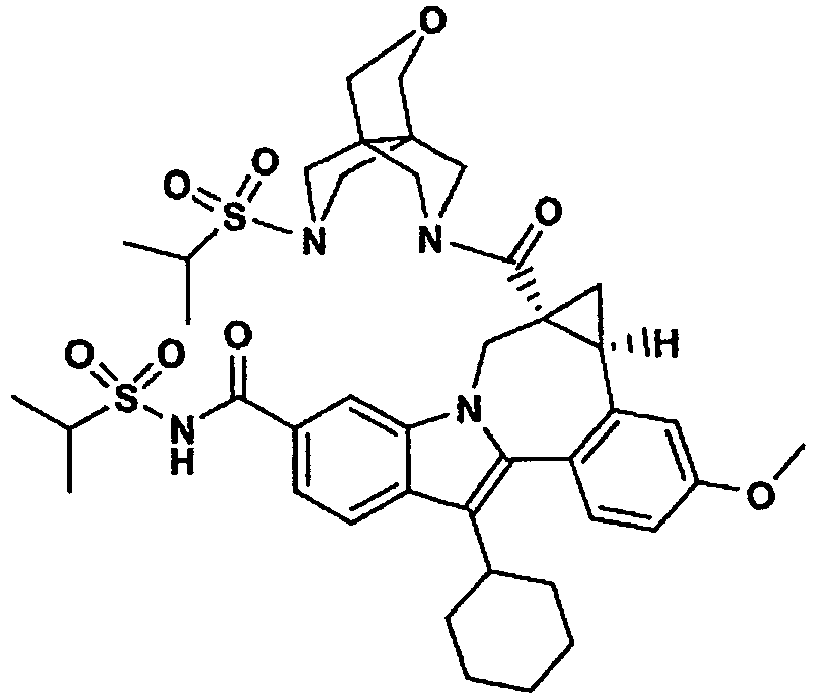
- (1aR, 12bS)-8-cyclohexyl-N-(isopropylsulfonyl)-1a-((10-(isopropylsulfonyl)-3-oxa-7,10-diazatricyclo[3.3.3.0∼1,5∼]undec-7-yl)carbonyl)-11-methoxy-1,1a,2,12b-tetrahydrocyclopropa[d]indolo[2,1-a][2]benzazepine-5-carboxamide. (1aR,12bS)-8-cyclohexyl-N-(isopropylsulfonyl)-11-methoxy-1a-(3-oxa-7,10-diazatricyclo[3.3.3.01,5]undec-7-ylcarbonyl)-1,1a,2,12b-tetrahydrocyclopropa[d]indolo[2,1-a][2]benzazepine-5-carboxamide (example 1B) (35 mg, 0.0051 mmol), diisopropyl ethyl amine (0.089 mL, 0.51 mmol), and isopropylsulfonyl chloride (0.057 mL, 0.51 mmol) were combined in CH2Cl2 (1 mL) and stirred at r.t. for 1h. The reaction mixture was then concentrated, dissolved into MeOH, filtered and purified by preparative HPLC (H2O-CH3CN with 0.1% TFA buffer) to give (1aR,12bS)-8-cyclohexyl-N-(isopropylsulfonyl)-1a-((10-(isopropylsulfonyl)-3-oxa-7,10-diazatricyclo[3.3.3.0∼1,5∼]undec-7-yl)carbonyl)-11-methoxy-1,1a,2,12b-tetrahydrocyclopropa[d]indolo[2,1-a][2]benzazepine-5-carboxamide (23 mg, 0.028 mmol, 56 % yield)as a white solid. LCMS : m/e = 816 (M+Na)+. LCMS retention time: 2.68 min. (Column: SunFire C18 5u 4.6 X 50 mm. Solvent A = 90% Water/ 10% Acetonitrile/ 0.1%TFA. Solvent B = 10% Water/ 90% Acetonitrile/ 0.1%TFA. Start % B = 0. Final % B = 100. Gradient Time = 3 min. Flow Rate = 4 mL/min.).
-

- (1aR, 12bS)-8-cyclohexyl-1a-((7-(diisopropylcarbamoyl)-3,7-diazatricyclo[3.3.2.0∼1,5∼]dec-3-yl)carbonyl)-N-(isopropylsulfonyl)-11-methoxy-1,1a,2,12b-tetrahydrocyclopropa[d]indolo[2,1-a][2]benzazepine-5-carboxamide. (1aR,12bS)-8-cyclohexyl-N-(isopropylsulfonyl)-11-methoxy-1a-(tetrahydro-1H,4H-3a,6a-ethanocyclopenta[c]pyrrol-5-ylcarbonyl)-1,1a,2,12b-tetrahydrocyclopropa[d]indolo[2,1-a][2]benzazepine-5-carboxamide (example 30) (35 mg, 0.052 mmol), diisopropylcarbamic chloride (34 mg, 0.21 mmol), and diisopropyl ethyl amine (0.046 mL, 0.26 mmol) were combined in CH2Cl2 (1 mL) and allowed to stir at r.t. for 1h. The reaction mixture was then concentrated, dissolved into MeOH, filtered and purified by preparative HPLC (H2O-CH3CN with 0.1% TFA buffer) to give (1aR,12bS)-8-cyclohexyl-1a-((7-(diisopropylcarbamoyl)-3,7-diazatricyclo[3.3.2.0∼1,5∼]dec-3-yl)carbonyl)-N-(isopropylsulfonyl)-11-methoxy-1,1a,2,12b-tetrahydrocyclopropa[d]indolo[2,1-a][2]benzazepine-5-carboxamide (19 mg, 0.024 mmol, 46 % yield) as a white solid. LCMS : m/e = 798 (M+H)+. LCMS retention time: 2.13 min. (Column: SunFire C18 5u 4.6 X 50 mm. Solvent A = 90% Water/ 10% Acetonitrile/ 0.1%TFA. Solvent B = 10% Water/ 90% Acetonitrile/ 0.1%TFA. Start % B = 0. Final % B = 100. Gradient Time = 3 min. Flow Rate = 4 mL/min.).
-

- (1aR, 12bS)-8-cyclohexyl-N-(isopropylsulfonyl)-11-methoxy-1a-((10-(2,2,2-trifluoroethyl)-3-oxa-7,10-diazatricyclo[3.3.3.0∼1,5∼]undec-7-yl)carbonyl)-1,1a,2,12b-tetrahydrocyclopropa[d]indolo[2,1-a][2]benzazepine-5-carboxamide. (1aR,12bS)-8-cyclohexyl-N-(isopropylsulfonyl)-11-methoxy-1a-(3-oxa-7,10-diazatricyclo[3.3.3.01,5]undec-7-ylcarbonyl)-1,1a,2,12b-tetrahydrocyclopropa[d]indolo[2,1-a][2]benzazepine-5-carboxamide (example 1B) (35 mg, 0.051 mmol), 2-Iodo-1,1,1-trifluoroethane (0.10 mL, 1.0 mmol), and potassium carbonate (35 mg, 0.26 mmol) were combined in acetonitrile (1 mL) and stirred at 100 °C for twelve days. The reaction mixture was then concentrated, dissolved into MeOH, filtered and purified by preparative HPLC (H2O-CH3CN with 0.1% TFA buffer) to give (1aR,12bS)-8-cyclohexyl-N-(isopropylsulfonyl)-11-methoxy-1a-((10-(2,2,2-trifluoroethyl)-3-oxa-7,10-diazatricyclo[3.3.3.0∼1,5∼]undec-7-yl)carbonyl)-1,1a,2,12b-tetrahydrocyclopropa[d]indolo[2,1-a][2]benzazepine-5-carboxamide (23 mg, 0.030 mmol, 59 % yield)as a white solid. LCMS : m/e = 769 (M+H)+. LCMS retention time: 2.90 min. (Column: SunFire C18 5u 4.6 X 50 mm. Solvent A = 90% Water/ 10% Acetonitrile/ 0.1%TFA. Solvent B = 10% Water/ 90% Acetonitrile/ 0.1%TFA. Start % B = 0. Final % B = 100. Gradient Time = 3 min. Flow Rate = 4 mL/min.).
-
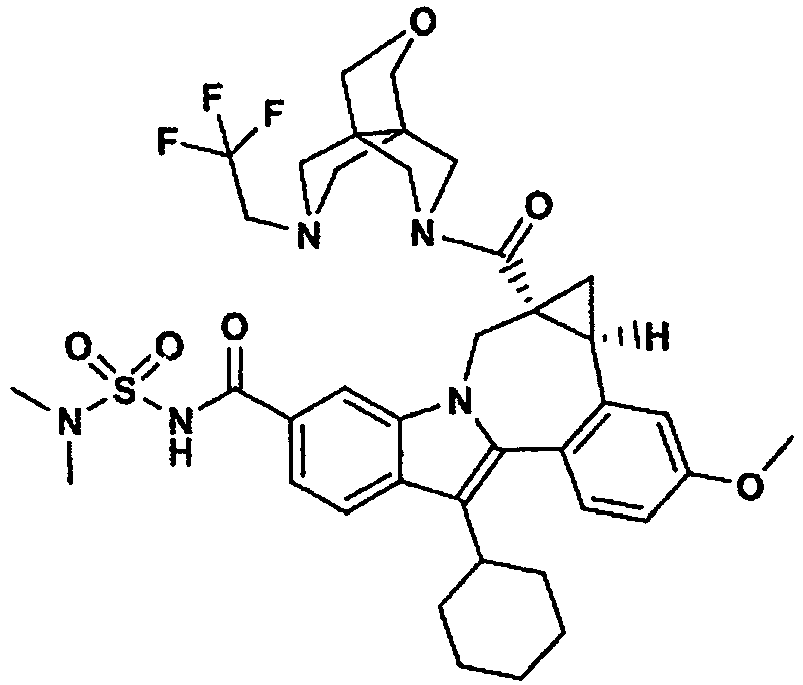
- (1aR,12bS)-8-cyclohexyl-N-(dimethylsulfamoyl)-11-methoxy-1a-((10-(2,2,2-trifluoroethyl)-3-oxa-7,10-diazatricyclo[3.3.3.0∼1,5∼]undec-7-yl)carbonyl)-1,1a,2,12b-tetrahydrocyclopropa[d]indolo[2,1-a][2]benzazepine-5-carboxamide. Prepared as previously described (example 45). White solid. LCMS : m/e = 770 (M+H)+. LCMS retention time: 2.90 min. (Column: SunFire C18 5u 4.6 X 50 mm. Solvent A = 90% Water/ 10% Acetonitrile/ 0.1%TFA. Solvent B = 10% Water/ 90% Acetonitrile/ 0.1%TFA. Start % B = 0. Final % B = 100. Gradient Time = 3 min. Flow Rate = 4 mL/min.).
-

- (1aR, 12bS)-8-cyclohexyl-N-(dimethylsulfamoyl)-1a-((10-(isopropylsulfonyl)-3-oxa-7,10-diazatricyclo[3.3.3.0∼1,5∼]undec-7-yl)carbonyl)-11-methoxy-1,1a,2,12b-tetrahydrocyclopropa[d]indolo[2,1-a][2]benzazepine-5-carboxamide. Prepared as previously described (example 43). Tan solid. LCMS : m/e = 794 (M+H)+. LCMS retention time: 2.65 min. (Column: SunFire C18 5u 4.6 X 50 mm. Solvent A = 90% Water/ 10% Acetonitrile/ 0.1%TFA. Solvent B = 10% Water/ 90% Acetonitrile/ 0.1%TFA. Start % B = 0. Final % B = 100. Gradient Time = 3 min. Flow Rate = 4 mL/min.).
-

- (1aR, 12bS)-8-cyclohexyl-1a-((7-(dimethylcarbamoyl)-3,7-diazatricyclo[3.3.2.0∼1,5∼]dec-3-yl)carbonyl)-N-(isopropylsulfonyl)-11-rnethoxy-1,1a,2,12b-tetrahydrocyclopropa[d]indodo[2,1-a][2]benzazepine-5-carboxamide. (1aR,12bS)-8-cyclohexyl-N-(isopropylsulfonyl)-11-methoxy-1a-(tetrahydro-1H,4H-3a,6a-ethanocyclopenta[c]pyrrol-5-ylcarbonyl)-1,1a,2,12b-tetrahydrocyclopropa[d]indolo[2,1-a][2]benzazepine-5-carboxamide (example 30) (35 mg, 0.052 mmol), dimethylcarbamic chloride (22 mg, 0.21 mmol), and diisopropyl ethyl amine (0.046 mL, 0.26 mmol) were combined in CH2Cl2 (1 mL) and allowed to stir at r.t. for 1h. The reaction mixture was then concentrated, dissolved into MeOH, filtered and purified by preparative HPLC (H2O-CH3CN with 0.1% TFA buffer) to give (1aR,12bS)-8-cyclohexyl-1a-((7-(dimethylcarbamoyl)-3,7-diazatricyclo[3.3.2.0∼1,5∼]dec-3-yl)carbonyl)-N-(isopropylsulfonyl)-11-methoxy-1,1a,2,12b-tetrahydrocyclopropa[d]indolo[2,1-a][2]benzazepine-5-carboxamide (25 mg, 0.032 mmol, 62 % yield) as a white solid. LCMS : m/e = 742 (M+H)+. LCMS retention time: 2.92 min. (Column: SunFire C18 5u 4.6 X 50 mm. Solvent A = 90% Water/ 10% Acetonitrile/ 0.1%TFA. Solvent B = 10% Water/ 90% Acetonitrile/ 0.1%TFA. Start % B = 0. Final % B = 100. Gradient Time = 3 min. Flow Rate = 4 mL/min.).
-

- (1aR, 12bS)-8-clohezyl-N-(isopropylsulfonyl)-11-methoxy-1a-((7-(1-pyrrolidinylcarbonyl)-3,7-diazatricyclo[3.3.2.0∼1,5∼]dec-3-yl)carbonyl)-1,1a,2,12b-tetrahydrocyclopropa[d]indolo[2,1-a][2]benzazepine-5-carboxamide. (1aR,12bS)-8-cyclohexyl-N-(isopropylsulfonyl)-11-methoxy-1a-(tetrahydro-1H,4H-3a,6a-ethanocyclopenta[c]pyrrol-5-ylcarbonyl)-1,1a,2,12b-tetrahydrocyclopropa[d]indolo[2,1-a][2]benzazepine-5-carboxamide (example 30) (35 mg, 0.052 mmol), pyrrolidine-1-carbonyl chloride (7.0 mg, 0.052 mmol), and diisopropyl ethyl amine (0.046 mL, 0.26 mmol) were combined in CH2Cl2 (1 mL) and allowed to stir at r.t. for 1h. The reaction mixture was then concentrated, dissolved into MeOH, filtered and purified by preparative HPLC (H2O-CH3CN with 0.1% TFA buffer) to give (1aR,12bS)-8-cyclohexyl-N-(isopropylsulfonyl)-11-methoxy-1a-((7-(1-pyrrolidinylcarbonyl)-3,7-diazatricyclo[3.3.2.0∼1,5∼]dec-3-yl)carbonyl)-1,1a,2,12b-tetrahydrocyclopropa[d]indolo[2,1-a][2]benzazepine-5-carboxamide (22 mg, 0.028 mmol, 54 % yield) as a white solid. LCMS : m/e = 768 (M+H)+. LCMS retention time: 2.20 min. (Column: SunFire C18 5u 4.6 X 50 mm. Solvent A = 90% Water/ 10% Acetonitrile/ 0.1%TFA. Solvent B = 10% Water/ 90% Acetonitrile/ 0.1%TFA. Start % B = 0. Final % B = 100. Gradient Time = 3 min. Flow Rate = 4 mL/min.).
-

- (1aR,12bS)-8-cyclohexyl-N-(isopropylsulfonyl)-11-methoxy-1a-((7-(4-morpholinylcarbonyl)-3,7-diazatricyclo[3.3.2.0∼1,5∼]dec-3-yl)carbonyl)-1,1a,2,12b-tetrahydrocyclopropa[d]indolo[2,1-a][2]benzazepine-5-carboxamide. (1aR,12bS)-8-cyclohexyl-N-(isopropylsulfonyl)-11-methoxy-1a-(tetrahydro-1H,4H-3a,6a-ethanocyclopenta[c]pyrrol-5-ylcarbonyl)-1,1a,2,12b-tetrahydrocyclopropa[d]indolo[2,1-a][2]benzazepine-5-carboxamide (example 30) (35 mg, 0.052 mmol), morpholine-4-carbonyl chloride (31 mg, 0.21 mmol), and diisopropyl ethyl amine (0.046 mL, 0.26 mmol) were combined in CH2Cl2 (1 mL) and allowed to stir at r.t. for 1h. The reaction mixture was then concentrated, dissolved into MeOH, filtered and purified by preparative HPLC (H2O-CH3CN with 0.1% TFA buffer) to give (1aR,12bS)-8-cyclohexyl-N-(isopropylsulfonyl)-11-methoxy-1a-((7-(4-morpholinylcarbonyl)-3,7-diazatricyclo[3.3.2.0∼1,5∼]dec-3-yl)carbonyl)-1,1a,2,12b-tetrahydrocyclopropa[d]indolo[2,1-a][2]benzazepine-5-carboxamide (36.5 mg, 0.047 mmol, 89 % yield) as a white solid. LCMS : m/e = 784 (M+H)+. LCMS retention time: 2.89 min. (Column: SunFire C18 5u 4.6 X 50 mm. Solvent A = 90% Water/ 10% Acetonitrile/ 0.1%TFA. Solvent B = 10% Water/ 90% Acetonitrile/ 0.1%TFA. Start % B = 0. Final % B = 100. Gradient Time = 3 min. Flow Rate = 4 mL/min.).
-

- (1aR,12bS)-8-cyclohexyl-1a-((7-(dimethylcarbamoyl)-3,7-diazatricyclo[3.3.2.0∼1,5∼]dec-3-yl)carbonyl)-N-(dimethylsulfamoyl)-11-methoxy-1,1a,2,12b-tetrahydrocyclopropa[d]indolo[2,1-a][2]benzazepine-5-carboxamide. Prepared as previously described (example 48). White solid. LCMS : m/e = 743 (M+H)+. LCMS retention time: 2.20 min. (Column: SunFire C18 5u 4.6 X 50 mm. Solvent A = 90% Water/ 10% Acetonitrile/ 0.1%TFA. Solvent B = 10% Water/ 90% Acetonitrile/ 0.1%TFA. Start % B = 0. Final % B = 100. Gradient Time = 3 min. Flow Rate = 4 mL/min.).
-

- (1aR, 12bS)-8-cyclohexyl-1a-((7-(diisopropylcarbamoyl)-3,7-diazatricyclo[3.3.2.0∼1,5∼]dec-3-yl)carbonyl)-N-(dimethylsulfamoyl)-11-methoxy-1,1a,2,12b-tetrahydrocyclopropa[d]indolo[2,1-a][2]benzazepine-5-carboxamide. Prepared as previously described (example 44). White solid. LCMS : m/e = 799 (M+H)+. LCMS retention time: 3.24 min. (Column: SunFire C18 5u 4.6 X 50 mm. Solvent A = 90% Water/ 10% Acetonitrile/ 0.1%TFA. Solvent B = 10% Water/ 90% Acetonitrile/ 0.1%TFA. Start % B = 0. Final % B = 100. Gradient Time = 3 min. Flow Rate = 4 mL/min.).
-

- (1aR,12bS)-8-cyclohexyl-N-(dimethylsulfamoyl)-11-methoxy-1a-((7-(1-pyrrolidinylcarbonyl)-3,7-diazatricyclo[3.3.2.0∼1,5∼]dec-3-yl)carbonyl)-1,1a,2,12b-tetrahydrocyclopropa[d]indolo[2,1-a][2]benzazepine-5-carboxamide. Prepared as previously described (example 48). White solid. LCMS : m/e = 769 (M+H)+. LCMS retention time: 2.80 min. (Column: SunFire C18 5u 4.6 X 50 mm. Solvent A = 90% Water/ 10% Acetonitrile/ 0.1%TFA. Solvent B = 10% Water/ 90% Acetonitrile/ 0.1%TFA. Start % B = 0. Final % B = 100. Gradient Time = 3 min. Flow Rate = 4 mL/min.).
-

- (1aR,12bS)-8-cyclohexyl-N-(dimethylsulfamoyl)-11-methoxy-1a-((7-(4-morpholinylcarbonyl)-3,7-diazatricyclo[3.3.2.0∼1,5∼]dec-3-yl)carbonyl)-1,1a,2,12b-tetrahydrocyclopropa[d]indolo[2,1-a][2]benzazepine-5-carboxamide. Prepared as previously described (example 49). White solid. LCMS : m/e = 785 (M+H)+. LCMS retention time: 2.60 min. (Column: SunFire C18 5u 4.6 X 50 mm. Solvent A = 90% Water/ 10% Acetonitrile/ 0.1 %TFA. Solvent B = 10% Water/ 90% Acetonitrile/ 0.1 %TFA. Start % B = 0. Final % B =100. Gradient Time = 3 min. Flow Rate = 4 mL/min.).
-

- (1aR, 12bS)-8-cyclohexyl-N-(isopropylsulfonyl)-11-methoxy-1a-((7-(2,2,2-trifluoroethyl)-3,7-diazatricyclo[3.3.2.0∼1,5∼]dec-3yl)carbonyl)-1,1a,2,12b-telrahydrocyclopropa[d]indolo[2,1-a][2]benzazepine-5-carboxamide. Prepared as previously described (example 45). White solid. LCMS : m/e = 753 (M+H)+. LCMS retention time: 2.89 min. (Column: SunFire C18 5u 4.6 X 50 mm. Solvent A = 90% Water/ 10% Acetonitrile/ 0.1%TFA. Solvent B = 10% Water/ 90% Acetonitrile/ 0.1%TFA. Start % B = 0. Final % B = 100. Gradient Time = 3 min. Flow Rate = 4 mL/min.).
-

- (1aR, 12bS)-8-cyclohexyl-N-(dimethylsulfamoyl)-11-methoxy-1a-((7-oxido-7-(2,2,2-trifluoroethyl)-3,7-diazatricyclo[3.3.2.0∼1,5∼]dec-3-yl)carbonyl)-1,1a,2,12b-tetrahydrocyclopropa[d]indolo[2,1-a][2]benzazepine-5-carboxamide. Prepared as previously described (example 45)(oxidation note: concomitant oxidation to N-oxide). Off-white solid. LCMS : m/e = 770 (M+H)+. LCMS retention time: 2.05 min. (Column: SunFire C18 5u 4.6 X 50 mm. Solvent A = 90% Water/ 10% Acetonitrile/ 0.1%TFA. Solvent B = 10% Water/ 90% Acetonitrile/ 0.1%TFA. Start % B = 0. Final % B = 100. Gradient Time = 3 min. Flow Rate = 4 mL/min.).
-

- (1aR,12bS)-8-cyclohexyl-N-(dimethylsulfamoyl)-11-methoxy-1a-((7-(2,2,2-trifluoroethyl)-3,7-diazatricyclo[3.3.2.0∼1,5∼]dec-3-yl)carbonyl)-1,1a,2,12b-tetrahydrocyclopropa[d]indolo[2,1-a][2]benzazepine-5-carboxamide. Prepared as previously described (example 45). Off-white solid. LCMS : m/e = 776 (M+Na)+. LCMS retention time: 2.79 min. (Column: SunFire C18 5u 4.6 X 50 mm. Solvent A = 90% Water/ 10% Acetonitrile/ 0.1%TFA. Solvent B = 10% Water/ 90% Acetonitrile/ 0.1%TFA. Start % B = 0. Final % B = 100. Gradient Time = 3 min. Flow Rate = 4 mL/min.).
-

- Methyl 7-(((1aR,12bS)-8-cyclohexyl-5-((isopropylsulfonyl)carbamoyl)-11-methoxy-1,12b-dihydrocyclopropa[d]indolo[2,1-a][2]benzazepin-1a(2H)yl)carbonyl)-3,7-diazatricyclo[3.3.2.0∼1,5∼]decane-3-carboxylate. Prepared as previously described (example 39). Yellow solid. LCMS : m/e = 729 (M+H)+. LCMS retention time: 2.66 min. (Column: SunFire C18 5u 4.6 X 50 mm. Solvent A = 90% Water/ 10% Acetonitrile/ 0.1%TFA. Solvent B = 10% Water/ 90% Acetonitrile/ 0.1%TFA. Start % B = 0. Final % B = 100. Gradient Time = 3 min. Flow Rate = 4 mL/min.).
-

- (1aR, 12bS)-8-cyclohexyl-N-(dimethylsumamoyl)-1a-((7-(isopropylsulfonyl)-3,7-diazatricyclo[3.3.2.0∼1,5∼]dec-3-yl)carbonyl)-11-methoxy-1,1a,2,12b-tetrahydrocyclopropa[d]indolo[2,1-a][2]benzazepine-5-carboxamide. Prepared as previously described (example 43). White solid. LCMS : m/e = 778 (M+H)+. LCMS retention time: 2.79 min. (Column: SunFire C18 5u 4.6 X 50 mm. Solvent A = 90% Water/ 10% Acetonitrile/ 0.1%TFA. Solvent B = 10% Water/ 90% Acetonitrile/ 0.1%TFA. Start % B = 0. Final % B = 100. Gradient Time = 3 min. Flow Rate = 4 mL/min.).
-

- (1aR,12bS)-8-cyclohexyl-N-(isopropylsulfonyl)-11-methoxy-1a-((7-(methylcarbamoyl)-3,7-diazatricyclo[3.3.2.0∼1,5∼]dec-3-yl)carbonyl)-1,1a,2,12b-tetrahydrocyclopropa[d]indolo[2,1-a][2]benzazepine-5-carboxamide. Prepared as previously described (example 41). White solid. LCMS : m/e = 728 (M+H)+. LCMS retention time: 2.14 min. (Column: SunFire C18 5u 4.6 X 50 mm. Solvent A = 90% Water/ 10% Acetonitrile/ 0.1%TFA. Solvent B = 10% Water/ 90% Acetonitrile/ 0.1%TFA. Start % B = 0. Final % B = 100. Gradient Time = 3 min. Flow Rate = 4 mL/min.).
-

- (1aR, 12bS)-8-cyclohexyl-N-(isopropylsulfonyl)-1a-((7-(isopropylsulfonyl)-3,7-diazatricyclo[3.3.2.0∼1,5∼]dec-3-yl)carbonyl)-11-methoxy-1,1a,2,12b-tetrahydrocyclopropa[d]indolo[2,1-a][2]benzazepine-5-carboxamide. Prepared as previously described (example 43). Yellow solid. LCMS : m/e = 779 (M+H)+. LCMS retention time: 2.84 min. (Column: SunFire C18 5u 4.6 X 50 mm. Solvent A = 90% Water/ 10% Acetonitrile/ 0.1%TFA. Solvent B = 10% Water/ 90% Acetonitrile/ 0.1%TFA. Start % B = 0. Final % B = 100. Gradient Time = 3 min. Flow Rate = 4 mL/min.).
-

- (1aR,12bS)-8-cyclohexyl-1a-((10-(2-ethoxyethyl)-3-oxa-7,10-diazatricyclo[3.3.3.0∼1,5∼]undec-7-y/)carbonyl)-N-(isopropylsulfonyl)-11-methoxy-1,1a,2,12b-tetrahydrocyclopropa[d]indolo[2,1-a][2]benzazepine-5-carboxamide. K2CO3 (10 mg, 0.073 mmol) was added to a solution of (1aR,12bS)-8-cyclohexyl-N-(isopropylsulfonyl)-11-methoxy-1a-(3-oxa-7,10-diazatricyclo[3.3.3.01,5]undec-7-ylcarbonyl)-1,1a,2,12b-tetrahydrocyclopropa[d]indolo[2,1-a][2]benzazepine-5-carboxamide (example 1B) (10 mg, 0.015 mmol) and 1-chloro-2-ethoxyethane (158 mg, 1.46 mmol) in DMF (1 mL). The resulting mixture was allowed to stir at r.t for 12 hours. LCMS showed no remaining starting material. The reaction mixture was then diluted with MeOH, filtered and purified by preparative HPLC (H2O-CH3CN with 0.1% TFA buffer) to give (1aR,12bS)-8-cyclohexyl-1a-((10-(2-ethoxyethyl)-3-oxa-7,10-diazatricyclo[3.3.3.0∼1,5∼]undec-7-yl)carbonyl)-N-(isopropylsulfonyl)-11-methoxy-1,1a,2,12b-tetrahydrocyclopropa[d]indolo[2,1-a][2]benzazepine-5-carboxamide (9.0 mg, 0.012 mmol, 81 % yield).as a white solid. LCMS : m/e = 759 (M+H)+. LCMS retention time: 2.27 min. (Column: SunFire C18 5u 4.6 X 50 mm. Solvent A = 90% Water/ 10% Acetonitrile/ 0.1%TFA. Solvent B = 10% Water/ 90% Acetonitrile/ 0.1%TFA. Start % B = 0. Final % B = 100. Gradient Time = 3 min. Flow Rate = 4 mL/min.) Presents as a 2:1 ratio of rotamers or atrope isomers - reporting partial data (aromatic reagion) - aliphatic reagion presents as a multiple multiplets. 1H NMR (400 MHz, CHLOROFORM-d) δ ppm 7.98. (1 H, s), 7.88 (1 H, m), 7.53 (0.67 H, m), 7.26 - 7.35 (1.67 H, m), 7.13 (1 H, s), 7.05 - 7.11 (0.33 H, m), 6.94 - 7.01 (1 H, m), 6.89 - 6.94 (0.33 H, m), 1.13-5.27 (44 H), 3.91 (3 H, s).
-

- (1aR, 12bS)-8-cyclohexyl-N-(dimethylsulfamoyl)-1a-((10-(2-ethoxyethyl)-3-oxa-7,10-diazatricyclo[3.3.3.0∼1,5∼]undec-7-yl)carbonyl)-11-methoxy-1,1a,2,12b-tetrahydrocyclopropa[d]indolo[2,1-a][2]benzazepine-5-carboxamide. Prepared as previously described (example 62). White solid. LCMS : m/e = 760 (M+H)+. LCMS retention time: 2.22 min. (Column: SunFire C18 5u 4.6 X 50 mm. Solvent A = 90% Water/ 10% Acetonitrile/ 0.1%TFA. Solvent B = 10% Water/ 90% Acetonitrile/ 0.1%TFA. Start % B = 0. Final % B = 100. Gradient Time = 3 min. Flow Rate = 4 mL/min.).
-

- (1aR, 12bS)-8-cyclohexyl-1a-((7-(2-ethoxyethyl)-3,7-diazatricyclo[3.3.2.0∼1,5∼]dec-3-yl)carbonyl)-N-(isopropylsulfonyl)-11-methoxy-1,1a,2,12b-tetrahydrocyclopropa[d]indolo[2,1-a][2]benzazepine-5-carboxamide. Prepared as previously described (example 62). White solid. LCMS : m/e = 743 (M+H)+. LCMS retention time: 2.03 min. (Column: SunFire C18 5u 4.6 X 50 mm. Solvent A = 90% Water/ 10% Acetonitrile/ 0.1%TFA. Solvent B = 10% Water/ 90% Acetonitrile/ 0.1%TFA. Start % B = 0. Final % B = 100. Gradient Time = 3 min. Flow Rate = 4 mL/min.).
-
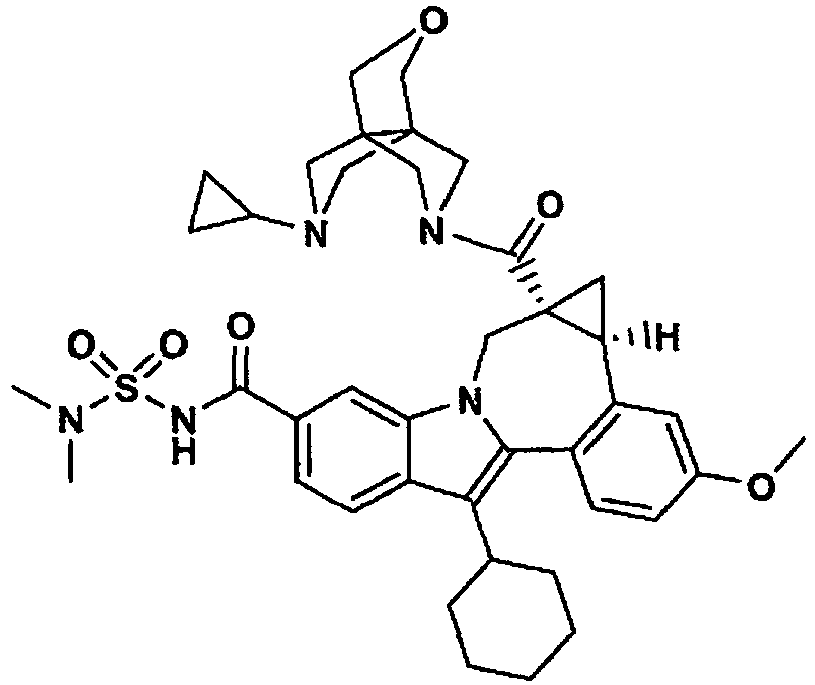
- (1aR, 12bS)-8-cyclohexyl-1a-((10-cyclopropyl-3-oxa-7,10-diazatricyclo[3.3.3.0∼1,5∼]undec-7-yl)carbonyl)-N-(dimethylsulfamoyl)-11-methoxy-1,1a,2,12b-tetrahydrocyclopropa[d]indodo[2,1-a][2]benzazepine-5-carboxamide. Prepared as previously described (example 29B). White solid. LCMS : m/e = 728 (M+H)+. LCMS retention time:2.97 min. (Column: SunFire C18 5u 4.6 X 50 mm. Solvent A = 90% Water/ 10% Acetonitrile/ 0.1%TFA. Solvent B = 10% Water/ 90% Acetonitrile/ 0.1%TFA. Start % B = 0. Final % B = 100. Gradient Time = 3 min. Flow Rate = 4 mL/min.).
-

- (1aR, 12bS)-8-cyclohexyl-1a-((7-cyclopropyl-3,7-diazatricyclo[3.3.2.0∼1,5∼]dec-3-yl)carbonyl)-N-(dimethylsulfamoyl)-11-methoxy-1,1a,2,12b-tetrahydrocyclopropa[d]indolo[2,1-a][2]benzazepine-5-carboxamide. Prepared as previously described (example 29B). White solid. LCMS : m/e = 711 (M+H)+. LCMS retention time: 2.00 min. (Column: SunFire C18 5u 4.6 X 50 mm. Solvent A = 90% Water/ 10% Acetonitrile/ 0.1%TFA. Solvent B = 10% Water/ 90% Acetonitrile/ 0.1%TFA. Start % B = 0. Final % B = 100. Gradient Time = 3 min. Flow Rate = 4 mL/min.).
-

- (1aR, 12bS)-8-cyclohexyl-1a-((7-cyclopropyl-3,7-diazatricyclo[3.3.2.0∼1,5∼]dec-3-yl)carbonyl)-N-(isopropylsulfonyl)-11-methoxy-1,1a,2,12b-tetrahydrocyclopropa[d]indolo[2,1-a][2]benzazepine-5-carboxamide. Prepared as previously described (example 29B). White solid. LCMS : m/e = 712 (M+H)+. LCMS retention time: 1.99 min. (Column: SunFire C18 5u 4.6 X 50 mm. Solvent A = 90% Water/ 10% Acetonitrile/ 0.1%TFA. Solvent B = 10% Water/ 90% Acetonitrile/ 0.1%TFA. Start % B = 0. Final % B = 100. Gradient Time = 3 min. Flow Rate = 4 mL/min.).
R1 is CO2R5 or CONR6R7;
R2 is

R4 is cycloalkyl;
R5 is hydrogen or alkyl;
R6 is hydrogen, alkyl, alkylSO2, alkenylSO2, cycloalkylSO2, haloalkylSO2, (R9)2NSO2, or (R10)SO2;
R7 is hydrogen or alkyl;
R8 is hydrogen, alkyl, cycloalkyl, (cycloalkyl)alkyl, haloalkyl, alkoxyalkyl, alkylcarbonyl, cycloalkylcarbonyl, haloalkylcarbonyl, alkoxycarbonyl, alkylSO2, cycloalkylSO2, haloalkylSO2, aminocarbonyl, (alkylamino)carbonyl, (dialkylamino)carbonyl, (R11)CO, benzyl, benzyloxycarbonyl, or pyridinyl;
R9 is hydrogen, alkyl, or cycloalkyl;
R10 is azetidinyl, pyrrolidinyl, piperidinyl, piperazinyl, morpholinyl, thiomorpholinyl, homopiperidinyl, or homomorpholinyl and is substituted with 0-3 alkyl substituents; R11 is azetidinyl, pyrrolidinyl, piperidinyl, piperazinyl, morpholinyl, thiomorpholinyl, homopiperidinyl, or homomorpholinyl and is substituted with 0-3 alkyl substituents; and
X is absent, a bond, or methylene;
or a pharmaceutically acceptable salt thereof.
Claims (14)
- A compound of formula I
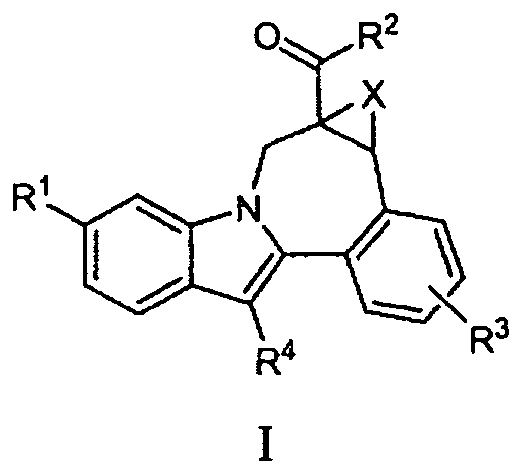 R1 is CO2R5 or CONR6R7;R2 is
 R4 is cycloalkyl;R5 is hydrogen or alkyl;R6 is hydrogen, alkyl, alkylSO2, alkenylSO2, cycloalkylSO2, haloalkylSO2, (R9)2NSO2, or (R10)SO2;R7 is hydrogen or alkyl;R8 is hydrogen, alkyl, cycloalkyl, (cycloalkyl)alkyl, haloalkyl, alkoxyalkyl, alkylcarbonyl, cycloalkylcarbonyl, haloalkylcarbonyl, alkoxycarbonyl, alkylSO2, cycloalkylSO2, haloalkylSO2, aminocarbonyl, (alkylamino)carbonyl, (dialkylamino)carbonyl, (R11)CO, benzyl, benzyloxycarbonyl, or pyridinyl;R9 is hydrogen, alkyl, or cycloalkyl;R10 is azetidinyl, pyrrolidinyl, piperidinyl, piperazinyl, morpholinyl, thiomorpholinyl, homopiperidinyl, or homomorpholinyl and is substituted with 0-3 alkyl substituents;R11 is azetidinyl, pyrrolidinyl, piperidinyl, piperazinyl, morpholinyl, thiomorpholinyl, homopiperidinyl, or homomorpholinyl and is substituted with 0-3 alkyl substituents; andX is absent, a bond, or methylene;or a pharmaceutically acceptable salt thereof.
 - A compound of claim 1 where
R1 is CONR6R7;
R2 is
R4 is cycloalkyl;
R6 is alkylSO2, alkenylSO2, cycloalkylSO2, or (R9)2NSO2;
R7 is hydrogen;
R8 is hydrogen, alkyl, cycloalkyl, haloalkyl, alkoxyalkyl, alkylcarbonyl, alkoxycarbonyl, alkylSO2, aminocarbonyl, (alkylamino)carbonyl, (dialkylamino)carbonyl, or (R11)CO;
R9 is alkyl; and
X is absent, a bond, or methylene;
or a pharmaceutically acceptable salt thereof. - A compound of claim 2 where
R1 is CONR6R7;
R2 is
R4 is cyclohexyl;
R6 is isopropylSO2, isobutylSO2, isopropenylSO2, cyclopropylSO2, or (Me)2NSO2; R7 is hydrogen; and
R8 is hydrogen, methyl, ethyl, cyclopropyl, trifluoroethyl, ethoxyethyl, acetyl, methoxycarbonyl, isopropylSO2, (methylamino)carbonyl, (dimethylamino)carbonyl, (diisopropylamino)carbonyl, (pyrrolidinyl)CO, or (morpholinyl)CO; and
X is absent, a bond, or methylene;
or a pharmaceutically acceptable salt thereof. - A compound of claim 1 where R1 is
- A compound of claim 1 where R2 is

- A compound of claim 1 where R3 is hydrogen, halo, or alkoxy.
- A compound of claim 1 where R6 is alkylSO2, alkenylSO2, cycloalkylSO2, haloalkylSO2, (R9)2NSO2, or (R10)SO2 and R7 is hydrogen or alkyl.
- A compound of claim 1 where R8 is hydrogen, alkyl, cycloalkyl, (cycloalkyl)alkyl, haloalkyl, alkoxyalkyl, alkylcarbonyl, cycloalkylcarbonyl, haloalkylcarbonyl, alkoxycarbonyl, alkylSO2, cycloalkylSO2, haloalkylSO2, aminocarbonyl, (alkylamino)carbonyl, (dialkylamino)carbonyl, (R11)CO, benzyl, benzyloxycarbonyl, or pyridinyl.
- A compound of claim 1 where X is absent.
- A compound of claim 1 where X is a bond.
- A compound of claim 1 where X is methylene.
- A compound of claim 1 selected from the group consisting of


- A composition comprising a compound of any one of claims 1 to 12, or a pharmaceutically acceptable salt thereof, and a pharmaceutically acceptable carrier.
- A compound of any one of claims 1 to 12, or a pharmaceutically acceptable salt thereof for use in treating hepatitis C infection.
Applications Claiming Priority (2)
| Application Number | Priority Date | Filing Date | Title |
|---|---|---|---|
| US15563409P | 2009-02-26 | 2009-02-26 | |
| PCT/US2010/025169 WO2010099159A1 (en) | 2009-02-26 | 2010-02-24 | Cyclopropyl fused indolobenzazepine hcv ns5b inhibitors |
Publications (2)
| Publication Number | Publication Date |
|---|---|
| EP2401280A1 EP2401280A1 (en) | 2012-01-04 |
| EP2401280B1 true EP2401280B1 (en) | 2013-05-01 |
Family
ID=42289577
Family Applications (1)
| Application Number | Title | Priority Date | Filing Date |
|---|---|---|---|
| EP10722809.0A Not-in-force EP2401280B1 (en) | 2009-02-26 | 2010-02-24 | Cyclopropyl fused indolobenzazepine hcv ns5b inhibitors |
Country Status (5)
| Country | Link |
|---|---|
| US (1) | US8143244B2 (en) |
| EP (1) | EP2401280B1 (en) |
| JP (1) | JP2012519173A (en) |
| CN (1) | CN102414212A (en) |
| WO (1) | WO2010099159A1 (en) |
Cited By (1)
| Publication number | Priority date | Publication date | Assignee | Title |
|---|---|---|---|---|
| EP4269332A1 (en) | 2022-04-26 | 2023-11-01 | GasConTec GmbH | Method and system for the production of ammonia |
Families Citing this family (9)
| Publication number | Priority date | Publication date | Assignee | Title |
|---|---|---|---|---|
| US20070049593A1 (en) | 2004-02-24 | 2007-03-01 | Japan Tobacco Inc. | Tetracyclic fused heterocyclic compound and use thereof as HCV polymerase inhibitor |
| WO2009120733A1 (en) * | 2008-03-27 | 2009-10-01 | Bristol-Myers Squibb Company | Pyrrolidine fused indolobenzadiazepine hcv ns5b inhibitors |
| JP2011515486A (en) * | 2008-03-27 | 2011-05-19 | ブリストル−マイヤーズ スクイブ カンパニー | Compound for the treatment of hepatitis C |
| US8138171B2 (en) * | 2008-03-27 | 2012-03-20 | Bristol-Myers Squibb Company | Dioxolane and dioxolanone fused indolobenzadiazepine HCV NS5B inhibitors |
| ES2747768T3 (en) | 2017-03-20 | 2020-03-11 | Forma Therapeutics Inc | Pyrrolopyrrole compositions as pyruvate kinase activators (PKR) |
| ES2989438T3 (en) | 2018-09-19 | 2024-11-26 | Novo Nordisk Healthcare Ag | Activation of pyruvate kinase R |
| US12053458B2 (en) | 2018-09-19 | 2024-08-06 | Novo Nordisk Health Care Ag | Treating sickle cell disease with a pyruvate kinase R activating compound |
| US20220378756A1 (en) | 2019-09-19 | 2022-12-01 | Forma Therapeutics, Inc. | Activating pyruvate kinase r |
| US12128035B2 (en) | 2021-03-19 | 2024-10-29 | Novo Nordisk Health Care Ag | Activating pyruvate kinase R |
Family Cites Families (59)
| Publication number | Priority date | Publication date | Assignee | Title |
|---|---|---|---|---|
| NZ533057A (en) * | 2001-10-26 | 2005-11-25 | Angeletti P Ist Richerche Bio | N-substituted hydroxypyrimidinone carboxamide inhibitors of HIV integrase |
| EP1441734B1 (en) * | 2001-10-26 | 2007-02-28 | Istituto di Richerche di Biologia Molecolare P. Angeletti S.p.A. | Dihydroxypyrimidine carboxamide inhibitors of hiv integrase |
| GB0201179D0 (en) | 2002-01-18 | 2002-03-06 | Angeletti P Ist Richerche Bio | Therapeutic agents |
| CN1731993A (en) | 2002-11-01 | 2006-02-08 | 维洛药品公司 | Benzofuran compounds, compositions and methods for treatment and prophylaxis of hepatitis c viral infections and associated diseases |
| US6745521B1 (en) * | 2002-12-13 | 2004-06-08 | Klemming Ulf Jp | Gazebo |
| EP1578748B1 (en) * | 2002-12-27 | 2010-09-15 | Istituto Di Ricerche Di Biologia Molecolare P. Angeletti S.P.A. | Tetrahydro-4h-pyrido[1,2-a]pyrimidines and related compounds useful as hiv integrase inhibitors |
| WO2004062613A2 (en) * | 2003-01-13 | 2004-07-29 | Bristol-Myers Squibb Company | Hiv integrase inhibitors |
| US7223785B2 (en) | 2003-01-22 | 2007-05-29 | Boehringer Ingelheim International Gmbh | Viral polymerase inhibitors |
| JP2004244320A (en) | 2003-02-10 | 2004-09-02 | Shionogi & Co Ltd | Nitrogen-containing heterocyclic antiviral agents |
| US7037908B2 (en) * | 2003-04-24 | 2006-05-02 | Bristol-Myers Squibb Company | HIV integrase inhibitors |
| AR046938A1 (en) | 2003-12-12 | 2006-01-04 | Merck & Co Inc | PROCEDURE TO PREPARE HEXAHYDROPIRIMID [1,2-A] AZEPIN-2-CARBOXYLATES AND SIMILAR COMPUTERS |
| TW200526635A (en) | 2003-12-22 | 2005-08-16 | Shionogi & Co | Hydroxypyrimidinone derivative having HIV integrase inhibitory activity |
| MXPA06007906A (en) | 2004-01-12 | 2007-02-14 | Gilead Sciences Inc | Pyrimidyl phosphonate antiviral compounds and methods of use. |
| HRP20090250T1 (en) | 2004-02-24 | 2009-06-30 | Japan Tobacco | CONDENSED HETEROCYCLIC COMPOUNDS AND THEIR USE AS HCV POLYMERASE INHIBITORS |
| US7273859B2 (en) * | 2004-05-12 | 2007-09-25 | Bristol-Myers Squibb Company | HIV integrase inhibitors: cyclic pyrimidinone compounds |
| US7115601B2 (en) * | 2004-05-18 | 2006-10-03 | Bristol-Myers Squibb Company | HIV integrase inhibitors |
| US7192948B2 (en) * | 2004-05-28 | 2007-03-20 | Bristol-Myers Squibb Company | Bicyclic heterocycles as HIV integrase inhibitors |
| US7173022B2 (en) * | 2004-05-28 | 2007-02-06 | Bristol-Myers Squibb Company | Bicyclic heterocycles as HIV integrase inhibitors |
| US7176196B2 (en) * | 2004-05-28 | 2007-02-13 | Bristol-Myers Squibb Company | Bicyclic heterocycles as HIV integrase inhibitors |
| US7153848B2 (en) * | 2004-08-09 | 2006-12-26 | Bristol-Myers Squibb Company | Inhibitors of HCV replication |
| US7348425B2 (en) * | 2004-08-09 | 2008-03-25 | Bristol-Myers Squibb Company | Inhibitors of HCV replication |
| EP1807403A2 (en) | 2004-10-26 | 2007-07-18 | Istituto di Richerche di Biologia Molecolare P. Angeletti S.p.A. | Tetracyclic indole derivatives as antiviral agents |
| ZA200705872B (en) * | 2005-01-14 | 2008-09-25 | Genelabs Tecnologies Inc | Indole derivatives for treating viral infections |
| CN101146811B (en) | 2005-03-31 | 2012-01-11 | P.安杰莱蒂分子生物学研究所 | Hiv integrase inhibitors |
| CA2607151C (en) | 2005-05-10 | 2012-06-19 | Merck & Co., Inc. | Hiv integrase inhibitors |
| CA2616314A1 (en) | 2005-07-27 | 2007-02-01 | Gilead Sciences, Inc. | Antiviral phosphonate conjugates for inhibition of hiv |
| US7494984B2 (en) * | 2005-08-31 | 2009-02-24 | Bristol-Myers Squibb Company | Substituted imidazo[1,2-a]pyrimidines as HIV viral DNA integrase inhibitors |
| GB0518390D0 (en) | 2005-09-09 | 2005-10-19 | Angeletti P Ist Richerche Bio | Therapeutic compounds |
| US7399758B2 (en) * | 2005-09-12 | 2008-07-15 | Meanwell Nicholas A | Cyclopropyl fused indolobenzazepine HCV NS5B inhibitors |
| US7473688B2 (en) * | 2005-09-13 | 2009-01-06 | Bristol-Myers Squibb Company | Indolobenzazepine HCV NS5B inhibitors |
| US7897592B2 (en) * | 2005-11-15 | 2011-03-01 | Bristol-Myers Squibb Company | HIV integrase inhibitors |
| US7902182B2 (en) * | 2005-11-16 | 2011-03-08 | Bristol-Myers Squibb Company | HIV integrase inhibitors |
| US8039458B2 (en) | 2005-11-17 | 2011-10-18 | Bristol-Myers Squibb Company | HIV integrase inhibitors |
| US20070129379A1 (en) * | 2005-12-01 | 2007-06-07 | Bristol-Myers Squibb Company | Hiv integrase inhibitors |
| US7456165B2 (en) * | 2006-02-08 | 2008-11-25 | Bristol-Myers Squibb Company | HCV NS5B inhibitors |
| GB0608928D0 (en) | 2006-05-08 | 2006-06-14 | Angeletti P Ist Richerche Bio | Therapeutic agents |
| US7521443B2 (en) * | 2006-05-17 | 2009-04-21 | Bristol-Myers Squibb Company | Cyclopropyl fused indolobenzazepine HCV NS5B inhibitors |
| US7456166B2 (en) * | 2006-05-17 | 2008-11-25 | Bristol-Myers Squibb Company | Cyclopropyl fused indolobenzazepine HCV NS5B inhibitors |
| US7521441B2 (en) * | 2006-05-22 | 2009-04-21 | Bristol-Myers Squibb Company | Cyclopropyl fused indolobenzazepine HCV NS5B inhibitors |
| WO2007140200A2 (en) * | 2006-05-25 | 2007-12-06 | Bristol-Myers Squibb Company | Cyclopropyl fused indolobenzazepine hcv ns5b inhibitors |
| JP5205370B2 (en) * | 2006-05-25 | 2013-06-05 | ブリストル−マイヤーズ スクイブ カンパニー | Cyclopropyl condensed indolobenzazepine HCVNS5B inhibitor |
| US7897593B2 (en) * | 2006-05-30 | 2011-03-01 | Bristol-Myers Squibb Company | HIV integrase inhibitors |
| US7452876B2 (en) | 2006-06-08 | 2008-11-18 | Bristol-Myers Squibb Company | Cyclopropyl fused indolobenzazepine HCV NS5B inhibitors |
| US7893055B2 (en) * | 2006-06-28 | 2011-02-22 | Bristol-Myers Squibb Company | HIV integrase inhibitors |
| US7541351B2 (en) * | 2007-01-11 | 2009-06-02 | Bristol-Myers Squibb Company | Compounds for the treatment of hepatitis C |
| US7541352B2 (en) | 2007-02-02 | 2009-06-02 | Bristol-Myers Squibb Company | Compounds for the treatment of hepatitis C |
| US7517872B2 (en) * | 2007-02-22 | 2009-04-14 | Bristol-Myers Squibb Company | Compounds for the treatment of hepatitis C |
| US7998951B2 (en) * | 2007-03-05 | 2011-08-16 | Bristol-Myers Squibb Company | HCV NS5B inhibitors |
| US7541353B2 (en) * | 2007-03-14 | 2009-06-02 | Bristol-Myers Squibb Company | Compounds for the treatment of hepatitis C |
| US7521444B2 (en) * | 2007-03-14 | 2009-04-21 | Bristol-Myers Squibb Company | Compounds for the treatment of hepatitis C |
| US7547690B2 (en) * | 2007-03-14 | 2009-06-16 | Bristol-Myers Squibb Company | Compounds for the treatment of Hepatitis C |
| US7538102B2 (en) * | 2007-03-14 | 2009-05-26 | Bristol-Myers Squibb Company | Compounds for the treatment of Hepatitis C |
| US7538103B2 (en) * | 2007-03-15 | 2009-05-26 | Bristol-Myers Squibb Company | Compounds for the treatment of hepatitis C |
| US20090018163A1 (en) * | 2007-07-11 | 2009-01-15 | Bristol-Myers Squibb Company | Substituted Heterocyclic Ethers and Their Use in CNS Disorders |
| US7642251B2 (en) * | 2007-08-09 | 2010-01-05 | Bristol-Myers Squibb Company | Compounds for the treatment of hepatitis C |
| US8124601B2 (en) * | 2007-11-21 | 2012-02-28 | Bristol-Myers Squibb Company | Compounds for the treatment of Hepatitis C |
| US8129367B2 (en) * | 2007-11-21 | 2012-03-06 | Bristol-Myers Squibb Company | Compounds for the treatment of Hepatitis C |
| US8129398B2 (en) * | 2008-03-19 | 2012-03-06 | Bristol-Myers Squibb Company | HIV integrase inhibitors |
| JP2011515486A (en) | 2008-03-27 | 2011-05-19 | ブリストル−マイヤーズ スクイブ カンパニー | Compound for the treatment of hepatitis C |
-
2010
- 2010-02-23 US US12/710,527 patent/US8143244B2/en active Active
- 2010-02-24 CN CN2010800184448A patent/CN102414212A/en active Pending
- 2010-02-24 WO PCT/US2010/025169 patent/WO2010099159A1/en not_active Ceased
- 2010-02-24 EP EP10722809.0A patent/EP2401280B1/en not_active Not-in-force
- 2010-02-24 JP JP2011552097A patent/JP2012519173A/en active Pending
Cited By (2)
| Publication number | Priority date | Publication date | Assignee | Title |
|---|---|---|---|---|
| EP4269332A1 (en) | 2022-04-26 | 2023-11-01 | GasConTec GmbH | Method and system for the production of ammonia |
| WO2023208926A1 (en) | 2022-04-26 | 2023-11-02 | Gascontec Gmbh | Process and plant for producing ammonia |
Also Published As
| Publication number | Publication date |
|---|---|
| JP2012519173A (en) | 2012-08-23 |
| EP2401280A1 (en) | 2012-01-04 |
| US8143244B2 (en) | 2012-03-27 |
| CN102414212A (en) | 2012-04-11 |
| US20100216774A1 (en) | 2010-08-26 |
| WO2010099159A1 (en) | 2010-09-02 |
Similar Documents
| Publication | Publication Date | Title |
|---|---|---|
| EP2118109B1 (en) | Compounds for the treatment of hepatitis c | |
| US7521441B2 (en) | Cyclopropyl fused indolobenzazepine HCV NS5B inhibitors | |
| EP2401280B1 (en) | Cyclopropyl fused indolobenzazepine hcv ns5b inhibitors | |
| EP2024375B1 (en) | Cyclopropyl fused indolobenzazepine hcv ns5b inhibitors | |
| US7521442B2 (en) | Cyclopropyl fused indolobenzazepine HCV NS5B inhibitors | |
| EP2121696B1 (en) | Compounds for the treatment of hepatitis c | |
| EP2118108B1 (en) | Compounds for the treatment of hepatitis c | |
| EP2099804B1 (en) | Compounds for the treatment of hepatitis c | |
| EP2121697B1 (en) | Compounds for the treatment of hepatitis c | |
| EP2209789B1 (en) | Cyclopropyl fused indolobenzazepine hcv ns5b inhibitors | |
| EP2118110B1 (en) | Cyclopropyl fused indolobenzazepine hcv inhibitors | |
| EP2215095B1 (en) | Cyclopropyl fused indolobenzazepine derivatives for the treatment of hepatitis c | |
| EP2209784B1 (en) | Compounds for the treatment of hepatitis c | |
| EP2114947B1 (en) | Indolobenzazepine derivatives for the treatment of hepatitis c | |
| EP2121694B1 (en) | Cyclopropyl fused indolobenzazepine hcv ns5b inhibitors | |
| EP2268643B1 (en) | Dioxolane and dioxolanone fused indolobenzadiazepine hcv ns5b inhibitors | |
| ES2370121T3 (en) | COMPOUNDS FOR THE TREATMENT OF HEPATITIS C. | |
| HK1122814B (en) | Cyclopropyl fused indolobenzazepine hcv ns5b inhibitors |
Legal Events
| Date | Code | Title | Description |
|---|---|---|---|
| PUAI | Public reference made under article 153(3) epc to a published international application that has entered the european phase |
Free format text: ORIGINAL CODE: 0009012 |
|
| 17P | Request for examination filed |
Effective date: 20110818 |
|
| AK | Designated contracting states |
Kind code of ref document: A1 Designated state(s): AT BE BG CH CY CZ DE DK EE ES FI FR GB GR HR HU IE IS IT LI LT LU LV MC MK MT NL NO PL PT RO SE SI SK SM TR |
|
| DAX | Request for extension of the european patent (deleted) | ||
| GRAP | Despatch of communication of intention to grant a patent |
Free format text: ORIGINAL CODE: EPIDOSNIGR1 |
|
| GRAS | Grant fee paid |
Free format text: ORIGINAL CODE: EPIDOSNIGR3 |
|
| GRAA | (expected) grant |
Free format text: ORIGINAL CODE: 0009210 |
|
| AK | Designated contracting states |
Kind code of ref document: B1 Designated state(s): AT BE BG CH CY CZ DE DK EE ES FI FR GB GR HR HU IE IS IT LI LT LU LV MC MK MT NL NO PL PT RO SE SI SK SM TR |
|
| REG | Reference to a national code |
Ref country code: GB Ref legal event code: FG4D |
|
| REG | Reference to a national code |
Ref country code: AT Ref legal event code: REF Ref document number: 609894 Country of ref document: AT Kind code of ref document: T Effective date: 20130515 Ref country code: CH Ref legal event code: EP |
|
| REG | Reference to a national code |
Ref country code: IE Ref legal event code: FG4D |
|
| REG | Reference to a national code |
Ref country code: DE Ref legal event code: R096 Ref document number: 602010006739 Country of ref document: DE Effective date: 20130627 |
|
| REG | Reference to a national code |
Ref country code: AT Ref legal event code: MK05 Ref document number: 609894 Country of ref document: AT Kind code of ref document: T Effective date: 20130501 |
|
| REG | Reference to a national code |
Ref country code: NL Ref legal event code: VDEP Effective date: 20130501 |
|
| REG | Reference to a national code |
Ref country code: LT Ref legal event code: MG4D |
|
| PG25 | Lapsed in a contracting state [announced via postgrant information from national office to epo] |
Ref country code: GR Free format text: LAPSE BECAUSE OF FAILURE TO SUBMIT A TRANSLATION OF THE DESCRIPTION OR TO PAY THE FEE WITHIN THE PRESCRIBED TIME-LIMIT Effective date: 20130802 Ref country code: IS Free format text: LAPSE BECAUSE OF FAILURE TO SUBMIT A TRANSLATION OF THE DESCRIPTION OR TO PAY THE FEE WITHIN THE PRESCRIBED TIME-LIMIT Effective date: 20130901 Ref country code: LT Free format text: LAPSE BECAUSE OF FAILURE TO SUBMIT A TRANSLATION OF THE DESCRIPTION OR TO PAY THE FEE WITHIN THE PRESCRIBED TIME-LIMIT Effective date: 20130501 Ref country code: SI Free format text: LAPSE BECAUSE OF FAILURE TO SUBMIT A TRANSLATION OF THE DESCRIPTION OR TO PAY THE FEE WITHIN THE PRESCRIBED TIME-LIMIT Effective date: 20130501 Ref country code: FI Free format text: LAPSE BECAUSE OF FAILURE TO SUBMIT A TRANSLATION OF THE DESCRIPTION OR TO PAY THE FEE WITHIN THE PRESCRIBED TIME-LIMIT Effective date: 20130501 Ref country code: ES Free format text: LAPSE BECAUSE OF FAILURE TO SUBMIT A TRANSLATION OF THE DESCRIPTION OR TO PAY THE FEE WITHIN THE PRESCRIBED TIME-LIMIT Effective date: 20130812 Ref country code: PT Free format text: LAPSE BECAUSE OF FAILURE TO SUBMIT A TRANSLATION OF THE DESCRIPTION OR TO PAY THE FEE WITHIN THE PRESCRIBED TIME-LIMIT Effective date: 20130902 Ref country code: AT Free format text: LAPSE BECAUSE OF FAILURE TO SUBMIT A TRANSLATION OF THE DESCRIPTION OR TO PAY THE FEE WITHIN THE PRESCRIBED TIME-LIMIT Effective date: 20130501 Ref country code: NO Free format text: LAPSE BECAUSE OF FAILURE TO SUBMIT A TRANSLATION OF THE DESCRIPTION OR TO PAY THE FEE WITHIN THE PRESCRIBED TIME-LIMIT Effective date: 20130801 Ref country code: SE Free format text: LAPSE BECAUSE OF FAILURE TO SUBMIT A TRANSLATION OF THE DESCRIPTION OR TO PAY THE FEE WITHIN THE PRESCRIBED TIME-LIMIT Effective date: 20130501 |
|
| PG25 | Lapsed in a contracting state [announced via postgrant information from national office to epo] |
Ref country code: CY Free format text: LAPSE BECAUSE OF FAILURE TO SUBMIT A TRANSLATION OF THE DESCRIPTION OR TO PAY THE FEE WITHIN THE PRESCRIBED TIME-LIMIT Effective date: 20130501 Ref country code: BG Free format text: LAPSE BECAUSE OF FAILURE TO SUBMIT A TRANSLATION OF THE DESCRIPTION OR TO PAY THE FEE WITHIN THE PRESCRIBED TIME-LIMIT Effective date: 20130801 Ref country code: HR Free format text: LAPSE BECAUSE OF FAILURE TO SUBMIT A TRANSLATION OF THE DESCRIPTION OR TO PAY THE FEE WITHIN THE PRESCRIBED TIME-LIMIT Effective date: 20130501 Ref country code: PL Free format text: LAPSE BECAUSE OF FAILURE TO SUBMIT A TRANSLATION OF THE DESCRIPTION OR TO PAY THE FEE WITHIN THE PRESCRIBED TIME-LIMIT Effective date: 20130501 |
|
| PG25 | Lapsed in a contracting state [announced via postgrant information from national office to epo] |
Ref country code: LV Free format text: LAPSE BECAUSE OF FAILURE TO SUBMIT A TRANSLATION OF THE DESCRIPTION OR TO PAY THE FEE WITHIN THE PRESCRIBED TIME-LIMIT Effective date: 20130501 |
|
| PG25 | Lapsed in a contracting state [announced via postgrant information from national office to epo] |
Ref country code: DK Free format text: LAPSE BECAUSE OF FAILURE TO SUBMIT A TRANSLATION OF THE DESCRIPTION OR TO PAY THE FEE WITHIN THE PRESCRIBED TIME-LIMIT Effective date: 20130501 Ref country code: EE Free format text: LAPSE BECAUSE OF FAILURE TO SUBMIT A TRANSLATION OF THE DESCRIPTION OR TO PAY THE FEE WITHIN THE PRESCRIBED TIME-LIMIT Effective date: 20130501 Ref country code: BE Free format text: LAPSE BECAUSE OF FAILURE TO SUBMIT A TRANSLATION OF THE DESCRIPTION OR TO PAY THE FEE WITHIN THE PRESCRIBED TIME-LIMIT Effective date: 20130501 Ref country code: CZ Free format text: LAPSE BECAUSE OF FAILURE TO SUBMIT A TRANSLATION OF THE DESCRIPTION OR TO PAY THE FEE WITHIN THE PRESCRIBED TIME-LIMIT Effective date: 20130501 Ref country code: SK Free format text: LAPSE BECAUSE OF FAILURE TO SUBMIT A TRANSLATION OF THE DESCRIPTION OR TO PAY THE FEE WITHIN THE PRESCRIBED TIME-LIMIT Effective date: 20130501 |
|
| PG25 | Lapsed in a contracting state [announced via postgrant information from national office to epo] |
Ref country code: NL Free format text: LAPSE BECAUSE OF FAILURE TO SUBMIT A TRANSLATION OF THE DESCRIPTION OR TO PAY THE FEE WITHIN THE PRESCRIBED TIME-LIMIT Effective date: 20130501 Ref country code: RO Free format text: LAPSE BECAUSE OF FAILURE TO SUBMIT A TRANSLATION OF THE DESCRIPTION OR TO PAY THE FEE WITHIN THE PRESCRIBED TIME-LIMIT Effective date: 20130501 Ref country code: IT Free format text: LAPSE BECAUSE OF FAILURE TO SUBMIT A TRANSLATION OF THE DESCRIPTION OR TO PAY THE FEE WITHIN THE PRESCRIBED TIME-LIMIT Effective date: 20130501 |
|
| PLBE | No opposition filed within time limit |
Free format text: ORIGINAL CODE: 0009261 |
|
| STAA | Information on the status of an ep patent application or granted ep patent |
Free format text: STATUS: NO OPPOSITION FILED WITHIN TIME LIMIT |
|
| 26N | No opposition filed |
Effective date: 20140204 |
|
| REG | Reference to a national code |
Ref country code: DE Ref legal event code: R097 Ref document number: 602010006739 Country of ref document: DE Effective date: 20140204 |
|
| PG25 | Lapsed in a contracting state [announced via postgrant information from national office to epo] |
Ref country code: LU Free format text: LAPSE BECAUSE OF FAILURE TO SUBMIT A TRANSLATION OF THE DESCRIPTION OR TO PAY THE FEE WITHIN THE PRESCRIBED TIME-LIMIT Effective date: 20140224 Ref country code: MC Free format text: LAPSE BECAUSE OF FAILURE TO SUBMIT A TRANSLATION OF THE DESCRIPTION OR TO PAY THE FEE WITHIN THE PRESCRIBED TIME-LIMIT Effective date: 20130501 |
|
| REG | Reference to a national code |
Ref country code: CH Ref legal event code: PL |
|
| PG25 | Lapsed in a contracting state [announced via postgrant information from national office to epo] |
Ref country code: LI Free format text: LAPSE BECAUSE OF NON-PAYMENT OF DUE FEES Effective date: 20140228 Ref country code: CH Free format text: LAPSE BECAUSE OF NON-PAYMENT OF DUE FEES Effective date: 20140228 |
|
| REG | Reference to a national code |
Ref country code: IE Ref legal event code: MM4A |
|
| PG25 | Lapsed in a contracting state [announced via postgrant information from national office to epo] |
Ref country code: IE Free format text: LAPSE BECAUSE OF NON-PAYMENT OF DUE FEES Effective date: 20140224 |
|
| REG | Reference to a national code |
Ref country code: FR Ref legal event code: PLFP Year of fee payment: 7 |
|
| PG25 | Lapsed in a contracting state [announced via postgrant information from national office to epo] |
Ref country code: MT Free format text: LAPSE BECAUSE OF FAILURE TO SUBMIT A TRANSLATION OF THE DESCRIPTION OR TO PAY THE FEE WITHIN THE PRESCRIBED TIME-LIMIT Effective date: 20130501 |
|
| PG25 | Lapsed in a contracting state [announced via postgrant information from national office to epo] |
Ref country code: SM Free format text: LAPSE BECAUSE OF FAILURE TO SUBMIT A TRANSLATION OF THE DESCRIPTION OR TO PAY THE FEE WITHIN THE PRESCRIBED TIME-LIMIT Effective date: 20130501 |
|
| PG25 | Lapsed in a contracting state [announced via postgrant information from national office to epo] |
Ref country code: TR Free format text: LAPSE BECAUSE OF FAILURE TO SUBMIT A TRANSLATION OF THE DESCRIPTION OR TO PAY THE FEE WITHIN THE PRESCRIBED TIME-LIMIT Effective date: 20130501 Ref country code: HU Free format text: LAPSE BECAUSE OF FAILURE TO SUBMIT A TRANSLATION OF THE DESCRIPTION OR TO PAY THE FEE WITHIN THE PRESCRIBED TIME-LIMIT; INVALID AB INITIO Effective date: 20100224 |
|
| REG | Reference to a national code |
Ref country code: FR Ref legal event code: PLFP Year of fee payment: 8 |
|
| REG | Reference to a national code |
Ref country code: FR Ref legal event code: PLFP Year of fee payment: 9 |
|
| PGFP | Annual fee paid to national office [announced via postgrant information from national office to epo] |
Ref country code: GB Payment date: 20180221 Year of fee payment: 9 Ref country code: DE Payment date: 20180214 Year of fee payment: 9 |
|
| PGFP | Annual fee paid to national office [announced via postgrant information from national office to epo] |
Ref country code: FR Payment date: 20180111 Year of fee payment: 9 |
|
| PG25 | Lapsed in a contracting state [announced via postgrant information from national office to epo] |
Ref country code: MK Free format text: LAPSE BECAUSE OF FAILURE TO SUBMIT A TRANSLATION OF THE DESCRIPTION OR TO PAY THE FEE WITHIN THE PRESCRIBED TIME-LIMIT Effective date: 20130501 |
|
| REG | Reference to a national code |
Ref country code: DE Ref legal event code: R119 Ref document number: 602010006739 Country of ref document: DE |
|
| GBPC | Gb: european patent ceased through non-payment of renewal fee |
Effective date: 20190224 |
|
| PG25 | Lapsed in a contracting state [announced via postgrant information from national office to epo] |
Ref country code: DE Free format text: LAPSE BECAUSE OF NON-PAYMENT OF DUE FEES Effective date: 20190903 Ref country code: GB Free format text: LAPSE BECAUSE OF NON-PAYMENT OF DUE FEES Effective date: 20190224 |
|
| PG25 | Lapsed in a contracting state [announced via postgrant information from national office to epo] |
Ref country code: FR Free format text: LAPSE BECAUSE OF NON-PAYMENT OF DUE FEES Effective date: 20190228 |