EP2410441A1 - Enregistrement des applications et recherche de support unifié - Google Patents
Enregistrement des applications et recherche de support unifié Download PDFInfo
- Publication number
- EP2410441A1 EP2410441A1 EP10193739A EP10193739A EP2410441A1 EP 2410441 A1 EP2410441 A1 EP 2410441A1 EP 10193739 A EP10193739 A EP 10193739A EP 10193739 A EP10193739 A EP 10193739A EP 2410441 A1 EP2410441 A1 EP 2410441A1
- Authority
- EP
- European Patent Office
- Prior art keywords
- search
- application
- media
- communications device
- mobile communications
- Prior art date
- Legal status (The legal status is an assumption and is not a legal conclusion. Google has not performed a legal analysis and makes no representation as to the accuracy of the status listed.)
- Withdrawn
Links
Images











Classifications
-
- G—PHYSICS
- G06—COMPUTING OR CALCULATING; COUNTING
- G06F—ELECTRIC DIGITAL DATA PROCESSING
- G06F16/00—Information retrieval; Database structures therefor; File system structures therefor
- G06F16/40—Information retrieval; Database structures therefor; File system structures therefor of multimedia data, e.g. slideshows comprising image and additional audio data
- G06F16/43—Querying
-
- G—PHYSICS
- G06—COMPUTING OR CALCULATING; COUNTING
- G06F—ELECTRIC DIGITAL DATA PROCESSING
- G06F16/00—Information retrieval; Database structures therefor; File system structures therefor
- G06F16/40—Information retrieval; Database structures therefor; File system structures therefor of multimedia data, e.g. slideshows comprising image and additional audio data
- G06F16/48—Retrieval characterised by using metadata, e.g. metadata not derived from the content or metadata generated manually
Definitions
- the present disclosure relates generally to mobile communications devices. More specifically, enabling implementations relate to platforms for an integrated media framework for a mobile communications device.
- the technology provides an integrated media experience for the discovery, acquisition, management and playback of various multimedia.
- the technology extends the functionality of device native media and integrates the functionality with non-native multimedia.
- the technology provides for the presentation of non-native applications directly from native media applications for installation and invocation.
- the technology can be customized dynamically on a per device or a per carrier basis or on a per device and a per carrier basis.
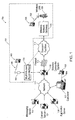
- FIG. 1 illustrates a communication system including a mobile communications device to which example implementations of the technology can be applied.
- FIG. 2 illustrates an indication of a search request on a display of a mobile communications device.
- FIG. 3 illustrates an example mobile communications device.
- FIG. 4 illustrates a block diagram of a mobile communications device.
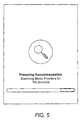
- FIG. 5 illustrates an indication of a search on a display of a mobile communications device.
- FIG. 6 illustrates a portion of a search result on a display of a Mobile communications device.
- FIG. 7 illustrates another portion of a search result on a display of a mobile communications device.
- FIG. 8 illustrates another portion of a search result on a display of a mobile communications device.
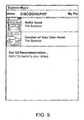
- FIG. 9 illustrates a search result on a display of a mobile communications device.
- FIG. 10 illustrates another portion of the search result shown in FIG. 9 .
- FIG. 11 illustrates still another portion of the search result shown in FIG. 9 .
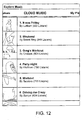
- FIG. 12 illustrates a different search result on a display of a mobile communications device.
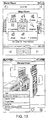
- FIG. 13 illustrates another different search result on a display of a mobile communications device.
- FIG. 14 illustrates a flow diagram of an extended search within the technology.
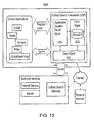
- FIG. 15 illustrates a high level view of a unified search platform.
- FIG. 16 illustrates a table of components and functionalities.
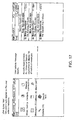
- FIG. 17 illustrates a flow diagram of an alternative universal search to that shown in FIG. 14 within the technology.
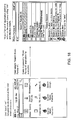
- FIG. 18 illustrates another flow diagram of a possible extended search within the technology.
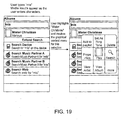
- FIG. 19 illustrates still another flow diagram of a possible extended search within the technology.
- FIG. 20 illustrates the steps of a method within the technology.
- FIG. 1 shows, in block diagram form, a communication system 100 in which implementations of the technology can be applied.
- the communication system 100 may comprise a number of mobile communications devices 103 that may be connected to the remainder of system 100 in any of several different ways. Accordingly, several instances of mobile communications devices 103 are depicted in FIG. 1 employing different example ways of connecting to system 100.
- the communications device e.g., 103 operable in particular network environments. While in the illustrated implementations, the communication devices, e.g., 103 may comprise smart phones, in other implementations, the communications devices may comprise personal digital assistants (PDA), tablet computers, laptop computers, desktop computers, servers, or other communications devices capable of sending and receiving electronic messages.
- PDA personal digital assistants
- Mobile communications devices 103 are connected to a wireless network 101 that may comprise one or more of a Wireless Wide Area Network (WWAN) 102 and a Wireless Local Area Network (WLAN) 104 or other suitable network arrangements.
- WWAN Wireless Wide Area Network
- WLAN Wireless Local Area Network
- the mobile communications devices 103 are configured to communicate over both the WWAN 102 and WLAN 104, and to roam between these networks.
- the wireless network 101 may comprise multiple WWANs 102 and WLANs 104 .
- the WWAN 102 may be implemented as any suitable wireless access network technology.
- the WWAN 102 may be implemented as a wireless network that includes a number of transceiver base stations 108 where each of the base stations 108 providers wireless Radio Frequency (RF) coverage to a corresponding area or cell.
- the WWAN 102 is typically operated by a mobile network service provider that provides subscription packages to users of the mobile communications devices 103.
- the WWAN 102 conforms ta one or more of the following wireless network types: Mobitex Radio Network, DataTAC, GSM (Global System for Mobile Communication), GPRS (General Packet Radio System), TDMA (Time Division Multiple Access), CDMA (Code-Division Multiple Access), CDPD (Cellular Digital Packet Data), iDEN (integrated Digital Enhanced Network), EvDO (Evolution-Data Optimized) CDMA2000, EDGE (Enhanced Data rates for GSM Evolution), UMTS (Universal Mobile Telecommunication Systems), HSPDA (High-Speed Downlink Packet Access), IEEE 802.15e (also referred to as Worldwide Interoperability for Microwave Access or "WiMAX”), or various other networks.
- WWAN 102 is described as a "Wide-Area" network, that term is intended herein also to incorporate wireless Metropolitan Area Networks (WMAN) and other similar technologies for providing coordinated service wirelessly over an area larger than that covered by typical WLANs.
- WMAN Wireless Metropolitan Area Networks
- the WWAN 102 may further comprise a wireless network gateway 110 that connects the mobile communications devices 103 to transport facilities 112, and through the transport facilities 112 to a wireless connector system 120.
- Transport facilities may include one or more private networks or lines, the Internet, a virtual private network, or any other suitable network.
- the wireless connector system 120 may be operated, for example, by an organization or enterprise such as a corporation, university, or governmental department, which allows access to a network 124 such as an interval enterprise network (e.g., an intranet), and its resources, or the wireless connector system 120 may be operated by a mobile network provider.
- the network 124 may be realized using the Internet rather than, or in addition to, an internal or enterprise network.
- the volunteers network gateway 110 provides an interface between the wireless connector system 120 and the WWAN 102, which facilitates communication between the mobile communications devices 103 and other devices (not shown) connected, directly or indirectly, to the WWAN 102. Accordingly, communications sent via the mobile communications devices 103 are transported via the WWAN 102 and the wireless network gateway 110 through transport facilities 112 to the wireless connector system 120. Communications sent from the wireless connector system 120 are received by the wireless network gateway 110 and transported via the WWAN 102 to the mobile communications devices 103.
- the WLAN 104 comprises a wireless network that, in some implementations, conforms to IEEE 802.11x standards (sometimes referred to as Wi-Fi TM) such as, for example, the IEEE 802.11a, 802.11b and/or 802.11g standard. Other communication protocols may be used for the WLAN 104 in other implementations such as, for example, IEEE 802.11n, IEEE 802.16e (also referred to as Worldwide Interoperability for Microwave Access or "WiMAX”), or IEEE 802.20 (also referred to as Mobile Wireless Broadband Access).
- the WLAN 104 includes one or more wireless RF Access Points (AP) 114 (one of which is shown in FIG. 1 ) that collectively provide a WLAN coverage area.
- AP wireless RF Access Points
- the WLAN 104 may be a personal network of the user, an enterprise network, or a hotspot offered by an internet service provider (ISP), a mobile network provider, or a property owner in a public or semi-public area, for example.
- the access points 114 are connected to an access point (AP) interface 116 that may connect to the wireless connector system 120 directly, (for example, if the access point 114 is part of an enterprise WLAN 104 in which the wireless connector system 120 resides), or indirectly, as indicated by the dashed line in FIG. 1 , via the transport facilities 112 if the access point 114 is a personal Wi-Fi network or Wi-Fi hotspot (in which case a mechanism for securely connecting to the wireless connector system 120, such as a virtual private network (VPN), may be used).
- the AP interface 116 provides translation and routing services between the access points 114 and the wireless connector system 120 to facilitate communication, directly or indirectly, with the wireless connector system 120.
- the wireless connector system 120 may be implemented as one or more servers, and is typically located behind a firewall 113.
- the wireless connector system 120 manages communications, including email, Hypertext Transfer Protocol (HTTP), and HTTP Secure (HTTPS) communications to and from a set of managed mobile communications devices 103.
- HTTP Hypertext Transfer Protocol
- HTTPS HTTP Secure
- the wireless connector system 120 also provides administrative control and management capabilities over users and mobile communications devices 103 that might connect to the wireless connector system 120.
- the wireless connector system 120 allows the mobile communications devices 103 to access the network 124 and connected resources and services such as a messaging server 132 (for example, a Microsoft Exchange Server®, IBM Lotus Domino®, or Novell GroupWise TM email server), a content server 134 for providing content such as Internet content or content from an organization's internal servers, application servers 136 for implementing server-based applications such as instant messaging (IM) applications to mobile communications devices 103, and intranet file services.
- a messaging server 132 for example, a Microsoft Exchange Server®, IBM Lotus Domino®, or Novell GroupWise TM email server
- a content server 134 for providing content such as Internet content or content from an organization's internal servers
- application servers 136 for implementing server-based applications such as instant messaging (IM) applications
- the wireless connector system 120 typically provides a secure exchange of data (e.g., email messages, personal information manager (PIM) data, and IM data) with the mobile communications devices 103.
- data e.g., email messages, personal information manager (PIM) data, and IM data
- communications between the wireless connector system 120 and the mobile communications devices 103 are encrypted.
- communications are encrypted using a symmetric encryption key implemented using Advanced Encryption Standard (AES) or Triple Data Encryption Standard (Triple DES) encryption.
- AES Advanced Encryption Standard
- Triple DES Triple Data Encryption Standard
- Private encryption keys are generated in a secure, two-way authenticated environment and are used for both encryption and decryption of data.
- the private encryption key is stored only in the user's mailbox on the messaging server 132 and on the mobile communications device 103, and can typically be regenerated by the user on mobile communications devices 103.
- Data sent to the mobile communications devices 103 is encrypted by the wireless connector system 120 using the private encryption key retrieved from the user's mailbox.
- the encrypted data when received on the mobile communications devices 103, is decrypted using the private encryption key stored in memory.
- data sent to the wireless connector system 120 from the mobile communications devices 103 is encrypted using the private encryption key stored in the memory of the mobile communications device 103.
- the encrypted data when received on the wireless connector system 120, is decrypted using the private encryption key retrieved from the user's mailbox.
- the wireless network gateway 110 is adapted to send data packets received from the mobile communications device 103 over the WWAN 102 to the wireless connector system 120.
- the wireless connector system 120 then sends the data packets to the appropriate connection point such as the messaging server 132 or content servers 134 or application server 136c
- the wireless connector system 120 sends data packets received, for example, from the messaging server 132 or content servers 134 or application servers 136 to the wireless network gateway 110 that then transmit the data packets to the destination mobile communications device 103.
- the AP interfaces 116 of the WLAN 104 provide similar sending functions between the mobile communications device 103 the wireless connector system 120 and network connection point such as the messaging server 132, content server 134 and application server 136.
- the network 124 may comprise a private local area network, metropolitan area network, wide area network, the public Internet or combinations thereof and may include virtual networks constructed using any of these, alone, or in combination.
- a mobile communications device 103 may alternatively connect to the wireless connector system 120 using a computer 117, such as desktop or notebook computer, via the network 124.
- a link 106 may be provided for exchanging information between the mobile communications device 103 and a computer 117 connected to the wireless connector system 120.
- the link 106 may comprise one or both of a physical interface and short-range wireless communication interface.
- the physical interface may comprise one or combinations of an Ethernet connection, Universal Serial Bus (USB) connection, FirewireTM (also known as an IEEE 1394 interface) connection, or other serial data connection, via respective ports or interfaces of the mobile communications device 103 and computer 117.
- the short-range wireless communication interface may be a personal area network (PAN) interface.
- PAN personal area network
- a Personal Area Network is a wireless point-to-point connection meaning no physical cables are used to connect the two end points.
- the short-range wireless communication interface may comprise one or a combination of an infrared (IR) connection such as an Infrared Data Association (IrDA) connection, a short-range radio frequency (RF) connection such as one specified by IEEE 802.15, or the BLUETOOTH special interest group, or IEEE 802.15.3a, also referred to as UltraWideband (UWB), or other PAN connection.
- IR infrared
- IrDA Infrared Data Association
- RF radio frequency
- the above-described communication system is provided for the purpose of illustration only, and that the above-described communication system comprises one possible communication network configuration of a multitude of possible configurations for use with the mobile communications devices 103. Suitable variations of the communication system will be understood to a person of skill in the art and are intended to fall within the scope of the present disclosure.
- an exemplary mobile communications device 300 (as an example of 103) comprises a display 322 located above a keyboard 332 constituting a user input means that is suitable for accommodating textual input to the device 300.
- the keyboard 332 can be part of a touch screen display 322.
- the front face 370 of the device 300 has a navigation row 380.
- the device 300 is of uni-body construction, also known as a "candy-bar" design.
- the device 300 may include an auxiliary input that acts as a cursor navigation tool 327 and that may be also exteriorly located upon the front face 370 of the device 300.
- the front face location of a cursor navigation tool 327 allows the tool to be thumb-actuable, e.g., like the keys of the keyboard 332.
- Some implementations of the technology provide the navigation tool 327 in the form of a trackball 321 that may be utilized to instruct two-dimentional screen cursor movement in substantially any direction, as well as act as an actuator when the trackball 321 is depressed like a button.
- Other implementations can provide the navigation tool in the form of a trackpad, a touchpad, a pointing stick, joystick, graphics tablet, or combinations thereof.
- the placement of the navigation tool 327 can be above the keyboard 332 and below the display 322; here, it may avoid interference during keyboarding and does not block the operator's view of the display 322 during use.
- the device 300 may be configured to send and receive messages.
- the device 300 includes a body 371 that can, in some implementations, be configured to be held in one hand by an operator of the device 300 during text entry.
- a display 322 is included that is located on a front face 370 of the body 371 and upon which information is displayed to the operator, e.g., during text entry.
- the device 300 may also be configured to send and receive voice communications such as mobile telephone calls.
- the device 300 also can include a camera (not shown) to allow the device 300 to take electronic photographs that can be referred to as photos or pictures. Further, the device 300 can be configured to operate a web browser.
- the device 300 may further contain a sensor, e.g., proximity sensor, behind a cover mounted in an aperture defined in body 371.
- a sensor e.g., proximity sensor
- a cover mounted in an aperture defined in body 371.
- a portion of the touch screen can constitute the cover.
- the device 300 includes a processor 438 that controls the operation of the communications device 300.
- a communication subsystem 411 performs communication transmission and reception with the wireless network 419.
- the microprocessor 438 further can be communicatively coupled with an auxiliary input/output (I/O) subsystem 428.
- the processor 438 can be communicatively coupled to a serial port (for example, a Universal Serial Bus port) 430 that can allow for communication with other devices or systems via the serial port 430.
- a serial port for example, a Universal Serial Bus port
- a display 322 can be communicatively coupled to processor 438 to allow for display of information to an operator of the communications device 300.
- the communications device 300 is equipped with a keyboard 432 (e.g., 332), the keyboard can also be communicatively coupled with the processor 438.
- the communications device 300 can include a speaker 434, a microphone 436, random access memory (RAM) 426, and flash memory 424, all of which may be communicatively coupled to the processor 438.
- RAM random access memory
- flash memory 424 flash memory
- Other similar components may be provided on the communications device 300 as well and optionally communicatively coupled to the processor 438.
- Other communication subsystems 440 and other device subsystems 442 are generally indicated as being functionally connected with the processor 438 as well.
- An example of a communication subsystem 440 is a short range communication system such as BLUETOOTH® communication module or a WI-FI® communication module (a communication module in compliance with IEEE 802.11b) and associated circuits and components.
- Examples of other device subsystem 442 include a sensor and implementations, of the present technology.
- the processor 438 is able to perform operating system functions and enables execution of programs on the communications device 300.
- the processor 438 is able to perform operating system functions and enables execution of programs on the communications device 300.
- not all of the above components are included in the communications device 300.
- the keyboard 432 is not provided as a separate component and is instead integrated with a touch screen as described below.
- the auxiliary I/O subsystem 428 can take the form of a variety of different navigation tools (multi-directional or single-directional) such as a trackball navigation tool 321, as illustrated in the exemplary implementation shown in FIG. 3 , or a thumbwheel, a navigation pad, a joystick, touch-sensitive interface, or other I/O interface. These navigation tools may be located on the front surface of the communications device 300 or may be located on any exterior surface of the communications device 300.
- Other auxiliary I/O subsystems may include external display devices and externally connected keyboards (not shown). While the above examples have been provided in relation to the auxiliary I/O subsystem 428, other subsystems capable of providing input or receiving output from the communications device 300 are considered within the scope of this disclosure.
- other keys may be placed along the side of the communications device 300 to function as escape keys, volume control keys, scrolling keys, power switches, or user programmable keys, and may likewise be programmed accordingly.
- the keyboard 432 can include a plurality of keys that can be of a physical nature such as actuable buttons, or the actuable buttons can be of a software nature, typically constituted by representations of physical keys on a display 322 (referred to herein as "virtual keys"). It is also contemplated that the user input can be provided as a combination of the two types of keys.
- Each key of the plurality of keys is associated with at least one action which can be the input of a character, a command or a function,
- characters are contemplated to exemplarily include alphabetic letters, language symbols, numbers, punctuation, insignias, icons, pictures, and even a blank space.
- the indicia for the respective keys are shown on the display 322, which in one implementation is enabled by touching the display 322, for example, with a stylus, finger, finger tip, finger nail, or other pointer, to generate the character or activate the indicated command or function.
- displays 322 capable of detecting a touch include resistive, capacitive, projected capacitive, infrared and surface acoustic wave (SAW) touch screens.
- Physical and virtual keys can be combined in many different ways as appreciated by those skilled in the art.
- physical and virtual keys are combined such that the plurality of enabled keys for a particular program or feature of the communications device 300 is shown on the displays 322 in the same configuration as the physical keys. Using this configuration, the operator can select the appropriate physical key corresponding to what is shown on the display 322. Thus, the desired character, command or function is obtained by depressing the physical key corresponding to the character, command or function displayed at a corresponding position on the display 322, rather than touching the display 322.
- the communications device 300 is equipped with components to enable operation of various programs, as shown in FIG. 4 .
- the flash memory 424 is enabled to provide a storage location for the operating system 457, device programs 458, and data.
- the operating system 457 is generally configured to manage other programs 458 that are also stored in memory 424 and executable on the processor 438.
- the operating system 457 honors requests for services made by programs 458 through predefined program interfaces. More specifically, the operating system 457 typically determines the order in which multiple programs 458 are executed on the processor 438 and the execution time allotted for each program 458, manages the sharing of memory 424 among multiple programs 458, handles input and output to and from other device subsystems 442, and so on.
- operating system 457 In addition, operators typically can interact directly with the operating system 457 through a user interface usually including the keyboard 432 and display 322. While in an exemplary implementation the operating system 457 is stored in flash memory 424, the operating system 457 in other implementations is stored in read-only memory (ROM) or similar storage element (not shown). As those skilled in the art will appreciate, the operating system 457, device program 458 , or parts thereof, may be loaded in RAM 426 or other volatile memory.
- ROM read-only memory
- the flash memory 424 may contain programs 458 for execution on the device 300, including - but not limited to an address book 452, a personal information manager (PIM) 454, and a device state 450. Furthermore, programs 458, such as social software, and other information 456 including data can be segregated upon storage in the flash memory 424 of the device 300.
- programs 458, such as social software, and other information 456 including data can be segregated upon storage in the flash memory 424 of the device 300.
- the communications device 300 When the communications device 300 is enabled for two-way communication within the wireless communication network 419, it can send and receive signals from a mobile communication service.
- Examples of communication systems enabled for two-way communication include, but are not limited to, the General Packet Radio Service (GPRS) network, the Universal Mobile Telecommunication Service (UMTS) network, the Enhanced Data for Global Evolution (EDGE) network, the Code Division Multiple Access (CDMA) network, High-Speed Packet Access (HSPA) networks, Universal Mobile Telecommunication Service Time Division Duplexing (UMTS-T9), Ultra Mobile Broadband (UMB) networks, Worldwide Interoperability for Microwave Access (WiMAX), and other networks that can be used for data and voice, or just data of voice.
- GPRS General Packet Radio Service
- UMTS Universal Mobile Telecommunication Service
- EDGE Enhanced Data for Global Evolution
- CDMA Code Division Multiple Access
- UMTS-T9 Universal Mobile Telecommunication Service Time Division Duplexing
- UMB Ultra Mobile Broadband
- the communications device 300 may use a unique identifier to enable the communications device 300 to transmit and receive signals from the communication network 419. Other systems may not use such identifying information.
- GPRS, UMTS, and EDGE use a Subscriber Identity Module (SIM) in order to allow communication with the communication network 419.
- SIM Subscriber Identity Module
- RUIM Removable User Identity Module
- the RUIM and SIM card can be used in multiple different communications devices 300.
- a communications device 300 can be configured to operate some features without a SIM/RUIM card, but a communications device will not necessarily be able to communicate with the network 419.
- a SIM/RUIM interface 444 located within the communications device 300 allows for removal or insertion of a SIM/RUIM card (not shown).
- the SIM/RUIM card features memory and holds key configurations 451, and other information 453 such as identification and subscriber related information. With a properly enabled communications device 300, two-way communication between the communications device 300 and communication network 419 is possible.
- the two-way communication enabled communications device 300 is able to both transmit and receive information from the communication network 419.
- the transfer of communication can be from the communications device 300 or to the communications device 300.
- the device 300 can be equipped with an integral or internal antenna 418 for transmitting signals to the communication network 419.
- the device 300 can be equipped with another antenna 416 for receiving communication from the communication network 419.
- These antennae (416, 418) in another exemplary implementation are combined into a single antenna (not shown).
- the antenna or antennae (416, 418) in another implementation can be externally mounted on the communications device 300.
- the communications device 300 When equipped for two-way communication, the communications device 300 features a communication subsystem 411.
- a communication subsystem 411 is modified so that a communication subsystem can support the operational needs of a communications device 300.
- the subsystem 411 includes a transmitter 414 and receiver 412 including the associated antenna or antennae (416, 418 ) as described above, local oscillators (LOs) 413, and a processing module that in the presently described exemplary implementation is a digital signals processor (DSP) 420.
- DSP digital signals processor
- communication by the communications device 300 with the wireless network 419 can be any type of communication that both the wireless network 419 and communications device 300 are enabled to transmit, receive and process. In general, these can be classified as voice or data, or both voice and data.
- Voice communication generally refers to communication in which signals for audible sounds are transmitted by the communications device 300 through the communication network 419.
- Data generally refers to all other types of communication that the communications device 300 is capable of performing within the constraints of the wireless network 419.
- Example device programs that can depend on such data include email, contacts and calendars. For each such program, synchronization with home-based versions of the program can be desirable for either or both of their long term and short term utility. As an example, emails are often time-sensitive, so substantially real time (or near-real time) synchronization may be desired. Contacts, on the other hand, can be usually updated less frequently without inconvenience. Therefore, the utility of the communications device 300 is enhanced when connectable within a communication system, and when connectable on a wireless basis in a network 419 in which voice, text messaging, and other data transfer are accommodated.
- Device 300 can include programs such as a web browser, a file browser, and client programs for interacting with server programs.
- Devices, e.g., 103, 300, for use in the technology can be characterized by an identification number assigned to the device. Such identification numbers cannot be changed and are locked to each device.
- implementations of the technology can be realized as including programming on a mobile communications device, e.g., 103.
- programming for the technology is on the mobile communication device 103, while data used by the mobile communications device 103 is on the wireless connector system 120 or a network server such as content server 134, messaging server 132, or application server 136.
- programming for the technology can be realized on a remote server. Allocation of functionality among architectural elements can be a function of several factors including latency, processing resource availability and efficient usage, storage availability and efficient usage, and revenue opportunities.
- device 300 can contain a proximity sensor.
- a typical proximity sensor can detect the presence of an object proximate to the sensor without physical contact between the object and the sensor.
- Typical active proximity sensors emit an electromagnetic or electrostatic field, or a beam of electromagnetic radiation, and can detect changes in the field or in a return signal. The object being sensed is typically referred to as the proximity sensor's "target.”
- users can link to native media applications from a Home Screen, as shown in FIG. 3 , which can be a global search application, to present various search results, as shown in FIGS. 5-12 .
- Search results presented within native media applications can be extended to other media Services which may be integrated into a framework. From within native media applications (including, but not limited to a media player) users can search for highlighted media or media within partner media services which may be integrated into a framework.
- the technology can be used to search for and capture photos, search for and view photos, search for and play music, search for and capture videos, and to search for and view videos, as depicted in FIG. 12 .
- the technology integrates providers of music and video content. Integrated content providers are accessed and the user of a mobile communications device is presented listings of related multimedia content based upon the metadata associated with multimedia content which can be provided by integrated content provider, as depicted in FIG. 18 .
- a mobile communications device 300 can be configured to comprise a core search framework.
- a core search framework can comprise a number of APIs providing search capabilities to different applications on a device 300.
- a media application on the device 300 can provide a search API subset to media which allows non-native applications to register with a core search framework and provide the media type category for which a non-native application is discoverable. Once registered a non-native application can be launched based on the media type of the current media application.
- the technology can track, collect and aggregate data in the form of a multimedia profit (MMP).
- MMP multimedia profit
- the technology can make a multimedia profile available for other resources which can be provided on a mobile communications device 300.
- information that can be contained within a MMP are music information: favorite genres, artists, albums and songs; playlists and songs contained in a playlist; recently added or recently downloaded or recently purchased music; and music services to which a user of the mobile communications device 300 subscribes, video information: favorite videos; recently added, recently downloaded, recently purchased videos; links to video sharing sites; video services and associated information, podcast information: favorite channels and specific episodes and podcasts to which a user has recently subscribed, recently downloaded or recently purchased, and picture information: favorite pictures; recently captured pictures, recently added pictures, recently downloaded pictures and links to photo sharing sites.
- an "Add to Favorites” option can be presented on the display 322. Selection of the option adds the associated metadata or link or metadata and link to a Media Profile database contained in a mobile communications device 300. A list of favorites can be accessed and updated by other application or by manual selection by a user of the mobile communications device 300.
- the technology can present personalized data or content recommendations from applications other than an application which is currently running based on a device 300 user's MMP.
- the technology can be configured to present recommendations to a user of a mobile communications device 300 when he or she is exploring specific media.
- the technology creates a dynamic application launch point that is accessible from media that is displayed on a mobile communications device 300 at any given moment.
- the technology can also aggregate, collate and send personal and contextual information to other applications.
- personal information the technology can send a list of favorite artists from one application to other applications.
- contextual information the technology can send information about the composer of a piece of music being played by an application to other applications.
- the technology enables a mobile communications device 300 to present personalized recommendations of content from media services and applications based on an MMP of the user of a mobile communications device 300.
- an explore option is displayed on the display 322 of the mobile communications device 300.
- Selection of the explore option displays contextual information relating to music or a video being played by a native application.
- the contextual information can come from other native applications or the contextual information can come from non-native applications.
- Non-native applications can include integrated carrier applications and registered multimedia services.
- the integrated carrier applications and registered multimedia services can vary by region or carrier or vary by region and carrier.
- a mobile communications device 300 can be programmed to contain a set of API's and connectivity options for allowing and enabling media services to connect to the framework to present information on a mobile communications device 300.
- a mobile communications device 300 displays static or dynamic or both static and dynamic information based on the parameters of a search, based on the music or video content, or based on both the music and video content, present on a mobile communications device 300.
- a mobile communications device 300 can be configured to be integrated with content providers and present content when the user of a device 300 selects an explore option.
- a mobile communications device 300 can be configured to enable a user to view the specific MMP of a particular contact listed in a contacts application stored on a mobile communications device 300.
- a mobile communications device 300 can be prompted by a user to explore specific items contained within a contact's profile and display similar content from registered applications.
- An application programming interface can include an interface implemented by a software program or firmware program which enables a software program or a firmware program to interact with other software or with firmware.
- An API can facilitate interaction between different software programs.
- An API can be implemented by applications, libraries, and operating systems to determine the vocabularies of applications, libraries and operating systems and calling conventions of applications, libraries and operating systems in order to access the services of applications, libraries and operating systems.
- An API can include specifications for routines, data structures, object classes, and protocols used to communicate between the user of a mobile communications device 300 and the implementer of an API.
- Registration of an application can be the notification, by an API which corresponds to a non-native application, to native applications and to a core search framework of a mobile communications device 300, what media type categories for which the non-native application are discoverable and that a non-native application has implemented the search APIs preprogrammed into a mobile communications device 300.
- a core search framework provides a mechanism which enables applications to register as a provider of searchable data. At least three modes of framework to application interaction can be programmed into a mobile communications device 300 and can be specified upon registration, as will be described in greater detail below.
- the technology includes a core search framework which can include a number of APIs which can collectively provide search capabilities to different applications on a device 300.
- a media application can provide a search API media subset which enables non-native applications to register non-native applications and enables non-native applications to indicate media type categories for which non-native applications may be searched. Once registered, non-native applications can be launched based upon the type of media being utilized by a media application.
- a non-native application can register as a data provider, subsequently providing data to be indexed within a core search framework (or simply framework) which enables an application to be displayed and utilized based on a category of search.
- a core search framework or simply framework
- the preceding example can be particularly beneficial if the data corresponding to an application is stored on a device 300 and if an application has no inherent search capability.
- an application can register as a "click to search" application.
- search requests invoked against the application can be passed through to an application for processing.
- the registration of an application as a "click to search” application can be advantageous where an application interacts with data which is not stored on a particular device 300, for example the data might be web based, and search queries are collated and forwarded to a server for implementation.
- a non-native application can register with the core search framework as a target for extended search operations.
- a mobile communications device 300 displays an application as a selection option to explore for subsequent searches when the mobile communications device 300 displays the results of a search. If an application is registered as an "extend-search" data source for media data, when a mobile communications device 300 displays results for a media search an application can also be stored on a device 300 and can be invoked by a current search query string such that an application can act on a current search query accordingly.
- the framework can provide a mechanism which enables applications to inform the framework of the data or type of data that an application deems search worthy.
- the framework can enable an application to be called to identify which data sources are relevant to a search query.
- Data sources may reside on a device 300 or may reside elsewhere, for example, on a server.
- a calling application can specify a data source by indicating search criteria.
- Search criteria can include data location, such as whether data resides on a device 300 or whether data resides elsewhere.
- Search criteria can also include data source types, such as email, media, contacts, and the like.
- Media types can include, but are not limited to, photographic data, sound data (music, for example), video data, and the like.
- FIGS. 17-19 illustrate a possible work flow scenarios as invoked from a universal search application which utilizes an underlying unified search API within the technology.
- the framework can retrieve search results dynamically from various data sources, which can then be displayed by a universal search application within a mobile communications device 300.
- a user of a mobile communications device 300 can expand a category of search results in order to view a detailed list of matches for any category. If a user of a device 300 desires, he or she can invoke an action associated with a search result.
- actions which can be invoked can include viewing an email, replying to an email, forwarding an email, and deleting an email.
- FIG. 19 illustrates a possible work flow scenario for non-native applications as invoked by a universal search application utilizing an underlying unified search API.
- the framework retrieves search results dynamically from various data sources, which can be displayed within a non-native search application.
- an extended set of secondary search options can be provided as part of search results. Secondary search options can include, but are not limited to, the searching of a designated content provider and the searching of the World Wide Web or internet.
- FIG. 15 illustrates a high level view of a unified search platform.
- a query management component 801 also known as a query manager 801 manages search queries and provides APIs to search data that are available either on a mobile communications device 300 or are available from outside a device 300, or both on a device 300 and outside a device 300.
- FIG. 15 also depicts an application and system event management component 802, also known as a system manager 802.
- a system event management component 802 is responsible for registration of non-native applications 806 , and is responsible for management and handling of other system level events.
- FIG. 15 also illustrates a data management component 803, also known as a data manager 803.
- a data management component 803 is responsible for loading data into a framework's data storage and maintaining the loaded data. Maintaining loaded data can include, but is not limited to aging loaded data, indexing loaded data, caching loaded data, and the like.
- FIG. 16 Some of the functionalities provided by the components discussed with reference to FIG. 15 are shown in chart form in FIG. 16 .
- the chart in FIG. 16 matches components of a framework with functionality that a component may provide.
- search integration functionality There are at least three types of search integration functionality which can be specified when a non-native application is registered with a unified search framework. Two types are generally related to whether or not there is a corresponding native application present on a mobile communications device 300 which is responsible for a data source and, whether or not data is present on a mobile communications device 300 or data is remotely located and accessed via the internet. In situations where data is resident on a device 300 and there is an application capable of utilizing data resident on a device 300, an application can utilize public APIs of the framework in order to register with the framework and make its data searchable. In situations where data is not resident on a device 300, it is possible for an application to register with the framework as a click-to-search data source and therefore act as a virtual on-device data source. Thus the framework passes action requests, and the like, directly to an application, and an application interacts with a remote data provider.
- an application can register to identify itself as a supplemental source of data for specific data types.
- An application which is registered and identified as a supplemental source of data for specific data types can be referred to as an extend-search data source.
- An extend-search data source can be referenced within subsequent search results affected against a particular data type.
- a unified search framework enables searches of data which is not stored on a mobile communications device 300, but may be for example present in web services, via a gateway server.
- a gateway server 805 can act as a single point of access for web service searches. The fact that a gateway server 805 can act as a single point of access for web service searches can be advantageous because multiple services can be queried via a single over-the-air connection.
- a gateway server 805 can also be advantageous because a common query request protocol between a device 300 and a gateway server 805 can be utilized, thus hiding API specifics for different web services.
- additional services can be implemented on a server, which can obviate the need for reconfiguration of a mobile communications device 300.
- a gateway server 805 can be beneficial because a gateway server 805 can enable search requests to be marshaled to multiple sources based on a single search request, thus reducing over-the-air bandwidth utilization.
- a mobile communications device 300 can be configured to display a data entry point to receive search criteria applicable to multiple data sources, such that the data entry point is consistently available to all relevant applications on a device 300 and search results are displayed in a unified format.
- a core search framework of a device 300 can execute search queries across multiple sources of data on the device 300.
- a core search framework can require a multi-threaded implementation to support concurrent searches across multiple data sources.
- an application 806 can implement search APIs which are pre-programmed into a mobile communications device 300.
- Search APIs enable an application 806 to indicate types of media an application can read. Thus when a particular item of media content is selected, an application 806 is displayed as an extended search option, as illustrated in FIG. 17 .
- Applications 806 can be specific media types or combinations of media types. Media types include can include music, video, pictures, podcasts, Ring Tones TM , Voice Notes-rm and the like.
- an application when an application is installed on the device 300, an application notifies the core search framework that the application has implemented the APIs present on the device 300 and of what media types the application can read, process and play.
- search parameters for a given context can be prepared by a unified search framework and passed to a single extended search item when invoked.
- the technology employs a media based extended context search, an example of which is illustrated in FIG. 19 .
- a media based extended context search can occur when a media item is displayed and a search option is selected from within a graphical context menu.
- the selection of a search option causes the display of a list of registered extended search providers to which context keywords are passed.
- Context keywords for a search can be derived by the technology solely from the metadata from an item selected by a user of a mobile communications device 300, as illustrated in the example shown in FIG. 17 .
- a selected item can be a musical track, a musical album, an artist a ringtone and the like.
- FIG. 20 illustrates a method implemented by the technology.
- a mobile communications device is comprises a computer readable medium 901 and a processor 902.
- a computer readable medium is in communication with the processor 903.
- a program module is stored on a computer readable medium 904. Execution of the program module 905 presents a registration application programming interface 906. The program module receives registration of a search application via the registration application programming interface 907.
- the technology can take the forms of hardware, software or both hardware and software elements.
- the technology is implemented in software, which includes, but is not limited to, firmware, resident software, microcode, a Field Programmable Gate Array (FPGA) or Application-Specific Integrated Circuit (ASIC), etc.
- FPGA Field Programmable Gate Array
- ASIC Application-Specific Integrated Circuit
- a computer-usable or computer readable medium can be any apparatus that can contain, store, communicate, propagate, or transport the program for use by or in connection with the instruction execution system, apparatus, or device 300.
- the medium can be an electronic, magnetic, optical, electromagnetic, infrared, or semiconductor system (or apparatus or device 300) or a propagation medium (though propagation mediums as signal carriers per se are not included in the definition of physical computer-readable medium).
- Examples of a physical computer-readable medium include a semiconductor or solid state memory, magnetic tape, a removable computer diskette, a random access memory (RAM), a read-only memory (ROM), a rigid magnetic disk and an optical disk.
- Current examples of optical disks include compact disk - read only memory (CD-ROM), compact disk - read/write (CD-R/W) and DVD.
- processors and program code for implementing each as aspect of the technology can be centralized or distributed (or a combination thereof) as known to those skilled in the art.
- the technology can take the forms of hardware, or both hardware and software elements.
- the technology is implemented in software, which includes but is not limited to firmware, resident software, microcode, a Field Programmable Gate Array (FPGA) or Application-Specific Integrated Circuit (ASIC), etc.
- FPGA Field Programmable Gate Array
- ASIC Application-Specific Integrated Circuit
- a computer-usable or computer readable medium can be any apparatus that can contain, store, communicate, propagate, or transport the program for use by or in connection with the instruction execution system, apparatus, or device 300.
- the medium can be an electronic, magnetic, optical, electromagnetic, infrared, or semiconductor system (or apparatus or device 300) or a propagation medium (though propagation mediums as signal carriers sacrifice are not included in the definition of physical computer-readable medium).
- Examples of a physical computer-readable medium include a semiconductor or solid state memory, removable memory connected via USB, magnetic tape, a removable computer diskette, a random access memory (RAM), a read-only memory (ROM), a rigid magnetic disk and an optical disk.
- Current examples of optical disks include compact disk - read only memory (CD-ROM), compact disk - read/write (CD-R/W), DVD, and Blu Ray TM .
- processors and program code for implementing each as aspect of the technology can be centralized or distributed (or a combination thereof) as known to those skilled in the art.
- a data processing system suitable for storing a computer program product of the present technology and for executing the program code of the computer program product will include at least one processor coupled directly or indirectly to memory elements through a system bus.
- the memory elements can include local memory employed during actual execution of the program code, bulk storage, and cache memories that provide temporary storage of at least some program code in order to reduce the number of times code must be retrieved from bulk storage during execution.
- I/O devices including but not limited to keyboards, displays, pointing devices, etc.
- Network adapters can also be coupled to the system to enable the data processing system to become coupled to other data processing systems or remote printers or storage devices through intervening private or public networks.
- Modems, cable modem, WiFi, and Ethernet cards are just a few of the currently available types of network adapters.
- Such systems can be centralized or distributed, e.g., in peer-to-peer and client/server configurations.
- the data processing system is implemented using one or both of FPGAs and ASICs.
Landscapes
- Engineering & Computer Science (AREA)
- Theoretical Computer Science (AREA)
- Multimedia (AREA)
- Data Mining & Analysis (AREA)
- Databases & Information Systems (AREA)
- Physics & Mathematics (AREA)
- General Engineering & Computer Science (AREA)
- General Physics & Mathematics (AREA)
- Library & Information Science (AREA)
- Information Transfer Between Computers (AREA)
- Mobile Radio Communication Systems (AREA)
- Telephone Function (AREA)
Applications Claiming Priority (1)
| Application Number | Priority Date | Filing Date | Title |
|---|---|---|---|
| US36492910P | 2010-07-16 | 2010-07-16 |
Publications (1)
| Publication Number | Publication Date |
|---|---|
| EP2410441A1 true EP2410441A1 (fr) | 2012-01-25 |
Family
ID=43706447
Family Applications (1)
| Application Number | Title | Priority Date | Filing Date |
|---|---|---|---|
| EP10193739A Withdrawn EP2410441A1 (fr) | 2010-07-16 | 2010-12-03 | Enregistrement des applications et recherche de support unifié |
Country Status (4)
| Country | Link |
|---|---|
| US (1) | US20120016861A1 (fr) |
| EP (1) | EP2410441A1 (fr) |
| CN (1) | CN102393844B (fr) |
| CA (1) | CA2745665C (fr) |
Families Citing this family (16)
| Publication number | Priority date | Publication date | Assignee | Title |
|---|---|---|---|---|
| US20130007196A1 (en) * | 2011-06-30 | 2013-01-03 | Alfano Frank M | Connectionless Operation in a Wireless Network |
| US11537671B1 (en) * | 2012-07-02 | 2022-12-27 | Amazon Technologies, Inc. | Unified search |
| CA2878043C (fr) * | 2012-09-26 | 2017-06-27 | Lg Electronics Inc. | Procede et appareil pour traiter un signal de service numerique |
| US20140188889A1 (en) * | 2012-12-31 | 2014-07-03 | Motorola Mobility Llc | Predictive Selection and Parallel Execution of Applications and Services |
| US8789040B1 (en) * | 2013-07-16 | 2014-07-22 | Appenity LLC | Converting non-natively executable programs to downloadable executable programs |
| US10140364B1 (en) | 2013-08-23 | 2018-11-27 | Google Llc | Dynamically altering shared content |
| JP6527170B2 (ja) | 2014-03-31 | 2019-06-05 | レコ コーポレイションLeco Corporation | 軸方向パルス変換器を備えた多重反射飛行時間質量分析計 |
| US9560055B2 (en) * | 2014-04-30 | 2017-01-31 | Microsoft Technology Licensing, Llc | Client-side integration framework of services |
| US10554486B2 (en) * | 2014-09-26 | 2020-02-04 | Microsoft Technology Licensing, Llc | Multi-enrollments of a computing device into configuration sources |
| US10216852B1 (en) | 2015-01-22 | 2019-02-26 | Google Llc | Indexing access limited native applications |
| US10503742B2 (en) * | 2015-10-27 | 2019-12-10 | Blackberry Limited | Electronic device and method of searching data records |
| CN107426079B (zh) * | 2016-05-24 | 2020-06-16 | 腾讯科技(深圳)有限公司 | 一种通知栏消息的处理方法及装置 |
| US20210209254A1 (en) * | 2017-03-24 | 2021-07-08 | Technologie Intelligente Llc | Rule-based control of communication devices |
| US11303731B2 (en) * | 2019-02-16 | 2022-04-12 | Samsung Electronics Co., Ltd. | Method and apparatus for registering API provider domain function entities on CAPIF core function entity |
| CN112422643B (zh) * | 2020-11-02 | 2022-04-01 | 中关村科学城城市大脑股份有限公司 | 一种第三方接口保护的请求转发方法和装置 |
| US11822699B1 (en) * | 2021-10-21 | 2023-11-21 | Secure Computing, Llc | Preventing surreptitious access to file data by malware |
Citations (1)
| Publication number | Priority date | Publication date | Assignee | Title |
|---|---|---|---|---|
| EP1659506A1 (fr) * | 2004-11-11 | 2006-05-24 | Microsoft Corporation | API (Application Programming Interface) et bibliothèque pour l'accès programmable aux moteurs de récherche |
Family Cites Families (10)
| Publication number | Priority date | Publication date | Assignee | Title |
|---|---|---|---|---|
| US6389467B1 (en) * | 2000-01-24 | 2002-05-14 | Friskit, Inc. | Streaming media search and continuous playback system of media resources located by multiple network addresses |
| CN100483404C (zh) * | 2003-05-12 | 2009-04-29 | 皇家飞利浦电子股份有限公司 | 用于搜索媒体对象的方法 |
| US8438147B2 (en) * | 2003-09-29 | 2013-05-07 | Home Box Office, Inc. | Media content searching and notification |
| US20050234929A1 (en) * | 2004-03-31 | 2005-10-20 | Ionescu Mihai F | Methods and systems for interfacing applications with a search engine |
| US7996487B2 (en) * | 2006-08-23 | 2011-08-09 | Oracle International Corporation | Managing searches on mobile devices |
| CN101360118B (zh) * | 2007-08-02 | 2013-05-22 | 广东新支点技术服务有限公司 | 一种适合移动终端多媒体文件共享与搜索的方法和协议 |
| EP2312427B1 (fr) * | 2009-10-13 | 2013-09-18 | BlackBerry Limited | Interface d'utilisateur pour affichage tactile |
| CA2789991A1 (fr) * | 2010-02-15 | 2011-08-18 | Research In Motion Limited | Systeme de communication comprenant un serveur de recherche destine a la recherche d'un dispositif de communication mobile sans fil et procedes associes |
| US9098363B2 (en) * | 2010-04-07 | 2015-08-04 | Apple Inc. | Search extensibility to third party applications |
| US20110283242A1 (en) * | 2010-05-14 | 2011-11-17 | Sap Ag | Report or application screen searching |
-
2010
- 2010-12-03 EP EP10193739A patent/EP2410441A1/fr not_active Withdrawn
- 2010-12-03 US US12/959,820 patent/US20120016861A1/en not_active Abandoned
-
2011
- 2011-06-30 CN CN201110181444.6A patent/CN102393844B/zh not_active Expired - Fee Related
- 2011-07-07 CA CA2745665A patent/CA2745665C/fr not_active Expired - Fee Related
Patent Citations (1)
| Publication number | Priority date | Publication date | Assignee | Title |
|---|---|---|---|---|
| EP1659506A1 (fr) * | 2004-11-11 | 2006-05-24 | Microsoft Corporation | API (Application Programming Interface) et bibliothèque pour l'accès programmable aux moteurs de récherche |
Non-Patent Citations (1)
| Title |
|---|
| HOONG D C ET AL: "Guided Google: A Meta Search Engine and its Implementation using the Google Distributed Web Services", INTERNET CITATION, 18 February 2003 (2003-02-18), XP002371594, Retrieved from the Internet <URL:http://arvix.org/ftp/cs/papers/0302/0302018.pdf> [retrieved on 20060309] * |
Also Published As
| Publication number | Publication date |
|---|---|
| US20120016861A1 (en) | 2012-01-19 |
| CN102393844A (zh) | 2012-03-28 |
| CA2745665A1 (fr) | 2012-01-16 |
| CN102393844B (zh) | 2015-01-21 |
| CA2745665C (fr) | 2014-12-02 |
Similar Documents
| Publication | Publication Date | Title |
|---|---|---|
| CA2745665C (fr) | Enregistrement d'applications et recherche multimedia unifiee | |
| US20230112569A1 (en) | Method and apparatus for managing files in an online account | |
| US11601385B2 (en) | Conversion of text relating to media content and media extension apps | |
| US8793332B2 (en) | Content tagging using broadcast device information | |
| US20130066908A1 (en) | System and method for sharing mobile device content | |
| US8965422B2 (en) | Tagging instant message content for retrieval using mobile communication devices | |
| US20100162165A1 (en) | User Interface Tools | |
| CN113127773B (zh) | 页面处理方法、装置、存储介质及终端设备 | |
| CN103180849B (zh) | 使用移动计算装置搜索多数据源 | |
| US20110202864A1 (en) | Apparatus and methods of receiving and acting on user-entered information | |
| KR20120095863A (ko) | 사용자 데이터 엔트리들의 애플리케이션들로의 라우팅 | |
| US20120094721A1 (en) | Method and apparatus for sharing of data by dynamic groups | |
| US20070245006A1 (en) | Apparatus, method and computer program product to provide ad hoc message recipient lists | |
| CN104050219A (zh) | 用于管理会话消息的方法和设备 | |
| CN107436948B (zh) | 文件搜索方法、装置及终端 | |
| US8832561B2 (en) | Automatic initiation of communications | |
| US9798769B2 (en) | Sharing document links from multiple data providers | |
| WO2024187932A1 (fr) | Système et procédé de communication, et équipement terminal | |
| US20150207768A1 (en) | Deriving atomic communication threads from independently addressable messages | |
| US8606300B2 (en) | Efficiency of electronic message communications between mobile communication devices | |
| CN101785197A (zh) | 被包括以用于手持设备中的资源选择器 | |
| EP2416260A1 (fr) | Système et procédé de synchronisation de fichiers média et arts média associés | |
| EP2618549A1 (fr) | Amélioration de l'efficacité des communications par message électronique entre des dispositifs de communication mobile | |
| CN102812477B (zh) | 用于管理在线账户中的文件的方法和设备 |
Legal Events
| Date | Code | Title | Description |
|---|---|---|---|
| 17P | Request for examination filed |
Effective date: 20101203 |
|
| AK | Designated contracting states |
Kind code of ref document: A1 Designated state(s): AL AT BE BG CH CY CZ DE DK EE ES FI FR GB GR HR HU IE IS IT LI LT LU LV MC MK MT NL NO PL PT RO RS SE SI SK SM TR |
|
| AX | Request for extension of the european patent |
Extension state: BA ME |
|
| PUAI | Public reference made under article 153(3) epc to a published international application that has entered the european phase |
Free format text: ORIGINAL CODE: 0009012 |
|
| RAP1 | Party data changed (applicant data changed or rights of an application transferred) |
Owner name: BLACKBERRY LIMITED |
|
| RAP1 | Party data changed (applicant data changed or rights of an application transferred) |
Owner name: BLACKBERRY LIMITED |
|
| STAA | Information on the status of an ep patent application or granted ep patent |
Free format text: STATUS: THE APPLICATION IS DEEMED TO BE WITHDRAWN |
|
| 18D | Application deemed to be withdrawn |
Effective date: 20160701 |