EP2444445A1 - Preparation method of terpolymer of poly(biphenyl ether sulphone) and poly(ethersulphone) - Google Patents
Preparation method of terpolymer of poly(biphenyl ether sulphone) and poly(ethersulphone) Download PDFInfo
- Publication number
- EP2444445A1 EP2444445A1 EP10825936A EP10825936A EP2444445A1 EP 2444445 A1 EP2444445 A1 EP 2444445A1 EP 10825936 A EP10825936 A EP 10825936A EP 10825936 A EP10825936 A EP 10825936A EP 2444445 A1 EP2444445 A1 EP 2444445A1
- Authority
- EP
- European Patent Office
- Prior art keywords
- poly
- biphenyl
- ether
- terpolymer
- sulfone
- Prior art date
- Legal status (The legal status is an assumption and is not a legal conclusion. Google has not performed a legal analysis and makes no representation as to the accuracy of the status listed.)
- Withdrawn
Links
- 229920001897 terpolymer Polymers 0.000 title claims abstract description 27
- ZCILODAAHLISPY-UHFFFAOYSA-N biphenyl ether Natural products C1=C(CC=C)C(O)=CC(OC=2C(=CC(CC=C)=CC=2)O)=C1 ZCILODAAHLISPY-UHFFFAOYSA-N 0.000 title 1
- 238000002360 preparation method Methods 0.000 title 1
- 125000001174 sulfone group Chemical group 0.000 title 1
- ZUOUZKKEUPVFJK-UHFFFAOYSA-N diphenyl Chemical compound C1=CC=CC=C1C1=CC=CC=C1 ZUOUZKKEUPVFJK-UHFFFAOYSA-N 0.000 claims abstract description 31
- RTZKZFJDLAIYFH-UHFFFAOYSA-N Diethyl ether Chemical compound CCOCC RTZKZFJDLAIYFH-UHFFFAOYSA-N 0.000 claims abstract description 30
- GPAPPPVRLPGFEQ-UHFFFAOYSA-N 4,4'-dichlorodiphenyl sulfone Chemical compound C1=CC(Cl)=CC=C1S(=O)(=O)C1=CC=C(Cl)C=C1 GPAPPPVRLPGFEQ-UHFFFAOYSA-N 0.000 claims abstract description 21
- XLYOFNOQVPJJNP-UHFFFAOYSA-N water Substances O XLYOFNOQVPJJNP-UHFFFAOYSA-N 0.000 claims abstract description 20
- VPWNQTHUCYMVMZ-UHFFFAOYSA-N 4,4'-sulfonyldiphenol Chemical compound C1=CC(O)=CC=C1S(=O)(=O)C1=CC=C(O)C=C1 VPWNQTHUCYMVMZ-UHFFFAOYSA-N 0.000 claims abstract description 19
- 239000004305 biphenyl Substances 0.000 claims abstract description 17
- 235000010290 biphenyl Nutrition 0.000 claims abstract description 16
- 229920000642 polymer Polymers 0.000 claims abstract description 16
- 239000007787 solid Substances 0.000 claims abstract description 15
- 150000003457 sulfones Chemical class 0.000 claims abstract description 15
- 229920006393 polyether sulfone Polymers 0.000 claims abstract description 13
- 238000000034 method Methods 0.000 claims abstract description 12
- CTQNGGLPUBDAKN-UHFFFAOYSA-N O-Xylene Chemical compound CC1=CC=CC=C1C CTQNGGLPUBDAKN-UHFFFAOYSA-N 0.000 claims abstract description 11
- 238000006243 chemical reaction Methods 0.000 claims abstract description 11
- 239000000178 monomer Substances 0.000 claims abstract description 11
- 238000003756 stirring Methods 0.000 claims abstract description 11
- 239000008096 xylene Substances 0.000 claims abstract description 11
- 238000010438 heat treatment Methods 0.000 claims abstract description 10
- 239000003960 organic solvent Substances 0.000 claims abstract description 6
- 239000003795 chemical substances by application Substances 0.000 claims abstract description 4
- CDBYLPFSWZWCQE-UHFFFAOYSA-L Sodium Carbonate Chemical group [Na+].[Na+].[O-]C([O-])=O CDBYLPFSWZWCQE-UHFFFAOYSA-L 0.000 claims description 16
- OZUNPRDEUXITBO-UHFFFAOYSA-N 1-(4-chlorophenyl)sulfonyl-4-[4-(4-chlorophenyl)sulfonylphenyl]benzene Chemical group C1=CC(Cl)=CC=C1S(=O)(=O)C1=CC=C(C=2C=CC(=CC=2)S(=O)(=O)C=2C=CC(Cl)=CC=2)C=C1 OZUNPRDEUXITBO-UHFFFAOYSA-N 0.000 claims description 15
- 239000000843 powder Substances 0.000 claims description 12
- 229910000029 sodium carbonate Inorganic materials 0.000 claims description 8
- HXJUTPCZVOIRIF-UHFFFAOYSA-N sulfolane Chemical group O=S1(=O)CCCC1 HXJUTPCZVOIRIF-UHFFFAOYSA-N 0.000 claims description 8
- IJGRMHOSHXDMSA-UHFFFAOYSA-N Atomic nitrogen Chemical compound N#N IJGRMHOSHXDMSA-UHFFFAOYSA-N 0.000 claims description 6
- 238000009835 boiling Methods 0.000 claims description 6
- 238000006116 polymerization reaction Methods 0.000 claims description 6
- SQGYOTSLMSWVJD-UHFFFAOYSA-N silver(1+) nitrate Chemical compound [Ag+].[O-]N(=O)=O SQGYOTSLMSWVJD-UHFFFAOYSA-N 0.000 claims description 6
- BVKZGUZCCUSVTD-UHFFFAOYSA-L Carbonate Chemical compound [O-]C([O-])=O BVKZGUZCCUSVTD-UHFFFAOYSA-L 0.000 claims description 5
- 239000003513 alkali Substances 0.000 claims description 5
- 238000001914 filtration Methods 0.000 claims description 5
- 230000000704 physical effect Effects 0.000 claims description 5
- 239000008367 deionised water Substances 0.000 claims description 4
- 229910021641 deionized water Inorganic materials 0.000 claims description 4
- 239000000203 mixture Substances 0.000 claims description 4
- BWHMMNNQKKPAPP-UHFFFAOYSA-L potassium carbonate Chemical compound [K+].[K+].[O-]C([O-])=O BWHMMNNQKKPAPP-UHFFFAOYSA-L 0.000 claims description 4
- 150000003839 salts Chemical class 0.000 claims description 4
- 239000003021 water soluble solvent Substances 0.000 claims description 4
- VEXZGXHMUGYJMC-UHFFFAOYSA-M Chloride anion Chemical compound [Cl-] VEXZGXHMUGYJMC-UHFFFAOYSA-M 0.000 claims description 3
- 229920012266 Poly(ether sulfone) PES Polymers 0.000 claims description 3
- 238000002156 mixing Methods 0.000 claims description 3
- 229910052757 nitrogen Inorganic materials 0.000 claims description 3
- 229910001961 silver nitrate Inorganic materials 0.000 claims description 3
- 125000001309 chloro group Chemical group Cl* 0.000 claims description 2
- 239000012153 distilled water Substances 0.000 claims description 2
- 239000000706 filtrate Substances 0.000 claims description 2
- 238000000227 grinding Methods 0.000 claims description 2
- 125000002887 hydroxy group Chemical group [H]O* 0.000 claims description 2
- 229910000027 potassium carbonate Inorganic materials 0.000 claims description 2
- 238000001291 vacuum drying Methods 0.000 claims description 2
- SECXISVLQFMRJM-UHFFFAOYSA-N N-Methylpyrrolidone Chemical compound CN1CCCC1=O SECXISVLQFMRJM-UHFFFAOYSA-N 0.000 claims 1
- 239000007788 liquid Substances 0.000 abstract 2
- 125000003963 dichloro group Chemical group Cl* 0.000 abstract 1
- 238000007670 refining Methods 0.000 abstract 1
- 230000001105 regulatory effect Effects 0.000 abstract 1
- 229920001577 copolymer Polymers 0.000 description 7
- KZTYYGOKRVBIMI-UHFFFAOYSA-N S-phenyl benzenesulfonothioate Natural products C=1C=CC=CC=1S(=O)(=O)C1=CC=CC=C1 KZTYYGOKRVBIMI-UHFFFAOYSA-N 0.000 description 2
- 229920006351 engineering plastic Polymers 0.000 description 2
- 238000004519 manufacturing process Methods 0.000 description 2
- 239000000126 substance Substances 0.000 description 2
- 239000012530 fluid Substances 0.000 description 1
- 230000007062 hydrolysis Effects 0.000 description 1
- 238000006460 hydrolysis reaction Methods 0.000 description 1
- 230000007774 longterm Effects 0.000 description 1
- 239000000463 material Substances 0.000 description 1
- 231100000956 nontoxicity Toxicity 0.000 description 1
- 239000003973 paint Substances 0.000 description 1
- 229920002492 poly(sulfone) Polymers 0.000 description 1
- 239000000047 product Substances 0.000 description 1
- 239000002904 solvent Substances 0.000 description 1
- 125000000472 sulfonyl group Chemical group *S(*)(=O)=O 0.000 description 1
- 239000006228 supernatant Substances 0.000 description 1
- 230000002194 synthesizing effect Effects 0.000 description 1
Images
Classifications
-
- C—CHEMISTRY; METALLURGY
- C08—ORGANIC MACROMOLECULAR COMPOUNDS; THEIR PREPARATION OR CHEMICAL WORKING-UP; COMPOSITIONS BASED THEREON
- C08G—MACROMOLECULAR COMPOUNDS OBTAINED OTHERWISE THAN BY REACTIONS ONLY INVOLVING UNSATURATED CARBON-TO-CARBON BONDS
- C08G75/00—Macromolecular compounds obtained by reactions forming a linkage containing sulfur with or without nitrogen, oxygen, or carbon in the main chain of the macromolecule
- C08G75/20—Polysulfones
-
- C—CHEMISTRY; METALLURGY
- C08—ORGANIC MACROMOLECULAR COMPOUNDS; THEIR PREPARATION OR CHEMICAL WORKING-UP; COMPOSITIONS BASED THEREON
- C08G—MACROMOLECULAR COMPOUNDS OBTAINED OTHERWISE THAN BY REACTIONS ONLY INVOLVING UNSATURATED CARBON-TO-CARBON BONDS
- C08G75/00—Macromolecular compounds obtained by reactions forming a linkage containing sulfur with or without nitrogen, oxygen, or carbon in the main chain of the macromolecule
- C08G75/20—Polysulfones
- C08G75/23—Polyethersulfones
-
- C—CHEMISTRY; METALLURGY
- C08—ORGANIC MACROMOLECULAR COMPOUNDS; THEIR PREPARATION OR CHEMICAL WORKING-UP; COMPOSITIONS BASED THEREON
- C08L—COMPOSITIONS OF MACROMOLECULAR COMPOUNDS
- C08L81/00—Compositions of macromolecular compounds obtained by reactions forming in the main chain of the macromolecule a linkage containing sulfur with or without nitrogen, oxygen or carbon only; Compositions of polysulfones; Compositions of derivatives of such polymers
- C08L81/06—Polysulfones; Polyethersulfones
Definitions
- the present invention falls into the art of high-molecular materials, and in particular relates to a method for preparing series of terpolymer of poly (biphenyl sulfone ether) and poly (ether sulfone) in a set of production equipment using ternary polymerization technology.
- Poly (ether sulfone) is a special engineering plastic with exceptional comprehensive physical properties. Due to its comprehensive heat resistance (heat distortion temperature 200-220°C), hydrolysis resistance (withstanding 150-160°C hot water or vapor), creep resistance, dimensional stability, impact resistance, chemical resistance, non-toxicity, flame retardance, etc., it has been widely applied to such fields as electrics, electronics, machinery, automobile, hot water, medical apparatus and food processing. Its global production capacity has reached tens of thousands of tons, represented by Solvay Chemicals, Inc. However, over long-term application and extension, higher heat resistance requirements are being raised in different fields of application. In other words, there is a prevalent expectation for increasing its heat resistance grade from today's H to C while keeping its mechanical properties unchanged.
- the essence of the present invention is to add the following to the reaction system in the presence of heat resistant organic solvent:
- a terpolymer whose molecular chain contains the following repeated unit structures can be obtained through a certain temperature rise procedure and after a certain hold time: i.e., A 2 B 2 chain segment I i.e., A 2' B 2 chain segment II
- the method is implemented by adding high-temperature organic solvent to a three-neck flask provided with a thermometer, a nitrogen tube, a condensate water separator and a stirrer, heating to 80°C and adding 4,4'-dichlorodiphenylsulfone, 4,4'-Bis(4-chlorophenyl)sulfonyl-1,1'-biphenyl and 4,4'-dihydroxydiphenylsulfone with solid content being 20-35%, stirring until all monomers are dissolved, heating to 100°C and adding alkali carbonate salt-forming agent mol% more than 4,4'-dihydroxydiphenylsulfone by 5-10%, and 60-100 ml of xylene per mole of polymer; heating while stirring so that the salt-forming reaction of the system begins, wherein the system temperature is controlled between 190°C and 210°C, and the theoretical value achievement of water yield of the system represents the completion of the first-stage salt-forming reaction
- a terpolymer with a different ratio of chain segment I to chain segment II in the molecular chain, and a different structural composition can be obtained by changing the mixing ratio of the two Bi-chloride monomers (4,4'-dichlorodiphenylsulfone and 4,4'-Bis(4-chlorophenyl)sulfonyl.-1,1'-biphenyl); its heat resistance is between that of poly (ether sulfone) and that of poly (biphenyl sulfone ether), and the Tg that indicates its heat resistance grade is freely adjustable between 226°C and 262°C.
- the said high-temperature organic solvent is sulfolane or methylpprolidone, and the alkali carbonate used is Na 2 CO 3 , K 2 CO 3 or a mixture thereof.
- the system temperature is controlled between 200°C and 210°C.
- the supernatant xylene turns from turbid to clear, continue to recirculate for 20 minutes to ensure full salt-forming reaction, and then heat to 230-236°C to start polymerization. Maintain a constant temperature for 3.5 hours to ensure full polymerization. Stop stirring, inject the viscous polymer solution directly into deionized water at room temperature to obtain a strip solid. After filtration, grind the strip solid into powder in a tissue grinder in the presence of water. Add the filtered powder to fresh deionized water and boil away for 1 hour. Repeat this 8-10 times until the chloride ion content in the water as detected with silver nitrate is acceptable.
- Tg of 226°C as measured by DSC is equivalent to that of pure poly (ether sulfone) (PES).
- Tg 237°C as measured by DSC.
- Tg 247°C as measured by DSC.
- Tg is 253°C as measured by DSC.
- Tg 258°C as measured by DSC.
- Tg is 262°C as measured by DSC, which is the same as that of pure poly (biphenyl sulfone ether).
Landscapes
- Chemical & Material Sciences (AREA)
- Health & Medical Sciences (AREA)
- Chemical Kinetics & Catalysis (AREA)
- Medicinal Chemistry (AREA)
- Polymers & Plastics (AREA)
- Organic Chemistry (AREA)
- Polymers With Sulfur, Phosphorus Or Metals In The Main Chain (AREA)
- Polyethers (AREA)
Abstract
Description
- The present invention falls into the art of high-molecular materials, and in particular relates to a method for preparing series of terpolymer of poly (biphenyl sulfone ether) and poly (ether sulfone) in a set of production equipment using ternary polymerization technology.
- Poly (ether sulfone) is a special engineering plastic with exceptional comprehensive physical properties. Due to its comprehensive heat resistance (heat distortion temperature 200-220°C), hydrolysis resistance (withstanding 150-160°C hot water or vapor), creep resistance, dimensional stability, impact resistance, chemical resistance, non-toxicity, flame retardance, etc., it has been widely applied to such fields as electrics, electronics, machinery, automobile, hot water, medical apparatus and food processing. Its global production capacity has reached tens of thousands of tons, represented by Solvay Chemicals, Inc. However, over long-term application and extension, higher heat resistance requirements are being raised in different fields of application. In other words, there is a prevalent expectation for increasing its heat resistance grade from today's H to C while keeping its mechanical properties unchanged. It is driven by this market demand that we have completed the study of copolymers containing the diphenyl sulfone ether structure with a higher heat resistance grade, and created this patent on the basis of existing polysulfone patents, such as ZL200510017259.8, by first synthesizing monomers containing the diphenyl sulfone structure successfully using the principle of molecular design and ternary polymerization technology.
- The essence of the present invention is to add the following to the reaction system in the presence of heat resistant organic solvent:
- (1) 4,4'-dichlorodiphenylsulfone

- (2) 4,4'-Bis(4-chlorophenyl)sulfonyl-1,1'-biphonyl

- (3) 4,4'-dihydroxydiphenylsulfone

- When the three monomers and the alkali carbonate salt-forming agent M2CO3 are mixed, a terpolymer whose molecular chain contains the following repeated unit structures can be obtained through a certain temperature rise procedure and after a certain hold time:
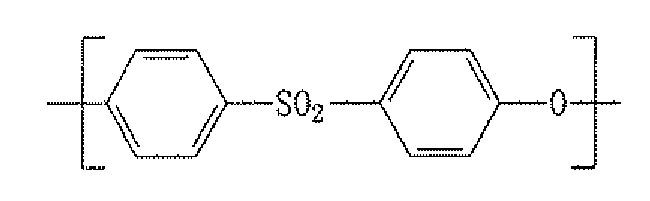

- The method is implemented by adding high-temperature organic solvent to a three-neck flask provided with a thermometer, a nitrogen tube, a condensate water separator and a stirrer, heating to 80°C and adding 4,4'-dichlorodiphenylsulfone, 4,4'-Bis(4-chlorophenyl)sulfonyl-1,1'-biphenyl and 4,4'-dihydroxydiphenylsulfone with solid content being 20-35%, stirring until all monomers are dissolved, heating to 100°C and adding alkali carbonate salt-forming agent mol% more than 4,4'-dihydroxydiphenylsulfone by 5-10%, and 60-100 ml of xylene per mole of polymer; heating while stirring so that the salt-forming reaction of the system begins, wherein the system temperature is controlled between 190°C and 210°C, and the theoretical value achievement of water yield of the system represents the completion of the first-stage salt-forming reaction; at the moment, raising the system temperature to 230-236°C and maintaining for 3-4 hours to complete polymerization to obtain a viscous polymer solution;
- After the reaction stops, injecting the viscous polymer solution directly into distilled water at room temperature to obtain a strip solid; grinding the strip solid into powder in a tissue grinder in the presence of water to obtain a solid powder containing a polymer, water-soluble solvent and salt through filtration; adding the solid powder to deionized water, boiling away for 1 hour, and removing the water-soluble solvent and salt through filtration; then boiling away the polymer-containing solid powder in the same way 8-10 times until the chloride ion content in the boiling filtrate as detected with silver nitrate is acceptable; and vacuum drying the resultant polymer powder until the moisture content by weight is less than 0.5%, when a terpolymer containing chain segments I and II is obtained.
- Further, when the mixing ratio (namely mole number ratio) of the above three monomers is:
- (1) A2:A2≥99%:1%, where the mole consumption of B2 is the sum of the mole numbers of A2 and A2', the content of chain segment I is ≥99% and that of chain segment II ≤1% in the resultant terpolymer, and the macroscopic physical properties of the terpolymer, are the same as those of the corresponding poly (ether sulfone) (PES).

- (2) A2:A2'≤1%:99%, where the mole consumption of B2 is the sum of the mole numbers of A2 and A2', the content of chain segment II is ≥99% and that of chain segment I ≤1% in the resultant terpolymer, and the macroscopic physical properties of the terpolymer are equivalent to those of the corresponding poly (biphenyl sulfone ether).

- When the sum of the consumptions or 4,4'-dichlorodiphenylsulfone and 4,4'-Bis(4-chlorophenyl)sulfonyl-1,1-biphenyl is more than that of 4,4'-dihydroxydiphenylsulfone, a chlorine end group with the following structure will be obtained:

- When 4,4`-dihydroxydiphenylsulfone is more than the sum of the consumptions of 4,4'-dichlorodiphenylsulfone and 4,4'-Bis(4-chlorophenyl)sulfonyl-1,1'-biphenyl, a hydroxyl end group with the following structure may be obtained:

- A terpolymer with a different ratio of chain segment I to chain segment II in the molecular chain, and a different structural composition can be obtained by changing the mixing ratio of the two Bi-chloride monomers (4,4'-dichlorodiphenylsulfone and 4,4'-Bis(4-chlorophenyl)sulfonyl.-1,1'-biphenyl); its heat resistance is between that of poly (ether sulfone) and that of poly (biphenyl sulfone ether), and the Tg that indicates its heat resistance grade is freely adjustable between 226°C and 262°C.
- The said high-temperature organic solvent is sulfolane or methylpprolidone, and the alkali carbonate used is Na2CO3, K2CO3 or a mixture thereof.
-
-
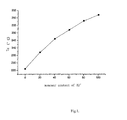
Fig. 1 : relation curve between the Tg of the terpolymer and the monomer content of the chain segment component A2' - Add 434g of solvent sulfolane to a three-neck flask provided with a thermometer, a nitrogen tube, a condensate water separator and a stirrer, stir and heat to 80°C, add 142.87g (0.4975 mol, so that the sum of the mole consumptions of 4,4'-dichlorodiphenylsulfone and 4,4'-Bis(4-chlorophenyl)sulfonyl-1,1'-biphenylis more than that of 4,4'-dihydroxydiphenylsulfone by 0.5%) of 4,4'-dichlorodiphenylsulfone, 2.52g (0.005 mol) of
- 4,4'-Bis(4-chlorophenyl)sulfonyl-1,1'-biphenyl and 125.14g (0.500 mol) of 4,4'-dihydroxydiphenylsulfone in turn, keep stirring until all monomers are dissolved, heat to 100°C, and add 58.3g (0.550 mol, 10 mol % more than 4,4'-dihydroxydiphenylsulfone) of Na2CO3 and then 80 ml of xylene to the system. Heat while stirring so that the salt-forming reaction of the system begins, wherein the water generated in the system co-boils with xylene, and cold fluid begins to drip from the condensate tube and stratify in the water separator. The system temperature is controlled between 200°C and 210°C. When the supernatant xylene turns from turbid to clear, continue to recirculate for 20 minutes to ensure full salt-forming reaction, and then heat to 230-236°C to start polymerization. Maintain a constant temperature for 3.5 hours to ensure full polymerization. Stop stirring, inject the viscous polymer solution directly into deionized water at room temperature to obtain a strip solid. After filtration, grind the strip solid into powder in a tissue grinder in the presence of water. Add the filtered powder to fresh deionized water and boil away for 1 hour. Repeat this 8-10 times until the chloride ion content in the water as detected with silver nitrate is acceptable.
- Vacuum dry the filtered polymer until the moisture content by weight is less than 0.5%. Then a copolymer with a chain segment I to chain segment II ratio of 99%:1% will be obtained.
- Its Tg of 226°C as measured by DSC is equivalent to that of pure poly (ether sulfone) (PES).
- Add 594 g of sulfolane, 115.59g (0.4025 mol, 0.5% more) of 4,4'-dichlorodiphenylsulfone, 50.34g (0.100 mol) of 4,4'-Bis(4-chlorophenyl)sulfonyl-1,1'-biphenyl, 125.14g (0.500 mol) of 4,4'-dihydroxydiphenylsulfone, 58.3g (0.550 mol, 10% more) of Na2CO3 and 80 ml of xylene in the same order to a reactor identical with that used in Embodiment 1. Operate in the same way as Embodiment 1 in the other steps. A copolymer with a chain segment I to chain segment II ratio of 80%:20% will be obtained.
- Its Tg is 237°C as measured by DSC.
- Add 645 g of sulfolane, 86.88g (3.025 mol, 0.5% more) of 4,4'-dichlorodiphenylsulfone, 100.68g (0.200 mol) of 4,4'-Bis(4-chlorophenyl)sulfonyl-1,1'-biphenyl, 125.14g (0.500 mol) of 4,4'-dihydroxydiphenylsulfone, 58.3g (0.550 mol, 10% more) of Na2CO3 and 80 ml of xylene in the same order to a reactor identical with that used in Embodiment 1. Operate in the same way as Embodiment 1 in the other steps. A copolymer with a chain segment I to chain segment II ratio of 60%:40% will be obtained.
- Its Tg is 247°C as measured by DSC.
- Add 683 g of sulfolane, 58.15g (0.2025 mol, 0.5% more) of 4,4'-dichlorodiphenylsulfone, 151-02g (0.300 mol) of 4,4'-Bis(4-chlorophenyl)sulfonyl-1,1'-biphenyl, 125.14g (0.500 mol) of 4,4'-dihydroxydiphenylsulfone, 58.3g (0.550 mol, 10% more) of Na2CO3 and 80 ml of xylene in the same order to a reactor identical with that used in Embodiment 1. Operate in the same way as Embodiment 1 in the other steps. A copolymer with a chain segment I to chain segment II ratio of 40%:60% will be obtained.
- Its Tg is 253°C as measured by DSC.
- Add 733 g of sulfolane, 29.43g (0.1025 mol, 0.5% more) of 4,4'-dichlorodiphenylsulfone, 201.36g (0.400 mol) of 4,4'-Bis(4-chlorophenyl)sulfonyl-1,1'-biphenyl, 125.14g (0.500 mol) of 4,4'-dihydroxydiphenylsulfone, 58.3g (0.550 mol, 10% more) of Na2CO3 and 80 ml of xylene in the same order to a reactor identical with that used in Embodiment 1. Operate in the same way as Embodiment 1 in the other steps. A copolymer with a chain segment I to chain segment II ratio of 20%:80% will be obtained.
- Its Tg is 258°C as measured by DSC.
- Add 809 g of sulfolane, 2.15g (0.0075 mol, 0.5% more) of 4,4'-dichlorodiphenylsulfone, 249.18g (0.495 mol) of 4,4'-Bis(4-chlorophenyl)sulfonyl-1,1'-biphenyl, 125.14g (0.500 mol) of 4,4'-dihydroxydiphenylsulfone, 58.3g (0.550 mol, 10% more) of Na2CO3 and 80 ml of xylene in the same order to a reactor identical with that used in Embodiment 1. Operate in the same way as Embodiment 1 in the other steps. A copolymer with a chain segment I to chain segment II ratio of 60%:40% will be obtained.
- Its Tg is 262°C as measured by DSC, which is the same as that of pure poly (biphenyl sulfone ether).
- Draw a curve of the monomer content of the product component A2' vs. its Tg based on the above results, as shown in
Fig. 1 .
Claims (8)
- A method for preparing terpolymer of poly (biphenyl sulfone ether) and poly (ether sulfone), the steps are as follows:(1) Adding high-temperature organic solvent to a three-neck flask provided with a thermometer, a nitrogen tube, a condensate water separator and a stirrer, heating to 80°C and adding 4,4'-dichlorodiphenylsulfone, 4,4'-Bis(4-chlorophenyl)sulfonyl-1,1'-biphenyl and 4,4'-dihydroxydiphenylsulfone with solid content being 20-35%, stirring until all monomers are dissolved, heating to 100°C and adding alkali carbonate salt-forming agent mol % more than 4,4'-dihydroxydiphenylsulfone by 5-10%, and 60-100 ml of xylene per mole of polymer; heating while stirring so that the salt-forming reaction of the system begins, wherein the system temperature is controlled between 190°C and 210°C, and the theoretical value achievement of water yield of the system represents the completion of the first-stage salt-forming reaction; at the moment, raising the system temperature to 230-236°C and maintaining for 3-4 hours to complete polymerization to obtain a viscous polymer solution;(2) After the reaction stops, injecting the viscous polymer solution directly into distilled water at room temperature to obtain a strip solid; grinding the strip solid into powder in a tissue grinder in the presence of water to obtain a solid powder containing a polymer, water-soluble solvent and salt through filtration; adding the solid powder to deionized water, boiling away for 1 hour, and removing the water-soluble solvent and salt through filtration; then boiling away the polymer-containing solid powder in the same way 8-10 times until the chloride ion content in the boiling filtrate as detected with silver nitrate is acceptable; vacuum drying the resultant polymer powder until the moisture content by weight is less than 0.5%, when a terpolymer containing chain segments I and II is obtained.


- A method for preparing terpolymer of poly (biphenyl sulfone ether) and poly (ether sulfone) according to claim 1, wherein when the mole consumption ratio of 4,4'-dichlorodiphenylsulfone to 4,4'-Bis(4-chlorophenyl)sulfonyl,1,1'-biphenyl is ≥99%:1%, the content of segment chain I is ≥99% and that of segment chain II ≤1% in the resultant terpolymer, and the macroscopic physical properties of the terpolymer are the same as those of the corresponding poly (ether sulfone) (PES), where the mole consumption of 4,4'-dihydroxydiphenylsulfone is the sum of the mole numbers of 4,4'-dichlorodiphenylsulfone and 4,4'-Bis(4-chlorophenyl)sulfonyl-1,1'-(biphenyl,

- A method for preparing terpolymer of poly (biphenyl sulfone ether) and poly (ether sulfone) according to claim 1, wherein when the mole consumption ratio of 4,4'-dichlorodiphenylsulfone to
4,4'-Bis(4-chlorophenyl)sulfonyl-1,1'-biphenyl is ≤1%:99%, the content of chain segment I is ≤1% and that of chain segment II ≥1% in the resultant terpolymer, and the macroscopic physical properties of the terpolymer are equivalent to those of the poly (biphenyl sulfone ether) shown below, where the mole consumption of 4,4'-dihydroxydiphenylsulfone is the sum of the mole numbers of 4,4'-dichlorodiphenylsulfone and 4,4'-Bis(4-chlorophenyl)sulfonyl-1,1'-biphenyl,
- A method for preparing terpolymer of poly (biphenyl sulfone ether) and poly (ether sulfone) according to claim 1, wherein when the sum of the consumptions of 4,4'-dichlorodiphenylsulfone and
4,4'-Bis(4-chlorophenyl)sulfonyl-1,1-biphenyl is more than that of 4,4'-dihydroxydiphenylsulfone, a chlorine end group with the following structure may be obtained:
- A method for preparing terpolymer of poly (biphenyl sulfone ether) and poly (ether sulfone) according to claim 1, wherein when 4,4'-dihydroxydiphenylsulfone is more than the sum of the consumptions of 4,4'-dichlorodiphenylsulfone and 4,4'-Bis(4-chlorophenyl)sulfonyl-1,1`-biphenyl, a hydroxyl end group with the following structure may be obtained:

- A method for preparing terpolymer of poly (biphenyl sulfone ether) and poly (ether sulfone) according to claim 1, wherein a terpolymer with a different ratio of chain segment I to chain segment II in the molecular chain, and a different structural composition can be obtained by changing the mixing ratio of 4,4'-dichlorodiphenylsulfone to 4,4'-Bis(4-chlorophenyl)sulfonyl-1,1'-biphenyl; its heat resistance is between that of poly (ether sulfone) and that of poly (biphenyl sulfone ether), and its Tg is within 226-262°C.
- A method for preparing terpolymer of poly (biphenyl sulfone ether) and poly (ether sulfone) according to claim 1, wherein the high-temperature organic solvent is sulfolane or methylpyrrolidone.
- A method for preparing terpolymer of poly (biphenyl sulfone ether) and poly (ether sulfone) according to claim 1, wherein the alkali carbonate is Na2CO3, K2CO3 or a mixture thereof.
Applications Claiming Priority (2)
| Application Number | Priority Date | Filing Date | Title |
|---|---|---|---|
| CN2009102177645A CN101704951B (en) | 2009-10-27 | 2009-10-27 | Method for preparing terpolymer of poly-diphenyl sulphone ether and polyether sulfone |
| PCT/CN2010/001699 WO2011050572A1 (en) | 2009-10-27 | 2010-10-26 | Preparation method of terpolymer of poly(biphenyl ether sulphone) and poly(ethersulphone) |
Publications (2)
| Publication Number | Publication Date |
|---|---|
| EP2444445A1 true EP2444445A1 (en) | 2012-04-25 |
| EP2444445A4 EP2444445A4 (en) | 2014-09-10 |
Family
ID=42375209
Family Applications (1)
| Application Number | Title | Priority Date | Filing Date |
|---|---|---|---|
| EP10825936.7A Withdrawn EP2444445A4 (en) | 2009-10-27 | 2010-10-26 | Preparation method of terpolymer of poly(biphenyl ether sulphone) and poly(ethersulphone) |
Country Status (6)
| Country | Link |
|---|---|
| US (1) | US8389665B2 (en) |
| EP (1) | EP2444445A4 (en) |
| JP (1) | JP2013508516A (en) |
| KR (1) | KR101466241B1 (en) |
| CN (1) | CN101704951B (en) |
| WO (1) | WO2011050572A1 (en) |
Cited By (2)
| Publication number | Priority date | Publication date | Assignee | Title |
|---|---|---|---|---|
| CN104277221A (en) * | 2014-10-08 | 2015-01-14 | 江苏林泉汽车装饰件有限公司 | Interfacial polycondensation method for preparing polyethersulfone |
| WO2016116616A1 (en) * | 2015-01-23 | 2016-07-28 | Basf Se | Desalination of polyaryl ethers from a melt polymerisation method |
Families Citing this family (11)
| Publication number | Priority date | Publication date | Assignee | Title |
|---|---|---|---|---|
| CN101704951B (en) | 2009-10-27 | 2012-01-25 | 金发科技股份有限公司 | Method for preparing terpolymer of poly-diphenyl sulphone ether and polyether sulfone |
| CN102391447B (en) * | 2011-09-07 | 2013-03-20 | 金发科技股份有限公司 | Preparation method of polyether ketone/sulfone high-temperature resistant material |
| EP2662398B1 (en) * | 2012-05-11 | 2014-07-16 | Ems-Patent Ag | Method for producing polysulfones and polysulfones |
| CN102816328B (en) * | 2012-09-11 | 2013-11-20 | 长春博文特塑技术咨询服务有限责任公司 | Polyarylether sulfone quadripolymers prepared by quaternary copolymerization technique |
| CN102911328B (en) * | 2012-09-26 | 2014-12-24 | 金发科技股份有限公司 | Polymer as well as preparation method and application thereof |
| CN102924719B (en) * | 2012-11-07 | 2015-02-18 | 金发科技股份有限公司 | Method for preparing polyether sulphone copolymer by adopting quadri-copolymerization technology |
| CN105295024A (en) * | 2015-11-24 | 2016-02-03 | 吉林大学 | Di(biphenyl) structure-containing polyethersulfones with high heat resistance class and preparation method thereof |
| JP7046489B2 (en) * | 2017-01-06 | 2022-04-04 | 住友化学株式会社 | Manufacturing method of resin fine particles, resin particles |
| CN108285535B (en) * | 2018-01-30 | 2023-11-10 | 上海帕斯砜材料科技有限公司 | A synthesis method of ternary and multi-component copolymerized polysulfone resin |
| CN113637168B (en) * | 2021-09-22 | 2023-05-23 | 山东海科创新研究院有限公司 | Preparation method of sulfone polymer |
| CN114058015A (en) * | 2021-12-23 | 2022-02-18 | 广东优巨先进新材料股份有限公司 | Preparation method of polyarylethersulfone |
Family Cites Families (11)
| Publication number | Priority date | Publication date | Assignee | Title |
|---|---|---|---|---|
| GB1153528A (en) * | 1965-09-24 | 1969-05-29 | Ici Ltd | Production of Aromatic Polymers |
| DE1685901B2 (en) * | 1967-04-12 | 1977-07-14 | Litton Industrial Products, Ine, Hartford, Conn (VStA) | HORIZONTAL SPINNING RING WITH FLANGE FOR ANGELS |
| US3634355A (en) * | 1968-03-21 | 1972-01-11 | Ici Ltd | Aromatic polymers from dihalogenoben-zenoid compounds and alkali metal hydroxide |
| CA1250693A (en) * | 1985-02-13 | 1989-02-28 | Amoco Corporation | Polyaryl ether sulphone polymers |
| CA1258346A (en) * | 1985-02-13 | 1989-08-08 | Louis M. Maresca | Polyaryl ether sulphone polymers |
| DE3636558A1 (en) * | 1986-10-28 | 1988-05-05 | Basf Ag | HIGH TEMPERATURE RESISTANT POLYETHER SULPHONE / POLYETHER KETONE BLOCK COPOLY CONDENSATES |
| EP0297363A3 (en) * | 1987-06-27 | 1989-09-13 | BASF Aktiengesellschaft | High temperature resistant thermoplastic moulding masses with improved melt stability |
| TW200724571A (en) * | 2005-09-30 | 2007-07-01 | Solvay Specialities India Priv | A process for preparing homoblock co-polysulfones and polysulfones prepared therefrom |
| CN100345889C (en) * | 2005-11-03 | 2007-10-31 | 赵东辉 | Polysulfone and polyethersulfone copolymer preparation method |
| CN100374482C (en) * | 2006-03-29 | 2008-03-12 | 长春吉大高科技股份有限公司 | Preparation method of biphenyl-containing polyether ether sulfone and polyether sulfone copolymer |
| CN101704951B (en) * | 2009-10-27 | 2012-01-25 | 金发科技股份有限公司 | Method for preparing terpolymer of poly-diphenyl sulphone ether and polyether sulfone |
-
2009
- 2009-10-27 CN CN2009102177645A patent/CN101704951B/en not_active Expired - Fee Related
-
2010
- 2010-10-26 JP JP2012535587A patent/JP2013508516A/en active Pending
- 2010-10-26 US US13/501,356 patent/US8389665B2/en not_active Expired - Fee Related
- 2010-10-26 WO PCT/CN2010/001699 patent/WO2011050572A1/en not_active Ceased
- 2010-10-26 EP EP10825936.7A patent/EP2444445A4/en not_active Withdrawn
- 2010-10-26 KR KR1020127005482A patent/KR101466241B1/en not_active Expired - Fee Related
Non-Patent Citations (2)
| Title |
|---|
| No further relevant documents disclosed * |
| See also references of WO2011050572A1 * |
Cited By (2)
| Publication number | Priority date | Publication date | Assignee | Title |
|---|---|---|---|---|
| CN104277221A (en) * | 2014-10-08 | 2015-01-14 | 江苏林泉汽车装饰件有限公司 | Interfacial polycondensation method for preparing polyethersulfone |
| WO2016116616A1 (en) * | 2015-01-23 | 2016-07-28 | Basf Se | Desalination of polyaryl ethers from a melt polymerisation method |
Also Published As
| Publication number | Publication date |
|---|---|
| US8389665B2 (en) | 2013-03-05 |
| JP2013508516A (en) | 2013-03-07 |
| US20120202967A1 (en) | 2012-08-09 |
| CN101704951A (en) | 2010-05-12 |
| KR20120098593A (en) | 2012-09-05 |
| WO2011050572A1 (en) | 2011-05-05 |
| CN101704951B (en) | 2012-01-25 |
| EP2444445A4 (en) | 2014-09-10 |
| KR101466241B1 (en) | 2014-11-27 |
Similar Documents
| Publication | Publication Date | Title |
|---|---|---|
| EP2444445A1 (en) | Preparation method of terpolymer of poly(biphenyl ether sulphone) and poly(ethersulphone) | |
| EP2444446B1 (en) | Method for preparing poly (diphenyl ether sulfone) and poly (diphenyl ether diphenyl sulfone) ternary polymer | |
| JP4842434B2 (en) | Improved poly (biphenyl ether sulfone) | |
| EP2773684B1 (en) | Poly(aryl ether sulfone) composition and method of making | |
| US10265663B2 (en) | Polyarylene ether sulfone-polymers for membrane applications | |
| JP2014521814A (en) | Method for producing block copolymer | |
| CN104530431A (en) | Industrial synthetic method of low-color high-transmittance polysulfone resin | |
| CN105358605A (en) | Polyaryl ether sulphone copolymers | |
| CN103642030A (en) | Industrial synthesis method of poly(aromatic ether sulfone) resin with high solid content | |
| CN109354686B (en) | Preparation method of polysulfone resin | |
| EP2000492A9 (en) | The process for preparation of terpolymer derived from polyether ethersulphone and polyether etherketone | |
| JP4797398B2 (en) | Method for producing polyarylene ether polymer or polyarylene sulfide polymer | |
| KR101732878B1 (en) | Anion-exchange membrane based on polyether ether ketone, preparation method thereof and anion-exchange membrane fuel cell comprising the same | |
| CN100374482C (en) | Preparation method of biphenyl-containing polyether ether sulfone and polyether sulfone copolymer | |
| CN1166719C (en) | Synthetic method of polyether ether ketone copolymer containing 1,5-naphthalene ring | |
| JP7566772B2 (en) | Amorphous polymer (P) containing segments (S1), (S2), and (S3) | |
| CN1032430C (en) | Preparation of Aromatic Polyetheretherketone-Polyethersulfone Containing Biphenyl Regular Block Copolymer | |
| WO2021182348A1 (en) | Block copolymer production method and block copolymer | |
| CN106076130A (en) | A kind of preparation method of bisphenol-A/bisphenol fluorene type poly (aryl ether sulfone ketone) ultrafilter membrane | |
| US20250011546A1 (en) | Block copolymer | |
| JP2006111664A (en) | Method for producing polyarylene-based polymer | |
| CN104629038A (en) | Crystalline polyethersulfone containing double biphenyl structure and preparation method thereof | |
| WO2026052703A1 (en) | Unsaturated poly(aryl ether sulfone) copolymer | |
| JP6073965B2 (en) | Method for synthesizing hydrocarbon electrolyte polymer and polymerization solvent used therefor | |
| JP2006111663A (en) | Method for producing polyarylene-based polymer |
Legal Events
| Date | Code | Title | Description |
|---|---|---|---|
| PUAI | Public reference made under article 153(3) epc to a published international application that has entered the european phase |
Free format text: ORIGINAL CODE: 0009012 |
|
| 17P | Request for examination filed |
Effective date: 20111214 |
|
| AK | Designated contracting states |
Kind code of ref document: A1 Designated state(s): AL AT BE BG CH CY CZ DE DK EE ES FI FR GB GR HR HU IE IS IT LI LT LU LV MC MK MT NL NO PL PT RO RS SE SI SK SM TR |
|
| DAX | Request for extension of the european patent (deleted) | ||
| A4 | Supplementary search report drawn up and despatched |
Effective date: 20140813 |
|
| RIC1 | Information provided on ipc code assigned before grant |
Ipc: C08G 75/23 20060101AFI20140807BHEP |
|
| GRAP | Despatch of communication of intention to grant a patent |
Free format text: ORIGINAL CODE: EPIDOSNIGR1 |
|
| INTG | Intention to grant announced |
Effective date: 20150210 |
|
| STAA | Information on the status of an ep patent application or granted ep patent |
Free format text: STATUS: THE APPLICATION IS DEEMED TO BE WITHDRAWN |
|
| 18D | Application deemed to be withdrawn |
Effective date: 20150623 |