EP2450003A2 - Verfahren zur Herstellung eines Grünkörpers sowie vorgesinteter Grünkörper - Google Patents
Verfahren zur Herstellung eines Grünkörpers sowie vorgesinteter Grünkörper Download PDFInfo
- Publication number
- EP2450003A2 EP2450003A2 EP11188041A EP11188041A EP2450003A2 EP 2450003 A2 EP2450003 A2 EP 2450003A2 EP 11188041 A EP11188041 A EP 11188041A EP 11188041 A EP11188041 A EP 11188041A EP 2450003 A2 EP2450003 A2 EP 2450003A2
- Authority
- EP
- European Patent Office
- Prior art keywords
- weight
- kvs
- hvs
- green compact
- sintering temperature
- Prior art date
- Legal status (The legal status is an assumption and is not a legal conclusion. Google has not performed a legal analysis and makes no representation as to the accuracy of the status listed.)
- Granted
Links
- 238000000034 method Methods 0.000 title claims abstract description 26
- 238000004519 manufacturing process Methods 0.000 title claims abstract description 16
- 238000010438 heat treatment Methods 0.000 claims abstract description 51
- 238000001816 cooling Methods 0.000 claims abstract description 36
- 238000005245 sintering Methods 0.000 claims description 57
- 239000000843 powder Substances 0.000 claims description 26
- 239000000203 mixture Substances 0.000 claims description 18
- 229910052751 metal Inorganic materials 0.000 claims description 17
- 239000002184 metal Substances 0.000 claims description 17
- PXHVJJICTQNCMI-UHFFFAOYSA-N Nickel Chemical compound [Ni] PXHVJJICTQNCMI-UHFFFAOYSA-N 0.000 claims description 16
- 239000011230 binding agent Substances 0.000 claims description 16
- WAIPAZQMEIHHTJ-UHFFFAOYSA-N [Cr].[Co] Chemical class [Cr].[Co] WAIPAZQMEIHHTJ-UHFFFAOYSA-N 0.000 claims description 14
- 241001522319 Chloris chloris Species 0.000 claims description 13
- 229910052750 molybdenum Inorganic materials 0.000 claims description 10
- 239000000463 material Substances 0.000 claims description 9
- 229910052759 nickel Inorganic materials 0.000 claims description 9
- VYZAMTAEIAYCRO-UHFFFAOYSA-N Chromium Chemical compound [Cr] VYZAMTAEIAYCRO-UHFFFAOYSA-N 0.000 claims description 8
- ZOKXTWBITQBERF-UHFFFAOYSA-N Molybdenum Chemical compound [Mo] ZOKXTWBITQBERF-UHFFFAOYSA-N 0.000 claims description 8
- 229910001092 metal group alloy Inorganic materials 0.000 claims description 8
- 239000011733 molybdenum Substances 0.000 claims description 8
- WFKWXMTUELFFGS-UHFFFAOYSA-N tungsten Chemical compound [W] WFKWXMTUELFFGS-UHFFFAOYSA-N 0.000 claims description 8
- 229910052721 tungsten Inorganic materials 0.000 claims description 8
- 239000010937 tungsten Substances 0.000 claims description 8
- 239000003564 dental alloy Substances 0.000 claims description 7
- 229910000623 nickel–chromium alloy Inorganic materials 0.000 claims description 7
- 239000010941 cobalt Substances 0.000 claims description 6
- 229910017052 cobalt Inorganic materials 0.000 claims description 6
- GUTLYIVDDKVIGB-UHFFFAOYSA-N cobalt atom Chemical compound [Co] GUTLYIVDDKVIGB-UHFFFAOYSA-N 0.000 claims description 6
- 238000000465 moulding Methods 0.000 claims description 6
- QVGXLLKOCUKJST-UHFFFAOYSA-N atomic oxygen Chemical compound [O] QVGXLLKOCUKJST-UHFFFAOYSA-N 0.000 claims description 5
- 229910052760 oxygen Inorganic materials 0.000 claims description 5
- 239000001301 oxygen Substances 0.000 claims description 5
- 239000012298 atmosphere Substances 0.000 claims description 2
- 229920002678 cellulose Polymers 0.000 claims description 2
- 239000001913 cellulose Substances 0.000 claims description 2
- 238000001746 injection moulding Methods 0.000 claims description 2
- 238000003825 pressing Methods 0.000 claims description 2
- LYKJEJVAXSGWAJ-UHFFFAOYSA-N compactone Natural products CC1(C)CCCC2(C)C1CC(=O)C3(O)CC(C)(CCC23)C=C LYKJEJVAXSGWAJ-UHFFFAOYSA-N 0.000 claims 1
- 230000007717 exclusion Effects 0.000 claims 1
- XEEYBQQBJWHFJM-UHFFFAOYSA-N Iron Chemical compound [Fe] XEEYBQQBJWHFJM-UHFFFAOYSA-N 0.000 description 11
- 238000012545 processing Methods 0.000 description 7
- IJGRMHOSHXDMSA-UHFFFAOYSA-N Atomic nitrogen Chemical compound N#N IJGRMHOSHXDMSA-UHFFFAOYSA-N 0.000 description 6
- 229910052742 iron Inorganic materials 0.000 description 6
- 229910000684 Cobalt-chrome Inorganic materials 0.000 description 5
- 239000010952 cobalt-chrome Substances 0.000 description 5
- 238000003801 milling Methods 0.000 description 5
- 229910052710 silicon Inorganic materials 0.000 description 5
- 229910052799 carbon Inorganic materials 0.000 description 4
- 239000000919 ceramic Substances 0.000 description 4
- 239000011651 chromium Substances 0.000 description 4
- NINIDFKCEFEMDL-UHFFFAOYSA-N Sulfur Chemical compound [S] NINIDFKCEFEMDL-UHFFFAOYSA-N 0.000 description 3
- RTAQQCXQSZGOHL-UHFFFAOYSA-N Titanium Chemical compound [Ti] RTAQQCXQSZGOHL-UHFFFAOYSA-N 0.000 description 3
- 229910045601 alloy Inorganic materials 0.000 description 3
- 239000000956 alloy Substances 0.000 description 3
- 229910052782 aluminium Inorganic materials 0.000 description 3
- XAGFODPZIPBFFR-UHFFFAOYSA-N aluminium Chemical compound [Al] XAGFODPZIPBFFR-UHFFFAOYSA-N 0.000 description 3
- 229910052790 beryllium Inorganic materials 0.000 description 3
- ATBAMAFKBVZNFJ-UHFFFAOYSA-N beryllium atom Chemical compound [Be] ATBAMAFKBVZNFJ-UHFFFAOYSA-N 0.000 description 3
- 229910052793 cadmium Inorganic materials 0.000 description 3
- BDOSMKKIYDKNTQ-UHFFFAOYSA-N cadmium atom Chemical compound [Cd] BDOSMKKIYDKNTQ-UHFFFAOYSA-N 0.000 description 3
- 229910052804 chromium Inorganic materials 0.000 description 3
- 238000003754 machining Methods 0.000 description 3
- WPBNNNQJVZRUHP-UHFFFAOYSA-L manganese(2+);methyl n-[[2-(methoxycarbonylcarbamothioylamino)phenyl]carbamothioyl]carbamate;n-[2-(sulfidocarbothioylamino)ethyl]carbamodithioate Chemical compound [Mn+2].[S-]C(=S)NCCNC([S-])=S.COC(=O)NC(=S)NC1=CC=CC=C1NC(=S)NC(=O)OC WPBNNNQJVZRUHP-UHFFFAOYSA-L 0.000 description 3
- 229910052757 nitrogen Inorganic materials 0.000 description 3
- 239000010703 silicon Substances 0.000 description 3
- 229910052717 sulfur Inorganic materials 0.000 description 3
- 239000011593 sulfur Substances 0.000 description 3
- 239000010936 titanium Substances 0.000 description 3
- 229910052719 titanium Inorganic materials 0.000 description 3
- 229910018487 Ni—Cr Inorganic materials 0.000 description 2
- XUIMIQQOPSSXEZ-UHFFFAOYSA-N Silicon Chemical compound [Si] XUIMIQQOPSSXEZ-UHFFFAOYSA-N 0.000 description 2
- 229910002065 alloy metal Inorganic materials 0.000 description 2
- VNNRSPGTAMTISX-UHFFFAOYSA-N chromium nickel Chemical compound [Cr].[Ni] VNNRSPGTAMTISX-UHFFFAOYSA-N 0.000 description 2
- 238000005516 engineering process Methods 0.000 description 2
- 238000000227 grinding Methods 0.000 description 2
- 239000000314 lubricant Substances 0.000 description 2
- 229910052748 manganese Inorganic materials 0.000 description 2
- 239000011572 manganese Substances 0.000 description 2
- 238000005259 measurement Methods 0.000 description 2
- 239000002245 particle Substances 0.000 description 2
- 238000005498 polishing Methods 0.000 description 2
- 239000000602 vitallium Substances 0.000 description 2
- OKTJSMMVPCPJKN-UHFFFAOYSA-N Carbon Chemical compound [C] OKTJSMMVPCPJKN-UHFFFAOYSA-N 0.000 description 1
- 238000009825 accumulation Methods 0.000 description 1
- 239000012300 argon atmosphere Substances 0.000 description 1
- 230000015572 biosynthetic process Effects 0.000 description 1
- 229910010293 ceramic material Inorganic materials 0.000 description 1
- 230000035606 childbirth Effects 0.000 description 1
- 230000001010 compromised effect Effects 0.000 description 1
- 238000011960 computer-aided design Methods 0.000 description 1
- 230000008602 contraction Effects 0.000 description 1
- 230000007797 corrosion Effects 0.000 description 1
- 238000005260 corrosion Methods 0.000 description 1
- 239000004053 dental implant Substances 0.000 description 1
- 238000013461 design Methods 0.000 description 1
- 238000011161 development Methods 0.000 description 1
- 239000000428 dust Substances 0.000 description 1
- 238000002474 experimental method Methods 0.000 description 1
- 238000001513 hot isostatic pressing Methods 0.000 description 1
- 230000008595 infiltration Effects 0.000 description 1
- 238000001764 infiltration Methods 0.000 description 1
- 150000002739 metals Chemical class 0.000 description 1
- 238000001000 micrograph Methods 0.000 description 1
- 238000002156 mixing Methods 0.000 description 1
- 229910000510 noble metal Inorganic materials 0.000 description 1
- 230000003647 oxidation Effects 0.000 description 1
- 238000007254 oxidation reaction Methods 0.000 description 1
- 230000001590 oxidative effect Effects 0.000 description 1
- 239000011148 porous material Substances 0.000 description 1
- 238000004663 powder metallurgy Methods 0.000 description 1
- 238000002360 preparation method Methods 0.000 description 1
- 239000007858 starting material Substances 0.000 description 1
- 239000000126 substance Substances 0.000 description 1
Classifications
-
- A—HUMAN NECESSITIES
- A61—MEDICAL OR VETERINARY SCIENCE; HYGIENE
- A61C—DENTISTRY; APPARATUS OR METHODS FOR ORAL OR DENTAL HYGIENE
- A61C13/00—Dental prostheses; Making same
- A61C13/0003—Making bridge-work, inlays, implants or the like
- A61C13/0022—Blanks or green, unfinished dental restoration parts
-
- A—HUMAN NECESSITIES
- A61—MEDICAL OR VETERINARY SCIENCE; HYGIENE
- A61K—PREPARATIONS FOR MEDICAL, DENTAL OR TOILETRY PURPOSES
- A61K6/00—Preparations for dentistry
- A61K6/80—Preparations for artificial teeth, for filling teeth or for capping teeth
- A61K6/84—Preparations for artificial teeth, for filling teeth or for capping teeth comprising metals or alloys
-
- B—PERFORMING OPERATIONS; TRANSPORTING
- B22—CASTING; POWDER METALLURGY
- B22F—WORKING METALLIC POWDER; MANUFACTURE OF ARTICLES FROM METALLIC POWDER; MAKING METALLIC POWDER; APPARATUS OR DEVICES SPECIALLY ADAPTED FOR METALLIC POWDER
- B22F3/00—Manufacture of workpieces or articles from metallic powder characterised by the manner of compacting or sintering; Apparatus specially adapted therefor ; Presses and furnaces
- B22F3/02—Compacting only
-
- B—PERFORMING OPERATIONS; TRANSPORTING
- B22—CASTING; POWDER METALLURGY
- B22F—WORKING METALLIC POWDER; MANUFACTURE OF ARTICLES FROM METALLIC POWDER; MAKING METALLIC POWDER; APPARATUS OR DEVICES SPECIALLY ADAPTED FOR METALLIC POWDER
- B22F3/00—Manufacture of workpieces or articles from metallic powder characterised by the manner of compacting or sintering; Apparatus specially adapted therefor ; Presses and furnaces
- B22F3/10—Sintering only
- B22F3/1017—Multiple heating or additional steps
- B22F3/1021—Removal of binder or filler
-
- B—PERFORMING OPERATIONS; TRANSPORTING
- B22—CASTING; POWDER METALLURGY
- B22F—WORKING METALLIC POWDER; MANUFACTURE OF ARTICLES FROM METALLIC POWDER; MAKING METALLIC POWDER; APPARATUS OR DEVICES SPECIALLY ADAPTED FOR METALLIC POWDER
- B22F3/00—Manufacture of workpieces or articles from metallic powder characterised by the manner of compacting or sintering; Apparatus specially adapted therefor ; Presses and furnaces
- B22F3/10—Sintering only
- B22F3/11—Making porous workpieces or articles
-
- B—PERFORMING OPERATIONS; TRANSPORTING
- B22—CASTING; POWDER METALLURGY
- B22F—WORKING METALLIC POWDER; MANUFACTURE OF ARTICLES FROM METALLIC POWDER; MAKING METALLIC POWDER; APPARATUS OR DEVICES SPECIALLY ADAPTED FOR METALLIC POWDER
- B22F3/00—Manufacture of workpieces or articles from metallic powder characterised by the manner of compacting or sintering; Apparatus specially adapted therefor ; Presses and furnaces
- B22F3/12—Both compacting and sintering
- B22F3/16—Both compacting and sintering in successive or repeated steps
-
- B—PERFORMING OPERATIONS; TRANSPORTING
- B22—CASTING; POWDER METALLURGY
- B22F—WORKING METALLIC POWDER; MANUFACTURE OF ARTICLES FROM METALLIC POWDER; MAKING METALLIC POWDER; APPARATUS OR DEVICES SPECIALLY ADAPTED FOR METALLIC POWDER
- B22F3/00—Manufacture of workpieces or articles from metallic powder characterised by the manner of compacting or sintering; Apparatus specially adapted therefor ; Presses and furnaces
- B22F3/24—After-treatment of workpieces or articles
-
- C—CHEMISTRY; METALLURGY
- C22—METALLURGY; FERROUS OR NON-FERROUS ALLOYS; TREATMENT OF ALLOYS OR NON-FERROUS METALS
- C22C—ALLOYS
- C22C19/00—Alloys based on nickel or cobalt
- C22C19/03—Alloys based on nickel or cobalt based on nickel
- C22C19/05—Alloys based on nickel or cobalt based on nickel with chromium
-
- C—CHEMISTRY; METALLURGY
- C22—METALLURGY; FERROUS OR NON-FERROUS ALLOYS; TREATMENT OF ALLOYS OR NON-FERROUS METALS
- C22C—ALLOYS
- C22C19/00—Alloys based on nickel or cobalt
- C22C19/03—Alloys based on nickel or cobalt based on nickel
- C22C19/05—Alloys based on nickel or cobalt based on nickel with chromium
- C22C19/051—Alloys based on nickel or cobalt based on nickel with chromium and Mo or W
- C22C19/053—Alloys based on nickel or cobalt based on nickel with chromium and Mo or W with the maximum Cr content being at least 30% but less than 40%
-
- C—CHEMISTRY; METALLURGY
- C22—METALLURGY; FERROUS OR NON-FERROUS ALLOYS; TREATMENT OF ALLOYS OR NON-FERROUS METALS
- C22C—ALLOYS
- C22C19/00—Alloys based on nickel or cobalt
- C22C19/03—Alloys based on nickel or cobalt based on nickel
- C22C19/05—Alloys based on nickel or cobalt based on nickel with chromium
- C22C19/051—Alloys based on nickel or cobalt based on nickel with chromium and Mo or W
- C22C19/055—Alloys based on nickel or cobalt based on nickel with chromium and Mo or W with the maximum Cr content being at least 20% but less than 30%
-
- C—CHEMISTRY; METALLURGY
- C22—METALLURGY; FERROUS OR NON-FERROUS ALLOYS; TREATMENT OF ALLOYS OR NON-FERROUS METALS
- C22C—ALLOYS
- C22C19/00—Alloys based on nickel or cobalt
- C22C19/07—Alloys based on nickel or cobalt based on cobalt
-
- B—PERFORMING OPERATIONS; TRANSPORTING
- B22—CASTING; POWDER METALLURGY
- B22F—WORKING METALLIC POWDER; MANUFACTURE OF ARTICLES FROM METALLIC POWDER; MAKING METALLIC POWDER; APPARATUS OR DEVICES SPECIALLY ADAPTED FOR METALLIC POWDER
- B22F3/00—Manufacture of workpieces or articles from metallic powder characterised by the manner of compacting or sintering; Apparatus specially adapted therefor ; Presses and furnaces
- B22F3/24—After-treatment of workpieces or articles
- B22F2003/247—Removing material: carving, cleaning, grinding, hobbing, honing, lapping, polishing, milling, shaving, skiving, turning the surface
-
- B—PERFORMING OPERATIONS; TRANSPORTING
- B22—CASTING; POWDER METALLURGY
- B22F—WORKING METALLIC POWDER; MANUFACTURE OF ARTICLES FROM METALLIC POWDER; MAKING METALLIC POWDER; APPARATUS OR DEVICES SPECIALLY ADAPTED FOR METALLIC POWDER
- B22F3/00—Manufacture of workpieces or articles from metallic powder characterised by the manner of compacting or sintering; Apparatus specially adapted therefor ; Presses and furnaces
- B22F3/24—After-treatment of workpieces or articles
- B22F2003/248—Thermal after-treatment
-
- B—PERFORMING OPERATIONS; TRANSPORTING
- B22—CASTING; POWDER METALLURGY
- B22F—WORKING METALLIC POWDER; MANUFACTURE OF ARTICLES FROM METALLIC POWDER; MAKING METALLIC POWDER; APPARATUS OR DEVICES SPECIALLY ADAPTED FOR METALLIC POWDER
- B22F2301/00—Metallic composition of the powder or its coating
- B22F2301/15—Nickel or cobalt
Definitions
- the invention relates to a method for producing a shaped body, in particular a dental prosthesis or a part thereof, by mixing a metal powder.
- the invention relates to a green compact for the production of a denture or a part of this.
- CAD / CAM computer-aided design
- a CAD / CAM milling method for producing a dental prosthesis.
- a metal powder is first mixed with a binder to then produce a blank by metal powder injection molding.
- a shaped body is produced by milling processing, which corresponds to the denture to be produced, taking into account the shrinkage occurring during sintering of the blank.
- EP-A-1 764 062 For example, a dental alloy body made of a dental alloy powder densely sintered by hot isostatic pressing is produced.
- US-A-2005/0023717 is a method for producing dental restorations in freeform design, in particular in the rapid prototyping method refer.
- the materials used are, in particular, powders of non-oxidizing metals.
- noble metals are used.
- a method for producing a sintered body is known.
- a metal powder such as iron or nickel is used.
- An iron powder mixture containing up to 1% organic binder is used to prepare a sintered compact after AT-A-505 698 used. After pre-sintering and cooling, final sintering is performed.
- the present invention is based on the object, a method and a pre-sintered green body of the type mentioned in such a way that a molding can be provided, in particular a denture or a part of this, which can be produced with extremely low tolerance and easily wet or dry to process, in particular, the possibility should be given to blind this with a ceramic material.
- the disadvantages of the prior art should be avoided.
- a green compact is to be made available, which can be processed in a simple manner with high accuracy, in order then to produce a high-precision molded part, in particular a denture or a part of this.
- Surface porosity refers to the proportion of the surface which is not filled with material when a metallographic cut is made.
- a dental metal alloy in the form of a cobalt-chromium or nickel-chromium alloy is used as metal powder.
- a composition should be chosen as follows: Cobalt: 50% to 70% by weight Chrome: 20% by weight to 35% by weight Molybdenum: 0% to 10% by weight. Tungsten: 0% by weight to 20% by weight further elements: less than 10% by weight, the total being 100% by weight.
- Nickel-chromium alloy of the composition Nickel: 50% to 70% by weight Chrome: 20% by weight to 35% by weight Molybdenum: 0% to 10% by weight. Tungsten: 0% by weight to 20% by weight further elements: less than 10% by weight, with a total of 100% by weight.
- manganese, silicon, nickel in the cobalt-chromium alloy, cobalt in the nickel-chromium alloy, beryllium, cadmium, lead, iron, aluminum, titanium, carbon, nitrogen, oxygen, sulfur and other elements are included as further elements a proportion by weight of less than 1% in question.
- the mixture compacted to the green compact has a surface porosity corresponding to the volume porosity of between 16% and 27%, preferably between 18% and 22%.
- the porosity is formed by the regions of the green body which are filled with air or binder between the metal powder particles.
- the green compact is held at the pre-sintering temperature T VS for a holding time t VS and then cooled with the cooling rate R KVS .
- the green compact having the cooling rate R KVS be cooled to a temperature T 3 , wherein in particular T 3 ⁇ T 2 , 450 ° C ⁇ T 3 ⁇ 650 ° C, preferably T 3 in about 600 ° C.
- Debinding and presintering should be carried out with oxygen being terminated, in particular in an inert or particularly preferred argon atmosphere. Also, a reducing atmosphere or vacuum come into question.
- the green compact is preferably heated to a debindering start temperature T 1 of 350 ° C ⁇ T1 ⁇ 550 ° C.
- the heating rate during the debinding process should not exceed 20 K / min.
- the heating rate is preferably 1 K / min to 5 K / min.
- a heating rate in particular 1 K / min and 5 K / min is selected.
- the green compact should then be held for a time t 2 of 1 min ⁇ t 2 ⁇ 20 min. However, this is not absolutely necessary and depends essentially on the heating rate.
- the heating must be carried out in such a way that the binder removal is controlled, otherwise the green product would be damaged and thus unusable.
- This controlled heating without damaging the green compact, can be easily carried out by a person of ordinary skill in the field, if appropriate after simple experiments have been carried out.
- heating takes place to the pre-sintering temperature T VS , wherein in principle any desired heating rates R HVS can be selected.
- a heating rate between 1 K / min and 10 K / min it is not necessary that the debindered green compact is held at the pre-sintering temperature for a time t VS.
- the cooling rate can also influence the holding time t VS , to the extent that cooling takes place immediately after reaching the pre-sintering temperature T VS.
- the adjustment of the parameters to achieve the desired surface or volume porosity between 16% and 22%, in particular between 18% and 20%, can be carried out in particular taking into account the following example by way of example.
- the heating rate R HVS and / or the cooling rate R KVS should be between 1 K / min and 200 K / min, preferably between 1 K / min and 50 K / min, more preferably between 1 K / min and 20 K / min, wherein after reaching the pre-sintering temperature T VS a holding time t VS between 10 min and 200 min, in particular between 30 min and 100 min, more preferably between 50 min and 80 minutes should be respected.
- the heating rate R HVS and / or the cooling rate R KVS should be between 5 K / min and 200 K / min, in particular between 5 K / min and 20 K / min.
- the presinterend temperature T VS is preferably to select a holding time t VS between 5 min and 60 min, in particular between 10 min and 30 min.
- the heating rate R HVS and the cooling rate R KVS should be in the range between 15 K / min and 200 K / min, preferably between 15 K / min and 50 K / min.
- Preferred holding times t VS at the pre-sintering temperature T VS are in the range between 5 min and 30 min, in particular between 10 min and 20 min.
- the presinterend temperature T VS can also be in the range between 950 ° C and 1100 ° C.
- the heating rate R HVS or the cooling rate R KVS should be between 30 K / min and 200 K / min, preferably between 30 K / min and 100 K / min.
- a pre-sintering temperature between 650 ° C and 750 ° C and a holding time of between 50 minutes and 70 minutes at the pre-sintering end temperature T VS are selected, the heating rates ranging between 10 K / min and 30 K / min lie.
- a surface porosity of the presintered green body which may also be referred to as a blank, with a surface porosity between 16% and 22%.
- a coordination of the parameters should be such that a surface porosity between 18% and 20% results.
- the green compact before debinding has a porosity which is at most 5% above the surface porosity after pre-sintering.
- the difference should be less than 2%.
- the invention is also characterized by the fact that a compacted green compact is used to produce the shaped body whose porosity is between 16% and 27%, in particular between 18% and 22%.
- the porosity of the compacted, but not unbound green compact is always above the porosity of the presintered green compact, ie the blank, then the porosity can likewise be the same without the invention being abandoned.
- Shaped bodies with a corresponding surface porosity show a very good processing behavior, in particular to be able to produce a dental prosthesis or tooth replacement part. It can be a precise machining with little tool wear.
- the abrasive machining then takes place to give the shaped body, with milling and grinding being mentioned.
- metal powder such as nickel-chromium-based or cobalt-chromium-based, in particular a dental alloy powder in the form of a Cobalt-chromium alloy, preferably cobalt-chromium-molybdenum alloy is used.
- binder it is preferable to specify one based on wax and / or cellulose.
- the green compact at the pre-sintering temperature T VS over a time t VS is maintained according to the relationship t / 2 ⁇ t VS ⁇ 2 ⁇ t
- the material constant t 0 can also be determined by interpolation of measurement results.
- t 0 0.0125 min.
- Tvs in the above formula is to be used in Kelvin and not in degrees Celsius.
- the pre-sintering according to this relationship by holding the pre-sintering temperature over a holding time t VS , so cooling and heating rates are to be chosen so short that the main part of Vorsinterns takes place during the hold time.
- the heating time between 650 ° C and the pre-sintering temperature T VS and the cooling time between pre-sintering temperature T VS and 650 ° C together should not be longer than 2t: T VS - 650 ⁇ ° ⁇ C R HVS + T VS - 650 ⁇ ° ⁇ C R KVS ⁇ 2 ⁇ t . where temperatures are to be used in degrees Celsius.
- the pre-sintering temperature T VS and the difference between c 0 and c are coordinated with one another such that a negative heating and cooling rate is excluded.
- the maximum pre-sintering temperature T VS should not be greater than 1100 ° C.
- Formula (3) thus represents a condition to be adhered to based on the specified parameters to produce a pre-sintered blank having a surface porosity between 16% and 22% when using a cobalt-chromium-based metal powder or equivalent thereto.
- the mixture of alloy powder and binder should be pressed axially or isostatically at a pressure p of 100 MPa ⁇ p ⁇ 1000 MPa, in particular of 200 MPa ⁇ p ⁇ 600 MPa.
- the green compact or the debinded green compact as well as the debinded and pre-sintered green compact are heated in an inert or FormiergasAtmospotrore or in a vacuum.
- the blank thus produced can then be processed in particular by a dry or wet working tool, in particular in CAM technique from the blank according to its dimensions a desired number of moldings, in particular of dentures such as crowns or bridges, in particular milled or grinding are worked out. Copy milling is also possible.
- the invention is also characterized by a green body intended for the production of a dental prosthesis or a part of this by the fact that the green compact is a pre-sintered green body made of a dental metal alloy and has a surface porosity between 16% and 22%. It is provided in particular that the dental metal alloy is a nickel-chromium or cobalt-chromium alloy.
- the dental alloy metal powder is a mixture of 50 wt .-% to 70 wt .-% cobalt, 20 wt .-% to 35 wt .-% chromium, 0 wt% to 10 wt .-% molybdenum, 0 wt % to 20% by weight of tungsten, less than 10% by weight of one or more further elements, in particular one or more elements from the group of manganese, silicon, nickel, beryllium, cadmium, lead, iron, aluminum, titanium , Oxygen, nitrogen, sulfur and optionally other elements with a weight fraction less than 1 wt .-% is used, wherein the total is 100 wt .-%.
- the dental alloy metal powder used is a mixture of 50% by weight to 70% by weight of nickel, 20% by weight to 35% by weight of chromium, 0% by weight to 10% by weight.
- % Molybdenum 0 wt.% To 20 wt.% Tungsten, less than 10 wt.% Of one or more further elements, in particular one or more elements from the group consisting of manganese, silicon, cobalt, beryllium, cadmium, lead, Iron, aluminum, titanium, oxygen, nitrogen, sulfur and optionally other elements with a weight fraction less than 1 wt .-% is used, wherein the total is 100 wt .-%.
- a metal alloy was first prepared, melted and then atomized. The average particle size was between 5 ⁇ m and 50 ⁇ m. Subsequently, about 2 Wt .-%, based on the metal powder, a wax-based binder added. With the mixture thus prepared, green compacts having a disc shape were produced by means of axial pressing. The diameter was about 10 cm and the thickness about 1 cm. Other dimensions are also possible.
- a debindered green compact was then pre-sintered.
- the green compact was heated rapidly to a temperature in the range of about 800 ° C. (heating rate in the range of 90 K / min) and maintained at this temperature for a period of about 20 minutes. This was followed by cooling with initially the same, subsequently low rate.
- Micrographs of blanks produced in this way showed that an open area porosity was in the range between 16% and 22%, with an accumulation of between 18% and 20%.
- Corresponding blanks were easy to machine, without the risk of high tool wear, whereby the accuracy of the processing can be compromised.
- the surface porosity made it easy to work on a CAM machine.
- the blank was fixed with a holder in the CAM machine. Subsequent machining took place, with areas of the blank being processed in a wet and in a dry system. When dry milled, the dust generated during processing was removed using a class H vacuum cleaner. If a wet process was used, sanding was used. Especially during wet processing, there were no disadvantages.
- the bodies carved out of the blank had a dimensioning which takes into account the contraction during sintering. It could be determined after the shrinkage that this was done evenly and fit. Subsequently, the surface of the molding was polished or applied in the usual way, a ceramic veneer, which was absolutely bubble-free, without the existing residual surface porosity led to problems.
Landscapes
- Chemical & Material Sciences (AREA)
- Engineering & Computer Science (AREA)
- Mechanical Engineering (AREA)
- Health & Medical Sciences (AREA)
- Organic Chemistry (AREA)
- Metallurgy (AREA)
- Materials Engineering (AREA)
- Manufacturing & Machinery (AREA)
- Oral & Maxillofacial Surgery (AREA)
- Veterinary Medicine (AREA)
- Public Health (AREA)
- General Health & Medical Sciences (AREA)
- Animal Behavior & Ethology (AREA)
- Life Sciences & Earth Sciences (AREA)
- Epidemiology (AREA)
- Dentistry (AREA)
- Plastic & Reconstructive Surgery (AREA)
- Powder Metallurgy (AREA)
- Dental Preparations (AREA)
- Dental Prosthetics (AREA)
Abstract
Description
- Die Erfindung bezieht sich auf ein Verfahren zur Herstellung eines Formkörpers, insbesondere eines Zahnersatzes oder eines Teiles von diesem, durch Mischen von einem Metallpulver.
- Auch nimmt die Erfindung Bezug auf einen Grünling zur Herstellung eines Zahnersatzes oder eines Teiles von diesem.
- In jüngerer Zeit wird zur Herstellung von Zahnersatz wie Kronen oder Brücken die CAD/CAM-Technik (Computer-Aided Design, Computer Aided Manufacturing) verwendet, die insbesondere auf dem Gebiet der Keramik zum Einsatz gelangt. Beispielhaft ist auf die
EP-B-1 067 880 zu verweisen. - Der
DE-C-199 38 144 ist ein Verfahren zur Herstellung von Zahnersatz zu entnehmen, wobei ein aus einer Keramik bestehender vorgesinterter Rohling durch fräsendes Verfahren bearbeitet und sodann dichtgesintert wird. - Aus der
WO-2009/120749 ist ein CAD/CAM-Fräsverfahren bekannt, um einen Zahnersatz herzustellen. Hierzu wird zunächst ein Metallpulver mit einem Bindemittel gemischt, um sodann durch Metallpulverspritzgießen einen Rohling herzustellen. Aus diesem wird durch fräsende Bearbeitung ein Formkörper hergestellt, der dem herzustellenden Zahnersatz unter Berücksichtigung der beim Sintern des Rohlings auftretenden Schrumpfung entspricht. - Nach der
EP-A-1 764 062 wird ein Formkörper aus einer Dentallegierung hergestellt, der aus einem durch heißisostatisches Pressen dichtgesinterten Dentallegierungspulver besteht. - Aus der
DE-A-103 52 231 ist es bekannt, einen Formkörper pulvermetallurgisch herzustellen, wobei der Körper zum Bearbeiten offenporig und nicht dichtgesintert ist. Erst nach Herstellung der Endform werden in einem weiteren Arbeitsschritt mittels Infiltrationsverfahren die offenen Poren des Formkörpers mit einer zweiten Legierung geschlossen. Nachteilig ist der Einsatz zweier Legierungen. - Der
US-A-2005/0023717 ist ein Verfahren zum Herstellen von Dentalrestaurationen in Freiformgestaltung, insbesondere im Rapid-Prototyping-Verfahren zu entnehmen. Als Materialien werden insbesondere Pulver aus nichtoxidierenden Metallen benutzt. Vorzugsweise werden Edelmetalle verwendet. - In der Literaturstelle Rodrigues et al.: "Powder metallurgical Processing of Co-28%Cr-6%Mo for dental implants: Physical, cheanical and electrochemical properties" Powder Technology, 2006 (2011), 233-238, wird ein Verfahren zur Herstellung von Restaurationen beschrieben. Hierzu wird eine biokompatible Kobalt-Chrom-Molybdän-Legierung mit einem Gleitmittel gemischt, auf eine Temperatur zum Ausbrennen des Gleitmittels erwärmt und sodann durchgesintert.
- Aus der
US-A-4,996,022 ist ein Verfahren zur Herstellung eines Sinterkörpers bekannt. Als Ausgangsmaterial wird ein Metallpulver wie Eisen oder Nickel benutzt. - Eine Eisenpulver-Mischung, die bis zu 1 % organisches Bindemittel enthält, wird zur Herstellung eines Sinterformteils nach der
AT-A-505 698 - Der vorliegenden Erfindung liegt die Aufgabe zu Grunde, ein Verfahren und einen vorgesinterten Grünkörper der eingangs genannten Art so weiterzubilden, dass ein Formkörper zur Verfügung gestellt werden kann, insbesondere ein Zahnersatz oder ein Teil von diesem, der mit überaus geringer Toleranz herstellbar und problemlos nass oder trocken zu bearbeiten ist, wobei insbesondere auch die Möglichkeit gegeben sein soll, diesen mit einem Keramikmaterial zu verblenden. Dabei sollen die Nachteile des Standes der Technik vermieden werden.
- Auch soll ein Grünling zur Verfügung gestellt werden, der auf einfache Weise mit hoher Genauigkeit bearbeitet werden kann, um sodann ein hochpräzises Formteil, insbesondere einen Zahnersatz oder ein Teil von diesem herstellen zu können.
- Erfindungsgemäß wird die Aufgabe im Wesentlichen durch ein Verfahren zur Herstellung eines Formkörpers, insbesondere eines Zahnersatzes oder eines Teils von diesem, gelöst, das durch die Verfahrensschritte gekennzeichnet ist:
- Herstellung einer Mischung aus dem Metallpulver und einem Bindemittel,
- Verdichten der Mischung zu einem Grünling,
- Aufheizen des Grünlings von Zimmertemperatur auf eine Entbinderungsstarttemperatur T1,
- Entbindern des Grünlings durch kontrolliertes Aufheizen des Grünlings von der Entbinderungsstarttemperatur T1 auf eine Entbinderungsendtemperatur T2 mit einer Aufheizrate R1 derart, dass ein Beschädigen des Grünlings unterbleibt,
- Vorsintern des entbinderten Grünlings, wobei der Grünling mit einer Aufheizrate RHVS auf eine Vorsinterendtemperatur TVS erhitzt wird,
- Kühlen des Grünlings von der Vorsinterendtemperatur TVS mit einer Kühlrate RKVS, wobei zumindest die Aufheizrate RHVS, die Vorsinterendtemperatur TVS und die Kühlrate RKVS derart aufeinander abgestimmt werden, dass der vorgesinterte einen Rohling bildende Grünling eine Flächenporosität zwischen 16% und 22 % nach dem Vorsintern aufweist,
- abtragendes Bearbeiten des Rohlings und
- Dichtsintern des bearbeiteten Rohlings zur Bildung des Formkörpers.
- Unter Flächenporosität wird hierbei der Anteil der Fläche bezeichnet, welcher bei Anfertigung eines metallographischen Schliffes nicht mit Material gefüllt ist.
- Insbesondere ist vorgesehen, dass als Metallpulver eine Dental-Metall-Legierung in Form einer Kobalt-Chrom- oder Nickel-Chrom-Legierung verwendet wird.
- Bei einer Kobalt-Chrom-Legierung sollte eine Zusammensetzung wie folgt gewählt werden:
Kobalt: 50 Gew.-% bis 70 Gew.-% Chrom: 20 Gew.-% bis 35 Gew.-% Molybdän: 0 Gew.-% bis 10 Gew.-% Wolfram: 0 Gew.-% bis 20 Gew.-% weitere Elemente: weniger als 10 Gew.-%, - Auch besteht die Möglichkeit, eine Nickel-Chrom-Legierung der Zusammensetzung zu verwenden:
Nickel: 50 Gew.-% bis 70 Gew.-% Chrom: 20 Gew.-% bis 35 Gew.-% Molybdän: 0 Gew.-% bis 10 Gew.-% Wolfram: 0 Gew.-% bis 20 Gew.-% weitere Elemente: weniger als 10 Gew.-%, - Als weitere Elemente kommen insbesondere Mangan, Silizium, Nickel bei der Kobalt-Chrom-Legierung, Kobalt bei der Nickel-Chrom-Legierung, Beryllium, Cadmium, Blei, Eisen, Aluminium, Titan, Kohlenstoff, Stickstoff, Sauerstoff, Schwefel sowie sonstige Elemente mit einem Gewichtsanteil von weniger als 1 % in Frage.
- Insbesondere ist vorgesehen, dass die zu dem Grünling verdichtete Mischung eine Flächenporosität, die der Volumenporosität entspricht, zwischen 16 % und 27 %, vorzugsweise zwischen 18 % und 22 % aufweist. Die Porosität wird dabei durch die Bereiche des Grünlings gebildet, die zwischen den Metallpulverpartikeln mit Luft oder Bindemittel gefüllt sind.
- Vorzugsweise ist vorgesehen, dass nach Aufheizen des Grünlings auf die Vorsinterendtemperatur TVS der Grünling bei der Vorsinterendtemperatur TVS über eine Haltezeit tVS gehalten wird und sodann mit der Kühlrate RKVS gekühlt wird.
- Insbesondere wird auch vorgeschlagen, dass der Grünling mit der Kühlrate RKVS auf eine Temperatur T3 abgekühlt wird, wobei insbesondere T3 ≤ T2, 450 °C ≤ T3 ≤ 650 °C, bevorzugterweise T3 in etwa 600 °C ist.
- Das Entbindern und Vorsintern sollte dabei unter Sauerstoffabschluss, insbesondere in einer Inert- oder besonders bevorzugt Argonatmosphäre erfolgen. Auch eine reduzierende Atmosphäre oder Vakuum kommen in Frage.
- Zum Entbindern wird der Grünling vorzugsweise auf eine Entbinderungsstarttemperatur T1 mit 350 °C ≤ T1 ≤ 550 °C erhitzt. Nach Erreichen der Temperatur T1, insbesondere dem Erreichen der Temperatur T1 ≅ 450 °C erfolgt sodann ein langsames Aufheizen, wobei die Aufheizrate während des Entbinderungsprozesses 20 K/min nicht übersteigen soll. Vorzugsweise beträgt die Aufheizrate 1 K/min bis 5 K/min. Insbesondere ist vorgesehen, dass im Bereich oberhalb 500 °C, insbesondere oberhalb 550 °C bis zur Entbinderungsendtemperatur T2 mit 550 °C ≤ T2 ≤ 650 °C, insbesondere T2 ≅ 600 °C, eine Aufheizrate zwischen insbesondere 1 K/min und 5 K/min gewählt wird. Nach Erreichen der Entbinderungsendtemperatur T2 sollte sodann der Grünling über eine Zeit t2 mit 1 min ≤ t2 ≤ 20 min gehalten werden. Dies ist jedoch nicht zwingend erforderlich und im Wesentlichen von der Aufheizrate abhängig.
- Unabhängig von den bevorzugten, jedoch beispielhaft und nicht schutzeinschränkend angegebenen Parametern muss das Aufheizen dabei derart erfolgen, dass das Entbindern kontrolliert erfolgt, wodurch anderenfalls der Grünling beschädigt und somit unbrauchbar würde. Dieses kontrollierte Aufheizen, ohne dass der Grünling beschädigt wird, kann ein Durchschnittsfachmann gegebenenfalls nach Durchführung einfacher Versuche ohne Weiteres durchführen.
- Nach dem Entbindern erfolgt ein Aufheizen auf die Vorsinterendtemperatur TVS, wobei grundsätzlich beliebige Heizraten RHVS gewählt werden können.
- Um die gewünschte Flächenporosität des vorgesinterten Grünlings zwischen 16 % und 22 %, insbesondere zwischen 18 % und 20 % zu erzielen, erfolgt erfindungsgemäß eine Abstimmung von Vorsinterendtemperatur TVS, Aufheizrate RHVS, gegebenenfalls Haltezeit tVS bei der Vorsinterendtemperatur TVS und Kühlrate RKVS. Bei einem sehr langsamem Aufheizen auf die Vorsinterendtemperatur TVS, z. B. mit einer Aufheizrate zwischen 1 K/min und 10 K/min, ist es nicht erforderlich, dass der entbinderte Grünling bei der Vorsinterendtemperatur über eine Zeit tVS gehalten wird.
- Auch durch die Kühlrate kann eine Beeinflussung der Haltezeit tVS erfolgen, und zwar bis zu einem Umfang, dass nach Erreichen der Vorsinterendtemperatur TVS unmittelbar ein Kühlen erfolgt.
- Die Abstimmung der Parameter zur Erreichung der gewünschten Flächen- bzw. Volumenporosität zwischen 16 % und 22 %, insbesondere zwischen 18 % und 20 %, kann insbesondere unter Berücksichtigung nachstehend beispielhaft erfolgter Angaben erfolgen.
- Liegt nämlich die Vorsinterendtemperatur TVS in einem Bereich zwischen 650 °C und 750 °C, so sollte die Aufheizrate RHVS und/oder die Kühlrate RKVS zwischen 1 K/min und 200 K/min, vorzugsweise zwischen 1 K/min und 50 K/min, besonders bevorzugterweise zwischen 1 K/min und 20 K/min liegen, wobei nach Erreichen der Vorsinterendtemperatur TVS eine Haltezeit tVS zwischen 10 min und 200 min, insbesondere zwischen 30 min und 100 min, besonders bevorzugt zwischen 50 min und 80 min eingehalten werden sollte.
- Bei Vorliegen der Vorsinterendtemperatur TVS zischen 750 °C und 850 °C sollte die Aufheizrate RHVS und/oder die Kühlrate RKVS zwischen 5 K/min und 200 K/min, insbesondere zwischen 5 K/min und 20 K/min liegen. Nach Erreichen der Vorsinterendtemperatur TVS ist bevorzugterweise eine Haltezeit tVS zwischen 5 min und 60 min, insbesondere zwischen 10 min und 30 min zu wählen.
- Es besteht jedoch z. B. auch die Möglichkeit, die Vorsinterendtemperatur TVS in den Bereich zwischen 850 °C und 950 °C zu legen. In diesem Fall sollten die Aufheizrate RHVS bzw. die Kühlrate RKVS im Bereich zwischen 15 K/min und 200 K/min, bevorzugterweise zwischen 15 K/min und 50 K/min liegen. Bevorzugte Haltezeiten tVS bei der Vorsinterendtemperautr TVS liegen im Bereich zwischen 5 min und 30 min, insbesondere zwischen 10 min und 20 min.
- Um die gewünschte Flächenporosität bzw. Volumenporosität des vorgesinterten Rohlings zu erreichen, kann die Vorsinterendtemperatur TVS auch in dem Bereich zwischen 950 °C und 1100 °C liegen. In diesem Fall sollte die Aufheizrate RHVS bzw. die Kühlrate RKVS zwischen 30 K/min und 200 K/min, bevorzugterweise zwischen 30 K/min und 100 K/min liegen. Für die diesbezüglichen Parameter ist bevorzugterweise eine Haltezeit tVS mit 5 min ≤ tVS ≤ 20 min festzulegen.
- Bevorzugterweise wird bei einer Kobalt-Chrom-Legierung zuvor beschriebener Zusammensetzung eine Vorsinterendtemperatur zwischen 650 °C und 750 °C und eine Haltezeit zwischen 50 min und 70 min bei der Vorsinterendtemperatur TVS gewählt, wobei die Aufheizraten im Bereich zwischen 10 K/min und 30 K/min liegen.
- Mit anderen Worten können unterschiedliche Aufheizraten, Vorsinterendtemperaturen, Haltezeiten und Kühlraten gewählt werden, die derart aufeinander abzustimmen sind, dass sich eine Flächenporosität des vorgesinterten Grünlings, der auch als Rohling zu bezeichnen ist, mit einer Flächenporosität zwischen 16 % und 22 % ergibt.
- Insbesondere sollte eine Abstimmung der Parameter derart erfolgen, dass sich eine Flächenporosität zwischen 18 % und 20 % ergibt.
- Insbesondere ist vorgesehen, dass der Grünling vor dem Entbindern eine Porosität aufweist, die maximal 5 % über der Flächenporosität nach dem Vorsintern liegt. Insbesondere sollte die Differenz weniger als 2 % betragen.
- Daher zeichnet sich die Erfindung auch dadurch aus, dass ein verdichteter Grünling zur Herstellung des Formkörpers verwendet wird, dessen Porosität zwischen 16 % und 27 %, insbesondere zwischen 18 % und 22 % liegt.
- Liegt die Porosität des verdichteten, jedoch nicht entbinderten Grünlings grundsätzlich oberhalb der Porosität des vorgesinterten Grünlings, also des Rohlings, so kann ebenfalls die Porosität gleich sein, ohne dass die Erfindung verlassen wird.
- Es besteht eine Korrelation zwischen Heizrate, Vorsinterendtemperatur, Haltezeit und Kühlrate. So ist bei niedrigeren Heiz- und Kühlraten eine kürzere Haltezeit einzustellen und umgekehrt. Alle Raten und Haltezeiten werden maßgeblich durch die Wahl der Vorsinterendtemperatur bestimmt. Haltezeiten unter 5 min sind weniger geeignet, da insbesondere bei größeren Rohlingen bei kürzeren Haltezeiten eine homogene Durchwärmung und Vorsinterung nicht gewährleistet werden können. Haltezeiten von über 60 min sind ebenfalls unvorteilhaft, da eine längere Verweilzeit die unerwünschte Bildung einer Oxidationsschicht begünstigt.
- Formkörper mit einer entsprechenden Flächenporosität zeigen ein überaus gutes Bearbeitungsverhalten, um insbesondere einen Zahnersatz oder Zahnersatzteil herstellen zu können. Es kann eine präzise Bearbeitung bei geringem Werkzeugverschleiß erfolgen.
- Nach Abkühlen des Rohlings auf Zimmertemperatur erfolgt sodann die abtragende Bearbeitung zum Formkörper, wobei Fräsen und Schleifen zu nennen sind.
- Schließlich wird der Schritt des Dichtsinterns durchgeführt.
- Insbesondere ist vorgesehen, dass als Metallpulver ein solches auf Nickel-Chrom-Basis oder auf Kobalt-Chrom-Basis, insbesondere ein Dentallegierungspulver in Form einer Kobalt-Chrom-Legierung, vorzugsweise Kobalt-Chrom-Molybdän-Legierung verwendet wird.
- Als Bindemittel ist bevorzugterweise ein solches anzugeben, das auf Wachs- und/oder Zellulose-Basis beruht.
- Insbesondere ist vorgesehen, dass zur Erzielung einer Flächenporosität zwischen 16 % und 22 %, insbesondere zwischen 18 % und 20 %, der Grünling bei der Vorsinterendtemperatur TVS über eine Zeit tVS gehalten wird gemäß der Beziehung

- Dabei berechnet sich t nach der Gleichung:
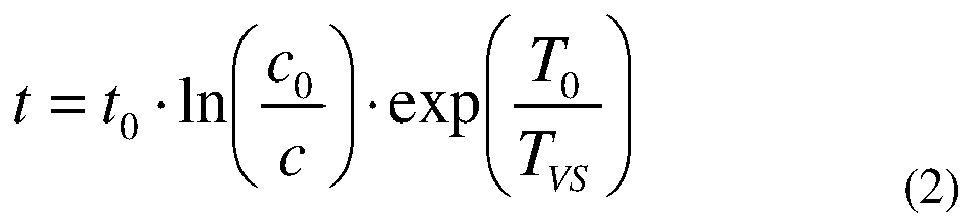
mit - c = Gewünschter Flächenporositätsanteil des Grünlings nach dem Vorsintern,
- c0 = Flächenporositätsanteil des Grünling nach dem Entbindern,
- t0 = Materialkonstante in min.,
- T0 = Materialkonstante in Kelvin,
- TVS = Vorsinterendtemperatur bei der Haltezeit tVS mit 650 °C ≤ TVS ≤ 1100 °C .
- Auch die Materialkonstante t0 kann durch Interpolation von Messergebnissen bestimmt werden. Bei Verwendung von Metallpulver auf Kobalt-Chrom-Basis oder äquivalenten Materialien ergibt sich t0=0,0125 min.
- Die Materialkonstante T0 beträgt bei der Verwendung von Metallpulver auf Kobalt-Chrom-Basis oder Äquivalenten hierzu T0 = 11000 K.
- Es ist zu beachten, dass Tvs in obige Formel in Kelvin und nicht in Grad Celsius einzusetzen ist.
- Erfolgt das Vorsintern gemäß dieses Zusammenhanges durch Halten der Vorsinterendtemperatur über eine Haltezeit tVS, so sind Kühl- und Aufheizraten so kurz zu wählen, dass der Hauptteil des Vorsinterns während der Haltezeit erfolgt. Insbesondere sollten beim Aufheizen mit annähernd konstanter Aufheizrate RHVS und Kühlen mit annähernd konstanter Kühlrate RKVS die Aufheizzeit zwischen 650°C und der Vorsinterendtemperatur TVS und die Kühlzeit zwischen Vorsinterendtemperatur TVS und 650°C in Summe zusammen nicht länger sein als 2t:

wobei Temperaturen in Grad Celsius einzusetzen sind. Ferner ist die Nebendingung einzuhalten, dass die Vorsinterendtemperatur TVS und die Differenz zwischen c0 und c derart aufeinander abgestimmt sind, dass eine negative Aufheiz- und Abkühlrate ausgeschlossen ist. Auch sollte die maximale Vorsinterendtemperatur TVS nicht größer als 1100 °C betragen. - Die Formel (3) stellt folglich eine Bedingung dar, die bei Zugrundelegung der angegebenen Parameter einzuhalten ist, um bei Verwendung eines Metallpulvers auf Kobalt-Chrom-Basis oder Äquivalenten hierzu einen vorgesinterten Rohling herzustellen, der eine Flächenporosität zwischen 16 % und 22 % aufweist.
- Überraschenderweise hat sich herausgestellt, dass ein vorgesinterter Rohling ungeachtet der bestehenden Flächenporosität nicht nur mit der gewünschten Genauigkeit bearbeitet werden kann, sondern dass außerdem nach dem Dichtsintern ungeachtet der Restflächenporosität eine absolut blasenfreie Verblendung möglich ist. Ursächlich hierfür dürfte sein, dass bei den erfindungsgemäßen Vorsinterschritten unter Berücksichtigung der angegebenen Parameter eine Restflächenporosität erzielbar ist, die nach dem Dichtsintern kein verbundenes System darstellt, sondern vereinzelt vorliegt. Hierdurch wird nicht nur erwähntermaßen die Möglichkeit einer blasenfreien keramischen Verblendung geboten, sondern auch die erforderliche Korrosionsbeständigkeit sichergestellt. Ferner konnte festgestellt werden, dass nach dem Bearbeiten nach dem darauf folgenden Dichtsintern die erforderliche Maßhaltigkeit erzielbar ist, also eine gleichmäßige und passungsgerechte Schrumpfung erfolgt.
- In Weiterbildung der Erfindung ist vorgesehen, dass die Mischung aus Legierungspulver und Bindemittel axial oder isostatisch bei einem Druck p mit 100 MPa ≤ p ≤ 1.000 MPa, insbesondere mit 200 MPa ≤ p ≤ 600 MPa, gepresst werden sollte.
- Ferner ist bevorzugterweise vorgesehen, dass der Grünling bzw. der entbinderte Grünling als auch der entbinderte und vorgesinterte Grünling in einer Inert- oder FormiergasAtmosphäre oder im Vakuum aufgeheizt werden. Durch diese Maßnahmen ist sichergestellt, dass oberflächlich eine nur sehr dünne Oxidschicht entsteht, die z. B. durch Polieren problemlos entfernbar ist, ohne dass die Restflächenporosität die Politur nach dem Dichtsintern beeinträchtigt.
- Der so hergestellte Rohling kann sodann insbesondere durch ein trocken oder nass arbeitendes Werkzeug bearbeitet werden, wobei insbesondere in CAM-Technik aus dem Rohling entsprechend dessen Dimensionierung eine gewünschte Anzahl von Formkörpern, insbesondere von Zahnersatz wie Kronen oder Brücken, insbesondere fräsend oder schleifend herausgearbeitet werden. Ein Kopierfräsen ist auch möglich.
- Die Erfindung zeichnet sich auch durch einen Grünling bestimmt zur Herstellung eines Zahnersatzes oder eines Teils von diesem dadurch aus, dass der Grünling ein vorgesinterter Grünling aus einer Dentalmetalllegierung ist und eine Flächenporosität zwischen 16 % und 22 % aufweist. Dabei ist insbesondere vorgesehen, dass die Dentalmetalllegierung eine Nickel-Chrom- oder Kobalt-Chrom-Legierung ist.
- Insbesondere ist vorgesehen, dass als Dentallegierungsmetallpulver eine Mischung aus 50 Gew.-% bis 70 Gew.-% Kobalt, 20 Gew.-% bis 35 Gew.-% Chrom, 0 Gew-% bis 10 Gew.-% Molybdän, 0 Gew.-% bis 20 Gew.-% Wolfram, weniger als 10 Gew.-% von einem oder mehreren weiteren Elementen, insbesondere einem oder mehreren Elementen aus der Gruppe Mangan, Silizium, Nickel, Beryllium, Cadmium, Blei, Eisen, Aluminium, Titan, Sauerstoff, Stickstoff, Schwefel und gegebenenfalls sonstige Elemente mit einem Gewichtsanteil weniger als 1 Gew.-% verwendet wird, wobei die Gesamtsumme 100 Gew.-% beträgt.
- Die Erfindung zeichnet sich jedoch auch dadurch aus, dass als Dentallegierungsmetallpulver eine Mischung aus 50 Gew.-% bis 70 Gew.-% Nickel, 20 Gew.-% bis 35 Gew.-% Chrom, 0 Gew-% bis 10 Gew.-% Molybdän, 0 Gew.-% bis 20 Gew.-% Wolfram, weniger als 10 Gew.-% von einem oder mehreren weiteren Elementen, insbesondere einem oder mehreren Elementen aus der Gruppe Mangan, Silizium, Kobalt, Beryllium, Cadmium, Blei, Eisen, Aluminium, Titan, Sauerstoff, Stickstoff, Schwefel und gegebenenfalls sonstige Elemente mit einem Gewichtsanteil weniger als 1 Gew.-% verwendet wird, wobei die Gesamtsumme 100 Gew.-% beträgt.
- Weitere Einzelheiten, Vorteile und Merkmale ergeben sich nicht nur aus den Ansprüchen, den diesen zu entnehmenden Merkmalen, sondern auch aus der nachfolgenden Beschreibung bevorzugter Ausführungsbeispiele.
- Zur Herstellung von Zahnersatz wurde eine Metalllegierung der Zusammensetzung
- 26 bis 30 Gew.-% Cr,
- 5 bis 7 Gew.-% Mo,
- insgesamt zwischen 0,01 und 1,5 Gew.-% zumindest eines
- der Elemente Mn, Si, Fe, C, Ni,
- Rest Co (61,5 Gew.-% bis 68,99 Gew.-%)
- Benutzt, wobei die Gesamtsumme 100 Gew.-% beträgt. Zur Herstellung des Pulvers wurde zunächst eine Metalllegierung hergestellt, erschmolzen und anschließend verdüst. Die mittlere Korngröße lag zwischen 5 µm und 50 µm. Anschließend wurden ca. 2 Gew.-%, bezogen auf das Metallpulver, ein Binder auf Wachsbasis zugegeben. Mit der so hergestellten Mischung wurden mittels axiales Pressen Grünlinge hergestellt, die eine Scheibenform aufweisen. Der Durchmesser betrug in etwa 10 cm und die Dicke in etwa 1 cm. Andere Dimensionierungen kommen gleichfalls in Frage.
- Anschließend erfolgte ein Entbindern. Hierzu wurden Grünlinge zunächst mit beliebiger Aufheizrate auf 450 °C aufgeheizt. Oberhalb 450 °C erfolgte ein langsames Aufheizen, wobei als bevorzugte Aufheizrate 3 K/min gewählt wurde. Nach Erreichen der Temperatur T2, die bei ca. 600 °C lag, wurden die Grünlinge über die Zeit t1 von in etwa 10 min gehalten. Diese Parameter reichten grundsätzlich aus, damit der Binder entfernt wurde.
- Zur Herstellung eines CoCrMo-Rohlings wurde sodann ein entbinderter Grünling vorgesintert. Hierzu wurde nach einer Alternative der Grünling auf eine Temperatur im Bereich von in etwa 800 °C schnell aufgeheizt (Aufheizrate im Bereich von 90 K/min) und bei dieser Temperatur über einen Zeitraum von in etwa 20 min gehalten. Anschließend erfolgte ein Kühlen mit anfangs gleicher, in der Folge niedriger Rate.
- Durch dieses Verfahren wurde den Beziehungen bzw. Bedingungen gemäß der Gleichungen (1), (2) und (3) entsprochen:

und somit t/2 < tVS < 2t, hier 9 min < tVS < 36 min und
hier:
- Schliffbilder so hergestellter Rohlinge zeigten, dass sich eine offene Flächenporosität im Bereich zwischen 16 % und 22 %, mit einer Häufung zwischen 18 % und 20 % ergab. Entsprechende Rohlinge waren einfach zu bearbeiten, ohne dass das Risiko eines hohen Werkzeugverschleißes erfolgte, wodurch die Genauigkeit der Bearbeitung Einbußen erfahren kann.
- Durch die Flächenporosität war ein einfaches Bearbeiten an einer CAM-Maschine möglich. Hierzu wurde der Rohling mit einer Halterung in der CAM-Maschine fixiert. Anschließend erfolgte ein abtragendes Bearbeiten, wobei Bereiche des Rohlings in einem nassen und in einem trockenen System bearbeitet worden sind. Wurde trocken gefräst, wurde der beim Bearbeiten entstehende Staub mittels eines Klasse-H-Staubsaugers entfernt. Wurde ein Nassverfahren eingesetzt, so wurde schleifend gearbeitet. Insbesondere beim Nassbearbeiten zeigten sich keine Nachteile.
- Die aus dem Rohling herausgearbeiteten Körper wiesen dabei eine Dimensionierung auf, die der beim Durchsintern erfolgenden Schrumpfung Rechnung trägt. Dabei konnte nach der Schrumpfung festgestellt werden, dass diese gleichmäßig und passungsgerecht erfolgte. Anschließend wurde die Oberfläche des Formkörpers poliert oder in gewohnter Weise eine keramische Verblendung aufgebracht, die absolut blasenfrei war, ohne dass die vorhandene Restflächenporosität zu Problemen führte.
- Wurde die Erfindung anhand der Herstellung von Zahnersatz erläutert, so wird hierdurch die Erfindung nicht eingeschränkt.
Claims (15)
- Verfahren zur Herstellung eines Formkörpers, insbesondere eines Zahnersatzes oder eines Teils von diesem, gekennzeichnet durch die Verfahrensschritte:- Herstellung einer Mischung aus einem Metallpulver und einem Bindemittel,- Verdichten der Mischung zu einem Grünling,- Aufheizen des Grünlings von Zimmertemperatur auf eine Entbinderungsstarttemperatur T1,- Entbindern des Grünlings durch kontrolliertes Aufheizen des Grünlings von der Entbinderungsstarttemperatur T1 auf eine Entbinderungsendtemperatur T2 mit einer Aufheizrate R1 derart, dass ein Beschädigen des Grünlings unterbleibt,- Vorsintern des entbinderten Grünlings auf eine Vorsinterendtemperatur TVS mit einer Aufheizrate RHVS,- Kühlen des Grünlings von der Vorsinterendtemperatur TVS mit einer Kühlrate RKVS, wobei zumindest die Aufheizrate RHVS, die Vorsinterendtemperatur TVS und die Kühlrate RKVS derart aufeinander abgestimmt werden, dass der vorgesinterte, einen Rohling bildende Grünling eine Flächenporosität zwischen 16 % und 22 % nach dem Vorsintern aufweist,- abtragendes Bearbeiten des Rohlings und- Dichtsintern des bearbeiteten Rohlings zur Bildung des Formkörpers.
- Verfahren nach Anspruch 1,
dadurch gekennzeichnet,
dass der Grünling nach Aufheizen des Grünlings auf die Vorsinterendtemperatur TVS bei der Vorsinterendtemperatur TVS über eine Haltezeit tVS gehalten wird und sodann mit der Kühlrate RKVS gekühlt wird, wobei vorzugsweise der Grünling mit der Kühlrate RKVS auf eine Temperatur T3 abgekühlt wird mit 450 °C ≤ T3 ≤ 650 °C. - Verfahren nach Anspruch 1 oder Anspruch 2,
dadurch gekennzeichnet,
dass der Grünling zum Entbindern zunächst auf die Entbinderungsstarttemperatur T1 mit 350 °C ≤ T1 ≤ 550 °C erhitzt und sodann im Temperaturbereich zwischen T1 und der Entbinderungsendtemperatur T2 mit 550 °C < T2 < 650 °C mit T2 > T1 bei einer Aufheizrate R1 mit 1 K/min ≤ R1 ≤ 5 K/min auf T2 erhitzt wird, wobei insbesondere der Grünling bei der Entbinderungsendtemperatur T2 über eine Zeit t2 mit 1 min ≤ t2 ≤ 20 min gehalten wird. - Verfahren nach zumindest einem der Ansprüche 1 bis 3,
dadurch gekennzeichnet,
dass als der verdichtete Grünling ein solcher verwendet wird, dessen Flächenporosität zwischen 16 % und 27 %, insbesondere zwischen 18 % und 22 % liegt. - Verfahren nach zumindest einem der Ansprüche 1 bis 4,
dadurch gekennzeichnet,
dass als Metallpulver eine Nickel-Chrom-Legierung oder eine Kobalt-Chrom-Legierung verwendet wird, wobei bei einer Kobalt-ChromLegierung folgende Zusammensetzung gewählt wird:Kobalt: 50 Gew.-% bis 70 Gew.-% Chrom: 20 Gew.-% bis 35 Gew.-% Molybdän: 0 Gew.-% bis 10 Gew.-% Wolfram: 0 Gew.-% bis 20 Gew.-% weitere Elemente: weniger als 10 Gew.-%,
und bei einer Nickel-Chrom-Legierung folgende Zusammensetzung verwendet wird:Nickel: 50 Gew.-% bis 70 Gew.-% Chrom: 20 Gew.-% bis 35 Gew.-% Molybdän: 0 Gew.-% bis 10 Gew.-% Wolfram: 0 Gew.-% bis 20 Gew.-% weitere Elemente: weniger als 10 Gew.-%, - Verfahren nach zumindest einem der Ansprüche 1 bis 5,
dadurch gekennzeichnet,
dass der Grünling bei der Vorsinterendtemperatur TVS über eine Haltezeit tVS gehalten wird mit insbesondere 650 °C ≤ TVS ≤ 1100 °C, wobei je höher TVS gewählt wird, je kürzer die Haltezeit tVS eingestellt wird. - Verfahren nach zumindest einem der Ansprüche 1 bis 6,
dadurch gekennzeichnet,
dass bei einer Vorsinterendtemperatur TVS mit 650 °C ≤ TVS < 750 °C die Haltezeit tVS mit 10 min ≤ tVS ≤ 200 min, insbesondere 30 min ≤ tVS ≤ 100 min, besonders bevorzugt 50 min ≤ 80 min eingestellt wird und vorzugsweise die Aufheizrate RHVS und die Kühlrate RKVS eingestellt werden auf 1 K/min ≤ RHVS ≤ 200 K/min, insbesondere 1 K/min ≤ RHVS ≤ 50 K/min, besonders bevorzugt 1 K/min ≤ RHVS ≤ 20 K/min, bzw. 1 K/min ≤ RKVS ≤ 200 K/min, insbesondere 1 K/min ≤ RKVS ≤ 50 K/min, besonders bevorzugt 1 K/min ≤ RKVS ≤ 20 K/min. - Verfahren nach zumindest einem der Ansprüche 1 bis 6,
dadurch gekennzeichnet,
dass bei einer Vorsinterendtemperatur TVS mit 750 °C ≤ TVS < 850 °C die Haltezeit tVS mit 5 min ≤ tVS ≤ 60 min, vorzugsweise 10 min ≤ tVS ≤ 30 min eingestellt wird und vorzugsweise die Aufheizrate RHVS und die Kühlrate RKVS eingestellt werden auf 5 K/min ≤ RHVS ≤ 200 K/min, vorzugsweise 5 K/min ≤ RHVS ≤ 20 K/min, bzw. 5 K/min ≤ RKVS ≤ 200 K/min, besonders bevorzugt 5 K/min ≤ RKVS ≤ 20 K/min - Verfahren nach zumindest einem der Ansprüche 1 bis 6,
dadurch gekennzeichnet,
dass bei einer Vorsinterendtemperatur TVS mit 850 °C ≤ TVS < 950 °C die Haltezeit tVS mit 5 min ≤ tVS ≤ 30 min, insbesondere 10 min ≤ tVS ≤ 20 min, eingestellt wird und vorzugsweise die Aufheizrate RHVS und die Kühlrate RKVS eingestellt werden auf 15 K/min ≤ RHVS ≤ 200 K/min, insbesondere 15 K/min ≤ RHVS ≤ 50 K/min, bzw. 15 K/min ≤ RKVS ≤ 200 K/min, insbesondere 15 K/min ≤ RKVS ≤ 50 K/min. - Verfahren nach zumindest einem der Ansprüche 1 bis 6,
dadurch gekennzeichnet,
dass bei einer Vorsinterendtemperatur TVS mit 950 °C ≤ TVS ≤ 1100 °C die Haltezeit tVS mit 5 min ≤ tVS ≤ 20 min eingestellt wird und vorzugsweise die Aufheizrate RHVS und die Kühlrate RKVS eingestellt werden auf 30 K/min ≤ RHVS ≤ 200, insbesondere 30 K/min ≤ RHVS ≤ 100 K/min, bzw. 30 K/min ≤ RKVS ≤ 200 K/min, insbesondere 30 K/min ≤ RKVS ≤ 100 K/min. - Verfahren nach zumindest einem der vorhergehenden Ansprüche,
dadurch gekennzeichnet,
dass der Grünling bei der Vorsinterendtemperatur TVS in Kelvin, über eine Zeit tVS gehalten wird mit
mit:

mitc = Gewünschter Flächenporositätsanteil des Grünlings nach dem Vorsintern mit 16 % < c < 22 %, insbesondere 18 % < c < 20 %,c0 = Flächenporositätsanteil des Grünling nach dem Entbindern mit c0 - c < 5 %, vorzugsweise c0 - c < 2 %, insbesondere mit c0 > c.t0 = Materialkonstante mit t0=0,0125 minT0 = Materialkonstante mit T0=11000 K.TVS = Vorsinterendtemperatur bei der Haltezeit tvs mit 650 °C ≤ TVS ≤ 1100 °C. - Verfahren nach Anspruch 11,
dadurch gekennzeichnet,
dass die Aufheizzeit und die mit annähernd konstanter Aufheizrate RHVS und die Kühlzeit mit annähernd konstanter Kühlrate RKVS im Bereich zwischen 650 °C und der Vorsinterendtemperatur TVS, angegeben in Grad Celsisus, derart eingestellt werden, dass deren Gesamtsumme der Bedingung genügt:
wobei
und TVS und c0 - c derart aufeinander abgestimmt werden, dass negative Aufheiz-und Kühlraten ausgeschlossen sind. - Verfahren nach zumindest einem der vorhergehenden Ansprüche,
dadurch gekennzeichnet,
dass die Metalllegierung zu Pulver verdüst und mit einem Bindemittel auf Wachs-und/oder Zellulose-Basis zur Herstellung der Mischung vermischt wird, dass bevorzugterweise der Grünkörper durch isostatisches oder axiales Pressen der aus dem Metallpulver und dem Bindemittel bestehenden Mischung bei einem Druck p mit 100 MPa ≤ p ≤ 1.000 MPa, insbesondere 200 MPa ≤ P ≤ 600 MPa, oder durch Metallpulverspritzgießverfahren hergestellt wird und dass bevorzugterweise das Entbindern und Vorsintern und vorzugsweise das Kühlen unter Sauerstoffabschluss, insbesondere in Inert- oder reduzierender Atmosphäre wie FormiergasAtmosphäre oder bei Vakuum durchgeführt wird. - Grünling bestimmt zur Herstellung eines Zahnersatzes oder eines Teiles von diesem,
dadurch gekennzeichnet,
dass der Grünling ein vorgesinterter Grünling ist, aus einer Dentalmetalllegierung besteht und eine Flächenporosität zwischen 16 % und 22 %, insbesondere zwischen 18 % und 20 % aufweist. - Grünling nach Anspruch 14,
dadurch gekennzeichnet,
dass die Dentalmetalllegierung eine Nickel-Chrom-Legierung oder Kobalt-Chrom-Legierung, ist, wobei die Dentallegierung in Form der Nickel-Chrom-Legierung vorzugsweise enthält:Nickel: 50 Gew.-% bis 70 Gew.-% Chrom: 20 Gew.-% bis 35 Gew.-% Molybdän: 0 Gew.-% bis 10 Gew.-% Wolfram: 0 Gew.-% bis 20 Gew.-% weitere Elemente: weniger als 10 Gew.-%, Kobalt: 50 Gew.-% bis 70 Gew.-% Chrom: 20 Gew.-% bis 35 Gew.-% Molybdän: 0 Gew.-% bis 10 Gew.-% Wolfram: 0 Gew.-% bis 20 Gew.-% weitere Elemente: weniger als 10 Gew.-% ,
Priority Applications (1)
| Application Number | Priority Date | Filing Date | Title |
|---|---|---|---|
| EP11188041.5A EP2450003B1 (de) | 2010-11-09 | 2011-11-07 | Verfahren zur Herstellung eines Grünkörpers sowie vorgesinteter Grünkörper |
Applications Claiming Priority (2)
| Application Number | Priority Date | Filing Date | Title |
|---|---|---|---|
| EP10190512 | 2010-11-09 | ||
| EP11188041.5A EP2450003B1 (de) | 2010-11-09 | 2011-11-07 | Verfahren zur Herstellung eines Grünkörpers sowie vorgesinteter Grünkörper |
Publications (3)
| Publication Number | Publication Date |
|---|---|
| EP2450003A2 true EP2450003A2 (de) | 2012-05-09 |
| EP2450003A3 EP2450003A3 (de) | 2012-10-03 |
| EP2450003B1 EP2450003B1 (de) | 2018-05-30 |
Family
ID=43823088
Family Applications (1)
| Application Number | Title | Priority Date | Filing Date |
|---|---|---|---|
| EP11188041.5A Active EP2450003B1 (de) | 2010-11-09 | 2011-11-07 | Verfahren zur Herstellung eines Grünkörpers sowie vorgesinteter Grünkörper |
Country Status (8)
| Country | Link |
|---|---|
| US (3) | US9393088B2 (de) |
| EP (1) | EP2450003B1 (de) |
| JP (1) | JP2012101070A (de) |
| CN (1) | CN102528039B (de) |
| AU (1) | AU2011244998B2 (de) |
| BR (1) | BRPI1106751A2 (de) |
| CA (1) | CA2758151A1 (de) |
| RU (1) | RU2011145357A (de) |
Cited By (3)
| Publication number | Priority date | Publication date | Assignee | Title |
|---|---|---|---|---|
| CN103143711A (zh) * | 2013-02-06 | 2013-06-12 | 李上奎 | 义齿及其制备方法 |
| DE102014209085A1 (de) | 2014-05-14 | 2015-11-19 | Precis GmbH | Herstellung eines Formkörpers aus einer Dentallegierung |
| CN115055685A (zh) * | 2022-06-24 | 2022-09-16 | 武汉苏泊尔炊具有限公司 | 刀具的制造方法和刀具 |
Families Citing this family (22)
| Publication number | Priority date | Publication date | Assignee | Title |
|---|---|---|---|---|
| CN102814500B (zh) * | 2012-08-09 | 2014-04-09 | 山东鼎成新材料有限公司 | 一种用不锈钢粉末生产高密度制品的方法 |
| KR101276616B1 (ko) * | 2013-03-05 | 2013-06-19 | 주식회사 디맥스 | 색상 구배를 갖는 인공치아용 지르코니아 블록의 제조방법 |
| CN103182510A (zh) * | 2013-03-07 | 2013-07-03 | 兴城市粉末冶金有限公司 | 粉末冶金齿毂加工工艺 |
| CN103340689A (zh) * | 2013-07-11 | 2013-10-09 | 南通市今日高科技材料有限公司 | 牙科用钴铬烤瓷合金圆盘材料的制作方法 |
| CN103436741A (zh) * | 2013-08-26 | 2013-12-11 | 苏州长盛机电有限公司 | 一种牙科合金 |
| CN103451479A (zh) * | 2013-08-26 | 2013-12-18 | 苏州长盛机电有限公司 | 一种复合型牙科合金 |
| ES2570538T3 (es) | 2013-09-27 | 2016-05-18 | Seiko Epson Corp | Pieza dental en bruto para mecanizar, polvo metálico para pulvimetalurgia, montura dental metálica para la adhesión de porcelana, y prótesis dental |
| JP6492512B2 (ja) * | 2014-01-31 | 2019-04-03 | セイコーエプソン株式会社 | 歯科用の被切削加工用ブランク材、粉末冶金用金属粉末、歯科用の陶材焼付用メタルフレームおよび歯科用補綴物 |
| US20150216637A1 (en) * | 2014-02-06 | 2015-08-06 | Seiko Epson Corporation | Dental component, metal powder for powder metallurgy, and method for producing dental component |
| KR101634132B1 (ko) * | 2015-04-14 | 2016-06-29 | 양용석 | 분말 야금법(pm)에 대한 치과용 보철물 성형재료 제조방법 |
| DE102016106370A1 (de) * | 2016-03-23 | 2017-09-28 | Degudent Gmbh | Verfahren zur Herstellung eines eingefärbten Rohlings sowie Rohling |
| US11357605B2 (en) * | 2017-01-27 | 2022-06-14 | Adamant Namiki Precision Jewel Co., Ltd. | Method for manufacturing ceramic sintered body |
| US12268564B2 (en) * | 2017-09-12 | 2025-04-08 | Dentsply Sirona Inc. | Blanks and methods for the manufacture of at least one molded blank |
| EP3595148B1 (de) * | 2018-07-13 | 2021-06-09 | Siemens Aktiengesellschaft | Verfahren zur herstellung einer materiallage und eines materiallagengefüges für eine dynamoelektrische rotatorische maschine |
| EP3924320A4 (de) | 2019-02-11 | 2022-11-23 | Holo, Inc. | Verfahren und systeme für dreidimensionales drucken |
| CN110269705A (zh) * | 2019-05-06 | 2019-09-24 | 上海海信牙科技术发展有限公司 | 一种义齿制造方法 |
| CN112159907B (zh) * | 2020-10-09 | 2021-09-07 | 成都科宁达材料有限公司 | 一种牙科烤瓷修复用3d打印钴铬合金及其制备方法 |
| CN112853157B (zh) * | 2020-12-31 | 2021-11-30 | 广州湘龙高新材料科技股份有限公司 | 一种钴铬钼钨硅合金棒材及其制备方法 |
| CN113385856A (zh) * | 2021-06-12 | 2021-09-14 | 广东博杰特新材料科技有限公司 | 三元硼化物Mo2NiB2合金焊材及其生产工艺 |
| CN114032433B (zh) * | 2021-10-13 | 2022-08-26 | 中南大学深圳研究院 | 钴基高温合金及其制备方法和热端部件 |
| WO2025217831A1 (zh) * | 2024-04-17 | 2025-10-23 | 刘垣皜 | 耳机框架的粉末压铸制造工艺 |
| DE102024112189A1 (de) * | 2024-04-30 | 2025-10-30 | Deloro Wear Solutions GmbH | Hartlegierung, Verfahren zur Herstellung der Hartlegierung und Verfahren zur Prüfung |
Citations (8)
| Publication number | Priority date | Publication date | Assignee | Title |
|---|---|---|---|---|
| US4996022A (en) | 1989-07-14 | 1991-02-26 | Juki Corporation | Process for producing a sintered body |
| DE19938144C2 (de) | 1999-08-16 | 2003-08-28 | 3M Espe Ag | Verfahren zur Herstellung von Zahnersatz |
| EP1067880B1 (de) | 1998-03-17 | 2003-10-01 | Eidgenössische Technische Hochschule Zürich Nichtmetallische Werkstoffe | Zahnkronen und/oder zahnbrücken |
| US20050023717A1 (en) | 2003-07-28 | 2005-02-03 | Sumitomo Chemical Company, Limited | Method for producing thermoplastic resin sheet |
| DE10342231A1 (de) | 2003-09-11 | 2005-05-04 | Sirona Dental Systems Gmbh | Rohling und Zwischenkörper zur Herstellung eines Zahnersatzteils und Verfahren zur Herstellung derselben |
| EP1764062A1 (de) | 2005-09-20 | 2007-03-21 | Dentaurum J.P. Winkelstroeter Kg | Formkörper aus einer Dentallegierung zur Herstellung von dentalen Teilen |
| AT505698A1 (de) | 2007-09-03 | 2009-03-15 | Miba Sinter Austria Gmbh | Verfahren zur herstellung eines sinterhärtbaren sinterformteils |
| WO2009120749A1 (en) | 2008-03-28 | 2009-10-01 | The Argen Corporation | Cad/cam milling process for the fabrication of dental devices |
Family Cites Families (6)
| Publication number | Priority date | Publication date | Assignee | Title |
|---|---|---|---|---|
| US20050023710A1 (en) * | 1998-07-10 | 2005-02-03 | Dmitri Brodkin | Solid free-form fabrication methods for the production of dental restorations |
| US7658781B1 (en) * | 1999-07-23 | 2010-02-09 | Marlene Rossing, legal representative | Silicon-containing composite bodies, and methods for making same |
| CN101646402A (zh) * | 2007-01-19 | 2010-02-10 | 金文申有限公司 | 用粉末模塑法制成的多孔、不可降解植入物 |
| CN100537802C (zh) * | 2007-02-05 | 2009-09-09 | 中南大学 | 一种高致密TiAl基合金制备方法 |
| CN100513603C (zh) * | 2007-10-12 | 2009-07-15 | 华南理工大学 | 可控孔隙特征轻质高强多孔镍钛记忆合金的制备方法 |
| US9139893B2 (en) * | 2008-12-22 | 2015-09-22 | Baker Hughes Incorporated | Methods of forming bodies for earth boring drilling tools comprising molding and sintering techniques |
-
2011
- 2011-11-07 AU AU2011244998A patent/AU2011244998B2/en not_active Ceased
- 2011-11-07 EP EP11188041.5A patent/EP2450003B1/de active Active
- 2011-11-08 RU RU2011145357/02A patent/RU2011145357A/ru not_active Application Discontinuation
- 2011-11-08 CA CA2758151A patent/CA2758151A1/en not_active Abandoned
- 2011-11-09 US US13/292,132 patent/US9393088B2/en not_active Expired - Fee Related
- 2011-11-09 JP JP2011245262A patent/JP2012101070A/ja active Pending
- 2011-11-09 BR BRPI1106751A patent/BRPI1106751A2/pt not_active Application Discontinuation
- 2011-11-09 CN CN201110420936.6A patent/CN102528039B/zh not_active Expired - Fee Related
-
2016
- 2016-06-10 US US15/178,697 patent/US20160278892A1/en not_active Abandoned
-
2019
- 2019-06-26 US US16/452,809 patent/US20190321147A1/en not_active Abandoned
Patent Citations (8)
| Publication number | Priority date | Publication date | Assignee | Title |
|---|---|---|---|---|
| US4996022A (en) | 1989-07-14 | 1991-02-26 | Juki Corporation | Process for producing a sintered body |
| EP1067880B1 (de) | 1998-03-17 | 2003-10-01 | Eidgenössische Technische Hochschule Zürich Nichtmetallische Werkstoffe | Zahnkronen und/oder zahnbrücken |
| DE19938144C2 (de) | 1999-08-16 | 2003-08-28 | 3M Espe Ag | Verfahren zur Herstellung von Zahnersatz |
| US20050023717A1 (en) | 2003-07-28 | 2005-02-03 | Sumitomo Chemical Company, Limited | Method for producing thermoplastic resin sheet |
| DE10342231A1 (de) | 2003-09-11 | 2005-05-04 | Sirona Dental Systems Gmbh | Rohling und Zwischenkörper zur Herstellung eines Zahnersatzteils und Verfahren zur Herstellung derselben |
| EP1764062A1 (de) | 2005-09-20 | 2007-03-21 | Dentaurum J.P. Winkelstroeter Kg | Formkörper aus einer Dentallegierung zur Herstellung von dentalen Teilen |
| AT505698A1 (de) | 2007-09-03 | 2009-03-15 | Miba Sinter Austria Gmbh | Verfahren zur herstellung eines sinterhärtbaren sinterformteils |
| WO2009120749A1 (en) | 2008-03-28 | 2009-10-01 | The Argen Corporation | Cad/cam milling process for the fabrication of dental devices |
Non-Patent Citations (1)
| Title |
|---|
| RODRIGUES ET AL.: "Powder metallurgical Processing of Co-28%Cr-6%Mo for dental implants: Physical, cheanical and electrochemical properties", POWDER TECHNOLOGY, vol. 2006, 2011, pages 233 - 238 |
Cited By (5)
| Publication number | Priority date | Publication date | Assignee | Title |
|---|---|---|---|---|
| CN103143711A (zh) * | 2013-02-06 | 2013-06-12 | 李上奎 | 义齿及其制备方法 |
| CN103143711B (zh) * | 2013-02-06 | 2015-08-12 | 江西岳龙科技有限公司 | 义齿及其制备方法 |
| DE102014209085A1 (de) | 2014-05-14 | 2015-11-19 | Precis GmbH | Herstellung eines Formkörpers aus einer Dentallegierung |
| DE102014209085B4 (de) * | 2014-05-14 | 2017-03-23 | Precis Glashütte GmbH | Herstellung eines Formkörpers aus einer Dentallegierung |
| CN115055685A (zh) * | 2022-06-24 | 2022-09-16 | 武汉苏泊尔炊具有限公司 | 刀具的制造方法和刀具 |
Also Published As
| Publication number | Publication date |
|---|---|
| RU2011145357A (ru) | 2013-05-20 |
| US9393088B2 (en) | 2016-07-19 |
| JP2012101070A (ja) | 2012-05-31 |
| US20120114516A1 (en) | 2012-05-10 |
| AU2011244998A1 (en) | 2012-05-24 |
| EP2450003A3 (de) | 2012-10-03 |
| CA2758151A1 (en) | 2012-05-09 |
| US20160278892A1 (en) | 2016-09-29 |
| US20190321147A1 (en) | 2019-10-24 |
| CN102528039B (zh) | 2016-01-27 |
| EP2450003B1 (de) | 2018-05-30 |
| BRPI1106751A2 (pt) | 2016-01-19 |
| AU2011244998B2 (en) | 2016-01-14 |
| CN102528039A (zh) | 2012-07-04 |
Similar Documents
| Publication | Publication Date | Title |
|---|---|---|
| EP2450003B1 (de) | Verfahren zur Herstellung eines Grünkörpers sowie vorgesinteter Grünkörper | |
| EP1021997B2 (de) | Verfahren zur Herstellung von Zahnersatz und dentalen Hilfsteilen | |
| EP1359882B1 (de) | Verfahren zur herstellung von zahnersatz | |
| DE102013104561A1 (de) | Verfahren zur Herstellung eines Rohlings sowie Rohling | |
| DE19938144C2 (de) | Verfahren zur Herstellung von Zahnersatz | |
| EP2651839B1 (de) | Herstellung dentaler formteile aus porösem glas | |
| EP4010299A1 (de) | Verfahren zur herstellung eines zirkondioxidrohlings mit farb- und transluzenzverlauf | |
| DE102016119934A1 (de) | Verfahren zur Herstellung eines Rohlings, Rohling sowie eine dentale Restauration | |
| WO2004078059A1 (de) | Verfahren zur herstellung eines zahnersatzteils aus metallischen werkstoffen und rohling hierzu | |
| DE10342231B4 (de) | Rohling zur Herstellung eines Zahnersatzteils und Verfahren zur Herstellung desselben | |
| EP1764062B1 (de) | Formkörper aus einer Dentallegierung zur Herstellung von dentalen Teilen | |
| EP3772497A1 (de) | Zirkondioxidrohling mit farb- und transluzenzverlauf | |
| DE102014209085B4 (de) | Herstellung eines Formkörpers aus einer Dentallegierung | |
| WO2021032895A1 (de) | Verwendung einer titan-eisen-legierung zur herstellung eines dentalen metallischen formkörpers oder einer verblendeten dentalen restauration, entsprechende dentale metallische formkörper, verblendete dentale restaurationen und verfahren | |
| WO2010015350A1 (de) | Verahren zur herstellung von oxidischer zahnkeramik | |
| EP3772498A1 (de) | Verfahren zur herstellung eines zirkondioxidrohlings mit farb- und transluzenzverlauf | |
| DE102017118528A1 (de) | Verfahren zur Herstellung eines Rohlings für die Herstellung dentaler Bauteile mittels subtraktiver CAD/CAM-Verfahren | |
| DE19703175A1 (de) | Verfahren zur Herstellung von keramischen oder pulvermetallurgischen Bauteilen mit einer schraubenförmigen Außenkontur | |
| EP3681433A1 (de) | Verfahren zur herstellung eines formkörpers mittels sintern |
Legal Events
| Date | Code | Title | Description |
|---|---|---|---|
| PUAI | Public reference made under article 153(3) epc to a published international application that has entered the european phase |
Free format text: ORIGINAL CODE: 0009012 |
|
| AK | Designated contracting states |
Kind code of ref document: A2 Designated state(s): AL AT BE BG CH CY CZ DE DK EE ES FI FR GB GR HR HU IE IS IT LI LT LU LV MC MK MT NL NO PL PT RO RS SE SI SK SM TR |
|
| AX | Request for extension of the european patent |
Extension state: BA ME |
|
| PUAL | Search report despatched |
Free format text: ORIGINAL CODE: 0009013 |
|
| AK | Designated contracting states |
Kind code of ref document: A3 Designated state(s): AL AT BE BG CH CY CZ DE DK EE ES FI FR GB GR HR HU IE IS IT LI LT LU LV MC MK MT NL NO PL PT RO RS SE SI SK SM TR |
|
| AX | Request for extension of the european patent |
Extension state: BA ME |
|
| RIC1 | Information provided on ipc code assigned before grant |
Ipc: A61C 13/00 20060101AFI20120828BHEP |
|
| 17P | Request for examination filed |
Effective date: 20130325 |
|
| 17Q | First examination report despatched |
Effective date: 20130603 |
|
| RAP1 | Party data changed (applicant data changed or rights of an application transferred) |
Owner name: DENTSPLY INTERNATIONAL INC. |
|
| GRAP | Despatch of communication of intention to grant a patent |
Free format text: ORIGINAL CODE: EPIDOSNIGR1 |
|
| INTG | Intention to grant announced |
Effective date: 20171103 |
|
| RAP1 | Party data changed (applicant data changed or rights of an application transferred) |
Owner name: DENTSPLY INTERNATIONAL, INC. |
|
| RAP1 | Party data changed (applicant data changed or rights of an application transferred) |
Owner name: DENTSPLY SIRONA INC. |
|
| GRAS | Grant fee paid |
Free format text: ORIGINAL CODE: EPIDOSNIGR3 |
|
| GRAJ | Information related to disapproval of communication of intention to grant by the applicant or resumption of examination proceedings by the epo deleted |
Free format text: ORIGINAL CODE: EPIDOSDIGR1 |
|
| GRAL | Information related to payment of fee for publishing/printing deleted |
Free format text: ORIGINAL CODE: EPIDOSDIGR3 |
|
| GRAP | Despatch of communication of intention to grant a patent |
Free format text: ORIGINAL CODE: EPIDOSNIGR1 |
|
| INTC | Intention to grant announced (deleted) | ||
| GRAA | (expected) grant |
Free format text: ORIGINAL CODE: 0009210 |
|
| INTG | Intention to grant announced |
Effective date: 20180411 |
|
| AK | Designated contracting states |
Kind code of ref document: B1 Designated state(s): AL AT BE BG CH CY CZ DE DK EE ES FI FR GB GR HR HU IE IS IT LI LT LU LV MC MK MT NL NO PL PT RO RS SE SI SK SM TR |
|
| REG | Reference to a national code |
Ref country code: GB Ref legal event code: FG4D Free format text: NOT ENGLISH |
|
| REG | Reference to a national code |
Ref country code: CH Ref legal event code: EP |
|
| REG | Reference to a national code |
Ref country code: AT Ref legal event code: REF Ref document number: 1002776 Country of ref document: AT Kind code of ref document: T Effective date: 20180615 |
|
| REG | Reference to a national code |
Ref country code: IE Ref legal event code: FG4D Free format text: LANGUAGE OF EP DOCUMENT: GERMAN |
|
| REG | Reference to a national code |
Ref country code: DE Ref legal event code: R096 Ref document number: 502011014237 Country of ref document: DE |
|
| REG | Reference to a national code |
Ref country code: CH Ref legal event code: NV Representative=s name: LUCHS AND PARTNER AG PATENTANWAELTE, CH |
|
| REG | Reference to a national code |
Ref country code: NL Ref legal event code: MP Effective date: 20180530 |
|
| REG | Reference to a national code |
Ref country code: LT Ref legal event code: MG4D |
|
| PG25 | Lapsed in a contracting state [announced via postgrant information from national office to epo] |
Ref country code: ES Free format text: LAPSE BECAUSE OF FAILURE TO SUBMIT A TRANSLATION OF THE DESCRIPTION OR TO PAY THE FEE WITHIN THE PRESCRIBED TIME-LIMIT Effective date: 20180530 Ref country code: SE Free format text: LAPSE BECAUSE OF FAILURE TO SUBMIT A TRANSLATION OF THE DESCRIPTION OR TO PAY THE FEE WITHIN THE PRESCRIBED TIME-LIMIT Effective date: 20180530 Ref country code: CY Free format text: LAPSE BECAUSE OF FAILURE TO SUBMIT A TRANSLATION OF THE DESCRIPTION OR TO PAY THE FEE WITHIN THE PRESCRIBED TIME-LIMIT Effective date: 20180530 Ref country code: BG Free format text: LAPSE BECAUSE OF FAILURE TO SUBMIT A TRANSLATION OF THE DESCRIPTION OR TO PAY THE FEE WITHIN THE PRESCRIBED TIME-LIMIT Effective date: 20180830 Ref country code: NO Free format text: LAPSE BECAUSE OF FAILURE TO SUBMIT A TRANSLATION OF THE DESCRIPTION OR TO PAY THE FEE WITHIN THE PRESCRIBED TIME-LIMIT Effective date: 20180830 Ref country code: FI Free format text: LAPSE BECAUSE OF FAILURE TO SUBMIT A TRANSLATION OF THE DESCRIPTION OR TO PAY THE FEE WITHIN THE PRESCRIBED TIME-LIMIT Effective date: 20180530 Ref country code: LT Free format text: LAPSE BECAUSE OF FAILURE TO SUBMIT A TRANSLATION OF THE DESCRIPTION OR TO PAY THE FEE WITHIN THE PRESCRIBED TIME-LIMIT Effective date: 20180530 |
|
| PG25 | Lapsed in a contracting state [announced via postgrant information from national office to epo] |
Ref country code: GR Free format text: LAPSE BECAUSE OF FAILURE TO SUBMIT A TRANSLATION OF THE DESCRIPTION OR TO PAY THE FEE WITHIN THE PRESCRIBED TIME-LIMIT Effective date: 20180831 Ref country code: HR Free format text: LAPSE BECAUSE OF FAILURE TO SUBMIT A TRANSLATION OF THE DESCRIPTION OR TO PAY THE FEE WITHIN THE PRESCRIBED TIME-LIMIT Effective date: 20180530 Ref country code: LV Free format text: LAPSE BECAUSE OF FAILURE TO SUBMIT A TRANSLATION OF THE DESCRIPTION OR TO PAY THE FEE WITHIN THE PRESCRIBED TIME-LIMIT Effective date: 20180530 Ref country code: RS Free format text: LAPSE BECAUSE OF FAILURE TO SUBMIT A TRANSLATION OF THE DESCRIPTION OR TO PAY THE FEE WITHIN THE PRESCRIBED TIME-LIMIT Effective date: 20180530 |
|
| PG25 | Lapsed in a contracting state [announced via postgrant information from national office to epo] |
Ref country code: NL Free format text: LAPSE BECAUSE OF FAILURE TO SUBMIT A TRANSLATION OF THE DESCRIPTION OR TO PAY THE FEE WITHIN THE PRESCRIBED TIME-LIMIT Effective date: 20180530 |
|
| PG25 | Lapsed in a contracting state [announced via postgrant information from national office to epo] |
Ref country code: RO Free format text: LAPSE BECAUSE OF FAILURE TO SUBMIT A TRANSLATION OF THE DESCRIPTION OR TO PAY THE FEE WITHIN THE PRESCRIBED TIME-LIMIT Effective date: 20180530 Ref country code: CZ Free format text: LAPSE BECAUSE OF FAILURE TO SUBMIT A TRANSLATION OF THE DESCRIPTION OR TO PAY THE FEE WITHIN THE PRESCRIBED TIME-LIMIT Effective date: 20180530 Ref country code: EE Free format text: LAPSE BECAUSE OF FAILURE TO SUBMIT A TRANSLATION OF THE DESCRIPTION OR TO PAY THE FEE WITHIN THE PRESCRIBED TIME-LIMIT Effective date: 20180530 Ref country code: PL Free format text: LAPSE BECAUSE OF FAILURE TO SUBMIT A TRANSLATION OF THE DESCRIPTION OR TO PAY THE FEE WITHIN THE PRESCRIBED TIME-LIMIT Effective date: 20180530 Ref country code: SK Free format text: LAPSE BECAUSE OF FAILURE TO SUBMIT A TRANSLATION OF THE DESCRIPTION OR TO PAY THE FEE WITHIN THE PRESCRIBED TIME-LIMIT Effective date: 20180530 Ref country code: DK Free format text: LAPSE BECAUSE OF FAILURE TO SUBMIT A TRANSLATION OF THE DESCRIPTION OR TO PAY THE FEE WITHIN THE PRESCRIBED TIME-LIMIT Effective date: 20180530 |
|
| PG25 | Lapsed in a contracting state [announced via postgrant information from national office to epo] |
Ref country code: IT Free format text: LAPSE BECAUSE OF FAILURE TO SUBMIT A TRANSLATION OF THE DESCRIPTION OR TO PAY THE FEE WITHIN THE PRESCRIBED TIME-LIMIT Effective date: 20180530 Ref country code: SM Free format text: LAPSE BECAUSE OF FAILURE TO SUBMIT A TRANSLATION OF THE DESCRIPTION OR TO PAY THE FEE WITHIN THE PRESCRIBED TIME-LIMIT Effective date: 20180530 |
|
| REG | Reference to a national code |
Ref country code: DE Ref legal event code: R097 Ref document number: 502011014237 Country of ref document: DE |
|
| PLBE | No opposition filed within time limit |
Free format text: ORIGINAL CODE: 0009261 |
|
| STAA | Information on the status of an ep patent application or granted ep patent |
Free format text: STATUS: NO OPPOSITION FILED WITHIN TIME LIMIT |
|
| 26N | No opposition filed |
Effective date: 20190301 |
|
| PG25 | Lapsed in a contracting state [announced via postgrant information from national office to epo] |
Ref country code: SI Free format text: LAPSE BECAUSE OF FAILURE TO SUBMIT A TRANSLATION OF THE DESCRIPTION OR TO PAY THE FEE WITHIN THE PRESCRIBED TIME-LIMIT Effective date: 20180530 |
|
| GBPC | Gb: european patent ceased through non-payment of renewal fee |
Effective date: 20181107 |
|
| PG25 | Lapsed in a contracting state [announced via postgrant information from national office to epo] |
Ref country code: MC Free format text: LAPSE BECAUSE OF FAILURE TO SUBMIT A TRANSLATION OF THE DESCRIPTION OR TO PAY THE FEE WITHIN THE PRESCRIBED TIME-LIMIT Effective date: 20180530 Ref country code: LU Free format text: LAPSE BECAUSE OF NON-PAYMENT OF DUE FEES Effective date: 20181107 |
|
| REG | Reference to a national code |
Ref country code: BE Ref legal event code: MM Effective date: 20181130 |
|
| REG | Reference to a national code |
Ref country code: IE Ref legal event code: MM4A |
|
| PG25 | Lapsed in a contracting state [announced via postgrant information from national office to epo] |
Ref country code: FR Free format text: LAPSE BECAUSE OF NON-PAYMENT OF DUE FEES Effective date: 20181130 Ref country code: IE Free format text: LAPSE BECAUSE OF NON-PAYMENT OF DUE FEES Effective date: 20181107 |
|
| PG25 | Lapsed in a contracting state [announced via postgrant information from national office to epo] |
Ref country code: AL Free format text: LAPSE BECAUSE OF FAILURE TO SUBMIT A TRANSLATION OF THE DESCRIPTION OR TO PAY THE FEE WITHIN THE PRESCRIBED TIME-LIMIT Effective date: 20180530 Ref country code: BE Free format text: LAPSE BECAUSE OF NON-PAYMENT OF DUE FEES Effective date: 20181130 |
|
| PG25 | Lapsed in a contracting state [announced via postgrant information from national office to epo] |
Ref country code: GB Free format text: LAPSE BECAUSE OF NON-PAYMENT OF DUE FEES Effective date: 20181107 |
|
| PG25 | Lapsed in a contracting state [announced via postgrant information from national office to epo] |
Ref country code: MT Free format text: LAPSE BECAUSE OF FAILURE TO SUBMIT A TRANSLATION OF THE DESCRIPTION OR TO PAY THE FEE WITHIN THE PRESCRIBED TIME-LIMIT Effective date: 20180530 |
|
| PG25 | Lapsed in a contracting state [announced via postgrant information from national office to epo] |
Ref country code: TR Free format text: LAPSE BECAUSE OF FAILURE TO SUBMIT A TRANSLATION OF THE DESCRIPTION OR TO PAY THE FEE WITHIN THE PRESCRIBED TIME-LIMIT Effective date: 20180530 |
|
| PG25 | Lapsed in a contracting state [announced via postgrant information from national office to epo] |
Ref country code: PT Free format text: LAPSE BECAUSE OF FAILURE TO SUBMIT A TRANSLATION OF THE DESCRIPTION OR TO PAY THE FEE WITHIN THE PRESCRIBED TIME-LIMIT Effective date: 20180530 |
|
| PG25 | Lapsed in a contracting state [announced via postgrant information from national office to epo] |
Ref country code: MK Free format text: LAPSE BECAUSE OF NON-PAYMENT OF DUE FEES Effective date: 20180530 Ref country code: HU Free format text: LAPSE BECAUSE OF FAILURE TO SUBMIT A TRANSLATION OF THE DESCRIPTION OR TO PAY THE FEE WITHIN THE PRESCRIBED TIME-LIMIT; INVALID AB INITIO Effective date: 20111107 |
|
| PG25 | Lapsed in a contracting state [announced via postgrant information from national office to epo] |
Ref country code: IS Free format text: LAPSE BECAUSE OF FAILURE TO SUBMIT A TRANSLATION OF THE DESCRIPTION OR TO PAY THE FEE WITHIN THE PRESCRIBED TIME-LIMIT Effective date: 20180930 |
|
| PGFP | Annual fee paid to national office [announced via postgrant information from national office to epo] |
Ref country code: DE Payment date: 20220930 Year of fee payment: 12 Ref country code: AT Payment date: 20221025 Year of fee payment: 12 |
|
| PGFP | Annual fee paid to national office [announced via postgrant information from national office to epo] |
Ref country code: CH Payment date: 20221103 Year of fee payment: 12 |
|
| REG | Reference to a national code |
Ref country code: DE Ref legal event code: R119 Ref document number: 502011014237 Country of ref document: DE |
|
| REG | Reference to a national code |
Ref country code: CH Ref legal event code: PL |
|
| REG | Reference to a national code |
Ref country code: AT Ref legal event code: MM01 Ref document number: 1002776 Country of ref document: AT Kind code of ref document: T Effective date: 20231107 |
|
| PG25 | Lapsed in a contracting state [announced via postgrant information from national office to epo] |
Ref country code: CH Free format text: LAPSE BECAUSE OF NON-PAYMENT OF DUE FEES Effective date: 20231130 |
|
| PG25 | Lapsed in a contracting state [announced via postgrant information from national office to epo] |
Ref country code: AT Free format text: LAPSE BECAUSE OF NON-PAYMENT OF DUE FEES Effective date: 20231107 |
|
| PG25 | Lapsed in a contracting state [announced via postgrant information from national office to epo] |
Ref country code: CH Free format text: LAPSE BECAUSE OF NON-PAYMENT OF DUE FEES Effective date: 20231130 Ref country code: AT Free format text: LAPSE BECAUSE OF NON-PAYMENT OF DUE FEES Effective date: 20231107 |
|
| PG25 | Lapsed in a contracting state [announced via postgrant information from national office to epo] |
Ref country code: DE Free format text: LAPSE BECAUSE OF NON-PAYMENT OF DUE FEES Effective date: 20240601 |
|
| PG25 | Lapsed in a contracting state [announced via postgrant information from national office to epo] |
Ref country code: DE Free format text: LAPSE BECAUSE OF NON-PAYMENT OF DUE FEES Effective date: 20240601 |