EP2458773B1 - Taktdaten-wiederherstellungsvorrichtung - Google Patents
Taktdaten-wiederherstellungsvorrichtung Download PDFInfo
- Publication number
- EP2458773B1 EP2458773B1 EP10802201.3A EP10802201A EP2458773B1 EP 2458773 B1 EP2458773 B1 EP 2458773B1 EP 10802201 A EP10802201 A EP 10802201A EP 2458773 B1 EP2458773 B1 EP 2458773B1
- Authority
- EP
- European Patent Office
- Prior art keywords
- value
- output
- phase difference
- difference signal
- clock
- Prior art date
- Legal status (The legal status is an assumption and is not a legal conclusion. Google has not performed a legal analysis and makes no representation as to the accuracy of the status listed.)
- Active
Links
Images







Classifications
-
- H—ELECTRICITY
- H04—ELECTRIC COMMUNICATION TECHNIQUE
- H04L—TRANSMISSION OF DIGITAL INFORMATION, e.g. TELEGRAPHIC COMMUNICATION
- H04L7/00—Arrangements for synchronising receiver with transmitter
- H04L7/02—Speed or phase control by the received code signals, the signals containing no special synchronisation information
- H04L7/033—Speed or phase control by the received code signals, the signals containing no special synchronisation information using the transitions of the received signal to control the phase of the synchronising-signal-generating means, e.g. using a phase-locked loop
-
- H—ELECTRICITY
- H03—ELECTRONIC CIRCUITRY
- H03L—AUTOMATIC CONTROL, STARTING, SYNCHRONISATION OR STABILISATION OF GENERATORS OF ELECTRONIC OSCILLATIONS OR PULSES
- H03L7/00—Automatic control of frequency or phase; Synchronisation
- H03L7/06—Automatic control of frequency or phase; Synchronisation using a reference signal applied to a frequency- or phase-locked loop
- H03L7/08—Details of the phase-locked loop
-
- H—ELECTRICITY
- H03—ELECTRONIC CIRCUITRY
- H03L—AUTOMATIC CONTROL, STARTING, SYNCHRONISATION OR STABILISATION OF GENERATORS OF ELECTRONIC OSCILLATIONS OR PULSES
- H03L7/00—Automatic control of frequency or phase; Synchronisation
- H03L7/06—Automatic control of frequency or phase; Synchronisation using a reference signal applied to a frequency- or phase-locked loop
- H03L7/08—Details of the phase-locked loop
- H03L7/085—Details of the phase-locked loop concerning mainly the frequency- or phase-detection arrangement including the filtering or amplification of its output signal
- H03L7/089—Details of the phase-locked loop concerning mainly the frequency- or phase-detection arrangement including the filtering or amplification of its output signal the phase or frequency detector generating up-down pulses
- H03L7/0891—Details of the phase-locked loop concerning mainly the frequency- or phase-detection arrangement including the filtering or amplification of its output signal the phase or frequency detector generating up-down pulses the up-down pulses controlling source and sink current generators, e.g. a charge pump
Definitions
- the present invention relates to a device that restores a clock and data based on an input digital signal.
- a clock data restoration device that performs such restoration is disclosed in, for example, non-patent literature 1.
- the clock data restoration device disclosed in this document includes a sampler portion, a digital phase comparison portion, a charge pump, a loop filter and a voltage control oscillator.
- the clock data restoration device has a bang-bang type PLL (phase lock loop) structure or an Alexander type PLL structure.
- the clock data restoration device operates as follows.
- the sampler portion the value of an input digital signal is sampled, held and output with timing indicated by the clock output from the voltage control oscillator.
- the phase comparison portion based on the value output from the sampler portion, the phase of the clock output from the voltage control oscillator and the phase of the input digital signal are compared, and a phase difference signal indicating the phase difference between them is output.
- the charge pump that inputs the phase difference signal outputs a charge and discharge current corresponding to the phase difference indicated by the phase difference signal.
- This charge and discharge current is input to the loop filter.
- a control voltage value output from the loop filter is input to the voltage control oscillator.
- a clock having a frequency corresponding to the control voltage value is output from the voltage control oscillator, and this clock is fed to the sampler portion.
- the clock that has been restored from the input digital signal as described above is output from the voltage control oscillator; the data restored from the input digital signal is output from the sampler portion.
- Non-patent literature 1 Rick Walker, "Clock and Data Recovery for Serial Digital Communication focusing on bang-bang loop CDR design methodology", ISSCC Short Course, February 2002 PING-YING WANG ET AL: "A Phase Locked Loop with a Mixed Mode Loop Filter for Clock/Data Recovery in Optical Disc Drives", Conference Proceedings/IEEE International Symposium on Circuits and Systems (ISCAS): May 23-26, 2005, International Conference Center, Kobe, Japan, IEEE Service Center, Piscataway, NJ, 23 May 2005, pages 5007-5010 , XP010816722 discloses a phase locked loop
- a loop filter includes a resistor and a capacitive element.
- the first end of the resistor is connected to the output end of a charge pump, and is also connected to the input end of a voltage control oscillator.
- the second end of the resistor is connected through the capacitive element to a reference potential.
- Kvco[Hz/V] is the gain of the voltage control oscillator
- Ip [A] is the magnitude of the charge and discharge current output from the charge pump
- R [ ⁇ ] is the resistance value of the resistor
- C [F] is the capacitance value of the capacitive element
- fo [bit/sec.] is the bit rate of the input digital signal.
- ⁇ represents the amount of phase shift in the voltage control oscillator shifted by one phase comparison operation performed by the phase comparison portion.
- ⁇ is a stability factor that represents the ratio between the second feedback to the first feedback. As this stability factor ⁇ is increased, the ratio of the first feedback is increased, and stability is increased.
- the present invention is made to solve the forgoing problem; an object of the present invention is to provide a clock data restoration device that has a satisfactory characteristic while reducing the increase in the area of a capacitive element of a loop filter.
- a clock data restoration device as defined in appended claim 1.
- a clock data restoration device that restores a clock and data based on an input digital signal
- the clock data restoration device including: (1) a sampler portion that inputs a clock CK and a clock CKX which have a same frequency and whose phases differ by ⁇ , that inputs the digital signal and that samples, holds and outputs a value D of the digital signal at a time indicated by the clock CK and a value DX of the digital signal at a time indicated by the clock CKX; (2) a phase comparison portion that compares, based on the value D and the value DX output from the sampler portion, phases of the digital signal and the clock CKX every period of the clock CKX, and that outputs a first phase difference signal which is a significant value when the phase of the clock CKX delays with respect to the digital signal or a second phase difference signal which is a significant value when the phase of the clock CKX advances with respect to the digital signal; (3) a drive portion which inputs the first phase difference signal and the second
- the sampler portion, the phase comparison portion, the drive portion, the charge pump, the capacitive element, the potential adjustment portion and the voltage control oscillator form a loop.
- the drive portion and the charge pump are provided in parallel to the potential adjustment portion.
- the charge pump inputs the charge and discharge current to the capacitive element such that the phase difference between the input digital signal and the clock is reduced, and the potential adjustment portion adjusts the potential at the first terminal of the capacitive element.
- the value D output from the sampler portion is data that is restored from the input digital signal
- the clocks output from the voltage control oscillator are clocks that are restored from the input digital signal.
- the processing on the variable ⁇ in the drive portion may be performed either every period or every duration of continuous two or more predetermined numbers of periods.
- M is an integer that is equal to or more than 1
- the first phase difference signal UP becomes a significant value at a m 1 period among the M periods and the second phase difference signal DN becomes a significant value at a m 2 period
- (m 1 - m 2 ) ⁇ is added to the value of the variable ⁇ , with the result that the variable ⁇ is assumed to be the value obtained by performing the above addition.
- the contact N is an integer that is equal to or more than 2
- the constant ⁇ is a value 1.
- the drive portion includes: (a) a decimeter portion that inputs the first phase difference signal and the second phase difference signal output from the phase comparison portion and that outputs a value m ⁇ indicating a difference m of a number of periods at which each of the first phase difference signal and the second phase difference signal becomes a significant value during duration of a predetermined number of periods; and (b) a delta sigma modulation portion that inputs the value m ⁇ output from the decimeter portion, that adds the value m ⁇ to the variable ⁇ , that outputs, if the value of the variable ⁇ becomes equal to or more than +N, the third phase difference signal indicating this fact and subtracts the value N from the variable ⁇ and that outputs, if the value of the variable ⁇ becomes equal to or less than -N, the fourth phase difference signal indicating this fact and adds the value N to the variable ⁇ .
- the drive portion includes an integration portion that inputs the value m ⁇ output from the decimeter portion and that outputs a value corresponding to a value obtained by accumulatively adding the value m ⁇ , and the delta sigma modulation portion adds, to the variable ⁇ , the value m ⁇ output from the decimeter portion and the value output from the integration portion.
- the integration portion includes a limiter portion that prevents the value obtained by accumulatively adding the value m ⁇ from exceeding a predetermined range.
- the potential adjustment portion includes: (a) a first buffer that inputs the first phase difference signal output from the phase comparison portion; (b) a first capacitive element that is provided between an output end of the first buffer and the first end of the capacitive element; (c) a second buffer that inputs the second phase difference signal output from the phase comparison portion and that outputs a signal of a polarity opposite a polarity of the output of the first buffer; and (d) a second capacitive element that is provided between an output end of the second buffer and the first end of the capacitive element.
- the potential adjustment portion includes: (e) a first resistor that is provided between the output end of the first buffer and the first capacitive element; and (f) a second resistor that is provided between the output end of the second buffer and the second capacitive element.
- the potential adjustment portion includes: (g) an LDO power supply that drives the first buffer and the second buffer.
- the potential adjustment portion includes: (h) a pulsar portion that outputs a pulse signal having a same period as the clock CL and the clock CKX; (i) a first AND circuit portion that is provided between the first buffer and the first capacitive element, that performs an AND operation on an output pulse signal of the pulsar portion and an output value of the first buffer and that outputs a value of the AND operation to the first capacitive element; and (j) a second AND circuit portion that is provided between the second buffer and the second capacitive element, that performs an AND operation on the output pulse signal of the pulsar portion and an output value of the second buffer and that outputs a value of the AND operation to the second capacitive element.
- the clock data restoration device of the present invention further includes: a pulsar portion that is provided between the drive portion and the charge pump, that determines that the third phase difference signal and the fourth phase difference signal output form the drive portion have a predetermined pulse width and that outputs the third phase difference signal and the fourth phase difference signal to the charge pump, in which the charge pump outputs a charge and discharge current based on the third phase difference signal and the fourth phase difference signal that are output from the drive portion and that are determined to have the predetermined pulse width by the pulsar portion.
- a pulsar portion that is provided between the drive portion and the charge pump, that determines that the third phase difference signal and the fourth phase difference signal output form the drive portion have a predetermined pulse width and that outputs the third phase difference signal and the fourth phase difference signal to the charge pump, in which the charge pump outputs a charge and discharge current based on the third phase difference signal and the fourth phase difference signal that are output from the drive portion and that are determined to have the predetermined pulse width by the pulsar portion.
- a clock data restoration device can have a satisfactory characteristic while reducing the increase in the area of a capacitive element of a loop filter.
- Fig. 1 is a diagram showing the configuration of a clock data restoration device 2A of a first comparative example.
- the clock data restoration device 2A of the first comparative example shown in this figure is a device that restores a clock and data based on an input digital signal; the clock data restoration device 2A includes a sampler portion 21, a phase comparison portion 22, a charge pump 24, a loop filter 25A and a voltage control oscillator 27.
- the sampler portion 21 inputs a clock CK and a clock CKX which are output from the voltage control oscillator 27 at the same period and whose phases differ by ⁇ , and also inputs a digital signal to be restored.
- the sampler portion 21 samples, holds and outputs to the phase comparison portion 22 the value D of the input digital signal at the time indicated by the clock CK and the value DX of the input digital signal at the time indicated by the clock CKX.
- the clock CK indicates the intermediate time of the individual bits of the input digital signal.
- the clock CKX indicates about the bit transition time of the input digital signal.
- the phase comparison portion 22 Based on the value D and the value DX output from the sampler portion 21, the phase comparison portion 22 compares the phases of the input digital signal and the clock CKX every period of the clock CKX. Then, the phase comparison portion 22 outputs, to the charge pump 24, a first phase difference signal UP that becomes a significant value when the phase of the clock CKX delays with respect to the input digital signal. The phase comparison portion 22 also outputs, to the charge pump 24, a second phase difference signal DN that becomes a significant value when the phase of the clock CKX advances with respect to the input digital signal.
- the charge pump 24 inputs the first phase difference signal UP and the second phase difference signal DN output from the phase comparison portion 22. Then, the charge pump 24 outputs, to the loop filter 25A, a charge and discharge current Icp corresponding to the phase difference indicated by these signals UP and DN.
- the loop filter 25A inputs the charge and discharge current Icp output from the charge pump 24, and outputs, to the voltage control oscillator 27, a control voltage value Vcon that is increased or decreased corresponding to the charge and discharge current Icp.
- the voltage control oscillator 27 inputs the control voltage value Vcon output from the loop filter 25A, and outputs, as the clocks CK and CKX, an oscillation signal having a frequency corresponding to the control voltage value Vcon.
- the sampler portion 21, the phase comparison portion 22, the charge pump 24, the loop filter 25A and the voltage control oscillator 27 form a loop.
- the charge and discharge current Icp is input from the charge pump 24 to the loop filter 25A.
- the value D output from the sampler portion 21 is data that is restored from the input digital signal
- the clocks CK and CKX output from the voltage control oscillator 27 are clocks that are restored from the input digital signal.
- Fig. 2 is a circuit diagram of the loop filter 25A included in the clock data restoration device 2A of the first comparative example.
- the loop filter 25A of the first comparative example includes a resistor R 1A , a capacitive element C 1A and a capacitive element C 2A .
- One end of the resistor R 1A is connected to an output end of the charge pump 24 and an input end of the voltage control oscillator 27; the other end of the resistor R 1A is connected to a ground potential through the capacitive element C 1A .
- One end of the capacitive element C 2A is connected to the output end of the charge pump 24 and the input end of the voltage control oscillator 27; the other end of the capacitive element C 2A is connected to the ground potential.
- Fig. 3 is a diagram showing an example of the waveforms of the first phase difference signal UP, the second phase difference signal DN, the charge and discharge current Icp and a control voltage value Vcon in the clock data restoration device 2A of the first comparative example.
- the phase of the clock CKX delays with respect to the input digital signal and that the first phase difference signal UP output from the phase comparison portion 22 is input as a pulse to the charge pump 24.
- this figure shows the waveforms when the loop filter 25A does not include a capacitive element C 1B , when the loop filter 25A includes the capacitive element C 1B , the waveform of the control voltage value Vcon is blunt.
- the pulse of the first phase difference signal UP output from the phase comparison portion 22 has a pulse width ⁇ e.
- the value of the charge and discharge current Icp that is output from the charge pump 24 and that is input to the loop filter 25A is a current value Ipmp over a pulse period of the first phase difference signal UP.
- the resistance value of the resistor R 1A included in the loop filter 25A is assumed to be R 1
- the capacitance value of the capacitive element C 1A is assumed to be C 1
- the control voltage value Vcon that is output from the loop filter 25A and that is input to the voltage control oscillator 27 includes, over the pulse period of the first phase difference signal UP, a voltage value corresponding to the amount of charge accumulated in the capacitive element C 1A and a voltage drop (Ipmp ⁇ R 1 ) in the resistor R 1A resulting from a current flowing through the resistor R 1A .
- the control voltage value Vcon is a voltage value (Ipmp ⁇ ⁇ e / C 1 ) corresponding to the amount of charge accumulated in the capacitive element C 1A .
- the clock data restoration device 2A of the first comparative example in order to increase a stability factor ⁇ while keeping a phase shift amount ⁇ constant, it is desirable to increase the capacitance value of the capacitive element C 1A of the loop filter 25A.
- the increasing of the capacitance of the capacitive element C 1A leads to an increased area of the capacitive element C 1A , and this disadvantageously results in an increased cost.
- the configuration of a second comparative example shown in Fig. 4 can be considered.
- Fig. 4 is a diagram showing the configuration of a clock data restoration device 2B of the second comparative example.
- the clock data restoration device 2B of the second comparative example shown in this figure is a device that restores a clock and data based on an input digital signal; the clock data restoration device 2B includes the sampler portion 21, the phase comparison portion 22, a drive portion 23, the charge pump 24, a loop filter 25B and the voltage control oscillator 27.
- the clock data restoration device 2B of the second comparative example shown in Fig. 4 differs from the clock data restoration device 2A in that the drive portion 23 is further included and that the loop filter 25B is included instead of the loop filter 25A.
- the drive portion 23 inputs the first phase difference signal UP and the second phase difference signal DN output from the phase comparison portion 22.
- a variable ⁇ below is assumed and used.
- the first phase difference signal UP becomes a significant value every period
- a value ⁇ is added to the variable ⁇
- the second phase difference signal DN becomes a significant value every period
- the value ⁇ is subtracted from the variable ⁇
- the value of the variable ⁇ becomes equal to or more than +N
- a value N is subtracted from the variable ⁇
- the value of the variable ⁇ becomes equal to or less than -N
- the value N is added to the variable ⁇ .
- a relationship 0 ⁇ ⁇ ⁇ N holds true between the constant N and the constant ⁇ .
- the constant N is an integer that is equal to or more than 2
- the constant ⁇ is a value 1.
- the drive portion 23 outputs, to the charge pump 24, a third phase difference signal UPFRQ indicating the above assumption whereas, when the value of the variable ⁇ becomes equal to or less than -N, the drive portion 23 outputs, to the charge pump 24, a fourth phase difference signal DNFRQ indicating the above assumption.
- the charge pump 24 inputs the third phase difference signal UPFRQ and the fourth phase difference signal DNFRQ output from the drive portion 23. Then, the charge pump 24 outputs, to the loop filter 25B, the charge and discharge current Icp corresponding to the phase difference indicated by the signals UPFRQ and DNFRQ.
- the loop filter 25B inputs the charge and discharge current Icp output from the charge pump 24, and outputs, to the voltage control oscillator 27, the control voltage value Vcon that is increased or decreased corresponding to the charge and discharge current Icp.
- Fig. 5 is a circuit diagram of the loop filter 25B included in the clock data restoration device 2B of the second comparative example.
- the loop filter 25B of the second comparative example includes a resistor R 1B , the capacitive element C 1B and a capacitive element C 2B .
- One end of the resistor R 1B is connected to the output end of the charge pump 24 and the input end of the voltage control oscillator 27; the other end of the resistor R 1B is connected to the ground potential through the capacitive element C 1B .
- One end of the capacitive element C 2B is connected to the output end of the charge pump 24 and the input end of the voltage control oscillator 27; the other end of the capacitive element C 2B is connected to the ground potential.
- the loop filter 25B of the second comparative example shown in Fig. 5 differs from the loop filter 25A in the resistance value of the resistor and the capacitance value of the capacitive element.
- the resistance value of the resistor R 1A is R 1
- the capacitance value of the capacitive element C 1A is C 1
- the capacitance value of the capacitive element C 2A is C 2
- the resistance value of the resistor R 1B is R 1 ⁇ N
- the capacitance value of the capacitive element C 1B is C 1 / N
- the capacitance value of the capacitive element C 2B is C 2 /N.
- the drive portion 23 is provided between the phase comparison portion 22 and the charge pump 24, and thus it is possible not only to reduce the increase in the area of the capacitive element C 1B of the loop filter 25B but also to increase the stability factor ⁇ while keeping the phase shift amount ⁇ constant.
- the drive portion 23 provided in the clock data restoration device 2B of the second comparative example becomes a delay element having an average of 0.5 ⁇ N ⁇ T, the operation of the clock data restoration device 2B can be considered to become unstable.
- T is the period of the clocks CK and CKX.
- Fig. 6 is a diagram showing the configuration of a clock data restoration device 1A of the first embodiment.
- the clock data restoration device 1A shown in this figure is a device that restores a clock and data based on an input digital signal; the clock data restoration device 1A includes a sampler portion 11, a phase comparison portion 12, a drive portion 13, a charge pump 14, a capacitive element 15, a potential adjustment portion 16 and a voltage control oscillator 17.
- the sampler portion 11 inputs a clock CK and a clock CKX which are output from the voltage control oscillator 17 at the same period and whose phases differ by ⁇ , and also inputs a digital signal to be restored.
- the sampler portion 11 samples, holds and outputs to the phase comparison portion 12 the value D of the input digital signal at the time indicated by the clock CK and the value DX of the input digital signal at the time indicated by the clock CKX.
- the clock CK indicates the intermediate time of the individual bits of the input digital signal.
- the clock CKX indicates about the bit transition time of the input digital signal.
- the phase comparison portion 12 Based on the value D and the value DX output from the sampler portion 11, the phase comparison portion 12 compares the phases of the input digital signal and the clock CKX every period of the clock CKX. Then, the phase comparison portion 12 outputs, to the drive portion 13 and the potential adjustment portion 16, a first phase difference signal UP that becomes a significant value when the phase of the clock CKX delays with respect to the input digital signal. The phase comparison portion 12 also outputs, to the drive portion 13 and the potential adjustment portion 16, a second phase difference signal DN that becomes a significant value when the phase of the clock CKX advances with respect to the input digital signal.
- the drive portion 13 inputs the first phase difference signal UP and the second phase difference signal DN output from the phase comparison portion 12.
- a variable ⁇ below is assumed and used.
- the first phase difference signal UP becomes a significant value every period
- a value ⁇ is added to the variable ⁇
- the second phase difference signal DN becomes a significant value every period
- the value ⁇ is subtracted from the variable ⁇
- the value of the variable ⁇ becomes equal to or more than +N
- a value N is subtracted from the variable ⁇
- the value of the variable ⁇ becomes equal to or less than -N
- the value N is added to the variable ⁇ .
- a relationship 0 ⁇ ⁇ ⁇ N holds true between the constant N and the constant ⁇ .
- the constant N is an integer that is equal to or more than 2
- the constant ⁇ is a value 1.
- the drive portion 13 outputs, to the charge pump 14, a third phase difference signal UPFRQ indicating the above assumption whereas, when the value of the variable ⁇ becomes equal to or less than -N, the drive portion 13 outputs, to the charge pump 14, a fourth phase difference signal DNFRQ indicating the above assumption.
- the processing on the variable ⁇ in the drive portion 13 may be performed either every period or every duration of continuous two or more predetermined numbers of periods.
- M is an integer that is equal to or more than 1
- the drive portion 13 When the value of the variable ⁇ obtained by performing the above addition becomes equal to or more than + N, the drive portion 13 outputs the third phase difference signal UPFRQ indicating this fact to the charge pump 14, and subtracts the value N from the variable ⁇ . On the other hand, when the value of the variable ⁇ obtained by performing the above addition becomes equal to or less than - N, the drive portion 13 outputs the fourth phase difference signal DNFRQ indicating this fact to the charge pump 14, and adds the value N to the variable ⁇ .
- the charge pump 14 inputs the third phase difference signal UPFRQ and the fourth phase difference signal DNFRQ output from the drive portion 13. Then, the charge pump 14 outputs, to the capacitive element 15, the charge and discharge current Icp corresponding to the phase difference indicated by these signals UPFRQ and DNFRQ.
- the capacitive element 15 has a first end connected to the output end of the charge pump 14 and a second end connected to the ground potential.
- the capacitive element 15 inputs the charge and discharge current Icp output from the charge pump 14 to the first end, is charged and discharged and outputs, to the voltage control oscillator 17, the control voltage value Vcon corresponding to the potential at the first end.
- the capacitance value of the capacitive element 15 is substantially equal to that of the capacitive element C 1B of the loop filter 25B of the second comparative example.
- the potential adjustment portion 16 inputs the first phase difference signal UP and the second phase difference signal DN output from the phase comparison portion 12. Then, the potential adjustment portion 16 increases or decreases the potential at the first terminal of the capacitive element 15 according to the phase difference indicated by these signals UP and DN.
- the voltage control oscillator 17 inputs the control voltage value Vcon output from the first terminal of the capacitive element 15, and outputs an oscillation signal having a frequency corresponding to the control voltage value Vcon as the clocks CK and CKX.
- the sampler portion 11, the phase comparison portion 12, the drive portion 13, the charge pump 14, the capacitive element 15, the potential adjustment portion 16 and the voltage control oscillator 17 form a loop.
- the drive portion 13 and the charge pump 14 are provided in parallel to the potential adjustment portion 16.
- the charge pump 14 inputs the charge and discharge current Icp to the capacitive element 15 such that the phase difference between the input digital signal and the clock CKX is reduced, and the potential adjustment portion 16 adjusts the potential at the first terminal of the capacitive element 15.
- the value D output from the sampler portion 11 is data that is restored from the input digital signal
- the clocks CK and CKX output from the voltage control oscillator 17 are clocks that are restored from the input digital signal.
- Fig. 7 is a diagram showing an example of the circuit of the sampler portion 11 included in the clock data restoration device 1A of the first embodiment. As shown in this figure, the sampler portion 11 includes four D flip-flops 111 to 114.
- the flip-flop 111 and the flip-flop 112 are connected in series, and form a shift register.
- the flip-flop 111 samples and holds the value of the input digital signal with timing indicated by the clock CK, and outputs the held value D B .
- the flip-flop 112 samples and holds the output value D B from the flip-flop 111 with timing indicated by the clock CK, and outputs the held value D A .
- the flip-flop 113 and the flip-flop 114 are connected in series, and form a shift register.
- the flip-flop 113 samples and holds the value of the input digital signal with timing indicated by the clock CKX, and outputs the held value.
- the flip-flop 114 samples and holds the output value from the flip-flop 113 with timing indicated by the clock CK, and outputs the held value DX.
- Fig. 8 is a diagram illustrating the operation of the sampler portion 11 included in the clock data restoration device 1A of the first embodiment.
- This figure schematically shows the eye pattern of the input digital signal, and also shows timings when the clocks CK and CKX indicate sampling of the values D A , DX and D B .
- the clock CK indicates the intermediate time of the individual bits of the input digital signal.
- the clock CKX indicates about the bit transition time of the input digital signal.
- the clocks CK and CKX may be two-phase clocks or may be clocks that indicate timings by both the rising and falling of one clock.
- Fig. 9 is a table illustrating the function of the phase comparison portion 12 included in the clock data restoration device 1A of the first embodiment.
- the phase comparison portion 12 determines that the phase of the clock CKX advances with respect to the input digital signal, outputs the first phase difference signal UP as a non-significant value and outputs the second phase difference signal DN as a significant value.
- the phase comparison portion 12 outputs both the first phase difference signal UP and the second phase difference signal DN as non-significant values.
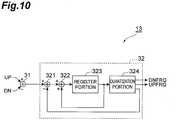
- Fig. 10 is a diagram showing an example of the configuration of the drive portion 13 included in the clock data restoration device 1A of the first embodiment.
- the drive portion 13 includes a decimeter portion 31 and a delta sigma modulation portion 32.
- ⁇ 1.
- the decimeter portion 31 inputs the first phase difference signal UP and the second phase difference signal DN output from the phase comparison portion 12, and outputs a value m indicating a difference of the number of periods at which each of the first phase difference signal UN and the second phase difference signal DN becomes a significant value during the duration of predetermined number M periods.
- the duration of the predetermined number M periods may be either one period or the duration of continuous two or more periods.
- the letter m is an integer that is equal to or more than -M but equal to or less than +M.
- the delta sigma modulation portion 32 includes a subtraction portion 321, an addition portion 322, a register portion 323 and a quantization portion 324.
- the subtraction portion 321 subtracts the output value of the quantization portion 324 from the output value of the decimeter portion 31, and outputs the value of the result of the subtraction to the addition portion 322.
- the addition portion 322 adds the output value of the subtraction portion 321 and the output value of the register portion 323, and outputs the value of the result of the addition to the register portion 323.
- the register portion 323 delays the output value of the addition portion 322 by the duration of the M periods, and outputs the value after the delay to the addition portion 322 and the quantization portion 324.
- the quantization portion 324 When the output value of the register portion 323 is equal to or more than +N, the quantization portion 324 outputs the third phase difference signal UPFRQ indicating this fact to the charge pump 14, and outputs +N to the subtraction portion 321. When the output value of the register portion 323 is equal to or less than -N, the quantization portion 324 outputs the fourth phase difference signal DNFRQ indicating this fact to the charge pump 14, and outputs -N to the subtraction portion 321.
- a loop including the addition portion 322 and the register portion 323 forms an integration portion that accumulatively adds the output value of the subtraction portion 321; the output value of the register portion 323 becomes the value of the variable ⁇ .
- the delta sigma modulation portion 32 inputs the value m output from the decimeter portion 31, and outputs, from the register portion 323, the value of the result of the addition of the value m to the variable ⁇ , as the value of the variable ⁇ .
- the delta sigma modulation portion 32 makes the quantization portion 324 output the third phase difference signal UPFRQ indicating this fact, and makes the subtraction portion 321 subtract the value N from the variable ⁇ .
- the delta sigma modulation portion 32 makes the quantization portion 324 output the fourth phase difference signal DNFRQ indicating this fact, and makes the subtraction portion 321 add the value N to the variable ⁇ .
- Fig. 11 is a diagram showing an example of the circuit of the potential adjustment portion 16 included in the clock data restoration device 1A of the first embodiment.
- the potential adjustment portion 16 includes a first buffer 161, a second buffer 162, a first resistor R 161 , a second resistor R 162 , a first capacitive element C 161 and a second capacitive element C 162 .
- the first buffer 161 and the second buffer 162 output signals of opposite polarities.
- the resistance values of the first resistor R 161 and the second resistor R 162 are equal to each other.
- the capacitance values of the first capacitive element C 161 and the second capacitive element C 162 are equal to each other.
- the first capacitive element C 161 and the second capacitive element C 162 can be realized by, for example, metal capacitors.
- the first buffer 161 inputs the first phase difference signal UP.
- the second buffer 162 inputs the second phase difference signal DN.
- One end of the first resistor R 161 is connected to the output end of the first buffer 161; the other end of the first resistor R 161 is connected to the capacitive element 15 through the first capacitive element C 161 .
- One end of the second resistor R 162 is connected to the output end of the second buffer 162; the other end of the second resistor R 162 is connected to the capacitive element 15 through the second capacitive element C 162 .
- the potential adjustment portion 16 configured as described above can increase or decrease the potential at the first end of the capacitive element 15 according to the phase difference indicated by the first phase difference signal UP and the second phase difference signal DN output from the phase comparison portion 12.
- Fig. 12 is a detailed circuit diagram of the potential adjustment portion 16 included in the clock data restoration device 1A of the first embodiment.
- the first buffer 161 and the second buffer 162 are shown in the circuit diagram of transistor level.
- This figure also shows a LDO (low drop out) power supply 160 that drives the first buffer 161 and the second buffer 162.
- Variations in the power supply voltage for driving the first buffer 161 and the second buffer 162 can cause jitter in the adjustment of the potential at the first end of the capacitive element 15 by the potential adjustment portion 16.
- the LDO power supply 16 that can supply a stable voltage is preferably used as a power supply for driving the first buffer 161 and the second buffer 162.
- the first resistor R 161 and the second resistor R 162 may not be provided in the potential adjustment portion 16.
- the first resistor R 161 is not provided, since the first buffer 161 directly drives the first capacitive element C 161 , an instantaneous large current is passed, and this may cause the reliability to be reduced.
- the second resistor R 162 is not provided.
- the provision of the first resistor R 161 and the second resistor R 162 improves the reliability.
- the provision of these resistors advantageously allows the potential adjustment portion 16 to have the function of a low pass filter.
- Fig. 13 is a diagram showing an example of the waveforms of individual signals in the clock data restoration device 1A of the first embodiment. Sequentially from above, this figure shows the example of the waveforms of: the first phase difference signal UP output from the phase comparison portion 12; the second phase difference signal DN output from the phase comparison portion 12; an output signal UPPH from the first buffer 161 of the potential adjustment portion 16; an output signal DNPHX from the second buffer 162 of the potential adjustment portion 16; the third phase difference signal UPFRQ output from the drive portion 13; the fourth phase difference signal DNFRQ output from the drive portion 13; and the control voltage value Vcon input to the voltage control oscillator 17.
- the control voltage value Vcon input to the voltage control oscillator 17 is adjusted to be high by the potential adjustment portion 16.
- the second phase difference signal DN is output from the phase comparison portion 12 as a pulse
- the control voltage value Vcon input to the voltage control oscillator 17 is adjusted to be low by the potential adjustment portion 16.
- the third phase difference signal UPFRQ is output from the drive portion 13 as a pulse
- the capacitive element 15 is charged, and thereafter the value of the control voltage value Vcon after the charging is maintained.
- the fourth phase difference signal DNFRQ is output from the drive portion 13 as a pulse, the capacitive element 15 is discharged, and thereafter the value of the control voltage value Vcon after the discharging is maintained.
- the capacitance value of the capacitive element 15 is C 15
- the capacitance values of the first capacitive element C 161 and the second capacitive element C 162 included in the potential adjustment portion 16 are C 16
- the magnitude of the pulses of the output signals UPPH and DNPHX of the first buffer 161 and the second buffer 162 included in the potential adjustment portion 16 is Vphfb.
- the pulses of the output signals UPPH and DNPHX have opposite polarities.
- the resistance value of the resistor R 1A included in the loop filter 25A is R 1
- the magnitude of the charge and discharge current Icp output from the charge pump 24 is Ipmp.
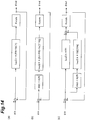
- Fig. 14 is a diagram showing a transfer function model in the clock data restoration device of each of the first comparative example, the second comparative example and the first embodiment.
- Fig. 14(a) shows the transfer function model of the clock data restoration device 2A of the first comparative example;
- Fig. 14(b) shows the transfer function model of the clock data restoration device 2B of the second comparative example;
- Fig. 14(c) shows the transfer function model of the clock data restoration device 1A of the first embodiment.
- T represents the period of the clocks CK and CKX.
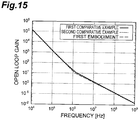
- Fig. 15 is a graph showing the frequency dependence of an open loop gain of the clock data restoration device of each of the first comparative example, the second comparative example and the first embodiment.
- Fig. 16 is a graph showing the frequency dependence of an open loop phase of the clock data restoration device of each of the first comparative example, the second comparative example and the first embodiment.
- Fig. 17 is a graph showing the frequency dependence of a closed loop gain of the clock data restoration device of each of the first comparative example, the second comparative example and the first embodiment.
- the clock data restoration device 1A of the first embodiment has a stable characteristic.
- the clock data restoration device 1A of the first embodiment can reduce the increase in the area of the capacitive element 15, can also increase the stability factor ⁇ while keeping the phase shift amount ⁇ constant and can perform a stable operation.
- Fig. 18 is a diagram showing the configuration of a clock data restoration device 1B of the second embodiment.
- the clock data restoration device 1B shown in this figure is a device that restores a clock and data based on an input digital signal; the clock data restoration device 1B includes the sampler portion 11, the phase comparison portion 12, the drive portion 13, the charge pump 14, the capacitive element 15, a potential adjustment portion 16B and the voltage control oscillator 17.
- the clock data restoration device 1B of the second embodiment shown in Fig. 18 differs from the clock data restoration device 1A in that the potential adjustment portion 16B is included instead of the potential adjustment portion 16.
- Fig. 19 is a diagram showing an example of the circuit of the potential adjustment portion 16B included in the clock data restoration device 1B of the second embodiment.
- the potential adjustment portion 16B includes the first buffer 161, the second buffer 162, the first resistor R 161 , the second resistor R 162 , the first capacitive element C 161 and the second capacitive element C 162 , and further includes a first AND circuit portion 163, a second AND circuit portion 164 and a pulsar portion 165.
- the potential adjustment portion 16B of the second embodiment shown in Fig. 19 differs from the potential adjustment portion 16 in that the first AND circuit portion 163, the second AND circuit portion 164 and the pulsar portion 165 are further included.
- the pulsar portion 165 inputs the clock CK or the clock CKX output from the voltage control oscillator 17, and outputs a pulse signal Pulse of the same period as this clock.
- the first AND circuit portion 163 is provided between the first buffer 161 and the first resistor R 161 , and inputs an output signal of the first buffer 161 and an output signal Pulse of the pulsar portion 165 and outputs a signal indicating the AND of these two signals to the first resistor R 161 .
- the second AND circuit portion 164 is provided between the second buffer 162 and the second resistor R 162 , and inputs an output signal of the second buffer 162 and an output signal Pulse of the pulsar portion 165 and outputs a signal indicating the AND of these two signals to the second resistor R 162 .
- Fig. 20 is a diagram showing an example of the waveforms of individual signals in the clock data restoration device 1B of the second embodiment. Sequentially from above, this figure shows the example of the waveforms of: the output signal Pulse from the pulsar portion 165 of the potential adjustment portion 16B; the first phase difference signal UP output from the phase comparison portion 12; the second phase difference signal DN output from the phase comparison portion 12; the output signal UPPH from the first buffer 161 of the potential adjustment portion 16B; the output signal DNPHX from the second buffer 162 of the potential adjustment portion 16B; the third phase difference signal UPFRQ output from the drive portion 13; the fourth phase difference signal DNFRQ output from the drive portion 13; and the control voltage value Vcon input to the voltage control oscillator 17.
- the output signal UPPH from the first buffer 161 of the potential adjustment portion 16B not only the output signal UPPH from the first buffer 161 of the potential adjustment portion 16B but also the output signal DNPHX from the second buffer 162 of the potential adjustment portion 16B are positive pulses.
- the signal UPPH is low, and the signal DNPHX is high.
- the capacitance of the capacitive element 15 is C 15
- the capacitance of the first capacitive element C 161 and the second capacitive element C 162 is C 16
- the magnitude of the pulses of the output signals UPPH and DNPHX of the first buffer 161 and the second buffer 162 is Vphfb.
- the first phase difference signal UP is a significant value
- both the signal UP and the signal DNPHX are high, and the control voltage value Vcon is higher by Vphfb ⁇ C 16 / C 15 than the case of Hold.
- the second phase difference signal DN is a significant value
- both the signal UPPH and the signal DNPHX are low
- the control voltage value Vcon is lower by Vphfb ⁇ C 16 / C 15 than the case of Hold.
- the potential adjustment portion 16B configured as described above is used, the potential (the control voltage value Vcon) at the first end of the capacitive element 15 is little affected by variations in the power supply. Hence, in the potential adjustment portion 16B, unlike the first embodiment, the LDO power supply needs to be used.
- Fig. 21 is a diagram showing the configuration of a clock data restoration device 1C of the third embodiment.
- the clock data restoration device 1C shown in this figure is a device that restores a clock and data based on an input digital signal; the clock data restoration device 1C includes the sampler portion 11, the phase comparison portion 12, a drive portion 13C, the charge pump 14, the capacitive element 15, the potential adjustment portion 16 and the voltage control oscillator 17.
- the clock data restoration device 1C of the third embodiment shown in Fig. 21 differs from the clock data restoration device 1A in that the drive portion 13C is included instead of the drive portion 13C.
- a resistor Rleak shown in Fig. 21 is an equivalent resistor when the charge leaks.
- the clock data restoration device 1C of the third embodiment includes the drive portion 13C so as to cope with the problem described above.
- Fig. 22 is a diagram showing an example of the configuration of the drive portion 13C included in the clock data restoration device 1C of the third embodiment.
- the drive portion 13C includes the decimeter portion 31, the delta sigma modulation portion 32, an integration portion 33 and an addition portion 34.
- the drive portion 13C of the third embodiment shown in Fig. 22 differs from the drive portion 13 in that the integration portion 33 and the addition portion 34 are further included.
- the integration portion 33 includes a multiplication portion 331, an addition portion 332, a register portion 333 and a limiter portion 334.
- the multiplication portion 331 multiplies the output value of the decimeter portion 31 by a positive constant k, and outputs the result of the multiplication to the addition portion 332.
- the addition portion 332 adds the output value of the multiplication portion 331 and the output value of the limiter portion 334, and outputs the result of the addition to the register portion 333.
- the register portion 333 delays the output value of the addition portion 332 by the duration of the M periods, and outputs the value after the delay to the limiter portion 334.
- the limiter portion 334 inputs the output value of the register portion 333. Then, if the input value falls within a predetermined range, the limiter portion 334 outputs the input value to the addition portion 332 and the addition portion 34 without the input value being processed; if the input value is higher than the upper limit of the predetermined range, the limiter portion 334 outputs the upper limit value to the addition portion 332 and the addition portion 34; if the input value is lower than the lower limit value of the predetermined range, the limiter portion 334 outputs the lower limit value to the addition portion 332 and the addition portion 34.
- the integration portion 33 outputs a value corresponding to a value obtained by accumulatively adding the output value of the decimeter portion 31.
- the addition portion 34 adds the output value of the decimeter portion 31 and the output value of the multiplication portion 33, and outputs the result of the addition to the delta sigma modulation portion 32.
- the delta sigma modulation portion 32 adds the output value of the decimeter portion 31 and the output value of the integration portion 33 to the variable ⁇ .
- the drive portion 13C configured as described above determines, with the integration portion 33, the value corresponding to the value obtained by accumulatively adding the output value of the decimeter portion 31, and inputs, to the delta sigma modulation portion 32, the addition value of the accumulative addition value determined with the integration portion 33 and the output value of the decimeter portion 31. Then, the delta sigma modulation portion 32 outputs, from the register portion 323, as the value of the variable ⁇ , the value of the result of the addition of the input value to the variable ⁇ .
- the quantization portion 324 when the value of the variable ⁇ becomes equal to or more than +N, the quantization portion 324 outputs the third phase difference signal UPFRQ indicating this fact, and the subtraction portion 321 subtracts the value N from the variable ⁇ . Moreover, in the delta sigma modulation portion 32, when the value of the variable ⁇ becomes equal to or less than -N, the quantization portion 324 outputs the fourth phase difference signal DNFRQ indicating this fact, and the subtraction portion 321 adds the value N to the variable ⁇ .
- the integration portion 33 when the integration portion 33 is not provided, part of the charge of the capacitive element 15 leaks through the resistor Rleak, and thus the first phase difference signal UP output from the phase comparison portion 12 becomes a significant value at a frequency higher than the frequency of the second phase difference signal DN.
- the drive portion 13C a value corresponding to the difference between the frequency at which the first phase difference signal UP becomes a significant value and the frequency at which the second phase difference signal DN becomes a significant value is output from the integration portion 33, and the addition value of the output value of the integration portion 33 and of the output value of the decimeter portion 31 is input to the delta sigma modulation portion 32.
- the first phase difference signal UP and the second phase difference signal DN output from the phase comparison portion 12 can become a significant value at the same frequency. In this way, it is possible to cancel the leakage of the charge of the capacitive element 15.
- the integration portion 33 includes the limiter portion 334, and thus the accumulative addition value (that is, the output value of the integration portion 33) in the integration portion 33 is prevented from exceeding the predetermined range, with the result that it is possible to prevent the malfunction of the drive portion 13C.
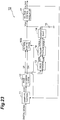
- Fig. 23 is a diagram showing the configuration of a clock data restoration device 1D of the fourth embodiment.
- the clock data restoration device 1D shown in this figure is a device that restores a clock and data based on an input digital signal; the clock data restoration device ID includes the sampler portion 11, the phase comparison portion 12, the drive portion 13, the charge pump 14, the capacitive element 15, the potential adjustment portion 16B, the voltage control oscillator 17 and a pulsar portion 18.
- the clock data restoration device ID of the fourth embodiment shown in Fig. 23 differs from the clock data restoration device 1B in that the pulsar portion 18 provided between the drive portion 13 and the charge pump 14 is further included.
- the pulsar portion 18 inputs the third phase difference signal UPFRQ and the fourth phase difference signal DNFRQ output from the drive portion 13. Then, the pulsar portion 18 outputs, to the charge pump 14, the third phase difference signal UPFRQ and the fourth phase difference signal DNFRQ, as signals having a constant pulse width (third phase difference signal UPFRQPLS and fourth phase difference signal DNFRQPLS).
- the charge pump 14 outputs a charge and discharge current based on the third phase difference signal UPFRQPLS and the fourth phase difference signal DNFRQPLS that are output from the drive portion 13 and that are determined by the pulsar portion 18 to have a constant pulse width.
- Fig. 24 is a diagram showing the configuration of the pulsar portion 18 included in the clock data restoration device ID of the fourth embodiment.
- the pulsar portion 18 includes a first delay circuit 181, a second delay circuit 182, a first logical inversion circuit 183, a second logical inversion circuit 184, a first AND circuit 185 and a second AND circuit 186.
- the first delay circuit 181 inputs the third phase difference signal UPFRQ output from the drive portion 13, provides a fixed delay to the third phase difference signal UPFRQ and outputs the third phase difference signal UPFRQ that has received the delay to the first logical inversion circuit 183.
- the first logical inversion circuit 183 inputs the third phase difference signal UPFRQ output from the first delay circuit 181, and performs logical inversion on the third phase difference signal UPFRQ and outputs it to the first AND circuit 185.
- the first AND circuit 185 inputs the third phase difference signal UPFRQ output from the drive portion 13, inputs a signal output from the first logical inversion circuit 183, performs an AND operation on these two signals and outputs the value of the AND as the third phase difference signal UPFRQPLS to the charge pump 14.
- the third phase difference signal UPFRQPLS has a constant pulse width regardless of an operational frequency.
- the second delay circuit 182 inputs the fourth phase difference signal DNFRQ output from the drive portion 13, provides a fixed delay to the fourth phase difference signal DNFRQ and outputs the fourth phase difference signal DNFRQ that has received the delay to the second logical inversion circuit 184.
- the second logical inversion circuit 184 inputs the fourth phase difference signal DNFRQ output from the second delay circuit 182, and performs logical inversion on the fourth phase difference signal DNFRQ and outputs it to the second AND circuit 186.
- the second AND circuit 186 inputs the fourth phase difference signal DNFRQ output from the drive portion 13, inputs a signal output from the second logical inversion circuit 184, performs an AND operation on these two signals and outputs the value of the AND as the fourth phase difference signal DNFRQPLS to the charge pump 14.
- the fourth phase difference signal DNFRQPLS has a constant pulse width regardless of an operational frequency.
- the stability factor ⁇ is expressed by a ratio of a phase feedback ⁇ bb during update to a frequency feedback ⁇ int.
- the stability factor ⁇ is expressed by the following formula. Nfq is increased, and thus ⁇ is increased, with the result that the stability can be acquired.
- tbit is increased, and thus ⁇ is disadvantageously decreased.
- ⁇ ⁇ bb / ⁇ int * Cph * Vph * tph * Nfq / Ipmp * tfq * tbit ⁇ Cph * Vph * Nfq / Ipmp * tbit * tbit
- the stability factor ⁇ is expressed by the following formula. As described above, ⁇ does not depend on the operational frequency, and thus it is possible to acquire stability.
- the clock data restoration device ID of the fourth embodiment is the clock data restoration device obtained by providing the pulsar portion 18 between the drive portion 13 and the charge pump 14 in the configuration of the clock data restoration device 1B of the second embodiment, in the configuration of the clock data restoration device 1A or 1C of the first or third embodiment, the pulsar portion 18 may be provided between the drive portion 13 and the charge pump 14.
- 1A, 1B, 1C, 1D, 2A and 2B clock data restoration device
- 11 sampler portion
- 12 phase comparison portion
- 13C drive portion
- 14 charge pump
- 15 capacitive element
- 16B potential adjustment portion
- 17 voltage control oscillator
- 18 pulsar portion
- 21 sampler portion
- 22 phase comparison portion
- 23 drive portion
- 24 charge pump
- 25A and 25B loop filter
- 27 voltage control oscillator
Landscapes
- Engineering & Computer Science (AREA)
- Computer Networks & Wireless Communication (AREA)
- Signal Processing (AREA)
- Stabilization Of Oscillater, Synchronisation, Frequency Synthesizers (AREA)
- Synchronisation In Digital Transmission Systems (AREA)
Claims (8)
- Taktdatenwiederherstellungsvorrichtung (1A), die angepasst ist, um einen Takt und Daten basierend auf einem digitalen Eingangssignal wiederherzustellen, wobei die Taktdatenwiederherstellungsvorrichtung (1A) umfasst:einen Samplerabschnitt (11), der angepasst ist, um einen Takt CK und einen Takt CKX, die eine gleiche Frequenz aufweisen und deren Phasen sich um π unterscheiden, einzugeben, das digitale Signal einzugeben und einen Wert D des digitalen Signals zu einer durch den Takt CK angezeigten Zeit und einen Wert DX des digitalen Signals zu einer durch den Takt CKX angezeigten Zeit, abzutasten, zu halten und auszugeben;einen Phasenvergleichsabschnitt (12), der angepasst ist, um basierend auf dem Wert D und dem Wert DX, der vom Samplerabschnitt (11) ausgegeben wird, Phasen des digitalen Signals und des Takts CKX mit jeder Periode des Takts CKX zu vergleichen, und der angepasst ist, um ein erstes Phasendifferenzsignal, das ein signifikanter Wert ist, wenn die Phase des Takts CKX in Bezug auf das digitale Signal verzögert wird, oder ein zweites Phasendifferenzsignal, das ein signifikanter Wert ist, wenn die Phase des Takts CKX in Bezug auf das digitale Signal voranschreitet, auszugeben;einen Treiberabschnitt (13), der angepasst ist, um das erste Phasendifferenzsignal und das zweite Phasendifferenzsignal, das vom Phasenvergleichsabschnitt (12) ausgegeben wird, einzugeben, wobei der Treiberabschnitt (13) einen Registerabschnitt (323) aufweist und Δ der Ausgabewert des Registerabschnitts (323) ist, wobei, wenn angenommen wird, dass Δ eine Variable darstellt, die 0<δ<N bewahrheitet, wobei N eine ganze Zahl ist, die gleich oder größer als 2 ist, und δ ein Wert ist, der die Beziehung von 0<δ<N erfüllt, der Wert δ zur Variablen Δ addiert wird, wenn das erste Phasendifferenzsignal in jeder Periode des Takts CKX zu einem signifikanten Wert wird, der Wert δ von der Variablen Δ abgezogen wird, wenn das zweite Phasendifferenzsignal in jeder Periode des Takts CKX zu einem signifikanten Wert wird, der Wert N von der Variablen Δ abgezogen wird, wenn der Wert der Variablen Δ gleich oder größer als +N wird, und der Wert N zur Variablen Δ addiert wird, wenn der Wert der Variablen Δ gleich oder kleiner als -N wird, wobei der Treiberabschnitt (13) angepasst ist, um es auszugeben, wenn der Wert der Variablen Δ gleich oder größer als +N wird, wobei ein drittes Phasendifferenzsignal anzeigt, dass der Wert der Variablen gleich oder größer als +N ist, und um es auszugeben, wenn der Wert der Variablen Δ gleich oder geringer als -N wird, wobei ein viertes Phasendifferenzsignal anzeigt, dass der Wert der Variablen Δ gleich oder geringer als -N ist,eine Ladepumpe (14), die angepasst ist, um einen Lade- und Entladestrom basierend auf dem dritten Phasendifferenzsignal und dem vierten Phasendifferenzsignal, das von dem Treiberabschnitt (13) ausgegeben wird, auszugeben;ein kapazitives Element (15), das ein erstes Ende aufweist, das mit einem Ausgangsende der Ladepumpe (14) verbunden ist, und ein zweites Ende aufweist, das mit einem Bezugspotential verbunden ist, und das angepasst ist, den Lade- und Entladestrom, der von der Ladepumpe (14) ausgegeben wird, in das erste Ende einzugeben, das geladen und entladen wird, und zum Ausgeben eines Spannungswerts am ersten Ende;einen Potentialeinstellungsabschnitt (16), der angepasst ist, um das erste Phasendifferenzsignal und das zweite Phasendifferenzsignal, die aus dem Phasenvergleich ausgegeben werden, einzugeben, und ein Potential am ersten Ende des kapazitiven Elements (15) gemäß einer Phasendifferenz, die durch das erste und zweite Phasendifferenzsignal angezeigt wird, zu erhöhen oder zu verringern, wobei der Potentialeinstellungsabschnitt (16) folgendes beinhaltet:einen ersten Puffer (161), der angepasst ist, um das erste Phasendifferenzsignal, das vom Phasenvergleichsabschnitt (12) ausgegeben wurde, einzugeben;ein erstes kapazitives Element (C161), das zwischen einem Ausgangsende des ersten Puffers (161) und dem ersten Ende des kapazitiven Elements (15) bereitgestellt ist;einen zweiten Puffer (162), der angepasst ist, um das zweite Phasendifferenzsignal, das von dem Phasenvergleichsabschnitt (12) ausgegeben wurde, einzugeben und ein Signal mit einer Polarität entgegengesetzt zu einer Polarität des ersten Puffers (161) auszugeben; undein zweites kapazitives Element (C162), das zwischen einem Ausgangsende des zweiten Puffers (162) und dem ersten Ende des kapazitiven Elements (15) bereitgestellt ist; undeinen Spannungssteueroszillator (17), der angepasst ist, den Spannungswert am ersten Ende des kapazitiven Elements (15) einzugeben, und an den Samplerabschnitt (11) als Takt CK und Takt CKX ein Schwingungssignal mit einer Frequenz entsprechend dem eingegebenen Spannungswert, auszugeben.
- Taktdatenwiederherstellungsvorrichtung (1A) nach Anspruch 1, wobei der Treiberabschnitt (13) umfasst:einen Dezimeterabschnitt (31), der angepasst ist, das erste Phasendifferenzsignal und das zweite Phasendifferenzsignal, das vom Phasenvergleichsabschnitt (12) ausgegeben wird, einzugeben und einen Wert mδ auszugeben, der eine Differenz m einer Anzahl von Perioden anzeigt, in der jedes von dem ersten Phasendifferenzsignal und dem zweiten Phasendifferenzsignal zu einem signifikanten Wert während einer vorbestimmten Anzahl von Perioden wird; undeinen Delta-Sigma-Modulationsabschnitt (32), der angepasst ist, um den Wert mδ, der vom Dezimeterabschnitt (31) ausgegeben wurde, einzugeben, den Wert mδ zur Variablen Δ zu addieren, auszugeben, wenn der Wert der Variablen Δ gleich oder größer als +N wird, wobei das dritte Phasendifferenzsignal anzeigt, dass die Variable Δ gleich oder mehr als +N ist, und den Wert N von der Variablen Δ abzuziehen und auszugeben, wenn der Wert der Variablen Δ gleich oder geringer als -N wird, wobei das vierte Phasendifferenzsignal anzeigt, dass die Variable Δ gleich oder geringer als -N ist, und den Wert N zur Variablen Δ zu addieren.
- Taktdatenwiederherstellungsvorrichtung (1A) nach Anspruch 2, wobei:der Treiberabschnitt (13) einen Integrationsabschnitt (33) beinhaltet, der angepasst ist, den Wert mδ, der vom Dezimeterabschnitt (31) ausgegeben wurde, einzugeben und einen Wert auszugeben, der einem Wert entspricht, der durch kumulatives Aufaddieren des Werts mδ erhalten wird, undder Delta-Sigma-Modulationsabschnitt (32) angepasst ist, um auf die Variable Δ, den Wert mδ, der vom Dezimeterabschnitt (31) ausgegeben wurde, und den Wert, der vom Integrationsabschnitt (33) ausgegeben wurde, aufzuaddieren.
- Taktdatenwiederherstellungsvorrichtung (1A) nach Anspruch 3, wobei der Integrationsabschnitt (33) einen Begrenzungsabschnitt (334) beinhaltet, der angepasst ist, um zu verhindern, dass der Wert, der durch kumulatives Aufaddieren des Wertes mδ erhalten wird, einen vorbestimmten Bereich überschreitet.
- Taktdatenwiederherstellungsvorrichtung (1A) nach Anspruch 1, wobei der Potentialeinstellungsabschnitt (16) umfasst:einen ersten Widerstand (R161), der zwischen dem Ausgangsende des ersten Puffers (161) und dem ersten kapazitiven Element (C161) bereitgestellt ist; undeinen zweiten Widerstand (R162), der zwischen dem Ausgangsende des zweiten Puffers (162) und dem zweiten kapazitiven Element (C162) bereitgestellt ist.
- Taktdatenwiederherstellungsvorrichtung (1A) nach Anspruch 1, wobei der Potentialeinstellungsabschnitt (16) umfasst:eine Low-Dropout, LDO, Stromversorgung (160), die angepasst ist, den ersten Puffer (161) und den zweiten Puffer (162) zu versorgen.
- Taktdatenwiederherstellungsvorrichtung (1A) nach Anspruch 1, wobei der Potentialeinstellungsabschnitt (16) umfasst:einen Pulsarabschnitt (165), der angepasst ist, ein Pulssignal auszugeben, das die gleiche Periode wie der Takt CK und der Takt CKX aufweist;einen ersten UND-Schaltungsabschnitt (163), der zwischen dem ersten Puffer (161) und dem ersten kapazitiven Element (C161) bereitgestellt ist, der angepasst ist, eine UND-Verknüpfung zwischen einem Ausgangspulssignal des Pulsarabschnitts (165) und einem Ausgangswert des ersten Puffers (165) auszuführen und einen Wert der UND-Verknüpfung an das erste kapazitive Element (C161) auszugeben; undeinen zweiten UND-Schaltungsabschnitt (164), der zwischen dem zweiten Puffer (162) und dem zweiten kapazitiven Element (C162) bereitgestellt ist, und der angepasst ist, eine UND-Verknüpfung des zweiten Pulssignals des Pulsarabschnitts (165) und einem Ausgangswert des zweiten Puffers (162) auszuführen und einen Wert der UND-Verknüpfung an das zweite kapazitive Element (C162) auszugeben.
- Taktdatenwiederherstellungsvorrichtung (1A) nach Anspruch 1, ferner umfassend:einen Pulsarabschnitt (165), der zwischen dem Treiberabschnitt (13) und der Ladepumpe (14) bereitgestellt und angepasst ist, um zu bestimmen, dass das dritte Phasendifferenzsignal und das vierte Phasendifferenzsignal, die vom Treiberabschnitt (13) ausgegeben werden, eine vorbestimmte Pulsweite aufweisen, und um das dritte Phasendifferenzsignal und das vierte Phasendifferenzsignal an die Ladepumpe (14) auszugeben,wobei die Ladepumpe (14) angepasst ist, einen Lade- und Entladestrom basierend auf dem dritten Phasendifferenzsignal und dem vierten Phasendifferenzsignal, die vom Treiberabschnitt (13) ausgegeben wurden und die bestimmt sind, die vorbestimmte Pulsbreite aufzuweisen, auszugeben.
Applications Claiming Priority (2)
| Application Number | Priority Date | Filing Date | Title |
|---|---|---|---|
| JP2009173243 | 2009-07-24 | ||
| PCT/JP2010/061875 WO2011010581A1 (ja) | 2009-07-24 | 2010-07-14 | クロックデータ復元装置 |
Publications (3)
| Publication Number | Publication Date |
|---|---|
| EP2458773A1 EP2458773A1 (de) | 2012-05-30 |
| EP2458773A4 EP2458773A4 (de) | 2018-01-03 |
| EP2458773B1 true EP2458773B1 (de) | 2019-01-30 |
Family
ID=43499054
Family Applications (1)
| Application Number | Title | Priority Date | Filing Date |
|---|---|---|---|
| EP10802201.3A Active EP2458773B1 (de) | 2009-07-24 | 2010-07-14 | Taktdaten-wiederherstellungsvorrichtung |
Country Status (6)
| Country | Link |
|---|---|
| US (1) | US8553828B2 (de) |
| EP (1) | EP2458773B1 (de) |
| JP (1) | JP5314143B2 (de) |
| KR (1) | KR101203370B1 (de) |
| CN (1) | CN102474411B (de) |
| WO (1) | WO2011010581A1 (de) |
Cited By (1)
| Publication number | Priority date | Publication date | Assignee | Title |
|---|---|---|---|---|
| EP4106205A4 (de) * | 2020-03-03 | 2023-04-19 | Huawei Technologies Co., Ltd. | Phasenregelkreisschaltung |
Families Citing this family (7)
| Publication number | Priority date | Publication date | Assignee | Title |
|---|---|---|---|---|
| US9014322B2 (en) * | 2012-05-23 | 2015-04-21 | Finisar Corporation | Low power and compact area digital integrator for a digital phase detector |
| JP6371096B2 (ja) * | 2014-04-09 | 2018-08-08 | ザインエレクトロニクス株式会社 | 受信装置 |
| TWI637601B (zh) * | 2017-01-24 | 2018-10-01 | 奇景光電股份有限公司 | 頻帶選擇時脈資料回復電路以及相關方法 |
| JP7037174B2 (ja) * | 2018-03-05 | 2022-03-16 | ザインエレクトロニクス株式会社 | Pll回路およびcdr装置 |
| CN109712591B (zh) * | 2018-12-24 | 2021-01-05 | 惠科股份有限公司 | 时序控制方法、时序控制芯片和显示装置 |
| TWI751767B (zh) * | 2020-10-30 | 2022-01-01 | 瑞鼎科技股份有限公司 | 一種用於低功率應用的時脈資料回復迴路穩定性改善裝置及相位偵測器 |
| TWI879299B (zh) * | 2023-12-11 | 2025-04-01 | 大陸商集創北方(珠海)科技有限公司 | 適應性時鐘恢復電路、顯示驅動晶片、顯示器及資訊處理裝置 |
Family Cites Families (12)
| Publication number | Priority date | Publication date | Assignee | Title |
|---|---|---|---|---|
| JPH0614638B2 (ja) * | 1985-07-31 | 1994-02-23 | セルヴル ミシエル | 局部クロック信号と受信データ信号とを再同期させる機構 |
| GB9102936D0 (en) | 1991-02-12 | 1991-03-27 | Shaye Communications Ltd | Digital communications systems |
| JPH06229236A (ja) | 1993-02-03 | 1994-08-16 | Toyota Motor Corp | 内燃機関の排気浄化装置 |
| WO2002005428A2 (en) * | 2000-07-10 | 2002-01-17 | Silicon Laboratories, Inc. | Digitally-synthesized loop filter circuit particularly useful for a phase locked loop |
| WO2002099971A1 (fr) * | 2001-05-30 | 2002-12-12 | Thine Electronics, Inc. | Circuit integre a semi-conducteur |
| US6509801B1 (en) * | 2001-06-29 | 2003-01-21 | Sierra Monolithics, Inc. | Multi-gigabit-per-sec clock recovery apparatus and method for optical communications |
| CN1310430C (zh) * | 2004-07-01 | 2007-04-11 | 威盛电子股份有限公司 | 锁相环电路 |
| US7372340B2 (en) * | 2005-01-03 | 2008-05-13 | Texas Instruments Incorporated | Precision frequency and phase synthesis with fewer voltage-controlled oscillator stages |
| TWI311865B (en) * | 2005-07-01 | 2009-07-01 | Via Tech Inc | Clock and data recovery circuit and method thereof |
| KR100711095B1 (ko) * | 2005-08-11 | 2007-04-24 | 삼성전자주식회사 | 클럭 및 데이터 복원회로, 및 클럭 및 데이터 복원 방법 |
| US7592847B2 (en) * | 2007-03-22 | 2009-09-22 | Mediatek Inc. | Phase frequency detector and phase-locked loop |
| KR101045072B1 (ko) * | 2009-12-28 | 2011-06-29 | 주식회사 하이닉스반도체 | 위상고정루프 및 그 구동방법 |
-
2010
- 2010-07-14 US US13/386,552 patent/US8553828B2/en active Active
- 2010-07-14 JP JP2011523613A patent/JP5314143B2/ja active Active
- 2010-07-14 EP EP10802201.3A patent/EP2458773B1/de active Active
- 2010-07-14 WO PCT/JP2010/061875 patent/WO2011010581A1/ja not_active Ceased
- 2010-07-14 KR KR1020117028122A patent/KR101203370B1/ko active Active
- 2010-07-14 CN CN201080032247.1A patent/CN102474411B/zh active Active
Non-Patent Citations (1)
| Title |
|---|
| None * |
Cited By (2)
| Publication number | Priority date | Publication date | Assignee | Title |
|---|---|---|---|---|
| EP4106205A4 (de) * | 2020-03-03 | 2023-04-19 | Huawei Technologies Co., Ltd. | Phasenregelkreisschaltung |
| US11742863B2 (en) | 2020-03-03 | 2023-08-29 | Huawei Technologies Co., Ltd. | Phase-locked loop circuit |
Also Published As
| Publication number | Publication date |
|---|---|
| EP2458773A1 (de) | 2012-05-30 |
| US20120187990A1 (en) | 2012-07-26 |
| KR101203370B1 (ko) | 2012-11-21 |
| US8553828B2 (en) | 2013-10-08 |
| EP2458773A4 (de) | 2018-01-03 |
| CN102474411B (zh) | 2014-10-15 |
| KR20120023705A (ko) | 2012-03-13 |
| CN102474411A (zh) | 2012-05-23 |
| JP5314143B2 (ja) | 2013-10-16 |
| WO2011010581A1 (ja) | 2011-01-27 |
| JPWO2011010581A1 (ja) | 2012-12-27 |
Similar Documents
| Publication | Publication Date | Title |
|---|---|---|
| EP2458773B1 (de) | Taktdaten-wiederherstellungsvorrichtung | |
| EP1648108A2 (de) | System zur Hochgeschwindigkeitstakt- und Datenrückgewinnung | |
| EP1738465B1 (de) | Schnelle phasenfrequenz-detektoranordnung | |
| US10374617B2 (en) | Injection-locked digital bang-bang phase-locked loop with timing calibration | |
| US8238504B2 (en) | Clock generation circuit and system | |
| JP4558028B2 (ja) | クロックデータ復元装置 | |
| US8358729B2 (en) | Baseband phase-locked loop | |
| Yang | Delay-locked loops-an overview | |
| US20050046452A1 (en) | All digital PLL trimming circuit | |
| US10623005B2 (en) | PLL circuit and CDR apparatus | |
| CN100550645C (zh) | 采用共模控制的差分电荷泵 | |
| US6496046B2 (en) | Method for increasing the control bandwidth of a frequency control circuit | |
| KR20080032236A (ko) | 클록 데이터 복원 장치 | |
| US6856659B1 (en) | Clock recovery method in digital signal sampling | |
| US7368954B2 (en) | Phase comparison circuit and CDR circuit | |
| CN120263175A (zh) | 用于分数-n频率合成器的电荷泵 | |
| KR101430796B1 (ko) | 주파수 배수 기능을 제공하는 위상 주파수 검출기, 상기 위상 주파수 검출기를 포함하는 위상 고정 루프 및 클락 및 데이터 복원 회로 | |
| WO2009027717A1 (en) | Phase detector and phase locked loop | |
| US10014867B1 (en) | Low-jitter phase-locked loop circuit | |
| Chen et al. | A CMOS 10 Gb/s clock and data recovery circuit with a novel adjustable K/sub pd/phase detector | |
| KR20230089958A (ko) | 디스플레이를 위한 클럭 데이터 복원 회로 | |
| Allan et al. | Mixed-signal thermometer filtering for low-complexity PLLs/DLLs | |
| Nikkhoo | Phase-locked loop with adaptive supply noise cancellation |
Legal Events
| Date | Code | Title | Description |
|---|---|---|---|
| PUAI | Public reference made under article 153(3) epc to a published international application that has entered the european phase |
Free format text: ORIGINAL CODE: 0009012 |
|
| 17P | Request for examination filed |
Effective date: 20120113 |
|
| AK | Designated contracting states |
Kind code of ref document: A1 Designated state(s): AL AT BE BG CH CY CZ DE DK EE ES FI FR GB GR HR HU IE IS IT LI LT LU LV MC MK MT NL NO PL PT RO SE SI SK SM TR |
|
| RAP1 | Party data changed (applicant data changed or rights of an application transferred) |
Owner name: THINE ELECTRONICS, INC. |
|
| DAX | Request for extension of the european patent (deleted) | ||
| REG | Reference to a national code |
Ref country code: DE Ref legal event code: R079 Ref document number: 602010056874 Country of ref document: DE Free format text: PREVIOUS MAIN CLASS: H04L0007033000 Ipc: H03L0007080000 |
|
| RA4 | Supplementary search report drawn up and despatched (corrected) |
Effective date: 20171205 |
|
| RIC1 | Information provided on ipc code assigned before grant |
Ipc: H04L 7/033 20060101ALI20171129BHEP Ipc: H03L 7/093 20060101ALI20171129BHEP Ipc: H03L 7/08 20060101AFI20171129BHEP |
|
| GRAP | Despatch of communication of intention to grant a patent |
Free format text: ORIGINAL CODE: EPIDOSNIGR1 |
|
| STAA | Information on the status of an ep patent application or granted ep patent |
Free format text: STATUS: GRANT OF PATENT IS INTENDED |
|
| INTG | Intention to grant announced |
Effective date: 20180912 |
|
| GRAJ | Information related to disapproval of communication of intention to grant by the applicant or resumption of examination proceedings by the epo deleted |
Free format text: ORIGINAL CODE: EPIDOSDIGR1 |
|
| STAA | Information on the status of an ep patent application or granted ep patent |
Free format text: STATUS: REQUEST FOR EXAMINATION WAS MADE |
|
| GRAR | Information related to intention to grant a patent recorded |
Free format text: ORIGINAL CODE: EPIDOSNIGR71 |
|
| GRAS | Grant fee paid |
Free format text: ORIGINAL CODE: EPIDOSNIGR3 |
|
| STAA | Information on the status of an ep patent application or granted ep patent |
Free format text: STATUS: GRANT OF PATENT IS INTENDED |
|
| GRAA | (expected) grant |
Free format text: ORIGINAL CODE: 0009210 |
|
| STAA | Information on the status of an ep patent application or granted ep patent |
Free format text: STATUS: THE PATENT HAS BEEN GRANTED |
|
| INTG | Intention to grant announced |
Effective date: 20181219 |
|
| AK | Designated contracting states |
Kind code of ref document: B1 Designated state(s): AL AT BE BG CH CY CZ DE DK EE ES FI FR GB GR HR HU IE IS IT LI LT LU LV MC MK MT NL NO PL PT RO SE SI SK SM TR |
|
| REG | Reference to a national code |
Ref country code: GB Ref legal event code: FG4D |
|
| REG | Reference to a national code |
Ref country code: CH Ref legal event code: EP |
|
| REG | Reference to a national code |
Ref country code: AT Ref legal event code: REF Ref document number: 1094052 Country of ref document: AT Kind code of ref document: T Effective date: 20190215 |
|
| REG | Reference to a national code |
Ref country code: IE Ref legal event code: FG4D |
|
| REG | Reference to a national code |
Ref country code: DE Ref legal event code: R096 Ref document number: 602010056874 Country of ref document: DE |
|
| REG | Reference to a national code |
Ref country code: NL Ref legal event code: FP |
|
| REG | Reference to a national code |
Ref country code: LT Ref legal event code: MG4D |
|
| PG25 | Lapsed in a contracting state [announced via postgrant information from national office to epo] |
Ref country code: FI Free format text: LAPSE BECAUSE OF FAILURE TO SUBMIT A TRANSLATION OF THE DESCRIPTION OR TO PAY THE FEE WITHIN THE PRESCRIBED TIME-LIMIT Effective date: 20190130 Ref country code: SE Free format text: LAPSE BECAUSE OF FAILURE TO SUBMIT A TRANSLATION OF THE DESCRIPTION OR TO PAY THE FEE WITHIN THE PRESCRIBED TIME-LIMIT Effective date: 20190130 Ref country code: NO Free format text: LAPSE BECAUSE OF FAILURE TO SUBMIT A TRANSLATION OF THE DESCRIPTION OR TO PAY THE FEE WITHIN THE PRESCRIBED TIME-LIMIT Effective date: 20190430 Ref country code: PL Free format text: LAPSE BECAUSE OF FAILURE TO SUBMIT A TRANSLATION OF THE DESCRIPTION OR TO PAY THE FEE WITHIN THE PRESCRIBED TIME-LIMIT Effective date: 20190130 Ref country code: ES Free format text: LAPSE BECAUSE OF FAILURE TO SUBMIT A TRANSLATION OF THE DESCRIPTION OR TO PAY THE FEE WITHIN THE PRESCRIBED TIME-LIMIT Effective date: 20190130 Ref country code: LT Free format text: LAPSE BECAUSE OF FAILURE TO SUBMIT A TRANSLATION OF THE DESCRIPTION OR TO PAY THE FEE WITHIN THE PRESCRIBED TIME-LIMIT Effective date: 20190130 Ref country code: PT Free format text: LAPSE BECAUSE OF FAILURE TO SUBMIT A TRANSLATION OF THE DESCRIPTION OR TO PAY THE FEE WITHIN THE PRESCRIBED TIME-LIMIT Effective date: 20190530 |
|
| REG | Reference to a national code |
Ref country code: AT Ref legal event code: MK05 Ref document number: 1094052 Country of ref document: AT Kind code of ref document: T Effective date: 20190130 |
|
| PG25 | Lapsed in a contracting state [announced via postgrant information from national office to epo] |
Ref country code: GR Free format text: LAPSE BECAUSE OF FAILURE TO SUBMIT A TRANSLATION OF THE DESCRIPTION OR TO PAY THE FEE WITHIN THE PRESCRIBED TIME-LIMIT Effective date: 20190501 Ref country code: HR Free format text: LAPSE BECAUSE OF FAILURE TO SUBMIT A TRANSLATION OF THE DESCRIPTION OR TO PAY THE FEE WITHIN THE PRESCRIBED TIME-LIMIT Effective date: 20190130 Ref country code: LV Free format text: LAPSE BECAUSE OF FAILURE TO SUBMIT A TRANSLATION OF THE DESCRIPTION OR TO PAY THE FEE WITHIN THE PRESCRIBED TIME-LIMIT Effective date: 20190130 Ref country code: BG Free format text: LAPSE BECAUSE OF FAILURE TO SUBMIT A TRANSLATION OF THE DESCRIPTION OR TO PAY THE FEE WITHIN THE PRESCRIBED TIME-LIMIT Effective date: 20190430 Ref country code: IS Free format text: LAPSE BECAUSE OF FAILURE TO SUBMIT A TRANSLATION OF THE DESCRIPTION OR TO PAY THE FEE WITHIN THE PRESCRIBED TIME-LIMIT Effective date: 20190530 |
|
| PG25 | Lapsed in a contracting state [announced via postgrant information from national office to epo] |
Ref country code: EE Free format text: LAPSE BECAUSE OF FAILURE TO SUBMIT A TRANSLATION OF THE DESCRIPTION OR TO PAY THE FEE WITHIN THE PRESCRIBED TIME-LIMIT Effective date: 20190130 Ref country code: DK Free format text: LAPSE BECAUSE OF FAILURE TO SUBMIT A TRANSLATION OF THE DESCRIPTION OR TO PAY THE FEE WITHIN THE PRESCRIBED TIME-LIMIT Effective date: 20190130 Ref country code: AL Free format text: LAPSE BECAUSE OF FAILURE TO SUBMIT A TRANSLATION OF THE DESCRIPTION OR TO PAY THE FEE WITHIN THE PRESCRIBED TIME-LIMIT Effective date: 20190130 Ref country code: CZ Free format text: LAPSE BECAUSE OF FAILURE TO SUBMIT A TRANSLATION OF THE DESCRIPTION OR TO PAY THE FEE WITHIN THE PRESCRIBED TIME-LIMIT Effective date: 20190130 Ref country code: IT Free format text: LAPSE BECAUSE OF FAILURE TO SUBMIT A TRANSLATION OF THE DESCRIPTION OR TO PAY THE FEE WITHIN THE PRESCRIBED TIME-LIMIT Effective date: 20190130 Ref country code: RO Free format text: LAPSE BECAUSE OF FAILURE TO SUBMIT A TRANSLATION OF THE DESCRIPTION OR TO PAY THE FEE WITHIN THE PRESCRIBED TIME-LIMIT Effective date: 20190130 Ref country code: SK Free format text: LAPSE BECAUSE OF FAILURE TO SUBMIT A TRANSLATION OF THE DESCRIPTION OR TO PAY THE FEE WITHIN THE PRESCRIBED TIME-LIMIT Effective date: 20190130 |
|
| REG | Reference to a national code |
Ref country code: DE Ref legal event code: R097 Ref document number: 602010056874 Country of ref document: DE |
|
| PG25 | Lapsed in a contracting state [announced via postgrant information from national office to epo] |
Ref country code: SM Free format text: LAPSE BECAUSE OF FAILURE TO SUBMIT A TRANSLATION OF THE DESCRIPTION OR TO PAY THE FEE WITHIN THE PRESCRIBED TIME-LIMIT Effective date: 20190130 |
|
| PLBE | No opposition filed within time limit |
Free format text: ORIGINAL CODE: 0009261 |
|
| STAA | Information on the status of an ep patent application or granted ep patent |
Free format text: STATUS: NO OPPOSITION FILED WITHIN TIME LIMIT |
|
| PG25 | Lapsed in a contracting state [announced via postgrant information from national office to epo] |
Ref country code: AT Free format text: LAPSE BECAUSE OF FAILURE TO SUBMIT A TRANSLATION OF THE DESCRIPTION OR TO PAY THE FEE WITHIN THE PRESCRIBED TIME-LIMIT Effective date: 20190130 |
|
| 26N | No opposition filed |
Effective date: 20191031 |
|
| PG25 | Lapsed in a contracting state [announced via postgrant information from national office to epo] |
Ref country code: MC Free format text: LAPSE BECAUSE OF FAILURE TO SUBMIT A TRANSLATION OF THE DESCRIPTION OR TO PAY THE FEE WITHIN THE PRESCRIBED TIME-LIMIT Effective date: 20190130 Ref country code: SI Free format text: LAPSE BECAUSE OF FAILURE TO SUBMIT A TRANSLATION OF THE DESCRIPTION OR TO PAY THE FEE WITHIN THE PRESCRIBED TIME-LIMIT Effective date: 20190130 |
|
| REG | Reference to a national code |
Ref country code: CH Ref legal event code: PL |
|
| PG25 | Lapsed in a contracting state [announced via postgrant information from national office to epo] |
Ref country code: TR Free format text: LAPSE BECAUSE OF FAILURE TO SUBMIT A TRANSLATION OF THE DESCRIPTION OR TO PAY THE FEE WITHIN THE PRESCRIBED TIME-LIMIT Effective date: 20190130 |
|
| REG | Reference to a national code |
Ref country code: BE Ref legal event code: MM Effective date: 20190731 |
|
| PG25 | Lapsed in a contracting state [announced via postgrant information from national office to epo] |
Ref country code: BE Free format text: LAPSE BECAUSE OF NON-PAYMENT OF DUE FEES Effective date: 20190731 Ref country code: CH Free format text: LAPSE BECAUSE OF NON-PAYMENT OF DUE FEES Effective date: 20190731 Ref country code: LU Free format text: LAPSE BECAUSE OF NON-PAYMENT OF DUE FEES Effective date: 20190714 Ref country code: LI Free format text: LAPSE BECAUSE OF NON-PAYMENT OF DUE FEES Effective date: 20190731 |
|
| PG25 | Lapsed in a contracting state [announced via postgrant information from national office to epo] |
Ref country code: IE Free format text: LAPSE BECAUSE OF NON-PAYMENT OF DUE FEES Effective date: 20190714 |
|
| PG25 | Lapsed in a contracting state [announced via postgrant information from national office to epo] |
Ref country code: CY Free format text: LAPSE BECAUSE OF FAILURE TO SUBMIT A TRANSLATION OF THE DESCRIPTION OR TO PAY THE FEE WITHIN THE PRESCRIBED TIME-LIMIT Effective date: 20190130 |
|
| PG25 | Lapsed in a contracting state [announced via postgrant information from national office to epo] |
Ref country code: MT Free format text: LAPSE BECAUSE OF FAILURE TO SUBMIT A TRANSLATION OF THE DESCRIPTION OR TO PAY THE FEE WITHIN THE PRESCRIBED TIME-LIMIT Effective date: 20190130 Ref country code: HU Free format text: LAPSE BECAUSE OF FAILURE TO SUBMIT A TRANSLATION OF THE DESCRIPTION OR TO PAY THE FEE WITHIN THE PRESCRIBED TIME-LIMIT; INVALID AB INITIO Effective date: 20100714 |
|
| PG25 | Lapsed in a contracting state [announced via postgrant information from national office to epo] |
Ref country code: MK Free format text: LAPSE BECAUSE OF FAILURE TO SUBMIT A TRANSLATION OF THE DESCRIPTION OR TO PAY THE FEE WITHIN THE PRESCRIBED TIME-LIMIT Effective date: 20190130 |
|
| PGFP | Annual fee paid to national office [announced via postgrant information from national office to epo] |
Ref country code: NL Payment date: 20250721 Year of fee payment: 16 |
|
| PGFP | Annual fee paid to national office [announced via postgrant information from national office to epo] |
Ref country code: DE Payment date: 20250722 Year of fee payment: 16 |
|
| PGFP | Annual fee paid to national office [announced via postgrant information from national office to epo] |
Ref country code: GB Payment date: 20250722 Year of fee payment: 16 |
|
| PGFP | Annual fee paid to national office [announced via postgrant information from national office to epo] |
Ref country code: FR Payment date: 20250725 Year of fee payment: 16 |