EP2489994A1 - Dispositif de détection d'eau - Google Patents
Dispositif de détection d'eau Download PDFInfo
- Publication number
- EP2489994A1 EP2489994A1 EP12155845A EP12155845A EP2489994A1 EP 2489994 A1 EP2489994 A1 EP 2489994A1 EP 12155845 A EP12155845 A EP 12155845A EP 12155845 A EP12155845 A EP 12155845A EP 2489994 A1 EP2489994 A1 EP 2489994A1
- Authority
- EP
- European Patent Office
- Prior art keywords
- water
- sensor
- detected
- outlet
- leg portion
- Prior art date
- Legal status (The legal status is an assumption and is not a legal conclusion. Google has not performed a legal analysis and makes no representation as to the accuracy of the status listed.)
- Withdrawn
Links
Images






Classifications
-
- G—PHYSICS
- G01—MEASURING; TESTING
- G01F—MEASURING VOLUME, VOLUME FLOW, MASS FLOW OR LIQUID LEVEL; METERING BY VOLUME
- G01F13/00—Apparatus for measuring by volume and delivering fluids or fluent solid materials, not provided for in the preceding groups
- G01F13/006—Apparatus for measuring by volume and delivering fluids or fluent solid materials, not provided for in the preceding groups measuring volume in function of time
-
- A—HUMAN NECESSITIES
- A47—FURNITURE; DOMESTIC ARTICLES OR APPLIANCES; COFFEE MILLS; SPICE MILLS; SUCTION CLEANERS IN GENERAL
- A47K—SANITARY EQUIPMENT; ACCESSORIES THEREFOR, e.g. TOILET ACCESSORIES
- A47K1/00—Wash-stands; Appurtenances therefor
- A47K1/14—Stoppers for wash-basins, baths, sinks, or the like
-
- E—FIXED CONSTRUCTIONS
- E03—WATER SUPPLY; SEWERAGE
- E03C—DOMESTIC PLUMBING INSTALLATIONS FOR FRESH WATER OR WASTE WATER; SINKS
- E03C1/00—Domestic plumbing installations for fresh water or waste water; Sinks
- E03C1/12—Plumbing installations for waste water; Basins or fountains connected thereto; Sinks
- E03C1/22—Outlet devices mounted in basins, baths, or sinks
-
- G—PHYSICS
- G01—MEASURING; TESTING
- G01F—MEASURING VOLUME, VOLUME FLOW, MASS FLOW OR LIQUID LEVEL; METERING BY VOLUME
- G01F1/00—Measuring the volume flow or mass flow of fluid or fluent solid material wherein the fluid passes through a meter in a continuous flow
- G01F1/007—Measuring the volume flow or mass flow of fluid or fluent solid material wherein the fluid passes through a meter in a continuous flow by measuring the level variations of storage tanks relative to the time
-
- G—PHYSICS
- G01—MEASURING; TESTING
- G01F—MEASURING VOLUME, VOLUME FLOW, MASS FLOW OR LIQUID LEVEL; METERING BY VOLUME
- G01F15/00—Details of, or accessories for, apparatus of groups G01F1/00 - G01F13/00 insofar as such details or appliances are not adapted to particular types of such apparatus
- G01F15/07—Integration to give total flow, e.g. using mechanically-operated integrating mechanism
- G01F15/075—Integration to give total flow, e.g. using mechanically-operated integrating mechanism using electrically-operated integrating means
-
- G—PHYSICS
- G01—MEASURING; TESTING
- G01F—MEASURING VOLUME, VOLUME FLOW, MASS FLOW OR LIQUID LEVEL; METERING BY VOLUME
- G01F22/00—Methods or apparatus for measuring volume of fluids or fluent solid material, not otherwise provided for
-
- G—PHYSICS
- G01—MEASURING; TESTING
- G01F—MEASURING VOLUME, VOLUME FLOW, MASS FLOW OR LIQUID LEVEL; METERING BY VOLUME
- G01F9/00—Measuring volume flow relative to another variable, e.g. of liquid fuel for an engine
- G01F9/008—Measuring volume flow relative to another variable, e.g. of liquid fuel for an engine where the other variable is the flight or running time
Definitions
- This invention relates to a device for the detection of water and in particular to a low-cost device for monitoring water use.
- a water monitoring device for positioning in a waste water outlet, comprising a top portion connected to a leg portion, the leg portion being configured to, in use, protrude down a waste water outlet in which the device is positioned, the leg portion comprising a water sensor positioned to detect water flowing down the waste water outlet, a timer connected to the water sensor and configured to be activated while water is detected by the water sensor, and an output connected to the timer, wherein the output is configured to provide an indication of the period over which water has been detected.
- the device may be a plug and the top portion is configured to seal a waste water outlet in which the device is positioned.
- the device is configured to supported by the leg portion such that it is movable between an open and a closed position.
- the device may be a waste water outlet cover configured such that the device is supported in a waste water outlet by the leg portion and such that the top portion covers, but does not seal, the waste water outlet.
- the output may be a visual display positioned in the top portion of the device.
- the visual device may comprise a plurality of light emitting devices.
- the light emitting device may be configured to illuminate sequentially.
- the device may comprise a power supply device located in the leg portion.
- the timer may be deactivated when water is not detected by the sensor, and wherein the period is the time during which the timer is activated.
- the period may be the total time elapsed from the timer starting, including periods when water is not detected.
- the sensor may be configured to detect hot water, but not cold water.
- the timer may be activated only if the temperature of the water exceeds a predetermined temperature.
- the period may be the time during which water over a predetermined temperature is detected.
- the current invention provides a device for indicating water usage.
- Various embodiments are described, for example for detecting water usage at the tap or at the outlet of the sink.
- An embodiment provides a device for positioning in a sink which detects and indicates water flow to a person using that sink.
- Embodiments of the invention may provide an indication of water volume flowing out of the sink, or may provide an alert each time certain quantities of water pass out of the sink.
- the device's alerts may cease or change when it is detected that the sink is being filled.
- Figure 1 shows an embodiment of a device 1 for detecting water flow out of an outlet of a sink.
- the body of the device 1 is a generally smooth ovoid shape, such that the device will naturally slide to the lowest point in the sink in which it is disposed. The device is thus most likely to locate itself close to the outlet of the sink, thereby ensuring water flowing out of the sink is detected. A more spherical shape would allow the device to roll to the lowest point of the sink.
- a liquid sensor is located on the device to detect liquid when it is in contact with the sensor.
- the sensor may be of any suitable type and particularly relevant options are discussed below.
- the device is provided with an indicator 2 for displaying an indication of water volume detected by the device.
- the display is a set of LEDs, but any suitable means may be utilised, for example a number display or bar-graph.
- each LED may be configured to illuminate in turn when a predefined volume of water is detected.
- FIG 2 shows a schematic diagram of a device shown in Figure 1 .
- the liquid sensor 20 is connected to a processing system 21 configured to respond to detection of liquid by the sensor 20.
- the processing system 21 comprises a counter 22 which counts while liquid is detected and thus provides an indication of the quantity of water that has been detected by the device.
- the counter 22 is started by the detection of water by the sensor 20, and stopped when water is no longer detected by the sensor 20. By calibration of the speed of counting to water flow-rate the counter 22 can be configured to provide an indication of water volume.
- a display 23 is connected to the processing system 21 and controlled to indicate the volume of liquid detected.
- the processing system 21 may be provided by a microcontroller or similar processing device, suitably programmed to perform the required functions. Alternatively, discrete logic devices may be utilised.
- Figure 3 shows an embodiment of the device comprising a numerical and graphical indication of water volume.
- the detection device may comprise more than one liquid sensor, each disposed at a different position on the body of the device. Embodiments may be designed to roll or slide to the lowest point of the sink, and thus the orientation of the device in its working position is not known. The provision of more than one sensor can be utilised to ensure that whatever the orientation of the device, one of the sensors will be exposed to liquid flowing out of the sink and the device will therefore be activated.
- the device may also comprise more than one indicator, such that the indicator will be visible regardless of the orientation of the device in the sink. The indicator may also be provided by the whole device, or a substantial portion of the device, illuminating.
- the provision of more than one sensor may also allow the device to distinguish between water flowing directly out of the sink, and water that is being held in the sink due to the closure of the outlet.
- the water level will generally be very low, and thus only the sensors located at the lowest points of the device will detect the liquid.
- the water level will increase and the liquid will be detected by more than one of the sensors.
- the indication provided by the device may change when it is detected that the sink is being filled. For example, the indication of volume may stop increasing, or the colour of the indicator may change from a first warning colour to a second colour indicating that the correct action is being taken.
- the outer body of the device may be provided with openings such that liquid can enter the device.
- the liquid sensors may be located within the outer body and are thus protected from contact with other items, for example the sink in which the device is disposed. Contact of the liquid sensors with an object may cause activation of the sensors and hence inaccurate measurement of liquid flow. Location of the sensors within the body may thus increase the accuracy of the device.
- the electronic system is adequately packaged, for example by encapsulation, to prevent any damage by contact with the liquid.
- a body shape which is designed to stay in one place may be utilised rather than the rolling-shape described above.
- a cuboid body may be utilised and the device would then be positioned in the preferred location by the user.
- Such a device may also be provided with an attachment means to secure it in the desired location.
- a further embodiment utilises a tripod or other multi-legged shape such that the device rests in a defined position.
- the liquid sensors may be mounted in any suitable position on the legs or body of the device.
- the legs may be arranged such that the device is stable when positioned in a sink with a sloping side.
- the display may be positioned on the top of the device such that it can be easily viewed, or as described previously the body or legs may form the indicator.
- the liquid sensor is mounted on an extension of the device, which extension is configured to extend into the plug hole or outlet of the sink, such that it protrudes below the plug.
- the extension may be constructed to be thin, such that the plug can still seal the outlet, in spite of the extension.
- the liquid sensor in this embodiment is only exposed to liquid when it is running out of the sink, and therefore a more accurate indication of wasted water may be gained.
- One or more liquid sensors may also be provided on the body of the device for operation in conjunction with the liquid sensor positioned in the outlet. The sensor on the body may be positioned such that it only detects liquid once it has reached a reasonable depth and thus indicates the sink is filling.
- Such a pair of sensors may allow discrimination between water flowing through the outlet due to an emptying of a sink of water and water being allowed to flow directly out of the sink. In the former case liquid will be detected by both sensors. The latter is more likely to indicate wasted water and the device may be configured to only monitor such flow.
- Sensors may also be provided to detect when the device is in contact with the bottom of the sink, or when it is floating, such that an alternative method of detecting when the sink is filling is provided.
- Figure 4 shows an embodiment 40 for mounting on the outlet of a tap.
- This embodiment monitors the flow of water into the sink, rather than out of it.
- the device has an attachment means for attaching to a variety of designs of tap, and a sensor 41 which protrudes into the water flow to detect the presence of water. When water is detected by the sensor 41, the device records and indicates volumes as described hereinbefore.
- water may be sensed using an optical sensor, so that no contact with the water is required.
- the optical sensor may operate in a reflective or transmissive mode.
- Figure 5 shows an alternative device utilising a hook-and-loop fastening strap to attach the device to the tap.
- the device is also provided with a solar panel such that the device can be powered without requiring batteries.
- a method of calibration is also provided such that the accuracy of the device can be improved.
- To calibrate the device it is set to a calibration mode and a predetermined volume of water is measured out of the tap.
- the device measures the time taken for that predetermined volume to be dispensed and utilises that time to calibrate measurements.
- the tap is set to a typical flow-rate, and it is then assumed that the flow rate of the tap is consistent with that calibration flow-rate.
- the flow-rate in use will not always be a precise match for the calibration flow-rate, it has been shown to be sufficiently close to provide useful data.
- typical flow-rates of taps are relatively consistent and therefore the devices can be pre-calibrated for an average flow-rate that the device is likely to be utilised with.
- the device may be supplied in a container that can be utilised to measure the predetermined volume of water for the calibration process.
- the liquid sensors may be utilised to change the mode of the device and to indicate when the predetermined volume measurements starts and stops.
- a temperature sensor may also be provided in the device to detect the temperature of liquid coming in contact with the device.
- the device may be configured to monitor and/or indicate differently depending on the temperature of the water. For example, the device may therefore be configured to alert the user more rapidly when hot water is detected, or a specific indication may be provided that the water detected is hot (i.e. above a certain predefined temperature).
- a capacitive sensor may be particularly appropriate for use as the liquid sensor.
- Figure 6 shows two embodiments of capacitive sensors that may be utilised to detect liquid. In each sensor the presence of liquid modifies the electrical properties of the capacitor. That change is detected and utilised to indicate a presence of liquid.
- a device is provided to detect water flowing through a waste outlet from a bath or shower tray to determine the length of use of the shower. The time for which water flows out of the waste outlet is monitored, thereby providing a measurement of shower duration. An output is provided to give an indication of that duration.
- the device may have green, amber, and red LEDs, which are illuminated in turn to indicate increasing shower duration. The green LED may illuminate initially, followed by the amber LED during an appropriate shower duration, followed by the re LED when the duration is excessive.
- various indication methods may be utilised, including coloured or flashing lights, and/or sound outputs.
- the device may be configured to vary the time at which the different LEDs are illuminated to encourage a reduction in shower duration over time. For example, the first time the device is used a record may be kept of the shower duration. On subsequent usages the time after which the amber and red LEDs illuminate may be decreased, encouraging a reduction in shower time. Various patterns of change may be provided, for example a percentage reduction, or a reduction by a fixed number of seconds. A minimum duration at which the LEDs illuminate may be set such that the duration does not continue to reduce to an impractical level. The duration may remain the same if the shower is stopped after the red LED is illuminated, or may reduce if the shower is stopped before the red LED is illuminated.
- the device may be configured to stop timing, but not reset the measured time, when a stop in water flow is detected, and then to restart timing when flow recommences. This ensures the duration accounts for periods during a shower when the water flow is turned off, such that the device provides an indication of water usage, not only total shower duration from start to finish. This feature may encourage users to turn the shower off while applying soap, for example.
- FIG. 7 shows a schematic diagram of a device for monitoring shower duration formed as a waste water outlet plug.
- the plug 70 has a leg portion 71 and a top portion 72. In use the leg portion 71 is positioned in the support structure of a waste water outlet to hold the plug at the required position.
- the waste water outlet may of the pop-up type such that a mechanism in the waste water outlet allows a user to open and close the outlet by movement of the plug.
- a water sensor 73 is provided on the leg portion for detecting water flowing down the waste outlet in which the device is positioned.
- a display 74 is provided in the top surface of the top portion for indicating the time for which water has been detected.
- the display may be a set of coloured LEDs as described hereinbefore.
- a processing system and power supply are positioned within the plug 70 and in communication with the display and water sensor 73.
- the power supply may be a battery positioned in the leg portion 71 and the processing system may be a microprocessor positioned in the top portion.
- the processing system is configured to implement the shower-duration monitoring method described above.
- the processing system monitors the water sensor and when water is activated by the sensor commences timing and controls the display to provide an indication of elapsed shower time. For example, as described above using three different colours of LED. As described above the timings may be fixed or variable to encourage behaviour change.
- the display may comprise any of the types described hereinbefore, configured to display information as most appropriate. Also, the calibration and indication based on volume described previously may be utilised in preference to durations as described immediately above.
- the device may be provided in the form of a cover for a waste outlet, supported in a comparable way to the plug shown in Figure 7 , providing an aesthetic cover, but not functioning as a plug.
- the top part of the cover is typically significantly larger than the actual outlet to provide a pleasing appearance.
- T-shaped cross-section
- Similar cross-section i.e. T-shaped
- T-shaped cross-sectional shape
- the device sits on top of the grate with the leg portion protruding through the grate to detect water flowing through the outlet covered by the grate.
- T-shape common cross-sectional T-shape of a top portion at one end of a leg portion.
- a water sensor may be provided in the waste outlet, with a display unit positioned remotely in a convenient location.
- a display may be incorporated into a part of the bath or shower tray, or in the wall of the bath or shower.
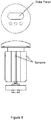
- Figure 8 shows an alternative embodiment including a solar panel to provide power for the device.
- Figure 9 shows an embodiment in which the display is a display panel position in the top part.
- the display panel may be, for example, an LCD panel.
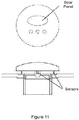
- Figure 10 shows an embodiment for use in a shower-only environment in which the device providers a cover for the waste outlet, but does not seal that waste outlet.
- Figure 11 shows a variation of the Figure 11 embodiment in which the device is supported on the surface of the waste outlet.
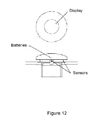
- Figure 12 shows a further variation with a display panel.
- Figure 13 shows a further variation in which the device sits astride the waste outlet with openings to allow water flow into the waste outlet.
- Figure 12 shows a further variation of Figure 13 with a display panel.
- Figure 15 shows a further variation with a suction pad for attachment to a surface.
- the devices described hereinbefore may be secured in place using any suitable attachment means, for example suction cups, or self-adhesive materials.
- the devices which replace existing plugs or waste covers may be secured using the conventional mechanism which have the particular advantage of making theft more difficult and requiring no modification of the existing waste outlet.
- 'sink' is used herein as a generic term to indicate any vessel into which water may be directed from a water outlet. References to sink are therefore intended to include other specific items such as baths and shower trays. Similarly, the term 'tap' is used to indicate any form of water outlet and accordingly encompasses items such as shower heads.
- the methods described herein may be performed by software in machine readable form on a storage medium.
Landscapes
- Physics & Mathematics (AREA)
- Fluid Mechanics (AREA)
- General Physics & Mathematics (AREA)
- Engineering & Computer Science (AREA)
- Health & Medical Sciences (AREA)
- Public Health (AREA)
- Environmental & Geological Engineering (AREA)
- Life Sciences & Earth Sciences (AREA)
- Hydrology & Water Resources (AREA)
- Water Supply & Treatment (AREA)
- Domestic Plumbing Installations (AREA)
Applications Claiming Priority (1)
| Application Number | Priority Date | Filing Date | Title |
|---|---|---|---|
| GB1102813.1A GB2488151A (en) | 2011-02-18 | 2011-02-18 | Water detection device |
Publications (1)
| Publication Number | Publication Date |
|---|---|
| EP2489994A1 true EP2489994A1 (fr) | 2012-08-22 |
Family
ID=43881289
Family Applications (1)
| Application Number | Title | Priority Date | Filing Date |
|---|---|---|---|
| EP12155845A Withdrawn EP2489994A1 (fr) | 2011-02-18 | 2012-02-16 | Dispositif de détection d'eau |
Country Status (2)
| Country | Link |
|---|---|
| EP (1) | EP2489994A1 (fr) |
| GB (1) | GB2488151A (fr) |
Families Citing this family (2)
| Publication number | Priority date | Publication date | Assignee | Title |
|---|---|---|---|---|
| GB2510616A (en) * | 2013-02-10 | 2014-08-13 | Thomas Frederick Northway | Bathtub light |
| DE102024130729A1 (de) * | 2024-10-22 | 2026-04-23 | Viega Technology Gmbh & Co. Kg | Ablauf für einen Sanitärbereich, insbesondere für eine Duschtasse oder als Bodenablauf, und System umfassend einen solchen Ablauf und eine Spülvorrichtung zur Durchführung einer Hygienespülung |
Citations (3)
| Publication number | Priority date | Publication date | Assignee | Title |
|---|---|---|---|---|
| US5969267A (en) * | 1997-11-18 | 1999-10-19 | Emhart Glass S.A. | Flowmeter having a temper proof housing mounted on a pipe section thereof for a telemetering unit including a battery and a circuit |
| GB2379991A (en) * | 2001-08-23 | 2003-03-26 | Yorkshire Water Services Ltd | Measuring apparatus |
| EP2131163A2 (fr) * | 2008-06-05 | 2009-12-09 | Priestman Goode | Dispositif de détection d'eau pour indiquer le volume d'eau utilisé |
Family Cites Families (4)
| Publication number | Priority date | Publication date | Assignee | Title |
|---|---|---|---|---|
| DE29714775U1 (de) * | 1997-08-12 | 1997-10-23 | Su, Chao-Ta, Kuan Shi, Hsin Chu | Anzeigeeinrichtung |
| JP2005207126A (ja) * | 2004-01-23 | 2005-08-04 | Inax Corp | 浴槽用排水栓装置 |
| FR2916532A1 (fr) * | 2007-05-21 | 2008-11-28 | Sandrine Kerleo | Globe lumineux indicateur de la consommation d'eau lors de la douche. |
| CN201445434U (zh) * | 2009-03-10 | 2010-05-05 | 达瑞光电股份有限公司 | 水塞模块及其水塞与水塞座 |
-
2011
- 2011-02-18 GB GB1102813.1A patent/GB2488151A/en not_active Withdrawn
-
2012
- 2012-02-16 EP EP12155845A patent/EP2489994A1/fr not_active Withdrawn
Patent Citations (3)
| Publication number | Priority date | Publication date | Assignee | Title |
|---|---|---|---|---|
| US5969267A (en) * | 1997-11-18 | 1999-10-19 | Emhart Glass S.A. | Flowmeter having a temper proof housing mounted on a pipe section thereof for a telemetering unit including a battery and a circuit |
| GB2379991A (en) * | 2001-08-23 | 2003-03-26 | Yorkshire Water Services Ltd | Measuring apparatus |
| EP2131163A2 (fr) * | 2008-06-05 | 2009-12-09 | Priestman Goode | Dispositif de détection d'eau pour indiquer le volume d'eau utilisé |
Also Published As
| Publication number | Publication date |
|---|---|
| GB201102813D0 (en) | 2011-04-06 |
| GB2488151A (en) | 2012-08-22 |
Similar Documents
| Publication | Publication Date | Title |
|---|---|---|
| US9428374B2 (en) | Liquid vessel pourer with timed illuminator for measuring purposes | |
| US8196463B2 (en) | Water detection device | |
| US20040258567A1 (en) | Device and method for monitoring and illuminating a fluid | |
| CA2642901A1 (fr) | Methode et dispositif indiquant la necessite de reapprovisionner un produit a distribution aleatoire | |
| CN102936824A (zh) | 一种洗衣机洗涤剂的余量检测及显示方法 | |
| CA2677130A1 (fr) | Distributeur electrique de savon | |
| EP2489994A1 (fr) | Dispositif de détection d'eau | |
| US20140225745A1 (en) | Telemetry system for water consumption | |
| US20120227821A1 (en) | Shower water usage indicator apparatus | |
| US8640536B2 (en) | Water detection device | |
| US9095248B2 (en) | Alarm unit for dishwashing systems | |
| EP2676652A1 (fr) | Système de détection le besoin de nettoyer un jacuzzi, jacuzzi avec un tel système et méthode de sa utilisation | |
| CN104688043A (zh) | 一种自动加热饮水机定时加热装置 | |
| CN109163456A (zh) | 一种热水器及热水器中热水剩余时间的测量方法 | |
| GB2287340A (en) | Flow measuring and leak detecting systems | |
| US20110282499A1 (en) | Control for indicating available hot fluid supply | |
| EP2150161B1 (fr) | Système de compteur pour douche | |
| US20140200838A1 (en) | Water Saving Device | |
| JP5453873B2 (ja) | 自動水栓 | |
| US9282875B2 (en) | Alarm unit for dishwashing systems | |
| CN208941820U (zh) | 饮水机及其缺水检测装置 | |
| JP2003207376A (ja) | 水道水使用量表示装置 | |
| CN208742825U (zh) | 一种多功能预警花洒 | |
| US20250001371A1 (en) | Detecting liquid temperature for a beverage carbonation system | |
| CN105476366A (zh) | 一种提示饮水的杯子 |
Legal Events
| Date | Code | Title | Description |
|---|---|---|---|
| PUAI | Public reference made under article 153(3) epc to a published international application that has entered the european phase |
Free format text: ORIGINAL CODE: 0009012 |
|
| AK | Designated contracting states |
Kind code of ref document: A1 Designated state(s): AL AT BE BG CH CY CZ DE DK EE ES FI FR GB GR HR HU IE IS IT LI LT LU LV MC MK MT NL NO PL PT RO RS SE SI SK SM TR |
|
| AX | Request for extension of the european patent |
Extension state: BA ME |
|
| STAA | Information on the status of an ep patent application or granted ep patent |
Free format text: STATUS: THE APPLICATION IS DEEMED TO BE WITHDRAWN |
|
| 18D | Application deemed to be withdrawn |
Effective date: 20130223 |