EP2504418B1 - Wasch- oder reinigungsmittel mit gegebenenfalls in situ erzeugtem bleichverstärkendem übergangsmetallkomplex - Google Patents
Wasch- oder reinigungsmittel mit gegebenenfalls in situ erzeugtem bleichverstärkendem übergangsmetallkomplex Download PDFInfo
- Publication number
- EP2504418B1 EP2504418B1 EP10784492.0A EP10784492A EP2504418B1 EP 2504418 B1 EP2504418 B1 EP 2504418B1 EP 10784492 A EP10784492 A EP 10784492A EP 2504418 B1 EP2504418 B1 EP 2504418B1
- Authority
- EP
- European Patent Office
- Prior art keywords
- formula
- acid
- cleaning
- weight
- washing
- Prior art date
- Legal status (The legal status is an assumption and is not a legal conclusion. Google has not performed a legal analysis and makes no representation as to the accuracy of the status listed.)
- Not-in-force
Links
- 229910052723 transition metal Inorganic materials 0.000 title claims description 9
- 150000003624 transition metals Chemical class 0.000 title claims description 9
- 239000012459 cleaning agent Substances 0.000 title claims description 8
- 239000003599 detergent Substances 0.000 title description 24
- 238000011065 in-situ storage Methods 0.000 title 1
- OKKJLVBELUTLKV-UHFFFAOYSA-N Methanol Chemical compound OC OKKJLVBELUTLKV-UHFFFAOYSA-N 0.000 claims description 55
- 239000000203 mixture Substances 0.000 claims description 55
- -1 alkali metal percarbonate Chemical class 0.000 claims description 50
- 150000001875 compounds Chemical class 0.000 claims description 36
- 239000003795 chemical substances by application Substances 0.000 claims description 35
- 150000003839 salts Chemical class 0.000 claims description 26
- 239000003446 ligand Substances 0.000 claims description 25
- 239000007844 bleaching agent Substances 0.000 claims description 24
- 238000004140 cleaning Methods 0.000 claims description 22
- 238000005406 washing Methods 0.000 claims description 22
- XLYOFNOQVPJJNP-UHFFFAOYSA-N water Chemical compound O XLYOFNOQVPJJNP-UHFFFAOYSA-N 0.000 claims description 22
- MHAJPDPJQMAIIY-UHFFFAOYSA-N Hydrogen peroxide Chemical compound OO MHAJPDPJQMAIIY-UHFFFAOYSA-N 0.000 claims description 18
- 229910052742 iron Inorganic materials 0.000 claims description 17
- 229910052783 alkali metal Inorganic materials 0.000 claims description 16
- 229910052748 manganese Inorganic materials 0.000 claims description 15
- 238000000034 method Methods 0.000 claims description 15
- 229910052750 molybdenum Inorganic materials 0.000 claims description 15
- 239000004094 surface-active agent Substances 0.000 claims description 13
- 230000008569 process Effects 0.000 claims description 12
- 239000003054 catalyst Substances 0.000 claims description 11
- 239000004615 ingredient Substances 0.000 claims description 7
- 125000002091 cationic group Chemical group 0.000 claims description 6
- KRKNYBCHXYNGOX-UHFFFAOYSA-K Citrate Chemical compound [O-]C(=O)CC(O)(CC([O-])=O)C([O-])=O KRKNYBCHXYNGOX-UHFFFAOYSA-K 0.000 claims description 5
- 150000001340 alkali metals Chemical class 0.000 claims description 5
- YRKCREAYFQTBPV-UHFFFAOYSA-N acetylacetone Chemical compound CC(=O)CC(C)=O YRKCREAYFQTBPV-UHFFFAOYSA-N 0.000 claims description 4
- 125000005263 alkylenediamine group Chemical group 0.000 claims description 4
- 239000004744 fabric Substances 0.000 claims description 4
- 150000004820 halides Chemical class 0.000 claims description 4
- 229910052739 hydrogen Inorganic materials 0.000 claims description 4
- 239000001257 hydrogen Substances 0.000 claims description 4
- 229910052721 tungsten Inorganic materials 0.000 claims description 4
- 150000002500 ions Chemical class 0.000 claims description 3
- 230000007935 neutral effect Effects 0.000 claims description 3
- QLAJNZSPVITUCQ-UHFFFAOYSA-N 1,3,2-dioxathietane 2,2-dioxide Chemical compound O=S1(=O)OCO1 QLAJNZSPVITUCQ-UHFFFAOYSA-N 0.000 claims description 2
- JFJNVIPVOCESGZ-UHFFFAOYSA-N 2,3-dipyridin-2-ylpyridine Chemical compound N1=CC=CC=C1C1=CC=CN=C1C1=CC=CC=N1 JFJNVIPVOCESGZ-UHFFFAOYSA-N 0.000 claims description 2
- VEXZGXHMUGYJMC-UHFFFAOYSA-M Chloride anion Chemical compound [Cl-] VEXZGXHMUGYJMC-UHFFFAOYSA-M 0.000 claims description 2
- BDAGIHXWWSANSR-UHFFFAOYSA-M Formate Chemical compound [O-]C=O BDAGIHXWWSANSR-UHFFFAOYSA-M 0.000 claims description 2
- 229910002651 NO3 Inorganic materials 0.000 claims description 2
- NHNBFGGVMKEFGY-UHFFFAOYSA-N Nitrate Chemical compound [O-][N+]([O-])=O NHNBFGGVMKEFGY-UHFFFAOYSA-N 0.000 claims description 2
- MUBZPKHOEPUJKR-UHFFFAOYSA-N Oxalic acid Chemical compound OC(=O)C(O)=O MUBZPKHOEPUJKR-UHFFFAOYSA-N 0.000 claims description 2
- 150000008051 alkyl sulfates Chemical class 0.000 claims description 2
- 150000001449 anionic compounds Chemical class 0.000 claims description 2
- 125000000129 anionic group Chemical group 0.000 claims description 2
- 230000015572 biosynthetic process Effects 0.000 claims description 2
- QAOWNCQODCNURD-UHFFFAOYSA-M hydrogensulfate Chemical compound OS([O-])(=O)=O QAOWNCQODCNURD-UHFFFAOYSA-M 0.000 claims description 2
- XLYOFNOQVPJJNP-UHFFFAOYSA-M hydroxide Chemical compound [OH-] XLYOFNOQVPJJNP-UHFFFAOYSA-M 0.000 claims description 2
- 229910001412 inorganic anion Inorganic materials 0.000 claims description 2
- 150000002891 organic anions Chemical class 0.000 claims description 2
- VLTRZXGMWDSKGL-UHFFFAOYSA-M perchlorate Inorganic materials [O-]Cl(=O)(=O)=O VLTRZXGMWDSKGL-UHFFFAOYSA-M 0.000 claims description 2
- VLTRZXGMWDSKGL-UHFFFAOYSA-N perchloric acid Chemical compound OCl(=O)(=O)=O VLTRZXGMWDSKGL-UHFFFAOYSA-N 0.000 claims description 2
- 229940095064 tartrate Drugs 0.000 claims description 2
- 125000003837 (C1-C20) alkyl group Chemical group 0.000 claims 1
- QGZKDVFQNNGYKY-UHFFFAOYSA-N Ammonia Chemical compound N QGZKDVFQNNGYKY-UHFFFAOYSA-N 0.000 claims 1
- FEWJPZIEWOKRBE-JCYAYHJZSA-L L-tartrate(2-) Chemical compound [O-]C(=O)[C@H](O)[C@@H](O)C([O-])=O FEWJPZIEWOKRBE-JCYAYHJZSA-L 0.000 claims 1
- 125000001797 benzyl group Chemical group [H]C1=C([H])C([H])=C(C([H])=C1[H])C([H])([H])* 0.000 claims 1
- 150000007942 carboxylates Chemical class 0.000 claims 1
- 125000004435 hydrogen atom Chemical class [H]* 0.000 claims 1
- 125000001997 phenyl group Chemical group [H]C1=C([H])C([H])=C(*)C([H])=C1[H] 0.000 claims 1
- 239000000243 solution Substances 0.000 description 36
- 239000002253 acid Substances 0.000 description 29
- 239000011572 manganese Substances 0.000 description 26
- 239000011734 sodium Substances 0.000 description 24
- 150000007513 acids Chemical class 0.000 description 19
- 125000004432 carbon atom Chemical group C* 0.000 description 18
- XEEYBQQBJWHFJM-UHFFFAOYSA-N Iron Chemical compound [Fe] XEEYBQQBJWHFJM-UHFFFAOYSA-N 0.000 description 17
- 239000000126 substance Substances 0.000 description 17
- KRKNYBCHXYNGOX-UHFFFAOYSA-N citric acid Chemical compound OC(=O)CC(O)(C(O)=O)CC(O)=O KRKNYBCHXYNGOX-UHFFFAOYSA-N 0.000 description 16
- 235000019832 sodium triphosphate Nutrition 0.000 description 16
- 239000012190 activator Substances 0.000 description 15
- 150000002009 diols Chemical group 0.000 description 14
- HEMHJVSKTPXQMS-UHFFFAOYSA-M Sodium hydroxide Chemical compound [OH-].[Na+] HEMHJVSKTPXQMS-UHFFFAOYSA-M 0.000 description 12
- 239000003112 inhibitor Substances 0.000 description 12
- 238000002360 preparation method Methods 0.000 description 12
- 229910052708 sodium Inorganic materials 0.000 description 12
- DGAQECJNVWCQMB-PUAWFVPOSA-M Ilexoside XXIX Chemical compound C[C@@H]1CC[C@@]2(CC[C@@]3(C(=CC[C@H]4[C@]3(CC[C@@H]5[C@@]4(CC[C@@H](C5(C)C)OS(=O)(=O)[O-])C)C)[C@@H]2[C@]1(C)O)C)C(=O)O[C@H]6[C@@H]([C@H]([C@@H]([C@H](O6)CO)O)O)O.[Na+] DGAQECJNVWCQMB-PUAWFVPOSA-M 0.000 description 11
- 239000003513 alkali Substances 0.000 description 11
- 229910052910 alkali metal silicate Inorganic materials 0.000 description 11
- 239000000178 monomer Substances 0.000 description 11
- 229920000642 polymer Polymers 0.000 description 11
- 239000000843 powder Substances 0.000 description 11
- 239000000047 product Substances 0.000 description 11
- 239000002689 soil Substances 0.000 description 11
- LWIHDJKSTIGBAC-UHFFFAOYSA-K tripotassium phosphate Chemical compound [K+].[K+].[K+].[O-]P([O-])([O-])=O LWIHDJKSTIGBAC-UHFFFAOYSA-K 0.000 description 11
- 238000006243 chemical reaction Methods 0.000 description 10
- RTZKZFJDLAIYFH-UHFFFAOYSA-N ether Substances CCOCC RTZKZFJDLAIYFH-UHFFFAOYSA-N 0.000 description 10
- 238000002844 melting Methods 0.000 description 10
- 230000008018 melting Effects 0.000 description 10
- 239000004753 textile Substances 0.000 description 10
- LYCAIKOWRPUZTN-UHFFFAOYSA-N Ethylene glycol Chemical compound OCCO LYCAIKOWRPUZTN-UHFFFAOYSA-N 0.000 description 9
- 239000000194 fatty acid Substances 0.000 description 9
- NBIIXXVUZAFLBC-UHFFFAOYSA-N Phosphoric acid Chemical compound OP(O)(O)=O NBIIXXVUZAFLBC-UHFFFAOYSA-N 0.000 description 8
- DNIAPMSPPWPWGF-UHFFFAOYSA-N Propylene glycol Chemical compound CC(O)CO DNIAPMSPPWPWGF-UHFFFAOYSA-N 0.000 description 8
- BGRWYDHXPHLNKA-UHFFFAOYSA-N Tetraacetylethylenediamine Chemical compound CC(=O)N(C(C)=O)CCN(C(C)=O)C(C)=O BGRWYDHXPHLNKA-UHFFFAOYSA-N 0.000 description 8
- 125000000217 alkyl group Chemical group 0.000 description 8
- 238000004061 bleaching Methods 0.000 description 8
- 229910052799 carbon Inorganic materials 0.000 description 8
- 235000014113 dietary fatty acids Nutrition 0.000 description 8
- 230000000694 effects Effects 0.000 description 8
- 229930195729 fatty acid Natural products 0.000 description 8
- 230000003647 oxidation Effects 0.000 description 8
- 238000007254 oxidation reaction Methods 0.000 description 8
- 239000006260 foam Substances 0.000 description 7
- CDBYLPFSWZWCQE-UHFFFAOYSA-L sodium carbonate Substances [Na+].[Na+].[O-]C([O-])=O CDBYLPFSWZWCQE-UHFFFAOYSA-L 0.000 description 7
- UNXRWKVEANCORM-UHFFFAOYSA-I triphosphate(5-) Chemical compound [O-]P([O-])(=O)OP([O-])(=O)OP([O-])([O-])=O UNXRWKVEANCORM-UHFFFAOYSA-I 0.000 description 7
- 229920000742 Cotton Polymers 0.000 description 6
- 230000002378 acidificating effect Effects 0.000 description 6
- WNLRTRBMVRJNCN-UHFFFAOYSA-N adipic acid Chemical compound OC(=O)CCCCC(O)=O WNLRTRBMVRJNCN-UHFFFAOYSA-N 0.000 description 6
- 229920001577 copolymer Polymers 0.000 description 6
- 238000000921 elemental analysis Methods 0.000 description 6
- 239000007788 liquid Substances 0.000 description 6
- VLKZOEOYAKHREP-UHFFFAOYSA-N n-Hexane Chemical compound CCCCCC VLKZOEOYAKHREP-UHFFFAOYSA-N 0.000 description 6
- 239000002244 precipitate Substances 0.000 description 6
- 239000001488 sodium phosphate Substances 0.000 description 6
- 239000007787 solid Substances 0.000 description 6
- 102000004190 Enzymes Human genes 0.000 description 5
- 108090000790 Enzymes Proteins 0.000 description 5
- 238000004566 IR spectroscopy Methods 0.000 description 5
- ZLMJMSJWJFRBEC-UHFFFAOYSA-N Potassium Chemical compound [K] ZLMJMSJWJFRBEC-UHFFFAOYSA-N 0.000 description 5
- OFOBLEOULBTSOW-UHFFFAOYSA-N Propanedioic acid Natural products OC(=O)CC(O)=O OFOBLEOULBTSOW-UHFFFAOYSA-N 0.000 description 5
- QAOWNCQODCNURD-UHFFFAOYSA-N Sulfuric acid Chemical compound OS(O)(=O)=O QAOWNCQODCNURD-UHFFFAOYSA-N 0.000 description 5
- 229910000323 aluminium silicate Inorganic materials 0.000 description 5
- 125000003178 carboxy group Chemical group [H]OC(*)=O 0.000 description 5
- 235000015165 citric acid Nutrition 0.000 description 5
- 239000001177 diphosphate Substances 0.000 description 5
- BNIILDVGGAEEIG-UHFFFAOYSA-L disodium hydrogen phosphate Chemical compound [Na+].[Na+].OP([O-])([O-])=O BNIILDVGGAEEIG-UHFFFAOYSA-L 0.000 description 5
- 229940088598 enzyme Drugs 0.000 description 5
- 150000004665 fatty acids Chemical class 0.000 description 5
- 239000000835 fiber Substances 0.000 description 5
- 239000000463 material Substances 0.000 description 5
- 239000002245 particle Substances 0.000 description 5
- 235000011007 phosphoric acid Nutrition 0.000 description 5
- 229910052700 potassium Inorganic materials 0.000 description 5
- 239000011591 potassium Substances 0.000 description 5
- SMZOUWXMTYCWNB-UHFFFAOYSA-N 2-(2-methoxy-5-methylphenyl)ethanamine Chemical compound COC1=CC=C(C)C=C1CCN SMZOUWXMTYCWNB-UHFFFAOYSA-N 0.000 description 4
- NIXOWILDQLNWCW-UHFFFAOYSA-N 2-Propenoic acid Natural products OC(=O)C=C NIXOWILDQLNWCW-UHFFFAOYSA-N 0.000 description 4
- CDAWCLOXVUBKRW-UHFFFAOYSA-N 2-aminophenol Chemical compound NC1=CC=CC=C1O CDAWCLOXVUBKRW-UHFFFAOYSA-N 0.000 description 4
- IJGRMHOSHXDMSA-UHFFFAOYSA-N Atomic nitrogen Chemical compound N#N IJGRMHOSHXDMSA-UHFFFAOYSA-N 0.000 description 4
- BVKZGUZCCUSVTD-UHFFFAOYSA-L Carbonate Chemical compound [O-]C([O-])=O BVKZGUZCCUSVTD-UHFFFAOYSA-L 0.000 description 4
- ABLZXFCXXLZCGV-UHFFFAOYSA-N Phosphorous acid Chemical compound OP(O)=O ABLZXFCXXLZCGV-UHFFFAOYSA-N 0.000 description 4
- 229920002472 Starch Polymers 0.000 description 4
- KKEYFWRCBNTPAC-UHFFFAOYSA-N Terephthalic acid Chemical compound OC(=O)C1=CC=C(C(O)=O)C=C1 KKEYFWRCBNTPAC-UHFFFAOYSA-N 0.000 description 4
- CUJRVFIICFDLGR-UHFFFAOYSA-N acetylacetonate Chemical compound CC(=O)[CH-]C(C)=O CUJRVFIICFDLGR-UHFFFAOYSA-N 0.000 description 4
- 239000013543 active substance Substances 0.000 description 4
- 150000001447 alkali salts Chemical class 0.000 description 4
- 125000003342 alkenyl group Chemical group 0.000 description 4
- 229910000147 aluminium phosphate Inorganic materials 0.000 description 4
- 239000003945 anionic surfactant Substances 0.000 description 4
- 239000003093 cationic surfactant Substances 0.000 description 4
- 229920002678 cellulose Polymers 0.000 description 4
- 239000001913 cellulose Substances 0.000 description 4
- 229910017052 cobalt Inorganic materials 0.000 description 4
- 239000010941 cobalt Substances 0.000 description 4
- GUTLYIVDDKVIGB-UHFFFAOYSA-N cobalt atom Chemical compound [Co] GUTLYIVDDKVIGB-UHFFFAOYSA-N 0.000 description 4
- 239000000645 desinfectant Substances 0.000 description 4
- HNPSIPDUKPIQMN-UHFFFAOYSA-N dioxosilane;oxo(oxoalumanyloxy)alumane Chemical compound O=[Si]=O.O=[Al]O[Al]=O HNPSIPDUKPIQMN-UHFFFAOYSA-N 0.000 description 4
- 238000010438 heat treatment Methods 0.000 description 4
- 230000001965 increasing effect Effects 0.000 description 4
- WPBNNNQJVZRUHP-UHFFFAOYSA-L manganese(2+);methyl n-[[2-(methoxycarbonylcarbamothioylamino)phenyl]carbamothioyl]carbamate;n-[2-(sulfidocarbothioylamino)ethyl]carbamodithioate Chemical compound [Mn+2].[S-]C(=S)NCCNC([S-])=S.COC(=O)NC(=S)NC1=CC=CC=C1NC(=S)NC(=O)OC WPBNNNQJVZRUHP-UHFFFAOYSA-L 0.000 description 4
- 229910052751 metal Inorganic materials 0.000 description 4
- 239000002184 metal Substances 0.000 description 4
- 239000002736 nonionic surfactant Substances 0.000 description 4
- HWGNBUXHKFFFIH-UHFFFAOYSA-I pentasodium;[oxido(phosphonatooxy)phosphoryl] phosphate Chemical compound [Na+].[Na+].[Na+].[Na+].[Na+].[O-]P([O-])(=O)OP([O-])(=O)OP([O-])([O-])=O HWGNBUXHKFFFIH-UHFFFAOYSA-I 0.000 description 4
- XNGIFLGASWRNHJ-UHFFFAOYSA-N phthalic acid Chemical compound OC(=O)C1=CC=CC=C1C(O)=O XNGIFLGASWRNHJ-UHFFFAOYSA-N 0.000 description 4
- 229920005646 polycarboxylate Polymers 0.000 description 4
- 229920000728 polyester Polymers 0.000 description 4
- BITYAPCSNKJESK-UHFFFAOYSA-N potassiosodium Chemical compound [Na].[K] BITYAPCSNKJESK-UHFFFAOYSA-N 0.000 description 4
- 235000011009 potassium phosphates Nutrition 0.000 description 4
- 159000000001 potassium salts Chemical class 0.000 description 4
- 238000010992 reflux Methods 0.000 description 4
- 150000004760 silicates Chemical class 0.000 description 4
- 239000000344 soap Substances 0.000 description 4
- FQENQNTWSFEDLI-UHFFFAOYSA-J sodium diphosphate Chemical compound [Na+].[Na+].[Na+].[Na+].[O-]P([O-])(=O)OP([O-])([O-])=O FQENQNTWSFEDLI-UHFFFAOYSA-J 0.000 description 4
- 235000019698 starch Nutrition 0.000 description 4
- 125000001424 substituent group Chemical group 0.000 description 4
- VZCYOOQTPOCHFL-UHFFFAOYSA-N trans-butenedioic acid Natural products OC(=O)C=CC(O)=O VZCYOOQTPOCHFL-UHFFFAOYSA-N 0.000 description 4
- 229910001428 transition metal ion Inorganic materials 0.000 description 4
- 239000001226 triphosphate Substances 0.000 description 4
- QTBSBXVTEAMEQO-UHFFFAOYSA-N Acetic acid Chemical compound CC(O)=O QTBSBXVTEAMEQO-UHFFFAOYSA-N 0.000 description 3
- WEVYAHXRMPXWCK-UHFFFAOYSA-N Acetonitrile Chemical compound CC#N WEVYAHXRMPXWCK-UHFFFAOYSA-N 0.000 description 3
- 108010065511 Amylases Proteins 0.000 description 3
- 102000013142 Amylases Human genes 0.000 description 3
- 102000005575 Cellulases Human genes 0.000 description 3
- 108010084185 Cellulases Proteins 0.000 description 3
- 235000008733 Citrus aurantifolia Nutrition 0.000 description 3
- LFQSCWFLJHTTHZ-UHFFFAOYSA-N Ethanol Chemical compound CCO LFQSCWFLJHTTHZ-UHFFFAOYSA-N 0.000 description 3
- 108090001060 Lipase Proteins 0.000 description 3
- 239000004367 Lipase Substances 0.000 description 3
- 102000004882 Lipase Human genes 0.000 description 3
- CERQOIWHTDAKMF-UHFFFAOYSA-N Methacrylic acid Chemical compound CC(=C)C(O)=O CERQOIWHTDAKMF-UHFFFAOYSA-N 0.000 description 3
- 102000004316 Oxidoreductases Human genes 0.000 description 3
- 108090000854 Oxidoreductases Proteins 0.000 description 3
- 229910019142 PO4 Inorganic materials 0.000 description 3
- 108091005804 Peptidases Proteins 0.000 description 3
- 102000035195 Peptidases Human genes 0.000 description 3
- 239000002202 Polyethylene glycol Substances 0.000 description 3
- 239000004365 Protease Substances 0.000 description 3
- KJTLSVCANCCWHF-UHFFFAOYSA-N Ruthenium Chemical compound [Ru] KJTLSVCANCCWHF-UHFFFAOYSA-N 0.000 description 3
- VYPSYNLAJGMNEJ-UHFFFAOYSA-N Silicium dioxide Chemical compound O=[Si]=O VYPSYNLAJGMNEJ-UHFFFAOYSA-N 0.000 description 3
- BQCADISMDOOEFD-UHFFFAOYSA-N Silver Chemical compound [Ag] BQCADISMDOOEFD-UHFFFAOYSA-N 0.000 description 3
- 239000004115 Sodium Silicate Substances 0.000 description 3
- 235000011941 Tilia x europaea Nutrition 0.000 description 3
- 239000001361 adipic acid Substances 0.000 description 3
- 235000011037 adipic acid Nutrition 0.000 description 3
- 150000001298 alcohols Chemical class 0.000 description 3
- 229910000318 alkali metal phosphate Inorganic materials 0.000 description 3
- 235000019418 amylase Nutrition 0.000 description 3
- 229940025131 amylases Drugs 0.000 description 3
- 239000007864 aqueous solution Substances 0.000 description 3
- 125000005161 aryl oxy carbonyl group Chemical group 0.000 description 3
- BVKZGUZCCUSVTD-UHFFFAOYSA-N carbonic acid Chemical class OC(O)=O BVKZGUZCCUSVTD-UHFFFAOYSA-N 0.000 description 3
- 150000004691 decahydrates Chemical class 0.000 description 3
- XPPKVPWEQAFLFU-UHFFFAOYSA-J diphosphate(4-) Chemical compound [O-]P([O-])(=O)OP([O-])([O-])=O XPPKVPWEQAFLFU-UHFFFAOYSA-J 0.000 description 3
- 235000011180 diphosphates Nutrition 0.000 description 3
- ZPWVASYFFYYZEW-UHFFFAOYSA-L dipotassium hydrogen phosphate Chemical compound [K+].[K+].OP([O-])([O-])=O ZPWVASYFFYYZEW-UHFFFAOYSA-L 0.000 description 3
- 238000004851 dishwashing Methods 0.000 description 3
- 230000002708 enhancing effect Effects 0.000 description 3
- 150000002148 esters Chemical class 0.000 description 3
- 238000007046 ethoxylation reaction Methods 0.000 description 3
- 239000008187 granular material Substances 0.000 description 3
- 239000004571 lime Substances 0.000 description 3
- 235000019421 lipase Nutrition 0.000 description 3
- VZCYOOQTPOCHFL-UPHRSURJSA-N maleic acid Chemical compound OC(=O)\C=C/C(O)=O VZCYOOQTPOCHFL-UPHRSURJSA-N 0.000 description 3
- 239000011976 maleic acid Substances 0.000 description 3
- 238000001906 matrix-assisted laser desorption--ionisation mass spectrometry Methods 0.000 description 3
- 235000019796 monopotassium phosphate Nutrition 0.000 description 3
- 230000003287 optical effect Effects 0.000 description 3
- 239000007800 oxidant agent Substances 0.000 description 3
- 229910052760 oxygen Inorganic materials 0.000 description 3
- 235000021317 phosphate Nutrition 0.000 description 3
- 150000003013 phosphoric acid derivatives Chemical class 0.000 description 3
- 229920001223 polyethylene glycol Polymers 0.000 description 3
- 235000019828 potassium polyphosphate Nutrition 0.000 description 3
- 102000004169 proteins and genes Human genes 0.000 description 3
- 108090000623 proteins and genes Proteins 0.000 description 3
- 150000003254 radicals Chemical class 0.000 description 3
- 239000011541 reaction mixture Substances 0.000 description 3
- 229910052707 ruthenium Inorganic materials 0.000 description 3
- 229910052709 silver Inorganic materials 0.000 description 3
- 239000004332 silver Substances 0.000 description 3
- GCLGEJMYGQKIIW-UHFFFAOYSA-H sodium hexametaphosphate Chemical compound [Na]OP1(=O)OP(=O)(O[Na])OP(=O)(O[Na])OP(=O)(O[Na])OP(=O)(O[Na])OP(=O)(O[Na])O1 GCLGEJMYGQKIIW-UHFFFAOYSA-H 0.000 description 3
- 235000019982 sodium hexametaphosphate Nutrition 0.000 description 3
- 235000019351 sodium silicates Nutrition 0.000 description 3
- 239000002904 solvent Substances 0.000 description 3
- 239000008107 starch Substances 0.000 description 3
- 239000000758 substrate Substances 0.000 description 3
- 235000019818 tetrasodium diphosphate Nutrition 0.000 description 3
- 150000003852 triazoles Chemical class 0.000 description 3
- RYFMWSXOAZQYPI-UHFFFAOYSA-K trisodium phosphate Chemical compound [Na+].[Na+].[Na+].[O-]P([O-])([O-])=O RYFMWSXOAZQYPI-UHFFFAOYSA-K 0.000 description 3
- YWWVWXASSLXJHU-AATRIKPKSA-N (9E)-tetradecenoic acid Chemical compound CCCC\C=C\CCCCCCCC(O)=O YWWVWXASSLXJHU-AATRIKPKSA-N 0.000 description 2
- RDMHXWZYVFGYSF-LNTINUHCSA-N (z)-4-hydroxypent-3-en-2-one;manganese Chemical compound [Mn].C\C(O)=C\C(C)=O.C\C(O)=C\C(C)=O.C\C(O)=C\C(C)=O RDMHXWZYVFGYSF-LNTINUHCSA-N 0.000 description 2
- RTBFRGCFXZNCOE-UHFFFAOYSA-N 1-methylsulfonylpiperidin-4-one Chemical compound CS(=O)(=O)N1CCC(=O)CC1 RTBFRGCFXZNCOE-UHFFFAOYSA-N 0.000 description 2
- 238000001644 13C nuclear magnetic resonance spectroscopy Methods 0.000 description 2
- 238000005160 1H NMR spectroscopy Methods 0.000 description 2
- LQJBNNIYVWPHFW-UHFFFAOYSA-N 20:1omega9c fatty acid Natural products CCCCCCCCCCC=CCCCCCCCC(O)=O LQJBNNIYVWPHFW-UHFFFAOYSA-N 0.000 description 2
- FJKROLUGYXJWQN-UHFFFAOYSA-N 4-hydroxybenzoic acid Chemical compound OC(=O)C1=CC=C(O)C=C1 FJKROLUGYXJWQN-UHFFFAOYSA-N 0.000 description 2
- LLLVZDVNHNWSDS-UHFFFAOYSA-N 4-methylidene-3,5-dioxabicyclo[5.2.2]undeca-1(9),7,10-triene-2,6-dione Chemical compound C1(C2=CC=C(C(=O)OC(=C)O1)C=C2)=O LLLVZDVNHNWSDS-UHFFFAOYSA-N 0.000 description 2
- HGINCPLSRVDWNT-UHFFFAOYSA-N Acrolein Chemical compound C=CC=O HGINCPLSRVDWNT-UHFFFAOYSA-N 0.000 description 2
- QGZKDVFQNNGYKY-UHFFFAOYSA-O Ammonium Chemical compound [NH4+] QGZKDVFQNNGYKY-UHFFFAOYSA-O 0.000 description 2
- 102100032487 Beta-mannosidase Human genes 0.000 description 2
- DPUOLQHDNGRHBS-UHFFFAOYSA-N Brassidinsaeure Natural products CCCCCCCCC=CCCCCCCCCCCCC(O)=O DPUOLQHDNGRHBS-UHFFFAOYSA-N 0.000 description 2
- 229910014033 C-OH Inorganic materials 0.000 description 2
- 229920002134 Carboxymethyl cellulose Polymers 0.000 description 2
- 229910014570 C—OH Inorganic materials 0.000 description 2
- 229920001353 Dextrin Polymers 0.000 description 2
- 239000004375 Dextrin Substances 0.000 description 2
- FEWJPZIEWOKRBE-JCYAYHJZSA-N Dextrotartaric acid Chemical compound OC(=O)[C@H](O)[C@@H](O)C(O)=O FEWJPZIEWOKRBE-JCYAYHJZSA-N 0.000 description 2
- IMROMDMJAWUWLK-UHFFFAOYSA-N Ethenol Chemical compound OC=C IMROMDMJAWUWLK-UHFFFAOYSA-N 0.000 description 2
- DBVJJBKOTRCVKF-UHFFFAOYSA-N Etidronic acid Chemical compound OP(=O)(O)C(O)(C)P(O)(O)=O DBVJJBKOTRCVKF-UHFFFAOYSA-N 0.000 description 2
- VZCYOOQTPOCHFL-OWOJBTEDSA-N Fumaric acid Chemical compound OC(=O)\C=C\C(O)=O VZCYOOQTPOCHFL-OWOJBTEDSA-N 0.000 description 2
- AEMRFAOFKBGASW-UHFFFAOYSA-N Glycolic acid Chemical compound OCC(O)=O AEMRFAOFKBGASW-UHFFFAOYSA-N 0.000 description 2
- UFHFLCQGNIYNRP-UHFFFAOYSA-N Hydrogen Chemical compound [H][H] UFHFLCQGNIYNRP-UHFFFAOYSA-N 0.000 description 2
- KFZMGEQAYNKOFK-UHFFFAOYSA-N Isopropanol Chemical compound CC(C)O KFZMGEQAYNKOFK-UHFFFAOYSA-N 0.000 description 2
- QECVIPBZOPUTRD-UHFFFAOYSA-N N=S(=O)=O Chemical class N=S(=O)=O QECVIPBZOPUTRD-UHFFFAOYSA-N 0.000 description 2
- BPQQTUXANYXVAA-UHFFFAOYSA-N Orthosilicate Chemical compound [O-][Si]([O-])([O-])[O-] BPQQTUXANYXVAA-UHFFFAOYSA-N 0.000 description 2
- 108700020962 Peroxidase Proteins 0.000 description 2
- 102000003992 Peroxidases Human genes 0.000 description 2
- CNVZJPUDSLNTQU-UHFFFAOYSA-N Petroselaidic acid Natural products CCCCCCCCCCCC=CCCCCC(O)=O CNVZJPUDSLNTQU-UHFFFAOYSA-N 0.000 description 2
- LGRFSURHDFAFJT-UHFFFAOYSA-N Phthalic anhydride Natural products C1=CC=C2C(=O)OC(=O)C2=C1 LGRFSURHDFAFJT-UHFFFAOYSA-N 0.000 description 2
- 229920003171 Poly (ethylene oxide) Polymers 0.000 description 2
- YGSDEFSMJLZEOE-UHFFFAOYSA-N Salicylic acid Natural products OC(=O)C1=CC=CC=C1O YGSDEFSMJLZEOE-UHFFFAOYSA-N 0.000 description 2
- 229910004298 SiO 2 Inorganic materials 0.000 description 2
- PPBRXRYQALVLMV-UHFFFAOYSA-N Styrene Chemical compound C=CC1=CC=CC=C1 PPBRXRYQALVLMV-UHFFFAOYSA-N 0.000 description 2
- KDYFGRWQOYBRFD-UHFFFAOYSA-N Succinic acid Natural products OC(=O)CCC(O)=O KDYFGRWQOYBRFD-UHFFFAOYSA-N 0.000 description 2
- QAOWNCQODCNURD-UHFFFAOYSA-L Sulfate Chemical compound [O-]S([O-])(=O)=O QAOWNCQODCNURD-UHFFFAOYSA-L 0.000 description 2
- DKGAVHZHDRPRBM-UHFFFAOYSA-N Tert-Butanol Chemical compound CC(C)(C)O DKGAVHZHDRPRBM-UHFFFAOYSA-N 0.000 description 2
- RTAQQCXQSZGOHL-UHFFFAOYSA-N Titanium Chemical compound [Ti] RTAQQCXQSZGOHL-UHFFFAOYSA-N 0.000 description 2
- 229910021536 Zeolite Inorganic materials 0.000 description 2
- UAOKXEHOENRFMP-ZJIFWQFVSA-N [(2r,3r,4s,5r)-2,3,4,5-tetraacetyloxy-6-oxohexyl] acetate Chemical compound CC(=O)OC[C@@H](OC(C)=O)[C@@H](OC(C)=O)[C@H](OC(C)=O)[C@@H](OC(C)=O)C=O UAOKXEHOENRFMP-ZJIFWQFVSA-N 0.000 description 2
- YDONNITUKPKTIG-UHFFFAOYSA-N [Nitrilotris(methylene)]trisphosphonic acid Chemical compound OP(O)(=O)CN(CP(O)(O)=O)CP(O)(O)=O YDONNITUKPKTIG-UHFFFAOYSA-N 0.000 description 2
- 239000000654 additive Substances 0.000 description 2
- 229910000288 alkali metal carbonate Inorganic materials 0.000 description 2
- 150000008041 alkali metal carbonates Chemical class 0.000 description 2
- 125000004453 alkoxycarbonyl group Chemical group 0.000 description 2
- 108090000637 alpha-Amylases Proteins 0.000 description 2
- JFCQEDHGNNZCLN-UHFFFAOYSA-N anhydrous glutaric acid Natural products OC(=O)CCCC(O)=O JFCQEDHGNNZCLN-UHFFFAOYSA-N 0.000 description 2
- 150000001450 anions Chemical class 0.000 description 2
- 230000000845 anti-microbial effect Effects 0.000 description 2
- YZXBAPSDXZZRGB-DOFZRALJSA-N arachidonic acid Chemical compound CCCCC\C=C/C\C=C/C\C=C/C\C=C/CCCC(O)=O YZXBAPSDXZZRGB-DOFZRALJSA-N 0.000 description 2
- 125000005100 aryl amino carbonyl group Chemical group 0.000 description 2
- 125000005129 aryl carbonyl group Chemical group 0.000 description 2
- 125000005199 aryl carbonyloxy group Chemical group 0.000 description 2
- 125000005163 aryl sulfanyl group Chemical group 0.000 description 2
- 125000005135 aryl sulfinyl group Chemical group 0.000 description 2
- 125000004391 aryl sulfonyl group Chemical group 0.000 description 2
- 125000004104 aryloxy group Chemical group 0.000 description 2
- QVGXLLKOCUKJST-UHFFFAOYSA-N atomic oxygen Chemical compound [O] QVGXLLKOCUKJST-UHFFFAOYSA-N 0.000 description 2
- WPYMKLBDIGXBTP-UHFFFAOYSA-N benzoic acid Chemical compound OC(=O)C1=CC=CC=C1 WPYMKLBDIGXBTP-UHFFFAOYSA-N 0.000 description 2
- 108010055059 beta-Mannosidase Proteins 0.000 description 2
- 239000004305 biphenyl Substances 0.000 description 2
- WERYXYBDKMZEQL-UHFFFAOYSA-N butane-1,4-diol Chemical compound OCCCCO WERYXYBDKMZEQL-UHFFFAOYSA-N 0.000 description 2
- KDYFGRWQOYBRFD-NUQCWPJISA-N butanedioic acid Chemical compound O[14C](=O)CC[14C](O)=O KDYFGRWQOYBRFD-NUQCWPJISA-N 0.000 description 2
- JHIWVOJDXOSYLW-UHFFFAOYSA-N butyl 2,2-difluorocyclopropane-1-carboxylate Chemical compound CCCCOC(=O)C1CC1(F)F JHIWVOJDXOSYLW-UHFFFAOYSA-N 0.000 description 2
- 239000001768 carboxy methyl cellulose Substances 0.000 description 2
- 235000010948 carboxy methyl cellulose Nutrition 0.000 description 2
- 150000001244 carboxylic acid anhydrides Chemical class 0.000 description 2
- 150000001732 carboxylic acid derivatives Chemical group 0.000 description 2
- 150000001733 carboxylic acid esters Chemical class 0.000 description 2
- 150000001735 carboxylic acids Chemical class 0.000 description 2
- 239000008112 carboxymethyl-cellulose Substances 0.000 description 2
- 239000000969 carrier Substances 0.000 description 2
- 230000009918 complex formation Effects 0.000 description 2
- 238000001816 cooling Methods 0.000 description 2
- 230000007797 corrosion Effects 0.000 description 2
- 238000005260 corrosion Methods 0.000 description 2
- 239000013078 crystal Substances 0.000 description 2
- 108010005400 cutinase Proteins 0.000 description 2
- 150000007973 cyanuric acids Chemical class 0.000 description 2
- GHVNFZFCNZKVNT-UHFFFAOYSA-N decanoic acid Chemical compound CCCCCCCCCC(O)=O GHVNFZFCNZKVNT-UHFFFAOYSA-N 0.000 description 2
- 238000000354 decomposition reaction Methods 0.000 description 2
- 230000000249 desinfective effect Effects 0.000 description 2
- 235000019425 dextrin Nutrition 0.000 description 2
- 229910000397 disodium phosphate Inorganic materials 0.000 description 2
- 235000019800 disodium phosphate Nutrition 0.000 description 2
- GYQBBRRVRKFJRG-UHFFFAOYSA-L disodium pyrophosphate Chemical compound [Na+].[Na+].OP([O-])(=O)OP(O)([O-])=O GYQBBRRVRKFJRG-UHFFFAOYSA-L 0.000 description 2
- UKMSUNONTOPOIO-UHFFFAOYSA-N docosanoic acid Chemical compound CCCCCCCCCCCCCCCCCCCCCC(O)=O UKMSUNONTOPOIO-UHFFFAOYSA-N 0.000 description 2
- POULHZVOKOAJMA-UHFFFAOYSA-N dodecanoic acid Chemical compound CCCCCCCCCCCC(O)=O POULHZVOKOAJMA-UHFFFAOYSA-N 0.000 description 2
- 239000000975 dye Substances 0.000 description 2
- NFDRPXJGHKJRLJ-UHFFFAOYSA-N edtmp Chemical compound OP(O)(=O)CN(CP(O)(O)=O)CCN(CP(O)(O)=O)CP(O)(O)=O NFDRPXJGHKJRLJ-UHFFFAOYSA-N 0.000 description 2
- 238000002451 electron ionisation mass spectrometry Methods 0.000 description 2
- 230000002255 enzymatic effect Effects 0.000 description 2
- 150000002191 fatty alcohols Chemical class 0.000 description 2
- 238000004108 freeze drying Methods 0.000 description 2
- 238000007710 freezing Methods 0.000 description 2
- 230000008014 freezing Effects 0.000 description 2
- 125000001046 glycoluril group Chemical group [H]C12N(*)C(=O)N(*)C1([H])N(*)C(=O)N2* 0.000 description 2
- 229930182470 glycoside Natural products 0.000 description 2
- 230000003179 granulation Effects 0.000 description 2
- 238000005469 granulation Methods 0.000 description 2
- MNWFXJYAOYHMED-UHFFFAOYSA-N heptanoic acid Chemical compound CCCCCCC(O)=O MNWFXJYAOYHMED-UHFFFAOYSA-N 0.000 description 2
- XMHIUKTWLZUKEX-UHFFFAOYSA-N hexacosanoic acid Chemical compound CCCCCCCCCCCCCCCCCCCCCCCCCC(O)=O XMHIUKTWLZUKEX-UHFFFAOYSA-N 0.000 description 2
- IPCSVZSSVZVIGE-UHFFFAOYSA-N hexadecanoic acid Chemical compound CCCCCCCCCCCCCCCC(O)=O IPCSVZSSVZVIGE-UHFFFAOYSA-N 0.000 description 2
- FUZZWVXGSFPDMH-UHFFFAOYSA-N hexanoic acid Chemical compound CCCCCC(O)=O FUZZWVXGSFPDMH-UHFFFAOYSA-N 0.000 description 2
- 229920001519 homopolymer Polymers 0.000 description 2
- 150000001469 hydantoins Chemical class 0.000 description 2
- 229940042795 hydrazides for tuberculosis treatment Drugs 0.000 description 2
- 125000002887 hydroxy group Chemical group [H]O* 0.000 description 2
- VKOBVWXKNCXXDE-UHFFFAOYSA-N icosanoic acid Chemical compound CCCCCCCCCCCCCCCCCCCC(O)=O VKOBVWXKNCXXDE-UHFFFAOYSA-N 0.000 description 2
- QQVIHTHCMHWDBS-UHFFFAOYSA-N isophthalic acid Chemical compound OC(=O)C1=CC=CC(C(O)=O)=C1 QQVIHTHCMHWDBS-UHFFFAOYSA-N 0.000 description 2
- JVTAAEKCZFNVCJ-UHFFFAOYSA-N lactic acid Chemical compound CC(O)C(O)=O JVTAAEKCZFNVCJ-UHFFFAOYSA-N 0.000 description 2
- 238000005259 measurement Methods 0.000 description 2
- YDSWCNNOKPMOTP-UHFFFAOYSA-N mellitic acid Chemical compound OC(=O)C1=C(C(O)=O)C(C(O)=O)=C(C(O)=O)C(C(O)=O)=C1C(O)=O YDSWCNNOKPMOTP-UHFFFAOYSA-N 0.000 description 2
- 150000002739 metals Chemical class 0.000 description 2
- 238000002156 mixing Methods 0.000 description 2
- 239000011733 molybdenum Substances 0.000 description 2
- 150000004682 monohydrates Chemical class 0.000 description 2
- 229910000402 monopotassium phosphate Inorganic materials 0.000 description 2
- 239000012452 mother liquor Substances 0.000 description 2
- WQEPLUUGTLDZJY-UHFFFAOYSA-N n-Pentadecanoic acid Natural products CCCCCCCCCCCCCCC(O)=O WQEPLUUGTLDZJY-UHFFFAOYSA-N 0.000 description 2
- 229910052757 nitrogen Inorganic materials 0.000 description 2
- BDJRBEYXGGNYIS-UHFFFAOYSA-N nonanedioic acid Chemical compound OC(=O)CCCCCCCC(O)=O BDJRBEYXGGNYIS-UHFFFAOYSA-N 0.000 description 2
- FBUKVWPVBMHYJY-UHFFFAOYSA-N nonanoic acid Chemical compound CCCCCCCCC(O)=O FBUKVWPVBMHYJY-UHFFFAOYSA-N 0.000 description 2
- WWZKQHOCKIZLMA-UHFFFAOYSA-N octanoic acid Chemical compound CCCCCCCC(O)=O WWZKQHOCKIZLMA-UHFFFAOYSA-N 0.000 description 2
- 230000001590 oxidative effect Effects 0.000 description 2
- 239000001301 oxygen Substances 0.000 description 2
- 150000002978 peroxides Chemical class 0.000 description 2
- CNVZJPUDSLNTQU-SEYXRHQNSA-N petroselinic acid Chemical compound CCCCCCCCCCC\C=C/CCCCC(O)=O CNVZJPUDSLNTQU-SEYXRHQNSA-N 0.000 description 2
- KJFMBFZCATUALV-UHFFFAOYSA-N phenolphthalein Chemical compound C1=CC(O)=CC=C1C1(C=2C=CC(O)=CC=2)C2=CC=CC=C2C(=O)O1 KJFMBFZCATUALV-UHFFFAOYSA-N 0.000 description 2
- 150000002989 phenols Chemical class 0.000 description 2
- WLJVNTCWHIRURA-UHFFFAOYSA-N pimelic acid Chemical compound OC(=O)CCCCCC(O)=O WLJVNTCWHIRURA-UHFFFAOYSA-N 0.000 description 2
- 238000006116 polymerization reaction Methods 0.000 description 2
- 229920001296 polysiloxane Polymers 0.000 description 2
- YPFDHNVEDLHUCE-UHFFFAOYSA-N propane-1,3-diol Chemical compound OCCCO YPFDHNVEDLHUCE-UHFFFAOYSA-N 0.000 description 2
- SMQUZDBALVYZAC-UHFFFAOYSA-N salicylaldehyde Chemical compound OC1=CC=CC=C1C=O SMQUZDBALVYZAC-UHFFFAOYSA-N 0.000 description 2
- CXMXRPHRNRROMY-UHFFFAOYSA-N sebacic acid Chemical compound OC(=O)CCCCCCCCC(O)=O CXMXRPHRNRROMY-UHFFFAOYSA-N 0.000 description 2
- 229910000029 sodium carbonate Inorganic materials 0.000 description 2
- 235000011008 sodium phosphates Nutrition 0.000 description 2
- UGTZMIPZNRIWHX-UHFFFAOYSA-K sodium trimetaphosphate Chemical compound [Na+].[Na+].[Na+].[O-]P1(=O)OP([O-])(=O)OP([O-])(=O)O1 UGTZMIPZNRIWHX-UHFFFAOYSA-K 0.000 description 2
- MWNQXXOSWHCCOZ-UHFFFAOYSA-L sodium;oxido carbonate Chemical compound [Na+].[O-]OC([O-])=O MWNQXXOSWHCCOZ-UHFFFAOYSA-L 0.000 description 2
- 238000005507 spraying Methods 0.000 description 2
- 230000000087 stabilizing effect Effects 0.000 description 2
- TYFQFVWCELRYAO-UHFFFAOYSA-N suberic acid Chemical compound OC(=O)CCCCCCC(O)=O TYFQFVWCELRYAO-UHFFFAOYSA-N 0.000 description 2
- AKEJUJNQAAGONA-UHFFFAOYSA-N sulfur trioxide Chemical compound O=S(=O)=O AKEJUJNQAAGONA-UHFFFAOYSA-N 0.000 description 2
- KKEYFWRCBNTPAC-UHFFFAOYSA-L terephthalate(2-) Chemical compound [O-]C(=O)C1=CC=C(C([O-])=O)C=C1 KKEYFWRCBNTPAC-UHFFFAOYSA-L 0.000 description 2
- RYCLIXPGLDDLTM-UHFFFAOYSA-J tetrapotassium;phosphonato phosphate Chemical compound [K+].[K+].[K+].[K+].[O-]P([O-])(=O)OP([O-])([O-])=O RYCLIXPGLDDLTM-UHFFFAOYSA-J 0.000 description 2
- 239000001577 tetrasodium phosphonato phosphate Substances 0.000 description 2
- 238000010257 thawing Methods 0.000 description 2
- 229910052719 titanium Inorganic materials 0.000 description 2
- 239000010936 titanium Substances 0.000 description 2
- 238000012546 transfer Methods 0.000 description 2
- 150000003623 transition metal compounds Chemical class 0.000 description 2
- VHOCUJPBKOZGJD-UHFFFAOYSA-N triacontanoic acid Chemical compound CCCCCCCCCCCCCCCCCCCCCCCCCCCCCC(O)=O VHOCUJPBKOZGJD-UHFFFAOYSA-N 0.000 description 2
- SZHOJFHSIKHZHA-UHFFFAOYSA-N tridecanoic acid Chemical compound CCCCCCCCCCCCC(O)=O SZHOJFHSIKHZHA-UHFFFAOYSA-N 0.000 description 2
- ARCGXLSVLAOJQL-UHFFFAOYSA-N trimellitic acid Chemical compound OC(=O)C1=CC=C(C(O)=O)C(C(O)=O)=C1 ARCGXLSVLAOJQL-UHFFFAOYSA-N 0.000 description 2
- 229910000406 trisodium phosphate Inorganic materials 0.000 description 2
- 235000019801 trisodium phosphate Nutrition 0.000 description 2
- ZDPHROOEEOARMN-UHFFFAOYSA-N undecanoic acid Chemical compound CCCCCCCCCCC(O)=O ZDPHROOEEOARMN-UHFFFAOYSA-N 0.000 description 2
- NQPDZGIKBAWPEJ-UHFFFAOYSA-N valeric acid Chemical compound CCCCC(O)=O NQPDZGIKBAWPEJ-UHFFFAOYSA-N 0.000 description 2
- 229910052720 vanadium Inorganic materials 0.000 description 2
- GPPXJZIENCGNKB-UHFFFAOYSA-N vanadium Chemical compound [V]#[V] GPPXJZIENCGNKB-UHFFFAOYSA-N 0.000 description 2
- 239000001993 wax Substances 0.000 description 2
- 230000037303 wrinkles Effects 0.000 description 2
- 239000010457 zeolite Substances 0.000 description 2
- OYHQOLUKZRVURQ-NTGFUMLPSA-N (9Z,12Z)-9,10,12,13-tetratritiooctadeca-9,12-dienoic acid Chemical compound C(CCCCCCC\C(=C(/C\C(=C(/CCCCC)\[3H])\[3H])\[3H])\[3H])(=O)O OYHQOLUKZRVURQ-NTGFUMLPSA-N 0.000 description 1
- 125000004169 (C1-C6) alkyl group Chemical group 0.000 description 1
- 125000006552 (C3-C8) cycloalkyl group Chemical group 0.000 description 1
- WRIDQFICGBMAFQ-UHFFFAOYSA-N (E)-8-Octadecenoic acid Natural products CCCCCCCCCC=CCCCCCCC(O)=O WRIDQFICGBMAFQ-UHFFFAOYSA-N 0.000 description 1
- BJEPYKJPYRNKOW-REOHCLBHSA-N (S)-malic acid Chemical compound OC(=O)[C@@H](O)CC(O)=O BJEPYKJPYRNKOW-REOHCLBHSA-N 0.000 description 1
- 125000002030 1,2-phenylene group Chemical group [H]C1=C([H])C([*:1])=C([*:2])C([H])=C1[H] 0.000 description 1
- 125000001989 1,3-phenylene group Chemical group [H]C1=C([H])C([*:1])=C([H])C([*:2])=C1[H] 0.000 description 1
- ITWBWJFEJCHKSN-UHFFFAOYSA-N 1,4,7-triazonane Chemical compound C1CNCCNCCN1 ITWBWJFEJCHKSN-UHFFFAOYSA-N 0.000 description 1
- FMIVOPRNBGRDKP-UHFFFAOYSA-N 1-[(2-hydroxyphenyl)iminomethyl]naphthalen-2-ol Chemical compound OC1=CC=CC=C1N=CC1=C(O)C=CC2=CC=CC=C12 FMIVOPRNBGRDKP-UHFFFAOYSA-N 0.000 description 1
- FEFQUIPMKBPKAR-UHFFFAOYSA-N 1-benzoylazepan-2-one Chemical compound C=1C=CC=CC=1C(=O)N1CCCCCC1=O FEFQUIPMKBPKAR-UHFFFAOYSA-N 0.000 description 1
- OSSNTDFYBPYIEC-UHFFFAOYSA-N 1-ethenylimidazole Chemical compound C=CN1C=CN=C1 OSSNTDFYBPYIEC-UHFFFAOYSA-N 0.000 description 1
- IIZPXYDJLKNOIY-JXPKJXOSSA-N 1-palmitoyl-2-arachidonoyl-sn-glycero-3-phosphocholine Chemical compound CCCCCCCCCCCCCCCC(=O)OC[C@H](COP([O-])(=O)OCC[N+](C)(C)C)OC(=O)CCC\C=C/C\C=C/C\C=C/C\C=C/CCCCC IIZPXYDJLKNOIY-JXPKJXOSSA-N 0.000 description 1
- FRPZMMHWLSIFAZ-UHFFFAOYSA-N 10-undecenoic acid Chemical compound OC(=O)CCCCCCCCC=C FRPZMMHWLSIFAZ-UHFFFAOYSA-N 0.000 description 1
- ULQISTXYYBZJSJ-UHFFFAOYSA-N 12-hydroxyoctadecanoic acid Chemical compound CCCCCCC(O)CCCCCCCCCCC(O)=O ULQISTXYYBZJSJ-UHFFFAOYSA-N 0.000 description 1
- OXEDXHIBHVMDST-UHFFFAOYSA-N 12Z-octadecenoic acid Natural products CCCCCC=CCCCCCCCCCCC(O)=O OXEDXHIBHVMDST-UHFFFAOYSA-N 0.000 description 1
- KIHBGTRZFAVZRV-UHFFFAOYSA-N 2-Hydroxyoctadecanoic acid Natural products CCCCCCCCCCCCCCCCC(O)C(O)=O KIHBGTRZFAVZRV-UHFFFAOYSA-N 0.000 description 1
- SGVQPOLUSDCVCO-UHFFFAOYSA-N 2-[(6-hydroxycyclohexa-2,4-dien-1-ylidene)amino]phenol Chemical compound OC1C=CC=CC1=NC1=CC=CC=C1O SGVQPOLUSDCVCO-UHFFFAOYSA-N 0.000 description 1
- NSMMFSKPGXCMOE-UHFFFAOYSA-N 2-[2-(2-sulfophenyl)ethenyl]benzenesulfonic acid Chemical compound OS(=O)(=O)C1=CC=CC=C1C=CC1=CC=CC=C1S(O)(=O)=O NSMMFSKPGXCMOE-UHFFFAOYSA-N 0.000 description 1
- DNUYOWCKBJFOGS-UHFFFAOYSA-N 2-[[10-(2,2-dicarboxyethyl)anthracen-9-yl]methyl]propanedioic acid Chemical compound C1=CC=C2C(CC(C(=O)O)C(O)=O)=C(C=CC=C3)C3=C(CC(C(O)=O)C(O)=O)C2=C1 DNUYOWCKBJFOGS-UHFFFAOYSA-N 0.000 description 1
- CIEZZGWIJBXOTE-UHFFFAOYSA-N 2-[bis(carboxymethyl)amino]propanoic acid Chemical compound OC(=O)C(C)N(CC(O)=O)CC(O)=O CIEZZGWIJBXOTE-UHFFFAOYSA-N 0.000 description 1
- NTCCNERMXRIPTR-UHFFFAOYSA-N 2-hydroxy-1-naphthaldehyde Chemical compound C1=CC=CC2=C(C=O)C(O)=CC=C21 NTCCNERMXRIPTR-UHFFFAOYSA-N 0.000 description 1
- NYHNVHGFPZAZGA-UHFFFAOYSA-N 2-hydroxyhexanoic acid Chemical compound CCCCC(O)C(O)=O NYHNVHGFPZAZGA-UHFFFAOYSA-N 0.000 description 1
- JRHWHSJDIILJAT-UHFFFAOYSA-N 2-hydroxypentanoic acid Chemical compound CCCC(O)C(O)=O JRHWHSJDIILJAT-UHFFFAOYSA-N 0.000 description 1
- YZTJKOLMWJNVFH-UHFFFAOYSA-N 2-sulfobenzene-1,3-dicarboxylic acid Chemical class OC(=O)C1=CC=CC(C(O)=O)=C1S(O)(=O)=O YZTJKOLMWJNVFH-UHFFFAOYSA-N 0.000 description 1
- RAADBCJYJHQQBI-UHFFFAOYSA-N 2-sulfoterephthalic acid Chemical class OC(=O)C1=CC=C(C(O)=O)C(S(O)(=O)=O)=C1 RAADBCJYJHQQBI-UHFFFAOYSA-N 0.000 description 1
- ZDFKSZDMHJHQHS-UHFFFAOYSA-N 2-tert-butylbenzoic acid Chemical compound CC(C)(C)C1=CC=CC=C1C(O)=O ZDFKSZDMHJHQHS-UHFFFAOYSA-N 0.000 description 1
- YNJSNEKCXVFDKW-UHFFFAOYSA-N 3-(5-amino-1h-indol-3-yl)-2-azaniumylpropanoate Chemical compound C1=C(N)C=C2C(CC(N)C(O)=O)=CNC2=C1 YNJSNEKCXVFDKW-UHFFFAOYSA-N 0.000 description 1
- SDGNNLQZAPXALR-UHFFFAOYSA-N 3-sulfophthalic acid Chemical class OC(=O)C1=CC=CC(S(O)(=O)=O)=C1C(O)=O SDGNNLQZAPXALR-UHFFFAOYSA-N 0.000 description 1
- PIFPCDRPHCQLSJ-WYIJOVFWSA-N 4,8,12,15,19-Docosapentaenoic acid Chemical compound CC\C=C\CC\C=C\C\C=C\CC\C=C\CC\C=C\CCC(O)=O PIFPCDRPHCQLSJ-WYIJOVFWSA-N 0.000 description 1
- 229940090248 4-hydroxybenzoic acid Drugs 0.000 description 1
- REJHVSOVQBJEBF-OWOJBTEDSA-N 5-azaniumyl-2-[(e)-2-(4-azaniumyl-2-sulfonatophenyl)ethenyl]benzenesulfonate Chemical class OS(=O)(=O)C1=CC(N)=CC=C1\C=C\C1=CC=C(N)C=C1S(O)(=O)=O REJHVSOVQBJEBF-OWOJBTEDSA-N 0.000 description 1
- OYUOLCCJOQBGNS-UHFFFAOYSA-N 6,6-diacetyl-1,3,5-triazinane-2,4-dione Chemical compound C(C)(=O)C1(NC(NC(N1)=O)=O)C(C)=O OYUOLCCJOQBGNS-UHFFFAOYSA-N 0.000 description 1
- ZCYVEMRRCGMTRW-UHFFFAOYSA-N 7553-56-2 Chemical compound [I] ZCYVEMRRCGMTRW-UHFFFAOYSA-N 0.000 description 1
- QSBYPNXLFMSGKH-UHFFFAOYSA-N 9-Heptadecensaeure Natural products CCCCCCCC=CCCCCCCCC(O)=O QSBYPNXLFMSGKH-UHFFFAOYSA-N 0.000 description 1
- YWWVWXASSLXJHU-UHFFFAOYSA-N 9E-tetradecenoic acid Natural products CCCCC=CCCCCCCCC(O)=O YWWVWXASSLXJHU-UHFFFAOYSA-N 0.000 description 1
- 241001136792 Alle Species 0.000 description 1
- 241000194108 Bacillus licheniformis Species 0.000 description 1
- 244000063299 Bacillus subtilis Species 0.000 description 1
- 235000014469 Bacillus subtilis Nutrition 0.000 description 1
- 101000740449 Bacillus subtilis (strain 168) Biotin/lipoyl attachment protein Proteins 0.000 description 1
- 241000894006 Bacteria Species 0.000 description 1
- 235000021357 Behenic acid Nutrition 0.000 description 1
- 239000005711 Benzoic acid Substances 0.000 description 1
- WKBOTKDWSSQWDR-UHFFFAOYSA-N Bromine atom Chemical compound [Br] WKBOTKDWSSQWDR-UHFFFAOYSA-N 0.000 description 1
- 241000589513 Burkholderia cepacia Species 0.000 description 1
- MPXCBQCUNKTGGN-UHFFFAOYSA-N CN(C)C.OP(=O)OP(O)=O Chemical compound CN(C)C.OP(=O)OP(O)=O MPXCBQCUNKTGGN-UHFFFAOYSA-N 0.000 description 1
- 102000005701 Calcium-Binding Proteins Human genes 0.000 description 1
- 108010045403 Calcium-Binding Proteins Proteins 0.000 description 1
- 239000005632 Capric acid (CAS 334-48-5) Substances 0.000 description 1
- 239000005635 Caprylic acid (CAS 124-07-2) Substances 0.000 description 1
- 150000000703 Cerium Chemical class 0.000 description 1
- ZAMOUSCENKQFHK-UHFFFAOYSA-N Chlorine atom Chemical compound [Cl] ZAMOUSCENKQFHK-UHFFFAOYSA-N 0.000 description 1
- PIFPCDRPHCQLSJ-UHFFFAOYSA-N Clupanodonic acid Natural products CCC=CCCC=CCC=CCCC=CCCC=CCCC(O)=O PIFPCDRPHCQLSJ-UHFFFAOYSA-N 0.000 description 1
- 229920001634 Copolyester Polymers 0.000 description 1
- 108010083608 Durazym Proteins 0.000 description 1
- KCXVZYZYPLLWCC-UHFFFAOYSA-N EDTA Chemical compound OC(=O)CN(CC(O)=O)CCN(CC(O)=O)CC(O)=O KCXVZYZYPLLWCC-UHFFFAOYSA-N 0.000 description 1
- 101710121765 Endo-1,4-beta-xylanase Proteins 0.000 description 1
- URXZXNYJPAJJOQ-UHFFFAOYSA-N Erucic acid Natural products CCCCCCC=CCCCCCCCCCCCC(O)=O URXZXNYJPAJJOQ-UHFFFAOYSA-N 0.000 description 1
- IAYPIBMASNFSPL-UHFFFAOYSA-N Ethylene oxide Chemical compound C1CO1 IAYPIBMASNFSPL-UHFFFAOYSA-N 0.000 description 1
- PXGOKWXKJXAPGV-UHFFFAOYSA-N Fluorine Chemical compound FF PXGOKWXKJXAPGV-UHFFFAOYSA-N 0.000 description 1
- 241000233866 Fungi Species 0.000 description 1
- 108010010803 Gelatin Proteins 0.000 description 1
- 241001480714 Humicola insolens Species 0.000 description 1
- 229920001479 Hydroxyethyl methyl cellulose Polymers 0.000 description 1
- 239000005639 Lauric acid Substances 0.000 description 1
- 235000021353 Lignoceric acid Nutrition 0.000 description 1
- CQXMAMUUWHYSIY-UHFFFAOYSA-N Lignoceric acid Natural products CCCCCCCCCCCCCCCCCCCCCCCC(=O)OCCC1=CC=C(O)C=C1 CQXMAMUUWHYSIY-UHFFFAOYSA-N 0.000 description 1
- 229920000881 Modified starch Polymers 0.000 description 1
- ZOKXTWBITQBERF-UHFFFAOYSA-N Molybdenum Chemical compound [Mo] ZOKXTWBITQBERF-UHFFFAOYSA-N 0.000 description 1
- WHNWPMSKXPGLAX-UHFFFAOYSA-N N-Vinyl-2-pyrrolidone Chemical compound C=CN1CCCC1=O WHNWPMSKXPGLAX-UHFFFAOYSA-N 0.000 description 1
- 150000001204 N-oxides Chemical class 0.000 description 1
- 229910000503 Na-aluminosilicate Inorganic materials 0.000 description 1
- 241001460678 Napo <wasp> Species 0.000 description 1
- XZTIUQAKASWQJM-UHFFFAOYSA-N OP(=O)OP(O)=O.NCC1=CC=CC=C1 Chemical compound OP(=O)OP(O)=O.NCC1=CC=CC=C1 XZTIUQAKASWQJM-UHFFFAOYSA-N 0.000 description 1
- 239000005642 Oleic acid Substances 0.000 description 1
- ZQPPMHVWECSIRJ-UHFFFAOYSA-N Oleic acid Natural products CCCCCCCCC=CCCCCCCCC(O)=O ZQPPMHVWECSIRJ-UHFFFAOYSA-N 0.000 description 1
- 235000021314 Palmitic acid Nutrition 0.000 description 1
- 239000005643 Pelargonic acid Substances 0.000 description 1
- ALQSHHUCVQOPAS-UHFFFAOYSA-N Pentane-1,5-diol Chemical compound OCCCCCO ALQSHHUCVQOPAS-UHFFFAOYSA-N 0.000 description 1
- 229920002504 Poly(2-vinylpyridine-N-oxide) Polymers 0.000 description 1
- 239000004952 Polyamide Substances 0.000 description 1
- 229920000805 Polyaspartic acid Polymers 0.000 description 1
- 229920000388 Polyphosphate Polymers 0.000 description 1
- 241000589630 Pseudomonas pseudoalcaligenes Species 0.000 description 1
- 229920000297 Rayon Polymers 0.000 description 1
- 235000021355 Stearic acid Nutrition 0.000 description 1
- 241000187392 Streptomyces griseus Species 0.000 description 1
- 108010056079 Subtilisins Proteins 0.000 description 1
- 102000005158 Subtilisins Human genes 0.000 description 1
- FEWJPZIEWOKRBE-UHFFFAOYSA-N Tartaric acid Natural products [H+].[H+].[O-]C(=O)C(O)C(O)C([O-])=O FEWJPZIEWOKRBE-UHFFFAOYSA-N 0.000 description 1
- 244000269722 Thea sinensis Species 0.000 description 1
- 241000223258 Thermomyces lanuginosus Species 0.000 description 1
- MKYQPGPNVYRMHI-UHFFFAOYSA-N Triphenylethylene Chemical class C=1C=CC=CC=1C=C(C=1C=CC=CC=1)C1=CC=CC=C1 MKYQPGPNVYRMHI-UHFFFAOYSA-N 0.000 description 1
- 240000000851 Vaccinium corymbosum Species 0.000 description 1
- 235000003095 Vaccinium corymbosum Nutrition 0.000 description 1
- 235000017537 Vaccinium myrtillus Nutrition 0.000 description 1
- XTXRWKRVRITETP-UHFFFAOYSA-N Vinyl acetate Chemical compound CC(=O)OC=C XTXRWKRVRITETP-UHFFFAOYSA-N 0.000 description 1
- QYKIQEUNHZKYBP-UHFFFAOYSA-N Vinyl ether Chemical class C=COC=C QYKIQEUNHZKYBP-UHFFFAOYSA-N 0.000 description 1
- QCWXUUIWCKQGHC-UHFFFAOYSA-N Zirconium Chemical compound [Zr] QCWXUUIWCKQGHC-UHFFFAOYSA-N 0.000 description 1
- 235000011054 acetic acid Nutrition 0.000 description 1
- 150000001253 acrylic acids Chemical class 0.000 description 1
- 230000009471 action Effects 0.000 description 1
- 239000004480 active ingredient Substances 0.000 description 1
- 125000004423 acyloxy group Chemical group 0.000 description 1
- 239000002671 adjuvant Substances 0.000 description 1
- 150000001299 aldehydes Chemical class 0.000 description 1
- 125000001931 aliphatic group Chemical group 0.000 description 1
- 150000008044 alkali metal hydroxides Chemical class 0.000 description 1
- 229910000272 alkali metal oxide Inorganic materials 0.000 description 1
- 125000003545 alkoxy group Chemical group 0.000 description 1
- 125000005138 alkoxysulfonyl group Chemical group 0.000 description 1
- 125000004457 alkyl amino carbonyl group Chemical group 0.000 description 1
- 125000005011 alkyl ether group Chemical group 0.000 description 1
- 125000004696 alkyl sulfanyl carbonyl group Chemical group 0.000 description 1
- 125000004644 alkyl sulfinyl group Chemical group 0.000 description 1
- 125000004390 alkyl sulfonyl group Chemical group 0.000 description 1
- 125000004414 alkyl thio group Chemical group 0.000 description 1
- 125000002947 alkylene group Chemical group 0.000 description 1
- 125000000304 alkynyl group Chemical group 0.000 description 1
- BJEPYKJPYRNKOW-UHFFFAOYSA-N alpha-hydroxysuccinic acid Natural products OC(=O)C(O)CC(O)=O BJEPYKJPYRNKOW-UHFFFAOYSA-N 0.000 description 1
- DTOSIQBPPRVQHS-PDBXOOCHSA-N alpha-linolenic acid Chemical compound CC\C=C/C\C=C/C\C=C/CCCCCCCC(O)=O DTOSIQBPPRVQHS-PDBXOOCHSA-N 0.000 description 1
- 235000020661 alpha-linolenic acid Nutrition 0.000 description 1
- 150000003863 ammonium salts Chemical class 0.000 description 1
- 239000002280 amphoteric surfactant Substances 0.000 description 1
- 125000002490 anilino group Chemical group [H]N(*)C1=C([H])C([H])=C([H])C([H])=C1[H] 0.000 description 1
- 238000000137 annealing Methods 0.000 description 1
- 238000013459 approach Methods 0.000 description 1
- 235000021342 arachidonic acid Nutrition 0.000 description 1
- 229940114079 arachidonic acid Drugs 0.000 description 1
- 125000003710 aryl alkyl group Chemical group 0.000 description 1
- 125000003118 aryl group Chemical group 0.000 description 1
- 150000005840 aryl radicals Chemical class 0.000 description 1
- 125000004429 atom Chemical group 0.000 description 1
- 244000052616 bacterial pathogen Species 0.000 description 1
- 239000002585 base Substances 0.000 description 1
- 229940116226 behenic acid Drugs 0.000 description 1
- 238000005452 bending Methods 0.000 description 1
- 235000010233 benzoic acid Nutrition 0.000 description 1
- QRUDEWIWKLJBPS-UHFFFAOYSA-N benzotriazole Chemical compound C1=CC=C2N[N][N]C2=C1 QRUDEWIWKLJBPS-UHFFFAOYSA-N 0.000 description 1
- 239000012964 benzotriazole Substances 0.000 description 1
- 235000021014 blueberries Nutrition 0.000 description 1
- GDTBXPJZTBHREO-UHFFFAOYSA-N bromine Substances BrBr GDTBXPJZTBHREO-UHFFFAOYSA-N 0.000 description 1
- 229910052794 bromium Inorganic materials 0.000 description 1
- 125000001589 carboacyl group Chemical group 0.000 description 1
- 235000014633 carbohydrates Nutrition 0.000 description 1
- 150000001720 carbohydrates Chemical class 0.000 description 1
- 150000001768 cations Chemical class 0.000 description 1
- 229920003086 cellulose ether Polymers 0.000 description 1
- 239000000460 chlorine Substances 0.000 description 1
- 229910052801 chlorine Inorganic materials 0.000 description 1
- 150000001805 chlorine compounds Chemical class 0.000 description 1
- IJBFSOLHRKELLR-FPLPWBNLSA-N cis-5-dodecenoic acid Chemical compound CCCCCC\C=C/CCCC(O)=O IJBFSOLHRKELLR-FPLPWBNLSA-N 0.000 description 1
- 239000003245 coal Substances 0.000 description 1
- 239000011248 coating agent Substances 0.000 description 1
- 238000000576 coating method Methods 0.000 description 1
- 239000000084 colloidal system Substances 0.000 description 1
- 230000000536 complexating effect Effects 0.000 description 1
- 238000009833 condensation Methods 0.000 description 1
- 230000005494 condensation Effects 0.000 description 1
- 238000010276 construction Methods 0.000 description 1
- 239000012050 conventional carrier Substances 0.000 description 1
- 238000007334 copolymerization reaction Methods 0.000 description 1
- 150000001879 copper Chemical class 0.000 description 1
- 238000002425 crystallisation Methods 0.000 description 1
- 230000008025 crystallization Effects 0.000 description 1
- 125000004122 cyclic group Chemical group 0.000 description 1
- 125000001316 cycloalkyl alkyl group Chemical group 0.000 description 1
- 125000000753 cycloalkyl group Chemical group 0.000 description 1
- YSRSBDQINUMTIF-UHFFFAOYSA-N decane-1,2-diol Chemical compound CCCCCCCCC(O)CO YSRSBDQINUMTIF-UHFFFAOYSA-N 0.000 description 1
- 230000007423 decrease Effects 0.000 description 1
- 229940111685 dibasic potassium phosphate Drugs 0.000 description 1
- 125000001142 dicarboxylic acid group Chemical group 0.000 description 1
- 150000001991 dicarboxylic acids Chemical class 0.000 description 1
- 150000004683 dihydrates Chemical class 0.000 description 1
- 238000009826 distribution Methods 0.000 description 1
- ZITKDVFRMRXIJQ-UHFFFAOYSA-N dodecane-1,2-diol Chemical compound CCCCCCCCCCC(O)CO ZITKDVFRMRXIJQ-UHFFFAOYSA-N 0.000 description 1
- 239000003792 electrolyte Substances 0.000 description 1
- 239000008393 encapsulating agent Substances 0.000 description 1
- DPUOLQHDNGRHBS-KTKRTIGZSA-N erucic acid Chemical compound CCCCCCCC\C=C/CCCCCCCCCCCC(O)=O DPUOLQHDNGRHBS-KTKRTIGZSA-N 0.000 description 1
- 125000004185 ester group Chemical group 0.000 description 1
- 230000032050 esterification Effects 0.000 description 1
- 238000005886 esterification reaction Methods 0.000 description 1
- 150000002170 ethers Chemical class 0.000 description 1
- FARYTWBWLZAXNK-WAYWQWQTSA-N ethyl (z)-3-(methylamino)but-2-enoate Chemical compound CCOC(=O)\C=C(\C)NC FARYTWBWLZAXNK-WAYWQWQTSA-N 0.000 description 1
- 125000004494 ethyl ester group Chemical group 0.000 description 1
- 238000001704 evaporation Methods 0.000 description 1
- 238000001125 extrusion Methods 0.000 description 1
- 239000000706 filtrate Substances 0.000 description 1
- 229910052731 fluorine Inorganic materials 0.000 description 1
- 239000011737 fluorine Substances 0.000 description 1
- 125000002485 formyl group Chemical group [H]C(*)=O 0.000 description 1
- 239000003205 fragrance Substances 0.000 description 1
- 235000011389 fruit/vegetable juice Nutrition 0.000 description 1
- 239000001530 fumaric acid Substances 0.000 description 1
- LQJBNNIYVWPHFW-QXMHVHEDSA-N gadoleic acid Chemical compound CCCCCCCCCC\C=C/CCCCCCCC(O)=O LQJBNNIYVWPHFW-QXMHVHEDSA-N 0.000 description 1
- 229920000159 gelatin Polymers 0.000 description 1
- 239000008273 gelatin Substances 0.000 description 1
- 235000019322 gelatine Nutrition 0.000 description 1
- 235000011852 gelatine desserts Nutrition 0.000 description 1
- 239000003292 glue Substances 0.000 description 1
- 150000004676 glycans Chemical class 0.000 description 1
- 125000003827 glycol group Chemical group 0.000 description 1
- 229910052735 hafnium Inorganic materials 0.000 description 1
- VBJZVLUMGGDVMO-UHFFFAOYSA-N hafnium atom Chemical compound [Hf] VBJZVLUMGGDVMO-UHFFFAOYSA-N 0.000 description 1
- 229910052736 halogen Inorganic materials 0.000 description 1
- 150000002367 halogens Chemical class 0.000 description 1
- 229910001385 heavy metal Inorganic materials 0.000 description 1
- 108010002430 hemicellulase Proteins 0.000 description 1
- 125000004404 heteroalkyl group Chemical group 0.000 description 1
- 125000001072 heteroaryl group Chemical group 0.000 description 1
- 125000004446 heteroarylalkyl group Chemical group 0.000 description 1
- 125000005241 heteroarylamino group Chemical group 0.000 description 1
- 125000005222 heteroarylaminocarbonyl group Chemical group 0.000 description 1
- 125000005223 heteroarylcarbonyl group Chemical group 0.000 description 1
- 125000005204 heteroarylcarbonyloxy group Chemical group 0.000 description 1
- 125000005553 heteroaryloxy group Chemical group 0.000 description 1
- 125000005226 heteroaryloxycarbonyl group Chemical group 0.000 description 1
- 125000005143 heteroarylsulfonyl group Chemical group 0.000 description 1
- 125000000592 heterocycloalkyl group Chemical group 0.000 description 1
- XXMIOPMDWAUFGU-UHFFFAOYSA-N hexane-1,6-diol Chemical compound OCCCCCCO XXMIOPMDWAUFGU-UHFFFAOYSA-N 0.000 description 1
- 150000002431 hydrogen Chemical class 0.000 description 1
- 238000005984 hydrogenation reaction Methods 0.000 description 1
- 230000007062 hydrolysis Effects 0.000 description 1
- 238000006460 hydrolysis reaction Methods 0.000 description 1
- 230000002209 hydrophobic effect Effects 0.000 description 1
- ORTFAQDWJHRMNX-UHFFFAOYSA-N hydroxidooxidocarbon(.) Chemical group O[C]=O ORTFAQDWJHRMNX-UHFFFAOYSA-N 0.000 description 1
- 229920013821 hydroxy alkyl cellulose Polymers 0.000 description 1
- 150000002440 hydroxy compounds Chemical class 0.000 description 1
- 125000002768 hydroxyalkyl group Chemical group 0.000 description 1
- 239000012535 impurity Substances 0.000 description 1
- 230000002779 inactivation Effects 0.000 description 1
- 229910052500 inorganic mineral Inorganic materials 0.000 description 1
- 230000003993 interaction Effects 0.000 description 1
- 229910052740 iodine Inorganic materials 0.000 description 1
- 239000011630 iodine Substances 0.000 description 1
- YAQXGBBDJYBXKL-UHFFFAOYSA-N iron(2+);1,10-phenanthroline;dicyanide Chemical compound [Fe+2].N#[C-].N#[C-].C1=CN=C2C3=NC=CC=C3C=CC2=C1.C1=CN=C2C3=NC=CC=C3C=CC2=C1 YAQXGBBDJYBXKL-UHFFFAOYSA-N 0.000 description 1
- QXJSBBXBKPUZAA-UHFFFAOYSA-N isooleic acid Natural products CCCCCCCC=CCCCCCCCCC(O)=O QXJSBBXBKPUZAA-UHFFFAOYSA-N 0.000 description 1
- 150000003951 lactams Chemical class 0.000 description 1
- 239000004310 lactic acid Substances 0.000 description 1
- 235000014655 lactic acid Nutrition 0.000 description 1
- 239000000787 lecithin Substances 0.000 description 1
- 235000010445 lecithin Nutrition 0.000 description 1
- 229940067606 lecithin Drugs 0.000 description 1
- 229960004488 linolenic acid Drugs 0.000 description 1
- KQQKGWQCNNTQJW-UHFFFAOYSA-N linolenic acid Natural products CC=CCCC=CCC=CCCCCCCCC(O)=O KQQKGWQCNNTQJW-UHFFFAOYSA-N 0.000 description 1
- 150000002689 maleic acids Chemical class 0.000 description 1
- 239000001630 malic acid Substances 0.000 description 1
- 235000011090 malic acid Nutrition 0.000 description 1
- 150000002696 manganese Chemical class 0.000 description 1
- 108010003855 mesentericopeptidase Proteins 0.000 description 1
- IJFXRHURBJZNAO-UHFFFAOYSA-N meta--hydroxybenzoic acid Natural products OC(=O)C1=CC=CC(O)=C1 IJFXRHURBJZNAO-UHFFFAOYSA-N 0.000 description 1
- 150000002736 metal compounds Chemical class 0.000 description 1
- 125000005395 methacrylic acid group Chemical class 0.000 description 1
- RIFHJAODNHLCBH-UHFFFAOYSA-N methanethione Chemical group S=[CH] RIFHJAODNHLCBH-UHFFFAOYSA-N 0.000 description 1
- 229920000609 methyl cellulose Polymers 0.000 description 1
- XJRBAMWJDBPFIM-UHFFFAOYSA-N methyl vinyl ether Chemical class COC=C XJRBAMWJDBPFIM-UHFFFAOYSA-N 0.000 description 1
- 125000000250 methylamino group Chemical group [H]N(*)C([H])([H])[H] 0.000 description 1
- 239000001923 methylcellulose Substances 0.000 description 1
- 108010020132 microbial serine proteinases Proteins 0.000 description 1
- 239000004200 microcrystalline wax Substances 0.000 description 1
- 235000019808 microcrystalline wax Nutrition 0.000 description 1
- 239000011707 mineral Substances 0.000 description 1
- 235000019426 modified starch Nutrition 0.000 description 1
- 150000005673 monoalkenes Chemical class 0.000 description 1
- 150000002763 monocarboxylic acids Chemical class 0.000 description 1
- 229910000403 monosodium phosphate Inorganic materials 0.000 description 1
- 235000019799 monosodium phosphate Nutrition 0.000 description 1
- 125000004573 morpholin-4-yl group Chemical group N1(CCOCC1)* 0.000 description 1
- 235000021290 n-3 DPA Nutrition 0.000 description 1
- SLCVBVWXLSEKPL-UHFFFAOYSA-N neopentyl glycol Chemical compound OCC(C)(C)CO SLCVBVWXLSEKPL-UHFFFAOYSA-N 0.000 description 1
- 238000006386 neutralization reaction Methods 0.000 description 1
- MGFYIUFZLHCRTH-UHFFFAOYSA-N nitrilotriacetic acid Chemical compound OC(=O)CN(CC(O)=O)CC(O)=O MGFYIUFZLHCRTH-UHFFFAOYSA-N 0.000 description 1
- 125000000449 nitro group Chemical group [O-][N+](*)=O 0.000 description 1
- QJGQUHMNIGDVPM-UHFFFAOYSA-N nitrogen group Chemical group [N] QJGQUHMNIGDVPM-UHFFFAOYSA-N 0.000 description 1
- QIQXTHQIDYTFRH-UHFFFAOYSA-N octadecanoic acid Chemical compound CCCCCCCCCCCCCCCCCC(O)=O QIQXTHQIDYTFRH-UHFFFAOYSA-N 0.000 description 1
- OQCDKBAXFALNLD-UHFFFAOYSA-N octadecanoic acid Natural products CCCCCCCC(C)CCCCCCCCC(O)=O OQCDKBAXFALNLD-UHFFFAOYSA-N 0.000 description 1
- OEIJHBUUFURJLI-UHFFFAOYSA-N octane-1,8-diol Chemical compound OCCCCCCCCO OEIJHBUUFURJLI-UHFFFAOYSA-N 0.000 description 1
- 229960002446 octanoic acid Drugs 0.000 description 1
- JRZJOMJEPLMPRA-UHFFFAOYSA-N olefin Natural products CCCCCCCC=C JRZJOMJEPLMPRA-UHFFFAOYSA-N 0.000 description 1
- ZQPPMHVWECSIRJ-KTKRTIGZSA-N oleic acid Chemical compound CCCCCCCC\C=C/CCCCCCCC(O)=O ZQPPMHVWECSIRJ-KTKRTIGZSA-N 0.000 description 1
- 238000006384 oligomerization reaction Methods 0.000 description 1
- 150000007524 organic acids Chemical class 0.000 description 1
- 235000005985 organic acids Nutrition 0.000 description 1
- 150000002894 organic compounds Chemical class 0.000 description 1
- 150000008427 organic disulfides Chemical class 0.000 description 1
- 150000004967 organic peroxy acids Chemical class 0.000 description 1
- 239000003960 organic solvent Substances 0.000 description 1
- 238000010525 oxidative degradation reaction Methods 0.000 description 1
- 239000012188 paraffin wax Substances 0.000 description 1
- 235000011837 pasties Nutrition 0.000 description 1
- CNVZJPUDSLNTQU-OUKQBFOZSA-N petroselaidic acid Chemical compound CCCCCCCCCCC\C=C\CCCCC(O)=O CNVZJPUDSLNTQU-OUKQBFOZSA-N 0.000 description 1
- PATMLLNMTPIUSY-UHFFFAOYSA-N phenoxysulfonyl 7-methyloctanoate Chemical compound CC(C)CCCCCC(=O)OS(=O)(=O)OC1=CC=CC=C1 PATMLLNMTPIUSY-UHFFFAOYSA-N 0.000 description 1
- NBIIXXVUZAFLBC-UHFFFAOYSA-K phosphate Chemical compound [O-]P([O-])([O-])=O NBIIXXVUZAFLBC-UHFFFAOYSA-K 0.000 description 1
- UEZVMMHDMIWARA-UHFFFAOYSA-M phosphonate Chemical compound [O-]P(=O)=O UEZVMMHDMIWARA-UHFFFAOYSA-M 0.000 description 1
- 150000003009 phosphonic acids Chemical class 0.000 description 1
- 125000001476 phosphono group Chemical group [H]OP(*)(=O)O[H] 0.000 description 1
- 150000003014 phosphoric acid esters Chemical class 0.000 description 1
- PJNZPQUBCPKICU-UHFFFAOYSA-N phosphoric acid;potassium Chemical compound [K].OP(O)(O)=O PJNZPQUBCPKICU-UHFFFAOYSA-N 0.000 description 1
- 150000003016 phosphoric acids Chemical class 0.000 description 1
- OJMIONKXNSYLSR-UHFFFAOYSA-N phosphorous acid Chemical class OP(O)O OJMIONKXNSYLSR-UHFFFAOYSA-N 0.000 description 1
- 229910052615 phyllosilicate Inorganic materials 0.000 description 1
- 229920002006 poly(N-vinylimidazole) polymer Polymers 0.000 description 1
- 229920002647 polyamide Polymers 0.000 description 1
- 108010064470 polyaspartate Proteins 0.000 description 1
- 239000001205 polyphosphate Substances 0.000 description 1
- 235000011176 polyphosphates Nutrition 0.000 description 1
- 229920001451 polypropylene glycol Polymers 0.000 description 1
- 229920001282 polysaccharide Polymers 0.000 description 1
- 239000005017 polysaccharide Substances 0.000 description 1
- 229920000036 polyvinylpyrrolidone Polymers 0.000 description 1
- 235000013855 polyvinylpyrrolidone Nutrition 0.000 description 1
- 150000003109 potassium Chemical class 0.000 description 1
- 235000007686 potassium Nutrition 0.000 description 1
- GNSKLFRGEWLPPA-UHFFFAOYSA-M potassium dihydrogen phosphate Chemical compound [K+].OP(O)([O-])=O GNSKLFRGEWLPPA-UHFFFAOYSA-M 0.000 description 1
- OQZCJRJRGMMSGK-UHFFFAOYSA-M potassium metaphosphate Chemical compound [K+].[O-]P(=O)=O OQZCJRJRGMMSGK-UHFFFAOYSA-M 0.000 description 1
- 229910000160 potassium phosphate Inorganic materials 0.000 description 1
- OTYBMLCTZGSZBG-UHFFFAOYSA-L potassium sulfate Chemical compound [K+].[K+].[O-]S([O-])(=O)=O OTYBMLCTZGSZBG-UHFFFAOYSA-L 0.000 description 1
- 229910052939 potassium sulfate Inorganic materials 0.000 description 1
- 235000011151 potassium sulphates Nutrition 0.000 description 1
- 230000002028 premature Effects 0.000 description 1
- 238000003825 pressing Methods 0.000 description 1
- UIIIBRHUICCMAI-UHFFFAOYSA-N prop-2-ene-1-sulfonic acid Chemical compound OS(=O)(=O)CC=C UIIIBRHUICCMAI-UHFFFAOYSA-N 0.000 description 1
- 239000002964 rayon Substances 0.000 description 1
- 235000020095 red wine Nutrition 0.000 description 1
- WBHHMMIMDMUBKC-XLNAKTSKSA-N ricinelaidic acid Chemical compound CCCCCC[C@@H](O)C\C=C\CCCCCCCC(O)=O WBHHMMIMDMUBKC-XLNAKTSKSA-N 0.000 description 1
- 229960003656 ricinoleic acid Drugs 0.000 description 1
- FEUQNCSVHBHROZ-UHFFFAOYSA-N ricinoleic acid Natural products CCCCCCC(O[Si](C)(C)C)CC=CCCCCCCCC(=O)OC FEUQNCSVHBHROZ-UHFFFAOYSA-N 0.000 description 1
- 239000004576 sand Substances 0.000 description 1
- 229920006395 saturated elastomer Polymers 0.000 description 1
- 235000003441 saturated fatty acids Nutrition 0.000 description 1
- 150000004671 saturated fatty acids Chemical class 0.000 description 1
- 239000003352 sequestering agent Substances 0.000 description 1
- RMAQACBXLXPBSY-UHFFFAOYSA-N silicic acid Chemical compound O[Si](O)(O)O RMAQACBXLXPBSY-UHFFFAOYSA-N 0.000 description 1
- 239000000377 silicon dioxide Substances 0.000 description 1
- 235000012239 silicon dioxide Nutrition 0.000 description 1
- 235000012217 sodium aluminium silicate Nutrition 0.000 description 1
- 150000003388 sodium compounds Chemical class 0.000 description 1
- AJPJDKMHJJGVTQ-UHFFFAOYSA-M sodium dihydrogen phosphate Chemical compound [Na+].OP(O)([O-])=O AJPJDKMHJJGVTQ-UHFFFAOYSA-M 0.000 description 1
- QSKQNALVHFTOQX-UHFFFAOYSA-M sodium nonanoyloxybenzenesulfonate Chemical compound [Na+].CCCCCCCCC(=O)OC1=CC=CC=C1S([O-])(=O)=O QSKQNALVHFTOQX-UHFFFAOYSA-M 0.000 description 1
- 229960001922 sodium perborate Drugs 0.000 description 1
- 235000019830 sodium polyphosphate Nutrition 0.000 description 1
- 229940048086 sodium pyrophosphate Drugs 0.000 description 1
- RPACBEVZENYWOL-XFULWGLBSA-M sodium;(2r)-2-[6-(4-chlorophenoxy)hexyl]oxirane-2-carboxylate Chemical compound [Na+].C=1C=C(Cl)C=CC=1OCCCCCC[C@]1(C(=O)[O-])CO1 RPACBEVZENYWOL-XFULWGLBSA-M 0.000 description 1
- YKLJGMBLPUQQOI-UHFFFAOYSA-M sodium;oxidooxy(oxo)borane Chemical compound [Na+].[O-]OB=O YKLJGMBLPUQQOI-UHFFFAOYSA-M 0.000 description 1
- 239000008247 solid mixture Substances 0.000 description 1
- 238000001694 spray drying Methods 0.000 description 1
- 239000008117 stearic acid Substances 0.000 description 1
- 230000019635 sulfation Effects 0.000 description 1
- 238000005670 sulfation reaction Methods 0.000 description 1
- 125000000020 sulfo group Chemical group O=S(=O)([*])O[H] 0.000 description 1
- BDHFUVZGWQCTTF-UHFFFAOYSA-M sulfonate Chemical compound [O-]S(=O)=O BDHFUVZGWQCTTF-UHFFFAOYSA-M 0.000 description 1
- 238000006277 sulfonation reaction Methods 0.000 description 1
- 125000001273 sulfonato group Chemical group [O-]S(*)(=O)=O 0.000 description 1
- 125000000542 sulfonic acid group Chemical group 0.000 description 1
- 239000000725 suspension Substances 0.000 description 1
- 238000005494 tarnishing Methods 0.000 description 1
- 239000011975 tartaric acid Substances 0.000 description 1
- 235000002906 tartaric acid Nutrition 0.000 description 1
- 238000009864 tensile test Methods 0.000 description 1
- 108010075550 termamyl Proteins 0.000 description 1
- 229920001897 terpolymer Polymers 0.000 description 1
- 238000012360 testing method Methods 0.000 description 1
- TUNFSRHWOTWDNC-HKGQFRNVSA-N tetradecanoic acid Chemical compound CCCCCCCCCCCCC[14C](O)=O TUNFSRHWOTWDNC-HKGQFRNVSA-N 0.000 description 1
- 150000004685 tetrahydrates Chemical class 0.000 description 1
- DPUOLQHDNGRHBS-MDZDMXLPSA-N trans-Brassidic acid Chemical compound CCCCCCCC\C=C\CCCCCCCCCCCC(O)=O DPUOLQHDNGRHBS-MDZDMXLPSA-N 0.000 description 1
- AQWHMKSIVLSRNY-UHFFFAOYSA-N trans-Octadec-5-ensaeure Natural products CCCCCCCCCCCCC=CCCCC(O)=O AQWHMKSIVLSRNY-UHFFFAOYSA-N 0.000 description 1
- 125000005208 trialkylammonium group Chemical group 0.000 description 1
- 229940062627 tribasic potassium phosphate Drugs 0.000 description 1
- 125000002023 trifluoromethyl group Chemical group FC(F)(F)* 0.000 description 1
- 150000004684 trihydrates Chemical class 0.000 description 1
- 229910000404 tripotassium phosphate Inorganic materials 0.000 description 1
- 235000019798 tripotassium phosphate Nutrition 0.000 description 1
- SOBHUZYZLFQYFK-UHFFFAOYSA-K trisodium;hydroxy-[[phosphonatomethyl(phosphonomethyl)amino]methyl]phosphinate Chemical compound [Na+].[Na+].[Na+].OP(O)(=O)CN(CP(O)([O-])=O)CP([O-])([O-])=O SOBHUZYZLFQYFK-UHFFFAOYSA-K 0.000 description 1
- 235000021122 unsaturated fatty acids Nutrition 0.000 description 1
- 150000004670 unsaturated fatty acids Chemical class 0.000 description 1
- 229940005605 valeric acid Drugs 0.000 description 1
- 229920001567 vinyl ester resin Polymers 0.000 description 1
- 125000000391 vinyl group Chemical group [H]C([*])=C([H])[H] 0.000 description 1
- 238000009736 wetting Methods 0.000 description 1
- 210000002268 wool Anatomy 0.000 description 1
- 238000012982 x-ray structure analysis Methods 0.000 description 1
- 229910052726 zirconium Inorganic materials 0.000 description 1
Classifications
-
- C—CHEMISTRY; METALLURGY
- C11—ANIMAL OR VEGETABLE OILS, FATS, FATTY SUBSTANCES OR WAXES; FATTY ACIDS THEREFROM; DETERGENTS; CANDLES
- C11D—DETERGENT COMPOSITIONS; USE OF SINGLE SUBSTANCES AS DETERGENTS; SOAP OR SOAP-MAKING; RESIN SOAPS; RECOVERY OF GLYCEROL
- C11D3/00—Other compounding ingredients of detergent compositions covered in group C11D1/00
- C11D3/39—Organic or inorganic per-compounds
- C11D3/3902—Organic or inorganic per-compounds combined with specific additives
- C11D3/3905—Bleach activators or bleach catalysts
- C11D3/3932—Inorganic compounds or complexes
-
- C—CHEMISTRY; METALLURGY
- C11—ANIMAL OR VEGETABLE OILS, FATS, FATTY SUBSTANCES OR WAXES; FATTY ACIDS THEREFROM; DETERGENTS; CANDLES
- C11D—DETERGENT COMPOSITIONS; USE OF SINGLE SUBSTANCES AS DETERGENTS; SOAP OR SOAP-MAKING; RESIN SOAPS; RECOVERY OF GLYCEROL
- C11D3/00—Other compounding ingredients of detergent compositions covered in group C11D1/00
- C11D3/16—Organic compounds
- C11D3/168—Organometallic compounds or orgometallic complexes
-
- C—CHEMISTRY; METALLURGY
- C11—ANIMAL OR VEGETABLE OILS, FATS, FATTY SUBSTANCES OR WAXES; FATTY ACIDS THEREFROM; DETERGENTS; CANDLES
- C11D—DETERGENT COMPOSITIONS; USE OF SINGLE SUBSTANCES AS DETERGENTS; SOAP OR SOAP-MAKING; RESIN SOAPS; RECOVERY OF GLYCEROL
- C11D3/00—Other compounding ingredients of detergent compositions covered in group C11D1/00
- C11D3/16—Organic compounds
- C11D3/26—Organic compounds containing nitrogen
-
- C—CHEMISTRY; METALLURGY
- C11—ANIMAL OR VEGETABLE OILS, FATS, FATTY SUBSTANCES OR WAXES; FATTY ACIDS THEREFROM; DETERGENTS; CANDLES
- C11D—DETERGENT COMPOSITIONS; USE OF SINGLE SUBSTANCES AS DETERGENTS; SOAP OR SOAP-MAKING; RESIN SOAPS; RECOVERY OF GLYCEROL
- C11D3/00—Other compounding ingredients of detergent compositions covered in group C11D1/00
- C11D3/39—Organic or inorganic per-compounds
- C11D3/3902—Organic or inorganic per-compounds combined with specific additives
- C11D3/3905—Bleach activators or bleach catalysts
- C11D3/3907—Organic compounds
- C11D3/3917—Nitrogen-containing compounds
Definitions
- the present invention relates to the use of certain iminodiols which are capable of complexing with transition metal ions, or a suitably pre-formed transition metal complex for enhancing the cleaning performance of detergents against soils, as well as detergents and cleaners containing the iminodiol or complex.
- Inorganic peroxygen compounds particularly hydrogen peroxide and solid peroxygen compounds which dissolve in water to release hydrogen peroxide, such as sodium perborate and sodium carbonate perhydrate, have long been used as oxidizing agents for disinfecting and bleaching purposes.
- the oxidation effect of these substances in dilute solutions depends strongly on the temperature; Thus, for example, with H 2 O 2 or perborate in alkaline bleaching liquors only at temperatures above about 80 ° C, a sufficiently fast bleaching of soiled textiles.
- the oxidation effect of the inorganic peroxygen compounds can be improved by adding so-called bleach activators which are able to provide peroxycarboxylic acids under the abovementioned perhydrolysis conditions and for the numerous proposals, especially from the classes of N- or O-acyl compounds, for example reactive Esters, polyacylated alkylenediamines, in particular N, N, N ', N'-tetraacetylethylenediamine (TAED), acylated glycolurils, in particular tetraacetylglycoluril, N-acylated hydantoins, hydrazides, triazoles, hydrotriazines, urazoles, diketopiperazines, sulphurylamides and cyanurates, and also carboxylic anhydrides, in particular, phthalic anhydride, carboxylic acid esters, especially sodium nonanoyloxy-benzenesulfonate (NOBS), sodium isononanoyl
- transition metal compounds for increasing the oxidation power of peroxygen compounds or atmospheric oxygen in detergents and cleaners has also been proposed on various occasions.
- the transition metal compounds proposed for this purpose include, for example, manganese, iron, cobalt, ruthenium or molybdenum-salene complexes, manganese, iron, cobalt, ruthenium or molybdenum carbonyl complexes, manganese, iron, cobalt, Ruthenium, molybdenum, titanium, vanadium and copper complexes with nitrogen-containing tripod ligands, and manganese complexes with polyazacycloalkane ligands, such as TACN.
- Detergents containing transition metal complexes are, inter alia WO 2005/116179 A1 .
- An object of the invention is accordingly the use of a bleach catalyst in the form of a complex of Fe, Mo, Mn and / or W, in particular Fe and / or Mn, with a ligand having a skeleton of the formula (I), for enhancing the cleaning performance of detergents or cleaners, in particular with respect to bleachable and / or protein-containing stains, wherein the skeleton of the formula (I) can also be bridged and mono- or polysubstituted.
- the preparation of the metal-ligand complex can generally be carried out in a simple manner by mixing a metal salt of the corresponding metal with the corresponding ligand in an aqueous environment. By setting a suitable redox potential, the formation of a desired oxidation state can be promoted.
- the substituents which may be bonded to the basic structure of the formula (I) may in particular be selected from alkyl, in particular C 1-22 -alkyl, preferably C 1-18 -alkyl, trifluoromethyl, cycloalkyl, in particular C 3-8 -cycloalkyl , Cycloalkylalkyl, in particular C 3-8 -cycloalkyl-C 1-12 -alkyl, alkenyl, in particular C 2-18 -alkenyl, alkynyl, in particular C 2-18 -alkynyl, heteroalkyl, heterocycloalkyl, alkoxy, in particular C 1-18 - Alkoxy, alkylsulfanyl, in particular C 1-18 -alkylsulfanyl, alkylsulfinyl, in particular C 1-18 -alkylsulfinyl, alkylsulfonyl, in particular C 1-18 -alkylsulfonyl, alkano
- Another preferred compound has the structure of formula (I).
- the inventively intended success also occurs when one does not use the said complex, but only the corresponding ligand with a skeleton according to formula (I) and the fleet used contains at least one called transition metal ion, wherein the oxidation state of said metals because of usually in the aqueous liquor usually rapidly adjusting redox equilibrium among the different oxidation states is not essential.
- Another object of the invention is therefore the use of a compound having a skeleton according to formula (I), for enhancing the cleaning performance of detergents and cleaners, especially bleachable and / or protein-containing stains, in aqueous, in particular surfactant-containing liquor, the Fe, Mo, Mn and / or W ions, in particular Fe and / or Mn Ions, contains.
- Further objects of the invention are a process for washing textiles and a process for cleaning hard surfaces, in particular for machine dishwashing, using a compound having a skeleton according to formula (I) or a bleach catalyst in the form of a complex of Fe, Mo, Mn and / or W, in particular Fe and / or Mn, with a Ligands having a skeleton of the formula (I).
- the concentration of the compound with a skeleton of the formula (I) in the aqueous washing or cleaning liquor is 0.5 ⁇ mol / l to 1500 ⁇ mol / l, in particular 1 ⁇ mol / l to 300 ⁇ mol / l.
- the concentration of Fe, Mo, Mn and / or W, in particular Fe and / or Mn, in the aqueous washing or cleaning liquor is preferably in the range from 0.1 ⁇ mol / l to 500 ⁇ mol / l, in particular 1 ⁇ mol / l up to 100 ⁇ mol / l.
- Preferred peroxygen concentrations (calculated as H 2 O 2 ) in the washing or cleaning liquor are in the range from 0.001 g / l to 10 g / l, in particular from 0.1 g / l to 1 g / l and particularly preferably from 0.2 g / l to 0.5 g / l.
- the inventive use and the inventive method is preferably carried out at temperatures in the range of 10 ° C to 95 ° C, in particular 20 ° C to 40 ° C.
- the water hardness of the water used for the preparation of the aqueous washing or cleaning solution is preferably in the range from 0 ° dH to 16 ° dH, in particular 0 ° dH to 3 ° dH.
- the use according to the invention and the method according to the invention is preferably carried out at pH values in the range from pH 5 to pH 12, in particular from pH 7 to pH 11.
- the uses according to the invention or the processes according to the invention can be realized particularly simply by the use of a washing or cleaning agent which comprises a compound having a skeleton of the formula (I) or a bleach catalyst obtainable therefrom by complex formation with a transition metal ion.
- a washing or cleaning agent which comprises a compound having a skeleton of the formula (I) or a bleach catalyst obtainable therefrom by complex formation with a transition metal ion.
- Detergents for cleaning textiles and agents for cleaning hard surfaces, in particular dishwashing detergents, and among these preferably those for machine use, which have a compound with a skeleton of the formula (I) or a bleach catalyst obtainable therefrom by complex formation with a transition metal ion compatible ingredients, in particular a surfactant are therefore further objects of the invention.
- the use of the invention or the inventive method can also be carried out in the presence of peroxygen bleach or a composition of the invention may additionally contain peroxygen bleach.
- a bleach-catalyzing complex which has a ligand with a skeleton of the formula (I) can have the corresponding ligand once or even several times, in particular twice. It can be one-or possibly two- or Pathkerning. It may also contain other neutral, anion or cationic ligands such as H 2 O, NH 3 , CH 3 OH, acetylacetone, terpyridine, organic anions such as citrate, oxalate, tartrate, formate, a C 2-18 -carboxylate, a C 1-18 alkyl sulfate, especially methosulfate, or a corresponding alkanesulfonate, inorganic anions such as halide, especially chloride, perchlorate, tetrafluoroborate, hexafluorophosphate, nitrate, bisulfate, hydroxide or hydroperoxide. It may also have bridging ligands such as alkylenediamines.
- the agent additionally contains a Fe, Mo, Mn and / or W salt and / or an Fe, Mo, Mn and / or or W complex without a ligand corresponding to a compound having a skeleton of the formula (I).
- the molar ratio of said transition metal or the sum of said transition metals to the compound of formula (I) is preferably in the range of 0.001: 1 to 2: 1, especially 0.01: 1 to 1: 1.
- compositions according to the invention 0.05 to 1% by weight, in particular 0.1 to 0.5% by weight, of bleach-catalyzing complex comprising a ligand of the formula I) included.
- Preferred transition metals in the context of the use according to the invention, the process according to the invention and the agent according to the invention are Fe and Mn, in particular Mn.
- Particularly suitable peroxygen compounds in the compositions are organic peracids or persalts of organic acids, such as phthalimidopercaproic acid, perbenzoic acid or salts of diperdodecanedioic acid, hydrogen peroxide and inorganic salts which release hydrogen peroxide under the washing conditions, such as perborate, percarbonate and / or persilicate.
- Hydrogen peroxide can also be produced by means of an enzymatic system, ie an oxidase and its substrate. If solid peroxygen compounds are to be used, they can be used in the form of powders or granules, which can also be enveloped in a manner known in principle.
- alkali metal percarbonate alkali metal perborate monohydrate, alkali metal perborate tetrahydrate or hydrogen peroxide in the form of aqueous solutions which contain from 3% by weight to 10% by weight of hydrogen peroxide.
- peroxygen compounds are present in amounts of up to 50% by weight, in particular from 5% by weight to 30% by weight, in detergents or cleaners according to the invention.
- compositions according to the invention which can be in the form of homogeneous solutions or suspensions in particular as pulverulent solids, in densified particle form, may contain, in principle, all known ingredients customary in such agents apart from the ligand or bleach catalyst to be used according to the invention.
- the agents according to the invention may in particular be builders, surface-active surfactants, water-miscible organic compounds Solvents, enzymes, sequestrants, electrolytes, pH regulators, special effect polymers such as soil release polymers, dye transfer inhibitors, grayness inhibitors, wrinkle reducing polymeric agents and polymer builders, and other adjuvants such as optical brighteners, foam regulators, additional peroxygen activators, dyes and fragrances.
- An agent according to the invention can contain conventional antimicrobial active ingredients in addition to the ingredients mentioned above in order to enhance the disinfecting action, for example against special germs.
- antimicrobial additives are contained in the disinfectants according to the invention preferably in amounts of up to 10 wt .-%, in particular from 0.1 wt .-% to 5 wt .-%.
- customary bleach activators which form peroxycarboxylic acids or peroxoimidic acids under perhydrolysis conditions and / or customary bleach-activating transition metal complexes can be used.
- the optional, in particular in amounts of 0.5 wt .-% to 6 wt .-%, present component of the bleach activators comprises the commonly used N- or O-acyl compounds, for example polyacylated alkylenediamines, especially tetraacetylethylenediamine, acylated glycolurils, in particular tetraacetylglycoluril, N-acylated hydantoins, hydrazides, triazoles, urazoles, diketopiperazines, sulfuryl amides and cyanurates, in addition to carboxylic anhydrides, in particular phthalic anhydride, carboxylic acid esters, especially sodium isononanoyl-phenolsulfonat, and acylated
- the bleach activators may have been coated or granulated in a known manner with coating substances in order to avoid the interaction with the per compounds, whereby granulated tetraacetylethylenediamine having mean particle sizes of 0.01 mm to 0.8 mm, granulated 1.5% by means of carboxymethylcellulose. Diacetyl-2,4-dioxohexahydro-1,3,5-triazine, and / or formulated in particulate trialkylammonium acetonitrile is particularly preferred.
- Such bleach activators are preferably contained in detergents or cleaners in amounts of up to 8% by weight, in particular from 2% by weight to 6% by weight, based in each case on the total agent.
- compositions of the invention may contain one or more surfactants, in particular anionic surfactants, nonionic surfactants and mixtures thereof, but also cationic and / or amphoteric surfactants may be included.
- Suitable nonionic surfactants are, in particular, alkyl glycosides and ethoxylation and / or propoxylation products of alkyl glycosides or linear or branched alcohols having in each case 12 to 18 carbon atoms in the alkyl moiety and 3 to 20, preferably 4 to 10, alkyl ether groups.
- Fatty acid esters and fatty acid amides which correspond in terms of the alkyl moiety said long-chain alcohol derivatives, as well as of alkylphenols having 5 to 12 carbon atoms in the alkyl radical.
- Suitable anionic surfactants are in particular soaps and those which contain sulfate or sulfonate groups with preferably alkali ions as cations.
- Usable soaps are preferably the alkali salts of the saturated or unsaturated fatty acids having 12 to 18 carbon atoms. Such fatty acids can also be used in incompletely neutralized form.
- Useful surfactants of the sulfate type include the salts of the sulfuric acid half-esters of fatty alcohols having 12 to 18 carbon atoms and the sulfation products of said nonionic surfactants having a low degree of ethoxylation.
- Suitable surfactants of the sulfonate type include linear alkylbenzenesulfonates having 9 to 14 carbon atoms in the alkyl moiety, alkane sulfonates having 12 to 18 carbon atoms, and olefin sulfonates having 12 to 18 carbon atoms, which are formed in the reaction of corresponding monoolefins with sulfur trioxide, and alpha-sulfofatty acid esters resulting from the sulfonation of fatty acid methyl or ethyl esters.
- Such surfactants are present in the cleaning or washing agents according to the invention in proportions of preferably 5 wt .-% to 50 wt .-%, in particular from 8 wt .-% to 30 wt .-%, while the disinfectant according to the invention as well as inventive cleaning agent preferably 0.1 wt .-% to 20 wt .-%, in particular 0.2 wt .-% to 5 wt .-% surfactants.
- the cationic surfactants have customary anions in the charge balance necessary type and number, which can be selected in addition to, for example halides also from the anionic surfactants.
- the cationic surfactants used are hydroxyalkyl trialkylammonium compounds, in particular C 12-18 -alkyl (hydroxyethyl) dimethylammonium compounds, and preferably their halides, in particular chlorides.
- An agent according to the invention preferably contains 0.5% by weight to 25% by weight, in particular 1% by weight to 15% by weight, of cationic surfactant.
- An agent according to the invention preferably contains at least one water-soluble and / or water-insoluble, organic and / or inorganic builder.
- the water-soluble organic builder substances include polycarboxylic acids, in particular citric acid and sugar acids, monomeric and polymeric aminopolycarboxylic acids, in particular methylglycinediacetic acid, nitrilotriacetic acid and ethylenediaminetetraacetic acid and polyaspartic acid, polyphosphonic acids, in particular aminotris (methylenephosphonic acid), ethylenediaminetetrakis (methylenephosphonic acid) and 1-hydroxyethane-1,1-diphosphonic acid, polymeric hydroxy compounds such as dextrin and polymeric (poly) carboxylic acids, in particular by oxidation of polysaccharides or dextrins accessible polycarboxylates, and / or polymeric acrylic acids, methacrylic acids, maleic acids and copolymers thereof, which may also contain polymerized small amounts of poly
- the molecular weight of the homopolymers of unsaturated carboxylic acids is generally between 5,000 and 200,000, that of the copolymers between 2,000 and 200,000, preferably 50,000 to 120,000, in each case based on the free acid.
- a particularly preferred acrylic acid-maleic acid copolymer has a molecular weight of 50,000 to 100,000.
- Suitable, although less preferred, compounds of this class are copolymers of acrylic or methacrylic acid with vinyl ethers, such as vinylmethyl ethers, vinyl esters, ethylene, propylene and styrene, in which the acid content is at least 50% by weight.
- the first acidic monomer or its salt is derived from a monoethylenically unsaturated C 3 -C 8 carboxylic acid and preferably from a C 3 -C 4 monocarboxylic acid, in particular from (meth) acrylic acid.
- the second acidic monomer or its salt may be a derivative of a C 4 -C 8 -dicarboxylic acid, with maleic acid being particularly preferred, and / or a derivative of an allylsulfonic acid which is substituted in the 2-position by an alkyl or aryl radical.
- Such polymers generally have a molecular weight between 1,000 and 200,000.
- Further preferred copolymers are those which have as monomers acrolein and acrylic acid / acrylic acid salts or vinyl acetate.
- the organic builder substances can be used, in particular for the preparation of liquid agents, in the form of aqueous solutions, preferably in the form of 30 to 50 percent by weight aqueous solutions. All of the acids mentioned are generally used in the form of their water-soluble salts, in particular their alkali metal salts.
- organic builder substances may be present in amounts of up to 40% by weight, in particular up to 25% by weight and preferably from 1% by weight to 8% by weight. Quantities close to the stated upper limit are preferably used in paste-form or liquid, in particular water-containing, agents according to the invention.
- Suitable water-soluble inorganic builder materials are, in particular, polymeric alkali metal phosphates, which may be in the form of their alkaline neutral or acidic sodium or potassium salts. Examples of these are tetrasodium diphosphate, disodium dihydrogen diphosphate, pentasodium triphosphate, so-called sodium hexametaphosphate and the corresponding potassium salts or mixtures of sodium and potassium salts. Crystalline or amorphous alkali metal aluminosilicates, in amounts of up to 50% by weight, preferably not more than 40% by weight, and in liquid agents, in particular from 1% by weight to 5% by weight, are particularly suitable as water-insoluble, water-dispersible inorganic builder materials. used.
- detergent grade crystalline sodium aluminosilicates especially zeolite A, P and optionally X. Amounts near the above upper limit are preferably used in solid, particulate agents.
- suitable aluminosilicates have no particles with a particle size greater than 30 .mu.m and preferably consist of at least 80% by weight of particles having a size of less than 10 .mu.m.
- Their calcium binding capacity is usually in the range of 100 to 200 mg CaO per gram.
- Suitable substitutes or partial substitutes for the said aluminosilicate are crystalline alkali silicates which may be present alone or in a mixture with amorphous silicates.
- the alkali metal silicates useful as builders in the compositions according to the invention preferably have a molar ratio of alkali metal oxide to SiO 2 below 0.95, in particular from 1: 1.1 to 1:12, and may be present in amorphous or crystalline form.
- Preferred alkali metal silicates are the sodium silicates, in particular the amorphous sodium silicates, with a molar ratio Na 2 O: SiO 2 of 1: 2 to 1: 2.8.
- the crystalline silicates which may be present alone or in admixture with amorphous silicates, are crystalline layer silicates with the general formula of Na 2 Si x O 2x + 1 ⁇ y H 2 O used in the x, known as the modulus, an integer of 1, 9 to 4 and y is a number from 0 to 20 and preferred values for x are 2, 3 or 4.
- Preferred crystalline phyllosilicates are those in which x in the abovementioned general formula assumes the values 2 or 3. In particular, both ⁇ - and ⁇ -sodium disilicates (Na 2 Si 2 O 5 ⁇ y H 2 O) are preferred.
- compositions according to the invention can be prepared from amorphous alkali silicates, practically anhydrous crystalline alkali silicates of the abovementioned general formula in which x is a number from 1.9 to 2.1, can be used in inventive compositions.
- a crystalline sodium layer silicate with a modulus of 2 to 3 is used, as can be prepared from sand and soda. Crystalline sodium silicates with a modulus in the range from 1.9 to 3.5 are used in a further preferred embodiment of compositions according to the invention.
- a granular compound of alkali silicate and alkali carbonate is used, as is commercially available, for example, under the name Nabion® 15.
- the weight ratio of aluminosilicate to silicate is preferably 1:10 to 10: 1.
- the weight ratio of amorphous alkali metal silicate to crystalline alkali metal silicate is preferably 1: 2 to 2: 1 and especially 1: 1 to 2: 1.
- Builder substances are preferably present in the detergents or cleaners according to the invention in amounts of up to 60% by weight, in particular from 5% by weight to 40% by weight.
- the water-soluble builder block contains at least 2 of components b), c), d) and e) in amounts greater than 0% by weight.
- component a in a preferred embodiment of the composition according to the invention, 15% by weight to 25% by weight of alkali carbonate, which may at least partly be replaced by alkali metal hydrogencarbonate, and up to 5% by weight, in particular 0.5% by weight. % to 2.5% by weight of citric acid and / or alkali citrate.
- inventive compositions are as component a) 5 wt .-% to 25 wt .-%, in particular 5 wt .-% to 15 wt .-% citric acid and / or alkali citrate and up to 5 wt .-%, in particular 1 wt .-% to 5 wt .-% alkali carbonate, which may be at least partially replaced by alkali metal bicarbonate included. If both alkali metal carbonate and alkali metal bicarbonate are present, the component comprises a) alkali carbonate and alkali metal bicarbonate, preferably in a weight ratio of 10: 1 to 1: 1.
- component b) in a preferred embodiment of the composition according to the invention, 1% by weight to 5% by weight of alkali metal silicate with a modulus in the range from 1.8 to 2.5 are contained.
- agents according to the invention contain from 0.05% by weight to 1% by weight of phosphonic acid and / or alkali metal phosphonate.
- Phosphonic acids are also understood as meaning optionally substituted alkylphosphonic acids, which may also have a plurality of phosphonic acid groups (so-called polyphosphonic acids).
- They are preferably selected from the hydroxy and / or aminoalkylphosphonic acids and / or their alkali salts, for example dimethylaminomethane diphosphonic acid, 3-aminopropane-1-hydroxy-1,1-diphosphonic acid, 1-amino-1-phenylmethane diphosphonic acid, 1-hydroxyethane 1,1-diphosphonic acid, amino-tris (methylenephosphonic acid), N, N, N ', N'-ethylenediamine tetrakis (methylenephosphonic acid) and acylated derivatives of phosphorous acid, which can also be used in any mixtures.
- dimethylaminomethane diphosphonic acid 3-aminopropane-1-hydroxy-1,1-diphosphonic acid
- 1-amino-1-phenylmethane diphosphonic acid 1-hydroxyethane 1,1-diphosphonic acid
- amino-tris methylenephosphonic acid
- component d in a preferred embodiment of the composition according to the invention, 15% by weight to 35% by weight of alkali metal phosphate, in particular trisodium polyphosphate, are contained.
- Alkaliphosphat is the summary term for the alkali metal (especially sodium and potassium) salts of the various phosphoric acids, in which one can distinguish metaphosphoric acids (HPO 3 ) n and orthophosphoric H 3 PO 4 in addition to high molecular weight representatives.
- the phosphates combine several advantages: they act as alkali carriers, prevent lime deposits on machine parts or lime incrustations in fabrics and also contribute to the cleaning performance.
- Sodium dihydrogen phosphate, NaH 2 PO 4 exists as a dihydrate (density 1.91 gcm -3 , melting point 60 °) and as a monohydrate (density 2.04 gcm -3 ).
- Both salts are white powders which are very soluble in water and which lose their water of crystallization when heated and at 200 ° C into the weak acid diphosphate (disodium hydrogen diphosphate, Na 2 H 2 P 2 O 7 ), at higher temperature in sodium trimetaphosphate (Na 3 P 3 O 9 ) and pass on Madrell's salt.
- NaH 2 PO 4 is acidic; It arises when phosphoric acid is adjusted to a pH of 4.5 with sodium hydroxide solution and the mash is sprayed.
- Potassium dihydrogen phosphate (potassium phosphate primary or monobasic potassium, potassium biphosphate, KDP), KH 2 PO 4 , is a white salt of density 2.33 gcm -3 , has a melting point of 253 ° (decomposition to form (KPO 3 ) x , potassium polyphosphate) and is slightly soluble in water.
- Disodium hydrogen phosphate (secondary sodium phosphate), Na 2 HPO 4 , is a colorless, very slightly water-soluble crystalline salt.
- Disodium hydrogen phosphate is prepared by neutralization of phosphoric acid with soda solution using phenolphthalein as an indicator.
- Dipotassium hydrogen phosphate (secondary or dibasic potassium phosphate), K 2 HPO 4 , is an amorphous, white salt that is readily soluble in water.
- Trisodium phosphate, tertiary sodium phosphate, Na 3 PO 4 are colorless crystals which have a density of 1.62 gcm -3 as dodecahydrate and a melting point of 73-76 ° C (decomposition), as decahydrate (corresponding to 19-20% P 2 O 5 ) have a melting point of 100 ° C and in anhydrous form (corresponding to 39-40% P 2 O 5 ) have a density of 2.536 gcm -3 .
- Trisodium phosphate is readily soluble in water under alkaline reaction and is prepared by evaporating a solution of exactly 1 mole of disodium phosphate and 1 mole of NaOH.
- Tripotassium phosphate (tertiary or tribasic potassium phosphate), K 3 PO 4 , is a white, deliquescent, granular powder of density 2.56 gcm -3 , has a melting point of 1340 ° and is readily soluble in water with an alkaline reaction. It arises, for example, when heating Thomasschlacke with coal and potassium sulfate. Despite the higher price, the more soluble, therefore highly effective, potassium phosphates are often preferred over the corresponding sodium compounds in the detergent industry.
- Tetrasodium diphosphate (sodium pyrophosphate), Na 4 P 2 O 7 , exists in anhydrous form (density 2.534 gcm -3 , melting point 988 °, also indicated 880 °) and as decahydrate (density 1.815-1.836 gcm -3 , melting point 94 ° with loss of water) ,
- decahydrate density 1.815-1.836 gcm -3 , melting point 94 ° with loss of water
- Na 4 P 2 O 7 is formed on heating disodium phosphate to> 200 ° or by reacting phosphoric acid with soda in a stoichiometric ratio and the solution drained by spraying.
- the decahydrate complexes heavy metal salts and hardness agents and therefore reduces the hardness of the water.
- Potassium diphosphate (potassium pyrophosphate), K 4 P 2 O 7 , exists in the form of the trihydrate and is a colorless, hygroscopic powder with a density of 2.33 gcm -3 , which is soluble in water, the pH being 1% Solution at 25 ° 10.4. Condensation of NaH 2 PO 4 or KH 2 PO 4 results in higher mol.
- Sodium and potassium phosphates in which one can distinguish cyclic representatives, the sodium or Kaliummetaphosphate and chain types, the sodium or potassium polyphosphates. In particular, for the latter are a variety of names in use: melting or annealing phosphates, Graham's salt, Kurrolsches and Madrell's salt.
- All higher sodium and potassium phosphates are collectively referred to as condensed phosphates.
- n 3.
- 100 g of water dissolve at room temperature about 17 g, at 60 ° about 20 g, at 100 ° around 32 g of the salt water-free salt; after two hours of heating the solution to 100 ° caused by hydrolysis about 8% orthophosphate and 15% diphosphate.
- pentasodium triphosphate In the preparation of pentasodium triphosphate, phosphoric acid is reacted with sodium carbonate solution or sodium hydroxide solution in a stoichiometric ratio and the solution is dehydrated by spraying. Similar to Graham's salt and sodium diphosphate, pentasodium triphosphate dissolves many insoluble metal compounds (including lime soaps, etc.). Pentakaliumtriphosphat, K 5 P 3 O 10 (potassium tripolyphosphate), for example, in the form of a 50 wt .-% solution (> 23% P 2 O 5 , 25% K 2 O) in the trade. The potassium polyphosphates are widely used in the washing and cleaning industry. There are also sodium potassium tripolyphosphates which can also be used in the context of the present invention. These arise, for example, when hydrolyzed sodium trimetaphosphate with KOH: (NaPO 3 ) 3 + 2 KOH ⁇ Na 3 K 2 P 3 O 10 + H 2 O
- agents according to the invention contain from 1.5% by weight to 5% by weight of polymeric polycarboxylate, in particular selected from the polymerization or copolymerization products of acrylic acid, methacrylic acid and / or maleic acid.
- polymeric polycarboxylate in particular selected from the polymerization or copolymerization products of acrylic acid, methacrylic acid and / or maleic acid.
- homopolymers of acrylic acid and below in turn, those having an average molecular weight in the range of 5,000 D to 15,000 D (PA standard) are particularly preferred.
- enzymes which can be used in the compositions apart from the abovementioned oxidase, those from the class of the proteases, lipases, cutinases, amylases, pullulanases, mannanases, cellulases, hemicellulases, xylanases and peroxidases and mixtures thereof are suitable, for example proteases such as BLAP®, Optimase®, Opticlean®, Maxacal®, Maxapem®, Alcalase®, Esperase®, Savinase®, Durazym® and / or Purafect® OxP, amylases such as Termamyl®, Amylase-LT®, Maxamyl®, Duramyl® and / or Purafect® OxAm, lipases such as Lipolase®, Lipomax®, Lumafast® and / or Lipozym®, cellulases such as Celluzyme® and / or Carezyme®.
- proteases such
- fungi or bacteria such as Bacillus subtilis, Bacillus licheniformis, Streptomyces griseus, Humicola lanuginosa, Humicola insolens, Pseudomonas pseudoalcaligenes or Pseudomonas cepacia derived enzymatic agents.
- the optionally used enzymes may be adsorbed to carriers and / or embedded in encapsulants to protect against premature inactivation. They are preferably present in the detergents, cleaners and disinfectants according to the invention in amounts of up to 10% by weight, in particular from 0.2% by weight to 2% by weight, particular preference being given to stabilizing enzymes which are stabilized against oxidative degradation become.
- the agent contains 5% by weight to 50% by weight, in particular 8-30% by weight of anionic and / or nonionic surfactant, up to 60% by weight, in particular 5-40% by weight.
- organic solvents which can be used in the compositions according to the invention, especially if they are in liquid or pasty form, are alcohols having 1 to 4 C atoms, in particular methanol, ethanol, isopropanol and tert-butanol, diols having 2 to 4 C atoms , in particular ethylene glycol and propylene glycol, and mixtures thereof and the derivable from said classes of compound ethers.
- Such water-miscible solvents are preferably present in the detergents according to the invention not more than 30% by weight, in particular from 6% by weight to 20% by weight.
- the compositions according to the invention can contain system- and environmentally compatible acids, in particular citric acid, acetic acid, tartaric acid, malic acid, lactic acid, glycolic acid, succinic acid, glutaric acid and / or adipic acid. but also mineral acids, in particular sulfuric acid, or bases, in particular ammonium or alkali metal hydroxides.
- pH regulators are preferably not more than 20% by weight, in particular from 1.2% by weight to 17% by weight, in the compositions according to the invention.
- Soil release polymers are, for example, nonionic or cationic cellulose derivatives.
- the particularly polyester-active soil release polymers include copolyesters of dicarboxylic acids, for example adipic acid, phthalic acid or terephthalic acid, diols, for example ethylene glycol or propylene glycol, and polydiols, for example polyethylene glycol or polypropylene glycol.
- Preferred soil release polymers include those compounds which are formally accessible by esterification of two monomeric moieties, wherein the first monomer is a dicarboxylic acid HOOC-Ph-COOH and the second monomer is a diol HO- (CHR 11 -) a OH, also known as polymeric Diol H- (O- (CHR 11 -) a ) b OH may be present.
- Ph is an o-, m- or p-phenylene radical which can carry 1 to 4 substituents selected from alkyl radicals having 1 to 22 C atoms, sulfonic acid groups, carboxyl groups and mixtures thereof
- R 11 denotes hydrogen
- a is a number from 2 to 6
- b is a number from 1 to 300.
- the molar ratio of monomer diol units to polymer diol units is preferably 100: 1 to 1: 100, in particular 10: 1 to 1:10.
- the degree of polymerization b is preferably in the range of 4 to 200, especially 12 to 140.
- the molecular weight or the average molecular weight or the maximum molecular weight distribution of preferred soil release polyester is in the range of 250 to 100,000, especially 500 to 50,000
- the acid underlying the remainder Ph is preferably selected from terephthalic acid, isophthalic acid, phthalic acid, trimellitic acid, mellitic acid, the isomers of sulfophthalic acid, sulfoisophthalic acid and sulfoterephthalic acid and mixtures thereof.
- acids having at least two carboxyl groups may be included in the soil release-capable polyester.
- alkylene and alkenylene dicarboxylic acids such as malonic acid, succinic acid, fumaric acid, maleic acid, glutaric acid, adipic acid, pimelic acid, suberic acid, azelaic acid and sebacic acid.
- the preferred diols HO- (CHR 11 -) a OH include those in which R 11 is hydrogen and a is a number from 2 to 6, and those in which a is 2 and R 11 is hydrogen and the alkyl radicals 1 to 10, in particular 1 to 3 C-atoms is selected.
- Among the latter diols are those of the formula HO-CH 2 -CHR 11 -OH in which R 11 is the has the abovementioned meaning, particularly preferred.
- diol components are ethylene glycol, 1,2-propylene glycol, 1,3-propylene glycol, 1,4-butanediol, 1,5-pentanediol, 1,6-hexanediol, 1,8-octanediol, 1,2-decanediol, 1, 2-dodecanediol and neopentyl glycol.
- Particularly preferred among the polymeric diols is polyethylene glycol having an average molecular weight in the range of 1000 to 6000.
- these polyesters may also be end developmentver consideration, with alkyl groups having 1 to 22 carbon atoms and esters of monocarboxylic acids in question as end groups.
- the hydroxymonocarboxylic acids may in turn be linked to one another via their hydroxyl group and their carboxyl group and thus be present several times in an end group.
- the number of hydroxymonocarboxylic acid units per end group is in the range from 1 to 50, in particular from 1 to 10.
- Polyvinylpyrrolidones polyvinylimidazoles, polymeric N-oxides such as poly (vinylpyridine-N-oxide) and copolymers of vinylpyrrolidone with vinylimidazole and optionally other monomers belong to the color transfer inhibitors which are suitable for use in laundry detergents according to the invention.
- the inventive compositions for use in the textile laundry may contain anti-crease agents, since textile fabrics, in particular of rayon, wool, cotton and their mixtures, may tend to wrinkle, because the individual fibers are sensitive to bending, buckling, pressing and squeezing transverse to the fiber direction.
- anti-crease agents since textile fabrics, in particular of rayon, wool, cotton and their mixtures, may tend to wrinkle, because the individual fibers are sensitive to bending, buckling, pressing and squeezing transverse to the fiber direction.
- These include, for example, synthetic products based on fatty acids, fatty acid esters, fatty acid amides, -alkylolestern, -alkylolamiden or fatty alcohols, which are usually reacted with ethylene oxide, or products based on lecithin or modified phosphoric acid ester.
- Graying inhibitors have the task of keeping suspended from the hard surface and in particular from the textile fiber suspended dirt in the fleet.
- Water-soluble colloids of mostly organic nature are suitable for this purpose, for example starch, glue, gelatin, salts of ether carboxylic acids or ether sulfonic acids of starch or of cellulose or salts of acidic sulfuric acid esters of cellulose or starch.
- water-soluble polyamides containing acidic groups are suitable for this purpose.
- starch derivatives can be used, for example aldehyde starches.
- cellulose ethers such as carboxymethylcellulose (Na salt), methylcellulose, hydroxyalkylcellulose and mixed ethers, such as methylhydroxyethylcellulose, methylhydroxypropylcellulose, methylcarboxymethylcellulose and mixtures thereof, for example in amounts of from 0.1 to 5% by weight, based on the compositions.
- the agents may contain optical brighteners, among these in particular derivatives of diaminostilbenedisulfonic acid or their alkali metal salts.
- Suitable salts are, for example, salts of 4,4'-bis (2-anilino-4-morpholino-1,3,5-triazinyl-6-amino) stilbene-2,2'-disulphonic acid or compounds of similar construction which, instead of the morpholino Group carry a diethanolamino group, a methylamino group, an anilino group or a 2-methoxyethylamino group.
- brighteners of the substituted diphenylstyrene type may be present, for example, the alkali salts of 4,4'-bis (2-sulfostyryl) -diphenyl, 4,4'-bis (4-chloro-3-sulfostyryl) -diphenyl, or 4 - (4-chlorostyryl) -4 '- (2-sulfostyryl).
- Mixtures of the aforementioned optical brightener can be used.
- foam inhibitors are, for example, soaps of natural or synthetic origin, which have a high proportion of C 18 -C 24 fatty acids.
- Suitable non-surfactant foam inhibitors are, for example, organopolysiloxanes and mixtures thereof with microfine, optionally silanized silica and paraffins, waxes, microcrystalline waxes and mixtures thereof with silanated silicic acid or bis-fatty acid alkylenediamides. It is also advantageous to use mixtures of various foam inhibitors, for example those of silicones, paraffins or waxes.
- the foam inhibitors, in particular silicone- and / or paraffin-containing foam inhibitors are preferably bound to a granular, water-soluble or dispersible carrier substance. In particular, mixtures of paraffins and bistearylethylenediamide are preferred.
- silver corrosion inhibitors are organic disulfides, dihydric phenols, trihydric phenols, optionally alkyl- or aminoalkyl-substituted triazoles such as benzotriazole and cobalt, manganese, titanium, zirconium, hafnium, vanadium or cerium salts and / or complexes in which the Metals in one of the oxidation states II, III, IV, V or VI are present.
- the compound having a skeleton of the formula (I) or the correspondingly preformed complex may be present in the form of powders or as granules, which may optionally also be coated and / or dyed and may contain conventional carrier materials and / or granulation auxiliaries. In the case of their use as granules, if desired, these may also contain further active substances, in particular bleach activator.
- compositions according to the invention presents no difficulties and can be carried out in a manner known in principle, for example by spray drying or granulation, with peroxygen compound and bleach activator combination optionally being added later.
- a process comprising an extrusion step is preferred.
- Detergents, cleaners or disinfectants according to the invention in the form of aqueous or other conventional solvent-containing solutions are particularly advantageously prepared by simply mixing the ingredients, which can be added in bulk or as a solution in an automatic mixer. In a preferred embodiment of means for the particular machine cleaning of dishes, these are tablet-shaped.
- cotton substrates provided with standardized tea soiling (T), standardized blueberry juice stain (S) or standardized red wine stain (R) were placed at 20 ° C, 30 ° C or 40 ° C for 30 minutes in the respective solutions.
- T tea soiling
- S blueberry juice stain
- R red wine stain
Landscapes
- Chemical & Material Sciences (AREA)
- Organic Chemistry (AREA)
- Life Sciences & Earth Sciences (AREA)
- Engineering & Computer Science (AREA)
- Chemical Kinetics & Catalysis (AREA)
- Oil, Petroleum & Natural Gas (AREA)
- Wood Science & Technology (AREA)
- Inorganic Chemistry (AREA)
- Detergent Compositions (AREA)
Description
- Die vorliegende Erfindung betrifft die Verwendung bestimmter Iminodiole, welche zur Komplexbildung mit Übergangsmetallionen befähigt sind, oder einem entsprechend vorgebildeten Übergangsmetallkomplex zur Verstärkung der Reinigungsleistung von Wasch- und Reinigungsmitteln gegenüber Anschmutzungen sowie Wasch- und Reinigungsmittel, welche das Iminodiol oder den Komplex enthalten.
- Anorganische Persauerstoffverbindungen, insbesondere Wasserstoffperoxid und feste Persauerstoffverbindungen, die sich in Wasser unter Freisetzung von Wasserstoffperoxid lösen, wie Natriumperborat und Natriumcarbonat-Perhydrat, werden seit langem als Oxidationsmittel zu Desinfektions- und Bleichzwecken verwendet. Die Oxidationswirkung dieser Substanzen hängt in verdünnten Lösungen stark von der Temperatur ab; so erzielt man beispielsweise mit H2O2 oder Perborat in alkalischen Bleichflotten erst bei Temperaturen oberhalb von etwa 80 °C eine ausreichend schnelle Bleiche verschmutzter Textilien. Bei niedrigeren Temperaturen kann die Oxidationswirkung der anorganischen Persauerstoffverbindungen durch Zusatz sogenannter Bleichaktivatoren verbessert werden, die in der Lage sind, unter den angesprochenen Perhydrolysebedingungen Peroxocarbonsäuren zu liefern und für die zahlreiche Vorschläge, vor allem aus den Stoffklassen der N- oder O-Acylverbindungen, beispielsweise reaktive Ester, mehrfach acylierte Alkylendiamine, insbesondere N,N,N',N'-Tetraacetylethylendiamin (TAED), acylierte Glykolurile, insbesondere Tetraacetylglykoluril, N-acylierte Hydantoine, Hydrazide, Triazole, Hydrotriazine, Urazole, Diketopiperazine, Sulfurylamide und Cyanurate, außerdem Carbonsäureanhydride, insbesondere Phthalsäureanhydrid, Carbonsäureester, insbesondere Natrium-nonanoyloxy-benzolsulfonat (NOBS), Natrium-isononanoyloxy-benzolsulfonat, O-acylierte Zuckerderivate, wie Pentaacetylglukose, und N-acylierte Lactame, wie N-Benzoylcaprolactam, in der Literatur bekannt geworden sind. Durch Zusatz dieser Substanzen kann die Bleichwirkung wäßriger Peroxidflotten so weit gesteigert werden, daß bereits bei Temperaturen um 60 °C im wesentlichen die gleichen Wirkungen wie mit der Peroxidflotte allein bei 95 °C eintreten.
- Bei differenzierender Betrachtungsweise beobachtet man allerdings, dass beispielsweise unter Textilwaschbedingungen aber auch beim maschinellen Geschirrspülen solche Bleichaktivatoren, die relativ kurzkettige Peroxocarbonsäuren freisetzen (wichtigstes Beispiel hierfür ist TAED), eine besonders ausgeprägte Wirksamkeit gegenüber hydrophilen gefärbten Anschmutzungen aufweisen, während Bleichaktivatoren, die relativ längerkettige Peroxocarbonsäuren freisetzen (ein Beispiel hierfür ist NOBS), eine höhere Wirksamkeit gegenüber hydrophoben gefärbten Anschmutzungen besitzen. Im Wesentlichen um gemittelt über möglichst alle Anschmutzungen eine hohe Bleichleistung zu erreichen wird verschiedentlich der Einsatz von Mischungen aus Bleichaktivatoren vorgeschlagen, die Peroxocarbonsäuren verschiedener Kettenlänge freisetzen.
- Im Bemühen um energiesparende Wasch- und Bleichverfahren gewinnen in den letzten Jahren zudem Anwendungstemperaturen noch deutlich unterhalb 60 °C, insbesondere unterhalb 45 °C bis herunter zur Kaltwassertemperatur an Bedeutung.
- Bei diesen niedrigen Temperaturen läßt die Wirkung der bisher bekannten Aktivatorverbindungen in der Regel erkennbar nach. Es hat deshalb nicht an Bestrebungen gefehlt, für diesen Temperaturbereich wirksamere Aktivatoren zu entwickeln. Dabei muß man allerdings in einzelnen Fällen feststellen, daß ein bei niedrigen Temperaturen hoch wirksamer Bleichaktivator seine Wirksamkeit im mittleren oder hohen Temperaturbereich, in dem bei hoher Anforderung an die Reinigungsleistung des Wasch- oder Reinigungsmittels durchaus ebenfalls noch eine Steigerung der Bleichleistung über diejenige des reinen Oxidationsmittels hinaus erwünscht sein kann, verliert.
- Verschiedentlich ist auch der Einsatz von Übergangsmetallverbindungen, insbesondere Übergangsmetallkomplexen, zur Steigerung der Oxidationskraft von Persauerstoffverbindungen oder auch Luftsauerstoff in Wasch- und Reinigungsmitteln vorgeschlagen worden. Zu den für diesen Zweck vorgeschlagenen Übergangsmetallverbindungen gehören beispielsweise Mangan-, Eisen-, Cobalt-, Ruthenium- oder Molybdän-Salenkomplexe, Mangan-, Eisen-, Cobalt-, Ruthenium- oder Molybdän-Carbonylkomplexe, Mangan-, Eisen-, Cobalt-, Ruthenium-, Molybdän-, Titan-, Vanadium- und Kupfer-Komplexe mit stickstoffhaltigen Tripod-Liganden, und Mangan-Komplexe mit Polyazacycloalkan-Liganden, wie TACN.
- Waschmittel, enthaltend Übergangsmetallkomplexe sind u.a. aus
WO 2005/116179 A1 ,DE 102007017656 A1 undDE 19721886 A1 bekannt. - Überraschenderweise wurde nun gefunden, daß bestimmte Komplexe, nämlich solche mit einem wie unten beschriebenen Liganden vom Iminodiol-Typ, eine ausgezeichnete bleichverstärkende Wirkung aufweisen und die Reinigungsleistung von Wasch- und Reinigungsmitteln insbesondere gegenüber bleichbaren, aber auch gegenüber proteinhaltigen Anschmutzungen verstärken, ohne daß es beim Einsatz des Mittels beziehungsweise beim gemeinsamen Einsatz seiner vorstehend genannten Komponenten zu Schädigungen des so behandelten Textils kommt, die über das beim Einsatz marktüblicher Mittel auftretende Maß hinausgehen. Proteinhaltige Anschmutzungen sind normalerweise nicht oxidativ von Textilien entfernbar.
- Ein Gegenstand der Erfindung ist demgemäß die Verwendung eines Bleichkatalysators in Form eines Komplexes von Fe, Mo, Mn und/oder W, insbesondere Fe- und/oder Mn, mit einem Liganden mit einem Gerüst der Formel (I),

- Die Substituenten, die an die Grundstruktur der Formel (I) gebunden sein können, können insbesondere ausgewählt sein aus Alkyl, insbesondere C1-22-Alkyl, vorzugsweise C1-18-Alkyl, Trifluormethyl, Cycloalkyl, insbesondere C3-8-Cycloalkyl, Cycloalkylalkyl, insbesondere C3-8-Cycloalkyl-C1-12-alkyl, Alkenyl, insbesondere C2-18-Alkenyl, Alkinyl, insbesondere C2-18-Alkinyl, Heteroalkyl, Heterocycloalkyl, Alkoxy, insbesondere C1-18-Alkoxy, Alkylsulfanyl, insbesondere C1-18-Alkylsulfanyl, Alkylsulfinyl, insbesondere C1-18-Alkylsulfinyl, Alkylsulfonyl, insbesondere C1-18-Alkylsulfonyl, Alkanoyl, insbesondere C1-18-Alkanoyl, Alkanoyloxy, insbesondere C1-18-Alkanoyloxy, Alkoxycarbonyl, insbesondere C1-18-Alkoxycarbonyl, Alkylaminocarbonyl, insbesondere C1-18-Alkylaminocarbonyl, Alkylsulfanylcarbonyl, insbesondere C1-18-Alkylsulfanylcarbonyl, Hydroxy, Amino, Aryl, insbesondere C6-10-Aryl, Arylalkyl, insbesondere C6-10-Aryl-C1-12-alkyl, Aryloxy, insbesondere C6-10-Aryloxy, Arylsulfanyl, insbesondere C6-10-Arylsulfanyl, Arylsulfinyl, insbesondere C6-10-Arylsulfinyl, Arylsulfonyl, insbesondere C6-10-Arylsulfonyl, Arylcarbonyl, insbesondere C6-10-Arylcarbonyl, Arylcarbonyloxy, insbesondere C6-10-Arylcarbonyloxy, Aryloxycarbonyl, insbesondere C6-10-Aryloxycarbonyl, Arylaminocarbonyl, insbesondere C6-10-Arylaminocarbonyl, Arylsulfanylcarbonyl, insbesondere C6-10-Arylsulfanylcarbonyl, Heteroaryl, Heteroarylalkyl, insbesondere Heteroaryl-C1-12-alkyl, Heteroaryloxy, Heteroarylamino, Heteroarylsulfanyl, Heteroarylsulfonyl, Heteroarylsulfoxidyl, Heteroarylcarbonyl, Heteroarylcarbonyloxy, Heteroaryloxycarbonyl, Heteroarylaminocarbonyl, Heteroarylsulfanylcarbonyl, Alkoxysulfonyl, insbesondere C1-18-Alkoxysulfonyl, Alkoxycarbinol, insbesondere C1-12-Alkoxycarbinol, Ammonium, Hydroxycarbonyl, Alkoxycarbonyl, insbesondere C1-18-Alkoxycarbonyl, Aryloxycarbonyl, insbesondere C6-10-Aryloxycarbonyl, Amidocarbonyl, Halogen, insbesondere Chlor, Brom, lod oder Fluor, Nitro, Sulfato, Sulfo, Amidosulfo, Phosphato, Phosphono, Amidophosphono, Formyl, Thioformyl, -(CH2-CH2-O-)nH und -(CH2-CH2-CH2-O)nH mit n = 1 bis 20, vorzugsweise 3 bis 20, wobei alle Reste des sich so ergebenden Moleküls, insbesondere die aliphatischen und aromatischen Reste jeweils unabhängig voneinander gegebenenfalls auch ein- oder mehrfach, insbesondere ein-, zwei- oder dreifach, vorzugsweise einfach, substituiert sein können, insbesondere durch Substituenten ausgewählt aus den zuvor genannten Resten. Durch Verknüpfung zweier Atome der Grundstruktur der Formel (I) mit einem zweibindigen Rest erhält man verbrückte Gerüste. Ein bevorzugter verbrückter Abkömmling des Gerüsts der allgemeinen Formel (I) entspricht der Formel (II),

- Eine weitere bevorzugte Verbindung weist die Struktur der Formel (I) auf.
- Der erfindungsgemäß beabsichtigte Erfolg tritt auch auf, wenn man nicht den genannten Komplex, sondern lediglich den entsprechenden Liganden mit einem Gerüst gemäß Formel (I) einsetzt und die zum Einsatz kommende Flotte mindestens ein genanntes Übergangsmetallion enthält, wobei die Oxidationsstufe der genannten Metalle wegen des sich in der wäßrigen Flotte üblicherweise rasch einstellenden Redox-Gleichgewichtes unter den verschiedenen Oxidationsstufen normalerweise nicht wesentlich ist. Ein weiterer Gegenstand der Erfindung ist daher die Verwendung einer Verbindung mit einem Gerüst gemäß Formel (I),

- Weitere Gegenstände der Erfindung sind ein Verfahren zum Waschen von Textilien und ein Verfahren zum Reinigen harter Oberflächen, insbesondere zum maschinellen Reinigen von Geschirr, unter Einsatz einer Verbindung mit einem Gerüst gemäß Formel (I) oder eines Bleichkatalysators in Form eines Komplexes von Fe, Mo, Mn und/oder W, insbesondere Fe- und/oder Mn, mit einem Liganden mit einem Gerüst der Formel (I).
- Im Rahmen der erfindungsgemäßen Verwendung und des erfindungsgemäßen Verfahrens ist bevorzugt, wenn die Konzentration der Verbindung mit einem Gerüst gemäß Formel (I) in der wäßrigen Wasch- beziehungsweise Reinigungsflotte 0,5 µmol/l bis 1500 µmol/l, insbesondere 1 µmol/l bis 300 µmol/l beträgt. Vorzugsweise liegt die Konzentration an Fe, Mo, Mn und/oder W, insbesondere Fe- und/oder Mn, in der wäßrigen Wasch- beziehungsweise Reinigungsflotte im Bereich von 0,1 µmol/l bis 500 µmol/l, insbesondere 1 µmol/l bis 100 µmol/l. Bevorzugte Persauerstoffkonzentrationen (berechnet als H2O2) in der Wasch- beziehungsweise Reinigungsflotte liegen im Bereich von 0,001 g/l bis 10 g/l, insbesondere von 0,1 g/l bis 1 g/l und besonders bevorzugt von 0,2 g/l bis 0,5 g/l. Die erfindungsgemäße Verwendung und das erfindungsgemäße Verfahren wird vorzugsweise bei Temperaturen im Bereich von 10 °C bis 95 °C, insbesondere 20 °C bis 40 °C durchgeführt. Die Wasserhärte des zur Zubereitung der wäßrigen Waschbeziehungsweise Reinigungsflotte zum Einsatz kommenden Wassers liegt vorzugsweise im Bereich von 0°dH bis 16°dH, insbesondere 0°dH bis 3°dH. Die erfindungsgemäße Verwendung und das erfindungsgemäße Verfahren wird vorzugsweise bei pH-Werten im Bereich von pH 5 bis pH 12, insbesondere von pH 7 bis pH 11 durchgeführt.
- Die erfindungsgemäßen Verwendungen beziehungsweise die erfindungsgemäßen Verfahren können besonders einfach durch den Einsatz eines Wasch- oder Reinigungsmittels, das eine Verbindung mit einem Gerüst gemäß Formel (I) oder einen durch Komplexbildung mit einem genannten Übergangsmetallion aus dieser zugänglichen Bleichkatalysator enthält, realisiert werden. Waschmittel zur Reinigung von Textilien und Mittel zur Reinigung harter Oberflächen, insbesondere Geschirrspülmittel und unter diesen vorzugsweise solche für den maschinellen Einsatz, die eine Verbindung mit einem Gerüst gemäß Formel (I) oder einen durch Komplexbildung mit einem genannten Übergangsmetallion aus dieser zugänglichen Bleichkatalysator neben üblichen damit verträglichen Inhaltsstoffen, insbesondere einem Tensid, enthalten, sind daher weitere Gegenstände der Erfindung. Obgleich der erfindungsgemäße Erfolg sich bereits bei Anwesenheit von Luftsauerstoff als alleinigem Oxidationsmittel einstellt, kann die erfindungsgemäße Verwendung beziehungsweise das erfindungsgemäße Verfahren auch in Gegenwart von persauerstoffhaltigem Bleichmittel vorgenommen werden beziehungsweise ein erfindungsgemäßes Mittel kann zusätzlich auch persauerstoffhaltiges Bleichmittel enthalten.
- Ein bleichkatalysierender Komplex, der einen Liganden mit einem Gerüst gemäß Formel (I) aufweist, kann den entsprechenden Liganden einmal oder auch mehrfach, insbesondere zweimal, aufweisen. Er kann ein- oder gegebenenfalls zwei- oder mehrkerning sein. Er kann außerdem weitere Neutral-, Anion- oder Kationliganden, wie beispielsweise H2O, NH3, CH3OH, Acetylaceton, Terpyridin,organische Anionen, wie beispielsweise Citrat, Oxalat, Tartrat, Formiat, ein C2-18-Carboxylat, ein C1-18-Alkylsulfat, insbesondere Methosulfat, oder ein entsprechendes Alkansulfonat, anorganische Anionen, wie beispielsweise Halogenid, insbesondere Chlorid, Perchlorat, Tetrafluoroborat, Hexafluorophosphat, Nitrat, Hydrogensulfat, Hydroxid oder Hydroperoxid. Er kann auch verbrückende Liganden, wie beispielsweise Alkylendiamine, aufweisen.
- Vorzugsweise ist in erfindungsgemäßen Mitteln 0,01 Gew.-% bis 2 Gew.-%, insbesondere 0,1 Gew.-% bis 1 Gew.-% der Verbindung mit einem Gerüst gemäß Formel (I) enthalten. Wenn eine Verbindung mit einem Gerüst gemäß Formel (I) enthalten ist, ist bevorzugt, dass das Mittel zusätzlich ein Fe-, Mo-, Mn- und/oder W-Salz und/oder einen Fe-, Mo-, Mn- und/oder W-Komplex ohne einen Liganden, welcher einer Verbindung mit einem Gerüst gemäß Formel (I) entspricht, enthält. Dann liegt das Molverhältnis des genannten Übergangsmetalls oder der Summe der genannten Übergangsmetalle zu der Verbindung gemäß Formel (I) vorzugsweise im Bereich von 0,001:1 bis 2:1, insbesondere 0,01:1 bis 1:1. In einer weiteren bevorzugten Ausgestaltung erfindungsgemäßer Mittel sind in diesen 0,05 Gew.-% bis 1 Gew.-%, insbesondere 0,1 Gew.-% bis 0,5 Gew.-% an bleichkatalysierendem Komplex, der einen Liganden gemäß Formel (I) aufweist, enthalten. Bevorzugte Übergangsmetalle im Rahmen der erfindungsgemäßen Verwendung, des erfindungsgemäßen Verfahrens und des erfindungsgemäßen Mittels sind Fe und Mn, insbesondere Mn.
- Als in den Mitteln gegebenenfalls enthaltene Persauerstoffverbindungen kommen insbesondere organische Persäuren beziehungsweise persaure Salze organischer Säuren, wie Phthalimidopercapronsäure, Perbenzoesäure oder Salze der Diperdodecandisäure, Wasserstoffperoxid und unter den Waschbedingungen Wasserstoffperoxid abgebende anorganische Salze, wie Perborat, Percarbonat und/oder Persilikat, in Betracht. Wasserstoffperoxid kann dabei auch mit Hilfe eines enzymatischen Systems, das heißt einer Oxidase und ihres Substrats, erzeugt werden. Sofern feste Persauerstoffverbindungen eingesetzt werden sollen, können diese in Form von Pulvern oder Granulaten verwendet werden, die auch in im Prinzip bekannter Weise umhüllt sein können. Besonders bevorzugt wird Alkalipercarbonat, Alkaliperborat-Monohydrat, Alkaliperborat-Tetrahydrat oder Wasserstoffperoxid in Form wäßriger Lösungen, die 3 Gew.-% bis 10 Gew.-% Wasserstoffperoxid enthalten, eingesetzt. Vorzugsweise sind Persauerstoffverbindungen in Mengen von bis zu 50 Gew.-%, insbesondere von 5 Gew.-% bis 30 Gew.-%, in erfindungsgemäßen Wasch- oder Reinigungsmitteln vorhanden.
- Die erfindungsgemäßen Mittel, die als insbesondere pulverförmige Feststoffe, in nachverdichteter Teilchenform, als homogene Lösungen oder Suspensionen vorliegen können, können außer dem erfindungsgemäß zu verwendenden Liganden beziehungsweise Bleichkatalysator im Prinzip alle bekannten und in derartigen Mitteln üblichen Inhaltsstoffe enthalten. Die erfindungsgemäßen Mittel können insbesondere Buildersubstanzen, oberflächenaktive Tenside, wassermischbare organische Lösungsmittel, Enzyme, Sequestrierungsmittel, Elektrolyte, pH-Regulatoren, Polymere mit Spezialeffekten, wie soil release-Polymere, Farbübertragungsinhibitoren, Vergrauungsinhibitoren, knitterreduzierende polymere Wirkstoffe und formerhaltende polymere Wirkstoffe, und weitere Hilfsstoffe, wie optische Aufheller, Schaumregulatoren, zusätzliche Persauerstoff-Aktivatoren, Farb- und Duftstoffe enthalten.
- Ein erfindungsgemäßes Mittel kann zur Verstärkung der Desinfektionswirkung, beispielsweise gegenüber speziellen Keimen, zusätzlich zu den bisher genannten Inhaltsstoffen übliche antimikrobielle Wirkstoffe enthalten. Derartige antimikrobielle Zusatzstoffe sind in den erfindungsgemäßen Desinfektionsmitteln vorzugsweise in Mengen bis zu 10 Gew.-%, insbesondere von 0,1 Gew.-% bis 5 Gew.-%, enthalten.
- Zusätzlich zu der erfindungsgemäß zu verwendenden Substanz können übliche Bleichaktivatoren, die unter Perhydrolysebedingungen Peroxocarbonsäuren oder Peroxoimidsäuren bilden, und/oder übliche die Bleiche aktivierende Übergangsmetallkomplexe eingesetzt werden. Die fakultativ, insbesondere in Mengen von 0,5 Gew.-% bis 6 Gew.-%, vorhandene Komponente der Bleichaktivatoren umfaßt die üblicherweise verwendeten N- oder O-Acylverbindungen, beispielsweise mehrfach acylierte Alkylendiamine, insbesondere Tetraacetylethylendiamin, acylierte Glykolurile, insbesondere Tetraacetylglykoluril, N-acylierte Hydantoine, Hydrazide, Triazole, Urazole, Diketopiperazine, Sulfurylamide und Cyanurate, außerdem Carbonsäureanhydride, insbesondere Phthalsäureanhydrid, Carbonsäureester, insbesondere Natrium-isononanoyl-phenolsulfonat, und acylierte Zuckerderivate, insbesondere Pentaacetylglukose, sowie kationische Nitrilderivate wie Trimethylammoniumacetonitril-Salze. Die Bleichaktivatoren können zur Vermeidung der Wechselwirkung mit den Perverbindungen bei der Lagerung in bekannter Weise mit Hüllsubstanzen überzogen beziehungsweise granuliert worden sein, wobei mit Hilfe von Carboxymethylcellulose granuliertes Tetraacetylethylendiamin mit mittleren Korngrößen von 0,01 mm bis 0,8 mm, granuliertes 1,5-Diacetyl-2,4-dioxohexahydro-1,3,5-triazin, und/oder in Teilchenform konfektioniertes Trialkylammoniumacetonitril besonders bevorzugt ist. In Wasch- oder Reinigungsmitteln sind derartige Bleichaktivatoren vorzugsweise in Mengen bis zu 8 Gew.-%, insbesondere von 2 Gew.-% bis 6 Gew.-%, jeweils bezogen auf gesamtes Mittel, enthalten.
- Die erfindungsgemäßen Mittel können ein oder mehrere Tenside enthalten, wobei insbesondere anionische Tenside, nichtionische Tenside und deren Gemische in Frage kommen, aber auch kationische und/oder amphotere Tenside enthalten sein können. Geeignete nichtionische Tenside sind insbesondere Alkylglykoside und Ethoxylierungs- und/oder Propoxylierungsprodukte von Alkylglykosiden oder linearen oder verzweigten Alkoholen mit jeweils 12 bis 18 C-Atomen im Al-kylteil und 3 bis 20, vorzugsweise 4 bis 10 Alkylethergruppen. Weiterhin sind entsprechende Ethoxylierungs- und/oder Propoxylierungsprodukte von N-Alkyl-aminen, vicinalen Diolen,
- Fettsäureestern und Fettsäureamiden, die hinsichtlich des Alkylteils den genannten langkettigen Alkoholderivaten entsprechen, sowie von Alkylphenolen mit 5 bis 12 C-Atomem im Alkylrest brauchbar.
- Geeignete anionische Tenside sind insbesondere Seifen und solche, die Sulfat- oder SulfonatGruppen mit bevorzugt Alkaliionen als Kationen enthalten. Verwendbare Seifen sind bevorzugt die Alkalisalze der gesättigten oder ungesättigten Fettsäuren mit 12 bis 18 C-Atomen. Derartige Fettsäuren können auch in nicht vollständig neutralisierter Form eingesetzt werden. Zu den brauchbaren Tensiden des Sulfat-Typs gehören die Salze der Schwefelsäurehalbester von Fettalkoholen mit 12 bis 18 C-Atomen und die Sulfatierungsprodukte der genannten nichtionischen Tenside mit niedrigem Ethoxylierungsgrad. Zu den verwendbaren Tensiden vom Sulfonat-Typ gehören lineare Alkylbenzolsulfonate mit 9 bis 14 C-Atomen im Alkylteil, Alkansulfonate mit 12 bis 18 C-Atomen, sowie Olefinsulfonate mit 12 bis 18 C-Atomen, die bei der Umsetzung entsprechender Monoolefine mit Schwefeltrioxid entstehen, sowie alpha-Sulfofettsäureester, die bei der Sulfonierung von Fettsäuremethyl- oder -ethylestern entstehen.
- Derartige Tenside sind in den erfindungsgemäßen Reinigungs- oder Waschmitteln in Mengenanteilen von vorzugsweise 5 Gew.-% bis 50 Gew.-%, insbesondere von 8 Gew.-% bis 30 Gew.-%, enthalten, während die erfindungsgemäßen Desinfektionsmittel wie auch erfindungsgemäße Reinigungsmittel vorzugsweise 0,1 Gew.-% bis 20 Gew.-%, insbesondere 0,2 Gew.-% bis 5 Gew.-% Tenside, enthalten.
- Die erfindungsgemäßen Mittel, insbesondere wenn es sich bei ihnen um solche handelt, die für die Behandlung von Textilien vorgesehen sind, können als kationische Aktivsubstanzen mit textilweichmachender Wirkung insbesondere einen oder mehrere der kationischen, textilweichmachenden Stoffe der allgemeinen Formeln X, XI oder XII enthalten:


- Ein erfindungsgemäßes Mittel enthält vorzugsweise mindestens einen wasserlöslichen und/oder wasserunlöslichen, organischen und/oder anorganischen Builder. Zu den wasserlöslichen organischen Buildersubstanzen gehören Polycarbonsäuren, insbesondere Citronensäure und Zuckersäuren, monomere und polymere Aminopolycarbonsäuren, insbesondere Methylglycindiessigsäure, Nitrilotriessigsäure und Ethylendiamintetraessigsäure sowie Polyasparaginsäure, Polyphosphonsäuren, insbesondere Aminotris(methylenphosphonsäure), Ethylendiamintetrakis(methylenphosphonsäure) und 1-Hydroxyethan-1,1-diphosphonsäure, polymere Hydroxyverbindungen wie Dextrin sowie polymere (Poly-)carbonsäuren, insbesondere durch Oxidation von Polysacchariden beziehungsweise Dextrinen zugänglichen Polycarboxylate, und/oder polymere Acrylsäuren, Methacrylsäuren, Maleinsäuren und Mischpolymere aus diesen, die auch geringe Anteile polymerisierbarer Substanzen ohne Carbonsäurefunktionalität einpolymerisiert enthalten können. Die relative Molekülmasse der Homopolymeren ungesättiger Carbonsäuren liegt im allgemeinen zwischen 5 000 und 200 000, die der Copolymeren zwischen 2 000 und 200 000, vorzugsweise 50 000 bis 120 000, jeweils bezogen auf freie Säure. Ein besonders bevorzugtes Acrylsäure-Maleinsäure-Copolymer weist eine relative Molekülmasse von 50 000 bis 100 000 auf. Geeignete, wenn auch weniger bevorzugte Verbindungen dieser Klasse sind Copolymere der Acrylsäure oder Methacrylsäure mit Vinylethern, wie Vinylmethylethern, Vinylester, Ethylen, Propylen und Styrol, in denen der Anteil der Säure mindestens 50 Gew.-% beträgt. Als wasserlösliche organische Buildersubstanzen können auch Terpolymere eingesetzt werden, die als Monomere zwei ungesättigte Säuren und/oder deren Salze sowie als drittes Monomer Vinylalkohol und/oder einem veresterten Vinylalkohol oder ein Kohlenhydrat enthalten. Das erste saure Monomer beziehungsweise dessen Salz leitet sich von einer monoethylenisch ungesättigten C3-C8-Carbonsäure und vorzugsweise von einer C3-C4-Monocarbonsäure, insbesondere von (Meth)-acrylsäure ab. Das zweite saure Monomer beziehungsweise dessen Salz kann ein Derivat einer C4-C8-Dicarbonsäure, wobei Maleinsäure besonders bevorzugt ist, und/oder ein Derivat einer Allylsulfonsäure, die in 2-Stellung mit einem Alkyl- oder Arylrest substituiert ist, sein. Derartige Polymere weisen im Allgemeinen eine relative Molekülmasse zwischen 1 000 und 200 000 auf. Weitere bevorzugte Copolymere sind solche, die als Monomere Acrolein und Acrylsäure/Acrylsäuresalze beziehungsweise Vinylacetat aufweisen. Die organischen Buildersubstanzen können, insbesondere zur Herstellung flüssiger Mittel, in Form wäßriger Lösungen, vorzugsweise in Form 30- bis 50-gewichtsprozentiger wäßriger Lösungen eingesetzt werden. Alle genannten Säuren werden in der Regel in Form ihrer wasserlöslichen Salze, insbesondere ihre Alkalisalze, eingesetzt.
- Derartige organische Buildersubstanzen können gewünschtenfalls in Mengen bis zu 40 Gew.-%, insbesondere bis zu 25 Gew.-% und vorzugsweise von 1 Gew.-% bis 8 Gew.-% enthalten sein. Mengen nahe der genannten Obergrenze werden vorzugsweise in pastenförmigen oder flüssigen, insbesondere wasserhaltigen, erfindungsgemäßen Mitteln eingesetzt.
- Als wasserlösliche anorganische Buildermaterialien kommen insbesondere polymere Alkaliphosphate, die in Form ihrer alkalischen neutralen oder sauren Natrium- oder Kaliumsalze vorliegen können, in Betracht. Beispiele hierfür sind Tetranatriumdiphosphat, Dinatriumdihydrogendiphosphat, Pentanatriumtriphosphat, sogenanntes Natriumhexametaphosphat sowie die entsprechenden Kaliumsalze beziehungsweise Gemische aus Natrium- und Kaliumsalzen. Als wasserunlösliche, wasserdispergierbare anorganische Buildermaterialien werden insbesondere kristalline oder amorphe Alkalialumosilikate, in Mengen von bis zu 50 Gew.-%, vorzugsweise nicht über 40 Gew.-% und in flüssigen Mitteln insbesondere von 1 Gew.-% bis 5 Gew.-%, eingesetzt. Unter diesen sind die kristallinen Natriumalumosilikate in Waschmittelqualität, insbesondere Zeolith A, P und gegebenenfalls X, bevorzugt. Mengen nahe der genannten Obergrenze werden vorzugsweise in festen, teilchenförmigen Mitteln eingesetzt. Geeignete Alumosilikate weisen insbesondere keine Teilchen mit einer Korngröße über 30 µm auf und bestehen vorzugsweise zu wenigstens 80 Gew.-% aus Teilchen mit einer Größe unter 10 µm. Ihr Calciumbindevermögen, das nach den Angaben der deutschen Patentschrift
DE 24 12 837 bestimmt werden kann, liegt in der Regel im Bereich von 100 bis 200 mg CaO pro Gramm. - Geeignete Substitute beziehungsweise Teilsubstitute für das genannte Alumosilikat sind kristalline Alkalisilikate, die allein oder im Gemisch mit amorphen Silikaten vorliegen können. Die in den erfindungsgemäßen Mitteln als Gerüststoffe brauchbaren Alkalisilikate weisen vorzugsweise ein molares Verhältnis von Alkalioxid zu SiO2 unter 0,95, insbesondere von 1:1,1 bis 1:12 auf und können amorph oder kristallin vorliegen. Bevorzugte Alkalisilikate sind die Natriumsilikate, insbesondere die amorphen Natriumsilikate, mit einem molaren Verhältnis Na2O:SiO2 von 1:2 bis 1:2,8. Als kristalline Silikate, die allein oder im Gemisch mit amorphen Silikaten vorliegen können, werden vorzugsweise kristalline Schichtsilikate der allgemeinen Formel Na2SixO2x+1 ˙ y H2O eingesetzt, in der x, das sogenannte Modul, eine Zahl von 1,9 bis 4 und y eine Zahl von 0 bis 20 ist und bevorzugte Werte für x 2, 3 oder 4 sind. Bevorzugte kristalline Schichtsilikate sind solche, bei denen x in der genannten allgemeinen Formel die Werte 2 oder 3 annimmt. Insbesondere sind sowohl ß- als auch δ-Natriumdisilikate (Na2Si2O5 ˙ y H2O) bevorzugt. Auch aus amorphen Alkalisilikaten hergestellte, praktisch wasserfreie kristalline Alkalisilikate der obengenannten allgemeinen Formel, in der x eine Zahl von 1,9 bis 2,1 bedeutet, können in erfindungsgemäßen Mitteln eingesetzt werden. In einer weiteren bevorzugten Ausführungsform erfindungsgemäßer Mittel wird ein kristallines Natriumschichtsilikat mit einem Modul von 2 bis 3 eingesetzt, wie es n aus Sand und Soda hergestellt werden kann. Kristalline Natriumsilikate mit einem Modul im Bereich von 1,9 bis 3,5 werden in einer weiteren bevorzugten Ausführungsform erfindungsgemäßer Mittel eingesetzt. In einer bevorzugten Ausgestaltung erfindungsgemäßer Mittel setzt man ein granulares Compound aus Alkalisilikat und Alkalicarbonat ein, wie es zum Beispiel unter dem Namen Nabion® 15 im Handel erhältlich ist. Falls als zusätzliche Buildersubstanz auch Alkalialumosilikat, insbesondere Zeolith, vorhanden ist, beträgt das Gewichtsverhältnis Alumosilikat zu Silikat, jeweils bezogen auf wasserfreie Aktivsubstanzen, vorzugsweise 1:10 bis 10:1. In Mitteln, die sowohl amorphe als auch kristalline Alkalisilikate enthalten, beträgt das Gewichtsverhältnis von amorphem Alkalisilikat zu kristallinem Alkalisilikat vorzugsweise 1:2 bis 2:1 und insbesondere 1:1 bis 2:1.
- Buildersubstanzen sind in den erfindungsgemäßen Wasch- oder Reinigungsmitteln vorzugsweise in Mengen bis zu 60 Gew.-%, insbesondere von 5 Gew.-% bis 40 Gew.-%, enthalten.
- In einer bevorzugten Ausgestaltung der Erfindung weist ein erfindungsgemäßes Mittel einen wasserlöslichen Builderblock auf. Durch die Verwendung des Begriffes "Builderblock" soll hierbei ausgedrückt werden, daß die Mittel keine weiteren Buildersubstanzen enthalten als solche, die wasserlöslich sind, das heißt sämtliche in dem Mittel enthaltenen Buildersubstanzen sind in dem so charakterisierten "Block" zusammengefasst, wobei allenfalls die Mengen an Stoffen ausgenommen sind, die als Verunreinigungen beziehungsweise stabilisierende Zusätze in geringen Mengen in den übrigen Inhaltsstoffen der Mittel handelsüblicherweise enthalten sein können. Unter dem Begriff "wasserlöslich" soll dabei verstanden werden, daß sich der Builderblock bei der Konzentration, die sich durch die Einsatzmenge des ihn enthaltenden Mittels bei den üblichen Bedingungen ergibt, rückstandsfrei löst. Vorzugsweise sind mindestens 15 Gew.-% und bis zu 55 Gew.-%, insbesondere 25 Gew.-% bis 50 Gew.-% an wasserlöslichem Builderblock in den erfindungsgemäßen Mitteln enthalten. Dieser setzt sich vorzugsweise zusammen aus den Komponenten
- a) 5 Gew.-% bis 35 Gew.-% Citronensäure, Alkalicitrat und/oder Alkalicarbonat, welches auch zumindest anteilig durch Alkalihydrogencarbonat ersetzt sein kann,
- b) bis zu 10 Gew.-% Alkalisilikat mit einem Modul im Bereich von 1,8 bis 2,5,
- c) bis zu 2 Gew.-% Phosphonsäure und/oder Alkaliphosphonat,
- d) bis zu 50 Gew.-% Alkaliphosphat, und
- e) bis zu 10 Gew.-% polymerem Polycarboxylat,
- In einer bevorzugten Ausführungsform erfindungsgemäßer Mittel enthält der wasserlösliche Builderblock mindestens 2 der Komponenten b), c), d) und e) in Mengen größer 0 Gew.-%.
- Hinsichtlich der Komponente a) sind in einer bevorzugten Ausführungsform erfindungsgemäßer Mittel 15 Gew.-% bis 25 Gew.-% Alkalicarbonat, welches zumindest anteilig durch Alkalihydrogencarbonat ersetzt sein kann, und bis zu 5 Gew.-%, insbesondere 0,5 Gew.-% bis 2,5 Gew.-% Citronensäure und/oder Alkalicitrat enthalten. In einer alternativen Ausführungsform erfindungsgemäßer Mittel sind als Komponente a) 5 Gew.-% bis 25 Gew.-%, insbesondere 5 Gew.-% bis 15 Gew.-% Citronensäure und/oder Alkalicitrat und bis zu 5 Gew.-% , insbesondere 1 Gew.-% bis 5 Gew.-% Alkalicarbonat, welches zumindest anteilig durch Alkalihydrogencarbonat ersetzt sein kann, enthalten. Falls sowohl Alkalicarbonat wie auch Alkalihydrogencarbonat vorhanden sind, weist die Komponte a) Alkalicarbonat und Alkalihydrogencarbonat vorzugsweise im Gewichtsverhältnis von 10:1 bis 1:1 auf.
- Hinsichtlich der Komponente b) sind in einer bevorzugten Ausführungsform erfindungsgemäßer Mittel 1 Gew.-% bis 5 Gew.-% Alkalisilikat mit einem Modul im Bereich von 1,8 bis 2,5 enthalten.
- Hinsichtlich der Komponente c) sind in einer bevorzugten Ausführungsform erfindungsgemäßer Mittel 0,05 Gew.-% bis 1 Gew.-% Phosphonsäure und/oder Alkaliphosphonat enthalten. Unter Phosphonsäuren werden dabei auch gegebenenfalls substituierte Alkylphosphonsäuren verstanden, die auch mehrere Phosphonsäuregruppierungen aufweisen könne (sogenannte Polyphosphonsäuren). Bevorzugt werden sie ausgewählt aus den Hydroxy- und/oder Aminoalkylphosphonsäuren und/oder deren Alkalisalzen, wie zum Beispiel Dimethylaminomethandiphosphonsäure, 3-Aminopropan-1-hydroxy-1,1-diphosphonsäure, 1-Amino-1-phenyl-methandiphosphonsäure, 1-Hydroxyethan-1,1-diphosphonsäure, Amino-tris(methylenphosphonsäure), N,N,N',N'-Ethylendiamin-tetrakis(methylenphosphonsäure) und acylierte Derivate der phosphorigen Säure, die auch in beliebigen Mischungen eingesetzt werden können.
- Hinsichtlich der Komponente d) sind in einer bevorzugten Ausführungsform erfindungsgemäßer Mittel 15 Gew.-% bis 35 Gew.-% Alkaliphosphat, insbesondere Trinatriumpolyphosphat, enthalten.
- Alkaliphosphat ist dabei die summarische Bezeichnung für die Alkalimetall- (insbesondere Natrium- und Kalium-) -Salze der verschiedenen Phosphorsäuren, bei denen man Metaphosphorsäuren (HPO3)n und Orthophosphorsäure H3PO4 neben höhermolekularen Vertretern unterscheiden kann. Die Phosphate vereinen dabei mehrere Vorteile in sich: Sie wirken als Alkaliträger, verhindern Kalkbeläge auf Maschinenteilen bzw. Kalkinkrustationen in Geweben und tragen überdies zur Reinigungsleistung bei. Natriumdihydrogenphosphat, NaH2PO4, existiert als Dihydrat (Dichte 1,91 gcm-3, Schmelzpunkt 60°) und als Monohydrat (Dichte 2,04 gcm-3). Beide Salze sind weiße, in Wasser sehr leicht lösliche Pulver, die beim Erhitzen das Kristallwasser verlieren und bei 200°C in das schwach saure Diphosphat (Dinatriumhydrogendiphosphat, Na2H2P2O7), bei höherer Temperatur in Natiumtrimetaphosphat (Na3P3O9) und Madrellsches Salz übergehen. NaH2PO4 reagiert sauer; es entsteht, wenn Phosphorsäure mit Natronlauge auf einen pH-Wert von 4,5 eingestellt und die Maische versprüht wird. Kaliumdihydrogenphosphat (primäres oder einbasiges Kaliumphosphat, Kaliumbiphosphat, KDP), KH2PO4, ist ein weißes Salz der Dichte 2,33 gcm-3, hat einen Schmelzpunkt 253° (Zersetzung unter Bildung von (KPO3)x, Kaliumpolyphosphat) und ist leicht löslich in Wasser. Dinatriumhydrogenphosphat (sekundäres Natriumphosphat), Na2HPO4, ist ein farbloses, sehr leicht wasserlösliches kristallines Salz. Es existiert wasserfrei und mit 2 Mol. (Dichte 2,066 gcm-3, Wasserverlust bei 95°), 7 Mol. (Dichte 1,68 gcm-3, Schmelzpunkt 48° unter Verlust von 5 H2O) und 12 Mol. Wasser (Dichte 1,52 gcm-3, Schmelzpunkt 35° unter Verlust von 5 H2O), wird bei 100° wasserfrei und geht bei stärkerem Erhitzen in das Diphosphat Na4P2O7 über. Dinatriumhydrogenphosphat wird durch Neutralisation von Phosphorsäure mit Sodalösung unter Verwendung von Phenolphthalein als Indikator hergestellt. Dikaliumhydrogenphosphat (sekundäres od. zweibasiges Kaliumphosphat), K2HPO4, ist ein amorphes, weißes Salz, das in Wasser leicht löslich ist. Trinatriumphosphat, tertiäres Natriumphosphat, Na3PO4, sind farblose Kristalle, die als Dodecahydrat eine Dichte von 1,62 gcm-3 und einen Schmelzpunkt von 73-76°C (Zersetzung), als Decahydrat (entsprechend 19-20% P2O5) einen Schmelzpunkt von 100°C und in wasserfreier Form (entsprechend 39-40% P2O5) eine Dichte von 2,536 gcm-3 aufweisen. Trinatriumphosphat ist in Wasser unter alkalischer Reaktion leicht löslich und wird durch Eindampfen einer Lösung aus genau 1 Mol Dinatriumphosphat und 1 Mol NaOH hergestellt. Trikaliumphosphat (tertiäres oder dreibasiges Kaliumphosphat), K3PO4, ist ein weißes, zerfließliches, körniges Pulver der Dichte 2,56 gcm-3, hat einen Schmelzpunkt von 1340° und ist in Wasser mit alkalischer Reaktion leicht löslich. Es entsteht z.B. beim Erhitzen von Thomasschlacke mit Kohle und Kaliumsulfat. Trotz des höheren Preises werden in der Reinigungsmittel-Industrie die leichter löslichen, daher hochwirksamen, Kaliumphosphate gegenüber entsprechenden Natrium-Verbindungen vielfach bevorzugt. Tetranatriumdiphosphat (Natriumpyrophosphat), Na4P2O7, existiert in wasserfreier Form (Dichte 2,534 gcm-3, Schmelzpunkt 988°, auch 880° angegeben) und als Decahydrat (Dichte 1,815-1,836 gcm-3, Schmelzpunkt 94° unter Wasserverlust). Bei Substanzen sind farblose, in Wasser mit alkalischer Reaktion lösliche Kristalle. Na4P2O7 entsteht beim Erhitzen von Dinatriumphosphat auf >200° oder indem man Phosphorsäure mit Soda im stöchiometrischem Verhältnis umsetzt und die Lösung durch Versprühen entwässert. Das Decahydrat komplexiert Schwermetall-Salze und Härtebildner und verringert daher die Härte des Wassers. Kaliumdiphosphat (Kaliumpyrophosphat), K4P2O7, existiert in Form des Trihydrats und stellt ein farbloses, hygroskopisches Pulver mit der Dichte 2,33 gcm-3 dar, das in Wasser löslich ist, wobei der pH-Wert der 1%igen Lösung bei 25° 10,4 beträgt. Durch Kondensation des NaH2PO4 bzw. des KH2PO4 entstehen höhermol. Natrium- und Kaliumphosphate, bei denen man cyclische Vertreter, die Natrium- bzw. Kaliummetaphosphate und kettenförmige Typen, die Natrium- bzw. Kaliumpolyphosphate, unterscheiden kann. Insbesondere für letztere sind eine Vielzahl von Bezeichnungen in Gebrauch: Schmelz- oder Glühphosphate, Grahamsches Salz, Kurrolsches und Madrellsches Salz. Alle höheren Natrium- und Kaliumphosphate werden gemeinsam als kondensierte Phosphate bezeichnet. Das technisch wichtige Pentanatriumtriphosphat, Na5P3O10 (Natriumtripolyphosphat), ist ein wasserfrei oder mit 6 H2O kristallisierendes, nicht hygroskopisches, weißes, wasserlösliches Salz der allgemeinen Formel NaO-[P(O)(ONa)-O]n-Na mit n=3. In 100 g Wasser lösen sich bei Zimmertemperatur etwa 17 g, bei 60° ca. 20 g, bei 100° rund 32 g des kristallwasserfreien Salzes; nach zweistündigem Erhitzen der Lösung auf 100° entstehen durch Hydrolyse etwa 8% Orthophosphat und 15% Diphosphat. Bei der Herstellung von Pentanatriumtriphosphat wird Phosphorsäure mit Sodalösung oder Natronlauge im stöchiometrischen Verhältnis zur Reaktion gebracht und die Lsg. durch Versprühen entwässert. Ähnlich wie Grahamsches Salz und Natriumdiphosphat löst Pentanatriumtriphosphat viele unlösliche Metall-Verbindungen (auch Kalkseifen usw.). Pentakaliumtriphosphat, K5P3O10 (Kaliumtripolyphosphat), kommt beispielsweise in Form einer 50 Gew.-%-igen Lösung (> 23% P2O5, 25% K2O) in den Handel. Die Kaliumpolyphosphate finden in der Wasch- und Reinigungsmittel-Industrie breite Verwendung. Weiter existieren auch Natriumkaliumtripolyphosphate, welche ebenfalls im Rahmen der vorliegenden Erfindung einsetzbar sind. Diese entstehen beispielsweise, wenn man Natriumtrimetaphosphat mit KOH hydrolysiert:
(NaPO3)3 + 2 KOH → Na3K2P3O10 + H2O
- Diese sind erfindungsgemäß genau wie Natriumtripolyphosphat, Kaliumtripolyphosphat oder Mischungen aus diesen beiden einsetzbar; auch Mischungen aus Natriumtripolyphosphat und Natriumkaliumtripolyphosphat oder Mischungen aus Kaliumtripolyphosphat und Natriumkaliumtripolyphosphat oder Gemische aus Natriumtripolyphosphat und Kaliumtripolyphosphat und Natriumkaliumtripolyphosphat sind erfindungsgemäß einsetzbar.
- Hinsichtlich der Komponente e) sind in einer bevorzugten Ausführungsform erfindungsgemäßer Mittel 1,5 Gew.-% bis 5 Gew.-% polymeres Polycarboxylat, insbesondere ausgewählt aus den Polymerisations- beziehungsweise Copolymerisationsprodukten von Acrylsäure, Methacrylsäure und/oder Maleinsäure enthalten. Unter diesen sind die Homopolymere der Acrylsäure und unter diesen wiederum solche mit einer mittleren Molmasse im Bereich von 5 000 D bis 15 000 D (PA-Standard) besonders bevorzugt.
- Als in den Mitteln verwendbare Enzyme kommen außer der obengenannten Oxidase solche aus der Klasse der Proteasen, Lipasen, Cutinasen, Amylasen, Pullulanasen, Mannanasen, Cellulasen, Hemicellulasen, Xylanasen und Peroxidasen sowie deren Gemische in Frage, beispielsweise Proteasen wie BLAP®, Optimase®, Opticlean®, Maxacal®, Maxapem®, Alcalase®, Esperase®, Savinase®, Durazym® und/oder Purafect® OxP, Amylasen wie Termamyl®, Amylase-LT®, Maxamyl®, Duramyl® und/oder Purafect® OxAm, Lipasen wie Lipolase®, Lipomax®, Lumafast® und/oder Lipozym®, Cellulasen wie Celluzyme® und/oder Carezyme®. Besonders geeignet sind aus Pilzen oder Bakterien, wie Bacillus subtilis, Bacillus licheniformis, Streptomyces griseus, Humicola lanuginosa, Humicola insolens, Pseudomonas pseudoalcaligenes oder Pseudomonas cepacia gewonnene enzymatische Wirkstoffe. Die gegebenenfalls verwendeten Enzyme können an Trägerstoffen adsorbiert und/oder in Hüllsubstanzen eingebettet sein, um sie gegen vorzeitige Inaktivierung zu schützen. Sie sind in den erfindungsgemäßen Wasch-, Reinigungs- und Desinfektionsmitteln vorzugsweise in Mengen bis zu 10 Gew.-%, insbesondere von 0,2 Gew.-% bis 2 Gew.-%, enthalten, wobei besonders bevorzugt gegen oxidativen Abbau stabilisierte Enzyme eingesetzt werden.
- In einer bevorzugten Ausführungsform der Erfindung enthält das Mittel 5 Gew.-% bis 50 Gew.-%, insbesondere 8 - 30 Gew.-% anionisches und/oder nichtionisches Tensid, bis zu 60 Gew.-%, insbesondere 5 - 40 Gew.-% Buildersubstanz und 0,2 Gew.-% bis 2 Gew.-% Enzym, ausgewählt aus den Proteasen, Lipasen, Cutinasen, Amylasen, Pullulanasen, Mannanasen, Cellulasen, Oxidasen und Peroxidasen sowie deren Gemischen.
- Zu den in den erfindungsgemäßen Mitteln, insbesondere wenn sie in flüssiger oder pastöser Form vorliegen, verwendbaren organischen Lösungsmitteln gehören Alkohole mit 1 bis 4 C-Atomen, insbesondere Methanol, Ethanol, Isopropanol und tert.-Butanol, Diole mit 2 bis 4 C-Atomen, insbesondere Ethylenglykol und Propylenglykol, sowie deren Gemische und die aus den genannten Verbindungsklassen ableitbaren Ether. Derartige wassermischbare Lösungsmittel sind in den erfindungsgemäßen Waschmitteln vorzugsweise nicht über 30 Gew.-%, insbesondere von 6 Gew.-% bis 20 Gew.-%, vorhanden.
- Zur Einstellung eines gewünschten, sich durch die Mischung der übrigen Komponenten nicht von selbst ergebenden pH-Werts können die erfindungsgemäßen Mittel system- und umweltverträgliche Säuren, insbesondere Citronensäure, Essigsäure, Weinsäure, Äpfelsäure, Milchsäure, Glykolsäure, Bernsteinsäure, Glutarsäure und/oder Adipinsäure, aber auch Mineralsäuren, insbesondere Schwefelsäure, oder Basen, insbesondere Ammonium- oder Alkalihydroxide, enthalten. Derartige pH-Regulatoren sind in den erfindungsgemäßen Mitteln vorzugsweise nicht über 20 Gew.-%, insbesondere von 1,2 Gew.-% bis 17 Gew.-%, enthalten.
- Schmutzablösevermögende Polymere, die oft als "Soil Release"-Wirkstoffe oder wegen ihres Vermögens, die behandelte Oberfläche, zum Beispiel der Faser, schmutzabstoßend auszurüsten, als "Soil Repellents" bezeichnet werden, sind beispielsweise nichtionische oder kationische Cellulosederivate. Zu den insbesondere polyesteraktiven schmutzablösevermögenden Polymeren gehören Copolyester aus Dicarbonsäuren, beispielsweise Adipinsäure, Phthalsäure oder Terephthalsäure, Diolen, beispielsweise Ethylenglykol oder Propylenglykol, und Polydiolen, beispielsweise Polyethylenglykol oder Polypropylenglykol. Zu den bevorzugt eingesetzten schmutzablösevermögenden Polyestern gehören solche Verbindungen, die formal durch Veresterung zweier Monomerteile zugänglich sind, wobei das erste Monomer eine Dicarbonsäure HOOC-Ph-COOH und das zweite Monomer ein Diol HO-(CHR11-)aOH, das auch als polymeres Diol H-(O-(CHR11-)a)bOH vorliegen kann, ist. Darin bedeutet Ph einen o-, m- oder p-Phenylenrest, der 1 bis 4 Substituenten, ausgewählt aus Alkylresten mit 1 bis 22 C-Atomen, Sulfonsäuregruppen, Carboxylgruppen und deren Mischungen, tragen kann, R11 Wasserstoff, einen Alkylrest mit 1 bis 22 C-Atomen und deren Mischungen, a eine Zahl von 2 bis 6 und b eine Zahl von 1 bis 300. Vorzugsweise liegen in den aus diesen erhältlichen Polyestern sowohl Monomerdioleinheiten -O-(CHR11-)aO- als auch Polymerdioleinheiten -(O-(CHR11-)a)bO- vor. Das molare Verhältnis von Monomerdioleinheiten zu Polymerdioleinheiten beträgt vorzugsweise 100:1 bis 1:100, insbesondere 10:1 bis 1:10. In den Polymerdioleinheiten liegt der Polymerisationsgrad b vorzugsweise im Bereich von 4 bis 200, insbesondere von 12 bis 140. Das Molekulargewicht beziehungsweise das mittlere Molekulargewicht oder das Maximum der Molekulargewichtsverteilung bevorzugter schmutzablösevermögender Polyester liegt im Bereich von 250 bis 100 000, insbesondere von 500 bis 50 000. Die dem Rest Ph zugrundeliegende Säure wird vorzugsweise aus Terephtalsäure, Isophthalsäure, Phthalsäure, Trimellithsäure, Mellithsäure, den Isomeren der Sulfophthalsäure, Sulfoisophthalsäure und Sulfoterephtalsäure sowie deren Gemischen ausgewählt. Sofern deren Säuregruppen nicht Teil der Esterbindungen im Polymer sind, liegen sie vorzugsweise in Salzform, insbesondere als Alkali- oder Ammoniumsalz vor. Unter diesen sind die Natrium- und Kaliumsalze besonders bevorzugt. Gewünschtenfalls können statt des Monomers HOOC-Ph-COOH geringe Anteile, insbesondere nicht mehr als 10 Mol-% bezogen auf den Anteil an Ph mit der oben gegebenen Bedeutung, anderer Säuren, die mindestens zwei Carboxylgruppen aufweisen, im schmutzablösevermögenden Polyester enthalten sein. Zu diesen gehören beispielsweise Alkylen- und Alkenylendicarbonsäuren wie Malonsäure, Bernsteinsäure, Fumarsäure, Maleinsäure, Glutarsäure, Adipinsäure, Pimelinsäure, Korksäure, Azelainsäure und Sebacinsäure. Zu den bevorzugten Diolen HO-(CHR11-)aOH gehören solche, in denen R11 Wasserstoff und a eine Zahl von 2 bis 6 ist, und solche, in denen a den Wert 2 aufweist und R11 unter Wasserstoff und den Alkylresten mit 1 bis 10, insbesondere 1 bis 3 C-Atomen ausgewählt wird. Unter den letztgenannten Diolen sind solche der Formel HO-CH2-CHR11-OH, in der R11 die obengenannte Bedeutung besitzt, besonders bevorzugt. Beispiele für Diolkomponenten sind Ethylenglykol, 1,2-Propylenglykol, 1,3-Propylenglykol, 1,4-Butandiol, 1,5-Pentandiol, 1,6-Hexandiol, 1,8-Octandiol, 1,2-Decandiol, 1,2-Dodecandiol und Neopentylglykol. Besonders bevorzugt unter den polymeren Diolen ist Polyethylenglykol mit einer mittleren Molmasse im Bereich von 1000 bis 6000. Gewünschtenfalls können diese Polyester auch endgruppenverschlossen sein, wobei als Endgruppen Alkylgruppen mit 1 bis 22 C-Atomen und Ester von Monocarbonsäuren in Frage kommen. Den über Esterbindungen gebundenen Endgruppen können Alkyl-, Alkenyl- und Arylmonocarbonsäuren mit 5 bis 32 C-Atomen, insbesondere 5 bis 18 C-Atomen, zugrundeliegen. Zu diesen gehören Valeriansäure, Capronsäure, Önanthsäure, Caprylsäure, Pelargonsäure, Caprinsäure, Undecansäure, Undecensäure, Laurinsäure, Lauroleinsäure, Tridecansäure, Myristinsäure, Myristoleinsäure, Pentadecansäure, Palmitinsäure, Stearinsäure, Petroselinsäure, Petroselaidinsäure, Ölsäure, Linolsäure, Linolaidinsäure, Linolensäure, Eläostearinsäure, Arachinsäure, Gadoleinsäure, Arachidonsäure, Behensäure, Erucasäure, Brassidinsäure, Clupanodonsäure, Lignocerinsäure, Cerotinsäure, Melissinsäure, Benzoesäure, die 1 bis 5 Substituenten mit insgesamt bis zu 25 C-Atomen, insbesondere 1 bis 12 C-Atomen tragen kann, beispielsweise tert.-Butylbenzoesäure. Den Endgruppen können auch Hydroxymonocarbonsäuren mit 5 bis 22 C-Atomen zugrundeliegen, zu denen beispielsweise Hydroxyvaleriansäure, Hydroxycapronsäure, Ricinolsäure, deren Hydrierungsprodukt Hydroxystearinsäure sowie o-, m- und p-Hydroxybenzoesäure gehören. Die Hydroxymonocarbonsäuren können ihrerseits über ihre Hydroxylgruppe und ihre Carboxylgruppe miteinander verbunden sein und damit mehrfach in einer Endgruppe vorliegen. Vorzugsweise liegt die Anzahl der Hydroxymonocarbonsäureeinheiten pro Endgruppe, das heißt ihr Oligomerisierungsgrad, im Bereich von 1 bis 50, insbesondere von 1 bis 10. In einer bevorzugten Ausgestaltung der Erfindung werden Polymere aus Ethylenterephthalat und Polyethylenoxid-terephthalat, in denen die Polyethylenglykol-Einheiten Molgewichte von 750 bis 5000 aufweisen und das Molverhältnis von Ethylenterephthalat zu Polyethylenoxid-terephthalat 50:50 bis 90:10 beträgt, allein oder in Kombination mit Cellulosederivaten verwendet.
- Zu den für den Einsatz in erfindungsgemäßen Mitteln für die Wäsche von Textilien in Frage kommenden Farbübertragungsinhibitoren gehören insbesondere Polyvinylpyrrolidone, Polyvinylimidazole, polymere N-Oxide wie Poly-(vinylpyridin-N-oxid) und Copolymere von Vinylpyrrolidon mit Vinylimidazol und gegebenenfalls weiteren Monomeren.
- Die erfindungsgemäßen Mittel zum Einsatz in der Textilwäsche können Knitterschutzmittel enthalten, da textile Flächengebilde, insbesondere aus Reyon, Wolle, Baumwolle und deren Mischungen, zum Knittern neigen können, weil die Einzelfasern gegen Durchbiegen, Knicken, Pressen und Quetschen quer zur Faserrichtung empfindlich sind. Hierzu zählen beispielsweise synthetische Produkte auf der Basis von Fettsäuren, Fettsäureestern, Fettsäureamiden, -alkylolestern, -alkylolamiden oder Fettalkoholen, die meist mit Ethylenoxid umgesetzt sind, oder Produkte auf der Basis von Lecithin oder modifizierter Phosphorsäureester.
- Vergrauungsinhibitoren haben die Aufgabe, den von der harten Oberfläche und insbesondere von der Textilfaser abgelösten Schmutz in der Flotte suspendiert zu halten. Hierzu sind wasserlösliche Kolloide meist organischer Natur geeignet, beispielsweise Stärke, Leim, Gelatine, Salze von Ethercarbonsäuren oder Ethersulfonsäuren der Stärke oder der Cellulose oder Salze von sauren Schwefelsäureestern der Cellulose oder der Stärke. Auch wasserlösliche, saure Gruppen enthaltende Polyamide sind für diesen Zweck geeignet. Weiterhin lassen sich andere als die obengenannten Stärkederivate verwenden, zum Beispiel Aldehydstärken. Bevorzugt werden Celluloseether, wie Carboxymethylcellulose (Na-Salz), Methylcellulose, Hydroxyalkylcellulose und Mischether, wie Methylhydroxyethylcellulose, Methylhydroxypropylcellulose, Methylcarboxymethylcellulose und deren Gemische, beispielsweise in Mengen von 0,1 bis 5 Gew.-%, bezogen auf die Mittel, eingesetzt.
- Die Mittel können optische Aufheller, unter diesen insbesondere Derivate der Diaminostilbendisulfonsäure beziehungsweise deren Alkalimetallsalze, enthalten. Geeignet sind zum Beispiel Salze der 4,4'-Bis(2-anilino-4-morpholino-1,3,5-triazinyl-6-amino)stilben-2,2'-disulfonsäure oder gleichartig aufgebaute Verbindungen, die anstelle der Morpholino-Gruppe eine Diethanolaminogruppe, eine Methylaminogruppe, eine Anilinogruppe oder eine 2-Methoxyethylaminogruppe tragen. Weiterhin können Aufheller vom Typ der substituierten Diphenylstyryle anwesend sein, zum Beispiel die Alkalisalze des 4,4'-Bis(2-sulfostyryl)-diphenyls, 4,4'-Bis(4-chlor-3-sulfostyryl)-diphenyls, oder 4-(4-Chlorstyryl)-4'-(2-sulfostyryl)-diphenyls. Auch Gemische der vorgenannten optischen Aufheller können verwendet werden.
- Insbesondere beim Einsatz in maschinellen Wasch- beziehungsweise Reinigungsverfahren kann es von Vorteil sein, den Mitteln übliche Schauminhibitoren zuzusetzen. Als Schauminhibitoren eignen sich beispielsweise Seifen natürlicher oder synthetischer Herkunft, die einen hohen Anteil an C18-C24-Fettsäuren aufweisen. Geeignete nichttensidartige Schauminhibitoren sind beispielsweise Organopolysiloxane und deren Gemische mit mikrofeiner, gegebenenfalls silanierter Kieselsäure sowie Paraffine, Wachse, Mikrokristallinwachse und deren Gemische mit silanierter Kieselsäure oder Bisfettsäurealkylendiamiden. Mit Vorteilen werden auch Gemische aus verschiedenen Schauminhibitoren verwendet, zum Beispiel solche aus Silikonen, Paraffinen oder Wachsen. Vorzugsweise sind die Schauminhibitoren, insbesondere Silikon- und/oder Paraffin-haltige Schauminhibitoren, an eine granulare, in Wasser lösliche beziehungsweise dispergierbare Trägersubstanz gebunden. Insbesondere sind dabei Mischungen aus Paraffinen und Bistearylethylendiamid bevorzugt.
- In erfindungsgemäßen Mitteln können außerdem Wirkstoffe zur Vermeidung des Anlaufens von Gegenständen aus Silber, sogenannte Silberkorrosionsinhibitoren, eingesetzt werden. Bevorzugte Silberkorrosionsschutzmittel sind organische Disulfide, zweiwertige Phenole, dreiwertige Phenole, gegebenenfalls alkyl- oder aminoalkylsubstituierte Triazole wie Benzotriazol sowie Cobalt-, Mangan-, Titan-, Zirkonium-, Hafnium-, Vanadium- oder Cersalze und/oder -komplexe, in denen die genannten Metalle in einer der Oxidationsstufen II, III, IV, V oder VI vorliegen.
- Die Verbindung mit einem Gerüst gemäß Formel (I) oder der entsprechend vorgebildete Komplex können in Form von Pulvern oder als Granulate, die auch gegebenenfalls gecoatet und/oder gefärbt sein können und übliche Trägermaterialien und/oder Granulationshilfsmittel enthalten können, vorliegen. Im Fall ihres Einsatzes als Granulate können diese gewünschtenfalls auch weitere Aktivstoffe, insbesondere Bleichaktivator, enthalten.
- Die Herstellung erfindungsgemäßer fester Mittel bietet keine Schwierigkeiten und kann in im Prinzip bekannter Weise, zum Beispiel durch Sprühtrocknen oder Granulation, erfolgen, wobei Persauerstoffverbindung und Bleichaktivatorkombination gegebenenfalls später zugesetzt werden. Zur Herstellung erfindungsgemäßer Mittel mit erhöhtem Schüttgewicht, insbesondere im Bereich von 650 g/l bis 950 g/l, ist ein einen Extrusionschritt aufweisendes Verfahren bevorzugt. Erfindungsgemäße Wasch-, Reinigungs- oder Desinfektionsmittel in Form wäßriger oder sonstige übliche Lösungsmittel enthaltender Lösungen werden besonders vorteilhaft durch einfaches Mischen der Inhaltsstoffe, die in Substanz oder als Lösung in einen automatischen Mischer gegeben werden können, hergestellt. In einer bevorzugten Ausführung von Mitteln für die insbesondere maschinelle Reinigung von Geschirr sind diese tablettenförmig.
-

- 2-Aminophenol (6,3 g, 57,3 mmol, 1,0 eq) wurde in 150 ml Methanol gelöst. Anschließend erfolgte die Zugabe von 2-Hydroxybenzaldehyd (7,0 g, 57,3 mmol, 1,0 eq). Nach wenigen Sekunden war eine intensive gelbe bis rote Farbe zu beobachten. Nach wenigen Minuten fiel orangefarbener Feststoff aus. Die Reaktionsmischung wurde für 3 h unter Rückfluss erhitzt und nach Abkühlen bei Raumtemperatur eine weitere Stunde gerührt. Der Niederschlag wurde abfiltriert und mit wenig Diethylether und Hexan gewaschen. Die Mutterlauge der Reaktion wurde über Nacht bei 4°C im Kühlschrank aufbewahrt; das auskristallisierte weitere Produkt wurde ebenfalls abfiltriert und gewaschen.
- Ausbeute: orangefarbene Nadeln, 11.1 g (91 %).
1H-NMR (400 MHz, DMSO-d6), δ/ppm = 13.85 (bs, 1H), 9.80 (bs, 1H), 9.00 (s, 1H, -CH=N-) 7.65 (dd, 1H, 3JHH = 7.9 Hz, 4JHH = 1.7 Hz, HAr), 7.45-7.38 (m, 2H, HAr), 7.17 (m, 1H, HAr), 7.03-6.97 (m, 3H, HAr), 6.92 (m, 1H, HAr).
13C-NMR (100 MHz, DMSO-d6), δ/ppm = 162.6 (C-OH), 161.7 (-CH=N), 152.1 (C-OH), 135.9 (CAr), 133.8 (CAr), 133.2 (CAr), 129.0 (CAr), 120.54 (2 CAr), 120.45 (CAr), 119.7 (CAr), 117.6 (CAr), 117.5 (CAr).
EI-MS m/z (%): 213 (100) [M]+, 120 (55) [C7H6NO]+, 93 (8) [C6H5O]+, 77 (8) [C6H5]+. IR-Spektroskopie (KBr) ν̃/cm-1: 3046 (w), 2550 (bm), 1632 (s), 1612 (m), 1593 (m), 1330 (m), 1487 (m), 1464 (s), 1275 (m), 1242 (m), 1223 (m), 1138 (s), 1115 (m), 764 (m), 740 (m), 548 (m), 475 (m).Elementaranalyse: C13H11NO2 (M = 213.2) /Gew% berechnet C: 73.23 H: 5.20 N: 6.57 gefunden C: 73.23 H: 5.53 N: 6.57. -
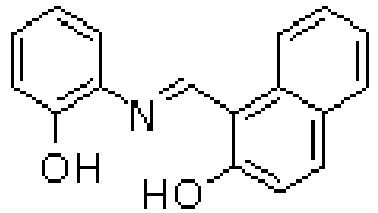
- 2-Aminophenol (3,0 g, 27,5 mmol, 1,0 eq) wurde in 100 ml Methanol gelöst. Anschließend erfolgte die Zugabe von 2-Hydroxy-1-naphthylaldehyd (4,7 g, 27,5 mmol, 1,0 eq). Nach wenigen Sekunden war eine intensive gelbe bis rote Farbe zu beobachten. Nach wenigen Minuten fiel orangefarbener Feststoff aus. Die Reaktionsmischung wurde für 3 h unter Rückfluss erhitzt und nach Abkühlen bei Raumtemperatur eine weitere Stunde gerührt. Der Niederschlag wurde abfiltriert und mit wenig Diethylether und Hexan gewaschen. Die Mutterlauge der Reaktion wurde über Nacht bei 4°C im Kühlschrank aufbewahrt; das auskristallisierte weitere Produkt wurde ebenfalls abfiltriert und gewaschen.
- Ausbeute: orangefarbenes Pulver, 5,0 g (69%).
1H-NMR (500 MHz, DMSO-d6), δ/ppm = 15.78 (d, 1H, 3JHH = 9.4 Hz, N-H), 10.41 (bs, 1H, O-H), 9.55 (d, 1H, 3JHH = 9.4 Hz, HA), 8.43 (d, 1H, 3JHH = 8.3, H8), 7.98 (dd, 1H, 3JHH = 8.1 Hz,
4JHH = 1.3 Hz, H3'), 7.83 (d, 1 H, 3JHH = 9.4 Hz, H4), 7.70 (dd, 1 H, 3JHH = 7.4 Hz, 4JHH = 0.6 Hz, H5), 7.51 (ddd, 1H, 3JHH = 7.8 Hz, 3JHH = 7.8 Hz, 4JHH = 1.3 Hz, H7), 7.29 (dd, 1 H, 3JHH = 7.5 Hz,
3JHH = 7.5 Hz, H6), 7.15 (ddd, 1H, 3JHH = 8.0 Hz, 3JHH = 8.0 Hz, 4JHH = 1.5 Hz, H5'), 7.07-6.96 (m, 2H, H4', H6'), 6.83 (d, 1H, 3JHH = 9.4 Hz, H3).
13C-NMR (125 MHz, DMSO-d6), δ/ppm = 177.4 (C2), 149.5 (CA), 148.5 (C1'), 137.9 (C4), 133.9 (C4a), 128.9 (C5), 128.6 (C8a), 128.0 (C7), 126.7 (C5'), 125.8 (C2'), 125.0 (C3), 123.0 (C6), 119.8 (C6'), 119.7 (C8), 117.6 (C3'), 116.0 (C4'), 107.7 (C1).
HRMS-ESI (MeOH): m/z: berechnet für [C17H14N1O2]+: 264.1019, gefunden: 264.1017 [M+H]+. IR (KBr) ν̃/cm-1: 3035 (w), 2548 (bm), 1632 (s), 1618 (s), 1548 (m), 1460 (m), 1356 (s), 1319 (m), 1271 (m), 1240 (s), 1209 (m), 1142 (s), 1115 (m), 746 (m), 739 (m).Elementaranalyse: C17H13N1O2 (M = 263.3) /Gew% berechnet C: 77.55 H: 4.98 N: 5.32 gefunden C: 77.23 H: 4.74 N: 5.87. -

- Eine Lösung von gemäß Beispiel 1 hergestelltem hpimp-Ligand (2,0 g, 9,4 mmol, 1,0 eq) in 150 ml entgastem Methanol wurde langsam zu einer Lösung von Mn(OAc)2 x 4 H2O (2,3 g, 9,4 mmol, 1,0 eq) in 50 ml entgastem Methanol getropft. Nach beendeter Zugabe wurde für 15 min bei RT gerührt und anschließend für zwei Stunden unter Rückfluss erhitzt. Danach wurde die Mischung auf Raumtemperatur abgekühlt, der entstandene Niederschlag abzentrifugiert, dreimal mit entgastem Methanol gewaschen und im Vakuum getrocknet. Durch mehrmaliges Einfrieren des Kolbens in flüssigem Stickstoff und anschließendem Auftauen auf Raumtemperatur unter Vakuum (Gefriertrocknung) wurde das teilweise verklumpte Material als feines Pulver erhalten.
- Ausbeute: orangefarbenes Pulver 78%.
MALDI-MS: m/z: 266.2 [M]+, 532.2 [(M)2]+.
IR-Spektroskopie ν̃/cm-1: 3414 (w), 3060 (w), 3011 (w), 1607 (s), 1583 (m), 1543 (m), 1472 (s), 1441 (m), 1391 (m), 1298 (s), 1261 (m), 918 (m), 756 (m), 745 (s).Elementaranalyse: C13H9MnNO2 (M = 266.2)/Gew% berechnet C: 58.66 H: 3.41 N: 5.26 Mn: 20.6 gefunden C: 57.62 H: 3.83 N: 5.16 Mn: 19.9. -

- Eine Lösung von gemäß Beispiel 1 hergestelltem hpimp-Ligand (2,0 g, 9,4 mmol, 1,0 eq) in 100 ml Methanol wurde langsam zu einer Lösung von [Mn(acac)3] (3,3 g, 9,4 mmol, 1,0 eq) in 20 ml Methanol gegeben. Die Farbe der Reaktionslösung schlug von gelbschwarz nach rotbraun um. Die Lösung wurde für 1 h unter Rückfluss erhitzt. Nach der Reaktion wurde die nahezu homogene Reaktionsmischung durch einen Spritzenfilter (0,45 µm) in einen zweiten Schlenk-Kolben überführt. Der Komplex kristallisierte über 3 Tage bei -30°C in Form feiner Nadeln aus. Der kristalline Niederschlag wurde abfiltriert und im Vakuum getrocknet.
- Ausbeute: braune Nadeln, 1.7 g (46%).
MALDI-MS: m/z: 365.1 [M-MeOH]+.
IR-Spektroskopie (KBr) ν̃/cm-1: 3165 (w), 3067 (w), 2934 (w), 1597 (s), 1514 (s), 1481 (m), 1384 (s), 1373 (s), 1307 (s), 1257 (s), 1146 (m), 1127 (m), 1024 (s), 924 (m), 839 (m), 737 (m), 544 (m).Elementaranalyse: C19H20MnNO5 (M = 397.3) /Gew% berechnet C: 57.44 H: 5.07 N: 3.53 Mn: 13.83 gefunden C: 57.19 H: 5.06 N: 3.46 Mn: 13.45. -

- Eine Lösung von gemäß Beispiel 2 hergestelltem hpimn-Ligand (606 mg, 2,3 mmol, 1,0 eq) in 65 ml Methanol wurde langsam zu einer Lösung von [Mn(acac)3] (810 mg, 2,3 mmol, 1,0 eq) in 35 ml Methanol gegeben. Die Farbe der Reaktionslösung schlug von gelbschwarz nach rotbraun um. Die Lösung wurde für 1 h unter Rückfluss erhitzt. Während der Reaktion fiel der Komplex als brauner, mikrokristalliner Niederschlag aus. Dieser wurde abfiltriert, zweimal mit Ether gewaschen und im Vakuum getrocknet. Aus dem Filtrat kristallisierte bei -30°C weiteres Produkt in einer für die Röntgenstrukturanalyse geeigneten Form aus.
- Ausbeute: dunkelbraunes mikrokristallines Pulver, 497 mg (52%).
HRMS-ESI (MeOH): m/z:: berechnet für [C22H18MnNNaO4]+: 438.0509, gefunden: 438.0505 [M-MeOH+Na]+.
EI-MS: m/z (%): 415 [M-MeOH]+(20), 154 [Mn(acac)]+(45), 100 [acac+H]+(60).
IR-Spektroskopie (KBr) ν̃/cm-1: 3414 (w), 3142 (w), 3057 (w), 2810 (w), 1581 (s), 1516 (s), 1481 (m), 1379 (s), 1361 (s), 1343 (m), 1259 (s), 1107 (w), 1028 (w), 981 (w), 835 (m), 748 (m), 736 (m), 729 (m).Elementaranalyse: C23H22MnNO5 (M = 447.4) /Gew% berechnet C: 61.75 H: 4.96 N: 3.13 Mn: 12.28 gefunden C: 60.11 H: 4.92 N: 3.00 Mn: 12.32. -

- Eine Lösung von gemäß Beispiel 2 hergestelltem hpimn-Ligand (800 mg, 3,04 mmol, 1,0 eq) in 80 ml entgastem Methanol wurde langsam zu einer Lösung von Mn(OAc)2 x 4 H2O (745 mg, 3,04 mmol, 1,0 eq) in 20 ml entgastem Methanol getropft. Nach beendeter Zugabe wurde für 15 min bei RT gerührt und anschließend für zwei Stunden unter Rückfluss erhitzt. Danach wurde die Mischung auf Raumtemperatur abgekühlt, der entstandene Niederschlag abzentrifugiert, dreimal mit entgastem Methanol gewaschen und im Vakuum getrocknet. Durch mehrmaliges Einfrieren des Kolbens in flüssigem Stickstoff und anschließendem Auftauen auf Raumtemperatur unter Vakuum (Gefriertrocknung) wurde das teilweise verklumpte Material als feines Pulver erhalten.
- Ausbeute: orangefarbenes Pulver, 596 mg (62%).
MALDI-MS: m/z: 316.0 [M]+, 631.9 [(M)2]+.
IR-Spektroskopie (KBr) ν̃/cm-1: 3547 (w), 3416 (w), 3057 (w), 3018 (w), 1616 (w), 1599 (m), 1537 (m), 1473 (s), 1456 (m), 1402 (m), 1336 (m), 1294 (s), 1257 (m), 1150 (m), 972 (w), 829 (m), 741 (s).Elementaranalyse: C17H11MnNO2 (M = 316.2) /Gew% berechnet C: 64.57 H: 3.51 N: 4.43 gefunden C: 63.98 H: 3.40 N: 4.15. - Primärwaschkraft und Nassreißkraftverlust bei Einsatz der gemäß den Beispielen 3 bis 6 hergestellten Komplexe A, B, C und D wurden in einem miniaturisierten Waschtest getestet. Es wurde zum einen mit einer vereinfachten Waschlauge bestehend aus Tensid, H2O2 und Katalysator in Wasser gearbeitet. Dabei kamen Lösungen von jeweils 0,93 g/l Tensid, 10 mmol/l H2O2 und 0,0086 mmol/l (bezogen auf Mn) des zu testenden Katalysators in Wasser (3°dH), deren pH-Werte mittels NaOH auf pH 10,5 eingestellt worden waren, zum Einsatz; zum Vergleich wurde eine ansonsten gleich zusammengestzte katalysatorfreie Lösung, der man 0,151 g/l TAED zugesetzt hatte, getestet (Tabelle 1). Zum anderen wurde mit Lösungen eines percarbonathaltigen Waschmittels (V1), das frei von Bleichaktivatoren und Bleichkatalysatoren war, oder eines ansonsten gleich zusammengesetzten Mittels (V2), das zusätzlich 2,7 Gew.-% TAED enthielt, gearbeitet. Dabei kamen Lösungen von jeweils 5,88 g/l des zu testenden Waschmittels zum Einsatz, wobei die Komplexe A, B, C und D in Mengen von jeweils 0,588 mg/l (bezogen auf Mn) jeweils einer V1 enthaltenden Lösung zugesetzt wurden (Tabelle 2).
- Für die Messung der Primärwaschleistung wurden Baumwollsubstrate, die mit einer standardisierten Teeanschmutzung (T), einer standardisierten Blaubeersaftanschmutzung (S) oder einer standardisierten Rotweinanschmutzung (R) versehen worden war, 30 Minuten bei 20 °C, 30 °C oder 40 °C in den jeweiligen Lösungen behandelt. Das behandelte Stoffsubstrat wurde unter fließendem Wasser ausgewaschen und anschließend getrocknet und farbvermessen. In den nachfolgenden Tabellen ist der Helligkeitswert der Baumwollmeßstücke angegeben (5fach-Bestimmungen, angegeben sind die Mittelwerte).
Tabelle 1: Bleichleistung in tensidhaltigem H2O2 A B C D TAED 20 °C, T 51,6 52,6 55,5 55,7 50,8 20 °C, S 37,8 37,9 36,8 36,9 n.b. 30 °C, T 55,3 56,6 57,9 59,3 51,5 30 °C, S 41,5 41,1 41,7 41,4 n.b. 30 °C, R n.b n.b. 70,8 73,1 70,2 40°C, T 61,5 62,3 60,9 61,2 55,9 40 °C, S 46,0 46,0 46,0 45,9 n.b. n.b.: nicht bestimmt Tabelle 2: Bleichleistung in Waschmittellösungen V1+A V1+B V1+C V1+D V2 20 °C, T n.b. 50,4 52,8 52,8 50,2 20 °C, S 54,6 55,0 53,8 53,9 n.b. 30 °C, T 52,9 54,8 55,0 55,0 53,3 30 °C, S 57,0 57,3 59,2 59,5 n.b. 40°C, T 57,2 58,8 56,7 56,4 54,9 40 °C, S 61,1 61,0 61,2 61,7 n.b. n.b.: nicht bestimmt - Für die Messung des Nassreißkraftverlusts wurden Baumwollstreifen mit definierter Breite (Fadenanzahl) 20 Mal über jeweils 60 Minuten bei 60°C in den oben angegebenen Waschmittellösungen behandelt. Die Streifen wurden getrocknet und in eine Netzlösung eingetaucht, bevor sie mittels einer Zugprüfmaschine mit konstanter Zugprüfgeschwindigkeit zerrissen wurden. Die Zerreißkraft der behandelten Baumwolle wurde mit der Zerreißkraft der unbehandelten Baumwolle verglichen und der Nassreißkraftverlust in % berechnet. In der nachfolgenden Tabelle 3 sind die Mittelwerte von 5fach-Bestimmungen angegeben.
Tabelle 3: Nassreißkraftverlust V1+A V1+B V2 7 5 8
Claims (10)
- Wasch- oder Reinigungsmittel, dadurch gekennzeichnet, daß es eine Verbindung mit einem Gerüst gemäß Formel (I),

- Mittel nach Anspruch 1, dadurch gekennzeichnet, dass es zusätzlich ein Fe-, Mo-, Mn- und/oder W-Salz und/oder einen Fe-, Mo-, Mn- und/oder W -Komplex ohne einen Liganden, welcher der Verbindung mit einem Gerüst gemäß Formel (I) entspricht, enthält.
- Mittel nach Anspruch 1 oder 2, dadurch gekennzeichnet, dass es 0,001 Gew.-% bis 2 Gew.-%, insbesondere 0,01 Gew.-% bis 1 Gew.-% der Verbindung mit einem Gerüst gemäß Formel (I) enthält, und/oder dass das Molverhältnis der Übergangsmetalle zu der Verbindung mit einem Gerüst gemäß Formel (I) vorzugsweise im Bereich von 0,001:1 bis 2:1, insbesondere 0,01:1 bis 1:1 liegt.
- Wasch- oder Reinigungsmittel, dadurch gekennzeichnet, daß es einen durch Komplexbildung mit Fe-, Mo-, Mn- und/oder W aus einer Verbindung mit einem Gerüst gemäß Formel (I),

- Mittel nach einem der Ansprüche 1 bis 4, dadurch gekennzeichnet, daß es zusätzlich bis zu 50 Gew.-%, insbesondere von 5 Gew.-% bis 30 Gew.-% einer Persauerstoffverbindung enthält, wobei die Persauerstoffverbindung vorzugsweise ausgewählt wird aus der Gruppe umfassend Wasserstoffperoxid, Alkaliperborat, Alkalipercarbonat und deren Mischungen.
- Verwendung einer Verbindung mit einem Gerüst gemäß Formel (I) oder eines Bleichkatalysators in Form eines Komplexes von Fe-, Mo-, Mn- und/oder W mit einem Liganden mit einem Gerüst der Formel (I),

- Verfahren zum Waschen von Textilien oder zum Reinigen harter Oberflächen, insbesondere zum maschinellen Reinigen von Geschirr, unter Einsatz einer Verbindung mit einem Gerüst gemäß Formel (I)

- Verfahren nach Anspruch 7, dadurch gekennzeichnet, dass man eine wäßrige Waschbeziehungsweise Reinigungsflotte einsetzt, in der die Konzentration an Fe-, Mo-, Mn- und/oder W im Bereich von 0,1 µmol/l bis 500 µmol/l, insbesondere 1 µmol/l bis 100 µmol/l liegt.
- Mittel nach Anspruch 4 oder 5, Verwendung nach Anspruch 6 oder Verfahren nach Anspruch 7 oder 8, dadurch gekennzeichnet, dass der bleichkatalysierende Komplex, der einen Liganden mit einem Gerüst gemäß Formel (I) aufweist, weitere Neutral-, Anion- oder Kationliganden, insbesondere H2O, NH3, CH3OH, Acetylaceton, Terpyridin, organische Anionen, wie Citrat, Oxalat, Tartrat, Formiat, ein C2-18-Carboxylat, ein C1-18-Alkylsulfat, insbesondere Methosulfat, oder ein entsprechendes Alkansulfonat, anorganische Anionen, wie Halogenid, insbesondere Chlorid, Perchlorat, Tetrafluoroborat, Hexafluorophosphat, Nitrat, Hydrogensulfat, Hydroxid oder Hydroperoxid, oder verbrückende Liganden, wie Alkylendiamine, enthält.
- Mittel nach Anspruch 4 oder 5 oder 9, Verwendung nach Anspruch 6 oder 9 oder Verfahren nach einem der Ansprüche 7 bis 9, dadurch gekennzeichnet, dass die Verbindung mit einem Gerüst gemäß Formel (I) der allgemeinen Formel (II) entspricht,

Priority Applications (1)
| Application Number | Priority Date | Filing Date | Title |
|---|---|---|---|
| PL10784492T PL2504418T3 (pl) | 2009-11-24 | 2010-11-22 | Środek piorący lub czyszczący z ewentualnie wytworzonym in situ, bielenie wzmacniającym kompleksem metalu przejściowego |
Applications Claiming Priority (2)
| Application Number | Priority Date | Filing Date | Title |
|---|---|---|---|
| DE102009047038A DE102009047038A1 (de) | 2009-11-24 | 2009-11-24 | Wasch- oder Reinigungsmittel mit gegebenenfalls in situ erzeugtem bleichverstärkendem Übergangsmetallkomplex |
| PCT/EP2010/067895 WO2011064159A1 (de) | 2009-11-24 | 2010-11-22 | Wasch- oder reinigungsmittel mit gegebenenfalls in situ erzeugtem bleichverstärkendem übergangsmetallkomplex |
Publications (2)
| Publication Number | Publication Date |
|---|---|
| EP2504418A1 EP2504418A1 (de) | 2012-10-03 |
| EP2504418B1 true EP2504418B1 (de) | 2017-02-15 |
Family
ID=43585643
Family Applications (1)
| Application Number | Title | Priority Date | Filing Date |
|---|---|---|---|
| EP10784492.0A Not-in-force EP2504418B1 (de) | 2009-11-24 | 2010-11-22 | Wasch- oder reinigungsmittel mit gegebenenfalls in situ erzeugtem bleichverstärkendem übergangsmetallkomplex |
Country Status (5)
| Country | Link |
|---|---|
| US (1) | US8481475B2 (de) |
| EP (1) | EP2504418B1 (de) |
| DE (1) | DE102009047038A1 (de) |
| PL (1) | PL2504418T3 (de) |
| WO (1) | WO2011064159A1 (de) |
Families Citing this family (4)
| Publication number | Priority date | Publication date | Assignee | Title |
|---|---|---|---|---|
| WO2013043874A2 (en) * | 2011-09-20 | 2013-03-28 | Dow Corning Corporation | Manganese containing hydrosilylation catalysts and compositions containing the catalysts |
| EP2700703B1 (de) * | 2012-08-24 | 2018-05-02 | The Procter and Gamble Company | Geschirrspülverfahren |
| US20160168515A1 (en) * | 2013-07-24 | 2016-06-16 | Michael B. Abrams | Manganese carboxylates for peroxygen activation |
| CN120202236A (zh) | 2022-11-16 | 2025-06-24 | 巴斯夫欧洲公司 | 用于聚氨酯合成的包含亚胺配体的含锰和含铁催化剂 |
Family Cites Families (7)
| Publication number | Priority date | Publication date | Assignee | Title |
|---|---|---|---|---|
| US3192161A (en) * | 1962-12-14 | 1965-06-29 | Texaco Inc | Grease composition |
| AT330930B (de) | 1973-04-13 | 1976-07-26 | Henkel & Cie Gmbh | Verfahren zur herstellung von festen, schuttfahigen wasch- oder reinigungsmitteln mit einem gehalt an calcium bindenden substanzen |
| GB1500933A (en) * | 1975-01-28 | 1978-02-15 | Ciba Geigy Ag | Production of azomethine pigment |
| DE19721886A1 (de) * | 1997-05-26 | 1998-12-03 | Henkel Kgaa | Bleichsystem |
| JP2007538120A (ja) * | 2004-05-17 | 2007-12-27 | ヘンケル コマンディットゲゼルシャフト アウフ アクチエン | 場合によりイン・サイチューで生成される漂白増進遷移金属錯体を含む洗剤 |
| CN100451169C (zh) * | 2004-11-01 | 2009-01-14 | 中国科学院兰州化学物理研究所 | 席夫碱自组装抗腐蚀润滑膜的制备方法 |
| DE102007017656A1 (de) * | 2007-04-12 | 2008-10-16 | Henkel Ag & Co. Kgaa | Biheteroaryl-Metallkomplexe als Bleichkatalysatoren |
-
2009
- 2009-11-24 DE DE102009047038A patent/DE102009047038A1/de not_active Withdrawn
-
2010
- 2010-11-22 PL PL10784492T patent/PL2504418T3/pl unknown
- 2010-11-22 WO PCT/EP2010/067895 patent/WO2011064159A1/de not_active Ceased
- 2010-11-22 EP EP10784492.0A patent/EP2504418B1/de not_active Not-in-force
-
2012
- 2012-05-23 US US13/478,464 patent/US8481475B2/en not_active Expired - Fee Related
Non-Patent Citations (1)
| Title |
|---|
| None * |
Also Published As
| Publication number | Publication date |
|---|---|
| US8481475B2 (en) | 2013-07-09 |
| US20120264670A1 (en) | 2012-10-18 |
| DE102009047038A1 (de) | 2011-05-26 |
| PL2504418T3 (pl) | 2017-08-31 |
| EP2504418A1 (de) | 2012-10-03 |
| WO2011064159A1 (de) | 2011-06-03 |
Similar Documents
| Publication | Publication Date | Title |
|---|---|---|
| EP2802644B1 (de) | Acylhydrazone als bleichverstärkende wirkstoffe | |
| EP2440641B1 (de) | Nanopartikuläres mangandioxid | |
| WO2010105962A1 (de) | Wasch- oder reinigungsmittel mit gegebenenfalls in situ erzeugtem bleichverstärkendem übergangsmetallkomplex | |
| WO2010105961A1 (de) | Wasch- oder reinigungsmittel mit gegebenenfalls in situ erzeugtem bleichverstärkendem übergangsmetallkomplex | |
| DE102011080099A1 (de) | Wasch- oder Reinigungsmittel mit elektrochemisch aktivierbarer Mediatorverbindung | |
| EP3134500B1 (de) | Wasch- oder reinigungsmittel mit elektrochemisch aktivierbarer anionischer mediatorverbindung | |
| EP2504418B1 (de) | Wasch- oder reinigungsmittel mit gegebenenfalls in situ erzeugtem bleichverstärkendem übergangsmetallkomplex | |
| EP2504419B1 (de) | Wasch- oder reinigungsmittel mit gegebenenfalls in situ erzeugtem bleichverstärkendem übergangsmetallkomplex | |
| EP2440644B1 (de) | Schonendes bleichmittel | |
| EP1749084B1 (de) | Bleichverstärkerkombination für den einsatz in wasch- und reinigungsmitteln | |
| EP1747259A1 (de) | Waschmittel mit gegebenenfalls in situ erzeugtem bleichverstärkendem übergangsmetallkomplex | |
| EP2411498B1 (de) | Schonendes bleichmittel | |
| EP2411495B1 (de) | Schonendes bleichmittel | |
| EP3440181B1 (de) | N-methylpiperidingruppen-haltige acylhydrazone | |
| DE102015225880A1 (de) | Pyridingruppenhaltige Acylhydrazone | |
| WO2010108784A1 (de) | Schonendes bleichmittel | |
| EP2304014A1 (de) | Textilschonendes waschmittel | |
| EP3095845A1 (de) | Acylhydrazone als bleichverstärkende wirkstoffe |
Legal Events
| Date | Code | Title | Description |
|---|---|---|---|
| PUAI | Public reference made under article 153(3) epc to a published international application that has entered the european phase |
Free format text: ORIGINAL CODE: 0009012 |
|
| 17P | Request for examination filed |
Effective date: 20120504 |
|
| AK | Designated contracting states |
Kind code of ref document: A1 Designated state(s): AL AT BE BG CH CY CZ DE DK EE ES FI FR GB GR HR HU IE IS IT LI LT LU LV MC MK MT NL NO PL PT RO RS SE SI SK SM TR |
|
| DAX | Request for extension of the european patent (deleted) | ||
| GRAP | Despatch of communication of intention to grant a patent |
Free format text: ORIGINAL CODE: EPIDOSNIGR1 |
|
| GRAJ | Information related to disapproval of communication of intention to grant by the applicant or resumption of examination proceedings by the epo deleted |
Free format text: ORIGINAL CODE: EPIDOSDIGR1 |
|
| GRAP | Despatch of communication of intention to grant a patent |
Free format text: ORIGINAL CODE: EPIDOSNIGR1 |
|
| INTG | Intention to grant announced |
Effective date: 20160926 |
|
| RIN1 | Information on inventor provided before grant (corrected) |
Inventor name: SUNDERMEYER, JOERG Inventor name: HAETZELT, ANDRE Inventor name: GAERTNER, FELIX Inventor name: NORDSKOG, ANETTE Inventor name: ERPENBACH, SIGLINDE |
|
| INTG | Intention to grant announced |
Effective date: 20161006 |
|
| GRAS | Grant fee paid |
Free format text: ORIGINAL CODE: EPIDOSNIGR3 |
|
| GRAA | (expected) grant |
Free format text: ORIGINAL CODE: 0009210 |
|
| AK | Designated contracting states |
Kind code of ref document: B1 Designated state(s): AL AT BE BG CH CY CZ DE DK EE ES FI FR GB GR HR HU IE IS IT LI LT LU LV MC MK MT NL NO PL PT RO RS SE SI SK SM TR |
|
| REG | Reference to a national code |
Ref country code: CH Ref legal event code: EP Ref country code: GB Ref legal event code: FG4D Free format text: NOT ENGLISH |
|
| REG | Reference to a national code |
Ref country code: IE Ref legal event code: FG4D Free format text: LANGUAGE OF EP DOCUMENT: GERMAN |
|
| REG | Reference to a national code |
Ref country code: AT Ref legal event code: REF Ref document number: 867898 Country of ref document: AT Kind code of ref document: T Effective date: 20170315 |
|
| REG | Reference to a national code |
Ref country code: DE Ref legal event code: R096 Ref document number: 502010013183 Country of ref document: DE |
|
| REG | Reference to a national code |
Ref country code: NL Ref legal event code: MP Effective date: 20170215 |
|
| REG | Reference to a national code |
Ref country code: LT Ref legal event code: MG4D |
|
| PG25 | Lapsed in a contracting state [announced via postgrant information from national office to epo] |
Ref country code: FI Free format text: LAPSE BECAUSE OF FAILURE TO SUBMIT A TRANSLATION OF THE DESCRIPTION OR TO PAY THE FEE WITHIN THE PRESCRIBED TIME-LIMIT Effective date: 20170215 Ref country code: GR Free format text: LAPSE BECAUSE OF FAILURE TO SUBMIT A TRANSLATION OF THE DESCRIPTION OR TO PAY THE FEE WITHIN THE PRESCRIBED TIME-LIMIT Effective date: 20170516 Ref country code: HR Free format text: LAPSE BECAUSE OF FAILURE TO SUBMIT A TRANSLATION OF THE DESCRIPTION OR TO PAY THE FEE WITHIN THE PRESCRIBED TIME-LIMIT Effective date: 20170215 Ref country code: LT Free format text: LAPSE BECAUSE OF FAILURE TO SUBMIT A TRANSLATION OF THE DESCRIPTION OR TO PAY THE FEE WITHIN THE PRESCRIBED TIME-LIMIT Effective date: 20170215 Ref country code: NO Free format text: LAPSE BECAUSE OF FAILURE TO SUBMIT A TRANSLATION OF THE DESCRIPTION OR TO PAY THE FEE WITHIN THE PRESCRIBED TIME-LIMIT Effective date: 20170515 |
|
| PG25 | Lapsed in a contracting state [announced via postgrant information from national office to epo] |
Ref country code: ES Free format text: LAPSE BECAUSE OF FAILURE TO SUBMIT A TRANSLATION OF THE DESCRIPTION OR TO PAY THE FEE WITHIN THE PRESCRIBED TIME-LIMIT Effective date: 20170215 Ref country code: PT Free format text: LAPSE BECAUSE OF FAILURE TO SUBMIT A TRANSLATION OF THE DESCRIPTION OR TO PAY THE FEE WITHIN THE PRESCRIBED TIME-LIMIT Effective date: 20170615 Ref country code: RS Free format text: LAPSE BECAUSE OF FAILURE TO SUBMIT A TRANSLATION OF THE DESCRIPTION OR TO PAY THE FEE WITHIN THE PRESCRIBED TIME-LIMIT Effective date: 20170215 Ref country code: SE Free format text: LAPSE BECAUSE OF FAILURE TO SUBMIT A TRANSLATION OF THE DESCRIPTION OR TO PAY THE FEE WITHIN THE PRESCRIBED TIME-LIMIT Effective date: 20170215 Ref country code: NL Free format text: LAPSE BECAUSE OF FAILURE TO SUBMIT A TRANSLATION OF THE DESCRIPTION OR TO PAY THE FEE WITHIN THE PRESCRIBED TIME-LIMIT Effective date: 20170215 Ref country code: LV Free format text: LAPSE BECAUSE OF FAILURE TO SUBMIT A TRANSLATION OF THE DESCRIPTION OR TO PAY THE FEE WITHIN THE PRESCRIBED TIME-LIMIT Effective date: 20170215 Ref country code: BG Free format text: LAPSE BECAUSE OF FAILURE TO SUBMIT A TRANSLATION OF THE DESCRIPTION OR TO PAY THE FEE WITHIN THE PRESCRIBED TIME-LIMIT Effective date: 20170515 |
|
| PG25 | Lapsed in a contracting state [announced via postgrant information from national office to epo] |
Ref country code: EE Free format text: LAPSE BECAUSE OF FAILURE TO SUBMIT A TRANSLATION OF THE DESCRIPTION OR TO PAY THE FEE WITHIN THE PRESCRIBED TIME-LIMIT Effective date: 20170215 Ref country code: CZ Free format text: LAPSE BECAUSE OF FAILURE TO SUBMIT A TRANSLATION OF THE DESCRIPTION OR TO PAY THE FEE WITHIN THE PRESCRIBED TIME-LIMIT Effective date: 20170215 Ref country code: RO Free format text: LAPSE BECAUSE OF FAILURE TO SUBMIT A TRANSLATION OF THE DESCRIPTION OR TO PAY THE FEE WITHIN THE PRESCRIBED TIME-LIMIT Effective date: 20170215 Ref country code: SK Free format text: LAPSE BECAUSE OF FAILURE TO SUBMIT A TRANSLATION OF THE DESCRIPTION OR TO PAY THE FEE WITHIN THE PRESCRIBED TIME-LIMIT Effective date: 20170215 |
|
| REG | Reference to a national code |
Ref country code: DE Ref legal event code: R097 Ref document number: 502010013183 Country of ref document: DE |
|
| REG | Reference to a national code |
Ref country code: FR Ref legal event code: PLFP Year of fee payment: 8 |
|
| PG25 | Lapsed in a contracting state [announced via postgrant information from national office to epo] |
Ref country code: DK Free format text: LAPSE BECAUSE OF FAILURE TO SUBMIT A TRANSLATION OF THE DESCRIPTION OR TO PAY THE FEE WITHIN THE PRESCRIBED TIME-LIMIT Effective date: 20170215 Ref country code: SM Free format text: LAPSE BECAUSE OF FAILURE TO SUBMIT A TRANSLATION OF THE DESCRIPTION OR TO PAY THE FEE WITHIN THE PRESCRIBED TIME-LIMIT Effective date: 20170215 |
|
| PLBE | No opposition filed within time limit |
Free format text: ORIGINAL CODE: 0009261 |
|
| STAA | Information on the status of an ep patent application or granted ep patent |
Free format text: STATUS: NO OPPOSITION FILED WITHIN TIME LIMIT |
|
| 26N | No opposition filed |
Effective date: 20171116 |
|
| PGFP | Annual fee paid to national office [announced via postgrant information from national office to epo] |
Ref country code: DE Payment date: 20171121 Year of fee payment: 8 Ref country code: FR Payment date: 20171121 Year of fee payment: 8 |
|
| PG25 | Lapsed in a contracting state [announced via postgrant information from national office to epo] |
Ref country code: SI Free format text: LAPSE BECAUSE OF FAILURE TO SUBMIT A TRANSLATION OF THE DESCRIPTION OR TO PAY THE FEE WITHIN THE PRESCRIBED TIME-LIMIT Effective date: 20170215 |
|
| PGFP | Annual fee paid to national office [announced via postgrant information from national office to epo] |
Ref country code: IT Payment date: 20171124 Year of fee payment: 8 Ref country code: PL Payment date: 20171024 Year of fee payment: 8 |
|
| PG25 | Lapsed in a contracting state [announced via postgrant information from national office to epo] |
Ref country code: MC Free format text: LAPSE BECAUSE OF FAILURE TO SUBMIT A TRANSLATION OF THE DESCRIPTION OR TO PAY THE FEE WITHIN THE PRESCRIBED TIME-LIMIT Effective date: 20170215 |
|
| GBPC | Gb: european patent ceased through non-payment of renewal fee |
Effective date: 20171122 |
|
| PG25 | Lapsed in a contracting state [announced via postgrant information from national office to epo] |
Ref country code: CH Free format text: LAPSE BECAUSE OF NON-PAYMENT OF DUE FEES Effective date: 20171130 Ref country code: LI Free format text: LAPSE BECAUSE OF NON-PAYMENT OF DUE FEES Effective date: 20171130 |
|
| PG25 | Lapsed in a contracting state [announced via postgrant information from national office to epo] |
Ref country code: LU Free format text: LAPSE BECAUSE OF NON-PAYMENT OF DUE FEES Effective date: 20171122 |
|
| REG | Reference to a national code |
Ref country code: BE Ref legal event code: MM Effective date: 20171130 |
|
| REG | Reference to a national code |
Ref country code: IE Ref legal event code: MM4A |
|
| PG25 | Lapsed in a contracting state [announced via postgrant information from national office to epo] |
Ref country code: MT Free format text: LAPSE BECAUSE OF FAILURE TO SUBMIT A TRANSLATION OF THE DESCRIPTION OR TO PAY THE FEE WITHIN THE PRESCRIBED TIME-LIMIT Effective date: 20170215 |
|
| PG25 | Lapsed in a contracting state [announced via postgrant information from national office to epo] |
Ref country code: IE Free format text: LAPSE BECAUSE OF NON-PAYMENT OF DUE FEES Effective date: 20171122 |
|
| PG25 | Lapsed in a contracting state [announced via postgrant information from national office to epo] |
Ref country code: BE Free format text: LAPSE BECAUSE OF NON-PAYMENT OF DUE FEES Effective date: 20171130 Ref country code: GB Free format text: LAPSE BECAUSE OF NON-PAYMENT OF DUE FEES Effective date: 20171122 |
|
| REG | Reference to a national code |
Ref country code: AT Ref legal event code: MM01 Ref document number: 867898 Country of ref document: AT Kind code of ref document: T Effective date: 20171122 |
|
| PG25 | Lapsed in a contracting state [announced via postgrant information from national office to epo] |
Ref country code: AT Free format text: LAPSE BECAUSE OF NON-PAYMENT OF DUE FEES Effective date: 20171122 |
|
| REG | Reference to a national code |
Ref country code: DE Ref legal event code: R119 Ref document number: 502010013183 Country of ref document: DE |
|
| PG25 | Lapsed in a contracting state [announced via postgrant information from national office to epo] |
Ref country code: HU Free format text: LAPSE BECAUSE OF FAILURE TO SUBMIT A TRANSLATION OF THE DESCRIPTION OR TO PAY THE FEE WITHIN THE PRESCRIBED TIME-LIMIT; INVALID AB INITIO Effective date: 20101122 |
|
| PG25 | Lapsed in a contracting state [announced via postgrant information from national office to epo] |
Ref country code: DE Free format text: LAPSE BECAUSE OF NON-PAYMENT OF DUE FEES Effective date: 20190601 Ref country code: IT Free format text: LAPSE BECAUSE OF NON-PAYMENT OF DUE FEES Effective date: 20181122 Ref country code: CY Free format text: LAPSE BECAUSE OF NON-PAYMENT OF DUE FEES Effective date: 20170215 Ref country code: FR Free format text: LAPSE BECAUSE OF NON-PAYMENT OF DUE FEES Effective date: 20181130 |
|
| PG25 | Lapsed in a contracting state [announced via postgrant information from national office to epo] |
Ref country code: MK Free format text: LAPSE BECAUSE OF FAILURE TO SUBMIT A TRANSLATION OF THE DESCRIPTION OR TO PAY THE FEE WITHIN THE PRESCRIBED TIME-LIMIT Effective date: 20170215 |
|
| PG25 | Lapsed in a contracting state [announced via postgrant information from national office to epo] |
Ref country code: TR Free format text: LAPSE BECAUSE OF FAILURE TO SUBMIT A TRANSLATION OF THE DESCRIPTION OR TO PAY THE FEE WITHIN THE PRESCRIBED TIME-LIMIT Effective date: 20170215 |
|
| PG25 | Lapsed in a contracting state [announced via postgrant information from national office to epo] |
Ref country code: PL Free format text: LAPSE BECAUSE OF NON-PAYMENT OF DUE FEES Effective date: 20181122 |
|
| PG25 | Lapsed in a contracting state [announced via postgrant information from national office to epo] |
Ref country code: AL Free format text: LAPSE BECAUSE OF FAILURE TO SUBMIT A TRANSLATION OF THE DESCRIPTION OR TO PAY THE FEE WITHIN THE PRESCRIBED TIME-LIMIT Effective date: 20170215 Ref country code: IS Free format text: LAPSE BECAUSE OF FAILURE TO SUBMIT A TRANSLATION OF THE DESCRIPTION OR TO PAY THE FEE WITHIN THE PRESCRIBED TIME-LIMIT Effective date: 20170615 |