EP2508511A1 - Inhibitors of viral replication, their process of preparation and their therapeutical uses - Google Patents
Inhibitors of viral replication, their process of preparation and their therapeutical uses Download PDFInfo
- Publication number
- EP2508511A1 EP2508511A1 EP11305406A EP11305406A EP2508511A1 EP 2508511 A1 EP2508511 A1 EP 2508511A1 EP 11305406 A EP11305406 A EP 11305406A EP 11305406 A EP11305406 A EP 11305406A EP 2508511 A1 EP2508511 A1 EP 2508511A1
- Authority
- EP
- European Patent Office
- Prior art keywords
- heterocyclyl
- alkyl
- alkenyl
- alkynyl
- heteroalkyl
- Prior art date
- Legal status (The legal status is an assumption and is not a legal conclusion. Google has not performed a legal analysis and makes no representation as to the accuracy of the status listed.)
- Withdrawn
Links
- 238000002360 preparation method Methods 0.000 title description 29
- 239000003112 inhibitor Substances 0.000 title description 14
- 238000000034 method Methods 0.000 title description 5
- 230000001225 therapeutic effect Effects 0.000 title description 2
- 230000029812 viral genome replication Effects 0.000 title 1
- 150000001875 compounds Chemical class 0.000 claims abstract description 110
- 230000002265 prevention Effects 0.000 claims abstract description 13
- 229910052717 sulfur Inorganic materials 0.000 claims description 582
- 125000000217 alkyl group Chemical group 0.000 claims description 576
- 125000003342 alkenyl group Chemical group 0.000 claims description 512
- 125000000304 alkynyl group Chemical group 0.000 claims description 512
- 125000004404 heteroalkyl group Chemical group 0.000 claims description 445
- 125000000623 heterocyclic group Chemical group 0.000 claims description 383
- 229910052799 carbon Inorganic materials 0.000 claims description 371
- -1 cycloalkynyl Chemical group 0.000 claims description 360
- 125000003118 aryl group Chemical group 0.000 claims description 336
- 229910052760 oxygen Inorganic materials 0.000 claims description 242
- 125000000753 cycloalkyl group Chemical group 0.000 claims description 227
- 125000003710 aryl alkyl group Chemical group 0.000 claims description 223
- 125000004415 heterocyclylalkyl group Chemical group 0.000 claims description 223
- 125000005015 aryl alkynyl group Chemical group 0.000 claims description 222
- 125000005018 aryl alkenyl group Chemical group 0.000 claims description 221
- 229910052757 nitrogen Inorganic materials 0.000 claims description 219
- 125000005842 heteroatom Chemical group 0.000 claims description 203
- 125000000392 cycloalkenyl group Chemical group 0.000 claims description 197
- 125000004449 heterocyclylalkenyl group Chemical group 0.000 claims description 185
- 125000004093 cyano group Chemical group *C#N 0.000 claims description 179
- 125000004432 carbon atom Chemical group C* 0.000 claims description 177
- 229910052736 halogen Inorganic materials 0.000 claims description 170
- 150000002367 halogens Chemical class 0.000 claims description 170
- 229910052739 hydrogen Inorganic materials 0.000 claims description 138
- 239000001257 hydrogen Substances 0.000 claims description 138
- 125000000876 trifluoromethoxy group Chemical group FC(F)(F)O* 0.000 claims description 130
- 125000000449 nitro group Chemical group [O-][N+](*)=O 0.000 claims description 115
- 125000003917 carbamoyl group Chemical group [H]N([H])C(*)=O 0.000 claims description 30
- 229920006395 saturated elastomer Polymers 0.000 claims description 27
- 125000001960 7 membered carbocyclic group Chemical group 0.000 claims description 26
- 125000004435 hydrogen atom Chemical group [H]* 0.000 claims description 26
- 125000003178 carboxy group Chemical group [H]OC(*)=O 0.000 claims description 22
- 239000003814 drug Substances 0.000 claims description 20
- 239000003443 antiviral agent Substances 0.000 claims description 16
- 239000008194 pharmaceutical composition Substances 0.000 claims description 15
- UFHFLCQGNIYNRP-UHFFFAOYSA-N Hydrogen Chemical compound [H][H] UFHFLCQGNIYNRP-UHFFFAOYSA-N 0.000 claims description 14
- 229910006074 SO2NH2 Inorganic materials 0.000 claims description 14
- MDFFNEOEWAXZRQ-UHFFFAOYSA-N aminyl Chemical compound [NH2] MDFFNEOEWAXZRQ-UHFFFAOYSA-N 0.000 claims description 14
- 125000001054 5 membered carbocyclic group Chemical group 0.000 claims description 13
- 125000004008 6 membered carbocyclic group Chemical group 0.000 claims description 13
- 229910004727 OSO3H Inorganic materials 0.000 claims description 13
- 229910006069 SO3H Inorganic materials 0.000 claims description 13
- 125000003831 tetrazolyl group Chemical group 0.000 claims description 13
- 150000003839 salts Chemical class 0.000 claims description 9
- 241000124008 Mammalia Species 0.000 claims description 7
- 208000036142 Viral infection Diseases 0.000 claims description 7
- 230000009385 viral infection Effects 0.000 claims description 7
- 208000031886 HIV Infections Diseases 0.000 claims description 5
- 206010038997 Retroviral infections Diseases 0.000 claims description 5
- 208000037357 HIV infectious disease Diseases 0.000 claims description 4
- 208000033519 human immunodeficiency virus infectious disease Diseases 0.000 claims description 4
- 238000004519 manufacturing process Methods 0.000 claims description 2
- 150000002431 hydrogen Chemical class 0.000 claims 110
- 239000004480 active ingredient Substances 0.000 claims 1
- 239000003937 drug carrier Substances 0.000 claims 1
- 230000003612 virological effect Effects 0.000 abstract description 5
- XEKOWRVHYACXOJ-UHFFFAOYSA-N Ethyl acetate Chemical compound CCOC(C)=O XEKOWRVHYACXOJ-UHFFFAOYSA-N 0.000 description 69
- YMWUJEATGCHHMB-UHFFFAOYSA-N Dichloromethane Chemical compound ClCCl YMWUJEATGCHHMB-UHFFFAOYSA-N 0.000 description 60
- HEDRZPFGACZZDS-MICDWDOJSA-N Trichloro(2H)methane Chemical compound [2H]C(Cl)(Cl)Cl HEDRZPFGACZZDS-MICDWDOJSA-N 0.000 description 38
- XLYOFNOQVPJJNP-UHFFFAOYSA-N water Substances O XLYOFNOQVPJJNP-UHFFFAOYSA-N 0.000 description 35
- 150000003254 radicals Chemical class 0.000 description 30
- 150000001721 carbon Chemical group 0.000 description 28
- 239000000243 solution Substances 0.000 description 26
- 239000000203 mixture Substances 0.000 description 24
- 238000005160 1H NMR spectroscopy Methods 0.000 description 23
- XDTMQSROBMDMFD-UHFFFAOYSA-N Cyclohexane Chemical compound C1CCCCC1 XDTMQSROBMDMFD-UHFFFAOYSA-N 0.000 description 22
- 241000725303 Human immunodeficiency virus Species 0.000 description 22
- 239000011541 reaction mixture Substances 0.000 description 22
- LFQSCWFLJHTTHZ-UHFFFAOYSA-N Ethanol Chemical compound CCO LFQSCWFLJHTTHZ-UHFFFAOYSA-N 0.000 description 21
- 239000007787 solid Substances 0.000 description 19
- WYURNTSHIVDZCO-UHFFFAOYSA-N Tetrahydrofuran Chemical compound C1CCOC1 WYURNTSHIVDZCO-UHFFFAOYSA-N 0.000 description 18
- VYPSYNLAJGMNEJ-UHFFFAOYSA-N Silicium dioxide Chemical compound O=[Si]=O VYPSYNLAJGMNEJ-UHFFFAOYSA-N 0.000 description 17
- 238000003818 flash chromatography Methods 0.000 description 17
- 239000000543 intermediate Substances 0.000 description 17
- 239000000741 silica gel Substances 0.000 description 17
- 229910002027 silica gel Inorganic materials 0.000 description 17
- PMZURENOXWZQFD-UHFFFAOYSA-L Sodium Sulfate Chemical compound [Na+].[Na+].[O-]S([O-])(=O)=O PMZURENOXWZQFD-UHFFFAOYSA-L 0.000 description 16
- 229910052938 sodium sulfate Inorganic materials 0.000 description 16
- 235000011152 sodium sulphate Nutrition 0.000 description 16
- YXFVVABEGXRONW-UHFFFAOYSA-N Toluene Chemical compound CC1=CC=CC=C1 YXFVVABEGXRONW-UHFFFAOYSA-N 0.000 description 15
- 239000012044 organic layer Substances 0.000 description 15
- IAZDPXIOMUYVGZ-UHFFFAOYSA-N Dimethylsulphoxide Chemical compound CS(C)=O IAZDPXIOMUYVGZ-UHFFFAOYSA-N 0.000 description 14
- 239000012267 brine Substances 0.000 description 14
- 239000011734 sodium Substances 0.000 description 14
- HPALAKNZSZLMCH-UHFFFAOYSA-M sodium;chloride;hydrate Chemical compound O.[Na+].[Cl-] HPALAKNZSZLMCH-UHFFFAOYSA-M 0.000 description 14
- 241000700605 Viruses Species 0.000 description 13
- CDBYLPFSWZWCQE-UHFFFAOYSA-L Sodium Carbonate Chemical compound [Na+].[Na+].[O-]C([O-])=O CDBYLPFSWZWCQE-UHFFFAOYSA-L 0.000 description 12
- 239000012299 nitrogen atmosphere Substances 0.000 description 12
- 239000000047 product Substances 0.000 description 11
- RTZKZFJDLAIYFH-UHFFFAOYSA-N Diethyl ether Chemical compound CCOCC RTZKZFJDLAIYFH-UHFFFAOYSA-N 0.000 description 10
- 208000037265 diseases, disorders, signs and symptoms Diseases 0.000 description 10
- 229940079593 drug Drugs 0.000 description 10
- 239000010410 layer Substances 0.000 description 10
- VEXZGXHMUGYJMC-UHFFFAOYSA-N Hydrochloric acid Chemical compound Cl VEXZGXHMUGYJMC-UHFFFAOYSA-N 0.000 description 9
- OKKJLVBELUTLKV-UHFFFAOYSA-N Methanol Chemical compound OC OKKJLVBELUTLKV-UHFFFAOYSA-N 0.000 description 9
- ZMXDDKWLCZADIW-UHFFFAOYSA-N N,N-Dimethylformamide Chemical compound CN(C)C=O ZMXDDKWLCZADIW-UHFFFAOYSA-N 0.000 description 9
- KWYUFKZDYYNOTN-UHFFFAOYSA-M Potassium hydroxide Chemical compound [OH-].[K+] KWYUFKZDYYNOTN-UHFFFAOYSA-M 0.000 description 9
- YLQBMQCUIZJEEH-UHFFFAOYSA-N tetrahydrofuran Natural products C=1C=COC=1 YLQBMQCUIZJEEH-UHFFFAOYSA-N 0.000 description 9
- 239000003795 chemical substances by application Substances 0.000 description 8
- 230000010076 replication Effects 0.000 description 8
- 230000015572 biosynthetic process Effects 0.000 description 7
- CXQGBMJSAAFWDF-UHFFFAOYSA-N 1-methyl-3-phenylindole Chemical compound C12=CC=CC=C2N(C)C=C1C1=CC=CC=C1 CXQGBMJSAAFWDF-UHFFFAOYSA-N 0.000 description 6
- XZNGTBLWFCRXKR-UHFFFAOYSA-N 3-phenyl-1h-indole Chemical compound C=1NC2=CC=CC=C2C=1C1=CC=CC=C1 XZNGTBLWFCRXKR-UHFFFAOYSA-N 0.000 description 6
- IJGRMHOSHXDMSA-UHFFFAOYSA-N Atomic nitrogen Chemical compound N#N IJGRMHOSHXDMSA-UHFFFAOYSA-N 0.000 description 6
- IAZDPXIOMUYVGZ-WFGJKAKNSA-N Dimethyl sulfoxide Chemical compound [2H]C([2H])([2H])S(=O)C([2H])([2H])[2H] IAZDPXIOMUYVGZ-WFGJKAKNSA-N 0.000 description 6
- MZRVEZGGRBJDDB-UHFFFAOYSA-N N-Butyllithium Chemical compound [Li]CCCC MZRVEZGGRBJDDB-UHFFFAOYSA-N 0.000 description 6
- 239000007864 aqueous solution Substances 0.000 description 6
- 150000005840 aryl radicals Chemical class 0.000 description 6
- 201000010099 disease Diseases 0.000 description 6
- 208000015181 infectious disease Diseases 0.000 description 6
- 239000003921 oil Substances 0.000 description 6
- 229910000029 sodium carbonate Inorganic materials 0.000 description 6
- YBFCBQMICVOSRW-UHFFFAOYSA-N 1-phenylindole Chemical compound C1=CC2=CC=CC=C2N1C1=CC=CC=C1 YBFCBQMICVOSRW-UHFFFAOYSA-N 0.000 description 5
- LBMHPHUSGIEGHJ-UHFFFAOYSA-N 2-phenyl-1-benzothiophene Chemical compound S1C2=CC=CC=C2C=C1C1=CC=CC=C1 LBMHPHUSGIEGHJ-UHFFFAOYSA-N 0.000 description 5
- HZYRPUKLUAUOMF-UHFFFAOYSA-N 3-phenyl-1-benzothiophene Chemical compound C=1SC2=CC=CC=C2C=1C1=CC=CC=C1 HZYRPUKLUAUOMF-UHFFFAOYSA-N 0.000 description 5
- 241000282412 Homo Species 0.000 description 5
- 241000713772 Human immunodeficiency virus 1 Species 0.000 description 5
- 102100034343 Integrase Human genes 0.000 description 5
- 108010092799 RNA-directed DNA polymerase Proteins 0.000 description 5
- 230000000840 anti-viral effect Effects 0.000 description 5
- JECAVVUVIWBNBD-UHFFFAOYSA-N ethyl 2-(1-methyl-3-phenylindol-2-yl)-2-[(2-methylpropan-2-yl)oxy]acetate Chemical compound C12=CC=CC=C2N(C)C(C(OC(C)(C)C)C(=O)OCC)=C1C1=CC=CC=C1 JECAVVUVIWBNBD-UHFFFAOYSA-N 0.000 description 5
- NFERSIIEFSPZNR-UHFFFAOYSA-N ethyl 2-[(2-methylpropan-2-yl)oxy]-2-(3-phenyl-1-benzothiophen-2-yl)acetate Chemical compound CCOC(=O)C(OC(C)(C)C)C=1SC2=CC=CC=C2C=1C1=CC=CC=C1 NFERSIIEFSPZNR-UHFFFAOYSA-N 0.000 description 5
- NUKHOCVOAWCGNN-UHFFFAOYSA-N ethyl 2-hydroxy-2-(2-phenyl-1-benzothiophen-3-yl)acetate Chemical compound S1C2=CC=CC=C2C(C(O)C(=O)OCC)=C1C1=CC=CC=C1 NUKHOCVOAWCGNN-UHFFFAOYSA-N 0.000 description 5
- SXSHNTJGUDTNIL-UHFFFAOYSA-N ethyl 2-hydroxy-2-(3-phenyl-1-benzothiophen-2-yl)acetate Chemical compound CCOC(=O)C(O)C=1SC2=CC=CC=C2C=1C1=CC=CC=C1 SXSHNTJGUDTNIL-UHFFFAOYSA-N 0.000 description 5
- JQKXWCMZGGIJJO-UHFFFAOYSA-N ethyl 2-oxo-2-(2-phenyl-1-benzothiophen-3-yl)acetate Chemical compound S1C2=CC=CC=C2C(C(=O)C(=O)OCC)=C1C1=CC=CC=C1 JQKXWCMZGGIJJO-UHFFFAOYSA-N 0.000 description 5
- DGRQEPVFICQXLJ-UHFFFAOYSA-N methyl 2-(1-benzothiophen-3-yl)-2-[(2-methylpropan-2-yl)oxy]acetate Chemical compound C1=CC=C2C(C(OC(C)(C)C)C(=O)OC)=CSC2=C1 DGRQEPVFICQXLJ-UHFFFAOYSA-N 0.000 description 5
- ONXQHVFLOUNCDZ-UHFFFAOYSA-N methyl 2-(1-benzothiophen-3-yl)-2-hydroxyacetate Chemical compound C1=CC=C2C(C(O)C(=O)OC)=CSC2=C1 ONXQHVFLOUNCDZ-UHFFFAOYSA-N 0.000 description 5
- KEDHVTVLTYGSSC-UHFFFAOYSA-N methyl 2-(2-bromo-1-benzothiophen-3-yl)-2-[(2-methylpropan-2-yl)oxy]acetate Chemical compound C1=CC=C2C(C(OC(C)(C)C)C(=O)OC)=C(Br)SC2=C1 KEDHVTVLTYGSSC-UHFFFAOYSA-N 0.000 description 5
- ARTZQDUXLWKQLJ-UHFFFAOYSA-N methyl 2-[2-(3,4-dihydro-2h-chromen-6-yl)-1-benzothiophen-3-yl]-2-[(2-methylpropan-2-yl)oxy]acetate Chemical compound O1CCCC2=CC(C3=C(C4=CC=CC=C4S3)C(OC(C)(C)C)C(=O)OC)=CC=C21 ARTZQDUXLWKQLJ-UHFFFAOYSA-N 0.000 description 5
- VFWRGKJLLYDFBY-UHFFFAOYSA-N silver;hydrate Chemical compound O.[Ag].[Ag] VFWRGKJLLYDFBY-UHFFFAOYSA-N 0.000 description 5
- 238000003786 synthesis reaction Methods 0.000 description 5
- RKSOPLXZQNSWAS-UHFFFAOYSA-N tert-butyl bromide Chemical compound CC(C)(C)Br RKSOPLXZQNSWAS-UHFFFAOYSA-N 0.000 description 5
- 208000030507 AIDS Diseases 0.000 description 4
- SIKJAQJRHWYJAI-UHFFFAOYSA-N Indole Chemical compound C1=CC=C2NC=CC2=C1 SIKJAQJRHWYJAI-UHFFFAOYSA-N 0.000 description 4
- 241001465754 Metazoa Species 0.000 description 4
- BTMPQAOZWBZSAV-UHFFFAOYSA-N ethyl 2-[(2-methylpropan-2-yl)oxy]-2-(1-phenylindol-2-yl)acetate Chemical compound CCOC(=O)C(OC(C)(C)C)C1=CC2=CC=CC=C2N1C1=CC=CC=C1 BTMPQAOZWBZSAV-UHFFFAOYSA-N 0.000 description 4
- UEXNYULNSZSTIV-UHFFFAOYSA-N ethyl 2-[(2-methylpropan-2-yl)oxy]-2-(2-phenyl-1-benzothiophen-3-yl)acetate Chemical compound S1C2=CC=CC=C2C(C(OC(C)(C)C)C(=O)OCC)=C1C1=CC=CC=C1 UEXNYULNSZSTIV-UHFFFAOYSA-N 0.000 description 4
- VWOSIJJQDGBDRV-UHFFFAOYSA-N ethyl 2-hydroxy-2-(1-methyl-3-phenylindol-2-yl)acetate Chemical compound C12=CC=CC=C2N(C)C(C(O)C(=O)OCC)=C1C1=CC=CC=C1 VWOSIJJQDGBDRV-UHFFFAOYSA-N 0.000 description 4
- DLNVDVLLMVCDCI-UHFFFAOYSA-N ethyl 2-hydroxy-2-(1-phenylindol-2-yl)acetate Chemical compound CCOC(=O)C(O)C1=CC2=CC=CC=C2N1C1=CC=CC=C1 DLNVDVLLMVCDCI-UHFFFAOYSA-N 0.000 description 4
- TYEYBOSBBBHJIV-UHFFFAOYSA-M 2-oxobutanoate Chemical compound CCC(=O)C([O-])=O TYEYBOSBBBHJIV-UHFFFAOYSA-M 0.000 description 3
- QTBSBXVTEAMEQO-UHFFFAOYSA-N Acetic acid Chemical compound CC(O)=O QTBSBXVTEAMEQO-UHFFFAOYSA-N 0.000 description 3
- WEVYAHXRMPXWCK-UHFFFAOYSA-N Acetonitrile Chemical compound CC#N WEVYAHXRMPXWCK-UHFFFAOYSA-N 0.000 description 3
- 241000282414 Homo sapiens Species 0.000 description 3
- WMFOQBRAJBCJND-UHFFFAOYSA-M Lithium hydroxide Chemical compound [Li+].[OH-] WMFOQBRAJBCJND-UHFFFAOYSA-M 0.000 description 3
- 108091005804 Peptidases Proteins 0.000 description 3
- 239000004365 Protease Substances 0.000 description 3
- 102100037486 Reverse transcriptase/ribonuclease H Human genes 0.000 description 3
- HEMHJVSKTPXQMS-UHFFFAOYSA-M Sodium hydroxide Chemical compound [OH-].[Na+] HEMHJVSKTPXQMS-UHFFFAOYSA-M 0.000 description 3
- NINIDFKCEFEMDL-UHFFFAOYSA-N Sulfur Chemical group [S] NINIDFKCEFEMDL-UHFFFAOYSA-N 0.000 description 3
- 125000002015 acyclic group Chemical group 0.000 description 3
- VSCWAEJMTAWNJL-UHFFFAOYSA-K aluminium trichloride Chemical compound Cl[Al](Cl)Cl VSCWAEJMTAWNJL-UHFFFAOYSA-K 0.000 description 3
- 239000002259 anti human immunodeficiency virus agent Substances 0.000 description 3
- 238000003556 assay Methods 0.000 description 3
- QVGXLLKOCUKJST-UHFFFAOYSA-N atomic oxygen Chemical compound [O] QVGXLLKOCUKJST-UHFFFAOYSA-N 0.000 description 3
- 238000002648 combination therapy Methods 0.000 description 3
- 230000003013 cytotoxicity Effects 0.000 description 3
- 231100000135 cytotoxicity Toxicity 0.000 description 3
- 239000002552 dosage form Substances 0.000 description 3
- PEASPLKKXBYDKL-FXEVSJAOSA-N enfuvirtide Chemical compound C([C@@H](C(=O)N[C@@H](CO)C(=O)N[C@@H](CC(C)C)C(=O)N[C@@H]([C@@H](C)CC)C(=O)N[C@@H](CCC(O)=O)C(=O)N[C@@H](CCC(O)=O)C(=O)N[C@@H](CO)C(=O)N[C@@H](CCC(N)=O)C(=O)N[C@@H](CC(N)=O)C(=O)N[C@@H](CCC(N)=O)C(=O)N[C@@H](CCC(N)=O)C(=O)N[C@@H](CCC(O)=O)C(=O)N[C@@H](CCCCN)C(=O)N[C@@H](CC(N)=O)C(=O)N[C@@H](CCC(O)=O)C(=O)N[C@@H](CCC(N)=O)C(=O)N[C@@H](CCC(O)=O)C(=O)N[C@@H](CC(C)C)C(=O)N[C@@H](CC(C)C)C(=O)N[C@@H](CCC(O)=O)C(=O)N[C@@H](CC(C)C)C(=O)N[C@@H](CC(O)=O)C(=O)N[C@@H](CCCCN)C(=O)N[C@@H](CC=1C2=CC=CC=C2NC=1)C(=O)N[C@@H](C)C(=O)N[C@@H](CO)C(=O)N[C@@H](CC(C)C)C(=O)N[C@@H](CC=1C2=CC=CC=C2NC=1)C(=O)N[C@@H](CC(N)=O)C(=O)N[C@@H](CC=1C2=CC=CC=C2NC=1)C(=O)N[C@@H](CC=1C=CC=CC=1)C(N)=O)NC(=O)[C@@H](NC(=O)[C@H](CC(C)C)NC(=O)[C@H](CO)NC(=O)[C@@H](NC(=O)[C@H](CC=1C=CC(O)=CC=1)NC(C)=O)[C@@H](C)O)[C@@H](C)CC)C1=CN=CN1 PEASPLKKXBYDKL-FXEVSJAOSA-N 0.000 description 3
- 229940124524 integrase inhibitor Drugs 0.000 description 3
- 239000002850 integrase inhibitor Substances 0.000 description 3
- SNHMUERNLJLMHN-UHFFFAOYSA-N iodobenzene Chemical compound IC1=CC=CC=C1 SNHMUERNLJLMHN-UHFFFAOYSA-N 0.000 description 3
- 125000002950 monocyclic group Chemical group 0.000 description 3
- 239000002777 nucleoside Substances 0.000 description 3
- 150000003833 nucleoside derivatives Chemical class 0.000 description 3
- 239000001301 oxygen Substances 0.000 description 3
- NFHFRUOZVGFOOS-UHFFFAOYSA-N palladium;triphenylphosphane Chemical compound [Pd].C1=CC=CC=C1P(C=1C=CC=CC=1)C1=CC=CC=C1.C1=CC=CC=C1P(C=1C=CC=CC=1)C1=CC=CC=C1.C1=CC=CC=C1P(C=1C=CC=CC=1)C1=CC=CC=C1.C1=CC=CC=C1P(C=1C=CC=CC=1)C1=CC=CC=C1 NFHFRUOZVGFOOS-UHFFFAOYSA-N 0.000 description 3
- 125000003367 polycyclic group Chemical group 0.000 description 3
- 208000024891 symptom Diseases 0.000 description 3
- RIOQSEWOXXDEQQ-UHFFFAOYSA-N triphenylphosphine Chemical compound C1=CC=CC=C1P(C=1C=CC=CC=1)C1=CC=CC=C1 RIOQSEWOXXDEQQ-UHFFFAOYSA-N 0.000 description 3
- CNPVJJQCETWNEU-CYFREDJKSA-N (4,6-dimethyl-5-pyrimidinyl)-[4-[(3S)-4-[(1R)-2-methoxy-1-[4-(trifluoromethyl)phenyl]ethyl]-3-methyl-1-piperazinyl]-4-methyl-1-piperidinyl]methanone Chemical compound N([C@@H](COC)C=1C=CC(=CC=1)C(F)(F)F)([C@H](C1)C)CCN1C(CC1)(C)CCN1C(=O)C1=C(C)N=CN=C1C CNPVJJQCETWNEU-CYFREDJKSA-N 0.000 description 2
- IDBHPEBMDXOGMH-UHFFFAOYSA-N 2-[(2-methylpropan-2-yl)oxy]-2-(3-phenyl-1-benzothiophen-2-yl)acetic acid Chemical compound CC(C)(C)OC(C(O)=O)C=1SC2=CC=CC=C2C=1C1=CC=CC=C1 IDBHPEBMDXOGMH-UHFFFAOYSA-N 0.000 description 2
- XQDSAPSMUKXYLG-UHFFFAOYSA-N 2-[2-(3,4-dihydro-2h-chromen-6-yl)-1-benzothiophen-3-yl]-2-[(2-methylpropan-2-yl)oxy]acetic acid Chemical compound O1CCCC2=CC(C3=C(C4=CC=CC=C4S3)C(C(O)=O)OC(C)(C)C)=CC=C21 XQDSAPSMUKXYLG-UHFFFAOYSA-N 0.000 description 2
- 102100035875 C-C chemokine receptor type 5 Human genes 0.000 description 2
- 101710149870 C-C chemokine receptor type 5 Proteins 0.000 description 2
- 239000004215 Carbon black (E152) Substances 0.000 description 2
- 108010032976 Enfuvirtide Proteins 0.000 description 2
- PCLIMKBDDGJMGD-UHFFFAOYSA-N N-bromosuccinimide Chemical compound BrN1C(=O)CCC1=O PCLIMKBDDGJMGD-UHFFFAOYSA-N 0.000 description 2
- 238000005481 NMR spectroscopy Methods 0.000 description 2
- 0 NNC1=CC*C=C1 Chemical compound NNC1=CC*C=C1 0.000 description 2
- 239000006146 Roswell Park Memorial Institute medium Substances 0.000 description 2
- UIIMBOGNXHQVGW-UHFFFAOYSA-M Sodium bicarbonate Chemical compound [Na+].OC([O-])=O UIIMBOGNXHQVGW-UHFFFAOYSA-M 0.000 description 2
- 239000002253 acid Substances 0.000 description 2
- 230000002378 acidificating effect Effects 0.000 description 2
- 230000036436 anti-hiv Effects 0.000 description 2
- 239000000427 antigen Substances 0.000 description 2
- 102000036639 antigens Human genes 0.000 description 2
- 108091007433 antigens Proteins 0.000 description 2
- YCOXTKKNXUZSKD-UHFFFAOYSA-N as-o-xylenol Natural products CC1=CC=C(O)C=C1C YCOXTKKNXUZSKD-UHFFFAOYSA-N 0.000 description 2
- 230000008901 benefit Effects 0.000 description 2
- YNCYPMUJDDXIRH-UHFFFAOYSA-N benzo[b]thiophene-2-boronic acid Chemical compound C1=CC=C2SC(B(O)O)=CC2=C1 YNCYPMUJDDXIRH-UHFFFAOYSA-N 0.000 description 2
- 239000012455 biphasic mixture Substances 0.000 description 2
- 239000008280 blood Substances 0.000 description 2
- 210000004369 blood Anatomy 0.000 description 2
- 239000011203 carbon fibre reinforced carbon Substances 0.000 description 2
- 238000012054 celltiter-glo Methods 0.000 description 2
- 239000003153 chemical reaction reagent Substances 0.000 description 2
- 238000001816 cooling Methods 0.000 description 2
- WHBIGIKBNXZKFE-UHFFFAOYSA-N delavirdine Chemical compound CC(C)NC1=CC=CN=C1N1CCN(C(=O)C=2NC3=CC=C(NS(C)(=O)=O)C=C3C=2)CC1 WHBIGIKBNXZKFE-UHFFFAOYSA-N 0.000 description 2
- 238000011161 development Methods 0.000 description 2
- 229960002062 enfuvirtide Drugs 0.000 description 2
- 229930195733 hydrocarbon Natural products 0.000 description 2
- PZOUSPYUWWUPPK-UHFFFAOYSA-N indole Natural products CC1=CC=CC2=C1C=CN2 PZOUSPYUWWUPPK-UHFFFAOYSA-N 0.000 description 2
- RKJUIXBNRJVNHR-UHFFFAOYSA-N indolenine Natural products C1=CC=C2CC=NC2=C1 RKJUIXBNRJVNHR-UHFFFAOYSA-N 0.000 description 2
- 230000002401 inhibitory effect Effects 0.000 description 2
- 229960004710 maraviroc Drugs 0.000 description 2
- GSNHKUDZZFZSJB-QYOOZWMWSA-N maraviroc Chemical compound CC(C)C1=NN=C(C)N1[C@@H]1C[C@H](N2CC[C@H](NC(=O)C3CCC(F)(F)CC3)C=3C=CC=CC=3)CC[C@H]2C1 GSNHKUDZZFZSJB-QYOOZWMWSA-N 0.000 description 2
- NQDJXKOVJZTUJA-UHFFFAOYSA-N nevirapine Chemical compound C12=NC=CC=C2C(=O)NC=2C(C)=CC=NC=2N1C1CC1 NQDJXKOVJZTUJA-UHFFFAOYSA-N 0.000 description 2
- 239000002773 nucleotide Substances 0.000 description 2
- 125000003729 nucleotide group Chemical group 0.000 description 2
- 239000000137 peptide hydrolase inhibitor Substances 0.000 description 2
- DTUQWGWMVIHBKE-UHFFFAOYSA-N phenylacetaldehyde Chemical compound O=CCC1=CC=CC=C1 DTUQWGWMVIHBKE-UHFFFAOYSA-N 0.000 description 2
- WKLSEOXEMKOKQH-UHFFFAOYSA-M potassium;2-(1-methyl-3-phenylindol-2-yl)-2-[(2-methylpropan-2-yl)oxy]acetate Chemical compound [K+].C12=CC=CC=C2N(C)C(C(OC(C)(C)C)C([O-])=O)=C1C1=CC=CC=C1 WKLSEOXEMKOKQH-UHFFFAOYSA-M 0.000 description 2
- 230000003389 potentiating effect Effects 0.000 description 2
- 229960004742 raltegravir Drugs 0.000 description 2
- CZFFBEXEKNGXKS-UHFFFAOYSA-N raltegravir Chemical compound O1C(C)=NN=C1C(=O)NC(C)(C)C1=NC(C(=O)NCC=2C=CC(F)=CC=2)=C(O)C(=O)N1C CZFFBEXEKNGXKS-UHFFFAOYSA-N 0.000 description 2
- 239000003419 rna directed dna polymerase inhibitor Substances 0.000 description 2
- 238000009097 single-agent therapy Methods 0.000 description 2
- 238000004809 thin layer chromatography Methods 0.000 description 2
- 230000001988 toxicity Effects 0.000 description 2
- 231100000419 toxicity Toxicity 0.000 description 2
- UAYWVJHJZHQCIE-UHFFFAOYSA-L zinc iodide Chemical compound I[Zn]I UAYWVJHJZHQCIE-UHFFFAOYSA-L 0.000 description 2
- JLUPGSPHOGFEOB-WQLSENKSSA-N (2z)-2-(2,2-dimethyl-5-oxo-1,3-dioxolan-4-ylidene)-n-[(4-fluorophenyl)methyl]-n-methoxyacetamide Chemical compound O\1C(C)(C)OC(=O)C/1=C/C(=O)N(OC)CC1=CC=C(F)C=C1 JLUPGSPHOGFEOB-WQLSENKSSA-N 0.000 description 1
- IXPBPUPDRDCRSY-YLZLUMLXSA-N (5e)-8-[4-(2-butoxyethoxy)phenyl]-1-(2-methylpropyl)-n-[4-[(s)-(3-propylimidazol-4-yl)methylsulfinyl]phenyl]-3,4-dihydro-2h-1-benzazocine-5-carboxamide;methanesulfonic acid Chemical compound CS(O)(=O)=O.C1=CC(OCCOCCCC)=CC=C1C1=CC=C(N(CC(C)C)CCC\C(=C/2)C(=O)NC=3C=CC(=CC=3)[S@@](=O)CC=3N(C=NC=3)CCC)C\2=C1 IXPBPUPDRDCRSY-YLZLUMLXSA-N 0.000 description 1
- GXINKQQWHLIBJA-UCIBKFKQSA-N (z)-but-2-enedioic acid;(4,6-dimethylpyrimidin-5-yl)-[4-[(3s)-4-[(1r)-2-methoxy-1-[4-(trifluoromethyl)phenyl]ethyl]-3-methylpiperazin-1-yl]-4-methylpiperidin-1-yl]methanone Chemical compound OC(=O)\C=C/C(O)=O.N([C@@H](COC)C=1C=CC(=CC=1)C(F)(F)F)([C@H](C1)C)CCN1C(CC1)(C)CCN1C(=O)C1=C(C)N=CN=C1C GXINKQQWHLIBJA-UCIBKFKQSA-N 0.000 description 1
- DBPMWRYLTBNCCE-UHFFFAOYSA-N 1-(4-benzoylpiperazin-1-yl)-2-(4,7-dimethoxy-1h-pyrrolo[2,3-c]pyridin-3-yl)ethane-1,2-dione Chemical compound C1=2C(OC)=CN=C(OC)C=2NC=C1C(=O)C(=O)N(CC1)CCN1C(=O)C1=CC=CC=C1 DBPMWRYLTBNCCE-UHFFFAOYSA-N 0.000 description 1
- BEMBRAMZGVDPMH-UHFFFAOYSA-N 11-ethyl-5-methyl-8-[2-(1-oxidoquinolin-1-ium-4-yl)oxyethyl]dipyrido[2,3-d:2',3'-h][1,4]diazepin-6-one Chemical compound CN1C(=O)C2=CC(CCOC=3C4=CC=CC=C4[N+]([O-])=CC=3)=CN=C2N(CC)C2=NC=CC=C21 BEMBRAMZGVDPMH-UHFFFAOYSA-N 0.000 description 1
- NDSHAELUPJMEBM-UHFFFAOYSA-N 2-(3,4-dihydro-2h-chromen-6-yl)-4,4,5,5-tetramethyl-1,3,2-dioxaborolane Chemical compound O1C(C)(C)C(C)(C)OB1C1=CC=C(OCCC2)C2=C1 NDSHAELUPJMEBM-UHFFFAOYSA-N 0.000 description 1
- GSNHKUDZZFZSJB-HLMSNRGBSA-N 4,4-Difluoro-N-[(1S)-3-[(1R,5S)-3-[3-methyl-5-(propan-2-yl)-4H-1,2,4-triazol-4-yl]-8-azabicyclo[3.2.1]octan-8-yl]-1-phenylpropyl]cyclohexane-1-carboximidic acid Chemical compound CC(C)C1=NN=C(C)N1C1C[C@H](N2CC[C@H](NC(=O)C3CCC(F)(F)CC3)C=3C=CC=CC=3)CC[C@H]2C1 GSNHKUDZZFZSJB-HLMSNRGBSA-N 0.000 description 1
- 125000004070 6 membered heterocyclic group Chemical group 0.000 description 1
- WVLHHLRVNDMIAR-IBGZPJMESA-N AMD 070 Chemical compound C1CCC2=CC=CN=C2[C@H]1N(CCCCN)CC1=NC2=CC=CC=C2N1 WVLHHLRVNDMIAR-IBGZPJMESA-N 0.000 description 1
- QTBSBXVTEAMEQO-UHFFFAOYSA-M Acetate Chemical compound CC([O-])=O QTBSBXVTEAMEQO-UHFFFAOYSA-M 0.000 description 1
- AXRYRYVKAWYZBR-UHFFFAOYSA-N Atazanavir Natural products C=1C=C(C=2N=CC=CC=2)C=CC=1CN(NC(=O)C(NC(=O)OC)C(C)(C)C)CC(O)C(NC(=O)C(NC(=O)OC)C(C)(C)C)CC1=CC=CC=C1 AXRYRYVKAWYZBR-UHFFFAOYSA-N 0.000 description 1
- 108010019625 Atazanavir Sulfate Proteins 0.000 description 1
- 241000283690 Bos taurus Species 0.000 description 1
- KVSKJPXZQIBQQW-MLPAPPSSSA-N CCOS(C(c1c(/C(/F)=C/C)c(cccc2)c2[nH]1)OC(C)(C)C)=O Chemical compound CCOS(C(c1c(/C(/F)=C/C)c(cccc2)c2[nH]1)OC(C)(C)C)=O KVSKJPXZQIBQQW-MLPAPPSSSA-N 0.000 description 1
- QAGYKUNXZHXKMR-UHFFFAOYSA-N CPD000469186 Natural products CC1=C(O)C=CC=C1C(=O)NC(C(O)CN1C(CC2CCCCC2C1)C(=O)NC(C)(C)C)CSC1=CC=CC=C1 QAGYKUNXZHXKMR-UHFFFAOYSA-N 0.000 description 1
- 241000282472 Canis lupus familiaris Species 0.000 description 1
- BXZVVICBKDXVGW-NKWVEPMBSA-N Didanosine Chemical compound O1[C@H](CO)CC[C@@H]1N1C(NC=NC2=O)=C2N=C1 BXZVVICBKDXVGW-NKWVEPMBSA-N 0.000 description 1
- XPOQHMRABVBWPR-UHFFFAOYSA-N Efavirenz Natural products O1C(=O)NC2=CC=C(Cl)C=C2C1(C(F)(F)F)C#CC1CC1 XPOQHMRABVBWPR-UHFFFAOYSA-N 0.000 description 1
- XQSPYNMVSIKCOC-NTSWFWBYSA-N Emtricitabine Chemical compound C1=C(F)C(N)=NC(=O)N1[C@H]1O[C@@H](CO)SC1 XQSPYNMVSIKCOC-NTSWFWBYSA-N 0.000 description 1
- 102000004190 Enzymes Human genes 0.000 description 1
- 108090000790 Enzymes Proteins 0.000 description 1
- 241000282326 Felis catus Species 0.000 description 1
- 241000713340 Human immunodeficiency virus 2 Species 0.000 description 1
- DGAQECJNVWCQMB-PUAWFVPOSA-M Ilexoside XXIX Chemical compound C[C@@H]1CC[C@@]2(CC[C@@]3(C(=CC[C@H]4[C@]3(CC[C@@H]5[C@@]4(CC[C@@H](C5(C)C)OS(=O)(=O)[O-])C)C)[C@@H]2[C@]1(C)O)C)C(=O)O[C@H]6[C@@H]([C@H]([C@@H]([C@H](O6)CO)O)O)O.[Na+] DGAQECJNVWCQMB-PUAWFVPOSA-M 0.000 description 1
- KJHKTHWMRKYKJE-SUGCFTRWSA-N Kaletra Chemical compound N1([C@@H](C(C)C)C(=O)N[C@H](C[C@H](O)[C@H](CC=2C=CC=CC=2)NC(=O)COC=2C(=CC=CC=2C)C)CC=2C=CC=CC=2)CCCNC1=O KJHKTHWMRKYKJE-SUGCFTRWSA-N 0.000 description 1
- 241000713666 Lentivirus Species 0.000 description 1
- HLFSDGLLUJUHTE-SNVBAGLBSA-N Levamisole Chemical compound C1([C@H]2CN3CCSC3=N2)=CC=CC=C1 HLFSDGLLUJUHTE-SNVBAGLBSA-N 0.000 description 1
- 241000699670 Mus sp. Species 0.000 description 1
- 229940124821 NNRTIs Drugs 0.000 description 1
- 241000283973 Oryctolagus cuniculus Species 0.000 description 1
- ZLMJMSJWJFRBEC-UHFFFAOYSA-N Potassium Chemical compound [K] ZLMJMSJWJFRBEC-UHFFFAOYSA-N 0.000 description 1
- 241000288906 Primates Species 0.000 description 1
- 229940124158 Protease/peptidase inhibitor Drugs 0.000 description 1
- 239000012979 RPMI medium Substances 0.000 description 1
- 241000700159 Rattus Species 0.000 description 1
- NCDNCNXCDXHOMX-UHFFFAOYSA-N Ritonavir Natural products C=1C=CC=CC=1CC(NC(=O)OCC=1SC=NC=1)C(O)CC(CC=1C=CC=CC=1)NC(=O)C(C(C)C)NC(=O)N(C)CC1=CSC(C(C)C)=N1 NCDNCNXCDXHOMX-UHFFFAOYSA-N 0.000 description 1
- KEAYESYHFKHZAL-UHFFFAOYSA-N Sodium Chemical compound [Na] KEAYESYHFKHZAL-UHFFFAOYSA-N 0.000 description 1
- XNKLLVCARDGLGL-JGVFFNPUSA-N Stavudine Chemical compound O=C1NC(=O)C(C)=CN1[C@H]1C=C[C@@H](CO)O1 XNKLLVCARDGLGL-JGVFFNPUSA-N 0.000 description 1
- 241000282887 Suidae Species 0.000 description 1
- SUJUHGSWHZTSEU-UHFFFAOYSA-N Tipranavir Natural products C1C(O)=C(C(CC)C=2C=C(NS(=O)(=O)C=3N=CC(=CC=3)C(F)(F)F)C=CC=2)C(=O)OC1(CCC)CCC1=CC=CC=C1 SUJUHGSWHZTSEU-UHFFFAOYSA-N 0.000 description 1
- WREGKURFCTUGRC-POYBYMJQSA-N Zalcitabine Chemical compound O=C1N=C(N)C=CN1[C@@H]1O[C@H](CO)CC1 WREGKURFCTUGRC-POYBYMJQSA-N 0.000 description 1
- 229960004748 abacavir Drugs 0.000 description 1
- MCGSCOLBFJQGHM-SCZZXKLOSA-N abacavir Chemical compound C=12N=CN([C@H]3C=C[C@@H](CO)C3)C2=NC(N)=NC=1NC1CC1 MCGSCOLBFJQGHM-SCZZXKLOSA-N 0.000 description 1
- 239000013543 active substance Substances 0.000 description 1
- 239000003513 alkali Substances 0.000 description 1
- 208000026935 allergic disease Diseases 0.000 description 1
- 150000001412 amines Chemical class 0.000 description 1
- 229960001830 amprenavir Drugs 0.000 description 1
- YMARZQAQMVYCKC-OEMFJLHTSA-N amprenavir Chemical compound C([C@@H]([C@H](O)CN(CC(C)C)S(=O)(=O)C=1C=CC(N)=CC=1)NC(=O)O[C@@H]1COCC1)C1=CC=CC=C1 YMARZQAQMVYCKC-OEMFJLHTSA-N 0.000 description 1
- 239000005557 antagonist Substances 0.000 description 1
- 239000003242 anti bacterial agent Substances 0.000 description 1
- 230000000843 anti-fungal effect Effects 0.000 description 1
- 229940124411 anti-hiv antiviral agent Drugs 0.000 description 1
- 230000000798 anti-retroviral effect Effects 0.000 description 1
- 239000003429 antifungal agent Substances 0.000 description 1
- 229940121375 antifungal agent Drugs 0.000 description 1
- 239000004599 antimicrobial Substances 0.000 description 1
- 238000011225 antiretroviral therapy Methods 0.000 description 1
- 229940124522 antiretrovirals Drugs 0.000 description 1
- 239000003903 antiretrovirus agent Substances 0.000 description 1
- 230000007416 antiviral immune response Effects 0.000 description 1
- 229960003277 atazanavir Drugs 0.000 description 1
- AXRYRYVKAWYZBR-GASGPIRDSA-N atazanavir Chemical compound C([C@H](NC(=O)[C@@H](NC(=O)OC)C(C)(C)C)[C@@H](O)CN(CC=1C=CC(=CC=1)C=1N=CC=CC=1)NC(=O)[C@@H](NC(=O)OC)C(C)(C)C)C1=CC=CC=C1 AXRYRYVKAWYZBR-GASGPIRDSA-N 0.000 description 1
- 125000004429 atom Chemical group 0.000 description 1
- 239000002585 base Substances 0.000 description 1
- YJEJKUQEXFSVCJ-WRFMNRASSA-N bevirimat Chemical compound C1C[C@H](OC(=O)CC(C)(C)C(O)=O)C(C)(C)[C@@H]2CC[C@@]3(C)[C@]4(C)CC[C@@]5(C(O)=O)CC[C@@H](C(=C)C)[C@@H]5[C@H]4CC[C@@H]3[C@]21C YJEJKUQEXFSVCJ-WRFMNRASSA-N 0.000 description 1
- 230000004071 biological effect Effects 0.000 description 1
- 229960000074 biopharmaceutical Drugs 0.000 description 1
- 230000037396 body weight Effects 0.000 description 1
- 229950009079 brecanavir Drugs 0.000 description 1
- JORVRJNILJXMMG-OLNQLETPSA-N brecanavir Chemical compound C([C@@H]([C@H](O)CN(CC(C)C)S(=O)(=O)C=1C=C2OCOC2=CC=1)NC(=O)O[C@@H]1[C@@H]2CCO[C@@H]2OC1)C(C=C1)=CC=C1OCC1=CSC(C)=N1 JORVRJNILJXMMG-OLNQLETPSA-N 0.000 description 1
- FJDQFPXHSGXQBY-UHFFFAOYSA-L caesium carbonate Chemical compound [Cs+].[Cs+].[O-]C([O-])=O FJDQFPXHSGXQBY-UHFFFAOYSA-L 0.000 description 1
- 229910000024 caesium carbonate Inorganic materials 0.000 description 1
- 150000001735 carboxylic acids Chemical class 0.000 description 1
- 230000003197 catalytic effect Effects 0.000 description 1
- 230000006037 cell lysis Effects 0.000 description 1
- 238000002512 chemotherapy Methods 0.000 description 1
- LSXDOTMGLUJQCM-UHFFFAOYSA-M copper(i) iodide Chemical compound I[Cu] LSXDOTMGLUJQCM-UHFFFAOYSA-M 0.000 description 1
- 229940121384 cxc chemokine receptor type 4 (cxcr4) antagonist Drugs 0.000 description 1
- 230000000120 cytopathologic effect Effects 0.000 description 1
- 229960005107 darunavir Drugs 0.000 description 1
- CJBJHOAVZSMMDJ-HEXNFIEUSA-N darunavir Chemical compound C([C@@H]([C@H](O)CN(CC(C)C)S(=O)(=O)C=1C=CC(N)=CC=1)NC(=O)O[C@@H]1[C@@H]2CCO[C@@H]2OC1)C1=CC=CC=C1 CJBJHOAVZSMMDJ-HEXNFIEUSA-N 0.000 description 1
- 229960005319 delavirdine Drugs 0.000 description 1
- 238000001514 detection method Methods 0.000 description 1
- 229960002656 didanosine Drugs 0.000 description 1
- 230000037213 diet Effects 0.000 description 1
- 235000005911 diet Nutrition 0.000 description 1
- 229940042399 direct acting antivirals protease inhibitors Drugs 0.000 description 1
- 208000035475 disorder Diseases 0.000 description 1
- 238000002651 drug therapy Methods 0.000 description 1
- 229960003804 efavirenz Drugs 0.000 description 1
- XPOQHMRABVBWPR-ZDUSSCGKSA-N efavirenz Chemical compound C([C@]1(C2=CC(Cl)=CC=C2NC(=O)O1)C(F)(F)F)#CC1CC1 XPOQHMRABVBWPR-ZDUSSCGKSA-N 0.000 description 1
- 230000000694 effects Effects 0.000 description 1
- 229960003586 elvitegravir Drugs 0.000 description 1
- 229960000366 emtricitabine Drugs 0.000 description 1
- OWZFULPEVHKEKS-UHFFFAOYSA-N ethyl 2-chloro-2-oxoacetate Chemical compound CCOC(=O)C(Cl)=O OWZFULPEVHKEKS-UHFFFAOYSA-N 0.000 description 1
- 229960002049 etravirine Drugs 0.000 description 1
- PYGWGZALEOIKDF-UHFFFAOYSA-N etravirine Chemical compound CC1=CC(C#N)=CC(C)=C1OC1=NC(NC=2C=CC(=CC=2)C#N)=NC(N)=C1Br PYGWGZALEOIKDF-UHFFFAOYSA-N 0.000 description 1
- 238000011156 evaluation Methods 0.000 description 1
- 230000029142 excretion Effects 0.000 description 1
- 238000002474 experimental method Methods 0.000 description 1
- 238000000605 extraction Methods 0.000 description 1
- RFHAOTPXVQNOHP-UHFFFAOYSA-N fluconazole Chemical compound C1=NC=NN1CC(C=1C(=CC(F)=CC=1)F)(O)CN1C=NC=N1 RFHAOTPXVQNOHP-UHFFFAOYSA-N 0.000 description 1
- 229960004884 fluconazole Drugs 0.000 description 1
- 229960003142 fosamprenavir Drugs 0.000 description 1
- MLBVMOWEQCZNCC-OEMFJLHTSA-N fosamprenavir Chemical compound C([C@@H]([C@H](OP(O)(O)=O)CN(CC(C)C)S(=O)(=O)C=1C=CC(N)=CC=1)NC(=O)O[C@@H]1COCC1)C1=CC=CC=C1 MLBVMOWEQCZNCC-OEMFJLHTSA-N 0.000 description 1
- 230000004927 fusion Effects 0.000 description 1
- 229940125777 fusion inhibitor Drugs 0.000 description 1
- 230000036541 health Effects 0.000 description 1
- IXCSERBJSXMMFS-UHFFFAOYSA-N hydrogen chloride Substances Cl.Cl IXCSERBJSXMMFS-UHFFFAOYSA-N 0.000 description 1
- 229910000041 hydrogen chloride Inorganic materials 0.000 description 1
- 239000002955 immunomodulating agent Substances 0.000 description 1
- 238000011534 incubation Methods 0.000 description 1
- 229960001936 indinavir Drugs 0.000 description 1
- CBVCZFGXHXORBI-PXQQMZJSSA-N indinavir Chemical compound C([C@H](N(CC1)C[C@@H](O)C[C@@H](CC=2C=CC=CC=2)C(=O)N[C@H]2C3=CC=CC=C3C[C@H]2O)C(=O)NC(C)(C)C)N1CC1=CC=CN=C1 CBVCZFGXHXORBI-PXQQMZJSSA-N 0.000 description 1
- 230000005764 inhibitory process Effects 0.000 description 1
- 229910052500 inorganic mineral Inorganic materials 0.000 description 1
- INQOMBQAUSQDDS-UHFFFAOYSA-N iodomethane Chemical compound IC INQOMBQAUSQDDS-UHFFFAOYSA-N 0.000 description 1
- 230000007794 irritation Effects 0.000 description 1
- 229960001627 lamivudine Drugs 0.000 description 1
- JTEGQNOMFQHVDC-NKWVEPMBSA-N lamivudine Chemical compound O=C1N=C(N)C=CN1[C@H]1O[C@@H](CO)SC1 JTEGQNOMFQHVDC-NKWVEPMBSA-N 0.000 description 1
- 229960001614 levamisole Drugs 0.000 description 1
- 229960004525 lopinavir Drugs 0.000 description 1
- 238000004020 luminiscence type Methods 0.000 description 1
- 239000006166 lysate Substances 0.000 description 1
- 238000004949 mass spectrometry Methods 0.000 description 1
- 239000000463 material Substances 0.000 description 1
- 230000035800 maturation Effects 0.000 description 1
- 239000002609 medium Substances 0.000 description 1
- 239000011707 mineral Substances 0.000 description 1
- 235000010755 mineral Nutrition 0.000 description 1
- 239000002480 mineral oil Substances 0.000 description 1
- 235000010446 mineral oil Nutrition 0.000 description 1
- 150000007522 mineralic acids Chemical class 0.000 description 1
- 238000012986 modification Methods 0.000 description 1
- 230000004048 modification Effects 0.000 description 1
- 230000035772 mutation Effects 0.000 description 1
- 229960000884 nelfinavir Drugs 0.000 description 1
- QAGYKUNXZHXKMR-HKWSIXNMSA-N nelfinavir Chemical compound CC1=C(O)C=CC=C1C(=O)N[C@H]([C@H](O)CN1[C@@H](C[C@@H]2CCCC[C@@H]2C1)C(=O)NC(C)(C)C)CSC1=CC=CC=C1 QAGYKUNXZHXKMR-HKWSIXNMSA-N 0.000 description 1
- 229960000689 nevirapine Drugs 0.000 description 1
- 229940042402 non-nucleoside reverse transcriptase inhibitor Drugs 0.000 description 1
- 239000002726 nonnucleoside reverse transcriptase inhibitor Substances 0.000 description 1
- 230000032696 parturition Effects 0.000 description 1
- 230000001717 pathogenic effect Effects 0.000 description 1
- 230000005551 perinatal transmission Effects 0.000 description 1
- 230000002688 persistence Effects 0.000 description 1
- 229940100595 phenylacetaldehyde Drugs 0.000 description 1
- HKOOXMFOFWEVGF-UHFFFAOYSA-N phenylhydrazine Chemical compound NNC1=CC=CC=C1 HKOOXMFOFWEVGF-UHFFFAOYSA-N 0.000 description 1
- 229940067157 phenylhydrazine Drugs 0.000 description 1
- 229910052700 potassium Inorganic materials 0.000 description 1
- 239000011591 potassium Substances 0.000 description 1
- RDZBRVZJKPGCQU-UHFFFAOYSA-M potassium;2-[(2-methylpropan-2-yl)oxy]-2-(2-phenyl-1-benzothiophen-3-yl)acetate Chemical compound [K+].S1C2=CC=CC=C2C(C(C([O-])=O)OC(C)(C)C)=C1C1=CC=CC=C1 RDZBRVZJKPGCQU-UHFFFAOYSA-M 0.000 description 1
- 230000001566 pro-viral effect Effects 0.000 description 1
- 230000002035 prolonged effect Effects 0.000 description 1
- 238000000746 purification Methods 0.000 description 1
- 238000011160 research Methods 0.000 description 1
- 230000004044 response Effects 0.000 description 1
- 229960002814 rilpivirine Drugs 0.000 description 1
- YIBOMRUWOWDFLG-ONEGZZNKSA-N rilpivirine Chemical compound CC1=CC(\C=C\C#N)=CC(C)=C1NC1=CC=NC(NC=2C=CC(=CC=2)C#N)=N1 YIBOMRUWOWDFLG-ONEGZZNKSA-N 0.000 description 1
- 229960000311 ritonavir Drugs 0.000 description 1
- NCDNCNXCDXHOMX-XGKFQTDJSA-N ritonavir Chemical compound N([C@@H](C(C)C)C(=O)N[C@H](C[C@H](O)[C@H](CC=1C=CC=CC=1)NC(=O)OCC=1SC=NC=1)CC=1C=CC=CC=1)C(=O)N(C)CC1=CSC(C(C)C)=N1 NCDNCNXCDXHOMX-XGKFQTDJSA-N 0.000 description 1
- 229960001852 saquinavir Drugs 0.000 description 1
- QWAXKHKRTORLEM-UGJKXSETSA-N saquinavir Chemical compound C([C@@H]([C@H](O)CN1C[C@H]2CCCC[C@H]2C[C@H]1C(=O)NC(C)(C)C)NC(=O)[C@H](CC(N)=O)NC(=O)C=1N=C2C=CC=CC2=CC=1)C1=CC=CC=C1 QWAXKHKRTORLEM-UGJKXSETSA-N 0.000 description 1
- 229930195734 saturated hydrocarbon Natural products 0.000 description 1
- 238000013207 serial dilution Methods 0.000 description 1
- 229910052708 sodium Inorganic materials 0.000 description 1
- 229910000030 sodium bicarbonate Inorganic materials 0.000 description 1
- 235000017557 sodium bicarbonate Nutrition 0.000 description 1
- 229910000033 sodium borohydride Inorganic materials 0.000 description 1
- 239000012279 sodium borohydride Substances 0.000 description 1
- 239000012312 sodium hydride Substances 0.000 description 1
- 229910000104 sodium hydride Inorganic materials 0.000 description 1
- MRAOWQNLWOUZQW-UHFFFAOYSA-M sodium;2-[(2-methylpropan-2-yl)oxy]-2-(1-phenylindol-2-yl)acetate Chemical compound [Na+].CC(C)(C)OC(C([O-])=O)C1=CC2=CC=CC=C2N1C1=CC=CC=C1 MRAOWQNLWOUZQW-UHFFFAOYSA-M 0.000 description 1
- 229960001203 stavudine Drugs 0.000 description 1
- 239000011550 stock solution Substances 0.000 description 1
- 239000000126 substance Substances 0.000 description 1
- 239000006228 supernatant Substances 0.000 description 1
- 239000000725 suspension Substances 0.000 description 1
- 230000009044 synergistic interaction Effects 0.000 description 1
- 230000008685 targeting Effects 0.000 description 1
- 229960004556 tenofovir Drugs 0.000 description 1
- VCMJCVGFSROFHV-WZGZYPNHSA-N tenofovir disoproxil fumarate Chemical compound OC(=O)\C=C\C(O)=O.N1=CN=C2N(C[C@@H](C)OCP(=O)(OCOC(=O)OC(C)C)OCOC(=O)OC(C)C)C=NC2=C1N VCMJCVGFSROFHV-WZGZYPNHSA-N 0.000 description 1
- 238000002560 therapeutic procedure Methods 0.000 description 1
- 229960000838 tipranavir Drugs 0.000 description 1
- SUJUHGSWHZTSEU-FYBSXPHGSA-N tipranavir Chemical compound C([C@@]1(CCC)OC(=O)C([C@H](CC)C=2C=C(NS(=O)(=O)C=3N=CC(=CC=3)C(F)(F)F)C=CC=2)=C(O)C1)CC1=CC=CC=C1 SUJUHGSWHZTSEU-FYBSXPHGSA-N 0.000 description 1
- 239000012096 transfection reagent Substances 0.000 description 1
- LEIMLDGFXIOXMT-UHFFFAOYSA-N trimethylsilyl cyanide Chemical compound C[Si](C)(C)C#N LEIMLDGFXIOXMT-UHFFFAOYSA-N 0.000 description 1
- 241001430294 unidentified retrovirus Species 0.000 description 1
- 229950009860 vicriviroc Drugs 0.000 description 1
- 230000008299 viral mechanism Effects 0.000 description 1
- 229960000523 zalcitabine Drugs 0.000 description 1
- 229960002555 zidovudine Drugs 0.000 description 1
- HBOMLICNUCNMMY-XLPZGREQSA-N zidovudine Chemical compound O=C1NC(=O)C(C)=CN1[C@@H]1O[C@H](CO)[C@@H](N=[N+]=[N-])C1 HBOMLICNUCNMMY-XLPZGREQSA-N 0.000 description 1
Classifications
-
- A—HUMAN NECESSITIES
- A61—MEDICAL OR VETERINARY SCIENCE; HYGIENE
- A61K—PREPARATIONS FOR MEDICAL, DENTAL OR TOILETRY PURPOSES
- A61K31/00—Medicinal preparations containing organic active ingredients
- A61K31/33—Heterocyclic compounds
- A61K31/395—Heterocyclic compounds having nitrogen as a ring hetero atom, e.g. guanethidine or rifamycins
- A61K31/40—Heterocyclic compounds having nitrogen as a ring hetero atom, e.g. guanethidine or rifamycins having five-membered rings with one nitrogen as the only ring hetero atom, e.g. sulpiride, succinimide, tolmetin, buflomedil
- A61K31/403—Heterocyclic compounds having nitrogen as a ring hetero atom, e.g. guanethidine or rifamycins having five-membered rings with one nitrogen as the only ring hetero atom, e.g. sulpiride, succinimide, tolmetin, buflomedil condensed with carbocyclic rings, e.g. carbazole
- A61K31/404—Indoles, e.g. pindolol
- A61K31/405—Indole-alkanecarboxylic acids; Derivatives thereof, e.g. tryptophan, indomethacin
-
- A—HUMAN NECESSITIES
- A61—MEDICAL OR VETERINARY SCIENCE; HYGIENE
- A61K—PREPARATIONS FOR MEDICAL, DENTAL OR TOILETRY PURPOSES
- A61K31/00—Medicinal preparations containing organic active ingredients
- A61K31/33—Heterocyclic compounds
- A61K31/38—Heterocyclic compounds having sulfur as a ring hetero atom
- A61K31/381—Heterocyclic compounds having sulfur as a ring hetero atom having five-membered rings
-
- A—HUMAN NECESSITIES
- A61—MEDICAL OR VETERINARY SCIENCE; HYGIENE
- A61K—PREPARATIONS FOR MEDICAL, DENTAL OR TOILETRY PURPOSES
- A61K31/00—Medicinal preparations containing organic active ingredients
- A61K31/33—Heterocyclic compounds
- A61K31/395—Heterocyclic compounds having nitrogen as a ring hetero atom, e.g. guanethidine or rifamycins
- A61K31/41—Heterocyclic compounds having nitrogen as a ring hetero atom, e.g. guanethidine or rifamycins having five-membered rings with two or more ring hetero atoms, at least one of which being nitrogen, e.g. tetrazole
- A61K31/425—Thiazoles
- A61K31/427—Thiazoles not condensed and containing further heterocyclic rings
-
- A—HUMAN NECESSITIES
- A61—MEDICAL OR VETERINARY SCIENCE; HYGIENE
- A61K—PREPARATIONS FOR MEDICAL, DENTAL OR TOILETRY PURPOSES
- A61K31/00—Medicinal preparations containing organic active ingredients
- A61K31/33—Heterocyclic compounds
- A61K31/395—Heterocyclic compounds having nitrogen as a ring hetero atom, e.g. guanethidine or rifamycins
- A61K31/435—Heterocyclic compounds having nitrogen as a ring hetero atom, e.g. guanethidine or rifamycins having six-membered rings with one nitrogen as the only ring hetero atom
- A61K31/4353—Heterocyclic compounds having nitrogen as a ring hetero atom, e.g. guanethidine or rifamycins having six-membered rings with one nitrogen as the only ring hetero atom ortho- or peri-condensed with heterocyclic ring systems
- A61K31/436—Heterocyclic compounds having nitrogen as a ring hetero atom, e.g. guanethidine or rifamycins having six-membered rings with one nitrogen as the only ring hetero atom ortho- or peri-condensed with heterocyclic ring systems the heterocyclic ring system containing a six-membered ring having oxygen as a ring hetero atom, e.g. rapamycin
-
- A—HUMAN NECESSITIES
- A61—MEDICAL OR VETERINARY SCIENCE; HYGIENE
- A61K—PREPARATIONS FOR MEDICAL, DENTAL OR TOILETRY PURPOSES
- A61K31/00—Medicinal preparations containing organic active ingredients
- A61K31/33—Heterocyclic compounds
- A61K31/395—Heterocyclic compounds having nitrogen as a ring hetero atom, e.g. guanethidine or rifamycins
- A61K31/435—Heterocyclic compounds having nitrogen as a ring hetero atom, e.g. guanethidine or rifamycins having six-membered rings with one nitrogen as the only ring hetero atom
- A61K31/4353—Heterocyclic compounds having nitrogen as a ring hetero atom, e.g. guanethidine or rifamycins having six-membered rings with one nitrogen as the only ring hetero atom ortho- or peri-condensed with heterocyclic ring systems
- A61K31/4365—Heterocyclic compounds having nitrogen as a ring hetero atom, e.g. guanethidine or rifamycins having six-membered rings with one nitrogen as the only ring hetero atom ortho- or peri-condensed with heterocyclic ring systems the heterocyclic ring system having sulfur as a ring hetero atom, e.g. ticlopidine
-
- A—HUMAN NECESSITIES
- A61—MEDICAL OR VETERINARY SCIENCE; HYGIENE
- A61K—PREPARATIONS FOR MEDICAL, DENTAL OR TOILETRY PURPOSES
- A61K31/00—Medicinal preparations containing organic active ingredients
- A61K31/33—Heterocyclic compounds
- A61K31/395—Heterocyclic compounds having nitrogen as a ring hetero atom, e.g. guanethidine or rifamycins
- A61K31/435—Heterocyclic compounds having nitrogen as a ring hetero atom, e.g. guanethidine or rifamycins having six-membered rings with one nitrogen as the only ring hetero atom
- A61K31/47—Quinolines; Isoquinolines
- A61K31/4738—Quinolines; Isoquinolines ortho- or peri-condensed with heterocyclic ring systems
- A61K31/4743—Quinolines; Isoquinolines ortho- or peri-condensed with heterocyclic ring systems condensed with ring systems having sulfur as a ring hetero atom
-
- A—HUMAN NECESSITIES
- A61—MEDICAL OR VETERINARY SCIENCE; HYGIENE
- A61K—PREPARATIONS FOR MEDICAL, DENTAL OR TOILETRY PURPOSES
- A61K31/00—Medicinal preparations containing organic active ingredients
- A61K31/33—Heterocyclic compounds
- A61K31/395—Heterocyclic compounds having nitrogen as a ring hetero atom, e.g. guanethidine or rifamycins
- A61K31/535—Heterocyclic compounds having nitrogen as a ring hetero atom, e.g. guanethidine or rifamycins having six-membered rings with at least one nitrogen and one oxygen as the ring hetero atoms, e.g. 1,2-oxazines
- A61K31/5375—1,4-Oxazines, e.g. morpholine
- A61K31/538—1,4-Oxazines, e.g. morpholine ortho- or peri-condensed with carbocyclic ring systems
-
- A—HUMAN NECESSITIES
- A61—MEDICAL OR VETERINARY SCIENCE; HYGIENE
- A61K—PREPARATIONS FOR MEDICAL, DENTAL OR TOILETRY PURPOSES
- A61K45/00—Medicinal preparations containing active ingredients not provided for in groups A61K31/00 - A61K41/00
- A61K45/06—Mixtures of active ingredients without chemical characterisation, e.g. antiphlogistics and cardiaca
-
- A—HUMAN NECESSITIES
- A61—MEDICAL OR VETERINARY SCIENCE; HYGIENE
- A61P—SPECIFIC THERAPEUTIC ACTIVITY OF CHEMICAL COMPOUNDS OR MEDICINAL PREPARATIONS
- A61P31/00—Antiinfectives, i.e. antibiotics, antiseptics, chemotherapeutics
- A61P31/12—Antivirals
-
- A—HUMAN NECESSITIES
- A61—MEDICAL OR VETERINARY SCIENCE; HYGIENE
- A61P—SPECIFIC THERAPEUTIC ACTIVITY OF CHEMICAL COMPOUNDS OR MEDICINAL PREPARATIONS
- A61P31/00—Antiinfectives, i.e. antibiotics, antiseptics, chemotherapeutics
- A61P31/12—Antivirals
- A61P31/14—Antivirals for RNA viruses
-
- A—HUMAN NECESSITIES
- A61—MEDICAL OR VETERINARY SCIENCE; HYGIENE
- A61P—SPECIFIC THERAPEUTIC ACTIVITY OF CHEMICAL COMPOUNDS OR MEDICINAL PREPARATIONS
- A61P31/00—Antiinfectives, i.e. antibiotics, antiseptics, chemotherapeutics
- A61P31/12—Antivirals
- A61P31/14—Antivirals for RNA viruses
- A61P31/18—Antivirals for RNA viruses for HIV
-
- C—CHEMISTRY; METALLURGY
- C07—ORGANIC CHEMISTRY
- C07D—HETEROCYCLIC COMPOUNDS
- C07D209/00—Heterocyclic compounds containing five-membered rings, condensed with other rings, with one nitrogen atom as the only ring hetero atom
- C07D209/02—Heterocyclic compounds containing five-membered rings, condensed with other rings, with one nitrogen atom as the only ring hetero atom condensed with one carbocyclic ring
- C07D209/04—Indoles; Hydrogenated indoles
- C07D209/10—Indoles; Hydrogenated indoles with substituted hydrocarbon radicals attached to carbon atoms of the hetero ring
- C07D209/18—Radicals substituted by carbon atoms having three bonds to hetero atoms with at the most one bond to halogen, e.g. ester or nitrile radicals
-
- C—CHEMISTRY; METALLURGY
- C07—ORGANIC CHEMISTRY
- C07D—HETEROCYCLIC COMPOUNDS
- C07D209/00—Heterocyclic compounds containing five-membered rings, condensed with other rings, with one nitrogen atom as the only ring hetero atom
- C07D209/02—Heterocyclic compounds containing five-membered rings, condensed with other rings, with one nitrogen atom as the only ring hetero atom condensed with one carbocyclic ring
- C07D209/04—Indoles; Hydrogenated indoles
- C07D209/10—Indoles; Hydrogenated indoles with substituted hydrocarbon radicals attached to carbon atoms of the hetero ring
- C07D209/18—Radicals substituted by carbon atoms having three bonds to hetero atoms with at the most one bond to halogen, e.g. ester or nitrile radicals
- C07D209/24—Radicals substituted by carbon atoms having three bonds to hetero atoms with at the most one bond to halogen, e.g. ester or nitrile radicals with an alkyl or cycloalkyl radical attached to the ring nitrogen atom
-
- C—CHEMISTRY; METALLURGY
- C07—ORGANIC CHEMISTRY
- C07D—HETEROCYCLIC COMPOUNDS
- C07D333/00—Heterocyclic compounds containing five-membered rings having one sulfur atom as the only ring hetero atom
- C07D333/02—Heterocyclic compounds containing five-membered rings having one sulfur atom as the only ring hetero atom not condensed with other rings
- C07D333/04—Heterocyclic compounds containing five-membered rings having one sulfur atom as the only ring hetero atom not condensed with other rings not substituted on the ring sulphur atom
- C07D333/06—Heterocyclic compounds containing five-membered rings having one sulfur atom as the only ring hetero atom not condensed with other rings not substituted on the ring sulphur atom with only hydrogen atoms, hydrocarbon or substituted hydrocarbon radicals, directly attached to the ring carbon atoms
- C07D333/24—Radicals substituted by carbon atoms having three bonds to hetero atoms with at the most one bond to halogen, e.g. ester or nitrile radicals
-
- C—CHEMISTRY; METALLURGY
- C07—ORGANIC CHEMISTRY
- C07D—HETEROCYCLIC COMPOUNDS
- C07D333/00—Heterocyclic compounds containing five-membered rings having one sulfur atom as the only ring hetero atom
- C07D333/50—Heterocyclic compounds containing five-membered rings having one sulfur atom as the only ring hetero atom condensed with carbocyclic rings or ring systems
- C07D333/52—Benzo[b]thiophenes; Hydrogenated benzo[b]thiophenes
- C07D333/54—Benzo[b]thiophenes; Hydrogenated benzo[b]thiophenes with only hydrogen atoms, hydrocarbon or substituted hydrocarbon radicals, directly attached to carbon atoms of the hetero ring
- C07D333/60—Radicals substituted by carbon atoms having three bonds to hetero atoms with at the most one bond to halogen, e.g. ester or nitrile radicals
-
- C—CHEMISTRY; METALLURGY
- C07—ORGANIC CHEMISTRY
- C07D—HETEROCYCLIC COMPOUNDS
- C07D407/00—Heterocyclic compounds containing two or more hetero rings, at least one ring having oxygen atoms as the only ring hetero atoms, not provided for by group C07D405/00
- C07D407/02—Heterocyclic compounds containing two or more hetero rings, at least one ring having oxygen atoms as the only ring hetero atoms, not provided for by group C07D405/00 containing two hetero rings
- C07D407/04—Heterocyclic compounds containing two or more hetero rings, at least one ring having oxygen atoms as the only ring hetero atoms, not provided for by group C07D405/00 containing two hetero rings directly linked by a ring-member-to-ring-member bond
-
- C—CHEMISTRY; METALLURGY
- C07—ORGANIC CHEMISTRY
- C07D—HETEROCYCLIC COMPOUNDS
- C07D409/00—Heterocyclic compounds containing two or more hetero rings, at least one ring having sulfur atoms as the only ring hetero atoms
- C07D409/02—Heterocyclic compounds containing two or more hetero rings, at least one ring having sulfur atoms as the only ring hetero atoms containing two hetero rings
- C07D409/04—Heterocyclic compounds containing two or more hetero rings, at least one ring having sulfur atoms as the only ring hetero atoms containing two hetero rings directly linked by a ring-member-to-ring-member bond
-
- C—CHEMISTRY; METALLURGY
- C07—ORGANIC CHEMISTRY
- C07D—HETEROCYCLIC COMPOUNDS
- C07D413/00—Heterocyclic compounds containing two or more hetero rings, at least one ring having nitrogen and oxygen atoms as the only ring hetero atoms
- C07D413/02—Heterocyclic compounds containing two or more hetero rings, at least one ring having nitrogen and oxygen atoms as the only ring hetero atoms containing two hetero rings
- C07D413/04—Heterocyclic compounds containing two or more hetero rings, at least one ring having nitrogen and oxygen atoms as the only ring hetero atoms containing two hetero rings directly linked by a ring-member-to-ring-member bond
-
- C—CHEMISTRY; METALLURGY
- C07—ORGANIC CHEMISTRY
- C07D—HETEROCYCLIC COMPOUNDS
- C07D417/00—Heterocyclic compounds containing two or more hetero rings, at least one ring having nitrogen and sulfur atoms as the only ring hetero atoms, not provided for by group C07D415/00
- C07D417/02—Heterocyclic compounds containing two or more hetero rings, at least one ring having nitrogen and sulfur atoms as the only ring hetero atoms, not provided for by group C07D415/00 containing two hetero rings
- C07D417/04—Heterocyclic compounds containing two or more hetero rings, at least one ring having nitrogen and sulfur atoms as the only ring hetero atoms, not provided for by group C07D415/00 containing two hetero rings directly linked by a ring-member-to-ring-member bond
-
- C—CHEMISTRY; METALLURGY
- C07—ORGANIC CHEMISTRY
- C07D—HETEROCYCLIC COMPOUNDS
- C07D491/00—Heterocyclic compounds containing in the condensed ring system both one or more rings having oxygen atoms as the only ring hetero atoms and one or more rings having nitrogen atoms as the only ring hetero atoms, not provided for by groups C07D451/00 - C07D459/00, C07D463/00, C07D477/00 or C07D489/00
- C07D491/02—Heterocyclic compounds containing in the condensed ring system both one or more rings having oxygen atoms as the only ring hetero atoms and one or more rings having nitrogen atoms as the only ring hetero atoms, not provided for by groups C07D451/00 - C07D459/00, C07D463/00, C07D477/00 or C07D489/00 in which the condensed system contains two hetero rings
- C07D491/04—Ortho-condensed systems
- C07D491/044—Ortho-condensed systems with only one oxygen atom as ring hetero atom in the oxygen-containing ring
- C07D491/052—Ortho-condensed systems with only one oxygen atom as ring hetero atom in the oxygen-containing ring the oxygen-containing ring being six-membered
-
- C—CHEMISTRY; METALLURGY
- C07—ORGANIC CHEMISTRY
- C07D—HETEROCYCLIC COMPOUNDS
- C07D495/00—Heterocyclic compounds containing in the condensed system at least one hetero ring having sulfur atoms as the only ring hetero atoms
- C07D495/02—Heterocyclic compounds containing in the condensed system at least one hetero ring having sulfur atoms as the only ring hetero atoms in which the condensed system contains two hetero rings
- C07D495/04—Ortho-condensed systems
Definitions
- the present invention relates to compounds, their use in the treatment or the prevention of viral disorders, including HIV.
- the present invention also relates to methods for the preparation of such compounds.
- the present invention also relates to pharmaceutical compositions comprising such compounds.
- the present invention also relates to the treatment of viral infections by the administration of a therapeutically efficient amount of such compounds.
- HIV Human Immunodeficiency Virus
- HIV-1 HIV-1
- HIV-2 HIV-1 is responsible for the larger part of the AIDS global epidemic in the world, with virtually every country reporting cases.
- Reverse Transcriptase inhibitors include two different classes, Nucleoside/Nucleotide RT Inhibitors (NRTI) and Non Nucleoside RT Inhibitors (NNRTI).
- NRTI Nucleoside/Nucleotide RT Inhibitors
- NRTI Non Nucleoside RT Inhibitors
- the present invention relates to compounds that are able to totally or partially solve the above-mentioned problems and drawbacks.
- the present invention provides new antiviral agents, especially anti-retroviral agents, and more particularly anti-HIV compounds.
- the compounds according the invention are inhibitors of HIV replication as assessed by HIV-1 replication assay as herein-detailed. These compounds are thus useful agents for treating or preventing virus, such as HIV, or other viral pathogenic diseases or disorders, by inhibiting replication of the virus into the host infected cells.
- the compounds according to the invention constitute a useful class of new potent antiviral compounds that can be used in the treatment and/or prevention of viral infections in animals, mammals and humans, more specifically for the treatment and/or prevention of HIV in humans.
- the present invention further relates to such compounds for their use as a medicine, to the use of such compounds as medicines, more specifically as antiviral agents, and to their use for the manufacture of medicaments for treating and/or preventing viral infections, in particular retroviral infections such as, but not limited to, HIV in humans.
- the invention also relates to pharmaceutical compositions comprising such compounds in an antiviral effective amount, optionally in combination with at least one further antiviral agent.
- the present invention further relates to such pharmaceutical composition for its use for the treatment of an HIV infection in a mammal being infected or having a risk to be infected by the HIV.
- the present invention also relates to a method of treatment or prevention of viral infections, in particular retroviral infections such as, but not limited to HIV in humans by the administration of one or more such compounds, optionally in combination with one or more other antiviral agents, to a patient in need thereof.
- retroviral infections such as, but not limited to HIV in humans
- the present invention also relates to a method of inhibiting the replication of HIV comprising exposing the virus to an effective amount of one or more such compounds under conditions where replication of HIV is inhibited.
- the invention provides compounds comprising a five membered carbocycle or heterocycle, said compounds having a structure according to formula (1): wherein :
- alkyl as used herein, either alone or in combination with another radical, refers to acyclic, straight or branched chain alkyl radicals.
- alkenyl refers to an unsaturated, acyclic straight or branched chain hydrocarbon radicals, at least two of carbon atoms are bonded to each other by a double bond.
- alkynyl refers to an unsaturated, acyclic straight or branched chain hydrocarbon radicals, at least two of carbon atoms are bonded to each other by a triple bond.
- cycloalkyl refers to a monocyclic or polycyclic saturated hydrocarbon radical.
- cycloalkenyl as used herein, alone or in combination with another radical, refers to a monocyclic or polycyclic non-aromatic hydrocarbon radical with at least one site of unsaturation, namely a carbon-carbon double bond
- cycloalkynyl refers to a monocyclic or polycyclic non-aromatic hydrocarbon radical with at least one site of unsaturation, namely a carbon-carbon triple bond
- heteroalkyl refers to an acyclic alkyl wherein one or more carbon atoms are replaced by an oxygen, nitrogen or sulphur atom.
- heteroalkenyl refers to an acyclic alkenyl wherein one or more carbon atoms are replaced by an oxygen, nitrogen or sulphur atom.
- heteroalkynyl refers to an acyclic alkynyl wherein one or more carbon atoms are replaced by an oxygen, nitrogen or sulphur atom.
- aryl refers to a carbocyclic aromatic monocyclic group containing 6 carbon atoms which can be fused with at least another saturated, unsaturated or aromatic carbocycle.
- arylakyl refers to an acyclic alkyl radical in which one of the hydrogen atoms bonded to a carbon atom is replaced with an aryl radical.
- arylalkenyl refers to an acyclic alkenyl radical in which one of the hydrogen atoms bonded to a carbon atom, is replaced with an aryl radical.
- arylalkynyl refers to an acyclic alkynyl radical in which one of the hydrogen atoms bonded to a carbon atom, is replaced with an aryl radical.
- arylheteroalkyl refers to a heteroalkyl radical in which one of the hydrogen atoms bonded to a carbon atom is replaced with an aryl radical.
- arylheteroalkenyl refers to a heteroalkenyl radical in which one of the hydrogen atoms bonded to a carbon atom, is replaced with an aryl radical.
- arylheteroalkynyl refers to a heteroalkynyl radical in which one of the hydrogen atoms bonded to a carbon atom, is replaced with an aryl radical.
- Carbocycle refers to a 3-to 8 membered saturated, unsaturated or aromatic cyclic radical in which all of the ring members are carbon atoms and which can be fused with at least another carbocycle.
- heterocycle as used herein means a saturated, unsaturated or aromatic ring system of 3 to 18 atoms including at least one N, O or S and which can be fused with at least another carbocycle or heterocycle.
- heterocyclyl-alkyl refers to an acyclic alkyl radical in which one of the hydrogen atoms bonded to a carbon atom is replaced with an heterocycle radical.
- heterocyclyl-alkenyl refers to an acyclic alkenyl radical in which one of the hydrogen atoms bonded to a carbon atom is replaced with an heterocycle radical.
- heterocyclyl-alkynyl refers to an acyclic alkynyl radical in which one of the hydrogen atoms bonded to a carbon atom is replaced with an heterocycle radical.
- heterocyclyl-heteroalkyl refers to a heteroalkyl radical in which one of the hydrogen atoms bonded to a carbon atom is replaced with an heterocycle, radical.
- heterocycle-heteroalkenyl refers to a heteroalkenyl radical in which one of the hydrogen atoms bonded to a carbon atom, is replaced with an heterocycle radical.
- heterocycle-heteroalkynyl refers to a heteroalkynyl radical in which one of the hydrogen atoms bonded to a carbon atom, is replaced with an heterocycle, radical.
- pharmaceutically acceptable is employed herein to refer to those compounds, materials, compositions, and/or dosage forms which are, within the scope of sound medical judgment, suitable for use in contact with the tissues of human beings and animals without excessive toxicity, irritation, allergic response, or other problem or complication, commensurate with a reasonable benefit/risk ratio.
- pharmaceutically acceptable salts refer to derivatives of the disclosed compounds wherein the parent compound is modified by making acid or base salts thereof.
- examples of pharmaceutically acceptable salts include, but are not limited to, mineral or organic acid salts of basic residues such as amines ; alkali or organic salts of acidic residues such as carboxylic acids ; and the like.
- the pharmaceutically acceptable salts of the present invention can be synthesized from the parent compound which contains a basic or acidic moiety by conventional chemical methods.
- treatment is intended to mean the administration of a compound or composition according to the present invention to alleviate or eliminate symptoms of HIV infection and/or to reduce viral load in a patient.
- treatment also encompasses the administration of a compound or composition according to the present invention post-exposure of the individual to the virus but before the appearance of symptoms of the disease, and/or prior to the detection of the virus in the blood, to prevent the appearance of symptoms of the disease and/or to prevent the virus from reaching detectible levels in the blood, and the administration of a compound or composition according to the present invention to prevent perinatal transmission of HIV from mother to baby, by administration to the mother before giving birth and to the child within the first days of life.
- terapéuticaally effective amount refers to an amount of a compound according to the invention, which when administered to a patient in need thereof, is sufficient to effect treatment for disease-states, conditions, or disorders for which the compounds have utility. Such an amount would be sufficient to elicit the biological or medical response of a tissue system, or patient that is sought by a researcher or clinician.
- the amount of a compound according to the invention which constitutes a therapeutically effective amount will vary depending on such factors as the compound and its biological activity, the composition used for administration, the time of administration, the route of administration, the rate of excretion of the compound, the duration of the treatment, the type of disease-state or disorder being treated and its severity, drugs used in combination with or coincidentally with the compounds of the invention, and the age, body weight, general health, sex and diet of the patient
- a therapeutically effective amount can be determined routinely by one of ordinary skill in the art having regard to their own knowledge, the state of the art, and this disclosure
- mammal as used herein is intended to encompass humans, as well as non-human mammals which are susceptible to infection by HIV or non human equivalents of HIV.
- Non-human mammals include but are not limited to domestic animals, such as cows, pigs, dogs, cats, rabbits, rats and mice, and non domestic animals.
- the compounds according to the invention are compounds of formula (1) as defined and including the embodiments described in the summary of the invention.
- the compounds according to the invention are compounds of formula (1) wherein c and d represent 0.
- the invention provides compounds of formulae (A) to (N): wherein :
- the invention provides compounds of formulae (A1) to (A3): wherein :
- the invention provides compounds of formulae (A1a) or (A2a):
- the invention also provides compounds of formulae (B1) or (B2): wherein :
- the invention also provides compounds of formulae (l1) to (l3): wherein :
- the invention provides compounds of formulae (l1a) or (l1b):
- the invention provides compounds of formulae (O) to (S): wherein :
- the invention also provides compounds of formulae (01) to (09): wherein:
- the invention provides compounds of formulae (R1) to (R9): wherein:
- the invention provides compounds of formulae (P1) to (P9): wherein:
- the invention provides compounds of formula (P1 a) or (P4a):
- the Invention also provides compounds of formulae (Q1) to (Q4): wherein:
- the invention also provides compounds of formulae (S1) to (S4): wherein:
- the invention also provides compounds of formula (T): wherein:
- Combination therapy is contemplated wherein a compound according to the invention, or a pharmaceutically acceptable salt thereof, is co-administered with at least one further antiviral agent.
- the additional agents may be combined with compounds according to the invention to create a single dosage form. Alternatively these additional agents may be separately administered, concurrently or sequentially, as part of a multiple dosage form.
- both the compound and the additional agent should be present at dosage levels of between about 10 to 100%, and more preferably between about 10 and 80% of the dosage normally administered in a monotherapy regimen.
- the dosage of any or all of the active agents in the combination may be reduced compared to the dosage normally administered in a monotherapy regimen.
- Antiviral agents contemplated for use in such combination therapy include agents (compounds or biologicals) that are effective to inhibit the formation and/or replication of a virus in a mammal, including but not limited to agents that interfere with either host or viral mechanisms necessary for the formation and/or replication of a virus in a mammal.
- agents can be selected from:
- a compound according to the invention can be used with at least one other compound according to the invention or with one or more antifungal or antibacterial agents (including but not limited to fluconazole).
- the pharmaceutical composition of this invention further comprises one or more antiviral agents.
- a further embodiment provides the pharmaceutical composition of this invention wherein the additional antiviral agent comprises at least one NNRTI.
- the additional antiviral agent comprises at least one NRTI.
- the additional antiviral agent comprises at least one protease inhibitor.
- the additional antiviral agent comprises at least one entry inhibitor.
- the additional antiviral agent comprises at least one integrase inhibitor.
- the first part represents the preparation of the compounds (intermediates and final compounds) whereas the second part describes the evaluation of antiviral activity and cytotoxicity of compounds according to the invention.
- Step 3 preparation of intermediate ethyl 2-hydroxy-2-(1-methyl-3-phenyl-1H-indol-2-yl)acetate (1c)
- Step 4 preparation of ethyl 2-( tert -butoxy)-2-(1-methyl-3-phenyl-1 H -indol-2-yl)acetate (1d)
- Step 5 preparation of potassium 2-(tert-butoxy)-2-(1-methyl-3-phenyl-1H-indol-2-yl)acetate
- the biphasic mixture was acidified with an aqueous solution of hydrochloric acid 1N until pH 2.
- the aqueous layer was extracted with ethyl acetate (2 ⁇ 20 mL) and the organic layer was washed with water (10 mL), brine (10 mL), dried over sodium sulfate, filtered and evaporated to dryness.
- the residue was purified by flash chromatography on silica gel (cyclohexane/ethyl acetate: 90/10) to afford the desired product (2a) as a yellow oil (640 mg, 3 mmol, 60%).
- 1 H NMR 400 MHz, CDCl 3
- Step 2 preparation of intermediate ethyl 2-oxo-2-(2-phenyl-1-benzothiophen-3-yl)acetate (2b)
- Step 3 preparation of intermediate ethyl 2-hydroxy-2-(2-phenyl-1-benzothiophen-3-yl)acetate (2c)
- Step 4 preparation of intermediate ethyl 2-(tert-butoxy)-2-(2-phenyl-1- benzothiophen-3-yl)acetate (2d)
- Step 5 preparation of potassium 2-(tert-butoxy)-2-(2-phenyl-1-benzothiophen-3-yl)acetate
- the biphasic mixture was acidified with an aqueous solution of hydrochloric acid 1N until pH 2.
- the aqueous layer was extracted with ethyl acetate (2 ⁇ 20 mL) and the organic layer was washed with water (10 mL), brine (10 mL), dried over sodium sulfate, filtered and evaporated to dryness.
- the residue was purified by flash chromatography on silica gel (cyclohexane) to afford the desired product (3a) as a yellow solid (1.18 g, 5.61 mmol, 100%).
- Step 2 preparation of ethyl 2-hydroxy-2-(3-phenyl-1-benzothiophen-2-yl)acetate (3b)
- Step 3 preparation of intermediate ethyl 2-(tert-butoxy)-2-(3-phenyl-1-benzothiophen-2-yl)acetate (3c)
- Step 4 preparation of 2-(tert-butoxy)-2-(3-phenyl-1-benzothiophen-2-yl)acetic acid
- Step 1 preparation of intermediate methyl 2-(1-benzothiophen-3-yl)-2-hydroxyacetate (4a)
- Trimethylsilylcyanide (924 ⁇ L, 7.39 mmol) was added at 0°C to a solution of thianaphtene-3-carboxaldehyde (1 g, 6.16 mmol) and zinc iodide(II) (198 mg, 0.62 mmol) in anhydrous dichloromethane (40 mL) under a nitrogen atmosphere. After 2 hours, the reaction mixture was quenched with a saturated aqueous solution of sodium carbonate and extracted with dichloromethane (2 ⁇ 20 mL). The organic layer was washed with brine (10 mL), dried over sodium sulfate, filtered and evaporated to dryness.
- Step 2 preparation of intermediate methyl 2-(1-benzothiophen-3-yl)-2-(tertbutoxy)acetate (4b)
- Step 3 preparation of intermediate methyl 2-(2-bromo-1-benzothiophen-3-yl)-2-(tertbutoxy)acetate (4c)
- N-bromosuccinimide (67 mg, 0.37 mmol) was added at room temperature to a stirred solution of methyl 2-(1-benzothiophen-3-yl)-2-(tert-butoxy)acetate (4b) (70 mg, 0.25 mmol) in acetonitrile (2 mL) under a nitrogen atmosphere. After 20 hours, water (10 mL) was added and the reaction mixture was extracted with dichloromethane (2 ⁇ 10 mL). The organic layer was washed with brine (10 mL), dried over sodium sulfate, filtered and evaporated to dryness.
- Step 4 preparation of intermediate methyl 2-(tert-butoxy)-2-[2-(3,4-dihydro-2H-1-benzopyran-6-yl)-1-benzothiophen-3-yl]acetate (4d)
- Step 5 preparation of 2-(tert-butoxy)-2-[2-(3,4-dihydro-2H-1-benzopyran-6-yl)-1-benzothiophen-3-yl]acetic acid
- Step 2 Preparation of intermediate ethyl 2-hydroxy-2-(1-phenyl-1H-indol-2-yl)acetate (5b)
- Step 3 Preparation of intermediate ethyl 2-(tert-butoxy)-2-(1-phenyl-1H-indol-2-yl)acetate (5c)
- Step 4 Preparation of sodium 2-(tert-butoxy)-2-( 1-phenyl-1H-indol-2-yl)acetate
- the antiviral activity, particularly against HIV, of compounds according to the invention is evaluated by the protocol described below.
- the virus was prepared as described in Lopez et al ( Lopez et al, Proc Natl Acad Sci U S A., 2006, 103(40):14947-52 , by transfecting 2 ⁇ 10 6 293T cells (CRL-1573, ATCC) with following modifications: 6 ⁇ g of NL4-3 proviral DNA molecular clone were mixed with Fugene 6 transfection reagent from Roche, and used according manufacturer's instructions. Forty eight hours later, transfected cell supernatants were harvested, filtered through 0.45- ⁇ m-pore-size filters, quantified for HIV-1 p24 antigen by using a Innotest HIV antigen mAb assay (Ingen) according manufacturer's instructions, and used in infection experiments.
- Ingen Innotest HIV antigen mAb assay
- Serial dilutions of compounds to be tested were prepared in complete RPMI medium from 10mM DMSO stock solutions, and distributed in a volume of 20 ⁇ l in 96 well Falcon 353072 MicrotestTM tissue culture plate, in order to get 0.5% DMSO final concentration in each well, after the addition of infected cells. Control wells contained also 0.5% DMSO final concentration but no compound.
- MT4 cells from the NIH AIDS Research and Reference Reagent Program
- RPMI complete medium were counted (10 ⁇ 10 6 cells per well in Falcon 353047 MultiwellTM 24 well) and infected for 2 hours at 37°, at a multiplicity of infection (moi) of 0.001.
- Cells were then centrifuged 3min at 3000rpm, and washed two times in 1ml PBS to remove viruses that have not entered in cells.
- Infected cells were resuspended in complete RPMI at 1.25 ⁇ 10 6 cells/ml, and 80 ⁇ l of infected cells were distributed in each well containing compounds to be tested or control wells. The plates were then incubated at 37° for 5 days.
Landscapes
- Chemical & Material Sciences (AREA)
- Organic Chemistry (AREA)
- Health & Medical Sciences (AREA)
- Life Sciences & Earth Sciences (AREA)
- Medicinal Chemistry (AREA)
- Pharmacology & Pharmacy (AREA)
- Animal Behavior & Ethology (AREA)
- General Health & Medical Sciences (AREA)
- Public Health (AREA)
- Veterinary Medicine (AREA)
- Epidemiology (AREA)
- Virology (AREA)
- Communicable Diseases (AREA)
- Oncology (AREA)
- Chemical Kinetics & Catalysis (AREA)
- General Chemical & Material Sciences (AREA)
- Nuclear Medicine, Radiotherapy & Molecular Imaging (AREA)
- Molecular Biology (AREA)
- AIDS & HIV (AREA)
- Tropical Medicine & Parasitology (AREA)
- Pharmaceuticals Containing Other Organic And Inorganic Compounds (AREA)
- Nitrogen Condensed Heterocyclic Rings (AREA)
- Plural Heterocyclic Compounds (AREA)
- Heterocyclic Carbon Compounds Containing A Hetero Ring Having Oxygen Or Sulfur (AREA)
- Indole Compounds (AREA)
- Medicines That Contain Protein Lipid Enzymes And Other Medicines (AREA)
Abstract
The present invention relates to compounds, their use in the treatment or the prevention of viral disorders, including HIV.
Description
- The present invention relates to compounds, their use in the treatment or the prevention of viral disorders, including HIV. The present invention also relates to methods for the preparation of such compounds. The present invention also relates to pharmaceutical compositions comprising such compounds. The present invention also relates to the treatment of viral infections by the administration of a therapeutically efficient amount of such compounds.
- The Acquired Immuno Deficiency Syndrome (AIDS) is a disease due to infection by the Human Immunodeficiency Virus (HIV). HIV is a retrovirus, belonging to the subclass of primate lentiviruses. Two types of HIV have been identified, HIV-1 and HIV-2. HIV-1 is responsible for the larger part of the AIDS global epidemic in the world, with virtually every country reporting cases.
- Currently HIV infected patients are treated with Highly Active Anti Retroviral Therapies (HAART) that rely on a combination of several drugs belonging to different classes. Up to 2003, all approved anti-HIV drugs were inhibitors of the catalytic activity of two viral enzymes, Reverse Transcriptase (RT) inhibitors and Protease (PR) inhibitors. Reverse Transcriptase inhibitors include two different classes, Nucleoside/Nucleotide RT Inhibitors (NRTI) and Non Nucleoside RT Inhibitors (NNRTI). In 2003,a new class of Anti-retroviral drug (ARV), Fusion inhibitor (Enfuvirtide) was introduced (Cervia et al, Clin Infect Dis., 2003, 37(8):1102-6). And lately, in 2007, two other classes of ARV were approved, Entry inhibitors (Maraviroc (Pfizer)) targeting the CCR5 co-receptor, and Integrase inhibitors (Raltegravir (Merck)) (Hughes et al, J Infect., 2008, 57(1):1-10.). Although these three novel drugs were very useful to treat patients in therapeutic failure due to multiresistance to RT and PR inhibitors, resistance mutations against these drugs have already been reported.
- Although the development of these potent anti-HIV drugs, has allowed HIV-infected people to live longer and to benefit of a higher quality of life, it is clear that these drugs do not cure the HIV infection. Moreover, their prolonged use often results in significant toxicity and in the emergence of drug-resistant viruses. Importantly, the ability of HIV to establish latent reservoirs early in the course of infection ensures the persistence of the virus even in the face of intensive drug therapy and vigorous antiviral immune response.
- Thus, there is a continuous need for the development of novel anti-HIV therapies or agents to overcome the problems of resistance to the existing drugs and to improve treatment efficiency (Daar ES, Top HIV Med, 2008, 16(4):110-6. ; De Clercq E, Expert Opin Emerg Drugs. 2008, 13(3):393-416.).
- Document of Christ et al (Christ et al, Nat. Chem. Biol., 2010, 6: 442.) and documents
WO 2007/131350 ,WO 2009/062285 ,WO 2009/062288 ,WO 2009/062289 ,WO 2009/062308 ,WO 2010/130034 ,WO 2010/130842 orWO 2011/015641 describe partially or totally unsaturated 6-membered heterocyclic derivatives as anti-HIV agents. - The present invention relates to compounds that are able to totally or partially solve the above-mentioned problems and drawbacks.
- The present invention provides new antiviral agents, especially anti-retroviral agents, and more particularly anti-HIV compounds.
- The compounds according the invention are inhibitors of HIV replication as assessed by HIV-1 replication assay as herein-detailed. These compounds are thus useful agents for treating or preventing virus, such as HIV, or other viral pathogenic diseases or disorders, by inhibiting replication of the virus into the host infected cells.
- Therefore, the compounds according to the invention constitute a useful class of new potent antiviral compounds that can be used in the treatment and/or prevention of viral infections in animals, mammals and humans, more specifically for the treatment and/or prevention of HIV in humans.
- The present invention further relates to such compounds for their use as a medicine, to the use of such compounds as medicines, more specifically as antiviral agents, and to their use for the manufacture of medicaments for treating and/or preventing viral infections, in particular retroviral infections such as, but not limited to, HIV in humans.
- The invention also relates to pharmaceutical compositions comprising such compounds in an antiviral effective amount, optionally in combination with at least one further antiviral agent.
- The present invention further relates to such pharmaceutical composition for its use for the treatment of an HIV infection in a mammal being infected or having a risk to be infected by the HIV.
- The present invention also relates to a method of treatment or prevention of viral infections, in particular retroviral infections such as, but not limited to HIV in humans by the administration of one or more such compounds, optionally in combination with one or more other antiviral agents, to a patient in need thereof.
- The present invention also relates to a method of inhibiting the replication of HIV comprising exposing the virus to an effective amount of one or more such compounds under conditions where replication of HIV is inhibited.
- In a first aspect, the invention provides compounds comprising a five membered carbocycle or heterocycle, said compounds having a structure according to formula (1):

- W represents a substituted or non-substituted, saturated or partially or totally unsaturated, aromatic or non-aromatic carbo- or heterocycle ;
- a, b, c, d, e, f, g, and h, independently represent 0 or 1 ;
- Q1 represents CR1, CR2, CR1R2, N, NR1, NR2, S, O ;
- Q2 represents CR3, CR3R4, NR3 ;
- Q3 represents CCR5R6R7, CR8CR5R6R7, NCR5R6R7 ;
- Q4 represents CR9, CR10, CR9R10, N, NR9, NR10, S, O ;
- Q5 represents CR11, CR12, CR11R12, N, NR11, NR12, S, O ;
- R1, R2, R9, R10, R11 and R12 independently represent hydrogen, -CN, -OH, -O-cycloalkyl, -O-cycloalkenyl, -O-cycloalkynyl, NH2, -NR13-cycloalkyl, -NR13-cycloalkenyl, -NR13-cycloalkynyl, -S-cycloalkyl, -S-cycloalkenyl, -S-cycloalkynyl, - COOH, -C(O)NH2, -CF3, -SO2NH2, -NHSO2NH2, -NHC(O)NH2, -OC(O)NH2, halogen, alkyl, alkenyl, alkynyl, heteroalkyl, heteroalkenyl, heteroalkynyl, aryl, -O-aryl, -NR13-aryl, -S-aryl, arylalkyl, arylalkenyl, arylalkynyl, arylheteroalkyl, arylheteroalkenyl, arylheteroalkynyl, cycloalkyl, cycloalkenyl, cycloalkynyl, heterocycle, -O-heterocycle, -NR13-heterocycle, -S-heterocycle, heterocyclyl-alkyl, heterocyclyl-alkenyl, heterocyclyl-alkynyl, heterocyclyl-heteroalkyl, heterocyclyl-heteroalkenyl, heterocyclyl-heteroalkynyl, non-substituted or substituted by at least one T1,
- R3 represents -O-cycloalkyl, -O-cycloalkenyl, -O-cycloalkynyl, -NR13-cycloalkyl, - NR13-cycloalkenyl, -NR13-cycloalkynyl, -S-cycloalkyl, -S-cycloalkenyl, -S-cycloalkynyl, alkyl, alkenyl, alkynyl, heteroalkyl, heteroalkenyl, heteroalkynyl, aryl,
- O-aryl, -NR13-aryl, -S-aryl, arylalkyl, arylalkenyl, arylalkynyl, arylheteroalkyl, arylheteroalkenyl, arylheteroalkynyl, cycloalkyl, cycloalkenyl, cycloalkynyl, heterocycle, -O-heterocycle, -NR13-heterocycle, -S-heterocycle, heterocyclyl-alkyl, heterocyclyl-alkenyl, heterocyclyl-alkynyl, heterocyclyl-heteroalkyl, heterocyclyl-heteroalkenyl, heterocyclyl-heteroalkynyl, non-substituted or substituted by at least one T1,
- R4 represents hydrogen, -OH, alkyl, O-alkyl,
- R5 or R6 identical, or different, independently represent hydrogen, halogen, -CN, -O-cycloalkyl, -O-cycloalkenyl, -O-cycloalkynyl, -NR13-cycloalkyl, -NR13-cycloalkenyl, -NR13-cycloalkynyl, -S-cycloalkyl, -S-cycloalkenyl, -S-cycloalkynyl, alkyl, alkenyl, alkynyl, heteroalkyl, heteroalkenyl, heteroalkynyl, aryl, -O-aryl, - NR13-aryl, -S-aryl, arylalkyl, arylalkenyl, arylalkynyl, arylheteroalkyl, arylheteroalkenyl, arylheteroalkynyl, cycloalkyl, cycloalkenyl, cycloalkynyl, heterocycle, -O-heterocycle, -NR13-heterocycle, -S-heterocycle, heterocyclyl-alkyl, heterocyclyl-alkenyl, heterocyclyl-alkynyl, heterocyclyl-heteroalkyl, heterocyclyl-heteroalkenyl, heterocyclyl-heteroalkynyl, non-substituted or substituted by at least one T2,
- R7 represents independently -C(O)OH, -CN, -C(O)NH2, -C(O)OR13, -C(O)NHCN,
- C(O)NHOH, -S(O)2OH, -S(O)2NHR13, -P(O)(OH)NH2, -P(O)(OH)O-alkyl, -P(O)(O-alkyl)2, -P(O)(OH)2, -OSO3H, -NR13SO3H, a tetrazolyl group,
- R8 represents hydrogen, alkyl;
- R13 represents hydrogen, alkyl or aryl,
- R1, Q1, Q5 and R11form a saturated, partially or totally unsaturated 5-, 6- or 7-membered carbo- or hetero-cycle or a satured, partially or totally unsatured 10-, 11-, 12-, 13- or 14-membered polycarbo- or polyheterocycle,
- R1, Q1, Q5 and R12 form a saturated, partially or totally unsaturated 5, 6 or 7 membered carbocycle or heterocycle or a satured, partially or totally unsatured 10,11,12,13 or 14 membered polycarbocycle or polyheterocycle,
- R2, Q1, Q5 and R11 form a saturated, partially or totally unsaturated 5, 6 or 7 membered carbocycle or heterocycle or a satured, partially or totally unsatured 10, 11, 12, 13 or 14 membered polycarbocycle or polyheterocycle,
- R2, Q1, Q5 and R12 form a saturated, partially or totally unsaturated 5, 6 or 7 membered carbocycie or heterocycle or a satured, partially or totally unsatured 10, 11, 12, 13 or 14 membered polycarbocycle or polyheterocycle,
- R9, Q4, Q5 and R11 form a saturated, partially or totally unsaturated 5, 6 or 7 membered carbocycle or heterocycle or a satured, partially or totally unsatured 10, 11, 12, 13 or 14 membered polycarbocycle or polyheterocycle,
- R9, Q4, Q5 and R12 form a saturated, partially or totally unsaturated 5, 6 or 7 membered carbocycle or heterocycle or a satured, partially or totally unsatured 10, 11, 12, 13 or 14 membered polycarbocycle or polyheterocycle,
- R10, Q4, Q5 and R11 form a saturated, partially or totally unsaturated 5, 6 or 7 membered carbocycle or heterocycle or a satured, partially or totally unsatured 10, 11, 12, 13 or 14 membered polycarbocycle or polyheterocycle,
- R10, Q4, Q5 and R12 form a saturated, partially or totally unsaturated 5, 6 or 7 membered carbocycle or heterocycle or a satured, partially or totally unsatured 10, 11, 12, 13 or 14 membered polycarbocycle or polyheterocycle,
- T1 represents hydrogen, halogen, -OT3, -OCF3, =O -ST3, =S, -S(O)T4, -S(O)2T4, -S(O)2NT5T6, CF3, NO2 -NT5T6, -NT3S(O)2T4, CN, -NT2c(O)T4, -NT2c(O)NT5T6, - C(O)OT3, -C(O)NT5T6, -C(O)T4, alkyl, alkenyl, alkynyl, heteroalkyl, heteroalkenyl, heteroalkynyl, aryl, arylalkyl, arylalkenyl, arylalkynyl, arylheteroalkyl, arylheteroalkenyl, arylheteroalkynyl, cycloalkyl, cycloalkenyl, cycloalkynyl, heterocycle, heterocyclyl-alkyl, heterocyclyl-alkenyl, heterocyclyl-alkynyl, heterocyclyl-heteroalkyl, heterocyclyl-heteroalkenyl, heterocyclyl-heteroalkynyl, wherein said alkyl, alkenyl, alkynyl, heteroalkyl, heteroalkenyl, heteroalkynyl, aryl, arylalkyl, arylalkenyl, arylalkynyl, arylheteroalkyl, arylheteroalkenyl, arylheteroalkynyl, cycloalkyl, cycloalkenyl, cycloalkynyl, heterocycle, heterocyclyl-alkyl, heterocylyl-alkenyl, heterocyclyl-alkynyl, heterocyclyl-heteroalkyl, heterocylyl-heteroalkenyl, heterocyclyl-heteroalkynyl can be substituted with one or more T7,
- T2 represents hydrogen, halogen, -OT8, -OCF3, =O -ST8, =S, -S(O)T9, -S(O)2T9, -S(O)2NT10T11, -CF3, -NO2 -NT10T11, -NT8S(O)2T9, -CN, -NT8C(O)T9, - NT8C(O)NT10T11, -C(O)OT8, -C(O)NT10T11, -C(O)T9, alkyl, alkenyl, alkynyl, heteroalkyl, heteroalkenyl, heteroalkynyl, aryl, arylalkyl, arylalkenyl, arylalkynyl, arylheteroalkyl, arylheteroalkenyl, arylheteroalkynyl, cycloalkyl, cycloalkenyl, cycloalkynyl, heterocycle, heterocyclyl-alkyl, heterocyclyl-alkenyl, heterocyclyl-alkynyl, heterocyclyl-heteroalkyl, heterocyclyl-heteroalkenyl, heterocyclyl-heteroalkynyl,
wherein said alkyl, alkenyl, alkynyl, heteroalkyl, heteroalkenyl, heteroalkynyl, aryl, arylalkyl, arylalkenyl, arylalkynyl, arylheteroalkyl, arylheteroalkenyl, arylheteroalkynyl, cycloalkyl, cycloalkenyl, cycloalkynyl, heterocycle, heterocyclyl-alkyl, heterocylyl-alkenyl, heterocyclyl-alkynyl, heterocyclyl-heteroalkyl, heterocylyl-heteroalkenyl, heterocyclyl-heteroalkynyl can be substituted with one or more T7,
wherein a carbon atom or heteroatom of said alkyl, alkenyl, alkynyl, heteroalkyl, heteroalkenyl, heteroalkynyl, aryl, arylalkyl, arylalkenyl, arylalkynyl, arylheteroalkyl, arylheteroalkenyl, arylheteroalkynyl, cycloalkyl, cycloalkenyl, cycloalkynyl, heterocycle, heterocyclyl-alkyl, heterocyclyl-alkenyl, heterocyclyl-alkynyl, heterocyclyl-heteroalkyl, heterocyclyl-heteroalkenyl, heterocyclyl-heteroalkynyl can be oxidized to form a C=O, C=S, N=O, N=S, S=O or S(O)2,- T3 represents hydrogen, alkyl, alkenyl, alkynyl, heteroalkyl, heteroalkenyl, heteroalkynyl, aryl, heterocycle,
- T4 represents -OH, alkyl, alkenyl, alkynyl, heteroalkyl, heteroalkenyl, heteroalkynyl, aryl, heterocycle,
- T5 or T6 independently represent hydrogen, alkyl, alkenyl, alkynyl, heteroalkyl, heteroalkenyl, heteroalkynyl, aryl, heterocycle
or T5 or T6 can be taken together to form a 4,5, 6 or 7 membered heterocycle substituted or non substituted with an alkyl, alkenyl, alkynyl, heteroalkyl, heteroalkenyl, heteroalkynyl, -OH, halogen, -SH, -CF3, -O-alkyl, -OCF3, -CN, - NO2 -C(O)OH, -NH2 or -C(O)NH2,- T7 represents an alkyl, alkenyl, alkynyl, heteroalkyl, heteroalkenyl, heteroalkynyl, -OH, =O, halogen, -SH, =S, -CF3, -CN, -NO2, -COOH, -NH2, -C(O)NH2,
- T8 represents hydrogen, alkyl, alkenyl, alkynyl, heteroalkyl, heteroalkenyl, heteroalkynyl,
and wherein a carbon atom or heteroatom of said alkyl, alkenyl, alkynyl, heteroalkyl, heteroalkenyl, heteroalkynyl can be oxidized to form a C=O, C=S, N=O, N=S, S=O or S(O)2,- T9 represents -OH, alkyl, alkenyl, alkynyl, heteroalkyl, heteroalkenyl, heteroalkynyl,
and wherein a carbon atom or heteroatom of said alkyl, alkenyl, alkynyl, heteroalkyl, heteroalkenyl, heteroalkynyl can be oxidized to form a C=O, C=S, N=O, N=S, S=O or S(O)2,- T10 or T11 independently represent hydrogen, alkyl, alkenyl, alkynyl, heteroalkyl, heteroalkenyl, heteroalkynyl,
and wherein a carbon atom or heteroatom of said alkyl, alkenyl, alkynyl, heteroalkyl, heteroalkenyl, heteroalkynyl can be oxidized to form a C=O, C=S, N=O, N=S, S=O or S(O)2,
or T10 or T11 can be taken together to form a 4, 5, 6 or 7 membered heterocycle substituted or non substituted with an alkyl, alkenyl, alkynyl, heteroalkyl, heteroalkenyl, heteroalkynyl, -OH, halogen, -SH, -CF3, O-alkyl, -OCF3, -CN, -NO2, -C(O)OH, -NH2 or -C(O)NH2, - Even if described in particular or preferred embodiments, the present invention is not to be understood as being limited to such particular or preferred embodiments.
- The term "alkyl" as used herein, either alone or in combination with another radical, refers to acyclic, straight or branched chain alkyl radicals.
- The term "alkenyl", as used herein, either alone or in combination with another radical, refers to an unsaturated, acyclic straight or branched chain hydrocarbon radicals, at least two of carbon atoms are bonded to each other by a double bond.
- The term "alkynyl", as used herein, either alone or in combination with another radical, refers to an unsaturated, acyclic straight or branched chain hydrocarbon radicals, at least two of carbon atoms are bonded to each other by a triple bond.
- The term "cycloalkyl", as used herein, either alone or in combination with another radical, refers to a monocyclic or polycyclic saturated hydrocarbon radical.
- The term "cycloalkenyl", as used herein, alone or in combination with another radical, refers to a monocyclic or polycyclic non-aromatic hydrocarbon radical with at least one site of unsaturation, namely a carbon-carbon double bond
- The term "cycloalkynyl", as used herein, alone or in combination with another radical, refers to a monocyclic or polycyclic non-aromatic hydrocarbon radical with at least one site of unsaturation, namely a carbon-carbon triple bond
- The term "heteroalkyl" as used herein, alone or in combination with another radical, refers to an acyclic alkyl wherein one or more carbon atoms are replaced by an oxygen, nitrogen or sulphur atom.
- The term "heteroalkenyl" as used herein, alone or in combination with another radical, refers to an acyclic alkenyl wherein one or more carbon atoms are replaced by an oxygen, nitrogen or sulphur atom.
- The term "heteroalkynyl" as used herein, alone or in combination with another radical, refers to an acyclic alkynyl wherein one or more carbon atoms are replaced by an oxygen, nitrogen or sulphur atom.
- The term "aryl", as used herein, either alone or in combination with another radical, refers to a carbocyclic aromatic monocyclic group containing 6 carbon atoms which can be fused with at least another saturated, unsaturated or aromatic carbocycle.
- The term "arylakyl", as used herein, either alone or in combination with another radical, refers to an acyclic alkyl radical in which one of the hydrogen atoms bonded to a carbon atom is replaced with an aryl radical.
- The term "arylalkenyl" as used herein, alone or in combination with another radical, refers to an acyclic alkenyl radical in which one of the hydrogen atoms bonded to a carbon atom, is replaced with an aryl radical.
- The term "arylalkynyl" as used herein, alone or in combination with another radical, refers to an acyclic alkynyl radical in which one of the hydrogen atoms bonded to a carbon atom, is replaced with an aryl radical.
- The term "arylheteroalkyl" as used herein, alone or in combination with another radical, refers to a heteroalkyl radical in which one of the hydrogen atoms bonded to a carbon atom is replaced with an aryl radical.
- The term "arylheteroalkenyl" as used herein, alone or in combination with another radical, refers to a heteroalkenyl radical in which one of the hydrogen atoms bonded to a carbon atom, is replaced with an aryl radical.
- The term "arylheteroalkynyl" as used herein, alone or in combination with another radical, refers to a heteroalkynyl radical in which one of the hydrogen atoms bonded to a carbon atom, is replaced with an aryl radical.
- The term "carbocycle", as used herein and unless specified otherwise, either alone or in combination with another radical, refers to a 3-to 8 membered saturated, unsaturated or aromatic cyclic radical in which all of the ring members are carbon atoms and which can be fused with at least another carbocycle.
- The term "heterocycle" as used herein means a saturated, unsaturated or aromatic ring system of 3 to 18 atoms including at least one N, O or S and which can be fused with at least another carbocycle or heterocycle.
- The term "heterocyclyl-alkyl" as used herein, alone or in combination with another radical, refers to an acyclic alkyl radical in which one of the hydrogen atoms bonded to a carbon atom is replaced with an heterocycle radical.
- The term "heterocyclyl-alkenyl" as used herein, alone or in combination with another radical, refers to an acyclic alkenyl radical in which one of the hydrogen atoms bonded to a carbon atom is replaced with an heterocycle radical.
- The term "heterocyclyl-alkynyl" as used herein, alone or in combination with another radical, refers to an acyclic alkynyl radical in which one of the hydrogen atoms bonded to a carbon atom is replaced with an heterocycle radical.
- The term "heterocyclyl-heteroalkyl" as used herein, alone or in combination with another radical, refers to a heteroalkyl radical in which one of the hydrogen atoms bonded to a carbon atom is replaced with an heterocycle, radical.
- The term "heterocycle-heteroalkenyl" as used herein, alone or in combination with another radical, refers to a heteroalkenyl radical in which one of the hydrogen atoms bonded to a carbon atom, is replaced with an heterocycle radical.
- The term "heterocycle-heteroalkynyl" as used herein, alone or in combination with another radical, refers to a heteroalkynyl radical in which one of the hydrogen atoms bonded to a carbon atom, is replaced with an heterocycle, radical.
- The expression "pharmaceutically acceptable" is employed herein to refer to those compounds, materials, compositions, and/or dosage forms which are, within the scope of sound medical judgment, suitable for use in contact with the tissues of human beings and animals without excessive toxicity, irritation, allergic response, or other problem or complication, commensurate with a reasonable benefit/risk ratio.
- As used herein, "pharmaceutically acceptable salts" refer to derivatives of the disclosed compounds wherein the parent compound is modified by making acid or base salts thereof. Examples of pharmaceutically acceptable salts include, but are not limited to, mineral or organic acid salts of basic residues such as amines ; alkali or organic salts of acidic residues such as carboxylic acids ; and the like.
- The pharmaceutically acceptable salts of the present invention can be synthesized from the parent compound which contains a basic or acidic moiety by conventional chemical methods.
- The term "treatment" as used herein is intended to mean the administration of a compound or composition according to the present invention to alleviate or eliminate symptoms of HIV infection and/or to reduce viral load in a patient. The term "treatment" also encompasses the administration of a compound or composition according to the present invention post-exposure of the individual to the virus but before the appearance of symptoms of the disease, and/or prior to the detection of the virus in the blood, to prevent the appearance of symptoms of the disease and/or to prevent the virus from reaching detectible levels in the blood, and the administration of a compound or composition according to the present invention to prevent perinatal transmission of HIV from mother to baby, by administration to the mother before giving birth and to the child within the first days of life.
- The expression "therapeutically effective amount" refers to an amount of a compound according to the invention, which when administered to a patient in need thereof, is sufficient to effect treatment for disease-states, conditions, or disorders for which the compounds have utility. Such an amount would be sufficient to elicit the biological or medical response of a tissue system, or patient that is sought by a researcher or clinician. The amount of a compound according to the invention which constitutes a therapeutically effective amount will vary depending on such factors as the compound and its biological activity, the composition used for administration, the time of administration, the route of administration, the rate of excretion of the compound, the duration of the treatment, the type of disease-state or disorder being treated and its severity, drugs used in combination with or coincidentally with the compounds of the invention, and the age, body weight, general health, sex and diet of the patient Such a therapeutically effective amount can be determined routinely by one of ordinary skill in the art having regard to their own knowledge, the state of the art, and this disclosure
- The term "mammal" " as used herein is intended to encompass humans, as well as non-human mammals which are susceptible to infection by HIV or non human equivalents of HIV. Non-human mammals include but are not limited to domestic animals, such as cows, pigs, dogs, cats, rabbits, rats and mice, and non domestic animals.
- The compounds according to the invention are compounds of formula (1) as defined and including the embodiments described in the summary of the invention.
- More particularly, the compounds according to the invention are compounds of formula (1) wherein c and d represent 0.
- Advantageously, the invention provides compounds of formulae (A) to (N):


- ● W represents a fused, substituted, partially unsaturated or aromatic carbo- or heterocycle ;
- ● a, b, e, f, j, k, l, m, n, o, p and q independently represent 0 or 1 ;
- ● Q2 represents CR3, NR3 ;
- ● Q3 represents CCR5R6R7, NCR5R6R7 ;
- ● Q6 represents CR14 CR15, CR14R15, N, NR14 , NR15, S, O ;
- ● Q7 represents CR16, CR17, CR16R17, N, NR16, NR17, S, O ;
- ● Q8 represents CR18, CR19, CR18R19, N, NR18, NR19, S, O ;
- ● Q9 represents CR20, CR21 CR20R21 N, NR20, NR21, S, O ;
- ● R14 , R15 , R16, R17, R18, R19, R20 and R21 independently represent hydrogen, - CN, -OH, -O-cycloalkyl, -O-cycloalkenyl, -O-cycloalkynyl, NH2, -NR13-cycloalkyl, -NR13-cycloalkenyl, -NR13-cycloalkynyl, -S-cycloalkyl, -S-cycloalkenyl, -S-cycloalkynyl, -COOH, -C(O)NH2, -CF3, -SO2NH2, -NHSO2NH2, -NHC(O)NH2, -OC(O)NH2, halogen, alkyl, alkenyl, alkynyl, heteroalkyl, heteroalkenyl, heteroalkynyl, aryl, -O-aryl, -NR13-aryl, -S-aryl, arylalkyl, arylalkenyl, arylalkynyl, arylheteroalkyl, arylheteroalkenyl, arylheteroalkynyl, cycloalkyl, cycloalkenyl, cycloalkynyl, heterocycle, -O-heterocycle, -NR13-heterocycle, -S-heterocycie, heterocyclyl-alkyl, heterocyclyl-alkenyl, heterocyclyl-alkynyl, heterocyclyl-heteroalkyl, heterocyclyl-heteroalkenyl, heterocyclyl-heteroalkynyl, non-substituted or substituted by at least one T1, wherein a carbon atom or a heteroatom of said alkyl, alkenyl, alkynyl, heteroalkyl, heteroalkenyl, heteroalkynyl, aryl, arylalkyl, arylalkenyl, arylalkynyl, arylheteroalkyl, arylheteroalkenyl, arylheteroalkynyl, cycloalkyl, cycloalkenyl, cycloalkynyl, heterocycle, heterocyclyl-alkyl, heterocyclyl-alkenyl, heterocyclyl-alkynyl, heterocyclyl-heteroalkyl, heterocyclyl-heteroalkenyl, heterocyclyl-heteroalkynyl can be oxidized to form a C=O, C=S, N=O, N=S, S=O or S(O)2, and wherein the aryl, arylalkyl, arylalkenyl, arylalkynyl, arylheteroalkyl, arylheteroalkenyl, arylheteroalkynyl, cycloalkyl, cycloalkenyl, cycloalkynyl, heterocycle, heterocyclyl-alkyl, heterocyclyl-alkenyl, heterocyclyl-alkynyl, heterocyclyl-heteroalkyl, heterocyclyl-heteroalkenyl, or heterocyclyl-heteroalkynyl group can be fused with at least one further cycle;
and wherein the alkyl, alkenyl, alkynyl, arylalkyl, arylalkenyl, arylalkynyl, cycloalkyl, cycloalkenyl, cycloalkynyl, heterocyclyl-alkyl, heterocyclyl-alkenyl, heterocyclyl-alkynyl group can include one or more heteroatoms, selected from O, S and N, in the alkyl, alkenyl, alkynyl moiety ; - ● Q1, Q4 , R1 R2 , R3, R5, R6, R7, R9, R10, R13, T1, T2, T3, T4, T5, T6, T7, T8, T9 and T10 are defined as for the compounds of formula (1).
- Preferably, the invention provides compounds of formulae (A1) to (A3):


- W represents a fused, substituted, partially unsaturated heterocycle,
- j, (l, n and p independently represent 0 or 1,
- Q6, Q7, Q8, Q9, R3, R5, R6, R7, R9, R13, R14, R16, R18, R20, T1, T2, T3, T4, T5, T6,T7, T8, T9 and T10 are defined as for the compounds of formula (A).
- As examples of compounds of formula (A), the invention provides compounds of formulae (A1a) or (A2a):

- Preferably, the invention also provides compounds of formulae (B1) or (B2):

- W represents a fused, substituted, partially unsaturated heterocycle,
- j, l, n and p independently represent 0 or 1,
- Q6, Q7, Q8, Q9, R3, R5, R6, R7, R9, R13, R14, R16, R18, R20, T1, T2, T3, T4, T5, T6, T7, T8, T9 and T10 are defined as for the compounds of formula (B).
- As an example of compounds of formula (B), the invention provides a compound of formula (B1a):

- Preferably, the invention also provides compounds of formulae (l1) to (l3):


- W represents a fused, substituted, partially unsaturated heterocycle,
- j, l, n and p independently represent 0 or 1,
- Q6, Q7, Q8, Q9, R3, R5, R6, R7, R13, R14, R16, R18, R20, T1, T2, T3, T4, T5, T6, T7, T8, T9 and T10 are defined as for the compounds of formula (I).
- As examples of compounds of formula (l), the invention provides compounds of formulae (l1a) or (l1b):

- Also advantageously, the invention provides compounds of formulae (O) to (S):


- W represents a substituted aromatic carbo- or heterocycle ;
- a, b, c, d, e, f, g, and h, independently represent 0 or 1 ;
- Q2 represents CR3, NR3 ;
- Q3 represents CCR5R6R7, NCR5R6R7 ;
- Q1, Q4, Q5, R1, R2, R3, R5, R6, R7, R9, R10, R11, R12, R13, T1, T2, T3, T4, T5, T6, T7, T8, T9 and T10 are defined as for the compounds of formula (1).
- Preferably, the invention also provides compounds of formulae (01) to (09):


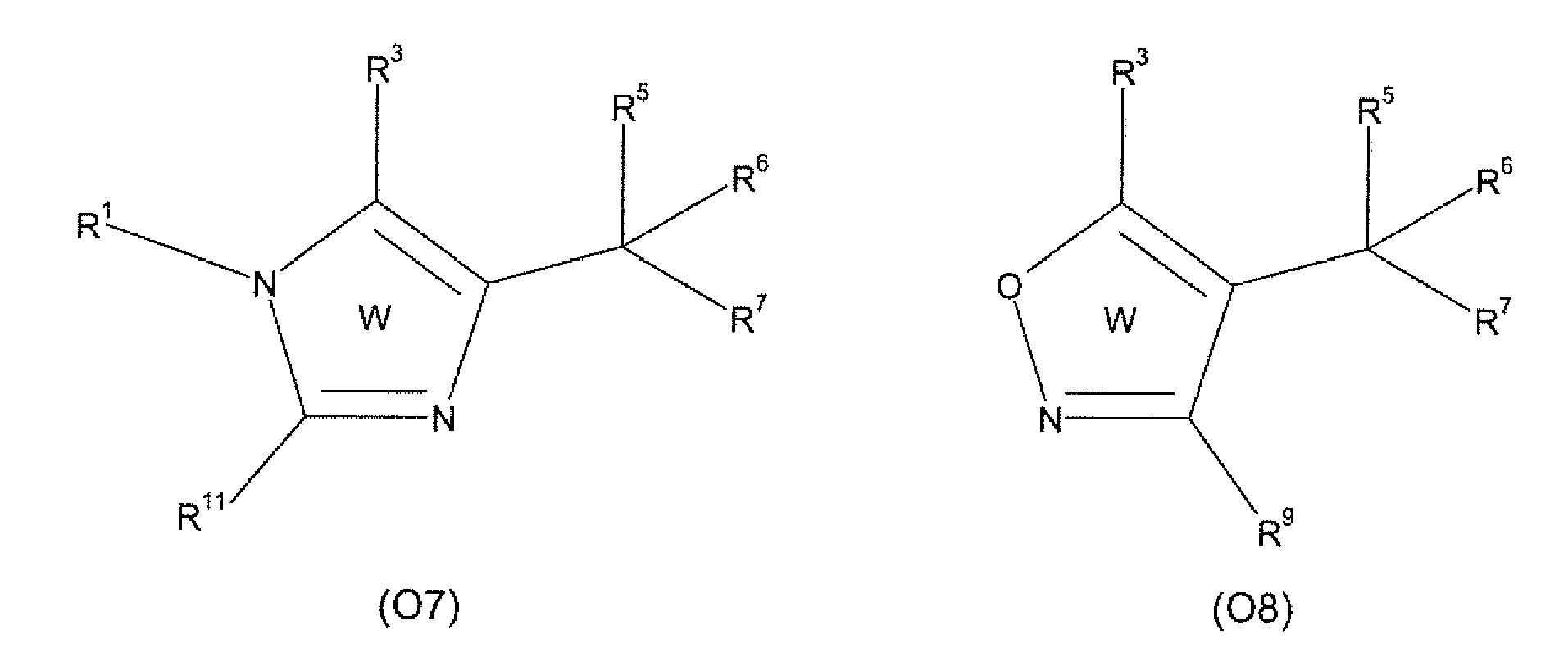

- W represents a substituted aromatic heterocycle;
- R1, R5, R6, R7, R9, R11, R13, T1, T2, T3, T4, T5, T6, T7, T8, T9 and T10 are defined as for the compounds of formula (O).
- As an example of compounds of formula (O), the invention provides a compound of formula (O3a):

- Also preferably, the invention provides compounds of formulae (R1) to (R9):

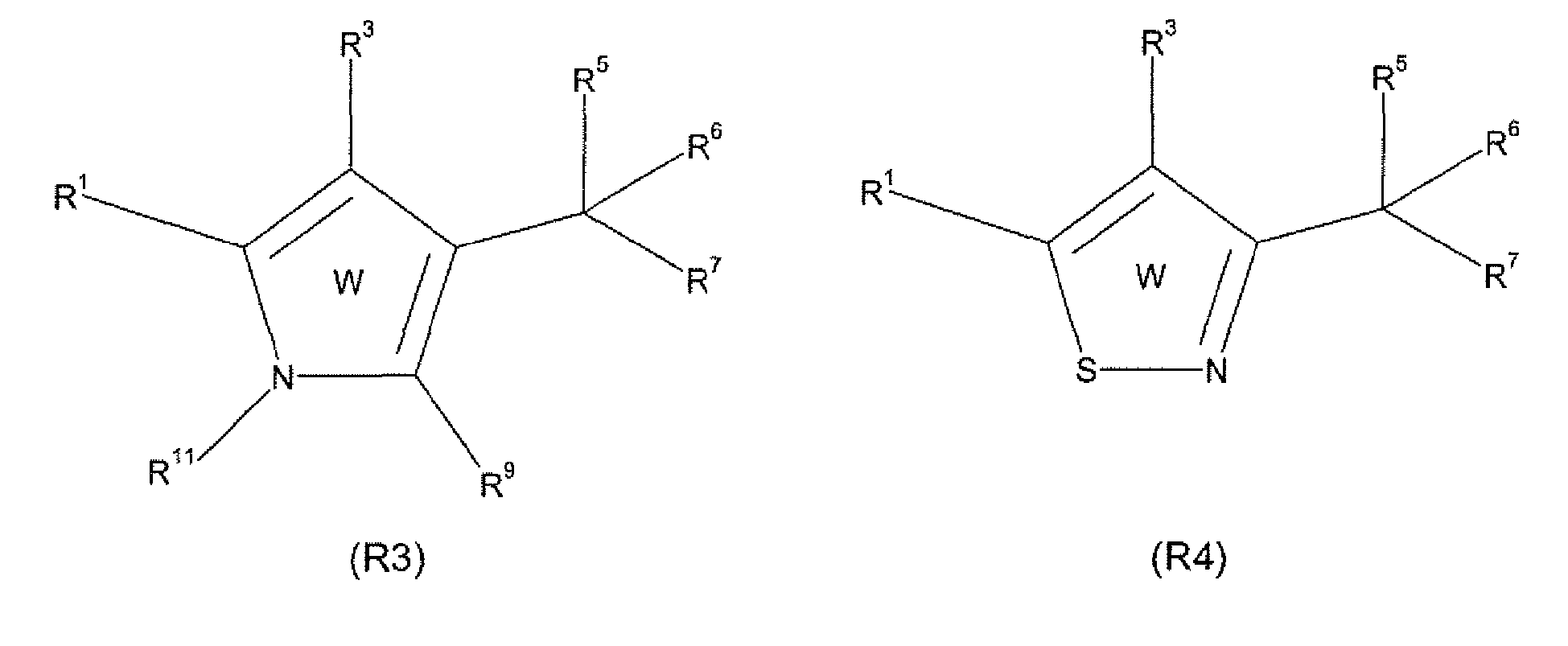

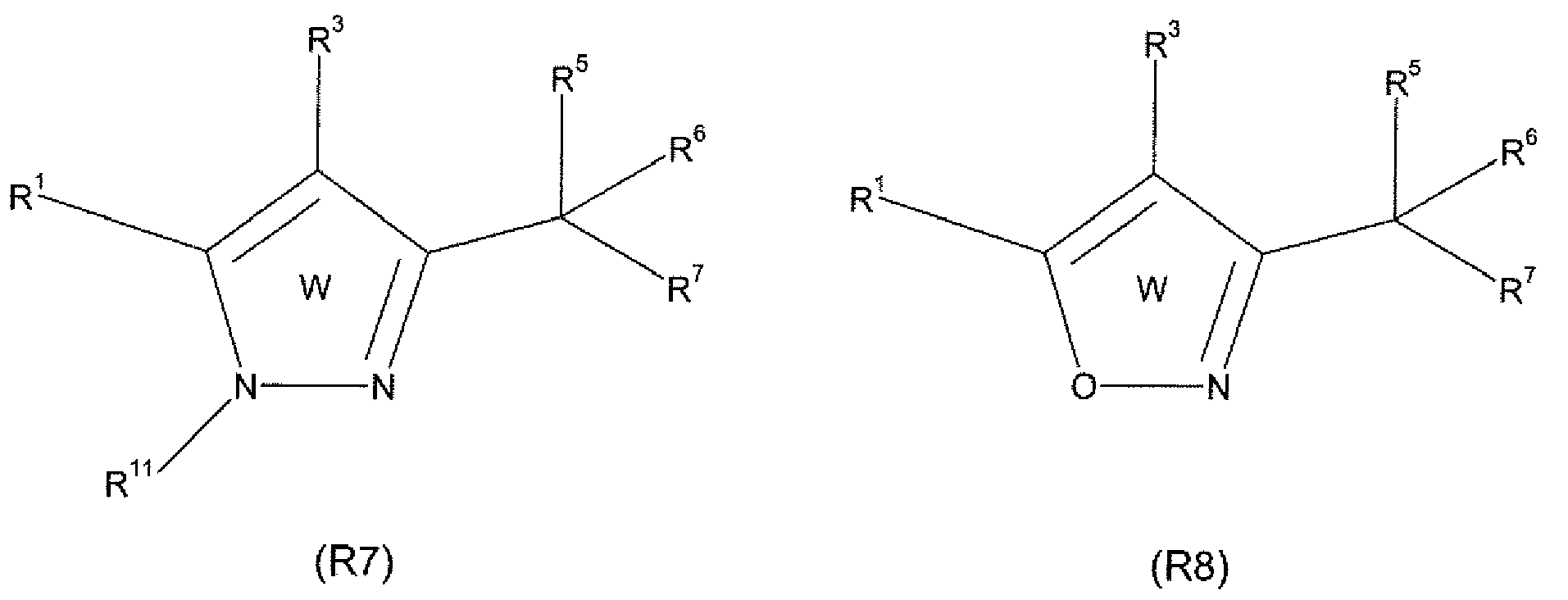

- W represents a substituted aromatic heterocycle ;
- R1, R5, R6, R7, R9, R11, R13, T1, T2, T3, T4, T5, T6, T7, T8, T9 and T10 are defined as for the compounds of formula (R).
- Also preferably, the invention provides compounds of formulae (P1) to (P9):


- W represents a substituted aromatic heterocycle ;
- R1, R5, R6, R7, R9, R11, R13, T1, T2, T3, T4, T5, T6, T7, T8, T9 and T10 are defined as for the compounds of formula (P).
- As examples of compounds of formula (P), the invention provides compounds of formula (P1 a) or (P4a):

- Also preferably, the Invention also provides compounds of formulae (Q1) to (Q4):


- W represents a substituted aromatic heterocycle ;
- R1, R5, R6, R7, R9, R11, R13, T1, T2, T3, T4, T5, T6, T7, T8, T9 and T10 are defined as for the compounds of formula (P).
- Also preferably, the invention also provides compounds of formulae (S1) to (S4):


- W represents a substituted aromatic heterocycle ;
- R1, R5, R6, R7, R9, R11, R13, T1, T2, T3, T4, T5, T6, T7, T8, T9 and T10 are defined as for the compounds of formula (P).
- Advantageously, the invention also provides compounds of formula (T):
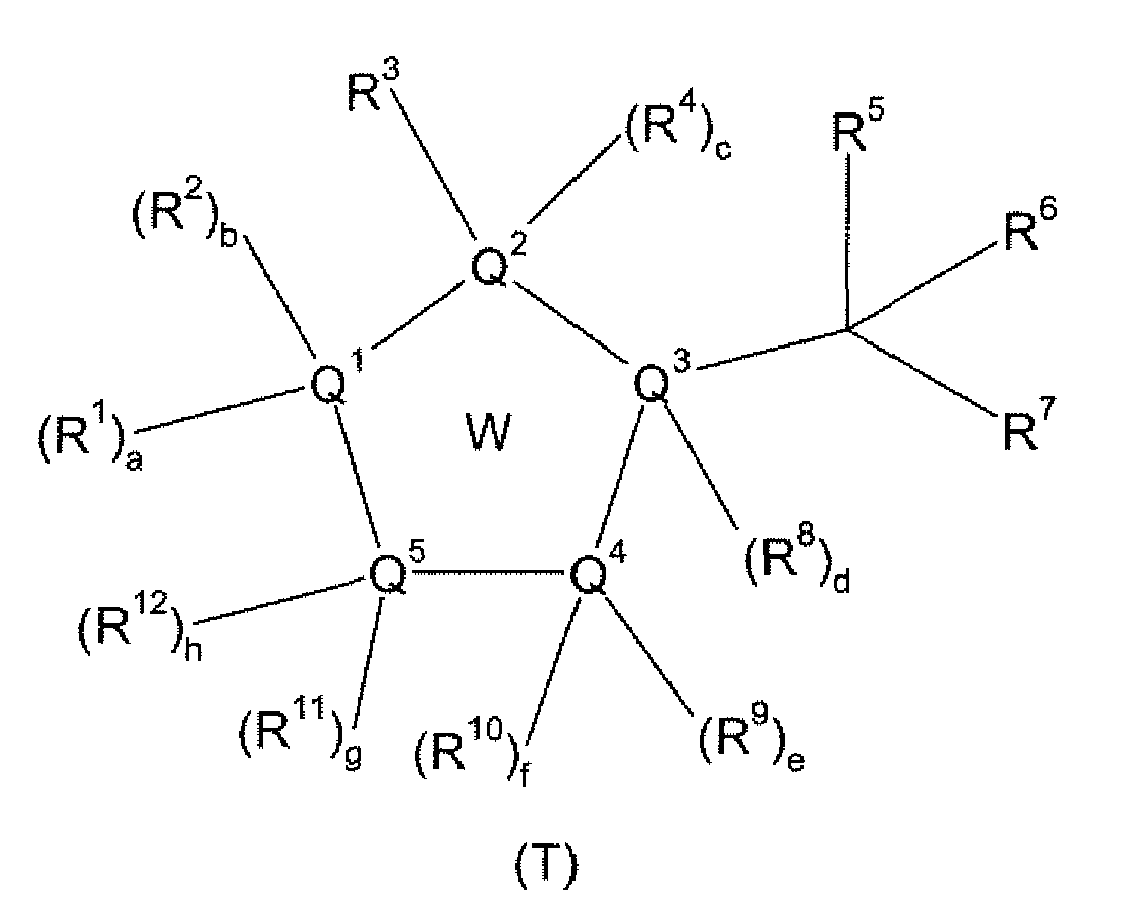
- W represents a substituted, saturated carbo- or heterocycle ;
- a, b, c, d, e, f, g, and h, independently represent 0 or 1 ;
- Q1, Q2, Q3, Q4, Q5, R1, R2, R3, R4, R5, R6, R7, R8, R9, R10, R11, R12, R13 , T1, T2, T3, T4, T5, T6, T7, T8, T9 and T10 are defined as for the compounds of formula (1).
- Combination therapy is contemplated wherein a compound according to the invention, or a pharmaceutically acceptable salt thereof, is co-administered with at least one further antiviral agent. The additional agents may be combined with compounds according to the invention to create a single dosage form. Alternatively these additional agents may be separately administered, concurrently or sequentially, as part of a multiple dosage form.
- When the pharmaceutical composition of this invention comprises a combination of a compound according to the invention, or a pharmaceutically acceptable salt thereof, and at least one further antiviral agent, both the compound and the additional agent should be present at dosage levels of between about 10 to 100%, and more preferably between about 10 and 80% of the dosage normally administered in a monotherapy regimen.
- In the case of a synergistic interaction between the compound according to the invention and the additional antiviral agent or agents, the dosage of any or all of the active agents in the combination may be reduced compared to the dosage normally administered in a monotherapy regimen.
- Antiviral agents contemplated for use in such combination therapy include agents (compounds or biologicals) that are effective to inhibit the formation and/or replication of a virus in a mammal, including but not limited to agents that interfere with either host or viral mechanisms necessary for the formation and/or replication of a virus in a mammal. Such agents can be selected from:
- NRTIs (nucleoside or nucleotide reverse transcriptase inhibitors ; including but not limited to zidovudine, didanosine, zalcitabine, stavudine, lamivudine, emtricitabine, abacavir, and tenofovir) ;
- NNRTIs (non-nucleoside reverse transcriptase inhibitors ; including but not limited to nevirapine, delavirdine, efavirenz, etravirine, rilpivirine and BILR 355) ;
- protease inhibitors (including but not limited to ritonavir, tipranavir, saquinavir, nelfinavir, indinavir, amprenavir, fosamprenavir, atazanavir, lopinavir, darunavir and brecanavir) ;
- entry inhibitors including but not limited to CCR5 antagonists, such as maraviroc (UK-427,857), vicriviroc (SCH-D, SCH-417690) and TAK-652), CXCR4 antagonists such as AMD-11070,
- fusion inhibitors (including but not limited to enfuvirtide (T-20)) and
- others (including but not limited to BMS-488043);
- integrase inhibitors (including but not limited to MK-0518, c-1605, BMS-538158 and GS 9137);
- TAT inhibitors;
- maturation inhibitors (including but not limited to bevirimat (PA-457)) ; and
- immunomodulating agents (including but not limited to levamisole).
- Furthermore, a compound according to the invention can be used with at least one other compound according to the invention or with one or more antifungal or antibacterial agents (including but not limited to fluconazole).
- Therefore, according to one embodiment, the pharmaceutical composition of this invention further comprises one or more antiviral agents.
- A further embodiment provides the pharmaceutical composition of this invention wherein the additional antiviral agent comprises at least one NNRTI.
- According to another embodiment of the pharmaceutical composition of this invention, the additional antiviral agent comprises at least one NRTI.
- According to yet another embodiment of the pharmaceutical composition of this invention, the additional antiviral agent comprises at least one protease inhibitor.
- According to still another embodiment of the pharmaceutical composition of this invention, the additional antiviral agent comprises at least one entry inhibitor.
- According to a further embodiment of the pharmaceutical composition of this invention, the additional antiviral agent comprises at least one integrase inhibitor.
- The following examples are provided for the purpose of illustrating the present invention and by no means should be interpreted to limit the scope of the present invention.
- The first part represents the preparation of the compounds (intermediates and final compounds) whereas the second part describes the evaluation of antiviral activity and cytotoxicity of compounds according to the invention.
- Abbreviations or symbols used herein include:
- DMSO: dimethylsulfoxide
- MS: Mass Spectrometry
- NMR: Nuclear Magnetic Resonance Spectroscopy
- s: singlet
- d: doublet
- t: triplet
- q: quadruplet
- dd: doubled doublet
- dt : doubled triplet
- m : multiplet
- TLC: Thin Layer Chromatography
-

- A solution of phenylhydrazine (1 mL, 10.15 mmol) and phenylacetaldehyde (1.32 mL, 10.15 mmol) in acetic acid was refluxed for 6 hours under a nitrogen atmosphere. After cooling to room temperature, the reaction mixture was poured into a saturated aqueous solution of sodium carbonate (100 mL) at 0°C. After extraction with dichloromethane (2 × 30 mL), the organic layer was dried over sodium sulfate, filtered and evaporated to dryness. The residue was purified by flash chromatography on silica gel (cyclohexane/ethyl acetate: 90/10) to afford the desired indole (1a) as a pale oil (940 mg, 4.86 mmol, 48%).
1H NMR (400 MHz, CDCl3) δ 7.19-7.32 (m, 3H), 7.37 (d, J = 2.5 Hz, 1H), 7.43-7.48 (m, 3H), 7.68 (d, J = 8.3 Hz, 2H), 7.96 (d, J = 8.0 Hz, 1H), 8.22 (broad s, 1H).
MS m/z ([M+H]+) 194. - Sodium hydride (60% in mineral oil, 200 mg, 5 mmol) was added at 0°C to a solution of 3-phenyl-1H-indole (1a) (940 mg, 4.86 mmol) in N,N-dimethylformamide (20 mL) under a nitrogen atmosphere. The suspension was stirred for 15 minutes at 0°C and methyliodide (311 µL, 5 mmol) was then added. The reaction mixture was warmed to room temperature, stirred for 6 hours and then concentrated in vacuo. The residue was partitioned between ethyl acetate (30 mL) and water (10 mL). The organic layer was washed with water (2 × 10 mL), brine (10 mL), dried over sodium sulfate, filtered and evaporated to dryness to give the desired product (1b) as a yellow oil (1 g, 4.86 mmol, 100%) which was used without further purification.
1H NMR (400 MHz, CDCl3) δ3.84 (s, 3H), 7.19-7.30 (m, 4H), 7.36 (d, J = 8.1 Hz, 1H), 7.43 (t, J = 7.6 Hz, 2H), 7.65 (d, J = 7.1 Hz, 2H), 7.95 (d, J = 8.0 Hz, 1H).
MS m/z ([M+H]+) 208. - A solution of butyllithium (1.6 M, 3.44 mL, 5.5 mmol) was added at -20°C to a solution of 1-methyl-3-phenyl-1H-indole (1b) (1.08 g, 5.3 mmol) in anhydrous tetrahydrofuran (20 mL) under a nitrogen atmosphere. After 1 hour, a solution of ethyl glyoxylate in toluene (50%, 1.1 mL, 5.5 mmol) was added. The reaction mixture was slowly warmed to room temperature for 2 hours, quenched with water (5 mL) and concentrated in vacuo. The residue was partitioned between dichloromethane (40 mL) and water (15 mL). The organic layer was washed with water (2 × 15 mL), brine (15 mL), dried over sodium sulfate, filtered and evaporated to dryness. The residue was purified by flash chromatography on silica gel (cyclohexane/ethyl acetate: 90/10) to afford the desired alcohol (1c) as a white solid (360 mg, 1.16 mmol, 22%).
1H NMR (400 MHz, CDCl3) δ1.23 (t, J = 7.1 Hz, 3H), 3.37 (d, J = 2.4 Hz, 1H), 3.78 (s, 3H), 4.10-4.30 (m, 2H), 5.57 (d, J = 2.4 Hz, 1H), 7.14 (t, J = 6.9 Hz, 1H), 7.30-7.37 (m, 3H), 7.46 (t, J = 7.7 Hz, 2H), 7.55 (d, J = 8.3 Hz, 2H), 7.66 (d, J = 7.9 Hz, 1H). MS mlz ([M+H]+) 310, ([M+Na]+) 332. - A mixture of ethyl 2-hydroxy-2-(1-methyl-3-phenyl-1H-indol-2-yl)acetate (1c) (300 mg, 0.97 mmol), silver(I) oxide (674 mg, 2.91 mmol) and tertButylbromide (544 µL, 4.85 mmol) in cyclohexane (10 mL) was vigorously stirred for 2 hours under a nitrogen atmosphere. The reaction mixture was then filtered and concentrated in vacuo. The residue was purified by flash chromatography on silica gel (cyclohexane/ethyl acetate: 90/10) to afford the desired ether oxide (1d) as a white solid (35 mg, 0.1 mmol,10%).
1H NMR (400 MHz, CDCl3) δ0.97 (s, 9H), 1.29 (t, J = 7.1 Hz, 3H), 3.91 (s, 3H), 4.15-4.32 (m, 2H), 5.45 (s, 1H), 7.13 (t, J = 7.0 Hz, 1H), 7.30 (t, J = 7.0 Hz, 1H), 7.35 (d, J = 8.8 Hz, 2H), 7.48 (t, J = 7.7 Hz, 2H), 7.58 (d, J = 8.3 Hz, 2H), 7.63 (d, J = 7.9 Hz, 1H).
MS m/z ([M+1]+) 366, ([M+Na]+) 388. - A solution of ethyl 2-(tert-butoxy)-2-(1-methyl-3-phenyl-1H-indol-2-yl)acetate (1d) (55 mg, 0.15 mmol) and potassium hydroxide (8.4 mg, 0.15 mmol) in water (2 mL), in a mixture of tetrahydrofuran (4 mL) and ethanol (1 mL) was refluxed for 2 hours. Water (10 mL) was added to the reaction mixture which was washed with dichloromethane (10 mL). The aqueous layer was lyophilized. The obtained solid was triturated with cyclohexane to afford the desired product as a white solid (7.9 mg, 0.021 mmol, 14%).
1H NMR (400 MHz, DMSO-d6) δ 0.81 (s, 9H), 3.86 (s, 3H), 5.08 (s, 1H), 7.00 (t, J = 7.4 Hz, 1H), 7.12 (t, J= 7.3 Hz, 1H), 7.27 (t, J = 7.3 Hz, 1H), 7.37 (d, J = 8.1 Hz, 1H), 7.44 (t, J = 7.4 Hz, 2H), 7.52 (d, J = 7.6 Hz, 1H), 7.88 (d, J = 7.4 Hz, 2H).
MS m/z ([M+H]+) 338, ([M+Na]+) 360. -

- A solution of benzothiopheneboronic acid (1 g, 5.61 mmol) in ethanol (23 mL) was added to a mixture of iodobenzene (560 µL, 5 mmol), palladium tetrakis(triphenylphospine) (460 mg, 0.4 mmol) and sodium carbonate (2.38 g, 22.4 mmol) in a mixture of toluene (15 mL) and water (15 mL). The reaction mixture was refluxed for 6 hours and then concentrated in vacuo. The residue was partitioned between ethyl acetate (30 mL) and water (10 mL). The biphasic mixture was acidified with an aqueous solution of hydrochloric acid 1N until pH 2. The aqueous layer was extracted with ethyl acetate (2 × 20 mL) and the organic layer was washed with water (10 mL), brine (10 mL), dried over sodium sulfate, filtered and evaporated to dryness. The residue was purified by flash chromatography on silica gel (cyclohexane/ethyl acetate: 90/10) to afford the desired product (2a) as a yellow oil (640 mg, 3 mmol, 60%).
1H NMR (400 MHz, CDCl3) δ 7.27-7.50 (m, 6H), 7.70-7.85 (m, 4H). - Ethyl chlorooxoacetate (162 µL, 1.48 mmol) was added at 0°C to a solution of 2-phenyl-1-benzothiophene (2a) (310 mg, 1.46 mmol) and aluminum chloride (III) (389 mg, 2.92 mmol) in dichloromethane (10 mL). After 30 minutes, the reaction mixture was quenched with a saturated aqueous solution of sodium carbonate. The aqueous layer was extracted with ethyl acetate (2 × 20 mL) and the organic layer was washed with water (20 mL), brine (20 mL), dried over sodium sulfate, filtered and evaporated to dryness. The residue was purified by flash chromatography on silica gel (cyclohexane/ethyl acetate: 80/20) to afford the desired product (2b) as a pale oil (370 mg, 1.19 mmol, 70%).
1H NMR (400 MHz, CDCl3) δ 1.05 (t, J = 7.1 Hz, 3H), 3.68 (q, J = 7.1 Hz, 2H), 7.45-7.60 (m, 7H), 7.86 (d, J = 8.0 Hz, 1H), 8.45 (d, J = 8.2 Hz, 1H).
MS m/z ([M+H]+) 311. - Sodium borohydride (53 mg, 1.40 mmol) was added to a solution of ethyl 2-oxo-2-(2-phenyl-1-benzothiophen-3-yl)acetate (2b) (430 mg, 1.38 mmol) in a mixture of methanol (10 mL) and tetrahydrofuran (5 mL) under a nitrogen atmosphere. The reaction mixture was stirred for 1hour, quenched with water (2 mL) and concentrated in vacuo. The residue was diluted with dichloromethane (20 mL), washed with water (2 × 10 mL), brine (10 mL), dried over sodium sulfate, filtered and evaporated to dryness. The residue was purified by flash chromatography on silica gel (dichloromethane/ethanol: 99/1) to afford the desired alcohol (2c) as a white solid (190 mg, 0.60 mmol, 44%).
1H NMR (400 MHz, CDCl3) δ 1.16 (t, J= 7.1 Hz, 3H), 3.48 (s, 1H), 4.10-4.30 (m, 2H), 5.53 (s, 1H), 7.32-7.36 (m, 2H), 7.40-7.48 (m, 3H), 7.62 (m, 2H), 7.83 (m, 1H).
MS m/z ([M+Na]+) 335. - A mixture of ethyl 2-hydroxy-2-(2-phenyl-1-benzothiophen-3-yl)acetate (2c) (190 mg, 0.6 mmol), silver(I) oxide (417 mg, 1.8 mmol) and tertbutylbromide (360 µL, 3.2 mmol) in cyclohexane (5 mL) was vigorously stirred for 2 hours. The reaction mixture was then filtered and concentrated in vacuo. The residue was purified by flash chromatography on silica gel (cyclohexane/ethyl acetate: 90/10) to afford the desired ether oxide (2d) as a white solid (30 mg, 0.08 mmol, 13%).
1H NMR (400 MHz, CDCl3) δ 0.99 (s, 9H), 1.23 (t, J = 7.1 Hz, 3H), 4.10-4.30 (m, 2H), 5.35 (s, 1H), 7.28-7.35 (m, 2H), 7.40-7.50 (m, 3H), 7.65-7.70 (m, 2H), 7.78 (d, J = 6.9 Hz, 1H), 8.29 (d, J = 7.4 Hz, 1H).
MS mlz ([M+Na]+) 391. - A solution of ethyl 2-(tert-butoxy)-2-(2-phenyl-1-benzothiophen-3-yl)acetate (70 mg, 0.19 mmol) and potassium hydroxide (10.7 mg, 0.19 mmol) in water (3 mL), in a mixture of tetrahydrofuran (3 mL) and ethanol (1 mL) was stirred at room temperature for 20 hours. Water (10 mL) was added to the reaction mixture which was washed with dichloromethane (10 mL). The aqueous layer was lyophilized and the obtained solid was triturated with cyclohexane to afford the desired product as a white solid (55 mg, 0.14 mmol, 76%).
1H NMR (400 MHz, DMSO-d6) δ 0.80 (s, 9H), 5.02 (s, 1H), 7.25 (m, 2H), 7.441 (m, J = 7.3 Hz, 1H), 7.49 (t, J = 7.6 Hz, 2H), 7.81 (m, 1H), 8.10 (d, J = 7.0 Hz, 2H), 8.50 (m, 1H).
MS m/z ([M+Na]+) 363. -

- A solution of benzothiopheneboronic acid (1 g, 5.61 mmol) in ethanol (23 mL) was added to a mixture of iodobenzene (560 µL, 5 mmol), palladium tetrakis(triphenylphospine) (460 mg, 0.4 mmol) and sodium carbonate (2.38 g, 22.4 mmol) in a mixture of toluene (15 mL) and water (15 mL). The reaction mixture was refluxed for 6 hours and then concentrated in vacuo. The residue was partitioned between ethyl acetate (30 mL) and water (10 mL). The biphasic mixture was acidified with an aqueous solution of hydrochloric acid 1N until pH 2. The aqueous layer was extracted with ethyl acetate (2 × 20 mL) and the organic layer was washed with water (10 mL), brine (10 mL), dried over sodium sulfate, filtered and evaporated to dryness. The residue was purified by flash chromatography on silica gel (cyclohexane) to afford the desired product (3a) as a yellow solid (1.18 g, 5.61 mmol, 100%).
1H NMR (400 MHz, CDCl3) δ 7.35-7.45 (m, 4H), 7.49 (t, J = 7.6 Hz, 2H), 7.59 (d, J = 7.0 Hz, 2H), 7.92 (m, 2H). - A solution of butyllithium (1.6 M, 3.75 mL, 6 mmol) was added at -20°C to a solution of 3-phenyl-1-benzothiophene (3a) (1.18 g, 5.61 mmol) in tetrahydrofuran (20 mL) under a nitrogen atmosphere. After 1 hour, a solution of ethyl glyoxylate in toluene (50%, 1.2 mL, 6 mmol) was added. The reaction mixture was slowly warmed to room temperature for 2 hours, quenched with water (5 mL) and concentrated in vacuo. The residue was partitioned between dichloromethane (40 mL) and water (15 mL). The organic layer was washed with water (2 × 15 mL), brine (15 mL), dried over sodium sulfate, filtered and evaporated to dryness. The residue was purified by flash chromatography on silica gel (cyclohexane/ethyl acetate: 90/10) to afford the desired alcohol (3b) as a white solid (340 mg, 1.09 mmol, 20%).
1H NMR (400 MHz, CDCl3) δ1.23 (t, J = 7.1 Hz, 3H), 3.57 (d, J = 5.1 Hz, 1H), 4.15-4.30 (m, 2H), 5.45 (d, J = 5.1 Hz, 1H), 7.30-7.35 (m, 2H), 7.38-7.55 (m, 6H), 7.86 (d, J=8.5Hz, 1H).
MS m/z ([M+Na]+) 335. - A mixture of ethyl 2-hydroxy-2-(3-phenyl-1-benzothiophen-2-yl)acetate (3b) (340 mg, 1.09 mmol), silver(I) oxide (758 mg, 3.27 mmol) and tertbutylbromide (612 µL, 5.45 mmol) in cyclohexane (20 mL) was vigorously stirred for 48 hours under a nitrogen atmosphere. The reaction mixture was then filtered and concentrated in vacuo. The residue was purified by flash chromatography on silica gel (cyclohexane/ethyl acetate: 90/10) to afford the desired ether oxide (3c) as a white solid (45 mg, 0.12 mmol, 11%).
1H NMR (400 MHz, CDCl3) δ 1.12 (s, 9H), 1.28 (t, J = 7.1 Hz, 3H), 4.15-4.30 (m, 2H), 5.38 (s, 1H), 7.25-7.40 (m, 2H), 7.45-7.60 (m, 6H), 7.90 (d, J = 7.9 Hz, 1H).
MS m/z ([M+Na]+) 391. - A solution of ethyl 2-(tert-butoxy)-2-(3-phenyl-1-benzothiophen-2-yl)acetate (3c) (45 mg, 0.12 mmol) and potassium hydroxide (34 mg, 0.61 mmol) in water (3 mL), in a mixture of tetrahydrofuran (3 mL) and ethanol (1 mL) was refluxed for 5 hours. The reaction mixture was concentrated in vacuo and water (10 mL) was added. The aqueous layer was washed with dichloromethane (10 mL), acidified with a hydrochloric acid solution 1N until pH 2 and extracted with dichloromehane (2 × 10 mL). The organic layer was dried over sodium sulfate, filtered and evaporated to dryness to afford the desired product (example 4) as a white solid (7.9 mg, 0.023 mmol, 19%).
1H NMR (400 MHz, CDCl3) δ1.08 (s, 9H), 5.38 (s, 1H), 7.27-7.40 (m, 3H), 7.45-7.60 (m, 5H), 7.90 (d, J = 7.1 Hz, 1H).
MS m/z ([M+Na]+) 363. -

- Trimethylsilylcyanide (924 µL, 7.39 mmol) was added at 0°C to a solution of thianaphtene-3-carboxaldehyde (1 g, 6.16 mmol) and zinc iodide(II) (198 mg, 0.62 mmol) in anhydrous dichloromethane (40 mL) under a nitrogen atmosphere. After 2 hours, the reaction mixture was quenched with a saturated aqueous solution of sodium carbonate and extracted with dichloromethane (2 × 20 mL). The organic layer was washed with brine (10 mL), dried over sodium sulfate, filtered and evaporated to dryness. The residue was dissolved in anhydrous methanol and the solution was cooled at 0°C. Hydrogen chloride was bubbled for 5 minutes. The mixture was then warmed at room temperature for 20h and concentrated in vacuo. The residue was partitioned between ethyl acetate (10 mL) and a saturated aqueous solution of sodium bicarbonate (10mL). The aqueous layer was extracted with ethyl acetate (2×10mL). The organic layer was washed with brine (10 mL), dried over sodium sulfate, filtered and evaporated to dryness. The residue was purified by flash chromatography on silica gel (dichloromethane/ethanol: 95/5) to afford the desired alcohol (4a) as a white solid (550 mg, 2.47 mmol, 40%). 1H NMR (400 MHz, CDCl3) δ 3.78 (s, 3H), 5.56 (s, 1H), 7.35-7.45 (m, 2H), 7.49 (s, 1H), 7.86-7.92 (m, 2H).
MS m/z ([M-OH]+) 205. - A mixture of methyl 2-(1-benzothiophen-3-yl)-2-hydroxyacetate (4a) (300 mg, 1.35 mmol), silver(I) oxide (938 mg, 4.05 mmol) and tertbutylbromide (910 µL, 8.1 mmol) in a mixture of cyclohexane (5 mL) and dichloromethane (1 mL) was vigorously stirred for 20 hours under a nitrogen atmosphere. The reaction mixture was then filtered and concentrated in vacuo. The residue was purified by flash chromatography on silica gel (cyclohexane/ethyl acetate: 90/10) to afford the desired ether oxide (4b) as a white solid (70 mg, 0.25 mmol, 10%).
1H NMR (400 MHz, CaCl3) δ 1.29 (s, 9H), 3.69 (s, 3H), 5.43 (s, 1H), 7.33-7.42 (m, 2H), 7.56 (s, 1 H), 7.85 (d, J = 7.5 Hz, 1H), 8.04 (d, J = 7.5 Hz, 1H).
MS m/z ([M-H]-) 277. - N-bromosuccinimide (67 mg, 0.37 mmol) was added at room temperature to a stirred solution of methyl 2-(1-benzothiophen-3-yl)-2-(tert-butoxy)acetate (4b) (70 mg, 0.25 mmol) in acetonitrile (2 mL) under a nitrogen atmosphere. After 20 hours, water (10 mL) was added and the reaction mixture was extracted with dichloromethane (2 × 10 mL). The organic layer was washed with brine (10 mL), dried over sodium sulfate, filtered and evaporated to dryness. The residue was purified by flash chromatography on silica gel (cyclohexane/ethyl acetate: 90/10) to afford the desired product (4c) as a pale oil (40 mg, 0.11 mmol, 45%).
1H NMR (400 MHz, CDCl3) δ 1.24 (s, 9H), 3.66 (s, 3H), 5.51 (s, 1H), 7.30-7.40 (m, 2H), 7.68 (d, J = 7.5 Hz, 1H), 8.21 (d, J = 7.5 Hz, 1H).
MS m/z ([M+Na]+) 379,381. - To a solution of methyl 2-(2-bromo-1-benzothiophen-3-yl)-2-(tert-butoxy)acetate (4c) (40 mg, 0.11 mmol) in N, N-dimethylformamide (2 mL) were successively added sodium carbonate (13 mg, 0.12 mmol), water (500 µL), palladium tetrakis(triphenylphospine) (18.3 mg, 0.016 mmol) and 6-(4,4,5,5-tetramethyl-1,3,2-dioxaborolan-2-yl)chroman (29 mg, 0.11 mmol). The mixture was heated at 100°C for 2 hours. After cooling to room temperature, water (10 mL) was added. The aqueous layer was extracted with ethyl acetate (2 × 10 mL). The organic layer was washed with brine (10 mL), dried over sodium sulfate, filtered and evaporated to dryness. The residue was purified by flash chromatography on silica gel (cyclohexane/ethyl acetate: 90/10) to afford the desired product (4d) as a white solid (25 mg, 0.061 mmol, 55%).
1H NMR (400 MHz, CDCl3) δ 1.01 (s, 9H), 2.05-2.10 (m, 2H), 2.84-2.88 (m, 2H), 3.73 (s, 3H), 4.24-4.28 (m, 2H), 5.41 (s, 1H), 6.89 (d, J = 8.3 Hz, 1H), 7.26-7.40 (m, 4H), 7.76 (d, J = 7.5 Hz, 1H), 8.23 (d, J = 7.5 Hz, 1H).
MS m/z ([M+Na]+) 433. - A solution of methyl 2-(tert-butoxy)-2-[2-(3,4-dihydro-2H-1-benzopyran-6-yl)-1-benzothiophen-3-yl]acetate (4d) (25 mg, 0.061 mmol) and lithium hydroxide (18 mg, 0.75 mmol) in water (3 mL), in a mixture of tetrahydrofuran (3 mL) and methanol (1 mL) was stirred at room temperature for 20 hours. Water (10 mL) was added to the reaction mixture which was washed with dichloromethane (10 mL). The aqueous layer was acidified with a hydrochloric acid solution 1 N until pH 2 and extracted with dichloromethane (2 × 10 mL). The organic layer was washed with brine (10 mL), dried over sodium sulfate, filtered and evaporated to dryness to afford the desired acid as a white solid (24mg, 0.06 mmol, 99%).
1H NMR (400 MHz, CDCl3) δ 1.00 (s, 9H), 2.04-2.08 (m, 2H), 2.84-2.88 (m, 2H), 4.26 (t, J = 5.1 Hz, 2H), 5.47 (s, 1H), 6.89 (d, J = 8.3 Hz, 1H), 7.28-7.43 (m, 4H), 7.79 (d, J = 7.5 Hz, 1H), 7.83 (d, J = 7.5 Hz, 1H).
MS m/z ([M-H]-) 395. -

- A mixture of indole (500 mg, 4.27 mmol), copper(l) iodide (122 mg, 0.64 mmol), cesium carbonate (1.9 g, 6 mmol) and phenyliodide (470 µL, 4.2 mmol) in anhydrous N,N-dimethylformamide (10 mL) was refluxed for 24 hours under a nitrogen atmosphere. The reaction mixture was then filtered and concentrated in vacuo. The residue was partitioned between dichloromethane (30mL) and water (10 mL). The organic layer was washed with water (2 × 10 mL), brine (10 mL), dried over sodium sulfate, filtered and evaporated to dryness. The residue was purified by flash chromatography on silica gel (cyclohexane/ethyl acetate: 95/5) to afford the desired product (5a) as a yellow oil (700 mg, 3.62 mmol, 86%).
1H NMR (400 MHz, CDCl3) δ 6.69 (d, J = 4 Hz, 1H), 7.15-7.27 (m, 2H), 7.34-7.39 (m, 2H), 7.51-7.55 (m, 4H), 7.59 (d, J = 8.2 Hz, 1H), 7.70 (d, J = 7.3 Hz, 1H).
MS m/z ([M+H]+) 194. - A solution of butyllithium (1.6 M, 1.19 mL, 1.9 mmol) was added at -78°C to a solution of 1-phenyl-1H-indole (5a) (350 mg, 1.81 mmol) in tetrahydrofuran (10 mL) under a nitrogen atmosphere. After 45 minutes, a solution of ethyl glyoxylate in toluene (50%, 400 µL, 2 mmol) was added. The reaction mixture was slowly warmed to room temperature for 12 hours, quenched with water (2 mL) and concentrated in vacuo. The residue The residue was partitioned between dichloromethane (30mL) and water (10 mL). The organic layer was washed with water (2 × 10 mL), brine (10 mL), dried over sodium sulfate, filtered and evaporated to dryness. The residue was purified by flash chromatography on silica gel (cyclohexane/ethyl acetate: 90/10) to afford the desired alcohol (5b) as a white solid (100 mg, 0.33 mmol, 19%).
1H NMR (400 MHz, CDCl3) δ 1.22 (t, J = 7.1 Hz, 3H), 3.22 (d, J = 6.7 Hz, 2H), 4.10-4.30 (m, 2H), 5.15 (d, J = 6.7 Hz, 1H), 6.65 (s, 1H), 7.10-7.20 (m, 3H), 7.45-7.60 (m, 5H), 7.66 (d, J = 6.0 Hz, 1H).
MS m/z ([M+H]+) 296, ([M+Na]+) 318. - A mixture of ethyl 2-hydroxy-2-(1-phenyl-1H-indol-2-yl)acetate (5b) (50 mg, 0.17 mmol), silver(I) oxide (130 mg, 0.56 mmol) and tertbutylbromide (114 µL, 1.02 mmol) in cyclohexane (4 mL) and dichloromethane (2 mL) was vigorously stirred for 24 hours. The reaction mixture was then filtered and concentrated in vacuo. The residue was purified by flash chromatography on silica gel (cyclohexane/ethyl acetate: 95/5) to afford the desired ether oxide (5c) as a white solid (20 mg, 0.057 mmol, 33%).
1H NMR (400 MHz, CDCl3) δ 1.00 (s, 9H), 1.25 (t, J = 7.1 Hz, 3H), 4.11-4.26 (m, 2H), 5.09 (s, 1H), 6.75 (s, 1H), 7.05-7.20 (m, 3H), 7.45-7.65 (m, 6H).
MS m/z ([M+Na]+) 374. - A solution of ethyl 2-(tert-butoxy)-2-(1-phenyl-1H-indol-2-yl)acetate (5c) (20 mg, 0.057 mmol) and sodium hydroxide (15 mg, 0.27 mmol) in water (2 mL), in a mixture of tetrahydrofuran (2 mL) and ethanol (1 mL) was stirred at room temperature for 3 hours. The reaction mixture was diluted with water (10 mL) and washed with dichloromethane (10 mL). The aqueous layer was lyophilized to afford the desired product as a white solid (15 mg, 0.042 mmol, 75%).
1H NMR (400 MHz, DMSO-d6) δ0.81 (s, 9H), 4.57 (s, 1H), 6.47 (s, 1H), 7.00-7.05 (m, 3H), 7.45-7.65 (m, 5H).
MS m/z ([M+H]+) 324. - The antiviral activity, particularly against HIV, of compounds according to the invention is evaluated by the protocol described below.
- The virus was prepared as described in Lopez et al (Lopez et al, Proc Natl Acad Sci U S A., 2006, 103(40):14947-52, by transfecting 2 × 10⁶ 293T cells (CRL-1573, ATCC) with following modifications: 6µg of NL4-3 proviral DNA molecular clone were mixed with Fugene 6 transfection reagent from Roche, and used according manufacturer's instructions. Forty eight hours later, transfected cell supernatants were harvested, filtered through 0.45-µm-pore-size filters, quantified for HIV-1 p24 antigen by using a Innotest HIV antigen mAb assay (Ingen) according manufacturer's instructions, and used in infection experiments.
- Serial dilutions of compounds to be tested were prepared in complete RPMI medium from 10mM DMSO stock solutions, and distributed in a volume of 20 µl in 96 well Falcon 353072 Microtest™ tissue culture plate, in order to get 0.5% DMSO final concentration in each well, after the addition of infected cells. Control wells contained also 0.5% DMSO final concentration but no compound.
- MT4 cells (from the NIH AIDS Research and Reference Reagent Program) in RPMI complete medium were counted (10×106 cells per well in Falcon 353047 Multiwell™ 24 well) and infected for 2 hours at 37°, at a multiplicity of infection (moi) of 0.001. Cells were then centrifuged 3min at 3000rpm, and washed two times in 1ml PBS to remove viruses that have not entered in cells. Infected cells were resuspended in complete RPMI at 1.25×10⁶ cells/ml, and 80µl of infected cells were distributed in each well containing compounds to be tested or control wells. The plates were then incubated at 37° for 5 days.
- After 5 days of incubation, 100µl of CellTiter-Glo reagent (Promega Biosciences, Inc., Madison WI, USA) were added to each well. Cell lysis was carried out at room temperature during 10min, 200µl of lysates were transferred in Packard Optiplate 96 well, and luminescence was read on BMG Pherastar.
- To determine cytotoxicity of the compounds according to the invention, they were incubated with uninfected cells for 5 days in the same conditions as described above for infected cells, and cytopathic effect was measured by addition of the CellTiter-Glo reagent as indicated above.
and wherein the aryl, arylalkyl, arylalkenyl, arylalkynyl, arylheteroalkyl, arylheteroalkenyl, arylheteroalkynyl, cycloalkyl, cycloalkenyl, cycloalkynyl, heterocycle, heterocyclyl-alkyl, heterocyclyl-alkenyl, heterocyclyl-alkynyl, heterocyclyl-heteroalkyl, heterocyclyl-heteroalkenyl, or heterocyclyl-heteroalkynyl group can be fused with at least one further cycle ;
and wherein the alkyl, alkenyl, alkynyl, arylalkyl, arylalkenyl, arylalkynyl, cycloalkyl, cycloalkenyl, cycloalkynyl, heterocyclyl-alkyl, heterocyclyl-alkenyl, heterocyclyl-alkynyl group can include one or more heteroatoms, selected from O, S and N, in the alkyl, alkenyl, alkynyl moiety ;
and wherein the aryl, arylalkyl, arylalkenyl, arylalkynyl, arylheteroalkyl, arylheteroalkenyl, arylheteroalkynyl, cycloalkyl, cycloalkenyl, cycloalkynyl, heterocycleheterocycle, heterocyclyl-alkyl, heterocyclyl-alkenyl, heterocyclyl-alkynyl, heterocyclyl-heteroalkyl, heterocyclyl-heteroalkenyl, or heterocyclyl-heteroalkynyl can be fused with at least one further cycle,
and wherein alkyl, alkenyl, alkynyl, arylalkyl, arylalkenyl, arylalkynyl, cycloalkyl, cycloalkenyl, cycloalkynyl, heterocyclyl-alkyl, heterocyclyl-alkenyl, heterocyclyl-alkynyl group can include one or more heteroatoms, selected from O, S and N, in the alkyl, alkenyl, alkynyl moiety ;
and wherein alkyl group can include one or more heteroatoms, selected from O, S and N ;
and wherein alkyl, alkenyl, alkynyl, arylalkyl, arylalkenyl, arylalkynyl, cycloalkyl, cycloalkenyl, cycloalkynyl, heterocyclyl-alkyl, heterocyclyl-alkenyl, heterocyclyl-alkynyl group can include one or more heteroatoms, selected from O, S and N, in the alkyl, alkenyl, alkynyl moiety,
R5 and R6 form with the carbon atom a 3- to 7-membered carbocycle or heterocycle,
wherein the carbocycle or heterocycle is fused with at least one further cycle, or R5 and R6 form a group of formula (i)

wherein a carbon atom or heteroatom of said alkyl, can be oxidized to form a C=O, C=S, N=O, N=S, S=O or S(O)2,
Claims (28)
- A compound according to formula (1):
 ● W represents a substituted or non-substituted, saturated or partially or totally unsaturated, aromatic or non-aromatic carbo- or heterocycle ;● a, b, c, d, e, f, g, and h, independently represent 0 or 1 ;● Q1 represents CR1, CR2, CR1R2, N, NR1, NR2, S, O ;● Q2 represents CR3, CR3R4, NR3 ;● Q3 represents CCR5R6R7, CR8CR5R6R7, NCR5R6R7 ;● Q4 represents CR9, CR10, CR9R10, N, NR9, NR10, S, O ;● Q5 represents CR11, CR12, CR11R12, N, NR11, NR12, S, O ;● R1, R2, R9, R10, R11 and R12 independently represent hydrogen, -CN, -OH, -O-cycloalkyl, -O-cycloalkenyl, -O-cycloalkynyl, -NH2, -NR13-cycloalkyl, -NR13-cycloalkenyl, -NR13-cycloalkynyl, -S-cycloalkyl, -S-cycloalkenyl, -S-cycloalkynyl, - COOH, -C(O)NH2, -CF3, -SO2NH2, -NHSO2NH2, -NHC(O)NH2, -OC(O)NH2, halogen, alkyl, alkenyl, alkynyl, heteroalkyl, heteroalkenyl, heteroalkynyl, aryl, -O-aryl, -NR13-aryl, -S-aryl, arylalkyl, arylalkenyl, arylalkynyl, arylheteroalkyl, arylheteroalkenyl, arylheteroalkynyl, cycloalkyl, cycloalkenyl, cycloalkynyl, heterocycle, -O-heterocycle, - NR13-heterocycle, -S-heterocycle, heterocyclyl-alkyl, heterocyclyl-alkenyl, heterocyclyl-alkynyl, heterocyclyl-heteroalkyl, heterocyclyl-heteroalkenyl, heterocyclyl-heteroalkynyl, non-substituted or substituted by at least one T1,
wherein a carbon atom or a heteroatom of said alkyl, alkenyl, alkynyl, heteroalkyl, heteroalkenyl, heteroalkynyl, aryl, arylalkyl, arylalkenyl, arylalkynyl, arylheteroalkyl, arylheteroalkenyl, arylheteroalkynyl, cycloalkyl, cycloalkenyl, cycloalkynyl, heterocycle, heterocyclyl-alkyl, heterocyclyl-alkenyl, heterocyclyl-alkynyl, heterocyclyl-heteroalkyl, heterocyclyl-heteroalkenyl, heterocyclyl-heteroalkynyl can be oxidized to form a C=O, C=S, N=O, N=S, S=O or S(O)2,
and wherein the aryl, arylalkyl, arylalkenyl, arylalkynyl, arylheteroalkyl, arylheteroalkenyl, arylheteroalkynyl, cycloalkyl, cycloalkenyl, cycloalkynyl, heterocycle, heterocyclyl-alkyl, heterocyclyl-alkenyl, heterocyclyl-alkynyl, heterocyclyl-heteroalkyl, heterocyclyl-heteroalkenyl, or heterocyclyl-heteroalkynyl group can be fused with at least one further cycle ;
and wherein the alkyl, alkenyl, alkynyl, arylalkyl, arylalkenyl, arylalkynyl, cycloalkyl, cycloalkenyl, cycloalkynyl, heterocyclyl-alkyl, heterocyclyl-alkenyl, heterocyclyl-alkynyl group can include one or more heteroatoms, selected from O, S and N, in the alkyl, alkenyl, alkynyl moiety ;● R3 represents -O-cycloalkyl, -O-cycloalkenyl, -O-cycloalkynyl, -NR13-cycloalkyl, -NR13-cycloalkenyl, -NR13-cycloalkynyl, -S-cycloalkyl, -S-cycloalkenyl, -S-cycloalkynyl, alkyl, alkenyl, alkynyl, heteroalkyl, heteroalkenyl, heteroalkynyl, aryl, -O-aryl, -NR13-aryl, -S-aryl, arylalkyl, arylalkenyl, arylalkynyl, arylheteroalkyl, arylheteroalkenyl, arylheteroalkynyl, cycloalkyl, cyctoalkenyl, cycloalkynyl, heterocycle, -O-heterocycle,-NR13-heterocycle, -S-heterocycle, heterocyclyl-alkyl, heterocyclyl-alkenyl, heterocyclyl-alkynyl, heterocyclyl-heteroalkyl, heterocyclyl-heteroalkenyl, heterocyclyl-heteroalkynyl, non-substituted or substituted by at least one T1,
wherein a carbon atom or heteroatom of said alkyl, alkenyl, alkynyl, heteroalkyl, heteroalkenyl, heteroalkynyl, aryl, arylalkyl, arylalkenyl, arylalkynyl, arylheteroalkyl, arylheteroalkenyl, arylheteroalkynyl, cycloalkyl, heterocycle, heteracyclyl-alkyl, heterocylyl-alkenyl, heterocyclyl-alkynyl, heterocyclyl-heteroalkyl, heterocylyl-heteroalkenyl, heterocyclyl-heteroalkynyl can be oxidized to form a C=O, C=S, N=O, N=S, S=O or S(O)2.
and wherein the aryl, arylalkyl, arylalkenyl, arytalkynyl, arylheteroalkyl, arylheteroalkenyl, arylheteroalkynyl, cycloalkyl, cycloalkenyl, cycloalkynyl, heterocycle, heterocyclyl-alkyl, heterocyclyl-alkenyl, heterocyclyl-alkynyl, heterocyclyl-heteroalkyl, heterocyclyl-heteroalkenyl, or heterocyclyl-heteroalkynyl can be fused with at least one further cycle,
and wherein alkyl, alkenyl, alkynyl, arylalkyl, arylaikenyl, arylalkynyl, cycloalkyl, cycloalkenyl, cycloalkynyl, heterocyclyl-alkyl, heterocyclyl-alkenyl, heterocyclyl-alkynyl group can include one or more heteroatoms, selected from O, S and N, in the alkyl, alkenyl, alkynyl moiety;● R4 represents hydrogen, -OH, alkyl, O-alkyl,
wherein a carbon atom or heteroatom of said alkyl, can be oxidized to form a C=O, C=S, N=O, N=S, S=O or S(O)2,
and wherein alkyl group can include one or more heteroatoms, selected from O, S and N;● R5 or R6 identical, or different, independently represent hydrogen, halogen, -CN, -O-cycloalkyl, -O-cycloalkenyl, -O-cycloalkynyl, -NR13-cycloalkyl, -NR13-cycloalkenyl, - NR13-cycloalkynyl, -S-cycloalkyl, -S-cycloalkenyl, -3-cycloalkynyl, alkyl, alkenyl, alkynyl, heteroalkyl, heteroalkenyl, heteroalkynyl, aryl, -O-aryl, -NR13-aryl, -S-aryl, arylalkyl, arytalkenyl, arylalkynyl, arylheteroalkyl, arylheteroalkenyl, arylheteroalkynyl, cycloalkyl, cycfoalkenyl, cycloalkynyl, heterocycle, -O-heterocycle, -NR13-heterocycle, -S-heterocycle, heterocyclyl-alkyl, heterocyclyl-alkenyl, heterocyclyl-alkynyl, heterocyclyl-heteroalkyl, heterocyclyl-heteroalkenyl, heterocyclyl-heteroalkynyl, non-substituted or substituted by at least one T2,
and wherein a carbon atom or heteroatom of said alkyl, alkenyl, alkynyl, heteroalkyl, heteroalkenyl, heteroalkynyl, aryl, arylalkyl, arylalkenyl, arylalkynyl, arylheteroalkyl, arylheteroalkenyl, arylheteroalkynyl, cycloalkyl, heterocycle, heterocyclyl-alkyl, heterocyclyl-alkenyl, heterocyclyl-alkynyl, heterocyclyl-heteroalkyl, heterocyclyl-heteroalkenyl, heterocyclyl-heteroalkynylcan be oxidized to form a C=O, C=S, N=O, N=S, S=O or S(O)2,
and wherein alkyl, alkenyl, alkynyl, arylalkyl, arylalkenyl, arylalkynyl, cycloalkyl, cycloalkenyl, cycloalkynyl, heterocyclyl-alkyl, heterocyclyl-alkenyl, heterocyclyl-alkynyl group can include one or more heteroatoms, selected from O, S and N, in the alkyl, alkenyl, alkynyl moiety,
R5 and R6 form with the carbon atom a 3- to 7-membered carbocycle or heterocycle, wherein the carbocycle or heterocycle is fused with at least one further cycle, or
R5 and R6 form a group of formula (i) ● R7 represents independently -C(O)OH, -CN, -C(O)NH2, -C(O)OR13, -C(O)NHCN, - C(O)NHOH, -S(O)2OH, -S(O)2NHR13, -P(O)(OH)NH2, -P(O)(OH)O-alkyl, -P(O)(O-alkyl)2, -P(O)(OH)2, -OSO3H -NR13SO3H, a tetrazolyl group ;● R8 represents hydrogen, alkyl ;● R13 represents hydrogen, alkyl or aryl,
wherein a carbon atom of said alkyl or aryl can be oxidized to form a C=O, C=S, N=O, N=S, S=O or S(O)2 ;● R1, Q1, Q5 and R11 form a saturated, partially or totally unsaturated 5-, 6- or 7-membered carbo- or hetero-cycle or a satured, partially or totally unsatured 10-, 11-, 12-, 13- or 14-membered polycarbo- or polyheterocycle ;● R1, Q1, Q5 and R12 form a saturated, partially or totally unsaturated 5, 6 or 7 membered carbocycle or heterocycle or a satured, partially or totally unsatured 10, 11, 12, 13 or 14 membered polycarbocycle or polyheterocycle ;● R2, Q1, Q5 and R11 form a saturated, partially or totally unsaturated 5, 6 or 7 membered carbocycle or heterocycle or a satured, partially or totally unsatured 10, 11, 12, 13 or 14 membered polycarbocycle or polyheterocycle ;● R2, Q1, Q5 and R12 form a saturated, partially or totally unsaturated 5, 6 or 7 membered carbocycle or heterocycle or a satured, partially or totally unsatured 10, 11, 12, 13 or 14 membered polycarbocycle or polyheterocycle ;● R9, Q4, Q5 and R11 form a saturated, partially or totally unsaturated 5, 6 or 7 membered carbocycle or heterocycle or a satured, partially or totally unsatured 10, 11, 12, 13 or 14 membered polycarbocycle or polyheterocycle ;● R9, Q4, Q5 and R12 form a saturated, partially or totally unsaturated 5, 6 or 7 membered carbocycle or heterocycle or a satured, partially or totally unsatured 10, 11, 12, 13 or 14 membered polycarbocycle or polyheterocycle ;● R10, Q4, Q5 and R11 form a saturated, partially or totally unsaturated 5, 6 or 7 membered carbocycle or heterocycle or a satured, partially or totally unsatured 10, 11, 12, 13 or 14 membered polycarbocycle or polyheterocycle ;● R10, Q4, Q5 and R12 form a saturated, partially or totally unsaturated 5, 6 or 7 membered carbocycle or heterocycle or a satured, partially or totally unsatured 10, 11, 12, 13 or 14 membered polycarbocycle or polyheterocycle ;● T1 represents hydrogen, halogen, -OT3, -OCF3, =O, -ST3, =S, -S(O)T4, -S(O)2T4, - S(O)2NT5T6, CF3, NO2, -NT5T6, -NT3S(O)2T4, CN, -NT3C(O)T4, -NT3C(O)NT5T6,-C(O)OT3, -C(O)NT5T6 -C(O)T4, alkyl, alkenyl, alkynyl, heteroalkyl, heteroalkenyl, heteroalkynyl, aryl, arylalkyl, arylalkenyl, arylalkynyl, arylheteroalkyl, arylheteroalkenyl, arylheteroalkynyl, cycloalkyl, cycloalkenyl, cycloalkynyl, heterocycle, heterocyclyl-alkyl, heterocyclyl-alkenyl, heterocyclyl-alkynyl, heterocyclyl-heteroalkyl, heterocyclyl-heteroalkenyl, heterocyclyl-heteroalkynyl,
wherein said alkyl, alkenyl, alkynyl, heteroalkyl, heteroalkenyl, heteroalkynyl, aryl, arylalkyl, arylalkenyl, arylalkynyl, arylheteroalkyl, arylheteroalkenyl, arylheteroalkynyl, cycloalkyl, cycloalkenyl, cycloalkynyl, heterocycle, heterocyclyl-alkyl, heterocylyl-alkenyl, heterocyclyl-alkynyl, heterocyclyl-heteroalkyl, heterocylyl-heteroalkenyl, heterocyclyl-heteroalkynyl can be substituted with one or more T7,
wherein a carbon atom or heteroatom of said alkyl, alkenyl, alkynyl, heteroalkyl, heteroalkenyl, heteroalkynyl, aryl, arylalkyl, arylalkenyl, arylalkynyl, arylheteroalkyl, arylheteroalkenyl, arylheteroalkynyl, cycloalkyl, cycloalkenyl, cycloalkynyl, heterocycle, heterocyclyl-alkyl, heterocyclyl-alkenyl, heterocyclyl-alkynyl, heterocyclyl-heteroalkyl, heterocyclyl-heteroalkenyl, heterocyclyl-heteroalkynyl can be oxidized to form a C=O, C=S, N=O, N=S, S=O or S(O)2 ;● T2 represents hydrogen, halogen, -OT8, -OCF3, =O, -ST8, =S, -S(O)T9, -S(O)2T9, - S(O)2NT10T11 -CF3, -NO2, -NT10T11 -NT8S(O)2T9, -CN, -NT8C(O)T9 -NT8C(O)NT10T11 -C(O)OT8, -C(O)NT10T11, -C(O)T9, alkyl, alkenyl, alkynyl, heteroalkyl, heteroalkenyl, heteroalkynyl, aryl, arylalkyl, arylalkenyl, arylalkynyl, arylheteroalkyl, arylheteroalkenyl, arylheteroalkynyl, cycloalkyl, cycloalkenyl, cycloalkynyl, heterocycle, heterocyclyl-alkyl, heterocyclyl-alkenyl, heterocyclyl-alkynyl, heterocyclyl-heteroalkyl, heterocyclyl-heteroalkenyl, heterocyclyl-heteroalkynyl,
wherein said alkyl, alkenyl, alkynyl, heteroalkyl, heteroalkenyl, heteroalkynyl, aryl, arylalkyl, arylalkenyl, arylalkynyl, arylheteroalkyl, arylheteroalkenyl, arylheteroalkynyl, cycloalkyl, cycloalkenyl, cycloalkynyl, heterocycle, heterocyclyl-alkyl, heterocylyl-alkenyl, heteracyclyl-alkynyl, heterocyclyl-heteroalkyl, heterocylyl-heteroalkenyl, heterocyclyl-heteroalkynyl can be substituted with one or more T7,
wherein a carbon atom or heteroatom of said alkyl, alkenyl, alkynyl, heteroalkyl, heteroalkenyl, heteroalkynyl, aryl, arylalkyl, arylalkenyl, arylalkynyl, arylheteroalkyl, arylheteroalkenyl, arylheteroalkynyl, cycloalkyl, cycloalkyl, cycloalkenyl, cycloalkynyl, heterocycle, heterocyclyl-alkyl, heterocyclyl-alkenyl, heterocyclyl-alkynyl, heterocyclyl-heteroalkyl, heterocyclyl-heteroalkenyl, heterocyclyl-heteroalkynyl can be oxidized to form a C=O, C=S, N=O, N=S, S=O or S(O)2● T3 represents hydrogen, alkyl, alkenyl, alkynyl, heteroalkyl, heteroalkenyl, heteroalkynyl, aryl, heterocycle,
wherein said alkyl, alkenyl, alkynyl, heteroalkyl, heteroalkenyl, heteroalkynyl, aryl, heterocycle can be substituted or non substituted with one or more -OH, =O, halogen, -SH, =S, -CF3, -O-alkyl, -OCF3, -CN, -NO2, -C(O)OH, -NH2 or C(O)NH2,
and wherein a carbon atom or heteroatom of said alkyl, alkenyl, alkynyl, heteroalkyl, heteroalkenyl, heteroalkynyl, aryl, heterocycle, can be oxidized to form a C=O, C=S, N=O, N=S, S=O or S(O)2;● T4 represents -OH, alkyl, alkenyl, alkynyl, heteroalkyl, heteroalkenyl, heteroalkynyl, aryl, heterocycle,
wherein said alkyl, alkenyl, alkynyl, heteroalkyl, heteroalkenyl, heteroalkynyl, aryl, heterocycle, can be substituted or non substituted with one or more -OH, =O, halogen, -SH, =S, -CF3, -O-alkyl, -OCF3, -CN, -NO2, -C(O)OH, -NH2 or C(O)NH2, and wherein a carbon atom or heteroatom of said alkyl, alkenyl, alkynyl, heteroalkyl, heteroalkenyl, heteroalkynyl aryl, heterocycle can be oxidized to form a C=O, C=S, N=O, N=S, S=O or S(O)2● T5 or T6 independently represent hydrogen, alkyl, alkenyl, alkynyl, heteroalkyl, heteroalkenyl, heteroalkynyl, aryl, heterocycle
wherein said alkyl, alkenyl, alkynyl, heteroalkyl, heteroalkenyl, heteroalkynyl, aryl, heterocycle can be substituted or non substituted with one or more -OH, =O, halogen, -SH, =S, -CF3, -O-alkyl, -OCF3, -CN, -NO2, -C(O)OH, -NH2 or C(O)NH2,
and wherein a carbon atom or heteroatom of said alkyl, alkenyl, alkynyl, heteroalkyl, heteroalkenyl, heteroalkynyl aryl, heterocycle can be oxidized to form a C=O, C=S, N=O, N=S, S=O or S(O)2,
or T5 or T6 can be taken together to form a 4,5, 6 or 7 membered heterocycle substituted or non substituted with an alkyl, alkenyl, alkynyl, heteroalkyl, heteroalkenyl, heteroalkynyl, -OH, halogen, -SH, -CF3, -O-alkyl, -OCF3, -CN, -NO2, - C(O)OH, -NH2 or -C(O)NH2 ;● T7 represents an alkyl, alkenyl, alkynyl, heteroalkyl, heteroalkenyl, heteroalkynyl, -OH, =O, halogen, -SH, =S, -CF3, -CN, -NO2 -COOH, -NH2, -C(O)NH2 ;● T8 represents hydrogen, alkyl, alkenyl, alkynyl, heteroalkyl, heteroalkenyl, heteroalkynyl,
wherein said alkyl, alkenyl, alkynyl, heteroalkyl, heteroalkenyl, heteroalkynyl, can be substituted or non substituted with one or more -OH, =O, halogen, -SH, =S, -CF3, -O-alkyl, -OCF3, -CN, -NO2, -C(O)OH, -NH2 or -C(O)NH2,
and wherein a carbon atom or heteroatom of said alkyl, alkenyl, alkynyl, heteroalkyl, heteroalkenyl, heteroalkynyl can be oxidized to form a C=O, C=S, N=O, N=S, S=O or S(O)2. ;● T9 represents -OH, alkyl, alkenyl, alkynyl, heteroalkyl, heteroalkenyl, heteroalkynyl, wherein said alkyl, alkenyl, alkynyl, heteroalkyl, heteroalkenyl, heteroalkynyl, can be substituted or non substituted with one or more -OH, =O, halogen, -SH, =S, -CF3, -O-alkyl, -OCF3, -CN, -NO2, -C(O)OH, -NH2 or -C(O)NH2,
and wherein a carbon atom or heteroatom of said alkyl, alkenyl, alkynyl, heteroalkyl, heteroalkenyl, heteroalkynyl can be oxidized to form a C=O, C=S, N=O, N=S, S=O or S(O)2● T10 or T11 independently represent hydrogen, alkyl, alkenyl, alkynyl, heteroalkyl, heteroalkenyl, heteroalkynyl,and a racemate, enantiomer, isomer or diastereoisomer or a phamaceutically acceptable salt thereof.
wherein said alkyl, alkenyl, alkynyl, heteroalkyl, heteroalkenyl, heteroalkynyl, can be substituted or non substituted with one or more -OH, =O, halogen, -SH, =S, -CF3, -O-alkyl, -OCF3, -CN, -NO2, -C(O)OH, -NH2 or -C(O)NH2,
and wherein a carbon atom or heteroatom of said alkyl, alkenyl, alkynyl, heteroalkyl, heteroalkenyl, heteroalkynyl can be oxidized to form a C=O, C=S, N=O, N=S, S=O or S(O)2,
or T10 or T11 can be taken together to form a 4, 5, 6 or 7 membered heterocycle substituted or non substituted with an alkyl, alkenyl, alkynyl, heteroalkyl, heteroalkenyl, heteroalkynyl, -OH, halogen, -SH, -CF3, O-alkyl, -OCF3, -CN, -N02, - C(O)OH, -NH2 or -C(O)NH2 ; - Compound according to claim 1, wherein c and d represent 0.
- Compound according to claim 2 that is of formula (A) to (N)


 ● W represents a fused, substituted, partially unsaturated or aromatic carbo- or heterocycle ;● a, b , e, f, j, k, l, m, n, o, p and q independently represent 0 or 1 ;● Q1 represents CR1, CR2, CR1R2, N, NR1, NR2, S, O ;● Q2 represents CR3, NR3 ;● Q3 represents CCR5R6R7, NCR5R6R7 ;● Q4 represents CR9, CR10, CR9R10, N, NR9, NR10, S, O ;● Q6 represents CR14 CR15, CR14R15, N, NR14 , NR15, S, O ;● Q7 represents CR16, CR17, CR16R17, N, NR16, NR17, S, O ;● Q8 represents CR18, CR19, CR18R19, N, NR18, NR19, S, O ;● Q9 represents CR20, CR21, CR20R21, N, NR20, NR21, S, O ;● R1, R2, R9, R10, R14, R15, R16, R17, R18, R19, R20 and R21 independently represent hydrogen, -CN, -OH, -O-cycloalkyl, -O-cycloalkenyl, -O-cycloalkynyl, -NH2, -NR13-cycloalkyl, -NR13-cycloalkenyl, -NR13-cycloalkynyl, -S-cycloalkyl, -S-cycloalkenyl, -S-cycloalkynyl, -COOH, -C(O)NH2, -CF3, -SO2NH2 -NHSO2NH2 -NHC(O)NH2, - OC(O)NH2, halogen, alkyl, alkenyl, alkynyl, heteroalkyl, heteroalkenyl, heteroalkynyl, aryl, -O-aryl, -NR13-aryl, -S-aryl, arylalkyl, arylalkenyl, arylalkynyl, arylheteroalkyl, arylheteroalkenyl, arylheteroalkynyl, cycloalkyl, cycloalkenyl, cycloalkynyl, heterocycle, -O-heterocycle, -NR13-heterocycle, -S-heterocycle, heterocyclyl-alkyl, heterocyclyl-alkenyl, heterocyclyl-alkynyl, heterocyclyl-heteroalkyl, heterocyclyl-heteroalkenyl, heterocyclyl-heteroalkynyl, non-substituted or substituted by at least one T1,
wherein a carbon atom or a heteroatom of said alkyl, alkenyl, alkynyl, heteroalkyl, heteroalkenyl, heteroalkynyl, aryl, arylalkyl, arylalkenyl, arylalkynyl, arylheteroalkyl, arylheteroalkenyl, arylheteroalkynyl, cycloalkyl, cycloalkenyl, cycloalkynyl, heterocycle, heterocyclyl-alkyl, heterocyclyl-alkenyl, heterocyclyl-alkynyl, heterocyclyl-heteroalkyl, heterocyclyl-heteroalkenyl, heterocyclyl-heteroalkynyl can be oxidized to form a C=O, C=S, N=O, N=S, S=O or S(O)2,
and wherein the aryl, arylalkyl, arylalkenyl, arylalkynyl, arylheteroalkyl, arylheteroalkenyl, arylheteroalkynyl, cycloalkyl, cycloalkenyl, cycloalkynyl, heterocycle, heterocyclyl-alkyl, heterocyclyl-alkenyl, heterocyclyl-alkynyl, heterocyclyl-heteroalkyl, heterocyclyl-heteroalkenyl, or heterocyclyl-heteroalkynyl group can be fused with at least one further cycle ,
and wherein the alkyl, alkenyl, alkynyl, arylalkyl, arylalkenyl, arylalkynyl, cycloalkyl, cycloalkenyl, cycloalkynyl, heterocyclyl-alkyl, heterocyclyl-alkenyl, heterocyclyl-alkynyl group can include one or more heteroatoms, selected from O, S and N, in the alkyl, alkenyl, alkynyl moiety ;● R3 represents -O-cycloalkyl, -O-cycloalkenyl, -O-cycloalkynyl, -NR13-cycloalkyl, -NR13-cycloalkenyl, -NR13-cycloalkynyl, -S-cycloalkyl, -S-cycloalkenyl, -S-cycloalkynyl, alkyl, alkenyl, alkynyl, heteroalkyl, heteroalkenyl, heteroalkynyl, aryl, -O-aryl, -NR13-aryl, -S-aryl, arylalkyl, arylalkenyl, arylalkynyl, arylheteroalkyl, arylheteroalkenyl, arylheteroalkynyl, cycloalkyl, cycloalkenyl, cycloalkynyl, heterocycle, -O-heterocycle, - NR13-heterocycle, -S-heterocycle, heterocyclyl-alkyl, heterocyclyl-alkenyl, heterocyclyl-alkynyl, heterocyclyl-heteroalkyl, heterocyclyl-heteroalkenyl, heterocyclyl-heteroalkynyl, non-substituted or substituted by at least one T1,
wherein a carbon atom or heteroatom of said alkyl, alkenyl, alkynyl, heteroalkyl, heteroalkenyl, heteroalkynyl, aryl, arylalkyl, arylalkenyl, arylalkynyl, arylheteroalkyl, arylheteroalkenyl, arylheteroalkynyl, cycloalkyl, heterocycle, heterocyclyl-alkyl, heterocylyl-alkenyl, heterocyclyl-alkynyl, heterocyclyl-heteroalkyl, heterocylyl-heteroalkenyl, heterocyclyl-heteroalkynyl can be oxidized to form a C=O, C=S, N=O, N=S, S=O or S(O)2,
and wherein the aryl, arylalkyl, arylalkenyl, arylalkynyl, arylheteroalkyl, arylheteroalkenyl, arylheteroalkynyl, cycloalkyl, cycloalkenyl, cycloalkynyl, heterocycle, heterocyclyl-alkyl, heterocyclyl-alkenyl, heterocyclyl-alkynyl, heterocyclyl-heteroalkyl, heterocyclyl-heteroalkenyl, or heterocyclyl-heteroalkynyl can be fused with at least one further cycle,
and wherein alkyl, alkenyl, alkynyl, arylalkyl, arylalkenyl, arylalkynyl, cycloalkyl, cycloalkenyl, cycloalkynyl, heterocyclyl-alkyl, heterocyclyl-alkenyl, heterocyclyl-alkynyl group can include one or more heteroatoms, selected from O, S and N, in the alkyl, alkenyl, alkynyl moiety ;● R5 or R6 identical, or different, independently represent hydrogen, halogen, -CN, -O-cycloalkyl, -O-cycloalkenyl, -O-cycloalkynyl, -NR13-cycloalkyl, -NR13-cycloalkenyl, - NR13-cycloalkynyl, -S-cycloalkyl, -S-cycloalkenyl, -S-cycloalkynyl, alkyl, alkenyl, alkynyl, heteroalkyl, heteroalkenyl, heteroalkynyl, aryl, -O-aryl, -NR13-aryl, -S-aryl, arylalkyl, arylalkenyl, arylalkynyl, arylheteroalkyl, arylheteroalkenyl, arylheteroalkynyl, cycloalkyl, cycloalkenyl, cycloalkynyl, heterocycle, -O-heterocycle, -NR13-heterocycle, -S-heterocycle, heterocyclyl-alkyl, heterocyclyl-alkenyl, heterocyclyl-alkynyl, heterocyclyl-heteroalkyl, heterocyclyl-heteroalkenyl, heterocyclyl-heteroalkynyl, non-substituted or substituted by at least one T2,
and wherein a carbon atom or heteroatom of said alkyl, alkenyl, alkynyl, heteroalkyl, heteroalkenyl, heteroalkynyl, aryl, arylalkyl, arylalkenyl, arylalkynyl, arylheteroalkyl, arylheteroalkenyl, arylheteroalkynyl, cycloalkyl, heterocycle, heterocyclyl-alkyl, heterocyclyl-alkenyl, heterocyclyl-alkynyl, heteracyclyl-heteroalkyl, heterocyclyl-heteroalkenyl, heterocyclyl-heteroalkynylcan be oxidized to form a C=O, C=S, N=O, N=S, S=O or S(O)2,
and wherein alkyl, alkenyl, alkynyl, arylalkyl, arylalkenyl, arylalkynyl, cycloalkyl, cycloalkenyl, cycloalkynyl, heterocyclyl-alkyl, heterocyclyl-alkenyl, heterocyclyl-alkynyl group can include one or more heteroatoms, selected from O, S and N, in the alkyl, alkenyl, alkynyl moiety,
R5 and R6 form with the carbon atom a 3- to 7-membered carbocycle or heterocycle, wherein the carbocycle or heterocycle is fused with at least one further cycle, or
R5 and R6 form a group of formula (i) ● R7 represents independently -C(O)OH, -CN, -C(O)NH2, -C(O)OR13, -C(O)NHCN, - C(O)NHOH, -S(O)2OH, -S(O)2NHR13, -P(O)(OH)NH2, -P(O)(OH)O-alkyl, -P(O)(O-alkyl)2, -P(O)OH2, -OSO3H, -NR13SO3H, a tetrazolyl group ;● R13 represents hydrogen, alkyl or aryl,
wherein a carbon atom of said alkyl or aryl can be oxidized to form a C=O, C=S, N=O, N=S, S=O or S(O)2 ;● T1 represents hydrogen, halogen, -OT3, -OCF3, =O, -ST3, =S, -S(O)T4, -S(O)2T4, - S(O)2NT5T6, CF3, NO2, -NT5T6, -NT3S(O)2T4, -CN, -NT3C(O)T4, -NT3C(O)NT5T6, - C(O)OT3, -C(O)NT5T6, -C(O)T4, alkyl, alkenyl, alkynyl, heteroalkyl, heteroalkenyl, heteroalkynyl, aryl, arylalkyl, arylalkenyl, arylalkynyl, arylheteroalkyl, arylheteroalkenyl, arylheteroalkynyl, cycloalkyl, cycloalkenyl, cycloalkynyl, heterocycle, heterocyclyl-alkyl, heterocyclyl-alkenyl, heterocyclyl-alkynyl, heterocyclyl-heteroalkyl, heterocyclyl-heteroalkenyl, heterocyclyl-heteroalkynyl,
wherein said alkyl, alkenyl, alkynyl, heteroalkyl, heteroalkenyl, heteroalkynyl, aryl, arylalkyl, arylalkenyl, arylalkynyl, arylheteroalkyl, arylheteroalkenyl, arylheteroalkynyl, cycloalkyl, cycloalkenyl, cycloalkynyl, heterocycle, heterocyclyl-alkyl, heterocylyl-alkenyl, heterocyclyl-alkynyl, heterocyclyl-heteroalkyl, heterocylyl-heteroalkenyl, heterocyclyl-heteroalkynyl can be substituted with one or more T7,
wherein a carbon atom or heteroatom of said alkyl, alkenyl, alkynyl, heteroalkyl, heteroalkenyl, heteroalkynyl, aryl, arylalkyl, arylalkenyl, arylalkynyl, arylheteroalkyl, arylheteroalkenyl, arylheteroalkynyl, cycloalkyl, cycloalkenyl, cycloalkynyl, heterocycle, heterocyclyl-alkyl, heterocyclyl-alkenyl, heterocyclyl-alkynyl, heterocyclyl-heteroalkyl, heterocyclyl-heteroalkenyl, heterocyclyl-heteroalkynyl can be oxidized to form a C=O, C=S, N=O, N=S, S=O or S(O)2 ;● T2 represents hydrogen, halogen, -OT8, -OCF3, =O, -ST8, =S, -S(O)T9, -S(O)2T9, - S(O)2NT10T11, -CF3, -NO2, -NT10T11, -NT8S(O)2T9, -CN, -NT8C(O)T9, -NT8C(O)NT10T11, -C(O)OT8, -C(O)NT10T11, -C(O)T9, alkyl, alkenyl, alkynyl, heteroalkyl, heteroalkenyl, heteroalkynyl, aryl, arylalkyl, arylalkenyl, arylalkynyl, arylheteroalkyl, arylheteroalkenyl, arylheteroalkynyl, cycloalkyl, cycloalkyl, cycloalkenyl, cycloalkynyl, heterocycle, heterocyclyl-alkyl, heterocyclyl-alkenyl, heterocyclyl-alkynyl, heterocyclyl-heteroalkyl, heterocyclyl-heteroalkenyl, heterocyclyl-heteroalkynyl,
wherein said alkyl, alkenyl, alkynyl, heteroalkyl, heteroalkenyl, heteroalkynyl, aryl, arylalkyl, arylalkenyl, arylalkynyl, arylheteroalkyl, arylheteroalkenyl, arylheteroalkynyl, cycloalkyl, cycloalkenyl, cycloalkynyl, heterocycle, heterocyclyl-alkyl, heterocylyl-alkenyl, heterocyclyl-alkynyl, heterocyclyl-heteroalkyl, heterocylyl-heteroalkenyl, heterocyclyl-heteroalkynyl can be substituted with one or more T7,
wherein a carbon atom or heteroatom of said alkyl, alkenyl, alkynyl, heteroalkyl, heteroalkenyl, heteroalkynyl, aryl, arylalkyl, arylalkenyl, arylalkynyl, arylheteroalkyl, arylheteroalkenyl, arylheteroalkynyl, cycloalkyl, cycloalkenyl, cycloalkynyl, heterocycle, heterocyclyl-alkyl, heterocyclyl-alkenyl, heterocyclyl-alkynyl, heterocyclyl-heteroalkyl, heterocyclyl-heteroalkenyl, heterocyclyl-heteroalkynyl can be oxidized to form a C=O, C=S, N=O, N=S, S=O or S(O)2 ;● T3 represents hydrogen, alkyl, alkenyl, alkynyl, heteroalkyl, heteroalkenyl, heteroalkynyl, aryl, heterocycle,
wherein said alkyl, alkenyl, alkynyl, heteroalkyl, heteroalkenyl, heteroalkynyl, aryl, heterocycle can be substituted or non substituted with one or more -OH, =O, halogen, -SH, =S, -CF3, -O-alkyl, -OCF3, -CN, -NO2, -C(O)OH, -NH2 or -C(O)NH2,
and wherein a carbon atom or heteroatom of said alkyl, alkenyl, alkynyl, heteroalkyl, heteroalkenyl, heteroalkynyl, aryl, heterocycle can be oxidized to form a C=O, C=S, N=O, N=S, S=O or S(O)2 ;● T4 represents -OH, alkyl, alkenyl, alkynyl, heteroalkyl, heteroalkenyl, heteroalkynyl, aryl, heterocycle,
wherein said alkyl, alkenyl, alkynyl, heteroalkyl, heteroalkenyl, heteroalkynyl, aryl, heterocycle, can be substituted or non substituted with one or more -OH, =O, halogen, -SH, =S, -CF3, -O-alkyl, -OCF3, -CN, -NO2, -C(O)OH, -NH2 or C(O)NH2,
and wherein a carbon atom or heteroatom of said alkyl, alkenyl, alkynyl, heteroalkyl, heteroalkenyl, heteroalkynyl aryl, heterocycle can be oxidized to form a C=O, C=S, N=O, N=S, S=O or S(O)2 ;● T5 or T6 independently represent hydrogen, alkyl, alkenyl, alkynyl, heteroalkyl, heteroalkenyl, heteroalkynyl, aryl, heterocycle
wherein said alkyl, alkenyl, alkynyl, heteroalkyl, heteroalkenyl, heteroalkynyl, aryl, heterocycle can be substituted or non substituted with one or more -OH, =O, halogen, -SH, =S, -CF3, -O-alkyl, -OCF3, -CN, -NO2 -C(O)OH, -NH2 or -C(O)NH2,
and wherein a carbon atom or heteroatom of said alkyl, alkenyl, alkynyl, heteroalkyl, heteroalkenyl, heteroalkynyl can be oxidized to form a C=O, C=S, N=O, N=S, S=O or S(O)2,
or T5 or T6 can be taken together to form a 4, 5, 6 or 7 membered heterocycle substituted or non substituted with an alkyl, alkenyl, alkynyl, heteroalkyl, heteroalkenyl, heteroalkynyl, -OH, halogen, -SH, -CF3, -O-alkyl, -OCF3, -CN, -NO2, - C(O)OH, -NH2 or -C(O)NH2 ;● T7 represents an alkyl, alkenyl, alkynyl, heteroalkyl, heteroalkenyl, heteroalkynyl, -OH, =O, halogen, -SH, =S, -CF3, -CN, -NO2 -COOH, -NH2, -C(O)NH2 ;● T8 represents hydrogen, alkyl, alkenyl, alkynyl, heteroalkyl, heteroalkenyl, heteroalkynyl;
wherein said alkyl, alkenyl, alkynyl, heteroalkyl, heteroalkenyl, heteroalkynyl, can be substituted or non substituted with one or more -OH, =O, halogen, -SH, =S, -CF3, -O-alkyl, -OCF3, -CN, -NO2, -C(O)OH, -NH2 or -C(O)NH2,
and wherein a carbon atom or heteroatom of said alkyl, alkenyl, alkynyl, heteroalkyl, heteroalkenyl, heteroalkynyl can be oxidized to form a C=O, C=S, N=O, N=S, S=O or S(O)2 ;● T9 represents -OH, alkyl, alkenyl, alkynyl, heteroalkyl, heteroalkenyl, heteroalkynyl, wherein said alkyl, alkenyl, alkynyl, heteroalkyl, heteroalkenyl, heteroalkynyl, can be substituted or non substituted with one or more -OH, =O, halogen, -SH, =S, -CF3, -O-alkyl, -OCF3, -CN, -NO2, -C(O)OH, -NH2 or -C(O)NH2,
and wherein a carbon atom or heteroatom of said alkyl, alkenyl, alkynyl, heteroalkyl, heteroalkenyl, heteroalkynyl can be oxidized to form a C=O, C=S, N=O, N=S, S=O or S(O)2 ;● T10 or T11 independently represent hydrogen, alkyl, alkenyl, alkynyl, heteroalkyl, heteroalkenyl, heteroalkynyl,
wherein said alkyl, alkenyl, alkynyl, heteroalkyl, heteroalkenyl, heteroalkynyl, can be substituted or non substituted with one or more -OH, =O, halogen, -SH, =S, -CF3, -O-alkyl, -OCF3, -CN, -NO2 -C(O)OH, -NH2 or -C(O)NH2,
and wherein a carbon atom or heteroatom of said alkyl, alkenyl, alkynyl, heteroalkyl, heteroalkenyl, heteroalkynyl can be oxidized to form a C=O, C=S, N=O, N=S, S=O or S(O)2,
or T10 or T11 can be taken together to form a 4, 5, 6 or 7 membered heterocycle substituted or non substituted with an alkyl, alkenyl, alkynyl, heteroalkyl, heteroalkenyl, heteroalkynyl, -OH, halogen, -SH, -CF3, O-alkyl, -OCF3, -CN, -NO2, - C(O)OH, -NH2 or -C(O)NH2. - Compound according to claim 3, that is of formula (A1) to (A3)

 ● W represents a fused, substituted, partially unsaturated heterocycle ;● j, l, n and p independently represent 0 or 1 ;● Q6 represents CR14, N ;● Q7 represents CR16, N ;● Q8 represents CR18, N ;● Q9 represents CR20, N ;● R9, R14, R16, R18 and R20 independently represent hydrogen, -CN, -OH, -O-cycloalkyl, - O-cycloalkenyl, -O-cycloalkynyl, NH2, -NR13-cycloalkyl, -NR13-cycloalkenyl, -NR13-cycloalkynyl, -S-cycloalkyl, -S-cycloalkenyl, -S-cycloalkynyl, -COOH, -C(O)NH2, -CF3, -SO2NH2, -NHSO2NH2, -NHC(O)NH2, -OC(O)NH2, halogen, alkyl, alkenyl, alkynyl, heteroalkyl, heteroalkenyl, heteroalkynyl, aryl, -O-aryl, -NR13-aryl, -S-aryl, arylalkyl, arylalkenyl, arylalkynyl, arylheteroalkyl, arylheteroalkenyl, arylheteroalkynyl, cycloalkyl, cycloalkenyl, cycloalkynyl, heterocycle, -O-heterocycle, -NR13-heterocycle, -S-heterocycle, heterocyclyl-alkyl, heterocyclyl-alkenyl, heterocyclyl-alkynyl, heterocyclyl-heteroalkyl, heterocyclyl-heteroalkenyl, heterocyclyl-heteroalkynyl, non-substituted or substituted by at least one T1,
wherein a carbon atom or a heteroatom of said alkyl, alkenyl, alkynyl, heteroalkyl, heteroalkenyl, heteroalkynyl, aryl, arylalkyl, arylalkenyl, arylalkynyl, arylheteroalkyl, arylheteroalkenyl, arylheteroalkynyl, cycloalkyl, cycloalkenyl, cycloalkynyl, heterocycle, heterocyclyl-alkyl, heterocyclyl-alkenyl, heterocyclyl-alkynyl, heterocyclyl-heteroalkyl, heterocyclyl-heteroalkenyl, heterocyclyl-heteroalkynyl can be oxidized to form a C=O, C=S, N=O, N=S, S=O or S(O)2,
and wherein the aryl, arylalkyl, arylalkenyl, arylalkynyl, arylheteroalkyl, arylheteroalkenyl, arylheteroalkynyl, cycloalkyl, cycloalkenyl, cycloalkynyl, heterocycle, heterocyclyl-alkyl, heterocyclyl-alkenyl, heterocyclyl-alkynyl, heterocyclyl-heteroalkyl, heterocyclyl-heteroalkenyl, or heterocyclyl-heteroalkynyl group can be fused with at least one further cycle,
and wherein the alkyl, alkenyl, alkynyl, arylalkyl, arylalkenyl, arylalkynyl, cycloalkyl, cycloalkenyl, cycloalkynyl, heterocyclyl-alkyl, heterocyclyl-alkenyl, heterocyclyl-alkynyl group can include one or more heteroatoms, selected from O, S and N, in the alkyl, alkenyl, alkynyl moiety ;● R3 represents -O-cycloalkyl, -O-cycloalkenyl, -O-cycloalkynyl, -NR13-cycloalkyl, -NR13-cycloalkenyl, -NR13-cycloalkynyl, -S-cycloalkyl, -S-cycloalkenyl, -S-cycloalkynyl, alkyl, alkenyl, alkynyl, heteroalkyl, heteroalkenyl, heteroalkynyl, aryl, -O-aryl, -NR13-aryl, -S-aryl, arylalkyl, arylalkenyl, arylalkynyl, arylheteroalkyl, arylheteroalkenyl, arylheteroalkynyl, cycloalkyl, cycloalkenyl, cycloalkynyl, heterocycle, -O-heterocycle, - NR13-heterocycle, -S-heterocycle, heterocyclyl-alkyl, heterocyclyl-alkenyl, heterocyclyl-alkynyl, heterocyclyl-heteroalkyl, heterocyclyl-heteroalkenyl, heterocyclyl-heteroalkynyl, non-substituted or substituted by at least one T1,
wherein a carbon atom or heteroatom of said alkyl, alkenyl, alkynyl, heteroalkyl, heteroalkenyl, heteroalkynyl, aryl, arylalkyl, arylalkenyl, arylalkynyl, arylheteroalkyl, arylheteroalkenyl, arylheteroalkynyl, cycloalkyl, heterocycle, heterocyclyl-alkyl, heterocylyl-alkenyl, heterocyclyl-alkynyl, heterocyclyl-heteroalkyl, heterocylyl-heteroalkenyl, heterocyclyl-heteroalkynyl can be oxidized to form a C=O, C=S, N=O, N=S, S=O or S(O)2,
and wherein the aryl, arylalkyl, arylalkenyl, arylalkynyl, arylheteroalkyl, arylheteroalkenyl, arylheteroalkynyl, cycloalkyl, cycloalkenyl, cycloalkynyl, heterocycle, heterocyclyl-alkyl, heterocyclyl-alkenyl, heterocyclyl-alkynyl, heterocyclyl-heteroalkyl, heterocyclyl-heteroalkenyl, or heterocyclyl-heteroalkynyl can be fused with at least one further cycle,
and wherein alkyl, alkenyl, alkynyl, arylalkyl, arylalkenyl, arylalkynyl, cycloalkyl, cycloalkenyl, cycloalkynyl, heterocyclyl-alkyl, heterocyclyl-alkenyl, heterocyclyl-alkynyl group can include one or more heteroatoms, selected from O, S and N, in the alkyl, alkenyl, alkynyl moiety ;● R5 or R6 identical, or different, independently represent hydrogen, halogen, -CN, -O-cycloalkyl, -O-cycloalkenyl, -O-cycloalkynyl, -NR13-cycloalkyl, -NR13-cycloalkenyl, - NR13-cycloalkynyl, -S-cycloalkyl, -S-cycloalkenyl, -S-cycloalkynyl, alkyl, alkenyl, alkynyl, heteroalkyl, heteroalkenyl, heteroalkynyl, aryl, -O-aryl, -NR13-aryl, -S-aryl, arylalkyl, arylalkenyl, arylalkynyl, arylheteroalkyl, arylheteroalkenyl, arylheteroalkynyl, cycloalkyl, cycloalkenyl, cycloalkynyl, heterocycle, -O-heterocycle, -NR13-heterocycle, -S-heterocycle, heterocyclyl-alkyl, heterocyclyl-alkenyl, heterocyclyl-alkynyl, heterocyclyl-heteroalkyl, heterocyclyl-heteroalkenyl, heterocyclyl-heteroalkynyl, non-substituted or substituted by at least one T2,
and wherein a carbon atom or heteroatom of said alkyl, alkenyl, alkynyl, heteroalkyl, heteroalkenyl, heteroalkynyl, aryl, arylalkyl, arylalkenyl, arylalkynyl, arylheteroalkyl, arylheteroalkenyl, arylheteroalkynyl, cycloalkyl, heterocycle, heterocyclyl-alkyl, heterocyclyl-alkenyl, heterocyclyl-alkynyl, heterocyclyl-heteroalkyl, heterocyclyl-heteroalkenyl, heterocyclyl-heteroalkynylcan be oxidized to form a C=O, C=S, N=O, N=S, S=O or S(O)2,
and wherein alkyl, alkenyl, alkynyl, arylalkyl, arylalkenyl, arylalkynyl, cycloalkyl, cycloalkenyl, cycloalkynyl, heterocyclyl-alkyl, heterocyclyl-alkenyl, heterocyclyl-alkynyl group can include one or more heteroatoms, selected from O, S and N, in the alkyl, alkenyl, alkynyl moiety,
R5 and R6 form with the carbon atom a 3- to 7-membered carbocycle or heterocycle, wherein the carbocycle or heterocycle is fused with at least one further cycle, or
R5 and R6 form a group of formula (i) ● R7 represents independently -C(O)OH, -CN, -C(O)NH2, -C(O)OR13, -C(O)NHCN, - C(O)NHOH, -S(O)2OH, -S(O)2NHR13, -P(O)(OH)NH2, -P(O)(OH)O-alkyl, -P(O)(O-alkyl)2, -P(O)OH2, -OSO3H, -NR13SO3H, a tetrazolyl group ;● R13 represents hydrogen, alkyl or aryl,
wherein a carbon atom of said alkyl or aryl can be oxidized to form a C=O, C=S, N=O, N=S, S=O or S(O)2 ;● T1 represents hydrogen, halogen, -OT3, -OCF3, =O, -ST3, =S, -S(O)T4, -S(O)2T4, - S(O)2NT5T6, CF3, NO2, -NT5T6, -NT3S(O)2T4, -CN, -NT3C(O)T4, -NT3C(O)NT5T6, - C(O)OT3, -C(O)NT5T6, -C(O)T4 , alkyl, alkenyl, alkynyl, heteroalkyl, heteroalkenyl, heteroalkynyl, aryl, arylalkyl, arylalkenyl, arylalkynyl, arylheteroalkyl, arylheteroalkenyl, arylheteroalkynyl, cycloalkyl, cycloalkenyl, cycloalkynyl, heterocycle, heterocyclyl-alkyl, heterocyclyl-alkenyl, heterocyclyl-alkynyl, heterocyclyl-heteroalkyl, heterocyclyl-heteroalkenyl, heterocyclyl-heteroalkynyl,
wherein said alkyl, alkenyl, alkynyl, heteroalkyl, heteroalkenyl, heteroalkynyl, aryl, arylalkyl, arylalkenyl, arylalkynyl, arylheteroalkyl, arylheteroalkenyl, arylheteroalkynyl, cycloalkyl, cycloalkenyl, cycloalkynyl, heterocycle, heterocyclyl-alkyl, heterocylyl-alkenyl, heterocyclyl-alkynyl, heterocyclyl-heteroalkyl, heterocylyl-heteroalkenyl, heterocyclyl-heteroalkynyl can be substituted with one or more T7,
wherein a carbon atom or heteroatom of said alkyl, alkenyl, alkynyl, heteroalkyl, heteroalkenyl, heteroalkynyl, aryl, arylalkyl, arylalkenyl, arylalkynyl, arylheteroalkyl, arylheteroalkenyl, arylheteroalkynyl, cycloalkyl, cycloalkenyl, cycloalkynyl, heterocycle, heterocyclyl-alkyl, heterocyclyl-alkenyl, heterocyclyl-alkynyl, heterocyclyl-heteroalkyl, heterocyclyl-heteroalkenyl, heterocyclyl-heteroalkynyl can be oxidized to form a C=O, C=S, N=O, N=S, S=O or S(O)2 ;● T2 represents hydrogen, halogen, -OT8, -OCF3, =O, -ST8, =S, -S(O)T9, -S(O)2T9, - S(O)2NT10T11, -CF3, -NO2, -NT10T11, -NT8S(O)2T9, -CN, -NT8C(O)T9, -NT8C(O)NT10T11, -C(O)OT8, -C(O)NT10T11, -C(O)T9, alkyl, alkenyl, alkynyl, heteroalkyl, heteroalkenyl, heteroalkynyl, aryl, arylalkyl, arylalkenyl, arylalkynyl, arylheteroalkyl, arylheteroalkenyl, arylheteroalkynyl, cycloalkyl, cycloalkenyl, cycloalkynyl, heterocycle, heterocyclyl-alkyl, heterocyclyl-alkenyl, heterocyclyl-alkynyl, heterocyclyl-heteroalkyl, heterocyclyl-heteroalkenyl, heterocyclyl-heteroalkynyl,
wherein said alkyl, alkenyl, alkynyl, heteroalkyl, heteroalkenyl, heteroalkynyl, aryl, arylalkyl, arylalkenyl, arylalkynyl, arylheteroalkyl, arylheteroalkenyl, arylheteroalkynyl, cycloalkyl, cycloalkenyl, cycloalkynyl, heterocycle, heterocyclyl-alkyl, heterocylyl-alkenyl, heterocyclyl-alkynyl, heterocyclyl-heteroalkyl, heterocylyl-heteroalkenyl, heterocyclyl-heteroalkynyl can be substituted with one or more T7,
wherein a carbon atom or heteroatom of said alkyl, alkenyl, alkynyl, heteroalkyl, heteroalkenyl, heteroalkynyl, aryl, arylalkyl, arylalkenyl, arylalkynyl, arylheteroalkyl, arylheteroalkenyl, arylheteroalkynyl, cycloalkyl, cycloalkenyl, cycloalkynyl, heterocycle, heterocyclyl-alkyl, heterocyclyl-alkenyl, heterocyclyl-alkynyl, heterocyclyl-heteroalkyl, heterocyclyl-heteroalkenyl, heterocyclyl-heteroalkynyl can be oxidized to form a C=O, C=S, N=O, N=S, S=O or S(O)2 ;● T3 represents hydrogen, alkyl, alkenyl, alkynyl, heteroalkyl, heteroalkenyl, heteroalkynyl, aryl, heterocycle,
wherein said alkyl, alkenyl, alkynyl, heteroalkyl, heteroalkenyl, heteroalkynyl, aryl, heterocycle can be substituted or non substituted with one or more -OH, =O, halogen, -SH, =S, -CF3, -O-alkyl, -OCF3, -CN, -NO2, -C(O)OH, -NH2 or -C(O)NH2,
and wherein a carbon atom or heteroatom of said alkyl, alkenyl, alkynyl, heteroalkyl, heteroalkenyl, heteroalkynyl, aryl, heterocycle can be oxidized to form a C=O, C=S, N=O, N=S, S=O or S(O)2 ;● T4 represents -OH, alkyl, alkenyl, alkynyl, heteroalkyl, heteroalkenyl, heteroalkynyl, aryl, heterocycle,
wherein said alkyl, alkenyl, alkynyl, heteroalkyl, heteroalkenyl, heteroalkynyl, aryl, heterocycle, can be substituted or non substituted with one or more -OH, =O, halogen, -SH, =S, -CF3, -O-alkyl, -OCF3, -CN, -NO2, -C(O)OH, -NH2 or C(O)NH2,
and wherein a carbon atom or heteroatom of said alkyl, alkenyl, alkynyl, heteroalkyl, heteroalkenyl, heteroalkynyl aryl, heterocycle can be oxidized to form a C=O, C=S, N=O, N=S, S=O or S(O)2 ;● T5 or T6 independently represent hydrogen, alkyl, alkenyl, alkynyl, heteroalkyl, heteroalkenyl, heteroalkynyl, aryl, heterocycle
wherein said alkyl, alkenyl, alkynyl, heteroalkyl, heteroalkenyl, heteroalkynyl, aryl, heterocycle can be substituted or non substituted with one or more -OH, -O, halogen, -SH, =S, -CF3, -O-alkyl, -OCF3, -CN, -NO2, -C(O)OH, -NH2 or -C(O)NH2,
and wherein a carbon atom or heteroatom of said alkyl, alkenyl, alkynyl, heteroalkyl, heteroalkenyl, heteroalkynyl can be oxidized to form a C=O, C=S, N=O, N=S, S=O or S(O)2,
or T5 or T6 can be taken together to form a 4, 5, 6 or 7 membered heterocycle substituted or non substituted with an alkyl, alkenyl, alkynyl, heteroalkyl, heteroalkenyl, heteroalkynyl, -OH, halogen, -SH, -CF3, -O-alkyl, -OCF3, -CN, -NO2, - C(O)OH, -NH2 or -C(O)NH2 ;● T7 represents an alkyl, alkenyl, alkynyl, heteroalkyl, heteroalkenyl, heteroalkynyl, -OH, =O, halogen, -SH, =S, -CF3, -CN, -NO2, -COOH, -NH2, -C(O)NH2 ;● T8 represents hydrogen, alkyl, alkenyl, alkynyl, heteroalkyl, heteroalkenyl, heteroalkynyl,
wherein said alkyl, alkenyl, alkynyl, heteroalkyl, heteroalkenyl, heteroalkynyl, can be substituted or non substituted with one or more -OH, =O, halogen, -SH, =S, -CF3, -O-alkyl, -OCF3, -CN, -NO2 -C(O)OH, -NH2 or -C(O)NH2,
and wherein a carbon atom or heteroatom of said alkyl, alkenyl, alkynyl, heteroalkyl, heteroalkenyl, heteroalkynyl can be oxidized to form a C=O, C=S, N=O, N=S, S=O or S(O)2 ;● T9 represents -OH, alkyl, alkenyl, alkynyl, heteroalkyl, heteroalkenyl, heteroalkynyl, wherein said alkyl, alkenyl, alkynyl, heteroalkyl, heteroalkenyl, heteroalkynyl, can be substituted or non substituted with one or more -OH, =O, halogen, -SH, =S, -CF3, -O-alkyl, -OCF3, -CN, -NO2, -C(O)OH, -NH2 or -C(O)NH2,
and wherein a carbon atom or heteroatom of said alkyl, alkenyl, alkynyl, heteroalkyl, heteroalkenyl, heteroalkynyl can be oxidized to form a C=O, C=S, N=O, N=S, S=O or S(O)2 ;● T10 or T11 independently represent hydrogen, alkyl, alkenyl, alkynyl, heteroalkyl, heteroalkenyl, heteroalkynyl,
wherein said alkyl, alkenyl, alkynyl, heteroalkyl, heteroalkenyl, heteroalkynyl, can be substituted or non substituted with one or more -OH, =O, halogen, -SH, =S, -CF3, -O-alkyl, -OCF3, -CN, -NO2, -C(O)OH, -NH2 or -C(O)NH2,
and wherein a carbon atom or heteroatom of said alkyl, alkenyl, alkynyl, heteroalkyl, heteroalkenyl, heteroalkynyl can be oxidized to form a C=O, C=S, N=O, N=S, S=O or S(O)2,
or T10 or T11 can be taken together to form a 4, 5, 6 or 7 membered heterocycle substituted or non substituted with an alkyl, alkenyl, alkynyl, heteroalkyl, heteroalkenyl, heteroalkynyl, -OH, halogen, -SH, -CF3, O-alkyl, -OCF3, -CN, -NO2, - C(O)OH, -NH2 or -C(O)NH2. - Compound according to claim 3, that is of formula (B1) or (B2)
 • W represents a fused, substituted, partially unsaturated heterocycle;• j, l, n and p independently represent 0 or 1 ;• Q6 represents CR14, N ;• Q7 represents CR16, N ;• Q8 represents CR18, N ;• Q9 represents CR20, N ;• R9, R14, R16, R18 and R20 independently represent hydrogen, -CN, -OH, -O-cycloalkyl, - O-cycloalkenyl, -O-cycloalkynyl, NH2, -NR13-cycloalkyl, -NR13-cycloalkenyl, -NR13-cycloalkynyl, -S-cycloalkyl, -S-cycloalkenyl, -S-cycloalkynyl, -COOH, -C(O)NH2, -CF3, -SO2NH2 -NHSO2NH2 -NHC(O)NH2, -OC(O)NH2, halogen, alkyl, alkenyl, alkynyl, heteroalkyl, heteroalkenyl, heteroalkynyl, aryl, -O-aryl, -NR13-aryl, -S-aryl, arylalkyl, arylalkenyl, arylalkynyl, arylheteroalkyl, arylheteroalkenyl, arylheteroalkynyl, cycloalkyl, cycloalkenyl, cycloalkynyl, heterocycle, -O-heterocycle, -NR13-heterocycle, -S-heterocycle, heterocyclyl-alkyl, heterocyclyl-alkenyl, heterocyclyl-alkynyl, heterocyclyl-heteroalkyl, heterocyclyl-heteroalkenyl, heterocyclyl-heteroalkynyl, non-substituted or substituted by at least one T1,
wherein a carbon atom or a heteroatom of said alkyl, alkenyl, alkynyl, heteroalkyl, heteroalkenyl, heteroalkynyl, aryl, arylalkyl, arylalkenyl, arylalkynyl, arylheteroalkyl, arytheteroalkenyl, arylheteroalkynyl, cycloalkyl, cycloalkenyl, cycloalkynyl, heterocycle, heterocyclyl-alkyl, heterocyclyl-alkenyl, heterocyclyl-alkynyl, heterocyclyl-heteroalkyl, heterocyclyl-heteroalkenyl, heterocyclyl-heteroalkynyl can be oxidized to form a C=O, C=S, N=O, N=S, S=O or S(O)2,
and wherein the aryl, arylalkyl, arylalkenyl, arylalkynyl, arylheteroalkyl, arylheteroalkenyl, arylheteroalkynyl, cycloalkyl, cycloalkenyl, cycloalkynyl, heterocycle, heterocyclyl-alkyl, heterocyclyl-alkenyl, heterocyclyl-alkynyl, heterocyclyl-heteroalkyl, heterocyclyl-heteroalkenyl, or heterocyclyl-heteroalkynyl group can be fused with at least one further cycle ,
and wherein the alkyl, alkenyl, alkynyl, arylalkyl, arylalkenyl, arylalkynyl, cycloalkyl, cycloalkenyl, cycloalkynyl, heterocyclyl-alkyl, heterocyclyl-alkenyl, heterocyclyl-alkynyl group can include one or more heteroatoms, selected from O, S and N, in the alkyl, alkenyl, alkynyl moiety ;• R3 represents -O-cycloalkyl, -O-cycloalkenyl, -O-cycloalkynyl, -NR13-cycloalkyl, -NR13-cycloalkenyl, -NR13-cycloalkynyl, -S-cycloalkyl, -S-cycloalkenyl, -S-cycloalkynyl, alkyl, alkenyl, alkynyl, heteroalkyl, heteroalkenyl, heteroalkynyl, aryl, -O-aryl, -NR13-aryl, -S-aryl, arylalkyl, arylalkenyl, arylalkynyt, arylheteroalkyl, arylheteroalkenyl, arylheteroalkynyl, cycloalkyl, cycloalkenyl, cycloalkynyl, heterocycle, -O-heterocycle, - NR13-heterocycle, -S-heterocycle, heterocyclyl-alkyl, heterocyclyl-alkenyl, heterocyclyl-alkynyl, heterocyclyl-heteroalkyl, heterocyclyl-heteroalkenyl, heterocyclyl-heteroalkynyl, non-substituted or substituted by at least one T1,
wherein a carbon atom or heteroatom of said alkyl, alkenyl, alkynyl, heteroalkyl, heteroalkenyl, heteroalkynyl, aryl, arylalkyl, arylalkenyl, arylalkynyl, arylheteroalkyl, arylheteroalkenyl, arylheteroalkynyl, cycloalkyl, heterocycle, heterocyclyl-alkyl, heterocylyl-alkenyl, heterocyclyl-alkynyl, heterocyclyl-heteroalkyl, heterocylyl-heteroalkenyl, heterocyclyl-heteroalkynyl can be oxidized to form a C=O, C=S, N=O, N=S, S=O or S(O)2,
and wherein the aryl, arylalkyl, arylalkenyl, arylalkynyl, arylheteroalkyl, arylheteroalkenyl, arylheteroalkynyl, cycloalkyl, cycloalkenyl, cycloalkynyl, heterocycle, heterocyclyl-alkyl, heterocyclyl-alkenyl, heterocyclyl-alkynyl, heterocyclyl-heteroalkyl, heterocyclyl-heteroalkenyl, or heterocyclyl-heteroalkynyl can be fused with at least one further cycle,
and wherein alkyl, alkenyl, alkynyl, arylalkyl, arylalkenyl, arylalkynyl, cycloalkyl, cycloalkenyl, cycloalkynyl, heterocyclyl-alkyl, heterocyclyl-alkenyl, heterocyclyl-alkynyl group can include one or more heteroatoms, selected from O, S and N, in the alkyl, alkenyl, alkynyl moiety ;• R5 or R6 identical, or different, independently represent hydrogen, halogen, -CN, -O-cycloalkyl, -O-cycloalkenyl, -O-cycloalkynyl, -NR13-cycloalkyl, -NR13-cycloalkenyl, - NR13-cycloalkynyl, -S-cycloalkyl, -S-cycloalkenyl, -S-cycloalkynyl, alkyl, alkenyl, alkynyl, heteroalkyl, heteroalkenyl, heteroalkynyl, aryl, -O-aryl, -NR13-aryl, -S-aryl, arylalkyl, arylalkenyl, arylalkynyl, arylheteroalkyl, arylheteroalkenyl, arylheteroalkynyl, cycloalkyl, cycloalkenyl, cycloalkynyl, heterocycle, -O-heterocycle, -NR13-heterocycle, -S-heterocycle, heterocyclyl-alkyl, heterocyclyl-alkenyl, heterocyclyl-alkynyl, heterocyclyl-heteroalkyl, heterocyclyl-heteroalkenyl, heterocyclyl-heteroalkynyl, non-substituted or substituted by at least one T2,
and wherein a carbon atom or heteroatom of said alkyl, alkenyl, alkynyl, heteroalkyl, heteroalkenyl, heteroalkynyl, aryl, arylalkyl, arylalkenyl, arylalkynyl, arylheteroalkyl, arylheteroalkenyl, arylheteroalkynyl, cycloalkyl, heterocycle, heterocyclyl-alkyl, heterocyclyl-alkenyl, heterocyclyl-alkynyl, heterocyclyl-heteroalkyl, heterocyclyl-heteroalkenyl, heterocyclyl-heteroalkynylcan be oxidized to form a C=O, C=S, N=O, N=S, S=O or S(O)2,
and wherein alkyl, alkenyl, alkynyl, arylalkyl, arylalkenyl, arylalkynyl, cycloalkyl, cycloalkenyl, cycloalkynyl, heterocyclyl-alkyl, heterocyclyl-alkenyl, heterocyclyl-alkynyl group can include one or more heteroatoms, selected from O, S and N, in the alkyl, alkenyl, alkynyl moiety,
R5 and R6 form with the carbon atom a 3- to 7-membered carbocycle or heterocycle, wherein the carbocycle or heterocycle is fused with at least one further cycle, or
R5 and R6 form a group of formula (i) • R7 represents independently -C(O)OH, -CN, -C(O)NH2, -C(O)OR13, -C(O)NHCN, - C(O)NHOH, -S(O)2OH, -S(O)2NHR13, -P(O)(OH)NH2, -P(O)(OH)O-alkyl, -P(O)(O-alkyl)2, -P(O)OH2, -OSO3H -NR13SO3H, a tetrazolyl group ;• R13 represents hydrogen, alkyl or aryl,
wherein a carbon atom of said alkyl or aryl can be oxidized to form a C=O, C=S, N=O, N=S, S=O or S(O)2;• T1 represents hydrogen, halogen, -OT3, -OCF3, =O -ST3, =S, -S(O)T4, -S(O)2T4, - S(O)2NT5T6, CF3, NO2, -NT5T6, -NT3S(O)2T4, -CN, -NT3C(O)T4, -NT3C(O)NT5T6, - C(O)OT3, -C(O)NT5T6, -C(O)T4, alkyl, alkenyl, alkynyl, heteroalkyl, heteroalkenyl, heteroalkynyl, aryl, arylalkyl, arylalkenyl, arylalkynyl, arylheteroalkyl, arylheteroalkenyl, arylheteroalkynyl, cycloalkyl, cycloalkenyl, cycloalkynyl, heterocycle, heterocyclyl-alkyl, heterocyclyl-alkenyl, heterocyclyl-alkynyl, heterocyclyl-heteroalkyl, heterocyclyl-heteroalkenyl, heterocyclyl-heteroalkynyl,
wherein said alkyl, alkenyl, alkynyl, heteroalkyl, heteroalkenyl, heteroalkynyl, aryl, arylalkyl, arylalkenyl, arylalkynyl, arylheteroalkyl, arylheteroalkenyl, arylheteroalkynyl, cycloalkyl, cycloalkenyl, cycloalkynyl, heterocycle, heterocyclyl-alkyl, heterocylyl-alkenyl, heterocyclyl-alkynyl, heterocyclyl-heteroalkyl, heterocylyl-heteroalkenyl, heterocyclyl-heteroalkynyl can be substituted with one or more T7,
wherein a carbon atom or heteroatom of said alkyl, alkenyl, alkynyl, heteroalkyl, heteroalkenyl, heteroalkynyl, aryl, arylalkyl, arylalkenyl, arylalkynyl, arylheteroalkyl, arylheteroalkenyl, arylheteroalkynyl, cycloalkyl, cycloalkenyl, cycloalkynyl, heterocycle, heterocyclyl-alkyl, heterocyclyl-alkenyl, heterocyclyl-alkynyl, heterocyclyl-heteroalkyl, heterocyclyl-heteroalkenyl, heterocyclyl-heteroalkynyl can be oxidized to form a C=O, C=S, N=O, N=S, S=O or S(O)2 ;• T2 represents hydrogen, halogen, -OT8, -OCF3, =O -ST8, =S, -S(O)T9, -S(O)2T9, S(O)2NT10T11, -CF3, -NO2 -NT10T11, -NT8S(O)2T9, -CN, -NT8C(O)T9, -NT8C(O)NT10T11, -C(O)OT8, -C(O)NT10T11, -C(O)T9, alkyl, alkenyl, alkynyl, heteroalkyl, heteroalkenyl, heteroalkynyl, aryl, arylalkyl, arylalkenyl, arylalkynyl, arylheteroalkyl, arylheteroalkenyl, arylheteroalkynyl, cycloalkyl, cycloalkenyl, cycloalkynyl, heterocycle, heterocyclyl-alkyl, heterocyclyl-alkenyl, heterocyclyl-alkynyl, heterocyclyl-heteroalkyl, heterocyclyl-heteroalkenyl, heterocyclyl-heteroalkynyl,
wherein said alkyl, alkenyl, alkynyl, heteroalkyl, heteroalkenyl, heteroalkynyl, aryl, arylalkyl, arylalkenyl, arylalkynyl, arylheteroalkyl, arylheteroalkenyl, arylheteroalkynyl, cycloalkyl, cycloalkenyl, cycloalkynyl, heterocycle, heterocyclyl-alkyl, heterocylyl-alkenyl, heterocyclyl-alkynyl, heterocyclyl-heteroalkyl, heterocylyl-heteroalkenyl, heterocyclyl-heteroalkynyl can be substituted with one or more T7,
wherein a carbon atom or heteroatom of said alkyl, alkenyl, alkynyl, heteroalkyl, heteroalkenyl, heteroalkynyl, aryl, arylalkyl, arylalkenyl, arylalkynyl, arylheteroalkyl, arylheteroalkenyl, arylheteroalkynyl, cycloalkyl, cycloalkenyl, cycloalkynyl, heterocycle, heterocyclyl-alkyl, heterocyclyl-alkenyl, heterocyclyl-alkynyl, heterocyclyl-heteroalkyl, heterocyclyl-heteroalkenyl, heterocyclyl-heteroalkynyl can be oxidized to form a C=O, C=S, N=O, N=S, S=O or S(O)2;• T3 represents hydrogen, alkyl, alkenyl, alkynyl, heteroalkyl, heteroalkenyl, heteroalkynyl, aryl, heterocycle,
wherein said alkyl, alkenyl, alkynyl, heteroalkyl, heteroalkenyl, heteroalkynyl, aryl, heterocycle can be substituted or non substituted with one or more -OH, =O, halogen, -SH, =S, -CF3, -O-alkyl, -OCF3, -CN, -NO2, -C(O)OH, -NH2 or -C(O)NH2,
and wherein a carbon atom or heteroatom of said alkyl, alkenyl, alkynyl, heteroalkyl, heteroalkenyl, heteroalkynyl, aryl, heterocycle can be oxidized to form a C=O, C=S, N=O, N=S, S=O or S(O)2 ;• T4 represents -OH, alkyl, alkenyl, alkynyl, heteroalkyl, heteroalkenyl, heteroalkynyl, aryl, heterocycle,
wherein said alkyl, alkenyl, alkynyl, heteroalkyl, heteroalkenyl, heteroalkynyl, aryl, heterocycle, can be substituted or non substituted with one or more -OH, =O, halogen, -SH, =S, -CF3, -O-alkyl, -OCF3, -CN, -NO2, -C(O)OH, -NH2 or C(O)NH2,
and wherein a carbon atom or heteroatom of said alkyl, alkenyl, alkynyl, heteroalkyl, heteroalkenyl, heteroalkynyl aryl, heterocycle can be oxidized to form a C=O, C=S, N=O, N=S, S=O or S(O)2 ;• T5 or T6 independently represent hydrogen, alkyl, alkenyl, alkynyl, heteroalkyl, heteroalkenyl, heteroalkynyl, aryl, heterocycle
wherein said alkyl, alkenyl, alkynyl, heteroalkyl, heteroalkenyl, heteroalkynyl, aryl, heterocycle can be substituted or non substituted with one or more -OH, =O, halogen, -SH, =S, -CF3, -O-alkyl, -OCF3, -CN, -NO2, -C(O)OH, -NH2 or -C(O)NH2,
and wherein a carbon atom or heteroatom of said alkyl, alkenyl, alkynyl, heteroalkyl, heteroalkenyl, heteroalkynyl can be oxidized to form a C=O, C=S, N=O, N=S, S=O or S(O)2,
or T5 or T6 can be taken together to form a 4, 5, 6 or 7 membered heterocycle substituted or non substituted with an alkyl, alkenyl, alkynyl, heteroalkyl, heteroalkenyl, heteroalkynyl, -OH, halogen, -SH, -CF3, -O-alkyl, -OCF3, -CN, -NO2, - C(O)OH, -NH2 or -C(O)NH2 ;• T7 represents an alkyl, alkenyl, alkynyl, heteroalkyl, heteroalkenyl, heteroalkynyl, -OH, =O, halogen, -SH, =S, -CF3, -CN, -NO2, -COOH, -NH2, -C(O)NH2 ;• T8 represents hydrogen, alkyl, alkenyl, alkynyl, heteroalkyl, heteroalkenyl, heteroalkynyl,
wherein said alkyl, alkenyl, alkynyl, heteroalkyl, heteroalkenyl, heteroalkynyl, can be substituted or non substituted with one or more -OH, =O, halogen, -SH, =S, -CF3, -O-alkyl, -OCF3, -CN, -NO2, -C(O)OH, -NH2 or -C(O)NH2,
and wherein a carbon atom or heteroatom of said alkyl, alkenyl, alkynyl, heteroalkyl, heteroalkenyl, heteroalkynyl can be oxidized to form a C=O, C=S, N=O, N=S, S=O or S(O)2;• T9 represents -OH, alkyl, alkenyl, alkynyl, heteroalkyl, heteroalkenyl, heteroalkynyl, wherein said alkyl, alkenyl, alkynyl, heteroalkyl, heteroalkenyl, heteroalkynyl, can be substituted or non substituted with one or more -OH, =O, halogen, -SH, =S, -CF3, -O-alkyl, -OCF3, -CN, -NO2, -C(O)OH, -NH2 or -C(O)NH2,
and wherein a carbon atom or heteroatom of said alkyl, alkenyl, alkynyl, heteroalkyl, heteroalkenyl, heteroalkynyl can be oxidized to form a C=O, C=S, N=O, N=S, S=O or S(O)2 ;• T10 or T11 independently represent hydrogen, alkyl, alkenyl, alkynyl, heteroalkyl, heteroalkenyl, heteroalkynyl,
wherein said alkyl, alkenyl, alkynyl, heteroalkyl, heteroalkenyl, heteroalkynyl, can be substituted or non substituted with one or more -OH, =O, halogen, -SH, =S, -CF3, -O-alkyl, -OCF3, -CN, -NO2 -C(O)OH, -NH2 or -C(O)NH2,
and wherein a carbon atom or heteroatom of said alkyl, alkenyl, alkynyl, heteroalkyl, heteroalkenyl, heteroalkynyl can be oxidized to form a C=O, C=S, N=O, N=S, S=O or S(O)2,
or T10 or T11 can be taken together to form a 4, 5, 6 or 7 membered heterocycle substituted or non substituted with an alkyl, alkenyl, alkynyl, heteroalkyl, heteroalkenyl, heteroalkynyl, -OH, halogen, -SH, -CF3, O-alkyl, -OCF3, -CN, -NO2, - C(O)OH, -NH2 or -C(O)NH2. - Compound according to claim 3, that is of formula (I1) to (I3)

 • W represents a fused, substituted, partially unsaturated heterocycle ;• j, I, n and p independently represent 0 or 1 ;• Q6 represents CR14, N ;• Q7 represents CR16, N ;• Q8 represents CR18, N ;• Q9 represents CR20, N ;• R1, R14, R16, R18 and R20 independently represent hydrogen, -CN, -OH, -O-cycloalkyl, - O-cycloalkenyl, -O-cycloalkynyl, NH2, -NR13-cycloalkyl, -NR13-cycloalkenyl, -NR13-cycloalkynyl, -S-cycloalkyl, -S-cycloalkenyl, -S-cycloalkynyl, -COOH, -C(O)NH2, -CF3, -SO2NH2 -NHSO2NH2 -NHC(O)NH2, -OC(O)NH2, halogen, alkyl, alkenyl, alkynyl, heteroalkyl, heteroalkenyl, heteroalkynyl, aryl, -O-aryl, -NR13-aryl, -S-aryl, arylalkyl, arylalkenyl, arylalkynyl, arylheteroalkyl, arylheteroalkenyl, arylheteroalkynyl, cycloalkyl, cycloalkenyl, cycloalkynyl, heterocycle, -O-heterocycle, -NR13-heterocycle, -S-heterocycle, heterocyclyl-alkyl, heterocyclyl-alkenyl, heterocyclyl-alkynyl, heterocyclyl-heteroalkyl, heterocyclyl-heteroalkenyl, heterocyclyl-heteroalkynyl, non-substituted or substituted by at least one T1,
wherein a carbon atom or a heteroatom of said alkyl, alkenyl, alkynyl, heteroalkyl, heteroalkenyl, heteroalkynyl, aryl, arylalkyl, arylalkenyl, arylalkynyl, arylheteroalkyl, arylheteroalkenyl, arylheteroalkynyl, cycloalkyl, cycloalkenyl, cycloalkynyl, heterocycle, heterocyclyl-alkyl, heterocyclyl-alkenyl, heterocyclyl-alkynyl, heterocyclyl-heteroalkyl, heterocyclyl-heteroalkenyl, heterocyclyl-heteroalkynyl can be oxidized to form a C=O, C=S, N=O, N=S, S=O or S(O)2,
and wherein the aryl, arylalkyl, arylalkenyl, arylalkynyl, arylheteroalkyl, arylheteroalkenyl, arylheteroalkynyl, cycloalkyl, cycloalkenyl, cycloalkynyl, heterocycle, heterocyclyl-alkyl, heterocyclyl-alkenyl, heterocyclyl-alkynyl, heterocyclyl-heteroalkyl, heterocyclyl-heteroalkenyl, or heterocyclyl-heteroalkynyl group can be fused with at least one further cycle ,
and wherein the alkyl, alkenyl, alkynyl, arylalkyl, arylalkenyl, arylalkynyl, cycloalkyl, cycloalkenyl, cycloalkynyl, heterocyclyl-alkyl, heterocyclyl-alkenyl, heterocyclyl-alkynyl group can include one or more heteroatoms, selected from O, S and N, in the alkyl, alkenyl, alkynyl moiety ;• R3 represents -O-cycloalkyl, -O-cycloalkenyl, -O-cycloalkynyl, -NR13-cycloalkyl, -NR13-cycloalkenyl, -NR13-cycloalkynyl, -S-cycloalkyl, -S-cycloalkenyl, -S-cycloalkynyl, alkyl, alkenyl, alkynyl, heteroalkyl, heteroalkenyl, heteroalkynyl, aryl, -O-aryl, -NR13-aryl, -S-aryl, arylalkyl, arylalkenyl, arylalkynyl, arylheteroalkyl, arylheteroalkenyl, arylheteroalkynyl, cycloalkyl, cycloalkenyl, cycloalkynyl, heterocycle, -O-heterocycle, - NR13-heterocycle, -S-heterocycle, heterocyclyl-alkyl, heterocyclyl-alkenyl, heterocyclyl-alkynyl, heterocyclyl-heteroalkyl, heterocyclyl-heteroalkenyl, heterocyclyl-heteroalkynyl, non-substituted or substituted by at least one T1,
wherein a carbon atom or heteroatom of said alkyl, alkenyl, alkynyl, heteroalkyl, heteroalkenyl, heteroalkynyl, aryl, arylalkyl, arylalkenyl, arylalkynyl, arylheteroalkyl, arylheteroalkenyl, arylheteroalkynyt, cycloalkyl, heterocycle, heterocyclyl-alkyl, heterocylyl-alkenyl, heterocyclyl-alkynyl, heterocyclyl-heteroalkyl, heterocylyl-heteroalkenyl, heterocyclyl-heteroalkynyl can be oxidized to form a C=O, C=S, N=O, N=S, S=O or S(O)2,
and wherein the aryl, arylalkyl, arylalkenyl, arylalkynyl, arylheteroalkyl, arylheteroalkenyl, arylheteroalkynyl, cycloalkyl, cycloalkenyl, cycloalkynyl, heterocycle, heterocyclyl-alkyl, heterocyclyl-alkenyl, heterocyclyl-alkynyl, heterocyclyl-heteroalkyl, heterocyclyl-heteroalkenyl, or heterocyclyl-heteroalkynyl can be fused with at least one further cycle,
and wherein alkyl, alkenyl, alkynyl, arylalkyl, arylalkenyl, arylalkynyl, cycloalkyl, cycloalkenyl, cycloalkynyl, heterocyclyl-alkyl, heterocyclyl-alkenyl, heterocyclyl-alkynyl group can include one or more heteroatoms, selected from O, S and N, in the alkyl, alkenyl, alkynyl moiety ;• R5 or R6 identical, or different, independently represent hydrogen, halogen, -CN, -O-cycloalkyl, -O-cycloalkenyl, -O-cycloalkynyl, -NR13-cycloalkyl, -NR13-cycloalkenyl, - NR13-cycloalkynyl, -S-cycloalkyl, -S-cycloalkenyl, -S-cycloalkynyl, alkyl, alkenyl, alkynyl, heteroalkyl, heteroalkenyl, heteroalkynyl, aryl, -O-aryl, -NR13-aryl, -S-aryl, arylalkyl, arylalkenyl, arylalkynyl, arylheteroalkyl, arylheteroalkenyl, arylheteroalkynyl, cycloalkyl, cycloalkenyl, cycloalkynyl, heterocycle, -O-heterocycle, -NR13-heterocycle, -S-heterocycle, heterocyclyl-alkyl, heterocyclyl-alkenyl, heterocyclyl-alkynyl, heterocyclyl-heteroalkyl, heterocyclyl-heteroalkenyl, heterocyclyl-heteroalkynyl, non-substituted or substituted by at least one T2,
and wherein a carbon atom or heteroatom of said alkyl, alkenyl, alkynyl, heteroalkyl, heteroalkenyl, heteroalkynyl, aryl, arylalkyl, arylalkenyl, arylalkynyl, arylheteroalkyl, arylheteroalkenyl, arylheteroalkynyl, cycloalkyl, heterocycle, heterocyclyl-alkyl, heterocyclyl-alkenyl, heterocyclyl-alkynyl, heterocyclyl-heteroalkyl, heterocyclyl-heteroalkenyl, heterocyclyl-heteroalkynylcan be oxidized to form a C=O, C=S, N=O, N=S, S=O or S(O)2,
and wherein alkyl, alkenyl, alkynyl, arylalkyl, arylalkenyl, arylalkynyl, cycloalkyl, cycloalkenyl, cycloalkynyl, heterocyclyl-alkyl, heterocyclyl-alkenyl, heterocyclyl-alkynyl group can include one or more heteroatoms, selected from O, S and N, in the alkyl, alkenyl, alkynyl moiety,
R5 and R6 form with the carbon atom a 3- to 7-membered carbocycle or heterocycle, wherein the carbocycle or heterocycle is fused with at least one further cycle, or
R5 and R6 form a group of formula (i)
 • R7 represents independently -C(O)OH, -CN, -C(O)NH2, -C(O)OR13, -C(O)NHCN, - C(O)NHOH, -S(O)2OH, -S(O)2NHR13, -P(O)(OH)NH2, -P(O)(OH)O-alkyl, -P(O)(O-alkyl)2, -P(O)OH2, -OSO3H, -NR13SO3H, a tetrazolyl group ;• R13 represents hydrogen, alkyl or aryl,
wherein a carbon atom of said alkyl or aryl can be oxidized to form a C=O, C=S, N=O, N=S, S=O or S(O)2 ;• T1 represents hydrogen, halogen, -OT3, -OCF3, =O -ST3, =S, -S(O)T4, -S(O)2T4, - S(O)2NT5T6, CF3, NO2 -NT5T6, -NT3S(O)2T4, -CN, -NT3C(O)T4, -NT3C(O)NT5T6, - C(O)OT3, -C(O)NT5T6, -C(O)T4, alkyl, alkenyl, alkynyl, heteroalkyl, heteroalkenyl, heteroalkynyl, aryl, arylalkyl, arylalkenyl, arylalkynyl, arylheteroalkyl, arylheteroalkenyl, arylheteroalkynyl, cycloalkyl, cycloalkenyl, cycloalkynyl, heterocycle, heterocyclyl-alkyl, heterocyclyl-alkenyl, heterocyclyl-alkynyl, heterocyclyl-heteroalkyl, heterocyclyl-heteroalkenyl, heterocyclyl-heteroalkynyl,
wherein said alkyl, alkenyl, alkynyl, heteroalkyl, heteroalkenyl, heteroalkynyl, aryl, arylalkyl, arylalkenyl, arylalkynyl, arylheteroalkyl, arylheteroalkenyl, arylheteroalkynyl, cycloalkyl, cycloalkenyl, cycloalkynyl, heterocycle, heterocyclyl-alkyl, heterocylyl-alkenyl, heterocyclyl-alkynyl, heterocyclyl-heteroalkyl, heterocylyl-heteroalkenyl, heterocyclyl-heteroalkynyl can be substituted with one or more T7,
wherein a carbon atom or heteroatom of said alkyl, alkenyl, alkynyl, heteroalkyl, heteroalkenyl, heteroalkynyl, aryl, arylalkyl, arylalkenyl, arylalkynyl, arylheteroalkyl, arylheteroalkenyl, arylheteroalkynyl, cycloalkyl, cycloalkenyl, cycloalkynyl, heterocycle, heterocyclyl-alkyl, heterocyclyl-alkenyl, heterocyclyl-alkynyl, heterocyclyl-heteroalkyl, heterocyclyl-heteroalkenyl, heterocyclyl-heteroalkynyl can be oxidized to form a C=O, C=S, N=O, N=S, S=O or S(O)2 ;• T2 represents hydrogen, halogen, -OT8, -OCF3, =O -ST8, =S, -S(O)T9, -S(O)2T9, - S(O)2NT10T11, -CF3, -NO2, -NT10T11, -NT8S(O)2T9 -CN, -NT8C(O)T9 -NT8C(O)NT10T11 -C(O)OT8, -C(O)NT10T11, -C(O)T9, alkyl, alkenyl, alkynyl, heteroalkyl, heteroalkenyl, heteroalkynyl, aryl, arylalkyl, arylalkenyl, arylalkynyl, arylheteroalkyl, arylheteroalkenyl, arylheteroalkynyl, cycloalkyl, heterocycle, heterocyclyl-alkyl, heterocyclyl-alkenyl, heterocyclyl-alkynyl, heterocyclyl-heteroalkyl, heterocyclyl-heteroalkenyl, heterocyclyl-heteroalkynyl,
wherein said alkyl, alkenyl, alkynyl, heteroalkyl, heteroalkenyl, heteroalkynyl, aryl, arylalkyl, arylalkenyl, arylalkynyl, arylheteroalkyl, arylheteroalkenyl, arylheteroalkynyl, cycloalkyl, cycloalkenyl, cycloalkynyl, heterocycle, heterocyclyl-alkyl, heterocylyl-alkenyl, heterocyclyl-alkynyl, heterocyclyl-heteroalkyl, heterocylyl-heteroalkenyl, heterocyclyl-heteroalkynyl can be substituted with one or more T7,
wherein a carbon atom or heteroatom of said alkyl, alkenyl, alkynyl, heteroalkyl, heteroalkenyl, heteroalkynyl, aryl, arylalkyl, arylalkenyl, arylalkynyl, arylheteroalkyl, arylheteroalkenyl, arylheteroalkynyl, cycloalkyl, cycloalkenyl, cycloalkynyl, heterocycle, heterocyclyl-alkyl, heterocyclyl-alkenyl, heterocyclyl-alkynyl, heterocyclyl-heteroalkyl, heterocyclyl-heteroalkenyl, heterocyclyl-heteroalkynyl can be oxidized to form a C=O, C=S, N=O, N=S, S=O or S(O)2 ;• T3 represents hydrogen, alkyl, alkenyl, alkynyl, heteroalkyl, heteroalkenyl, heteroalkynyl, aryl, heterocycle,
wherein said alkyl, alkenyl, alkynyl, heteroalkyl, heteroalkenyl, heteroalkynyl, aryl, heterocycle can be substituted or non substituted with one or more -OH, =O, halogen, -SH, =S, -CF3, -O-alkyl, -OCF3, -CN, -NO2, -C(O)OH, -NH2 or -C(O)NH2,
and wherein a carbon atom or heteroatom of said alkyl, alkenyl, alkynyl, heteroalkyl, heteroalkenyl, heteroalkynyl, aryl, heterocycle can be oxidized to form a C=O, C=S, N=O, N=S, S=O or S(O)2 ;• T4 represents -OH, alkyl, alkenyl, alkynyl, heteroalkyl, heteroalkenyl, heteroalkynyl, aryl, heterocycle,
wherein said alkyl, alkenyl, alkynyl, heteroalkyl, heteroalkenyl, heteroalkynyl, aryl, heterocycle, can be substituted or non substituted with one or more -OH, =O, halogen, -SH, =S, -CF3, -O-alkyl, -OCF3, -CN, -NO2, -C(O)OH, -NH2 or C(O)NH2,
and wherein a carbon atom or heteroatom of said alkyl, alkenyl, alkynyl, heteroalkyl, heteroalkenyl, heteroalkynyl aryl, heterocycle can be oxidized to form a C=O, C=S, N=O, N=S, S=O or S(O)2 ;• T5 or T6 independently represent hydrogen, alkyl, alkenyl, alkynyl, heteroalkyl, heteroalkenyl, heteroalkynyl, aryl, heterocycle
wherein said alkyl, alkenyl, alkynyl, heteroalkyl, heteroalkenyl, heteroalkynyl, aryl, heterocycle can be substituted or non substituted with one or more -OH, =O, halogen, -SH, =S, -CF3, -O-alkyl, -OCF3, -CN, -NO2, -C(O)OH, -NH2 or -C(O)NH2,
and wherein a carbon atom or heteroatom of said alkyl, alkenyl, alkynyl, heteroalkyl, heteroalkenyl, heteroalkynyl can be oxidized to form a C=O, C=S, N=O, N=S, S=O or S(O)2,
or T5 or T6 can be taken together to form a 4, 5, 6 or 7 membered heterocycle substituted or non substituted with an alkyl, alkenyl, alkynyl, heteroalkyl, heteroalkenyl, heteroalkynyl, -OH, halogen, -SH, -CF3, -O-alkyl, -OCF3, -CN, -NO2, - C(O)OH, -NH2 or -C(O)NH2 ;• T7 represents an alkyl, alkenyl, alkynyl, heteroalkyl, heteroalkenyl, heteroalkynyl, -OH, =O, halogen, -SH, =S, -CF3, -CN, -NO2, -COOH, -NH2, -C(O)NH2 ;• T8 represents hydrogen, alkyl, alkenyl, alkynyl, heteroalkyl, heteroalkenyl, heteroalkynyl,
wherein said alkyl, alkenyl, alkynyl, heteroalkyl, heteroalkenyl, heteroalkynyl, can be substituted or non substituted with one or more -OH, =O, halogen, -SH, =S, -CF3, -O-alkyl, -OCF3, -CN, -NO2, -C(O)OH, -NH2 or -C(O)NH2,
and wherein a carbon atom or heteroatom of said alkyl, alkenyl, alkynyl, heteroalkyl, heteroalkenyl, heteroalkynyl can be oxidized to form a C=O, C=S, N=O, N=S, S=O or S(O)2 ;• T9 represents -OH, alkyl, alkenyl, alkynyl, heteroalkyl, heteroalkenyl, heteroalkynyl, wherein said alkyl, alkenyl, alkynyl, heteroalkyl, heteroalkenyl, heteroalkynyl, can be substituted or non substituted with one or more -OH, =O, halogen, -SH, =S, -CF3, -O-alkyl, -OCF3, -CN, -NO2, -C(O)OH, -NH2 or -C(O)NH2,
and wherein a carbon atom or heteroatom of said alkyl, alkenyl, alkynyl, heteroalkyl, heteroalkenyl, heteroalkynyl can be oxidized to form a C=O, C=S, N=O, N=S, S=O or S(O)2 ;• T10 or T11 independently represent hydrogen, alkyl, alkenyl, alkynyl, heteroalkyl, heteroalkenyl, heteroalkynyl,
wherein said alkyl, alkenyl, alkynyl, heteroalkyl, heteroalkenyl, heteroalkynyl, can be substituted or non substituted with one or more -OH, =O, halogen, -SH, =S, -CF3, -O-alkyl, -OCF3, -CN, -NO2, -C(O)OH, -NH2 or -C(O)NH2,
and wherein a carbon atom or heteroatom of said alkyl, alkenyl, alkynyl, heteroalkyl, heteroalkenyl, heteroalkynyl, can be oxidized to form a C=O, C=S, N=O, N=S, S=O or S(O)2,
or T10 or T11 can be taken together to form a 4, 5, 6 or 7 membered heterocycle substituted or non substituted with an alkyl, alkenyl, alkynyl, heteroalkyl, heteroalkenyl, heteroalkynyl, -OH, halogen, -SH, -CF3, O-alkyl, -OCF3, -CN, -NO2, - C(O)OH, -NH2 or -C(O)NH2. - Compound according to claim 2 that is of formula (O) to (S)


 ● W represents a substituted aromatic carbo- or heterocycle ;● a, b, c, d, e, f, g, and h, independently represent 0 or 1 ;● Q1 represents CR1, CR2, CR1R2, N, NR1, NR2, S, O ;● Q2 represents CR3, NR3 ;● Q3 represents CCR5R6R7, NCR5R6R7 ;● Q4 represents CR9, CR10, CR9R10, N, NR9, NR10, S, O ;● Q5 represents CR11, CR12, CR11R12, N, NR11, NR12, S, O ;● R1, R2, R9, R10, R11 and R12 independently represent hydrogen, -CN, -OH, -O-cycloalkyl, -O-cycloalkenyl, -O-cycloalkynyl, NH2, -NR13-cycloalkyl, -NR13-cycloalkenyl, -NR13-cycloalkynyl, -S-cycloalkyl, -S-cycloalkenyl, -S-cycloalkynyl, -COOH, -C(O)NH2, -CF3, -SO2NH2, -NHSO2NH2, -NHC(O)NH2, -OC(O)NH2, halogen, alkyl, alkenyl, alkynyl, heteroalkyl, heteroalkenyl, heteroalkynyl, aryl, -O-aryl, -NR13-aryl, -S-aryl, arylalkyl, arylalkenyl, arylalkynyl, arylheteroalkyl, arylheteroalkenyl, arylheteroalkynyl, cycloalkyl, cycloalkenyl, cycloalkynyl, heterocycle, -O-heterocycle, -NR13-heterocycle, -S-heterocycle, heterocyclyl-alkyl, heterocyclyl-alkenyl, heterocyclyl-alkynyl, heteracyclyl-heteroalkyl, heterocyclyl-heteroalkenyl, heterocyclyl-heteroalkynyl, non-substituted or substituted by at least one T1,
wherein a carbon atom or a heteroatom of said alkyl, alkenyl, alkynyl, heteroalkyl, heteroalkenyl, heteroalkynyl, aryl, arylalkyl, arylalkenyl, arylalkynyl, arylheteroalkyl, arylheteroalkenyl, arylheteroalkynyl, cycloalkyl, cycloalkenyl, cycloalkynyl, heterocycle, heterocyclyl-alkyl, heterocyclyl-alkenyl, heterocyclyl-alkynyl, heterocyclyl-heteroalkyl, heterocyclyl-heteroalkenyl, heterocyclyl-heteroalkynyl can be oxidized to form a C=O, C=S, N=O, N=S, S=O or S(O)2,
and wherein the aryl, arylalkyl, arylalkenyl, arylalkynyl, arylheteroalkyl, arylheteroalkenyl, arylheteroalkynyl, cycloalkyl, cycloalkenyl, cycloalkynyl, heterocycle, heterocyclyl-alkyl, heterocyclyl-alkenyl, heterocyclyl-alkynyl, heterocyclyl-heteroalkyl, heterocyclyl-heteroalkenyl, or heterocyclyl-heteroalkynyl group can be fused with at least one further cycle ;
and wherein the alkyl, alkenyl, alkynyl, arylalkyl, arylalkenyl, arylalkynyl, cycloalkyl, cycloalkenyl, cycloalkynyl, heterocyclyl-alkyl, heterocyclyl-alkenyl, heterocyclyl-alkynyl group can include one or more heteroatoms, selected from O, S and N, in the alkyl, alkenyl, alkynyl moiety ;● R3 represents -O-cycloalkyl, -O-cycloalkenyl, -O-cycloalkynyl, -NR13-cycloalkyl, -NR13-cycloalkenyl, -NR13-cycloalkynyl, -S-cycloalkyl, -S-cycloalkenyl, -S-cycloalkynyl, alkyl, alkenyl, alkynyl, heteroalkyl, heteroalkenyl, heteroalkynyl, aryl, -O-aryl, -NR13-aryl, -S-aryl, arylalkyl, arylalkenyl, arylalkynyl, arylheteroalkyl, arylheteroalkenyl, arylheteroalkynyl, cycloalkyl, cycloalkenyl, cycloalkynyl, heterocycle, -O-heterocycle, - NR13-heterocycle, -S-heterocycle, heterocyclyl-alkyl, heterocyclyl-alkenyl, heterocyclyl-alkynyl, heterocyclyl-heteroalkyl, heterocyclyl-heteroalkenyl, heterocyclyl-heteroalkynyl, non-substituted or substituted by at least one T1,
wherein a carbon atom or heteroatom of said alkyl, alkenyl, alkynyl, heteroalkyl, heteroalkenyl, heteroalkynyl, aryl, arylalkyl, arylalkenyl, arylalkynyl, arylheteroalkyl, arylheteroalkenyl, arylheteroalkynyl, cycloalkyl, heterocycle, heterocyclyl-alkyl, heterocylyl-alkenyl, heterocyclyl-alkynyl, heterocyclyl-heteroalkyl, heterocylyl-heteroalkenyl, heterocyclyl-heteroalkynyl can be oxidized to form a C=O, C=S, N=O, N=S, S=O or S(O)2,
and wherein the aryl, arylalkyl, arylalkenyl, arylalkynyl, arylheteroalkyl, arylheteroalkenyl, arylheteroalkynyl, cycloalkyl, cycloalkenyl, cycloalkynyl, heterocycle, heterocyclyl-alkyl, heterocyclyl-alkenyl, heterocyclyl-alkynyl, heterocyclyl-heteroalkyl, heterocyclyl-heteroalkenyl, or heterocyclyl-heteroalkynyl can be fused with at least one further cycle,
and wherein alkyl, alkenyl, alkynyl, arylalkyl, arylalkenyl, arylalkynyl, cycloalkyl, cycloalkenyl, cycloalkynyl, heterocyclyl-alkyl, heterocyclyl-alkenyl, heterocyclyl-alkynyl group can include one or more heteroatoms, selected from O, S and N, in the alkyl, alkenyl, alkynyl moiety ;● R5 or R6 identical, or different, independently represent hydrogen, halogen, -CN, -O-cycloalkyl, -O-cycloalkenyl, -O-cycloalkynyl, -NR13-cycloalkyl, -NR13-cycloalkenyl, - NR13-cycloalkynyl, -S-cycloalkyl, -S-cycloalkenyl, -S-cycloalkynyl, alkyl, alkenyl, alkynyl, heteroalkyl, heteroalkynyl, heteroalkynyl, aryl, -O-aryl, -NR13 -aryl, -S-aryl, arylalkyl, arylalkenyl, arylalkynyl, arylheteroalkyl, arylheteroalkenyl, arylheteroalkynyl, cycloalkyl, cycloalkenyl, cycloalkynyl, heterocycle, -O-heterocycle, -NR13-heterocycle, -S-heterocycle, heterocyclyl-alkyl, heterocyclyl-alkenyl, heterocyclyl-alkynyl, heterocyclyl-heteroalkyl, heterocyclyl-heteroalkenyl, heterocyclyl-heteroalkynyl, non-substituted or substituted by at least one T2,
and wherein a carbon atom or heteroatom of said alkyl, alkenyl, alkynyl, heteroalkyl, heteroalkenyl, heteroalkynyl, aryl, arylalkyl, arylalkenyl, arylalkynyl, arylheteroalkyl, arylheteroalkenyl, arylheteroalkynyl, cycloalkyl, heterocycle, heterocyclyl-alkyl, heterocyclyl-alkenyl, heterocyclyl-alkynyl, heterocyclyl-heteroalkyl, heterocyclyl-heteroalkenyl, heterocyclyl-heteroalkynylcan be oxidized to form a C=O, C=S, N=O, N=S, S=O or S(O)2,
and wherein alkyl, alkenyl, alkynyl, arylalkyl, arylalkenyl, arylalkynyl, cycloalkyl, cycloalkenyl, cycloalkynyl, heterocyclyl-alkyl, heterocyclyl-alkenyl, heterocyclyl-alkynyl group can include one or more heteroatoms, selected from O, S and N, in the alkyl, alkenyl, alkynyl moiety,
R5 and R6 form with the carbon atom a 3- to 7-membered carbocycle or heterocycle, wherein the carbocycle or heterocycle is fused with at least one further cycle, or
R5 and R6 form a group of formula (i) ● R7 represents independently -C(O)OH, -CN, -C(O)NH2, -C(O)OR13, -C(O)NHCN, - C(O)NHOH, -S(O)2OH, -S(O)2NHR13, -P(O)(OH)NH2, -P(O)(OH)O-alkyl, -P(O)(O-alkyl)2, -P(O)(OH)2, -OSO3H, -NR13SO3H, a tetrazolyl group ;● R13 represents hydrogen, alkyl or aryl,
wherein a carbon atom of said alkyl or aryl can be oxidized to form a C=O, C=S, N=O, N=S, S=O or S(O)2 ;● T1 represents hydrogen, halogen, -OT3, -OCF3, =O, -ST3, =S, -S(O)T4, -S(O)2T4, - S(O)2NT5T6, CF3, NO2, -NT5T6, -NT3S(O)2T4, -CN, -NT3C(O)T4, -NT3C(O)NT5T6, - C(O)OT3, -C(O)NT5T6, -C(O)T4, alkyl, alkenyl, alkynyl, heteroalkyl, heteroalkenyl, heteroalkynyl, aryl, arylalkyl, arylalkenyl, arylalkynyl, arylheteroalkyl, arylheteroalkenyl, arylheteroalkynyl, cycloalkyl, cycloalkenyl, cycloalkynyl, heterocycle, heterocyclyl-alkyl, heterocyclyl-alkenyl, heterocyclyl-alkynyl, heterocyclyl-heteroalkyl, heterocyclyl-heteroalkenyl, heterocyclyl-heteroalkynyl,
wherein said alkyl, alkenyl, alkynyl, heteroalkyl, heteroalkenyl, heteroalkynyl, aryl, arylalkyl, arylalkenyl, arylalkynyl, arylheteroalkyl, arylheteroalkenyl, arylheteroalkynyl, cycloalkyl, cycloalkenyl, cycloalkynyl, heterocycle, heterocyclyl-alkyl, heterocylyl-alkenyl, heterocyclyl-alkynyl, heterocyclyl-heteroalkyl, heterocylyl-heteroalkenyl, heterocyclyl-heteroalkynyl can be substituted with one or more T7,
wherein a carbon atom or heteroatom of said alkyl, alkenyl, alkynyl, heteroalkyl, heteroalkenyl, heteroalkynyl, aryl, arylalkyl, arylalkenyl, arylalkynyl, arylheteroalkyl, arylheteroalkenyl, arylheteroalkynyl, cycloalkyl, cycloalkenyl, cycloalkynyl, heterocycle, heterocyclyl-alkyl, heterocyclyl-alkenyl, heterocyclyl-alkynyl, heterocyclyl-heteroalkyl, heterocyclyl-heteroalkenyl, heterocyclyl-heteroalkynyl can be oxidized to form a C=O, C=S, N=O, N=S, S=O or S(O)2 ;● T2 represents hydrogen, halogen, -OT8, -OCF3, =O, -ST8, =S, -S(O)T9, -S(O)2T9, - S(O)2NT10T11, -CF3, -NO2, -NT10T11, -NT8S(O)2T9, -CN, -NT8C(O)T9, -NT8C(O)NT10T11, -C(O)OT8, -C(O)NT10T11, -C(O)T9, alkyl, alkenyl, alkynyl, heteroalkyl, heteroalkenyl, heteroalkynyl, aryl, arylalkyl, arylalkenyl, arylalkynyl, arylheteroalkyl, arylheteroalkenyl, arylheteroalkynyl, cycloalkyl, cycloalkenyl, cycloalkynyl, heterocycle, heterocyclyl-alkyl, heterocyclyl-alkenyl, heterocyclyl-alkynyl, heterocyclyl-heteroalkyl, heterocyclyl-heteroalkenyl, heterocyclyl-heteroalkynyl,
wherein said alkyl, alkenyl, alkynyl, heteroalkyl, heteroalkenyl, heteroalkynyl, aryl, arylalkyl, arylalkenyl, arylalkynyl, arylheteroalkyl, arylheteroalkenyl, arylheteroalkynyl, cycloalkyl, cycloalkenyl, cycloalkynyl, heterocycle, heterocyclyl-alkyl, heterocylyl-alkenyl, heterocyclyl-alkynyl, heterocyclyl-heteroalkyl, heterocylyl-heteroalkenyl, heterocyclyl-heteroalkynyl can be substituted with one or more T7,
wherein a carbon atom or heteroatom of said alkyl, alkenyl, alkynyl, heteroalkyl, heteroalkenyl, heteroalkynyl, aryl, arylalkyl, arylalkenyl, arylalkynyl, arylheteroalkyl, arylheteroalkenyl, arylheteroalkynyl, cycloalkyl, cycloalkenyl, cycloalkynyl, heterocycle, heterocyclyl-alkyl, heterocyclyl-alkenyl, heterocyclyl-alkynyl, heterocyclyl-heteroalkyl, heterocyclyl-heteroalkenyl, heterocyclyl-heteroalkynyl can be oxidized to form a C=O, C=S, N=O, N=S, S=O or S(O)2 ;• T3 represents hydrogen, alkyl, alkenyl, alkynyl, heteroalkyl, heteroalkenyl, heteroalkynyl, aryl, heterocycle,
wherein said alkyl, alkenyl, alkynyl, heteroalkyl, heteroalkenyl, heteroalkynyl, aryl, heterocycle can be substituted or non substituted with one or more -OH, =O, halogen,-SH, =S, -CF3, -O-alkyl, -OCF3, -CN, -NO2 -C(O)OH, -NH2 or C(O)NH2,
and wherein a carbon atom or heteroatom of said alkyl, alkenyl, alkynyl, heteroalkyl, heteroalkenyl, heteroalkynyl, aryl, heterocycle can be oxidized to form a C=O, C=S, N=O, N=S, S=O or S(O)2 ;• T4 represents OH, alkyl, alkenyl, alkynyl, heteroalkyl, heteroalkenyl, heteroalkynyl, aryl, heterocycle,
wherein said alkyl, alkenyl, alkynyl, heteroalkyl, heteroalkenyl, heteroalkynyl, aryl, heterocycle, can be substituted or non substituted with one or more -OH, =O, halogen, -SH, =S, -CF3, -O-alkyl, -OCF3, -CN, -NO2, -C(O)OH, -NH2 or C(O)NH2,
and wherein a carbon atom or heteroatom of said alkyl, alkenyl, alkynyl, heteroalkyl, heteroalkenyl, heteroalkynyl aryl, heterocycle can be oxidized to form a C=O, C=S, N=O, N=S, S=O or S(O)2 ;• T5 or T6 independently represent hydrogen, alkyl, alkenyl, alkynyl, heteroalkyl, heteroalkenyl, heteroalkynyl, aryl, heterocycle,
wherein said alkyl, alkenyl, alkynyl, heteroalkyl, heteroalkenyl, heteroalkynyl, aryl, heterocycle can be substituted or non substituted with one or more -OH, =O, halogen, -SH, =S, -CF3, -O-alkyl, -OCF3, -CN, -NO2, -C(O)OH, -NH2 or C(O)NH2,
and wherein a carbon atom or heteroatom of said alkyl, alkenyl, alkynyl, heteroalkyl, heteroalkenyl, heteroalkynyl aryl, heterocycle can be oxidized to form a C=O, C=S, N=O, N=S, S=O or S(O)2,
or T5 or T6 can be taken together to form a 4, 5, 6 or 7 membered heterocycle substituted or non substituted with an alkyl, alkenyl, alkynyl, heteroalkyl, heteroalkenyl, heteroalkynyl, -OH, halogen, -SH, -CF3, -O-alkyl, -OCF3, -CN, -NO2, C(O)OH, -NH2 or -C(O)NH2 ;• T7 represents an alkyl, alkenyl, alkynyl, heteroalkyl, heteroalkenyl, heteroalkynyl, -OH, =O, halogen, -SH, =S, -CF3, -CN, -NO2 -COOH, -NH2, -C(O)NH2 ;• T8 represents hydrogen, alkyl, alkenyl, alkynyl, heteroalkyl, heteroalkenyl, heteroalkynyl,
wherein said alkyl, alkenyl, alkynyl, heteroalkyl, heteroalkenyl, heteroalkynyl, can be substituted or non substituted with one or more -OH, =O, halogen, -SH, =S, -CF3, -O-alkyl, -OCF3, -CN, -NO2, -C(O)OH, -NH2 or -C(O)NH2,
and wherein a carbon atom or heteroatom of said alkyl, alkenyl, alkynyl, heteroalkyl, heteroalkenyl, heteroalkynyl can be oxidized to form a C=O, C=S, N=O, N=S, S=O or S(O)2 ;• T9 represents -OH, alkyl, alkenyl, alkynyl, heteroalkyl, heteroalkenyl, heteroalkynyl, wherein said alkyl, alkenyl, alkynyl, heteroalkyl, heteroalkenyl, heteroalkynyl, can be substituted or non substituted with one or more -OH, =O, halogen, -SH, =S, -CF3, -O-alkyl, -OCF3, -CN, -NO2, -C(O)OH, -NH2 or -C(O)NH2,
and wherein a carbon atom or heteroatom of said alkyl, alkenyl, alkynyl, heteroalkyl, heteroalkenyl, heteroalkynyl can be oxidized to form a C=O, C=S, N=O, N=S, S=O or S(O)2;• T10 or T11 independently represent hydrogen, alkyl, alkenyl, alkynyl, heteroalkyl, heteroalkenyl, heteroalkynyl,
wherein said alkyl, alkenyl, alkynyl, heteroalkyl, heteroalkenyl, heteroalkynyl, can be substituted or non substituted with one or more -OH, =O halogen, -SH, =S, -CF3, -O-alkyl, -OCF3, -CN, -NO2, -C(O)OH, -NH2 or -C(O)NH2,
and wherein a carbon atom or heteroatom of said alkyl, alkenyl, alkynyl, heteroalkyl, heteroalkenyl, heteroalkynyl can be oxidized to form a C=O, C=S, N=O, N=S, S=O or S(O)2,
or T10 or T11 can be taken together to form a 4, 5, 6 or 7 membered heterocycle substituted or non substituted with an alkyl, alkenyl, alkynyl, heteroalkyl, heteroalkenyl, heteroalkynyl, -OH, halogen, -SH, -CF3, O-alkyl, -OCF3, -CN, -NO2, - C(O)OH, -NH2 or -C(O)NH2. - Compound according to claim 7, that is of formula (01) to (09)


 • W represents a substituted aromatic heterocycle ;• R1, R9 and R11 independently represent hydrogen, -CN, -OH, -O-cycloalkyl, -O cycloalkenyl, -O-cycloalkynyl, NH2, -NR13-cycloalkyl, -NR13-cycloalkenyl, -NR13-cycloalkynyl, -S-cycloalkyl, -S-cycloalkenyl, -S-cycloalkynyl, -COOH, -C(O)NH2, -CF3, -SO2NH2, -NHSO2NH2,-NHC(O)NH2, -OC(O)NH2, halogen, alkyl, alkenyl, alkynyl, heteroalkyl, heteroalkenyl, heteroalkynyl, aryl, -O-aryl, -NR13-aryl, -S-aryl, arylalkyl, arylalkenyl, arylalkynyl, arylheteroalkyl, arylheteroalkenyl, arylheteroalkynyl, cycloalkyl, cycloalkenyl, cycloalkynyl, heterocycle, -O-heterocycle, -NR13-heterocycle, -S-heterocycle, heterocyclyl-alkyl, heteracyclyl-alkenyl, heterocyclyl-alkynyl, heteracyclyl-heteroalkyl, heterocyclyl-heteroalkenyl, heterocyclyl-heteroalkynyl, non-substituted or substituted by at least one T1,
wherein a carbon atom or a heteroatom of said alkyl, alkenyl, alkynyl, heteroalkyl, heteroalkenyl, heteroalkynyl, aryl, arylalkyl, arylalkenyl, arylalkynyl, arylheteroalkyl, arylheteroalkenyl, arylheteroalkynyl, cycloalkyl, cycloalkenyl, cycloalkynyl, heterocycle, heterocyclyl-alkyl, heterocyclyl-alkenyl, heterocyclyl-alkynyl, heterocyclyl-heteroalkyl, heterocyclyl-heteroalkenyl, heterocyclyl-heteroalkynyl can be oxidized to form a C=O, C=S, N=O, N=S, S=O or S(O)2,
and wherein the aryl, arylalkyl, arylalkenyl, arylalkynyl, arylheteroalkyl, arylheteroalkenyl, arylheteroalkynyl, cycloalkyl, cycloalkenyl, cycloalkynyl, heterocycle, heterocyclyl-alkyl, heterocyclyl-alkenyl, heterocyclyl-alkynyl, heterocyclyl-heteroalkyl, heterocyclyl-heteroalkenyl, or heterocyclyl-heteroalkynyl group can be fused with at least one further cycle ;
and wherein the alkyl, alkenyl, alkynyl, arylalkyl, arylalkenyl, arylalkynyl, cycloalkyl, cycloalkenyl, cycloalkynyl, heterocyclyl-alkyl, heterocyclyl-alkenyl, heterocyclyl-alkynyl group can include one or more heteroatoms, selected from O, S and N, in the alkyl, alkenyl, alkynyl moiety ;• R3 represents -O-cycloalkyl, -O-cycloalkenyl, -O-cycloalkynyl, -NR13-cycloalkyl, -NR13-cycloalkenyl, -NR13-cycloalkynyl, -S-cycloalkyl, -S-cycloalkenyl, -S-cycloalkynyl, alkyl, alkenyl, alkynyl, heteroalkyl, heteroalkenyl, heteroalkynyl, aryl, -O-aryl, -NR13-aryl, -S-aryl, arylalkyl, arylalkenyl, arylalkynyl, arylheteroalkyl, arylheteroalkenyl, arylheteroalkynyl, cycloalkyl, cycloalkenyl, cycloalkynyl, heterocycle, -O-heterocycle, - NR13-heterocycle, -S-heterocycle, heterocyclyl-alkyl, heterocyclyl-alkenyl, heterocyclyl-alkynyl, heterocyclyl-heteroalkyl, heterocyclyl-heteroalkenyl, heterocyclyl-heteroalkynyl, non-substituted or substituted by at least one T1,
wherein a carbon atom or heteroatom of said alkyl, alkenyl, alkynyl, heteroalkyl, heteroalkenyl, heteroalkynyl, aryl, arylalkyl, arylalkenyl, arylalkynyl, arylheteroalkyl, arylheteroalkenyl, arylheteroalkynyl, cycloalkyl, heterocycle, heterocyclyl-alkyl, heterocylyl-alkenyl, heterocyclyl-alkynyl, heterocyclyl-heteroalkyl, heterocylyl-heteroalkenyl, heterocyclyl-heteroalkynyl can be oxidized to form a C=O, C=S, N=O, N=S, S=O or S(O)2,
and wherein the aryl, arylalkyl, arylalkenyl, arylalkynyl, arylheteroalkyl, arylheteroalkenyl, arylheteroalkynyl, cycloalkyl, cyckoalkenyl, cycloalkynyl, heterocycle, heterocyclyl-alkyl, heterocyclyl-alkenyl, heterocyclyl-alkynyl, heterocyclyl-heteroalkyl, heterocyclyl-heteroalkenyl, or heterocyclyl-heteroalkynyl can be fused with at least one further cycle,
and wherein alkyl, alkenyl, alkynyl, arytalkyl, arylalkenyl, arylalkynyl, cycloalkyl, cycloalkenyl, cycloalkynyl, heterocyclyl-alkyl, heterocyclyl-alkenyl, heterocyclyl-alkynyl group can include one or more heteroatoms, selected from O, S and N, in the alkyl, alkenyl, alkynyl moiety ;● R5 or R6 identical, or different, independently represent hydrogen, halogen, -CN, -O-cycloalkyl, -O-cycloalkenyl, -O-cycloalkynyl, -NR13-cycloalkyl, -NR13-cycloalkenyl, - NR13-cycloalkynyl, -S-cycloalkyl, -S-cycloalkenyl, -S-cycloalkynyl, alkyl, alkenyl, alkynyl, heteroalkyl, heteroalkenyl, heteroalkynyl, aryl, -O-aryl, -NR13-aryl, -S-aryl, arylalkyl, arylalkenyl, arylalkynyl, arylheteroalkyl, arylheteroalkenyl, arylheteroalkynyl, cyckoalkyl, cycloalkenyl, cycloalkynyl, heterocycle, -O-heterocycle, -NR13-heterocycle, -S-heterocycle, heterocyclyl-alkyl, heterocyclyl-alkenyl, heterocyclyl-alkynyl, heterocyclyl-heteroalkyl, heterocyclyl-heteroalkenyl, heterocyclyl-heteroalkynyl, non-substituted or substituted by at least one T2,
and wherein a carbon atom or heteroatom of said alkyl, alkenyl, alkynyl, heteroalkyl, heteroalkenyl, heteroalkynyl, aryl, arylalkyl, arylalkenyl, arylalkynyl, arylheteroalkyl, arylheteroalkenyl, arylheteroalkynyl, cycloalkyl, heterocycle, heterocyclyl-alkyl, heterocyclyl-alkenyl, heterocyclyl-alkynyl, heterocyclyl-heteroalkyl, heterocyclyl-heteroalkenyl, heterocyclyl-heteroalkynylcan be oxidized to form a C=O, C=S, N=O, N=S, S=O or S(O)2,
and wherein alkyl, alkenyl, alkynyl, arylalkyl, arylalkenyl, arylalkynyl, cycloalkyl, cycloalkenyl, cycloalkynyl, heterocyclyl-alkyl, heterocyclyl-alkenyl, heterocyclyl-alkynyl group can include one or more heteroatoms, selected from O, S and N, in the alkyl, alkenyl, alkynyl moiety,
R5 and R6 form with the carbon atom a 3- to 7-membered carbocycle or heterocycle, wherein the carbocycle or heterocycle is fused with at least one further cycle, or
R5 and R6 form a group of formula (i) ● R7 represents independently -C(O)OH, -CN, -C(O)NH2, -C(O)OR13, -C(O)NHCN, - C(O)NHOH, -S(O)2OH, -S(O)2NHR13, -P(O)(OH)NH2, -P(O)(OH)O-alkyl, -P(O)(O-alkyl)2, -P(O)(OH)2, -OSO3H, -NR13SO3H, a tetrazolyl group ;● R13 represents hydrogen, alkyl or aryl,
wherein a carbon atom of said alkyl or aryl can be oxidized to form a C=O, C=S, N=O, N=S, S=O or S(O)2 ;● T1 represents hydrogen, halogen, -OT3, -OCF3, =0, -ST3, =S, _S(O)T4, -S(O)2T4, - S(O)2NT5T6, CF3, NO2 -NT5T6, -NT3S(O)2T4, -CN, -NT3C(O)T4, -NT3C(O)NT5T6, - C(O)OT3, -C(O)NT5T6, -C(O)T4, alkyl, alkenyl, alkynyl, heteroalkyl, heteroalkenyl, heteroalkynyl, aryl, arylalkyl, arylalkenyl, arylalkynyl, arylheteroalkyl, arylheteroalkenyl, arylheteroalkynyl, cycloalkyl, cycloalkenyl, cycloalkynyl, heterocycle, heterocyclyl-alkyl, heterocyclyl-alkenyl, heterocyclyl-alkynyl, heterocyclyl-heteroalkyl, heterocyclyl-heteroalkenyl, heterocyclyl-heteroalkynyl,
wherein said alkyl, alkenyl, alkynyl, heteroalkyl, heteroalkenyl, heteroalkynyl, aryl, aryialkyl, arylaikenyl, arytalkynyl, arylheteroalkyl, arylheteroalkenyl, arylheteroalkynyl, cycloalkyl, cycloalkenyl, cycloalkynyl, heterocycle, heterocyclyl-alkyl, heterocylyl-alkenyl, heterocyclyl-alkynyl, heterocyclyl-heteroalkyl, heterocylyl-heteroalkenyl, heterocyclyl-heteroalkynyl can be substituted with one or more T7,
wherein a carbon atom or heteroatom of said alkyl, alkenyl, alkynyl, heteroalkyl, heteroalkenyl, heteroalkynyl, aryl, arylalkyl, arylalkenyl, arylatkynyl, arylheteroalkyl, arylheteroalkenyl, arylheteroalkynyl, cycloalkyl, cycloalkenyl, cycloalkynyl, heterocycle, heterocyclyl-alkyl, heterocyclyl-alkenyl, heterocycyl-alkynyl, heterocyclyl-heteroalkyl, heterocyclyl-heteroalkenyl, heterocyclyl-heteroalkynyl can be oxidized to form a C=O, C=S, N=O, N=S, S=O or S(O)2;● T2 represents hydrogen, halogen, -OT8, -OCF3, =O -ST8, =S, -S(O)T9, -S(O)T9, - S(O)2NT10T11, -CF3, -NO2 -NT10T11, -NT8S(O)2T9, -CN, -NT8C(O)T9, -NT8C(O)NT10T11 -C(O)OT8, -C(O)NT10T11, -C(O)T9, alkyl, alkenyl, alkynyl, heteroalkyl, heteroalkenyl, heteroalkynyl, aryl, arylalkyl, arylalkenyl, arylalkynyl, arylheteroalkyl, arylheteroalkenyl, arylheteroalkynyl, cycloalkyl, cycloalkenyl, cycloalkynyl, heterocycle, heterocyclyl-alkyl, heterocyclyl-alkenyl, heterocyclyl-alkynyl, heterocyclyl-heteroalkyl, heterocyclyl-heteroalkenyl, heterocyclyl-heteroalkynyl,
wherein said alkyl, alkenyl, alkynyl, heteroalkyl, heteroalkenyl, heteroalkynyl, aryl, arylalkyl, arylalkenyl, arylalkynyl, arylheteroalkyl, arylheteroalkenyl, arylheteroalkynyl, cycloalkyl, cycloalkenyl, cycloalkynyl, heterocycle, heterocyclyl-alkyl, heterocylyl-alkenyl, heterocyclyl-alkynyl, heterocyclyl-heteroalkyl, heterocylyl-heteroalkenyl, heterocyclyl-heteroalkynyl can be substituted with one or more T7,
wherein a carbon atom or heteroatom of said alkyl, alkenyl, alkynyl, heteroalkyl, heteroalkenyl, heteroalkynyl, aryl, arylalkyl, arylalkenyl, arylalkynyl, arylheteroalkyl, arylheteroalkenyl, arylheteroalkynyl, cycloalkyl, cycloalkenyl, cycloalkynyl, heterocycle, heterocyclyl-alkyl, heterocyclyl-alkenyl, heterocyclyl-alkynyl, heterocyclyl-heteroalkyl, heterocyclyl-heteroalkenyl, heterocyclyl-heteroalkynyl can be oxidized to form a C=O, C=S, N=O, N=S, S=O or S(O)2 ;● T3 represents hydrogen, alkyl, alkenyl, alkynyl, heteroalkyl, heteroalkenyl, heteroalkynyl, aryl, heterocycle,
wherein said alkyl, alkenyl, alkynyl, heteroalkyl, heteroalkenyl, heteroalkynyl, aryl, heterocycle can be substituted or non substituted with one or more -OH, =O, halogen, -SH, =S, -CF3, -O-alkyl, -OCF3, -CN, -NO2, -C(O)OH, -NH2 or C(O)NH2,
and wherein a carbon atom or heteroatom of said alkyl, alkenyl, alkynyl, heteroalkyl, heteroalkenyl, heteroalkynyl, aryl, heterocycle can be oxidized to form a C=O, C=S, N=O, N=S, S=O or S(O)2 ;● T4 represents OH, alkyl, alkenyl, alkynyl, heteroalkyl, heteroalkenyl, heteroalkynyl, aryl, heterocycle,
wherein said alkyl, alkenyl, alkynyl, heteroalkyl, heteroalkenyl, heteroalkynyl, aryl, heterocycle, can be substituted or non substituted with one or more -OH, =O, halogen, -SH, =S, -CF3, -O-alkyl, -OCF3, -CN, -NO2 -C(O)OH, -NH2 or C(O)NH2,
and wherein a carbon atom or heteroatom of said alkyl, alkenyl, alkynyl, heteroalkyl, heteroalkenyl, heteroalkynyl aryl, heterocycle can be oxidized to form a C=O, C=S, N=O, N=S, S=O or S(O)2 ;● T5 or T6 independently represent hydrogen, alkyl, alkenyl, alkynyl, heteroalkyl, heteroalkenyl, heteroalkynyl, aryl, heterocycle,
wherein said alkyl, alkenyl, alkynyl, heteroalkyl, heteroalkenyl, heteroalkynyl, aryl, heterocycle can be substituted or non substituted with one or more -OH, =O, halogen, -SH, =S, -CF3, -O-alkyl, -OCF3, -CN, -NO2 -C(O)OH, -NH2 or C(O)NH2,
and wherein a carbon atom or heteroatom of said alkyl, alkenyl, alkynyl, heteroalkyl, heteroalkenyl, heteroalkynyl aryl, heterocycle can be oxidized to form a C=O, C=S, N=O, N=S, S=O or S(O)2,
or T5 or T6 can be taken together to form a 4, 5, 6 or 7 membered heterocycle substituted or non substituted with an alkyl, alkenyl, alkynyl, heteroalkyl, heteroalkenyl, heteroalkynyl, -OH, halogen, -SH, -CF3, -O-alkyl, -OCF3, -CN, -NO2, - C(O)OH, -NH2 or -C(O)NH2 ;● T7 represents an alkyl, alkenyl, alkynyl, heteroalkyl, heteroalkenyl, heteroalkynyl, -OH, =O, halogen, -SH, =S, -CF3, -CN, -NO2, -COOH, -NH2, -C(O)NH2;● T8 represents hydrogen, alkyl, alkenyl, alkynyl, heteroalkyl, heteroalkenyl, heteroalkynyl,
wherein said alkyl, alkenyl, alkynyl, heteroalkyl, heteroalkenyl, heteroalkynyl, can be substituted or non substituted with one or more -OH, =O, halogen, -SH, =S, -CF3, -O-alkyl, -OCF3, -CN, -NO2, -C(O)OH, -NH2 or -C(O)NH2,
and wherein a carbon atom or heteroatom of said alkyl, alkenyl, alkynyl, heteroalkyl, heteroalkenyl, heteroalkynyl can be oxidized to form a C=O, C=S, N=O, N=S, S=O or S(O)2 ;● T9 represents -OH, alkyl, alkenyl, alkynyl, heteroalkyl, heteroalkenyl, heteroalkynyl, wherein said alkyl, alkenyl, alkynyl, heteroalkyl, heteroalkenyl, heteroalkynyl, can be substituted or non substituted with one or more -OH, =O, halogen, -SH, =S, -CF3, -O-alkyl, -OCF3, -CN, -NO2, -C(O)OH, -NH2 or-C(O)NH2,
and wherein a carbon atom or heteroatom of said alkyl, alkenyl, alkynyl, heteroalkyl, heteroalkenyl, heteroalkynyl can be oxidized to form a C=O, C=S, N=O, N=S, S=O or S(O)2 ;● T10 or T11 independently represent hydrogen, alkyl, alkenyl, alkynyl, heteroalkyl, heteroalkenyl, heteroalkynyl,
wherein said alkyl, alkenyl, alkynyl, heteroalkyl, heteroalkenyl, heteroalkynyl, can be substituted or non substituted with one or more -OH, =O, halogen, -SH, =S, -CF3, -O-alkyl, -OCF3, -CN, -NO2 -C(O)OH, -NH2 or -C(O)NH2,
and wherein a carbon atom or heteroatom of said alkyl, alkenyl, alkynyl, heteroalkyl, heteroalkenyl, heteroalkynyl can be oxidized to form a C=O, C=S, N=O, N=S, S=O or S(O)2,
or T10 or T11 can be taken together to form a 4, 5, 6 or 7 membered heterocycle substituted or non substituted with an alkyl, alkenyl, alkynyl, heteroalkyl, heteroalkenyl, heteroalkynyl, -OH, halogen, -SH, -CF3, O-alkyl, -OCF3, -CN, -N02, - C(O)OH, -NH2 or -C(O)NH2. - Compound according to claim 7, that is of formula (R1) to (R9)


 ● W represents a substituted aromatic heterocycle ;● R1, R9 and R11 independently represent hydrogen, -CN, -OH, -O-cycloalkyl, -O-cycloalkenyl, -O-cycloalkynyl, NH2, -NR13-cycloalkyl, -NR13-cycloalkenyl, -NR13-cycloalkynyl, -S-cycloalkyl, -S-cycloafkenyl, -S-cycloalkynyl" -COOH, -C(O)NH2, -CF3, -SO2NH2, -NHSO2NH2 -NHC(O)NH2, -OC(O)NH2, halogen, alkyl, alkenyl, alkynyl, heteroalkyl, heteroalkenyl, heteroalkynyl, aryl, -O-aryl, -NR13-aryl, -S-aryl, arylalkyl, arylalkenyl, arylalkynyl, arylheteroalkyl, arylheteroalkenyl, arylheteroalkynyl, cycloalkyl, cycloalkenyl, cycloalkynyl, heterocycle, -O-heterocycle, -NR13-heterocycle, -S-heterocycle, heterocyclyl-alkyl, heterocyclyl-alkenyl, heterocyclyl-alkynyl, heterocyclyl-heteroalkyl, heterocyclyl-heteroalkenyl, heterocyclyl-heteroalkynyl, non-substituted or substituted by at least one T1,
wherein a carbon atom or a heteroatom of said alkyl, alkenyl, alkynyl, heteroalkyl, heteroalkenyl, heteroalkynyl, aryl, arylalkyl, arylalkenyl, arylalkynyl, arylheteroalkyl, arylheteroalkenyl, arylheteroalkynyl, cycloalkyl, cycloalkenyl, cycloalkynyl, heterocycle, heterocyclyl-alkyl, heterocyclyl-alkenyl, heterocyclyl-alkynyl, heterocyclyl-heteroalkyl, heterocyclyl-heteroalkenyl, heterocyclyl-heteroalkynyl can be oxidized to form a C=O, C=S, N=O, N=S, S=O or S(O)2,
and wherein the aryl, arylalkyl, arylalkenyl, arylalkynyl, arylheteroalkyl, arylheteroalkenyl, arylheteroalkynyl, cycloalkyl, cycloalkenyl, cycloalkynyl, heterocycle, heterocyclyl-alkyl, heterocyclyl-alkenyl, heterocyclyl-alkynyl, heterocyclyl-heteroalkyl, heterocyclyl-heteroalkenyl, or heterocyclyl-heteroalkynyl group can be fused with at least one further cycle ;
and wherein the alkyl, alkenyl, alkynyl, arylalkyl, arytalkenyl, arylalkynyl, cycloalkyl, cycloalkenyl, cycloalkynyl, heterocyclyl-alkyl, heterocyclyl-alkenyl, heterocyclyl-alkynyl group can include one or more heteroatoms, selected from O, S and N, in the alkyl, alkenyl, alkynyl moiety ;● R3 represents -O-cycloalkyl, -O-cycloalkenyl, -O-cycloalkynyl, -NR13-cycloalkyl, -NR13-cycloalkenyl, -NR13-cycloalkynyl, -S-cycloalkyl, -S-cycloalkenyl, -S-cycloalkynyl, alkyl, alkenyl, alkynyl, heteroalkyl, heteroalkenyl, heteroalkynyl, aryl, -O-aryl, -NR13-aryl, -S-aryl, arylalkyl, arylalkenyl, arylalkynyl, arylheteroalkyl, arylheteroalkenyl, arylheteroalkynyl, cycloalkyl, cycloalkenyl, cycloalkynyl, heterocycle, -O-heterocycle, - NR13-heterocycle, -S-heterocycle, heterocyclyl-aikyl, heterocycEyl-alkenyl, heterocyclyl-alkynyl, heterocyclyl-heteroalkyl, heterocyclyl-heteroalkenyl, heterocyclyl-heteroalkynyl, non-substituted or substituted by at least one T1,
wherein a carbon atom or heteroatom of said alkyl, alkenyl, alkynyl, heteroalkyl, heteroalkenyl, heteroalkynyl, aryl, arylalkyl, arylalkenyl, arylalkynyl, arylheteroalkyl, arylheteroalkenyl, arylheteroalkynyl, cycloalkyl, heterocycle, heterocyclyl-alkyl, heterocylyl-alkenyl, heterocyclyl-alkynyl, heterocyclyl-heteroalkyl, heterorylyl-heteroalkenyl, heterocyclyl-heteroalkynyl can be oxidized to form a C=O, C=S, N=O, N=S, S=O or S(O)2,
and wherein the aryl, arylalkyl, arylalkenyl, arylalkynyl, arylheteroalkyl, arylheteroalkenyl, arylheteroalkynyl, cycloalkyl, cycloalkenyl, cycloalkynyl, heterocycle, heterocyclyl-alkyl, heterocyclyl-alkenyl, heterocyclyl-alkynyl, heterocyclyl-heteroalkyl, heterocyclyl-heteroalkenyl, or heterocyclyl-heteroalkynyl can be fused with at least one further cycle,
and wherein alkyl, alkenyl, alkynyl, arylalkyl, arylalkenyl, arylalkynyl, cycloalkyl, cycloalkenyl, cycloalkynyl, heterocyclyl-alkyl, heterocyclyl-alkenyl, heterocyclyl-alkynyl group can include one or more heteroatoms, selected from O, S and N, in the alkyl, alkenyl, alkynyl moiety ;● R5 or R6 identical, or different, independently represent hydrogen, halogen, -CN, -O-cycloalkyl, -O-cycloalkenyl, -O-cycloalkynyl, -NR13-cycloalkyl, -NR13-cycloalkenyl, - NR13-cycloalkynyl, -S-cycloalkyl, -S-cycloalkenyl, -S-cycloalkynyl, alkyl, alkenyl, alkynyl, heteroalkyl, heteroalkenyl, heteroalkynyl, aryl, -O-aryl, -NR13-aryl, -S-aryl, arylalkyl, arylalkenyl, arylalkynyl, arylheteroalkyl, arylheteroalkenyl, arylheteroalkynyl, cycloalkyl, cycloalkenyl, cycloalkynyl, heterocycle, -O-heterocycle, -NR13-heterocycle, -S-heterocycle, heterocyclyl-alkyl, heterocyclyl-alkenyl, heterocyclyl-alkynyl, heterocyclyl-heteroalkyl, heterocyclyl-heteroalkenyl, heterocyclyl-heteroalkynyl, non-substituted or substituted by at least one T2,
and wherein a carbon atom or heteroatom of said alkyl, alkenyl, alkynyl, heteroalkyl, heteroalkenyl, heteroalkynyl, aryl, arylalkyl, arylalkenyl, arylalkynyl, arylheteroalkyl, arylheteroalkenyl, arylheteroalkynyl, cycloalkyl, heterocycle, heterocyclyl-alkyl, heterocyclyl-alkenyl, heterocyclyl-alkynyl, heterocyclyl-heteroalkyl, heterocyclyl-heteroalkenyl, heterocycl-heteroalkynylcan be oxidized to form a C=O, C=S, N=O, N=S, S=O or S(O)2,
and wherein alkyl, alkenyl, alkynyl, arylalkyl, arylalkenyl, arylalkynyl, cycloalkyl, cycloalkenyl, cycloalkynyl, heterocyclyl-alkyl, heterocyclyl-alkenyl, heterocyclyl-alkynyl group can include one or more heteroatoms, selected from O, S and N, in the alkyl, alkenyl, alkynyl moiety,
R5 and R6 form with the carbon atom a 3- to 7-membered carbocycle or heterocycle, wherein the carbocycle or heterocycle is fused with at least one further cycle, or
R5 and R6 form a group of formula (i) ● R7 represents independently -C(O)OH, -CN, -C(O)NH2, -C(O)OR13, -C(O)NHCN, - C(O)NHOH, -S(O)2OH, -S(O)2NHR13,-P(O)(OH)NH2, -P(O)(OH)O-alkyl, -P(O)(O-alkyl)2, -P(O)(OH)2, -OSO3H -NR13SO3H, a tetrazolyl group ;● R13 represents hydrogen, alkyl or aryl,
wherein a carbon atom of said alkyl or aryl can be oxidized to form a C=O, C=S, N=O, N=S, S=O or S(O)2 ;● T1 represents hydrogen, halogen, -OT3, -OCF3, =O, -ST3, =S, -S(O)T4, -S(O)2T4, - S(O)2NT5T6, CF3, NO2, -NT'T", -NT3S(O)2T4, -CN, -NT3C(O)T4, -NT3C(O)NT5T6, - C(O)OT3, -C(O)NT5T6, -C(O)T4, alkyl, alkenyl, alkynyl, heteroalkyl, heteroalkenyl, heteroalkynyl, aryl, arylalkyl, arylalkenyl, arylalkynyl, arylheteroalkyl, arylheteroalkenyl, arylheteroalkynyl, cycloalkyl, cycloalkenyl, cycloalkynyl, heterocycle, heterocyclyl-alkyl, heterocyclyl-alkenyl, heterocyclyl-alkynyl, heterocyclyl-heteroalkyl, heterocyclyl-heteroalkenyl, heterocyclyl-heteroalkynyl,
wherein said alkyl, alkenyl, alkynyl, heteroalkyl, heteroalkenyl, heteroalkynyl, aryl, arylalkyl, arylalkenyl, arylalkynyl, arylheteroalkyl, arylheteroalkenyl, arylheteroalkynyl, cycloalkyl, cycloalkenyl, cycloalkynyl, heterocycle, heterocyclyl-alkyl, heterocylyl-alkenyl, heterocyclyl-alkynyl, heterocyclyl-heteroalkyl, heterocylyl-heteroalkenyl, heterocyclyl-heteroalkynyl can be substituted with one or more T7,
wherein a carbon atom or heteroatom of said alkyl, alkenyl, alkynyl, heteroalkyl, heteroalkenyl, heteroalkynyl, aryl, arylalkyl, arylalkenyl, arylalkynyl, arylheteroalkyl, arylheteroalkenyl, arylheteroalkynyl, cycloalkyl, cycloalkenyl, cycloalkynyl, heterocycle, heterocyclyl-alkyl, heterocyclyl-alkenyl, heterocyclyl-alkynyl, heterocyclyl-heteroalkyl, heterocyclyl-heteroalkenyl, heterocyclyl-heteroalkynyl can be oxidized to form a C=O, C=S, N=O, N=S, S=O or S(O)2;● T2 represents hydrogen, halogen, -OT8, -OCF3, =O -ST8, =S, -S(O)T9, -S(O)2 T9, - S(O)2NT10T11, -CF3 -NO2, -NT10T11, -NT8S(O)2T9, -CN -NT8C(O)T9, -NT8C(O)NT10T11, -C(O)OT8, -C(O)NT10T11, -C(O)T9, alkyl, alkenyl, alkynyl, heteroalkyl, heteroalkenyl, heteroalkynyl, aryl, arylalkyl, arylalkenyl, arylalkynyl, arylheteroalkyl, arylheteroalkenyl, arylheteroalkynyl, cycloalkyl, cycloalkenyl, cycloalkynyl, heterocycle, heterocyclyl-alkyl, heterocyclyl-alkenyl, heterocyclyl-alkynyl, heterocyclyl-heteroalkyl, heterocyclyl-heteroalkenyl, heterocyclyl-heteroalkynyl,
wherein said alkyl, alkenyl, alkynyl, heteroalkyl, heteroalkenyl, heteroalkynyl, aryl, arylalkyl, arylalkenyl, arylalkynyl, arylheteroalkyl, arylheteroalkenyl, arylheteroalkynyl, cycloalkyl, cycloalkenyl, cycloalkynyl, heterocycle, heterocyclyl-alkyl, heterocylyl-alkenyl, heterocyclyl-alkynyl, heterocyclyl-heteroalkyl, heterocylyl-heteroalkenyl, heterocyclyl-heteroalkynyl can be substituted with one or more T7,
wherein a carbon atom or heteroatom of said alkyl, alkenyl, alkynyl, heteroalkyl, heteroalkenyl, heteroalkynyl, aryl, arylalkyl, arylalkenyl, arylalkynyl, arylheteroalkyl, arylheteroalkenyl, arylheteroalkynyl, cycloalkyl, cycloalkenyl, cycloalkynyl, heterocycle, heterocyclyl-alkyl, heterocyclyl-alkenyl, heterocyclyl-alkynyl, heterocyclyl-heteroalkyl, heterocyclyl-heteroalkenyl, heterocyclyl-heteroalkynyl can be oxidized to form a C=O, C=S, N=O, N=S, S=O or S(O)2;● T3 represents hydrogen, alkyl, alkenyl, alkynyl, heteroalkyl, heteroalkenyl, heteroalkynyl, aryl, heterocycle,
wherein said alkyl, alkenyl, alkynyl, heteroalkyl, heteroalkenyl, heteroalkynyl, aryl, heterocycle can be substituted or non substituted with one or more -OH, =O, halogen, -SH, =S, -CF3, -O-alkyl, -OCF3, -CN, -NO2 -C(O)OH, -NH2 or C(O)NH2,
and wherein a carbon atom or heteroatom of said alkyl, alkenyl, alkynyl, heteroalkyl, heteroalkenyl, heteroalkynyl, aryl, heterocycle can be oxidized to form a C =O, C=S, N=O, N=S, S=O or S(O)2 ;● T4 represents OH, alkyl, alkenyl, alkynyl, heteroalkyl, heteroalkenyl, heteroalkynyl, aryl, heterocycle,
wherein said alkyl, alkenyl, alkynyl, heteroalkyl, heteroalkenyl, heteroalkynyl, aryl, heterocycle, can be substituted or non substituted with one or more -OH, =O, halogen, -SH, =S, -CF3, -O-alkyl, -OCF3, -CN, -NO2, -C(O)OH, -NH2 or C(O)NH2, and wherein a carbon atom or heteroatom of said alkyl, alkenyl, alkynyl, heteroalkyl, heteroalkenyl, heteroalkynyl aryl, heterocycle can be oxidized to form a C=O, C=S, N=O, N=S, S=O or S(O)2 ;● T5 or T6 independently represent hydrogen, alkyl, alkenyl, alkynyl, heteroalkyl, heteroalkenyl, heteroalkynyl, aryl, heterocycle,
wherein said alkyl, alkenyl, alkynyl, heteroalkyl, heteroalkenyl, heteroalkynyl, aryl, heterocycle can be substituted or non substituted with one or more -OH, =O, halogen, -SH, =S, -CF3, -O-alkyl, -OCF3, -CN, -NO2, -C(O)OH, -NH2 or C(O)NH2,
and wherein a carbon atom or heteroatom of said alkyl, alkenyl, alkynyl, heteroalkyl, heteroalkenyl, heteroalkynyl aryl, heterocycle can be oxidized to form a C=O, C=S, N=O, N=S, S=O or S(O)2,
or T5 or T6 can be taken together to form a 4, 5, 6 or 7 membered heterocycle substituted or non substituted with an alkyl, alkenyl, alkynyl, heteroalkyl, heteroalkenyl, heteroalkynyl, -OH, halogen, -SH, -CF3, -O-alkyl, -OCF3, -CN, -NO2, C(O)OH, -NH2 or -C(O)NH2;● T7 represents an alkyl, alkenyl, alkynyl, heteroalkyl, heteroalkenyl, heteroalkynyl, -OH, =O, halogen, -SH, =S, -CF3, -CN, -NO2 -COOH, -NH2, -C(O)NH2; ;● T8 represents hydrogen, alkyl, alkenyl, alkynyl, heteroalkyl, heteroalkenyl, heteroalkynyl,
wherein said alkyl, alkenyl, alkynyl, heteroalkyl, heteroalkenyl, heteroalkynyl, can be substituted or non substituted with one or more -OH, =O, halogen, -SH, =S, -CF3, -O-alkyl, -OCF3, -CN, -NO2 -C(O)OH, -NH2 or -C(O)NH2,
and wherein a carbon atom or heteroatom of said alkyl, alkenyl, alkynyl, heteroalkyl, heteroalkenyl, heteroalkynyl can be oxidized to form a C=O, C=S, N=O, N=S, S=O or S(O)2;●T9 represents -OH, alkyl, alkenyl, alkynyl, heteroalkyl, heteroalkenyl, heteroalkynyl, wherein said alkyl, alkenyl, alkynyl, heteroalkyl, heteroalkenyl, heteroalkynyl, can be substituted or non substituted with one or more -OH, =O, halogen, -SH, =S, -CF3, -O-alkyl, -OCF3, -CN, -NO2, -C(O)OH, -NH2 or -C(O)NH2,
and wherein a carbon atom or heteroatom of said alkyl, alkenyl, alkynyl, heteroalkyl, heteroalkenyl, heteroalkynyl can be oxidized to form a C=O, C=S, N=O, N=S, S=O or S(O)2 ;● T10 or T11 independently represent hydrogen, alkyl, alkenyl, alkynyl, heteroalkyl, heteroalkenyl, heteroalkynyl,
wherein said alkyl, alkenyl, alkynyl, heteroalkyl, heteroalkenyl, heteroalkynyl, can be substituted or non substituted with one or more -OH, =O, halogen, -SH, =S, -CF3, -O-alkyl, -OCF3, -CN, -NO2, -C(O)OH -NH2 or -C(O)NH2,
and wherein a carbon atom or heteroatom of said alkyl, alkenyl, alkynyl, heteroalkyl, heteroalkenyl, heteroalkynyl can be oxidized to form a C=O, C=S, N=O, N=S, S=O or S(O)2,
or T10 or T11 can be taken together to form a 4, 5, 6 or 7 membered heterocycle substituted or non substituted with an alkyl, alkenyl, alkynyl, heteroalkyl, heteroalkenyl, heteroalkynyl, -OH, halogen, -SH, -CF3, O-alkyl, -OCF3, -CN, -N02, - C(O)OH, -NH2 or -C(O)NH2. - Compound according to claim 7, that is of formula (P1) to (P9)


 ● W represents a substituted aromatic heterocycle● R1, R9 and R11 independently represent hydrogen, -CN, -OH, -O-cycloalkyl, -O-cycloalkenyl, -O-cycloalkynyl, NH2, -NR13-cycloalkyl, -NR13-cycloalkenyl, -NR13-cycloalkynyl, -S-cycloalkyl, -S-cycloalkenyl, -S-cycloalkynyl, -COOH, -C(O)NH2, -CF3, -SO2NH2, -NHSO2NH2, -NHC(O)NH2, -OC(O)NH2, halogen, alkyl, alkenyl, alkynyl, heteroalkyl, heteroalkenyl, heteroalkynyl, aryl, -O-aryl, -NR13-aryl, -S-aryl, arylalkyl, arylalkenyl, arylalkynyl, arylheteroalkyl, arylheteroalkenyl, arylheteroalkynyl, cycloalkyl, cycloalkenyl, cycloalkynyl, heterocycle, -O-heterocycle, -NR13-heterocycle, -S-heterocycle, heterocyclyl-alkyl, heterocyclyl-alkenyl, heterocyclyl-alkynyl, heterocyclyl-heteroalkyl, heterocyclyl-heteroalkenyl, heterocyclyl-heteroalkynyl, non-substituted or substituted by at least one T1,
wherein a carbon atom or a heteroatom of said alkyl, alkenyl, alkynyl, heteroalkyl, heteroalkenyl, heteroalkynyl, aryl, arylalkyl, arylalkenyl, arylalkynyl, arylheteroalkyl, arylheteroalkenyl, arylheteroalkynyl, cycloalkyl, cycloalkenyl, cycloalkynyl, heterocycle, heterocyclyl-alkyl, heterocyclyl-alkenyl, heterocyclyl-alkynyl, heterocyclyl-heteroalkyl, heterocyclyl-heteroalkenyl, heterocyclyl-heteroalkynyl can be oxidized to form a C=O, C=S, N=O, N=S, S=O or S(O)2,
and wherein the aryl, arylalkyl, arylalkenyl, arylalkynyl, arylheteroalkyl, arylheteroalkenyl, arylheteroalkynyl, cycloalkyl, cycloalkenyl, cycloalkynyl, heterocycle, heterocyclyl-alkyl, heterocyclyl-alkenyl, heterocyclyl-alkynyl, heterocyclyl-heteroalkyl, heterocyclyl-heteroalkenyl, or heterocyclyl-heteroalkynyl group can be fused with at least one further cycle ;
and wherein the alkyl, alkenyl, alkynyl, arylalkyl, arylalkenyl, arylalkynyl, cycloalkyl, cycloalkenyl, cycloalkynyl, heterocyclyl-alkyl, heterocyclyl-alkenyl, heterocyclyl-alkynyl group can include one or more heteroatoms, selected from O, S and N, in the alkyl, alkenyl, alkynyl moiety ;● R3 represents -O-cycloalkyl, -O-cycloalkenyl, -O-cycloalkynyl, -NR13-cycloalkyl, -NR13-cycloalkenyl, -NR13-cycloalkynyl, -S-cycloalkyl, -S-cycloalkenyl, -S-cycloalkynyl, alkyl, alkenyl, alkynyl, heteroalkyl, heteroalkenyl, heteroalkynyl, aryl, -O-aryl, -NR13-aryl, -S-aryl, arylalkyl, arylalkenyl, arylalkynyl, arylheteroalkyl, arylheteroalkenyl, arylheteroalkynyl, cycloalkyl, cycloalkenyl, cycloalkynyl, heterocycle, -O-heterocycle, - NR13-heterocycle, -S-heterocycle, heterocyclyl-alkyl, heterocyclyl-alkenyl, heterocyclyl-alkynyl, heterocyclyl-heteroalkyl, heterocyclyl-heteroalkenyl, heterocyclyl-heteroalkynyl, non-substituted or substituted by at least one T1,
wherein a carbon atom or heteroatom of said alkyl, alkenyl, alkynyl, heteroalkyl, heteroalkenyl, heteroalkynyl, aryl, arylalkyl, arylalkenyl, arylalkynyl, arylheteroalkyl, arylheteroalkenyl, arylheteroalkynyl, cycloalkyl, heterocycle, heterocyclyl-alkyl, heterocylyl-alkenyl, heterocyclyl-alkynyl, heterocyclyl-heteroalkyl, heterocylyl-heteroalkenyl, heterocyclyl-heteroalkynyl can be oxidized to form a C=O, C=S, N=O, N=S, S=O or S(O)2,
and wherein the aryl, arylalkyl, arylalkenyl, arylalkynyl, arylheteroalkyl, arylheteroalkenyl, arylheteroalkynyl, cycloalkyl, cycloalkenyl, cycloalkynyl, heterocycle, heterocyclyl-alkyl, heterocyclyl-alkenyl, heterocyclyl-alkynyl, heterocyclyl-heteroalkyl, heterocyclyl-heteroalkenyl, or heterocyclyl-heteroalkynyl can be fused with at least one further cycle,
and wherein alkyl, alkenyl, alkynyl, arylalkyl, arylalkenyl, arylalkynyl, cycloalkyl, cycloalkenyl, cycloalkynyl, heterocyclyl-alkyl, heterocyclyl-alkenyl, heterocyclyl-alkynyl group can include one or more heteroatoms, selected from O, S and N, in the alkyl, alkenyl, alkynyl moiety ;● R5 or R6 identical, or different, independently represent hydrogen, halogen, -CN, -O-cycloalkyl, -O-cycloalkenyl, -O-cycloalkynyl, -NR13-cycloalkyl, -NR13-cycloalkenyl, - NR13-cycloalkynyl, -S-cycloalkyl, -S-cycloalkenyl, -S-cycloalkynyl, alkyl, alkenyl, alkynyl, heteroalkyl, heteroalkenyl, heteroalkynyl, aryl, -O-aryl, -NR13-aryl, -S-aryl, arylalkyl, arylalkenyl, arylalkynyl, arylheteroalkyl, arylheteroalkenyl, arylheteroalkynyl, cycloalkyl, cycloalkenyl, cycloalkynyl, heterocycle, -O-heterocycle, -NR13-heterocycle, -S-heterocycle, heterocyclyl-alkyl, heterocyclyl-alkenyl, heterocyclyl-alkynyl, heterocyclyl-heteroalkyl, heteracyclyl-heteroalkenyl, heterocyclyl-heteroalkynyl, non-substituted or substituted by at least one T2,
and wherein a carbon atom or heteroatom of said alkyl, alkenyl, alkynyl, heteroalkyl, heteroalkenyl, heteroalkynyl, aryl, arylalkyl, arylalkenyl, arylalkynyl, arylheteroalkyl, arylheteroalkenyl, arylheteroalkynyl, cycloalkyl, heterocycle, heterocyclyl-alkyl, heterocyclyl-alkenyl, heterocyclyl-alkynyl, heterocyclyl-heteroalkyl, heterocyclyl-heteroalkenyl, heterocyclyl-heteroalkynylcan be oxidized to form a C=O, C=S, N=O, N=S, S=O or S(O)2,
and wherein alkyl, alkenyl, alkynyl, arylalkyl, arylalkenyl, arylalkynyl, cycloalkyl, cycloalkenyl, cycloalkynyl, heterocyclyl-alkyl, heterocyclyl-alkenyl, heterocyclyl-alkynyl group can include one or more heteroatoms, selected from O, S and N, in the alkyl, alkenyl, alkynyl moiety,
R5 and R6 form with the carbon atom a 3- to 7-membered carbocycle or heterocycle, wherein the carbocycle or heterocycle is fused with at least one further cycle, or
R5 and R6 form a group of formula (i) ● R7 represents independently -C(O)OH, -CN, -C(O)NH2, -C(O)OR13, -C(O)NHCN, - C(O)NHOH, -S(O)2OH, -S(O)2NHR13, -P(O)(OH)NH2, -P(O)(OH)O-alkyl, -P(O)(O-alkyl)2, -P(O)(OH)2, -OSO3H, -NR13SO3H, a tetrazolyl group ;● R13 represents hydrogen, alkyl or aryl,
wherein a carbon atom of said alkyl or aryl can be oxidized to form a C=O, C=S, N=O, N=S, S=O or S(O)2 ;● T1 represents hydrogen, halogen, -OT3, -OCF3, =O, -ST3, =S, -S(O)T4, -S(O)2T4, - S(O)2NT5T6, CF3, NO2,-NT5T6, -NT3S(O)2T4, -CN, -NT3C(O)T4, -NT3C(O)NT5T6, C(O)OT3, -C(O)NT5T6, -C(O)T4, alkyl, alkenyl, alkynyl, heteroalkyl, heteroalkenyl, heteroalkynyl, aryl, arylalkyl, arylalkenyl, arylalkynyl, arylheteroalkyl, arylheteroalkenyl, arylheteroalkynyl, cycloalkyl, cycloalkenyl, cycloalkynyl, heterocycle, heterocyclyl-alkyl, heterocyclyl-alkenyl, heterocyclyl-alkynyl, heterocyclyl-heteroalkyl, heterocyclyl-heteroalkenyl, heterocyclyl-heteroalkynyl,
wherein said alkyl, alkenyl, alkynyl, heteroalkyl, heteroalkenyl, heteroalkynyl, aryl, arylalkyl, arylalkenyl, arylalkynyl, arylheteroalkyl, arylheteroalkenyl, arylheteroalkynyl, cycloalkyl, cycloalkenyl, cycloalkynyl, heterocycle, heterocyclyl-alkyl, heterocylyl-alkenyl, heterocyclyl-alkynyl, heterocyclyl-heteroalkyl, heterocylyl-heteroalkenyl, heterocyclyl-heteroalkynyl can be substituted with one or more T7,
wherein a carbon atom or heteroatom of said alkyl, alkenyl, alkynyl, heteroalkyl, heteroalkenyl, heteroalkynyl, aryl, arylalkyl, arylalkenyl, arylalkynyl, arylheteroalkyl, arylheteroalkenyl, arylheteroalkynyl, cycloalkyl, cycloalkenyl, cycloalkynyl, heterocycle, heterocyclyl-alkyl, heterocyclyl-alkenyl, heterocyclyl-alkynyl, heterocyclyl-heteroalkyl, heterocyclyl-heteroalkenyl, heterocyclyl-heteroalkynyl can be oxidized to form a C=O, C=S, N=O, N=S, S=O or S(O)2;● T2 represents hydrogen, halogen, -OT8, -OCF3, =O, -ST8, =S, -S(O)T9, -S(O)2T9, - S(O)2NT10T11, -CF3, -NO2, -NT10T11, -NT88(O)2T9, -CN, -NT8C(O)T9, -NT8C(O)NT10T11, -C(O)OT8, -C(O)NT10T11, -C(O)T9, alkyl, alkenyl, alkynyl, heteroalkyl, heteroalkenyl, heteroalkynyl, aryl, arylalkyl, arylalkenyl, arylalkynyl, arylheteroalkyl, arylheteroalkenyl, arylheteroalkynyl, cycloalkyl, cycloalkenyl, cycloalkynyl, heterocycle, heterocyclyl-alkyl, heterocyclyl-alkenyl, heterocyclyl-alkynyl, heterocyclyl-heteroalkyl, heterocyclyl-heteroalkenyl, heterocyclyl-heteroalkynyl,
wherein said alkyl, alkenyl, alkynyl, heteroalkyl, heteroalkenyl, heteroalkynyl, aryl, arylalkyl, arylalkenyl, arylalkynyl, arylheteroalkyl, arylheteroalkenyl, arylheteroalkynyl, cycloalkyl, cycloalkenyl, cycloalkynyl, heterocycle, heterocyclyl-alkyl, heterocylyl-alkenyl, heterocyclyl-alkynyl, heterocyclyl-heteroalkyl, heterocylyl-heteroalkenyl, heterocyclyl-heteroalkynyl can be substituted with one or more T7,
wherein a carbon atom or heteroatom of said alkyl, alkenyl, alkynyl, heteroalkyl, heteroalkenyl, heteroalkynyl, aryl, arylalkyl, arytalkenyl, arylalkynyl, arylheteroalkyl, arylheteroalkenyl, arylheteroalkynyl, cycloalkyl, cycloalkenyl, cycloalkynyl, heterocycle, heterocyclyl-alkyl, heterocyclyl-alkenyl, heterocyclyl-alkynyl, heterocyclyl-heteroalkyl, heterocyclyl-heteroalkenyl, heterocyclyl-heteroalkynyl can be oxidized to form a C=O, C=S, N=O, N=S, S=O or S(O)2 ;● T3 represents hydrogen, alkyl, alkenyl, alkynyl, heteroalkyl, heteroalkenyl, heteroalkynyl, aryl, heterocycle,
wherein said alkyl, alkenyl, alkynyl, heteroalkyl, heteroalkenyl, heteroalkynyl, aryl, heterocycle can be substituted or non substituted with one or more -OH, =O, halogen, -SH, =S, -CF3, -O-alkyl, -OCF3, -CN, -NO2, -C(O)OH, -NH2 or C(O)NH2,
and wherein a carbon atom or heteroatom of said alkyl, alkenyl, alkynyl, heteroalkyl, heteroalkenyl, heteroalkynyl, aryl, heterocycle can be oxidized to form a C=O, C=S, N=O, N=S, S=O or S(O)2 ;● T4 represents OH, alkyl, alkenyl, alkynyl, heteroalkyl, heteroalkenyl, heteroalkynyl, aryl, heterocycle,
wherein said alkyl, alkenyl, alkynyl, heteroalkyl, heteroalkenyl, heteroalkynyl, aryl, heterocycle, can be substituted or non substituted with one or more -OH, =O, halogen, -SH, =S, -CF3, -O-alkyl, -OCF3, -CN, -NO2, -C(O)OH, -NH2 or C(O)NH2, and wherein a carbon atom or heteroatom of said alkyl, alkenyl, alkynyl, heteroalkyl, heteroalkenyl, heteroalkynyl aryl, heterocycle can be oxidized to form a C=O, C=S, N=O, N=S, S=O or S(O)2 ;● T5 or T6 independently represent hydrogen, alkyl, alkenyl, alkynyl, heteroalkyl, heteroalkenyl, heteroalkynyl, aryl, heterocycle,
wherein said alkyl, alkenyl, alkynyl, heteroalkyl, heteroalkenyl, heteroalkynyl, aryl, heterocycle can be substituted or non substituted with one or more -OH, =O, halogen, -SH, =S, -CF3, -O-alkyl, -OCF3, -CN, -NO2 -C(O)OH, -NH2 or C(O)NH2,
and wherein a carbon atom or heteroatom of said alkyl, alkenyl, alkynyl, heteroalkyl, heteroalkenyl, heteroalkynyl aryl, heterocycle can be oxidized to form a C=O, C=S, N=O, N=S, S=O or S(O)2,
or T5 or T6 can be taken together to form a 4, 5, 6 or 7 membered heterocycle substituted or non substituted with an alkyl, alkenyl, alkynyl, heteroalkyl, heteroalkenyl, heteroalkynyl, -OH, halogen, -SH, -CF3, -O-alkyl, -OCF3, -CN, -NO2, - C(O)OH, -NH2 or -C(O)NH2 ;● T7 represents an alkyl, alkenyl, alkynyl, heteroalkyl, heteroalkenyl, heteroalkynyl, -OH, =O, halogen, -SH, =S, -CF3, -CN, -NO2,-COOH, -NH2, -C(O)NH2 ;● T8 represents hydrogen, alkyl, alkenyl, alkynyl, heteroalkyl, heteroalkenyl, heteroalkynyl,
wherein said alkyl, alkenyl, alkynyl, heteroalkyl, heteroalkenyl, heteroalkynyl, can be substituted or non substituted with one or more -OH, =O, halogen, -SH, =S, -CF3, -O-alkyl, -OCF3, -CN, -NO2, -C(O)OH, -NH2 or -C(O)NH2,
and wherein a carbon atom or heteroatom of said alkyl, alkenyl, alkynyl, heteroalkyl, heteroalkenyl, heteroalkynyl can be oxidized to form a C=O, C=S, N=O, N=S, S=O or S(O)2 ;● T9 represents -OH, alkyl, alkenyl, alkynyl, heteroalkyl, heteroalkenyl, heteroalkynyl, wherein said alkyl, alkenyl, alkynyl, heteroalkyl, heteroalkenyl, heteroalkynyl, can be substituted or non substituted with one or more -OH, =O, halogen, -SH, =S, -CF3, -O-alkyl, -OCF3, -CN, -NO2, -C(O)OH, -NH2 or -C(O)NH2,
and wherein a carbon atom or heteroatom of said alkyl, alkenyl, alkynyl, heteroalkyl, heteroalkenyl, heteroalkynyl can be oxidized to form a C=O, C=S, N=O, N=S, S=O or S(O)2 ;● T10 or T11 independently represent hydrogen, alkyl, alkenyl, alkynyl, heteroalkyl, heteroalkenyl, heteroalkynyl,
wherein said alkyl, alkenyl, alkynyl, heteroalkyl, heteroalkenyl, heteroalkynyl, can be substituted or non substituted with one or more -OH, =O, halogen, -SH, =S, -CF3, -O-alkyl, -OCF3, -CN, -NO2, -C(O)OH, -NH2 or -C(O)NH2,
and wherein a carbon atom or heteroatom of said alkyl, alkenyl, alkynyl, heteroalkyl, heteroalkenyl, heteroalkynyl, can be oxidized to form a C=O, C=S, N=O, N=S, S=O or S(O)2,
or T10 or T11can be taken together to form a 4, 5, 6 or 7 membered heterocycle substituted or non substituted with an alkyl, alkenyl, alkynyl, heteroalkyl, heteroalkenyl, heteroalkynyl, -OH, halogen, -SH, -CF3, O-alkyl, -OCF3, -CN, -N02, - C(O)OH, -NH2 or -C(O)NH2. - Compound according to claim 7, that is of formula (Q1) to (Q4)

 ● W represents a substituted aromatic heteracycle ;● R1, R9 and R11 independently represent hydrogen, -CN, -OH, -O-cycloalkyl, -O-cycloalkenyl, -O-cycloalkynyl, NH2, -NR13-cycloalkyl, -NR13-cycloalkenyl, -NR13-cycloalkynyl, -S-cycloalkyl, -S-cycloalkenyl, -S-cycloalkynyl, -COOH, -C(O)NH2, -CF3, -SO2NH2, -NHSO2NH2, -NHC(O)NH2, -OC(O)NH2, halogen, alkyl, alkenyl, alkynyl, heteroalkyl, heteroalkenyl, heteroalkynyl, aryl, -O-aryl, -NR13-aryl -S-aryl, arylalkyl, arylalkenyl, arylalkynyl, arylheteroalkyl, arylheteroalkenyl, arylheteroalkynyl, cycloalkyl, cycloalkenyl, cycloalkynyl, heterocycle, -O-heterocycle, -NR13-heterocycle, -S-heterocycle, heterocyclyl-alkyl, heterocyclyl-alkenyl, heterocyclyl-alkynyl, heterocyclyl-heteroalkyl, heterocyclyl-heteroalkenyl, heterocyclyl-heteroalkynyl, non-substituted or substituted by at least one T1,
wherein a carbon atom or a heteroatom of said alkyl, alkenyl, alkynyl, heteroalkyl, heteroalkenyl, heteroalkynyl, aryl, arylalkyl, arylalkenyl, arylalkynyl, arylheteroalkyl, arylheteroalkenyl, arylheteroalkynyl, cycloalkyl, cycloalkenyl, cycloalkynyl, heterocycle, heterocyclyl-alkyl, heterocyclyl-alkenyl, heterocyclyl-alkynyl, heterocyclyl-heteroalkyl, heterocyclyl-heteroalkenyl, heteracyclyl-heteroalkynyl can be oxidized to form a C=O, C=S, N=O, N=S, S=O or S(O)2,
and wherein the aryl, arylalkyl, arylalkenyl, arylalkynyl, arylheteroalkyl, arylheteroalkenyl, arylheteroalkynyl, cycloalkyl, cycloalkenyl, cycloalkynyl, heterocycle, heterocycyl-alkyl, heterocyclyl-alkenyl, heterocyclyl-alkynyl, heterocyclyl-heteroalkyl, heterocyclyl-heteroalkenyl, or heterocyclyl-heteroalkynyl group can be fused with at least one further cycle ;
and wherein the alkyl, alkenyl, alkynyl, arylalkyl, arylalkenyl, arylalkynyl, cycloalkyl, cycloalkenyl, cycloalkynyl, heterocyclyl-alkyl, heterocyclyl-alkenyl, heterocyclyl-alkynyl group can include one or more heteroatoms, selected from O, S and N, in the alkyl, alkenyl, alkynyl moiety ;● R3 represents -O-cycloalkyl, -O-cycloalkenyl, -O-cycloalkynyl, -NR13-cycloalkyl, -NR13-cycloalkenyl, -NR13-cycloalkynyl, -S-cycloalkyl, -S-cycloalkenyl, -S-cycloalkynyl, alkyl, alkenyl, alkynyl, heteroalkyl, heteroalkenyl, heteroalkynyl, aryl, -O-aryl, -NR13-aryl, -S-aryl, arylalkyl, arylalkenyl, arylalkynyl, arylheteroalkyl, arylheteroalkenyl, arylheteroalkynyl, cycloalkyl, cycloalkenyl, cycloalkynyl, heterocycle, -O-heterocycle, - NR13-heterocycle, -S-heterocycle, heterocyclyl-alkyl, heterocyclyl-alkenyl, heterocyclyl-alkynyl, heterocyclyl-heteroalkyl, heterocycyl-heteroalkenyl, heterocyclyl-heteroalkynyl, non-substituted or substituted by at least one T1,
wherein a carbon atom or heteroatom of said alkyl, alkenyl, alkynyl, heteroalkyl, heteroalkenyl, heteroalkynyl, aryl, arylalkyl, arylalkenyl, arylalkynyl, arylheteroalkyl, arylheteroalkenyl, arylheteroalkynyl, cycloalkyl, heterocycle, heterocyclyl-alkyl, heterocylyl-alkenyl, heterocyclyl-alkynyl, heterocyclyl-heteroalkyl, heterocylyl-heteroalkenyl, heterocyclyl-heteroalkynyl can be oxidized to form a C=O, C=S, N=O, N=S, S=O or S(O)2,
and wherein the aryl, arylalkyl, arylalkenyl, arylalkynyl, arylheteroalkyl, arylheteroalkenyl, arylheteroalkynyl, cycloalkyl, cycloalkenyl, cycloalkynyl, heterocycle, heterocyclyl-alkyl, heterocyclyl-alkenyl, heterocyclyl-alkynyl, heterocyclyl-heteroalkyl, heterocyclyl-heteroalkenyl, or heterocycyl-heteroalkynyl can be fused with at least one further cycle,
and wherein alkyl, alkenyl, alkynyl, arylalkyl, arylalkenyl, arylalkynyl, cycloalkyl, cycloalkenyl, cycloalkynyl, heterocyclyl-alkyl, heterocyclyl-alkenyl, heterocyclyl-alkynyl group can include one or more heteroatoms, selected from O, S and N, in the alkyl, alkenyl, alkynyl moiety ;● R5 or R6 identical, or different, independently represent hydrogen, halogen, -CN, -O-cycloalkyl, -O-cycloalkenyl, -O-cycloalkynyl, -NR13-cycloalkyl, -NR13-cycloalkenyl, - NR13-cycloalkynyl, -S-cycloalkyl, -S-cycloalkenyl, -S-cycloalkynyl, alkyl, alkenyl, alkynyl, heteroalkyl, heteroalkenyl, heteroalkynyl, aryl, -O-aryl, -NR13-aryl, -S-aryl, arylalkyl, arylalkenyl, arylalkynyl, arylheteroalkyl, arylheteroalkenyl, arylheteroalkynyl, cycloalkyl, cycloalkenyl, cycloalkynyl, heterocycle, -O-heterocycle, -NR13-heterocycle, -S-heterocycle, heterocyclyl-alkyl, heterocyclyl-alkenyl, heterocyclyl-alkynyl, heterocyclyl-heteroalkyl, heterocyclyl-heteroalkenyl, heteracyclyl-heteroalkynyl, non-substituted or substituted by at least one T2,
and wherein a carbon atom or heteroatom of said alkyl, alkenyl, alkynyl, heteroalkyl, heteroalkenyl, heteroalkynyl, aryl, arylalkyl, arylalkenyl, arylalkynyl, arylheteroalkyl, arylheteroalkenyl, arylheteroalkynyl, cycloalkyl, heterocycle, heterocyclyl-alkyl, heterocyclyl-alkenyl, heterocyclyl-alkynyl, heterocyclyl-heteroalkyl, heterocyclyl-heteroalkenyl, heterocyclyl-heteroalkynylcan be oxidized to form a C=O, C=S, N=O, N=S, S=O or S(O)2,
and wherein alkyl, alkenyl, alkynyl, arylalkyl, arylalkenyl, arylalkynyl, cycloalkyl, cycloalkenyl, cycloalkynyl, heterocyclyl-alkyl, heterocyclyl-alkenyl, heterocyclyl-alkynyl group can include one or more heteroatoms, selected from O, S and N, in the alkyl, alkenyl, alkynyl moiety,
R5 and R6 form with the carbon atom a 3- to 7-membered carbocycle or heterocycle, wherein the carbocycle or heterocycle is fused with at least one further cycle, or
R5 and R6 form a group of formula (i) ● R7 represents independently -C(O)OH, -CN, -C(O)NH2, -C(O)OR13, -C(O)NHCN, - C(O)NHOH, -S(O)2OH, -S(O)2NHR13, -P(O)(OH)NH2, -P(O)(OH)O-alkyl, -P(O)(O-alkyl)2, -P(O)(OH)2, -OSO3H, -NR13SO3H, a tetrazolyl group ;● R13 represents hydrogen, alkyl or aryl,
wherein a carbon atom of said alkyl or aryl can be oxidized to form a C=O, C=S, N=O, N=S, S=O or S(O)2 ;● T1 represents hydrogen, halogen, -OT3, -OCF3, =O -ST3, =S, -S(O)T4, -S(O)2T4, - S(O)2NT5T6, CF3, NO2, -NT5T6, -NT3(O)2T4, -CN, -NT3C(O)T4, -NT3C(O)NT5T6, - C(O)OT3, C(O)NT5T6, -C(O)T4, alkyl, alkenyl, alkynyl, heteroalkyl, heteroalkenyl, heteroalkynyl, aryl, arylalkyl, arylalkenyl, arylalkynyl, arylheteroalkyl, arylheteroalkenyl, arylheteroalkynyl, cycloalkyl, cycloalkenyl, cycloalkynyl, heterocycle, heterocyclyl-alkyl, heterocyclyl-alkenyl, heterocyclyl-alkynyl, heterocyclyl-heteroalkyl, heterocyclyl-heteroalkenyl, heterocyclyl-heteroalkynyl,
wherein said alkyl, alkenyl, alkynyl, heteroalkyl, heteroalkenyl, heteroalkynyl, aryl, arylalkyl, arylalkenyl, arylalkynyl, arylheteroalkyl, arylheteroalkenyl, arylheteroalkynyl, cycloalkyl, cycloalkenyl, cycloalkynyl, heterocycle, heterocyclyl-alkyl, heterocylyl-alkenyl, heterocyclyl-alkynyl, heterocyclyl-heteroalkyl, heterocylyl-heteroalkenyl, heterocyclyl-heteroalkynyl can be substituted with one or more T7,
wherein a carbon atom or heteroatom of said alkyl, alkenyl, alkynyl, heteroalkyl, heteroalkenyl, heteroalkynyl, aryl, arylalkyl, arylalkenyl, arylalkynyl, arylheteroalkyl, arylheteroalkenyl, arylheteroalkynyl, cycloalkyl, cycloalkenyl, cycloalkynyl, heterocycle, heterocyclyl-alkyl, heterocyclyl-alkenyl, heterocyclyl-alkynyl, heterocyclyl-heteroalkyl, heterocyclyl-heteroalkenyl, heterocyclyl-heteroalkynyl can be oxidized to form a C=O, C=S, N=O, N=S, S=O or S(O)2:● T2 represents hydrogen, halogen, -OT8, -OCF3, =O -ST8, =S, -S(O)T9, -S(O)2T9, - S(O)2NT10T11, -CF3, -NO2, -NT10T11, -NT8S(O)2T9, -CN, -NT8C(O)T9, -NT8C(O)NT10T11, -C(O)OT8, -C(O)NT10T11, -C(O)T9, alkyl, alkenyl, alkynyl, heteroalkyl, heteroalkenyl, heteroalkynyl, aryl, arylalkyl, arylalkenyl, arylalkynyl, arylheteroalkyl, arylheteroalkenyl, arylheteroalkynyl, cycloalkyl, cycloalkenyl, cycloalkynyl, heterocycle, heterocyclyl-alkyl, heterocyclyl-alkenyl, heterocyclyl-alkynyl, heterocyclyl-heteroalkyl, heterocyclyl-heteroalkenyl, heterocyclyl-heteroalkynyl,
wherein said alkyl, alkenyl, alkynyl, heteroalkyl, heteroalkenyl, heteroalkynyl, aryl, arylalkyl, arylalkenyl, arylalkynyl, arylheteroalkyl, arylheteroalkenyl, arylheteroalkynyl, cycloalkyl, cycloalkenyl, cycloalkynyl, heterocycle, heterocyclyl-alkyl, heterocylyl-alkenyl, heterocyclyl-alkynyl, heterocyclyl-heteroalkyl, heterocylyl-heteroalkenyl, heterocyclyl-heteroalkynyl can be substituted with one or more T7,
wherein a carbon atom or heteroatom of said alkyl, alkenyl, alkynyl, heteroalkyl, heteroalkenyl, heteroalkynyl, aryl, arylalkyl, arylalkenyl, arylalkynyl, arylheteroalkyl, arylheteroalkenyl, arylheteroalkynyl, cycloalkyl, cycloalkenyl, cycloalkynyl, heterocycle, heterocyclyl-alkyl, heterocyclyl-alkenyl, heterocyclyl-alkynyl, heterocyclyl-heteroalkyl, heterocyclyl-heteroalkenyl, heterocyclyl-heteroalkynyl can be oxidized to form a C=O, C=S, N=O, N=S, S=O or S(O)2 ;• T3 represents hydrogen, alkyl, alkenyl, alkynyl, heteroalkyl, heteroalkenyl, heteroalkynyl, aryl, heterocycle,
wherein said alkyl, alkenyl, alkynyl, heteroalkyl, heteroalkenyl, heteroalkynyl, aryl, heterocycle can be substituted or non substituted with one or more -OH, =O, halogen, -SH, =S, -CF3, -O-alkyl, -OCF3, -CN, -NO2, -C(O)OH, -NH2 or C(O)NH2,
and wherein a carbon atom or heteroatom of said alkyl, alkenyl, alkynyl, heteroalkyl, heteroalkenyl, heteroalkynyl, aryl, heterocycle can be oxidized to form a C=O, C=S, N=O, N=S, S=O or S(O)2;• T4 represents OH, alkyl, alkenyl, alkynyl, heteroalkyl, heteroalkenyl, heteroalkynyl, aryl, heterocycle,
wherein said alkyl, alkenyl, alkynyl, heteroalkyl, heteroalkenyl, heteroalkynyl, aryl, heterocycle, can be substituted or non substituted with one or more -OH, =O, halogen, -SH, =S, -CF3, -O-alkyl, -OCF3, -CN, -NO2, -C(O)OH, -NH2 or C(O)NH2, and wherein a carbon atom or heteroatom of said alkyl, alkenyl, alkynyl, heteroalkyl, heteroalkenyl, heteroalkynyl aryl, heterocycle can be oxidized to form a C=O, C=S, N=O, N=S, S=O or S(O)2 ;• T5 or T6 independently represent hydrogen, alkyl, alkenyl, alkynyl, heteroalkyl, heteroalkenyl, heteroalkynyl, aryl, heterocycle,
wherein said alkyl, alkenyl, alkynyl, heteroalkyl, heteroalkenyl, heteroalkynyl, aryl, heterocycle can be substituted or non substituted with one or more -OH, =O, halogen, -SH, =S, -CF3, -O-alkyl, -OCF3, -CN, -NO2, -C(O)OH, -NH2 or C(O)NH2,
and wherein a carbon atom or heteroatom of said alkyl, alkenyl, alkynyl, heteroalkyl, heteroalkenyl, heteroalkynyl aryl, heterocycle can be oxidized to form a C=O, C=S, N=O, N=S, S=O or S(O)2,
or T5 or T6 can be taken together to form a 4, 5, 6 or 7 membered heterocycle substituted or non substituted with an alkyl, alkenyl, alkynyl, heteroalkyl, heteroalkenyl, heteroalkynyl, -OH, halogen, -SH, -CF3, -O-alkyl, -OCF3, -CN, -NO2, - C(O)OH, -NH2 or -C(O)NH2 ;• T7 represents an alkyl, alkenyl, alkynyl, heteroalkyl, heteroalkenyl, heteroalkynyl, -OH, =O, halogen, -SH, =S, -CF3, -CN, -NO2 -COOH, -NH2, -C(O)NH2;• T8 represents hydrogen, alkyl, alkenyl, alkynyl, heteroalkyl, heteroalkenyl, heteroalkynyl,
wherein said alkyl, alkenyl, alkynyl, heteroalkyl, heteroalkenyl, heteroalkynyl, can be substituted or non substituted with one or more -OH, =O, halogen, -SH, =S, -CF3, -O-alkyl, -OCF3, -CN, -NO2, -C(O)OH, -NH2 or -C(O)NH2,
and wherein a carbon atom or heteroatom of said alkyl, alkenyl, alkynyl, heteroalkyl, heteroalkenyl, heteroalkynyl can be oxidized to form a C=O, C=S, N=O, N=S, S=O or S(O)2;• T9 represents -OH, alkyl, alkenyl, alkynyl, heteroalkyl, heteroalkenyl, heteroalkynyl, wherein said alkyl, alkenyl, alkynyl, heteroalkyl, heteroalkenyl, heteroalkynyl, can be substituted or non substituted with one or more -OH, =O, halogen, -SH, =S, -CF3, -O-alkyl, -OCF3, -CN, -NO2, -C(O)OH, -NH2 or -C(O)NH2,
and wherein a carbon atom or heteroatom of said alkyl, alkenyl, alkynyl, heteroalkyl, heteroalkenyl, heteroalkynyl can be oxidized to form a C=O, C=S, N=O, N=S, S=O or S(O)2 ;• T10 or T11 independently represent hydrogen, alkyl, alkenyl, alkynyl, heteroalkyl, heteroalkenyl, heteroalkynyl,
wherein said alkyl, alkenyl, alkynyl, heteroalkyl, heteroalkenyl, heteroalkynyl, can be substituted or non substituted with one or more -OH, =O, halogen, -SH, =S, -CF3, -O-alkyl, -OCF3, -CN, -NO2, -C(O)OH, -NH2 or -C(O)NH2,
and wherein a carbon atom or heteroatom of said alkyl, alkenyl, alkynyl, heteroalkyl, heteroalkenyl, heteroalkynyl can be oxidized to form a C=O, C=S, N=O, N=S, S=O or S(O)2,
or T10 or T11 can be taken together to form a 4, 5, 6 or 7 membered heterocycle substituted or non substituted with an alkyl, alkenyl, alkynyl, heteroalkyl, heteroalkenyl, heteroalkynyl, -OH, halogen, -SH, -CF3, O-alkyl, -OCF3, -CN, -N02, - C(O)OH, -NH2 or -C(O)NH2. - Compound according to claim 7, that is of formula (S1) to (S4)

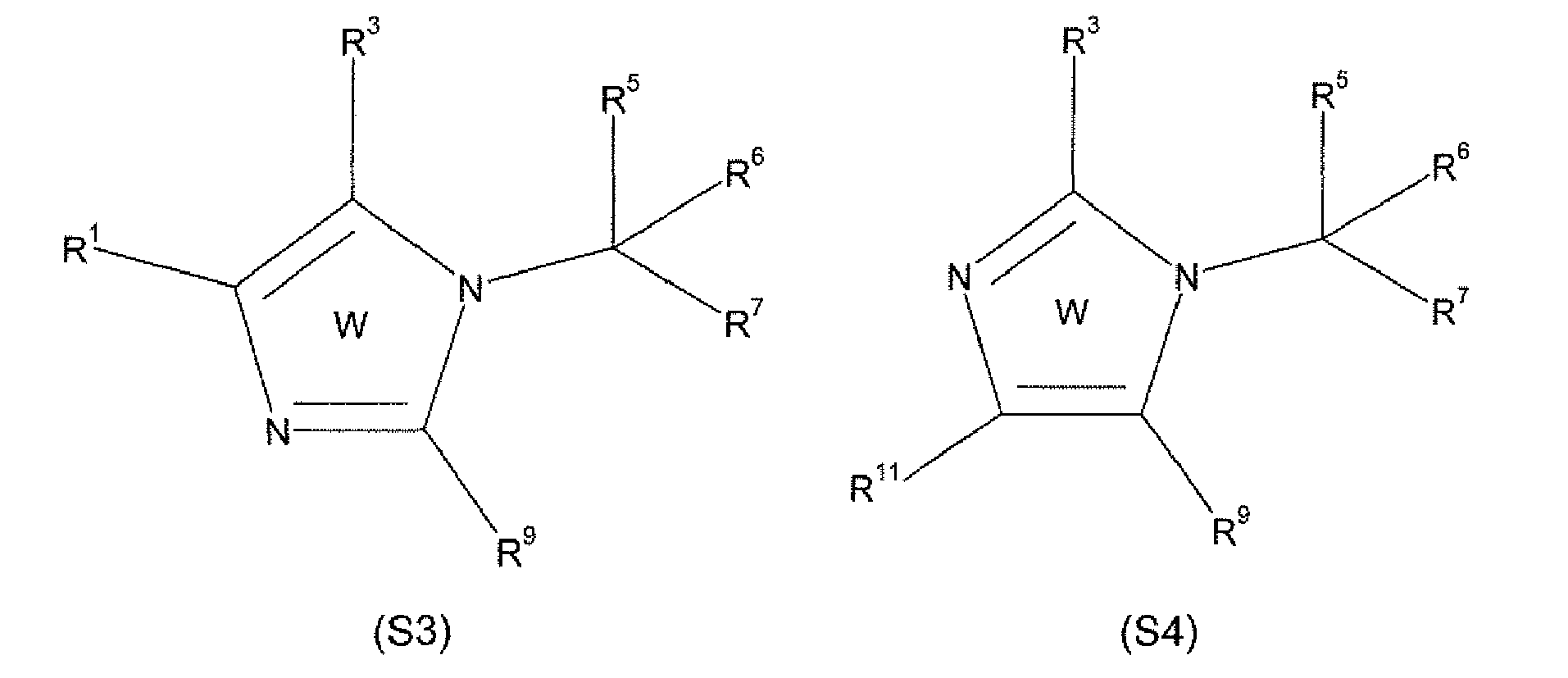 • W represents a substituted aromatic heterocycle;• R1, R9 and R11 independently represent hydrogen, -CN, -OH, -O-cycloalkyl, -O-cycloalkenyl, -O-cycloalkynyl, NH2, -NR13-cycloalkyl, -NR13-cycloalkenyl, -NR13-cycloalkynyl, -S-cycloalkyl, -S-cycloalkenyl, -S-cycloalkynyl, -COOH, -C(O)NH2, -CF3, -SO2NH2 -NHSO2NH2 -NHC(O)NH2, -OC(O)NH2, halogen, alkyl, alkenyl, alkynyl, heteroalkyl, heteroalkenyl, heteroalkynyl, aryl, -O-aryl, -NR13-aryl, -S-aryl, arylalkyl, arylalkenyl, arylalkynyl, arylheteroalkyl, arylheteroalkenyl, arylheteroalkynyl, cycloalkyl, cycloalkenyl, cycloalkynyl, heterocycle, -O-heterocycle, -NR13-heterocycle, -S-heterocycle, heterocyclyl-alkyl, heterocyclyl-alkenyl, heterocyclyl-alkynyl, heterocyclyl-heteroalkyl, heterocyclyl-heteroalkenyl, heterocyclyl-heteroalkynyl, non-substituted or substituted by at least one T1,
wherein a carbon atom or a heteroatom of said alkyl, alkenyl, alkynyl, heteroalkyl, heteroalkenyl, heteroalkynyl, aryl, arylalkyl, arylalkenyl, arylalkynyl, arylheteroalkyl, arylheteroalkenyl, arylheteroalkynyl, cycloalkyl, cycloalkenyl, cycloalkynyl, heterocycle, heterocyclyl-alkyl, heterocyclyl-alkenyl, heterocyclyl-alkynyl, heterocyclyl-heteroalkyl, heterocyclyl-heteroalkenyl, heterocyclyl-heteroalkynyl can be oxidized to form a C=O, C=S, N=O, N=S, S=O or S(O)2,
and wherein the aryl, arylalkyl, arylalkenyl, arylalkynyl, arylheteroalkyl, arylheteroalkenyl, arylheteroalkynyl, cycloalkyl, cycloalkenyl, cycloalkynyl, heterocycle, heterocyclyl-alkyl, heterocyclyl-alkenyl, heterocyclyl-alkynyl, heterocyclyl-heteroalkyl, heterocyclyl-heteroalkenyl, or heterocyclyl-heteroalkynyl group can be fused with at least one further cycle ;
and wherein the alkyl, alkenyl, alkynyl, arylalkyl, arylalkenyl, arylalkynyl, cycloalkyl, cycloalkenyl, cycloalkynyl, heterocyclyl-alkyl, heterocyclyl-alkenyl, heterocyclyl-alkynyl group can include one or more heteroatoms, selected from O, S and N, in the alkyl, alkenyl, alkynyl moiety ;• R3 represents -O-cycloalkyl, -O-cycloalkenyl, -O-cycloalkynyl, -NR13-cycloalkyl, -NR13-cycloalkenyl, -NR13-cycloafkynyl, -S-cycloalkyl, -S-cycloalkenyl, -S-cycloalkynyl, alkyl, alkenyl, alkynyl, heteroalkyl, heteroalkenyl, heteroalkynyl, aryl, -O-aryl, -NR13-aryl, -S-aryl, arylalkyl, arylalkenyl, arylalkynyl, arylheteroalkyl, arylheteroalkenyl, arylheteroalkynyl, cycloalkyl, cycloalkenyl, cycloalkynyl, heterocycle, -O-heterocycle, - NR13-heterocycle, -S-heterocycle, heterocyclyl-alkyl, heterocyclyl-alkenyl, heterocyclyl-alkynyl, heterocyclyl-heteroalkyl, heterocyclyl-heteroalkenyl, heterocyclyl-heteroalkynyl, non-substituted or substituted by at least one T1,
wherein a carbon atom or heteroatom of said alkyl, alkenyl, alkynyl, heteroalkyl, heteroalkenyl, heteroalkynyl, aryl, arylalkyl, arylalkenyl, arylalkynyl, arylheteroalkyl, arylheteroalkenyl, arylheteroalkynyl, cycloalkyl, heterocycle, heterocyclyl-alkyl, heterocylyl-alkenyl, heterocyclyl-alkynyl, heterocyclyl-heteroalkyl, heterocylyl-heteroalkenyl, heterocyclyl-heteroalkynyl can be oxidized to form a C=O, C=S, N=O, N=S, S=O or S(O)2,
and wherein the aryl, arylalkyl, arylalkenyl, arylalkynyl, arylheteroalkyl, arylheteroalkenyl, arylheteroalkynyl, cycloalkyl, cycloalkenyl, cycloalkynyl, heterocycle, heterocyclyl-alkyl, heterocyclyl-alkenyl, heterocyclyl-alkynyl, heterocyclyl-heteroalkyl, heterocyclyl-heteroalkenyl, or heterocyclyl-heteroalkynyl can be fused with at least one further cycle,
and wherein alkyl, alkenyl, alkynyl, arylalkyl, arylalkenyl, arylalkynyl, cycloalkyl, cycloalkenyl, cycloalkynyl, heterocyclyl-alkyl, heterocyclyl-alkenyl, heterocyclyl-alkynyl group can include one or more heteroatoms, selected from O, S and N, in the alkyl, alkenyl, alkynyl moiety ;• R5 or R6 identical, or different, independently represent hydrogen, halogen, -CN, -O-cycloalkyl, -O-cycloalkenyl, -O-cycloalkynyl, -NR13-cycloalkyl, -NR13-cycloalkenyl, - NR13-cycloalkynyl, -S-cycloalkyl, -S-cycloalkenyl, -S-cycloalkynyl, alkyl, alkenyl, alkynyl, heteroalkyl, heteroalkenyl, heteroalkynyl, aryl, -O-aryl, -NR13-aryl, -S-aryl, arylalkyl, arylalkenyl, arylalkynyl, arylheteroalkyl, arylheteroalkenyl, arylheteroalkynyl, cycloalkyl, cycloalkenyl, cycloalkynyl, heterocycle, -O-heterocycle, -NR13-heterocycle, -S-heterocycle, heterocyclyl-alkyl, heterocyclyl-alkenyl, heterocyclyl-alkynyl, heterocyclyl-heteroalkyl, heterocyclyl-heteroalkenyl, heterocyclyl-heteroalkynyl, non-substituted or substituted by at least one T2,
and wherein a carbon atom or heteroatom of said alkyl, alkenyl, alkynyl, heteroalkyl, heteroalkenyl, heteroalkynyl, aryl, arylalkyl, arylalkenyl, arylalkynyl, arylheteroalkyl, arylheteroalkenyl, arylheteroalkynyl, cycloalkyl, heterocycle, heterocyclyl-alkyl, heterocyclyl-alkenyl, heterocyclyl-alkynyl, heterocyclyl-heteroalkyl, heterocyclyl-heteroalkenyl, heterocyclyl-heteroalkynylcan be oxidized to form a C=O, C=S, N=O, N=S, S=O or S(O)2,
and wherein alkyl, alkenyl, alkynyl, arylalkyl, arylalkenyl, arylalkynyl, cycloalkyl, cycloalkenyl, cycloalkynyl, heterocyclyl-alkyl, heterocyclyl-alkenyl, heterocyclyl-alkynyl group can include one or more heteroatoms, selected from O, S and N, in the alkyl, alkenyl, alkynyl moiety,
R5 and R6 form with the carbon atom a 3- to 7-membered carbocycle or heterocycle, wherein the carbocycle or heterocycle is fused with at least one further cycle, or
R5 and R6 form a group of formula (i) • R7 represents independently -C(O)OH, -CN, -C(O)NH2, -C(O)OR13, -C(O)NHCN, - C(O)NHOH, -S(O)2OH, -S(O)2NHR13, -P(O)(OH)NH2, -P(O)(OH)O-alkyl, -P(O)(O-alkyl)2, -P(O)(OH)2, -OSO3H, -NR13SO3H, a tetrazolyl group ;• R13 represents hydrogen, alkyl or aryl,
wherein a carbon atom of said alkyl or aryl can be oxidized to form a C=O, C=S, N=O, N=S, S=O or S(O)2;• T1 represents hydrogen, halogen, -OT3, -OCF3, =O, -ST3, =S, -S(O)T4, -S(O)2T4, - S(O)2NT5T6, CF3, NO2, -NT5T6, -NT3S(O)2T4, -CN, -NT3C(O)T4, -NT3C(O)NT5T6, - C(O)OT3, -C(O)NT5T6, -C(O)T4, alkyl, alkenyl, alkynyl, heteroalkyl, heteroalkenyl, heteroalkynyl, aryl, arylalkyl, arylalkenyl, arylalkynyl, arylheteroalkyl, arylheteroalkenyl, arylheteroalkynyl, cycloalkyl, cycloalkenyl, cycloalkynyl, heterocycle, heterocyclyl-alkyl, heterocyclyl-alkenyl, heterocyclyl-alkynyl, heterocyclyl-heteroalkyl, heterocyclyl-heteroalkenyl, heterocyclyl-heteroalkynyl,
wherein said alkyl, alkenyl, alkynyl, heteroalkyl, heteroalkenyl, heteroalkynyl, aryl, arylalkyl, arylalkenyl, arylalkynyl, arylheteroalkyl, arylheteroalkenyl, arylheteroalkynyl, cycloalkyl, cycloalkenyl, cycloalkynyl, heterocycle, heterocyclyl-alkyl, heterocylyl-alkenyl, heterocyclyl-alkynyl, heterocyclyl-heteroalkyl, heterocylyl-heteroalkenyl, heterocyclyl-heteroalkynyl can be substituted with one or more T7,
wherein a carbon atom or heteroatom of said alkyl, alkenyl, alkynyl, heteroalkyl, heteroalkenyl, heteroalkynyl, aryl, arylalkyl, arylalkenyl, arylalkynyl, arylheteroalkyl, arylheteroalkenyl, arylheteroalkynyl, cycloalkyl, cycloalkenyl, cycloalkynyl, heterocycle, heterocyclyl-alkyl, heterocyclyl-alkenyl, heterocyclyl-alkynyl, heterocyclyl-heteroalkyl, heterocyclyl-heteroalkenyl, heterocyclyl-heteroalkynyl can be oxidized to form a C=O, C=S, N=O, N=S, S=O or S(O)2:• T2 represents hydrogen, halogen, -OT8, -OCF3, =O, -ST8, =S, -S(O)T9, -S(O)2T9, - S(O)2NT10T11, -CF3, -NO2, -NT10T11, -NT8S(O)2T9, -CN, -NT8C(O)T9, -NT8C(O)NT10T11, -C(O)OT8, -C(O)NT10T11, -C(O)T9, alkyl, alkenyl, alkynyl, heteroalkyl, heteroalkenyl, heteroalkynyl, aryl, arylalkyl, arylalkenyl, arylalkynyl, arylheteroalkyl, arylheteroalkenyl, arylheteroalkynyl, cycloalkyl, cycloalkenyl, cycloalkynyl, heterocycle, heterocyclyl-alkyl, heterocyclyl-alkenyl, heterocyclyl-alkynyl, heterocyclyl-heteroalkyl, heterocyclyl-heteroalkenyl, heterocyclyl-heteroalkynyl,
wherein said alkyl, alkenyl, alkynyl, heteroalkyl, heteroalkenyl, heteroalkynyl, aryl, arylalkyl, arylalkenyl, arylalkynyl, arylheteroalkyl, arylheteroalkenyl, arylheteroalkynyl, cycloalkyl, cycloalkenyl, cycloalkynyl, heterocycle, heterocyclyl-alkyl, heterocylyl-alkenyl, heterocyclyl-alkynyl, heterocyclyl-heteroalkyl, heterocylyl-heteroalkenyl, heterocyclyl-heteroalkynyl can be substituted with one or more T7,
wherein a carbon atom or heteroatom of said alkyl, alkenyl, alkynyl, heteroalkyl, heteroalkenyl, heteroalkynyl, aryl, arylalkyl, arylalkenyl, arylalkynyl, arylheteroalkyl, arylheteroalkenyl, arylheteroalkynyl, cycloalkyl, cycloalkenyl, cycloalkynyl, heterocycle, heterocyclyl-alkyl, heterocyclyl-alkenyl, heterocyclyl-alkynyl, heterocyclyl-heteroalkyl, heterocyclyl-heteroalkenyl, heterocyclyl-heteroalkynyl can be oxidized to form a C=O, C=S, N=O, N=S, S=O or S(O)2 ;• T3 represents hydrogen, alkyl, alkenyl, alkynyl, heteroalkyl, heteroalkenyl, heteroalkynyl, aryl, heterocycle,
wherein said alkyl, alkenyl, alkynyl, heteroalkyl, heteroalkenyl, heteroalkynyl, aryl, heterocycle can be substituted or non substituted with one or more -OH, =O, halogen, -SH, =S, -CF3, -O-alkyl, -OCF3, -CN, -NO2, -C(O)OH, -NH2 or C(O)NH2,
and wherein a carbon atom or heteroatom of said alkyl, alkenyl, alkynyl, heteroalkyl, heteroalkenyl, heteroalkynyl, aryl, heterocycle can be oxidized to form a C=O, C=S, N=O, N=S, S=O or S(O)2 ;• T4 represents OH, alkyl, alkenyl, alkynyl, heteroalkyl, heteroalkenyl, heteroalkynyl, aryl, heterocycle,
wherein said alkyl, alkenyl, alkynyl, heteroalkyl, heteroalkenyl, heteroalkynyl, aryl, heterocycle, can be substituted or non substituted with one or more -OH, =O, halogen, -SH, =S, -CF3, -O-alkyl, -OCF3, -CN, -NO2, -C(O)OH, -NH2 or C(O)NH2,
and wherein a carbon atom or heteroatom of said alkyl, alkenyl, alkynyl, heteroalkyl, heteroalkenyl, heteroalkynyl aryl, heterocycle can be oxidized to form a C=O, C=S, N=O, N=S, S=O or S(O)2 ;• T5 or T6 independently represent hydrogen, alkyl, alkenyl, alkynyl, heteroalkyl, heteroalkenyl, heteroalkynyl, aryl, heterocycle,
wherein said alkyl, alkenyl, alkynyl, heteroalkyl, heteroalkenyl, heteroalkynyl, aryl, heterocycle can be substituted or non substituted with one or more -OH, =O, halogen, -SH, =S, -CF3, -O-alkyl, -OCF3, -CN, -NO2, -C(O)OH, -NH2 or C(O)NH2,
and wherein a carbon atom or heteroatom of said alkyl, alkenyl, alkynyl, heteroalkyl, heteroalkenyl, heteroalkynyl aryl, heterocycle can be oxidized to form a C=O, C=S, N=O, N=S, S=O or S(O)2,
or T5 or T6 can be taken together to form a 4, 5, 6 or 7 membered heterocycle substituted or non substituted with an alkyl, alkenyl, alkynyl, heteroalkyl, heteroalkenyl, heteroalkynyl, -OH, halogen, -SH, -CF3, -O-alkyl, -OCF3, -CN, -NO2, - C(O)OH, -NH2 or -C(O)NH2 ;• T7 represents an alkyl, alkenyl, alkynyl, heteroalkyl, heteroalkenyl, heteroalkynyl, -OH, =O, halogen, -SH, =S, -CF3, -CN, -NO2, -COOH, -NH2, -C(O)NH2 ;• T8 represents hydrogen, alkyl, alkenyl, alkynyl, heteroalkyl, heteroalkenyl, heteroalkynyl,
wherein said alkyl, alkenyl, alkynyl, heteroalkyl, heteroalkenyl, heteroalkynyl, can be substituted or non substituted with one or more -OH, =O, halogen, -SH, =S, -CF3, -O-alkyl, -OCF3, -CN, -NO2, -C(O)OH, -NH2 or -C(O)NH2,
and wherein a carbon atom or heteroatom of said alkyl, alkenyl, alkynyl, heteroalkyl, heteroalkenyl, heteroalkynyl can be oxidized to form a C=O, C=S, N=O, N=S, S=O or S(O)2 ;• T9 represents -OH, alkyl, alkenyl, alkynyl, heteroalkyl, heteroalkenyl, heteroalkynyl, wherein said alkyl, alkenyl, alkynyl, heteroalkyl, heteroalkenyl, heteroalkynyl, can be substituted or non substituted with one or more -OH, =O, halogen, -SH, =S, -CF3, -O-alkyl, -OCF3, -CN, -NO2, -C(O)OH, -NH2 or -C(O)NH2,
and wherein a carbon atom or heteroatom of said alkyl, alkenyl, alkynyl, heteroalkyl, heteroalkenyl, heteroalkynyl, can be oxidized to form a C=O, C=S, N=O, N=S, S=O or S(O)2 ;• T10 or T11 independently represent hydrogen, alkyl, alkenyl, alkynyl, heteroalkyl, heteroalkenyl, heteroalkynyl,
wherein said alkyl, alkenyl, alkynyl, heteroalkyl, heteroalkenyl, heteroalkynyl, can be substituted or non substituted with one or more -OH, =O, halogen, -SH, =S, -CF3, -O-alkyl, -OCF3, -CN, -NO2, -C(O)OH, -NH2 or -C(O)NH2,
and wherein a carbon atom or heteroatom of said alkyl, alkenyl, alkynyl, heteroalkyl, heteroalkenyl, heteroalkynyl can be oxidized to form a C=O, C=S, N=O, N=S, S=O or S(O)2.
or T10 or T11 can be taken together to form a 4, 5, 6 or 7 membered heterocycle substituted or non substituted with an alkyl, alkenyl, alkynyl, heteroalkyl, heteroalkenyl, heteroalkynyl, -OH, halogen, -SH, -CF3, O-alkyl, -OCF3, -CN, -N02, - C(O)OH, -NH2 or -C(O)NH2. - Compound according to claim 1 that is of formula (T)
 • W represents a substituted, saturated carbo- or heterocycle• a, b, c, d, e, f, g, and h, independently represent 0 or 1 ;• Q1 represents CR1, CR2, CR1R2, N, NR1, NR2, S, O ;• Q2 represents CR3, CR3R4, NR3 ;• Q3 represents CCR5R6R7, CR8CR5R6R7, NCR5R6R7 ;• Q4 represents CR9, CR10, CR9R10, N, NR9, NR10, S, O ;• Q5 represents CR11, CR12, CR11R12, N, NR11, NR12, S, O ;• R1, R2, R9, R10, R11 and R12 independently represent hydrogen, -CN, -OH, -O-cycloalkyl, -O-cycloalkenyl, -O-cycloalkynyl, NH2, -NR13-cycloalkyl, -NR13-cycloalkenyl, -NR13-cycloalkynyl, -S-cycloalkyl, -S-cycloalkenyl, -S-cycloalkynyl, -COOH, -C(O)NH2, -CF3, -SO2NH2, -NHSO2NH2, -NHC(O)NH2, -OC(O)NH2, halogen, alkyl, alkenyl, alkynyl, heteroalkyl, heteroalkenyl, heteroalkynyl, aryl, -O-aryl, -NR13-aryl, -S-aryl, arylalkyl, arylalkenyl, arylalkynyl, arylheteroalkyl, arylheteroalkenyl, arylheteroalkynyl, cycloalkyl, cycloalkenyl, cycloalkynyl, heterocycle, -O-heterocycle, -NR13-heterocycle, -S-heterocycle, heterocyclyl-alkyl, heterocyclyl-alkenyl, heterocyclyl-alkynyl, heterocyclyl-heteroalkyl, heterocyclyl-heteroalkenyl, heterocyclyl-heteroalkynyl, non-substituted or substituted by at least one T1,
wherein a carbon atom or a heteroatom of said alkyl, alkenyl, alkynyl, heteroalkyl, heteroalkenyl, heteroalkynyl, aryl, arylalkyl, arylalkenyl, arylalkynyl, arylheteroalkyl, arylheteroalkenyl, arylheteroalkynyl, cycloalkyl, cycloalkenyl, cycloalkynyl, heterocycle, heterocyclyl-alkyl, heterocyclyl-alkenyl, heterocyclyl-alkynyl, heterocyclyl-heteroalkyl, heterocyclyl-heteroalkenyl, heterocyclyl-heteroalkynyl can be oxidized to form a C=O, C=S, N=O, N=S, S=O or S(O)2,
and wherein the aryl, arylalkyl, arylalkenyl, arylalkynyl, arylheteroalkyl, arylheteroalkenyl, arylheteroalkynyl, cycloalkyl, cycloalkenyl, cycloalkynyl, heterocycle, heterocyclyl-alkyl, heterocyclyl-alkenyl, heterocyclyl-alkynyl, heterocyclyl-heteroalkyl, heterocyclyl-heteroalkenyl, or heterocyclyl-heteroalkynyl group can be fused with at least one further cycle ;
and wherein the alkyl, alkenyl, alkynyl, arylalkyl, arylalkenyl, arylalkynyl, cycloalkyl, cycloalkenyl, cycloalkynyl, heterocyclyl-alkyl, heterocyclyl-alkenyl, heterocyclyl-alkynyl group can include one or more heteroatoms, selected from O, S and N, in the alkyl, alkenyl, alkynyl moiety ;• R3 represents -O-cycloalkyl, -O-cycloalkenyl, -O-cycloalkynyl, -NR13-cycloalkyl, -NR13-cycloalkenyl, -NR13-cycloalkynyl, -S-cycloalkyl, -S-cycloalkenyl, -S-cycloalkynyl, alkyl, alkenyl, alkynyl, heteroalkyl, heteroalkenyl, heteroalkynyl, aryl, -O-aryl, -NR13-aryl, -S-aryl, arylalkyl, arylalkenyl, arylalkynyl, arylheteroalkyl, arylheteroalkenyl, arylheteroalkynyl, cycloalkyl, cycloalkenyl, cycloalkynyl, heterocycle, -O-heterocycle, - NR13-heterocycle, -S-heterocycle, heterocyclyl-alkyl, heterocyclyl-alkenyl, heterocyclyl-alkynyl, heterocyclyl-heteroalkyl, heterocyclyl-heteroalkenyl, heterocyclyl-heteroalkynyl, non-substituted or substituted by at least one T1,
wherein a carbon atom or heteroatom of said alkyl, alkenyl, alkynyl, heteroalkyl, heteroalkenyl, heteroalkynyl, aryl, arylalkyl, arylalkenyl, arylalkynyl, arylheteroalkyl, arylheteroalkenyl, arylheteroalkynyl, cycloalkyl, heterocycle, heterocyclyl-alkyl, heterocylyl-alkenyl, heterocyclyl-alkynyl, heterocyclyl-heteroalkyl, heterocylyl-heteroalkenyl, heterocyclyl-heteroalkynyl can be oxidized to form a C=O, C=S, N=O, N=S, S=O or S(O)2,
and wherein the aryl, arylalkyl, arylalkenyl, arylalkynyl, arylheteroalkyl, arylheteroalkenyl, arylheteroalkynyl, cycloalkyl, cycloalkenyl, cycloalkynyl, heterocycle, heterocyclyl-alkyl, heterocyclyl-alkenyl, heterocyclyl-alkynyl, heterocyclyl-heteroalkyl, heterocyclyl-heteroalkenyl, or heterocyclyl-heteroalkynyl can be fused with at least one further cycle,
and wherein alkyl, alkenyl, alkynyl, arylalkyl, arylalkenyl, arylalkynyl, cycloalkyl, cycloalkenyl, cycloalkynyl, heterocyclyl-alkyl, heterocyclyl-alkenyl, heterocyclyl-alkynyl group can include one or more heteroatoms, selected from O, S and N, in the alkyl, alkenyl, alkynyl moiety;• R4 represents hydrogen, -OH, alkyl, O-alkyl,
wherein a carbon atom or heteroatom of said alkyl, can be oxidized to form a C=O, C=S, N=O, N=S, S=O or S(O)2,
and wherein alkyl group can include one or more heteroatoms, selected from O, S and N ;● R5 or R6 identical, or different, independently represent hydrogen, halogen, -CN, -O-cycloalkyl, -O-cycloalkenyl, -O-cycloalkynyl, -NR13-cycloalkyl, -NR13-cycloalkenyl, - NR13-cycloalkynyl, -S-cycloalkyl, -S-cycloalkenyl, -S-cycloalkynyl, alkyl, alkenyl, alkynyl, heteroalkyl, heteroalkenyl, heteroalkynyl, aryl, -O-aryl, -NR13-aryl, -S-aryl, arylalkyl, arylalkenyl, arylalkynyl, arylheteroalkyl, arylheteroalkenyl, arylheteroalkynyl, cycloalkyl, cycloalkenyl, cycloalkynyl, heterocycle, -O-heterocycle, -NR13-heterocycle, -S-heterocycle, heterocyclyl-alkyl, heterocyclyl-alkenyl, heterocyclyl-alkynyl, heterocyclyl-heteroalkyl, heterocyclyl-heteroalkenyl, heterocyclyl-heteroalkynyl, non-substituted or substituted by at least one T2,
and wherein a carbon atom or heteroatom of said alkyl, alkenyl, alkynyl, heteroalkyl, heteroalkenyl, heteroalkynyl, aryl, arylalkyl, arylalkenyl, arylalkynyl, arylheteroalkyl, arylheteroalkenyl, arylheteroalkynyl, cycloalkyl, heterocycle, heterocyclyl-alkyl, heterocyclyl-alkenyl, heterocyclyl-alkynyl, heterocyclyl-heteroalkyl, heterocyclyl-heteroalkenyl, heterocyclyl-heteroalkynylcan be oxidized to form a C=O, C=S, N=O, N=S, S=O or S(O)2,
and wherein alkyl, alkenyl, alkynyl, arylalkyl, arylalkenyl, arylalkynyl, cycloalkyl, cycloalkenyl, cycloalkynyl, heterocyclyl-alkyl, heterocyclyl-alkenyl, heterocyclyl-alkynyl group can include one or more heteroatoms, selected from O, S and N, in the alkyl, alkenyl, alkynyl moiety,
R5 and R6 form with the carbon atom a 3- to 7-membered carbocycle or heterocycle, wherein the carbocycle or heterocycle is fused with at least one further cycle, or
R5 and R6 form a group of formula (i) ● R7 represents independently -C(O)OH, -CN, -C(O)NH2, -C(O)OR13, -C(O)NHCN, - C(O)NHOH, -S(O)2OH, -S(O)2NHR13, -P(O)(OH)NH2, -P(O)(OH)O-alkyl, -P(O)(O-alkyl)2, -P(O)(OH)2, -OSO3H -NR13SO3H, a tetrazolyl group ;● R8 represents hydrogen, alkyl ;● R13 represents hydrogen, alkyl or aryl,
wherein a carbon atom of said alkyl or aryl can be oxidized to form a C=O, C=S, N=O, N=S, S=O or S(O)2 ;● T1 represents hydrogen, halogen, -OT3, -OCF3, =O, -ST3, =S, -S(O)T4, -S(O)2T4, - S(O)2NT5T6, CF3, NO2 -NT5T6, -NT3S(O)2T4, -CN, -NT3C(O)T4, -NT3C(O)NT5T6, - C(O)OT3, -C(O)NT5T6, -C(O)T4, alkyl, alkenyl, alkynyl, heteroalkyl, heteroalkenyl, heteroalkynyl, aryl, arylalkyl, arylalkenyl, arylalkynyl, arylheteroalkyl, arylheteroalkenyl, arylheteroalkynyl, cycloalkyl, cycloalkenyl, cycloalkynyl, heterocycle, heterocyclyl-alkyl, heterocyclyl-alkenyl, heterocyclyl-alkynyl, heterocyclyl-heteroalkyl, heterocyclyl-heteroalkenyl, heterocyclyl-heteroalkynyl,
wherein said alkyl, alkenyl, alkynyl, heteroalkyl, heteroalkenyl, heteroalkynyl, aryl, arylalkyl, arylalkenyl, arylalkynyl, arylheteroalkyl, arylheteroalkenyl, arylheteroalkynyl, cycloalkyl, cycloalkenyl, cycloalkynyl, heterocycle, heterocyclyl-alkyl, heterocylyl-alkenyl, heterocyclyl-alkynyl, heterocyclyl-heteroalkyl, heterocylyl-heteroalkenyl, heterocyclyl-heteroalkynyl can be substituted with one or more T7,
wherein a carbon atom or heteroatom of said alkyl, alkenyl, alkynyl, heteroalkyl, heteroalkenyl, heteroalkynyl, aryl, arylalkyl, arylalkenyl, arylalkynyl, arylheteroalkyl, arylheteroalkenyl, arylheteroalkynyl, cycloalkyl, cycloalkenyl, cycloalkynyl, heterocycle, heterocyclyl-alkyl, heterocyclyl-alkenyl, heterocyclyl-alkynyl, heterocyclyl-heteroalkyl, heterocyclyl-heteroalkenyl, heterocyclyl-heteroalkynyl can be oxidized to form a C=O, C=S, N=O, N=S, S=O or S(O)2 ;● T2 represents hydrogen, halogen, -OT8, -OCF3, =O -ST8, =S, -S(O)T9, -S(O)2T9, S(O)2NT10T11 , -CF3, -NO2, -NT10T11, -NT8S(O)2T9, -CN, -NT8C(O)T9, -NT8C(O)NT10T11, -C(O)OT8, -C(O)NT10T11, -C(O)T9, alkyl, alkenyl, alkynyl, heteroalkyl, heteroalkenyl, heteroalkynyl, aryl, arylalkyl, arylalkenyl, arylalkynyl, arylheteroalkyl, arylheteroalkenyl, arylheteroalkynyl, cycloalkyl, cycloalkenyl, cycloalkynyl, heterocycle, heterocyclyl-alkyl, heterocyclyl-alkenyl, heterocyclyl-alkynyl, heterocyclyl-heteroalkyl, heterocyclyl-heteroalkenyl, heterocyclyl-heteroalkynyl,
wherein said alkyl, alkenyl, alkynyl, heteroalkyl, heteroalkenyl, heteroalkynyl, aryl, arylalkyl, arylalkenyl, arylalkynyl, arylheteroalkyl, arylheteroalkenyl, arylheteroalkynyl, cycloalkyl, cycloalkenyl, cycloalkynyl, heterocycle, heterocyclyl-alkyl, heterocylyl-alkenyl, heterocyclyl-alkynyl, heterocyclyl-heteroalkyl, heterocylyl-heteroalkenyl, heterocyclyl-heteroalkynyl can be substituted with one or more T7,
wherein a carbon atom or heteroatom of said alkyl, alkenyl, alkynyl, heteroalkyl, heteroalkenyl, heteroalkynyl, aryl, arylalkyl, arylalkenyl, arylalkynyl, arylheteroalkyl, arylheteroalkenyl, arylheteroalkynyl, cycloalkyl, cycloalkenyl, cycloalkynyl, heterocycle, heterocyclyl-alkyl, heterocyclyl-alkenyl, heterocyclyl-alkynyl, heterocyclyl-heteroalkyl, heterocyclyl-heteroalkenyl, heterocyclyl-heteroalkynyl can be oxidized to form a C=O, C=S, N=O, N=S, S=O or S(O)2 ;● T3 represents hydrogen, alkyl, alkenyl, alkynyl, heteroalkyl, heteroalkenyl, heteroalkynyl, aryl, heterocycle,
wherein said alkyl, alkenyl, alkynyl, heteroalkyl, heteroalkenyl, heteroalkynyl, aryl, heterocycle can be substituted or non substituted with one or more -OH, =O, halogen, -SH, =S, -CF3, -O-alkyl, -OCF3, -CN, -NO2, -C(O)OH, -NH2 or C(O)NH2,
and wherein a carbon atom or heteroatom of said alkyl, alkenyl, alkynyl, heteroalkyl, heteroalkenyl, heteroalkynyl, aryl, heterocycle can be oxidized to form a C=O, C=S, N=O, N=S, S=O or S(O)2 ;● T4 represents -OH, alkyl, alkenyl, alkynyl, heteroalkyl, heteroalkenyl, heteroalkynyl, aryl, heterocycle,
wherein said alkyl, alkenyl, alkynyl, heteroalkyl, heteroalkenyl, heteroalkynyl, aryl, heterocycle, can be substituted or non substituted with one or more -OH, =O, halogen, -SH, =S, -CF3, -O-alkyl, -OCF3, -CN, -NO2, -C(O)OH, -NH2 or C(O)NH2, and wherein a carbon atom or heteroatom of said alkyl, alkenyl, alkynyl, heteroalkyl, heteroalkenyl, heteroalkynyl aryl, heterocycle can be oxidized to form a C=O, C=S, N=O, N=S, S=O or S(O)2;● T5 or T6 independently represent hydrogen, alkyl, alkenyl, alkynyl, heteroalkyl, heteroalkenyl, heteroalkynyl, aryl, heterocycle
wherein said alkyl, alkenyl, alkynyl, heteroalkyl, heteroalkenyl, heteroalkynyl, aryl, heterocycle can be substituted or non substituted with one or more -OH, =O, halogen, -SH, =S, -CF3, -O-alkyl, -OCF3, -CN, -NO2, -C(O)OH, -NH2 or -C(O)NH2,
and wherein a carbon atom or heteroatom of said alkyl, alkenyl, alkynyl, heteroalkyl, heteroalkenyl, heteroalkynyl aryl, heterocycle can be oxidized to form a C=O, C=S, N=O, N=S, S=O or S(O)2,
or T5 or T6 can be taken together to form a 4, 5, 6 or 7 membered heterocycle substituted or non substituted with an alkyl, alkenyl, alkynyl, heteroalkyl, heteroalkynyl, heteroalkynyl, -OH, halogen, -SH, -CF3, -O-alkyl, -OCF3, -CN, -NO2, C(O)OH, -NH2 or -C(O)NH2;● T7 represents an alkyl, alkenyl, alkynyl, heteroalkyl, heteroalkenyl, heteroalkynyl, -OH, =O, halogen, -SH, =S, -CF3, -CN, -NO2 -COOH, -NH2, -C(O)NH2 ;● T8 represents hydrogen, alkyl, alkenyl, alkynyl, heteroalkyl, heteroalkenyl, heteroalkynyl,
wherein said alkyl, alkenyl, alkynyl, heteroalkyl, heteroalkenyl, heteroalkynyl, can be substituted or non substituted with one or more -OH, =O, halogen, -SH, =S, -CF3, -O-alkyl, -OCF3, -CN, -NO2, -C(O)OH, -NH2 or -C(O)NH2,
and wherein a carbon atom or heteroatom of said alkyl, alkenyl, alkynyl, heteroalkyl, heteroalkenyl, heteroalkynyl can be oxidized to form a C=O, C=S, N=O, N=S, S=O or S(O)2 ;● T9 represents -OH, alkyl, alkenyl, alkynyl, heteroalkyl, heteroalkenyl, heteroalkynyl, wherein said alkyl, alkenyl, alkynyl, heteroalkyl, heteroalkenyl, heteroalkynyl, can be substituted or non substituted with one or more -OH, =O, halogen, -SH, =S, -CF3, -O-alkyl, -OCF3, -CN, -NO2 -C(O)OH, -NH2 or -C(O)NH2,
and wherein a carbon atom or heteroatom of said alkyl, alkenyl, alkynyl, heteroalkyl, heteroalkenyl, heteroalkynyl can be oxidized to form a C=O, C=S, N=O, N=S, S=O or S(O)2 ;● T10 or T11 independently represent hydrogen, alkyl, alkenyl, alkynyl, heteroalkyl, heteroalkenyl, heteroalkynyl,
wherein said alkyl, alkenyl, alkynyl, heteroalkyl, heteroalkenyl, heteroalkynyl, can be substituted or non substituted with one or more -OH, =O, halogen, -SH, =S, -CF3, -O-alkyl, -OCF3, -CN, -NO2, -C(O)OH, -NH2 or -C(O)NH2,
and wherein a carbon atom or heteroatom of said alkyl, alkenyl, alkynyl, heteroalkyl, heteroalkenyl, heteroalkynyl can be oxidized to form a C=O, C=S, N=O, N=S, S=O or S(O)2,
or T10 or T11 can be taken together to form a 4, 5, 6 or 7 membered heterocycle substituted or non substituted with an alkyl, alkenyl, alkynyl, heteroalkyl, heteroalkenyl, heteroalkynyl, -OH, halogen, -SH, -CF3, O-alkyl, -OCF3, -CN, -N02, - C(O)OH, -NH2 or -C(O)NH2. - Compound according to any of the preceding claims wherein R7 represents -C(O)OR13.
- Compound according to any of the preceding claims wherein R6 represents hydrogen.
- Compound according to any of the preceding claims for use as a medicine.
- Compound according to claim 16 for use as a medicine for the prevention or treatment of a viral infection.
- Compound according to claim 17 for use as a medicine for the prevention or treatment of a retroviral infection.
- Compound according to claim 18 for use as a medicine for the prevention or treatment of HIV.
- Compound according to any of claims 1 to 15 for the manufacture of a medicament.
- Compound according to claim 20 wherein the medicament is for the prevention or treatment of a viral infection.
- Compound according to claim 21 wherein the medicament is for the prevention or treatment of a retroviral infection.
- Compound according to claim 22 wherein the medicament is for the prevention or treatment of HIV.
- A pharmaceutical composition comprising a compound according to any of claims 1 to 15 as an active ingredient and at least a pharmaceutically acceptable carrier.
- Pharmaceutical composition according to claim 24 further comprising a further antiviral agent.
- Pharmaceutical composition according to claim 24 or 25 for use for the prevention or treatment of a viral infection.
- Pharmaceutical composition according to claim 26 for use for the prevention or treatment of a retroviral infection.
- Pharmaceutical composition according to claim 27 for use for the treatment of an HIV infection in a mammal being infected or having a risk to be infected by the HIV.
Priority Applications (12)
| Application Number | Priority Date | Filing Date | Title |
|---|---|---|---|
| EP11305406A EP2508511A1 (en) | 2011-04-07 | 2011-04-07 | Inhibitors of viral replication, their process of preparation and their therapeutical uses |
| RU2013149400/04A RU2013149400A (en) | 2011-04-07 | 2012-04-06 | VIRAL REPLICATION INHIBITORS, METHOD FOR PRODUCING THEM AND THEIR THERAPEUTIC USE |
| MX2013011691A MX2013011691A (en) | 2011-04-07 | 2012-04-06 | Inhibitors of viral replication, their process of preparation and their therapeutical uses. |
| KR1020137029527A KR20140022872A (en) | 2011-04-07 | 2012-04-06 | Inhibitors of viral replication, their process of preparation and their therapeutical uses |
| US14/110,391 US9238026B2 (en) | 2011-04-07 | 2012-04-06 | Inhibitors of viral replication, their process of preparation and their therapeutical uses |
| AU2012241003A AU2012241003A1 (en) | 2011-04-07 | 2012-04-06 | Inhibitors of viral replication, their process of preparation and their therapeutical uses |
| PCT/IB2012/051722 WO2012137181A1 (en) | 2011-04-07 | 2012-04-06 | Inhibitors of viral replication, their process of preparation and their therapeutical uses |
| JP2014503268A JP2014513074A (en) | 2011-04-07 | 2012-04-06 | Inhibitors of viral replication, methods for their preparation and their therapeutic use |
| CA2832202A CA2832202A1 (en) | 2011-04-07 | 2012-04-06 | Inhibitors of viral replication, their process of preparation and their therapeutical uses |
| BR112013025769A BR112013025769A2 (en) | 2011-04-07 | 2012-04-06 | viral replication inhibitors, their preparation process and their therapeutic uses |
| EP12718385.3A EP2694476A1 (en) | 2011-04-07 | 2012-04-06 | Inhibitors of viral replication, their process of preparation and their therapeutical uses |
| ZA2013/07442A ZA201307442B (en) | 2011-04-07 | 2013-10-04 | Inhibitors of viral replication. their process of preparation and their therapeutical uses |
Applications Claiming Priority (1)
| Application Number | Priority Date | Filing Date | Title |
|---|---|---|---|
| EP11305406A EP2508511A1 (en) | 2011-04-07 | 2011-04-07 | Inhibitors of viral replication, their process of preparation and their therapeutical uses |
Publications (1)
| Publication Number | Publication Date |
|---|---|
| EP2508511A1 true EP2508511A1 (en) | 2012-10-10 |
Family
ID=44146343
Family Applications (2)
| Application Number | Title | Priority Date | Filing Date |
|---|---|---|---|
| EP11305406A Withdrawn EP2508511A1 (en) | 2011-04-07 | 2011-04-07 | Inhibitors of viral replication, their process of preparation and their therapeutical uses |
| EP12718385.3A Withdrawn EP2694476A1 (en) | 2011-04-07 | 2012-04-06 | Inhibitors of viral replication, their process of preparation and their therapeutical uses |
Family Applications After (1)
| Application Number | Title | Priority Date | Filing Date |
|---|---|---|---|
| EP12718385.3A Withdrawn EP2694476A1 (en) | 2011-04-07 | 2012-04-06 | Inhibitors of viral replication, their process of preparation and their therapeutical uses |
Country Status (11)
| Country | Link |
|---|---|
| US (1) | US9238026B2 (en) |
| EP (2) | EP2508511A1 (en) |
| JP (1) | JP2014513074A (en) |
| KR (1) | KR20140022872A (en) |
| AU (1) | AU2012241003A1 (en) |
| BR (1) | BR112013025769A2 (en) |
| CA (1) | CA2832202A1 (en) |
| MX (1) | MX2013011691A (en) |
| RU (1) | RU2013149400A (en) |
| WO (1) | WO2012137181A1 (en) |
| ZA (1) | ZA201307442B (en) |
Cited By (2)
| Publication number | Priority date | Publication date | Assignee | Title |
|---|---|---|---|---|
| EP2821082A1 (en) | 2013-07-05 | 2015-01-07 | Laboratoire Biodim | Method of producing an inactivated lentivirus, especially HIV, vaccine, kit and method of use |
| US11198699B2 (en) | 2019-04-02 | 2021-12-14 | Aligos Therapeutics, Inc. | Compounds targeting PRMT5 |
Families Citing this family (19)
| Publication number | Priority date | Publication date | Assignee | Title |
|---|---|---|---|---|
| EP2588455B1 (en) | 2010-07-02 | 2018-04-04 | Gilead Sciences, Inc. | 2-quinolinyl-acetic acid derivatives as hiv antiviral compounds |
| MX2012015097A (en) | 2010-07-02 | 2013-05-28 | Gilead Sciences Inc | Napht- 2 -ylacetic acid derivatives to treat aids. |
| UA111841C2 (en) | 2011-04-21 | 2016-06-24 | Гіліад Сайєнсіз, Інк. | BENZOTHIAZOL COMPOUNDS AND THEIR PHARMACEUTICAL APPLICATION |
| WO2013062028A1 (en) | 2011-10-25 | 2013-05-02 | 塩野義製薬株式会社 | Hiv replication inhibitor |
| US9284323B2 (en) | 2012-01-04 | 2016-03-15 | Gilead Sciences, Inc. | Naphthalene acetic acid derivatives against HIV infection |
| US9376392B2 (en) | 2012-01-04 | 2016-06-28 | Gilead Sciences, Inc. | 2-(tert-butoxy)-2-(7-methylquinolin-6-yl) acetic acid derivatives for treating AIDS |
| UY34750A (en) | 2012-04-20 | 2013-11-29 | Gilead Sciences Inc | ? COMPOUNDS FOR HIV TREATMENT, COMPOSITIONS, PREPARATION METHODS, INTERMEDIARIES AND THERAPEUTIC METHODS ?. |
| EP2716632A1 (en) | 2012-10-05 | 2014-04-09 | Laboratoire Biodim | Inhibitors of viral replication, their process of preparation and their therapeutical uses |
| TW201441197A (en) | 2013-01-31 | 2014-11-01 | Shionogi & Co | HIV replication inhibitor |
| CN103694217A (en) * | 2013-12-20 | 2014-04-02 | 华东师范大学 | 2,4-disubstituted thiophene derivative as well as preparation method and application thereof |
| US9975906B2 (en) | 2014-05-16 | 2018-05-22 | Shionogi & Co., Ltd. | Tricyclic heterocycle derivatives having HIV replication inhibitory effect |
| RS62017B1 (en) | 2014-09-17 | 2021-07-30 | Celgene Car Llc | Mk2 inhibitors and uses thereof |
| TWI700284B (en) | 2015-05-29 | 2020-08-01 | 日商塩野義製藥股份有限公司 | Nitrogen-containing tricyclic derivertives having hiv reprication inhibitory activity |
| WO2018177995A1 (en) | 2017-03-31 | 2018-10-04 | Bayer Cropscience Aktiengesellschaft | Tricyclic carboxamides for controlling arthropods |
| WO2018177993A1 (en) | 2017-03-31 | 2018-10-04 | Bayer Cropscience Aktiengesellschaft | Pyrazoles for controlling arthropods |
| KR102866499B1 (en) | 2019-03-15 | 2025-10-02 | 더 제너럴 하스피탈 코포레이션 | Novel small molecule inhibitors of TEAD transcription factors |
| JP2021070684A (en) * | 2019-10-30 | 2021-05-06 | 東ソー株式会社 | Method of producing halogen compound |
| CN116670142A (en) | 2021-02-01 | 2023-08-29 | 细胞基因公司 | MK2 inhibitors, their synthesis and their intermediates |
| KR20260027149A (en) * | 2023-05-18 | 2026-02-27 | 엔베다 테라퓨틱스, 인크. | G protein-coupled receptor antagonists |
Citations (27)
| Publication number | Priority date | Publication date | Assignee | Title |
|---|---|---|---|---|
| US3271407A (en) * | 1965-06-28 | 1966-09-06 | R & L Molecular Research Ltd | Certain isothiazolylacetic acid compounds |
| DE2450617A1 (en) * | 1973-10-24 | 1975-04-30 | Shionogi & Co | THIAZOLE DERIVATIVES, THEIR SALT, PROCESS FOR THEIR MANUFACTURING AND MEDICINAL PRODUCTS |
| US4152440A (en) * | 1975-11-13 | 1979-05-01 | Hoechst Aktiengesellschaft | Novel derivatives of imidazole, and pharmaceutical compositions containing them |
| US4272507A (en) * | 1978-05-24 | 1981-06-09 | Byk Gulden Lomberg Chemische Fabrik Gmbh | Phenylaminothiophenacetic acids, their synthesis, compositions and use |
| US5268378A (en) * | 1990-05-31 | 1993-12-07 | Merck Sharp & Dohme, Limited | Dioxo-tetrahydroquinoline derivatives |
| US5656629A (en) * | 1995-03-10 | 1997-08-12 | Sanofi Winthrop, Inc. | 6-substituted pyrazolo (3,4-d)pyrimidin-4-ones and compositions and methods of use thereof |
| US5910506A (en) * | 1994-09-26 | 1999-06-08 | Shionogi & Co., Ltd. | Imidazole derivatives as anti-HIV agents |
| US6184245B1 (en) * | 1997-09-26 | 2001-02-06 | Toray Industries Inc. | Cyclic ketone derivatives and their medical applications |
| US20020193415A1 (en) * | 2001-04-11 | 2002-12-19 | Lacolla Paulo | Phenylindoles for the treatment of HIV |
| EP1382607A2 (en) * | 1998-12-31 | 2004-01-21 | Societe De Conseils De Recherches Et D'applications Scientifiques (S.C.R.A.S.) | Prenyl transferase inhibitors |
| WO2004058776A1 (en) * | 2002-12-24 | 2004-07-15 | Astrazeneca Ab | Therapeutic agents |
| WO2004074257A1 (en) * | 2003-02-18 | 2004-09-02 | F. Hoffmann-La Roche Ag | Non-nucleoside reverse transcriptase inhibitors |
| US20040204407A1 (en) * | 2003-03-07 | 2004-10-14 | Sugen Inc. | 5-sulfonamido-substituted indolinone compounds as protein kinase inhibitors |
| US20060052426A1 (en) * | 2003-01-23 | 2006-03-09 | Pierre Despeyroux | Acylaminothiazole derivatives, their preparation and their therapeutic use |
| WO2007131350A1 (en) | 2006-05-16 | 2007-11-22 | Boehringer Ingelheim International Gmbh | Inhibitors of human immunodeficiency virus replication |
| WO2007141267A1 (en) * | 2006-06-06 | 2007-12-13 | Glaxo Group Limited | N- (phenylmethyl) -2- (1h-pyraz0l-4-yl) acetamide derivatives as p2x7 antagonists for the treatment of pain, inflammation and neurodegeneration |
| EP1958948A1 (en) * | 2005-12-07 | 2008-08-20 | Sumitomo Chemical Company, Limited | Pyridazine compound and use thereof |
| US20090099228A1 (en) * | 2006-04-26 | 2009-04-16 | Actelion Pharmaceuticals Ltd. | Pyrazolo-tetrahydro pyridine derivatives as orexin receptor antagonists |
| WO2009062288A1 (en) | 2007-11-15 | 2009-05-22 | Boehringer Ingelheim International Gmbh | Inhibitors of human immunodeficiency virus replication |
| WO2009062308A1 (en) | 2007-11-16 | 2009-05-22 | Boehringer Ingelheim International Gmbh | Inhibitors of human immunodeficiency virus replication |
| WO2009062285A1 (en) | 2007-11-16 | 2009-05-22 | Boehringer Ingelheim International Gmbh | Inhibitors of human immunodeficiency virus replication |
| WO2009062289A1 (en) | 2007-11-15 | 2009-05-22 | Boehringer Ingelheim International Gmbh | Inhibitors of human immunodeficiency virus replication |
| WO2009072139A1 (en) * | 2007-12-07 | 2009-06-11 | Matrix Laboratories Limited | Process for producing 2-[1-methyl-5-(4-methylbenzoyl)- pyrrol-2- yl]acetic acid or salt thereof |
| WO2010126851A1 (en) * | 2009-04-27 | 2010-11-04 | Boehringer Ingelheim International Gmbh | Cxcr3 receptor antagonists |
| WO2010130034A1 (en) | 2009-05-15 | 2010-11-18 | Boehringer Ingelheim International Gmbh | Inhibitors of human immunodeficiency virus replication |
| WO2010130842A1 (en) | 2009-05-15 | 2010-11-18 | Katholieke Universiteit Leuven | Thieno [2, 3-b] pyridine derivatives as viral replication inhibitors |
| WO2011015641A1 (en) | 2009-08-05 | 2011-02-10 | Katholieke Universiteit Leuven | Novel viral replication inhibitors |
Family Cites Families (7)
| Publication number | Priority date | Publication date | Assignee | Title |
|---|---|---|---|---|
| FR1482844A (en) * | 1964-12-31 | 1967-06-02 | Merck & Co Inc | Process for the preparation of new lower 2- [2- (substituted phenylalkyl) -3-indolyl] aliphatic acids |
| GB9726989D0 (en) * | 1997-12-22 | 1998-02-18 | Ciba Geigy Ag | Organic compounds |
| US7329680B2 (en) * | 2003-04-30 | 2008-02-12 | The Institute For Pharmaceutical Discovery, Llc | Heterocycle substituted carboxylic acids |
| US20070219206A1 (en) | 2005-11-04 | 2007-09-20 | Amira Pharmaceuticals, Inc. | 5-lipoxygenase-activating protein (flap) inhibitors |
| US20070225285A1 (en) | 2005-11-04 | 2007-09-27 | Amira Pharmaceuticals, Inc. | 5-lipoxygenase-activating protein (flap) inhibitors |
| MX2009008439A (en) * | 2007-02-12 | 2009-08-13 | Intermune Inc | Novel inhibitors hepatitis c virus replication. |
| US20100298343A1 (en) * | 2007-10-05 | 2010-11-25 | John Howard Hutchinson | 5-lipoxygenase-activating protein (flap) inhibitors |
-
2011
- 2011-04-07 EP EP11305406A patent/EP2508511A1/en not_active Withdrawn
-
2012
- 2012-04-06 WO PCT/IB2012/051722 patent/WO2012137181A1/en not_active Ceased
- 2012-04-06 JP JP2014503268A patent/JP2014513074A/en active Pending
- 2012-04-06 MX MX2013011691A patent/MX2013011691A/en unknown
- 2012-04-06 KR KR1020137029527A patent/KR20140022872A/en not_active Withdrawn
- 2012-04-06 EP EP12718385.3A patent/EP2694476A1/en not_active Withdrawn
- 2012-04-06 BR BR112013025769A patent/BR112013025769A2/en not_active IP Right Cessation
- 2012-04-06 RU RU2013149400/04A patent/RU2013149400A/en not_active Application Discontinuation
- 2012-04-06 AU AU2012241003A patent/AU2012241003A1/en not_active Abandoned
- 2012-04-06 CA CA2832202A patent/CA2832202A1/en not_active Abandoned
- 2012-04-06 US US14/110,391 patent/US9238026B2/en not_active Expired - Fee Related
-
2013
- 2013-10-04 ZA ZA2013/07442A patent/ZA201307442B/en unknown
Patent Citations (27)
| Publication number | Priority date | Publication date | Assignee | Title |
|---|---|---|---|---|
| US3271407A (en) * | 1965-06-28 | 1966-09-06 | R & L Molecular Research Ltd | Certain isothiazolylacetic acid compounds |
| DE2450617A1 (en) * | 1973-10-24 | 1975-04-30 | Shionogi & Co | THIAZOLE DERIVATIVES, THEIR SALT, PROCESS FOR THEIR MANUFACTURING AND MEDICINAL PRODUCTS |
| US4152440A (en) * | 1975-11-13 | 1979-05-01 | Hoechst Aktiengesellschaft | Novel derivatives of imidazole, and pharmaceutical compositions containing them |
| US4272507A (en) * | 1978-05-24 | 1981-06-09 | Byk Gulden Lomberg Chemische Fabrik Gmbh | Phenylaminothiophenacetic acids, their synthesis, compositions and use |
| US5268378A (en) * | 1990-05-31 | 1993-12-07 | Merck Sharp & Dohme, Limited | Dioxo-tetrahydroquinoline derivatives |
| US5910506A (en) * | 1994-09-26 | 1999-06-08 | Shionogi & Co., Ltd. | Imidazole derivatives as anti-HIV agents |
| US5656629A (en) * | 1995-03-10 | 1997-08-12 | Sanofi Winthrop, Inc. | 6-substituted pyrazolo (3,4-d)pyrimidin-4-ones and compositions and methods of use thereof |
| US6184245B1 (en) * | 1997-09-26 | 2001-02-06 | Toray Industries Inc. | Cyclic ketone derivatives and their medical applications |
| EP1382607A2 (en) * | 1998-12-31 | 2004-01-21 | Societe De Conseils De Recherches Et D'applications Scientifiques (S.C.R.A.S.) | Prenyl transferase inhibitors |
| US20020193415A1 (en) * | 2001-04-11 | 2002-12-19 | Lacolla Paulo | Phenylindoles for the treatment of HIV |
| WO2004058776A1 (en) * | 2002-12-24 | 2004-07-15 | Astrazeneca Ab | Therapeutic agents |
| US20060052426A1 (en) * | 2003-01-23 | 2006-03-09 | Pierre Despeyroux | Acylaminothiazole derivatives, their preparation and their therapeutic use |
| WO2004074257A1 (en) * | 2003-02-18 | 2004-09-02 | F. Hoffmann-La Roche Ag | Non-nucleoside reverse transcriptase inhibitors |
| US20040204407A1 (en) * | 2003-03-07 | 2004-10-14 | Sugen Inc. | 5-sulfonamido-substituted indolinone compounds as protein kinase inhibitors |
| EP1958948A1 (en) * | 2005-12-07 | 2008-08-20 | Sumitomo Chemical Company, Limited | Pyridazine compound and use thereof |
| US20090099228A1 (en) * | 2006-04-26 | 2009-04-16 | Actelion Pharmaceuticals Ltd. | Pyrazolo-tetrahydro pyridine derivatives as orexin receptor antagonists |
| WO2007131350A1 (en) | 2006-05-16 | 2007-11-22 | Boehringer Ingelheim International Gmbh | Inhibitors of human immunodeficiency virus replication |
| WO2007141267A1 (en) * | 2006-06-06 | 2007-12-13 | Glaxo Group Limited | N- (phenylmethyl) -2- (1h-pyraz0l-4-yl) acetamide derivatives as p2x7 antagonists for the treatment of pain, inflammation and neurodegeneration |
| WO2009062288A1 (en) | 2007-11-15 | 2009-05-22 | Boehringer Ingelheim International Gmbh | Inhibitors of human immunodeficiency virus replication |
| WO2009062289A1 (en) | 2007-11-15 | 2009-05-22 | Boehringer Ingelheim International Gmbh | Inhibitors of human immunodeficiency virus replication |
| WO2009062285A1 (en) | 2007-11-16 | 2009-05-22 | Boehringer Ingelheim International Gmbh | Inhibitors of human immunodeficiency virus replication |
| WO2009062308A1 (en) | 2007-11-16 | 2009-05-22 | Boehringer Ingelheim International Gmbh | Inhibitors of human immunodeficiency virus replication |
| WO2009072139A1 (en) * | 2007-12-07 | 2009-06-11 | Matrix Laboratories Limited | Process for producing 2-[1-methyl-5-(4-methylbenzoyl)- pyrrol-2- yl]acetic acid or salt thereof |
| WO2010126851A1 (en) * | 2009-04-27 | 2010-11-04 | Boehringer Ingelheim International Gmbh | Cxcr3 receptor antagonists |
| WO2010130034A1 (en) | 2009-05-15 | 2010-11-18 | Boehringer Ingelheim International Gmbh | Inhibitors of human immunodeficiency virus replication |
| WO2010130842A1 (en) | 2009-05-15 | 2010-11-18 | Katholieke Universiteit Leuven | Thieno [2, 3-b] pyridine derivatives as viral replication inhibitors |
| WO2011015641A1 (en) | 2009-08-05 | 2011-02-10 | Katholieke Universiteit Leuven | Novel viral replication inhibitors |
Non-Patent Citations (40)
| Title |
|---|
| ABDELHAMID A. O. ET AL.: "Synthesis and Reactivity of 1-Amino-4-methyl-3,4-dihydro-5H-pyrazolo[3',4':4,5]pyrimido[1,6-a]benzoimidazolo-5-one", JOURNAL OF HETEROCYCLIC CHEMISTRY, vol. 44, 2007, pages 701 - 705, XP002644993 * |
| ALBEROLA A ET AL: "PRODUCTION AND TRANSFORMATION OF CARBANIONS DERIVED FROM C4A - FUNCTIONALIZED 3, 5-DIMETHYLISOTHIAZOLES", GAZZETTA CHIMICA ITALIANA, SOCIETA CHIMICA, ITALIANA, ROME; IT, vol. 117, 1 January 1987 (1987-01-01), pages 461 - 467, XP001012807, ISSN: 0016-5603 * |
| BENARDEAU A ET AL: "Aleglitazar, a new, potent, and balanced dual PPARalpha/gamma agonist for the treatment of type II diabetes", BIOORGANIC & MEDICINAL CHEMISTRY LETTERS, PERGAMON, ELSEVIER SCIENCE, GB, vol. 19, no. 9, 1 May 2009 (2009-05-01), pages 2468 - 2473, XP026041294, ISSN: 0960-894X, [retrieved on 20090314], DOI: 10.1016/J.BMCL.2009.03.036 * |
| BERGER M. L. ET AL.: "Benzimidazole-type Glycine Antagonists: The Role of the Ring Nitrogen Atoms", ARCHIV DER PHARMAZIE, vol. 329, no. 3, 1996, pages 121 - 124, XP002644994 * |
| BOWDEN K. ET AL.: "The Sythesis of Pantherine and Related Compounds", JOURNAL OF THE CHEMICAL SOCIETY (C), 1968, pages 172 - 185, XP002667425 * |
| BOWMAN ET AL: "Amides as precursors of imidoyl radicals in cyclisation reactions", TETRAHEDRON, ELSEVIER SCIENCE PUBLISHERS, AMSTERDAM, NL, vol. 63, no. 1, 2 December 2006 (2006-12-02), pages 191 - 203, XP005788633, ISSN: 0040-4020, DOI: 10.1016/J.TET.2006.10.030 * |
| BROWN G ET AL: "Synthesis of 4-substituted hex-4-enoic and hept-5-enoic acid derivatives of 3,4-dihydro-1H-pyrano[3,4-b] benzofuran as analogues of the 1,3-dioxane thromboxane receptor antagonists", EUROPEAN JOURNAL OF MEDICINAL CHEMISTRY, EDITIONS SCIENTIFIQUE ELSEVIER, PARIS, FR, vol. 27, no. 7, 1 October 1992 (1992-10-01), pages 723 - 727, XP023870955, ISSN: 0223-5234, [retrieved on 19921001], DOI: 10.1016/0223-5234(92)90093-G * |
| CERVIA ET AL., CLIN INFECT DIS., vol. 37, no. 8, 2003, pages 1102 - 6 |
| CHARLOTTE G. J?RGENSEN ET AL: "Synthesis and pharmacology of glutamate receptor ligands: new isothiazole analogues of ibotenic acid", ORGANIC & BIOMOLECULAR CHEMISTRY, vol. 5, no. 3, 1 January 2007 (2007-01-01), pages 463, XP055016751, ISSN: 1477-0520, DOI: 10.1039/b615162k * |
| CHATTERJEA J.N. ET AL.: "A SYNTHESIS OF 5-HYDROXY BENZO[1,2-d]FURAN. REVISION OF STRUCTURES OF COMPOUNDS REGARDED EARLIER AS 5-HYDROXY BENZO[b]NEPTHOL[1,2-d]FURANS", TETRAHEDRON LETTERS, vol. 5, 1970, pages 395 - 399, XP002644991 * |
| CHRIST ET AL., NAT. CHEM. BIOL., vol. 6, 2010, pages 442 |
| CHRIST F. ET AL.: "Rational design of small-molecule inhibitors of the LEDGF/p75-integrase interaction and HIV replication", NATURE CHEMICAL BIOLOGY, vol. 6, 2010, pages 442 - 448, XP002644995 * |
| CHUA P C ET AL: "A novel and efficient synthesis of 3-carboxy-4-oxo-1,8-naphthyridines using magnesium chloride", TETRAHEDRON LETTERS, ELSEVIER, AMSTERDAM, NL, vol. 49, no. 28, 7 July 2008 (2008-07-07), pages 4437 - 4442, XP022703737, ISSN: 0040-4039, [retrieved on 20080506], DOI: 10.1016/J.TETLET.2008.05.005 * |
| DAAR ES, TOP HIV MED, vol. 16, no. 4, 2008, pages 110 - 6 |
| DAS J ET AL: "Effects of positional and geometrical isomerism on the biological activity of some novel oxazolidinones", BIOORGANIC & MEDICINAL CHEMISTRY LETTERS, PERGAMON, ELSEVIER SCIENCE, GB, vol. 15, no. 2, 17 January 2005 (2005-01-17), pages 337 - 343, XP025313596, ISSN: 0960-894X, [retrieved on 20050117], DOI: 10.1016/J.BMCL.2004.10.073 * |
| DE CLERCQ E, EXPERT OPIN EMERG DRUGS, vol. 13, no. 3, 2008, pages 393 - 416 |
| DOW R L: "AN EFFICIENT SYNTHESIS OF ETHYL 5-OXAZOLEACETATES", JOURNAL OF ORGANIC CHEMISTRY, AMERICAN CHEMICAL SOCIETY, EASTON.; US, vol. 55, no. 1, 1 January 1990 (1990-01-01), pages 386 - 388, XP002929589, ISSN: 0022-3263, DOI: 10.1021/JO00288A077 * |
| DUBININA G G ET AL: "Novel 5,7-disubstituted 6-amino-5H-pyrrolo[3,2-b]pyrazine-2,3-dicarbo nitriles, the promising protein kinase inhibitors with antiproliferative activity", EUROPEAN JOURNAL OF MEDICINAL CHEMISTRY, EDITIONS SCIENTIFIQUE ELSEVIER, PARIS, FR, vol. 41, no. 6, 1 June 2006 (2006-06-01), pages 727 - 737, XP024993964, ISSN: 0223-5234, [retrieved on 20060601], DOI: 10.1016/J.EJMECH.2006.03.019 * |
| DYKSTRA ET AL: "Estrogen receptor ligands. Part 16: 2-Aryl indoles as highly subtype selective ligands for ERalpha", BIOORGANIC & MEDICINAL CHEMISTRY LETTERS, PERGAMON, ELSEVIER SCIENCE, GB, vol. 17, no. 8, 30 March 2007 (2007-03-30), pages 2322 - 2328, XP022009258, ISSN: 0960-894X, DOI: 10.1016/J.BMCL.2007.01.054 * |
| ERIK DE CLERCQ: "Emerging antiviral drugs", EXPERT OPINION ON EMERGING DRUGS, ASHLEY PUBLICATIONS, GB, vol. 13, no. 3, 1 September 2008 (2008-09-01), pages 393 - 416, XP009149549, ISSN: 1472-8214, DOI: 10.1517/14728214.13.3.393 * |
| G. DANNHARDT ET AL: "Nonsteriodal Antiinflammatory Agents, XVII: Inhibition of Bovine Cyclooxygenase and 5-Lipoxygenase byN-Alkyldiphenyl-pyrrolyl Acetic and Propionic Acid Derivatives", ARCHIV DER PHARMAZIE, vol. 326, no. 3, 1 January 1993 (1993-01-01), pages 157 - 162, XP055016635, ISSN: 0365-6233, DOI: 10.1002/ardp.19933260308 * |
| GENIN M J ET AL: "NOVEL 1,5-DIPHENYLPYRAZOLE NONNUCLEOSIDE HIV-1 REVERSE TRANSCRIPTASE INHIBITORS WITH ENHANCED ACTIVITY VERSUS THE DELAVIRDINE-RESISTANT P236L MUTANT: LEAD IDENTIFICATION AND SAR OF 3- AND 4-SUBSTITUTED DERIVATIVES", JOURNAL OF MEDICINAL CHEMISTRY, AMERICAN CHEMICAL SOCIETY, US, vol. 43, 1 January 2000 (2000-01-01), pages 1034 - 1040, XP002178918, ISSN: 0022-2623, DOI: 10.1021/JM990383F * |
| GIUSEPPE GUERCIO ET AL: "Overall synthesis of GSK35627: Quick delivery of a PDE4 inhibitor using a fit-for-purpose approach", ORGANIC PROCESS RESEARCH AND DEVELOPMENT, AMERICAN CHEMICAL SOCIETY, US, vol. 14, no. 5, 17 September 2010 (2010-09-17), pages 1153 - 1161, XP002636157, ISSN: 1083-6160, [retrieved on 20100701], DOI: 10.1021/OP1001148 * |
| GRAY N M ET AL: "NOVEL INDOLE-2-CARCOXYLATES AS LIGANDS FOR THE STRYCHNINE-INSENSITIVE N-METHYL-D-ASPARTATE-LINKED GLYCINE RECEPTOR", JOURNAL OF MEDICINAL CHEMISTRY, AMERICAN CHEMICAL SOCIETY, US, vol. 34, no. 4, 1 January 1991 (1991-01-01), pages 1283 - 1292, XP000919438, ISSN: 0022-2623, DOI: 10.1021/JM00108A007 * |
| GREGG S. JONES ET AL., ANTIMICROBIAL AGENTS AND CHEMOTHERAPY, vol. 53, no. 3, 2009, pages 1194 - 1203 |
| GUPTA: "Synthesis of 0-D-Ribo- and Z'-Deoxy-o-D-ribofuranosyl Derivatives of 6-Aminopyrazolo[4,3-c]pyridin-4(5~-one by a Ring Closure of Pyrazole Nucleoside Precursors", JOURNAL OF HETEROCYCLIC CHEMISTRY, 1 January 1986 (1986-01-01), pages 59 - 64, XP055016762, Retrieved from the Internet <URL:http://onlinelibrary.wiley.com/store/10.1002/jhet.5570230112/asset/5570230112_ftp.pdf?v=1&t=gxj5vbmk&s=5ab3db0ab5dd1d03352a04ac73f2d6b1d5f33189> [retrieved on 20120117] * |
| GÜRTLER C. F. ET AL.: "[4+2]-Cycloaddition Reactions between beta-Acceptor-Substituted Enamines and 2-Vinylindole Radical Cations acting as Hetero-Dienes", JOURNAL OF ORGANIC CHEMISTRY, vol. 61, 1996, pages 4136 - 4143, XP002644987 * |
| HUGHES ET AL., J INFECT., vol. 57, no. 1, 2008, pages 1 - 10 |
| KITA Y. ET AL.: "Synthetic Anthracyclines: Regiospecific Total synthesis of a D-Ring Indole Analogue of Daunomycin", CHEMICAL AND PHARMACEUTICAL BULLETIN, vol. 38, no. 3, 1990, pages 585 - 589, XP002644988 * |
| L. M. PEVZNER: "Synthesis of isomeric bromo(diethoxyphosphorylmethyl)furans", RUSSIAN JOURNAL OF GENERAL CHEMISTRY, vol. 79, no. 3, 1 March 2009 (2009-03-01), pages 362 - 372, XP055016642, ISSN: 1070-3632, DOI: 10.1134/S1070363209030050 * |
| LOPEZ ET AL., PROC NATL ACAD SCI U S A., vol. 103, no. 40, 2006, pages 14947 - 52 |
| MONGE A. ET AL.: "Synthesis of Pyridazino[4,5-b]indole Derivatives from 2-(3-Carboxy-1-methylindole)acetic Acid Anhydride", JOURNAL OF HETEROCYCLIC CHEMISTRY, vol. 23, 1986, pages 141 - 144, XP002644992 * |
| PEVZNER ET AL.: "Reactions of Halomethyl Derivatives of Acylfurans and Furylcarbonitriles with sodium diethyl phosphite", RUSSIAN JOURNAL OF GENERAL CHEMISTRY, vol. 64, no. 1, 1994, pages 125 - 128, XP009155610 * |
| ROSEN T. ET AL.: "Synthesis, in Vitro Binding Profile, and Central Nervous System Penetrability of the Highly Potent 5-HT3 Receptor Antagonist [3H]-4-(2-Methoxyphenyl-2-[4(5)-methyl-5(4)-imidazolylmethyl]thiazole", JOURNAL OF MEDICINAL CHEMISTRY, vol. 33, 1990, pages 3020 - 3023, XP002667424 * |
| RUSSEL GAERTNER: "Reactions of 3-Thianaphthenylmethylmagnesium Chloride", JOURNAL OF THE AMERICAN CHEMICAL SOCIETY, vol. 74, 1952, pages 2185 - 2187, XP002644990 * |
| SCHNELLER S W ET AL: "6-AMINO-1H-PYRROLOÄ3,2-CÜPYRIDIN-4(5H)-ONE (3,7-DIDEAZAGUANINE)", TETRAHEDRON LETTERS, vol. 21, no. 33, 1980, pages 3135 - 3138, XP008039774, ISSN: 0040-4039, DOI: 10.1016/S0040-4039(00)77428-4 * |
| SCOTT ET AL.: "Reaction of Phenylacetonitrile Anion with Sulphites: a Novel Isothiazole Synthesis", JOURNAL OF THE CHEMICAL SOCIETY, PERKIN TRANSACTIONS 1: ORGANIC AND BIO-ORGANIC CHEMISTRY, vol. 12, 1972, pages 1432 - 1434, XP002667423 * |
| SOSKIC ET AL: "Binding of ring-substituted indole-3-acetic acids to human serum albumin", BIOORGANIC & MEDICINAL CHEMISTRY, PERGAMON, GB, vol. 15, no. 13, 23 May 2007 (2007-05-23), pages 4595 - 4600, XP022093299, ISSN: 0968-0896, DOI: 10.1016/J.BMC.2007.04.005 * |
| UCHIDA K ET AL: "THERMALLY IRREVERSIBLE PHOTOCHROMIC SYSTEMS. REVERSIBLE PHOTOCYCLIZATION OF 1,2-BIS(BENZOÄbÜTHIOPHEN-3-yl)ETHENE DERIVATIVES", BULLETIN OF THE CHEMICAL SOCIETY OF JAPAN, CHEMICAL SOCIETY OF JAPAN, TOKYO, JP, vol. 63, no. 5, 1 January 1990 (1990-01-01), pages 1311 - 1315, XP009098232, ISSN: 0009-2673 * |
| VICE S. F. ET AL.: "C-2-SIDE CHAIN MODIFICATION OF 2-METHYL-3-ALKYLINDOLES VIA 3-METHYLTHIOINDOLENINES: A NEW APPROACH TO PYRROLO[1,2-A]INDOLES", TETRAHEDRON LETTERS, vol. 26, no. 2, 1985, pages 165 - 168, XP002644989 * |
Cited By (2)
| Publication number | Priority date | Publication date | Assignee | Title |
|---|---|---|---|---|
| EP2821082A1 (en) | 2013-07-05 | 2015-01-07 | Laboratoire Biodim | Method of producing an inactivated lentivirus, especially HIV, vaccine, kit and method of use |
| US11198699B2 (en) | 2019-04-02 | 2021-12-14 | Aligos Therapeutics, Inc. | Compounds targeting PRMT5 |
Also Published As
| Publication number | Publication date |
|---|---|
| MX2013011691A (en) | 2014-05-27 |
| US9238026B2 (en) | 2016-01-19 |
| AU2012241003A1 (en) | 2013-10-24 |
| BR112013025769A2 (en) | 2016-12-20 |
| RU2013149400A (en) | 2015-05-20 |
| JP2014513074A (en) | 2014-05-29 |
| US20140128383A1 (en) | 2014-05-08 |
| WO2012137181A1 (en) | 2012-10-11 |
| CA2832202A1 (en) | 2012-11-10 |
| ZA201307442B (en) | 2015-12-23 |
| KR20140022872A (en) | 2014-02-25 |
| EP2694476A1 (en) | 2014-02-12 |
Similar Documents
| Publication | Publication Date | Title |
|---|---|---|
| EP2508511A1 (en) | Inhibitors of viral replication, their process of preparation and their therapeutical uses | |
| EP2511273B1 (en) | Inhibitors of viral replication, their process of preparation and their therapeutical uses | |
| US11267801B2 (en) | Therapeutic compounds | |
| EP2167476B1 (en) | Novel hiv reverse transcriptase inhibitors | |
| CA2833377C (en) | Benzothiazole compounds and their pharmaceutical use | |
| US8354421B2 (en) | HIV reverse transcriptase inhibitors | |
| US20160152582A1 (en) | Therapeutic compounds | |
| EA037918B1 (en) | Hepatitis b antiviral agents | |
| AU2007275689A1 (en) | AZA-peptide protease inhibitors | |
| EP2719685A1 (en) | Inhibitors of viral replication, their process of preparation and their therapeutical uses | |
| EP0809504B1 (en) | Anti-viral triazacyclododecane | |
| US20250296936A1 (en) | Sars-cov2 main protease inhibitors | |
| US20110184029A1 (en) | Pyridone derivatives as non-nucleoside reverse transcriptase inhibitors | |
| JP2013517302A (en) | Pyridoxine derivatives for inhibiting HIV integrase | |
| US20250188091A1 (en) | Pyridone compound having integrase inhibitory activity and pharmaceutical use thereof | |
| US20160002299A1 (en) | Non-immunosuppressive cyclosporin derivatives as antiviral agents | |
| JP7766885B2 (en) | TRAP1 inhibitors and their uses | |
| NZ715889B2 (en) | Benzothiazole compounds and their pharmaceutical use | |
| NZ617996B2 (en) | Benzothiazole compounds and their pharmaceutical use | |
| HK1194062A (en) | Benzothiazole compounds and their pharmaceutical use |
Legal Events
| Date | Code | Title | Description |
|---|---|---|---|
| PUAI | Public reference made under article 153(3) epc to a published international application that has entered the european phase |
Free format text: ORIGINAL CODE: 0009012 |
|
| AK | Designated contracting states |
Kind code of ref document: A1 Designated state(s): AL AT BE BG CH CY CZ DE DK EE ES FI FR GB GR HR HU IE IS IT LI LT LU LV MC MK MT NL NO PL PT RO RS SE SI SK SM TR |
|
| AX | Request for extension of the european patent |
Extension state: BA ME |
|
| STAA | Information on the status of an ep patent application or granted ep patent |
Free format text: STATUS: THE APPLICATION IS DEEMED TO BE WITHDRAWN |
|
| 18D | Application deemed to be withdrawn |
Effective date: 20130411 |