EP2531038B2 - Vorrichtung zum bearbeiten von lebensmitteln zum erfassen und abschneiden von harten gewebe aus lebensmittelprodukten - Google Patents
Vorrichtung zum bearbeiten von lebensmitteln zum erfassen und abschneiden von harten gewebe aus lebensmittelprodukten Download PDFInfo
- Publication number
- EP2531038B2 EP2531038B2 EP11708578.7A EP11708578A EP2531038B2 EP 2531038 B2 EP2531038 B2 EP 2531038B2 EP 11708578 A EP11708578 A EP 11708578A EP 2531038 B2 EP2531038 B2 EP 2531038B2
- Authority
- EP
- European Patent Office
- Prior art keywords
- image data
- ray
- food
- cutting
- conveyor belt
- Prior art date
- Legal status (The legal status is an assumption and is not a legal conclusion. Google has not performed a legal analysis and makes no representation as to the accuracy of the status listed.)
- Active
Links
Images



Classifications
-
- A—HUMAN NECESSITIES
- A22—BUTCHERING; MEAT TREATMENT; PROCESSING POULTRY OR FISH
- A22C—PROCESSING MEAT, POULTRY, OR FISH
- A22C17/00—Other devices for processing meat or bones
- A22C17/0073—Other devices for processing meat or bones using visual recognition, X-rays, ultrasounds, or other contactless means to determine quality or size of portioned meat
- A22C17/0086—Calculating cutting patterns based on visual recognition
-
- A—HUMAN NECESSITIES
- A22—BUTCHERING; MEAT TREATMENT; PROCESSING POULTRY OR FISH
- A22C—PROCESSING MEAT, POULTRY, OR FISH
- A22C21/00—Processing poultry
- A22C21/0069—Deboning poultry or parts of poultry
-
- A—HUMAN NECESSITIES
- A22—BUTCHERING; MEAT TREATMENT; PROCESSING POULTRY OR FISH
- A22C—PROCESSING MEAT, POULTRY, OR FISH
- A22C25/00—Processing fish ; Curing of fish; Stunning of fish by electric current; Investigating fish by optical means
- A22C25/16—Removing fish-bones; Filleting fish
- A22C25/166—Removing loose pin bones, e.g. from fish fillets
Definitions
- the present invention relates to a food processing apparatus and a method for detecting and cutting tough tissues such as bones, cartilage, and fat from food item pieces.
- US 5,162,016 discloses a method for segmenting an animal carcass by placing it on a mounting vehicle, which forms a portion of a carcass transport system.
- the mounting vehicle securely holds the carcass and transports it to an imaging station in which a position of a selected bone in the carcass is determined using a first and a second scanner.
- the first scanner includes two television cameras and the second scanner includes two X-ray tubes.
- the mounting vehicle or the carcass thereon is positioned in a known location within the imaging station.
- a detector such as photodiode, is positioned within the imaging station to deliver a control signal in response to the carcass or the mounting vehicle reaching a predetermined location.
- the control signal causes the drive mechanism driving the mounting vehicle to stop the mounting vehicle in the predetermined location. Once in position, the interior and exterior portions of the carcass is scanned.
- the mounting vehicle transports the carcass to a cutting station, where pressurized fluid stream containing an abrasive material is directed toward the carcass along a cutting path created by the information from the scanners.
- a detector is provided that determines the proper position of the carcass so that the pressurized fluid stream can segment the carcass along the predetermined cutting paths into e.g. primary cuts, such as shank, the round, the rump, the sirloin, the loin, the flank, the rib, the chuck, the plate etc. These primary cuts fall onto a conveyor belt that operates below the carcass.
- US 5,162,016 is limited to cutting cattle, pigs and labs carcasses, but not the resulting primary cuts such as the shank, the round, the rump, the sirloin etc., which are subsequently delivered for further butchering or transport to a wholesale outlet.
- the inventor of the present invention has appreciated that there is thus a need for food processing apparatus that is capable of automatically processing food item pieces such as said primary cuts resulting from US 5,162,016 , but also all kinds of food item pieces such as fish fillets, poultry pieces and the like with the aim of increasing the cutting yield and has in consequence devised the present invention.
- the invention preferably seeks to mitigate, alleviate or eliminate one or more of the above mentioned disadvantages singly or in any combination.
- a food processing apparatus according to claim 1, and its corresponding method according to claim 14 and computer program according to claim 15 is provided adapted for detecting and cutting tough tissues such as bones, cartilage, and fat from food item pieces such as fish or meat fillets or poultry items, comprising:
- the precise location of the fillet was captured when the x-ray image was taken and an accurate encoder is used to track the movement of the fillet, there will always be some uncertainty about the fillet location when it is transferred from the "x-ray conveyor" over to the "cutting conveyor” where the cutting takes place.
- a very thin solid belt conveyor may be most suitable as a first conveyor.
- the cutting means is high pressure water jet the most suitable second conveyor may be a strong porous steel belt conveyor or any type of a cutting belt conveyor, and thus it will be necessary to take an image of the items on the cutting belt so as to provide an accurate location image of the food items on the cutting belt conveyor.
- the bones become transferred over to the coordinate system of the vision camera image (the second image data) so that the x-ray data match the second image data.
- the transfer from said first conveyor ("x-ray conveyor") to the second conveyor (“cutting conveyor”) causes the fish fillet to move 1mm to the side so that the x-ray image data and the second image data do not match, it will be ensured that this will be corrected, i.e. the x-ray data will be "moved" 1mm back so that they match with the second image data.
- a food processing apparatus is provided that is capable of cutting said tough tissues, e.g. remove bones from fish fillets, fully automatically with high accuracy. Also, the fact that the conveyed food item pieces are at no time stopped during said processing, i.e. imaging and cutting, means that the processing speed becomes very high and therefore the productivity of the food processing apparatus.
- a complete food processing apparatus is provided that can cut food items into portions with higher accuracy than previously possible. The benefit of increased accuracy is that the apparatus is capable of minimizing the size of the tough tissues portions such as bones by cutting as close to the bones as possible. In the following we will refer to increasing the cutting yield as the apparatus can cut closer to the tough tissues and can thus minimize the size of the items containing tough tissues.
- the food items can as an example be selected from fish fillet, or meat or poultry meat such as chicken breast and the tough tissues can be bones, or cartilage, fat stripes from the fillet and the like. In the following, it will be assumed that the tough tissues are bones.
- cutting said food items pieces may include, but is not limited to, cutting and removing the tough tissues (e.g. bones, cartilage, or fat) from the food item pieces, or cutting the food item pieces such that they hang together, where the cutting is based on said mapped x-ray image data. Therefore, one piece can e.g. be the piece the contains the bone part, while the remaining part include the bone free parts.
- the tough tissues e.g. bones, cartilage, or fat
- comparing by said processor the estimated position of the food item pieces on said second porous conveyor belt to the actual position on the second porous conveyor belt based on said second image data comprises:
- the x-ray machine comprises two or more x-ray sources placed at different viewing angles with respect to the incoming food objects adapted to emit x-ray beams onto the incoming food objects under said different viewing angles and thus generate at least two x-ray measuring data
- the food processing apparatus further comprising a processor for generating said first image data by processing the at least two x-ray measuring data for generating three dimensional (3D) x-ray image data of said tough tissues
- said vision system is selected from:
- said the dimensional (3D) image data obtained from said digital camera and a laser based vision are used for estimating:
- said vision system is a three dimensional vision (3D) system adapted to capture 3D image of said food item pieces in addition to said 3D x-ray image data, the comparing by said processor the estimated position of the food item pieces on said second porous conveyor belt to the actual position on the second porous conveyor belt based on said second image data comprising determining whether the total volume of the 3D x-ray image data matches with the volume of the 3D image data, where in case of non-match, mapping by said processor the volume of the 3D x-ray image data onto the volume of the 3D image data such that the volumetric error is minimized.
- 3D three dimensional vision
- said volumetric error is minimized by means of minimizing of the volumetric error being determined by said processor by means of minimizing the sum X+Y of the two volumes minus the common set X ⁇ Y of the two volumes, where X is the volume determined by said two or more x-ray sources and Y being the volume determined by said 3D vision system.
- the comparing by said processor the estimated position of the food item pieces on said second porous conveyor belt to the actual position on the second porous conveyor belt based on said second image data comprising comparing whether the cross sectional surfaces of said 3D x-ray image data matches with the cross sectional surfaces of said 3D image data, where in case of non-match, mapping the said 3D x-ray image data onto the 3D image data such that the difference between the area of the cross sectional surfaces between the 3D x-ray image data and the 3D image data is minimized.
- cutting means is a high pressure water jet nozzle system or a cutting blade having one to six degrees of freedom movement.
- said three dimensional x-ray image data are processed for determining an angle of the tough tissues in the food items, the angle of the tough tissues being used for determining a cutting angle which is used as a tuning parameter for adjusting the angle of the high pressure water jet nozzle system or the cutting blade when cutting the tough tissues from the food items.
- the food processing apparatus further comprises a second tough tissue detection means for generating third image data by imaging the processed food items after removing the cut portions there from.
- the second tough tissue detection means is an x-ray machine and where the third image data is x-ray image data.
- the third image data is x-ray image data which is processed by said control unit and used as a tuning parameter for tuning the operation of the cutting means.
- the second tough tissue detection means is an x-ray machine or a vision system and where the third image data is the resulting image data from the x-ray machine or a vision system, the third image subsequently being processed by said control unit and used as a tuning parameter for tuning the operation of the cutting means.
- the quality of the cutting can be monitored and eventually it is possible to make the necessary adjustments of the cutting device and in that way make a kind of feedback correction for the cutting procedure.
- the food items are selected from fish fillet where the tough tissues are the bones in the fish filet, meat where the tough tissues is cartilage, bones or fat or combination thereof, poultry meat where the tough tissues is cartilage, bone or fat or combination thereof.
- the x-ray machine comprises two or more x-ray sources placed at different viewing angles with respect to the incoming food objects adapted to emit x-ray beams onto the incoming food objects under said different viewing angles and thus generate at least two x-ray measuring data
- the food processing apparatus further comprising a processor for generating said first image data by processing the at least two x-ray measuring data for generating three dimensional x-ray image data of said tough tissues.
- the image data can thus be implemented to determine a cutting angle which will result in maximizing the cutting yield because such a 3D image allows determining the angle of the bones/cartilage or even better a precise location of the bones/cartilage in a full three dimensional image of the food item.
- a method for detecting and cutting tough tissues such as bones, cartilage, and fat from food item pieces such as fish or meat fillets or poultry items comprising:
- a computer program comprising instructions for carrying out all the steps of said method when said computer program is executed on a computer system.
- this invention is related to automatic cutting of food products where the food items would typically tough tissues such as bones, fat or cartilage inside them and part of the objective of the cutting process is to cut out the tough tissues.
- tough tissues such as bones, fat or cartilage inside them
- part of the objective of the cutting process is to cut out the tough tissues.
- the tough tissues are bones, but the tough tissues may just as well be cartilage and the like.
- This vision system can be a simple camera generating a 2D silhouette image of the items or an advanced colour camera and a laser vision capable of creating a full colour 3D image of the object.
- One of the primary objective of the second vision system is to locate the food item as accurately as possible and to map the detected locations on the bones from the bone detecting system as accurately as possible.
- Other objectives are to gather various information about the food items which will be used for further guiding of the cut. This information includes the volume of the item which can be used to estimate the weight such that the item can be cut into portions of predefined weight.
- Another information from a colour image of the item is to detect fat on a food item and the cutting pattern can thus involve cutting that part of the item into a separate portion.
- Portions which contain bones could also purposely be put through the second bone detection system. By identifying how much tissue is remaining on these pieces around the bones valuable feed back can be given to the control computer. That feed back can then be used to optimize the cutting even further.
- Figure 1 shows an embodiment of a conceptual setup of an apparatus according to the present invention for detecting and cutting tough tissues from food item pieces, showing a main computer which operates a bone detection computer, a vision computer, a robotic controller and a cutting means, respectively.
- the bone computer operates a bone detection means, a bone detection conveyor, and an encoder feedback.
- the vision computer operates a camera, a vision and cutting conveyor and an encoder for feedback.
- the Robotic controllers operates servo-and/or linear motors and encoders for feedback.
- the cutting means operates cutting motors for rotary knives, water valves and high pressure water pump.
- Figure 2 shows illustrates an embodiment of a flow diagram of a method according to the present invention for detecting and cutting tough tissues from food items.
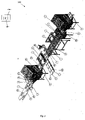
- FIG 3 shows a food processing apparatus 1000 according to the present invention for detecting and cutting tough tissues from food item pieces.
- the food processing apparatus is adapted to cut pin bones fully automatically from pre-rigor salmon fillets or white fish (e.g. cod, haddock, saith and redfish) fillets accurately and effectively.
- the fillets would commonly be trimmed before entering the system on a so-called pre-trimming line. On the pre-trimming line (not shown on drawing) loose bones and obvious flesh defects would typically be manually removed.
- the fillets can be with or without skin.
- the fillets 101 are fed one by one onto an x-ray machine 1, which captures an image of the fillet as well as the precise location of the bones in the fillet.
- FIG. 14 An example of such an image is shown in Fig. 14 of a red fish fillet where the bone appear as black lines in the image.
- the conveyor 2 on the x-ray machine conveys the fillet 101 through the detection means and then off the conveyor onto the cutting conveyor 6.
- the precise location of the fillet 102 was captured when the x-ray image was taken and an accurate encoder in a tracking mechanism is used to track the movement of the fillet, there will always come in some uncertainty about the fillet 102 location when it is transferred over to the cutting conveyor 6 as shown in Figure 4 .
- this uncertainty is acceptable and then the vision unit 3 is not needed.
- the vision unit 3 is used to capture one or more of the following; silhouette image, full colour image and full 3D scan image.
- Figure 11 shows an example of an image of a fillet obtained from the x-ray machine 1 (a) and a silhouette image (b) of the same fillet obtained with the vision system 3.
- the position of the fillet on the cutting conveyor 6 is known precisely when the vision system picture is taken and a good estimate is known about where the fillet is supposed to be according to information from the x-ray machine - utilizing tracking information as well - the system can identify the fillet which these two images are off.
- the image taken with the vision unit 3 has a precise location on the cutting conveyor while the x-ray image contains the information about the bones the system must find the optimum location for the x-ray image on top of the vision unit image.
- this may be done by matching the centre of gravity of the two images as well as the principal axis.
- a mapping mechanism 1001 comprising a processor (P) 1002, but this may be any type of a computing system e.g. integrated in industrial computer.
- This mapping is demonstrated on Figure 11 where the centre of gravity point is marked with G1 for the x-ray image, Figure 11 (a) , and G2 for the vision image, Figure 11 (b) .
- This may as an example be done by detecting the thee dimensional shape of the fish fillet using well know imaging apparatus in the art, and based on the mass density of the fish fillet, calculating the centre of gravity point.
- each axis are marked with AX1 and AX2, but these axis may be calculating using well known methods in the art based on the detected shape of the fish fillet, or where the food item pieces are chicken breasts, the method disclosed in US-7452266 , hereby incorporated in whole by reference, may be applied.
- image noise has limited effect on the accuracy.
- Other methods which are for example based on stereo vision algorithms are also an alternative for finding the optimum match. It should be noted that other methods may just as well be applied to compare the position of the food items pieces on the x-ray conveyor and the cutting conveyor and should thus not be construed to be limited to the above mentioned methods.
- the camera of the vision system 3 when the camera of the vision system 3 takes an image of the food items it knows precisely where the camera frame is located with a respect to a fixed point on the conveyor.
- the edge of the frame is therefore at a know position and the precise position of the encoder is known at all times and then as well when the image is taken.
- the coordinate frame of the piece is then updated with the encoder position updates and the cutting robot can use traditional tracking method to cut the pieces at the precise locations determined by the cutting pattern.
- Figure 12 is marked the coordinate system of the x-ray machine 1 which consists of a x-axis along the moving direction of the conveyor (pointing outside of the drawing plane), a y-axis perpendicular to the moving direction of the conveyor and finally z-axis which is a normal to the conveyor belt it self.
- the location of the bones will only be known in the xy-plane and no information is available from the image about the z-coordinate of the bones.
- a bone is drawn into the cross section of a fillet and it is assumed that the bone is linear and has endpoints P1 and P2.
- the objective is to find the coordinates of these two points.
- the first image gives the y-coordinates of the points, that is y1 and y2.
- the x-coordinates are then determined by the time the bone is detected for a linear scan system but from the image if self when a frame image is used. If the bones are to be cut away from the loin part of the fillet with maximum certainty a straight cut would be used and the location would be outside the bounding box of the pin bones. This would result in reduced cutting yield as is shown on Figure 9 and indicated with two areas labeled A1 and A2.
- One way to improve the cutting yield is to use priory knowledge about the angle, which is to be expected for fillets of a given type and size and cut the fillets in that angle.
- Another more reliable method is to utilize multiple x-ray sources and detection modules. For most applications, one additional x-ray source and detection module would be required although more will always generate more accuracy.
- An example of such a setup where the second source and receiver is placed at an angle to the first receiver is also shown in Figure 12 .
- the second receiver has its own coordinate system, which is obtained by rotating the xyz-coordinate system by degrees around the x-axis.
- the new coordinate system is referred to as x'y'z' - coordinate system.
- the second x-ray system would typically be offset from the first system in the x-direction as much as would be needed for fitting mechanically the receivers.
- the cutting system can be used to cut the bones out of the fillet at each x-location in the fillet at the correct angle to improve the cutting yield such that section A1 and A2 shown in Figure 9 will remain with the bone free sections of the fillet.
- the bones can be broken up to any number of linear sections and the same method will then be used to calculate the endpoints and any number of internal points in each bone. It is however clear that the more accuracy is needed and the more curved the bones are the more need is for more than two sources and receivers. More sources and receivers can also assist in distinguishing between multiple bones, which can be detected as a single bone from certain angles.
- the next step is to determine the cutting pattern of the fillet.
- the cutting pattern can be any desired pattern and can involve cutting out of sections of the fillet, which contain bones. Some common cutting patterns used in the fishing industry are shown in Figure 10 . Although the bones will typically be cut away from the rest of the fillet with the minimum amount of tissue attached to it there are also application where only a single cutting device is used and the system would only make the most important cut between the loin and the pin bones.
- the cutting pattern can also be determined based on the weight of the fillet, which can be obtained a priory or estimated based on a 2D or 3D image of the object.
- the system can thus cut the fillet into portions of fixed weight, length or in a pattern, which optimizes the portion yield. Once the pattern has been determined it is superimposed onto the image of the fillet and that information is then sent to the robotic controller, which performs the cuts.
- the cutting pattern is defined in terms of a moving coordinate frame of the fillet 105 and the robotic controller and the vision system have access to the same encoder of the cutting conveyor 6 to update the location of that coordinate frame.
- a selection of other types of mapping can be used when a 3D scanning is used in the second image camera.
- An embodiment of an image system to capture 3D image of a moving object indicated by the arrow is shown showing a laser light (1) positioned directly above the object where the emitted light beam lights up a single line on the object.
- a camera (2) is then placed under an angle.
- the frame camera takes then images at high frequency to capture the laser light where the shift of the laser light as depicted in figure 16b is used to determine the height of the object at that cross section of the object. By adding these images together a complete digital 3D image of the object is obtained. It typically assumes that the object is completely flat at the bottom but additional lasers and cameras can be used to obtain a more accurate model of the objects (not shown here).
- An x-ray image can also be used to generate a 3D image of the object. This is based on the fact that the intensity of each pixel in the image is based on the thickness of the object at that location. The thicker the object is the more it reduces the intensity. It is though important to eliminate the bones - or other tough tissues - from the image by putting the intensity where the bones are with an averaging method where the intensity where the bones, or any other tough tissue, was will be the average of the neighbouring pixels.
- a pure volumetric mapping can then be obtained by initially adjusting the height at each pixel in x-ray image proportionally such that the total volume measured with the x-ray image matches precisely the volume measured with the 3D system.
- the x-ray image, volume of which is called X is then mapped onto the 3D image, volume of which is called Y, such that the volumetric error is minimized.
- the volumetric error is defined as: X + Y ⁇ X ⁇ Y
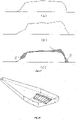
- Figure 17 shows a cross section of an x-ray image and in (b) is shown a cross section from a 3D image.
- the x-ray image has been mapped onto the 3D image such that the 2D volumetric error is minimized.
- the area which is in the 3D image and not in the x-ray image is marked with 1 while the area which is in the x-ray image and not in the 3D image is market with 2 in Figure 17 (d).
- each cross section of the object is mapped such that the error is minimized and then based on this mapping the entire object is located such that the deviation from optimal location of each cross section is minimized.
- mapping instead of using the volumetric mapping for the entire object it is an alternative to map just the regions around the touch tissues where maximum accuracy is needed. Then both images are cut at a certain location and the section which does not include the tough tissues is removed before the mapping is done.
- the 2D mapping methods and the mapping based on cross sections can also be used only in areas of interest rather than for the entire object.
- mapping discussed here above can be used in any desired combination. It might thus be desired to map the images first based on 2D methods with the centre of mass and principal axis and then use the 3D mappings to relocate the object such that minimum 3D error is obtained around the bones.
- the purpose of mapping of the x-ray image onto the second image is to have the location of the tough tissues in the image which can be accurately tracked on the cutting conveyor. Once that has been determined the cutting pattern for the object can be determined. Commonly it is desired to cut the tough tissues out of the primary part of the object. This is demonstrated in Figure 11 (d) where two paths are created based on position information of the tough tissues in the second image. The first path is marked as 1 and is placed right at the boundary of the tough tissue. The second path is marked as 2 and is obtained by offsetting the first path a given amount which is based on the inaccuracy in the system. The offset will ensure that the primary piece is not with any tough tissues. Once the cutting path has been planned the cutting path is transferred over to the coordinate system of the robot which will then track the path as the piece moves on the conveyor and then accurately make the cut on the object according to the desired curve.
- One method to plan the path is to fit ruled surface at either side of the bones as illustrated in Figure 18 .
- this surface can be offset by a user controlled amount which will typically depend on the accuracy in the cutting system.
- the first robotic cutting unit 4 consists of a linear motor - which can only move perpendicular to the moving direction of the cutting conveyor 6 as shown with the arrows on Figure 5 - a valve to disable and enable the flow of the water, and a nozzle with very fine aperture, for example 0,07-0,25mm.
- the nozzle assembly is attached rigidly to the linear motor and then there is a water pipe leading to the valve from a high pressure water pump. The pump and the water pipe are not shown on the Figure. By opening for the water stream the system will begin to cut whatever is underneath the nozzle. As the conveyor is moving in the x-direction while the linear motor moves in the y-direction any portion of the fillet can be cut.
- the second robotic cutting unit 5 comprises of three linear motors, where two of the linear motors work together to move a steel bracket along the moving direction of the cutting conveyor as shown in greater detail in Figure 6 . Attached to the bracket is then a linear motor, which can move perpendicular to the moving direction. A nozzle assembly is attached to this linear motor in a similar way as to the first robotic cutting unit.
- This cutting unit can cut straight cuts perpendicular to the moving direction of the conveyor as the cutting nozzle can be transported at the same speed as the conveyor while the nozzle is moved across the fillet.
- the third robotic cutting unit 7 comprises of a six-axis robot.
- a nozzle assembly is attached to the robot in a similar way as on the previous robots. This robot has flexibility to make any type of cut with any tilt angle. It should be noted that in this embodiment, said first, second and third cutting units work together in and independent way and can thus perform the cutting different time periods.
- the robotic control computer splits up the cutting paths between the robots such that each robot cuts only the desired part of the desired cutting pattern. After the fillet 104 has passed the final robot the cutting of the fillet is completed.
- This embodiment can also be used to cut away fat stripes from the fillet.
- two robotic cutting units each with a single degree of freedom, will be used for such cuts.
- Both an x-ray image and a colour image of the fillet can assist in determine the optimum cutting locations for such cuts.
- An example of a location of such cuts is shown in Figure 15 .
- a robotic gripper units 8, 9 are then used to take away pieces which contain bones inside. It can also be used to remove fat stripes cut from the fillet.
- the gripper is shown in greater detail on Figure 8 .
- the bone free sections of the fillets 108 continue onto another x-ray machine 13 while the bone sections are transferred over to conveyors 10, 11 for further processing or packing.
- the second x-ray machine 13 works identically to the first x-ray machine and takes an x-ray image of the fillets 108. Those images are used for two purposes. Firstly they are used to control a pull-back conveyor 14 which direct the fillet portions 110 which still contain bones onto conveyor 16 while the remaining portions 111 which are bone free go onto conveyor 18.
- the bones from the portions with remaining bones will be manually removed and then fed again through the x-ray machine 13.
- the second purpose is to provide feedback to the cutting computer about the performance of the cutting. This feed back is especially important when the system has a tendency to leave bones in portions which are supposed to be bone free but it can also assist in optimizing the yield. Further optimization of the yield can be obtained by inspecting portions which contain bones in the second bone detection system as the extra tissue on those portions can then be evaluated.
- the fish portions are finally inspected and packed fresh or utilized in further processing like freezing or breading.
- an x-ray image is primarily used for bone detections it has shown to be very useful for other type of measurements of animal tissues or food products. This includes measurement of defects and hair length in furs and fat contents in various food products.
- the current invention can as well be used for such trimming applications where either the bone detection means or the vision image or a combination of both will be used to obtain information such that a desired fat trim can be made.
- An example of location of such trims in a salmon fillet is shown in Figure 15 .
- This cutting pattern would typically be a pure addition to other cutting patterns where bones are cut from the fillet or it is cut into portions. This extra cut will typically require two extra cutting nozzles which would be placed on a robot with a single degree of freedom (4) as shown in Figure 5 .
- a computer program may be stored/distributed on a suitable medium, such as an optical storage medium or a solid-state medium supplied together with or as part of other hardware, but may also be distributed in other forms, such as via the Internet or other wired or wireless telecommunication systems. Any reference signs in the claims should not be construed as limiting the scope.
Landscapes
- Life Sciences & Earth Sciences (AREA)
- Engineering & Computer Science (AREA)
- Wood Science & Technology (AREA)
- Zoology (AREA)
- Food Science & Technology (AREA)
- Analysing Materials By The Use Of Radiation (AREA)
- Processing Of Meat And Fish (AREA)
- Apparatus For Radiation Diagnosis (AREA)
- General Preparation And Processing Of Foods (AREA)
Claims (15)
- Lebensmittelverarbeitungsvorrichtung (1000), ausgelegt für das Erkennen und Abschneiden von festem Gewebe wie Knochen, Knorpeln und Fett von Lebensmittelobjektstücken (101, 102) wie Fisch- oder Fleischfilets oder Geflügelteilen, umfassend:ein erstes Förderband (2), das massiv und geeignet dünn ist, für die Röntgenbildgebunq mit einem Einlaufende und einem Auslaufende, mindestens ein dem ersten massiven Förderband (2) zugeordnetes Röntgengerät (1) zur Bildgebung eingehender Lebensmittelobjekte (101), die auf dem ersten massiven Förderband transportiert werden, und auf der Grundlage der Bildgebung Generierung von Röntgenbilddaten, die den Ort des festen Gewebes in den Lebensmittelobj ektstücken angeben,ein zweites poröses Förderband (6) für das Wasserstrahlschneiden, wobei das Einlaufende ausgelegt ist, neben dem Auslaufende des ersten massiven Förderbands (2) positioniert zu sein, um die Lebensmittelobjektstücke vom Auslaufende des ersten massiven Förderbands aufzunehmen,ein Sichtsystem (3) zum Bereitstellen von zweiten Bilddaten der Lebensmittelobjektstücke (101, 102) in der Folge auf die Bildgebung durch das mindestens eine Röntgengerät (1), wobei die zweiten Bilddaten positionsbezogene Daten enthalten, die die Position der Lebensmittelobjektstücke auf dem zweiten porösen Förderband (6) vor dem Schneiden angeben, wobei das zweite poröse Förderband (6) ausgelegt ist, die Lebensmittelobjektstücke während dieser Bildgebung und während des Abschneidens des festen Gewebes von den Lebensmittelobjektstücken zu transportieren, undeinen Verfolgungsmechanismus zum Verfolgen der Position der Lebensmittelobjektstücke zu jeder Zeit,einen Abbildungsmechanismus (1001), umfassend:einen Prozessor (1002) zum Nutzen der Positionsverfolgungsdaten der Lebensmittelobjektstücke in der Folge auf die Röntgenbildgebungsdaten, um eine geschätzte Position der Lebensmittelobjektstücke auf dem zweiten porösen Förderband (6) zu bestimmen, wobei in der Folge auf das Erhalten der zweiten Bilddaten die geschätzte Koordinatenposition der Lebensmittelobjektstücke mit der tatsächlichen Position auf dem zweiten porösen Förderband auf der Grundlage der zweiten Bilddaten verglichen wird, wobei im Fall einer Nicht-Übereinstimmung zwischen der geschätzten Koordinatenposition und der tatsächlichen Position,einen Prozessor (1002) zum Abbilden der Röntgenbilddaten auf die zweiten Bilddaten, sodass die Position des festen Gewebes mit den zweiten Bilddaten übereinstimmt, undeine Steuereinheit (1003), die zum Betreiben eines Schneidmittels (4, 5, 7) zum Schneiden der Lebensmittelobjektstücke betreibbar ist, indem sie die abgebildeten Röntgenbilddaten als Betriebsdaten nutzt.
- Lebensmittelverarbeitungsvorrichtung nach Anspruch 1, wobei das Vergleichen der geschätzten Position der Lebensmittelobjektstücke auf dem zweiten porösen Förderband mit der tatsächlichen Position auf dem zweiten porösen Förderband auf der Grundlage der zweiten Bilddaten durch den Prozessor Folgendes umfasst:Vergleichen, ob der Schwerpunkt der Röntgenbildgebungsdaten mit dem Schwerpunkt der zweiten Bilddaten übereinstimmt, wobei im Fall einer Nicht-Übereinstimmung die Röntgenbildgebungsdaten auf die zweiten Bilddaten abgebildet werden, sodass der Schwerpunkt der Röntgenbildgebungsdaten mit dem Schwerpunkt der zweiten Bilddaten übereinstimmt, oderVergleichen, ob die Hauptachse der Röntgenbildgebungsdaten mit der Hauptachse der zweiten Bilddaten übereinstimmt, wobei im Fall einer Nicht-Übereinstimmung die Röntgenbildgebungsdaten abgebildet werden, indem die Röntgenbildgebungsdaten gedreht werden, bis die Hauptachse des Röntgenbildes und der zweiten Bilddaten zusammenfallen, oderVergleichen, ob die Skalierung der Röntgenbildgebungsdaten mit der Skalierung der zweiten Bilddaten übereinstimmt, indem verglichen wird, ob die Fläche der Röntgenbildgebungsdaten mit den zweiten Bilddaten übereinstimmt, wobei im Fall einer Nichtübereinstimmung die Röntgenbildgebungsdaten abgebildet werden, indem die Skalierung der Röntgenbildgebungsdaten angepasst wird, bis die Fläche der Röntgenbildgebungsdaten mit der Fläche der zweiten Bilddaten übereinstimmt, eine Kombination aus einem oder mehreren der oben genannten Schritte.
- Lebensmittelverarbeitungsvorrichtung nach Anspruch 1 oder 2, wobei das Röntgengerät (1) zwei oder mehr Röntgenquellen umfasst, die in Bezug auf die eingehenden Lebensmittelobjekte in unterschiedlichen Ansichtswinkeln positioniert sind und ausgelegt sind, Röntgenstrahlen auf die eingehenden Lebensmittelobjekte unter den unterschiedlichen Ansichtswinkeln abzugeben und somit mindestens zwei Röntgenmessdaten zu generieren, wobei die Lebensmittelverarbeitungsvorrichtung des Weiteren einen Prozessor zum Generieren der ersten Bilddaten durch ein Verarbeiten der mindestens zwei Röntgenmessdaten umfasst, um dreidimensionale (3D) Röntgenbilddaten des festen Gewebes zu generieren.
- Lebensmittelverarbeitungsvorrichtung nach Anspruch 1, wobei das Sichtsystem (2) ausgewählt ist aus:einer Digitalkamera, wobei die zweiten Bilddaten beinhalten, dass sie 2D-Silhouettenbilddaten der Lebensmittelobjekte sind,einer Digitalkamera und einem laserbasierten Sichtsystem, wobei die Bilddaten vollständige 3D-Bilddaten der Lebensmittelobjekte sind,einer Farb-Digitalkamera und einem laserbasierten Sichtsystem, wobei die Bilddaten vollständige Farb-3D-Bilddaten der Lebensmittelobjekte sind.
- Lebensmittelverarbeitungsvorrichtung nach Anspruch 4, wobei die dreidimensionalen (3D) Bilddaten, die von der Digitalkamera und einem laserbasierten Sichtsystem erhalten werden, für das Schätzen folgender Werte verwendet werden:des Volumens der Lebensmittelobjekte,des Gewichts der Lebensmittelobjekte,des Dickeprofils der Lebensmittelobjekte,der Farbe oder des Farbprofils der Lebensmittelobjekte, um Fett oder Defekte wie Blutflecken oder Löcher oder eine Kombination davon in den Lebensmittelobjekten zu schätzen oder zu erkennen.
- Lebensmittelverarbeitungsvorrichtung nach Anspruch 3, wobei das Sichtsystem (2) ein dreidimensionales (3D) Sichtsystem ist, das ausgelegt ist, 3D-Bilder der Lebensmittelobjektstücke zusätzlich zu den 3D-Röntgenbilddaten aufzunehmen, wobei das Vergleichen durch den Prozessor der geschätzten Position der Lebensmittelobjektstücke auf dem zweiten porösen Förderband mit der tatsächlichen Position auf dem zweiten porösen Förderband auf der Grundlage der zweiten Bilddaten das Bestimmen umfasst, ob das Gesamtvolumen der 3D-Röntgenbilddaten mit dem Volumen der 3D-Bilddaten übereinstimmt, wobei im Fall einer Nicht-Übereinstimmung das Volumen der 3D-Röntgenbilddaten durch den Prozessor auf das Volumen der 3D-Bilddaten abgebildet wird, sodass der volumetrische Fehler minimiert wird.
- Lebensmittelverarbeitungsvorrichtung nach Anspruch 6, wobei der volumetrische Fehler minimiert wird, indem das Minimieren des volumetrischen Fehlers durch den Prozessor bestimmt wird, indem die Summe X+Y der zwei Volumina minus des gemeinsamen Sets XIIY der zwei Volumina minimiert wird, wobei X das von den zwei oder mehr Röntgenquellen bestimmte Volumen ist und Y das vom 3D-Sichtsystem bestimmte Volumen ist.
- Lebensmittelverarbeitungsvorrichtung nach Anspruch 6 oder 7, wobei die geschätzte Position der Lebensmittelobjektstücke auf dem zweiten porösen Förderband zur tatsächlichen Position auf dem zweiten porösen Förderband auf der Grundlage der zweiten Bilddaten das Vergleichen umfasst, ob die Querschnittflächen der 3D-Röntgenbilddaten mit den Querschnittflächen der 3D-Bilddaten übereinstimmen, wobei im Fall einer Nicht-Übereinstimmung die 3D-Röntgenbilddaten auf die 3D-Bilddaten abgebildet werden, sodass die Differenz zwischen der Fläche der Querschnittflächen zwischen den 3D-Röntgenbilddaten und den 3D-Bilddaten minimiert wird.
- Lebensmittelverarbeitungsvorrichtung nach einem der vorhergehenden Ansprüche, wobei das Schneidmittel (4, 5) ein Hochdruck-Wasserstrahl-Düsensystem oder eine Schneidklinge mit einem bis sechs Graden an Bewegungsfreiheit ist.
- Lebensmittelverarbeitungsvorrichtung nach Anspruch 3, wobei die dreidimensionalen Röntgenbilddaten verarbeitet werden, um einen Winkel des festen Gewebes in den Lebensmittelobjekten zu bestimmen, wobei der Winkel des festen Gewebes verwendet wird, um einen Schneidwinkel zu bestimmen, der als Einstellparameter für das Anpassen des Winkels des Hochdruck-Wasserstrahl-Düsensystems oder der Schneidklinge verwendet wird, wenn das feste Gewebe von den Lebensmittelobjekten abgeschnitten wird.
- Lebensmittelverarbeitungsvorrichtung nach einem der vorhergehenden Ansprüche, des Weiteren umfassend ein zweites Erkennungsmittel (13) für festes Gewebe zum Generieren von dritten Bilddaten durch Bildgebung der verarbeiteten Lebensmittelobjekte nach dem Entfernen der abgeschnittenen Teile davon.
- Lebensmittelverarbeitungsvorrichtung nach Anspruch 8, wobei das zweite Erkennungsmittel (13) für festes Gewebe ein Röntgengerät oder ein Sichtsystem ist, und wobei die dritten Bilddaten die resultierenden Bilddaten von dem Röntgengerät oder einem Sichtsystem sind, wobei das dritte Bild in der Folge durch die Steuereinheit verarbeitet und als Einstellparameter für das Einstellen des Betriebs des Schneidmittels verwendet wird.
- Lebensmittelverarbeitungsvorrichtung nach einem der vorhergehenden Ansprüche, wobei die Lebensmittelobjekte ausgewählt sind aus Fischfilets, wobei das feste Gewebe die Knochen im Fischfilet sind; Fleisch, wobei das feste Gewebe Knorpel, Knochen oder Fett oder eine Kombination davon sind; Geflügelfleisch, wobei das feste Gewebe Knorpel, Knochen oder Fett oder eine Kombination davon sind.
- Verfahren zum Erkennen und Abschneiden von festem Gewebe wie Knochen, Knorpeln und Fett von Lebensmittelobjektstücken wie Fisch- oder Fleischfilets oder Geflügelteilen, umfassend:Bildgebung eingehender Lebensmittelobjektstücke mit mindestens einem Röntgengerät während des Transportierens der Lebensmittelobjektstücke auf einem ersten Förderband, das massiv und geeignet dünn ist für die Bildgebung mit dem mindestens einen Röntgengerät, und auf der Grundlage der Bildgebung, Generieren der Röntgenbilddaten, die den Ort des festen Gewebes in den Lebensmittelobjektstücken angeben,Transportieren, in der Folge auf die Röntgenbildgebung, der Lebensmittelobjektstücke auf einem zweiten porösen Förderband (6),wobei während des Transportierens folgende Schritte durchgeführt werden:Bereitstellen von zweiten Bilddaten der Lebensmittelobjektstücke (101) in der Folge auf die Bildgebung durch das mindestens eine Röntgengerät,Abschneiden des festen Gewebes von den Lebensmittelobjektstücken in der Folge auf das Bereitstellen der zweiten Bilddaten, wobei die zweiten Bilddaten positionsbezogene Daten enthalten, die die Position der Lebensmittelobjektstücke auf dem zweiten porösen Förderband (6) angeben, undVerfolgen der Position der Lebensmittelobjektstücke zu jeder Zeit,Nutzen der Positionsverfolgungsdaten der Lebensmittel objektstücke in der Folge auf die Röntgenbildgebungsdaten, um eine geschätzte Position der Lebensmittelobjektstücke auf dem zweiten porösen Förderband (6) zu bestimmen, wobei in der Folge auf das Erhalten der zweiten Bilddaten die geschätzte Koordinatenposition der Lebensmittelobjektstücke mit der tatsächlichen Position auf dem zweiten porösen Förderband auf der Grundlage der zweiten Bilddaten verglichen wird, wobei im Fall einer Nicht-Übereinstimmung zwischen der geschätzten Koordinatenposition und der tatsächlichen Position,Abbilden der Röntgenbilddaten auf die zweiten Bilddaten, sodass die Position des festen Gewebes mit den zweiten Bilddaten übereinstimmt, undSchneiden der Lebensmittelobjektstücke durch Nutzen der abgebildeten Röntgenbilddaten als Betriebsdaten.
- Computerprogramm, das Anweisungen zum Durchführen aller Schritte des Verfahrensanspruchs 14 umfasst, wenn das Computerprogramm auf einem Computersystem ausgeführt wird.
Priority Applications (2)
| Application Number | Priority Date | Filing Date | Title |
|---|---|---|---|
| EP11708578.7A EP2531038B2 (de) | 2010-02-07 | 2011-02-04 | Vorrichtung zum bearbeiten von lebensmitteln zum erfassen und abschneiden von harten gewebe aus lebensmittelprodukten |
| PL11708578T PL2531038T3 (pl) | 2010-02-07 | 2011-02-04 | Urządzenie do przetwórstwa spożywczego, do wykrywania i cięcia twardych tkanek z artykułów spożywczych |
Applications Claiming Priority (3)
| Application Number | Priority Date | Filing Date | Title |
|---|---|---|---|
| EP10001250A EP2353395A1 (de) | 2010-02-07 | 2010-02-07 | Küchenmaschine zum Erkennen und Schneiden von Geweben von Lebensmitteln |
| EP11708578.7A EP2531038B2 (de) | 2010-02-07 | 2011-02-04 | Vorrichtung zum bearbeiten von lebensmitteln zum erfassen und abschneiden von harten gewebe aus lebensmittelprodukten |
| PCT/IS2011/000001 WO2011095998A1 (en) | 2010-02-05 | 2011-02-04 | Food processing apparatus for detecting and cutting tough tissues from food items |
Publications (3)
| Publication Number | Publication Date |
|---|---|
| EP2531038A1 EP2531038A1 (de) | 2012-12-12 |
| EP2531038B1 EP2531038B1 (de) | 2013-12-25 |
| EP2531038B2 true EP2531038B2 (de) | 2022-09-28 |
Family
ID=42341363
Family Applications (2)
| Application Number | Title | Priority Date | Filing Date |
|---|---|---|---|
| EP10001250A Ceased EP2353395A1 (de) | 2010-02-05 | 2010-02-07 | Küchenmaschine zum Erkennen und Schneiden von Geweben von Lebensmitteln |
| EP11708578.7A Active EP2531038B2 (de) | 2010-02-07 | 2011-02-04 | Vorrichtung zum bearbeiten von lebensmitteln zum erfassen und abschneiden von harten gewebe aus lebensmittelprodukten |
Family Applications Before (1)
| Application Number | Title | Priority Date | Filing Date |
|---|---|---|---|
| EP10001250A Ceased EP2353395A1 (de) | 2010-02-05 | 2010-02-07 | Küchenmaschine zum Erkennen und Schneiden von Geweben von Lebensmitteln |
Country Status (6)
| Country | Link |
|---|---|
| US (1) | US9095147B2 (de) |
| EP (2) | EP2353395A1 (de) |
| DK (1) | DK2531038T4 (de) |
| ES (1) | ES2452558T5 (de) |
| PL (1) | PL2531038T3 (de) |
| WO (1) | WO2011095998A1 (de) |
Families Citing this family (52)
| Publication number | Priority date | Publication date | Assignee | Title |
|---|---|---|---|---|
| EP2636495A1 (de) * | 2012-03-08 | 2013-09-11 | Marel Iceland EHF | Schneidevorrichtung zum Schneiden von Lebensmittelartikeln, die auf einer Förderanlage mit mindestens einem Förderband befördert werden, sowie eine solche Vorrichtung enthaltendes System zur Behandlung von Nahrungsmitteln |
| DE102013205043A1 (de) * | 2013-03-21 | 2014-09-25 | Gea Food Solutions Germany Gmbh | Linie ohne Kontrollwaage zwischen Aufschneide- und Verpackungsmaschine |
| EP3260024A1 (de) * | 2013-05-10 | 2017-12-27 | Juicero, Inc. | Entsaftungssysteme und -verfahren |
| RU2628400C1 (ru) * | 2013-07-11 | 2017-08-16 | ФОСС Аналитикал А/С | Мясоперерабатывающее устройство, содержащее рентгеновский анализатор |
| EP2957175A1 (de) | 2014-06-20 | 2015-12-23 | Marel Iceland EHF | Schneidsystem zum Schneiden von Lebensmitteln |
| GB201411508D0 (en) * | 2014-06-27 | 2014-08-13 | Ishida Europ Ltd | Method and apparatus for removing foreign objects from food pieces |
| EP3169161B1 (de) * | 2014-07-15 | 2018-11-07 | Marel Iceland EHF | Stehgrätenbeseitigungssystem und -verfahren |
| AU2015371036C1 (en) * | 2014-12-23 | 2021-09-16 | Marel Iceland Ehf | A cutting device and a cutting system for cutting food products |
| WO2016139611A2 (en) * | 2015-03-02 | 2016-09-09 | Valka Ehf | Apparatus for processing and grading food articles and related methods |
| US11357237B2 (en) | 2015-03-02 | 2022-06-14 | Valka Ehf | Apparatus for processing and grading food articles and related methods |
| US11259531B2 (en) | 2015-03-02 | 2022-03-01 | Valka Ehf | Apparatus for processing and grading food articles and related methods |
| US10074028B2 (en) * | 2015-10-20 | 2018-09-11 | Arizona Board Of Regents On Behalf Of Arizona State University | Real-time diet assessment and food identification using thermal imaging |
| US10543652B2 (en) | 2016-03-03 | 2020-01-28 | Fresh Press LLC | Press |
| US10654185B2 (en) | 2016-07-29 | 2020-05-19 | John Bean Technologies Corporation | Cutting/portioning using combined X-ray and optical scanning |
| DK178928B2 (en) * | 2016-07-29 | 2023-05-15 | Pescatech Aps | Pre-rigor and fresh fish nerve deboning apparatus |
| EP3275313B1 (de) * | 2016-07-29 | 2024-02-14 | Nordischer Maschinenbau Rud. Baader GmbH + Co. KG | Vorrichtung zum erfassen und auswerten von produktspezifischen informationen von produkten der nahrungsmittel verarbeitenden industrie sowie system mit einer solchen vorrichtung und verfahren zum verarbeiten von produkten der nahrungsmittel verarbeitenden industrie |
| US10845615B2 (en) | 2016-09-29 | 2020-11-24 | Marel Iceland Ehf | Method of generating a three dimensional surface profile of a food object |
| ES2950645T3 (es) * | 2016-11-14 | 2023-10-11 | Marel Iceland Ehf | Un sistema y un método para procesar piezas de carne |
| DK179426B9 (en) | 2016-12-06 | 2018-07-12 | Marel Iceland Ehf | A method of processing a food object |
| US10596601B2 (en) * | 2017-05-19 | 2020-03-24 | The United States Of America, As Represented By The Secretary Of Agriculture | Imaging system for sorting poultry meat with wooden breast myopathy |
| CA3076412A1 (en) | 2017-09-19 | 2019-03-28 | Valka Ehf | Apparatus for processing and grading food articles and related methods |
| CA3102346A1 (en) * | 2018-06-06 | 2019-12-12 | Marel Iceland Ehf. | A method of providing feedback data indicating quality of food processing performed by an operator |
| EP3837533A1 (de) | 2018-08-16 | 2021-06-23 | Thai Union Group Public Company Limited | Abbildungssystem mit mehreren ansichten und verfahren zur nicht-invasiven inspektion bei der lebensmittelverarbeitung |
| US11120540B2 (en) | 2018-08-16 | 2021-09-14 | Thai Union Group Public Company Limited | Multi-view imaging system and methods for non-invasive inspection in food processing |
| US10869489B2 (en) | 2018-08-31 | 2020-12-22 | John Bean Technologies Corporation | Portioning accuracy analysis |
| PL3849715T3 (pl) | 2018-09-11 | 2024-02-05 | Valka Ehf | System i aparat do przetwarzania i sortowania artykułów spożywczych oraz powiązany sposób |
| US11375739B2 (en) | 2018-10-10 | 2022-07-05 | MP Equipment, LLC | Method of removing tissue from food product |
| US12465952B2 (en) | 2019-02-06 | 2025-11-11 | Marel Salmon A/S | Food processing device |
| EP3937646B1 (de) * | 2019-03-11 | 2026-04-08 | JBT Marel Corporation | Teilen und schneiden von rippen erstzerlegungen |
| EP3952657A4 (de) * | 2019-04-08 | 2023-04-19 | Provisur Technologies, Inc. | Vorrichtung und verfahren zum schneiden von fleischprodukten in fleischblöcke |
| DE102019110313B3 (de) | 2019-04-18 | 2020-07-02 | Provisur Technologies GmbH | Nahrungsmittelverarbeitungseinrichtung und entsprechendes Nahrungsmittelverarbeitungsverfahren |
| GB201906418D0 (en) | 2019-05-07 | 2019-06-19 | Valka Ehf | Conveyor system and method |
| DE102019127275A1 (de) * | 2019-07-04 | 2021-01-07 | Weber Maschinenbau Gmbh Breidenbach | Verfahren und System zur Verarbeitung von Produkten |
| US20230001032A1 (en) | 2019-11-13 | 2023-01-05 | D-Tech Ehf | Disinfecting system for food processing equipment |
| EP4096882A1 (de) * | 2020-01-27 | 2022-12-07 | John Bean Technologies Corporation | Trimmen von arbeitsprodukten zur optimierung des pressens |
| WO2021151955A2 (en) * | 2020-01-27 | 2021-08-05 | Foodmate B.V. | Method of mechanically harvesting inner and outer meat fillets from poultry carcass breast caps, and a device for carrying out the method |
| JP6950994B1 (ja) * | 2020-09-14 | 2021-10-20 | 土佐電子工業株式会社 | 魚フィーレ骨抜き取りシステム |
| EP4258886A1 (de) * | 2020-12-11 | 2023-10-18 | Lambhusasund ehf. | Vorrichtung zum schneiden und schneiden von lebensmitteln |
| PL4266891T3 (pl) * | 2020-12-22 | 2025-08-11 | Marel Salmon A/S | Ustalenie rozmiaru ubytku w jednostce filetu rybnego |
| CN112825900A (zh) * | 2021-01-08 | 2021-05-25 | 周广波 | 二维刀片阵列间隔调节系统及方法 |
| PL4319560T3 (pl) | 2021-04-06 | 2025-04-22 | Nordischer Maschinenbau Rud. Baader Gmbh + Co Kg | Sposób i urządzenie do wykrywania wadliwych miejsc w powierzchni wysklepionych wyrobów |
| JP7626579B2 (ja) * | 2021-06-16 | 2025-02-04 | プライフーズ株式会社 | 食鳥屠体上半部から剥ぎ取られた胸肉をトリミング作業場へ搬送する搬送システム |
| JP7566714B2 (ja) * | 2021-10-13 | 2024-10-15 | 株式会社前川製作所 | 画像処理装置、画像処理プログラム及び画像処理方法 |
| US20230125230A1 (en) | 2021-10-25 | 2023-04-27 | Provisur Technologies, Inc. | Pivoting loading tray assembly for food product slicing apparatus and method of use |
| WO2024012979A1 (en) * | 2022-07-15 | 2024-01-18 | Marel A/S | Method and apparatus for portion cutting of meat items |
| KR102795355B1 (ko) * | 2022-08-22 | 2025-04-16 | (주)웰푸드월드 | X선을 이용하여 잔가시를 검사 판별하는 순살포 생선의 제조방법 |
| EP4591060A1 (de) * | 2022-09-20 | 2025-07-30 | Orchard Holding | System und verfahren zur messung, identifizierung, verarbeitung und reduzierung von lebensmitteldefekten während manueller oder automatisierter verarbeitung |
| US20240208098A1 (en) * | 2022-12-21 | 2024-06-27 | Proex Food, Llc | Food imaging and processing systems and methods |
| JP2026506040A (ja) | 2023-02-17 | 2026-02-20 | シンケイ システムズ コーポレイション | 自動魚処理システムおよび方法 |
| JP2026508986A (ja) | 2023-03-10 | 2026-03-16 | シンケイ システムズ コーポレイション | 自動魚処理システム |
| CN118700239B (zh) * | 2024-06-26 | 2025-05-27 | 上海联豪食品有限公司 | 一种高效切片的切片机控制方法及系统 |
| JP2026021999A (ja) * | 2024-07-30 | 2026-02-12 | 株式会社前川製作所 | 物体認識装置、物体認識システム及び物体認識方法 |
Citations (4)
| Publication number | Priority date | Publication date | Assignee | Title |
|---|---|---|---|---|
| US5205779A (en) † | 1991-09-04 | 1993-04-27 | Texas Beef Group | Method and apparatus for automatically segmenting animal carcasses |
| GB2364894A (en) † | 2000-07-19 | 2002-02-13 | Fmc Corp | Computer controlled, adjustable cutters for food |
| WO2002043502A2 (en) † | 2000-12-01 | 2002-06-06 | Fmc Technologies, Inc. | Apparatus and method for detecting and removing undesirable material from workpieces |
| US20050032471A1 (en) † | 2003-07-21 | 2005-02-10 | Pfarr Craig E. | Apparatus and method for portioning using automatic workpiece conveyance speed control |
Family Cites Families (18)
| Publication number | Priority date | Publication date | Assignee | Title |
|---|---|---|---|---|
| DE2249369C3 (de) * | 1972-10-09 | 1979-01-18 | Josef Dipl.-Ing. 6000 Frankfurt Busek | Presse zum Entwässern von Flächengebilden, wie Lederhäuten |
| US4557019A (en) | 1984-08-10 | 1985-12-10 | Seafreeze Limited Partnership | Automatic portion-cutting method and machine |
| US4748724A (en) | 1987-05-12 | 1988-06-07 | The Laitram Corporation | Support apparatus for use in video imaging and processing of transverse fish sections |
| US4875254A (en) | 1988-03-22 | 1989-10-24 | Design Systems, Inc. | Method and apparatus for automatically cutting food products to predetermined weight or shape |
| US4970757A (en) | 1989-06-27 | 1990-11-20 | The United States Of America As Represented By The Secretary Of Agriculture | Automated excision of undesirable material and production of starting material for restructured meat |
| NL9001240A (nl) | 1990-05-31 | 1991-12-16 | Meyn Bv | Inrichting voor het bewerken van platvis. |
| US5162016A (en) * | 1991-09-04 | 1992-11-10 | Texas Beef Group | Abrasive for a water jet cutting head |
| JPH09224935A (ja) | 1996-02-27 | 1997-09-02 | Furuno Electric Co Ltd | 超音波式骨測定方法およびその装置 |
| AU6227099A (en) * | 1998-10-20 | 2000-05-08 | Marel Hf. | Method and apparatus for cutting objects |
| US20040022930A1 (en) * | 2000-05-10 | 2004-02-05 | Skjervold Per Olav | Method for the manufacture of raw fish products |
| CA2327894A1 (en) * | 2000-12-07 | 2002-06-07 | Clearview Geophysics Inc. | Method and system for complete 3d object and area digitizing |
| AU2004205170A1 (en) * | 2003-08-20 | 2005-03-10 | Cargill Meat Solutions Corporation | Meat cutting system |
| US7263243B2 (en) * | 2003-12-29 | 2007-08-28 | Carestream Health, Inc. | Method of image registration using mutual information |
| IS7959A (is) | 2004-12-16 | 2006-06-17 | Skaginn Hf. | Athferth og bunathur vith sj βlfvirka beingarthst”ku, skurth meth vatni og snyrtingu β afurth |
| GB2421676B (en) * | 2004-12-30 | 2010-03-24 | Fmc Technologies | Portioning apparatus and method |
| DE102005010183B4 (de) | 2005-03-02 | 2012-02-02 | CFS Bühl GmbH | Verfahren und Vorrichtung zur Erzeugung von gewichtsgenauen Lebensmittelportionen |
| DK200501448A (da) | 2005-08-26 | 2006-09-06 | Scanvaegt Int As | Fremgangsmåde og anlæg til opskæring af emner såsom ködstykker |
| WO2007067052A2 (en) * | 2005-12-09 | 2007-06-14 | Stork Pmt B.V. | Method and device for processing a carcass part of slaughtered poultry |
-
2010
- 2010-02-07 EP EP10001250A patent/EP2353395A1/de not_active Ceased
-
2011
- 2011-02-04 ES ES11708578T patent/ES2452558T5/es active Active
- 2011-02-04 US US13/577,316 patent/US9095147B2/en active Active
- 2011-02-04 DK DK11708578.7T patent/DK2531038T4/da active
- 2011-02-04 PL PL11708578T patent/PL2531038T3/pl unknown
- 2011-02-04 EP EP11708578.7A patent/EP2531038B2/de active Active
- 2011-02-04 WO PCT/IS2011/000001 patent/WO2011095998A1/en not_active Ceased
Patent Citations (5)
| Publication number | Priority date | Publication date | Assignee | Title |
|---|---|---|---|---|
| US5205779A (en) † | 1991-09-04 | 1993-04-27 | Texas Beef Group | Method and apparatus for automatically segmenting animal carcasses |
| GB2364894A (en) † | 2000-07-19 | 2002-02-13 | Fmc Corp | Computer controlled, adjustable cutters for food |
| WO2002043502A2 (en) † | 2000-12-01 | 2002-06-06 | Fmc Technologies, Inc. | Apparatus and method for detecting and removing undesirable material from workpieces |
| US20050032471A1 (en) † | 2003-07-21 | 2005-02-10 | Pfarr Craig E. | Apparatus and method for portioning using automatic workpiece conveyance speed control |
| GB2405081A (en) † | 2003-07-21 | 2005-02-23 | Fmc Technologies | Apparatus and method for portioning using automatic workpiece conveyance speed control |
Also Published As
| Publication number | Publication date |
|---|---|
| DK2531038T3 (en) | 2014-03-03 |
| DK2531038T4 (da) | 2022-11-21 |
| PL2531038T3 (pl) | 2014-07-31 |
| EP2353395A1 (de) | 2011-08-10 |
| ES2452558T3 (es) | 2014-04-01 |
| ES2452558T5 (es) | 2022-11-22 |
| US9095147B2 (en) | 2015-08-04 |
| EP2531038A1 (de) | 2012-12-12 |
| US20120307013A1 (en) | 2012-12-06 |
| EP2531038B1 (de) | 2013-12-25 |
| WO2011095998A1 (en) | 2011-08-11 |
Similar Documents
| Publication | Publication Date | Title |
|---|---|---|
| EP2531038B2 (de) | Vorrichtung zum bearbeiten von lebensmitteln zum erfassen und abschneiden von harten gewebe aus lebensmittelprodukten | |
| EP3937646B1 (de) | Teilen und schneiden von rippen erstzerlegungen | |
| DK180234B1 (en) | Cutting/portioning using combined x-ray and optical scanning | |
| US10485242B2 (en) | Sensor-guided automated method and system for processing crustaceans | |
| US11399550B2 (en) | Pork belly trimming | |
| US9700060B2 (en) | Contour measurement apparatus and contour measurement method for measuring contour of poultry carcass, and deboning device for poultry carcass | |
| CA2200545C (en) | Apparatus and method for removing ribs | |
| US11051522B2 (en) | Cutting system for cutting food products | |
| US9826747B2 (en) | Incision making apparatus and incision making method | |
| EP1174034A1 (de) | Verfahren zum Schneiden von Schweinebäuchen | |
| WO2017118757A1 (en) | A system and method for determining the presence and/or position of at least one bone in a meat piece | |
| WO2011025384A1 (en) | System for automated bleeding of stunned living fish | |
| EP3307073B1 (de) | Entfernung der wirbelsäule aus einer schlachttierhälfte | |
| US20180345513A1 (en) | Annular knife with a sensor for measuring the cutting depth of a rotating knife blade | |
| DK201901357A1 (en) | Portion cutting of meat products | |
| DK202000212A1 (en) | Automatic determination of the presence and subsequent removal of bones in meat products |
Legal Events
| Date | Code | Title | Description |
|---|---|---|---|
| PUAI | Public reference made under article 153(3) epc to a published international application that has entered the european phase |
Free format text: ORIGINAL CODE: 0009012 |
|
| 17P | Request for examination filed |
Effective date: 20120905 |
|
| AK | Designated contracting states |
Kind code of ref document: A1 Designated state(s): AL AT BE BG CH CY CZ DE DK EE ES FI FR GB GR HR HU IE IS IT LI LT LU LV MC MK MT NL NO PL PT RO RS SE SI SK SM TR |
|
| DAX | Request for extension of the european patent (deleted) | ||
| GRAP | Despatch of communication of intention to grant a patent |
Free format text: ORIGINAL CODE: EPIDOSNIGR1 |
|
| INTG | Intention to grant announced |
Effective date: 20130716 |
|
| GRAS | Grant fee paid |
Free format text: ORIGINAL CODE: EPIDOSNIGR3 |
|
| GRAA | (expected) grant |
Free format text: ORIGINAL CODE: 0009210 |
|
| AK | Designated contracting states |
Kind code of ref document: B1 Designated state(s): AL AT BE BG CH CY CZ DE DK EE ES FI FR GB GR HR HU IE IS IT LI LT LU LV MC MK MT NL NO PL PT RO RS SE SI SK SM TR |
|
| REG | Reference to a national code |
Ref country code: GB Ref legal event code: FG4D |
|
| REG | Reference to a national code |
Ref country code: CH Ref legal event code: EP |
|
| REG | Reference to a national code |
Ref country code: AT Ref legal event code: REF Ref document number: 646091 Country of ref document: AT Kind code of ref document: T Effective date: 20140115 |
|
| REG | Reference to a national code |
Ref country code: IE Ref legal event code: FG4D |
|
| REG | Reference to a national code |
Ref country code: DE Ref legal event code: R096 Ref document number: 602011004369 Country of ref document: DE Effective date: 20140220 |
|
| REG | Reference to a national code |
Ref country code: DK Ref legal event code: T3 Effective date: 20140228 |
|
| REG | Reference to a national code |
Ref country code: SE Ref legal event code: TRGR |
|
| REG | Reference to a national code |
Ref country code: NL Ref legal event code: T3 |
|
| REG | Reference to a national code |
Ref country code: ES Ref legal event code: FG2A Ref document number: 2452558 Country of ref document: ES Kind code of ref document: T3 Effective date: 20140401 |
|
| PG25 | Lapsed in a contracting state [announced via postgrant information from national office to epo] |
Ref country code: FI Free format text: LAPSE BECAUSE OF FAILURE TO SUBMIT A TRANSLATION OF THE DESCRIPTION OR TO PAY THE FEE WITHIN THE PRESCRIBED TIME-LIMIT Effective date: 20131225 Ref country code: HR Free format text: LAPSE BECAUSE OF FAILURE TO SUBMIT A TRANSLATION OF THE DESCRIPTION OR TO PAY THE FEE WITHIN THE PRESCRIBED TIME-LIMIT Effective date: 20131225 Ref country code: LT Free format text: LAPSE BECAUSE OF FAILURE TO SUBMIT A TRANSLATION OF THE DESCRIPTION OR TO PAY THE FEE WITHIN THE PRESCRIBED TIME-LIMIT Effective date: 20131225 |
|
| REG | Reference to a national code |
Ref country code: NO Ref legal event code: T2 Effective date: 20131225 |
|
| REG | Reference to a national code |
Ref country code: AT Ref legal event code: MK05 Ref document number: 646091 Country of ref document: AT Kind code of ref document: T Effective date: 20131225 |
|
| REG | Reference to a national code |
Ref country code: LT Ref legal event code: MG4D |
|
| PG25 | Lapsed in a contracting state [announced via postgrant information from national office to epo] |
Ref country code: RS Free format text: LAPSE BECAUSE OF FAILURE TO SUBMIT A TRANSLATION OF THE DESCRIPTION OR TO PAY THE FEE WITHIN THE PRESCRIBED TIME-LIMIT Effective date: 20131225 Ref country code: LV Free format text: LAPSE BECAUSE OF FAILURE TO SUBMIT A TRANSLATION OF THE DESCRIPTION OR TO PAY THE FEE WITHIN THE PRESCRIBED TIME-LIMIT Effective date: 20131225 |
|
| PG25 | Lapsed in a contracting state [announced via postgrant information from national office to epo] |
Ref country code: EE Free format text: LAPSE BECAUSE OF FAILURE TO SUBMIT A TRANSLATION OF THE DESCRIPTION OR TO PAY THE FEE WITHIN THE PRESCRIBED TIME-LIMIT Effective date: 20131225 |
|
| REG | Reference to a national code |
Ref country code: PL Ref legal event code: T3 |
|
| PG25 | Lapsed in a contracting state [announced via postgrant information from national office to epo] |
Ref country code: SK Free format text: LAPSE BECAUSE OF FAILURE TO SUBMIT A TRANSLATION OF THE DESCRIPTION OR TO PAY THE FEE WITHIN THE PRESCRIBED TIME-LIMIT Effective date: 20131225 Ref country code: PT Free format text: LAPSE BECAUSE OF FAILURE TO SUBMIT A TRANSLATION OF THE DESCRIPTION OR TO PAY THE FEE WITHIN THE PRESCRIBED TIME-LIMIT Effective date: 20140428 Ref country code: CZ Free format text: LAPSE BECAUSE OF FAILURE TO SUBMIT A TRANSLATION OF THE DESCRIPTION OR TO PAY THE FEE WITHIN THE PRESCRIBED TIME-LIMIT Effective date: 20131225 Ref country code: AT Free format text: LAPSE BECAUSE OF FAILURE TO SUBMIT A TRANSLATION OF THE DESCRIPTION OR TO PAY THE FEE WITHIN THE PRESCRIBED TIME-LIMIT Effective date: 20131225 Ref country code: CY Free format text: LAPSE BECAUSE OF FAILURE TO SUBMIT A TRANSLATION OF THE DESCRIPTION OR TO PAY THE FEE WITHIN THE PRESCRIBED TIME-LIMIT Effective date: 20131225 Ref country code: RO Free format text: LAPSE BECAUSE OF FAILURE TO SUBMIT A TRANSLATION OF THE DESCRIPTION OR TO PAY THE FEE WITHIN THE PRESCRIBED TIME-LIMIT Effective date: 20131225 |
|
| REG | Reference to a national code |
Ref country code: DE Ref legal event code: R026 Ref document number: 602011004369 Country of ref document: DE |
|
| PLBI | Opposition filed |
Free format text: ORIGINAL CODE: 0009260 |
|
| PG25 | Lapsed in a contracting state [announced via postgrant information from national office to epo] |
Ref country code: LU Free format text: LAPSE BECAUSE OF FAILURE TO SUBMIT A TRANSLATION OF THE DESCRIPTION OR TO PAY THE FEE WITHIN THE PRESCRIBED TIME-LIMIT Effective date: 20140204 Ref country code: MC Free format text: LAPSE BECAUSE OF FAILURE TO SUBMIT A TRANSLATION OF THE DESCRIPTION OR TO PAY THE FEE WITHIN THE PRESCRIBED TIME-LIMIT Effective date: 20131225 |
|
| REG | Reference to a national code |
Ref country code: CH Ref legal event code: PL |
|
| 26 | Opposition filed |
Opponent name: NORDISCHER MASCHINENBAU RUD. BAADER GMBH + CO. KG Effective date: 20140924 |
|
| PG25 | Lapsed in a contracting state [announced via postgrant information from national office to epo] |
Ref country code: LI Free format text: LAPSE BECAUSE OF NON-PAYMENT OF DUE FEES Effective date: 20140228 Ref country code: CH Free format text: LAPSE BECAUSE OF NON-PAYMENT OF DUE FEES Effective date: 20140228 |
|
| PLAX | Notice of opposition and request to file observation + time limit sent |
Free format text: ORIGINAL CODE: EPIDOSNOBS2 |
|
| REG | Reference to a national code |
Ref country code: DE Ref legal event code: R026 Ref document number: 602011004369 Country of ref document: DE Effective date: 20140924 |
|
| PLAF | Information modified related to communication of a notice of opposition and request to file observations + time limit |
Free format text: ORIGINAL CODE: EPIDOSCOBS2 |
|
| PLBB | Reply of patent proprietor to notice(s) of opposition received |
Free format text: ORIGINAL CODE: EPIDOSNOBS3 |
|
| PG25 | Lapsed in a contracting state [announced via postgrant information from national office to epo] |
Ref country code: SI Free format text: LAPSE BECAUSE OF FAILURE TO SUBMIT A TRANSLATION OF THE DESCRIPTION OR TO PAY THE FEE WITHIN THE PRESCRIBED TIME-LIMIT Effective date: 20131225 |
|
| REG | Reference to a national code |
Ref country code: FR Ref legal event code: PLFP Year of fee payment: 5 |
|
| REG | Reference to a national code |
Ref country code: PL Ref legal event code: LAPE |
|
| PG25 | Lapsed in a contracting state [announced via postgrant information from national office to epo] |
Ref country code: PL Free format text: LAPSE BECAUSE OF NON-PAYMENT OF DUE FEES Effective date: 20140204 |
|
| PG25 | Lapsed in a contracting state [announced via postgrant information from national office to epo] |
Ref country code: MT Free format text: LAPSE BECAUSE OF FAILURE TO SUBMIT A TRANSLATION OF THE DESCRIPTION OR TO PAY THE FEE WITHIN THE PRESCRIBED TIME-LIMIT Effective date: 20131225 |
|
| PG25 | Lapsed in a contracting state [announced via postgrant information from national office to epo] |
Ref country code: SM Free format text: LAPSE BECAUSE OF FAILURE TO SUBMIT A TRANSLATION OF THE DESCRIPTION OR TO PAY THE FEE WITHIN THE PRESCRIBED TIME-LIMIT Effective date: 20131225 |
|
| REG | Reference to a national code |
Ref country code: FR Ref legal event code: PLFP Year of fee payment: 6 |
|
| PG25 | Lapsed in a contracting state [announced via postgrant information from national office to epo] |
Ref country code: IT Free format text: LAPSE BECAUSE OF FAILURE TO SUBMIT A TRANSLATION OF THE DESCRIPTION OR TO PAY THE FEE WITHIN THE PRESCRIBED TIME-LIMIT Effective date: 20131225 Ref country code: BG Free format text: LAPSE BECAUSE OF FAILURE TO SUBMIT A TRANSLATION OF THE DESCRIPTION OR TO PAY THE FEE WITHIN THE PRESCRIBED TIME-LIMIT Effective date: 20131225 Ref country code: GR Free format text: LAPSE BECAUSE OF FAILURE TO SUBMIT A TRANSLATION OF THE DESCRIPTION OR TO PAY THE FEE WITHIN THE PRESCRIBED TIME-LIMIT Effective date: 20140326 |
|
| PG25 | Lapsed in a contracting state [announced via postgrant information from national office to epo] |
Ref country code: HU Free format text: LAPSE BECAUSE OF FAILURE TO SUBMIT A TRANSLATION OF THE DESCRIPTION OR TO PAY THE FEE WITHIN THE PRESCRIBED TIME-LIMIT; INVALID AB INITIO Effective date: 20110204 Ref country code: TR Free format text: LAPSE BECAUSE OF FAILURE TO SUBMIT A TRANSLATION OF THE DESCRIPTION OR TO PAY THE FEE WITHIN THE PRESCRIBED TIME-LIMIT Effective date: 20131225 |
|
| REG | Reference to a national code |
Ref country code: FR Ref legal event code: PLFP Year of fee payment: 7 |
|
| APBM | Appeal reference recorded |
Free format text: ORIGINAL CODE: EPIDOSNREFNO |
|
| APBP | Date of receipt of notice of appeal recorded |
Free format text: ORIGINAL CODE: EPIDOSNNOA2O |
|
| APAH | Appeal reference modified |
Free format text: ORIGINAL CODE: EPIDOSCREFNO |
|
| PGFP | Annual fee paid to national office [announced via postgrant information from national office to epo] |
Ref country code: FR Payment date: 20170102 Year of fee payment: 7 |
|
| APBQ | Date of receipt of statement of grounds of appeal recorded |
Free format text: ORIGINAL CODE: EPIDOSNNOA3O |
|
| PG25 | Lapsed in a contracting state [announced via postgrant information from national office to epo] |
Ref country code: MK Free format text: LAPSE BECAUSE OF FAILURE TO SUBMIT A TRANSLATION OF THE DESCRIPTION OR TO PAY THE FEE WITHIN THE PRESCRIBED TIME-LIMIT Effective date: 20131225 |
|
| PG25 | Lapsed in a contracting state [announced via postgrant information from national office to epo] |
Ref country code: AL Free format text: LAPSE BECAUSE OF FAILURE TO SUBMIT A TRANSLATION OF THE DESCRIPTION OR TO PAY THE FEE WITHIN THE PRESCRIBED TIME-LIMIT Effective date: 20131225 |
|
| REG | Reference to a national code |
Ref country code: FR Ref legal event code: ST Effective date: 20181031 |
|
| PG25 | Lapsed in a contracting state [announced via postgrant information from national office to epo] |
Ref country code: FR Free format text: LAPSE BECAUSE OF NON-PAYMENT OF DUE FEES Effective date: 20180228 |
|
| REG | Reference to a national code |
Ref country code: DE Ref legal event code: R082 Ref document number: 602011004369 Country of ref document: DE Representative=s name: VOSSIUS & PARTNER PATENTANWAELTE RECHTSANWAELT, DE |
|
| APBU | Appeal procedure closed |
Free format text: ORIGINAL CODE: EPIDOSNNOA9O |
|
| PUAH | Patent maintained in amended form |
Free format text: ORIGINAL CODE: 0009272 |
|
| STAA | Information on the status of an ep patent application or granted ep patent |
Free format text: STATUS: PATENT MAINTAINED AS AMENDED |
|
| 27A | Patent maintained in amended form |
Effective date: 20220928 |
|
| AK | Designated contracting states |
Kind code of ref document: B2 Designated state(s): AL AT BE BG CH CY CZ DE DK EE ES FI FR GB GR HR HU IE IS IT LI LT LU LV MC MK MT NL NO PL PT RO RS SE SI SK SM TR |
|
| REG | Reference to a national code |
Ref country code: DE Ref legal event code: R102 Ref document number: 602011004369 Country of ref document: DE |
|
| REG | Reference to a national code |
Ref country code: NL Ref legal event code: FP |
|
| REG | Reference to a national code |
Ref country code: DK Ref legal event code: T4 Effective date: 20221118 |
|
| REG | Reference to a national code |
Ref country code: ES Ref legal event code: DC2A Ref document number: 2452558 Country of ref document: ES Kind code of ref document: T5 Effective date: 20221122 |
|
| REG | Reference to a national code |
Ref country code: NO Ref legal event code: TB2 |
|
| REG | Reference to a national code |
Ref country code: SE Ref legal event code: RPEO |
|
| P01 | Opt-out of the competence of the unified patent court (upc) registered |
Effective date: 20230514 |
|
| PGFP | Annual fee paid to national office [announced via postgrant information from national office to epo] |
Ref country code: NL Payment date: 20250121 Year of fee payment: 15 |
|
| PGFP | Annual fee paid to national office [announced via postgrant information from national office to epo] |
Ref country code: DK Payment date: 20250121 Year of fee payment: 15 |
|
| PGFP | Annual fee paid to national office [announced via postgrant information from national office to epo] |
Ref country code: ES Payment date: 20250303 Year of fee payment: 15 |
|
| PGFP | Annual fee paid to national office [announced via postgrant information from national office to epo] |
Ref country code: IE Payment date: 20250124 Year of fee payment: 15 Ref country code: SE Payment date: 20250121 Year of fee payment: 15 |
|
| PGFP | Annual fee paid to national office [announced via postgrant information from national office to epo] |
Ref country code: NO Payment date: 20250123 Year of fee payment: 15 |
|
| PGFP | Annual fee paid to national office [announced via postgrant information from national office to epo] |
Ref country code: GB Payment date: 20250123 Year of fee payment: 15 |
|
| PGFP | Annual fee paid to national office [announced via postgrant information from national office to epo] |
Ref country code: DE Payment date: 20260121 Year of fee payment: 16 |
|
| PGFP | Annual fee paid to national office [announced via postgrant information from national office to epo] |
Ref country code: BE Payment date: 20260121 Year of fee payment: 16 |
|
| PGFP | Annual fee paid to national office [announced via postgrant information from national office to epo] |
Ref country code: IS Payment date: 20260204 Year of fee payment: 16 |