EP2562722B1 - Système et procédé pour la visualisation de scènes - Google Patents
Système et procédé pour la visualisation de scènes Download PDFInfo
- Publication number
- EP2562722B1 EP2562722B1 EP11178724.8A EP11178724A EP2562722B1 EP 2562722 B1 EP2562722 B1 EP 2562722B1 EP 11178724 A EP11178724 A EP 11178724A EP 2562722 B1 EP2562722 B1 EP 2562722B1
- Authority
- EP
- European Patent Office
- Prior art keywords
- client
- dimensional image
- scene
- image layers
- series
- Prior art date
- Legal status (The legal status is an assumption and is not a legal conclusion. Google has not performed a legal analysis and makes no representation as to the accuracy of the status listed.)
- Not-in-force
Links
Images



Classifications
-
- G—PHYSICS
- G06—COMPUTING OR CALCULATING; COUNTING
- G06T—IMAGE DATA PROCESSING OR GENERATION, IN GENERAL
- G06T15/00—Three-dimensional [3D] image rendering
-
- G—PHYSICS
- G06—COMPUTING OR CALCULATING; COUNTING
- G06T—IMAGE DATA PROCESSING OR GENERATION, IN GENERAL
- G06T15/00—Three-dimensional [3D] image rendering
- G06T15/04—Texture mapping
-
- G—PHYSICS
- G06—COMPUTING OR CALCULATING; COUNTING
- G06T—IMAGE DATA PROCESSING OR GENERATION, IN GENERAL
- G06T15/00—Three-dimensional [3D] image rendering
- G06T15/10—Geometric effects
- G06T15/20—Perspective computation
- G06T15/205—Image-based rendering
Definitions
- the present invention generally relates to electronic data processing, and more particularly, relates to methods, computer program products and systems for scene visualization.
- Visualizations of, for example, numerical simulations, industrial designs, medical tomography or virtual reality are based on large data sets representing three-dimensional scenes that even may be unbounded. They are created on computers with appropriate visualization software using specialized graphics hardware. In many applications data need to be explored and viewed from various viewpoints in an interactive way. In general the amount and complexity of visualization data is rising and the computational demands for such systems are increasing. Because of an increasingly mobile society such visualization needs appear more and more for mobile devices, such as thin clients, smartphone or tablets.
- Image-based rendering techniques are widely used to reduce the geometric complexity of virtual environments. This is done by replacing parts of a scene with a textured representation approximating the original geometry of the virtual environment.
- Such representation can be a polygon with four sides and four vertices or corners, a so called textured quadrilateral.
- a textured representation can be generated for a specific position and viewing direction, a so called viewport. Because the textured representation has a significantly simplified geometry compared to the original virtual environment, parallax errors can occur on rendering the approximation. These display errors are described by measuring the visual difference to the (hypothetically rendered) original, for example by measuring the maximum angle between a point and its representation. A viewport is said to be valid as long as the visual difference is below a certain threshold.
- a textured representation is either easy to generate but only valid inside a small region and thus needs to be updated very often, or it is valid inside a large domain but complex and difficult to generate and display. Since the former strains bandwidth and the latter strains render speed, any image-based rendering approach is usually a trade-off between the available capacities.
- J. Noguera et al "Navigating large terrains using commodity mobile devices", Computers and Geosciences, September 2011 , discloses a hybrid cilent-server technique for remote adaptive streaming and rendering of large terrains, wherein the terrain area close to the viewer is rendered by the client in real time, and the terrain located far from the viewer is rendered by the server as impostors to be projected on the inner faces of a cube surrounding the viewer position.
- a computer implemented method for scene visualization includes: sending from a client a visualization description of a three-dimensional scene to at least one server, wherein the visualization description comprises position and orientation parameters of the three-dimensional scene, and the position parameters indicate a view position and the orientation parameters indicate a view orientation in respect of the three-dimensional scene; receiving at the client from the at least one server at least one series of two-dimensional image layers according to the visualization description, wherein each two-dimensional image layer is a representation of a corresponding spatial portion of the three-dimensional scene, the at least one series corresponding to the position and orientation parameters, and wherein a front layer of the series includes a projection of objects closest to the view position and a back layer of the series includes a projection of the farest objects; calculating at the client the three-dimensional scene by composing the two-dimensional image layers of the at least one series and, if required, by adjusting the two-dimensional image layers to a specific position and orientation; and displaying the calculated three-dimensional scene at the client. Position and orientation parameters of the three-dimensional scene
- This method allows enabling client computers, especially thin clients with small network bandwidth, to display interactive visualizations of large three-dimensional data sets. Because these sets are too complex to be stored in device memory, the scene is rendered in parts on a server and the client approximates the scene on the device with the use of two-dimensional image layers.
- This approach on the one hand, enables parallelization on the server side.
- approximating the scene with two-dimensional image layers allows changing the viewport without the need of receiving new data for every change in position. Instead, a two-dimensional image layer only needs to be updated when it becomes invalid, for example, if the viewport change is too large for the current two-dimensional image layers to act as a sufficing approximation for the respective objects.
- FIG. 10 Further aspects of the invention are a computer program product according to the independent claim 10, a client computer according to independent claim 11, and a computer system according to claim 15.
- the client can run the computer program to execute the method of claim 1.
- Alternative embodiments of the invention can be implemented by including a pre-fetching method for anticipating the movement of an observer.
- This alternative embodiment according to claim 3 further includes: receiving position change information at the client; predicting future change information on the basis of the received change information; determining a further visualization description corresponding to the predicted future change information; and pre-fetching at least a further series of two-dimensional image layers for the further visualization description by repeating the sending, receiving and calculating steps for the further visualization description.
- the received position change information may also include information from external knowledge sources, such as for example, the knowledge of a map where a certain building is located.
- the predicting, determining and pre-fetching steps can be implemented at the client or may at least partly be executed by the at least one server.
- this aspect of the invention allows hiding network latency by pre-fetching data sets for viewports which are likely to be needed later on.
- the assumed future observer movement can be modeled as a probability distribution, which is then used to minimize the expected error caused by the movement by finding an optimal set of data sets (two-dimensional image layers) for pre-fetching.
- the visualization description further comprises at least one client capability parameter and wherein the spatial portions being adapted to the at least one client capability parameter as pointed out in claim 2.
- FIG. 1 shows a computer system 1000 according to one embodiment of the invention that includes at least one client computer 1001 and one server computer 1002.
- the client 1001 and the server 1002 are communicatively coupled trough a communication network.
- the communication network can be of high bandwidth but also low bandwidth networks, such as GSM networks, may be used.
- the client computer 1001 can be a personal computer or a thin client, which is a constrained device like a smart phone or a tablet PC. Constrained devices can have limitations like memory constraints, processing power constraints or bandwidth constraints.
- the client 1001 has display means, which is appropriate to display a three dimensional scene.
- display means can be a LCD display or be made of any other commercially available display technology.
- the client may have a processor which is capable to generate display graphics with sufficient resolution for visualizing three-dimensional scenes on the display means.
- the client can display a virtual environment corresponding to a three-dimensional scene of a street where the client currently is.
- the client can be equipped with sensors to sense the current position of the client and a view direction for the client.
- the current position can be determined by using a Global Positioning System (GPS) sensor or by using a triangulation method based on the field strength received by different base stations of a cell phone network.
- GPS Global Positioning System
- the view direction can be described through orientation parameters which, for example, may be sensed by a compass and gravitational sensors integrated in the client.
- the client can send a request 1101 for the corresponding data to a server 1002, where the data of the virtual environment is stored.
- the client may include a visualization description in the request 1101 to inform the server about the current position and the respective orientation parameters for specifying expected scene visualization data.
- the server 1002 may generate a series of two-dimensional image layers according to the position and orientation parameters of the visualization description.
- the two-dimensional image layers are representations of spatial portions of the three-dimensional scene. That is, each two-dimensional image layer corresponds to a planar projection of all objects in the respective spatial portion of the three-dimensional space of the scene.
- the three dimensional space is cut into slices, wherein each slice corresponds to a two-dimensional image layer and the objects in the three-dimensional space around each slice are projected onto the corresponding image layer.
- the whole three-dimensional space, which corresponds to the scene can be divided into spatial portions, which are compressed into a limited number of two-dimensional image layers.
- a front layer of the plurality of image layers of the series is the layer closest to the view position of the client's user and a back layer is the layer with the farest distance from the view position.
- a two-dimensional image layer can correspond to an infinite band representing an infinite spatial portion of the scene but it is also possible to use a plurality of smaller, finite two-dimensional areas instead of infinite bands to represent finite portions of the scene. Those finite areas may even be slightly shifted in relation to neighboring areas. Even an unstructured partitioning of the scene can be used to generate the corresponding two-dimensional image layers. Such generation techniques are described in more detail for example in Switzerland in Switzerland in Switzerland, Switzerland, An introduction to solid modeling, Rockville, Maryland: Computer Science Pr.
- the number of image layers between the front and the back layer may be predefined or may be determined based on a client capability parameter, which can be included in the request 1101 or which can be dynamically determined.
- the client capability parameter can relate to client hardware constraints, connection properties of the connection between the client and the server or to client user behavior or any combination thereof.
- the server 1002 then can determine the number of two dimensional image layers, which is appropriate for the requesting client and generates the corresponding image layers for the respective spatial portions.
- the client itself can provide the numbers of requested image layers to the server.
- the server generates the series of two-dimensional image layers according to the visualization description.
- the series of generated image layers for the requested scene visualization is then sent as a response 1102 to the client 1001.
- the server 1002 may also send further series of two-dimensional image layers which are associated with further viewports being close to the visualization description.
- the client calculates the three dimensional scene by composing the two-dimensional image layers of the received series.
- the client can adjust the two-dimensional image layers to the current position by shifting or rotating the two-dimensional image layers accordingly before finally displaying the scene for on its display means to the user. Details of the corresponding translations and rotations are described under FIG. 2 .
- FIG. 2 illustrates the visualization description 2000 corresponding to a viewport 6000.
- Mathematical concepts and methods, such as homogenous coordinates and projective transformations are well established and can be found in most books on the topic of geometry.
- An example of such a reference book is Projective Geometry: Form Foundations to Applications by Albrecht Beutelspacher and Ute Rosenbaum.
- Establishing a model requires a mathematical model describing viewports and projections thereon, with which rendering and approximation processes can be modeled. This yields an error function describing the error of a single point, which can be expanded to an error function describing a certain average error on a whole set of points. Both these errors are defined as functions of the observer movement. Then, building the observer movement as a probability distribution, one can describe the expected value of the error. This interaction error corresponds to a cost function, which can be optimized.
- the coordinate system in FIG. 2 is defined by the three dimensional orthogonal axis x 1 , x 2 , x 3 .
- the five values are also referred to as the visualization description including the position and orientation parameters of the three dimensional scene.
- the coordinates c 1 , c 2 , c 3 of the viewport 6000 represent the position parameters in the three dimensional coordinates system.
- the orientation parameters are
- ⁇ is the orientation angle in respect to the plane defined by the x 1 , x 2 dimensions and ⁇ is the orientation angle within the x 1 , x 2 -plane in relation to the x 2 axis.
- c 1 , c 2 , c 3 represent a translation in viewport space, that is, increasing c 1 will always move the viewport to the right from its own point of view, regardless of its actual orientation.
- ⁇ is the angle between the x 1 , x 2 -plane and the viewing direction
- the set X : c 1 c 2 c 3 ⁇ ⁇ T
- c 1 , c 2 , c 3 ⁇ R , ⁇ ⁇ ⁇ ⁇ 2 , ⁇ 2 , ⁇ ⁇ ⁇ ⁇ , ⁇ ⁇ R 5 will be called the viewport set.
- FIG. 3 is a flow chart diagram of a computer implemented method 4000 according to one embodiment of the invention.
- the method starts with sending 4100 from a client a visualization description of a three-dimensional scene to at least one server 1002, wherein the visualization description comprises position and orientation parameters of the three-dimensional scene.
- the client receives 4200 from the at least one server at least one series of two-dimensional image layers according to the visualization description, wherein each two-dimensional image layer is a representation of a corresponding spatial portion of the three-dimensional scene.
- the at least one series corresponds to the position and orientation parameters.
- the client calculates 4300 the three-dimensional scene by composing 4301 the two-dimensional image layers of the at least one series and, if required, by adjusting 4302 the two-dimensional image layers to a specific position and orientation. After the calculation of the scene the client displays 4400 the calculated three-dimensional scene.
- the client 1001 is sending the visualization description, for example in the form as described under FIG. 2 , to the server(s) 1002.
- the server(s) 1002 For example, a user standing in a street wants to receive on a smartphone a three dimensional scene representing a virtual environment, which corresponds to the actual view direction of the user in the street. The user can turn the smartphone in the viewing direction, for example by verifying the view direction with the camera function of the smartphone. When the view direction corresponds to the user's view the user can trigger a request to receive the virtual environment data for the current view.
- the user can use an interaction function of the smartphone client (e.g., by clicking on the camera release button or using a software function of the client) to send a request to one or more servers for providing the three-dimensional scene data in correspondence with the visualization description so that the scene data is provided in appropriate manner for the client.
- an interaction function of the smartphone client e.g., by clicking on the camera release button or using a software function of the client
- the visualization description can be sent to multiple servers, when the task of generating the two-dimensional image layers is distributed on multiple servers in a network or in a cloud based architecture.
- Commercially available sensors as for example present in smartphones or tablet PCs, can be used to determine the visualization description parameters at the client side.
- the server 1002 can determine a series of two-dimensional image layers according to the visualization description.
- the two-dimensional image layers are representations of spatial portions of the three-dimensional scene, which correspond to the position and orientation parameters of the visualization description.
- the method for generating the two-dimensional image layers at the server(s) is described in detail under FIG. 4 and shows various aspects of the invention for handling errors like cell, domain and interaction errors.
- the visualization description may further include at least one partitioning parameter for the three-dimensional scene, telling the server how many two-dimensional layers the client would like to receive for visualizing the scene.
- partitioning parameters for the three-dimensional scene, telling the server how many two-dimensional layers the client would like to receive for visualizing the scene.
- the visualization description may further include at least one client capability parameter.
- a client capability parameter may relate to specific information known by the client, such as client hardware constraints, such as limitations in processor speed or memory or a certain display size or resolution. It may also relate to connection properties of the communication network between the client and the server(s), such as for example, the maximum bandwidth available between client and server. It can also relate to client user behavior. For example, a typical translation and rotation speed of the user can be applied, where the continuation of the previously detected movement is assumed. Another example is to assume a uniformly distributed change of the user's future movement to anticipate any possible movement of the user.
- the capability parameter(s) can be used by the server to dynamically calculate a number of two-dimensional image layers, which is appropriate for the requesting client in view of the client's limitations, behavior and/or available connection properties. That is, the number of the spatial portions, in which the entire space of the scene is finally divided by the server, can be adapted to one or more client capability parameters.
- the dynamic calculation of the number of two-dimensional image layers based on client capability parameters can also occur already at the client. In this case client simply sends the result to the server(s).
- the client 1001 then receives at least one series of two-dimensional image layer created by the one or more servers for the three-dimensional scene.
- a high degree of parallelization can be achieved for the rendering of the two-dimensional image layers.
- These include data-decomposition (as described in Gurntylä, M. (1988); An introduction to solid modeling; Rockville, Maryland: Computer Science Pr. ), screen-space decomposition and corresponding composition methods (as described in Molnar, S., Cox, M., Ellsworth, D. & Fuchs, H. (1994); A sorting classification of parallel rendering; IEEE Computer Graphics and Applications, 14, 23-32 ).
- the client composes the scene by layering the image layers in the correct order.
- the front layer includes the projection of the objects closest to the observer
- the back layer includes the projection of the farest objects.
- the layers in between are composed 4301 into the scene according to the projected objects' distances from the observing user/ client. It can occur that the generated image layers do not exactly correspond to the visualization description or that the observer has already moved a bit from the position, for which the visualization description was generated.
- the client can adjust 4302 the two-dimensional image layers to the actual position of the observing user. This allows to save bandwidth in the communication between the client and the server(s) and to save processing power at the server(s) by shifting and/or rotating the two-dimensional image layers accordingly.
- FIG. 4 illustrates how the server(s) create the two dimensional image layers according to the visualization description.
- the characters ⁇ ' and ⁇ as used hereinafter in the description correspond to the characters ⁇ ' and ⁇ , respectively as shown in the following formulas.
- Renderable objects of the three-dimensional scene are located in a domain ⁇ (spatial portion).
- the planar representations correspond to the two-dimensional image layers and will also be referred to as impostors hereinafter.
- An impostor is created using a local central projection with respect to the global viewport to achieve correct reconstruction at composition, wherein correct in this context means that the two-dimensional image layers can be composed at the client into a picture with a pixel-exact result.
- a central projection is defined by a projection point and a projection area.
- Enabling interaction allows leaving control over the observer viewport ⁇ to the user. Choosing any setup to approximate the scene, one can measure the goodness of the approximation by computing the domain error. As the domain error depends on ⁇ , the scene can be evaluated once the movement of the user is known. It would be advantageous to optimize the scene beforehand, by evaluating the scene without knowledge of ⁇ .
- a probability distribution P with an associated probability density function ⁇ on A Conceivable are, for instance, a uniform distribution on A or normal distributions around the current viewport ⁇ . These distributions represent the probability for the respective viewport "to happen", and thus modeling the expected observer movement.
- An advantage of this approach is an error tolerance built into the two-dimensional image layers. This already allows for viewport changes at the client (after having composed the three-dimensional scene on the bases of the received image layers) within the error tolerance without any significant deterioration of the scene visualization for the user. This will be shown in the following.
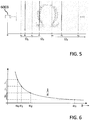
- FIG. 5 illustrates an example of partitioning the entire space ⁇ corresponding to the three-dimensional scene into spatial portions for a given viewport 6003.
- the spatial portions are ⁇ 0 , ⁇ 1 , ⁇ 2 ,..., which are defined by the corresponding boundaries a 0 , a 1 , a 2 ,...
- the two-dimensional image layers are located at d 0 , d 1 , d 2 ,... respectively. All objects of a three-dimensional spatial portion are projected onto the respective two-dimensional image layer d i .
- we regard the inverse problem that is, which geometry is needed to guarantee a predefined or expected accuracy.
- a hyperbolic spatial distribution can be calculated for the impostors with regards to their distance from the respective viewport. This results in a number of two-dimensional image layers (impostors), which is needed to achieve the predefined or expected accuracy.
- FIG. 6 shows a hyperbolic graph for finding a set of partitioning parameters (cell borders a 0 , a 1 , a 2 ,...) for defining the spatial portions in which the entire space is to be divided according to FIG. 7 .
- One can find appropriate cell borders by a i 1 a 0 ⁇ ⁇ i ⁇ 1 while 1 a i > 1 b .
- a i 1 a 0 ⁇ ⁇ i ⁇ 1 while 1 a i > 1 b .
- a i 1 a 0 ⁇ ⁇ i ⁇ 1 while 1 a i > 1 b .
- a i 3/2
- the number of viewports n is proportional to R -2 , independent of the tiling method.
- R : 2 ⁇ ⁇ 1 a ⁇ 1 b ⁇ 1 m .
- the total number of impostors nm is proportional to R -1 .
- R bandwidth usage
- few sets of many impostors are to be preferred.
- maximizing R also increases the number of impostors displayed at the same time thus maximizing render time.
- ⁇ R 2 ⁇ m 1 a ⁇ 1 b ⁇ m ⁇ 1 R ⁇ m ⁇ 1 n ⁇ 1 / 2 .
- the accuracy depends on the number of cells (two-dimensional image layers) m.
- I ⁇ O(m -1 n -1/5 ), where, O stands for the Landau-symbol for order of magnitude. That is, it may be advantageous to use only a few viewports with a higher number of image layers rather than using many viewports with, for example, only one image layer.
- the dependence of the accuracy on the number of image layers m and the number of viewports n implies for example, that 10000 viewports each with one image layer provide the same accuracy as one viewport with ten image layers.
- FIG. 7 is a flow chart diagram of further optional step of computer implemented method 4000.
- the client may receive 4500 position change information. This can occur by using the same or similar sensor information as for generating the visualization information. For example, a GPS sensor may recognize that the user with the client has moved to another position. Over time this can lead to invalidity of the currently displayed scene if the position change becomes too big to be corrected through the shifting and rotating functions applied to the scene for adjusting the scene as described under FIG. 3 .
- the client can then predict 4600 future position change information on the basis of the received position change information. For example, the client can extrapolate the future movement based on the current position and a speed vector, which is determined using GPS and/or other sensor data tracking the prior movement of the user. Another possibility to predict the future movement is by using the speed vector of the prior movement in combination with street map information of a navigational system. For example, if the user is moving along a street at constant speed, which is taking a turn, the prediction algorithm can anticipate the future user position by taking also into account the actual street map information about road bends or the like.
- the client can determine 4700 a further visualization description associated with a further viewport corresponding to the predicted future position change information.
- the further visualization description is different from the initial visualization description, which was sent 4100 (cf. FIG. 3 ) to the server previously.
- the client can then perform pre-fetching 4800 at least a further series of two-dimensional image layers for the further visualization description by repeating the sending 4100, receiving 4200 and calculating 4300 steps for the further visualization description. If the client can perform the pre-fetching for the anticipated position included in the further visualization description, the respective two-dimensional images layers will already be received by the client before the user/client reaches a position where the initially received series of image layers for the initial visualization description becomes invalid. Thus, the user will have already the updated scene visualization data available on the client when finally the new position is reached.
- the pre-fetching can be performed by the at least one server. That is, the server receives the position change information from the client and calculates the further visualization description as well as the respective two-dimensional image layers, which are then pushed back to the client.
- a goal is to find a set of further viewports ⁇ 1 ,..., ⁇ n ⁇ ⁇ for a given n ⁇ N , which minimizes the inspection error I p ( ⁇ 1 ,..., ⁇ n ), which is an important error with regards to the movement of the user/client.
- Adding a viewport causes a decrease of the inspection error, while removing a viewport is increasing it.
- the Wynn, Mitchel and Miller algorithm one can start with an initial set of n viewports and hope to find an optimal new viewport set by repeating the two following steps:
- the initial viewport set is chosen randomly from the set of permissible viewports (1.). From there on, the algorithm is optimizing the set in a loop starting at step (2.).
- the initial interaction error for the current set is computed (3.) to enable comparisons with extended or modified sets.
- the current minimal interaction error for extended sets is memorized in step (4.), and in step (5.) the set of all permissible viewports are iterated as candidates for extension.
- step (6.) an extended set is compared to the current minimal interaction error, if it is lower, the new viewport is memorized as a candidate in (7.) and the new minimum is stored in (8.).
- the best candidate is added to the set (9.), and since in the next part a viewport will be taken from the set, the original error without the latest addition is taken as a reference (10.).
- the loop iterates through the set of viewports (11.) and compares the set when the regarded viewport is removed with the current reference (12.). If the error is smaller than the reference, the regarded viewport is stored as the current candidate (13.) and the reference is updated (14.). The last candidate is removed from the set (15.,16.) and the outer loop is iterated as long there is a significant improvement (17.).
- the algorithm is monotonically decreasing in I p .
- the algorithm after a while, cyclically generates subsets of cardinality n of one scene with n + 1 points. At this point the first step of the algorithm always reproduces the same (n + 1)-point scene, from which in the second step one point is removed resulting in a subsets with n elements.
- Points are removed cyclically, which is due to the fact that in this implementation of the algorithm, from several points of equal weakness the first one is removed, while new elements are always added at the end. Since, in a way, the algorithm converges to an (n + 1)-point scene, one can eradicate that problem by simply switching the two steps of the algorithm. Then the algorithm converges to a scene with n-points, and the subsets of cardinality n - 1 are those generated between the steps. Once the optimal n-point scene has been reached, the algorithm cyclically picks a point from the set, removes it from the scene in the first step and immediately adds it again in the second step. Hence, the algorithm has converged once n iterations in a row do not result in a different scene.
- the initial viewport set is chosen randomly from the set of permissible viewports (1.). From there on, the algorithm is optimizing the set in a loop starting at step (2.).
- the initial interaction error for the current set is computed (3.) to enable comparisons with extended or modified sets. The largest representable number is assumed as the current minimum (4.), and in step (5.) the set of all permissible viewports are iterated as candidates for exclusion. In step (6.) a smaller set is compared to the current minimal interaction error, if it is lower, the new viewport is memorized as a candidate in (7.) and the new minimum is stored in (8.).
- the algorithm After iteration over all permissible viewports the least significant contributor is removed from the set (9., 10.), and since in the next part a viewport will be added to the set, the original error without the latest omission is taken as a reference (11.). Now, the loop iterates through the set of viewports (12.) and compares the set when the regarded viewport is added with the current reference (13.). If the error is smaller than the reference, the regarded viewport is stored as the current candidate (14.) and the reference is updated (15.). The last candidate is added to the set (16.). In case of equivalent omission candidates, the algorithm prefers the first viewport in the set, which might be the best to be added again as the new last viewport.
- the error remains unchanged, which is tested in (17.), and to allow testing omission of all viewports once, a counter is increased in (18.). If the error has changed (19.) this counter is reset (20.) and the outer loop terminates (21.) after n unsuccessful omission steps.
- the alternative version of the algorithm is also monotonically decreasing in the interaction error I p . With the two interchanged steps the alternative algorithm does converge to an n-point scene as desired. However, especially for large n, it may require quite a lot of steps to turn the arbitrary initial scene into a "reasonable" scene which is then optimized further. Therefore, rather than starting with a random scene, the algorithm may be improved by generating an initial scene as follows.
- an outer loop iterates over the number of demanded viewports (1.). For each iteration, the largest representable number is assumed as the first minimal error (2.). Then an inner loop iterates over all permissible viewports (3.) and compares the enlarged set with the current minimum (4.), if the new candidate performs better than the previous minimum, the candidate is memorized (5.), and the minimum is updated (6.). The best candidate is then added to the viewport set (7.). The steps from (8.) until (27.) are already described in the previous algorithm from step (2.) until (21.).
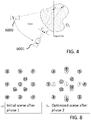
- FIG. 8 shows resulting patterns of the initial and the optimal scene of the previously described third version of the algorithm.
- the numbering of the points reflects their order of appearance in phase 1.
- Part (b) shows the result of the optimization after phase 2 (grey bubbles 1-12) vs. the initial scene (white bubbles 1,2,3,4,5,10). Where a corresponding white bubble is not visible in the part (b) the initial scene is equal to the optimized scene.
- pre-fetching the viewports as proposed by the algorithm results in an optimal set of data sets. In general, the optimal viewport distribution for any two different observer locations do not need to share any viewports.
- always pre-fetching those data sets being optimal for the current observer location may require updating all data sets whenever the observer is moving. Because the algorithm works by optimizing a given viewport distribution, it can be used adaptively. That is, rather than pre-fetching those data sets for the optimal distribution, one can update the current state, where all updates are in order of their importance. This way, even though the intermediate steps might not be optimal, every update is taking account of the data sets already available on the client. An optimal distribution can be attained, if the observer is standing still long enough for all data sets to be updated to their optimal viewport. This way, also time-dependent probability distributions (for instance, a normal distribution centered at the current observer location) can be used.
- the run-time of the third version of the algorithm as described under FIG. 7 depends mainly on n the number of viewports, and q the number of points we use to discretize A. q is of greater significance, as it is larger than n. Because a two-phase algorithm is used where the first phase is invoked only once, the ratio of n and the number of iterations of the second phase I affects how much of the overall run-time is due to which phase.
- the complexity of the algorithm can be expressed by counting the number of evaluations of the domain error. Each evaluation of the inspection error of an n-point scene requires qn evaluations of the domain error as, for every ⁇ ⁇ A, we need to find the initial viewport out of n for which the domain error is smallest.
- the first phase requires q evaluations of the inspection error of a 1-point scene, q evaluations of the inspection error of a 2-point scene, and so on up to q evaluations of an n-point scene.
- each iteration, in the first step, requires q evaluations of (n - 1)-point scenes and, in the second step, n - 2 evaluations of n-point scenes.
- the complexity is O(q 2 (n 2 - in)), that is, if the number of iterations is of the same order of magnitude as n, the complexity is O(q 2 n 2 ), otherwise O(q 2 n).
- Embodiments of the invention can be implemented in digital electronic circuitry, or in computer hardware, firmware, software, or in combinations of them.
- the invention can be implemented as a computer program product, i.e., a computer program tangibly embodied in an information carrier, e.g., in a machine-readable storage device, for execution by, or to control the operation of, data processing apparatus, e.g., a programmable processor, a computer, or multiple computers.
- a computer program such as the computer program of claim 9, can be written in any form of programming language, including compiled or interpreted languages, and it can be deployed in any form, including as a standalone program or as a module, component, subroutine, or other unit suitable for use in a computing environment.
- a computer program can be deployed to be executed on one computer or on multiple computers at one site or distributed across multiple sites and interconnected by a communication network.
- Method steps of the invention can be performed by one or more programmable processors executing a computer program to perform functions of the invention by operating on input data and generating output. Method steps can also be performed by, and apparatus of the invention can be implemented as, special purpose logic circuitry, e.g., an FPGA (field programmable gate array) or an ASIC (application-specific integrated circuit).
- FPGA field programmable gate array
- ASIC application-specific integrated circuit
- processors suitable for the execution of a computer program include, by way of example, both general and special purpose microprocessors, and any one or more processors of any kind of digital computing device.
- a processor will receive instructions and data from a read-only memory or a random access memory or both.
- the essential elements of a computer are at least one processor for executing instructions and one or more memory devices for storing instructions and data.
- a computer will also include, or be operatively coupled to receive data from or transfer data to, or both, one or more mass storage devices for storing data, e.g., magnetic, magneto-optical disks, or optical disks. Such storage devices may also provisioned on demand and be accessible through the Internet (Cloud Computing).
- Information carriers suitable for embodying computer program instructions and data include all forms of non-volatile memory, including by way of example semiconductor memory devices, e.g., EPROM, EEPROM, and flash memory devices; magnetic disks, e.g., internal hard disks or removable disks; magneto-optical disks; and CD-ROM and DVD-ROM disks.
- semiconductor memory devices e.g., EPROM, EEPROM, and flash memory devices
- magnetic disks e.g., internal hard disks or removable disks
- magneto-optical disks e.g., CD-ROM and DVD-ROM disks.
- the processor and the memory can be supplemented by, or incorporated in special purpose logic circuitry.
- the invention can be implemented on a computer having a display device, e.g., a cathode ray tube (CRT) or liquid crystal display (LCD) monitor, for displaying information to the user and an input device such as a keyboard, touchscreen or touchpad, a pointing device, e.g., a mouse or a trackball, by which the user can provide input to the computer.
- a display device e.g., a cathode ray tube (CRT) or liquid crystal display (LCD) monitor
- an input device such as a keyboard, touchscreen or touchpad, a pointing device, e.g., a mouse or a trackball, by which the user can provide input to the computer.
- Other kinds of devices can be used to provide for interaction with a user as well; for example, feedback provided to the user can be any form of sensory feedback, e.g., visual feedback, auditory feedback, or tactile feedback; and input from the user can be received in any form, including acoustic, speech,
- the invention can be implemented in a computing system that includes a back-end component, e.g., as a data server, or that includes a middleware component, e.g., an application server, or that includes a front-end component, e.g., a client computer having a graphical user interface or a Web browser through which a user can interact with an implementation of the invention, or any combination of such back-end, middleware, or front-end components.
- the components of the system can be interconnected by any form or medium of digital data communication, e.g., a communication network. Examples of communication networks include a local area network (LAN) and a wide area network (WAN), e.g., the Internet or wireless LAN or telecommunication networks.
- LAN local area network
- WAN wide area network
- the computing system can include clients and servers.
- a client and server are generally remote from each other and typically interact through a communication network.
- the relationship of client and server arises by virtue of computer programs running on the respective computers and having a client-server relationship to each other.
Landscapes
- Engineering & Computer Science (AREA)
- Theoretical Computer Science (AREA)
- Physics & Mathematics (AREA)
- Computer Graphics (AREA)
- General Physics & Mathematics (AREA)
- Computing Systems (AREA)
- Geometry (AREA)
- Processing Or Creating Images (AREA)
- Measuring And Recording Apparatus For Diagnosis (AREA)
- Apparatus For Radiation Diagnosis (AREA)
Claims (15)
- Procédé mis en oeuvre par ordinateur (4000), destiné à la visualisation d'une scène, comprenant :l'envoi (4100), à partir d'un client (1001), d'une description de visualisation d'une scène tridimensionnelle à au moins un serveur (1002), dans lequel la description de visualisation comprend des paramètres de position et d'orientation de la scène tridimensionnelle et les paramètres de position indiquent une position de vue et les paramètres d'orientation indiquent une orientation de vue par rapport à la scène tridimensionnelle ;la réception (4200) par le client (1001), à partir d'au moins un serveur (1002), d'au moins une série de couches d'images bidimensionnelles (d0, d1, d2) selon la description de visualisation, dans lequel chaque couche d'image bidimensionnelle (d0, d1, d2) est une représentation d'une partie spatiale correspondante (Ω0, Ω1, Ω2) de la scène tridimensionnelle, la ou les séries correspondant aux paramètres de position etd'orientation, et dans lequel une couche avant de la série comprend une projection d'objets les plus proches de la position de vue et une couche arrière de la série comprend la projection des objets les plus éloignés ;le calcul (4300) par le client (1001) de la scène tridimensionnelle en composant (4301) les couches d'images bidimensionnelles (d0, d1, d2) de la ou des série(s) et, si nécessaire, en ajustant (4302) les couches d'images bidimensionnelles à une position et à une orientation spécifiques ; etl'affichage (4400) de la scène tridimensionnelle calculée par le client (1001).
- Procédé selon la revendication 1, dans lequel la description de visualisation comprend en outre au moins un paramètre de capacité client et dans lequel les parties spatiales (Ω0, Ω1, Ω2) sont en cours d'adaptation au ou aux paramètre(s) de capacité client.
- Procédé selon la revendication 1 ou 2, comprenant en outre :la réception (4500) des informations de changement de position par le client ;la prédiction (4600) des informations de changement de position futures sur la base des informations de changement de position reçues ;la détermination (4700) d'une description de visualisation supplémentaire correspondant aux informations de changement de position futures prédites ; etla pré-extraction (4800) d'au moins une série de couches d'images bidimensionnelles supplémentaire pour la description de visualisation supplémentaire en répétant les étapes d'envoi, de réception et de calcul pour la description de visualisation supplémentaire.
- Procédé selon l'une quelconque des revendications 1 à 3, dans lequel le ou les paramètre(s) de capacité client concerne/concernent les contraintes matérielles du client et/ou concerne/concernent les propriétés de connexion entre le client (1001) et le ou les serveur(s) (1002) et/ou concerne/concernent le comportement de l'utilisateur client.
- Procédé selon l'une quelconque des revendications 1 à 4, dans lequel la description de visualisation comprend en outre au moins un paramètre de partitionnement pour la scène tridimensionnelle.
- Procédé selon la revendication l'une quelconque des revendications précédentes, dans lequel chaque couche d'image a une contribution d'erreur et la contribution d'erreur diminue de manière monotone de la couche avant vers la couche arrière.
- Procédé selon l'une quelconque des revendications 1 à 6, dans lequel l'ajustement des couches d'images bidimensionnelles à une position spécifique comprend le décalage des couches d'images bidimensionnelles de la série.
- Procédé selon l'une quelconque des revendications 1 à 6, dans lequel l'ajustement des couches d'images bidimensionnelles à une position spécifique comprend la rotation des couches d'images bidimensionnelles de la série.
- Procédé selon l'une quelconque des revendications précédentes, dans lequel les couches d'images bidimensionnelles (d0, d1, d2) ont une distribution spatiale hyperbolique en ce qui concerne leur distance par rapport à la position de vue.
- Produit de programme informatique qui, lorsqu'il est chargé dans une mémoire d'un dispositif informatique et exécuté par au moins un processeur du dispositif informatique, exécute les étapes du procédé mis en oeuvre par ordinateur selon l'une quelconque des revendications 1 à 9.
- Ordinateur client (1001) comprenant :un composant d'interface configuré pour envoyer (4100) une description de visualisation d'une scène tridimensionnelle à au moins un serveur (1002), dans lequel la description de visualisation comprend des paramètres de position et d'orientation de la scène tridimensionnelle et les paramètres de position indiquent une position de vue et les paramètres d'orientation indiquent une orientation de vue par rapport à la scène tridimensionnelle, et pour recevoir (4200) du ou des serveur(s) (1002) au moins une série de couches d'images bidimensionnelles (d0, d1, d2) selon la description de visualisation, dans lequel chaque couche d'image bidimensionnelle (d0, d1, d2) est une représentation d'une partie spatiale correspondante (Ω0, Ω1, Ω2) de la scène tridimensionnelle, la ou les série(s) correspondant aux paramètres de position et d'orientation, et dans lequel une couche avant de la série comprend une projection d'objets les plus proches de la position de vue et une couche arrière de la série comprend la projection des objets les plus éloignés ;un composant de mémoire configuré pour stocker la ou les série(s) de couches d'images bidimensionnelles (d0, d1, d2) ;un composant de processeur configuré pour calculer (4300) la scène tridimensionnelle en composant (4301) les couches d'images bidimensionnelles (d0, d1, d2) d'au moins une série et, si nécessaire, en ajustant (4302) les couches d'images bidimensionnelles à une position et à une orientation spécifiques ; etun composant d'affichage configuré pour afficher (4400) la scène tridimensionnelle calculée.
- Ordinateur client selon la revendication 11, dans lequel le composant de traitement est en outre configuré pour capturer au moins un paramètre de capacité client, et dans lequel le composant d'interface est configuré pour envoyer au moins un paramètre de capacité client avec la description de visualisation à au moins un serveur (1002) servant d'entrée pour l'adaptation des parties spatiales (Ω0, Ω1, Ω2) à une capacité correspondante du client (1001).
- Ordinateur client selon la revendication 11 ou 12, comprenant en outre :un composant de positionnement configuré pour recevoir (4500) des informations de changement de position ;dans lequel le composant de traitement est en outre configuré pour :prédire (4600) des informations de changement de position futures sur la base des informations de changement de position reçues ;déterminer (4700) une description de visualisation supplémentaire correspondant aux informations de changement de position futures prédites ; etpré-extraire (4800) au moins une série de couches d'images bidimensionnelles supplémentaire pour la description de visualisation supplémentaire en répétant les étapes d'envoi, de réception et de calcul pour la description de visualisation supplémentaire.
- Ordinateur client selon l'une quelconque des revendications 11 à 13, dans lequel le composant de traitement est en outre configuré pour déterminer au moins un paramètre de partitionnement pour la scène tridimensionnelle.
- Système informatique (1000) comprenant :un ordinateur client (1001) configuré selon l'une quelconque des revendications 11 à 14 ;et au moins un ordinateur serveur (1002) couplé de manière à communiquer avec l'ordinateur client (1001) configuré pour générer au moins une série de couches d'images bidimensionnelles (d0, d1, d2) selon la description de visualisation.
Priority Applications (2)
| Application Number | Priority Date | Filing Date | Title |
|---|---|---|---|
| EP11178724.8A EP2562722B1 (fr) | 2011-08-24 | 2011-08-24 | Système et procédé pour la visualisation de scènes |
| PCT/EP2012/065705 WO2013026719A2 (fr) | 2011-08-24 | 2012-08-10 | Procédé et système pour la visualisation d'une scène |
Applications Claiming Priority (1)
| Application Number | Priority Date | Filing Date | Title |
|---|---|---|---|
| EP11178724.8A EP2562722B1 (fr) | 2011-08-24 | 2011-08-24 | Système et procédé pour la visualisation de scènes |
Publications (2)
| Publication Number | Publication Date |
|---|---|
| EP2562722A1 EP2562722A1 (fr) | 2013-02-27 |
| EP2562722B1 true EP2562722B1 (fr) | 2019-07-10 |
Family
ID=46690490
Family Applications (1)
| Application Number | Title | Priority Date | Filing Date |
|---|---|---|---|
| EP11178724.8A Not-in-force EP2562722B1 (fr) | 2011-08-24 | 2011-08-24 | Système et procédé pour la visualisation de scènes |
Country Status (2)
| Country | Link |
|---|---|
| EP (1) | EP2562722B1 (fr) |
| WO (1) | WO2013026719A2 (fr) |
Families Citing this family (2)
| Publication number | Priority date | Publication date | Assignee | Title |
|---|---|---|---|---|
| US10325403B2 (en) * | 2016-08-24 | 2019-06-18 | Google Llc | Image based rendering techniques for virtual reality |
| CN110796744A (zh) * | 2019-11-07 | 2020-02-14 | 成都淞幸科技有限责任公司 | 一种三维在线组装方法 |
Family Cites Families (1)
| Publication number | Priority date | Publication date | Assignee | Title |
|---|---|---|---|---|
| US7019742B2 (en) * | 2003-11-20 | 2006-03-28 | Microsoft Corporation | Dynamic 2D imposters of 3D graphic objects |
-
2011
- 2011-08-24 EP EP11178724.8A patent/EP2562722B1/fr not_active Not-in-force
-
2012
- 2012-08-10 WO PCT/EP2012/065705 patent/WO2013026719A2/fr not_active Ceased
Non-Patent Citations (1)
| Title |
|---|
| None * |
Also Published As
| Publication number | Publication date |
|---|---|
| WO2013026719A3 (fr) | 2013-06-06 |
| EP2562722A1 (fr) | 2013-02-27 |
| WO2013026719A2 (fr) | 2013-02-28 |
Similar Documents
| Publication | Publication Date | Title |
|---|---|---|
| JP7733741B2 (ja) | 潜在変数で条件付けた幾何学的形状認識ニューラルネットワークを使用した、シーンの新規画像のレンダリング | |
| US9024947B2 (en) | Rendering and navigating photographic panoramas with depth information in a geographic information system | |
| US8624926B2 (en) | Panning using virtual surfaces | |
| US9881415B2 (en) | Generating point clouds | |
| CN114998433B (zh) | 位姿计算方法、装置、存储介质以及电子设备 | |
| CN115375836B (zh) | 基于多元置信度滤波的点云融合三维重建方法和系统 | |
| CN113643414A (zh) | 一种三维图像生成方法、装置、电子设备及存储介质 | |
| US20150199383A1 (en) | Systems and Methods for Indexing and Retrieving Images | |
| JP2024521816A (ja) | 無制約画像手ぶれ補正 | |
| CN116824068B (zh) | 面向复杂动态场景中点云流的实时重建方法、装置及设备 | |
| US9852542B1 (en) | Methods and apparatus related to georeferenced pose of 3D models | |
| CN115424022B (zh) | 输电走廊地面点云分割方法、装置和计算机设备 | |
| CN113034582A (zh) | 位姿优化装置及方法、电子设备及计算机可读存储介质 | |
| EP2562722B1 (fr) | Système et procédé pour la visualisation de scènes | |
| CN106503171B (zh) | 一种矢量数据的处理方法及装置 | |
| WO2026020755A1 (fr) | Procédé, appareil et dispositif de prédiction de réseau d'occupation, support de stockage et produit | |
| CN116128943B (zh) | 一种点云匹配方法、装置、计算机设备及存储介质 | |
| CN117830372A (zh) | 三维场景构建方法、装置、计算机设备和存储介质 | |
| CN116109799A (zh) | 调整模型训练方法、装置、计算机设备及存储介质 | |
| Zhang et al. | Efficient and fine-grained viewshed analysis in a three-dimensional urban complex environment | |
| CN121213805B (zh) | 稀疏视图的三维重建方法、装置、设备、存储介质及产品 | |
| CN118657867B (zh) | 三维结构化模型贴图渲染方法、装置和计算机设备 | |
| US12579732B2 (en) | Face-oriented geometry streaming | |
| US20250371728A1 (en) | Human-body-aware visual SLAM in metric scale | |
| Boutsi | Photogrammetric Techniques and Algorithms Optimization for the Development of Interactive Augmented Reality Systems |
Legal Events
| Date | Code | Title | Description |
|---|---|---|---|
| PUAI | Public reference made under article 153(3) epc to a published international application that has entered the european phase |
Free format text: ORIGINAL CODE: 0009012 |
|
| AK | Designated contracting states |
Kind code of ref document: A1 Designated state(s): AL AT BE BG CH CY CZ DE DK EE ES FI FR GB GR HR HU IE IS IT LI LT LU LV MC MK MT NL NO PL PT RO RS SE SI SK SM TR |
|
| AX | Request for extension of the european patent |
Extension state: BA ME |
|
| 17P | Request for examination filed |
Effective date: 20130502 |
|
| 17Q | First examination report despatched |
Effective date: 20140708 |
|
| RIC1 | Information provided on ipc code assigned before grant |
Ipc: G06T 15/04 20110101ALI20181219BHEP Ipc: G06T 15/00 20110101AFI20181219BHEP Ipc: G06T 15/20 20110101ALI20181219BHEP |
|
| GRAP | Despatch of communication of intention to grant a patent |
Free format text: ORIGINAL CODE: EPIDOSNIGR1 |
|
| STAA | Information on the status of an ep patent application or granted ep patent |
Free format text: STATUS: GRANT OF PATENT IS INTENDED |
|
| INTG | Intention to grant announced |
Effective date: 20190128 |
|
| GRAS | Grant fee paid |
Free format text: ORIGINAL CODE: EPIDOSNIGR3 |
|
| GRAA | (expected) grant |
Free format text: ORIGINAL CODE: 0009210 |
|
| STAA | Information on the status of an ep patent application or granted ep patent |
Free format text: STATUS: THE PATENT HAS BEEN GRANTED |
|
| AK | Designated contracting states |
Kind code of ref document: B1 Designated state(s): AL AT BE BG CH CY CZ DE DK EE ES FI FR GB GR HR HU IE IS IT LI LT LU LV MC MK MT NL NO PL PT RO RS SE SI SK SM TR |
|
| REG | Reference to a national code |
Ref country code: GB Ref legal event code: FG4D |
|
| REG | Reference to a national code |
Ref country code: CH Ref legal event code: EP Ref country code: AT Ref legal event code: REF Ref document number: 1154365 Country of ref document: AT Kind code of ref document: T Effective date: 20190715 |
|
| REG | Reference to a national code |
Ref country code: DE Ref legal event code: R096 Ref document number: 602011060310 Country of ref document: DE |
|
| REG | Reference to a national code |
Ref country code: IE Ref legal event code: FG4D |
|
| REG | Reference to a national code |
Ref country code: NL Ref legal event code: MP Effective date: 20190710 |
|
| REG | Reference to a national code |
Ref country code: LT Ref legal event code: MG4D |
|
| REG | Reference to a national code |
Ref country code: AT Ref legal event code: MK05 Ref document number: 1154365 Country of ref document: AT Kind code of ref document: T Effective date: 20190710 |
|
| PG25 | Lapsed in a contracting state [announced via postgrant information from national office to epo] |
Ref country code: HR Free format text: LAPSE BECAUSE OF FAILURE TO SUBMIT A TRANSLATION OF THE DESCRIPTION OR TO PAY THE FEE WITHIN THE PRESCRIBED TIME-LIMIT Effective date: 20190710 Ref country code: LT Free format text: LAPSE BECAUSE OF FAILURE TO SUBMIT A TRANSLATION OF THE DESCRIPTION OR TO PAY THE FEE WITHIN THE PRESCRIBED TIME-LIMIT Effective date: 20190710 Ref country code: BG Free format text: LAPSE BECAUSE OF FAILURE TO SUBMIT A TRANSLATION OF THE DESCRIPTION OR TO PAY THE FEE WITHIN THE PRESCRIBED TIME-LIMIT Effective date: 20191010 Ref country code: SE Free format text: LAPSE BECAUSE OF FAILURE TO SUBMIT A TRANSLATION OF THE DESCRIPTION OR TO PAY THE FEE WITHIN THE PRESCRIBED TIME-LIMIT Effective date: 20190710 Ref country code: PT Free format text: LAPSE BECAUSE OF FAILURE TO SUBMIT A TRANSLATION OF THE DESCRIPTION OR TO PAY THE FEE WITHIN THE PRESCRIBED TIME-LIMIT Effective date: 20191111 Ref country code: NL Free format text: LAPSE BECAUSE OF FAILURE TO SUBMIT A TRANSLATION OF THE DESCRIPTION OR TO PAY THE FEE WITHIN THE PRESCRIBED TIME-LIMIT Effective date: 20190710 Ref country code: FI Free format text: LAPSE BECAUSE OF FAILURE TO SUBMIT A TRANSLATION OF THE DESCRIPTION OR TO PAY THE FEE WITHIN THE PRESCRIBED TIME-LIMIT Effective date: 20190710 Ref country code: AT Free format text: LAPSE BECAUSE OF FAILURE TO SUBMIT A TRANSLATION OF THE DESCRIPTION OR TO PAY THE FEE WITHIN THE PRESCRIBED TIME-LIMIT Effective date: 20190710 Ref country code: NO Free format text: LAPSE BECAUSE OF FAILURE TO SUBMIT A TRANSLATION OF THE DESCRIPTION OR TO PAY THE FEE WITHIN THE PRESCRIBED TIME-LIMIT Effective date: 20191010 |
|
| PG25 | Lapsed in a contracting state [announced via postgrant information from national office to epo] |
Ref country code: IS Free format text: LAPSE BECAUSE OF FAILURE TO SUBMIT A TRANSLATION OF THE DESCRIPTION OR TO PAY THE FEE WITHIN THE PRESCRIBED TIME-LIMIT Effective date: 20191110 Ref country code: RS Free format text: LAPSE BECAUSE OF FAILURE TO SUBMIT A TRANSLATION OF THE DESCRIPTION OR TO PAY THE FEE WITHIN THE PRESCRIBED TIME-LIMIT Effective date: 20190710 Ref country code: LV Free format text: LAPSE BECAUSE OF FAILURE TO SUBMIT A TRANSLATION OF THE DESCRIPTION OR TO PAY THE FEE WITHIN THE PRESCRIBED TIME-LIMIT Effective date: 20190710 Ref country code: AL Free format text: LAPSE BECAUSE OF FAILURE TO SUBMIT A TRANSLATION OF THE DESCRIPTION OR TO PAY THE FEE WITHIN THE PRESCRIBED TIME-LIMIT Effective date: 20190710 Ref country code: GR Free format text: LAPSE BECAUSE OF FAILURE TO SUBMIT A TRANSLATION OF THE DESCRIPTION OR TO PAY THE FEE WITHIN THE PRESCRIBED TIME-LIMIT Effective date: 20191011 Ref country code: ES Free format text: LAPSE BECAUSE OF FAILURE TO SUBMIT A TRANSLATION OF THE DESCRIPTION OR TO PAY THE FEE WITHIN THE PRESCRIBED TIME-LIMIT Effective date: 20190710 |
|
| PG25 | Lapsed in a contracting state [announced via postgrant information from national office to epo] |
Ref country code: TR Free format text: LAPSE BECAUSE OF FAILURE TO SUBMIT A TRANSLATION OF THE DESCRIPTION OR TO PAY THE FEE WITHIN THE PRESCRIBED TIME-LIMIT Effective date: 20190710 |
|
| PG25 | Lapsed in a contracting state [announced via postgrant information from national office to epo] |
Ref country code: PL Free format text: LAPSE BECAUSE OF FAILURE TO SUBMIT A TRANSLATION OF THE DESCRIPTION OR TO PAY THE FEE WITHIN THE PRESCRIBED TIME-LIMIT Effective date: 20190710 Ref country code: DK Free format text: LAPSE BECAUSE OF FAILURE TO SUBMIT A TRANSLATION OF THE DESCRIPTION OR TO PAY THE FEE WITHIN THE PRESCRIBED TIME-LIMIT Effective date: 20190710 Ref country code: RO Free format text: LAPSE BECAUSE OF FAILURE TO SUBMIT A TRANSLATION OF THE DESCRIPTION OR TO PAY THE FEE WITHIN THE PRESCRIBED TIME-LIMIT Effective date: 20190710 Ref country code: IT Free format text: LAPSE BECAUSE OF FAILURE TO SUBMIT A TRANSLATION OF THE DESCRIPTION OR TO PAY THE FEE WITHIN THE PRESCRIBED TIME-LIMIT Effective date: 20190710 Ref country code: EE Free format text: LAPSE BECAUSE OF FAILURE TO SUBMIT A TRANSLATION OF THE DESCRIPTION OR TO PAY THE FEE WITHIN THE PRESCRIBED TIME-LIMIT Effective date: 20190710 |
|
| PG25 | Lapsed in a contracting state [announced via postgrant information from national office to epo] |
Ref country code: IS Free format text: LAPSE BECAUSE OF FAILURE TO SUBMIT A TRANSLATION OF THE DESCRIPTION OR TO PAY THE FEE WITHIN THE PRESCRIBED TIME-LIMIT Effective date: 20200224 Ref country code: SM Free format text: LAPSE BECAUSE OF FAILURE TO SUBMIT A TRANSLATION OF THE DESCRIPTION OR TO PAY THE FEE WITHIN THE PRESCRIBED TIME-LIMIT Effective date: 20190710 Ref country code: CZ Free format text: LAPSE BECAUSE OF FAILURE TO SUBMIT A TRANSLATION OF THE DESCRIPTION OR TO PAY THE FEE WITHIN THE PRESCRIBED TIME-LIMIT Effective date: 20190710 Ref country code: LU Free format text: LAPSE BECAUSE OF NON-PAYMENT OF DUE FEES Effective date: 20190824 Ref country code: MC Free format text: LAPSE BECAUSE OF FAILURE TO SUBMIT A TRANSLATION OF THE DESCRIPTION OR TO PAY THE FEE WITHIN THE PRESCRIBED TIME-LIMIT Effective date: 20190710 Ref country code: SK Free format text: LAPSE BECAUSE OF FAILURE TO SUBMIT A TRANSLATION OF THE DESCRIPTION OR TO PAY THE FEE WITHIN THE PRESCRIBED TIME-LIMIT Effective date: 20190710 Ref country code: CH Free format text: LAPSE BECAUSE OF NON-PAYMENT OF DUE FEES Effective date: 20190831 Ref country code: LI Free format text: LAPSE BECAUSE OF NON-PAYMENT OF DUE FEES Effective date: 20190831 |
|
| REG | Reference to a national code |
Ref country code: BE Ref legal event code: MM Effective date: 20190831 |
|
| REG | Reference to a national code |
Ref country code: DE Ref legal event code: R097 Ref document number: 602011060310 Country of ref document: DE |
|
| PLBE | No opposition filed within time limit |
Free format text: ORIGINAL CODE: 0009261 |
|
| STAA | Information on the status of an ep patent application or granted ep patent |
Free format text: STATUS: NO OPPOSITION FILED WITHIN TIME LIMIT |
|
| PG2D | Information on lapse in contracting state deleted |
Ref country code: IS |
|
| PG25 | Lapsed in a contracting state [announced via postgrant information from national office to epo] |
Ref country code: IE Free format text: LAPSE BECAUSE OF NON-PAYMENT OF DUE FEES Effective date: 20190824 |
|
| 26N | No opposition filed |
Effective date: 20200603 |
|
| PG25 | Lapsed in a contracting state [announced via postgrant information from national office to epo] |
Ref country code: SI Free format text: LAPSE BECAUSE OF FAILURE TO SUBMIT A TRANSLATION OF THE DESCRIPTION OR TO PAY THE FEE WITHIN THE PRESCRIBED TIME-LIMIT Effective date: 20190710 Ref country code: BE Free format text: LAPSE BECAUSE OF NON-PAYMENT OF DUE FEES Effective date: 20190831 |
|
| PGFP | Annual fee paid to national office [announced via postgrant information from national office to epo] |
Ref country code: DE Payment date: 20200824 Year of fee payment: 10 Ref country code: GB Payment date: 20200825 Year of fee payment: 10 Ref country code: FR Payment date: 20200820 Year of fee payment: 10 |
|
| PG25 | Lapsed in a contracting state [announced via postgrant information from national office to epo] |
Ref country code: CY Free format text: LAPSE BECAUSE OF FAILURE TO SUBMIT A TRANSLATION OF THE DESCRIPTION OR TO PAY THE FEE WITHIN THE PRESCRIBED TIME-LIMIT Effective date: 20190710 |
|
| PG25 | Lapsed in a contracting state [announced via postgrant information from national office to epo] |
Ref country code: HU Free format text: LAPSE BECAUSE OF FAILURE TO SUBMIT A TRANSLATION OF THE DESCRIPTION OR TO PAY THE FEE WITHIN THE PRESCRIBED TIME-LIMIT; INVALID AB INITIO Effective date: 20110824 Ref country code: MT Free format text: LAPSE BECAUSE OF FAILURE TO SUBMIT A TRANSLATION OF THE DESCRIPTION OR TO PAY THE FEE WITHIN THE PRESCRIBED TIME-LIMIT Effective date: 20190710 |
|
| REG | Reference to a national code |
Ref country code: DE Ref legal event code: R119 Ref document number: 602011060310 Country of ref document: DE |
|
| GBPC | Gb: european patent ceased through non-payment of renewal fee |
Effective date: 20210824 |
|
| PG25 | Lapsed in a contracting state [announced via postgrant information from national office to epo] |
Ref country code: MK Free format text: LAPSE BECAUSE OF FAILURE TO SUBMIT A TRANSLATION OF THE DESCRIPTION OR TO PAY THE FEE WITHIN THE PRESCRIBED TIME-LIMIT Effective date: 20190710 |
|
| PG25 | Lapsed in a contracting state [announced via postgrant information from national office to epo] |
Ref country code: GB Free format text: LAPSE BECAUSE OF NON-PAYMENT OF DUE FEES Effective date: 20210824 Ref country code: FR Free format text: LAPSE BECAUSE OF NON-PAYMENT OF DUE FEES Effective date: 20210831 Ref country code: DE Free format text: LAPSE BECAUSE OF NON-PAYMENT OF DUE FEES Effective date: 20220301 |