EP2576533B1 - Verfahren zur herstellung von in 2-stellung substituierten tetrahydropyranolen - Google Patents
Verfahren zur herstellung von in 2-stellung substituierten tetrahydropyranolen Download PDFInfo
- Publication number
- EP2576533B1 EP2576533B1 EP11721542.6A EP11721542A EP2576533B1 EP 2576533 B1 EP2576533 B1 EP 2576533B1 EP 11721542 A EP11721542 A EP 11721542A EP 2576533 B1 EP2576533 B1 EP 2576533B1
- Authority
- EP
- European Patent Office
- Prior art keywords
- formula
- process according
- weight
- isoprenol
- reaction
- Prior art date
- Legal status (The legal status is an assumption and is not a legal conclusion. Google has not performed a legal analysis and makes no representation as to the accuracy of the status listed.)
- Not-in-force
Links
- 238000000034 method Methods 0.000 title claims description 53
- 238000004519 manufacturing process Methods 0.000 title description 5
- CELWCAITJAEQNL-UHFFFAOYSA-N oxan-2-ol Chemical group OC1CCCCO1 CELWCAITJAEQNL-UHFFFAOYSA-N 0.000 title description 2
- CPJRRXSHAYUTGL-UHFFFAOYSA-N isopentenyl alcohol Chemical compound CC(=C)CCO CPJRRXSHAYUTGL-UHFFFAOYSA-N 0.000 claims description 75
- 238000006243 chemical reaction Methods 0.000 claims description 57
- XLYOFNOQVPJJNP-UHFFFAOYSA-N water Substances O XLYOFNOQVPJJNP-UHFFFAOYSA-N 0.000 claims description 47
- 239000003054 catalyst Substances 0.000 claims description 45
- 150000001768 cations Chemical class 0.000 claims description 38
- 230000002378 acidificating effect Effects 0.000 claims description 35
- 239000007858 starting material Substances 0.000 claims description 28
- 150000001875 compounds Chemical class 0.000 claims description 25
- 239000000203 mixture Substances 0.000 claims description 22
- 239000011541 reaction mixture Substances 0.000 claims description 21
- 238000002360 preparation method Methods 0.000 claims description 19
- 229910052739 hydrogen Inorganic materials 0.000 claims description 17
- 239000001257 hydrogen Substances 0.000 claims description 16
- 238000005984 hydrogenation reaction Methods 0.000 claims description 16
- UFHFLCQGNIYNRP-UHFFFAOYSA-N Hydrogen Chemical compound [H][H] UFHFLCQGNIYNRP-UHFFFAOYSA-N 0.000 claims description 15
- QVGXLLKOCUKJST-UHFFFAOYSA-N atomic oxygen Chemical compound [O] QVGXLLKOCUKJST-UHFFFAOYSA-N 0.000 claims description 15
- 150000002500 ions Chemical class 0.000 claims description 15
- 239000001301 oxygen Substances 0.000 claims description 15
- 229910052760 oxygen Inorganic materials 0.000 claims description 15
- 125000002496 methyl group Chemical group [H]C([H])([H])* 0.000 claims description 13
- 125000000542 sulfonic acid group Chemical group 0.000 claims description 12
- 125000004432 carbon atom Chemical group C* 0.000 claims description 11
- PXHVJJICTQNCMI-UHFFFAOYSA-N Nickel Chemical compound [Ni] PXHVJJICTQNCMI-UHFFFAOYSA-N 0.000 claims description 10
- 125000001495 ethyl group Chemical group [H]C([H])([H])C([H])([H])* 0.000 claims description 7
- QCWXUUIWCKQGHC-UHFFFAOYSA-N Zirconium Chemical compound [Zr] QCWXUUIWCKQGHC-UHFFFAOYSA-N 0.000 claims description 6
- 229910052726 zirconium Inorganic materials 0.000 claims description 6
- MCMNRKCIXSYSNV-UHFFFAOYSA-N Zirconium dioxide Chemical compound O=[Zr]=O MCMNRKCIXSYSNV-UHFFFAOYSA-N 0.000 claims description 5
- 229910052759 nickel Inorganic materials 0.000 claims description 5
- 229920005989 resin Polymers 0.000 claims description 5
- 239000011347 resin Substances 0.000 claims description 5
- NWUYHJFMYQTDRP-UHFFFAOYSA-N 1,2-bis(ethenyl)benzene;1-ethenyl-2-ethylbenzene;styrene Chemical class C=CC1=CC=CC=C1.CCC1=CC=CC=C1C=C.C=CC1=CC=CC=C1C=C NWUYHJFMYQTDRP-UHFFFAOYSA-N 0.000 claims description 4
- RYGMFSIKBFXOCR-UHFFFAOYSA-N Copper Chemical compound [Cu] RYGMFSIKBFXOCR-UHFFFAOYSA-N 0.000 claims description 4
- 229910052802 copper Inorganic materials 0.000 claims description 4
- 239000010949 copper Substances 0.000 claims description 4
- 230000006735 deficit Effects 0.000 claims description 4
- 239000003960 organic solvent Substances 0.000 claims description 4
- 229920002223 polystyrene Polymers 0.000 claims description 4
- ZOKXTWBITQBERF-UHFFFAOYSA-N Molybdenum Chemical compound [Mo] ZOKXTWBITQBERF-UHFFFAOYSA-N 0.000 claims description 3
- 239000004793 Polystyrene Substances 0.000 claims description 3
- 229910052750 molybdenum Inorganic materials 0.000 claims description 3
- 239000011733 molybdenum Substances 0.000 claims description 3
- 229920000642 polymer Polymers 0.000 claims description 3
- 125000002485 formyl group Chemical class [H]C(*)=O 0.000 claims 7
- JKQOBWVOAYFWKG-UHFFFAOYSA-N molybdenum trioxide Chemical compound O=[Mo](=O)=O JKQOBWVOAYFWKG-UHFFFAOYSA-N 0.000 claims 2
- 238000007599 discharging Methods 0.000 claims 1
- 125000004435 hydrogen atom Chemical group [H]* 0.000 claims 1
- 150000001299 aldehydes Chemical class 0.000 description 39
- 229920001429 chelating resin Polymers 0.000 description 21
- SEPQTYODOKLVSB-UHFFFAOYSA-N 3-methylbut-2-enal Chemical compound CC(C)=CC=O SEPQTYODOKLVSB-UHFFFAOYSA-N 0.000 description 19
- OKKJLVBELUTLKV-UHFFFAOYSA-N Methanol Chemical compound OC OKKJLVBELUTLKV-UHFFFAOYSA-N 0.000 description 12
- FRISMOQHTLZZRP-UHFFFAOYSA-N (+-)-nerol oxide Natural products CC(C)=CC1CC(C)=CCO1 FRISMOQHTLZZRP-UHFFFAOYSA-N 0.000 description 9
- YVSNOTITPICPTB-UHFFFAOYSA-N 4-methyl-2-(2-methylpropyl)oxan-4-ol Chemical compound CC(C)CC1CC(C)(O)CCO1 YVSNOTITPICPTB-UHFFFAOYSA-N 0.000 description 7
- BZLVMXJERCGZMT-UHFFFAOYSA-N Methyl tert-butyl ether Chemical compound COC(C)(C)C BZLVMXJERCGZMT-UHFFFAOYSA-N 0.000 description 7
- QAOWNCQODCNURD-UHFFFAOYSA-N Sulfuric acid Chemical compound OS(O)(=O)=O QAOWNCQODCNURD-UHFFFAOYSA-N 0.000 description 6
- 239000002585 base Substances 0.000 description 6
- 239000003456 ion exchange resin Substances 0.000 description 6
- 229920003303 ion-exchange polymer Polymers 0.000 description 6
- VLKZOEOYAKHREP-UHFFFAOYSA-N n-Hexane Chemical compound CCCCCC VLKZOEOYAKHREP-UHFFFAOYSA-N 0.000 description 6
- 229920001467 poly(styrenesulfonates) Polymers 0.000 description 6
- 238000001556 precipitation Methods 0.000 description 6
- 239000000126 substance Substances 0.000 description 6
- 239000012043 crude product Substances 0.000 description 5
- 229910052500 inorganic mineral Inorganic materials 0.000 description 5
- 239000011707 mineral Substances 0.000 description 5
- 239000000047 product Substances 0.000 description 5
- 239000012266 salt solution Substances 0.000 description 5
- 239000002904 solvent Substances 0.000 description 5
- HSPKVJPBGMXDTF-UHFFFAOYSA-N 2-(3-hydroxy-2-methylpropyl)-4-methyloxan-2-ol Chemical compound OCC(C)CC1(O)CC(C)CCO1 HSPKVJPBGMXDTF-UHFFFAOYSA-N 0.000 description 4
- GLZPCOQZEFWAFX-UHFFFAOYSA-N Geraniol Chemical compound CC(C)=CCCC(C)=CCO GLZPCOQZEFWAFX-UHFFFAOYSA-N 0.000 description 4
- VEXZGXHMUGYJMC-UHFFFAOYSA-N Hydrochloric acid Chemical compound Cl VEXZGXHMUGYJMC-UHFFFAOYSA-N 0.000 description 4
- 229920000557 Nafion® Polymers 0.000 description 4
- 239000002253 acid Substances 0.000 description 4
- 238000004817 gas chromatography Methods 0.000 description 4
- 125000001449 isopropyl group Chemical group [H]C([H])([H])C([H])(*)C([H])([H])[H] 0.000 description 4
- 125000004123 n-propyl group Chemical group [H]C([H])([H])C([H])([H])C([H])([H])* 0.000 description 4
- 150000003839 salts Chemical class 0.000 description 4
- 239000000243 solution Substances 0.000 description 4
- 150000003755 zirconium compounds Chemical class 0.000 description 4
- MYRTYDVEIRVNKP-UHFFFAOYSA-N 1,2-Divinylbenzene Chemical compound C=CC1=CC=CC=C1C=C MYRTYDVEIRVNKP-UHFFFAOYSA-N 0.000 description 3
- 0 CC1(C[C@](C=C(C)*)OCC1)O Chemical compound CC1(C[C@](C=C(C)*)OCC1)O 0.000 description 3
- LFQSCWFLJHTTHZ-UHFFFAOYSA-N Ethanol Chemical compound CCO LFQSCWFLJHTTHZ-UHFFFAOYSA-N 0.000 description 3
- WSFSSNUMVMOOMR-UHFFFAOYSA-N Formaldehyde Chemical compound O=C WSFSSNUMVMOOMR-UHFFFAOYSA-N 0.000 description 3
- KWYUFKZDYYNOTN-UHFFFAOYSA-M Potassium hydroxide Chemical compound [OH-].[K+] KWYUFKZDYYNOTN-UHFFFAOYSA-M 0.000 description 3
- HEMHJVSKTPXQMS-UHFFFAOYSA-M Sodium hydroxide Chemical compound [OH-].[Na+] HEMHJVSKTPXQMS-UHFFFAOYSA-M 0.000 description 3
- PPBRXRYQALVLMV-UHFFFAOYSA-N Styrene Chemical compound C=CC1=CC=CC=C1 PPBRXRYQALVLMV-UHFFFAOYSA-N 0.000 description 3
- YXFVVABEGXRONW-UHFFFAOYSA-N Toluene Chemical compound CC1=CC=CC=C1 YXFVVABEGXRONW-UHFFFAOYSA-N 0.000 description 3
- -1 alkene aldehydes Chemical class 0.000 description 3
- 239000006227 byproduct Substances 0.000 description 3
- 230000018044 dehydration Effects 0.000 description 3
- 238000006297 dehydration reaction Methods 0.000 description 3
- 239000000706 filtrate Substances 0.000 description 3
- 239000002638 heterogeneous catalyst Substances 0.000 description 3
- 239000002244 precipitate Substances 0.000 description 3
- CZCBTSFUTPZVKJ-UHFFFAOYSA-N rose oxide Chemical compound CC1CCOC(C=C(C)C)C1 CZCBTSFUTPZVKJ-UHFFFAOYSA-N 0.000 description 3
- 239000002002 slurry Substances 0.000 description 3
- 238000003756 stirring Methods 0.000 description 3
- MBDOYVRWFFCFHM-UHFFFAOYSA-N 2-hexenal Chemical compound CCCC=CC=O MBDOYVRWFFCFHM-UHFFFAOYSA-N 0.000 description 2
- GSSXLFACIJSBOM-UHFFFAOYSA-N 2h-pyran-2-ol Chemical compound OC1OC=CC=C1 GSSXLFACIJSBOM-UHFFFAOYSA-N 0.000 description 2
- YGHRJJRRZDOVPD-UHFFFAOYSA-N 3-methylbutanal Chemical compound CC(C)CC=O YGHRJJRRZDOVPD-UHFFFAOYSA-N 0.000 description 2
- XKRFYHLGVUSROY-UHFFFAOYSA-N Argon Chemical compound [Ar] XKRFYHLGVUSROY-UHFFFAOYSA-N 0.000 description 2
- IJGRMHOSHXDMSA-UHFFFAOYSA-N Atomic nitrogen Chemical compound N#N IJGRMHOSHXDMSA-UHFFFAOYSA-N 0.000 description 2
- OKTJSMMVPCPJKN-UHFFFAOYSA-N Carbon Chemical compound [C] OKTJSMMVPCPJKN-UHFFFAOYSA-N 0.000 description 2
- XDTMQSROBMDMFD-UHFFFAOYSA-N Cyclohexane Chemical compound C1CCCCC1 XDTMQSROBMDMFD-UHFFFAOYSA-N 0.000 description 2
- VQTUBCCKSQIDNK-UHFFFAOYSA-N Isobutene Chemical compound CC(C)=C VQTUBCCKSQIDNK-UHFFFAOYSA-N 0.000 description 2
- KFZMGEQAYNKOFK-UHFFFAOYSA-N Isopropanol Chemical compound CC(C)O KFZMGEQAYNKOFK-UHFFFAOYSA-N 0.000 description 2
- AMIMRNSIRUDHCM-UHFFFAOYSA-N Isopropylaldehyde Chemical compound CC(C)C=O AMIMRNSIRUDHCM-UHFFFAOYSA-N 0.000 description 2
- AFVFQIVMOAPDHO-UHFFFAOYSA-N Methanesulfonic acid Chemical compound CS(O)(=O)=O AFVFQIVMOAPDHO-UHFFFAOYSA-N 0.000 description 2
- IMNFDUFMRHMDMM-UHFFFAOYSA-N N-Heptane Chemical compound CCCCCCC IMNFDUFMRHMDMM-UHFFFAOYSA-N 0.000 description 2
- CDBYLPFSWZWCQE-UHFFFAOYSA-L Sodium Carbonate Chemical compound [Na+].[Na+].[O-]C([O-])=O CDBYLPFSWZWCQE-UHFFFAOYSA-L 0.000 description 2
- 239000011149 active material Substances 0.000 description 2
- 239000012159 carrier gas Substances 0.000 description 2
- 238000000975 co-precipitation Methods 0.000 description 2
- 238000001816 cooling Methods 0.000 description 2
- 229920001577 copolymer Polymers 0.000 description 2
- 239000003205 fragrance Substances 0.000 description 2
- 239000010439 graphite Substances 0.000 description 2
- 229910002804 graphite Inorganic materials 0.000 description 2
- 238000005342 ion exchange Methods 0.000 description 2
- 239000011159 matrix material Substances 0.000 description 2
- VLTRZXGMWDSKGL-UHFFFAOYSA-N perchloric acid Chemical compound OCl(=O)(=O)=O VLTRZXGMWDSKGL-UHFFFAOYSA-N 0.000 description 2
- BWHMMNNQKKPAPP-UHFFFAOYSA-L potassium carbonate Chemical compound [K+].[K+].[O-]C([O-])=O BWHMMNNQKKPAPP-UHFFFAOYSA-L 0.000 description 2
- 239000000843 powder Substances 0.000 description 2
- 229930007790 rose oxide Natural products 0.000 description 2
- 239000000523 sample Substances 0.000 description 2
- JOXIMZWYDAKGHI-UHFFFAOYSA-N toluene-4-sulfonic acid Chemical compound CC1=CC=C(S(O)(=O)=O)C=C1 JOXIMZWYDAKGHI-UHFFFAOYSA-N 0.000 description 2
- 150000003754 zirconium Chemical class 0.000 description 2
- DTCCTIQRPGSLPT-ONEGZZNKSA-N (E)-2-pentenal Chemical compound CC\C=C\C=O DTCCTIQRPGSLPT-ONEGZZNKSA-N 0.000 description 1
- XGADWNHARGAKQG-GQCTYLIASA-N (e)-3-methylpent-2-enal Chemical compound CC\C(C)=C\C=O XGADWNHARGAKQG-GQCTYLIASA-N 0.000 description 1
- YZUPZGFPHUVJKC-UHFFFAOYSA-N 1-bromo-2-methoxyethane Chemical compound COCCBr YZUPZGFPHUVJKC-UHFFFAOYSA-N 0.000 description 1
- IXQGCWUGDFDQMF-UHFFFAOYSA-N 2-Ethylphenol Chemical compound CCC1=CC=CC=C1O IXQGCWUGDFDQMF-UHFFFAOYSA-N 0.000 description 1
- MBDOYVRWFFCFHM-SNAWJCMRSA-N 2-Hexenal Natural products CCC\C=C\C=O MBDOYVRWFFCFHM-SNAWJCMRSA-N 0.000 description 1
- GYDWAHVMHVWZOZ-UHFFFAOYSA-N 3-methylhex-2-enal Chemical compound CCCC(C)=CC=O GYDWAHVMHVWZOZ-UHFFFAOYSA-N 0.000 description 1
- LETLQGKRPMMKKC-UHFFFAOYSA-N 4-methyl-2-(2-methylpropyl)oxane Chemical compound CC(C)CC1CC(C)CCO1 LETLQGKRPMMKKC-UHFFFAOYSA-N 0.000 description 1
- YVSNOTITPICPTB-QVDQXJPCSA-N CC(C)CC(C1)OCC[C@@]1(C)O Chemical compound CC(C)CC(C1)OCC[C@@]1(C)O YVSNOTITPICPTB-QVDQXJPCSA-N 0.000 description 1
- 241000755716 Convallaria Species 0.000 description 1
- 235000009046 Convallaria majalis Nutrition 0.000 description 1
- 101710088194 Dehydrogenase Proteins 0.000 description 1
- GLZPCOQZEFWAFX-YFHOEESVSA-N Geraniol Natural products CC(C)=CCC\C(C)=C/CO GLZPCOQZEFWAFX-YFHOEESVSA-N 0.000 description 1
- 239000005792 Geraniol Substances 0.000 description 1
- GLZPCOQZEFWAFX-JXMROGBWSA-N Nerol Natural products CC(C)=CCC\C(C)=C\CO GLZPCOQZEFWAFX-JXMROGBWSA-N 0.000 description 1
- CTQNGGLPUBDAKN-UHFFFAOYSA-N O-Xylene Chemical compound CC1=CC=CC=C1C CTQNGGLPUBDAKN-UHFFFAOYSA-N 0.000 description 1
- 229910006069 SO3H Inorganic materials 0.000 description 1
- ACWQBUSCFPJUPN-UHFFFAOYSA-N Tiglaldehyde Natural products CC=C(C)C=O ACWQBUSCFPJUPN-UHFFFAOYSA-N 0.000 description 1
- 150000007513 acids Chemical class 0.000 description 1
- 229910052783 alkali metal Inorganic materials 0.000 description 1
- 150000001340 alkali metals Chemical class 0.000 description 1
- 150000001450 anions Chemical class 0.000 description 1
- 239000007864 aqueous solution Substances 0.000 description 1
- 229910052786 argon Inorganic materials 0.000 description 1
- DTCCTIQRPGSLPT-UHFFFAOYSA-N beta-Aethyl-acrolein Natural products CCC=CC=O DTCCTIQRPGSLPT-UHFFFAOYSA-N 0.000 description 1
- 230000015572 biosynthetic process Effects 0.000 description 1
- 230000002051 biphasic effect Effects 0.000 description 1
- 150000001642 boronic acid derivatives Chemical class 0.000 description 1
- 238000001354 calcination Methods 0.000 description 1
- 229910052799 carbon Inorganic materials 0.000 description 1
- 230000003197 catalytic effect Effects 0.000 description 1
- 238000009903 catalytic hydrogenation reaction Methods 0.000 description 1
- 238000005119 centrifugation Methods 0.000 description 1
- 239000003153 chemical reaction reagent Substances 0.000 description 1
- 230000009918 complex formation Effects 0.000 description 1
- 238000010924 continuous production Methods 0.000 description 1
- 238000007334 copolymerization reaction Methods 0.000 description 1
- MLUCVPSAIODCQM-NSCUHMNNSA-N crotonaldehyde Chemical compound C\C=C\C=O MLUCVPSAIODCQM-NSCUHMNNSA-N 0.000 description 1
- MLUCVPSAIODCQM-UHFFFAOYSA-N crotonaldehyde Natural products CC=CC=O MLUCVPSAIODCQM-UHFFFAOYSA-N 0.000 description 1
- 238000006356 dehydrogenation reaction Methods 0.000 description 1
- 230000001419 dependent effect Effects 0.000 description 1
- 238000004821 distillation Methods 0.000 description 1
- 238000001035 drying Methods 0.000 description 1
- 238000001914 filtration Methods 0.000 description 1
- NBVXSUQYWXRMNV-UHFFFAOYSA-N fluoromethane Chemical compound FC NBVXSUQYWXRMNV-UHFFFAOYSA-N 0.000 description 1
- 239000007789 gas Substances 0.000 description 1
- 229940113087 geraniol Drugs 0.000 description 1
- 238000000227 grinding Methods 0.000 description 1
- 238000010438 heat treatment Methods 0.000 description 1
- 150000001261 hydroxy acids Chemical class 0.000 description 1
- 239000011261 inert gas Substances 0.000 description 1
- 150000002576 ketones Chemical class 0.000 description 1
- 239000000463 material Substances 0.000 description 1
- 229910052751 metal Inorganic materials 0.000 description 1
- 239000002184 metal Substances 0.000 description 1
- 150000002736 metal compounds Chemical class 0.000 description 1
- 150000002739 metals Chemical class 0.000 description 1
- 229940098779 methanesulfonic acid Drugs 0.000 description 1
- 238000010327 methods by industry Methods 0.000 description 1
- 238000002156 mixing Methods 0.000 description 1
- 238000000465 moulding Methods 0.000 description 1
- 125000004108 n-butyl group Chemical group [H]C([H])([H])C([H])([H])C([H])([H])C([H])([H])* 0.000 description 1
- 125000000740 n-pentyl group Chemical group [H]C([H])([H])C([H])([H])C([H])([H])C([H])([H])C([H])([H])* 0.000 description 1
- 229910052757 nitrogen Inorganic materials 0.000 description 1
- 150000004880 oxines Chemical class 0.000 description 1
- 150000002927 oxygen compounds Chemical class 0.000 description 1
- RVTZCBVAJQQJTK-UHFFFAOYSA-N oxygen(2-);zirconium(4+) Chemical compound [O-2].[O-2].[Zr+4] RVTZCBVAJQQJTK-UHFFFAOYSA-N 0.000 description 1
- GGROONUBGIWGGS-UHFFFAOYSA-N oxygen(2-);zirconium(4+);hydrate Chemical compound O.[O-2].[O-2].[Zr+4] GGROONUBGIWGGS-UHFFFAOYSA-N 0.000 description 1
- 229910000027 potassium carbonate Inorganic materials 0.000 description 1
- 230000001376 precipitating effect Effects 0.000 description 1
- 238000004886 process control Methods 0.000 description 1
- 230000035484 reaction time Effects 0.000 description 1
- 125000002914 sec-butyl group Chemical group [H]C([H])([H])C([H])([H])C([H])(*)C([H])([H])[H] 0.000 description 1
- 238000000926 separation method Methods 0.000 description 1
- 238000007493 shaping process Methods 0.000 description 1
- 238000007086 side reaction Methods 0.000 description 1
- 150000004760 silicates Chemical class 0.000 description 1
- 229910000029 sodium carbonate Inorganic materials 0.000 description 1
- OBTWBSRJZRCYQV-UHFFFAOYSA-N sulfuryl difluoride Chemical compound FS(F)(=O)=O OBTWBSRJZRCYQV-UHFFFAOYSA-N 0.000 description 1
- 238000003786 synthesis reaction Methods 0.000 description 1
- 125000000999 tert-butyl group Chemical group [H]C([H])([H])C(*)(C([H])([H])[H])C([H])([H])[H] 0.000 description 1
- BFKJFAAPBSQJPD-UHFFFAOYSA-N tetrafluoroethene Chemical compound FC(F)=C(F)F BFKJFAAPBSQJPD-UHFFFAOYSA-N 0.000 description 1
- 150000003527 tetrahydropyrans Chemical class 0.000 description 1
- 238000005406 washing Methods 0.000 description 1
- 239000008096 xylene Substances 0.000 description 1
- LEHFSLREWWMLPU-UHFFFAOYSA-B zirconium(4+);tetraphosphate Chemical class [Zr+4].[Zr+4].[Zr+4].[O-]P([O-])([O-])=O.[O-]P([O-])([O-])=O.[O-]P([O-])([O-])=O.[O-]P([O-])([O-])=O LEHFSLREWWMLPU-UHFFFAOYSA-B 0.000 description 1
Classifications
-
- C—CHEMISTRY; METALLURGY
- C07—ORGANIC CHEMISTRY
- C07D—HETEROCYCLIC COMPOUNDS
- C07D309/00—Heterocyclic compounds containing six-membered rings having one oxygen atom as the only ring hetero atom, not condensed with other rings
- C07D309/02—Heterocyclic compounds containing six-membered rings having one oxygen atom as the only ring hetero atom, not condensed with other rings having no double bonds between ring members or between ring members and non-ring members
- C07D309/08—Heterocyclic compounds containing six-membered rings having one oxygen atom as the only ring hetero atom, not condensed with other rings having no double bonds between ring members or between ring members and non-ring members with hetero atoms or with carbon atoms having three bonds to hetero atoms with at the most one bond to halogen, e.g. ester or nitrile radicals, directly attached to ring carbon atoms
- C07D309/10—Oxygen atoms
Definitions
- the present invention relates to a process for the preparation of 2-substituted 4-hydroxy-4-methyl-tetrahydropyrans by reacting 3-methylbut-3-en-1-ol (isoprenol) with the corresponding alkene aldehydes in the presence of a strongly acidic ion exchanger and then hydrogenation.
- the present invention relates to a corresponding process for the preparation of 2-isobutyl-4-hydroxy-4-methyl-tetrahydropyran by reacting isoprenol with prenal, and subsequent hydrogenation.
- the SU 825 528 discloses a process for the preparation of di- or tetrahydropyrans and tetrahydropyranols by reacting 2-methyl-buten-1-ol-4 (isoprenol) with aldehydes or ketones in the presence of an acidic catalyst, the acidic catalyst being present in an amount of 0, 0001 to 0.01 wt .-% based on the amount of isoprenol is used and the reaction is carried out at a temperature of 0 to 25 ° C in an organic solvent.
- the catalysts mentioned are the ion exchange resin KU-2 (sulfonated polystyrene resin), para-toluenesulfonic acid, sulfuric acid or perchloric acid.
- the reaction of isoprenol with isobutyraldehyde in the presence of KU-2 is described by way of example.
- EP 1 493 737 A1 discloses a process for preparing mixtures of ethylenically unsaturated 4-methyl or 4-methylene pyrans and the corresponding hydroxypyrans by reacting the corresponding aldehydes with isoprenol, the reaction being initiated in a reaction system in which the molar ratio of aldehyde to isoprenol is greater than 1, ie the aldehyde is used in excess.
- the document discloses the subsequent dehydrogenation of said mixtures to the desired ethylenically unsaturated pyrans.
- Suitable catalysts for the first reaction step are mineral acids such as hydrochloric acid or sulfuric acid, but preferably methanesulfonic acid or para-toluenesulfonic acid.
- JP 2007-154069 relates to 2-substituted 4-hydroxytetrahydropyrans having a cis diastereomer content of from 70 to 95% by weight.
- the document further discloses a process for preparing the same by reacting isoprenol with a corresponding aldehyde in the presence of an aqueous solution of an acidic catalyst.
- the reaction at a concentration of the aqueous catalyst solution either in the range of 1 to 10 wt .-% at a temperature of 0 to 100 ° C or in the range of 10 wt .-% or more at a temperature of 0 to 30 ° C.
- As a possible acidic catalysts are generally also called ion exchange resins.
- Helvetica Chimica Acta Vol. 90, 196-204, 2007 describes the preparation of the 2-substituted 4-hydroxy-4-methyltetrahydropyrans Florol® from a geraniol / nerol mixture. In the last step of the synthesis, the side chain in position 2 is hydrogenated.
- the aim is to be able to use inexpensive, easily recoverable and readily reusable starting compounds and reagents or catalysts.
- the starting materials for carrying out the process according to the invention are 3-methylbut-3-en-1-ol (isoprenol) of the formula (II) which is readily accessible by commercial methods from isobutene and formaldehyde on any scale and is readily available commercially.
- isoprenol 3-methylbut-3-en-1-ol (isoprenol) of the formula (II) which is readily accessible by commercial methods from isobutene and formaldehyde on any scale and is readily available commercially.
- isoprenol there are no special requirements for the purity, quality or production process of the isoprenol to be used according to the invention. It can be used in commercial quality and purity with good success as a starting material in the context of the method according to the invention.
- Preference is given to using isoprenol which has a purity of 90% by weight or more, particularly preferably those having a purity of 95 to 100% by weight and very particularly preferably those having a purity of 97 to 99.9% by weight.
- Another starting material for carrying out the process according to the invention is an alkenoaldehyde of the formula (III) where R 1 is a straight-chain or branched alkyl radical having 1 to 5 carbon atoms and R 2 is hydrogen or a straight-chain or branched alkyl radical having 1 to 3 carbon atoms.
- alkyl substituent R 1 is to be understood as having 1 to 5 carbon atoms, for example methyl, ethyl, n-propyl, isopropyl, n-butyl, sec-butyl, tert-butyl or n-pentyl, preferably methyl, Ethyl, n-propyl, iso-propyl, and most preferably methyl.
- alkyl substituent R 2 is to be understood as having 1 to 3 carbon atoms, for example methyl, ethyl, n-propyl or isopropyl, preferably methyl or ethyl, and most preferably methyl.
- strongly acidic cation exchanger mean that the ion exchanger is present in H + form.
- Alkenaldehydes of the formula (III) which are very particularly preferred according to the invention are those in which the radical R 1 is a straight-chain or branched alkyl radical having 1 to 3 carbon atoms and the radical R 2 is an alkyl radical having 1 to 2 carbon atoms.
- preferred meanings for the radical R 1 according to the invention are, for example, methyl, ethyl, n-propyl and isopropyl, very particularly preferably methyl, and preferred meanings for the radical R 2 are thus methyl or ethyl, and very particularly preferably methyl.
- alkenaldehydes of the formula (III) which are preferably used according to the invention are: prenal (3-methyl-2-butenal), 2-butenal, 3-methyl-2-pentenal, 2-pentenal, 2-hexenal, 3-methyl-2 -hexenal.
- An alkenaldehyde of the formula (III) which is very particularly preferably used according to the invention is prenal.
- the starting materials isoprenol to be used in the process according to the invention and the respectively selected aldehyde of the formula (III) can be reacted with one another in different proportions. So it is possible to use one of the two starting materials in excess, the amount of the selected excess should move in procedurally and economically advantageous limits, but otherwise in principle can be chosen freely.
- isoprenol and the aldehyde of the formula (III) preferably prenal, in a molar ratio in the range from 1 to 2 to 2 to 1, corresponding to one double molar excess of one of the starting materials.
- the process according to the invention is carried out by using isoprenol and the aldehyde of the formula (III) in a molar ratio of 0.7 to 1 to 2 to 1.
- the process according to the invention is carried out by using isoprenol and the aldehyde of the formula (III) in a molar ratio of 1: 1 to 2: 1.
- the process according to the invention is carried out by using isoprenol and the aldehyde of the formula (III) in a molar ratio of from 1: 1 to 1.5: 1.
- reaction to be carried out in the context of the process according to the invention for preparing the 2-substituted 4-hydroxy-4-methyltetrahydropyrans of the formula (I), preferably for the preparation of 2-iso-butyl-4-hydroxy-4-methyltetrahydropyran of isoprenol with the selected aldehyde of the formula (III), preferably with prenal, is carried out in the presence of water.
- water is added to the reaction mixture in addition to isoprenol, the aldehyde of the formula (III) and the selected strongly acidic cation exchanger.
- the reaction mixture may still contain small amounts of water which may be released by the possibly occurring as an undesirable side reaction dehydration of the desired process product of formula (I).
- the reaction of the isoprenol with the selected aldehyde of the formula (III) is usually carried out in the presence of approximately at least 10 mol% of water, the amount of water being dependent on the amount of the starting material isoprenol or the aldehyde of the formula ( III), or, in the case of the equimolar reaction of the two starting materials, refers to the molar amount of one of the two.
- the amount of water can be chosen freely and, if at all, limited only by procedural or economic aspects and can certainly be used in large, for example in 10 to 100-fold excess or even more.
- a mixture of isoprenol and the chosen aldehyde of formula (III), preferably prenal is prepared with the chosen amount of water so that the added water remains dissolved in the mixture of isoprenol and the chosen aldehyde, ie no biphasic system.
- the starting materials isoprenol and the selected aldehyde of the formula (III) are usually employed in the presence of at least 25 mol%, preferably of at least 50 mol%, more preferably of at least 75 and even more preferably of at least 90 to about 1000 mol% of water, wherein the amount of water to the amount of optionally used in deficit starting material isoprenol or the aldehyde of the formula (III), or, in the case of the equimolar reaction of the two starting materials, the amount of a the two relates.
- the reaction of the invention is carried out in the presence of an at least equimolar amount of water, wherein the amount of water on the amount of optionally used in deficit starting material isoprenol or the aldehyde of the formula (III), or, in the case of the equimolar reaction of the two starting materials , refers to the amount of substance of one of the two.
- the said starting materials i. Isoprenol and each selected aldehyde and the water to be used in the above amount may be brought into contact with each other in any order.
- a mixture of isoprenol and the selected aldehyde of the formula (III) is usually prepared with the chosen amount of water and this mixture is used in the context of the reaction to be carried out according to the invention.
- the reaction of isoprenol with the selected aldehyde of the formula (III) to be carried out in the context of the process according to the invention for preparing the desired 2-substituted 4-hydroxy-4-methyltetrahydropyrans of the formula (I) is carried out in the presence of a strongly acidic cation exchanger.
- a strongly acidic cation exchanger is to be understood as meaning those cation exchangers which have strongly acidic groups, as a rule sulfonic acid groups, whose matrix may be gelatinous or macroporous.
- a preferred embodiment of the process according to the invention is accordingly characterized in that one uses a strongly acidic, containing sulfonic acid groups or comprehensive cation exchanger.
- the ion exchangers differ in the structure of their polymer frameworks, and there are different gel-and macroporous resins.
- the strongly acidic ion exchange resins are usually regenerated with hydrochloric acid and / or sulfuric acid.
- Nafion® is a perfluorinated ion exchange material consisting of fluorocarbon base chains and perfluorinated side chains containing sulfonic acid groups.
- the resins are prepared by a copolymerization of perfluorinated, terminally unsaturated and sulfonyl fluoride functionalized ethoxylates with perfluoroethene.
- Nafion® is one of the gel-like ion exchange resins. When Example of such a perfluorinated polymeric ion exchange resin called Nafion® NR-50.
- a particularly preferred embodiment of the process according to the invention is characterized in that at least one strongly acidic cation exchanger in the H + form is used, the ion exchanger containing a polymer skeleton containing sulfonic acid groups and being either gel-like or containing macroporous resins.
- a very particularly preferred embodiment of the process according to the invention is characterized in that the ion exchanger is based on a polystyrene skeleton with sulfonic acid groups or on a perfluorinated ion exchange resin with sulfonic acid groups.
- the commercially available strong acid cation exchangers are trade names) Lewatit® (Lanxess), Purolite® (The Purolite Company), Dowex® (Dow Chemical Company), Amberlite® (Rohm and Haas Company), Amberlyst TM (Rohm and Haas Company) known.
- Examples of strongly acidic cation exchangers preferred according to the invention are: Lewatit® K 1221, Lewatit® K 1461, Lewatit® K 2431, Lewatit® K 2620, Lewatit® K 2621, Lewatit® K 2629, Lewatit® K 2649, Amberlite® IR 120, Amberlyst 131, Amberlyst 15, Amberlyst 31, Amberlyst 35, Amberlyst 36, Amberlyst 39, Amberlyst 46, Amberlyst 70, Purolite SGC650, Purolite C100H, Purolite C150H, Dowex 50X8, Serdolit red and Nafion® NR-50.
- the reaction of isoprenol to be carried out according to the invention with the selected aldehyde of the formula (III) is carried out in the presence of at least one strongly acidic cation exchanger which is selected from the group of cation exchangers comprising Lewatit® K 1221, Lewatit® K 2629, Amberlyst TM 131, Purolite® SGC650, Purolite® C100H, Purolite® C150H, Amberlite® IR 120 and Dowex® 50X8.
- at least one strongly acidic cation exchanger which is selected from the group of cation exchangers comprising Lewatit® K 1221, Lewatit® K 2629, Amberlyst TM 131, Purolite® SGC650, Purolite® C100H, Purolite® C150H, Amberlite® IR 120 and Dowex® 50X8.
- Particularly preferred strongly acidic cation exchangers according to the invention are the cation exchangers Amberlyst TM 131 and / or Lewatit® K 1221.
- a particularly strongly preferred strongly acidic cation exchanger according to the invention is Amberlyst TM 131, which, like the other cited cation exchangers, is commercially available.
- the abovementioned starting materials and the selected amount of water are brought into contact with the selected strongly acidic cation exchanger.
- the amount of cation exchanger to be used is not critical and can be chosen freely within wide limits taking into account the economic and procedural aspect. Accordingly, the reaction can be carried out both in the presence of catalytic amounts and in the presence of large excesses of the chosen strong acid cation exchanger.
- the chosen cation exchanger is used in an amount of about 5 to about 40% by weight, preferably in an amount of about 20 to about 40% by weight and more preferably in an amount of about 20 to about 30% by weight.
- a based on the sum of used isoprenol and aldehyde of the formula (III), a.
- the data relate to the ready-to-use cation exchanger, which is usually pretreated with water and, accordingly, amounts of up to about 70% by weight, preferably from about 30 to about 65% by weight and more preferably from about 40 to about 65% by weight % Water.
- the said strongly acidic cation exchangers can be used either individually or else in the form of mixtures with one another in the context of the process according to the invention.
- the reaction to be carried out according to the invention can optionally also be carried out in the presence of a solvent which is inert under the reaction conditions, for example tert-butyl methyl ether, cyclohexane, toluene, hexane or xylene.
- a solvent which is inert under the reaction conditions for example tert-butyl methyl ether, cyclohexane, toluene, hexane or xylene.
- the solvents mentioned can be used alone or in the form of mixtures with one another.
- the reaction of isoprenol with the selected aldehyde of the formula (III) is carried out without addition of an organic solvent.
- the reaction to be carried out according to the invention of isoprenol with the selected aldehyde of the formula (III) in the presence of water and in the presence of a strongly acidic cation exchanger is usually carried out at a temperature in the range from 0 to 100 ° C., preferably at a temperature in the range from 20 to 90 ° C and more preferably carried out at a temperature in the range of 20 to 80 ° C, wherein the temperature refers to that of the reaction mixture.
- the reaction to be carried out according to the invention can optionally be carried out batchwise or continuously.
- the reaction can be carried out so that a mixture of isoprenol, the selected aldehyde of the formula (III) and water in a suitable reaction vessel submitted and the strongly acidic cation exchanger admits.
- the cation exchanger can then be separated off from the reaction mixture obtained by suitable separation processes, preferably by filtration or also by centrifugation.
- suitable separation processes preferably by filtration or also by centrifugation.
- the order of contacting the individual reaction components is not critical and can be varied according to the respective process engineering embodiment.
- the reaction of isoprenol to be carried out according to the invention with the selected aldehyde of the formula (III) is carried out continuously.
- a mixture of the starting materials to be reacted isoprenol and aldehyde of the formula (III) can be prepared with water and this mixture be continuously brought into contact with a strongly acidic cation exchanger.
- the selected cation exchanger can be introduced, for example, into a suitable flow-through reactor, for example a stirred reactor with inlet and outlet or a tubular reactor, and the starting materials and the water are continuously discharged thereinto and the reaction mixture is discharged continuously.
- the starting materials and the water can optionally be added as individual components or in the form of a mixture as described above in the flow reactor.
- the hydrogenation step of the process according to the invention is preferably carried out in the presence of hydrogen and in the presence of a heterogeneous catalyst, wherein the heterogeneous catalyst to be used comprises 30 to 70% by weight, preferably 40 to 60% by weight, of oxygen-containing compounds of the nickel, calculated as NiO, 15 to 45 wt .-%, preferably 20 to 40 wt .-% oxygen-containing compounds of zirconium, calculated as ZrO 2 , 5 to 30 wt .-%, preferably 10 to 25 wt .-% oxygen-containing compounds of copper, calculated as CuO and 0.1 to 10 wt .-%, preferably 0.5 to 5 wt .-% oxygen-containing compounds of molybdenum, calculated as MoO 3 optionally in addition to other components in an amount of 0 to 10 wt .-%, preferably 0 to 5 wt .-% such as graphite.
- the data in% by weight refers to the dry, unreduced catalyst.
- catalysts which comprise 45 to 55% by weight of oxygen-containing compounds of nickel, calculated as NiO, 25 to 35% by weight of oxygen-containing compounds of zirconium, calculated as ZrO 2 , 5 to 20% by weight of oxygen-containing compounds of copper, calculated as CuO, from 0.1 to 3% by weight, in particular from 1 to 3% by weight, of oxygen-containing compounds of molybdenum, calculated as MoO 3 0 to 5% by weight of further components, wherein the data in wt .-% add up to 100 wt .-% and relate to the dry, unreduced catalyst.
- Particularly preferred according to the invention are those catalysts which consist of the abovementioned components in the abovementioned proportions by weight.
- a catalyst which is particularly preferred for use in the process according to the invention consists of 49 to 53% by weight of NiO, 15 to 19% by weight of CuO, 28 to 32% by weight of ZrO 2 and 1 to 2 Wt .-% of MoO 3 and optionally from 0 to 3 wt .-% of other components such as graphite, wherein each selected proportions by weight of the individual components refer to the dry, unreduced catalyst and add to 100 wt .-%.
- Such catalysts are known and can be prepared, for example, as described in EP 0 696 572.
- the catalysts usable in the invention may e.g. produced by the use of precipitation methods.
- they can be obtained by coprecipitation of the nickel and copper components from an aqueous salt solution containing these elements by means of mineral bases in the presence of a sparingly soluble oxygen-containing zirconium compound slurry, followed by washing, drying and calcination of the resulting precipitate.
- Zirconium dioxide, zirconium oxide hydrate, zirconium phosphates, borates and silicates can be used, for example, as sparingly soluble, oxygen-containing zirconium compounds.
- the slurries of the sparingly soluble zirconium compounds can be prepared by suspending fine-grained powders of these compounds in water with vigorous stirring.
- these slurries are obtained by precipitating the sparingly soluble zirconium compounds from aqueous zirconium salt solutions using mineral bases.
- the catalysts which can be used according to the invention are preferably prepared by a co-precipitation (mixed precipitation) of all their components.
- an aqueous salt solution containing the catalyst components in the heat and while stirring with an aqueous mineral base, in particular an alkali metal base - for example sodium carbonate, sodium hydroxide, potassium carbonate or potassium hydroxide - until the precipitation is complete.
- an aqueous mineral base in particular an alkali metal base - for example sodium carbonate, sodium hydroxide, potassium carbonate or potassium hydroxide - until the precipitation is complete.
- the nature of the salts used is generally not critical - since it depends primarily on the water solubility of the salts in this approach, one criterion is their water solubility required for the preparation of these relatively highly concentrated salt solutions.
- Catalysts having particularly advantageous properties which can be used according to the invention are obtainable by dissolving a portion of the zirconium component of the catalyst, expediently from an aqueous zirconium salt solution, separately in a precipitation apparatus by addition of aqueous mineral bases falls. The remaining portion of the zirconium component of the catalyst may then be precipitated along with the other catalytically active components in a mixed precipitate onto the thus-obtained, preferably freshly precipitated zirconia hydrate, as described above. In this case, it is generally found to be particularly expedient to pre-precipitate 10 to 80% by weight, preferably 30 to 70% by weight and in particular 40 to 60% by weight, of the total amount of zirconium in the catalytically active composition.
- the catalysts prepared in this way can be stored and used as such. Before being used as catalysts in the process of the invention, they are usually prereduced. However, they can also be used without prereduction, in which case they are then reduced under the conditions of the hydrogenation according to the invention by the hydrogen present in the reactor.
- the catalysts are generally first exposed at 150 to 200 ° C over a period of 12 to 20 hours a nitrogen-hydrogen atmosphere and then treated for up to about 24 hours at 200 to 300 ° C in a hydrogen atmosphere. In this pre-reduction, part of the oxygen-containing metal compounds present in the catalysts is usually reduced to the corresponding metals so that they are present together with the various oxygen compounds in the active form of the catalyst.
- the catalysts of the invention are preferably used in the form of unsupported catalysts.
- the term "unsupported catalyst” denotes a catalyst which, in contrast to a supported catalyst, consists only of catalytically active material.
- Full catalysts can be used in such a way that one introduces the catalytically active, ground to powder mass in the reaction vessel or that the catalytically active material after grinding, mixing with molding aids, shaping and heat treatment as a shaped catalyst body - for example as balls, cylinders, tablets, rings , Spirals, strands and the like more - arranges in the reactor.
- the chosen heterogeneous catalyst is used in the form of a fixed bed catalyst.
- the compound of the formula (IV) as described above is brought into contact with hydrogen and the chosen catalyst.
- the hydrogen can be used in undiluted form, usually in a purity of about 99.9% by volume or in diluted form, ie in the form of mixtures with inert gases such as nitrogen or argon. Preference is given to using hydrogen in undiluted form.
- the reaction can be carried out successfully with or without the addition of a solvent. In the event that the reaction takes place in the presence of a solvent, come under the reaction conditions inert organic solvents, such as methanol, ethanol, isopropanol, hexane, heptane, cyclohexane and the like. Preferably, the reaction is carried out in methanol as a solvent.
- the hydrogenation according to the invention can be carried out at a hydrogen pressure (absolute) in the range from 1 to 200 bar, preferably from 2 or better from 3 to 200 bar, particularly preferably from 4 or 5 to 150 bar, particularly preferably from 5 to 100 bar and very particularly preferably be carried out in the range of 5 to 50 bar.
- the reaction temperature for carrying out the hydrogenation according to the invention is advantageously selected from a temperature in the range from 20 to 150.degree. C., preferably from 40 to 130.degree. C., more preferably from 60 to 110.degree. C. and very particularly preferably from 70 to 100.degree.
- the procedure is generally carried out such that the catalyst, which is usually in a preferably heated from outside fixed bed reactor such as a tubular reactor, autoclave or shell and tube reactor, at the desired reaction temperature and the desired pressure, the product of the formula ( IV) feeds.
- the catalyst is generally charged with from 0.1 to 1.0, preferably from 0.1 to 0.6 and more preferably from 0.2 to 0.4 kg of the compound of the formula (IV) per kg of catalyst and per hour , It may be expedient to heat the product of the formula (IV) to be used already before it is fed into the reaction vessel or the reactor, preferably to the reaction temperature.
- the hydrogenation process according to the invention can be carried out both batchwise and continuously. In both cases, unreacted educt can be recycled together with the hydrogen.
- the selected strongly acidic cation exchanger can be present both in the form of a loose bed and in the form of a fixed bed in the aforementioned flow reactor.
- the process according to the invention makes it possible to prepare 2-substituted 4-hydroxy-4-methyltetrahydropyrans of the formula (I), especially the preparation of 2-isobutyl-4-hydroxy-4-methyltetrahydropyrans of the formula (I). These are usually obtained in the form of reaction mixtures which, in addition to the desired target compounds, residues of the starting materials used, the water used and possibly also to a minor extent the dehydrated by-products of the formulas (Va) and (Vb) - may contain, wherein R 1 and R 2 may have the meanings given under formula (I).
- the process according to the invention makes it possible to prepare the desired hydroxypyrans of the formula (I) or preferably of 2-iso-butyl-4-hydroxy-4-methyltetrahydropyran in high yield and high purity, the undesired dehydration products of the formulas (Va) to (Vb ) if at all, only to a minor extent.
- the reaction mixtures obtained according to the invention typically consist of about 50 to about 90% by weight, often about 60 to about 80% by weight, of the desired 2-substituted-4-hydroxy-4-methyl-tetrahydropyrans of the formula (I) and only up to about 20 wt .-%, preferably only up to about 15 wt .-% and particularly preferably only up to 10 wt .-% of the dehydration of the formulas (IVa) to (IVc), each based on the total weight of the crude product obtained and, moreover, from the unreacted or excessively used starting materials and the other by-products mentioned.
- the mixtures of substances obtained as crude product can be further purified well by processes known to those skilled in the art, in particular by distillation or rectification.
- the respectively desired 2-substituted 4-hydroxy-4-methyl-tetrahydropyran of the formula (I) is obtained, especially when isoprenol and prenal are used, followed by hydrogenation, the desired 2-iso-butyl-4-hydroxy-4- methyltetrahydropyran in a purity of more than 95% by weight or preferably from 97 to 99.9% by weight or particularly preferably from 98 to 99.8% by weight, ie in a quality, as required, for example, for use as Aromachemikalie.
- a preferred embodiment of the process according to the invention relates to the preparation of 2-substituted 4-hydroxy-4-methyltetrahydropyrans in the form of mixtures of the cis-diastereomers of the formula (Ib) and the trans diastereomers of the formula (Ic) wherein the diastereomeric ratio of the cis-diastereoisomer of the formula (Ib) to the trans-diastereomer of the formula (Ic) 65 to 35 to 95 to 5, preferably 70 to 30 to 85 to 15.
- isoprenol with prenal and subsequent hydrogenation is obtained in the context of the process according to the invention 2-isobutyl-4-hydroxy-4-methyl-tetrahydropyran in the form of mixtures of cis-diastereomers of the formula (Ib) and the trans-diastereomers (Ic) wherein the diastereomeric ratio of the cis-diastereoisomer of the formula (Ib) to the trans-diastereomer of the formula (Ic) 65 to 35 to 95 to 5, preferably 70 to 30 to 85 to 15.
- Such mixtures are particularly suitable for use as aroma chemicals because of their particular odor properties, for example as a component with lily-of-the-valley fragrance for the preparation of fragrance compositions.
- the present invention therefore relates in a preferred embodiment to a process for preparing 2-isobutyl-4-hydroxy-4-methyltetrahydropyran of the formula (Ia) comprising the reaction of 3-methylbut-3-en-1-ol of the formula (II) with prenal of the formula (IIIa) in the presence of water and in the presence of a strongly acidic cation exchanger to give the product of formula (IVa) and subsequent catalytic hydrogenation in the presence of hydrogen and a nickel-containing catalyst to form the compound of formula (Ia).
- the ion exchanger was first washed several times with water before use, then washed once with methanol and finally with water until methanol-free.
Landscapes
- Chemical & Material Sciences (AREA)
- Organic Chemistry (AREA)
- Organic Low-Molecular-Weight Compounds And Preparation Thereof (AREA)
- Low-Molecular Organic Synthesis Reactions Using Catalysts (AREA)
- Pyrane Compounds (AREA)
Description
- Die vorliegende Erfindung betrifft ein Verfahren zur Herstellung von 2-substituierten 4-Hydroxy-4-methyl-tetrahydropyranen durch Umsetzung von 3-Methylbut-3-en-1-ol (Isoprenol) mit den entsprechenden Alkenaldehyden in Gegenwart eines stark sauren Ionenaustauschers und anschliessender Hydrierung. Speziell betrifft die vorliegende Erfindung ein entsprechendes Verfahren zur Herstellung von 2-Isobutyl-4-hydroxy-4-methyl-tetrahydropyran durch Umsetzung von Isoprenol mit Prenal, und anschliessender Hydrierung.
- In Tetrahedron Letters No. 51, Seiten 4507 - 4508, 1970 wird die Reaktion von 3-Alken-1-olen mit Aldehyden und deren Anwendung zur Herstellung der Aromachemikalien Rosenoxid bzw. Dihydrorosenoxid beschrieben. Dabei wird auch die Umsetzung von 3-Methylbutanal mit Isoprenol unter sauren Bedingungen erwähnt.
- Die
SU 825 528 -
EP 1 493 737 A1 offenbart ein Verfahren zur Herstellung von Gemischen von ethylenisch ungesättigten 4-Methyl- bzw. 4-Methylenpyranen und den entsprechenden Hydroxypyranen durch Umsetzung der entsprechenden Aldehyde mit Isoprenol, wobei die Umsetzung in einem Reaktionssystem initiiert wird, in dem das molare Verhältnis von Aldehyd zu Isoprenol größer als 1 ist, d.h. der Aldehyd im Überschuss eingesetzt wird. Darüber hinaus offenbart das Dokument die anschließende Dehydrierung der genannten Gemische zu den gewünschten ethylenisch ungesättigten Pyranen. Als geeignete Katalysatoren für den ersten Reaktionsschritt werden Mineralsauren wie Salzsäure oder Schwefelsäure, bevorzugt jedoch Methansulfonsäure oder para-Toluolsulfonsäure genannt. -
JP 2007-154069 - Ausgehend von diesem Stand der Technik bestand die Aufgabe der vorliegenden Erfindung darin, ein Verfahren zur Herstellung von 2-substituierten 4-Hydroxy-4-methyl-tetrahydropyranen insbesondere von 2-Isobutyl-4-Hydroxy-4-methyl-tetrahydropyran (=Pyranol) bereitzustellen, das sich auf verfahrenstechnisch gut handhabbare Weise und mit hoher Gesamtausbeute bei möglichst hoher Chemoselektivität im technischen Maßstab durchführen lässt. Dabei sollen wohlfeile, leicht wiederzugewinnende und gut wieder einsetzbare Ausgangsverbindungen und Reagenzien bzw. Katalysatoren genutzt werden können.
- Die Aufgabe wurde in überraschender Weise erfindungsgemäß gelöst durch die Bereitstellung eines Verfahrens zur Herstellung von 2-substituierten 4-Hydroxy-4-methyl-tetrahydropyranen der Formel (I)

- R1
- ein geradkettiger oder verzweigter Alkylrest mit 1 bis 5 Kohlenstoffatomen ist,
- R2
- Wasserstoff oder ein geradkettiger oder verzweigter Alkylrest mit 1 bis 3 Kohlenstoffatomen ist,
- Als Ausgangsstoffe zur Durchführung des erfindungsgemäßen Verfahrens dienen 3-Methylbut-3-en-1-ol (Isoprenol) der Formel (II),

- Als weiterer Ausgangsstoff zur Durchführung des erfindungsgemäßen Verfahrens dient ein Alkenaldehyd der Formel (III)

- Unter einem Alkylsubstituenten R1 ist ein solcher zu verstehen der 1 bis 5 Kohlenstoffatome aufweist wie beispielsweise Methyl, Ethyl, n-Propyl, iso-Propyl, n-Butyl, sec-Butyl, tert.-Butyl oder n-Pentyl, bevorzugt Methyl, Ethyl, n-Propyl, iso-Propyl, und ganz besonders bevorzugt Methyl.
- Unter einem Alkylsubstituenten R2 ist ein solcher zu verstehen der 1 bis 3 Kohlenstoffatome aufweist wie beispielsweise Methyl, Ethyl, n-Propyl oder iso-Propyl, bevorzugt Methyl oder Ethyl, und ganz besonders bevorzugt Methyl.
- In dem erfindungsgemässen Verfahren bedeuten die Worte "stark saurer Kationenaustauscher", dass der Ionenaustauscher in H+-Form vorliegt.
- Erfindungsgemäß ganz besonders bevorzugte Alkenaldehyde der Formel (III) sind solche, bei denen der Rest R1 für einen geradkettigen oder verzweigten Alkylrest mit 1 bis 3 Kohlenstoffatomen und der Rest R2 für einen Alkylrest mit 1 bis 2 Kohlenstoffatomen steht. Erfindungsgemäß bevorzugte Bedeutungen für den Rest R1 sind somit beispielsweise Methyl, Ethyl, n-Propyl und iso-Propyl, ganz besonders bevorzugt Methyl, und bevorzugte Bedeutungen für den Rest R2 sind somit Methyl oder Ethyl, und ganz besonders bevorzugt Methyl. Als dementsprechend erfindungsgemäß bevorzugt einzusetzende Alkenaldehyde der Formel (III) seien genannt: Prenal (3-Methyl-2-butenal), 2-Butenal, 3-Methyl-2-pentenal, 2-Pentenal, 2-Hexenal, 3-Methyl-2-hexenal. Ein erfindungsgemäß ganz besonders bevorzugt einzusetzender Alkenaldehyde der Formel (III) ist Prenal.
- Die im Rahmen des erfindungsgemäßen Verfahrens einzusetzenden Ausgangsstoffe Isoprenol und der jeweils gewählte Aldehyd der Formel (III) können in unterschiedlichen Mengenverhältnissen miteinander umgesetzt werden. So ist es möglich eine der beiden Ausgangsstoffe im Überschuss einzusetzen, wobei die Höhe des gewählten Überschusses sich in verfahrenstechnisch und wirtschaftlich vorteilhaften Grenzen bewegen sollte, ansonsten im Prinzip jedoch frei gewählt werden kann. Der Stöchiometrie der erfindungsgemäßen Umsetzung von Isoprenol mit dem gewählten Aldehyd der Formel (III) folgend, werden Isoprenol und der Aldehyd der Formel (III), bevorzugt Prenal, in einem molaren Verhältnis im Bereich von 1 zu 2 bis 2 zu 1 eingesetzt, entsprechend einem doppelten molaren Überschuss einer der Ausgangsstoffe. Im Rahmen einer bevorzugten Ausführungsform führt man das erfindungsgemäße Verfahren so durch, dass man Isoprenol und den Aldehyd der Formel (III) in einem molaren Verhältnis von 0,7 zu 1 bis 2 zu 1 einsetzt. Besonders bevorzugt führt man das erfindungsgemäße Verfahren so durch, dass man Isoprenol und den Aldehyd der Formel (III) in einem molaren Verhältnis von 1 zu 1 bis 2 zu 1 einsetzt. Ganz besonders bevorzugt führt man das erfindungsgemäße Verfahren so durch, dass man Isoprenol und den Aldehyd der Formel (III) in einem molaren Verhältnis von 1 zu 1 bis 1,5 zu 1 einsetzt.
- Die im Rahmen des erfindungsgemäßen Verfahren zur Herstellung der 2-substituierten 4-Hydroxy-4-methyl-tetrahydropyranen der Formel (I), bevorzugt zur Herstellung von 2-Iso-Butyl-4-Hydroxy-4-methyl-tetrahydropyran durchzuführende Umsetzung von Isoprenol mit dem gewählten Aldehyd der Formel (III), bevorzugt mit Prenal, wird in Gegenwart von Wasser durchgeführt. Dies bedeutet, dass dem Reaktionsgemisch neben Isoprenol, dem Aldehyd der Formel (III) und dem gewählten stark sauren Kationenaustauscher auch Wasser zugesetzt wird. Zusätzlich kann das Reaktionsgemisch noch geringe Mengen Wasser enthalten, das durch die möglicherweise als unerwünschte Nebenreaktion erfolgende Dehydratisierung des gewünschten Verfahrensproduktes der Formel (I) freigesetzt werden kann.
Üblicherweise führt man die Umsetzung des Isoprenols mit dem gewählten Aldehyd der Formel (III) in Gegenwart von etwa mindestens 10 mol-% Wasser durch, wobei sich die Menge an Wasser auf die Menge des gegebenenfalls im Unterschuss eingesetzten Ausgangsstoffes Isoprenol oder den Aldehyd der Formel (III), oder, in dem Fall der äquimolaren Umsetzung der beiden Ausgangsstoffe, auf die Stoffmenge eines der beiden bezieht. - Oberhalb des angegebenen Wertes kann die Menge an Wasser frei gewählt werden und ist, wenn überhaupt, nur durch verfahrenstechnische oder ökonomische Aspekte begrenzt und kann durchaus in großem, beispielsweise in 10- bis 100-fachem Überschuss oder auch darüber eingesetzt werden. Vorzugsweise bereitet man ein Gemisch aus Isoprenol und dem gewählten Aldehyd der Formel (III), vorzugsweise Prenal, mit der gewählten Menge Wasser, so dass das zugegebene Wasser in dem Gemisch aus Isoprenol und dem gewählten Aldehyd gelöst bleibt d.h. kein zweiphasiges System vorliegt.
Üblicherweise setzt man im Rahmen des erfindungsgemäßen Verfahrens die Ausgangsstoffe Isoprenol und den gewählten Aldehyd der Formel (III) in Gegenwart von mindestens 25 mol-%, bevorzugt von mindestens 50 mol-%, noch mehr bevorzugt von mindestens 75 und noch mehr bevorzugt von mindestens 90 bis etwa 1000 mol-% Wasser um, wobei sich die Menge an Wasser auf die Menge des gegebenenfalls im Unterschuss eingesetzten Ausgangsstoffes Isoprenol oder den Aldehyd der Formel (III), oder, in dem Fall der äquimolaren Umsetzung der beiden Ausgangsstoffe, auf die Stoffmenge eines der beiden bezieht. Die erfindungsgemäße Umsetzung wird in Gegenwart einer mindestens äquimolaren Menge an Wasser durchführt, wobei sich die Menge an Wasser auf die Menge des gegebenenfalls im Unterschuss eingesetzten Ausgangsstoffes Isoprenol oder den Aldehyd der Formel (III), oder, in dem Fall der äquimolaren Umsetzung der beiden Ausgangsstoffe, auf die Stoffmenge eines der beiden bezieht. Demzufolge führt man die erfindungsgemäße Umsetzung von Isoprenol mit dem gewählten Aldehyd der Formel (III) in Gegenwart von 100 bis 200 mol-% und bevorzugt in Gegenwart von 100 bis 180 mol-% Wasser durch, wobei sich die Menge an Wasser auf die Menge des gegebenenfalls im Unterschuss eingesetzten Ausgangsstoffes Isoprenol oder den Aldehyd der Formel (III), oder, in dem Fall der äquimolaren Umsetzung der beiden Ausgangsstoffe, auf die Stoffmenge eines der beiden bezieht. - Die genannten Ausgangsstoffe, d.h. Isoprenol und der jeweils gewählte Aldehyd und das in der vorstehenden Menge einzusetzende Wasser können in beliebiger Reihenfolge miteinander in Kontakt gebracht bzw. gemischt werden. Üblicherweise bereitet man ein Gemisch aus Isoprenol und dem gewählten Aldehyd der Formel (III) mit der gewählten Menge Wasser und setzt dieses Gemisch im Rahmen der erfindungsgemäß durchzuführenden Umsetzung ein.
- Die im Rahmen des erfindungsgemäßen Verfahrens zur Herstellung der gewünschten 2-substituierten 4-Hydroxy-4-methyl-tetrahydropyranen der Formel (I) durchzuführende Umsetzung von Isoprenol mit dem gewählten Aldehyd der Formel (III) wird in Gegenwart eines stark sauren Kationenaustauschers durchgeführt. Unter dem Begriff stark saurer Kationenaustauscher sind dabei im Rahmen der vorliegenden Erfindung solche Kationenaustauscher zu verstehen, die stark saure Gruppen, in der Regel Sulfonsäuregruppen, aufweisen, deren Matrix gelförmig bzw. makroporös sein kann.
- Eine bevorzugte Ausführungsform des erfindungsgemäßen Verfahrens ist dementsprechend dadurch gekennzeichnet, dass man einen stark sauren, Sulfonsäuregruppen aufweisenden bzw. umfassenden Kationenaustauscher einsetzt.
- Stark saure Kationenaustauscher sind insbesondere lonenaustauscherharze in der H+-Form. Als solche kommen beispielsweise in Betracht:
- stark saure Ionenaustauscher (wie z.B. Amberlyst, Amberlite, Dowex, Lewatit, Purolite, Serdolit), die auf Polystyrol basieren, und die Copolymere aus Styrol und Divinylbenzol als Trägermatrix mit Sulfonsäuregruppen in H+-Form enthalten,
- mit Sulfonsäuregruppen (-SO3H) funktionalisierte Ionenaustauschergruppen.
- Die Ionenaustauscher unterscheiden sich im Aufbau ihrer Polymergerüste, und man unterscheidet gelförmige und makroporöse Harze. Die stark sauren Ionentauscherharze werden in der Regel mit Salzsäure und / oder Schwefelsäure regeneriert.
- Bei Nafion® handelt es sich dabei um perfluorierte lonenaustauschmaterialien bestehend aus Fluorkohlenstoff-Basisketten und perfluorierten Seitenketten, die Sulfonsäuregruppen enthalten. Die Harze werden durch eine Copolymerisation von perfluorierten, endständig ungesättigten und mit Sulfonylfluorid funktionalisierten Ethoxylaten mit Perfluorethen hergestellt. Nafion® zählt zu den gelartigen Ionenaustauscherharzen. Als Beispiel für ein solches perfluoriertes polymeres lonenaustauscherharz sein Nafion® NR-50 genannt.
- Eine besonders bevorzugte Ausführungsform des erfindungsgemässen Verfahrens ist dadurch gekennzeichnet, dass man mindestens einen stark sauren Kationenaustauscher in der H+-Form einsetzt, wobei der Ionenaustauscher ein Sulfonsäuregruppen aufweisendes Polymergerüst enthält und entweder gelförmig ist oder makroporöse Harze enthält.
- Eine ganz besonders bevorzugte Ausführungsform des erfindungsgemässen Verfahrens ist dadurch gekennzeichnet, dass der Ionenaustauscher auf einem Polystyrolgerüst mit Sulfonsäuregruppen oder auf einem perfluorierten lonenaustauscherharz mit Sulfonsäuregruppen basiert.
- Die kommerziell verfügbaren stark sauren Kationenaustauscher sind unter den Handelsnamen) Lewatit® (Lanxess), Purolite® (The Purolite Company), Dowex® (Dow Chemical Company), Amberlite® (Rohm and Haas Company), Amberlyst™ (Rohm and Haas Company) bekannt.
- Als erfindungsgemäß bevorzugte stark saure Kationenaustauscher seien beispielsweise genannt: Lewatit® K 1221, Lewatit® K 1461, Lewatit® K 2431, Lewatit® K 2620, Lewatit® K 2621, Lewatit® K 2629, Lewatit® K 2649, Amberlite® IR 120, Amberlyst™ 131, Amberlyst™ 15, Amberlyst™ 31, Amberlyst™ 35, Amberlyst™ 36, Amberlyst™ 39, Amberlyst™ 46, Amberlyst™ 70, Purolite® SGC650, Purolite® C100H, Purolite® C150H, Dowex® 50X8, Serdolit® red und Nafion® NR-50.
- Im Rahmen einer bevorzugten Ausführungsform führt man die erfindungsgemäß durchzuführende Umsetzung von Isoprenol mit dem gewählten Aldehyd der Formel (III) in Gegenwart mindestens eines stark sauren Kationenaustauschers durch, der ausgewählt ist aus der Gruppe der Kationenaustauscher umfassend Lewatit® K 1221, Lewatit® K 2629, Amberlyst™ 131, Purolite® SGC650, Purolite® C100H, Purolite® C150H, Amberlite® IR 120 und Dowex® 50X8.
- Erfindungsgemäß insbesondere bevorzugte stark saure Kationenaustauscher sind die Kationenaustauscher Amberlyst™ 131 und/oder Lewatit® K 1221.
- Ein erfindungsgemäß ganz besonders bevorzugter stark saurer Kationenaustauscher ist Amberlyst™ 131, der wie die anderen genannten Kationenaustauscher kommerziell verfügbar ist.
- Zur Durchführung der erfindungsgemäßen Umsetzung von Isoprenol mit dem Aldehyd der Formel (III) bringt man die genannten Ausgangsstoffe und die gewählte Menge Wasser, vorzugsweise in Form eines Gemisches, mit dem gewählten stark sauren Kationenaustauscher in Kontakt. Die Menge an einzusetzendem Kationenaustauscher ist nicht kritisch und kann unter Berücksichtigung des wirtschaftlichen und verfahrenstechnischen Aspektes in breiten Grenzen frei gewählt werden. Die Umsetzung kann dementsprechend sowohl in Gegenwart katalytischer Mengen als auch in Gegenwart großer Überschüsse des gewählten stark sauren Kationenaustauschers durchgeführt werden. Üblicherweise setzt man den gewählten Kationentauscher in einer Menge von etwa 5 bis etwa 40 Gew.-%, bevorzugte in einer Menge von etwa 20 bis etwa 40 Gew.-% und besonders bevorzugt in einer Menge von etwa 20 bis etwa 30 Gew.-%, jeweils bezogen auf die Summe an eingesetztem Isoprenol und Aldehyd der Formel (III), ein. Dabei beziehen sich die Angaben auf den gebrauchsfertigen Kationenaustauscher, der in der Regel mit Wasser vorbehandelt wird und dementsprechend Mengen von bis zu etwa 70 Gew.%, bevorzugt von etwa 30 bis etwa 65 Gew-% und besonders bevorzugt von etwa 40 bis etwa 65 Gew.-% Wasser umfassen kann. Insbesondere bei diskontinuierlicher Verfahrensführung kann sich daher ein darüber hinausgehender Wasserzusatz bei der Durchführung des erfindungsgemäßen Verfahrens erübrigen.
- Die genannten stark sauren Kationenaustauscher können sowohl einzeln oder auch in Form von Gemischen untereinander im Rahmen des erfindungsgemäßen Verfahrens eingesetzt werden.
- Die erfindungsgemäß durchzuführende Umsetzung kann wahlweise auch in Gegenwart eines unter den Reaktionsbedingungen inerten Lösungsmittels wie beispielsweise tert-Butylmethylether, Cyclohexan, Toluol, Hexan oder Xylol durchgeführt werden. Die genannten Lösungsmittel können alleine oder in Form von Gemischen untereinander eingesetzt werden. Im Rahmen einer bevorzugten Ausführungsform des erfindungsgemäßen Verfahrens führt man die Umsetzung von Isoprenol mit dem gewählten Aldehyd der Formel (III) ohne Zusatz eines organischen Lösungsmittels durch.
- Die erfindungsgemäß durchzuführende Umsetzung von Isoprenol mit dem gewählten Aldehyd der Formel (III) in Gegenwart von Wasser und in Gegenwart eines stark sauren Kationentauschers wird üblicherweise bei einer Temperatur im Bereich von 0 bis 100°C, bevorzugt bei einer Temperatur im Bereich von 20 bis 90°C und besonders bevorzugt bei einer Temperatur im Bereich von 20 bis 80°C durchgeführt, wobei sich die Temperatur auf die des Reaktionsgemisches bezieht.
- Die erfindungsgemäß durchzuführende Umsetzung kann wahlweise diskontinuierlich oder kontinuierlich durchgeführt werden. Dabei kann man beispielsweise im diskontinuierlichen Fall die Umsetzung so vornehmen, dass man ein Gemisch von Isoprenol, dem gewählten Aldehyd der Formel (III) und Wasser in einem geeigneten Reaktionsgefäß vorlegt und den stark sauren Kationenaustauscher zugibt. Nach Abschluss der Reaktion kann dann der Kationenaustauscher durch geeignete Trennverfahren, vorzugsweise durch Filtration oder auch durch Zentrifugation, vom erhaltenen Reaktionsgemisch abgetrennt werden. Die Reihenfolge des Inkontaktbringens der einzelnen Reaktionskomponenten ist nicht kritisch und kann nach Maßgabe der jeweiligen verfahrenstechnischen Ausgestaltung variiert werden.
- Im Rahmen einer bevorzugten Ausführungsform führt man die erfindungsgemäß durchzuführende Umsetzung von Isoprenol mit dem gewählten Aldehyd der Formel (III) kontinuierlich durch. Dazu kann beispielsweise eine Mischung der umzusetzenden Ausgangsstoffe Isoprenol und Aldehyd der Formel (III) mit Wasser bereitet werden und diese Mischung kontinuierlich mit einem stark sauren Kationentauscher in Kontakt gebracht werden. Dazu kann der gewählte Kationenaustauscher beispielsweise in einen geeigneten Durchflussreaktor, beispielsweise einen Rührreaktor mit Zu- und Ablauf oder einen Rohrreaktor eingebracht werden und die Ausgangsstoffe und das Wasser in diesen kontinuierlich ausgetragen werden und das Reaktionsgemisch kontinuierlich ausgetragen werden. Dabei können die Ausgangsstoffe und das Wasser wahlweise als Einzelkomponenten oder auch in Form eines wie vorstehend beschriebenen Gemisches in den Durchflussreaktor eingetragen werden.
- Der Hydrierungsschritt des erfindungsgemäßen Verfahrens wird vorzugsweise in Gegenwart von Wasserstoff und in Gegenwart eines heterogenen Katalysators durchgeführt, wobei der einzusetzende heterogene Katalysator 30 bis 70 Gew.-%, bevorzugt 40 bis 60 Gew.-% sauerstoffhaltige Verbindungen des Nickels, berechnet als NiO, 15 bis 45 Gew.-%, bevorzugt 20 bis 40 Gew.-% sauerstoffhaltige Verbindungen des Zirkons, berechnet als ZrO2, 5 bis 30 Gew.-%, bevorzugt 10 bis 25 Gew.-% sauerstoffhaltige Verbindungen des Kupfers, berechnet als CuO und 0,1 bis 10 Gew.-%, bevorzugt 0,5 bis 5 Gew.-% sauerstoffhaltige Verbindungen des Molybdäns, berechnet als MoO3 gegebenenfalls neben weiteren Komponenten in einer Menge von 0 bis 10 Gew.-%, bevorzugt 0 bis 5 Gew.-% wie beispielsweise Graphit enthält. Dabei beziehen sich die Angaben in Gew.-% auf den trockenen, nicht reduzierten Katalysator.
- Im Rahmen einer bevorzugten Ausführungsform des erfindungsgemässen Verfahrenssetzt man zur Durchführung solche Katalysatoren ein, umfassend 45 bis 55 Gew.-% sauerstoffhaltige Verbindungen des Nickels, berechnet als NiO, 25 bis 35 Gew.-% sauerstoffhaltige Verbindungen des Zirkons, berechnet als ZrO2, 5 bis 20 Gew.-% sauerstoffhaltige Verbindungen des Kupfers, berechnet als CuO, - 0,1 bis 3 Gew.-% insbesondere 1 bis 3 Gew.-% sauerstoffhaltige Verbindungen des Molybdäns, berechnet als MoO3
0 bis 5 Gew.-% weiterer Komponenten,
wobei sich die Angaben in Gew.-% zu 100 Gew.-% ergänzen und sich auf den trockenen, nicht reduzierten Katalysator beziehen. Erfindungsgemäß insbesondere bevorzugt sind solche Katalysatoren, die aus den vorstehend genannten Komponenten in den ebenfalls vorstehend genannten Gewichtsanteilen bestehen. - Ein zum Einsatz im Rahmen des erfindungsgemäßen Verfahrens insbesondere bevorzugter Katalysator besteht zu 49 bis 53 Gew.-% aus NiO, zu 15 bis 19 Gew.-% aus CuO, zu 28 bis 32 Gew.-% aus ZrO2 und zu 1 bis 2 Gew.-% aus MoO3 sowie gegebenenfalls zu 0 bis 3 Gew.-% aus weiteren Komponenten wie beispielsweise Graphit, wobei sich die jeweils gewählten Gewichtsanteile der einzelnen Komponenten auf den trockenen, nicht reduzierten Katalysator beziehen und zu 100 Gew.-% ergänzen. Derartige Katalysatoren sind bekannt und können beispielsweise wie in der EP 0 696 572 beschrieben hergestellt werden.
- Die erfindungsgemäß einsetzbaren Katalysatoren können z.B. durch Einsatz von Fällungsmethoden hergestellt werden. So können sie beispielsweise durch eine gemeinsame Fällung der Nickel- und Kupferkomponenten aus einer diese Elemente enthaltenden, wässrigen Salzlösung mittels Mineralbasen in Gegenwart einer Aufschlämmung einer schwerlöslichen, sauerstoffhaltigen Zirkoniumverbindung und anschließendes Waschen, Trocknen und Calcinieren des erhaltenen Präzipitats erhalten werden. Als schwerlösliche, sauerstoffhaltige Zirkoniumverbindungen können beispielsweise Zirkoniumdioxid, Zirkoniumoxidhydrat, Zirkoniumphosphate, -borate und -Silikate Verwendung finden. Die Aufschlämmungen der schwerlöslichen Zirkoniumverbindungen können durch Suspendieren feinkörniger Pulver dieser Verbindungen in Wasser unter kräftigem Rühren hergestellt werden. Vorteilhaft werden diese Aufschlämmungen durch Ausfällen der schwerlöslichen Zirkoniumverbindungen aus wässrigen Zirkonium-Salzlösungen mittels Mineralbasen erhalten.
- Bevorzugt werden die erfindungsgemäß einsetzbaren Katalysatoren über eine gemeinsame Fällung (Mischfällung) aller ihrer Komponenten hergestellt. Dazu wird zweckmäßigerweise eine die Katalysatorkomponenten enthaltende, wässrige Salzlösung in der Wärme und unter Rühren so lange mit einer wässrigen Mineralbase, insbesondere einer Alkalimetallbase - beispielsweise Natriumcarbonat, Natriumhydroxid, Kaliumcarbonat oder Kaliumhydroxid - versetzt, bis die Fällung vollständig ist. Die Art der verwendeten Salze ist im allgemeinen nicht kritisch - da es bei dieser Vorgehensweise vornehmlich auf die Wasserlöslichkeit der Salze ankommt, ist ein Kriterium ihre zur Herstellung dieser verhältnismäßig stark konzentrierten Salzlösungen erforderliche, gute Wasserlöslichkeit. Es wird als selbstverständlich erachtet, dass bei der Auswahl der Salze der einzelnen Komponenten natürlich nur Salze mit solchen Anionen gewählt werden, die nicht zu Störungen führen, sei es, indem sie unerwünschte Fällungen verursachen oder indem sie durch Komplexbildung die Fällung erschweren oder verhindern.
Erfindungsgemäß einsetzbare Katalysatoren mit besonders vorteilhaften Eigenschaften sind dadurch erhältlich, dass man einen Teil der Zirkoniumkomponente des Katalysators, zweckmäßigerweise aus einer wässrigen Zirkoniumsalzlösung, separat in einer Fällungsapparatur durch Zugabe wässriger Mineralbasen fällt. Auf das so erhaltene, vorzugsweise frisch gefällte Zirkoniumoxid-Hydrat, kann dann der restliche Teil der Zirkoniumkomponente des Katalysators zusammen mit den anderen katalytisch aktiven Komponenten in einer Mischfällung gefällt werden, wie oben beschrieben wurde. Dabei erweist es sich in der Regel als besonders zweckmäßig 10 bis 80 Gew.-%, vorzugsweise 30 bis 70 Gew.-% und insbesondere 40 bis 60 Gew.-% der Gesamtzirkoniummenge der katalytisch aktiven Masse vorzufällen. - Die auf diese Weise hergestellten Katalysatoren können als solche gelagert und eingesetzt werden. Vor ihrem Einsatz als Katalysatoren im Rahmen des erfindungsgemäßen Verfahrens werden sie üblicherweise vorreduziert. Sie können jedoch auch ohne Vorreduktion eingesetzt werden, wobei sie dann unter den Bedingungen der erfindungsgemäßen Hydrierung durch den im Reaktor vorhandenen Wasserstoff reduziert werden. Zur Vorreduktion werden die Katalysatoren im allgemeinen zunächst bei 150 bis 200° C über einen Zeitraum von 12 bis 20 Stunden einer Stickstoff-Wasserstoff- Atmosphäre ausgesetzt und anschließend noch bis zu ca. 24 Stunden bei 200 bis 300°C in einer Wasserstoffatmosphäre behandelt. Bei dieser Vorreduktion wird ein Teil der in den Katalysatoren vorliegenden sauerstoffhaltigen Metallverbindungen üblicherweise zu den entsprechenden Metallen reduziert, so dass diese gemeinsam mit den verschiedenartigen Sauerstoffverbindungen in der aktiven Form des Katalysators vorliegen.
Im Allgemeinen werden die erfindungsgemäßen Katalysatoren bevorzugt in Form von Vollkatalysatoren eingesetzt. Mit dem Begriff "Vollkatalysator" wird ein Katalysator bezeichnet, der im Gegensatz zu einem Trägerkatalysator nur aus katalytisch aktiver Masse besteht. Vollkatalysatoren können dergestalt eingesetzt werden, dass man die katalytisch aktive, zu Pulver vermahlene Masse in das Reaktionsgefäß einbringt oder, dass man die katalytisch aktive Masse nach Mahlung, Vermischung mit Formhilfsmitteln, Formung und Temperung als Katalysatorformkörper - beispielsweise als Kugeln, Zylinder, Tabletten, Ringe, Spiralen, Stränge und dergleichen mehr - im Reaktor anordnet.
Im Rahmen einer weiteren Ausführungsform des erfindungsgemäßen Hydrierverfahrens setzt man den gewählten heterogenen Katalysator in Form eines Festbettkatalysators ein.
Zur Durchführung des erfindungsgemäßen Verfahrens bringt man die wie vorstehend beschriebenene Verbindung der Formel (IV) mit Wasserstoff und dem gewählten Katalysator in Kontakt. Der Wasserstoff kann dabei in unverdünnter Form, üblicherweise in einer Reinheit von etwa 99,9 Vol.-% oder in verdünnter Form, d.h. in Form von Gemischen mit inerten Gasen wie beispielsweise Stickstoff oder Argon, eingesetzt werden. Bevorzugt setzt man Wasserstoff in unverdünnter Form ein.
Die Umsetzung kann mit gutem Erfolg mit oder ohne Zusatz eines Lösungsmittels erfolgen. Für den Fall, dass die Umsetzung in Gegenwart eines Lösungsmittels erfolgt, kommen unter den Reaktionsbedingungen inerte organische Lösungsmittel in Betracht, wie beispielsweise Methanol, Ethanol, Isopropanol, Hexan, Heptan, Cyclohexan und dergleichen. Bevorzugt führt man die Reaktion in Methanol als Lösungsmittel durch. - Die erfindungsgemäße Hydrierung kann bei einem Wasserstoffdruck (absolut) im Bereich von 1 bis 200 bar, bevorzugt von 2 oder besser von 3 bis 200 bar, besonders bevorzugt von 4 oder 5 bis 150 bar, besonders bevorzugt von 5 bis 100 bar und ganz besonders bevorzugt im Bereich von 5 bis 50 bar durchgeführt werden. Als Reaktionstemperatur zur Durchführung der erfindungsgemäßen Hydrierung wählt man vorteilhaft eine Temperatur im Bereich von 20 bis 150°C, bevorzugt von 40 bis 130°C, besonders bevorzugt von 60 bis 110°C und ganz besonders bevorzugt von 70 bis 100°C. Praktisch geht man bei der Durchführung im allgemeinen so vor, dass man dem Katalysator, der sich üblicherweise in einem bevorzugt von außen beheizten Festbettreaktor wie beispielsweise einem Rohrreaktor, Autoklaven oder Rohrbündelreaktor befindet, bei der gewünschten Reaktionstemperatur und dem gewünschten Druck das umzusetzende Produkt der Formel (IV) zuführt. Dabei belastet man den Katalysator im Allgemeinen mit 0,1 bis 1,0, bevorzugt mit 0,1 bis 0,6 und besonders bevorzugt mit 0,2 bis 0,4 kg der Verbindung der Formel (IV) pro kg Katalysator und pro Stunde. Hierbei kann es zweckmäßig sein, das einzusetzende Produkt der Formel (IV) bereits vor der Zuführung in das Reaktionsgefäß bzw. den Reaktor zu erwärmen und zwar bevorzugt auf die Reaktionstemperatur.
- Das erfindungsgemäße Hydrierverfahren kann sowohl diskontinuierlich als auch kontinuierlich durchgeführt werden. In beiden Fällen kann nicht umgesetztes Edukt zusammen mit dem Wasserstoff im Kreis geführt werden.
- Eine bevorzugte Ausführungsform des erfindungsgemäßen Verfahrens betrifft dementsprechend ein kontinuierliches Verfahren zur Herstellung von 2-substituierten 4-Hydroxy-4-methyl-tetrahydropyranen der Formel (I) umfassend die Schritte
- a. Bereitstellen eines den gewählten stark sauren Kationenaustauscher enthaltenden Durchflussreaktors;
- b. kontinuierliches Eintragen von Isoprenol, dem Aldehyd der Formel (III) sowie Wasser in den Durchflussreaktor;
- c. kontinuierliches Inkontaktbringen von Isoprenol, dem Aldehyd der Formel (III) sowie Wasser mit dem stark sauren Kationenaustauscher im Durchflussreaktor unter Erhalt eines die gewünschte Verbindung der Formel (IV) umfassenden Reaktionsgemisches
- d. kontinuierliche Hydrierung des die Verbindung der Formel (IV) umfassenden Reaktionsgemisches, und
- e. kontinuierliches Austragen des Reaktionsgemisches.
- Der gewählte stark saure Kationenaustauscher kann dabei sowohl in Form einer losen Schüttung als auch in Form eines Festbettes im vorstehend genannten Durchflussreaktor vorliegen.
- Es ist auch möglich die erfindungsgemäß durchzuführende Umsetzung von Isoprenol mit dem Aldehyd der Formel (III) in einer Kaskade von mehreren, beispielsweise 2 oder 3 hintereinander geschalteten Durchflussreaktoren durchzuführen, wobei die einzelnen Durchflussreaktoren auch mit verschiedenen stark sauren Kationenaustauschern befüllt sein können und im Fall des Einsatzes von Rohrreaktoren, diese sowohl in Sumpf als auch in Rieselfahrweise betrieben werden können. Darüber hinaus kann das aus dem gewählten Durchflussreaktor ausgetragene Reaktionsgemisch gewünschtenfalls auch teilweise wieder in die kontinuierlichbetriebene Umsetzung zurückgeführt werden.
- Das erfindungsgemäße Verfahren ermöglicht die Herstellung von 2-substituierten 4-Hydroxy-4-methyl-tetrahydropyranen der Formel (I), speziell die Herstellung von 2-lso-Butyl-4-Hydroxy-4-methyl-tetrahydropyranen der Formel (I). Diese fallen üblicherweise in Form von Reaktionsgemischen an, die neben den gewünschten Zielverbindungen, noch Reste der eingesetzten Ausgangsstoffe, das eingesetzte Wasser sowie möglicherweise in geringem Ausmaß auch die dehydratisierten Nebenprodukte der Formeln (Va) und (Vb) -


- Diese Nebenprodukte können, genauso wie die nicht umgesetzten bzw. im Überschuss eingesetzten Ausgangsverbindungen in vorteilhafter Weise wieder in die Reaktion zurückgeführt werden.
- Die erfindungsgemäß erhaltenen Reaktionsgemische bestehen typischerweise zu etwa 50 bis zu etwa 90 Gew.-%, häufig zu etwa 60 bis zu etwa 80 Gew.-% aus den gewünschten 2-substituierten 4-Hydroxy-4-methyl-tetrahydropyranen der Formel (I) und nur bis zu etwa 20 Gew.-%, bevorzugt nur bis zu etwa 15 Gew.-% und besonders bevorzugt nur bis zu 10 Gew.-% aus den Dehydratisierungsprodukten der Formeln (IVa) bis (IVc), jeweils bezogen auf das Gesamtgewicht des erhaltenen Rohproduktes und im übrigen aus den nicht umgesetzten bzw. im Überschuss eingesetzten Ausgangsstoffen sowie den anderen genannten Nebenprodukten.
- Die als Rohprodukt erhaltenen Stoffgemische lassen sich gut nach dem Fachmann bekannten Verfahren, insbesondere durch Destillation bzw. Rektifikation, weiter aufreinigen. Auf diese Weise erhält man das jeweils gewünschte 2-substituierte 4-Hydroxy-4-methyl-tetrahydropyran der Formel (I), insbesondere bei Einsatz von Isoprenol und Prenal und nachfolgender Hydrierung das gewünschte 2-Iso-butyl-4-hydroxy-4-methyltetrahydropyran in einer Reinheit von über 95 Gew.-% oder bevorzugt von 97 bis 99,9 Gew.-% oder besonders bevorzugt von 98 bis 99,8 Gew.-% , d.h. in einer Qualität, wie sie beispielsweise für den Einsatz als Aromachemikalie erforderlich ist.
- Eine bevorzugte Ausführungsform des erfindungsgemäßen Verfahrens betrifft die Herstellung von 2-substituierten 4-Hydroxy-4-methyl-tetrahydropyranen in Form von Gemischen der cis-Diastereomeren der Formel (Ib)


- Insbesondere für die erfindungsgemäß bevorzugte Umsetzung von Isoprenol mit Prenal und nachfolgender Hydrierung erhält man im Rahmen des erfindungsgemäßen Verfahrens 2-Isobutyl-4-hydroxy-4-methyl-tetrahydropyran in Form von Gemischen des cis-Diastereomeren der Formel (Ib)


- Die vorliegende Erfindung betrifft daher im Rahmen einer bevorzugten Ausführungsform ein Verfahren zur Herstellung von 2-Isobutyl-4-hydroxy-4-methyl-tetrahydropyran der Formel (la)


- Die folgenden Beispiele dienen der Erläuterung der Erfindung, ohne sie in irgendeiner Weise zu beschränken:
- Gaschromatographische Analysen wurden nach der folgenden Methode durchgeführt: 30 m DB-WAX, ID.: 0,32 mm, FD.: 1,2 µm; 50°C, 3°C/min - 170 °C- 20 °C/min auf 230 °C; t R = min; Trägergas: He; Probe: 0.2 µl; t R (Prenal): 9,1; t R (Isoprenol): 10,6; t R (Dehydrorosenoxid der Formel (Va)): 15,6; t R (Neroloxid der Formel (Vb)): 18,5; t R (trans-Pyranol der Formel (Ic)): 28,5; t R (cis-Pyranol der Formel (Ib)): 29,8; t R (trans-Hydroxyrosenoxid der Formel IVa): 34,2; t R (cis-Hydroxyrosenoxid der Formel IVa): 35,4; t R (2-(2-Hydroxymethylpropyl)-4-methyltetrahydropyranol): 41,5 und 42,2.
- Der Ionenaustauscher wurde vor dem Einsatz zunächst mehrmals mit Wasser gewaschen, dann einmal mit Methanol und abschließend mit Wasser Methanol-frei gewaschen.
- In einem Kolben wurden 1.7 g Amberlyst™ 131 (58 Gew.% H2O) und 4.2 g (0.05 mol) Isoprenol bei Raumtemperatur vorgelegt und anschließend wurden 4.3 g (0.05 mol) Prenal zugetropft. Das Reaktionsgemisch wurde 3 h bei Raumtemperatur gerührt. Das abreagierte Reaktionsgemisch wurde mit 30 ml MTBE versetzt und der Ionenaustauscher wurde anschließend abfiltriert. Der Ionenaustauscher wurde zweimal mit je 5 ml MTBE gewaschen. Die erhaltene Reaktionslösung wurde gaschromatographisch analysiert (in GC-Flächen-%). Das gelbe Filtrat wurde am Rotationsverdampfer eingeengt und man erhielt 7.1 g Rohprodukt.
Prenal 1,8 GC-Flächen-% Isoprenol 3,8 GC-Flächen-% Dehydrorosenoxid 1,6 GC-Flächen-% Neroloxid 4,5 GC-Flächen-% trans-Hydroxyrosenoxid 17,7 GC-Flächen-% cis-Hydroxyrosenoxid 67,5 GC-Flächen-% - In einem Kolben wurden 1.7 g (20 Gew.%) Amberlyst™ 131 (58 Gew.% H2O) und 4.2 g (0.05 mol) Isoprenol bei Raumtemperatur vorgelegt und anschließend wurden 4.3 g (0.05 mol) Prenal zugetropft. Das Reaktionsgemisch wurde 1 h bei 60 °C gerührt. Nach Abkühlen des abreagierten Reaktionsgemisches wurde MTBE (30 ml) zugegeben und der Ionenaustauscher wurde anschließend abfiltriert. Der Ionenaustauscher wurde zweimal mit je 5 ml MTBE gewaschen. Die erhaltene Reaktionslösung wurde gaschromatographisch analysiert (in GC-Flächen-%). Das gelbe Filtrat wurde am Rotationsverdampfer eingeengt und man erhielt 7.6 g Rohprodukt.
Prenal 0,9 GC-Flächen-% Isoprenol 1,2 GC-Flächen-% Dehydrorosenoxid 1,8 GC-Flächen-% Neroloxid 4,5 GC-Flächen-% trans-Hydroxyrosenoxid 31,1 GC-Flächen-% cis-Hydroxyrosenoxid 55,5 GC-Flächen-% 2-(2-Hydroxymethylpropyl)-4-methyltetrahydropyranol 2,7 GC-Flächen-% - In einem Kolben wurden 1.7 g (20 Gew.%) Amberlyst™ 131 (58 Gew.% H2O) und 4.2 g (0.05 mol) Isoprenol bei Raumtemperatur vorgelegt und anschließend wurden 4.3 g (0.05 mol) Prenal zugetropft. Das Reaktionsgemisch wurde 1 h bei 80 °C gerührt. Nach Abkühlen des abreagierten Reaktionsgemisches wurde MTBE (30 ml) zugegeben und der Ionenaustauscher wurde anschließend abfiltriert. Der Ionenaustauscher wurde zweimal mit je 5 ml MTBE gewaschen. Die erhaltene Reaktionslösung wurde gaschromatographisch analysiert (in GC-Flächen-%). Das gelbe Filtrat wurde am Rotationsverdampfer eingeengt und man erhielt 7.6 g Rohprodukt.
Prenal 0,4 GC-Flächen-% Isoprenol 0,3 GC-Flächen-% Dehydrorosenoxid 1.7 GC-Flächen-% Neroloxid 4,9 GC-Flächen-% trans-Hydroxyrosenoxid 46,1 GC-Flächen-% cis-Hydroxyrosenoxid 27,3 GC-Flächen-% 2-(2-Hydroxymethylpropyl)-4-methyltetrahydropyranol 13,5 GC-Flächen-% - In einem 300 ml Laborautoklaven wurden 20 g Hydroxyrosenoxid, gelöst in 80 ml Methanol in Gegenwart von 20 g eines Katalysators bestehend aus 50 Gew.-% NiO, 17 Gew.-% CuO, 30,5 Gew.-% ZrO2 und 1,5 Gew.-% MoO3 in Form von Tabletten mit einem Durchmesser und einer Höhe von jeweils von 3 mm bei einem Wasserstoffdruck von 30 bar und einer Temperatur von 95 °C unter kräftigem Rühren hydriert. Nach 4 h Reaktionsdauer wurde der Katalysator abfiltriert. Das erhaltene Reaktionsgemisch wurde zu den in Tabelle 1 angegeben Zeiten gaschromatographisch analysiert. Man erhielt die in Tabelle 1 angegebenen Ergebnisse (jeweils in GC-Flächen-%, Umsatz: 99% und Selektivität: 95%).
Tabelle 1: Zeit (h) 0 2 4 trans-Hydroxyrosenoxid 55,5 4,5 0,4 cis-Hydroxyrosenoxid 36,4 2,9 0,3 trans-Pyranol 0 55,4 57,6 cis-Pyranol 0 34,0 36,3


Claims (14)
- Verfahren zur Herstellung von 2-substituierten 4-Hydroxy-4-methyl-tetrahydropyranen der Formel (I)
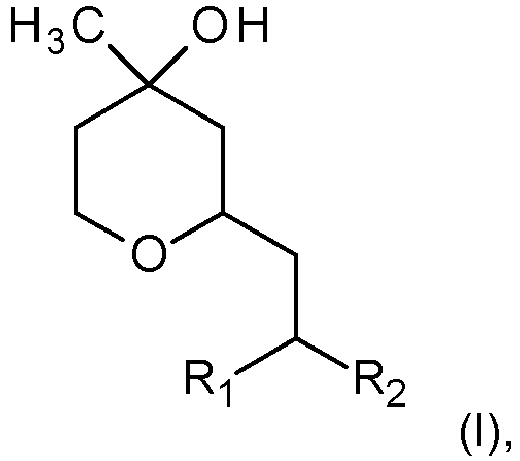 R1 einen geradkettigen oder verzweigten Alkylrest mit 1 bis 5 Kohlenstoffatomen bedeutet, undR2 Wasserstoff oder einen geradkettigen oder verzweigten Alkylrest mit 1 bis 3 Kohlenstoffatomen bedeutet,umfassend die Umsetzung von 3-Methylbut-3-en-1-ol der Formel (II)


und Hydrierung in Gegenwart eines Katalysators zu einer Verbindung der Formel (I). - Verfahren nach Anspruch 1, dadurch gekennzeichnet, dass der Rest R1 einen geradkettigen oder verzweigten Alkylrest mit 1 bis 3 Kohlenstoffatomen, insbesondere Methyl bedeutet.
- Verfahren nach Anspruch 1, dadurch gekennzeichnet, dass der Rest R2 Methyl oder Ethyl, insbesondere Methyl bedeutet.
- Verfahren nach einem der Ansprüche 1 bis 3, dadurch gekennzeichnet, dass man Isoprenol und den Aldehyd der Formel (III) in einem molaren Verhältnis von 0,7 zu 1 bis 2 zu 1, insbesondere von 1 zu 1 bis 1,5 zu 1 einsetzt.
- Verfahren nach einem der Ansprüche 1 bis 4, dadurch gekennzeichnet, dass man einen stark sauren, Sulfonsäuregruppen umfassenden Kationenaustauscher einsetzt.
- Verfahren nach einem der Ansprüche 1 bis 5, dadurch gekennzeichnet, dass man mindestens einen stark sauren Kationenaustauscher in der H(+)-Form einsetzt, wobei der Ionenaustauscher ein Sulfonsäuregruppen aufweisendes Polymergerüst enthält und entweder gelförmig ist oder makroporöse Harze enthält.
- Verfahren gemäss einem der Ansprüche 1 bis 6, dadurch gekennzeichnet, dass der Ionenaustauscher auf einem Polystyrolgerüst mit Sulfonsäuregruppen oder auf einem perfluorierten lonenaustauscherharz mit Sulfonsäuregruppen basiert.
- Verfahren nach einem der Ansprüche 1 bis 7, dadurch gekennzeichnet, dass man die Umsetzung von Isoprenol mit einem Aldehyd der Formel (III) ohne Zusatz eines organischen Lösungsmittels durchführt.
- Verfahren nach einem der Ansprüche 1 bis 8, dadurch gekennzeichnet, dass man die Umsetzung von Isoprenol mit einem Aldehyd der Formel (III) bei einer Temperatur im Bereich von 20 bis 80°C durchführt.
- Verfahren gemäss einem der Ansprüche 1 bis 9, dadurch gekennzeichnet, dass die Hydrierung in Gegenwart von Wasserstoff und einem Katalysator, umfassend- 30 bis 70 Gew.-%, bevorzugt 40 bis 60 Gew.-% sauerstoffhaltige Verbindungen des Nickels, berechnet als NiO,- 15 bis 45 Gew.-%, bevorzugt 20 bis 40 Gew.-% sauerstoffhaltige Verbindungen des Zirkons, berechnet als ZrO2,- 5 bis 30 Gew.-%, bevorzugt 10 bis 25 Gew.-% sauerstoffhaltige Verbindungen des Kupfers, berechnet als CuO und- 0,1 bis 10 Gew.-%, bevorzugt 0,5 bis 5 Gew.-% sauerstoffhaltige Verbindungen des Molybdäns, berechnet als MoO3, gegebenenfalls- 0 bis 10 Gew.-%, bevorzugt 0 bis 5 Gew.-% weitere Komponenten,wobei sich die Angaben in Gew.-% auf den trockenen, nicht reduzierten Katalysator beziehen, durchgeführt wird.
- Verfahren gemäss einem der Ansprüche 1 bis 10, dadurch gekennzeichnet, dass man die Hydrierung bei einer Temperatur im Bereich von 50 bis 130°C durchführt.
- Verfahren gemäss einem der Ansprüche 1 bis 11, dadurch gekennzeichnet, dass man die Hydrierung bei einem Wasserstoffdruck im Bereich von 5 bis 200 bar absolut durchführt.
- Verfahren nach einem der Ansprüche 1 bis 12, umfassend die Schrittea. Bereitstellen eines den gewählten stark sauren Kationenaustauscher enthaltenden Durchflussrektors;b. kontinuierliches Eintragen von Isoprenol, dem Aldehyd der Formel (III) sowie Wasser in den Durchflussreaktor;c. kontinuierliches Inkontaktbringen von Isoprenol, dem Aldehyd der Formel (III) sowie Wasser mit dem stark sauren Kationenaustauscher im Durchflussreaktor unter Erhalt eines die gewünschten 2-substituierten 4-Hydroxy-4-methyl-tetrahydropyrane umfassenden Reaktionsgemisches,d. kontinuierliche Hydrierung des die Verbindung der Formel (IV) umfassenden Reaktionsgemisches, unde. kontinuierliches Austragen des Reaktionsgemisches aus dem Durchflussreaktor.
- Verfahren nach einem der Ansprüche 1 bis 13 zur Herstellung von 2-substituierten 4-Hydroxy-4-methyl-tetrahydropyranen in Form von Gemischen des cis- Diastereomeren der Formeln (Ib)


Priority Applications (1)
| Application Number | Priority Date | Filing Date | Title |
|---|---|---|---|
| EP11721542.6A EP2576533B1 (de) | 2010-05-27 | 2011-05-26 | Verfahren zur herstellung von in 2-stellung substituierten tetrahydropyranolen |
Applications Claiming Priority (3)
| Application Number | Priority Date | Filing Date | Title |
|---|---|---|---|
| EP10164114 | 2010-05-27 | ||
| EP11721542.6A EP2576533B1 (de) | 2010-05-27 | 2011-05-26 | Verfahren zur herstellung von in 2-stellung substituierten tetrahydropyranolen |
| PCT/EP2011/058646 WO2011147919A1 (de) | 2010-05-27 | 2011-05-26 | Verfahren zur herstellung von in 2-stellung substituierten tetrahydropyranolen |
Publications (2)
| Publication Number | Publication Date |
|---|---|
| EP2576533A1 EP2576533A1 (de) | 2013-04-10 |
| EP2576533B1 true EP2576533B1 (de) | 2017-12-13 |
Family
ID=44119273
Family Applications (1)
| Application Number | Title | Priority Date | Filing Date |
|---|---|---|---|
| EP11721542.6A Not-in-force EP2576533B1 (de) | 2010-05-27 | 2011-05-26 | Verfahren zur herstellung von in 2-stellung substituierten tetrahydropyranolen |
Country Status (6)
| Country | Link |
|---|---|
| EP (1) | EP2576533B1 (de) |
| JP (1) | JP5860039B2 (de) |
| CN (1) | CN102906082A (de) |
| ES (1) | ES2660768T3 (de) |
| MX (1) | MX2012013509A (de) |
| WO (1) | WO2011147919A1 (de) |
Families Citing this family (15)
| Publication number | Priority date | Publication date | Assignee | Title |
|---|---|---|---|---|
| WO2014060345A1 (de) | 2012-10-15 | 2014-04-24 | Basf Se | Verfahren zur integrierten herstellung von 2-substituierten 4-hydroxy-4-methyl-tetrahydropyranen und von 2-substituierten 4-methyl-tetrahydropyranen |
| US9139549B2 (en) | 2012-10-15 | 2015-09-22 | Basf Se | Process for the integrated preparation of 2-substituted 4-hydroxy-4-methyltetrahydropyrans and of 2-substituted 4-Methyltetrahydropyrans |
| JP6549611B2 (ja) * | 2014-04-14 | 2019-07-24 | ビーエーエスエフ ソシエタス・ヨーロピアBasf Se | 匂いの品質が安定した2−置換4−ヒドロキシ−4−メチルテトラヒドロピランの製造 |
| EP3131888B1 (de) | 2014-04-14 | 2022-08-03 | Basf Se | Herstellung von 2-substituierten 4-hydroxy-4-methyl-tetrahydropyranen aus 2-alkyl-4,4-dimethyl-1,3-dioxan-haltigen ausgangsstoffen |
| EP2865676A1 (de) * | 2014-04-14 | 2015-04-29 | Basf Se | Herstellung von 2-substituierten 4-Methyl-tetrahydropyranen aus 2-Alkyl-4,4-dimethyl-1,3-dioxan-haltigen Ausgangsstoffen |
| JP6822948B2 (ja) | 2014-09-26 | 2021-01-27 | ビーエイエスエフ・ソシエタス・エウロパエアBasf Se | 異性体として純粋な又は高度に異性体濃縮されたcis−又はtrans−(2−イソブチル−4−メチルテトラヒドロピラン−4−イル)アセテートの使用 |
| CN104370867B (zh) * | 2014-11-21 | 2017-03-15 | 山东新和成药业有限公司 | 一种香料4‑甲基‑2‑(2‑甲基丙基)‑2h‑四氢吡喃‑4‑醇的制备方法 |
| CN107438600B (zh) | 2015-03-05 | 2021-04-13 | 巴斯夫欧洲公司 | 制备四氢吡喃基酯的方法 |
| MX2018014918A (es) | 2016-05-31 | 2019-09-05 | Basf Se | Esteres de tetrahidropiranilalquilo inferior y su produccion usando un compuesto de ceteno. |
| WO2018158244A1 (en) | 2017-02-28 | 2018-09-07 | Basf Se | Process for preparing an unsaturated alcohol |
| CN111108100B (zh) * | 2017-08-09 | 2023-08-01 | 西姆莱斯有限公司 | 帝王龙涎用于增强铃兰调的用途 |
| US10919827B2 (en) | 2017-08-11 | 2021-02-16 | Basf Se | Process for recovering 3-methylbut-3-en-1-ol |
| CN109608426B (zh) * | 2018-12-04 | 2020-11-24 | 万华化学集团股份有限公司 | 一种以生产柠檬醛的废液为原料合成铃兰吡喃的方法 |
| CN114797968B (zh) * | 2021-01-18 | 2024-06-25 | 万华化学集团股份有限公司 | 一种负载型磷酸催化剂及其制备方法和用途 |
| CN116041299B (zh) * | 2022-11-23 | 2024-06-11 | 江苏宏邦化工科技有限公司 | 一种橙花醚的合成方法 |
Family Cites Families (14)
| Publication number | Priority date | Publication date | Assignee | Title |
|---|---|---|---|---|
| JPS5225776A (en) * | 1975-08-20 | 1977-02-25 | Kuraray Co Ltd | Preparation of 2,4-disubstituted 6-membered cyclic ethers |
| SU825528A1 (ru) | 1978-12-08 | 1981-04-30 | Inst Orch Khim An Armyanskoj S | Способ получения производных ди—-тетрагидропиранов и тетрагидропиранолов ^ |
| DE2925043A1 (de) * | 1979-06-21 | 1981-01-15 | Basf Ag | Neue 2,4-disubstituierte pyranderivate, deren herstellung und deren verwendung als riechstoffe |
| DE3913835A1 (de) * | 1989-04-27 | 1990-10-31 | Basf Ag | Katalysator fuer die hydrierung aliphatischer ungesaettigter verbindungen |
| DE4428004A1 (de) | 1994-08-08 | 1996-02-15 | Basf Ag | Verfahren zur Herstellung von Aminen |
| DE4429547A1 (de) * | 1994-08-19 | 1996-02-22 | Basf Ag | Verfahren zur Herstellung von Aminen |
| DE19641707A1 (de) * | 1996-10-10 | 1998-04-16 | Basf Ag | Verfahren zur Herstellung von 1,4-Butandiol durch katalytische Hydrierung von 1,4-Butindiol |
| US20050004210A1 (en) * | 2003-07-04 | 2005-01-06 | Kao Corporation | Process for producing a pyran compound |
| JP4801431B2 (ja) | 2005-12-06 | 2011-10-26 | 長谷川香料株式会社 | 香料成分およびその製造方法 |
| JP5476299B2 (ja) * | 2007-07-23 | 2014-04-23 | ビーエーエスエフ ソシエタス・ヨーロピア | イソプレゴールの水素化によるメントールの製造方法 |
| EP2112144A1 (de) * | 2008-04-22 | 2009-10-28 | V. Mane Fils | Neuartige Pyranderivate, ihre Zubereitung und Verwendung in der Parfümerie |
| US8618315B2 (en) * | 2009-05-19 | 2013-12-31 | Basf Se | Method for producing 2-substituted tetrahydropyranols |
| US8779169B2 (en) * | 2010-05-27 | 2014-07-15 | Basf Se | Process for the preparation of 2 substituted tetrahydropyranols |
| MX2012014204A (es) * | 2010-06-10 | 2013-02-07 | Basf Se | Proceso para la preparacion y aislamiento de 2 - tetrahidropiranoles sustituidos. |
-
2011
- 2011-05-26 ES ES11721542.6T patent/ES2660768T3/es active Active
- 2011-05-26 CN CN2011800261595A patent/CN102906082A/zh active Pending
- 2011-05-26 JP JP2013511685A patent/JP5860039B2/ja not_active Expired - Fee Related
- 2011-05-26 MX MX2012013509A patent/MX2012013509A/es active IP Right Grant
- 2011-05-26 WO PCT/EP2011/058646 patent/WO2011147919A1/de not_active Ceased
- 2011-05-26 EP EP11721542.6A patent/EP2576533B1/de not_active Not-in-force
Also Published As
| Publication number | Publication date |
|---|---|
| JP2013531633A (ja) | 2013-08-08 |
| JP5860039B2 (ja) | 2016-02-16 |
| CN102906082A (zh) | 2013-01-30 |
| EP2576533A1 (de) | 2013-04-10 |
| ES2660768T3 (es) | 2018-03-26 |
| WO2011147919A1 (de) | 2011-12-01 |
| MX2012013509A (es) | 2013-01-24 |
Similar Documents
| Publication | Publication Date | Title |
|---|---|---|
| EP2576533B1 (de) | Verfahren zur herstellung von in 2-stellung substituierten tetrahydropyranolen | |
| EP2432773B1 (de) | Verfahren zur Herstellung von 2-substituierten Tetrahydropyranolen | |
| US9428481B2 (en) | Process for the preparation of 2 substituted tetrahydropyranols | |
| EP2582669B1 (de) | Verfahren zur herstellung eines zyklischen tertiären methylamins | |
| EP2181084B1 (de) | Verfahren zur herstellung von menthol durch hydrierung von isopulegol | |
| EP2406212B1 (de) | Verfahren zur herstellung von 1-adamantyltrimethylammoniumhydroxid | |
| EP2991974B1 (de) | Verfahren zur herstellung von 2-substituierten 4-hydroxy-4-methyl-tetrahydropyranen in einer reaktorkaskade | |
| EP2635544B1 (de) | Verfahren zur herstellung eines phenylcyclohexans | |
| EP0887330B1 (de) | Verfahren zur Addition von Hydroxylgruppen enthaltenden Verbindungen an Alkine oder Allene | |
| EP1072577B1 (de) | Herstellung von Pentandiolen aus Alkoxydihydropyranen | |
| DE2611320C2 (de) | Verfahren zur Herstellung von 2,3,6-Trimethylphenol durch Methylierung von 2,6-Xylenol in flüssiger Phase | |
| DE102005032726A1 (de) | Katalysator und Verfahren zur Hydrierung von Carbonylverbindungen | |
| DE3440195A1 (de) | Verfahren zur herstellung von 1-alkyl- oder 1-cycloalkylpiperazinen | |
| EP0902001A1 (de) | Verfahren zur Herstellung von ungesättigten Ketonen | |
| EP3010880B1 (de) | Verfahren zur herstellung von 2-chlordialkylbenzylaminen durch hydrierung | |
| WO2003062174A1 (de) | Verfahren zur herstellung von toluolderivaten | |
| WO1997046546A1 (de) | Verfahren zur herstellung von tetrahydrofuran aus dialkoxybutenen | |
| EP2771330B1 (de) | Verfahren zur herstellung von cis-rosenoxid | |
| DE102004011543A1 (de) | Verfahren zur Herstellung optisch aktiver Carbonylverbindungen | |
| DE19635703A1 (de) | Verfahren zur Herstellung von Alkindiolen oder Gemischen von Alkindiolen mit Alkinmonoolen | |
| WO2000015590A1 (de) | Verfahren zur herstellung von enolethern | |
| DE3333678A1 (de) | Verfahren zur herstellung von 3-formyl-tetrahydrothiopyranen | |
| WO2004046073A1 (de) | Verfahren zur herstellung von ethern | |
| DD203714A5 (de) | Verfahren zur selektiven spaltung von polyalkylenglykolen | |
| EP0684220A1 (de) | Verfahren zur Herstellung von -p-Alkoxybenzaldehyden |
Legal Events
| Date | Code | Title | Description |
|---|---|---|---|
| PUAI | Public reference made under article 153(3) epc to a published international application that has entered the european phase |
Free format text: ORIGINAL CODE: 0009012 |
|
| 17P | Request for examination filed |
Effective date: 20130102 |
|
| AK | Designated contracting states |
Kind code of ref document: A1 Designated state(s): AL AT BE BG CH CY CZ DE DK EE ES FI FR GB GR HR HU IE IS IT LI LT LU LV MC MK MT NL NO PL PT RO RS SE SI SK SM TR |
|
| DAX | Request for extension of the european patent (deleted) | ||
| 17Q | First examination report despatched |
Effective date: 20160225 |
|
| GRAP | Despatch of communication of intention to grant a patent |
Free format text: ORIGINAL CODE: EPIDOSNIGR1 |
|
| INTG | Intention to grant announced |
Effective date: 20170728 |
|
| GRAS | Grant fee paid |
Free format text: ORIGINAL CODE: EPIDOSNIGR3 |
|
| GRAA | (expected) grant |
Free format text: ORIGINAL CODE: 0009210 |
|
| AK | Designated contracting states |
Kind code of ref document: B1 Designated state(s): AL AT BE BG CH CY CZ DE DK EE ES FI FR GB GR HR HU IE IS IT LI LT LU LV MC MK MT NL NO PL PT RO RS SE SI SK SM TR |
|
| REG | Reference to a national code |
Ref country code: GB Ref legal event code: FG4D Free format text: NOT ENGLISH |
|
| REG | Reference to a national code |
Ref country code: AT Ref legal event code: REF Ref document number: 954226 Country of ref document: AT Kind code of ref document: T Effective date: 20171215 Ref country code: CH Ref legal event code: EP |
|
| REG | Reference to a national code |
Ref country code: IE Ref legal event code: FG4D Free format text: LANGUAGE OF EP DOCUMENT: GERMAN |
|
| REG | Reference to a national code |
Ref country code: DE Ref legal event code: R096 Ref document number: 502011013445 Country of ref document: DE |
|
| REG | Reference to a national code |
Ref country code: ES Ref legal event code: FG2A Ref document number: 2660768 Country of ref document: ES Kind code of ref document: T3 Effective date: 20180326 |
|
| REG | Reference to a national code |
Ref country code: NL Ref legal event code: FP |
|
| REG | Reference to a national code |
Ref country code: LT Ref legal event code: MG4D |
|
| PG25 | Lapsed in a contracting state [announced via postgrant information from national office to epo] |
Ref country code: FI Free format text: LAPSE BECAUSE OF FAILURE TO SUBMIT A TRANSLATION OF THE DESCRIPTION OR TO PAY THE FEE WITHIN THE PRESCRIBED TIME-LIMIT Effective date: 20171213 Ref country code: NO Free format text: LAPSE BECAUSE OF FAILURE TO SUBMIT A TRANSLATION OF THE DESCRIPTION OR TO PAY THE FEE WITHIN THE PRESCRIBED TIME-LIMIT Effective date: 20180313 Ref country code: LT Free format text: LAPSE BECAUSE OF FAILURE TO SUBMIT A TRANSLATION OF THE DESCRIPTION OR TO PAY THE FEE WITHIN THE PRESCRIBED TIME-LIMIT Effective date: 20171213 Ref country code: SE Free format text: LAPSE BECAUSE OF FAILURE TO SUBMIT A TRANSLATION OF THE DESCRIPTION OR TO PAY THE FEE WITHIN THE PRESCRIBED TIME-LIMIT Effective date: 20171213 |
|
| REG | Reference to a national code |
Ref country code: FR Ref legal event code: PLFP Year of fee payment: 8 |
|
| PG25 | Lapsed in a contracting state [announced via postgrant information from national office to epo] |
Ref country code: BG Free format text: LAPSE BECAUSE OF FAILURE TO SUBMIT A TRANSLATION OF THE DESCRIPTION OR TO PAY THE FEE WITHIN THE PRESCRIBED TIME-LIMIT Effective date: 20180313 Ref country code: RS Free format text: LAPSE BECAUSE OF FAILURE TO SUBMIT A TRANSLATION OF THE DESCRIPTION OR TO PAY THE FEE WITHIN THE PRESCRIBED TIME-LIMIT Effective date: 20171213 Ref country code: LV Free format text: LAPSE BECAUSE OF FAILURE TO SUBMIT A TRANSLATION OF THE DESCRIPTION OR TO PAY THE FEE WITHIN THE PRESCRIBED TIME-LIMIT Effective date: 20171213 Ref country code: HR Free format text: LAPSE BECAUSE OF FAILURE TO SUBMIT A TRANSLATION OF THE DESCRIPTION OR TO PAY THE FEE WITHIN THE PRESCRIBED TIME-LIMIT Effective date: 20171213 Ref country code: GR Free format text: LAPSE BECAUSE OF FAILURE TO SUBMIT A TRANSLATION OF THE DESCRIPTION OR TO PAY THE FEE WITHIN THE PRESCRIBED TIME-LIMIT Effective date: 20180314 |
|
| PG25 | Lapsed in a contracting state [announced via postgrant information from national office to epo] |
Ref country code: CZ Free format text: LAPSE BECAUSE OF FAILURE TO SUBMIT A TRANSLATION OF THE DESCRIPTION OR TO PAY THE FEE WITHIN THE PRESCRIBED TIME-LIMIT Effective date: 20171213 Ref country code: SK Free format text: LAPSE BECAUSE OF FAILURE TO SUBMIT A TRANSLATION OF THE DESCRIPTION OR TO PAY THE FEE WITHIN THE PRESCRIBED TIME-LIMIT Effective date: 20171213 Ref country code: CY Free format text: LAPSE BECAUSE OF FAILURE TO SUBMIT A TRANSLATION OF THE DESCRIPTION OR TO PAY THE FEE WITHIN THE PRESCRIBED TIME-LIMIT Effective date: 20171213 Ref country code: EE Free format text: LAPSE BECAUSE OF FAILURE TO SUBMIT A TRANSLATION OF THE DESCRIPTION OR TO PAY THE FEE WITHIN THE PRESCRIBED TIME-LIMIT Effective date: 20171213 |
|
| PGFP | Annual fee paid to national office [announced via postgrant information from national office to epo] |
Ref country code: ES Payment date: 20180618 Year of fee payment: 8 Ref country code: CH Payment date: 20180525 Year of fee payment: 8 |
|
| PG25 | Lapsed in a contracting state [announced via postgrant information from national office to epo] |
Ref country code: RO Free format text: LAPSE BECAUSE OF FAILURE TO SUBMIT A TRANSLATION OF THE DESCRIPTION OR TO PAY THE FEE WITHIN THE PRESCRIBED TIME-LIMIT Effective date: 20171213 Ref country code: IT Free format text: LAPSE BECAUSE OF FAILURE TO SUBMIT A TRANSLATION OF THE DESCRIPTION OR TO PAY THE FEE WITHIN THE PRESCRIBED TIME-LIMIT Effective date: 20171213 Ref country code: IS Free format text: LAPSE BECAUSE OF FAILURE TO SUBMIT A TRANSLATION OF THE DESCRIPTION OR TO PAY THE FEE WITHIN THE PRESCRIBED TIME-LIMIT Effective date: 20180413 Ref country code: PL Free format text: LAPSE BECAUSE OF FAILURE TO SUBMIT A TRANSLATION OF THE DESCRIPTION OR TO PAY THE FEE WITHIN THE PRESCRIBED TIME-LIMIT Effective date: 20171213 Ref country code: SM Free format text: LAPSE BECAUSE OF FAILURE TO SUBMIT A TRANSLATION OF THE DESCRIPTION OR TO PAY THE FEE WITHIN THE PRESCRIBED TIME-LIMIT Effective date: 20171213 |
|
| PGFP | Annual fee paid to national office [announced via postgrant information from national office to epo] |
Ref country code: FR Payment date: 20180525 Year of fee payment: 8 Ref country code: NL Payment date: 20180525 Year of fee payment: 8 |
|
| REG | Reference to a national code |
Ref country code: DE Ref legal event code: R097 Ref document number: 502011013445 Country of ref document: DE |
|
| PG25 | Lapsed in a contracting state [announced via postgrant information from national office to epo] |
Ref country code: MT Free format text: LAPSE BECAUSE OF FAILURE TO SUBMIT A TRANSLATION OF THE DESCRIPTION OR TO PAY THE FEE WITHIN THE PRESCRIBED TIME-LIMIT Effective date: 20171213 |
|
| PLBE | No opposition filed within time limit |
Free format text: ORIGINAL CODE: 0009261 |
|
| STAA | Information on the status of an ep patent application or granted ep patent |
Free format text: STATUS: NO OPPOSITION FILED WITHIN TIME LIMIT |
|
| PGFP | Annual fee paid to national office [announced via postgrant information from national office to epo] |
Ref country code: GB Payment date: 20180530 Year of fee payment: 8 Ref country code: DE Payment date: 20180731 Year of fee payment: 8 |
|
| 26N | No opposition filed |
Effective date: 20180914 |
|
| PG25 | Lapsed in a contracting state [announced via postgrant information from national office to epo] |
Ref country code: DK Free format text: LAPSE BECAUSE OF FAILURE TO SUBMIT A TRANSLATION OF THE DESCRIPTION OR TO PAY THE FEE WITHIN THE PRESCRIBED TIME-LIMIT Effective date: 20171213 |
|
| REG | Reference to a national code |
Ref country code: BE Ref legal event code: MM Effective date: 20180531 |
|
| PG25 | Lapsed in a contracting state [announced via postgrant information from national office to epo] |
Ref country code: MC Free format text: LAPSE BECAUSE OF FAILURE TO SUBMIT A TRANSLATION OF THE DESCRIPTION OR TO PAY THE FEE WITHIN THE PRESCRIBED TIME-LIMIT Effective date: 20171213 |
|
| REG | Reference to a national code |
Ref country code: IE Ref legal event code: MM4A |
|
| PG25 | Lapsed in a contracting state [announced via postgrant information from national office to epo] |
Ref country code: SI Free format text: LAPSE BECAUSE OF FAILURE TO SUBMIT A TRANSLATION OF THE DESCRIPTION OR TO PAY THE FEE WITHIN THE PRESCRIBED TIME-LIMIT Effective date: 20171213 |
|
| PG25 | Lapsed in a contracting state [announced via postgrant information from national office to epo] |
Ref country code: LU Free format text: LAPSE BECAUSE OF NON-PAYMENT OF DUE FEES Effective date: 20180526 |
|
| PG25 | Lapsed in a contracting state [announced via postgrant information from national office to epo] |
Ref country code: IE Free format text: LAPSE BECAUSE OF NON-PAYMENT OF DUE FEES Effective date: 20180526 |
|
| PG25 | Lapsed in a contracting state [announced via postgrant information from national office to epo] |
Ref country code: BE Free format text: LAPSE BECAUSE OF NON-PAYMENT OF DUE FEES Effective date: 20180531 |
|
| REG | Reference to a national code |
Ref country code: AT Ref legal event code: MM01 Ref document number: 954226 Country of ref document: AT Kind code of ref document: T Effective date: 20180526 |
|
| PG25 | Lapsed in a contracting state [announced via postgrant information from national office to epo] |
Ref country code: AT Free format text: LAPSE BECAUSE OF NON-PAYMENT OF DUE FEES Effective date: 20180526 |
|
| REG | Reference to a national code |
Ref country code: DE Ref legal event code: R119 Ref document number: 502011013445 Country of ref document: DE |
|
| REG | Reference to a national code |
Ref country code: CH Ref legal event code: PL |
|
| REG | Reference to a national code |
Ref country code: NL Ref legal event code: MM Effective date: 20190601 |
|
| GBPC | Gb: european patent ceased through non-payment of renewal fee |
Effective date: 20190526 |
|
| PG25 | Lapsed in a contracting state [announced via postgrant information from national office to epo] |
Ref country code: LI Free format text: LAPSE BECAUSE OF NON-PAYMENT OF DUE FEES Effective date: 20190531 Ref country code: CH Free format text: LAPSE BECAUSE OF NON-PAYMENT OF DUE FEES Effective date: 20190531 |
|
| PG25 | Lapsed in a contracting state [announced via postgrant information from national office to epo] |
Ref country code: TR Free format text: LAPSE BECAUSE OF FAILURE TO SUBMIT A TRANSLATION OF THE DESCRIPTION OR TO PAY THE FEE WITHIN THE PRESCRIBED TIME-LIMIT Effective date: 20171213 |
|
| PG25 | Lapsed in a contracting state [announced via postgrant information from national office to epo] |
Ref country code: DE Free format text: LAPSE BECAUSE OF NON-PAYMENT OF DUE FEES Effective date: 20191203 Ref country code: NL Free format text: LAPSE BECAUSE OF NON-PAYMENT OF DUE FEES Effective date: 20190601 Ref country code: GB Free format text: LAPSE BECAUSE OF NON-PAYMENT OF DUE FEES Effective date: 20190526 |
|
| PG25 | Lapsed in a contracting state [announced via postgrant information from national office to epo] |
Ref country code: PT Free format text: LAPSE BECAUSE OF FAILURE TO SUBMIT A TRANSLATION OF THE DESCRIPTION OR TO PAY THE FEE WITHIN THE PRESCRIBED TIME-LIMIT Effective date: 20171213 Ref country code: HU Free format text: LAPSE BECAUSE OF FAILURE TO SUBMIT A TRANSLATION OF THE DESCRIPTION OR TO PAY THE FEE WITHIN THE PRESCRIBED TIME-LIMIT; INVALID AB INITIO Effective date: 20110526 |
|
| PG25 | Lapsed in a contracting state [announced via postgrant information from national office to epo] |
Ref country code: FR Free format text: LAPSE BECAUSE OF NON-PAYMENT OF DUE FEES Effective date: 20190531 Ref country code: MK Free format text: LAPSE BECAUSE OF NON-PAYMENT OF DUE FEES Effective date: 20171213 |
|
| PG25 | Lapsed in a contracting state [announced via postgrant information from national office to epo] |
Ref country code: AL Free format text: LAPSE BECAUSE OF FAILURE TO SUBMIT A TRANSLATION OF THE DESCRIPTION OR TO PAY THE FEE WITHIN THE PRESCRIBED TIME-LIMIT Effective date: 20171213 |
|
| REG | Reference to a national code |
Ref country code: ES Ref legal event code: FD2A Effective date: 20201001 |
|
| PG25 | Lapsed in a contracting state [announced via postgrant information from national office to epo] |
Ref country code: ES Free format text: LAPSE BECAUSE OF NON-PAYMENT OF DUE FEES Effective date: 20190527 |