EP2600713B1 - Pestizidzusammensetzungen aus mittelgrossen partikeln mit verstärkter aktivität - Google Patents
Pestizidzusammensetzungen aus mittelgrossen partikeln mit verstärkter aktivität Download PDFInfo
- Publication number
- EP2600713B1 EP2600713B1 EP11815244.6A EP11815244A EP2600713B1 EP 2600713 B1 EP2600713 B1 EP 2600713B1 EP 11815244 A EP11815244 A EP 11815244A EP 2600713 B1 EP2600713 B1 EP 2600713B1
- Authority
- EP
- European Patent Office
- Prior art keywords
- oil
- meso
- herbicides
- active ingredient
- insecticides
- Prior art date
- Legal status (The legal status is an assumption and is not a legal conclusion. Google has not performed a legal analysis and makes no representation as to the accuracy of the status listed.)
- Revoked
Links
Images





Classifications
-
- A—HUMAN NECESSITIES
- A01—AGRICULTURE; FORESTRY; ANIMAL HUSBANDRY; HUNTING; TRAPPING; FISHING
- A01N—PRESERVATION OF BODIES OF HUMANS OR ANIMALS OR PLANTS OR PARTS THEREOF; BIOCIDES, e.g. AS DISINFECTANTS, AS PESTICIDES OR AS HERBICIDES; PEST REPELLANTS OR ATTRACTANTS; PLANT GROWTH REGULATORS
- A01N25/00—Biocides, pest repellants or attractants, or plant growth regulators, characterised by their forms, or by their non-active ingredients or by their methods of application, e.g. seed treatment or sequential application; Substances for reducing the noxious effect of the active ingredients to organisms other than pests
- A01N25/32—Ingredients for reducing the noxious effect of the active substances to organisms other than pests, e.g. toxicity reducing compositions, self-destructing compositions
-
- A—HUMAN NECESSITIES
- A01—AGRICULTURE; FORESTRY; ANIMAL HUSBANDRY; HUNTING; TRAPPING; FISHING
- A01N—PRESERVATION OF BODIES OF HUMANS OR ANIMALS OR PLANTS OR PARTS THEREOF; BIOCIDES, e.g. AS DISINFECTANTS, AS PESTICIDES OR AS HERBICIDES; PEST REPELLANTS OR ATTRACTANTS; PLANT GROWTH REGULATORS
- A01N25/00—Biocides, pest repellants or attractants, or plant growth regulators, characterised by their forms, or by their non-active ingredients or by their methods of application, e.g. seed treatment or sequential application; Substances for reducing the noxious effect of the active ingredients to organisms other than pests
-
- A—HUMAN NECESSITIES
- A01—AGRICULTURE; FORESTRY; ANIMAL HUSBANDRY; HUNTING; TRAPPING; FISHING
- A01N—PRESERVATION OF BODIES OF HUMANS OR ANIMALS OR PLANTS OR PARTS THEREOF; BIOCIDES, e.g. AS DISINFECTANTS, AS PESTICIDES OR AS HERBICIDES; PEST REPELLANTS OR ATTRACTANTS; PLANT GROWTH REGULATORS
- A01N25/00—Biocides, pest repellants or attractants, or plant growth regulators, characterised by their forms, or by their non-active ingredients or by their methods of application, e.g. seed treatment or sequential application; Substances for reducing the noxious effect of the active ingredients to organisms other than pests
- A01N25/02—Biocides, pest repellants or attractants, or plant growth regulators, characterised by their forms, or by their non-active ingredients or by their methods of application, e.g. seed treatment or sequential application; Substances for reducing the noxious effect of the active ingredients to organisms other than pests containing liquids as carriers, diluents or solvents
- A01N25/04—Dispersions, emulsions, suspoemulsions, suspension concentrates or gels
-
- A—HUMAN NECESSITIES
- A01—AGRICULTURE; FORESTRY; ANIMAL HUSBANDRY; HUNTING; TRAPPING; FISHING
- A01N—PRESERVATION OF BODIES OF HUMANS OR ANIMALS OR PLANTS OR PARTS THEREOF; BIOCIDES, e.g. AS DISINFECTANTS, AS PESTICIDES OR AS HERBICIDES; PEST REPELLANTS OR ATTRACTANTS; PLANT GROWTH REGULATORS
- A01N25/00—Biocides, pest repellants or attractants, or plant growth regulators, characterised by their forms, or by their non-active ingredients or by their methods of application, e.g. seed treatment or sequential application; Substances for reducing the noxious effect of the active ingredients to organisms other than pests
- A01N25/12—Powders or granules
-
- A—HUMAN NECESSITIES
- A01—AGRICULTURE; FORESTRY; ANIMAL HUSBANDRY; HUNTING; TRAPPING; FISHING
- A01N—PRESERVATION OF BODIES OF HUMANS OR ANIMALS OR PLANTS OR PARTS THEREOF; BIOCIDES, e.g. AS DISINFECTANTS, AS PESTICIDES OR AS HERBICIDES; PEST REPELLANTS OR ATTRACTANTS; PLANT GROWTH REGULATORS
- A01N25/00—Biocides, pest repellants or attractants, or plant growth regulators, characterised by their forms, or by their non-active ingredients or by their methods of application, e.g. seed treatment or sequential application; Substances for reducing the noxious effect of the active ingredients to organisms other than pests
- A01N25/26—Biocides, pest repellants or attractants, or plant growth regulators, characterised by their forms, or by their non-active ingredients or by their methods of application, e.g. seed treatment or sequential application; Substances for reducing the noxious effect of the active ingredients to organisms other than pests in coated particulate form
- A01N25/28—Microcapsules or nanocapsules
-
- A—HUMAN NECESSITIES
- A01—AGRICULTURE; FORESTRY; ANIMAL HUSBANDRY; HUNTING; TRAPPING; FISHING
- A01N—PRESERVATION OF BODIES OF HUMANS OR ANIMALS OR PLANTS OR PARTS THEREOF; BIOCIDES, e.g. AS DISINFECTANTS, AS PESTICIDES OR AS HERBICIDES; PEST REPELLANTS OR ATTRACTANTS; PLANT GROWTH REGULATORS
- A01N43/00—Biocides, pest repellants or attractants, or plant growth regulators containing heterocyclic compounds
- A01N43/34—Biocides, pest repellants or attractants, or plant growth regulators containing heterocyclic compounds having rings with one nitrogen atom as the only ring hetero atom
- A01N43/40—Biocides, pest repellants or attractants, or plant growth regulators containing heterocyclic compounds having rings with one nitrogen atom as the only ring hetero atom six-membered rings
-
- A—HUMAN NECESSITIES
- A01—AGRICULTURE; FORESTRY; ANIMAL HUSBANDRY; HUNTING; TRAPPING; FISHING
- A01N—PRESERVATION OF BODIES OF HUMANS OR ANIMALS OR PLANTS OR PARTS THEREOF; BIOCIDES, e.g. AS DISINFECTANTS, AS PESTICIDES OR AS HERBICIDES; PEST REPELLANTS OR ATTRACTANTS; PLANT GROWTH REGULATORS
- A01N43/00—Biocides, pest repellants or attractants, or plant growth regulators containing heterocyclic compounds
- A01N43/64—Biocides, pest repellants or attractants, or plant growth regulators containing heterocyclic compounds having rings with three nitrogen atoms as the only ring hetero atoms
- A01N43/647—Triazoles; Hydrogenated triazoles
- A01N43/653—1,2,4-Triazoles; Hydrogenated 1,2,4-triazoles
-
- A—HUMAN NECESSITIES
- A01—AGRICULTURE; FORESTRY; ANIMAL HUSBANDRY; HUNTING; TRAPPING; FISHING
- A01N—PRESERVATION OF BODIES OF HUMANS OR ANIMALS OR PLANTS OR PARTS THEREOF; BIOCIDES, e.g. AS DISINFECTANTS, AS PESTICIDES OR AS HERBICIDES; PEST REPELLANTS OR ATTRACTANTS; PLANT GROWTH REGULATORS
- A01N43/00—Biocides, pest repellants or attractants, or plant growth regulators containing heterocyclic compounds
- A01N43/64—Biocides, pest repellants or attractants, or plant growth regulators containing heterocyclic compounds having rings with three nitrogen atoms as the only ring hetero atoms
- A01N43/66—1,3,5-Triazines, not hydrogenated and not substituted at the ring nitrogen atoms
- A01N43/68—1,3,5-Triazines, not hydrogenated and not substituted at the ring nitrogen atoms with two or three nitrogen atoms directly attached to ring carbon atoms
- A01N43/70—Diamino—1,3,5—triazines with only one oxygen, sulfur or halogen atom or only one cyano, thiocyano (—SCN), cyanato (—OCN) or azido (—N3) group directly attached to a ring carbon atom
-
- A—HUMAN NECESSITIES
- A01—AGRICULTURE; FORESTRY; ANIMAL HUSBANDRY; HUNTING; TRAPPING; FISHING
- A01N—PRESERVATION OF BODIES OF HUMANS OR ANIMALS OR PLANTS OR PARTS THEREOF; BIOCIDES, e.g. AS DISINFECTANTS, AS PESTICIDES OR AS HERBICIDES; PEST REPELLANTS OR ATTRACTANTS; PLANT GROWTH REGULATORS
- A01N43/00—Biocides, pest repellants or attractants, or plant growth regulators containing heterocyclic compounds
- A01N43/90—Biocides, pest repellants or attractants, or plant growth regulators containing heterocyclic compounds having two or more relevant hetero rings, condensed among themselves or with a common carbocyclic ring system
Definitions
- compositions with enhanced activity consisting of meso-sized particles combined with adjuvants, penetrant adjuvants, oils or blends thereof and methods of their preparation and use are described.
- Modern agricultural pesticide active ingredients including fungicides, insecticides miticides, herbicides and safeners, as well as growth regulators and nutrients, are typically formulated as liquid or solid formulations. These formulations are designed so that they are convenient for the grower or end user to use and so that the inherent biological activity of the active ingredient is properly expressed.
- WO 2006/015791 A2 relates to a method for producing aqueous active substance compositions of active substances that are hardly soluble in water, especially for use in the protection of plants and describes, among others, the preparation of aqueous dispersions of nano-sized particles, particles comprise a pesticide and a polymer.
- the purpose of various aspects and embodiments disclosed herein is to further improve the effectiveness and efficiency of the delivery and biological activity of active ingredients used in agriculture and pest management.
- Agricultural active ingredient refers to a chemical used in agriculture, horticulture and pest management for protection of crops, plants, structures, animals and humans against unwanted organisms such as fungal and bacterial plant pathogens, weeds, insects, mites, algae, nematodes and the like.
- active ingredients used for these purposes include fungicides, bactericides, herbicides, insecticides, miticides, algaecides, nemtocides and fumigants.
- the term "agricultural active ingredient” also includes insect repellants and attractants and pheromones, modifiers of plant physiology or structure, zoospore attractants and herbicide safeners.
- meso as used herein describes particles, capsules, or droplets which have a volume-average diameter of between about 30 nanometers (nm) and about 500 nm.
- mesoparticle as used herein describes capsules, core-shell particles or matrix particles having a volume-average diameter of between about 30 nm and about 500 nm.
- core-shell particle describes a particle with a liquid or solid core containing an agricultural active ingredient and an outer shell partially or totally encapsulating or covering the core.
- capsule as used herein describes a core-shell particle with a liquid core containing an agricultural active ingredient and an outer shell partially or totally encapsulating or covering the core.
- matrix particle describes a particle consisting of an agricultural active ingredient dispersed within a solid polymer matrix such as, for example, a synthetic latex polymer.
- poorly water soluble as used herein means agricultural active ingredients with solubility in water of less than about 1000 ppm.
- the poorly water soluble active ingredient has solubility in water of less than 100 ppm, more preferably less than 10 ppm.
- water immiscible solvent as used herein means a solvent or mixture of solvents with a solubility in water of about 10 g/100ml or less.
- essentially no surfactant means a surfactant concentration of less than 1 weight percent with respect to the oil phase and more preferably less than 0.5 wt. percent of a surfactant with respect to the oil phase.
- surfactant means a substance used to create and/or stabilize an emulsion.
- Surfactants include nonionic, anionic, cationic, or combinations of nonionic and anionic or nonionic and cationic.
- suitable surfactants include alkali metal lauryl sulfates such as sodium dodecyl sulfate, alkali metal fatty acids salts such as sodium oleate and sodium stearate, alkali metal alkylbenzene sulfonates such as sodium dodecylbenzene sulfonate, polyoxyethylene nonionics, and quaternary ammonium surfactants.
- Standard reference sources from which one of skill in the art can select suitable surfactants include Handbook of Industrial Surfactants, Fourth Edition (2005) published by Synapse Information Resources Inc, and McCutcheon's Emulsifiers and Detergents, North American and International Editions (2008) published by MC Publishing Company.
- adjuvant refers to substances which can increase the biological activity of the active ingredient, but are themselves not significantly biologically active. Adjuvants assist with the effectiveness of the active ingredient such as, for example, by improving the delivery and uptake of an herbicide into a target weed plant leading to improved biological control. Adjuvants, in the form of solids or liquids, can be incorporated directly into the formulation of an agricultural active ingredient or it can be added to an aqueous dilution of the formulated agricultural active ingredient to provide improved performance of the product upon application. Commonly used adjuvants may include, for example, surfactants, spreaders, penetrants, petroleum and plant derived oils and solvents and wetting agents.
- adjuvants include, but are not limited to, paraffin oil, horticultural spray oils (e.g., summer oil), methylated rape seed oil, methylated soybean oil, highly refined vegetable oil and the like, polyol fatty acid esters, polyethoxylated esters, ethoxylated alcohols, ethoxylated phenols such as nonylphenol ethoxylates, alkyl polysaccharides and blends, amine ethoxylates such as Ethomeen T/25 TM and Armoblend AB600 TM (Akzo-Nobel), sorbitan fatty acid esther ethoxylates, polyethylene glycol esters such as PEG (Huntsman) and Polyglycol 26-2 TM (The Dow Chemical Co), organosilicone based surfactants such as Boost TM (Dow AgroSciences, LLC), ethylene vinyl acetate terpolymers, ethoxylated alkyl aryl
- penetrant refers to materials that enhance the ability of a agricultural active ingredient to penetrate into or through the surface of a plant.
- Typical penetrants are paraffinic oils, crop oils, seed oils or methylated seed oils that are able to dissolve or penetrate waxy layers on leaves.
- Penetrants also include these types of oils mixed with from 0.5 to about 40% emulsifiers or surfactants to further enhance their utility and effectivness.
- Examples of penetrants include but are not limited to: petroleum oil concentrates such as Agri-dex TM (Helena Chemical Co), Crop Oil Concentrate (Helena Chemical Co.
- Herbimax TM Loveland Products Inc.
- Penetrator TM Helena Chemical Co
- Uptake TM Oil Downtake TM Oil (Dow AgroSciences, LLC).
- Ethylated or methylated vegetable oils such as Hasten TM , (Wilbur-Ellis Company) Tronic TM (Kalo, Inc.), Renegade TM (Wilbur-Ellis Company) and modified vegetable oil, and vegetable oil concentrates such as Amigo TM (Loveland Products Inc.) and Peerless. TM (Custom Chemicides).
- built-in adjuvant refers to one or more adjuvants that have been added to a particular formulation, such as a granule or liquid formulation, at the manufacturing stage of the product, rather than at the point of use of the product such as, for example, to a spray solution.
- a particular formulation such as a granule or liquid formulation
- the use of built-in adjuvants simplifies the use of agrochemical products for the end-user by reducing the number of ingredients that must be individually measured and applied.
- interfacial condensation means a reaction between two complimentary, organic intermediates that takes place at an interface between two immiscible liquids in which one immiscible liquid is dispersed in the other immiscible liquid.
- An example of an interfacial condensation reaction is given by US Pat. No. 3,577,515 .
- a "core-shell” capsule is a capsule created by an interfacial condensation reaction that takes place between two immiscible phases in which the first immiscible phase is a dispersed phase, the second immiscible phase is a continuous phase; and the dispersed phase or core is encapsulated within a shell formed by the reaction of two complimentary, organic intermediates which form the shell and the core-shell capsule is dispersed within the continuous phase.
- crosslinker means a substance that initiates and facilitates reaction of polymer precursors to form a core shell particle.
- the crosslinker may or may not become part of the polymer structure comprising the core shell particle.
- examples of crosslinkers as used herein include water, water-soluble diamines, water soluble polyamines, water soluble polyamino acids, water soluble diols, water soluble polyols, and mixtures thereof.
- the present disclosure relates to novel pesticide compositions consisting of meso-sized particles containing AIs and certain adjuvants such as built-in adjuvants which are added directly to the formulation or to an aqueous dilution of the formulation such as tank-mix adjuvants, to provide enhanced effectiveness for the control of agricultural pests.
- Mesoparticle compositions containing such adjuvants have been found to provide improved biological effectiveness compared to mesoparticle compositions not containing such adjuvants or to conventional formulations.
- We have found that the addition of certain adjuvants, especially penetrant adjuvants to mesoparticle formulations provides even greater effectiveness than meso-particle formulations not containing adjuvants.
- compositions provide improved effectiveness compared to conventional formulations of the same active ingredient.
- Meso-sized particles are in the size range of 30 to 500 nm and may be of diverse morphology, including, but not limited to meso-capsules containing active ingredient, and meso-matrix particles containing active ingredient.
- the present disclosure concerns formulations of meso-particles containing certain built-in adjuvants and of meso-particle formulations in diluted form mixed with certain adjuvants prior to contacting plants, and of contacting a plant at risk of insect or disease attack or an agricultural weed with these compositions so as to effectively control said pests.
- One embodiment of the present disclosure includes a composition for the delivery of an agricultural active ingredient according to claim 1, comprising an adjuvant combined with a mesocapsule, the mesocapsule having a polymer shell, and a poorly water soluble agricultural active ingredient, wherein the active ingredient is at least partially included within the polymer shell, the mesocapsules having a volume-average particle diameter between about 30 nm and about 500 nm.
- the adjuvant is a built-in adjuvant comprising from 1 to about 90% of the formulation or it can be a tank-mixed comprising from 0.05 to about 5% of the dilute spray solution.
- Yet another embodiment of the present disclosure includes a composition for the delivery of an agricultural active ingredient, comprising a meso-matrix particle combined with an adjuvant, the meso-matrix particle being comprised of a poorly water soluble agricultural active ingredient, wherein the active ingredient is distributed throughout a polymer matrix, the meso-matrix particles having a volume-average particle diameter between about 30 nm and about 500 nm.
- the adjuvant is a built-in adjuvant comprising from 1 to about 90% of the formulation or it can be a tank-mixed comprising from 0.05 to about 5% of the dilute spray solution.
- the present disclosure also embodies a method for treatment or prophylaxis of a fungal disease on plants with fungicides formulated as mesoparticles and combined with built-in or tank-mixed adjuvants, wherein the method consists of contacting a plant, plant tissue, plant cells or a seed with an agriculturally effective amount of the aforementioned compositions employing application or spray techninques known to those skilled in the art.
- the present disclosure also embodies a method for treatment or prophylaxis of a insect and mites infestations on plants with insecticides and miticides formulated as mesoparticles and combined with built-in or tank-mixed adjuvants, wherein the method consists of contacting an insect, a mite, a plant, plant tissue, plant cells or a seed with an agriculturally effective amount of the aforementioned compositions employing application or spray techninques known to those skilled in the art.
- the present disclosure also embodies a method for treatment or prophylaxis of weed infestations in agricultural crops with herbicides formulated as mesoparticles and combined with built-in or tank-mixed adjuvants, wherein the method consists of contacting a plant, plant tissue, plant cells or a seed with an agriculturally effective amount of the aforementioned compositions employing application or spray techninques known to those skilled in the art.
- the terms 'plant' and 'agricultural crop' shall mean any commercially propagated plant whether produced by conventional plant breeding, vegetative propagation or by employing techniques of genetic modification.
- AIs agricultural active ingredients
- fungicides such as fungicides, insecticides, herbicides, modifiers of plant physiology or structure, and the like
- Cost considerations alone dictate an ever-growing need for new formulations and methods for making and using AIs. This need is especially acute when the effectivenss of AIs is limited or when they are difficult to handle and apply effectively as desired due to problems such as low solubility in aqueous solutions, poor bioavailability in and on plants and insects or poor penetration of the plant surface.
- One of the most effective ways of improving the efficacy of AIs is to increase the penetration of the AIs into the plant either through the root system or through the stem and leaf surfaces. Often times this involves formulating the AIs in a water soluble form. However, many otherwise effective AIs are not very soluble in water. Accordingly, a formulation that increases the penetration of poorly water soluble AIs into and through plants has the potential to improve overall effectiveness of a wide variety of AIs including, for example, AIs that are not very soluble in water.
- Some aspects disclosed herein increase an agricultural active ingredient's bioavailability by providing the AI as a particle of very small size e.g., a mesoparticle having a volume-average particle diameter of about 500 nm or less; in some aspects the mesoparticle diameter is on the order of 300 nm or less.
- Some of these mesoparticles include a surface functionalized with biologically compatible hydrophilic functional groups such as carboxylic acid groups.
- AIs in the form of mesoparticles more effectively penetrate plants and are more efficiently transported within the plant and through the plant than are AI's that are larger than mesoparticles.
- This invention consists of compositions of adjuvants and mesoparticles which include meso-sized core-shell particles, such as capsules and matrix paiticles.
- Mesoparticles of the current invention may be prepared by the methods discussed herein.
- Mesocapsules can be synthesized utilizing the steps of providing an oil phase, the oil phase including at least one agricultural active ingredient and one or more polymer precursers such as a polyisocyanate capable of reacting to form a shell, supplying an aqueous phase, the aqueous phase including water and at least one crosslinker, adding a surfactant to at least one of the aqueous phase and the oil phase, mixing the oil and the aqueous phases under shear conditions sufficient to form an emulsion having meso-sized droplets with a volume-average diameter of about 500 nm or less, and reacting the polymer precursor with the crosslinker to form the mesocapsule.
- polymer precursers such as a polyisocyanate capable of reacting to form a shell
- Surfactant free mesocapsules can be synthesized utilizing the steps of providing an oil phase, the oil phase including at least one agricultural active ingredient and at least one polyisocyanate, supplying an aqueous phase, wherein the aqueous phase includes at least one component wherein the component includes at least one functional moiety that is either a primary or secondary amine or a primary or secondary amino group and additionally at least one hydrophilic functional group, mixing the oil and the aqueous phases to form an emulsion, and reacting polyisocyanate with a crosslinker to form the mesocapsule.
- Core-shell mesocapsules can be prepared by a number of methods including interfacial polymerization at the surface of a droplet or particle or polymerization inside the dispersed phase.
- a preferred encapsulating polymer is polyurea including those formed from the reaction of polyisocyanate with a polyamine, a poly amino acid, or water.
- Other preferred encapsulating polymers include those formed from melamine-formaldehyde or urea-formaldehyde condensates, as well as similar types of aminoplasts.
- Capsules having shell walls comprised of polyurethane, polyamide, polyolefin, polysaccaharide, protein, silica, lipid, modified cellulose, gums, polyacrylate, polyphosphate, polystyrene, and polyesters or combinations of these materials can also be used to form core-shell mesocapsules.
- Suitable polymers for use in forming mesocapsules of the present disclosure include amino-based prepolymers such as urea-, melamine-, benzoguanamine-, and glycouril-formaldehyde resins and dimethyloldihydroxyethylene urea type prepolymers. These prepolymers can be used as blends and cross linkers with polyvinyl alcohol, polyvinyl amines, acrylates (acid functionality preferred), amines, polysaccharides, polyureas/urethanes, poly amino acids, and proteins.
- amino-based prepolymers such as urea-, melamine-, benzoguanamine-, and glycouril-formaldehyde resins and dimethyloldihydroxyethylene urea type prepolymers. These prepolymers can be used as blends and cross linkers with polyvinyl alcohol, polyvinyl amines, acrylates (acid functionality preferred), amines, polysaccharides, polyureas/urethan
- polyesters including biodegradable polyesters, polyamides, polyacrylates and polyacrylamides, polyvinyl polymer and copolymers with polyacrylates, polyurethanes, polyethers, polyureas, polycarbonates, naturally occurring polymers such as, polyanhydrides, polyphosphazines, polyoxazolines, and UV-cured polyolefins.
- a poorly water soluble agricultural active ingredient is encapsulated within a core-shell particle of very small size e.g., of about 500 nm or less, more preferably 300 nm or less.
- AIs encapsulated in these mesocapsules may exhibit increased penetration into plants, plant cells and even plant pathogens than AIs that are not associated with mesocapsules and is combined with a tank-mixed or built-in adjuvant.
- Mesocapsules can include hydrophilic functional groups built into the polyurea shell and at least partially exposed on the mesocapsule's surface.
- Hydrophilic functional groups include carboxylate, salts of carboxylate, phosphonate, salts of phosphonate, phosphate, salts of phosphate, sulfonate, salts of sulfonate, quaternary ammonium, betaine, oxyethylene or oxyethylene-containing polymers.
- the hydrophilic group is a carboxylate or the salt of a carboxylate.
- Some AIs are solid at room temperature and must be dissolved in a solvent before they can be encapsulated within a polyurea mesocapsule.
- a poorly water-soluble AI is dissolved in a solvent that readily dissolves the AI before adding the oil phase.
- Suitable solvents may be one or a mixture of organic solvents that have low water solubility, i.e.
- g/100ml or less which includes, but are not limited to, petroleum fractions or hydrocarbons such as mineral oil, aromatic solvents, xylene, toluene, paraffinic oils, and the like; vegetable oils such as soy bean oil, rape seed oil, olive oil, castor oil, sunflower seed oil, coconut oil, corn oil, cotton seed oil, linseed oil, palm oil, peanut oil, safflower oil, sesame oil, tung oil and the like; esters of the above vegetable oils; esters of monoalcohols or dihydric, trihydric, or other lower polyalcohols (4-6 hydroxy containing), such as 2-ethyl hexyl stearate, ethylhexyl benzoate, isopropyl benzoate, n-butyl oleate, isopropyl myristate, propylene glycol dioleate, di-octyl succinate, di-butyl adipate, di
- an ultra-hydrophobe is added to the oil phase, ostensibly to preserve the stability of an emulsion that will be created later in the process when the oil phase is mixed with an aqueous phase.
- This additive is a highly water-insoluble material that 1) has a negligible diffusion coefficient and negligible solubility in the continuous aqueous phase and 2) is compatible with the dispersed phase.
- ultrahydrophobes examples include long chain paraffins such as hexadecane, polymers such as polyisobutene, polystyrene, polymethylmethacrylate, natural oils such as seed oils, and silicones such as silicone oil or dimethicone.
- the additive is used in an amount not greater than 10 weight percent based on the weight of the dispersed phase.
- the polymer precursor within the oil phase of the emulsion is a polyisocyanate.
- the polyisocyanate reacts with a crosslinker or with water to form a polyurea shell.
- polyisocyanates include but are not limited to toluene diisocyanate (TDI), diisocyanato-diphenylmethane (MDI), derivatives of MDI such as polymethylene polyphenylisocyanate that contains MDI, an example of which is PAPI TM 27 polymeric MDI (The Dow Chemical Company), isophorone diisocyanate, 1,4-diisocyanatobutane, phenylene diisocyanate, hexamethylene diisocyanate, 1,3-bis(isocyanatomethyl)benzene, 1,8-disocyanatooctane, 4,4'-methylenebis(phenyl isocyanate), and 4,4'-methylenebis(cyclohexyl isocyanate).
- the oil and water phases are combined in the presence of a surfactant that aids in the creation and or stabilization of meso-size droplets of less than 500 nm but preferable less than 300 nm.
- the surfactant can be added to either the oil phase or to the water phase or to both the oil and water phases.
- Surfactants include nonionic, anionic, cationic, or combinations of nonionic and anionic or nonionic and cationic.
- Suitable surfactants include alkali metal lauryl sulfates such as sodium dodecyl sulfate, alkyl metal fatty acids salts such as oleates and stearates, alkali methyl alkylbenzene sulfonates such as sodium dodecylbenzene sulfonate, polyoxyethylene nonionics, and quaternary ammonium surfactants.
- Standard reference sources from which one of skill in the art can select suitable surfactants surfactants include Handbook of Industrial Surfactants, Fourth Edition (2005) published by Synapse Information Resources Inc , and McCutcheon's Emulsifiers and Detergents, North American and International Editions (2008) published by MC Publishing Company .
- the emulsion can be prepared by a variety of methods, including batch and continuous methods well known in the art.
- the emulsion is prepared using an ultra-high shear device such as an ultrasonicating device or a high-pressure homogenizer to create meso-size droplets of less than 500 nm, preferably less than 300 nm.
- Ultrasonicating devices include standard sonicating equipment containing a ultrasonic probe that is inserted into the formulation to create the meso-size droplets, one representative example being the Sonicator 400 from Misonix Sonicators.
- High-pressure homogenizers use very high pressure, 500 to 20,000 psi, to force fluid through a small opening and create the meso-size droplets. Examples of such devices include, but are not limited to the EmulsiFlex TM (Avestin, Inc.) devices and the Microfluidizer TM (Microfluidics) devices.
- a polyisocyanate reacts with hydroxyl-containing or amine-containing molecules in the continuous phase (i.e. water), such as water-soluble diamines, water soluble polyamines, water soluble polyamino acids, water soluble diols, water soluble polyols, and mixtures thereof, via an interfacial polycondensation to form a polymeric shell.
- Examples of these reactive intermediates in the aqueous continuous phase may include, but are not limited to, water soluble diamines, such as ethylene diamine, and the like; water soluble polyamines, such as diethylenetriamine, triethylenetetramine, tetraethylenepentamine, pentaethylenehexamine, and the like; water soluble amino acids having more than one isocyanate-reactive functional group, such as L-lysine, arginine, histidine, serine, threonine, polymers or oligomers of these aminoacids, and the like; water soluble diols or water soluble polyols, such as ethylene glycol, propylene glycol, polyethylene oxide diol, water soluble amino alcohols, such as 2-aminoethanol, and the like.
- water soluble diamines such as ethylene diamine, and the like
- water soluble polyamines such as diethylenetriamine, triethylenetetramine, tetraethylenepentamine, pentaethylene
- the water soluble phase includes a polyamine with a carboxylate functionality (such as L-lysine) which reacts to form a polyurea shell that includes carboxylate functional groups at the surface of the mesocapsule.
- This carboxylate functionality may be unneutralized or it may be partly or fully neutralized to form a carboxylate salt.
- the diamine or polyamines or their equivalents, included in the aforementioned exemplary aqueous phase, are omitted from the reaction mixture.
- the polyisocyanate reacts with water to form a polyurea shell.
- Some embodiments of the present disclosure can be realized by varying the levels of some of the reactants in the reaction mixture, the reaction mixture consisting of a dispersed oil phase and a continuous aqueous phase which are used to form mesocapsules that include at least one AI.
- these include, given as weight percent (wt.%) of the oil phase of at least one AI in the range of from about 1.0 wt.% to about 90 wt.%, more preferably from about 1.0 wt.% to about 80 wt.%; optionally, a solvent suitable for dissolving the AI in the range of from about 1 wt.% to about 90 wt.%, more preferably from about 20 wt.% to about 80 wt.%; optionally, an ultrahydrophobe present in the range of from about 0.5 wt.% to about 10 wt.%, more preferably from about 1.0 wt.% to about 5.0 wt.%; at least one polyisocyanate present in the range of from about 1 wt.% to about 30 wt.%, more preferably from about 5 wt.% to about 20 wt.%; optionally, an emulsifier present in the range of from 0.1 wt.% to about 20 wt.
- aqueous phase of the reaction mixture consists of from about 40 wt.% to about 99 wt.% of the total emulsion and contains from about 60 wt.% to about 90 wt.% water, from about 1 wt.% to about 30 wt.% of one or more cross-linkers and optionally, from about 0.1 wt.% to about 20 wt.% of one or more water soluble surfactants.
- ingredients used in some of the exemplary formulations are optional.
- the addition of these types of optional components to the reaction mixture is especially useful when the AI is a solid.
- one method used in encapsulating poorly water-soluble materials is to create a polyurea core-shell by interfacial condensation reaction of a polyisocyanate in the oil phase which reacts with at least one of water and with a water-soluble polyamine in the continuous phase.
- a surfactant may be useful if the goal of the reaction is to create mesocapsules smaller than 500 nm.
- the presence of surfactant may be detrimental in many end use applications.
- the surfactant accompanying the polyurea mesocapsules may be toxic to the plant.
- the surfactant may also cause unwanted foaming in the final product. Accordingly, it may be beneficial to develop a method for efficiently synthesizing mesocapsules that required less or no surfactant than the methods previously discussed.
- the component is glycine, a salt of glycine, or a mixture of glycine and a salt of glycine.
- These methods for producing mesocapsules include adding glycine, a salt of glycine, or a mixture of glycine and a salt of glycine to the aqueous phase of the reaction mixture before creating the final emulsion, and, if desired, before initiating the cross linking reaction between components such as polyisocyanate to create the polyurea mesocapsules shell.
- Additional molecules that can be used in addition to or in place of glycine include other molecules that have either a primary or secondary amine group on one end and of the molecule and a hydrophilic group such as a carboxylate or a trimethylamine on the other end of the molecule.
- the surfactant-like molecule formed by the reaction of glycine reacts to become incorporated into the polyurea shell and no longer acts as a free surfactant.
- the hydrophilic functional group of the glycine or glycine like molecule exists at the surface of the shell to help stabilize the shell. A partial list of some of these types of molecules can be found in US Patent No. 4,757,105 .
- Polyurea meso-capsules can be made without surfactant using colloidal stabilizers such as polyvinyl alcohol but it is difficult to control particle size.
- Some formulations of AIs are made using surfactants that do not exhibit some of the properties that need to be avoided, such as using less phytotoxic surfactants or surfactants that exhibit less foaming.
- Adding a glycine salt or a similar molecule that includes either primary or secondary amine groups and either a carboxylate group or a trimethylamine to the aqueous phase before creating the final emulsion lowers or eliminates altogether the need to add a surfactant to the reaction mixture.
- Adding a material that is not a surfactant such as glycine and that reacts with the di- or polyisocyanate to create a molecule that helps to emulsify and stabilize the organic phase and that further reacts into polyurea shell once the di or polyisocyanate enables the production of mesocapsules that are free or essentially free of surfactants.
- essentially free implies that the oil phase includes less than about 1.0 wt % and more preferably less than 0.5 wt. percent of a surfactant.
- An exemplary method of forming the mesocapsules includes an interfacial polycondensation reaction between the AI in the oil phase and either water or a water soluble cross linker in the aqueous phase.
- a surfactant such as sodium dodecyl sulfate can be added to the reaction mixture or a molecule such as glycine can be added to the aqueous phase before creating the final emulsion and/or initiating the cross linking reaction.
- the oil and aqueous phases are mixed under high-shear to form an emulsion that includes meso-sized droplets which are converted into polyurea mesocapsules as described herein.
- Devices for processing the emulsion to help form mesocapsules include ultrasonicating devices and/or high-pressure homogenizers.
- Ultrasonicating devices include standard sonicating equipment containing a ultrasonic probe that is inserted into the system to create the meso-size droplets, one representative example being the Sonicator 400 from Misonix Sonicators.
- High-pressure homogenizers use very high pressure, 500 to 20,000 psi, to force fluid through a small opening and create the meso-size droplets. Examples of such devices include the EmulsiFlex TM (Avestin, Inc.) devices and the Microfluidizer TM (Microfluidics) devices.
- an AI with a low solubility in water is optionally dissolved in a solvent such as benzyl acetate.
- a solvent such as benzyl acetate.
- an ultrahydrophobe such as hexadecane can be added to help preserve the stability of an emulsion that will form once the oil and water phases are combined.
- a polyisocyanate for example PAPI TM 27 polymeric MDI (The Dow Chemical Company), is added to the oil phase.
- a surfactant such as the sodium salt of dodecyl sulphate (SDS) may be added to either or both the oil or water phases.
- SDS dodecyl sulphate
- glycine or any other molecule with either an amine or amino moiety on one end of the molecule and a hydrophilic group on the other end of the molecule is added to the aqueous phase before forming the final emulsion or initiating the cross-linking reaction.
- the amount of glycine or similar molecule can be increased as necessary to replace all or at least some of the surfactant.
- the oil and water phases are mixed and optionally processed with an ultra-high shear device such as a Microfluidizer TM (Microfluidics) device to create the desired small droplets which are converted into polyurea mesocapsules as described herein.
- Meso-matrix particles can be prepared by utilizing the steps of providing an oil phase, the oil phase including at least one agricultural active ingredient, an initiator, a monomer, a co-monomer, an optional dye monomer, and an ultrahydrophobe, supplying an aqueous phase, the aqueous phase including water and a surfactant, mixing the oil and the aqueous phases under shear conditions sufficient to form an pre-emulsion and then sonicating the pre-emulson to produce the meso-sized droplets with a volume-average diameter of about 500 nm or less, and finally polymerizing the monomers within the droplets by heating the emulsion to form the polymer matrix containing the AI which constitutes the meso-matrix particles.
- the procedures used for preparing the emulsion of meso-sized droplets can be similar to those for the preparation of the meso-capsules, as described above, as will be apprent to those proficient in the art.
- the AI level in the meso-matrix particle can be from about 1 to about 80 wt%, of the meso-matrix particle weight on a dry weight basis.
- Suitable initiators including controlled growth free radical initiator systems), ultrahydrophobes, dipersing agents and surfactants, shear dispersing procedures and equipment, polymerization conditions, and monomers and co-monomers for use in the preparation of meso-matrix particles of the present disclosure are described in US 2006/0052529 A1 (Mar. 9, 2006 ), US 5686518 (Nov. 11, 1997 ), and US 6710128 B1 (Mar. 23, 2004 ), US 7317050 B2 (Jan. 8, 2008 ), US 2002/0032242 A1 (May 16, 2001 ), and US 2006/0223936 A1 (Dec. 20, 2002 ).
- the agricultural active ingredient is at least one agricultural chemical selected from the group consisting of fungicides, bactericides, herbicides, insecticides, miticides, algaecides, nemtocides, insect attractants and pheromones, modifiers of plant physiology or structure, zoospore attractants and herbicide safeners.
- the mesoparticle contains an agricultural active ingredient has solubility in water on the order of about 1,000 parts per million or less, preferably 100 parts per million or less, and more preferably 10 parts per million or less.
- insecticides such as antibiotic insecticides such as allosamidin and thuringensin, macrocyclic lactone insecticides such as spinosad, spinetoram and 21-butenyl spinosyns; avermectin insecticides such as abamectin, doramectin, emamectin, eprinomectin, ivermectin and selamectin; milbemycin insecticides such as lepimectin, milbemectin, milbemycin oxime and moxidectin; botanical insecticides such as anabasine, azadirachtin, d-limonene, nicotine, pyrethrins, cinerins, cinerin I, cinerin II, jasmolin I, jasmolin II, pyrethrin I, pyrethrin II, quassia, rotenone,
- insecticides such as antibiotic insecticides such as all
- the present disclosure contemplates selecting insecticides from this list with water solubilities of about 1000 ppm or less and formulating them as mesoparticles with built-in or tank-mixed adjuvant.
- Preferable insecticides are those with water solubilities of about 100 ppm or less. More preferable insecticides are those with water solubilities of 10 ppm or less.
- Insecticides can be chosen based on water solubilities published in compendia such as The Pesticide Manual Fourteenth Edition, (ISBN 1-901396-14-2 .
- fungicides are useful in agriculture. Examples include ametoctradin, amisulbrom 2-(thiocyanatomethylthio)-benzothiazole, 2-phenylphenol, 8-hydroxyquinoline sulfate, antimycin, azaconazole, azoxystrobin, benalaxyl, benomyl, benthiavalicarb-isopropyl, benzylaminobenzene-sulfonate (BABS) salt, bicarbonates, biphenyl, bismerthiazol, bitertanol, bixafen, blasticidin-S, borax, Bordeaux mixture, boscalid, bromuconazole, bupirimate, BYF 1047, calcium polysulfide, captafol, captan, carbendazim, carboxin, carpropamid, carvone, chloroneb, chlorothalonil, chlozolinate, copper hydroxide, copper octan
- the present disclosure contemplates selecting fungicides from this list with water solubilities of about 1000 ppm or less and formulating them as mesoparticles with built-in or tank-mixed adjuvant.
- Preferable fungicides are those with water solubilities of about 100 ppm or less. More preferable fungicides are those with water solubilities of 10 ppm or less.
- Fungicides can be chosen based on water solubilities published in compendia such as The Pesticide Manual Fourteenth Edition, ISBN 1-901396-14-2 .
- herbicides are useful in agriculture. Examples include amide herbicides such as allidochlor, beflubutamid, benzadox, benzipram, bromobutide, cafenstrole, CDEA, chlorthiamid, cyprazole, dimethenamid, dimethenamid-P, diphenamid, epronaz, etnipromid, fentrazamide, flupoxam, fomesafen, halosafen, isocarbamid, isoxaben, napropamide, naptalam, pethoxamid, propyzamide, quinonamid and tebutam; anilide herbicides such as chloranocryl, cisanilide, clomeprop, cypromid, diflufenican, etobenzanid, fenasulam, flufenacet, flufenican, mefenacet, mefluidide, metamifop
- the present disclosure contemplates selecting herbicides from this list with water solubilities of about 1000 ppm or less and formulating them as mesoparticles with built-in or tank-mixed adjuvant.
- Preferable herbicides are those with water solubilities of about 100 ppm or less. More preferable herbicides are those with water solubilities of 10 ppm or less.
- Herbicides can be chosen based on water solubilities published in compendia such as The Pesticide Manual Fourteenth Edition, ISBN 1-901396-14-2 .
- modifiers of plant physiology or structure are useful in agriculture. Examples include ancymidol, aminoethoxyvinylglycine, 6-benzylaminopurine, carvone, chlorflurenol-methyl, chlormequat chloride, cloxyfonac, 4-CPA, cyclanilide, cytokinins, daminozide, dikegulac, ethephon, flurenol, flurprimidol, forchlorfenuron, gibberellic acids, gibberellins, inabenfide, indol-3-ylacetic acid, 4-indol-3ylbutyric acid, maleic hydrazide, mepiquat chloride, 1-methylcyclopropene, 2-(1-napthyl)acetamide, 1-napthylacetic acid, 2-napthyloxyacetic acid, nitrophenolates, paclobutrazol, N-phenylphthalamic acid, prohexadi
- the present disclosure contemplates selecting modifiers from this list with water solubilities of about 1000 ppm or less and formulating them as mesoparticles with built-in or tank-mixed adjuvant.
- Preferable modifiers are those with water solubilities of about 100 ppm or less. More preferable modifiers are those with water solubilities of 10 ppm or less.
- Modifiers can be chosen based on water solubilities published in compendia such as The Pesticide Manual Fourteenth Edition, ISBN 1-901396-14-2 .
- Mesoparticle formulations of herbicides in accordance with various embodiments can be used in combination with a wide variety of herbicide safeners, incuding safeners such as benoxacor, benthiocarb, brassinolide, cloquintocet (mexyl), cyometunil, cyprosulfamide, daimuron, dichlormid, dicyclonon, dimepiperate, disulfoton, fenchlorazole-ethyl, fenclorim, flurazole, fluxofenim, furilazole, isoxadifen-ethyl, mefenpyr-diethyl, MG 191, MON 4660, naphthalic anhydride (NA), oxabetrinil, R29148 and N-phenylsulfonylbenzoic acid amides.
- herbicide safeners such as benoxacor, benthiocarb, brassinolide, cloquintocet
- the level of active ingredient in the mesoparticle used to prepare these formulations can range from about 0.001 wt. % to about to 99 wt. %. It is contemplated that mesoparticle formulations of herbicides can be combined with built-in or tank-mixed adjuvants and herbicide safeners. It is further contemplated that the herbicide safeners themselves can be formulated as mesoparticles, as conventional-sized particles or even solublized directly into the formulation containing herbicide mesoparticles and built-in adjuvants.
- mesoparticles and adjuvants of the present disclosure can be used with many conventional formulation ingredients such as aqueous or non-aqueous solvent media or diluents in which the mesoparticles are suspended or slurried at a concentration of the agricultural active ingredient, with respect to the formulation, from about 0.1% to about 95% and, more commonly in the range of about 5 to about 50%.
- the adjuvant may be included in these conventional formulations containing mesoparticles at a concentration of, with respect to the formulation, from about 0.1% to about 90% and, more commonly in the range of about 5 to about 50%.
- inactive or inert ingredients such as dispersants, thickening agents, stickers, film-forming agents, buffers, emulsifiers, anti-freeezing agents, dyes, stablizers, solid carriers and the like may also be incorporated into these formulations containing mesoparticles and adjuvants.
- formulations of agricultural AIs contained in mesoparticles combined with built-in or tank-mixed penetrant adjuvants or a nonylphenol ethoxylate can be utilized to control insects, mites, plant diseases or weeds by providing and applying an agriculturally effective amount of the mesoparticle formulation to at least one of the following: the plant, plant foliage, blossoms, stems, fruits, the area adjacent to the plant, soil, seeds, germinating seeds, roots, liquid and solid growth media, and hydroponic growth solutions.
- the mesoparticle formulation combined with built-in or tank-mixed adjuvants can be diluted in a suitable agricultural diluent, such as water, and applied by any conventional method, including but not limited to: 1) application as a foliar spray, preferably in sufficient volume to wet the foliage, 2) application as a drench to soil, 3) application to seeds, 4) application by drip irrigation, and 5) application by injection into soil or hydroponic growth media. It is further envisioned that mesoparticle formulations can be applied in mixture with conventional formulations of agricultural AIs, plant nutrients and growth regulators.
- Conventional formulations of agricultural AI's include solutions such as oil in water or water in oil dispersions, emulsifiable concentrates, solutions of AIs in water, sprayable concentrates of AIs as suspended particulates with a volume average diameter of about 1 micron or larger, AIs in the form of wettable powders with a volume average diameter of about 1 micron or larger and AIs in the form of granules with a volume average diameter of about 10 microns or larger.
- the particle size can be determined in particular by the known method of quasi-elastic light scattering.
- One apparatus that can be used for this determination is the Brookhaven 90Plus Nanoparticle Size Analyzer. This apparatus provides a measure of the average diameter by photon correlation spectroscopy (or PCS).
- PCS photon correlation spectroscopy
- the Malvern MasterSizer 2000 may also be used for particle size measurements.
- particle size may be measured by other known techniques including centrifugation or electron microscopy.
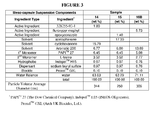
- a typical method used to synthesize a representative polyurea mesoparticle formulation is set forth below using the ingredients and quantities listed in FIG. 2 . Briefly, fenbuconazole, benzyl acetate, hexadecane, and PAPI TM 27 polymeric MDI (The Dow Chemical Co.) were added to a 60 ml jar and mixed until uniform. Surfactant, water, and glycine solutions were added to the jar and mixed with a hand-held Biohomogenizer mixer for about 10 seconds to create a pre-emulsion.
- the jar was placed in an ice bath and the pre-emulsion was sonicated for 5 minutes using a Branson 184V Ultrasonicator at 40% power to create the final emulsion which was converted into the polyurea mesocapsules by addition of the cross-linker.
- the particle volume-average diameter of meso-capsules in each sample was measured using a Brookhaven 90Plus Nanoparticle Size Analyzer.
- the mesocapsule formulations listed in FIG. 2 were made using this method. As indicated in FIG. 2 , the compositions of the reaction mixtures were varied to create the formulations disclosed herein.
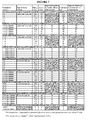
- the formulations referenced in FIG. 6 were tested on plants to determine their curative and preventative plant disease control properties.
- the aqueous phase was combined with the oil phase and the mixture was magnetically stirred for 2 minutes to make a pre-emulsion, which was subsequently sonicated for 4-5 minutes using a Vibra Cell TM (Sonics & Materials, Inc.) at 750W and 24-25% amplitude in an ice/water bath to make a stable oil-in-water emulsion at the meso scale.
- Vibra Cell TM Sonics & Materials, Inc.
- polyamine (2 nd monomer) was added to react with the isocyanate to form the polyurea shell.
- the formulation samples 14, 15 and 16B referenced in FIG. 6 were tested on plants to determine their pest control properties.
- a typical method used to synthesize a representative latex meso-matrix particle formulation is set forth below.
- the aqueous and oil the phases were prepared separately.
- To prepare the aqueous phase add the desired amount of surfactant to DI water in an 8-oz glass jar.
- To prepare the oil phase measure the fenbuconazole, initiator, monomer, co-monomer, dye monomer, and ultrahydrophobe. After both solutions are transparent, add the oil phase into the aqueous phase with magnetic stirring. This mixture was pre-emulsified in an ice-water bath with magnetic stirring for 30 minutes.
- the above emulsion was sonicated (450watts, 100 mL, 6-8 minutes) in an ice-water bath to produce a stable oil-in-water miniemulsion.
- 50 mL of the resulting miniemulsion was added to a 250 mL round bottom glass reactor flask, and the flask degassed 3-4 times under vacuum/N 2 purge.
- the miniemulsion was polymerized at 75°C under nitrogen for 1-2 hours.
- FIG. 4 shows the specific amounts of each reagent used.
- the polymerized formulations were used as is, or diluted to achieve the desired level of active ingredient and were tested on plants to determine their curative and preventative plant disease control properties.
- the table includes a listing of the formulations that were tested.
- the formulations of mesoparticles of fenbuconazole listed in FIG. 6 were tested to measure their curative and protectant effects on wheat leaf blotch disease, which is caused by the fungus Septoria tritici.
- Latex meso-matrix particle and polyurea mesocapsule particle formulations of fenbuconazole were tested for curative and protectant effects on leaf blotch disease of wheat on separate sets of wheat (cultivar Yuma) plants Each formulation was diluted in water and tested at the rates of 125, 41.4, 13.8, 4.6 and 1.4 g active substance/Ha.
- Uptake Oil TM is a penetrant adjuvant comprised of 582 g/L paraffinic oil, 7.5 g/L oleic acid, 145 g/L Polyglycol 26-2 surfactant (The Dow Chemical Company), 95 g/L Teric TM 12-A3 (Huntsman Corporation) emulsifier and 42.5 g/L Aromatic 150.
- a mesocapsule formulation of 328255-92-1 was tested with and without Uptake TM or Trycol 5941; and a mesocapule formulation of epoxiconazole was tested with and without Uptake TM .
- Each formulation was diluted in water and tested at the rates of 62.5, 20.8, 6.9, 2.3 and 0.8 g active substance/Ha.
- Experimental units for these tests consisted of 8 to 10 wheat plants grown in 5 cm by 5 cm pots of growth media comprised of half MetroMix and half clay loam soil. Each treatment was replicated four times and treatments were randomized after chemicals were applied.
- Plants for the curative test were inoculated in the 2-leaf stage of growth two or three days before formulationss were applied, depending on the test.
- formulations were applied in the two leaf stage of growth and plants were inoculated three or four days later, depending on the test.
- Treatments were applied using a Gen III Research Sprayer (DeVries Mfg., Hollandale MN) tracksprayer calibrated to deliver 100 L/Ha and equipped with a Spraying Systems 8002E TeeJet spray nozzle.
- plants were incubated in a dark dew room (22 C) at 99-100% relative humidity for 24 hours, then moved to a lighted dew room (20 C) at 99-100% relative humidity for an additional 48 hrs and then placed in a greenhouse set at 20 C and a 14-hr photoperiod for the remainder of the test. Plant growth was maintained through regular application of dilute liquid fertilizer solution.
- Wheat seedlings were rated for disease approximately 21 days after the inoculation. Percent disease was assessed by making a visual estimate of the percent of the leaf showing disease symptoms. Plants that were first inoculated and then treated with chemical two days later provided indications of curative effects. Plants that were first treated and then inoculated four days later provide indications of protectant effects. The level of disease on untreated check plants in the curative test was 82%. The level of disease on untreated check plants in the protectant test was 95%.
- Percent disease was converted to percent disease control using the following formula: (Average % disease in untreated check - average % disease in treatment)/(Average % disease in untreated check) X 100%.
- the percent disease control in each series of meso-formulations applied with adjuvant was compared to the actual and expected levels of control for the same series applied without adjuvant using the Colby Equation.
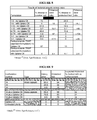
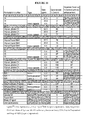
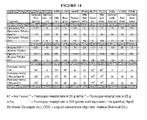
- FIGS. 7 and 8 the results of the various tests are as follows.
- the addition of Uptake Oil TM resulted in an enhancement of the curative and protectant effectiveness of all meso-formulations of fenbuconazole on leaf blotch.
- FIGURE 8 shows a comparison of the enhancement ratios for the 4 meso-formulations to the enhancement ratio for fenbuconazole 75% WP.
- the enhancement ratio is a calculation made by dividing the factorial mean disease control across rates without oil by the factorial mean across rates with Uptake Oil TM . The calculations show that, whether indicated by curative data or by protectant data, the level of enhancement experienced by meso-sized formulations is considerably greater than the enhancement of 75 WP.
- Various meso-particle formulations of fungicides were tested for protectant or curative effects on brown rust of wheat.
- a polyurea meso-capsule formulation of 328255-92-1 (Sample 14) was tested for protectant effects on brown rust of wheat which is caused by the fungus, Puccinia recondita f. sp. Tritici.
- the test was conducted on wheat plants (cultivar Yuma). Each formulation was diluted in water and tested at the rates of 62.5, 20.8, and 6.9, g active substance/Ha.
- the meso-formulation was tested with and without Uptake Oil TM at the rate of 0.5% v/v in the final spray solution.
- Each experimental unit consisted of 8 to 10 wheat plants grown in 5 cm by 5 cm pots of growth media comprised of half MetroMix and half clay loam soil. Each treatment was replicated four times and treatments were randomized after chemicals were applied.
- Each formulation was diluted in water and tested at the rates of 62.5, 20.8, 6.9, 2.3 and 0.8 g active substance/Ha Treatments were applied using a Gen III Research Sprayer (DeVries Mfg., Hollandale MN) tracksprayer equipped with a Spraying Systems 8002E TeeJet spray nozzle and calibrated to deliver 100 L/Ha.
- Gen III Research Sprayer (DeVries Mfg., Hollandale MN) tracksprayer equipped with a Spraying Systems 8002E TeeJet spray nozzle and calibrated to deliver 100 L/Ha.
- Inoculum of the foliar pathogen Puccinia recondita f.sp. tritici
- Puccinia recondita f.sp. tritici was prepared by harvesting urediospores from freshly erumpent and mature pustules.
- the final aqueous suspension of urediospores was made using the following ratios 0.1 g of urediospores, added to three drops of Tween 20, and then mixed as a paste.
- To the paste was added 100 ml of distilled water.
- the suspension yielded approximately 1,000,000 uredia /ml. Plants were inoculated by applying a fine mist with a low pressure compressed air sprayer at a volume of approximately 300 ml per 80 pots of wheat.
- plants were incubated in a dark dew room (22°C) at 99-100% relative humidity for 24 hours and then moved to a greenhouse set at 24°C and a 14-hr photoperiod for the remainder of the test. Plant growth was maintained through regular application of dilute liquid fertilizer solution.
- the wheat seedlings were rated for disease approximately 7-8 days after the inoculation. Percent disease was assessed by making a visual estimate of the percent disease on the primary leaf.
- the results of the test indicate that the addition of UptakeTM (Dow AgroSciences, LLC) or Trycol ® 5941 (Cognis Corporation) resulted in an enhancement of the curative effectiveness of the meso-capsule formulation of 328255-92-1 on brown rust. Further, the results of the test indicate that the addition of Uptake TM (Dow AgroSciences, LLC) or Trycol ® 5941 resulted in an enhancement of the curative effectiveness of the meso-capsule formulation of 328255-92-1 on brown rust. Further, the results of the test indicate that the addition of UptakeTM (Dow AgroSciences, LLC) resulted in an enhancement of the curative effectiveness of the meso-capsule formulation of epoxiconazole on brown rust.
- the results of the test indicate that the addition of Uptake TM (Dow AgroSciences, LLC) or Trycol ® 5941 (Cognis Corporation) resulted in an enhancement of the protectant effectiveness of the meso-capsule formulation of 328255-92-1 on leaf blotch. Further, the results of the test indicate that the addition of Uptake TM (Dow AgroSciences, LLC) resulted in an enhancement of the protectant effectiveness of the meso-capsule formulation of epoxiconazole on leaf blotch.
- the results of the test indicate that the addition of Uptake TM (Dow AgroSciences, LLC) or Trycol ® 5941 resulted in an enhancement of the curative effectiveness of the meso-capsule formulation of 328255-92-1 on leaf blotch. Further, the results of the test indicate that the addition of Uptake TM (Dow AgroSciences, LLC) resulted in an enhancement of the curative effectiveness of the meso-capsule formulation of epoxiconazole on leaf blotch.
- the table includes a listing of the formulations that were tested containing the herbicidal active ingredient fluroxypyr-meptyl.
- the polyurea mesocapsule formulations made in accordance with the various embodiments disclosed herein were compared with and without the addition of 0.25% v/v Agral 90 (Norac Concepts Inc.) or 2.0% v/v crop oil concentrate (COC, Agri-dex; Helena Chemical Co.).
- the polyurea mesocapsule formulation of fluroxypyr-meptyl listed in FIG. 6 were tested to measure their post-emergence herbicidal effects on various dicot and monocot weed species utilizing the methods described herein.
- Metro-mix 360 was used as the soil media for this test.
- Metro-mix is a growing medium consisting of 35 to 45% specially processed coconut coir pith, 10 to 20% horticultural grade vermiculite, 15 to 25% processed ash bark, 20 to 30% choice Canadian Sphagnum Peat Moss and proprietary nutrients and other ingredients.
- Several seeds of each species were planted in 10 cm square pots and top watered twice daily.
- Natural light was supplemented with 1000-watt metal halide overhead lamps with an average illumination of 500 uE m-2 s-1 photosynthetic active radiation (PAR). The photoperiod was 16 hr. Plant material was top-watered prior to treatment and sub-irrigated after treatment.
- PAR photosynthetic active radiation
- the meso-formulation of fluroxypyr-meptyl was tested at rates of 100, 50, 25 and 12.5 g acid equivalent /Ha.
- the formulations were diluted in tap water and applied alone, with Agral 90 (Norac Concepts Inc.) at 0.25% v/v or with crop oil concentrate (COC, Agri-dex; Helena Chemical Co.) at 2 % v/v.
- Treatments were applied with a tracksprayer manufactured by Allen Machine Works.
- the sprayer utilized an 8002E spray nozzle, spray pressure of 262 kPa pressure and speed of 1.8 mph to deliver 187 L/Ha.
- the nozzle height was 46 cm above the plant canopy.
- the growth stage of the various weed species ranged from 2 to 4 leaf.
- Treatments were replicated 1, 2 or 3 times depending on the availability of plant material. Plants were returned to the greenhouse after treatment and sub-watered throughout the duration of the experiment. Plant material was fertilized twice weekly with Hoagland's fertilizer solution. Visual assessments of percent control were made on a scale of 0 to 100% as compared to the untreated control plants (where 0 is equal to no control and 100 is equal to complete control).
- the results of the post-emergence herbicide test indicate that use of the mesocapsule formulation of fluroxypyr-meptyl with either Agral 90 (Norac Concepts Inc.) at 0.25% v/v or with crop oil concentrate (COC, Agri-dex; Helena Chemical Co.) at 2% v/v resulted in generally higher levels of control when compared to the mesocapsule formulation of fluroxypyr-meptyl alone.
Landscapes
- Life Sciences & Earth Sciences (AREA)
- General Health & Medical Sciences (AREA)
- Health & Medical Sciences (AREA)
- Dentistry (AREA)
- Pest Control & Pesticides (AREA)
- Plant Pathology (AREA)
- Engineering & Computer Science (AREA)
- Agronomy & Crop Science (AREA)
- Wood Science & Technology (AREA)
- Zoology (AREA)
- Environmental Sciences (AREA)
- Toxicology (AREA)
- Chemical & Material Sciences (AREA)
- Dispersion Chemistry (AREA)
- Agricultural Chemicals And Associated Chemicals (AREA)
- Catching Or Destruction (AREA)
Claims (12)
- Eine Zusammensetzung umfassend:a) einen Mesopartikel beinhaltend einen wenig wasserlöslichen landwirt-schaftlich aktiven Inhaltsstoff mit einem volumenmittleren Durchmesser im Bereich von 30 ± 3 nm bis 500 ± 50,0 nm, undb) einen Hilfsstoff,
wobei der landwirtschaftlich aktive Inhaltsstoff eine Wasserlöslichkeit von weniger als 1000 ± 100,0 ppm hat, der Mesopartikel wenigstens eines von einer Mesokapsel und einem Meso-Matrixpartikel ist und der Hilfsstoff ein Eindringungmedium oder ein nichtionisches oberflächenaktives Agens, welches ein Nonylphenolethoxylat darstellt, ist. - Die Zusammensetzung gemäß Anspruch 1, weiterhin umfassend inerte Inhaltsstoffe und Verdünnungsmittel.
- Die Zusammensetzung gemäß Anspruch 1, wobei die Ölphase der Meso-kapsel von 1 ± 0,1 bis 90 ± 9,0 Gew.-% des landwirtschaftlich aktiven Inhaltsstoffes beinhaltet oder der Meso-Matrixpartikel von 1 ± 0,1 bis 90 ± 9,0 Gew.-% des landwirtschaftlich aktiven Inhaltsstoffes beinhaltet.
- Die Zusammensetzung gemäß Anspruch 1, wobei der Hilfsstoff eines von einem integrierten Hilfsstoff, vorzugsweise umfassend von 1 ± 0,1 bis 90 ± 9,0 Gew.-% eines wässrigen oder nicht wässrigen Formulierungskonzentrats und einem im Tank zu mischenden Hilfsstoff ist, vorzugsweise umfassend von 0,05 ± 0,005 bis 5 ± 0,5 Vol.-% der verdünnten Sprühlösung.
- Die Zusammensetzung gemäß Anspruch 1, wobei das Eindringungsmittel mindestens eines von einem erdölbasierten Öl, einem pflanzlichen Öl, einem Samenöl und einem methylierten Samenöl ist und vorzugsweise ein Crop-Oil-Konzentrat ist.
- Die Zusammensetzung gemäß Anspruch 1, weiterhin umfassend einen konventionell formulierten landwirtschaftlich aktiven Inhaltsstoff.
- Ein Verfahren zur Bekämpfung von Insekten, Milben, Pflanzenkrankheiten oder Unkräutern beinhaltend die Schritte des:Bereitstellens einer Formulierung, die die Zusammensetzung gemäß Anspruch 1 enthält undAnwenden einer landwirtschaftlich wirksamen Menge der Formulierung auf mindestens eines der Folgenden: die Pflanze, das Pflanzenblattwerk, die Blüten, Stängel und Stämme, Früchte, die an die Pflanze angrenzende Fläche, den Boden, die Samen, keimenden Samen, Wurzeln, flüssige und feste Wachstumsmedien und Hydrokulturwachstumslösungen.
- Das Verfahren gemäß Anspruch 7, wobei das Verfahren zur Bekämpfung von Insekten, Pflanzenkrankheiten oder Unkräutern ist und die landwirtschaftlich wirksame Menge der Formulierung in Mischung mit einer oder mehreren konventionellen Formulierungen von landwirtschaftlich aktiven Inhaltsstoffen oder Nährstoffen angewandt wird.
- Die Zusammensetzung gemäß Anspruch 1, wobei der landwirtschaftlich aktive Inhaltsstoff aus der Gruppe bestehend aus Fungiziden, Insektiziden, Acariziden, Herbiziden, Herbizid-Safenern und Modifikatoren der Pflanzenphysiologie oder -struktur ausgewählt ist.
- Die Zusammensetzung gemäß Anspruch 9, wobei das Fungizid ein Triazolfungizid ist, vorzugsweise ausgewählt aus der Gruppe bestehend aus Cyproconazol, Difenocolazol, Epoxiconazol, Fenbuconazol, Fluquinconazol, Flutriafol, Ipconazol, Metconazol, Myclobutanil, Propiconazol, Prothioconazol, Tebuconazol, Tetraconazol, Triadimefon, Triadimenol und Triticonazol.
- Die Zusammensetzung gemäß Anspruch 9, wobei das Fungizid die mit der CAS-Nr. 328255-92-1 bezeichnete Verbindung ((3S,6S,7S,8R)-8-Benzyl-3-(3-(isobutylryloxymethoxy)-4-methoxypicolinamido)-6-methyl-4,9-dioxo-1,5-dioxonan-7-ylisobutyrat) ist.
- Die Zusammensetzung gemäß Anspruch 9, wobei das Herbizid Atrazin, ein Pyridinherbizid ausgewählt aus der Gruppe bestehend aus Aminopyralid, Clopyralid, Fluroxypyr, Picloram und Triclopyr oder ein Triazolpyrimidinherbizid ausgewählt aus der Gruppe bestehend aus Cloransulam, Diclosulam, Florasulam, Flumetsulam, Metosulam, Penoxsulam und Pyroxsulam ist.
Priority Applications (1)
| Application Number | Priority Date | Filing Date | Title |
|---|---|---|---|
| PL11815244T PL2600713T3 (pl) | 2010-08-05 | 2011-08-03 | Kompozycje pestycydowe z cząstkami o wielkości mezo o zwiększonej aktywności |
Applications Claiming Priority (2)
| Application Number | Priority Date | Filing Date | Title |
|---|---|---|---|
| US37083810P | 2010-08-05 | 2010-08-05 | |
| PCT/US2011/046374 WO2012018885A1 (en) | 2010-08-05 | 2011-08-03 | Pesticide compositions of meso-sized particles with enhanced activity |
Publications (3)
| Publication Number | Publication Date |
|---|---|
| EP2600713A1 EP2600713A1 (de) | 2013-06-12 |
| EP2600713A4 EP2600713A4 (de) | 2013-12-25 |
| EP2600713B1 true EP2600713B1 (de) | 2015-12-16 |
Family
ID=45556560
Family Applications (1)
| Application Number | Title | Priority Date | Filing Date |
|---|---|---|---|
| EP11815244.6A Revoked EP2600713B1 (de) | 2010-08-05 | 2011-08-03 | Pestizidzusammensetzungen aus mittelgrossen partikeln mit verstärkter aktivität |
Country Status (22)
| Country | Link |
|---|---|
| US (1) | US9084418B2 (de) |
| EP (1) | EP2600713B1 (de) |
| JP (2) | JP6147188B2 (de) |
| KR (1) | KR20130100120A (de) |
| CN (1) | CN103153052B (de) |
| AU (2) | AU2011285758B2 (de) |
| BR (1) | BR112013002856A2 (de) |
| CA (1) | CA2807028A1 (de) |
| CL (1) | CL2013000345A1 (de) |
| CO (1) | CO6650381A2 (de) |
| DK (1) | DK2600713T3 (de) |
| ES (1) | ES2564262T3 (de) |
| IL (1) | IL224546A (de) |
| MX (1) | MX341735B (de) |
| MY (1) | MY169313A (de) |
| NZ (1) | NZ607491A (de) |
| PH (1) | PH12013500230A1 (de) |
| PL (1) | PL2600713T3 (de) |
| PT (1) | PT2600713E (de) |
| UA (1) | UA111167C2 (de) |
| WO (1) | WO2012018885A1 (de) |
| ZA (1) | ZA201300833B (de) |
Families Citing this family (57)
| Publication number | Priority date | Publication date | Assignee | Title |
|---|---|---|---|---|
| UA107670C2 (en) * | 2009-08-07 | 2015-02-10 | Dow Agrosciences Llc | Meso-sized capsules useful for the delivery of agricultural chemicals |
| PT3153020T (pt) | 2009-10-07 | 2019-02-26 | Dow Agrosciences Llc | Misturas fungicidas sinérgicas para o controlo de fungos em cereais |
| UA111167C2 (uk) | 2010-08-05 | 2016-04-11 | ДАУ АГРОСАЙЄНСІЗ ЕлЕлСі | Пестицидні композиції мезорозмірних частинок з підсиленою дією |
| JP5852673B2 (ja) * | 2011-01-11 | 2016-02-03 | ビーエーエスエフ ソシエタス・ヨーロピアBasf Se | カプセル化殺有害生物剤を含む農薬製剤 |
| JP2012197243A (ja) * | 2011-03-22 | 2012-10-18 | Sumitomo Chemical Co Ltd | 除草組成物および雑草の防除方法 |
| AU2012311247B2 (en) | 2011-08-23 | 2016-10-13 | Vive Crop Protection Inc. | Pyrethroid formulations |
| US10206391B2 (en) | 2011-12-22 | 2019-02-19 | Vive Crop Protection Inc. | Strobilurin formulations |
| US9961900B2 (en) | 2012-06-11 | 2018-05-08 | Vive Crop Protection Inc. | Herbicide formulations |
| EA028729B1 (ru) | 2012-12-14 | 2017-12-29 | ДАУ АГРОСАЙЕНСИЗ ЭлЭлСи | Борьба с сорняками на основе синергического применения аминопиралида и клопиралида |
| US10412964B2 (en) | 2012-12-14 | 2019-09-17 | Dow Agrosciences Llc | Synergistic weed control from applications of aminopyralid and clopyralid |
| EP2934112B1 (de) | 2012-12-21 | 2019-05-08 | Dow Agrosciences LLC | Herbizid enthaltend aminopyralid, triclopyr und organosilikon-tensid |
| MX378259B (es) | 2012-12-28 | 2025-03-10 | Corteva Agriscience Llc | Mezclas fungicidas sinérgicas para el control fúngico en cereales. |
| BR112015015243B8 (pt) | 2012-12-31 | 2022-08-23 | Dow Agrosciences Llc | Composto contendo picolinamidas macrocíclicas, composição e método para controle e prevenção de doença em planta |
| US9392786B2 (en) | 2013-02-05 | 2016-07-19 | Vive Crop Protection, Inc. | Mectin and milbemycin polyelectrolyte nanoparticle formulations |
| AU2014221670B2 (en) | 2013-02-28 | 2017-02-09 | Sumitomo Chemical Company, Limited | Aqueous suspended pesticide composition |
| EP2975939B1 (de) | 2013-03-14 | 2020-08-05 | Dow AgroSciences LLC | Laubbaumzuchtsteuerung mit 6-arylpicolin-carbonsäuren, 2-arylpyrimidin-carbonsäuren oder salzen oder estern davon |
| EP2839744A1 (de) * | 2013-08-23 | 2015-02-25 | Fine Agrochemicals Limited | Wachstumregelkonzentrat und Verwendung davon |
| WO2015100184A1 (en) | 2013-12-26 | 2015-07-02 | Dow Agrosciences Llc | Use of macrocyclic picolinamides as fungicides |
| WO2015100182A1 (en) | 2013-12-26 | 2015-07-02 | Dow Agrosciences Llc | Use of macrocyclic picolinamides as fungicides |
| US9700047B2 (en) | 2014-05-06 | 2017-07-11 | Dow Agrosciences Llc | Macrocyclic picolinamides as fungicides |
| EP3166936A4 (de) | 2014-07-08 | 2017-11-22 | Dow AgroSciences LLC | Makrocyclische picolinamide als fungizide |
| US9686984B2 (en) | 2014-07-08 | 2017-06-27 | Dow Agrosciences Llc | Macrocyclic picolinamides as fungicides |
| NZ732812A (en) | 2014-12-30 | 2019-01-25 | Dow Agrosciences Llc | Use of picolinamides and other compounds as fungicides |
| JP6687625B2 (ja) | 2014-12-30 | 2020-04-22 | ダウ アグロサイエンシィズ エルエルシー | 殺真菌活性を有するピコリンアミド化合物 |
| US20180000084A1 (en) | 2014-12-30 | 2018-01-04 | Dow Agrosciences Llc | Use of picolinamide compounds with fungicidal activity |
| RU2687160C2 (ru) | 2014-12-30 | 2019-05-07 | ДАУ АГРОСАЙЕНСИЗ ЭлЭлСи | Пиколинамидные соединения с фунгицидной активностью |
| KR20170099928A (ko) | 2014-12-30 | 2017-09-01 | 다우 아그로사이언시즈 엘엘씨 | 살진균 활성을 갖는 피콜린아미드 |
| TWI700036B (zh) * | 2014-12-30 | 2020-08-01 | 美商陶氏農業科學公司 | 殺真菌組成物(一) |
| WO2017027431A1 (en) | 2015-08-09 | 2017-02-16 | Homs, Llc | Herbicidal compositions |
| WO2018045000A1 (en) | 2016-08-30 | 2018-03-08 | Dow Agrosciences Llc | Picolinamides as fungicides |
| WO2018045012A1 (en) | 2016-08-30 | 2018-03-08 | Dow Agrosciences Llc | Pyrido-1,3-oxazine-2,4-dione compounds with fungicidal activity |
| US10172358B2 (en) | 2016-08-30 | 2019-01-08 | Dow Agrosciences Llc | Thiopicolinamide compounds with fungicidal activity |
| US10111432B2 (en) | 2016-08-30 | 2018-10-30 | Dow Agrosciences Llc | Picolinamide N-oxide compounds with fungicidal activity |
| CN110139560A (zh) | 2016-12-30 | 2019-08-16 | 温菲尔德解决方案公司 | 降漂佐剂组合物及其使用方法 |
| US11678660B2 (en) | 2016-12-30 | 2023-06-20 | Winfield Solutions, Llc | Drift reduction adjuvant compositions and methods of using same |
| BR102018000183B1 (pt) | 2017-01-05 | 2023-04-25 | Dow Agrosciences Llc | Picolinamidas, composição para controle de um patógeno fúngico, e método para controle e prevenção de um ataque por fungos em uma planta |
| TW201842851A (zh) | 2017-05-02 | 2018-12-16 | 美商陶氏農業科學公司 | 用於穀類中的真菌防治之協同性混合物 |
| TWI774761B (zh) | 2017-05-02 | 2022-08-21 | 美商科迪華農業科技有限責任公司 | 用於穀物中的真菌防治之協同性混合物 |
| KR102659552B1 (ko) | 2017-05-02 | 2024-04-23 | 코르테바 애그리사이언스 엘엘씨 | 잔디풀 상의 진균 질환에 대한 살진균제로서의 비고리형 피콜린아미드 화합물의 용도 |
| WO2019038642A1 (en) | 2017-08-25 | 2019-02-28 | Vive Crop Protection Inc. | MULTI-COMPONENT PESTICIDE COMPOSITIONS APPLIED TO SOIL |
| BR102019004480B1 (pt) | 2018-03-08 | 2023-03-28 | Dow Agrosciences Llc | Picolinamidas como fungicidas |
| WO2019178161A1 (en) * | 2018-03-12 | 2019-09-19 | Massachusetts Institute Of Technology | Articles and compositions associated with oils on surfaces and associated methods |
| EP3829303A1 (de) * | 2018-07-27 | 2021-06-09 | Bayer Aktiengesellschaft | Formulierungen mit gesteuerter freisetzung für agrochemikalien |
| CA3115684A1 (en) | 2018-10-15 | 2020-04-23 | Dow Agrosciences Llc | Methods for sythesis of oxypicolinamides |
| BR112021008978A2 (pt) | 2018-12-11 | 2021-08-10 | Dow Global Technologies Llc | composição, e, método |
| US12458020B2 (en) | 2019-01-18 | 2025-11-04 | Sbm Développement Sas | Synergistic herbicidal mixtures and compositions comprising triclopyr and phosphate ester adjuvants |
| CA3069202A1 (en) * | 2019-01-24 | 2020-07-24 | Winfield Solutions, Llc | Multifunctional agricultural adjuvant compositions |
| WO2020161006A1 (en) * | 2019-02-04 | 2020-08-13 | Basf Se | New microcapsules for agricultural applications |
| WO2020220115A1 (en) | 2019-04-30 | 2020-11-05 | AVA Technologies Inc. | Gardening apparatus |
| AR119585A1 (es) * | 2019-08-06 | 2021-12-29 | Upl Corporation Ltd | Combinación herbicida |
| US12281076B2 (en) | 2019-10-18 | 2025-04-22 | Corteva Agriscience Llc | Process for synthesis of picolinamides |
| JPWO2021085396A1 (de) * | 2019-10-28 | 2021-05-06 | ||
| EP4056262A4 (de) * | 2019-11-05 | 2023-11-22 | LG Household & Health Care Ltd. | Biologisch abbaubare mikrokapsel und verfahren zum herstellen derselben |
| USD932346S1 (en) | 2020-01-10 | 2021-10-05 | AVA Technologies Inc. | Planter |
| USD932345S1 (en) | 2020-01-10 | 2021-10-05 | AVA Technologies Inc. | Plant pod |
| TWI896605B (zh) * | 2020-02-26 | 2025-09-11 | 美商維迪希安生命科學美國公司 | 用於氮抑制劑之無腐蝕性調配組合物 |
| WO2024130460A1 (zh) * | 2022-12-18 | 2024-06-27 | 张子勇 | 代森锰锌纳米悬浮液及其制备方法 |
Citations (16)
| Publication number | Priority date | Publication date | Assignee | Title |
|---|---|---|---|---|
| WO2002078674A1 (en) | 2001-03-30 | 2002-10-10 | Trustees Of Princeton University | A process and apparatuses for preparing nanoparticle compositions with amphiphilic copolymers and their use |
| WO2003022048A1 (en) | 2001-09-06 | 2003-03-20 | Syngenta Limited | Novel compounds |
| WO2003099012A1 (en) | 2002-05-23 | 2003-12-04 | Syngenta Limited | Phosphonates and derivatives thereof as enhancers of the activity of insecticides |
| WO2004017733A1 (en) | 2002-08-22 | 2004-03-04 | Syngenta Limited | Composition |
| WO2004017734A1 (en) | 2002-08-22 | 2004-03-04 | Syngenta Limited | Microencapsulated agrochemical composition |
| WO2005013692A1 (en) | 2003-08-06 | 2005-02-17 | Syngenta Limited | Agrochemical concentrate comprising an adjuvant and a hydrotrope |
| WO2005060756A1 (en) | 2003-12-18 | 2005-07-07 | Huntsman Petrochemical Corporation | Surfactant enhanced quick release pesticide granules |
| CN1663378A (zh) | 2004-03-05 | 2005-09-07 | 云南中科生物产业有限公司 | 印楝素·甲胺基阿维菌素杀虫剂制剂及其制备方法 |
| US20050221991A1 (en) | 2002-05-29 | 2005-10-06 | Hilmar Wolf | Microcapsule formulations |
| WO2006015791A2 (de) | 2004-08-04 | 2006-02-16 | Basf Aktiengesellschaft | Verfahren zur herstellung wässriger wirkstoffzusammensetzungen von in wasser schwer löslichen wirkstoffen |
| WO2008032328A2 (en) | 2006-09-14 | 2008-03-20 | Yissum Research Development Company Of The Hebrew University Of Jerusalem | Pesticide nanoparticles obtained from microemulsions and nanoemulsions |
| US20090104269A1 (en) | 2005-02-11 | 2009-04-23 | Brian Graham | Nanoformulations |
| US20100010051A1 (en) | 2006-09-30 | 2010-01-14 | Bayer Cropscience Ag | Suspension concentrates |
| CN101692808A (zh) | 2009-09-30 | 2010-04-14 | 深圳诺普信农化股份有限公司 | 甲氨基阿维菌素苯甲酸盐固体脂质纳米粒及其制备方法和在农药制剂中的应用 |
| WO2011017480A2 (en) * | 2009-08-07 | 2011-02-10 | Dow Agrosciences Llc | Meso-sized capsules useful for the delivery of agricultural chemicals |
| US20110319341A1 (en) | 2004-06-01 | 2011-12-29 | Awada Salam M | Method of controlling pests with biosurfactant penetrants as carriers for active agents |
Family Cites Families (16)
| Publication number | Priority date | Publication date | Assignee | Title |
|---|---|---|---|---|
| US5225118A (en) | 1990-08-15 | 1993-07-06 | Boise Cascade Corporation | Process for manufacturing polyurea microcapsules and product therefrom |
| CN1265872C (zh) * | 2000-06-05 | 2006-07-26 | 辛甄塔有限公司 | 新型微胶囊 |
| US7241804B1 (en) * | 2000-08-18 | 2007-07-10 | Fred Hutchinson Cancer Research Center | Compositions and methods for modulating apoptosis in cells over-expressing Bcl-2 family member proteins |
| US8137699B2 (en) * | 2002-03-29 | 2012-03-20 | Trustees Of Princeton University | Process and apparatuses for preparing nanoparticle compositions with amphiphilic copolymers and their use |
| US6540808B2 (en) | 2001-04-09 | 2003-04-01 | Mississippi Chemical Corporation | Controlled release fertilizers based on self-assembled molecule coatings |
| CA2357889A1 (en) * | 2001-04-30 | 2002-10-30 | Her Majesty The Queen In Right Of Canada As Represented By The Minister Of Agriculture And Agri-Food Canada | Biological control agents |
| JP2003221303A (ja) * | 2001-12-19 | 2003-08-05 | W Neudorff Gmbh Kg | 農薬組成物 |
| EP1517746A1 (de) | 2002-05-31 | 2005-03-30 | McMaster University | Verfahren zum Einkapseln von hydrophobischen organischen Molekulen in Polyharnstoffkapseln |
| US8119150B2 (en) | 2002-10-25 | 2012-02-21 | Foamix Ltd. | Non-flammable insecticide composition and uses thereof |
| GB0613925D0 (en) * | 2006-07-13 | 2006-08-23 | Unilever Plc | Improvements relating to nanodispersions |
| EP2054036B1 (de) * | 2006-07-24 | 2019-12-18 | Singh-Broemer and Company, Inc. | Feste nanoteilchenförmige formulierung von wasserunlöslichen pharmazeutischen substanzen mit verringerter ostwald-reifung |
| EP2057898A1 (de) * | 2007-11-06 | 2009-05-13 | Bayer CropScience AG | Homogene und lagerstabile Mischungen unterschiedlicher Pflanzenchutzmittel-Wirkstoff-Granulatpartikel |
| WO2009100144A1 (en) * | 2008-02-04 | 2009-08-13 | Dow Agrosciences Llc | Stabilized oil-in-water emulsions including meptyl dinocap |
| BRPI0914847A2 (pt) | 2008-06-20 | 2020-12-15 | Basf Se | Formulação agroquímica, processo para a preparação da composição, kit de partes, usos de uma mistura de um filtro fotoprotetor orgânico, e da formulação agroquímica, e, métodos para combater insetos prejudiciais e/ou de fungos fitopatogênicos, e para controlar vegetação indesejada |
| CN101449675B (zh) * | 2008-11-19 | 2011-09-07 | 东北农业大学 | 一种除草剂甲酯化植物油增效剂的制备方法 |
| UA111167C2 (uk) | 2010-08-05 | 2016-04-11 | ДАУ АГРОСАЙЄНСІЗ ЕлЕлСі | Пестицидні композиції мезорозмірних частинок з підсиленою дією |
-
2011
- 2011-03-08 UA UAA201302604A patent/UA111167C2/uk unknown
- 2011-08-03 PT PT118152446T patent/PT2600713E/pt unknown
- 2011-08-03 EP EP11815244.6A patent/EP2600713B1/de not_active Revoked
- 2011-08-03 NZ NZ607491A patent/NZ607491A/en not_active IP Right Cessation
- 2011-08-03 MX MX2013001417A patent/MX341735B/es active IP Right Grant
- 2011-08-03 CN CN201180048245.6A patent/CN103153052B/zh not_active Expired - Fee Related
- 2011-08-03 AU AU2011285758A patent/AU2011285758B2/en not_active Ceased
- 2011-08-03 WO PCT/US2011/046374 patent/WO2012018885A1/en not_active Ceased
- 2011-08-03 BR BR112013002856A patent/BR112013002856A2/pt not_active IP Right Cessation
- 2011-08-03 JP JP2013523297A patent/JP6147188B2/ja not_active Expired - Fee Related
- 2011-08-03 PH PH1/2013/500230A patent/PH12013500230A1/en unknown
- 2011-08-03 PL PL11815244T patent/PL2600713T3/pl unknown
- 2011-08-03 KR KR1020137005506A patent/KR20130100120A/ko not_active Ceased
- 2011-08-03 MY MYPI2013700196A patent/MY169313A/en unknown
- 2011-08-03 CA CA2807028A patent/CA2807028A1/en not_active Abandoned
- 2011-08-03 ES ES11815244.6T patent/ES2564262T3/es active Active
- 2011-08-03 US US13/197,106 patent/US9084418B2/en not_active Expired - Fee Related
- 2011-08-03 DK DK11815244.6T patent/DK2600713T3/en active
-
2013
- 2013-01-31 ZA ZA2013/00833A patent/ZA201300833B/en unknown
- 2013-02-03 IL IL224546A patent/IL224546A/en active IP Right Grant
- 2013-02-04 CL CL2013000345A patent/CL2013000345A1/es unknown
- 2013-02-05 CO CO13022883A patent/CO6650381A2/es active IP Right Grant
-
2015
- 2015-02-19 AU AU2015200842A patent/AU2015200842B2/en not_active Ceased
-
2016
- 2016-10-24 JP JP2016207432A patent/JP2017061479A/ja active Pending
Patent Citations (17)
| Publication number | Priority date | Publication date | Assignee | Title |
|---|---|---|---|---|
| WO2002078674A1 (en) | 2001-03-30 | 2002-10-10 | Trustees Of Princeton University | A process and apparatuses for preparing nanoparticle compositions with amphiphilic copolymers and their use |
| WO2003022048A1 (en) | 2001-09-06 | 2003-03-20 | Syngenta Limited | Novel compounds |
| WO2003099012A1 (en) | 2002-05-23 | 2003-12-04 | Syngenta Limited | Phosphonates and derivatives thereof as enhancers of the activity of insecticides |
| US20050221991A1 (en) | 2002-05-29 | 2005-10-06 | Hilmar Wolf | Microcapsule formulations |
| WO2004017734A1 (en) | 2002-08-22 | 2004-03-04 | Syngenta Limited | Microencapsulated agrochemical composition |
| WO2004017733A1 (en) | 2002-08-22 | 2004-03-04 | Syngenta Limited | Composition |
| WO2005013692A1 (en) | 2003-08-06 | 2005-02-17 | Syngenta Limited | Agrochemical concentrate comprising an adjuvant and a hydrotrope |
| WO2005060756A1 (en) | 2003-12-18 | 2005-07-07 | Huntsman Petrochemical Corporation | Surfactant enhanced quick release pesticide granules |
| CN1663378A (zh) | 2004-03-05 | 2005-09-07 | 云南中科生物产业有限公司 | 印楝素·甲胺基阿维菌素杀虫剂制剂及其制备方法 |
| US20110319341A1 (en) | 2004-06-01 | 2011-12-29 | Awada Salam M | Method of controlling pests with biosurfactant penetrants as carriers for active agents |
| WO2006015791A2 (de) | 2004-08-04 | 2006-02-16 | Basf Aktiengesellschaft | Verfahren zur herstellung wässriger wirkstoffzusammensetzungen von in wasser schwer löslichen wirkstoffen |
| US20080213326A1 (en) | 2004-08-04 | 2008-09-04 | Patrick Amrhein | Method For Producing Aqueous Active Substance Compositions Of Active Substances That Are Hardly Soluble In Water |
| US20090104269A1 (en) | 2005-02-11 | 2009-04-23 | Brian Graham | Nanoformulations |
| WO2008032328A2 (en) | 2006-09-14 | 2008-03-20 | Yissum Research Development Company Of The Hebrew University Of Jerusalem | Pesticide nanoparticles obtained from microemulsions and nanoemulsions |
| US20100010051A1 (en) | 2006-09-30 | 2010-01-14 | Bayer Cropscience Ag | Suspension concentrates |
| WO2011017480A2 (en) * | 2009-08-07 | 2011-02-10 | Dow Agrosciences Llc | Meso-sized capsules useful for the delivery of agricultural chemicals |
| CN101692808A (zh) | 2009-09-30 | 2010-04-14 | 深圳诺普信农化股份有限公司 | 甲氨基阿维菌素苯甲酸盐固体脂质纳米粒及其制备方法和在农药制剂中的应用 |
Non-Patent Citations (6)
| Title |
|---|
| C J TONKIN: "Using adjuvants, surfactants and oils with herbicides", WEED CONTROL IN WINTER CROPS, 2002, Australia, pages 1 - 4, XP055089321, Retrieved from the Internet <URL:http://www.agric.wa.gov.au/objtwr/imported_assets/content/pw/weed/using adjuvants.pdf> |
| CORREDOR EDUARDO ET AL.: "Nanoparticle penetration and transport in living pumpkin plants: in situ subcellular identification", BMC PLANT BIOLOGY 2009, vol. 9, 23 April 2009 (2009-04-23), pages 45, XP021048434 |
| KARATE? ZEON? - SYNGENTA TECHNICAL BULLETIN, 2000 |
| MICHAEL ASH ET AL., HANDBOOK OF GREEN CHEMICALS, 2004, pages 876, XP055307828 |
| THE PESTICIDE MANUAL, 2000, pages 349 - 350, XP055307827 |
| THOMAS EICHERT ET AL.: "Size exclusion limits and lateral heterogeneity of the stomatal foliar uptake pathway for aqueous solutes and water-suspended nanoparticles", PHYSIOLOGIA PLANTARUM, vol. 134, no. Issue 1, 28 June 2008 (2008-06-28), XP055089336 |
Also Published As
| Publication number | Publication date |
|---|---|
| AU2015200842B2 (en) | 2016-12-01 |
| AU2011285758A1 (en) | 2013-03-14 |
| ES2564262T3 (es) | 2016-03-21 |
| MY169313A (en) | 2019-03-21 |
| US9084418B2 (en) | 2015-07-21 |
| DK2600713T3 (en) | 2016-03-07 |
| KR20130100120A (ko) | 2013-09-09 |
| CN103153052A (zh) | 2013-06-12 |
| RU2013109400A (ru) | 2014-09-10 |
| US20120035054A1 (en) | 2012-02-09 |
| IL224546A (en) | 2017-08-31 |
| PL2600713T3 (pl) | 2016-07-29 |
| WO2012018885A1 (en) | 2012-02-09 |
| CO6650381A2 (es) | 2013-04-15 |
| ZA201300833B (en) | 2014-04-30 |
| JP6147188B2 (ja) | 2017-06-14 |
| JP2013532732A (ja) | 2013-08-19 |
| PT2600713E (pt) | 2016-03-22 |
| EP2600713A1 (de) | 2013-06-12 |
| CA2807028A1 (en) | 2012-02-09 |
| BR112013002856A2 (pt) | 2016-05-31 |
| PH12013500230A1 (en) | 2019-10-11 |
| AU2015200842A1 (en) | 2015-03-12 |
| CL2013000345A1 (es) | 2014-03-28 |
| CN103153052B (zh) | 2016-02-17 |
| NZ607491A (en) | 2016-03-31 |
| EP2600713A4 (de) | 2013-12-25 |
| MX2013001417A (es) | 2013-03-18 |
| AU2011285758B2 (en) | 2014-11-27 |
| JP2017061479A (ja) | 2017-03-30 |
| UA111167C2 (uk) | 2016-04-11 |
| MX341735B (es) | 2016-08-31 |
Similar Documents
| Publication | Publication Date | Title |
|---|---|---|
| EP2600713B1 (de) | Pestizidzusammensetzungen aus mittelgrossen partikeln mit verstärkter aktivität | |
| AU2010279437B2 (en) | Meso-sized capsules useful for the delivery of agricultural chemicals | |
| EP2827714B1 (de) | Tankmischungsadditiv-konzentrate mit triglycerid-fettsäureestern und verfahren zur verwendung | |
| US20130109725A1 (en) | Granules with improved dispersion properties | |
| US11832610B2 (en) | Rheological modifiers for spray drift control in agrochemical emulsions | |
| CN112996387B (zh) | 使用聚烷氧基化氨基醇的难溶性活性成分的水性溶液 | |
| RU2575746C2 (ru) | Пестицидные композиции мезо-размерных частиц с усиленным действием | |
| WO2020123130A1 (en) | Aqueous solutions of poorly soluble pesticides using polyalkyoxylated alcohols |
Legal Events
| Date | Code | Title | Description |
|---|---|---|---|
| PUAI | Public reference made under article 153(3) epc to a published international application that has entered the european phase |
Free format text: ORIGINAL CODE: 0009012 |
|
| 17P | Request for examination filed |
Effective date: 20130228 |
|
| AK | Designated contracting states |
Kind code of ref document: A1 Designated state(s): AL AT BE BG CH CY CZ DE DK EE ES FI FR GB GR HR HU IE IS IT LI LT LU LV MC MK MT NL NO PL PT RO RS SE SI SK SM TR |
|
| DAX | Request for extension of the european patent (deleted) | ||
| REG | Reference to a national code |
Ref country code: DE Ref legal event code: R079 Ref document number: 602011022128 Country of ref document: DE Free format text: PREVIOUS MAIN CLASS: A01N0025320000 Ipc: A01N0025040000 |
|
| A4 | Supplementary search report drawn up and despatched |
Effective date: 20131127 |
|
| RIC1 | Information provided on ipc code assigned before grant |
Ipc: A01N 43/70 20060101ALI20131121BHEP Ipc: A01N 25/28 20060101ALI20131121BHEP Ipc: A01N 25/04 20060101AFI20131121BHEP Ipc: A01N 25/12 20060101ALI20131121BHEP Ipc: A01N 43/90 20060101ALI20131121BHEP Ipc: A01N 43/40 20060101ALI20131121BHEP Ipc: A01P 13/00 20060101ALI20131121BHEP Ipc: A01N 43/653 20060101ALI20131121BHEP |
|
| 17Q | First examination report despatched |
Effective date: 20140930 |
|
| GRAP | Despatch of communication of intention to grant a patent |
Free format text: ORIGINAL CODE: EPIDOSNIGR1 |
|
| INTG | Intention to grant announced |
Effective date: 20150618 |
|
| GRAS | Grant fee paid |
Free format text: ORIGINAL CODE: EPIDOSNIGR3 |
|
| GRAA | (expected) grant |
Free format text: ORIGINAL CODE: 0009210 |
|
| AK | Designated contracting states |
Kind code of ref document: B1 Designated state(s): AL AT BE BG CH CY CZ DE DK EE ES FI FR GB GR HR HU IE IS IT LI LT LU LV MC MK MT NL NO PL PT RO RS SE SI SK SM TR |
|
| REG | Reference to a national code |
Ref country code: GB Ref legal event code: FG4D |
|
| REG | Reference to a national code |
Ref country code: CH Ref legal event code: EP |
|
| REG | Reference to a national code |
Ref country code: IE Ref legal event code: FG4D |
|
| REG | Reference to a national code |
Ref country code: AT Ref legal event code: REF Ref document number: 765064 Country of ref document: AT Kind code of ref document: T Effective date: 20160115 Ref country code: CH Ref legal event code: NV Representative=s name: FIAMMENGHI-FIAMMENGHI, CH |
|
| REG | Reference to a national code |
Ref country code: DE Ref legal event code: R096 Ref document number: 602011022128 Country of ref document: DE |
|
| REG | Reference to a national code |
Ref country code: DK Ref legal event code: T3 Effective date: 20160304 |
|
| REG | Reference to a national code |
Ref country code: ES Ref legal event code: FG2A Ref document number: 2564262 Country of ref document: ES Kind code of ref document: T3 Effective date: 20160321 |
|
| REG | Reference to a national code |
Ref country code: PT Ref legal event code: SC4A Free format text: AVAILABILITY OF NATIONAL TRANSLATION Effective date: 20160212 |
|
| REG | Reference to a national code |
Ref country code: NL Ref legal event code: FP |
|
| REG | Reference to a national code |
Ref country code: LT Ref legal event code: MG4D |
|
| PG25 | Lapsed in a contracting state [announced via postgrant information from national office to epo] |
Ref country code: NO Free format text: LAPSE BECAUSE OF FAILURE TO SUBMIT A TRANSLATION OF THE DESCRIPTION OR TO PAY THE FEE WITHIN THE PRESCRIBED TIME-LIMIT Effective date: 20160316 Ref country code: HR Free format text: LAPSE BECAUSE OF FAILURE TO SUBMIT A TRANSLATION OF THE DESCRIPTION OR TO PAY THE FEE WITHIN THE PRESCRIBED TIME-LIMIT Effective date: 20151216 Ref country code: LT Free format text: LAPSE BECAUSE OF FAILURE TO SUBMIT A TRANSLATION OF THE DESCRIPTION OR TO PAY THE FEE WITHIN THE PRESCRIBED TIME-LIMIT Effective date: 20151216 |
|
| REG | Reference to a national code |
Ref country code: AT Ref legal event code: MK05 Ref document number: 765064 Country of ref document: AT Kind code of ref document: T Effective date: 20151216 |
|
| PG25 | Lapsed in a contracting state [announced via postgrant information from national office to epo] |
Ref country code: SE Free format text: LAPSE BECAUSE OF FAILURE TO SUBMIT A TRANSLATION OF THE DESCRIPTION OR TO PAY THE FEE WITHIN THE PRESCRIBED TIME-LIMIT Effective date: 20151216 Ref country code: RS Free format text: LAPSE BECAUSE OF FAILURE TO SUBMIT A TRANSLATION OF THE DESCRIPTION OR TO PAY THE FEE WITHIN THE PRESCRIBED TIME-LIMIT Effective date: 20151216 Ref country code: LV Free format text: LAPSE BECAUSE OF FAILURE TO SUBMIT A TRANSLATION OF THE DESCRIPTION OR TO PAY THE FEE WITHIN THE PRESCRIBED TIME-LIMIT Effective date: 20151216 Ref country code: FI Free format text: LAPSE BECAUSE OF FAILURE TO SUBMIT A TRANSLATION OF THE DESCRIPTION OR TO PAY THE FEE WITHIN THE PRESCRIBED TIME-LIMIT Effective date: 20151216 Ref country code: GR Free format text: LAPSE BECAUSE OF FAILURE TO SUBMIT A TRANSLATION OF THE DESCRIPTION OR TO PAY THE FEE WITHIN THE PRESCRIBED TIME-LIMIT Effective date: 20160317 |
|
| REG | Reference to a national code |
Ref country code: FR Ref legal event code: PLFP Year of fee payment: 6 |
|
| PG25 | Lapsed in a contracting state [announced via postgrant information from national office to epo] |
Ref country code: CZ Free format text: LAPSE BECAUSE OF FAILURE TO SUBMIT A TRANSLATION OF THE DESCRIPTION OR TO PAY THE FEE WITHIN THE PRESCRIBED TIME-LIMIT Effective date: 20151216 |
|
| PG25 | Lapsed in a contracting state [announced via postgrant information from national office to epo] |
Ref country code: RO Free format text: LAPSE BECAUSE OF FAILURE TO SUBMIT A TRANSLATION OF THE DESCRIPTION OR TO PAY THE FEE WITHIN THE PRESCRIBED TIME-LIMIT Effective date: 20151216 Ref country code: SM Free format text: LAPSE BECAUSE OF FAILURE TO SUBMIT A TRANSLATION OF THE DESCRIPTION OR TO PAY THE FEE WITHIN THE PRESCRIBED TIME-LIMIT Effective date: 20151216 Ref country code: IS Free format text: LAPSE BECAUSE OF FAILURE TO SUBMIT A TRANSLATION OF THE DESCRIPTION OR TO PAY THE FEE WITHIN THE PRESCRIBED TIME-LIMIT Effective date: 20160416 Ref country code: AT Free format text: LAPSE BECAUSE OF FAILURE TO SUBMIT A TRANSLATION OF THE DESCRIPTION OR TO PAY THE FEE WITHIN THE PRESCRIBED TIME-LIMIT Effective date: 20151216 Ref country code: EE Free format text: LAPSE BECAUSE OF FAILURE TO SUBMIT A TRANSLATION OF THE DESCRIPTION OR TO PAY THE FEE WITHIN THE PRESCRIBED TIME-LIMIT Effective date: 20151216 Ref country code: SK Free format text: LAPSE BECAUSE OF FAILURE TO SUBMIT A TRANSLATION OF THE DESCRIPTION OR TO PAY THE FEE WITHIN THE PRESCRIBED TIME-LIMIT Effective date: 20151216 |
|
| REG | Reference to a national code |
Ref country code: DE Ref legal event code: R026 Ref document number: 602011022128 Country of ref document: DE |
|
| PLBI | Opposition filed |
Free format text: ORIGINAL CODE: 0009260 |
|
| PLAX | Notice of opposition and request to file observation + time limit sent |
Free format text: ORIGINAL CODE: EPIDOSNOBS2 |
|
| 26 | Opposition filed |
Opponent name: SYNGENTA CROP PROTECTION AG Effective date: 20160916 |
|
| PG25 | Lapsed in a contracting state [announced via postgrant information from national office to epo] |
Ref country code: SI Free format text: LAPSE BECAUSE OF FAILURE TO SUBMIT A TRANSLATION OF THE DESCRIPTION OR TO PAY THE FEE WITHIN THE PRESCRIBED TIME-LIMIT Effective date: 20151216 |
|
| PLBB | Reply of patent proprietor to notice(s) of opposition received |
Free format text: ORIGINAL CODE: EPIDOSNOBS3 |
|
| PG25 | Lapsed in a contracting state [announced via postgrant information from national office to epo] |
Ref country code: MC Free format text: LAPSE BECAUSE OF FAILURE TO SUBMIT A TRANSLATION OF THE DESCRIPTION OR TO PAY THE FEE WITHIN THE PRESCRIBED TIME-LIMIT Effective date: 20151216 |
|
| REG | Reference to a national code |
Ref country code: FR Ref legal event code: PLFP Year of fee payment: 7 |
|
| PG25 | Lapsed in a contracting state [announced via postgrant information from national office to epo] |
Ref country code: LU Free format text: LAPSE BECAUSE OF NON-PAYMENT OF DUE FEES Effective date: 20160803 |
|
| PGFP | Annual fee paid to national office [announced via postgrant information from national office to epo] |
Ref country code: CH Payment date: 20170814 Year of fee payment: 7 Ref country code: IT Payment date: 20170824 Year of fee payment: 7 Ref country code: ES Payment date: 20170901 Year of fee payment: 7 Ref country code: GB Payment date: 20170802 Year of fee payment: 7 |
|
| PGFP | Annual fee paid to national office [announced via postgrant information from national office to epo] |
Ref country code: DK Payment date: 20170810 Year of fee payment: 7 Ref country code: IE Payment date: 20170809 Year of fee payment: 7 |
|
| PLCK | Communication despatched that opposition was rejected |
Free format text: ORIGINAL CODE: EPIDOSNREJ1 |
|
| STAA | Information on the status of an ep patent application or granted ep patent |
Free format text: STATUS: THE PATENT HAS BEEN GRANTED |
|
| APBM | Appeal reference recorded |
Free format text: ORIGINAL CODE: EPIDOSNREFNO |
|
| APBP | Date of receipt of notice of appeal recorded |
Free format text: ORIGINAL CODE: EPIDOSNNOA2O |
|
| APAH | Appeal reference modified |
Free format text: ORIGINAL CODE: EPIDOSCREFNO |
|
| PG25 | Lapsed in a contracting state [announced via postgrant information from national office to epo] |
Ref country code: HU Free format text: LAPSE BECAUSE OF FAILURE TO SUBMIT A TRANSLATION OF THE DESCRIPTION OR TO PAY THE FEE WITHIN THE PRESCRIBED TIME-LIMIT; INVALID AB INITIO Effective date: 20110803 Ref country code: CY Free format text: LAPSE BECAUSE OF FAILURE TO SUBMIT A TRANSLATION OF THE DESCRIPTION OR TO PAY THE FEE WITHIN THE PRESCRIBED TIME-LIMIT Effective date: 20151216 |
|
| APBQ | Date of receipt of statement of grounds of appeal recorded |
Free format text: ORIGINAL CODE: EPIDOSNNOA3O |
|
| REG | Reference to a national code |
Ref country code: FR Ref legal event code: PLFP Year of fee payment: 8 |
|
| PG25 | Lapsed in a contracting state [announced via postgrant information from national office to epo] |
Ref country code: MK Free format text: LAPSE BECAUSE OF FAILURE TO SUBMIT A TRANSLATION OF THE DESCRIPTION OR TO PAY THE FEE WITHIN THE PRESCRIBED TIME-LIMIT Effective date: 20151216 Ref country code: MT Free format text: LAPSE BECAUSE OF NON-PAYMENT OF DUE FEES Effective date: 20160831 Ref country code: TR Free format text: LAPSE BECAUSE OF FAILURE TO SUBMIT A TRANSLATION OF THE DESCRIPTION OR TO PAY THE FEE WITHIN THE PRESCRIBED TIME-LIMIT Effective date: 20151216 |
|
| PG25 | Lapsed in a contracting state [announced via postgrant information from national office to epo] |
Ref country code: BG Free format text: LAPSE BECAUSE OF FAILURE TO SUBMIT A TRANSLATION OF THE DESCRIPTION OR TO PAY THE FEE WITHIN THE PRESCRIBED TIME-LIMIT Effective date: 20151216 |
|
| PGFP | Annual fee paid to national office [announced via postgrant information from national office to epo] |
Ref country code: PL Payment date: 20180612 Year of fee payment: 8 Ref country code: BE Payment date: 20180614 Year of fee payment: 8 Ref country code: FR Payment date: 20180612 Year of fee payment: 8 |
|
| PG25 | Lapsed in a contracting state [announced via postgrant information from national office to epo] |
Ref country code: AL Free format text: LAPSE BECAUSE OF FAILURE TO SUBMIT A TRANSLATION OF THE DESCRIPTION OR TO PAY THE FEE WITHIN THE PRESCRIBED TIME-LIMIT Effective date: 20151216 |
|
| PGFP | Annual fee paid to national office [announced via postgrant information from national office to epo] |
Ref country code: DE Payment date: 20180724 Year of fee payment: 8 Ref country code: NL Payment date: 20180712 Year of fee payment: 8 |
|
| PGFP | Annual fee paid to national office [announced via postgrant information from national office to epo] |
Ref country code: PT Payment date: 20180802 Year of fee payment: 8 |
|
| REG | Reference to a national code |
Ref country code: DK Ref legal event code: EBP Effective date: 20180831 |
|
| REG | Reference to a national code |
Ref country code: CH Ref legal event code: PL |
|
| GBPC | Gb: european patent ceased through non-payment of renewal fee |
Effective date: 20180803 |
|
| PG25 | Lapsed in a contracting state [announced via postgrant information from national office to epo] |
Ref country code: CH Free format text: LAPSE BECAUSE OF NON-PAYMENT OF DUE FEES Effective date: 20180831 Ref country code: LI Free format text: LAPSE BECAUSE OF NON-PAYMENT OF DUE FEES Effective date: 20180831 |
|
| REG | Reference to a national code |
Ref country code: IE Ref legal event code: MM4A |
|
| PG25 | Lapsed in a contracting state [announced via postgrant information from national office to epo] |
Ref country code: DK Free format text: LAPSE BECAUSE OF NON-PAYMENT OF DUE FEES Effective date: 20180831 Ref country code: IE Free format text: LAPSE BECAUSE OF NON-PAYMENT OF DUE FEES Effective date: 20180803 Ref country code: IT Free format text: LAPSE BECAUSE OF NON-PAYMENT OF DUE FEES Effective date: 20180803 |
|
| REG | Reference to a national code |
Ref country code: ES Ref legal event code: FD2A Effective date: 20190918 |
|
| PLAB | Opposition data, opponent's data or that of the opponent's representative modified |
Free format text: ORIGINAL CODE: 0009299OPPO |
|
| PG25 | Lapsed in a contracting state [announced via postgrant information from national office to epo] |
Ref country code: ES Free format text: LAPSE BECAUSE OF NON-PAYMENT OF DUE FEES Effective date: 20180804 Ref country code: GB Free format text: LAPSE BECAUSE OF NON-PAYMENT OF DUE FEES Effective date: 20180803 |
|
| R26 | Opposition filed (corrected) |
Opponent name: SYNGENTA CROP PROTECTION AG Effective date: 20160916 |
|
| REG | Reference to a national code |
Ref country code: DE Ref legal event code: R119 Ref document number: 602011022128 Country of ref document: DE |
|
| REG | Reference to a national code |
Ref country code: NL Ref legal event code: MM Effective date: 20190901 |
|
| PG25 | Lapsed in a contracting state [announced via postgrant information from national office to epo] |
Ref country code: PT Free format text: LAPSE BECAUSE OF NON-PAYMENT OF DUE FEES Effective date: 20200203 |
|
| REG | Reference to a national code |
Ref country code: BE Ref legal event code: MM Effective date: 20190831 |
|
| PG25 | Lapsed in a contracting state [announced via postgrant information from national office to epo] |
Ref country code: DE Free format text: LAPSE BECAUSE OF NON-PAYMENT OF DUE FEES Effective date: 20200303 Ref country code: FR Free format text: LAPSE BECAUSE OF NON-PAYMENT OF DUE FEES Effective date: 20190831 Ref country code: NL Free format text: LAPSE BECAUSE OF NON-PAYMENT OF DUE FEES Effective date: 20190901 |
|
| PG25 | Lapsed in a contracting state [announced via postgrant information from national office to epo] |
Ref country code: BE Free format text: LAPSE BECAUSE OF NON-PAYMENT OF DUE FEES Effective date: 20190831 |
|
| APBY | Invitation to file observations in appeal sent |
Free format text: ORIGINAL CODE: EPIDOSNOBA2O |
|
| APCA | Receipt of observations in appeal recorded |
Free format text: ORIGINAL CODE: EPIDOSNOBA4O |
|
| APBU | Appeal procedure closed |
Free format text: ORIGINAL CODE: EPIDOSNNOA9O |
|
| REG | Reference to a national code |
Ref country code: DE Ref legal event code: R103 Ref document number: 602011022128 Country of ref document: DE Ref country code: DE Ref legal event code: R064 Ref document number: 602011022128 Country of ref document: DE |
|
| RDAF | Communication despatched that patent is revoked |
Free format text: ORIGINAL CODE: EPIDOSNREV1 |
|
| RDAG | Patent revoked |
Free format text: ORIGINAL CODE: 0009271 |
|
| STAA | Information on the status of an ep patent application or granted ep patent |
Free format text: STATUS: PATENT REVOKED |
|
| REG | Reference to a national code |
Ref country code: CH Ref legal event code: PL |
|
| 27W | Patent revoked |
Effective date: 20230126 |
|
| PG25 | Lapsed in a contracting state [announced via postgrant information from national office to epo] |
Ref country code: PL Free format text: LAPSE BECAUSE OF NON-PAYMENT OF DUE FEES Effective date: 20190803 |