EP2602013A1 - Phosphorus recovery of products containing phosphorus, in particular of clearing sludge ash - Google Patents
Phosphorus recovery of products containing phosphorus, in particular of clearing sludge ash Download PDFInfo
- Publication number
- EP2602013A1 EP2602013A1 EP11009619.5A EP11009619A EP2602013A1 EP 2602013 A1 EP2602013 A1 EP 2602013A1 EP 11009619 A EP11009619 A EP 11009619A EP 2602013 A1 EP2602013 A1 EP 2602013A1
- Authority
- EP
- European Patent Office
- Prior art keywords
- phosphorus
- sewage sludge
- aluminum
- sludge ash
- filtrate
- Prior art date
- Legal status (The legal status is an assumption and is not a legal conclusion. Google has not performed a legal analysis and makes no representation as to the accuracy of the status listed.)
- Granted
Links
Images

Classifications
-
- B—PERFORMING OPERATIONS; TRANSPORTING
- B01—PHYSICAL OR CHEMICAL PROCESSES OR APPARATUS IN GENERAL
- B01D—SEPARATION
- B01D11/00—Solvent extraction
- B01D11/02—Solvent extraction of solids
- B01D11/0288—Applications, solvents
-
- C—CHEMISTRY; METALLURGY
- C01—INORGANIC CHEMISTRY
- C01B—NON-METALLIC ELEMENTS; COMPOUNDS THEREOF; METALLOIDS OR COMPOUNDS THEREOF NOT COVERED BY SUBCLASS C01C
- C01B25/00—Phosphorus; Compounds thereof
- C01B25/16—Oxyacids of phosphorus; Salts thereof
- C01B25/26—Phosphates
-
- C—CHEMISTRY; METALLURGY
- C01—INORGANIC CHEMISTRY
- C01B—NON-METALLIC ELEMENTS; COMPOUNDS THEREOF; METALLOIDS OR COMPOUNDS THEREOF NOT COVERED BY SUBCLASS C01C
- C01B25/00—Phosphorus; Compounds thereof
- C01B25/16—Oxyacids of phosphorus; Salts thereof
- C01B25/26—Phosphates
- C01B25/36—Aluminium phosphates
-
- C—CHEMISTRY; METALLURGY
- C01—INORGANIC CHEMISTRY
- C01B—NON-METALLIC ELEMENTS; COMPOUNDS THEREOF; METALLOIDS OR COMPOUNDS THEREOF NOT COVERED BY SUBCLASS C01C
- C01B25/00—Phosphorus; Compounds thereof
- C01B25/16—Oxyacids of phosphorus; Salts thereof
- C01B25/26—Phosphates
- C01B25/37—Phosphates of heavy metals
- C01B25/375—Phosphates of heavy metals of iron
-
- C—CHEMISTRY; METALLURGY
- C05—FERTILISERS; MANUFACTURE THEREOF
- C05B—PHOSPHATIC FERTILISERS
- C05B17/00—Other phosphatic fertilisers, e.g. soft rock phosphates, bone meal
-
- C—CHEMISTRY; METALLURGY
- C05—FERTILISERS; MANUFACTURE THEREOF
- C05D—INORGANIC FERTILISERS NOT COVERED BY SUBCLASSES C05B, C05C; FERTILISERS PRODUCING CARBON DIOXIDE
- C05D9/00—Other inorganic fertilisers
-
- C—CHEMISTRY; METALLURGY
- C05—FERTILISERS; MANUFACTURE THEREOF
- C05D—INORGANIC FERTILISERS NOT COVERED BY SUBCLASSES C05B, C05C; FERTILISERS PRODUCING CARBON DIOXIDE
- C05D9/00—Other inorganic fertilisers
- C05D9/02—Other inorganic fertilisers containing trace elements
-
- C—CHEMISTRY; METALLURGY
- C05—FERTILISERS; MANUFACTURE THEREOF
- C05F—ORGANIC FERTILISERS NOT COVERED BY SUBCLASSES C05B, C05C, e.g. FERTILISERS FROM WASTE OR REFUSE
- C05F7/00—Fertilisers from waste water, sewage sludge, sea slime, ooze or similar masses
-
- Y—GENERAL TAGGING OF NEW TECHNOLOGICAL DEVELOPMENTS; GENERAL TAGGING OF CROSS-SECTIONAL TECHNOLOGIES SPANNING OVER SEVERAL SECTIONS OF THE IPC; TECHNICAL SUBJECTS COVERED BY FORMER USPC CROSS-REFERENCE ART COLLECTIONS [XRACs] AND DIGESTS
- Y02—TECHNOLOGIES OR APPLICATIONS FOR MITIGATION OR ADAPTATION AGAINST CLIMATE CHANGE
- Y02A—TECHNOLOGIES FOR ADAPTATION TO CLIMATE CHANGE
- Y02A40/00—Adaptation technologies in agriculture, forestry, livestock or agroalimentary production
- Y02A40/10—Adaptation technologies in agriculture, forestry, livestock or agroalimentary production in agriculture
- Y02A40/20—Fertilizers of biological origin, e.g. guano or fertilizers made from animal corpses
Definitions
- the present invention relates to phosphorus recovery from sewage sludge ash and similar phosphorus containing products or wastes.
- Phosphorus ores are important sources of raw materials for the production of a wide variety of phosphorus products used in industry and agriculture. Thus, they represent a very important asset. The proven world stocks are decreasing sharply.
- phosphate can not be substituted by other substances. This is problematic because intensive agriculture without phosphate fertilization is not possible.
- Phosphates dissolved in waste water are converted into undissolved phosphates with the aid of suitable precipitants and removed from the waste water as solid together with other solids in the form of sewage sludge (chemical P precipitation).
- Possible precipitants are iron chlorides, iron chloride sulfates, iron sulfates, aluminum sulfates, sodium aluminates and lime milk.
- the dissolved phosphates are removed from the waste water by means of microorganisms which store phosphates in their cells (biological P precipitation).
- biological P precipitation The combination of chemical and biological precipitation is also known. Due to the high phosphate content, it makes sense to work up the sewage sludge. In thermal mono-combustion, the organic part of the sewage sludge is destroyed. What remains is an ashes with predominantly inorganic material. Alternatively, it is possible to obtain phosphorus-containing coal as fuel via the so-called HTC process (hydrothermal carbonization).
- DE 10 2009 020 745 describes a process for the production of phosphate, in which a suspension of the sewage sludge product in water, water / alcohol mixture or aqueous solution is prepared, and then gaseous carbon dioxide or supercritical carbon dioxide is introduced as an extraction agent in the suspension of the sewage sludge product. The undissolved solids are separated from the liquid suspending agent. Carbon dioxide is removed from the suspending agent and finally the phosphate dissolved in the suspending agent is precipitated and separated.
- CH 697 083 discloses a method and apparatus for recovering phosphorus from phosphorus-containing combustion ash.
- the phosphates contained in the combustion ash are brought into solution by an acid digestion.
- the solution is cleaned, and especially iron removed.
- the solution obtained in the acid digestion is purified by a liquid-liquid extraction, thereby removing iron. preferably, it is purified with an organic extractant.
- the problem with the process is the time-consuming removal of the iron from the solution.
- DE 102 06 347 discloses a process for recovering phosphorus compounds from combustion residues.
- the combustion ash is used to dissolve the phosphate compounds present in the combustion ash
- the separation of the phosphate-containing solution of insoluble accompanying components and deposited by precipitation, non-phosphate-containing components is carried out, followed by the preparation of the resulting phosphate solution.
- the object of the present invention is to provide an economical, ecological and simple process for the recovery of phosphorus compounds from sewage sludge ash, phosphorus-containing products or phosphorus-containing wastes.
- phosphorus-containing products in particular sewage sludge ash, phosphorus-containing coal and phosphorus-containing wastes, whereby a large part of the phosphorus is recovered in the form of basic aluminum phosphates.
- the aluminum phosphates are essentially free of heavy metals or at least meet the legal requirements Limits and can therefore be reused.
- the apparatuses used for the process according to the invention are inexpensive standard apparatuses. The entire process takes place at ambient temperature, so no heat sources are necessary, or the heat of reaction is used for heating.
- Heavy metal cations which have been dissolved out of the sewage sludge ash, must be separated, otherwise they will be incorporated into the phosphorus product precipitated in the last process step.
- a sacrificial metal is added during or immediately during acid digestion in the digestion container, or the sacrificial metal is placed after filtering off the filter cake in a separate container containing the filtrate.
- the reductive conditions can be enhanced by the addition of a suitable reducing agent such as Na 2 SO 3 , Na 2 S 2 O 4 , Na 2 S 2 O 3 .
- a suitable reducing agent such as Na 2 SO 3 , Na 2 S 2 O 4 , Na 2 S 2 O 3 .
- the optional addition of a reducing agent may optionally be in the sacrificial metal addition or later in the aluminum salt addition.
- the sacrificial metal is generally added in a stoichiometric excess of 0.5 to 10 times the molar amount of the nobler metals, ideally the excess factor is between 1 to 5.
- the sacrificial metal used typically has a grain size smaller than 2 mm, particularly preferred is a grain size between 0.001 and 0.8 mm.
- the acid digestion typically lasts 10 to 30 minutes and the reaction with the sacrificial metal 20 to 60 minutes.
- the metal-deposited heavy metal mixture of cadmium, copper and lead is separated by filtration. Filtration takes place either directly in the first step instead, if the sacrificial metal is added during or immediately after acid digestion, or if the sacrificial metal is added in a separate process step, by additional filtration.
- the strongly acidic pH range allows a very efficient and cost-effective separation of the heavy metals from the sewage sludge ash.
- an aluminum salt or a mixture of various aluminum salts or aqueous solutions of Al salts are added to the filtrate, which should be soluble in the filtrate.
- the amount of the aluminum salt used should be chosen so that there is a stoichiometric excess based on the phosphorus concentration.
- the phosphorus concentration can be determined by standard methods such as ion chromatography and photometry.
- a base By adding a base, the pH is raised to 2.1 to 3.0 and the dissolved phosphorus compounds are substantially completely precipitated in the form of basic aluminum phosphates and separated by filtration.
- this low precipitation pH value of 3.0 heavy metal cations with a higher precipitation pH, such as cobalt, chromium, iron, manganese, nickel and zinc etc., remain in solution and can thus be separated from the product in an elegant and simple manner.
- the filtrate which has a pH of 0 to 1.0, preferably from 0 to 0.5, again treated with sewage sludge ash.
- the pH of the Filtrates raised to a pH of 1.0 to 2.0.
- the sewage sludge ash is proportionately pre-extracted, ie phosphates are already in solution.
- the pre-extracted sewage sludge ash separated after further filtration is returned to the extraction process of the newly added KSA with fresh mineral acid. Too much increase in pH must be prevented to ensure that no unwanted precipitation occurs.
- the pH is raised to a range of pH 1.3 to 1.8.
- the pH can be controlled by standard methods.
- the sacrificial metal may in turn be added during or immediately after the acid digestion in the digestion container, or alternatively, in a separate container after separation of the filter cake.
- the process can be operated both continuously and discontinuously with the appropriate process engineering components.
- This embodiment with the re-addition of sewage sludge ash has the advantage that the amount of neutralization chemicals (base) necessary for the precipitation of the phosphorus product can be reduced. Furthermore, the acid consumption of the overall process can thus be significantly reduced.
- the sacrificial metal is aluminum.
- Aluminum has the advantage that it is already the metal that is then used for product insulation.
- the sacrificial metal is iron.
- Iron has the advantage that it is very cheap and therefore preferred for economic reasons. But it is also a combination of aluminum and iron conceivable.
- the acid digestion is carried out with a dilute mineral acid.
- a dilute mineral acid This is preferably selected from the group of hydrochloric acid, sulfuric acid, phosphoric acid and mixtures thereof.
- the concentration of the dilute mineral acids is preferably in the range of 0.1 to 2.5 M, more preferably 0.5 to 1.5 M.
- a base is added to raise the pH to 2.1 to 3.0.
- the base is preferably selected from the group of caustic soda, ammonia, milk of lime and soda. Particularly preferred is the use of caustic soda or milk of lime and mixtures thereof, as this leads to a very high phosphorus content of the product. More preferably, the pH is raised to within a range of 2.5 to 3.0 because this results in almost complete precipitation of the basic aluminum phosphate and no precipitation of other unwanted compounds still occurs.
- the aluminum compound is selected from the group of aluminum chloride, aluminum sulfate, potassium aluminum sulfate, sodium aluminate, polyaluminum (hydroxide) chloride, aluminum ferric chloride, polyaluminum (hydroxide) chloride sulfate, polyaluminum iron (III) chloride or mixtures and aqueous solutions thereof.
- aluminum sulphate and aluminum chloride solutions or solid or liquid waste containing soluble Al 3+ are especially preferred.
- the precipitated phosphorus product i.
- the aluminum phosphate can now be fed into either fertilizer production or thermal phosphorus production.
- the use in thermal phosphorus production is also possible with products made from ferrous sewage sludge ash. The reason is that the phosphorus product obtained by the process according to the invention substantially prevents the incorporation of iron into the product, thanks to the optimum pH choice during the recovery process.
- a possible phosphorus-containing product is, for example, phosphorus-containing coal.
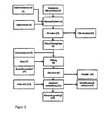
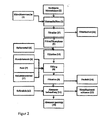
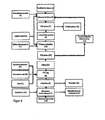
- the invention is in the in the FIGS. 1 to 4 illustrated flow charts illustrates.
- the sewage sludge ash (1) is treated with dilute mineral acid (2) in a digestion tank (3), in which the acid digestion is carried out with stirring. Subsequently, the sacrificial metal (4) is added. It is also possible to add the sacrificial metal already during acid digestion. After substantially all of the heavy metal cations (lead, cadmium and copper) that can react with the sacrificial metal have been reduced, the suspension in the subsequent filtration unit (3 '), in which the solid-liquid meeting occurs, filtered and the heavy metals lead, cadmium and copper are separated together with the filter cake (16) from the filtrate (5).
- the filtrate (5) has a pH of about 0 to 1.0, preferably 0 to 0.5.
- an aluminum salt (6) a mixture of different aluminum salts or aqueous solutions with Al salts is added and then the pH of the filtrate is raised to 2.1 to 3.0 by adding an optional reducing agent (7 ') and a base (7) wherein the desired aluminum phosphate is precipitated in a precipitation vessel (8).
- the product (10) is separated by filtration (9).
- the filtrate which contains other heavy metals with a higher precipitation pH, is discharged into the waste water treatment (11) and treated there by a standard method (for example adding lime (12) to form metal hydroxide sludge (13)).
- the sewage sludge ash (1) is mixed with dilute mineral acid (2) in a digestion tank (3), I in which the acid digestion is carried out with stirring.
- the solid / liquid separation takes place, wherein the filter cake (16) is separated.
- the filtrate (5) has a pH of about 0 to 1.0, preferably 0 to 0.5.
- the sacrificial metal (4) is added in this embodiment in a separate process step after the separation of the filter cake. After essentially all heavy metal cations (lead, cadmium, and copper) that can react with the sacrificial metal have been reduced, the suspension is filtered off (14) and the metallic heavy metals separated from the filtrate.
- an aluminum salt (6) a mixture of different aluminum salts or aqueous solutions with Al salts is added, and then by adding an optional reducing agent (7 ') and a base (7), the pH of the filtrate to 2.1 to 3.0 raised, wherein the desired aluminum phosphate is precipitated in a precipitation container (8).
- the product (10) is separated by filtration (9).
- the filtrate which contains other heavy metals with a higher precipitation pH, is discharged into the waste water treatment (11) and treated there by a standard method (for example, adding lime (12) to form metal hydroxide sludge (13)).
- the sewage sludge ash (1) is treated with dilute mineral acid (2) in a digestion tank (3), in which the acid digestion is carried out with stirring.
- the subsequent filtration unit (3 ') the solid / liquid separation takes place.
- the filtrate (5) has a pH of 0 to 1.0, preferably 0 to 0.5.
- the filtrate (5) is again added to sewage sludge ash (KSA) (1 ') which reacts alkaline, the pH being raised to a maximum pH of 2.0, preferably 1.3 to 1.8 (partial neutralization 15)).
- KSA sewage sludge ash
- the sacrificial metal (4) is added. It is also possible to add the sacrificial metal already proportionally during acid digestion.
- the suspension is filtered off (15 ') and the heavy metals lead, cadmium and copper are separated together with the filter cake (17) from the filtrate (5').
- an aluminum salt (6) or a mixture of various aluminum salts and solutions is added to the filtrate (5) liberated with lead, copper and cadmium, and is then added by adding a base (7) and optionally a reducing agent (7 ').
- the pH of the filtrate is increased to 2.1 to 3.0, wherein the desired aluminum phosphate is precipitated in a precipitation vessel (8).
- the product (10) is separated by filtration (9).
- the filtrate which contains even more heavy metals with a higher precipitation pH, is discharged into the waste water treatment (11) and treated there by a standard method (for example adding lime (12) to form metal hydroxide sludge (13)).
- the sewage sludge ash (1) is treated with dilute mineral acid (2) in a digestion tank (3), in which the acid digestion is carried out with stirring. Subsequently, the sacrificial metal (4) is added. After substantially all heavy metal cations (lead, cadmium and copper) that can react with the sacrificial metal have been reduced, the suspension is filtered off (3 ') and the deposited metals lead, cadmium and copper are taken together with the filter cake (16) from Separated filtrate (5).
- the filtrate (5) has a pH of about 0 to 1.0, preferably 0 to 0.5. Unlike the in FIG.
- the acid phase (5) is now a new sewage sludge ash (1 '), the reacts alkaline, added, the pH of not more than 2.0, preferably 1.3 to 1.8 is raised (partial neutralization 15).
- the sacrificial metal (4) is again added to the reaction vessel and after the reaction the heavy metals lead, cadmium and copper are discharged together with the pre-extracted filter cake (17) via the additional filtration stage (13 ').
- the pre-extracted filter cake (17) is returned for complete phosphate extraction in the acid digestion step (3) and there completely extracted with new sewage sludge ash (1) and dilute mineral acid (2) and discharged as a filter cake (16) on the filtration (3 ').
- the product (10) is separated by filtration (9).
- the filtrate, which contains even more heavy metal cations with a higher precipitation pH, is discharged into the waste water treatment (11) and treated there by a standard method (for example adding lime (12) to form metal hydroxide sludge (13)).
- Table 1 summarizes the composition of sewage sludge ash and phosphorus precipitate: sewage sludge ash phosphorus product element [mg / kg dry matter] [mg / kg dry matter] aluminum 33'403 65,000 antimony 22 10 arsenic 13 6 barium 1'480 80 lead 131 40 bromine 5C 13 cadmium ⁇ 6 ⁇ 1 calcium 143'033 4,000 chrome 80 40 iron 165'900 9,000 potassium 5'698 400 cobalt 153 ⁇ 50 copper 847 25 magnesium 18'233 2,000 manganese 1,523 300 sodium 4'767 107,000 nickel 53 ⁇ 10 phosphorus 83'073 135,000 sulfur 12'760 123,000 silicon 98'973 3'750 titanium 6'183 700 zinc 2'447 500
Landscapes
- Chemical & Material Sciences (AREA)
- Organic Chemistry (AREA)
- Inorganic Chemistry (AREA)
- Chemical Kinetics & Catalysis (AREA)
- Engineering & Computer Science (AREA)
- Environmental & Geological Engineering (AREA)
- Treatment Of Sludge (AREA)
Abstract
Description
Die vorliegende Erfindung betrifft die Phosphorrückgewinnung aus Klärschlammasche und ähnlichen phosphorhaltigen Produkten oder Abfällen.The present invention relates to phosphorus recovery from sewage sludge ash and similar phosphorus containing products or wastes.
Phosphorerze sind wichtige Rohstoffquellen für die Herstellung einer grossen Vielfalt von Phosphorprodukten, die in Industrie und Landwirtschaft Einsatz finden. Damit stellen sie ein sehr wichtiges Wirtschaftsgut dar. Die nachgewiesenen Weltvorräte nehmen stark ab.Phosphorus ores are important sources of raw materials for the production of a wide variety of phosphorus products used in industry and agriculture. Thus, they represent a very important asset. The proven world stocks are decreasing sharply.
Phosphat ist als Düngemittel nicht durch andere Stoffe substituierbar. Dies ist problematisch, da eine intensive Landwirtschaft ohne Phosphatdüngung nicht möglich ist.As a fertilizer, phosphate can not be substituted by other substances. This is problematic because intensive agriculture without phosphate fertilization is not possible.
Es sind Verfahren bekannt, mit denen Phosphor aus Klärschlamm und tierischen Nebenprodukten, die in grossen Mengen Phosphor enthalten, gewonnen wird. Klärschlamm wurde ausserdem direkt auf Landwirtschaftsflächen aufgebracht, dies ist jedoch mittlerweile sehr umstritten. Die Gehalte an Schwermetallen und der Nachweis von persistenten organischen Stoffen, deren ökologisches Potential teilweise unbekannt ist, haben dazu geführt, dass das Ausbringen von Klärschlamm auf Landwirtschaftsflächen mittlerweile verboten ist.There are known methods by which phosphorus from sewage sludge and animal by-products, which contain phosphorus in large quantities, is obtained. Sewage sludge was also applied directly to agricultural land, but this is now very controversial. The content of heavy metals and the detection of persistent organic matter, whose ecological potential is partly unknown, have meanwhile prevented the spreading of sewage sludge on agricultural land.
In Abwasser gelöste Phosphate werden mit Hilfe geeigneter Fällungsmittel in ungelöste Phosphate umgewandelt und als Feststoff zusammen mit anderen Feststoffen in Form von Klärschlamm aus dem Abwasser entfernt (chemische P-Fällung). Mögliche Fällungsmittel sind Eisenchloride, Eisenchloridsulfate, Eisensulfate, Aluminiumsulfate, Natriumaluminate und Kalkmilch. Alternativ werden die gelösten Phosphate mit Hilfe von Mikroorganismen, die Phosphate in ihren Zellen einlagern, aus dem Abwasser entfernt (biologische P-Fällung). Auch die Kombination der chemischen und biologischen Fällung ist bekannt. Durch den hohen Phosphatanteil ist es sinnvoll, den Klärschlamm aufzuarbeiten. Bei der thermischen Mono-Verbrennung wird der organische Anteil des Klärschlammes vernichtet. Zurück bleibt eine Asche mit überwiegend anorganischem Stoffbestand. Alternativ kann über das sogenannte HTC-Verfahren (hydrothermale Carbonisierung) phosphorhaltige Kohle als Brennstoff erhalten werden.Phosphates dissolved in waste water are converted into undissolved phosphates with the aid of suitable precipitants and removed from the waste water as solid together with other solids in the form of sewage sludge (chemical P precipitation). Possible precipitants are iron chlorides, iron chloride sulfates, iron sulfates, aluminum sulfates, sodium aluminates and lime milk. Alternatively, the dissolved phosphates are removed from the waste water by means of microorganisms which store phosphates in their cells (biological P precipitation). The combination of chemical and biological precipitation is also known. Due to the high phosphate content, it makes sense to work up the sewage sludge. In thermal mono-combustion, the organic part of the sewage sludge is destroyed. What remains is an ashes with predominantly inorganic material. Alternatively, it is possible to obtain phosphorus-containing coal as fuel via the so-called HTC process (hydrothermal carbonization).
Im Stand der Technik sind ausserdem verschiedene Ansätze zur Nutzung oder Gewinnung von Phosphor aus der Asche von Mono-Klärschlammverbrennungen bekannt. Dies sind beispielsweise
- direkte Aufarbeitung der Asche in der Düngemittelindustrie,
- Auswaschen der Phosphate mit heissem Wasser und anschliessender Fällung oder Kristallisation,
- Eluierung der Phosphate aus der Asche mit Schwefelsäure unter Einsatz von Ionenaustauschern,
- Kepro-Prozess mit Saure und Hitze,
- Seaborne Verfahren mit NRS-Reaktoren (Nitrogen Recycling System),
- Phostrip-Prozess,
- Ashdec-Verfahren.
- direct processing of the ash in the fertilizer industry,
- Washing out the phosphates with hot water and subsequent precipitation or crystallization,
- Elution of the phosphates from the ash with sulfuric acid using ion exchangers,
- Kepro process with acid and heat,
- Seaborne Process with NRS Reactors (Nitrogen Recycling System),
- Phostrip process,
- Ashdec method.
Sämtliche dieser Verfahren sind in der
Die bisher im Stand der Technik beschriebenen Verfahren weisen verschiedene Nachteile auf. Zum Teil sind sie sehr aufwändig und mit einem grossen Energieverbrauch verbunden, da bei erhöhten Temperaturen gearbeitet wird. Andere Verfahren ermöglichen nur die Verwendung von eisenfreier Klärschlammasche.The methods described so far in the prior art have various disadvantages. In part, they are very complex and associated with a large energy consumption, since it works at elevated temperatures. Other methods only allow the use of iron-free sewage sludge ash.
Aufgabe der vorliegenden Erfindung ist es, ein wirtschaftliches, ökologisches und einfaches Verfahren zur Rückgewinnung von Phosphorverbindungen aus Klärschlammasche, phosphorhaltigen Produkten oder phosphorhaltigen Abfällen bereitzustellen.The object of the present invention is to provide an economical, ecological and simple process for the recovery of phosphorus compounds from sewage sludge ash, phosphorus-containing products or phosphorus-containing wastes.
Die Aufgabe wird durch das Verfahren gemäss Anspruch 1 gelöst. Weitere bevorzugte Ausführungsformen sind Gegenstand der abhängigen Ansprüche. Ausserdem wird die Verwendung der so hergestellten Phosphorverbindungen beansprucht.The object is achieved by the method according to
Durch das unten beschriebene Verfahren ist es möglich, verschiedenste phosphorhaltige Produkte, insbesondere Klärschlammasche, phosphorhaltige Kohle und phosphorhaltige Abfälle, effizient und kostengünstig aufzubereiten, wobei ein Grossteil des Phosphors in Form von basischen Aluminiumphosphaten zurückgewonnen wird. Die Aluminiumphosphate sind im Wesentlichen frei von Schwermetallen oder erfüllen zumindest die gesetzlichen Grenzwerte und können daher wieder verwendet werden. Die für das erfindungsgemässe Verfahren verwendeten Apparaturen sind kostengünstige Standardapparaturen. Das gesamte Verfahren findet bei Umgebungstemperatur statt, daher sind keine Heizquellen notwendig, bzw. die Reaktionswärme wird zur Erwärmung genutzt.By the method described below, it is possible to efficiently and inexpensively process a wide variety of phosphorus-containing products, in particular sewage sludge ash, phosphorus-containing coal and phosphorus-containing wastes, whereby a large part of the phosphorus is recovered in the form of basic aluminum phosphates. The aluminum phosphates are essentially free of heavy metals or at least meet the legal requirements Limits and can therefore be reused. The apparatuses used for the process according to the invention are inexpensive standard apparatuses. The entire process takes place at ambient temperature, so no heat sources are necessary, or the heat of reaction is used for heating.
Überdies ist es möglich, sämtliche Arten von Klärschlammaschen mit dem erfindungsgemässen Verfahren zu behandeln. Im Gegensatz zu den im Stand der Technik bekannten Verfahren, ist die Anwesenheit von Eisen in der Klärschlammasche kein Problem. Das Eisen muss auch nicht durch einen aufwändigen, separaten Prozess mittels Ionenaustauscher oder Ähnlichem abgetrennt werden, sondern bleibt durch geeignete Bedingungen in Lösung, wenn das Produkt abgetrennt wird. Auch Klärschlammasche aus Klärschlamm, der mittels chemischer und biologischer Fällung hergestellt wurde, insbesondere eisenhaltige Klärschlammasche kann mit dem erfindungsgemässen Verfahren problemlos behandelt werden.Moreover, it is possible to treat all types of sewage sludge ash with the inventive method. In contrast to the methods known in the art, the presence of iron in sewage sludge ash is not a problem. Nor does the iron need to be separated by a complex, separate process by means of an ion exchanger or the like, but it remains in solution by suitable conditions when the product is separated. Also sewage sludge ash from sewage sludge, which was produced by chemical and biological precipitation, in particular iron-containing sewage sludge ash can be treated easily with the inventive method.
Das erfindungsgemässe Verfahren zur Rückgewinnung von Phosphorverbindungen aus Klärschlammaschen umfasst wenigstens folgende Schritte:
- In einem ersten Schritt (a) werden die in der Klärschlammasche enthaltenen phosphorhaltigen Verbindungen, insbesondere Phosphate, durch einen Säureaufschluss mit einer verdünnten Mineralsäure in Lösung gebracht. Der Säureaufschluss wird in einem säurebeständigen Aufschlussbehälter durchgeführt. Beim Säureaufschluss geht ein Grossteil, d.h. mehr als 70 % der Phosphorverbindungen in Lösung. Desweiteren gehen auch einige Schwermetallkationen, sowie säurelösliche Salze in Lösung. Anschliessend wird durch eine Filtration die Klärschlammaschen-Säure-Suspension in einen phosphorarmen Filterkuchen und ein phosphorreiches Filtrat getrennt. Das erhaltene, phosphorreiche Filtrat hat einen pH-Wert von 0 bis 1.0, vorzugsweise 0 bis 0.5.
- In a first step (a), the phosphorus-containing compounds contained in the sewage sludge ash, in particular phosphates, are brought into solution by an acid digestion with a dilute mineral acid. The acid digestion is carried out in an acid-resistant digestion vessel. The acid digestion is a major part, ie more than 70% of the phosphorus compounds in solution. Furthermore go too some heavy metal cations, as well as acid soluble salts in solution. Subsequently, the sewage sludge ash-acid suspension is separated into a low-phosphorus filter cake and a phosphorus-rich filtrate by filtration. The obtained, phosphorus-rich filtrate has a pH of 0 to 1.0, preferably 0 to 0.5.
Schwermetallkationen, die aus der Klärschlammasche herausgelöst worden sind, müssen abgetrennt werden, da sie sonst in das im letzten Verfahrensschritt ausgefällte Phosphorprodukt eingebunden werden. Dazu gibt es zwei Möglichkeiten: Entweder wird während oder unmittelbar beim Säureaufschluss in den Aufschlussbehälter ein Opfermetall zugegeben, oder das Opfermetall wird nach dem Abfiltrieren des Filterkuchens in einen separaten Behälter gegeben, der das Filtrat enthält.Heavy metal cations, which have been dissolved out of the sewage sludge ash, must be separated, otherwise they will be incorporated into the phosphorus product precipitated in the last process step. There are two options: Either a sacrificial metal is added during or immediately during acid digestion in the digestion container, or the sacrificial metal is placed after filtering off the filter cake in a separate container containing the filtrate.
Das Opfermetall wird ausgewählz aus der Gruppe von Aluminium, Eisen und Zink oder Mischungen davon. Dabei findet eine Reduktion der gelöst vorliegenden edleren Metalle auf der Oberfläche des unedleren Opfermetalls statt, das dabei oxidiert wird. Beispielsweise finden folgende Reaktionen statt:
- 2 Al + 3 Pb2+ → 2 Al3+ + 3 Pb
- 2 Al + 3 Cu2- → 2 Al3+ + 3 Cu
- 2 Al + 3 Cd2- → 2 Al3+ + 3 Cd
- Fe + Pb2+ → Fe2+ + Pb
- Fe + Cu2+ → Fe2+ + Cu
- Fe + Cd2+ -> Fe2+ + Cd
- Zn + Pb2+ → Zn2+ + Pb
- Zn + Cu2+ → Zn2+ + Cu
- Zn + Cd2+ → Zn2+ + Cd
- 2 Al + 3 Pb 2+ → 2 Al 3+ + 3 Pb
- 2 Al + 3 Cu 2 → 2 Al 3+ + 3 Cu
- 2 Al + 3 Cd 2 → 2 Al 3+ + 3 Cd
- Fe + Pb 2+ → Fe 2+ + Pb
- Fe + Cu 2+ → Fe 2+ + Cu
- Fe + Cd 2+ -> Fe 2+ + Cd
- Zn + Pb 2+ → Zn 2+ + Pb
- Zn + Cu 2+ → Zn 2+ + Cu
- Zn + Cd 2+ → Zn 2+ + Cd
Durch die hier vorliegenden reduktiven Bedingungen, die unter anderem durch die Bildung von naszierendem Wasserstoff entstehen (2 Al + 6 H+ -> 3 Al3+ und 3 H2), wird entweder in der Suspension bereits vorhandenes oder neu gebildetes Eisen (III) zu Eisen (II) reduziert, was für die spätere Unterdrückung der Ausfällung bei pH-Werten < 3.0 entscheidend ist.Due to the reductive conditions present here, which are caused, inter alia, by the formation of nascent hydrogen (2 Al + 6 H + -> 3 Al 3+ and 3 H 2 ), either already present or newly formed iron (III) in the suspension reduced to iron (II), which is crucial for the subsequent suppression of precipitation at pH <3.0.
Zusätzlich können die reduktiven Bedingungen durch die Zugabe eines geeigneten Reduktionsmittels wie beispielsweise Na2SO3, Na2S2O4, Na2S2O3 verstärkt werden. Die optionale Zugabe eines Reduktionsmittels kann wahlweise bei der opfermetallzugabe oder später bei der Aluminiumsalzzugabe erfolgen. Das Opfermetall wird im Allgemeinen im stöchiometrischen Überschuss der 0.5 bis 10-fachen Stoffmenge der edleren Metalle zugegeben, idealerweise liegt der Überschussfaktor zwischen 1 bis 5. Das eingesetzte Opfermetall weist typischerweise eine Körnung auf, die kleiner als 2 mm ist, besonders bevorzugt ist eine Körnung zwischen 0.001 und 0.8 mm.In addition, the reductive conditions can be enhanced by the addition of a suitable reducing agent such as Na 2 SO 3 , Na 2 S 2 O 4 , Na 2 S 2 O 3 . The optional addition of a reducing agent may optionally be in the sacrificial metal addition or later in the aluminum salt addition. The sacrificial metal is generally added in a stoichiometric excess of 0.5 to 10 times the molar amount of the nobler metals, ideally the excess factor is between 1 to 5. The sacrificial metal used typically has a grain size smaller than 2 mm, particularly preferred is a grain size between 0.001 and 0.8 mm.
Der Säureaufschluss dauert typischerweise 10 bis 30 Minuten und die Reaktion mit dem Opfermetall 20 bis 60 Minuten.The acid digestion typically lasts 10 to 30 minutes and the reaction with the
Das metallisch abgeschiedene schwermetallgemisch aus Cadmium, Kupfer und Blei wird durch Filtration abgetrennt. Die Filtration findet entweder direkt im ersten Schritt statt, wenn das Opfermetall während oder unmittelbar nach dem Säureaufschluss zugegeben wird, oder aber falls das Opfermetall in einem separaten Verfahrensschritt zugegeben wird, durch eine zusätzliche Filtration. Der stark saure pH-Bereich erlaubt eine sehr effiziente und kostengünstige Abtrennung der Schwermetalle aus der Klärschlammasche. Anschliessend werden dem Filtrat ein Aluminiumsalz oder eine Mischung verschiedener Aluminiumsalze oder wässrige Lösungen der Al-Salze zugegeben, welche im Filtrat löslich sein sollten. Die Menge des eingesetzten Aluminiumsalzes sollte so gewählt werden, dass ein stöchiometrischer Überschuss bezogen auf die Phosphorkonzentration vorliegt. Die Phosphorkonzentration kann durch Standardmethoden ermittelt werden, wie beispielsweise durch Ionenchromatographie und Photometrie. Durch die Zugabe einer Base wird der pH-Wert auf 2.1 bis 3.0 angehoben und die gelöst vorliegenden Phosphorverbindungen werden in Form von basischen Aluminiumphosphaten im Wesentlichen vollständig ausgefällt und mittels Filtration abgetrennt. Durch diesen tiefen Fällungs-pH-Wert von maximal 3.0 bleiben Schwermetallkationen mit höherem Fällungs-pH-Wert wie Kobalt, Chrom, Eisen, Mangan, Nickel und Zink etc. in Lösung und können so elegant und einfach von dem Produkt abgetrennt werden.The metal-deposited heavy metal mixture of cadmium, copper and lead is separated by filtration. Filtration takes place either directly in the first step instead, if the sacrificial metal is added during or immediately after acid digestion, or if the sacrificial metal is added in a separate process step, by additional filtration. The strongly acidic pH range allows a very efficient and cost-effective separation of the heavy metals from the sewage sludge ash. Subsequently, an aluminum salt or a mixture of various aluminum salts or aqueous solutions of Al salts are added to the filtrate, which should be soluble in the filtrate. The amount of the aluminum salt used should be chosen so that there is a stoichiometric excess based on the phosphorus concentration. The phosphorus concentration can be determined by standard methods such as ion chromatography and photometry. By adding a base, the pH is raised to 2.1 to 3.0 and the dissolved phosphorus compounds are substantially completely precipitated in the form of basic aluminum phosphates and separated by filtration. By means of this low precipitation pH value of 3.0, heavy metal cations with a higher precipitation pH, such as cobalt, chromium, iron, manganese, nickel and zinc etc., remain in solution and can thus be separated from the product in an elegant and simple manner.
In einer weiteren bevorzugten Ausführungsform wird vor der eigentlichen Produktisolierung, d.h. vor der Zugabe des Aluminiumsalzes und des Opfermetalls, das Filtrat, das einen pH Wert von 0 bis 1.0, vorzugsweise von 0 bis 0.5, aufweist, erneut mit Klärschlammasche versetzt. Durch die Klärschlammasche, die alkalisch wirkt, wird der pH des Filtrats auf einen pH-Wert von 1.0 bis 2.0 angehoben. Neben der Teilneutralisation der Säurephase wird die Klärschlammasche anteilig vorextrahiert, d.h. Phosphate gehen bereits zu einem Teil in Lösung. Zur vollständigen Phosphorextraktion wird die nach einer weiteren Filtration abgetrennte vorextrahierte Klärschlammasche wieder in den Extraktionsprozess der neu zugegebenen KSA mit frischer Mineralsäure zurück geführt. Ein zu starkes Ansteigen des pH muss verhindert werden, um sicher zu stellen, dass keine unerwünschten Ausfällungen stattfinden. Besonders bevorzugt wird der pH in einen Bereich von pH 1.3 bis 1.8 angehoben. Der pH kann über Standardmethoden kontrolliert werden.In a further preferred embodiment, prior to the actual product isolation, ie before the addition of the aluminum salt and the sacrificial metal, the filtrate, which has a pH of 0 to 1.0, preferably from 0 to 0.5, again treated with sewage sludge ash. By the sewage sludge ash, which acts alkaline, the pH of the Filtrates raised to a pH of 1.0 to 2.0. In addition to the partial neutralization of the acid phase, the sewage sludge ash is proportionately pre-extracted, ie phosphates are already in solution. For complete phosphorus extraction, the pre-extracted sewage sludge ash separated after further filtration is returned to the extraction process of the newly added KSA with fresh mineral acid. Too much increase in pH must be prevented to ensure that no unwanted precipitation occurs. Most preferably, the pH is raised to a range of pH 1.3 to 1.8. The pH can be controlled by standard methods.
Das Opfermetall kann wiederum während oder unmittelbar nach dem Säureaufschluss in den Aufschlussbehälter gegeben werden, oder alternativ, in ein separates Behältnis nach Abtrennung des Filterkuchens. Der Prozess kann sowohl kontinuierlich als auch diskontinuierlich mit den jeweils geeigneten verfahrenstechnischen Komponenten betrieben werden.The sacrificial metal may in turn be added during or immediately after the acid digestion in the digestion container, or alternatively, in a separate container after separation of the filter cake. The process can be operated both continuously and discontinuously with the appropriate process engineering components.
Diese Ausführungsform mit der erneuten Zugabe von Klärschlammasche hat den Vorteil, dass die Menge von Neutralisationschemikalien (Base), die für die Fällung des Phosphorproduktes notwendig ist, reduziert werden kann. Des Weiteren kann somit der Säureverbrauch des Gesamtprozess deutlich reduziert werden.This embodiment with the re-addition of sewage sludge ash has the advantage that the amount of neutralization chemicals (base) necessary for the precipitation of the phosphorus product can be reduced. Furthermore, the acid consumption of the overall process can thus be significantly reduced.
In einer bevorzugten Ausführungsform ist das Opfermetall Aluminium. Aluminium hat den Vorteil, dass es bereits das Metall ist, das anschliessend für die Produkteisolierung verwendet wird.In a preferred embodiment, the sacrificial metal is aluminum. Aluminum has the advantage that it is already the metal that is then used for product insulation.
In einer weiteren bevorzugten Ausführungsform ist das Opfermetall Eisen. Eisen hat den Vorteil, dass es sehr billig ist und daher aus wirtschaftlichen Gründen bevorzugt wird. Es ist aber auch eine Kombination aus Aluminium und Eisen denkbar.In a further preferred embodiment, the sacrificial metal is iron. Iron has the advantage that it is very cheap and therefore preferred for economic reasons. But it is also a combination of aluminum and iron conceivable.
Der Säureaufschluss wird mit einer verdünnten Mineralsäure durchgeführt. Diese ist vorzugsweise ausgewählt aus der Gruppe von Salzsäure, Schwefelsäure, Phosphorsäure und Mischungen davon. Die Konzentration der verdünnten Mineralsäuren ist dabei vorzugsweise im Bereich von 0.1 bis 2.5 M, besonders bevorzugt 0.5 bis 1.5 M.The acid digestion is carried out with a dilute mineral acid. This is preferably selected from the group of hydrochloric acid, sulfuric acid, phosphoric acid and mixtures thereof. The concentration of the dilute mineral acids is preferably in the range of 0.1 to 2.5 M, more preferably 0.5 to 1.5 M.
Für die Produktisolierung wird nach der Zugabe des Aluminiumsalzes eine Base zugegeben, um den pH auf 2.1 bis 3.0 anzuheben. Die Base ist dabei vorzugsweise ausgewählt aus der Gruppe von Natronlauge, Ammoniak, Kalkmilch und Soda. Besonders bevorzugt ist dabei der Einsatz von Natronlauge oder Kalkmilch und Mischungen davon, da dies zu einem sehr hohen Phosphorgehalt des Produktes führt. Besonders bevorzugt wird der pH in einen Bereich von 2.5 bis 3.0 angehoben, weil dadurch eine fast vollständige Fällung des basischen Aluminiumphosphates erfolgt und noch keine Fällung anderer, nicht erwünschter Verbindungen stattfindet.For product isolation, after the addition of the aluminum salt, a base is added to raise the pH to 2.1 to 3.0. The base is preferably selected from the group of caustic soda, ammonia, milk of lime and soda. Particularly preferred is the use of caustic soda or milk of lime and mixtures thereof, as this leads to a very high phosphorus content of the product. More preferably, the pH is raised to within a range of 2.5 to 3.0 because this results in almost complete precipitation of the basic aluminum phosphate and no precipitation of other unwanted compounds still occurs.
In einer weiteren Ausführungsform ist die Aluminiumverbindung ausgewählt aus der Gruppe von Aluminiumchlorid, Aluminiumsulfat, Kaliumaluminiumsulfat, Natriumaluminat, Polyaluminium(hydroxid)chlorid, Aluminium-Eisen(III)chlorid, Polyaluminium-(Hydroxid)-chlorid-Sulfat, Polyaluminium-Eisen(III)chlorid oder Mischungen und wässrige Lösungen davon. Besonders bevorzugt sind Aluminiumsulfat- und Aluminiumchloridlösungen oder Abfallstoffe fest oder flüssig, die lösliches Al3+ enthalten.In another embodiment, the aluminum compound is selected from the group of aluminum chloride, aluminum sulfate, potassium aluminum sulfate, sodium aluminate, polyaluminum (hydroxide) chloride, aluminum ferric chloride, polyaluminum (hydroxide) chloride sulfate, polyaluminum iron (III) chloride or mixtures and aqueous solutions thereof. Especially preferred are aluminum sulphate and aluminum chloride solutions or solid or liquid waste containing soluble Al 3+ .
Das gefällte Phosphorprodukt, d.h. das Aluminiumphosphat, kann nun entweder in die Düngemittelherstellung oder der thermischen Phosphorproduktion zugeführt werden. Der Einsatz in der thermischen Phosphorproduktion (Thermphos-Verfahren) ist auch mit Produkten, die aus eisenhaltiger Klärschlammasche hergestellt wurden, möglich. Der Grund ist, dass das durch das erfindungsgemässe Verfahren erhaltene Phosphorprodukt, dank der optimalen pH-Wahl während des Rückgewinnungsprozesses den Einbau von Eisen in das Produkt im Wesentlichen verhindert.The precipitated phosphorus product, i. The aluminum phosphate can now be fed into either fertilizer production or thermal phosphorus production. The use in thermal phosphorus production (Thermphos process) is also possible with products made from ferrous sewage sludge ash. The reason is that the phosphorus product obtained by the process according to the invention substantially prevents the incorporation of iron into the product, thanks to the optimum pH choice during the recovery process.
Das oben beschriebene Verfahren kann analog anstelle von Klärschlammasche mit einem phosphorhaltigen Produkt oder einem phosphorhaltigen Abfall durchgeführt werden. Ein mögliches phosphorhaltiges Produkt ist beispielsweise phosphorhaltige Kohle.The process described above can be carried out analogously instead of sewage sludge ash with a phosphorus-containing product or a phosphorus-containing waste. A possible phosphorus-containing product is, for example, phosphorus-containing coal.
Die Erfindung wird in den in den
In
In
In
In
Die im Beispiel eingesetzte Klärschlammasche stammt aus einer industriellen Klärschlammverbrennungsanlage. Der verwendete Klärschlamm wurde chemisch/biologisch gewonnen. Es wurde das Verfahren gemäss Flussdiagramm 1 durchgeführt:
- 500 g Schwefelsäure (9% H2SO4, (2)) werden mit 100 g getrocknete Klärschlammasche (1) versetzt und bei Raumtemperatur für 10 Minuten gerührt. Nach 10 Minuten werden 10 g Aluminiumpulver (4) zugegeben. Die Suspension wird für weitere 30 Minuten gerührt und anschliessend mit einer Vakuumfilternutsche filtriert (3'). Das Filtrat (5) wird mit 25 g Aluminium(III)chlorid versetzt und unter Rühren mit Natronlauge 50% auf pH 2.8 neutralisiert. Anschliessend wird das ausgefallene basische Aluminiumphosphat mit einer Vakuumfilternutsche abfiltriert. Es werden 173 g feuchtes basisches Aluminiumphosphat gewonnen (TS-Gehalt 33%). Der Trockensubstanzanteil beträgt 57 g basisches Aluminiumphosphat.
- 500 g of sulfuric acid (9% H 2 SO 4 , (2)) are mixed with 100 g of dried sewage sludge ash (1) and stirred at room temperature for 10 minutes. After 10 minutes, 10 g of aluminum powder (4) are added. The suspension is stirred for a further 30 minutes and then filtered with a vacuum suction filter (3 '). The filtrate (5) is mixed with 25 g of aluminum (III) chloride and neutralized while stirring with sodium hydroxide solution 50% to pH 2.8. Subsequently, the precipitated basic aluminum phosphate is filtered off with a vacuum suction chute. 173 g of moist basic aluminum phosphate are recovered (TS content 33%). The dry matter content is 57 g of basic aluminum phosphate.
Die chemische Zusammensetzung ausgewählter Elemente des Phsphorproduktes ist in Tabelle 1 zusammengefasst.The chemical composition of selected elements of the phosphor product is summarized in Table 1.
In Tabelle 1 ist die Zusammensetzung der Klärschlammasche und des Phosphorfällungsproduktes zusammengestellt:
Claims (15)
ein Opfermetall ausgewählt aus der Gruppe von Aluminium, Eisen und Zink oder Mischungen davon zugegeben wird, um Schwermetallkationen zu reduzieren, wobei das so entstandene metallische Schwermetall mittels Filtration zusammen mit dem Filterkuchen oder separat abgetrennt wird,
a sacrificial metal selected from the group of aluminum, iron and zinc or mixtures thereof is added to reduce heavy metal cations, the resulting metal heavy metal by filtration separated together with the filter cake or separately,
Priority Applications (1)
| Application Number | Priority Date | Filing Date | Title |
|---|---|---|---|
| EP11009619.5A EP2602013B1 (en) | 2011-12-06 | 2011-12-06 | Phosphorus recovery of products containing phosphorus, in particular of clearing sludge ash |
Applications Claiming Priority (1)
| Application Number | Priority Date | Filing Date | Title |
|---|---|---|---|
| EP11009619.5A EP2602013B1 (en) | 2011-12-06 | 2011-12-06 | Phosphorus recovery of products containing phosphorus, in particular of clearing sludge ash |
Publications (2)
| Publication Number | Publication Date |
|---|---|
| EP2602013A1 true EP2602013A1 (en) | 2013-06-12 |
| EP2602013B1 EP2602013B1 (en) | 2014-08-06 |
Family
ID=45346172
Family Applications (1)
| Application Number | Title | Priority Date | Filing Date |
|---|---|---|---|
| EP11009619.5A Active EP2602013B1 (en) | 2011-12-06 | 2011-12-06 | Phosphorus recovery of products containing phosphorus, in particular of clearing sludge ash |
Country Status (1)
| Country | Link |
|---|---|
| EP (1) | EP2602013B1 (en) |
Cited By (20)
| Publication number | Priority date | Publication date | Assignee | Title |
|---|---|---|---|---|
| DE102013103770A1 (en) * | 2013-04-15 | 2014-10-16 | Rwe Power Ag | Process for obtaining phosphorus-containing compounds from sewage sludge |
| DE102015101795A1 (en) * | 2015-02-09 | 2016-08-11 | Justus-Liebig-Universität Giessen | Process for obtaining phosphate-containing compounds |
| EP3061726A1 (en) | 2015-02-26 | 2016-08-31 | TerraNova Energy GmbH | Method for the separation of phosohorous from biomass and device |
| US20160257574A1 (en) * | 2013-11-06 | 2016-09-08 | Remondis Aqua Gmbh & Co. Kg | Method of treating phosphate-containing ash from waste-incineration plants by wet-chemical digestion in order to obtain compounds of aluminium, calcium, phosphorus and nitrogen |
| CN106007292A (en) * | 2016-07-15 | 2016-10-12 | 天津壹新环保工程有限公司 | Method and device for respectively extracting and using inorganic matters in sludge |
| WO2017093570A1 (en) * | 2015-12-03 | 2017-06-08 | Power Minerals Limited | Process for making granules and agglomerates from powders |
| WO2017137538A1 (en) * | 2016-02-12 | 2017-08-17 | Power Minerals Limited | Process for making granules and agglomerates from mineral powders |
| CN107540182A (en) * | 2017-10-20 | 2018-01-05 | 天津壹新环保工程有限公司 | A kind of method and apparatus of sludge organic fertilizer |
| DE102016212242A1 (en) * | 2016-07-05 | 2018-01-11 | Technische Universität Bergakademie Freiberg | Process for the production of phosphoric acid from phosphorus-containing primary and secondary raw materials |
| WO2018046621A1 (en) * | 2016-09-07 | 2018-03-15 | Patrick Herr | Process and device for recovering phosphorus from phosphorus-containing sludge ash |
| WO2019149405A1 (en) | 2018-02-01 | 2019-08-08 | Pontes Pabuli Gmbh | Pedosphere-improving granulate, method for producing same, and use thereof |
| CN110590007A (en) * | 2019-05-19 | 2019-12-20 | 襄阳华虹高科新材料有限公司 | Pretreatment method for removing high-valence metal ions in high-salt waste liquid by controlling pH for multiple times and in segmented manner |
| CN111732459A (en) * | 2020-06-30 | 2020-10-02 | 武汉轻工大学 | A kind of preparation method of phosphate fertilizer |
| CN111924817A (en) * | 2020-07-24 | 2020-11-13 | 中南大学 | A method for comprehensive utilization of waste lithium iron phosphate cathode materials |
| WO2020249410A1 (en) * | 2019-06-13 | 2020-12-17 | Real Entsorgung Recycling Abwasser Luzern | Method for processing sewage-sludge ash |
| EP3770113A1 (en) | 2019-07-25 | 2021-01-27 | Técnicas Reunidas, S.A. | Process for preparing technical grade phosphoric acid from sewage sludge ash |
| EP4015452A1 (en) | 2020-12-21 | 2022-06-22 | Técnicas Reunidas, S.A. | Process for producing technical grade phosphoric acid from sewage sludge ash |
| CN116618422A (en) * | 2023-05-22 | 2023-08-22 | 北京建工环境修复股份有限公司 | A kind of harmless solid waste and its preparation method |
| CN116924378A (en) * | 2023-09-18 | 2023-10-24 | 内蒙古大学 | A method for directional cleaning and recovery of phosphorus in sludge through acid-regulated hydrothermal carbonization reforming treatment |
| CN116924361A (en) * | 2023-07-06 | 2023-10-24 | 大连理工大学 | Method for recycling sludge incineration ash |
Families Citing this family (1)
| Publication number | Priority date | Publication date | Assignee | Title |
|---|---|---|---|---|
| DE102016116633A1 (en) | 2016-09-06 | 2018-03-08 | Glatt Ingenieurtechnik Gmbh | Process for the production of fertilizer granules; fertilizer granules |
Citations (5)
| Publication number | Priority date | Publication date | Assignee | Title |
|---|---|---|---|---|
| FR1441626A (en) * | 1965-04-26 | 1966-06-10 | Pechiney Saint Gobain | Process for preparing granular fertilizers based on calcined natural alumina phosphates and resulting fertilizers |
| JPS5224188A (en) * | 1975-08-20 | 1977-02-23 | Toyo Soda Mfg Co Ltd | Treatment of aluminum-sludge including phosphorus |
| DE10206347A1 (en) | 2002-02-14 | 2003-09-04 | Ibu Tec Gmbh & Co Kg | Phosphorus compound recovery from incineration residues of sludge, animal or other bio-wastes involves dissolution of the phosphates in diluted mineral acid and gives by-products useful in building materials |
| CH697083A5 (en) | 2004-12-01 | 2008-04-30 | Eberhard Recycling Ag | Process and plant for the recovery of phosphorus from phosphorus-containing combustion ash. |
| DE102009020745A1 (en) | 2009-05-11 | 2010-11-25 | Chemische Fabrik Budenheim Kg | Phosphate recovery on sewage sludge |
-
2011
- 2011-12-06 EP EP11009619.5A patent/EP2602013B1/en active Active
Patent Citations (5)
| Publication number | Priority date | Publication date | Assignee | Title |
|---|---|---|---|---|
| FR1441626A (en) * | 1965-04-26 | 1966-06-10 | Pechiney Saint Gobain | Process for preparing granular fertilizers based on calcined natural alumina phosphates and resulting fertilizers |
| JPS5224188A (en) * | 1975-08-20 | 1977-02-23 | Toyo Soda Mfg Co Ltd | Treatment of aluminum-sludge including phosphorus |
| DE10206347A1 (en) | 2002-02-14 | 2003-09-04 | Ibu Tec Gmbh & Co Kg | Phosphorus compound recovery from incineration residues of sludge, animal or other bio-wastes involves dissolution of the phosphates in diluted mineral acid and gives by-products useful in building materials |
| CH697083A5 (en) | 2004-12-01 | 2008-04-30 | Eberhard Recycling Ag | Process and plant for the recovery of phosphorus from phosphorus-containing combustion ash. |
| DE102009020745A1 (en) | 2009-05-11 | 2010-11-25 | Chemische Fabrik Budenheim Kg | Phosphate recovery on sewage sludge |
Non-Patent Citations (1)
| Title |
|---|
| DATABASE WPI Week 197714, Derwent World Patents Index; AN 1977-24358Y, XP002675367 * |
Cited By (34)
| Publication number | Priority date | Publication date | Assignee | Title |
|---|---|---|---|---|
| DE102013103770A1 (en) * | 2013-04-15 | 2014-10-16 | Rwe Power Ag | Process for obtaining phosphorus-containing compounds from sewage sludge |
| EP3296258A1 (en) * | 2013-11-06 | 2018-03-21 | Remondis Aqua GmbH & Co. KG | Method for the treatment of ashes containing phosphate from waste incineration plants through wet-chemical decomposition for the recovery of aluminium, calcium, phosphorus and nitrogen compounds |
| US20160257574A1 (en) * | 2013-11-06 | 2016-09-08 | Remondis Aqua Gmbh & Co. Kg | Method of treating phosphate-containing ash from waste-incineration plants by wet-chemical digestion in order to obtain compounds of aluminium, calcium, phosphorus and nitrogen |
| EP3699141A3 (en) * | 2013-11-06 | 2020-10-28 | Remondis Aqua GmbH & Co. KG | Method for the treatment of ashes containing phosphate from waste incineration plants through wet-chemical decomposition for the recovery of aluminium, calcium, phosphorus and nitrogen compounds |
| EP3699141A2 (en) | 2013-11-06 | 2020-08-26 | Remondis Aqua GmbH & Co. KG | Method for the treatment of ashes containing phosphate from waste incineration plants through wet-chemical decomposition for the recovery of aluminium, calcium, phosphorus and nitrogen compounds |
| US10392260B2 (en) * | 2013-11-06 | 2019-08-27 | Remondis Aqua Gmbh & Co. Kg | Method of treating phosphate-containing ash from waste-incineration plants by wet-chemical digestion in order to obtain compounds of aluminium, calcium, phosphorus and nitrogen |
| DE102015101795A1 (en) * | 2015-02-09 | 2016-08-11 | Justus-Liebig-Universität Giessen | Process for obtaining phosphate-containing compounds |
| EP3061726A1 (en) | 2015-02-26 | 2016-08-31 | TerraNova Energy GmbH | Method for the separation of phosohorous from biomass and device |
| EP3061725A1 (en) | 2015-02-26 | 2016-08-31 | TerraNova Energy GmbH | Method for the separation of phosohorous from biomass and device |
| DE102015002416A1 (en) * | 2015-02-26 | 2016-09-01 | Terranova Energy Gmbh | Process for the separation of phosphorus from sewage sludge |
| WO2017093570A1 (en) * | 2015-12-03 | 2017-06-08 | Power Minerals Limited | Process for making granules and agglomerates from powders |
| WO2017137538A1 (en) * | 2016-02-12 | 2017-08-17 | Power Minerals Limited | Process for making granules and agglomerates from mineral powders |
| GB2562628A (en) * | 2016-02-12 | 2018-11-21 | Power Minerals Ltd | Process for making granules and agglomerates from mineral powders |
| DE102016212242B4 (en) | 2016-07-05 | 2019-02-07 | Technische Universität Bergakademie Freiberg | Process for the production of phosphoric acid from phosphorus-containing primary and secondary raw materials |
| DE102016212242A1 (en) * | 2016-07-05 | 2018-01-11 | Technische Universität Bergakademie Freiberg | Process for the production of phosphoric acid from phosphorus-containing primary and secondary raw materials |
| CN106007292A (en) * | 2016-07-15 | 2016-10-12 | 天津壹新环保工程有限公司 | Method and device for respectively extracting and using inorganic matters in sludge |
| WO2018046621A1 (en) * | 2016-09-07 | 2018-03-15 | Patrick Herr | Process and device for recovering phosphorus from phosphorus-containing sludge ash |
| CN107540182A (en) * | 2017-10-20 | 2018-01-05 | 天津壹新环保工程有限公司 | A kind of method and apparatus of sludge organic fertilizer |
| WO2019149405A1 (en) | 2018-02-01 | 2019-08-08 | Pontes Pabuli Gmbh | Pedosphere-improving granulate, method for producing same, and use thereof |
| EP3666746A1 (en) | 2018-02-01 | 2020-06-17 | Pontes pabuli GmbH | Pedosphere enhancing granules, method of making and using same |
| US20210122684A1 (en) * | 2018-02-01 | 2021-04-29 | Pontes Pabuli Gmbh | Pedosphere-improving granulate, method for producing same, and use thereof |
| US11834382B2 (en) * | 2018-02-01 | 2023-12-05 | Pontes Pabuli Gmbh | Pedosphere-improving granulate, method for producing same, and use thereof |
| CN110590007A (en) * | 2019-05-19 | 2019-12-20 | 襄阳华虹高科新材料有限公司 | Pretreatment method for removing high-valence metal ions in high-salt waste liquid by controlling pH for multiple times and in segmented manner |
| WO2020249410A1 (en) * | 2019-06-13 | 2020-12-17 | Real Entsorgung Recycling Abwasser Luzern | Method for processing sewage-sludge ash |
| EP4206125A1 (en) | 2019-07-25 | 2023-07-05 | Técnicas Reunidas, S.A. | Process for preparing technical grade phosphoric acid from sewage sludge ash |
| EP3770113A1 (en) | 2019-07-25 | 2021-01-27 | Técnicas Reunidas, S.A. | Process for preparing technical grade phosphoric acid from sewage sludge ash |
| CN111732459A (en) * | 2020-06-30 | 2020-10-02 | 武汉轻工大学 | A kind of preparation method of phosphate fertilizer |
| CN111924817A (en) * | 2020-07-24 | 2020-11-13 | 中南大学 | A method for comprehensive utilization of waste lithium iron phosphate cathode materials |
| WO2022136212A1 (en) | 2020-12-21 | 2022-06-30 | Técnicas Reunidas, S.A. | Process for producing technical grade phosphoric acid from sewage sludge ash |
| EP4015452A1 (en) | 2020-12-21 | 2022-06-22 | Técnicas Reunidas, S.A. | Process for producing technical grade phosphoric acid from sewage sludge ash |
| CN116618422A (en) * | 2023-05-22 | 2023-08-22 | 北京建工环境修复股份有限公司 | A kind of harmless solid waste and its preparation method |
| CN116924361A (en) * | 2023-07-06 | 2023-10-24 | 大连理工大学 | Method for recycling sludge incineration ash |
| CN116924378A (en) * | 2023-09-18 | 2023-10-24 | 内蒙古大学 | A method for directional cleaning and recovery of phosphorus in sludge through acid-regulated hydrothermal carbonization reforming treatment |
| CN116924378B (en) * | 2023-09-18 | 2023-12-12 | 内蒙古大学 | Method for directionally cleaning and recycling phosphorus in sludge through acid-regulated hydrothermal carbonization reforming treatment |
Also Published As
| Publication number | Publication date |
|---|---|
| EP2602013B1 (en) | 2014-08-06 |
Similar Documents
| Publication | Publication Date | Title |
|---|---|---|
| EP2602013B1 (en) | Phosphorus recovery of products containing phosphorus, in particular of clearing sludge ash | |
| DE102014006278B3 (en) | A process for purifying crude phosphoric acid (e.g., MGA acid) by adding ashes from waste incinerators comprising recovery of pure phosphoric acid, calcium sulfate, water soluble calcium hydrogen phosphates, and metal salt solution | |
| EP3296258B2 (en) | Method for the treatment of ashes containing phosphate from waste incineration plants through wet-chemical decomposition for the recovery of aluminium, calcium, phosphorus and nitrogen compounds | |
| DE69414580T2 (en) | TREATMENT METHOD FOR AT LEAST ONE METAL-CONTAINING WASTEWATER SLUDGE | |
| DE2722615C2 (en) | Process for the production of a high purity alkali molybdate from an impure molybdenite concentrate | |
| DE102013018652B4 (en) | Process for the treatment of phosphate-containing solids by wet-chemical digestion to obtain aluminum, calcium, phosphorus and nitrogen compounds | |
| DE69415526T2 (en) | METHOD FOR TREATING WATER TREATMENT SLUDGE | |
| EP2792949A2 (en) | Method for the recovery of compounds containing phosphorous from sewage sludge | |
| CH637163A5 (en) | METHOD FOR PROCESSING COLORED METAL HYDROXIDE SLUDGE. | |
| DE102014112108B3 (en) | Process for the recovery of phosphorus dissolved in waste water | |
| CH697083A5 (en) | Process and plant for the recovery of phosphorus from phosphorus-containing combustion ash. | |
| DE1173074B (en) | Process for working up the hydrolysis acids obtained during the production of titanium dioxide using the sulfuric acid digestion process | |
| DE2841271B2 (en) | Process for processing non-ferrous metal hydroxide sludge residues | |
| EP4245741A1 (en) | Phosphate-enriched, heavy metal-enriched fertilizer granulate, production method, device and use | |
| DE10206347A1 (en) | Phosphorus compound recovery from incineration residues of sludge, animal or other bio-wastes involves dissolution of the phosphates in diluted mineral acid and gives by-products useful in building materials | |
| DE69715674T2 (en) | PROCESS FOR THE PRODUCTION OF SOLUTIONS WITH THREE-VALUE IRON FOR WATER PURIFICATION AND USE OF THE PRODUCT SO OBTAINED | |
| DE3126681A1 (en) | METHOD FOR PRODUCING IRON-FREE CHROME (III) COMPOUND | |
| EP4455099B1 (en) | Phosphorus recovery from sewage sludge | |
| DE2820197C2 (en) | Process for precipitating iron as a low non-ferrous metal jarosite | |
| ES3015099T3 (en) | Process for producing technical grade phosphoric acid from sewage sludge ash | |
| DE68906145T2 (en) | METHOD FOR REMOVING ARSEN AND / OR OTHER AMPHOTERAL ELEMENTS FROM SLUDGE AND SOLID WASTE. | |
| DE102021006152A1 (en) | A new process for the simplified separation of by-products from brines for the production of lithium salts | |
| DE10252951A1 (en) | Recovery of nickel double salts from impurity-containing solutions involves crystallization by introduction of an ammonium sulfate/potassium sulfate mixture optionally together with inorganic additives | |
| DE326595C (en) | Process for the extraction of nickel from silica containing other metals, e.g. Garnierite ores, with sulfuric acid | |
| AT82678B (en) | Process for the extraction of nickel with sulfuric acid from complex silica. |
Legal Events
| Date | Code | Title | Description |
|---|---|---|---|
| PUAI | Public reference made under article 153(3) epc to a published international application that has entered the european phase |
Free format text: ORIGINAL CODE: 0009012 |
|
| AK | Designated contracting states |
Kind code of ref document: A1 Designated state(s): AL AT BE BG CH CY CZ DE DK EE ES FI FR GB GR HR HU IE IS IT LI LT LU LV MC MK MT NL NO PL PT RO RS SE SI SK SM TR |
|
| AX | Request for extension of the european patent |
Extension state: BA ME |
|
| 17P | Request for examination filed |
Effective date: 20131203 |
|
| RBV | Designated contracting states (corrected) |
Designated state(s): AL AT BE BG CH CY CZ DE DK EE ES FI FR GB GR HR HU IE IS IT LI LT LU LV MC MK MT NL NO PL PT RO RS SE SI SK SM TR |
|
| REG | Reference to a national code |
Ref country code: DE Ref legal event code: R079 Ref document number: 502011003930 Country of ref document: DE Free format text: PREVIOUS MAIN CLASS: B01D0011020000 Ipc: C05B0017000000 |
|
| GRAP | Despatch of communication of intention to grant a patent |
Free format text: ORIGINAL CODE: EPIDOSNIGR1 |
|
| RIC1 | Information provided on ipc code assigned before grant |
Ipc: C05F 7/00 20060101ALI20140213BHEP Ipc: C05F 7/04 20060101ALI20140213BHEP Ipc: C05B 17/00 20060101AFI20140213BHEP Ipc: B01D 11/02 20060101ALI20140213BHEP Ipc: C01B 25/36 20060101ALI20140213BHEP Ipc: C05D 9/00 20060101ALI20140213BHEP Ipc: C05D 9/02 20060101ALI20140213BHEP Ipc: B09B 3/00 20060101ALI20140213BHEP |
|
| INTG | Intention to grant announced |
Effective date: 20140305 |
|
| GRAS | Grant fee paid |
Free format text: ORIGINAL CODE: EPIDOSNIGR3 |
|
| GRAA | (expected) grant |
Free format text: ORIGINAL CODE: 0009210 |
|
| AK | Designated contracting states |
Kind code of ref document: B1 Designated state(s): AL AT BE BG CH CY CZ DE DK EE ES FI FR GB GR HR HU IE IS IT LI LT LU LV MC MK MT NL NO PL PT RO RS SE SI SK SM TR |
|
| REG | Reference to a national code |
Ref country code: GB Ref legal event code: FG4D Free format text: NOT ENGLISH |
|
| REG | Reference to a national code |
Ref country code: CH Ref legal event code: EP Ref country code: AT Ref legal event code: REF Ref document number: 680972 Country of ref document: AT Kind code of ref document: T Effective date: 20140815 |
|
| REG | Reference to a national code |
Ref country code: IE Ref legal event code: FG4D Free format text: LANGUAGE OF EP DOCUMENT: GERMAN |
|
| REG | Reference to a national code |
Ref country code: DE Ref legal event code: R096 Ref document number: 502011003930 Country of ref document: DE Effective date: 20140918 |
|
| REG | Reference to a national code |
Ref country code: CH Ref legal event code: NV Representative=s name: PATENTANWAELTE SCHAAD, BALASS, MENZL AND PARTN, CH |
|
| REG | Reference to a national code |
Ref country code: NL Ref legal event code: VDEP Effective date: 20140806 |
|
| REG | Reference to a national code |
Ref country code: LT Ref legal event code: MG4D |
|
| PG25 | Lapsed in a contracting state [announced via postgrant information from national office to epo] |
Ref country code: SE Free format text: LAPSE BECAUSE OF FAILURE TO SUBMIT A TRANSLATION OF THE DESCRIPTION OR TO PAY THE FEE WITHIN THE PRESCRIBED TIME-LIMIT Effective date: 20140806 Ref country code: ES Free format text: LAPSE BECAUSE OF FAILURE TO SUBMIT A TRANSLATION OF THE DESCRIPTION OR TO PAY THE FEE WITHIN THE PRESCRIBED TIME-LIMIT Effective date: 20140806 Ref country code: FI Free format text: LAPSE BECAUSE OF FAILURE TO SUBMIT A TRANSLATION OF THE DESCRIPTION OR TO PAY THE FEE WITHIN THE PRESCRIBED TIME-LIMIT Effective date: 20140806 Ref country code: BG Free format text: LAPSE BECAUSE OF FAILURE TO SUBMIT A TRANSLATION OF THE DESCRIPTION OR TO PAY THE FEE WITHIN THE PRESCRIBED TIME-LIMIT Effective date: 20141106 Ref country code: LT Free format text: LAPSE BECAUSE OF FAILURE TO SUBMIT A TRANSLATION OF THE DESCRIPTION OR TO PAY THE FEE WITHIN THE PRESCRIBED TIME-LIMIT Effective date: 20140806 Ref country code: NO Free format text: LAPSE BECAUSE OF FAILURE TO SUBMIT A TRANSLATION OF THE DESCRIPTION OR TO PAY THE FEE WITHIN THE PRESCRIBED TIME-LIMIT Effective date: 20141106 Ref country code: GR Free format text: LAPSE BECAUSE OF FAILURE TO SUBMIT A TRANSLATION OF THE DESCRIPTION OR TO PAY THE FEE WITHIN THE PRESCRIBED TIME-LIMIT Effective date: 20141107 Ref country code: PT Free format text: LAPSE BECAUSE OF FAILURE TO SUBMIT A TRANSLATION OF THE DESCRIPTION OR TO PAY THE FEE WITHIN THE PRESCRIBED TIME-LIMIT Effective date: 20141209 |
|
| PG25 | Lapsed in a contracting state [announced via postgrant information from national office to epo] |
Ref country code: LV Free format text: LAPSE BECAUSE OF FAILURE TO SUBMIT A TRANSLATION OF THE DESCRIPTION OR TO PAY THE FEE WITHIN THE PRESCRIBED TIME-LIMIT Effective date: 20140806 Ref country code: RS Free format text: LAPSE BECAUSE OF FAILURE TO SUBMIT A TRANSLATION OF THE DESCRIPTION OR TO PAY THE FEE WITHIN THE PRESCRIBED TIME-LIMIT Effective date: 20140806 Ref country code: NL Free format text: LAPSE BECAUSE OF FAILURE TO SUBMIT A TRANSLATION OF THE DESCRIPTION OR TO PAY THE FEE WITHIN THE PRESCRIBED TIME-LIMIT Effective date: 20140806 Ref country code: HR Free format text: LAPSE BECAUSE OF FAILURE TO SUBMIT A TRANSLATION OF THE DESCRIPTION OR TO PAY THE FEE WITHIN THE PRESCRIBED TIME-LIMIT Effective date: 20140806 Ref country code: PL Free format text: LAPSE BECAUSE OF FAILURE TO SUBMIT A TRANSLATION OF THE DESCRIPTION OR TO PAY THE FEE WITHIN THE PRESCRIBED TIME-LIMIT Effective date: 20140806 Ref country code: IS Free format text: LAPSE BECAUSE OF FAILURE TO SUBMIT A TRANSLATION OF THE DESCRIPTION OR TO PAY THE FEE WITHIN THE PRESCRIBED TIME-LIMIT Effective date: 20141206 Ref country code: CY Free format text: LAPSE BECAUSE OF FAILURE TO SUBMIT A TRANSLATION OF THE DESCRIPTION OR TO PAY THE FEE WITHIN THE PRESCRIBED TIME-LIMIT Effective date: 20140806 |
|
| PG25 | Lapsed in a contracting state [announced via postgrant information from national office to epo] |
Ref country code: IT Free format text: LAPSE BECAUSE OF FAILURE TO SUBMIT A TRANSLATION OF THE DESCRIPTION OR TO PAY THE FEE WITHIN THE PRESCRIBED TIME-LIMIT Effective date: 20140806 Ref country code: RO Free format text: LAPSE BECAUSE OF FAILURE TO SUBMIT A TRANSLATION OF THE DESCRIPTION OR TO PAY THE FEE WITHIN THE PRESCRIBED TIME-LIMIT Effective date: 20140806 Ref country code: SK Free format text: LAPSE BECAUSE OF FAILURE TO SUBMIT A TRANSLATION OF THE DESCRIPTION OR TO PAY THE FEE WITHIN THE PRESCRIBED TIME-LIMIT Effective date: 20140806 Ref country code: EE Free format text: LAPSE BECAUSE OF FAILURE TO SUBMIT A TRANSLATION OF THE DESCRIPTION OR TO PAY THE FEE WITHIN THE PRESCRIBED TIME-LIMIT Effective date: 20140806 Ref country code: CZ Free format text: LAPSE BECAUSE OF FAILURE TO SUBMIT A TRANSLATION OF THE DESCRIPTION OR TO PAY THE FEE WITHIN THE PRESCRIBED TIME-LIMIT Effective date: 20140806 Ref country code: DK Free format text: LAPSE BECAUSE OF FAILURE TO SUBMIT A TRANSLATION OF THE DESCRIPTION OR TO PAY THE FEE WITHIN THE PRESCRIBED TIME-LIMIT Effective date: 20140806 |
|
| REG | Reference to a national code |
Ref country code: DE Ref legal event code: R097 Ref document number: 502011003930 Country of ref document: DE |
|
| PLBE | No opposition filed within time limit |
Free format text: ORIGINAL CODE: 0009261 |
|
| STAA | Information on the status of an ep patent application or granted ep patent |
Free format text: STATUS: NO OPPOSITION FILED WITHIN TIME LIMIT |
|
| PG25 | Lapsed in a contracting state [announced via postgrant information from national office to epo] |
Ref country code: BE Free format text: LAPSE BECAUSE OF NON-PAYMENT OF DUE FEES Effective date: 20141231 |
|
| 26N | No opposition filed |
Effective date: 20150507 |
|
| PG25 | Lapsed in a contracting state [announced via postgrant information from national office to epo] |
Ref country code: LU Free format text: LAPSE BECAUSE OF FAILURE TO SUBMIT A TRANSLATION OF THE DESCRIPTION OR TO PAY THE FEE WITHIN THE PRESCRIBED TIME-LIMIT Effective date: 20141206 |
|
| REG | Reference to a national code |
Ref country code: IE Ref legal event code: MM4A |
|
| REG | Reference to a national code |
Ref country code: FR Ref legal event code: ST Effective date: 20150831 |
|
| PG25 | Lapsed in a contracting state [announced via postgrant information from national office to epo] |
Ref country code: IE Free format text: LAPSE BECAUSE OF NON-PAYMENT OF DUE FEES Effective date: 20141206 |
|
| PG25 | Lapsed in a contracting state [announced via postgrant information from national office to epo] |
Ref country code: SI Free format text: LAPSE BECAUSE OF FAILURE TO SUBMIT A TRANSLATION OF THE DESCRIPTION OR TO PAY THE FEE WITHIN THE PRESCRIBED TIME-LIMIT Effective date: 20140806 Ref country code: FR Free format text: LAPSE BECAUSE OF NON-PAYMENT OF DUE FEES Effective date: 20141231 |
|
| PG25 | Lapsed in a contracting state [announced via postgrant information from national office to epo] |
Ref country code: SM Free format text: LAPSE BECAUSE OF FAILURE TO SUBMIT A TRANSLATION OF THE DESCRIPTION OR TO PAY THE FEE WITHIN THE PRESCRIBED TIME-LIMIT Effective date: 20140806 |
|
| PG25 | Lapsed in a contracting state [announced via postgrant information from national office to epo] |
Ref country code: MC Free format text: LAPSE BECAUSE OF FAILURE TO SUBMIT A TRANSLATION OF THE DESCRIPTION OR TO PAY THE FEE WITHIN THE PRESCRIBED TIME-LIMIT Effective date: 20140806 |
|
| PG25 | Lapsed in a contracting state [announced via postgrant information from national office to epo] |
Ref country code: TR Free format text: LAPSE BECAUSE OF FAILURE TO SUBMIT A TRANSLATION OF THE DESCRIPTION OR TO PAY THE FEE WITHIN THE PRESCRIBED TIME-LIMIT Effective date: 20140806 Ref country code: HU Free format text: LAPSE BECAUSE OF FAILURE TO SUBMIT A TRANSLATION OF THE DESCRIPTION OR TO PAY THE FEE WITHIN THE PRESCRIBED TIME-LIMIT; INVALID AB INITIO Effective date: 20111206 Ref country code: MT Free format text: LAPSE BECAUSE OF FAILURE TO SUBMIT A TRANSLATION OF THE DESCRIPTION OR TO PAY THE FEE WITHIN THE PRESCRIBED TIME-LIMIT Effective date: 20140806 |
|
| GBPC | Gb: european patent ceased through non-payment of renewal fee |
Effective date: 20151206 |
|
| PG25 | Lapsed in a contracting state [announced via postgrant information from national office to epo] |
Ref country code: GB Free format text: LAPSE BECAUSE OF NON-PAYMENT OF DUE FEES Effective date: 20151206 |
|
| REG | Reference to a national code |
Ref country code: AT Ref legal event code: MM01 Ref document number: 680972 Country of ref document: AT Kind code of ref document: T Effective date: 20161206 |
|
| PG25 | Lapsed in a contracting state [announced via postgrant information from national office to epo] |
Ref country code: AT Free format text: LAPSE BECAUSE OF NON-PAYMENT OF DUE FEES Effective date: 20161206 |
|
| PG25 | Lapsed in a contracting state [announced via postgrant information from national office to epo] |
Ref country code: MK Free format text: LAPSE BECAUSE OF FAILURE TO SUBMIT A TRANSLATION OF THE DESCRIPTION OR TO PAY THE FEE WITHIN THE PRESCRIBED TIME-LIMIT Effective date: 20140806 |
|
| PG25 | Lapsed in a contracting state [announced via postgrant information from national office to epo] |
Ref country code: AL Free format text: LAPSE BECAUSE OF FAILURE TO SUBMIT A TRANSLATION OF THE DESCRIPTION OR TO PAY THE FEE WITHIN THE PRESCRIBED TIME-LIMIT Effective date: 20140806 |
|
| REG | Reference to a national code |
Ref country code: DE Ref legal event code: R081 Ref document number: 502011003930 Country of ref document: DE Owner name: AIK TECHNIK AG, CH Free format text: FORMER OWNER: BSH UMWELTSERVICE AG, SURSEE, CH |
|
| REG | Reference to a national code |
Ref country code: CH Ref legal event code: U11 Free format text: ST27 STATUS EVENT CODE: U-0-0-U10-U11 (AS PROVIDED BY THE NATIONAL OFFICE) Effective date: 20260101 |
|
| PGFP | Annual fee paid to national office [announced via postgrant information from national office to epo] |
Ref country code: DE Payment date: 20251211 Year of fee payment: 15 |
|
| PGFP | Annual fee paid to national office [announced via postgrant information from national office to epo] |
Ref country code: CH Payment date: 20260101 Year of fee payment: 15 |