EP2609432B1 - Verfahren zur bestimmung des lipoprotein-partikel-spiegels in körperflüssigkeiten - Google Patents
Verfahren zur bestimmung des lipoprotein-partikel-spiegels in körperflüssigkeiten Download PDFInfo
- Publication number
- EP2609432B1 EP2609432B1 EP11785815.9A EP11785815A EP2609432B1 EP 2609432 B1 EP2609432 B1 EP 2609432B1 EP 11785815 A EP11785815 A EP 11785815A EP 2609432 B1 EP2609432 B1 EP 2609432B1
- Authority
- EP
- European Patent Office
- Prior art keywords
- lipoprotein
- apo
- apolipoprotein
- particles
- lipoprotein particles
- Prior art date
- Legal status (The legal status is an assumption and is not a legal conclusion. Google has not performed a legal analysis and makes no representation as to the accuracy of the status listed.)
- Active
Links
Images



Classifications
-
- G—PHYSICS
- G01—MEASURING; TESTING
- G01N—INVESTIGATING OR ANALYSING MATERIALS BY DETERMINING THEIR CHEMICAL OR PHYSICAL PROPERTIES
- G01N33/00—Investigating or analysing materials by specific methods not covered by groups G01N1/00 - G01N31/00
- G01N33/48—Biological material, e.g. blood, urine; Haemocytometers
- G01N33/50—Chemical analysis of biological material, e.g. blood, urine; Testing involving biospecific ligand binding methods; Immunological testing
- G01N33/92—Chemical analysis of biological material, e.g. blood, urine; Testing involving biospecific ligand binding methods; Immunological testing involving lipids, e.g. cholesterol, lipoproteins, or their receptors
-
- G—PHYSICS
- G01—MEASURING; TESTING
- G01N—INVESTIGATING OR ANALYSING MATERIALS BY DETERMINING THEIR CHEMICAL OR PHYSICAL PROPERTIES
- G01N2800/00—Detection or diagnosis of diseases
- G01N2800/32—Cardiovascular disorders
-
- G—PHYSICS
- G01—MEASURING; TESTING
- G01N—INVESTIGATING OR ANALYSING MATERIALS BY DETERMINING THEIR CHEMICAL OR PHYSICAL PROPERTIES
- G01N2800/00—Detection or diagnosis of diseases
- G01N2800/50—Determining the risk of developing a disease
Definitions
- An assembly, method, system, and apparatus for determining the levels of substances in bodily fluids such as serum, plasma, synovial fluid, or ascitic fluid.
- the levels determined may be used to predict the risk of developing various diseases related to lipoprotein particles and to monitor physiologic changes, treatment routines and pharmaceutical effects.
- lipoprotein particles The role of lipoprotein particles is to transport water-insoluble lipids through the bloodstream to various locations in the body.
- Lipoprotein particles contain proteins and lipids.
- a lipoprotein particle includes esterified and free cholesterol, triacylglycerol (triglyceride), phosplzolipids and apolipoproteins.
- Cholesterol (esterified and free) and triglyceride are the two major components found in the lipoprotein particles. Cholesterol is a steroid metabolite that is utilized in membranes of animal cells.
- Triglycerides are esters that are made of glycerol and three fatty acids.
- Phospholipids are a major portion of cell membranes.
- Apolipoproteins identify the different types of lipoprotein particles while others provide enzymatic ligands to facilitate the process of biochemical lipid balance and cellular function.
- the hydrophilic components of lipoprotein particles are found on the exterior of the lipoprotein particle. Hydrophilic components include at least portions of apolipoproteins, phospholipids, and cholesterol.
- the hydrophobic components are found on the interior of the lipoprotein particle and include triglycerides and cholesterol esters.
- lipoprotein particles There are various types of lipoprotein particles and these include high density lipoprotein particles (HDL-P), low density lipoprotein particles (LDL-P), intermediate density lipoprotein particles (IDL-P), very low density lipoprotein particles (VLDL-P), chylomicron particles (CM-P), and lipoprotein(a) particles (Lp(a)-P). Hydrolyzed VLDL-P are called intermediate density lipoproteins (IDL-P). Each varies in size, density, protein, and lipid compositions.
- HDL-P high density lipoprotein particles
- LDL-P low density lipoprotein particles
- IDL-P intermediate density lipoprotein particles
- VLDL-P very low density lipoprotein particles
- CM-P chylomicron particles
- Lp(a)-P lipoprotein(a) particles
- Hydrolyzed VLDL-P are called intermediate density lipoproteins (IDL-P). Each varies in size, density, protein, and lipid compositions.
- Classes and subclasses of apolipoproteins are apolipoprotein A (Apo A-I, Apo A-II, Apo A-IV, and Apo A-V), apolipoprotein B (Apo B-48 and Apo B-100), apolipoprotein C (Apo C-I, Apo C-II, Apo C-III, and Apo C-IV), apolipoprotein D, apolipoprotein E (Apo E-2, E-3, and E-4), and apolipoprotein H.
- Apolipoproteins present in HDL-P are Apo A-I, A-II, A-IV, A-V, C-I, C-II, C-III, D, E-2, E-3, and E-4.
- the apolipoprotein in LDL-P is Apo B-100.
- Apolipoproteins in IDL-P are Apo B-100, C, E-2, E-3, and E-4.
- Apolipoproteins in VLDL-P are Apo A-V, B-100, C-I, C-II, C-III, C-IV, E-2, E-3, and E-4.
- Apolipoproteins in chylomicrons are Apo A-I, A-II, A-IV, B-48, C-I, C-II, C-III, and E-2, E-3, and E-4.
- a lipoprotein(a) particle is an LDL-like particle with apolipoprotein A bound to apolipoprotein B by a disulfide bond.
- Lp(a)-P is comprised of Apo B on the surface of the LDL-like particle. Higher levels of Lp(a)-P are linked to increased risk for coronary heart disease.
- Separating lipoprotein particles in bodily fluids provides information on the levels of various lipoprotein particles.
- Various disease states are linked to levels of apolipoproteins and/or lipoprotein particles including but not limited to cardiovascular disease, Alzheimer's disease, hyperlipidemia, abetalipoproteinemia, hypothyroidism, liver disease, diabetes mellitus, and renal problems.
- Higher levels of apolipoprotein B and LDL particles have been associated with increased risk of cardiovascular disease. It has been disclosed that differences in the amount of cholesterol in a particle may also play a role in the risk of cardiovascular disease. Small dense LDL-P, having more cholesterol ester, appears to be correlated with a higher risk of cardiovascular disease. However, increased levels of HDL-P correlate with a decrease in risk for cardiovascular disease.
- An assay of a single type of lipoprotein particle may not be sufficient to accurately determine whether an individual is at risk for a disease because determining the total amount of a lipoprotein or apolipoprotein does not indicate with which components it is associated. For example, a particular apolipoprotein bound to a particular lipoprotein may not be indicative of a risk for developing a disease whereas the same apolipoprotein bound to a different lipoprotein, may indicate that the individual is at risk for that disease.
- An embodiment is an assembly for assessment of the level of specific lipoprotein particles present in a bodily fluid comprising: a substrate to receive a bodily fluid sample; an antibody to detect an immunologically active agent associated with lipoprotein particles or components of lipoprotein particles; a reagent applied to the substrate for detection of the presence of proteins or lipids; and whereas a signal indicates the presence of specific lipoprotein particles.
- An embodiment further comprising a device for detecting a signal used to quantitate the level of said specific lipoprotein particles.
- said substrate is a gel for gel electrophoresis.
- the immunologically active agent detected is selected from the group consisting of apolipoprotein A, apolipoprotein B, apolipoprotein C, apolipoprotein D, apolipoprotein E, apolipoprotein H, lipoprotein (a), high density lipoprotein, intermediate density lipoprotein, low density lipoprotein, very low density lipoprotein, and mixtures thereof.
- said assembly further comprises a processor to quantitate the level of lipoprotein particles.
- an elevated level of apolipoprotein B and low density lipoprotein particles signifies that an individual has increased risk for cardiovascular disease.
- an elevated level of apolipoprotein B and lipoprotein (a) particles signifies that an individual has increased risk for cardiovascular disease.
- an elevated level of apolipoprotein B and low density lipoprotein particles and lipoprotein(a) particles signifies that an individual has increased risk for cardiovascular disease.
- An embodiment is a method of assessing the level of specific lipoprotein particles present in a bodily fluid comprising: separating lipoprotein particles present in a bodily fluid sample on a substrate; exposing the substrate to an antibody to detect an immunologically active agent associated with lipoprotein particles or components of lipoprotein particles; exposing the substrate to a reagent for detection of the presence of proteins or lipids; determining the level of specific lipoprotein particles.
- separating occurs by gel electrophoresis and the substrate is a gel.
- An embodiment further comprises determining an optical density of a signal on the substrate indicating the level of a specific lipoprotein particle.
- Another embodiment further comprises visually detecting a signal on the substrate indicating the level of a specific lipoprotein particle.
- the immunologically active agent is selected from the group consisting of apolipoprotein A, apolipoprotein B, apolipoprotein C, apolipoprotein D, apolipoprotein E, apolipoprotein H, lipoprotein (a), high density lipoprotein, intermediate density lipoprotein, low density lipoprotein, very low density lipoprotein, and mixtures thereof.
- the component is apolipoprotein B.
- An embodiment is a system for assessment of the level of specific lipoprotein particles present in a bodily fluid comprising: a separation apparatus to separate lipoprotein particles present in a bodily fluid sample; an antibody to detect an immunologically active agent associated with lipoprotein particles or components of lipoprotein particles; and a reagent applied to the substrate for detection of the presence of lipoprotein particles.
- the separation apparatus is an electrophoretic apparatus.
- an electrophoretic pattern of the bodily fluid sample is detected visually.
- An embodiment further comprises a densitometer for determining optical density of an electrophoretic pattern of the bodily fluid sample for assessment of the level of specific lipoprotein particles.
- An embodiment further comprising a processor to quantitate the level of lipoprotein particles.
- the immunologically active agent is selected from the group consisting of apolipoprotein A, apolipoproteins B; apolipoprotein C; apolipoprotein D; apolipoprotein E; apolipoprotein H; lipoprotein(a), high density lipoprotein, intermediate density lipoprotein, low density lipoprotein, very low density lipoprotein, and mixtures thereof.
- the component is apolipoprotein B.
- An embodiment is an apparatus for assessment of the level of specific lipoprotein particles present in a bodily fluid comprising: a separation apparatus to separate lipoprotein particles present in a bodily fluid sample on a gel; a densitometer for determining the optical density of an electrophoretic pattern of the bodily fluid sample for assessment of the level of specific lipoprotein particles; and a processor for correlating the level of said optical density of the electrophoretic pattern of the bodily fluid sample for assessment of the level of specific lipoprotein particles.
- the separation apparatus is an electrophoretic apparatus.
- the disclosure relates to an assembly, method, system, and apparatus for the integrated determination of levels of apolipoproteins, lipoprotein, particles, proteins, and lipids in bodily fluids such as serum, plasma, synovial fluid, and ascitic fluid as an indicator of lipoprotein particle number. These levels may be used as predictors of the risk of developing various diseases related to lipoprotein particle number.
- bodily fluids such as serum, plasma, synovial fluid, and ascitic fluid as an indicator of lipoprotein particle number.
- levels may be used as predictors of the risk of developing various diseases related to lipoprotein particle number.
- numerous specific details are set forth in order to provide a thorough understanding of the example embodiments described herein. However, it will be understood by those of ordinary skill in the art that the example embodiments described herein may be practiced without these specific details. In other instances, methods, procedures and components have not been described in detail so as not to obscure the embodiments described herein.
- lipoprotein particle refers to a particle that contains both protein and lipid.
- lipoprotein particle number refers to the number of the lipoprotein particles present in the bodily fluid.
- apolipoprotein refers to a protein that combines with lipids to form a lipoprotein particle.
- the unique nature of the apolipoprotein is their stoichiometric relationship to lipoprotein particles, providing an estimate of the lipoprotein particle number.
- lipoprotein(a) particle also referred to as lipoprotein little 'a' and designated (Lp(a)-P), as used herein, refers to an LDL-like particle with apolipoprotein(a) bound to apolipoprotein B by a disulfide bond.
- CVD cardiovascular disease
- CAD coronary artery disease
- CHD coronary heart disease
- An assembly, method, apparatus, and system for separating and assaying lipoprotein particles and apolipoproteins are disclosed.
- the assembly, method, apparatus, and system are used to determine which individuals are at a higher risk for a given disease state by the level of lipoprotein particles comprised of various lipoprotein particles and apolipoproteins.
- the presence of cholesterol, phospholipids and triglycerides as part of a given lipoprotein particle is also detectable.
- An assembly, method, apparatus, and system are disclosed that allow simultaneous, modifiable, charge/size lipoprotein particle separations to be probed immunologically for various apolipoproteins.
- the assembly, method, apparatus, and system provide an improved method for direct measurement of lipoprotein particles. Elevated levels of Apo B, Lp(a)-P and LDL-P particles are known to correlate to increase risk of cardiovascular disease.
- An advantage of the present systems, methods, assemblies, and apparatus are that lipoprotein particle separation and integrated detection of components and immuno-recognition are available on the same gel simultaneously, providing the ability to distinguish what amount of which apolipoproteins or other components including but not limited to triglycerides, phospholipids, and cholesterol are bound to what amounts of certain lipoprotein particles. It is beneficial to not have to use multiple gels, multiple instruments, and/or multiple methods to detect this information. The reasons for detecting this information simultaneously are that a bias occurs when gels, multiple instruments, and/or multiple methods are used. Simultaneous detection eliminates this source of variability.
- Bile acids are found in intestinal bile and aid in the digestion of fats by the formation of micelles to emulsify the fats. Bile acids are stored in the gallbladder until they are secreted into the intestine after eating. Intestinal epithelial cells synthesize triacylglycerols. A portion of the cholesterol is esterified to form cholesterol esters. Intestinal cells form chylomicrons from triacylglycerols, cholesterol esters, phospholipids, free cholesterol, and apolipoproteins.
- Apolipoproteins are the protein component of lipoprotein particles.
- Apolipoproteins coat lipoprotein particles that include cholesterol esters and triacylglyceride.
- the coat of the lipoprotein particle is made up of unesterified cholesterol, phospholipids, and apolipoproteins.
- the unique nature of the apolipoprotein is their stoichiometric relationship to lipoprotein particles, providing an estimate of the lipoprotein particle number. These lipoprotein particles provide a way to circulate the hydrophobic components throughout the bloodstream.
- Different lipoprotein particles include chylomicron-P, VLDL-P, IDL-P, LDL-P, and HDL-P. Lipoprotein particles vary in size, density, apolipoprotein composition, and lipid composition.
- FIG. 1 illustrates a diagram of lipoprotein particle metabolism.
- apolipoprotein A (Apo A) family constitute the major proteins found in HDL-P and triglyceride-rich lipoprotein particles.
- Apo A as part of HDL-P, is involved in the removal of free cholesterol from extrahepatic tissues and also plays a role in the activation of lecithin acyltransferase.
- Apolipoprotein A activates the enzymes driving cholesterol transfer from the tissues into HDL-P and is also involved in HDL-P recognition and receptors binding in the liver.
- Apolipoprotein A There are multiple forms of apolipoprotein A. The most common forms are Apo A-I and Apo A-II.
- Apolipoprotein A (A-I, A-II, and A-IV) are found in chylomicrons and HDL-P.
- Apo A-I is the major apolipoprotein A attached to HDL-P.
- Apo A-I is responsible for activating lecithin-cholesterol acyltransferase and Apo A-II modulates that activation.
- Lecithin-cholesterol acyltransferase converts free cholesterol into a cholesterol ester.
- Apo A-IV secretions increase when fat is absorbed in the intestines.
- Apo A-IV may also function in activation of lecithin-cholesterol acyltransferase.
- Apo A-I is found in greater proportion than Apo A-II (about 3 to 1). Lower levels of Apo A commonly correlate with the presence of cardiovascular disease (CVD) and peripheral vascular disease. Apo A-I may be a better predictor of atherogenic risk than HDL-cholesterol (HDL-C). Certain genetic disorders cause Apo A-I deficiencies and associated low levels of HDL particles. These patients also tend to have hyperlipidemia with elevated LDL particles. This contributes to accelerated rates of atherosclerosis. Apo A levels may be extremely low in analphalipoproteinemia (also known as familial high density lipoprotein deficiency).
- HDL-P scavenger receptor
- Apo A-I can dissociate from HDL-P, so that lipid-free Apo A-I could be available for the competition of the Apo A-I binding site by HDL.
- Lorenzi I et al., BIJ Mol Med. 2008; 86:171-183 .
- Apo A-II another component of HDL, has been shown to be pro-atherogenic in animal models. Meyers CD and Kashyap ML., Curr Opin Cardiol. 2004; 19(4):366-373 .
- Apolipoprotein B (Apo B-100 and Apo B-48) is the protein component of LDL-P.
- Apo B One molecule of Apo B is present in the phospholipid layer of each LDL-P. Over 90% of the LDL particle is composed of Apo B.
- Apo B functions to solubilize cholesterol within the LDL-P complex, which in turn increases the transport capacity of LDL-P for subsequent deposit of LDL-P cholesterol on the arterial wall. The deposit contributes to cardiovascular disease.
- Apo B is also a protein component of chylomicrons, VLDL-P, IDL-P, and Lp(a) -P.
- Apo B is a large amphipathic helical glycoprotein with 2 isoforms: Apo B-100 (synthesized in the hepatocytes) and Apo B-48 (the structural protein of chylomicrons). Chylomicrons contain Apo B-48 while other lipoprotein particles that contain Apo B contain Apo B-100.
- Apo B modulates the activity of enzymes that act on lipoprotein particles, maintains the structural integrity of the lipoprotein particle complex, and facilitates the uptake of lipoprotein particles by acting as ligands for specific cell-surface receptors.
- Enzymes that act on lipoprotein particles include but are not limited to lipoprotein lipase, lecithin-cholesterol acyltransferease, hepatic-triglyceride lipase, and cholesterol ester transfer protein. Elevated levels of Apo B are found in hyperlipoproteinemia. Apo B-100 is absent in forms of abetalipoproteinemia. High levels of Apo B-100 may be present in hyperlipoproteinemia, acute angina, and myocardial infarction. Apo B-48 stays in the intestine in chylomicron retention disease.
- Apo B is a component of all atherogenic or potentially atherogenic particles, including very low density lipoprotein particles (VLDL-P), intermediate density lipoprotein particles (IDL-P), low density lipoprotein particles (LDL-P), and lipoprotein(a) particles(Lp(a)-P), and each particle contains one molecule of Apo B.
- VLDL-P very low density lipoprotein particles
- IDL-P intermediate density lipoprotein particles
- LDL-P low density lipoprotein particles
- Lp(a)-P lipoprotein(a) particles
- Apo B provides a direct measure of the number of atherogenic lipoprotein particles in the circulation, optimum clinical merit is achieved only when Apo-B measurements are used to quantitate the distribution and type of lipoprotein particles present.
- CVD risk assessment relative to Total Apo B will be influenced by its presence in the various particles above. Measuring total Apo B alone without separating the particles does not indicate with which particle it is associated.
- an elevated level of Apo B and LDL-P signifies that an individual has increased risk for cardiovascular disease.
- an elevated level of Apo B, LDL-P and Lp(a)-P signifies that an individual has increased risk for cardiovascular disease.
- Apolipoprotein C (Apo C-I, C-II, C-III) is a component of chylomicron particles, VLDL particles, IDL particles, and HDL particles.
- Apo C-II is an activator of lipoprotein lipase and a deficiency results in an accumulation of chylomicrons and triacylglycerols.
- High levels of Apo C-II are indicators of angina and myocardial infarction.
- Apolipoprotein C-II (Apo C-II) is a specific type of protein found in large particles absorbed from the gastrointestinal tract. It is also found in very low density lipoprotein particles (VLDL-P) which is made up of mostly cholesterol.
- Apo C-II is an apolipoprotein responsible for the activation of lipoprotein lipase (LPL) in capillaries and thus begins the catabolism of the chylomicron particles and VLDL-P. It is also found in HDL-P. Deficits of this Apo C-II present with grave hypertriglyceridemia and hyperchylomicronemia during fasting.
- LPL lipoprotein lipase
- Apo C-II measurements can help to determine the specific type or cause of high blood lipids (hyperlipidemia). Persons with familial lipoprotein lipase deficiency may have high amounts of Apo C-II. Other disorders that may be associated with high Apo C-II levels include angina pectoris and heart attack. Low Apo C-II levels are seen in persons with a rare condition called familial Apo C-II deficiency.
- Apolipoprotein C-III (Apo C-III) is found in very low density lipoprotein particles (VLDL-P). Apo C-III inhibits lipoprotein lipase and hepatic lipase and it is thought to inhibit hepatic uptake of triglyceride-rich particles. Apo C-IV is found in at least VLDL-P and HDL-P.
- the Apo A-I, Apo C-III and Apo A-IV genes are closely linked in both rat and human genomes.
- the A-I and A-IV genes are transcribed from the same strand, while the A-I and C-III genes are convergently transcribed.
- An increase in Apo C-III levels induces the development of hypertriglyceridemia.
- Apolipoprotein D is a minor component of HDL-P. High concentrations of Apo D are correlated with various diseases such as gross cystic disease of the breast and Alzheimer's disease.
- Apolipoprotein E (Apo E-2, E-3, and E-4) are found in chylomicrons and IDL-P. Apo E binds to a receptor on liver cells and peripheral cells. Apo E is essential for the normal catabolism of triglyceride-rich lipoprotein particle constituents. Apo E was initially recognized for its importance in lipoprotein particle metabolism and cardiovascular disease. It plays a role in the transport of lipids to the tissues, the transport of cholesterol from the organs to the liver, in lipoprotein particle metabolism by clearing VLDL-P and chylomicrons, and in formation of atherosclerotic lesions. The Apo E portion of the lipoprotein particles mediates the binding of Apo E lipoprotein particles to the LDL-P receptor.
- Apo E bound to HDL-P inhibits agonist induced platelet aggregation by binding to sites on the platelets.
- Apo E e4 is associated with an increased risk of late onset Alzheimer's disease.
- Apolipoprotein H functions to bind cardiolipin.
- Anti-cardiolipin antibodies are found in syphilis, sclerosis, and lupus and in some diseases the antibodies require Apo H to be active and inhibit serotonin release by the platelets and prevent aggregation of platelets. Apo H also inhibits serotonin release by platelets and prevents aggregation of platelets.
- Lipoprotein particle profiles are different for different individuals and for the same individual at different times. Chylomicrons are produced in the intestine and transport digested fat to the tissues. Lipoprotein lipase hydrolyzes triacylgylcerol to form fatty acids. Chylomicrons are one of the largest buoyant particles. VLDL-P is formed from free fatty acids upon metabolism of chylomicrons in the liver. Lipoprotein lipase hydrolyzes triacylgylcerol to form fatty acids. IDL-P is the unhydrolyzed triacylglycerol of VLDL-P. IDL-P becomes LDL-P due to hepatic lipase. HDL-P plays a role in the transfer of cholesterol to the liver from peripheral tissues. HDL-P is synthesized in the liver and intestines.
- LDL particles bind to LDL-P receptors. Upon receptor binding, LDL-P is removed from the blood. Cells use cholesterol within the LDL-P for membranes and hormone synthesis. LDL-P deposits LDL cholesterol on the arterial wall which contributes to cardiovascular disease.
- Figure 1 LDL-P causes inflammation when it builds up inside an artery wall. Macrophages are attracted to the inflammation and turn into foam cells when they take up LDL-P, causing further inflammation. Smaller, denser LDL-P contain more cholesterol ester than the larger, buoyant LDL-P.
- the structure of the lipoprotein(a) particles is that of an LDL-like particle with apolipoprotein A bound to apolipoprotein B by a disulfide bond. Lipoprotein(a) particles appear to play a role in coagulation and may stimulate immune cells to deposit cholesterol on arterial walls. An antibody to apolipoprotein B recognizes two bands in the area of where Lp(a)-P migrates. One band previously co-migrated with HDL-P and was detected using the method of simultaneous lipoprotein particle separation and immunological detection as disclosed herein. Migration differences may be associated with charge/size differentiation of isoforms of Lp(a)-P. A high lipoprotein(a)-P level indicates a higher risk for cardiovascular disease.
- Lp(a)-P is useful in diagnostic and statistical risk assessment.
- Lp(a)-P may serve to facilitate LDL-P plaque deposition.
- Levels of Lp(a)-P are increased in atherogenic events.
- the anodic Lp(a)-P was previously unrecognized.
- Lp(a)-P may have a link between thrombosis and atherosclerosis, interfering with plasminogen function in the fibrinolytic cascade.
- Numerous studies have documented the relationship of high plasma Lp(a)-P concentrations to a variety of cardiovascular disorders, including peripheral vascular disease, cerebrovascular disease, and premature coronary disease.
- Fried LP et al. Ann Epidemiol 1991; 3:263-76 .
- LDL-C Low-density lipoprotein cholesterol
- Apo B is a better measure of circulating LDL particle number (LDL-P) and therefore a more reliable indicator of risk than that traditional LDL-C because there is 1:1 stoichiometry of Apo B and LDL particles.
- the sum of total Apo B includes but is not limited to the Apo B complement of LDL-P (large buoyant particles and small dense particles), + VLDL + IDL + Lp(a) + chylomicrons.
- Measurement of Apo B levels as a quantitative indicator of lipoprotein, particles provides additional information on the risk of atherosclerotic heart disease beyond that of the individual measurements or the traditional LDL-C assays. Measurement of fasting plasma insulin levels and LDL particle size also provide useful information.
- the present systems, methods, apparatus, and assemblies may be used to determine concentrations of levels of components of bodily fluids such as serum, plasma, synovial fluid, and ascitic fluid that are indicators of risk of developing a particular disease. Once a correlation is identified, a diagnostic test will be designed to provide an efficient and cost effective method of determining the risk of developing a disease, diagnosing a disease, or monitoring treatment of a disease.
- the diagnostic test may utilize methods including but not limited to enzyme-linked immunosorbent assay (ELISA) or other method known in the art.
- an elevated level of Apo B and LDL-P signifies that an individual has increased risk for cardiovascular disease.
- an elevated level of Apo B and Lp(a)-P signifies that an individual has increased risk for cardiovascular disease.
- the present systems, methods, apparatus, and assemblies allow determination of the atherogenicity of Apo B and LDL-P or Apo B and Lp(a)-P.
- the present systems, methods, apparatus, and assemblies provide the ability to separate out various fractions, such as those for Lp(a)-P.
- polyclonal antibodies to an apolipoprotein are created by injecting a purified apolipoprotein and an adjuvant into a rabbit or similar host animal. Additional immunizations may be done periodically. Blood is collected periodically to determine the titer of the antibody. Antibodies are purified from the blood by allowing the blood to clot and decanting off the serum. Alternatively, antibodies may be purchased from a commercial source or produced by any other method know to one of skill in the art.
- electrophoresis may be utilized to separate lipoprotein particles to determine the relative levels of lipoprotein particles and apolipoproteins.
- an electrical field is applied to a matrix (crosslinked polymer).
- the matrix or medium may be polyacrylamide, agarose, cellulose-acetate, or other suitable conductive matrixed substances.
- the gel electrophoresis may be one-dimensional. In another embodiment, the gel electrophoresis may be two-dimensional. In an embodiment, isoelectric focusing may be performed. In an embodiment, the gel electrophoresis will use agarose or polyacrylamide. SDS-PAGE (polyacrylamide) gels separate proteins based on their size because the SDS coats the proteins with a negative charge. Separation of proteins on the agarose gel is by charge. In an embodiment, any suitable type of electrophoresis known in the art may be used.
- cellulose-acetate electrophoresis may be performed.
- Cellulose-acetate electrophoresis separates proteins based upon their charge.
- the matrix may be stained to detect lipids using a lipid stain such as Fat Red 7B, Sudan Black B, Luxol fast blue, or osmium tetroxide.
- Cholesterol may be visualized by using an enzymatic reagent. Amido black 10B may be used to stain serum proteins.
- particular lipoprotein particles may be detected by other methods than a stain.
- an antibody or other substance specific for the lipoprotein particle of interest may be used. Cholesterol may be developed using any reagent in the art known to detect cholesterol. In an embodiment, formazan is used to detect cholesterol.
- the separated lipoprotein particles on the gel may be transferred to a membrane such as nitrocellulose and exposed to the desired method of detection.
- Gels or membranes may be exposed to stain or antibody by incubation in a wash containing the reagent, exposing the gel or membrane to a film containing the reagent, or other method known in the art.
- films containing the reagent or reagents should be clear, rapidly dissolving, supported, and complementary to the sensitivity required for the system. Different reagents may be present on the film at different locations corresponding to a particular lane on a gel to be probed.
- the membrane is probed with the antibody to the lipoprotein particle followed by detection with a labeled secondary antibody.
- the secondary antibody may be radio- or enzymatically-labeled.
- the optical density of each band may be determined by densitometry.
- a processor may be used to correlate the optical densities.
- Gels of varying sizes may be run containing various numbers of lanes.
- the serum (or other bodily fluid such as plasma, synovial fluid, or ascites) for one individual may be probed to identify multiple components and/or serum from multiple individuals may be tested.
- the protocols for running different sizes of gels will be similar except for modifications that may be performed to optimize separation on that size of gel.
- immunofixation may be used to detect the amount of a given apolipoprotein associated with a given lipoprotein particle therefore providing the lipoprotein particle number due to the 1:1 stoichiometric relationship.
- the antigen apolipoprotein within the lipoprotein particle
- the lipoprotein migrates based upon its size and charge. Given appropriate circumstances, the binding of the antigen and the antibody causes the complex to precipitate out of the gel.
- the antibody is attached to a support.
- a fluid to be assayed, containing the antigen bound lipoprotein may be added to the support.
- the binding of the antigen to the antibody allows determination of the amount of a given apolipoprotein associated with a given lipoprotein particle therefore providing the lipoprotein particle number.
- determination of the levels of substances in bodily fluids such as serum, plasma, synovial fluid, and ascitic fluid is used as a diagnostic assay that detects specific targets associated with certain diseases.
- the diagnostic assay detects numerous lipoprotein particles, apolipoproteins, and other substances present in bodily fluids such as serum, plasma, synovial fluid, and ascitic fluid.
- various forms of enzyme-linked immunosorbent assay (ELISA) may be utilized in the assay.
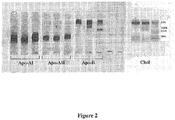
- Fig. 2 lipoprotein particles were separated on a gel probed for Apo-AI, Apo-AII, and Apo-B and stained.
- Fig. 3 depicts a gel containing samples from multiple patients and probed for the presence of Apo-B. The labels present on the lanes indicate the patient number.
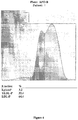
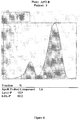
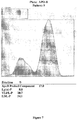
- Figures 4-8 depict the densitometic scans of the bands present in the lanes for various patient samples in Figure 3 . The fraction values represent the percentage of the peak area.
- Fig. 4 depicts a densitometric scan of the lane for patient 1 (labeled 1).
- Fig. 5 depicts a densitometric scan of the lane for patient 2 (labeled 2).
- Fig. 3 depicts a gel containing samples from multiple patients and probed for the presence of Apo-B.
- the labels present on the lanes indicate the patient number.
- Figures 4-8 depict the densitometic scans of the bands present in the lanes for various patient samples in Figure 3 .
- FIG. 6 depicts a densitometric scan of the lane for patient 10 (labeled 10).
- Fig. 7 depicts a densitometric scan of the lane for patient 12 (labeled 12).
- Fig. 8 depicts a densitometric scan of the lane for patient 74 (labeled 74).
- Ultracentrifugation separates lipoprotein particles based upon their densities.
- a discontinuous NaCl/sucrose gradient may be used for separation by ultracentrifugation.
- bodily fluids such as serum, plasma, synovial fluid, and ascitic fluid may be prestained with Fat Red 7B to visualize the bands for the lipids or acid violet to visualize the protein. Fractions may be isolated by bottom puncture of the tube. In one embodiment, fractions of individual lipoprotein particles may be probed for the amount of a given apolipoprotein.
- Lipoprotein particles may be separated by various methods.
- lipoprotein particles may be separated by column chromatography.
- the column chromatography may be performed on an HPLC.
- HPLC fractions may be collected and probed for the presence of a given apolipoprotein.
- separation may be achieved by ELISA or precipitation. Alternatively, any suitable type of separation protocol known in the art may be used.
- densitometry is used to quantitate the levels of lipoprotein particles and apolipoproteins.
- the optical density of the bands is determined by exposing the bands to light and measuring the decrease in the amount of light that travels through the transparent gel. Other methods may be used to quantitate the amount of lipoprotein particles and apolipoprotein present in the bands.
- a processor may be attached to the densitometer to determine and analyze the optical density of the band for each lipoprotein particle and apolipoprotein. The values determined by the densitometer may be given as a ratio between the actual value and the positive control.
- the use of densitometry in quantifying bands is well known in the art. See U.S. Patent No. 4,572,671 ; and U.S. Patent No. 7,682,795 .
- an apolipoprotein will be detected by precipitation upon binding of the apolipoprotein and the polyclonal antibody directed to it.
- the presence or absence of a lipoprotein particles or apolipoprotein may be detected visually.
- a protein stain may be utilized to detect the binding of the apolipoprotein and antibody.
- a secondary antibody with a label may be utilized to detect the binding of the apolipoprotein and antibody.
- the risk of development of a particular disease may be determined based upon a ratio of one component to another or based upon the actual levels of the components. Different methods of separation or detection may lend themselves to the use of ratios or actual levels. For instance, ratios may be preferred to detect risk if gel electrophoresis was used or actual levels may be preferred if ELISA was used. However, either may be used for any method of detection.
- the level of a lipoprotein particle may be a good indicator of risk for a particular disease but analyzing the level of an additional component may improve the ability to predict an individual's risk of developing that disease.
- the levels of the target lipoprotein particles and apolipoproteins in a large collection of samples will be analyzed and compared to the disease data available for those samples to determine which are the best indicators of risk for a particular disease.
- a diagnostic assay may be prepared using this information.
- LDL deposits LDL cholesterol on the arterial wall which contributes to cardiovascular disease. Inflammation occurs when cholesterol builds up inside an artery wall. Macrophages appear because of the inflammation. The macrophages become foam cells when they take up LDL, causing additional inflammation. Inflammation indicates risk of cardiovascular disease.
- An embodiment of the present disclosure determines how much Apo B is present from various lipoprotein particle sources.
- This assay makes assessment of the atherogenicity of individual lipoprotein particles and apolipoproteins possible. These measurements provide an assay for determination of the risk of an individual for developing cardiovascular disease and provide a way to monitor treatment. High levels of Apo B and LDL particles indicate an increased risk for cardiovascular disease.
- the method provides a method for the assessment of the number specific lipoprotein particles. The method allows for simultaneous, modifiable, charge/sized lipoprotein particle separations to be probed immunologically for various apolipoproteins. The method provides a direct measurement of lipoprotein particles. The method also provides a mechanism to determine which levels of specific lipoprotein particles are indicative of an increased risk for a given disease.
- immunospecificity and simultaneous charge separation potential are combined to determine the level of specific lipoprotein particles.
- Separation of serum lipoprotein particles, such as by gel electrophoresis, provide fractionation of Apo B.
- the method of detection of provides clinical information that may be utilized to develop a simple, easy-to-use, and quick diagnostic assay that detects the lipoprotein particle of interest for a specific disease.
- Other methods of separation known in the art may be used in place or in addition to gel electrophoresis. This assay detects lipoprotein particles with a protein or lipid stain and apolipoproteins with an antibody.
- Figure 2 Other methods of detection known in the art may be used.
- the contents of the gel may be transferred to membrane such as nitrocellulose.
- Gels or membranes may be exposed to stain or antibody by incubation in a wash containing the reagent, exposing the gel or membrane to a film containing the reagent, or other method known in the art.
- the gel is stained with Acid Violet.
- the gel is stained with Oil Red O.
- films containing the reagent or reagents should be clear, rapidly dissolving, supported, and complementary to the sensitivity required for the system. Different reagents may be present on the film at different locations corresponding to a particular lane on a gel to be probed.
- liquid reagents were used.
- the optical density of each band may be determined by densitometry. The optical density may be correlated using a processor, such as a computer, calculated by hand, or by any other method known in the art.
- An antibody to apolipoprotein B recognizes two bands in the area of where Lp(a) migrates. One band previously co-migrated with HDL and was detected using the method of simultaneous lipoprotein particle separation and immunological detection as disclosed herein. The slower migrating band is atherogenic. Therefore, a high level of that band indicates a higher risk for cardiovascular disease.
- Lipoprotein particles present in bodily fluids such as serum, plasma, synovial fluid, and ascitic fluid may be separated and exposed to reagents that detect lipoprotein particles and apolipoproteins.
- Apo B-100 is present as part of Lp(a) so probing with an Apo B-100 antibody will detect Lp(a).
- An example of a suitable protein stain is Acid Violet and a suitable lipid stain is Oil Red O. Any other suitable stains known in the art may be used.
- Apo E has been associated with the risk of late onset Alzheimer's Disease.
- the presence of Apo E e4 correlates with an increased risk of late onset Alzheimer's Disease.
- Each person has a pair of Apo E genes that are a combination of e2, e3, and e4.
- Apo E e3/e3 is the most common genotype.
- Apo E e4/e4 and e4/e3 indicate a risk for atherosclerosis.
- Apo E e4 is also associated with an increased risk of late onset Alzheimer's disease, with e4/e4 being at the highest risk.
- An advantage of the present systems, methods, apparatus, and assemblies is the capability of detecting which Apo E proteins are present with which lipoprotein particles and at what levels. Antisera specific to Apo E e2, e3, or e4 will be used to determine which is present. Measuring total Apo E is not sufficient because it does not provide information on which lipoprotein particle the Apo E is present.
- Polyclonal antibodies to an apolipoprotein will be produced by injecting a suitable animal host, such as a rabbit, with the apolipoprotein of interest and an adjuvant. Approximately 0.02 milliliters will be injected and reinjection occurs every 21 days until peak antibody titer is achieved. Antibody titer will be tested by an ear bleed. Antibodies to Apo B-100 or other apolipoprotein can be produced in this manner. Alternatively, antibodies to Apo B-100 or other apolipoprotein may be purchased commercially.
- a SPIFE Electrophoresis System by Helena Laboratories Corporation was used to analyze serum samples from various patients. Deep well disposable cup strips were placed into rows 2, 3, 4 and 5 of the sample cup tray. The blades were placed into the vertical slots numbered A, 9, 13 and 16 of the applicator assembly. 50 microliters of a patient sample or control was pipetted into the appropriate sample cups. In other embodiments, different volumes of patient samples may be used. In one embodiment, 75 microliters of a patient sample or control was pipetted into the appropriate sample cups.
- REP is a coined term for Rapid ElectoPhoresis.
- the gel was placed on the REP Prep and a lint-free tissue was used to wipe around the edges of the gel backing to remove excess REP Prep. Special attention was taken to wipe next to the electrode posts.
- the protective gel overlay was removed from the gel and discarded.
- a Blotter C was used to gently blot the entire surface. The blotter was then removed.
- a carbon electrode was placed on the outside ledge of the cathode gel block (left) outside the magnetic posts.
- a stainless steel electrode was placed on the outside ledge of the anode gel block (right) outside the magnetic posts.
- An electrode blotter was placed under the ends of the carbon electrode so that they touched the gel block ends.
- the running parameters for electrophoresis were as follows: samples were loaded in 30 seconds, samples were applied in 60 seconds, and electrophoresed for 20 minutes at 16°C and 400 volts.
- the electrodes were removed following electrophoresis and the gel blocks were removed and discarded.
- Apo-B antiserum was diluted 1:4 with saline (1 part antiserum with 3 parts saline). In other embodiments, a different concentration of antiserum may be used.
- the antisera template was gently placed onto the surface of the gel. 250 microliters of the diluted antiserum was pipetted into the oval slots at the right end of each antisera channel in the template. The antiserum was allowed to absorb for 10 minutes at 20°C.
- one comb blotter was placed into the slots on the right end of the antisera channels such that the tips of the comb touched the gel.
- the antisera template and comb blotter was removed after 3 minutes.
- the surface of the gel was blotted with a Blotter C and the Blotter C was then removed and discarded.
- Two Blotter Cs were wet in normal saline and placed on the gel surface.
- Four Blotter Ds were placed on top of the wet Blotter Cs.
- the antisera template was placed on top and blotted for 2 minutes.
- the antisera template and blotters were removed and discarded.
- Two Blotter Cs were wet and placed on the gel, four Blotter Ds were placed on the Blotter Cs, and the antisera template was placed on top and blotted for another 2 minutes.
- An electrode was placed at each end of the gel, against the magnetic posts, to ensure good contact of the gel with the floor during drying.
- the gel was dried at 50°C for 8 minutes.
- the gel was removed from the electrophoresis chamber and attached to the gel holder of the Stainer Unit with the gel facing the back of the unit.
- the gel holder and gel were placed into the Stainer Unit.
- the gel was washed in TBS for 10 minutes, stained in Acid Violet stain for 4 minutes, destained twice in Citric Acid Destain for I minute each time, and dried at 63°C for 8 minutes.
- the gel was then destained in Citric Acid Destain for 1 minute and dried at 63°C for 5 minutes.
- Example 3 Determining the risk of developing cardiovascular disease using Apo B and LDL levels
- Serum will be drawn from an individual to be tested for the risk of cardiovascular disease.
- Gel electrophoresis will be performed on the serum.
- the lipoprotein particles migrate based on their size/charge.
- One part of the gel will be developed with Fat Red 7B to detect lipids.
- Cholesterol will be detected with any cholesterol reagent known in the art. In one embodiment, the cholesterol reagent is formazan.
- Another part of the gel will be developed with a polyclonal antibody to Apo B-100 using immunofixation. Precipitation occurs when the antibody binds its antigen, Apo B-100.
- the binding of an antibody and its antigen may be detected by using an antibody that is labeled or using a labeled secondary antibody.
- Densitometry will be performed upon the bands for various specific lipoprotein particles. Densitometry will also be performed on the bands recognized by the antibody to Apo B-100. The matrix or medium was stained with Acid Violet following detection by the antibody. A high level of Apo B-100 and LDL particles correlates to an increased risk of cardiovascular disease.
- the present method also provides a method for specific lipoprotein particles in addition to a method for lipoprotein particle cholesterol levels and lipoprotein triglyceride levels.
- Example 4 Determining the risk of developing cardiovascular disease using Lp(a)-P levels
- One part of the gel will be developed with Acid Violet to detect proteins or Fat Red 7B to detect lipids.
- the gel will also be developed with a polyclonal antibody to Apo B-100.
- the binding of an antibody and its antigen may be detected by using an antibody that is labeled or using a labeled secondary antibody.
- An antibody to apolipoprotein B recognizes two bands in the area of where Lp(a) migrates. The same antibody will recognize Apo-B in all lipoprotein particles containing Apolipoprotein-B, not only the Lp(a) "pair".
- One band previously co-migrated with HDL and was detected using the method of simultaneous lipoprotein particle separation and immunological detection as disclosed herein.
- cholesterol will be detected with any cholesterol reagent known in the art.
- the cholesterol reagent will produce a formazan dye for detection.
- Densitometry will be performed upon the bands for various lipoprotein particles detected using Fat Red 7B, Acid Violet, a cholesterol agent, and the Apo B-100 antibody, (densitometry cannot be used on the Apo-B antibody without suitable visualization protocols as here is no visibly optically active color intrinsic to the antigen-antibody binding without an appropriate detectable ligand or conjugate), to determine the level of lipoprotein particles.
- An increased level of lipoprotein particles containing Lp(a) indicates increased risk of cardiovascular disease.
- Example 5 Determining the risk of developing late onset Alzheimer's Disease using Apo E levels
- Serum will be drawn from an individual to be tested for the risk of developing late onset Alzheimer's Disease.
- Gel electrophoresis will be performed on the serum.
- the lipoprotein particles migrate based on their size/charge.
- the gel will be developed with Acid Violet or Fat Red 7B lipoprotein particles.
- Cholesterol may be detected with any cholesterol reagent known in the art.
- the cholesterol reagent will produce a formazan dye for detection.
- Another portion of the gel will be developed with polyclonal antibodies to the e2, e3, and e4 alleles.
- the binding of an antibody and its antigen may be detected by using an antibody that is labeled or using a labeled secondary antibody.
- Densitometry will be performed upon the bands for various lipoprotein particles detected using Acid Violet. Densitometry may also be performed on the bands recognized by the antibody to e2, e3, and e4. Developing antisera probed complexes requires a suitable protein/lipid stain and/or visually active conjugate or ligand. The presence of e4 alleles correlate to an increased risk of cardiovascular disease, especially if an individual possesses two e4 alleles.
- a diagnostic assay to detect presence and/or levels of specific lipoprotein particles in bodily fluids, such as serum for the purpose of identifying risk of a particular disease, utilizes, in general terms, an electrophoretic support or platform, a "membrane” or reagent-containing film, and a densitometer, or the equivalent of one or more of the above.
- the membrane may provide the dual functions of a support during electrophoresis and may contain the reagent.
- the "membrane" or “reagent-containing film” may contain the antibodies.
- Antibodies to apolipoprotein A, apolipoprotein B, apolipoprotein C, apolipoprotein D, apolipoprotein E, or apolipoprotein H will be present in a spot in one lane on a membrane.
- Antibodies to high density lipoprotein particle, intermediate density lipoprotein particle, low density lipoprotein particle, very low density lipoprotein particle, or lipoprotein(a) particle will be present in a spot in another lane on the membrane.
- the membrane will be blocked to prevent nonspecific binding of the antigen to the membrane.
- the assay will be provided to a user after which time the membrane will be incubated with a sample of serum to be tested for a given disease, such as cardiovascular disease.
- the antigens in the serum will bind to the antibodies present on the membrane. Unbound antigen will be washed off of the membrane. The membrane will then be incubated with a dye or antibody specific for the antigen and containing a detectable label. A band will be visible on the membrane where the antibody binds its antigen. A densitometer will be used to determine the amount of antigen present in the serum.
- densitometry conventionally relates to visually detectable/measurable color changes.
- any emitted spectral electromagnetic radiation linked to the analyte of interest with a complementary detector can "densitomize" the lipoprotein particles.
- compositions and methods disclosed and claimed herein can be made and executed without undue experimentation in light of the present disclosure. While the compositions and methods disclosed herein have been described in terms of preferred embodiments, it will be apparent to those of skill in the art that variations may be applied to the compositions and methods and in the steps or in the sequence of steps of the methods described herein without departing from the concept, and scope. More specifically, it will be apparent that certain agents which are both chemically and physiologically related may be substituted for the agents described herein while the same or similar results would be achieved. All such similar substitutes and modifications apparent to those skilled in the art are deemed to be within the concept, and scope as defined by the appended claims.
Landscapes
- Life Sciences & Earth Sciences (AREA)
- Health & Medical Sciences (AREA)
- Molecular Biology (AREA)
- Engineering & Computer Science (AREA)
- Urology & Nephrology (AREA)
- Chemical & Material Sciences (AREA)
- Biomedical Technology (AREA)
- Immunology (AREA)
- Hematology (AREA)
- Medicinal Chemistry (AREA)
- General Health & Medical Sciences (AREA)
- Microbiology (AREA)
- Biophysics (AREA)
- Endocrinology (AREA)
- Food Science & Technology (AREA)
- Biotechnology (AREA)
- Analytical Chemistry (AREA)
- Cell Biology (AREA)
- Biochemistry (AREA)
- Physics & Mathematics (AREA)
- General Physics & Mathematics (AREA)
- Pathology (AREA)
- Investigating Or Analysing Biological Materials (AREA)
- Investigating Or Analysing Materials By Optical Means (AREA)
Claims (9)
- Ein Verfahren zur Beurteilung des Spiegels spezifischer Lipoproteinpartikel in einer Körperflüssigkeit, welches Folgendes umfasst:Trennen von in einer Probe einer Körperflüssigkeit vorhanden Lipoproteinpartikeln auf einem Substrat;Exponieren des Substrats gegenüber einem Antikörper, um ein immunologisch aktives Agens zu erkennen, welches mit Lipoproteinpartikeln oder Komponenten von Lipoproteinpartikeln verbunden ist;Exponieren des Substrats gegenüber einem Reagens, um die Anwesenheit von Proteinen oder Lipiden zu erkennen;Bestimmen einer optischen Dichte eines Signals auf dem Substrat, welches den Spiegel eines spezifischen Lipoproteinpartikels angibt.
- Das Verfahren nach Anspruch 1, wobei die Trennung durch Gelelektrophorese stattfindet und das Substrat ein Gel ist.
- Das Verfahren nach Anspruch 1, welches ferner das visuelle Erkennen eines Signals auf dem Substrat umfasst, das den Spiegel eines spezifischen Lipoproteinpartikels angibt.
- Das Verfahren nach Anspruch 1, wobei das immunologisch aktive Agens ausgewählt wird aus der Gruppe bestehend aus Apolipoprotein A, Apolipoprotein B, Apolipoprotein C, Apolipoprotein D, Apolipoprotein E, Apolipoprotein H, Lipoprotein (a), Lipoprotein hoher Dichte, Lipoprotein mittlerer Dichte, Lipoprotein geringer Dichte, Lipoprotein sehr geringer Dichte, und Mischungen davon.
- Das Verfahren nach Anspruch 1, wobei die Komponente Apolipoprotein B ist.
- Das Verfahren nach Anspruch 1, wobei ein erhöhter Spiegel von Apolipoprotein B und Lipoproteinpartikeln geringer Dichte bedeutet, dass eine Person ein erhöhtes Risiko auf eine kardiovaskuläre Erkrankung hat.
- Das Verfahren nach Anspruch 1, wobei ein erhöhter Spiegel von Apolipoprotein B und Partikeln von Lipoprotein (a) bedeutet, dass eine Person ein erhöhtes Risiko auf eine kardiovaskuläre Erkrankung hat.
- Verwendung eines Geräts zur Beurteilung des Spiegels von spezifischen in einer Körperflüssigkeit vorhandenen Lipoproteinpartikeln nach dem Verfahren nach Anspruch 1, wobei das erwähnte Gerät Folgendes umfasst:ein Trenngerät zum Trennen von in einer Probe einer Körperflüssigkeit anwesenden Lipoproteinpartikeln auf einem Gel;ein Densitometer zum Bestimmen der optischen Dichte eines elektrophoretischen Musters der Probe der Körperflüssigkeit zur Beurteilung des Spiegels spezifischer Lipoproteinpartikel; und einen Prozessor zum Korrelieren des Niveaus der erwähnten optischen Dichte des elektrophoretischen Musters der Probe der Körperflüssigkeit zur Beurteilung des Spiegels spezifischer Lipoproteinpartikel.
- Die Verwendung des Geräts aus Anspruch 8, wobei das Trenngerät ein elektrophoretisches Gerät ist.
Applications Claiming Priority (3)
| Application Number | Priority Date | Filing Date | Title |
|---|---|---|---|
| US12/861,829 US20120052593A1 (en) | 2010-08-24 | 2010-08-24 | Assay for determination of levels of lipoprotein particle number in bodily fluids |
| US12/877,733 US9488666B2 (en) | 2010-08-24 | 2010-09-08 | Assay for determination of levels of lipoprotein particles in bodily fluids |
| PCT/US2011/048733 WO2012027318A1 (en) | 2010-08-24 | 2011-08-23 | Assay for determination of levels of lipoprotein particles in bodily fluids |
Publications (2)
| Publication Number | Publication Date |
|---|---|
| EP2609432A1 EP2609432A1 (de) | 2013-07-03 |
| EP2609432B1 true EP2609432B1 (de) | 2017-05-10 |
Family
ID=45003032
Family Applications (1)
| Application Number | Title | Priority Date | Filing Date |
|---|---|---|---|
| EP11785815.9A Active EP2609432B1 (de) | 2010-08-24 | 2011-08-23 | Verfahren zur bestimmung des lipoprotein-partikel-spiegels in körperflüssigkeiten |
Country Status (8)
| Country | Link |
|---|---|
| US (2) | US9488666B2 (de) |
| EP (1) | EP2609432B1 (de) |
| JP (2) | JP5981433B2 (de) |
| AU (1) | AU2011293548B2 (de) |
| BR (1) | BR112013004254B1 (de) |
| CA (1) | CA2808821C (de) |
| ES (1) | ES2632760T3 (de) |
| WO (1) | WO2012027318A1 (de) |
Families Citing this family (10)
| Publication number | Priority date | Publication date | Assignee | Title |
|---|---|---|---|---|
| US9005419B2 (en) | 2012-05-29 | 2015-04-14 | Health Diagnostic Laboratory, Inc. | Composition and method for gel electrophoresis with in-situ calibration |
| WO2013188879A1 (en) | 2012-06-16 | 2013-12-19 | Atherotech, Inc. | Measurement of serum lipoproteins |
| ES2686740T3 (es) | 2013-02-28 | 2018-10-19 | Helena Laboratories Corporation | Detección fluorescente in situ de apolipoproteínas de partículas lipídicas en la primera matraz electroforética |
| US9759682B2 (en) | 2013-08-09 | 2017-09-12 | True Health Ip Llc | Applicator comb for gel electrophoresis |
| CA2933605A1 (en) | 2013-12-18 | 2015-06-25 | Philip Guadagno | Lp(a) subform size identification using zonal gel immuno-fixation electrophoresis |
| JP2015141137A (ja) * | 2014-01-29 | 2015-08-03 | 国立大学法人大阪大学 | 小腸由来hdlの取得方法、小腸由来hdlの評価方法、小腸由来hdl増加作用を有する化合物のスクリーニング方法並びに前記化合物を含む小腸由来hdl増加薬及び家族性高コレステロール血症治療薬 |
| WO2016069639A1 (en) * | 2014-10-27 | 2016-05-06 | True Health Diagnostics, Llc | Lp(a) subform size identification by capillary isoteachophoresis electrophoresis with laser-induced-fluorescence |
| WO2017058781A1 (en) * | 2015-09-29 | 2017-04-06 | Polymer Technology Systems, Inc. | Systems and methods for point-of-care determination of hdl-c and hdl-p |
| US10789830B2 (en) * | 2017-03-02 | 2020-09-29 | Motorola Solutions, Inc. | Method and apparatus for gathering visual data using an augmented-reality application |
| US20220099625A1 (en) | 2019-03-02 | 2022-03-31 | Helena Laboratories Corporation | Applicator comb with serrated teeth for gel electrophoresis |
Citations (1)
| Publication number | Priority date | Publication date | Assignee | Title |
|---|---|---|---|---|
| EP0546916A1 (de) * | 1991-12-11 | 1993-06-16 | Sebia | Verfahren zur lp(a)-Trennung durch Elektrophorese, Gels zur Durchführung davon und Anwendung des Verfahrens auf die in vitro Bestimmung des Atherogen-Risikos in Zusammenhang mit der Anwesenheit des lp(a) |
Family Cites Families (10)
| Publication number | Priority date | Publication date | Assignee | Title |
|---|---|---|---|---|
| JPS5917136A (ja) | 1982-07-20 | 1984-01-28 | Olympus Optical Co Ltd | 電気泳動用測光装置 |
| FR2533704B1 (fr) | 1982-09-27 | 1986-03-21 | Spiral | Dosage immunologique dans le serum de l'apolipoproteine b des lipoproteines de basse densite |
| US20040053321A1 (en) * | 1995-06-30 | 2004-03-18 | Patrea L Pabst Holland And Knight Llp | Method for makin antibodies immunoreative with an epitope of an apolipoprotein |
| IT1311904B1 (it) | 1999-04-02 | 2002-03-20 | Univ Pavia | Metodo per la identificazion del piu' diffuso gene responsabile dimalattia aterosclerotica. |
| US7062077B1 (en) * | 1999-10-29 | 2006-06-13 | Helena Laboratories Corporation | Scanner densitometer and data evaluation method |
| WO2004011943A1 (en) | 2002-07-30 | 2004-02-05 | The Regents Of The University Of California | Method of diagnosing alzheimer's disease |
| JP4729580B2 (ja) * | 2004-11-24 | 2011-07-20 | 三代 岡崎 | リポプロテインの分析方法 |
| WO2007040974A2 (en) * | 2005-09-29 | 2007-04-12 | Berkeley Heartlab | Method for quantitatively determining the ldl particle number in a distribution of ldl cholesterol subfractions |
| JP2007248131A (ja) | 2006-03-14 | 2007-09-27 | Yamaguchi Univ | セルロースアセテート膜を用いたリポ蛋白質の分離方法 |
| US20120052593A1 (en) * | 2010-08-24 | 2012-03-01 | Helena Laboratories Corporation | Assay for determination of levels of lipoprotein particle number in bodily fluids |
-
2010
- 2010-09-08 US US12/877,733 patent/US9488666B2/en active Active
-
2011
- 2011-08-23 AU AU2011293548A patent/AU2011293548B2/en not_active Ceased
- 2011-08-23 WO PCT/US2011/048733 patent/WO2012027318A1/en not_active Ceased
- 2011-08-23 CA CA2808821A patent/CA2808821C/en active Active
- 2011-08-23 EP EP11785815.9A patent/EP2609432B1/de active Active
- 2011-08-23 ES ES11785815.9T patent/ES2632760T3/es active Active
- 2011-08-23 BR BR112013004254-0A patent/BR112013004254B1/pt not_active IP Right Cessation
- 2011-08-23 JP JP2013526082A patent/JP5981433B2/ja not_active Expired - Fee Related
-
2016
- 2016-03-14 JP JP2016050053A patent/JP6505040B2/ja active Active
- 2016-09-27 US US15/276,930 patent/US20170131301A1/en not_active Abandoned
Patent Citations (1)
| Publication number | Priority date | Publication date | Assignee | Title |
|---|---|---|---|---|
| EP0546916A1 (de) * | 1991-12-11 | 1993-06-16 | Sebia | Verfahren zur lp(a)-Trennung durch Elektrophorese, Gels zur Durchführung davon und Anwendung des Verfahrens auf die in vitro Bestimmung des Atherogen-Risikos in Zusammenhang mit der Anwesenheit des lp(a) |
Non-Patent Citations (3)
| Title |
|---|
| HOLMQUIST ET AL: "A zone immunoelectrophoresis assay method for quantification of apolipoprotein D in human cerebrospinal fluid", JOURNAL OF BIOCHEMICAL AND BIOPHYSICAL METHODS, AMSTERDAM, NL, vol. 33, no. 1, 1 January 1996 (1996-01-01), pages 1 - 08, XP002121480, ISSN: 0165-022X, DOI: 10.1016/0165-022X(95)00041-O * |
| JC FRUCHART ET AL: "Simultaneous measurement of plasma apolipoproteins A-I and B by electroimmunoassay", CLINICAL CHEMISTRY, 1 January 1982 (1982-01-01), UNITED STATES, pages 59 - 62, XP055148999, Retrieved from the Internet <URL:http://www.clinchem.org/cgi/content/abstract/28/1/59> * |
| PETER J. DOLPHIN: "Two-dimensional immunoelectrophoresis of rat serum apolipoproteins", ELECTROPHORESIS, vol. 2, no. 2, 1 February 1981 (1981-02-01), pages 113 - 116, XP055149005, ISSN: 0173-0835, DOI: 10.1002/elps.1150020208 * |
Also Published As
| Publication number | Publication date |
|---|---|
| JP2016156827A (ja) | 2016-09-01 |
| JP6505040B2 (ja) | 2019-04-24 |
| ES2632760T3 (es) | 2017-09-15 |
| BR112013004254A2 (pt) | 2016-08-02 |
| US20120052594A1 (en) | 2012-03-01 |
| EP2609432A1 (de) | 2013-07-03 |
| JP2013539540A (ja) | 2013-10-24 |
| US9488666B2 (en) | 2016-11-08 |
| CA2808821A1 (en) | 2012-03-01 |
| CA2808821C (en) | 2019-10-15 |
| JP5981433B2 (ja) | 2016-08-31 |
| AU2011293548A1 (en) | 2013-03-07 |
| US20170131301A1 (en) | 2017-05-11 |
| AU2011293548B2 (en) | 2015-07-30 |
| WO2012027318A1 (en) | 2012-03-01 |
| BR112013004254B1 (pt) | 2020-11-03 |
Similar Documents
| Publication | Publication Date | Title |
|---|---|---|
| EP2609432B1 (de) | Verfahren zur bestimmung des lipoprotein-partikel-spiegels in körperflüssigkeiten | |
| US10823698B2 (en) | Composition and method for gel electrophoresis with in-situ calibration | |
| Böttcher et al. | Preparative free-solution isotachophoresis for separation of human plasma lipoproteins: apolipoprotein and lipid composition of HDL subfractions | |
| US9372197B2 (en) | Flourescent in-situ detection of lipid particle apolipoproteins within primary electrophoretic matrix | |
| US20120052593A1 (en) | Assay for determination of levels of lipoprotein particle number in bodily fluids | |
| EP3210028A1 (de) | Lipoproteinpartikelzahl aus messungen der lipoproteinpartikelphospholidkonzentration in einer lipoproteinpartikelmembrandoppelschicht | |
| WO2016065041A1 (en) | Quantitative molar concentration detection of specific apolipoprotein-containing particles present in bodily fluids by using capillary electrophoresis | |
| Ellington et al. | Atherogenic lipoprotein subprofiling | |
| JP2007248131A (ja) | セルロースアセテート膜を用いたリポ蛋白質の分離方法 | |
| Voutilainen et al. | Isolation and Determination of Lipoproteins | |
| Hafiane et al. | BBA Clinical |
Legal Events
| Date | Code | Title | Description |
|---|---|---|---|
| PUAI | Public reference made under article 153(3) epc to a published international application that has entered the european phase |
Free format text: ORIGINAL CODE: 0009012 |
|
| 17P | Request for examination filed |
Effective date: 20130220 |
|
| AK | Designated contracting states |
Kind code of ref document: A1 Designated state(s): AL AT BE BG CH CY CZ DE DK EE ES FI FR GB GR HR HU IE IS IT LI LT LU LV MC MK MT NL NO PL PT RO RS SE SI SK SM TR |
|
| DAX | Request for extension of the european patent (deleted) | ||
| 17Q | First examination report despatched |
Effective date: 20140327 |
|
| GRAJ | Information related to disapproval of communication of intention to grant by the applicant or resumption of examination proceedings by the epo deleted |
Free format text: ORIGINAL CODE: EPIDOSDIGR1 |
|
| GRAP | Despatch of communication of intention to grant a patent |
Free format text: ORIGINAL CODE: EPIDOSNIGR1 |
|
| INTG | Intention to grant announced |
Effective date: 20161206 |
|
| GRAS | Grant fee paid |
Free format text: ORIGINAL CODE: EPIDOSNIGR3 |
|
| GRAA | (expected) grant |
Free format text: ORIGINAL CODE: 0009210 |
|
| AK | Designated contracting states |
Kind code of ref document: B1 Designated state(s): AL AT BE BG CH CY CZ DE DK EE ES FI FR GB GR HR HU IE IS IT LI LT LU LV MC MK MT NL NO PL PT RO RS SE SI SK SM TR |
|
| REG | Reference to a national code |
Ref country code: GB Ref legal event code: FG4D |
|
| REG | Reference to a national code |
Ref country code: AT Ref legal event code: REF Ref document number: 892902 Country of ref document: AT Kind code of ref document: T Effective date: 20170515 Ref country code: CH Ref legal event code: EP |
|
| REG | Reference to a national code |
Ref country code: IE Ref legal event code: FG4D |
|
| REG | Reference to a national code |
Ref country code: DE Ref legal event code: R096 Ref document number: 602011037869 Country of ref document: DE |
|
| REG | Reference to a national code |
Ref country code: FR Ref legal event code: PLFP Year of fee payment: 7 |
|
| REG | Reference to a national code |
Ref country code: NL Ref legal event code: MP Effective date: 20170510 |
|
| REG | Reference to a national code |
Ref country code: ES Ref legal event code: FG2A Ref document number: 2632760 Country of ref document: ES Kind code of ref document: T3 Effective date: 20170915 |
|
| REG | Reference to a national code |
Ref country code: LT Ref legal event code: MG4D |
|
| REG | Reference to a national code |
Ref country code: AT Ref legal event code: MK05 Ref document number: 892902 Country of ref document: AT Kind code of ref document: T Effective date: 20170510 |
|
| PG25 | Lapsed in a contracting state [announced via postgrant information from national office to epo] |
Ref country code: NO Free format text: LAPSE BECAUSE OF FAILURE TO SUBMIT A TRANSLATION OF THE DESCRIPTION OR TO PAY THE FEE WITHIN THE PRESCRIBED TIME-LIMIT Effective date: 20170810 Ref country code: GR Free format text: LAPSE BECAUSE OF FAILURE TO SUBMIT A TRANSLATION OF THE DESCRIPTION OR TO PAY THE FEE WITHIN THE PRESCRIBED TIME-LIMIT Effective date: 20170811 Ref country code: HR Free format text: LAPSE BECAUSE OF FAILURE TO SUBMIT A TRANSLATION OF THE DESCRIPTION OR TO PAY THE FEE WITHIN THE PRESCRIBED TIME-LIMIT Effective date: 20170510 Ref country code: FI Free format text: LAPSE BECAUSE OF FAILURE TO SUBMIT A TRANSLATION OF THE DESCRIPTION OR TO PAY THE FEE WITHIN THE PRESCRIBED TIME-LIMIT Effective date: 20170510 Ref country code: LT Free format text: LAPSE BECAUSE OF FAILURE TO SUBMIT A TRANSLATION OF THE DESCRIPTION OR TO PAY THE FEE WITHIN THE PRESCRIBED TIME-LIMIT Effective date: 20170510 Ref country code: AT Free format text: LAPSE BECAUSE OF FAILURE TO SUBMIT A TRANSLATION OF THE DESCRIPTION OR TO PAY THE FEE WITHIN THE PRESCRIBED TIME-LIMIT Effective date: 20170510 |
|
| PG25 | Lapsed in a contracting state [announced via postgrant information from national office to epo] |
Ref country code: SE Free format text: LAPSE BECAUSE OF FAILURE TO SUBMIT A TRANSLATION OF THE DESCRIPTION OR TO PAY THE FEE WITHIN THE PRESCRIBED TIME-LIMIT Effective date: 20170510 Ref country code: PL Free format text: LAPSE BECAUSE OF FAILURE TO SUBMIT A TRANSLATION OF THE DESCRIPTION OR TO PAY THE FEE WITHIN THE PRESCRIBED TIME-LIMIT Effective date: 20170510 Ref country code: NL Free format text: LAPSE BECAUSE OF FAILURE TO SUBMIT A TRANSLATION OF THE DESCRIPTION OR TO PAY THE FEE WITHIN THE PRESCRIBED TIME-LIMIT Effective date: 20170510 Ref country code: BG Free format text: LAPSE BECAUSE OF FAILURE TO SUBMIT A TRANSLATION OF THE DESCRIPTION OR TO PAY THE FEE WITHIN THE PRESCRIBED TIME-LIMIT Effective date: 20170810 Ref country code: LV Free format text: LAPSE BECAUSE OF FAILURE TO SUBMIT A TRANSLATION OF THE DESCRIPTION OR TO PAY THE FEE WITHIN THE PRESCRIBED TIME-LIMIT Effective date: 20170510 Ref country code: IS Free format text: LAPSE BECAUSE OF FAILURE TO SUBMIT A TRANSLATION OF THE DESCRIPTION OR TO PAY THE FEE WITHIN THE PRESCRIBED TIME-LIMIT Effective date: 20170910 Ref country code: RS Free format text: LAPSE BECAUSE OF FAILURE TO SUBMIT A TRANSLATION OF THE DESCRIPTION OR TO PAY THE FEE WITHIN THE PRESCRIBED TIME-LIMIT Effective date: 20170510 |
|
| PG25 | Lapsed in a contracting state [announced via postgrant information from national office to epo] |
Ref country code: DK Free format text: LAPSE BECAUSE OF FAILURE TO SUBMIT A TRANSLATION OF THE DESCRIPTION OR TO PAY THE FEE WITHIN THE PRESCRIBED TIME-LIMIT Effective date: 20170510 Ref country code: RO Free format text: LAPSE BECAUSE OF FAILURE TO SUBMIT A TRANSLATION OF THE DESCRIPTION OR TO PAY THE FEE WITHIN THE PRESCRIBED TIME-LIMIT Effective date: 20170510 Ref country code: SK Free format text: LAPSE BECAUSE OF FAILURE TO SUBMIT A TRANSLATION OF THE DESCRIPTION OR TO PAY THE FEE WITHIN THE PRESCRIBED TIME-LIMIT Effective date: 20170510 Ref country code: CZ Free format text: LAPSE BECAUSE OF FAILURE TO SUBMIT A TRANSLATION OF THE DESCRIPTION OR TO PAY THE FEE WITHIN THE PRESCRIBED TIME-LIMIT Effective date: 20170510 Ref country code: EE Free format text: LAPSE BECAUSE OF FAILURE TO SUBMIT A TRANSLATION OF THE DESCRIPTION OR TO PAY THE FEE WITHIN THE PRESCRIBED TIME-LIMIT Effective date: 20170510 |
|
| REG | Reference to a national code |
Ref country code: DE Ref legal event code: R097 Ref document number: 602011037869 Country of ref document: DE |
|
| PG25 | Lapsed in a contracting state [announced via postgrant information from national office to epo] |
Ref country code: SM Free format text: LAPSE BECAUSE OF FAILURE TO SUBMIT A TRANSLATION OF THE DESCRIPTION OR TO PAY THE FEE WITHIN THE PRESCRIBED TIME-LIMIT Effective date: 20170510 |
|
| PLBE | No opposition filed within time limit |
Free format text: ORIGINAL CODE: 0009261 |
|
| STAA | Information on the status of an ep patent application or granted ep patent |
Free format text: STATUS: NO OPPOSITION FILED WITHIN TIME LIMIT |
|
| REG | Reference to a national code |
Ref country code: CH Ref legal event code: PL |
|
| PG25 | Lapsed in a contracting state [announced via postgrant information from national office to epo] |
Ref country code: MC Free format text: LAPSE BECAUSE OF FAILURE TO SUBMIT A TRANSLATION OF THE DESCRIPTION OR TO PAY THE FEE WITHIN THE PRESCRIBED TIME-LIMIT Effective date: 20170510 |
|
| 26N | No opposition filed |
Effective date: 20180213 |
|
| PG25 | Lapsed in a contracting state [announced via postgrant information from national office to epo] |
Ref country code: LI Free format text: LAPSE BECAUSE OF NON-PAYMENT OF DUE FEES Effective date: 20170831 Ref country code: CH Free format text: LAPSE BECAUSE OF NON-PAYMENT OF DUE FEES Effective date: 20170831 |
|
| REG | Reference to a national code |
Ref country code: IE Ref legal event code: MM4A |
|
| PG25 | Lapsed in a contracting state [announced via postgrant information from national office to epo] |
Ref country code: SI Free format text: LAPSE BECAUSE OF FAILURE TO SUBMIT A TRANSLATION OF THE DESCRIPTION OR TO PAY THE FEE WITHIN THE PRESCRIBED TIME-LIMIT Effective date: 20170510 |
|
| REG | Reference to a national code |
Ref country code: BE Ref legal event code: MM Effective date: 20170831 |
|
| PG25 | Lapsed in a contracting state [announced via postgrant information from national office to epo] |
Ref country code: LU Free format text: LAPSE BECAUSE OF NON-PAYMENT OF DUE FEES Effective date: 20170823 |
|
| PG25 | Lapsed in a contracting state [announced via postgrant information from national office to epo] |
Ref country code: IE Free format text: LAPSE BECAUSE OF NON-PAYMENT OF DUE FEES Effective date: 20170823 |
|
| PG25 | Lapsed in a contracting state [announced via postgrant information from national office to epo] |
Ref country code: BE Free format text: LAPSE BECAUSE OF NON-PAYMENT OF DUE FEES Effective date: 20170831 |
|
| PG25 | Lapsed in a contracting state [announced via postgrant information from national office to epo] |
Ref country code: MT Free format text: LAPSE BECAUSE OF NON-PAYMENT OF DUE FEES Effective date: 20170823 |
|
| REG | Reference to a national code |
Ref country code: FR Ref legal event code: PLFP Year of fee payment: 8 |
|
| PG25 | Lapsed in a contracting state [announced via postgrant information from national office to epo] |
Ref country code: HU Free format text: LAPSE BECAUSE OF FAILURE TO SUBMIT A TRANSLATION OF THE DESCRIPTION OR TO PAY THE FEE WITHIN THE PRESCRIBED TIME-LIMIT; INVALID AB INITIO Effective date: 20110823 |
|
| PG25 | Lapsed in a contracting state [announced via postgrant information from national office to epo] |
Ref country code: CY Free format text: LAPSE BECAUSE OF NON-PAYMENT OF DUE FEES Effective date: 20170510 |
|
| PG25 | Lapsed in a contracting state [announced via postgrant information from national office to epo] |
Ref country code: MK Free format text: LAPSE BECAUSE OF FAILURE TO SUBMIT A TRANSLATION OF THE DESCRIPTION OR TO PAY THE FEE WITHIN THE PRESCRIBED TIME-LIMIT Effective date: 20170510 |
|
| PG25 | Lapsed in a contracting state [announced via postgrant information from national office to epo] |
Ref country code: TR Free format text: LAPSE BECAUSE OF FAILURE TO SUBMIT A TRANSLATION OF THE DESCRIPTION OR TO PAY THE FEE WITHIN THE PRESCRIBED TIME-LIMIT Effective date: 20170510 |
|
| PG25 | Lapsed in a contracting state [announced via postgrant information from national office to epo] |
Ref country code: PT Free format text: LAPSE BECAUSE OF FAILURE TO SUBMIT A TRANSLATION OF THE DESCRIPTION OR TO PAY THE FEE WITHIN THE PRESCRIBED TIME-LIMIT Effective date: 20170510 |
|
| PG25 | Lapsed in a contracting state [announced via postgrant information from national office to epo] |
Ref country code: AL Free format text: LAPSE BECAUSE OF FAILURE TO SUBMIT A TRANSLATION OF THE DESCRIPTION OR TO PAY THE FEE WITHIN THE PRESCRIBED TIME-LIMIT Effective date: 20170510 |
|
| PGFP | Annual fee paid to national office [announced via postgrant information from national office to epo] |
Ref country code: ES Payment date: 20250925 Year of fee payment: 15 |
|
| PGFP | Annual fee paid to national office [announced via postgrant information from national office to epo] |
Ref country code: DE Payment date: 20250820 Year of fee payment: 15 |
|
| PGFP | Annual fee paid to national office [announced via postgrant information from national office to epo] |
Ref country code: IT Payment date: 20250825 Year of fee payment: 15 |
|
| PGFP | Annual fee paid to national office [announced via postgrant information from national office to epo] |
Ref country code: GB Payment date: 20250820 Year of fee payment: 15 |
|
| PGFP | Annual fee paid to national office [announced via postgrant information from national office to epo] |
Ref country code: FR Payment date: 20250829 Year of fee payment: 15 |