EP2623488A1 - Verfahren zur Etherifizierung von Olefinen - Google Patents
Verfahren zur Etherifizierung von Olefinen Download PDFInfo
- Publication number
- EP2623488A1 EP2623488A1 EP13166518.4A EP13166518A EP2623488A1 EP 2623488 A1 EP2623488 A1 EP 2623488A1 EP 13166518 A EP13166518 A EP 13166518A EP 2623488 A1 EP2623488 A1 EP 2623488A1
- Authority
- EP
- European Patent Office
- Prior art keywords
- olefin
- alcohol
- etherification
- catalyst
- dodecene
- Prior art date
- Legal status (The legal status is an assumption and is not a legal conclusion. Google has not performed a legal analysis and makes no representation as to the accuracy of the status listed.)
- Granted
Links
Images
Classifications
-
- C—CHEMISTRY; METALLURGY
- C07—ORGANIC CHEMISTRY
- C07C—ACYCLIC OR CARBOCYCLIC COMPOUNDS
- C07C41/00—Preparation of ethers; Preparation of compounds having groups, groups or groups
- C07C41/01—Preparation of ethers
- C07C41/05—Preparation of ethers by addition of compounds to unsaturated compounds
- C07C41/06—Preparation of ethers by addition of compounds to unsaturated compounds by addition of organic compounds only
-
- C—CHEMISTRY; METALLURGY
- C07—ORGANIC CHEMISTRY
- C07C—ACYCLIC OR CARBOCYCLIC COMPOUNDS
- C07C41/00—Preparation of ethers; Preparation of compounds having groups, groups or groups
- C07C41/01—Preparation of ethers
- C07C41/34—Separation; Purification; Stabilisation; Use of additives
- C07C41/40—Separation; Purification; Stabilisation; Use of additives by change of physical state, e.g. by crystallisation
- C07C41/42—Separation; Purification; Stabilisation; Use of additives by change of physical state, e.g. by crystallisation by distillation
-
- Y—GENERAL TAGGING OF NEW TECHNOLOGICAL DEVELOPMENTS; GENERAL TAGGING OF CROSS-SECTIONAL TECHNOLOGIES SPANNING OVER SEVERAL SECTIONS OF THE IPC; TECHNICAL SUBJECTS COVERED BY FORMER USPC CROSS-REFERENCE ART COLLECTIONS [XRACs] AND DIGESTS
- Y02—TECHNOLOGIES OR APPLICATIONS FOR MITIGATION OR ADAPTATION AGAINST CLIMATE CHANGE
- Y02P—CLIMATE CHANGE MITIGATION TECHNOLOGIES IN THE PRODUCTION OR PROCESSING OF GOODS
- Y02P20/00—Technologies relating to chemical industry
- Y02P20/10—Process efficiency
Definitions
- the invention relates to improved processes for the etherification of olefins with alcohols in the presence of etherification catalysts.
- Alkyl ethers of aliphatic alcohols are useful intermediates for a variety of specialty chemical products, including surfactants, chelants, lubricants, and functional additives.
- the alkyl ethers can be prepared by olefin etherification, also commonly referred to as hydroalkoxylation: an addition reaction of an alcohol to an olefin in the presence of an acid catalyst.
- the invention provides processes for preparing ethers from olefins and alcohols.
- the process of the invention comprises: (a) contacting an olefin and an alcohol with a heterogeneous etherification catalyst in a reaction zone under etherification conditions to form an ether compound; (b) removing unconsumed olefin and alcohol, and the ether compound, to a catalyst free zone; (c) repeating steps (a) to (b) using at least a portion of the unconsumed olefin and alcohol until a desired amount of ether compound accumulates in the catalyst free zone; and (d) recovering the ether compound.
- the process comprises: (a) contacting an olefin with an alcohol in the presence of an etherification catalyst, under etherification conditions, to form an ether compound; (b) recovering the ether compound, and unconsumed alcohol and olefin; (c) using at least a portion of the unconsumed olefin of step (b) in an etherification process conducted according to step (a), wherein the alcohol is a linear or branched alcohol alkyl containing one or two alcohol groups, and further substituted with 1, 2, or 3 activating groups independently selected from CN, NO 2 , F, Cl, Br, I, C 1 -C 6 alkoxy, and -C(O)O-alkyl.
- the invention provides a process for the preparation of ether compounds.
- the process comprises: (a) contacting an olefin and an alcohol with a heterogeneous etherification catalyst in a reaction zone under etherification conditions to form an ether compound; (b) removing unconsumed olefin and alcohol, and the ether compound, to a catalyst free zone; (c) repeating steps (a) to (b) using at least a portion of the unconsumed olefin and alcohol until a desired amount of ether compound accumulates in the catalyst free zone; and (d) recovering the ether compound.
- a principal advantage of the foregoing process is that the ether product is removed from the catalyst while the reaction is ongoing, thus allowing contact between product and catalyst to be limited. As a result, equilibrium driven conversion of ethers back to starting materials, which occurs when ethers are in prolonged contact with catalyst as in prior art processes, is reduced.
- a further advantage of the process is that by continuously recycling the mixture of unconsumed olefin and alcohol to the heterogeneous catalyst, conversion to the desired ether product is improved and generally higher than can be achieved with a standard batch reactor system. The process therefore provides a significant cost improvement over existing art.
- the molar ratio of alcohol to olefin in the process is between about 6:1 and about 1:6, preferably between about 5:1 and 1:5, and even more preferably, between about 3:1 and 1:3, and further preferably between about 2:1 and 1:2.
- the alcohol:olefin ratio is less than 6:1, even more preferably, 4:1 or less, and still more preferably 2:1 or less.
- Particularly preferred is an alcohol to olefin molar ratio of about 1:1.
- the zones in the process of the invention permit removal of the ether compound from the heterogeneous catalyst, preferably as it is formed or shortly thereafter, which, as discussed above, mitigates the equilibrium driven conversion of ether compound back to starting materials.
- the first and second zones may be, for instance, a round bottomed flask connected to a soxhlet extractor or distillation column (the reaction zone) in which the heterogeneous catalyst is positioned.
- a soxhlet extractor or distillation column the reaction zone
- the heterogeneous catalyst is positioned in laboratory scale syntheses.
- a particularly preferred embodiment for laboratory scale synthesis is illustrated by the examples. In this embodiment, a Dean-Stark trap is used as the reaction zone and a round bottomed flask is used as the catalyst free zone.
- reaction zone may be a heated section of pipe or column containing the heterogeneous etherification catalyst through which the olefin and alcohol are passed before being directed or returned to vessel (the catalyst free zone).
- At least one of the olefin or alcohol starting materials are sourced from the catalyst free zone before being directed to the reaction zone.
- the starting materials are directed to the reaction zone preferably by distillation from the catalyst free zone to the reaction zone, where they are condensed on the heterogeneous catalyst. Distillation can be effected by applying heat, reduced pressure, or a combination of heat and reduced pressure, to the catalyst free zone.
- the temperature and vacuum are chosen depending on the volatility of the alcohol and/or olefin so as to provide distillation thereof.
- the temperature in the reaction zone is preferably lower than the temperature in the catalyst free zone. For example, if the reactants are distilled at a given pressure from the catalyst free zone, e.g., between 60 and 180 °C, a heterogeneous catalyst temperature of, for instance, 50 to 150 °C is preferable.
- a refluxing solution of the alcohol (e.g., in a suitable solvent) is provided in the catalyst free zone and the olefin is added by controlled addition either to the refluxing alcohol or directly into the reaction zone.
- Controlled addition of the olefin to the refluxing alcohol is particularly attractive when the olefin has a relative volatility much higher than the alcohol, as it can be used to keep the overall concentration of the olefin at a low enough level to maintain a temperature which allows vaporization of the alcohol.
- a refluxing solution of the olefin is provided in the catalyst free zone and the alcohol is added by controlled addition either to the refluxing olefin or directly into the reaction zone.
- Controlled addition of the alcohol to the refluxing olefin is particularly attractive when the alcohol has a relative volatility much higher than the olefin, as it can be used to keep the overall concentration of the alcohol at a low enough level to maintain a temperature which allows vaporization of the olefin.
- contact with the heterogeneous catalyst may be carried out under pressure to ensure the material remains in the liquid phase.
- the ether compound, and unconsumed olefin and alcohol are removed and directed to the catalyst free zone which, according to a preferred embodiment, already contains alcohol or olefin, or preferably both, starting materials.
- the alcohol and olefin generally have a lower boiling point than the ether product, they can be re-distilled from the catalyst free zone to the reaction zone to form further ether compound, whereas the already formed ether compound accumulates in the catalyst free zone, out of contact with the heterogeneous catalyst, thus allowing the process to proceed unencumbered by equilibrium reaction reversal of the already formed ether compound.
- the temperature in the catalyst free zone may be increased and/or the vacuum decreased as the reaction progresses in order to maintain distillation rate.
- an ether compound yield based on the olefin, of at least 60 %, more preferably at least 70 %, and even more preferably at least 80 %, is considered a desired amount of ether compound.
- the mixture in the catalyst free zone (containing the product) is removed for use or further processing.
- the ether product can be utilized without purification.
- the ether product can be readily purified by techniques well known to those skilled in the art, such as high efficiency distillation.
- heterogeneous etherification catalysts for use in this first aspect of the invention include, but are not limited to, acidic ionic exchange resins, such as DOWEX DR-2030 available from The Dow Chemical Company, clays, zeolites, sulfonated polystyrene beads, and acids immobilized on a heterogeneous surface, such as tetrafluoroethanesulfonic acid on silica beads.
- acidic ionic exchange resins such as DOWEX DR-2030 available from The Dow Chemical Company
- clays zeolites, sulfonated polystyrene beads, and acids immobilized on a heterogeneous surface, such as tetrafluoroethanesulfonic acid on silica beads.
- the ratio of catalyst to reactants is not critical and is generally adjusted so as to obtain a desired reaction rate.
- the catalyst is at a temperature of between about 50 and 150 °C during the process in order to facilitate the etherification reaction.
- Alcohols that can be used in the process are preferably short chain linear or branched alkyls (e.g., containing 2-6 carbons, more preferably 2-4 carbons) substituted with one or two alcohol groups, preferably one alcohol group, and further substituted with 1, 2, or 3 activating groups independently selected from CN, NO 2 , F, Cl, Br, I, C 1 -C 6 alkoxy, and -C(O)O-alkyl.
- the alcohol should distill readily without excessive decomposition.
- the alcohol is a compound of the following formula (I): wherein R 4 is H, CH 3 , X, CH 2 X, CHX 2 , CX 3 , CN, or CH 2 OR 5 ; A is CN, CH 2 OR 5 , CH 2 X, CHX 2 , CX 3 , CH 2 CH 2 X, CHXCH 2 X, CHXCH 2 OH, CH(OH)CH 2 X, CH 2 OH, or -C(O)OR 5 ; X is NO 2 , F, Cl, Br, or I; and R 5 is C 1 -C 6 alkyl.
- R 4 is H, CH 3 , X, CH 2 X, CHX 2 , CX 3 , CN, or CH 2 OR 5 ; A is CN, CH 2 OR 5 , CH 2 X, CHX 2 , CX 3 , CH 2 CH 2 X, CHXCH 2 X, CHXCH 2 OH, CH(OH)CH 2 X, CH 2 OH
- Preferred alcohols of the formula (I) include those wherein R 4 is H, CH 3 , or CH 2 X. Further preferred are alcohols wherein A is CH 2 X, CHXCH 2 OH, or CH 2 OH, with it being further preferred that when A is CH 2 OH, R 4 is not H and is preferably CH 2 X . Preferred X in the above formula is halogen and more preferably chloro.
- the compound of formula (I) contain at least one CN or X group.
- Particularly preferred alcohols include: 1,3-dichloro-2-propanol, 2,3-dichloropropanol, 2-chloroethanol, 2-chloro-1,3-propanediol, 3-chloro-1,2-propanediol, or a mixture of two or more thereof.
- Olefins that can be used in the process of the first aspect of the invention are generally those that are distillable under the process conditions, lack basic functionality capable of quenching the heterogeneous catalyst (which is generally acidic), and react with the activated alcohol to form ethers with limited loss of yield to higher molecular weight polyolefins or other unwanted by-products.
- Examples include, for instance, linear or branched alkenes such as alpha-olefins, internal disubstituted olefins, or cyclic structures (e.g., C 3 -C 12 cycloalkene).
- Examples further include: butene, pentene, hexene, methylpentene, heptene, octene, nonene, decene, undecene, dodecene, tridecene, tetradecene, pentadecene, hexadecene, heptadecene, octadecene, nonadecene, and eicosene.
- linear or branched alpha-olefins i.e., 1-alkenes
- alkenes are linear or branched (preferably linear) and contain 3 to 18, and even more preferably 3 to 16, carbon atoms.
- Non-limiting examples of particularly preferred alpha olefins include: 1-butene, 1-pentene, 1-hexene, 4-methyl-1-pentene, 1-heptene, 1-octene, 1-nonene, 1-decene, 1-undecene, 1-dodecene, 1-tridecene, 1-tetradecene, 1-pentadecene, 1-hexadecene, 1-heptadecene, 1-octadecene, 1-nonadecene, 1-eicosene, or mixtures of two or more thereof.
- olefin is isomerized by contacting the acidic catalyst, it is not necessary to use an alpha-olefin, and internal olefins containing 4 to 22 carbon atoms, or mixtures of isomers of linear or branched alkenes are also suitable for use.
- Non-limiting examples of suitable internal olefins include: 2-butene, 2-pentene, 2-hexene, 3-hexene, 2-heptene, 3-heptene, 2-octene, 3-octene, 4-octene, 2-nonene, 3-nonene, 4-nonene, 2-decene, 3-decene, 4-decene, 5-decene, etc, or mixtures of two or more thereof.
- the invention provides an etherification process that is suitable for use with both heterogeneous and homogeneous etherification catalysts and, in its preferred embodiment, is particularly advantageous for the etherification of linear or branched 1-alkenes (alpha-olefins).
- This aspect of the invention also offers significant process and cost improvement over the existing art for olefin etherification. The improvements are achieved primarily by use of the particular alcohols described herein and by the recycling of unconsumed olefins (i.e., unreacted olefins and/or olefin isomers thereof).
- the process of the second aspect comprises: (a) contacting an olefin with an alcohol in the presence of an etherification catalyst, under etherification conditions, to form an ether compound; (b) recovering the ether compound, and unconsumed alcohol and olefin; (c) using at least a portion of the unconsumed olefin of step (b) in an etherification process conducted according to step (a), wherein the alcohol is a linear or branched alcohol alkyl (e.g., containing 2-6 carbons, more preferably 2-4 carbons) containing one or two alcohol groups, preferably one alcohol group, and further substituted by 1, 2, or 3 activating groups independently selected from CN, NO 2 , F, Cl, Br, I, C 1 -C 6 alkoxy, and -C(O)O-alkyl.
- the alcohol is a linear or branched alcohol alkyl (e.g., containing 2-6 carbons, more preferably 2-4 carbons) containing one or two alcohol groups,
- Suitable catalysts for the process of the second aspect of the invention include Bronsted acids such as triflic (trifluoromethanesulfonic) acid, methanesulfonic acid, or sulfuric acid, Lewis acids such as BF 3 and its derivatives (e.g., dihydrate or ether), trimethylsilyl triflate, and acidic ionic exchange resins, such as DOWEX DR-2030 available from The Dow Chemical Company).
- the catalyst is preferably triflic acid or trimethylsilyl triflate.
- triflic acid and trimethylsilyl triflate have surprisingly been found to effectively catalyze the reaction of internal olefins, and thus improve overall olefin conversion to ethers.
- These catalysts are also more effective than conventional catalysts and therefore allow the process to run effectively at lower catalyst concentrations.
- Preferred alcohols for use in the second aspect are those of formula (I) as defined above.
- Preferred alcohols of formula (I) include compounds wherein R 4 is H, CH 3 , or CH 2 X. Further preferred are compounds wherein A is CH 2 X, CHXCH 2 OH, or CH 2 OH, with it being further preferred that when A is CH 2 OH, R 4 is not H and is preferably CH 2 X .
- Preferred X in formula (I) is halogen and more preferably chloro. Also preferably are alcohols wherein the compound contains at least one CN or X group.
- Particularly preferred alcohols include: 1,3-dichloro-2-propanol, 2,3-dichloropropanol, 2-chloroethanol, 2-chloro-1,3-propanediol, 3-chloro-1,2-propanediol, or a mixture of two or more thereof.
- Olefins suitable for use in the second aspect of the invention are generally those that are distillable under the process conditions, lack basic functionality capable of quenching the heterogeneous catalyst (which is generally acidic), and react with the activated alcohol to form ethers with limited loss of yield to higher molecular weight polyolefins or other unwanted by-products.
- Examples include, for instance, linear or branched alkenes such as alpha-olefins, internal disubstituted olefins, or cyclic structures (e.g., C 3 -C 12 cycloalkene).
- the catalyst concentration in the process is preferably from 0.01 mol % to 20 mol %, more preferably from 0.1 mol% to 10 mol%, most preferably from 0.25 mol% to 5 mol%, based on the olefin.
- the olefin to alcohol molar ratio in the reaction may vary. The olefin can be used in excess, the alcohol can be used in excess, or the reagents can be mixed in stoichiometric amounts. The separation and recycle strategy is adjusted accordingly.
- the molar ratio of olefin to alcohol is preferably between 20 and 0.05, more preferably between 10 and 0.1, and even more preferably between 6 and 0.16.
- the process is preferably run at elevated temperature, such as between 60 °C and 150 °C.
- the process may be carried out under vacuum, atmospheric or elevated pressure.
- Reaction time is preferably between about 5 minutes and 24 hours, but can vary depending upon equipment size and reactants and catalyst used.
- the olefin of step (a) of the second aspect process is a linear or branched 1-alkene (alpha olefin) containing 3 to 22 carbon atoms, more preferably 3 to 18 carbon atoms, and even more preferably 3 to 16 carbon atoms.
- Examples include 1-butene, 1-pentene, 1-hexene, 4-methyl-1-pentene, 1-heptene, 1-octene, 1-nonene, 1-decene, 1-undecene, 1-dodecene, 1-tridecene, 1-tetradecene, 1-pentadecene, 1-hexadecene, 1-heptadecene, 1-octadecene, 1-nonadecene, 1-eicosene, and mixtures of two or more thereof.
- the preferred etherification catalyst under this embodiment is BF 3 or a derivative thereof.
- an alpha-olefin upon exposure to an acidic catalyst, an alpha-olefin isomerizes to an equilibrium mixture of terminal and internal alkenes. Because, under the conditions of this preferred embodiment, the terminal alpha olefin is generally more reactive than its internal isomers to etherification, the unreacted olefin of step (b) of the process is depleted of alpha-olefin and enriched with internal olefins.
- the reaction mixture in the latter etherification remains enriched in alpha-olefin.
- the yield of alkyl ether product based on alpha-olefin charged to the reactor is increased as compared to processes that do not utilize the re-use step.
- the molar ratio of the total isomers in the isomer mixture to the alpha-olefin is between 0.05 and 10, preferably between 0.1 and 3, and more preferably between 0.2 and 2.
- a non-polar solvent is used to extract the ether products and unconsumed olefins from unreacted alcohol and from the catalyst.
- the extracted mixture may then be distilled to separate the product from the unconsumed olefins.
- the recovered olefins are recycled to the same or, preferably, to a subsequent reaction, as described above.
- Preferred non-polar solvents for the extraction include, but are not limited to, pentane, heptane, hexanes, toluene, and the like. If appropriately selected, e.g., with the addition of minor amounts of water, the non-polar solvent may also promote phase separation of the unreacted alcohol and/or the catalyst in the extracted mixture, allowing for easy separation and optional reuse of these components.
- Another method for separating the ether product and the unconsumed olefins from the reaction mixture is through direct distillation of the reaction mixture.
- the catalyst is quenched or adsorbed onto a basic solid or resin before distillation.
- Three fractions are collected from the distillation: unreacted alcohol, unconsumed olefin, and the ether product.
- the recovered alcohol may be reused.
- Preferred ether compounds prepared by the processes of the first or second aspect of the invention are of the following formula: wherein R is linear or branched C 2 -C 22 alkyl; R 1 , R 2 , and R 3 are independently H or linear or branched C 1 -C 18 alkyl each of which is optionally independently substituted with 1, 2, or 3 non-basic groups, such as siloxanes, alkyl ethers, acetals, and acetates; R 4 is H, CH 3 , X, CH 2 X, CHX 2 , CX 3 , CN, or CH 2 OR 5 ;
- A is CN, CH 2 OR 5 , CH 2 X, CHX 2 , CX 3 , CH 2 CH 2 X, CHXCH 2 X, CHXCH 2 OH, CH(OH)CH 2 X, CH 2 OH, or COOR 5 ;
- X is NO 2 , F, Cl, Br, or I; and
- R 5 is C 1 -C 6 alkyl.
- R 1 , R 2 , and R 3 are each hydrogen.
- R 4 is H, CH 3 or CH 2 X, particularly CH 2 Cl.
- A is CH 2 X, particularly CH 2 Cl.
- a solvent should not react with the olefin, alcohol or catalyst or initiate any undesirable side-reactions.
- suitable solvents include, but are not limited to toluene, xylene, tetrahydrofuran, diglyme, dioxane, dialkyl ethers (e.g., diethyl ether), chloroform, methylene chloride and the like.
- the olefins of the first and second aspect of the invention are optionally substituted with 1, 2, or 3 independently selected substituents.
- the substituent should be substantially unreactive towards the catalysts and alcohol.
- Examples of such groups include: non-basic groups such as siloxanes, alkyl ethers, acetals, or acetates.
- the groups may be located at any available position on the olefin (e.g., allylic, homo-allylic, or more distant functionality).
- the product ether compounds are useful in a variety of applications, or are intermediates for the manufacture of downstream products useable in various applications, including as surfactants, chelants, lubricants, and functional additives.
- a 1-L round-bottom flask is charged with 206.5 g (1.60 mol) of 1,3-dichloro-2-propanol ("DCP"), 1.32 g of trifluoromethanesulfonic (triflic) acid, and reacted at 80 to 85 °C with 271.8 g (1.62 mol) of 1-dodecene, added in approximately 50-g portions over 6 hours.
- GC analysis of the final reaction product finds 25.9 wt% 1,3-dichloro-2-propanol, 33.6 wt% of dodecene (mixture of isomers), and 37.1 wt% of the 1,3-dichloropropyl ether of dodecane (mixture of positional isomers).
- the cooled reaction mixture (479.6 g) is added to 3.5 g of sodium carbonate and 10 g sodium chloride in 100 g of water.
- the top layer (399.58 g), containing 35.0 wt%, (or 171.1 g) of the 1,3-dichloropropyl ether of dodecane (mixture of positional isomers) is removed and a 360.2 g potion purified by distillation to afford 139.1 g of the 1,3-dichloropropyl ether of dodecane (mixture of positional isomers) (b.p. 135-140 °C at 1 torr).
- a 1-L round-bottom flask is charged with 173 g (1.34 mol) of 1,3-dichloro-2-propanol, 15.96 g of methanesulfonic acid, and reacted at 80 to 85 °C with 226.6 g (1.34 mol) of 1-dodecene, added in 2 portions, and held overnight at temperature.
- GC analysis of the final reaction product finds 27.3 wt% 1,3-dichloro-2-propanol, 34.8 wt% of dodecene (mixture of isomers), and 32.8 wt% of the 1,3-dichloropropyl ether of dodecane (mixture of positional isomers).
- a 100-mL round bottom flask is charged with 0.92 g of DOWEX DR-2030 resin, 7.90 g (0.061 mol) of 1,3-dichloro-2-propanol, and 10.36 g (0.062 mol) of 1-docenene.
- the mixture is warmed to 80 to 100 °C for 2 hours.
- GC analysis of the solution finds 28.4 wt% 1,3-dichloro-2-propanol, 41.8 wt% of dodecene (mixture of isomers), and 26.6 wt% of the 1,3-dichloropropyl ether of dodecane (mixture of positional isomers).
- a bottom-drain Dean-Stark trap with a glass wool plug to retain the resin beads is charged with 16.2 g of DOWEX DR-2030 resin, the resin is wetted with 11.5 g of 1,3-dichloro-2-propanol, and the apparatus attached to a 1-L round bottom flask.
- the flask is charged with 196 g (1.1 mol) of 1-dodecene and 139.7 g of 1,3-dichloro-2-propanol (total of 1.17 mol).
- Vacuum (30 - 40 torr) is applied, and the 1-L flask heated to distill at a bottoms temperature of 90-95 °C.
- the temperature in the Dean Stark trap is controlled at 80 to 90 °C (e.g., with a temperature controlled heating mantle). Distillate from the 1-L flask is condensed into the Dean Start trap containing the warmed resin, and returned to the 1-L flask. The temperature in the 1-L flask climbs to 133 °C with continued distillation.
- GC analysis of the cooled reaction mixture finds 2 wt% 1,3-dichloro-2-propanol, 11.8 wt% of dodecene (mixture of isomers), and 85 wt% of the 1,3-dichloropropyl ether of dodecane (mixture of positional isomers).
- reaction mixture A 297.46-g portion of the reaction mixture is purified by distillation to afford 222.5 g of the 1,3-dichloropropyl ether of dodecane (mixture of positional isomers) (b.p. 123 °C at 0.7 torr).
- a bottom-drain Dean-Stark trap with a glass wool plug to retain the resin beads is charged with 19 g of DOWEX DR-2030 resin, the resin is wetted with 50 g of 1,3-dichloro-2-propanol, and the apparatus attached to a 2-L round bottom flask.
- the flask is charged with 319.9 g (2.28 mol) of 1-decene and 243.1 g of 1,3-dichloro-2-propanol (total of 2.26 mol).
- Vacuum 40 - 50 torr
- the temperature in the Dean Stark trap is controlled at 80 to 90 °C.
- reaction mixture A 539.57 g portion of the reaction mixture is purified by distillation to afford 452.7 g of the 1,3-dichloropropyl ether of decane (mixture of positional isomers)(b.p. 101 °C at 0.7 torr).
- a 100-mL round bottom flask is charged with 0.44 g of tetrafluoroethanesulfonic acid on porous silica (DuPont), 8.88 g (0.069 mol) of 1,3-dichloro-2-propanol, and 11.48 g (0.068 mol) of 1-docenene.
- the mixture is warmed to 80 °C for 1 hour.
- GC analysis of the solution finds 35.1 wt% 1,3-dichloro-2-propanol, 45.3 wt% of dodecene (mixture of isomers), and 26.8 wt% of the 1,3-dichloropropyl ether of dodecane (mixture of positional isomers).
- Example I-7 (Illustrating Aspect One of the Invention)
- a bottom-drain Dean-Stark trap with a glass wool plug to retain the resin beads is charged with 1.15 g of tetrafluoroethanesulfonic acid on porous silica (DuPont) and the apparatus attached to a 1-L round bottom flask.
- the flask is charged with 136 g (0.81 mol) of 1-dodecene and 109.8 g of 1,3-dichloro-2-propanol (0.85 mol).
- Vacuum 25 - 30 torr
- the temperature in the Dean Stark trap is controlled at 80 to 90 °C.
- Example I-8 (Illustrating Aspect One of the Invention)
- a 2-L round-bottom flask with a magnetic stirrer is fitted into a heating mantle. Distillate from the 2-L flask is condensed into a side arm distillate receiver containing a magnetic stirrer and temperature probe. A valved line between the distillate receiver and the 2-L flask gives a nominal volume of about 100 mL in the distillate receiver. Liquid is pumped from the bottom of the distillate receiver though a 18 inch long 1 ⁇ 2 inch diameter stainless steel tube. The tube is fitted on each end with 140 ⁇ m screen filters to provide a catalyst bed containing approximately 15 g of DOWEX DR-2030 ion exchange resin.
- the 1 ⁇ 2 inch tube is jacketed for a length of 9 inches; the jacket system is heated using a recirculating hot oil bath.
- the outlet from the catalyst bed returns liquid to the distillate receiver.
- a 250-mL addition funnel attached to an addition pump allows for a constant rate of component addition.
- the 2-L vessel is charged with 665.89 g (5.16 mol) of 1,3-dichloro-2-propanol.
- the vacuum is adjusted to 18 to 20 torr, and the 2-L vessel heated to afford distillation at an initial temperature of 81 °C, with a vapor temperature of 75 °C.
- the catalyst bed oil bath is set to 130 °C to give a temperature in reaction product exiting the catalyst bed of 80-91 °C.
- the condenser temperature is 0 to -6 °C.
- the distillate receiver temperature is 35 to 45 °C.
- a total of 634.21 g (5.65 mol) of 1-octene is added over the course of the reaction using the addition pump.
- the temperature in the 2-L vessel rises to 123 °C and the overhead temperature rises to 87 °C.
- GC analysis of the cooled reaction mixture finds 9.8 wt% of DCP, 1.1 wt% of octenes, and 73.5 wt% of the DCP ether of octane.
- the solution in the distillate receiver and catalyst bed (79.65 g, 6.1% of mass loaded) is discarded.
- the solution in the 2-L vessel (926.3 g, 71.2% of mass loaded) is loaded to a 2-L round-bottom flask and purified by distillation at 1 to 2 torr using a 14" vacuum-jacketed Vigreux column topped with a reflux splitter.
- the first fraction (108 g) is collected using a 2:1 reflux ratio at an overhead temperature of 20 to 80 °C with a bottoms temperature of 60-130 °C.
- the product fraction is collected using a 3:1 reflux ratio at an overhead temperature of 85 °C and a bottoms temperature of 142 °C to afford 785.31 g (3.26 mol) of the 1,3-dichloropropyl ether of octane (1,3-dichloropropan-2-lyoxyoctane, mixture of positional isomers, 85% distilled yield).
- Example I-8 The equipment of Example I-8 is used for this example.
- the 2-L vessel is charged with 43.13 g (0.334 mol) of 1,3-dichloro-2-propanol and 458.76 g (2.34 mol) of 1-tetradecene.
- the vacuum is adjusted to 18 to 20 torr, and the 2-L vessel is heated to afford distillation at an initial temperature of 138 °C, with a vapor temperature of 120 °C.
- the catalyst bed oil bath is set to 130 °C to give a temperature in reaction product exiting the catalyst bed of 80-95 °C.
- the condenser temperature is 0 to -5 °C.
- the distillate receiver temperature is 50 to 70 °C.
- the first fraction (22.45 g) is collected using a 2:1 reflux ratio at an overhead temperature of 20 to 90 °C with a bottoms temperature of 103-212 °C.
- the product fraction is collected using a 5:1 reflux ratio at an overhead temperature of 133 °C and a bottoms temperature of 221 °C to afford 629.66 g (1.93 mol) of the 1,3-dichloropropyl ether oftetradecane (1,3-dichloropropan-2-lyoxytetradecane, mixture of positional isomers, 92% distilled yield).
- the heptane solutions are combined and the heptane is removed on a rotary evaporator. Distillation of residual heptane under reduced pressure affords 46.3 g of dodecene isomers mixture and 94.4 g of sec-dodecyl 1,3-dichloro-2-propyl ether and isomers.
- the dodecene mixtures is collected at 80-105 °C/0.6 mmHg, and the ether product is collected as 128-141 °C/0.6 mmHg)
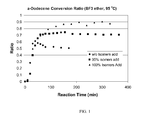
- the yield of sec-dodecyl 1,3-dichloro-2-propyl ether and isomers based on 1-dodecene intake, determined by gas chromatography, against reaction time is plotted in Fig. 1 . It is shown that the yield goes through a maximum at about 61 mol% and then drops back to - 50 mol%.
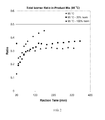
- the ratio of the total isomers other than the main product of 2-chloro-1-(chloromethyl)ethyl 1-methylundecyl ether (i.e., the isomers of the ether product with the ether linkage other than at C-2 position) among the ether product mixture in the reaction mixture is plotted against reaction time in Fig. 2 .
- the isomers (other than of 2-chloro-1-(chloromethyl)ethyl 1-methylundecyl ether) amount in the product mixture keeps increasing with the reaction time.
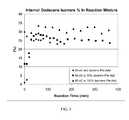
- the molar percentage of the total internal dodecene isomers in the reaction mixture is plotted versus reaction time in Fig. 3 .
- the total internal olefin isomers percentage increases from less than 1% at the beginning of the reaction to about 25% corresponding to the time at which the ether yield reaches the maximum. The result indicates that about 25% of the 1-dodecene is converted to internal olefin isomers during the reaction.
- the ratios of the total isomers other than the main product of, 2-chloro-1-(chloromethyl)ethyl 1-methylundecyl ether among the ether product mixture in the reaction mixture versus reaction time is compared in Fig. 2 with the results of Example II-2.
- the isomer amounts in the product mixture is smaller than those in Example II-2 and the change with reaction time after reaching the maximum yield (refer to Fig. 1 ) is smaller than that observed in Example II-2.
- the yield of sec-dodecyl 1,3-dichloro-2-propyl ether and isomers based on 1-dodecene intake, determined by gas chromatography, is compared with the results of Examples II-2 and II-3 in Fig. 1 .
- the ether yield based on 1-dodecene intake is increased to approximately 90 mol% and the yield is stable after reaching the maximum value.
- the ratios of the total isomers other than the main product of, 2-chloro-1-(chloromethyl)ethyl 1-methylundecyl ether among the ether product mixture in the reaction mixture versus reaction time is compared with the results of Examples II-2 and II-3 in Fig. 2 .
- the isomer amounts in the product mixture are smaller than those in Examples II-2 and II-3 and stay stable with reaction time after reaching the maximum yield (refer to Fig. 1 ).
- the lower phase containing the excess dichloropropanol, ether products, unreacted and isomerized olefins, and the catalyst is extracted with 200 ml of heptane three more times.
- Catalyst screening is carried out in a set of 48 high throughput reactors (cells) under nitrogen atmosphere.
- the reagents are transferred using a standard automated liquid handling system while the catalyst solutions are charged manually.
- Each cell is equipped with a glass liner and stirrer.
Landscapes
- Chemical & Material Sciences (AREA)
- Organic Chemistry (AREA)
- Crystallography & Structural Chemistry (AREA)
- Organic Low-Molecular-Weight Compounds And Preparation Thereof (AREA)
- Low-Molecular Organic Synthesis Reactions Using Catalysts (AREA)
Applications Claiming Priority (2)
| Application Number | Priority Date | Filing Date | Title |
|---|---|---|---|
| US5190008P | 2008-05-09 | 2008-05-09 | |
| EP09743269.4A EP2285763B1 (de) | 2008-05-09 | 2009-04-27 | Verfahren zur etherifizierung von olefinen |
Related Parent Applications (3)
| Application Number | Title | Priority Date | Filing Date |
|---|---|---|---|
| EP09743269.4 Division | 2009-04-27 | ||
| EP09743269.4A Division-Into EP2285763B1 (de) | 2008-05-09 | 2009-04-27 | Verfahren zur etherifizierung von olefinen |
| EP09743269.4A Division EP2285763B1 (de) | 2008-05-09 | 2009-04-27 | Verfahren zur etherifizierung von olefinen |
Publications (2)
| Publication Number | Publication Date |
|---|---|
| EP2623488A1 true EP2623488A1 (de) | 2013-08-07 |
| EP2623488B1 EP2623488B1 (de) | 2014-08-20 |
Family
ID=40791564
Family Applications (2)
| Application Number | Title | Priority Date | Filing Date |
|---|---|---|---|
| EP13166518.4A Active EP2623488B1 (de) | 2008-05-09 | 2009-04-27 | Verfahren zur Etherifizierung von Olefinen |
| EP09743269.4A Revoked EP2285763B1 (de) | 2008-05-09 | 2009-04-27 | Verfahren zur etherifizierung von olefinen |
Family Applications After (1)
| Application Number | Title | Priority Date | Filing Date |
|---|---|---|---|
| EP09743269.4A Revoked EP2285763B1 (de) | 2008-05-09 | 2009-04-27 | Verfahren zur etherifizierung von olefinen |
Country Status (3)
| Country | Link |
|---|---|
| US (1) | US8722944B2 (de) |
| EP (2) | EP2623488B1 (de) |
| WO (1) | WO2009137282A1 (de) |
Families Citing this family (8)
| Publication number | Priority date | Publication date | Assignee | Title |
|---|---|---|---|---|
| EP2454233B1 (de) * | 2009-07-16 | 2015-02-25 | Dow Global Technologies LLC | Sulfonat-tenside und methoden zu deren herstellung und verwendung |
| JP5869488B2 (ja) * | 2009-11-03 | 2016-02-24 | ダウ グローバル テクノロジーズ エルエルシー | ビニルエーテル化合物並びにそれらの製造及び使用方法 |
| US20110112328A1 (en) * | 2009-11-06 | 2011-05-12 | Drovetskaya Tatiana V | Difunctional, Amine-Based Surfactants, and Their Precursors, Preparation, Compositions and Use |
| EP2588586B1 (de) | 2010-06-29 | 2016-12-21 | Dow Global Technologies LLC | Kompatible gemische aus anionischen und kationischen tensiden |
| WO2012078728A1 (en) | 2010-12-10 | 2012-06-14 | Dow Global Technologies Llc | Apparatus and process for using olefin as an azeotropic entrainer for isolating 1,3-dichloro-2-propanol from a 2,2'-oxybis (1-chloropropane) waste stream |
| EP3744752B1 (de) * | 2019-05-28 | 2024-10-16 | Evonik Operations GmbH | Verfahren zur herstellung von nichtcyclischen alkoxyfunktionellen polysiloxanen |
| WO2021067223A1 (en) | 2019-09-30 | 2021-04-08 | Dow Global Technologies Llc | Metallosilicate catalyst solvents for the formation of alkylene glycol monoalkyl ethers |
| CN114685235B (zh) * | 2022-03-25 | 2024-08-23 | 国家能源集团宁夏煤业有限责任公司 | 从费托合成稳定重质油中分离1-癸烯的方法及装置 |
Citations (1)
| Publication number | Priority date | Publication date | Assignee | Title |
|---|---|---|---|---|
| US5030768A (en) * | 1990-03-30 | 1991-07-09 | Air Products And Chemicals, Inc. | Process for preparing alkyl tert-alkyl ethers |
Family Cites Families (15)
| Publication number | Priority date | Publication date | Assignee | Title |
|---|---|---|---|---|
| US2067385A (en) * | 1934-04-26 | 1937-01-12 | Shell Dev | Ethers and process for producing the same |
| NL6607907A (de) | 1966-06-08 | 1967-12-11 | ||
| JPS5735687B2 (de) | 1973-10-26 | 1982-07-30 | ||
| US4139566A (en) * | 1977-10-03 | 1979-02-13 | Shell Oil Company | Secondary alcohol ethoxylate process |
| US4371716A (en) * | 1979-09-04 | 1983-02-01 | Shell Oil Company | β-(Sec-alkoxy) ethanol process |
| JP2567927B2 (ja) | 1987-09-30 | 1996-12-25 | テキサス インスツルメンツ インコーポレイテッド | 電気的にプログラム可能なメモリセル |
| US4906787A (en) * | 1987-12-30 | 1990-03-06 | Mobil Oil Corporation | Process for the production of ethers |
| US5026459A (en) * | 1988-03-21 | 1991-06-25 | Institut Francais Du Petrole | Apparatus for reactive distillation |
| US5258560A (en) * | 1992-06-22 | 1993-11-02 | Uop | Etherification of C5 -plus olefins by catalytic distillation |
| AU702870B2 (en) | 1995-06-08 | 1999-03-11 | Nippon Shokubai Co., Ltd. | Process for production of (poly)alkylene glycol monoalkyl ether |
| TW519535B (en) | 1996-12-06 | 2003-02-01 | Nippon Catalytic Chem Ind | Higher secondary alcohol alkoxylate compound composition, method for production thereof, and detergent and emulsifier using the composition |
| TW349106B (en) | 1996-12-06 | 1999-01-01 | Nippon Catalytic Chem Ind | Production process for (poly)alkylene glycol monoalkyl ether |
| US6930206B1 (en) * | 2001-07-05 | 2005-08-16 | Catalytic Distillation Technologies | Process and apparatus for catalytic distillations |
| ATE512946T1 (de) | 2002-06-11 | 2011-07-15 | Catalytic Distillation Tech | Verfahren und vorrichtung für katalytische destillierungen |
| JP2006282558A (ja) | 2005-03-31 | 2006-10-19 | Nippon Zeon Co Ltd | シクロアルキルアルキルエーテルの製造方法 |
-
2009
- 2009-04-27 EP EP13166518.4A patent/EP2623488B1/de active Active
- 2009-04-27 EP EP09743269.4A patent/EP2285763B1/de not_active Revoked
- 2009-04-27 WO PCT/US2009/041747 patent/WO2009137282A1/en not_active Ceased
- 2009-04-27 US US12/430,171 patent/US8722944B2/en active Active
Patent Citations (1)
| Publication number | Priority date | Publication date | Assignee | Title |
|---|---|---|---|---|
| US5030768A (en) * | 1990-03-30 | 1991-07-09 | Air Products And Chemicals, Inc. | Process for preparing alkyl tert-alkyl ethers |
Non-Patent Citations (2)
| Title |
|---|
| BAKKER ET AL., J. AM. OIL CHEM. SOC., vol. 44, 1967, pages 517 - 512 |
| BAKKER P M ET AL: "AN EXPLORATORY STUDY OF THE ADDITION REACTIONS OF ETHYLENEGLYCOL, 2-CHLOROETHANOL AND 1,3-DICHLORO-2-PROPANOL TO 1-DODECENE", JOURNAL OF THE AMERICAN OIL CHEMISTS' SOCIETY, SPRINGER, BERLIN, DE, vol. 44, no. 9, 1 January 1967 (1967-01-01), pages 517 - 518, XP009081570, ISSN: 0003-021X * |
Also Published As
| Publication number | Publication date |
|---|---|
| WO2009137282A1 (en) | 2009-11-12 |
| EP2285763B1 (de) | 2014-05-07 |
| US8722944B2 (en) | 2014-05-13 |
| EP2285763A1 (de) | 2011-02-23 |
| EP2623488B1 (de) | 2014-08-20 |
| US20090281359A1 (en) | 2009-11-12 |
Similar Documents
| Publication | Publication Date | Title |
|---|---|---|
| EP2623488B1 (de) | Verfahren zur Etherifizierung von Olefinen | |
| US4307032A (en) | Process for the preparation of dialkyl carbonates | |
| US20250257088A1 (en) | Indole-functionalized bisphosphoramidites, methods for the preparation thereof, and rhodium-ligand complex | |
| KR101331553B1 (ko) | 글리콜에테르를 이용한 고순도 이소부텐의 제조 방법 | |
| EP2935191B1 (de) | Herstellung von (6r,10r)-6,10,14-trimethylpentadecan-2-on aus 3,7-dimetyloct-2-enal oder 3,7-dimetylocta-2,6-dienal | |
| US9890131B2 (en) | Direct synthesis of bio-based alkyl and furanic diol ethers, acetates, ether-acetates, and carbonates | |
| EP2935189B1 (de) | Verwendung von mischungen aus e/z-isomeren zum erhalten von quantitativ spezifischen produkten durch kombinieren von asymmetrischer hydrierung und isomerisation | |
| EP2935188B1 (de) | Verwendung von mischungen aus e/z-isomeren zum erhalten von quantitativ spezifischen produkten durch kombinierte asymmetrische hydrierungen | |
| CN114341092A (zh) | 用于形成亚烷基二醇单烷基醚的金属硅酸盐催化剂溶剂 | |
| US3965132A (en) | Acid and ester production | |
| Alamdari et al. | An efficient and highly selective ortho-tert-butylation of p-cresol with methyl tert-butyl ether catalyzed by sulfonated ionic liquids | |
| EP3401301A1 (de) | Hydroxypivalaldehydherstellungsverfahren | |
| GB2145076A (en) | A process for producing 1,2-alkanediols | |
| EP3720835B1 (de) | Verfahren zur herstellung von ethern aus zykloaliphatischen oder araliphatischen diolen | |
| KR102800446B1 (ko) | 아크릴로니트릴 이량체의 제조 방법 | |
| WO2024002859A1 (en) | Hydrofluoroether composition and method for its preparation | |
| US20100197975A1 (en) | Process for making dialkyl ethers from alcohols | |
| JP5619753B2 (ja) | 2−第二級−アルキル−4,5−ジ−(直鎖−アルキル)フェノール類を製造する方法 | |
| EP3775111B1 (de) | Diarylether als brennstoffmarker | |
| JP7296209B2 (ja) | 環状アセタール化合物の製造方法 | |
| Marochkin et al. | High-Boiling By-Products of the Synthesis of Trimethylolpropane and Their Processing into Esters | |
| FR2670778A1 (fr) | Procede de c-alkylation des diphenols et de leurs monoethers. | |
| WO2011056448A1 (en) | Vinyl ether compounds and methods of their preparation and use | |
| Petrov | Full Research Paper Open Access | |
| JPWO2024085256A5 (de) |
Legal Events
| Date | Code | Title | Description |
|---|---|---|---|
| PUAI | Public reference made under article 153(3) epc to a published international application that has entered the european phase |
Free format text: ORIGINAL CODE: 0009012 |
|
| AC | Divisional application: reference to earlier application |
Ref document number: 2285763 Country of ref document: EP Kind code of ref document: P |
|
| AK | Designated contracting states |
Kind code of ref document: A1 Designated state(s): AT BE BG CH CY CZ DE DK EE ES FI FR GB GR HR HU IE IS IT LI LT LU LV MC MK MT NL NO PL PT RO SE SI SK TR |
|
| GRAP | Despatch of communication of intention to grant a patent |
Free format text: ORIGINAL CODE: EPIDOSNIGR1 |
|
| 17P | Request for examination filed |
Effective date: 20140207 |
|
| RBV | Designated contracting states (corrected) |
Designated state(s): AT BE BG CH CY CZ DE DK EE ES FI FR GB GR HR HU IE IS IT LI LT LU LV MC MK MT NL NO PL PT RO SE SI SK TR |
|
| RIC1 | Information provided on ipc code assigned before grant |
Ipc: C07C 41/42 20060101ALI20140305BHEP Ipc: C07C 41/06 20060101AFI20140305BHEP Ipc: C07C 43/12 20060101ALI20140305BHEP |
|
| INTG | Intention to grant announced |
Effective date: 20140318 |
|
| GRAS | Grant fee paid |
Free format text: ORIGINAL CODE: EPIDOSNIGR3 |
|
| GRAA | (expected) grant |
Free format text: ORIGINAL CODE: 0009210 |
|
| AC | Divisional application: reference to earlier application |
Ref document number: 2285763 Country of ref document: EP Kind code of ref document: P |
|
| AK | Designated contracting states |
Kind code of ref document: B1 Designated state(s): AT BE BG CH CY CZ DE DK EE ES FI FR GB GR HR HU IE IS IT LI LT LU LV MC MK MT NL NO PL PT RO SE SI SK TR |
|
| REG | Reference to a national code |
Ref country code: GB Ref legal event code: FG4D |
|
| REG | Reference to a national code |
Ref country code: CH Ref legal event code: EP |
|
| REG | Reference to a national code |
Ref country code: AT Ref legal event code: REF Ref document number: 683361 Country of ref document: AT Kind code of ref document: T Effective date: 20140915 |
|
| REG | Reference to a national code |
Ref country code: IE Ref legal event code: FG4D |
|
| REG | Reference to a national code |
Ref country code: DE Ref legal event code: R096 Ref document number: 602009026229 Country of ref document: DE Effective date: 20141002 |
|
| REG | Reference to a national code |
Ref country code: AT Ref legal event code: MK05 Ref document number: 683361 Country of ref document: AT Kind code of ref document: T Effective date: 20140820 |
|
| REG | Reference to a national code |
Ref country code: NL Ref legal event code: VDEP Effective date: 20140820 |
|
| REG | Reference to a national code |
Ref country code: LT Ref legal event code: MG4D |
|
| PG25 | Lapsed in a contracting state [announced via postgrant information from national office to epo] |
Ref country code: SE Free format text: LAPSE BECAUSE OF FAILURE TO SUBMIT A TRANSLATION OF THE DESCRIPTION OR TO PAY THE FEE WITHIN THE PRESCRIBED TIME-LIMIT Effective date: 20140820 Ref country code: BG Free format text: LAPSE BECAUSE OF FAILURE TO SUBMIT A TRANSLATION OF THE DESCRIPTION OR TO PAY THE FEE WITHIN THE PRESCRIBED TIME-LIMIT Effective date: 20141120 Ref country code: GR Free format text: LAPSE BECAUSE OF FAILURE TO SUBMIT A TRANSLATION OF THE DESCRIPTION OR TO PAY THE FEE WITHIN THE PRESCRIBED TIME-LIMIT Effective date: 20141121 Ref country code: NO Free format text: LAPSE BECAUSE OF FAILURE TO SUBMIT A TRANSLATION OF THE DESCRIPTION OR TO PAY THE FEE WITHIN THE PRESCRIBED TIME-LIMIT Effective date: 20141120 Ref country code: ES Free format text: LAPSE BECAUSE OF FAILURE TO SUBMIT A TRANSLATION OF THE DESCRIPTION OR TO PAY THE FEE WITHIN THE PRESCRIBED TIME-LIMIT Effective date: 20140820 Ref country code: FI Free format text: LAPSE BECAUSE OF FAILURE TO SUBMIT A TRANSLATION OF THE DESCRIPTION OR TO PAY THE FEE WITHIN THE PRESCRIBED TIME-LIMIT Effective date: 20140820 Ref country code: LT Free format text: LAPSE BECAUSE OF FAILURE TO SUBMIT A TRANSLATION OF THE DESCRIPTION OR TO PAY THE FEE WITHIN THE PRESCRIBED TIME-LIMIT Effective date: 20140820 Ref country code: PT Free format text: LAPSE BECAUSE OF FAILURE TO SUBMIT A TRANSLATION OF THE DESCRIPTION OR TO PAY THE FEE WITHIN THE PRESCRIBED TIME-LIMIT Effective date: 20141222 |
|
| PG25 | Lapsed in a contracting state [announced via postgrant information from national office to epo] |
Ref country code: LV Free format text: LAPSE BECAUSE OF FAILURE TO SUBMIT A TRANSLATION OF THE DESCRIPTION OR TO PAY THE FEE WITHIN THE PRESCRIBED TIME-LIMIT Effective date: 20140820 Ref country code: AT Free format text: LAPSE BECAUSE OF FAILURE TO SUBMIT A TRANSLATION OF THE DESCRIPTION OR TO PAY THE FEE WITHIN THE PRESCRIBED TIME-LIMIT Effective date: 20140820 Ref country code: IS Free format text: LAPSE BECAUSE OF FAILURE TO SUBMIT A TRANSLATION OF THE DESCRIPTION OR TO PAY THE FEE WITHIN THE PRESCRIBED TIME-LIMIT Effective date: 20141220 Ref country code: HR Free format text: LAPSE BECAUSE OF FAILURE TO SUBMIT A TRANSLATION OF THE DESCRIPTION OR TO PAY THE FEE WITHIN THE PRESCRIBED TIME-LIMIT Effective date: 20140820 |
|
| PG25 | Lapsed in a contracting state [announced via postgrant information from national office to epo] |
Ref country code: NL Free format text: LAPSE BECAUSE OF FAILURE TO SUBMIT A TRANSLATION OF THE DESCRIPTION OR TO PAY THE FEE WITHIN THE PRESCRIBED TIME-LIMIT Effective date: 20140820 |
|
| PG25 | Lapsed in a contracting state [announced via postgrant information from national office to epo] |
Ref country code: RO Free format text: LAPSE BECAUSE OF FAILURE TO SUBMIT A TRANSLATION OF THE DESCRIPTION OR TO PAY THE FEE WITHIN THE PRESCRIBED TIME-LIMIT Effective date: 20140820 Ref country code: DK Free format text: LAPSE BECAUSE OF FAILURE TO SUBMIT A TRANSLATION OF THE DESCRIPTION OR TO PAY THE FEE WITHIN THE PRESCRIBED TIME-LIMIT Effective date: 20140820 Ref country code: EE Free format text: LAPSE BECAUSE OF FAILURE TO SUBMIT A TRANSLATION OF THE DESCRIPTION OR TO PAY THE FEE WITHIN THE PRESCRIBED TIME-LIMIT Effective date: 20140820 Ref country code: SK Free format text: LAPSE BECAUSE OF FAILURE TO SUBMIT A TRANSLATION OF THE DESCRIPTION OR TO PAY THE FEE WITHIN THE PRESCRIBED TIME-LIMIT Effective date: 20140820 Ref country code: IT Free format text: LAPSE BECAUSE OF FAILURE TO SUBMIT A TRANSLATION OF THE DESCRIPTION OR TO PAY THE FEE WITHIN THE PRESCRIBED TIME-LIMIT Effective date: 20140820 Ref country code: CZ Free format text: LAPSE BECAUSE OF FAILURE TO SUBMIT A TRANSLATION OF THE DESCRIPTION OR TO PAY THE FEE WITHIN THE PRESCRIBED TIME-LIMIT Effective date: 20140820 |
|
| REG | Reference to a national code |
Ref country code: DE Ref legal event code: R097 Ref document number: 602009026229 Country of ref document: DE |
|
| PG25 | Lapsed in a contracting state [announced via postgrant information from national office to epo] |
Ref country code: PL Free format text: LAPSE BECAUSE OF FAILURE TO SUBMIT A TRANSLATION OF THE DESCRIPTION OR TO PAY THE FEE WITHIN THE PRESCRIBED TIME-LIMIT Effective date: 20140820 |
|
| PLBE | No opposition filed within time limit |
Free format text: ORIGINAL CODE: 0009261 |
|
| STAA | Information on the status of an ep patent application or granted ep patent |
Free format text: STATUS: NO OPPOSITION FILED WITHIN TIME LIMIT |
|
| 26N | No opposition filed |
Effective date: 20150521 |
|
| PG25 | Lapsed in a contracting state [announced via postgrant information from national office to epo] |
Ref country code: LU Free format text: LAPSE BECAUSE OF FAILURE TO SUBMIT A TRANSLATION OF THE DESCRIPTION OR TO PAY THE FEE WITHIN THE PRESCRIBED TIME-LIMIT Effective date: 20150427 Ref country code: SI Free format text: LAPSE BECAUSE OF FAILURE TO SUBMIT A TRANSLATION OF THE DESCRIPTION OR TO PAY THE FEE WITHIN THE PRESCRIBED TIME-LIMIT Effective date: 20140820 Ref country code: MC Free format text: LAPSE BECAUSE OF FAILURE TO SUBMIT A TRANSLATION OF THE DESCRIPTION OR TO PAY THE FEE WITHIN THE PRESCRIBED TIME-LIMIT Effective date: 20140820 |
|
| REG | Reference to a national code |
Ref country code: CH Ref legal event code: PL |
|
| REG | Reference to a national code |
Ref country code: IE Ref legal event code: MM4A |
|
| PG25 | Lapsed in a contracting state [announced via postgrant information from national office to epo] |
Ref country code: LI Free format text: LAPSE BECAUSE OF NON-PAYMENT OF DUE FEES Effective date: 20150430 Ref country code: CH Free format text: LAPSE BECAUSE OF NON-PAYMENT OF DUE FEES Effective date: 20150430 |
|
| REG | Reference to a national code |
Ref country code: FR Ref legal event code: PLFP Year of fee payment: 8 |
|
| PG25 | Lapsed in a contracting state [announced via postgrant information from national office to epo] |
Ref country code: IE Free format text: LAPSE BECAUSE OF NON-PAYMENT OF DUE FEES Effective date: 20150427 |
|
| PG25 | Lapsed in a contracting state [announced via postgrant information from national office to epo] |
Ref country code: BE Free format text: LAPSE BECAUSE OF FAILURE TO SUBMIT A TRANSLATION OF THE DESCRIPTION OR TO PAY THE FEE WITHIN THE PRESCRIBED TIME-LIMIT Effective date: 20140820 |
|
| PG25 | Lapsed in a contracting state [announced via postgrant information from national office to epo] |
Ref country code: MT Free format text: LAPSE BECAUSE OF FAILURE TO SUBMIT A TRANSLATION OF THE DESCRIPTION OR TO PAY THE FEE WITHIN THE PRESCRIBED TIME-LIMIT Effective date: 20140820 |
|
| REG | Reference to a national code |
Ref country code: FR Ref legal event code: PLFP Year of fee payment: 9 |
|
| PG25 | Lapsed in a contracting state [announced via postgrant information from national office to epo] |
Ref country code: HU Free format text: LAPSE BECAUSE OF FAILURE TO SUBMIT A TRANSLATION OF THE DESCRIPTION OR TO PAY THE FEE WITHIN THE PRESCRIBED TIME-LIMIT; INVALID AB INITIO Effective date: 20090427 |
|
| PG25 | Lapsed in a contracting state [announced via postgrant information from national office to epo] |
Ref country code: CY Free format text: LAPSE BECAUSE OF FAILURE TO SUBMIT A TRANSLATION OF THE DESCRIPTION OR TO PAY THE FEE WITHIN THE PRESCRIBED TIME-LIMIT Effective date: 20140820 |
|
| PG25 | Lapsed in a contracting state [announced via postgrant information from national office to epo] |
Ref country code: TR Free format text: LAPSE BECAUSE OF FAILURE TO SUBMIT A TRANSLATION OF THE DESCRIPTION OR TO PAY THE FEE WITHIN THE PRESCRIBED TIME-LIMIT Effective date: 20140820 |
|
| REG | Reference to a national code |
Ref country code: FR Ref legal event code: PLFP Year of fee payment: 10 |
|
| PG25 | Lapsed in a contracting state [announced via postgrant information from national office to epo] |
Ref country code: MK Free format text: LAPSE BECAUSE OF FAILURE TO SUBMIT A TRANSLATION OF THE DESCRIPTION OR TO PAY THE FEE WITHIN THE PRESCRIBED TIME-LIMIT Effective date: 20140820 |
|
| P01 | Opt-out of the competence of the unified patent court (upc) registered |
Effective date: 20230526 |
|
| PGFP | Annual fee paid to national office [announced via postgrant information from national office to epo] |
Ref country code: DE Payment date: 20250305 Year of fee payment: 17 |
|
| PGFP | Annual fee paid to national office [announced via postgrant information from national office to epo] |
Ref country code: GB Payment date: 20260313 Year of fee payment: 18 |
|
| PGFP | Annual fee paid to national office [announced via postgrant information from national office to epo] |
Ref country code: FR Payment date: 20260310 Year of fee payment: 18 |