EP2643154B1 - Flexibler schlauch für den einsatz am meeresboden mit einer schicht aus einem polymer-harz mit aluminium- oder magnesium-silikat nano-röhrchen - Google Patents
Flexibler schlauch für den einsatz am meeresboden mit einer schicht aus einem polymer-harz mit aluminium- oder magnesium-silikat nano-röhrchen Download PDFInfo
- Publication number
- EP2643154B1 EP2643154B1 EP11790933.3A EP11790933A EP2643154B1 EP 2643154 B1 EP2643154 B1 EP 2643154B1 EP 11790933 A EP11790933 A EP 11790933A EP 2643154 B1 EP2643154 B1 EP 2643154B1
- Authority
- EP
- European Patent Office
- Prior art keywords
- group
- polymer
- nanotube
- groups
- layer
- Prior art date
- Legal status (The legal status is an assumption and is not a legal conclusion. Google has not performed a legal analysis and makes no representation as to the accuracy of the status listed.)
- Active
Links
Images


Classifications
-
- F—MECHANICAL ENGINEERING; LIGHTING; HEATING; WEAPONS; BLASTING
- F16—ENGINEERING ELEMENTS AND UNITS; GENERAL MEASURES FOR PRODUCING AND MAINTAINING EFFECTIVE FUNCTIONING OF MACHINES OR INSTALLATIONS; THERMAL INSULATION IN GENERAL
- F16L—PIPES; JOINTS OR FITTINGS FOR PIPES; SUPPORTS FOR PIPES, CABLES OR PROTECTIVE TUBING; MEANS FOR THERMAL INSULATION IN GENERAL
- F16L11/00—Hoses, i.e. flexible pipes
- F16L11/04—Hoses, i.e. flexible pipes made of rubber or flexible plastics
-
- B—PERFORMING OPERATIONS; TRANSPORTING
- B32—LAYERED PRODUCTS
- B32B—LAYERED PRODUCTS, i.e. PRODUCTS BUILT-UP OF STRATA OF FLAT OR NON-FLAT, e.g. CELLULAR OR HONEYCOMB, FORM
- B32B1/00—Layered products having a non-planar shape
- B32B1/08—Tubular products
-
- B—PERFORMING OPERATIONS; TRANSPORTING
- B32—LAYERED PRODUCTS
- B32B—LAYERED PRODUCTS, i.e. PRODUCTS BUILT-UP OF STRATA OF FLAT OR NON-FLAT, e.g. CELLULAR OR HONEYCOMB, FORM
- B32B27/00—Layered products comprising a layer of synthetic resin
- B32B27/18—Layered products comprising a layer of synthetic resin characterised by the use of special additives
-
- B—PERFORMING OPERATIONS; TRANSPORTING
- B32—LAYERED PRODUCTS
- B32B—LAYERED PRODUCTS, i.e. PRODUCTS BUILT-UP OF STRATA OF FLAT OR NON-FLAT, e.g. CELLULAR OR HONEYCOMB, FORM
- B32B27/00—Layered products comprising a layer of synthetic resin
- B32B27/34—Layered products comprising a layer of synthetic resin comprising polyamides
-
- F—MECHANICAL ENGINEERING; LIGHTING; HEATING; WEAPONS; BLASTING
- F16—ENGINEERING ELEMENTS AND UNITS; GENERAL MEASURES FOR PRODUCING AND MAINTAINING EFFECTIVE FUNCTIONING OF MACHINES OR INSTALLATIONS; THERMAL INSULATION IN GENERAL
- F16L—PIPES; JOINTS OR FITTINGS FOR PIPES; SUPPORTS FOR PIPES, CABLES OR PROTECTIVE TUBING; MEANS FOR THERMAL INSULATION IN GENERAL
- F16L11/00—Hoses, i.e. flexible pipes
- F16L11/04—Hoses, i.e. flexible pipes made of rubber or flexible plastics
- F16L11/08—Hoses, i.e. flexible pipes made of rubber or flexible plastics with reinforcements embedded in the wall
- F16L11/081—Hoses, i.e. flexible pipes made of rubber or flexible plastics with reinforcements embedded in the wall comprising one or more layers of a helically wound cord or wire
- F16L11/083—Hoses, i.e. flexible pipes made of rubber or flexible plastics with reinforcements embedded in the wall comprising one or more layers of a helically wound cord or wire three or more layers
-
- F—MECHANICAL ENGINEERING; LIGHTING; HEATING; WEAPONS; BLASTING
- F17—STORING OR DISTRIBUTING GASES OR LIQUIDS
- F17D—PIPE-LINE SYSTEMS; PIPE-LINES
- F17D1/00—Pipe-line systems
- F17D1/08—Pipe-line systems for liquids or viscous products
-
- B—PERFORMING OPERATIONS; TRANSPORTING
- B32—LAYERED PRODUCTS
- B32B—LAYERED PRODUCTS, i.e. PRODUCTS BUILT-UP OF STRATA OF FLAT OR NON-FLAT, e.g. CELLULAR OR HONEYCOMB, FORM
- B32B2597/00—Tubular articles, e.g. hoses, pipes
-
- Y—GENERAL TAGGING OF NEW TECHNOLOGICAL DEVELOPMENTS; GENERAL TAGGING OF CROSS-SECTIONAL TECHNOLOGIES SPANNING OVER SEVERAL SECTIONS OF THE IPC; TECHNICAL SUBJECTS COVERED BY FORMER USPC CROSS-REFERENCE ART COLLECTIONS [XRACs] AND DIGESTS
- Y10—TECHNICAL SUBJECTS COVERED BY FORMER USPC
- Y10T—TECHNICAL SUBJECTS COVERED BY FORMER US CLASSIFICATION
- Y10T137/00—Fluid handling
- Y10T137/0318—Processes
Definitions
- the present invention relates to an underwater flexible pipe for the transport of fluids in deep water.
- These fluids are in particular gases or liquids, preferably hydrocarbons.
- the pipe comprises a metal carcass, it is said passage not smooth ("rough bore” in English). If the pipe is free of metal carcass, it is said to smooth passage ("smooth-bore" in English).
- a pipe comprising a carcass is preferred, while a carcass-free pipe will be adapted for the transport of water and / or water vapor under pressure.
- the metal casing and the pressure vault consist of longitudinal elements wound with short pitch, and they give the pipe its resistance to radial forces while the plies of tensile armor consist of metal wires wound in long steps to resume axial efforts.
- the nature, number, sizing and organization of the layers constituting the flexible pipes are essentially related to their conditions of use and installation.
- the conduits may include additional layers to those mentioned above.
- the concept of short-pitch winding designates any helical winding at a helix angle close to 90 °, typically between 75 ° and 90 °.
- the concept of long-pitch winding covers, for its part, helix angles less than 55 °, typically between 25 ° and 55 ° for the armor plies.
- Flexible pipes can be used at great depth, typically up to 2500 meters deep. They allow the transport of fluids, especially hydrocarbons, having a temperature typically reaching 130 ° C and may even exceed 150 ° C and an internal pressure of up to 1000 bar or 1500 bar.
- the constituent material of the inner polymeric sheath sealing must be chemically stable and able to mechanically resist the transported fluid and its characteristics (composition, temperature and pressure). This material must combine characteristics of ductility, time resistance (generally, pipe life of at least 20 years), strength, heat and pressure. The material must in particular be chemically inert vis-à-vis the chemical compounds constituting the transported fluid.
- Pipes comprising an inner polymeric sheath sealing based on polymer, in particular polyamide, graft polyethylene (Crossflex ® ) or polyvinylidene fluoride, may in particular be used.
- polymer in particular polyamide, graft polyethylene (Crossflex ® ) or polyvinylidene fluoride
- the thermomechanical properties of the polymers under the previously mentioned conditions of use can be significantly reduced.
- the polyamides can be degraded by hydrolysis.
- the document US 2010 / 0189946A1 discloses a flexible conduit for the transport of fluids comprising a plurality of layers of which at least one layer comprises a polymer resin comprising at least one nanotube.
- WO 2008/113362 discloses a flexible pipe comprising a layer comprising a polymer resin comprising a silicate cationic clay non-covalently bonded to the polymer, said clay being described as being able to increase the corrosion resistance and to improve the mechanical strength of said layer .
- the preparation of a layer in which the cationic clay, in the form of sheets, is distributed homogeneously is generally not easy.
- the homogeneity of the layer is very important, because the more the sheets are independent of each other and distributed homogeneously, the more the contact surface between the polymer and the slip is important, and the greater the impact of clay on the improvement of properties is noticeable.
- One of the objectives of the present invention is to provide an underwater flexible pipe comprising a polymer-based layer having improved thermomechanical properties allowing its use for the transport of fluids, such as hydrocarbons, especially at high pressure and high temperature and which can be prepared by a conventional process for preparing a polymer resin, in particular which does not require an exfoliation step.
- the subject of the invention is a submarine flexible pipe intended for the transport of fluids, in particular of hydrocarbons, comprising a plurality of layers of which at least one layer comprises a polymer resin comprising at least one nanotube alumino- or magnesio-silicate chemically bonded to the polymer by covalent bonding.
- the aluminosilicate or aluminosilicate nanotube may be an aluminosilicate, such as halloysite of the formula Al 2 SiO 5 (OH) 4 ⁇ nH 2 O or the imogolite of formula Al 2 SiO 3 (OH) 4 ⁇ nH 2 O, or a magnesiosilicate of formula Mg 3 Si 2 O 5 (OH) 4 ⁇ nH 2 O, in which "nH 2 O" means that the nanotubes are in the hydrated form (n being greater than 0) or not (n being 0). Halloysite is particularly preferred.
- aluminosilicate or magnesiosilicate nanotubes are advantageously commercially available, for example in NaturalNano TM, Imerys ®, Sigma Aldrich ® or Northstar Clay Mining, Inc. ®, or can be synthesized by methods known in the art, for example described in US 4,150,099 .
- These nanotubes have a hollow tubular structure, said structure comprising two tubular sheets having the same axis: an external tubular sheet in which is located an internal tubular leaflet.
- the chemical structure of the outer tubular leaflet is close to SiO 2 .
- such a nanotube has a length of 1 to 15 ⁇ m and / or an internal diameter (considering the internal tubular sheet) of 5 to 200 nm, typically 10 to 150 nm.
- aluminosilicate or magnesio-silicate nanotubes chemically bonded by covalent bonding to a polymer make it possible to reduce the mobility of the polymer chains relative to one another and thus to improve the thermomechanical properties of the polymer, in particular the improve its resistance to creep and tension or compression and / or its flame retardant properties.
- a “chemically bonded” alumino- or magnesio-silicate nanotube by covalent bonding to the polymer it is meant that the nanotube comprises at least one group capable of forming a covalent bond with the polymer, called group A in the present application.
- group capable of forming a covalent bond means any atom capable of forming a covalent bond or any group carrying such an atom or such a function.
- the chemical bond between the polymer and the alumino- or magnesiosilicate nanotube in the pipe layer is a covalent bond.
- This chemical bond may especially be an ester, amide, amine, ether, thioether, urea, imine, imide, sulfonamide, carbamate, phosphate, siloxane (Si-O-Si), silane (Si-C) or carbon-carbon bond. carbon.
- the covalent bonds are advantageously the most stable chemical bonds.
- the polymer of the layer of the flexible pipe is a polymer capable of covalently bonding to the nanotube.
- the polymer may comprise in its backbone groups capable of binding covalently to the nanotube. It may also include functional side chains able to bind covalently to the nanotube. Functional side chains are, for example, side chains carrying COOH, NH 2 , OH, epoxide, nitrile, anhydride or trialkoxysilane groups.
- the polymer is preferably an organic polymer (that is to say having carbon atoms), and in particular whose skeleton is organic.
- the polymer of the layer of the flexible pipe is a polyamide optionally comprising functional side chains, especially as defined above.
- Polyamides are advantageous because they can be used at high temperatures, generally up to 100 ° C.
- the polyamide of layer of the flexible underwater pipe may be a homopolyamide or a copolyamide, such as, for example, polyamide 6, polyamide 4.6, polyamide 6.6, polyamide 11, polyamide 12, polyamide 12.12, polyamide 10.12, polyamide 6.10, polyamide 6.12, polyamide 6.9, polyamide 9.9, polyamide 9T, polyamide 12T, polyamide 10T, polyamide 12I, polyamide 12T, polyamide 12T.12, polyamide 10T.12, polyamide 12T .106, polyamide 10T.106, polyamide 6.66, polyamide 6.612, polyamide 6.66.610, polyamide 6.66.12, polyamide 6.6T, polyamide 6T.6, polyamide 6T.12, polyamide 6T.
- the polyamide is chosen from polyamide 11, polyamide 12, polyamide 6.12 and a polyphthalamide.
- the polymer of the layer of the flexible pipe is a polyethylene having functional side chains.
- the functional side chains are, for example, side chains having COOH groups, NH 2, OH, epoxide, nitrile, anhydride or trialkoxy silane, preferably trialkoxysilane, including functional side chains carrying groups of the formula -Si- (OR 10 ) (OR 11 ) (OR 12 ), wherein R 10 , R 11 and R 12 are independently alkyl groups, preferably n-propyl, isopropyl, ethyl or methyl, particularly preferably methyl.
- the polyethylene may comprise side chains of the formula -CH 2 -CH 2 -Si (OR 10 ) (OR 11 ) (OR 12 ), where R 10 , R 11 and R 12 are as defined above , in particular side chains of formula -CH 2 -CH 2 -Si- (OMe) 3 , which are particularly preferred because the Si-OMe functions are easily hydrolysable to silanol Si-OH functions.
- the polymer may for example be a polymer Crossflex ®, the following formula:
- Polyethylene polymers having functional side chains are either commercially available or may be prepared by techniques known to those skilled in the art. job.
- a flexible pipe comprising a layer comprising a polyethylene resin comprising at least one alumino or magnesiosilicate nanotube covalently bonded to the polyethylene may advantageously be used at higher temperatures than a flexible pipe comprising a layer comprising a polyethylene resin, and in particular at temperatures compatible with use for the transport of hydrocarbons.
- the polymer of the layer of the flexible pipe is a polyvinylidene fluoride (PVDF) homopolymer or copolymer having functional side chains.
- Functional side chains are, for example, side chains bearing COOH, NH 2 , OH, epoxide, nitrile, anhydride or trialkoxysilane groups, preferably COOH or anhydride groups.
- the layer comprising a polymer resin comprising at least one nanotube covalently bonded to the polymer of the submarine flexible pipe may also comprise additives, such as: antioxidants, plasticizers and any other fillers such as carbon black.
- the at least one nanotube of the underwater flexible pipe layer comprises a chemical compound.
- an aluminosilicon or magnesio-silicate nanotube comprises an outer tubular sheet in which there is an internal tubular sheet.
- the outer tubular leaflet has a negative zeta potential while the inner tubular leaflet has a positive zeta potential.
- the positive charge of the inner cavity of the inner tubular lamina (lumen) promotes the insertion of negatively charged chemical compounds, which are repelled by the negatively charged outer tubular sheet.
- the chemical compound can therefore be advantageously inserted into the internal cavity of the inner sheet or the chemical compound can also be inserted between the inner and outer layers of the nanotube.
- the chemical bonds between the chemical compound and the nanotube are generally ionic, hydrogen or Van der Waals bonds.
- this chemical compound can remain inside the internal cavity of the nanotube or be released.
- the layer comprising a polymer resin comprising at least one alumino or magnesiosilicate nanotube covalently bonded to the polymer may in particular be the internal polymer sheath sealing in a subsea flexible pipe as defined above, but it may also be a intermediate layer between two other layers, in particular an adhesive layer used between two layers.
- alumino- or magnesio-silicate nanotubes are discrete nanoparticles, which do not aggregate or little to each other as do clay sheets as implemented in the polymer resin layer. described in WO 2008/113362 .
- the step of forming the polymer resin of the preparation method according to the invention is generally free of exfoliation step, and can be carried out under the usual conditions of formation of any polymer resin.
- the preparation process is therefore simple and the cost of preparation of the polymer resin layer, and therefore of the flexible pipe, is reduced.
- the polymer used in the process is as defined above.
- the at least one group A capable of forming a covalent bond with said polymer is a substituent of the outer tubular sheet of the nanotube, whose chemical structure is close to SiO 2 .
- the at least one group A is a substituent of one of the silicon atoms of the outer tubular sheet, as for example represented in FIG. figure 2 .
- said group A is generally chosen from a group G and an O-POSS, the POSS being of formula (RSiO 1.5 ) x or [(RSiO 1.5 ) x ' (XRSiO 1.0 ) x " ].
- the group G is likely to form a covalent bond with the polymer, the group A must therefore comprise a group G.
- at least one group R and / or X of the formulas (RSiO 1.5 ) x and [(RSiO 1, 5 ) x ' (XRSiO 1.0 ) x " ] represents a group G.
- a POSS of formula (RSiO 1.5 ) x has a structure in the form of a "cage" comprising atoms of silicon and oxygen, and where each silicon atom bears a substituent R.
- These POSS can for example have one of the structures following:
- a POSS of formula [(RSiO 1.5 ) x ' (XRSiO 1.0 ) x " ] is a POSS in which some of the Si-O-Si functions are broken (" cage "partially open) as shown in the diagram below.
- the silicon atoms located at the opening of the cage are substituted with groups R and X.
- the silicon atoms of the cage are substituted with R.
- the nanotube of the layer of the flexible pipe according to the invention may for example have one of the structures represented in FIG. Figures 3 and 4 attached.
- the structure of the POSS shown is merely illustrative: the POSS can have any structure corresponding to one of the formulas (RSiO 1.5 ) x or [(RSiO 1.5 ) x ' (XRSiO 1.0 ) x " ].
- Two adjacent groups A can be linked to each other by a POSS.
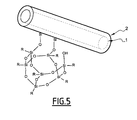
- the at least one nanotube of the layer of the flexible pipe may have the structure shown in the figure 5 attached.
- groups A selected from groups G as defined above, and especially from groups G 'as defined above.
- a halogen is selected from fluorine, bromine, iodine and chlorine, especially bromine, iodine and chlorine, preferably chlorine.
- a hydrocarbon chain preferably comprises from 1 to 10 carbon atoms, especially from 2 to 6 carbon atoms.
- the preferred hydrocarbon chains are alkyl groups (preferably having 1 to 10 carbon atoms, in particular 2 to 6), alkenyl (preferably 2 to 10 carbon atoms, in particular 2 to 6 carbon atoms), aryl (preferably having 6 to 10 carbon atoms), arylalkyl (preferably 7 to 10 carbon atoms) or alkylaryl (preferably 7 to 10 carbon atoms).
- the vinyl group is the preferred alkenyl group.
- the phenyl group is the preferred aryl.
- the alkyl groups preferably have 1 to 10 carbon atoms, especially 2 to 6.
- An alkoxyl group is a -O-alkyl group.
- step a) at least one covalent bond is formed between the polymer and the nanotube.
- FIG. 1 the reaction between a PVDF comprising functional side chains bearing anhydride groups with a nanotube bearing an OH group (A represents -OH) is represented in FIG. 1 below.
- a covalent bond of ester type is then formed between the nanotube and the polymer during the process according to the invention.
- the covalent bond capable of being formed between the group A carried by the alumino- or magnesiosilicate nanotube and the polymer is a siloxane bond.
- the polymer is a polyethylene having side chains having trialkoxysilane groups, for example of the Crossflex ® and the group A bears a hydroxyl, alkoxyl or trialkoxysilane (especially OSi (R 7) (R 8) (R 9) wherein R 7, R 8 and R 9 are as defined above)
- the method comprises a further step d) of curing the assembly obtained when step c).
- This crosslinking is generally carried out by placing said assembly in the presence of water (or moisture) at elevated temperatures, in particular from 85 to 99 ° C., preferably from 95 to 98 ° C., for example by immersion in the water. hot water or hot water circulation.
- the duration of step d) of crosslinking is variable, and depends in particular on the thickness of the layer comprising the polymer resin comprising the aluminosiloxes or magnesio-silicate nanotubes.
- step a) can in particular be carried out by melt mixing the polymer ("melt mixing" in English), by compounding, by extrusion, by reactive extrusion (that is to say by carrying out the steps a) and b) simultaneously). Except when step a) is carried out by reactive extrusion, the mixture of step a) can be used either as a masterbatch or a main matrix to form the layer comprising the polymeric resin.
- the polymer resin can be made using the usual material for preparing a polymer resin.
- no adaptation of the temperature during compounding, specific shear or exfoliation step is necessary during step a) according to the invention, unlike the method as described in WO 2008/113362 .
- step a) (and therefore the process according to the invention), is free of exfoliation step.
- step a) of the process when the mixture of the polymer and the at least one nanotube constitutes the main matrix, 1 to 10% by weight, preferably 2 to 5% by weight, of nanotubes are used relative to total weight of the mixture.
- the mass percentage of nanotubes in the polymer resin can reach 30% or even 50%.
- step a) of the process additives may be added, in particular those mentioned above.
- the method may include a chemical coupling step to form a covalent bond between said moiety and the functions of the polymer.
- the chemical coupling step may be catalyzed, in particular by heat, radiation and / or a catalyst.
- the esterification reaction between the hydroxyl function carried by a nanotube and the carboxylic acid function of a polymer may be catalyzed by a base. It is within the abilities of those skilled in the art to adapt the conditions of the chemical coupling (temperature, pressure, use of a catalyst, reaction time) to allow the creation of the covalent bond.
- the hydrolysis steps of alkoxysilane or trialkoxysilane groups to the above-mentioned silanol groups when the nanotube carries at least one trialkoxysilane or alkoxyl group and / or the polymer comprises trialkoxysilane groups may be catalyzed by an acid.
- the condensation step between the nanotube and the polymer to form a siloxane bond can be catalyzed by an acid, or even an acid and by heat.
- the process according to the invention may also comprise, before or simultaneously with step a), a step for preparing an aluminosilicate or magnesiosilicate nanotube bearing at least one group A as defined above, for example by grafting the a group bearing at least one group A as defined above on a commercial aluminosilicate or nanosilver nanotube (which is generally carrying -Si-OH groups, the hydroxyl function being capable of being grafted by a carrier group of at least less a group A as defined above by methods known to those skilled in the art, in particular described in RC Larock's Comprehensive Organic Transformations: A Guide to Functional Group Preparations , published by John Wiley & Sons Inc.).
- the polymer may also be prepared in step a).
- the peroxide initiator may especially be dicumyl peroxide or 1,1- (t-butylperoxy) 3,3,5-trimethylcyclohexane (Lupersol L231).
- the catalyst of the crosslinking reaction can in particular be dibutyl tin laurate (DBTL) or dioctyl tin laurate (DOTL).
- DBTL dibutyl tin laurate
- DTL dioctyl tin laurate
- DNL dioctyl tin laurate
- the antioxidant may especially be a hindered phenolic compound, such as Irganox ® compounds (Ciba-BASF) or Hostanox ® (Clariant).
- a hindered phenolic compound such as Irganox ® compounds (Ciba-BASF) or Hostanox ® (Clariant).
- the stabilizer can in particular be a hindered amine light stabilizer (HALS - "hindered amine light stabilizer”), such as Chimassorb ®, Tinuvin ® or Irgastab ® (Ciba-BASF).
- HALS hindered amine light stabilizer
- Chimassorb ® Tinuvin ®
- Irgastab ® Ciba-BASF
- the polyethylene mixture, the crosslinking reaction catalyst, the antioxidant and the stabilizer is a masterbatch for the polyethylene having side chains of the formula -CH 2 -CH 2 -Si (OR 10 ) (OR 11 ) (OR 12 ).
- the nanotubes bearing at least one hydroxyl, trialkoxysilane or alkoxyl group are preferably added during step a2) simultaneously or separately to the vinylsilane derivative. Indeed, it is generally preferred to avoid the addition of nanotube during step a3) to avoid a chemical reaction between the catalyst of the crosslinking reaction and the nanotube and therefore their degradation.
- step b) extrusion
- step c) assembly with other layers
- step d) crosslinking
- Step d) then comprises the above-mentioned hydrolysis step allowing the formation of the siloxane bonds.
- This first embodiment may also comprise, prior to step a 2 ), a step of preparing an aluminosilicate or magnesiosilicate nanotube bearing at least one group A as defined above.
- both the polymer and the at least one aluminosilicon or magnesium silicate nanotube bearing a hydroxyl, trialkoxysilane or alkoxyl group are formed in step a).
- step b) extrusion
- step c) assembly with other layers
- step d) crosslinking
- step a 2 during step a 2 ), there is competition between the two reactions 1) and 2), and this step a 2 ) is therefore generally more difficult to control than step a 2 ) of the first embodiment above. Therefore, when it is desired that the process includes both the preparation of the polymer and the at least one aluminosilane or magnesium silicate nanotube bearing a hydroxyl, trialkoxysilane or alkoxyl group, the first embodiment above comprising before step a 2 ) a step of preparing an alumino nanotube or Magnesiosilicate bearing at least one group A as defined above is preferred.
- step a) is carried out as described above. , replacing the nanotube with a nanotube comprising a chemical compound.
- the nanotube comprises only a group A capable of forming a covalent bond
- a polymer comprising a modified functional group whose molecular mass is increased is obtained.
- the nanotube When the nanotube has two groups A capable of forming a covalent bond, the nanotube can react with two distinct polymer chains, which makes it possible to increase the molecular weight of the polymer obtained.
- the nanotube When the nanotube has more than three A groups capable of forming a covalent bond, the nanotube can react with more than three distinct polymer chains, which makes it possible to increase the molecular weight of the polymer obtained and to create crosslinking points.
- the more the nanotube comprises A groups capable of forming a covalent bond the more the molecular weight of the polymer increases.
- the increase in the molecular weight and / or the number of crosslinking points makes it possible to reduce the mobility of the polymer chains with respect to one another and thus to obtain a polymer having improved thermomechanical properties.
- a submarine flexible pipe comprising such a polymer is therefore adapted to be used for the transport of fluids under high pressure and high temperature, especially hydrocarbons.
- Step b) extrusion can be performed by any method known to those skilled in the art.
- the resin obtained at the end of step a) is dried, typically in an oven at a temperature greater than 70 ° C., generally for several hours, for example four hours at 80 ° C., before feeding an extruder single-screw or twin-screw. It is also possible to use a reactive extruder and in this case steps a) and b) are simultaneous since the mixture between the nanotube (s) and the polymer and the extrusion are made in the same tool, or in a co-extruder method for producing a layer comprising a polymer resin comprising at least one nanotube chemically bonded covalently to the polymer.
- the layer comprising the resin obtained at the end of step b) is typically tubular, generally has a diameter of 50 mm to 600 mm, preferably 50 to 400 mm, a thickness of 1 mm to 150 mm, preferably 40 mm. at 100 mm and a length of 1 m to 10 km.
- the method comprises step c) assembling the layer obtained in step b) with at least one other layer to form the flexible underwater pipe, in particular with an outer polymeric sheath, a traction armor ply possibly a pressure vault, and possibly a metal carcass.
- the extrusion of the mixture obtained in step a) is carried out on another layer, typically the carcass, to obtain an assembly (carcass / layer of polymer resin comprising at least one nanotube chemically bonded to the polymer of covalently) which will then be reported and calendered with at least one other layer during step c), typically a pressure vault, tensile armor plies and an outer polymeric sheath.
- an assembly typically a pressure vault, tensile armor plies and an outer polymeric sheath.
- the extrusion of the mixture obtained in step a) is independent and the layer obtained at the end of step b) is then reported and calendered with at least one other layer during step c), typically a pressure vault, tensile armor plies and an outer polymeric sheath.
- step c typically a pressure vault, tensile armor plies and an outer polymeric sheath.
- API 17J The layers are assembled to form an unbonded flexible pipe in the English language, as described in the normative documents published by the American Petroleum Institute (API), API 17J and API RP 17B.
- the invention relates to the use of the aforesaid flexible pipe underwater for the transport of fluids, especially gas or liquids, preferably hydrocarbons.
- this pipe Due to the presence of the inner carcass 22, this pipe is said to passage not smooth ("rough bore” in English).
- the invention could also be applied to a so-called smooth-bore (English-speaking) pipe, having no internal carcass.
- the armor plies 12, 14 are obtained by long-pitch winding of a set of son of metal or composite material, of generally substantially rectangular section. The invention would also apply if these wires had a section of circular or complex geometry, of the type for example T auto-stapled. On the figure 1 only two armor plies 12 and 14 are shown, but the pipe could also have one or more additional pairs of armor.
- the armor ply 12 is called external because it is here the last, starting from the inside of the pipe, before the outer sealing sheath 10.
Landscapes
- Engineering & Computer Science (AREA)
- General Engineering & Computer Science (AREA)
- Mechanical Engineering (AREA)
- Health & Medical Sciences (AREA)
- Public Health (AREA)
- Water Supply & Treatment (AREA)
- Laminated Bodies (AREA)
- Rigid Pipes And Flexible Pipes (AREA)
- Compositions Of Macromolecular Compounds (AREA)
Claims (14)
- Flexible Unterwasserleitung für den Transport von Fluiden, insbesondere Kohlenwasserstoffe, umfassend eine Mehrzahl von Schichten, von denen mindestens eine Schicht ein Polymerharz umfasst, das mindestens ein Alumino- oder Magnesiumsilicat-Nanoröhrchen umfasst, welches an das Polymer durch kovalente Bindung chemisch gebunden ist.
- Flexible Unterwasserleitung nach Anspruch 1, bei der das Polymer und das mindestens eine Alumino- oder Magnesiumsilicat-Nanoröhrchen durch Bindung des Typs Ester, Amid, Amin, Ether, Thioether, Harnstoff, Imin, Imid, Sulfonamid, Carbamat, Phosphat, Siloxan, Silan oder Kohlenstoff-Kohlenstoff gebunden sind.
- Flexible Unterwasserleitung nach einem beliebigen der Ansprüche 1 bis 2, bei der das Polymer ein Polyamid, das gegebenenfalls funktionelle Seitenketten aufweist, ein Polyethylen, das funktionelle Seitenketten aufweist, oder ein Polyvinylidenfluorid, das funktionelle Seitenketten aufweist, ist.
- Flexible Unterwasserleitung nach einem beliebigen der Ansprüche 1 bis 3, bei der das mindestens eine Nanoröhrchen eine chemische Verbindung umfasst, die ausgewählt ist aus:- einem Antikorrosionsmittel, und/oder- einem CO2-, H2S-, O2- und/oder CH4-Sensor, und/oder- einem Antioxidationsmittel.
- Flexible Unterwasserleitung nach einem beliebigen der Ansprüche 1 bis 4, umfassend zusätzlich zu der Schicht, die ein Polymerharz umfasst, das mindestens ein Alumino- oder Magnesiumsilicat-Nanoröhrchen umfasst, welches an das Polymer durch kovalente Bindung chemisch gebunden ist, eine oder mehrere der folgenden Schichten:- eine äußere Polymerhülle und/oder- mindestens eine Schicht aus Zugarmierungen und/oder- gegebenenfalls ein Druckgewölbe und/oder- gegebenenfalls eine Metallkarkasse.
- Verfahren zum Herstellen einer flexiblen Unterwasserleitung nach einem beliebigen der Ansprüche 1 bis 5, folgende Schritte umfassend:a) Mischung eines Polymers und mindestens eines Alumino- oder Magnesiumsilicat-Nanoröhrchens, das ein Träger mindestens einer Gruppe A ist, die geeignet ist, eine kovalente Bindung mit dem Polymer zu bilden,b) Extrusion, um eine Schicht zu bilden, die das Harz umfasst,c) Zusammensetzen der bei Schritt b) erhaltenen Schicht mit mindestens einer anderen Schicht.
- Verfahren nach Anspruch 6, bei dem die Gruppe A ist:entweder eine Gruppe G ausgewählt aus- einer Gruppe, ausgewählt aus einem Halogen, -OH, -COOH, -NH2, -SH, -OSi(R7)(R8)(R9) und einem Alkoxyl und- einer linearen, verzweigten oder cyclischen, gesättigten, ungesättigten oder aromatischen Kohlenwasserstoffkette, substituiert mit einer oder mehreren Gruppen ausgewählt aus Hal, -CO-Hal, -OCO-Hal, -SO2-Hal, -COOH, -OH, -SH, -CN, -NCO, -OSi(R7)(R8)(R9),-CR1R2-Hal,
 - R7, R8 und R9 unabhängig OH, ein Alkyl oder ein Alkoxyl repräsentieren,- R1, R2 und R3 unabhängig H oder eine lineare, verzweigte oder cyclische, gesättigte, ungesättigte oder aromatische Kohlenwasserstoffkette repräsentieren, wobei diese selbst gegebenenfalls mit einer oder mehreren der Gruppen substituiert ist, die ausgewählt sind aus einem Halogen oder einer Gruppe -CO-Hal, -OCO-Hal, -SO2-Hal, -COOR4, -COR4, -CR4R5-Hal, -OR4, -SR4, -NR4R5, NR4COR5, -COR4NR5,-NR4-CO-NR5R6, -O-CO-NR4, -NR4-CO-OR5, -CN, - NO2, -NCO,
 - Hal ein Halogen, ausgewählt aus Chlor, Brom und lod darstellt,oder eine Gruppe -O-POSS, wobei POSS ein polyedrisches oligomeres Silsesquioxan ist:- der Formel (RSiO1,5)x, wobei:- x eine ganze Zahl größer oder gleich 6 und kleiner oder gleich 12 ist, und- R darstellt:- eine Gruppe G, wie sie oben definiert ist, oder- eine lineare, verzweigte oder cyclische, gesättigte, ungesättigte oder aromatische Kohlenwasserstoffkette,vorausgesetzt, dass die Gruppen R jeder Gruppe RSiO1,5 identisch oder unterschiedlich zueinander sein können und dass mindestens eine Gruppe R eine Gruppe G repräsentiert, oder- der Formel [(RSiO1,5)x'(XRSiO1,0)x"], wobei:- x' und x" unabhängig voneinander eine ganze Zahl repräsentieren, derart, dass die Summe von x' und x" größer oder gleich 6 undkleiner oder gleich 12 ist, und- R so ist, wie oben definiert, und- X eine Gruppe G repräsentiert, wie weiter oben definiert ist, die Gruppen X jeder Gruppe XRSiO1,0 identisch oder unterschiedlich zueinander und identisch oder unterschiedlich zu R sein können,vorausgesetzt, dass die benachbarten Gruppen A durch ein POSS aneinander gebunden werden können.
 - Verfahren nach Anspruch 7, bei dem die Gruppe A ausgewählt ist aus:- einer Gruppe G', ausgewählt aus einem Alkoxyl, -OH und-OSi(R7)(R8)(R9), wobei R7, R8 und R9 unabhängig OH, ein Alkyl oder ein Alkoxyl repräsentieren,
und- einer Gruppe O-POSS, wobei POSS ist:- der Formel (R'SiO1,5)x, wobei x eine ganze Zahl größer oder gleich 6 und kleiner oder gleich 12 repräsentiert und wobei R' repräsentiert:- eine Gruppe G', wie oben definiert, oder- eine lineare, verzweigte oder cyclische, gesättigte, ungesättigte oder aromatische Kohlenwasserstoffkette,vorausgesetzt, dass die Gruppen R' jeder Gruppe R'SiO1,5 identisch oder unterschiedlich zueinander sein können und dass mindestens eine Gruppe R' eine Gruppe G' repräsentiert, oder- der Formel [(R'SiO1,5)x'(G'R'SiO1,0)x"], wobei:- x' und x" unabhängig voneinander eine ganze Zahl mit x' ungleich 0 repräsentieren, derart, dass die Summe von x' und x" größer oder gleich 6 und kleiner oder gleich 12 ist, und- R' so ist, wie oben definiert, und- die Gruppen G' jeder Gruppe G'R'SiO1,0 identisch oder unterschiedlich zueinander und identisch zu oder unterschiedlich von R' sein können. - Verfahren nach Anspruch 8, bei dem die Gruppe A eine Gruppe G' ist, ausgewählt aus einem Alkoxyl, -OH und -OSi(R7)(R8)(R9), wobei R7, R8 und R9 unabhängig OH, ein Alkyl oder ein Alkoxyl repräsentieren.
- Verfahren nach einem beliebigen der Ansprüche 6 bis 9, bei dem:- das Polymer ein Polyamid ist, das gegebenenfalls funktionelle Seitenketten umfasst und das mindestens eine Nanoröhrchen ein Träger von mindestens einer Gruppe -OH, NH2 oder COOH ist,- das Polymer ein Polyethylen ist, das funktionelle Seitenketten mit Gruppen der Formel -Si-(OR10)(OR11)(OR12) umfasst, wobei R10, R11 und R12 unabhängig Alkylgruppen sind und das mindestens eine Nanoröhrchen Träger von mindestens einer Gruppe -OH,-OSi(R7)(R8)(R9) oder Alcoxyl ist, wobei R7, R8 und R9 unabhängig OH, ein Alkyl oder ein Alcoxyl darstellen, oder- das Polymer ein Polyvinylidenfluorid ist, das funktionelle Seitenketten mit Gruppen COOH oder Anhydrid umfasst und das mindestens eine Nanoröhrchen Träger mindestens einer Gruppe -OH ist.
- Verfahren nach einem beliebigen der Ansprüche 6 bis 10, umfassend einen nachfolgenden Schritt d), der Vernetzung der bei dem Schritt c) erhaltenen Anordnung, wenn die kovalente Bindung, die geeignet ist, zwischen der Gruppe A, die von dem Alumino- oder Magnesiumsilicat-Röhrchen getragen wird, und dem Polymer gebildet zu werden, eine Siloxanbindung ist.
- Verfahren nach einem beliebigen der Ansprüche 6 bis 11 zur Herstellung einer flexiblen Unterwasserleitung, umfassend mindestens eine Schicht, die ein Polyethylenpolymerharz umfasst, das Seitenketten der Formel -CH2-CH2-Si-(OR10)(OR11)(OR12) aufweist, wobei R10, R11 und R12 unabhängig Alkylgruppen sind, umfassend die Schritte:a1) Schmelzen eines Polyethylenpolymers,a2) Hinzufügen eines Vinylsilanderivats der Formel CH2=CH-Si-(OR10)(OR11)(OR12), eines Peroxidinitiators und mindestens eines Alumino- oder Magnesiumsilicat-Nanoröhrchens, welches Träger einer Hydroxyl-, Trialkoxylsilan- oder Alkoxylgruppe ist, um ein Polyethylen zu erhalten, das funktionelle Seitenketten aufweist,a3) Mischen eines Katalysators der Vernetzungsreaktion, gegebenenfalls ein Antioxidationsmittel und/oder ein Stabilisator, mit dem Polyethylen,b) Extrusion, um eine das Harz enthaltende Schicht zu bilden,c) Zusammensetzen der bei Schritt b) erhaltenen Schicht mit mindestens einer anderen Schicht,d) Vernetzung der Anordnung, die bei Schritt c) erhalten wird,unter der Voraussetzung, dass die Schritte a2, a3 und b) gleichzeitig durchgeführt werden können.
- Verwendung einer flexiblen Unterwasserleitung nach einem beliebigen der Ansprüche 1 bis 5 für den Transport von Fluiden.
- Verwendung nach Anspruch 13 für den Transport von Kohlenwasser-stoffen.
Applications Claiming Priority (2)
| Application Number | Priority Date | Filing Date | Title |
|---|---|---|---|
| FR1059735A FR2968060B1 (fr) | 2010-11-25 | 2010-11-25 | Conduite flexible sous marine comprenant une couche comprenant une resine polymere comprenant des nanotubes alumino- ou magnesiosilicate |
| PCT/EP2011/070914 WO2012069577A1 (fr) | 2010-11-25 | 2011-11-24 | Conduite flexible sous marine comprenant une couche comprenant une résine polymère comprenant des nanotubes alumino- ou magnésiosilicate |
Publications (2)
| Publication Number | Publication Date |
|---|---|
| EP2643154A1 EP2643154A1 (de) | 2013-10-02 |
| EP2643154B1 true EP2643154B1 (de) | 2014-11-05 |
Family
ID=44501673
Family Applications (1)
| Application Number | Title | Priority Date | Filing Date |
|---|---|---|---|
| EP11790933.3A Active EP2643154B1 (de) | 2010-11-25 | 2011-11-24 | Flexibler schlauch für den einsatz am meeresboden mit einer schicht aus einem polymer-harz mit aluminium- oder magnesium-silikat nano-röhrchen |
Country Status (8)
| Country | Link |
|---|---|
| US (1) | US9664311B2 (de) |
| EP (1) | EP2643154B1 (de) |
| AU (1) | AU2011333758B2 (de) |
| BR (1) | BR112013012942B1 (de) |
| DK (1) | DK2643154T3 (de) |
| FR (1) | FR2968060B1 (de) |
| MY (1) | MY156646A (de) |
| WO (1) | WO2012069577A1 (de) |
Families Citing this family (7)
| Publication number | Priority date | Publication date | Assignee | Title |
|---|---|---|---|---|
| FR2954451B1 (fr) * | 2009-12-21 | 2012-03-02 | Technip France | Conduite flexible sous-marine comprenant une couche comprenant une resine polyamide comprenant un silsesquioxane oligomerique polyedrique |
| JP2012131876A (ja) * | 2010-12-21 | 2012-07-12 | Bridgestone Corp | ゴム組成物及びそれを用いたタイヤ |
| KR20170099945A (ko) * | 2014-12-19 | 2017-09-01 | 솔베이 스페셜티 폴리머스 이태리 에스.피.에이. | 다층 관형 물품을 만드는 방법 |
| FR3050005B1 (fr) * | 2016-04-06 | 2018-05-04 | Technip France | Conduite sous-marine comprenant une gaine comprenant un homopolymere de polypropylene |
| CN106838494A (zh) * | 2017-04-07 | 2017-06-13 | 康红艳 | 一种连续柔性增强粘合型复合管 |
| FR3109195B1 (fr) * | 2020-04-08 | 2022-11-04 | Technip N Power SAS | Conduite sous-marine comprenant une gaine interne d’étanchéité |
| FR3123104B1 (fr) * | 2021-05-21 | 2023-09-22 | Technip N Power SAS | Conduite flexible sous-marine comprenant une couche anti-usure à base de polypropylène homopolymère |
Family Cites Families (14)
| Publication number | Priority date | Publication date | Assignee | Title |
|---|---|---|---|---|
| US4150099A (en) | 1974-11-19 | 1979-04-17 | Exxon Research & Engineering Co. | Synthetic halloysites |
| US5651976A (en) | 1993-06-17 | 1997-07-29 | The United States Of America As Represented By The Secretary Of The Navy | Controlled release of active agents using inorganic tubules |
| US5705191A (en) | 1995-08-18 | 1998-01-06 | The United States Of America As Represented By The Secretary Of The Navy | Sustained delivery of active compounds from tubules, with rational control |
| BR0308435B1 (pt) * | 2002-03-20 | 2013-12-17 | Processo para a produção de um tubo sob o mar não-ligado flexível | |
| GB2410308B (en) * | 2004-01-20 | 2008-06-25 | Uponor Innovation Ab | Multilayer pipe |
| US8567450B2 (en) * | 2005-01-12 | 2013-10-29 | Smart Pipe Company Lp | Methods and systems for in situ manufacture and installation of non-metallic high pressure pipe and pipe liners |
| FR2885672B1 (fr) | 2005-05-11 | 2007-06-22 | Technip France Sa | Conduite tubulaire flexible a gaine anti-usure |
| US7888419B2 (en) * | 2005-09-02 | 2011-02-15 | Naturalnano, Inc. | Polymeric composite including nanoparticle filler |
| JP2008105395A (ja) * | 2006-09-27 | 2008-05-08 | Denso Corp | 冷媒輸送用ホースおよびその製造方法 |
| WO2008113362A1 (en) | 2007-03-16 | 2008-09-25 | Nkt Flexibles I/S | A flexible pipe |
| FR2918081B1 (fr) * | 2007-06-27 | 2009-09-18 | Cabinet Hecke Sa | Procede d'impregnation de fibres continues par une matrice polymerique composite renfermant un polymere thermoplastique |
| FR2918067B1 (fr) * | 2007-06-27 | 2011-07-01 | Arkema France | Materiau composite comprenant des nanotubes disperses dans une matrice polymerique fluroree. |
| EP2389411A4 (de) * | 2009-01-20 | 2012-09-19 | Arkema Inc | Hochleistungskonnektoren |
| FR2956183B1 (fr) * | 2010-02-09 | 2012-03-16 | Technip France | Conduite flexible sous-marine comprenant une couche comprenant une resine polymere comprenant des nanoparticules de titane modifiees en surface |
-
2010
- 2010-11-25 FR FR1059735A patent/FR2968060B1/fr not_active Expired - Fee Related
-
2011
- 2011-11-24 WO PCT/EP2011/070914 patent/WO2012069577A1/fr not_active Ceased
- 2011-11-24 US US13/988,951 patent/US9664311B2/en active Active
- 2011-11-24 DK DK11790933.3T patent/DK2643154T3/en active
- 2011-11-24 AU AU2011333758A patent/AU2011333758B2/en active Active
- 2011-11-24 BR BR112013012942-5A patent/BR112013012942B1/pt active IP Right Grant
- 2011-11-24 EP EP11790933.3A patent/EP2643154B1/de active Active
- 2011-11-24 MY MYPI2013001888A patent/MY156646A/en unknown
Also Published As
| Publication number | Publication date |
|---|---|
| EP2643154A1 (de) | 2013-10-02 |
| FR2968060B1 (fr) | 2013-06-21 |
| FR2968060A1 (fr) | 2012-06-01 |
| AU2011333758A1 (en) | 2013-07-04 |
| BR112013012942B1 (pt) | 2020-12-29 |
| BR112013012942A2 (pt) | 2016-08-23 |
| MY156646A (en) | 2016-03-15 |
| US9664311B2 (en) | 2017-05-30 |
| AU2011333758B2 (en) | 2015-09-24 |
| US20130247996A1 (en) | 2013-09-26 |
| WO2012069577A1 (fr) | 2012-05-31 |
| DK2643154T3 (en) | 2015-02-16 |
Similar Documents
| Publication | Publication Date | Title |
|---|---|---|
| EP2516534B1 (de) | Flexibles unterwasserrohr mit einer schicht mit einem polymerharz mit einem polyedrischen oligomeren silsesquioxan | |
| EP2643154B1 (de) | Flexibler schlauch für den einsatz am meeresboden mit einer schicht aus einem polymer-harz mit aluminium- oder magnesium-silikat nano-röhrchen | |
| EP2098365B1 (de) | Mehrschichtgebilde aus Polyamide, enthaltend eine Schicht stabilisiert mit einem organischen Stabilisator und mindestens eine Schicht stabilisiert mit einem Stabilisator auf Grundlage von Kupfer | |
| EP1996831B1 (de) | Treibriemen und verfahren zu seiner herstellung | |
| WO2019129870A1 (fr) | Conduite flexible sous-marine comprenant une gaine externe multicouches | |
| FR3010082A1 (fr) | Procede de preparation d'une composition de polymeres fluores reticules | |
| EP2879875B2 (de) | Flexible unterwasserröhre mit einer inneren und/oder äusseren polymerverschlusshülle mit polyethylen von hohem molekulargewicht | |
| FR3010089A1 (fr) | Composition de polymeres fluores thermoplastiques pour les tubes off-shore | |
| EP2533973B1 (de) | Flexibles unterwasserrohr mit einer schicht mit einem polymerharz mit oberflächenmodifizierten titan-nanopartikeln | |
| EP3439870B1 (de) | Unterwasserrohrs mit einer ummantelung mit einem polypropylenblockcopolymers | |
| EP4359207B1 (de) | Thermoplastischer verbundschlauch zum transport von flüssigkeiten und flexibles rohr damit | |
| FR3109195A1 (fr) | Conduite sous-marine comprenant une gaine interne d’étanchéité | |
| EP3810967B1 (de) | Flexibles rohr zum eintauchen in ein gewässer, verfahren zu seiner herstellung und seine verwendung | |
| EP4676734A1 (de) | Unterwasserrohr mit einer inneren dichtungshülle aus polyaryletherketon | |
| FR3161008A1 (fr) | Conduite flexible sous-marine comprenant une couche polymérique intermédiaire à base de poly(éther de p-phénylène) | |
| EP3717237A1 (de) | Verwendung von pekk zur herstellung von teilen mit niedriger gasdurchlässigkeit |
Legal Events
| Date | Code | Title | Description |
|---|---|---|---|
| PUAI | Public reference made under article 153(3) epc to a published international application that has entered the european phase |
Free format text: ORIGINAL CODE: 0009012 |
|
| 17P | Request for examination filed |
Effective date: 20130521 |
|
| AK | Designated contracting states |
Kind code of ref document: A1 Designated state(s): AL AT BE BG CH CY CZ DE DK EE ES FI FR GB GR HR HU IE IS IT LI LT LU LV MC MK MT NL NO PL PT RO RS SE SI SK SM TR |
|
| DAX | Request for extension of the european patent (deleted) | ||
| GRAP | Despatch of communication of intention to grant a patent |
Free format text: ORIGINAL CODE: EPIDOSNIGR1 |
|
| INTG | Intention to grant announced |
Effective date: 20140602 |
|
| GRAS | Grant fee paid |
Free format text: ORIGINAL CODE: EPIDOSNIGR3 |
|
| GRAA | (expected) grant |
Free format text: ORIGINAL CODE: 0009210 |
|
| AK | Designated contracting states |
Kind code of ref document: B1 Designated state(s): AL AT BE BG CH CY CZ DE DK EE ES FI FR GB GR HR HU IE IS IT LI LT LU LV MC MK MT NL NO PL PT RO RS SE SI SK SM TR |
|
| REG | Reference to a national code |
Ref country code: GB Ref legal event code: FG4D Free format text: NOT ENGLISH |
|
| REG | Reference to a national code |
Ref country code: CH Ref legal event code: EP |
|
| REG | Reference to a national code |
Ref country code: AT Ref legal event code: REF Ref document number: 694372 Country of ref document: AT Kind code of ref document: T Effective date: 20141115 |
|
| REG | Reference to a national code |
Ref country code: IE Ref legal event code: FG4D Free format text: LANGUAGE OF EP DOCUMENT: FRENCH |
|
| REG | Reference to a national code |
Ref country code: DE Ref legal event code: R096 Ref document number: 602011011188 Country of ref document: DE Effective date: 20141224 |
|
| REG | Reference to a national code |
Ref country code: NL Ref legal event code: T3 |
|
| REG | Reference to a national code |
Ref country code: DK Ref legal event code: T3 Effective date: 20150209 |
|
| REG | Reference to a national code |
Ref country code: AT Ref legal event code: MK05 Ref document number: 694372 Country of ref document: AT Kind code of ref document: T Effective date: 20141105 |
|
| REG | Reference to a national code |
Ref country code: NO Ref legal event code: T2 Effective date: 20141105 Ref country code: LT Ref legal event code: MG4D |
|
| PG25 | Lapsed in a contracting state [announced via postgrant information from national office to epo] |
Ref country code: ES Free format text: LAPSE BECAUSE OF FAILURE TO SUBMIT A TRANSLATION OF THE DESCRIPTION OR TO PAY THE FEE WITHIN THE PRESCRIBED TIME-LIMIT Effective date: 20141105 Ref country code: IS Free format text: LAPSE BECAUSE OF FAILURE TO SUBMIT A TRANSLATION OF THE DESCRIPTION OR TO PAY THE FEE WITHIN THE PRESCRIBED TIME-LIMIT Effective date: 20150305 Ref country code: PT Free format text: LAPSE BECAUSE OF FAILURE TO SUBMIT A TRANSLATION OF THE DESCRIPTION OR TO PAY THE FEE WITHIN THE PRESCRIBED TIME-LIMIT Effective date: 20150305 Ref country code: FI Free format text: LAPSE BECAUSE OF FAILURE TO SUBMIT A TRANSLATION OF THE DESCRIPTION OR TO PAY THE FEE WITHIN THE PRESCRIBED TIME-LIMIT Effective date: 20141105 Ref country code: LT Free format text: LAPSE BECAUSE OF FAILURE TO SUBMIT A TRANSLATION OF THE DESCRIPTION OR TO PAY THE FEE WITHIN THE PRESCRIBED TIME-LIMIT Effective date: 20141105 |
|
| PG25 | Lapsed in a contracting state [announced via postgrant information from national office to epo] |
Ref country code: LV Free format text: LAPSE BECAUSE OF FAILURE TO SUBMIT A TRANSLATION OF THE DESCRIPTION OR TO PAY THE FEE WITHIN THE PRESCRIBED TIME-LIMIT Effective date: 20141105 Ref country code: HR Free format text: LAPSE BECAUSE OF FAILURE TO SUBMIT A TRANSLATION OF THE DESCRIPTION OR TO PAY THE FEE WITHIN THE PRESCRIBED TIME-LIMIT Effective date: 20141105 Ref country code: SE Free format text: LAPSE BECAUSE OF FAILURE TO SUBMIT A TRANSLATION OF THE DESCRIPTION OR TO PAY THE FEE WITHIN THE PRESCRIBED TIME-LIMIT Effective date: 20141105 Ref country code: AT Free format text: LAPSE BECAUSE OF FAILURE TO SUBMIT A TRANSLATION OF THE DESCRIPTION OR TO PAY THE FEE WITHIN THE PRESCRIBED TIME-LIMIT Effective date: 20141105 Ref country code: CY Free format text: LAPSE BECAUSE OF FAILURE TO SUBMIT A TRANSLATION OF THE DESCRIPTION OR TO PAY THE FEE WITHIN THE PRESCRIBED TIME-LIMIT Effective date: 20141105 Ref country code: RS Free format text: LAPSE BECAUSE OF FAILURE TO SUBMIT A TRANSLATION OF THE DESCRIPTION OR TO PAY THE FEE WITHIN THE PRESCRIBED TIME-LIMIT Effective date: 20141105 Ref country code: GR Free format text: LAPSE BECAUSE OF FAILURE TO SUBMIT A TRANSLATION OF THE DESCRIPTION OR TO PAY THE FEE WITHIN THE PRESCRIBED TIME-LIMIT Effective date: 20150206 Ref country code: PL Free format text: LAPSE BECAUSE OF FAILURE TO SUBMIT A TRANSLATION OF THE DESCRIPTION OR TO PAY THE FEE WITHIN THE PRESCRIBED TIME-LIMIT Effective date: 20141105 |
|
| REG | Reference to a national code |
Ref country code: DE Ref legal event code: R119 Ref document number: 602011011188 Country of ref document: DE |
|
| PG25 | Lapsed in a contracting state [announced via postgrant information from national office to epo] |
Ref country code: BE Free format text: LAPSE BECAUSE OF NON-PAYMENT OF DUE FEES Effective date: 20141130 |
|
| REG | Reference to a national code |
Ref country code: CH Ref legal event code: PL |
|
| PG25 | Lapsed in a contracting state [announced via postgrant information from national office to epo] |
Ref country code: LI Free format text: LAPSE BECAUSE OF NON-PAYMENT OF DUE FEES Effective date: 20141130 Ref country code: CZ Free format text: LAPSE BECAUSE OF FAILURE TO SUBMIT A TRANSLATION OF THE DESCRIPTION OR TO PAY THE FEE WITHIN THE PRESCRIBED TIME-LIMIT Effective date: 20141105 Ref country code: EE Free format text: LAPSE BECAUSE OF FAILURE TO SUBMIT A TRANSLATION OF THE DESCRIPTION OR TO PAY THE FEE WITHIN THE PRESCRIBED TIME-LIMIT Effective date: 20141105 Ref country code: CH Free format text: LAPSE BECAUSE OF NON-PAYMENT OF DUE FEES Effective date: 20141130 Ref country code: SK Free format text: LAPSE BECAUSE OF FAILURE TO SUBMIT A TRANSLATION OF THE DESCRIPTION OR TO PAY THE FEE WITHIN THE PRESCRIBED TIME-LIMIT Effective date: 20141105 |
|
| REG | Reference to a national code |
Ref country code: IE Ref legal event code: MM4A |
|
| PG25 | Lapsed in a contracting state [announced via postgrant information from national office to epo] |
Ref country code: MC Free format text: LAPSE BECAUSE OF FAILURE TO SUBMIT A TRANSLATION OF THE DESCRIPTION OR TO PAY THE FEE WITHIN THE PRESCRIBED TIME-LIMIT Effective date: 20141105 |
|
| PLBE | No opposition filed within time limit |
Free format text: ORIGINAL CODE: 0009261 |
|
| STAA | Information on the status of an ep patent application or granted ep patent |
Free format text: STATUS: NO OPPOSITION FILED WITHIN TIME LIMIT |
|
| 26N | No opposition filed |
Effective date: 20150806 |
|
| PG25 | Lapsed in a contracting state [announced via postgrant information from national office to epo] |
Ref country code: IE Free format text: LAPSE BECAUSE OF NON-PAYMENT OF DUE FEES Effective date: 20141124 Ref country code: DE Free format text: LAPSE BECAUSE OF NON-PAYMENT OF DUE FEES Effective date: 20150602 |
|
| REG | Reference to a national code |
Ref country code: FR Ref legal event code: PLFP Year of fee payment: 5 |
|
| PG25 | Lapsed in a contracting state [announced via postgrant information from national office to epo] |
Ref country code: IT Free format text: LAPSE BECAUSE OF FAILURE TO SUBMIT A TRANSLATION OF THE DESCRIPTION OR TO PAY THE FEE WITHIN THE PRESCRIBED TIME-LIMIT Effective date: 20141105 |
|
| PG25 | Lapsed in a contracting state [announced via postgrant information from national office to epo] |
Ref country code: SI Free format text: LAPSE BECAUSE OF FAILURE TO SUBMIT A TRANSLATION OF THE DESCRIPTION OR TO PAY THE FEE WITHIN THE PRESCRIBED TIME-LIMIT Effective date: 20141105 |
|
| PG25 | Lapsed in a contracting state [announced via postgrant information from national office to epo] |
Ref country code: SM Free format text: LAPSE BECAUSE OF FAILURE TO SUBMIT A TRANSLATION OF THE DESCRIPTION OR TO PAY THE FEE WITHIN THE PRESCRIBED TIME-LIMIT Effective date: 20141105 |
|
| PG25 | Lapsed in a contracting state [announced via postgrant information from national office to epo] |
Ref country code: RO Free format text: LAPSE BECAUSE OF FAILURE TO SUBMIT A TRANSLATION OF THE DESCRIPTION OR TO PAY THE FEE WITHIN THE PRESCRIBED TIME-LIMIT Effective date: 20141105 |
|
| PG25 | Lapsed in a contracting state [announced via postgrant information from national office to epo] |
Ref country code: BG Free format text: LAPSE BECAUSE OF FAILURE TO SUBMIT A TRANSLATION OF THE DESCRIPTION OR TO PAY THE FEE WITHIN THE PRESCRIBED TIME-LIMIT Effective date: 20141105 |
|
| PG25 | Lapsed in a contracting state [announced via postgrant information from national office to epo] |
Ref country code: TR Free format text: LAPSE BECAUSE OF FAILURE TO SUBMIT A TRANSLATION OF THE DESCRIPTION OR TO PAY THE FEE WITHIN THE PRESCRIBED TIME-LIMIT Effective date: 20141105 Ref country code: LU Free format text: LAPSE BECAUSE OF NON-PAYMENT OF DUE FEES Effective date: 20141124 Ref country code: MT Free format text: LAPSE BECAUSE OF FAILURE TO SUBMIT A TRANSLATION OF THE DESCRIPTION OR TO PAY THE FEE WITHIN THE PRESCRIBED TIME-LIMIT Effective date: 20141105 Ref country code: HU Free format text: LAPSE BECAUSE OF FAILURE TO SUBMIT A TRANSLATION OF THE DESCRIPTION OR TO PAY THE FEE WITHIN THE PRESCRIBED TIME-LIMIT; INVALID AB INITIO Effective date: 20111124 |
|
| REG | Reference to a national code |
Ref country code: FR Ref legal event code: PLFP Year of fee payment: 6 |
|
| REG | Reference to a national code |
Ref country code: FR Ref legal event code: PLFP Year of fee payment: 7 |
|
| PG25 | Lapsed in a contracting state [announced via postgrant information from national office to epo] |
Ref country code: MK Free format text: LAPSE BECAUSE OF FAILURE TO SUBMIT A TRANSLATION OF THE DESCRIPTION OR TO PAY THE FEE WITHIN THE PRESCRIBED TIME-LIMIT Effective date: 20141105 |
|
| PG25 | Lapsed in a contracting state [announced via postgrant information from national office to epo] |
Ref country code: AL Free format text: LAPSE BECAUSE OF FAILURE TO SUBMIT A TRANSLATION OF THE DESCRIPTION OR TO PAY THE FEE WITHIN THE PRESCRIBED TIME-LIMIT Effective date: 20141105 |
|
| P01 | Opt-out of the competence of the unified patent court (upc) registered |
Effective date: 20230516 |
|
| PGFP | Annual fee paid to national office [announced via postgrant information from national office to epo] |
Ref country code: NL Payment date: 20251028 Year of fee payment: 15 |
|
| PGFP | Annual fee paid to national office [announced via postgrant information from national office to epo] |
Ref country code: GB Payment date: 20251126 Year of fee payment: 15 |
|
| PGFP | Annual fee paid to national office [announced via postgrant information from national office to epo] |
Ref country code: NO Payment date: 20251028 Year of fee payment: 15 |
|
| PGFP | Annual fee paid to national office [announced via postgrant information from national office to epo] |
Ref country code: DK Payment date: 20251029 Year of fee payment: 15 |
|
| PGFP | Annual fee paid to national office [announced via postgrant information from national office to epo] |
Ref country code: FR Payment date: 20251127 Year of fee payment: 15 |