EP2653033A1 - Complexes antimicrobiens - Google Patents
Complexes antimicrobiens Download PDFInfo
- Publication number
- EP2653033A1 EP2653033A1 EP12398001.3A EP12398001A EP2653033A1 EP 2653033 A1 EP2653033 A1 EP 2653033A1 EP 12398001 A EP12398001 A EP 12398001A EP 2653033 A1 EP2653033 A1 EP 2653033A1
- Authority
- EP
- European Patent Office
- Prior art keywords
- ddab
- antimicrobial
- nanomaterial
- complex
- surfactant
- Prior art date
- Legal status (The legal status is an assumption and is not a legal conclusion. Google has not performed a legal analysis and makes no representation as to the accuracy of the status listed.)
- Withdrawn
Links
- 230000000845 anti-microbial effect Effects 0.000 title claims abstract description 105
- 239000002086 nanomaterial Substances 0.000 claims abstract description 70
- 239000004094 surface-active agent Substances 0.000 claims abstract description 67
- VYPSYNLAJGMNEJ-UHFFFAOYSA-N Silicium dioxide Chemical compound O=[Si]=O VYPSYNLAJGMNEJ-UHFFFAOYSA-N 0.000 claims abstract description 56
- 239000004599 antimicrobial Substances 0.000 claims abstract description 38
- OKTJSMMVPCPJKN-UHFFFAOYSA-N Carbon Chemical compound [C] OKTJSMMVPCPJKN-UHFFFAOYSA-N 0.000 claims abstract description 33
- 239000002105 nanoparticle Substances 0.000 claims abstract description 32
- 239000000377 silicon dioxide Substances 0.000 claims abstract description 27
- 239000002041 carbon nanotube Substances 0.000 claims abstract description 14
- 229910021393 carbon nanotube Inorganic materials 0.000 claims abstract description 12
- 239000003093 cationic surfactant Substances 0.000 claims abstract description 11
- 125000001453 quaternary ammonium group Chemical group 0.000 claims abstract description 10
- XRWMGCFJVKDVMD-UHFFFAOYSA-M didodecyl(dimethyl)azanium;bromide Chemical compound [Br-].CCCCCCCCCCCC[N+](C)(C)CCCCCCCCCCCC XRWMGCFJVKDVMD-UHFFFAOYSA-M 0.000 claims description 107
- 239000002109 single walled nanotube Substances 0.000 claims description 43
- 238000000576 coating method Methods 0.000 claims description 35
- 238000000034 method Methods 0.000 claims description 29
- 239000000725 suspension Substances 0.000 claims description 25
- 239000011248 coating agent Substances 0.000 claims description 18
- XJWSAJYUBXQQDR-UHFFFAOYSA-M dodecyltrimethylammonium bromide Chemical compound [Br-].CCCCCCCCCCCC[N+](C)(C)C XJWSAJYUBXQQDR-UHFFFAOYSA-M 0.000 claims description 14
- 239000000693 micelle Substances 0.000 claims description 13
- VIXPKJNAOIWFMW-UHFFFAOYSA-M dihexadecyl(dimethyl)azanium;bromide Chemical compound [Br-].CCCCCCCCCCCCCCCC[N+](C)(C)CCCCCCCCCCCCCCCC VIXPKJNAOIWFMW-UHFFFAOYSA-M 0.000 claims description 11
- SBHRWOBHKASWGU-UHFFFAOYSA-M tridodecyl(methyl)azanium;chloride Chemical compound [Cl-].CCCCCCCCCCCC[N+](C)(CCCCCCCCCCCC)CCCCCCCCCCCC SBHRWOBHKASWGU-UHFFFAOYSA-M 0.000 claims description 11
- 239000000853 adhesive Substances 0.000 claims description 10
- 230000001070 adhesive effect Effects 0.000 claims description 10
- PSLWZOIUBRXAQW-UHFFFAOYSA-M dimethyl(dioctadecyl)azanium;bromide Chemical compound [Br-].CCCCCCCCCCCCCCCCCC[N+](C)(C)CCCCCCCCCCCCCCCCCC PSLWZOIUBRXAQW-UHFFFAOYSA-M 0.000 claims description 10
- 230000000840 anti-viral effect Effects 0.000 claims description 9
- IRMGVPILCPGYNQ-UHFFFAOYSA-M dimethyl-di(tetradecyl)azanium;bromide Chemical compound [Br-].CCCCCCCCCCCCCC[N+](C)(C)CCCCCCCCCCCCCC IRMGVPILCPGYNQ-UHFFFAOYSA-M 0.000 claims description 9
- 241000588724 Escherichia coli Species 0.000 description 28
- 241000222122 Candida albicans Species 0.000 description 27
- 210000004027 cell Anatomy 0.000 description 20
- XLYOFNOQVPJJNP-UHFFFAOYSA-N water Chemical compound O XLYOFNOQVPJJNP-UHFFFAOYSA-N 0.000 description 20
- 241000894006 Bacteria Species 0.000 description 19
- 239000000243 solution Substances 0.000 description 16
- 238000004458 analytical method Methods 0.000 description 15
- 239000011521 glass Substances 0.000 description 15
- 238000002296 dynamic light scattering Methods 0.000 description 14
- 229920001817 Agar Polymers 0.000 description 13
- 239000008272 agar Substances 0.000 description 13
- 239000012153 distilled water Substances 0.000 description 12
- 239000000463 material Substances 0.000 description 12
- 239000002609 medium Substances 0.000 description 12
- 238000002360 preparation method Methods 0.000 description 12
- 241000233866 Fungi Species 0.000 description 11
- LOKCTEFSRHRXRJ-UHFFFAOYSA-I dipotassium trisodium dihydrogen phosphate hydrogen phosphate dichloride Chemical compound P(=O)(O)(O)[O-].[K+].P(=O)(O)([O-])[O-].[Na+].[Na+].[Cl-].[K+].[Cl-].[Na+] LOKCTEFSRHRXRJ-UHFFFAOYSA-I 0.000 description 11
- 230000000694 effects Effects 0.000 description 11
- 239000002953 phosphate buffered saline Substances 0.000 description 11
- IJGRMHOSHXDMSA-UHFFFAOYSA-N Atomic nitrogen Chemical compound N#N IJGRMHOSHXDMSA-UHFFFAOYSA-N 0.000 description 10
- 240000004808 Saccharomyces cerevisiae Species 0.000 description 10
- 238000000351 diffuse reflectance infrared Fourier transform spectroscopy Methods 0.000 description 10
- -1 poly(hyaluronic acid) Polymers 0.000 description 10
- 238000001179 sorption measurement Methods 0.000 description 10
- 235000010443 alginic acid Nutrition 0.000 description 9
- 229920000615 alginic acid Polymers 0.000 description 9
- 239000002245 particle Substances 0.000 description 9
- FHVDTGUDJYJELY-UHFFFAOYSA-N 6-{[2-carboxy-4,5-dihydroxy-6-(phosphanyloxy)oxan-3-yl]oxy}-4,5-dihydroxy-3-phosphanyloxane-2-carboxylic acid Chemical compound O1C(C(O)=O)C(P)C(O)C(O)C1OC1C(C(O)=O)OC(OP)C(O)C1O FHVDTGUDJYJELY-UHFFFAOYSA-N 0.000 description 8
- 229940072056 alginate Drugs 0.000 description 8
- 230000002401 inhibitory effect Effects 0.000 description 8
- 244000005700 microbiome Species 0.000 description 8
- 241000985514 Penicillium ochrochloron Species 0.000 description 7
- 150000002430 hydrocarbons Chemical group 0.000 description 7
- 239000000523 sample Substances 0.000 description 7
- 238000002411 thermogravimetry Methods 0.000 description 7
- 238000004627 transmission electron microscopy Methods 0.000 description 7
- 240000006439 Aspergillus oryzae Species 0.000 description 6
- OKKJLVBELUTLKV-UHFFFAOYSA-N Methanol Chemical compound OC OKKJLVBELUTLKV-UHFFFAOYSA-N 0.000 description 6
- HEMHJVSKTPXQMS-UHFFFAOYSA-M Sodium hydroxide Chemical compound [OH-].[Na+] HEMHJVSKTPXQMS-UHFFFAOYSA-M 0.000 description 6
- 241000700605 Viruses Species 0.000 description 6
- 239000000872 buffer Substances 0.000 description 6
- VYFYYTLLBUKUHU-UHFFFAOYSA-N dopamine Chemical compound NCCC1=CC=C(O)C(O)=C1 VYFYYTLLBUKUHU-UHFFFAOYSA-N 0.000 description 6
- 125000002887 hydroxy group Chemical group [H]O* 0.000 description 6
- 238000011534 incubation Methods 0.000 description 6
- 239000010410 layer Substances 0.000 description 6
- 238000002386 leaching Methods 0.000 description 6
- 238000005259 measurement Methods 0.000 description 6
- 229920000642 polymer Polymers 0.000 description 6
- 238000004626 scanning electron microscopy Methods 0.000 description 6
- 239000000126 substance Substances 0.000 description 6
- 238000005406 washing Methods 0.000 description 6
- 229910002808 Si–O–Si Inorganic materials 0.000 description 5
- 238000002835 absorbance Methods 0.000 description 5
- 230000000844 anti-bacterial effect Effects 0.000 description 5
- 230000000843 anti-fungal effect Effects 0.000 description 5
- 230000015572 biosynthetic process Effects 0.000 description 5
- 238000012512 characterization method Methods 0.000 description 5
- 238000003795 desorption Methods 0.000 description 5
- PCHJSUWPFVWCPO-UHFFFAOYSA-N gold Chemical compound [Au] PCHJSUWPFVWCPO-UHFFFAOYSA-N 0.000 description 5
- 239000002054 inoculum Substances 0.000 description 5
- 239000000203 mixture Substances 0.000 description 5
- 239000002048 multi walled nanotube Substances 0.000 description 5
- 229910052757 nitrogen Inorganic materials 0.000 description 5
- 238000001228 spectrum Methods 0.000 description 5
- XQVWYOYUZDUNRW-UHFFFAOYSA-N N-Phenyl-1-naphthylamine Chemical compound C=1C=CC2=CC=CC=C2C=1NC1=CC=CC=C1 XQVWYOYUZDUNRW-UHFFFAOYSA-N 0.000 description 4
- 239000011324 bead Substances 0.000 description 4
- 229910052799 carbon Inorganic materials 0.000 description 4
- 230000007423 decrease Effects 0.000 description 4
- KPUWHANPEXNPJT-UHFFFAOYSA-N disiloxane Chemical class [SiH3]O[SiH3] KPUWHANPEXNPJT-UHFFFAOYSA-N 0.000 description 4
- 229910052737 gold Inorganic materials 0.000 description 4
- 239000010931 gold Substances 0.000 description 4
- 230000005764 inhibitory process Effects 0.000 description 4
- 230000003993 interaction Effects 0.000 description 4
- 239000002122 magnetic nanoparticle Substances 0.000 description 4
- 125000002496 methyl group Chemical group [H]C([H])([H])* 0.000 description 4
- 230000003287 optical effect Effects 0.000 description 4
- 239000001965 potato dextrose agar Substances 0.000 description 4
- 230000008569 process Effects 0.000 description 4
- UCSJYZPVAKXKNQ-HZYVHMACSA-N streptomycin Chemical compound CN[C@H]1[C@H](O)[C@@H](O)[C@H](CO)O[C@H]1O[C@@H]1[C@](C=O)(O)[C@H](C)O[C@H]1O[C@@H]1[C@@H](NC(N)=N)[C@H](O)[C@@H](NC(N)=N)[C@H](O)[C@H]1O UCSJYZPVAKXKNQ-HZYVHMACSA-N 0.000 description 4
- 238000012360 testing method Methods 0.000 description 4
- UXVMQQNJUSDDNG-UHFFFAOYSA-L Calcium chloride Chemical compound [Cl-].[Cl-].[Ca+2] UXVMQQNJUSDDNG-UHFFFAOYSA-L 0.000 description 3
- 238000005033 Fourier transform infrared spectroscopy Methods 0.000 description 3
- WQZGKKKJIJFFOK-GASJEMHNSA-N Glucose Natural products OC[C@H]1OC(O)[C@H](O)[C@@H](O)[C@@H]1O WQZGKKKJIJFFOK-GASJEMHNSA-N 0.000 description 3
- 239000001888 Peptone Substances 0.000 description 3
- 108010080698 Peptones Proteins 0.000 description 3
- 239000007983 Tris buffer Substances 0.000 description 3
- 238000010521 absorption reaction Methods 0.000 description 3
- 239000000956 alloy Substances 0.000 description 3
- PNEYBMLMFCGWSK-UHFFFAOYSA-N aluminium oxide Inorganic materials [O-2].[O-2].[O-2].[Al+3].[Al+3] PNEYBMLMFCGWSK-UHFFFAOYSA-N 0.000 description 3
- 239000007864 aqueous solution Substances 0.000 description 3
- 125000004432 carbon atom Chemical group C* 0.000 description 3
- 238000005119 centrifugation Methods 0.000 description 3
- 239000008121 dextrose Substances 0.000 description 3
- 229960003638 dopamine Drugs 0.000 description 3
- 239000007850 fluorescent dye Substances 0.000 description 3
- 239000001307 helium Substances 0.000 description 3
- 229910052734 helium Inorganic materials 0.000 description 3
- SWQJXJOGLNCZEY-UHFFFAOYSA-N helium atom Chemical compound [He] SWQJXJOGLNCZEY-UHFFFAOYSA-N 0.000 description 3
- 125000001570 methylene group Chemical group [H]C([H])([*:1])[*:2] 0.000 description 3
- 239000011859 microparticle Substances 0.000 description 3
- 238000012986 modification Methods 0.000 description 3
- 230000004048 modification Effects 0.000 description 3
- 239000002071 nanotube Substances 0.000 description 3
- 235000019319 peptone Nutrition 0.000 description 3
- 229920001690 polydopamine Polymers 0.000 description 3
- 210000001236 prokaryotic cell Anatomy 0.000 description 3
- 230000003595 spectral effect Effects 0.000 description 3
- 239000008223 sterile water Substances 0.000 description 3
- 238000001757 thermogravimetry curve Methods 0.000 description 3
- LENZDBCJOHFCAS-UHFFFAOYSA-N tris Chemical compound OCC(N)(CO)CO LENZDBCJOHFCAS-UHFFFAOYSA-N 0.000 description 3
- 239000007222 ypd medium Substances 0.000 description 3
- CSCPPACGZOOCGX-UHFFFAOYSA-N Acetone Chemical compound CC(C)=O CSCPPACGZOOCGX-UHFFFAOYSA-N 0.000 description 2
- BTBUEUYNUDRHOZ-UHFFFAOYSA-N Borate Chemical compound [O-]B([O-])[O-] BTBUEUYNUDRHOZ-UHFFFAOYSA-N 0.000 description 2
- 108091003079 Bovine Serum Albumin Proteins 0.000 description 2
- CPELXLSAUQHCOX-UHFFFAOYSA-M Bromide Chemical compound [Br-] CPELXLSAUQHCOX-UHFFFAOYSA-M 0.000 description 2
- HEDRZPFGACZZDS-UHFFFAOYSA-N Chloroform Chemical compound ClC(Cl)Cl HEDRZPFGACZZDS-UHFFFAOYSA-N 0.000 description 2
- KRKNYBCHXYNGOX-UHFFFAOYSA-K Citrate Chemical compound [O-]C(=O)CC(O)(CC([O-])=O)C([O-])=O KRKNYBCHXYNGOX-UHFFFAOYSA-K 0.000 description 2
- 241001360526 Escherichia coli ATCC 25922 Species 0.000 description 2
- LFQSCWFLJHTTHZ-UHFFFAOYSA-N Ethanol Chemical compound CCO LFQSCWFLJHTTHZ-UHFFFAOYSA-N 0.000 description 2
- PXHVJJICTQNCMI-UHFFFAOYSA-N Nickel Chemical compound [Ni] PXHVJJICTQNCMI-UHFFFAOYSA-N 0.000 description 2
- 229930182555 Penicillin Natural products 0.000 description 2
- JGSARLDLIJGVTE-MBNYWOFBSA-N Penicillin G Chemical compound N([C@H]1[C@H]2SC([C@@H](N2C1=O)C(O)=O)(C)C)C(=O)CC1=CC=CC=C1 JGSARLDLIJGVTE-MBNYWOFBSA-N 0.000 description 2
- UIIMBOGNXHQVGW-UHFFFAOYSA-M Sodium bicarbonate Chemical compound [Na+].OC([O-])=O UIIMBOGNXHQVGW-UHFFFAOYSA-M 0.000 description 2
- 241000191967 Staphylococcus aureus Species 0.000 description 2
- PPBRXRYQALVLMV-UHFFFAOYSA-N Styrene Chemical compound C=CC1=CC=CC=C1 PPBRXRYQALVLMV-UHFFFAOYSA-N 0.000 description 2
- 230000001464 adherent effect Effects 0.000 description 2
- 125000000217 alkyl group Chemical group 0.000 description 2
- 229910045601 alloy Inorganic materials 0.000 description 2
- 150000001412 amines Chemical class 0.000 description 2
- 229940121375 antifungal agent Drugs 0.000 description 2
- 239000012298 atmosphere Substances 0.000 description 2
- 239000001110 calcium chloride Substances 0.000 description 2
- 229910001628 calcium chloride Inorganic materials 0.000 description 2
- 235000011148 calcium chloride Nutrition 0.000 description 2
- 229940095731 candida albicans Drugs 0.000 description 2
- 229940041514 candida albicans extract Drugs 0.000 description 2
- YCIMNLLNPGFGHC-UHFFFAOYSA-N catechol Chemical compound OC1=CC=CC=C1O YCIMNLLNPGFGHC-UHFFFAOYSA-N 0.000 description 2
- 239000002131 composite material Substances 0.000 description 2
- 230000021615 conjugation Effects 0.000 description 2
- 230000007547 defect Effects 0.000 description 2
- 238000001739 density measurement Methods 0.000 description 2
- 238000011161 development Methods 0.000 description 2
- 230000008034 disappearance Effects 0.000 description 2
- 230000009881 electrostatic interaction Effects 0.000 description 2
- 230000005284 excitation Effects 0.000 description 2
- 238000002474 experimental method Methods 0.000 description 2
- 239000012091 fetal bovine serum Substances 0.000 description 2
- 239000010408 film Substances 0.000 description 2
- 238000009472 formulation Methods 0.000 description 2
- 230000006870 function Effects 0.000 description 2
- 125000000524 functional group Chemical group 0.000 description 2
- 238000010438 heat treatment Methods 0.000 description 2
- 239000001257 hydrogen Substances 0.000 description 2
- 229910052739 hydrogen Inorganic materials 0.000 description 2
- 230000005923 long-lasting effect Effects 0.000 description 2
- 238000003760 magnetic stirring Methods 0.000 description 2
- 229910052751 metal Inorganic materials 0.000 description 2
- 239000002184 metal Substances 0.000 description 2
- 150000002739 metals Chemical class 0.000 description 2
- 230000003641 microbiacidal effect Effects 0.000 description 2
- 108010004563 mussel adhesive protein Proteins 0.000 description 2
- 229910001000 nickel titanium Inorganic materials 0.000 description 2
- 239000008188 pellet Substances 0.000 description 2
- 229940049954 penicillin Drugs 0.000 description 2
- 239000012071 phase Substances 0.000 description 2
- BASFCYQUMIYNBI-UHFFFAOYSA-N platinum Chemical compound [Pt] BASFCYQUMIYNBI-UHFFFAOYSA-N 0.000 description 2
- 238000001485 positron annihilation lifetime spectroscopy Methods 0.000 description 2
- 238000010926 purge Methods 0.000 description 2
- 238000001812 pycnometry Methods 0.000 description 2
- 238000006862 quantum yield reaction Methods 0.000 description 2
- 238000011160 research Methods 0.000 description 2
- 238000001338 self-assembly Methods 0.000 description 2
- 230000035945 sensitivity Effects 0.000 description 2
- 125000005372 silanol group Chemical group 0.000 description 2
- 239000001509 sodium citrate Substances 0.000 description 2
- NLJMYIDDQXHKNR-UHFFFAOYSA-K sodium citrate Chemical compound O.O.[Na+].[Na+].[Na+].[O-]C(=O)CC(O)(CC([O-])=O)C([O-])=O NLJMYIDDQXHKNR-UHFFFAOYSA-K 0.000 description 2
- 238000000527 sonication Methods 0.000 description 2
- 229960005322 streptomycin Drugs 0.000 description 2
- 239000000758 substrate Substances 0.000 description 2
- 230000004083 survival effect Effects 0.000 description 2
- 238000003786 synthesis reaction Methods 0.000 description 2
- 125000003396 thiol group Chemical group [H]S* 0.000 description 2
- 239000012137 tryptone Substances 0.000 description 2
- 239000012138 yeast extract Substances 0.000 description 2
- 241000228212 Aspergillus Species 0.000 description 1
- 235000002247 Aspergillus oryzae Nutrition 0.000 description 1
- 238000004438 BET method Methods 0.000 description 1
- OYPRJOBELJOOCE-UHFFFAOYSA-N Calcium Chemical compound [Ca] OYPRJOBELJOOCE-UHFFFAOYSA-N 0.000 description 1
- LZZYPRNAOMGNLH-UHFFFAOYSA-M Cetrimonium bromide Chemical compound [Br-].CCCCCCCCCCCCCCCC[N+](C)(C)C LZZYPRNAOMGNLH-UHFFFAOYSA-M 0.000 description 1
- 229910000531 Co alloy Inorganic materials 0.000 description 1
- 229920002307 Dextran Polymers 0.000 description 1
- CTENFNNZBMHDDG-UHFFFAOYSA-N Dopamine hydrochloride Chemical compound Cl.NCCC1=CC=C(O)C(O)=C1 CTENFNNZBMHDDG-UHFFFAOYSA-N 0.000 description 1
- 239000006144 Dulbecco’s modified Eagle's medium Substances 0.000 description 1
- 241000192125 Firmicutes Species 0.000 description 1
- 238000004566 IR spectroscopy Methods 0.000 description 1
- 229930040373 Paraformaldehyde Natural products 0.000 description 1
- 241000228143 Penicillium Species 0.000 description 1
- 229920002873 Polyethylenimine Polymers 0.000 description 1
- 229920001710 Polyorthoester Chemical class 0.000 description 1
- FOIXSVOLVBLSDH-UHFFFAOYSA-N Silver ion Chemical compound [Ag+] FOIXSVOLVBLSDH-UHFFFAOYSA-N 0.000 description 1
- 238000003917 TEM image Methods 0.000 description 1
- 229910001069 Ti alloy Inorganic materials 0.000 description 1
- ATJFFYVFTNAWJD-UHFFFAOYSA-N Tin Chemical compound [Sn] ATJFFYVFTNAWJD-UHFFFAOYSA-N 0.000 description 1
- RTAQQCXQSZGOHL-UHFFFAOYSA-N Titanium Chemical compound [Ti] RTAQQCXQSZGOHL-UHFFFAOYSA-N 0.000 description 1
- 102000004142 Trypsin Human genes 0.000 description 1
- 108090000631 Trypsin Proteins 0.000 description 1
- AFCNCLZXEBACDZ-UHFFFAOYSA-M [C].[Br-].C(CCCCCCCCCCC)[N+](C)(C)CCCCCCCCCCCC Chemical compound [C].[Br-].C(CCCCCCCCCCC)[N+](C)(C)CCCCCCCCCCCC AFCNCLZXEBACDZ-UHFFFAOYSA-M 0.000 description 1
- YJZATOSJMRIRIW-UHFFFAOYSA-N [Ir]=O Chemical class [Ir]=O YJZATOSJMRIRIW-UHFFFAOYSA-N 0.000 description 1
- HZEWFHLRYVTOIW-UHFFFAOYSA-N [Ti].[Ni] Chemical compound [Ti].[Ni] HZEWFHLRYVTOIW-UHFFFAOYSA-N 0.000 description 1
- 239000002253 acid Substances 0.000 description 1
- 150000003926 acrylamides Chemical class 0.000 description 1
- 150000001252 acrylic acid derivatives Chemical class 0.000 description 1
- 230000002776 aggregation Effects 0.000 description 1
- 238000004220 aggregation Methods 0.000 description 1
- 239000000783 alginic acid Substances 0.000 description 1
- 229960001126 alginic acid Drugs 0.000 description 1
- 150000004781 alginic acids Chemical class 0.000 description 1
- 125000003277 amino group Chemical group 0.000 description 1
- 230000002141 anti-parasite Effects 0.000 description 1
- 229940088710 antibiotic agent Drugs 0.000 description 1
- 238000002802 antimicrobial activity assay Methods 0.000 description 1
- 229940125687 antiparasitic agent Drugs 0.000 description 1
- 239000003096 antiparasitic agent Substances 0.000 description 1
- 239000003443 antiviral agent Substances 0.000 description 1
- 229940121357 antivirals Drugs 0.000 description 1
- 238000013459 approach Methods 0.000 description 1
- 239000008346 aqueous phase Substances 0.000 description 1
- 239000007900 aqueous suspension Substances 0.000 description 1
- 244000052616 bacterial pathogen Species 0.000 description 1
- 230000009286 beneficial effect Effects 0.000 description 1
- 230000004071 biological effect Effects 0.000 description 1
- 238000002815 broth microdilution Methods 0.000 description 1
- 230000001680 brushing effect Effects 0.000 description 1
- 229910052791 calcium Inorganic materials 0.000 description 1
- 239000011575 calcium Substances 0.000 description 1
- 239000000648 calcium alginate Substances 0.000 description 1
- 235000010410 calcium alginate Nutrition 0.000 description 1
- 229960002681 calcium alginate Drugs 0.000 description 1
- OKHHGHGGPDJQHR-YMOPUZKJSA-L calcium;(2s,3s,4s,5s,6r)-6-[(2r,3s,4r,5s,6r)-2-carboxy-6-[(2r,3s,4r,5s,6r)-2-carboxylato-4,5,6-trihydroxyoxan-3-yl]oxy-4,5-dihydroxyoxan-3-yl]oxy-3,4,5-trihydroxyoxane-2-carboxylate Chemical compound [Ca+2].O[C@@H]1[C@H](O)[C@H](O)O[C@@H](C([O-])=O)[C@H]1O[C@H]1[C@@H](O)[C@@H](O)[C@H](O[C@H]2[C@H]([C@@H](O)[C@H](O)[C@H](O2)C([O-])=O)O)[C@H](C(O)=O)O1 OKHHGHGGPDJQHR-YMOPUZKJSA-L 0.000 description 1
- 125000003178 carboxy group Chemical group [H]OC(*)=O 0.000 description 1
- 238000004113 cell culture Methods 0.000 description 1
- 239000006285 cell suspension Substances 0.000 description 1
- 239000004568 cement Substances 0.000 description 1
- 239000000919 ceramic Substances 0.000 description 1
- 229910010293 ceramic material Inorganic materials 0.000 description 1
- 229960001927 cetylpyridinium chloride Drugs 0.000 description 1
- YMKDRGPMQRFJGP-UHFFFAOYSA-M cetylpyridinium chloride Chemical compound [Cl-].CCCCCCCCCCCCCCCC[N+]1=CC=CC=C1 YMKDRGPMQRFJGP-UHFFFAOYSA-M 0.000 description 1
- RLGQACBPNDBWTB-UHFFFAOYSA-N cetyltrimethylammonium ion Chemical compound CCCCCCCCCCCCCCCC[N+](C)(C)C RLGQACBPNDBWTB-UHFFFAOYSA-N 0.000 description 1
- 239000003795 chemical substances by application Substances 0.000 description 1
- 239000000788 chromium alloy Substances 0.000 description 1
- UOUJSJZBMCDAEU-UHFFFAOYSA-N chromium(3+);oxygen(2-) Chemical class [O-2].[O-2].[O-2].[Cr+3].[Cr+3] UOUJSJZBMCDAEU-UHFFFAOYSA-N 0.000 description 1
- 239000011247 coating layer Substances 0.000 description 1
- 229910052681 coesite Inorganic materials 0.000 description 1
- 230000001332 colony forming effect Effects 0.000 description 1
- 238000010668 complexation reaction Methods 0.000 description 1
- 150000001875 compounds Chemical class 0.000 description 1
- 229920001577 copolymer Polymers 0.000 description 1
- 238000005859 coupling reaction Methods 0.000 description 1
- 229910052906 cristobalite Inorganic materials 0.000 description 1
- 239000013078 crystal Substances 0.000 description 1
- 230000003247 decreasing effect Effects 0.000 description 1
- 230000008021 deposition Effects 0.000 description 1
- QQJDHWMADUVRDL-UHFFFAOYSA-N didodecyl(dimethyl)azanium Chemical compound CCCCCCCCCCCC[N+](C)(C)CCCCCCCCCCCC QQJDHWMADUVRDL-UHFFFAOYSA-N 0.000 description 1
- 238000010790 dilution Methods 0.000 description 1
- 239000012895 dilution Substances 0.000 description 1
- 238000007598 dipping method Methods 0.000 description 1
- 239000002270 dispersing agent Substances 0.000 description 1
- 239000006185 dispersion Substances 0.000 description 1
- 229960001149 dopamine hydrochloride Drugs 0.000 description 1
- 239000003814 drug Substances 0.000 description 1
- 229940079593 drug Drugs 0.000 description 1
- 238000001035 drying Methods 0.000 description 1
- 229910000701 elgiloys (Co-Cr-Ni Alloy) Inorganic materials 0.000 description 1
- 238000011067 equilibration Methods 0.000 description 1
- 230000001747 exhibiting effect Effects 0.000 description 1
- 239000010419 fine particle Substances 0.000 description 1
- 239000000499 gel Substances 0.000 description 1
- 239000001963 growth medium Substances 0.000 description 1
- WIHZLLGSGQNAGK-UHFFFAOYSA-N hafnium(4+);oxygen(2-) Chemical class [O-2].[O-2].[Hf+4] WIHZLLGSGQNAGK-UHFFFAOYSA-N 0.000 description 1
- 238000001864 heat-flux differential scanning calorimetry Methods 0.000 description 1
- 230000002779 inactivation Effects 0.000 description 1
- 238000010348 incorporation Methods 0.000 description 1
- 208000037797 influenza A Diseases 0.000 description 1
- 229910052909 inorganic silicate Inorganic materials 0.000 description 1
- 238000011835 investigation Methods 0.000 description 1
- 229910000457 iridium oxide Inorganic materials 0.000 description 1
- 238000011031 large-scale manufacturing process Methods 0.000 description 1
- 125000005647 linker group Chemical group 0.000 description 1
- 238000011068 loading method Methods 0.000 description 1
- 238000004519 manufacturing process Methods 0.000 description 1
- 230000001404 mediated effect Effects 0.000 description 1
- 238000002844 melting Methods 0.000 description 1
- 230000008018 melting Effects 0.000 description 1
- 150000002734 metacrylic acid derivatives Chemical class 0.000 description 1
- 150000001247 metal acetylides Chemical class 0.000 description 1
- FQPSGWSUVKBHSU-UHFFFAOYSA-N methacrylamide Chemical class CC(=C)C(N)=O FQPSGWSUVKBHSU-UHFFFAOYSA-N 0.000 description 1
- 239000003988 mussel adhesive protein Substances 0.000 description 1
- 229910052759 nickel Inorganic materials 0.000 description 1
- HLXZNVUGXRDIFK-UHFFFAOYSA-N nickel titanium Chemical compound [Ti].[Ti].[Ti].[Ti].[Ti].[Ti].[Ti].[Ti].[Ti].[Ti].[Ti].[Ni].[Ni].[Ni].[Ni].[Ni].[Ni].[Ni].[Ni].[Ni].[Ni].[Ni].[Ni].[Ni].[Ni] HLXZNVUGXRDIFK-UHFFFAOYSA-N 0.000 description 1
- 150000004767 nitrides Chemical class 0.000 description 1
- 231100001083 no cytotoxicity Toxicity 0.000 description 1
- 238000000424 optical density measurement Methods 0.000 description 1
- 150000001282 organosilanes Chemical class 0.000 description 1
- SOQBVABWOPYFQZ-UHFFFAOYSA-N oxygen(2-);titanium(4+) Chemical class [O-2].[O-2].[Ti+4] SOQBVABWOPYFQZ-UHFFFAOYSA-N 0.000 description 1
- RVTZCBVAJQQJTK-UHFFFAOYSA-N oxygen(2-);zirconium(4+) Chemical class [O-2].[O-2].[Zr+4] RVTZCBVAJQQJTK-UHFFFAOYSA-N 0.000 description 1
- 229920002866 paraformaldehyde Polymers 0.000 description 1
- 238000005192 partition Methods 0.000 description 1
- 230000002688 persistence Effects 0.000 description 1
- 238000005191 phase separation Methods 0.000 description 1
- 230000000704 physical effect Effects 0.000 description 1
- 229910052697 platinum Inorganic materials 0.000 description 1
- 239000002745 poly(ortho ester) Chemical class 0.000 description 1
- 229920000867 polyelectrolyte Polymers 0.000 description 1
- 229920000728 polyester Chemical class 0.000 description 1
- 229920000570 polyether Chemical class 0.000 description 1
- 238000006116 polymerization reaction Methods 0.000 description 1
- 229920001296 polysiloxane Chemical class 0.000 description 1
- 229920002635 polyurethane Chemical class 0.000 description 1
- 238000012545 processing Methods 0.000 description 1
- 239000000047 product Substances 0.000 description 1
- 238000011002 quantification Methods 0.000 description 1
- 238000004445 quantitative analysis Methods 0.000 description 1
- 230000009257 reactivity Effects 0.000 description 1
- 230000009467 reduction Effects 0.000 description 1
- 238000001878 scanning electron micrograph Methods 0.000 description 1
- 238000001350 scanning transmission electron microscopy Methods 0.000 description 1
- 239000013545 self-assembled monolayer Substances 0.000 description 1
- 238000013207 serial dilution Methods 0.000 description 1
- 229910001285 shape-memory alloy Inorganic materials 0.000 description 1
- 235000012239 silicon dioxide Nutrition 0.000 description 1
- 238000004513 sizing Methods 0.000 description 1
- 235000017557 sodium bicarbonate Nutrition 0.000 description 1
- 229910000030 sodium bicarbonate Inorganic materials 0.000 description 1
- 239000002904 solvent Substances 0.000 description 1
- 239000007921 spray Substances 0.000 description 1
- 238000001694 spray drying Methods 0.000 description 1
- 239000010935 stainless steel Substances 0.000 description 1
- 229910001220 stainless steel Inorganic materials 0.000 description 1
- 229910052682 stishovite Inorganic materials 0.000 description 1
- 150000003440 styrenes Chemical class 0.000 description 1
- 239000006228 supernatant Substances 0.000 description 1
- 229920001059 synthetic polymer Polymers 0.000 description 1
- 229910052715 tantalum Inorganic materials 0.000 description 1
- GUVRBAGPIYLISA-UHFFFAOYSA-N tantalum atom Chemical compound [Ta] GUVRBAGPIYLISA-UHFFFAOYSA-N 0.000 description 1
- 238000002076 thermal analysis method Methods 0.000 description 1
- 239000010409 thin film Substances 0.000 description 1
- 239000010936 titanium Substances 0.000 description 1
- 229910052719 titanium Inorganic materials 0.000 description 1
- OGIDPMRJRNCKJF-UHFFFAOYSA-N titanium oxide Inorganic materials [Ti]=O OGIDPMRJRNCKJF-UHFFFAOYSA-N 0.000 description 1
- 238000004448 titration Methods 0.000 description 1
- 230000001988 toxicity Effects 0.000 description 1
- 231100000419 toxicity Toxicity 0.000 description 1
- 230000009466 transformation Effects 0.000 description 1
- 230000007704 transition Effects 0.000 description 1
- 229910052905 tridymite Inorganic materials 0.000 description 1
- 239000012588 trypsin Substances 0.000 description 1
- 239000001974 tryptic soy broth Substances 0.000 description 1
- 108010050327 trypticase-soy broth Proteins 0.000 description 1
- 239000011882 ultra-fine particle Substances 0.000 description 1
- 238000002525 ultrasonication Methods 0.000 description 1
- 238000002460 vibrational spectroscopy Methods 0.000 description 1
- 230000003612 virological effect Effects 0.000 description 1
- 229910001928 zirconium oxide Inorganic materials 0.000 description 1
Images





Classifications
-
- A—HUMAN NECESSITIES
- A01—AGRICULTURE; FORESTRY; ANIMAL HUSBANDRY; HUNTING; TRAPPING; FISHING
- A01N—PRESERVATION OF BODIES OF HUMANS OR ANIMALS OR PLANTS OR PARTS THEREOF; BIOCIDES, e.g. AS DISINFECTANTS, AS PESTICIDES OR AS HERBICIDES; PEST REPELLANTS OR ATTRACTANTS; PLANT GROWTH REGULATORS
- A01N33/00—Biocides, pest repellants or attractants, or plant growth regulators containing organic nitrogen compounds
- A01N33/02—Amines; Quaternary ammonium compounds
- A01N33/12—Quaternary ammonium compounds
-
- A—HUMAN NECESSITIES
- A01—AGRICULTURE; FORESTRY; ANIMAL HUSBANDRY; HUNTING; TRAPPING; FISHING
- A01N—PRESERVATION OF BODIES OF HUMANS OR ANIMALS OR PLANTS OR PARTS THEREOF; BIOCIDES, e.g. AS DISINFECTANTS, AS PESTICIDES OR AS HERBICIDES; PEST REPELLANTS OR ATTRACTANTS; PLANT GROWTH REGULATORS
- A01N25/00—Biocides, pest repellants or attractants, or plant growth regulators, characterised by their forms, or by their non-active ingredients or by their methods of application, e.g. seed treatment or sequential application; Substances for reducing the noxious effect of the active ingredients to organisms other than pests
- A01N25/30—Biocides, pest repellants or attractants, or plant growth regulators, characterised by their forms, or by their non-active ingredients or by their methods of application, e.g. seed treatment or sequential application; Substances for reducing the noxious effect of the active ingredients to organisms other than pests characterised by the surfactants
Definitions
- the present invention relates to antimicrobial complexes and methods of their preparation, and, in particular to an antimicrobial complex comprising a nanomaterial and a surfactant.
- Antimicrobial-nanomaterial complexes and suspensions thereof can be used to form antimicrobial coatings with particular utility in industrial settings.
- antimicrobial coatings have received increasing attention in recent years, due to the need to prevent propagation of microbes on surfaces.
- the preparation of antimicrobial coatings for industrial purposes represents a particular challenge, due to the broad spectrum of antimicrobial activity required, the varying dimensions of the surfaces to be coated, as well as the different materials to which the surface coatings must be applied.
- antimicrobial coatings should preferably be versatile, easy and relatively inexpensive to produce, and exhibit long-lasting antimicrobial characteristics.
- Non-leaching surfaces are often considered preferable, because microbes are exposed to high surface concentrations of the antimicrobial agent compared with slow release surfaces.
- Known non-leaching antimicrobial coatings and preparation methodologies suffer from a number of drawbacks, however.
- surfactants can be complexed with nanomaterials, to form antimicrobial nanomaterial complexes which exhibit effective antimicrobial activity and which address some of the disadvantages of the prior art materials.
- an antimicrobial nanomaterial complex comprising a surfactant and a nanomaterial.
- the surfactant functions as an antimicrobial agent.
- surfactants are known to possess antibacterial properties, the activity of these surfactants is relatively low, making them generally unsuitable for use as antimicrobial agents due to the significantly high loading that would be required in order to obtain a useful surface-coating material.
- mild antibacterial activity has been demonstrated, surfactants are not known to exhibit broad spectrum antimicrobial activity.
- the applicant has surprisingly discovered that when an antimicrobial surfactant is complexed with a nanomaterial, significantly lower minimal inhibitory concentration is exhibited compared with the soluble surfactant alone.
- the lower minimal inhibitory concentration of antimicrobial surfactants in the nanomaterial complexes mean that surfactants can be effectively employed in the formation of antimicrobial preparations and coatings.
- MIC minimum inhibitory concentration
- antimicrobial agent as used herein is taken to mean a substance that kills (microbicidal) or inhibits (microbistatic) the growth of microorganisms.
- antimicrobial agent thus encompasses antibacterials, antivirals, antifungals and antiparasitics.
- the antimicrobial nanomaterial complex may be a broad-spectrum antimicrobial complex and may have antibacterial, antiviral and antifungal activity.
- the antimicrobial nanomaterial complex is antiviral.
- the surfactant may be attached to the nanomaterial by any conventional means of attachment that allows the surfactant to be presented at the surface of the nanomaterial.
- the surfactant may be adsorbed or immobilized on the surface of the nanomaterial.
- the surfactant may be coated on the surface of the nanomaterial and may interact electrostatically with the nanomaterial surface.
- the surfactant is attached directly to the nanomaterial in the complex or conjugate and is not attached to the nanomaterial by means of a linker molecule, such as a polymer.
- the surfactant may be an amphiphilic polycation.
- the surfactant may be single-chained or multi-chained.
- the surfactant may be single-chained, di-chained or tri-chained.
- the chains may be of variable chain length.
- the surfactant may include at least one hydrocarbon chain comprising between 12 and 20 carbon atoms.
- the surfactant may include at least one hydrocarbon chain comprising 12, 14, 16 or 18 carbon atoms.
- the amphiphilic polycation is a quaternary ammonium cationic surfactant.
- the quaternary ammonium cationic surfactant may be selected from the group consisting of dodecyltrimethylammonium bromide (DTAB), didodecyldimethylammonium bromide (DDAB), tridodecylmethylammonium chloride (TMAC), ditetradecyldimethylammonium bromide (DTDAB), dihexadecyldimethylammonium bromide (DHDAB) and dioctadecyldimethylammonium bromide (DODAB).
- DTAB dodecyltrimethylammonium bromide
- DDAB didodecyldimethylammonium bromide
- TMAC tridodecylmethylammonium chloride
- DTDAB ditetradecyldimethylammonium bromide
- DHDAB dihexa
- nanomaterial as used herein is taken to mean materials comprising particles having one or more dimensions at the nanometre scale and preferably those particles having one or more dimensions of 1 to 500 nm.
- nanomaterial encompasses materials having both ultrafine particles (1 to 100 nm) and fine particles from 100 to 500 nm.
- the nanomaterial may be a nanoparticle (NP).
- NP nanoparticle
- Suitable nanoparticles for use in the complexes of the invention include, but are not limited to gold nanoparticles, silver nanoparticles, silica nanoparticles and organic nanoparticles such as poly(lactic acid-coglycolic acid), polyethyleneimine, chytosan and poly(hyaluronic acid).
- the nanoparticle is a silica nanoparticle (SNP).
- SNP silica nanoparticle
- Silica nanoparticles are particularly advantageous for the formation of stable antimicrobial complexes due to the non-cytotoxicity, low price, high stability, durability, and ease of modification by organosilane chemistry allowing the incorporation of an array of different functional groups.
- Nanoparticles for immobilization in the complex can be of any suitable diameter.
- the average diameter of the nanoparticles can be from 2 to 500 nm; from 10 to 400 nm; from 20 to 290 nm.
- the average diameter of the nanoparticle can be 100 nm or below, or from 20 to 100 nm.
- the nanomaterial may be a carbon nanotube (CNT).
- Carbon nanotubes are promising for the formation of antimicrobial complexes because they are known to possess inherent antimicrobial properties ( Kang et al. 'Single-walled carbon nanotubes exhibit strong antimicrobial activity' Langmuir 2007 (23) 8670- 8673 ).
- Carbon nanotubes for immobilization in the complex may be of any suitable diameter and length.
- the average diameter of the nanotubes can be from 0.8 to 500 nm.
- the average diameter may be about 1.5 nm.
- the average length can be from 50 nm to 10 ⁇ m.
- the carbon nanotube may be a single-walled (SWCNT) or multi-walled nanotube (MWCNT).
- SWCNT single-walled
- MWCNT multi-walled nanotube
- single-walled nanotubes are preferred as they are known to exhibit mild antimicrobial activity.
- multi-walled carbon nanotubes which are less expensive, may be preferred.
- CMC critical micelle concentration
- a solution of surfactant is mixed with a suspension of the nanomaterial and allowed to complex. After complexation, the mixture is centrifuged to wash away unconjugated surfactant.
- the method of the invention therefore represents an easy and low-cost route to the preparation of antimicrobial complexes.
- an amphiphilic polycation and preferably a quaternary ammonium cationic surfactant, can be used in the preparation of an antimicrobial complex.
- the nanomaterial can be a silica nanoparticle or a carbon nanotube.
- an antimicrobial complex as described above as an antimicrobial coating.
- the complex may be utilised in the form of a suspension of the nanomaterial complex in any suitable solution.
- a method of preparing an object with an antimicrobial coating comprising coating at least one surface or part of a surface of the object with an antimicrobial complex as described herein.
- the at least one surface or part of a surface of the device or material can be coated by any suitable means known in the art such as, for example, spray-drying, brushing or dipping.
- the at least one surface or part of a surface is treated with an adhesive prior to coating. Treating the surface with an adhesive prior to coating can ensure efficient immobilization of the antimicrobial nanoparticle complex.
- the adhesive may be a chemical adhesive.
- the adhesive is formed by a polyelectrolyte of opposite charge to the antimicrobial nanomaterial complex which is adsorbed or chemically reacted with the substrate.
- assembly of the nanoparticles into large-area uniform thin films can be achieved by layer-by-layer techniques such as described in Lee D et al.' Multilayers of oppositely charged SiO2 nanoparticles: Effect of surface charge on multilayer assembly', Langmuir 2007, 23, 8833-8837 .
- the adhesive is formed by nanoparticles of opposite charge to the antimicrobial nanomaterial conjugate. These nanoparticles can interact with the substrate by electrostatic interactions and physically immobilize the antimicrobial nanomaterial complexes of opposite charge.
- the adhesive is a chemical adhesive formed by polydopamine.
- Dopamine a biomolecule that contains catechol and amine functional groups, found also in high concentration in mussel adhesive proteins, polymerizes at alkaline pHs to form thin adherent polydopamine films that exhibit latent reactivity toward amine and thiol groups ( Lee H et al., 'Facile conjugation of biomolecules onto surfaces via mussel adhesive protein inspired coatings': Advanced Materials 2009, 21, 431 ).
- the method of the invention can be used to apply an antimicrobial coating to any suitable surface such as, for example, metals ceramics, polymers, fibres and glass.
- suitable metals include, for example, titanium and titanium alloys such as nitinol, nickel-titanium alloys and thermo-memory alloy materials; stainless steel; tantalum; nickel-chrome alloys and cobalt alloys such as cobalt-chromium alloys Elgiloy® and Phynox®.
- Suitable ceramic materials include, for example, oxides, carbides or nitrides of the transition elements such as titanium oxides, hafnium oxides, iridium oxides, chromium oxides, aluminium oxides and zirconium oxides.
- Suitable polymers include styrene and substituted styrenes, ethylene, propylene, poly(urethanes), acrylates, methacrylates, acrylamides, methacrylamides, polyesters, polysiloxanes, polyethers, poly(orthoester), poly(carbonates), poly(hydroxylalkanoates), and copolymers thereof. Attachment of the antimicrobial nanomaterial complex to a surface using an adhesive lends the method of the invention versatility as specific surface chemistries are not required. The method therefore has broad utility, and is particularly useful in industrial settings where a wide variety of materials and objects require antimicrobial protection.
- Surfaces which may be coated can be in the form of films, particles, beads and fibres.
- an object with an antimicrobial coating obtainable by the method as described herein.
- the antimicrobial nanomaterial complex is a surfactant-SNP complex.
- the antimicrobial nanomaterial complex is a quaternary ammonium cationic surfactant-SNP complex.
- the quaternary ammonium cationic surfactant preferably has two carbon chains.
- the antimicrobial nanomaterial complex is a DDAB-SNP complex.
- the antimicrobial nanomaterial is a surfactant-CNT complex.
- the antimicrobial nanomaterial complex is a quaternary ammonium cationic surfactant-CNT complex.
- the quaternary ammonium cationic surfactant preferably has two carbon chains.
- the antimicrobial nanomaterial complex is a DDAB-CNT complex.
- the nanomaterial is a SWCNT.
- the nanomaterial may be a MWCNT.
- the antimicrobial nanomaterial complex is a DDAB-SWCNT complex.
- the complexed nanomaterials can be encapsulated in order to control their spatial location in surfaces. This can be beneficial, for example, to minimise the cost of expensive nanomaterials such as carbon nanotubes while maintaining the surfactant at the surface of a coating material.
- the nanomaterial complexes can be encapsulated in a bead or a carrier.
- the nanomaterial complexes can be encapsulated in alginate beads.
- magnetic nanoparticles can be incorporated in the encapsulated product to direct the spatial location of the complex by use of a magnet.
- the invention is directed to antimicrobial complexes comprising nanomaterials complexed with surfactants.
- DDAB-SNP didodecyldimethylammonium bromide-silica nanoparticle complex
- DDAB-CNT didodecyldimethylammonium bromide- carbon nanotube complex
- silica nanoparticles of 5 nm (SNP5) and 80 nm (SNP80) in diameter were purchased from Eka Chemicals AB (Bohus, Sweden) and PlasmaChem GmbH (Berlin, Germany), respectively.
- the nanoparticles were characterised prior to conjugation by scanning electron microscopy, transmission electron microscopy and dynamic light scattering as detailed below. The specific surface area and the density of the particles were also determined.
- SNP size was determined using dynamic light scattering (DLS) via Zeta PALS Zeta Potential Analyzer and ZetaPlus Particle Sizing Software, v. 2.27 (Brookhaven Instruments Corporation). An aliquot (20 ⁇ l) of SNPs suspended in water (2 mg/ml) was added to 2 ml of PBS pH 7.4, vortexed and sonicated. All sizing measurements were performed at ca. 25°C, and all data were recorded at 90°C, with an equilibration time of 5 min. and individual run times of 60s (5 runs per measurement). The average diameters are number-weighted, and were collected from 3 independent measurements. The zeta potential of the previous SNP suspensions was recorded in at least 6 runs with a relative residual value (measure of data fit quality) of 0.03.
- DLS dynamic light scattering
- the specific surface area was assessed on an ASAP 2000 instrument, using the BET isotherm model with a relative pressure range of 0.05 - 0.15.
- Density of the nanoparticles was measured using helium pycnometry.
- Table 1 SNP5 SNP80 Diameter (nm) [SEM/TEM] 5.0 ⁇ 2.0 58.3 ⁇ 3.8 Diameter (nm) [DLS] 7.5 ⁇ 1.7 78.9 ⁇ 12.6 Specific Surface Area (m 2 g -1 ) [BET method] 293.0 ⁇ 3.4 218.5 ⁇ 68 Density (g/cm 3 ) [helium pycometry] 2.18 1.20 Table 1: Characterisation of bare SNP
- SNP5 were found by DLS to have a diameter of 7.5 ⁇ 1.7 nm, corresponding to a diameter of 5.0 ⁇ 2.0 by SEM.
- SNP80 were found by DLS to have a diameter of 78.9 ⁇ 12.6 nm, corresponding to a diameter of 58.3 ⁇ 3.8 by TEM.
- BET analysis established a surface area of 293.0 ⁇ 3.4 m 2 g -1 for SNP5 and a surface area of 218.5 ⁇ 68 m 2 g -1 for SNP80.
- the densities of the SNPs were 2.18 g/cm 3 (SNP5) and 1.20 g/cm 3 (SNP80) measured by helium pycnometry.
- CMC Critical Micelle Concentration
- the surfactants tested were:
- the surfactants were dissolved in PBS (pH 7.4), serially diluted and mixed with N-phenyl-1-naphthylamine (NPN; TCI).
- NPN N-phenyl-1-naphthylamine
- the fluorescence of each sample was quantified (excitation at 350 nm; emission at 420 nm) and plotted against the concentration of each surfactant.
- the CMC was found at the intersection of two straight lines traced on the emission intensity plot, defining the aqueous and micellar environments.
- the CMC values for the tested surfactants are given in Table 2 below.
- Example 3 Antimicrobial activity of quaternary ammonium cationic surfactants
- quaternary ammonium cationic surfactants were tested against fungi and bacteria in order to determine the minimal inhibitory concentration.
- the surfactants tested were single-chained (DTAB), di-chained (DDAB) and tri-chained (TMAC), having 12-C length hydrocarbon chains.
- DTAB single-chained
- DDAB di-chained
- TMAC tri-chained
- dialkyldimethylammonium bromide surfactants with variable chain lengths including 12 (DDAB), 14 (DTAB), 16 (DHDAB) and 18 (DODAB) carbon atoms were tested. These surfactants are shown in Figure 2 .
- Candida albicans ATCC 10231 C. albicans, fungi
- Staphylococcus aureus ATCC 6538 S. aureus, gram-positive bacteria
- Escherichia coli ATCC 25922 Escherichia coli ATCC 25922
- Inoculum corresponds to prokaryotic cells incubated without surfactants. The samples were prepared in a 96-well plate and incubated for 18 h at 30°C (fungi) or 37°C (bacteria) with constant shaking in a Biotek Synergy Mx spectrophotometer.
- DDAB was chosen for further investigation. SNPs were mixed with aqueous solutions of DDAB at different concentrations and pHs, for varying lengths of time to facilitate absorption. Concentrations of DDAB above its CMC (32.4 ⁇ g/ml, example 2 above) were tested (i.e. 200, 500, 1000 and 2000 ⁇ g/ml for DDAB 50 -SNP, DDAB 125 -SNP, DDAB 250 -SNP and DDAB 500 -SNP, respectively).
- the concentrations used were 50, 125, 250 and 500 ⁇ g of DDAB per mg of SNPs (suspension of 5%, w/v) and therefore per 0.293 m 2 or 0.218 m 2 in case of SNP5 and SNP80, respectively (taking into account the surface areas of 293.0 ⁇ 3.4 m 2 g -1 and 218.5 ⁇ 68 m 2 g -1 for SNP5 and SNP80, respectively).
- aqueous suspensions of SNP5 or SNP80 (5% w/v, in (i) distilled water; (ii) 0.1M citrate/sodium citrate buffer pH 3.0 and (iii) 0.1M borate/NaOH buffer pH 9.0) were added to an aqueous solution of DDAB (50, 125, 250 and 500 ⁇ g per mg of SNPs), for variable time (30 min, 1 h, or 3 h), under vigorous magnetic stirring (800 rpm) at room temperature.
- DDAB 50, 125, 250 and 500 ⁇ g per mg of SNPs
- the suspension of the SNPs was centrifuged (30 min, 40,000 rpm for SNP5; 20 min, 10,000 rpm for SNP80), washed two times with distilled water and finally freeze-dried.
- aqueous solutions of DDAB i.e. without SNPs, forming vesicles with an average diameter of 57 nm and a zeta potential of 17.11 ⁇ 2.15 mV centrifuged at the same velocities, did not form a pellet.
- the adsorption of DDAB to SNPs was determined by conventional and high resolution modulated Thermogravimetric Analysis (TGA).
- the thermal behavior of the samples was evaluated by simultaneous thermal analysis (STA; heat-flux DSC and TGA), by using a TA Instruments SDT Q600 equipment (thermobalance sensitivity: 0.1 ⁇ g), which was previously calibrated in the range 25-1000 °C by running tin and lead as melting standards, at a heating rate of 10 °C min -1 , using open alumina crucibles and a dry nitrogen purge flow of 100 ml min -1 .
- the mass loss measured in the temperature range from 200 to 350°C was used to calculate the percentage of surfactant adsorbed to a certain mass of SNPs.
- the mass loss process was further studied in detail by high-resolution modulated thermogravimetric analysis (HiRes-M-TGA) in a TA Instruments Q500 thermogravimetric apparatus (thermobalance sensitivity: 0.1 ⁇ g).
- HiRes-M-TGA high-resolution modulated thermogravimetric analysis
- the temperature calibration was performed in the range 25-1000 °C by measuring the Curie point of nickel standard. Open platinum crucibles and a dry nitrogen purge flow of 100 ml min -1 were used.
- the experiments were performed under a dynamic rate mode with a (maximum) heating rate of 2 °C min -1 , a modulation period of 200 s, and a temperature amplitude of ⁇ 5 °C.
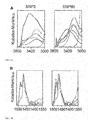
- SNP5 was found to immobilize between 57 and 210 ⁇ g of DDAB per mg of SNP, while SNP80 was found to immobilize between 45 to 275 ⁇ g of the conjugate per mg of SNP ( Fig. 4A ).
- the amount of surfactant physically adsorbed onto SNP5 is higher than on SNP80, while the opposite was observed when an initial concentration of DDAB of 500 ⁇ g was used per mg of silica (see below).
- the derivatives of the TGA plots of DDAB-SNP80 samples indicate the presence of three major peaks at 160-170°C, 190-200°C and 210-230°C ( Fig. 4B ).
- the first peak at 160-170°C is attributed to desorption of monomeric DDAB molecules, whose hydrocarbon chains are partially inserted in the bilayer;
- the second peak at 190-200°C is ascribed to desorption of the DDAB molecules in the outer layer of the DDAB bilayer coated on SNPs;
- the third peak at 210-230°C is related to desorption of the DDAB molecules bonded to the SNPs ( Nikoobakht et al.
- the derivatives of the TGA plots in DDAB-SNP5 indicate the presence of two major peaks: the first one between 150°C and 195°C, and the second one between 218°C and 255°C ( Fig. 4B ).
- the first peak is likely attributed to desorption of DDAB molecules in the outer layer of the bilayer coated on SNPs, while the second peak due to the desorption of DDAB bonded to the SNPs.
- the differences between the temperatures of the peaks in DDAB-SNP5 and DDAB-SNP80 samples are likely due to differences in the curvature of the nanoparticles and in the interactions of DDAB chains among them and with the silica nanoparticles.
- Figure 5A shows the influence of pH on the physical immobilization of DDAB onto SNP80.
- the size and the zeta potentials of the SNPs were evaluated.
- Figure 5B shows the influence of SNP size on the physical immobilization of DDAB onto SNPs.
- Figure 5C shows the influence of time on the physical immobilization of DDAB onto SNPs.
- Diffuse Reflectance Infrared Fourier Transform Spectroscopy (DRIFT) analysis was carried out.
- DRIFT analysis of lyophilized DDAB vesicles and of the bare and DDAB-coated SNPs was performed using a Mattson RS1 FTIR spectrometer with a Specac Selector, in the 400-4000 cm -1 range (wide band MCT detector), at 4 cm -1 resolution.
- the spectra were the result of 500 co-added scans for each sample, ratioed against the same number of scans for the background (ground KBr, FTIR grade from Aldrich).
- the ⁇ as Si-O-Si band was decomposed into a sum of four Gaussian functions by a nonlinear least squares fitting method, assuming that the elementary SiO 4 units are arranged mostly in (SiO) 4 and (SiO) 6 siloxane rings ( Fidalgo et al. 'Chemical tailoring of porous silica xerogels: Local structure by vibrational spectroscopy'. Chem. Eur. J. 2004 (10) 392-398 ) and that in each type of ring this mode is split into a pair of optic components (longitudinal, LO, and transverse, TO).
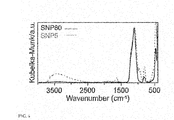
- the SNP5 are considerably more hydrophilic, since their spectrum evidences strong ⁇ Si-O (dangling from broken siloxane bridges or in silanol groups) and vO-H bands, at 960 and centered at 3300 cm -1 , respectively, and also some adsorbed water ( ⁇ HOH band, at 1630 cm -1 ). These bands are extremely weak (vO-H and ⁇ HOH) or even absent ( ⁇ Si-O d ) in the spectrum of SNP80. Therefore, the SNP80 have a considerably lower content of surface hydroxyl groups.
- the broad vO-H band for SNP5 also indicates that the hydroxyl and/or silanol groups are involved in a variety of hydrogen bonds, suggesting that some aggregation between particles may occur. These features are unlikely to occur in SNP80. Both samples have a small proportion of free OH groups, which are more significant in SNP80.
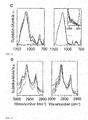
- FIG. 7 illustrates DRIFT analysis of DDAB-SNP.
- SNPs are shown by 1, DDAB vesicles by 2, DDAB 50 -SNP by 3, DDAB 125 -SNP by 4, DDAB 250 -SNP by 5 and DDAB 500 -SNP by 6.
- A O-H stretching region, normalized to the main silica band;
- B CH deformation region, normalized to the ⁇ sc CH 2 mode;
- C silica fingerprint region;
- D C-H stretching region, normalized to the ⁇ as CH 2 band.
- a significant shift of the ⁇ as CH 2 to a higher wavenumber for DDAB 50 -SNP5 and DDAB 50 -SNP80 was observed when compared to DDAB vesicles (from 2920 to 2927 and 2928 cm -1 , respectively) and a more subtle shift for the ⁇ s CH 2 band (from 2852 to 2856 and 2858 cm -1 , respectively). These shifts decrease when increasing the DDAB load, and become within the spectral resolution for samples DDAB 500 -SNP5 and DDAB 500 -SNP80.
- the relative intensity of the ⁇ s CH 2 band (2854 cm -1 ) is smaller for those DDAB chains with more gauche defects adsorbed on SNPs.
- the relative intensity of the ⁇ as CH 3 band ( ⁇ 2953 cm -1 ) is higher for all the coated SNPs than for DDAB vesicles, but it decreases as the surfactant concentration increases, indicating that the terminal methyl groups lose some freedom as the first layer becomes denser and the bilayer is formed ( Cheng et al. 'Synthesis and Self-assembly of Cetyltrimethylammonium Bromide-capped Gold Nanoparticles' Langmuir 2003 (19) 9434-9439 ).
- sample DDAB 500 -SNP5 which is consistent with some vesicles forming at the surface of aggregated silica particles, resulting in less confined terminal methyl groups.
- the ratio 250 ⁇ g of DDAB per mg of SNPs was selected (SNP-DDAB 250 ) for further experiments.
- Example 7 Immobilization of -DDAB-SNP onto a surface
- the coverslips were dried and covered with a suspension of SNP5 or DDAB 250 -SNP5 (20 ⁇ l each, 5 mg/ml in 10 mM Tris buffer pH 8.5), dried and immersed in 0.5 ml Tris buffer overnight. This process was repeated three times. The washing water was analysed by DLS via Zeta PALS Zeta Potential Analyzer in order to assess the number of particles removed from the surface (given by the counts per second). It was possible to immobilise 222.8 and 243.9 ⁇ g/cm 2 of SNP5 and DDAB 250 -SNP5, respectively. Because no amine or sulfhydryl groups exist in DDAB 250 -SNP5, ⁇ - ⁇ interactions and hydrogen bonding likely mediate the immobilization of SNPs to the polydopamine-coated surface.
- SNP5 or SNP80 coated with DDAB were tested in suspension against C . albicans, Aspergillus oryzae ATCC 46244 ( A. oryzae ; mold), Penicillium ochrochloron ATCC 9112 ( P. ochrochloron ; mold), S. aureus (bacteria gram-positive) and E. coli (bacteria gram-negative).
- Yeast Peptone Dextrose (YPD) and Tryptone Soy Yeast (TSY) media were used to culture yeast and bacteria, respectively.
- DDAB 250 -SNP5 or DDAB 250 -SNP80 suspended in culture medium was added to (i) 1ml YPD media containing 1 ⁇ 10 5 cells of C. albicans, (ii) 1 ml TSY medium containing 1 ⁇ 10 6 cells of E . Coli or S. Aureus, or (iii) 1ml water containing 1 ⁇ 10 5 cells /ml of A oryzae or P . ochrochloron spores. Cells were incubated for 6 h at 30°C (fungi) or 37°C (bacteria) with orbital shaking (150 rpm).
- MICs Minimum inhibitory concentrations
- suspensions of spores from Aspergillus or Penicillium were prepared from grown cultures on Potato Dextrose Agar (PDA) plates at 30°C.
- PDA Potato Dextrose Agar
- DDAB 250 -SNP80 suspended in sterile distilled water 500 ⁇ g/ml was incubated with a suspension of spores (1 ⁇ 10 5 spores/ml, in sterile distilled water) for 6 h, at 150 rpm and 30°C.
- an aliquot of the medium was serially diluted in sterile distilled water and plated on PDA plates (3.3% potato dextrose broth, 1.1% agar). The plates were then incubated at 30°C and CFU counted after 3 days and compared with the controls (SNP5 or SNP80) and the inoculum (spores without SNP).
- the particle suspension (3 mg/ml) was centrifuged (20 min, 14,000 rpm) after the previous antimicrobial activity assay and the SNPs resuspended in YPD medium containing C . albicans (1 ⁇ 10 5 cells/ml), TSY medium containing S . aureus or E. coli (1 ⁇ 10 6 cells/ml), or distilled water containing spores (1 ⁇ 10 6 spores of A. oryzae or P. ochrochloron). The suspension was incubated in an orbital shaker for 6 h at 30°C (fungi and molds) or 37°C (bacteria) and the number of CFU was determined as described above.
- SNP5 or SNP80 without physically adsorbed DDAB showed no significant antifungal activity.
- SNPs incorporating DDAB killed 100% of the microorganisms.
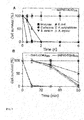
- SNP5 or SNP80 modified with DDAB can be reused for 5 times (maximum number of rounds tested) without losing their activity against C. albicans, S. aureus, A. oryzae and P. ochrochloron.
- SNP80-DDAB 250 lost their activity against E. coli at the 3 rd round ( Fig. 8A ).
- the MIC for SNP5-DDAB 250 against C . albicans, S. aureus, and E. coli was 25, 12.5 and 500 ⁇ g/ml, respectively, while for SNP80-DDAB 250 was 50, 25 and above 1000 ⁇ g/ml (Table 4).
- coated SNP5 formulations have 4.5, 2.2 and 89.1 ⁇ g of DDAB, while SNP80 have 9.7, 4.9 and 194.4 ⁇ g of DDAB, respectively (Table 4).
- the MIC values of SNPs coated with DDAB are much below the MIC of DDAB solutions ( C. albicans : 125 ⁇ g/ml; S . aureus 31.25 ⁇ g/ml; E . coli : 125 ⁇ g/ml).
- SNP80-DDAB 250 were incubated in YPD or TSY mediums or distilled water for 6 h, centrifuged and the supernatant collected and tested against microorganisms. Limited killing was observed (below 25%) suggesting that antimicrobial activity of the SNPs is mainly mediated by contact ( Fig. 8B ).
- DDAB 250 -SNP80 The antimicrobial activity of DDAB 250 -SNP80 over time was evaluated as follows. Samples of DDAB 250 -SNP80 (1 mg/ml) were maintained in 0.1 M citrate/sodium citrate buffer pH 3.0, PBS pH 7.4, 0.1 M borate/NaOH buffer pH 9.0 and YPD medium for 60 days. The buffers and the YPD medium were changed every 3 days. For that purpose, SNPs were centrifuged at 14,000 rpm for 20 min, and the buffer/medium replaced by a new one. After 60 days, the SNPs were centrifuged (same conditions as before), washed with distilled water, and freeze-dried before testing antifungal activity with C .
- DDAB 250 -SNP80 killed 100% of C. albicans while SNP80 without DDAB showed no antifungal activity.
- Example 10 Antimicrobial activity of SNPs and SNP-DDAB coated on glass coverslips
- the antimicrobial activity due to the leaching of the SNPs was evaluated by washing the glass coverslips (sterilized for 30 min under UV light) coated with SNP5 and SNP5-DDAB 250 for 6 h with 1 ml of YPD (at 30 °C) or TSY (at 37 °C), under orbital shaking (150 rpm).
- the washing medium was tested against 1 ⁇ 10 5 C. albicans cells, 1 ⁇ 10 6 E. coli or S. aureus cells.
- No measureable antimicrobial activity was detected ( Fig. 10 ), confirming that the SNPs were permanently bound to the glass surface.
- the antimicrobial activity of the surfaces was tested by adding 1 ml of YPD with 1 ⁇ 10 5 C. albicans cells or 1 ml of TSY with 1 ⁇ 10 3 E . coli or 1 ⁇ 10 6 S . aureus cells to each coverslip and incubating at 30°C (fungi) or 37°C (bacteria) for 6 h, under orbital shaking (150 rpm). An aliquot of the medium was serially diluted in sterile distilled water and plated on YPD or TSY agar plates. The number of CFU was counted after incubation of the plates at 30°C or at 37°C for 24 h.
- coverslips were rinsed twice with 1 ml of sterile water. After drying rapidly, the coverslips were plated with coated side down on YPD or TSY agar plates and incubated at 30 °C or at 37 °C.
- Example 11 Dynamic Light Scattering (DLS) analysis of DDAB-SNP and DDAB-SNP80
- the size of the coated SNPs were determined using dynamic light scattering (DLS) as described in Example 1.2.3. The results of this analysis are shown in Table 4.
- Table 4 SNPs Size (nm) a MIC ( ⁇ g/ml) b C. albicans S. aureus E. coli SNP5 7.5 ⁇ 1.7 - - - SNP5-DDAB 34.6 ⁇ 13.5 25 (4.5) 12.5 (2.2) 500 (89.1) SNP80 78.9 ⁇ 12.6 - - - SNP80-DDAB 98.5 ⁇ 6.0 50 (9.7) 25 (4.9) > 1000 (194.4) a Data corresponds to the average ⁇ standard deviation of three independent measurements by DLS. b The value in parentheses is the amount of DDAB ( ⁇ g) in the SNPs.
- MDCK cells obtained from the European Collection of Cell Cultures agency (ECACC), were grown in Dulbecco's Modified Eagle's Medium supplemented with 10% fetal bovine serum (FBS), 100 units/ml penicillin and 100 ⁇ g/ml streptomycin, at 37°C in a humidified-air atmosphere containing 5% CO 2 .
- Influenza A / PR / 8 / 34 was obtained from Advanced Biotechnologies.
- the antiviral activity of the coated glass coverslips was assessed by a methodology described in Halder et al. 'Preparation, application and testing of permanent antibacterial and antiviral coatings'. Nat. Protoc 2007 (2) 2412-2417 . Briefly, glass coverslips (glass, glass dopamine coated with SNP5 and glass dopamine coated with SNP5-DDAB 250 ) were placed in 24-well plates and 20 ⁇ l of virus solution was deposited on the top of each sample and covered with parafilm to spread the drop. After 30 min. of incubation at room temperature, the samples were washed with 1.98 ml PBS and 2-fold serial dilutions were made.
- confluent MDCK monolayers were washed twice with PBS and infected with 200 ⁇ l of each dilution for 1 h at room temperature. After incubation, the virus solution was aspirated and the cells were covered with agar medium (1:1 DME/F12 modified supplemented with 0.01% DEAE-dextran, 0.1% NaHCO3, 4 ⁇ g/ml trypsin, 100 units/ml penicillin, 100 ⁇ g/ml streptomycin and 0,6% agar) and incubated for 4 days at 37°C in a humidified-air atmosphere containing 5% CO 2 . Finally, the agar overlay was removed and the cells were fixed with paraformaldehyde and stained with crystal violet (0.1 % in 20% v/v aqueous methanol).
- the antiviral activity of the surfaces due to the leaching of SNPs was evaluated by washing the coverslips with PBS (1 ml) for 6 h under orbital shaking and incubating the washing with 20 ⁇ l of virus solution for 1 h at room temperature. The number of viral colonies was determined as before.
- Fig. 11 No measurable antiviral activity was observed ( Fig. 11 ). Then, a virus suspension was added to the surface of the coverslips followed by incubation at room temperature for 30 min. Virus survival was evaluated by their ability to infect MDCK cells. According to Figure 11 , no survival was observed after virus exposure to coverslips coated with SNP5-DDAB 250 relative to the control (coverslips coated with SNP5).
- SWCNT were chosen for use in this study as they have been shown to exhibit antimicrobial activity ( Kang et al. 'Single-walled carbon nanotubes exhibit strong antimicrobial activity.' Langmuir 2007 (23) 8670- 8673 ) which is stronger than for MWCNTs ( Arias et al 'Inactivation of Bacterial Pathogens by Carbon Nanotubes in Suspensions. Langmuir 25 (2009) 3003- 3012 )
- Carboxylated single-wall carbon nanotubes of 1.5 nm in diameter and 1 - 5 ⁇ m in length were purchased from NanoLab (USA) and used without further processing.
- SWCNTs and DDAB Sigma-Aldrich
- DDAB Sigma-Aldrich
- a 6 mm probe was used with sonication cycles of 1 h with 5:1 seconds of pulse (on:off). The amplitude used was typically 50%. After each cycle the released energy was registered and the optical density at 600 nm was measured.
- centrifugation cycles were performed on a centrifuge at 10,000 g for 20 min, to remove the aggregates.
- NPN N-phenyl-1-naphthylamine
- CMC critical micelle concentration
- DDAB or SWCNT-DDAB suspensions were mixed in equal volumes on a opaque 96-well plate and the fluorescence measured with the assistance of a SpectraMax Fluoremeter using an excitation and emission wavelength of 320 and 450 nm, respectively.
- Alginic acid and calcium chloride were purchased from Sigma-Aldrich. Calcium-alginate microparticles were prepared at room temperature with a Nisco Nozzle Var-J1 (Nisco, Switzerland) and coaxial nitrogen air flow. Briefly, an alginate solution (0.5 - 2%) was extruded with controlled flow (10 - 200 ml/h) through a variable internal diameter needle (ID ⁇ 200 - 450 ⁇ m). The controlled coaxial flow of nitrogen (0.5 - 15 L/min) cuts the alginate flow on the other edge of the needle, projecting the alginate drop against a calcium chloride solution of variable concentration (0.05 - 1 M) with or without magnetic stirring. The needle length (1 - 5 mm) and nozzle height (2 - 20 cm) to the calcium solution were also screened. Each sample was visualized and photographed under the contrast phase microscope and the sizes were assessed with ImageJ.
- Magnetic nanoparticles were acquired from PlasmaChem (Germany). To prepare the alginate microparticles-loaded with DDAB-SWCNT and magnetic nanoparticles defined standard concentrations for each of the components were determined.
- the typical extruded composite suspension is composed of 2% alginate, 10 - 100 ⁇ g/ml of magnetic nanoparticles (PlasmaChem, Germany), 25 ⁇ g/ml of SWCNT and DDAB. The latter amount depends on the DDAB/SWCNT mass ratio chosen.
- This mix was typically extruded against a 0.1 M CaCl2 solution at a flow rate of 10 - 20 ml/h (needle with 200 ⁇ m i.d.) or 50 - 100 ml/h (needle with ⁇ 420 ⁇ m i.d.).
- a nitrogen coaxial flow rate of 5 - 8 l/min was used to generate beads.
- SWCNTs coated with DDAB or other surfactants were diluted taking in account the initial surfactant concentration being the SWCNT concentration estimated by the corresponding mass ratio used.
- the antimicrobial activity of the coated SWCNTs was tested in suspension against Candida albicans ATCC 10231 (C. albicans, fungi), Staphylococcus aureus ATCC 6538 ( S. aureus, bacteria gram-positive) and Escherichia coli ATCC 25922 (E. coli, bacteria gram-negative).
- Yeast Peptone Dextrose (YPD) and Tryptone Soy Yeast (TSY) media were used to culture yeast and bacteria, respectively.
- DDAB-SWCNTs (mass ratio of DDAB:SWCNT) of 15 and 100 showed high antimicrobial activity against C . albicans, S. aureus and E. coli, exhibiting minimal inhibitory concentrations (MIC) of approximately 2, 0.5 and 31 ⁇ g/ml, respectively (Table 4). These MIC values compare favourably to the ones obtained for silica nanoparticles coated with DDAB. Also, these values compare favourably to the ones reported in the literature using CNTs. The lowest concentration ever reported for an effective antimicrobial activity of SWCNTs in suspension (although in this case forming aggregates) was 1 ⁇ g/ml ( Kang et al. 'Single-walled carbon nanotubes exhibit strong antimicrobial activity'.
- DDAB acts simultaneously as a dispersant agent of the SWCNTs and as an antimicrobial agent.
- the antimicrobial complexes of the invention demonstrate effective antimicrobial activity both in suspension and when immobilized on surfaces.
- the surfactants exhibit low minimal inhibitory concentrations compared with soluble surfactants.
- the complexes of the invention can be used to prepare highly active antimicrobial coatings with a broad spectrum of activity. The inventors have shown that when the nanomaterial complexes are applied to a surface, a non-leaching surface coating is obtained such that a long-lasting antimicrobial effect can be achieved.
- the invention also encompasses methods of preparing the nanomaterial complexes and of applying the complex to a surface to create an antimicrobial coating.
Landscapes
- Life Sciences & Earth Sciences (AREA)
- Health & Medical Sciences (AREA)
- General Health & Medical Sciences (AREA)
- Dentistry (AREA)
- Plant Pathology (AREA)
- Engineering & Computer Science (AREA)
- Pest Control & Pesticides (AREA)
- Agronomy & Crop Science (AREA)
- Wood Science & Technology (AREA)
- Zoology (AREA)
- Environmental Sciences (AREA)
- Toxicology (AREA)
- Agricultural Chemicals And Associated Chemicals (AREA)
- Cosmetics (AREA)
- Paints Or Removers (AREA)
Priority Applications (5)
| Application Number | Priority Date | Filing Date | Title |
|---|---|---|---|
| EP12398001.3A EP2653033A1 (fr) | 2012-04-20 | 2012-04-20 | Complexes antimicrobiens |
| EP13717772.1A EP2838360A1 (fr) | 2012-04-20 | 2013-04-19 | Complexes antimicrobiens |
| US14/394,569 US20150079174A1 (en) | 2012-04-20 | 2013-04-19 | Antimicrobial complexes |
| PCT/EP2013/058166 WO2013156595A1 (fr) | 2012-04-20 | 2013-04-19 | Complexes antimicrobiens |
| US18/070,186 US20230232825A1 (en) | 2012-04-20 | 2022-11-28 | Antimicrobial complexes |
Applications Claiming Priority (1)
| Application Number | Priority Date | Filing Date | Title |
|---|---|---|---|
| EP12398001.3A EP2653033A1 (fr) | 2012-04-20 | 2012-04-20 | Complexes antimicrobiens |
Publications (1)
| Publication Number | Publication Date |
|---|---|
| EP2653033A1 true EP2653033A1 (fr) | 2013-10-23 |
Family
ID=48143290
Family Applications (2)
| Application Number | Title | Priority Date | Filing Date |
|---|---|---|---|
| EP12398001.3A Withdrawn EP2653033A1 (fr) | 2012-04-20 | 2012-04-20 | Complexes antimicrobiens |
| EP13717772.1A Withdrawn EP2838360A1 (fr) | 2012-04-20 | 2013-04-19 | Complexes antimicrobiens |
Family Applications After (1)
| Application Number | Title | Priority Date | Filing Date |
|---|---|---|---|
| EP13717772.1A Withdrawn EP2838360A1 (fr) | 2012-04-20 | 2013-04-19 | Complexes antimicrobiens |
Country Status (3)
| Country | Link |
|---|---|
| US (2) | US20150079174A1 (fr) |
| EP (2) | EP2653033A1 (fr) |
| WO (1) | WO2013156595A1 (fr) |
Cited By (1)
| Publication number | Priority date | Publication date | Assignee | Title |
|---|---|---|---|---|
| EP2958964A4 (fr) * | 2013-02-21 | 2016-08-10 | Cleanspot Inc | Traitement de surfaces touchées fréquemment afin d'améliorer l'hygiène |
Families Citing this family (4)
| Publication number | Priority date | Publication date | Assignee | Title |
|---|---|---|---|---|
| JP6588095B2 (ja) * | 2014-10-28 | 2019-10-09 | ブリガム・ヤング・ユニバーシティBrigham Young University | 微生物耐性材料、並びに関連する装置、システム及び方法 |
| US10517995B2 (en) | 2016-11-01 | 2019-12-31 | Brigham Young University | Super-hydrophobic materials and associated devices, systems, and methods |
| PL3964553T3 (pl) | 2020-09-03 | 2023-10-16 | SWISS KRONO Tec AG | Sposób wytwarzania materiału nośnego pokrytego powłoką przeciwwirusową |
| CN113558046B (zh) | 2021-07-16 | 2022-04-15 | 西南石油大学 | 一种油田用植物型纳米缓蚀杀菌剂的制备方法及其应用 |
Citations (4)
| Publication number | Priority date | Publication date | Assignee | Title |
|---|---|---|---|---|
| WO2006049478A1 (fr) * | 2004-11-08 | 2006-05-11 | Bio Dreams Co. Ltd. | Produits fibreux antimicrobiens |
| WO2006105669A1 (fr) * | 2005-04-08 | 2006-10-12 | Ctt Group Inc. | Solution antimicrobienne comprenant un sel métallique et un tensioactif |
| WO2008027950A1 (fr) * | 2006-08-30 | 2008-03-06 | Alllen Thomas K | Composition antimicrobienne |
| US20110301369A1 (en) * | 2010-06-04 | 2011-12-08 | National Taiwan University | Exfoliated clay/surfactant complex for inhibiting microorganisms, viruses or plant pests |
Family Cites Families (2)
| Publication number | Priority date | Publication date | Assignee | Title |
|---|---|---|---|---|
| EP1539378A2 (fr) * | 2002-09-19 | 2005-06-15 | Optimax Technology Corp. | Revetements antireflets pour nanoparticules tensioactives |
| US20120135658A1 (en) * | 2008-09-30 | 2012-05-31 | General Electric Company | Protective article and methods of manufacture thereof |
-
2012
- 2012-04-20 EP EP12398001.3A patent/EP2653033A1/fr not_active Withdrawn
-
2013
- 2013-04-19 US US14/394,569 patent/US20150079174A1/en not_active Abandoned
- 2013-04-19 WO PCT/EP2013/058166 patent/WO2013156595A1/fr not_active Ceased
- 2013-04-19 EP EP13717772.1A patent/EP2838360A1/fr not_active Withdrawn
-
2022
- 2022-11-28 US US18/070,186 patent/US20230232825A1/en not_active Abandoned
Patent Citations (4)
| Publication number | Priority date | Publication date | Assignee | Title |
|---|---|---|---|---|
| WO2006049478A1 (fr) * | 2004-11-08 | 2006-05-11 | Bio Dreams Co. Ltd. | Produits fibreux antimicrobiens |
| WO2006105669A1 (fr) * | 2005-04-08 | 2006-10-12 | Ctt Group Inc. | Solution antimicrobienne comprenant un sel métallique et un tensioactif |
| WO2008027950A1 (fr) * | 2006-08-30 | 2008-03-06 | Alllen Thomas K | Composition antimicrobienne |
| US20110301369A1 (en) * | 2010-06-04 | 2011-12-08 | National Taiwan University | Exfoliated clay/surfactant complex for inhibiting microorganisms, viruses or plant pests |
Non-Patent Citations (20)
Cited By (1)
| Publication number | Priority date | Publication date | Assignee | Title |
|---|---|---|---|---|
| EP2958964A4 (fr) * | 2013-02-21 | 2016-08-10 | Cleanspot Inc | Traitement de surfaces touchées fréquemment afin d'améliorer l'hygiène |
Also Published As
| Publication number | Publication date |
|---|---|
| US20230232825A1 (en) | 2023-07-27 |
| EP2838360A1 (fr) | 2015-02-25 |
| WO2013156595A1 (fr) | 2013-10-24 |
| US20150079174A1 (en) | 2015-03-19 |
Similar Documents
| Publication | Publication Date | Title |
|---|---|---|
| US20230232825A1 (en) | Antimicrobial complexes | |
| Botequim et al. | Nanoparticles and surfaces presenting antifungal, antibacterial and antiviral properties | |
| Travlou et al. | Carbon quantum dot surface-chemistry-dependent Ag release governs the high antibacterial activity of Ag-metal–organic framework composites | |
| Tremiliosi et al. | Ag nanoparticles-based antimicrobial polycotton fabrics to prevent the transmission and spread of SARS-CoV-2 | |
| Hamouda et al. | Multi-walled carbon nanotubes decorated with silver nanoparticles for antimicrobial applications | |
| Ma et al. | N-doped carbon dots derived from leaves with low toxicity via damaging cytomembrane for broad-spectrum antibacterial activity | |
| Zhang et al. | Mussel-inspired functionalization of graphene for synthesizing Ag-polydopamine-graphene nanosheets as antibacterial materials | |
| Ciofani et al. | Preparation of boron nitride nanotubes aqueous dispersions for biological applications | |
| Xiao et al. | Antibacterial hybrid materials fabricated by nanocoating of microfibril bundles of cellulose substance with titania/chitosan/silver-nanoparticle composite films | |
| Agnihotri et al. | Immobilized silver nanoparticles enhance contact killing and show highest efficacy: elucidation of the mechanism of bactericidal action of silver | |
| Jayaseelan et al. | Novel microbial route to synthesize ZnO nanoparticles using Aeromonas hydrophila and their activity against pathogenic bacteria and fungi | |
| Kong et al. | Synthesis and antimicrobial properties of novel silver/polyrhodanine nanofibers | |
| US20170142975A1 (en) | Polydopamine functionalized cellulose nanocrystals (pd-cncs) and uses thereof | |
| Martynková et al. | Antimicrobial nanocomposites based on natural modified materials: a review of carbons and clays | |
| Kujda et al. | Charge stabilized silver nanoparticles applied as antibacterial agents | |
| Zhong et al. | Functionalization of mesoporous silica as an effective composite carrier for essential oils with improved sustained release behavior and long-term antibacterial performance | |
| Panáček et al. | Preparation, characterization and antimicrobial efficiency of Ag/PDDA-diatomite nanocomposite | |
| Wu et al. | Preparation and antibacterial effects of Ag/AgCl-doped quaternary ammonium-modified silicate hybrid antibacterial material | |
| Alsaiari et al. | Colloidal Gold Nanoclusters Spiked Silica Fillers in Mixed Matrix Coatings: Simultaneous Detection and Inhibition of Healthcare‐Associated Infections | |
| Jacumazo et al. | Development, characterization and antimicrobial activity of sodium dodecyl sulfate-polysaccharides capsules containing eugenol | |
| Rilda et al. | Biosynthesis of Zinc oxide nanorods using Agaricus bisporus and its antibacterial capability enhancement with dodeciltriethoxyl on cotton textiles | |
| Rahisuddin et al. | Extracellular synthesis of silver dimer nanoparticles using Callistemon viminalis (bottlebrush) extract and evaluation of their antibacterial activity | |
| EP2701515B1 (fr) | Procédé d'immobilisation de nanoparticules d'argent sur des substrats solides | |
| Sharma et al. | Polyquaternium enhances the colloidal stability of chitosan-capped platinum nanoparticles and their antibacterial activity | |
| Hirao et al. | Virus inactivation based on optimal surfactant reservoir of mesoporous silica |
Legal Events
| Date | Code | Title | Description |
|---|---|---|---|
| PUAI | Public reference made under article 153(3) epc to a published international application that has entered the european phase |
Free format text: ORIGINAL CODE: 0009012 |
|
| AK | Designated contracting states |
Kind code of ref document: A1 Designated state(s): AL AT BE BG CH CY CZ DE DK EE ES FI FR GB GR HR HU IE IS IT LI LT LU LV MC MK MT NL NO PL PT RO RS SE SI SK SM TR |
|
| AX | Request for extension of the european patent |
Extension state: BA ME |
|
| STAA | Information on the status of an ep patent application or granted ep patent |
Free format text: STATUS: THE APPLICATION IS DEEMED TO BE WITHDRAWN |
|
| 18D | Application deemed to be withdrawn |
Effective date: 20140424 |