EP2654202B1 - Mélangeur à rejet d'harmoniques - Google Patents
Mélangeur à rejet d'harmoniques Download PDFInfo
- Publication number
- EP2654202B1 EP2654202B1 EP12164771.3A EP12164771A EP2654202B1 EP 2654202 B1 EP2654202 B1 EP 2654202B1 EP 12164771 A EP12164771 A EP 12164771A EP 2654202 B1 EP2654202 B1 EP 2654202B1
- Authority
- EP
- European Patent Office
- Prior art keywords
- mixer
- signal
- harmonic rejection
- output
- input
- Prior art date
- Legal status (The legal status is an assumption and is not a legal conclusion. Google has not performed a legal analysis and makes no representation as to the accuracy of the status listed.)
- Active
Links
Images





Classifications
-
- H—ELECTRICITY
- H03—ELECTRONIC CIRCUITRY
- H03D—DEMODULATION OR TRANSFERENCE OF MODULATION FROM ONE CARRIER TO ANOTHER
- H03D7/00—Transference of modulation from one carrier to another, e.g. frequency-changing
- H03D7/14—Balanced arrangements
- H03D7/1425—Balanced arrangements with transistors
- H03D7/1491—Arrangements to linearise a transconductance stage of a mixer arrangement
-
- H—ELECTRICITY
- H03—ELECTRONIC CIRCUITRY
- H03D—DEMODULATION OR TRANSFERENCE OF MODULATION FROM ONE CARRIER TO ANOTHER
- H03D7/00—Transference of modulation from one carrier to another, e.g. frequency-changing
- H03D7/14—Balanced arrangements
- H03D7/1425—Balanced arrangements with transistors
- H03D7/1458—Double balanced arrangements, i.e. where both input signals are differential
-
- H—ELECTRICITY
- H03—ELECTRONIC CIRCUITRY
- H03D—DEMODULATION OR TRANSFERENCE OF MODULATION FROM ONE CARRIER TO ANOTHER
- H03D7/00—Transference of modulation from one carrier to another, e.g. frequency-changing
- H03D7/16—Multiple-frequency-changing
- H03D7/165—Multiple-frequency-changing at least two frequency changers being located in different paths, e.g. in two paths with carriers in quadrature
-
- H—ELECTRICITY
- H03—ELECTRONIC CIRCUITRY
- H03D—DEMODULATION OR TRANSFERENCE OF MODULATION FROM ONE CARRIER TO ANOTHER
- H03D2200/00—Indexing scheme relating to details of demodulation or transference of modulation from one carrier to another covered by H03D
- H03D2200/0041—Functional aspects of demodulators
- H03D2200/0086—Reduction or prevention of harmonic frequencies
-
- H—ELECTRICITY
- H03—ELECTRONIC CIRCUITRY
- H03D—DEMODULATION OR TRANSFERENCE OF MODULATION FROM ONE CARRIER TO ANOTHER
- H03D7/00—Transference of modulation from one carrier to another, e.g. frequency-changing
- H03D7/14—Balanced arrangements
- H03D7/1425—Balanced arrangements with transistors
- H03D7/1466—Passive mixer arrangements
-
- H—ELECTRICITY
- H03—ELECTRONIC CIRCUITRY
- H03D—DEMODULATION OR TRANSFERENCE OF MODULATION FROM ONE CARRIER TO ANOTHER
- H03D7/00—Transference of modulation from one carrier to another, e.g. frequency-changing
- H03D7/14—Balanced arrangements
- H03D7/1425—Balanced arrangements with transistors
- H03D7/1475—Subharmonic mixer arrangements
Definitions
- the present invention generally relates to a mixer arrangement for complex signal mixing, a radio circuit and a communication apparatus.
- a harmonic mixer sometimes called a sampling mixer, mixes a signal with a pulse sequence representing the oscillator signal, wherein the pulse sequence has a fundamental frequency equal to a desired frequency translation frequency, and wherein switches can be used in the mixer.
- This has advantages in design in sense of power consumption and ability to operate at high frequencies. Due to the properties of the pulses, harmonics are generated.
- the mixing can be performed at several mixer unit cells and the output from these are added, sometimes with opposite signs, i.e. a subtraction, to form an aggregate output signal more resembling the one of a time-continuous mixing with a sinusoid oscillator signal.
- US 2009/0280762 A1 discloses a high-order harmonic rejection mixer using a current steering technique.
- the mixer generates a sinus-like signal by an input current generation unit generating and outputting an input current corresponding to an input signal, a first path circuit unit including a plurality of transistors having sources connected in common to the input current generation unit, a second path circuit including a plurality of transistors having sources connected in common to the input current generation unit, and a load unit connected to drains of the transistors of the first path circuit, while the drains of the transistors of the second path circuit are connected to ground.
- a local oscillator signal is phase shifted in steps corresponding to the plurality of transistors in the paths and are connected to the gates of the transistors with in-phase polarity to the transistors of the first circuit path and with opposite phase polarity to the transistors of the second circuit path.
- the transconductance of each of the transistors of the first path circuit is determined such that current passing through the transistors are turned on or off according to the phase-shifted oscillator signal to resemble a sinusoidal waveform.
- Complex mixers provide a division of the mixed signal in an in-phase down-converted signal and a quadrature-phase down-converted signal. This can be provided arrangement for the quadrature-phase purpose, with oscillator signals thereto arranged in proper phase.
- US 2011/0102051 disclosed a harmonic rejection mixer which includes a differential in-phase signal path and a differential quadrature signal path.
- a structure with a shared differential transconductor and mixing circuits connected thereto is suggested, wherein the mixers are controlled to selectively supply a shared transconductor output signal to the differential in-phase signal path and a differential quadrature signal path, respectively.
- US 2012/0049926 discloses a harmonic rejection mixer and combining outputs of a plurality of mixers connected in parallel to a rear stage of a plurality of g m elements.
- a common block with a structure of mixers connected in parallel to a g m element is also disclosed.
- WO 2005/091493 discloses a harmonic suppression mixer using a plurality of switching mixers each with a gain stage to produce a sinusoidal sum of the mixer outputs. It is also disclosed that switches can be used to isolate mixer signals in configurations where less than all of the mixers are used.
- Mixers arranged to deal with two or more carriers are normally arranged by multiplying the number of mixers in the arrangements accordingly.
- An object of the invention is to at least alleviate the above stated problem.
- the present invention is based on the understanding that provision of a design of a versatile mixer unit cell together with an approach of letting mixers of a mixer arrangement share those mixer unit cells where appropriate can reduce the amount of circuitry.
- the mixer arrangement may further comprise a third harmonic rejection mixer, and a fourth harmonic rejection mixer, wherein the third and the fourth rejection mixer share a second mixer unit cell comprising an input for receiving a signal to be mixed, an input for receiving control signals derived from a local oscillator signal, and one output for each of the third and fourth harmonic rejection mixers such that the mixer arrangement form a complex mixer.
- the arrangement may further comprise a signal generation unit arranged to generate the control signals.
- the signal generation unit may be arranged to provide a first set of binary control signals associated with sign switching for respective output of the shared mixer unit cell, and provide a second set of binary control signals associated with current output for respective output of the shared mixer unit cell such that current at any time instant is output to only one of the respective outputs.
- At least two mixer unit cells not provided with a high impedance state may be paired such that the pair produces a zero aggregate output such that all mixer unit cells are always active.
- Transconductances of each of the harmonic rejection mixers may be assigned by their mixer unit cells such that transconductances sum up to provide resemblance to a sinusoidal waveform.
- the input for receiving a signal to be mixed may comprise a differential input comprising a first and a second input terminal, wherein the signal at respective input terminal is subject to a transconductance and switched to alternatively a first and a second output terminal of a differential output associated with one of the sharing harmonic rejection mixers such that the signal from the first input terminal is coupled to the first output terminal thereof when the signal from the second input terminal is coupled to the second output terminal thereof and the signal from the first input terminal is coupled to the second output terminal thereof when the signal from the second input terminal is coupled to the first output terminal thereof, and switched to alternatively a first and a second output terminal of a differential output associated with another of the sharing harmonic rejection mixers such that the signal from the first input terminal is coupled to the first output terminal thereof when the signal from the second input terminal is coupled to the second output terminal thereof and the signal from the first input terminal is coupled to the second output terminal thereof when the signal from the second input terminal is coupled to the first output terminal thereof, and wherein the alternating switching for respective harmonic rejection
- the input for receiving a signal to be mixed may comprise a differential input comprising a first and a second input terminal, wherein the signal at respective input terminal is subject to a transconductance and switched to alternatively a first and a second node such that the signal from the first input terminal is coupled to the first node when the signal from the second input terminal is coupled to the second node and the signal from the first input terminal is coupled to the second node when the signal from the second input terminal is coupled to the first node, and the signal at the first node is switched to alternatively a first output terminal of a differential output associated with one of the sharing harmonic rejection mixers and a first output terminal of a differential output associated with another of the sharing harmonic rejection mixers and the signal at the second node is switched to alternatively a second output terminal of a differential output associated with one of the sharing harmonic rejection mixers and a second output terminal of a differential output associated with another of the sharing harmonic rejection mixers, and wherein the alternating switching for respective node is controlled based on
- Each harmonic rejection mixer may comprise an odd number of mixer unit cells.
- the mixer unit cells may comprise switches switched in dependence on the control signals and arranged to selectively thereupon connect the signal from input to output of respective mixer unit cell.
- Each mixer unit cell may comprise a switch controller arranged to receive the control signals and provide control of switch operation of the switches of respective mixer unit cell based on the received control signals.
- All mixer unit cells, respectively, may be structurally equally configured.
- a radio circuit comprising a mixer arrangement according to the first aspect.
- a communication apparatus comprising a radio circuit according to the second aspect.
- a radio frequency (RF) signal is translated in two steps.
- two carriers or two bands of carriers are received, and they are sufficiently close in frequency to enable down-conversion of them both using a single RF down-converter, they can be down-converted in a first step, and then in a second step they are simultaneously further down-converted and separated.
- Fig. 1 illustrates an example of a mixer arrangement suitable for dealing with two carrier frequencies. At top of Fig. 1 , it is also illustrated, from left to right, frequency diagrams for the received carriers or bands of carriers, the down-converted carriers or bands of carriers after the first down-conversion step, and finally the further down-converted and separated carriers or bands of carriers.
- the complex IF mixers preferably exhibit a substantial amount of harmonic rejection, otherwise undesired signals present around the harmonics of the IF LO frequency will be frequency-translated to fall on the desired signal.
- this provides issues for the use of traditional switched mixers that exhibit high conversion gain at harmonics of the LO, and at odd harmonics in particular.
- time-discrete harmonic rejection mixers that provide a high degree of harmonic rejection up to a certain harmonic index beyond which LO sampling images are present.
- a pre-filter can be used to attenuate signals appearing around those frequencies.
- the RF signals consist of two carriers being proximate in frequency, located at f c1 and f c2 , respectively.
- the frequency of the first LO signal driving the RF quadrature demodulator (RFLO) is set to a frequency, f RF,LO , at the middle of the two carriers.
- the two carriers can be down-converted to an IF frequency equal to half the carrier separation, f 1F , LO .
- the complex output of the quadrature demodulator makes it possible to distinguish the two carriers from each other as they will be located on either side of zero frequency, i.e. direct current (DC).
- selectivity can be implemented by IF filters, e.g. low-pass or band-pass filters to reduce signals levels at LO sampling image frequencies but also to reduce blocking signals to alleviate dynamic range requirements downstream in the receiver.
- the second conversion step is performed by complex IF mixers that aims to separate the two carriers while also down-converting them to baseband.
- This down-conversion is feasible by a second LO with a frequency set to f 1F , LO .
- the arrangement 100 comprises a first set of mixers 102, 104 receiving the RF signal from a low-noise amplifier, LNA, 101, wherein the mixers 102, 104 are arranged mutually in quadrature by phase offset of local oscillator (LO) signals LO I, RF , LO Q, RF provided to the mixers 102, 104.
- the LO signals LO I , RF , LO Q , RF are provided by a LO 106 which provides the LO signals at a frequency f RF, LO that is between the frequencies f c1 , f c2 of the two carriers or bands of carriers.
- the mixers 102, 104 outputs the IF signal as an in-phase IF signal and a quadrature-phase IF signal. These signals are preferably filtered by IF signal filters 108, 110, and then provided to a respective complex mixer 112, 114 for the respective carrier or band of carriers.
- the complex mixers 112, 114 performs the second down-conversion step using another LO signal LO I , IF , LO Q , IF provided from another LO 113, and the signals are preferably then filtered by channel selection filters 116, 118, 120, 122, and then digitised by analog-to-digital converters 124, 126, 128, 130. Further processing in digital domain (not shown) can then be made.
- the complex mixers 112, 114 of the arrangement 100 should preferably provide a substantial amount of harmonic rejection. Otherwise will undesired signals be present around harmonics of the frequency of the another LO such that they are frequency-translated to fall on the desired signal. This is troublesome since it is for a number of other reasons preferred to use switched mixers for the second mixing step. However, such switched mixers will provide high conversion gain at harmonics of the another LO and at odd harmonics in particular. Using time-discrete harmonic rejection mixers and/or using a pre-filter to attenuate signals around those frequencies may alleviate the problem.
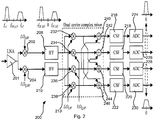
- Fig. 2 illustrates another example of a mixer arrangement 200 suitable for dealing with two carrier frequencies, presented here as background information.
- An LNA 201 provides an RF signal to mixers 202, 204 arranged mutually in quadrature by phase offset of local oscillator (LO) signals LO I , RF , LO Q , RF provided to the mixers 202, 204.
- LO local oscillator
- complex IF signals are generated accordingly and the IF signals are filtered by IF signal filters 208, 210, and then provided to a dual carrier complex mixer 213.
- the dual carrier complex mixer 213 performs the second down-conversion step using another LO signal LO I , IF , LO Q , IF provided from another LO and the signals are preferably then filtered by channel selection filters 216, 218, 220, 222, and then digitised by analog-to-digital converters 224, 226, 228, 230. Further processing in digital domain (not shown) can then be made.
- the dual carrier complex mixer 213 comprises mixer elements 232, 234, 236, 238 fed by respective of the in-phase and quadrature IF signals, and the LO signals LO I , IF , LO Q , IF , and summing elements 240, 242, 244, 246, wherein each mixer element 232, 234, 236, 238 provides the output signal to two of the summing elements 240, 242, 244, 246, wherein output signals from mixer elements 234, 236, which are mixing by the quadrature LO signal LO Q , IF , are connected to summing elements 240, 246 so as to provide inverse sign in the summing.
- a dual carrier complex mixer 300 can include means 302 for calibration of RF mixer imbalance, as illustrated in Fig. 3 .
- Each mixer element 332, 334, 336, 338 can provide its output to three summing elements 340, 342, 344, 346, i.e. each summing element has three inputs.
- the benefit is the improved imbalance calibration, but at the cost of increased circuitry.
- Fig. 4 illustrates an equivalent circuit 400 for a harmonic rejection mixer.
- the cross-coupled structure ensures that the input and output conductance of the mixer is constant with a variable ⁇ , as long as the load and source conductances, respectively, fulfil G L G S > > G m 2
- control sequences can be provided by a digital sequencer to produce a sinusoidal resembling transconductance.
- the discretisation into N unit cells means that the samples of the sinusoidal transconductance will be quantised such that g m ⁇ ⁇ NG u ⁇ N ⁇ 2 G u ⁇ N ⁇ 2 G u NG u
- the circuit area e.g. for integrated circuits
- consumption is non-negligible.
- the supporting circuitry required becomes large, i.e. each mixer may need a following buffer since it provides its output to three summing elements and a distribution network may consume space, although it adds benefits in terms of calibration of individual paths.
- accurate current splitting may not be guaranteed by just forwarding that current to three different current summing nodes. Having a buffer with virtual ground input and a voltage output which drives three resistive networks to generate three currents to the three different current summing nodes can solve this.
- each harmonic rejection mixer do not need to distribute its signal to more than one summing node, except for any issue about the calibration.
- the area can be made smaller if the buffers and associated circuitry can be omitted, i.e. at the expense of lost means for calibration, but the harmonic rejection mixer area will nevertheless double in size.
- the next task is to reduce layout area of the complex harmonic rejection mixer regardless of the IF mixer architecture being used. This is achieved by reuse of mixer unit cells between two harmonic rejection mixers operating in mutual quadrature.
- Fig. 7 shows (from top to bottom) cosine and sine waveforms, and also the sum of their absolute values.
- Fig. 13 illustrates for comparison corresponding time-discrete case, which will be further elucidated below.
- Mixer unit cells that is not used for in-phase harmonic rejection mixer can in part or completely be handed over to a quadrature phase harmonic rejection mixer as required, and vice versa.
- Input and output impedance of the complex IF mixer will not be affected since each node is attached to one in-phase mixer and one quadrature-phase mixer. Thus, the total impedance will be constant.
- the above demonstrated mixer unit cell sharing can be employed for example for the architectures discussed with reference to Fig. 1 or Fig. 2 .
- the mixer unit cell sharing can also be used in quadrature up and down conversion mixers if input and output impedance changes are managed.
- Fig. 8 schematically illustrates a shared mixer unit cell, SMUC, which is described here for understanding but does not form part of the claimed invention.
- the SMUC 800 has an input where the signal V in is provided through transconductances G u to a sign switching network.
- output current is now output to one of two output ports, but never to both simultaneously.
- both ports have the switches located on the output side.
- the outputs can be terminated with low impedances, e.g. virtual ground, which will have the least impact on voltage modulation on the switches. If this is not a concern, the SMUC can have the switches on the input side with two input signal voltages to alternate between and one current output.
- Sign switching control signals S1 and S2 for respective ports are provided to the SMUC 800.
- control signals S1, S2 and A are provided from a sequencer and internal control signals S1a, S1b, S2a and S2b are generated therefrom in the SMUC 800.
- the control signals S1a, S1b, S2a and S2b can of course also be provided directly from the sequencer.
- the provision of the control signals from the sequencer to the SMUC can be affected by latency and/or other effects on the control signals.
- local flip-flops may be employed in or close to the SMUC 800 to synchronise all SMUCs with a common phase of a clock, wherein the generation of the respective physical control signals for the switches are generated accordingly anyway. A reduced number of signals can thus be preferred to be conveyed between the sequencer and the SMUC 800.
- Fig. 9 schematically illustrates a SMUC 900 which is presented here for understanding and does not form part of the claimed invention.
- the SMUC 900 has an input where the signal V in is provided through transconductances G u to a sign switching network.
- the sign switching network includes a sequential signal and path control.
- the control signals into the SMUC 900 are the same, i.e. S1, S2, A.
- the sequencer can of course provide control signals S and A directly.
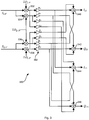
- Fig. 10 illustrates a mixer arrangement 1000 comprising at least two harmonic rejection mixers using shared mixer unit cells 1002.
- all mixer unit cells are shared, which is of course not necessary as will be demonstrated with reference to Fig. 11 below.
- the thermometer code as demonstrated above for providing the sign switching signal to the respective SMUCs can be employed and can be provided by a sequencer (not shown), which preferably is controlled by one or more LOs.
- Locally clocked flip-flops can be provided in the SMUCs or by any circuitry in vicinity of them for each signal controlling a switch, respectively, if necessary to synchronise all SMUCs with a common phase of a clock due to the architecture of the mixer arrangement and/or other circuitry.
- An advantage of having all mixer unit cells shared is that a regular layout structure can be achieved, but which can be at the expense of longer signal routes for some output lines of the mixer arrangement 1000.
- Fig. 11 illustrates a mixer arrangement 1100 comprising at least two harmonic rejection mixers using both shared 1102 and non-shared 1104, 1106 mixer unit cells.
- the principles for this mixer arrangement 1100 are similar to what has been demonstrated above in sense of thermometer code, local flip-flops, assignment of switches, etc.
- An advantage of having a mix of shared and non-shared mixer unit cells can be that a design with comparably shorter signal routes for the outputs can be achieved, but at the expense of a more irregular layout structure.
- Fig. 12 illustrates an example of assignment of shared mixer unit cells in a complex harmonic rejection mixer 1200.
- a complex harmonic rejection mixer such as for example those demonstrated with reference to Fig. 1
- the harmonic rejection mixer 1200 features four harmonic rejection mixers 1232, 1234, 1236, and 1238 and includes two summing elements 1240, 1242.
- assigning the sharing can be such that the mixers having the in-phase IF signal as input to share SMUCs and that the mixers having the quadrature phase IF signal as input share their SMUCs.
- assigning the sharing can be such that the mixers having the in-phase IF signal as input to share SMUCs and that the mixers having the quadrature phase IF signal as input share their SMUCs.
- Similar advantage can be provided for a structure as those of the complex harmonic rejection mixers demonstrated with reference to any of Figs 2 and 3 .
- Fig. 13 illustrates graphs of time-discrete (from top to bottom) cosine and sine waveforms, and their absolute value sum.
- the graphs can be compared to the time-continuous graphs of Fig. 7 for finding correspondence (note the scales of level of sums).
- the illustrated time-discrete cosine and sine waveforms have an oversampling comprising 12 samples per LO period and are quantised to 20 amplitude levels, but this can of course be chosen differently.
- the degree of oversampling can be chosen such that switching in mixer unit cells, in the chosen structure, works well.
- the number of amplitude levels chosen has a relation to the number N of mixer unit cells used, i.e. to correspond to thermometer code.
- the quantisation can raise some issues to be considered when designing the mixer arrangement.
- the maximum of the sum is 28.
- the maximum sum of the absolute values of quantised amplitude levels may due to quantisation and sample position give a value exceeding a theoretical maximum level calculated based on time-continuous summed absolute values.
- one or two mixer unit cells more than such theoretical maximum level may be needed to be assigned when applying the thermometer code. The opposite will also be possible.
- a single harmonic rejection mixer needs N control signals S ⁇ 1:N>, from which Sbar ⁇ 1:N> can be derived.
- a first and a second harmonic rejection mixer would thus need 2N control signals.
- P control signals A ⁇ 1:P>, from which Abar ⁇ 1:P> can be derived to control whether the signal should be output to a first or second output of the SMUC, i.e. to be associated to the first or the second harmonic rejection mixer.
- a third state of the SMUC can be employed, e.g. a high impedance state, wherein for example redundant mixer unit cells which can be used for matching purposes etc. can be kept in reserve.
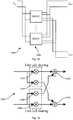
- Fig. 14 schematically illustrates a shared mixer unit cell, SMUC, 1400 according to an embodiment implementing such third state.
- the SMUC 1400 has an architecture similar to the one demonstrated with reference to Fig. 8 , but can also include a switch 1402 for short circuit of internal nodes to avoid a differential charge to build up when internal nodes are not connected to any output terminal, as will be understood to occur from the description below of control signals S1a, S1b, S2a and S2b for the respective switches of the SMUC 1400.
- control signals S1, S2, A and Y are provided from a sequencer and internal control signals S1a, S1b, S2a, S2b and S3 are generated therefrom in the SMUC 1400.
- the control signals S1a, S1b, S2a, S2b and S3 can of course also be provided directly from the sequencer.
- the provision of the control signals from the sequencer to the SMUC can be affected by latency and/or other effects on the control signals.
- flip-flops may be employed in or close to the SMUC 1400, wherein the generation of the physical control signals for the switches are generated accordingly anyway.
- the SMUC 1400 can thus be set in the third state, i.e. to functionally disconnect the SMUC by a high-impedance state.
- Fig. 15 schematically illustrates a SMUC 1500 according to an embodiment.
- the SMUC 1500 has an architecture similar to the one demonstrated with reference to Fig. 9 , but can also include a switch 1502 for short circuit of internal nodes to avoid a differential charge to build up when internal nodes are not connected to any output terminal, as will be understood to occur from the description below of control signals B and C for the respective switches of the SMUC 1500.
- the SMUC 1500 has an input where the signal V in is provided through transconductances G u to a sign switching network.
- the sign switching network includes a sequential signal and path control.
- the control signals into the SMUC 1500 are the same, i.e.
- the SMUC 1500 can thus be set in the third state, i.e. to functionally disconnect the SMUC by a high-impedance state.
- each harmonic rejection mixer When each harmonic rejection mixer is set to represent a certain transconductance and the sum of a first and second harmonic rejection mixer transconductance may not sum up to the maximum transconductance available from all mixer unit cells. Then, the remaining mixer unit cells should be configured to produce zero transconductance. This can be achieved by letting pairs of mixer unit cells produce transconductances with opposite signs to cancel each other. However, when unit cells are handed over from a first harmonic rejection mixer to a second harmonic rejection mixer, it is beneficial if they are handed over in pairs since a single mixer unit cell will always contribute with +G u or -G u , if not provided with a third state as demonstrated above. By this pair handling, the number P of control signals for A can be reduced to P/2.
- both the first and the second harmonic rejection mixer can have an odd number of mixer unit cells, accuracy can be improved since the number of transconductance levels can be doubled (cf. eq. 7) g m ⁇ ⁇ NG u ⁇ N ⁇ 1 G u ⁇ N ⁇ 1 G u NG u
- a particular advantage when having a SMUC capable of a third state, as demonstrated above, is when not both of a first and a second harmonic rejection mixer simultaneously benefits from an odd number of mixer unit cells.
- input and/or output impedance may in such cases vary a bit.
- the principle for handover of mixer unit cell pairs configured to produce zero transconductance contribution can be implemented in various ways. It may be based on that all such pairs are associated with either a first or a second harmonic rejection mixer; split equally between a first and second harmonic rejection mixer; or associated according to a random or more variable pattern. Ideally, handover of "unused" SMUC pairs will not have any impact on performance, but need to be considered anyway in a real implementation.
Landscapes
- Engineering & Computer Science (AREA)
- Power Engineering (AREA)
- Superheterodyne Receivers (AREA)
Claims (14)
- Agencement de mélangeur (112, 114, 213, 300, 1000, 1100, 1200) pour un mélange de signaux complexes comprenant un premier mélangeur à réjection d'harmoniques (232, 332, 1232) ; et
un deuxième mélangeur à réjection d'harmoniques (234, 334, 1234), dans lequel
chacun des mélangeurs à réjection d'harmoniques comprend une pluralité de cellules unitaires de mélangeur (500, 602, 800, 900, 1002, 1102, 1104, 1106, 1400, 1500) connectées en parallèle, dans lequel chaque cellule unitaire de mélangeur comprend une entrée différentielle, des éléments de transconductance connectés aux entrées différentielles correspondantes, et un réseau de commutation agencé pour commuter des signaux allant des éléments de transconductance à une sortie différentielle,
les premier et deuxième mélangeurs à réjection d'harmoniques ayant une relation de phase en quadrature réciproque, et
dans lequel les premier et deuxième mélangeurs à réjection d'harmoniques partagent une pluralité de cellules unitaires de mélangeur (800, 900, 1002, 1102, 1400, 1500) parmi les cellules unitaires de mélangeur (500, 602, 800, 900, 1002, 1102, 1104, 1106, 1400, 1500), dans lequel chaque cellule unitaire de mélangeur partagée (800, 900, 1002, 1102, 1400, 1500) comprend une entrée pour recevoir un signal à mélanger (Vin),
une entrée pour recevoir des signaux de commande (S1, S2) dérivés d'un signal d'oscillateur local, et
une sortie pour chacun des premier et deuxième mélangeurs à réjection d'harmoniques, et
caractérisé en ce que les signaux de commande comprennent un signal supplémentaire (Y) configuré pour amener le réseau de commutation à placer la cellule unitaire de mélangeur partagée (1400, 1500) dans un état d'impédance élevée dans lequel la cellule unitaire de mélangeur partagée est fonctionnellement déconnectée des premier et deuxième mélangeurs à réjection d'harmoniques. - Agencement de mélangeur selon la revendication 1, comprenant en outre
un troisième mélangeur à réjection d'harmoniques (236, 336, 1236) ; et
un quatrième mélangeur à réjection d'harmoniques (238, 338, 1238), dans lequel
le troisième et le quatrième mélangeur à réjection partagent une deuxième cellule unitaire de mélangeur (800, 900, 1002, 1102, 1400, 1500) comprenant
une entrée pour recevoir un signal à mélanger,
une entrée pour recevoir des signaux de commande dérivés d'un signal d'oscillateur local, et
une sortie pour chacun des troisième et quatrième mélangeurs à réjection d'harmoniques de sorte que l'agencement de mélangeur forme un mélangeur complexe. - Agencement de mélangeur selon l'une quelconque des revendications 1 ou 2, comprenant en outre une unité de génération de signal agencée pour générer les signaux de commande.
- Agencement de mélangeur selon la revendication 3, dans lequel l'unité de génération de signal est agencée pour fournir un premier ensemble de signaux de commande binaires associés à une commutation de polarité pour une sortie respective de la cellule unitaire de mélangeur partagée, et fournir un deuxième ensemble de signaux de commande binaires associés à une sortie de courant pour une sortie respective de la cellule unitaire de mélangeur partagée de sorte qu'un courant à n'importe quel instant temporel n'est délivré en sortie qu'à une seule des sorties respectives.
- Agencement de mélangeur selon la revendication 4, dans lequel au moins deux cellules unitaires de mélangeur non pourvues de l'état d'impédance élevée sont appariées de sorte que des cellules unitaires de mélangeur de la paire s'annulent mutuellement pour produire une sortie globale nulle de sorte que l'une et l'autre des cellules unitaires de mélangeur de la paire sont toujours actives.
- Agencement de mélangeur selon l'une quelconque des revendications 4 ou 5, dans lequel, pour l'une quelconque des cellules unitaires de mélangeur partagées (800, 1400), l'entrée pour recevoir un signal à mélanger comprend une entrée différentielle comprenant une première et une deuxième borne d'entrée, dans lequel le signal au niveau d'une borne d'entrée respective est soumis à une transconductance et commuté alternativement vers une première et une deuxième borne de sortie d'une sortie différentielle associée à l'un des mélangeurs à réjection d'harmoniques de partage de sorte que le signal provenant de la première borne d'entrée est couplé à la première borne de sortie de celui-ci lorsque le signal provenant de la deuxième borne d'entrée est couplé à la deuxième borne de sortie de celui-ci et le signal provenant de la première borne d'entrée est couplé à la deuxième borne de sortie de celui-ci lorsque le signal provenant de la deuxième borne d'entrée est couplé à la première borne de sortie de celui-ci, et commuté alternativement vers une première et une deuxième borne de sortie d'une sortie différentielle associée à un autre des mélangeurs à réjection d'harmoniques de partage de sorte que le signal provenant de la première borne d'entrée est couplé à la première borne de sortie de celui-ci lorsque le signal provenant de la deuxième borne d'entrée est couplé à la deuxième borne de sortie de celui-ci et le signal provenant de la première borne d'entrée est couplé à la deuxième borne de sortie de celui-ci lorsque le signal provenant de la deuxième borne d'entrée est couplé à la première borne de sortie de celui-ci, et
dans lequel la commutation alternée pour un mélangeur à réjection d'harmoniques respectif est commandée sur la base d'un signal dérivé des premier et deuxième ensembles de signaux de commande. - Agencement de mélangeur selon l'une quelconque des revendications 3 à 6, dans lequel des transconductances de chacun des mélangeurs à réjection d'harmoniques sont attribuées par leurs cellules unitaires de mélangeur de sorte que les transconductances s'additionnent pour fournir une ressemblance à une forme d'onde sinusoïdale.
- Agencement de mélangeur selon l'une quelconque des revendications 4 à 6, dans lequel, pour l'une quelconque des cellules unitaires de mélangeur partagées (900, 1500), l'entrée pour recevoir un signal à mélanger comprend une entrée différentielle comprenant une première et une deuxième borne d'entrée, dans lequel le signal au niveau d'une borne d'entrée respective est soumis à une transconductance et commuté alternativement vers un premier et un deuxième nœud de sorte que le signal provenant de la première borne d'entrée est couplé au premier nœud lorsque le signal provenant de la deuxième borne d'entrée est couplé au deuxième nœud et le signal provenant de la première borne d'entrée est couplé au deuxième nœud lorsque le signal provenant de la deuxième borne d'entrée est couplé au premier nœud, et le signal au niveau du premier nœud est commuté alternativement vers une première borne de sortie d'une sortie différentielle associée à l'un des mélangeurs à réjection d'harmoniques de partage et une première borne de sortie d'une sortie différentielle associée à un autre des mélangeurs à réjection d'harmoniques de partage et le signal au niveau du deuxième nœud est commuté alternativement vers une deuxième borne de sortie d'une sortie différentielle associée à l'un des mélangeurs à réjection d'harmoniques de partage et une deuxième borne de sortie d'une sortie différentielle associée à un autre des mélangeurs à réjection d'harmoniques de partage, et
dans lequel la commutation alternée pour un nœud respectif est commandée sur la base d'un signal respectif dérivé des premier et deuxième ensembles de signaux de commande et la commutation alternée vers des bornes de sortie respectives des mélangeurs à réjection d'harmoniques de partage est commandée sur la base du deuxième ensemble de signaux de commande. - Agencement de mélangeur selon l'une quelconque des revendications 1 à 8, dans lequel chaque mélangeur à réjection d'harmoniques comprend un nombre impair de cellules unitaires de mélangeur.
- Agencement de mélangeur selon l'une quelconque des revendications 1 à 9, dans lequel les cellules unitaires de mélangeur comprennent des commutateurs commutés en fonction des signaux de commande et agencés pour connecter sélectivement sur ceux-ci le signal de l'entrée à la sortie d'une cellule unitaire de mélangeur respective.
- Agencement de mélangeur selon la revendication 10, dans lequel chaque cellule unitaire de mélangeur comprend un contrôleur de commutateur agencé pour recevoir les signaux de commande et fournir une commande de fonctionnement de commutateur des commutateurs d'une cellule unitaire de mélangeur respective sur la base des signaux de commande reçus.
- Agencement de mélangeur selon l'une quelconque des revendications 1 à 11, dans lequel toutes les cellules unitaires de mélangeur, respectivement, sont structurellement configurées de manière égale.
- Circuit radio comprenant un agencement de mélangeur selon l'une quelconque des revendications 1 à 12.
- Appareil de communication comprenant un circuit radio selon la revendication 13.
Priority Applications (3)
| Application Number | Priority Date | Filing Date | Title |
|---|---|---|---|
| EP12164771.3A EP2654202B1 (fr) | 2012-04-19 | 2012-04-19 | Mélangeur à rejet d'harmoniques |
| PCT/EP2013/057011 WO2013156305A1 (fr) | 2012-04-19 | 2013-04-03 | Agencement de mélangeurs à réjection d'harmoniques |
| US14/394,956 US9450538B2 (en) | 2012-04-19 | 2013-04-03 | Harmonic rejection mixer arrangement |
Applications Claiming Priority (1)
| Application Number | Priority Date | Filing Date | Title |
|---|---|---|---|
| EP12164771.3A EP2654202B1 (fr) | 2012-04-19 | 2012-04-19 | Mélangeur à rejet d'harmoniques |
Publications (2)
| Publication Number | Publication Date |
|---|---|
| EP2654202A1 EP2654202A1 (fr) | 2013-10-23 |
| EP2654202B1 true EP2654202B1 (fr) | 2020-01-01 |
Family
ID=46027675
Family Applications (1)
| Application Number | Title | Priority Date | Filing Date |
|---|---|---|---|
| EP12164771.3A Active EP2654202B1 (fr) | 2012-04-19 | 2012-04-19 | Mélangeur à rejet d'harmoniques |
Country Status (3)
| Country | Link |
|---|---|
| US (1) | US9450538B2 (fr) |
| EP (1) | EP2654202B1 (fr) |
| WO (1) | WO2013156305A1 (fr) |
Families Citing this family (3)
| Publication number | Priority date | Publication date | Assignee | Title |
|---|---|---|---|---|
| WO2013189547A1 (fr) * | 2012-06-21 | 2013-12-27 | Huawei Technologies Co., Ltd. | Récepteur superhétérodyne |
| US9529380B1 (en) | 2015-08-04 | 2016-12-27 | Qualcomm Incorporated | Local oscillator signal generation circuit with harmonic current rejection |
| US10620659B2 (en) | 2017-04-05 | 2020-04-14 | International Business Machines Corporation | Clock network analysis using harmonic balance |
Family Cites Families (15)
| Publication number | Priority date | Publication date | Assignee | Title |
|---|---|---|---|---|
| KR100519876B1 (ko) | 2004-01-30 | 2005-10-10 | 삼성전자주식회사 | 2차 혼변조 왜곡을 제거하기 위한 직접 변환용 믹서 회로및 이를 이용한 직접 변환 송수신기 |
| EP2136468B1 (fr) * | 2004-03-12 | 2012-06-13 | RF Magic, Inc. | Mélangeur de suppression d'harmoniques et syntoniseur |
| US7509110B2 (en) | 2005-03-14 | 2009-03-24 | Broadcom Corporation | High-order harmonic rejection mixer using multiple LO phases |
| US7385429B1 (en) * | 2005-05-31 | 2008-06-10 | Altera Corporation | Charge pump with reduced current mismatch |
| US7532874B2 (en) | 2005-11-09 | 2009-05-12 | Texas Instruments Incorporated | Offset balancer, method of balancing an offset and a wireless receiver employing the balancer and the method |
| US7826816B2 (en) | 2006-07-11 | 2010-11-02 | Qualcomm Incorporated | Systems, methods, and apparatus for frequency conversion |
| US8072255B2 (en) | 2008-01-07 | 2011-12-06 | Qualcomm Incorporated | Quadrature radio frequency mixer with low noise and low conversion loss |
| KR20090117537A (ko) | 2008-05-09 | 2009-11-12 | 삼성전기주식회사 | 전류 스티어링 기법을 적용한 고차 하모닉 제거 믹서 |
| EP2141819A1 (fr) | 2008-07-04 | 2010-01-06 | Telefonaktiebolaget LM Ericsson (publ) | Dispositif et procédé de traitement de signal |
| US8483643B2 (en) * | 2009-01-29 | 2013-07-09 | Panasonic Corporation | Harmonic rejection mixer |
| US8378733B2 (en) * | 2009-10-30 | 2013-02-19 | Stmicroelectronics Design & Application Gmbh | Harmonic rejection mixer |
| EP2333949B1 (fr) | 2009-12-11 | 2016-06-29 | Telefonaktiebolaget LM Ericsson (publ) | Agencement de mixeur |
| EP2434640B1 (fr) | 2010-09-24 | 2012-12-05 | Telefonaktiebolaget L M Ericsson (PUBL) | Correction des déséquilibres dans un mélangeur de fréquences intermédiaires complexes |
| US8624660B2 (en) * | 2012-04-19 | 2014-01-07 | Telefonaktiebolaget Lm Ericsson (Publ) | Method and apparatus for mixer-based harmonic rejection |
| US9017197B2 (en) * | 2012-05-16 | 2015-04-28 | Dayco Ip Holdings, Llc | Hydraulic damping mechanism and use for belt tensioning |
-
2012
- 2012-04-19 EP EP12164771.3A patent/EP2654202B1/fr active Active
-
2013
- 2013-04-03 US US14/394,956 patent/US9450538B2/en active Active
- 2013-04-03 WO PCT/EP2013/057011 patent/WO2013156305A1/fr not_active Ceased
Non-Patent Citations (1)
| Title |
|---|
| None * |
Also Published As
| Publication number | Publication date |
|---|---|
| WO2013156305A1 (fr) | 2013-10-24 |
| US20150070071A1 (en) | 2015-03-12 |
| US9450538B2 (en) | 2016-09-20 |
| EP2654202A1 (fr) | 2013-10-23 |
Similar Documents
| Publication | Publication Date | Title |
|---|---|---|
| US8867671B2 (en) | Conversion circuit for converting complex analog signal into digital representation | |
| US7421259B2 (en) | RF mixer with high local oscillator linearity using multiple local oscillator phases | |
| Crols et al. | Low-IF topologies for high-performance analog front ends of fully integrated receivers | |
| US8165538B2 (en) | Systems and methods for implementing a harmonic rejection mixer | |
| EP2408118B1 (fr) | Système de conversion | |
| EP2191566B1 (fr) | Unité de mélange à réjection des harmoniques et procédé pour effectuer un mélange à réjection des harmoniques | |
| US7986192B2 (en) | Harmonic rejection mixer and harmonic rejection mixing method | |
| JP4364330B2 (ja) | イメージ阻止回路 | |
| CN101106662A (zh) | 直接转换电视调谐器及其方法 | |
| EP3286833B1 (fr) | Procédé et appareil pour mélanger des signaux en utilisant un circuit suppresseur de charge | |
| EP2654202B1 (fr) | Mélangeur à rejet d'harmoniques | |
| WO2012002026A1 (fr) | Convertisseur de fréquence et récepteur l'utilisant | |
| JPWO2012032936A1 (ja) | 信号処理回路、信号処理方法及び制御プログラムの記録媒体 | |
| EP3105854B1 (fr) | Filtre de partage de charge | |
| CN105580268B (zh) | 正交混频器装置 | |
| US8378733B2 (en) | Harmonic rejection mixer | |
| JP5790650B2 (ja) | 周波数変換器およびそれを用いた受信機 | |
| US9209750B2 (en) | Harmonic rejection mixer | |
| US20060252396A1 (en) | Phase generator using polyphase architecture | |
| Ugajin et al. | Image-rejection-performance assessment of double-conversion wireless receiver with 3-phase complex filter using montecarlo simulation | |
| Yamaji et al. | A 6-phase harmonic rejection down-converter with digital assist | |
| Ugajin et al. | An (N+N 2)-Mixer Architecture for a High-Image-Rejection Wireless Receiver with an N-Phase Active Complex Filter | |
| WO2009059831A2 (fr) | Appareil de mélange | |
| WO2020239233A1 (fr) | Récepteur radiofréquence et procédé de conversion descendante de signaux en composantes de signal de bande de base | |
| da Costa Malheiro | Polyphase Filter with Parametric Tuning |
Legal Events
| Date | Code | Title | Description |
|---|---|---|---|
| PUAI | Public reference made under article 153(3) epc to a published international application that has entered the european phase |
Free format text: ORIGINAL CODE: 0009012 |
|
| 17P | Request for examination filed |
Effective date: 20130816 |
|
| AK | Designated contracting states |
Kind code of ref document: A1 Designated state(s): AL AT BE BG CH CY CZ DE DK EE ES FI FR GB GR HR HU IE IS IT LI LT LU LV MC MK MT NL NO PL PT RO RS SE SI SK SM TR |
|
| AX | Request for extension of the european patent |
Extension state: BA ME |
|
| RBV | Designated contracting states (corrected) |
Designated state(s): AL AT BE BG CH CY CZ DE DK EE ES FI FR GB GR HR HU IE IS IT LI LT LU LV MC MK MT NL NO PL PT RO RS SE SI SK SM TR |
|
| STAA | Information on the status of an ep patent application or granted ep patent |
Free format text: STATUS: EXAMINATION IS IN PROGRESS |
|
| 17Q | First examination report despatched |
Effective date: 20171013 |
|
| GRAP | Despatch of communication of intention to grant a patent |
Free format text: ORIGINAL CODE: EPIDOSNIGR1 |
|
| STAA | Information on the status of an ep patent application or granted ep patent |
Free format text: STATUS: GRANT OF PATENT IS INTENDED |
|
| INTG | Intention to grant announced |
Effective date: 20191011 |
|
| GRAS | Grant fee paid |
Free format text: ORIGINAL CODE: EPIDOSNIGR3 |
|
| GRAA | (expected) grant |
Free format text: ORIGINAL CODE: 0009210 |
|
| STAA | Information on the status of an ep patent application or granted ep patent |
Free format text: STATUS: THE PATENT HAS BEEN GRANTED |
|
| AK | Designated contracting states |
Kind code of ref document: B1 Designated state(s): AL AT BE BG CH CY CZ DE DK EE ES FI FR GB GR HR HU IE IS IT LI LT LU LV MC MK MT NL NO PL PT RO RS SE SI SK SM TR |
|
| REG | Reference to a national code |
Ref country code: GB Ref legal event code: FG4D |
|
| REG | Reference to a national code |
Ref country code: CH Ref legal event code: EP Ref country code: AT Ref legal event code: REF Ref document number: 1221057 Country of ref document: AT Kind code of ref document: T Effective date: 20200115 |
|
| REG | Reference to a national code |
Ref country code: IE Ref legal event code: FG4D |
|
| REG | Reference to a national code |
Ref country code: DE Ref legal event code: R096 Ref document number: 602012066837 Country of ref document: DE |
|
| REG | Reference to a national code |
Ref country code: NL Ref legal event code: MP Effective date: 20200101 |
|
| REG | Reference to a national code |
Ref country code: LT Ref legal event code: MG4D |
|
| PG25 | Lapsed in a contracting state [announced via postgrant information from national office to epo] |
Ref country code: FI Free format text: LAPSE BECAUSE OF FAILURE TO SUBMIT A TRANSLATION OF THE DESCRIPTION OR TO PAY THE FEE WITHIN THE PRESCRIBED TIME-LIMIT Effective date: 20200101 Ref country code: NO Free format text: LAPSE BECAUSE OF FAILURE TO SUBMIT A TRANSLATION OF THE DESCRIPTION OR TO PAY THE FEE WITHIN THE PRESCRIBED TIME-LIMIT Effective date: 20200401 Ref country code: PT Free format text: LAPSE BECAUSE OF FAILURE TO SUBMIT A TRANSLATION OF THE DESCRIPTION OR TO PAY THE FEE WITHIN THE PRESCRIBED TIME-LIMIT Effective date: 20200527 Ref country code: CZ Free format text: LAPSE BECAUSE OF FAILURE TO SUBMIT A TRANSLATION OF THE DESCRIPTION OR TO PAY THE FEE WITHIN THE PRESCRIBED TIME-LIMIT Effective date: 20200101 Ref country code: RS Free format text: LAPSE BECAUSE OF FAILURE TO SUBMIT A TRANSLATION OF THE DESCRIPTION OR TO PAY THE FEE WITHIN THE PRESCRIBED TIME-LIMIT Effective date: 20200101 Ref country code: NL Free format text: LAPSE BECAUSE OF FAILURE TO SUBMIT A TRANSLATION OF THE DESCRIPTION OR TO PAY THE FEE WITHIN THE PRESCRIBED TIME-LIMIT Effective date: 20200101 Ref country code: LT Free format text: LAPSE BECAUSE OF FAILURE TO SUBMIT A TRANSLATION OF THE DESCRIPTION OR TO PAY THE FEE WITHIN THE PRESCRIBED TIME-LIMIT Effective date: 20200101 |
|
| PG25 | Lapsed in a contracting state [announced via postgrant information from national office to epo] |
Ref country code: GR Free format text: LAPSE BECAUSE OF FAILURE TO SUBMIT A TRANSLATION OF THE DESCRIPTION OR TO PAY THE FEE WITHIN THE PRESCRIBED TIME-LIMIT Effective date: 20200402 Ref country code: BG Free format text: LAPSE BECAUSE OF FAILURE TO SUBMIT A TRANSLATION OF THE DESCRIPTION OR TO PAY THE FEE WITHIN THE PRESCRIBED TIME-LIMIT Effective date: 20200401 Ref country code: IS Free format text: LAPSE BECAUSE OF FAILURE TO SUBMIT A TRANSLATION OF THE DESCRIPTION OR TO PAY THE FEE WITHIN THE PRESCRIBED TIME-LIMIT Effective date: 20200501 Ref country code: SE Free format text: LAPSE BECAUSE OF FAILURE TO SUBMIT A TRANSLATION OF THE DESCRIPTION OR TO PAY THE FEE WITHIN THE PRESCRIBED TIME-LIMIT Effective date: 20200101 Ref country code: LV Free format text: LAPSE BECAUSE OF FAILURE TO SUBMIT A TRANSLATION OF THE DESCRIPTION OR TO PAY THE FEE WITHIN THE PRESCRIBED TIME-LIMIT Effective date: 20200101 Ref country code: HR Free format text: LAPSE BECAUSE OF FAILURE TO SUBMIT A TRANSLATION OF THE DESCRIPTION OR TO PAY THE FEE WITHIN THE PRESCRIBED TIME-LIMIT Effective date: 20200101 |
|
| REG | Reference to a national code |
Ref country code: DE Ref legal event code: R097 Ref document number: 602012066837 Country of ref document: DE |
|
| PG25 | Lapsed in a contracting state [announced via postgrant information from national office to epo] |
Ref country code: DK Free format text: LAPSE BECAUSE OF FAILURE TO SUBMIT A TRANSLATION OF THE DESCRIPTION OR TO PAY THE FEE WITHIN THE PRESCRIBED TIME-LIMIT Effective date: 20200101 Ref country code: SK Free format text: LAPSE BECAUSE OF FAILURE TO SUBMIT A TRANSLATION OF THE DESCRIPTION OR TO PAY THE FEE WITHIN THE PRESCRIBED TIME-LIMIT Effective date: 20200101 Ref country code: SM Free format text: LAPSE BECAUSE OF FAILURE TO SUBMIT A TRANSLATION OF THE DESCRIPTION OR TO PAY THE FEE WITHIN THE PRESCRIBED TIME-LIMIT Effective date: 20200101 Ref country code: EE Free format text: LAPSE BECAUSE OF FAILURE TO SUBMIT A TRANSLATION OF THE DESCRIPTION OR TO PAY THE FEE WITHIN THE PRESCRIBED TIME-LIMIT Effective date: 20200101 Ref country code: RO Free format text: LAPSE BECAUSE OF FAILURE TO SUBMIT A TRANSLATION OF THE DESCRIPTION OR TO PAY THE FEE WITHIN THE PRESCRIBED TIME-LIMIT Effective date: 20200101 Ref country code: ES Free format text: LAPSE BECAUSE OF FAILURE TO SUBMIT A TRANSLATION OF THE DESCRIPTION OR TO PAY THE FEE WITHIN THE PRESCRIBED TIME-LIMIT Effective date: 20200101 |
|
| PLBE | No opposition filed within time limit |
Free format text: ORIGINAL CODE: 0009261 |
|
| STAA | Information on the status of an ep patent application or granted ep patent |
Free format text: STATUS: NO OPPOSITION FILED WITHIN TIME LIMIT |
|
| REG | Reference to a national code |
Ref country code: AT Ref legal event code: MK05 Ref document number: 1221057 Country of ref document: AT Kind code of ref document: T Effective date: 20200101 |
|
| PG25 | Lapsed in a contracting state [announced via postgrant information from national office to epo] |
Ref country code: MC Free format text: LAPSE BECAUSE OF FAILURE TO SUBMIT A TRANSLATION OF THE DESCRIPTION OR TO PAY THE FEE WITHIN THE PRESCRIBED TIME-LIMIT Effective date: 20200101 |
|
| REG | Reference to a national code |
Ref country code: CH Ref legal event code: PL |
|
| 26N | No opposition filed |
Effective date: 20201002 |
|
| PG25 | Lapsed in a contracting state [announced via postgrant information from national office to epo] |
Ref country code: CH Free format text: LAPSE BECAUSE OF NON-PAYMENT OF DUE FEES Effective date: 20200430 Ref country code: AT Free format text: LAPSE BECAUSE OF FAILURE TO SUBMIT A TRANSLATION OF THE DESCRIPTION OR TO PAY THE FEE WITHIN THE PRESCRIBED TIME-LIMIT Effective date: 20200101 Ref country code: IT Free format text: LAPSE BECAUSE OF FAILURE TO SUBMIT A TRANSLATION OF THE DESCRIPTION OR TO PAY THE FEE WITHIN THE PRESCRIBED TIME-LIMIT Effective date: 20200101 Ref country code: LU Free format text: LAPSE BECAUSE OF NON-PAYMENT OF DUE FEES Effective date: 20200419 Ref country code: LI Free format text: LAPSE BECAUSE OF NON-PAYMENT OF DUE FEES Effective date: 20200430 |
|
| REG | Reference to a national code |
Ref country code: BE Ref legal event code: MM Effective date: 20200430 |
|
| PG25 | Lapsed in a contracting state [announced via postgrant information from national office to epo] |
Ref country code: PL Free format text: LAPSE BECAUSE OF FAILURE TO SUBMIT A TRANSLATION OF THE DESCRIPTION OR TO PAY THE FEE WITHIN THE PRESCRIBED TIME-LIMIT Effective date: 20200101 Ref country code: BE Free format text: LAPSE BECAUSE OF NON-PAYMENT OF DUE FEES Effective date: 20200430 Ref country code: SI Free format text: LAPSE BECAUSE OF FAILURE TO SUBMIT A TRANSLATION OF THE DESCRIPTION OR TO PAY THE FEE WITHIN THE PRESCRIBED TIME-LIMIT Effective date: 20200101 |
|
| PG25 | Lapsed in a contracting state [announced via postgrant information from national office to epo] |
Ref country code: IE Free format text: LAPSE BECAUSE OF NON-PAYMENT OF DUE FEES Effective date: 20200419 |
|
| PG25 | Lapsed in a contracting state [announced via postgrant information from national office to epo] |
Ref country code: TR Free format text: LAPSE BECAUSE OF FAILURE TO SUBMIT A TRANSLATION OF THE DESCRIPTION OR TO PAY THE FEE WITHIN THE PRESCRIBED TIME-LIMIT Effective date: 20200101 Ref country code: MT Free format text: LAPSE BECAUSE OF FAILURE TO SUBMIT A TRANSLATION OF THE DESCRIPTION OR TO PAY THE FEE WITHIN THE PRESCRIBED TIME-LIMIT Effective date: 20200101 Ref country code: CY Free format text: LAPSE BECAUSE OF FAILURE TO SUBMIT A TRANSLATION OF THE DESCRIPTION OR TO PAY THE FEE WITHIN THE PRESCRIBED TIME-LIMIT Effective date: 20200101 |
|
| PG25 | Lapsed in a contracting state [announced via postgrant information from national office to epo] |
Ref country code: MK Free format text: LAPSE BECAUSE OF FAILURE TO SUBMIT A TRANSLATION OF THE DESCRIPTION OR TO PAY THE FEE WITHIN THE PRESCRIBED TIME-LIMIT Effective date: 20200101 Ref country code: AL Free format text: LAPSE BECAUSE OF FAILURE TO SUBMIT A TRANSLATION OF THE DESCRIPTION OR TO PAY THE FEE WITHIN THE PRESCRIBED TIME-LIMIT Effective date: 20200101 |
|
| PGFP | Annual fee paid to national office [announced via postgrant information from national office to epo] |
Ref country code: GB Payment date: 20220427 Year of fee payment: 11 Ref country code: FR Payment date: 20220425 Year of fee payment: 11 Ref country code: DE Payment date: 20220427 Year of fee payment: 11 |
|
| REG | Reference to a national code |
Ref country code: DE Ref legal event code: R119 Ref document number: 602012066837 Country of ref document: DE |
|
| GBPC | Gb: european patent ceased through non-payment of renewal fee |
Effective date: 20230419 |
|
| PG25 | Lapsed in a contracting state [announced via postgrant information from national office to epo] |
Ref country code: GB Free format text: LAPSE BECAUSE OF NON-PAYMENT OF DUE FEES Effective date: 20230419 |
|
| PG25 | Lapsed in a contracting state [announced via postgrant information from national office to epo] |
Ref country code: GB Free format text: LAPSE BECAUSE OF NON-PAYMENT OF DUE FEES Effective date: 20230419 Ref country code: FR Free format text: LAPSE BECAUSE OF NON-PAYMENT OF DUE FEES Effective date: 20230430 Ref country code: DE Free format text: LAPSE BECAUSE OF NON-PAYMENT OF DUE FEES Effective date: 20231103 |