EP2679930A1 - Refrigeration cycle apparatus - Google Patents
Refrigeration cycle apparatus Download PDFInfo
- Publication number
- EP2679930A1 EP2679930A1 EP11859245.0A EP11859245A EP2679930A1 EP 2679930 A1 EP2679930 A1 EP 2679930A1 EP 11859245 A EP11859245 A EP 11859245A EP 2679930 A1 EP2679930 A1 EP 2679930A1
- Authority
- EP
- European Patent Office
- Prior art keywords
- temperature
- compressor
- solenoid valve
- refrigerating cycle
- time
- Prior art date
- Legal status (The legal status is an assumption and is not a legal conclusion. Google has not performed a legal analysis and makes no representation as to the accuracy of the status listed.)
- Withdrawn
Links
Images




Classifications
-
- F—MECHANICAL ENGINEERING; LIGHTING; HEATING; WEAPONS; BLASTING
- F25—REFRIGERATION OR COOLING; COMBINED HEATING AND REFRIGERATION SYSTEMS; HEAT PUMP SYSTEMS; MANUFACTURE OR STORAGE OF ICE; LIQUEFACTION SOLIDIFICATION OF GASES
- F25B—REFRIGERATION MACHINES, PLANTS OR SYSTEMS; COMBINED HEATING AND REFRIGERATION SYSTEMS; HEAT PUMP SYSTEMS
- F25B49/00—Arrangement or mounting of control or safety devices
- F25B49/02—Arrangement or mounting of control or safety devices for compression type machines, plants or systems
- F25B49/022—Compressor control arrangements
-
- F—MECHANICAL ENGINEERING; LIGHTING; HEATING; WEAPONS; BLASTING
- F25—REFRIGERATION OR COOLING; COMBINED HEATING AND REFRIGERATION SYSTEMS; HEAT PUMP SYSTEMS; MANUFACTURE OR STORAGE OF ICE; LIQUEFACTION SOLIDIFICATION OF GASES
- F25B—REFRIGERATION MACHINES, PLANTS OR SYSTEMS; COMBINED HEATING AND REFRIGERATION SYSTEMS; HEAT PUMP SYSTEMS
- F25B13/00—Compression machines, plants or systems, with reversible cycle
-
- F—MECHANICAL ENGINEERING; LIGHTING; HEATING; WEAPONS; BLASTING
- F25—REFRIGERATION OR COOLING; COMBINED HEATING AND REFRIGERATION SYSTEMS; HEAT PUMP SYSTEMS; MANUFACTURE OR STORAGE OF ICE; LIQUEFACTION SOLIDIFICATION OF GASES
- F25B—REFRIGERATION MACHINES, PLANTS OR SYSTEMS; COMBINED HEATING AND REFRIGERATION SYSTEMS; HEAT PUMP SYSTEMS
- F25B2313/00—Compression machines, plants or systems with reversible cycle not otherwise provided for
- F25B2313/031—Sensor arrangements
- F25B2313/0314—Temperature sensors near the indoor heat exchanger
-
- F—MECHANICAL ENGINEERING; LIGHTING; HEATING; WEAPONS; BLASTING
- F25—REFRIGERATION OR COOLING; COMBINED HEATING AND REFRIGERATION SYSTEMS; HEAT PUMP SYSTEMS; MANUFACTURE OR STORAGE OF ICE; LIQUEFACTION SOLIDIFICATION OF GASES
- F25B—REFRIGERATION MACHINES, PLANTS OR SYSTEMS; COMBINED HEATING AND REFRIGERATION SYSTEMS; HEAT PUMP SYSTEMS
- F25B2313/00—Compression machines, plants or systems with reversible cycle not otherwise provided for
- F25B2313/031—Sensor arrangements
- F25B2313/0315—Temperature sensors near the outdoor heat exchanger
-
- F—MECHANICAL ENGINEERING; LIGHTING; HEATING; WEAPONS; BLASTING
- F25—REFRIGERATION OR COOLING; COMBINED HEATING AND REFRIGERATION SYSTEMS; HEAT PUMP SYSTEMS; MANUFACTURE OR STORAGE OF ICE; LIQUEFACTION SOLIDIFICATION OF GASES
- F25B—REFRIGERATION MACHINES, PLANTS OR SYSTEMS; COMBINED HEATING AND REFRIGERATION SYSTEMS; HEAT PUMP SYSTEMS
- F25B2600/00—Control issues
- F25B2600/02—Compressor control
- F25B2600/026—Compressor control by controlling unloaders
- F25B2600/0261—Compressor control by controlling unloaders external to the compressor
-
- F—MECHANICAL ENGINEERING; LIGHTING; HEATING; WEAPONS; BLASTING
- F25—REFRIGERATION OR COOLING; COMBINED HEATING AND REFRIGERATION SYSTEMS; HEAT PUMP SYSTEMS; MANUFACTURE OR STORAGE OF ICE; LIQUEFACTION SOLIDIFICATION OF GASES
- F25B—REFRIGERATION MACHINES, PLANTS OR SYSTEMS; COMBINED HEATING AND REFRIGERATION SYSTEMS; HEAT PUMP SYSTEMS
- F25B2600/00—Control issues
- F25B2600/25—Control of valves
- F25B2600/2513—Expansion valves
-
- F—MECHANICAL ENGINEERING; LIGHTING; HEATING; WEAPONS; BLASTING
- F25—REFRIGERATION OR COOLING; COMBINED HEATING AND REFRIGERATION SYSTEMS; HEAT PUMP SYSTEMS; MANUFACTURE OR STORAGE OF ICE; LIQUEFACTION SOLIDIFICATION OF GASES
- F25B—REFRIGERATION MACHINES, PLANTS OR SYSTEMS; COMBINED HEATING AND REFRIGERATION SYSTEMS; HEAT PUMP SYSTEMS
- F25B2600/00—Control issues
- F25B2600/25—Control of valves
- F25B2600/2521—On-off valves controlled by pulse signals
-
- F—MECHANICAL ENGINEERING; LIGHTING; HEATING; WEAPONS; BLASTING
- F25—REFRIGERATION OR COOLING; COMBINED HEATING AND REFRIGERATION SYSTEMS; HEAT PUMP SYSTEMS; MANUFACTURE OR STORAGE OF ICE; LIQUEFACTION SOLIDIFICATION OF GASES
- F25B—REFRIGERATION MACHINES, PLANTS OR SYSTEMS; COMBINED HEATING AND REFRIGERATION SYSTEMS; HEAT PUMP SYSTEMS
- F25B2700/00—Sensing or detecting of parameters; Sensors therefor
- F25B2700/21—Temperatures
- F25B2700/2104—Temperatures of an indoor room or compartment
-
- F—MECHANICAL ENGINEERING; LIGHTING; HEATING; WEAPONS; BLASTING
- F25—REFRIGERATION OR COOLING; COMBINED HEATING AND REFRIGERATION SYSTEMS; HEAT PUMP SYSTEMS; MANUFACTURE OR STORAGE OF ICE; LIQUEFACTION SOLIDIFICATION OF GASES
- F25B—REFRIGERATION MACHINES, PLANTS OR SYSTEMS; COMBINED HEATING AND REFRIGERATION SYSTEMS; HEAT PUMP SYSTEMS
- F25B2700/00—Sensing or detecting of parameters; Sensors therefor
- F25B2700/21—Temperatures
- F25B2700/2106—Temperatures of fresh outdoor air
Definitions
- the present invention relates to a refrigerating cycle system provided with a capacity-control compressor capable of executing a capacity-control. Further, the present invention is suitable for application to a refrigerating cycle system such as an air-conditioning water-heating system intended for a new-generation housing high in ecological (environmental responsiveness) effect, and is suitable for application to a refrigerating cycle system provided with a scroll compressor capable of carrying out an operation in a wide range, and efficiently performing a capacity-control even in an ultrasmall capacity-operation mode, in particular.
- a refrigerating cycle system such as an air-conditioning water-heating system intended for a new-generation housing high in ecological (environmental responsiveness) effect
- a scroll compressor capable of carrying out an operation in a wide range, and efficiently performing a capacity-control even in an ultrasmall capacity-operation mode, in particular.
- a refrigerating cycle system such as an air-conditioner, a water heater, and so forth, is in use.
- a capacity-control in a wide range can be realized by use of one unit.
- a room air-temperature is generally high at the time of starting the operation, so that there is the need for a quick operation.
- a high-speed operation high-speed rotation
- low-speed rotation small in volume is executed.
- the operation will be carried out at a very low rotation speed assuming the case where an air-conditioning machine is installed in a building provided with a highly heat-insulating material, using latest energy-saving techniques, in particular.
- Well known techniques for rendering a discharge volume variable include, for example, a scroll-type machine (refer to Patent Document 1) provided with a capacity-adjustment mechanism structured such that sealing in the axial direction of the crankshaft is released to stop compression, and an air-conditioner (refer to Patent Document 2) with a scroll compressor mounted therein, the scroll compressor provided with a capacity-adjustment mechanism whereby a refrigerant gas in the middle of compression is discharged toward a suction side to thereby delay the start of the compression.
- a scroll-type machine (refer to Patent Document 1) provided with a capacity-adjustment mechanism structured such that sealing in the axial direction of the crankshaft is released to stop compression
- an air-conditioner (refer to Patent Document 2) with a scroll compressor mounted therein, the scroll compressor provided with a capacity-adjustment mechanism whereby a refrigerant gas in the middle of compression is discharged toward a suction side to thereby delay the start of the compression.
- Patent Document 1 a high-pressure chamber, a discharge chamber, a low-pressure suction pipe that are formed between outer-shell connected fittings provided on one end side of the compressor, and a piston connected to a non-orbiting scroll are connected with each other via piping with a solenoid valve interposed therebetween, respectively, so that when the solenoid valve is turned ON (opened) by pulse width modulation (PWM) control, the high-pressure chamber is communicated with a low pressure suction pipe inside the piping, whereupon the non- orbiting scroll moves toward the crankshaft side, whereupon sealing is released in the axial direction of the crankshaft, thereby preventing compression.
- PWM pulse width modulation
- the scroll-type machine according to Patent Document 1 is operated by turning the solenoid valve OFF (closed) at the time of a normal capacity-control while the solenoid valve is turned ON (open) at the time of the small capacity-control, and the refrigerant gas is returned to the suction pipe on the low pressure side to thereby adjust the discharge volume of the refrigerant gas, enabling capacity-control in a wide range of 0 to 100% to be implemented.
- this will enable a compression action at a small-capacity-control (the ultrasmall capacity-operation mode) corresponding to the case of an ultra-low speed operation at not higher than a low-limit set value of a motor rotational speed that cannot be actually realized owing to a problem of the rupture of the oil film at the sliding bearing, described as above, and torque change (in a drive signal to a motor, frequency is on the order of 5Hz), however, frequency in actual designing is set to a value higher than that, to a range of about 15 to 20Hz).
- the refrigerant gas subjected compression is guided to a refrigerating cycle via a discharge pipe, thereby enabling refrigerant gas to be slowly circulated.
- the scroll compressor having a bypass port, a flow path where the bypass port is open to a suction pressure atmosphere, a control valve for opening/closing the flow path, and a control means for opening/closing the control valve according to a plurality of control patterns based on short-period time allocation that is set according to an operation load of the air-conditioner.
- the refrigerant gas in the middle of compression is discharged into a suction chamber, and a containment volume upon suction completion is reduced, thereby enabling capacity-control by 60% to be realized.
- an operation with a capacity-control in a range of 60 to 100% by stages is realized by opening/closing the control valve for discharging the refrigerant gas in the middle of compression into the suction chamber according to the plural control patterns based on the short-period time allocation.
- Patent Document 1 it is simply described that the solenoid valve is subjected to the PWM control to vary an ON - OFF time (a duty period) for the purpose of adjustment to a target capacity, thereby effecting the capacity-control, however, no consideration is given to enhancement in comfortability while suppressing deterioration in efficiency.
- a load state of a refrigerating cycle is detected on the basis of respective signals from a temperature sensor, and a pressure sensor, provided at the condenser, and the evaporator, respectively, thereby switching between a capacity-control operation, and a full-load operation.
- a capacity-control operation a bypass operation is executed according to predetermined time allocation.
- no consideration is given to enhancement in comfortability while suppressing deterioration in efficiency either as is the case with Patent Document 1.
- a refrigerating cycle system provided with a compressor, an outdoor heat exchanger, an expansion valve capable of controlling an opening thereof, and an indoor heat exchanger
- said refrigerating cycle system comprising a bypass flow path for causing a refrigerant in the middle of compression to bypass toward a suction side of the compressor, a solenoid valve for opening or closing the bypass flow path, and a controller for controlling open (ON) state time ( ⁇ 1) of the solenoid valve, and closed (OFF) state time ( ⁇ 2) thereof to adjust a flow rate of a refrigerant discharged from the compressor into a refrigerating cycle, thereby executing a capacity-control.
- the controller executes a control on the basis of a duty ratio (d) that is a ratio of open time of the solenoid valve against a duty period (T) representing the sum of the open time of the solenoid valve, and closed time thereof, and further, if a pressure (Ps) on the suction side of the compressor when the solenoid valve is in the ON state is higher than a suction pressure (Ps0) before the solenoid valve is in the ON state by a allowable deviation ( ⁇ P), the controller controls the solenoid valve so as to be in the closed state, the closed time being decided on the basis of the duty period.
- a duty ratio (d) that is a ratio of open time of the solenoid valve against a duty period (T) representing the sum of the open time of the solenoid valve, and closed time thereof
- the invention provides in its another aspect a refrigerating cycle system provided with a compressor, an outdoor heat exchanger, an expansion valve capable of controlling an opening thereof, and an indoor heat exchanger, said refrigerating cycle system comprising a bypass flow path for causing a refrigerant in the middle of compression to bypass toward a suction side of the compressor, a solenoid valve for opening or closing the bypass flow path; and a controller for controlling open (ON) state time ( ⁇ 1) of the solenoid valve, and closed (OFF) state time ( ⁇ 2) thereof to adjust a flow rate of a refrigerant discharged from the compressor into a refrigerating cycle, thereby executing a capacity-control.
- the controller executes a control on the basis of a duty ratio d, that is, a ratio of open time of the solenoid valve against a duty period (T) representing the sum of the open time of the solenoid valve, and closed time thereof, and further, if an evaporator temperature (Tev) of the indoor heat-exchanger or the outdoor heat-exchanger (an evaporator-side heat-exchanger), serving as the evaporator, when the solenoid valve is in the ON state, becomes higher than an evaporator temperature (Tev0) before the solenoid valve is in the ON state by a allowable deviation ( ⁇ Tev), the controller controls the solenoid valve so as to be in the closed state, the closed time being decided on the basis of the duty period.
- a duty ratio d that is, a ratio of open time of the solenoid valve against a duty period (T) representing the sum of the open time of the solenoid valve, and closed time thereof, and further, if an evaporator
- the present invention can provide a refrigerating cycle system capable of executing a highly efficient operation control even in an ultrasmall-capacity operation mode and improving comfortability.
- FIG. 1 is a schematic block diagram of the refrigerating cycle system, showing the first embodiment of the invention, representing the case where the present invention is applied to a room air-conditioner (an air-conditioner).
- a refrigerant compressed by a compressor 1 repeats a circulation whereby the refrigerant flows from a high-pressure side connection piping 7 into a four-way valve 5, passes through the four-way valve 5 before flowing out to an outdoor connection piping 8. Thereafter, the refrigerant is subjected to heat exchange with an outdoor air in an outdoor heat exchanger 2 to release heat, thereby undergoing condensation liquefaction before being subjected to decompression by the agency of an expansion valve 3.
- the refrigerant that has turned low in temperature ⁇ pressure after subjected to the decompression enters an indoor heat exchanger 4 to cool an indoor air while the refrigerant itself undergoes evaporation ⁇ gasification before flowing from an indoor connection piping 9 into the four-way valve 5 again, thereafter flowing out from a low-pressure side connection port of the four-way valve 5, and passing through a low-pressure side connection piping 10 before returning to the suction side of the compressor 1 to be compressed again.
- connection destination of a piping for refrigerant from the four-way valve 5 is switched.
- a refrigerant high in temperature ⁇ high pressure discharged from the compressor 101 (1), passes through the four-way valve 5 from the high-pressure side connection piping 7 to flow out to an indoor connection piping 9 before flowing to the indoor heat exchanger 4, thereby carrying out the heating operation by releasing heat to an indoor air while the refrigerant itself undergoes condensation.
- Reference numeral 11 denotes a bypass piping (bypass flow path) for guiding a refrigerant gas at a discharge pressure to the suction side of the compressor 1, and the bypass piping 11 has one end connected to the low-pressure side connection piping 10 on the suction side of the compressor.
- the bypass piping 11 is provided with a solenoid valve 12 to be controlled so as to be in an open (ON) state, and a closed (OFF) state by the agency of a pulse width modulation (PWM) control signal such that communication between the bypass piping 11 and the low-pressure side connection piping 10 is turned ON/OFF.
- PWM pulse width modulation
- the solenoid valve 12 is caused to make a repetitive action so as to be in an open state, and a closed state to repeatedly cause ON/OFF of a discharge-side refrigerant flow into a suction side, thereby realizing a capacity-adjustment mechanism for carrying out a small-capacity control of the refrigerant discharged from the compressor into a refrigerating cycle.
- Reference numeral 13 shown in Fig. 1 denotes a discharge-temperature sensor attached to a discharge-side piping (the high-pressure side connection piping 7) of the compressor 1, the discharge-temperature sensor being for detecting a discharge temperature of the refrigerant from the compressor (an inlet temperature of the refrigerant flowing into a condenser).
- 14 indicates an indoor heat-exchanger temperature sensor installed at a substantially central position of the indoor heat exchanger 4, and this temperature sensor 14 is used for detection of an evaporation temperature of the refrigerant at the time of the cooling operation when the indoor heat exchanger 4 functions as an evaporator.
- 15 indicates an outdoor heat-exchanger temperature sensor installed at a substantially central position of the outdoor heat exchanger 2, and this temperature sensor 15 is used for detection of an evaporation temperature of the refrigerant at the time of the heating operation when the outdoor heat exchanger 2 functions as an evaporator.
- 16 indicates an indoor temperature sensor for detecting an air temperature inside a room where the indoor heat exchanger 4 is installed
- 17 indicates an outdoor temperature sensor for detecting an outdoor air temperature around the location of the outdoor heat exchanger 2.
- an inverter (a motor drive circuit) 18 is connected to the compressor 1, and the inverter 18 is connected to a commercial AC power supply source 19.
- the inverter 18 rectifies a voltage of the commercial AC power supply source 19 to be converted into a voltage at a frequency according to a command, thereby outputting the voltage to a motor installed inside the compressor 1. Further, the inverter 18 is connected to a controller 20, driving the motor on the basis of a command from controller 20.
- the four-way valve 5, the expansion valve 3, an outdoor fan 21, an indoor fan 22, the indoor heat-exchanger temperature sensor 14, the outdoor heat-exchanger temperature sensor 15, the indoor temperature sensor 16, the outdoor temperature sensor 17, the discharge-temperature sensor 13, a suction pressure sensor 23, the inverter 18, a remote-control manipulator (not shown, hereinafter referred to as "remote controller"), and so forth are each connected to the controller 20 so that the refrigerating cycle system (the room air-conditioner) in its entirety is controlled by the controller 20.
- the controller 20 set the four-way valve 5 to a state for the cooling operation to drive the compressor 1, the outdoor fan 21, and the indoor fan 22 each at a specified rotational speed preset as an initial-value.
- the refrigerant discharged from the compressor 1 repeats a circulation whereby the refrigerant passes through the four-way valve 5, the outdoor heat exchanger 2, the expansion valve 3, and the indoor heat exchanger 4 in sequence before passing through the four-way valve 5 again to return to the compressor 1, whereupon the cooling operation is carried out.
- the expansion valve 3 is made up of, for example, an electronic expansion valve, and a pulse motor incorporated in the electronic expansion valve is rotated such that the expansion valve 3 is opened at a predetermined initial opening.
- the indoor heat exchanger (heat exchanger being used) 4 functions as an evaporator.
- a room air-temperature is detected by the indoor temperature sensor 16 provided in the vicinity of the inlet of a ventilation passage of the indoor heat exchanger 4, and the controller 20 controls the inverter 18 according to a difference from a set temperature set by the remote controller to render the rotational speed of the compressor variable. Thereby, an operation of the compressor 1 is carried out corresponding to an air-conditioning load.
- a sensed temperature (discharge refrigerant temperature) of the discharge-temperature sensor 13 is detected once in every predetermined control time periods, and the opening of the expansion valve 3 is controlled once in every control time periods described as above according to a difference between the sensed temperature and a target discharge temperature dependent on a sensed temperature (an evaporation temperature) of the outdoor heat-exchanger temperature sensor 14, a detection temperature (a room air temperature) of the indoor temperature sensor 16, the rotational speed of the compressor 1 and a rotational speed command value of the outdoor fan 21.
- this discharge superheat control control can be implemented such that a suction superheat on the suction side of the compressor 1 is rendered nearly zero, thereby maintaining excellent coefficient of performance of the refrigerating cycle system.
- the controller 20 switches the four-way valve 5 over to a heating operation side, thereby operating the compressor 1, the outdoor fan 21, and the indoor fan 22, respectively, at a specified rotational speed preset as an initial-value.
- the refrigerant discharged from the compressor 1 repeats a circulation whereby the refrigerant passes through the four-way valve 5, the indoor heat exchanger 4, the expansion valve 3, and the outdoor heat exchanger 2 in sequence before passing through the four-way valve 5 again to return to the compressor 1, whereupon the heating operation is carried out.
- the indoor heat exchanger (the heat exchanger being used) 4 functions as a condenser.
- the controller 20 detects a difference between the set temperature set by the remote controller and the room air temperature sensed by the indoor temperature sensor 16 as an air-conditioning load, controlling an operation frequency (an output frequency of the inverter 18) of the compressor according to the air-conditioning load. Thereby, an operation of the compressor 1 is carried out corresponding to a heating load.
- a discharge refrigerant temperature is detected by the discharge-temperature sensor 13 once in every predetermined control time periods, and the opening of the expansion valve 3 is controlled once in every control time periods described as above according to a difference between the discharge refrigerant temperature as sensed and a target discharge temperature dependent on a sensed temperature (an evaporation temperature) of the outdoor heat-exchanger temperature sensor 15, a detection temperature (an outdoor air temperature) of the outdoor temperature sensor 17, the rotational speed of the compressor 1 and the rotational speed command value of the outdoor fan 21.
- this discharge superheat control control can be implemented such that the suction superheat on the suction side of the compressor 1 is rendered nearly zero, thereby maintaining excellent coefficient of performance of the refrigerating cycle system.
- the discharge temperature control prevents the compressor 1 from being abnormally heated, thereby preventing breakdown of the compressor 1 due to the problem such as seizure, and so forth.
- the ultralow-load operation mode (the ultrasmall-capacity operation mode).
- the solenoid valve 12 provided in the bypass piping 11 is controlled so as to in the open (ON) state, and the closed (OFF) state by the pulse width modulation (PWM) control, thereby performing a capacity-adjust operation.
- PWM pulse width modulation
- a check valve 121 (refer to Fig. 10 ) provided at an outlet of the compressor 1 is closed, and a discharge refrigerant gas passes through the bypass piping 11 to flow to a low-pressure side connection piping (a suction pipe). For this reason, the refrigerant does not flow toward the four-way valve 5, and a flow rate of the refrigerant in the refrigerating cycle decreases, thereby causing a decrease in capacity.
- the solenoid valve 12 is set in the closed state, it is possible to cause the discharge refrigerant gas from the compressor to flow toward the four-way valve 5.
- the solenoid valve 12 is caused to make a repetitive action so as to be in the open state, or the closed state to thereby repeat opening/closing of the bypass piping 11, rendering it possible to execute capacity-adjustment.
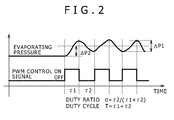
- a variation width of an evaporating pressure is defined ⁇ P1. Further, at the time of the capacity-adjustment operation, the evaporating pressures as a whole rises, and a mean pressure of various evaporating pressures rises by ⁇ P2 against the evaporating pressure prior to the capacity-adjustment operation. If ⁇ P1 at the time of the capacity-adjustment operation is large, the evaporating pressure subsequently will undergo variation to thereby cause variation in a heat exchange amount in the evaporator, so that the capacity of the refrigerating cycle system undergoes variation, thereby causing occurrence of variation in a blow-out temperature.
- ⁇ P1 is preferably reduced in order to maintain comfortable air-conditioning.
- ⁇ P2 is large, endothermic energy will decrease, so that the heat exchange amount, as well, will decrease.
- T ⁇ 1 + ⁇ 2
- an adequate duty period is decided in accordance with flow charts shown in Figs. 3 and 4 , respectively, thereby effecting control of the capacity-adjustment operation.
- a compressor rotational-speed control routine is described.
- a room air temperature Tea in detected by the indoor temperature sensor 16 provided in the vicinity of the inlet of the ventilation passage of the indoor neat exchanger 4, as previously described, is read (step 31)
- a difference ⁇ Tea in from the set temperature (a room air temperature target value) Tea* in set by the remote controller is found (step 32)
- the rotational speed of the compressor 1 is rendered variable according to the difference ⁇ Tea in by the agency of the inverter 18 (step 33, 34).
- the control is executed such that the smaller the difference between the set temperature and the room air temperature as detected is, the smaller a compressor rotational speed f z becomes.
- a controller timer as well is turned ON, thereby starting to count elapsed-time ⁇ 1.
- the suction pressure sensor 23 starts measuring a suction pressure, repeating a measurement on the pressure, while the PWM control signal remains in the ON state until a measured suction pressure Ps exceeds a suction pressure Ps0 before the PWM control signal is turned ON by a preset allowable deviation ⁇ P (steps 38 to 41). If a difference between the measured suction pressure Ps and the initial suction pressure Ps0 exceeds ⁇ P, the PWM control signal is turned OFF, the solenoid valve 12 is turned into the closed state, and the timer is turned OFF, whereupon counting of the elapsed-time is completed, deciding ⁇ 1 as opening time (step 42).
- closing time ⁇ 2 is decided, and the PWM capacity-control operation based on this duty period is performed (step 43).
- change in the suction pressure, caused by the opening/closing of the solenoid valve 12 can be decided so as to fall within ⁇ P, so that an operation based on an optimum duty period is enabled by setting the ⁇ P in such a range as not to impair comfortability.
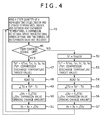
- Fig. 4 is a flow chart for describing an expansion-valve opening-control routine in the refrigerating cycle system according to the present embodiment.
- a state quantity of a refrigerating cycle is read. More specifically, the room air temperature, the outdoor temperature, temperature of the indoor heat exchanger, temperature of the outdoor heat exchanger, and so forth, detected by the various sensors, respectively, are each read, and further, the rotational speed of the compressor 1, the rotational speed of the outdoor fan 21 as well as the indoor fan 22, the opening of the expansion valve 3, and so forth, as well, are read.
- the opening of the expansion valve 3 is controlled such that the sensed temperature (the discharge refrigerant temperature) Td of the discharge-temperature sensor 13 will approach the target discharge temperature Td* determined from a sensed temperature (condensation temperature) Tao of the outdoor heat-exchanger temperature sensor 15, a detection temperature (an outdoor air temperature) Tai of the outdoor temperature sensor 17, the rotational speed f z of the compressor 1, and the rotational speed command value fp of the outdoor fan 21 (steps 47 to 51).
- a corrected compressor rotational speed f z ' obtained by dividing the rotational speed f z opt at the time of starting the capacity-control operation by a duty ratio "d" at that point in time is decided (step 52), thereupon switching is made to a routine whereby the expansion valve 3 is controlled such that the sensed temperature (the discharge refrigerant temperature) Td of the discharge-temperature sensor 13 will approach the target discharge temperature Td* determined from the corrected compressor rotational speed f z ' , the sensed temperature (condensation temperature) Tao of the outdoor heat-exchanger temperature sensor 15, the detection temperature (the outdoor air temperature) Tai of the outdoor temperature sensor 17, and the rotational speed command value fp of the outdoor fan 21 (steps 52 to 57).
- variation (change) in the suction pressure (the evaporating pressure), due to the opening/the closing of the solenoid valve 12, can be decided so as to be in a range based on the allowable deviation ⁇ P, so that it is possible to suppress the variation (change) in the suction pressure to fall within a given range, thereby enabling comfortability in air-conditioning, and so forth to be enhanced. Further, since it is possible to prevent occurrence of an increase in losses, caused by an excessively shortened duty period, a highly efficient capacity-control operation can be realized. In addition, an advantageous effect of realizing the capacity-control in the wide range of 0 to 100% by use of a simple structure can be obtained.
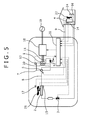
- Fig. 5 is a schematic block diagram of a refrigerating cycle system, showing a second embodiment of the invention, representing the case where the present invention is applied to the room air-conditioner as is the case with the first embodiment.
- parts denoted by like reference numerals shown in Fig. 1 are parts identical, or corresponding thereto.
- the second embodiment differs from the first embodiment in that the suction pressure sensor is removed, and a blow-out temperature sensor 24, in place of the suction pressure sensor, is installed in the vicinity of the outlet of a ventilation passage of the indoor heat exchanger 4, thereby enabling a blow-out temperature to be detected by the blow-out temperature sensor 24.
- variation (change) in the evaporation temperature can be estimated on the basis of the temperature of an evaporator-side heat exchanger (the indoor heat exchanger 4 at the time of the cooling operation, and an outdoor heat exchanger 2 at the time of the heating operation) and the blow-out temperature of the indoor heat exchanger 4, measured by the blow-out temperature sensor 24.
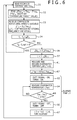
- a compressor rotational-speed control routine in the case of the refrigerating cycle system according to the second embodiment of the invention.
- the rotational speed of a compressor 1 the room air temperature Tea in detected by the indoor temperature sensor 16 provided in the vicinity of the inlet of the ventilation passage of the indoor heat exchanger 4, as previously described, is read (step 31), the difference ⁇ Tea in from the set temperature (the room air temperature target value) Tea* in set by the remote controller is found (step 32), and the rotational speed of the compressor 1 is rendered variable according to the difference ⁇ Tea in by the agency of the inverter 18 (steps 33, 34).
- the control is executed such that the smaller the difference between the set temperature and the room air temperature as detected becomes, the smaller the compressor rotational speed f z becomes.
- step 35 if the compressor rotational speed f z becomes smaller than a rotational speed f z opt at the time of starting the capacity-control operation, the compressor rotational speed is fixed to f z opt, and an initial duty ratio decided from a difference between the room air temperature and the room air temperature target value is determined (steps 36, 37), thereby executing the PWM capacity-control operation for turning the solenoid valve 12 ON/OFF.
- a controller timer as well is turned ON, thereby starting to count elapsed-time ⁇ 1.
- step 61 measurement on an evaporator-side heat exchanger temperature Tev0, by use of the heat exchanger temperature sensor on the evaporator-side (reference numeral 14, or 15), is started (step 61). Further, an allowable deviation ⁇ Tev is worked out according to a table for holding the evaporator-side heat exchanger temperature Tev0 at the time of starting the measurement, and a blow-out temperature Tea out of the indoor heat exchanger 4, detected by the blow-out temperature sensor 24, as preset controlled parameters (step 62).
- the PWM control signal remains in the ON state until a measured evaporator-side heat exchanger temperature Tev exceeds the allowable deviation ⁇ Tev, as compared with the evaporator-side heat exchanger temperature Tev0 before the PWM control signal is turned ON, and the measurement on the evaporator-side heat exchanger temperature Tev is repeated (steps 63 to 65).
- the PWM control signal is turned OFF, and the solenoid valve 12 will be in the closed state, whereupon the timer will be turned OFF, completing counting of the elapsed time, and ⁇ 1 is determined as open time.
- closed time ⁇ 2 is determined, and the PWM capacity-control operation based on this duty period is performed (steps 66, 67).
- the opening-control of an expansion valve 3 is executed according to the same routine as the expansion-valve opening control routine executed in the first embodiment, as shown in Fig. 4 .
- variation (change) in the suction pressure due to the opening/closing of the solenoid valve 12, can be decided so as to fall within a range based on the allowable deviation ⁇ Tev, so that if the allowable deviation ⁇ Tev is set within an appropriate range, it becomes possible to suppress the variation (change) in the suction pressure to be within a given range even without the pressure sensor for measuring the evaporating pressure (the suction pressure sensor), so that it is possible to realize a refrigerating cycle system that can be manufactured at a lower cost, and can execute a capacity-control operation not only excellent in air-conditioning properties, but also high in efficiency.
- Fig. 7 is a schematic block diagram of a refrigerating cycle system, showing a third embodiment of the invention, representing the case where the present invention is applied to the room air-conditioner, as is the case with the first embodiment and the second embodiment, respectively.
- parts denoted by like reference numerals shown in Fig. 1 and Fig. 5 respectively are parts identical or corresponding thereto.
- the third embodiment differs from the first embodiment, and the second embodiment, respectively, in that the suction pressure sensor 23, as shown in the first embodiment, and the blow-out temperature sensor 24 installed in the vicinity of the outlet of the ventilation passage of the indoor heat exchanger 4, as shown in the second embodiment, are removed.
- change in the evaporation temperature is estimated by measuring the temperature of an evaporator-side heat exchanger (an indoor heat exchanger 4 at the time of the cooling operation, and an outdoor heat exchanger 2 at the time of the heating operation), whereupon the control can be executed.
- the evaporator-side heat exchanger is operated so as to effect the discharge superheat control such that a suction superheat at the outlet thereof is rendered nearly zero, that is, dryness 1, as previously described.
- dryness at the inlet of the evaporator-side heat exchanger is normally in a range of about 0.1 to 0.3, the evaporator-side heat exchanger has a distribution such that dryness gradually increases from the inlet toward the outlet inside the heat exchanger.
- a circulation amount of the refrigerant decreases, and an amount of the refrigerant flowing out of the evaporator-side heat exchanger will decrease against an amount of the refrigerant flowing into the evaporator-side heat exchanger, so that the evaporating pressure rises, and the evaporation temperature rises, however, a liquid refrigerant undergoes phase change from a liquid phase to a gas phase, and dryness gradually increases. Accordingly, inside the evaporator-side heat exchanger, the refrigerant gradually becomes drier starting from the outlet side of the heat exchanger, a heat exchange amount becomes extremely smaller starting from a point closer to the outlet side.
- the evaporator-side heat exchanger temperature (the evaporator temperature) Tev measured by the sensor will behave as shown in Fig. 8 . More specifically, if the PWM control signal is turned ON, the evaporator temperature Tev will gently rises, and the heat exchanger gradually becomes drier starting from the outlet side thereof, so that as the neighborhood of an installation position of the heat-exchanger temperature sensor (the reference numeral 14, or 15) becomes drier, a measured temperature abruptly rises.
- an installation position of the heat-exchanger temperature sensor (the reference numeral 14, or 15) is in the vicinity of the center of the heat exchanger, however, the installation position is preferably selected as appropriate so as to be in a range where change in the air-conditioning capacity is adequately permissible.
- a compressor rotational-speed control routine in the case of the refrigerating cycle system according to the third embodiment of the invention is described with reference to Fig. 9 .
- a room air temperature Tea in detected by the indoor temperature sensor 16 provided in the vicinity of the inlet of the ventilation passage of the indoor heat exchanger 4, as previously described, is read (step 31), a difference ⁇ Tea in from the set temperature (the room air temperature target value) Tea* in set by the remote controller is found (step 32), and the rotational speed of the compressor 1 is rendered variable according to the difference ⁇ Tea in by the agency of the inverter 18 (steps 33, 34).
- the control is executed such that the smaller the difference between the set temperature and the room air temperature as detected becomes, the smaller the compressor rotational speed f z becomes.
- step 35 if the compressor rotational speed f z becomes smaller than a rotational speed f z opt at the time of starting the capacity-control operation, the compressor rotational speed is fixed to f z opt, deciding an initial duty ratio determined from a difference between the room air temperature and the room air temperature target value (steps 36, 37), whereupon the PWM capacity-control operation for turning the solenoid valve 12 ON/OFF is performed.
- the PWM control signal is turned ON, a controller timer is concurrently turned ON, thereby starting to count elapsed-time ⁇ 1.
- evaporator-side heat exchanger temperature (evaporator temperature) Tev0 by use of the evaporator-side heat exchanger (reference numeral 14, or 15), is started (step 61). Further, an allowable deviation ⁇ Tev is worked out according to a table for holding the evaporator-side heat exchanger temperature Tev0 at the time of starting the measurement, and an air temperature Tai, or Tao, measured by an indoor temperature sensor 16, or an outdoor temperature sensor 17, provided in the vicinity of the inlet of a ventilation passage of the indoor heat exchanger 4, or the outdoor heat exchanger 2, serving as the evaporator, respectively, as preset controlled parameters.
- This allowable deviation ⁇ Tev is set to such a value as reached after the occurrence of an abrupt rise in temperature due to the heat exchanger being dried (dryness of the refrigerant becoming greater) at a temperature measurement position where the heat-exchanger temperature sensor 14, or 15 is installed (step 68).
- the PWM control signal remains in the ON state until a measured evaporator-side heat exchanger temperature Tev exceeds the allowable deviation ⁇ Tev, as compared with the evaporator-side heat exchanger temperature Tev0 before the PWM control signal is turned ON, and a measurement on the evaporator-side heat exchanger temperature Tev is repeated (steps 63 to 65).
- the PWM control signal is turned OFF, and the solenoid valve 12 will be in the closed state, whereupon the timer will be turned OFF, completing counting of the elapsed-time is, and ⁇ 1 is decided as opening time.
- closing time ⁇ 2 is decided, and the PWM capacity-control operation based on this duty period is performed (steps 66, 67).
- the opening-control of an expansion valve 3 is executed according to the same routine as the expansion-valve opening control routine executed in the first embodiment, as shown in Fig. 4 .
- change in the suction pressure (the evaporating pressure), due to the opening/closing of the solenoid valve 12, can be decided so as to fall within a range based on the allowable deviation ⁇ Tev, so that if the allowable deviation ⁇ Tev is set within an appropriate range, it becomes possible to suppress the change in the suction pressure to be within a given range even without the suction pressure sensor 23 for measuring the evaporating pressure (refer to Fig, 1 ), and the blow-out temperature sensor 24 (refer to Fig.
- FIG. 10 is a longitudinal sectional view showing a scroll compressor as an example of the capacity-control compressor used in the present invention
- Fig. 11 an expanded sectional view of the principal part of the scroll compressor shown in Fig. 10 , for describing a refrigerant gas flow at the time of a normal operation (at the time of an operation mode when the solenoid valve 12 of the capacity-adjustment mechanism is a closed state)
- Fig. 12 an expanded sectional view of the principal part of the scroll compressor shown in Fig. 10 , for describing a refrigerant gas flow at the time of a bypass operation (at the time of an operation mode when the solenoid valve 12 of the capacity-adjustment mechanism is in an open state).
- a scroll compressor 1 is provided with a sealed chamber 115, having a suction pipe 113 for taking in a refrigerant gas, and a discharge pipe 114 for discharging a depressed refrigerant gas, the closed casing 115 incorporating a compression mechanism part comprised of a fixed scroll 102 having a spiral lap, and a orbiting scroll 101 having such a spiral lap as to be engaged with the spiral lap of the fixed scroll 102.
- a motor 100 comprised of a rotor 100a, and a stator 100b is provided below the compression mechanism part, and a crankshaft 106 serving as a rotational main shaft is integrally linked with the rotor 100a.
- the crankshaft 106 is rotatively supported by a main bearing 105a provided in a frame 105, and a secondary bearing 112 provided in a lower frame 111 in a lower part inside the closed casing 115.
- a sliding bearing 130 is provided on a back face of the orbiting scroll 101, and an eccentric part 106a provided on the upper end side of the crankshaft 106 is inserted in the sliding bearing 130.
- Reference numeral 107 denotes an Oldham coupling ring (a rotation-preventive member), and upon the crankshaft 106 being rotated, the orbiting scroll 101 is set in a swing motion by the agency of this Oldham coupling ring 107 without undergoing rotation, thereby compressing the refrigerant gas taken in from the suction pipe 113.
- the spiral laps provided on the respective end plates of the orbiting scroll 101, and the fixed scroll 102 are made up to form asymmetrical laps in which respective winding angles of the spiral laps differ from each other, so that respective compression chamber formed on the external line side, and the inner line side of the orbiting scroll lap by engaging the orbiting scroll 101 with the fixed scroll 102 are in the shape of an asymmetrical scroll where the two compression chambers differ in maximum stroke volume from each other.
- the respective spiral laps formed by respective involute curves of the orbiting scroll 101, and the fixed scroll 102 are engaged with each other, and the respective compression chamber are formed on the outer line side of the lap on the end side of the orbiting scroll 101, and the inner line side of the lap on the winding end side thereof.
- the compression chamber formed on the outer line side differs in size from the compression room formed on the inner line side, and these compression chambers each are formed in such a way as to be out of phase with the axial rotation of the crankshaft by about 180 degrees.
- a discharge port 108 is open near the center of the fixed scroll 102, and the end of the spiral lap thereof, on the inner line side, is extended about 180 degrees up to the vicinity of the end of the orbiting scroll 101. Accordingly, when the respective laps of the orbiting scroll 101, and the fixed scroll 102, are combined with each other to form the compression rooms, a first compression room formed due to confinement with the outer line side of the spiral lap of the orbiting scroll 101, and the inner line side of the spiral lap of the fixed scroll 102 differs in size from a second compression room formed due to confinement with the inner line side of the spiral lap of the orbiting scroll 101, and the outer line side of the spiral lap of the fixed scroll 102, so that the first compression room, and the second compression room are formed in such a way as to be out of phase with the axial rotation of the crankshaft by about 180 degrees.
- a release port 125 communicating with the compression room is formed on the outer peripheral side of the discharge port 108, and the release port 125 is provided with a release valve 124 serving as an excessive-compression relief valve.
- a discharge head cover 118 attached to a top plate (an end plate top-face) of the fixed scroll 102 covers both the discharge port 108, and the release valve 12, to thereby form a discharge head space 123, and further, the discharge head cover 118 is provided with a discharge valve 121 functioning as a check valve for opening/closing a through-hole 119 formed at a predetermined location.
- the bypass piping 11 is for use in guiding the refrigerant gas in the discharge head space 123 to outside the closed casing 115, and one end of the bypass piping 11 is connected to the discharge head cover 118, the bypass piping 11 being extended through the closed casing 115 before the other end thereof is drawn out of the closed casing 115.
- the other end of the bypass piping 11 is connected with the suction pipe 113 for taking in the refrigerant gas, and further, the bypass piping 11 is provided with a solenoid valve 12 at some midpoint on its way from the closed casing 115.
- the solenoid valve 12 is made up so as to be drive-controlled in the open state, or the closed state by the agency of the pulse width modulation (PWM) control signal as described in the respective embodiments.
- PWM pulse width modulation
- the discharge head cover 118, the bypass piping 11, and a solenoid valve 12 form a bypass flow path for guiding the refrigerant gas in the discharge head space 123 from the bypass piping 11 to the suction pipe 113 when the solenoid valve 12 is turned into the open state. Further, at the time of the ultrasmall volume-operation mode, the solenoid valve 12 is caused to make a repetitive action so as to be in either the opening state, or the closing state to repeat use/non-use of the bypass flow path, thereby putting the capacity-adjustment mechanism for the small-capacity-control at work.
- the suction pipe 113 for taking in the refrigerant gas in the refrigerating cycle is connected with the fixed scroll 102.
- a flywheel for 117 for stabilizing rotation is provided at a part of the crankshaft 106, between the rotor 100a and the rotor 100a and the secondary bearing 112.
- Oil supplied from the oil reservoir 116 is guided, through the sliding bearing 130 provided around the eccentric part 106a of the crankshaft 106, to a back-pressure (an intermediate) chamber 109 formed by the fixed scroll 102, the orbiting scroll 101, and the frame 105.
- the back pressure chamber 109 is made up such that if the refrigerant gas in the oil is foamed, causing a rise in pressure, a control valve (not shown) will let a rising pressure escape to a suction side part thereof to thereby retain a predetermined pressure level.
- the suction side part is communicated with a fixed outer peripheral groove provided on the outer periphery of the fixed scroll 102, however, since the fixed outer peripheral groove is communicated with a suction inlet of the refrigerant gas, the interior of the fixed outer peripheral groove is constantly at the suction pressure.
- the discharge pressure acts on the central part thereof, and an intermediate pressure acts on a part thereof, on the outer peripheral side. For this reason, the orbiting scroll 101 is pressed against the fixed scroll 102 at PWM control signal an adequate pressure, so that sealing between scroll laps can be maintained.
- a refrigerant gas compressed in the compression room is at a pressure higher than a pressure inside the discharge head space 123, or equal thereto, the refrigerant gas is discharged into the discharge head space 123 via the a release port 125 and the release valve 124. If the refrigerant gas is at a pressure less than the pressure inside the discharge head space 123, the release valve 12 is closed, the refrigerant gas is discharged from the discharge port 108 into the discharge head space 123, and the refrigerant gas is further discharged into a discharge room 103 by pushing the discharge valve 121 away from the through-hole 119.
- the refrigerant gas discharged into the discharge chamber 103 passes through a passage formed among the fixed scroll 102, the frame 105, and the closed casing 115 to flow into a discharge space 104 where the motor 100 is provided to be subsequently discharged into the refrigerating cycle via the discharge pipe 114.
- the scroll compressor has a high-pressure chamber structure where a space inside the closed casing 115 is at the discharge pressure.
- an inverter 18 as a motor drive circuit for driving a motor 100
- a solenoid drive circuit 12a for generating a pulse-width modulation control signal for drive-control of an open state, and a closed state of the solenoid valve 12
- a controller 20 as an operation-instruction control means for controlling the respective actions of the inverter 18, and the solenoid drive circuit 12a.
- FIG. 11 shows a flow of a refrigerant gas in the first operation mode when the solenoid valve 12 of a capacity-adjustment mechanism provided in the scroll compressor is in the closed state.
- the solenoid drive circuit 12a turns the solenoid valve 12 into the closed state in a cycle ⁇ 2 during a HIGH to LOW transition of a rectangular wave of the pulse-width modulation control signal, and the inverter 18 drives the motor 100 to thereby rotate the rotor 100a, and the crankshaft 106.
- the orbiting scroll 101 starts a swing motion.
- This action causes the first compression room, and the second compression room, formed due to the engagement of respective spiral parts of the orbiting scroll 101 and the fixed scroll 102, with each other, to move toward the center while respective internal volumes are reduced.
- the refrigerant gas flowing from the suction pipe 113 is compressed by the first compression room, and the second compression chamber, respectively, whereupon a high-pressure refrigerant gas is discharged from the discharge port 108 formed in the fixed scroll 102 into the discharge head space 123.
- a pressure in the compression chamber becomes higher than the pressure in the discharge head space 123, the high-pressure refrigerant gas is discharged into the discharge head space 123 via the release port 125, and the release valve 124, as previously described.
- the release valve 124 indicates a valve plate fitted to the tip of a coil spring 127 attached to a part of a presser part 126, on the tip side thereof, however, a release valve mechanism in whole, including the presser part 126, and the coil spring 127, is occasionally referred to as a release valve.
- the solenoid valve 12 In the first operation mode, the solenoid valve 12 is set in the closed state, thereby causing the refrigerant gas to flow toward the refrigerating cycle without use of the bypass piping 11. Therefore, the first operation mode may be called a load-operation.
- Fig. 12 shows a flow of the refrigerant gas in the second operation mode when the solenoid valve 12 of the capacity-adjustment mechanism provided in the scroll compressor is in the open state.
- the solenoid drive circuit 12a turns the solenoid valve 12 into the open state in a cycle ⁇ 1 during a LOW to HIGH transition of the rectangular wave of the pulse-width modulation control signal, and the inverter 18 drives the motor 100 to thereby rotate the rotor 100a, and the crankshaft 106.
- the orbiting scroll 101 starts a swing motion. This action causes the first compression room, and the second compression room, formed due to the engagement of the respective spiral parts of the orbiting scroll 101 and the fixed scroll 102, with each other, to move toward the center while the respective internal volumes are reduced.
- the solenoid valve 12 In the second operation mode, since the solenoid valve 12 is in the open state, the refrigerant gas in the discharge head space 123 flows into the suction pipe 113 via the bypass piping 11 for connecting he discharge head space 123 to the suction pipe 113. Accordingly, a pressure inside the discharge head space 123 falls down to a suction pressure substantially at a level slightly higher the suction pressure.
- the pressure of the discharge head space 123 is lower than the pressure of the discharge chamber 103, and the discharge valve 121 covering the through-hole 119 in the discharge head cover 118 is closed, so that the refrigerant gas is not discharged into the discharge chamber 103.
- the refrigerant gas taken into the suction pipe 113 is compressed by the first compression chamber, and the second compression chamber, respectively, the refrigerant gas will be at a pressure higher than the pressure in the discharge head space 123, so that the refrigerant gas is discharged into the discharge head space 123 via the release port 125 and the release valve 124.
- the refrigerant gas moved further toward the center side of the release port 125, in the compression chamber, is discharged the discharge port 108 into the discharge head space 123.
- the refrigerant gas discharged into the discharge head space 123 passes through the bypass piping 11, and the solenoid valve 12 in the open state before flowing into the suction pipe 113.
- the solenoid valve 12 In the second operation mode, the solenoid valve 12 is set in the open state, and the refrigerant gas from the bypass piping 11 is returned to the suction pipe 113, without discharging the refrigerant gas toward the refrigerating cycle. Therefore, the second operation mode may be called an unload-operation.
- the release port 125 and the release valve 124 each are preferably installed at such a position as to enable communication with compression chambers in all rotation angle regions. The reason is because internal compression within the scroll lap can be avoided in this way, and a compression action in the unload-operation can be reduced.
- the motor 100 is driven by the inverter 18, and switchover is made between the load operation (the first operation mode) whereby the solenoid valve 12 is turned into the closed state in the cycle ⁇ 2 during the HIGH to LOW transition of the rectangular wave of the pulse-width modulation control signal, and the unload operation (the second operation mod) whereby the solenoid valve 12 is turned into the open state in the cycle ⁇ 1 during the LOW to HIGH transition of the rectangular wave, thereby enabling a capacity-control to be performed.
- the load operation the first operation mode
- the unload operation the second operation mod
- the capacity-control is enabled by the opening/closing of the solenoid valve, however, in a rotation range of from a high-speed rotation to a predetermined set value slightly higher than the low limit set value of the motor rotational speed by motor-driving, control of the rotational speed of the motor 100 is executed by the inverter 18, while in the case where it is necessary to further reduce the capacity in a low-speed rotation range lower than the predetermined set value, the capacity-adjustment mechanism (for controlling the opening/closing of a bypass passage by use of the solenoid valve 12) for executing a small-capacity control is preferably set in motion to operate in the ultrasmall-capacity operation mode by changing a ratio of the load-operation to the unload-operation.
- the small-capacity control can be efficiently carried out by the capacity-adjustment mechanism simple in structure even at the time of the ultrasmall-capacity operation mode. More specifically, it becomes possible to implement the compression action at the ultrasmall-capacity control (the ultrasmall-capacity operation mode) corresponding to the case of the ultra-low speed operation executed at not higher than the low-limit set value of the motor rotational speed (in the drive signal to the motor, the frequency is on the order of 5Hz) without deteriorating efficiency in motor driving, so that an excellent scroll compressor capable of realizing the capacity-control in the wide range of 0 to 100% can be obtained. Furthermore, since the capacity-adjustment mechanism provided in the scroll compressor according to the present embodiment is simple in structure, reduction in cost, miniaturization, reduction in weight, and mass-production can be easily realized with respect to the scroll compressor.
- the duty period as a cycle of a switchover time between the load-operation and the unload-operation is controlled such that the deviation of the evaporating pressure falls within a given value, and a rise as well as change of the suction pressure can therefore be controlled within a threshold value, thereby enabling comfortablity such as suitable air conditioning, and so forth to be enhanced.
- the losses due to an excessively shortened duty period can be prevented, so that it is possible to realize a high-performance refrigerating cycle system capable of implementing an operation high in efficiency, and a highly efficient capacity-control in a wide range of 0 to 100%.
- the highly efficient capacity-control in the wide range can be implemented, reduction in cost is enabled.
Landscapes
- Engineering & Computer Science (AREA)
- Physics & Mathematics (AREA)
- Mechanical Engineering (AREA)
- Thermal Sciences (AREA)
- General Engineering & Computer Science (AREA)
- Air Conditioning Control Device (AREA)
- Details And Applications Of Rotary Liquid Pumps (AREA)
- Applications Or Details Of Rotary Compressors (AREA)
Abstract
Description
- The present invention relates to a refrigerating cycle system provided with a capacity-control compressor capable of executing a capacity-control. Further, the present invention is suitable for application to a refrigerating cycle system such as an air-conditioning water-heating system intended for a new-generation housing high in ecological (environmental responsiveness) effect, and is suitable for application to a refrigerating cycle system provided with a scroll compressor capable of carrying out an operation in a wide range, and efficiently performing a capacity-control even in an ultrasmall capacity-operation mode, in particular.
- From the standpoint of reducing energy consumed in common housing, that is, energy consumed by an air-conditioner, and energy consumed by a water heater, there has lately been seen an increasing tendency toward the use of material high in heat-insulating properties as a heat-insulating material in a building. Furthermore, there exists a concept of implementing a fossil-fuel zero-use housing whereby integrated power consumption for one year is zeroed by the installation of solar power generator, and soar heaters.
- Under this concept, a refrigerating cycle system, such as an air-conditioner, a water heater, and so forth, is in use. For example, in the case of a scroll compressor, it is required that a capacity-control in a wide range can be realized by use of one unit. More specifically, in a cooling operation by use of an air-conditioner, a room air-temperature is generally high at the time of starting the operation, so that there is the need for a quick operation. In such a case, a high-speed operation (high-speed rotation) large in volume is executed at a startup, however, when the interior is cooled to some extent, and the operation shifts to a steady operation state, a low-speed operation (low-speed rotation) small in volume is executed. In a low-speed operation in the steady operation state, the operation will be carried out at a very low rotation speed assuming the case where an air-conditioning machine is installed in a building provided with a highly heat-insulating material, using latest energy-saving techniques, in particular.
- However, if an excessively low-speed rotation is executed in the scroll compressor, this will structurally cause occurrence of rupture of an oil film at a plain bearing to thereby render the plain bearing susceptible to damage, rendering it difficult to perform stable operative actions since smooth motor-driving for rotating a crankshaft is prevented because of the low-speed rotation, and so forth. Accordingly, at the time of a mall-capacity operation, a general practice is adopted whereby the rotation speed is maintained to some extent in order to perform a capacity-control, and if, for example, the indoor is cooled to some extent, the scroll compressor is stopped while if a room air temperature rises, the scroll compressor is started again, this operation pattern being repeated.
- However, the operation pattern for repeating stop and startup at the time of the mall-capacity operation is not only poor in efficiency but also incapable of performing comfortable air conditioning, there has been proposed a technique for devising a new capacity-control. In the case of executing a capacity-control with the use of the scroll compressor, there are generally adopted techniques including a technique for controlling a rotational speed by a motor rotation, a technique whereby a structure is partially modified to keep a rotation speed constant to thereby perform a control for rendering a discharge rate variable, or a technique for using these techniques in combination. Well known techniques for rendering a discharge volume variable include, for example, a scroll-type machine (refer to Patent Document 1) provided with a capacity-adjustment mechanism structured such that sealing in the axial direction of the crankshaft is released to stop compression, and an air-conditioner (refer to Patent Document 2) with a scroll compressor mounted therein, the scroll compressor provided with a capacity-adjustment mechanism whereby a refrigerant gas in the middle of compression is discharged toward a suction side to thereby delay the start of the compression.
- In
Patent Document 1, a high-pressure chamber, a discharge chamber, a low-pressure suction pipe that are formed between outer-shell connected fittings provided on one end side of the compressor, and a piston connected to a non-orbiting scroll are connected with each other via piping with a solenoid valve interposed therebetween, respectively, so that when the solenoid valve is turned ON (opened) by pulse width modulation (PWM) control, the high-pressure chamber is communicated with a low pressure suction pipe inside the piping, whereupon the non- orbiting scroll moves toward the crankshaft side, whereupon sealing is released in the axial direction of the crankshaft, thereby preventing compression. Then, when the solenoid valve is turned OFF (closed), the high-pressure chamber is connected with the discharge chamber inside the piping, whereupon the non- orbiting scroll moves toward the crankshaft side, on the opposite side of the outer-shell connected fittings, whereupon sealing is executed in the axial direction of the crankshaft, thereby performing a normal compression action. - The scroll-type machine according to
Patent Document 1 is operated by turning the solenoid valve OFF (closed) at the time of a normal capacity-control while the solenoid valve is turned ON (open) at the time of the small capacity-control, and the refrigerant gas is returned to the suction pipe on the low pressure side to thereby adjust the discharge volume of the refrigerant gas, enabling capacity-control in a wide range of 0 to 100% to be implemented. As a result, this will enable a compression action at a small-capacity-control (the ultrasmall capacity-operation mode) corresponding to the case of an ultra-low speed operation at not higher than a low-limit set value of a motor rotational speed that cannot be actually realized owing to a problem of the rupture of the oil film at the sliding bearing, described as above, and torque change (in a drive signal to a motor, frequency is on the order of 5Hz), however, frequency in actual designing is set to a value higher than that, to a range of about 15 to 20Hz). The refrigerant gas subjected compression is guided to a refrigerating cycle via a discharge pipe, thereby enabling refrigerant gas to be slowly circulated. - In
Patent Document 2, there are provided the scroll compressor having a bypass port, a flow path where the bypass port is open to a suction pressure atmosphere, a control valve for opening/closing the flow path, and a control means for opening/closing the control valve according to a plurality of control patterns based on short-period time allocation that is set according to an operation load of the air-conditioner.
In the case of the air-conditioner with the scroll compressor mounted therein, according toPatent Document 2, the refrigerant gas in the middle of compression is discharged into a suction chamber, and a containment volume upon suction completion is reduced, thereby enabling capacity-control by 60% to be realized. Further, an operation with a capacity-control in a range of 60 to 100% by stages is realized by opening/closing the control valve for discharging the refrigerant gas in the middle of compression into the suction chamber according to the plural control patterns based on the short-period time allocation. -
- Patent Document 1: Japanese Unexamined Patent Application Publication No.
Hei8(1996)-334094 - Patent Document 2: Japanese Unexamined Patent Application Publication No.
Hei11(1999)-324951 - In a capacity-control operation using a compressor for variably controlling a discharge volume, a discharge pressure, and a suction pressure undergo change due to the opening/closing of a control valve for capacity-control, such as the solenoid valve, and so forth. If ON (opening) - OFF (closing) cycle (a duty period)) is large at the time of a pulse width modulation control (hereinafter referred to as PWM control), in particular, change in a suction pressure is large, and if this capacity-control scheme is applied to an air-conditioner, a blow-off temperature will undergo variation, and comfortability can be no longer maintained. Furthermore, in the case of the capacity-control scheme described as above, losses occur at the time of the opening/closing of the control valve, so that if the duty period is rendered shorter, the losses will increase although the variation decreases, thereby causing deterioration in efficiency.
With the one according toPatent Document 1, capacity-adjustment is performed by subjecting the solenoid valve to the PWM control to be turned ON/OFF, and the capacity-control in a wide range can be performed. However, inPatent Document 1, it is simply described that the solenoid valve is subjected to the PWM control to vary an ON - OFF time (a duty period) for the purpose of adjustment to a target capacity, thereby effecting the capacity-control, however, no consideration is given to enhancement in comfortability while suppressing deterioration in efficiency. - In the case of the one according to
Patent Document 2, a load state of a refrigerating cycle is detected on the basis of respective signals from a temperature sensor, and a pressure sensor, provided at the condenser, and the evaporator, respectively, thereby switching between a capacity-control operation, and a full-load operation. In the capacity-control operation, a bypass operation is executed according to predetermined time allocation. However, in the case of the one according toPatent Document 2, no consideration is given to enhancement in comfortability while suppressing deterioration in efficiency either as is the case withPatent Document 1. - It is therefore an object of the invention to obtain a refrigerating cycle system capable of not only realizing highly efficient operation-control even in an ultrasmall capacity-operation mode, but also realizing enhancement in comfortability.
- In accordance with one aspect of the invention, there is provided a refrigerating cycle system provided with a compressor, an outdoor heat exchanger, an expansion valve capable of controlling an opening thereof, and an indoor heat exchanger, said refrigerating cycle system comprising a bypass flow path for causing a refrigerant in the middle of compression to bypass toward a suction side of the compressor, a solenoid valve for opening or closing the bypass flow path, and a controller for controlling open (ON) state time (τ1) of the solenoid valve, and closed (OFF) state time (τ2) thereof to adjust a flow rate of a refrigerant discharged from the compressor into a refrigerating cycle, thereby executing a capacity-control. The controller executes a control on the basis of a duty ratio (d) that is a ratio of open time of the solenoid valve against a duty period (T) representing the sum of the open time of the solenoid valve, and closed time thereof, and further, if a pressure (Ps) on the suction side of the compressor when the solenoid valve is in the ON state is higher than a suction pressure (Ps0) before the solenoid valve is in the ON state by a allowable deviation (ΔP), the controller controls the solenoid valve so as to be in the closed state, the closed time being decided on the basis of the duty period.
- The invention provides in its another aspect a refrigerating cycle system provided with a compressor, an outdoor heat exchanger, an expansion valve capable of controlling an opening thereof, and an indoor heat exchanger, said refrigerating cycle system comprising a bypass flow path for causing a refrigerant in the middle of compression to bypass toward a suction side of the compressor, a solenoid valve for opening or closing the bypass flow path; and a controller for controlling open (ON) state time (τ1) of the solenoid valve, and closed (OFF) state time (τ2) thereof to adjust a flow rate of a refrigerant discharged from the compressor into a refrigerating cycle, thereby executing a capacity-control. The controller executes a control on the basis of a duty ratio d, that is, a ratio of open time of the solenoid valve against a duty period (T) representing the sum of the open time of the solenoid valve, and closed time thereof, and further, if an evaporator temperature (Tev) of the indoor heat-exchanger or the outdoor heat-exchanger (an evaporator-side heat-exchanger), serving as the evaporator, when the solenoid valve is in the ON state, becomes higher than an evaporator temperature (Tev0) before the solenoid valve is in the ON state by a allowable deviation (ΔTev), the controller controls the solenoid valve so as to be in the closed state, the closed time being decided on the basis of the duty period.
- The present invention can provide a refrigerating cycle system capable of executing a highly efficient operation control even in an ultrasmall-capacity operation mode and improving comfortability.
-
-
Fig. 1 is a schematic block diagram showing a first embodiment of a refrigerating cycle system according to the invention; -
Fig. 2 is a diagram for describing PWM control in the refrigerating cycle system, and change in an evaporating pressure; -
Fig. 3 is a flow chart for describing a compressor rotational-speed control routine according to the first embodiment; -
Fig. 4 is a flow chart for describing an expansion-valve opening-control routine in the refrigerating cycle system according to the first embodiment; -
Fig. 5 is a schematic block diagram of a refrigerating cycle system according to a second embodiment of the invention: -
Fig. 6 is a flow chart for describing a compressor rotational-speed control routine in the case of the refrigerating cycle system according to the second embodiment of the invention; -
Fig. 7 is a schematic block diagram of a refrigerating cycle system according to a third embodiment of the invention; -
Fig. 8 is a diagram for describing PWM control, and change in an evaporator temperature in the case of a refrigerating cycle system according to a third embodiment of the invention; -
Fig. 9 is a flow chart for describing a compressor rotational-speed control routine in the case of the refrigerating cycle system according to the third embodiment of the invention; -
Fig. 10 is a longitudinal sectional view showing an example of a capacity-control compressor used in the present invention: -
Fig. 11 is an expanded sectional view of the principal part of the scroll compressor shown inFig. 10 , for describing a refrigerant gas flow at the time of a normal operation; and -
Fig. 12 is an expanded sectional view of the principal part of the scroll compressor shown inFig. 10 , for describing a refrigerant gas flow at the time of a bypass operation. Description of Embodiments - Specific embodiments of a refrigerating cycle system according to the invention are described hereinafter with reference to the accompanied drawings.
- A first embodiment of a refrigerating cycle system according to the invention is described with reference to
Figs. 1 to 4 .Fig. 1 is a schematic block diagram of the refrigerating cycle system, showing the first embodiment of the invention, representing the case where the present invention is applied to a room air-conditioner (an air-conditioner). - The refrigerating cycle system shown in
Fig. 1 , together with an operation at the time of a cooling operation, is described hereinafter. A refrigerant compressed by acompressor 1 repeats a circulation whereby the refrigerant flows from a high-pressure side connection piping 7 into a four-way valve 5, passes through the four-way valve 5 before flowing out to anoutdoor connection piping 8. Thereafter, the refrigerant is subjected to heat exchange with an outdoor air in anoutdoor heat exchanger 2 to release heat, thereby undergoing condensation liquefaction before being subjected to decompression by the agency of anexpansion valve 3. The refrigerant that has turned low in temperature · pressure after subjected to the decompression enters anindoor heat exchanger 4 to cool an indoor air while the refrigerant itself undergoes evaporation · gasification before flowing from an indoor connection piping 9 into the four-way valve 5 again, thereafter flowing out from a low-pressure side connection port of the four-way valve 5, and passing through a low-pressure side connection piping 10 before returning to the suction side of thecompressor 1 to be compressed again. - Further, in the case of switching from the cooling operation to a heating operation, the connection destination of a piping for refrigerant from the four-
way valve 5 is switched. At the time of the heating operation, a refrigerant high in temperature · high pressure, discharged from the compressor 101 (1), passes through the four-way valve 5 from the high-pressure side connection piping 7 to flow out to an indoor connection piping 9 before flowing to theindoor heat exchanger 4, thereby carrying out the heating operation by releasing heat to an indoor air while the refrigerant itself undergoes condensation. Thereafter, a circulation is repeated whereby the refrigerant subjected to the condensation undergoes decompression by the agency of anexpansion valve 3 to be subjected to heat exchange with an outdoor air in anoutdoor heat exchanger 2, thereby undergoing condensation · liquefaction before flowing from the outdoor connection piping 8 into the four-way valve 5, and subsequently flowing to the low-pressure side connection piping 10 before returning to the suction side of thecompressor 1 to be compressed again. -
Reference numeral 11 denotes a bypass piping (bypass flow path) for guiding a refrigerant gas at a discharge pressure to the suction side of thecompressor 1, and the bypass piping 11 has one end connected to the low-pressure side connection piping 10 on the suction side of the compressor. Thebypass piping 11 is provided with asolenoid valve 12 to be controlled so as to be in an open (ON) state, and a closed (OFF) state by the agency of a pulse width modulation (PWM) control signal such that communication between the bypass piping 11 and the low-pressure side connection piping 10 is turned ON/OFF. - For example, at the time of an ultralow-load operation mode (an ultrasmall-capacity operation mode), the
solenoid valve 12 is caused to make a repetitive action so as to be in an open state, and a closed state to repeatedly cause ON/OFF of a discharge-side refrigerant flow into a suction side, thereby realizing a capacity-adjustment mechanism for carrying out a small-capacity control of the refrigerant discharged from the compressor into a refrigerating cycle. - Next, there is described a control system of the refrigerating cycle system shown in
Fig. 1 .Reference numeral 13 shown inFig. 1 denotes a discharge-temperature sensor attached to a discharge-side piping (the high-pressure side connection piping 7) of thecompressor 1, the discharge-temperature sensor being for detecting a discharge temperature of the refrigerant from the compressor (an inlet temperature of the refrigerant flowing into a condenser). Further, 14 indicates an indoor heat-exchanger temperature sensor installed at a substantially central position of theindoor heat exchanger 4, and thistemperature sensor 14 is used for detection of an evaporation temperature of the refrigerant at the time of the cooling operation when theindoor heat exchanger 4 functions as an evaporator. Furthermore, 15 indicates an outdoor heat-exchanger temperature sensor installed at a substantially central position of theoutdoor heat exchanger 2, and thistemperature sensor 15 is used for detection of an evaporation temperature of the refrigerant at the time of the heating operation when theoutdoor heat exchanger 2 functions as an evaporator. Still further, 16 indicates an indoor temperature sensor for detecting an air temperature inside a room where theindoor heat exchanger 4 is installed, and 17 indicates an outdoor temperature sensor for detecting an outdoor air temperature around the location of theoutdoor heat exchanger 2. - Meanwhile, an inverter (a motor drive circuit) 18 is connected to the
compressor 1, and theinverter 18 is connected to a commercial ACpower supply source 19. Theinverter 18 rectifies a voltage of the commercial ACpower supply source 19 to be converted into a voltage at a frequency according to a command, thereby outputting the voltage to a motor installed inside thecompressor 1. Further, theinverter 18 is connected to acontroller 20, driving the motor on the basis of a command fromcontroller 20. Further, the four-way valve 5, theexpansion valve 3, anoutdoor fan 21, anindoor fan 22, the indoor heat-exchanger temperature sensor 14, the outdoor heat-exchanger temperature sensor 15, theindoor temperature sensor 16, theoutdoor temperature sensor 17, the discharge-temperature sensor 13, asuction pressure sensor 23, theinverter 18, a remote-control manipulator (not shown, hereinafter referred to as "remote controller"), and so forth are each connected to thecontroller 20 so that the refrigerating cycle system (the room air-conditioner) in its entirety is controlled by thecontroller 20. - Next, there is described hereinafter an operation of the refrigerating cycle system at the time of the cooling operation. At the time of starting the cooling operation, the
controller 20 set the four-way valve 5 to a state for the cooling operation to drive thecompressor 1, theoutdoor fan 21, and theindoor fan 22 each at a specified rotational speed preset as an initial-value. The refrigerant discharged from thecompressor 1 repeats a circulation whereby the refrigerant passes through the four-way valve 5, theoutdoor heat exchanger 2, theexpansion valve 3, and theindoor heat exchanger 4 in sequence before passing through the four-way valve 5 again to return to thecompressor 1, whereupon the cooling operation is carried out. Theexpansion valve 3 is made up of, for example, an electronic expansion valve, and a pulse motor incorporated in the electronic expansion valve is rotated such that theexpansion valve 3 is opened at a predetermined initial opening. At the time of the cooling operation, the indoor heat exchanger (heat exchanger being used) 4 functions as an evaporator. - With the room air-conditioner serving as the refrigerating cycle system, a room air-temperature is detected by the
indoor temperature sensor 16 provided in the vicinity of the inlet of a ventilation passage of theindoor heat exchanger 4, and thecontroller 20 controls theinverter 18 according to a difference from a set temperature set by the remote controller to render the rotational speed of the compressor variable. Thereby, an operation of thecompressor 1 is carried out corresponding to an air-conditioning load. - Further, a sensed temperature (discharge refrigerant temperature) of the discharge-
temperature sensor 13 is detected once in every predetermined control time periods, and the opening of theexpansion valve 3 is controlled once in every control time periods described as above according to a difference between the sensed temperature and a target discharge temperature dependent on a sensed temperature (an evaporation temperature) of the outdoor heat-exchanger temperature sensor 14, a detection temperature (a room air temperature) of theindoor temperature sensor 16, the rotational speed of thecompressor 1 and a rotational speed command value of theoutdoor fan 21. By virtue of this discharge superheat control, control can be implemented such that a suction superheat on the suction side of thecompressor 1 is rendered nearly zero, thereby maintaining excellent coefficient of performance of the refrigerating cycle system. - On the other hand, if the discharge refrigerant temperature sensed by the discharge-
temperature sensor 13 rises to a set value, or higher, an operation frequency of thecompressor 1 is reduced until the sensed temperature falls to a predetermined set value and the opening of theexpansion valve 3 is controlled so that the discharged refrigerant temperature will be at the set value. This discharge temperature control prevents thecompressor 1 from being abnormally heated, thereby preventing breakdown of thecompressor 1 due to a problem such as seizure, and so forth. - Next, there is described hereinafter an operation of the refrigerating cycle system at the time of the heating operation. At the time of the heating operation, the
controller 20 switches the four-way valve 5 over to a heating operation side, thereby operating thecompressor 1, theoutdoor fan 21, and theindoor fan 22, respectively, at a specified rotational speed preset as an initial-value. The refrigerant discharged from thecompressor 1 repeats a circulation whereby the refrigerant passes through the four-way valve 5, theindoor heat exchanger 4, theexpansion valve 3, and theoutdoor heat exchanger 2 in sequence before passing through the four-way valve 5 again to return to thecompressor 1, whereupon the heating operation is carried out. At the time of the heating operation, the indoor heat exchanger (the heat exchanger being used) 4 functions as a condenser. - The
controller 20 detects a difference between the set temperature set by the remote controller and the room air temperature sensed by theindoor temperature sensor 16 as an air-conditioning load, controlling an operation frequency (an output frequency of the inverter 18) of the compressor according to the air-conditioning load. Thereby, an operation of thecompressor 1 is carried out corresponding to a heating load. - Further, a discharge refrigerant temperature is detected by the discharge-
temperature sensor 13 once in every predetermined control time periods, and the opening of theexpansion valve 3 is controlled once in every control time periods described as above according to a difference between the discharge refrigerant temperature as sensed and a target discharge temperature dependent on a sensed temperature (an evaporation temperature) of the outdoor heat-exchanger temperature sensor 15, a detection temperature (an outdoor air temperature) of theoutdoor temperature sensor 17, the rotational speed of thecompressor 1 and the rotational speed command value of theoutdoor fan 21. By virtue of this discharge superheat control, control can be implemented such that the suction superheat on the suction side of thecompressor 1 is rendered nearly zero, thereby maintaining excellent coefficient of performance of the refrigerating cycle system. - On the other hand, if the discharge refrigerant temperature sensed by the discharge-
temperature sensor 13 rises to the set value, or higher, the operation frequency of thecompressor 1 is reduced until the sensed temperature falls to the predetermined set value, and the opening of theexpansion valve 3 is controlled so that the discharged refrigerant temperature will be at the set value. The discharge temperature control prevents thecompressor 1 from being abnormally heated, thereby preventing breakdown of thecompressor 1 due to the problem such as seizure, and so forth. - Next, there is described a control using a capacity-adjustment mechanism for performing a small-capacity control of the refrigerant discharged from the compressor into the refrigerating cycle at the time of the ultralow-load operation, that is, the ultralow-load operation mode (the ultrasmall-capacity operation mode). With the capacity-adjustment mechanism for executing an ultrasmall-capacity control in the ultralow-load operation mode, the
solenoid valve 12 provided in the bypass piping 11 is controlled so as to in the open (ON) state, and the closed (OFF) state by the pulse width modulation (PWM) control, thereby performing a capacity-adjust operation. - At the time when the
solenoid valve 12 is in the open state, a check valve 121 (refer toFig. 10 ) provided at an outlet of thecompressor 1 is closed, and a discharge refrigerant gas passes through the bypass piping 11 to flow to a low-pressure side connection piping (a suction pipe). For this reason, the refrigerant does not flow toward the four-way valve 5, and a flow rate of the refrigerant in the refrigerating cycle decreases, thereby causing a decrease in capacity. On the other hand, if thesolenoid valve 12 is set in the closed state, it is possible to cause the discharge refrigerant gas from the compressor to flow toward the four-way valve 5. - Accordingly, at the time of an operation in the ultralow-load operation mode, when the capacity-adjustment mechanism is activated, the
solenoid valve 12 is caused to make a repetitive action so as to be in the open state, or the closed state to thereby repeat opening/closing of the bypass piping 11, rendering it possible to execute capacity-adjustment. - Now, the state of change in an evaporating pressure at the time when the
solenoid valve 12 is under the PWM control is described hereinafter with reference toFig. 2 . If the PWM control signal is turned ON (thesolenoid valve 12 is in the open state), the evaporating pressure rises. Further, if the PWM control signal is turned OFF (thesolenoid valve 12 is in the closed state), the evaporating pressure falls. Thus, as thesolenoid valve 12 is turned ON/OFF, variation (change) in the evaporating pressure is repeated. - At the time of a capacity-adjustment operation making use of the bypass piping 11, a variation width of an evaporating pressure is defined ΔP1. Further, at the time of the capacity-adjustment operation, the evaporating pressures as a whole rises, and a mean pressure of various evaporating pressures rises by ΔP2 against the evaporating pressure prior to the capacity-adjustment operation. If ΔP1 at the time of the capacity-adjustment operation is large, the evaporating pressure subsequently will undergo variation to thereby cause variation in a heat exchange amount in the evaporator, so that the capacity of the refrigerating cycle system undergoes variation, thereby causing occurrence of variation in a blow-out temperature. For this reason, ΔP1 is preferably reduced in order to maintain comfortable air-conditioning. Further, if ΔP2 is large, endothermic energy will decrease, so that the heat exchange amount, as well, will decrease. In order to render both ΔP1, and ΔP2 smaller, it need only be sufficient to reduce a duty period T (= τ1 + τ2) of the PWM control signal. However, there occur energy losses because of a back flow of the discharge refrigerant gas, losses in the pressure of the bypass piping 11, and so forth, occurring at the time of opening/closing the
solenoid valve 12, in a PWM capacity-control operation. For this reason, in order to efficiently perform the capacity-adjustment operation, it is preferable not to reduce the duty period T. - Accordingly, with the present embodiment, in order to realize air-conditioning high in efficiency, and small in variation (change) of the evaporating pressure, an adequate duty period is decided in accordance with flow charts shown in
Figs. 3 and4 , respectively, thereby effecting control of the capacity-adjustment operation. - First, referring to a flow chart shown in
Fig. 3 , a compressor rotational-speed control routine is described. As for the rotational speed of the compressor, a room air temperature Teain detected by theindoor temperature sensor 16 provided in the vicinity of the inlet of the ventilation passage of the indoorneat exchanger 4, as previously described, is read (step 31), a difference ΔTeain from the set temperature (a room air temperature target value) Tea*in set by the remote controller is found (step 32), and the rotational speed of thecompressor 1 is rendered variable according to the difference ΔTeain by the agency of the inverter 18 (step 33, 34). In this case, the control is executed such that the smaller the difference between the set temperature and the room air temperature as detected is, the smaller a compressor rotational speed fz becomes. - In
step 35, if the compressor rotational speed fz becomes smaller than a rotational speed fzopt at the time of starting the capacity-control operation, the compressor rotational speed is fixed to fzopt, deciding an initial duty ratio d {d = τ1/ (τ1 + τ2)} determined from a difference between the room air temperature and the room air temperature target value (steps 36, 37), whereupon the PWM capacity-control operation for turning thesolenoid valve 12 ON/OFF is performed. At this point in time, upon the PWM control signal being turned ON, a controller timer as well is turned ON, thereby starting to count elapsed-time τ1. Further, thesuction pressure sensor 23 starts measuring a suction pressure, repeating a measurement on the pressure, while the PWM control signal remains in the ON state until a measured suction pressure Ps exceeds a suction pressure Ps0 before the PWM control signal is turned ON by a preset allowable deviation ΔP (steps 38 to 41). If a difference between the measured suction pressure Ps and the initial suction pressure Ps0 exceeds ΔP, the PWM control signal is turned OFF, thesolenoid valve 12 is turned into the closed state, and the timer is turned OFF, whereupon counting of the elapsed-time is completed, deciding τ1 as opening time (step 42). On the basis of the opening time τ1, and a present duty ratio d, closing time τ2 is decided, and the PWM capacity-control operation based on this duty period is performed (step 43). Thereby, change in the suction pressure, caused by the opening/closing of thesolenoid valve 12, can be decided so as to fall within ΔP, so that an operation based on an optimum duty period is enabled by setting the ΔP in such a range as not to impair comfortability. -
Fig. 4 is a flow chart for describing an expansion-valve opening-control routine in the refrigerating cycle system according to the present embodiment. Upon the start of the PWM capacity-control operation according to the compressor rotational-speed control routine as described with reference toFig. 3 , the evaporation temperature rises and the evaporating pressure become larger by ΔP2 (refer toFig. 2 ) against the evaporating pressure prior to the capacity-control operation. In order to render the ΔP2 as small as possible, the control of the opening of theexpansion valve 3 is performed. - First, in
step 45, a state quantity of a refrigerating cycle is read. More specifically, the room air temperature, the outdoor temperature, temperature of the indoor heat exchanger, temperature of the outdoor heat exchanger, and so forth, detected by the various sensors, respectively, are each read, and further, the rotational speed of thecompressor 1, the rotational speed of theoutdoor fan 21 as well as theindoor fan 22, the opening of theexpansion valve 3, and so forth, as well, are read. Then, when the PWM control signal is OFF (in step 46), the opening of theexpansion valve 3 is controlled such that the sensed temperature (the discharge refrigerant temperature) Td of the discharge-temperature sensor 13 will approach the target discharge temperature Td* determined from a sensed temperature (condensation temperature) Tao of the outdoor heat-exchanger temperature sensor 15, a detection temperature (an outdoor air temperature) Tai of theoutdoor temperature sensor 17, the rotational speed fz of thecompressor 1, and the rotational speed command value fp of the outdoor fan 21 (steps 47 to 51). - If the PWM control signal is ON in the
step 46, a corrected compressor rotational speed fz ', obtained by dividing the rotational speed fzopt at the time of starting the capacity-control operation by a duty ratio "d" at that point in time is decided (step 52), thereupon switching is made to a routine whereby theexpansion valve 3 is controlled such that the sensed temperature (the discharge refrigerant temperature) Td of the discharge-temperature sensor 13 will approach the target discharge temperature Td* determined from the corrected compressor rotational speed fz ', the sensed temperature (condensation temperature) Tao of the outdoor heat-exchanger temperature sensor 15, the detection temperature (the outdoor air temperature) Tai of theoutdoor temperature sensor 17, and the rotational speed command value fp of the outdoor fan 21 (steps 52 to 57). At the time of the PWM capacity-control operation, the larger the duty ratio d is, the less a refrigerant circulation amount becomes, so that the opening of theexpansion valve 3 can be changed to an adequate opening even against a reduced refrigerant circulation amount at the time of the PWM capacity-control operation, and ΔP2 can be prevented from rising. - With the refrigerating cycle system according to the present embodiment, variation (change) in the suction pressure (the evaporating pressure), due to the opening/the closing of the
solenoid valve 12, can be decided so as to be in a range based on the allowable deviation ΔP, so that it is possible to suppress the variation (change) in the suction pressure to fall within a given range, thereby enabling comfortability in air-conditioning, and so forth to be enhanced. Further, since it is possible to prevent occurrence of an increase in losses, caused by an excessively shortened duty period, a highly efficient capacity-control operation can be realized. In addition, an advantageous effect of realizing the capacity-control in the wide range of 0 to 100% by use of a simple structure can be obtained. - Thus, with the present embodiment of the invention, it is possible to obtain a refrigerating cycle system capable of realizing an operation control excellent in efficiency even in an ultrasmall volume-operation mode, and enhancing comfortability as well.
-
Fig. 5 is a schematic block diagram of a refrigerating cycle system, showing a second embodiment of the invention, representing the case where the present invention is applied to the room air-conditioner as is the case with the first embodiment. InFig. 5 , parts denoted by like reference numerals shown inFig. 1 are parts identical, or corresponding thereto. The second embodiment differs from the first embodiment in that the suction pressure sensor is removed, and a blow-outtemperature sensor 24, in place of the suction pressure sensor, is installed in the vicinity of the outlet of a ventilation passage of theindoor heat exchanger 4, thereby enabling a blow-out temperature to be detected by the blow-outtemperature sensor 24. - In the case of executing control by use of the capacity-adjustment mechanism for small-capacity control, upon the PWM control signal being turned ON (that is, the
solenoid valve 12 is in the open state), an evaporating pressure rises, while upon the PWM control signal being turned OFF (that is, thesolenoid valve 12 is in the closed state), the evaporating pressure falls. At this point in time, an evaporation temperature as well undergoes variation (change), and a heat exchange amount in an evaporator undergoes variation (change), so that a refrigerating cycle undergoes variation (change), thereby causing occurrence of variation (change) in the blow-out temperature, and a refrigeration capacity. For this reason, variation (change) in the evaporation temperature can be estimated on the basis of the temperature of an evaporator-side heat exchanger (theindoor heat exchanger 4 at the time of the cooling operation, and anoutdoor heat exchanger 2 at the time of the heating operation) and the blow-out temperature of theindoor heat exchanger 4, measured by the blow-outtemperature sensor 24. - Referring to
Fig. 6 , there is described hereinafter a compressor rotational-speed control routine in the case of the refrigerating cycle system according to the second embodiment of the invention. As for the rotational speed of acompressor 1, the room air temperature Teain detected by theindoor temperature sensor 16 provided in the vicinity of the inlet of the ventilation passage of theindoor heat exchanger 4, as previously described, is read (step 31), the difference ΔTeain from the set temperature (the room air temperature target value) Tea*in set by the remote controller is found (step 32), and the rotational speed of thecompressor 1 is rendered variable according to the difference ΔTeain by the agency of the inverter 18 (steps 33, 34). In this case, the control is executed such that the smaller the difference between the set temperature and the room air temperature as detected becomes, the smaller the compressor rotational speed fz becomes. - In
step 35, if the compressor rotational speed fz becomes smaller than a rotational speed fzopt at the time of starting the capacity-control operation, the compressor rotational speed is fixed to fzopt, and an initial duty ratio decided from a difference between the room air temperature and the room air temperature target value is determined (steps 36, 37), thereby executing the PWM capacity-control operation for turning thesolenoid valve 12 ON/OFF. At this point in time, upon the PWM control signal being turned ON, a controller timer as well is turned ON, thereby starting to count elapsed-time τ1. Further, measurement on an evaporator-side heat exchanger temperature Tev0, by use of the heat exchanger temperature sensor on the evaporator-side (reference numeral 14, or 15), is started (step 61). Further, an allowable deviation ΔTev is worked out according to a table for holding the evaporator-side heat exchanger temperature Tev0 at the time of starting the measurement, and a blow-out temperature Teaout of theindoor heat exchanger 4, detected by the blow-outtemperature sensor 24, as preset controlled parameters (step 62). The PWM control signal remains in the ON state until a measured evaporator-side heat exchanger temperature Tev exceeds the allowable deviation ΔTev, as compared with the evaporator-side heat exchanger temperature Tev0 before the PWM control signal is turned ON, and the measurement on the evaporator-side heat exchanger temperature Tev is repeated (steps 63 to 65). If a difference between the measured evaporator-side heat exchanger temperature Tev and the initial evaporator-side heat exchanger temperature Tev0 exceeds the allowable deviation ΔTev, the PWM control signal is turned OFF, and thesolenoid valve 12 will be in the closed state, whereupon the timer will be turned OFF, completing counting of the elapsed time, and τ1 is determined as open time. On the basis of τ1, and the present duty ratio d, closed time τ2 is determined, and the PWM capacity-control operation based on this duty period is performed (steps 66, 67). - Meanwhile, the opening-control of an
expansion valve 3 is executed according to the same routine as the expansion-valve opening control routine executed in the first embodiment, as shown inFig. 4 .
With the present embodiment, variation (change) in the suction pressure, due to the opening/closing of thesolenoid valve 12, can be decided so as to fall within a range based on the allowable deviation ΔTev, so that if the allowable deviation ΔTev is set within an appropriate range, it becomes possible to suppress the variation (change) in the suction pressure to be within a given range even without the pressure sensor for measuring the evaporating pressure (the suction pressure sensor), so that it is possible to realize a refrigerating cycle system that can be manufactured at a lower cost, and can execute a capacity-control operation not only excellent in air-conditioning properties, but also high in efficiency. -
Fig. 7 is a schematic block diagram of a refrigerating cycle system, showing a third embodiment of the invention, representing the case where the present invention is applied to the room air-conditioner, as is the case with the first embodiment and the second embodiment, respectively. InFig. 7 , parts denoted by like reference numerals shown inFig. 1 andFig. 5 , respectively are parts identical or corresponding thereto. The third embodiment differs from the first embodiment, and the second embodiment, respectively, in that thesuction pressure sensor 23, as shown in the first embodiment, and the blow-outtemperature sensor 24 installed in the vicinity of the outlet of the ventilation passage of theindoor heat exchanger 4, as shown in the second embodiment, are removed. - In the case of executing the control by use of the capacity-adjustment mechanism for effecting the small-capacity control, upon the PWM control signal being turned ON (that is, the
solenoid valve 12 is in the open state), an evaporating pressure rises, while upon the PWM control signal being turned OFF (that is, thesolenoid valve 12 is in the closed state), the evaporating pressure falls. At this point in time, an evaporation temperature as well undergoes change, and a heat exchange amount in an evaporator undergoes change, so that a refrigerating cycle undergoes change , thereby causing occurrence of change in the blow-out temperature, and a refrigeration capacity. For this reason, change in the evaporation temperature is estimated by measuring the temperature of an evaporator-side heat exchanger (anindoor heat exchanger 4 at the time of the cooling operation, and anoutdoor heat exchanger 2 at the time of the heating operation), whereupon the control can be executed. - At the time of a normal operation, the evaporator-side heat exchanger is operated so as to effect the discharge superheat control such that a suction superheat at the outlet thereof is rendered nearly zero, that is,
dryness 1, as previously described. As dryness at the inlet of the evaporator-side heat exchanger is normally in a range of about 0.1 to 0.3, the evaporator-side heat exchanger has a distribution such that dryness gradually increases from the inlet toward the outlet inside the heat exchanger. At the time of the capacity-control operation, a circulation amount of the refrigerant decreases, and an amount of the refrigerant flowing out of the evaporator-side heat exchanger will decrease against an amount of the refrigerant flowing into the evaporator-side heat exchanger, so that the evaporating pressure rises, and the evaporation temperature rises, however, a liquid refrigerant undergoes phase change from a liquid phase to a gas phase, and dryness gradually increases. Accordingly, inside the evaporator-side heat exchanger, the refrigerant gradually becomes drier starting from the outlet side of the heat exchanger, a heat exchange amount becomes extremely smaller starting from a point closer to the outlet side. If the heat-exchanger temperature sensor (thereference numeral 14, or 15) is installed in the vicinity of the center of the relevant heat-exchanger, the evaporator-side heat exchanger temperature (the evaporator temperature) Tev measured by the sensor will behave as shown inFig. 8 . More specifically, if the PWM control signal is turned ON, the evaporator temperature Tev will gently rises, and the heat exchanger gradually becomes drier starting from the outlet side thereof, so that as the neighborhood of an installation position of the heat-exchanger temperature sensor (thereference numeral 14, or 15) becomes drier, a measured temperature abruptly rises. For this reason, a dryness distribution inside the evaporator can be grasped on the basis of a temperature measurement position inside the evaporator-side heat exchanger. Accordingly, if timing for turning the PWM control signal OFF is determined as when the allowable deviation ΔTev of the evaporator temperature is at a value after the occurrence of an abrupt increase in temperature, this will enable the duty period T to be decided according to a degree of dryness at the temperature measurement position. - With the present embodiment, an installation position of the heat-exchanger temperature sensor (the
reference numeral 14, or 15) is in the vicinity of the center of the heat exchanger, however, the installation position is preferably selected as appropriate so as to be in a range where change in the air-conditioning capacity is adequately permissible. - A compressor rotational-speed control routine in the case of the refrigerating cycle system according to the third embodiment of the invention is described with reference to
Fig. 9 . As for the rotational speed of acompressor 1, a room air temperature Teain detected by theindoor temperature sensor 16 provided in the vicinity of the inlet of the ventilation passage of theindoor heat exchanger 4, as previously described, is read (step 31), a difference ΔTeain from the set temperature (the room air temperature target value) Tea*in set by the remote controller is found (step 32), and the rotational speed of thecompressor 1 is rendered variable according to the difference ΔTeain by the agency of the inverter 18 (steps 33, 34). In this case, the control is executed such that the smaller the difference between the set temperature and the room air temperature as detected becomes, the smaller the compressor rotational speed fz becomes. - In
step 35, if the compressor rotational speed fz becomes smaller than a rotational speed fzopt at the time of starting the capacity-control operation, the compressor rotational speed is fixed to fzopt, deciding an initial duty ratio determined from a difference between the room air temperature and the room air temperature target value (steps 36, 37), whereupon the PWM capacity-control operation for turning thesolenoid valve 12 ON/OFF is performed. At this point in time, as the PWM control signal is turned ON, a controller timer is concurrently turned ON, thereby starting to count elapsed-time τ1. Further, measurement of an evaporator-side heat exchanger temperature (evaporator temperature) Tev0, by use of the evaporator-side heat exchanger (reference numeral 14, or 15), is started (step 61). Further, an allowable deviation ΔTev is worked out according to a table for holding the evaporator-side heat exchanger temperature Tev0 at the time of starting the measurement, and an air temperature Tai, or Tao, measured by anindoor temperature sensor 16, or anoutdoor temperature sensor 17, provided in the vicinity of the inlet of a ventilation passage of theindoor heat exchanger 4, or theoutdoor heat exchanger 2, serving as the evaporator, respectively, as preset controlled parameters.
This allowable deviation ΔTev is set to such a value as reached after the occurrence of an abrupt rise in temperature due to the heat exchanger being dried (dryness of the refrigerant becoming greater) at a temperature measurement position where the heat-exchanger temperature sensor steps 63 to 65). If a difference between the measured evaporator-side heat exchanger temperature Tev and the initial evaporator-side heat exchanger temperature Tev0 exceeds the allowable deviation ΔTev, the PWM control signal is turned OFF, and thesolenoid valve 12 will be in the closed state, whereupon the timer will be turned OFF, completing counting of the elapsed-time is, and τ1 is decided as opening time. On the basis of τ1, and the present duty ratio d, closing time τ2 is decided, and the PWM capacity-control operation based on this duty period is performed (steps 66, 67). - Meanwhile, the opening-control of an
expansion valve 3 is executed according to the same routine as the expansion-valve opening control routine executed in the first embodiment, as shown inFig. 4 .
With the present embodiment, change in the suction pressure (the evaporating pressure), due to the opening/closing of thesolenoid valve 12, can be decided so as to fall within a range based on the allowable deviation ΔTev, so that if the allowable deviation ΔTev is set within an appropriate range, it becomes possible to suppress the change in the suction pressure to be within a given range even without thesuction pressure sensor 23 for measuring the evaporating pressure (refer toFig, 1 ), and the blow-out temperature sensor 24 (refer toFig. 5 ) for measuring the blow-out temperature of air into a room, so that it is possible to realize a refrigerating cycle system that can be manufactured at a still lower cost, and can execute a capacity-control operation not only excellent in air-conditioning properties, but also high in efficiency. - Next, there is described hereinafter an example of the capacity-control compressor used in the refrigerating cycle system according to the respective embodiments of the invention.
Fig. 10 is a longitudinal sectional view showing a scroll compressor as an example of the capacity-control compressor used in the present invention,Fig. 11 an expanded sectional view of the principal part of the scroll compressor shown inFig. 10 , for describing a refrigerant gas flow at the time of a normal operation (at the time of an operation mode when thesolenoid valve 12 of the capacity-adjustment mechanism is a closed state), andFig. 12 an expanded sectional view of the principal part of the scroll compressor shown inFig. 10 , for describing a refrigerant gas flow at the time of a bypass operation (at the time of an operation mode when thesolenoid valve 12 of the capacity-adjustment mechanism is in an open state). - A
scroll compressor 1 is provided with a sealedchamber 115, having asuction pipe 113 for taking in a refrigerant gas, and adischarge pipe 114 for discharging a depressed refrigerant gas, theclosed casing 115 incorporating a compression mechanism part comprised of afixed scroll 102 having a spiral lap, and aorbiting scroll 101 having such a spiral lap as to be engaged with the spiral lap of the fixedscroll 102. Further, a motor 100 comprised of arotor 100a, and astator 100b is provided below the compression mechanism part, and acrankshaft 106 serving as a rotational main shaft is integrally linked with therotor 100a. Thecrankshaft 106 is rotatively supported by amain bearing 105a provided in aframe 105, and asecondary bearing 112 provided in a lower frame 111 in a lower part inside theclosed casing 115. A slidingbearing 130 is provided on a back face of theorbiting scroll 101, and aneccentric part 106a provided on the upper end side of thecrankshaft 106 is inserted in the slidingbearing 130.Reference numeral 107 denotes an Oldham coupling ring (a rotation-preventive member), and upon thecrankshaft 106 being rotated, theorbiting scroll 101 is set in a swing motion by the agency of thisOldham coupling ring 107 without undergoing rotation, thereby compressing the refrigerant gas taken in from thesuction pipe 113. - The spiral laps provided on the respective end plates of the
orbiting scroll 101, and the fixedscroll 102 are made up to form asymmetrical laps in which respective winding angles of the spiral laps differ from each other, so that respective compression chamber formed on the external line side, and the inner line side of the orbiting scroll lap by engaging theorbiting scroll 101 with the fixedscroll 102 are in the shape of an asymmetrical scroll where the two compression chambers differ in maximum stroke volume from each other. - That is, the respective spiral laps formed by respective involute curves of the
orbiting scroll 101, and the fixedscroll 102 are engaged with each other, and the respective compression chamber are formed on the outer line side of the lap on the end side of theorbiting scroll 101, and the inner line side of the lap on the winding end side thereof. However, the compression chamber formed on the outer line side differs in size from the compression room formed on the inner line side, and these compression chambers each are formed in such a way as to be out of phase with the axial rotation of the crankshaft by about 180 degrees. - More specifically, a
discharge port 108 is open near the center of the fixedscroll 102, and the end of the spiral lap thereof, on the inner line side, is extended about 180 degrees up to the vicinity of the end of theorbiting scroll 101. Accordingly, when the respective laps of theorbiting scroll 101, and the fixedscroll 102, are combined with each other to form the compression rooms, a first compression room formed due to confinement with the outer line side of the spiral lap of theorbiting scroll 101, and the inner line side of the spiral lap of the fixedscroll 102 differs in size from a second compression room formed due to confinement with the inner line side of the spiral lap of theorbiting scroll 101, and the outer line side of the spiral lap of the fixedscroll 102, so that the first compression room, and the second compression room are formed in such a way as to be out of phase with the axial rotation of the crankshaft by about 180 degrees. - Further, with the scroll compressor, a
release port 125 communicating with the compression room is formed on the outer peripheral side of thedischarge port 108, and therelease port 125 is provided with arelease valve 124 serving as an excessive-compression relief valve. Adischarge head cover 118 attached to a top plate (an end plate top-face) of the fixedscroll 102 covers both thedischarge port 108, and therelease valve 12, to thereby form adischarge head space 123, and further, thedischarge head cover 118 is provided with adischarge valve 121 functioning as a check valve for opening/closing a through-hole 119 formed at a predetermined location. - The
bypass piping 11 is for use in guiding the refrigerant gas in thedischarge head space 123 to outside theclosed casing 115, and one end of the bypass piping 11 is connected to thedischarge head cover 118, the bypass piping 11 being extended through theclosed casing 115 before the other end thereof is drawn out of theclosed casing 115. The other end of the bypass piping 11 is connected with thesuction pipe 113 for taking in the refrigerant gas, and further, the bypass piping 11 is provided with asolenoid valve 12 at some midpoint on its way from theclosed casing 115. Thesolenoid valve 12 is made up so as to be drive-controlled in the open state, or the closed state by the agency of the pulse width modulation (PWM) control signal as described in the respective embodiments. - The
discharge head cover 118, the bypass piping 11, and asolenoid valve 12 form a bypass flow path for guiding the refrigerant gas in thedischarge head space 123 from the bypass piping 11 to thesuction pipe 113 when thesolenoid valve 12 is turned into the open state. Further, at the time of the ultrasmall volume-operation mode, thesolenoid valve 12 is caused to make a repetitive action so as to be in either the opening state, or the closing state to repeat use/non-use of the bypass flow path, thereby putting the capacity-adjustment mechanism for the small-capacity-control at work. - The
suction pipe 113 for taking in the refrigerant gas in the refrigerating cycle is connected with the fixedscroll 102. A portion of the interior of theclosed casing 115, on the lower end side of thecrankshaft 106, is anoil reservoir 116. Further, a flywheel for 117 for stabilizing rotation is provided at a part of thecrankshaft 106, between therotor 100a and therotor 100a and thesecondary bearing 112. - Oil supplied from the
oil reservoir 116 is guided, through the slidingbearing 130 provided around theeccentric part 106a of thecrankshaft 106, to a back-pressure (an intermediate)chamber 109 formed by the fixedscroll 102, theorbiting scroll 101, and theframe 105. Theback pressure chamber 109 is made up such that if the refrigerant gas in the oil is foamed, causing a rise in pressure, a control valve (not shown) will let a rising pressure escape to a suction side part thereof to thereby retain a predetermined pressure level. The suction side part is communicated with a fixed outer peripheral groove provided on the outer periphery of the fixedscroll 102, however, since the fixed outer peripheral groove is communicated with a suction inlet of the refrigerant gas, the interior of the fixed outer peripheral groove is constantly at the suction pressure. In theorbiting scroll 101, the discharge pressure acts on the central part thereof, and an intermediate pressure acts on a part thereof, on the outer peripheral side. For this reason, theorbiting scroll 101 is pressed against the fixedscroll 102 at PWM control signal an adequate pressure, so that sealing between scroll laps can be maintained. - In the case of this scroll compressor, a refrigerant gas compressed in the compression room is at a pressure higher than a pressure inside the
discharge head space 123, or equal thereto, the refrigerant gas is discharged into thedischarge head space 123 via the arelease port 125 and therelease valve 124. If the refrigerant gas is at a pressure less than the pressure inside thedischarge head space 123, therelease valve 12 is closed, the refrigerant gas is discharged from thedischarge port 108 into thedischarge head space 123, and the refrigerant gas is further discharged into adischarge room 103 by pushing thedischarge valve 121 away from the through-hole 119. The refrigerant gas discharged into thedischarge chamber 103 passes through a passage formed among the fixedscroll 102, theframe 105, and theclosed casing 115 to flow into adischarge space 104 where the motor 100 is provided to be subsequently discharged into the refrigerating cycle via thedischarge pipe 114. Accordingly, the scroll compressor has a high-pressure chamber structure where a space inside theclosed casing 115 is at the discharge pressure. - Installed outside the
scroll compressor 1 are aninverter 18 as a motor drive circuit for driving a motor 100, asolenoid drive circuit 12a for generating a pulse-width modulation control signal for drive-control of an open state, and a closed state of thesolenoid valve 12, and acontroller 20 as an operation-instruction control means for controlling the respective actions of theinverter 18, and thesolenoid drive circuit 12a. - A compression operation of this scroll compressor is divided into a first operation mode with the
solenoid valve 12 in the closed state and a second operation mode with thesolenoid valve 12 in the open state.Fig. 11 shows a flow of a refrigerant gas in the first operation mode when thesolenoid valve 12 of a capacity-adjustment mechanism provided in the scroll compressor is in the closed state. - In the first operation mode, the
solenoid drive circuit 12a turns thesolenoid valve 12 into the closed state in a cycle τ2 during a HIGH to LOW transition of a rectangular wave of the pulse-width modulation control signal, and theinverter 18 drives the motor 100 to thereby rotate therotor 100a, and thecrankshaft 106. In consequence, the orbiting scroll 101 starts a swing motion. This action causes the first compression room, and the second compression room, formed due to the engagement of respective spiral parts of theorbiting scroll 101 and the fixedscroll 102, with each other, to move toward the center while respective internal volumes are reduced. - Thereby, the refrigerant gas flowing from the
suction pipe 113 is compressed by the first compression room, and the second compression chamber, respectively, whereupon a high-pressure refrigerant gas is discharged from thedischarge port 108 formed in the fixedscroll 102 into thedischarge head space 123. In the process of this compression, if a pressure in the compression chamber becomes higher than the pressure in thedischarge head space 123, the high-pressure refrigerant gas is discharged into thedischarge head space 123 via therelease port 125, and therelease valve 124, as previously described. - Further, the
release valve 124 indicates a valve plate fitted to the tip of acoil spring 127 attached to a part of apresser part 126, on the tip side thereof, however, a release valve mechanism in whole, including thepresser part 126, and thecoil spring 127, is occasionally referred to as a release valve. - When a refrigerant gas pressure of the
discharge head space 123 becomes slightly higher than the discharge pressure to be higher than the pressure of the discharge room (chamber) 103, thedischarge valve 121 covering the through-hole 119 in thedischarge head cover 118 is pushed to open, thereby causing the refrigerant gas to be discharged into the discharge room (chamber) 103. - In the first operation mode, the
solenoid valve 12 is set in the closed state, thereby causing the refrigerant gas to flow toward the refrigerating cycle without use of thebypass piping 11. Therefore, the first operation mode may be called a load-operation. -
Fig. 12 shows a flow of the refrigerant gas in the second operation mode when thesolenoid valve 12 of the capacity-adjustment mechanism provided in the scroll compressor is in the open state. - In the second operation mode, the
solenoid drive circuit 12a turns thesolenoid valve 12 into the open state in a cycle τ1 during a LOW to HIGH transition of the rectangular wave of the pulse-width modulation control signal, and theinverter 18 drives the motor 100 to thereby rotate therotor 100a, and thecrankshaft 106. In consequence, the orbiting scroll 101 starts a swing motion. This action causes the first compression room, and the second compression room, formed due to the engagement of the respective spiral parts of theorbiting scroll 101 and the fixedscroll 102, with each other, to move toward the center while the respective internal volumes are reduced. - In the second operation mode, since the
solenoid valve 12 is in the open state, the refrigerant gas in thedischarge head space 123 flows into thesuction pipe 113 via the bypass piping 11 for connecting he dischargehead space 123 to thesuction pipe 113. Accordingly, a pressure inside thedischarge head space 123 falls down to a suction pressure substantially at a level slightly higher the suction pressure. - For this reason, the pressure of the
discharge head space 123 is lower than the pressure of thedischarge chamber 103, and thedischarge valve 121 covering the through-hole 119 in thedischarge head cover 118 is closed, so that the refrigerant gas is not discharged into thedischarge chamber 103. In the state of the second operation mode, when the refrigerant gas taken into thesuction pipe 113 is compressed by the first compression chamber, and the second compression chamber, respectively, the refrigerant gas will be at a pressure higher than the pressure in thedischarge head space 123, so that the refrigerant gas is discharged into thedischarge head space 123 via therelease port 125 and therelease valve 124. Further, the refrigerant gas moved further toward the center side of therelease port 125, in the compression chamber, is discharged thedischarge port 108 into thedischarge head space 123. The refrigerant gas discharged into thedischarge head space 123 passes through the bypass piping 11, and thesolenoid valve 12 in the open state before flowing into thesuction pipe 113. - In the second operation mode, the
solenoid valve 12 is set in the open state, and the refrigerant gas from the bypass piping 11 is returned to thesuction pipe 113, without discharging the refrigerant gas toward the refrigerating cycle. Therefore, the second operation mode may be called an unload-operation. - The
release port 125 and therelease valve 124 each are preferably installed at such a position as to enable communication with compression chambers in all rotation angle regions. The reason is because internal compression within the scroll lap can be avoided in this way, and a compression action in the unload-operation can be reduced. - With the scroll compressor according to the first embodiment of the invention, the motor 100 is driven by the
inverter 18, and switchover is made between the load operation (the first operation mode) whereby thesolenoid valve 12 is turned into the closed state in the cycle τ2 during the HIGH to LOW transition of the rectangular wave of the pulse-width modulation control signal, and the unload operation (the second operation mod) whereby thesolenoid valve 12 is turned into the open state in the cycle τ1 during the LOW to HIGH transition of the rectangular wave, thereby enabling a capacity-control to be performed. - Even at the time of a high-speed operation mode when the scroll compressor is operated at a relatively high-speed, the capacity-control is enabled by the opening/closing of the solenoid valve, however, in a rotation range of from a high-speed rotation to a predetermined set value slightly higher than the low limit set value of the motor rotational speed by motor-driving, control of the rotational speed of the motor 100 is executed by the
inverter 18, while in the case where it is necessary to further reduce the capacity in a low-speed rotation range lower than the predetermined set value, the capacity-adjustment mechanism (for controlling the opening/closing of a bypass passage by use of the solenoid valve 12) for executing a small-capacity control is preferably set in motion to operate in the ultrasmall-capacity operation mode by changing a ratio of the load-operation to the unload-operation. - With the scroll compressor provided with the capacity-adjustment mechanism, the small-capacity control can be efficiently carried out by the capacity-adjustment mechanism simple in structure even at the time of the ultrasmall-capacity operation mode. More specifically, it becomes possible to implement the compression action at the ultrasmall-capacity control (the ultrasmall-capacity operation mode) corresponding to the case of the ultra-low speed operation executed at not higher than the low-limit set value of the motor rotational speed (in the drive signal to the motor, the frequency is on the order of 5Hz) without deteriorating efficiency in motor driving, so that an excellent scroll compressor capable of realizing the capacity-control in the wide range of 0 to 100% can be obtained. Furthermore, since the capacity-adjustment mechanism provided in the scroll compressor according to the present embodiment is simple in structure, reduction in cost, miniaturization, reduction in weight, and mass-production can be easily realized with respect to the scroll compressor.
- As described in the foregoing, with the refrigerating cycle system according to the present embodiment, the duty period as a cycle of a switchover time between the load-operation and the unload-operation is controlled such that the deviation of the evaporating pressure falls within a given value, and a rise as well as change of the suction pressure can therefore be controlled within a threshold value, thereby enabling comfortablity such as suitable air conditioning, and so forth to be enhanced. Further, with the present embodiment, the losses due to an excessively shortened duty period can be prevented, so that it is possible to realize a high-performance refrigerating cycle system capable of implementing an operation high in efficiency, and a highly efficient capacity-control in a wide range of 0 to 100%. Further, with the present embodiment, since the highly efficient capacity-control in the wide range can be implemented, reduction in cost is enabled. List of Reference Signs
-
- 1:
-
compressor 1, - 2:
- outdoor heat exchanger,
- 3:
- expansion valve,
- 4:
- indoor heat exchanger,
- 5:
- four-way valve,
- 7:
- high-pressure side connection pipe,
- 8:
- outdoor connection pipe,
- 9:
- indoor connection pipe,
- 10:
- low-pressure side connection pipe,
- 11:
- bypass pipe (bypass flow path),
- 12:
- solenoid valve, 12a; solenoid drive circuit,
- 13:
- discharge-temperature sensor,
- 14:
- indoor heat-exchanger temperature sensor,
- 15:
- outdoor heat-exchanger temperature sensor,
- 16:
- indoor temperature sensor,
- 17:
- outdoor temperature sensor,
- 18:
- inverter,
- 19:
- commercial AC power supply source,
- 20:
- controller, 21: outdoor fan, 22: indoor fan,
- 23:
- suction pressure sensor,
- 24:
- blow-out temperature sensor,
- 100:
- motor (100a: rotor, 100b: stator),
- 101:
- orbiting
scroll 101, 102: fixed scroll, - 103:
- discharge chamber, 104: discharge space,
- 105:
- frame, 105a: main bearing,
- 106:
- crankshaft, 16a: eccentric part,
- 107:
- Oldham coupling ring, 18: discharge port,
- 109:
- back-pressure chamber (intermediate chamber),
- 111:
- lower frame, 112: secondary bearing,
- 113:
- suction pipe, 114: discharge pipe,
- 115:
- closed casing, 116: oil reservoir,
- 117:
- flywheel, 118: discharge head cover,
- 119:
- through-hole, 121: discharge valve,
- 123:
- discharge head space, 124: release valve,
- 125:
- release port, 126: presser part, 127: coil spring, and
- 130:
- sliding bearing
Claims (16)
- A refrigerating cycle system provided with a compressor, an outdoor heat exchanger, an expansion valve capable of controlling an opening thereof, and an indoor heat exchanger, said refrigerating cycle system comprising:a bypass flow path for causing a refrigerant in the middle of compression to bypass toward a suction side of the compressor;a solenoid valve for opening or closing the bypass flow path; anda controller for controlling open (ON) state time of the solenoid valve, and closed (OFF) state time thereof to adjust a flow rate of a refrigerant discharged from the compressor into a refrigerating cycle, thereby executing a capacity-control,wherein the controller executes a control on the basis of a duty ratio that is a ratio of open time of the solenoid valve against a duty period representing the sum of the open time of the solenoid valve, and closed time thereof, and further, if a pressure on the suction side of the compressor when the solenoid valve is in the ON state is higher than a suction pressure before the solenoid valve is in the ON state by a allowable deviation, the controller controls the solenoid valve so as to be in the closed state, the closed time being decided on the basis of the duty period.
- The refrigerating cycle system according to claim 1, wherein the duty period is decided on the basis of a difference between a room air temperature and a room air temperature target value as set.
- The refrigerating cycle system according to claim 1, wherein the controller controls the opening of the expansion valve such that a discharge refrigerant temperature of a refrigerant discharged from the compressor approaches a target discharge temperature.
- The refrigerating cycle system according to claim 3, wherein when the solenoid valve is controlled so as to be in the closed-state, the target discharge temperature is decided on the basis of a temperature (an evaporation temperature) of the outdoor heat-exchanger, an outdoor air temperature, a rotational speed of the compressor, and a rotational speed command value of an outdoor fan, when the solenoid valve is controlled so as to be in the open-state, a corrected compressor rotational speed is determined by multiplying a compressor rotational speed at the time of starting opening/closing control of the solenoid valve by a duty ratio at that point in time, and the target discharge temperature is decided on the basis of the corrected compressor rotational speed, the temperature (the evaporation temperature) of the outdoor heat-exchanger temperature sensor, the outdoor air temperature, and the rotational speed command value of the outdoor fan.
- The refrigerating cycle system according to claim 1, wherein a pressure on the suction side of the compressor is detected by a suction pressure sensor provided on the suction side of the compressor.
- The refrigerating cycle system according to claim 1, wherein for a pressure on the suction side of the compressor to become higher than a suction pressure Ps0 before the solenoid valve is turned into the open state by a preset allowable deviation ΔP is determined by estimating variation (change) in suction pressure on the basis of a temperature Tev0 of the indoor heat-exchanger or the outdoor heat-exchanger, serving as the evaporator, and a blow-out temperature of the indoor heat exchanger.
- The refrigerating cycle system according to claim 1, wherein a temperature sensor for detecting a temperature in the vicinity of the center of the indoor heat-exchanger or the outdoor heat-exchanger, serving as the evaporator, is provided, and variation (change) in an evaporating pressure is estimated on the basis of a temperature detected by the temperature sensor, thereby determining that a pressure on the suction side of the compressor becomes higher than a suction pressure Ps0 before the solenoid valve is turned into the open state by a preset allowable deviation ΔP.
- A refrigerating cycle system provided with a compressor, an outdoor heat exchanger, an expansion valve capable of controlling an opening thereof, and an indoor heat exchanger, said refrigerating cycle system comprising:a bypass flow path for causing a refrigerant in the middle of compression to bypass toward a suction side of the compressor;a solenoid valve for opening or closing the bypass flow path; anda controller for controlling open (ON) state time of the solenoid valve, and closed (OFF) state time thereof to adjust a flow rate of a refrigerant discharged from the compressor into a refrigerating cycle, thereby executing a capacity-control,wherein the controller executes a control on the basis of a duty ratio that is a ratio of open time of the solenoid valve against a duty period representing the sum of the open time of the solenoid valve, and closed time thereof, and further, if an evaporator temperature of the indoor heat-exchanger or the outdoor heat-exchanger (an evaporator-side heat-exchanger), serving as the evaporator, when the solenoid valve is in the ON state, becomes higher than an evaporator temperature before the solenoid valve is in the ON state by a allowable deviation, the controller controls the solenoid valve so as to be in the closed state, the closed time being decided on the basis of the duty period.
- The refrigerating cycle system according to claim 8, wherein a blow-out temperature sensor is provided in the vicinity of the outlet of a ventilation passage of the indoor heat exchanger, and the allowable deviation ΔTev is worked out according to a table for holding the evaporator temperature before the solenoid valve is in the ON state, and a blow-out temperature Teaout of the indoor heat exchanger, detected by the blow-out temperature sensor, as preset controlled parameters.
- The refrigerating cycle system according to claim 8, further comprising an evaporator-temperature sensor for detecting a temperature in the vicinity of the center of evaporator-side heat exchanger, and a temperature sensor provided in the vicinity of the inlet of a ventilation passage of the indoor heat exchanger,
wherein the allowable deviation ΔTev is worked out according to a table for holding an evaporator temperature at the time of starting measurement, detected by the evaporator-temperature sensor, and an air temperature measured by the temperature sensor provided in the vicinity of the inlet of a ventilation passage of the evaporator-side heat exchanger, as preset controlled parameters. - The refrigerating cycle system according to claim 8, wherein the duty period is decided on the basis of a difference between a room air temperature and a room air temperature target value as set.
- The refrigerating cycle system according to claim 8, wherein the controller controls the opening of the expansion valve such that a discharge refrigerant temperature of a refrigerant discharged from the compressor approaches a target discharge temperature.
- The refrigerating cycle system according to claim 12, wherein when the solenoid valve is controlled so as to be in the closed-state, the target discharge temperature is decided on the basis of a temperature (an evaporation temperature) of the outdoor heat-exchanger, an outdoor air temperature, a rotational speed of the compressor, and a rotational speed command value of an outdoor fan, when the solenoid valve is controlled so as to be in the open-state, a corrected compressor rotational speed is determined by multiplying a compressor rotational speed at the time of starting opening/closing control of the solenoid valve by a duty ratio at that point in time, and the target discharge temperature is decided on the basis of the corrected compressor rotational speed, the temperature (the evaporation temperature) of the outdoor heat-exchanger temperature sensor, the outdoor air temperature, and the rotational speed command value of the outdoor fan.
- The refrigerating cycle system according to claim 1, wherein the compressor is a scroll compressor incorporated in a closed casing, the scroll compressor comprising a fixed scroll having a spiral body, and a orbiting scroll having such a spiral body as to be engaged with the spiral body of the fixed scroll to thereby form compression chambers, and a discharge port is formed around the center of the fixed scroll, a release port connecting with the compression chamber, together with a release valve for opening/closing the release port, being formed on the outer peripheral side of the discharge port.
- The refrigerating cycle system according to claim 14, wherein the bypass flow path is a bypass piping 11 connecting the release port provided in the scroll compressor to a suction pipe provided on the suction side of the scroll compressor, and the solenoid valve 12 is provided in the bypass piping.
- The refrigerating cycle system according to claim 15, wherein the scroll compressor is provided with a discharge head cover attached to a top plate of the fixed scroll, covering both the discharge port, and the release valve to thereby form a discharge head space, the discharge head cover is provided with both a through-hole communicating with a discharge room inside the closed casing, and a discharge valve for opening/closing the through-hole, and the bypass piping is provided in such a way as to connect the discharge head space to the suction pipe while the solenoid valve is driven to be controlled so as to be in the open state, and the closed state by the agency of a pulse width modulation (PWM) control signal.
Applications Claiming Priority (1)
| Application Number | Priority Date | Filing Date | Title |
|---|---|---|---|
| PCT/JP2011/053839 WO2012114454A1 (en) | 2011-02-22 | 2011-02-22 | Refrigeration cycle apparatus |
Publications (2)
| Publication Number | Publication Date |
|---|---|
| EP2679930A1 true EP2679930A1 (en) | 2014-01-01 |
| EP2679930A4 EP2679930A4 (en) | 2015-04-29 |
Family
ID=46720274
Family Applications (1)
| Application Number | Title | Priority Date | Filing Date |
|---|---|---|---|
| EP20110859245 Withdrawn EP2679930A4 (en) | 2011-02-22 | 2011-02-22 | REFRIGERATION CYCLE APPARATUS |
Country Status (4)
| Country | Link |
|---|---|
| EP (1) | EP2679930A4 (en) |
| JP (1) | JP5965895B2 (en) |
| CN (1) | CN103380334B (en) |
| WO (1) | WO2012114454A1 (en) |
Cited By (5)
| Publication number | Priority date | Publication date | Assignee | Title |
|---|---|---|---|---|
| EP2767780A3 (en) * | 2013-02-18 | 2015-11-18 | Liebert Corporation | Scroll compressor differential pressure control techniques |
| US9476624B2 (en) | 2013-02-18 | 2016-10-25 | Liebert Corporation | Scroll compressor differential pressure control during compressor shutdown transitions |
| US9829233B2 (en) | 2013-02-18 | 2017-11-28 | Liebert Corporation | Scroll compressor differential pressure control during compressor startup transitions |
| EP3431903A1 (en) * | 2017-07-20 | 2019-01-23 | Mitsubishi Heavy Industries Thermal Systems, Ltd. | Air-conditioning apparatus and method for operating the same |
| WO2019072813A1 (en) * | 2017-10-10 | 2019-04-18 | Eut Edelstahl Umformtechnik Gmbh | SELF-REGULATING ADJUSTMENT DEVICE FOR A FLOW CONTROL VALVE, A TEMPERATURE SYSTEM AS WELL AS A DISTRIBUTION DEVICE WITH THE SAME, AND METHOD THEREFOR |
Families Citing this family (12)
| Publication number | Priority date | Publication date | Assignee | Title |
|---|---|---|---|---|
| JP5914307B2 (en) * | 2012-12-03 | 2016-05-11 | リンナイ株式会社 | Heat pump heating system |
| JP6120966B2 (en) * | 2013-07-10 | 2017-04-26 | 三菱電機株式会社 | Refrigeration cycle equipment |
| CN104215008B (en) * | 2014-10-08 | 2016-05-25 | 烟台荏原空调设备有限公司 | A kind of method and system of screw refrigerator capacity regulating |
| JP6767841B2 (en) * | 2016-10-14 | 2020-10-14 | サンデン・オートモーティブクライメイトシステム株式会社 | Vehicle air conditioner |
| KR102052341B1 (en) * | 2017-11-29 | 2019-12-04 | (주)퓨처시스텍 | A Electrical Expanding Control Valve for A Refrigerator Vehicle to Applying Various Refrigerants |
| JP6925528B2 (en) * | 2018-06-15 | 2021-08-25 | 三菱電機株式会社 | Refrigeration cycle equipment |
| JP7332882B2 (en) * | 2019-09-30 | 2023-08-24 | ダイキン工業株式会社 | Refrigeration cycle device and four-way valve |
| CN113670969A (en) * | 2021-09-09 | 2021-11-19 | 中国矿业大学(北京) | A freeze-thaw cycle simulation device |
| CN116336619A (en) * | 2021-12-23 | 2023-06-27 | 青岛海尔空调器有限总公司 | Method and device for adjusting air-conditioning refrigerant, air conditioner, storage medium |
| CN115419714A (en) * | 2022-08-18 | 2022-12-02 | 浙江怡和卫浴有限公司 | Flow regulating device and method |
| CN115528519A (en) * | 2022-09-23 | 2022-12-27 | 深圳技术大学 | A high-power excimer laser discharge chamber temperature control system and method |
| JP7893788B2 (en) * | 2023-07-11 | 2026-07-22 | ボッシュホームコンフォートジャパン株式会社 | Refrigeration cycle equipment |
Family Cites Families (17)
| Publication number | Priority date | Publication date | Assignee | Title |
|---|---|---|---|---|
| JPS58193055A (en) * | 1982-05-04 | 1983-11-10 | 株式会社東芝 | Heat pump type air conditioner |
| JPS62126289A (en) * | 1985-11-25 | 1987-06-08 | Toshiba Corp | Air conditioner |
| JPH0277555U (en) * | 1988-11-30 | 1990-06-14 | ||
| JPH04340058A (en) * | 1991-01-28 | 1992-11-26 | Toshiba Corp | Refrigeration cycle device |
| JPH05106922A (en) * | 1991-10-18 | 1993-04-27 | Hitachi Ltd | Control system for refrigerating equipment |
| JPH05149608A (en) * | 1991-11-29 | 1993-06-15 | Daikin Ind Ltd | Operation control device for air conditioner |
| JP3103673B2 (en) * | 1992-07-09 | 2000-10-30 | 東芝キヤリア株式会社 | Scroll compressor |
| US5741120A (en) * | 1995-06-07 | 1998-04-21 | Copeland Corporation | Capacity modulated scroll machine |
| JP3489281B2 (en) * | 1995-07-31 | 2004-01-19 | 松下電器産業株式会社 | Air conditioner expansion valve controller |
| JPH11324951A (en) * | 1998-05-19 | 1999-11-26 | Mitsubishi Electric Corp | Air conditioner |
| US6213731B1 (en) * | 1999-09-21 | 2001-04-10 | Copeland Corporation | Compressor pulse width modulation |
| JP3849467B2 (en) * | 2001-07-11 | 2006-11-22 | 松下電器産業株式会社 | Air conditioner |
| JP2005016884A (en) * | 2003-06-27 | 2005-01-20 | Matsushita Electric Ind Co Ltd | Air conditioner |
| US20080223057A1 (en) * | 2005-10-26 | 2008-09-18 | Alexander Lifson | Refrigerant System with Pulse Width Modulated Components and Variable Speed Compressor |
| JP4920432B2 (en) * | 2007-01-23 | 2012-04-18 | 三菱電機株式会社 | Air conditioning system |
| CN101627268B (en) * | 2007-02-15 | 2012-08-29 | 开利公司 | Pulse Width Modulation for Increased Efficiency by Lowering Suction Pressure |
| US8047012B2 (en) * | 2007-05-24 | 2011-11-01 | Computer Process Controls, Inc. | Refrigeration system and method using multiple variable capacity devices |
-
2011
- 2011-02-22 JP JP2013500750A patent/JP5965895B2/en active Active
- 2011-02-22 CN CN201180067090.0A patent/CN103380334B/en not_active Expired - Fee Related
- 2011-02-22 EP EP20110859245 patent/EP2679930A4/en not_active Withdrawn
- 2011-02-22 WO PCT/JP2011/053839 patent/WO2012114454A1/en not_active Ceased
Cited By (7)
| Publication number | Priority date | Publication date | Assignee | Title |
|---|---|---|---|---|
| EP2767780A3 (en) * | 2013-02-18 | 2015-11-18 | Liebert Corporation | Scroll compressor differential pressure control techniques |
| US9477235B2 (en) | 2013-02-18 | 2016-10-25 | Liebert Corporation | Methods of controlling a cooling system based on pressure differences across a scroll compressor |
| US9476624B2 (en) | 2013-02-18 | 2016-10-25 | Liebert Corporation | Scroll compressor differential pressure control during compressor shutdown transitions |
| US9829233B2 (en) | 2013-02-18 | 2017-11-28 | Liebert Corporation | Scroll compressor differential pressure control during compressor startup transitions |
| EP3431903A1 (en) * | 2017-07-20 | 2019-01-23 | Mitsubishi Heavy Industries Thermal Systems, Ltd. | Air-conditioning apparatus and method for operating the same |
| WO2019072813A1 (en) * | 2017-10-10 | 2019-04-18 | Eut Edelstahl Umformtechnik Gmbh | SELF-REGULATING ADJUSTMENT DEVICE FOR A FLOW CONTROL VALVE, A TEMPERATURE SYSTEM AS WELL AS A DISTRIBUTION DEVICE WITH THE SAME, AND METHOD THEREFOR |
| RU2735734C1 (en) * | 2017-10-10 | 2020-11-06 | Еут Эдельшталь Умформтехник Гмбх | Self-tuning adjustment device for flow control valve, temperature control system and distribution device therewith, as well as corresponding methods |
Also Published As
| Publication number | Publication date |
|---|---|
| WO2012114454A1 (en) | 2012-08-30 |
| EP2679930A4 (en) | 2015-04-29 |
| JPWO2012114454A1 (en) | 2014-07-07 |
| JP5965895B2 (en) | 2016-08-10 |
| CN103380334B (en) | 2016-03-16 |
| CN103380334A (en) | 2013-10-30 |
Similar Documents
| Publication | Publication Date | Title |
|---|---|---|
| JP5965895B2 (en) | Refrigeration cycle equipment | |
| JP5489142B2 (en) | Scroll compressor | |
| JP5306478B2 (en) | Heat pump device, two-stage compressor, and operation method of heat pump device | |
| WO2004063642A1 (en) | Refrigeration apparatus | |
| JP2002161878A (en) | Capacity adjustment device for air conditioner and scroll compressor | |
| CN111854216B (en) | Air conditioning system | |
| JP5698727B2 (en) | Scroll compressor | |
| US10006681B2 (en) | Pulse width modulation with discharge to suction bypass | |
| CN201779016U (en) | Variable-volume rotary compressor | |
| US20100307177A1 (en) | Rapid compressor cycling | |
| CN101317045B (en) | Pulse Width Modulation System with Pressure Regulating Valve | |
| JP5971633B2 (en) | Refrigeration cycle equipment | |
| KR101128797B1 (en) | Control method of air conditioner | |
| CN100572955C (en) | The control method of air regulator | |
| JP2006250491A (en) | Cold heat generation system, air conditioning apparatus, refrigeration apparatus, and cold heat generation method | |
| Roth et al. | Modulating Compressors For Residential Cooling. | |
| HK1138351B (en) | Pulse width modulation with discharge to suction bypass | |
| CN1971052A (en) | Variable capacity compressor and method of operation thereof | |
| HK1172676B (en) | Pressure spike reduction for refrigerant systems incorporating a microchannel heat exchanger | |
| HK1172676A1 (en) | Pressure spike reduction for refrigerant systems incorporating a microchannel heat exchanger | |
| HK1140540B (en) | Pulse width modulation with reduced suction pressure to improve efficiency | |
| HK1140540A1 (en) | Pulse width modulation with reduced suction pressure to improve efficiency | |
| HK1136617B (en) | Refrigerant system and method of operating a refrigerant system |
Legal Events
| Date | Code | Title | Description |
|---|---|---|---|
| PUAI | Public reference made under article 153(3) epc to a published international application that has entered the european phase |
Free format text: ORIGINAL CODE: 0009012 |
|
| 17P | Request for examination filed |
Effective date: 20130923 |
|
| AK | Designated contracting states |
Kind code of ref document: A1 Designated state(s): AL AT BE BG CH CY CZ DE DK EE ES FI FR GB GR HR HU IE IS IT LI LT LU LV MC MK MT NL NO PL PT RO RS SE SI SK SM TR |
|
| DAX | Request for extension of the european patent (deleted) | ||
| RIC1 | Information provided on ipc code assigned before grant |
Ipc: F25B 1/00 20060101AFI20141118BHEP Ipc: F25B 1/04 20060101ALI20141118BHEP |
|
| RA4 | Supplementary search report drawn up and despatched (corrected) |
Effective date: 20150331 |
|
| RIC1 | Information provided on ipc code assigned before grant |
Ipc: F25B 1/04 20060101ALI20150325BHEP Ipc: F25B 1/00 20060101AFI20150325BHEP |
|
| RAP1 | Party data changed (applicant data changed or rights of an application transferred) |
Owner name: HITACHI APPLIANCES, INC. |
|
| RAP1 | Party data changed (applicant data changed or rights of an application transferred) |
Owner name: JOHNSON CONTROLS-HITACHI AIR CONDITIONING TECHNOLO |
|
| RAP1 | Party data changed (applicant data changed or rights of an application transferred) |
Owner name: HITACHI-JOHNSON CONTROLS AIR CONDITIONING, INC. |
|
| STAA | Information on the status of an ep patent application or granted ep patent |
Free format text: STATUS: EXAMINATION IS IN PROGRESS |
|
| 17Q | First examination report despatched |
Effective date: 20190910 |
|
| GRAP | Despatch of communication of intention to grant a patent |
Free format text: ORIGINAL CODE: EPIDOSNIGR1 |
|
| STAA | Information on the status of an ep patent application or granted ep patent |
Free format text: STATUS: GRANT OF PATENT IS INTENDED |
|
| INTG | Intention to grant announced |
Effective date: 20210326 |
|
| STAA | Information on the status of an ep patent application or granted ep patent |
Free format text: STATUS: THE APPLICATION IS DEEMED TO BE WITHDRAWN |
|
| 18D | Application deemed to be withdrawn |
Effective date: 20210806 |