EP2706148B1 - Verfahren zur Tragfähigkeitsverbesserung von im Baugrund gesetzten offenen Profilen sowie damit erstelltes System - Google Patents
Verfahren zur Tragfähigkeitsverbesserung von im Baugrund gesetzten offenen Profilen sowie damit erstelltes System Download PDFInfo
- Publication number
- EP2706148B1 EP2706148B1 EP13182032.6A EP13182032A EP2706148B1 EP 2706148 B1 EP2706148 B1 EP 2706148B1 EP 13182032 A EP13182032 A EP 13182032A EP 2706148 B1 EP2706148 B1 EP 2706148B1
- Authority
- EP
- European Patent Office
- Prior art keywords
- profile
- open
- subsoil
- displacement means
- open profile
- Prior art date
- Legal status (The legal status is an assumption and is not a legal conclusion. Google has not performed a legal analysis and makes no representation as to the accuracy of the status listed.)
- Not-in-force
Links
Images
Classifications
-
- E—FIXED CONSTRUCTIONS
- E02—HYDRAULIC ENGINEERING; FOUNDATIONS; SOIL SHIFTING
- E02D—FOUNDATIONS; EXCAVATIONS; EMBANKMENTS; UNDERGROUND OR UNDERWATER STRUCTURES
- E02D5/00—Bulkheads, piles, or other structural elements specially adapted to foundation engineering
- E02D5/74—Means for anchoring structural elements or bulkheads
- E02D5/80—Ground anchors
-
- E—FIXED CONSTRUCTIONS
- E02—HYDRAULIC ENGINEERING; FOUNDATIONS; SOIL SHIFTING
- E02D—FOUNDATIONS; EXCAVATIONS; EMBANKMENTS; UNDERGROUND OR UNDERWATER STRUCTURES
- E02D5/00—Bulkheads, piles, or other structural elements specially adapted to foundation engineering
- E02D5/74—Means for anchoring structural elements or bulkheads
- E02D5/80—Ground anchors
- E02D5/808—Ground anchors anchored by using exclusively a bonding material
Definitions
- the invention relates to a method for improving the sustainability of set in a ground with pore space open profiles. Furthermore, the invention relates to a system of an open profile and an open profile enclosed, having a pore space ground.
- Open profile means a component with a self-contained, in the longitudinal direction along the profile substantially the same cross-section.
- the profile is open at the bottom and top. Accordingly, open profiles in addition to circular casings and square tubes, box sections, shafts, caissons and the like can be.
- the DE 19 66 479 C3 shows a method for producing grouted anchors or piles provided with foot widening, which are simultaneously formed as injection tubes, through which a flowable preparation containing isocyanate group-containing compounds is injected.
- plastic-based injection means is for example from the DE 43 30 244 A1 as well as the DE 100 18 395 B4 , in particular based on 2-component polyurethane injection resin known.
- the US 2011/0038675 A1 describes a method of soil reinforcement in which a soil reinforcing steel tube is drilled into the soil and then an injection material is pressed, wherein the material from the pipe inside passes through a plurality of through holes in the outer space.
- the displacement means is introduced centrally along the profile axis.
- the tension of the profile in the ground when setting the profile is significantly reduced, since the initially loose to medium-density floor is compacted by the vibration of the profile.
- the tension of the profile in the ground is increased again. This is done by preferably passing centrally through an expansion by the displacement means. The soil is sheared. In the Scherfuge dilated by its volume, which is prevented due to the boundary condition, namely the enclosed profile and leads to considerable tension. This achieves a significant increase in the stress state at the contact surface between the profile and the ground (ground).
- even low-capacity floors can significantly increase the carrying capacity by the displacement process.
- the displacing agent is a swellable injection medium, which then swells, filling the pore space in the area of the ground covered with the profile with the swellable injection medium and then swelling the injection means achieves a significantly increased soil tension and thus, as it were, closure of the open profile. whereby the load capacity of the already introduced profile increases according to the prevailing at the foot of the profile vertical stress.
- the displacement means is a full profile occupying a part of the cross-sectional dimension of the open profile, which is used in the area enclosed by the open profile of the ground, is driven by the solid profile driven into the ground profile of the ground in the open profile enclosed area compacted, whereby a significant increase in voltage occurs and this in turn acts like a closure of the open profile. Accordingly, the carrying capacity of the introduced profile increases. In extreme cases, a solid profile can only be pressed into the dense soil when the grains break or the outer tube expands.
- the open profile is slightly distended by the subsequent bracing of the area enclosed by the open profile area of the ground with the profile by introducing a displacement means, also carried a voltage increase on the outside of the profile, ie on the contact surface of the profile wall with the outer ground. Due to the increased tension of the contact surface between the profile and the outer ground, the skin friction increases correspondingly, which results in a further increased bearing capacity.
- the carrying capacity can be increased by introducing injection means near the profile wall on the outside of the open profile.
- the tension in the subsoil is preferably also increased at the outer contact surface of the profile.
- the injection agent is preferably introduced over the entire circumference of the profile at a suitable depth.
- the displacement means is a solid profile with 5% to 50% of the cross-sectional dimension of the open profile, which is inserted centrally along the profile axis in the area of the ground enclosed by the open profile, the floor is enclosed in the open profile by insertion of the solid profile Area compacted and braced, making this area virtually forms a plug and accordingly increases the carrying capacity of the profile.
- the solid profile has 8% to 25% of the cross-sectional dimension of the open profile.
- the ground is laterally around the profile with a embedment depth T in the ground in an extent of 1/20 T to 1/1 T, in particular 1 / Provide 10 to 1/4 T with the injectable.
- the profile in its profile wall weakening zones or slots, where a greater expansion of the profile is possible, a greater expansion of the profile is made possible during bracing of the open profile enclosed area of the ground, so that this also with the outside of the profile wall causes a stronger contact with the surrounding ground, so that here the jacket friction increases further. Accordingly, the carrying capacity of the introduced profile can be further increased.
- Weakening zones are, for example, local areas in the profile wall, which have a significantly lower material thickness or are made of a different, softer material.
- slots which are preferably aligned substantially parallel profile axes, the expansion of the profile can be significantly facilitated.
- the weakening zones and / or slots must not weaken the strength of the profile for placement in the ground and initiation of the payloads.
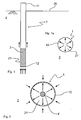
- Fig. 1 shows in a first embodiment, an open profile 1, which is formed with a profile wall 10 in tube form. How out Fig. 1 can be seen, the open profile 1 is introduced vertically for a building foundation in the ground 2 and is for further structural use slightly with his profile head 11 on the ground surface 20 addition.
- the open profile 1 has been introduced, for example, by vibration in the ground 2.
- Im in Fig. 1 illustrated embodiment has been injected in the area enclosed by the profile 1 area 21 near the profile foot 12 a swellable injection medium 3 in the ground.
- the injection medium 3 has a very low viscosity during injection, ie a high flowability, and fills the pore space in the soil in this injected region 21.
- Injection agent 3 is triggered by the chemical reaction taking place in the injection agent, for example when it comes into contact with groundwater, the foaming and hardening process.
- Such injection means 3 are known as intumescent in contact with water 2-component polyurethane injection resins, for example under the product name PUR-O-STOP manufacturer TPH Bausysteme GmbH, 22848 Norderstedt.
- the ground 2 is further solidified in the enclosed area 21 and achieved a significant increase in voltage.
- foaming the pore space of the bottom 2 is completely filled and a further pressure on the inside of the profile wall 10 as shown by the arrow in the horizontal cross-section in with further foaming Fig. 1a achieved shown open profile 1.
- This clamping of the enclosed area 21 in the interior of the open profile 1 thus virtually achieves closure of the open profile 1 and increases the load capacity in accordance with the vertical ground tension prevailing on the foot 12 of the profile 1 (four parallel arrows on the profile foot 12).
- a second embodiment is in Fig. 2 a cross section of a profile 1, similar to the representation according to Fig. 1a represented in which in the area enclosed by the profile 1 area 21, a solid profile 4 is introduced as a displacement means.
- Components which correspond to the first exemplary embodiment are designated by the same reference numerals.
- the profile 1 is slightly widened by the pressure generated by the driven solid profile 4, as shown by the dashed line (ground state) and the solid line for the profile wall 10.
- the outside of the profile wall 10 is pressed against the outer ground, which also creates an increased tension, which is symbolized by the six inwardly directed smaller arrows. Consequently, the skin friction is increased on the outside of the profile wall 10, whereby the carrying capacity of the profile 1 is further increased.
- injection means 3 could also be introduced externally around the open profile 1, whereby a further significant increase in load capacity is achieved by the tension of the open profile 1 via its contact surface, namely the outer profile wall, with the bottom and correspondingly higher skin friction.
Landscapes
- Engineering & Computer Science (AREA)
- Structural Engineering (AREA)
- Life Sciences & Earth Sciences (AREA)
- General Life Sciences & Earth Sciences (AREA)
- Mining & Mineral Resources (AREA)
- Paleontology (AREA)
- Civil Engineering (AREA)
- General Engineering & Computer Science (AREA)
- Consolidation Of Soil By Introduction Of Solidifying Substances Into Soil (AREA)
Description
- Die Erfindung betrifft ein Verfahren zur Tragfähigkeitsverbesserung von in einem Baugrund mit Porenraum gesetzten offenen Profilen. Ferner betrifft die Erfindung ein System aus einem offenen Profil und einem vom offenen Profil umschlossenen, einen Porenraum aufweisenden Baugrund.
- Offenes Profil bedeutet dabei ein Bauteil mit einem in sich geschlossenen, in Längsrichtung entlang des Profils im Wesentlichen gleichen Querschnitt. Das Profil ist unten und oben offen. Entsprechend können offene Profile neben kreisförmigen Verrohrungen auch Vierkantrohre, Kastenprofile, Schächte, Senkkästen und dergleichen sein.
- Aus der
DE 19 14 554 A ist ein Verfahren zum Verfestigen und Abdichten von Bodenformationen im Bauwesen bekannt, bei der eine fliessbare Zubereitung in den Baugrund geleitet wird, wobei diese fliessbare Zubereitung bei Berührung mit Wasser mit diesem unter Bildung von einer wasserunlöslichen verfestigten Substanz unter Freisetzung eines Gases reagiert. Entsprechend können mit diesem Verfahren Hohlräume einer Bodenformation ausgeschäumt und verdichtet werden. - Ferner ist es aus der
EP 0 264 998 A1 bekannt, zur Gründung in den Untergrund aufschäumendes Material einzubringen, um so vor dem Setzen von Pfeilern oder Ankern eine Verfestigung der Bodenformation zu erreichen. Ferner ist darin auch beschrieben, eine Verfestigung unterhalb eines existierenden Gründungselementes einzubringen. Ferner ist alternativ beschrieben, den Untergrund mit dem expandierenden Material zu verfestigen und anschließend einen Pfahl in den so verfestigten Untergrund einzubringen. - In der
US 2012/0163923 A1 wird ein Tragwerksystem beschrieben, bei dem unter einem nicht ausreichend gegründeten Fundament langgestreckte Metallprofile gesetzt werden, die mit einem chemisch reagierenden Injektionsmaterial umgeben werden, das expandiert. Damit wird unter dem bestehenden Fundament eine Bodenverfestigung mit Lastabtrag über den verfestigten Boden bzw. das langgestreckte Profil in den Untergrund erreicht. - Die
DE 19 66 479 C3 zeigt ein Verfahren zum Herstellen von Verpressankern oder mit Fußaufweitungen versehenen Pfählen, die gleichzeitig als Injektionsrohre ausgebildet sind, durch die eine fließfähige Zubereitung, die isocyanatgruppenhaltige Verbindungen enthält, injiziert wird. - Die Verwendung von kunststoffbasierten Injektionsmitteln ist beispielsweise aus der
DE 43 30 244 A1 sowie derDE 100 18 395 B4 , insbesondere bezogen auf 2-Komponenten Polyurethan-Injektionsharz, bekannt. - Die
US 2011/0038675 A1 beschreibt ein Verfahren zur Bodenverstärkung, bei dem ein Bodenverstärkungsstahlrohr in den Boden gebohrt und anschließend ein Injektionsmaterial verpresst wird, wobei das Material von der Rohrinnenseite durch eine Vielzahl von Durchgangsöffnungen in den Außenraum tritt. - Nachteilig ist jedoch, dass beim Einvibrieren oder Einstellen eines Profils in den Baugrund eine je nach Porenraum mehr oder minder starke Bodenverdichtung und damit ein Volumenschwund im Bereich der Kontaktfläche zwischen dem eingebrachten Profil und dem Baugrund entsteht. Somit wird die über die Kontaktfläche stattfindende Verspannung im Baugrund stark herabgesetzt, womit die Gesamttragfähigkeit der eingebrachten Profile gegenüber einem eingerammten Profil deutlich verringert ist. Es wurde daher bisher zum Erreichen einer besseren Verspannung des einvibrierten oder eingestellten Profils mit dem Baugrund das Profil kurz vor Erreichen der Endteufe nachgerammt oder nachverpresst. Da an vielen Lokationen ein Rammen sich aus bautechnischen oder Umweltschutzgründen verbietet, ist dieses Vorgehen häufig nicht zielführend. Zudem ist ein zusätzliches Rammen mit deutlichen Zusatzkosten und Zeitverzögerungen für das Heranschaffen, Tauschen der Gerätschaften und Aufrüsten der Rammvorrichtung verbunden.
- Alternativ werden im Stand der Technik Zusatzbleche im Inneren oder außen am Profil angeordnet, um eine sog. Propfenwirkung zu erzielen. Dadurch entstehen jedoch Erschwernisse beim Einbringen der Profile in den Baugrund, womit eine höhere Einbringleistung und damit stärkere Umweltbeeinträchtigungen sowie Kostensteigerungen einhergehen.
- Für das Nachverpressen von bereits einvibrierten Profilen werden zur Zeit nicht quellfähige, mineralische Stoffe wie z. B. Zementsuspensionen unter hohem Pumpendruck injiziert. Ein derartiges Nachverpressen bedarf somit wiederum einen erheblichen Geräteeinsatz und somit erhebliche Kosten.
- Ausgehend von der
EP 0 264 998 A1 ist es Aufgabe der vorliegenden Erfindung, ein Verfahren zur Tragfähigkeitsverbesserung nach dem Setzen des Profils anzugeben. - Gelöst wird diese Aufgabe verfahrensgemäß durch Anspruch 1 und vorrichtungsgemäß durch Anspruch 9.
- Durch Setzen des Profils in den Baugrund und nachträgliches Verspannen des vom offenen Profil umschlossenen Bereichs des Baugrunds mit der Profilwandung durch Einbringen eines Verdrängungsmittels in den vom offenen Profil umschlossenen Bereich des Baugrunds wird durch die Verdrängung des Baugrunds im vom offenen Profil umschlossenen Bereich ein erheblicher Druck auf die Innenseite der Profilwandung ausgeübt, womit eine Verspannung dieses umschlossenen Bereichs des Baugrunds mit dem Profil erreicht wird. Damit wird quasi ein Verschluss des offenen Profils erzielt und die Tragfähigkeit entsprechend der am Fuß des Profils herrschenden vertikalen Bodenspannung erhöht.
- Um eine möglichst gleichmäßige Flächenlasterhöhung auf der Innenseite der Profilwandung durch das Verdrängen des in diesem Bereich vorliegenden Baugrunds zu erreichen, wird das Verdrängungsmittel entlang der Profilachse zentral eingebracht.
- Wenn das Setzen des Profils durch Vibrieren oder Einstellen erfolgt, wird zwar die Verspannung des Profils im Baugrund beim Setzen des Profils deutlich verringert, da der anfänglich locker bis mitteldicht gelagerte Boden durch das Einvibrieren des Profils verdichtet wird. Jedoch ist ein solcher Einbringvorgang mit geringeren Beeinträchtigungen von umliegenden Bauten und mit heutigen Umweltschutzmaßnahmen bevorzugt, wobei durch das nachträgliche Ausführen der Tragfähigkeitsverbesserung durch Einbringen des Verdrängungsmittels die Verspannung des Profils im Untergrund wieder erhöht wird. Das erfolgt dadurch, dass bevorzugt zentral eine Aufweitung durch das Verdrängungsmittel passiert. Dabei wird der Boden geschert. In der Scherfuge vergrößert sich durch Dilatanz sein Volumen, was aufgrund der Randbedingung, nämlich dem umschlossenen Profil verhindert ist und zu erheblichen Verspannungen führt. Damit wird eine deutliche Erhöhung des Spannungszustandes an der Kontaktfläche zwischen Profil und Boden (Baugrund) erreicht. Somit können auch gering tragfähige Böden durch den Verdrängungsvorgang die Tragfähigkeit deutlich erhöhen.
- Wenn das Verdrängungsmittel ein quellfähiges Injektionsmittel ist, das anschließend aufquillt, wird durch das Verfüllen des Porenraums im vom Profil umschlossenen Bereich des Baugrunds mit dem quellfähigen Injektionsmittel und dem anschließenden Aufquellen lassen des Injektionsmittels eine deutlich erhöhte Bodenspannung und somit quasi ein Verschluss des offenen Profils erreicht, womit sich die Tragfähigkeit des bereits eingebrachten Profils entsprechend der am Fuß des Profils herrschenden Vertikalspannung erhöht.
- Dadurch, dass das Verdrängungsmittel ein einen Teil der Querschnittsdimension des offenen Profils einnehmendes Vollprofil ist, das in den vom offenen Profil umschlossenen Bereich des Baugrunds eingesetzt wird, wird durch das in den Baugrund eingetriebene Vollprofil der Baugrund im vom offenen Profil umschlossenen Bereich kompaktiert, womit eine deutliche Spannungserhöhung eintritt und dieser wiederum quasi wie ein Verschluss des offenen Profils wirkt. Entsprechend erhöht sich die Tragfähigkeit des eingebrachten Profils. Im Extremfall kann ein Vollprofil nur dann in den dicht gelagerten Boden gedrückt werden, wenn die Körner brechen oder das äußere Rohr sich aufweitet.
- Bevorzugt erfolgt das Setzen des Vollprofils innerhalb des offenen Profils durch Vibrieren oder Einstellen, da somit wiederum übermäßige Erschütterungen vermieden werden können, um die Umgebung zu schützen.
- Wenn durch das nachträgliche Verspannen des vom offenen Profil umschlossenen Bereichs des Baugrunds mit der Profilwandung durch Einbringen eines Verdrängungsmittels das offene Profil leicht aufgedehnt wird, erfolgt ebenfalls eine Spannungserhöhung auf der Außenseite des Profils, also auf der Kontaktfläche der Profilwandung mit dem äußeren Baugrund. Durch die erhöhte Verspannung der Kontaktfläche zwischen Profil und äußeren Baugrund erhöht sich entsprechend die Mantelreibung, womit eine weiter erhöhte Tragfähigkeit einhergeht.
- Ergänzend kann die Tragfähigkeit dadurch erhöht werden, dass außenseitig des offenen Profils nahe der Profilwandung Injektionsmittel eingebracht wird. Somit wird bevorzugt auch an der außenliegenden Kontaktfläche des Profils die Verspannung im Baugrund erhöht. Dabei wird bevorzugt das Injektionsmittel über den gesamten Umfang des Profils in geeigneter Tiefe eingebracht.
- Wenn als Injektionsmittel ein bei Kontakt mit Wasser aufschäumender 2-Komponenten Polyurethan-Injektionsharz verwendet wird, bestehen auch keine Bedenken hinsichtlich der Grundwassereignung des Materials, wobei beim Aufschäumen dieses Materials lineare Dehnungen von 10 % bis 200 %, bevorzugt 20 % bis 100 % im freien Raum erreicht werden, die entsprechend im Baugrund zu einer deutlichen Spannungserhöhung führen. Somit können auch gering tragfähige Böden durch den Quellvorgang sowie die Eigenfestigkeit des aufgequellten und ausgehärteten Materials in den Poren die Tragfähigkeit deutlich erhöhen. Vorteilhaft kann somit mit einem geringen Materialeinsatz eine wesentliche Traglaststeigerung erreicht werden.
- Dadurch, dass das Verdrängungsmittel ein Vollprofil mit 5% bis 50% der Querschnittsdimension des offenen Profils ist, das entlang der Profilachse zentral in den vom offenen Profil umschlossenen Bereich des Baugrunds eingesetzt ist, wird der Boden durch das Einsetzen des Vollprofils im vom offenen Profil umschlossenen Bereich kompaktiert und verspannt, womit dieser Bereich quasi einen Pfropfen bildet und entsprechend die Tragfähigkeit des Profils erhöht wird. Bevorzugt hat das Vollprofil 8% bis 25% der Querschnittsdimension des offenen Profils.
- Um eine ausreichende Stützung auch außenseitig um das Profil und somit eine entsprechende Spannungserhöhung im äußeren Baugrund zu erreichen, ist der Baugrund lateral um das Profil mit einer Einbindetiefe T im Baugrund in einer Ausdehnung von 1/20 T bis 1/1 T, insbesondere 1/10 T bis ¼ T mit dem Injektionsmittel versehen.
- Dadurch, dass das Profil in seiner Profilwandung Schwächungszonen oder Schlitze aufweist, an denen eine stärkere Aufdehnung des Profils möglich ist, wird beim Verspannen des vom offenen Profil umschlossenen Bereichs des Baugrunds eine stärkere Aufdehnung des Profils ermöglicht, so dass dieses auch mit der Außenseite der Profilwandung einen stärkeren Kontakt zu dem außen umgebenden Baugrund bewirkt, so dass hier die Mantelreibung weiter steigt. Entsprechend kann die Tragfähigkeit des eingebrachten Profils weiter erhöht werden. Schwächungszonen sind beispielsweise lokale Bereiche in der Profilwandung, die eine deutlich geringere Materialstärke aufweisen oder aus einem anderen, weicheren Material hergestellt sind. Bei der Verwendung von Schlitzen, die bevorzugt im Wesentlichen Profilachsen parallel ausgerichtet sind, kann das Aufweiten des Profils erheblich erleichtert werden. Die Schwächungszonen und/oder Schlitze dürfen jedoch die Festigkeit des Profils zur Einbringung in den Baugrund und Einleitung der Traglasten nicht schwächen. Nachfolgend werden zwei Ausführungsbeispiele der Erfindung anhand der beiliegenden Figuren detailliert beschrieben.
- Darin zeigt:
- Fig. 1
- ein offenes Profil in Rohrform,
- Fig. 1a
- ein vergrößerter Querschnitt des Profils von
Fig. 1 und - Fig. 2
- in einem zweiten Ausführungsbeispiel einen Querschnitt eines aufgeweiteten Profils.
-
Fig. 1 zeigt in einem ersten Ausführungsbeispiel ein offenes Profil 1, das mit einer Profilwandung 10 in Rohrform ausgebildet ist. Wie ausFig. 1 ersichtlich, ist das offene Profil 1 für eine Bauwerksgründung senkrecht im Baugrund 2 eingebracht und steht zur weiteren baulichen Verwendung geringfügig mit seinem Profilkopf 11 über Bodenoberfläche 20 hinaus. - Das offene Profil 1 ist beispielsweise durch Vibrieren in den Baugrund 2 eingebracht worden. Dabei erfolgt eine Bodenverdichtung mit Volumenabnahme und daraus resultierender deutlicher Abnahme der horizontalen Spannungen an den Kontaktflächen sowohl außenseitig um die Profilwandung 10 des offenen Profils 1, wie auch innenseitig. Erkennbar ist diese Volumenabnahme an einem sich ausbildenden Rutschtrichter außenseitig um das offene Profil 1 sowie auch analog innenseitig. Entsprechend verringert sich die Verspannung des eingebrachten offenen Profils 1 mit dem Baugrund 2, da durch die Volumenabnahme die Bodenspannung lokal deutlich verringert wird.
- Im in
Fig. 1 dargestellten Ausführungsbeispiel ist im vom Profil 1 umschlossenen Bereich 21 nahe des Profilfußes 12 ein quellfähiges Injektionsmittel 3 in den Boden injiziert worden. Das Injektionsmittel 3 weist bei der Injektion eine sehr niedrige Viskosität, also eine hohe Fliessfähigkeit auf und füllt den Porenraum im Boden in diesem injizierten Bereich 21 aus. Je nach verwendetem Injektionsmittel 3 wird durch die im Injektionsmittel ablaufende chemische Reaktion, beispielsweise bei Kontakt mit Grundwasser, der Aufschäumungs- und Härtungsprozess ausgelöst. Derartige Injektionsmittel 3 sind als bei Kontakt mit Wasser aufschäumende 2-Komponenten Polyurethan-Injektionsharze, beispielsweise unter der Produktbezeichnung PUR-O-STOP des Herstellers TPH Bausysteme GmbH, 22848 Norderstedt, bekannt. - Mit dem Aufschäumen des Injektionsmittels 3 wird der Baugrund 2 im umschlossenen Bereich 21 weiter verfestigt und eine deutliche Spannungserhöhung erzielt. Durch das Aufschäumen wird der Porenraum des Bodens 2 vollständig ausgefüllt und bei weiterer Aufschäumung ein erheblicher Druck auf die Innenseite der Profilwandung 10 gemäß Pfeildarstellung in dem im horizontalen Querschnitt in
Fig. 1a dargestellten offenen Profil 1 erzielt. Durch diese Verspannung des umschlossenen Bereichs 21 im Inneren des offenen Profils 1 wird somit quasi ein Verschluss des offenen Profils 1 erreicht und die Tragfähigkeit entsprechend der am Fuß 12 des Profils 1 herrschenden vertikalen Bodenspannung (vier parallele Pfeile am Profilfuß 12) erhöht. - In einem zweiten Ausführungsbeispiel ist in
Fig. 2 ein Querschnitt eines Profils 1, ähnlich zur Darstellung gemäßFig. 1a dargestellt, bei dem in dem vom Profil 1 umschlossenen Bereich 21 ein Vollprofil 4 als Verdrängungsmittel eingebracht ist. Mit dem ersten Ausführungsbeispiel übereinstimmende Bauteile sind mit gleichen Bezugszeichen bezeichnet. - Durch das zentral in der Profilachse eingebrachte Vollprofil 4 wird der Boden im umschlossenen Bereich 21 stark verdichtet, so dass die mit großen Pfeilen dargestellten Horizontalspannungen entstehen, die den Boden an die Innenseite der Profilwandung 10 des Profils 1 drängen. Entsprechend verspannt sich der Boden mit dem Profil 1 und bildet quasi einen Verschluss, so dass das gesetzte Profil 1 zusätzlich die im Beriech des Profilfußes 12 herrschende vertikale Bodenspannung, wie in
Fig. 1 mit den vier parallelen Pfeilen dargestellt, als Last aufnehmen kann. - Zusätzlich wird das Profil 1 durch den durch das eingetriebene Vollprofil 4 erzeugten Druck leicht aufgeweitet, wie es mit der gestrichelten Linie (Grundzustand) und der durchgehenden Linie für die Profilwandung 10 dargestellt ist. Damit wird auch die Außenseite der Profilwandung 10 gegen den äußeren Baugrund gedrückt, womit auch hier eine erhöhte Verspannung entsteht, die mit den sechs nach innen gerichteten kleineren Pfeilen symbolisiert ist. Folglich wird die Mantelreibung an der Außenseite der Profilwandung 10 erhöht, womit die Tragfähigkeit des Profils 1 weiter gesteigert wird.
- Ergänzend könnte das Injektionsmittel 3 auch außen um das offene Profil 1 eingebracht werden, womit eine weitere deutliche Tragfähigkeitsverbesserung durch die Verspannung des offenen Profils 1 über seine Kontaktfläche, nämlich der äußeren Profilwandung, mit dem Boden und entsprechend höherer Mantelreibung erzielt wird.
-
- 1
- offenes Profil
- 10
- Profilwandung
- 11
- Profilkopf
- 12
- Profilfuß
- 2
- Baugrund
- 20
- Bodenoberfläche
- 21
- umschlossener Bereich
- 3
- Injektionsmittel, Verdrängungsmittel
- 4
- Vollprofil, Verdrängungsmittel
Claims (15)
- Verfahren zur Tragfähigkeitsverbesserung von in einem Baugrund (2) mit Porenraum gesetzten, offenen Profilen (1) mit einer Profilwandung (10) mit den Schritten:- Setzen des Profils (1) in den Baugrund (2) und- nachträgliches Verspannen des vom offenen Profil (1) umschlossenen Bereichs (21) des Baugrunds (2) mit der Profilwandung (10) durch Einbringen eines Verdrängungsmittels (3, 4) in den vom offenen Profil (1) umschlossenen Bereich (21) des Baugrunds (2).
- Verfahren nach Anspruch 1, dadurch gekennzeichnet, dass das Verdrängungsmittel (3, 4) entlang der Profilachse zentral eingebracht wird.
- Verfahren nach Anspruch 1 oder 2, dadurch gekennzeichnet, dass das Setzen des offenen Profils (1) durch Vibrieren oder Einstellen erfolgt.
- Verfahren nach Anspruch 1, 2 oder 3, dadurch gekennzeichnet, dass das Verdrängungsmittel ein quellfähiges Injektionsmittel (3) ist, das anschließend aufquillt.
- Verfahren nach Anspruch 1, 2 oder 3, dadurch gekennzeichnet, dass das Verdrängungsmittel ein einen Teil der Querschnittsdimension des offenen Profils einnehmendes Vollprofil (4) ist, das in den vom offenen Profil (1) umschlossenen Bereich (21) des Baugrunds (2) eingesetzt wird.
- Verfahren nach Anspruch 5, dadurch gekennzeichnet, dass das Setzen des Vollprofils (4) innerhalb des offenen Profils (1) durch Vibrieren oder Einstellen erfolgt.
- Verfahren nach einem der vorangehenden Ansprüche, dadurch gekennzeichnet, dass durch das nachträgliche Verspannen des vom offenen Profil (1) umschlossenen Bereich (21) des Baugrunds (2) mit der Profilwandung (10) durch Einbringen eines Verdrängungsmittels (3, 4) das offene Profil (1) leicht aufgedehnt wird.
- Verfahren nach einem der vorangehenden Ansprüche, dadurch gekennzeichnet, dass außenseitig des offenen Profils (1) nahe der Profilwandung (10) Injektionsmittel (3) eingebracht wird.
- System aus einem offenen Profil (1) und einem einen Porenraum aufweisenden Baugrund (2), in dem das Profil (1) gesetzt ist, dadurch gekennzeichnet, dass der vom offenen Profil (1) umschlossene Bereich (21) des Baugrundes (2) durch ein eingebrachtes Verdrängungsmittel (3, 4) mit der Innenwandung (10) des Profils (1) verspannt ist.
- System nach Anspruch 9, dadurch gekennzeichnet, dass das Verdrängungsmittel ein aufgeschäumtes und abgebundenes Injektionsmittel (3) im Porenraum des vom offenen Profil (1) umschlossenen Bereichs (21) des Baugrunds (2) ist.
- System nach Anspruch 10, dadurch gekennzeichnet, dass das Injektionsmittel (3) ein 2-Komponenten Polyurethan-Injektionsharz ist, der bei freiem Aufschäumen eine lineare Dehnung von 10 % bis 200 %, bevorzugt 20 % bis 100 % hat.
- System nach Anspruch 9, dadurch gekennzeichnet, dass das Verdrängungsmittel ein Vollprofil (4) mit 5% bis 50% der Querschnittsdimension des offenen Profils ist, das entlang der Profilachse zentral in den vom offenen Profil (1) umschlossenen Bereich (21) des Baugrunds (2) eingesetzt ist.
- System nach Anspruch 10, dadurch gekennzeichnet, dass das Vollprofil (4) 8% bis 25% der Querschnittsdimension des offenen Profils hat.
- System nach einem der Ansprüche 9 bis 13, dadurch gekennzeichnet, dass der Baugrund (2) lateral um das Profil (1) bei einer Einbindetiefe T im Baugrund (2) in einer Ausdehnung von 1/20 T bis 1/1 T, insbesondere 1/10 T bis ¼ T mit dem Injektionsmittel (3) versehen ist.
- System nach einem der Ansprüche 9 bis 14, dadurch gekennzeichnet, dass das Profil (1) in seiner Profilwandung (10) Schwächungszonen oder Schlitze aufweist, an denen eine stärkere Aufdehnung des Profils (1) möglich ist.
Priority Applications (1)
| Application Number | Priority Date | Filing Date | Title |
|---|---|---|---|
| PL13182032T PL2706148T3 (pl) | 2012-08-30 | 2013-08-28 | Sposób poprawy nośności otwartych profili osadzonych w gruncie budowlanym oraz utworzony przez nie system |
Applications Claiming Priority (1)
| Application Number | Priority Date | Filing Date | Title |
|---|---|---|---|
| DE102012108038 | 2012-08-30 |
Publications (2)
| Publication Number | Publication Date |
|---|---|
| EP2706148A1 EP2706148A1 (de) | 2014-03-12 |
| EP2706148B1 true EP2706148B1 (de) | 2014-10-15 |
Family
ID=49084797
Family Applications (1)
| Application Number | Title | Priority Date | Filing Date |
|---|---|---|---|
| EP13182032.6A Not-in-force EP2706148B1 (de) | 2012-08-30 | 2013-08-28 | Verfahren zur Tragfähigkeitsverbesserung von im Baugrund gesetzten offenen Profilen sowie damit erstelltes System |
Country Status (3)
| Country | Link |
|---|---|
| EP (1) | EP2706148B1 (de) |
| DK (1) | DK2706148T3 (de) |
| PL (1) | PL2706148T3 (de) |
Families Citing this family (1)
| Publication number | Priority date | Publication date | Assignee | Title |
|---|---|---|---|---|
| DK2998448T3 (da) | 2014-09-22 | 2017-02-20 | Tutech Innovation Gmbh | Fremgangsmåde til bæreevne-forbedring af åbne profiler, der er indsat i byggegrund, såvel som system, der er fremstillet ved anvendelse af samme. |
Family Cites Families (7)
| Publication number | Priority date | Publication date | Assignee | Title |
|---|---|---|---|---|
| DE1966479C3 (de) | 1968-03-21 | 1981-07-23 | Kabushiki Kaisha Takenaka Komuten, Osaka | Verfahren zum Herstellen von Verpreßankern oder mit Fußerweiterungen versehenen Pfählen im Boden |
| DE1914554C3 (de) | 1968-03-21 | 1978-10-12 | Kabushiki Kaisha Takenaka Komuten, Osaka (Japan) | Verfahren zum Abdichten von Bodenformationen und Tiefbaukonstruktionen |
| NL8700512A (nl) | 1986-10-06 | 1988-05-02 | Ballast Nedam Groep Nv | Fundering en werkwijze voor het vervaardigen daarvan. |
| DE4330244A1 (de) | 1993-09-07 | 1995-03-09 | Henkel Kgaa | Vereinfachtes Verfahren zur Erdreichstabilisierung |
| DE10018395B4 (de) | 2000-04-13 | 2004-07-15 | Bayer Ag | Polyurethanschäume mit geringer Exothermie |
| US20110038675A1 (en) | 2008-10-02 | 2011-02-17 | Nippon Steel Corporation | Steel pipe for reinforcing ground, method of reinforcing ground using the same, and method of reinforcing structure |
| TR200906475A1 (tr) | 2009-08-21 | 2011-03-21 | Mete Erdemg�L Enver | Yapı destekleme sistemi. |
-
2013
- 2013-08-28 PL PL13182032T patent/PL2706148T3/pl unknown
- 2013-08-28 DK DK13182032.6T patent/DK2706148T3/en active
- 2013-08-28 EP EP13182032.6A patent/EP2706148B1/de not_active Not-in-force
Also Published As
| Publication number | Publication date |
|---|---|
| EP2706148A1 (de) | 2014-03-12 |
| PL2706148T3 (pl) | 2015-03-31 |
| DK2706148T3 (en) | 2015-01-12 |
Similar Documents
| Publication | Publication Date | Title |
|---|---|---|
| DE69700280T2 (de) | Verfahren zum Erhöhen der Belastbarkeit eines Fundamentsbodens für Bauwerke | |
| DE2651023C2 (de) | Verfahren zum Herstellen eines Ortbetonpfahles mit einer Fußerweiterung und Vorrichtung zum Durchführen des Verfahrens | |
| EP3085843B1 (de) | Vorrichtung und verfahren zur wärmeentkopplung von betonierten gebäudeteilen | |
| DE102015106294A1 (de) | Vorrichtung und Verfahren zur Wärmeentkopplung von betonierten Gebäudeteilen | |
| DE3445965A1 (de) | Verdichtende tiefgruendung, verfahren und vorrichtung zu deren herstellen | |
| EP2698476B1 (de) | Verfahren zur Gründung eines Offshore-Bauwerks sowie Fundament für ein Offshore-Bauwerk | |
| DE2823950C2 (de) | Schachtausbau, insbesondere für den Ausbau tiefer Schächte in nicht standfestem, wasserführendem Gebirge | |
| EP2706148B1 (de) | Verfahren zur Tragfähigkeitsverbesserung von im Baugrund gesetzten offenen Profilen sowie damit erstelltes System | |
| DE102017121037A1 (de) | Verfahren zur Tragfähigkeitsverbesserung von im Baugrund gesetzten Profilen sowie Profil dafür | |
| DE102012201281A1 (de) | Stahlbeton-Rammpfahlfundament | |
| AT511240B1 (de) | Verfahren zum erstellen eines bauwerkes und mauerwerk-verankerungssystem | |
| EP0151389B1 (de) | Verfahren und Vorrichtung zum Herstellen von Bauelementen im Baugrund, wie Pfählen, Injektionsankern, Schlitzwänden oder dergleichen | |
| DE102005029364B4 (de) | Fertigteilpfahl sowie dazugehöriges Verfahren zur Bauwerksgründung | |
| EP1108855B1 (de) | Tragfähiges Dichtgewölbe für die Abdichtung unterirdischer Tunnelbauten | |
| EP3118376B1 (de) | Vorrichtung zur aktivierung der mantelreibung von pfahlartigen traggliedern | |
| DE19939799A1 (de) | Verfahren und Anordnung zur Sanierung bzw. Verstärkung von Stützen | |
| DE3521434A1 (de) | Injektionsverfahren und -vorrichtung zur bodenverbesserung | |
| EP2998448B1 (de) | Verfahren zur Tragfähigkeitsverbesserung von im Baugrund gesetzten offenen Profilen sowie damit erstelltes System | |
| DE3033715A1 (de) | Verfahren zur untergrundverbesserung und dazu dienender gruendungspfahl, -anker o.dgl. | |
| Vigl et al. | Grouting in pressure tunnel construction | |
| EP0457969B1 (de) | Verfahren und Vorrichtung zum Heben von Bauwerken | |
| EP3656926B1 (de) | Verfahren zur stabilisierung und anhebung von bauwerken | |
| EP3115520B1 (de) | Verfahren zur nachträglichen sicherung von unzureichend verankerten vormauerschalen eines zweischaligen mauerwerks | |
| DE3921938A1 (de) | Verfahren zur stabilisierung von lockerboeden mit organomineralharzen | |
| WO2007028534A1 (de) | Verfahren und vorrichtung für die verfestigung von böden und die stabilisierung von fundamenten |
Legal Events
| Date | Code | Title | Description |
|---|---|---|---|
| PUAI | Public reference made under article 153(3) epc to a published international application that has entered the european phase |
Free format text: ORIGINAL CODE: 0009012 |
|
| AK | Designated contracting states |
Kind code of ref document: A1 Designated state(s): AL AT BE BG CH CY CZ DE DK EE ES FI FR GB GR HR HU IE IS IT LI LT LU LV MC MK MT NL NO PL PT RO RS SE SI SK SM TR |
|
| AX | Request for extension of the european patent |
Extension state: BA ME |
|
| 17P | Request for examination filed |
Effective date: 20140306 |
|
| RBV | Designated contracting states (corrected) |
Designated state(s): AL AT BE BG CH CY CZ DE DK EE ES FI FR GB GR HR HU IE IS IT LI LT LU LV MC MK MT NL NO PL PT RO RS SE SI SK SM TR |
|
| GRAP | Despatch of communication of intention to grant a patent |
Free format text: ORIGINAL CODE: EPIDOSNIGR1 |
|
| INTG | Intention to grant announced |
Effective date: 20140605 |
|
| GRAS | Grant fee paid |
Free format text: ORIGINAL CODE: EPIDOSNIGR3 |
|
| GRAA | (expected) grant |
Free format text: ORIGINAL CODE: 0009210 |
|
| AK | Designated contracting states |
Kind code of ref document: B1 Designated state(s): AL AT BE BG CH CY CZ DE DK EE ES FI FR GB GR HR HU IE IS IT LI LT LU LV MC MK MT NL NO PL PT RO RS SE SI SK SM TR |
|
| REG | Reference to a national code |
Ref country code: CH Ref legal event code: EP Ref country code: GB Ref legal event code: FG4D Free format text: NOT ENGLISH |
|
| REG | Reference to a national code |
Ref country code: IE Ref legal event code: FG4D Free format text: LANGUAGE OF EP DOCUMENT: GERMAN |
|
| REG | Reference to a national code |
Ref country code: AT Ref legal event code: REF Ref document number: 691770 Country of ref document: AT Kind code of ref document: T Effective date: 20141115 |
|
| REG | Reference to a national code |
Ref country code: DE Ref legal event code: R096 Ref document number: 502013000129 Country of ref document: DE Effective date: 20141127 |
|
| REG | Reference to a national code |
Ref country code: SE Ref legal event code: TRGR |
|
| REG | Reference to a national code |
Ref country code: DK Ref legal event code: T3 Effective date: 20150105 |
|
| REG | Reference to a national code |
Ref country code: NO Ref legal event code: T2 Effective date: 20141015 |
|
| REG | Reference to a national code |
Ref country code: NL Ref legal event code: VDEP Effective date: 20141015 |
|
| REG | Reference to a national code |
Ref country code: LT Ref legal event code: MG4D |
|
| PG25 | Lapsed in a contracting state [announced via postgrant information from national office to epo] |
Ref country code: NL Free format text: LAPSE BECAUSE OF FAILURE TO SUBMIT A TRANSLATION OF THE DESCRIPTION OR TO PAY THE FEE WITHIN THE PRESCRIBED TIME-LIMIT Effective date: 20141015 |
|
| REG | Reference to a national code |
Ref country code: PL Ref legal event code: T3 |
|
| PG25 | Lapsed in a contracting state [announced via postgrant information from national office to epo] |
Ref country code: PT Free format text: LAPSE BECAUSE OF FAILURE TO SUBMIT A TRANSLATION OF THE DESCRIPTION OR TO PAY THE FEE WITHIN THE PRESCRIBED TIME-LIMIT Effective date: 20150216 Ref country code: FI Free format text: LAPSE BECAUSE OF FAILURE TO SUBMIT A TRANSLATION OF THE DESCRIPTION OR TO PAY THE FEE WITHIN THE PRESCRIBED TIME-LIMIT Effective date: 20141015 Ref country code: LT Free format text: LAPSE BECAUSE OF FAILURE TO SUBMIT A TRANSLATION OF THE DESCRIPTION OR TO PAY THE FEE WITHIN THE PRESCRIBED TIME-LIMIT Effective date: 20141015 Ref country code: IS Free format text: LAPSE BECAUSE OF FAILURE TO SUBMIT A TRANSLATION OF THE DESCRIPTION OR TO PAY THE FEE WITHIN THE PRESCRIBED TIME-LIMIT Effective date: 20150215 Ref country code: ES Free format text: LAPSE BECAUSE OF FAILURE TO SUBMIT A TRANSLATION OF THE DESCRIPTION OR TO PAY THE FEE WITHIN THE PRESCRIBED TIME-LIMIT Effective date: 20141015 |
|
| PG25 | Lapsed in a contracting state [announced via postgrant information from national office to epo] |
Ref country code: GR Free format text: LAPSE BECAUSE OF FAILURE TO SUBMIT A TRANSLATION OF THE DESCRIPTION OR TO PAY THE FEE WITHIN THE PRESCRIBED TIME-LIMIT Effective date: 20150116 Ref country code: HR Free format text: LAPSE BECAUSE OF FAILURE TO SUBMIT A TRANSLATION OF THE DESCRIPTION OR TO PAY THE FEE WITHIN THE PRESCRIBED TIME-LIMIT Effective date: 20141015 Ref country code: CY Free format text: LAPSE BECAUSE OF FAILURE TO SUBMIT A TRANSLATION OF THE DESCRIPTION OR TO PAY THE FEE WITHIN THE PRESCRIBED TIME-LIMIT Effective date: 20141015 Ref country code: LV Free format text: LAPSE BECAUSE OF FAILURE TO SUBMIT A TRANSLATION OF THE DESCRIPTION OR TO PAY THE FEE WITHIN THE PRESCRIBED TIME-LIMIT Effective date: 20141015 Ref country code: RS Free format text: LAPSE BECAUSE OF FAILURE TO SUBMIT A TRANSLATION OF THE DESCRIPTION OR TO PAY THE FEE WITHIN THE PRESCRIBED TIME-LIMIT Effective date: 20141015 |
|
| REG | Reference to a national code |
Ref country code: DE Ref legal event code: R097 Ref document number: 502013000129 Country of ref document: DE |
|
| PG25 | Lapsed in a contracting state [announced via postgrant information from national office to epo] |
Ref country code: EE Free format text: LAPSE BECAUSE OF FAILURE TO SUBMIT A TRANSLATION OF THE DESCRIPTION OR TO PAY THE FEE WITHIN THE PRESCRIBED TIME-LIMIT Effective date: 20141015 Ref country code: RO Free format text: LAPSE BECAUSE OF FAILURE TO SUBMIT A TRANSLATION OF THE DESCRIPTION OR TO PAY THE FEE WITHIN THE PRESCRIBED TIME-LIMIT Effective date: 20141015 Ref country code: CZ Free format text: LAPSE BECAUSE OF FAILURE TO SUBMIT A TRANSLATION OF THE DESCRIPTION OR TO PAY THE FEE WITHIN THE PRESCRIBED TIME-LIMIT Effective date: 20141015 Ref country code: SK Free format text: LAPSE BECAUSE OF FAILURE TO SUBMIT A TRANSLATION OF THE DESCRIPTION OR TO PAY THE FEE WITHIN THE PRESCRIBED TIME-LIMIT Effective date: 20141015 |
|
| PLBE | No opposition filed within time limit |
Free format text: ORIGINAL CODE: 0009261 |
|
| STAA | Information on the status of an ep patent application or granted ep patent |
Free format text: STATUS: NO OPPOSITION FILED WITHIN TIME LIMIT |
|
| PG25 | Lapsed in a contracting state [announced via postgrant information from national office to epo] |
Ref country code: IT Free format text: LAPSE BECAUSE OF FAILURE TO SUBMIT A TRANSLATION OF THE DESCRIPTION OR TO PAY THE FEE WITHIN THE PRESCRIBED TIME-LIMIT Effective date: 20141015 |
|
| 26N | No opposition filed |
Effective date: 20150716 |
|
| PG25 | Lapsed in a contracting state [announced via postgrant information from national office to epo] |
Ref country code: SI Free format text: LAPSE BECAUSE OF FAILURE TO SUBMIT A TRANSLATION OF THE DESCRIPTION OR TO PAY THE FEE WITHIN THE PRESCRIBED TIME-LIMIT Effective date: 20141015 |
|
| PG25 | Lapsed in a contracting state [announced via postgrant information from national office to epo] |
Ref country code: LU Free format text: LAPSE BECAUSE OF FAILURE TO SUBMIT A TRANSLATION OF THE DESCRIPTION OR TO PAY THE FEE WITHIN THE PRESCRIBED TIME-LIMIT Effective date: 20150828 Ref country code: MC Free format text: LAPSE BECAUSE OF FAILURE TO SUBMIT A TRANSLATION OF THE DESCRIPTION OR TO PAY THE FEE WITHIN THE PRESCRIBED TIME-LIMIT Effective date: 20141015 |
|
| REG | Reference to a national code |
Ref country code: IE Ref legal event code: MM4A |
|
| PG25 | Lapsed in a contracting state [announced via postgrant information from national office to epo] |
Ref country code: IE Free format text: LAPSE BECAUSE OF NON-PAYMENT OF DUE FEES Effective date: 20150828 |
|
| REG | Reference to a national code |
Ref country code: FR Ref legal event code: PLFP Year of fee payment: 4 |
|
| PG25 | Lapsed in a contracting state [announced via postgrant information from national office to epo] |
Ref country code: MT Free format text: LAPSE BECAUSE OF FAILURE TO SUBMIT A TRANSLATION OF THE DESCRIPTION OR TO PAY THE FEE WITHIN THE PRESCRIBED TIME-LIMIT Effective date: 20141015 |
|
| REG | Reference to a national code |
Ref country code: CH Ref legal event code: PL |
|
| PG25 | Lapsed in a contracting state [announced via postgrant information from national office to epo] |
Ref country code: CH Free format text: LAPSE BECAUSE OF NON-PAYMENT OF DUE FEES Effective date: 20160831 Ref country code: LI Free format text: LAPSE BECAUSE OF NON-PAYMENT OF DUE FEES Effective date: 20160831 |
|
| PG25 | Lapsed in a contracting state [announced via postgrant information from national office to epo] |
Ref country code: BG Free format text: LAPSE BECAUSE OF FAILURE TO SUBMIT A TRANSLATION OF THE DESCRIPTION OR TO PAY THE FEE WITHIN THE PRESCRIBED TIME-LIMIT Effective date: 20141015 Ref country code: HU Free format text: LAPSE BECAUSE OF FAILURE TO SUBMIT A TRANSLATION OF THE DESCRIPTION OR TO PAY THE FEE WITHIN THE PRESCRIBED TIME-LIMIT; INVALID AB INITIO Effective date: 20130828 |
|
| PG25 | Lapsed in a contracting state [announced via postgrant information from national office to epo] |
Ref country code: BE Free format text: LAPSE BECAUSE OF NON-PAYMENT OF DUE FEES Effective date: 20150831 |
|
| REG | Reference to a national code |
Ref country code: FR Ref legal event code: PLFP Year of fee payment: 5 |
|
| PGFP | Annual fee paid to national office [announced via postgrant information from national office to epo] |
Ref country code: NO Payment date: 20170822 Year of fee payment: 5 Ref country code: GB Payment date: 20170824 Year of fee payment: 5 Ref country code: FR Payment date: 20170823 Year of fee payment: 5 |
|
| PGFP | Annual fee paid to national office [announced via postgrant information from national office to epo] |
Ref country code: DK Payment date: 20170824 Year of fee payment: 5 Ref country code: PL Payment date: 20170818 Year of fee payment: 5 Ref country code: SE Payment date: 20170830 Year of fee payment: 5 |
|
| PG25 | Lapsed in a contracting state [announced via postgrant information from national office to epo] |
Ref country code: SM Free format text: LAPSE BECAUSE OF FAILURE TO SUBMIT A TRANSLATION OF THE DESCRIPTION OR TO PAY THE FEE WITHIN THE PRESCRIBED TIME-LIMIT Effective date: 20141015 |
|
| PG25 | Lapsed in a contracting state [announced via postgrant information from national office to epo] |
Ref country code: TR Free format text: LAPSE BECAUSE OF FAILURE TO SUBMIT A TRANSLATION OF THE DESCRIPTION OR TO PAY THE FEE WITHIN THE PRESCRIBED TIME-LIMIT Effective date: 20141015 Ref country code: MK Free format text: LAPSE BECAUSE OF FAILURE TO SUBMIT A TRANSLATION OF THE DESCRIPTION OR TO PAY THE FEE WITHIN THE PRESCRIBED TIME-LIMIT Effective date: 20141015 |
|
| PG25 | Lapsed in a contracting state [announced via postgrant information from national office to epo] |
Ref country code: AL Free format text: LAPSE BECAUSE OF FAILURE TO SUBMIT A TRANSLATION OF THE DESCRIPTION OR TO PAY THE FEE WITHIN THE PRESCRIBED TIME-LIMIT Effective date: 20141015 |
|
| REG | Reference to a national code |
Ref country code: DK Ref legal event code: EBP Effective date: 20180831 Ref country code: NO Ref legal event code: MMEP |
|
| REG | Reference to a national code |
Ref country code: SE Ref legal event code: EUG |
|
| GBPC | Gb: european patent ceased through non-payment of renewal fee |
Effective date: 20180828 |
|
| PG25 | Lapsed in a contracting state [announced via postgrant information from national office to epo] |
Ref country code: NO Free format text: LAPSE BECAUSE OF NON-PAYMENT OF DUE FEES Effective date: 20180831 |
|
| PG25 | Lapsed in a contracting state [announced via postgrant information from national office to epo] |
Ref country code: SE Free format text: LAPSE BECAUSE OF NON-PAYMENT OF DUE FEES Effective date: 20180829 |
|
| PG25 | Lapsed in a contracting state [announced via postgrant information from national office to epo] |
Ref country code: DK Free format text: LAPSE BECAUSE OF NON-PAYMENT OF DUE FEES Effective date: 20180831 |
|
| PG25 | Lapsed in a contracting state [announced via postgrant information from national office to epo] |
Ref country code: FR Free format text: LAPSE BECAUSE OF NON-PAYMENT OF DUE FEES Effective date: 20180831 |
|
| REG | Reference to a national code |
Ref country code: AT Ref legal event code: MM01 Ref document number: 691770 Country of ref document: AT Kind code of ref document: T Effective date: 20180828 |
|
| PG25 | Lapsed in a contracting state [announced via postgrant information from national office to epo] |
Ref country code: GB Free format text: LAPSE BECAUSE OF NON-PAYMENT OF DUE FEES Effective date: 20180828 |
|
| PGFP | Annual fee paid to national office [announced via postgrant information from national office to epo] |
Ref country code: DE Payment date: 20190822 Year of fee payment: 7 |
|
| PG25 | Lapsed in a contracting state [announced via postgrant information from national office to epo] |
Ref country code: AT Free format text: LAPSE BECAUSE OF NON-PAYMENT OF DUE FEES Effective date: 20180828 |
|
| PG25 | Lapsed in a contracting state [announced via postgrant information from national office to epo] |
Ref country code: PL Free format text: LAPSE BECAUSE OF NON-PAYMENT OF DUE FEES Effective date: 20180828 |
|
| REG | Reference to a national code |
Ref country code: DE Ref legal event code: R119 Ref document number: 502013000129 Country of ref document: DE |
|
| PG25 | Lapsed in a contracting state [announced via postgrant information from national office to epo] |
Ref country code: DE Free format text: LAPSE BECAUSE OF NON-PAYMENT OF DUE FEES Effective date: 20210302 |