EP2748233B1 - Partikel enthaltende polyetheralkohole - Google Patents
Partikel enthaltende polyetheralkohole Download PDFInfo
- Publication number
- EP2748233B1 EP2748233B1 EP12748474.9A EP12748474A EP2748233B1 EP 2748233 B1 EP2748233 B1 EP 2748233B1 EP 12748474 A EP12748474 A EP 12748474A EP 2748233 B1 EP2748233 B1 EP 2748233B1
- Authority
- EP
- European Patent Office
- Prior art keywords
- particle
- polyether alcohol
- polyol
- compounds
- weight
- Prior art date
- Legal status (The legal status is an assumption and is not a legal conclusion. Google has not performed a legal analysis and makes no representation as to the accuracy of the status listed.)
- Not-in-force
Links
- 0 C[C@@]1C*CCC1 Chemical compound C[C@@]1C*CCC1 0.000 description 3
Classifications
-
- C—CHEMISTRY; METALLURGY
- C08—ORGANIC MACROMOLECULAR COMPOUNDS; THEIR PREPARATION OR CHEMICAL WORKING-UP; COMPOSITIONS BASED THEREON
- C08F—MACROMOLECULAR COMPOUNDS OBTAINED BY REACTIONS ONLY INVOLVING CARBON-TO-CARBON UNSATURATED BONDS
- C08F290/00—Macromolecular compounds obtained by polymerising monomers on to polymers modified by introduction of aliphatic unsaturated end or side groups
- C08F290/02—Macromolecular compounds obtained by polymerising monomers on to polymers modified by introduction of aliphatic unsaturated end or side groups on to polymers modified by introduction of unsaturated end groups
- C08F290/06—Polymers provided for in subclass C08G
- C08F290/062—Polyethers
-
- C—CHEMISTRY; METALLURGY
- C08—ORGANIC MACROMOLECULAR COMPOUNDS; THEIR PREPARATION OR CHEMICAL WORKING-UP; COMPOSITIONS BASED THEREON
- C08F—MACROMOLECULAR COMPOUNDS OBTAINED BY REACTIONS ONLY INVOLVING CARBON-TO-CARBON UNSATURATED BONDS
- C08F290/00—Macromolecular compounds obtained by polymerising monomers on to polymers modified by introduction of aliphatic unsaturated end or side groups
- C08F290/02—Macromolecular compounds obtained by polymerising monomers on to polymers modified by introduction of aliphatic unsaturated end or side groups on to polymers modified by introduction of unsaturated end groups
- C08F290/06—Polymers provided for in subclass C08G
- C08F290/068—Polysiloxanes
-
- C—CHEMISTRY; METALLURGY
- C08—ORGANIC MACROMOLECULAR COMPOUNDS; THEIR PREPARATION OR CHEMICAL WORKING-UP; COMPOSITIONS BASED THEREON
- C08G—MACROMOLECULAR COMPOUNDS OBTAINED OTHERWISE THAN BY REACTIONS ONLY INVOLVING UNSATURATED CARBON-TO-CARBON BONDS
- C08G18/00—Polymeric products of isocyanates or isothiocyanates
- C08G18/06—Polymeric products of isocyanates or isothiocyanates with compounds having active hydrogen
- C08G18/28—Polymeric products of isocyanates or isothiocyanates with compounds having active hydrogen characterised by the compounds used containing active hydrogen
- C08G18/40—High-molecular-weight compounds
- C08G18/48—Polyethers
- C08G18/4829—Polyethers containing at least three hydroxy groups
-
- C—CHEMISTRY; METALLURGY
- C08—ORGANIC MACROMOLECULAR COMPOUNDS; THEIR PREPARATION OR CHEMICAL WORKING-UP; COMPOSITIONS BASED THEREON
- C08G—MACROMOLECULAR COMPOUNDS OBTAINED OTHERWISE THAN BY REACTIONS ONLY INVOLVING UNSATURATED CARBON-TO-CARBON BONDS
- C08G18/00—Polymeric products of isocyanates or isothiocyanates
- C08G18/06—Polymeric products of isocyanates or isothiocyanates with compounds having active hydrogen
- C08G18/28—Polymeric products of isocyanates or isothiocyanates with compounds having active hydrogen characterised by the compounds used containing active hydrogen
- C08G18/40—High-molecular-weight compounds
- C08G18/48—Polyethers
- C08G18/50—Polyethers having heteroatoms other than oxygen
- C08G18/5021—Polyethers having heteroatoms other than oxygen having nitrogen
-
- C—CHEMISTRY; METALLURGY
- C08—ORGANIC MACROMOLECULAR COMPOUNDS; THEIR PREPARATION OR CHEMICAL WORKING-UP; COMPOSITIONS BASED THEREON
- C08G—MACROMOLECULAR COMPOUNDS OBTAINED OTHERWISE THAN BY REACTIONS ONLY INVOLVING UNSATURATED CARBON-TO-CARBON BONDS
- C08G18/00—Polymeric products of isocyanates or isothiocyanates
- C08G18/06—Polymeric products of isocyanates or isothiocyanates with compounds having active hydrogen
- C08G18/28—Polymeric products of isocyanates or isothiocyanates with compounds having active hydrogen characterised by the compounds used containing active hydrogen
- C08G18/40—High-molecular-weight compounds
- C08G18/63—Block or graft polymers obtained by polymerising compounds having carbon-to-carbon double bonds on to polymers
- C08G18/632—Block or graft polymers obtained by polymerising compounds having carbon-to-carbon double bonds on to polymers onto polyethers
-
- C—CHEMISTRY; METALLURGY
- C08—ORGANIC MACROMOLECULAR COMPOUNDS; THEIR PREPARATION OR CHEMICAL WORKING-UP; COMPOSITIONS BASED THEREON
- C08G—MACROMOLECULAR COMPOUNDS OBTAINED OTHERWISE THAN BY REACTIONS ONLY INVOLVING UNSATURATED CARBON-TO-CARBON BONDS
- C08G18/00—Polymeric products of isocyanates or isothiocyanates
- C08G18/06—Polymeric products of isocyanates or isothiocyanates with compounds having active hydrogen
- C08G18/70—Polymeric products of isocyanates or isothiocyanates with compounds having active hydrogen characterised by the isocyanates or isothiocyanates used
- C08G18/72—Polyisocyanates or polyisothiocyanates
- C08G18/74—Polyisocyanates or polyisothiocyanates cyclic
- C08G18/76—Polyisocyanates or polyisothiocyanates cyclic aromatic
- C08G18/7657—Polyisocyanates or polyisothiocyanates cyclic aromatic containing two or more aromatic rings
- C08G18/7664—Polyisocyanates or polyisothiocyanates cyclic aromatic containing two or more aromatic rings containing alkylene polyphenyl groups
- C08G18/7671—Polyisocyanates or polyisothiocyanates cyclic aromatic containing two or more aromatic rings containing alkylene polyphenyl groups containing only one alkylene bisphenyl group
-
- C—CHEMISTRY; METALLURGY
- C08—ORGANIC MACROMOLECULAR COMPOUNDS; THEIR PREPARATION OR CHEMICAL WORKING-UP; COMPOSITIONS BASED THEREON
- C08G—MACROMOLECULAR COMPOUNDS OBTAINED OTHERWISE THAN BY REACTIONS ONLY INVOLVING UNSATURATED CARBON-TO-CARBON BONDS
- C08G77/00—Macromolecular compounds obtained by reactions forming a linkage containing silicon with or without sulfur, nitrogen, oxygen or carbon in the main chain of the macromolecule
- C08G77/42—Block-or graft-polymers containing polysiloxane sequences
- C08G77/442—Block-or graft-polymers containing polysiloxane sequences containing vinyl polymer sequences
-
- C—CHEMISTRY; METALLURGY
- C08—ORGANIC MACROMOLECULAR COMPOUNDS; THEIR PREPARATION OR CHEMICAL WORKING-UP; COMPOSITIONS BASED THEREON
- C08L—COMPOSITIONS OF MACROMOLECULAR COMPOUNDS
- C08L71/00—Compositions of polyethers obtained by reactions forming an ether link in the main chain; Compositions of derivatives of such polymers
- C08L71/02—Polyalkylene oxides
-
- C—CHEMISTRY; METALLURGY
- C08—ORGANIC MACROMOLECULAR COMPOUNDS; THEIR PREPARATION OR CHEMICAL WORKING-UP; COMPOSITIONS BASED THEREON
- C08F—MACROMOLECULAR COMPOUNDS OBTAINED BY REACTIONS ONLY INVOLVING CARBON-TO-CARBON UNSATURATED BONDS
- C08F285/00—Macromolecular compounds obtained by polymerising monomers on to preformed graft polymers
-
- C—CHEMISTRY; METALLURGY
- C08—ORGANIC MACROMOLECULAR COMPOUNDS; THEIR PREPARATION OR CHEMICAL WORKING-UP; COMPOSITIONS BASED THEREON
- C08G—MACROMOLECULAR COMPOUNDS OBTAINED OTHERWISE THAN BY REACTIONS ONLY INVOLVING UNSATURATED CARBON-TO-CARBON BONDS
- C08G18/00—Polymeric products of isocyanates or isothiocyanates
- C08G18/06—Polymeric products of isocyanates or isothiocyanates with compounds having active hydrogen
- C08G18/28—Polymeric products of isocyanates or isothiocyanates with compounds having active hydrogen characterised by the compounds used containing active hydrogen
- C08G18/40—High-molecular-weight compounds
- C08G18/48—Polyethers
- C08G18/4804—Two or more polyethers of different physical or chemical nature
- C08G18/482—Mixtures of polyethers containing at least one polyether containing nitrogen
-
- C—CHEMISTRY; METALLURGY
- C08—ORGANIC MACROMOLECULAR COMPOUNDS; THEIR PREPARATION OR CHEMICAL WORKING-UP; COMPOSITIONS BASED THEREON
- C08G—MACROMOLECULAR COMPOUNDS OBTAINED OTHERWISE THAN BY REACTIONS ONLY INVOLVING UNSATURATED CARBON-TO-CARBON BONDS
- C08G18/00—Polymeric products of isocyanates or isothiocyanates
- C08G18/06—Polymeric products of isocyanates or isothiocyanates with compounds having active hydrogen
- C08G18/28—Polymeric products of isocyanates or isothiocyanates with compounds having active hydrogen characterised by the compounds used containing active hydrogen
- C08G18/40—High-molecular-weight compounds
- C08G18/48—Polyethers
- C08G18/50—Polyethers having heteroatoms other than oxygen
-
- C—CHEMISTRY; METALLURGY
- C08—ORGANIC MACROMOLECULAR COMPOUNDS; THEIR PREPARATION OR CHEMICAL WORKING-UP; COMPOSITIONS BASED THEREON
- C08G—MACROMOLECULAR COMPOUNDS OBTAINED OTHERWISE THAN BY REACTIONS ONLY INVOLVING UNSATURATED CARBON-TO-CARBON BONDS
- C08G2110/00—Foam properties
- C08G2110/0025—Foam properties rigid
-
- C—CHEMISTRY; METALLURGY
- C08—ORGANIC MACROMOLECULAR COMPOUNDS; THEIR PREPARATION OR CHEMICAL WORKING-UP; COMPOSITIONS BASED THEREON
- C08G—MACROMOLECULAR COMPOUNDS OBTAINED OTHERWISE THAN BY REACTIONS ONLY INVOLVING UNSATURATED CARBON-TO-CARBON BONDS
- C08G2110/00—Foam properties
- C08G2110/0041—Foam properties having specified density
- C08G2110/005—< 50kg/m3
-
- C—CHEMISTRY; METALLURGY
- C08—ORGANIC MACROMOLECULAR COMPOUNDS; THEIR PREPARATION OR CHEMICAL WORKING-UP; COMPOSITIONS BASED THEREON
- C08G—MACROMOLECULAR COMPOUNDS OBTAINED OTHERWISE THAN BY REACTIONS ONLY INVOLVING UNSATURATED CARBON-TO-CARBON BONDS
- C08G2261/00—Macromolecular compounds obtained by reactions forming a carbon-to-carbon link in the main chain of the macromolecule
- C08G2261/10—Definition of the polymer structure
- C08G2261/12—Copolymers
- C08G2261/128—Copolymers graft
-
- C—CHEMISTRY; METALLURGY
- C08—ORGANIC MACROMOLECULAR COMPOUNDS; THEIR PREPARATION OR CHEMICAL WORKING-UP; COMPOSITIONS BASED THEREON
- C08G—MACROMOLECULAR COMPOUNDS OBTAINED OTHERWISE THAN BY REACTIONS ONLY INVOLVING UNSATURATED CARBON-TO-CARBON BONDS
- C08G77/00—Macromolecular compounds obtained by reactions forming a linkage containing silicon with or without sulfur, nitrogen, oxygen or carbon in the main chain of the macromolecule
- C08G77/42—Block-or graft-polymers containing polysiloxane sequences
- C08G77/46—Block-or graft-polymers containing polysiloxane sequences containing polyether sequences
-
- C—CHEMISTRY; METALLURGY
- C08—ORGANIC MACROMOLECULAR COMPOUNDS; THEIR PREPARATION OR CHEMICAL WORKING-UP; COMPOSITIONS BASED THEREON
- C08L—COMPOSITIONS OF MACROMOLECULAR COMPOUNDS
- C08L2205/00—Polymer mixtures characterised by other features
- C08L2205/05—Polymer mixtures characterised by other features containing polymer components which can react with one another
-
- C—CHEMISTRY; METALLURGY
- C08—ORGANIC MACROMOLECULAR COMPOUNDS; THEIR PREPARATION OR CHEMICAL WORKING-UP; COMPOSITIONS BASED THEREON
- C08L—COMPOSITIONS OF MACROMOLECULAR COMPOUNDS
- C08L83/00—Compositions of macromolecular compounds obtained by reactions forming in the main chain of the macromolecule a linkage containing silicon with or without sulfur, nitrogen, oxygen or carbon only; Compositions of derivatives of such polymers
- C08L83/10—Block- or graft-copolymers containing polysiloxane sequences
- C08L83/12—Block- or graft-copolymers containing polysiloxane sequences containing polyether sequences
Definitions
- the invention relates to particle-containing polyether alcohols, their preparation and their use, in particular for the production of polyurethanes, preferably of rigid polyurethane foams.
- Particle-containing polyols have long been known and are widely used for the production of polyurethanes.
- a frequently used variant of particle-containing polyols are the so-called graft polyols. These are usually prepared by in situ polymerization of olefinically unsaturated monomers in polyols, so-called carrier polyols. The polymerization is usually carried out in the presence of compounds which provide a stable dispersion of the particles in the polyols, and are often referred to as macromers.
- the graft polyols are used in the production of polyurethanes.
- An essential area here is the production of rigid polyurethane foams.
- rigid polyurethane foams These have long been known and widely described in the literature. They are usually prepared by reacting polyisocyanates with compounds having at least two isocyanate-reactive hydrogen atoms, in particular polyfunctional alcohols.
- the rigid polyurethane foams are preferably used for insulation in refrigerators or for components. It is a constant task to improve the properties of rigid polyurethane foams. In particular, the thermal conductivity and the demolding time should be shortened and the processability of the structural components for the rigid polyurethane foams, in particular the compatibility with the blowing agents, constantly ensured.
- polyether alcohols which contain polymer particles produced by in situ polymerization of olefinically unsaturated monomers, in particular styrene and acrylonitrile, can improve the releasability of the rigid polyurethane foams.
- polyols are often referred to in the art as graft polyols. So describes WO 2004/035650 a process for producing rigid polyurethane foams using graft polyols.
- the graft polyols described therein are prepared using 2-8-functional polyether alcohols and styrene and acrylonitrile, preferably in a weight ratio of 2: 1; prepared and used in admixture with other polyols, for example based on sugar and aromatic amines, such as toluenediamine, for the production of rigid polyurethane foams.
- the rigid foams described there are characterized by good curing and mold release and good flow behavior out. Disadvantages, however, are the insufficient miscibility of the graft polyols with polyols and the blowing agents and the low storage stability of the polyol component, especially when using hydrocarbons.
- WO 2005/097863 describes a process for the production of rigid polyurethane foams using graft polyols prepared using polyether alcohols with a high proportion of ethylene oxide in the chain. This should improve the compatibility with the polyols of the formulation.
- EP 1108514 For example, a process for producing rigid foam panels using a graft polyol is described. This is prepared using a polyol mixture comprising a polyether alcohol containing at least 40% by weight of ethylene oxide. These foams should have a reduced shrinkage.
- JP 2000 169541 describes rigid polyurethane foams having improved mechanical strength and low shrinkage.
- a graft polyol prepared solely by using acrylonitrile as a monomer was used.
- JP 11060651 describes a process for the production of rigid polyurethane foams using graft polyols, for the production of a Polyetheralkhol is used with a content of at least 40 wt .-% of ethylene oxide.
- US 4,723,026 (D1) relates to the preparation of polymer polyols.
- WO 2007/101048 A2 (D2) relates to free-radically polymerizable macromers comprising a polysiloxane chain and lateral polyether groups, which are terminated by hydrogen or the radical of an unsaturated cyclic anhydride.
- the macromers are copolymerized in an emulsion polymerization process with, inter alia, methyl methacrylate and ethyl acrylate.
- polyurethanes in particular rigid polyurethane foams, which are characterized by a high compatibility of the polyol component and the polyol component has a low viscosity.
- the resulting rigid foams should be distinguished by a short demolding time, a low thermal conductivity and good mechanical properties.
- the object could be achieved by a special particle-containing polyether alcohol, hereinafter also referred to as graft polyol, and its use for the production of polyurethanes, in particular rigid polyurethane foams.
- graft polyol a special particle-containing polyether alcohol
- the invention accordingly provides particle-containing polyether alcohols which can be prepared by in situ polymerization of olefinically unsaturated monomers in a polyether alcohol, characterized in that the polymerization is carried out in the presence of at least one compound (A) of the general formula (I) which comprises a polysiloxane chain contains at which at least one polyether chain containing at least one reactive hydrogen atom, and a polyether chain containing at least one olefinic double bond are bonded.
- the polysiloxane chain preferably has a molecular weight M n of 2,000 to 4,500.
- the particle-containing polyether alcohols preferably contain compounds (A) of the general formula (II) where the variables Me and m, n, x, y and z have the same meaning as in formula (I).
- the compounds (A) preferably have 0.7 to 1 groups C, in particular 0.85 to 0.95 groups C in the molecule.
- the compounds (A) have a molecular weight Mn in the range of 8,000 to 30,000.
- the compounds (A) have a molecular weight Mn of 10,000 to 20,000.
- between two units A and / or C each have on average 7 to 20 units B.
- m and n are preferably chosen so that the molecular weights M n of the units A and C are on average in the range of 700 to 2000.
- the graft polyols b1) preferably have a content of polymerized particles, also referred to as solids content, of at least 35% by weight, based on the weight of the graft polyol.
- a solids content of 65 wt .-% should not be exceeded, otherwise the viscosity of the polyols increases too much and it can lead to problems during processing.
- the hydroxyl number of the graft polyols b1) according to the invention is preferably 40 to 260, in particular 40 to 150 mg KOH / g.
- the preparation of compounds (A) can be carried out, for example, as follows:
- a first step the polysiloxane backbone is prepared by equilibrium reaction of hexamethyldisiloxane (HMDS), octamethyldisiloxane (OMTS) and polymethylhydrosiloxane (PMHS) in the presence of trifluoromethanesulphonic acid.
- HMDS hexamethyldisiloxane
- OMTS octamethyldisiloxane
- PMHS polymethylhydrosiloxane
- HMDS octamethyldisiloxane
- PMHS polymethylhydrosiloxane
- HMDS octamethyldisiloxane
- PMHS polymethylhydrosiloxane
- HMDS octamethyldisiloxane
- PMHS polymethylhydrosiloxane
- allyl alcohol is alkoxylated with ethylene oxide and /
- a platinum-catalyzed hydrosilylation of the allyl group of Allylpolyetherols to form a polyether siloxane is formed by insertion of double bonds of the allyl groups of Allylpolyetherols in Si-H bonds of the polysiloxane Si-C bonds. Typically, 1.5 equivalents of allyl polyetherol is used.
- the polyethersiloxane is reacted, for example, with dimethyl meta-isopropylbenzyl isocyanate (TMI) or a similar compound.
- residues with polymerizable double bonds for example dimethyl-meta-isopropenylbenzylreste be incorporated into the polymer to form urethane groups.
- This synthesis step can be carried out at 80.degree.
- a deficit of TMI is preferably used, so that on average less than one OH group of the polyethersiloxane reacts with TMI per molecule.
- the graft polyols b1) according to the invention are usually also referred to below as in-situ polymerization of olefinically unsaturated monomers in polyether alcohols as carrier polyols, in the presence of at least one compound (A).
- the compound (A) is also referred to below as a macromer.
- the olefinically unsaturated monomers used are preferably styrene and / or acrylonitrile.
- the ratio h of the molecular weight of the hydrophobic molecular components (polysiloxane chain) to the total molecular weight is 0.25 to 0.65.
- the carrier polyols used are preferably those having a functionality of from 2 to 4, in particular from 3 to 4. They are usually prepared by addition of alkylene oxides, in particular propylene oxide or mixtures of propylene oxide and ethylene oxide with a maximum of 20 wt .-%, based on the weight of the polyether alcohol b1i), ethylene oxide to H-functional starter substances.
- the starting substances are usually alcohols or amines with the appropriate functionality.
- Preferably used starter substances are ethylene glycol, propylene glycol, glycerol, trimethylolpropane, ethylenediamine and toluenediamine (TDA).
- TDA ethylenediamine and toluenediamine
- the starting substance used is TDA, preferably the ortho isomers.
- the carrier polyols preferably have a hydroxyl number of greater than 100 mg KOH / g, particularly preferably in the range between 100 and 300 mg KOH / g, in particular from 100 to 260 mg KOH / g.
- the carrier polyols are prepared by the customary and known processes for the preparation of polyether alcohols, which are described in more detail below.
- the carrier polyols are preferably used individually, but it is also possible to use these in the form of any mixtures with each other.
- the alkylene oxide used is preferably a mixture of ethylene oxide and propylene oxide.
- the compounds A are incorporated into the copolymer chain.
- This forms block copolymers with a polyether and a polyacrylonitrile-styrene block, which act as phase mediators in the interface of continuous phase and dispersed phase and suppress the agglomeration of Graftpolyolpumble.
- the proportion of compound A is usually 1 to 20, more preferably 1 to 15 Wt .-%, based on the total weight of the monomers used to prepare the graft polyol.
- moderators also referred to as chain transfer agents
- chain transfer agents are used to prepare graft polyols.
- the use and function of these moderators is described, for example, in US 4,689,354 , described.
- the moderators reduce the molecular weight of the forming copolymers by chain transfer of the growing radical, thereby reducing the cross-linking between the polymer molecules, which affects the viscosity and the dispersion stability as well as the filterability of the graft polyols.
- the proportion of moderators is usually 0.5 to 25 wt .-%, based on the total weight of the monomers used to prepare the graft polyol.
- Moderators commonly used to prepare graft polyols are alcohols, such as 1-butanol, 2-butanol, isopropanol, ethanol, methanol, cyclohexane, toluene, mercaptans, such as ethanethiol, 1-heptanethiol, 2-octanethiol, 1- Dodecanethiol, thiophenol, 2-ethylhexyl thioglycolates, methyl thioglycolates, cyclohexyl mercaptan and enol ether compounds, morpholines and ⁇ - (benzoyloxy) styrene.
- alcohols such as 1-butanol, 2-butanol, isopropanol, ethanol, methanol, cyclohexane, toluene
- mercaptans such as ethanethiol, 1-heptanethiol, 2-octan
- peroxide or azo compounds such as dibenzoyl peroxide, lauroyl peroxides, t-amyl peroxy-2-ethylhexanoate, di-t-butyl peroxide, diisopropyl peroxide carbonate, t-butyl peroxy-2-ethylhexanoate, t-butyl perpivalates , t-butylperneo-decanoates, t-butyl perbenzoates, t-butylpercrotonate, t-butyl perisobutyrate, t-butylperoxy-1-methylpropanoate, t-butylperoxy-2-ethylpentanoate, t-butylperoxyoctanoate and di-t-butylperphthalate, 2,2 'Azobis (2,4-dimethyl-valeronitrile), 2,2'-azobisiso
- the free radical polymerization for the preparation of graft polyols is usually carried out at temperatures of 70 to 150 ° C and a pressure up to 20 bar due to the reaction rate of the monomers and the half life of the initiators.
- Preferred reaction conditions for the preparation of graft polyols are temperatures of 80 to 140 ° C, at a pressure of atmospheric pressure to 15 bar.
- the graft polyols b1) preferably have a particle size of the polymers of 0.1 ⁇ m to 8 ⁇ m, preferably 0.2 ⁇ m to 4 ⁇ m, with a maximum particle size of 0.2 to 3 ⁇ m, preferably 0.2 to 2, 0 ⁇ m.
- the particle size distribution is bimodal, that is, the distribution curve of the particle size has two maxima.
- Such graft polyols can be prepared, for example, by mixing graft polyols having a monomodal particle size distribution and different particle size in the corresponding ratio but also by adding polyol as a carrier in the reaction template Polyol used, which already contains polymers of olefinically unsaturated monomers.
- the particle size is also in this embodiment in the range described above.
- the graft polyols b1) can be prepared in continuous processes and batch processes.
- the synthesis of graft polyols by both methods is known and described in a number of examples.
- the synthesis of graft polyols according to the semi-batch process is described for example in EP 439755
- a special form of the semi-batch process is the semi-batch seeding process, in which a graft polyole is additionally used as seed in the reaction template, for example described in US Pat EP 510533
- the synthesis of graft polyols by a continuous process is also known and is discussed, inter alia, in WO 00/59971 described.
- the graft polyols according to the invention are preferably used for the production of polyurethanes, and here in particular of rigid polyurethane foams.
- polyurethanes are prepared by customary and known processes by reacting polyols b) with isocyanates a), the polyols b) containing at least one inventive graft polyol, hereinafter referred to as polyol b1).
- the graft polyol b1) can in principle be used as the sole compound having at least two isocyanate-reactive hydrogen atoms b). However, it is preferred to use this compound b1) in admixture with other compounds having at least two isocyanate-reactive hydrogen atoms.
- the customary and known compounds having at least two isocyanate-reactive hydrogen atoms can preferably be used.
- polyether alcohols and / or polyester alcohols are used.
- the polyester alcohols used together with the graft polyols b1) are usually obtained by condensation of polyfunctional alcohols, preferably diols, having 2 to 12 carbon atoms, preferably 2 to 6 carbon atoms, with polyfunctional carboxylic acids having 2 to 12 carbon atoms, for example succinic acid, glutaric acid, adipic acid, Suberic acid, azelaic acid, sebacic acid, decanedicarboxylic acid, maleic acid, fumaric acid and preferably phthalic acid, isophthalic acid, terephthalic acid and the isomeric naphthalenedicarboxylic acids.
- polyfunctional alcohols preferably diols, having 2 to 12 carbon atoms, preferably 2 to 6 carbon atoms
- polyfunctional carboxylic acids having 2 to 12 carbon atoms
- the polyether alcohols used together with the graft polyols b1) usually have a functionality between 2 and 8, in particular 3 to 8.
- polyether alcohols which are prepared by known processes, for example by anionic polymerization of alkylene oxides in the presence of catalysts, preferably alkali metal hydroxides, are used.
- alkylene oxides used are usually ethylene oxide and / or propylene oxide, preferably pure 1,2-propylene oxide.
- compounds having at least 3, preferably 4 to 8 hydroxyl groups or having at least two primary amino groups in the molecule are used as starting molecules.
- starting molecules having at least 3, preferably 4 to 8 hydroxyl groups in the molecule are preferably trimethylopropane, glycerol, pentaerythritol, sugar compounds such as glucose, sorbitol, mannitol and sucrose, polyhydric phenols, resoles such. oligomeric condensation products of phenol and formaldehyde and Mannich condensates of phenols, formaldehyde and dialkanolamines and melamine used.
- aromatic di- and / or polyamines for example phenylenediamines, 2,3-, 2,4-, 3,4- and 2,6-toluenediamine (TDA), in particular 2, 3- and 3,4-isomers, and 4,4'-, 2,4'- and 2,2'-diaminodiphenylmethane and aliphatic di- and polyamines, such as ethylenediamine used.
- TDA 2,3-, 2,4-, 3,4- and 2,6-toluenediamine
- TDA 2, 3- and 3,4-isomers
- 4,4'-, 2,4'- and 2,2'-diaminodiphenylmethane and aliphatic di- and polyamines such as ethylenediamine used.
- the polyether alcohols have a functionality of preferably 3 to 8 and hydroxyl numbers of preferably 100 mgKOH / g to 1200 mgKOH / g and especially 240 mgKOH / g to 570 mgKOH / g.
- a preferred embodiment of the process according to the invention is used as compounds having at least two isocyanate-reactive hydrogen atoms, a mixture of the graft polyol b1), a starting with sucrose polyether alcohol b2).
- a polyether alcohol b3 which has been started with a trifunctional alcohol or an aromatic amine.
- the polyether alcohol b2) preferably has a hydroxyl number in the range between 375 and 525 mgKOH / g and a functionality of 5 to 7.5.
- the sucrose is usually reacted with the alkylene oxides, preferably propylene oxide and / or ethylene oxide, in admixture with water and / or other dihydric to trifunctional alcohols, such as ethylene glycol, propylene glycol and / or glycerol.
- the reaction can be catalyzed with alkali or alkaline earth metal hydroxides or amines.
- the polyether alcohol b3) preferably has a hydroxyl number in the range between 100 and 250 mgKOH / g and a functionality of 3 to 4.
- the trifunctional alcohols used are preferably glycerol or trimethylolpropane.
- the aromatic amine it is preferable TDA used, with particular preference the 2,3- and 3,4-isomers are used.
- component b) consists of 10 to 25 wt .-% of component b1), 25 to 65 wt .-% of a sucrose-started polyether alcohol b2), and 10 - 40 wt .-% of a with an aromatic amine or a trihydric alcohol-initiated polyether alcohol b3).
- Suitable organic polyisocyanates a) are preferably aromatic polyfunctional isocyanates.
- TDI 2,4- and 2,6-toluene diisocyanate
- MDI 4,4'-, 2,4'- and 2,2'-diphenylmethane diisocyanate
- MDI 4,4'-, 2,4'- and 2,2'-diphenylmethane diisocyanate
- the organic di- and polyisocyanates can be used individually or in the form of mixtures.
- modified polyvalent isocyanates i. Products obtained by chemical reaction of organic di- and / or polyisocyanates used. Examples include isocyanurate and / or urethane-containing di- and / or polyisocyanates.
- the modified polyisocyanates may optionally be reacted with each other or with unmodified organic polyisocyanates, e.g. 2,4'-, 4,4'-diphenylmethane diisocyanate, crude MDI, 2,4- and / or 2,6-toluene diisocyanate are mixed.
- reaction products of polyfunctional isocyanates with polyhydric polyols as well as their mixtures with other di- and polyisocyanates can be used.
- the compounds having at least two isocyanate-reactive hydrogen atoms b) also include the optionally used chain extenders and crosslinkers.
- the polyurethane foams can be made without or with the concomitant use of chain extenders and / or crosslinkers.
- chain extenders and / or crosslinking agents are preferably used alkanolamines and in particular diols and / or triols having molecular weights less than 400, preferably 60 to 300.
- Chain extenders, crosslinking agents or mixtures thereof are expediently used in an amount of 1 to 20% by weight, preferably 2 to 5% by weight, based on the compounds having at least two isocyanate-reactive hydrogen atoms b).
- the reaction is usually carried out in the presence of catalysts, blowing agents and customary auxiliaries and / or additives.
- the catalysts used are in particular compounds which greatly accelerate the reaction of the isocyanate groups with the groups reactive with isocyanate groups.
- Such catalysts are strongly basic amines, such as.
- secondary aliphatic amines imidazoles, amidines, and alkanolamines or organic metal compounds, especially organic tin compounds.
- isocyanurate groups are to be incorporated in the rigid polyurethane foam, special catalysts are required for this purpose.
- the isocyanurate catalysts used are usually metal carboxylates, in particular potassium acetate and its solutions.
- the catalysts can, depending on requirements, be used alone or in any mixtures with one another.
- propellant preferably water can be used which reacts with isocyanate groups with elimination of carbon dioxide.
- so-called physical blowing agents can also be used. These are compounds which are inert to the starting components and which are usually liquid at room temperature and evaporate under the conditions of the urethane reaction. Preferably, the boiling point of these compounds is below 50 ° C.
- the physical blowing agents also include compounds which are gaseous at room temperature and are introduced or dissolved under pressure into the starting components, for example carbon dioxide, low-boiling alkanes and fluoroalkanes.
- the compounds are usually selected from the group comprising alkanes and / or cycloalkanes having at least 4 carbon atoms, dialkyl ethers, esters, ketones, acetals, fluoroalkanes having 1 to 8 carbon atoms, and tetraalkylsilanes having 1 to 3 carbon atoms in the alkyl chain, in particular tetramethylsilane.
- Examples which may be mentioned are propane, n-butane, iso- and cyclobutane, n-, iso- and cyclopentane, cyclohexane, dimethyl ether, methyl ethyl ether, methyl butyl ether, methyl formate, acetone, and fluoroalkanes, which can be degraded in the troposphere and therefore for the ozone layer are harmless, such as trifluoromethane, difluoromethane, 1,1,1,3,3-pentafluorobutane, 1,1,1,3,3-pentafluoropropane, 1,1,1,2-tetrafluoroethane, difluoroethane and 1,1,1, 2,3,3,3-heptafluoropropane, and perfluoroalkanes such as C 3 F 8 , C 4 F 10 , C 5 F 12 , C 6 F 14 , and C 7 F 17 .
- the said physical blowing agents can be used alone
- a combination of water and an aliphatic hydrocarbon is used as blowing agent.
- Preferred hydrocarbons are n-pentane, isopentane and cyclopentane.
- the process according to the invention can be carried out in the presence of flame retardants and customary auxiliaries and / or additives auxiliaries and / or additives.
- organic phosphoric acid and / or phosphonic acid esters can be used as flame retardants. Preference is given to using compounds which are not reactive toward isocyanate groups. Chlorine-containing phosphoric acid esters are also among the preferred compounds.
- Typical representatives of this group of flame retardants are triethyl phosphate, diphenyl cresyl phosphate, tris (chloropropyl) phosphate and diethyl ethane phosphonate.
- bromine-containing flame retardants can also be used.
- compounds having groups which are reactive toward the isocyanate group are esters of tetrabromophthalic acid with aliphatic diols and alkoxylation products of dibromobutenediol.
- Compounds derived from the brominated, OH group-containing neopentyl compounds may also be used.
- auxiliaries and / or additives are the substances known per se for this purpose, for example surface-active substances, foam stabilizers, cell regulators, fillers, pigments, dyes, flameproofing agents, hydrolysis protection agents, antistatic agents, fungistatic and bacteriostatic agents.
- the polyisocyanates a) and the compounds having at least two isocyanate-reactive hydrogen atoms b) are reacted in amounts such that the isocyanate index is in a range between 100 and 220, preferably between 115 and 195.
- the rigid polyurethane foams can be prepared batchwise or continuously by means of known mixing devices.
- the rigid polyurethane foams according to the invention are usually prepared by the two-component process.
- the compounds are mixed with at least two isocyanate-reactive hydrogen atoms b), with the flame retardants, the catalysts c), the blowing agents d), and the other auxiliaries and / or additives to a so-called polyol component and these with the polyisocyanates or Mixtures of the polyisocyanates and optionally blowing agents, also referred to as isocyanate component, reacted.
- the starting components are usually mixed at a temperature of 15 to 35 ° C, preferably from 20 to 30 ° C.
- the reaction mixture can be poured into closed support tools with high or low pressure metering machines. According to this technology z. B. manufactured discontinuous sandwich panels.
- reaction mixture can also be poured or sprayed freely on surfaces or in open cavities. Roofs or complicated containers can be insulated on site using this method.
- the reaction mixture can also be introduced at one point or at several points simultaneously into a closed mold of complex geometry. The position of the injection of the reaction mixture may be at different points in the mold. The mold may be differently oriented with respect to the spatial directions at the time of injection of the reaction mixture. Such methods are typical for example for the production of refrigerators.
- the reaction mixture can be poured into an open mold, which is closed after completion of the filling process. This procedure is typical for example for the production of doors for refrigerators.
- the continuous mixing of the isocyanate component with the polyol component for the production of sandwich or insulating elements on double belt systems is a preferred embodiment of the method according to the invention.
- it is customary to meter the catalysts and the blowing agents into the polar component via further metering pumps.
- the components used can be divided into up to 8 individual components. Derived from the two-component process, the foaming formulations can be easily converted to the processing of multicomponent systems.
- the rigid polyurethane foams produced by the process according to the invention can be produced with a very short demolding time on the basis of a phase-stable polyol component, which allows significantly shorter cycle times.
- a phase-stable polyol component In the polyol component, despite the presence of the graft polyol, large amounts of physical blowing agents are soluble so that foam densities in the component of less than 30 g / l can be achieved.
- the foam properties in terms of compressive strength, thermal conductivity and quality of the foam surfaces / formation of voids are excellent.
- the graft polyols used in the following examples were prepared in continuous processes and batch processes.
- the synthesis of graft polyols by both methods is known and described in a number of examples.
- the synthesis of graft polyols according to the semi-batch process for example in EP 439 755 described.
- a special form of the semi-batch process is the semi-batch seeding process in which a graft polyol is additionally used as seed in the reaction template, for example described in US Pat EP 510 533 .
- the synthesis of graft polyols with a bimodal particle size distribution is described in WO 03/078496 described.
- the synthesis of graft polyols according to a continuous process is also known and is described, for example, in WO 00/59971 described.
- the various polyols, stabilizers, catalysts are mixed with water and the propellant in the proportions shown in Table 3.
- 100 parts by weight of the polyol component was added to the respective amount of a mixture of diphenylmethane diisocyanate and polyphenylene polymethylene polyisocyanate having an NCO content of 31.5% by weight and a viscosity of 200 mPas (25 ° C.) in a high-pressure foam molding machine of the type shown in Table 1 Puromat® HD 30 (Elastogran GmbH).
- the reaction mixture was injected into a mold measuring 200 cm x 20 cm x 5 cm or 40 cm x 70 cm x 9 cm and allowed to foam there.
- the properties and characteristics of the resulting foams are given in Table 3.
- the thermal conductivity is determined according to DIN 52616.
- the polyurethane reaction mixture is poured into a mold of dimensions 200 ⁇ 20 ⁇ 5 cm 3 (10% overfilling) and after a few hours a test specimen of the dimension 20 ⁇ 20 ⁇ 2 cm 3 cut out of the middle.
- the compressive strength is determined according to DIN 53421 / DIN EN ISO 604.
Landscapes
- Chemical & Material Sciences (AREA)
- Health & Medical Sciences (AREA)
- Chemical Kinetics & Catalysis (AREA)
- Medicinal Chemistry (AREA)
- Polymers & Plastics (AREA)
- Organic Chemistry (AREA)
- Polyurethanes Or Polyureas (AREA)
- Graft Or Block Polymers (AREA)
- Macromonomer-Based Addition Polymer (AREA)
- Polymerisation Methods In General (AREA)
Description
- Gegenstand der Erfindung sind Partikel enthaltende Polyetheralkohole, ihre Herstellung und ihre Verwendung, insbesondere zur Herstellung von Polyurethanen, vorzugsweise von Polyurethan-Hartschaumstoffen.
Partikel enthaltende Polyole sind seit langem bekannt und werden vielfach zur Herstellung von Polyurethanen eingesetzt. Eine häufig eingesetzte Variante von Partikel enthaltenden Polyolen sind die sogenannten Graft-Polyole. Diese werden zumeist durch in-situ Polymerisation von olefinisch ungesättigten Monomeren in Polyolen, sogenannten Carrier-Polyolen, hergestellt. Die Polymerisation erfolgt üblicherweise in Anwesenheit von Verbindungen, die für eine stabile Dispersion der Partikel in den Polyolen sorgen, und häufig als Makromere bezeichnet werden. Wie bereits ausgeführt, werden die Graft-Polyole bei der Herstellung von Polyurethanen eingesetzt. Ein wesentliches Gebiet ist hierbei die Herstellung von Polyurethan-Hartschaumstoffen. Diese sind seit langem bekannt und vielfach in der Literatur beschrieben. Ihre Herstellung erfolgt üblicherweise durch Umsetzung von Polyisocyanaten mit Verbindungen mit mindestens zwei mit Isocyanatgruppen reaktiven Wasserstoffatomen, insbesondere mehrfunktionellen Alkoholen. Die Polyurethan-Hartschaumstoffe werden vorzugsweise zur Dämmung in Kältegeräten oder für Bauelemente eingesetzt.
Es ist eine ständige Aufgabe, die Eigenschaften der Polyurethan-Hartschaumstoffe zu verbessern. Insbesondere sollten die Wärmeleitfähigkeit und die Entformzeit verkürzt sowie die Verarbeitbarkeit der Aufbaukomponenten für die Polyurethan-Hartschaumstoffe, insbesondere die Verträglichkeit mit den Treibmitteln, ständig gewährleistet werden.
Es hat sich gezeigt, dass durch den Einsatz von Polyetheralkoholen, die durch in-situ Polymerisation von olefinisch ungesättigten Monomeren, insbesondere Styrol und Acrylnitril, hergestellte Polymerpartikel enthalten, die Entformbarkeit der Polyurethan-Hartschaumstoffe verbessert werden kann. Derartige Polyole werden in der Technik häufig auch als Graft-Polyole bezeichnet.
So beschreibtWO 2004/035650 ein Verfahren zur Herstellung von Polyurethan-Hartschaumstoffen unter Verwendung von Graft-Polyolen. Die dort beschriebenen Graft-Polyole werden unter Verwendung von 2 - 8-funktionellen Polyetheralkoholen und Styrol und Acrylnitril, bevorzugt in einem Gewichtsverhältnis von 2:1; hergestellt und im Gemisch mit anderen Polyolen, beispielsweise auf Basis von Zucker und von aromatischen Aminen, wie Toluylendiamin, zur Herstellung der Polyurethan-Hartschaumstoffe eingesetzt. Die dort beschriebenen Hartschaumstoffe zeichnen sich durch eine gute Aushärtung und Entformbarkeit und gutes Fließverhalten aus. Nachteilig sind jedoch die unzureichende Mischbarkeit der Graft-Polyole mit Polyolen und den Treibmitteln sowie die geringe Lagerstabilität der Polyolkomponente, insbesondere bei Verwendung von Kohlenwasserstoffen. - In
WO 2005/097863 wird ein Verfahren zur Herstellung von Polyurethan-Hartschaumstoffen unter Verwendung von Graft-Polyolen beschreiben, die unter Verwendung von Polyetheralkoholen mit einem hohen Anteil von Ethylenoxid in der Kette hergestellt wurden. Dadurch sollte die Verträglichkeit mit den Polyolen der Formulierung verbessert werden. - In
EP 1108514 wird ein Verfahren zur Herstellung von Hartschaumpaneelen beschrieben, bei dem ein Graft-Polyol verwendet wird. Dieser wird unter Verwendung einer Polyolmischung hergestellt, die einen Polyetheralkohol mit einem Gehalt an Ethylenoxid von mindestens 40 Gew.-% aufweist. Diese Schaumstoffe sollten einen verringerten Schrumpf aufweisen. -
JP 2000 169541 - Auch in
JP 11060651 - Die Verwendung so hoher Mengen an Ethylenoxid in den Graft-Polyolen hat jedoch auch Nachteile. So ist die Löslichkeit der üblicherweise als Treibmittel verwendeten Kohlenwasserstoffe in derartigen Polyolen schlechter. Weiterhin weisen derartige Polyole eine erhöhte Eigenreaktivität auf. Dies verringert die Möglichkeiten, mittels Katalysatoren die Polyurethanbildung zu steuern.
- Insbesondere bei der Verwendung von Polyolen, die mittels Sucrose gestartet werden, kommt es zu großen Mischbarkeitsproblemen mit den Graft-Polyolen.
-
US 4,723,026 (D1) betrifft die Herstellung von Polymerpolyolen. In Beispiel 10 wird eine Polymerpolyol-Dispersion aus Styrol:Acrylnitril = 70:30 in einem Polyether in Gegenwart eines "NAD stabiliser" hergestellt. Dabei handelt es sich um das Reaktionsprodukt von in Glycerin gestarteten PO/EO-Polyethern mit Vinyltrimethoxysilan. -
WO 2007/101048 A2 (D2) betrifft radikalisch polymerisierbare Makromere umfassend eine Polysiloxankette und laterale Polyethergruppen, welche durch Wasserstoff bzw. den Rest eines ungesättigten cyclischen Anhydrids terminiert sind. Die Makromere werden in einem Emulsionspolymerisationsverfahren mit u.a. Methylmethacrylat und Ethylacrylat copolymerisiert. - Es war die Aufgabe der vorliegenden Erfindung, Polyurethane, insbesondere Polyurethan-Hartschaumstoffe, bereitzustellen, die sich durch eine hohe Verträglichkeit der Polyolkomponente auszeichnen, und bei der die Polyolkomponente eine geringe Viskosität aufweist. Die resultierenden Hartschaumstoffe sollten sich durch eine kurze Entformzeit, eine geringe Wärmeleitfähigkeit und gute mechanische Eigenschaften auszeichnen.
- Die Aufgabe konnte überraschenderweise gelöst werden durch einen speziellen, Partikel enthaltenden Polyetheralkohol, im Folgenden auch als Graft-Polyol bezeichnet, und seine Verwendung zur Herstellung von Polyurethanen, insbesondere von Polyurethan-Hartschaumstoffe.
- Gegenstand der Erfindung sind demzufolge Partikel enthaltende Polyetheralkohole, herstellbar durch in-situ Polymerisation von olefinisch ungesättigten Monomeren in einem Polyetheralkohol, dadurch gekennzeichnet, dass die Polymerisation in Anwesenheit von mindestens einer Verbindung (A) der allgemeinen Formel (I) durchgeführt wird, die eine Polysiloxankette enthält, an der mindestens eine Polyetherkette, die mindestens ein reaktives Wasserstoffatom enthält, und eine Polyetherkette, die mindestens eine olefinische Doppelbindung enthält, gebunden sind.
- Gegenstand der Erfindung ist weiterhin ein Verfahren zur Herstellung von Polyurethanen durch Umsetzung von
- a) Polyisocyanaten mit
- b) Verbindungen mit mindestens zwei mit Isocyanatgruppen reaktiven Wasserstoffatomen,
- Die Partikel enthaltende Polyetheralkohole b1) enthalten erfindungsgemäß Verbindungen (A) mit der allgemeinen Formel (I)
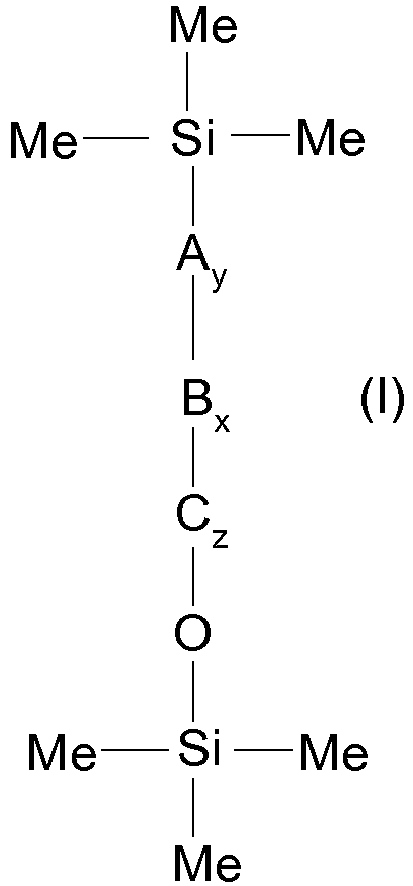



- wobei A, B und C statistisch angeordnet sind und x, y und z so gewählt sind, dass das Gewichtsverhältnis der Polysiloxankette zurm Gesamtmolekulargewicht 0,25 bis 0,65 beträgt,
- Me eine Methylgruppe,
- R eine Alkylgruppe mit 1 bis 10 Kohlenstoffatomen,
- M eine Alkylen- oder Arylengruppe oder araliphatische Gruppe mit 2 bis 10 Kohlenstoffatomen, die über eine Ether-, Ester-, Urethan- Carbponat- oder Acetalbindung an die Polyetherkette angebunden sein kann,
- m, n ganze Zahlen, die so gewählt sind, dass die Molekulargewichte Mn der Einheiten A und C im Bereich zwischen 500 und 2000 liegen und das Verhältnis n : m im Bereich von 25 : 75 bis 75 : 25 liegt,
- Bevorzugt weist die Polysiloxankette ein Molekulargewicht Mn von 2000 bis 4500 auf.
- Die Partikel enthaltenden Polyetheralkohole enthalten vorzugsweise Verbindungen (A) der allgemeine Formel (II)

- Im Allgemeinen weisen die Verbindungen (A) ein Molekulargewicht Mn im Bereich von 8000 bis 30000 auf.
- Insbesondere weisen die die Verbindungen (A) ein Molekulargewicht Mn von 10000 bis 20000 auf.
- In einer bevorzugten Ausführungsform liegen zwischen je zwei Einheiten A und/oder C im Mittel 7 bis 20 Einheiten B.
- m und n sind vorzugsweise so gewählt, dass die Molekulargewichte Mn der Einheiten A und C im Mittel im Bereich von 700 bis 2000 liegen.
- Die Graft-Polyole b1) haben vorzugsweise einen Gehalt an polymerisierten Partikeln, auch als Feststoffgehalt bezeichnet, von mindestens 35 Gew.-%, bezogen auf das Gewicht des Graft-Polyols. Üblicherweise sollte ein Feststoffgehalt von 65 Gew.-% nicht überschritten werden, da ansonsten die Viskosität der Polyole zu stark ansteigt und es damit zu Problemen bei der Verarbeitung kommen kann.
- Die Hydroxylzahl der erfindungsgemäßen Graft-Polyole b1) beträgt vorzugsweise 40 bis 260, insbesondere 40 bis 150 mg KOH/g.
- Die Herstellung von Verbindungen (A) kann beispielsweise wie folgt durchgeführt werden: In einem ersten Schritt wird das Polysiloxan-Rückgrat durch Gleichgewichtsreaktion von Hexamethyldisiloxan (HMDS), Oktamethyldisiloxan (OMTS) und Polymethylhydrosiloxan (PMHS) in Gegenwart von Triflourmethansulfonsäure hergestellt. Dabei erfolgt eine Ringöffnung von OMTS und eine Depolymerisation von PMHS. HMDS reagiert mit den gebildeten Oligomeren und erzeugt dabei die Endgruppen. In einem zweiten Schritt wird Allylalkohol mit Ethylenoxid und/oder Propylenoxid alkoxiliert und dabei ein Allylpolyetherol erzeugt. In einem dritten Schritt erfolgt eine Platin-katalysierte Hydrosilylierung der Allylgruppe des Allylpolyetherols unter Bildung eines Polyethersiloxans. Dabei werden durch Insertion von Doppelbindungen der Allylgruppen des Allylpolyetherols in Si-H-Bindungen des Polysiloxans Si-C-Bindungen ausgebildet. Typischerweise wird 1,5 Äquivalenten Allylpolyetherol verwendet. In einem vierten Schritt wird das Polyethersiloxan beispielsweise mit Dimethyl-metaisopropylbenzylisocyanat (TMI) oder einer ähnlichen Verbindung umgesetzt. Dabei werden unter Ausbildung von Urethangruppen Reste mit polymerisierbaren Doppelbindungen, beispielsweise Dimethyl-meta-isopropenylbenzylreste in das Polymer eingefügt. Dieser Syntheseschritt kann bei 80° C erfolgen. Dabei wird vorzugsweise ein Unterschuss an TMI verwendet, so dass im Durchschnitt weniger als eine OH-Gruppe des Polyethersiloxans pro Molekül mit TMI reagiert. Durch Wahl der stöchiometrischen Verhältnisse können die Variablen x, y, z, n und m gezielt eingestellt werden.
Die erfindungsgemäßen Graft-Polyole b1) werden üblicherweise durch in-situ Polymerisation von olefinisch ungesättigten Monomeren in Polyetheralkoholen im Folgenden auch als Carrier-Polyole bezeichnet, in Anwesenheit mindestens einer Verbindung (A). Die Verbindung (A) wird im Folgenden auch als Makromer bezeichnet. - Als olefinisch ungesättigte Monomere werden bevorzugt Styrol und/oder Acrylnitril eingesetzt.
- In der Verbindung (A) ist das Verhältnis h des Molekulargewichts der hydrophoben Molekülbestandteile (Polysiloxankette) zum Gesamtmolekulargewicht 0,25 bis 0,65.
- Als Carrier-Polyole werden vorzugsweise solche mit einer Funktionalität von 2 bis 4, insbesondere von 3 bis 4, eingesetzt. Sie werden üblicherweise hergestellt durch Anlagerung von Alkylenoxiden, insbesondere Propylenoxid oder Gemischen aus Propylenoxid und Ethylenoxid mit maximal 20 Gew.-%, bezogen auf das Gewicht des Polyetheralkohols b1i), Ethylenoxid an H-funktionelle Startsubstanzen. Die Startsubstanzen sind zumeist Alkohole oder Amine mit der entsprechenden Funktionalität. Bevorzugt eingesetzte Startsubstanzen sind Ethylenglykol, Propylenglykol, Glyzerin, Trimethylolpropan, Ethylendiamin und Toluylendiamin (TDA). In einer besonders bevorzugten Ausführungsform der Erfindung wird als Startsubstanz TDA, vorzugsweise die ortho-Isomeren, eingesetzt.
- Die Carrier-Polyole haben vorzugsweise eine Hydroxylzahl von größer 100 mg KOH/g, besonders bevorzugt im Bereich zwischen 100 und 300 mg KOH/g, insbesondere von 100 bis 260 mg KOH/g.
- Die Carrier-Polyole werden nach den üblichen und bekannten Verfahren zur Herstellung von Polyetheralkoholen hergestellt, die unten näher beschrieben sind.
- Die Carrier-Polyole werden vorzugsweise einzeln eingesetzt, es ist jedoch auch möglich, diese in Form von beliebigen Gemischen untereinander einzusetzen.
- Bei der bevorzugten Verwendung von TDA wird als Alkylenoxid vorzugsweise ein Gemisch aus Ethylenoxid und Propylenoxid eingesetzt. dabei wird bevorzugt zunächst Ethylenoxid und danach Propylenoxid angelagert, wobei die Anlagerung des Ethylenoxids vorzugsweise ohne Anwesenheit eines Katalysators erfolgt.
- Während der radikalischen Polymerisation werden die Verbindungen A mit in die Copolymerkette eingebaut. Dadurch bilden sich Blockcopolymere mit einem Polyether- und einen Polyacrylnitril-styren-Block, welche in der Grenzfläche von kontinuierlicher Phase und dispergierter Phase als Phasenvermittler wirken und das Agglomerieren der Graftpolyolpartikel unterdrücken. Der Anteil der Verbindung A beträgt üblicherweise 1 bis 20, besonders bevorzugt 1 bis 15 Gew.-%, bezogen auf das Gesamtgewicht der zur Herstellung des Graft-Polyols eingesetzten Monomere.
- Zur Herstellung von Graft-Polyolen werden üblicherweise Moderatoren, auch als Kettenüberträger bezeichnet, eingesetzt. Der Einsatz und die Funktion dieser Moderatoren wird beispielsweise in
US 4 689 354 , beschrieben. Die Moderatoren verringern durch Kettenübertragung des wachsenden Radikals das Molekulargewicht der sich bildenden Copolymere, wodurch die Vernetzung zwischen den Polymermolekülen verringert wird, was die Viskosität und die Dispersionsstabilität sowie die Filtrierbarkeit der Graft-Polyole beeinflusst. Der Anteil der Moderatoren beträgt üblicherweise 0,5 bis 25 Gew.-%, bezogen auf das Gesamtgewicht der zur Herstellung des Graft-Polyols eingesetzten Monomere. Moderatoren, die üblicherweise zur Herstellung von Graft-Polyolen eingesetzt werden, sind Alkohole, wie 1-Butanol, 2-Butanol, Isopropanol, Ethanol, Methanol, Cyclohexan, Toluene, Mercaptane, wie Ethanthiol, 1-Heptanthiol, 2-Octanethiol, 1-Dodecanthiol, Thiophenol, 2-Ethylhexylthioglycolate, Methylthioglycolate, Cyclohexylmercaptan sowie Enoletherverbindungen, Morpholine und α-(Benzoyloxy)styren. - Zur Initiierung der radikalischen Polymersisation werden üblicherweise Peroxid- oder AzoVerbindungen, wie Dibenzoyl peroxide, Lauroyl peroxide, t-Amylperoxy-2-ethylhexanoate, Di-t-butyl peroxide, Diisopropyl peroxide carbonate, t-Butyl peroxy-2-ethylhexanoate, t-Butylperpivalate, t-Butylperneo-decanoate, t-Butylperbenzoate, t-Butyl percrotonate, t-Butyl perisobutyrate, t-Butylperoxy-1-methylpropanoate, t-Butylperoxy-2-ethylpentanoate, t-Butylperoxyoctanoate und di-t-butylperphthalate, 2,2'-Azobis(2,4-dimethyl-valereronitrile), 2,2'-Azobisisobutyronitrile (AIBN), Dimethyl-2,2'-azobisisobutyrate, 2,2'-Azobis(2-methylbutyronitrile (AMBN), 1,1'-Azobis(1-cyclohexanecarbonitrile) eingesetzt. Der Anteil der Initiatoren beträgt üblicherweise 0,1 bis 6 Gew.-%, bezogen auf das Gesamtgewicht der zur Herstellung des Graft-Polyols eingesetzten Monomere.
- Die radikalische Polymerisation zur Herstellung von Graft-Polyolen wird aufgrund der Reaktionsgeschwindigkeit der Monomere sowie der Halbwertszeit der Initiatoren üblicherweise bei Temperaturen von 70 bis 150 °C und einem Druck bis zu 20 bar durchgeführt. Bevorzugte Reaktionsbedingungen zur Herstellung von Graft-Polyolen sind Temperaturen von 80 bis 140 °C, bei einem Druck von Atmosphärendruck bis 15 bar.
- Die Graft-Polyole b1) haben vorzugsweise eine Teilchengröße der Polymere von 0,1 µm bis 8 µm, vorzugsweise 0,2 µm bis 4 µm mit einem Maximum bei der Teilchengröße bei 0,2 bis 3 µm vorzugsweise bei 0,2 bis 2,0 µm.
- In einer weiteren bevorzugten Ausführungsform der Graft-Polyole b1) ist die Teilchengrößenverteilung bimodal, das heißt, die Verteilungskurve der Teilchengröße weist zwei Maxima auf. Derartige Graft-Polyole können beispielsweise hergestellt werden, durch Mischen von Graft-Polyolen mit monomodaler Teilchengrößenverteilung und unterschiedlicher Teilchengröße im entsprechenden Verhältnis aber auch indem man als Carrier Polyol in der Reaktionsvorlage ein Polyol verwendet, das bereits Polymerisate aus olefinisch ungesättigten Monomeren enthält. Die Teilchengröße liegt auch bei dieser Ausführungsform im oben beschriebenen Bereich.
- Die Graft-Polyole b1) können in kontinuierlichen Verfahren und diskontinuierlichen Verfahren hergestellt werden. Die Synthese von Graft-Polyolen nach beiden Verfahren ist bekannt und wird in einer Reihe von Beispielen beschrieben. So wird die Synthese von Graft-Polyolen nach den Semi Batch Verfahren wird beispielsweise beschrieben in
EP 439755 EP 510533 WO 00/59971 - Wie oben beschrieben, werden die erfindungsgemäßen Graft-Polyole vorzugsweise zur Herstellung von Polyurethanen, und hier insbesondere von Polyurethan-Hartschaumstoffen, eingesetzt.
- Die Herstellung der Polyurethane erfolgt nach üblichen und bekannten Verfahren durch Umsetzung von Polyolen b) mit Isocyanaten a), wobei die Polyole b) mindestens ein erfindungsgemäßes Graft-Polyol, im Folgenden als Polyol b1) bezeichnet, enthalten.
- Das Graft-Polyol b1) kann prinzipiell als einzige Verbindung mit mindestens zwei mit Isocyanatgruppen reaktiven Wasserstoffatomen b) eingesetzt werden. Es ist jedoch bevorzugt, diese Verbindung b1) im Gemisch mit anderen Verbindungen mit mindestens zwei mit Isocyanatgruppen reaktiven Wasserstoffatomen einzusetzen.
- Dazu können vorzugsweise die üblichen und bekannten Verbindungen mit mindestens zwei mit Isocyanatgruppen reaktiven Wasserstoffatomen zum Einsatz kommen. Vorzugsweise in Kombination mit den Graft-Polyolen b1) werden Polyetheralkohole und/oder Polyesteralkohole eingesetzt.
- Die gemeinsam mit den Graft-Polyolen b1) eingesetzten Polyesteralkohole werden zumeist durch Kondensation von mehrfunktionellen Alkoholen, vorzugsweise Diolen, mit 2 bis 12 Kohlenstoffatomen, vorzugsweise 2 bis 6 Kohlenstoffatomen, mit mehrfunktionellen Carbonsäuren mit 2 bis 12 Kohlenstoffatomen, beispielsweise Bernsteinsäure, Glutarsäure, Adipinsäure, Korksäure, Azelainsäure, Sebacinsäure, Decandicarbonsäure, Maleinsäure, Fumarsäure und vorzugsweise Phthalsäure, Isophthalsäure, Terephthalsäure und die isomeren Naphthalindicarbonsäuren, hergestellt.
- Die gemeinsam mit den Graft-Polyolen b1) verwendeten Polyetheralkohole haben zumeist eine Funktionalität zwischen 2 und 8, insbesondere 3 bis 8.
- Insbesondere kommen Polyetheralkohole, die nach bekannten Verfahren, beispielsweise durch anionische Polymerisation von Alkylenoxiden in Gegenwart von Katalysatoren, vorzugsweise Alkalihydroxiden, hergestellt werden, zum Einsatz.
- Als Alkylenoxide werden zumeist Ethylenoxid und/oder Propylenoxid, vorzugsweise reines 1,2-Propylenoxid eingesetzt.
- Als Startmoleküle kommen insbesondere Verbindungen mit mindestens 3, vorzugsweise 4 bis 8 Hydroxylgruppen oder mit mindestens zwei primären Aminogruppen im Molekül zum Einsatz.
- Als Startmoleküle mit mindestens 3, vorzugsweise 4 bis 8 Hydroxylgruppen im Molekül werden vorzugsweise Trimethylopropan, Glycerin, Pentaerythrit, Zuckerverbindungen wie beispielsweise Glucose, Sorbit, Mannit und Saccharose, mehrwertige Phenole, Resole, wie z.B. oligomere Kondensationsprodukte aus Phenol und Formaldehyd und Mannich-Kondensate aus Phenolen, Formaldehyd und Dialkanolaminen sowie Melamin eingesetzt.
- Als Startmoleküle mit mindestens zwei primären Aminogruppen im Molekül werden vorzugsweise aromatische Di- und/oder Polyamine, beispielsweise Phenylendiamine, 2,3-, 2,4-, 3,4- und 2,6-Toluylendiamin (TDA), insbesondere die 2,3- und 3,4-Isomeren, und 4,4'-, 2,4'- und 2,2'-Diamino-diphenylmethan sowie aliphatische Di- und Polyamine, wie Ethylendiamin, eingesetzt.
- Die Polyetheralkohole besitzen eine Funktionalität von vorzugsweise 3 bis 8 und Hydroxylzahlen von vorzugsweise 100 mgKOH/g bis 1200 mgKOH/g und insbesondere 240 mgKOH/g bis 570 mgKOH/g.
- In einer bevorzugten Ausführungsform des erfindungsgemäßen Verfahrens wird als Verbindungen mit mindestens zwei mit Isocyanatgruppen reaktiven Wasserstoffatomen eine Mischung aus dem Graft-Polyol b1), einem mit Saccharose gestarteten Polyetheralkohol b2) eingesetzt. Besonders bevorzugt wird zusätzlich ein mit einem dreifunktionellen Alkohol oder einem aromatischen Amin gestarteten Polyetheralkohol b3) eingesetzt.
- Der Polyetheralkohol b2) hat vorzugsweise eine Hydroxylzahl im Bereich zwischen 375 und 525 mgKOH/g und eine Funktionalität von 5 bis 7,5. Die Saccharose wird zumeist im Gemisch mit Wasser und/oder anderen, bei Raumtemperatur flüssigen zwei- bis dreifunktionellen Alkoholen, wie Ethylenglykol, Propylenglykol und/oder Glyzerin mit den Alkylenoxiden, bevorzugt Propylenoxid und/oder Ethylenoxid, umgesetzt. Die Umsetzung kann mit Alkali- oder Erdalkalihydroxiden oder Aminen katalysiert werden.
- Der Polyetheralkohol b3) hat vorzugsweise einen Hydroxylzahl im Bereich zwischen 100 und 250 mgKOH/g und eine Funktionalität von 3 bis 4. Als dreifunktionelle Alkohole werden vorzugsweise Glyzerin oder Trimethylolpropan eingesetzt. Als aromatisches Amin wird vorzugsweise TDA eingesetzt, wobei besonders bevorzugt die 2,3- und 3,4-Isomeren eingesetzt werden.
- In dieser Ausführungsform der Erfindung besteht die Komponente b) aus 10 bis 25 Gew.-% der Komponente b1), 25 bis 65 Gew.-% aus einem mit Saccharose gestarteten Polyetheralkohol b2), und 10 - 40 Gew.-% aus einem mit einem aromatischen Amin oder einem mit einem dreiwertigen Alkohol gestartetem Polyetheralkohol b3).
- Zu den übrigen für das erfindungsgemäße Verfahren eingesetzten Einsatzstoffen ist im Einzelnen folgendes zu sagen:
Als organische Polyisocyanate a) kommen vorzugsweise aromatische mehrwertige Isocyanate in Betracht. - Im einzelnen seien beispielhaft genannt: 2,4- und 2,6-Toluylen-diisocyanat (TDI) und die entsprechenden Isomerengemische, 4,4'-, 2,4'- und 2,2'-Diphenylmethan-diisocyanat (MDI) und die entsprechenden Isomerengemische, Mischungen aus 4,4'- und 2,4'-Diphenylmethandiisocyanaten, Polyphenyl-polymethylen-polyisocyanate, Mischungen aus 4,4'-, 2,4'- und 2,2'-Diphenylmethan-diisocyanaten und Polyphenyl-polymethylen-polyisocyanaten (Roh-MDI) und Mischungen aus Roh-MDI und Toluylendiisocyanaten. Die organischen Di- und Polyisocyanate können einzeln oder in Form von Mischungen eingesetzt werden.
- Häufig werden auch sogenannte modifizierte mehrwertige Isocyanate, d.h. Produkte, die durch chemische Umsetzung organischer Di- und/oder Polyisocyanate erhalten werden, verwendet. Beispielhaft genannt seien Isocyanurat- und/oder Urethangruppen enthaltende Di- und/oder Polyisocyanate. Die modifizierten Polyisocyanate können gegebenenfalls miteinander oder mit unmodifizierten organischen Polyisocyanaten wie z.B. 2,4'-, 4,4'-Diphenylmethan-diisocyanat, Roh-MDI, 2,4- und/oder 2,6-Toluylen-diisocyanat gemischt werden.
- Daneben können auch Umsetzungsprodukte von mehrwertigen Isocyanaten mit mehrwertigen Polyolen, sowie deren Mischungen mit anderen Di- und Polyisocyanaten Verwendung finden.
- Besonders bewährt hat sich als organisches Polyisocyanat Roh-MDI mit einem NCO-Gehalt von 29 bis 33 Gew.-% und einer Viskosität bei 25°C im Bereich von 150 bis 1000 mPa.s.
- Weitere, an Stelle von oder in Kombination mit den Polyolen b2) und b3) einsetzbare Polyole wurden bereits oben beschrieben.
- Zu den Verbindungen mit mindestens zwei gegenüber Isocyanat reaktiven Wasserstoffatomen b) gehören auch die gegebenenfalls mitverwendeten Kettenverlängerer und Vernetzer. Die Polyurethan-Schaumstoffe können ohne oder unter Mitverwendung von Kettenverlängerungs- und/oder Vernetzungsmitteln hergestellt werden. Zur Modifizierung der mechanischen Eigenschaften kann sich der Zusatz von difunktionellen Kettenverlängerungsmitteln, tri- und höherfunktionellen Vernetzungsmitteln oder gegebenenfalls auch Gemischen davon als vorteilhaft erweisen. Als Kettenverlängerungs- und/oder Vernetzungsmittel verwendet werden vorzugsweise Alkanolamine und insbesondere Diole und/oder Triole mit Molekulargewichten kleiner als 400, vorzugsweise 60 bis 300.
- Kettenverlängerungsmittel, Vernetzungsmittel oder Mischungen davon werden zweckmäßigerweise in einer Menge von 1 bis 20 Gew.-%, vorzugsweise 2 bis 5 Gew.-%, bezogen auf die Verbindungen mit mindestens zwei mit Isocyanatgruppen reaktiven Wasserstoffatomen b), eingesetzt.
- Die Umsetzung wird üblicherweise in Anwesenheit von Katalysatoren, Treibmitteln sowie üblichen Hilfs- und/oder Zusatzstoffen durchgeführt.
- Als Katalysatoren werden insbesondere Verbindungen eingesetzt, welche die Reaktion der Isocyanatgruppen mit den mit Isocyanatgruppen reaktiven Gruppen stark beschleunigen. Solche Katalysatoren sind stark basische Amine, wie z. B. sekundäre aliphatische Amine, Imidazole, Amidine, sowie Alkanolamine oder organische Metallverbindungen, insbesondere organische Zinnverbindungen.
- Wenn in den Polyurethan-Hartschaum auch Isocyanuratgruppen eingebaut werden sollen, werden dafür spezielle Katalysatoren benötigt. Als Isocyanurat-Katalysatoren werden üblicherweise Metallcarboxylate, insbesondere Kaliumacetat und dessen Lösungen, eingesetzt.
- Die Katalysatoren können, je nach Erfordernis, allein oder in beliebigen Mischungen untereinander eingesetzt werden.
- Als Treibmittel kann vorzugsweise Wasser verwendet werden, das mit Isocyanatgruppen unter Abspaltung von Kohlendioxid reagiert. In Kombination mit oder an Stelle von Wasser können auch sogenannte physikalische Treibmittel eingesetzt werden. Dabei handelt es sich um gegenüber den Einsatzkomponenten inerte Verbindungen, die zumeist bei Raumtemperatur flüssig sind und bei den Bedingungen der Urethanreaktion verdampfen. Vorzugsweise liegt der Siedepunkt dieser Verbindungen unter 50 °C. Zu den physikalischen Treibmitteln zählen auch Verbindungen, die bei Raumtemperatur gasförmig sind und unter Druck in die Einsatzkomponenten eingebracht bzw. in ihnen gelöst werden, beispielsweise Kohlendioxid, niedrigsiedende Alkane und Fluoralkane.
- Die Verbindungen werden zumeist ausgewählt aus der Gruppe, enthaltend Alkane und/oder Cycloalkane mit mindestens 4 Kohlenstoffatomen, Dialkylether, Ester, Ketone, Acetale, Fluoralkane mit 1 bis 8 Kohlenstoffatomen, und Tetraalkylsilane mit 1 bis 3 Kohlenstoffatomen in der Alkylkette, insbesondere Tetramethylsilan.
- Als Beispiele seien genannt Propan, n-Butan, iso- und Cyclobutan , n-, iso- und Cyclopentan, Cyclohexan, Dimethylether, Methylethylether, Methylbutylether, Ameisensäuremethylester, Aceton, sowie Fluoralkane, die in der Troposphäre abgebaut werden können und deshalb für die Ozonschicht unschädlich sind, wie Trifluormethan, Difluormethan, 1,1,1,3,3-Pentafluorbutan, 1,1,1,3,3-Pentafluorpropan, 1,1,1,2-Tetrafluorethan, Difluorethan und 1,1,1,2,3,3,3-Heptafluorpropan, sowie Perfluoralkane wie C3F8, C4F10, C5F12, C6F14, und C7F17. Die genannten physikalischen Treibmittel können allein oder in beliebigen Kombinationen untereinander eingesetzt werden.
- In einer bevorzugten Ausführungsform des erfindungsgemäßen Verfahrens wird eine Kombination aus Wasser und einem aliphatischen Kohlenwasserstoff als Treibmittel eingesetzt. Bevorzugte Kohlenwasserstoffe sind n-Pentan, Isopentan und Cyclopentan.
- Das erfindungsgemäße Verfahren kann, falls erforderlich, in Anwesenheit von Flammschutzmitteln sowie üblichen Hilfs- und/oder Zusatzstoffen Hilfs- und/oder Zusatzstoffen durchgeführt werden.
- Als Flammenschutzmittel können organische Phosphorsäure- und oder Phosphonsäureester zur Anwendung kommen. Vorzugsweise werden gegenüber Isocyanatgruppen nicht reaktive Verbindungen eingesetzt. Auch Chlor enthaltende Phosphorsäureester gehören zu den bevorzugten Verbindungen.
- Typischer Vertreter dieser Gruppe von Flammschutzmitteln sind Triethylphosphat, Diphenylkresylphosphat, Tris-(Chlorpropyl)-phosphat sowie Diethylethanphosphonat.
- Daneben können auch Brom enthaltende Flammschutzmittel zum Einsatz kommen. Als Brom enthaltende Flammschutzmittel werden vorzugsweise gegenüber der Isocyanatgruppe reaktive Gruppen aufweisende Verbindungen eingesetzt. Derartige Verbindungen sind Ester der Tetrabromphthalsäure mit aliphatischen Diolen und Alkoxylierungsprodukte des Dibrombutendiols. Auch Verbindungen, die sich aus der Reihe der bromierten, OH-Gruppen enthaltenden Neopentylverbindungen ableiten, können zur Anwendung kommen.
- Als Hilfsmittel und/oder Zusatzstoffe kommen die für diesen Zweck an sich bekannten Stoffe, beispielsweise oberflächenaktive Substanzen, Schaumstabilisatoren, Zellregler, Füllstoffe, Pigmente, Farbstoffe, Flammschutzmittel, Hydrolyseschutzmittel, Antistatika, fungistatisch und bakteriostatisch wirkende Mittel zum Einsatz.
- Nähere Angaben über die zur Durchführung des erfindungsgemäßen Verfahrens eingesetzten Ausgangsstoffe, Treibmittel, Katalysatoren sowie Hilfs- und/oder Zusatzstoffe finden sich beispielsweise im Kunststoffhandbuch, Band 7, "Polyurethane" Carl-Hanser-Verlag München, 1. Auflage, 1966, 2. Auflage, 1983 und 3. Auflage, 1993.
- Zur Herstellung der Polyurethan-Hartschaumstoffe werden die Polyisocyanate a), und die Verbindungen mit mindestens zwei mit Isocyanatgruppen reaktiven Wasserstoffatomen b) in solchen Mengen zur Umsetzung gebracht, dass der Isocyanatindex in einem Bereich zwischen 100 und 220, vorzugsweise zwischen 115 und 195, liegt. Die Polyurethan-Hartschaumstoffe können diskontinuierlich oder kontinuierlich mit Hilfe bekannter Mischvorrichtungen hergestellt werden.
- Bei der Herstellung von Polyisocyanuratschäumen kann auch mit einem höheren Index, vorzugsweise bis 350, gearbeitet werden.
- Üblicherweise werden die erfindungsgemäßen PUR-Hartschaumstoffe nach dem Zweikomponenten-Verfahren hergestellt. Bei diesem Verfahren werden die Verbindungen mit mindestens zwei gegenüber Isocyanatgruppen reaktiven Wasserstoffatomen b), mit den Flammschutzmitteln, den Katalysatoren c), den Treibmitteln d), sowie den weiteren Hilfs- und/oder Zusatzstoffen zu einer sogenannten Polyolkomponente vermischt und diese mit den Polyisocyanaten oder Mischungen aus den Polyisocyanaten und gegebenenfalls Treibmitteln, auch als Isocyanatkomponente bezeichnet, zur Umsetzung gebracht.
- Die Ausgangskomponenten werden zumeist bei einer Temperatur von 15 bis 35°C, vorzugsweise von 20 bis 30°C gemischt. Das Reaktionsgemisch kann mit Hoch- oder Niederdruckdosiermaschinen in geschlossene Stützwerkzeuge gegossen werden. Nach dieser Technologie werden z. B. diskontinuierlich Sandwichelemente gefertigt.
- Daneben kann das Reaktionsgemisch auch frei auf Flächen oder in offene Hohlräume gegossen oder gespritzt werden. Nach diesem Verfahren lassen sich Dächer bzw. komplizierte Behälter vor Ort isolieren. Das Reaktionsgemisch kann auch an einer Stelle oder an mehreren Stellen gleichzeitig in ein geschlossenes Formwerkzeug auch komplexer Geometrie eingebracht werden. Die Position der Injektion des Reaktionsgemisches kann sich an verschiedenen Stellen der Form befinden. Die Form kann zum Zeitpunkt der Injektion des Reaktionsgemisches unterschiedlich ausgerichtet sein bezüglich der Raumrichtungen. Solche Verfahren sind typisch beispielsweise für die Herstellung von Kältegeräten. Ebenfalls kann das Reaktionsgemisch in ein offenes Formwerkzeug gegossen werden, welches nach Abschluss des Füllvorgangs geschlossen wird. Diese Prozedur ist beispielsweise typisch für die Herstellung von Türen für Kältegeräte.
- Auch die kontinuierliche Vermischung der Isocyanatkomponente mit der Polyolkomponente zur Herstellung von Sandwich- oder Dämmelementen auf Doppelbandanlagen ist eine bevorzugte Ausführungsform des erfindungsgemäßen Verfahrens. Bei dieser Technologie ist es üblich, die Katalysatoren und die Treibmittel über weitere Dosierpumpen in die Polkomponente zu dosieren. Dabei können die eingesetzten Komponenten in bis zu 8 Einzelkomponenten aufgeteilt werden. Die Verschäumrezepturen lassen sich, abgeleitet von dem Zwei-Komponentenverfahren in einfacher Weise auf die Verarbeitung von Mehrkomponentensystemen umrechnen.
- Die nach dem erfindungsgemäßen Verfahren hergestellten Polyurethan-Hartschaumstoffe sind mit einer sehr kurzen Entformzeit auf Basis einer phasenstabilen Polyolkomponente herstellbar, was signifikant verkürzte Taktzeiten ermöglicht. In der Polyolkomponente sind trotz Anwesenheit der Graft-Polyols große Mengen an physikalischen Treibmitteln löslich, so dass Schaumstoffdichten im Bauteil von unter 30 g/l erreicht werden können. Die Schaumstoffeigenschaften in Bezug auf Druckfestigkeit, Wärmeleitfähigkeit und Qualität der Schaumstoffoberflächen/Bildung von Lunkern sind exzellent.
- Die in den folgenden Beispielen eingesetzten Graftpolyole wurden in kontinuierlichen Verfahren und diskontinuierlichen Verfahren hergestellt. Die Synthese von Graftpolyolen nach beiden Verfahren ist bekannt und wird in einer Reihe von Beispielen beschrieben. So wird die Synthese von Graftpolyolen nach den Semi-Batch-Verfahren beispielsweise in
EP 439 755 EP 510 533 WO 03/078496 WO 00/59971 - Die Erfindung soll an den folgenden Beispielen näher beschrieben werden.
- Zur Herstellung der Graft-Polyole werden das Carrier Polyol, der Initiator, der Moderator und 10 Gew.-% der Menge an Makromer in einem mit einem Rührer versehenen Reaktor vorgelegt und das Gemisch auf 100°C erwärmt. Anschließend werden die Monomere und 90% des Makromers kontinuierlich zudosiert. Nach 165 Minuten Reaktion bei 115°C werden die unreagierten Monomere für 2 Stunden bei 10 mbar und 125°C abdestilliert.
- Moderator: 1% Dodecanthiol (bezogen auf die Monomermenge)
- Initiator: 0.45% Wako V601 (bezogen auf die Monomermenge)
- Nachfolgende Definitionen beziehen sich auf die allgemeine Formel (I)
- a- Molgewicht Polysiloxankette (Polymergrückgrat)
- b- Durchschnittliche Anzahl der Si-Atome zwischen den Verzweigungen
- c- Molekulargewicht einer Seitenkette
- d- Durchschnittliche Anzahl der Verzweigungen im Molekül
- e- Verhältnis von Ethylenoxid zu Propylenoxid in der Seitenkette
- f- durchschnittliche Anzahl der OH-Gruppen, die zu einer endständigen C=C-Bindung umgesetzt werden
- g- Gesamtmolekulargewicht des Makromers (Polyethersiloxan)
- h- Amphiphilie, das Verhältnis der hydrophoben Molekülbestandteile zum Gesamtmolekulargewicht
- Die verschiedenen Polyole, Stabilisatoren, Katalysatoren werden mit Wasser und dem Treibmittel in den in Tabelle 3 angegebenen Verhältnissen gemischt. 100 Gewichtsteile der Polyolkomponente wurden mit der jeweiligen in Tabelle 1 genannten Menge einer Mischung aus Diphenylmethandiisocyanat und Polyphenylenpolymethylenpolyisocyanat mit einem NCO-Gehalt von 31,5 Gew.-% und einer Viskosität von 200 mPas (25 °C) in einer Hochdruck-Verschäummaschine vom Typ Puromat® HD 30 (Elastogran GmbH) vermischt. Die Reaktionsmischung wurde in ein Formwerkzeug der Abmessungen 200 cm x 20 cm x 5 cm bzw. 40 cm x 70 cm x 9 cm eingespritzt und dort aufschäumen lassen. Die Eigenschaften und Kennzahlen der erhaltenen Schaumstoffe sind in Tabelle 3 angegeben.
- Die Wärmeleitfähigkeit wird bestimmt nach DIN 52616. Zur Herstellung von Prüfkörper wird das Polyurethan-Reaktionsgemisch in eine Form der Maße 200 x 20 x 5 cm3 gegossen (10 % Überfüllung) und nach einigen Stunden ein Prüfkörper der Dimension 20 x 20 x 2 cm3 aus der Mitte herausgeschnitten.
- Die Druckfestigkeit wird bestimmt nach DIN 53421 / DIN EN ISO 604.
- Fließfähigkeit ist eine dimensionslose Größe und der Quotient aus Kernrohdichte zu frei geschäumter Rohdichte.
Tabelle 3 Schaumstoffe Vergleich 1 Vergleich 2 Vergleich 3 Bsp. 1 Bsp. 2 Bsp. 3 Polyol 2 47.3 47.3 47.3 47.3 47.3 47.3 Polyol 1 30 30 30 30 30 30 Polyol 3 16 12 12 12 12 12 Graftpolyol V1 4 Graftpolyol V2 4 Graftpolyol 1 4 Graftpolyol 2 4 15 Wasser 2.7 2.7 2.7 2.7 2.7 2.7 Stabilisator 2 2 2 2 2 2 Aminkatalysator 2.1 2.1 2.1 2.1 2.1 2.1 Cyclopentan 70 13 13 13 13 13 13 Partikel-Gehalt 0 4 4 4 4 15 STY:ACN 0 1:1 1:1 1:2 1:1 1:2 Druckfestigkeit, 10% overpack [N/mm2] 13.1 14.1 14.9 15.2 14.8 16.0 Wärmeleitfähigkeit [mW/mK] 19,4 19,2 19,2 19,3 19,2 19,1 Entformbarkeit [mm] [3 min. 20% overpack] 96,4 96,9 95,0 95,1 94,9 94,3 Fließfähigkeit 1,34 1,35 1,33 1,34 1,35 1,34 Formteildichte [g/l] 29.2 27.4 28.1 27,5 27,9 28,1 Freigeschäumte Rohdichte [g/l] 21.4 20.3 21.1 20,5 21,0 21,4 - Polyol 1:
- Polyetheralkohol aus vicinalem TDA und Ethylenoxid und Propylenoxid mit einer Hydroxylzahl von 390 mgKOH/g und einer Viskosität bei 25 °C von 17000 mPas;
- Polyol 2:
- Polyetheralkohol aus Saccharose, Glyzerin und Propylenoxid mit einer Hydroxylzahl von 440 mgKOH/g und einer Viskosität von 2000 mPas bei 25 °C;
- Polyol 3:
- Polyetheralkohol aus vicinalem TDA und Ethylenoxid und Propylenoxid mit einer Hydroxylzahl von 160 mgKOH/g und einer Viskosität von 800 mPas bei 25 °C;
- Graftpolyol V1:
- Graftpolyol auf Basis Polyol 3, 10 % Makromer (ein Umsetzungsprodukt aus Sorbitol mit Ethylenoxid/Propylenoxid und TMI, Molekulargewicht 18000 g/mol), Styrol : Acrylnitril 1:3, Feststoffgehalt 45 %, Partikelgroesse 1 Mikrometer;
- Graftpolyol V2:
- Graftpolyol auf Basis Polyol 3, 15 % Makromer 8, Styrol : Acrylnitril 1:3, Feststoffgehalt 35 %, Partikelgroesse 60 Mikrometer;
- Graftpolyol 1:
- Graftpolyol auf Basis Polyol 3, 15 % Makromer 20, Styrol : Acrylnitril 1:3, Feststoffgehalt 35 %, Partikelgroesse 5 Mikrometer;
- Graftpolyol 2:
- Graftpolyol auf Basis Polyol 3, 12 % Makromer 27, Styrol : Acrylnitril 1:3, Feststoffgehalt 40 %, Partikelgroesse 0,8 Mikrometer;
- Graftpolyol 3:
- Graftpolyol auf Basis Polyol 3, 12 % Makromer 42, Styrol : Acrylnitril 1:1, Feststoffgehalt 40 %, Partikelgroesse 1,5 Mikrometer;
wobei die Polysiloxankette

| Graft-Polyol | Graftpolyol V1 | Graftpolyol V2 | Graftpolyol 1 | Graftpolyol 2 | Graftpolyol 3 |
| Carrierpolyol | Polyol 1 | Polyol 2 | Polyol 3 | Polyol 3 | Polyol 3 |
| Polyethersiloxan | - | 15% | 15% | 12% | 12% |
| Feststoffgehalt | 45% | 35% | 35% | 40% | 40% |
| ACN:STY | 3:1 | 3:1 | 3:1 | 3:1 | 1:1 |
| Makromer | 8 | 20 | 27 | 42 | |
| Partikelgröße | 1 µm | 60 µm | 5 µm | 0.8 µm | 1.5 µm |
| Stabilität | Separation der Partikel in Formulierung | Schlechte Stabilisierung des Graftpolyols. Separation der Partikel in Formulierung | Schlechte Stabilisierung des Graftpolyols. Phasenstabil in Formulierung | Phasenstabil in Formulierung | Phasenstabil in Formulierung |
| a | b | c | d | e | f | g | h | |
| 8 | 4400 | 7 | 980 | 8.6 | 81:19 | 0.9 | 13000 | 0.34 |
| 20 | 5050 | 8.3 | 1700 | 8.4 | 60:40 | 0.9 | 19000 | 0.27 |
| 27 | 5050 | 8.3 | 1250 | 8.4 | 60:40 | 0.9 | 16000 | 0.32 |
| 42 | 5050 | 10.6 | 980 | 6.5 | 60:40 | 0.9 | 11000 | 0.46 |
Claims (12)
- Partikel enthaltende Polyetheralkohole herstellbar durch in-situ Polymerisation von olefinisch ungesättigten Monomeren in einem Polyetheralkohol, dadurch gekennzeichnet, dass die Polymerisation in Anwesenheit von mindestens einer Verbindung (A) der allgemeinen Formel (I) durchgeführt wird,


 Me eine Methylgruppe,R eine Alkylgruppe mit 1 bis 10 Kohlenstoffatomen,M eine Alkylen- oder Arylengruppe oder araliphatische Gruppe mit 2 bis 10 Kohlenstoffatomen, die über eine Ether-, Ester-, Urethan- Carbonat- oder Acetalbindung an die Polyetherkette angebunden sein kann,m, n ganze Zahlen, die so gewählt sind, dass die Molekulargewichte Mn der Einheiten A und C im Bereich zwischen 500 und 2000 liegen und das Verhältnis n : m im Bereich von 20 : 80 bis 80 : 20 liegt,bedeuten,
wobei die Polysiloxankette
- Partikel enthaltende Polyetheralkohole nach Anspruch 1, dadurch gekennzeichnet, dass die Verbindungen (A) die allgemeine Formel (II)

- Partikel enthaltende Polyetheralkohole nach Anspruch 1 oder 2, dadurch gekennzeichnet, dass die Verbindungen (A) 0,7 bis 1 Gruppen C im Molekül aufweisen.
- Partikel enthaltende Polyetheralkohole nach einem der Ansprüche 1 bis 3, dadurch gekennzeichnet, dass die Verbindungen (A) ein Molekulargewicht Mn 8000 bis 30000 aufweisen.
- Partikel enthaltende Polyetheralkohole nach Anspruch 1 oder 2, dadurch gekennzeichnet, dass in den Verbindungen (A) zwischen je 2 Einheiten A und/oder C im Mittel 7 bis 20 Einheiten B liegen.
- Partikel enthaltende Polyetheralkohole nach einem der Ansprüche 1 bis 5, dadurch gekennzeichnet, dass sie einen Gehalt an Partikeln von 35 Gew.-% bis 65 Gew.-%, bezogen auf das Gewicht des Partikel enthaltenden Polyetheralkohols, aufweisen.
- Partikel enthaltende Polyetheralkohole nach einem der Ansprüche 1 bis 6, dadurch gekennzeichnet, dass sie eine Hydroxylzahl von 40 bis 260 mgKOH/g aufweisen.
- Partikel enthaltende Polyetheralkohole nach einem der Ansprüche 1 bis 7, dadurch gekennzeichnet, dass als olefinisch ungesättigte Monomere Styrol und/oder Acrylnitril eingesetzt werden.
- Verfahren zur Herstellung von Polyurethanen durch Umsetzung vona) Polyisocyanaten mitb) Verbindungen mit mindestens zwei mit Isocyanatgruppen reaktiven Wasserstoffatomen,dadurch gekennzeichnet, dass die Komponente b) mindestens einen Partikel enthaltenden Polyetheralkohol b1) nach einem der Ansprüche 1 bis 8 enthält.
- Verfahren nach Anspruch 9, dadurch gekennzeichnet, dass der Partikel enthaltende Polyetheralkohol b1) in einer Menge von 2 bis 30 Gew.-%, bezogen auf das Gewicht der Komponente b), enthalten ist.
- Polyurethane, herstellbar nach dem Verfahren gemäß Anspruch 9 oder 10.
- Verwendung von Partikel enthaltenden Polyetheralkoholen, wie in einem der Ansprüche 1 bis 8 definiert, zur Herstellung von Polyurethanen.
Priority Applications (2)
| Application Number | Priority Date | Filing Date | Title |
|---|---|---|---|
| PL12748474T PL2748233T3 (pl) | 2011-08-23 | 2012-08-20 | Polieteroalkohole zawierające cząstki |
| EP12748474.9A EP2748233B1 (de) | 2011-08-23 | 2012-08-20 | Partikel enthaltende polyetheralkohole |
Applications Claiming Priority (3)
| Application Number | Priority Date | Filing Date | Title |
|---|---|---|---|
| EP11178520 | 2011-08-23 | ||
| PCT/EP2012/066166 WO2013026815A1 (de) | 2011-08-23 | 2012-08-20 | Partikel enthaltende polyetheralkohole |
| EP12748474.9A EP2748233B1 (de) | 2011-08-23 | 2012-08-20 | Partikel enthaltende polyetheralkohole |
Publications (2)
| Publication Number | Publication Date |
|---|---|
| EP2748233A1 EP2748233A1 (de) | 2014-07-02 |
| EP2748233B1 true EP2748233B1 (de) | 2018-07-25 |
Family
ID=46704660
Family Applications (1)
| Application Number | Title | Priority Date | Filing Date |
|---|---|---|---|
| EP12748474.9A Not-in-force EP2748233B1 (de) | 2011-08-23 | 2012-08-20 | Partikel enthaltende polyetheralkohole |
Country Status (11)
| Country | Link |
|---|---|
| EP (1) | EP2748233B1 (de) |
| JP (1) | JP6118321B2 (de) |
| KR (1) | KR101953416B1 (de) |
| CN (1) | CN103890047B (de) |
| AU (1) | AU2012298519B2 (de) |
| BR (1) | BR112014004187A2 (de) |
| HU (1) | HUE040688T2 (de) |
| MX (1) | MX360809B (de) |
| PL (1) | PL2748233T3 (de) |
| RU (1) | RU2615772C2 (de) |
| WO (1) | WO2013026815A1 (de) |
Families Citing this family (3)
| Publication number | Priority date | Publication date | Assignee | Title |
|---|---|---|---|---|
| ES2557754T3 (es) * | 2011-08-23 | 2016-01-28 | Basf Se | Polieteralcoholes que contienen partículas |
| DE102013211349A1 (de) * | 2013-06-18 | 2014-12-18 | Evonik Industries Ag | Isocyanat-Siloxanpolyether-Zusammensetzung |
| CN113831538B (zh) * | 2021-11-16 | 2023-08-11 | 南京美思德新材料有限公司 | 有机硅共聚物、其的制备方法、硬质泡沫稳定剂和硬质聚氨酯泡沫 |
Family Cites Families (18)
| Publication number | Priority date | Publication date | Assignee | Title |
|---|---|---|---|---|
| US4689354A (en) | 1982-04-01 | 1987-08-25 | Basf Corporation | Process for the preparation of white graft polymer dispersions and flame-retardant polyurethane foams |
| GB8410480D0 (en) * | 1984-04-24 | 1984-05-31 | Bp Chem Int Ltd | Preparation of polymer polyols |
| US4797501A (en) * | 1986-12-31 | 1989-01-10 | Union Carbide Corporation | Silicone-based stabilizers useful in the preparation of improved polyurethane foams |
| DE69017418T2 (de) | 1990-01-29 | 1995-06-29 | Basf Corp | Verfahren zur Herstellung von gepfropften Polyolen und daraus erhaltene Polyolen. |
| EP0510533A3 (en) | 1991-04-22 | 1993-05-26 | The Dow Chemical Company | Process for preparing polymer polyols, and polymer polyol so made |
| DK0687279T3 (da) * | 1993-03-05 | 1999-02-01 | Shell Int Research | Polymerpolyoler |
| US5447997A (en) * | 1994-03-11 | 1995-09-05 | General Electric Company | Silicone polyether carboxylic acids |
| JP3837854B2 (ja) | 1997-08-08 | 2006-10-25 | 旭硝子株式会社 | ポリマー分散ポリオールの製造方法 |
| JP2000169541A (ja) | 1998-12-04 | 2000-06-20 | Sanyo Chem Ind Ltd | ポリウレタンフォームの製造方法 |
| US6602450B1 (en) | 1999-03-04 | 2003-08-05 | Asahi Glass Company, Limited | Method for producing a thermally insulating plate |
| US6172164B1 (en) | 1999-04-01 | 2001-01-09 | Basf Corporation | Process for making graft polyols using t-amyl peroxy free radical initiator |
| MXPA04008161A (es) | 2002-03-15 | 2005-05-17 | Basf Ag | Polioles de injerto con una distribucion de tamano de particula bimodal y metodo para producir polioles de injerto de este tipo, ademas del uso de los mismos para producir poliuretanos. |
| US20060058409A1 (en) | 2002-10-15 | 2006-03-16 | Bernd Zaschke | Method for producing rigid polyurethane foams by means of graft polyhydric alcohols |
| DE102004017294A1 (de) | 2004-04-05 | 2005-10-20 | Basf Ag | Verfahren zur Herstellung von Polyurethan-Schaumstoffen |
| RU2418812C2 (ru) * | 2005-12-16 | 2011-05-20 | ПиПиДжи ИНДАСТРИЗ ОГАЙО, ИНК. | Поли(мочевиноуретаны), изделия и покрытия, изготовленные из них, и способы их производства |
| CN101389694B (zh) * | 2006-02-24 | 2013-03-27 | 路博润高级材料公司 | 可聚合的硅氧烷共聚醇大分子单体和由其制成的聚合物 |
| DE102008000266A1 (de) * | 2008-02-11 | 2009-08-13 | Evonik Goldschmidt Gmbh | Die Erfindung betrifft die Verwendung von Schaumstabilisatoren, die auf Basis nachwachsender Rohstoffe hergestellt werden, zur Herstellung von Polyurethanschäumen |
| ES2557754T3 (es) * | 2011-08-23 | 2016-01-28 | Basf Se | Polieteralcoholes que contienen partículas |
-
2012
- 2012-08-20 WO PCT/EP2012/066166 patent/WO2013026815A1/de not_active Ceased
- 2012-08-20 PL PL12748474T patent/PL2748233T3/pl unknown
- 2012-08-20 EP EP12748474.9A patent/EP2748233B1/de not_active Not-in-force
- 2012-08-20 CN CN201280051824.0A patent/CN103890047B/zh not_active Expired - Fee Related
- 2012-08-20 JP JP2014526461A patent/JP6118321B2/ja active Active
- 2012-08-20 RU RU2014110880A patent/RU2615772C2/ru not_active IP Right Cessation
- 2012-08-20 KR KR1020147007115A patent/KR101953416B1/ko not_active Expired - Fee Related
- 2012-08-20 MX MX2014002016A patent/MX360809B/es active IP Right Grant
- 2012-08-20 BR BR112014004187A patent/BR112014004187A2/pt active Search and Examination
- 2012-08-20 AU AU2012298519A patent/AU2012298519B2/en not_active Ceased
- 2012-08-20 HU HUE12748474A patent/HUE040688T2/hu unknown
Non-Patent Citations (1)
| Title |
|---|
| None * |
Also Published As
| Publication number | Publication date |
|---|---|
| BR112014004187A2 (pt) | 2017-03-21 |
| KR101953416B1 (ko) | 2019-02-28 |
| MX360809B (es) | 2018-11-16 |
| JP6118321B2 (ja) | 2017-04-19 |
| KR20140051432A (ko) | 2014-04-30 |
| HUE040688T2 (hu) | 2019-03-28 |
| EP2748233A1 (de) | 2014-07-02 |
| AU2012298519B2 (en) | 2015-08-20 |
| RU2615772C2 (ru) | 2017-04-11 |
| MX2014002016A (es) | 2014-03-27 |
| RU2014110880A (ru) | 2015-09-27 |
| AU2012298519A1 (en) | 2014-04-03 |
| PL2748233T3 (pl) | 2019-02-28 |
| JP2014527109A (ja) | 2014-10-09 |
| CN103890047A (zh) | 2014-06-25 |
| CN103890047B (zh) | 2016-10-19 |
| WO2013026815A1 (de) | 2013-02-28 |
Similar Documents
| Publication | Publication Date | Title |
|---|---|---|
| EP2066717B1 (de) | Verfahren zur herstellung von polyurethan-hartschaumstoffen | |
| EP1742978B1 (de) | Verfahren zur herstellung von polyurethan-schaumstoffen | |
| WO2007085548A1 (de) | Verfahren zur herstellung von offenzelligen viskoelastischen polyurethan-weichschaumstoffen | |
| EP2964689B1 (de) | Polybutadienmodifizierte polymerpolyole, schaumstoffe aus polybutadienmodifizierten polymerpolyolen und verfahren zur herstellung davon | |
| EP1554329B1 (de) | Verfahren zur herstellung von polyurethan-hartschaumstoffen mit graftpolyolen | |
| CN107849212A (zh) | 聚氨酯预聚物 | |
| WO2013026809A1 (de) | Verfahren zur herstellung von polyurethanen | |
| EP2748233B1 (de) | Partikel enthaltende polyetheralkohole | |
| US9403963B2 (en) | Particle-comprising polyether alcohols | |
| EP2748232B1 (de) | Partikel enthaltende polyetheralkohole | |
| EP2408841B1 (de) | POLYURETHANFORMKÖRPER MIT VERBESSERTER WEITERREIßFESTIGKEIT UND VERBESSERTEM DAUERBIEGEVERHALTEN | |
| US20210269579A1 (en) | Process for Producing a Rigid polyurethane Foam and use Thereof as an Insulation Material | |
| WO2010066598A1 (de) | Polyurethanschaumstoffe mit verbesserten dauerbiegeeigenschaften | |
| WO2013024101A2 (de) | Verfahren zur herstellung von polyurethan-hartschaumstoffen | |
| KR20250034141A (ko) | 폴리우레탄 폼 폴리올 블렌드를 위한 첨가제 및 이를 포함하여 구성되는 폴리우레탄폼 | |
| US20130217795A1 (en) | Particle-comprising polyether alcohols |
Legal Events
| Date | Code | Title | Description |
|---|---|---|---|
| PUAI | Public reference made under article 153(3) epc to a published international application that has entered the european phase |
Free format text: ORIGINAL CODE: 0009012 |
|
| 17P | Request for examination filed |
Effective date: 20140324 |
|
| AK | Designated contracting states |
Kind code of ref document: A1 Designated state(s): AL AT BE BG CH CY CZ DE DK EE ES FI FR GB GR HR HU IE IS IT LI LT LU LV MC MK MT NL NO PL PT RO RS SE SI SK SM TR |
|
| DAX | Request for extension of the european patent (deleted) | ||
| 17Q | First examination report despatched |
Effective date: 20150421 |
|
| GRAP | Despatch of communication of intention to grant a patent |
Free format text: ORIGINAL CODE: EPIDOSNIGR1 |
|
| RIC1 | Information provided on ipc code assigned before grant |
Ipc: C08F 285/00 20060101ALI20180123BHEP Ipc: C08G 77/442 20060101ALI20180123BHEP Ipc: C08F 290/06 20060101ALI20180123BHEP Ipc: C08L 71/02 20060101ALI20180123BHEP Ipc: C08G 77/46 20060101AFI20180123BHEP Ipc: C08G 18/76 20060101ALI20180123BHEP Ipc: C08G 18/50 20060101ALI20180123BHEP Ipc: C08G 18/63 20060101ALI20180123BHEP Ipc: C08L 71/00 20060101ALI20180123BHEP Ipc: C08G 18/48 20060101ALI20180123BHEP Ipc: C08G 101/00 20060101ALI20180123BHEP Ipc: C08L 83/12 20060101ALI20180123BHEP |
|
| INTG | Intention to grant announced |
Effective date: 20180220 |
|
| GRAS | Grant fee paid |
Free format text: ORIGINAL CODE: EPIDOSNIGR3 |
|
| GRAA | (expected) grant |
Free format text: ORIGINAL CODE: 0009210 |
|
| AK | Designated contracting states |
Kind code of ref document: B1 Designated state(s): AL AT BE BG CH CY CZ DE DK EE ES FI FR GB GR HR HU IE IS IT LI LT LU LV MC MK MT NL NO PL PT RO RS SE SI SK SM TR |
|
| REG | Reference to a national code |
Ref country code: GB Ref legal event code: FG4D Free format text: NOT ENGLISH |
|
| REG | Reference to a national code |
Ref country code: CH Ref legal event code: EP |
|
| REG | Reference to a national code |
Ref country code: AT Ref legal event code: REF Ref document number: 1021692 Country of ref document: AT Kind code of ref document: T Effective date: 20180815 |
|
| REG | Reference to a national code |
Ref country code: DE Ref legal event code: R096 Ref document number: 502012013117 Country of ref document: DE |
|
| REG | Reference to a national code |
Ref country code: IE Ref legal event code: FG4D Free format text: LANGUAGE OF EP DOCUMENT: GERMAN |
|
| REG | Reference to a national code |
Ref country code: RO Ref legal event code: EPE |
|
| REG | Reference to a national code |
Ref country code: NL Ref legal event code: MP Effective date: 20180725 |
|
| REG | Reference to a national code |
Ref country code: LT Ref legal event code: MG4D |
|
| PG25 | Lapsed in a contracting state [announced via postgrant information from national office to epo] |
Ref country code: NL Free format text: LAPSE BECAUSE OF FAILURE TO SUBMIT A TRANSLATION OF THE DESCRIPTION OR TO PAY THE FEE WITHIN THE PRESCRIBED TIME-LIMIT Effective date: 20180725 |
|
| PG25 | Lapsed in a contracting state [announced via postgrant information from national office to epo] |
Ref country code: NO Free format text: LAPSE BECAUSE OF FAILURE TO SUBMIT A TRANSLATION OF THE DESCRIPTION OR TO PAY THE FEE WITHIN THE PRESCRIBED TIME-LIMIT Effective date: 20181025 Ref country code: GR Free format text: LAPSE BECAUSE OF FAILURE TO SUBMIT A TRANSLATION OF THE DESCRIPTION OR TO PAY THE FEE WITHIN THE PRESCRIBED TIME-LIMIT Effective date: 20181026 Ref country code: RS Free format text: LAPSE BECAUSE OF FAILURE TO SUBMIT A TRANSLATION OF THE DESCRIPTION OR TO PAY THE FEE WITHIN THE PRESCRIBED TIME-LIMIT Effective date: 20180725 Ref country code: SE Free format text: LAPSE BECAUSE OF FAILURE TO SUBMIT A TRANSLATION OF THE DESCRIPTION OR TO PAY THE FEE WITHIN THE PRESCRIBED TIME-LIMIT Effective date: 20180725 Ref country code: FI Free format text: LAPSE BECAUSE OF FAILURE TO SUBMIT A TRANSLATION OF THE DESCRIPTION OR TO PAY THE FEE WITHIN THE PRESCRIBED TIME-LIMIT Effective date: 20180725 Ref country code: IS Free format text: LAPSE BECAUSE OF FAILURE TO SUBMIT A TRANSLATION OF THE DESCRIPTION OR TO PAY THE FEE WITHIN THE PRESCRIBED TIME-LIMIT Effective date: 20181125 Ref country code: LT Free format text: LAPSE BECAUSE OF FAILURE TO SUBMIT A TRANSLATION OF THE DESCRIPTION OR TO PAY THE FEE WITHIN THE PRESCRIBED TIME-LIMIT Effective date: 20180725 |
|
| PG25 | Lapsed in a contracting state [announced via postgrant information from national office to epo] |
Ref country code: AL Free format text: LAPSE BECAUSE OF FAILURE TO SUBMIT A TRANSLATION OF THE DESCRIPTION OR TO PAY THE FEE WITHIN THE PRESCRIBED TIME-LIMIT Effective date: 20180725 Ref country code: LV Free format text: LAPSE BECAUSE OF FAILURE TO SUBMIT A TRANSLATION OF THE DESCRIPTION OR TO PAY THE FEE WITHIN THE PRESCRIBED TIME-LIMIT Effective date: 20180725 Ref country code: HR Free format text: LAPSE BECAUSE OF FAILURE TO SUBMIT A TRANSLATION OF THE DESCRIPTION OR TO PAY THE FEE WITHIN THE PRESCRIBED TIME-LIMIT Effective date: 20180725 |
|
| REG | Reference to a national code |
Ref country code: HU Ref legal event code: AG4A Ref document number: E040688 Country of ref document: HU |
|
| REG | Reference to a national code |
Ref country code: CH Ref legal event code: PL |
|
| REG | Reference to a national code |
Ref country code: DE Ref legal event code: R097 Ref document number: 502012013117 Country of ref document: DE |
|
| PG25 | Lapsed in a contracting state [announced via postgrant information from national office to epo] |
Ref country code: EE Free format text: LAPSE BECAUSE OF FAILURE TO SUBMIT A TRANSLATION OF THE DESCRIPTION OR TO PAY THE FEE WITHIN THE PRESCRIBED TIME-LIMIT Effective date: 20180725 Ref country code: CH Free format text: LAPSE BECAUSE OF NON-PAYMENT OF DUE FEES Effective date: 20180831 Ref country code: ES Free format text: LAPSE BECAUSE OF FAILURE TO SUBMIT A TRANSLATION OF THE DESCRIPTION OR TO PAY THE FEE WITHIN THE PRESCRIBED TIME-LIMIT Effective date: 20180725 Ref country code: LI Free format text: LAPSE BECAUSE OF NON-PAYMENT OF DUE FEES Effective date: 20180831 Ref country code: CZ Free format text: LAPSE BECAUSE OF FAILURE TO SUBMIT A TRANSLATION OF THE DESCRIPTION OR TO PAY THE FEE WITHIN THE PRESCRIBED TIME-LIMIT Effective date: 20180725 Ref country code: LU Free format text: LAPSE BECAUSE OF NON-PAYMENT OF DUE FEES Effective date: 20180820 Ref country code: MC Free format text: LAPSE BECAUSE OF FAILURE TO SUBMIT A TRANSLATION OF THE DESCRIPTION OR TO PAY THE FEE WITHIN THE PRESCRIBED TIME-LIMIT Effective date: 20180725 |
|
| REG | Reference to a national code |
Ref country code: BE Ref legal event code: MM Effective date: 20180831 |
|
| REG | Reference to a national code |
Ref country code: IE Ref legal event code: MM4A |
|
| PG25 | Lapsed in a contracting state [announced via postgrant information from national office to epo] |
Ref country code: SK Free format text: LAPSE BECAUSE OF FAILURE TO SUBMIT A TRANSLATION OF THE DESCRIPTION OR TO PAY THE FEE WITHIN THE PRESCRIBED TIME-LIMIT Effective date: 20180725 Ref country code: DK Free format text: LAPSE BECAUSE OF FAILURE TO SUBMIT A TRANSLATION OF THE DESCRIPTION OR TO PAY THE FEE WITHIN THE PRESCRIBED TIME-LIMIT Effective date: 20180725 Ref country code: SM Free format text: LAPSE BECAUSE OF FAILURE TO SUBMIT A TRANSLATION OF THE DESCRIPTION OR TO PAY THE FEE WITHIN THE PRESCRIBED TIME-LIMIT Effective date: 20180725 |
|
| PLBE | No opposition filed within time limit |
Free format text: ORIGINAL CODE: 0009261 |
|
| STAA | Information on the status of an ep patent application or granted ep patent |
Free format text: STATUS: NO OPPOSITION FILED WITHIN TIME LIMIT |
|
| GBPC | Gb: european patent ceased through non-payment of renewal fee |
Effective date: 20181025 |
|
| 26N | No opposition filed |
Effective date: 20190426 |
|
| PG25 | Lapsed in a contracting state [announced via postgrant information from national office to epo] |
Ref country code: IE Free format text: LAPSE BECAUSE OF NON-PAYMENT OF DUE FEES Effective date: 20180820 |
|
| PG25 | Lapsed in a contracting state [announced via postgrant information from national office to epo] |
Ref country code: BE Free format text: LAPSE BECAUSE OF NON-PAYMENT OF DUE FEES Effective date: 20180831 Ref country code: SI Free format text: LAPSE BECAUSE OF FAILURE TO SUBMIT A TRANSLATION OF THE DESCRIPTION OR TO PAY THE FEE WITHIN THE PRESCRIBED TIME-LIMIT Effective date: 20180725 Ref country code: FR Free format text: LAPSE BECAUSE OF NON-PAYMENT OF DUE FEES Effective date: 20180925 |
|
| PG25 | Lapsed in a contracting state [announced via postgrant information from national office to epo] |
Ref country code: GB Free format text: LAPSE BECAUSE OF NON-PAYMENT OF DUE FEES Effective date: 20181025 |
|
| PGFP | Annual fee paid to national office [announced via postgrant information from national office to epo] |
Ref country code: TR Payment date: 20190801 Year of fee payment: 8 Ref country code: RO Payment date: 20190814 Year of fee payment: 8 Ref country code: IT Payment date: 20190822 Year of fee payment: 8 |
|
| PGFP | Annual fee paid to national office [announced via postgrant information from national office to epo] |
Ref country code: HU Payment date: 20190821 Year of fee payment: 8 Ref country code: BG Payment date: 20190819 Year of fee payment: 8 Ref country code: PL Payment date: 20190730 Year of fee payment: 8 |
|
| PGFP | Annual fee paid to national office [announced via postgrant information from national office to epo] |
Ref country code: AT Payment date: 20190827 Year of fee payment: 8 |
|
| PG25 | Lapsed in a contracting state [announced via postgrant information from national office to epo] |
Ref country code: MT Free format text: LAPSE BECAUSE OF FAILURE TO SUBMIT A TRANSLATION OF THE DESCRIPTION OR TO PAY THE FEE WITHIN THE PRESCRIBED TIME-LIMIT Effective date: 20180725 |
|
| PG25 | Lapsed in a contracting state [announced via postgrant information from national office to epo] |
Ref country code: PT Free format text: LAPSE BECAUSE OF FAILURE TO SUBMIT A TRANSLATION OF THE DESCRIPTION OR TO PAY THE FEE WITHIN THE PRESCRIBED TIME-LIMIT Effective date: 20180725 |
|
| PG25 | Lapsed in a contracting state [announced via postgrant information from national office to epo] |
Ref country code: CY Free format text: LAPSE BECAUSE OF FAILURE TO SUBMIT A TRANSLATION OF THE DESCRIPTION OR TO PAY THE FEE WITHIN THE PRESCRIBED TIME-LIMIT Effective date: 20180725 Ref country code: MK Free format text: LAPSE BECAUSE OF NON-PAYMENT OF DUE FEES Effective date: 20180725 |
|
| REG | Reference to a national code |
Ref country code: AT Ref legal event code: MM01 Ref document number: 1021692 Country of ref document: AT Kind code of ref document: T Effective date: 20200820 |
|
| PG25 | Lapsed in a contracting state [announced via postgrant information from national office to epo] |
Ref country code: RO Free format text: LAPSE BECAUSE OF NON-PAYMENT OF DUE FEES Effective date: 20200820 Ref country code: HU Free format text: LAPSE BECAUSE OF NON-PAYMENT OF DUE FEES Effective date: 20200821 |
|
| PG25 | Lapsed in a contracting state [announced via postgrant information from national office to epo] |
Ref country code: BG Free format text: LAPSE BECAUSE OF NON-PAYMENT OF DUE FEES Effective date: 20210228 Ref country code: AT Free format text: LAPSE BECAUSE OF NON-PAYMENT OF DUE FEES Effective date: 20200820 |
|
| PG25 | Lapsed in a contracting state [announced via postgrant information from national office to epo] |
Ref country code: IT Free format text: LAPSE BECAUSE OF NON-PAYMENT OF DUE FEES Effective date: 20200820 |
|
| PG25 | Lapsed in a contracting state [announced via postgrant information from national office to epo] |
Ref country code: TR Free format text: LAPSE BECAUSE OF NON-PAYMENT OF DUE FEES Effective date: 20200820 |
|
| PG25 | Lapsed in a contracting state [announced via postgrant information from national office to epo] |
Ref country code: PL Free format text: LAPSE BECAUSE OF NON-PAYMENT OF DUE FEES Effective date: 20200820 |
|
| PGFP | Annual fee paid to national office [announced via postgrant information from national office to epo] |
Ref country code: DE Payment date: 20230828 Year of fee payment: 12 |
|
| REG | Reference to a national code |
Ref country code: DE Ref legal event code: R119 Ref document number: 502012013117 Country of ref document: DE |
|
| PG25 | Lapsed in a contracting state [announced via postgrant information from national office to epo] |
Ref country code: DE Free format text: LAPSE BECAUSE OF NON-PAYMENT OF DUE FEES Effective date: 20250301 |