EP2768070B1 - Élément métal-air muni d'un électrolyte solide sous forme de gel - Google Patents
Élément métal-air muni d'un électrolyte solide sous forme de gel Download PDFInfo
- Publication number
- EP2768070B1 EP2768070B1 EP12840347.4A EP12840347A EP2768070B1 EP 2768070 B1 EP2768070 B1 EP 2768070B1 EP 12840347 A EP12840347 A EP 12840347A EP 2768070 B1 EP2768070 B1 EP 2768070B1
- Authority
- EP
- European Patent Office
- Prior art keywords
- group
- lithium
- secondary cell
- gel
- gly
- Prior art date
- Legal status (The legal status is an assumption and is not a legal conclusion. Google has not performed a legal analysis and makes no representation as to the accuracy of the status listed.)
- Not-in-force
Links
Images


Classifications
-
- H—ELECTRICITY
- H01—ELECTRIC ELEMENTS
- H01M—PROCESSES OR MEANS, e.g. BATTERIES, FOR THE DIRECT CONVERSION OF CHEMICAL ENERGY INTO ELECTRICAL ENERGY
- H01M12/00—Hybrid cells; Manufacture thereof
- H01M12/08—Hybrid cells; Manufacture thereof composed of a half-cell of a fuel-cell type and a half-cell of the secondary-cell type
-
- H—ELECTRICITY
- H01—ELECTRIC ELEMENTS
- H01M—PROCESSES OR MEANS, e.g. BATTERIES, FOR THE DIRECT CONVERSION OF CHEMICAL ENERGY INTO ELECTRICAL ENERGY
- H01M4/00—Electrodes
- H01M4/02—Electrodes composed of, or comprising, active material
- H01M4/36—Selection of substances as active materials, active masses, active liquids
- H01M4/38—Selection of substances as active materials, active masses, active liquids of elements or alloys
- H01M4/381—Alkaline or alkaline earth metals elements
- H01M4/382—Lithium
-
- H—ELECTRICITY
- H01—ELECTRIC ELEMENTS
- H01M—PROCESSES OR MEANS, e.g. BATTERIES, FOR THE DIRECT CONVERSION OF CHEMICAL ENERGY INTO ELECTRICAL ENERGY
- H01M4/00—Electrodes
- H01M4/86—Inert electrodes with catalytic activity, e.g. for fuel cells
- H01M4/90—Selection of catalytic material
- H01M4/9016—Oxides, hydroxides or oxygenated metallic salts
-
- H—ELECTRICITY
- H01—ELECTRIC ELEMENTS
- H01M—PROCESSES OR MEANS, e.g. BATTERIES, FOR THE DIRECT CONVERSION OF CHEMICAL ENERGY INTO ELECTRICAL ENERGY
- H01M4/00—Electrodes
- H01M4/86—Inert electrodes with catalytic activity, e.g. for fuel cells
- H01M4/90—Selection of catalytic material
- H01M4/9075—Catalytic material supported on carriers, e.g. powder carriers
- H01M4/9083—Catalytic material supported on carriers, e.g. powder carriers on carbon or graphite
-
- H—ELECTRICITY
- H01—ELECTRIC ELEMENTS
- H01M—PROCESSES OR MEANS, e.g. BATTERIES, FOR THE DIRECT CONVERSION OF CHEMICAL ENERGY INTO ELECTRICAL ENERGY
- H01M2300/00—Electrolytes
- H01M2300/0017—Non-aqueous electrolytes
- H01M2300/0025—Organic electrolyte
-
- H—ELECTRICITY
- H01—ELECTRIC ELEMENTS
- H01M—PROCESSES OR MEANS, e.g. BATTERIES, FOR THE DIRECT CONVERSION OF CHEMICAL ENERGY INTO ELECTRICAL ENERGY
- H01M2300/00—Electrolytes
- H01M2300/0017—Non-aqueous electrolytes
- H01M2300/0025—Organic electrolyte
- H01M2300/0028—Organic electrolyte characterised by the solvent
- H01M2300/0037—Mixture of solvents
-
- H—ELECTRICITY
- H01—ELECTRIC ELEMENTS
- H01M—PROCESSES OR MEANS, e.g. BATTERIES, FOR THE DIRECT CONVERSION OF CHEMICAL ENERGY INTO ELECTRICAL ENERGY
- H01M2300/00—Electrolytes
- H01M2300/0085—Immobilising or gelification of electrolyte
-
- H—ELECTRICITY
- H01—ELECTRIC ELEMENTS
- H01M—PROCESSES OR MEANS, e.g. BATTERIES, FOR THE DIRECT CONVERSION OF CHEMICAL ENERGY INTO ELECTRICAL ENERGY
- H01M4/00—Electrodes
- H01M4/86—Inert electrodes with catalytic activity, e.g. for fuel cells
- H01M4/90—Selection of catalytic material
- H01M4/92—Metals of platinum group
- H01M4/925—Metals of platinum group supported on carriers, e.g. powder carriers
- H01M4/926—Metals of platinum group supported on carriers, e.g. powder carriers on carbon or graphite
-
- Y—GENERAL TAGGING OF NEW TECHNOLOGICAL DEVELOPMENTS; GENERAL TAGGING OF CROSS-SECTIONAL TECHNOLOGIES SPANNING OVER SEVERAL SECTIONS OF THE IPC; TECHNICAL SUBJECTS COVERED BY FORMER USPC CROSS-REFERENCE ART COLLECTIONS [XRACs] AND DIGESTS
- Y02—TECHNOLOGIES OR APPLICATIONS FOR MITIGATION OR ADAPTATION AGAINST CLIMATE CHANGE
- Y02E—REDUCTION OF GREENHOUSE GAS [GHG] EMISSIONS, RELATED TO ENERGY GENERATION, TRANSMISSION OR DISTRIBUTION
- Y02E60/00—Enabling technologies; Technologies with a potential or indirect contribution to GHG emissions mitigation
- Y02E60/10—Energy storage using batteries
-
- Y—GENERAL TAGGING OF NEW TECHNOLOGICAL DEVELOPMENTS; GENERAL TAGGING OF CROSS-SECTIONAL TECHNOLOGIES SPANNING OVER SEVERAL SECTIONS OF THE IPC; TECHNICAL SUBJECTS COVERED BY FORMER USPC CROSS-REFERENCE ART COLLECTIONS [XRACs] AND DIGESTS
- Y02—TECHNOLOGIES OR APPLICATIONS FOR MITIGATION OR ADAPTATION AGAINST CLIMATE CHANGE
- Y02E—REDUCTION OF GREENHOUSE GAS [GHG] EMISSIONS, RELATED TO ENERGY GENERATION, TRANSMISSION OR DISTRIBUTION
- Y02E60/00—Enabling technologies; Technologies with a potential or indirect contribution to GHG emissions mitigation
- Y02E60/30—Hydrogen technology
- Y02E60/50—Fuel cells
Definitions
- the present invention relates to a metal-air cell provided with a gel-form solid electrolyte, particularly to a lithium-air cell, and more particularly to a lithium-air secondary cell provided with an ionic conductive gel-form solid electrolyte using a low molecular weight lipid peptide-type gelator.
- Lithium-air cells do not need to store positive electrode active materials inside of the cells because they utilize, as a positive electrode active material, oxygen in the air that can be provided from outside of the cells. Therefore, a large amount of lithium metals that are negative electrode active materials can be charged in the cells to acquire extremely large discharge capacities, whereby the cells are expected to be driven for a long period of time.
- Patent Document 1 a lithium-air (oxygen) cell is evaluated by producing an electrolyte solution in which 1 mol/L of lithium bis(trifluoro methanesulfonyl)imide (LiTFSI) is used as a solute, and a mixed solvent of ethylene carbonate and diethyl carbonate is used as an organic solvent.
- LiTFSI lithium bis(trifluoro methanesulfonyl)imide
- Patent Document 2 a lithium-air cell is produced with an electrolyte solution in which 1 mol/L lithium hexafluorophosphate (LiPF 6 ) is used as a solute, and a mixed solvent of ethylene carbonate and diethyl carbonate is used as an organic solvent, and is evaluated.
- LiPF 6 lithium hexafluorophosphate
- the produced lithium-air cells have extremely large discharge capacities compared to those of common lithium ion cells.
- the organic solvent which is one of the components of the electrolyte solution in the lithium ion cells of these documents, is not only volatile, but also has some miscibility with water, and thus these cells do not seem to be stable when they work for a long time.
- their electrolyte solutions are predicted to be volatilized from the positive electrode sides so that the cell resistance increases.
- oxygen and water may enter the cells to corrode lithium metals that are negative electrodes and to generate hydrogen. These events may impair a long time discharge, which is the characteristic of lithium-air cells.
- Patent Document 3 describes a lithium-air cell using a lithium ionic conductive solid electrolyte instead of an electrolyte solution.
- the lithium-air cell works only at a relatively high temperature, such as 95°C.
- Patent Document 4 describes a lithium-air cell using two types of electrolyte solutions in order to prevent water intrusion into the negative electrode.
- One of the electrolyte solutions is an electrolyte solution of an organic solvent placed on the negative electrode side
- the other is an electrolyte solution of an aqueous solution placed on the air electrode side.
- the electrolyte solution of an organic solvent placed on the negative electrode side and the electrolyte solution of an aqueous solution placed on the air electrode side are separated with a solid electrolyte (separator) that conducts only lithium ions. This inhibits water permeation from the air electrode side to the negative electrode side, offering a superior level of safety.
- the electrolyte solution (of an organic solvent) on the negative electrode side and the electrolyte solution (of an aqueous solution) on the air electrode side are required to be prepared independently, and the electrolyte solutions are required to be separated from each other with the lithium ion solid electrolyte.
- manufacturing of the cell may become complicated.
- the capacity may be limited because the aqueous solution serves as an electrode active material for the air electrode.
- US 2011/091777 A1 describes a lithium air battery comprising a cathode layer, an anode layer, and an electrolyte layer formed between the cathode layer and the anode layer.
- the electrolyte layer may be a nonaqueous liquid electrolyte, a nonaqueous gel electrolyte, a polymer electrolyte or an inorganic solid electrolyte.
- JP 2010-287390 A is concerned with a metal air secondary battery comprising a nonaqueous electrolyte which may, for example, be a nonaqueous gel electrolyte, a polymer electrolyte or an inorganic solid electrolyte.
- a nonaqueous electrolyte which may, for example, be a nonaqueous gel electrolyte, a polymer electrolyte or an inorganic solid electrolyte.
- JP 2007-042532 A is concerned with a liquid electrolyte containing a hardening agent such as a low molecular gelator.
- the gelator may inter alia be one of the following compounds.
- EP 2 172 475 , EP 2 319 894 and EP 2 180 027 are further documents which describe use of certain lipid peptides as gel-forming agents. Inter alia use in alkaline batteries is mentioned briefly.
- the organic solvent used as one of the components of the electrolyte is volatile and has some miscibility with water and oxygen.
- the cells thus have issues on the stability when working for a long time.
- the present invention has been completed in view of the above circumstances, and a problem to be solved by the present invention is to provide a novel lithium-air cell in which an organic solvent is less volatilized, and mixing of water is inhibited in order to overcome the issues of conventional liquid electrolytes.
- a gel-form solid electrolyte including: a lipid peptide gelator having a low molecular weight lipid peptide or a pharmaceutically acceptable salt thereof; a solid electrolyte salt; and a solvent, as a solid electrolyte for a lithium-air cell.
- the use of the gel-form solid electrolyte can inhibit volatilization of an organic solvent, mixing of water, and the like, which are disadvantages of conventional electrolytes, and allows good ionic conductivity and charge and discharge properties to be obtained that are equal to those of a cell using a conventional liquid electrolyte.
- the present invention has thus been completed.
- the present invention relates to a lithium-air secondary cell characterized by comprising: an air electrode; a negative electrode containing metal lithium or a lithium-containing material; and a gel-form solid electrolyte, in which the gel-form solid electrolyte contains a solid electrolyte salt, a solvent, and a lipid peptide-type gelator composed of at least one of compounds of Formulae (1) to (3):
- R 1 is a C 9-23 aliphatic group
- R 2 is a hydrogen atom or a C 1-4 alkyl group optionally having a C 1 or C 2 branched chain
- R 3 is a -(CH 2 ) n -X group
- n is a number of 1 to 4
- X is an amino group, a guanidino group, a -CONH 2 group, a 5-membered ring optionally having 1 to 3 nitrogen atoms, a 6-membered ring optionally having 1 to 3 nitrogen atoms, or
- the present invention relates to the lithium-air secondary cell according to the first aspect, characterized in that the solvent contained in the gel-form solid electrolyte includes a chain carbonate ester and either a cyclic carbonate ester or an ether compound.
- the present invention relates to the lithium-air secondary cell according to the second aspect, in which the chain carbonate ester is selected from the group consisting of dimethyl carbonate, diethyl carbonate, and ethylmethyl carbonate.
- the present invention relates to the lithium-air secondary cell according to the second aspect, in which the cyclic carbonate ester is ethylene carbonate or propylene carbonate.
- the present invention relates to the lithium-air secondary cell according to the second aspect, in which the ether compound is 1,2-dimethoxyethane.
- the present invention relates to the lithium-air secondary cell according to the first aspect, characterized in that the solvent contained in the gel-form solid electrolyte includes a chain carbonate ester, a cyclic carbonate ester, and a cyclic carboxylate ester.
- the present invention relates to the lithium-air secondary cell according to the sixth aspect, in which the cyclic carboxylate ester is ⁇ -butyrolactone.
- the present invention relates to the lithium-air secondary cell according to any one of the first to the seventh aspects, characterized in that the air electrode is composed by including a porous carbon or a fine carbon that supports, as a catalyst, at least one of noble metals selected from the group consisting of platinum, rhodium, palladium, silver, and ruthenium, and metal oxides selected from the group consisting of a perovskite oxide, a manganese oxide, a cobalt oxide, a nickel oxide, an iron oxide, and a copper oxide.
- the air electrode is composed by including a porous carbon or a fine carbon that supports, as a catalyst, at least one of noble metals selected from the group consisting of platinum, rhodium, palladium, silver, and ruthenium, and metal oxides selected from the group consisting of a perovskite oxide, a manganese oxide, a cobalt oxide, a nickel oxide, an iron oxide, and a copper oxide.
- the present invention relates to the lithium-air secondary cell according to the eighth aspect, characterized in that the air electrode is composed by including a porous carbon supporting a manganese oxide.
- the present invention relates to the lithium-air secondary cell according to any one of the first to the ninth aspects, characterized in that the negative electrode is metal lithium.
- the present invention relates to the lithium-air secondary cell according to any one of the first to the tenth aspects, characterized in that the solid electrolyte salt contained in the gel-form solid electrolyte is applicable to a lithium ion secondary cell.
- the present invention relates to the lithium-air secondary cell according to the eleventh aspect, in which the solid electrolyte salt is selected from the group consisting of LiN(SO 2 C 2 F 5 ) 2 , LiPF 6 , LiBF 4 , LiClO 4 , LiAsF 6 , LiCF 3 SO 3 , LiN(SO 2 CF 3 ) 2 , and mixtures of any of LiN(SO 2 C 2 F 5 ) 2 , LiPF 6 , LiBF 4 , LiClO 4 , LiAsF 6 , LiCF 3 SO 3 , and LiN(SO 2 CF 3 ) 2 .
- the solid electrolyte salt is selected from the group consisting of LiN(SO 2 C 2 F 5 ) 2 , LiPF 6 , LiBF 4 , LiClO 4 , LiAsF 6 , LiCF 3 SO 3 , LiN(SO 2 CF 3 ) 2 .
- a lithium-air secondary cell using a gel-form solid electrolyte of the present invention has a high discharge capacity and good charge and discharge properties that are equivalent to those of conventionally developed lithium-air secondary cells using liquid electrolytes.
- the electrolyte solution can be inhibited from leaking to the outside and being volatilized, and the electrode material (negative electrode) can be inhibited from being corroded because a gel-form solid electrolyte is used as the electrolyte.
- the gel-form solid electrolyte used as the electrolyte lipid peptide serving as a gelator forms rigid network in a system so that mixing of water from an air electrode is inhibited.
- the lipid peptide-type gelator has a polar group, such as amino group and a carboxyl group in its backbone to interact with a lithium ion, and thus dissociation of the lithium ion, and conduction of the lithium ion can be facilitated in an electrolyte.
- a polar group such as amino group and a carboxyl group in its backbone to interact with a lithium ion, and thus dissociation of the lithium ion, and conduction of the lithium ion can be facilitated in an electrolyte.
- sufficient ionic conduction of the lithium ion can be obtained even in a gelatinized condition (condition in which the flowability is completely lost).
- the present invention relates to a lithium-air secondary cell provided with at least an air electrode serving as a positive electrode, a negative electrode containing metal lithium or a lithium-containing material, and a gel-form solid electrolyte (hereinafter, also simply called a gel electrolyte).
- the gel electrolyte is a gel-form solid electrolyte including a solid electrolyte salt, a solvent, and a lipid peptide-type agent including at least one of the compounds of Formulae (1) to (3) and pharmaceutically acceptable salts thereof.
- the main characteristic of the present invention is that a gel-form solid electrolyte including a lipid peptide-type gelator is used as an electrolyte for a lithium-air secondary cell.
- any of conventional air electrodes which have been developed as positive electrodes for lithium-air secondary cells can be used as an air electrode for the lithium-air secondary cell of the present invention.
- An example thereof is an air electrode in which a catalyst for a positive electrode is supported on a carbon material.
- Examples of the catalyst for a positive electrode include noble metals selected from the group consisting of platinum, rhodium, palladium, silver, and ruthenium, and metal oxides selected from the group consisting of perovskite oxides, manganese oxides, cobalt oxides, nickel oxides, iron oxides, and copper oxides.
- the carbon material usable includes carbon blacks such as Ketjen black (registered trademark) and acetylene black; and porous carbon or fine carbon, such as activated charcoal, graphite, and carbon fiber.
- porous carbon or fine carbon on which a manganese oxide is supported is preferably used as a catalyst for a positive electrode.
- an air electrode is formed by pressure-bonding, onto a current collector, a positive electrode material in which an organic binder is added to the catalyst for a positive electrode and a carbon material.
- the organic binder usable includes polytetrafluoroethylene, polyvinylidene fluoride, and carbon fiber.
- the current collector usable includes stainless mesh, nickel mesh, and gold mesh.
- a negative electrode for the lithium-air secondary cell of the present invention usable includes metal lithium, or a lithium-containing material such as lithium carbon, lithium silicon, lithium aluminum, lithium indium, lithium tin, and lithium nitride.
- metal lithium is preferably used as the negative electrode.
- the negative electrode may be formed by pressure-bonding metal lithium or a lithium-containing material onto a current collector such as stainless mesh, or by forming metal lithium or a lithium-containing material into a desired shape, for example, a plate shape.
- any of the compounds of Formulae (1) to (3) (lipid peptides) or pharmaceutically acceptable salts thereof can be used as a lipid peptide-type gelator for a gel-form solid electrolyte.
- R 1 is a C 9-23 aliphatic group, and preferably a C 11-23 straight chain aliphatic group having 0 to 2 unsaturated bonds.
- R 1 and an adjacent lipid portion composed of a carbonyl group include a lauroyl group, a dodecylcarbonyl group, a myristoyl group, a tetradecylcarbonyl group, a palmitoyl group, a margaroyl group, an oleoyl group, an elaidoyl group, a linoleoyl group, a stearoyl group, a vaccenoyl group, an octadecylcarbonyl group, an arachidoyl group, an eicosylcarbonyl group, a behenoyl group, an alkanoyl group, a docosylcarbonyl group, a lignoceyl group, and a nervonoyl group.
- Particularly preferable examples thereof include a lauroyl group, a myristoyl group, a palmitoyl group, a margaroyl group, a stearoyl group, an oleoyl group, an elaidoyl group and a behenoyl group.
- R 2 contained in the peptide portion is a hydrogen atom or a C 1-4 alkyl group optionally having a C 1-2 branched chain.
- the C 1-4 alkyl group optionally having a C 1-2 branched chain means an alkyl group that has a C 1-4 main chain and optionally has a C 1-2 branched chain. Specific examples thereof include a methyl group, an ethyl group, an n-propyl group, an i-propyl group, an n-butyl group, an i-butyl group, a sec-butyl group, and a tert-butyl group.
- R 2 is preferably a hydrogen atom or a C 1-3 alkyl group optionally having a C 1 branched chain, and more preferably a hydrogen atom.
- the C 1-3 alkyl group optionally having a C 1 branched chain means an alkyl group that has a C 1-3 main chain and optionally has a C 1 branched chain. Specific examples thereof include a methyl group, an ethyl group, an n-propyl group, an i-propyl group, an i-butyl group, and a sec-butyl group, and preferably include a methyl group, an i-propyl group, an i-butyl group, and a sec-butyl group.
- R 3 is a -(CH 2 ) n -X group.
- n is a number of 1 to 4
- X is an amino group, a guanidino group, a -CONH 2 group, a 5-membered ring optionally having 1 to 3 nitrogen atoms, a 6-membered ring optionally having 1 to 3 nitrogen atoms, or a condensed heterocycle that is composed of a 5-membered ring and a 6-membered ring and optionally has 1 to 3 nitrogen atoms.
- X is preferably an amino group, a guanidino group, a carbamoyl group (a -CONH 2 group), a pyrrole group, an imidazole group, a pyrazole group, or an indole group, and more preferably an imidazole group.
- n is preferably 1 or 2, and more preferably 1.
- the -(CH 2 ) n - group is preferably an aminomethyl group, a 2-aminoethyl group, a 3-aminopropyl group, a 4-aminobutyl group, a carbamoylmethyl group, a 2-carbamoylethyl group, a 3-carbamoylbutyl group, a 2-guanidinoethyl group, a 3-guanidinobutyl group, a pyrrolemethyl group, a 4-imidazolemethyl group, a pyrazolemethyl group, or a 3-indolemethyl group, more preferably a 4-aminobutyl group, a carbamoylmethyl group, a 2-carbamoylethyl group, a 3-guanidinobutyl group, a 4-imidazolemethyl group or a 3-indolemethyl group, and more preferably a 4-imidazolemethyl group.
- lipid peptides particularly preferable as lipid peptide-type gelators are the compounds below that are formed with lipid portions and peptide portions (amino acid assembling portion).
- abbreviations of amino acids are alanine (Ala), asparagine (Asn), glutamine (Gln), Glycine (Gly), histidine (His), isoleucine (Ile), leucine (Leu), lysine (Lys), triptophan (Trp), and valine (Val).
- the compounds are lauroyl-Gly-His, lauroyl-Gly-Gln, lauroyl-Gly-Asn, lauroyl-Gly-Trp, lauroyl-Gly-Lys, lauroyl-Ala-His, lauroyl-Ala-Gln, lauroyl-Ala-Asn, lauroyl-Ala-Trp, lauroyl-Ala-Lys; myristoyl Gly-His, myristoyl-Gly-Gln, myristoyl-Gly-Asn, myristoyl-Gly-Trp, myristoyl-Gly-Lys, myristoyl-Ala-His, myristoyl-Ala-Gln, myristoyl-Ala-Asn, myristoyl-Ala-Trp, myristoyl-Ala-Lys; palmitoyl-Gly -His, palmito
- the most preferable compounds are lauroyl-Gly-His, lauroyl-Ala-His-myristoyl-Gly-His, myristoyl-Ala-His; palmitoyl-Gly-His, palmitoyl-Ala-His; stearoy-Gly-His, and stearoyl-Ala-His.
- R 4 is a C 9-23 aliphatic group, and preferable specific examples thereof include the groups same as those defined for R 1 above.
- each of R 5 to R 7 is independently a hydrogen atom, or a C 1-4 alkyl group optionally having a C 1 or C 2 branched chain, or a -(CH 2 ) n -X group, and at least one of R 5 to R 7 is a -(CH 2 ) n -X group.
- n is a number of 1 to 4
- X is an amino group, a guanidino group, a -CONH 2 group, or a 5-membered ring optionally having 1 to 3 nitrogen atoms, a 6-membered ring optionally having 1 to 3 nitrogen atoms, or a condensed heterocyclic group that is composed of a 5-membered ring and a 6-membered ring and optionally has 1 to 3 nitrogen atoms.
- R 5 to R 7 include the groups same as those defined for R 2 and R 3 of above.
- lipid peptides particularly preferable are the following compounds that are formed with lipid portions and peptide portions (amino acid assembling portion): myristoyl-Gly-Gly-His, myristoyl-Gly-Gly-Gln, myristoyl-Gly-Gly-Asn, myristoyl-Gly-Gly-Trp, myristoyl-Gly-Gly-Lys, myristoyl-Gly-Ala-His, myristoyl-Gly-Ala-Gln, myristoyl-Gly-Ala-Asn, myristoyl-Gly-Ala-Trp, myristoyl-Gly-Ala-Lys, myristoyl-Ala-Gly-His, myristoyl-Ala-Gly-Gln, myristoyl-Ala-Gly-Asn, myristoyl-Ala-Gly-Trp, myristoyl-Ala-Gly-Hi
- the most preferable compounds are lauroyl-Gly-Gly-His, myristoyl-Gly-Gly-His, palmitoyl-Gly-Gly-His, palmitoyl-Gly-His-Gly, palmitoyl-His-Gly-Gly, and stearoyl-Gly-Gly-His.
- R 8 is a C 9-23 aliphatic group, and preferable specific examples thereof include the groups same as those defined for R 1 of above.
- each of R 9 to R 12 is independently a hydrogen atom, or a C 1-4 alkyl group optionally having a C 1 or C 2 branched chain, or a -(CH 2 ) n -X group, and at least one of R 9 to R 12 is a -(CH 2 ) n -X group.
- n is a number of 1 to 4
- X is an amino group, a guanidino group, a -CONH 2 group, a 5-membered ring optionally having 1 to 3 nitrogen atoms, a 6-membered ring optionally having 1 to 3 nitrogen atoms, or a condensed heterocyclic group that is composed of a 5-membered ring and a 6-membered ring and optionally has 1 to 3 nitrogen atoms.
- R 9 to R 12 include the groups same as those defined for R 2 and R 3 of above.
- lipid peptides as preferable lipid peptide-type gelators include lauroyl-Gly-Gly-Gly-His, myristoyl-Gly-Gly-Gly-His, palmitoyl-Gly-Gly-Gly-His, palmitoyl-Gly-Gly-His-Gly, palmitoyl-Gly-His-Gly-Gly, palmitoyl-His-Gly-Gly-Gly, palmitoyl-His-Gly-Gly-Gly, and stearoyl-Gly-Gly-Gly-His.
- a lipid peptide-type gelator used in the present invention includes at least one of the compounds of Formulae (1) to (3) (lipid peptides) or pharmaceutically acceptable salts thereof, and these compounds can be used singly, or two or more of them can be used in combination as a gelator.
- the ratio of the lipid peptide-type gelator is 0.1% to 30% by mass, and preferably 15% to 20% by mass of the total mass of an obtained gel-form solid electrolyte.
- a solid electrolyte salt applicable to lithium ion secondary cells can be used for a gel-form solid electrolyte in the present invention.
- Specific examples thereof include LiN(SO 2 C 2 F 5 ) 2 [also called LiBETI], LiPF 6 , LiBF 4 , LiClO 4 , LiAsF 6 , LiCF 3 SO 3 [also called LiTFS], LiN(SO 2 CF 3 ) 2 [also called LiTFSI], and mixtures thereof.
- a solid electrolyte salt is used for an obtained gel-form solid electrolyte with a concentration of 0.01 mol/kg to 2 mol/kg, and preferably 0.1 mol/kg to 1 mol/kg.
- a solvent used for a gel-form solid electrolyte dissolves not only the aforementioned solid electrolyte salt, but also the aforementioned lipid peptide-type gelator, and the solvent is gelated by the gelator. In addition, the solvent does not react with both of the solid electrolyte salt and the gelator.
- the ratio of the solvent is 30% to 98% by mass, and preferably 60% to 95% by mass of the total mass of an obtained gel-form solid electrolyte.
- an organic solvent can be suitably used as the solvent, and the organic solvent is preferably a two-type mixed solvent containing at least two selected from the group consisting of cyclic carbonate esters, chain carbonate esters, ether compounds, and cyclic carbonate esters, specifically containing a chain carbonate ester and either a cyclic carbonate ester or an ether compound; or a three-type mixed solvent containing a chain carbonate ester, a cyclic carbonate ester, and a cyclic carboxylate ester.
- chain carbonate ester examples include dimethyl carbonate (DMC), diethyl carbonate (DEC), and ethylmethyl carbonate.
- cyclic carbonate ester examples include ethylene carbonate, propylene carbonate, and vinylene carbonate.
- ether compound 1,2-dimethoxyethane.
- cyclic carboxylate ester examples include ⁇ -butyrolactone and ⁇ -valerolactone.
- another solvent in addition to a chain or a cyclic carbonate ester, an ether compound, and a cyclic carboxylate ester, another solvent can also be contained as a third solvent.
- Examples of such another solvent include aprotic polarity solvents such as N,N-dimethylformamide, dimethyl sulfoxide, N,N-dimethylacetamide, 1,3-dimethyl-2-imidazolidinone, N-methyl-2-pyrrolidone, and tetrahydrofuran; lower aliphatic alcohol solvents such as methanol, ethanol, n-propanol, and isopropanol; ether solvents such as 1,2-diethoxyethane (ethylene glycol diethyl ether); aliphatic ester solvents or aliphatic ester ether solvents, such as ethyl acetate, butyl acetate, methoxybutyl acetate, methyl cellosolve acetate, ethyl cellosolve acetate, and propylene glycol monomethyl ether acetate; and nitrile solvents such as acetonitrile.
- aprotic polarity solvents such as
- Such another solvent is preferably contained at a ratio of 0% to 50% by mass of the total mass of all the solvents.
- preferable combinations of these solvents include the two-type mixed solvent of dimethyl carbonate and 1,2-dimethoxyethane [a combination of a chain carbonate ester and an ether compound], the two-type mixed solvent of diethyl carbonate and ethylene carbonate [a combination of a chain carbonate ester and a cyclic carbonate ester], and the three-type mixed solvent of ⁇ -butyrolactone, diethyl carbonate, and ethylene carbonate [a combination of a cyclic carboxylate ester, a chain carbonate ester, and a cyclic carbonate ester].
- Preferable examples of the combination of the aforementioned solvent and the aforementioned solid electrolyte include a combination of the two-type mixed solvent of dimethyl carbonate and 1,2-dimethoxyethane, and LiN(SO 2 CF 3 ) 2 ; a combination of the two-type mixed solvent of diethyl carbonate and ethylene carbonate, and LiN(SO 2 CF 3 ) 2 ; and a combination of the three-type mixed solvent of ⁇ -butyrolactone, diethyl carbonate, and ethylene carbonate, and LiN(SO 2 CF 3 ) 2 .
- a preferable mixing ratio of the two-type mixed solvent of dimethyl carbonate and 1,2- dimethoxyethane is 10 : 90 to 90 : 10, more preferably 25 : 75, and most preferably 50 : 50, in % by mass.
- a preferable mixing ratio of the two-type mixed solvent of diethyl carbonate and ethylene carbonate is 10 : 90 to 90 : 10, more preferably 20 : 80, and most preferably 25 : 75, in % by mass.
- a preferable mixing ratio of the three-type mixed solvent of ⁇ -butyrolactone, diethyl carbonate, and ethylene carbonate is 10% by mass or greater of ⁇ -butyrolactone, 10% by mass or greater of diethyl carbonate, and the remaining of ethylene carbonate.
- the mixing ratio of ⁇ -butyrolactone is preferably limited to not more than 33.3% by mass based on the mass of the mixed solvent, taking into account of cycle characteristics.
- the preferable mixing ratio is 33.3% by mass or less of ⁇ -butyrolactone, 20% by mass or more of diethyl carbonate, and the remaining of ethylene carbonate, and the most preferable mixing ratio is 33.3% by mass or less of ⁇ -butyrolactone, 33.3% by mass or more of diethyl carbonate, and the remaining of ethylene carbonate.
- a gel-form solid electrolyte used for the lithium-air secondary cell of the present invention can be obtained by a variety of methods.
- the lipid peptide-type gelator and the solid electrolyte salt are heated and dissolved in the solvent to obtain a mixture (casting liquid).
- the temperature at the time of heating and dissolving may be any temperature so long as it is equal to, or less than the boiling point of the solvent.
- an appropriate amount of the mixture is added dropwise onto a smooth surface, or poured into an appropriate mold, as needed, and then the mixture is cooled to a temperature equal to or less than room temperature, and left standing still to obtain a gel electrolyte.
- the lipid peptide used as the gelator in the Examples was synthesized as follows.
- the obtained solid was dissolved in the mixed solution of 600g of water and 750 g of methanol, and then 30.5 ml (183.2 mmol) of 6-normal hydrochloric acid was added thereto for neutralization to precipitate a solid, and the resultant mixture was filtered.
- the obtained solid was dissolved in the mixed solution of 120 g of tetrahydrofuran and 30 g of water at 60°C, and then 150 g of ethyl acetate was added thereto, and the resultant mixture was cooled from 60°C to 30°C. After that, the precipitated solid was filtered.
- the obtained solid was then dissolved in the solvent of 120 g of tetrahydrofuran and 60 g of acetonitrile.
- N-palmitoyl-Gly-His (hereinafter, also simply called N-palmitoyl-Gly-His) as a white crystal (yield: 65%).
- Electrolytic MnO 2 (manufactured by Kojundo Chemical Laboratory Co., Ltd., 1.5 mg), Ketjen black (registered trademark) (KB) (EC600 JD, manufactured by Lion Corporation, 7.5 mg), and PTFE (polytetrafluoroethylene, manufactured by Aldrich Chemical Co., 1.0 mg) were mixed in a mortar, and the obtained pellet (10 mg) was pressure-bonded to a stainless mesh (SUS-3176, manufactured by The Nilaco Corporation, ⁇ 28 mm) to manufacture the air electrode.
- EMD Electrolytic MnO 2
- KB Ketjen black
- PTFE polytetrafluoroethylene, manufactured by Aldrich Chemical Co., 1.0 mg
- the negative electrode was manufactured by pressure-bonding metal lithium (The Honjo Chemical Corporation, 1.0 ⁇ 1.2 cm) to a stainless mesh (SUS-3176, manufactured by The Nilaco Corporation, 1.0 ⁇ 1.2 cm).
- Dimethyl carbonate (DMC, Kishida Chemical Co., Ltd., an organic solvent for lithium primary/secondary/polymer cells & lithium ion capacitors, 5.0 g) and 1,2-dimethoxyethane (DME, manufactured by Kishida Chemical Co., Ltd., an organic solvent for lithium primary/secondary/polymer cells & lithium ion capacitors, 5.0 g) were mixed.
- DMC Kishida Chemical Co., Ltd., an organic solvent for lithium primary/secondary/polymer cells & lithium ion capacitors, 5.0 g
- DME 1,2-dimethoxyethane
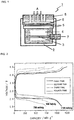
- a negative electrode 3 prepared in the method described above was placed at the bottom of the cell 2.
- a perforated lid 8 made of stainless steel and having holes to intake the air was placed on the topside of the air electrode 6 placed, and thus the lithium-air secondary cell (1) was prepared.
- the charge and discharge test was conducted in the prepared lithium-air secondary cell (1), in which the negative electrode 3 side is used as a counter electrode (CE) and reference electrode (RE) 7 (the counter electrode serves also as the reference electrode), and the air electrode 6 side was used as a working electrode (WE) (the air electrode serves also as the working electrode).
- CE counter electrode
- RE reference electrode
- WE working electrode
- the charge and discharge test was conducted at a constant current, a charge and discharge current density of 0.1 mA/cm 2 , a voltage range of 2.0 V to 4.0 V, and a temperature of 25°C.
- FIG. 2 shows the results of the constant current charge and discharge test on the lithium-air secondary cell (1) (4 cycles).
- the initial charge capacity of the lithium-air secondary cell (1) was 1130 mAh/g, and the capacity value was 750 mAh/g at the fourth cycle, which was still high.
- the lithium-air secondary cell (2) was prepared in the same manner as in Example 1 except that the compositions of the air electrode and the electrolyte solution were changed.
- Electrolytic MnO 2 (manufactured by Kojundo Chemical Laboratory Co., Ltd., 0.5 mg), Ketjen black (registered trademark) (KB) (EC600 JD, manufactured by Lion Corporation, 8.5 mg), and PTFE (polytetrafluoroethylene, manufactured by Aldrich Chemical Co., 1.0 mg) were mixed in a mortar, and the obtained pellet (10 mg) was pressure-bonded to a stainless mesh (SUS-3176, manufactured by The Nilaco Corporation, ⁇ 28 mm) to manufacture the air electrode.
- EMD Electrolytic MnO 2
- KB EC600 JD, manufactured by Lion Corporation, 8.5 mg
- PTFE polytetrafluoroethylene, manufactured by Aldrich Chemical Co., 1.0 mg
- DEC Diethyl carbonate
- EC ethylene carbonate
- the charge and discharge test was conducted at a constant current, a charge and discharge current of 0.1 mA/cm 2 , and a voltage range of 2.0 V to 4.5 V.
- FIG. 3 shows the results of the constant current charge and discharge test on the lithium-air secondary cell (2) is shown (3 cycles).
- both of the initial discharge capacity of the lithium-air secondary cell (2) and that of the cell using the electrolyte solution exceeded 1200 mAh/g, which shows that the cell using the gel-form solid electrolyte provides a discharge capacity comparable to that of the cell using the liquid electrolyte.
- the flat area of the electric potential of the cell using the gel-form solid electrolyte is slightly lower than that of the cell using the liquid electrolyte in both discharge and charge. This is presumed to be because diffusion of lithium ions in a gel is slower than that in a liquid.
- FIG. 3 shows that the cycle characteristic of the lithium-air secondary cell (2) using the gel-form solid electrolyte was deteriorated. This is presumed to be caused because the contact of the gel electrolyte with both of the positive electrode (air electrode) and the negative electrode at the interfaces was decreased, in particular caused by remarkable increase of a resistance at the air electrode side. Improvement of the cycle characteristic is expected by improving the contact with the gel electrolyte at the air electrode side.
- the lithium-air secondary cell (3) was prepared in the same manner as in the case of Example 1 except that the compositions of the air electrode and the electrolyte solution were changed.
- the air electrode used in Example 2 was used.
- ⁇ -butyrolactone (GBL, manufactured by Kishida Chemical Co., Ltd., an organic solvent for lithium primary/secondary/polymer cells & lithium ion capacitors, 3.3 g), DEC (manufactured by Kishida Chemical Co., Ltd., an organic solvent for lithium primary/secondary/polymer cells & lithium ion capacitors, 3.3 g), and EC (manufactured by Kishida Chemical Co., Ltd., an organic solvent for lithium primary/secondary/polymer cells & lithium ion capacitors, 3.3 g) were mixed.
- GBL Kishida Chemical Co., Ltd., an organic solvent for lithium primary/secondary/polymer cells & lithium ion capacitors, 3.3 g
- DEC manufactured by Kishida Chemical Co., Ltd., an organic solvent for lithium primary/secondary/polymer cells & lithium ion capacitors, 3.3 g
- EC manufactured by Kishida Chemical Co., Ltd
- the charge and discharge test was conducted at a constant current, a charge and discharge current of 0.1 mA/cm 2 , and a voltage range of 2.0 V to 4.5 V.
- FIG. 5 shows the result of the constant current charge and discharge test on the lithium-air secondary cell (3) (3 cycles).
- the initial charge and discharge capacity of the lithium-air secondary cell (3) exceeded 1000 mAh/g, and although the capacity was decreased at the second cycle, the capacity value at the third cycle again exceeded 1000 mAh/g that is a high capacity value.
- the results of further charge and discharge tests showed that charge and discharge were possible over 10 cycles.
- Example 2 The result showed that the cycle characteristic observed to be deteriorated in Example 2 can be improved by adding ⁇ -butyrolactone to the electrolyte solution used in Example 2.
- the lithium-air secondary cell (4) was prepared in the same manner as in Example 1 except that the compositions of the air electrode and the electrolyte solution were changed.
- the air electrode used in Example 2 was used.
- the electrolyte solution used in Example 3 was used.
- the charge and discharge test was conducted at a constant current, a charge and discharge current density of 0.1 mA/cm 2 , and a voltage range of 2.0 V to 4.5 V.
- alternating current impedance was measured after discharge was completed (the measurement instrument: an electrochemical analyzer Solartron 1280 + 1267, manufactured by Solartron Analytical Company).
- FIG. 6 shows the results of the constant current charge and discharge test on the lithium-air secondary cell (4) (3 cycles), and FIG. 7 shows the conductivity of the gel-form solid electrolyte after discharge, obtained by the alternating current impedance measurement.
- the conductivity of the gel electrolyte after 3 cycle-discharge was not largely changed, and the value was stable. This suggests that the stability of the gel electrolyte is improved by providing the prolonged resting time period after each of charge and discharge, which contributes to improvement in cycle characteristics of the lithium-air cells.
- the impedance characteristic was evaluated for each of the two types of gel used as the gel-form solid electrolytes in the lithium-air secondary cells (2) and (3) manufactured in Example 2 and Example 3.
- the alternating current impedance was measured at 25°C, and the equipment used was an electrochemical analyzer Solartron 1280 + 1267, manufactured by Solartron Analytical Company.
- Example 3 the value of conductivity was improved by adding GBL to an electrolyte solution, and by increasing a ratio of DEC.
- the gel used in Example 3, in which the mass ratio of EC : DEC : GBL was 1 : 1 : 1 showed good conductivity, around log ( ⁇ /S cm -1 ) -1.7, at room temperature. This suggests that improvement of conductivity of the gel resulting from addition of GBL and the like is one of reasons for the excellent cycle characteristic of charge and discharge in the lithium-air secondary cell of Example 3 described above.
- the alternating current impedance was measured in the same manner as in Example 5 except that the measurement was conducted under temperatures changed within the range from -20°C to 50°C.
- the alternating current impedance was measured in the same manner as described above except that the lipid peptide-type gelator of Synthesis Example 1 was not added to the electrolyte solution used in Example 3 to prevent gelation of the electrolyte (the state of an electrolyte solution (liquid) is maintained).
- FIG. 9 shows each of the obtained results (Arrhenius plot).
- the active energy Ea obtained from the Arrhenius plot shown in FIG. 9 was 0.155 (eV) for the gel-form solid electrolyte and was 0.149 (eV) for the electrolyte solution.
- the gel obtained by using a lipid peptide-type gelator defined by the present invention showed conductivity comparable to that of the electrolyte solution even when gelated.
- conductivity at a low temperature which has been a problem of gel electrolytes, was extremely high, and thus the gel electrolyte can be used even at -20°C.
- the alternating current impedance of the gel-form solid electrolyte was temporally measured for a period from (1 day) after the preparation until 30 days had passed.
- the alternating current impedance measurement was conducted by using the gel-form solid electrolyte and the measuring condition of Example 6, except that the measuring temperature was set to 25°C.
- the horizontal axis indicates the elapsed time (days), and the vertical axis indicates the interfacial resistance value of metal lithium (electrode) and the gel electrolyte, which was obtained from the alternating current impedance measurement.
- the lithium-air secondary cell (4) was prepared in the same manner as in Example 1 except that the compositions of the air electrode and the electrolyte solution were changed.
- the air electrode used in Example 2 was used.
- the electrolyte solution used in Example 3 was used.
- the charge and discharge test was conducted at a constant current, a charge and discharge current density of 0.1 mA/cm 2 , and a voltage range of 2.0 V to 4.5 V. In this test, the lithium-air secondary cell was cooled to 0°C.
- FIG. 11 shows the results of the constant current charge and discharge test on the lithium-air secondary cell (4) (3 cycles), and FIG. 12 shows the result of the cycle characteristic test for charge and discharge.
- the lithium-air secondary cell (5) was prepared in the same manner as in Example 1 except that the compositions of the air electrode and the electrolyte solution were changed.
- the air electrode used in Example 2 was used.
- ⁇ -butyrolactone (GBL, manufactured by Kishida Chemical Co., Ltd., an organic solvent for lithium primary/secondary/polymer cells & lithium ion capacitors, 3.3 g), DEC (manufactured by Kishida Chemical Co., Ltd., an organic solvent for lithium primary/secondary/polymer cells & lithium ion capacitors, 4.4 g), and EC (manufactured by Kishida Chemical Co., Ltd., an organic solvent for lithium primary/secondary/polymer cells & lithium ion capacitors, 2.2 g) were mixed.
- GBL Kishida Chemical Co., Ltd., an organic solvent for lithium primary/secondary/polymer cells & lithium ion capacitors, 3.3 g
- DEC manufactured by Kishida Chemical Co., Ltd., an organic solvent for lithium primary/secondary/polymer cells & lithium ion capacitors, 4.4 g
- EC manufactured by Kishida Chemical Co., Ltd
- the charge and discharge test was conducted at a constant current, a charge and discharge current of 0.1 mA/cm 2 , and a voltage range of 2.0 V to 4.5 V.
- FIG. 13 shows the results of the constant current charge and discharge test on the lithium-air secondary cell (5) (3 cycles).
Landscapes
- Chemical & Material Sciences (AREA)
- Engineering & Computer Science (AREA)
- Chemical Kinetics & Catalysis (AREA)
- Electrochemistry (AREA)
- General Chemical & Material Sciences (AREA)
- Materials Engineering (AREA)
- Manufacturing & Machinery (AREA)
- Hybrid Cells (AREA)
- Inert Electrodes (AREA)
- Conductive Materials (AREA)
Claims (11)
- Pile au lithium-air rechargeable caractérisée en ce qu'elle comprend :une électrode à air;une électrode négative contenant du lithium métal ou une matière contenant du lithium ;
etun électrolyte solide sous forme de gel, dans laquellel'électrolyte solide sous forme de gel contient un sel d'électrolyte solide, un solvant et un gélifiant de type lipide/peptide composé d'au moins un des composés de Formules (1) à (3) :

 où, dans la formule (3), R8 est un groupe aliphatique en C9-23, chacun de R9 à R12 est indépendamment un atome d'hydrogène, un groupe alkyle en C1-4 ayant de manière facultative une chaîne ramifiée en C1 ou C2, ou un groupe -(CH2)n-X, n est un nombre de 1 à 4, et X est un groupe amino, un groupe guanidino, un groupe -CONH2, un cycle à 5 éléments ayant de manière facultative 1 à 3 atomes d'azote, un cycle à 6 éléments ayant de manière facultative 1 à 3 atomes d'azote, ou un hétérocycle condensé qui est composé d'un cycle à 5 éléments et d'un cycle à 6 éléments et comporte de manière facultative 1 à 3 atomes d'azote, etdes sels des composés acceptables d'un point de vue pharmaceutique.
 - Pile au lithium-air rechargeable selon la revendication 1, caractérisée en ce que
le solvant contenu dans l'électrolyte solide sous forme de gel inclut un ester de carbonate à chaîne et soit un ester de carbonate cyclique soit un composé d'éther. - Pile au lithium-air rechargeable selon la revendication 2, dans laquelle
l'ester de carbonate à chaîne est sélectionné à partir du groupe constitué par du carbonate diméthylique, du carbonate diéthylique et du carbonate éthylméthylique. - Pile au lithium-air rechargeable selon la revendication 2, dans laquelle
l'ester de carbonate cyclique est du carbonate d'éthylène ou du carbonate de propylène. - Pile au lithium-air rechargeable selon la revendication 2, dans laquelle
le composé d'éther est du 1,2-diméthoxyéthane. - Pile au lithium-air rechargeable selon la revendication 1, caractérisée en ce que
le solvant contenu dans l'électrolyte solide sous forme de gel inclut un ester de carbonate à chaîne, un ester de carbonate cyclique et un ester de carboxylate cyclique. - Pile au lithium-air rechargeable selon la revendication 6, dans laquelle l'ester de carboxylate cyclique est de la γ-butyrolactone.
- Pile au lithium-air rechargeable selon l'une quelconque des revendications 1 à 7, caractérisée en ce que
l'électrode à air est composée en incluant un carbone poreux ou un carbone fin qui supporte, en tant que catalyseur, au moins un de métaux nobles sélectionnés à partir du groupe constitué par le platine, le rhodium, le palladium, l'argent et le ruthénium, et des oxydes de métal sélectionnés à partir du groupe constitué par un oxyde de pérovskite, un oxyde de manganèse, un oxyde de cobalt, un oxyde de nickel, un oxyde de fer et un oxyde de cuivre. - Pile au lithium-air rechargeable selon la revendication 8, caractérisée en ce que
l'électrode à air est composée en incluant un carbone poreux supportant un oxyde de manganèse. - Pile au lithium-air rechargeable selon l'une quelconque des revendications 1 à 9, caractérisée en ce que
l'électrode négative est du lithium métal. - Pile au lithium-air rechargeable selon l'une quelconque des revendications 1 à 10, caractérisée en ce que
le sel d'électrolyte solide est sélectionné à partir du groupe constitué par LiN(SO2C2F5)2, LiPF6, LiBF4, LiClO4, LiAsF6, LiCF3SO3, LiN(SO2CF3)2 et des mélanges de n'importe lesquels de LiN(SO2C2F5)2, LiPF6, LiBF4, LiClO4, LiAsF6, LiCF3SO3 et LiN(SO2CF3)2.
Applications Claiming Priority (2)
| Application Number | Priority Date | Filing Date | Title |
|---|---|---|---|
| JP2011226882 | 2011-10-14 | ||
| PCT/JP2012/076527 WO2013054922A1 (fr) | 2011-10-14 | 2012-10-12 | Elément métal-air muni d'un électrolyte solide sous forme de gel |
Publications (3)
| Publication Number | Publication Date |
|---|---|
| EP2768070A1 EP2768070A1 (fr) | 2014-08-20 |
| EP2768070A4 EP2768070A4 (fr) | 2015-07-08 |
| EP2768070B1 true EP2768070B1 (fr) | 2017-12-06 |
Family
ID=48081967
Family Applications (1)
| Application Number | Title | Priority Date | Filing Date |
|---|---|---|---|
| EP12840347.4A Not-in-force EP2768070B1 (fr) | 2011-10-14 | 2012-10-12 | Élément métal-air muni d'un électrolyte solide sous forme de gel |
Country Status (6)
| Country | Link |
|---|---|
| US (1) | US9431689B2 (fr) |
| EP (1) | EP2768070B1 (fr) |
| JP (1) | JP5988986B2 (fr) |
| KR (1) | KR20140084170A (fr) |
| CN (1) | CN103988361B (fr) |
| WO (1) | WO2013054922A1 (fr) |
Families Citing this family (8)
| Publication number | Priority date | Publication date | Assignee | Title |
|---|---|---|---|---|
| CN103515676B (zh) * | 2013-09-29 | 2015-06-17 | 吉林大学 | 全固态可分离式铝空气电池 |
| CN104659375B (zh) * | 2015-02-09 | 2016-05-25 | 华中科技大学 | 一种导电凝胶颗粒构成的空气正极及其锂空气电池 |
| KR101720105B1 (ko) | 2015-05-08 | 2017-03-28 | 한국에너지기술연구원 | 질화처리된 고체 전해질, 그 제조방법 및 이를 포함하는 하이브리드 리튬 전지 |
| JP6996840B2 (ja) * | 2016-10-19 | 2022-02-03 | トヨタ自動車株式会社 | 負極の製造方法 |
| CN106601979A (zh) * | 2016-12-08 | 2017-04-26 | 德阳九鼎智远知识产权运营有限公司 | 一种二次电池负极 |
| CN107068962A (zh) * | 2016-12-08 | 2017-08-18 | 德阳九鼎智远知识产权运营有限公司 | 一种二次电池负电极制备方法 |
| CN111933951B (zh) * | 2020-08-25 | 2021-10-15 | 中南大学 | 一种锂金属活性前驱材料及其制备和应用 |
| CN113258137B (zh) * | 2021-05-07 | 2022-05-10 | 厦门大学 | 一种提高锂空气电池电化学性能的电解液添加剂 |
Family Cites Families (13)
| Publication number | Priority date | Publication date | Assignee | Title |
|---|---|---|---|---|
| US20030165743A1 (en) * | 1998-10-19 | 2003-09-04 | Tomonari Horikiri | Gel electrolyte, cell and electrochromic element |
| JP2007042532A (ja) * | 2005-08-05 | 2007-02-15 | Nissan Motor Co Ltd | 液状電解質 |
| JP5125461B2 (ja) | 2007-01-18 | 2013-01-23 | 株式会社豊田中央研究所 | リチウム空気電池 |
| EP2559697B1 (fr) * | 2007-07-05 | 2014-03-26 | Nissan Chemical Industries, Ltd. | Nouveau peptide lipidique et hydrogel |
| US8486896B2 (en) * | 2007-07-05 | 2013-07-16 | Nissan Chemical Industries, Ltd. | Lipid tripeptide-based hydrogelator and hydrogel |
| CN101165964A (zh) * | 2007-09-20 | 2008-04-23 | 复旦大学 | 一种不对称的二次空气燃料电池 |
| US9178255B2 (en) | 2008-06-20 | 2015-11-03 | University Of Dayton | Lithium-air cells incorporating solid electrolytes having enhanced ionic transport and catalytic activity |
| CN102105553B (zh) * | 2008-08-01 | 2013-11-13 | 日产化学工业株式会社 | 新的脂质二肽和凝胶 |
| WO2010073332A1 (fr) * | 2008-12-25 | 2010-07-01 | トヨタ自動車株式会社 | Batterie lithium-air |
| JP2010176907A (ja) | 2009-01-27 | 2010-08-12 | Toyota Central R&D Labs Inc | リチウム空気電池 |
| JP5354580B2 (ja) | 2009-01-28 | 2013-11-27 | 独立行政法人産業技術総合研究所 | リチウム−空気電池 |
| JP2010287390A (ja) * | 2009-06-10 | 2010-12-24 | Toyota Motor Corp | 金属空気二次電池 |
| JP5664864B2 (ja) * | 2011-03-07 | 2015-02-04 | 日産化学工業株式会社 | ゲル電解質 |
-
2012
- 2012-10-12 EP EP12840347.4A patent/EP2768070B1/fr not_active Not-in-force
- 2012-10-12 US US14/351,729 patent/US9431689B2/en not_active Expired - Fee Related
- 2012-10-12 JP JP2013538605A patent/JP5988986B2/ja active Active
- 2012-10-12 KR KR1020147012726A patent/KR20140084170A/ko not_active Ceased
- 2012-10-12 WO PCT/JP2012/076527 patent/WO2013054922A1/fr not_active Ceased
- 2012-10-12 CN CN201280061610.1A patent/CN103988361B/zh not_active Expired - Fee Related
Non-Patent Citations (1)
| Title |
|---|
| None * |
Also Published As
| Publication number | Publication date |
|---|---|
| CN103988361A (zh) | 2014-08-13 |
| EP2768070A4 (fr) | 2015-07-08 |
| US9431689B2 (en) | 2016-08-30 |
| JPWO2013054922A1 (ja) | 2015-04-02 |
| KR20140084170A (ko) | 2014-07-04 |
| WO2013054922A1 (fr) | 2013-04-18 |
| JP5988986B2 (ja) | 2016-09-07 |
| CN103988361B (zh) | 2016-09-21 |
| EP2768070A1 (fr) | 2014-08-20 |
| US20140295296A1 (en) | 2014-10-02 |
Similar Documents
| Publication | Publication Date | Title |
|---|---|---|
| EP2768070B1 (fr) | Élément métal-air muni d'un électrolyte solide sous forme de gel | |
| Yang et al. | Fluorinated carboxylate ester-based electrolyte for lithium ion batteries operated at low temperature | |
| Imanishi et al. | Rechargeable lithium–air batteries: characteristics and prospects | |
| JP5461883B2 (ja) | 二次電池用非水電解液及び非水電解液二次電池 | |
| US9269997B2 (en) | Rechargeable alkali metal-air battery | |
| US12148889B2 (en) | Non-aqueous electrolyteincluding lithium bis(fluorosulfonyl)imide, fluorinated acyclic carboxylic acid ester, organic carbonate and electrolyte salt | |
| US10957953B2 (en) | Lithium oxygen battery and electrolyte composition | |
| Walker Jr et al. | Conductivity and electrochemical stability of electrolytes containing organic solvent mixtures with lithium tris (trifluoromethanesulfonyl) methide | |
| EP4016686A1 (fr) | Solution d'électrolyte non aqueux, batterie à électrolyte non aqueux et composé | |
| US20140255802A1 (en) | Stable non-aqueous electrolyte promoting ideal reaction process in rechargeable lithium-air batteries | |
| EP3240094B1 (fr) | Solution électrolytique pour batteries secondaires et batterie secondaire la comprenant | |
| JP2001313071A (ja) | 非水電解液及びそれを用いたリチウム二次電池 | |
| US9928970B2 (en) | Lithium ion capacitor | |
| Smith et al. | Electrolytes containing fluorinated ester co-solvents for low-temperature Li-ion cells | |
| Lewandowski et al. | Properties of the lithium and graphite–lithium anodes in N-methyl-N-propylpyrrolidinium bis (trifluoromethanesulfonyl) imide | |
| JP2005285492A (ja) | 非水電解液およびそれを用いたリチウム二次電池 | |
| JP4226844B2 (ja) | 電気化学ディバイス用部材の腐食抑制方法及び電池 | |
| JP2010238385A (ja) | 二次電池用非水電解液及び非水電解液二次電池 | |
| US20200161708A1 (en) | Battery | |
| JPH1126016A (ja) | リチウム二次電池用電解液 | |
| Seong et al. | Ionic additives to increase electrochemical utilization of sulfur cathode for Li-S batteries | |
| WO2015186568A1 (fr) | Solution électrolytique non aqueuse et dispositif de stockage d'électricité l'utilisant | |
| JP3974012B2 (ja) | 電気化学ディバイス用電解質、その電解液または固体電解質並びに電池 | |
| Wang et al. | High-voltage LiNi0. 4Co0. 4Mn0. 2O2/graphite pouch battery cycled at 4.5 V with a LiDFP-based electrolyte | |
| JP2004103372A (ja) | 電気化学ディバイス用非水電解液及びそれを用いた電気化学ディバイス |
Legal Events
| Date | Code | Title | Description |
|---|---|---|---|
| PUAI | Public reference made under article 153(3) epc to a published international application that has entered the european phase |
Free format text: ORIGINAL CODE: 0009012 |
|
| 17P | Request for examination filed |
Effective date: 20140425 |
|
| AK | Designated contracting states |
Kind code of ref document: A1 Designated state(s): AL AT BE BG CH CY CZ DE DK EE ES FI FR GB GR HR HU IE IS IT LI LT LU LV MC MK MT NL NO PL PT RO RS SE SI SK SM TR |
|
| DAX | Request for extension of the european patent (deleted) | ||
| RA4 | Supplementary search report drawn up and despatched (corrected) |
Effective date: 20150609 |
|
| RIC1 | Information provided on ipc code assigned before grant |
Ipc: H01M 4/92 20060101ALN20150602BHEP Ipc: H01M 12/08 20060101AFI20150602BHEP Ipc: H01M 4/90 20060101ALI20150602BHEP Ipc: H01M 4/38 20060101ALI20150602BHEP |
|
| RIC1 | Information provided on ipc code assigned before grant |
Ipc: H01M 12/08 20060101AFI20170410BHEP Ipc: H01M 4/90 20060101ALI20170410BHEP Ipc: H01M 4/92 20060101ALN20170410BHEP Ipc: H01M 4/38 20060101ALI20170410BHEP |
|
| GRAP | Despatch of communication of intention to grant a patent |
Free format text: ORIGINAL CODE: EPIDOSNIGR1 |
|
| INTG | Intention to grant announced |
Effective date: 20170523 |
|
| GRAS | Grant fee paid |
Free format text: ORIGINAL CODE: EPIDOSNIGR3 |
|
| GRAA | (expected) grant |
Free format text: ORIGINAL CODE: 0009210 |
|
| AK | Designated contracting states |
Kind code of ref document: B1 Designated state(s): AL AT BE BG CH CY CZ DE DK EE ES FI FR GB GR HR HU IE IS IT LI LT LU LV MC MK MT NL NO PL PT RO RS SE SI SK SM TR |
|
| REG | Reference to a national code |
Ref country code: GB Ref legal event code: FG4D |
|
| REG | Reference to a national code |
Ref country code: AT Ref legal event code: REF Ref document number: 953158 Country of ref document: AT Kind code of ref document: T Effective date: 20171215 Ref country code: CH Ref legal event code: EP |
|
| REG | Reference to a national code |
Ref country code: IE Ref legal event code: FG4D |
|
| REG | Reference to a national code |
Ref country code: DE Ref legal event code: R096 Ref document number: 602012040703 Country of ref document: DE |
|
| REG | Reference to a national code |
Ref country code: NL Ref legal event code: MP Effective date: 20171206 |
|
| REG | Reference to a national code |
Ref country code: LT Ref legal event code: MG4D |
|
| PG25 | Lapsed in a contracting state [announced via postgrant information from national office to epo] |
Ref country code: ES Free format text: LAPSE BECAUSE OF FAILURE TO SUBMIT A TRANSLATION OF THE DESCRIPTION OR TO PAY THE FEE WITHIN THE PRESCRIBED TIME-LIMIT Effective date: 20171206 Ref country code: FI Free format text: LAPSE BECAUSE OF FAILURE TO SUBMIT A TRANSLATION OF THE DESCRIPTION OR TO PAY THE FEE WITHIN THE PRESCRIBED TIME-LIMIT Effective date: 20171206 Ref country code: SE Free format text: LAPSE BECAUSE OF FAILURE TO SUBMIT A TRANSLATION OF THE DESCRIPTION OR TO PAY THE FEE WITHIN THE PRESCRIBED TIME-LIMIT Effective date: 20171206 Ref country code: LT Free format text: LAPSE BECAUSE OF FAILURE TO SUBMIT A TRANSLATION OF THE DESCRIPTION OR TO PAY THE FEE WITHIN THE PRESCRIBED TIME-LIMIT Effective date: 20171206 Ref country code: NO Free format text: LAPSE BECAUSE OF FAILURE TO SUBMIT A TRANSLATION OF THE DESCRIPTION OR TO PAY THE FEE WITHIN THE PRESCRIBED TIME-LIMIT Effective date: 20180306 |
|
| REG | Reference to a national code |
Ref country code: AT Ref legal event code: MK05 Ref document number: 953158 Country of ref document: AT Kind code of ref document: T Effective date: 20171206 |
|
| PG25 | Lapsed in a contracting state [announced via postgrant information from national office to epo] |
Ref country code: GR Free format text: LAPSE BECAUSE OF FAILURE TO SUBMIT A TRANSLATION OF THE DESCRIPTION OR TO PAY THE FEE WITHIN THE PRESCRIBED TIME-LIMIT Effective date: 20180307 Ref country code: RS Free format text: LAPSE BECAUSE OF FAILURE TO SUBMIT A TRANSLATION OF THE DESCRIPTION OR TO PAY THE FEE WITHIN THE PRESCRIBED TIME-LIMIT Effective date: 20171206 Ref country code: BG Free format text: LAPSE BECAUSE OF FAILURE TO SUBMIT A TRANSLATION OF THE DESCRIPTION OR TO PAY THE FEE WITHIN THE PRESCRIBED TIME-LIMIT Effective date: 20180306 Ref country code: LV Free format text: LAPSE BECAUSE OF FAILURE TO SUBMIT A TRANSLATION OF THE DESCRIPTION OR TO PAY THE FEE WITHIN THE PRESCRIBED TIME-LIMIT Effective date: 20171206 Ref country code: HR Free format text: LAPSE BECAUSE OF FAILURE TO SUBMIT A TRANSLATION OF THE DESCRIPTION OR TO PAY THE FEE WITHIN THE PRESCRIBED TIME-LIMIT Effective date: 20171206 |
|
| PG25 | Lapsed in a contracting state [announced via postgrant information from national office to epo] |
Ref country code: NL Free format text: LAPSE BECAUSE OF FAILURE TO SUBMIT A TRANSLATION OF THE DESCRIPTION OR TO PAY THE FEE WITHIN THE PRESCRIBED TIME-LIMIT Effective date: 20171206 |
|
| PG25 | Lapsed in a contracting state [announced via postgrant information from national office to epo] |
Ref country code: CZ Free format text: LAPSE BECAUSE OF FAILURE TO SUBMIT A TRANSLATION OF THE DESCRIPTION OR TO PAY THE FEE WITHIN THE PRESCRIBED TIME-LIMIT Effective date: 20171206 Ref country code: EE Free format text: LAPSE BECAUSE OF FAILURE TO SUBMIT A TRANSLATION OF THE DESCRIPTION OR TO PAY THE FEE WITHIN THE PRESCRIBED TIME-LIMIT Effective date: 20171206 Ref country code: SK Free format text: LAPSE BECAUSE OF FAILURE TO SUBMIT A TRANSLATION OF THE DESCRIPTION OR TO PAY THE FEE WITHIN THE PRESCRIBED TIME-LIMIT Effective date: 20171206 |
|
| PG25 | Lapsed in a contracting state [announced via postgrant information from national office to epo] |
Ref country code: IT Free format text: LAPSE BECAUSE OF FAILURE TO SUBMIT A TRANSLATION OF THE DESCRIPTION OR TO PAY THE FEE WITHIN THE PRESCRIBED TIME-LIMIT Effective date: 20171206 Ref country code: RO Free format text: LAPSE BECAUSE OF FAILURE TO SUBMIT A TRANSLATION OF THE DESCRIPTION OR TO PAY THE FEE WITHIN THE PRESCRIBED TIME-LIMIT Effective date: 20171206 Ref country code: AT Free format text: LAPSE BECAUSE OF FAILURE TO SUBMIT A TRANSLATION OF THE DESCRIPTION OR TO PAY THE FEE WITHIN THE PRESCRIBED TIME-LIMIT Effective date: 20171206 Ref country code: SM Free format text: LAPSE BECAUSE OF FAILURE TO SUBMIT A TRANSLATION OF THE DESCRIPTION OR TO PAY THE FEE WITHIN THE PRESCRIBED TIME-LIMIT Effective date: 20171206 Ref country code: PL Free format text: LAPSE BECAUSE OF FAILURE TO SUBMIT A TRANSLATION OF THE DESCRIPTION OR TO PAY THE FEE WITHIN THE PRESCRIBED TIME-LIMIT Effective date: 20171206 |
|
| REG | Reference to a national code |
Ref country code: DE Ref legal event code: R097 Ref document number: 602012040703 Country of ref document: DE |
|
| PLBE | No opposition filed within time limit |
Free format text: ORIGINAL CODE: 0009261 |
|
| STAA | Information on the status of an ep patent application or granted ep patent |
Free format text: STATUS: NO OPPOSITION FILED WITHIN TIME LIMIT |
|
| 26N | No opposition filed |
Effective date: 20180907 |
|
| PG25 | Lapsed in a contracting state [announced via postgrant information from national office to epo] |
Ref country code: DK Free format text: LAPSE BECAUSE OF FAILURE TO SUBMIT A TRANSLATION OF THE DESCRIPTION OR TO PAY THE FEE WITHIN THE PRESCRIBED TIME-LIMIT Effective date: 20171206 Ref country code: SI Free format text: LAPSE BECAUSE OF FAILURE TO SUBMIT A TRANSLATION OF THE DESCRIPTION OR TO PAY THE FEE WITHIN THE PRESCRIBED TIME-LIMIT Effective date: 20171206 |
|
| REG | Reference to a national code |
Ref country code: DE Ref legal event code: R119 Ref document number: 602012040703 Country of ref document: DE |
|
| REG | Reference to a national code |
Ref country code: CH Ref legal event code: PL |
|
| GBPC | Gb: european patent ceased through non-payment of renewal fee |
Effective date: 20181012 |
|
| REG | Reference to a national code |
Ref country code: BE Ref legal event code: MM Effective date: 20181031 |
|
| PG25 | Lapsed in a contracting state [announced via postgrant information from national office to epo] |
Ref country code: MC Free format text: LAPSE BECAUSE OF FAILURE TO SUBMIT A TRANSLATION OF THE DESCRIPTION OR TO PAY THE FEE WITHIN THE PRESCRIBED TIME-LIMIT Effective date: 20171206 Ref country code: LU Free format text: LAPSE BECAUSE OF NON-PAYMENT OF DUE FEES Effective date: 20181012 |
|
| REG | Reference to a national code |
Ref country code: IE Ref legal event code: MM4A |
|
| PG25 | Lapsed in a contracting state [announced via postgrant information from national office to epo] |
Ref country code: DE Free format text: LAPSE BECAUSE OF NON-PAYMENT OF DUE FEES Effective date: 20190501 |
|
| PG25 | Lapsed in a contracting state [announced via postgrant information from national office to epo] |
Ref country code: FR Free format text: LAPSE BECAUSE OF NON-PAYMENT OF DUE FEES Effective date: 20181031 Ref country code: CH Free format text: LAPSE BECAUSE OF NON-PAYMENT OF DUE FEES Effective date: 20181031 Ref country code: LI Free format text: LAPSE BECAUSE OF NON-PAYMENT OF DUE FEES Effective date: 20181031 Ref country code: BE Free format text: LAPSE BECAUSE OF NON-PAYMENT OF DUE FEES Effective date: 20181031 |
|
| PG25 | Lapsed in a contracting state [announced via postgrant information from national office to epo] |
Ref country code: IE Free format text: LAPSE BECAUSE OF NON-PAYMENT OF DUE FEES Effective date: 20181012 Ref country code: GB Free format text: LAPSE BECAUSE OF NON-PAYMENT OF DUE FEES Effective date: 20181012 |
|
| PG25 | Lapsed in a contracting state [announced via postgrant information from national office to epo] |
Ref country code: MT Free format text: LAPSE BECAUSE OF NON-PAYMENT OF DUE FEES Effective date: 20181012 |
|
| PG25 | Lapsed in a contracting state [announced via postgrant information from national office to epo] |
Ref country code: TR Free format text: LAPSE BECAUSE OF FAILURE TO SUBMIT A TRANSLATION OF THE DESCRIPTION OR TO PAY THE FEE WITHIN THE PRESCRIBED TIME-LIMIT Effective date: 20171206 |
|
| PG25 | Lapsed in a contracting state [announced via postgrant information from national office to epo] |
Ref country code: PT Free format text: LAPSE BECAUSE OF FAILURE TO SUBMIT A TRANSLATION OF THE DESCRIPTION OR TO PAY THE FEE WITHIN THE PRESCRIBED TIME-LIMIT Effective date: 20171206 |
|
| PG25 | Lapsed in a contracting state [announced via postgrant information from national office to epo] |
Ref country code: MK Free format text: LAPSE BECAUSE OF NON-PAYMENT OF DUE FEES Effective date: 20171206 Ref country code: CY Free format text: LAPSE BECAUSE OF FAILURE TO SUBMIT A TRANSLATION OF THE DESCRIPTION OR TO PAY THE FEE WITHIN THE PRESCRIBED TIME-LIMIT Effective date: 20171206 Ref country code: HU Free format text: LAPSE BECAUSE OF FAILURE TO SUBMIT A TRANSLATION OF THE DESCRIPTION OR TO PAY THE FEE WITHIN THE PRESCRIBED TIME-LIMIT; INVALID AB INITIO Effective date: 20121012 |
|
| PG25 | Lapsed in a contracting state [announced via postgrant information from national office to epo] |
Ref country code: AL Free format text: LAPSE BECAUSE OF FAILURE TO SUBMIT A TRANSLATION OF THE DESCRIPTION OR TO PAY THE FEE WITHIN THE PRESCRIBED TIME-LIMIT Effective date: 20171206 Ref country code: IS Free format text: LAPSE BECAUSE OF FAILURE TO SUBMIT A TRANSLATION OF THE DESCRIPTION OR TO PAY THE FEE WITHIN THE PRESCRIBED TIME-LIMIT Effective date: 20180406 |